Advertise with Googlier.comAmber Hewett Archives - The National Wildlife Federation Blog
https://blog.nwf.org/authors/amber-hewett/
The National Wildlife Federation's blogSat, 15 Dec 2018 01:32:36 +0000en-US
hourly
1 https://wordpress.org/?v=7.1.1Offshore Wind Lease Auction Blows Old Record Out of the Water
https://blog.nwf.org/2018/12/offshore-wind-lease-auction-blows-past-record-out-of-the-water/
Fri, 14 Dec 2018 22:18:57 +0000http://blog.nwf.org/?p=138096What a difference a few years and visionary leadership can make. This morning, developers finished 32 rounds of bidding on areas of federal waters off the coast of Massachusetts designated … Read more
]]>The three easternmost areas (0520, 0521, and 0522) sold today for a collective $405 million. Map: Bureau of Ocean Energy Management
What a difference a few years and visionary leadership can make. This morning, developers finished 32 rounds of bidding on areas of federal waters off the coast of Massachusetts designated for offshore wind power development. The three areas drew a collective total of just over $405 million. Moving from west to east, the winning bidders are Equinor Wind, Mayflower Wind Energy, and Vineyard Wind, with bids of $135 million, $135 million, and $135.1 million, respectively.
Zero to hundreds of millions in four years– what happened?!
What has changed to spike such intense competition? Quite a bit, actually. Despite the fact that the U.S. has yet to get a single offshore wind turbine built in federal waters (the nation’s only five turbines stand in Rhode Island state waters), globally speaking the offshore wind industry is booming – and has been growing for decades. The U.S. Atlantic Coast is prime for offshore wind development; it’s home to plenty of demand for power, a strong and consistent wind resource, and a gradually sloping outer continental shelf essential for fixing turbines to the seafloor.
Offshore wind developers worldwide have had an eye on this part of the planet for quite some time – while eagerly awaiting a shift in the political climate.
Back in 2015, while thousands of offshore wind turbines operated to great success around the globe, decision-makers in the U.S. were still grappling with whether to support the concept. There was some policy progress in the Mid-Atlantic, but not a single Northeast state had made a large-scale commitment to offshore wind power development. Massachusetts’s Cape Wind project had just lost its utility contracts after over a decade of legal battles with deep-pocketed opponents unwilling to share Nantucket Sound with wind turbines, and the few developers willing to take the gamble on U.S. development had already acquired a handful of other lease areas – stretching any thinner with such uncertainty would have been tough to justify.
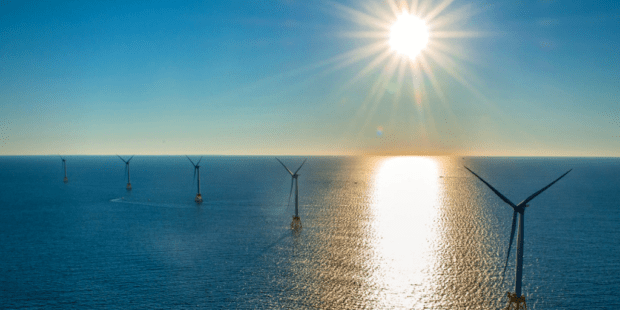
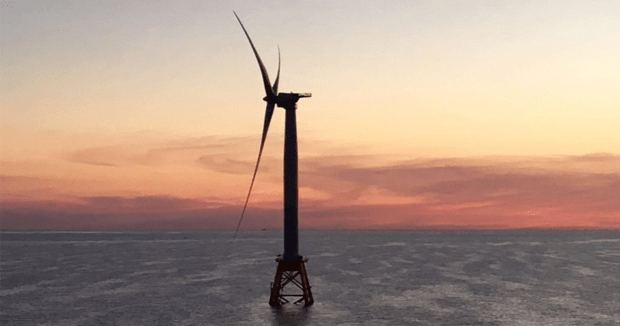
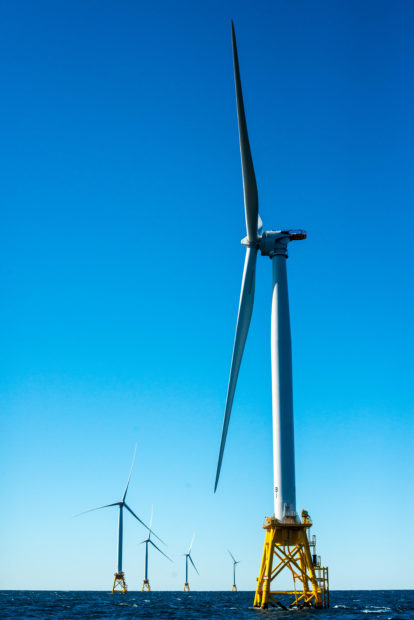
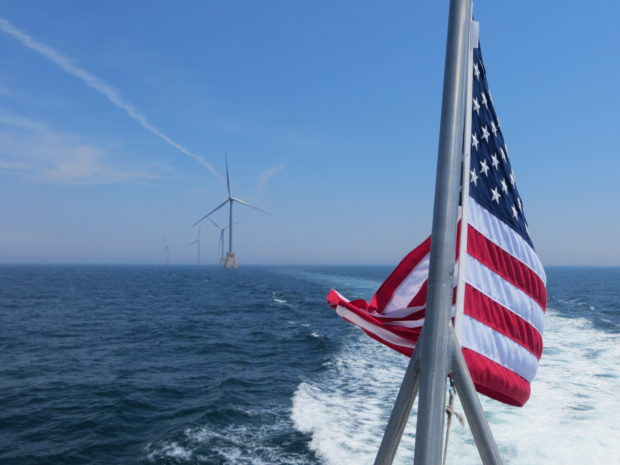
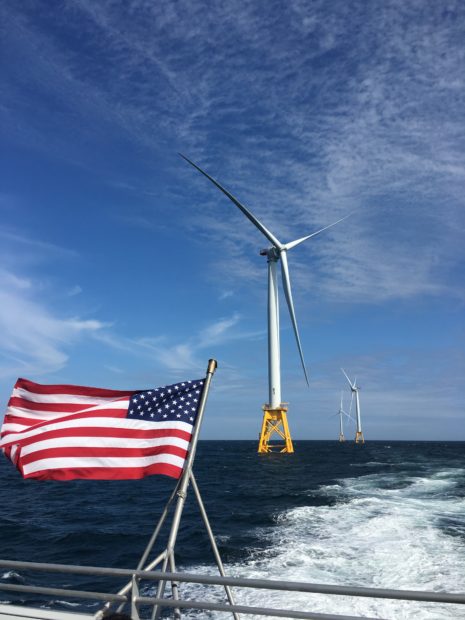
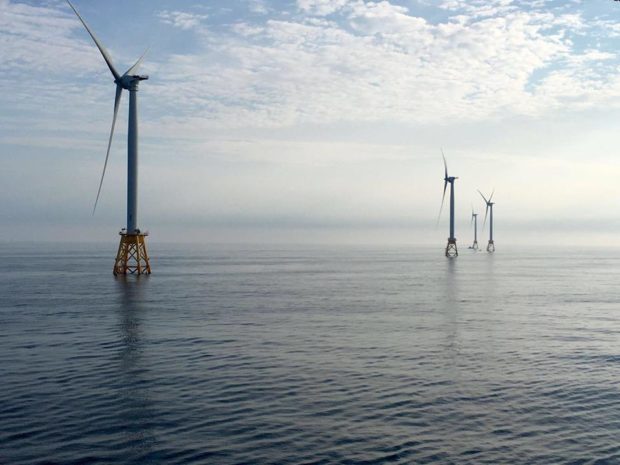
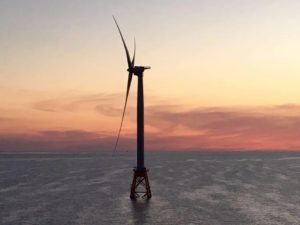
The Block Island Wind Farm is currently America’s only offshore wind power project – five turbines in Rhode Island State Waters. Photo: NWF
Since then, the U.S. offshore wind story has turned from a crawl to a full sprint. The Block Island Wind Farm is up and running, demonstrating what these feats of engineering are capable of: replacing fossil fuel-fired power plants and providing clean, domestic power right when and where we need it most. Massachusetts, New York, and New Jersey have made assertive commitments to develop enough offshore wind power for hundreds of thousands of homes apiece. Massachusetts, New York, Rhode Island, and Connecticut are advancing specific project contracts. It’s a new day for offshore wind power in the Northeast. The opportunity is here and now, and developers are vying to get in the game.
“This historic auction clearly demonstrates investor confidence in America’s offshore wind market, thanks to the leadership of states like Massachusetts, New York, and New Jersey that have set long term, large scale commitments to finally bring this critically needed climate solution online… The National Wildlife Federation applauds the Bureau of Ocean Energy Management for a successful auction and congratulates Equinor Wind, Mayflower Wind Energy and Vineyard Wind for securing these new leases. Looking forward, we will continue to work with all leaseholders to ensure that coastal and marine wildlife are protected throughout every stage of the offshore wind development process.”
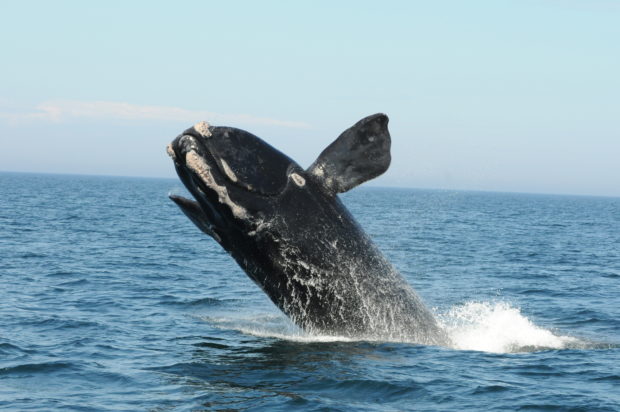
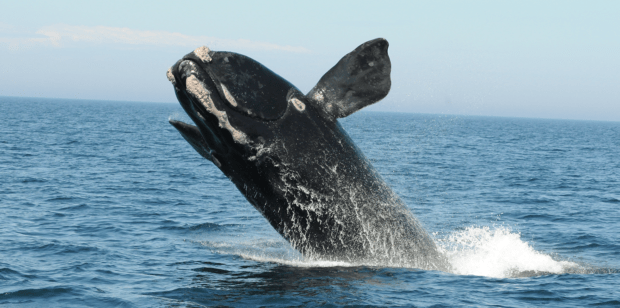
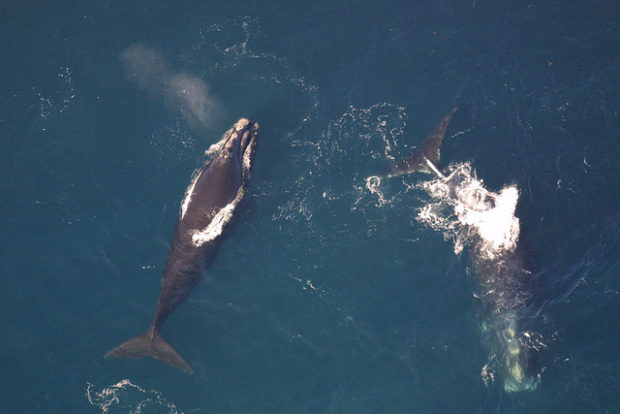
NWF works to ensure that all species, such as the endangered North Atlantic Right Whale, are carefully protected during all stages of offshore wind power development. Photo by New England Aquarium, Collected under NMFS permit 14233
There’s still a long way to go from here. Developers now need to learn the details of their areas, design projects, secure power contracts and an extensive number of permits, and much more. There are public comment periods every step of the way, and ample opportunity to raise and work through concerns.
The National Wildlife Federation looks forward to working with these new lease holders to ensure that wildlife and habitat will be protected throughout every stage of surveying and development. We will continue to advocate for the swift and responsible development of offshore wind power, and we hope you will join us in speaking up for this important clean energy solution. Offshore wind power can play a key role in transforming our energy profile into one we can be proud of – and it will take all of us pushing in that direction to ensure we seize the opportunity closer to our grasp than ever before.
]]>138096Offshore Wind Power: A Clean Energy Victory for Wildlife!
https://blog.nwf.org/2018/11/virginia-to-build-the-first-two-offshore-wind-turbines-in-federal-waters/
Thu, 15 Nov 2018 21:00:08 +0000http://blog.nwf.org/?p=137730Virginia to Build the First Two Offshore Wind Turbines in Federal Waters For years, states along the Atlantic Coast have been striving to get offshore wind turbines built in federal … Read more
]]>Virginia to Build the First Two Offshore Wind Turbines in Federal Waters
For years, states along the Atlantic Coast have been striving to get offshore wind turbines built in federal waters. 2018 has been rich with progress, particularly in the Northeast region, but no state has yet won the race to be first. Though Virginia has hardly been a front-runner to date, a recent turn of events put Dominion Energy on track to pioneer construction within the next year.
Earlier this month, Virginia’s State Corporation Commission approved a two-turbine demonstration project, Coastal Virginia Offshore Wind (CVOW), to be built 27 miles from shore. CVOW is a collaboration between Dominion Energy and the leading global offshore wind developer, Ørsted. The project will generate 12 megawatts (MW) of clean energy – enough to power 3,000 homes in the Commonwealth – and will provide lessons to hopefully inform larger offshore wind development in the years ahead.
In 2013, the U.S. Department of the Interior auctioned a 112,800 acre area of federal waters designated for offshore wind development just over 23 miles off of Virginia Beach, and Dominion placed the highest bid. For the five years since, Dominion has cited concerns about the high cost of offshore wind energy as reason for postponing build-out of the wind energy area – ultimately capable of supplying power to more than half a million homes. In the meantime, areas of federal water have been leased, spanning from Massachusetts to North Carolina, and states are grappling to figure out exactly how to seize the massive opportunity within them.
Wildlife and Offshore Wind
Kemp’s ridley sea turtles. Photo Credit: USFWS
Rising sea levels brought on by climate change are eroding beaches and destroying the critical nesting grounds Kemp’s ridley sea turtles rely on to lay their eggs. All along the coast, similar impacts are threatening species like piping plovers and Florida Key deer. Currently, carbon-emitting coal plants and other fossil fuel-generated energy are contributing heavily to climate-disrupting carbon pollution. But with renewable energy like offshore wind power, we can reduce our contribution to climate change and protect the critical coastal habitats sea turtles need to survive.
The National Wildlife Federation is committed to ensuring that as offshore wind power moves forward, the highest standards of wildlife protection are in place every step of the way. Because offshore wind power is new to the nation, we have the opportunity to do this right from the start. NWF is working closely with developers, state and federal government officials, conservation partners, and many ocean users to ensure that wildlife and habitat protection is considered at every decision point, from siting to construction, and ultimately during operation and maintenance of offshore wind projects.
National Wildlife Federation works closely with developers, government officials, and conservation partners to ensure that species like the North Atlantic right whale will be carefully protected throughout every stage of offshore wind development. Photo by New England Aquarium, Collected under NMFS permit 14233
European nations have been building offshore wind turbines and advancing their technology for nearly three decades – and they now host a collective total of over 4,000 turbines powering millions of homes and businesses with clean, local energy. Finally, in 2016, Rhode Island managed to install America’s first five turbines. The Block Island Wind Farm stands in state waters, which typically extend three miles from a coastline. Beyond three miles (where the wind is often stronger and more consistent), falls under federal jurisdiction and requires coordination between state and federal officials, offshore wind developers, ocean users, and members of the public for any development to move forward. That is an orchestra no one has yet to successfully conduct – but many states are getting close.
Massachusetts, New York, New Jersey, Connecticut, Rhode Island, and Maryland are all at various stages of getting a project in the water. The list of incentives is long. Offshore wind power can help states meet urgent greenhouse gas reduction targets. It will create thousands of jobs in-state and in the surrounding region – the industry supports 80,000 jobs in Europe. And once projects make up a significant portion of a state’s energy mix, they will help buffer ratepayers from spikes in the volatile fossil fuel market.
Taking on as transformative an endeavor as offshore wind development has the potential to be requires foresight. It requires early investments in research, stakeholder engagement, infrastructure development, and workforce training. It has to be done right, with stringent measures in place to protect marine and coastal wildlife and habitat every step of the way.
The Block Island Wind Farm’s turbines stand 600 feet tall, the same size as the two planned off of Virginia. Photo from Deepwater Wind
The challenge is great, but the opportunity is greater. Finding a path forward holds immense environmental and economic promise, and will likely inspire other states to follow. Virginia is forging a path different than that of any other state leading the way – and it looks like this path will get us 3,000 homes closer to a clean energy future by 2020. We’ll take it. And we look forward to working closely with Virginia’s leaders ensure that these first two turbines clear the way for many more to follow. Communities, wildlife, and wild places are counting on us getting this right and going big, sooner rather than later.
]]>137730Massachusetts Invites Bids for Nation’s Largest Offshore Wind Power Development
https://blog.nwf.org/2017/06/massachusetts-invites-bids-for-nations-largest-offshore-wind-power-development/
Thu, 29 Jun 2017 18:33:45 +0000http://blog.nwf.org/?p=129151On June 29th, Massachusetts took a nationally unprecedented step forward for clean energy. Offshore wind power developers holding leases more than ten miles off the coast of the Commonwealth are now formally … Read more
]]>America’s first and only offshore wind turbines – the Block Island Wind Farm. Photo by NWF
On June 29th, Massachusetts took a nationally unprecedented step forward for clean energy. Offshore wind power developers holding leases more than ten miles off the coast of the Commonwealth are now formally invited to submit bids for projects large enough to replace retiring nuclear and coal-fired power plants. Under the requirement of the energy bill signed into law last summer, Massachusetts will consider the competitive bids before selecting one or multiple projects to generate enough clean, local power for more than 180,000 homes.
With America’s first offshore wind power project now up and running – the five-turbine Block Island Wind Farm – it’s time to take this resource to the next level and catch up to the nearly three decades of progress overseas. Massachusetts is on track to lead the way.
“The national significance of this moment cannot be overstated. Our most abundant, home-grown, clean energy resource will soon be delivering cleaner air, cleaner water, and quality jobs to the Commonwealth, all while helping protect communities and wildlife from climate change. We urge Massachusetts’s leadership to maintain this critically important momentum toward the clean energy future within reach.”
– National Wildlife Federation Senior Manager, Catherine Bowes
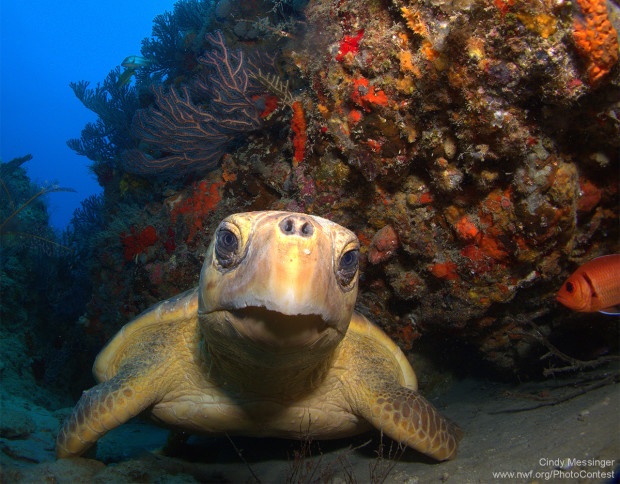
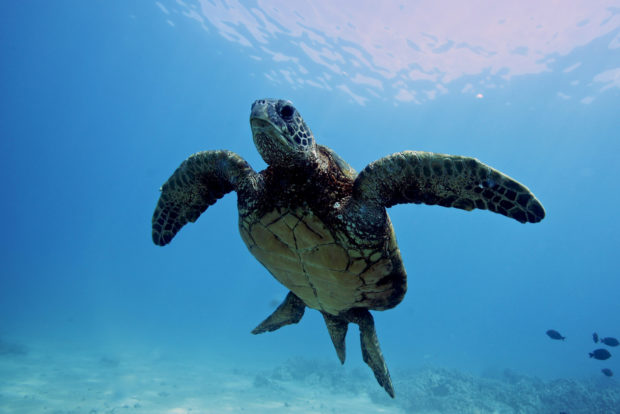
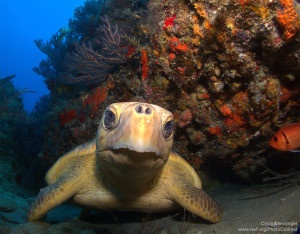
Sea turtles benefit from responsibly developed clean energy sources like offshore wind power. Photo donated by National Wildlife Photo Contest entrant Cindy Messinger
The National Wildlife Federation has long supported offshore wind power as a clean energy solution capable of rising to the daunting scale of our climate challenges. We work closely with developers and government officials to ensure that the highest standards of wildlife protection are in place every step of the way. With Massachusetts’s leadership and states like New York and Maryland close behind, we can finally begin to realize the many untapped environmental, public health, and economic benefits of offshore wind power.
There is a long way to go, but Thursday’s milestone is worth celebrating. It’s also worth replicating all along the coast! Visit our website to learn the status of offshore wind power in each coastal state and to get involved in our efforts to launch this wildlife-friendly energy resource to its full potential (creating thousands of high-quality jobs along the way!).
If you live in Massachusetts, please click on the above to re-tweet a thank you to Governor Charlie Baker (@MassGovernor) for his Administration’s leadership. Everyone else, please take just a minute to send an email to your Governor urging them to advance offshore wind power for your state! Click the button below to add your voice!
]]>129151The Unifying Appeal of Offshore Wind Power
https://blog.nwf.org/2017/06/the-unifying-appeal-of-offshore-wind-power/
https://blog.nwf.org/2017/06/the-unifying-appeal-of-offshore-wind-power/#commentsFri, 16 Jun 2017 19:19:56 +0000http://blog.nwf.org/?p=128737Now that America’s first offshore wind power project is up and running, it’s time to get out on the water and soak in the massive clean energy opportunity we’re just … Read more
]]>Now that America’s first offshore wind power project is up and running, it’s time to get out on the water and soak in the massive clean energy opportunity we’re just beginning to seize. On Tuesday, National Wildlife Federation partnered with the BlueGreen Alliance and the Rhode Island Building and Construction Trades Council to bring more than 100 leaders in labor and workforce development out to the Block Island Wind Farm to witness the debut project in action. The tour was covered by several local news outlets, including the Boston Globe, the Cape Cod Times, and the Springfield Republican.
NWF advocates for the responsible development of offshore wind power as a critical climate change solution with abundant untapped clean energy potential. We work closely with developers, government officials, local ocean users, and community members to ensure that coastal and marine wildlife are considered and protected every step of the way. The Block Island Wind Farm serves as a model that we now hope to see the industry grow from.
America’s first five offshore wind turbines began generating power off the coast of Rhode Island just months ago. While producing enough clean, local energy for 17,000 homes, they also serve as a critical opportunity to show what’s possible in U.S. waters. They were developed with the highest standards of wildlife protection in place , and they created over 300 Rhode Island jobs in the process.
The unmatched clean energy potential and the thousands of workers needed to bring it to fruition make offshore wind power a unifying force between labor and environmental leaders.
Here are a few reactions from those on board
Kim Glas, Executive Director, BlueGreen Alliance:
Kim Glas addressing the crowd. Photo by NWF
“It was incredible to see the work done by so many skilled union members and that was the result of years of collaboration between labor, environmental organizations, industry and key government officials and entities. It’s a testament of what is possible across the northeast and beyond when organizations work together. We are also really excited about the possibilities that offshore wind offers in terms of creating good paying, high-quality union jobs in the manufacturing and construction industries over the long-term.”
Scott Duhamel, Secretary Treasurer, Rhode Island Building and Construction Trades Council,Rhode Island:
Scott Duhamel (left) deep in conversation during Tuesday’s tour. Photo by NWF
“While the process was a long and hard fought journey (six years), the end result was truly satisfying: Close to 300 jobs for local unionized craftsman who came out of 10 separate Building Trades Locals, who worked for 30 or so unionized contractors and sub-contractors. We, at the RI Building and Construction Trades Council, are fiercely proud of our initial advocacy that lead to the great end results of putting the first wind turbines in America’s waters, and even prouder that our member’s skills were utilized in making and completing the groundbreaking project, and hopefully, helping to jumpstart a whole new industry.”
George Nee, President, Rhode Island AFL-CIO:
“When you look at this, you see history, you see success and you see perseverance,” he said. “This is labor, business, government and the environmental movement getting together to do what’s right for jobs, what’s right for the environment and what’s right for our kids and grandkids.”
Craig A. Pinkham, President, Utility Workers Union of America Local 369, Massachusetts:
Craig Pinkham and the UWUA crew enjoying the view of the turbines.
“The clean energy sector is growing rapidly and the Block Island Wind Farm is a historic project that will generate affordable and reliable clean energy. Just as important, this project is spurring economic growth and new jobs with good wages and benefits — critical opportunities for highly skilled workers like ours. The offshore wind industry offers tremendous promise and we’re invested in the success of this project and others like it.”
Ellen Redmond, International Representative, IBEW, Third District, New York:
“The Block Island Wind Farm is an amazing feat of engineering and construction. At first sight of the BIWF it became very apparent to me that working in this industry is not for the faint-hearted. I am so proud of my brothers and sisters in the IBEW, and all the people who helped build these beautiful machines so that we may benefit from a cleaner source of energy for generations to come.”
Luke Gordon, Staff Representative, United Steelworkers, New Jersey:
Luke Gordon (center) on Tuesday’s tour.
“I was thrilled to take part in the recent tour of the Block Island Wind Farm. It was truly exciting to see the potential for developing zero emissions renewable energy while creating good community-based jobs in the manufacturing and construction industries. Offshore Wind has a tremendous potential for the future, and is an important opportunity to create a true ‘just transition’ for industrial workers.”
Todd Vachon, President, United Auto Workers Local 6950, Connecticut:
“This is an issue our members care a lot about. We’re in favor of infrastructure development to employ Connecticut workers, and we consider climate change a major health and safety issue for all working people and their families.”
Heading home after another successful tour! Photo by NWF
Let’s make it happen!
Building offshore wind power at the scale needed to transform our energy future, combat climate change, and create thousands of U.S. jobs requires action at all levels of government. Together, we can show our state and federal leaders that offshore wind power is of urgent importance, and ensure that the Block Island Wind Farm is the start of a new energy era we can all be proud to have a hand in building.
]]>https://blog.nwf.org/2017/06/the-unifying-appeal-of-offshore-wind-power/feed/8128737Speak up for Massachusetts offshore wind power!
https://blog.nwf.org/2017/05/speak-up-for-massachusetts-offshore-wind-power/
Tue, 09 May 2017 19:04:55 +0000http://blog.nwf.org/?p=127869We are finally on the cusp of seizing the massive clean energy potential far off the shores of Massachusetts – and we need every resident of the Commonwealth speaking up … Read more
Being first in the nation to launch an industry at a scale capable of replacing nuclear and coal-fired power plants comes with immense responsibility. The first projects can and must provide a model for wildlife-friendly development and for local job creation. They will demonstrate the viability and reliability of the largest clean energy opportunity available to densely populated coastal states like Massachusetts. It’s the beginning of a new energy chapter.
We are sending a message to the Baker Administration as they work out the details of how to move forward with their commitment to develop enough offshore wind power for over half a million homes. Please add your voice today to the call for developing large-scale offshore wind power as quickly and responsibly as possible.
There’s more! Please consider joining us for a Public Meeting in Falmouth, MA on May 16th.
The five-turbine Block Island Wind Farm employed more than 300 local workers. Photo by NWF
While we are thrilled to see Massachusetts move toward such an impactful clean energy goal – we are also working hard to ensure that meeting Governor Baker’s commitment is just the beginning. After all, the law passed last summer accounts for just a fraction of the potential already designated for offshore wind development far off the south shore of the Commonwealth.
If you would like to learn more, and potentially speak up for going bigger on offshore wind power, please join us at a Public Meeting, co-hosted by the U.S. Bureau of Ocean Energy Management, the Executive Office of Energy and Environmental Affairs, and the Massachusetts Clean Energy Center on Tuesday, May 16th (details below). The hosts will provide updates on the offshore wind development process in the federal offshore wind planning areas and developers will provide project-specific updates.
Tuesday, May 16th 5:30-7:00 PM
Holiday Inn Cape Cod – Falmouth
291 Jones Road, Falmouth, MA 02540
Please email HewettA@NWF.orgwith any questions or to let us know if you can attend. We hope to see you there!
]]>127869Why we are fighting for offshore wind power
https://blog.nwf.org/2017/04/why-we-are-fighting-for-offshore-wind-power/
Sat, 08 Apr 2017 15:00:22 +0000http://blog.nwf.org/?p=127149For years, the National Wildlife Federation has called on our leaders in Washington and coastal states to seize the abundant clean energy potential in the wind off our shores. Until December … Read more
]]>For years, the National Wildlife Federation has called on our leaders in Washington and coastal states to seize the abundant clean energy potential in the wind off our shores. Until December 2016, offshore wind power was an untapped American opportunity. NWF saw the need to harness that energy, responsibly and sustainably, learning from our global counterparts. After all, Europe spent 25 years advancing offshore wind technology and building more than 3,000 turbines before we planted a single one on this side of the Atlantic.
As states like Massachusetts and New York move forward on their commitments, the U.S. offshore wind industry is rapidly expanding. NWF is tracking progress and keeping wildlife and communities at the forefront of this important endeavor. We believe offshore wind power is worth advancing and we remain committed to scaling up this important wildlife-friendly source of renewable energy.
Why is offshore wind power so important for wildlife and communities?
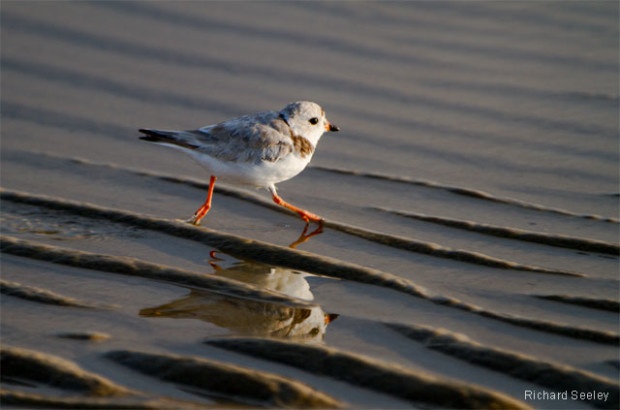
A piping plover runs along Crane Beach in Ipswich, Massachusetts. Photo by Richard Seeley.
Our mission at NWF is to unite all Americans to ensure wildlife thrive in a rapidly changing world. It is among our top priorities to do all we can to combat the present and worsening threat of global warming. To do so we must dramatically reduce our reliance on one of climate change’s primary drivers: carbon-polluting fossil fuels. We need to embrace the clean, renewable energy resources available to us and ensure that they are developed responsibly, minimizing and mitigating impacts on wildlife and habitat.
In coastal states, offshore wind power is one the most valuable clean energy opportunities we have. With our largest urban centers and most strained energy markets located along the coast, offshore wind power is available right where it is needed. Offshore wind is reliable, inexhaustible, and uniquely able to rise to the scale of our energy needs. Moreover, it can replace polluting power plants as they retire, improve local air and water quality all while creating thousands of jobs. And since we’re getting in the game decades behind Europe, the cost of offshore wind power has dramatically declined, offering an increasingly affordable energy choice that will help buffer ratepayers from the volatile fossil fuel market.
How is NWF ensuring offshore wind power is wildlife-friendly?
NWF is committed to ensuring that as offshore wind power moves forward, the highest standards of wildlife protection are in place every step of the way. Because offshore wind power is new to the nation, we have the opportunity to do this right from the start. NWF is working closely with developers, state and federal government officials, conservation partners, and many ocean users to ensure that wildlife and habitat protection is considered at every decision point, from siting to construction, and ultimately during operation and maintenance of offshore wind projects.
Ensure all offshore wind project siting, construction and operations decisions are informed by the best available science, comprehensive input from all kinds of stakeholders, and latest ocean planning efforts.
Avoid building in biologically sensitive areas including: shoals, boulder reefs, rocky cobble areas, the mouths of inlets, and other areas critical to wildlife migration, breeding, wintering, or other sensitive life stages.
Steer projects further offshore to significantly reduce potential conflicts with birds.
Ensure comprehensive pre- and post-construction monitoring programs to inform strategies for avoiding, minimizing, and mitigating potential impacts to wildlife.
Look at the big picture – including potential cumulative impacts of offshore wind projects as well as future shifts in wildlife ranges and other ecological changes that will result from climate change.
What is NWF doing to protect North Atlantic right whales?
North Atlantic right whales are critically endangered. Fewer than 500 are estimated to be alive today, so the loss of even one female could be devastating to the species. These majestic creatures migrate along the Atlantic Seaboard, and have been observed in and around areas designated for offshore wind development. Increased ship traffic and underwater noise from offshore wind survey and construction efforts pose a risk to right whales, as a result, extra precautions must be taken to minimize the potential impacts of these activities. NWF and our partners work to ensure these whales are protected through every stage of the development process as offshore wind leasing and projects advance.
North Atlantic Right Whale. Photo by New England Aquarium, Collected under NMFS permit 14233
America’s first offshore wind project has set a strong precedent for responsible offshore wind development. The Block Island Wind Farm – now up and running off the coast of Rhode Island – was developed with the highest standards of wildlife protection in place. Specifically, project developer Deepwater Wind worked closely with NWF and our partners to adjust their construction schedule to minimize risks to right whales and followed stringent protocols to ensure real-time actions were taken to protect whales as the turbines were being installed.
This success story builds on years of work to develop protocols for right whale protection throughout the offshore wind development process. In 2012, we negotiated a landmark agreement with three companies to voluntarily implement protective measures to reduce or avoid sound impacts from exploratory activities while determining where to build projects in the Mid-Atlantic region. Two years later, we collaborated on another agreement with Deepwater Wind to implement protective measures during pre-construction activities in their lease area off of southern New England.
In addition to working directly with developers, NWF and our partners are in regular dialogue with the U.S. Bureau of Ocean Energy Management and state officials regarding our recommendations for protecting whales and other wildlife. We submit comments at every relevant opportunity and organize meetings to bring the latest science and data to those making decisions about all offshore energy development. We also work at the state level to ensure adequate consideration of wildlife and habitat as states navigate challenges in bringing offshore wind power to shore through state waters and sensitive coastal areas.
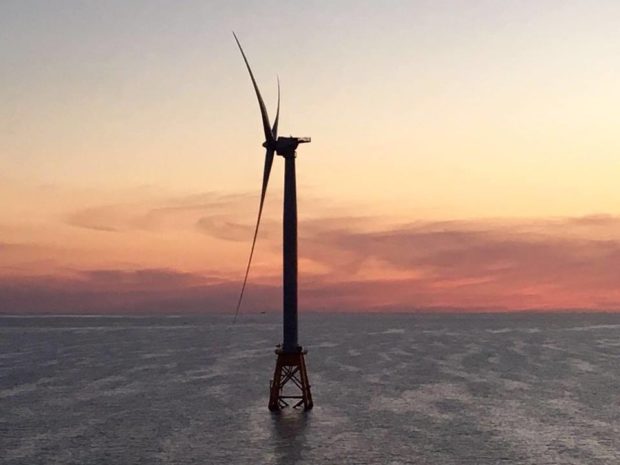
America’s first offshore wind turbine, Block Island Wind Farm. (Photo: Deepwater Wind)
Questions about activities in your state or specific project proposals?
We’d love to fill you in on the details! Send us an email with questions, concerns, or to get involved.
What can we do to help offshore wind power move forward?
We are confident that offshore wind power can be among the most wildlife-friendly sources of energy available to us – at a time when cleaning up our energy sector has never been more urgent. It has a long way to go and needs all the support it can get as we chart a pollution-free, responsible energy future. We hope you’ll join us in calling on leaders at the city, state, and federal levels to set bold goals for offshore wind power and enact the policies needed to meet them. NWF is closely engaged all along the coast and are always looking for help raising the volume of our call to action. We hope you’ll join us!
]]>127149Seizing Our Massive Offshore Wind Potential
https://blog.nwf.org/2016/09/seizing-our-massive-offshore-wind-potential/
Fri, 09 Sep 2016 20:57:12 +0000http://blog.nwf.org/?p=122535Secretary of Energy Ernest Moniz and Secretary of the Interior Sally Jewell gathered with state and federal officials in Boston today to announce the National Offshore Wind Strategy: Facilitating the … Read more
]]>It’s been quite the summer for U.S. offshore wind power! Following months of unprecedented progress in Massachusetts and Rhode Island, the Obama Administration released a strategy today that charts a collective path forward for the U.S. to seize the immense clean energy potential off our shores.
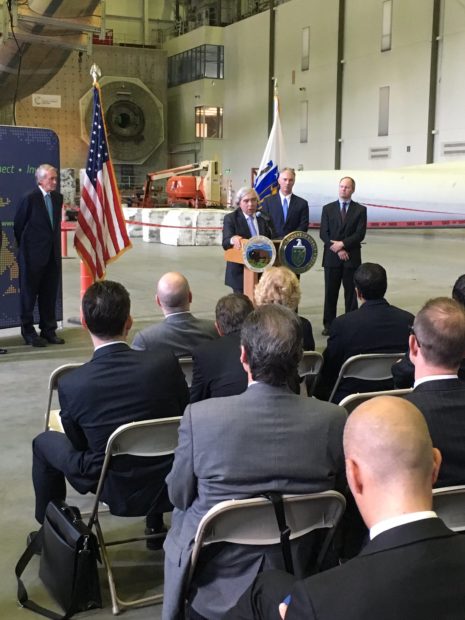
U.S. Energy Secretary Moniz unveiling the National Offshore Wind Strategy in Boston. Photo by Mass Clean Energy Center
Secretary of Energy Ernest Moniz and Secretary of the Interior Sally Jewell gathered with state and federal officials in Boston today to announce the National Offshore Wind Strategy: Facilitating the Development of the Offshore Wind Industry in the United States. Gathered in the Massachusetts Clean Energy Center’s Wind Technology Testing Center, attendees learned of the Strategy’s three focus areas, and details on how the federal government can help clear the way for industry advancement:
Reducing technical costs and risks;
Supporting effective stewardship;
And improving the market conditions for investment in offshore wind energy.
The National Wildlife Federation President and CEO Collin O’Mara attended the Boston event and issued the following response:
“We have miles to go before we reach the offshore wind deployment scale needed to confront climate change, but today’s event shows that, by working together, we take advantage of this golden opportunity to solve our energy, economic, and environmental challenges.”
The choice to release the national strategy in Boston comes on the heels of MA Governor Baker signing historic energy legislation into law this summer. On Tuesday, all three lease-holding developers signed an agreement to use the MA Clean Energy Center’s New Bedford Marine Commerce Terminal to stage the projects they intend to develop in federal waters 12 miles south of Martha’s Vineyard. Later this fall, the Block Island Wind Farm will bring commercial-scale offshore wind power online in the U.S. for the very first time. A new era for American energy is starting now – and the reports released today help to further underscore its worth and is urgent value in the fight against climate change.
“We are confident the strategy we’re outlining today will chart a course for additional investment in clean energy technologies that can help power America’s future.” – Secretary Sally Jewell
America’s first offshore wind turbine, Block Island Wind Farm. Photo by Deepwater Wind
“Today’s collaborative strategic plan is part of a long-term commitment to support innovation that enables widespread offshore wind deployment and shows how offshore wind will benefit our country with new jobs, less pollution, and a more diversified electricity mix.” – Secretary Ernest Moniz
Today’s highly anticipated announcement underscores that a clean, responsible energy future – one that reflects foresight and stewardship – is well within reach. Now to roll up our sleeves and make it happen!
]]>122535America’s First Offshore Wind Power Project is COMPLETE!
https://blog.nwf.org/2016/08/americas-first-offshore-wind-power-project-is-complete/
https://blog.nwf.org/2016/08/americas-first-offshore-wind-power-project-is-complete/#commentsFri, 19 Aug 2016 18:46:20 +0000http://blog.nwf.org/?p=122122From earning unanimous approval from state officials in 2014, to achieving full financing in 2015, to putting hundreds of Rhode Islanders to work on the project – including building the … Read more
]]>The fifth and final turbine has been installed at the Block Island Wind Farm – and with that, the nation’s first offshore wind power project is now just weeks away from generating clean, local, wildlife-friendly energy.
Finishing touches on turbine #5! Photo by Deepwater Wind
From earning unanimous approval from state officials in 2014, to achieving full financing in 2015, to putting hundreds of Rhode Islanders to work on the project – including building the first U.S.-flagged offshore wind power crew transfer vessel – to finally putting steel in the water in 2015 to kick off a new energy chapter in America, Deepwater Wind has blazed the trail and created a shining national model for offshore wind development in America. With strong measures in place to protect wildlife including the endangered North Atlantic right whale every step of the way, the Block Island Wind Farm demonstrates that offshore wind development can be compatible with ocean conservation. The National Wildlife Federation proudly points to the success of the Block Island Wind Farm as clear evidence that a truly responsible energy future is possible.
It’s a new day! Photo by Deepwater Wind
With a new energy policy on the books in Massachusetts equipped to finally launch a robust offshore wind power industry, there is no doubt that the Block Island Wind Farm can be the start of something big. We are witnessing America reach for the incredible clean energy potential off our shores, and now we can begin to catch up with other countries around the world that are 25 years ahead of us in tapping into this booming global industry.
The Block Island Wind Farm demonstrates how developers can ensure North Atlantic right whales are protected every step of the way. Photo by NOAA
The swift and responsible development of offshore wind power can and must help us onto an energy path that responds to the urgent threat of climate change. Now is the moment for our state leaders along the coast to step confidently onto that path.
]]>https://blog.nwf.org/2016/08/americas-first-offshore-wind-power-project-is-complete/feed/1122122A New Day for American Energy
https://blog.nwf.org/2016/08/a-new-day-for-american-energy/
Tue, 09 Aug 2016 12:59:03 +0000http://blog.nwf.org/?p=121697During the bill-signing ceremony, MA Rep. Tom Golden referenced John F. Kennedy’s declaration in 1960 that it was “time for a new generation of leadership, to cope with new problems … Read more
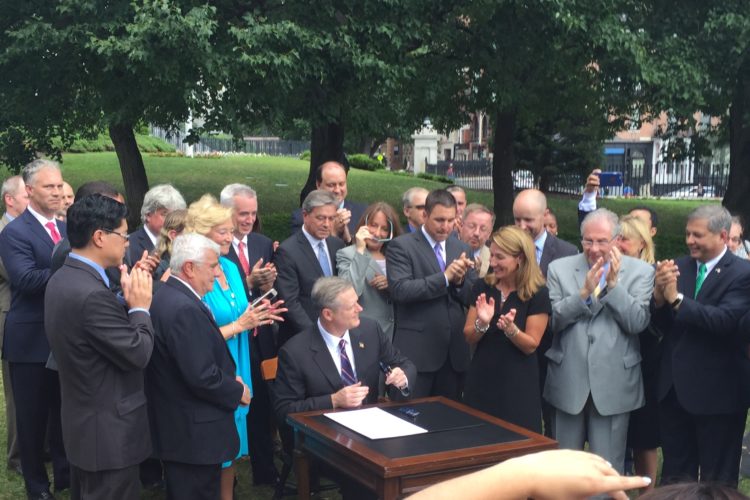
]]>Yesterday, on the lawn of the Massachusetts State House, Governor Charlie Baker signed an energy bill that commits the Commonwealth to enough offshore wind power for more than half a million homes.
During the bill-signing ceremony, MA Rep. Tom Golden referenced John F. Kennedy’s declaration in 1960 that it was “time for a new generation of leadership, to cope with new problems and new opportunities.” For, as he said, “there is a new world to be won.” Rep. Golden noted that what starts today is a new generation of energy.
A Big Deal
I was born and raised on the coast of Massachusetts. When I was in middle school, I started hearing about the concept of offshore wind. Bumper stickers, tables at the farmers’ market, lawn signs, and more touted the strong opinions for and against one project proposed in Nantucket Sound. As a young environmentalist, I stuck a Yes Cape Wind pin on my backpack and went on with my middle and then high school life.
Fast forward through college and to the start of my career at the National Wildlife Federation. The more I learned from my colleagues, the harder it was to believe that this massive, clean, local, and inexhaustible energy source could still be sitting untapped. Though there was incredible progress underway to change it – progress that gets hardly the attention it deserves.
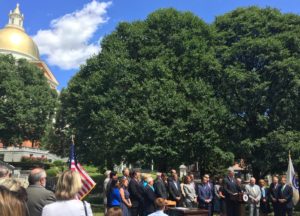
Governor Baker addresses a packed lawn before signing An Act to Promote Energy Diversity. Photo by NWF
The National Wildlife Federation and many close partners were fighting for permission to build five commercial-scale turbines in Rhode Island state waters (a project that is now just weeks from completion!). The Obama Administration was years into an incredibly comprehensive process to designate areas of federal water for wind energy development. Environmental, labor, and business leaders were putting pressure on Congress to help incentivize financing for offshore wind projects with an effective Investment Tax Credit. Collaboration to understand the measures needed to protect wildlife throughout development was well underway. Just to name a sampling.
“Responsibly developed offshore wind power is a game-changing climate solution for America, and this bold leadership from Massachusetts is precisely what’s needed to bring it to scale.” – Catherine Bowes, NWF Senior Manager for Climate and Energy
Work Still Ahead
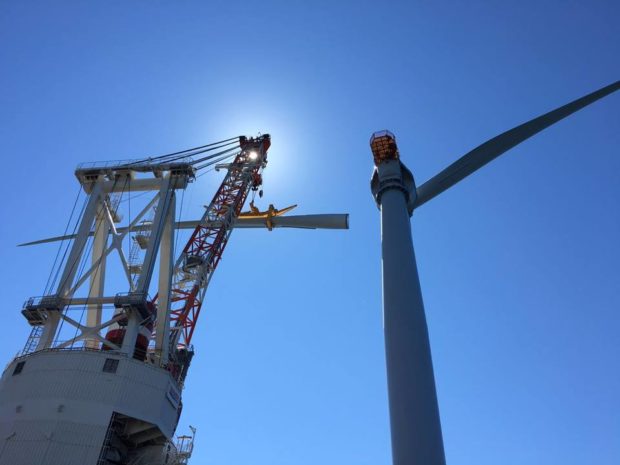
America’s first offshore wind turbine installed just last week at the Block Island Wind Farm. Photo by Deepwater Wind
And here we are today. The Commonwealth of Massachusetts has decided to replace nuclear and coal-fired power plants with a clean energy solution unlike any other – one that can rise to the scale of a challenge that daunts my generation.
Don’t get me wrong, there is serious work ahead to get these turbines built and operating and to ensure they are the first of many. But the Massachusetts Legislature and the Governor committing to making offshore wind power a pillar of our energy future marks incredible progress. It’s a trail-blazing stride toward an energy future that promotes clean air and clean water, healthy wildlife occupying vibrant habitats, and a workforce busy building, operating, and maintaining a home-grown, sustainable industry. Now we need to make sure this essential vision becomes reality.
Governor Baker signs the bill! Photo by NWF
May the Massachusetts milestone remind us all that the new world we’re reaching for is possible and that we know how to win. The stakes are too high and the mission too important to be anything but motivated by what we have accomplished together. This is just the beginning.
]]>121697MA Makes Nation’s Largest Offshore Wind Power Commitment!
https://blog.nwf.org/2016/08/ma-makes-nations-largest-offshore-wind-power-commitment/
Mon, 01 Aug 2016 17:55:22 +0000http://blog.nwf.org/?p=121494Things are moving quickly! Click here for the latest offshore wind power updates. This is great news for wildlife, and for all of us counting on our leaders to take … Read more
I’m so proud to say that the Bay State, my home state, just made history. Late last night, in the final moments of the Massachusetts legislative session, leaders on Beacon Hill passed an energy bill equipped to finally launch America’s offshore wind industry!
Loggerhead sea turtles will benefit from responsibly developed clean energy sources like offshore wind power. Photo donated by National Wildlife Photo Contest entrant Cindy Messinger.
This is great news for wildlife, and for all of us counting on our leaders to take swift, bold action to confront climate change. Massachusetts has stepped up to demonstrate just how offshore wind power can play a key role in addressing the massive energy and environmental challenges of our time.
Legislation passed last night commits the Commonwealth to bringing 1,600 megawatts of offshore wind power online. That’s enough clean, local energy to power more than half a million homeswhile creating thousands of long-term, high quality jobs.
Massachusetts will be on track toward a truly clean energy future – one where our energy portfolio reflects the need to protect our communities and wildlife from the dangers of climate change. The MA legislation’s commitment shows a prioritization of public health, clean air, and clean water – all while buffering ratepayers from the volatile fossil fuel market.
“The Massachusetts Legislature hit a home run tonight. All eyes are now on Governor Baker to sign the bill and make this pivotal commitment to offshore wind power a reality.”
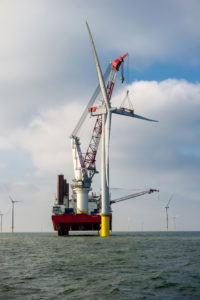
Installation of the final turbine in the London Array, the world’s largest offshore wind power project to date. Photo by London Array Limited
This milestone has been a long time coming in Massachusetts. We have a world-class wind resource off our shores, ready to serve as the foundation for a new clean energy economy in the Commonwealth. While our neighbors across the Atlantic have been growing offshore wind power into a booming global industry for 25 years, we have yet to get a single turbine into U.S. waters (though that is changing this summer with the Block Island Wind Farm!).
Massachusetts’ leadership here is pivotal. With America’s first offshore wind project finally under construction, bold policy commitments from state leaders are precisely what’s needed to ensure this is truly the beginning of a new energy chapter. Among all of the lasting benefits listed above, what arguably makes this bill most significant is the example it will set.
Over the next decade and beyond, offshore wind power will replace retiring nuclear and coal-fired power plants in New England and show state leaders up and down the coast that we can power our homes and businesses with local, clean energy.
The Massachusetts legislature just turned the tide in a way that will unleash the nation’s largest untapped clean energy opportunity! It’s a new day, and a turning point in our endlessly important pursuit of a responsible energy future.
Of course, there is a long road ahead to get these turbines up and running, and the next step is getting this historic bill signed by Governor Charlie Baker. Please sign the petition below and share it with your friends in Massachusetts – let’s keep up this momentum!