The post Ryzen 7 1800X, 1700X, and 1700 CPUs launch appeared first on Andrew.Technology.
]]>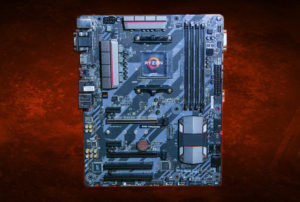
AMD Ryzen AM4 motherboard
Ryzen 7 1800X, 1700X, and 1700 processors were released March 2nd. These are the latest high-performance processors released by AMD based on the Zen microarchitecture. Hardware manufacturers also launched new motherboards equipped with AM4 sockets and new chipsets to take advantage of features like native DDR4 memory, USB 3.1 Gen 2 and NVMe.
This is the first major microarchitecture launch for AMD since Bulldozer in 2011. That family of processors also included Piledriver, Steamroller, and most recently Excavator generations. Although APUs were strengthened considerably in Excavator none of AMD’s CPUs could compete when it came to intense single-core performance that enthusiasts and gamers required. This resulted in Intel’s dominance in the high-performance processor space for the last six years.
Ryzen 7 sets world record for 8-core Cinebench benchmark
Thie release of Ryzen 7 CPUs is AMD’s answer to Intel’s i7 lineup. A defining feature of Ryzen 7 processors is they all sport 8-cores and 16 threads. This is huge because a majority of Intel chips are stuck on quad-core with a few octa-core that are expensive. Essentially, AMD is bringing 8-core processors to the masses at a price most can afford. Ryzen 5 chips were also announced to be released Q2 of this year.
It’s obvious the strategy for AMD is more cores but that was not very successful for Bulldozer and Excavator CPUs so what’s changed in Zen and Ryzen? The Zen microarchitecture dramatically increased it’s instructions per clock or IPC. This measures how many instructions per hertz can be computed by a processor. Originally, AMD was aiming for a 40% increase from Excavator to Zen but at AMD Ryzen Tech Day it was announced that Zen was actually performing 52% better than Excavator in benchmarks.
Benchmarks should always be taken with a grain of salt but when it comes to rendering and multi-core applications the Zen microarchitecture performs very well. The AMD Ryzen 7 1800X actually captured the world record for the Cinebench – R15 benchmark the day it launched. The AMD Ryzen 7 1800X beat out an Intel Core i7 5960X that’s clocked 680 MHz higher and costs $570 more!
Gaming benchmarks show a different story though. Video games especially depend on single-core performance because so few games really make use of every core in a processor. While AMD did make great improvements in IPC it’s still beaten out by Intel in this category and this shows in benchmarks for games. Another factor is Ryzen, AM4, and the motherboard chipsets are all brand new and could use optimization in both hardware and software.
All these chips come unlocked to allow for overclocking through the BIOS or AMD’s software. New “Wraith Coolers” were also released that provide cooling specifically designed for Ryzen chips.
Overall the AMD Ryzen 7 processors provide a good price-performance ratio. At the time of writing this you could buy a 1700 for $329.99, 1700X for $399.99 and the Ryzen 7 1800X for $499.99 though it’s back ordered on both Newegg and Amazon. This is just the start for CPUs released with Zen microarchitecture. Ryzen 5 processors are due out Q2 and there will also be APUs and server chips down the line.
Here are the specifications for Ryzen 7 & Ryzen 5 processors:
| PRODUCT LINE | MODEL | CORES | THREADS | BASE CLOCK (GHZ) | BOOST CLOCK (GHZ) | INCLUDED COOLER | TDP4 (WATTS) | ON SALE |
|---|---|---|---|---|---|---|---|---|
| RYZEN 7 | 1800X | 8 | 16 | 3.6 | 4.0 | N/A | 95 | Now |
| RYZEN 7 | 1700X | 8 | 16 | 3.4 | 3.8 | N/A | 95 | Now |
| RYZEN 7 | 1700 | 8 | 16 | 3.0 | 3.7 | Wraith Spire | 65 | Now |
| RYZEN 5 | 1600X | 6 | 12 | 3.6 | 4.0 | Wraith Spire | 95 | Q2 |
| RYZEN 5 | 1500X |
The post Ryzen 7 1800X, 1700X, and 1700 CPUs launch appeared first on Andrew.Technology.
]]>The post AMD announces Ryzen processor based on “Zen” architecture appeared first on Andrew.Technology.
]]>
AMD Ryzen processor logo
Yesterday AMD announced Ryzen, their latest generation high-performance processors, at the “New Horizon” fan event. This is the first CPU based on “Zen” microarchitecture which has been under development for the last four years. Besides new silicon chips, AMD also released technology dubbed “SenseMI” that makes use of sensors and artificial intelligence to deliver even better voltage, clock frequency, and cooling.
Hardware specs of the featured Ryzen CPU include 8-cores, 16-threads, 95-watt TDP all running at 3.4 GHz without boost. AMD claims performance gains of “greater than 40 percent in instructions per clock” which could equalize or inch out Intel’s current offerings.
The fan event showed off benchmarks and 4K gaming demos pitting the AMD Ryzen against Intel’s Core i7-6900K. According to the AMD press release, “Blender- and Handbrake-based image rendering and video transcoding demos showed that the new CPU can match or outperform the Intel Core i7 6900K.” These benchmarks and demos should be taken with a grain of salt but AMD did release the Ryzen Blender demo for users to download and test out themselves.
Zen-based Ryzen processors & SenseMI
Zen microarchitecture was originally shown at E3 2016 using the code name “Summit Ridge”. Details have been sparse since then leaving enthusiasts to question if they should continue to wait or opt for Intel chips. Luckily for them this announcement cements the official launch of Ryzen/Zen for the first quarter of 2017 (Q1 2017). Generally, the highest performing processors are released first followed by consumer desktop and notebook variations and ending with server and extreme models.
AMD touts “multiple architectural advances combined with platform and processing technologies” for Zen. President and CEO Dr. Lisa Su elaborated further saying, “The ‘Zen’ core at the heart of our Ryzen processors is the result of focused execution and thousands of engineering hours designing.” Zen’s performance is bolstered by “SenseMI” technology which was also announced yesterday.
SenseMI is not a singular technology but rather “comprised of five components” according to AMD. Those components are: “Pure Power, Precision Boost, Extended Frequency Range (XFR), Neural Net Prediction, and Smart Prefetch.” The first three components revolve around embedded and integrated sensors for optimal voltage, clock frequency, clock speeds, and cooling capability. The last two utilize artificial intelligence, algorithms, and software, “that learns to predict what future pathway an application will take based on past runs.”
The success of these new Zen-based CPUs is key for AMD’s future and to challenge Intel’s dominance in the microprocessor space. No doubt the performance and price of Ryzen/Zen could very well make or break AMD in the consumer desktop market.
The post AMD announces Ryzen processor based on “Zen” architecture appeared first on Andrew.Technology.
]]>The post AMD brings unified Linux driver stack with “AMDGPU” appeared first on Andrew.Technology.
]]>
AMD Linux Driver Stack September 2015 AMDGPU
Last month at the XDC2015 conference AMD detailed plans for their Linux driver stack dubbed “AMDGPU”. At the center of AMDGPU is a new open-source Kernel driver that interfaces both closed and open source user-mode drivers (UMDs) unifying it’s driver offering into a solution that both official drivers and community created alternatives can tap into.
From the images displayed on your monitor all the way down to the physical hardware, the graphics driver stack controls every aspect of of rendering both 2D and 3D graphics on a computer. It’s important to differentiate between the Kernel graphics driver (AMDGPU) which is used by hardware and the user-space drivers which is used by the operating system (Linux). Since both closed and open source user-space drivers will utilize the same Kernel driver it will be possible to switch between user-spaces without the need to reboot!
Using AMDGPU most of the graphics stack will be open-source including the KFD and HSA runtime, OpenGL, Video Encode/Decode Gallium, DDX and Advanced Micro Devices has promised to open up OpenCL and Vulkan as it progresses down the AMDGPU road map. They also showed a closed stack diagram for AMD FirePro that will remain proprietary for workstation graphics cards but these are mostly used at the enterprise level.
This is a big deal for Linux users who for years had to choose between proprietary graphics drivers that offered better performance or open-source alternatives created by the community. For AMD cards, Radeon is the open source project that is based on documentation released by AMD and Catalyst Linux previously known as fglrx is the current official drivers. On the NVIDIA side of things, Nouveau is the open source project that relies almost entirely on reverse engineering and NVIDIA’s proprietary Linux Display Driver is what they officially recommend for Linux users.
AMD code included in Linux Kernel 4.2 for AMDGPU
Starting with Linux Kernel 4.2 released on September 1st 2015 AMDGPU code was included through AMD pull requests and they continue to submit new updates for Linux 4.3 and most recently Linux 4.4 as different parts become stable. This is not an open-source version of their currently closed Catalyst drivers but as the slides put it: “AMDGPU is based on current upstream open source AMDRadeon kernel driver” and “The existing open source AMD Radeon driver and new AMDGPU driver leverage upstream components.”
Support of this new driver does require owning a slightly newer AMD graphics card with GCN 1.2 support which are chips based on Tonga, Fiji, and Carrizo it’s new mobile-only chips. This does include the latest and greatest AMD Fiji cards: R9 Fury X, R9 Fury, and R9 Nano. Tonga cards supported only include the Radeon R9 285 and OEM only R9 380. All Carrizo APUs are supported but so far few have been announced or released.
Advanced Micro Devices is not opening up professional workstation cards which are separate from consumer chips and high-end graphics cards for gaming. AMD FirePro add-ons along with some other UMDs will remain closed source indefinitely and are not marked for become open-source ever. See the AMD Linux Stacks slide below for more details:
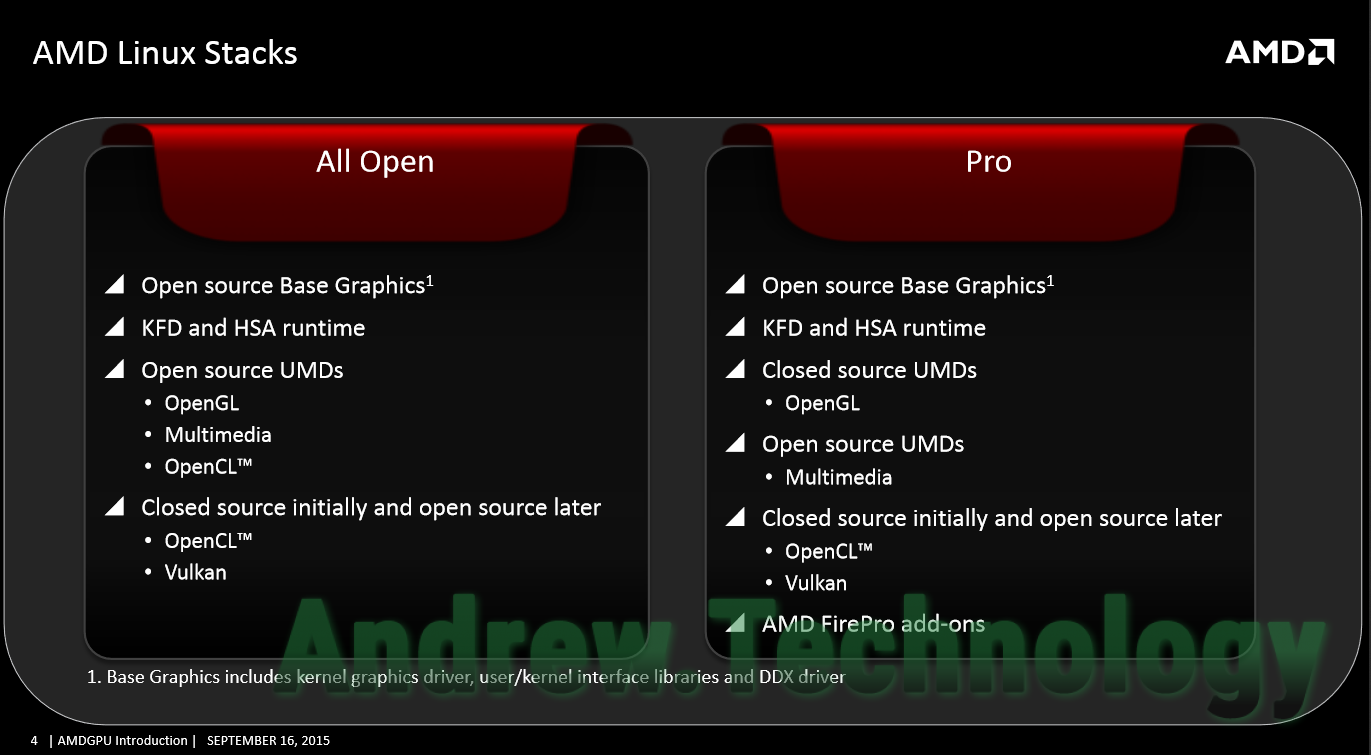
AMD Linux Driver All Open vs Pro
To help conceptualize from User Space (OS) to Kernel Space (hardware) here is the stack diagram for the All Open drivers:
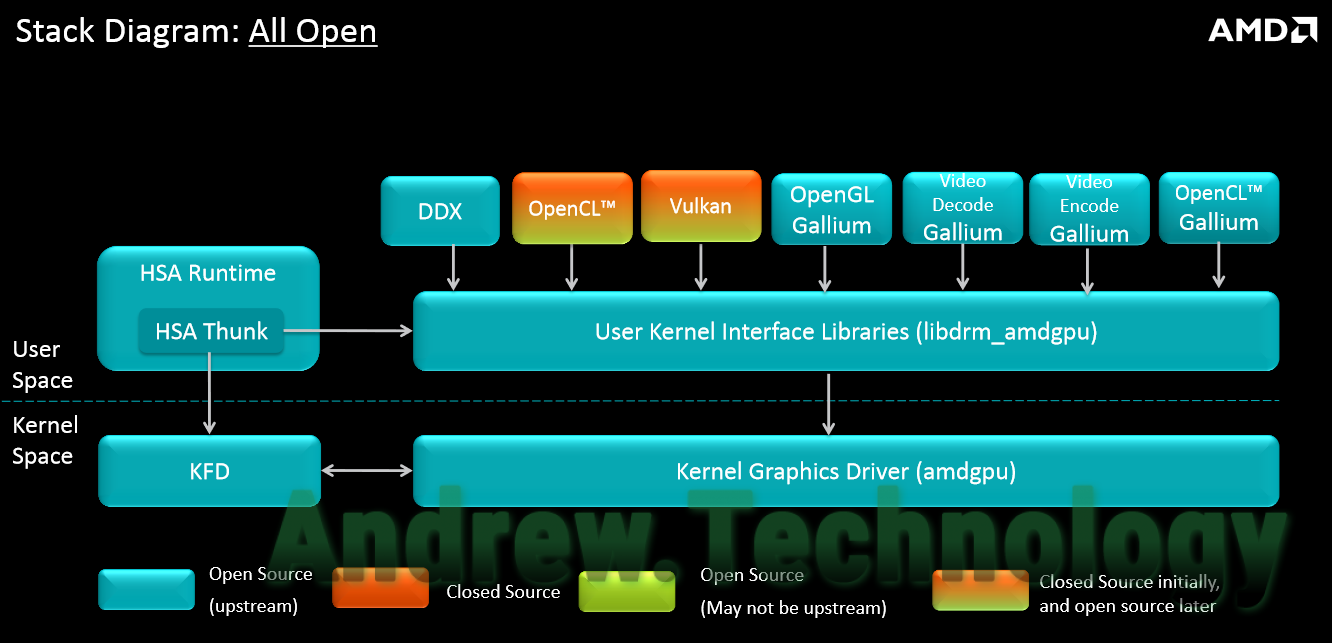
AMD Linux Driver Stack Diagram All Open
The post AMD brings unified Linux driver stack with “AMDGPU” appeared first on Andrew.Technology.
]]>