Safety upgrade: Lock-off; anti-rebound bar handle
The post Your DIY Dream Nursery—on a Budget appeared first on Baby Products Mom.
]]>
Photo source: Micuna/babyhome
After getting a positive pregnancy test, decorating the nursery is right up there on the excitement scale. There’s nothing like having a baby on the way to rustle up your nesting instincts.
On one hand, the nursery is just a room–traditionally the smallest bedroom in the house. On the other, it’s a room with a viewpoint.
“When you’re creating this environment, you’re showing your love for your child and creating an honor space because you want the best for him or her,” says Angela DeYoung, an interior designer in Franklin, Tennessee. Through the nursery you envision, you might also be reliving the joy of your own childhood.
Still, like weddings, baby nurseries are big business. Sure, well-wishers can help fund your dream nursery by chipping in for the furniture on your baby registry. But it’s still easy to go all out—as in spending $10,000 or more. (Whoops!)
How to decorate a nursery cheaply?
“Design is a slippery slope and dollar costs can add up quickly,” says Donna Hoffman, former QVC host and founder of The Interior Design Advocate, a site that helps DIY consumers avoid wasting money when furnishing or designing a home. Hoffman equates the thrill of outfitting a nursery to food shopping when you’re hungry. “You’re compelled to overspend,” she says.
If it’s your first baby, you might think, well, it’s my first baby, so I’m just going to splurge. And baby #2? Well, he/she should have it just as good as baby #1, don’t you think?! Don’t get me wrong. These are valid reasons for going all out on the nursery. After all, babies are priceless.
Still, raising them is a pricey proposition. According to the USDA, you can expect to spend at least $233,610 on each child from birth to age 17 on things like housing, food, childcare, education and clothes.
To meet your expenses, which may include paying student loans, have reserves for emergencies and saving for retirement and your baby’s college fund, it pays to strategically cut corners. The nursery is a good place to start.
These smart steps can help you stretch your nursery decorating dollars—and lots more. Consider this post your baby nursery decorating blueprint that can help save your sanity and your budget.
This post contains Amazon Affiliate links to products Babyproductsmom recommends, at no cost to you. As always, thanks for your support!
 Step 1: Take a good look at your bedroom
During your baby’s first six months to a year, your bedroom should, ideally, double as a nursery. Rooming in with your baby in a crib or bassinet (but not co-sleeping), reduces your baby’s risk of sudden infant death syndrome by 50 percent, according to the American Academy of Pediatrics. Where will you put the bassinet or crib? How much space you have in your bedroom can determine which type of baby bed you get initially. Although you can use a crib from day one, you’ve got options, such as: Newton bassinet (roomy!), Halo BassiNest Swivel baby bassinet, a travel crib like the Baby Bjorn Travel Crib Lite or the Snoo smart bassinet.
For larger spaces or tight budgets (as in–skip the bassinet)

Full-size crib: With this nursery strategy, you skip the bassinet and go straight to the crib in your bedroom. Warning: Your baby will look tiny in a crib at first but that’s okay. You’ll move the crib into the nursery when your baby is 6 months or older. Keep in mind cribs sold in the U.S. are federally regulated; fullsize cribs must be a standard size (28? wide and 52 3/8? long, plus or minus 5/8?). If your budget is tight, a crib like this one will get the job done. And don’t forget the crib mattress. Go with a basic Greenguard-certified foam mattresss like this one. Compared to an innerspring crib mattress, a firm foam is lighter, easier for crib sheet changes.
Keep in mind that bare is best. Skip the bumpers, sleep positioner, blanket, pillow, stuffed animals. In the crib, just a tight-fitting crib sheet is all you’ll need. (Feel free to use the crib sheet as a decorating focal point.) Dress your baby in a swaddle or sleep sack or warm jammies instead of using a blanket.
What’s sleep solution is safest–a crib, bassinet or travel crib? All of them are fine. “It’s whatever works best for the family,” says Rachel Y. Moon, MD, a professor of pediatrics at the University of Virginia School of Medicine and co-author of 14 Ways to Protect Your Baby from SIDS.
Your overall starter nursery strategy:
Put a travel crib, bassinet or full-size crib right next to your bed along with a changing table or some sort of changing table set-up for middle of the night diaper changes. After six months or so, move your baby to a full-size crib in the nursery or, if you started with a crib in your bedroom, you can move the crib to the nursery.

Photo source: Micuna
Step 2: Planning the Nursery–Big Picture
Before diving in to outfitting your baby’s actual nursery, ask yourself the first big-picture question: Will this room be a dedicated or a convertible nursery?
Dedicated Nursery—the details
A dedicated nursery stays that way as long as you have babies in the house. The room will be used for baby #1 and for all babies thereafter. If/when baby #2 etc. comes along, the new baby takes over the nursery and bumps out his/her older sibling into a big boy/big girl room, and so on. A dedicated nursery won’t convert to a big boy/big girl room until your last baby becomes a toddler. Depending on the size and spacing of your family, a dedicated nursery could stay in baby mode for a decade or more.
Convertible Nursery—the overview
A convertible nursery, on the other hand, grows with your child. It starts out as a nursery then converts to a big boy/big girl room when that baby becomes a toddler. Baby #1 starts out in that room and stays. If/when baby #2 comes along, he/she gets his/her own nursery.
Your answer to the dedicated versus convertible nursery question provides the framework for your nursery and other decorating decisions. When you’ve got the big picture, you can avoid costly mistakes, such as spending $5000 on a hand-painted mural for baby #1 in a dedicated nursery you later decide wouldn’t work for baby #2.
What about house guests?
When planning your nursery and the furniture you’ll need, consider all the bedrooms in your home and their use, including what you’ll do with overnight visitors. If baby #1 gets bumped into a big boy/big girl room when a new brother or sister comes along, for example, that child’s new room could double as a guest room, if you buy a queen-size bed instead of a twin bed.
Having a big boy/girl bedroom double as a guest room is a tactic designer Angela DeYoung used when her kids were little. “By the time both my kids were 3 years old, they already had queen-size beds,” she says. For safety, she just added a bed rail to the queensize bed. Guests can take over your child’s big boy/girl room and your toddler/preschool-age kids can temporarily camp out in your room in an inflatable toddler bed. I can vouch for this one, the Hiccapop inflatable toddler bed.


Tip: If you plan to put a queen-size bed in your child’s big boy/big girl room, don’t worry so much about buying a convertible crib–a crib that, with a conversion kit (usually sold separately) and a full-size mattress (sold separately as well), transforms into a toddler, twin or full-size bed. Most convertible cribs don’t convert to a queen-size bed. Note: If you want to buy a convertible crib and the conversion components are sold separately, buy the conversion components at the time you buy the crib, just so you have them. Cribs and their respective conversion components become unavailable for many reasons.

Handpainted mural by Annette Dostaler
Second big-picture question: Will my baby’s nursery have a theme?
Once you have an idea of which nursery configuration you’re after (dedicated vs convertible nursery), it’s time to consider whether your baby’s nursery will have a decorating theme or not. Popular nursery trends include woodland, nautical, flowers and Disney and other characters, such as Winnie the Pooh. (Here are more classic nursery themes for ideas.) If you choose a theme, filter everything you buy for the nursery through your theme lense, as in “Does this style crib fit with my woodland-themed nursery?”
Your theme can be general, such as monkeys, trains, geometric, clean and contemporary, retro, Victorian, black and white, etc. Or skip the theme concept and just be eclectic. You can find design inspiration in a crib skirt, a rug or artwork first, then spin your entire room around it.
Go ahead and turn to Pinterest or celeb nurseries for nursery theme inspiration. But feel free to be uniquely creative. “Celeb nursuries are just suggestions,” says DeYoung. “Those are their dreams. What are yours?”
If you have a color you love, go for it. Want to do pink and poofy? Go ahead. “One client was having twins, a boy and a girl. She did her nursery in shades of cream with splashes of peach and gray,” Hoffman says. Safety in the nursery should be your main concern. But otherwise, there are no rules. “If there’s any room where you can push your fantasy, it’s a child’s room,” Hoffman says.
If you’re thinking about painting a mural, here’s excellent artsy advice for working with a muralist.
 Nursery Decorating Guidelines
Convertible nurseries: from baby to big boy/girl room
Choose a convertible crib. “It’s a great option for young families,” Hoffman says. Rather than buying a crib and a twin or full-size bed within a few years of each other, you’ll simply morph the crib into the next-stage bed, with a conversion kit and full-size mattress (sold separately).

“Taking the long view in design will come back to reward you,” Hoffman says. Buying a convertible crib can be less expensive in the long run. Plus, when your crib days are over, you’ll know exactly what to do with the crib: Convert it into a toddler or full-size bed.
Don’t go into lockdown baby mode. With a convertible nursery, having the flexibility to morph the room into the next stage is key because the room will grow as quickly as your child does. But if you want to baby it up, keep babyish items off permanent surfaces. Choose gender-neutral colors for the floor and walls. In other words, you might want to think twice about babyish pink or blue carpet or wall color.
Ideally, for a convertible nursery, you should be able to lift anything babyish, such as artwork, out of the room.
Safety check: Remember, bare is best. Don’t use bumpers, blankets, pillows, sleep positioners or stuffed animals in the crib.
Dedicated nurseries: A room that stays in nursery mode indefinitely
Go baby crazy if you want to. If the room will be a dedicated nursery, you can babyify it all you want and not worry about having to change the décor anytime soon. If you’re in to classic boy/girl stuff though, just make sure all gender-related décor isn’t permanent in case you have a different gender baby next time.

Think blank slate. Since this room will need to work for all babies down the line, neutral colors will serve you well. “Gray is popular for nurseries because you can accent it any way you want,” says Caroline Eager, president of the Liz and Roo fine baby bedding. Think gray or taupe crib bedding (crib sheet, blanket for use outside the crib only and crib shirt) and neutral walls, such as white, with pops of colorful accessories, such as gray and pink, aqua, taupe or coral, which are popular color combos for girls, and gray and navy, red or a lighter gray, which are trending for boys.
Don’t worry about buying a convertible crib. Cribs that convert to toddler, day bed or full-size bed are popular. There’s lots of selection in the convertible crib category. Still, since a dedicated crib will be used in crib mode indefinitely, you can zero in on cribs that don’t convert if you want to or buy a convertible crib but skip the conversion kit. But when your crib days are over, you’ll have to ask yourself: What are we going to do with the crib? One answer: Scout around in your area to find a place to donate it, if it’s in excellent condition and hasn’t been recalled.
Step 3. Select nursery furniture
After you’ve decided on the type of nursery you want (dedicated versus convertible), it’s time to go furniture shopping. In fact, it’s best to buy nursery furniture first, then your baby bedding and then select wall paint or wallpaper.
This shopping sequence minimizes do-overs, as in painting the walls mint green first (like I did), then trying to find nursery accessories to go with the wall color. Who knew what an impossible task that would be? (The room got repainted lime green, which worked much better.)
Okay, let’s drill down some more.
When selecting nursery furniture, shopping in this order can make your life easier: Select the crib first, then all the rest–the dresser, changing table and glider.
What furniture do you put in a nursery?

Nursery Furniture Secrets
Before reading any further, psst! Here’s a little secret about baby furniture in general: Unlike furniture made for adult spaces, such as a dining room table or a sofa in your living room, most baby furniture isn’t made to last. It’s true!
“For the most part, juvenile furniture doesn’t feature the manufacturing processes that you’d find in ‘better’ or ‘best made’ furniture,” says Hoffman. Because of potential quality issues, such as peeling paint and drawer hinges that come off, most interior designers will only work with best-made nursery furniture manufacturers (a fraction of the market).
So, if you choose to work with an interior designer, expect to pay a premium for nursery furniture. Even still, the furniture will likely not be “better” or “best made.”
Even if you pay top dollar, you can find yourself with chipping paint, nicks in the wood, hardware that dislodges and other quality issues. After a couple of years of use, your baby’s nursery dresser drawers might come undone, for example, preventing you from opening or closing the drawers (been there). Bottomline: Buy the best quality nursery furniture you can afford, but don’t break the bank. It’s not worth it. In other words, compared to say a $500 crib, a $100 to $300 crib is likely to do the job just fine.
Where to Shop: Online vs brick and mortar store
In terms of where to shop, ask yourself: What level of customer service am I comfortable with? Baby furniture can be tricky. Even if you buy nursery furniture from a baby boutique, parts can be missing or broken during shipping (it happens all the time). Then, there’s assembly, which can be more involved than you anticipate.
Still, consider shopping at an actual store, not online. In other words, “use a retailer with a door presence in your town,” Hoffman says. That way, if there’s a problem with the baby furniture you select, you have an actual person or store you can turn to. They may even be able to help you assemble the furniture too (though Amazon can do that too. Check out their crib assembly service). As someone who assembles cribs often because I rent baby gear as a BabyQuip Quality Provider, serving Connecticut, it’s a project. Even if you’re handy, plan to spend two hours to do a thorough job.
“Is There Room in the Price?”
Another advantage to shopping for nursery furniture at a local baby boutique is that the proprietors more have more price leeway. So be sure to ask: “Is this your best price?” (It’s commonly done.) Ask about the return policy too. Specifically, you want to know: Can I return this furniture for any reason? And, if you can return it, is there a restocking fee?
One new mom called Babyproductsmom complaining that the baby furniture she just bought from a local baby boutique smelled like new furniture even though they told her it wouldn’t. Concerned about volatile organic compounds (VOCs; more on those in a jif), she wanted to return everything–the crib, dresser and glider. The retailer told her that odor wasn’t a good enough reason to return the merchandise. He wouldn’t take the furniture back without charging this customer a restocking fee that was half the price of the furniture. Needless to say, she kept it, but not happily. I told her to just air it out. (See How to Get Rid of that New Furniture Smell, below.)
Buying the Crib: Features to Consider
- The look. Crib styles range from traditional (carved spindles) to modern (sleek, clean lines). Convertible cribs often have a headboard—the backside is higher than the rest, which can serve as the headboard to a full-size bed. As you’re considering cribs, ask yourself: Does this crib look fit with the style of the nursery I’m envisioning?
- Color. Cribs come in wood, metal (such as painted iron) and acrylic (translucent plastic). Popular colors range from brown, black and gray to white, clear and natural, and painted cribs in colors such as yellow and blue. Just fyi–white cribs are the most popular, commanding 50 percent of the market.
- Stationary sides. Any crib you’re considering should be made after June 2011, when federal crib safety standards were updated, such that all cribs sold in the U.S. must have stationary sides. In other words, don’t buy a used crib with a drop side (a side that moves up and down), even if you find it at a tag sale for next to nothing. Also, say “thanks, but no thanks,” if someone tries to give you a drop-side crib. If a crib is circa 2011 or before, it’s potentially dangerous. Bottomline: The crib you buy should be a solid piece of furniture, with no moving parts.
- Recessed hardware: It’s always a plus when the screws and bolts that hold a crib together are inset into the wood. It’s peace of mind when there’s no protruding hardware that could potentially scratch your baby or catch baby’s clothes. It’s a cleaner look too.
- Greenguard certification. Because babies are still growing and developing, they breathe more air for their size compared to adults. Consequently, they’re at higher risk for inhaling volatile organic compounds (VOCs), fumes that emit from products made with formaldehyde and other chemicals.
 We spend 90 percent our time inside where air pollutant levels can be 2 to 5 times higher than they are outside, according to the EPA.
VOCs have been linked to asthma, allergies and lung infections in infants. Children exposed to elevated levels of VOCs are four times more likely to develop asthma.
One way to limit VOCs is to buy a crib and mattress that have been Greenguard certified. (Look for the Green seal.) A Greenguard certified crib and crib mattress have been tested by the Greenguard Environmental Institute and screened for over 10,000 airborne chemicals and has passed Greenguard’s rigorous standards for indoor air quality. They’re free of VOCs. Greenguard is a voluntary program.
Safety Check: How to Get Out that New Furniture Smell
If you can’t buy a crib and a mattress that’s Greenguard certified for some reason, air them out for two weeks before using them, somewhere where there’s lots of air circulation, such as in a room with open windows. (That advice applies to all new baby furniture with a new furniture smell.) Good to know: VOCs peak within the first 24 hours after a new product is taken out of the package, says Marilyn Black, PhD, the founder of the Greenguard Environmental Institute. In fact, 90 percent of chemicals “offgas” within 24 hours.
Put a fan on the floor to move the air and push it out the windows. Ventilation is key. But don’t air out a crib or a crib mattress in the garage; there’s a potential for cross contamination—for example, if you store oil or gas there. If the new smell doesn’t dissipate within two weeks, that’s an indication that strong chemicals were used in manufacturing and that it may take much longer for them to dissipate.
Crib Recommendations for Convertible and Dedicated Nurseries
Every crib listed here (below) is Greenguard certified except for those with a star/asterisk. Babyproductsmom included some cribs that aren’t Greenguard certified because they’re high quality and good value.
A note about cost: How much to spend on a crib can depend on how high style you want to go and the potential size of your family. If you’re only planning on having one child, for example, an inexpensive crib will do the job. Why invest $500 to $1,000 in a crib if you’re only going to use it for two to three years?
Keep in mind that the crib mattress, mattress pad, fitted crib sheet, and crib skirt (optional) are sold separately.
Good Value Cribs ($115 to $350)
*Fisher-Price cribs: All Fisher-Price cribs convert to a toddler, daybed and then, a full-size bed (full size mattress and conversion kits sold separately). All Fisher-Price cribs are manufactured by Bivona, which licenses all cribs sold under the Fisher-Price label. They’re not Greenguard certified though.
The Fisher-Price *Newbury crib is a top seller. Here are more Fisher-Price cribs to choose from.
*Union 3-in-1 Convertible Crib: You can buy a good, safe crib around $100 and this one proves it. The Union 3-in-1 comes in five colors: Espresso, Grey, Lagoon (blue), Sunshine (yellow) and white.
*Dream on Me Aston 5 in 1 Convertible Crib: This crib sells for around $200. It’s another great value buy.
All cribs (below) are Greenguard certified:
Nursery Smart
DaVinci
DaVinci cribs convert to a toddler bed and full-size bed (3-in-1, as in crib, toddler bed and full-size bed) or toddler bed, day bed and full-size bed (4-in-1).
Jenny Lind 3-in-1—classic spindle crib, with wheels. Some DaVinci cribs come with a toddler conversion kit; the full-size conversion kit is sold separately.
Meadow 4-in-1—solid back and headboard.
Piedmont 4-in-1—spindle crib with under drawer. Comes in three colors: Espresso, slate (gray) and white.
Clover 4-in-1—Classic spindle crib
Other Greenguard certified DaVinci cribs to choose from include:
Richmond 4-in-1
Glenn 4-in-1
Grove 4-in-1
Laurel 4-in-1
Perse 4-in-1
Brook 4-in-1
Porter 4-in-1
Thompson 4-in-1
Autumn 4-in-1
Emily 4-in-1
Parker 4-in-1: Comes with a natural finish and under drawer.
Baby Mod Bella 4-in-1
Highland 4-in-1
Kalani 4-in-1: Available in seven colors: Cherry, chestnut, Ebony, Espresso, Gray, White and Honey Oak.
Morgan 4-in-1
Jamie 4-in-1
Jayden 4-in-1
Flora 4-in-1
Asher 3-in-1
Connor 4-in-1
Taylor 4-in-1
Mid-range cribs: $350 to $500
Babyletto
This modern crib manufacturer is high style, but still affordable. Some Babyletto cribs include the toddler bed conversion kit (fullsize conversion kit sold separately).
Choose from:
Babyletto Skip 3-in-1
Babyletto Mercer 3-in-1
Babyletto Hudson 3-in-1. This crib converts to a daybed/toddler bed and has a matching changing dresser (dresser with built in changing table, which are sold separately). It’s a best seller. Comes in six colors: Espresso, white, espresso/white, grey/white, washed natural and grey.
Babyletto Modo 3-in-1
Babyletto Sprout 4-in-1 crib: Converts to a twin bed, then a full-size bed. Conversion kits sold separately.
Babyletto Gelato 4-in-1 convertible crib: With this crib, you can swap out the feet for a subtle style statement; additional feet colors are available in spring yellow or cool mint (colored feet sold separately).
Babyletto Scoot 3-in-1
Babyletto Lolly 3-in-1
Million Dollar Baby Classic
Liberty 3-in-1 convertible crib
Karla Dubois
Karla Dubois Oslo Crib: modern design; includes under drawer for storage. The head board can be used for a full-size bed. Toddler bed guard rail sold separately.
Getting up there: $500+ Cribs
Oeuf
Sparrow crib in walnut, slate, petal and birch
Baby Appleseed
Davenport Convertible Crib
Stratford
Chelmsford
High end and High Style Cribs (over $1000)
Nursery Works Novella crib: It converts to a daybed, toddler bed and a reading nook. Conversion components sold separately. Includes specialty details, such as steel feet with brass plating.
Nursery Works Vetro: It’s made of dark yet translucent acrylic. Since it launched in 2013, this see-through crib has been selling well, says a company representative.
RH Baby & Child
Tulip Juvenile Crib
All Tulip Juvenile Cribs are Greenguard certified.
Natart
A popular one: Avalon by Natart. “We use this crib for Liz and Roo’s photo shoots,” says Liz and Roo’s Caroline Eager. “The Avalon is a creamy white that looks beautiful with everything. We so get so many calls asking ‘What’s that crib? I want to buy it!’”
Step 4: Select the crib mattress
Crib mattresses are typically sold separately. Babyproductsmom is a big fan of firm Greenguard certified crib mattresses. You can find Greenguard certified crib mattresses here.
More Baby Furniture Secrets You Need to Know:
Bundling can be a bargain. Buying nursery furniture as a set–a nursery collection–can look nice in the baby’s room. If you decide to go that route, ask about bundled pricing, such as three pieces for $1000. Bundling can be a good deal.
Cribs and their conversion kits get discontinued. Repeat–buy all conversion kits when purchasing your crib, even if you’re not sure if you’ll be converting the crib to a toddler or full-size bed. It’ll add an extra $100 to $300 to the cost, but at least you’ll for sure have it for later.
Crib placement is important. Think about where you’ll put the crib in your baby’s nursery. Room placement can be a factor in deciding which style of crib to buy. If you want to float the crib in the middle of a large room, for example, look for a crib without a headboard, one that’s even on all sides. This oval crib (below) looks good as a standalone, don’t you think?
Step 5: Select Other Baby Furniture
The dresser
Baby furniture dressers especially have a way of looking high quality, but not holding up too well over the long. Even if you pay top dollar, drawers can fall off their tracks; drawer bottoms can come unglued. For that reason, it’s a good idea to venture off the baby furniture grid and invest in a dresser that’s not part of a nursery collection.
By shopping for a non-nursery dresser, you have a better chance of buying a dresser that your child could potentially use he/she leaves for college or use in another room. “A chest of drawers is the most versatile piece of furniture you can have in your home,” DeYoung says. Or, shop your house for a dresser that needs a new purpose or scout out the selections at antique stores and refinish the dresser yourself. Used furniture—anything over two years old—is no longer likely to off gas. If you buy used furniture and decide to spruce it up, use no-VOC paint.
But keep in mind that the dresser you select should be low enough so you can double it as a changing table. In otherwords, go ahead and skip the changing table and install a changing pad on top of a dresser and call it a day.
Safety Check: Securing Tall Furniture
It’s imporant to secure tall baby furniture such as a dresser and bookcase to the wall.
According to the CPSC, one child dies every two weeks when a TV, furniture or appliance falls on him/her. More stats:
25,400: Number of children injured from furniture tip-overs annually
45: Percent of furniture tip-overs that occur in the bedroom
70: Percent of TV tip-overs
26: Percent of tip-overs that occur with dressers and tables
New furniture is sold with brackets. Follow the instructions on the package to install them. If you’ve purchased older or used furniture, you’ll need to buy brackets (available at hardware stores). These tips can help with installation. Install brackets/bolt a tall dresser and bookcase to the wall even if you don’t think your child will be a climber, you’ve installed safety latches on the drawers, and you’ve purchased your furniture from a reputable store. If you need assistance with installation, call a professional childproofer.
The glider
A glider can be a nice addition to a nursery. Trending: Wide gliders; gliders that are extra wide so you can read to your toddler (your baby in no time) and sit side by side comfortably in the chair. But don’t think you’ll use the glider after your baby days are long over (to justify blowing your budget). You won’t. “Nursery gliders tend to look silly in other rooms in the house,” DeYoung says. “Most people end up trying to sell it.”
Consider pint-size pieces
When outfitting your nursery, think of it from your child’s perspective and consider buying child-size furnishings, such as a child-size upholstered armchair or a child-size chair and table. “Toddlers love to have furniture their own size they can move around,” Hoffman says. Once the nursery converts to a big boy/big girl room and you transform the crib to a toddler or full-size bed, you can move the furniture to a toy room if space is tight.
 Safety check: Buying used baby furniture
As long as a crib doesn’t have a drop side, which signals that it was made pre-2011, before crib safety standards were updated, it’s probably fine to buy a used crib if it hasn’t been recalled and it’s a solid piece of furniture (no wobbly spindles or loose hardware). But generally, for peace of mind, Babyproductsmom recommends buying a new crib, then reusing it for your next baby unless it gets recalled in the interim. Don’t buy a used drop-side crib, or accept a hand-me down. Nuh uh. Never.
Benefits to buying new stuff
–You know the history of a product and how it has been used.
–You get to assemble it correctly, according to the manufacturer’s instructions (which aren’t missing).
–You get to register the product on the manufacturer’s website and be quickly notified in case of a recall. Cribs are a highly regulated product that get recalled from time to time due to violations of federal safety standards and/or things that happen in everyday use that manufacturers can’t anticipate.
–You know it’s clean. With used upholstered furniture, including an upholstered crib, crib mattress or glider, dust mites can be present (radar: allergies in children susceptible to them).
Step 6: Choose baby bedding
Finally, it’s time select baby bedding. That means buying a tight fitting crib sheet or two, and maybe a crib skirt, for fun. Go ahead and go crazy with colors and prints. Interesting aside: A color that’s surprisingly not popular for nurseries: Yellow. “We have no demand for yellow bedding at all,” says Liz and Roo’s Caroline Eager. At Liz and Roo, you can also buy a matching cover for the changing table pad. They’re also famous for their crib rail covers, which also add a decorative touch. But remember, bare is best. No bumpers (not even the meshy ones), blankets, stuffed animals, pillows, or sleep positioners in the crib.
Bonus: Not buying a crib bumper set can save you hundreds of dollars. If you want to get a pillow—monogrammed pillows are popular–get one for the glider. “It’s cute and great for back support,” Eager says.
Step 7: Choose your wall color or wall paper
Neutral wall colors for nurseries, such as gray and off white, are popular. “They allow you to play with accessories,” says Janene Ferrara, owner of Dalehead Designs in Sayville, New York. Neutrals give you the flexibility to easily change out the bedding and artwork if you want to. Lavenders and blues are also nice paint colors for the nursery because they’re soothing. As a general rule with paint, stick with light shades. “Because paint encompasses a whole room, it can be overwhelming if it’s too dark,” Ferrara says.
To paint the room, use paint with low or zero volatile organic compounds (VOCs) or paint the nursery at least a month before your due date so the room has time to air out.
Paint large samples on the walls and live with them for a couple of days so you can see how light reflects off each color at different times of the day. If you decide to wallpaper the baby’s room, peel and stick makes papering whole walls easier. It’s a plus if the wallpaper is washable.
Step 8: Add wall decals or a mural

Handpainted mural quote by Annette Dostaler
Key question: Do you use wall decals or paint a mural?
For a whimsical feel, peel and stick wall decals, such as lady bugs, dragonflies, the alphabet and trains are an easy way to add detail to the walls and ceiling. DeYoung suggests placing wall decals in unexpected places, such as along the baseboard. “It’s all about the composition,” she says. Experiment until your design feels right.
If you want to use a peel and stick or handpainted mural quote, “make sure it’s authentic to you,” DeYoung says. It should be a meaningful quote that you care about.
Interested in a hand-painted mural? Check out this post for more info.
Step 9: Don’t Forget Window Treatments
First, a safety check: Don’t use window treatments with cords in a baby or child’s room. Excellent low-cost options include cordless roller shades, cordless honey comb shades, and indoor shutters, for a clean, bright look. Cordless blackout shades or curtains can also make any baby’s room sleep-friendly for night or nap time. Cordless Eclipse room darkening thermal curtain panels, for example, block out 99.9 percent of outside light. They also help save energy and reduce noise. “Curtains are definitely in,” says Liz and Roo’s Caroline Eager.
 Final note: Working with an Interior Designer
If you’re doing everything yourself–and you’re feeling overwhelmed–consider working with a designer as a consultant to guide your DIY efforts. “A designer can look at a space and see what’s possible,” Hoffman says. “A designer can help you discovers things that you would never have thought of on your own and understand how to use and control your budget.”The winner will be notified by e-mail. If the winner doesn’t respond within 24 hours, another winner will be chosen and notified by e-mail and given 24 hours to respond, etc.
How should a nursery be decorated? More to Explore
For more ideas on nursery decorating ideas, check this out: I was named an expert in a Rent. article. Check out the featured article: Nursery Decor Ideas for Apartment Dwellers | Rent.
This post: How to Make Your Nursery and Home Safe for Your Baby is good too.
Updated May 1, 2024.
The post Your DIY Dream Nursery—on a Budget appeared first on Baby Products Mom.
]]>The post Buying guide: Infant Car Seats appeared first on Baby Products Mom.
]]>That’s right. You’ll need a car seat to drive home from the hospital or birthing center–either an infant car or a convertible car seat, which is rear facing until your baby outgrows that mode, then you’ll switch it to forward facing mode.
Exception: If you’ll be walking home from the hospital with your baby, like you might if you live in New York City, you won’t need a car seat from day one. But you probably won’t be able to just leave the hospital just by carrying your baby. As per hospital or your birthing center’s policy, you may be required to leave with your baby in a stroller with a near-flat seat recline like the BabyJogger City Mini G2, a stroller with a bassinet or a soft infant carrier. So, just keep that in mind.
Shopping shortcut: Pick the infant car seat first, then a corresponding stroller or stroller frame. It’s just easier to do it in that order.
In this post, we’ll cover the most important details and best practices for buying an infant car seat. Note: This post may contain affiliate links, meaning I get a commission if you decide to make a purchase through my links to recommended products, at no cost to you.
What’s the best infant car seat?
That’s what everyone wants to know. Truth is, the best car seats fit your child’s age, weight, height and your car. And it’s installed correctly, including harnessing your child in the seat. Across the board, all car seats sold in the U.S. must meet the same federal motor vehicle safety standard (FMVSS) 213. So, consider any car seat sold in the U.S. safe and potentially the best for you and your family.
But let’s drill down.
There are three main types of car seats for infants:
- Infant car seat: It’s specifically designed for infants and rear facing only–installed in your car’s back seat, facing the back seat. If offers a bucket-like cocoon and functions as a baby carrier.
- Convertible car seat: It goes both directions. At first, you’ll use a convertible car seat in rear facing mode, then turn it forward facing when your baby maxes out of the specifications of seat’s rear facing mode. In Connecticut, for example, you can turn your baby forward facing when you baby is at least 2 years old and 30 pounds. Check your state’s car seat laws. Some convertible car seats are also rotating car seats, which turn from back to front or 360 degrees so it’s easier to get your kiddo in/out of the seat without twisting.
- All in one car seat: These “one and done” seats grow with your child. You’ll start in rear-facing mode and transition the seat through the stages to a belt-positioning booster. All in one car seats are for kiddos 4 to 120 pounds and up to 57 inches tall. An all in one car seat can be pricey, but it may be the only car seat you’ll need to buy until your child is out of the car seat stage (at around age 8 or 9).
All of these type of car seats are suitable for infants and can be used from day one, rear facing. Safety note: Kiddos are five times safer riding rear facing until age 2 because the rear-facing mode spreads crash force energy over a larger area.
Which type of car seat to choose? BabyProductsMom recommends starting with an infant car seat for your main vehicle. A rear-facing care is more convenient for taking an sleeping infant in/out of a car, with less risk of waking up your baby. Your baby stays in the bucket part of the car seat, which may snap into a base in your car (or not). Babies sleep a lot, up to 17 hours per day in the first year, which is why you’ll likely find yourself “toting the bucket” with a sleeping baby often.
For a car you don’t drive as often, such as for your second car or for a grandparent’s car, go ahead and select another infant car seat or a second base. Or, go with a convertible or all in one car seat because you won’t need the convenience of toting the bucket so often. Convertible and all in one car seats always stay in the car. There’s no bucket to tote.
3 Big Features to consider
1. Safety upgrades
All car seats sold in the U.S. must meet FMVSS 213. But some car seats have added safety features that can potentially make a car seat more stable (less movement) in the event of a crash, which may translate to less risk of injury. These added safety features exceed federal government safety standards, FMVSS 213. Here are three added safety features some infant car seats offer:
Safety upgrade #1: Load leg[easyazon_image align="none" cloak="n" height="160" identifier="B0CZPB9GT7" locale="US" src="https://m.media-amazon.com/images/I/318lpjFaK+L._SL160_.jpg" tag="babyprodu0369-20" width="160" type="image" link_id="5264"]
A load leg is a safety design that gives extra support and stabilization that reduces crash energy to the child in a crash. Some manufacturers of car seats with load legs say it reduces crash forces up to 50%. Most vehicles can accommodate a car seat with a load leg.
Safety upgrade #2: Anti-rebound bar

Generally made of padded steel, an anti-rebound bar limits the amount of rebound movement–movement of the car seat into the vehicle’s back seat–in the event of front-impact crash by up to 40 percent. During a front-end collision crash, the car seat will rotate toward the front of the car. But when it rebounds towards the back of the car as expected, the anti-rebound bar catches on the backseat and halts the rebound movement of the car seat.An anti-rebound bar forms a rigid L shape against your car’s backset to limit rebound motion so your baby’s head is less likely to hit the back of the seat in the event of a front or backend collision.
Some car seats are designed so that the carry handle becomes an an anti-rebound bar when it’s in the rebound position, such as the Doona car seat stroller.
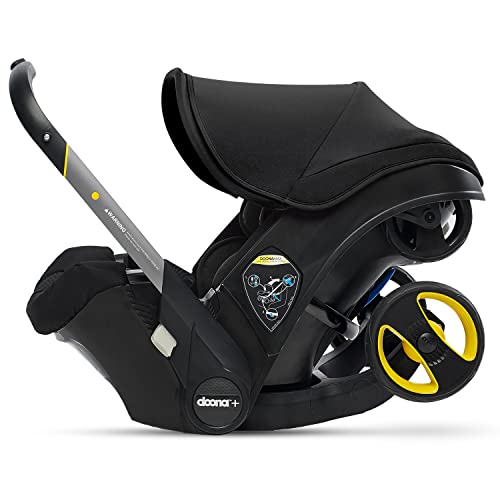
Car seats with an anti-rebound bar can be used in all vehicles. The only issue? A car seat with an anti-rebound bar may take up more room, increasing the front to back footprint of the car seat. In other words, it may take up too much space to be a good, safe fit for your car, so keep that in mind when you’re car seat shopping, especially if you have a smallish car.
On some infant car seats, the anti-rebound bar is optional. Other manufacturers require using an anti-rebound bar because their car seats are safety-tested with it. But one thing is for sure: If the anti-rebound bar is integrated into the car seat or car seat base, there’s no question: You should use it.
Safety upgrade #3: Lock-off

Lock-off on the UPPABaby Mesa infant car seat base, in blue.

The lock-off on this Britax infant car seat is red.
A lock off is a built-in safety feature built into a car seat that locks the seatbelt at either the lap, shoulder or both. When you install the car seat with the seat belt, a lock-off secures the seatbelt so that it can’t loosen; your tight car seat installation will stay tight. A lock-off is usually a bright color, such as red, blue, yellow or orange. When you’re car seat shopping, especially if you will be installing the car seat with the seat belt, look for a lock-off whenever possible.
Generally, Babyproductsmom recommends buying an infant car seat with a load leg, an anti-rebound bar and a lock-off, if you will be installing it with the seat belt rather than the Latch system. But if you like a car seat without these added safety features, no worries. For example, one infant car seat I own and love is the Nuna Urbn. It doesn’t have an anti-rebound bar or a load leg, but what it does have are rigid Latch connectors, which connect to the dedicated metal anchors in your car. So, there’s no car seat base to install or lug around. Wee! It would make an especially great option if you’re in and out of taxis and ride shares often. And the Nuna Urbn is super lightweight, at just seven pounds.
Remember, all car seats sold in the U.S. must meet federal motor vehicle safety standard 213, providing this baseline level of safety.
You’ll find infant car seats with these and other added safety features at all price points. Here’s a sampling.


Safety upgrade: Lock-off; anti-rebound bar handle
Lock-off; anti-rebound bar in base
Lock-off
Lock-off; load leg; rigid Latch connectors for easy installation
anti-rebound bar; lock-off
Lock-off; anti-rebound bar
Lock-off; anti-rebound bar
Lock-off; anti-rebound bar
Load leg, ant-rebound bar; lock-off
Load leg, anti-rebound bar, lock-off
Lock-off; anti-rebound bar
2. Weight of the infant car seat without the base
Since you’ll most likely be using an infant car seat as a baby carrier, you’ll be carrying around baby weight and the weight of the carrier, which can quickly add up as your baby grows.
The good news is that infant car seats are lighter than ever these days. Many infant car seats without the base weigh in the range of 10 pounds.
Still, if the average 6 month old baby weighs 16 pounds and the car seat itself weighs 10 pounds, you could soon find yourself lugging around 26 pounds of baby and car seat weight, which could be a painful, especially if you carry the car seat on your forearm like a purse.
Even if you’re in great shape, that’s a recipe for neck, back and shoulder pain for sure.
At just 6 pounds, 9 ounces, it’s the lightest infant car seat on the market. It features a load leg in the base, but no anti-rebound bar.

Safety tip: When installing an infant car seat, consult the owner’s manual, watch the manufacturer’s installation video and consult your car manual. But for quick how-tos, just read the fine-print labels on the side of the car seat. Everything you need to know to install your baby’s car seat correctly is right there.
Shopping
For budget watchers eager to simplify their car seat search, consider focusing in one brand, such as Graco. It’s BabyProductsmom’s favorite value car seat and stroller brand, with models that feature the latest premium safety features. (More on premium safety features in a minute.)
More car seats to consider for your baby registry list:
These infant car seats don’t have a load leg or an anti-rebound bar but they’re still super popular and worth considering:
Exception:
Shopping shortcut: An All-in-One Car Seat, such as the Graco 4Ever or the Britax One4Life. The Britax One4Life offers Clicktight installation, which makes installation and adjusting as your child grows super easy. The Graco 4Ever is also easy to install and adjust as your child grows.
All most all car seat manufacturers make an all in one car seat these days.
Pro: You can use from day (in rear-facing mode) then later forward-facing until you’re baby is 120 lbs and 63 inches tall!
Con: You won’t get the cozy nest that an infant car seat offers and you won’t have an infant car seat to transport your baby around in, which is helpful.
Never miss a post. If you haven’t already, be sure to sign up to receive Babyproductsmom posts and special offers by e-mail.
Copyright Sandra Gordon Writing Resources LLC
Pin it!
The post Buying guide: Infant Car Seats appeared first on Baby Products Mom.
]]>The post Great gift ideas for grownups appeared first on Baby Products Mom.
]]> With the pressure on to pick the perfect thing for everyone on your list, let’s take a breather for a second to play detective.
“Picking out the perfect gift is really just about picking up on the subtle clues we’re always dropping about ourselves,” says Aileen Avery, a Los Angeles gift expert and author of Gift Rap: The History and Art of Gift Giving. “When people I’ve bought gifts for ask me, ‘How did you know I liked that?’ I always say, ‘I just paid attention.’”
Great Gifter Strategies:
- What do giftees like? Buy more of the same (BMOTS). For example, you notice they like scented candles. Buy them a scented candle. It seems like the easy way out, but you can’t go wrong with the BMOTS strategy.
- What is the giftee asking for? Some people like to create gift lists and registries. It’s tempting to go off-list because it seems so obvious to get the requested item. But, then again, you’re aiming to please and they asked for it.
- What does the giftee do? Do they travel a lot? Take care of grandchildren? Play pickleball? Buy them something to enhance that activity, hobby, pasttime, vocation.
- What have giftees casually told you about themselves? For example, my frugal relatives are building a house and boast about the fact they consult Dwell magazine at the local library. (Clue!) You can bet there’s a subscription to Dwell coming their way.
As you can see, the best gifts make people feel seen. The payoff for your thoughtfulness is that spark of recognition, which makes gift giving more fun and gratifying for everyone.
What should you get for the grownups on your gift giving list? Here’s a roundup of thoughtful gift ideas to get the ball rolling, with the goal of helping you personalize your product picks. (This post contains affiliate links. As always, thanks for your support!)
Tushbaby hip carrier
[easyazon_image align="none" height="160" identifier="B0BS3P3SSN" locale="US" src="https://m.media-amazon.com/images/I/41xcoIxhLHL._SL160_.jpg" tag="babyprodu0369-20" width="160" type="image" link_id="3273"]
Whether you (or grandma or grandpa) are multitasking in the house, out for a walk or traveling with a tot, the Tushbaby hip carrier makes the trek a lot easier, comfier and more supportive. The ergonomic hip seat, which looks like a big fanny pack, is designed to help hold a child on either side of your body to evenly distribute the baby/toddler weight to avoid straining your arms, back, hips, shoulders or neck. Tushbaby hip carrier fits newborns to 36 month-old toddlers (or up to 45lbs). Without straps to contend with, you can easily go from holding your baby to putting your baby down to walk. With Tushbaby’s integrated compartments for essentials, such as a bottle, snacks and diapers, it doubles as a diaper bag and roving food court.
Vera Bradley fleece plush throw blanket
[easyazon_image align="none" cloak="n" height="158" identifier="B09GDZ3Z73" locale="US" src="https://m.media-amazon.com/images/I/41CABV77WnL._SL160_.jpg" tag="babyprodu0369-20" width="160" type="image" link_id="3274"]


Wine glasses with silicone sleeves and covers

When you’re outward bound with a beverage, like at the beach, the park, on the patio or on a picnic, a Life Factory wine glass with a protective silicone sleeve or the stainless Yeti Rambler has got you covered. Outdoorsy types and those who like to smuggle a glass of their fave wine into fast-casual restaurants (guilty!) will appreciate your thoughtfulness.
Aura digital picture frame
[easyazon_image align="none" cloak="n" height="125" identifier="B09X1XN3FZ" locale="US" src="https://m.media-amazon.com/images/I/41n6P626V9L._SL160_.jpg" tag="babyprodu0369-20" width="160" type="image" link_id="3276"]Getting cherished photos off your phone and on digital display is great way to appreciate life’s greatest joys–whether it’s a new baby or grandchild, an amazing trip you took or special moments with family and friends.
With the top-rated Aura digital frame, you can send photos and videos directly from your phone to the frame. You can also invite family and friends to add photos. The Aura digital frame offers free, unlimited storage and no fees.
Quiet Mind weighted pillow

Move over weighted blanket. The Quiet Mind weighted pillow is a next-gen weighted tool to help everyone say goodnight to insomnia and better cope with the chaos of the day. Hug away the stress or just rest the weighted pillow against your lap for 15 to 30 minutes and wait for those feel-good endorphins to work their mindset magic. Quiet Mind pillows come in three sizes–small, medium and large–matched according to bodyweight. Great for anyone who could use an extra dose of calm. (Me!)
Tripped compression packing cubes

Frequent flyers on your list will appreciate Tripped compression packing cubes. Not your typical vacuum bags, Tripped compression packing cubes use a two-zipper system to compress clothes, save space and help eliminate the extra bulk when packing. Great for organizing your suitcase, fitting it all in one carry-on and peace of mind, especially if say–you keep an “essentials” Tripped compression packing cube or two in your carry-on bag in case of lost lugguge. (Nancy Monson, a travel writer extraordinare, swears by these and she goes everywhere.)
Ceres Chill Breastmilk Storage System
[easyazon_image align="none" cloak="n" height="160" identifier="B08SHLDQ5K" locale="US" src="https://m.media-amazon.com/images/I/31uKgKtVYjL._SL160_.jpg" tag="babyprodu0369-20" width="160" type="image" link_id="3279"]From new parents on the go, give the gift of breastfeeding convenience. The Ceres Chill breastmilk chiller, a double-walled stainless steel, dual chambered system is a safe, discreet, convenient and sustainable way to keep 12 ounces of pumped breast milk cold for up 16+ hours and keep it with you, wherever you are. Pump right into the Ceres Chiller. Fill the outer chamber with six to eight standard ice cubes; if you need more than 16 hours, just add more ice.


 Crossrope Weight Jump Rope set
[easyazon_image align="none" cloak="n" height="160" identifier="B0C4BDW877" locale="US" src="https://m.media-amazon.com/images/I/51FwGEYSP0L._SL160_.jpg" tag="babyprodu0369-20" width="160" type="image" link_id="3280"]
For the fitness-minded on your list, Crossrope Weighted Jump Rope could be a strong contender in the great gift department. The lightly weighted rope comes with a free app with guided workouts that allow you to exercise anywhere. Crossrope’s most popular ropes start at 1/4 pound, allowing you to get an incredible workout in, with only one piece of equipment. Guided workouts in the app offer heart-healthy, HIIT workouts in that burns almost twice the calories of running–and maybe even as many calories as running after a 2 year old.
Momcozy universal stroller organizer

This universal stroller organizer turns any stroller into command central. New parents will appreciate the insulated cup holders and the plethora of pockets for stashing their phone, wallet, keys and other necessities. Need more new-parent gift ideas for parents who love to travel? Check these out.
Tell Your Life Story

Life goes by in a blur, but when you write it down on paper or digitally, it becomes a tangible way to harness it and make sense of it all. For the writer types and story tellers on your gift list, Tell Your Life Story breaks writing your own autobiography into organized journal entries. Fun and thoughtful questions help guide the process of recording your life’s history as you think back about meaningful experiences and your take on the situations that will inspire current and future generations.
Lululemon Everywhere Belt
[easyazon_image align="none" cloak="n" height="160" identifier="B09MR3VH7N" locale="US" src="https://m.media-amazon.com/images/I/31I6TzT38ML._SL160_.jpg" tag="babyprodu0369-20" width="148" type="image" link_id="3283"]When you’re on the go, a belt bag is just what you need. The Lululemon Everywhere belt bag is big enough to fit essentials, such as your wallet, phone and keys, but not so big to weigh down your walk, run or bike ride.
Philips Sonicare Electric Toothbrush EssentialClean

Okay, yeah. An electric toothbrush isn’t the most exciting gift. But everyone brushes their teeth. What’s great about the Philips Sonicare electric toothbrush EssentialClean is not only that it makes your teeth feel sparkly clean, it’s rechargeable and comes with its own travel case, so you can use the same toothbrush at home and when you’re out and about. Include extra toothbrush heads to go with it for good measure.
Custom paint by number

The artsy hobbiest in your life will enjoy this personalized take on paint by numbers: CleverFine Custom Paint by Numbers from your own photo. Maybe you have a photo of the giftee in your phone (or their dog) that would make the perfect artwork? When you order the custom paint by number kit, you’ll send in a reference photo that will be turned into a personalized photo pre-printed canvas. Each kit includes 24 to 36 high-gloss acryllic paints and three brushes.
The post Great gift ideas for grownups appeared first on Baby Products Mom.
]]>The post Get a deal on a hands-free breast pump! appeared first on Baby Products Mom.
]]>
Willow Go
Which breast pump is best?
If you’re a fan of chatting on speaker while driving or working out while watching TV or you prefer backpacks instead of purses, the answer is a hands-free breast pump, of course.
With a hands-free breast pump, what can’t you do? You can use a hands-free breast pump while you’re working, texting, reading or even while driving (with safety first, of course). A hands-free breast pump is a fabulous time saver!
Many regular breast pumps can be made hands-free with a special pumping bra. But the Willow Go Wearable, along with Willow’s new wireless Luxe Pumping Bra, is the ultimate pairing as you gear up for heading back to the office, working from home while running the breastaurant, or crossing errands off your to-do list–this fall and beyond.

Willow Go and Luxe Pumping bra pairing
Willow Go hands-free breast pump features sleek design and hospital grade suction, without dangling tubes, wires or cords, for quiet pumping wherever you are.
Note: This content contains affiliate links to products and services BabyProductsMom believes may be of high quality and value to you.
Willow Go hands-free breast pump is more affordable than ever!
The Willow Go hands-free breast pump regularly retails for $329. Until the end of September 2022, you can score a Willow Go for just $299!
What to do: To get your discount, go to One Willow and use BabyProductMom’s special discount code willowgo-BPM at checkout, now through Friday, September 30, 2022.

What should I look for when choosing a breast pump?
When you’re shopping for a breast pump, here are the features to look for, no matter which style of pump you choose.
Suction settings
The best pumps mimic a baby’s natural nursing rhythm by automatically pumping in two distinct modes: rapid, to simulate a baby’s rapid sucking to begin fast milk flow, and slower, to simulate a baby’s deeper sucking to produce the most milk flow. Together, the two phases offer a more authentic breast-feeding experience with greater comfort, increased milk flow, and quicker nursing time.
Willow Go features nine levels of suction.
Double-pumping
If you’ll be pumping at work or pumping often, get a double pump. By expressing both breasts at once, you can complete a pumping session in 10 to 15 minutes. Besides being fast, double pumps are better for milk production. Double-pumping increases levels of prolactin, the hormone responsible for milk production. Smaller pumps or a single pump may not be able to maintain your milk supply long-term and can quickly become frustrating to use.
With the Willow Go, you can pump two at a time.
Warranty
If you’ll be using your personal-use breast pump every day, look for a pump that has at least a one-year warranty on the motor. A generous warranty typically is a sign of quality and durability.
Willow Go features a 1 year warranty.
Willow Pumps are covered under a 12 month warranty from the purchase date. Pump accessories — all replaceable pump parts, including but not limited to, flanges, FlexTubes, containers, milk bags, diaphragms, duckbills, chargers and sizing inserts — are covered under a 90 day warranty. Other physical products, including but not limited to bras, are covered under a 60 day warranty.
Adapter/batteries
If you’re pumping on the road or you don’t have access to an electrical outlet, look for a pump that can run on batteries or that includes an adapter that can attach to your car’s cigarette lighter.
Willow Go is rechargeable. Charge your pump for 1.5 hours to get a full charge, which is enough for three pumping sessions.
LCD display
Some breast pumps offer an LCD panel that displays speed and suction settings as well as the time and length you last pumped–even which breast you pumped last.
The LED display on the pump and the Willow Go app can keep you updated on battery status.
Carrying case
If you’ll be commuting or traveling, a professional-looking pump “briefcase” or backpack is the way to go.
Whoops! The Willow Go doesn’t come with a carrying case. You’ll have to buy that separately.
Some options: This backpack version looks good to me or this one, to keep everything all on in place.
Look for insulated cooler compartments in the pump’s carrying case if you’ll be pumping on the go and need to store your milk for later. Throw in an ice pack or two with your breast milk in the storage compartment for good measure.
What is the return policy?
The return policy a good thing to know when you’re buying baby and other products, especially with bigger ticket items like a hands-free breast pump. Breast pumps are personal, single use items, like a toothbrush. Once you break the safety seal on the Willow Go, it’s not returnable. But…you can return an unopened Willow Pump within 60 days of the purchase date. If you decide to return your unopened pump or accessories, you must contact One Willow to start the return process and to obtain a RMA number. Here are One Willow’s return policies.
More ways to save on a breast pump
- For more ways to save on a breast pump, check out this post.
- Is Willow Go covered by your insurance? Check here.
- Check out this post on the baby products a leading pediatrician recommends when you’re gearing up, including a breast pump.
Get Willow Go Breast Pump for Less While You Can
To get Willow Go for just $299, go to One Willow and use BabyProductMom’s special discount code willowgo-BPM at checkout, now through Friday, September 30, 2022.
Stack your savings: Get $25 off your first order at One Willow by signing up for their emails.
You can use your discount and pay for your Willow Go breast pump over time with Affirm. Willow Go is also FSA/HSA eligible.
The post Get a deal on a hands-free breast pump! appeared first on Baby Products Mom.
]]>The post How Can You Save Money on Disposable Diapers? Go Diaper Free + GIVEAWAY! appeared first on Baby Products Mom.
]]>

 that’s just an average.
According to a report in American Family Physician (AFP), only 40 to 60 percent of kiddos complete toilet training by 36 months of age. That means, your diaper days could be a marathon and your diaper costs could add up to much more than $2590.
BUT…there is another way to cut your diaper costs. How about potty training your baby early–as early as the newborn stage–so you’re done with diapers by 12 months or so—rather than at 36 months or later?
It’s possible! In fact, Andrea E. Olson, the author of Go Diaper Free: A simple handbook for elimination communication and the Go Diaper Free podcast and founder of Tiny Undies, a specialist in early potty training–a technique known as elimination communication (EC)–says EC could cut your diaper costs by as much as 60 percent.
EC with a special item known as a Top Hat Potty is a form of toilet training that involves observing babies for a few weeks to learn their verbal elimination cues and body language for when they’re about to pee or poop, then taking them to a potty before #1 or #2 ever makes it to their diaper. (With EC, babies still wear diapers, they just don’t necessarily soil them.)
All five her of Olson’s kids were out of diapers by 12 months. “If you’re done with diapers by 12 months instead of 36 months, you could save roughly $2,000 a child,” Olson says. “I estimate I’ve saved $10,000 on diapers on my five children.”
Read on for Olsen’s advice on EC and how she went on to create the Top Hat Potty and spearhead the diaper-free “movement.”
Note: This content contains affiliate links to products and services BabyProductsMom believes may be of high quality and value to you.
Potty-Training Tactics
Today, most toilet training in the US happens between 21 and 36 months of age. “But in the 1950s, 92% of babies were out of diapers by 18 months in the US,” Olson says. That proves that babies are capable of being potty-trained earlier than 36 months. “It’s a myth that babies must be developmentally ready to potty-train,” Olson says.
According to the AFP, the convenience of disposable diapers and training pants have likely contributed to today’s 36 month toilet training time table. Elimination communication reverses the trend.
Olson never planned on becoming the face of EC. It just naturally evolved. “Before I ever had a child, I had heard of friends of a friends who didn’t use diapers,” Olson says. “They just had their baby pee into the sink. I was like, whatever that is, I’m doing it when I get pregnant because I remember changing diapers babysitting at age 11 and I hated it.”
When Olsen’s first child was born in 2010, she read up on elimination communication and began observing her baby for a few weeks to learn his verbal and body language elimination cues for when a poop or pee is occurring, such as squirming or fussing. “I caught onto some of my son’s rhythms and his signals and just made it work for me where he was poop trained pretty instantly. There was no going back,” Olsen says.
Introducing the Top Hat Potty

Instead of pooping in a diaper, Olson had her baby son poop over the toilet or in a small receptacle, a Top Hat Potty, which looks like a top hat.
Top Hat Potties are common in developing nations. Olson created a version that doesn’t slip from between the thighs and offers a warm rim at the top, sparing babies the chill of hard plastic.
To-do tactic: When you sense your baby has to go, simply hold your baby underneath the thighs over the potty or a receptacle like a Top Hat Potty and give a little grunt, signaling that it’s okay to let go. Olsen demonstrates using a Top Hat Potty in this video.
“Your baby will begin to associate the sound with peeing or pooping into the receptacle,” Olson says.
Afterwards, you’ll just dump the pee and poop into the toilet. Rinse out the Top Hat Potty with warm water and a little soap or throw it in the dishwasher and you’re good to go–until the next time.
You can use a Top Hat Potty in the diaper bag and take it out with you.
How early can potty training begin?
You can start with elimination communication anywhere from zero to 18 months, and not have to wait till your child is two and three years old to potty train.
When Ols0n’s son was 9 months old and started crawling, she missed the poop signals for about a week, which is typical during developmental transitions. “But other than that, he literally never pooped in his diaper. The diaper was just a backup,” she says. After Olson’s son mastered crawling, Olson got rid of her son’s backup diaper completely.
“I stopped using diapers during the daytime with him at nine months. My second child was out of diapers by 12 months or 13 months. My third child was out of diapers at 17 months, but he also was pooped-trained from pretty much from birth. My fourth child, I took him out of diapers at 12 months. And my fifth was really my golden child and all levels. She was out of diapers at 12 to 13 months in the day. By 17 months, we didn’t use nighttime diapers either. It was absolutely amazing,” Olson says.
How the diaper-free method works
The diaper-free elimination communication method starts with just observing your baby, preferring starting in the newborn stage.
Watch your baby for a few hours a day for a couple of days and see if he/she gives off any kind of facial expression. “Most babies just get fussy a little bit after nursing; that’s a signal for sure your baby has to go. The most common signal actually is getting fussy,” Olson says.
Another common pooping signal is the grimace. When you notice your baby grimacing, “You just gently say, ‘Wait,’ bring them over to the toilet, the sink or a container,” Olson says. Another excellent time to have your baby use a Top Hat Potty (instead of a diaper) when they wake up or after a nap. “We all have a hormone, an anti-diuretic hormone that keeps us clean and dry when we’re sleeping and when we wake up, we need to go,” Olson says.
Elimination communication is an exposure technique. Over time, your baby gets used to not going in his/her diaper. “Elimination communication is what they do in countries across the world that don’t use diapers. They make a noise, such as a grunt or mimicking the sound of rushing water, and the baby releases,” Olson says.
The role diapers still play
With elimination communication, you’ll still use diapers, but just as a backup, such as during the day or at night and up until a certain age or stage such as when your baby is crawling or walking. Then, they’ll just wear toddler underwear.
“With elimination communication, people stop using diapers when their baby is between around 9 to 14 months,” Olsen says.
You might also resort to diapers when you’re busy, such as when you’re traveling.
Still, the diaper is just there in case. With elimination communication, you reuse the same dry diaper for two to three days. “I’ve used the same diaper until the tabs have ripped off,” Olson says.
Which type of diapers work best for elimination communication?

“Disposables and cloth diapers all work well,” Olsen says. “You can use any kind of diaper as a backup.”
It’s common to worry that elimination communication will take a lot of time and energy, that it’s one more thing to do. “Most of us will say: ‘I’m just going to use a diaper and not worry about it and potty train later. No big deal,'” Olson says. “But what most people don’t understand is that EC actually simplifies parenting because you no longer have to change poopy diapers, which takes a long time and it’s disgusting.
You also don’t have as many behavioral issues when your child becomes a toddler. Because they have self-mastery. It takes away the power struggle away that can happen with potty training and normalizes being out of diapers by 12 to 18 months.”
If you’re interested in trying elimination communication, Olsen offers this advice:
- Just start, even in a tiny way, by paying attention to your baby’s elimination signals.
- Just try it once a day. Offer your baby the potty or Top Hat Potty at every diaper change, or every time your baby wakes up in the morning or after a nap.
- As you observe your baby at first, you might go through a lot of diapers in a month. Then the next month, you’ll hit a rhythm and start catching more pees and poops in the Top Hat Potty and reusing diapers that are dry.
- You can practice elimination communication around a busy schedule. As you continue, your baby will actually start to wait for you and to look to you and crawl up to you and signal that it’s time, you know.
Elimination communication is a team effort.”I never thought this was what I would do when I grew up,” Olson says. “But after I had my first baby, I struggled so much at first, trying to figure out how to do elimination communication just from reading about it in a text book. I wanted to make it easier for everybody for an alternative to traditional potty training. Find a little piece you can start to do that feels doable because it’s really easier than changing diapers all the time.”
To learn more about elimination communication, visit Go Diaper Free.
Yay! It’s a Top Hat Potty Giveaway!
Want to give elimination communication a go? BabyProductsMom is giving away a Top Hat Potty to three lucky (and random) winners!
To enter to win, just sign up below. Contest ends on Tuesday, May 18, 2021 at 5 PM ET. The winners will be notified by email. If each winner doesn’t respond within 24 hours, another winner be chosen and given 24 hours to respond, etc.
The post How Can You Save Money on Disposable Diapers? Go Diaper Free + GIVEAWAY! appeared first on Baby Products Mom.
]]>The post Your top diaper questions—answered + diaper giveaway! appeared first on Baby Products Mom.
]]>
Little ones come with BIG expenses and…disposable diapers can take a giant chunk of the family budget!
In fact, babies typically go through roughly 7,000 diapers from birth to potty training (at around age 2 ½). At an average price of 37 cents per diaper, you can plan to spend roughly $2590 over your baby’s diapering career. Ouch!
BUT…that’s just an average.
“What you’ll spend is going to be very different, depending on the brand of diapers you buy,” says Natalia Richer, director of operations at Diaper Testing International and a diaper and and absorbent hygience products consultant.
Which are the cheapest diapers? Which is the best brand of diapers? Are some disposable diapers more ecofriendly than others?
If you decide to use disposable diapers—like the majority of parents do even though reusable diapers are becoming more mainstream–there’s a lot you can do to cut your diaper costs.
BabyProductsMom talked with Ms. Richer to answer your most pressing questions to help you save dollars on disposable diapers—and more!
Note: This content contains affiliate links to products and services BabyProductsMom believes may be of high quality and value to you.
Which brand of diapers is the cheapest?
[easyazon_image align="none" cloak="n" height="500" identifier="B0792Q247X" locale="US" src="https://m.media-amazon.com/images/I/51-PjTeAa1L.jpg" tag="babyprodu0369-20" width="500" type="image" link_id="3196"]
NR: The least expensive diapers are Walmart’s Parent’s Choice. Using size 4 diapers as an example, you can find Walmart’s Parent’s Choice diapers for as low as 13 or 14 cents per diaper. (Although you can find Parent’s Choice on Amazon, Walmart offers that low price.)
On the flip side, Healthynest diapers in size 4 may cost as much as 60 cents per diaper.
BPM: Wowza! That’s a big spread–$980 for Parents’s Choice versus $4200 for Healthynest, for the 7,000 diapers you’ll use, on average.
NR: Diapers can also vary widely in cost within a brand, too. You can find Pampers BabyDry and Pampers Swaddlers, for example, for as low as 22 to 24 cents per diaper (size 4). Pampers Pure may cost 43 cents per size 4 diaper.
BPM: And Walmart now offers Rascal + Friends, which retails for around 27 cents to 32 cents per diaper, for size 4, depending on the size box you buy (in general, the greater the diaper count, the lower the cost per diaper).
So, it sounds like if saving money is your biggest goal, you might start with Parent’s Choice to see if they work for your baby. If they don’t work out for some reason, shop around.
NR: Yes, try different brands and see which offers the snuggest fit. Does it leave holes where leakages can happen? How good is the waist elastic?
Trust your instincts as a parent and look for something that works for you. Whichever diaper you choose, if it works for you, it’s a good diaper.
Let’s go back to Healthynest diapers for a second…
BPM: Healthynest is the first diaper brand to be verified by the Environmental Working Group (EWG). EWG verified diapers must not contain 19 chemicals or materials the EWG has linked to health harm, such as parabens, phthalates, bisphenols, fragrances or fragrance ingredients, such as essential oils or botanical extracts, formaldehyde or formaldehyde-releasing compounds, and more. (Here are the requirements for diaper to become EWG verified, just fyi.)
The founder of Healthynest diapers, Shazi Visram, is a member of EWG’s board of directors. Hmm…what do you think of Healthynest and EWG’s Verified diaper program as a concept?
NR: I respect the program, even if it’s still a work in progress. I’ve talked some of the folks from EWG and I feel like they’re coming from a good place. Their certification program can provide more self-regulation for an industry that may seem not very well regulated and provide consumers with more information about what’s inside the diapers they’re buying.
BPM: Fair enough. Maybe the EWG will start a trend and more diaper brands will become EWG verified. Speaking of trends…

Walmart’s Rascal + Friends offers fun prints and no lotions, latex or fragrance
What’s trending in diapers now?
NR: The Honest Company kicked off a trend in 2012 that is still going strong today: eco-friendly claims and transitioning diapers from being just a basic product to something that’s social media worthy with beautiful patterns.
Now, Proctor & Gamble, the makers of Pampers and Luvs, and Kimberly Clark, the makers of Huggies have released their own brands that are their answer to Honest, which is the Pampers Pure and Huggies Special Delivery.
Diapers sold online, direct to consumers, is also a big trend now, with Healthynest, Dyper, Coterie and Parasol. All of these more premium diapers focus on reducing the environmental impact of diapers.
Are diapers recyclable?
NR: No, not really. Diapers companies are making little changes to make the story a little more sustainable. But, there’s not all that much that can be done. As you know, diapers are mainly made from synthetic materials that are derived from fossil fuels. Many companies, whether it’s Pampers Pure or anyone one, might make the back sheet out of polypropylene blended with 15 percent cotton or maybe they’re manufacturing with green energy, which is good.
But in terms of the overall impact to the environment, these little changes have little impact on the overall supply chain. In my opinion, there’s little being done to actually make the diapers more environmentally friendly.
But Proctor & Gamble is working on making diapers recyclable. Right now, they have a pilot plan in Italy where they’re successfully recycling diapers. If that process can be brought into the US–the whole process of being able to receive all the diapers, send them to the correct location and recycle them, that would be truly the game changer that could make an impact and be part of a circular economy.
BPM: That’s surprising! So, right now, “ecofriendly” disposable diapers don’t biodegrade faster than regular disposable diapers?
NR: That’s right. Even a diaper is made out of many plant-based components, landfills in the US aren’t designed for products to decompost. Landfills just don’t promote decomposition.
Are any disposable diaper recyclable?
There is one company, Dyper, that will actually compost the diapers for you if you sign up for their Redyper program (US only). The program is a bit pricey ($39/month). But if you subscribe to the program, they pick up your dirty diapers and compost them for you.
BPM: If you’re really into the environmental, the Dyper and their Redyper program might be the way to go, or cloth diapering.
NR: Yes, but keep in mind that clothing diapering may only be better for the environment if you reuse cloth diapers for your next child, wash them in a full load, line dry them and wash them in water cooler than 140 degrees F. Otherwise, according to a UK study comparing the lifecycle of a cloth diaper versis a disposable diaper, cloth diapers may not be much better for the environment than using a disposable diaper.
But compared to disposable diapers, cloth diapers can save money.
BPM: Okay, let’s talk storebrand diapers again.
Are storebrand diapers comparable to namebrand diapers?

NR: Yes. If you look at the CostCo diaper, the Kirkland diaper, you’ll find that it’s very similar to some of the lines that Huggies offers.
BPM: If you want to save money, start trying storebrand diapers until you find one you like?
NR: Yes, at my company, Diaper Testing International, we’ve tested all store brands in terms of diaper performance. Walmart’s Parent’s Choice has really good performance. If you want to save money, try it, and see if it is a good fit for your baby.
What else shoppers should know to save money on diapers?
NR: Consider diaper subscription boxes. You would think would make the diapers expensive. But when you subscribe and save, you’re basically getting bulk discount prices.
BPM: And with subscription boxes, diapers are delivered right to your doorstep!

NR: Also, consider diaper pants, also known as training pants, which you pull on like underwear one leg at a time.
In India, they basically only sell diaper pants. There, newborns wear diaper pants from day one. In China and Japan, where they have regular diapers, sales of diaper pants are growing.
Diaper pants offer different routines. You can put them on vertically instead of horizontally, which makes changing babies easier, especially when they start crawling. Diaper pants provide the benefit of an all-around elastic waistband, which provides a better fit and it doesn’t need to be adjusted throughout the day.
If you’re having trouble with leakages along the waist overnight, I would look at diaper pants for a baby boy.
Huggies Pullups are the market leader for diaper pants.

We earn a commission if you make a purchase, at no additional cost to you.

Pampers 360 diaper pants start at size 3. But Parasol, Hello Bello and Dyper also have their own diaper pants.
BPM: You bring up an excellent idea. You could transition your baby to “training pants” earlier, when your baby is around 18 pounds. The fit might be better than using traditional diapers through size 6 or 7. And if you’re interested in early potty training–as in starting around 18 months or so–training pants can help get the job done.
Are diaper pants great for potty training?
NR: Yes, in Indonesia, babies are potty trained as early as 18 months. But it requires a full-time parent oversight. Babies are biologically capable of being potty trained much earlier than when we’re potty training them in the US.
In third world countries, price is a huge motivator. They want to save as many diapers as they can. When an infant is wearing diaper pants, parents can begin to recognize facial expressions a baby makes when they’re going to pee or poop. They can run to the toilet and pull down the diaper, which saves that diaper from being used.
For them, saving those 15 cents is a big deal. In the US, parents go through an average of 5.5 diapers per day. In places like Japan, that number is higher. There are countries that are more hygiene obsessed.
Japanese parents are going to change diapers more often than US parents. But in the US, we change diapers more often than in Mexico, or in many other countries where the average is closer to four changes per day.
What’s the best performing diaper?
NR: The diaper brand Coterie has the highest performing core in the US. If you want to have a diaper with the highest retentive capacity diaper, which is going to keep your baby drier longer, that’s a good option.
BPM: Coterie touts their diapers as “hypoallergenic, fragrance free, chlorine free, alcohol free, paraben free, dermatologist tested and recommended.” For size 4, with doorstep delivery, you’ll pay around 54 cents per diaper, but sign up for automatic renewal, and you’ll get 10 percent off, or 48 cents per diaper, which is still on the pricey side.
But in this case, it seems you definitely get what you pay for!
Key takeaways:
- Inside story: Healthynest diapers are the only diaper brand verified by the Environmental Working Group to be free of 19 chemicals. EWG’s diaper verification program is new. Maybe more brands will follow.
- Value: Parent’s Choice diapers are the least expensive storebrand diaper (at 13 to 14 cents per diaper) and they test well. Give them a go, if saving money on diapers is your main mission. They’re available on Amazon, but you’ll get a better deal by buying them at Walmart.
- Sustainability: Ecofriendly disposable diapers really aren’t any better from the environment than regular diapers because the landfills in the US aren’t set up for composting. But Dyper’s Redyper program will compost Dyper brand diapers for you. The Redyper program is worth checking out if sustainability is a top concern.
- Performance: Coterie diapers, available by door to door subscription, will keep your baby dry like no other. If your baby is a heavy wetter, they could be a contender.
- Trending: Diaper pants, otherwise known as training pants or pullups, which go on like underwear with an elastic waist, are a great option if you’re interested in potty training early (as early as 18 months or maybe even earlier). Pullups/diaper pants start at size 3.
- Practical: Be sure to put disposable diapers on your baby registry.
Yay! It’s a Diaper Giveaway!
BabyProductsMom is giving away one giant (134 count) box of size 5 Rascal + Friends disposable diapers (retail value $50).
This premium diaper brand features a fun print (pictured), 3D core for increased absorbency, a deep pocket design, custom-designed grip tabs and high back waistband.
To enter to win, just sign up below. Contest ends on Tuesday, April 13, 2021 at 5 PM ET. The winner will be notified by email. If the winner doesn’t respond within 24 hours, another
winner be chosen and given 24 hours to respond, etc.
The post Your top diaper questions—answered + diaper giveaway! appeared first on Baby Products Mom.
]]>The post Why is my baby’s skin so sensitive? Your Answers Here! appeared first on Baby Products Mom.
]]> Right up there with puppies, kittens, crimson sunsets, shared laughter—and other great things in life–is newborn baby skin. It doesn’t last forever. But when it’s here, you can’t help but marvel at the miracle of its pillowy lushiness.
“Baby’s skin should feel wonderful,” says Sheilagh Maguiness, MD, a pediatric dermatologist at the University of Minnesota Health Pediatric Specialty Care Discovery Clinic and spokesperson for the Society for Pediatric Dermatology. Soft and smooth baby skin is a sign the skin barrier is working.
But what if your baby’s newborn skin has crusty patches? Or it’s drier than the Sahara? What is the skin barrier?
Read on for some baby sensitive skin care information that might change the way you handle baby bath time–otherwise known as that wet and wiggly bonding session.
Note: This post contains affiliate links. BPM only promotes certain products and services she believes to be of high quality and value that can be beneficial to you. Thank you for your support, which continues to make this blog possible.
What is the skin barrier?
Ok, first–the outside story. The skin barrier is the surface of the skin—the stratum corneum. It’s your baby’s birthday suit and it has a big job to do, including keeping out stuff that shouldn’t get in, like allergens and harmful bacteria. Water and oils naturally evaporate from skin’s surface.
We’re all always losing water and oils from our skin all the time. But a healthy skin barrier–stratum corneum–can also help keep your baby’s skin hydrated by preventing water and oils from skedaddling from the skin’s surface too quickly.
If your baby’s skin feels a little dry or you’re seeing cradle cap—crusty or oil patches on your baby’s scalp–or if your newborn has diaper rashes or baby acne, that’s a sign the skin barrier isn’t perfect. “Skin barrier defects are the cause of dry skin and atopic dermatitis (eczema) in 70% to 80% of pediatric patients,” Dr. Maguiness says.
The result? Red, itchy and inflamed baby sensitive skin.
Why is my baby’s skin so sensitive?
Dry, baby sensitive skin happens when baby’s skin doesn’t retain water in that top layer, the stratum corneum. Babies with eczema (atopic dermatis), for example, develop it because they’re missing filaggrin–a protein in the top layer of the skin.
“When you don’t have enough filaggrin, you’ll lose more water through the skin than normal,” Dr. Maguiness says. Eczema tends runs in families. Children who come from families with a history of eczema, asthma or hay fever (known as the atopic triad) are more likely to develop eczema. If your baby inherited the tendency for eczema, something in the environment then triggers it.
Overall, “20% of babies are going to have dry skin/eczema,” Dr. Maguiness says. “That can start right in the newborn period. At around three months of age, you can start to see those signs of dry skin.”
How do I get rid of dry, irritated baby skin?
Fortunately, skin barrier defects like eczema can be easily treated at home. To take the very best care of your newborn baby’s dry, sensitive skin, Dr. Maguiness offers these skincare tips.
1. Bathe your baby daily

How often should you bathe your newborn? It depends. “Babies with normal skin, those who aren’t showing any sign of sensitive skin and don’t have a family history of eczema, you can probably get away with bathing them two or three times a week. And you probably don’t even need to apply a moisturizer,” Dr. Maguiness says.
“But children with dry, sensitive skin need to be bathed every day,” Dr. Maguiness says. And don’t think a sponge bath will do it.
2. Soak it up
You know that pruney look you get when you’ve had a good soak in the bathtub? That’s the look you’re going for wit
“That’s water expanding the stratum corneum,” Dr. Maguiness says. “It’s all about getting the water in.” During your baby’s daily bath, a good soaking can help prevent eczema-prone skin from drying out.
Your baby’s skin is like a sponge. Completely saturating your baby’s skin in water adds water back to your baby’s top later of skin (yes–the stratum corneum), which helps keep it soft and supple.
Best Baby Bathtubs for Babies with Dry Skin
If your baby has sensitive skin, these soaker tub can help get the job done!

Boon Soak
Munchin Sit and Soak Baby Bathtub
[easyazon_image align="none" cloak="n" height="160" identifier="B08BPHGF8T" locale="US" src="https://m.media-amazon.com/images/I/31WgaQ9gHtL._SL160_.jpg" tag="babyprodu0369-20" width="160" type="image" link_id="3148"]
Beaba Shnuggle
[easyazon_image align="none" cloak="n" height="160" identifier="B07KQRS3H9" locale="US" src="https://m.media-amazon.com/images/I/21fj9yjX9pL._SL160_.jpg" tag="babyprodu0369-20" width="160" type="image" link_id="3149"]
Stokke Flexibath
“If your baby has dry skin or eczema runs in my family, buy a baby bathtub with more volume of water for a true immersion tub bath,” Dr. Maguiness says.
Saturating baby sensitive skin with water is easier to do when you’ve got the right infant bathtub. The sling type of bathtub is just fine for babies with not-sensitive skin.
But the best tub for a newborn with dry, sensitive skin is a baby bathtub that allows you to immerse your baby’s body in lukewarm water, Dr. Maguiness says.
Of course, you’re not going to dunk your baby’s head in the water. But you do want a baby bathtub deep enough to easily get water on your baby’s face and scalp.
Safety note: Never leave your baby alone in the bathtub for even just a minute–not to run for your cellphone, answer the door or get something from the other room. According to the Consumer Product Safety Commission, children can drown in even a very small amount of water.
3. Skip the soap for baby sensitive skin
“You don’t need any soap. Water is a perfectly good cleansing solvent. Soapy bubbles and foam can be drying,” Dr. Maguiness says.
Still, a very gentle liquid nondetergent or non soap cleanser is fine in the first three months as long as you’re just cleaning the dirty parts, such as the diaper area, the armpits and hair. But you don’t need to lather your baby up all over with tons of foam.

Good choices for nonsoap body washes for babies are bland, fragrance-free, and often marked with hypoallergenic on the label, Dr. Maguiness says. Some options fitting her criteria include Cetaphil and Vanicream.
4. Smear on moisturizer for baby sensitive skin

Within 30 to 60 seconds of taking your pruney baby out of the baby bathtub, dry him/her off and massage a thick emollient moisturizer into your baby’s skin to seal in the water. “My favorite moisturizer is just plain petroleum jelly, something that is really thick and greasy. You want it to lock that water in,” Dr. Maguiness says. Vaseline petroleum jelly or Aquaphor fit the bill.
Stay away from lotions. “Pump lotions have high alcohol content; they often have fragrance and a lot of additives. You’re putting things on you don’t really need to and it’s not going to trap the water.”
How long do you need to keep up the daily bath, soak and smear routine? Studies show that applying a daily bland moisturizer can reduce the signs and symptoms of eczema by up to 50% at six months.
As a rule of thumb, keep up the soak and smear routine for the first six to eight months. “It’s very protective, it’s safe, it’s cost effective and if your child’s skin feels normal and isn’t super sensitive, you could certainly reduce at that point,” Dr. Maguiness says.
If your baby still has ongoing signs and symptoms of eczema, keep up the soak and smear routine and the nightly bath.
Should you change your baby’s skincare routine in the winter versus the spring and summer?
Nope. “Certainly in winter and dry cold climates, your baby is more prone to having dry skin, and that’s when children predisposed to eczema might flare,” Dr. Maguiness says. But you can stick to the same baby skincare routine year round.
Products to Avoid for Baby Sensitive Skin
In general, stay away from baby skincare products with fragrance, essential oils and surfactants (foaming agents). “Applying fragrance so early on could actually sensitize the baby,” Dr. Maquiness says.
Think fragrance free, very bland and and thick.

“I’ve seen a lot of kids with eczema induced by Johnson and Johnson’s body wash,” she says. “It’s so drying.” The number two ingredient is cocoamidopropyl betaine, which is a surfactant.
“Cocoamidopropyl betaine is super drying,” Dr. Maguiness says.
Shop Amazon – Create an Amazon Baby Registry
Why is baby skincare so important?
Not only does the right skincare routine help keep your baby comfortable and baby skin soft and smooth, it makes your baby less prone to food allergies.
Consider: Chronic eczema in infancy can leave the skin barrier dry and “leaky,” Dr. Macquiness says, which means that allergens–proteins from food–could enter through the skin.

To reduce your baby’s risk of food allergy, talk to your pediatrician about introducing peanut-containing products such as Love that Peanut as early as four months of age.
Introducing peanut allergens to your baby’s immune system early through your baby’s diet may reduce your baby’s risk of food allergies.
If you wait to introduce peanut-containing products and your baby has eczema, peanut protein could enter through the skin, which may cause an allergic reaction.
Myth: Using a humidifier in dry environments can help keep eczema from flaring up.

Reality check: A humidifier isn’t helpful for eczema. “There’s not enough water in the air to get it in the stratum corneum,” Dr. Maquiness says.
“Baby skin really needs to be a soaking in the bathtub. That’s where your baby’s skin will pick up water and keep it in there.”
BabyProductsMom bottomline:
If your baby has eczema or your baby is still a bun in the oven but eczema, asthma or hay fever runs in your family, consider registering for or buying a soaker tub.
Pin it!

The post Why is my baby’s skin so sensitive? Your Answers Here! appeared first on Baby Products Mom.
]]>The post What Nobody Tells You About Preparing for a New Baby! appeared first on Baby Products Mom.
]]>
Source: Pexels/Raw Pexels
Then sign up for the Get Ready for Baby masterclass series!
My friend Kelly Maher Carvell, founder of the Successful Breastfeeding podcast, has brought together 15+ top experts and influencers for this complimentary training series on having the easiest birth possible, thriving through the newborn stage, and mastering feeding your baby without ever worrying if you’re making enough milk.
It’s free! Yay!
Big Names in New Babyville
When you’re preparing for a new baby, here are a few of the incredible people you’ll get the chance to hear from:
-
Pediatrician and mom blogger, Dr. Krupa Playforth
-
Exclusive pumping expert, Amanda Glenn
-
Lactation, parenting, and sleep expert Brandi Jordan
-
Labor and delivery guru, Heather Knezic
-
Crunchy Mama, and Breastfeeding Advocate, Aaronica Cole
-
Postpartum fitness and core rehab mastermind, Erica Ziel
-
Real food nutrition expert and author, Lily Nichols
-
Evidence based parenting support with Samantha Radford
-
And me, of course! (I’ll be talking about what not to register for; with a process of elimination strategy, picking out the right baby products gets easier!)
Those are just a handful of the teachers involved. I would list them all, but you should probably just head on over to the registration page and take a look for yourself. And you can get access to all of it by clicking here.
 If you’re anything like me, then thriving as a new parent means a lot to you.
Thriving through your birth no matter what happens in labor…
Thriving through the newborn phase, (and maybe even getting back into your favorite pre-baby outfit- yes I’m looking at you, skinny jeans!)…
Thriving through nursing and bonding with your baby….
That’s what the power of being informed can do for you.
But…as new parents, it’s tempting to put a lot of energy and focus into material aspects of parenting, and not enough focus on really learning what’s going to happen to your body after birth and during lactation, or how to prepare to have the easiest start with your baby possible!
Is it possible to have the birth of your dreams, enjoy a well rested newborn phase, and have an easy start to nursing your baby? Absolutely, it is.
But does all that come as naturally as some people make it out to be?
Definitely not. And having a new baby is not so easy if you don’t have anyone to guide you through what to expect.
“It breaks my heart when I hear my clients tell me they’re overwhelmed, feeling isolated, and anxious about their new life with their babies,” Cahill says. “Their relationships are suffering, they’re exhausted, and their bodies are worse for wear. They want to feel like they’ve got this parenting thing figured out and enjoy their newly expanded family, but they don’t know how to do that without sacrificing every bit of themselves in the process.”
 That’s why the free Get Ready for Baby Masterclass is so exciting!
It’s 7 straight days of evidence based strategies and inside access to top influencers and experts who are there to help YOU rock your nesting phase and enjoy life with your new baby.
It’s free, but you have to save your seat to get access.
Claim your ticket to the online event here.
Babies don’t come with instructions, but the instructions can come to you–right in the comfort of your own Zoom room. See you at this amazing informational event!
The post What Nobody Tells You About Preparing for a New Baby! appeared first on Baby Products Mom.
]]>The post Delightful Holiday Gift Ideas for Everyone on Your List appeared first on Baby Products Mom.
]]> This year, we need great holiday gifts more than ever. With the pandemic and all it has put us through, gifts that delight –rather than those that are more practical– are what’s trending this holiday season, according to the New York Magazine’s The Strategist 2020 holiday shopping trends webinar BabyProductsMom attended recently.
To delight gift recipients, practice the thoughtful art of picking up on the subtle clues we’re always dropping about ourselves. As mentioned this post, “When people I’ve bought gifts for ask me, ‘How did you know I liked that?’ I always say, ‘I just paid attention,’” says Aileen Avery, a Los Angeles gift expert and author of Gift Rap: The History and Art of Gift Giving.
Start with: What do your gift recipients like to do? Feel free to drill down into your memory bank. Do they like to take baths? Take walks after dark? Plan charcuterie parties? What are their hobbies? If they have a baby on the way, what’s still outstanding on their baby registry? If they just got married, what didn’t get get from their wedding registry?
Thoughtful, delightful gifts ca
All told, a lot is wrapped up in being a good holiday gifter in 2020. But these gift ideas for everyone on your list can help you rise to the occasion.
Note: This post contains affiliate links. Meaning, BPM gets a commission if you purchase through her links, at no cost to you. BPM only promotes certain products and services she believes to be of high quality and value that can be beneficial to you. Thank you for your support, which continues to make this blog possible.
Stocking Stuffer
Earth to Skin Hand Sanitizer

Okay, this gifty is on the practical side. But Earth to Skin hand sanitizers possess the delight factor because they come in fun scents, such as coconut + aloe, blueberry and lemon + basil. Available at Walmart.
Gifts for New Parents
Infantino Pat & Play water mat

The Infantino Pat & Play water mat, Wee Wild Ones is the baby water park version of tummy time. Just fill the center with water and watch your baby do push ups with the play mat’s six floating sea pals. Perfect for sensory play.
Family Jammies

Dressing alike on Christmas morning in these cozy PajamaGram family matching Christmas jammies will make everyone smile. Whether Grandpa and Grandma will by joining you on Zoom or in person, be sure to get a pair for them too.
Premium Baby Gear


If you have pricey but coveted items on your baby wish list–maybe you didn’t even dare put them on your baby registry–such as the Snoo, a BOB jogging stroller, the UPPABaby Cruz V2 or the Doona car seat stroller, now’s the time to drop hints. Black Friday, Cyber Monday typically offer the best deals of the year. Shop early; offers are often only available while supplies last.
In fact, the Snoo is 25% off for Black Friday.
[easyazon_image align="none" cloak="n" height="160" identifier="B084Q6L7PD" locale="US" src="https://m.media-amazon.com/images/I/21HOalscW4L._SL160_.jpg" tag="babyprodu0369-20" width="160" type="image" link_id="3108"]And be sure to grab your Snoo sleep sacks at 40% off. You’ll need the Snoo Sleep Sacks for the Snoo, not to be confused with the Sleepea swaddle. You’ll need Snoo sleep sacks for the Snoo, not the Sleepea swaddle.
The Doona car seat stroller in storm grey is 20% off–a $100 savings.
Gifts for Grandparents
Brookstone PhotoShare Digital Photo Frame
[easyazon_image align="none" cloak="n" height="500" identifier="B087DXH4JG" locale="US" src="https://m.media-amazon.com/images/I/41bGP+97+-L.jpg" tag="babyprodu0369-20" width="500" type="image" link_id="3109"]
Grandparents will delight in seeing new images of the grandkids in their photo frame, without having to do anything or master new technology. With the Brookstone PhotosShare Digital Photo Frame, you can send treasured images from your phone to the frame, using the PhotoShare Frame app (iOS and Android) if the PhotoShare digital frame is connected to Wifi. The frames’ 8GB onboard memory will hold roughly 5,000 images.
Masterclass Gift Card
An annual Masterclass membership will surely delight lifelong learner types. Masterclass delivers 90+ world renowned instructors across 90+ categories.
Gift for Her
Heated Slippers
[easyazon_image align="none" cloak="n" height="500" identifier="B08KZQMLS2" locale="US" src="https://m.media-amazon.com/images/I/41VC01tx2CL.jpg" tag="babyprodu0369-20" width="500" type="image" link_id="3111"]
Whether they’re watching TV, studying or cozying up with a good memoir like this or this one, people whose feeties are always cold will appreciate these snuggly heated slippers, which reach an internal temperature of 122 degrees F.
Tranquility Weight Blanket

Weighted blankets are designed to help adults and children relax, so they can rest, recharge and sleep more comfortably by using deep touch pressure, a sensory experience similar to a comforting hug. Weighted blankets can be pricey. But the Tranquility weighted blanket starts at just $25. The blanket for adults is available in 15 and 20 pounds. The Tranquility kid’s weighted blanket is 6 pounds.
Yoga Zeal Jackson Pollock mat

The Jackson Pollock mats, available in two prints, are gorgeous but functional, providing the perfect artful surface for all forms of yoga and exercise. Yoga Zeal mats combine yoga mat and yoga towel to prevent slipping. Other stunning mats are also available.

Gifts for Teens
iFox iF012 Bluetooth Shower Speaker


Music in the shower? Duh! If you’ve got teens to buy for, this gift will signal that you “get” them. The iFox iF012 Bluetooth certified waterproof wireless shower speaker pairs easily to Bluetooth devices, such as phones, tablets.
Gifts for the Whole Family
Classic Board Games


Beloved board games to play together on Zoom, such as Pictionary, Uno and Yahtzee, can bring the whole family together when you have to be apart.
Baking Kits
[easyazon_image align="none" cloak="n" height="500" identifier="B0886L2QJC" locale="US" src="https://m.media-amazon.com/images/I/81noUVSGhZL._SL500_.jpg" tag="babyprodu0369-20" width="500" type="image" link_id="3116"]
For the bakers and bakers to be on your gift list, Baketivity baking kits take the guesswork out of whipping up tasty treats in the kitchen. The kit includes a creative, easy to follow recipe and pre-measured ingredients. Kit options include Bug Cupcakes, Cake Pops, Cinnamon Rolls, Whoopie Pies, Bagels and more. A perfect activity for grandparents who love to bake and little bakers!
Secret Santa Gift Idea
Motivational Giant Water Bottle
[easyazon_image align="none" cloak="n" height="500" identifier="B08FSTHWJV" locale="US" src="https://m.media-amazon.com/images/I/41Q1+2NiT-L.jpg" tag="babyprodu0369-20" width="500" type="image" link_id="3117"]
This gallon water jug makes it easy to monitor your daily water intake and comes in lots of fun colors.
The post Delightful Holiday Gift Ideas for Everyone on Your List appeared first on Baby Products Mom.
]]>The post Baby skin care: Which products do you really need? appeared first on Baby Products Mom.
]]> Baby skin care is big business. On Amazon alone, there are 4,237 products in the baby skin care category! Before stocking up on bottom balm and lavender baby wash or selecting skin care “essentials” for your baby registry, I asked leading pediatric dermatologists, members of the Society for Pediatric Dermatology, to weigh in on whether babies really need skin care products.
And, if so, which ones measure up?
We also cover the best diaper rash ointment, the best time to moisture, the best baby wipes and diapers for your baby’s skin and how to deal with cradle cap.
Maybe you were wondering about all this yourself. Here’s the skinny on baby skin care.
Do babies need skin care products?
“All babies certainly need a gentle wash,” says Lacey L. Kruse, MD, FAAD, attending physician at the Ann & Robert H. Lurie Children’s Hospital of Chicago and assistant professor of Pediatrics and Dermatology at Northwestern University Feinberg School of Medicine in Chicago. Dr. Kruse is also mom to Jonah, 2, and Nolan, 3 1/2.
Dr. Kruse recommends these baby washes for bath time:

Dove Body Wash

Aquaphor Baby Wash and Shampoo

Cetaphil Gentle Cleanser (not Cetaphil’s baby line) or

Cerave Hydrating Cleanser (ditto—not Cerave’s baby line)
“They’re very gentle and don’t strip the natural oils from our skin that keep it moist and protected, and they do a good job of getting what you need cleaned off,” Dr. Kruse says.
What about moisturizer—do all babies need it?
Moisturizer is a definite yes for babies prone to dry skin or eczema–an inflammatory skin condition that causes itchy, red and dry skin. One in five or 17 percent of all babies have eczema. As you may know, eczema is a risk factor for peanut allergy. For these babies, Dr. Kruse recommends Vasoline (a.k.a. petroleum jelly) or Aquaphor, which is similar to Vasoline/petroleum jelly.
“Vasoline is one of the best moisturizers there is,” she says, or a nonfragranced, thick, white cream moisturizer, which helps prevent the skin’s natural moisture from evaporating. “Lotion is better than nothing, but a cream is better than a lotion.”
Dr. Kruse’s top moisturizer picks include:


Cetaphil cream (not the baby line)

CeraVe Baby Moisturizing Lotion; it’s not as thick the Cerave cream
Best time to moisturize: “Within three minutes of getting out of the bath or shower for older kids,” Dr. Kruse says. After your baby’s bath, pat her dry and then apply moisturizer. “A little bit of moisture seeps into the skin during the bath. Moisturizer helps seal in that moisture,” Dr. Kruse says.
After-bath moisturizing is all your baby needs. You don’t need to apply moisturizer daily if your baby doesn’t have a bath–or at other times of the day.
If your baby doesn’t have dry skin or eczema, recent studies show that a bath then a moisturizing may still have a potential benefit: It may help prevent eczema.
But moisturizing is a must for your baby skin care routine if your baby has eczema or is prone to it. “For many babies with eczema, applying moisturizer often will keep it under control. If and when eczema flares up again, prescription or over-the-counter anti-inflammatory medication (cortisone) typically clear it up quickly,” Dr. Kruse says.
 How often do babies need a bath?
You don’t need to give your baby a bath every day. “For many babies, a few times per week or every other day is enough,” Dr. Kruse says. For babies with dry skin, keep the bath short—five to 10 minutes. Use warm, not hot, water, then moisturize after you’ve patted your baby dry within that three minute deadline.
Do babies need “baby” skin care products?
No. In fact, “’baby’ skin care products are often the products we don’t recommend because they tend to be heavily perfumed to smell like baby,” Dr. Kruse says. Fragrance can be irritating for kids with sensitive skin or prone to eczema. She recommends avoiding a skin care brand’s baby line if it’s heavily fragranced. Cetaphil’s baby line falls into this category, she says.
“It’s fine for the average baby,” Dr. Kruse says. But if your baby has eczema, “I like Cetaphil’s nonfragranced cream much better.”
What about “organic” or “natural” baby skin care products?
“Look for skin care products that are gentle for baby. ‘Natural,’ ‘herbal’ and ‘organic’” doesn’t necessarily equate to gentle,” says Jennifer Sorrell, MD, FAAP, FAAD, clinical assistant professor of dermatology and pediatrics at Stanford University School of Medicine. Lavender, for example, sounds soothing, doesn’t it? So does calendula. “But it doesn’t mean they’re the most gentle products for baby’s skin,” Dr. Sorrell says. “I have my parents avoid skin care products with additives, such as lavender and calendula because they’re potential irritants for babies with eczema or sensitive skin.” The same goes for skin care products with aloe.
Dr. Kruse agrees. “A lot of the plant and food extracts in organic products can be irritating for kids with sensitive skin or eczema,” she says.

Let’s talk diaper rash. What’s your dream diaper rash cream?
“My favorite diaper rash ointments have zinc oxide as the active ingredient,” Dr. Sorrell says. It can also contain petroleum jelly or mineral oil. But steer clear of zinc oxide ointments with fragrance or lots of additional ingredients, such as vitamin E (a potential irritant) or herbal extracts. “It’s important to read the label and get something very bland,” she says.
Diaper rash creams create a protective barrier between the skin and the diaper so that urine and stool aren’t in close contact with the skin, which can be irritating. Diaper rash ointment creates a seal on the skin to keep that stuff from touching it. Change diapers as often as necessary and change poopy diapers asap. Kind in mind that that “everything that happens in the diaper is irritating–urine, stool, wipes, and rarely, even the diapers themselves,” Dr. Kruse says.
Do all babies need diaper rash ointment?
It’s good to use diaper rash ointment preventively if your baby is prone to diaper rash because, say–he has frequent bouts of diarrhea. But if your kid has zero diaper rash problems, you don’t necessarily need diaper rash ointment,” Dr. Kruse says.

Baby wipes—any preferences?

Wipes are an important part of your baby skin care routine. Look for baby wipes without fragrance or water wipes, which are moistened with water and a small amount of grapefruit seed extract. Traditional baby wipes can have harsh preservatives. “If you feel your baby is irritated by traditional baby wipes, water wipes are a great choice,” Dr. Kruse says.
Dr. Sorrell also recommends unfragranced dry baby wipes, which you have to get wet yourself with water. If your baby has super sensitive skin, she recommends making your own wipes with cotton squares and mineral oil, which is baby oil without fragrance. Store your homemade wipes in a to-go container to wick up moisture.


Cloth or disposable—which diaper type is better for preventing diaper rash?
Studies conflict. Some show that diaper rash is more common with cloth diapers. Some show it’s less likely, Dr. Kruse says. If you choose cloth diapers, use a diaper liner if/when you use diaper rash ointment. Without the protective liner (which also makes changing cloth diapers a lot easier), diaper rash ointment will clog cloth diapers over time, making them nonabsorbent.
When your baby has a diaper rash outbreak, switch to disposable diapers and use liberal amounts of diaper rash ointment. This is, by far, the best choice for treating diaper rash, Dr. Kruse says.

What’s the best laundry detergent for baby clothes?
“For my patients with sensitive skin or eczema, I recommend All Free and Clear or Tide Free and Gentle,” Dr. Sorrell says. “There’s no fragrance and they do a really good job of having as few ingredients as possible.”

Any tricks for cradle cap?
“You don’t have to treat mild cradle cap as long as it’s not causing any distress, like itching,” says Dr. Sorrell. If your baby has lots of the flaky, dry skin that looks like dandruff, “just massage a little mineral oil into your baby’s scalp and use a soft tooth brush to remove the flakes.”
All told, the best baby skin care products have are fragrance free and contain few ingredients.
Want to know more? Here are more tips for baby’s sensitive skin.
The post Baby skin care: Which products do you really need? appeared first on Baby Products Mom.
]]>