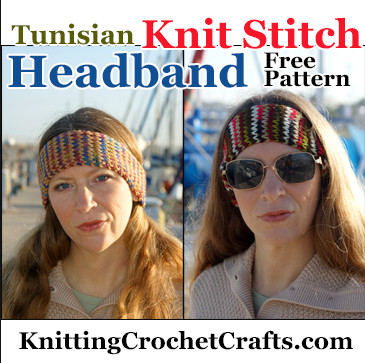
These crochet headband patterns are free for a limited time. If you’d be interested in crocheting yourself a lovely new spring-friendly headband, I invite you to make use of them. Please be sure to access the patterns before May 1, 2026 because I have plans to move them behind a paywall after that date.
Pictured above, you can see two colorways of a Tunisian knit stitch headband, which resembles a knitted headband, even though it is technically crocheted. This is my favorite pattern from the list, although it isn’t the only pattern.
Thanks for checking out my blog today. I appreciate your interest!
See Also:
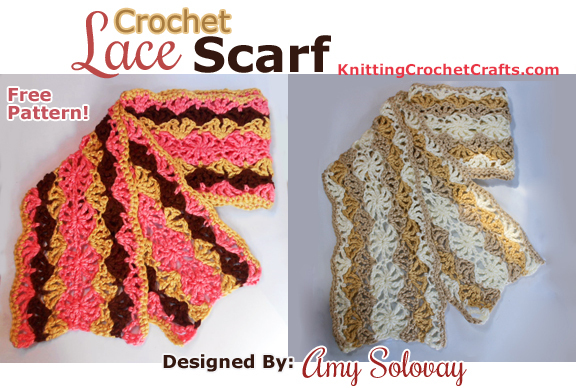
You can crochet this fabulous scarf using a taller, lacier variation of the popular vintage crochet shell stitch.
Update 12-5-2025: My original scarf project sample was multicolored. I now have a solid-colored version of this scarf to show you, too! I like the solid-colored version better. Which one do you prefer? Please let me know in the comments!
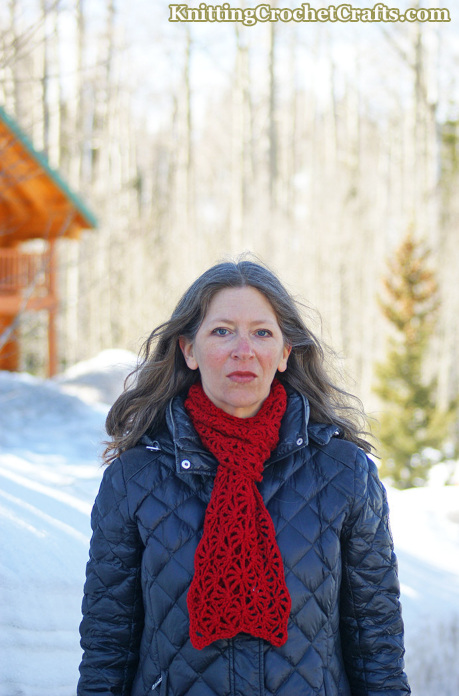
You can crochet this beautiful, lacy shell stitch scarf using the free crochet pattern posted below.
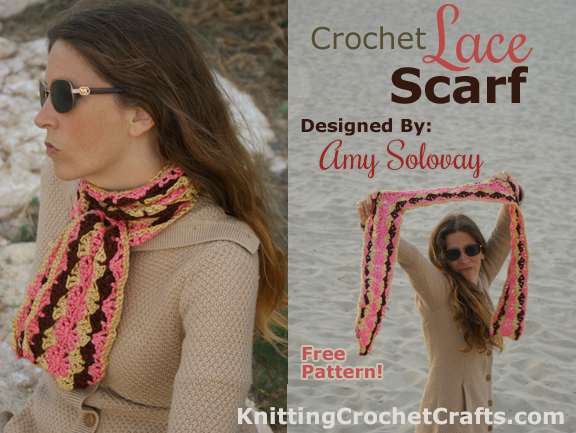
Amy Solovay is the designer of this scarf pattern. Amy is a living human, not a robot and not artificial intelligence (AI).
This matters because untrustworthy AI-generated crochet patterns are flooding the internet. You really don’t want to waste your time working them because they don’t typically work out. Maybe someday they’ll get better, but right now, if you attempt them, you’ll waste a lot of time and yarn.
So even if this scarf isn’t what you want to make right now, I invite you to check out my other patterns (and also my crochet book recommendations) because I only offer and recommend human-generated crochet patterns.
Related Resources: Crochet Scarf Patterns | How to Crochet a Scarf | Crochet Accessories | Shell Stitch

Project Description:
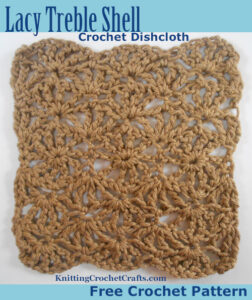
Special Stitch: The Lacy Treble Shell Stitch, shortened to “Lacy Shell” in the pattern below — Work the following sequence into the same chain stitch or half double crochet stitch, as directed in the pattern below: tr, ch 1, tr, ch 1, tr, ch 1, tr.
List of Supplies:
Yarn: You’ll need three different colors of worsted weight yarn. I worked the multicolored sample projects in acrylic yarn, and I crocheted the solid-colored project using Cascade 220 wool yarn. I think this design would also be lovely if crocheted in alpaca or other fibers.
Yarn Brand and Colors: The first time I crocheted this scarf, I used several different colors of Caron Simply Soft yarn. The colors I used are as follows:
- Color A: Strawberry, the bright pink colored yarn
- Color B: Autumn Maize, the golden tan colored yarn
- Color C: Chocolate, the rich dark brown yarn
To keep the same general look, you’d want to go with one bright color, one light color, and one dark color. There’s no rule that says you have to keep the same general look, so feel free to experiment with different color values.
This might not be the best color combination to work into your wardrobe, so feel free to choose other colors if they’d suit your needs better.
I wear quite a bit of khaki and brown, so this color combination works well for accessorizing many of my outfits. I think the pink is an interesting accent; I have NO other clothes this color, so it adds a bright cheery (and eye-catching) touch of color close to my face. I love that!
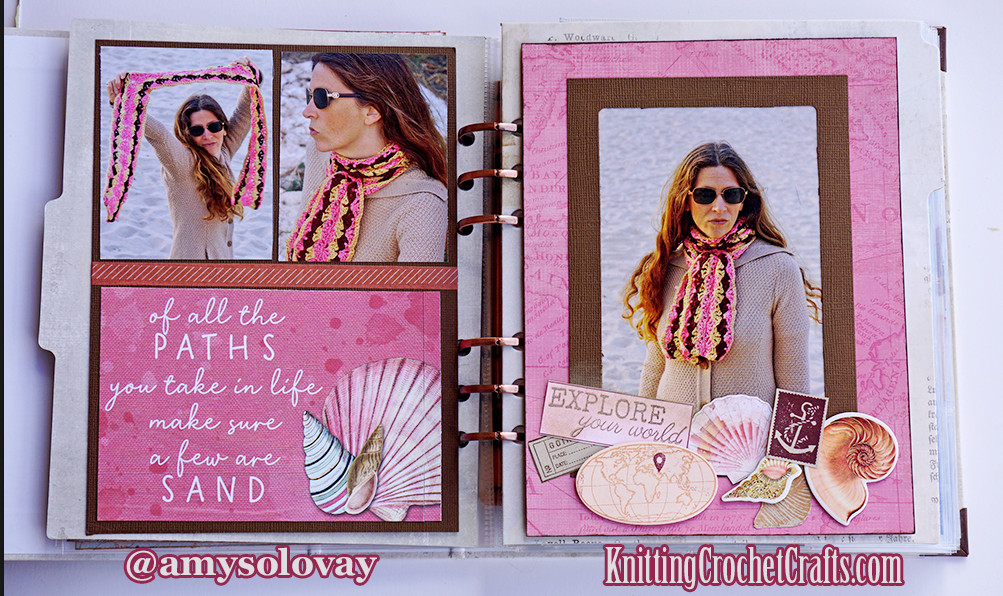
I enjoyed crocheting this design so much that I tried a second colorway:
- Autumn Maize
- Bone
- Antique White
I’d love to try other color combinations, such as using Autumn Maize, Autumn Red, and Antique White together. For a tested-and-true cool color combination, I already know from other projects that Sage, Bone and Blue Mint work well together, so that’s another good combination you could try.
You can also crochet this stitch pattern in one color if you like, or you can vary the number of colors you’ll use.

Crochet Hook: I / 9 – 5.5 mm
Other: Tapestry needle for weaving in ends.
Crochet Abbreviations Used in This Scarf Pattern:
- ch = chain
- ch-1 space = chain-1 space
- ea = each
- hdc = half double crochet
- rep = repeat
- sc = single crochet
- tr = treble crochet
- st = stitch
Design Notes:
This scarf features an interesting mirror-image design. To create this effect, the beginning of your scarf eventually becomes the center of the design; you start crocheting in the spot that will turn out to be the middle of the piece. Then you work in rows until the scarf reaches half the overall width, at which point you flip the work over and start again in the center. From there, you work more rows to complete the other half of the scarf.
Center of a Lacy Shell: When you are directed to work into the center of a lacy shell, work into the center ch-1 space in the shell – the second of the three ch-1 spaces you crocheted when working the lacy shell in the previous row.
Changing Colors: If you want to work with several colors as pictured, you should have an understanding of how to change colors.
Before you complete the last step of the last stitch in each row, change to the next color you want to work with.
Loose Ends: If this pattern has a downside, it’s that you generate bunches of loose ends from all your color changes. I recommend weaving them in as you go, to avoid having a big headache at the end.
Here’s how I did mine: After attaching each new color, I’d work the turning chain in the new color, then cut the old color. If you do it that way, before you proceed with the row in the new color, you can then weave the old color into the stitches of the last row worked, and crochet overtop of them with the new color. For even more security, you can leave a little bit more of a tail at the end to be woven in the usual way, if you like. I’ve found that this method is more secure than just weaving in my ends, and I have started to do this with crochet patterns featuring lots of open areas, like this one has. Of course, feel free to use the method of your choice for weaving in your ends. If you’d rather do it in the usual way, you certainly can.
How to Crochet the Scarf:
Using color A, Ch 203.
Row 1: Using color A, work a hdc st in the third ch from your hook. [Skip 3 ch sts. In the next ch, work a lacy shell. Skip next 3 ch sts. Hdc in next ch st.] Rep the sequence in brackets all the way across the row. At the end of the row, change colors to color B.
Row 2: Ch 4, turn. Your turning chain counts as the first tr in the row. Work another tr into the same st, ch 1, then work another tr into the same st. [Work a hdc in the center of the next lacy shell, then work a lacy shell into the next hdc st.] Rep the sequence in brackets all the way across the row. At the end of the row, work a hdc st into the center of the last shell, then work a tr into the last hdc, ch 1, then work 2 more tr into the same st. Before completing the last step of the last st, change colors to color C.
Row 3: Using color C, ch 2, turn. Hdc in first st. [Work a lacy shell in next hdc st, work a hdc st in the center of the next lacy shell.] Rep the sequence in brackets all the way across the row. End the row by working a lacy shell into the next hdc st, then working a hdc st into the turning chain. Before working the last step of the last st, change colors to color A.
Row 4: Using color A, ch 4, turn. Your turning chain counts as the first tr in the row. Work another tr into the same st, ch 1, then work another tr into the same st. [Work a hdc in the center of the next lacy shell, then work a lacy shell into the next hdc st.] Rep the sequence in brackets all the way across the row. At the end of the row, work a hdc st into the center of the last shell, then work a tr into the last hdc, ch 1, then work 2 more tr into the same st. Before completing the last step of the last st, change colors to color B.
Ch 1, turn.
Row 5: Using color B, work sc st across the entire row as follows: Put 1 sc st in ea tr, hdc, or ch-1 space.
After you’ve completed row 5, flip your work so that what used to be the bottom is now the top, and what used to be the top is now the bottom of the piece. Attach color A; if you’re right-handed, attach it in the upper right-hand corner. If you’re left-handed, you’ll most likely want to attach your yarn in the upper left-hand corner.
Row 6: To crochet this row, you’re going to be working back across your starting chain. The ch sts will all have sts already worked in them (from when you worked row 1 at the beginning) but don’t let that bother you! You can still work more sts into these chains.
Using color A, ch 2, then work a hdc in first st in the row. [Skip 3 ch sts. In the next ch, work a lacy shell. Skip next 3 ch sts. Hdc in next ch st.] Rep the sequence in brackets all the way across the row. At the end of the row, change colors to color B.
Rows 7 – 10: Rep rows 2 – 5 to create a mirror-image of the first half of the scarf.
End off and weave in any remaining loose ends.
Enjoy your new crocheted scarf!
Another Crochet Project Using The Lacy Treble Shell Stitch:
Please Visit My Ko-Fi Shop HERE to Find My Sample Sale, Destash Sale and Digital PDF Pattern Downloads for Sale.
Please Check Out My Ravelry Store HERE!
Find More Crochet Scarf Patterns HERE.
Check Out My Top Picks for the Best Crochet Scarf Pattern Books HERE.
Thanks so much for supporting my work! I sincerely appreciate your visit today, and I hope you enjoyed this free crochet scarf pattern.
Posted By: Amy Solovay
]]>
TL;DR Summary: I’m a slow traveler who’s journeyed 5,000+ nautical miles with my eyes on the horizon and the wind in my sails. In this article, I share some of the reasons I became a liveaboard cruising sailor, and I explain why I think #sailinglife beats #vanlife.
These days, it isn’t just the lavish homes you see pictured in Architectural Digest that are priced out of reach for growing numbers of ordinary people.
Nowadays, according to the analysts at Harvard University’s Joint Center for Housing Studies, many renters can barely afford to pay their rent. People in this situation find that it’s not an option to buy any house, even a modest one. In general, home prices have surged higher than Americans’ incomes.
And furthermore, the numbers of homeless Americans have reached record highs.
A few other related lifestyle trends are the explosion of the content creator economy, the increasing availability of remote work and a generation of young people stricken by wanderlust.
Enter #vanlife.
#Vanlife, Explained:
What Is Vanlife? Why Would Anyone Want to Embark on Vanlife?
Some people have come to the conclusion that it’s more economically advantageous for them to live in a van than it is to live in traditional housing units such as apartments, condos or homes.
#Vanlife is simple to explain: If you’ve decided you want to be a vanlifer, you (and possibly also the person / people / pets you love) get in a van, and you travel to wherever it is you want to go.
You stay there for awhile and experience life in that place. Then you move on and go somewhere else…and somewhere else after that…and somewhere else after that.
There are infinite possible variations to this story. Maybe you sell off everything else you own before you board the van. Or maybe you put all your possessions in storage.
Maybe you take out a loan to buy the van, and you get a lucrative remote job that more than covers your van payments. Perhaps you save up to buy the van. Or perhaps you buy a Scooby Doo Mystery Machine lookalike from your hippie uncle, who’s had it parked in his garage since the 1970s.
If you do it right, it’s a lifestyle filled with travel, adventure, spectacular scenery and self-discovery.
Selfies, videoing your adventures and oversharing everything about your van and your travels on Instagram / Youtube could become part of the package if you’re willing to invite strangers into your life in that intimate way. But those aspects of vanlife are optional.
Of course, vanlife isn’t always as fun and glamorous as the vanlifers on Instagram and Youtube portray it to be.
I got my first micro-taste of vanlife as a child in the years before the rise of social media. My mom bought an old Ford Econoline van that the previous owner had converted into a comfortable living space. It had a couch that transformed to a bed; it had a coffee table; and it had a kitchenette complete with countertops and a sink with space under it to put a water tank.
Every year, my family would pile into the van and head to the beach for a week of strolling along the boardwalk, playing in the sand, getting sunburned and camping out.
But these days, people who are buying vans aren’t all doing it for vacation use. Housing has become unaffordable. Many people are choosing to forego rent / mortgage payments and instead choosing to live in their vehicles.
Some internet influencers promote this lifestyle in a way that makes it look liberating, enticing and glamorous. I’m positive it can be that - but if you’re seeking out a life of freedom and adventure, vanlife has serious limitations.
So, Your Top-Priority Goal in Life Is to Travel.
Are You Hoping to Embark on a Grand Tour of the USA’s Finest Walmart Parking Lots?
I don’t know about you - but when I get a case of wanderlust, it leaves me yearning to visit the planet’s most scenic vantage points, her fascinating historic sites, her enthralling botanical gardens and her loveliest sandy beaches.

If you could go anywhere and do anything, where would you go? What would you do? Who would you talk to when you got there?
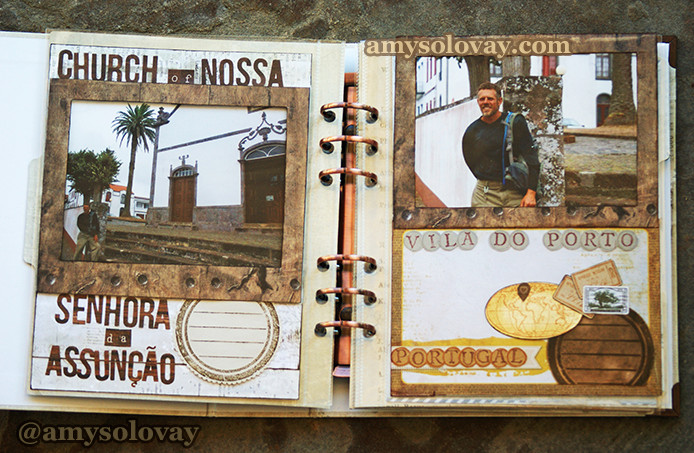
And let me also ask you this: What’s stopping you from going there?
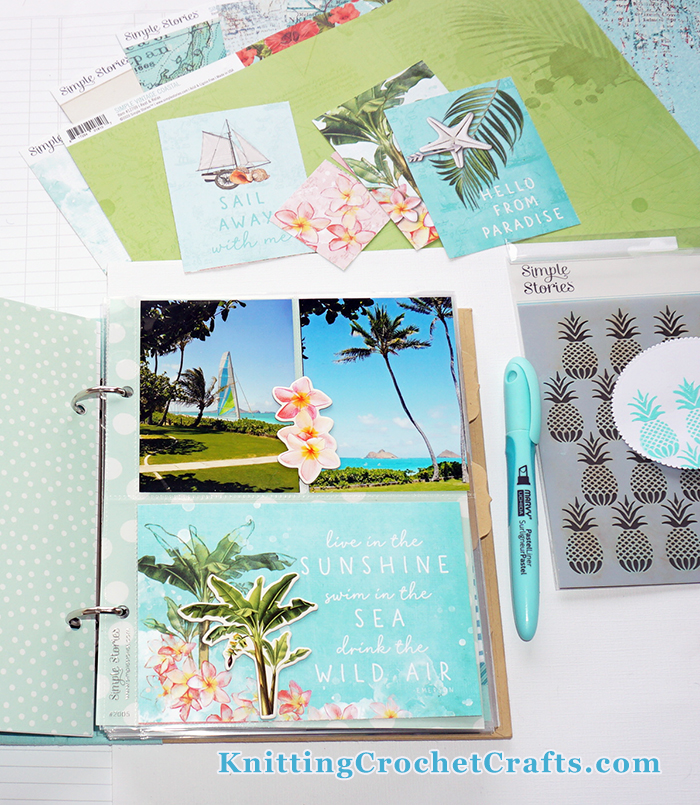
From where I sit, here’s the answer: NOTHING.
Nothing is stopping you!
You actually could go pretty much anywhere you want to.

Okay, maybe not anywhere. Depending on who you are and what country you come from, maybe there are places you couldn’t go, because maybe you couldn’t get a visa to go there. It’s tricky if you’re an American who wants to travel to Cuba, for example. I know Americans who’ve done it, but it isn’t such an easy thing to do.
But anyway, let’s not get caught up in minutiae. Sorry.
Here’s the point: If traveling’s what you want to do, there isn’t much stopping you.
But, depending on where you want to go and what you want to see, a van might not be the ideal vehicle to get you there.
If you’re an American who’s hungering to experience every awe-inspiring wonder found within your homeland’s vast expanse from sea to shining sea - say, for example, you want to visit any or all of America’s national parks, scenic highways and scenic byways - then #vanlife is a valid and worthy option.
And it’s also an okay option if your goal in life is to sample the uniquely authentic American cuisine at the innovative McDonald’s, Burger King and Taco Bell eateries that have been rubber stamped across America’s landscape.
(Did you know that McDonalds properties, on their own, occupy an estimated 50,000 acres of land? For real! YIKES!)
But if your wanderlust takes a different form, then maybe vanlife isn’t the best way to satisfy it.
Do You Want to Live at the Beach?
In my experience, living in a van = mostly living on highways and parking lots - although if you do it right, you’ll also experience some truly appealing campgrounds, parks and scenery, too.
But living aboard a sailboat = mostly living at the beach, or sheltered in lovely harbors and anchorages and marinas.

(It’s also possible to spend a lot of time sailing around out in the world’s vast oceans, if that’s what you want to do.)
If you want to wake up to beachfront views every morning, you could spend a couple of million dollars buying a condo in Pacific Palisades. Or you could spend $20,000 buying a seaworthy used sailboat, and then you could go cruising.
(And if you hang around at marinas during hard economic times, you might find boat owners who are willing to give you an even better deal than that.)
We actually know of a couple people who acquired sound, seaworthy sailboats for free, simply because it was a time of economic distress, and the sailboat owners in question wanted to get out from under the expenses associated with owning a boat.
It can get ridiculously expensive to dock and maintain sailboats. The exact cost depends on where you live, how big your boat is, where you choose to dock it and other related factors like that (i.e. whether your marina requires insurance - most do - and how much your insurance costs…)
In my experience, the docking expenses aren’t such an issue if your boat is also your home, because if you start out with a modest boat (notably, one that’s small - less than 40′ including the bowsprit, if applicable), you can find ways to dock and maintain the boat that would be less expensive than the typical cost to maintain a home.
(Don’t take my word for this without doing the math on how much it would end up costing for your own unique situation, which will, of course, be different than mine was.
And Mike says I should add that some marinas won’t let you live aboard a small boat on their premises, which is a valid point - except that’s not what I’m writing about here. I’m writing about actually going cruising - not just moving aboard a boat to stay put in a marina.)
But if you aren’t living aboard the boat, it’s a different story. In that case, the boat is an expensive luxury.
For boat owners who aren’t living aboard their boats, when hard economic times hit, their boat stops being a source of enjoyment and morphs into being just another burdensome bill to pay. So in a downturn, it isn’t uncommon to find boat owners who want to get rid of their boats in order to get rid of the resulting bills that inevitably accompany them.
And in those times, it also becomes harder for them to find willing buyers, because few people are willing to acquire a new set of monthly bills when the economy is spiraling downward.
And this was the situation following the Great Financial crisis, which is when my husband and I bought our first sailboat.
Some sailboats maintain a minimum value just because the metal in sailboat keels can be valuable. Around 2010, 2011, after the Great Financial Crisis, massive numbers of people were selling their sailboats at a loss to crushers who would extract the valuable metal and resell that for industrial use.
To me, this was a heartbreaking situation. It made me sad at the time. I still get sad thinking about it now.
But if you’re an opportunist who wants to live or travel affordably, and you’re willing to invest some effort in looking for a sailboat owner who wants to get out from under their boat, you might be able to really help that person out while also scoring yourself a great deal on a sailboat.
That said, I’d also give you the following advice: Never buy a boat without first hiring a qualified marine surveyor and asking that surveyor’s opinion about whether or not the vessel you’re considering is a smart buy - because there are good deals out there, and there are also horrendously bad deals. If you don’t know anything about sailboats, it is really easy to make a bad purchase. So be careful out there.
An important takeaway: The expenses on a sailboat could go either way; some of them are stupendously expensive, and some of them are incredible bargains.
If you want to live affordably aboard a sailboat, skip the large, impressive mega-yachts, because those will also come with large, impressive mega-bills. Instead, you need to make a smart purchase on a small, modest, seaworthy used sailboat.
Also, you should be aware that not all sailboats are good for ocean cruising. Many sailboats are meant to be coastal cruisers; they aren’t meant to cross oceans. And the boats that are good for crossing oceans aren’t necessarily going to be the most fun boats if you’re just hoping to hang around in marinas sunbathing and drinking beer.
So if your goal is to travel further than a few miles up or down the coast, you’ll want to get educated about what makes a comfortable ocean cruiser, and find one of those to buy.
Vanlife Has More Downsides Than You Might Think
Two of vanlife’s most compelling problems are the costs of fossil fuels:
- The costs in currency: Fuel is expensive;
- And also the environmental costs, which are substantial.
Ask yourself this: Are you earning enough to sustain a lifestyle that revolves around frequent driving considering the high price of fuel?
And don’t you care about the environmental costs, too?
You could argue, “So what? Everything’s unsustainable. Everything’s expensive. And in the scheme of things, one single van’s environmental footprint isn’t really all that problematic.” And I think it’d be hard for people to disagree with that view of the situation.
But on the other hand, if there’s a way to do better, then why not do better?
If you view sustainability as a spectrum or scale that has two diverging points, with “totally unsustainable” as one end point and “totally sustainable” as the other, you can make an educated guess about where on the scale vanlife might fall. And then you can similarly assign sailinglife a place on the same scale. And you can compare the two to make a value judgment about which option is more sustainable than the other.
Sure, there’ll be bunches of variables to evaluate when making any such comparison. But I think it’s fair to say that sailing (traveling under wind power) falls closer to the “totally sustainable” side than driving a van does. Would you agree?
Just FYI: My husband, Mike, and I traveled the 2436.3 nautical mile-journey from the Colonial Beach Yacht Center in Colonial Beach, Virginia to the Porto do Vilo marina in Santa Maria Island, Portugal using mostly wind power.
A nautical mile isn’t the same distance as a mile. So if you convert that distance to ordinary miles, it’s about 2804 miles, according to Google’s automated nautical-miles-to-miles calculator.
If you’re lucky, a campervan might take you about 16 miles for each gallon of gas you put in the tank. So it’d take you about 175 gallons of fuel to drive an equivalent distance. In contrast, we used an estimated 37 gallons of fuel while making the trip. The wind provided the rest of the power to get us there.
Before that, we cruised around the Channel Islands for a couple of years. During the last approximately 6 months of that time period, the engine on our boat wasn’t even working - so except for a couple of instances where we asked our harbor patrol friends to give us a tow out of Catalina Island’s Cat Harbor, we were 100% traveling under wind power.
(Mike says, “If you want to become a better sailor, ditch your motor.”)
So after weighing the pros and cons of sailinglive vs vanlife, this was my conclusion: For us, moving aboard a sailboat was a smarter move than moving into a van would have been.
But of course, your mileage may vary. And before you decide to go all in on sailing, there are a few additional things you should keep in mind.
Cons to Sailinglife:
Living Aboard a Sailboat Can Be Stressful
Do you like Metallica’s music?
I do. There are a couple of Metallica songs that are like personal anthems to me.
From Enter Sandman:
“Sleep with one eye open, gripping your pillow tight…”
And from Wherever I May Roam:
“Where I lay my head is home.”
In either case, I doubt those guys were singing about sailing. But in my cruising days, I felt as if they might as well have been singing about sailing. I’d sing their songs at the top of my lungs, all night long while sitting in the cockpit, doing anchor watch and staring up at the moon.
There are unlimited numbers of things that can go wrong while you’re sailing or anchoring a boat. You have to be perpetually watchful because other boats will hit yours, and your anchor will drag sometimes, and bad weather could pummel the harbor, cove, mooring or marina where you’re sheltered. So all of that can be stressful. It’s an exciting lifestyle, but I’ve learned that there are many kinds of excitement I can happily live without.
Slow
Sailing is slow. If you’re the type of person who’s able to just relax and chill, you are the ideal candidate for #sailinglife. But if you’re an impatient person, this mode of travel isn’t going to be your jam.
Unpredictable
Sailors are at the mercy of the wind, waves and weather. If you lead a highly regimented life, and you need to be at X place by Y o’clock, you really need to think twice about whether this lifestyle would work for you. It probably isn’t going to be workable.
Not Ideal for Single-Handers; Better With a Couple, Group or Team
There are lots of solo sailors; the lingo for that is “single-handers.” I don’t recommend single-handing, because every time you go to sleep, there is no one to watch your back. That said, there are lots of single-handers sailing around out there.
Sailing Is Free; It’s Docking That’s Expensive
Living aboard a sailboat can be super cheap if you’re willing to put up with some discomfort. But if you need to be comfortable at all times, that’s going to get expensive.
The least expensive ways to do things also tend to be the least comfortable, most thrilling and most stressful.
Let me give you some examples.
The safest, most comfortable places to put a sailboat tend to be well-sheltered marinas; staying in those can get expensive, depending on the size of your boat and other factors like when and where you go.
Marinas tend to cost more during the busy season and less during the off season - sometimes much, much less.
In contrast, it’s totally free to sail in international waters in the world’s oceans. But, offshore cruising isn’t necessarily going to be a comfortable experience.
There’ll be days when you get sunshine, gentle breezes, small waves and following seas. On those days, you’re ecstatic to be a liveaboard cruising sailor. As you watch dolphins frolicking alongside your boat, you think to yourself, “This is insanely amazing. I can’t believe the world’s oceans aren’t jam-packed with cruisers.”
And then there are going to be days when it’s raining; there are 30-knot winds blowing; the surf is pounding against your boat’s hull; waves are hitting your portals with such force that you’re starting to worry they’ll shatter; and you can’t stay dry because wave after wave after wave keeps breaking over your cockpit. And you think, “I wonder if I’m about to get washed overboard.” And as you look around, you realize that if that happens, nobody is ever even going to figure out what became of you.
There are many free anchorages in various locations around the world. Some of them, I have a hard time figuring out why they’re free; the local governments in those locations could charge money, and people would pay it.
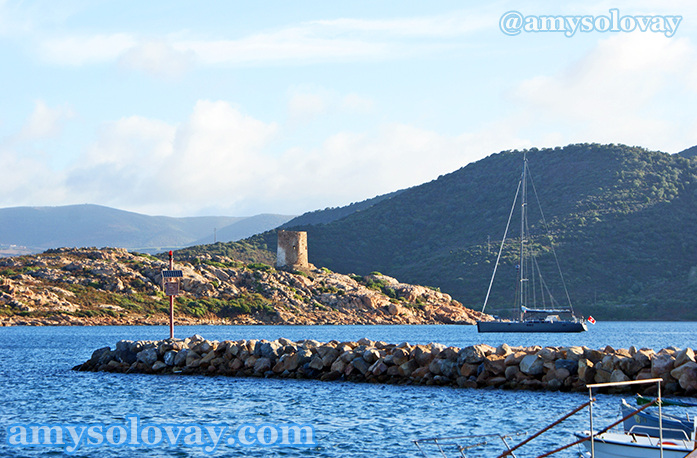
But many of the free anchorages I’ve encountered around the USA, they’re free for a reason. And, often, the reason is that it isn’t going to necessarily be fun or comfortable to anchor there.

But if you can tolerate getting rocked by massive swells, and you don’t mind keeping an eye on your anchor, that free anchorage offers you the opportunity to save however much cash you would’ve spent on mooring in a local harbor or docking in a marina. Those costs can add up fast; it isn’t uncommon to spend $50+ per night, and the bigger your boat is, the more you’ll typically save by chilling out in free anchorages.
For me, the good days outweighed the bad days when we were out cruising. But if you can’t deal with those bad days, cruising isn’t for you.
There Aren’t Any 7–11s, Liquor Stores, Emergency Rooms or Hospitals in the Middle of the Ocean
If you have a chronic disease or any condition that requires medical supervision, #vanlife is a better choice than #sailinglife.
If you don’t know how to handle emergencies, you’re not a good candidate for #sailinglife. Cruising sailors have to be resourceful.
And if you’re the type of person who can’t cope without regular intake of hot coffee or cold beer, you probably shouldn’t try to sail across oceans - because, inevitably, the coffee and the beer will run out, and you can’t just run to the store when you’re a week or more offshore.
At one point when Mike and I were cruising in the Mediterranean Sea, we stalled in between Spain and Algeria, because the wind simply stopped blowing - for weeks.
So we were just sitting there, getting nowhere, and rocking.
And rocking.
And rocking.
And rocking. Endlessly rocking.
The Mediterranean sun embraced our boat with its powerful heat and shimmering light. I felt as if I could have easily drowned in my own sweat, but we didn’t have enough water aboard the boat to justify taking showers.
I said to Mike, “Let’s go to Natural Grocers and get ice cream.” And he glared at me, because all we could see in any direction was an endless expanse of blue ocean and blue sky. There was no nearby island oasis that happened to have a Natural Grocers, or even a random ice cream truck.
So #sailinglife isn’t for everyone. For sure, it has its share of stressors and downsides. But if you can cope with those, the upsides are beyond incredible.
If you’re thinking of embarking on #vanlife, I urge you to at least consider the possibility of #sailinglife before you buy a van and get started.
Over to You:
Have you tried any form of nomadic living? If so, how’d you decide to approach it? And how’s it working out for you?
If not, would you consider it? Are you thinking of trying either #vanlife or #sailinglife?
If you want to travel, but you haven’t yet taken the plunge, what’s stopping you from getting started?
]]>

Happy Boxing Day, friends!
OK, Christmas is over and done with. Next comes the part where we’re all supposed to make New Year’s resolutions about how we’re going to get healthy in 2025 and exercise every day and eat our vegetables.
What are your plans for 2025?
Whatever they are, I’m wishing you health, wealth, love, peace, joy and prosperity in the new year!
XOXO,
Amy
TLDR summary: I wrote this post for fellow content creators. Read this if you want to understand how some of the top-earning content creators and platforms build wealth. If you aren’t a content creator, and you don’t care about internet platforms, you can safely skip this post without fear of missing out.
If you’re just here for the crafts and / or planner layouts, I invite you to check out the latest posts at my crafts website.
++++++
Content creation is like building an empire.
Historically, many content creators who got rich did so in the long term. They achieved success by building a library of content that had long-term staying power, and they were able to continue earning from it long after its initial publication.
If you stick with me until the end of this post, you’ll learn how to build your content empire with the goal of maintaining it – and earning from it – for the long term.
A few of the other things you’ll learn in this post:
- Why you don’t need to be brilliant, talented or exceptional to launch a successful career as a content creator.
- The real secret to earning your living as a content creator.
(pro tip: It isn’t getting Botox or dermal fillers in hopes of looking like the Kardashians, although I suppose it might not hurt to try that, too.)
- The top-priority things you need to keep in mind as you create your content if you’re hoping to get rich from your creative work.
This post is for you if…
- …you’re a content creator who is willing to work at building your own skills with a goal of creating long-term wealth, financial security and a legacy that outlives you.
This post IS NOT for you if…
- … you’re hoping to harness AI or automation technologies to build your wealth for you.
Those strategies might work, but it isn’t what we’re discussing here, and you’ll be disappointed if you bring that mindset to this discussion.

Forbes maintains a long-running, annually updated list of the top-earning dead celebrities.
This list is fascinating to me because it doesn’t 100% consist of people that I think of as being “celebrities.”
Who are “celebrities,” in your opinion?
It appears I had this wrong – but up until now, I was thinking of celebrities as being rock stars, singers and bands; prominent actors and actresses; and A-list models, mostly.
Well, I stand corrected.
Forbes’ top-earning dead celebrities list does include many performing artists, which is what I expected; however, to my surprise and delight, some of the celebrities on the list were content creators.
A couple of examples: Dr. Seuss (real name: Theodor Seuss Geisel) and Charles Schulz were both writers who illustrated their own material. Both of these artists frequently appear on the top-earning dead celebrities list.

And, this is interesting: Both of these legends also have stars on the Hollywood Walk of Fame. Did you know that? I didn’t, until just now.
Historically, “cartoonist” was the terminology we might have used to describe these two exceptional writers’ role in this world.
But nowadays, comics and cartoons fit under the broader umbrella of “content.” And, if you were to ask analysts at today’s think tanks where to allocate and analyze Dr. Seuss’ and Charles Schulz’ earnings, they’d categorize them as being part of the “content creator economy.”
If you’re a content creator who wants to build long-term wealth and a legacy that outlives you, Dr. Seuss and Charles Schulz are both examples worth studying.
This is my opinion: I think any content creator who’s prepared to habitually, systematically, routinely create content has the potential to become the next Dr. Seuss or Charles Schulz.
For example, YOU have the potential to do this (assuming you’re willing to make content creation a habitual part of your routine. You are, aren’t you?)
Here’s why I’ve arrived at this conclusion:
The Dartmouth Alumni magazine tells us that Dr. Seuss habitually devoted the hours it requires to be a successful content creator.
“His practice was always to stay at his desk eight hours a day, whether art was being created or not.”
So, important takeaway #1 is this: Sit at your desk (or its equivalent) and create content, all day, every day, for 8+ hours a day.
Or if you struggle with the content creation process, at least sit at your desk and think about creating content for 8+ hours a day.
Dr. Seuss graduated from Dartmouth in 1925. His first book was published in 1937. He had a book published in 1990, the year before he died. He was 87 years old when he died in 1991.
While he was alive, he authored 60 books, which, on one hand, is impressive.
On the other hand, if you look at that in light of the time frame of his entire career, he only published a bit more than one book each year.
This should be totally doable, don’t you think? Even if you’re a slow, thoughtful and methodical content creator, you could manage to create a book each year if you were systematic about sitting down to write and illustrate on a daily basis.
(Of course, you should apply this logic to your own situation as a content creator. If you’re a videographer, maybe you’ll sit at a desk writing video scripts, but otherwise, you’ll probably be spending that 8+ hours per day behind a tripod filming.)
It doesn’t matter what kind of content you’re creating. Whether you’re filming, writing, photographing or drawing, getting to work is the most important first step to building wealth as a content creator.
And, you don’t need to be a creative genius to make this first step work for you.
The folks over at Dr. Seuss’ alma mater, Dartmouth, tell us that he
“ won a Pulitzer Prize, three Academy Awards, two Emmys, and two Peabody Awards for his literary creations.”
So, nowadays, in hindsight, people feel comfortable calling him “brilliant” and “talented.” But he wasn’t always perceived that way.
Writing about Dr. Seuss, NPR says,
“Geisel wasn’t a brilliant illustrator from the start and his writing wasn’t great from the get-go. In fact, he worked at both for years, turning in work that ranged from slightly funny and unique to mediocre and immediately forgettable. That he managed to become an international sensation is a testament to his perseverance…”
And furthermore, some of his peers at Dartmouth voted him “Least likely to succeed.”
“The genius of Dr. Seuss was the outcome of a personal and artistic evolution … Geisel wouldn’t fully embrace his profession or achieve his most significant triumphs until midlife and beyond.”
Furthermore, they tell us that
“Geisel’s few film projects that saw fruition ranged from disappointing to disastrous.”
So, important takeaway #2 is this: You don’t need to be brilliant to launch a successful career as a content creator. You’re fine even if much of your work is “mediocre” and “immediately forgettable,” and your friends have labeled you “least likely to succeed” in your group.
Important takeaway #3 is this: You can succeed as a content creator even if you initially create some content that is “disappointing” or “disastrous.”
Important takeaway #4: If you aren’t a brilliant content creator to start with, perseverance is the key to success.
Perseverance means that you sit down, day after day after day, and create new content.
You will hit hurdles, but despite the hurdles, you do not give up. You persevere.
Whatever problems or conflicts arise as a result of the content creation process, you deal with them.
And by doing this, even if you start out as a mediocre content creator, you will improve.
And the more effort you put into it, the more you’ll improve.
And if you continue in the long term with this process of exerting the effort it takes to succeed, there’s a high likelihood that you will improve your skills to the point of brilliance – or at least to the point of complete competence.
This will take time. I’m not aware of any short cuts for it.
Pro tip: If you systematically use artificial intelligence technologies to create your content for you, you are quite unlikely to develop your own skills to the point of brilliance.
So in that case, you’re settling for perpetual mediocrity.
You can probably think of examples of mediocre writers who’ve earned an okay living in the past.
But in the future, I think they’re unlikely to be able to continue with that.
My opinion: From here on out, I believe human writers will have to master their craft until they become absolutely brilliant at it, or make a career change.
Because who’s going to pay humans to create mediocre content when AI will do that at no cost?
Important takeaway #5: Don’t expect immediate success.
Successful content creation is like slowly, deliberately building an empire.
As a content creator, your day-to-day job is to create individual pieces of content:
- newsletters
- posts
- articles
- photographs
- charts
- illustrations / paintings / drawings
- videos
- books / e-books
- white papers
- reports
- essays
- memoirs
- or whatever types of content it is that you’re creating.
But if you want to be a successful content creator in the long term, it’s important to look beyond each of these individual bits of content. You must consider the long-term value of your entire body of work as a content creator.
Historically, many of the content creators who’ve achieved wealth, fame and success got rich over the long term:
- They formed a habit of creating content;
- And, they systematically worked at creating a body of creative work that has long-term value.
So, if you want to get rich as a content creator, it’ll serve you well to get in the habit of thinking of your content as an empire.
But wait!
Are you actually building a powerful empire with your content creation process?
Will the content you’re building now have long-term, lasting significance to humanity?
Give some thought to this, because this is another one of the most important keys to building long-term wealth as a content creator.
If you’re creating content that is valuable today but won’t have lasting relevance for tomorrow, next week and next year, you will perpetually be like a gerbil on a wheel, always chasing the next paycheck.
(Ask me how I know this. I’ve done far too much of this type of work, myself.)
If you’re creating content that has long-term value and significance, you’re much more likely to build long-term wealth as you build your content empire.
Also important: How are you maintaining what you’re building?
You can compare each bit of content you create to the structures within an empire: cities, towns, skyscrapers, cottages, barns, roads…
Empires rise and thrive.
Inevitably, they also fall and decay.
If you’re a proactive content creator, you can build an empire that will rise and thrive during your lifetime, and then continue to provide for your heirs long after your passing.
If you’re haphazard about your content creation process, it won’t ever achieve empire status.
So far, we’ve looked at two content creators whose work has had a lasting impact on humanity.
Now let’s take a look at a platform that failed to achieve such an impact.
More importantly, we’ll talk about why it failed.
The platform was originally called “Associated Content.” Anyone could register an account and submit articles for publication at the platform; writing for them didn’t require a degree, any special skills or any inside connections. Content creators at the platform could submit text, images, audio and / or video.
On May 18, 2010, Yahoo announced its acquisition of Associated Content. They rebranded the portal as “The Yahoo Contributor Network.”
In December of 2011, Searchengineland reported that Yahoo was rebranding yet again, along with deleting 75,000+ articles that were “inactive and outdated.” The surviving content would be moved to Yahoo’s domain under the brand name of “Yahoo Voices.”
On July 30th, 2014, Yahoo discontinued Yahoo Voices.
I had been a contributor at all 3 of these iterations of the platform: Associated Content, the Yahoo Contributor Network and Yahoo Voices. In fact, I’d been a “Featured contributor” at Yahoo Voices, and editors at Yahoo had selected multiple articles of mine to be promoted on the home page of Yahoo.
One of my greatest frustrations with that gig was the inability to update the content I’d published on their network. Once the content had been reviewed by their editors and published, they didn’t allow authors to edit it.
I am 100% convinced that this was the reason their platform ultimately failed. Nobody was in charge of updating it, so they ended up with a library of outdated and useless content that nobody wanted to read.
”Another flaw in the human character is that everybody wants to build and nobody wants to do maintenance.”
When it comes to content creation, the people who catch onto Vonnegut’s logic and grit their teeth, dig in and do the maintenance are often the long-term winners.
That said, not all content needs updating.
Media people have a label we use for this type of content: We call it “evergreen.” Like an evergreen tree in wintertime, evergreen content has lasting relevance.
If you want to see enduring examples of evergreen content, it’s as easy as picking up some of Dr. Seuss’ or Charles Schulz’s most popular works. Technology has greatly changed since their old books and comic strips were originally published, but the characters and story lines you’ll find in the books are just as relevant now as they were when the books were brand new.
In the past, you could reliably build a content empire by creating “evergreen” content. But AI has introduced new challenges with that model.
I could have this wrong — but looking ahead to the future, I think that sizable numbers of human content creators will have to discover their most lucrative opportunities at the cutting edge of technology.
And the cutting edge of technology is just about the opposite of “evergreen.”
So if you’re building your content empire by creating non-evergreen content, then your top challenge will be avoiding the mistake that the Yahoo Contributor Network made: It’s absolutely imperative to avoid getting stuck with a library of outdated content.
That means you need to go back and update your old content to perpetually keep it relevant for current readers.
This is not an easy task, but I’ll explain the secret to approaching it:
- Don’t build what you can’t maintain.
- And, habitually, perpetually, systematically maintain what you build.
(In the physical world, these are a couple of critically important principles in environmental sustainability. But I think these ideas are just as valid if you apply them to your content. In fact, I first encountered these ideas at one of the media sites I used to write for.)
So each time you create a new, non-evergreen piece of content, choose a date and time in the future when you will update it.
And mark that date and time in your planner. (You do have a planner, don’t you?)

And when the date and time arrives to update the content, you’ll actually need to make the needed updates to it.
Do that consistently to avoid ending up like Associated Content, the Yahoo Contributor Network and Yahoo Voices.
It’s the Holiday Season, So Let’s (Gift)Wrap This Up, Stick a Super Cute Bow on It and Send It Out into the World.
There are multiple ways to succeed as a content creator. This is one in a series of articles I’m writing with a goal of pinpointing the most reliable step-by-step success strategies I’ve been able to identify.
I’m doing this mostly for myself because I need to make a pivot in my own approach to content creation. So I’m systematically looking around at my options.
So to put that in other words, I’m ditching the content creation blueprint I used to follow in the past, and I’m trying to nail down a new, improved step-by-step process for what I need to do to succeed in the future.
Although I’m doing this for me, I also think there’s tremendous value in sharing my thoughts on this topic with you because, in the past, I have been part of other communities where I had the opportunities to share insights with other groups of smart, talented content creators — and give-and-take participation in such groups has been the ultimate key to my long-term success.
But I’m now at the point in my career where I don’t want to join another entity’s community. Forget that! I want to build my own community. And I invite you to become a part of it, if you want to be.
Let’s revisit an obvious axiom that you already know: Past performance does not reliably predict future results.
I’m convinced that most writers and content creators in the current environment are like those proverbial Thanksgiving turkeys.
Pretend it’s the day before Thanksgiving. Are you listening to a group of turkeys who are explaining to you how to reliably stay well-fed and comfortable?
I don’t know about you, but I don’t wanna be in that group of turkeys. You with me?
It’s become obvious to me that there are bunches of things that used to work, that won’t keep working in the future.
So what I want to do is understand my options for what will work.
But what I’m finding is that any formula I’ve come up with so far has either oversimplified or overcomplicated the content creation process.
Nevertheless, I think there is value in identifying formulas to use as a starting point, even if the formulas overlook some of the details.
Do you agree?
Would you find it more useful to have a broad and somewhat oversimplified five-step formula, or would you find it more useful to have a 5,280-step formula covering every nuance of every possibility?
As I’ve been writing these articles, they keep growing into the 5,280-step versions.
So I’ve started and scrapped a bunch of them, because y’all are perfectly capable of overcomplicating things on your own. You don’t need me to help you with that, right?
So let’s distill this down to its essence, turn it into a step-by-step formula, and slap a label on it.
- To be a successful content creator, you need to habitually create content.
- It doesn’t always have to be excellent content that you’re creating. You can succeed as a content creator even if you initially create some content that is “disappointing” or “disastrous.”
- You don’t need to be brilliant to get rich as a content creator. Dr. Seuss’ early work was “mediocre” and “immediately forgettable,” and he’s high on the list of top-earning dead celebrities several decades after his death.
- Don’t expect immediate success, and don’t lose sight of the fact that the content creators who get rich typically do so in the long term.
- Perseverance is the key to success. This is true even if you aren’t a brilliant content creator to start with.
- Think of your content as an empire and create it with a goal of building a strong, long-lasting empire that will thrive.
- It’s ideal if you can create “evergreen” content; but in the age of AI, evergreen content may not be realistic for a sizable percentage of content creators.
- If you aren’t creating “evergreen” content, you’ll need to keep your content updated to avoid ending up with a library of work that is useless and out-of-date.
- Don’t create content you can’t maintain.
- Create, and stick to, a schedule for maintaining all the content you create to keep it relevant and useful.
- Approaching your content creation in this way maximizes the chances that you will become a brilliant content creator who builds long-term wealth and maximizes your chances of success.
Now let’s translate this into an actionable, step-by-step formula you can follow:
- Choose a specific group of people you will create content for. For Charles Schulz, his group of people (initially) was newspaper readers. Dr. Seuss floundered a bit in this step, but he finally found success with creating content for children who’re learning to read.
- Get to work producing a body of creative work that will have long-term value to the group you identified in step 1 above. Do this habitually, systematically, routinely on a schedule of your own choosing. It’s best to do this daily, all day, every day, for at least 5 days per week.
- Update old content habitually, systematically, routinely with a goal of keeping it relevant, useful and up-to-date. Do this on a schedule of your own choosing.
- When you hit hurdles, persevere.
- Repeat steps 1-4.
Let’s call this the “Empire-building formula” for success as a content creator.
(I want to give it a label because we’ll be referring to it again in future newsletters.)
Over to You:
Up until now, have you been creating content that’ll crash and burn, or have you been building a content empire for the long term?
If you’ve been building for the long term, what habits have you established that are working well for you?
If not, what changes can you make in your content creation process that’ll increase your chances of long-term success?
I don’t know if reading this post sparked any ideas for you – but writing this entry certainly gave me some insights I’m going to use for improving my own strategies.
So, I invite you to consider your long-term plans and then join me for a discussion of our future content creation strategies. See you in the comments!
Other Places You Can Find Me Online:
You’ll find me online in bunches of other places, including the following:
My Ravelry Store: I’m a craft pattern designer. If you crochet, please check out the digital PDF crochet patterns I make available.
Your clicks to my beaded crochet necklace pattern and fingerless gloves pattern help me out, even if you don’t buy them (because Ravelry has an attention-based algorithm that elevates any patterns getting a lot of views.) So thanks heaps for any clicks or purchases you send my way. I really appreciate your help and support with this.
My Ko-Fi Shop: If you crochet, I invite you to shop for my digital PDF crochet patterns at Ko-Fi.
If you don’t crochet or craft, I invite you to shop for an eclectic selection of handcrafted items. Ko-Fi is my brand-new outlet for selling the project samples I create while developing and testing the patterns I make available. When I get that far, it’ll also be a place for me to offer the one-of-a-kind experiments I’m fond of creating. You’re invited to check this shop often, because you never know what you’ll find!
My craft blog at KnittingCrochetCrafts.com
Thanks so much for reading, and thanks also for considering all of the above requests. Wishing you continued success!
Best,
Amy
]]>I’ve been earning my full-time living online as a content creator since 2009, and was doing it part-time for long before then.
I put my own by-line on my personal projects (mostly craft projects) and occasional other projects, but other than that, I typically ghostwrite.
I’m thinking of making a pivot in the types of clients I seek out.
I used to do most of my work for digital marketing agencies, but lately I’m finding that type of work is no longer the right fit for the way I work.
One of my greatest frustrations, lately, is the barriers that I encounter when trying to do digital marketing work for tech companies — in particular, SaaS companies.
My process goes something like this:
I’ll get a brief from my contact at a digital marketing agency that says,
Client: SaaSStartupCompanySite.com
Assignment: Write a 1,000+ word article that provides value to readers and builds awareness for XYZ Software Product
Publishing Site: SomeRandomTechSite.com
Link to: SaaSStartupCompanySite.com/XYZSoftware
Anchor Text: XYZ Software
So I’ll look carefully at SomeRandomTechSite.com and read at least half a dozen articles at their site to see what topics they typically cover and get a feel for what their readers might be interested in learning about; then I’ll also carefully scrutinize SaaSStartupCompanySite.com and SaaSStartupCompanySite.com/XYZSoftware in hopes of figuring out what XYZ Software does, and why prospects at SomeRandomTechSite.com might want to use it.
My primary goal for this process is to figure out what I could write that would be valuable and actionable to readers at SomeRandomTechSite.com but would also serve the interests of the team at SaaSStartupCompany.
When I do this, 9 times out of 10, I’ll find a page about XYZ Software that says
XYZ Software — Coming soon!
Or, maybe I’ll find something that says,
“XYZ Software is SaaS technology empowering digital innovation for the next generation of leaders.”
Great! That at least gives me something to go on. “Digital innovation” and “leaders” is a fantastic start.
But which leaders in which industry would use this software? Is this a product that’ll be marketed to C-suite executives? What problem does it solve for them?
So I email my contact, and I ask him,
“Can I get a download of XYZ Software? I’d like to kick the tires on this thing and see what it does so I can help visitors at somerandomtechsite.com understand why they might be interested in this software and tell them about the problems the software would solve for them.”
To which my contact will respond something like,
“Sorry, Amy. XYZ Software isn’t ready to ship yet. I’ve been trying to land this account for a few months now, and they finally agreed to work with us before launch so we could generate some pre-launch buzz. But the software won’t actually be ready to ship until July of 2025.
Me: “Okay, I understand. Can you please at least tell me what XYZ software is supposed to do for its users?
Him: “Sorry, I have no idea what the software does.
At this point in the exchange, I feel like throwing my laptop into Lake Buchanan. Or maybe going back to my previous career in textile product development. At least it is fairly easy to explain to prospects in the fashion industry what they might expect from this fabric or that fabric or that other fabric over there.
With cutting-edge tech products, it takes specialized knowledge, or at least solid interviewing skills, to figure out how to market the products — and if there are barriers in between the content creator and the knowledge, the work can’t effectively happen.
So in cases like this, I have 2 choices:
- Write an article that won’t help anyone accomplish any of their objectives; or
- Turn down the work and invest my time on a project that’s win-win-win for all parties involved (for the readers at the publishing site, the client, the agency and myself.)
I want to invest my effort into projects where I can make a real difference. So more times than not, I turn down assignments like this. I don’t want to take on work unless I can actually get results for the client, and in situations like this, there’s no credible way to help the client accomplish their goals. I’m a content creator, not a mind reader and not a miracle worker.
Thankfully, I’m at the stage in my career where I can turn down work. But this is really a dumb and frustrating problem to have, and I’m tired of having it.
I’ve been giving this problem a massive amount of thought lately, and I finally had a light-bulb moment. I came to the conclusion that maybe the problem is really me, seeking the wrong sorts of clients. Maybe I shouldn’t be working for digital marketing agencies.
Speaking for myself as a content creator, the problem isn’t that I’m incapable of understanding the tech. On the contrary; I’m good at tire-kicking and figuring out how tech products work without a lot of hand-holding.
That said, as tech gets increasingly more specialized, I realize that it would be prudent for me to also get more specialized and to build a knowledge base that supports a specific niche market. So I’ve been giving that a massive amount of thought.
But beyond that, it occurs to me that what really needs to happen in those situations is that I need to be able to interview someone at the client’s company to get the information I need. I’d need to interview the founder, or one of the engineers, or whichever exec is heading up the XYZ Software project.
.So I’m not sure I want to keep working for digital marketing agencies, unless those digital marketing agencies trust me enough to put me in touch with the client’s subject matter experts.
So it occurs to me that what I need to do is skip working with the digital marketing agencies, and do more ghostwriting directly for founders, CEOs, entrepreneurs and department heads.
Interestingly, within my very own sphere of influence is the founder of a tech startup.

I married him. He’s the love of my life. I’d cross oceans with him. I HAVE crossed oceans with him.
I’ve been working on various copywriting assignments for his tech startup for more than a year now.
And from that experience, I can honestly say that I think he’s a thought leader within his space. There is no one else on this planet who has his vision and his skill.
But pinning down his actual thought process to, first of all, understand it myself; second, to explain it to others; and third, to demonstrate his thought leadership, well this isn’t such an easy thing to do.
So it dawned on me: I’m already ghostwriting for a startup founder, and that founder (my husband) chose my verticals for me.
The initial rollout of his SaaS tech product sits at the intersection of proptech, insuretech and telecom, but his patent doesn’t limit the product to use in only those verticals.
Looking ahead to the future, it’s a product that anyone, anywhere could benefit from in the long term (sort of like mobile technology; in the early days of mobile tech, it was prohibitively expensive, but now even people in remote locations all over the globe have it.)
Anyway, my husband is really an expert at telecom. So even though I’m not, I’ve been interviewing him to understand what it is that makes his product compelling and why his prosects will want it — and also why it’s a bargain to them at its asking price.
And I realized: There is absolutely no way that my husband could hire a digital marketing agency and expect that random freelancers there would be able to understand his product well enough to explain it to his prospects and get them onboard with using it.
Not a chance!
If he didn’t have me, he’d have to hire someone in house, and it would have to be their mission in life to figure out the tech and then figure out how to sell the tech to the people who would most benefit from it.
So that’s the problem with digital marketing agencies, in a nutshell. An outstanding digital marketing agency will do an excellent job at helping you sell products or services that everyone already understands — fabrics, shoes, shirts, cars, cosmetic dentistry and coaching services.
But that model totally falls apart when it comes to brand new, cutting-edge, specialized products that nobody understands yet. These days, I don’t think companies with that kind of product are best served by hiring a digital marketing agency. I think companies in that situation should hire smart ghostwriters to handle their content marketing.
So if you’re a founder or a marketing director in need of a ghostwriter, let’s talk. I invite you to get in touch. Tell me about your product and what it can do for your prospects. I’ll help you reach them.
That’s it for today! Thanks for checking out my blog. I appreciate your interest.
Wishing you continued success,
Amy ]]>

You can do anything. But you can’t do everything!
What?
What do you mean, I can’t do everything?
Of course I can do everything!
Didn’t anybody explain to you that I’m Wonder Woman?!
*FacePalm*
I’ve enjoyed a varied and interesting career that started with hospitality; diverted to retail management; segued into textile design, product development and textile manufacturing; veered into academia and teaching; transitioned into freelance journalism and content strategy; and then morphed into email marketing, copywriting, content marketing, search engine optimization and ghostwriting.
Up until now, all my past work experience and life experience have empowered me to succeed as a generalist freelance writer. I’ve written articles about a vast diversity of topics ranging from investing to ed tech to proptech to ecommerce to supply chain logistics to human resources management.
However, lately I’ve noticed that it’s getting increasingly challenging to keep on top of the tech and the trends in each of the verticals I’ve been writing about. Each of these niches now requires an increasingly more specialized focus.
And I came to a startling realization: I’m trying to do too much.
The problem is, I’m interested in everything.
I place a high value on education, knowledge and learning.
And I want to learn everything; know everything; understand everything.
Freelance writing has massively helped me with this, because the best way to learn something is to teach it to someone else.
So, in the last 15+ years I’ve been earning a living as a content creator, I’ve been able to learn a substantial amount about all of the industries my digital marketing agency clients and ghostwriting clients do business in. Thanks to this experience, I’m knowledgeable about trends in investing, personal finance, fintech, cybersecurity, data science, healthcare, SaaS, ed tech, education, proptech, insurtech, HR, and the list goes on — because I’m proactive about understanding what my clients and clients’ clients in these industries are doing. Then I take that knowledge and apply it by educating interested prospects about how my clients’ offerings will enhance their lives.
But, looking into my crystal ball (just kidding. I’m not into soothsaying at all — only trend forecasting) I can see that the generalist freelance writer will soon go the way of the dodo bird. The only content creators who’ll succeed are those who are experts at what they’re creating content about. They’ll need to have personal experience and truly be thought leaders in their respective niches.
So, going forward, if I’m going to keep working as a content creator, I need to figure out just one thing to specialize in — because it is getting fairly impossible to understand ALL the fintech, and ALL the ed tech, and ALL the proptech, and ALL the latest Google algorithm updates, and ALL the social media marketing trends, and and and and and and….
It’s just endless.
So, it’s time for me to pivot.
But where to focus?
I’m still in the process of thinking this over.

Thinking this through to its logical conclusion, I realize that, if I want to keep working as a writer for clients in any tech vertical, I will need to stop ghostwriting long enough to create a specialized portfolio of writing samples that I put my own name on.
Because, on paper, I don’t look like a tech writer.
I have a degree in textile design.
And, I have about a decade’s worth of experience working in the textile industry.
And, even when I was working in education, I got the job because of my textile industry experience. I taught college courses on textile design, trend forecasting and apparel marketing to fashion design majors at design school.
And then I transitioned into freelance writing by spending 5+ years writing about crochet (and, later, knitting.)
It was only from there that I transitioned into writing about tech and other topics.
So it doesn’t appear to matter that I’ve built a massive knowledge base about technology by accepting writing assignments for clients in the tech sector; and it also doesn’t matter that I’ve written hundreds of tech articles, because those all have my clients’ by-lines on them rather than mine. (Because I ghostwrite.)
And I fiercely protect my ghostwriting clients’ privacy, so I also can’t use them as references when seeking new clients.
Which means that I can’t prove I did any of that.
So it seems that the way forward is to stop pursuing generalist work, pick a niche, build my real-world experience to become an expert in it and make it my area of specialization.
But I keep getting overwhelmed trying to pick a niche, because there are so many interesting things to learn about on this amazing planet.
So I’m at a crossroads. All the possible paths ahead look intriguing and enticing. Which one to choose?
I don’t yet have the answer, but my long-term plan is to stop trying to do everything, and to make it my top priority to pick a niche and become the absolute best at it.
Thanks so much for checking out my blog today! I appreciate your interest.
XOXOXOXO,
Amy ]]>

If you’ve been following me for awhile, you might remember that I designed these ruffled fingerless gloves for publication in Sharon Hernes Silverman’s lovely crochet pattern book called Delicate Crochet. Stackpole Books is the publisher.

I’m excited to announce that I’ve released a standalone digital PDF download of this pattern for sale. A few of the details:
- The pattern was tested and professionally tech edited.
- It includes international symbol crochet charts, text instructions, color photographs and a schematic.
- This is an easy crochet pattern!
Where to Download This Fingerless Gloves Pattern:
There are 3 different places where you can download the pattern for crocheting these fingerless gloves:
- Get it From My Ko-Fi Shop
- Download It at Ravelry
- Or you can download this pattern from my Gumroad store, HERE.
Or if you prefer to work from physical pattern books rather than downloads, you’re covered there, too. You can pick up a copy of Delicate Crochet from many different book dealers. This pattern is included in the book, along with my bead crochet necklace pattern and a bunch of other truly stunning patterns submitted by many of the rock stars of crochet — Sharon Silverman, Kristin Omdahl, Robyn Chachula, Vashti Braha, Karen McKenna and other truly talented designers! I think you are going to LOVE this book!!!

Thanks so much for considering this pattern! I appreciate your interest in my work.
]]>
If you’ve been following me for awhile, you might remember that I designed this crochet necklace for publication in Sharon Hernes Silverman’s lovely crochet pattern book called Delicate Crochet. Stackpole Books is the publisher.
I’m excited to announce that I’ve released a standalone digital PDF download of this pattern for sale. A few of the details:
- The pattern was tested and professionally tech edited.
- It includes international symbol crochet charts and a step-by-step tutorial for stringing the beads.
Where to Download This Necklace Pattern:
There are two places you can download this necklace pattern:
Thanks so much for considering this pattern! I appreciate your interest in my work.
]]>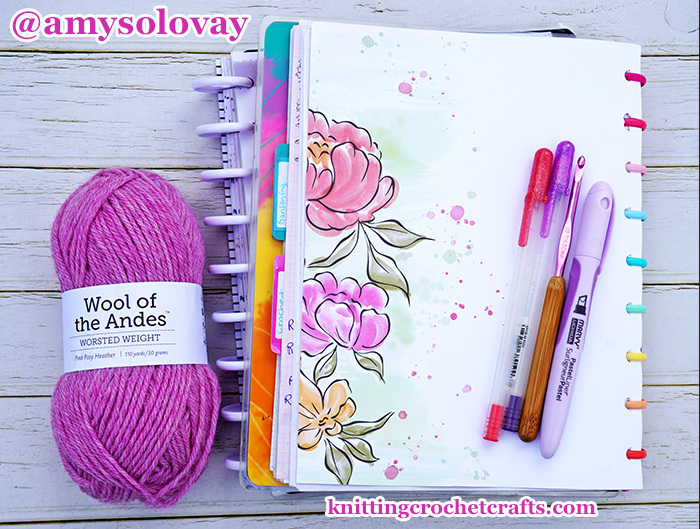
I dedicated most of my productive work hours this month to my husband Mike’s tech startup. Let’s hope that someday we we will be billionaires as a result of that effort.
Right now, the tech startup is a cash-eating animal that costs money rather than earning it.
The worst part is that it is also a time-eating animal that is gobbling up every moment of every day and not leaving me with much time left over for anything else (like showering, or prospecting for content marketing jobs / writing gigs that pay in 30 days rather than “someday, maybe, hopefully”).
All this to say that I don’t have much progress to report on any of my own projects. Bummer!
But I did get a few things done this month. Here’s a list of the most important things I accomplished so far in September, 2024 at my craft site:
My September Posts at KnittingCrochetCrafts.com
- September Crafts: Fall-Friendly Craft Ideas to Work on This Month
- Uses for Scrap Yarn
- Halloween Patterns: Halloween Is the Ideal Holiday for Beastly Crochet
- Happy Fall Card Making Idea With Cute Bears by Lawn Fawn
- Happy Fall Card Making Idea With Bear Cubs and Autumn Trees
New Pages at KnittingCrochetCrafts.com:

I created a bunch of new pages about art and craft supplies by Stamperia, including this list of Stamperia Stencils I have owned and used. Spoiler alert: Some of them are more durable than others.
My all-time favorite patterned paper collection is Blue Dream by Paco Nunez for Stamperia. “All time” as in, all time, in the history of ever. That would be since 2006ish when I started scrapbooking.
I also reviewed Scrapbook.com’s double-sided adhesive foam strips, which I enjoy using to make scrapbooking layouts and handmade cards.
There were some other pages I updated, expanded and / or reposted, but I am out of time for this blog post because it’s back to the startup grind. Wish us luck with that?
I hope your September was lovely, creative and productive! Here’s wishing you a magnificent month of October.
Love and hugs,
Amy Solovay