I took my family to Ireland for three weeks in 2024. I’d been twice before — for a month in a house swap when I was seven, and for a month a decade later travelling with friends on the Irish Experience for my Grade 11 English credit. I wanted to retrace my steps with my wife and kids — and we sure did, all the way up to recreating photos and visiting dozens of precise spots that had been seared into my soul on previous trips.
Ireland is a primordial part of my being. When I still had an afro, I would describe my ethnic background as having Bajan hair, a Polish nose, and a Celtic heart. There’s something about the place that beckons me, something about the land that places my whole past and future before me — like I’m feeling 30 years back, 50 years forward, and 1000 years in either direction all at once. The yearning of my heartspace is fundamentally Irish — a longing for Mhuínse (and we almost went there too — believe me I looked it up and tried to make it happen).
So much of this trip was retracing my steps with my heart as a homing beacon. But the place that most captured my heart was a place I’d never been before on the Antrim coast.
Northern Ireland was an afterthought in my trip planning. Why bother leaving the South? I suppose I was also scared off because it was a different place during the Troubles, so we did not visit in 1994. But Keith from theirishroadtrip.com — who became a dear but distant partner in planning this trip — made a compelling case for an Antrim Coast road trip, and I figured we could make a day trip from Dublin to Belfast, up the Antrim Coast road, and back. What seemed like a detour to the Giant’s Causeway ended up causing me to mark my map for the place I most want to return.
After an early morning departure from Dublin, first breakfast at Insomnia, and second breakfast (or was it lunch?) at a Belfast McDonald’s, we set off further north — on the left side of the road, and in miles per hour — making for Dunluce and the Giant’s Causeway, after which we’d head back on the inland highway and stop for dinner in Belfast en route back to Dublin (we fell in love with the Zizzi Italian restaurant chain). I marked OpenStreetMap with a couple dozen spots along the coastal drive so we could visit as many as time would allow. Dunluce is hard to forget, with jagged ruins like teeth on the edge of the cliff, and the legend of the kitchen that fell into the sea. Carrick-a-Rede was also worth a stop, and we just did quick drivebys at many other stops like Dunseverick and Carrickfergus. There was too much ground to cover in one short day trip from Dublin, and the drive itself was half the draw. But at Kinbane, we stopped and left the car to walk, because we couldn’t see the castle from the road.
My kids say there’s been a different theme for each of our road trips — waterfalls through Western Canada (“another waterfall??”), museums through the US northeast (we started with a blitz of Smithsonians and cemented the theme by watching Night at the Museum in the evenings), and, well, playgrounds through the Maritimes (the kids were younger and many things were closed during the pandemic). In Ireland, the theme was castles.
Castle after castle, we’d constantly ask each other: Which is your favourite castle now? What are your top three? How do your rankings compare with Keith’s? Muckross Abbey was otherworldly, like a place from the Ocarina of Time or Breath of the Wild, or really like Rivendell or Lothlórien or someplace Elvish. Bunratty Castle was a childhood favourite — I’m a McNamara and I remember flashes of exploring it from my visit at age seven. (It’s what I always think of when I think of a medieval castle.) But nothing compares to the experience of first laying eyes on Kinbane.
From the parking lot, you can’t see the castle. You take a walking trail a brief way round the rocky cliffside and towards the water. There are ruins somewhere ahead, but you can’t see them — until, suddenly, you can. As you round the bend, you see it all at once: the path dives down steeply, and far below and a bit back up the other side, on a narrow extension of the rocky coastline, lie the ruins of Kinbane Castle. Scotland visible in the distance, the rocky edge of Ireland holds the little that remains of the castle. To experience the transformation of a rather ordinary coastal trail into a bridge to the ruins down below and out into the water felt like walking through a portal. It’s like a rocky hand is stretching out into the sea — relaxed, palm facing upwards — and the ruins of Kinbane lie out towards the end of Ireland’s index finger. As you step round the bend, past the palm of the land’s hand, you must first descend steeply along the base of the finger and across the joint below, before beginning a much smaller but still steep ascent towards what’s left of the castle at the upper joint. Like the hand of Ireland delicately balances Kinbane on its finger to show you something precious and fragile.
After our high school trip to Ireland, my best friend and bandmate wrote in our song, Halton’s Post, about our visit to Kinsale at the opposite edge of the island, almost kitty-corner to Kinbane.
And in Kinsale, on the lonely coast of Ireland
Just past the harbour, where a dozen bright sails soar
Once stood a castle, but now lies only ruins
It strikes me odd that only cold wind calls it home
Except, it wasn’t actually a castle in Kinsale — it struck me odd as I realized on this past trip that it was a British fort. Yet at Kinbane Head lies the trace of a castle on the lonely coast of Ireland. To reach Kinbane Castle, you must first round the bend, and then descend below, before you can rise up the other side. Down below, at the edge of the finite, once stood a castle, practically hidden from the mainland. Now, at this place that feels like a secret, lies only ruins. Only cold wind calls it home — yet, with just one look, I felt like I belonged there too.
Keith may have ranked it #22, but Kinbane is first among castles on my list and in my heart.
(Photo credit: Chris Brooks CC BY-ND)
My seven-year-old daughter responded, “That this is bad” (and the look of disgust on her face certainly reinforced that!).
I pressed further: Why?
“Because… he’s just treating him like a weapon, not like a person.”
Since January 1, we had been reading daily reflections from St. John Paul II. They’re short, but they can be dense. I’ll often paraphrase or ask questions and just hope they get the gist. For several days, the reflections had been on a theme of St. John Paul II calling on athletes, scientists, students, workers, etc to avoid partial perspectives and be conscious of the whole human person throughout all aspects of life. I guess my daughter got the gist!

I have three kids, ages 9, 7, and almost 6. After experimenting for a long time, over the past year I’ve established a daily routine with my kids for catechesis and prayer that has been working really well — and that we continue to build on. A few simple resources and practices go a long way to helping my kids grow closer to Christ each day.
Morning Prayer: Daily Intentions in the Car
Mornings are hectic. We’ve yet to establish much of a morning routine, but one simple hack we started recently that has worked really well is using the short drive to school to pray together. (I think I picked up the suggestion from a session at The Word virtual conference.) Since we always have the drive, we just take a few minutes to pray for any intentions for the day as they go to school and I go to work.
It’s really effective, and very easy to do — and a great way to set off on our respective days.
Catholic Sprouts: A Daily Podcast for Catholic Kids

Catholic Sprouts is a daily podcast for Catholic kids. I saw a friend mention it on social media towards the end of 2019, and we’ve been listening to it ever since. They have an active online community too, and I just noticed they have a podcast and resources for parents too — the Domestic Church Project (just subscribed!).
Catholic Sprouts is fantastic. There is an episode each weekday, and it takes about 5 minutes to listen (at 1.5x speed…). We listen at night, but may move this to mornings in the future. Last week was on the ultimate goal of Lent, the week before was on the Daily Examen. They cover topics like the saints, the sacraments, stories from the Bible, themes in Catholic social teaching, etc.
It’s very accessible for younger kids, yet lots of rich content for older kids as well. It’s easy to understand, but not dumbed down. We have mostly just stuck to the podcast, but there are also lots of activities and challenges through the online community. Highly recommend.
Page-a-day Children’s Bible
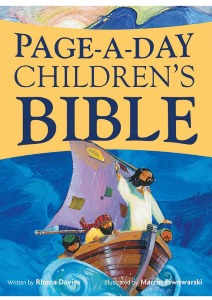
In 2019, I bought this Page a Day Children’s Bible. I was a fan of this one, after skimming a couple children’s Bibles and reading some of the passages I’m most familiar with; this one was pretty solid in terms of making the Bible accessible without dumbing it down. We got through the whole book in 2020, and in 2021 we’ve started another children’s Bible that was a gift from a godparent — also broken down into 365 daily readings.
I really like the format of a page-a-day children’s Bible that gets you from origin to eschaton in 365 days. We’ll probably continue to alternate between two or three different versions, picking a different one each year.
Daily Papal Reflections
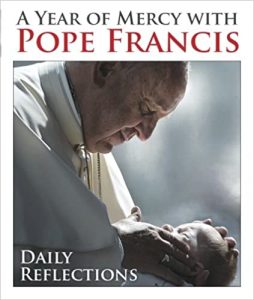
My mom bought me A Year of Mercy with Pope Francis — daily papal reflections for an entire year on the theme of mercy. I didn’t read it during the Year of Mercy, but I paired this with the Page-a-Day Children’s Bible for 2020 and it worked really well as part of our night time routine. Each day was a meditation from Pope Francis, along with some reflection questions. Sometimes there were big words or big concepts, but we’d take some time to discuss or to guess what the words meant, and I think it was really fruitful.
Meanwhile, I’ve had this book of 365 daily reflections from St. John Paul II sitting on a shelf for a decade: Love is the Explanation of Everything.
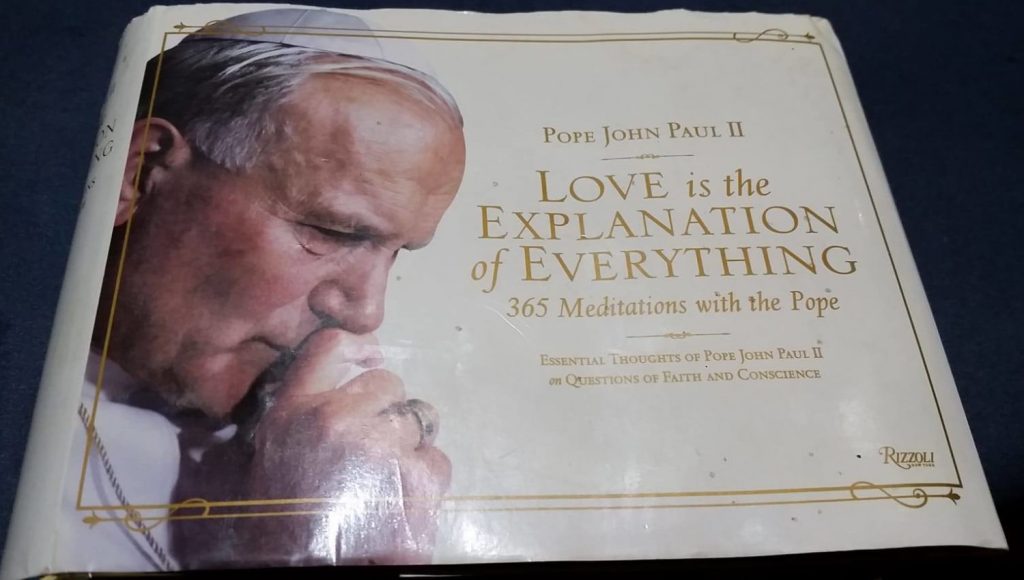
For 2021, as we switched over to a different page-a-day children’s Bible, we switched to a different book of daily papal reflections too. To the surprise of no one who’s read both popes, St. John Paul II’s writing is a lot more dense and less accessible than Pope Francis’. However, with some paraphrasing, pauses, and discussion, this has been a rich source of short daily reflections, drawing on the deep personalism and Christocentrism of St. John Paul II. If our WandaVision experience was any indication, it’s leaving an impression.
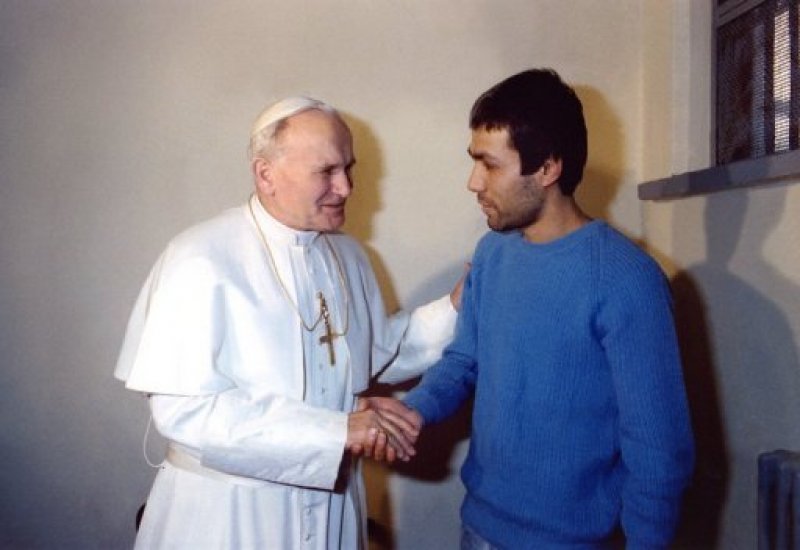
This book contains photos for each day too — sometimes stock photos, but often photos of St. John Paul II. Just yesterday, we read a reflection from his remarks at Rebibbia Prison in 1983, where he met with and forgave the man who tried to assassinate him. Powerful stuff.
For 2022, I’ll be looking for a book of 365 daily reflections from Pope Benedict XVI. There’s something liturgical about repeating the cycle every three years, or maybe we’ll find another book of papal reflections afterwards, but this pairing of a page-a-day Bible with short daily papal reflections has worked very well. (Perhaps I should also add daily reflections with the saints.)
As St. John Paul II wrote in Catechesi Tradendae, Tradition and Scripture are the source of catechesis:
To speak of Tradition and Scripture as the source of catechesis is to draw attention to the fact that catechesis must be impregnated and penetrated by the thought, the spirit and the outlook of the Bible and the Gospels through assiduous contact with the texts themselves; but it is also a reminder that catechesis will be all the richer and more effective for reading the texts with the intelligence and the heart of the Church and for drawing inspiration from the 2,000 years of the Church’s reflection and life.
Daily Examen Storybook for Families
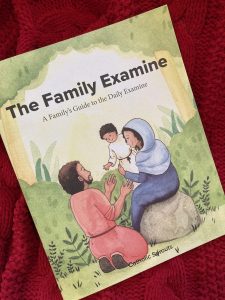
One of the early experiments in our nightly routine was to try the Daily Examen. This worked well for several months when my oldest was younger, but we didn’t stick with the habit in the long run. In February, Catholic Sprouts spent a week on the Examen, and we’ve ordered their Daily Examen Storybook for Families. I’m really excited to use this as a resource to make this a part of our nightly routine. We may need to shuffle some things from evenings to mornings, but I’m looking forward to using the book to facilitate this Ignatian spiritual exercise in an accessible and age-appropriate way.
A pedagogy of desire in the domestic church
When I became a father, I remember realizing that, while I’d given a lot of thought to the theological and philosophical and even musical grounding I wanted to given my children, I didn’t know the first thing about car seats or how to change a diaper. I suppose keeping another human being alive comes first on Lonergan’s scale of values or Maslow’s hierarchy of needs. However, as my kids get older, a few simple resources like the above have gone a long way to facilitating accessible catechesis.
We may move some of these things to the mornings, but there is something really valuable about our evening discussion time. It’s not just a chance to read Bible stories or papal thoughts, but to reflect on meaning and purpose, on our deepest fears and aspirations, and to connect the dots with our desire for God and relationship with Christ. It’s a chance to pray for family members, especially those who are sick or have died, and to discuss real challenges and struggles, while also expressing gratitude for our blessings and discussing the joys of life — and connecting this to Scripture and Tradition.
As St. John Paul II wrote in his Letter to Families:
The Fathers of the Church, in the Christian tradition, have spoken of the family as a “domestic church”, a “little church”. They thus referred to the civilization of love as a possible system of human life and coexistence: “to be together” as a family, to be for one another, to make room in a community for affirming each person as such, for affirming “this” individual person…
Certainly one area in which the family has an irreplaceable role is that of religious education, which enables the family to grow as a “domestic church”. Religious education and the catechesis of children make the family a true subject of evangelization and the apostolate within the Church.
St. John Paul II also describes the family as the school of love:
The family is the first and fundamental school of social living: as a community of love, it finds in self-giving the law that guides it and makes it grow. The self- giving that inspires the love of husband and wife for each other is the model and norm for the self-giving that must be practiced in the relationships between brothers and sisters and the different generations living together in the family. And the communion and sharing that are part of everyday life in the home at times of joy and at times of difficulty are the most concrete and effective pedagogy for the active, responsible and fruitful inclusion of the children in the wider horizon of society.
One of my favourite papal addresses of all time is Pope Benedict XVI’s Year of Faith: The Desire for God. Benedict says that we need a pedagogy of desire:
We must therefore maintain that it is possible also in this age, seemingly so blocked to the transcendent dimension, to begin a journey toward the true religious meaning of life, that shows how the gift of faith is not senseless, is not irrational. It would be very useful, to that end, to foster a kind of pedagogy of desire, both for the journey of one who does not yet believe and for the one who has already received the gift of faith…
Instilling in someone from a young age the taste for true joy, in every area of life – family, friendship, solidarity with those who suffer, self-renunciation for the sake of the other, love of knowledge, art, the beauty of nature — all this means exercising the inner taste and producing antibodies that can fight the trivialization and the dulling widespread today…
It is precisely the truest joy that unleashes in us the healthy restlessness that leads us to be more demanding — to want a higher good, a deeper good — and at the same time to perceive ever more clearly that no finite thing can fill our heart.
These simple resources have helped me to put into practice daily catechesis in the domestic church, to connect the every day school of love with every day reflections on Scripture and Tradition. They’ve given us the daily opportunities to learn, reflect, and pray together through the joys and challenges of daily life, to foster that pedagogy of desire rooted in faith and oriented ourselves towards the love that satisfies.
These are manageable, accessible daily activities that work even when life is extremely busy. Bit by bit, I pray this nurtures the development of a true religious sense and a daily encounter with Christ — and a true “vision” of the human person, created in the image and likeness of God.
In addition to being another mix for me to try after taking some Recording Revolution courses, this is the first time I’ve used melodic MIDI instruments in Ardour — Yoshimi and amsyth plugins are powering six different parts (as well as the amazing DrumGizmo for the drums). Also, filming outdoors in the urban wilderness was a great physically distanced pandemic activity for the Fall.
NMG Studios is Noah, Mara and Gabriella making music with help from their dad. Here’s our second video:
The Original
Enter NMG Studios: Noah, Mara and Gabriella making music with help for their dad. My kids are in Suzuki violin, but turning to some fun covers are a great opportunity to give them experience recording and filming, while allowing me a chance to practice my skills.
This is our first cover: My Name is Jonas.
While studying English at the University of Toronto, I unfortunately never took a course with Nick Mount. Mount opens the lecture with a description of the lyric poem that resonates with me and is forever etched in my memory:
When you’re reading a novel, your attention is on the progression of time, the forward movement of the plot through its complication and its resolution. A lyric poem… is less about the progression of time than it is about the attempt to stop time. The lyric tries the impossible. It tries to temporarily stop time, to slow us down in order to allow for a moment of perception — sometimes a moment of confusion, of understanding, sometimes emotional, sometimes intellectual, often a bit of both. For me, that is the main virtue of poetry – and in particular of the lyric poem – its ability to get me to stop and pay attention to life, to everything that I’m rushing by because of time, because of the inevitable tick of the clock. And that is what a lyric poem excels at – capturing the things, the experiences, that we don’t see because they’re there in front of us all the time.
Then, channeling the famous University of Toronto English professor, Northrop Frye, Mount continues:
Frye says that the lyric poem gets written because some normal activity has been blocked, the normal progression of time, and the poet has to write about that block before returning to the world of time.
This is my experience as a songwriter explained by the University of Toronto Department of English. Furthermore, while I have yet to fully wrap my mind around this yet, I think a pair of U of T theology professors have something profound to say about this too.
Fr. Bernard Lonergan from Regis College wrote in Insight about four fundamental forms of bias that can impact our consciousness, the first of which is dramatic bias, which operates at the level of elementary feelings and passions. From Insight (emphasis added):
Just as insight can be desired, so too it can be unwanted. Besides the love of light, there can also be a love of darkness. If prepossessions and prejudices notoriously vitiate theoretical investigations, much more easily can elementary passions bias understanding in practical and personal matters. Nor has such a bias merely some single or isolated effect. To exclude an insight is also to exclude the further questions that would arise from it, and the complementary insights that would carry it towards a rounded and balanced viewpoint. To lack that fuller view results in behaviour that generates misunderstanding both in ourselves and in others. To suffer such incomprehension favours a withdrawal from the outer drama of human living into the inner drama of fantasy. This introversion, which overcomes the extroversion native to the biological pattern of experience, generates a differentiation of the persona that appears before others and the more intimate ego that in the daydream is at once the main actor and the sole spectator. Finally, the incomprehension, isolation, and duality rob the development of one’s common sense of some part, greater or less, of the corrections and assurances that result from learning accurately the tested insights of others and from submitting one’s own insights to the criticism based on others’ experience and development.
Bernard Lonergan, Insight: A Study of Human Understanding, p. 191.
Biases are the kinds of things that emerge and prevent authentic insight, and dramatic bias in particular has to do with that level of passion and feeling in one’s own psyche. These are barriers, but the sort of thing that when not ignored but worked out, can lead to insight. Furthermore, dramatic bias is dialectical, as there’s some tension between two competing things that needs to be worked out is dialogue.
As one of my Regis College professors, John Dadosky, once put it in a lecture: “Once a bias is removed, then you can get on with the business of authentic living with that area of life in which you were stuck.” This comment is what sparked the connection for me and reminded me of Nick Mount’s comments on the lyric poem, calling to mind Northrop Frye’s notion that the normal progression of time has been blocked and you are stuck and cannot return to the normal world of time until — or unless – you work out the block with the lyric poem. What is a lyric poem but that dialectical attempt to resolve the bias, to resolve to block – to get unstuck?
Lonergan, in his transcendental precepts, describes the method through which any individual transcends himself or herself to live in reality:
- be attentive to experience;
- be intelligent in understanding;
- be reasonable in judgment;
- be responsible in decision-making;
- be in love with God, self and neighbour.
A good artist – a good lyricist – is attentive to human experience, as a prerequisite for being intelligent in our understanding of the human experience (and, thus, a prerequisite of being reasonable, responsible and in love). Insofar as art is good, insofar as it is attentive to our lived experience and it authentically expresses that, it is the raw material for reflection that can lead to intelligent understanding of the human experience.
Is the lyric poem not a dialectical attempt at being attentive to the experience of dramatic bias? To be attentive to that experience that stops the normal progression of time and removes us from the world, so that we can work through that experience and return to the world – unstuck – with the bias removed through a dialectical engagement with the blockage?
For the lyricist, the world of time has stopped – the dramatic bias “blocks… the normal progression of time” – and the lyricist experiences a “withdrawal from the outer drama of human living into the inner drama of fantasy.” That dramatic bias is worked out in a dialogue between fantasy and reality through the lyric, so that the lyricist can “return to the world of time” and “get on with the business of authentic living.”
For the listener or reader, lyrics that are truly attentive to experience cause us to “stop and pay attention to life,” to “slow us down in order to allow for a moment of perception” – a mix of confusion and understanding, of emotion and intellect – in order to draw our attention to the dramatic biases in our own lives, the “experiences that we don’t see because they’re there in front of us all the time,” so that the listener themselves can, through engaging with the lyric, work out a similar block or dramatic bias in their own life and return to the normal progression of time (whether or not the lyricist is similarly successful).
I feel like I have a lot more work to do to wrap my mind properly around what Lonergan is saying and how this relates to lyric poetry, but… is that not what a lyric poem does? Is that not the experience and the role of a songwriter? Is that not what lyrics are for you?
That’s what lyrics are for me.
Canvases is a song about the normal progression of time being blocked and the need to “paint all of these unknown voices” before returning to the world of time – written four years before I heard Nick Mount’s lecture, while I was attentive to my own experience but before I understood it in the way I do now.
Thank you, Nick Mount, Northrop Frye, John Dadosky and Bernard Lonergan, for furthering my understanding of my own lyric poetry and experience as a music lover.
What we experience at recess is central to the human drama.
We long to be accepted and to be loved for who we are. We ask: Do I belong here? Am I accepted for who I am? Can I reveal what I truly feel without regretting it? Without being mocked? Without feeling stupid? Will anybody ever love me for who I am? This social pretense, is it permanent? Is it everywhere? Is there a place where I can belong as myself? Is there a person with whom I can belong as myself?
And her. I want to be near her. I want to think about her always. If only she would accept me, it wouldn’t really matter what anyone else thinks. But if only she cannot see me, what does it matter what anyone else sees? Will I always feel like this? Will I ever feel this way about anyone else again? How can I love someone else like this again? How could I live with this feeling again? Will I always have to feel this ache? Does anyone else feel this? Does anyone else understand me? Will anyone else ever feel this way about me?
What does this mean?
I fell in love with the music — I never understood the lyrics. By chance, I scrolled past it in a playlist today, and it spoke to my heart, so I put it on repeat and decided to spend some time searching for an English translation.
*hand to heart*
If I were three leagues out at sea or on mountains far from home,
Without any living thing near me but the green fern and the heather,
The snow being blown down on me, and the wind snatching it off again,
And I were to be talking to my fair Taimín and I would not find the night long.Dear Virgin Mary, what will I do, this winter is coming on cold.
And, dear Virgin Mary, what will this house do and all that are in it?
Wasn’t it young, my darling, that you went, during a grand time,
At a time when the cuckoo was playing a tune and every green leaf was growing?If I have my children home with me the night that I will die,
They will wake me in mighty style three nights and three days;
There will be fine clay pipes and kegs that are full,
And there will be three mountainy women to keen me when I’m laid out.And cut my coffin out for me, from the choicest brightest boards;
And if Seán Hynes is in Muínis, let it be made by his hand.
Let my cap and my ribbon be inside in it, and be placed stylishly on my head,
And Big Paudeen will take me to Muínis for rough will be the day.And as I go west by Inse Ghainimh, let the flag be on the mast.
Oh, do not bury me in Leitir Calaidh, for it’s not where my people are,
But bring me west to Muínis, to the place where I will be mourned aloud;
The lights will be on the dunes, and I will not be lonely there.


Here goes nothing…

Thanks for the reminder, I guess, but I wasn’t exactly planning to spend my anniversary on Facebook. This brought up some similar stories from friends:
When I removed my “In a relationship” status […] all the targeted ads changed from ‘Buy Engagement Rings Here’ to ‘ARE YOU SINGLE AND ALONE?’
The barrage of wedding ads my wife and I received once we were engaged only subsided when we got married — then, she immediately started receiving ads for baby stuff. As my friend put it, “Facebook is like a really pushy, suggestive relative.”
My wife got the anniversary reminder too, but the next day Facebook stepped up its game and served her a divorce ad.

An hour later, the divorce ad and anniversary suggestion appeared on the same page.

… was it because I didn’t send her a message? Well, there’s yet another reason to move away from services like Facebook…