Encryption
The affine cipher key consists of a pair of integers (a, b) which is used to are used to form the equation ax+b and subsequently used to generate the mapping of each plaintext character to ciphertext character.
Take (3, 5) as an example. Note a must be a co-prime (have no common factors other than 1) to 26 otherwise different characters may map to the same letter and thus wouldn’t be reversible. In group theory this is because a needs to be cyclic generator of the group Z/26Z
(a) 3*0+5=5 (F)
(d) 3*3+5=5 (O)
(x) 3*23+5=74=5 (mod 22) (W)

abcdefghijklmnopqrstuvwxyz
FILORUXADGJMPSVYBEHKNQTWZC
For each letter in your plaintext you replace it it with its corresponding ciphertext letter.
Example
when the clock strikes twelve attack
TARS KAR LMVLJ HKEDJRH KTRMQR FKKFLJ
Decryption
For each letter in your ciphertext you replace it it with its corresponding plaintext letter (the one above it in the mapping).
abcdefghijklmnopqrstuvwxyz - Key (9, 15)
PYHQZIRAJSBKTCLUDMVENWFOXG

FAZC EAZ HKLHB VEMJBZV EFZKWZ PEEPHB
when the clock strikes twelve attack
New: Try it yourself!
]]>In a language there is certain n-grams that are much more common than others, the quadgram “THER” has a much greater probability than “DOXW”. So if we were to split text up into all the n-grams making it up the text and multiply the probabilities of each n-gram together, we would get the probability of that specific piece of text being a certain language.
LOOKOUT contains 4 quadgrams LOOK, OOKO, OKOU and KOUT

As the text gets longer, the probability gets even smaller, so small that numerical underflow occurs as there are so many zeros in the decimal place that an accurate representation can’t be stored in 64 bits. The number basically become 0.
To get round this problem we log the probability. This makes the numbers more manageable, normally in the range of 0 to -2000. This is because the probability of the text is the product of all the probabilities of individual each n-gram. So using the log rule 

To first the probabilities of each quadgram needs to be determined
CABCD is the number of times the particular quadgram occurs
N is the total number of quadgrams in the list

You can find lists of quadgram frequency online or create your own using large samples of text. This can have its advantages – if you create your statistics from a sample of text similar to what you are trying to score this can give better results.
]]>The Caesar Cipher is a very easy to crack as there are only 25 unique keys so we can test all of them and score how English they are using either Chi-Squared Statistic or N-Gram Probability.
Example
Ciphertext of “RCZIOCZXGJXFNOMDFZNORZGQZVOOVXF”
Shift | Decrypted Text                 | Chi-Sq Score
1       QBYHNBYWFIWEMNLCEYMNQYFPYUNNUWE  201.327499
2       PAXGMAXVEHVDLMKBDXLMPXEOXTMMTVD  599.489345
3       OZWFLZWUDGUCKLJACWKLOWDNWSLLSUC  267.058510
4       NYVEKYVTCFTBJKIZBVJKNVCMVRKKRTB  325.267580
5       MXUDJXUSBESAIJHYAUIJMUBLUQJJQSA  775.163340
6       LWTCIWTRADRZHIGXZTHILTAKTPIIPRZ  434.880892
7       KVSBHVSQZCQYGHFWYSGHKSZJSOHHOQY  554.916606
8       JURAGURPYBPXFGEVXRFGJRYIRNGGNPX  340.923863
9       ITQZFTQOXAOWEFDUWQEFIQXHQMFFMOW  1012.384679
10      HSPYESPNWZNVDECTVPDEHPWGPLEELNV  115.358434
11      GROXDROMVYMUCDBSUOCDGOVFOKDDKMU  91.670467
12      FQNWCQNLUXLTBCARTNBCFNUENJCCJLT  283.701596
13      EPMVBPMKTWKSABZQSMABEMTDMIBBIKS  194.299832
14      DOLUAOLJSVJRZAYPRLZADLSCLHAAHJR  385.733449
15      CNKTZNKIRUIQYZXOQKYZCKRBKGZZGIQ  1520.292006
16      BMJSYMJHQTHPXYWNPJXYBJQAJFYYFHP  801.523128
17      ALIRXLIGPSGOWXVMOIWXAIPZIEXXEGO  603.683962
18      ZKHQWKHFORFNVWULNHVWZHOYHDWWDFN  280.874579
19      YJGPVJGENQEMUVTKMGUVYGNXGCVVCEM  269.610988
20      XIFOUIFDMPDLTUSJLFTUXFMWFBUUBDL  176.849244
21      WHENTHECLOCKSTRIKESTWELVEATTACK  51.921327
22      VGDMSGDBKNBJRSQHJDRSVDKUDZSSZBJ  460.236803
23      UFCLRFCAJMAIQRPGICQRUCJTCYRRYAI  262.108135
24      TEBKQEBZILZHPQOFHBPQTBISBXQQXZH  1373.411997
25      SDAJPDAYHKYGOPNEGAOPSAHRAWPPWYG  90.715517
As you can see the lowest Chi-Squared value is 51.921327, which was using a shift of 21. If you read the decrypted text for a shift of 21 you can indeed see that it is English. Hence cipher has been broken!
WIP
]]>
Encryption
The key is an integer normally known as the ‘shift’, it can be a number from 0-25 (0 being the identity). First you create your alphabet mapping of plaintext letters (lowercase) to ciphertext letters (uppercase) using the shift.
Some examples a shifts would look like this

Shift of 1:                Shift of 21:
abcdefghijklmnopqrstuvwxyz abcdefghijklmnopqrstuvwxyz
BCDEFGHIJKLMNOPQRSTUVWXYZA VWXYZABCDEFGHIJKLMNOPQRSTU
For each letter in your plaintext you replace it it with its corresponding ciphertext letter (the one below it in the mapping).
It can also be thought of like converting each letter to is equivalent value (A=0, B=1…. Z=25 etc) and adding the key shift, and subtracting 26 if the value is 26 or greater, then convert back to letters.
Example:
Encrypting “when the clock strikes twelve attack” using the shift of 21
when the clock strikes twelve attack
RCZI OCZ XGJXF NOMDFZN ORZGQZ VOOVXF
Decryption
For each letter in your ciphertext you replace it it with its corresponding plaintext letter (the one above it in the mapping).
You can also convert each letter to is equivalent value (A=0, B=1…. Z=25 etc) and subtract the key shift this time, and add 26 if the value smaller than 0, then convert back to letters.
VWXYZABCDEFGHIJKLMNOPQRSTU - Shift of 21:
abcdefghijklmnopqrstuvwxyz

RCZI OCZ XGJXF NOMDFZN ORZGQZ VOOVXF
when the clock strikes twelve attack
As we are working in modular 26 a shift of -5 is the same as a shift of 21. The inverse key of 21 would be 5.
New: Try it yourself!
]]> of appearing, the Index of Coincidence is also (
 ).
).
If the frequency of the letters are known and the sum of the frequencies is 1 then this formula can be used to calculate Index of Coincidence for a particular language.
Fi is the frequency, in decimal form (10% = 0.1), of a letter in your text.

For for a generic piece of text written in English the Index of Coincidence is 0.0667, it is different for each language as the letter frequencies are different…
| Language | Index of Coincidence |
| English | 0.0667 |
| French | 0.0694 |
| German | 0.0734 |
| Spanish | 0.0729 |
| Portuguese | 0.0824 |
| Turkish | 0.0701 |
| Swedish | 0.0681 |
| Polish | 0.0607 |
| Danish | 0.0672 |
| Icelandic | 0.0669 |
| Finnish | 0.0699 |
| Czech | 0.0510 |
Values for this tabled created from the frequencies from Wikipedia. The values are for letters A-Z other letters such as ‘á’ or ‘â’ are considered to be the same as ‘a’, ‘ü’ or ‘ú’ are considered to be the same as ‘u’ etc…
However if you want to figure out the index of coincidence for a particular piece of text this formula can be used.
Ci is the count, of a letter in the text.
Li is the total number of letters in the text.

If a letter does not appear more than once then is does not need to be involved in the calculation as when Ci is 1 or 0, Ci x (Ci – 1) will equal 0;
Example: ‘WHENTHECLOCKSTRIKESTWELVEATTACK’ Text length = 31
| Letter | Count (Ci) | Ci(Ci – 1) |
| A | 2 | 2 |
| C | 3 | 6 |
| E | 5 | 20 |
| H | 2 | 2 |
| K | 3 | 6 |
| L | 2 | 2 |
| M | 0 | 0 |
| S | 2 | 2 |
| T | 5 | 20 |
| W | 2 | 2 |
| Total | 31 | 62 |

This value is reasonably close to the expected Index of Coincidence value of English (0.0667). It is also much higher than that the expected Index of Coincidence of random text (0.0385) suggesting that this text is not random.
The larger the Index of Coincidence the more likely that there is some sort of language structure behind text. For example the Vigenère Cipher has an average Index of Coincidence of 0.042 – suggesting that the text is not random, which it is not.
]]>To find the period you assume it is a particular period and put in blocks of 2 in columns of the period, then you do an diagraphic index of coincidence calculation on each column and take the average of all the columns.
This is an example of the difference between the expected English index of coincidence (0.0667) and the average Index of Coincidence Calculation for periods 2-40. Hence the smaller the bar the closer it is to that of English.
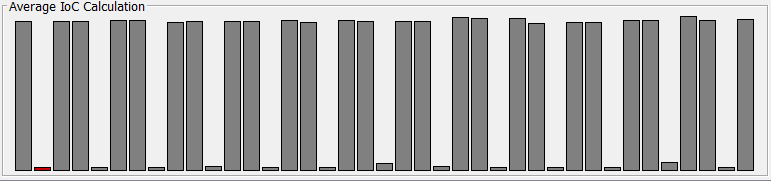
As you can see for this particular text it is very obvious that the period is 3 because all the of multiples of 3s are very close to English. This is because the key ‘MAN’ – period 3 is the same as ‘MANMAN’ – period 6.
Once the period has been identified place the ciphertext into blocks of 2 in columns of the correct period.
Example:
345173345643531536543672… has been found to have a period of 3
?  ?  ?  = Key
34 51 73
34 56 43
53 15 36
54 36 72
........
From this point on you treat each column separately as they are all encoded by a different letter. From here we use each number digraph to narrow down the possible keys. We can infer things from ciphertext for example if the second digit is 0 there was only one way it could have been created that would be the plaintext number and the key number ending in a 5.
This can be extended to create inequalities for all possible ciphertext number digraphs. This is some pseudocode to create an inequalities for both the row and column.
rowMin = 1
rowMax = 5
colMin = 1
colMax = 5
no = ciphertext number digraph

IF no is smaller than 11 THEN
    no = no + 100

col = no % 10
IF col equals 0 THEN
    colMin = 5
    colMax = 5
    no = no - 10
ELIF col smaller than 7 THEN
    colMin = 1
    colMax = col - 1
ELSE
    colMin = col - 5
    colMax = 5

row = floor(no / 10) % 10

IF row equals 0 THEN
    rowMin = 5
    rowMax = 5
ELIF row smaller than 7 THEN
    rowMin = 1
    rowMax = row - 1
ELSE
    rowMin = row - 5
    rowMax = 5
You apply this algorithm to all number digraphs in each column and then create an equation for the row and column of the key number. The equation will be…
rowMin <= row <= rowMax
colMin <= col <= colMax
You then use these to narrow down the possibility, lets say you had the inequalities …
2 <= row <= 4 & 3 <= row <= 5 & 2 <= row <= 3
From these three inequalities you can infer that:
3 <= row <= 3 hence row = 3
So you now know that for that columns the key number must starts with a 3. You can then get the inequalities for the column and then create the full key which in this case will now be 31, 32, 33, 34 or 35.
Once the key has been found for each column subtract it away from each number in its respective column. Now if there have been no mistakes there should be less than 25 (size of polybius square with I/J being 1 character) number digraphs. Convert each unique one into a unique letter. Example: swap out all 24 for ‘A’s all 45 for ‘B’s, all 86 for ‘C’s etc.
You are now left will a simple substitution cipher, I wont go into detail on how to break it here, but I have a page here on how to break a simple substitution cipher. Tips: The most common letter in the new ciphertext will likely be ‘E’, the most common trigraph ‘THE’ and so on.
]]>The key consists of a 5×5 polybius square which has all the letters in the alphabet however I/J are treated the same and a second key.
| 1 | 2 | 3 | 4 | 5 | |
| 1 | A | B | C | D | E |
| 2 | F | G | H | I/J | K |
| 3 | L | M | N | O | P |
| 4 | Q | R | S | T | U |
| 5 | V | W | X | Y | Z |
The second key can be of any length, keep in mind that the longer the key the more secure it theoretically is, however the key should be memorable so a person could remember and use it. Examples:
MAGIC, KEY, DEFEND, POLYALPHABETIC etc.
Encryption
Consider the polybius square created using the keyword CIPHER
| 1 | 2 | 3 | 4 | 5 | |
| 1 | C | I/J | P | H | E |
| 2 | R | A | B | D | F |
| 3 | G | K | L | M | N |
| 4 | O | Q | S | T | U |
| 5 | V | W | X | Y | Z |
and a second key of PAGE which defines the period as 4.
The second key is replaced with its position the polybius square (row then column), the numbers effectively become the key. Then each plaintext letter is written in rows of the period length and it too also replaced with its position the polybius square (row then column). The cipher text is then the sum of the key and the cipher text numbers. If the number is greater than 99 (3 digit number) subtract 100. 105 becomes 05, 100 becomes 00.
P  A  G  E   P  A  G  E   P  A  G  E
13 22 31 15  13 22 31 15  13 22 31 15
-----------  -----------  -----------
W  H  E  N   S  T  R  I   E  A  T  T
52 14 15 35  43 44 21 12  15 22 44 44
65 36 46 50  56 66 52 27  28 44 75 59
-----------  -----------  -----------
T  H  E  C   K  E  S  T   A  C  K
44 14 15 11  32 15 43 44  22 11 32
57 36 46 26  45 37 74 59  35 33 63
-----------  -----------
L  O  C  K   W  E  L  V
33 41 11 32  52 15 33 51
46 63 42 47  65 37 64 66
WHENTHECLOCKSTRIKESTWELVEATTACK using these keys encrypts to 65364650573646264663424756665227453774596537646628447559353363.
Decryption
To decrypt simply split the number text into blocks of 2 and write each block in rows of the period length then subtract the key numbers. If the result is less than 0 add 100.
There are however some serious flaws that significantly decrease the security of this cipher, these flaws can be used to break the Nihilist Substitution Cipher.
New: Try it yourself!
]]>The first thing to note is that when encoding in Hill Cipher each row of the key matrix encodes to 1 letter independently of the rest of the key matrix.

Notice how the top row of the far left matrix is only involved in the top cell of the ciphertext matrix, the middle row is only involved in the middle cell etc.
We can use this fact to dramatically decrease the number of keys we have to test to break the Hill Cipher.
For square matrix of size N, there are 26N×N unique keys (there will be less as not all matrices have an inverse). For N=3, there is 269 ≈ 5.43×10¹² keys, to test all of these is not feasible (I calculated on my pc it would take ≈ 8 years to test them all).
However, if we test each row individually then there is only 26N keys we need to test, For N=3 there is 263 = 17,576 which is a very small number in comparison (Takes 0.5 seconds on my pc!)
With this property of Hill Cipher we can go about cracking it.
First you will need to identify N (the size of the matrix) the size will be a multiple of the text length – this narrows it down a lot
Now you will be to iterate over all the row vectors with a size of N and possible values of 0 (inclusive) to 26 (exclusive).
For a 3 by 3 there are 17,576 combinations. They look will look something like this. On the left is the iteration number…
1/17576 [ 0, 0, 0]
2/17576 [ 0, 0, 1]
3/17576 [ 0, 0, 2] ……
16249/17576 [24, 0, 24]
16250/17576 [24, 0, 25]
16251/17576 [24, 1, 0] ……
17576/17576 [25, 25, 25]
For each one of these possibilities assume it is part of the key and multiply your ciphertext by it, you will multiply in blocks of N and get a single letter out for each block.

Once you have all the output letters for a particular possibility, score the letters using the Chi-Squared Statistic. Store the row vectors from smallest to largest Chi-Squared value.
Once you have checked all the possibilities. Take the best results from the list you have compiled and then go through all the permutations of creating an N by N matrix and checking it has an inverse in modular 26.
Example:
Let’s say you know N=3 and the best row vectors found using this method were with a Chi-Squared value of… (note is some cases the best N vectors may not be the correct ones so you may need to try a combination of a few different ones)
[22, 6, 7] X2 = 71.721647
[23, 17, 18] X2 = 50.562860
[25, 0, 6] X2 = 81.987751
Rearranging each row to every possible position (For R number of rows there is R!, R×(R-1)×(R-2)…×1, permutations)
The next (3! = 6) matrices are all the permutations of each row vector.
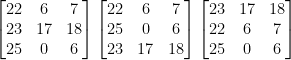

Then encrypt your ciphertext using these matrices (encrypting using the inverse key matrix is the same as decrypting using the key matrix). One of these results should be English – being your solution. If you wish to find the key matrix, you will need to inverse the inverse key matrix in mod 26.
To Conclude
For larger matrices like 4 by 4 and up the sheer number of keys make a brute force attack impossible, I don’t believe anyone has the patience or life expectancy to wait around 64 trillion years to solve one cipher. Other methods like crib dragging require you to guess or make assumptions for large chunks of the plaintext, a crib of 19+ characters very hard to come by. The method described above can solve a 4 by 4 Hill cipher in about 10 seconds, with no known cribs. The only thing it requires is that the text is of a certain length, about 100×(N-1) or greater when N is the size of the matrix being tested, so that statistical properties are not affected by a lack of data.
This same method can be adapted to decrypted ciphertext in other languages you just need to change the frequencies of letters that the Chi-Squared Statistic uses.
[powr-hit-counter id=4db2581c_1482002480525]
]]>
Oi is the observed count of that letter in your text.
Ei is the expected count of that letter in the length of your text.

Chi-Squared Statistic in words is, “the sum, of the squared difference between observed count and expected count divided by the expected count, of each letter.”
Example: ‘WHENTHECLOCKSTRIKESTWELVEATTACK’ Text length = 31
| Letter | Observed Count (Oi) | Frequency in English | Expected Count (Ei)* | (Oi – Ei)2/Ei |
| A | 2 | 8.17% | 2.53177 | 0.11169 |
| B | 0 | 1.49% | 0.46252 | 0.46252 |
| C | 3 | 2.78% | 0.86242 | 5.29817 |
| D | 0 | 4.25% | 1.31843 | 1.31843 |
| E | 5 | 12.70% | 3.93762 | 0.28663 |
| F | 0 | 2.23% | 0.69068 | 0.69068 |
| G | 0 | 2.02% | 0.62465 | 0.62465 |
| H | 2 | 6.09% | 1.88914 | 0.00651 |
| I | 1 | 7.00% | 2.16876 | 0.62985 |
| J | 0 | 0.15% | 0.04743 | 0.04743 |
| K | 3 | 0.77% | 0.23932 | 31.84587 |
| L | 2 | 4.03% | 1.24775 | 0.45352 |
| M | 0 | 2.41% | 0.74586 | 0.74586 |
| N | 1 | 6.75% | 2.09219 | 0.57016 |
| O | 1 | 7.51% | 2.32717 | 0.75688 |
| P | 0 | 1.93% | 0.59799 | 0.59799 |
| Q | 0 | 0.10% | 0.02945 | 0.02945 |
| R | 1 | 5.99% | 1.85597 | 0.39477 |
| S | 2 | 6.33% | 1.96137 | 0.00076 |
| T | 5 | 9.06% | 2.80736 | 1.71252 |
| U | 0 | 2.76% | 0.85498 | 0.85498 |
| V | 1 | 0.98% | 0.30318 | 1.60155 |
| W | 2 | 2.36% | 0.73160 | 2.19907 |
| X | 0 | 0.15% | 0.04650 | 0.04650 |
| Y | 0 | 1.97% | 0.61194 | 0.61194 |
| Z | 0 | 0.07% | 0.02294 | 0.02294 |
| Total | 31 | 1.00029 | 31.00899 | 51.92133 |
* Expected Count = FREQ / 100 × LEN
For English a Chi-Squared value of about 150 or less is expected anything above does likely does not resemble English.
WHENTHECLOCKSTRIKESTWELVEATTACK, X2 = 51.92133
THWKEEVIWTETSCANHKERCTTAKSCLLOE, X2 = 51.92133
ZDXPLXTDOWXSWCRSGPWVVOCWEOTTXOK, X2 = 425.59631
As you can see English text scores low however score is independent of letter order and a random text does not score highly.
I have created an Excel spreadsheet that can calculate Chi-Squared when given the frequencies of letters. It does not use macros. Chi-Squared Calculator
]]>To encrypt in Hill a key first needs to be chosen, this will be a square matrix which has an inverse in modular 26. For the matrix to have an inverse the determinant must be co-prime to 26.
Here are two example matrices…


Hence both these matrices are valid keys for the Hill cipher
*Co-prime means that the greatest common factor between the two numbers is 1.

If a 2 by 2 matrix is chosen for the key, the plaintext must be padded usually with an ‘X’ so that it is a multiple of 2. So for an N by N matrix the plaintext must be padded so that it that it is a multiple of N. E.G
For N=2, “CAREFUL” would become “CAREFULX”
For N=2, “SPORTS” would stay as “SPORTS”
For N=3, “CAREFUL” would become “CAREFULXX”
Once the text is a valid length, you take letters in blocks of N and convert them to a column vector. Letter ‘A’ has the value 0, ‘B’ is 1, ‘C’ is 2 … ‘Z’ is 25 etc.
Example:


You do this for each block of N characters. Then multiply the key matrix by each column vector. You will get a new column vector which can be converted back to letters.
“CAREFUL” encodes to “EKUTSHNU” using the key matrix M2

“CAREFULX” encodes to “DIOSDCCCR” using the key matrix M3
