The post Elon Musk Grok AI Predicts Best Privacy Coin: Monero (XMR) Vs. Zcash (ZEC) appeared first on 99Bitcoins.
]]>When comparing the two leading privacy cryptocurrencies, Monero (XMR) is recognized as the superior pure-privacy technology, while Zcash (ZEC) appears better positioned for significant percentage gains through the rest of 2026.

(SOURCE: Elon Musk’s Grok AI Predicts the Best Privacy Coin – XMR or ZEC?)
Monero is considered the gold standard for privacy, as it enforces mandatory privacy features by default. Every transaction utilizes ring signatures, stealth addresses, and Ring Confidential Transactions (RingCT), which intentionally make the entire blockchain opaque.
In contrast, Zcash provides strong optional privacy through its shielded pools using zero-knowledge proofs (zk-SNARKs). However, much of Zcash activity has historically remained transparent, which has reduced its effective privacy footprint compared to Monero’s always-on privacy approach.

Technical Analysis Snapshot: How is XMR Trading Vs. ZEC?
Monero is trading near the mid-$600s with a market capitalization around $12Bn. It has shown relative resilience, holding higher lows in recent weeks and maintaining more stable volume than many mid-cap assets.
Key resistance sits overhead near recent local highs, while support has formed in the mid-to-high $500s. Zcash has been more volatile, recently trading in a wide range with stronger short-term momentum swings and significantly higher 24-hour volume relative to its size.
Its market cap sits higher (near the low $20Bn in recent prints). Price has been oscillating between deeper pullback zones and sharp relief rallies, reflecting higher beta and narrative sensitivity.
DISCOVER: 10+ Next Crypto to 100X In 2026
Technical Comparison: Which Token Functions Best Purely From a Privacy Perspective?
From a pure privacy and fungibility standpoint, Monero is superior. Its default privacy makes chain analysis much harder and preserves fungibility more effectively.
Zcash’s optional shielding is cryptographically strong when used, but optional privacy creates a smaller anonymity set and leaves more of the chain transparent.
On pure technical privacy grounds, XMR wins. On market structure and potential percentage upside from current levels, ZEC’s higher volatility and lower relative maturity in this cycle give it a larger swing range if privacy narratives regain force.
Price Outlook for Monero and Zcash Over Q4 and Into 2027

In a constructive broader market, Monero could grind higher toward $900–$1,200, with a stretch into the mid-$1,000s if privacy demand strengthens.
Zcash, with higher beta, has room for a sharper move and could retest the $1,800–$2,500 zone, with an aggressive stretch toward prior-cycle extremes if shielded adoption and narrative momentum accelerate.
Final Reveal: Grok AI Predicts the Best Privacy Coin
Bottom line: Elon Musk’s Grok AI predicts that while Monero is the better privacy coin, Zcash currently offers the larger upside asymmetry if risk appetite returns to the privacy sector.
DISCOVER: 15+ Upcoming Coinbase Listings to Watch in 2026
Follow 99Bitcoins on X For the Latest Market Updates, and Subscribe on YouTube For Daily Expert Market Analysis.
The post Elon Musk Grok AI Predicts Best Privacy Coin: Monero (XMR) Vs. Zcash (ZEC) appeared first on 99Bitcoins.
]]>The post Ripple XRP News: Two-Thirds of RLUSD Still Lives on Ethereum And The XRP Ledger Upgrades That Could Change That Lack Votes appeared first on 99Bitcoins.
]]>The split is lopsided. The XRP Ledger holds $862.8 million of RLUSD, against $1.72 billion on Ethereum, and Ripple’s latest attestation put total circulation at $2.63 billion on October 29.
Ripple’s last week should help RLUSD grow. It won final approval for Ripple National Trust Bank on October 26, and signed a partnership with Robinhood a day later. Only the Robinhood deal names the XRP Ledger, for settling institutional trades through Bitstamp.
The ledger’s own upgrades are stuck. Its native lending protocol has 19 of the 28 validator votes it needs, and token vaults have 21.
So what did Ripple sign, and why isn’t more of it landing on the XRP Ledger?
DISCOVER: 10+ Next Crypto to 100X In 2026
Ripple XRP News: What Did Ripple Sign Last Week?
Two deals that give RLUSD a bank behind it and a broker in front of it.
The bank charter lets Ripple National Trust Bank hold the segregated reserves backing RLUSD, act as their collateral trustee for RLUSD holders, and offer digital asset custody once it opens. It can’t take deposits or make loans, and RLUSD will still be issued by Standard Custody & Trust Company, Ripple’s New York-regulated trust company.
“For years, we’ve said crypto and banks work better together,” Ripple CEO Brad Garlinghouse said. Ripple hasn’t given an opening date.
The Robinhood partnership is broader than a listing:
- RLUSD: already live on Robinhood Chain and Bitstamp by Robinhood, with the Robinhood app due later this year
- XRP Ledger: Robinhood will settle institutional trades in RLUSD on the ledger
- Ripple Treasury: Robinhood will run its own cash, payments and liquidity on Ripple’s treasury software
- Ripple Prime: already lends to Bitstamp across about 20 digital assets, and will support perpetual futures there later this year
“Utility is what moves stablecoins forward,” said Johann Kerbrat, who runs Robinhood Crypto. Robinhood had 28.6 million funded customers in August.
DISCOVER: Ripple Brings RLUSD to Robinhood as Moody’s Rates It A2: How Much of This XRP News Reaches XRP?
Where Does Ripple’s RLUSD Actually Live?
Mostly on Ethereum. On Wednesday morning, RLUSD’s issuing account on the XRP Ledger showed 862.8 million tokens outstanding, while the RLUSD contract on Ethereum showed 1.72 billion.
That gives the XRP Ledger about 33% of the $2.58 billion on the two chains.
The split matters for XRP. Every RLUSD payment on the XRP Ledger pays a small fee in XRP, which is destroyed, and every new account has to hold at least 1 XRP in reserve. RLUSD on Ethereum does neither.
Why Isn’t More RLUSD on the XRP Ledger?
Partly because the tools stablecoin users rely on elsewhere aren’t live on it yet. An upgrade, or amendment, needs 28 of the 35 trusted validators, or 80%, to vote yes for two weeks before it switches on, and most of the ones aimed at institutions are well short.

Where the key upgrades stand, XRPScan’s amendment tracker shows:
- fixCleanup3_4_0: 33 votes, and due to switch on at about 14:46 UTC today. It closes a loophole that let an account with permission to burn tokens mint new ones in some cases.
- Single-asset vaults: 21 votes, 7 short. Vaults pool one asset, such as RLUSD, for others to borrow.
- Lending protocol: 19 votes, 9 short, for both versions. It would let those vaults make loans directly on the ledger.
- Confidential transfers: 20 votes, 8 short.
Until lending and vaults go live, institutions that want to lend out RLUSD have more options on Ethereum.
EXPLORE: XRP Ledger Stablecoin Security Fix Faces Second Deadline After Validator Vote Delay
What Does It Mean for Ripple XRP Holders?
Ripple’s business is growing faster than the XRP Ledger’s share of it. Two other numbers from this week show how XRP itself is being handled:
- Ripple’s escrow: two escrow contracts released 1 billion XRP on November 1, and Ripple locked 700 million straight back up the same day, leaving 300 million in its hands.
- The ETFs: the five US spot XRP funds saw no net flow on Tuesday, November 3, and took in $17.52 million over 30 days. They hold $1.46 billion, about 1.78% of XRP’s market value.
The price hasn’t reacted to any of it. XRP trades at $1.28, flat over 24 hours, between support at $1.27 and resistance at $1.30, and below its 50-day and 200-day EMAs at $1.3353 and $1.3631.

XRPUSDT 1D chart. Source: TradingView.
Three things to watch next:
- The Robinhood app: RLUSD is due there later this year, and Ripple hasn’t said which chain app users will hold it on.
- Ripple National Trust Bank: no opening date yet.
- The lending vote: if 9 more validators back the lending protocol, it still needs two weeks at 80% before it goes live.
For now, the Ripple XRP story is a split one. Ripple keeps adding banks and brokers for RLUSD, while most of the stablecoin stays on Ethereum.
DISCOVER: 10+ Next Crypto to 100X In 2026
Follow 99Bitcoins on X For the Latest Market Updates, and Subscribe on YouTube For Daily Expert Market Analysis.
The post Ripple XRP News: Two-Thirds of RLUSD Still Lives on Ethereum And The XRP Ledger Upgrades That Could Change That Lack Votes appeared first on 99Bitcoins.
]]>The post Microsoft Copilot AI Predicts a Wild Ethereum Run Over Q4 appeared first on 99Bitcoins.
]]>Ethereum emerges as the main settlement and coordination layer for a large-scale, decentralized marketplace focused on AI computing and autonomous agents.
In this scenario, major AI infrastructure providers, cloud platforms, and independent agent networks start directing a significant portion of payments, resource allocations, and smart contract executions through Ethereum. This shift creates a new, high-velocity demand driver that previous cycles have never witnessed.

(SOURCE: Copilot AI Predicts an ETH Explosion)
ETH Technical Backdrop: Is a $2,500 Reclaim Key to Any Huge Move?
Ethereum continues to trade in a multi-month consolidation after the broader market pullback. Price has been oscillating in a relatively wide range, repeatedly testing support in the low-to-mid $2,000s while struggling to sustain moves above intermediate resistance.
On the higher timeframes, the structure remains constructive as long as the longer-term demand zones hold. A decisive breakout and sustained acceptance above the $2,800–$3,200 region would mark a clear shift in intermediate momentum.
In a high-conviction expansion phase, measured-move projections and multi-cycle extensions from the current base would point to substantially higher targets than most market participants currently expect.
Ethereum News Roundup: Glamsterdam Upgrade and BitMine Accumulation to Boost ETH USD Surge Odds?
In recent weeks, several developments have provided constructive signals for Ethereum. Large holders continue to accumulate, with notable whale activity including multi-million-dollar rotations from Bitcoin into ETH and corporate buyers such as BitMine pushing closer to a self-imposed target of holding roughly 5% of the total supply.
On-chain metrics have also shown periods of renewed activity, including sharp rises in active addresses that suggest improving network usage. Protocol development remains active, with testing underway for the next major upgrade (Glamsterdam), which aims to significantly increase block capacity and improve efficiency.
At the same time, a substantial portion of the ETH supply remains staked, supporting the network while reducing liquid circulating supply. Although short-term ETF flows have been mixed, persistent large-scale accumulation, ongoing technical upgrades, and sustained staking participation continue to build a longer-term foundation that supporters view as constructive for Ethereum’s broader recovery potential.
Ethereum co-founder Vitalik Buterin proposes a December 2028 timeline for quantum-resistant defenses, potentially ahead of the current 2029 roadmap.
The goal is to prepare Ethereum for future quantum computing threats. However, the timeline is still a proposal, not an approved… pic.twitter.com/Mh7n2AUnGF
— Crypto Promo (@CryptoVPromo) November 4, 2026
DISCOVER: 10+ Next Crypto to 100X In 2026
Copilot AI Predicts ETH Price: External Factors that Could Amplify a Huge Ethereum Move
Several developments outside Ethereum itself could increase the odds of a strong recovery. Globally, meaningful de-escalation in major geopolitical conflicts would reduce risk aversion and free up capital for growth assets.
Economically, a clearer path toward monetary easing or sustained liquidity support from major central banks would favor high-beta assets.
Within crypto, continued growth in real-world asset tokenization, rising institutional allocation to smart-contract platforms, stronger Ethereum ETF inflows, and a broader rotation from Bitcoin into higher-beta layer-1 assets would all create a more supportive environment for ETH.
US–IRAN: REPORTS SIGNAL POTENTIAL DIPLOMATIC BREAKTHROUGH
Washington has reportedly approved a draft memorandum of understanding presented to Iran by Qatari mediators, according to Al-Araby Al-Jadeed, citing sources close to the mediation team.
Discussions are reportedly…
— *Walter Bloomberg (@DeItaone) November 3, 2026
Copilot AI Predicts an ETH USD Explosion: The Final Prediction
Under this aggressive scenario, Ethereum could reach $18,000 and $28,000, with a stretch target toward $40,000+ by January 1, 2027. This remains a highly speculative, over-the-top outlook rather than a base-case forecast.
The catalyst would require a fundamental shift in how AI infrastructure and autonomous systems determine value, which is currently a long shot.
DISCOVER: 15+ Upcoming Coinbase Listings to Watch in 2026
Follow 99Bitcoins on X For the Latest Market Updates, and Subscribe on YouTube For Daily Expert Market Analysis.
The post Microsoft Copilot AI Predicts a Wild Ethereum Run Over Q4 appeared first on 99Bitcoins.
]]>The post BTC USD Bounces Back to $78,500 After a Democratic Sweep of Congress: Are Traders Really Punishing the Republicans? appeared first on 99Bitcoins.
]]>The dip was quick. Bitcoin slid nearly 3% from its pre-poll level as results came in on Tuesday night, touching its lowest price since mid-September around 03:00 UTC, or 10 pm in New York.
Then the buyers showed up. By 09:00 UTC, BTC had gained 3.6% from the low, and it was up 2.5% over 24 hours.
The rest of the market moved the same way. Gold jumped 2.6% to $4,044.70, and the dollar index fell 0.5%, while S&P 500 futures were flat to slightly higher.
The result itself wasn’t a shock. On Polymarket, traders gave Democrats a 94.5% chance of taking the House and 76.5% for the Senate before the vote. What the odds didn’t show was the size of the Senate win.
So did traders sell Bitcoin to punish the Republicans, or just to get through the count?
BREAKING: Kansas has elected its first Democratic senator since 1932
— The Spectator Index (@spectatorindex) November 4, 2026
DISCOVER: 10+ Next Crypto to 100X In 2026
How Big Was the Blue Wave?
Bigger than the Senate odds suggested. Democrats flipped at least five Republican seats, ABC News projected:
- Maine: Troy Jackson unseated Susan Collins
- Texas: James Talarico flipped the seat
- Iowa, Kansas and South Carolina: Josh Turek, Adam Hamilton and Annie Andrews flipped Republican seats
In the House, Democrats needed a net gain of three seats and passed that early Wednesday, the AP said. CNN called it only the second time in 50 years that control of both chambers changed in the same election.
President Trump took it calmly. “I think we’ll work with the Democrats, and we’ll get along very well with them,” he told the Wall Street Journal.
Are Traders Punishing the Republicans?
Not so far. The night looks more like traders cutting risk before a known event and buying back once it was over.

Three things point that way:
- The size of the move: Bitcoin moved about 1.7% after polls closed, close to the 1.8% options traders had priced in, Talos research head Kelly Ye noted. She saw no big leverage flush.
- The bounce level: the low landed almost exactly on the 50-week moving average at $75,733, a line that has held since mid-September.
- Other markets: gold and US stock futures rose overnight with BTC, and the dollar weakened.
The cost of the blue wave shows up in Washington, not in the price. A Democratic Congress means the crypto market structure bill likely waits until 2027, with Elizabeth Warren in line to chair the Senate Banking Committee.
Traders may still price that in, but the Bitcoin chart doesn’t show it yet.
EXPLORE: Bitcoin Price Wobbles as Democrats Take Congress: Crypto Market Structure Bill Faces Uncertainty
BTC USD Price Analysis: Can Bitcoin Get Back Above $80,000?
The election-night low held the line that matters. Bitcoin closed every day since the Binance hack above its 200-day EMA, now at $76,528, and Tuesday night’s wick bounced off just under it.
Above, the ceiling hasn’t moved:
- 50-day EMA: $80,069, sloping down
- Resistance: $81,971, where the last bounce before the Binance hack stopped
- Support: $75,736, the election-night low, then $74,968, the September low
Rekt Capital warned overnight that Bitcoin kept failing at $78,000, with lower highs on the 3-day chart. It now trades just above that level, so a daily close over $78,000 would be the first sign the bounce has legs.

| Path | What has to happen | Next stop |
|---|---|---|
| Push higher | A daily close above $80,069 | $81,971, the pre-hack high |
| Stall | Holding between $75,736 and $80,069 | More range trade as Congress changes hands |
| Slip | A daily close below $75,736 | $74,968, then the $62,535 summer base |
The midterms are over, and BTC USD survived them. Now buyers have to prove they can clear the 50-day EMA at $80,069.
DISCOVER: 15+ Upcoming Coinbase Listings to Watch in 2026
Follow 99Bitcoins on X For the Latest Market Updates, and Subscribe on YouTube For Daily Expert Market Analysis.
The post BTC USD Bounces Back to $78,500 After a Democratic Sweep of Congress: Are Traders Really Punishing the Republicans? appeared first on 99Bitcoins.
]]>The post Bitcoin Price Wobbles as Democrats Take Congress: Crypto Market Structure Bill Faces Uncertain Future appeared first on 99Bitcoins.
]]>
Bitcoin fell to around $75,000 area overnight before recovering above $77,000 on Wednesday morning. The move followed early election results that pointed toward Democratic control of both chambers, a major shift in Washington’s political balance.
But the election was not the only pressure point. Bitcoin had already weakened alongside technology stocks, while traders faced uncertainty over the stalled CLARITY Act and the next phase of U.S. crypto policy.
Bitcoin Price Follows Tech Stocks Lower
The Nasdaq 100 entered correction territory on November 2, falling more than 10% from its October record as investors questioned whether massive AI investments would generate sufficient returns. The S&P 500 also pulled back, while concerns around chipmakers and Big Tech spending weighed on sentiment.
Stock futures are getting HAMMERED as Democratic gains pile up.
Nasdaq futures are down 1.83%, the S&P 500 1.22%, and the Dow 0.66%.
Tech is taking the biggest hit as traders react to the possibility of a Democratic sweep in Congress.
Votes are still being counted, but…
— Mario Nawfal (@MarioNawfal) November 4, 2026
That weakness matters for Bitcoin. BTC has increasingly traded alongside high-growth technology stocks during periods of tightening financial conditions and investor risk reduction.
The midterm results added another layer of uncertainty. U.S. stock futures fell after early returns pointed to Democratic gains, while Treasury yields and the dollar weakened as markets considered the possibility of congressional gridlock.
Bitcoin’s recovery from its overnight low suggests traders were not rushing to abandon the market. However, the move leaves BTC vulnerable if technology stocks resume their decline or investors reduce exposure to risk assets.
DISCOVER: 15+ Best Crypto IPO to Watch in 2026
CLARITY Act Faces a Tougher Path in Washington
The biggest crypto-specific concern is the Digital Asset Market CLARITY Act, which aims to establish a federal framework for digital asset markets and clarify SEC and CFTC responsibilities.
The House passed the bill 294–134 in July 2025, giving it bipartisan support. But the Senate failed to advance it in a September 2026 procedural vote, leaving the legislation stalled before the midterms.
BREAKING: 99% chance Democrats control the House.
If Democrats win, two major catalysts could be off the table:
• $5,000 checks for every adult citizen.
• CLARITY Act, which could bring regulatory clarity to crypto. pic.twitter.com/Jx0GpCivTV
— Josh (@CryptoWorldJosh) November 4, 2026
Democratic control could make the next attempt more complicated. New committee chairs may prioritize stronger consumer protections, ethics restrictions and oversight of crypto firms before supporting market structure legislation.
The result could delay negotiations or force lawmakers to revise parts of the bill. Crypto companies would then face continued uncertainty over registration, token classification and exchange requirements.
Still, a Democratic majority does not automatically mean the industry will face a complete regulatory reversal. Some lawmakers support clearer rules, even if they disagree with Republicans over enforcement and safeguards.
What the Election News Mean for Bitcoin?
The immediate outlook depends on whether the market can separate political uncertainty from economic concerns. If Nasdaq stabilizes and investors regain confidence in technology earnings, Bitcoin could recover alongside other risk assets. A renewed push for bipartisan crypto legislation could also help restore confidence in the regulatory outlook.
But if the AI selloff deepens, Bitcoin price could remain under pressure regardless of what happens in Congress. The election has changed the political landscape, but it has not removed the market’s existing concerns.
Now, we face a combination of tech-stock weakness, uncertain regulation and a potentially slower legislative process. Bitcoin next move may depend less on the election result itself than on Washington news, whether can produce a workable crypto framework while markets regain their footing.
DISCOVER: 15+ Upcoming Coinbase Listings to Watch in 2026
Follow 99Bitcoins on X For the Latest Market Updates, and Subscribe on YouTube For Daily Expert Market Analysis.
The post Bitcoin Price Wobbles as Democrats Take Congress: Crypto Market Structure Bill Faces Uncertain Future appeared first on 99Bitcoins.
]]>The post Claude AI Predicts a Privacy Coin Boom: Can Zcash Go To $5,000? appeared first on 99Bitcoins.
]]>Imagine a world where AI-driven financial surveillance, geopolitical instability, and the growing demand for confidential transactions come together, making Zcash a cryptocurrency that everyone wants to own.
While it may seem unlikely, the elements needed for a significant rally aren’t entirely fictional. With ZEC currently trading around $1,250, holders will be eager to see just how high Claude believes its value can rise.

(SOURCE: Claude AI Predicts a Parabolic Zcash Move)
Claude AI Predicts a Monster Zcash (ZEC) Move: What is the Hypothetical Catalyst in Question?
In this bullish scenario, imagine a major global payments company announcing it will integrate Zcash’s shielded transaction technology into a new digital payments platform, along with a meaningful investment in ZEC.
Such an announcement could transform Zcash’s reputation from a niche privacy coin into a serious contender for institutional financial infrastructure. Its zero-knowledge cryptography already enables shielded transactions, while growing interest in financial privacy provides a compelling narrative for investors.
The real game-changer would be evidence that institutional adoption translates into actual demand for ZEC. If that coincided with more holders locking away coins long term, reduced liquidity could amplify buying pressure and potentially trigger a short squeeze.
DISCOVER: 10+ Next Crypto to 100X In 2026
Technical Analysis: Can ZEC Price Breach $1,500 to Kickstart Claude’s Prediction?
On October 29, 2026, technical analysis showed ZEC priced around $1,272, with resistance at $1,356 and support at $1,266. These levels are indicative and can change rapidly.
A strong breakout above $1,356, especially if supported by rising spot trading volume and sustained bullish momentum, could pave the way for a move toward $1,500. A further move above this psychological milestone could attract momentum traders and accelerate the rally.
However, reaching $3,000 within two months would require more than a technical breakout. Zcash would need a significant fundamental catalyst, a substantial increase in demand, and an exceptionally favorable cryptocurrency market. Additionally, previous security concerns and potential regulatory restrictions continue to pose important risks.
What are Five Catalysts that Could Supercharge a Parabolic Run for Zcash Crypto?
AI Surveillance: More advanced blockchain analytics could lead to a greater demand for financial privacy, making shielded transactions increasingly appealing.
Geopolitical Instability: Sanctions, capital controls, and banking restrictions may drive interest in censorship-resistant digital assets.
Interest Rate Cuts: A dovish shift by central banks, a weaker dollar, and improved global liquidity could encourage investors to take on more risk.
Bitcoin’s Next Rally: A renewed cryptocurrency bull market could eventually cause a rotation of capital into smaller sectors, including privacy coins.
Institutional Investment: Growing demand for regulated investment products could enhance access to ZEC (Zcash) and strengthen its investment narrative.
These catalysts are hypothetical and not guaranteed. Regulatory crackdowns on privacy coins could also undermine this outlook.
Claude AI Predicts the Huge ZEC Price
If institutional adoption, geopolitical uncertainty, favorable monetary conditions, and a speculative altcoin rally all come together, Zcash could see a significant increase in its value.
While this scenario is ambitious and carries considerable security, regulatory, and market risks, Claude AI predicts Zcash could trade at $5,000 per ZEC by January 1, 2027.
DISCOVER: 15+ Upcoming Coinbase Listings to Watch in 2026
Follow 99Bitcoins on X For the Latest Market Updates, and Subscribe on YouTube For Daily Expert Market Analysis.
The post Claude AI Predicts a Privacy Coin Boom: Can Zcash Go To $5,000? appeared first on 99Bitcoins.
]]>The post XRP Has Moved Just 2.4% Since Saturday, Its Tightest Range Since August’s 71% Breakout: Which Way Will the Squeeze Break? appeared first on 99Bitcoins.
]]>XRP is the calmest coin in a nervous market.
It trades at $1.256 today, exactly where it opened on Saturday. Over the same days, Bitcoin swung 3.3% and Solana 6.8%, and most large altcoins closed lower.
Trading has dried up with it. Binance’s XRPUSDT pair did just $28 million on Saturday and $38 million on Sunday, against an October average of $126 million a day. The 4-hour Bollinger Bands, which measure how far the price strays from its average, are the narrowest they have been since at least January 2025.
The last time XRP was this quiet was mid-August, at about $1. Days later, it jumped 71% in three sessions.
So what is keeping XRP so still, and which way could the break go?
Can someone tell me wtf this is that’s been going on for two days?$XRP pic.twitter.com/asPAqAXJrx
— XRPawn Shop (@Xrpawnshop) November 3, 2026
XRP News: How Flat Is the XRP Price Right Now?
Flatter than any major coin. Since Saturday at 00:00 UTC, XRP’s highest and lowest prices sit just 2.4% apart, the narrowest range in the top seven:

The daily candles tell the same story:
- Saturday: a 1.6% range on $28 million of volume
- Sunday: 1.4% on $38 million
- Monday: 2.4% on $94 million, when the Binance hacker moved its stolen XRP
- Tuesday so far: 1.4%
On Binance’s daily data back to February 2024, only one four-day stretch was tighter: August 15 to 18 this year, when XRP sat between $0.9882 and $1.0086. On August 19 it broke out, and it hit $1.6999 three days later.
DISCOVER: The Binance Hacker Splits Its 233M Stolen XRP Across Six New Wallets: Can XRP Price Hold $1.24?
Why is the price action flat? Because the buyers and the sellers have both stepped back. For anyone following XRP news this week, the usual movers are all quiet at the same time:
- The hacker: the 233.46 million XRP stolen from Binance still sits in six wallets, untouched as of 10:15 UTC on Tuesday. A sale would hit order books hard, so traders wait.
- The ETFs: US spot XRP funds lost a net $529,510 on Monday, close to zero, after taking in only $18.83 million in October.
- Ripple: it released 1 billion XRP from escrow on Sunday and locked 700 million straight back up, a routine monthly move.
- New users: Santiment counted 7,934 new XRP wallets on Sunday, the sixth-most of 2026, but that activity hasn’t turned into buying.
With Americans voting in the midterms today and Bitcoin ETFs losing $398.6 million on Monday, few traders want to take a big position in either direction.
XRP Price Analysis: Where Does the Squeeze Break?
Ali Martinez has drawn the lines. “A squeeze doesn’t predict direction,” the analyst wrote on X, calling $1.23 to $1.27 a “no-trade zone” until a 4-hour candle closes outside it.
XRP: A BIG MOVE IS COMING
The Bollinger Bands on the 4-hour chart have squeezed to their narrowest levels since August.
The last time they were this compressed, $XRP rallied 71% in just three days.
But a squeeze doesn’t predict direction.
That’s why I’m watching:
• 4H close… pic.twitter.com/Dy2vRNlXWZ
— Ali Charts (@alicharts) November 2, 2026
| Path | What has to happen | Next stop |
|---|---|---|
| Push higher | A 4-hour close above $1.27 | $1.3308, the 4H 200 EMA |
| Stall | Holding between $1.23 and $1.27 | More sideways trade on thin volume |
| Slip | A 4-hour close below $1.23 | $1.2002, the hack low |

XRP has been this quiet only once before this year, and that one ended in a 71% rally. The midterm results tonight, or the hacker’s next transfer, could decide which way it moves.
DISCOVER: 10+ Next Crypto to 100X In 2026
Follow 99Bitcoins on X For the Latest Market Updates, and Subscribe on YouTube For Daily Expert Market Analysis.
The post XRP Has Moved Just 2.4% Since Saturday, Its Tightest Range Since August’s 71% Breakout: Which Way Will the Squeeze Break? appeared first on 99Bitcoins.
]]>The post Sam Altman’s ChatGPT AI Predicts a Monster Chainlink Move appeared first on 99Bitcoins.
]]>The idea centers on Chainlink being formally designated as the preferred oracle, data, and cross-chain interoperability standard for a major multi-jurisdictional tokenized finance framework.
In this framework, a coalition of large financial institutions, market infrastructures, and regulators would require or strongly incentivize the use of Chainlink’s CCIP and data services for issuing, settling, and servicing tokenized assets, driving structural demand for LINK at an unprecedented scale.

(SOURCE: ChatGPT AI Predicts a Monumental Move for LINK)
LINK Technical Analysis: Can $20 be Reclaimed in November?
On the higher timeframes, LINK has been consolidating in the $11.00–$11.40 region after a broader pullback from higher levels earlier in the cycle. Price continues to hold above key intermediate supports while facing resistance around the $12.00–$13.00 zone.
In a standard bull market, a sustained breakout above $15–$18 would confirm intermediate strength and open the path to higher-cycle targets and a longer-term recovery toward the prior all-time high near $52–$53.
Under the extreme tokenized finance standard adoption scenario outlined above, clearing significant resistance levels would likely trigger powerful measured-move extensions and multi-cycle Fibonacci projections from the longer-term base.
Momentum indicators currently sit in neutral-to-corrective territory with substantial room to run into the extreme overbought readings typical of parabolic advances.
Key nearer-term supports sit near $10.50–$10.80 and $9.80–$10.20; holding those levels would keep the broader recovery structure intact.
EXPLORE: 15+ Upcoming Coinbase Listings to Watch in 2026
Supporting Catalysts That Could Boost Chainlink Rally Odds
Breaking
#Iran has launched retaliatory strikes against #US assets in the #MiddleEast after U.S. forces struck multiple targets on Qeshm Island and #Iranian oil and gas sites on November 2–3 pic.twitter.com/EP5seunCJU— Spraha Joshi (@sprahajoshi) November 3, 2026

Several external factors could enhance this optimistic outlook. On the global stage, a lasting resolution to significant geopolitical conflicts, such as the Russia-Ukraine war or a permanent ceasefire involving Iran and the normalization of the Strait of Hormuz, could lower risk premiums and encourage capital to flow back into growth and technology assets.
Ahead of this week’s midterms in the US, Trump has resumed attacks on Iran, striking Qeshm Island overnight, with Iran retaliating by hitting US assets in the Middle East, making a peace deal seem further away than ever.
Economically, a clear shift by major central banks toward more accommodative monetary policies, coupled with elevated liquidity, would foster risk-taking across markets.
In the cryptocurrency space, ongoing increases in Bitcoin and Ethereum ETF inflows, accelerating real-world asset tokenization, broader institutional adoption of smart contract platforms, rising demand for secure cross-chain interoperability, and a sustained return of interest in altcoins would create a favorable liquidity environment. This environment would particularly benefit critical infrastructure protocols like Chainlink.
ChatGPT AI Predicts the LINK Price: The Big Reveal
Under this highly speculative scenario, and assuming a full-blown crypto bull market returns alongside supportive external conditions, Chainlink (LINK) could reach somewhere between $180 and $320, with a stretch target toward $500+ by January 1, 2027.
This remains pure speculation and entertainment, not a realistic base-case outlook. The catalyst would require extraordinary coordination among major financial institutions and regulators that is currently highly unlikely.
DISCOVER: 10+ Next Crypto to 100X In 2026
Follow 99Bitcoins on X For the Latest Market Updates and Subscribe on YouTube For Daily Expert Market Analysis.
The post Sam Altman’s ChatGPT AI Predicts a Monster Chainlink Move appeared first on 99Bitcoins.
]]>The post XRP Ledger Stablecoin Security Fix Faces Second Deadline After Validator Vote Delay appeared first on 99Bitcoins.
]]>Nothing fancy here but happy this fixCleanup amendment is going live on the XRP Ledger in the next 48h!
Hardening and improving the XRP protocol. pic.twitter.com/XAzbFW4rPY
— Vet (@Vet_X0) November 2, 2026
The XRP Ledger amendment currently has backing from 33 of 35 trusted validators, exceeding the required threshold. However, activation depends on maintaining that support throughout a continuous 14-day period. A renewed drop below the threshold could push the deadline back again.
The fix is particularly relevant to stablecoin security because it addresses permissions used to destroy issued tokens. Under certain conditions, an account authorized only to burn tokens could also create new ones.
DISCOVER: 15+ Best Crypto IPO to Watch in 2026
XRP Ledger Fix Faces Second Activation Deadline
The amendment initially targeted October 23, but validator support briefly fell to 26 of 35 on October 21. That was below the 29 votes required to maintain the approval threshold, resetting the two-week activation countdown.
Support recovered to the required level later that day, restarting the clock and moving the earliest activation date to November 4. The amendment now has 33 supporting validators, giving it a four-vote cushion above the minimum.
XRP LEDGER BIG UPDATE
XRPL bug fix is delayed until November 4. It closes a loophole that could let burn only accounts create new tokens.
Will this delay affect confidence in $XRP, even as ETFs have attracted $1.8 billion in net inflows since launch? pic.twitter.com/hgzHkyQvXV
— TMA | The Money Ape (@TheMoneyApe) October 22, 2026
The XRP Ledger requires an amendment to maintain more than 80% support from trusted validators for 14 consecutive days before activation. The network checks support regularly, meaning even a temporary dip can restart the countdown.
The current activation estimate is November 4 at 14:46 UTC. The date remains conditional until the amendment is enabled on the network.
Why the Fix Matters for Stablecoin Security?
The vulnerability involves XRPL’s delegated `PaymentBurn` permission, which allows an account to destroy fungible tokens or Multi-Purpose Tokens on behalf of an issuer.
In certain circumstances, the permission could also allow a delegate to mint new tokens, despite lacking authorization to create them. The amendment is designed to enforce a clearer separation between token burning and issuance.
This is important for stablecoin security. Issuers may rely on third-party services to burn tokens when customers redeem them for fiat currency. Those services should not be able to create additional tokens without the issuer’s authorization.

Unauthorized issuance could undermine confidence in a token’s supply controls, particularly for assets designed to maintain a fixed value against reserves. XRPL’s official documentation warns developers against delegating `PaymentBurn` until the fix activates.
The issue concerns issued assets on the XRP Ledger, including trust-line tokens and Multi-Purpose Tokens. XRP itself is unaffected because the native cryptocurrency does not use these issuer permissions.
Ripple’s RLUSD stablecoin operates on both the XRP Ledger and Ethereum, making XRPL’s token controls relevant to the network’s stablecoin ecosystem. However, there is no public evidence that RLUSD was affected by the flaw or that its reserves were compromised.
The amendment is part of a broader package of technical fixes covering token permissions, automated market makers, vaults, lending calculations, escrow, and other ledger functions. It does not independently activate XRPL’s proposed lending protocol, which requires separate validator approval.
If the amendment activates on schedule, it will close the permission loophole and strengthen safeguards around issued assets. But another validator support dip could delay the upgrade again, leaving the network waiting for its next activation window.
DISCOVER: 15+ Upcoming Coinbase Listings to Watch in 2026
Follow 99Bitcoins on X For the Latest Market Updates, and Subscribe on YouTube For Daily Expert Market Analysis.
The post XRP Ledger Stablecoin Security Fix Faces Second Deadline After Validator Vote Delay appeared first on 99Bitcoins.
]]>The post BTC USD Slides to $76,500 as America Votes and the US Strikes Iran Again: Is the Midterm Dip a Trap or a Buy? appeared first on 99Bitcoins.
]]>The strike barely moved the chart. Bitcoin traded between $76,541 and $77,314 in the four hours after the news reached Asian markets, while Brent crude rose 0.5% to $105.25.
The selling came earlier, during US hours on Monday, when BlackRock’s IBIT alone lost $405.3 million, its biggest daily outflow since the summer.
The vote is the bigger question. Prediction markets give Democrats about a 94% chance of taking the House, which would put crypto bills that never passed this Congress further out of reach. And Bitcoin has ended the fourth quarter lower in each of the last three midterm years.
Tomorrow could trigger the stock market's biggest rally
President Trump could become the 8th president in history to lose both the House and Senate to Democrats
What happened to the S&P after, on average:
• 1 month later: +2.1% (6 of 7 times positive)
• 3 months later:… pic.twitter.com/7j2I6GInhb
— Michael Burry Stock Tracker
(@burrytracker) November 2, 2026
The price is now resting on supports that have held since August, with trading volume low. So is the midterm dip a trap, or the last chance to buy before the usual post-election rally?
DISCOVER: Next 1000X Crypto – Here’s 10+ Crypto Tokens That Can Hit 1000x This Year
What Happened With Iran, and Why Did BTC USD Shrug?
A small strike, kept small on purpose. On Monday night, an Iranian surface-to-air missile downed a US drone east of the Strait of Hormuz, US officials told reporters, and a US jet then hit the launcher on Qeshm Island in what an official called “self-defence.” The US has carried out a series of such strikes in recent weeks, The Wall Street Journal reported, kept quiet so as not to signal a return to the full campaign that began on February 28.
President Trump played it down. “I don’t know if you even call it a war because we haven’t been doing any fighting for months,” he said, and when asked whether he planned strikes after the midterms, he answered “no.”
The market took him at his word:
- Oil: Brent rose 0.5% to $105.25 in early Asian trade, a fraction of last week’s swings
- Bitcoin: the 4-hour candle that opened at midnight UTC moved less than 1% and closed slightly higher
- Volume: 3,145 BTC traded on Binance in that candle, a normal session, nothing like the 10,496 BTC in the four hours after the Binance hack
War headlines have mattered more for Bitcoin through oil. Brent above $100 keeps inflation high, and with PCE inflation at 3.6%, CME futures now lean toward a Fed rate hike in December, not a cut. A strike that doesn’t move oil doesn’t move that.
What Could the Midterms Mean for BTC USD?
A Democratic House, mostly priced in. Trump has already said that if they do, “I guess I’ll become Mr Veto.”

For crypto, that means gridlock. The industry has spent about $176 million on more than 100 races this cycle, but any new crypto law after January would need both parties, and the White House would be left with executive orders and regulators’ guidance.
The calendar is the other worry. In each of the last three midterm years, Bitcoin ended the fourth quarter lower:
- 2014: -17.3%
- 2018: -43.5%
- 2022: -14.8%
This quarter it is down 6.4% so far, after its weakest October since 2014. All three earlier years were bear markets, though, and the same years also mark the turn: Bitcoin was higher 12 months after each of those three elections.
“Usually the Q4 dump of midterm years just provide opportunities to buy for those who sold long ago,” analyst Benjamin Cowen said.
The result itself may matter less than its timing. Results land in the same week as Friday’s jobs report, and a surprise Republican hold on the House is the one outcome markets haven’t priced.
Who Is Selling BTC USD: ETFs or Traders?

The ETFs, mostly. US spot Bitcoin ETFs have now lost money for two straight sessions:
- Friday, October 30: -$643.3 million, the most since June 25, led by IBIT (-$233.7 million) and Fidelity’s FBTC (-$201.4 million)
- Monday, November 2: -$398.6 million, almost all of it from IBIT (-$405.3 million), with FBTC taking in $6.7 million and every other fund flat
That is $1.04 billion out in two days. The funds started Friday with just over $1 billion of net inflows for 2026, so the year is now roughly flat, and total assets have slipped below $100 billion to about $98 billion.
Spot traders are not adding to it. Binance’s BTCUSDT market averaged $1.16 billion a day in October, and only three days came near double that: October 2 and the two days of the Binance hack.

Monday’s slide came on $0.98 billion, below average, after a weekend of about $0.5 billion a day. Weekly volume tells the same story: $8.1 billion last week, in line with the $7.3 billion to $9.4 billion of most weeks since September, against $12.2 billion in the August breakout week.
Low volume on a slide means sellers aren’t panicking, but it also means no one is stepping in. Until ETF flows turn, the bid has to come from somewhere else.
BTC USD Price Analysis: What Do the Weekly and 4-Hour Charts Say?
Both point to the same line: $76,300 to $76,500. BTC trades at $76,514 on Binance, 39% below its $126,080 record from October 2025.
The Weekly Chart: A Range Losing Its Top
Since the August breakout, Bitcoin has traded between $74,968 and $87,396. Inside that range, the trend has turned:
- Four lower weekly closes in a row: from $86,530 to $83,773, $82,116, $80,154 and $78,354 last week
- 50-week EMA: $78,497, lost in the hack week and not reclaimed
- 20-week EMA: $76,840, which BTC is trading just under this week

A weekly close back above $78,497 would keep the range intact. A close below $74,968 would end it, and the next real support on this chart is the summer base around $62,300, where Bitcoin spent most of June to mid-August.
The 4-Hour Chart: A Floor Under Lower Highs
The short-term picture is tighter. Bitcoin has bottomed at $76,326 to $76,389 twice, on October 30 and on Tuesday, and every bounce has topped out lower, from $81,971 before the hack to $78,878 on Monday.
- 4H 50 EMA: $78,673, just under Monday’s high and capping each bounce
- 4H 200 EMA: $80,643, with the 50 below it since late October
- Floor: $76,326, the October 30 low, tested again on Tuesday at $76,389

A flat floor under falling highs is a descending triangle, which usually breaks down. Its height, about $2,550, points to $73,800 if the floor gives way.
| Path | What has to happen | Next stop |
|---|---|---|
| Push higher | A 4-hour close above $78,878 | $80,643, the 4H 200 EMA, then $81,971 |
| Stall | Holding between $76,326 and $78,878 | More range trade while the midterm count comes in and ETF flows decide the direction |
| Slip | A 4-hour close below $76,326 | $74,968, the September low, then $73,800 |
For BTC USD, the war headlines are noise for now. The ETF outflows and the $76,326 floor are the signal, and a close below it would turn the midterm dip into a breakdown.
DISCOVER: 10+ Next Crypto to 100X In 2026
Follow 99Bitcoins on X For the Latest Market Updates, and Subscribe on YouTube For Daily Expert Market Analysis.
The post BTC USD Slides to $76,500 as America Votes and the US Strikes Iran Again: Is the Midterm Dip a Trap or a Buy? appeared first on 99Bitcoins.
]]>The post Microsoft Copilot AI Predicts a Pudgy Penguins (PENGU) Explosion appeared first on 99Bitcoins.
]]>The prediction suggests that Pudgy Penguins could secure a significant multi-year partnership with a major global entertainment and consumer brand conglomerate. This partnership would elevate the Penguins IP to a mainstream cultural franchise.
Such a development might include producing large-scale animated content, launching global retail product lines, and integrating the PENGU token into fan engagement, merchandise, and digital experiences. This transformation would shift the PENGU token from being a crypto-native meme asset to a widely recognized consumer brand token.

PENGU Technical Analysis: Can Pudgy Penguins Reclaim $0.01
On higher timeframes, PENGU has been consolidating in the $0.0069 to $0.0072 range after a prolonged downtrend from earlier peaks. Price continues to hold above recent lows but faces overhead resistance in the $0.008 to $0.009 zone.
In a typical bull market, a sustained breakout above the $0.012 to $0.015 range would indicate intermediate strength and pave the way for higher recovery targets.
If mainstream entertainment and retail franchise adoption become extreme, breaking through key resistance levels could trigger powerful measured-move extensions and multi-cycle Fibonacci projections based on the longer-term foundation.
Currently, momentum indicators are positioned in neutral to oversold territory, leaving substantial room for upward movement into the extreme overbought readings often seen during parabolic advances in meme assets.
Key near-term support levels are around $0.0070 to $0.0072 and $0.0060 to $0.0065. Holding above these levels would help maintain the broader market structure.
EXPLORE: 15+ Upcoming Coinbase Listings to Watch in 2026
Could an End to Global Conflicts Boost the Copilot AI PENGU Prediction Odds?
BREAKING: Iran directly rejects today's reports of a US-Iran deal breakthrough, saying "no new developments have occurred in this regard."
Oil prices crashed nearly 8% today based on the false claim of a breakthrough.
Iran says "definitely no new events or actions will take…
— The Hormuz Letter (@HormuzLetter) November 2, 2026
Several external developments could enhance this optimistic scenario. Globally, a lasting resolution to major geopolitical conflicts, such as the Russia-Ukraine war or a durable ceasefire involving Iran and the normalization of the Strait of Hormuz, could reduce risk premiums and encourage capital to flow back into growth and technology assets.
Economically, if major central banks adopt more accommodative monetary policies while maintaining elevated liquidity, it would promote risk-taking across markets.
In the cryptocurrency space, continued increases in Bitcoin and Ethereum ETF inflows, broader institutional adoption of smart contract platforms, rising volumes in real-world asset tokenization, successful scaling upgrades, and a sustained return of risk appetite for altcoins would create a favorable liquidity environment. This would particularly benefit Ethereum, as it remains the leading programmable blockchain.
Microsoft Copilot AI Predicts Pudgy Penguins: Can PENGU Really Surge 150x Over Q4?
Under this highly speculative scenario, and assuming a full-blown crypto bull market returns, Pudgy Penguins (PENGU) could reach somewhere between $0.45 and $0.85, with a stretch target of $1.50+ by January 1, 2027.
This remains pure speculation and entertainment, not a realistic base-case outlook. The catalyst would require extraordinary mainstream brand and entertainment adoption that is currently highly unlikely.
DISCOVER: 10+ Next Crypto to 100X In 2026
Follow 99Bitcoins on X For the Latest Market Updates and Subscribe on YouTube For Daily Expert Market Analysis.
The post Microsoft Copilot AI Predicts a Pudgy Penguins (PENGU) Explosion appeared first on 99Bitcoins.
]]>The post The “Whale” Buying 27,553 ETH Overnight Was a Thief: ZachXBT Ties It to a Suspected $106 Million Crypto Hack appeared first on 99Bitcoins.
]]>At first, the buying looked like good news. At 01:17 UTC, Lookonchain flagged “whales buying ETH like crazy”, as wallet 0x9EcA spent $37.96 million of USDC on 16,658 ETH in two hours. By the time it stopped, it had spent $62.97 million at an average of $2,286.
It was funded from at least three centralized exchange accounts. A map credited to ZachXBT, the investigator Specter and the analytics firm TRM shows the USDC leaving them on Sunday, passing through dozens of fresh wallets and landing in 0x9EcA.
That swap mattered. Circle can freeze USDC at the issuer, but nobody can freeze ETH, so turning stablecoins into ETH within hours is a standard first move after a theft.
No victim has been named, and no exchange has commented yet.
Whales are buying $ETH like crazy on-chain!
Over the past 2 hours, whale 0x9EcA spent 37.96M $USDC to buy 16,658 $ETH at an average price of $2,279.
The whale is still buying!https://t.co/aua683wTF0 pic.twitter.com/okLzKm9c5h
— Lookonchain (@lookonchain) November 2, 2026
Where Is the ETH From the Crypto Hack Now?
Spread out, and partly still sitting. The Ethereum ledger shows 0x9EcA passing almost all of its ETH on within hours of buying it:
- Nov 1, 23:46 to Nov 2, 00:26 UTC: 15,085 ETH to wallet 0x65C3…b841, in eight transfers
- 00:40 to 03:56 UTC: 12,033 ETH to wallet 0xBe95…a85a, in 25 transfers
- 10:29 to 10:40 UTC: 0xBe95 empties into two new wallets, 6,217 ETH and 5,816 ETH
Wallet 0x65C3 is drip-feeding. It has sent 3,100 ETH to a wallet the investigators’ map shows bridging to Tron, 2,358 ETH to another address, and smaller amounts to at least seven more. It also sent test amounts to the SwftSwap and Rango cross-chain services.
As of 14:35 UTC, it still held 7,844 ETH, about $18 million at today’s $2,290. 0x9EcA keeps another 310 ETH.

Other parts of the $106 million crypto hack took different routes. The map shows USDC going straight to instant swap services and to Wagyu and Kyrrex, and some of it bridged out to Tron.
EXPLORE: BTC USD Holds $78,000 As OneKey’s Founder Warns North Korean Hackers May Already Have BlackRock’s IBIT on Their List
Could There Be Any Consequence for the Ethereum Price?
That overnight bid was real money, but it won’t stay. ETH trades at $2,290, up 1% on the day and almost exactly at the thief’s $2,286 average, so the $62.97 million of buying added demand overnight.
Now that ETH is a supply overhang. Bridges and swap services turn it into other coins, which means someone sells ETH on the other side of each hop, and roughly $18 million of it is still waiting in one wallet.
DISCOVER: 10+ Next Crypto to 100X In 2026
Follow 99Bitcoins on X For the Latest Market Updates, and Subscribe on YouTube For Daily Expert Market Analysis.
The post The “Whale” Buying 27,553 ETH Overnight Was a Thief: ZachXBT Ties It to a Suspected $106 Million Crypto Hack appeared first on 99Bitcoins.
]]>The post The Binance Hacker Splits Its 233M Stolen XRP Across Six New Wallets: Can XRP Price Hold $1.24? appeared first on 99Bitcoins.
]]>The stash sat untouched for more than three days. Then, between 03:47 and 04:00 UTC on Monday, the hacker’s wallet sent out five chunks of 40 million XRP and one of 33.45 million, leaving 23.7 XRP behind. At today’s $1.25, that is about $291 million, and none of it has reached an exchange yet.
The ETFs went the other way. XRP funds took in a net $4.3 million last week while Bitcoin, Ethereum and Solana funds lost $706 million between them.
Ripple was busy too. It released 1 billion XRP from escrow on Sunday, locked 700 million straight back up until 2029 and moved the other 300 million to its main wallet.
XRP itself has barely moved, stuck between $1.24 and $1.27 since Saturday.
JUST IN: Bitwise and Franklin ETF clients buy a combined $8.43 million worth of $XRP. pic.twitter.com/9rHPIM5PMG
— Whale Insider (@WhaleInsider) October 30, 2026
DISCOVER: Next 1000X Crypto – Here’s 10+ Crypto Tokens That Can Hit 1000x This Year
XRP News: Where Is the Binance Hacker Moving the Stolen XRP?
Into six fresh wallets, all still holding the coins. The XRP Ledger shows the whole sequence:
- Oct 29, 20:05 to 20:09 UTC: five Binance accounts empty 233,461,943 XRP into one new address, rK21t6…gfzMx, the opening move of the $6.36 billion hack
- Nov 2, 02:12 UTC: a 1,000 XRP test payment to a new wallet
- Nov 2, 03:47 to 03:50 UTC: six more wallets are each opened with 1,000 XRP
- Nov 2, 03:52 to 04:00 UTC: the stash goes out in pieces of 30, 40, 10 and 33.45 million XRP, until five wallets hold 40 million each and the sixth holds 33.45 million
As of 10:26 UTC, none of the six had sent anything onward.
One report says the transfers happened as Binance was moving the last of its own XRP to safety. The ledger says otherwise: the emptied wallet is the one that received the stolen coins on October 29, and Binance has no control over it.
Splitting a stash is a common first step before laundering, because smaller wallets are harder to follow and easier to drip into exchanges or swap services. Native XRP can’t be frozen, so the only checkpoint is the exchange where the coins eventually land.
That is why the size matters. $291 million is about 28% of XRP’s $1.05 billion in 24-hour trading volume, enough to weigh on order books if it is sold in a hurry.
Who Is Still Buying the XRP ETFs?
Franklin Templeton, mostly. US spot XRP ETFs took in a net $4.33 million over October 26 to 30, and one fund did most of the work:
- Franklin (XRPZ): +$5.57 million, all of it on Thursday, October 29
- Canary (XRPC): +$922,000 on Friday
- Bitwise (XRP): -$1.44 million over the week
- Grayscale (GXRP): -$725,000 on Friday
Thursday’s $8.43 million was the best day in a month, and it came the day the Binance hack broke. Every other major crypto ETF group bled.

The funds hold $1.42 billion in XRP, about 1.79% of its market value, against $1.81 billion of cumulative inflows. That $390 million gap is the price drop, not redemptions: investors have kept their shares while the XRP inside them lost value.
XRP News: What Did Ripple Do With Its November Unlock?
It kept 300 million XRP and locked the rest back up. The ledger shows the routine to the minute:
- 00:00 UTC Sunday: two escrows release 500 million XRP each to Ripple’s wallets 10 and 11
- 17:31 to 17:35 UTC: Ripple sends 300 million to its main Ripple 1 wallet and 700 million to two other Ripple wallets
- 17:38 to 17:42 UTC: those 700 million go into three new escrows that open between June 1 and July 1, 2029
It is the same 300 million Ripple 1 received on September 1 and October 1. In October, it passed all 300 million to another Ripple wallet within eight days.
The October release is still parked. Ripple 10 and 11 hold another 500 million XRP each from October 1 and haven’t sent any of it out.
EXPLORE: Ripple Leaves October’s 1 Billion XRP Unlock Untouched for 26 Days: Will Swell Week Change That?
XRP Price Analysis: Can XRP Hold $1.24?
It has for three days, but only just. XRP trades at $1.2487 on Binance, down 0.8% on the day, and has bottomed at $1.2423 to $1.2429 on Saturday, Sunday and Monday.
The bigger floor is lower. XRP hit $1.2002 on October 30, the day after the hack, and bounced, but couldn’t get back above $1.2739. Both daily EMAs (exponential moving averages) sit well overhead, the 50-day at $1.3399 and the 200-day at $1.3648, and the 50-day crossed below the 200-day on October 22.
Key levels:
- Resistance: $1.2739, the October 30 high, then $1.3399 to $1.3444, the 50-day EMA and the October 28 high
- Support: $1.2423, the three-day floor, then $1.2002, the post-hack low

| Path | What has to happen | Next stop |
|---|---|---|
| Push higher | A daily close above $1.2739 | $1.3399, the 50-day EMA |
| Stall | Holding between $1.2423 and $1.2739 | More sideways trade while the hacker’s wallets sit still |
| Slip | A daily close below $1.2423 | $1.2002, the October 30 low |
For XRP news this week, the six new wallets are the thing to watch. If any of them starts sending to an exchange, $1.2002 is likely to be tested quickly.
EXPLORE: Best Meme Coin ICOs to Invest in 2026
Follow 99Bitcoins on X For the Latest Market Updates, and Subscribe on YouTube For Daily Expert Market Analysis.
The post The Binance Hacker Splits Its 233M Stolen XRP Across Six New Wallets: Can XRP Price Hold $1.24? appeared first on 99Bitcoins.
]]>The post BTC USD Holds $78,000 As OneKey’s Founder Warns North Korean Hackers May Already Have BlackRock’s IBIT on Their List appeared first on 99Bitcoins.
]]>The funds blinked. The price didn’t.
Friday’s redemptions wiped out the $440.7 million that had come in over the previous four sessions and left October $515.9 million in the red. BlackRock’s IBIT lost $233.7 million and Fidelity’s FBTC $201 million. Yet Bitcoin has climbed back from $76,326 and printed three higher lows since.
The louder story is the warning. OneKey founder Yishi Wang wrote that IBIT, with about 815,000 BTC at one custodian, is the kind of target the hackers behind Binance would want.
So is the ETF Bitcoin safe, and can BTC USD keep climbing?
How Bad Were Friday’s Bitcoin ETF Outflows?
Bad for one day, small for the funds. Five ETFs sold and the rest sat flat, by SoSoValue’s count:
- IBIT (BlackRock): -$233.7 million
- FBTC (Fidelity): -$201.0 million
- ARKB (ARK 21Shares): -$129.6 million
- GBTC (Grayscale): -$53.3 million
- BITB (Bitwise): -$25.7 million
That still left the funds holding $98.14 billion. Laevitas analyst Rick Maeda said the outflow was under 1% of assets and called it “simply a de-risking day, and not capitulation.”
October has seen this twice already. Heavy two-day outflows on October 7 and 8, then October 22 and 23, were followed by inflows within a session or two.

The week ended $202.6 million down. October ended $515.9 million down, and those two numbers are now the bar for a November turn.
Could Hackers Really Target a Bitcoin ETF?
No one has attacked one, but the warning rests on how Binance and Bybit were robbed. “I suspect IBIT is already on North Korea’s shortlist,” OneKey founder Yishi Wang wrote on Friday, in a post seen 192,000 times.
I suspect IBIT is already on North Korea’s shortlist.
In February 2025, the attackers behind the Bybit hack compromised a Safe{Wallet} developer’s Mac through a malicious project disguised as legitimate Docker-related tooling. They had access for 17 days before the theft, giving…
— Yishi (@ohyishi) October 30, 2026
His case runs in three steps:
- The method. The group behind Bybit sat inside a Safe{Wallet} developer’s Mac for 17 days in 2025, then tricked signers into approving a $1.5 billion theft from cold storage. TRM Labs ties the Binance hack to the same North Korean group, TraderTraitor, and Binance has pointed to a compromised DevOps engineer’s laptop. The keys never have to leave cold storage if the approval screen lies.
- The concentration. IBIT holds roughly 815,000 BTC, about $63.7 billion at today’s price, and Coinbase is its active custodian. Anchorage Digital is a backup, but Wang says the fund’s filing shows no plan to move coins there.
- The cushion. A Binance-sized $6 billion theft would be about 9.5% of IBIT, or around $4 a share. Wang notes BlackRock doesn’t insure the coins separately, and Coinbase’s $320 million crime policy is shared across all its customers.
Coinbase pushed back before the warning landed. Its security chief Jeff Lunglhofer posted on Thursday that “Coinbase is safe,” adding that it was blocking sends to the hacked Binance wallets and had made “adjustments to our cold storage systems solely out of an abundance of caution.”
No authority has named IBIT as a target, and Wang sells hardware wallets, so self-custody is his business. Still, the numbers in his post are the fund’s own.
BTC USD Price Analysis: Can Bitcoin Clear $79,158?
Not yet, but it is getting closer. On the 4-hour chart, BTC USD has made higher lows at $77,114 on Saturday, $77,517 on Sunday, and $77,927 on Monday since the $76,326 bottom on October 30.
The ceiling is close. Monday’s push stalled at $78,878, just under the 4-hour 50 EMA (exponential moving average) at $79,158. The 200 EMA sits higher at $80,875, and both are still sloping down from the high.
Key levels:
- Resistance: $78,878, Monday’s high, then $79,158 (4H 50 EMA) and $80,875 (4H 200 EMA)
- Support: $77,114, Saturday’s low, then $76,326, the post-hack bottom

| Path | What has to happen | Next stop |
|---|---|---|
| Push higher | A 4-hour close above $79,158 | $80,875, the 4H 200 EMA |
| Stall | Holding between $77,114 and $78,878 | More higher lows under the 50 EMA |
| Slip | A 4-hour close below $77,114 | $76,326, the October 30 low |
The ETF tape decides which. Another day of nine-figure outflows would make $76,326 the level that matters again.
DISCOVER: 10+ Next Crypto to 100X In 2026
Follow 99Bitcoins on X For the Latest Market Updates, and Subscribe on YouTube For Daily Expert Market Analysis.
The post BTC USD Holds $78,000 As OneKey’s Founder Warns North Korean Hackers May Already Have BlackRock’s IBIT on Their List appeared first on 99Bitcoins.
]]>The post Elon Musk’s Grok AI Predicts a Huge Move for Ethereum: Can it Really Go This High by 2027? appeared first on 99Bitcoins.
]]>The concept proposes officially recognizing Ethereum as the primary platform for settlement and smart contracts within a comprehensive, multi-jurisdictional framework for tokenized securities and real-world assets.

(SOURCE: Grok AI Predicts a Huge Move for ETH)
In this framework, a coalition of major financial centers and institutional platforms would mandate or strongly encourage the use of Ethereum to issue, settle, and service tokenized equities, bonds, and funds.
This transition would create significant demand for ETH, which would be utilized for transaction fees (gas) and as collateral. Today (November 2), Ethereum is trading at $2,290, up +1% on the day following a -2% weekly move.
What Does the Technical Analysis Say for ETH USD?
On the higher timeframes, ETH has been consolidating in the $2,250–$2,320 region after a broader pullback from higher levels earlier in the cycle. Price continues to hold above key intermediate supports while facing resistance around the $2,400–$2,500 zone.
In a standard bull market, a sustained breakout above $2,700–$2,900 would confirm intermediate strength and open the path to higher-cycle targets and a longer-term recovery toward the prior all-time high near $4,900.
Under the extreme tokenized securities and RWA settlement adoption scenario outlined above, clearing significant resistance levels would likely trigger powerful measured-move extensions and multi-cycle Fibonacci projections from the longer-term base.
Momentum indicators currently sit in oversold-to-neutral territory with substantial room to run into the extreme overbought readings typical of parabolic advances.
Key nearer-term supports sit near $2,200–$2,250 and $2,050–$2,100; holding those levels would keep the broader recovery structure intact.
EXPLORE: 15+ Upcoming Coinbase Listings to Watch in 2026
Could an End to Global Conflicts Boost the Grok AI Ethereum Prediction Odds?
BREAKING: Oil drops below $100 as Iran held a third straight day of talks with Qatari mediators to end the war with the US. pic.twitter.com/LNv2lJUFK9
— Bull Theory (@BullTheoryio) November 2, 2026
Several external developments could enhance this optimistic scenario. On a global scale, a lasting resolution to major geopolitical conflicts, such as the Russia-Ukraine war or a durable ceasefire involving Iran and the normalization of the Strait of Hormuz, could lower risk premiums and encourage capital to flow back into growth and technology assets.
Economically, if major central banks shift towards more accommodative monetary policies while maintaining elevated liquidity conditions, it would promote risk-taking across various markets.
In the cryptocurrency space, continued increases in Bitcoin and Ethereum ETF inflows, broader institutional adoption of smart contract platforms, rising volumes in real-world asset tokenization, successful scaling upgrades, and a sustained return of risk appetite for altcoins would create a favorable liquidity environment. This would particularly benefit Ethereum, as it remains the leading programmable blockchain.
Grok AI Predicts ETH USD Explosion: The Big Price Reveal
Under this highly speculative scenario, and assuming a full-blown crypto bull market returns alongside supportive external conditions, Ethereum (ETH) could reach somewhere between $18,000 and $28,000, with a stretch target toward $40,000+ by January 1, 2027.
This remains pure speculation and entertainment, not a realistic base-case outlook. The catalyst would require extraordinary coordination among major financial centers and institutional platforms that is currently highly unlikely.
DISCOVER: 10+ Next Crypto to 100X In 2026
Follow 99Bitcoins on X For the Latest Market Updates and Subscribe on YouTube For Daily Expert Market Analysis.
The post Elon Musk’s Grok AI Predicts a Huge Move for Ethereum: Can it Really Go This High by 2027? appeared first on 99Bitcoins.
]]>The post Haley Stevens Backed Crypto Bills: Political Fallout Boost Industry Hopes? appeared first on 99Bitcoins.
]]>I am endorsing Mike Rogers for the United States Senate today. pic.twitter.com/pQgfSBuhOJ
— Haley Stevens (@HaleyforMI) November 1, 2026
Stevens supported several major digital asset bills during her time in Congress, including the GENIUS Act and CLARITY Act. Her record shows that crypto regulation has attracted bipartisan support, even as political divisions deepen across Washington.
With Michigan’s Senate race approaching its final stretch, the Haley Stevens story could offer a timely look at how crypto fits into America’s increasingly complicated political landscape.
Haley Stevens Record Includes Major Crypto Bills
Stevens voted in favor of the GENIUS Act and CLARITY Act in July 2025, two major pieces of legislation aimed at establishing clearer rules for the crypto industry.
The GENIUS Act created a federal framework for payment stablecoins, including reserve requirements and oversight provisions for issuers. The legislation marked a significant step toward bringing dollar-backed digital assets into the regulated financial system.
The CLARITY Act seeks to establish a clearer division of authority between the Securities and Exchange Commission and the Commodity Futures Trading Commission. Crypto companies have long argued that uncertainty over regulatory jurisdiction has discouraged innovation and pushed businesses overseas.

Stevens also supported the Financial Innovation and Technology for the 21st Century Act, known as FIT21, in 2024. The bill sought to clarify how digital assets are regulated and establish a more defined framework for crypto markets.
Stand With Crypto, an industry-backed advocacy organization, rates Haley Stevens A for her crypto voting record and public statements.
Her support for these measures places her among Democrats who have backed legislation designed to provide the industry with greater regulatory certainty. This matters as crypto companies continue pushing Congress to establish lasting rules for exchanges, stablecoins, and digital asset markets.
Could This Political Fallout Boost Crypto Industry Hopes?
Stevens’ endorsement of Rogers came after a bitter dispute with Democratic Senate nominee Abdul El-Sayed. The congresswoman lost Michigan’s Democratic Senate primary to El-Sayed in August but initially endorsed him afterward. Their relationship deteriorated in the final days of the campaign, culminating in Stevens’ appearance alongside Rogers in Detroit on November 1.
The move triggered criticism from Democratic officials and colleagues, with some describing it as a betrayal. Stevens’ chief of staff also reportedly left her office following the endorsement.
The political fallout has placed Stevens in an unusual position. Despite remaining a Democrat, she has publicly backed a Republican candidate in a closely watched race that could influence control of the Senate.
For crypto advocates, however, Haley Stevens legislative record offers a separate reason to pay attention. Bipartisan support remains important for digital asset legislation, particularly when bills require cooperation across party lines to advance through Congress.
Thank you to everyone working so hard in good faith to get this critical legislation done. Our innovators need clear rules of the road, that’s why I was proud to be one of the earliest supporters of the Clarity Act in the House.
Still work ahead, but let’s keep the momentum… https://t.co/5GTxASkiZy
— Rep. Haley Stevens (@RepHaleyStevens) May 15, 2026
Stevens’ votes for FIT21, the GENIUS Act, and the CLARITY Act demonstrate that support for crypto policy has extended beyond Republican lawmakers. Her endorsement of Rogers does not guarantee any change in crypto legislation, but the story shows how digital asset policy can remain relevant even when political alliances shift.
The Michigan Senate election takes place on November 3, with the outcome likely to shape the next phase of the state’s political debate.
For the crypto industry, the larger takeaway is that regulatory clarity has supporters across the political spectrum. That bipartisan foundation could prove valuable as lawmakers continue debating the rules governing America’s crypto markets.
EXPLORE: Best Meme Coin ICOs to Invest in 2026
Follow 99Bitcoins on X For the Latest Market Updates, and Subscribe on YouTube For Daily Expert Market Analysis.
The post Haley Stevens Backed Crypto Bills: Political Fallout Boost Industry Hopes? appeared first on 99Bitcoins.
]]>The post Copilot AI Predicts Solana Could Hit $2,500 if This Landmark Event Happens appeared first on 99Bitcoins.
]]>SOL currently trades near $95 as of November 1, 2026. This outlook is intentionally extreme and far beyond any mainstream forecast. Copilot AI envisions a strong late-2026 bull market spurred by a major global consortium adopting Solana as the go-to high-throughput blockchain for consumer applications and real-time payments.
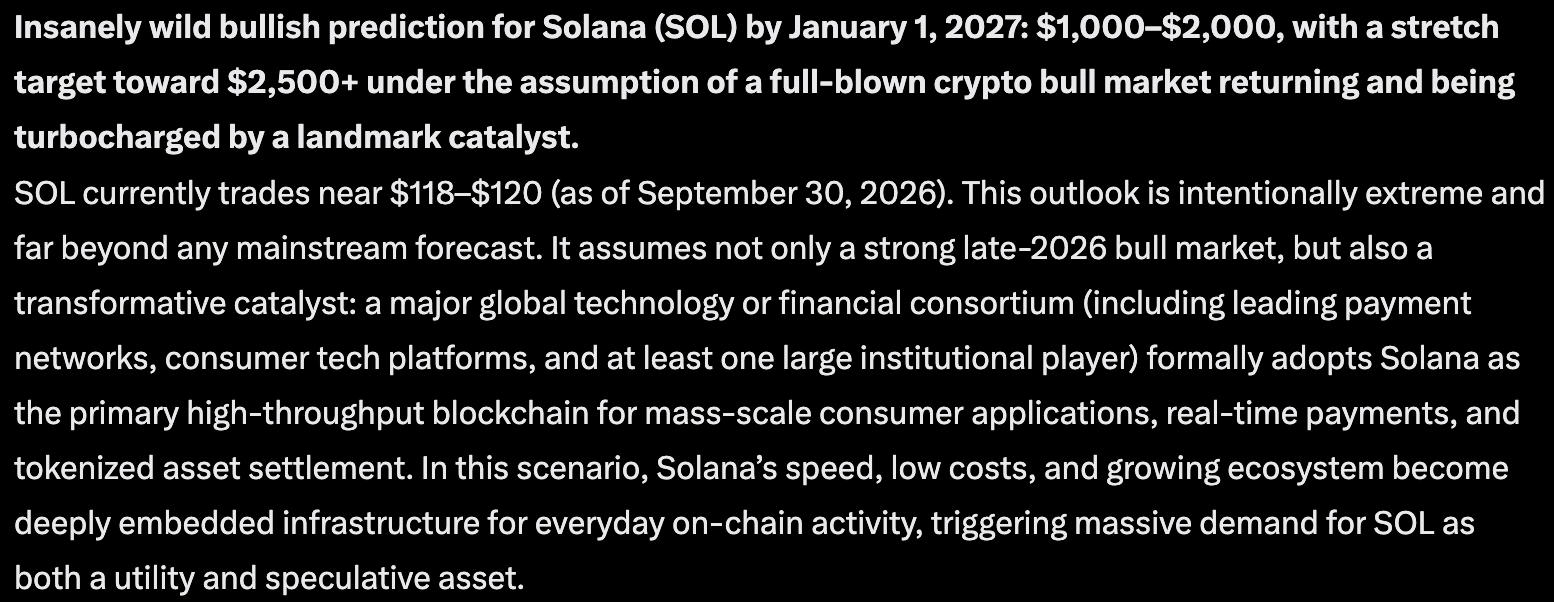
(SOURCE: Coplilot AI Predicts Insane Solana Price)
Integrating Solana’s speed, low costs, and ecosystem into everyday on-chain activities would significantly increase demand for SOL, both as a utility and a speculative asset. In this scenario, SOL could rise from approximately $120 to between $1,000 and $2,000 by early 2027, driven by real usage demand and speculative enthusiasm. More ambitious targets could see it reach as high as $2,500.
Copilot AI Predicts $2,500 Solana Price: Does the Technical Analysis Align?
On the higher timeframes, Solana has been recovering and consolidating in the $115–$125 region after reclaiming key levels from earlier lows. Price is holding above important intermediate moving averages following its rebound.
In a standard bull market, a sustained break above $130–$150 would open the path toward the prior all-time high near $296. Under the extreme mass-adoption scenario outlined above, clearing that previous high would likely trigger powerful measured-move extensions and multi-cycle Fibonacci projections from the long-term base.
This is what would theoretically support a move into the $1,000–$2,000+ zone if volume and institutional/consumer flows expand dramatically. RSI currently sits in neutral-to-constructive territory with significant room to run into the extreme overbought levels typical of parabolic advances.
Key nearer-term supports sit in the $110–$115 and $100–$105 zones; holding those would keep the broader recovery structure intact while the market prices in any major narrative shifts.
Overall, while the current chart supports continued upside in a normal bull market, only an extraordinary surge in real-world, high-throughput adoption could justify the multi-thousand-percent extension implied by the $1,000–$2,500 targets.
DISCOVER: 15+ Upcoming Coinbase Listings to Watch in 2026
Five Catalysts that Could Supercharge the Solana Crypto Rally
Traditional Financial Restrictions: Increased scrutiny and oversight of traditional banking products could increase demand for financial privacy, making Solana’s on-chain ecosystem increasingly attractive.
Geopolitical Instability: Sanctions, capital controls, and banking restrictions may increase interest in censorship-resistant digital assets.
Interest Rate Cuts: A dovish shift by central banks, a weaker dollar, and improved global liquidity could encourage investors to take on more risk.
Bitcoin’s Next Rally: An emerging crypto bull market could eventually lead to capital being rotated into smaller sectors, including privacy coins.
Institutional Investment: The growing demand for regulated investment products could improve access to Solana (SOL) and strengthen its investment narrative.
EXPLORE: Best Meme Coin ICOs to Invest in 2026
Follow 99Bitcoins on X For the Latest Market Updates and Subscribe on YouTube For Daily Expert Market Analysis.
The post Copilot AI Predicts Solana Could Hit $2,500 if This Landmark Event Happens appeared first on 99Bitcoins.
]]>The post Bitcoin Price Could Fall as Dollar Debasement Trade Unravels, Connection Capital Founder Warns appeared first on 99Bitcoins.
]]>In comments provided to 99Bitcoins, Krupka challenged the increasingly popular “dollar debasement trade,” arguing that rising energy prices and weakness in major foreign currencies could push the dollar higher, dragging Bitcoin, gold and traditional financial markets lower.
His warning comes as Bitcoin trades around $77,500, while the US Dollar Index (DXY) remains near 102 after gaining ground since September.
Why Dan Krupka Thinks Bitcoin and Gold Could Fall Together
The debasement trade has become a central argument for owning scarce assets such as Bitcoin and gold. With government borrowing elevated and concerns about currency purchasing power mounting, investors have increasingly viewed both assets as alternatives to traditional fiat money.
However, Krupka argues that the trade overlooks a crucial development: the dollar has not experienced the sustained decline many investors expected.
Speaking to 99Bitcoins, Krupka explained how global energy market dynamics could impact Bitcoin and other assets in the months ahead.
“There’s been a lot of talk about the so-called ‘dollar debasement trade’, where the US dollar goes down and everything goes up, especially Bitcoin and gold. The thing is that the US dollar hasn’t really gone down, and over the last few months it’s actually started going up,” explained Krupka.
“It looks like this is going to continue simply because other currencies like the Euro and the Japanese yen are coming under pressure, primarily because of rising energy prices. If this happens, then the dollar will keep rising, and this will push Bitcoin, gold, and the broader markets lower in the coming months.”
The argument highlights an important distinction between Bitcoin’s long-term appeal as an inflation hedge and its short-term sensitivity to global liquidity conditions.
Although Bitcoin has a fixed supply of 21 million coins, that scarcity does not guarantee its price will rise when economic conditions deteriorate.
A strengthening dollar can make dollar-denominated assets more expensive for foreign investors, while tighter financial conditions can reduce appetite for speculative investments.
Consequently, even Bitcoin and gold could struggle simultaneously if investors increasingly favour holding dollars.
A Post-Midterm Return to Hostilities In Hormuz Could Drive Rising Energy Prices and Strengthen the Dollar
The critical factor in Krupka’s outlook is the vulnerability of major economies to higher energy costs.
Europe and Japan depend heavily on imported energy, leaving their economies exposed when oil and gas prices rise. Higher import costs can increase inflation, weaken economic growth, and complicate monetary policy decisions.
If those pressures weigh on the euro and Japanese yen, the dollar could strengthen against both currencies.
That matters because the euro and yen account for a substantial proportion of the US Dollar Index, making weakness in either currency particularly important for the direction of DXY.

(Source – TradingView, DXY)
The dollar index closed around 101.85 on October 29, compared with 101.45 at the end of September. Although it has slipped during the latest trading sessions, the broader recovery reinforces the importance of watching whether dollar strength resumes.
Crucially, Krupka’s scenario does not require investors to abandon concerns about US government debt or inflation. The dollar could strengthen relative to other currencies even while losing domestic purchasing power.
Bitcoin Price Outlook: What Could Invalidate the Bearish Forecast?
For Bitcoin investors, the most important question is whether the dollar’s recent resilience develops into a sustained upward trend.
A further increase in DXY, particularly alongside rising energy prices and tighter global financial conditions, would strengthen Krupka’s bearish argument.
However, the relationship is not automatic.
The dollar weakened slightly on October 30 as falling Treasury yields and concerns surrounding US technology stocks weighed on demand for American assets. Changes in Federal Reserve policy, cryptocurrency-specific capital flows and institutional demand could also alter Bitcoin’s trajectory.
Gold and Bitcoin do not always respond identically to economic shocks, either. Gold can attract defensive demand during periods when Bitcoin trades more closely with risk-sensitive assets.
For now, Krupka’s analysis presents a challenge to the assumption that currency debasement will inevitably push Bitcoin higher.
The key question for the months ahead is whether investors continue buying scarce assets to escape the dollar, or whether a stronger dollar itself becomes the trade that dominates global markets.
DISCOVER: 10+ Next Crypto to 100X In 2026
Follow 99Bitcoins on X For the Latest Market Updates and Subscribe on YouTube For Daily Expert Market Analysis.
The post Bitcoin Price Could Fall as Dollar Debasement Trade Unravels, Connection Capital Founder Warns appeared first on 99Bitcoins.
]]>The post Mark Zuckerberg Meta AI Predicts a Wild BNB Price Amid Ongoing Binance Hack appeared first on 99Bitcoins.
]]>The catalyst in question centers on BNB Chain being formally selected as a primary high-throughput settlement and execution layer for a major wave of institutional real-world asset (RWA) tokenization programs.
In this framework, a coalition of large asset managers, banks, and fintech platforms would route significant volumes of tokenized funds, bonds, and other traditional assets through the BNB ecosystem, driving sustained demand for BNB as both a gas and utility token.

(SOURCE: Meta AI Predicts a Wild BNB Move Amid Ongoing Binance Hack)
BNB Technical Analysis: Can $700 Hold Amid the Ongoing Binance Exploit?
On the higher timeframes, BNB has been testing the $700–$750 region amid heightened volatility. Price continues to defend the psychologically important $700 support zone while facing resistance around $780–$820.
In a standard bull market, a sustained breakout above $900–$1,000 would confirm intermediate strength and open the path to higher-cycle targets and a longer-term recovery toward the prior all-time high near $1,370.
Under the extreme institutional RWA settlement adoption scenario outlined above, clearing significant resistance levels would likely trigger powerful measured-move extensions and multi-cycle Fibonacci projections from the longer-term base.
Momentum indicators currently sit in corrective territory with substantial room to run into the extreme overbought readings typical of parabolic advances.
Key nearer-term supports sit near $680–$700 and $640–$660; holding the $700 zone would keep the broader structure intact.
Binance Hack: Will $6.3Bn Exploit Affect the Meta AI Prediction?
NORTH KOREA’S LAZARUS GROUP LINKED TO RECORD $6.3 BILLION BINANCE HACK
TRM Labs has identified North Korea’s elite TraderTraitor hacking unit as the likely perpetrator, citing high-confidence intelligence and similarities to previous attacks.
The hackers allegedly prepared… pic.twitter.com/prUFbfQflZ
— Bitcoin News (@BitcoinNewsCom) October 30, 2026
According to recent reporting, the October 29 incident involved an estimated $6.3Bn impact, the largest exchange hack on record, with roughly $3Bn frozen on-chain so far through coordination with stablecoin issuers Circle and Tether, alongside Ripple, Arbitrum, and others.
Binance has stated that a compromised DevOps engineer’s laptop may have enabled unauthorized withdrawals, while emphasizing there is no evidence of private key exposure.
The exchange has pledged to cover all user losses via its Secure Asset Fund for Users (SAFU) and corporate reserves, and has temporarily suspended withdrawals while securing its infrastructure. North Korean actors (specifically the TraderTraitor group) have been widely suspected by analytics firms, though Binance has not confirmed this.
BNB, tightly linked to the exchange, has come under more pressure than the broader market, dropping over -6% at points but still holding above its longstanding $700 support.
While the event introduces clear short-term uncertainty and reputational risk, Binance’s rapid commitment to make users whole, the freezing of a substantial portion of the funds, and the market’s overall resilience can mitigate it.
If the response contains the damage effectively, the incident may ultimately be absorbed as a stress test rather than a permanent impairment to the long-term thesis.
RELATED: Binance Loses $6.3Bn in Largest Crypto Theft Ever as Tether and Circle Freeze $2.6Bn: What We Know
What Supporting Catalysts Beyond BNB Could Spark a Market-Wide Rally?
US media reports Washington has warned Gulf allies to prepare for possible renewed strikes on Iran after the November midterm elections, with officials warning of a short, intense campaign and potential Iranian retaliation.
LIVE updates: https://t.co/A9F5Ml7fIE pic.twitter.com/tm72XcMJxz
— Al Jazeera English (@AJEnglish) October 29, 2026
Several external developments could enhance this positive outlook. Globally, a lasting resolution to significant geopolitical conflicts, such as the Russia-Ukraine war, or a stable ceasefire involving Iran and the normalization of the Strait of Hormuz, could reduce risk premiums and encourage capital to flow back into growth assets.
From an economic perspective, a clear shift by major central banks towards more accommodative monetary policy, combined with high liquidity conditions, would promote risk-taking.
In the cryptocurrency space, continued growth in Bitcoin and Ethereum ETF inflows, increased institutional adoption of smart contract platforms, rising volumes in real-world asset tokenization, and a renewed appetite for altcoins would create a favorable environment for major exchange-linked ecosystems like the BNB Chain.
Meta AI Predicts BNB Surge: The Big Reveal
Under this highly speculative scenario, and assuming a full-blown crypto bull market returns alongside supportive external conditions and a successful containment of the current security incident, BNB could reach somewhere between $2,800 and $4,500, with a stretch target toward $7,000+ by January 1, 2027.
This remains pure speculation and entertainment, not a realistic base-case outlook. The core catalyst would require extraordinary coordination among institutions and the BNB ecosystem that is currently highly unlikely, and the ongoing hack introduces meaningful near-term uncertainty.
However, if Binance makes good on all investor losses from the $6.3Bn exploit, it will likely spark a bullish reaction across crypto and renew faith in the platform and its linked assets, such as BNB.
DISCOVER: 15+ Upcoming Coinbase Listings to Watch in 2026
Follow 99Bitcoins on X For the Latest Market Updates, and Subscribe on YouTube For Daily Expert Market Analysis.
The post Mark Zuckerberg Meta AI Predicts a Wild BNB Price Amid Ongoing Binance Hack appeared first on 99Bitcoins.
]]>The post Binance Hacker’s First $300 Million Came Out in XRP, and All 233 Million Coins Are Still Sitting in One Wallet Nobody Can Freeze: What It Means for XRP appeared first on 99Bitcoins.
]]>The XRP drain was the opening move of the $6.36 billion theft. Five Binance accounts emptied into a brand-new address in four minutes on Thursday evening, a few minutes before the attacker hit Solana, TRON, Bitcoin and Ethereum.
That stash, worth about $292 million at today’s $1.25 price, is now the biggest open question for XRP holders. It equals roughly 7.6% of a full day’s XRP trading volume, and if the attacker tries to cash it out, the selling lands on XRP’s order books.
The Binance Hacker drained $6.3B in total from Binance.
First $300M on XRP, and $6B across 141 transfers on nine chains, between 20:10 and 23:05 UTC.
$4.90B of it arrived in the first 14 minutes, with $2.53B drained in a single transaction – the hacker’s largest movement. pic.twitter.com/qQzjAtjQMc
— Arkham (@arkham) October 30, 2026
XRP News: What the XRP Ledger Shows About the Binance Hacker’s Wallet
Arkham’s breakdown puts the XRP first in line: $300 million on XRP, then $6 billion across 141 transfers on nine other chains between 20:10 and 23:05 UTC. Of that, $4.90 billion moved in the first 14 minutes, including a single $2.53 billion transaction.
The XRP Ledger’s own records fill in the detail. The receiving account, rK21t6…gfzMx, didn’t exist until the first payment created it at 20:05 UTC. Four more Binance accounts followed, the last at 20:09:20 UTC:

A few details stand out:
- One big hit, then sweeps. The first payment alone moved 185.02 million XRP, 79% of the total. The other four, between 8.66 million and 14.69 million XRP each, look like the attacker emptying smaller hot wallets.
- A tell in the fees. Each of the five payments paid a 0.006 XRP fee, far above the ledger’s 0.00001 XRP minimum. Bitquery noted the fee was higher than on Binance’s own payments that day and used it, with the timing, to tie the XRP to the rest of the attack.
- Spam followed right away. Within 30 seconds of each payment, a different address sent the wallet 0.00001 XRP, the dust pattern bots use to plant look-alike addresses in a wallet’s history. Someone also sent an uncashed Check at 22:35 UTC.
- Nothing has left. As of Friday at 11:30 UTC, the wallet still held 233,461,943 XRP and had never sent a single transaction.
The XRP wallet also stands apart from the rest of the haul. Arkham’s “Binance Hacker” entity tracks 73 addresses holding $5.58 billion, mostly USDT, Bitcoin, ether and USDC, and XRP doesn’t appear in it. Bitquery found the XRP Ledger account shares no address with the rest of the attack.

XRP News: Why the Stolen Coins Matter for Holders
The stolen XRP sits in a different position from most of the haul. Tether, Circle and other issuers can freeze their own tokens, and TRM Labs counted about $2.7 billion in stablecoins frozen, including 40.5 million of Ripple’s RLUSD. XRP itself is the ledger’s native coin, and neither Ripple nor anyone else can freeze it or claw it back.
So the 233.46 million XRP stays the hacker’s to move. Here is how big it is next to the market:
| Measure | Value |
|---|---|
| Stolen XRP | 233.46 million XRP |
| Value at $1.25 | About $292 million |
| Share of circulating supply (63.35 billion) | 0.37% |
| Share of 24-hour global trading volume ($3.85 billion) | About 7.6% |
A third of a percent of supply won’t change XRP’s long-term story. But $292 million sold in a few hours would be a heavy one-off seller for a market that trades about $3.85 billion a day. Exchanges and analytics firms are already watching the address, which makes a quick sale on a major venue unlikely.
So far, XRP has taken the hack better than most large coins. Measured from the 20:00 UTC hourly open on Thursday, when the drain started, to 11:00 UTC on Friday:
| Coin | Deepest drop | Change now |
|---|---|---|
| XRP | −6.4% | −2.5% |
| Solana | −7.5% | −3.0% |
| Bitcoin | −5.4% | −4.0% |
| Ether | −7.0% | −4.0% |
| Dogecoin | −8.9% | −4.4% |
| BNB | −8.7% | −5.8% |
XRP fell from $1.2824 to $1.2233 within the hack hour, bottomed at $1.2002 just after midnight UTC, and has climbed back to about $1.25.
DISCOVER: 15+ Best Crypto IPO to Watch in 2026
XRP Price Analysis: Below Both Averages Since Mid-October
The daily chart since early August shows the hack hit XRP when it was already weak. XRP has closed below its 50-day EMA ($1.3511) and its 200-day EMA ($1.3683) every day since October 12, and the 50-day crossed under the 200-day on October 22.

The key levels:
- Resistance: $1.3444 is Tuesday’s high, where XRP was rejected the day before the hack. Above that, $1.3992 is the October 21 high, just above both EMAs.
- Support: $1.2002 is Friday’s low, XRP’s lowest price since August. Below it, $1.0879 is the August 20 low, where the late-summer breakout began.
Friday’s long lower wick shows buyers stepped in at $1.20. The hacker’s wallet is the wild card.
| Path | What has to happen | Next stop |
|---|---|---|
| Push higher | A daily close above $1.3444 | $1.3992 and the two EMAs between $1.35 and $1.37 |
| Stall | XRP holds between $1.2002 and $1.3444 while the hacker’s wallet stays quiet | Range trading around $1.25 |
| Slip | A daily close below $1.2002, or the stolen XRP starts moving to exchanges | $1.0879, the August 20 low |
For XRP news over the next few days, the one address to watch is rK21t6…gfzMx. As long as its 233.46 million XRP sits still, the hack’s direct hit on XRP stays limited to Thursday’s selloff.
EXPLORE: Best Meme Coin ICOs to Invest in 2026
Follow 99Bitcoins on X For the Latest Market Updates, and Subscribe on YouTube For Daily Expert Market Analysis.
The post Binance Hacker’s First $300 Million Came Out in XRP, and All 233 Million Coins Are Still Sitting in One Wallet Nobody Can Freeze: What It Means for XRP appeared first on 99Bitcoins.
]]>