The post Impartiality: imperfect, evolving, and essential? first appeared on Polis.
]]>Impartiality in Journalism
I’ve spent more than two decades working inside newsrooms and another two studying them, and in that time I’ve come to see impartiality not as a fixed rulebook but as a disciplined aspiration. Yet the way we talk about impartiality today often misses what it really is and what it can realistically achieve.
For me, impartiality has never meant neutrality. It isn’t a scientific method that produces a perfectly objective account of events. It’s a commitment to reducing the influence of personal and institutional bias as far as possible, and to grounding journalism in evidence. Every journalist carries their own priors, shaped by upbringing, education, and professional culture. Every newsroom has its own assumptions about what matters. Impartiality is the effort to recognise those forces and to work against them, not the fantasy of eliminating them.
This is why impartiality is not just about the final product. It runs through the entire journalistic process. When I was an editor, I made constant decisions about what counted as a story, what didn’t, and what deserved prominence. I rarely stopped to interrogate why I made those choices. Yet those decisions are where bias most powerfully enters the system. The act of selecting news is itself a form of framing. If we want to take impartiality seriously, we have to acknowledge that it begins long before a script is written or a bulletin is broadcast.
Institutions matter just as much as individuals. Newsrooms develop shared habits and assumptions that shape coverage in ways journalists themselves may not fully see. Over the past decade, organisations like the BBC have become more self‑aware about these dynamics, partly because public scrutiny has intensified. But greater transparency does not necessarily translate into greater public trust. In a fragmented media environment, people increasingly judge impartiality by whether coverage aligns with their own worldview. That makes the BBC’s commitment to impartiality both more valuable and more contested than ever.
I still believe that having a strong impartial news organisation is essential to a healthy information ecosystem. I also recognise that impartiality has become a kind of brand and as such, one the BBC must defend even as it is attacked from all sides. I don’t think all journalism should be impartial. Partisan journalism has a legitimate place, provided it is transparent about its standpoint. But the existence of at least one major institution committed to evidence‑based reporting, broad representation, and editorial restraint remains vital.
This is why the regulatory debate matters. The framework Ofcom uses was designed for a very different media landscape. New entrants like GB News operate in ways that stretch the spirit of due impartiality, even if they stay within the technical boundaries. Ofcom now faces a choice: either enforce the principle robustly or accept that the concept no longer fits the contemporary environment. What makes little sense is treating broadcasters who openly promote a single political perspective as if they are fulfilling the same public service obligations as those striving for balanced coverage.
Yet despite all this, I don’t think the biggest challenge facing journalism today is impartiality or even trust. These issues are real, but they are often exaggerated, amplified by social media dynamics and by political actors who benefit from portraying the BBC or other outlets as biased. The deeper trend is that high‑quality journalism is losing attention and revenue. People are turning to influencers, personalised feeds, and algorithmic platforms not because they reject impartiality, but because they find traditional news formats unengaging or emotionally distant.
This shift also shapes the debate about misinformation. I take misinformation seriously, but I see much of the public panic around it as misplaced. Research shows that most people are less vulnerable to falsehoods than we assume, and that misinformation has had far less impact on major political events than the popular narrative suggests. The real danger comes from powerful individuals: politicians, billionaires, and media owners who use their platforms and resources to support the spread of misleading narratives. Regulating ordinary users or tweaking algorithms will achieve little if those with the loudest megaphones continue to distort public discourse.
We cannot return to the media environment of the past. The era of passive audiences and limited choice is gone. Impartiality still matters, but it cannot restore a world that no longer exists. Instead, journalism must adapt. Journalists need to be more transparent about how they work, more attentive to the diversity of audiences, and more willing to experiment with formats that resonate emotionally as well as intellectually.
Impartiality, as I see it, is not a relic. It is a discipline: imperfect, evolving, and essential. But it is only one part of a much larger challenge: ensuring that good journalism remains visible, valued, and viable in a world where attention is the scarcest resource.
Charlie Beckett
The post Impartiality: imperfect, evolving, and essential? first appeared on Polis.
]]>The post It’s been 40 years. Thanks… first appeared on Polis.
]]>Thanks to all the wonderful (and terrible or incompetent) people I worked with as a journalist from local newspapers in south London (all publications now deceased) to a regional documentary strand at LWT (also now defunct) and thence to the BBC (still standing). Finally, to Channel 4 News (definitely still out there!), a programme that you can happily spend a lifetime with, but one that I left after eight years as part of a mid-lift reorientation. Or rather a leap into the unknown. All those people and experiences gave me the grounding for my next phase as a researcher, teacher and convener of debate around journalism at the LSE.
Thanks to the late Prof Roger Silverstone for hiring me against my better judgement. Don’t worry he said, I know there’s no budget, but you’ll think of something… Also thanks to the great LSE sociologist Tony Giddens whose idea it was that the LSE should have some kind of think-tank about journalism at a time when ‘the media’ was becoming more central to politics in particular, and society in general. Thanks especially to Prof Robin Mansell who as head of the department of Media and Communications manipulated the LSE into making me a “Professor of Practice” and entrenching Polis into the fabric of the LSE.
Since then thanks to the thousands of journalists, researchers, students, academics, politicians, technologists and citizens who have made this such an exciting two decades of observing and, to a degree, participating in the roller coaster ride of media change that we’ve undergone around the world. When I started as a junior reporter in Croydon back in 1986 I never imagined that I would end up working with the biggest technology companies and the smallest digital independent newsrooms from Argentina to Australia. I am perhaps most proud of the JournalismAI project. It’s been the most mind-bending project I’ve worked on. And perhaps, the most useful. But only because of the incredible participants and, above all, my wonderful team.
So thanks to everyone that has made this such a rewarding journey. Apologies to all those who’ve suffered from the mistakes I’ve made. And here’s looking forward to more adventures.
The post It’s been 40 years. Thanks… first appeared on Polis.
]]>The post Journalism and AI in an age of doubt first appeared on Polis.
]]>The age of doubt is a wonderful opportunity for journalism because I can tell you that if you lived in an age of certainty, you would be very bored and you would be probably living in a totalitarian regime. People in the Global South are quite used to this idea of being battered all the time because you’re a journalist and being under-resourced as a journalist. There’s a lot that the rest of the world can learn from those experiences. There is a kind of paradox of power at the moment for journalism which is that the ability to do individual acts of journalism has never been more extraordinary. I know that because I used to work as a journalist for 20 years back in the analogue era. We were so constrained, so limited by the technology then. As a sector, we have lost our institutional might. And I actually think that’s quite a good thing in some ways.

We have got to think of much more networked, much more collaborative ways of working. We mustn’t assume that we know better. We mustn’t assume that we can speak for the people when the people can speak for themselves. We have to think quite differently about our roles as say. coordinators or curators but also as experts, as people who are passionate about finding out things, who are passionate about trying to understand why there are conflicts, for example. But I don’t think journalism’s job is to somehow cure the ills of the world, to solve polarization, even to stop conflict as such. I think we got to be brutally realistic about the limits of journalism. We do have skills and we are adopting better ways of working, but we certainly can’t do it alone.
I want to turn quickly to AI because that’s what I’ve been working on the last decade. We work with thousands of journalists around the world, especially in the Global South. And when you work with those people, it’s inspirational. It’s impressive because they are finding ways, often in very niche ways, often at hyperlocal levels or specialist or mission driven around a particular topic or a particular community. They are finding ways to do their journalism it in very innovative ways and they’re doing it in very audience centred ways. So what is AI to them? Is it an existential threat? Well, it will take away attention. It will provide competition. It will be used by horrible people to do a load of stupid and bad journalism as well. But please go to our LSE JournalismAI Innovation Challenge website. Look at the extraordinary things that the people we support are doing. We’re hoping that other people will follow in their pathways.
It’s not just about the tech. Those pioneering news organisations use the AI tech to supplement their work. In a world where AI for example becomes more important then of course the bit that’s going to make you stand out is your human values, your human skills, your human connectivity to the other humans in the real world. My question is do we as journalists have the skills and the ability to do that, to make that leap?
This article by Professor Charlie Beckett is his view, not that of the LSE or the JournalismAI project. You can see a recording of that session here: https://www.youtube.com/watch?v=wZKHLvUSlEs. Check out the Innovation Challenge here: https://www.journalismai.info/programmes/innovation
The post Journalism and AI in an age of doubt first appeared on Polis.
]]>The post 2024 Elections: Do New Disinformation Frontiers Threaten Global Democracy? first appeared on Polis.
]]>Global Democracy: At a Crossroads
The backdrop to these elections is troubling. International IDEA’s 2023 report showed that half of the countries examined experienced declines in at least one indicator of democratic performance, marking the sixth consecutive year of this trend. With over 60 elections taking place over the course of this year, the stakes for global democracy have never been higher.
Disinformation Evolves: Beyond Candidate Attacks
During my time leading Global Policy Communications at Twitter from 2015-2021, I worked closely on emerging issues of election integrity, disinformation, and the changing nature of our information ecosystem. Our research uncovered a significant shift in disinformation tactics. Rather than merely targeting individual candidates, bad actors are now undermining the foundations of democracy itself — they sense blood in the water. In Taiwan, narratives portraying democracy as “messy, ineffective, and chaotic” gained traction, eroding public trust in democratic institutions. In Mexico, we observed how disinformation fueled a climate of fear, distrust, and real-world harm — over 130 incidents of violence against political candidates were recorded.
The scale of this threat is substantial. In Taiwan, approximately one-third of observed disinformation campaigns had links to foreign actors, primarily China. The European Union saw a 40% increase in false narratives about election integrity compared to the previous election cycle. Climate change and the war in Ukraine were exploited and weaponized to expand the Overton Window in harmful ways. The culprits? In many cases, the political parties themselves are central to the spread — often emboldened by an exhausted public — particularly those on the furthest right and left edges of the political spectrum.

AI Development: A Subtle Yet Powerful Influence
Contrary to some predictions, AI’s role in election manipulation has been more nuanced and muted than expected. That said, its use is growing. In Indonesia, Prabowo Subianto and Gibran Rakabuming Raka successfully deployed the AI-generated “gemoy” rebrand to boost their votes with Indonesian youth. The tactic essentially obscured the candidate’s hard military background and diverted young voters from his alleged human rights violation track records by portraying him as a cute and cuddly avatar. Prabowo’s character, in reality, is neither cute nor cuddly, and as a result this represents the start of a new form of information distortion. While we did not observe widespread AI abuse, it’s important to remember the speed and growth of this technology is without modern precedent. As a result, the tools used in 2025 will be exponentially more sophisticated than those deployed in an election context this year.
Geopolitics: Impacting Vectors of Disinformation
Our analysis revealed a clear geopolitical divide in foreign interference. While Taiwan and the EU faced external disinformation campaigns, countries like Indonesia and South Africa experienced minimal foreign meddling. This pattern underscores the need for context-specific approaches to election security. It also begs the question of whether or not there are tactics that we’re just not quite aware of yet. The 2024 United States election — already seeing hacking operations from Iran and widespread disinformation campaigns from its own voter base — will prove to be hugely consequential litmus test.
Platform Policies: Gaps in the Defense
Despite efforts by major social media platforms, significant vulnerabilities persist. In the EU, content moderation remains overwhelmingly English-centric, leaving millions of non-English speaking voters exposed to unchecked disinformation. Even more concerning, 87% of Meta’s counter-misinformation funds are allocated to English language cases, despite English speakers accounting for just 9% of global Facebook users. This dynamic has been exacerbated by the fact that many services have made content moderation a culture war issue, particularly X.
Civil Society: Crucial Yet Underfunded
Across the five elections we analysed, civil society organisations emerged as vital defenders against disinformation. In Taiwan, fact-checking teams worked tirelessly to debunk falsehoods in real-time. The EU, particularly in the context of the recently implemented Digital Services Act (DSA), has seen strides forward, too, although with some legitimate concerns around freedom of expression and appropriate redlines. However, these organisations often operate with limited resources. For example, in South Africa, researchers struggled to access crucial platform data, hampering their ability to track hate speech and disinformation effectively.
Independent Media: A Vital Check on Disinformation
As Nobel Peace Prize winner Maria Ressa recently noted, “In a quicksand world constantly erupting in violence, independent journalism is a lifeline. It is the bedrock of democracy and equitable development.” OECD data tells us that the global print advertising market has plummeted by nearly 40% between 2019 and 2024, which has devastated news outlets. Meanwhile only 0.19% — just $500m — of total Official Development Assistance was allocated to supporting media and information in 2022.
Shrinking revenue sources are exacerbated by the sharp decline in the number of democracies around the world, and the steady rise of illiberalism over the past decade. In 2023 alone, 42 countries experienced democratic backsliding or a rise in autocratic systems of government, affecting 2.8 billion people — 35% of the global population. Our research supports this specific challenge. A trustworthy and dying media ecosystem permits disinformation to spread like a virus, far beyond our collective abilities to inoculate it. Democracy and independent media exist in symbiosis: as one fractures, so too does the other.
The Taiwan Model: A Beacon of Hope
Taiwan’s response to disinformation offers valuable lessons. Their “whole-of-society” approach, involving collaboration between government, tech companies, civil society, and the public, proved remarkably effective. When disinformation campaigns struck, the response was swift and coordinated: fact-checkers debunked rumours, the electoral commission countered false claims, and even influencers helped spread accurate information. It was both sophisticated in its scale and microscopic in its execution. More time must be spent learning from others in this regard.

Urgent Call to Action
Based on our findings, we propose the following actions:
- Governments must implement clear regulations on AI use in political campaigning, particularly regarding advertising, with appropriate oversight and enforcement mechanisms.
- Social media platforms should significantly increase investment in linguistically diverse content moderation in the context of election disinformation, aiming for more balanced enforcement across languages.
- Governments must establish a robust funding mechanism for civil society organisations combating disinformation, recognizing their crucial role in defending democratic integrity.
- Independent media, particularly those entities that historically have high integrity and high standards, must be appropriately bolstered to prevent market failure.
The fight against election disinformation is not just a technical challenge — it’s a critical battle for the future of democracy. Our research indicates that the current approach is insufficient to meet the evolving threat. As we look towards future elections, we must act decisively to strengthen our democratic processes against the tide of disinformation.
Yet, as we point fingers at bad actors and flawed systems, we must confront an uncomfortable truth: we, as a society, are complicit in this crisis of disinformation. Our collective tolerance for lies in public discourse has corroded the very foundations of our democracies. We consume media properties that twist facts, reward certain Internet platforms that prioritise division over truth, and elect leaders who shamelessly manipulate reality to suit their agendas. By cheaply giving away that most precious and innate of our faculties — our attention — we’ve become architects of our own democratic decline.
This tacit acceptance of dishonesty has profound implications — for elections, our climate, our communities, and how we govern. It’s given rise to a political landscape where truth is optional, where campaigns are built on online takedowns rather than policies, and where our strongman and strongwoman leaders increasingly resemble reality stars, rather than public servants.
The harsh reality is this: until we, the citizens, demand and uphold a higher standard of truth in our public sphere, no amount of fact-checking or platform regulation will save us. The future of democracy doesn’t just hinge on combating external threats — it depends on our willingness to look in the mirror and change our own behaviour. And to demand better from those who serve us what we read and consume, and the platforms we use every day. The question is, are we brave enough to face this reflection and do the hard work of rebuilding a culture of truth?

Ian Plunkett graduated with an MSc in Political Science & Communications from LSE in 2014. He’s the CMO of Alder Renewables & a Senior Advisor at Blue Owl Group, which he helped to co-found with colleagues from his time leading Global Policy Communications at Twitter.
[This article represents the view of the author and does not necessarily reflect the stance of Polis or the LSE}
The post 2024 Elections: Do New Disinformation Frontiers Threaten Global Democracy? first appeared on Polis.
]]>The post Journalism and AI: balancing innovation and integrity first appeared on Polis.
]]>We live in a world of high risk and rapid changes, so it’s vital to be well-informed. Will Artificial Intelligence (AI) help or hinder you in your life? Especially in your search for reliable information and explanations that analyse such information and situations that you may encounter? Would it bother you if you found out that what you are reading now had been written by AI or with the help of AI?
My work involves exploring in cooperation with news organisations around the world how to use this rapidly-growing technology called AI responsibly to support the information that we convey through our journalism. The short answer is that this technology is very powerful, but it is humans — you and I — who will decide if it is a force for good or bad.
As a news consumer, you enjoy extensive coverage of AI in all aspects of your lives from its use in financial markets to health services, security and even entertainment such as streaming TV or music. But how is it changing the quality of all this information and how you receive it? And how is it changing journalism itself?

Innovative modern news organisations have been making full use of new communications technologies. Most of them moved online and shared their content on social media relatively early. Some use AI to automate simple data stories, personalise content, and to help moderate reader comments. Many are now also using Generative AI tools (like ChatGPT) for translation, transcription and for tweaking content to make it more appealing. Most of the time, most people won’t notice it, but should readers who consume this news worry about how this formidable and rapidly evolving technology is taking up residence in newsrooms and in what people read?
Over the last six years at the London School of Economics and Political Science (LSE), we have researched globally into the opportunities and risks of AI for journalism. In our JournalismAI project, we have created education and training resources as well as innovation programmes. With more than 12,000 people in our network, we work with newsrooms from Argentina to Australia — in English, Arabic, Spanish, and Portuguese.
We have seen how AI technologies can supplement many kinds of work, including that of journalists, usually doing relatively simple tasks but at great speed and scale. In journalism, for instance, AI can impact on every aspect from news gathering to content creation and distribution and revenue-raising. But the risks that come with it — such as tech dependency, and flaws in the algorithms or data bases used — have also become evident.
As has become evident in many fields around the world, the explosion of Generative AI since 2022 might accelerate some of those trends and create new paradigms for news media everywhere. Generative AI is a step up on previous types of AI machine learning, automation and data-driven software. It can create content from a simple prompt and to learn how to do it better. So, it appears to be “intelligent”. Used responsibly it is going to have a huge impact.
Leading the GenAI charge in the region’s media industry, for instance, are some of Asia’s biggest news organisations. You might have seen stories about GenAI-created newsreaders such as ‘Joon’ and ‘Monica’ who present on Malaysian news channel Astro Awani. Those automated newscasters are the most visible sign of GenAI in newsrooms but many other uses are being adopted all the time. In India, for example, the Hindustan Times has created a team that will focus on creating a GenAI-driven newsbot, as well as behind-the-scenes tools to increase personalisation and boost their recruitment of subscribers.
The huge Japanese publisher Nikkei which produces vast amounts of content every day for its subscribers is using GenAI to create a product called Minutes. This condenses some stories into easily digested nuggets of news for readers in a hurry, opening up a whole new audience and bringing in fresh revenue.
But what about the impact on customers? It might sound like good news for hard-pressed media organisations but what about you? Are you worried about these technologies? Would you trust journalism that has been created using AI? Do you worry about being targeted by the algorithms? How can you avoid disinformation and a flood of poor quality articles generated by AI bots? How will you even be able to tell if something is created by humans or AI? Trust in journalism is already fragile and surveys have shown that the public is even more sceptical about newsrooms using AI.
But is it the fault of AI or the businesses and people applying it?
In fact, most of the mistakes with GenAI, including in journalism, have been made by humans who use AI tools in dumb ways or for malicious reasons. They use it to create poor quality ‘slime’ in ‘content farms’. They care only about clicks that earn them revenue.
Then there are journalists who use GenAI in stupid and deceitful ways such as the German sports magazine which used AI to make up a fictitious interview with the F1 legend Michael Schumacher. Others want to spread false information or content that creates confusion and fear. There have always been people and governments who create bad journalism and disinformation. GenAI allows them to do that more easily and to make it harder to detect.
There are inherent risks in using Generative AI in many fields and this applies wherever it is used, including in media. It is a language machine, not a truth machine. It does not ‘know’ anything. It can be inaccurate, and it can make things up. So for everyone, including journalists and anyone consuming news, GenAI must be treated with caution.
So, for news organisations, it is important that they draw up and follow guidelines on how their staff are going to use AI tools in a responsible way. Those guidelines might also help to reassure readers. It is also important that publishers are transparent with their audiences. Tell readers if you use AI extensively. Most people will be pleased that the journalists they respect are being super-powered by AI tools. But those journalists should explain what they are doing and what measures they take to make sure their work remains trustworthy and reliable.
Ultimately this is about human choices, as it always has been with journalism. You will trust journalism if it delivers authentic reporting over time. You will trust it because the humans make the important judgements, not machines. New technologies like the Internet, social media and smartphones have delivered amazing products and services and AI can help do more. So please continue to be cautious about AI-driven journalism. In fact, it’s sensible to be careful about any information online. But for the news industry and news consumers this technology represents a potential game-changer. It is important that the best news organisations use it to continue their good work at a time when we need strong, independent and effective journalism more than ever.
Oh, and yes, I did use ChatGPT in the research and writing of this article. It saved me time and threw up a couple of fresh ideas for me. You should try it yourself.
Charlie Beckett is a professor in the Department of Media and Communications. He is the founding director of Polis, the London School of Economics’ international journalism think-tank. Professor Beckett is currently leading the Polis Journalism and AI project. He was recently in Singapore to speak at the 15th anniversary reunion of the Asia Journalism Fellowship, a programme funded by Temasek Foundation and hosted by the Institute of Policy Studies, National University of Singapore.
The post Journalism and AI: balancing innovation and integrity first appeared on Polis.
]]>The post What have we learnt about generative AI and journalism first appeared on Polis.
]]>This article will take you through a strategy of approaching generative AI. It will seek to avoid both the dystopian hype about robots taking over and the marketing froth. My professional opinion is pretty simple. Yes, this is a significant ‘step-change’ in the technology, but it’s not a miracle. Yes, it opens up incredible creative potential and an opportunity for efficiency gains. But it is also unreliable and rapidly evolving. It contains profound flaws and risks to the user, to publishers and to society in general. So approach with caution, but also with informed enthusiasm.

The Difference
So what is the difference between ‘generative AI’ and that bundle of technologies we called Artificial Intelligence before? This is not a technical article, but in brief, old AI was either supervised learning where an algorithm learns from labelled data – it is trained by the programmers. It then makes predictions about new data that it is given. So you search for an image of a cat. It gives you an image of a cat because it’s been taught to do that. It is a language prediction machine, not a truth machine. It doesn’t ‘know’ anything.
GPT stands for “Generative pre-trained transformer”. Generative AI is focused on generating new data. It uses statistical models to learn the underlying patterns of a given dataset and then it generates new data points. It does this by using vast ‘Large Language Models’ that enable it to respond coherently to the questions, or ‘prompts’ that you give it. It seeks to predict the answer you want. It does not ‘know’ or ‘understand’ the answers it gives. It is not sentient. But it is brilliant at giving the appearance that it does.
Programmes such as ChatGPT or image generators such as Midjourney are successful partly because they have a brilliant UX. You simply give it a prompt and something happens. If you have tried it, you can’t fail to be impressed, excited, perhaps even a little spooked by its ability to create responses to everything from requests for jokes or poems to answers to the meaning of life.
As you will have seen or read, it is possible to reach its limits pretty quickly. A programme like ChatGPT or Google’s Gemini is designed to tell you what it can’t do. It will seek to remind you that it is only a piece of software, not a human being. If you ask it a simple question it will give you a pretty sensible, orthodox answer. If you engage in a sustained dialogue with complex ideas it will struggle. It might be AI but it is not truly ‘intelligent’. It is prone to ‘hallucinations’. These are not deliberate ‘lies’ because generative AI has no concept of the ‘truth’. It is only trying to predict what the answer should be. And so it might make up false facts or fake sources because it predicts they should exist. More on those flaws later.
Extraordinary Potential
The potential for publishers is quite extraordinary. Here is an article with some great use cases. We have already seen how publishers can use previous AI technologies in creative ways. The Washington Post’s Heliograf automatically writes articles on simple stories such as sports scores or election results. Reuters’ News Tracer allows it to spot, track and help verify news stories breaking on social media. The New York Times’ Project Feels automatically generates personalised summaries of stories that seek to understand the emotional tone of an article.
Generative AI offers the opportunity to expand that exponentially. But at the moment, I would never use current generative AI tools to publish directly without human oversight. It is just too risky. Instead, it is best to think about generative AI as a set of tools that might supplement your workflow and augment your newsgathering, content creation and distribution. Some of the gains will be invisible to consumers. Coders say that generative AI is giving them massive gains in programming efficiency. Video and audio editors say that it is giving them clever shortcuts.
Journalists tell me that ChatGPT and its equivalents are very useful for helping them create. You can use it to brainstorm ideas, to try out different styles or formats. You can give it a relatively large text – perhaps an academic article – and ask it to summarise it in plain English or bullet points. But for anything at all complex you have to check the outcome. You can’t rely on it. Perhaps it is not so different to using content from social media, websites or even copy from news agencies or other media. It is not infallible.
The same applies to image generation. Generative AI pictures are completely ‘made up’. They do not use existing imagery directly. They are predicting what your prompt has suggested. This might make them useful for graphics, marketing, or article illustrations. They might well be more interesting than stock photos. But the whole point of news imagery that reports on what is really happening in the world is that it must be authentic. In that sense, this is a pretty straightforward distinction that publishers have been making for a long time.
So, enormous potential benefits, but also serious risks. I see three kinds. Firstly, the universal dangers of generative AI. The data sets can be biased or incomplete. The algorithm can ‘hallucinate’ giving false answers or sources. Then secondly there are the general risks to publishing and the news media. Who is responsible if it makes a mistake? Is it invading privacy or appropriating other people’s content? (including publishers’) Is it potentially an unfair competitor that will also supercharge the spread of misinformation and propaganda? And then thirdly, the specific dangers for journalists or publishers. I’ve already raised a few of those in this article. And generally, those can be dealt with by observing the usual best journalist practice. Edit. Check everything, have multiple sources, and then review the results.
So what should be your strategy to benefit from generative AI? My advice is not so different to approaching more basic forms of AI.
Everyone In Your Organisation Needs Some Generative AI knowledge
Make sure everyone in your organisation has some basic knowledge about Generative AI. There are loads of introductory articles and courses. Your people need to know about AI and generative AI, because they will definitely be using it, in the future they will use it more, and the world they report on will be using it too.
Assign Responsibility for Generative AI
Identify people in your organisation who can take responsibility for getting across this technology and it’s fast-moving development. You need to understand how it might relate to your workflows, mission and business model. How should you change your hiring policy and skills-sets? It is vital that they work across the organisation, gathering insights and views from ALL staff. Address concerns and spread best practice.
Explore
Explore existing use cases. This about what problems it might solve or ameliorate. What processes might it enhance? What things need to be kept ‘human’? Play around the tools to build your confidence and AI literacy. Create a culture of confidence, not fear, around generative AI.
Iterate and Review
Start small. Try and then try again. Do it but then review. Is it saving time? Is it accurate? Does it enhance the quality of the content and the user experience? Could you develop new products or systems?
Guidelines
Mitigate ethical and editorial risks. Think through the potential dangers to your reputation. Put in place guidelines – there are good examples out there already that are sensible and helpful. But think it through for yourselves and involve all staff in that process. Every publisher is different. Guidelines can give confidence to your staff but also send a positive message to advertisers/funders and the audience.
This is yet another challenge isn’t it? You are already busting a gut just to keep afloat and thriving. And here we go again. First you went online all those years ago. Then you had to deal with social media about a decade ago. Perhaps you are now truly ‘digital first’. Then along came artificial intelligence and perhaps you used it to improve your subscription processes or to personalise newsletters? Now once again, there’s a new technological kid in town demanding attention and threatening to disrupt everything.
A top digital news executive said to me recently, we have to ask if we have the desire, time and skills to handle generative AI. Well, if you got this far through all the years of change, then perhaps you have. The cliché is that we exaggerate the short-term effect of these technology leaps, and underestimate their long-term impact. That might well be true in this case. You do have time to see how this plays out. It is going to evolve quickly, though regulators might well step in to constrain its development. Some news organisations will do deals with the LLMs. Others may find their fundamental business model is under threat. But regardless of what happens, it is vital to pay attention to generative AI and to start the process right now of thinking through how it might change your working life and your business.
Charlie Beckett is a professor in the Department of Media and Communications at the LSE. He is director of the LSE journalism think-tank Polis and leads the Polis/LSE Journalism and AI project
JournalismAI at LSE is an open, global project with an array of free training courses, case studies, articles, research reports and tools to help you explore AI and publishing. We have a network of 10,000 people around the world facing the same challenges as you. Please join us!
A version of this article first appeared in inpublishing magazine
The post What have we learnt about generative AI and journalism first appeared on Polis.
]]>The post Trust: how to build public confidence in your journalism first appeared on Polis.
]]>Pretty much everywhere around the world indicators of trust in authority: politicians, business, journalism – appear to be heading down. I don’t think you should pay too much attention to those headline figures. But that does not mean we should not strive to build and maintain more confidence. If we want to improve public participation, then improving confidence in journalism is key.
I was a journalist for 25 years before joining the LSE in 2006. So I am old enough to know that people have always been cynical about journalists. ‘Don’t believe what you read in the papers’ was the axiom of that age. Now, of course, many people don’t read physical newspapers at all!
The last 20-30 years has seen stupendous technological change with the internet, mobile telephony, digital tools, social media and now Artificial Intelligence. The information landscape has changed radically. Much of it is for the best: we can all now have a voice and the creative and accountability potential of information technology is astounding. We have more, better journalism than ever before. But of course, it has also brought sensational and false disinformation, offensive and hate speech, polarising propaganda and cheap clickbait. It’s not surprising that people are confused – they are drowning in an ocean of good and bad information. Around the world – including Malaysia – news organisations are struggling for their lives.

As this chart shows levels of trust measured by the Reuters Institute survey of online news in the UK shows a decline in declared trust.

Although it’s interesting that it goes up when people talk about the news they actually consume.
 But the problem is that the current measures can be used as a weapon against journalism. As Nobel Prize winning Philippine editor Maria Ressa has said, authoritarian politicians or corporations can cite those surveys to denigrate journalism. Those same surveys show that the country with the highest level of trust in its media is China and I am not sure that is a political model that I would advocate.

I think those surveys are asking the wrong question. As a journalist (or professor) I never asked to be trusted automatically. I never trusted anyone else without good reason, so why should I ask the same of the public? I prefer the age of scepticism to the age of deference. At places like the LSE we tell people to think critically, so why are we surprised when they do?
So perhaps we don’t need that kind of trust? Certainly, healthy societies need information pluralism and civil discourse. We need information to live our daily lives and to build productive and sustainable communities. Journalism can be part of that process. It gives us facts, it gives us analysis and it can help us have conversations about what we want in life as citizens and a country. It can help us understand the world and connect to each other. All that makes for happier, thriving societies.
Don’t Wait To Be Trusted
Mainstream media needs to stop waiting for the trust to return. There was no Golden Age of trust. In fact, I would suggest that every time you are tempted to use the word ‘trust’ you try to use a different word to describe what you really mean. Do you want people’s trust or do you want their confidence, attention, respect or money?
Journalism spends a lot of time worrying about technology – the Internet has meant that legacy mainstream media faces more competition for attention and its old convenient source of funding, advertising, has drifted away to more effective platforms. People can get their information and debate without going to a news organisation.
To adapt to this journalism has to change. And a lot of this has little to do with technology and more to do with culture and editorial policy. Mainstream media is still too out of touch. It lacks connection to its audience. The people who work in newsrooms don’t reflect their audiences. It lacks a sense of mission and public purpose. It is still too focused on its own agenda and its own profit rather than what serves its audience best.
Paradox of Power
Journalism is caught up in a paradox of power. As we’ve seen, journalism collectively is weaker than before: politically, commercially, and culturally. And yet journalists individually or as a teamhave more technological power than ever before. Thanks to digital technologies and the internet we can reach more people. We have dozens of networks and channels to connect to people in new and more powerful ways. A newspaper like the Guardian that used to have hundreds of thousands of readers in the UK now has tens of millions of online readers around the world. We have amazing tools such as mobile phones, digital editing, and online search. We have more formats, from podcasts to Instagram videos to report with.
So what’s the recipe for surviving this paradox?
Any solution to digital disruption has to put AI at its centre, but let’s leave that for another article. Let’s look at other steps. If you want to counter digital disruption here is the double challenge. You have to use the same technologies that are disrupting you. But you also have to find non-technological solutions.
Every news organisation is different. If I had an easy universal answer I would not be standing here. I would be a massively rich consultant. But here is my strategy:
1.
Firstly, journalists are too undiverse: we don’t reflect the communities we serve. In every sense: class, race, and background. But especially in our interests: we are too isolated with our own agendas rather than responding to what people need to know or care about. We are still too attached to elites and unconcerned about how the public uses journalism. In the UK we have newsrooms full of people obsessed by Westminster politics and not interested enough in health, families, culture, arts, sports, business, work, careers, environment, and all the things that make up people’s real lives. So hire differently and think differently.
- 2.
- Secondly, the news industry is terrible at professional development and nurturing its workers. News management is still at a Victorian factory level. It has not learnt the lessons of influencers, creative industries, and the service sector. New technologies offer amazing potential for creativity and new ways to find stories, create content and connect to people but journalism is always behind the curve. We need to think of newsrooms as laboratories not factories. We need to think of the people who make the news as a resource for investment.
- 3.
- Thirdly, on disinformation. There is a lot of bad information out there. New technologies make it easier to create and spread it. But it is humans who choose to create it and it is humans, very often, who are happy to consume it and share it, even when they know it’s not true. So it is vital that journalists offer an alternative. Firstly, use the same technologies to filter and fact-check and to help people find reliable news. Challenge the source of disinfo which is often overt disinformation from politicians, powerful people as well as citizens and, of course, other journalists.
- 4.
- Fourthly, there will always be an appetite for reliable information and informed analysis. We saw that during the pandemic. There was a lot of fake news about vaccines but traffic to reliable news organisations also went up. It’s not the job of journalism to clean up the Internet but at least we can stop amplifying it. We need to be more transparent, rigorous and better informed. We need more data journalism and explainers. That means more real expertise in newsrooms.
- 5.
- Fifthly, we need to focus much harder on audiences. We need new ways to bring young people into contact with our journalism. We need to work harder to provide optimised and diverse information services to our subscribers or users. Look at how the New York Times now gets more income from games and recipes than news – nothing wrong with that – news has always been subsidised – don’t kid yourself that more than 10% of people will pay for news. So engage more with your audiences and diversify your revenue sources.
- 6.
- Consider the UX – the user experience. This sounds technical but it’s essential. People are always just a click or a swipe away from ignoring your journalism. And if people don’t access your journalism, if it doesn’t fit their lives, then it won’t be able to compete in a networked world. Offer them the right format for their lifestyle. Offer them added value: your content has to stand out. Give them hard news but also more constructive news or content that can be useful or give serendipity and joy. Help people to have a healthy news diet
We are at the start of another wave of technological change with AI. It’s a good moment to spend some precious time facing up to what might be an existential threat. Legacy media has actually been much more resilient than we thought. Fewer news organisations have disappeared than we feared. I am glad that traditional journalism values can endure: independence, critical thinking, compassion, anger, curiosity, the ability to communicate what is happening in our complex and risky world. But go back to basics and ask yourself some hard questions. Why are YOU doing journalism? What is YOUR news organisation for? Why should anyone want your journalism?
And finally, it’s about society fostering good journalism. The news industry is relatively small. It needs to collaborate much more: with each other, but also with universities, start-ups, tech companies and communities. The state can help, too. That means removing restrictive legislation, relaxing regulation, ending threats to journalists who are critical of those in power and supporting innovation and training. It means investing in media literacy and the promotion of transparency in government, law, finance and business. Politicians and other leaders in society are not likely to love journalism because when it works, it holds them to account, but ultimately we all benefit.
So to end. Every day I speak to journalists around the world. I know that they work incredibly hard for scant reward in a precarious profession. They are subjected to endless criticism, abuse and, in many parts of the world, personal, physical danger and the threat of imprisonment. So it is not surprising they crave some kind of affirmation. Those surveys of public Trust suggest that it is possible to build public confidence. Certainly, news organisations need public support, revenue and engagement. But they also need to be independent, professional and prepared to tell unpleasant truths. Our world needs better journalism more than ever as we face the challenges of climate change and geopolitical threats and I hope I can do my bit to help it go forwards.
This article by Charlie Beckett
The post Trust: how to build public confidence in your journalism first appeared on Polis.
]]>The post The obsession with ‘trust’ must end first appeared on Polis.
]]>[This was first published as one of the Nieman Lab predictions for 2024]
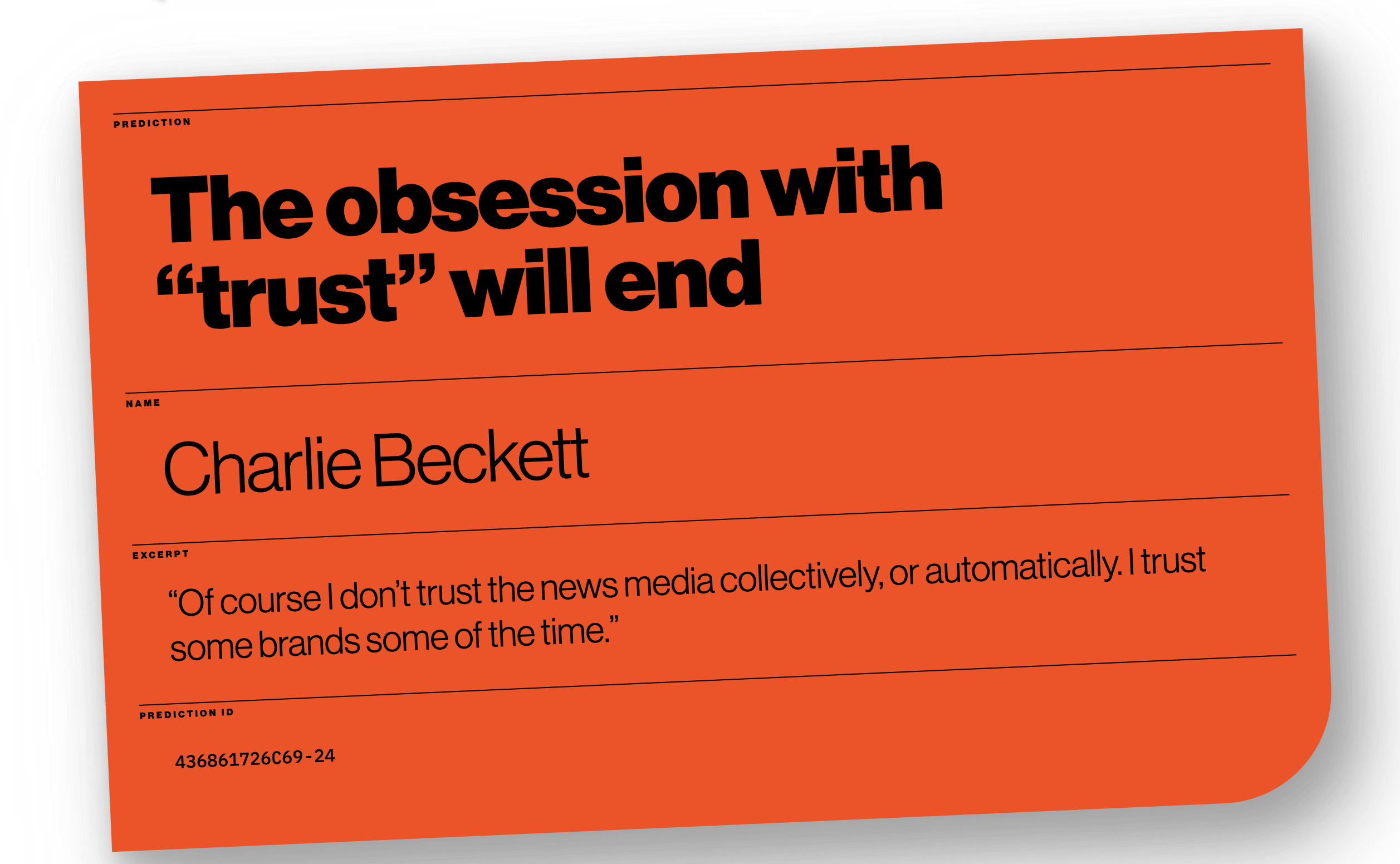
I don’t have a particular problem with the actual methodology of surveys such as Edelmen or RISJ. Although any poll that usually shows that the most public trust news media is in China surely must be fundamentally flawed in terms of purpose? If you asked me whether I trust the ‘news media’ I would say ‘no’. Of course I don’t trust the news media collectively, or automatically. I trust some brands some of the time. So when you ask people if they ‘trust’ a brand that they personally use, they will generally say ‘yes’. All trust surveys seem to measure is whether you like a particular news organisation.
As a journalist (or professor!) I never asked to be trusted. I never trusted anyone else without good reason, so why should I ask the same of the public? In the wake of all the untrustworthy content online, journalists have forgotten that it used to be axiomatic that ‘you should not believe what you read in the papers’. In a way, we are now in a better place because good journalism can act as a safe haven in a sea of junk and lies. But that is relative and trust is absolute.
TRUSTWORTHY NOT TRUST
Being trustworthy might be useful. Build a relationship over time where people have expectations that you will deliver relevant, reliable and accessible journalism. That is much more useful than some kind of deferential, instinctive ‘trust’. Show them your workings, admit and correct your mistakes. Be honest about what you don’t know and listen to what your users say interests them. Try to be diverse, accurate, empathetic and purposeful. Be constructive as well as critical. Be ethical, moral and political without being partisan. But don’t run advertising campaigns saying how important journalism is. Don’t advocate for media literacy education on the basis that people are too dumb to realise how great and valuable your work is. First of all, get yourself more literate about technology, your topic and your public.
Be ‘relational’ all the time in all your work. As this article explains it is a constant process that goes beyond allowing comments on articles. It might even be about having physical contact through events as well as reporting.
Journalists work incredibly hard for scant reward in a precarious profession. They are subjected to endless criticism, abuse and, in many parts of the world, personal, physical danger. So it is not surprising they crave some kind of affirmation. Trust surveys imply it’s possible. Perhaps it is, but don’t hold your breath. News organisations need public support, revenue and engagement. But they also need to be independent, professional and prepared to tell unpleasant truths. So in 2023 don’t go looking for trust in surveys. Whenever you are tempted to use the word, replace it with what you really mean.
The post The obsession with ‘trust’ must end first appeared on Polis.
]]>The post What are you in the mood for? New research report on sentiment in streaming services first appeared on Polis.
]]>Human behaviour is very much driven by emotion. So it follows that emotions also influence our media consumption – such as in how we decide what we want to watch on video streaming platforms. There is currently a great deal of talk about sentiment, emotions, feelings and mood when it comes to analysing and curating streaming platform video content. Understanding the emotional effect of content supports improvements in both content recommendation and engagement as well as content development.
Viewers of streaming services often use their feelings to describe the content they find most relevant to their personal preferences and ask for recommendations in viewing groups for new things to watch, based on the emotional reaction caused by a series, movie, or other content they have just watched.
Viewers will also avoid some content because they will react to it in a negative way. If producers know how to analyse the content they publish more widely by looking at its emotional effects, they can offer more relevant recommendations and instead of spending time browsing a service, viewers can concentrate instead on watching the actual content.
The report [click here to access What are you in the mood for? ] provides an introduction to how metadata and Artificial Intelligence (AI) could be used to recommend content on a video streaming platform, based on the mood and feel it gives to the audience. It will also suggest ideas for the future in this field of emotional recommendations, using AI with humans in the loop. In addition to its opportunities and benefits, an emotion-based recommendation also raises considerations about ethics and risks. This article is based on expert interviews conducted in October 2022 and follow-up interviews in spring/summer 2023.
 This report was written by Elina Yli-Ojanperä, a Publishing executive at the Finnish public media service company Yle. She specialises in working with digital content and platforms to provide an objective view from the customer’s perspective. Her expertise includes supporting digital content development, creating publishing plans, and understanding digital and streaming platform features and data analysis. Contact: elina.yli-ojanpera@yle.fi
This paper was produced as part of the Polis Newsroom Fellowship scheme supported by Yle. Polis is the international journalism think-tank at the London School of Economics and Political Science. This project was overseen by Polis director, Professor Charlie Beckett. The views in this paper reflect those of the author and are not necessarily those of Yle, Polis or LSE.
Click below to read the report PDF
The post What are you in the mood for? New research report on sentiment in streaming services first appeared on Polis.
]]>The post Bearing witness in the digital age – a new Polis newsroom fellowship paper first appeared on Polis.
]]>Bearing Witness in the digital age is the outcome of a research fellowship at the LSE supported by the Swedish Journalistfonden. It was edited by Professor Charlie Beckett, director of Polis, the LSE’s international journalism think-tank. The views are those of the author and do not necessarily represent the opinion of Polis or the LSE.
Here are the key findings:
1 The changing media environment has a significant impact on a photographer’s professional role and practice. The interviews reveal many examples of how photographers experience this impact. One is advances in photography equipment or ‘gear’, meaning photographers can do their work more efficiently and effectively. For example, some cameras can capture information in almost pitch-black conditions.
2 Digital platforms and social media channels change how and what images are published, influencing the professional workload of several of the participants and their communication with their audience.
3 Participants were concerned about credibility. They said that most photographers understand that an image is an interpretation of an event rather than a true and objective representation of reality. However, there is concern that the public considers images as objective representations of reality. Participants reflect on the tensions between these differing views and how this affects photojournalism. In the light of this complexity of perceptions, participants point to how important it is for them to give their own interpretation of reality. With the tools at their disposal – technology and their presence on site – they seek to “bear witness.”
4 The relationship between the photographer and those being photographed is changing. Many participants see positive changes, such as a different power dynamic, and others mention people›s concerns about having images published on digital channels.
5 A common thread in the interviews, albeit often implicit and interwoven in participants’ reflections, relates to moral approaches regarding their professional role and the public. The complex and changing nature of society, including technological advances, suggests that photojournalists must redefine their practice. The report identifies some of the necessary themes that should be discussed during the training of photojournalists and within the industry.
6 Participants said that the very definition of photography is being challenged as our visual culture and communication methods develop.
Click here to upload the pdf of Bearing witness in the Digital Age

The post Bearing witness in the digital age – a new Polis newsroom fellowship paper first appeared on Polis.
]]>