The post What Makes You More Valuable as AI Becomes More Capable appeared first on Anat Baron Speaker.
]]>
A retail company reached out through my website about a keynote. I knew very little about the product and had never been inside one of its locations.
AI models helped me research the company, the category, customer reviews, and the people who would be on the call. I entered the discovery call informed rather than cold, which meant I could spend less time proving I had done my homework and more time actually listening. The conversation became specific, useful, and unexpectedly fun. Afterward, AI helped me organize my notes and draft the follow-up.
I got the engagement. Then I went to visit one of the stores myself. I spoke with employees and customers and brought those observations back into the work. That material became the backbone of the keynote and, even more so, the workshop.
AI did real work at every stage: research, drafting, and synthesis. But none of that is what made the engagement land. That came from asking the right next question, knowing which two things from the conversation mattered, and physically standing inside a store that no research summary could fully capture.
The value didn’t show up despite the AI work. It showed up because the AI work freed me to focus on the parts that still depended most on judgment, attention, and human connection.
The more work AI takes on, the more certain human traits matter, not less. This client’s own business makes the same case. They sell safes, a product people can research and buy entirely online. But most customers, especially for larger safes, still do something else first: they visit a showroom, see the product in person, and talk to a real employee before they buy. Their customers find them online, often through AI-assisted search. Then they want to talk to a human. That’s not a failure of AI discovery. It’s what happens after discovery, once the decision becomes consequential.
I see the same pattern on every discovery call I take, whether or not it turns into business. Three human traits become especially visible on those calls.
The first is navigating ambiguity, especially in real time. AI can detect a pause or flag a shift in tone. But deciding what that moment means in this relationship, whether to press, whether to wait, or which question will move the conversation forward still requires human judgment.
The second is critical thinking, especially a sense of proportion. A thirty-minute call can generate ten pages of AI summaries and notes, every point documented at roughly the same weight. Producing the notes is one task. Knowing which two sentences should change the proposal, the keynote, or the relationship is another.
The third is relationship-building through specificity. Prospective clients aren’t only asking what I know anymore. They’re asking why I’m the right person for this audience, at this moment. AI can help me prepare for that question. It can’t answer it for me. The answer emerges through the conversation itself.
The Human + AI Equation is not only about preventing authority drift. It’s also about identifying which human traits become more valuable as AI takes on more of the work. Navigating ambiguity, critical thinking, and relationship-building don’t disappear from the mix. They become more consequential because more of the surrounding research, drafting, analysis, and documentation can be automated.
Leaders who are only asking what AI can automate are missing half the equation. The other half is asking which human traits rise in value as a result, then protecting, developing, and rewarding them accordingly.
This is the third in a series exploring The Human + AI Equation. Catch up on Part 1: Why I Created The Human + AI Equation and Part 2: Authority Drift: When AI Advice Quietly Becomes the Decision.
Related Coverage
CEOs In 2031: What We Must Become — Chief Executive
Why AI’s Knowledge of You Matters to Your Job Search — Andrew Seaman, LinkedIn News
The post What Makes You More Valuable as AI Becomes More Capable appeared first on Anat Baron Speaker.
]]>The post Authority Drift: When AI Advice Quietly Becomes the Decision appeared first on Anat Baron Speaker.
]]>
When I released my feature documentary Beer Wars, I struck a deal with three of the largest theater chains in the country to bring the film to 450 screens for a one-night event, broadcast live by satellite before streaming made that kind of release routine.
I received spreadsheets from the theater chains showing which theaters, which markets, and how many seats they expected to sell in each. I pushed back. Data from my promotional partners showed real demand building in specific cities, not spread evenly across their standard grid. I asked the chains to move seats out of theaters that wouldn’t fill and into the cities where we were about to sell out.
They wouldn’t budge. Their response was consistent: their experience running one-night events told them their numbers were right.
We sold out New York and Boston weeks before the event and turned away paying customers. In the suburbs, where their model had confidently assigned tickets, theaters sat empty. I had identified the mismatch, but their own history made them unwilling to reconsider.
I’ve caught this pattern more than once throughout my career: an authoritative source with a real track record, delivering an answer with total confidence, unwilling to adjust it even when given specific evidence that this situation was different. I usually recognized it right away. This time I didn’t. I was new to LLM discoverability and schema markup. As I rebuilt my online presence, I was using several AI models as an advisory board. I assumed they understood their own terrain better than I did. I kept looking for consensus among them instead of trusting my own read. Four models reached the same wrong conclusion about a technical problem on my own website. That felt like confirmation, until it wasn’t.
The theater chains had formal authority, and they exercised it openly. Authority drift is harder to see. Often, no one explicitly decides to give an AI system more authority. Its recommendation simply becomes the default because it arrives quickly, sounds certain, and is easier to accept than to challenge.
Most organizations have already asked one question: what can AI do? Far fewer have confronted the harder one: what should AI decide? In the rush to show results, the first gets answered and the second often gets skipped.
Those two questions don’t move together the way people assume. The percentage of a task AI performs doesn’t tell you how much decision authority people have allowed it to exercise. A system can do most of the visible analysis while a human still makes the final call. Or it can do very little of the visible work and still end up deciding the outcome, quietly, by shaping which options look credible enough to consider in the first place. Work allocation and decision authority are not the same variable. Treating them as if they move together is how drift happens without anyone noticing.
I give executives a simple exercise to find where this may already be happening inside their organization: take the ten most consequential decisions from the last quarter. For each one, ask honestly: who actually made the call? If the answer is unclear, or if the honest answer is something close to “the system decided,” that’s worth taking seriously.
Once leaders run that audit, the follow-up questions reveal what the list alone cannot. Was AI used as evidence, as a recommendation, or as the default? Was a human owner named before the decision was made? Could that person explain why the recommendation was accepted or rejected? Those questions don’t come from the audit itself. They’re what the audit is for.
This is exactly the gap The Human + AI Equation addresses. The Equation asks leaders to determine what stays human-led, what should be AI-augmented, and what can be fully automated. Authority drift is what happens when the work mix changes but the authority decision is not revisited. A change in what a system can do may justify a change in how the work gets done. It doesn’t automatically justify a change in who is allowed to decide.
AI capability is moving faster than most organizations’ systems of accountability. That gap won’t close by slowing the technology down. It closes when leaders get as deliberate about ownership as they are about adoption: who is responsible, who is allowed to override the recommendation, and who answers for it when the system is wrong. That responsibility doesn’t get easier as AI gets more capable. If anything, the human side of the equation becomes more valuable, not less.
This is the second in a series exploring The Human + AI Equation. Read Part 1: Why I Created The Human + AI Equation. Read Part 3: What Makes You More Valuable as AI Becomes More Capable.
Related Coverage
The Trust Problem That Could Doom Smartglasses and AI Adoption — Forbes
Complete This 10-Decision Audit to See Whether AI Is Secretly Running Your Startup — Inc.
The post Authority Drift: When AI Advice Quietly Becomes the Decision appeared first on Anat Baron Speaker.
]]>The post Why I Created The Human + AI Equation appeared first on Anat Baron Speaker.
]]>
I started my career at Four Seasons Hotels while I was still in university, when the service standard stated that a phone had to be answered within three rings. Decades later, when chatbots could have handled much of that interaction, Four Seasons chose not to use them for its guest chat platform. It built a service that connected guests directly with employees and described human connection as perhaps the most important element of the guest experience.
If the outcome had been speed alone, automation might have been the obvious answer. But the outcome included how each interaction made a guest feel.
That’s not simply a question of whether a machine can handle the moment. It’s whether a person should.
Four Seasons made that choice deliberately. I had been making versions of it throughout my career as an executive and entrepreneur. If a decision damaged the business, cost us a customer, undermined the team, or failed to deliver the result we promised, the responsibility stayed human. A tool or process could often handle part of the work, but it couldn’t own the outcome.
Artificial intelligence doesn’t change that. But AI is making it much easier for organizations to blur the line between who produces an answer and who owns what happens next.
I began exploring that tension right after ChatGPT launched, in late 2022, initially through the idea of human-machine collaboration. The question I kept returning to was simple: as machines become more capable, which human qualities become more valuable? One early expression of that thinking focused on five qualities I believed remained distinctly human: curiosity, creativity, compassion, collaboration, and connection.
By mid-2024, I had moved from the broad idea of collaboration to a more practical question: what outcome are we trying to achieve, which human traits and AI capabilities does it require, and how should the work be divided between them? I created The Human + AI Equation, a decision framework for determining what stays human-led, what should be AI-augmented, and what can be fully automated. I began using it in keynotes to help leaders and teams make that call deliberately instead of by default.
The framework is new. The operating problem behind it is not.
Most of the public conversation about AI is still framed as a contest. Will it replace us? Is it better than us? Which jobs will survive? That framing misses the decision every leader faces today. The real issue isn’t only what AI can do. It’s what AI should be allowed to decide, what still requires human judgment, and who remains accountable when the system is wrong.
AI can generate an answer, model a scenario, flag a pattern, or execute a repetitive task at a scale few human teams could match. None of that tells you who owns the consequence. Capability and authority are different questions. The goal isn’t to hold AI back. It’s to let AI do what it is good at: researching, drafting, analyzing, and surfacing options, so people can spend more time on decisions that still require human judgment. The mistake organizations make is assuming that once a system becomes capable enough, the authority question resolves itself. It doesn’t. Someone must decide where to draw the line.
I begin with the same question every time: what result are we trying to produce, and who is accountable for it? Only after that should the organization decide what role AI will play.
Does the decision carry serious consequences or require trust, judgment, or context? Firing someone. Ending a client relationship. Responding to a crisis. AI can inform the decision. It should not own the verdict.
Does the work benefit from speed, scale, or pattern recognition, while still requiring human oversight? Equipment-maintenance alerts, pricing scenarios, fraud indicators, inventory forecasts. This is where AI earns its place: moving faster through the work while a person still makes the call.
Is the work rules-based, repetitive, high-volume, measurable, and genuinely low-risk? Automate it.
The equation isn’t fixed because the variables are not fixed. The split can run anywhere from mostly human to fully automated, and where it lands shifts as the technology, the stakes, and the work itself change. That’s not the framework breaking down. That’s how it’s intended to work. But a change in what a system can do doesn’t automatically justify a change in who is allowed to decide. That must remain a deliberate choice, not a default that happens on its own.
The clearest example happened while overhauling my own website. ChatGPT, Claude, Gemini, and Perplexity independently concluded that my developer had made the same technical mistake. She pushed back. We examined the actual implementation, and she was right. Once shown the evidence, all four systems reversed their answers. What stayed with me was not simply that the models were wrong. It was that four confident, matching answers still did not constitute proof. My developer had the direct technical knowledge to challenge the consensus. I still had to examine the evidence, decide which conclusion it supported, and remain accountable for that call. That’s the discipline compressed into one afternoon: several systems delivered the same plausible answer with confidence, and it was still wrong until someone challenged and verified it.
The Human + AI Equation formalizes that decision in three steps:
1. Define the outcome before discussing the tool.
2. Identify the human traits and AI capabilities the outcome requires.
3. Determine the appropriate mix, with authority and accountability made explicit.
It’s not a mathematical formula that produces one permanent answer. It’s a decision discipline for revisiting the question as the technology, the work, and the consequences continue to change. Read the full Human + AI Equation framework and see how it is applied in keynotes and workshops here.
AI will continue to become more capable, participate in more decisions, and become less visible as it’s embedded into ordinary systems. Like other infrastructure, much of it will eventually operate in the background. The hardest questions facing organizations won’t be technical. They’ll be questions of judgment, authority, trust, and who is still willing to remain accountable when the system is wrong.
The tools will keep improving. The responsibility to decide where they belong will remain ours.
This is the first in a series exploring The Human + AI Equation. Read Part 2: Authority Drift: When AI Advice Quietly Becomes the Decision. Read Part 3: What Makes You More Valuable as AI Becomes More Capable.
Related Coverage:
The Human + AI Equation — Controls, Drives & Automation Magazine
We’re Still the Boss of AI: Lessons from Anat Baron’s Talk on AI and Innovation — DirectIndustry
The post Why I Created The Human + AI Equation appeared first on Anat Baron Speaker.
]]>The post My 2025 AI Advisory Board appeared first on Anat Baron Speaker.
]]>
Introducing my advisory board for 2025:
- ChatGPT
- Claude
- Perplexity
- Gemini
- Copilot
- Grok
Each one was chosen for their ability to advise on specific tasks and issues. Each one with its own strengths and weaknesses. Together they will help me make better decisions, solve problems faster and be more productive. In all areas of my life.
I highly recommend that everyone add a few advisors to their life. These LLMs already add value and together with the agents that I’ll be adding in the next few months will change how I live and work. For the better, I hope. It’s still early (ChatGPT is still a 2-year-old toddler) but GenAI is already pretty amazing.
If you’re still waiting to jump in, this is your sign. It’s time.
And if you’re already onboard, get ready for more. And faster.
I’m counting on my advisors to help me keep up.
The post My 2025 AI Advisory Board appeared first on Anat Baron Speaker.
]]>The post Buckle Up, Buttercup appeared first on Anat Baron Speaker.
]]>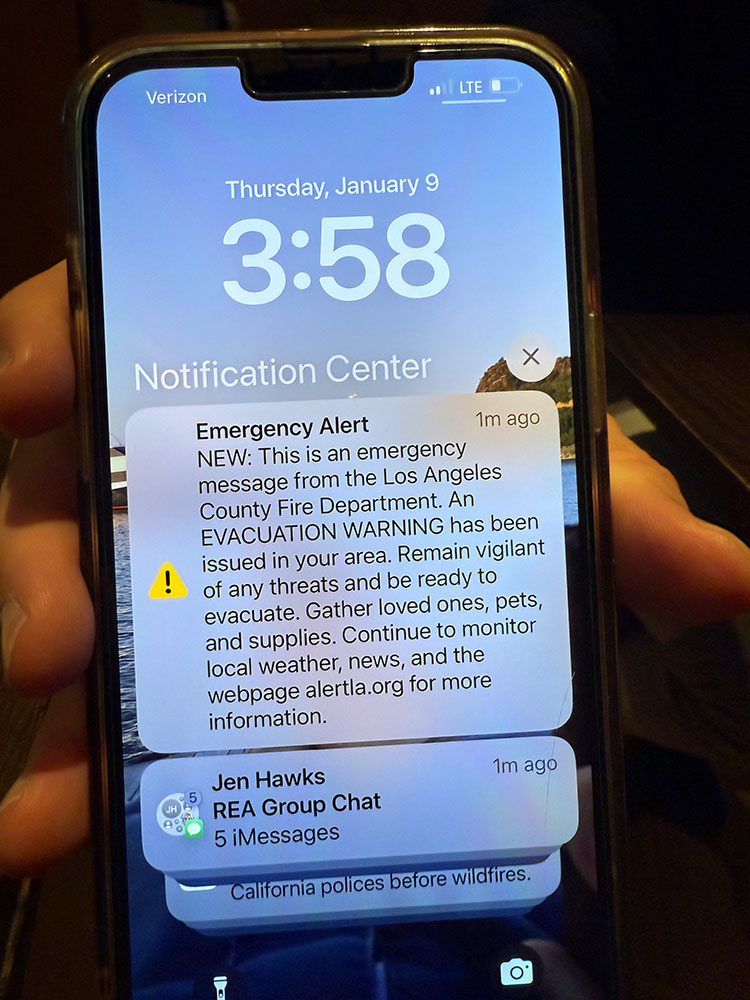
I knew that 2025 was going to be unlike any other. AI growing exponentially, climate change accelerating, unpredictable geopolitics, new administration – it’s a lot. And sometimes, real life intrudes on your expectations. Enter the LA Fires.
I moved to Los Angeles in the 90’s from Toronto. Mostly for the weather. But also, for a fresh start. It seemed like the kind of place where anything was possible. Over time, I built a life here. Made friends. Explored professional opportunities. Built community. Spent time getting to know the city and heading out to Malibu as often as possible.
On Tuesday, everything changed. I heard that friends were evacuating from the Palisades in the early afternoon but that had happened before, so it didn’t seem that abnormal. A few hours later, reality set in. This was something different. While we’ve all been waiting for the big one – earthquake – we were brought to our knees by wildfires. They were fast and furious. So far, I know of 12 people in my network who lost their homes – 11 in the Palisades and 1 in Altadena. Many friends are evacuated, and others left the city because of the poor air quality. I’m OK, thanks to everyone who reached out. I have a roof over my head and life seems almost normal when I walk in my neighborhood (with a mask because of the smoke). But it’ll take time to process what this means to the city and the community.
Right now, I’m concerned about everyone who lost everything and the brave firefighters on the front lines. We aren’t at the end yet. That’s what differentiates this from other extreme weather events. Fires are not contained. Each of us is coping in our own way. There is also anger on top of sadness and a feeling that there’s been a lack of leadership in this crisis.
But the how and why will have to wait. The focus must be on getting through the next few days (more anticipated wind events) and then the hard part, supporting those who will need help to rebuild their homes and lives. And we can’t forget all the people whose livelihood is lost because they worked in the affected areas. The scope of this disaster is still hard to wrap my head around. It’s at times like this that leadership matters most.
The post Buckle Up, Buttercup appeared first on Anat Baron Speaker.
]]>The post ChatGPT Made Up a different Version of Me appeared first on Anat Baron Speaker.
]]>
ChatGPT is a great storyteller. It makes stuff up. And it sounds authoritative in doing so.
I’ve been working on updating my website and social media profiles for the past few weeks. I decided to use AI tools, including ChatGPT to help me edit my content.
Today, I decided to ask ChatGPT to tell me about me. As you can see, it told a great story. Except most of it isn’t true. It’s pure fiction. The only thing that is true is the fact that I made “Beer Wars.” Where I grew up, went to school, worked – all false. I never wrote a book (although it does sound like something I’d want to read). I’m not a mentor.
So, what does this mean? Are ChatGPT and AI chatbots doomed because they hallucinate? Absolutely not. We are at the very beginning of mainstream AI adoption. These LLMs are still a work in progress. ChatGPT3.5 is a baby, and we need to be patient as it grows up and matures. That doesn’t mean that it will always be right. But it does mean that there’s still work to be done so that we can trust what it tells us to be true.
In the meantime, let’s double check what it tells us, especially about ourselves.
The post ChatGPT Made Up a different Version of Me appeared first on Anat Baron Speaker.
]]>The post The Fine Line Between Reality and AI appeared first on Anat Baron Speaker.
]]>
Last night I watched the finale of Paul T. Goldman on Peacock, saw the latest George Santos “story” on the news and rewrote my “about” page here on LinkedIn using ChatGPT. I woke up at 4 AM with a realization that many of you may have already had. We could be seeing the end of “reality” as we’ve known it.
Let me back up. In 2009 I released a documentary film called Beer Wars. In the film, I followed 2 entrepreneurs and their families for over 3 years as they struggled to succeed in a competitive world run by giant multinationals. It turned out that making a documentary is harder than making a scripted film (which I had done before). Several of my editors worked in reality TV and they told me stories of how fake their shows were. They weren’t a good fit for my vision because I was after the truth, not bending it.
So fast forward to 2023. We are on the precipice of an AI revolution. The one I’ve been waiting for since watching the Jetsons on Saturday mornings.
I’ve been using AI tools for years. We all have. Alexa, Siri, navigation, facial recognition, etc. have become part of our daily lives. But we are at an inflection point. The release of ChatGPT and DALL-E-2 from OpenAI have brought its potential to the mainstream. Much has been written about the ethical and moral dilemmas, loss of jobs, deep fakes and other issues but I want to address a broader question. Going forward, how do we discern what is real?
Paul T Goldman is a series that’s hard to define. Suffice to say that all is not as it seems. And Paul T. Goldman (who plays himself) isn’t even the protagonist’s real name. You must watch this mind-bending show to understand how difficult it is to tell fact from fiction. George Santos (not his real name) is a US Congressman whose life story is just that. Made up. And it seems to get stranger by the day.
And then there’s ChatGPT which I’ve been using daily (instead of Google). I decided to teach it about myself since I’m not famous by asking it to edit my bio on LinkedIn. And then the bio on my website. And then last night, I asked it about myself (I mean, who hasn’t done that on Google?) And boom, it gave me an answer. One it did not have in early December when I first asked. I’m basically “training” the AI but it accepts what I tell it. And so, here is my concern. As we move forward and integrate AI into everything, how do we tell what is real? What do we believe?
The post The Fine Line Between Reality and AI appeared first on Anat Baron Speaker.
]]>The post How to Ask Your Network for Introductions and Referrals appeared first on Anat Baron Speaker.
]]>
“No one is busy all the time. The issue is where you fit on their priority list.”
I believe that we are moving beyond transactions to relationships. I see this with brands that want to move customers beyond one purchase to accruing “lifetime value” by looking for ways to build loyalty, often by humanizing the brand and/or offering incentives. In business, it’s becoming increasingly important in a world where everyone is connected to move beyond posts and likes to something more substantial. Some of this is captured in communities where like-minded people get together online or IRL (In Real Life).
Gives and Gets. Asks and Offers.
I’ve been to various events recently where the value is structured around what the participants can do for each other. Is this the evolution of networking? Does it actually work?
I recently attended events where the focus was on specifics (what can I get or give to the group members?) vs. on more general networking. While I applaud the organizers for trying something different, I’m not sure that this approach is the best way to get people (or in my case, women) to help each other. Here’s why:
Introductions
Most of the asks/gets are for specific introductions. Do you know so and so or someone at company X? I’m always happy to connect people BUT I do it strategically. Mostly because I want there to be a good likelihood for success and value derived by both sides. That introductory email should be effusive as opposed to perfunctory. And I can’t be authentic if I’m facilitating a transaction. Especially since many of the requests are introductions to investors. It’s my network and my reputation. I protect it so that my credibility stays intact. If you have a big ask then I’ll be more likely to make it if you make an effort. Take the time to tell me about the desired outcome. Get me excited about the fit. If I believe it’s right, I’ll make the introduction happen because I care.
Virality
Helping someone spread the word about her new book or product is another favorite ask. The issue with something generic like that is that it’s unlikely to move the needle. Unless… there is a clear understanding of whom you want to reach. Case in point. When my movie Beer Warscame out a few years back, my famous cousin who had over 10 million Twitter followers offered to tweet about it. He was later surprised that he didn’t “break” my site as he was used to his followers literally clicking en mass. What I realized was that my audience didn’t match his followers. So it was a favor that failed because I asked (he offered first but go with me) the wrong person. Strategy always helps, especially when trying to get attention.
Lack of clarity
If you show up to an event where this is the focus, you need to be clear on how you can be helped. I can’t help someone if they aren’t clear about their need themselves. What I’m saying here isn’t that I won’t help you figure it out but that it then becomes the beginning of a relationship, not a transaction because it requires time and thought.
This “ask culture” is happening online as well, especially in women’s groups on Facebook. I’m not talking about recommendations for travel or hairdressers. I see endless posts asking for introductions or advice for business reasons. Transactional for sure but the asks are smaller and almost lend themselves to the digital world that is transactional in nature (look at your ratio of any of your posts to see likes vs. actual comments.) Sadly, even birthdays have become transactional.
So how do we navigate a world where we are the center of our own universe with social media there to amplify our every move? Where we are encouraged to speak up and stand up and ask for what we need?
Make It Easy for Me to Help You
If I agreed to make an introduction for you, don’t expect me to sit down for an hour and draft an email for you. Have a few paragraphs ready for me to cut and paste. Write them in the third person since they’re coming from me. Include a summary of the company or idea. A little about you and specifically what your ask is – a meeting, a call, feedback. The more context you provide, the easier it will be for me to get the email out.
Show Up
If you set up a lunch or coffee because you want something from the other person, show up. Don’t cancel at the last minute. Don’t say you need to reschedule and don’t. Be consistent. If I agree to meet someone, I do my homework and have already invested some time to prepare.
Reciprocate
I go to so many lunches and coffees where the entire conversation is about the other person. Here I thought we started a relationship but no, apparently the other person thought it was OK to talk about herself and her company for the entire meeting and to ask me how I was doing on the way out. Really? That may explain why I’m not responding to her email asking for investor introductions.
Tell the Truth
When I’m presented with an ask (outside of the event) I expect to hear the real story and I reciprocate with my straightforward opinion. I believe that if I’m starting a relationship with someone that it should be base on authenticity instead of bullshit. Many relationships seem to end because of my brutal honesty but I’m OK with that. Better to cut my losses early.
Do What You Say
If you make an offer then execute it. I can’t understand why anyone would want to appear as a giver and then not follow through. Case in point, at a recent event 10 women offered to help me with a specific ask. I followed up with all of them and provided all the information necessary plus an invitation to get together to see how I can reciprocate (while I believe in karma, I’m more than happy to dig to see how I can be helpful, especially to someone who is willing to help me). It’s been over a month and only 4 of them actually followed through. Some scheduled lunches (to discuss further) but then canceled. I’m not surprised. This is what happens when everything is transactional. You want to help in the moment but then you get busy and the transaction moves off your priority list and with it any potential relationship because you don’t see yourself getting (instant) value. I see it differently. Some of the best business relationships I developed started with me doing something for someone else and later as our relationship progressed that person opening a door without me even asking. I’m not suggesting that you keep a ledger but that you take a long-term view.
Follow-up
I try to stay on top of my offers so that I can stay helpful. Again this is easy if it’s a relationship—I can simply check in. If it’s a one-time transaction, I don’t really bother.
The post How to Ask Your Network for Introductions and Referrals appeared first on Anat Baron Speaker.
]]>The post Disintermediation and the End of the Middleman appeared first on Anat Baron Speaker.
]]>
We are living in a time of extreme disruption. Right now there is a startup somewhere in the world working on upending the status quo of every industry. Technology is the common denominator but the impetus is the changing consumer and her demand for frictionless experiences and convenience. Or in Silicon Valley speak, they are solving a problem.
There are of course the obvious and much-discussed companies:
Uber is changing transportation in 2 ways. Firstly, by using the phone, it enables users to order a car to take them from point A to point B and know the cost, driver name and arrival time upfront. Secondly, it allows anyone (with a car) to become a driver and by doing so they addressed the complexity (and cost) of becoming a taxi driver.
Another sharing economy darling, Airbnb brings together travelers and hosts. It provides the platform and allows anyone with a room or house to rent to post photos and a description. Like on Uber, everyone can review each other to (supposedly) provide future users with insight. The company’s valuation at $31 billion makes it worth almost as much as Hilton and Hyatt combined. What makes that number remarkable is that it does not own or operate anything. Its tech platform provides a marketplace.
Netflix initially took the friction out of the Blockbuster experience (driving to the store, out of stocks, late fees) by mailing out DVDs and completely transformed the TV business with streaming. Binge watching, anyone?
And of course, there’s Amazon that started its ascendance by selling books online. And en route to retail behemoth (and world domination) eviscerated Borders and brought Barnes & Noble to its knees. It turns out that consumers are only too happy to avoid driving to the store, parking, walking the aisles and lining up to pay. Instead, they can find whatever they need in their PJs, on the couch, and choose when they want to have it delivered. As a leader in self-publishing, Amazon also provides would-be authors with a platform and the ability to bypass the agent and publisher altogether. The ability to reach consumers directly is perhaps the ultimate example of disintermediation. Of course, the downside is that some books suffer from quality issues. And the review system in place to fix that has its own issues.
Many other industries have been shaken up by the changes in distribution and the rise of social media. Even the beer industry has been surprised at the astronomical rise in craft breweries in the past decade. (More on this in a future post.)
Take a look at news as a business. Until 10 years ago I was still holding on to print; I subscribed to 4 daily newspapers and 40 magazines. Today that number is zero. Like most people, I get my news online. From newsletters that curate articles based on my interests to updates on social media from the media outlets themselves. Facebook and Twitter have made all of us content creators and provide us the ability to make or share news as it happens.
A great example of someone who uses Twitter to skip the middleman is @realDonaldTrump. His tweets before he became President and now as President provide him direct access to followers and then get amplified by news outlets as they report on his latest tweet.
Of course, the difference between non-celebrities and celebrities is that name recognition is key to winning the battle for attention. While it’s true that every one of us now has the power to put their words, photos, and videos out into the world, the bigger issue is breaking through the noise.
We will continue to see disintermediation in every industry that has intermediaries. Especially on the consumer side. Our connected world continues to remove barriers and our reliance on our devices, social media, search and crowdsourced reviews will propel us into a world increasingly shaped by AI as machines learn to not only understand our needs and wants but to predict them.
I’m waiting for personalized everything. Getting the information I’m interested in (news I care about, products I may want to buy, places I may want to travel to etc.) to come to me. Basically, my life as a Netflix recommendation engine. Because who knows me better than my iPhone and Google search history?
The post Disintermediation and the End of the Middleman appeared first on Anat Baron Speaker.
]]>The post No One Cares About Your Idea: How to Get Advice That Matters appeared first on Anat Baron Speaker.
]]>
At least once a week someone with “an idea” approaches me, usually via email or social network. Sometimes it’s a friend or friend of a friend, other times it’s a total stranger who found me online. They just need a few minutes or want to buy me a coffee (which by the way, I don’t drink) to pick my brain.
Sometimes it’s an idea for a product, or a movie, or an app. I believe in karma and giving back so when I can, I say yes. And then I ask if they want my honest opinion. At their own risk (just ask my friend Danielle) because I only know how to provide unfiltered, non-sugar coated feedback. And it’s often brutal, especially if you haven’t done even the tiniest amount of work to validate it.
But at times even before they tell me their idea, they want me to sign a NDA. Seriously? You’re coming to me for advice but you don’t trust me? I get it. There are plenty of stories out there about people stealing ideas. I’ve had it happen to me. But the reality is that 99% of ideas are just that. Case in point, I have notebooks full of ideas sitting in my storage locker. They aren’t real until you take some action and make them come to life.
But before doing that, there are questions to be answered to see if the idea is actually worthy of execution.
What’s the Big Idea? When I ask about the “what” a fountain of information comes out. Because for the most part, the focus is about the “idea” usually coupled with how it came about. There’s often passion there and the exciting feeling that comes with beginnings.
Who Is It For? I follow up this excitement with my no-nonsense (some would say unfeeling) advice that starts out as questions. And every single time the question is: who is it for? After all, you can create a great product or service, write a brilliant book or make a great film but unless you can figure out how to reach potential consumers, readers or audiences, it won’t be commercially successful. And “viral” or “social media” are not a “who” nor is “it’s for everyone.”
I acknowledge that it’s tough to know, especially if it’s something that doesn’t exist or is truly transformative but let’s face it; even a small tribe or club needs a few members (and no, aunts or nephews don’t count).
My advice is often ignored because the “who” is hard. And not as much fun as focusing on the product or idea. But guess what, if you don’t know who you’re creating for then how do you know what to create?
And yes, I’m familiar with the Henry Ford and Steve Jobs quotes but they’re the exception, not the rule. If you’re transforming the world (e.g. building a car to replace horses or a smartphone to replace the camera/cell phone/iPod/computer) please stop reading now.
Otherwise, be an owl. Keep asking WHO, WHO, WHO? That is the beginning of the journey.
How Will You Reach Your Who? Once you can articulate whom it’s for then equally important is how. How will you reach this user or customer to let them know your “idea” is out there? And the answer can’t be “social media” or “viral” because getting attention is harder every day. When everyone is a content creator, when algorithms dictate what people see online, you need to be clear about how hard it will be to get your message out there. From day 1.
When Should You Launch? When you launch anything new is as important as the messaging around it. Getting attention is critical for launching any product or service. Timing matters. When you get attention matters. And yet, many entrepreneurs are so in love with their “baby” that they forget about the old rule: being at the right place at the right time. There is still a lot of emphasis on getting on TV or on a podcast or even in the newspaper. But here’s the thing, there’s no point in getting attention until you are ready. After all, unless you’re building a personal brand, you may want to wait until you have something to sell. Creating awareness is great. Converting that awareness to sales is even better.
So next time someone offers you a launchpad for your new “baby” take a minute to ensure that the timing is right. That you are ready to make a splash. You know what they say: you only get one chance to make a first impression. Make it count!
How Are You Differentiated? Once you believe that there are people out there who have a need for the “idea” you’ve created and that you know where and when to reach them, then it’s time to think about your competition. Who else is out there with a similar idea? And if no one is because it’s so unique, whom are you trying to replace or displace? There are very few original ideas so the key is to find a way to differentiate your “idea” from the plethora of new ideas that are being introduced on a constant basis. The buzz phrase for this is “unique value proposition.” I think of it as a way to describe the value you are adding to your end user or consumer. It could be knowledge or productivity or entertainment but the best ideas make someone’s life better in some way. The very best products and services (IRL or digital) solve problems, sometimes that you didn’t even know you had.
So if you’re planning to pick someone’s brain for your next big idea, I suggest thinking through some of the answers to these (difficult) questions. I’m always shocked when I can easily Google the answers and the advice seeker hasn’t even done the most basic search. You probably won’t come up with answers right away (because execution is HARD) but you will be better prepared for that call or coffee meeting. Having been a scout, I believe that being prepared is always a great idea.
The post No One Cares About Your Idea: How to Get Advice That Matters appeared first on Anat Baron Speaker.
]]>