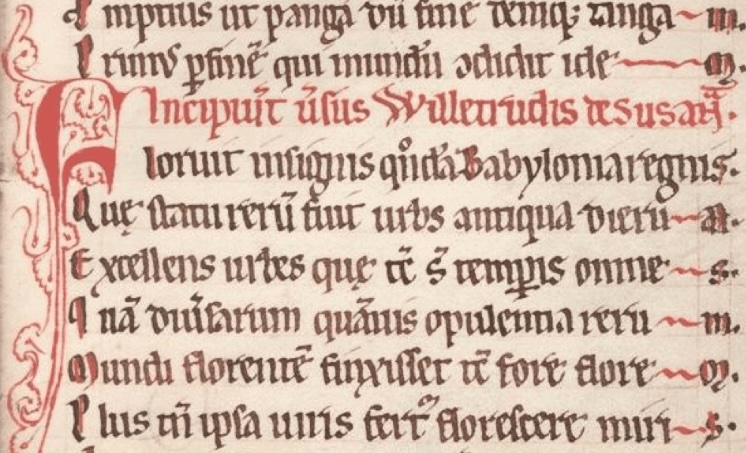
Clm 12513, fol. 24 where Willetrudis is named as the author of the poem ‘about Susanna’ (c) Bavarian State Library, Munich. Reproduced with permission.
We know little for sure about the life of Willetrudis the poet, but she has left us some clues. She is the named author of a 403-line Latin poem, ‘About Susanna’ (‘de Susanna’). This poem is a retelling of the biblical story of Susanna, a married woman falsely accused of adultery and subsequently exonerated by divine intervention (Daniel 13).
But who was Willetrudis? Within the poem, she refers to herself as a ‘scriptrix’, a female writer. She repeatedly uses first-person plural verbs and feminine endings, and she claims to use the example of Susanna to motivate her ‘sorores’ (her sisters) and fellow ‘famulae’ (handmaidens), words that are both regularly used for nuns in medieval Latin. Such language, along with the quality of her Latin, Classical references, and subject matter strongly suggests a highly intellectual Christian woman most likely placed within the literate world of a medieval convent. Despite the fact that the text comes from a manuscript in Germany, poetic and historical evidence suggests that it is more likely Willetrudis lived and wrote at the abbey in Wilton, England, a known center of creative literary production.
A German Manuscript, a German Nun?
The text is preserved in a single extant manuscript dating to 1240 and housed in the Bavarian State Library in Munich (Clm 12513, fols. 23-35). It was copied by a scribe named Liutold who was working in the Cistercian monastery of Raitenhaslach (just over 100 km from Munich). Seligenthal Abbey in Landshut, founded in 1232 and placed under the pastoral care of Raitenhaslach in 1426, thus may be where Willetrudis potentially lived and wrote. The nuns of Seligenthal actively participated in copying, producing, and maintaining manuscripts over centuries, but there is little evidence for a culture of creative literary production at the convent. She is identified as the author on fol.24r. The rubricated letters read ‘Incipiunt versūs Willetrudis de Susanna’ (‘So begin the verses of Willetrudis About Susanna’).
Following further clues, the name Willetrudis may have a Frankish origin. There was in fact a woman named Wiltrudis (note the slight spelling difference) who was the first abbess of the Bavarian Hohenwart Abbey founded by her and her brother, Count Ortolf, in 1074. As with Seligenthal Abbey, there is evidence for book production at the convent, but no evidence of literary production there.
A Literary Community at Wilton
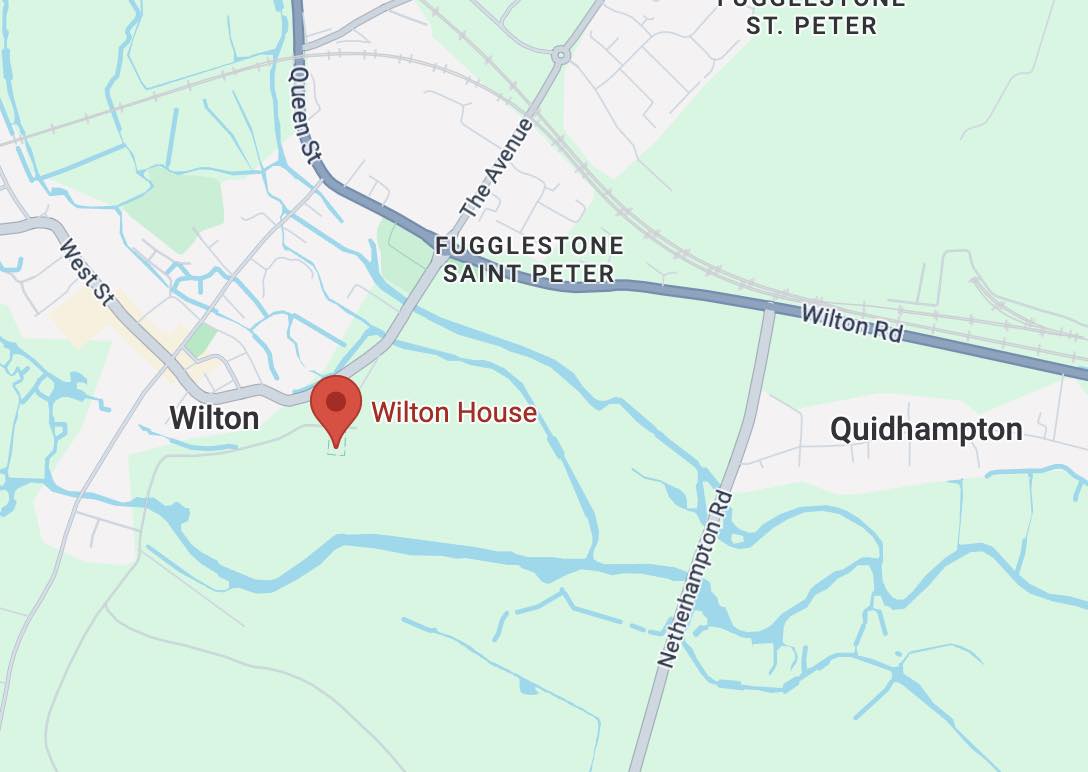
A more promising location for our poetess is Wilton Abbey in Wiltshire, England. An ‘abbess Wiltrudis’ (‘abbatissa Wiltrudis’) appears on a scroll announcing the death of Vitalis of Savigny in 1122 (a mortuary roll) that requests prayers for his soul. Such mortuary rolls were circulated between communities, who would add responses (‘tituli’) in the form of poems or prayers and would often also append the names of their own dead. In the titulus from Wilton, abbess Wiltrudis’ name is placed prominently after a 14-line poem honoring Vitalis, written in the same meter as de Susanna (leonine hexameter) and featuring similar classicizing influences.

Detail of the mortuary roll for Vitalis of Savigny that identifies a ‘Wiltrudis’ at Wilton.

Unlike at the German abbeys, the women of Wilton were especially known for their education and literary output. The convent, founded c. 830, was a well-respected Anglo-Saxon royal nunnery and convent school. Only five Wilton manuscripts survive, because of (or despite) the destruction of the abbey in the 16th century during the Dissolution of the Monasteries.
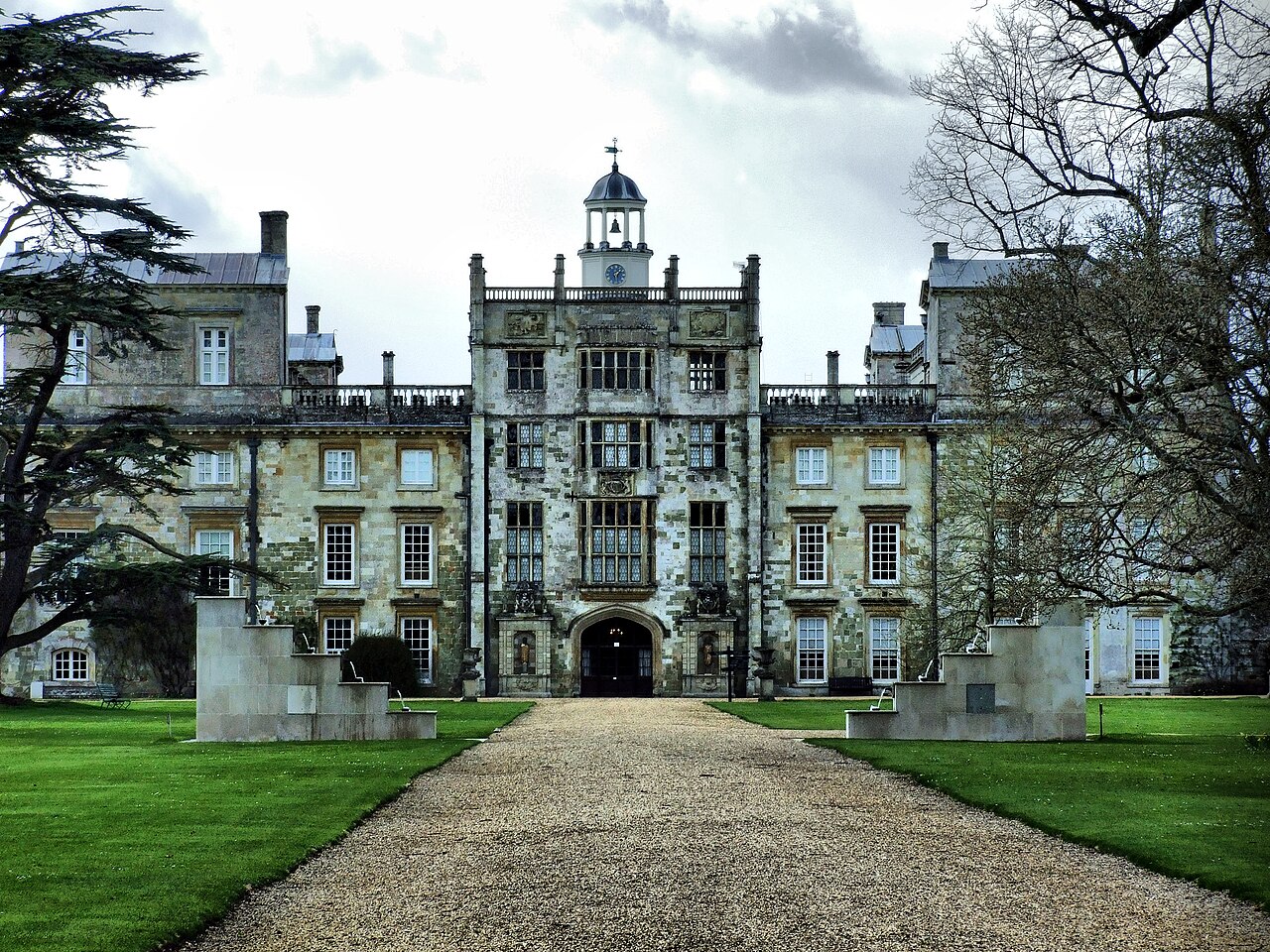
The east front of Wilton house built over the remains of the medieval Wilton Abbey.

Unfortunately, no text survives by Wilton’s most famous literary alumna, the poet Muriel, who, like the Wiltrudis of the Wilton titulus, lived at the beginning of the 12th century. In a text describing the 1113 journey of a group of priests from France to England, Herman of Tournai says that during their stop at Wilton Abbey they visited the grave of Muriel, whom he calls an illustrious poetess (‘inclyta versificatrix’, De Miraculis, PL 156, 983). Male poets celebrated the work of Muriel, and in a letter from Serlo, a canon of Bayeux, the convent at Wilton is admired as ‘a city rich in poetry’ (‘faecundam versibus urbem’, 3). In this same letter, Serlo admires Muriel’s skill and knowledge of Classical poetry. Such an environment suits the Willetrudis of de Susanna, who freely quotes Vergil and references classical mythology.
Susanna, who also features, albeit briefly, in other texts associated with Wilton, was just the sort of exemplum those living and working at Wilton might employ. Willetrudis offers a version of the story, tailored for nuns and future wives, that centers Susanna as a model of endurance and faith under pressure. As a nunnery and convent school, Wilton served a mixed audience of both religious and secular women, making the topic of a chaste woman’s reputation endangered by male accusations relatable to the entire population in the abbey.
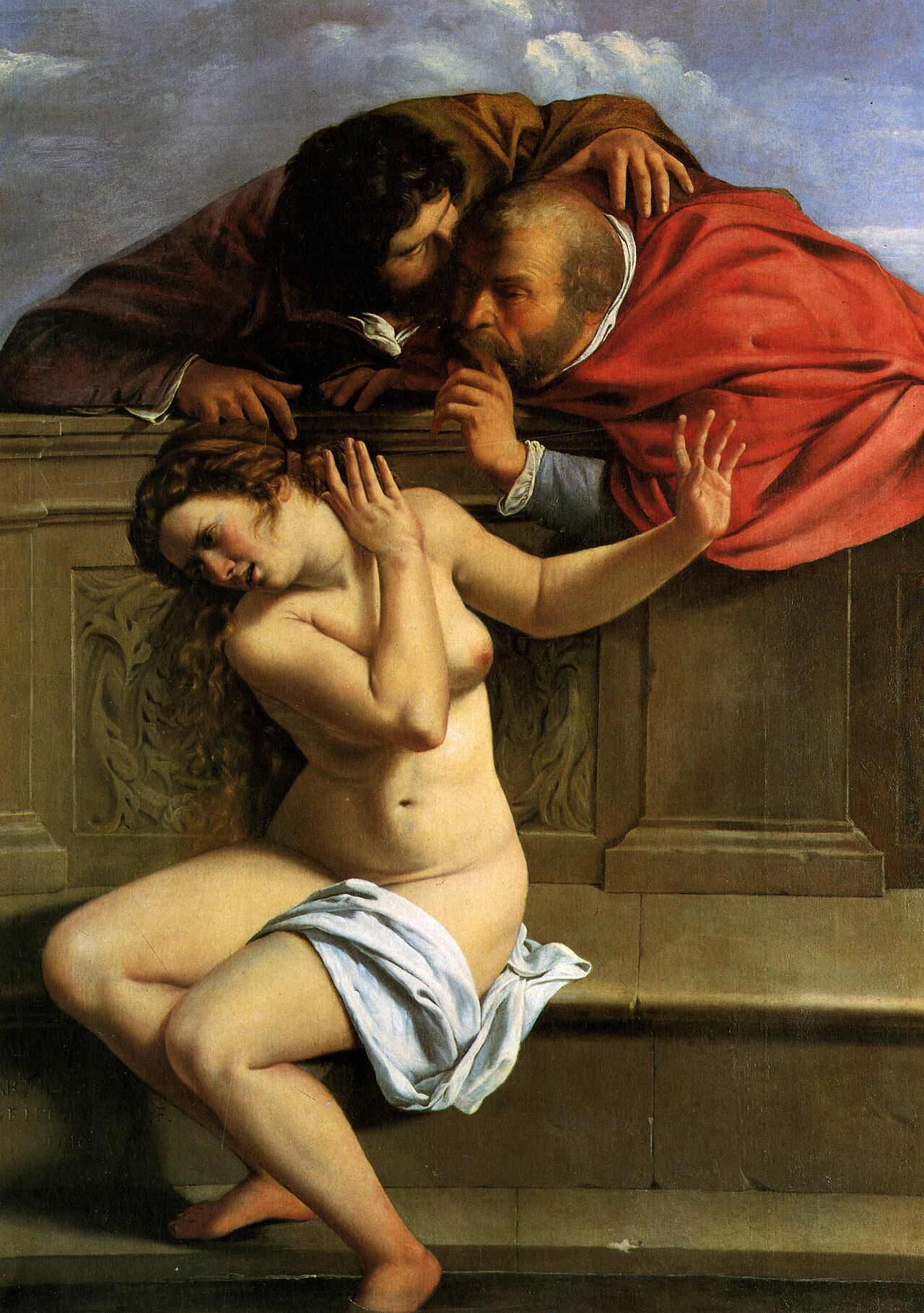
Susanna and the Elders by Artemisia Gentileschi, 1610.

Despite the limited information Willetrudis provides about herself within the poem, the text hints at three possible locations: the German abbeys of Seligenthal and Hohenwart, or Wilton Abbey in England. Seligenthal was connected with the monastery that produced the only manuscript to preserve Willetrudis’ poem, but Hohenwart was founded by a noble woman named Wiltrudis. While there is evidence for book production at both houses, neither had the renown for creative literary production boasted by Wilton Abbey, the home of an abbess Wiltrudis who died in 1122. How Willetrudis’ ‘de Susanna’ ultimately ended up preserved in a single German manuscript remains a mystery, but Wilton clearly had a reputation for poetry that extended beyond England to the religious communities of the continent.
If you would like to read Willetrudis’ rendition of ‘de Susanna’, the Latin text, along with the first ever published translation of the full poem in English, is now available through Pixelia Publishing.
Further Reading
1. Editions and Translations
Gabriel Silagi, ‘Willetrudis Versus de Susanna: Eine Unbeachtete Frauendichtung Aus Dem 13. Jahrhundert’, Aevum 73, no. 2 (1999): 371–384. JSTOR
Abbe Walker et al., ed. and trans., Willetrudis: Verses about Susanna (Pixelia Publishing, 2026). Pixelia Publishing
2. Secondary Sources
Liz Herbert McAvoy, ‘Willetrudis’ in The Palgrave Encyclopedia of Medieval Women’s Writing in the Global Middle Ages, ed. Michelle M. Sauer, Diane Watt and Liz Herbert McAvoy (Cham: Palgrave Macmillan, 2023). DOI
Jane Stevenson, Women Latin Poets: Language, Gender, and Authority from Antiquity to the Eighteenth Century (Oxford: Oxford University Press, 2005).
Elizabeth Muir Tyler, England in Europe: English Royal Women and Literary Patronage, c. 1000–1150 (Toronto: University of Toronto Press, 2017).
]]>
Diane Watt, University of Surrey and Liz Herbert McAvoy, Swansea University
The afterlife is not typically associated with aggressive pets and insatiable worms. But these are exactly the creatures that appeared to an unnamed woman recluse living in Winchester, England, over the course of three nights in the summer of 1422. The woman was an anchoress. That means she had chosen – and subsequently vowed – to live in solitary confinement within a small cell attached to a church for the rest of her life.
The recluse wrote a vivid account of her vision and sent it to her confessor and a circle of influential churchmen. Her letter, known today as A Revelation of Purgatory, makes her one of the earliest known women writers in the English language.
Despite deserving this accolade, the Winchester recluse did not appear alongside her more famous contemporaries or near contemporaries, Julian of Norwich (1342 – after 1416) and Margery Kempe (circa 1373 – after 1438), in the British Library’s hugely successful recent exhibition, Medieval Women: In Their Own Words. One likely reason for this is that the manuscript copy of the full account of the vision was not available for display at the time. That situation has now changed.
The British Library has just announced the purchase of five medieval manuscripts from Longleat House in Wiltshire. One of these manuscripts contains the complete surviving version of the recluse’s letter, which, although referred to in an incomplete version elsewhere as “a revelation recently shown to a holy woman”, is untitled in this particular manuscript. This may be another reason for this woman’s writing having been overlooked until very recently. This exciting purchase will hopefully now give the Winchester recluse and her writing the attention they deserve.

In her vivid, technicolor visions, the recluse watched a dead friend, a nun named Margaret, ushered to the forefront of purgatory by a cat and dog that she had adored and pampered when she was alive.
Transformed into vicious satanic minions, Margaret’s former pets joined the many devils responsible for doling out her punishments. They tore endlessly at her flesh and bit and scratched her relentlessly. They did so to remind her that, as a nun, she had broken her vows by keeping them as her companions in her nunnery and by devoting too much love and attention to them.
In Margaret’s heart, too, a voracious little worm had taken up residence – a so-called “worm of conscience” – that was intent on consuming her from the inside out as part of her torment.
So deeply troubling was this vision of her friend’s suffering that the Winchester recluse immediately summoned her young maid, and the two women started to pray for the nun’s soul. On the very next day the recluse decided there was nothing for it but to document her visions of Margaret’s fate. She not only detailed all she had seen, but also stipulated which prayers, and how many, should be said on behalf of poor Margaret to deliver her from her suffering and help her reach the gates of heaven.
The recluse’s letter is very specific about the date of these visions: they took place on St Lawrence’s day, August 10 1322, which fell on a Sunday that year. There was – and still is – a small church dedicated to this saint very close to the cathedral in Winchester (the so-called Mother Church of Winchester).
As an anchoress, the author would almost certainly have occupied a cell attached to a church somewhere in Winchester. This would also have allowed her the time and the space for contemplation, study and writing.
As has been argued in a recent blog and podcast for the University of Surrey’s Mapping Medieval Women Writers project, it is quite possible that the Church of St Lawrence was the location of her cell, where she experienced her visions, and where she wrote down her account of them.
This manuscript now permanently joins an unparalleled collection of medieval women’s writing in England held in the British Library. It includes not only The Book of Margery Kempe, manuscripts of both the short and long texts of Julian of Norwich’s Revelations, but also the Lais and Fables of Marie de France, the Boke of Saints Albans attributed to Juliana Berners, and the letters of the 15th-century Norfolk gentlewoman Margaret Paston and other female family members.
As such, the work of this unnamed Winchester anchoress now takes up its rightful place alongside the writing of her hitherto better-known literary sisters.
Diane Watt, Professor of English, University of Surrey and Liz Herbert McAvoy, Professor Emerita of Medieval Studies, Swansea University
This article is republished from The Conversation under a Creative Commons license. Read the original article.
]]>
Diane Watt, University of Surrey
Marie Maitland, a 16th-century Scottish gentlewoman, has for centuries been recognised as the likely scribe of the Maitland Quarto. This important manuscript, now held in the Pepys Library of Magdalene College, Cambridge, is an anthology of Scottish poetry by members of the noble Maitland family and their associates.
Maitland’s name appears twice on the first leaf and is also found in a partial anagram in the opening sonnet (“maid ane immortall”). By way of emphasis the anagram is repeated beneath the poem.
In recent years, researchers have acknowledged the probability that Maitland not only copied and curated the manuscript, but that she also composed some of the poems.
This includes, most notably, Poem 49, a lyrical exploration of one woman’s desire for and commitment to another. This is an erotic as well as an emotional poem. At the end of the second stanza, the speaker submits to her lover:
Ye weild me holie at your will /
and raviss my affectioun.
In her new book With My Own Hand: The Secret Life of Marie Maitland, Scotland’s Sixteenth Century Sappho, historian and translator Ashley Douglas places an analysis of Poem 49 at the heart of her thoughtful and often speculative reconstruction of this early modern woman’s queer life.
Douglas contends that Maitland included within the manuscript two further sapphic poems: Poem 72, which she argues was written by Maitland’s unidentified married woman lover and Poem 89, composed by Maitland herself. Douglas suggests that the three poems, read together, tell the story of their relationship and its unhappy ending. Another verse, which may have been written either for Maitland by another woman or about herself, compares her to Sappho, the famous lesbian lyrical poet of ancient Greece.
Reclaiming lesbian history
Digging deep into the archives to find long overlooked records, Douglas discovered that Maitland was born in the late 1540s. She remained unmarried until after the death of her father, the courtier Sir Richard Maitland, which occurred when she was in her late thirties.
Up to this point, Maitland enjoyed considerable financial independence. Douglas convincingly argues that her father did all he could to ensure that this would be maintained after his death. This was likely a reward for her serving as his scribe after he lost his sight. Unfortunately, the plan didn’t work. When her brother John (the future Lord Chancellor of Scotland) became head of the household, for reasons of political and financial expediency, Maitland was quickly married off to a much younger man. She died just ten years later, possibly in childbirth.
According to Douglas, Maitland should be recognised as a “new Anne Lister”. Lauded as the “first modern lesbian”, Lister – a member of the Yorkshire landed gentry – enjoyed an unusually autonomous life in the first half of the 19th century.

From her extensive diaries, which were partly written in her “crypt hand” code, we know Lister had multiple relationships with women. Indeed, she wrote explicitly about her sexual experiences, finding the terminology to describe them in the epigrams of the ancient Roman poet Martial and other sources. Maitland, on the other hand, wrote about love and desire, but not about sex itself.
In this respect, I would suggest, Maitland’s verses anticipate more closely the late 17th-century poetry of Katherine Philips and her circle, which depicts intensely amorous friendships between women in platonic terms.
Douglas, however, rejects describing the desire for women expressed in Maitland’s poetry in terms of friendship on the grounds that such labelling renders historical lesbianism invisible.
It is certainly the case that the burden of proof seems much higher when it comes to sexual relations between women. Without the sort of detailed firsthand accounts found uniquely in Lister’s diaries, or the vanishingly rare evidence from court cases or other official records, the default assumption is often that women in the past did not have sex with each other.

This assumption is made even when the women are known to have shared a home (the British Museum, for example, is equivocal about the nature of the relationship between the Ladies of Llangollen, who famously eloped and lived together and even shared a bed). But what is perhaps most remarkable about Lister’s diaries is that they reveal that so many women in her social circle, whether they were single, married or widowed, had relationships – and sex – with her.
If we didn’t have Lister’s diaries, we simply wouldn’t know about this aspect of their personal lives. With this context in mind, the possibility that, two centuries earlier, the young Maitland had a sexual relationship with another woman, seems perfectly plausible.
Between 2019 and 2022, the television series Gentleman Jack portrayed Lister (played by Suranne Jones) as a highly intelligent, charismatic, sexually liberated and gender non-conforming lesbian in search of commitment in late Georgian England.
Douglas represents Maitland as Lister’s sapphic forebear – an educated, intellectual and self-determining woman who found (and, sadly, lost) her love, and much of her liberty, in the repressively patriarchal and conflict-riven environment of Reformation Scotland. In this respect at least, Maitland could be considered the new Gentleman Jack.
This article features references to books that have been included for editorial reasons, and may contain links to bookshop.org. If you click on one of the links and go on to buy something, The Conversation UK may earn a commission.
Diane Watt, Professor of English, University of Surrey
This article is republished from The Conversation under a Creative Commons license. Read the original article.
]]>
We are pleased to announce that The Palgrave Encyclopedia of Medieval Women’s Writing in the Global Middle Ages will be published in print format in 2026. Brought together under the stewardship of Editors-in-Chief, Liz Herbert McAvoy, Michelle M. Sauer and Diane Watt, with the assistance of a committed international team of section editors and contributors, this is the first encyclopedia devoted exclusively to medieval women’s writing globally. Focusing on the thousand-year period between 500-1500, this comprehensive reference work addresses a long-standing gap in scholarship on women writers from this period. It challenges current understandings of the literary tradition of women by incorporating early writers and texts that remain marginal and by expanding definitions of textual composition to include more collaborative and contextual activities. This encyclopedia also presents women in the context of the global Middle Ages. Entries extend beyond works written in England, Scotland, Ireland, and Wales to include works by women from Europe, Africa, and Asia. By locating medieval women’s writing within its cultural, social, religious, and political contexts, The Palgrave Encyclopedia of Medieval Women’s Writing in the Global Middle Ages will be an ideal entry point for students and researchers coming into the field, and a valuable resource for established scholars.
To celebrate the forthcoming publication and Palgrave’s 25th anniversary this year, four chapters are free-to-view throughout October. These chapters are:
Pernilla Myrne, ‘Arabic Women’s Medicine’.
Jeong-hee Ko & Justin M. Byron-Davies, ‘Korean Kisaeng Sijo’.
Miriamne Ara Krummel, Jewish Women in Medieval English Records‘.
Millicent-Rose Newis, ‘Margery Kempe’.


This map identifies locations across England linked to the lives of medieval women writers and to medieval women who played a key role in literary history. Created by academics and researchers at the University of Surrey, and funded by an Arts & Humanities IAA award, the map brings the women’s stories to light in research-driven entries written by experts in the field, photographs, and podcasts. This map aims to raise the profile of these medieval women and to enable a fuller cultural understanding of these writers within their localities.
Click here to access the map.
]]>
The Book of Margery Kempe, British Library Add. MS 61823, on display at the British Library’s Medieval Women: In Their Own Words Exhibition (c) British Library
Margery Kempe was born into a wealthy merchant family in King’s Lynn, Norfolk, then known as Bishop’s Lynn, in 1373. After a series of religious visions she was converted to a life of complete devotion to God. She continued to have ‘mystical’ visions and auditory revelations for the rest of her life, which she later recounted to two scribes. Her book became known as The Book of Margery Kempe and is considered to be the first female-authored autobiography in English.
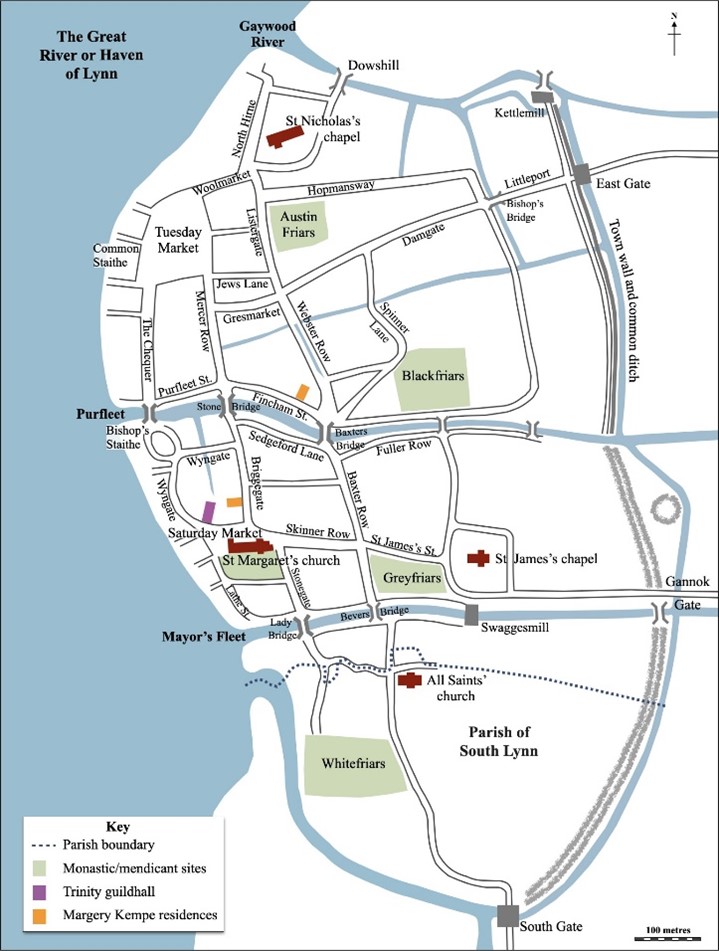
Map of late medieval King’s Lynn, by Susan Maddock ©. Reproduced with kind permission.
The Book provides a rare glimpse into religious, and secular, life in the late fourteenth and early fifteenth centuries. Margery was born Margery Brunham. The Brunham family had owned land in the Burnham parishes of north Norfolk for many decades. When she was around twenty years old she married John Kempe, a man whom she considered to be rather below her social station, and whom she must have married for love. Her Book tells us that she had fourteen children, few of whom are mentioned in detail; it is likely that not all survived.
Margery’s family home is thought to have been very close to her parish church of St Margaret’s, to which she was particularly devoted, now called the King’s Lynn Minster. Known for her copious weeping and devotional fervour in St Margaret’s Church and beyond, Margery was frequently criticised by priests and parishioners for these displays of high emotion. At times, however, they were well-received. When a ‘great fire’ threatened to burn down the nearby Hall of the Trinity Guild in Bishop’s Lynn in 1421, Robert Spryngolde, the parish priest of St Margaret’s Church, sought Margery’s advice and she was encouraged by the parishioners to cry copiously, in order that God would have mercy.
As a highly active religious lay woman, Margery travelled extensively to various parts of England and abroad. In 1413 she visited the famous anchoress, Julian of Norwich, at her cell at St Julian’s Church in Norwich, to ask for her counsel regarding the validity of her visions. Her Book also recounts terrifying arrests for her suspected heresy: in Beverley, and in Cawood, Yorkshire, where she was hauled in front of the Archbishop of York at his chapel and interrogated in 1413. She was also tried for being a Lollard in Leicester, in 1417, and subsequently released. Margery also ventured further afield on pilgrimage; in her forties, to Rome, Assisi, Middelburg, the Holy Land, and Santiago de Compostela, and in her sixties, to northern Europe.
But it is Margery Kempe’s deep affection for St Margaret’s Church that resonates throughout her Book. Today, that connection is still evident in King’s Lynn. In 2018 a commemorative bench in the Saturday Market Place, outside the Minster, was unveiled. In 2022, the Margery Kempe Centre was launched in St Margaret’s Church in collaboration with the Margery Kempe Society. In 2023 a sculpture of Margery Kempe entitled ‘A Woman in Motion’ by the artist Rosemary Goodenough was placed in the Minster. Although we have no record of Margery’s death, it is likely that she is buried somewhere in the grounds of St Margaret’s Church: the King’s Lynn Minster.

Commemorative bench, King’s Lynn, by Toby Winteringham. Photograph © Laura Kalas

‘A Woman in Motion’ by Rosemary Goodenough. Photograph © Laura Kalas

Further Reading:
1. Translations of The Book of Margery Kempe
Bale, Anthony, trans. and ed., The Book of Margery Kempe (Oxford: Oxford University Press, 2015).
McAvoy, Liz Herbert, The Book of Margery Kempe: an Abridged Translation (Cambridge: D.S. Brewer, 2003).
2. Secondary Sources
Arnold, John and Lewis, Katherine, eds., A Companion to The Book of Margery Kempe (D.S. Brewer, 2010).
Bale, Anthony, Margery Kempe: A Mixed Life (Reaktion Books, 2021).
Goodman, Anthony, Margery Kempe and Her World (Longman, 2002).
Kalas, Laura, and Varnam, Laura, eds. Encountering The Book of Margery Kempe (Manchester University Press, 2021).
]]>
Marie de France, Fables and Lais. Possibly Oxford (England), 1250s-1270s. The British Library Harley MS 978, on display at the British Library’s Medieval Women: In Their Own Words Exhibition (c) British Library
Marie de France is one of the most well-known yet mysterious women writers of the medieval period. Often noted as the first female poet writing in Old French, she is the cited author of three, potentially four texts: the Lais, a collection of twelve short poems written around the 1170s; the Fables (known as the Ysopë), a collection of fables likely composed between 1189 and 1208; the Espurgatoire seint Patriz, a translation of the Cistercian Monk H. de Saltrey’s Tractatus de Purgatorio Sancti Patricii dating to around 1190; and finally, La Vie seinte Audree (The Life of Saint Audrey), a hagiography detailing the life, death and miracles of Saint Audrey dated roughly to c. 1200.
Everything that we know about Marie is taken from her works and the only concrete evidence that we have is her name which is, unusually for many authors of the time, stated in each text. She also tells us in the epilogue to the Fables that she is of France which is why it is accepted that she was a French writer who was active in the English court during the reign of Henry II (1133-1189) and his wife, Eleanor of Aquitaine (1124-1204). Even though it is impossible to identify who Marie was and there is a growing debate amongst scholars about whether these works should be attributed to one single author, it is undeniable that Marie represents an extremely significant example of medieval women’s writing. Her rich works offer us incredible insight into life, love, and spirituality in the twelfth and early thirteenth-centuries.
Considering the little that we know about Marie de France, and the questions surrounding single authorship of the four texts making up her corpus, it is unsurprising that it is very difficult to firmly situate her in a location. However, one historic property does open up a window into late twelfth-century culture and that is Dover Castle’s Great Tower. The Great Tower was built by Henry II in the 1180s as part of an extensive rebuilding campaign in order to create an impressive stronghold fit to entertain important guests travelling to England to visit the shrine of Thomas of Becket in Canterbury.

The Great Tower, Dover Castle. Credit: DeFacto, CC BY-SA 4.0 via Wikimedia Commons
The Great Tower was restored by English Heritage in 2008-2009 to allow visitors to experience the twelfth-century court as it would have looked when first built. As well as the King’s Hall, King’s Bedchamber, and the Chapel of Thomas Becket, the project developed another Guest Hall which has been furnished for a twelfth-century banquet. It is in lavish, colourful, and richly decorated spaces like this banquet hall that we can imagine Marie de France’s magical, thought-provoking, and popular lais about love and courtly society being shared.

The Guest Hall, Dover Castle. Credit HARTLEPOOLMARINA2014, CC By-SA 4.0 via Wikimedia Commons
Regardless of whether these works were written by one or more well-educated, multilingual women, we know that her works were well-known and celebrated at court. The restoration of Dover Castle’s Great Tower allows us a glimpse into this vibrant world.

Further Reading:
- Editions of Marie de France’s Works
Curley, Michel J., trans. and ed., Saint Patrick’s Purgatory: A Poem by Marie de France (Binghamton: Center for Medieval and Early Renaissance Texts, 1993).
Gilbert, Dorothy, trans. and ed., Marie de France Poetry (New York & London: W. W. Norton & Co., 2015)
McCash, June Hall & Barban, Judith Clark, trans. and eds., The Life of Saint Audrey: A Text by Marie de France. Jefferson: McFarland & Co., 2006).
Waters, Claire. M., trans. and ed., The Lais of Marie de France: Text and Translation (Peterborough: Broadview Press, 2018).
- Secondary Sources
Brindle, Stephen, Dover Castle (London: English Heritage, 2012).
Brindle, Stephen, Paul Pattison, and David M. Robinson, eds. The Great Tower of Dover Castle: History, Architecture and Context (Liverpool: Liverpool University Press, 2020).
Howes, Hetta, Poet, Mystic, Widow, Wife: The Extraordinary Lives of Medieval Women (London: Bloomsbury Continuum, 2024).
McCash, June Hall, ‘La Vie seinte Audree: A Fourth Text by Marie de France?’ Speculum, 77 (2002): 744-77.
Wogan-Brown, Jocelyn, ‘Recovery and Loss: Women’s Writing around Marie(s) “de France“‘ in Women Leaders and Intellectuals of the Medieval World, eds. Katie Ann-Marie Bugyis, John van Engen, and Katherine Kerby-Fulton (Cambridge: D. S. Brewer, 2020), 169-189.
]]>
The Ordinale and Customary of the Benedictine Nuns of Barking Abbey. University College, Oxford, Ms. 169, pp 118-19. With the kind permission of The Master and Fellows of University College Oxford.
Katherine Sutton, Abbess of Barking between 1358 and 1377, has now been recognised as the earliest named English woman playwright. She made adjustments to the Easter Plays that were to be performed in the abbey church, with the aim of better engaging the local population with the liturgy and the abbey in general. Her three Holy Week liturgical dramas, Depositio, Descensus/Elevatio, and Visitatio sepulchri, survive in one manuscript, University College, Oxford MS 169. An important figure in her own right, Sutton’s contribution has to be understood in terms of the long tradition of literary culture at Barking Abbey.
Barking Abbey was established in c.666 as a double house with Ethelburga as its first abbess. Viking raids in the late 9th century led to an apparent pause in activity at the site until it was reestablished as a single sex Benedictine monastery in c.965. It continued on this site as one of the country’s wealthiest female religious houses until the dissolution in 1539.
Throughout its history the importance of reading, writing and education is evident in the number of surviving manuscripts with links to the Abbey. The nuns and abbesses of Barking were known to be authors, copyists, consumers, and commissioners of literature.
The earliest known writings, frustratingly, do not survive, but are referenced by Bede in his Ecclesiastical History and have come to be known as the ‘Lost Book of Barking’. Bede acknowledges this lost book as the source of much of his information on Barking Abbey as well as the East Saxon royal family, the implication being that the book is a chronicle of the Abbey’s early history and that of the surrounding area. It is likely to have been written during the time of Barking’s second abbess, Hildelith, and may be seen to be an astute, political move on her part as she sought to cement the importance of the abbey and its links to local centres of power.
The 12th century is known to be one of significant literary output at Barking, with two of the most notable writings being the Life of St Catherine of Alexandria by Clemence of Barking and the Life of Edward the Confessor by an anonymous nun of Barking. Both were translations with significant additions and alterations made by the two women and are demonstrative of a highly educated and highly literate community of women.
We know that the Lost Book of Barking and the two aforementioned saints’ lives were copied and distributed much further afield. The nuns in the early 8th century were also in close communication with the likes of Bishop Aldhelm and Saint Boniface. Clearly, Barking was not an isolated community, but one with an active role in literary networks across England and Europe.

(c) J. Lee public realm Unveiling 2023-4 The Curfew Tower of Barking Abbey and Model
Today in the London Borough of Barking and Dagenham, the Curfew Tower of Barking is still standing; the rest of the abbey is in ruins, and its rich history of women’s literature especially, is often underplayed or little understood. An ongoing project funded by the National Lottery Heritage Fund and the Council called ‘A Magnifying Glass on Barking Abbey’s Archaeology’ is seeking to undertake a more in-depth analysis of the existing archaeological finds held at Valence House Museum to enhance our knowledge of the site. It is hoped that the archaeological evidence will go some way into filling gaps in the written record and help to build a greater picture of life at Barking Abbey to be shared with the local community. The above is merely the tip of the iceberg in the story of Barking Abbey, and is something we are very excited to be exploring further.

Further Reading
1.Editions and Translations
Bede, The Ecclesiastical History of the English People, ed. Judith McClure and Roger Collins (Oxford: World’s Classics Series, 1994).
Clemence of Barking, ‘The Life of St. Catherine’ in Virgin Lives and Holy Deaths: Two Exemplary Biographies for Anglo-Norman Women, ed. Jocelyn Wogan-Browne and Glyn S. Burgess (London: Everyman, 1986).
2. Secondary Sources
Jane Bliss, ‘The Anonymous Nun of Barking’ and ‘Clemence of Barking’, Donna Bussell, ‘Barking Abbey’, and Sue Niebrzydowski, ‘Katherine Sutton, Abbess of Barking,’ in The Palgrave Encyclopedia of Medieval Women’s Writing in the Global Middle Ages ed. Michelle M.Sauer, Diane Watt and Liz Herbert McAvoy (Cham: Palgrave Macmillan: 2024).
Jennifer N. Brown and Donna Alfano Bussell, Barking Abbey and Medieval Literary Culture: Authorship and Authority in a Female Community (York: York Medieval Press, 2012).
Diane Watt, Women, Writing and Religion in England and Beyond, 650-1100 (London: Bloomsbury, 2019).
]]>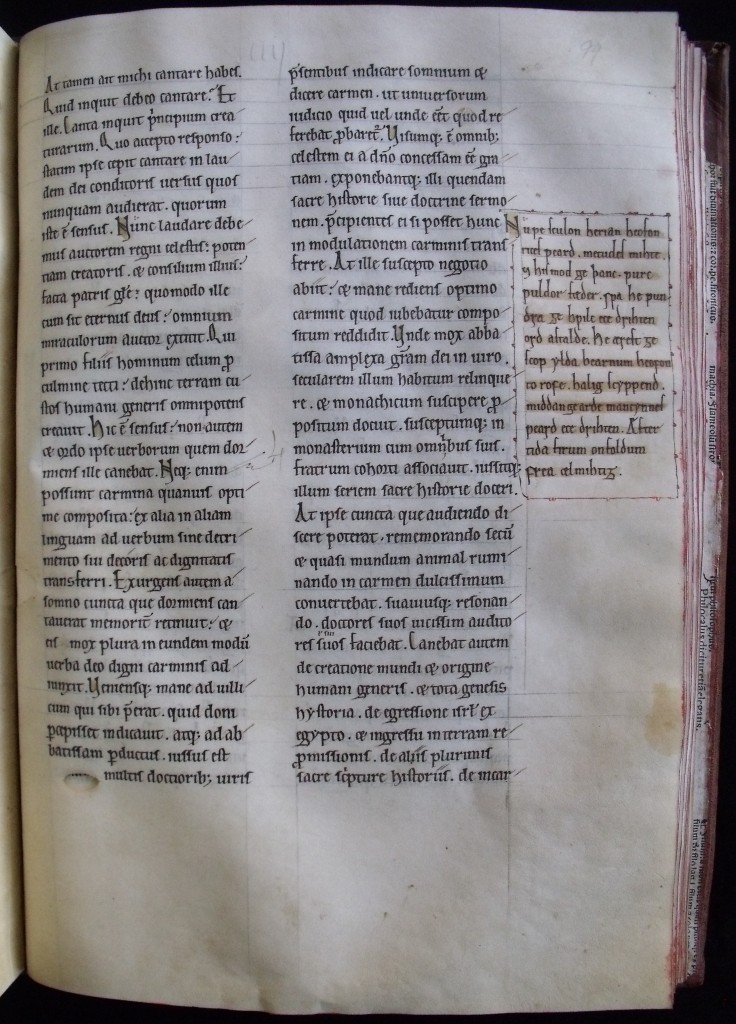
Bede’s Ecclesiastical History (Caedmon’s Hymn) in Oxford, Magdalen College, MS.Lat.105. Credit: The President and Fellows of Magdalen College, Oxford. Reproduced with permission.
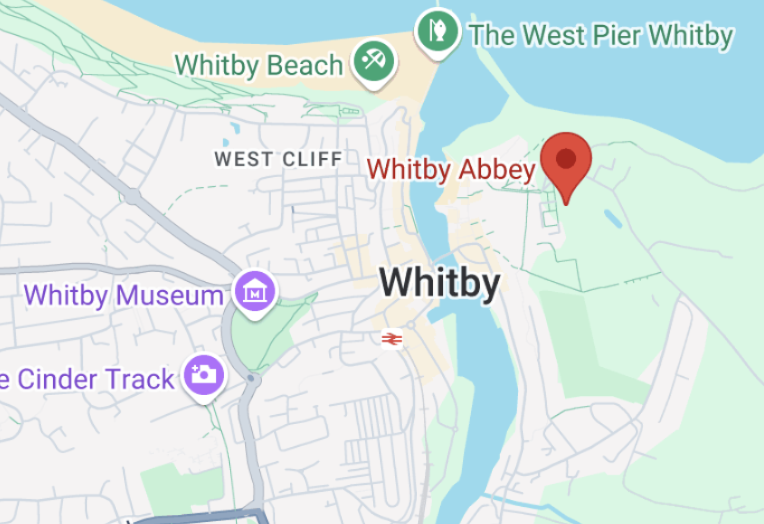
Hild of Whitby, often known by the latinised version of her name, Hilda, was the founding Abbess of Streanaeshalch, now known as Whitby, high on the North Sea cliffs above the safe harbour where the River Esk reaches the North Sea. Today, Whitby Abbey is a striking ruin, towering above the coast. It is maintained by English Heritage and there is a visitor centre on site. Whitby Museum is located near by in Pannett Park.
Hild was the daughter of Breguswith and Hereric, nephew of the first Christian Northumbrian king Edwin, so was of noble birth. She was instructed in Christianity by Paulinus, the first bishop of York and thus was part of the very first wave of Northumbrian Christianity.
Little is known of Hild’s early life. One of her sisters, Hereswith, was mother of Ealdwulf, king of the East Angles, but had retired to live as a nun in France. Hild did not become a nun until she was 33, she did intend to join her sister but was called back by Aidan, bishop of Lindisfarne. Beginning her religious life first on the north bank of the River Wear, she became abbess of the recently established monastery at Hartlepool, where she was visited regularly by Aidan and other learned men.
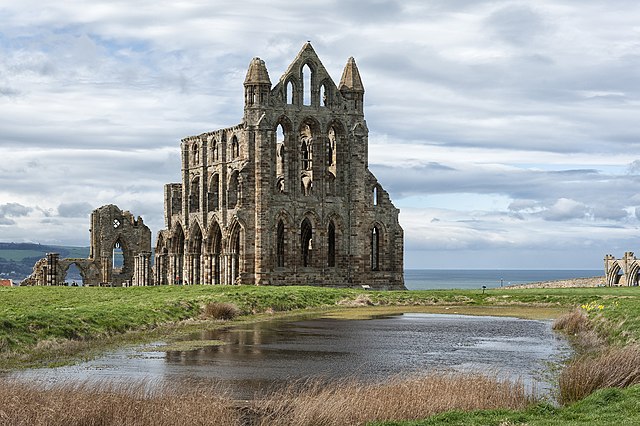
The ruins of Whitby Abbey seen from the south east. Credit: Juliet220, CC BY-SA 3.0 https://creativecommons.org/licenses/by-sa/3.0, via Wikimedia Commons
From Hartlepool, Hild moved to Whitby a ‘double’ monastery of women and men with a woman in charge; her position as abbess reflects her prominence in the Northumbrian Church. Today Whitby seems on the edge of things, but at the time Whitby had a prominent place on the sea routes to the south and to Rome. Perhaps that, along with Hild’s reputation was why it was chosen as the venue for the Synod of Whitby at which the Northumbrian kings chose to accept the Roman date of Easter.
Hild’s contribution to early medieval literary culture centres on her patronage of Caedmon, the earliest English poet whose name has come down to us. Caedmon was an illiterate farm-worker at the abbey was called on in a dream to sing a song about the Creation of the world. Caedmon, who had previously avoided singing at feasts, composed some verses. He was brought to Hild who believed that Caedmon had received a gift from God.
Hild recognised that Caedmon’s verses would assist the process of converting the people of Northumbria to Christianity because they could be sung at feasts. We know that Hild used her connections to distribute the hymn widely because the vernacular text survives in 21 versions in different Anglo-Saxon dialects which points to it having been used widely across England.
The Hymn itself consists of just nine lines it is theologically conventional, telling the Christian story of creation in a simple and memorable form.
The lasting importance of the poem to the English medieval church is exemplified in a 12th century Latin manuscript at Magdalene College, Oxford (Magd. MS.Lat.105, f.99) where a vernacular version has been added to the account of Caedmon’s story.
But Whitby was not just a centre for missionary work, it was also very much a centre of learning, probably the pre-eminent centre for learning in Anglo-Saxon England. After Hild’s death, a life of Pope Gregory the Great was written at Whitby linking this wind-swept corner of Northumbria with Rome, then the heart of Europe.
Further Reading
Bede, The Ecclesiastical History of the English People, ed. Judith McClure and Roger Collins (Oxford: World’s Classics Series, 1994).
Clare A. Lees Gillian R. Overing, ‘Birthing Bishops and Fathering Poets: Bede, Hild, and the Relations of Cultural Production,’ Exemplaria 6.1 (1994): 35–65.
Daniel Paul O’Donnell, Cædmon’s Hymn (Cambridge: D.S. Brewer, 2005)
Andrew White, A History of Whitby (Cheltenham: The History Press, 2019.
]]>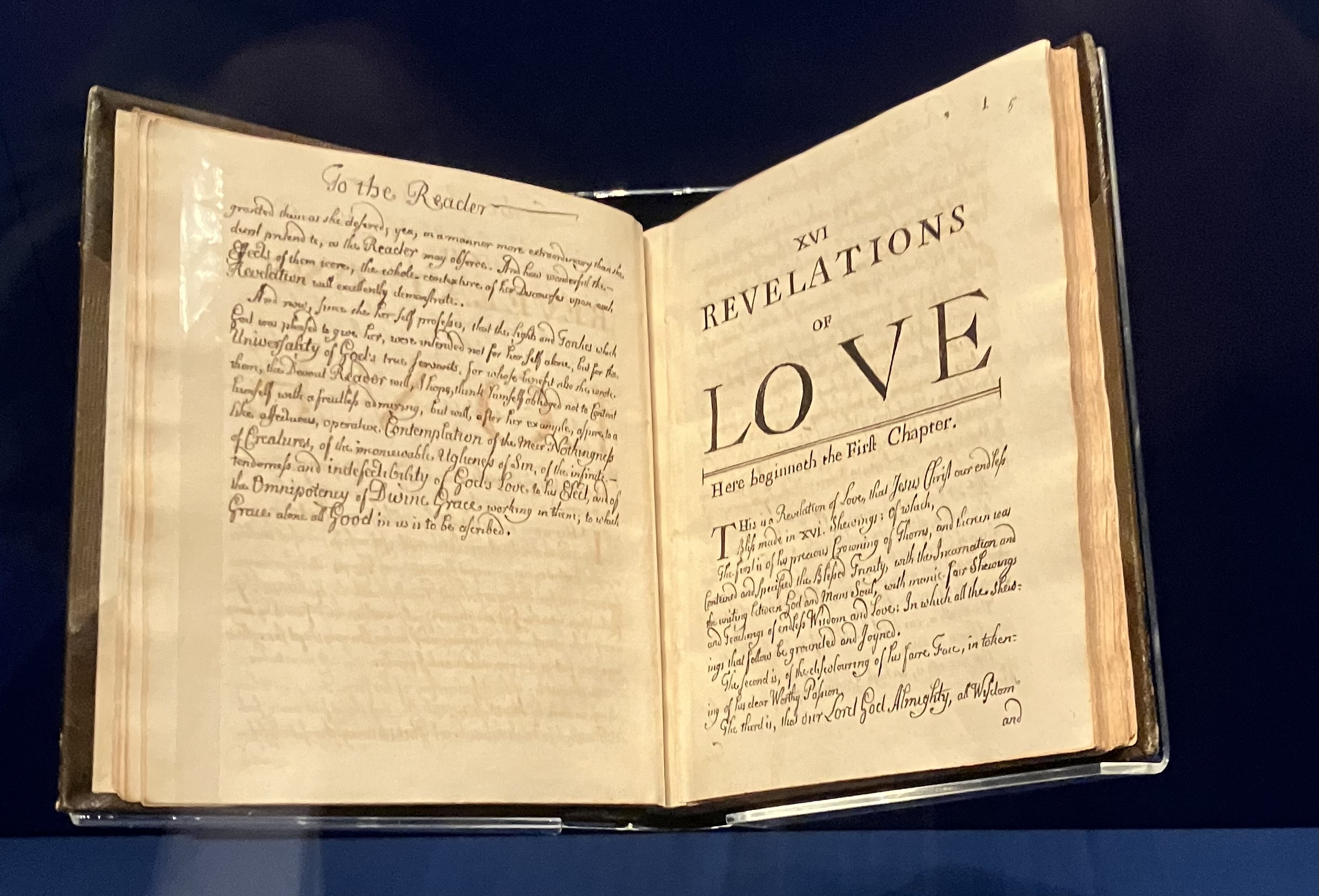
Julian of Norwich’s Revelations of Divine Love (the ‘Long Text’), possibly Cambrai (France) around 1675, on display at the British Library’s Medieval Women: In Their Own Words Exhibition (c) British Library
A woman has a vision of something like a hazelnut in the palm of her hand, and contemplates that ‘it is all that is made’. This was Julian of Norwich, the first woman to have her name recorded as an author in English. Entering a cell in St Julian’s church in Norwich, one finds a bowl full of hazelnuts—testament to Julian’s striking image of the entirety of creation found in a humble hazelnut. Julian was enclosed there as an anchorite, a recluse, in the cell attached to the church.
Very little is known about Julian of Norwich’s life. She may or may not have been a nun. It is possible she had a child who died in the Black Death, the devastating pandemic of bubonic plague that spread through Europe in the fourteenth century. It was later in life that she chose to become an anchorite, living the remainder of her days in the cell in St Julian’s.
Julian is known for a prose work, The Revelations of Divine Love, in two versions (the ‘Short Text’ developed into the ‘Long Text’). Alternatively, we might see these versions as two distinct works. Julian tells us that she had a debilitating and life-threatening illness at the age of thirty. This illness provoked a series of visions of Christ’s suffering, love, and grace, and Julian felt compelled to share these visions with her fellow Christians. It is these experiences that form The Revelations of Divine Love.

In this work or works, Julian has a series of sixteen visions. These are visions rich in visual detail, leading one scholar to suggest that Julian ‘reads her vision like a picture rather than a story’ (Denise Nowakowski Baker). In her first vision, Julian sees Christ’s crowning with thorns, and this event is relayed in vivid detail. She sees the ‘red blood trickling down from under the garland, hot and freshly and most plenteously’. In the eighth revelation, Julian sees a close-up of Christ’s face as he dies, watching it change colour and losing all its moisture.
But such suffering is always combined with the gentleness of Christ’s abiding and all-encompassing love. In the tenth revelation, Julian has a vision of Christ gazing at the terrible wound in his side. He then leads her inside his body, his side acting as a kind of opening. There, Julian sees a place that is ‘beautiful, and delectable, and large enough for all humankind that shall be saved to rest in peace and love’. She even hears Christ speaking to her, uttering the following words of love and compassion: ‘My darling, behold and see your Lord, your God who is your creator and your endless joy; see what pleasure and bliss I have in your salvation, and for my love rejoice now with me’.
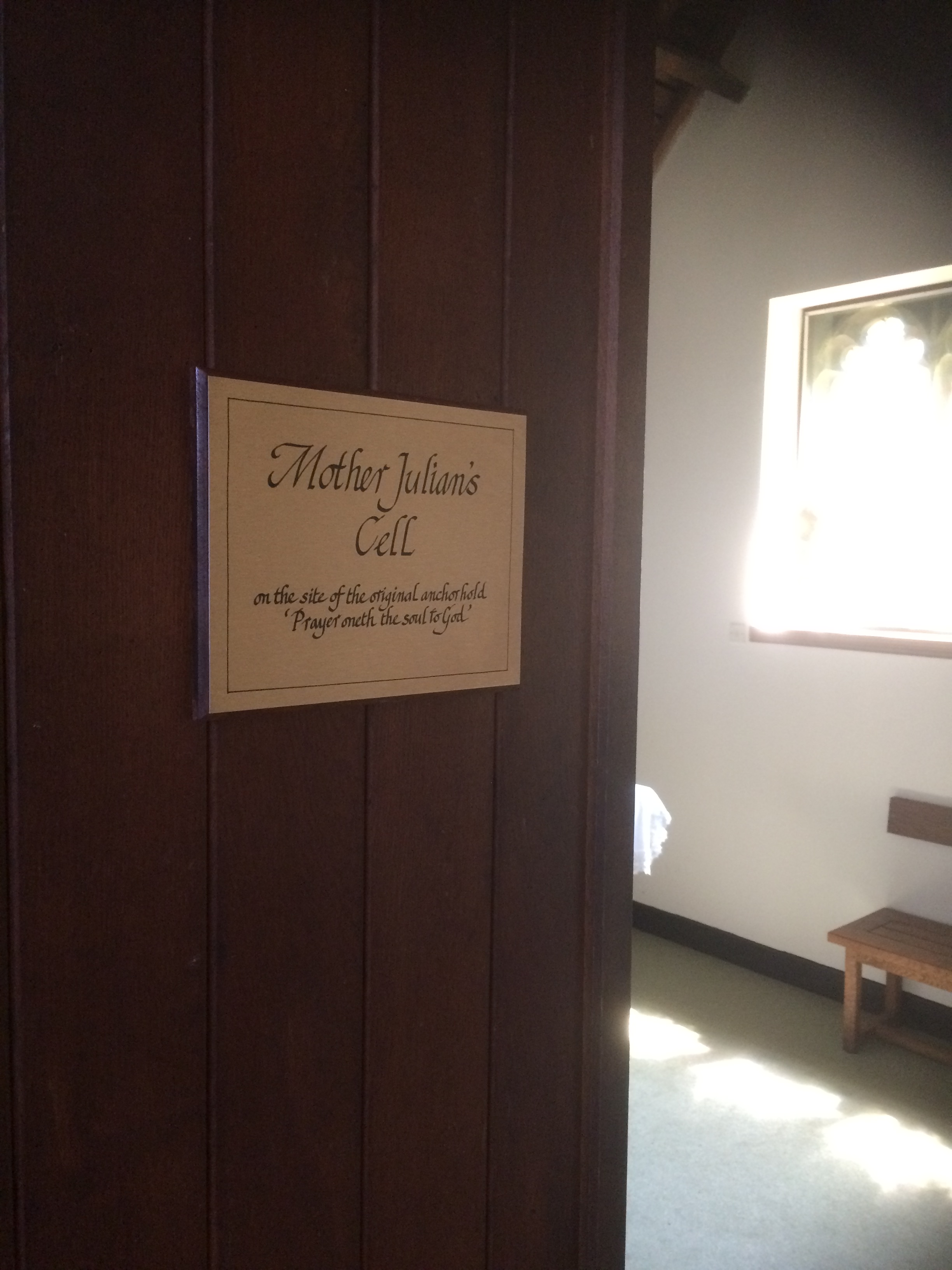
Entering Julian’s reconstructed cell (c) Diane Watt
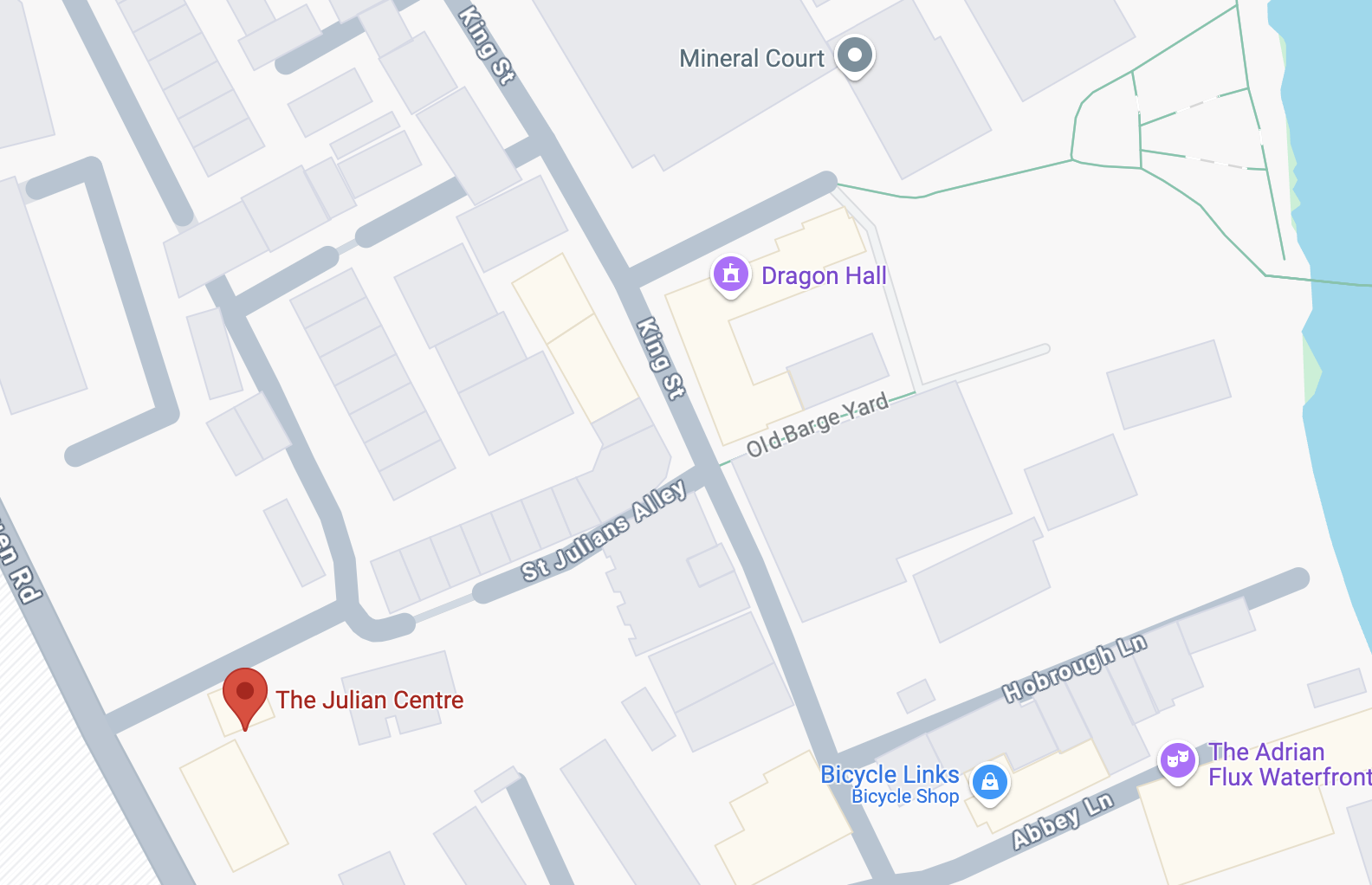
To this day, visitors can see and walk in a reconstruction of the cell where Julian spent her later years, ruminating and writing on her extraordinary visions. The church, which in the Middle Ages was situated in the thriving mercantile area of Conesford, had been destroyed in the Norwich Blitz in 1942, but was rebuilt and reopened in 1953. Since then, it has remained a home to Julian’s legacy.
Further reading
1.Translation
Julian of Norwich, Revelations of Divine Love, trans. by Barry Windeatt (Oxford: Oxford University Press, 2015)
2.Secondary Reading
Denise Nowakowski Baker, Julian of Norwich’s Showings: From Vision to Book (Princeton: Princeton University Press, 1994).
Santha Bhattacharji, ‘Julian of Norwich (1342-c.1416), Oxford Dictionary of National Biography (2014), https://doi.org/10.1093/ref:odnb/15163; Accessed 19 March 2025.
Hetta Howes, Poet, Mystic, Widow, Wife: The Extraordinary Lives of Medieval Women (London: Bloomsbury Continuum, 2024)
Elizabeth Ruth Obbard, Through Julian’s Windows: Growing into Wholeness with Julian of Norwich (Norwich: Canterbury Press, 2008)
Janina Ramirez, Julian of Norwich: A Very Brief History (London: SPCK, 2016)
]]>