In May 2020, we published a thorough discussion of how much it costs us to publish an open access (OA) book, using the figures from our October 2018–September 2019 financial year. We included information about our costs; the revenue streams that enable us to meet those costs; and how we saw this approach ‘scaling’ in the near-to-medium-term future. We did this “to provide some of the numbers that are currently missing and to counter some of the prevailing assumptions about funding OA books.” Since this year’s Open Access Week theme is ‘The cost of knowledge’, now seems a good time to revisit this piece from almost six and a half years ago and to reflect on what is different today: the changing context we’re working in, how our own costs and revenue models have shifted, and what the future looks like now.
Output
We are a scholar-led, non-profit, Diamond OA book publisher (that is to say, we don’t charge readers to access our books and we don’t charge authors a compulsory fee to publish with us). All of our books are freely available under a Creative Commons licence from the date of publication, in PDF and (usually) HTML; we also sell copies in paperback, hardback, and (usually) EPUB formats. In our 2020 post we talked in more detail about our approach to publishing and the quality of our work; we won’t repeat this here but encourage you to read the relevant sections of that post (which are almost entirely[1] still accurate) if you would like to know more.
In 2020, we had published over 170 titles, at a rate (at the time of writing) of between 24–30 books per year. Now we are approaching our 500th publication and we publish between 55–70 books per year: a more than 100% increase in our annual publication rate. It’s worth reflecting on how this increase has been achieved.
Costs
As we pointed out in our 2020 post, conversations about OA books often jump straight to revenue, with the Book Processing Charge (BPC) the most common model used. BPCs don’t necessarily reflect cost, however; they are what the publisher charges to publish a book OA, which might not be what it costs them to do so. And if costs can be kept lower, revenue can go further.
We are a non-profit publisher, so we also do not need to make additional revenue for shareholders. Our operations are entirely structured around our key objective: making high-quality research as widely accessible as possible. Financial sustainability is obviously important, but any surplus is reinvested so we can publish more titles. Our full financial statements are publicly available online at Companies House.
As was the case in 2018–2019, we have two operational ‘arms’ of OBP: a publishing arm (the core of our work, publishing OA books) and a software development arm (developing open source software to support OA book workflows and infrastructure). The latter arm has been funded entirely from research and development grants received for that purpose. So here we separate out the costs and revenue of our publishing operation only—although, as we will go on to discuss, the infrastructure built over the last six and a half years by these R&D projects has significantly increased our efficiency and enabled us to improve the quality of our books in important areas such as accessibility.
If we look at our most recent complete financial year Oct 2025–Sept 2026, we see the following costs (NB: these figures are for our most complete financial year, which has only just ended, and so they are provisional at the time of writing):
During this period, we published 57 new books (compared to 25 in 2018–2019), which is an obvious explanation for the overall increase in costs.
However, in our 2020 post, we also shared the average ‘first copy’ cost of production for our titles. This can be obtained by considering ‘Total costs’ less ‘Printing costs & royalties’ (which are associated entirely with costs incurred after the first copy) and dividing by total number of titles published.
Average ‘first copy’ cost of production = £6,594 per title (compared to £5,266 in 2018–2019)
The overall first-copy costs have risen by just over £1,000 per title in six and a half years. Within that, however, there are some more complex shifts.
Changes since 2018–2019
In 2020, we noted that our offices in King’s College, Cambridge were rented to us at favourable terms. Since the conclusion of the pandemic, we moved to fully remote working, so we now have no rental costs at all included in ‘Overhead’. However, there has been a significant increase in our IT costs (from £1,400 to £9,750) reflecting both our increased publishing output and the increased cost of these services over time. We also now make contributions to the Open Book Collective’s Development Fund (£3,200) which awards grants ‘to build capacity to increase the quantity, quality and diversity of Open Access books’ (this is part of the ‘scaling small’ ethos we will discuss below).
There has also been a significant increase in our title production costs; this is because we now outsource some specialist typesetting work to a trusted freelance colleague, and because of external copyediting for a specific series that requires a substantial degree of subject-specific knowledge.
Inflation has obviously been a factor, with significant changes to the inflation rate during this period. Overall, the Bank of England’s inflation calculator estimates that goods and services costing £5,266 in 2020 (our first-copy costs back then) would be expected to cost £6,957 in August 2026—so our first-copy costs increase overall is about 5% below inflation.
Comparisons
As we noted in our previous post, and as we still think relevant today if comparing OBP with many other presses,[2] our acquisition costs are likely significantly lower. This is because we do not invest money in e.g. travelling to conferences to meet and persuade potential authors, or take on other significant costs that might support a competitive acquisitions process. We receive many high-quality proposals, and we are not interested in approaching acquisitions as an area in which to compete with other presses for advantage. Instead we pursue a collaborative ‘scaling small’ approach that we will discuss in more detail later in this post.
Our distribution costs, which in any case are not typically part of ‘first-copy’ cost calculations but are nonetheless costs that a press has to cover, are also likely lower than those of many other presses because most distributors, of both printed editions and ebooks, take a margin of 30-60% of the sale price of the title. Given that our printed titles typically retail at less than £30–£50, and ‘legacy’ publications typically retail at prices in excess of £60–£120, it seems likely that distribution costs associated with our printed titles are, at most, half of those for legacy publishers. Distribution costs for digital editions are considerably less, since the vast majority of people access our digital titles at no cost (the hosting costs we incur for this are incorporated into our ‘Overheads’ cost). We also now have the benefit of Thoth Open Metadata to support our distribution, which has considerably lessened the staff time required, as we will go on to discuss.
Revenue
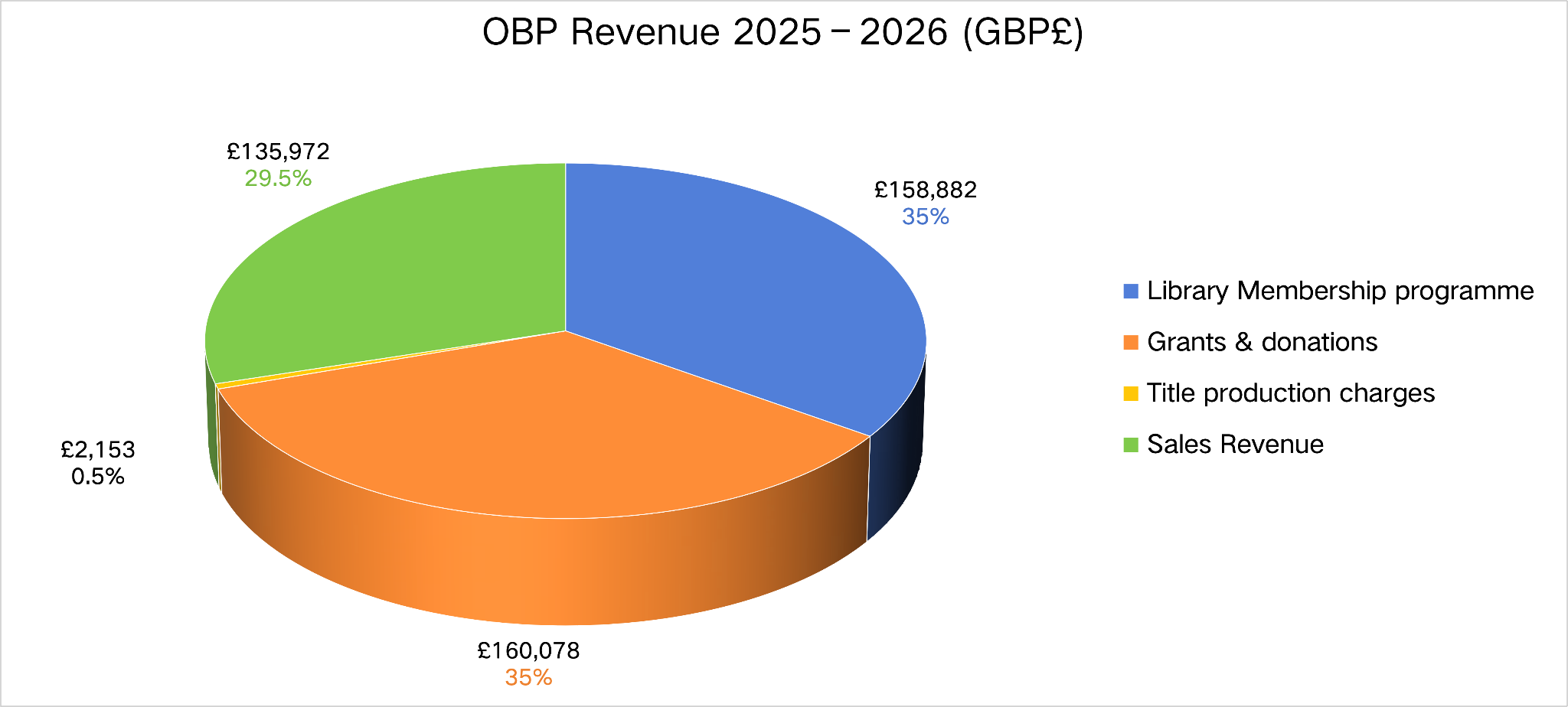
As with our costs, if we look at our most recent complete financial year Oct 2025–Sept 2026, we see the following revenue figures (NB: these figures are for our most complete financial year, which has only just ended, and so they are provisional at the time of writing):
As was the case in 2018–2019, we have three main revenue streams: sales, income from our Library Membership Programme, and grants and donations.
Changes since 2018–2019
The amount of revenue we are bringing in has significantly increased relative to 2018–2019, for two main reasons:
- We are now publishing many more books, which results both in increased sales revenue overall (although per title our sales revenue has decreased, which we will be blogging about in the near-ish future)[3] and in increased grant income, since grants are mostly tied to particular books. In 2025–2026, out of 57 books published, 13 had all of their costs funded by grants and 15 had partial grant funding attached. This means we published 29 books without any grant funding whatsoever. In total, 34 books could only be published thanks to either complete or partial support from a combination of our Library Membership Programme and our sales revenue.
- Our Library Membership revenue has increased, both because we have more Library Members (around 100 more compared to 2019) and because we have adjusted our membership fees, from a flat rate of £300 a year per library in 2019, to a tiered annual system in 2026. (We are also now members of the Open Book Collective (OBC), which didn’t exist in 2019, and we will discuss the impact of this more fully below.) Most of our libraries belong to a tier between £300–£700 depending on their size, while a small number have elected to join our ‘Quarto’ tier at £1,500 per year or our ‘Folio’ tier at £5,000 per year. Our Library Membership programme was effectively our joint-largest income stream in 2025–2026 at 35% and £158,882, increased from £42,137 in 2018–2019, when it was the smallest strand and represented only 23% of our income. (Our revenue from grants and donations was only 0.25% and £1,196 higher than our Library Membership income at £160,078; this includes individual donations as well as title grants.) It is important to emphasise that this substantial income from our Library Membership Programme (which one could argue, given our average first-copy costs, funds 24 OA books by itself), comes at a cost to each individual library of a fraction of the average BPC for one book—a tiny fraction for those libraries that are part of our regular tiers, and still only around 50% for those few libraries that are part of our most expensive Folio tier. This is the power of collective funding in action.
It is worth noting that this growth in revenue from libraries comes at a time when many universities across the world have been experiencing funding crises, subsequent to the COVID-19 crisis that we were all facing in 2020 when the initial blog post was written. It is possible that the COVID-19 crisis itself persuaded more people within libraries (or perhaps university leadership) of the importance of open digital resources, but it is also true that the sustained support of libraries during a time of financial turmoil has been enormously valued and, we hope others will agree, extremely cost-effective in terms of the overall return on investment. We have certainly noticed in increase in library focus on, and investment in, community-led OA initiatives (and a consequent rise in ‘community-washing’ by commercial presses that want to try to muscle in on this trend)—a focus that seems to persist despite (or perhaps because of) broader uncertainties. We urge universities to reflect on the significant impact that this investment is having and to consider how much more might be achieved by greater investment in the kinds of publishing activity represented by OBP (and by the members of the Open Book Collective and the Open Journals Collective, among others).[4]
Improvements from 2018–2019
We are now publishing over 100% more books compared to 2018–2019 with a very similar-sized team compared to that time.[5] Roughly speaking, there is a similar number of person-hours involved, with the work distributed across more full-time roles and fewer part-time staff bringing down the overall head count, and with some rebalancing of the staff numbers across editorial and production resulting in an increase in the person-hours logged on the editorial side. This suggests that our production processes in particular have become more efficient.
We have also made significant improvements in the accessibility of our books. We began adding alt text to our titles systematically from 2023, in addition to other accessibility measures to bring our books into line with current best standards. Our books are also more easily discoverable in a wider range of places and with better quality metadata than before.
How has this increased efficiency and greater quality been achieved?
Scaling small
The most significant impact on our work since 2020 was anticipated in that earlier blog post: the activities of the COPIM Project (2019–2023) and a second project, Copim Open Book Futures (2023–2026). The development of the OBC and Thoth Open Metadata had a particular impact. Following an ethos of ‘scaling small’—that is, enabling growth within a community-led, non-commercial ecosystem that is focused on building collaborative solutions to common problems through knowledge-sharing and shared, open infrastructures, rather than through commercial consolidation—these collaboratively built and community-owned infrastructures support our work and that of many other small- to medium-sized OA book publishers.
Thoth Open Metadata underlies our online catalogue and our website; it enables us to create high-quality open metadata in multiple formats and to distribute this to many different outlets and systems at a fraction of the time we used to have to invest into this vital process (which is particularly important for an OA press that wants our titles to be widely discoverable and openly shareable). The OBC now administrates our Library Membership Programme for a proportion of our Library Members who wish to route their membership through the Collective. Although this incurs a cost to us on the one hand (we pay 5% of the library income we receive through OBC to contribute to its running costs, and we make a 5% contribution to the OBC’s Collective Development Fund) on the other we have gained new Library Members thanks to the OBC’s outreach efforts, and they also administrate all of the memberships that are routed through them, which saves us staff time; we also hope that the OBC will be more successful at attracting consortial library funding than we have been on our own, because of its greater size. (Again, this is one of the benefits of the ‘scaling small’ approach!) Thanks to both of these infrastructures, our operating costs are lower and we have more time to invest in working on our books.
Copim has also created resources that have contributed to other areas of our work, including accessibility, archiving and preservation, and our more experimental projects.
There has been a broader shift in the OA landscape since 2020. Likeminded communities focused on knowledge-sharing, joint advocacy and shared solutions, including Copim, ScholarLed, the Open Institutional Publishing Association (or OIPA, of which we are now associate members), the Open Access Books Network, and OPERAS are either new since then or have grown larger. Other models have sprung up focusing on collective funding for OA books, including Opening the Future (a Copim initiative), D2O at MIT, Path to Open, and many more—in one sense these are competition for library resources, but they are also making the argument that this way of funding OA books should be taken seriously and significant resources should be devoted to it. We also see increased coordination at a community level—and at a governmental level—in different countries across Europe, including the Netherlands and Ireland, and galvanising activity across the continent in support of Diamond OA with initiatives such as the European Diamond Capacity Hubs and National Capacity Centres, and projects including ALMASI and AEGIS. With more people making the argument that community-led OA should be supported and invested in, a rising tide has the potential to lift all boats.
In addition to these OA-specific changes, AI tools have also begun to save us some staff time. We put considerable care and thought into decisions about how we choose to use AI tools in our publication processes to complement human expertise in specific aspects of our work. Most significantly, we use AI tools to generate initial lists of index topics, draft preliminary book blurbs, and create alt-text for accessibility. AI also assists in the compilation of lists of journals and societies for marketing purposes.
Finally, one of the series we now publish, new since 2018–2019, has the bulk of its editorial and typesetting completed by freelance staff because of the specialist knowledge required, so we invest less of our own staff time in these titles than in most of our books (although there is still a proportion of our editorial and production time required, plus our standard distribution and marketing input—and the freelance labour is reflected in our increased title production costs, as noted above). We published 8 titles in this series in 2025–2026.
Conclusions
Our 2020 post was sparked by conversations around UKRI’s proposal for an OA books mandate in their upcoming policy, and furious cries that such a move might result in the death of the monograph. The policy came to be, and the death of the monograph has not come to pass.
However, in 2026 we observe widespread inertia following the decision not to include an OA books mandate in the current REF cycle, and an insistence (which, going by current levels of inactivity, is not being taken seriously) that such a policy will apply for the next REF. In the UK and in other countries, the wider picture in Higher Education is that of funding cuts and job losses, and governments beset by challenges struggling to grapple with the slow withering of the university system. Threats to academic freedom appear to be increasing, most notably (but not only) in the United States, and although AI tools can offer benefits they are also causing significant challenges for teaching, research, and publishing. We also see a reliance in universities and elsewhere on monolithic commercial technology companies that are increasingly uninterested in democratic norms, never mind the needs of scholarly communities. This is an era when access to knowledge is needed, seemingly more than ever before, but the systems that produce and disseminate much of that knowledge are facing significant and multiple challenges.
When we reflect on these wider challenges, the fact that OBP has grown as it has—and that the wider community-led OA publishing landscape has developed as it has—is arguably a minor miracle. We believe it is worth paying attention to what has enabled this success. Community-led OA presses like OBP can offer expert OA publishing at a fraction of the cost of many alternatives, and we are part of the development of innovative, equitable and community-owned infrastructures to ‘scale small’ our work and that of our communities. We believe it is particularly important that these initiatives are independent from control by any one institution, company, or government—that they are truly collective, and collectively governed, endeavours.
However, presses like ours and the broader community that we are part of need support if they are to continue to develop, and if their potential for growth is to be realised. We hope this post helps to provide some evidence of that potential.
[1] Our partnerships with Worldreader and OpenEdition have come to an end since the 2020 post was published; everything else is still accurate.
[2] For some estimates of costs from other presses for comparison, see for example the following: ‘How much does a typical specialized monograph cost to publish? The short answer is: it’s complicated. Ithaka S+R published a detailed study in 2016 that benchmarked the “basic” cost of a monograph at $28,747 and the “full” cost including overheads at $39,892.[14] In 2022, Project TOME published a retrospective analysis, using a modified version of the methodology developed for the 2016 study, benchmarking the average cost of a monograph in the program at $19,954.[15] The SHMP project experienced lower costs still, in the range of $10,000-$12,000 per book (excluding general and administrative costs),[16] as a result of its standardization and economies of scale.’ Laura Brown, Maya Dayan, Brenna McLaughlin, Roger C. Schonfeld, John Sherer, Erich van Rijn, 'Print Revenue and Open Access Monographs: A University Press Study', ITHAKA S-R, September 2023, https://doi.org/10.18665/sr.319642
[3] Since our 2020 post there has been more attention paid to the fact that it is possible to make significant revenue from the sale of OA books: see for example the study cited in fn.2. It will be important to continue to monitor this in case of changes.
[4] When we reflect on the amount of money poured into BPCs, APCs, and so-called transformative agreements, we do wonder what community-led OA publishing might achieve with even a fraction of this level of investment. See for example Lisa Matthias, Eric Schares, Juan Pablo Alperin, Leigh-Ann Butler, Sherry Kuang, Nina Schönfelder, and Stefanie Haustein, 'Estimating global article processing charges paid to 14 publishers for open access between 2019 and 2025', August 2026, https://doi.org/10.48550/arXiv.2608.16322
[5] In addition to the staff listed on the current ‘Our Team’ page, and as mentioned earlier in this post, we also employ a freelance designer for specialist typesetting work and a freelance editor for a specific series that requires a substantial degree of subject-specific knowledge.
]]>By Alice Battersby
In our rapidly changing world, water – the excess or lack of it – is perhaps a greater concern than ever before. Climate change is making extreme weather events such as floods more frequent and unpredictable. Industrialisation has led to overextraction of many natural water resources, causing lakes and streams to dwindle, along with the nature and communities that depend on them. Agriculture requires water for irrigation, but too much water can be just as damaging to plants as not enough. Stephanie Kampf’s open access book, Hydrology for Sustainability, introduces these problems, and crucially, the ways they are being solved.
Of course, many of these methods rely on technology developed relatively recently. Fog harvesting, for instance, is carried out using a range of modern methods. Researchers have even taken inspiration from nature to create their designs. One type of beetle found in Namibia has a back made up of hydrophilic bumps separated by waxy hydrophobic surfaces. Water can condense on the bumps, and then fall into the waxy spaces between the bumps, flowing into the beetle’s mouth. Similar methods can be used for fog collection nets, where water condenses on hydrophilic bumps, and the drops fall down onto hydrophobic surfaces once they’re heavy enough, allowing collection. These innovations are fascinating, and can bring significant benefits.
What was particularly interesting to me, though, is the way that people throughout history and in different regions of the world have managed to work with water in clever and surprising ways. Their knowledge, developed over long periods of time through experimentation and practical experience, can be valuable to other communities seeking to work with their own water resources. Rather than forcing the water to behave according to human preference, these techniques often fulfil human needs effectively using what is available.
The contrast between these two approaches is perhaps most evident in the case of wetlands. Crops can’t grow if they don’t have access to oxygen. Waterlogged soil, as found in wetlands, fills the air pockets in the soil, making it impossible for most plants to survive, except for those with particular adaptations. If the land is to be used for agriculture, therefore, something must be done to give the plants oxygen access. One solution to this is wetland drainage, which has been carried out widely in places including northern Europe, India, East Asia, and southeastern North America.
But wetlands have advantages. In intact wetlands, the vegetation slows down surface water flow, allowing more of it to seep into the soil and contribute to groundwater, which is the ultimate source of many of our water resources. This slowing can also help with flood prevention, as downstream areas receive extra water more slowly, over a longer period of time, rather than all at once. Wetlands have other benefits, too; they can store large amounts of carbon, and can therefore play a role in the fight against climate change.
Is there a way, then, to allow agriculture to continue even in wet conditions? In fact, there are several. The Aztec city of Tenochtitlan was built on an island in Lake Texaco. To grow crops for the city, the inhabitants constructed smaller islands on the lake, called chinampas, using willow frames, vegetation, and lake mud. On the islands, there is enough soil above the water level for plants to get oxygen, but the plants still benefit from the water surrounding them, which is sucked into the soil and towards the roots. Trees are planted to keep the soil stable and to replenish organic matter over time. As well as this, the islands support flourishing ecosystems. Considering the sustainability and benefits of this type of agriculture, it is no surprise that evidence for similar systems has been found in Bolivia, Ecuador, Venezuela, and Colombia.
A similar method, used in Bangladesh, is floating agriculture. Much of Bangladesh is at high risk of flooding, something that an increasingly volatile climate will only worsen. One traditional technique for dealing with this is growing crops on floating islands in the flooded areas. These are constructed from rafts made of water hyacinth, bamboo, and organic matter. This has a similar effect to the chinampas: the plant roots do not become waterlogged. These gardens have the additional advantage that they can simply rise and fall with the water levels. Farmers grow many different crops on these islands, including tomatoes, beans, and potatoes.
The usefulness of looking at traditional methods is also clear when considering the crops that we choose to plant alongside each other. In mass agriculture, planting crops in monocultures is common, where only one type of plant is grown in each area. But using careful combinations of plants in an area to form a polyculture can bring benefits for both nutrients in the soil and water resources. The ‘Three sisters’ combination, used originally by Mesoamerican Indigenous groups, is a good example of this. This involves planting beans, squash, and corn together. Each plant provides benefits to the others: the beans fix nitrogen in the soil, the squash provides ground cover to prevent evaporation of water, and the corn provides shade and a trellis for the beans to climb. Comparing this to a monoculture of corn, less water is needed for irrigation, as there is less bare soil between plants from which water can evaporate. This therefore helps conserve water resources while allowing the same or better crop yields.
This isn’t to say that new, innovative techniques aren’t needed. But it does show that there is value in looking at the ways people have managed challenges before. Working with rather than against the present state of water in a landscape is in some cases both possible and beneficial, and using traditional methods may be one way we can try to do this. This could be a huge boon to many around the world, helping us all to face the challenges the future will bring.
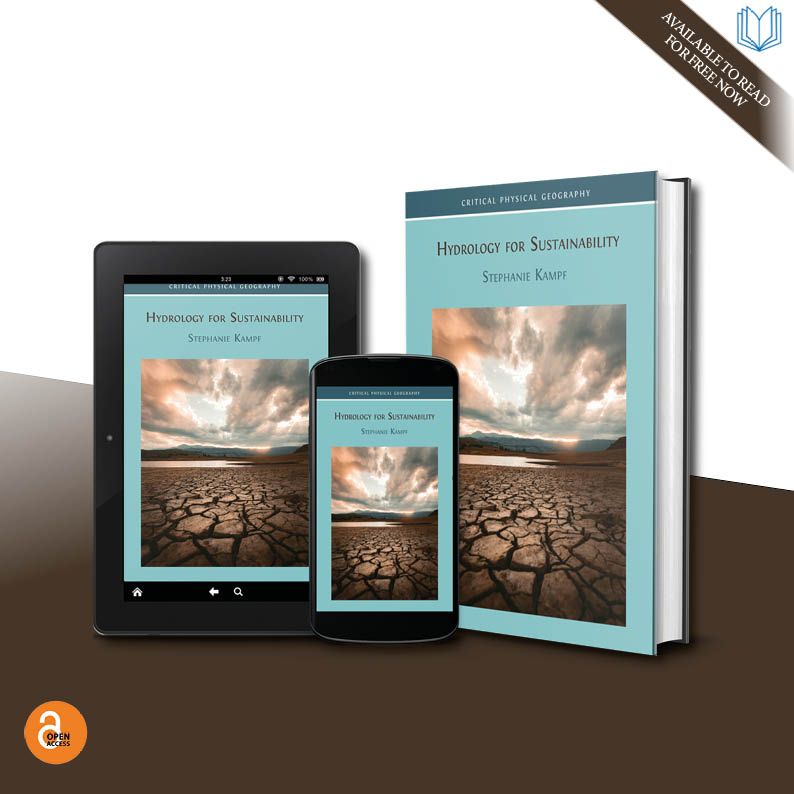
Stephanie Kampf's book, Hydrology for Sustainability, is freely accessible online in PDF and HTML, and you can also buy a copy in paperback, hardback or EPUB.
Today there are more open journals, repositories, educational resources, and digital platforms than ever before. Yet this does not mean that knowledge has become equally accessible to everyone. An open resource can remain invisible; global infrastructure can reproduce inequality; and formally accessible data can create risks for individuals and communities. Openness on its own is therefore not enough. We also need to look at how resources, capacity, visibility, authority, responsibility, and benefits are distributed. This largely determines whether openness actually contributes to equity.
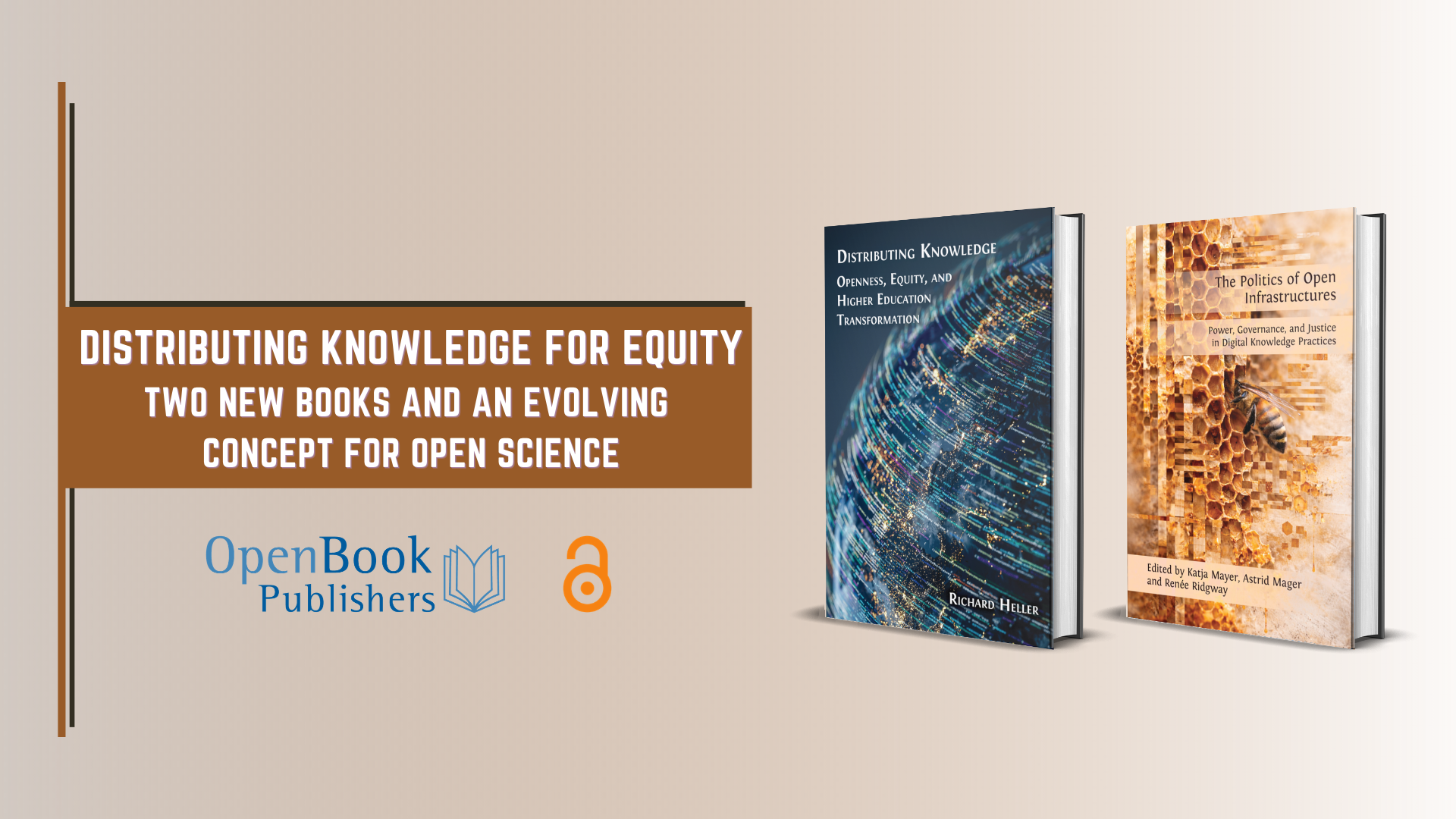
The publication of two open access books by the Diamond open access publisher Open Book Publishers stimulated a webinar to explore openness and equity in the distribution of knowledge. The session included presentations from Australia, Germany, Mexico, Nigeria, UK, and Ukraine. The recording is available to view online, and the slides are available to download.
Topics included how a distributed approach built on openness can contribute to equity in access to education and the production and publication of knowledge, how a distributed open infrastructure can support collaboration and new models of education in different global settings. The crisis response to the Russian invasion led to Ukraine’s ‘University without walls’ and a number of open education innovations, and demonstrated the potential for a wider application of a distributed model of education.
Openness is not enough
One of the most interesting outcomes of this conversation was that very different geographical and disciplinary contexts repeatedly brought us back to the same problem: openness is not enough.
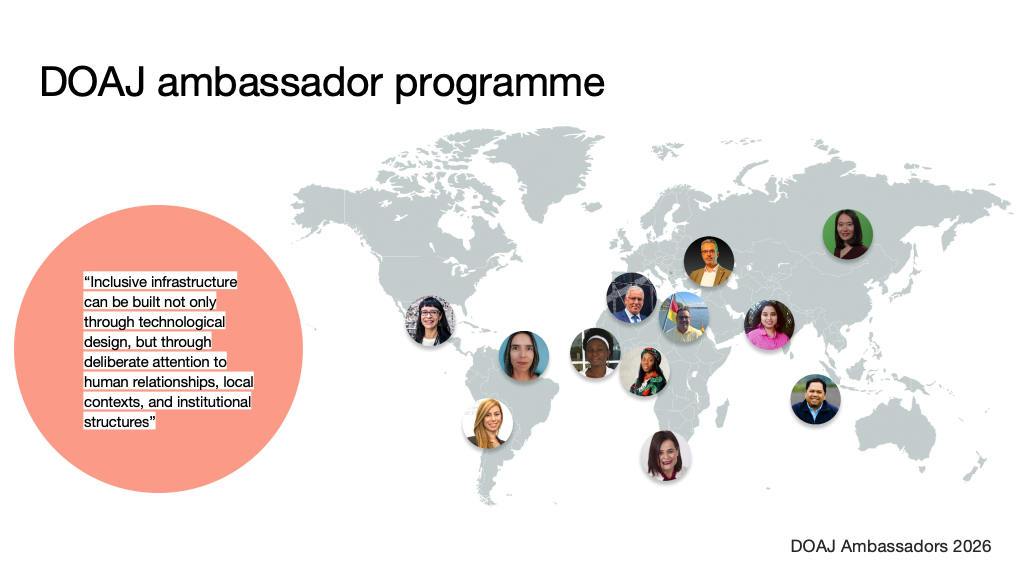
In open publishing, the experience of DOAJ illustrated this particularly well - inclusive infrastructure cannot be built through standards and technological solutions alone. Any classification system includes some and excludes others, while criteria developed in one context do not always work fairly in another. This is why DOAJ has developed its Ambassador Programme, involving people who work within local academic communities, understand local languages and practices, and are able to question the assumed universality of particular criteria. In this sense, inclusivity is not an end state but an ongoing process of negotiation, adaptation, and participation.
Building collaborative relationships while retaining local autonomy
A different tension emerges in open education — an open resource is not necessarily an accessible resource. Materials may be openly licensed and free to use, yet remain effectively invisible if they are hosted in isolated repositories, use incompatible metadata, or are not indexed by the services that teachers and students actually use. The question therefore shifts from “Where should we store all open knowledge?” to “How can different knowledge environments interact with one another without creating yet another dominant global platform?”
The same logic emerged from an African perspective where scaling the ecosystem, rather than the individual institution, is required. Universities do not necessarily need to reproduce an entire digital infrastructure independently if locally rooted and autonomous institutions can be connected through shared networks, repositories, digital identity, persistent identifiers, computing capacity, and other services. A formulation — “cooperate without having to become the same institution” — captures one of the central principles of a distributed model: collaboration should not require the loss of local autonomy.
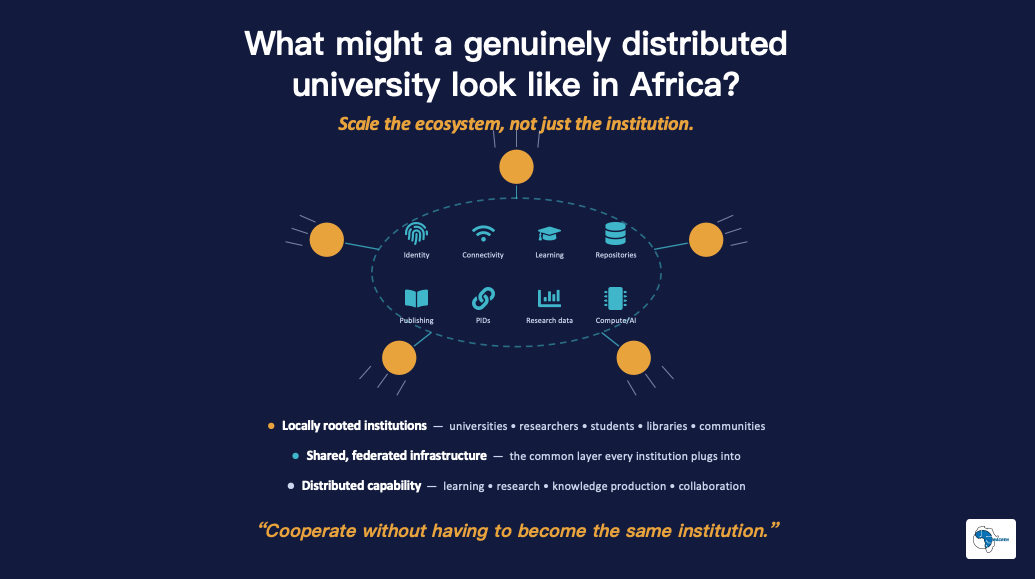
What does it take to maintain connections in a distributed environment?
The Ukrainian experience adds another dimension to this discussion. War has confronted displaced universities with a very literal question: what makes a university a university when it loses its campus, laboratories, and shared physical space?
The experience of Berdyansk State Pedagogical University illustrates this. Following the occupation of Berdyansk, staff and students found themselves dispersed across different cities in Ukraine and abroad, yet the university continued to function as a shared organisation. The “University Without Walls” brought together Moodle, synchronous and asynchronous learning, assessment and student support, psychological assistance, academic and cultural meetings in different cities, and international exchange. This experience shows that distributed learning is not simply about digital technologies. It requires shared resources, coordination, institutional responsibility, and human support.
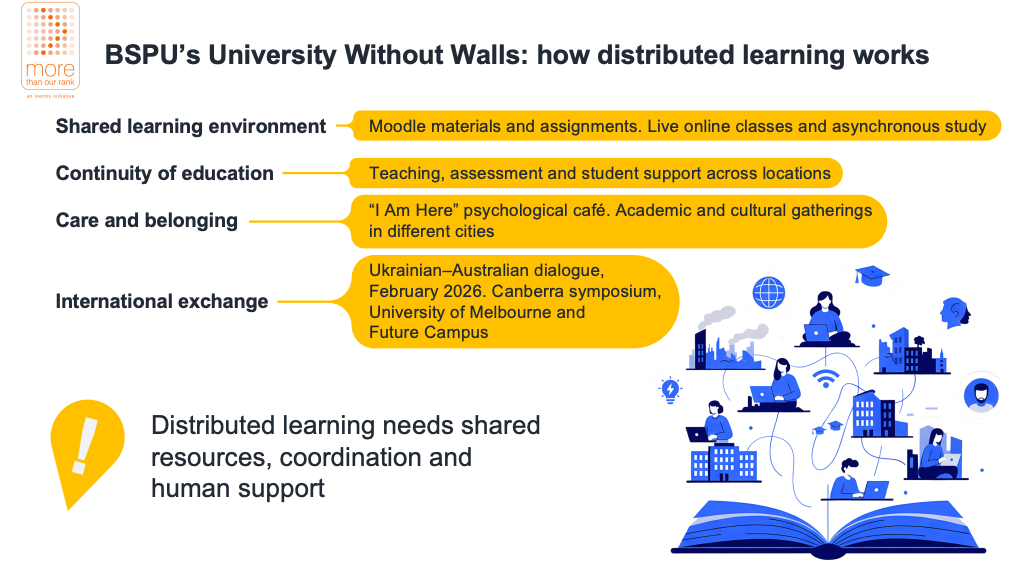
Who decides?
For open science, the issue becomes even more complex. Distributing knowledge means not only expanding access, but also distributing responsibility. In wartime, maximum openness is not always ethically appropriate. Data about researchers, students, or communities can create real risks. This is why the principle “as open as possible” must be balanced by “as closed as necessary.” In Berdyansk State Pedagogical University’s experience, this means combining open infrastructure with the CARE Principles, ethics review, data management plans, and a broader understanding of research responsibility.
From this emerge four questions that may be useful far beyond the Ukrainian case: Who has the capacity to participate? Who makes decisions? Who takes responsibility? Who benefits? These questions help move us from understanding openness simply as access towards understanding distribution as a set of relationships among people, institutions, and infrastructures.
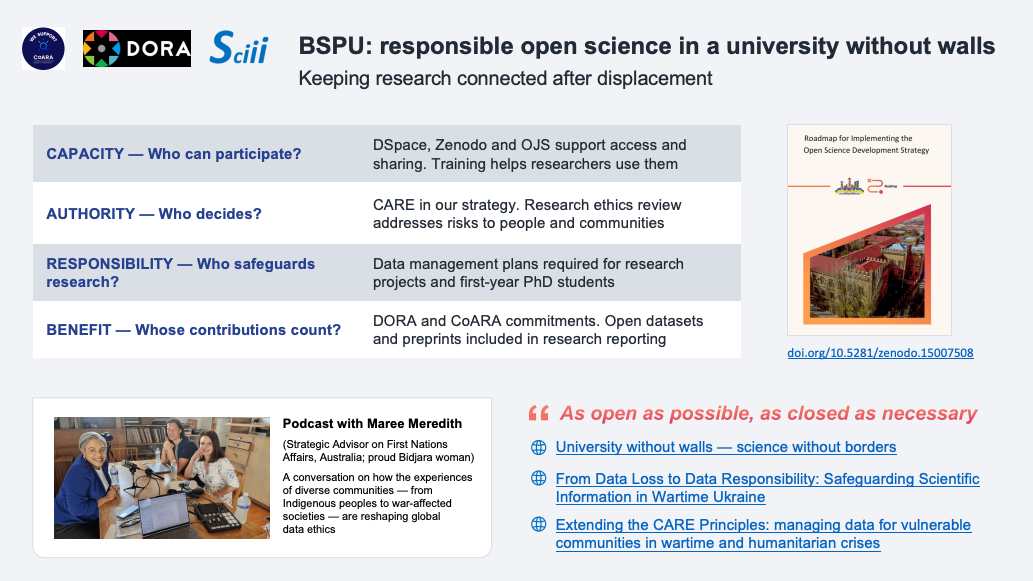
Distributed knowledge, power and governance
This is where the different contributions begin to form a coherent picture. DOAJ raises the question of the distribution of the power to define criteria. Distributed Learning Ecosystems raise the issue of visibility and the ability to find knowledge. The African model concerns the distribution of infrastructural capacity without loss of autonomy. The “University Without Walls” concerns the distribution of education, support, and institutional presence across different locations. Open science in wartime brings in the distribution of responsibility and protection.
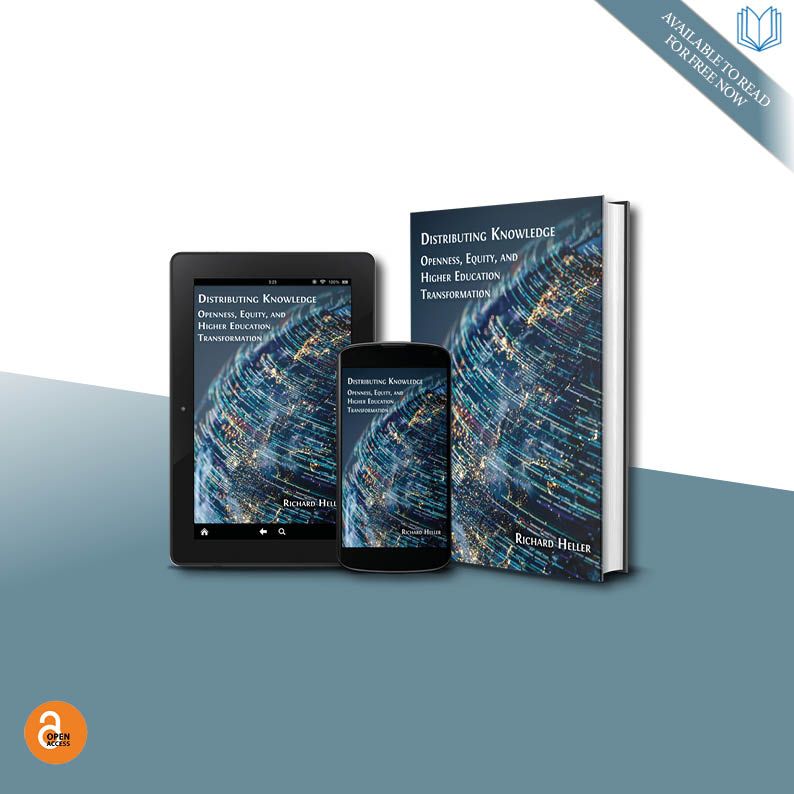
In this sense, the concept of distributed knowledge developed in the book Distributing Knowledge: Openness, Equity, and Higher Education Transformation is useful because it encourages us to move from asking whether knowledge is open to asking a more complex question: how are relationships around knowledge organised? His concept of the Distributed University invites us to see higher education not as a collection of autonomous campuses, but as a network of interconnected educational, research, and infrastructural capacities in which equity and openness become foundational principles.
At the same time, the second book, The Politics of Open Infrastructures: Power, Governance, and Justice in Digital Knowledge Practices, adds another important dimension to the discussion. Openness and distribution are not neutral technical characteristics. Infrastructures have their own rules, governance models, and centres of decision-making. Questions of access therefore sit alongside questions of power, participation, and justice: who defines standards, whose practices become visible, who can influence the rules, and who remains outside them.
Taken together, these two perspectives allow us to think about openness more broadly: not only as access to knowledge, but as a system of relationships in which resources, visibility, authority, responsibility, and benefits are distributed.
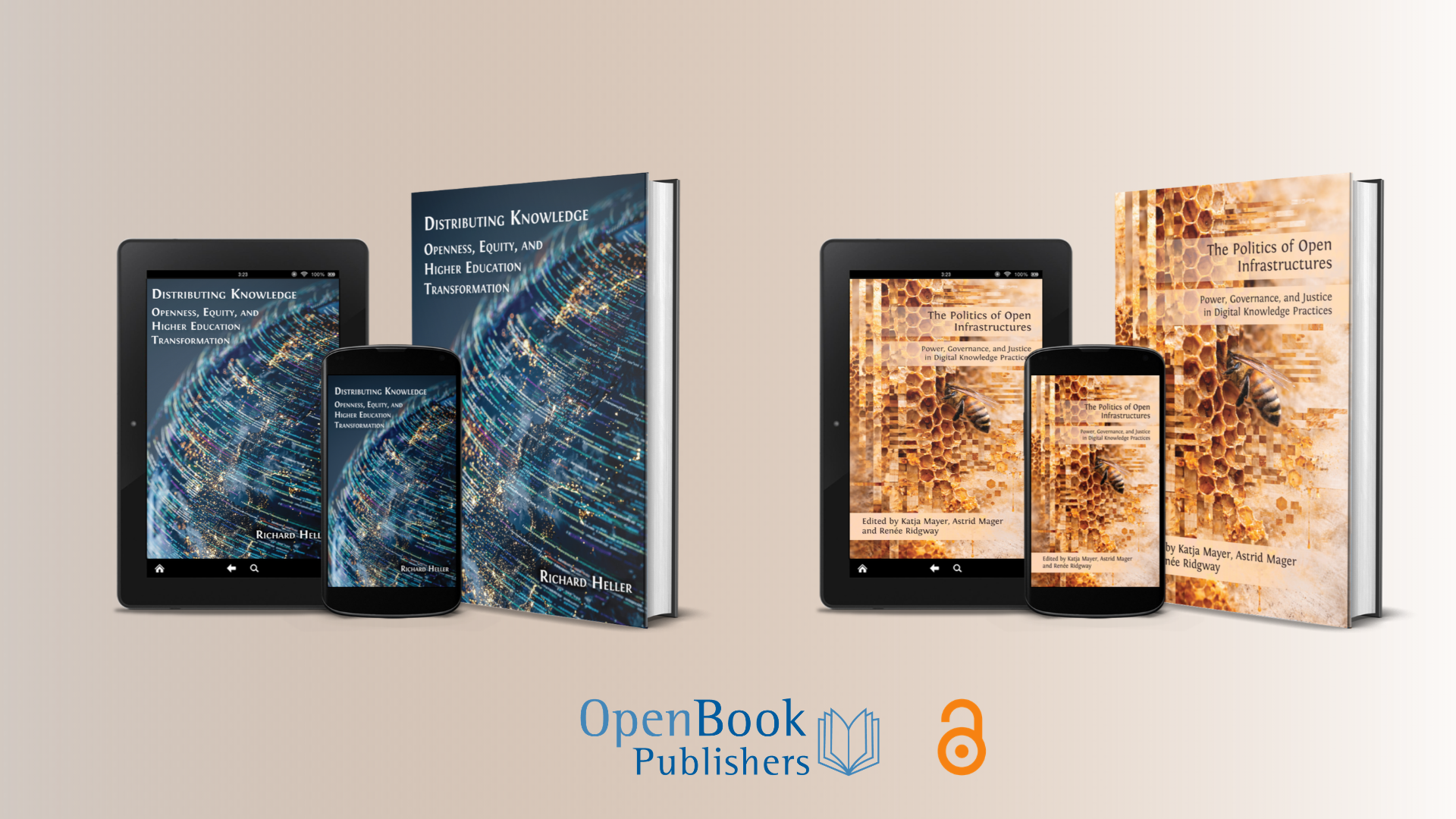
Making it work in practice
This also points to the next step. What is needed is not another declaration in support of openness, but a closer examination of how the distribution of knowledge works in real systems. Can universities share infrastructure while preserving autonomy? Can global systems remain locally governed? Can openness broaden participation without increasing risk? And can models developed under crisis conditions, such as the “University Without Walls,” help us rethink higher education far beyond the context of crisis?
Taken together, these two perspectives allow us to view openness more broadly — as a system of relationships in which what matters is not only access to knowledge, but also the distribution of resources, visibility, authority, responsibility, and benefits.
The next step is to examine how these principles work in real institutional environments. We are interested in how universities can share infrastructure while retaining autonomy; how global systems can take local governance and context into account; and how participation can be broadened while risks are handled responsibly. It is also worth exploring what models developed under crisis conditions, including the “University Without Walls,” may contribute to a broader rethinking of the future of higher education.
A call to action
The discussion brought together complementary perspectives on open publishing, education, infrastructure, and open science around the questions of equity, participation, autonomy, and distributed systems. Participants agreed on the need to explore these issues in a systematic way in the face of the crisis facing the higher education sector globally.
We plan to come together virtually to explore these issues in depth to offer solutions and suggestions for the transformation of higher education. We call for those interested to join us in this exploration.
On behalf of the webinar presenters:
Lucy Barnes, Senior Editor and Outreach Coordinator, Open Book Publishers; Richard Heller, Emeritus Professor, Universities of Manchester UK, and Newcastle Australia; Ivonne Lujano, Post-doctoral researcher, El Colegio Mexiquense, Mexico, and Community Manager and Ambassador at the DOAJ; Igor Lyman, Head of Department of History and Philosophy, Berdyansk State Pedagogical University, Ukraine: Omo Oaiya, Chief Strategy Officer, West and Central African Research and Education Network (WACREN); Daniel Otto, Professor of Educational Technology and Digital Education, European University for Innovation and Perspective; Yana Suchikova, Vice-Rector Research, Berdyansk State Pedagogical University, Ukraine
]]>Open Book Publishers (OBP) turns eighteen today! As we reach our maturity as official publishing ‘adults’, we have dipped into our story so far and pulled out eighteen thoughts on our experiences of scholar-led, open access book publishing.
(We also find ourselves wondering whether reaching eighteen officially qualifies us as ‘sustainable’ yet…)
So here we go:
- Try it and see!
As co-founders and directors Alessandra Tosi and Rupert Gatti explained when the press turned ten, “Our approach was very much: we’ll try, we’ll see if it works.” Over eighteen years, OBP has grown from publishing one book a year to publishing around 60 books a year, from developing software and processes for our own use to developing infrastructures to support other publishers facing similar issues, but that progress was gradual, focused, embraced experimentation (recognising trial and error as a process) and began by just getting started on a small scale. - Seek advice from peers
There are now networks of scholar-led, institution-led and community-led presses in different countries, as well as other open publishing networks to go to for help and advice, including ScholarLed, Copim, the Open Access Books Network, OPERAS, the Radical Open Access Collective, and OIPA. Individual presses are also generally eager to help peers who might want to launch a new press and can offer advice and support. - Find supportive authors #1
The first book OBP published was actually republished: William St Clair’s That Greece Might Still Be Free, which had fallen out of print in the years since it was first published by another press: open access gave it a second life. William became a much-valued co-director of the press, and Alessandra and Rupert asked the Modern and Medieval Languages library in Cambridge for a list of their most-borrowed books, writing to a number of authors on the list to see if any of them were interested in their work being republished by OBP. Robert Phillip Kolker agreed to us republishing his film studies classic The Altering Eye, and Gossman generously offered his new manuscript, which became Brownshirt Princess. - Find supportive authors #2
A publisher survives and thrives because authors support it by choosing to entrust it with their work. Other academics give their time and expertise to peer review manuscripts, or bring their series idea or serve on series editorial boards, or sit on an advisory board. Any publisher is successful because of the generosity of its authors and of the broader academic community, and we are hugely grateful for eighteen years of this generous support. - Know that people will tell you that you can’t do it—try it anyway
When OBP began eighteen years ago, Alessandra and Rupert received a lot of feedback that what they were attempting was impossible; that they lacked the knowledge and resources to be successful; and that book publishing was best left to the people who were already doing it. But they had faith that a new and more nimble, innovative approach could be successful. - Find your co-conspirators in publishing
Throughout the life of the press, we have sought out people interested in open books and open infrastructures, who share our values and who are stimulating to work with. Communities including Copim, ScholarLed, OPERAS, OIPA, ROAC and others have given us opportunities to shape and hone our ideas through collective work (and occasional collegiate disagreements), by being inventive and ambitious to build things together, and by offering sociability and support in good times and bad. We’ve found that having a network of colleagues to bounce ideas off, share frustrations and create things with is essential. - Disagreement can be useful
Sometimes people who don’t share your aims will make pertinent points, and thinking through why you disagree with an argument can clarify your own ideas. Antagonists can be valuable as well as allies! - Keep talking
You have to keep advocating for the changes you want to see happen in scholarly publishing—speaking to different groups and making the same arguments can feel repetitive over time, but it is how change happens. Persistence is key. - Be prepared to be asked if you’re ‘sustainable’
A reflexive challenge to anything new (or even not so new) in scholarly publishing is the question of whether it is ‘sustainable’. Sometimes this means ‘will you still be around in five years’ time’ but sometimes it means ‘is this commercially scaleable’—which might not be what you want in any case. ‘Sustainability’ is not an inherent property of an organisation or a model, but a result of the choices of others. OBP has been sustained for eighteen years by the authors, librarians, funders and other supporters who have invested their money, research, time and expertise into what we do; just as other organisations (including large commercial publishers) are sustained by those same things. Are we sustainable? Well, we have been sustained so far. - Value librarians—along with authors, they are your biggest supporters
The Library Membership Programme that we introduced around 2015 has been hugely significant for us financially, supplying a reliable revenue stream that has enabled us to take on more staff and gradually grow the number of books we publish. Our library supporters have stuck with us even during tough times. They have also invited us to speak to their authors and students, given us advice and feedback, championed us to their researchers, created metadata for us, and worked with us on projects such as those implemented by Copim, advocating for and helping to build community-led, Diamond, open publishing alongside us. They are our financial supporters, but they are also our allies in opening research equitably. - Being smaller can make you more resilient, responsive and innovative
Being smaller is often considered a vulnerability, but it enables us to make quick decisions and be nimble to react to changes and opportunities – whether those are changes within scholarly publishing, or global crises such as the COVID-19 pandemic. - Infrastructure is essential
One of Copim’s mottoes is ‘no open access without open infrastructure’ and we would agree wholeheartedly. If your workflows are locked in to proprietary commercial software, then your press is dependent on those companies (and contributing to their success). We are not perfect in this regard—there are certain commercial tools we still choose to use for now—but the bulk of the core infrastructure that we rely on is open source and community-led, including Thoth Open Metadata (which generates and distributes our metadata in multiple formats, powers our catalogue, and underlies our website), the OPERAS Metrics Service (which consolidates our usage data via Thoth), and our accessibility software. - You need allies to make change
Finding your co-conspirators in publishing (see #6) is a necessary first step to making bigger changes as a smaller organisation. We have embraced the principles of ‘scaling small’ by being part of communities that build infrastructures and make arguments to achieve significant change in open scholarly publishing. To do that, you have to nourish your communities and think about what you can contribute—not what you can extract. Be generous in sharing knowledge, time, ideas, and other forms of support and resources with your allies and those who share your values. - Demonstrate an alternative
The continued existence of scholarly presses that have been publishing high-quality, open access books without relying on author fees for eighteen years (or ten years, or five years) is immediately a contradiction to the argument that this model of publishing ‘can’t be done’ or ‘isn’t sustainable’ (see #9). - Keep knowledge free… from interference
The open accessibility and free circulation of knowledge is of increasingly critical importance in a world beset by major challenges, one of which is the existence of authoritarian governments that seek to influence, obscure, or even, in some areas, eradicate scholarly research. In this environment, open access makes a vital contribution to the persistence of knowledge free from political interference. - Success is defined by your actions today, not by your future plans
Every title we have published and will publish is a ‘success’. It is another work freely available to the world that might have been locked away behind a paywall otherwise. Even if we stop publishing today, we will have published nearly 500 titles that are now openly available for the world, and will remain so for as long as our archiving and preservation strategies are successful. - Don’t do it for the money
If financial profit is an objective, you’re in the wrong business. Seriously, everything is distorted with a business model that seeks to maximise the profits from scholarly publishing—whatever your uses for those profits are! Covering operational costs is clearly a necessity; surpluses allow you to better achieve your objectives. Profits do not. - Focus on the mission—not the institution
OBP itself is not important. What OBP does is important.
By Brandon Walsh
It is an enormously challenging time to teach. It can be easy to feel helpless, as a broad web of forces influences what teachers and learners can and cannot do together.
Embedded Pedagogies: Digital Humanities Teaching and the Infrastructure of Change offers a roadmap for university workers caught between the powers that shape the work that they do and the teaching that they hope to see in the world. The book argues that administrative norms, policies, and procedures push our teaching in directions instructors might not desire, acting as embedded pedagogies that structure the possibilities available for teaching and learning. Speaking from the standpoint of a digital humanities practitioner working in a university library, Embedded Pedagogies examines the intersections between teaching and administration with a view to shedding light on how they influence each other. We might use budgets as teaching objects to facilitate conversation about the political economy of the university and how we can more fully center students in our work. We might design classroom assignments that aim to help students define and empower their communities. Or we might engage students directly in the project of designing the future of the university. We all teach, and we all have something to give.
Each chapter of the book focuses on the stories that universities tell about themselves, how these narratives impact our work as teachers and administrators, and how readers can teach their way to better circumstances. Universities claim to be knowable, but this understanding is limited by design and obscures their inner workings from their teachers and learners. They offer statements of aspirational neutrality when confronted with political challenges, leaving the door open for hostile actors to undermine the very foundations of education. They frame themselves as rigorous and intellectual at the cost of the bodies and workers in their midst. And they position themselves as preparing students for the world of tomorrow while they structure those possibilities around conservative, pre-determined visions only available to a few. In contrast, Embedded Pedagogies argues for teaching that is transparent rather than opaque, committed rather than neutral, embodied and collective rather than individuated and intellectual, and that generates possibilities rather than pre-determined futures. Far from helpless, Embedded Pedagogies encourages educators to see themselves as the infrastructure of change that they want to see as they teach their way toward a brighter tomorrow.
Embedded Pedagogies is freely available through the Open Book Publishers website, where you can also purchase a variety of print and digital versions.
When: Monday 14th September, 2pm UTC (8am Mexico City, 3pm London and Abuja, 4pm Berlin, 5pm Kyiv)
Registration (free): https://us02web.zoom.us/meeting/register/D_Wh9aIJQA66rYlvuSZwwg
The publication of two open access books by the Diamond open access publisher Open Book Publishers stimulates this webinar to explore openness and equity in the distribution of knowledge. The session will include presentations from an international cast from Australia, Germany, Mexico, Nigeria, UK, and Ukraine.
We will discuss topics such as: how openness can contribute to equity in access to education and the production of knowledge, how open infrastructure can offer new models of education, the creation of the ‘University without walls’ as a crisis response, the need to consider the politics of open, and a new framework for the distribution of open science. Presentations will be very short to allow a discussion of possible next steps in advocating for these ideas to transform higher education.
Chaired by Lucy Barnes, Open Book Publishers
Open publishing – Ivonne Lujano: Achieving equity and preserving quality without reinforcing global power imbalances
Open education – Igor Layman: Ukraine’s crisis response and the University Without Walls; Richard Heller – Distributing knowledge: openness, equity, and higher education transformation
Open infrastructure – Daniel Otto: Distributed Learning Ecosystems; Omo Oaiya: African Distributed Digital Campus
Open science – Yana Suchikova: Open Science Distribution as a framework connecting publishing, education and infrastructure
Discussion. Action/advocacy
Participants
Lucy Barnes, Senior Editor and Outreach Coordinator, Open Book Publishers
Ivonne Lujano, Post-doctoral researcher, El Colegio Mexiquense, Mexico, and Community Manager and Ambassador at the DOAJ
Igor Lyman, Head of Department of History and Philosophy, Berdyansk State Pedagogical University, Ukraine
Richard Heller, Emeritus Professor, Universities of Manchester UK, and Newcastle Australia
Daniel Otto, Professor of Educational Technology and Digital Education, European University for Innovation and Perspective
Omo Oaiya, Chief Strategy Officer, West and Central African Research and Education Network (WACREN)
Yana Suchikova, Vice-Rector Research, Berdyansk State Pedagogical University, Ukraine
The open access books that have inspired this webinar:
- Distributing Knowledge: Openness, Equity, and Higher Education Transformation by Richard Heller
- The Politics of Open Infrastructures: Power, Governance, and Justice in Digital Knowledge Practices edited by Katja Mayer, Astrid Mager and Renée Ridgway
Just a reminder to register (free): https://us02web.zoom.us/meeting/register/D_Wh9aIJQA66rYlvuSZwwg

By Michael Karlberg
In the summer of 2000, against the backdrop of Vancouver’s beautiful north shore mountains, I was defending a doctoral dissertation that would become a book titled Beyond the Culture of Contest. In that dissertation I examined how central institutions and practices in the modern world have been organized around the principles of conflict and competition: partisan contests in the political arena, contests of advocacy in the legal arena, contests of capital accumulation in the economic arena, contests for grades and recognition in the educational arena, and even physical and mental contests in the arenas of recreation and leisure. Ironically, the doctoral “defense” I was participating in was yet another expression of this culture of contest.
My dissertation examined the questionable assumptions and justifications the modern culture of contest was based on, along with its deeply problematic social and ecological consequences. Those consequences inevitably gave rise to countless movements protesting the unjust and unsustainable nature of the prevailing order. This gave rise, in turn, to the paradox of protest in a culture of contest. This paradox arises because protest and related forms of contentious politics are also expressions of the culture of contest. And they inadvertently reinforce the underlying principles the culture of contest is organized around.
Exploring a way out of this paradox of protest would become a defining feature of the program of research I pursued over the next quarter of a century. Along the way, I benefitted from the engagement of hundreds of individuals who enriched and refined my thinking. For the past decade, a primary thought partner and collaborator on this path of learning has been Derik Smith – a professor of African American literature who had already been grappling, in his own way, with similar questions and concerns.
Our joint path of inquiry recently led us to coauthor Rethinking Social Justice: Theory and Practice in an Age of Transition. This book traces the evolution of the modern discourse on ends and means in the pursuit of social justice. Drawing insights from this discourse and the empirical body of experience associated with it, the book argues that in order to move beyond the prevailing culture of contest – and transcend the paradox of protest – we would do well to orient toward the horizon of contributive justice and center radical constructive agency as a primary means of advancing toward that horizon.
The book also argues that we are living through a transitional age in human affairs when this reorientation is not only becoming possible, it has become imperative. Humanity’s scientific, technological, and economic advances have transformed the conditions of our existence. Under these conditions, the culture of contest is becoming increasingly maladaptive. Indeed, its social and ecological consequences now represent an existential threat.
Much more can be said about these themes, but that is beyond the scope of this brief blog post. Readers are invited to turn to the book for that longer discussion – or to just turn to its summary chapter for a concise overview of our argument.
Back in the summer of 2000, when I was defending my initial argument regarding the culture of contest, the implications of that argument were not yet clear to many observers – including my doctoral supervisors. But today I live in the epicenter of the culture of contest: The United States of America. Back in 2000, few would have predicted the vulgar extremes to which the culture of contest would soon become manifest here. Even fewer would have predicted the way this would, in turn, destabilize the entire post-World War II global order.
Many people are now lamenting the loss of that global order and hoping, somehow, that we can restore it. But those who lament tend to have been the primary beneficiaries of that order. Meanwhile, much of humanity applauds the disruption of an order that served the needs of the few at the expense of the many, and at the expense of generations not yet born.
Regardless of one’s position in relation to that vanishing order, there is no going back because the earth and its multitudes cannot sustain it and will not abide it. We’ve entered a period of profound crisis in human affairs. But in this crisis lies opportunity. What is required now is for growing numbers of people to be animated by a radical social imaginary and to translate this into movements of radical constructive agency focused on building a new social order. If humanity hopes to survive and flourish, this new social order will need to embody the principle of contributive justice. In other words, it will need to be characterized by social conditions in which every individual and group can develop their latent capacity to contribute to the betterment of humanity.
Derik and I have faith in humanity’s capacity to do this. It will not be easy. And it will not happen overnight. But the longer we cling to the past, or the longer we doubt human capacity to do this, the greater will be the toll of human suffering. No species on earth has the cooperative, creative, constructive capacities we have. They’ve enabled us to peer into the depths of the cosmos and plumb the mysteries of the subatomic world. They’ve enabled us to send people to the moon and back, develop instantaneous systems of global communication, map the human genome, and invent machines capable of learning. The powers of the human spirit are up to the challenge. And all the forces of history are now bearing down on us, compelling us to learn how to release these society-building powers in every greater measure through commitments to contributive justice and radical constructive agency.
]]>By Giuliano Pozza
"What should we choose, heaviness or lightness?"
Our collection of essays, The Unbearable Light(ness) of AI, starts from this question, contained in the unforgettable The Unbearable Lightness of Being (1984) by Milan Kundera, to try to reason about Artificial Intelligence (AI) in an unconventional way. Some might wonder if there is a need for another book on AI, but we believe that this contribution can offer something original to the discussion of a vast and complex topic.
Through the lens of Kundera’s question, the book explores themes of sustainability, inclusion, ethics, digital sovereignty, education and learning, work and organizational impacts, security and medicine of the future. For each of these areas, both lightness and heaviness are analysed, showing that, as Kundera said, in heaviness there is sometimes a depth that allows us to better appreciate lightness as well.
The authors position themselves, taking a cue from Plato, as "sceptical believers" and they searched for positive deviants in each of these areas. The book invites us on an adventurous journey and, as J.R.R. Tolkien reminds us, in every adventure there are sometimes uncomfortable situations.
The central theme running throughout the book is the tension between the challenges posed by AI and the opportunities it presents when developed and governed responsibly. Each chapter explores this duality by pairing a significant societal challenge, such as environmental sustainability, exclusion, inequality, loss of digital sovereignty, or barriers in healthcare and higher education, with a corresponding promise of AI, including more sustainable innovation, greater inclusion, improved health outcomes, stronger institutional autonomy, and the transformation of education. Rather than presenting AI as inherently beneficial or harmful, the authors examine the conditions under which it can become a force for positive change. Across diverse topics, the chapters demonstrate that the impact of AI depends not only on technological advances, but also on human choices, governance frameworks, and societal values. Together, these essays offer a balanced perspective on how AI can help address some of society's most pressing challenges, provided it is designed, deployed, and regulated in ways that prioritise fairness, transparency, sustainability, and the public good.
The Unbearable Light(ness) of AI is freely available in PDF and HTML; it can also be purchased in paperback, hardback and EPUB formats.
By Alice Battersby
In a recent debate in Parliament, MPs spoke about the pressure on people to change their accents to advance in their careers. People are keenly aware that others judge them according to their accent, and that employers may view regional accents as a sign of unintelligence or unprofessionalism. As MP Ian Lavery pointed out, accent discrimination is far more acceptable in society than discrimination on the basis of other characteristics. When this extends to categorising certain accents as incorrect and enforcing use of the standard, it is known by linguists as prescriptivism.
This is not new. People have a strong tendency to ascribe social meaning to accents, and to judge people according to how they speak. Those whose own accents are judged incorrect can be ashamed of them. One example of this comes from a perhaps unlikely source – a spelling system devised by Benjamin Franklin in the 1700s (along with his related writings), and discussed by Gary German in his recent two-volume open access study, Benjamin Franklin, Orthoepist and Phonetician.
First drafted in 1768, then published in 1779 in an anthology (Political, Miscellaneous and Philosophical Pieces Written by Benjamin Franklin), Franklin's spelling system reveals a lot about what he believed to be correct and proper English: not his own Boston accent, but the contemporary London way of speaking.
The spelling system had several purposes. Franklin believed it would make English easier to spell, by ensuring each letter corresponded to one sound, and that the sound was always the same. Franklin particularly envisioned it allowing children to learn to read and write more quickly. However, according to Gary German’s research, Franklin did not base this system on his own Boston accent, but instead on a London accent of the time. The spelling system was therefore intended to function as a method of presenting the ‘correct’ accent of English to speakers of other accents.
Evidence for the spelling system reflecting London pronunciation comes from several sources. German argues that Franklin’s letter to Polly Stevenson, his confidante and a Londoner, shows that Franklin wished to use her London speech as a model for his system.
‘I wish you to consider this Alphabet, and give me Instances of such English words and Sounds as you may think cannot perfectly be expressed by it. I am persuaded it may be completed by your help.’
This suggests that in his mind, her way of speaking was the proper way of speaking English, and the one he wished to promote. Furthermore, Franklin lived nearly fifteen years in London and spoke with some of the most powerful and illustrious Englishmen of his time.
Franklin’s transcriptions using his spelling system also indicate his attempts to bring the system closer to London speech. One example of this is the spelling of the sound written <y> in words such as ‘perfectly’ or ‘hurry’. Franklin’s original transcriptions of this word in his 1768 letters to Polly Stevenson indicate a pronunciation as a diphthong, a sound formed by the blending two vowels, in this case ‘uh’ + ‘ee’. The vowel here seems to have been pronounced similarly to the word ‘lie’. In a later letter to Polly, he adapts his transcription of perfectly to the more evolved ‘ee’ monophthong now used in contemporary Received Pronunciation and General American English. German suggests that the initial transcription is an error reflecting Franklin’s Boston English, which he later corrected to reflect the pronunciation in London, perhaps on Polly Stevenson’s advice. Further evidence for this comes from his poems, the earliest of which was published in 1719 when he was only thirteen and in which he rhymed ‘die’ and ‘manfully’, suggesting the final sounds were the same for him. This shows that Franklin wanted to replicate what he viewed as the standard. Regional variations such as his own were not to be included in his spelling system. The London pronunciations, to him, were the ones worthy of being taught.
Considering the context of the time, this could be viewed as surprising. When Franklin initially drafted his spelling system, the relationship between Parliament and colonial American legislatures was worsening, and the book of Franklin’s writings was published during the War of Independence. Why would Franklin, in this political context, have based his system on London speech? Not everybody made the same choice. The lexicographer Webster, writing a few years later, argued against the idea of using the language of contemporary Great Britain as a model. German points out that Webster criticised London English as having deviated from older ‘purer’ English spoken in England during its Golden Age, that is, prior to 1727. Webster firmly believed that the English spoken in New England preserved the older pronunciation of England and that this should be the model for America. On the contrary, he considered that London English was evolving too far away from this older English model. Volume 2 of German’s book presents hundreds of examples supporting this contention.
And Franklin also had a lot of affection for his native Boston accent. Shortly before his death, he wrote that ‘the Boston manner, turn of phrase, and even tone of voice, and accent in pronunciation’ were all pleasing to him, and were part of the reason why he wanted to visit his hometown again.
But though Franklin was hostile towards certain political aspects of Britain, such as the monarchy, this did not extend to its speech. Americans and Britons alike often forget that Franklin was a staunch Whig who enjoyed considerable support in England (e.g. former Prime Minister William Pitt). He was also a British patriot and defender of the British Empire who passionately believed that America’s role was crucial to its future greatness. Given that London was the capital of the Empire, Franklin believed that the English of educated Londoners should be the model for all English speakers. It was on this London model that he attempted to base his Reformed Mode of Spelling, not entirely successfully. Additionally, despite liking his native speech, Franklin seemingly believed it was simply inferior to that used in London. In his Autobiography, Franklin states he was ‘a bad speaker’ and ‘hardly correct in language’, and in earlier letters, he states he will ‘give up as bad’ words that were not in common use among Londoners.
Why would Franklin have thought this? German cites Looby, who suggests that Franklin would have become keenly aware of the social value of his accent when arriving in London to work as a printer’s apprentice at the age of 19. The differences between his own speech and the speech of those around him would have been obvious. Significantly, the speech he heard would have been the speech of the powerful and educated elite. As people do today, Franklin would have viewed the speech of these people as ‘correct’, making his own provincial and ‘incorrect’.
In this way, Franklin faced the same struggle in the 1700s as so many face today, including the MPs taking part in the recent debate. He spoke in a way that he believed to be inferior, but that he still liked and perhaps viewed as part of his identity. And as is the case today, the way of speaking that he believed was correct was largely arbitrary. Prescriptivism has existed for a long time. Perhaps it’s time to let it go.
Gary German's two-volume study is freely available in PDF and HTML, and available at a reasonable price in paperback, hardback and EPUB:
- Benjamin Franklin, Orthoepist and Phonetician, Vol. 1: Language, Literacy and Social Mobility in Franklin’s World
- Benjamin Franklin, Orthoepist and Phonetician, Vol. 2: Colonial American Voices and London Norms: Franklin’s Quest for an Orthographic Reform

By Richard Heller
Inequity is everywhere in higher education, and my book Distributing Knowledge: Openness, Equity and Higher Education Transformation offers an equity lens through which the sector could transform itself.
There is inequity in the dissemination of knowledge, with variation in access to higher education between countries and regions within countries, as well as across various social groupings—the population groups to which you belong largely determines your access to learning opportunities. There is inequity in the creation of knowledge because the experiences of certain populations and groups are under-represented in research, as well as inequity in the publication of research, and in educational programmes. This is what can be termed knowledge inequity, as the stock of human knowledge is biased towards some population groups and away from others. Within universities there is gross inequity between high-paid executives and academic staff—many of whom are on precarious contracts, as universities have become business enterprises and education a commodity rather than serving a societal purpose and responding to societal needs such as the climate emergency and a reduction in socioeconomic inequity.
To give an example: In Australia and the UK, and probably elsewhere as well, university finances are propped up by profits from fee income from international students. Looking through an equity lens at the rate in different countries per 100,000 population at which students enrol in Australian universities, we discover that international students do not reflect global needs for higher education. There is variation between regions and countries in the rate at which students come to Australia, but this has no relation to the educational or financial needs of the country. In fact, the only relationship is that some countries with a high GDP have a high rate of international students in Australian universities. Individual ability to pay fees appears to be the driving force, and universities attract who they can and who will pay fees. As an example from SE Asia, Malaysia and Singapore together provided 47% of SE Asian international student numbers in Australia in 2022 but comprise only 6% of the total population of SE Asia. Indonesia, with a much lower GDP and greater need, provided 12% of SE Asian international student numbers in Australia but comprise 40% of SE Asia’s combined population. The pattern of enrolments serves no obvious strategic purpose for Australia, or the need for boosting a country’s knowledge stock; it is purely an income generation exercise for Australian universities.
Thomas Piketty provides an appropriate context in his book with Michael Sandel, Equality—What It Means and Why It Matters: ‘I think the fact that we’ve sort of given up on an ambitious egalitarian objective for higher education is at the source of many of our problems today—economic, and even more so democratic’.
Equity problems also arise in the creation of knowledge through research. Many of the same populations that miss out on education are also under-represented in research. Research has focused on Global North populations, and this extends to the researchers themselves and the funding they receive. A relevant example comes from research into neglected tropical diseases where the majority of research funding goes to researchers in countries where the diseases do not even exist.
The publication of research findings is dominated by big business, where there are five particularly large companies making massive profits from the journals they publish. Libraries are charged high fees to hold their journals, and where the publisher allows free access to the journal, it is the author of the research paper, or the author’s institution, who has to pay article processing charges. Again, this creates obvious inequity as the profit motive overrides equity.
As you see from these examples, the higher education sector is failing in its mission to reduce knowledge inequity. As Piketty suggests, inequity is responsible for many of our social and economic problems, while the higher education sector is not tackling, and is even contributing to, social inequity. Nor is the sector paying real attention to the climate emergency.
What if we could provide education to wherever and whenever it is needed, with low impact on the climate? Where equity and societal priorities rather than a business model are reflected in the mission of universities? Where students from rural and remote areas and those at social disadvantage could equally access education, extended globally to those at real need? Where educational resources are open and can be shared, increasing access to best practice resources and reducing costs all round? Where research can involve under-represented populations, and research publications move away from predatory commercial publishers and are free—for researchers to publish and for those who require the information to read? What if there was a way to transform higher education towards these ideals?
I’d like to suggest that my book offers ways in which the sector could transform using an equity focus. The title of the book: Distributing Knowledge: Openness, Equity and Higher Education Transformation gives a good guide as to its theme and content. The book is built around a framework for distributing knowledge for equity, where education is largely online and utilises a distributed model with large campuses largely replaced by local hubs—which can be physical or virtual. Educational resources will be open and can be shared. Research will be able to involve under-represented populations as research hubs will also be distributed rather than centralised. Publication of research will use the ‘Diamond Open Access’ model—a community-driven, academic-led, and academic-owned model allowing open access to journals and textbooks avoiding the current paywalls. The carbon footprint of higher education would be drastically reduced. The distributed model would extend to leadership, reducing managerialism, increasing academic autonomy and reducing internal inequity. Collaborative development and sharing of Open Educational Resources reduce the drive to the commodification of education, and open publishing reduces the power of commercial publishers. These various initiatives will increase knowledge equity. The distributed model is consistent with societal moves towards decentralisation of the internet (Web 3.0 and 4.0) and federated IT infrastructures (such as the Fediverse for social media). The adoption of such a model would encourage new locally driven academic environments and research initiatives responsive to societal needs, and increase knowledge equity.
The book ends with an urgent call to action. I would welcome any suggestions of ways to advocate for distributing knowledge for equity and transform higher education. Please get in touch with me.
By David H. Silver
Popular science has a formula. Take a difficult idea, strip the mathematics, add a metaphor, and tell the reader how to feel about it. Gravity bends space "like a bowling ball on a rubber sheet." Quantum mechanics is "spooky." The universe is "mind-blowing." The reader leaves with a sense of wonder and no tools to verify any of it.
Textbooks sit at the other end. They assume two years of prerequisite coursework, define every symbol, prove every theorem, and are read by people who already know what they're looking for. They also strip the wonder in a different way. A student who has spent nights fighting integrals has little space left to appreciate how far from intuition they've wandered. The machinery repels the amazement. The gap between these two forms is enormous, and almost nothing occupies it.
Beyond Popular Science is an attempt to sit in that gap — and to be honest about the awkwardness of sitting there. The main exposition isn't long enough for full understanding. The technical sections are often too abstract. But if the book works, the reader leaves hungry enough to go find the real meal — a textbook, a paper, a late-night Wikipedia spiral.
The project started as a family flight magazine. Before a transatlantic trip, I put together a few notes on questions that seem simple on the surface but turn out to be scientifically intricate. The list kept growing, and the flight magazine became fifty chapters spanning mathematics, physics, computer science, chemistry, philosophy, and history.
Consider one of the most familiar objects on earth: a tree. Ask where a tree's mass comes from and intuition points downward — soil, water, nutrients drawn up through roots. This is almost entirely wrong. About 95% of a tree's dry mass is carbon and oxygen from atmospheric CO₂. A tree is made of air. Van Helmont demonstrated this in the 1640s: he planted a willow sapling in weighed soil, supplied only water, and after five years the tree had gained over 70 kilograms while the soil lost less than 60 grams. He didn't know the mechanism — that came centuries later with isotope labelling, which traced carbon atoms from CO₂ through stomata into sugar molecules via light-powered biochemical cycles, then into cellulose, lignin, and hemicellulose. The oxygen in wood comes from CO₂, not from water — the oxygen released by photosynthesis comes from splitting water molecules, confirmed by experiments with oxygen-18. When a tree burns, the carbon returns to the atmosphere and the stored sunlight is released as heat. The chapter walks the full chain, from photon to wood.
Each chapter follows the same structure. Historical context comes first — the people, circumstances, and discoveries behind the phenomenon. Then a description of the phenomenon itself, in straightforward terms. Finally, a one-page technical section that is unapologetically tough: equations, derivations, and references. This section functions like the references in a scientific article. It isn't required to grasp the main ideas, but it justifies the claims, provides scaffolding, and offers readers the tools to verify everything or explore further.
The book's position creates an unusual relationship with the reader. A popular science book can promise accessibility — anyone can follow along. A textbook can promise mastery — work through the problem sets and you'll understand. This book promises neither. It promises that the science is presented as it actually is, without manufactured excitement, and that the effort required to engage with it is part of the value.
Too much science communication relies on what I think of as a "laugh track" approach — telling readers how they should feel instead of letting the ideas do the work. "This is mind-blowing!" cheapens the experience, as though the Dirac equation or the Banach–Tarski paradox need a hype man. They don't. A solid sphere can be decomposed into finitely many pieces and reassembled into two copies of itself. That fact is strange enough without commentary. The quasi-liquid layer on the surface of ice — nanometres of disordered molecules that explain why ice is slippery, even when pressure melting and frictional heating fail — is fascinating because of what it is, not because someone told you to be fascinated.
Several people who work in science communication have told me this book feels like it was written for them. They know the popular version of every story in it, and they're tired of repeating metaphors they know are incomplete. They want to understand what's actually happening — the real mechanism, the actual equation, the part that gets cut from the magazine article. If you spend your career explaining science to others, you develop a craving for the unexpurgated version.
The fifty chapters can be read independently. Some are approachable — the etymology of "wheel" and "cycle," the Christmas truce of 1914, why fireflies glow. Others are demanding — Poncelet's closure theorem in projective billiards, the Woodward–Hoffmann rules in orbital symmetry, observer-dependent vacuum states in quantum field theory. The chapter summaries are accessible to anyone. The technical sections are not, and are not intended to be.
This range is deliberate. A reader with a background in physics might skip the historical context of general relativity but spend time with the chapter on the Jewish calendar's astronomical calculations. A mathematician might breeze through the topology chapter but find the chemistry of DNA sequencing unfamiliar. The book is designed so that every reader finds chapters where they're comfortable and chapters where they're not. The uncomfortable ones are the point.
The book contains errors. The introduction says so, and means it. Precision across fifty topics spanning half a dozen fields is unrealisable for a single author. Readers are invited to report mistakes, and I expect they will. This is a feature of writing in the gap: you trade the safety of a narrow specialism for the risk of getting something wrong in someone else's field. The trade-off is worth it if the result is a book where a single chapter can take you from a Bronze Age Proto-Indo-European root word to modern comparative linguistics, or from a 4chan post about anime to a breakthrough in combinatorics.
I wrote this book because I'm the person who corners friends at dinner to explain why ice is slippery or how GPS satellites account for time dilation. Anyone who knows me knows this happens regardless of the time or place. The book is an attempt to do the same thing in print — to share the parts of science that made me sit up, but without pretending they're simpler than they are.
Consider what happens when a ray of sunlight hits your eye and you move. The photon was generated in a star's core where the weak nuclear force converted protons to neutrons after quantum tunnelling through an energy barrier. It was trapped in plasma for a million years in random-walk collisions, finally escaping the surface and flying straight for eight minutes across the vacuum — zero time from the photon's point of view. It strikes your retina and flips rhodopsin from cis to trans, a femtosecond molecular rearrangement amplified into a millisecond spike. Neurons fire, motor cortex computes, acetylcholine floods neuromuscular junctions, actin and myosin filaments slide, and you move. Every layer of physics and biology has fired in unison — from subnuclear quark fields to stellar photon journeys to cellular cities to muscular contraction — so that when you think "I should move," your body tilts its trajectory through spacetime.
This is less mundane than any grumpy villain who can fly forks around telekinetically. The universe doesn't need exaggeration. It needs explanation.
David H. Silver is an industrial researcher whose work spans computational biology, computer vision, and science communication. Beyond Popular Science is freely available from Open Book Publishers.

By Héloïse Berkowitz
Twenty years have passed since the pioneering work by the Swedish sociologists Ahrne and Brunsson on meta-organizations : that is, organizations whose members are themselves organizations. Catalan fisheries co-management committees, the International Whaling Commission (IWC), the Association of Supervisors of Banks of the Americas (ASBA), the World Business Council for Sustainable Development (WBCSD), Finance Participative France, La Vía Campesina and the European Union (EU) are examples that illustrate the diversity, breadth and scope of meta-organizations’ presence and importance in contemporary societies. Ahrne and Brunsson, and the growing community of researchers on meta-organizations, emphasized the need for and specific nature of this concept compared to other social phenomena and theoretical approaches.
The book A Society of Meta-Organizations argues that it can be useful to look at meta-organizations through different lenses :
1) as a multifaceted empirical phenomenon of significant importance that affects contemporary societies;
2) as a specific analytical approach that shifts the emphasis on certain dimensions of collective action and can be used for studying evolutionary dynamics, or studied in relation with other concepts and literatures;
3) as a theoretical perspective about social orders that sheds lights on the complexity of systems of decisions; and
4) as specific spaces of power dynamics that enable hegemonic and counter-hegemonic collaborations.
Meta-organizations are everywhere, and they have important effects on societies. Empirically, they are both quantitatively widespread and qualitatively diverse. They can range from local, highly specialized collectives to large, generalist global actors. Meta-organizations are incredibly diverse, in terms of size, membership, purposes, activities, which makes it impossible to treat them as a single, homogeneous category. Yet across this diversity, some shared characteristics emerge. These similarities point to the analytical value of meta-organizations as a concept—one that helps make sense of contemporary forms of collective action.
Originally introduced by Göran Ahrne and Nils Brunsson, the concept of meta-organization marked a decisive break with dominant ways of thinking about organized collective action among organizations. Rather than treating ‘organizations of organizations’ as if they were conventional, individual-based organizations, or, conversely, as loose networks or institutions without decision-making capacity, the concept highlights their specific nature as decided social orders composed of organizational members. This specificity makes meta-organizations analytically powerful, but also methodologically challenging. Over time, the concept has been developed into an analytical framework that allows researchers to study their internal dynamics, their evolution, and their relationships with other forms of organized intermediation.
Building on this work, the book proposes an integrated, decision-based approach to understanding social orders and meta-organizations. It shows how social orders can be analyzed across multiple dimensions: from the underlying parameters that shape how social orders exist and change, to their structural components, their capacity for collective action and identity, their contextual characteristics, and finally the distinctive effects produced when social orders are nested within one another. This perspective makes visible how decision-making, responsibility, and actorhood are distributed and transformed across levels.
Such an approach also reveals the ambivalence of meta-organizations. On the one hand, they play a central role in organizing collaborations across boundaries and addressing complex collective problems. On the other hand, they contribute to the production and maintenance of unfair global social orders, while diluting responsibility and making accountability nearly impossible. Meta-organizations may become powerful vehicles of hegemonic strategies—sometimes turning into what can be described as organizational monsters. Yet under certain conditions, they can also serve as spaces for counter-hegemonic collaboration, enabling alternative forms of coordination, resistance, and social ordering.
Taken together, these analyses support a central claim of the book: we do not simply live in a society of organizations, but in a society of meta-organizations. Understanding their diversity, their specific characteristics and their effects on social orders is essential to understand how contemporary societies are governed—and for imagining how they might be organized otherwise.
This work received support from the Prix de la Recherche en Provence and the ANR: ANR-22-CE26-0004.
By Anita Frison
When I started working on Africa in Russian Imperial Culture: Race, Empire, and Representation (1850-1917), I only had a general understanding of a phenomenon – that of the (re-)construction and reshaping of sub-Saharan Africa in late tsarist culture – which seemed to be largely associated with marginal, peripheral individuals united by scientific curiosity and a penchant for exoticism. Even the poet Nikolai Gumilev, arguably the most famous Russian writer commonly associated with Africa, seemed an anomaly in his extensive and layered work on this continent.
However, I quickly realised that their efforts were by no means marginal, either in the context of fin-de-siècle Russia or within the parameters of European colonial knowledge production. In fact, the discourses, rhetoric and practices of Russian subjects in relation to Africa were deeply embedded in Western colonial culture, not least because, as emerges most vividly in the fourth chapter (Collectors), there was a direct and fruitful collaboration between them. In this regard, examining imperial Russia’s cultural and political attitudes towards Africa supports the ‘colonialism without colonies’ paradigm, as it vividly illustrates how colonial discourse transcended actual colonial ties and was adopted, perpetuated, and promoted by nations lacking colonies (in this case, African ones). Consequently, the notion of Russian exceptionalism, which was most prominent in Soviet anti-colonial rhetoric but was actually rooted in late 19th-century writings, is largely subverted.
The second most notable feature to emerge was that the construction of knowledge about Africa in late imperial Russia was relevant to both highbrow and lowbrow circles. This is reflected throughout the volume, from the first chapter, which introduces figures from various social backgrounds who were associated with Africa, to the subsequent analysis of their works, including travelogues, maps, anthropological studies, encyclopaedia entries, museum collections, and literary efforts. Sub-Saharan Africa was shaped for a wide audience which included highly educated people such as scholars and highbrow artists, as well as commoners. Indeed, it featured prominently in cultural products aimed at the lower classes and played a significant role in the late 19th-century effort to democratise knowledge for the masses. Thus, through dubious literary works, second-rate essays and social novelties such as the opening of museums to the public, a certain rhetoric of race – mirroring its no less unfounded highbrow counterpart – began to permeate the people’s understanding of Africa, indelibly shaping their perception of the continent.
The five chapters of the book, presenting an array of figures and analysing their work, all convey these two perspectives, which act as a red thread throughout: Russia’s participation in the Western system of knowledge about Africa, and the pervasiveness of the ensuing racial discourse in various media and social classes. In this respect, I believe it is important (and even crucial) to always put cultural and political phenomena occurring in Russia – often victim of the exceptionalist rhetoric (on the Russian side) or of othering (on the Western side) – into a wider, global context. As we live in an interconnected and complex world, it is essential to remember that discourses and practices are largely shared and developed in unison – for better or worse.
]]>By Anna Beresin
As an ethnographer, psychologist, and folklorist, I have spent forty years studying children’s play and childlore, often the only adult outsider on a children’s playground, paper or sound recorder in hand. The field of play and culture studies places the objects and motifs of childhood within their own contexts, balancing at the intersection of the social sciences and the humanities. I have written about play after the Rodney King Case, and after 9/11 in the United States, and with Julia Bishop edited a global volume about play during the Covid-19 pandemic. These books include songs sung, games crafted, and objects and drawings made. Thanks to this gracious publisher, Play in a Covid Frame is available for purchase and free download.
My new book Make/Unmake: Play at the Centre of Culture Change examines what UNICEF calls the three greatest challenges currently facing children globally, now and into the future: migration, the climate crisis, and changing forms of work. Make/Unmakeoffers what I hope to be two different poetic paths of engaging with the material presented as three different communities wrestled with immigration, recycled materials, and their own future work ambivalence. The physical book and free download offer images, original photographs of children’s sculptural play with those children’s identities masked. There is also an audio book, but that has no images, yet it reflects the rhythm of the poetic narration offered by the adults who cared for these children and for their creations. Both the written book and the audiobook honor the verbatim words of named adults in the communities studied: The Pitsmoor Adventure Playground and the Maker{Futures} Mobile Makerspace of Sheffield, England, and the GLUE Collective of nearby Birmingham. As is traditional in ethnographic practice, the author gives equal weight to the words of living participants in these communities as it does to respected scholars in the field of play. Both the audiobook and the physical book can be found here (the audiobook is available as a free MP3 download).
Why mask the children’s identities, but not the adults’ identities in this book, you might ask? These three programs serve children in vulnerable communities, and masking children’s identities keeps them safe. All of the children in the study gave verbal and written permission to be photographed and filmed, as did their parents, and each child’s face was covered in a variety of methods ranging from blurring the children’s faces to just photographing the children’s hands. In order to honor the poetry of children’s physicality connected to their object play, I experimented with placing images of children’s homemade objects on their faces as digital masks- both in the still photography and in the short research film made. The adults agreed that the methods sufficiently protected the children, and this assured the research review boards that the priority of protection came first. The adults in the three communities studied rightly wished to get credit for their hard work, for their roles as leaders in their communities and so, they are proudly named. Each program has read drafts of the book before publication, satisfied with their work and mine, a multi-layered process of editing, revoicing, and reclaiming. I imagine further discussions emerging about the social sciences’ desire to protect people’s identities as the humanities holler to give people credit where credit is due for their creations.
I was influenced by the field of ethnopoetics in folklore and conversation analysis, and also by the work in sociolinguistics about the poetry of everyday speech. One of my practices is to repeat powerful excerpts from the chapters as a form of book summary, and to link them by theme at the book’s end, a natural found poem, a printed form of spontaneous spoken word as spoken by the people studied. Listen for the rhythm, the rhyme, the subtle repetition in this excerpt from the conclusion:
That much freedom? Really? Really?
Sometimes parents say, ‘Where’s the activity?’
I just point to the all the materials.
Don’t they see?
‘Well, they’re just playing’.
But you’ve not watched.
You may have observed,
But you’ve just not seen what other people are seeing. . .
The words are poetry. The objects are poetry. Will you be led by your ears or by your eyes?
]]>By Floriana Cerniglia and Francesco Saraceno
In a context marked by economic and geopolitical tensions, the European Union is called upon to make energy a pillar of its strategic autonomy. Accelerating on the adoption of renewables is essential not only to meet environmental commitments, but also to address the productivity gap with the United States and reduce dependence on fossil fuels, which exposes the EU to supply shocks and geopolitical blackmailing. Lower reliance on fossil fuel means lower energy costs and less import dependency, with positive effects not only on the environment but also on productivity and economic security: the transition is not just an environmental choice, but a lever for economic sovereignty and strategic autonomy.
According to this perspective, energy policy cannot be separated from the new industrial policy invoked by the Draghi Report. Leaving the structural transformation of the EU economy to markets alone is not enough: it is necessary to facilitate it by reshaping and shortening supply chains, eliminating bottlenecks in strategic sectors, shifting resources toward high-value-added activities, and developing active labor market policies.
These themes are the focus of the sixth Outlook on Public Investment in Europe (More with More: Investing in the Energy Transition. 2025 European Public Investment Outlook). The Outlook highlights, on the one hand, how the EU continues to move in a scattered way; on the other hand, more fundamentally, both public and private investment is insufficient. EU Member states have different sources of energy and often have divergent interests, stemming from specific industrial histories and unequal resource endowments. Consequently – as noted in the first part of the Outlook – the decarbonization is certainly progressing in France, Germany, Italy, and Spain, but with strong differences in industrial policies, regulatory frameworks, and incentives. The difficulty of building a truly common and adequately financed energy policy emerges, for example, in the chapter written by our colleagues from the EIB.
In the few years since the introduction of the Green Deal in 2019, the context has become significantly more complicated. The Green Deal's main objective was reducing emissions, with an eye on the consequences for distribution and welfare. Today, the EU must juggle several, at times competing, objectives: decarbonizing; reviving an industry that has moved late and is now under pressure from the green transition and from competition from the United States and China; ensuring supply- and value-chain security in an unstable geopolitical environment; and mitigating the distributional impact of industrial restructuring. The second part of the Outlook links the energy transition to horizontal themes such as mission-orientedpolicies for industrial competitiveness, research and innovation, and vertical policies on green hydrogen, grid infrastructure, and access to critical raw materials. In a situation of tighter budget constraints and new spending priorities (particularly defence), and without proactive policies for fair distribution of costs and benefits, public consensus for the transition risks weakening; to avoid this, focus on local energy communities and equitable use of carbon resources are of paramount importance.
The Outlook's chapters are written by authors from different backgrounds and institutions, but the thread that links them is clear: without strong European coordination and stable public investment, the energy transition risks slowing down and weighing on the economy precisely when it should instead accelerate and act as a driver for sustained and sustainable growth.
European institutions do not seem equipped to support a genuine common energy and industrial policy. Following the short COVID-19-related parenthesis of Next Generation EU, the return to "frugal" positions by several EU actors and the limited ambition of the new Multiannual Financial Framework make an EU-wide push for industrial and energy policy unlikely. The necessary investments will therefore have to be carried out by Member States, which, however, are constrained by the Stability and Growth Pact.
For this reason, in our introduction, we propose an Augmented Golden Rule that would exclude investment, both tangible and intangible, from the 3% deficit limit of the Stability Pact. The logic would not be very different from the recent decision to exempt defence spending from the Pact's limits, in the framework of the SAFE initiative. However, unlike that measure, it would be institutionalized, to become the outcome of a democratic process regarding the EU’s investment priorities: the Council and Parliament would periodically (for example when approving the EU budget) reach an agreement on priority sectors in which there is the need to increase the stock of (tangible and/or intangible) capital; national governments could then finance these priorities through debt, in exemption from the Pact.
To prevent market pressure on individual countries, the Augmented Golden Rule should be accompanied by a European Debt Agency that would issue Eurobonds and lend to national countries to finance the commonly agreed investment priorities. The modulation of interest rates on these loans would ensure fiscal discipline, while protecting governments from undue market pressure.
Without a rethinking of the EU economic governance, a strategy that integrates the energy transition, competitiveness, and security will inevitably remain incomplete.
]]>