The post The Moment appeared first on Bluegrass Today.
]]> Award shows usually disappoint. There’s so much that can go wrong, and even when things go right, the most that can often be said afterward is that awards were handed out and—in the case of the IBMA award show—music was played.
You don’t expect a life-affirming moment. And yet, Tony Rice gave us just that on the night of Thursday, September 26, 2013, in Raleigh, North Carolina.
This is about that, but it’s also about the people behind the show.
With Jon Weisberger, I co-produced this year’s show. When you produce a show like this you quickly learn that you are the least important person to show up that night.
Sure, there are still things to decide and fix, but when the show starts, you suddenly realize that of the 165 people involved in the production, if everybody suddenly wanted pizza, you’d be the logical choice to go pick it up.
More on those 165 in a moment. But first, The Moment.
It was Jon’s idea to put the Manzanita band together and he did the heavy lifting to make it happen.
We told the media that we had a big surprise. Tony picking up a guitar and playing with the band was what we had in mind. But we really didn’t know until that day whether he’d even be there. Without Nancy Cardwell almost literally paving the way, I’m not sure he would have been. My backup surprise was for me to run on stage and yell, “Surprise!”
A little before 7:00 p.m. (with the show starting at 7:30) I got a call from Nancy saying that she, Tony, and his wife Pam were pulled up in the loading dock looking for a place to park. I did the only thing I could. “Jon!”
Five minutes later they had parked and Tony was in a small dressing room with word quickly getting out that he was there. I thanked him for coming and then tried to give him some space.
Back to the show.
Jon and I don’t do this for a living, so the best thing for us to do was get out of the way and let the professionals do their thing. With Cliff Miller, Buck Parker, Mark Richards, and a terrific crew on sound, Allen Reep (from Raleigh) as stage director, Paul Marsland (another Raleighian) on lighting, and Michael Davis and the team from Music City Roots recording and webcasting the whole thing, we were in good hands.
So, I took my place just stage-right next to Jill Crabtree who ran the teleprompter, a job that demands the concentration and coolness—traits Jill has—of a major league closer.
To her right was Ned Luberecki, the off-stage announcer— the Voice. I heard him count down to 7:30 p.m. Shoulder to Shoulder, the iconic theme song written by Jerry Douglas and Mark Schatz started up. (It’s also an ironic theme song in that it starts with clawhammer banjo.)
Behind Ned was the Stage Director, the unflappable Allen Reep, at his post, headset on, cueing everything.
“Curtain up,” Allen said.
I was sitting at the edge of the curtain. Behind it I could see the Steep Canyon Rangers ready to hit the downbeat. On the other side, I could see the first few rows of seats with people applauding and yelling.
“Curtain up.”
Nothing.
“Curtain up.”
Nothing.
This went on for what seemed like fifteen minutes. I later learned it was only 15 seconds, but about halfway through I started hating curtains. They don’t move! Why don’t curtains move?
At that point I was seeing headlines in Bluegrass Today, “Award Show Flop: Trophies Handed Out in Parking Lot.”
“Curtain up.”
Allen kept his cool but I detected a sense of urgency. Then, the first miracle of the night occurred. The curtain rose.
Turns out, there was a communications glitch that got fixed by a crew member, Thomas Dameron, who immediately knew what had happened, ran all the way from the stage up the stairs, and fixed the problem—in 15 seconds. He will always have a job as long as I’m around.
After that it seemed like miracle after miracle, which means that a lot of very talented people were doing their jobs very well. Presenters appeared; performers played; envelopes were opened; trophies were handed out.
I was so busy checking the script and being available for any decisions (such as what they should do with me should I pass out) that it wasn’t until about a third of the way through that I took my first breath and started noticing that there were bluegrass artists with trophies in their hands and smiles on their faces.
And it was only when Johnny Warren appeared with his family and graciously accepted the Hall of Fame plaque for his father, Paul Warren, that I could actually start enjoying it.
I saw Peter Rowan and Sam Bush go onstage. Then, in front of me, listening for his introduction, was Tony Rice.
Sam was telling a story about the first time the two met. He described meeting the thinnest man he had ever seen. Looking at Tony, with his long pony tail, I thought the same thing. He seemed impossibly thin.
The post The Moment appeared first on Bluegrass Today.
]]>The post Federal Oversight Of Language in Songs appeared first on Bluegrass Today.
]]>
Greetings Bluegrass Fans,
Once again I am forced to remove the dust cover from my Underwood typewriter and report to you a plot so heinous that it caused me to look up the word heinous.
Combined with my income from promoters who pay me not to show up at festivals, that tidy sum means I’m quite comfortable and no longer see reason to put pen to paper or thumb-index-middle to banjo, although it may soothe you to know that I am well and spend my days ferrying tourists to Catalina Island where I perform as either Bluegrass Elvis or Bluegrass Santa depending on the season.
But back to the plot.
While we all take for granted that the government is responsible for the Kennedy assassination, the incarceration of extraterrestrials in Arizona, and the addition of fluoride into 120 oz Cokes, what I am about to relate is so insidious, so treacherous, so threatening to our bluegrass community, that I am risking my retirement in order to expose it.
Simply put, a government task force has been formed called the Federal Oversight Of Language in Songs committee. This innocuous-sounding cabal is tasked with the job of correcting grammar in songs.
Including bluegrass!
I shudder as I type. Or maybe it’s because the window is open and the temperature in San Diego has suddenly dipped to 68 degrees. Just a second.
Where was I? Oh yes. As the saying goes—when they came for Justin Bieber I said nothing, but when they came for Jimmy Martin, it was too late.
The first report from the committee has come out and lists among the songs now corrected:
- Eric Clapton – Lie Down Sally
- Janis Joplin – Bobby McGee and I
- Bob Dylan – Lie, Lady, Lie
- Rolling Stones – I Have Not Received Any Satisfaction
- Fats Domino – Is That Not a Shame?
- The Four Seasons – Walk As If You Were a Man
- Neil Diamond – from Play Me: Songs she sang to me, Songs she brang to me.
Okay, I can see the committee’s point on the last one, but will we think it’s okay when the government insists on changing these bluegrass classics?
- I Ain’t Gonna Work Tomorrow – I May, Perhaps, Not Labor Tomorrow
- Why You Been Gone So Long? – Why Have You Been Absent For Such a Long Period?
- No Mother or Dad – Neither Mother Nor Dad
- Hold Watcha Got – You May Retain What You Have
- I Don’t Want Your Ramblin’ Letters – I Do Not Care to Receive Your Prolix Missives
Correcting grammar is just the first step in the government’s agenda.
The second will be to enforce strict enunciation and accents on anyone attempting to sing a bluegrass song—thus shifting bluegrass dominance from southern states, where people sing proper bluegrass vowels, to states where people sound like six o’clock news anchors attempting to read the names of eastern European countries.
So, what can we do besides hold up signs expressing our displeasure so the drones can see?
I have in mind a coordinated campaign of slowing the work of the committee down by flooding it with songs that need to be corrected. A hillbilly filibuster. A song sequester.
Because most bluegrass songs are already grammatical, we need to change those songs and send them to the committee so their work will slow to a crawl until a majority of banjo players can be elected to congress and put an end to this foolishness.
You might be able to come up with your own, but I offer these as a starting point:
- If I Loose
- He Will Set You’re Fields on Fire
- Hey; Hey: Hey
- Whose That Knocking at My Door?
- Whom Will Sing For Me?
- Its Mighty Dark to Travel
- Cabin’ of Love
Please pass this along to ten other people today, April 1, so we can build momentum and stop the Federal Oversight of Language in Songs committee before they bring down our beloved bluegrass language.
The post Federal Oversight Of Language in Songs appeared first on Bluegrass Today.
]]>The post Blue Yodel #58 – Holiday Poem 2012 appeared first on Bluegrass Today.
]]>
Dear friends upon the Internet,
And Facebook pals I’ve never met,
Let us pause in late December
To gather ‘round and remember,
The year that was two-thousand-twelve,
(Old arguments for now let’s shelve).
I’d have to say, if I were pressed,
Twas not the worst, but not the best.
Too many souls gone-on we’ll miss,
Like Everett Lilly and Snuffy Smith,
John McGann and Dillard, Doug,
Doc and Rosa, and Earl Scruggs.
The season seems such a silent night,
But we were lucky to have their light,
To guide us through so many years,
Let’s give thanks as well as tears.
So many bands, so many artists,
But by far I think the smartest,
Was Chris Thile, by all adored,
He won the MacArthur Genius Award.
And lest you think that a rarity,
JD Crowe got a PhD.
This year, some of our favorite discs,
Were LRB and Junior Sisk.
And while awards went to others,
Entertainer of the Year – The Gibson Brothers.
On TV we heard a joyful noise,
From the Sleepy Man Banjo Boys,
And though he’s still spry as a pixie,
Samuel Bush this year turned 60!
To the Hall of Fame went Rinzler and Lawson,
And the Steve Martin prize went to Mark Johnson,
The Grammys extended the well-deserved reign
Of AKUS for Paper Airplane,
And because they are by far the best team,
They got to play the Simpson’s theme.
Mojo & Nedski, Vincent & Dailey,
The next bluegrass instrument? The ukelele.
Dale Ann Bradley and Della Mae,
Alan Bibey and Blue Highway,
And if you have any questions,
Just go see the Porchlight Sessions.
Let’s hear it, then, all high-fivers,
For Chris Jones & the Night Drivers,
And the first Songwriter of the Year,
The hardest to rhyme, Jon Weisberger.
Tom Adler, Fred Bartenstein, and Marty Godbey,
All came out with books I wanted to copy.
And at IBMA, there were no objectors –
Nancy Cardwell for Executive Director.
Jerry Douglas, Del & Dawg,
Bill Evans, Tim Stafford, pass the grog!
So, as we sing of boughs of holly,
Let’s plan on meeting up in Raleigh.
Put down your kindle, iPad, and Nook,
Drink some eggnog, read a book,
Hug your loved ones, keep them near,
And let’s hope for a better next year.
The post Blue Yodel #58 – Holiday Poem 2012 appeared first on Bluegrass Today.
]]>The post Blue Yodel #57 – A Single Candle appeared first on Bluegrass Today.
]]> Death has crept near and far this week in unspeakable horror, to those we know and to those we hear about. Words are usually my comfort, but this past week has reminded me of the inadequacy of words to express the deepest sadness—the loss of children.
I cannot fathom that sadness and I would not pretend to offer anything in the way of a message that could begin to lighten those families’ burdens by even one tear.
And yet because of the coincidence of laying my mother to rest in the soil of her native Texas tomorrow, I am reminded of her as a school teacher, as one of the helpers over a, thankfully, long life.
I read Kathy Kallick’s sharing on Facebook this week about Mister Rogers’ message many years ago from his mother, who said that in a tragedy look for the helpers. Look for those people making things better.
For most of my life, I have not been a helper. I’ve been a taker. Now, I feel that everywhere I look, something is shouting at me to lend a hand.
A few years ago, I volunteered for a children’s literacy program called Rolling Readers. It helps underprivileged children learn to read. But for some reason I got caught up in myself and my own needs and let that slide to the point where I haven’t volunteered in about ten years. It can’t possibly be that long, but it is.
So, yesterday I contacted them and will start again in January. It’s not much—part of one or two days a week helping kids to read. It’s nothing compared to a school teacher, a principal, a policeman, fighter, EMT, but it’s a little bit.
Below is a song I wrote years ago called A Single Candle. It’s about helping. Most of you are already helpers. For you, I offer it as a tribute. For those of you, like me, who have not helped in a while, I offer it as encouragement.
A Single Candle
(Chris Stuart – Backcountry Music, BMI)
When darkness holds you,
And you can’t find a way,
And hopelessness seems to surround you,
Take this candle,
It will shine anywhere,
The burning flame will remind you.
A single candle lights the way,
Through the longest night and the darkest day,
Look in your heart and find the flame,
A single candle lights the way.
When bright lights blind you,
To those in despair,
And you turn your eyes from pain around you,
Light one candle and hope will be there,
The steady flame will always guide you.
A single candle lights the way,
Through the longest night and the darkest day,
Look in your heart and find the flame,
A single candle lights the way.
And though the flame grows colder,
And flickers in the wind,
If it has lit another candle,
Like the distant stars, hope will never dim.
A single candle lights the way,
Through the longest night and the darkest day,
Look in your heart and find the flame,
A single candle lights the way.
The post Blue Yodel #57 – A Single Candle appeared first on Bluegrass Today.
]]>The post Blue Yodel #56 – Mr. Blue Grass Smarty Pants appeared first on Bluegrass Today.
]]> Our guest smarty pants this week has been called the Father of Bluegrass History—okay, I just called him that, but it’s apt. Neil Rosenberg is Professor Emeritus of Folklore at Memorial University of Newfoundland, a chair formerly held by Gandalf.
Neil is also one of the few banjo players to win a Grammy, which he did in 1997 for his contribution to the brochure for the Smithsonian/Folkways reissue of Harry Smith’s Anthology of American Folk Music.
Most of us in bluegrass know him as the author of Bluegrass: A History (1985), the definitive work on the first 40 years of bluegrass, and, with Charles Wolfe, The Music of Bill Monroe, a bio-discography published in 2007, in which there is a lot of very small type—Bill Monroe even wears glasses on the cover.
In 1981, he started the column Thirty Years Ago This Month in Bluegrass Unlimited, and wrote it until 1993, when a blog called Thirty Seconds Ago in Bluegrass made the column irrelevant.
When I asked Neil to contribute to this column, he rose (or fell) to the challenge with some doozies. This may be the toughest challenge of all time. Mr. Blue Grass Smarty Pants only got one of these right, so good luck!
Neil Rosenberg Smarty Pants Questions:
- When and where did Jerry Garcia play banjo in a Florida bluegrass gig?
- Who took Eddie Adcock’s place in the Country Gentlemen in 1961?
- What bluegrass banjo player worked in Brenda Lee’s first backup band, a bluegrass outfit?
The first person to correctly answer all three questions below will win a rare copy of Neil’s CD where he plays banjo with his band Crooked Stovepipe.
 You Can’t Make This Stuff Up
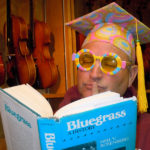
This month’s true trivia comes from the essential Bluegrass Bluesman: Josh Graves a Memoir, edited by the currently #2 ranked bluegrass historian in the world, Fred Bartenstein. If you haven’t read this book yet, put down those picks and go get it! It makes for a dandy dobro-case stuffer.
First correct answer below will win a Mr. Blue Grass Smarty Pants postcard and standing ovation.
Question: What band did Josh Graves think was the first real bluegrass band he ever heard?
Answer is at the end of this article.
You Can Make This Stuff Up
Mr. BGSP accepts questions relating to advice on the bluegrass lifestyle. Grammy awards are not guaranteed.
Dear Mr. Blue Grass Smarty Pants,
With the holidays coming up, how can I celebrate a traditional bluegrass Christmas dinner?
—Turkeyed Out in Tuscaloosa
Dear Turkeyed Out in Tuscaloosa,
If you want to impress your guests with more than the usual funnel cakes, backstage vegetable tray, and blooming onions fare, I would go with my “You Can’t Hurt Ham” recipe, which calls for cooking a 10-pound ham on the engine block of a bus, preferably one with a Fuel Pincher Diesel V-8 engine. And, of course, Martha White biscuits.
—Mr. Blue Grass Smarty Pants
Dear Mr. Blue Grass Smarty Pants,
How many banjo players does it take to cross the road?
—Frontman in Fontana
Dear Frontman in Fontana,
I can’t stress enough the importance of not doing banjo jokes on stage. We’ve moved far beyond that kind of humor. Farting and bathroom jokes are the cutting edge now. Plus, I think you’re confusing two different genres of jokes here, so I will confuse it even further by answering in two more. My answers are “Cross the Road who?” and “Gangnam Style!” Also, the answer to every banjo joke is either “A pizza feeds a family of four” or “You can tune a Harley.” You can use these interchangeably.
—Mr. Blue Grass Smarty Pants
Answer to Josh Graves question: The Callahan Brothers.
In Bluegrass Bluesman, Uncle Josh says, “…my daddy would have a little extra money, and he’d buy me a record, Jimmie Rodgers or the Carter Family. One day he bought me a Callahan Brothers record. The Callahans, to me, was the first ones that ever did bluegrass music, really.” (Bluegrass Bluesman, p. 9)
The post Blue Yodel #56 – Mr. Blue Grass Smarty Pants appeared first on Bluegrass Today.
]]>The post Blue Yodel #55 – The Last Yellow Rose appeared first on Bluegrass Today.
]]>This has been a week that I know a lot of you have faced already: having to put a loved one into hospice care and then watch as—in my case, my mother—slowly, quickly passed away from us.
Alpha Mell Stanley Stuart was 98 years old when she died. If you’re wondering about that “Alpha,” she was the first-born. At that age I can’t say we were cheated of any time with her. She led a long life, but more importantly a full one. She was a poet, a preacher’s wife, a mother, a grandmother, an aunt to my 16 cousins, and a sixth-grade school teacher and assistant principal for 30 years. I never forgot how to spell principal: the principal is your p-a-l, as she taught me.
The last years were difficult. The once agile wit became ever more calcified by dementia, though there were the occasional flashes of mom. It made me wonder how this person could have grown out of that person and that person have grown out of a young girl from East Texas in the Depression.
She loved the natural world, her garden, and when we visited places like Colonial Williamsburg, she would often jump over the ropes meant to keep the public out of the gardens because she had to reach down into the earth and feel the soil, had to taste the herbs and smell the flowers close up. As embarrassed as I was back then, she taught me that boundaries are meant to be crossed—maybe not a lesson she intended, but one she lived by.
And she taught me that words were something you cultivated as well. She showed me where to jump over the ropes to get at Shakespeare, Donne, Edna St. Vincent Millay, John Crowe Ransom, James Thurber, and S.J. Perelman. I’m lucky. I have notebooks, scrapbooks, papers, poems, notes, letters that I can read and visit with her anytime.
Even though she was a Stanley (no relation to Carter and Ralph), her taste in music ran to a sometimes odd combination of classical and pop. She particularly liked Blood, Sweat, and Tears for a while, and then ABBA.
A few years ago I wrote a song for her called The Last Yellow Rose (of Texas, of course). When she was able to come to a few shows, I sang it for her. She liked to talk about imagery and rhyme, but I also noticed that she started tying a yellow rose to her wheelchair—all but a sign saying, “Ask me about my yellow rose!” And I wrote about her in a Blue Yodel Mother’s Day piece earlier this year about, yes, Bluegrass Dead Mother Songs.
Though she would have raised an eyebrow at this public wailing, I feel closer to her just putting a subject with a verb. But right now, these words seem so immensely inadequate. What’s that, mom? Too many syllables? Something more Anglo-Saxon? These words seem so poor. I miss you.
Here’s a poem by her:
Let Others Thank Thee
Let others thank thee for immensities—
For earth and sun and outer galaxies.
Magellan-like, their gratitude
Can circumnavigate the globe,
Jet leap through barricades of space,
And mysteries of moon unprobe.
Does adoration need a universe?
Must vastness be the caller of our days?
I would not minimize thy grandure, Lord,
But ask instead for simple things to praise.
Today my son and two young friends
Explored the hills of Bethany,
Found fossils in the pebbled dust,
Rang dinner bell unstintingly,
Poked fingers in the critter cage,
Plowed furrows through the swimming pool,
Discussed the salamander’s sex,
Shared pocket knife for whittling tool.
Let others thank thee for immensities—
I’m glad for three small boys upon their knees.
—Alpha Mell Stanley Stuart
The post Blue Yodel #55 – The Last Yellow Rose appeared first on Bluegrass Today.
]]>The post Blue Yodel $54 – Bluegrass Tuesday Shopping Starts Today! appeared first on Bluegrass Today.
]]>Today is Cyber Monday, the day that robots everywhere break Isaac Asimov’s Three Laws of Robotics and take over the world. But while that’s happening, let’s shop!
You may have already done your shopping on Black Friday (which started this year on Thanksgiving Thursday) or on Small-Business Saturday or on Dear-God-Make-It-Stop Sunday, but it’s not over yet because I’m declaring tomorrow Bluegrass Tuesday, a special day set aside to do all your bluegrass shopping for that special banjo player in your life.
If you’re looking for gift ideas for bluegrass musicians or fans it’s good to know that all we want is time to practice so we can play like our favorite bluegrass artist. I calculate I will need 835 years at 12 hours a day to play guitar like Tony Rice.
So, that’s my first suggestion for a gift (especially for your bluegrass partner, parent, or kid): a coupon promising practice time without interruption. I’ve even created special coupons for you to download and use:

It’s also good to know that bluegrass people do NOT want t-shirts. We have t-shirts from every festival we attended, every workshop, every band we wanted to support, and a few that just grew by themselves in the bluegrass petri dish known as the back of the van.
The only caveat to this rule is if it’s an especially dumb t-shirt such as this squirrel-playing-plugged-in-banjo-on-top-of-an-amp t-shirt:

Or one with an incorrect use of a semicolon:

Other than that, bluegrass people are pretty easy to please. Strings, CDs, picks, capos, etc., are just fine.
On Bluegrass Tuesday, think about walking into your local music store and buying a nice gift for someone. It doesn’t have to be a Lloyd Loar. Just something like a coupon for lessons, or a set of strings, or starting a layaway on that dobro someone you know really wants.
Without these local stores—the focal points for jamming, lessons, and information—we wouldn’t have the kind of grass roots that feeds the next generation of bluegrass artists.
But let me make a few suggestions for bluegrass holiday gifts in the over $500,000 range. Here’s a dandy tour bus just right for the up-and-coming bluegrass band wanting to impress promoters and fans:

It’s a steal at $682,400. And I bet you could talk them down to $681,999.
For those of you thinking more like under $20, here’s a stocking-stuffer banjo coffee mug from cafepress.com:

If you think about it, there are really only three types of gifts:
- Gifts you give others but you really want yourself
- Gifts that people have specifically said they want because you usually only give them gifts you really want yourself, and
- Gifts that are donations to good causes that neither of you want.
 The first one is easy. If I were buying a gift for someone, what I would do is go to one of my favorite bluegrass websites, such as, oh, I don’t know, let’s say the AcuTab website, run by John Lawless of Bluegrass Today, my editor and boss. And I would buy the new Ron Block guitar DVD.
It fulfills the one requirement for the first type of gift: I want it. Whoever I give this to will surely like it because I would like it.
 As another example of the “gift I really want myself” gift, let’s pop over to Roland White’s website and see his Roland White’s Mandolin Christmas book and CD.
For those of you who receive these gifts from me, I won’t be offended if you return them to me, as I really want them for myself anyway.
The second type of gift is also easy because you just ask that person what they want. This is almost always disappointing, though, because it turns out that other people want different things than what you want. This one pays off, though, in that the person you give it to is glad to have it.
Recently, someone told me they wanted this. It’s something called the “Stumpf Fiddle” or the “One-Man-Bluegrass-Band” by Hammacher-Schlemmer. At $299.95 it’s about $295.99 overpriced, but the person who wants it would really enjoy it. Don’t worry, there’s no way I’m buying it, but I thought you’d like to check it out:

That brings us to the third type of gift – the donation gift. This seems to me the perfect gift idea because it benefits some worthy cause, surprises the recipient, and you’ve given something to a cause that you like as well. It’s a win-win-win.
There are many worthy causes in bluegrass, but I’m going to mention one, the Foundation For Bluegrass Music:

This organization covers a lot of great programs such as Bluegrass In the Schools, Teacher Workshops, Bluegrass Innovator Grants, and many more. Making a gift donation in someone else’s name is easy and will benefit the next generation of bluegrass artists (some of whom may not be able to afford an $800,000 bus).
Other gift ideas might include a membership to IBMA or another bluegrass organization such as the California Bluegrass Association, or any of the recent wonderful books on bluegrass published by the University of Illinois Press.
I hope you’ll contribute more ideas for bluegrass holiday gifts because I’m barely scratching the surface. I know if I start listing more bluegrass items I’ll advertently leave a lot of good stuff out.
Just think of what artist or teacher you’d like to support and buy everything they have for sale.
Bluegrass Tuesday shopping starts now!
The post Blue Yodel $54 – Bluegrass Tuesday Shopping Starts Today! appeared first on Bluegrass Today.
]]>The post Blue Yodel #53 – Dictionary of Bluegrass Slang appeared first on Bluegrass Today.
]]>This is Blue Yodel #53, the same number of times that local bluegrass band The Remington Riders of Free Dirt, Texas, played their signature song, Remington Ride, at a wedding on November 19, 1995. It was band policy to play the tune whenever someone requested anything by ZZ Top. An insistent drunk egged them on thinking he was hearing his favorite band’s greatest hits. The Remington Riders broke up after the gig, but later re-formed as The Obnoxious Pull-Offs.
This week I thought I’d take a first crack at compiling a dictionary of bluegrass slang. That should tell you a lot about my social life.
I started making a list and then asked some friends if they had any contributions. (Okay, it was mostly Facebook, but I know if I were ever in trouble those people would like me.) If it wasn’t on the original list, I cite the person who sent it.
I’m sure this is just scratching the surface—and feel free to use Scratching the Surface as a title for a banjo tune. If you think of something you don’t see here, please contribute below. There are some I had not heard before; I especially like pork chop, sent by Charlie Sizemore.
If this goes well, I plan to start selling the dictionary door-to-door. A digital version will probably be easiest to carry.
A Dictionary of Bluegrass Slang
Being a Compendium of Select Words & Phrases Spoken & Overheard by People Gathered Together to Play & Listen to The Bluegrass Music.
Ain’t No Part of Nothin’ – (Mary Katherine Alden) Bill Monroe quote for describing something particularly bad. Triple-negative with a twist.
Arch-Top – (Ned Luberecki) A raised-head banjo. The kind of banjo Ralph plays.
B chord – (Megan Lynch) Referring to things as B chord means they are the best of their kind. “These Mallomars are B chord!” Said to have been coined by Terry Baucom.
Boom-Chick – Downstroke rhythm guitar style, alternating bass strings (boom) with off-beat quick strum (chick). Also, the first name every all-female band thinks up and discards – The Boom Chicks.
Boom-Chuck – See Boom-Chick.
Cheater – Capo (see Clamp).
Cheaters – Scruggs-Keith banjo tuners. See Risers, Twisters and Whiners.
Chunk-uh-a-la-foo – (Alan Munde) Verbal description of a G-run from Jimmy Martin. The last syllable “foo” lands on the final third-string open G of the run.
Chop – Off-beat rhythm usually played by the mandolin, fiddle, dobro, and/or guitar player.
Clamp – Capo (see Cheater).
Devil’s Box – A fiddle. Playing the instrument was thought to be sinful.
Diamonds –When the bass (or any instrument) rings for a certain number of whole beats. When bassist Irl Hees plays diamonds, you could say that diamonds are an Irl’s best friend.
Doghouse Bass – Acoustic bass.
Drive – The kind of bluegrass rhythm that great players have. You know it when you hear it. Also, what bluegrass bands do when not playing.
Drop Chord – (Ira Gitlin) meaning a flat-seven chord. “Little Maggie, that’s got the drop chord in it, don’t it?” See Off Chord.
Flat-Top – (Ned Luberecki) Dreadnought guitar or John Duffey’s hairstyle.
Gangnam Style – This entry fulfills the requirement that everything must include a reference to Gangnam Style.
Gear – (Tommy Goldsmith) Key that a song is played in. “What gear is this in?”
Good ‘Un – (Ned Luberecki) Any good song, or a reference to the tune Sally Goodin. See Minner-Dipper.
Herringbone – Any of the fancy-styled D-model Martin guitars. Also, suits occasionally worn by Del McCoury.
High Baritone – The baritone part moved up an octave and sung above the tenor. Also, the part some people claim to be singing when they’re actually singing unison with the lead.
Hook It – (Eric Bannister) The first time I heard it was at Bean Blossom several years ago when Dave Evans banjo player took off, Dave kept yelling “Hook it! Hook it, now!” See Mash.
Hound Dog – Resonator Guitar. See TIFKAD.
Jimmy Martin Ending – An abrupt, muted stop at the end of a song, as in Hit Parade of Love.
Kick-Off – To begin a song. A rare football term used in bluegrass.
Low Tenor – The tenor part moved down an octave and sung below the baritone. The part some people are actually singing when they think they’re singing baritone.
Mash – After 2005, to play fast with great drive. “Let’s mash.” Before 2005, an abbreviation for sour mash whiskey or a 70s tv show.
Minner-Dipper – (Ned Luberecki) I was never sure if Jimmy Martin used this for banjo or mando, but it’s a good’un either way. See Good ‘Un.
Off Chord – Any chord that’s not G, C, or D. Any minor chord. See Drop Chord.
Pork Chop – (Charlie Sizemore) All down-stroke boom-chick rhythm guitar style. This is a Jimmy Martinism. He’d say “Listen there at Melvin [Goins]: pork-chop, pork-chop, pork-chop . . .”
Potatoes – A shuffling fiddle kick-off that sets the tempo. Goes like: Nah-na-na-nah-na-na-nah-na-na-nah. See Taters.
Poverty Box – (Chris Rogers) Any of the bluegrass instruments. See Devil’s Box.
Quile – (Jon Weisberger) Harley Gabbard used to use the word quile, as in quile down – “I think I’ll go to the bus and quile down for a while.”
Rawhide – (Tommy Goldsmith) Exclamation said to indicate ending a tune as in the Monroe instrumental Rawhide.
Risers – Scruggs-Keith banjo tuners. See Cheaters, Twisters, and Whiners.
Spikes – (Ned Luberecki) Banjo 5th string capo made from small spikes usually at the 7th, 9th, and sometimes 10th frets. Sometimes referred to as Railroad Spikes.
Tater-Bug – (Ned Luberecki) Round-back mandolin. Heard from Mike Compton.
Taters – See Potatoes.
TIFKAD – The Instrument Formerly Known As the Dobro. See Hound Dog.
Turn-Around – A brief chord progression that introduces a song, or a repeated ending to a song.
Twisters – Scruggs-Keith banjo tuners. See Cheaters, Risers, and Whiners.
Whiners – (Jon Weisberger) Scruggs-Keith banjo tuners. See Cheaters, Risers and Twisters.
Wires – (Darcy Whiteside) Strings. “Gotta change my wires.”
Y’all Sounded Good Up There – A two-word expletive.
Yankee double-picking – (Ira Gitlin) Melodic banjo playing. Mike Munford heard this one at the Sandpiper, a Baltimore bar.
The post Blue Yodel #53 – Dictionary of Bluegrass Slang appeared first on Bluegrass Today.
]]>The post Blue Yodel #52 – White House Blues appeared first on Bluegrass Today.
]]> This is Blue Yodel #52, the same as the world-record number of strings broken by the band High Wind Advisory the night of December 5, 1983 in Delphi Plains, Ohio, when they attempted a bluegrass version of the rock opera, Tommy.
I bring up Ohio only because tomorrow the good people of that state will once again exercise their right every four years to choose a president for the rest of us.
Not that I envy them. Out here in California, or in some other deep blue or red state that the campaigns have long given up on, you’d be hard pressed to find a Romney or Obama ad, though we do have our share of local mudslingers.
One San Diego mayoral candidate is running an ad showing a distraught airline baggage handler saying that the other candidate yelled at her and made her cry. I wish I could make the Delta baggage handler who broke the neck of my Martin guitar cry a little. Okay, a lot; I’m not running for mayor.
Don’t worry, folks. I’m not going to try to persuade you one way or the other. My only advice is to fly Southwest.
Like that tearful four-year-old who is tired of “Bronco Bama” and “Mitt Rominey,” I’m sick of the whole thing too and look forward to waking up on November 7 to a nation once again united in the pursuit of the perfect bacon cheeseburger.
But I harbor no illusions. As Aristotle said, “I’m pretty sure we almost broke up last night when I threw my phone across the room at you.” Sorry, that was Taylor Swift.
Aristotle said, “Man is a political animal.” Which explains why everybody back then wanted to party at Plato’s and not Aristotle’s. They were as sick of hearing about politics as we are today.
I would also like to remind you of the words of Aristotle’s nephew, Kevin of Macedon, who, as he left a family gathering after a bit too much wine, rolled down the window of his chariot, and shouted back at the philosopher, “And another thing, man is NOT a @#!$ political animal!”
There is not a lot of politics in bluegrass. And by that, I mean there is a lot of politics in bluegrass.
If there’s one thing I’ve learned this past year, it’s that you can say one thing and then the exact opposite and people will determine your truthiness by how far the polls shift.
I’ve just been told that my numbers are down two points in Downton Abbey, Arkansas, which means it’s time to either man up and suspend my campaign or double-down on both stances.
Beyond the occasional re-writes of White House Blues, I can’t think of any political bluegrass songs. Sure, Bill Clinton used to play More Pretty Girls Than One on the saxophone and George W. Bush was once convinced he was his own grandpa, but beyond that, not much.
And that’s a good thing!
It’s hard enough to get a band to play in time together without the mandolin player questioning the bass player’s stance on campaign finance. I say let’s keep politics out of the music and put it in IBMA board meetings where it belongs.
I think it was either James or Rodney King who said, “Can’t we all just get along?” I’m not saying that so much as I’m saying, “Can’t we all please remember to bring our own floss on these long tours?”
Sure, politics is important. But remember my other position: politics is not important.
I can go whole days without getting irritated at my congressperson, whoever he or she is. And while my neighbor has spent his energy being angry at me for stealing his yard sign every night, he’s unaware that I’ve also gotten away with his recliner, a toaster, and an Xbox 360.
I’m just asking for a little perspective. And maybe some reverb and pitch correction because I’d like what I’m writing to be narrated by one of those scary-voice actors in a political ad. Really, you can make anything sound sinister in one of those.
I do have one suggestion for future elections. If we’re going to have candidates going around pretending they’re somebody they’re not and promising treats, then I see no reason why elections can’t be held on Halloween. This has the added benefit of everyone being too sick on November 1 (celebrated as The Day of the Dead Snickers Wrappers) to care about who won the election.
My pollster just told me I’ve swung too negative and now have to come back with a positive message:
I hope you vote. Or vote again if you’ve already voted by mail. Or vote, then watch as your teenage son who just turned 18 cancels your vote just because he’s a teenager and always does the exact opposite of whatever advice you give him.
One rule: whatever happens, no gloating or whining. We still live in America and I’m pretty sure 1) nobody’s going to come looking for my Flatt & Scruggs collection and 2) porta-potties will always be there.
At this point, my expectations have been lowered so far, that’s all I care about anyway.
Go Buckeyes.
The post Blue Yodel #52 – White House Blues appeared first on Bluegrass Today.
]]>The post Blue Yodel #51 – Bluegrass Bluesman appeared first on Bluegrass Today.
]]> I spent yesterday with Josh Graves by reading Bluegrass Bluesman: Josh Graves A Memoir, a collection of transcribed interviews given in the ’90s by the resonator guitar master.
Expertly edited by Fred Bartenstein with help from a lot of good folks, which I’ll come back to in a minute, it also includes never-before-published photos and 24 tributes from musicians and friends, many of which were compiled by Betty Wheeler in 2001 for an honorary presentation to Josh.
But what makes this book so compelling is the voice of Burkett “Buck” “Uncle Josh” Graves himself.
From the first sentence (“There’s a story on me, I guess—where I come from and why.”) to the last (“I’d just like to go back up in the mountains and stay there.”), the voice of Josh Graves takes you on a front-seat ride with one of the most interesting and influential—and too often underappreciated—lives in bluegrass history.
As if establishing the dobro in bluegrass wasn’t enough, Josh was also a great singer, songwriter, bass player, and comedian.
As the straight man to Jake Tullock in the Foggy Mountain Boys comedy routines (which sometimes went 20 minutes in the middle of a show), Josh and Jake also had an amazing vocal duo as heard in these clips of Feast Here Tonight …
… and Hand Me Down My Walking Cane:
http://www.youtube.com/watch?v=wFqdg_VKp8M
In addition to Fireball, Josh wrote over 150 other songs, some of which are classics, such as Foggy Mountain Rock and Wilma Lee & Stoney Cooper’s hit Come Walk With Me.
http://www.youtube.com/watch?v=lFXOu6L3Ybk
The immediate commercial success of that song led to both Lester and Earl offering to buy it from him. Wisely, he kept it.
Fred Bartenstein emailed me a link to BMI’s listing of songs written by Josh Graves. It’s an amazing catalog and a resource for bands looking for songs that have not been covered nearly enough.
There are a lot of great stories in this collection as well as straight talk about life as a sideman in the country and bluegrass bands of the 40s through the 60s. Josh had honest opinions and didn’t pull punches.
There are many intriguing quotes:
“The Callahan Brothers, to me, was the first ones that ever did bluegrass music, really.”
“When you’re young like that, you think the attention and success are going to last forever, but they don’t.”
“Other musicians would come up to Lester and say, “Boy, it’s gone, ain’t it?” And he’d say, “Yeah.” He didn’t want nobody to know we was doing that good…We never suffered a bit when rock hit.”
“Earl didn’t allow nobody to tune on stage. If your instrument was out or you broke a string, you’d go behind the stage, fix it, and then come back. You’d tune to what you heard.”
“You left him [Lester Flatt], buddy, and he wouldn’t speak to you. Oh, he didn’t speak to me for the two years I was with Earl. And tried to hurt me every way he could.”
And many more. To quote Raymond Chandler, it’s “unputdownable.”
The title Bluegrass Bluesman perfectly describes the importance of the blues in Josh’s life. In fact, he called it his first love.
 Josh recalls, “And then I remember one old guy, Buck Roper. He was a black man. . . and he played bottleneck on the banjo. I’d sit there, and it fascinated me, the notes that he would hit, and how he’d curl them around.”
And “…my dad would throw a party, maybe once a month, and he’d hire these two black guys. . . I sat at their feet and stayed right with them when they was playing. One had an old taterbug mandolin, I called it—big-bodied thing—and one had an old Silvertone Gene Autry guitar, I guess it was, but they could play!”
Josh also became a fan and a friend of blues giant Lightning Hopkins and there’s a great story about Hopkins’ traveling bar. You’ll have to read the book to find out about it, though.
In the introduction, Fred Bartenstein lays out the circuitous route this project took. Barry Willis, the author of America’s Music: Bluegrass, first interviewed Graves over eight days in 1994. The intent was for Willis to write an “as told to” autobiography of Graves, but the project was never completed.
In 2008, two years after Graves’ death, Willis contacted Bartenstein to see if he might be interested in doing something with the transcript. Unfortunately the original tapes and electronic files had been lost.
Using additional interviews of Josh conducted by Bobby Wolfe in 1990 and Stacy Phillips in 1993, Fred assembled and edited the transcripts into a coherent memoir tracing Josh’s life from his youth in Tellicoe Plains, TN, through his work with Kenny Baker in the ’80s and ’90s.
We owe a huge debt of gratitude to Fred Bartenstein and all the people involved in this project, all of whom are mentioned in Fred’s introduction.
Neil Rosenberg’s foreword concisely describes Josh’s career and his importance to bluegrass music. Thomas Goldsmith added wonderful introductions to each chapter, even coming up with an apt Shakespearean reference when he compares Josh to Hamlet’s friend Horatio.
Goldsmith writes, “Born poor before he became a scholar, Shakespeare tells us, Horatio was a friend to the best and brightest, present at every important moment and a survivor who outlived the mighty and dying to tell the story.”
This past year has seen the release of several great books by the University of Illinois Press: this and Marty Godbey’s biography of J.D. Crowe have not only upped the ante of bluegrass writing, but have put into lasting form the history of two remarkable men and their times.
But, as Josh says, “You can’t get back to the original thing. They’d have to feel the same way they felt then and play like they did then.”
This memoir is the closest thing we have.
The post Blue Yodel #51 – Bluegrass Bluesman appeared first on Bluegrass Today.
]]>