The post The gang gets a walking tour and climbs atop St. Paul’s Cathedral appeared first on London, England: Creating Shakespeare, Then and Now 2016.
]]>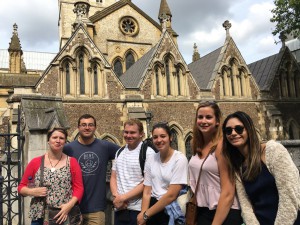

Most of us (I won’t name names) made it to the top of St. Paul’s Cathedral to see fantastic views of the city. The inside was amazing and we were lucky enough to get a thorough walking tour throughout. (No pictures allowed inside, so you’ll have to go see for yourself.)
The post The gang gets a walking tour and climbs atop St. Paul’s Cathedral appeared first on London, England: Creating Shakespeare, Then and Now 2016.
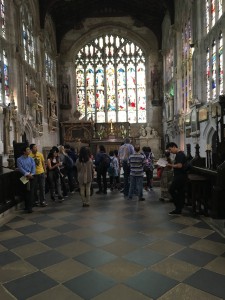
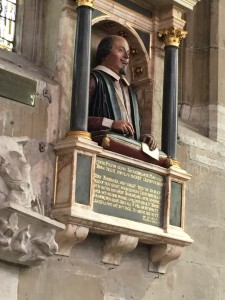
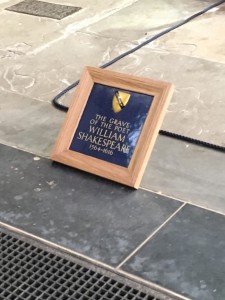
]]>The post Shakespeare’s final resting place appeared first on London, England: Creating Shakespeare, Then and Now 2016.
]]>
The post Shakespeare’s final resting place appeared first on London, England: Creating Shakespeare, Then and Now 2016.
]]>The post The Gang Storms Stratford-upon-Avon appeared first on London, England: Creating Shakespeare, Then and Now 2016.
]]>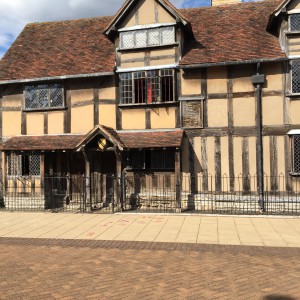
Shakespeare’s birthplace
We filled our bellies with Shakespeare and all things touristy for our three days in the town of Shakespeare’s birth and final resting place. We managed to see two productions at the Royal Shakespeare Company, visit Shakespeare’s home where his father made gloves, see his grammar school where he learned “small Latin and less Greek” (though by our standards, there was nothing small about it), and enjoy the many, many gift shops.
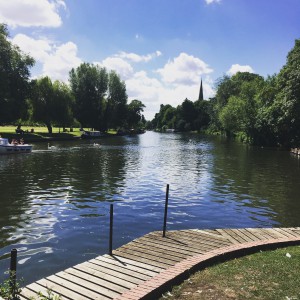 The Sweet Swans of the river Avon. (Though not so sweet; I saw them attack children for food.)
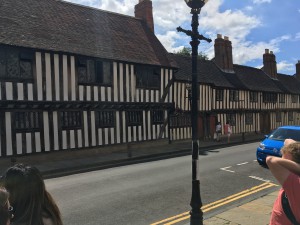
Shakespeare’s school house
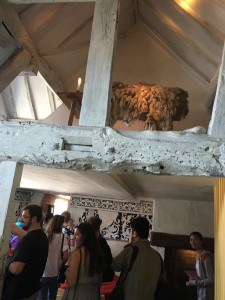 A visit inside the Shakespeare house. Sean and Taylor admire the furniture.
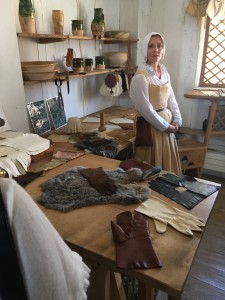
Gloves! High fashion back in the day.
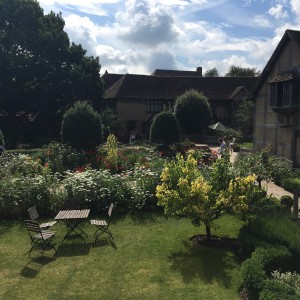
After tight quarters with low ceilings and tons of visitors, the gardens were a beautiful spot to relax and breathe.
The post The Gang Storms Stratford-upon-Avon appeared first on London, England: Creating Shakespeare, Then and Now 2016.
]]>The post Stratford-Upon-Avon: Always Remember, Never Forget appeared first on London, England: Creating Shakespeare, Then and Now 2016.
]]>Having consistent motifs is an important quality to have in any kind of writing, whether it be a play, a poem, a novel, or any other form of writing. Motifs allow for a level of creativity and imagination to occur from the reader/audience member. For example, the child in Macbeth served as this recurring motif that could be interpreted in an infinite amount of ways. The director of Hamlet, in my opinion, lacked this consistency with his motifs such as the African tribal theme.
As my classmates have heard over and over again from me, I was very discontent with Hamlet. There was no commitment to their motifs, the acting was subpar, and the overall feelings I had by the end was anger and disappointment. Anger because of how the director combined several different themes without any transitions as though he didn’t know what he was doing, and disappointment because most of the actors had no idea what they were saying. Elizabethan English is certainly not easy to master and actually know what you’re talking about, but if you’re in an actual production you should probably have some idea.
Although quite reluctant, I went in with an open mind for Cymbeline and it was such an improvement. The acting was amazing and there was so much commitment to the characters. This play had a modern theme as well, however it was slightly dystopian with a hint of steampunk in terms of costume choices. Even the set and props were consistent with the motifs. I also appreciated the different dynamics between the characters, and the swapped genders of some characters because they were seamless and had a very overwhelming effect.
Outside of the theatre aspects of the trip, Stratford-Upon-Avon is rather cute. It’s a huge difference from London, although there’s still no shortage of tourists. There’s not a whole lot to do besides shop and praise William Shakespeare, but you can still have fun. If you ever get bored, the Royal Shakespeare Company has a lovely selection of things to color (apparently it’s for the children, but we’re all children at heart). One thing I will critique about Stratford-Upon-Avon is that their mac and cheese is quite subpar, other than that it’s a very cute town.
The post Stratford-Upon-Avon: Always Remember, Never Forget appeared first on London, England: Creating Shakespeare, Then and Now 2016.
]]>The post Hamlet In Africa appeared first on London, England: Creating Shakespeare, Then and Now 2016.
]]>However, the play was not without its flaws, and the most striking of those flaws was the RSC’s inability to fully commit to its African vision of the play. The production company was clearly trying have the play take place in an African setting. This was evident because of their casting, music, and set decisions that they made in regards to the play. However, the lines that the actors used still indicated that the story takes place in Europe; Denmark specifically. In order to do justice to the vision that the RSC had created for Hamlet, they should have made the play take place in an African country.
One could argue that it is essential to remain faithful to the text when producing a play, but when the director of Hamlet decided to set the play in what is obviously an African country, the intent of the text was altered anyway. The characters dressed in African clothing, the music used in the play was African, and the design of the set was African. To present this African imagery to the audience and yet insist that the play still takes place in Denmark is asking me to suspend my disbelief too far.
The RSC’s production of Hamlet was fun to watch, but in order to become a stronger performance, the RSC needed to fully commit to their vision of Hamlet in Africa. Such a decision would have strayed from the text, but it would have given the production a stronger continuity and the performance would have been more polished as a whole.
The post Hamlet In Africa appeared first on London, England: Creating Shakespeare, Then and Now 2016.
]]>The post Modern Hamlet appeared first on London, England: Creating Shakespeare, Then and Now 2016.
]]>The director of Hamlet really tired to put a modern spin the show by modernizing it. This is evident with Hamlet’s graduation where there are prospect college sweaters, a podium with a microphone and graduation caps; all which were not around in the 1600’s. While modernizing the play the director also used a Black cast for the production. The inconsistency were with the elements used from different Black cultures, Jamaican (dancing/music) and Kenyan (clothing). I am not sure what the director was aiming to do with blending the cultures but personally it also confused me because the play was set in Denmark.
Despite the cultural inconsistencies, I was able to find some appreciation in how the director used colors to symbolize death. Through out the play we see Gertrude and Claudius wearing a red-wined color garments. I believe this wine color was supposed to represent the forecasted blood shed caused by Claudius’ and Gertude’s throne desire. At the end we see this red wine color on Laertes, Claudius, Gertrude and Hamlet when they die.
The post Modern Hamlet appeared first on London, England: Creating Shakespeare, Then and Now 2016.
]]>The post Shakespeare Land appeared first on London, England: Creating Shakespeare, Then and Now 2016.
]]>It was exciting to see the place where he lived and worked, but less so when we took the time to see his burial site. Shakespeare is everywhere. His presence lingers despite his death occurring over four centuries ago. It was a funny feeling to see his eternal resting place, after analyzing nearly every aspect of his life over the past few weeks. As corny as it sounds, its like William Shakespeare is the unofficial 7th member of our London Breakfast Club.
Now onto Hamlet. Hamlet is most likely the play that what most people think of when they hear the words William Shakespeare. I’ve come to respect the tradition associated with Shakespeare’s works even when some like Macbeth (which we saw at the Globe) incorporate bits of modern reference. However, I found the Royal Shakespeare Company’s (RSC) interpretation to be disappointing. While I was watching the performance, I felt let down by the performance. It seemed like it was trying so incredibly hard to be something that it wasn’t, which was modern and relatable to those in the audience today. This rendition of Hamlet felt like something completely different from the world that Shakespeare created, and while I could appreciate the work and dedication of all involved, I could not however appreciate it as a whole. The immature nature of the Hamlet character, the disconnect in costumes and the farfetched themes were entirely underwhelming for me as an audience member.
Luckily my faith was restored in Cymbeline, the second RSC performance my class saw. It completely changed my impression of the RSC, and it was a relief to see many of Hamlet’s actors take up different roles in Cymbeline (which was great to see how dynamic and talented they all are).
Overall Shakespeare Land was great, but I would be lying if I said that I wasn’t very excited to return to the hustle and bustle of the ever changing London.
The post Shakespeare Land appeared first on London, England: Creating Shakespeare, Then and Now 2016.
]]>
The post Shakespeare In The Modern World: Part 4 appeared first on London, England: Creating Shakespeare, Then and Now 2016.
]]>
The post Shakespeare In The Modern World: Part 3 appeared first on London, England: Creating Shakespeare, Then and Now 2016.
]]>The post Q & A appeared first on London, England: Creating Shakespeare, Then and Now 2016.
]]>I went in not knowing what to expect. Despite having just performed on stage, attending a cast meeting, and then rushing to meet a small group eagerly waiting to ask questions the actors Jay Dominique (Banquo) and Jacob Fortune-Lloyd (Macduff) were wonderful to listen to. Their responses to the questions asked by the audience were thoughtful, amusing, and genuine (not something you always get out of a q & a). It was a great experience, and they even took the time to take a picture with Emily, Taylor, and myself before getting some well earned r & r before their next performance. 
The post Q & A appeared first on London, England: Creating Shakespeare, Then and Now 2016.
]]>