The post The Calligrapher’s Brush appeared first on The Occasional Blog.
]]>by Jose R. Rodriguez
The calligrapher’s brush
Held gently in hand
Cradled by lovingkindess
fingers
and a steady mind.
{ Feeling. }
Now.
A golden dawn. The sun in your head.
Now.
The moon in planted firmly in your heart.
Leaving no trace but the imprint of a bird’s wing in the sky.
NOW.
A bud explodes
into star spangled glory
pledging no allegiance
but to the turning
of
the
wheel.
now…
…a horse’s tail turns
and dances lightly across the
pulp
-ed
rem
-nants
of SEVEN THOUSAND days.
Without a sound.
{ Being. }
¿Porque sonriè el dragòn?
Porque con la sabiduria de una vida profunda.
ya
sabè
no saber / no sè.
(Why does the dragon smile?
Because with the wisdom of a profound life
she knows “not knowing” / “don’t know.” )
Now.
I young child cries in the only language she needs to know.
A bell rings.
A dog barks.
<< ¡Señora ama de casa
aquī viene gas El Lago! >>
A leaf
drops.
Pirouetting.
touches
this
good
earth
with a satisfying — ‘tak’
{ Touching. }
Without
even
trying
this leaf has attained
true
complete
enlightenment.
what the earth has witnessed
what
you
your
self
have experienced the calligrapher’s brush
in the branch of a tree
in the gaze of an ancestor blinded by age and poverty
in the sigh of a lover / in the trill of a songbird
in the car alarm at midnight / in the laugh of a child / in Don Alvaro’s rake
in the scent of cilantro
in the essence of compost
in the sour first time taste of a
fruit you cannot name
in the small of your back…
in the caress of a breeze on your bare cheek
in the ring of a gong
(gong)
in the echo of your mind… .. .
IS
the calligrapher’s brush.
The post The Calligrapher’s Brush appeared first on The Occasional Blog.
]]>The post Phoenix appeared first on The Occasional Blog.
]]>by Jose R. Rodriguez
You are like the phoenix
burning bright
destroyed by its own light
and when ashes are all that remain
you will rise again.
You are boundless energy.
You are love made flesh.
You are light crystalized in human form.
You may not be perfection. Yet.
You are perfect potential – vast and undiscovered.
You are not alone.
You are loved.
Let the heaviness of this moment go at your own pace.
Let the cool breeze of your tears clear away the ashes of the past.
Let one feather remain (momentarily) as a reminder of the pain.
Let that feather be the pen
which pens the tale
that time will not erase.
The post Phoenix appeared first on The Occasional Blog.
]]>The post Protected: Dharma Talk: Radical Self-Compassion appeared first on The Occasional Blog.
]]>This content is password-protected. To view it, please enter the password below.
The post Protected: Dharma Talk: Radical Self-Compassion appeared first on The Occasional Blog.
]]>The post Type is Art: Parts of a Character appeared first on The Occasional Blog.
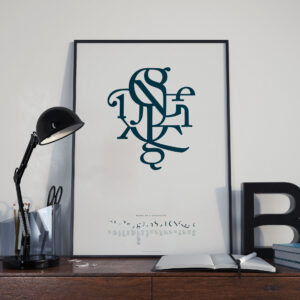
]]>All letterforms are composed of twenty-one distinct parts.
Most commonly, these parts combine to form the characters of our alphabet.
Type is Art allows for experimentation beyond this typical character set.
I was not always a “typography nerd.” Maybe by some standards I’m still not. There is a point in my career that I can recall fairly vividly as the period when my eyes opened a bit more to the beauty and precision of the typographical form. This was the more or less at the moment when I was introduced to “The Elements of Typographic Style” by Robert Bringhurst, a book which most graphic designers would consider the gold standard of typography. Bringhurst delves into the history, forms, and uses of type with beautiful prose and clear illustrations. If you’ve never read or thumbed through this book I highly recommend it.
There is a high probability that I would never have come across this book were it not for the influence of a couple of friends, one of whom was a co-worker at an interactive design studio in New York’s Silicone Alley, that nexus of the city which is directly pointed at by the Flatiron Building and fed oxygen by Madison Square Park. I’ll note that this was in the early nineties and the neighborhood had not received it’s microchip inspired monicker yet – it was simply The Flatiron District. This is where I met Terje Vist and his partner Suzanne Cerja, both of whom were and continue to be art directors and designers of the highest caliber. Terje was in charge of making the interactive designs we created look good and communicate well. I was in charge of making these designs move and react to the end-users’ input, navigating the information and imagery being conveyed by whatever digital medium was available, mostly CD-Rom at the time. Suzanne was keeping the home fires burning and building Silo Design.
Type Is Art is a public interactive art project co-created by the three of us as an inspired labor of love that took on a life of its own. While the original piece was created in Flash, which no longer rules the web, the data for the user-generated designs and the source-code for the engine still exist and may see the light of day again in the future. Just writing this post is making me want to dig it all up and get it up and running. No small task, but so worthy of my time.
This typographic exploration tool is based on Susanne Cerha’s poster “Parts Of A Character” which beautifully illustrates the twenty-one simple forms which make up every character of our alphabet. The poster also features an abstract design created from these forms that is distinctly not a character of our alphabet. The impact of this poster along with my love for typography inspired me with such possibilities and led me to create a little Flash experiment where one could move these “parts of a character” around the screen and reconfigure them into new designs. I shared this with Terje, who shared it with Susanne, and by the end of 2001 the website and public art installation known as Type is Art was born.
Since its inception Type Is Art has been featured in numerous blogs and publications including PRINT magazine. It has been shown in art galleries, during an international typography conference, and used as an educational tool. Contributors to the database of designs include students, curious passers by, and well known designers. It is rumored that Austrian designer and typographic kingpin Stefan Sagmeister created one or two designs during the Typecon conference in Buffalo, New York. At last count there were over 20,000 user-generated designs created with Type is Art.
I will update this post once Type is Art has been revived. Until then please enjoy some photos, video, and a small collection of the images created by our collaborators.
The post Type is Art: Parts of a Character appeared first on The Occasional Blog.
]]>The post A Buddhist Reference Sheet by the Numbers appeared first on The Occasional Blog.
]]>I’ve recently been working on a single-page reference sheet for some key elements of Buddhist practice and study. I was inspired by Art’s Buddhist Cheat Sheet by Arthur Rosengarten which was a great look-up for me several years ago. I have been using a variety of resources in this effort, starting with Mr. Rosengarten’s original infographic as a jumping off point and including the wonderful rigpawiki.org and wikipedia as well as “The Heart of the Buddha” by Chögyam Trungpa as well as my own experience of practice and study in the Tibetan Buddhist tradition.
Below is a link to an Adobe InDesign hosted version of the file which can be printed, downloaded as a PDF or shared online. I welcome your comments and feedback.
Please feel free to download, share, and distribute as you see fit but note that this is just one man’s view on a sliver of what has been my path of practice and study and not meant to be any sort of exhaustive resource or doctrinal document.
Addendum
I’ve labeled this reference with a version number (v1.2 as of this post) — I plan to continue updating and potentially expanding to two sides of a single page. It just feels incomplete without things like the 12 Nidanas, the 5 Buddha Families, and so many others. Just for fun, I’ve gather a couple of classic and modern infographics and may add more to this post as I find them.


The post A Buddhist Reference Sheet by the Numbers appeared first on The Occasional Blog.
]]>The post I AM, No Self : Redux appeared first on The Occasional Blog.
]]>
Back in 2010 I had the internet ask itself, “Who am I?” – “I AM, No Self” was the response. A digital art project which looks at identity and egolessness through the lens of social media, the project began as a personal contemplation. Born of my meditation practice it was shown for the first time in March of 2010 at the SP@CE224 Gallery in Buffalo, New York. The piece was part of a show themed around the concept of identity.
Back in 2010 I had the internet ask itself,
“Who am I?”
In a way this piece looks at our collective consciousness gathered by social media and asks of it the question, “Who am I?” The response is an endless stream of truncated self-identifying statements spanning the from mundane to the heartbreaking. When viewed in a gallery setting this work is taken to another level as the viewer, standing on a platform or otherwise marked space, blocks out part of the projection; their own silhouette carving out an area that is non-self identifying.
Initially the viewer may be overwhelmed by the endless flow of this collective mind-stream but it is my hope that in the space of a minute or two, the smooth and rhythmic pace of the animation, in concert with the gap visible in their shadow, will both relax and awaken the viewer to feelings of joy, compassion, kinship, and ultimately liberation.

Originally created in Adobe Flash, I recently reprogrammed it in using HTML5, allowing it to be viewed in modern browsers as well as on tablets, phones, and other mobile devices. While the personal screen experience is less impactful than being there I think it is worth sharing online.
It is my hope to show this piece in public again, perhaps projected at a larger scale for a wider audience.
View the project online at http://iamnoself.me
The post I AM, No Self : Redux appeared first on The Occasional Blog.
]]>The post The Coyote’s Dilemma appeared first on The Occasional Blog.
]]>The bad news is you’re falling through the air, nothing to hang on to, no parachute.
The good news is there’s no ground.
— Chögyam Trungpa
This seems like an appropriate way to begin…
We, our family, our country, our global society seems to be in a constant freaked out free fall. With seemingly good reason. The economy is all over the place, the world has been at war for as long as my children have been alive (one of them is a teenager), and while we survived an actor president back in the 80’s – we’ve got a rabid business tycoon turned reality TV star with eyes on the oval office. In the media, even the once levelheaded pundits are telling us that the sky is falling. Again with good reason. Climate change, while still played down by some, is obviously affecting weather patterns.
That’s the bad news. Nothing to hang on to, no parachute.
The good news? Well, if you have read the opening quote, you have an idea. But what does it mean for there to be “no ground?” How does that figure into the reality of our daily lives? Maybe we could start with what it means for there to be ground.
We generally think of ground as a safe place. If we’re on solid ground then chances are we’re not falling. When Matt Damon’s character in “The Martian” gets back to Earth after being stranded on Mars he kisses the ground. Home. Familiar. Comfortable. Solid. Ground.
However, when the rug has been pulled out from under our feet, or if we’re falling through the air without a parachute, our relationship to ground changes. We are in unfamiliar territory, uncomfortable due to the fact that our lives are not turning out how we planned. At that point the ground might be more akin to the solidity of our expectations. The ground of our concrete hopes and fears.
For the coyote in the Warner Bros. cartoons, hitting the ground usually meant he was about to get crushed by a boulder and mocked by his quarry, the roadrunner. “Meep meep!”
I remember distinctly that there were a couple of times when the coyote defied the laws of physics and swam through the air as he fell, or even walked across thin air to safety, albeit temporary safety in his case, but that’s another story.
I wonder if there isn’t something to be learned from the coyote’s dilemma.
Maybe we can adjust our relationship to this free fall by becoming more familiar with how it feels to be groundless. Accepting the vulnerability and intimacy of our groundless situation; our reality. The reality that things not always going to go our way. The reality of human suffering in a world that is in constant flux. The reality that the material and economic choices we make affect not only our lives but the lives of everyone else too. And at the same time, maybe we can loosen up our expectations. We don’t have to give up on our dreams or stop working towards change in the world. We don’t have to give up on anything – but maybe we can soften the ground of our hopes and fears.
Maybe with this familiarity and flexibility we can free fall without the freakout. It seems that we could likely get much more accomplished this way; and maybe even enjoy the wind in our hair as we go.
The post The Coyote’s Dilemma appeared first on The Occasional Blog.
]]>