 It has been a busy season for the WWF polar bear patrol in Ittoqqortoormiit. At least 21 polar bear encounters were recorded this year in this village of 450 people on the east coast of Greenland. Throughout the Arctic, the number of conflicts between polar bears and humans has risen as climate change has caused […]]]>

Throughout the Arctic, the number of conflicts between polar bears and humans has risen as climate change has caused the sea ice to shrink. The bears are now forced to stay on land for longer periods than before. In their search for food, they are often attracted to communities. The problem is particularly severe in Ittoqqortoormiit, where a deluge of bears is creating life-threatening situations for both the bears and the the village’s inhabitants.
In 2007, nine polar bear conflicts were registered in all of Greenland. By 2017, there were 21 conflicts in Ittoqqortoormiit alone between August and December. In almost all 21 cases, the polar bear patrol was called to ensure that the bears were scared away from the area and kept under observation.
WWF founded the local polar bear patrol in 2015 to protect residents from dangerous encounters on their way to school or work, and to reduce the number of bears killed in self-defense. During peak polar bear season in autumn, the patrol is particularly active just before school opens each morning.
“The community members tell us that the patrol gives them greater peace of mind, and we prevent a lot of polar bears from being shot in self-defense”, says Bo Øksnebjerg, Secretary-General of WWF-Denmark. “So on the one hand, we’re glad that the polar bear patrol is working so well. On the other hand, we regret that the patrol is so busy. Everything indicates that the problem of hungry polar bears in communities will continue to grow as the sea ice shrinks.”
Even patrol members have unexpected encounters with bears
Dispatches from the polar bear patrol:
September: Dine steps outside the incineration plant early in the morning to smoke a cigarette. Flicking on his lighter, he finds himself looking into the eyes of a polar bear standing by his ATV four meters away. The bear moves straight towards him. Dines races for the corner of the building, and fortunately, the bear chooses to move in another direction.
October: Mikkel, who works at the weather station, goes to launch a weather balloon at 22:00. As he walks towards the building, he hears the ice crunch behind him. He turns around and sees a polar bear three meters away. He runs inside, and the polar bear takes off down the slope at the dump and swims towards Storesten.
]]> WWF’s first Polar Bear CAP Scorecard shows that the Range States have a long way to go to achieve their goals. ]]>
February 2 marks the start of the 2018 Biennial Meeting of the Parties to the five polar bear Range States in Fairbanks, Alaska − more than 40 years since the countries first came together to recognise their joint role in polar bear conservation. During that time, polar bears living in Canada, the Kingdom of Denmark, Norway, the Russian Federation and the United States have been exposed to two major threats: unregulated hunting before 1973, and loss of sea ice habitat due to climate change. While polar bears are recovering from overhunting, the threat of climate change increases.
 Without urgent action to reduce greenhouse gas emissions, scientists predict we will lose a third of the world’s polar bears by 2050. But climate change is not just a problem for polar bears and the Arctic. The scale of the threat is as big as it gets – it’s global.
Ensuring polar bears have the best chance of survival needs collaborative action on two fronts. The first front is the The Circumpolar Action Plan for the Conservation of Polar Bears (CAP). WWF’s first Polar Bear CAP Scorecard shows that the Range States have a long way to go to achieve their goals. Two years in, they have completed 5% of their 10-year plan. At the current rate, they will not meet their 2025 target.
To encourage circumpolar action and successful implementation of the CAP, WWF’s Scorecard provides recommendations to Range States moving forward. We ask them to increase their transparency and accountability to the public, increased engagement with Indigenous Peoples in polar bear management and the use of traditional knowledge, and start talking with one voice about the need for climate change action.
The Scorecard shows Range States performed better as individual countries than as a team. Polar bears don’t have passports: they roam freely across national boundaries. At best, if a government works effectively at a national level, polar bears within that country will be well-managed. But once the bears leave, they are subject to a new set of rules on trade, hunting, oil and gas and protection of denning habitats, to name a few. Working alone, Range States risk redundancies, knowledge gaps, and conservation efforts being outpaced by fast-moving threats like climate change.
Successful polar bear conservation needs more than five nations working alone or somewhat together, some of the time. Going into the next two years of CAP implementation, we ask Range States to unite so that management of polar bears can be truly adaptive and effective. Which brings us to the second front: combating climate change requires immense efforts by the entire world at every level. This includes governments setting and meeting ambitious targets for reducing global greenhouse gas emissions, right down to individuals making changes in our everyday lives that decrease our ecological footprint on the planet.
Read more about polar bears and our Polar Bear CAP Scorecard here.
Melanie Lancaster is Senior Specialist, Arctic Species for the WWF Arctic Programme.
]]> This has been a winter like no other for the polar bears of Svalbard. ]]>
This has been a winter like no other for the polar bears of Svalbard. Temperatures on the archipelago broke records this fall and winter, reaching 20-30 degrees C above normal. Not surprisingly, sea ice extent was also shockingly low in the region. “There is incredibly little sea ice and it is probably a record low for the north coast this time of the year”, says NPI researcher Magnus Andersen. “We have however had several years with very little ice in the north, but this year might be the worst so far.”
How are these bears coping with a rapidly warming Arctic?
N26279

This 24-year old female currently has no cubs. She has been waiting on the island of Storoya, which would normally be surrounded by thick ice at this time of year. Instead, there’s thin ice and open water. Like N26241, she might be a “pelagic” bear stuck on land – pelagic bears spend much of their lives out on the sea ice, but females come to land in order to den and give birth.
“The sea ice in our region is so dynamic that a den will not be safe on the sea ice”, says Magnus. “Bears have to find suitable denning habitat on land, and if they do not reach land we think they skip reproducing. In a way they are adapted to this uncertainty, by investing very little in their fetuses prior to birth, the cubs are born tiny. We also think that some of the bears that normally would den in Svalbard now will go on land in Franz Josef Land [in Russia], and den there instead. The problem of finding good denning habitat will have negative consequences for the population as a whole, for sure.”
N26241

N26241 is an eight-year-old female who may have already lost the cubs she had last year. She is currently on the northern coast of Svalbard, which has been stunningly ice-free for most of the winter. The ice has finally reached the coast, so it will be interesting to see where she goes in the coming weeks.
N26018

Not all Svalbard bears are pelagic. Some, like N26018, spend their lives mainly on land in Svalbard’s fjords.Most polar bears successfully raise one or two cubs at a time. This bear has three! She and her cubs are hunting along the fjords of Spitsbergen, where seals may be resting on floating ice from glaciers.
What’s next for Svalbard’s bears?
Bears on other parts of Svalbard are facing much more difficulty in raising cubs. The island of Kongsøya further to the south, a previously important denning location for Svalbard bears, was ice-free for much of the winter.
“We expect there to be very few dens on Kongsøya this year for sure”, says Magnus. “Some females might have stayed on land there since there was last ice [spring], but these have not had the best conditions for preparing for giving birth and staying several months in a den. We hope to check the island for dens this spring, but do not expect to find many. A key question for us now is: where do the females that normally would den on [Kongsøya] go to den now? We hope that they find alternative places, but cannot be sure that they do not simply skip reproducing.”
The Arctic’s sea ice generally reaches its maximum extent in mid to late March. Today that extent is at a record low – and it has been for most of the winter. NPI’s researchers will head out this spring to assess the effect of the Arctic’s warm winter on the bears, and their cubs. For regular updates, keep following the bears on our map, or see all the species we track.
]]>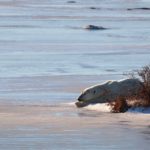 It’s not complicated. Polar bears need sea ice and their habitat is disappearing at an alarming rate.]]>
 Polar bear waiting for sea ice to form. Churchill, Manitoba, Canada, November 2016. Photo: Sybille Klenzendorf / WWF
To understand the threat to polar bears from climate change, one only has to examine the trends in sea ice across the Arctic. With 19 different polar bear populations, we’re seeing 19 different scenarios play out over time: none of them bode well for the long term. Polar bears were almost preordained to be the Arctic icon for climate change. It’s not because scientists and managers could see the future but rather because the 1973 International Agreement on the Conservation of Polar Bears required the five Arctic nations with polar bears to conduct national research programs.
In the earlier years, research focused on estimating population size, understanding their ecology, and calculating sustainable harvest levels. The baseline of information allowed scientists to examine the relationships between polar bears and sea ice. The absolute dependence of polar bears on sea ice for all aspects of their life history became increasingly clear. From this background, it has also become increasingly clear that loss of sea ice associated with climate change is a rapidly growing risk to the long-term conservation of polar bears. Without enough sea ice, there are no polar bears. The challenge is defining “enough”.
Polar bears use up about 1 kg of body mass per day that they’re not feeding on seals.
Consider that polar bears use up about 1 kg of body mass per day that they’re not feeding on seals. Changing ice formation or melt by a few days is well within the fasting capacity of most bears but the ice-free period across the Arctic is changing by at least 5 days/decade and some areas up to 75 days/decade depending on the population. As the ice-free period increases, it’s clear that more bears will run out of stored fat and succumb to starvation.
Once we cross about 180 days of ice-free time in an area, there’s little hope that a population will produce enough cubs to persist. Polar bear populations will blink out one-by-one. There’s little or no hope of adaptation – polar bears evolved as an obligate marine predator on seals. They won’t become more terrestrial as some wishfully hope: the terrestrial Arctic bear niche is already filled by the barren-ground grizzly bear. On the positive side, we should have polar bears to the end of the century in the Last Ice Area in the high Arctic.
The sea ice conditions in 2016 were challenging for some polar bear populations with an early melt. Of particular concern was that the September minimum sea ice cover was the second lowest on record. The situation, however, has gotten worse in some areas as the sea ice is at record lows for many areas through much of November. What will 2016 mean for polar bears across the Arctic? It’s always hard to know but some populations are already 25-50% lower in abundance than only a decade ago.
It’s a given that 2016 will present new challenges for polar bears and the communities across the Arctic. Hungry bears seek out food and northern communities are often right in path of hungry bears. More hungry bears in communities usually means more dead bears but it’s also a major safety concern for people as we move into the months long Arctic night.
Is 2016 the year that some populations crash? It’s possible but we won’t know until monitoring programs are in the field in 2017. Nonetheless, we won’t really have solid insights because the monitoring of polar bears is so episodic. Some populations have no monitoring and others are only followed every decade or two. The core monitoring populations in Western Hudson Bay, Southern Beaufort Sea, and Barents Sea near Svalbard are all showing similar concerns: loss of sea ice leads to lower body condition and then declines in reproduction and survival that lead to population declines.
It’s not complicated. Polar bears need sea ice and their habitat is disappearing at an alarming rate.
It’s not complicated. Polar bears need sea ice and their habitat is disappearing at an alarming rate. People understand that destroying the Amazon rainforest endangers species but sea ice is such a mysterious habitat for many people and polar bears are such amazing animals that they expect they’ll somehow manage. Wishful thinking is a poor means of conserving any wildlife species – it will have tragic consequences for polar bears.
]]> This was my fifth time in Churchill, and I was shocked at the difference from the last four. ]]>
 Tourists in Churchill, Manitoba, Canada observe a polar bear. Photo: Elisabeth Kruger / WWF
Sybille Klenzendorf, PhD, is a Senior Biologist with WWF.
In mid-November, I spent a week in Churchill on Canada’s Hudson Bay Coast. It’s one of the most popular places for viewing polar bears, as they gather on the shore waiting for the sea ice to form, so they can end their long summer fast. This was my fifth time in Churchill, and I was shocked at the difference from the last four. The temperature was 35 degrees Fahrenheit (20 C) warmer than any of the times before. A friend asked if it was just ‘weather’, but it was that much warmer for over 4 weeks and not just a couple days. I got by the whole week without an Arctic coat, most of the time in just a long-sleeved t-shirt and a vest. There was no ice to be seen on the bay and the ice charts showed no ice anywhere in the whole of Hudson Bay.
 WWF biologist Sybille Klenzendorf in Churchill, Manitoba, Canada in November 2016.
We came now because we wanted to see them before they are gone.
The whole week there I felt excited to have amazing bear photography in sunny, warm days but was feeling panicked that Nov. 2016 might be the tipping point for a fast decline of the Western Hudson Bay polar bear population. Many of the travelers that were in my group said “we came now because we wanted to see them before they are gone”. I had always thought that might be 10-20 years off for Churchill but now I am not so sure it will be that long.
 Polar bears wait for the ice to form on Hudson Bay, Canada. See where the bears are now.
Scientists say that there might be a 50% mortality for bears that are on land without ice for more than 210 days. At this rate we are very fast approaching that point. In discussing this with bear researcher Andrew Derocher, he said that “I’d say there’s a chance that we’re now in the final decline stage for the population based on data I’ve seen. Reproductive rates are tanking and the body condition is still declining. Is November 30, 2016 the panic button for Western Hudson Bay bears? Not yet as far as I can see, but if the ice doesn’t come in soon, however, 2016 may be a major challenge for the bears.”
I can confirm that. In the week I was there, I saw one particularly skinny female and cub, and many other bears looked very thin. This was 3 weeks ago and the ice has still not come. The time for action is now! The climate change talks in Morocco were a good start to get serious to save our climate and the remaining polar bears.
]]> Since 2003, WWF has partnered with the Norwegian Polar Institute (NPI) to track Svalbard polar bears by satellite. The Arctic is warming twice as fast as the rest of the world, rapidly altering the sea ice that polar bears depend upon. This research helps scientists understand how polar bears are adapting to changing ice conditions. You […]]]>
Here’s what the Svalbard bears have been up to this summer and fall:
Snovit

During late summer and early fall, Snovit mainly moved along the shores of the fjord with some shorter trips inland, always returning to the beach.
There’s no sea ice in this fjord now and there won’t be for a few months. She must rely on sources of food other than her favourite, ringed seals, which won’t be available to her until ice freeze up in early winter.
N23980

As in previous years, polar bear N23980 took a trip further north on Svalbard this summer before returning to her favourite fjord, where she has been patrolling the shores and taking a few short trips inland.
She has now been completely land-based for several months. However, she’s still moving around quite a bit, challenging the idea that polar bears on land in summer stay put to save energy.
She must find some food to keep her going, however – presumably a mixed diet of both marine and terrestrial origin.
N26165

Of the bears we’re following on Svalbard, N26165 has the most restricted movement pattern. She’s hardly moved outside the fjord where she was tagged in April 2015.
After the sea ice melted in early summer, she has been on land, patrolling the beaches and swimming to small islands nearby.
In particular, she’s spent a lot of time near the largest glacier front in the fjord, where she could be hunting seals that have climbed, or hauled out, onto floating pieces of glacier ice. Polar bears in Svalbard quite frequently hunt seals in this habitat. They’re good at it too, even though hauled out seals are suspicious and wary.
Isdimma3

As the distance between the coast and sea ice around Svalbard increases, pregnant polar bears on the drift ice face a major challenge – how do they get back to land in time to dig a maternity den?
N26243, aka Isdimma3, spent about spending about two and a half months in the drift ice this summer. By July, the distance between land and ice was quite significant. Luckily, she managed to reach the coast by moving on very loose drift ice and swimming long distances.
It must be important for her to get onto land, say the researchers, since her hunting opportunities would probably be better out on the ice. It’s possible that she’s looking for a suitable denning location, and staying with the ice would jeopardize her chances to reach land later in the fall.
]]> Ittoqqortoormiit is one of the most isolated places in Greenland, and home to the newest polar bear patrol.]]>
 Using binoculars to scan the shore for polar bears in Ittoqqortoormiit, Greenland.
Every morning in August and September, a patrol officer surveys the land and coast of the tiny eastern community of Ittoqqortoormiit, Greenland. He’s on the lookout for dangerous, and increasingly numerous, visitors – polar bears.
This polar bear patrol is one of many around the Arctic, from Alaska to Russia to Canada. Since 2006, the patrols have monitored polar bears around Arctic communities, frightening them away when necessary. WWF has provided patrols with training and equipment, ensuring that the patrollers are effective and safe.
 The coast of Ittoqqortoormiit, Greenland, is polar bear habitat. © WWF-Denmark
Ittoqqortoormiit is one of the most isolated places in Greenland, and home to the newest polar bear patrol. This month, the first polar bear of the season came to town – a three-metre long male polar bear. The patrol successfully scared the bear away, and it didn’t return.
Although Ittoqqortoormiit lies above the Arctic Circle, conflict with polar bears is a relatively new problem. The warming climate and receding sea ice mean polar bears have less opportunity to hunt seals. Instead, they are forced to spend more time looking for food on land, and communities are an appealing source of food.
 WWF’s Kaare Winther Hansen speaks with a resident of Ittoqqortoormiit about the increase in polar bear conflict. © WWF-Denmark
“When I was a kid, we never saw polar bears in this area”, reported one 64-year old resident. “Now we have to polar bear-proof our cabins. Last spring, polar bears smashed all our windows.”
Residents are also hoping to discourage bears from coming into town in the first place. WWF is working with the municipality to better manage the community’s garbage so the bears will look elsewhere for food.
Learn more about how WWF is keeping people and polar bears safe around the Arctic.
]]> Since 2003, WWF has partnered with the Norwegian Polar Institute (NPI) to track Svalbard polar bears by satellite. The Arctic is warming twice as fast as the rest of the world, rapidly altering the sea ice that polar bears depend upon. This research helps scientists understand how polar bears are adapting to changing ice conditions. […]]]>
April 26, 2016 – After many days with wind from the north, when the fjords facing that direction were mostly covered in sea fog, today we finally had great weather. We knew we had a few bears in that area that we hadn’t captured when we first started this year’s field work. It was a very pleasant day at only a few degrees below zero.
We did spot a few of the bears we handled earlier, identified by temporary painted numbers on their bums. In addition, we found five different bears that were not marked. Three of those we captured: an adult male we know well from the area, a very local adult female we used to see almost every year, and a two year old bear that we never met before.
In addition, in Raudfjorden, furthest north-west on Spitsbergen, we met two adult males we were not able to capture. The ice was really rotten, and the bears went through the ice or dived and broke through it from time to time. It is dangerous to both bears and people to work in such conditions.
 Walruses from north Spitsbergen. Photo: Jon Aars / NPI
There was plenty of other wildlife to see, from arctic foxes to walruses and belugas. We also spotted a lot of bird life, including the endemic rock ptarmigans that seems to have had a very good year with high winter survival. Tomorrow we will at most have a short day in field, and then April next year will be our next chance to meet our bears again. The season has been good, with 75 bears handled, and many nice days in the field in scenic areas of the Arctic.
]]> Since 2003, WWF has partnered with the Norwegian Polar Institute (NPI) to track Svalbard polar bears by satellite. The Arctic is warming twice as fast as the rest of the world, rapidly altering the sea ice that polar bears depend upon. This research helps scientists understand how polar bears are adapting to changing ice conditions. […]]]>
April 23, 2016 – We have now left the boat and are using Longyearbyen, the main settlement in Svalbard, as a base. A few days ago, we surveyed the west coast of Spitsbergen, the main island of Svalbard, with limited success.
In two of the larger western fjords, Van Mijen and Van Keulen, we searched for two of the polar bears on WWF’s Tracker. Snovit (N23979) still has a working collar, so we know her position. The other one, N23980, has a collar that hasn’t sent positions since early March.
Today these females were our main target. About noon we found fresh tracks at a glacier front on sea ice close to Snovit’s location from the day before. The ice had broken up, so her last position was at open water, but what we assumed were her tracks were picked up a few hundred meters further into the fjord.
 This is Snovit (N23979), one of the bears from the WWF polar bear tracker, taken in Van Keulenfjorden, W Spitsbergen. Follow her track here. Photo: Jon Aars / NPI
Soon we spotted her, and were able to immobilize her. She did not seem to have had cubs, something we were interested to know. She went into a den in January, later than what is normal for polar bears giving birth. She left the den in March, and we assumed that if she gave birth, the cubs would have been lost. It seems she was only in what we call a temporary den, not a maternity den. Snovit is starting to get rather old, and maybe she found she deserved a break.
Her daughter is N23980, and we knew from observations that she had been with her two 2-year old cubs until early April, but that the family had broken up since then. We observed one of her 2-year olds on very thin ice, not safe for helicopter landing.
 Snovit’s daughter is N23980, also a WWF polar bear tracker bear. Here she is examined by Magnus Andersen. Follow her tracks here. Photo: Jon Aars / NPI
A bit later we found N23980 on sea ice close to land, in an area we knew she was likely to spend time. We darted her on land, where it was safe, took off the old nonfunctional collar, and replaced it with a new one. As this bear has had a very specific migration route every year, involving the crossing on a fjord and a strait, it shall be interesting to follow her the next months.
]]> Edgeøya is a large island in eastern Svalbard, here in sunset, just a few days before we have 24hr daylight in the area. Photo: Jon Aars / NPI
April 15, 2016 – Today we surveyed Edgeøya, the largest of the islands in the east of the archipelago. We followed the coast down on the west side, and found neither sea ice nor bears.
We finally encountered a local shallow area (a laguna) that had sea ice, and certainly the bears had found the same place. Within a few hours we captured an adult male, a female with two cubs of the year, a female with a yearling and a lone adult female in the rather restricted area.
 A sedated mother and her one year old cub, southern Edgeøya. Photo: Jon Aars / NPI
The lone female was the TV star from a BBC series called “The Polar Bear Family and Me” from a few years ago. She was filmed with two cubs through the year in 2012.
Since then we have not seen her nor any of the cubs. As she had a small logger measuring temperature and light in one ear, we got data that showed she had been denning the winter 2013-2014. This means she did not wean any cub successfully (they should have been with her until 2014, and she should not have been in den before 2014-2015 if any of the cubs survived.
The series showed that she lost one cub the first summer, the data show she likely lost the other one some time after. This is fairly normal, perhaps one out of three cubs survive until weaning in Svalbard. It is hard for a mother to raise cubs. In addition to the bears we spotted many ptarmigans and some walruses.
]]>