The post We rebuilt Evercontact around one idea: your inbox is already your CRM appeared first on Blog | evercontact.
]]>Here’s what changed, why we made the calls we made, and what’s new in the dashboard.
The thesis: stop treating contact data as a feature
For years, contact extraction was sold as a checkbox: a thing that scraped a signature and dropped a row into your address book. Useful, narrow, forgettable.
But every email your team sends is a structured object waiting to happen. There’s a person in it, a company, a title, a phone number, a relationship, a decision. The inbox isn’t a place where contact data lives near. The inbox is the source of truth. Every other system, your CRM, your address book, your warehouse, is a downstream copy that’s already going stale.
So we stopped designing around “extract a contact” and started designing around a single sentence: turn every email into structured relationship data, automatically. That reframing drove every decision below.
Design choice #1: show the product working, not a screenshot of it
The old homepage led with a static hero image and a list of adjectives. We replaced it with a live transformation. The first thing you see on evercontact.com now is an actual email, Amélie’s “Q3 partnership kickoff” thread, being read, parsed, enriched, and synced to HubSpot, Salesforce, and Google Contacts in 3.4 seconds, on screen.
We debated this for a long time, because “show the live product on the marketing page” is harder to build and easier to get wrong than a polished mockup. We shipped it anyway, for one reason: trust is the entire product. You are handing us your inbox. A buyer in that position doesn’t want to be told the magic is fast and clean. They want to watch it happen. The demo isn’t decoration. It’s the argument.
Design choice #2: expose the work
Most AI products hide the machinery and ask you to take the output on faith. We went the other way. Across the new site and dashboard, we deliberately surface the intermediate state: the parsed JSON, the individual fields lifted from a signature, the dedup graph collapsing three records into one truth, the sync destinations with their timestamps.
That’s an unusual choice for a “clean, minimal” redesign, and it was intentional. When the category is full of black-box enrichment vendors, legibility is a differentiator. Showing you the structured object we built from your thread is how we prove we actually read the inbox, instead of guessing from a third-party data pool, which is what the vendors we replace tend to do.
Design choice #3: privacy moved from the footer to the spine
In the old design, security lived where security always lives: a trust badge near the bottom and a legal page nobody reads. In 4.0, the privacy posture is a load-bearing pillar of the narrative, with its own section, its own data-flow diagram, and a place in the FAQ that doesn’t hedge.
The commitments are stated plainly because they’re absolute: we never train on your data, we never store message bodies, and we never sell, pool, or syndicate your contacts, ever, to anyone, for any price. No data-broker side business. No shared enrichment graph fed by your inbox. Per-tenant isolation on hardened infrastructure, SOC 2 Type II, GDPR-native consent, regional data residency.
We put this front and center because enterprise buyers told us, repeatedly, that the privacy posture was the reason they started the conversation, not a box they checked at the end of it. The design should reflect what actually matters to the person reading it.
Design choice #4: quiet on purpose
The visual language of 4.0 is restrained: lots of whitespace, low chrome, monospace accents where the product gets technical, almost no decorative noise. The headline on our customers section is the design brief for the whole thing: “Quiet infrastructure for loud revenue teams.”
Evercontact is meant to run in the background and disappear. A loud, busy, animation-heavy site would have contradicted the product. We wanted the design to feel like the thing it sells: calm, fast, and out of your way.
What’s new in the dashboard
The marketing site is the promise; evercontact.com is where it’s kept. The redesigned dashboard, “Inbox → Intelligence,” is the heart of 4.0.
The live enrichment panel. When a new person appears in a thread, you watch the record assemble in real time: name, title, company, phone, location, parsed from the signature, matched against verified sources, and written back to your CRM in under four seconds. No “import,” no “sync now” button. It just happens as the mail arrives.
The autonomous AI agent. This is the headline of 4.0, and the reason the badge says “Now with AI Agents.” Evercontact no longer just reacts to incoming mail. It owns your CRM hygiene on its own. The agent runs in the background detecting stale records, missing fields, and duplicate companies, and fixes them while you sleep. You wake up to a clean book instead of a cleanup task.
Graph-based identity resolution. The dashboard now knows that “Bob Smith” and “Robert J. Smith” are the same person, and follows them across spelling changes, aliases, role changes, and company moves. Your relationship history attaches to the human, not to an email string that breaks the moment they switch jobs.
The command palette (⌘K). The whole dashboard is keyboard-first. Jump to any contact, company, or action instantly. It’s built for the ops people who live in their tools and don’t want to reach for a mouse.
Email intelligence as structured events. Beyond contacts, the dashboard now surfaces the relationship events buried in threads, warm intros, follow-ups, meetings, decisions, as clean, structured objects you can pipe into the rest of your stack over webhook, REST, or a warehouse mirror. Every thread becomes a queryable object.
Multilingual extraction, visible. The extraction model reads signatures across 30+ languages, including broken formatting, missing punctuation, and titles buried three replies deep, and the dashboard shows you which language and which fields it pulled. Six dedicated models, one coordinated agent, trained on the messy reality of business email.
The ContactRescue console. Point Evercontact at the last 24 months of your inbox and watch the recovery run live: scanning, extracting, deduping, enriching, synced, with running counts, coverage stats, and an ETA. It’s the most-watched screen we’ve ever built, because it’s the moment people discover thousands of warm relationships their CRM never saved.
Why ContactRescue got its own story
One feature got a disproportionate amount of design attention in this release, and it deserves an explanation: ContactRescue.
Most contact tools are forward-looking. They help with the mail you get from now on. But the most valuable relationship data your company owns is already sitting in the archive, unrecorded. Every time an employee leaves, a domain switches, or a business gets acquired, thousands of warm relationships quietly disappear.
So we designed ContactRescue around the moments when that loss actually happens, offboarding, M&A, domain migration, restructures, even a lost laptop, and we gave each one its own concrete promise: a clean handover in under four hours before a mailbox is suspended, a full relationship graph captured before an acquired company goes dark, zero CSV exports for a domain move. These aren’t abstract benefits. They’re the bad days ContactRescue is built to rescue you from.
The numbers we designed toward
We didn’t pick the metrics on the new site to look impressive. We picked them because they’re the outcomes the whole redesign is in service of:
- 87% less manual CRM data entry
- 4.2× more verified contacts captured vs. typing into the CRM
- 320 hours saved per rep, per year
- 3.4 seconds median time from email received to contact synced
- 99.99% platform uptime
If the design did its job, you felt those numbers were inevitable by the time you reached them, because the product you watched working on the way down the page already made the case.
What stayed the same
One thing we refused to change: your contacts are yours. No browser extensions to install, no middleware, no lock-in, and a one-click export to CSV or any CRM. A decade in, the promise is the same as day one. 4.0 just makes it faster, smarter, and quieter.
Connect your inbox in 60 seconds and watch the first contacts flow in. We think you’ll see the thesis immediately: your inbox was always your best CRM. Now it acts like one.
Evercontact 4.0 began rolling out to all accounts on Jun 29, 2026. The new dashboard is live for every plan; existing layouts remain available for 30 days during the transition.
The post We rebuilt Evercontact around one idea: your inbox is already your CRM appeared first on Blog | evercontact.
]]>The post 🧠 AI + CRM: Why Your Contact Data Strategy Will Make or Break Your 2026 Pipeline appeared first on Blog | evercontact.
]]>Everyone talks about pipeline acceleration, deal velocity, and outbound performance — but few talk about the hidden force that drives all three: contact data.
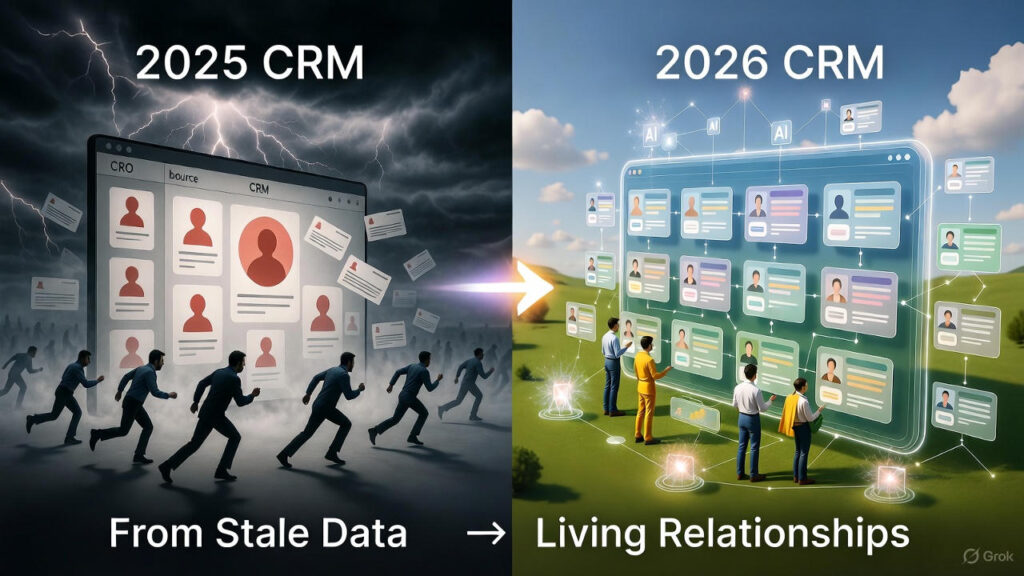
Every sales workflow, every automation, and every marketing campaign relies on a simple truth: you can’t build relationships on outdated information. The era of static contact lists is over. With job mobility at an all-time high and communication channels multiplying, AI contact intelligence has become the single most important upgrade to your CRM stack.
The Hidden Cost of Stale Contacts
Every year, 25–30% of B2B contact data goes stale. That means one in three emails in your CRM may already be invalid, outdated, or misaligned.
When that happens, your campaigns still run, your sequences still send, and your dashboards still look fine — but the results quietly decay.
Sales reps waste time chasing the wrong people. Marketing automation workflows misfire. Customer success loses track of key contacts who moved to new companies.
We’ve seen it across industries:
- A sales team sends 10,000 emails — 1,200 bounce instantly, and 3,000 more go to people who have changed roles.
- A marketing team spends budget on ads targeting an audience that’s 40% outdated.
- CRM “cleanup projects” take months and cost thousands, only for the problem to return weeks later.
 The takeaway: Before you optimize your CRM, fix what feeds it.
AI: The Contact Intelligence Revolution
Artificial Intelligence is redefining how contact data is captured, updated, and enriched.
Where old CRMs relied on users manually entering or correcting data, modern systems now learn from real interactions — emails, signatures, calendar invites, and message patterns.
At Evercontact, our Contact Intelligence Suite (CIS) processes millions of emails every day, detecting signatures, role changes, and contact shifts automatically.
That means your CRM updates itself in real time — no manual entry, no spreadsheets, no guesswork.
Here’s what that looks like in practice:
- Real-time contact refresh: when a prospect joins a new company or changes roles, their profile updates instantly.
- Context enrichment: automatically adds missing information like company size, location, and LinkedIn URL.
- Predictive mapping: identifies relationships and engagement strength across your network.
AI isn’t replacing your CRM — it’s reviving it.
From Static Data to Dynamic Relationships
When your contact data is alive, your pipeline comes alive too.
Clean, accurate contacts mean your sales teams spend more time talking to the right people — and less time chasing ghosts.
It also means your marketing segmentation improves dramatically, leading to higher engagement and better personalization.
Our clients who automated contact intelligence saw tangible gains:
- +18% higher reply rates across sales sequences
- +12% boost in MQL-to-SQL conversion
- 40% fewer bounces and invalid records
Imagine your CRM alerting you when a decision-maker you once pitched just joined a new company — and is ready to buy again. That’s the new standard of pipeline intelligence.
The takeaway: Accurate contacts aren’t data points — they’re opportunities in motion.
Implementation Challenges & Best Practices
For many organizations, the biggest hurdle isn’t technology — it’s mindset.
Too often, teams assume “CRM = contact strategy.” But a CRM without automated enrichment is just a database.
Contact data management has to be continuous, intelligent, and integrated into your daily workflows.
Here’s what works best:
- Automate enrichment directly from your communication layer — your inbox, calendar, or collaboration tools.
- Standardize contact fields across teams and systems.
- Set review cycles and data-governance rules (especially for GDPR/CCPA compliance).
- Use APIs and integrations to ensure updates sync instantly with your CRM and marketing platforms.
The companies winning in 2026 will be those who treat contact intelligence as part of their revenue infrastructure, not an afterthought.
The 2026 Roadmap: Predictive, Real-Time, Relationship-Aware
The next evolution of CRM is already here — and it’s powered by AI that understands relationships.
In the coming year, we’ll see:
- Predictive intent scoring based on communication frequency and tone.
- Relationship graphs that visualize your team’s real network strength.
- Real-time syncs between email, CRM, and marketing systems.
At Evercontact, we’re building exactly that.
Our roadmap focuses on deeper integrations with Salesforce, HubSpot, and Microsoft Dynamics; predictive contact scoring; and “relationship health” dashboards that visualize engagement across an organization.
The takeaway: The contact layer is becoming the most valuable part of the go-to-market stack.
Conclusion: Your Pipeline Is Only as Smart as Your Contacts
In 2026, the competitive edge won’t come from sending more emails or running more ads — it’ll come from knowing exactly who you’re talking to.
AI contact intelligence transforms your CRM from a static record keeper into a living, breathing network of relationships. It’s the foundation of accurate forecasting, stronger pipelines, and sustainable growth.
If your contact data isn’t keeping up, your pipeline won’t either.
 Ready to see your own contact data in motion? Book a quick demo of Evercontact’s Contact Intelligence Suite — and see how automated contact intelligence can keep your CRM always one step ahead.
The post 🧠 AI + CRM: Why Your Contact Data Strategy Will Make or Break Your 2026 Pipeline appeared first on Blog | evercontact.
]]>The post ContactRescue 2.0: AI-Powered Contact Extraction, Smarter and More Accurate Than Ever appeared first on Blog | evercontact.
]]>
Today, we’re thrilled to announce a major upgrade to ContactRescue, built on a new AI-driven architecture that makes it smarter, faster, and more globally accessible than ever before.
Re-Engineered with AI at the Core
The new ContactRescue leverages advanced natural language processing (NLP) and machine learning models to identify and validate contact information with unprecedented accuracy. Our AI doesn’t just scan your inbox—it understands context, differentiates between signatures and noise, and adapts to diverse formats and languages.
The results speak for themselves:
- 32% more contacts extracted on average
- 19% improvement in accuracy, thanks to AI-based validation and de-duplication
- Support for over 90 languages, including Russian, Greek, Arabic, Hebrew, and Indian character sets
This AI-powered architecture ensures that ContactRescue not only captures more contacts but also delivers higher-quality results you can trust.
Why Run a ContactRescue?
The value of ContactRescue goes beyond simply extracting names and emails. Here are the key use cases where ContactRescue becomes essential:
- Recover lost contacts – never lose touch with valuable connections hidden in years of email history.
- Prevent client theft – secure your organization’s relationships by ensuring contacts remain in your CRM, not just in a departing employee’s inbox.
- Preserve valuable business data – your contacts are one of your most important assets; ContactRescue ensures they’re captured and protected.
- Ensure CRM integrity – keep your CRM accurate, complete, and up to date by automatically enriching it with verified contacts.
- Manage team transitions – when employees change jobs or sales reps leave, ensure no client connections are lost.
- Prepare for due diligence – an organized, enriched contact database adds significant value to your business during M&A, fundraising, or audits.
- Unlock extremely cheap qualified leads – turn your historical email interactions into a ready-made, pre-validated pool of leads at a fraction of traditional acquisition costs.
With ContactRescue, your network becomes a resilient, structured, and secure business asset—while providing a cost-effective way to generate new business opportunities.
The Future of Contact Intelligence
This release is just the beginning. We’re continuing to push the boundaries of AI to make contact management more proactive and intelligent. Upcoming enhancements will leverage graph neural networks, contextual enrichment, and real-time updates to ensure your address book isn’t just complete—it’s always current and actionable.
Try the New AI-Powered ContactRescue Today
The latest version of ContactRescue is now live for all users. Whether you’re an individual, a growing team, or a global enterprise, our AI-driven approach ensures that every valuable connection in your inbox is captured and kept up to date.
Get Started with ContactRescue
The post ContactRescue 2.0: AI-Powered Contact Extraction, Smarter and More Accurate Than Ever appeared first on Blog | evercontact.
]]>The post AI, LLMs, and the Future of Contact Intelligence: Why Data is Everything appeared first on Blog | evercontact.
]]>
At its core, AI is a system that can learn, adapt, and make decisions, often mimicking human capabilities. Among the most powerful forms of AI today are Large Language Models (LLMs) — AI models trained on massive amounts of text to understand and generate human language. Think ChatGPT, Gemini, Claude — all built on the idea that with enough data, a machine can learn how humans think, write, and communicate.
But while most LLMs are general-purpose, trained on everything from Wikipedia to Reddit, Contact Intelligence is a different story.
What is Contact Intelligence?
Contact Intelligence is the ability for AI to understand, clean, enrich, and activate contact data — at scale. It’s not about guessing your next word; it’s about knowing who someone is, how to reach them, what company they work for, and when that changed. It’s about context, accuracy, and real-time relevance.
And here’s the truth: LLMs are only as powerful as the data they’re trained on. That’s where Evercontact comes in.
The Largest LLM for Contact Data
Evercontact isn’t just a smart contact tool. Behind the scenes, we process and analyze over 20 million emails per day across a massive, real-time dataset. That’s tens of millions of unique identities, companies, job titles, phone numbers, and email addresses updated continuously.
In other words: Evercontact operates the largest living dataset of contact intelligence in the world.
While others build LLMs trained on public text, we’re building the most advanced LLM in the world trained on real, structured contact interactions — the metadata of modern business.
We don’t just know that someone exists. We know when they changed jobs, added a new signature, started using a new phone number, or took on a new role — and we know it automatically, in real time.
Why This Matters
Whether you’re a salesperson, recruiter, founder, or investor — your network is your leverage. But contacts go stale fast. People move, change roles, update numbers. Manual upkeep doesn’t scale. CRM data is notoriously outdated. And no one wants to pay for “enrichment” based on last year’s scraped data.
That’s where Evercontact’s Contact Intelligence Suite (CIS) comes in. It leverages our AI + LLM stack to auto-update and auto-sync your contacts across platforms — clean, enriched, and always relevant.
AI is only as good as the data behind it.
At Evercontact, we’ve built an AI that doesn’t just guess — it knows. Because it’s trained on the most dynamic dataset in the professional world: your inbox.
We believe the future of productivity starts with better contacts. And we’re not just riding the AI wave — we’re shaping it.
The post AI, LLMs, and the Future of Contact Intelligence: Why Data is Everything appeared first on Blog | evercontact.
]]>The post Is Online Privacy Dead? appeared first on Blog | evercontact.
]]>For the past two decades, we’ve fought tooth and nail to shield consumers from the Wild West of the internet. Laws like GDPR, CCPA, and countless others emerged as digital armor, promising a safer online world. The mission was clear: protect user data, enforce transparency, and hold companies accountable. We built firewalls, crafted consent forms, and preached the gospel of privacy. And for a while, it seemed to work—users felt empowered, regulators flexed their muscles, and businesses scrambled to comply.

But then, something shifted. Artificial Intelligence stormed into our lives, flipping the script entirely. What once felt like a battle for control has morphed into a strange surrender. Today, users seem less like guarded skeptics and more like willing participants in a grand data experiment. The unspoken deal? The more you know about me, the better you can serve me. It’s a logic that’s long governed the brick-and-mortar world—think loyalty cards and personalized shopping—and now, amplified by AI, it’s rewriting the rules of the digital age.
So, is online privacy dead? Not quite. But it’s undeniably on life support. We’ve gone from paranoid to carefree, from locking our digital doors to flinging them wide open. How did this happen? And more importantly, what do we do about it?
The AI Paradox: Convenience vs. Control
AI thrives on data—it’s the fuel that powers personalized recommendations, predictive analytics, and seamless experiences. The more it knows, the smarter it gets, and the more we benefit. Need proof? Look at how we’ve embraced virtual assistants, tailored ads, and even AI-driven tools that anticipate our next move. It’s intoxicatingly convenient. But here’s the catch: that convenience comes at the cost of the very firewalls we spent years erecting.
Users, once wary of every cookie and tracker, now shrug as they trade privacy for utility. It’s not ignorance—it’s maturity, or perhaps resignation. We’ve reached a tipping point where the promise of a better, more tailored digital life outweighs the fear of being exposed. We’ve gone from clutching our data like a secret to wearing it like a badge. Exhibitionism has replaced caution.
The Fall of the Privacy Fortress
This shift didn’t happen overnight. It’s the culmination of years of data breaches desensitizing us, social media normalizing oversharing, and AI proving its worth in ways we can’t ignore. The frameworks we built—those meticulously crafted regulations—feel like relics in an AI-driven world. They weren’t designed for a reality where machines learn faster than lawmakers can legislate, or where users willingly feed the beast. The result? A digital landscape where privacy is less a right and more a negotiation.
But let’s not mistake this for progress. The collapse of privacy firewalls doesn’t mean we’ve won—it means we’re vulnerable. Without guardrails, the power lies entirely with those who wield the data: tech giants, AI innovators, and, yes, bad actors. The question isn’t whether online privacy is dead—it’s whether we’re okay with letting it die.
The Case for Moderation—and Leadership
Here’s the truth: AI doesn’t have to be the enemy of privacy. It’s a tool, and like any tool, its impact depends on how it’s used. That’s where industry leaders like Evercontact come in. We believe innovation and safety aren’t mutually exclusive—they’re two sides of the same coin. The future doesn’t demand the death of privacy; it demands balance.
Moderation is key. Firewalls may be crumbling, but they can—and must—be rebuilt, smarter and stronger than before. Companies like Evercontact have a responsibility to lead the charge, not just by complying with regulations, but by setting a higher standard. We need systems that harness AI’s potential without turning users into open books. We need transparency that empowers, not exploits. And we need to remind the world that convenience shouldn’t come at the cost of control.
Evercontact’s Commitment: Privacy as a Pillar
At Evercontact, we’ve always taken user rights seriously. From day one, our mission has been to innovate responsibly—because we know that cutting-edge tools should never jeopardize people’s safety. Our products are designed with you in mind, not just as a data point, but as a person deserving of respect. We don’t see privacy as an obstacle to overcome; we see it as a foundation to build upon. As AI reshapes the digital world, we’re committed to ensuring it serves you—without selling you out.
The Road Ahead
Online privacy isn’t dead—it’s evolving. And with that evolution comes a choice: do we let it slip away entirely, or do we fight for a middle ground where innovation and safety coexist? At Evercontact, we’re choosing the latter. We’re calling on industry leaders, regulators, and users alike to rethink what privacy means in an AI age. It’s not about locking everything down or giving everything up—it’s about finding the balance that keeps the internet human.
So, no, online privacy isn’t dead. But it’s on us to keep it alive. Let’s build a future where AI lifts us up without tearing us apart. At Evercontact, that’s not just a promise—it’s our purpose.
The post Is Online Privacy Dead? appeared first on Blog | evercontact.
]]>The post The Hidden Cost of Contact Obsolescence: Why You Need Evercontact appeared first on Blog | evercontact.
]]>
This issue, known as contact obsolescence, is a stealthy adversary to productivity and revenue. Industry studies suggest that 30% of business contacts become outdated each year. Yet, the majority of professionals and organizations fail to update their contact databases regularly. The consequences? Lost deals, ineffective marketing campaigns, and missed opportunities for long-term business relationships.
Why Contact Obsolescence is a Problem
- Wasted Time and Resources: Sales and marketing teams spend excessive hours chasing leads that lead nowhere. Each obsolete contact translates into another fruitless email, phone call, or LinkedIn message.
- Lost Revenue: When you’re targeting outdated contacts, you’re not only losing time but also potential income. Outdated data results in lower conversion rates, skewed forecasts, and missed revenue opportunities.
- Damaged Customer Relationships: Imagine sending a renewal notice to someone who no longer works at the company. Not only is this ineffective, but it can also tarnish your company’s image and make your outreach appear uninformed.
- Security & Compliance Risks: Maintaining outdated or incorrect data in your CRM could lead to compliance issues, especially with regulations like GDPR, which mandate accurate data management.
How Evercontact Solves Contact Obsolescence
Evercontact leverages AI to revolutionize contact management by automating updates across your address book, CRM, and email contacts in real-time. Here’s how it can benefit you:
- Automatic Contact Updates: Evercontact scans your incoming emails to identify and update contact details automatically, ensuring your address book remains current.
- Seamless CRM Integration: Compatible with major CRMs like Salesforce, HubSpot, etc., Evercontact keeps your contact information accurate, minimizing manual data entry and errors.
- Time and Cost Savings: By automating contact updates, your team can dedicate more time to high-impact activities like deal-making and relationship building.
- Enhanced Business Intelligence: With up-to-date contact data, your business can make informed decisions, enhance outreach, and leverage every revenue opportunity.
The Bottom Line
In today’s fast-paced business environment, contact obsolescence isn’t merely an annoyance—it’s a significant liability. If you’re still managing contacts through outdated spreadsheets or struggling with manual CRM updates, you’re essentially squandering potential revenue.
With Evercontact, you can eliminate the worry of losing valuable connections or wasting resources on outdated information. Let AI manage the mundane, so you can focus on what truly matters: expanding your business.
Ready to eliminate contact obsolescence? Try Evercontact today and keep your contact list ahead of the curve.
The post The Hidden Cost of Contact Obsolescence: Why You Need Evercontact appeared first on Blog | evercontact.
]]>The post Unleashing the Power of Contact Intelligence: How AWS and NVIDIA GPUs Drive Evercontact’s CIS appeared first on Blog | evercontact.
]]>
Why Contact Intelligence Matters
In today’s world, managing business relationships efficiently can mean the difference between growth and stagnation. Evercontact’s CIS automates contact management by extracting, updating, and synchronizing contacts across multiple platforms in real time. It transforms email data into actionable contact insights, helping businesses stay connected and competitive.
The Role of AWS Cloud Services
AWS serves as the scalable foundation for Evercontact’s CIS platform, enabling high availability, reliability, and security at every level of the product. Here’s how AWS enhances our platform:
1. Scalable Infrastructure:
AWS allows us to scale resources dynamically based on workload demand, ensuring our platform can process approximately 20 million emails daily with minimal latency.
2. Data Storage & Security:
With AWS’s advanced storage services like Amazon S3 and security features like AWS Identity and Access Management (IAM), we securely manage and store massive volumes of contact data.
3. AI and Machine Learning Services:
AWS AI/ML services like Amazon SageMaker accelerate our model training and deployment process, helping us deliver smarter contact insights faster.
The Role of NVIDIA GPUs
The development of CIS requires processing vast amounts of data at lightning speed. Our platform analyzes massive email datasets, leveraging advanced AI models for natural language processing (NLP) and predictive analytics. NVIDIA’s cutting-edge GPUs enable us to scale this process efficiently by accelerating deep learning computations.
Here’s how NVIDIA GPUs make a difference:
1. High-Performance Computing:
NVIDIA GPUs deliver unparalleled processing power, enabling real-time contact extraction and synchronization.
2. Scalable AI Training:
Training large-scale AI models requires immense computational resources. NVIDIA GPUs allow us to train models faster and more cost-effectively.
3. Enhanced Accuracy:
With more computing power, our models achieve higher accuracy in identifying and updating contacts.
Driving Innovation for the Future
Our integration of AWS cloud services and NVIDIA GPU technology empowers us to push the boundaries of AI-driven contact management. As we continue to evolve CIS, we are committed to developing even more advanced features that enhance business productivity and communication.
Join the Contact Intelligence Revolution
Evercontact’s CIS, powered by AWS and NVIDIA technology, is transforming the way businesses manage contacts. We’re excited about the future and invite you to be part of this journey toward smarter, faster, and more reliable contact management.
Discover the power of CIS today and experience the next level of business intelligence.
The post Unleashing the Power of Contact Intelligence: How AWS and NVIDIA GPUs Drive Evercontact’s CIS appeared first on Blog | evercontact.
]]>The post What 20 Million Emails Per Day Reveal About the 2024 Election Dynamics in Swing States appeared first on Blog | evercontact.
]]>At Evercontact, where our users are primarily executives, entrepreneurs, and independent professionals, we are uniquely positioned to analyze how influential individuals engage with election-related messaging. By processing 20 million emails per day from four key swing states, we discovered intriguing trends that offer a new lens into voter engagement and campaign outreach.

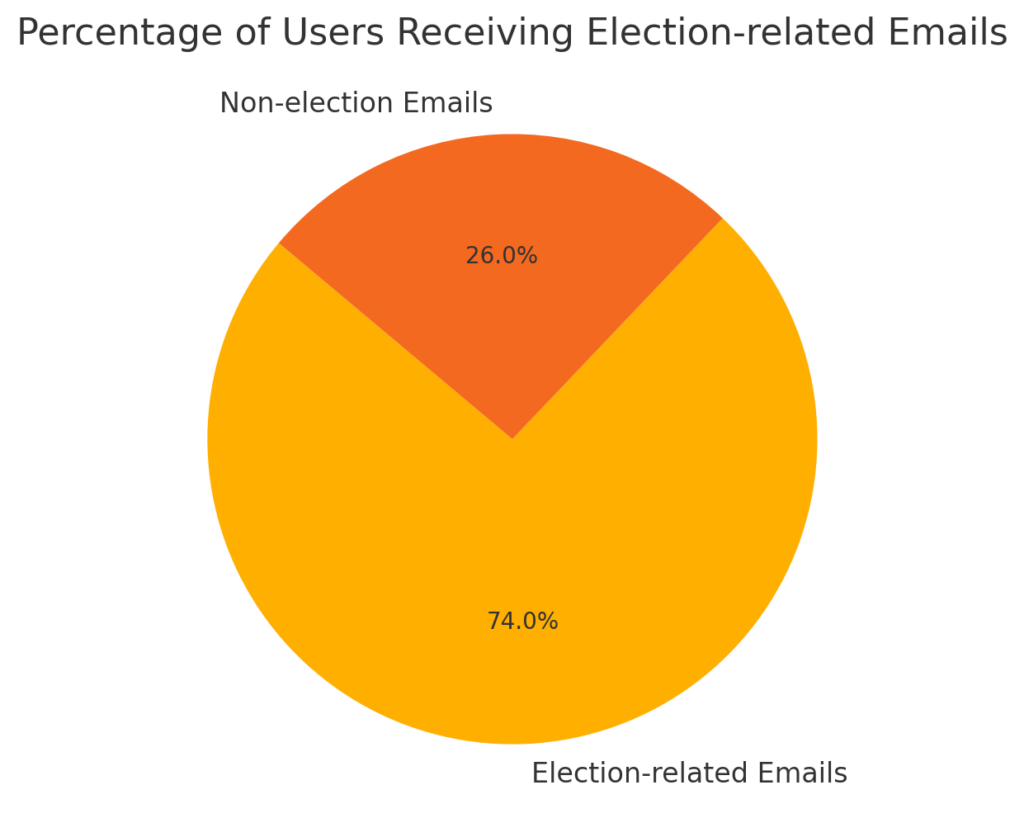
1. 74% of Users Receive Election-Related Emails
Our analysis shows that 74% of users—including business leaders, entrepreneurs, and professionals—are receiving emails related to the election. Campaigns are clearly targeting high-impact individuals who can influence their networks.
- Why this matters: This group often plays a pivotal role in campaigns, providing financial support, spreading awareness, and mobilizing their own contacts to vote. Understanding how campaigns engage with these individuals offers valuable insight into election dynamics.
2. GOP Outpaces DNC in Newsletter Subscriptions
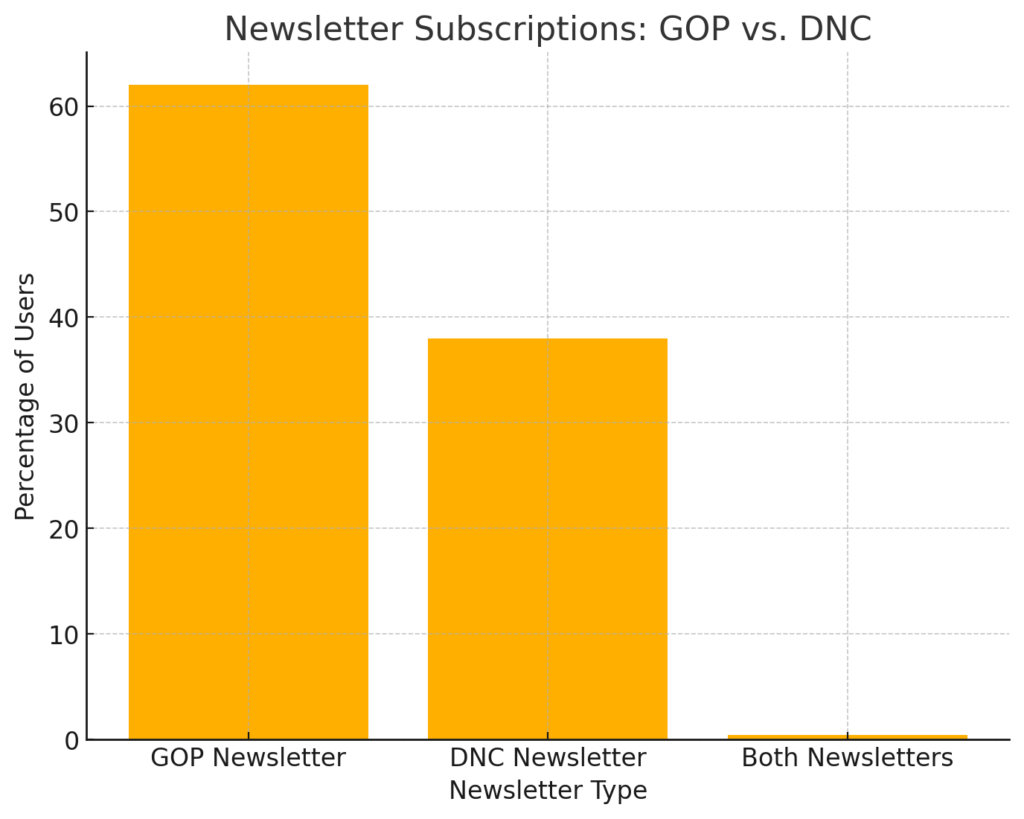
Among users receiving election-related emails, 62% subscribe to GOP newsletters, compared to 38% following the DNC. The Republican advantage could reflect stronger messaging to entrepreneurs and executives or more aggressive outreach to these segments.
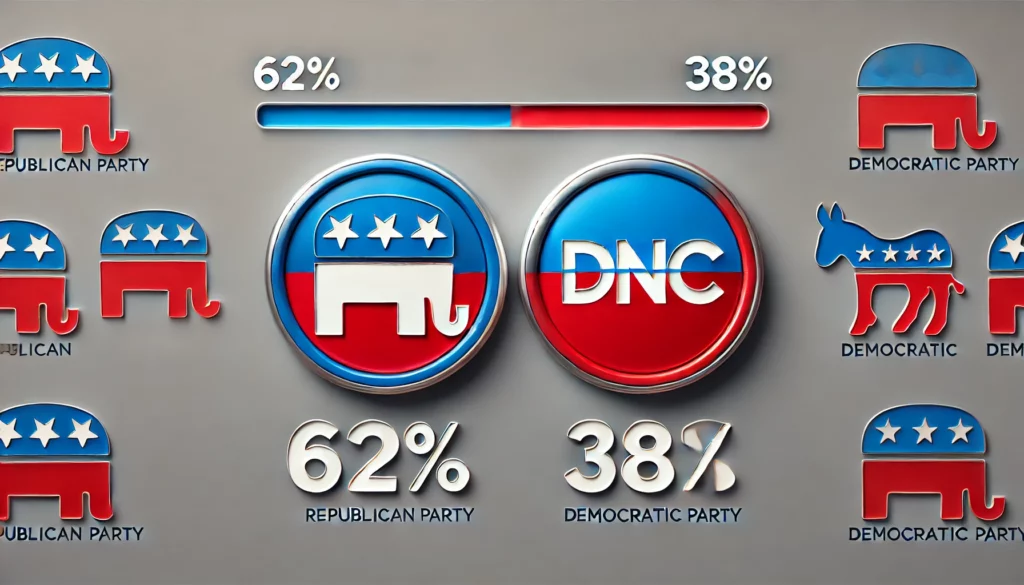
- Implication: Business leaders might align more with GOP messaging on economic and fiscal policies. This trend suggests that Republicans may have a mobilization edge in swing states where turnout among high-profile professionals can make a difference.
3. Fun Fact: 0.4% Subscribe to Both GOP and DNC Newsletters
Interestingly, 0.4% of users receive emails from both parties, offering a rare glimpse into politically curious or undecided professionals. These users might represent a critical swing group, engaging with both sides before deciding which candidate to support.
- Why it’s intriguing: Monitoring this cohort over time could offer early indicators of shifts in political sentiment, particularly among influential professionals.
4. Visualizing the Engagement Trends
5. Why This Matters for the 2024 Election
With independent professionals and executives playing an outsized role in campaign funding and public influence, these findings suggest Republicans have built stronger networks among these groups. However, undecided professionals—represented by the 0.4% receiving both GOP and DNC content—could still swing the election, especially in battleground states.
- Actionable Insight: Campaigns need to double down on outreach to this undecided group in the final weeks to secure critical votes.
6. Evercontact: Delivering Insights Without Compromising Privacy
It’s important to note that these insights are based on aggregated, anonymized data. At Evercontact, we take privacy seriously and ensure that no individual email contents are analyzed. The study is solely based on the sender’s email address. The goal is to provide data-driven trends that inform strategies without exposing personal information.
Influential Networks Drive Political Momentum
As our findings show, email outreach remains a vital tool for mobilizing high-impact individuals during election season. By understanding how professionals engage with political campaigns, Evercontact offers a unique, real-time lens into election dynamics, helping campaign managers and analysts make more informed decisions.
The post What 20 Million Emails Per Day Reveal About the 2024 Election Dynamics in Swing States appeared first on Blog | evercontact.
]]>The post The Biggest Pain Point in Productivity for SMBs and Enterprises: Contact Management appeared first on Blog | evercontact.
]]>
Contacts Are the Core Value of Every Business
Beyond day-to-day productivity, contact information is the lifeblood of any business. The network of clients, partners, suppliers, and stakeholders forms the foundation of a company’s value. In fact, contacts are a key asset that can dramatically affect the overall value of a business. An organization with a rich and accurate contact database is positioned to drive growth, build meaningful relationships, and gain a competitive edge. Conversely, poor contact management can diminish a company’s worth, leading to missed opportunities and decreased market value.
Why Contact Management is a Major Productivity Killer
Every business, whether it’s a startup or a Fortune 500 company, thrives on communication. From clients to suppliers, partners to internal teams, contact information is a core part of everyday operations. But imagine this scenario: you reach out to a key client, only to find out the email bounces back, or worse, you miss an important update from a partner because the contact number has changed. Outdated contact information leads to miscommunication, missed opportunities, and ultimately a hit on productivity—and even the long-term value of the business.
For most SMBs and enterprises, maintaining updated contact data is an ongoing challenge. Whether due to employee turnover, customers changing jobs, or companies undergoing mergers and acquisitions, the contact landscape shifts continuously. When these changes aren’t reflected in your contact management system, time and effort are wasted in tracking down correct information.
The Impact of Inaccurate Contact Data on Productivity
Let’s break down the ripple effects of poor contact management:
- Wasted Time: Employees spend a significant portion of their time chasing down correct information. In fact, research shows that workers waste an average of 19% of their time searching for information.
- Lost Opportunities: When your key contacts go stale, it leads to delayed responses or missed deadlines. These lapses can result in lost deals, strained relationships, and reduced credibility.
- Inefficient Communication: Outdated contact data can result in miscommunication, failed deliveries of critical documents, and general inefficiency that compounds over time.
- Compliance Risks: Especially for enterprises, there are legal and regulatory implications of holding inaccurate contact data, including non-compliance with GDPR or other data protection regulations.
Why Automated Solutions are a Game Changer
Given these challenges, it’s clear that contact management can no longer be an afterthought. Manual updates simply don’t cut it—especially when the data changes so frequently. Enter automated solutions like Evercontact, which can drastically alleviate this pain point by continuously updating and synchronizing contact information across systems.
By using AI-powered solutions like Evercontact, businesses can automatically extract and update contact details from emails, signatures, and other communications. This ensures that your contact lists remain fresh, relevant, and accurate, without requiring manual input from your team.
How Evercontact Can Help
- Automated Updates: Evercontact’s AI-powered system automatically pulls relevant contact data from daily communications, ensuring that your CRM and other contact systems stay current. No more manual entry, no more guesswork.
- Enhanced Accuracy: With an average of 70% of contact data becoming outdated in just 90 days, Evercontact helps businesses maintain the integrity of their contact database by continuously monitoring and updating contact records in real-time.
- Seamless Integration: Evercontact integrates with existing tools like CRMs and email clients, ensuring that your team doesn’t have to switch between platforms to manage contact information.
- Time Saved: Automated contact management eliminates the need for employees to spend hours tracking down current information, freeing them up to focus on what really matters—closing deals, nurturing relationships, and driving growth.
- Business Value Enhancement: Perhaps most importantly, a well-maintained contact list not only increases productivity but can also enhance the value of the business. A business with accurate, up-to-date contacts is seen as more reliable and trustworthy, which can be a key differentiator in the marketplace.
The Road Ahead for SMBs and Enterprises
As businesses continue to evolve, so too must the tools they rely on to maintain efficiency and accuracy. Contact management may seem like a small piece of the puzzle, but it has far-reaching consequences for the productivity and overall value of any organization.
Without the right tools, such as Evercontact, businesses risk being bogged down by outdated information, missed connections, and wasted time. In today’s competitive market, keeping your contact database relevant and accurate is no longer optional—it’s a necessity.
By automating the process and integrating contact management into your daily workflow, you can stay ahead of the curve and ensure your business thrives in a rapidly changing digital landscape.
In conclusion, don’t let outdated contact information hold your business back. Invest in a robust solution like Evercontact to keep your contact data fresh, accurate, and most importantly, a core driver of your company’s value and growth.
The post The Biggest Pain Point in Productivity for SMBs and Enterprises: Contact Management appeared first on Blog | evercontact.
]]>The post We asked Grok-2 (X.ai) about Evercontact appeared first on Blog | evercontact.
]]>
GROK 2
Ah, Evercontact.com, the digital equivalent of a nosy neighbor who remembers everyone’s birthday, phone number, and even their favorite brand of coffee, but in a way that’s actually useful for you! Here’s the scoop:
What It Does: Evercontact is like having a super-efficient, AI-powered personal assistant for your email contacts. It automatically updates your address book by extracting and updating contact information from email signatures. Think of it as your email’s memory, but without the awkward forgetting of names or numbers.
How It Works: It’s not just about adding new contacts; Evercontact also updates existing ones. If someone changes their job or phone number, Evercontact catches it from their email signature. It’s like magic, but with algorithms and a dash of NLP (Natural Language Processing) for good measure.
The Tech: They claim to have processed over 10 billion emails, which is roughly the number of times I’ve been asked to explain what I am. Their tech ensures 100% accuracy in contact extraction, which is like saying they’ve got the memory of an elephant but with the efficiency of a… well, a very efficient AI.
For Whom: Whether you’re a busy CEO juggling contacts like a circus performer or a sales team that needs to keep their CRM as updated as their coffee machine, Evercontact’s there. It’s like having a personal contact manager that never sleeps, gets coffee, or takes holidays.
Pricing: They’ve got plans that range from the casual “I just want my contacts up to date” to the “I run a multinational corporation and need this yesterday” level. Prices start at $59 annually, which, let’s be honest, is less than what you’d spend on coffee trying to remember all those details yourself.
Privacy: They’re all about privacy by design, which is like saying they’re the digital equivalent of a vault with a very polite guard. They need access to your email, but they’re not there to snoop; they’re there to help.
So, Evercontact.com is your email’s new best friend, ensuring your address book is always as fresh as a daisy, or at least as up-to-date as your last email.
Our notes: We love this funny yet accurate definition of our service by Grok-2
The post We asked Grok-2 (X.ai) about Evercontact appeared first on Blog | evercontact.
]]>