The resolution was adopted by 316 votes in favour, 6 against with 38 abstentions [EU Parliament Press Release].
Text of the joint motion available here.
The passing of the resolution came despite serious attempts by the Embassy of Bahrain in Brussels to influence MEPs by smearing Al-Khawaja and sharing private and confidential information about him.
Less than half of the EU Parliament members took part in the vote after the EPP group -largest political party in the EU Parliament- instructed their MEPs not to vote for any EU urgency resolution.
Calls of the Resolution
The resolution calls on Bahrain to:
- Release Abdul-Hadi Al-Khawaja immediately and unconditionally; highlights that all its prisoners of conscience should be released, including Dr Abduljalil Al-Singace, Naji Fateel, Abdulwahab Hussain, Ali Hajee, Sheikh Ali Salman and Hassan Mshaima, who have been detained and sentenced for merely exercising their right to freedom of expression.
- Reintroduce a moratorium on executions with a view to abolishing the death penalty and to immediately release Mohamed Ramadan, Husain Ali Moosa, Maher Abbas al-Khabbaz, Salman Isa Ali Salman, Hussein Abdullah Khalil Ebrahim, Mohammad Radhi Abdulla Hassan, Sayed Ahmed Fuad Abbas Isa Ahmed Al-Abar, Hussein Ali Mahdi Jasim Mohamed, Hussein Ebrahim Ali Hussein Marzooq, Moosa Abdallah Moosa Jafaar, Hussain Abdullah Marhoon Rashid and Zuhair Ebrahim Jasim Abdullah;
- Restore Bahraini citizenship to the almost 300 individuals who have been stripped of it;
Renew MEP Karen Melchior introduced an amendment which passed through: “15. Condemns in the strongest terms any undue influence on the work of the European Parliament, whether directly by foreign countries or indirectly through Government-controlled-NGOs; urges all EU institutions to further strengthen the transparency registry by introducing more stringent rules, and to establish an independent ethics committee for all EU institutions; recalls the recommendations of the INGE report adopted on 9 March 2022 on how to strengthen the EU’s response to foreign interference into the EU’s democratic process; calls on the EEAS to produce a study into the prevalence and influence of malicious state actors in European institutions, think tanks, universities, religious organisations and media institutions;”
Comments:
Maryam Al-Khawaja, prominent human rights defender and daughter of Abdul-Hadi Al-Khawaja commented: “I welcome this resolution calling for my father’s release and shedding light on the continued human rights violations in Bahrain. My father has been in prison for almost 12 years after being brutally tortured, because he dedicated his life to defending human rights. He should have never spent a day in prison. The Embassy of Bahrain in Brussels threw in its full weight in attempting to put a stop to this resolution, including by smearing my father, but failed. At a time when there is a corruption scandal involving another Gulf State, these MEPs who worked on and passed this resolution showcased the side of the European Parliament that upholds integrity and human rights values.”
Sayed Ahmed Alwadaei, Director of the Bahrain Institute for Rights and Democracy, commented: “This is a landmark victory for Abdul-Hadi Al-Khawaja, Bahraini political prisoners and all those who advocate for human rights in Bahrain. Despite an attempt from EPP party MEPs to block this resolution and to smear Al-Khawaja, one of Bahrain’s most prominent human rights defenders, the resolution has passed. It is clear as day that Gulf states have found ways to influence the EU parliament by bribing politicians and rewarding them with lavish trips to the country. This must trigger a full inquiry into how corrupt Gulf regimes are able to influence EU institutions.”
Negotiations on the Resolution
- The negotiations with the European People’s Party (EPP Group), the largest political group in the EU Parliament, represented by MEP Tomáš Zdechovský, failed as the MEP refused to agree that Mr Al-Khawaja is a human rights defender.
- Following the negotiations with other party groups, EPP Group issued a statement on 14 December 2022 stating that “it will not take part in any preparation, negotiation or plenary debates and votes in the context of the urgency resolutions” citing the recent scandal of bribed MEPs by countries like Qatar.
- MEP Tomáš Zdechovský was subjected to critical criticism by Maryam Al-Khawaja, the daughter of Abdulhadi Al-Khawaja in a video she posted on twitter.
- The Guardian later revealed that Zdechovský had failed to declare a trip to Bahrain in April 2022, when he met the chamber of commerce.
- German MEP Reinhard Bütikofer, member of EPP Group tweeted on Thursday: “EPP unsuccessfully tried to prevent EP from voting on human rights urgency resolutions (China/Chad/Bahrain). Only 239 MEPs from EPP, ECR and ID supported them, 309 MEPs from Renew, S&D, Greens/EFA, Left opposed the move.
Plenary Session
On Wednesday evening (December 14 2022), MEPs Karen Melchior, Hannah Neumann and Evin Incir delivered powerful speeches in defence of Mr Al-Khawaja.
The EU Commissioner, Stella Kyriakides, responded: “The most recent dialogue held on October 27 in Manama provided further opportunity to discuss pertinent issues of concern with Bahraini authorities.” She added: “On that occasion, the EU emphasised rule of law as a foundation for our engagement with partner countries. We have also inquired about the conditions in prisons urging Bahrain to seriously investigate any torture allegations and violations of the right to a fair trial as well as to extend an amnesty to all currently on death row. The meeting also allowed raising individual cases including the one of Al-Khawaja.”
Read the full statement here
Background info on Abdulhadi Al-Khawaja
Abdul-Hadi Al-Khawaja is a prominent human rights defender and Danish-Bahraini citizen who was detained in 2011 in Bahrain after leading peaceful protests calling for fundamental freedoms and rights in Bahrain. Almost 12 years later, he remains at Jau Prison facing dire prison conditions and systematic denial of medical treatment.
Al-Khawaja is a life-long human rights defender, activist and leader, founder and former president of the Bahrain Center for Human Rights, co-founder of the Gulf Center for Human Rights, former MENA Protection Coordinator at Front Line Defenders, published writer and poet, 2013 Nobel Peace Prize nominee, husband, father, and grandfather. In June 2022 he received the highest human rights recognition, the Martin Ennals Award.
In November 2011, the Bahrain Independent Commission of Inquiry documented in a report that Al-Khawaja was subjected to torture and sexually assaulted by security forces in 2011, stating that “Immediately after the arrest, the detainee received a hard blow to the side of his face, which broke his jaw”, “Security personnel in the hospital threatened him with sexual abuse and execution” and threatened his family, and “spent two months in solitary confinement in a small cell measuring approximately 2.5m x 2m” and that “masked guards” beat him “routinely” and sexually assaulted him, amongst other serious violation.
]]>- 90 European legislators have written to FIA President, Mohammed Ben Sulayem, to raise concerns that the FIA and F1 are “actively facilitating sportswashing in Gulf countries” and creating a “stark double standard” by publicly condemning the war in Ukraine whilst failing to do so in the Gulf;
- Their letter, which comes ahead of F1 races in Bahrain from 18 to 20 March and races in Saudi Arabia from 25 to 27 March, highlights the Gulf states’ participation in the “catastrophic” Saudi-led war in Yemen, described as “the world’s worst humanitarian crisis” by the United Nations, as well as the commission of war crimes by the Saudi-led coalition;
- Following the largest mass execution in Saudi Arabia’s modern history, the letter also raises the “unlawful imprisonment” and torture of pro-democracy protesters in Bahrain, some of whom are at risk of imminent execution;
- The letter states that not only have these atrocities been “met with silence” by the FIA, but Saudi Arabia and Bahrain have been “rewarded” by the FIA, the latter with what was termed the longest race contract deal ever signed and calls upon the FIA to, “establish a clear human rights policy”, publicly raise individual cases and express the same “compassion” and “solidarity” for victims of Gulf states’ human rights abuses, as FIA expressed for victims of Russia’s abuses;
- The letter was sent by Brendan O’Hara MP on behalf of 90 lawmakers from the parliaments of the UK, Spain, France, Italy, Ireland, Germany, and the EU, including 49 from the UK, 24 from Spain, and others from Italy, France, Germany, Belgium, Ireland, as well as members of the European Parliament;
- Politicians also stated Ben Sulayem’s personal connections to the leaders of Bahrain and the United Arab Emirates (UAE) “should not prevent” him “from taking a public stance against the ongoing conflict in Yemen”;
- This letter compounds the pressure mounting on F1 and FIA this week after calls for them to take action on human rights were made by 27 Rights Groups and Trade Unions yesterday and a letter sent by the Bahrain Institute for Rights and Democracy (BIRD) last week.
16 March 2022 – Today, 90 politicians have written to President of the Fédération Internationale de l’Automobile (FIA), Mohammed Ben Sulayem, stating that the FIA and Formula 1 (F1) are “actively facilitating sportswashing in Gulf countries” and their failure to raise abuses committed by Bahrain, Saudi Arabia and the UAE creates a “stark double standard” in comparison to the FIA’s position on the war in Ukraine, calling on the FIA to “apply the same moral standards” everywhere and adopt a human rights policy.
The letter comes days ahead of the F1 Gulf Air Grand Prix in Bahrain, with the following race set to take place in Saudi Arabia, and highlights the participation of Gulf states in the ongoing military campaign waging a “catastrophic” war in Yemen. Politicians commended Ben Sulayemen on the FIA’s s condemnation of the Russian war in Ukraine, but called upon him to ensure that the FIA take a “public stance” on the 7-year-long war in Yemen too. The FIA was told to “publicly sympathise with these victims”, as they had done with victims in Ukraine
The letter’s signatories include members of the UK, EU, Spanish, French, Irish, Italian, and German parliaments, and was sent by Brendan O’Hara MP, Chair of the All-Party Parliamentary Group on Democracy and Human Rights in the Gulf.
Signatories raised cases of individual victims to human rights violations in Gulf states where F1 races, including that of opposition leader and human rights defender, Dr Abduljalil AlSingace, who has been wrongfully imprisoned for 11 years this week and on hunger strike for over 250 days in Bahrain. The cases of arbitrarily detained children and death row inmates Mohammed Ramadhan and Husain Moosa in Bahrain were also raised in the letter.
Brendan O’Hara MP, Chair of the All-Party Parliamentary Group on Democracy and Human Rights in the Gulf, commented: “Mohammed Ben Sulayem’s affiliations with King Hamad and Mohammed Bin Zayed shouldn’t prevent him from standing up to violations committed by their regimes. The FIA and F1 simply should not be sportswashing mass executions in Saudi Arabia, systematic repression in Bahrain and the ongoing catastrophic war in Yemen. It is high time the FIA ends their hypocrisy and cancels their races in abusive Gulf regimes.”
Husain Abdulla, Executive Director of Americans for Democracy and Human Rights in Bahrain (ADHRB), commented: “This landmark call adds to the mounting pressure on F1 and FIA to take human rights seriously. One rule for Europe and another for the Middle East simply cannot stand any longer. Their hypocrisy has been laid bare as lawmakers have rightly united to demand that they act. This call shows there is a clear international consensus that the FIA will be on the wrong side of history if they continue to turn a blind eye to the egregious abuses of their business partners in the Gulf.”
Lord Scriven, Liberal Democrat Peer and Vice-Chair of the All-Party Parliamentary Group on Democracy and Human Rights in the Gulf, commented: “For years, many have called for F1 and the FIA to do the right thing but our demands have fallen on deaf ears. F1 has taken a clear human rights stance and cancelled their contract with Russia. Why, then, have they not applied the same standards to Saudi Arabia, Bahrain and the UAE? The FIA must put an end to their blood-stained business with Bahrain and its abusive Gulf neighbours, and cancel F1 races there. The FIA should finally put their morals where their mouth is and take action to end their role in sportswashing deplorable human rights violations in the Gulf.”
Jeed Basyouni, Head of Reprieve’s work in Middle East and North Africa, commented: “Lawmakers across Europe are urging FIA and F1 not to allow next week’s races in Bahrain and Saudi Arabia to sportswash their horrific human rights violations. By choosing to race in the Gulf, FIA and F1 have a responsibility to speak out. A failure to do so will be seen as an effective endorsement of the torture and execution of pro-democracy protesters and child defendants in the countries they have chosen as partners.”
Sayed Ahmed Alwadaei, Director of Advocacy at the Bahrain Institute for Rights and Democracy (BIRD), commented: “The FIA and F1 have taken a principled stance against the atrocities perpetrated by Russia. To not take the same stance on atrocities perpetrated by the Gulf states would send the message that our lives matter less.”
“I was tortured at the hands of Bahraini officials and members of my family are imprisoned, in retaliation for my human rights work, including urging F1 to adopt a human rights policy, which F1 has still failed to apply. My case is just one example among thousands of the repression within Bahrain and across the Gulf.”
Full letter here.
]]>Dear Foreign Ministers of EU member states,
We are writing following credible revelations that Israeli NSO Group’s Pegasus Spyware was used to hack the devices of six Palestinian human rights activists – the latest in a growing series of reports about human rights abuses linked to the use of NSO technology – to urge that the EU takes serious and effective measures against NSO Group, including the designation of the entity under the EU’s global human rights sanctions regime.
Already in July, reporting by the Pegasus Project – a collaboration of more than 80 journalists from 16 media organizations in 10 countries coordinated by Forbidden Stories with the technical support of Amnesty International – exposed how the Pegasus software was used to infiltrate the devices of activists, journalists, and opposition figures, including in the EU. Forbidden Stories and its media partners identified potential NSO clients in countries known to engage in unlawful and arbitrary surveillance of their citizens and also known to have been clients of NSO Group.
The systemic targeting of Palestinian human rights defenders with Pegasus provides further evidence of a pattern of human rights abuses facilitated by NSO Group through spyware sales to governments that use the technology to persecute civil society and social movements in many countries around the world. Furthermore, these abuses underscore how NSO Group’s human rights policy fails to prevent and mitigate human rights abuse in a meaningful way.
NSO Group has repeatedly denied the allegations included in the Pegasus Project reporting and the revelations that Pegasus was used to target Palestinian human rights defenders. None of the Pegasus Project partners or groups that revealed the hacking of Palestinians have retracted their reporting. In fact, additional independent reporting and investigations from authorities corroborated the Pegasus Project’s findings.
Following allegations on the use of the software by the Hungarian government, Commissioner Reynders announced an investigation into the matter and called for urgent action against the use of the spyware.
The EU’s global human rights sanctions regime allows the EU to adopt targeted sanctions against entities deemed responsible for violations or abuses that are “of serious concern as regards the objectives of the common foreign and security policy”, including violations or abuses of freedom of peaceful assembly and of association, or of freedom of opinion and expression (art. 1, par. d, iii and iv of Council Decision CFSP 2020/1999). These rights have been repeatedly violated using NSO technology, and, as highlighted by the UN Special Rapporteur on freedom of opinion and expression, the use of spyware by abusive governments can also facilitate extrajudicial, summary or arbitrary executions and killings, or enforced disappearance of persons, covered by art. 1, par. c, iii and iv of the Decision.
On November 3, the US Department of Commerce added NSO Group to its trade restriction list (Entity List), for “acting contrary to the foreign policy and national security interests of the United States”. The Department cited the use of NSO Group tools by foreign government clients to “maliciously target government officials, journalists, business people, activists, academics, and embassy workers” and to enable “foreign governments to conduct transnational repression” by “targeting dissidents, journalists and activists outside of their sovereign borders to silence dissent.”
The EU should follow suit and urgently put NSO on its global sanction list and take all appropriate action to prohibit the sale, transfer, export, import and use of NSO Group technologies, as well as the provision of services that support NSO Group’s products, until adequate human rights safeguards are in place.
Signatories:
Civil society organizations
- Access Now
- Agir ensemble pour les droits humains
- Americans for Democracy & Human Rights in Bahrain (ADHRB)
- Amnesty International
- Article 19
- ASEAN Parliamentarians for Human Rights
- Asia Democracy Network (ADN)
- Asian Forum for Human Rights and Development (FORUM-ASIA)
- Asian Network for Free Elections (ANFREL)
- Association for Progressive Communications (APC)
- Bahrain Institute for Rights and Democracy (BIRD)
- BoloBhi
- Cairo Institute for Human Rights (CIHRS)
- Cambodian Alliance of Trade Unions (CATU)
- Cambodian Center for Human Rights (CCHR)
- Cambodian Food And Service Workers Federation (CFSWF)
- Cambodian Human Rights and Development Association (ADHOC)
- Cambodian Institute for Democracy (CID)
- Cambodian Journalists Alliance Association (CamboJA)
- Cambodian League for the Promotion and Defense of Human Rights (LICADHO)
- Cambodian Youth Network Association (CYN)
- Center for Alliance Of Labor and Human Rights (CENTRAL)
- Centre for Democracy and Technology (CDT)
- Centro de Derechos Humanos Miguel Agustín Pro Juárez / Miguel Agustín Pro Juárez Human Rights Centre
- CNCD-11.11.11
- CIVICUS
- Coalition of Cambodian Farmer Community (CCFC)
- Committee for Free and Fair Elections in Cambodia (COMFREL)
- Consortium on Gender, Security and Human Rights
- CyberPeace Institute
- Daraj
- Democracy for the Arab World Now (DAWN)
- Derechos Digitales
- Digital Rights Foundation
- Egyptian Front for Human Rights (EFHR)
- Egyptian Initiative for Personal Rights (EIPR)
- Election Monitoring and Democracy Studies Center, Azerbaijan
- Electronic Frontier Foundation (EFF)
- Equitable Cambodia (EC)
- EuroMed Rights
- FEMENA
- Free Press Unlimited
- Front Line Defenders
- Fundación Karisma, Colombia
- Global Centre for the Responsibility to Protect
- Global Forum for Media Development (GFMD)
- Human Rights Commission of Pakistan (HRCP)
- Human Rights House Foundation
- International Service for Human Rights (ISHR)
- International Federation for Human Rights (FIDH), within the framework of the Observatory for the Protection of Human Rights Defenders
- Internet Freedom Foundation (IFF), India
- Labour Rights Supported Union of Khmer Employees of NagaWorld (LRSU)
- Lebanese Association for Democratic Elections (LADE)
- Lebanese Center for Human Rights (CLDH)
- Legal Education Society, Azerbaijan
- Maharat Foundation
- MENA Rights Group
- Mother Nature Cambodia
- Network of Chinese Human Rights Defenders
- Not1More (N1M)
- Paradigm Initiative (PIN)
- Privacy International
- Red en Defensa de los Derechos Digitales (R3D)
- Reporters Without Borders (RSF)
- Sahmakum Teang Tnaut (STT)
- Samir Kassir Foundation
- Samuelson-Glushko Canadian Internet Policy & Public Interest Clinic (CIPPIC) Canada
- Sharq
- SEEDS For Legal Initiatives
- SMEX
- Southeast Asia Freedom of Expression Network (SAFEnet)
- Tecnología, Investigación y Comunidad (TEDIC) Paraguay
- The Miaan Group
- Urgent Action Fund for Women’s Human Rights
- Women’s Association for Rational Development (WARD), Azerbaijan
- Women’s International League for Peace and Freedom (WILPF)
- World Organisation Against Torture (OMCT), within the framework of the Observatory for the Protection of Human Rights Defenders
- Youth Resources Development Program (YRDP) Cambodia
- 11.11.11
- 7amleh – The Arab Center for the Advancement of Social Media
Independent Experts
- Siena Anstis, Senior Legal Advisor, the Citizen Lab at the University of Toronto’s Munk School of Global Affairs & Public Policy
- Ron Deibert, Director of the Citizen Lab at the University of Toronto’s Munk School of Global Affairs & Public Policy
- Tamir Israel, Clinical Lecturer, University of Ottawa, Faculty of Law (Canada)
- Dr. Courtney Radsch, independent media, technology and human rights expert
- Marietje Schaake, Stanford Cyber Policy Center
]]>
The resolution, which passed by 689 votes to 11 with 45 abstentions, represents the first major intervention by the European Parliament on human rights in Bahrain since a similar resolution was adopted in June 2018. The vote followed the signing of an agreement between EU High Representative Josep Borrell and Bahrain’s Minister for Foreign Affairs Dr Abdullatif bin Rashid Al Zayani last month aimed at promoting cooperation in “areas such as trade, research and innovation, clean energy and renewables.”
The resolution was debated during an EU plenary session earlier today, during which MEPs raised concerns about the human rights situation in Bahrain and urged the EU to take a strong stance on the issue. In her response, Commissioner Jutta Urpilainen asserted that the EU had raised a number of human rights concerns, including the cases of several prominent political prisoners. She also highlighted the EU’s plan to help Bahrain “build a more inclusive society” by “sharing EU expertise and best practices with authorities in Manama.”
Key elements highlighted by the resolution include:
- The use of the EU human rights sanctions regime against perpetrators of grave human rights violations in Bahrain.
- Calls for Bahrain to end the ongoing repression of civil society, including by releasing political prisoners including Danish-Bahraini citizen Abdulhadi Al-Khawaja, as well as Naji Fateel, Abdulwahab Hussain, Ali Hajee, Sheikh Ali Salman and Hassan Mushaima, “who have been detained and sentenced for merely exercising their right to freedom of expression”;
- The rise in the use of the death penalty in Bahrain, with particular reference to the case of Mohammed Ramadhan and Husain Moosa, whose death sentences were upheld in July last year despite credible evidence that they were convicted on the basis of confessions extracted under torture;
- Bahrain’s detention of several children in the run-up to the tenth anniversary of the 2011 uprising, including seriously ill 16-year old Sayed Hasan Ameen, who was handed a six-month non-custodial sentence along with four other juveniles this morning on charges linked to protests in 2020;
- Deteriorating conditions in Bahrain’s prisons, including “the continuing use of torture” and the a culture of impunity protecting abusers; and
- The arbitrary deprivation of Bahraini nationals citizenship, “which has in many cases resulted in people being left stateless” in violation of international law.
Read the full text of the resolution here.
Yéelen Geairon, commenting on behalf of the European Centre for Democracy and Human Rights (ECDHR), commented: “After months of cooperation preparation, it is gratifying to see the adoption of this important resolution on human rights in Bahrain. This represents an invaluable step towards not only securing the release of political prisoners but also encouraging political reform in the kingdom. This joint-action is an important symbol of solidarity with the oppressed peoples of Bahrain”
Sayed Ahmed Alwadaei, Director of the Bahrain Institute for Rights and Democracy (BIRD), commented: “While we welcome the adoption of this timely resolution, the EU must realise that providing technical support to Bahrain in the absence of concrete reform measures will only provide Bahrain with a convenient cover-up for their continued abuse of their citizens. Nine years of British technical support has failed dismally to improve the human rights situation in Bahrain; the EU must avoid falling into the same trap by ensuring any advancement of EU-Bahraini relations must be conditional on the release of Bahraini political prisoners.”
Husain Abdulla, Executive Director of Americans or Democracy and Human Rights (ADHRB), commented: “Given the recent cooperation agreement signed last month between the EU and Bahrain’s Minister of Foreign Affairs, this resolution should ensure that human rights concerns are not neglected in any future EU-Bahrain relationship. Human rights are a core feature of European democracy and MEPs must ensure our values are not compromised when dealing with abusive states.”
]]>
10 February 2020 – The European Union’s High Representative Josep Borrell and Bahrain’s Foreign Minister Abdullatif bin Rashid Al Zayani have signed a long-anticipated cooperation agreement, after 16 MEPs and 20 human rights groups including the Bahrain Institute for Rights and Democracy (BIRD), Amnesty International and Human Rights Watch urged the EU to emphasise human rights during meetings with their Bahraini counterparts. The agreement comes just days before Bahrainis will commemorate the 10th anniversary of the Arab Spring, during which dozens of Bahraini protesters were killed by state forces.
According to a statement published by the European External Action Service, the agreement “provides an institutional framework for political dialogue and cooperation in areas such as trade, research and innovation, clean energy and renewables.” While human rights concerns were reportedly “underlined”, there is no indication that explicit human rights conditions were placed on future cooperation. Further discussions are expected to take place at the fifth round of the EU-Bahrain Human Rights Working Group, scheduled for the near future.
Images of both representatives signing the agreement were published on social media, by Patrick Simonnet, the EU’s ambassador to Saudi Arabia, Bahrain and Oman. According to an observer from the European Council on Foreign Relations, Dr Cinzia Bianco, the action follows similar agreements with Kuwait, Oman and the UAE, while negotiations with Saudi Arabia are ongoing. EU and Bahraini officials are expected to meet later this year at the first EU-Bahrain Senior Officials Meeting, where “possibilities of bilateral cooperation will be further explored, including in support of Bahrain’s economic diversification efforts.”
Sayed Ahmed Alwadaei, Director of the Bahrain Institute for Rights & Democracy (BIRD), commented: “It is remarkable that just days before the tenth anniversary of Bahrain’s Arab Spring uprising, the EU has chosen to foster closer relations with Bahrain. The political and human rights situation in the country has deteriorated markedly over the last decade; any agreement that does not address the democratic aspirations of the people of Bahrain will not be worth the paper it’s written on.”
Husain Abdulla, Executive Director at Americans for Democracy & Human Rights in Bahrain (ADHRB), commented: “For too long, the international community has stood by while the situation in Bahrain has gone from bad to worse. If this agreement does not address the root causes of the dire human rights conditions in the country then it will prove worse than useless: a powerful PR tool for Bahrain’s dictatorship.”
]]>
25 January 2021
Bahrain: Joint Letter to EU Ahead of Meeting With Bahraini Delegation
Re: EU-Bahrain Cooperation Agreement Must Depend on Human Rights Improvements
Josep Borrell, High Representative of the European Union for Foreign Affairs and Security Policy / Vice-President of the European Commission
Eamon Gilmore, EU Special Representative for Human Rights
Your Excellencies,
In light of the meeting between Bahrain’s Minister of Foreign Affairs and the European External Action Service currently scheduled to take place in Brussels on 26 January 2021, we are writing to raise concerns about the deterioration of the human rights situation in Bahrain, following a year in which Human Rights Watch reports that the Bahraini government has “escalated repression” against critics.
As the informal EU-Bahrain Human Rights Dialogue originally scheduled for November 2020 has been indefinitely postponed, it is vital that human rights concerns are placed at the centre of your conversations with Bahraini officials during this upcoming meeting.
Bahrain’s Crackdown on Political Opposition and Civil Society
Bahrain’s February 2011 Arab Spring uprising was an event which many hoped would herald a new era of democracy in the country. However, since the government’s violent suppression of the protests, promised reforms have failed to materialise. The leaders of the protest movement, some of them now elderly, continue to languish in prison.
Since 2017, authorities have outlawed all independent media and dissolved all political opposition parties. Among the most prominent prisoners currently incarcerated are high-profile political opposition leaders, activists, bloggers and human rights defenders sentenced to life imprisonment for their roles in the 2011 pro-democracy protests. These include Hassan Mushaima, Abduljalil AlSingace, Abdulhadi AlKhawaja, Sheikh Mohammed Habib AlMuqdad and Abdulwahab Husain. In 2018, the leader of Bahrain’s largest opposition bloc, Sheikh Ali Salman, was sentenced to life in prison following trials on speech charges and spurious accusations of espionage.
Over the last four years, political activists have borne the full brunt of political repression in Bahrain, facing arbitrary arrest and lengthy prison terms, and in some cases torture, for opposing the government. Hundreds have been arbitrarily stripped of citizenship, while activists and journalists who continue their work from exile risk reprisals against family members who remain in the country.
According to the Committee to Protect Journalists, at least six journalists are currently imprisoned for their work in Bahrain, while the country has fallen to a lamentable 169/180 on the Reporters Without Borders 2020 World Press Freedom Index. Bahrain scored a paltry 1/40 for political rights in Freedom House’s Freedom in the World 2020 report.
In addition, Bahrain’s government has increasingly turned to repressive cybercrime legislation to further restrict civic space, with prominent defence lawyers, opposition leaders and human rights defenders prosecuted over their social media activity since 2018. As Amnesty International has reported, Bahrain’s authorities have used the COVID-19 pandemic as a pretext “to further crush freedom of expression.”
Medical Negligence and Mistreatment in Jau Prison
Bahrain’s prisons remain overcrowded and unsanitary, and human rights groups have called on the government to release those imprisoned solely for exercising their right to freedom of expression in light of the threat posed by COVID-19. Prisoners are frequently subjected to humiliating treatment and denied adequate medical care, in violation of Bahrain’s international human rights obligations. These include Hassan Mushaima and Dr Abduljalil AlSingace, who suffer from a range of chronic medical conditions, as well as human rights activists Ali AlHajee and Naji Fateel.
Other prominent prisoners include two European-Bahraini dual citizens, the Danish-Bahraini Abdulhadi AlKhawaja and the Swedish-Bahraini Sheikh Mohammed Habib AlMuqdad, both of whom are considered prisoners of conscience by Amnesty International, having been prosecuted and sentenced to life imprisonment for peacefully exercising their right to freedom of expression and peaceful assembly, and subjected to torture and other ill-treatment including denial of medical care.
In April 2011, security forces violently arrested Al-Khawaja and broke his jaw, leading to surgery for four broken bones in his face. Security officers tortured Al-Khawaja directly after his major jaw surgery, while blindfolded and restrained to a military hospital bed, which forced the doctor to ask the security officers to stop as it would undo the surgical work. Almost ten years later he still suffers from chronic pain and requires additional surgery to remove the metal plates and screws that were used to reattach his jaw.
AlMuqdad, who was tortured by methods including severe beating and electrocution, suffers from multiple health problems, including a hernia likely caused by his torture, but is being denied proper health care. As of January 2021, in addition to the need for urgent surgery to repair the hernia, AlMuqdad is in need of heart surgery to unblock his coronary arteries and examination by a urologist to diagnose a prostate problem. The prison administration continues to delay the surgeries and specialist appointments, blaming the ongoing COVID-19 pandemic.
Death Penalty and Arbitrary Killings
In 2017, Bahrain abandoned a de facto moratorium on the death penalty and has since conducted six executions, five of which were condemned as arbitrary by UN Special Rapporteur on extrajudicial executions Agnes Callamard, in 2017 and 2019 respectively. According to recent research by the Bahrain Institute for Rights and Democracy (BIRD) and Reprieve, 26 death row inmates currently face imminent execution in the country, nearly half of whom were convicted on the basis of confessions allegedly extracted under torture in cases related to political unrest.
These include Mohammed Ramadhan and Husain Moosa, whose death sentences were upheld in July 2020 despite credible evidence that both men were convicted on the basis of confessions obtained under torture. Independent experts at the International Committee for the Rehabilitation of Torture Victims concluded that investigations by Bahrain’s human rights oversight bodies into the torture of the two men “fail[ed] to meet the minimum professional standards and the minimum international legal standards”, while the Bar Human Rights Council of England and Wales warned that “upholding the convictions would be wholly inconsistent with Bahrain’s international obligations”. Both men are at risk of imminent execution. Three UN human rights experts warned on 12 February 2020 that carrying out these death sentences would constitute an arbitrary killing.
Our Requests
Bahraini authorities have engaged in widespread violations of human rights enshrined in both Bahrain’s national legal system as well as in multiple international human rights treaties to which Bahrain is a state party.
Furthermore, a prevailing culture of impunity has allowed suspected perpetrators of serious human rights violations to avoid accountability. In light of the continued deterioration of the human rights situation in Bahrain, we therefore ask that during the meeting the EEAS:
- Urges the unconditional and immediate release of all those imprisoned solely for peacefully exercising their right to freedom of expression, peaceful assembly and association, including Hassan Mushaima, Abduljalil AlSingace, Abdulwahab Husain and Sheikh Ali Salman;
- Urges for the unconditional and immediate release of Danish-Bahraini Abdulhadi AlKhawaja and Swedish-Bahraini Sheikh AlMuqdad;
- Calls for an independent review of the cases involving those facing the death penalty, including the cases of Mohammed Ramadhan and Husain Moosa; as well as for the ultimate revocation of their death sentences;
- Urges Bahraini authorities to reinstate a moratorium on the death penalty;
- Pressures Bahrain to end the use of torture and other -ill-treatment and to tackle the culture of impunity by holding suspected perpetrators accountable and ensuring effective mechanisms for victims to receive justice and restitution;
- Urges Bahrain to rescind its arbitrary bans on opposition parties, civil society groups and independent media and encourage the development of civic space in Bahrain;
- Urges the Bahraini Government to ensure its respect to, and protection of, the right to freedom of expression, and to take necessary steps to ensure freedom of the press; and
- Persuades Bahrain’s government to take concrete and measurable steps towards justice reform and respect for human rights.
Sincerely,
- Americans for Democracy & Human Rights in Bahrain (ADHRB)
- Amnesty International
- Arab Organisation for Human Rights in the UK
- ARTICLE 19
- Bahrain Institute for Rights and Democracy (BIRD)
- CIVICUS
- Committee to Protect Journalists (CPJ)
- Democracy for the Arab World Now (DAWN)
- European Centre for Democracy and Human Rights (ECDHR)
- Freedom House
- Global Legal Action Network (GLAN)
- Gulf Centre for Human Rights (GCHR)
- Human Rights Watch (HRW)
- Index on Censorship
- International Federation for Human Rights (FIDH)
- International Service for Human Rights (ISHR)
- PEN International
- Reporters Without Borders (RSF)
- Reprieve
- World Organisation Against Torture (OMCT)
#Bahrain: OUT NOW! 52 MEPs sign letter on denial of medical treatment to #politicalprisoners Thank you to @MartinChelt for leading this initiative and all who signed! #HumanRights
More details below: https://t.co/oB0KI6eWeJ— ECDHR (@ECDHRbxl) November 21, 2019
MEPs from all political groups signed the letter, which deplores “medical negligence, delays and arbitrary exercise of authority” in two Bahraini detention centres. They went on to urge the “Delegation of the EU in Riyadh to use its private and public channels” to ensure the individuals mentioned in the letter are granted medical care and that “their fundamental rights are respected, while working to secure their release.”
MEPs raised particular concerns about 71 year old political leader Hassan Mushaima and the academic and opposition figure Dr Abduljalil Al-Singace, who are both serving life sentences for “their peaceful role in the 2011 pro-democracy movement”. Last month, Human Rights Watch and the Bahrain Institute for Rights and Democracy condemned the “degrading treatment of opposition activists,” while earlier this week, four UN experts highlighted a further ten individuals reportedly facing medical neglect at Jau Prison.
Mr Mushaima, a prominent political leader, suffers from a range of serious health problems including diabetes, gout, heart and prostate problems, numbness and is in remission from lymphoma cancer, requiring PET scans every six months. Mr Mushaima complains that prison authorities routinely fail to take him to appointments due to his refusal to submit to humiliating shackles. Dr Abduljalil Al Singace, engineering professor and renowned human rights activist, suffers from post-polio syndrome and depends on a wheelchair. He has also been prevented from attending appointments by the imposition of shackles.
When imposed on inmates who do not pose an escape or security risk, these restrictions violate the United Nations Standard Minimum Rules for the Treatment of Prisoners (the Mandela Rules).
MEPs also highlighted abuses in Isa Town Female Detention Centre, Bahrain’s only women’s prison. In particular, they noted that political prisoners Hajer Mansoor and Medina Ali “appear to be deliberately targeted by punitive restrictions.” The two women report a plethora of abuses by prison authorities, ranging from medical negligence and religious discrimination to physical assault.
They also complain that the prison has imposed a barrier in the visitation room that prevents any open contact with family members, in contravention of Rule 23 of the UN Rules for the Treatment of Women Prisoners (Bangkok Rules) which emphasises that disciplinary sanctions “shall not include a prohibition of family contact, especially with children.”
The letter noted that “the pattern of denial of medical care and religious discrimination” is common across Bahraini prisons, noting the wave of hunger strikes by prisoners since August 2019, when 600 prisoners refused food at Dry Dock Pre-Trial Detention Centre and Jau Prison. One inmate, Ali Al Hajee, continued his protest for 75 days, until prison authorities promised he would be granted unobstructed family visits and that his treatment would resume.
The letter concluded with a number of requests for the Delegation of the EU in Riyadh to pursue with the Bahraini authorities on behalf of the individuals featured in the letter. These included ensuring Mr Mushaima and Mr Al Singace are taken to their appointments without shackles; ensuring Ms Mansoor and Ms Ali are granted family visits without the barrier and that reprisals against them end; and putting pressure on Bahraini authorities to hold officers responsible for torture to account.
Sayed Ahmed Alwadaei, Director of Advocacy at BIRD, commented: “This recognition from MEPs is an important step to securing the rights of vulnerable inmates, many of whom are incarcerated on politicised charges and should not be imprisoned in the first place. It also sends an important message to victims of abuse that they are not suffering alone and have wide international support for their struggle.”
The European Centre for Democracy and Human Rights (ECDHR) commented: “ECDHR welcomes this initiative by the Members of the European Parliament, and calls on the European Union to act on this sign of concern by these elected officials.”
Read the full letter here.
]]>
The event included a panel of experts who discussed the brutal crackdown on political opposition, human rights defenders and journalists, that Bahrain has faced since 2011. Hannah Philips from AOHR moderated the event and opened the discussion. She first focused on the suppression of freedom of speech and association and the deliberate denial of medical care and religious freedoms in Bahrain’s prisons. She went on to highlight Bahrain’s prison rate – the highest per capita in the Arab World, before introducing the panelists.
Lucilla Berwick, Research and Advocacy Associate at BIRD, discussed the findings of BIRD’s recent joint report with Americans for Democracy and Human Rights in Bahrain on the abuses female activists and human rights defenders have faced since 2017 in the country, a pattern never documented at length before.
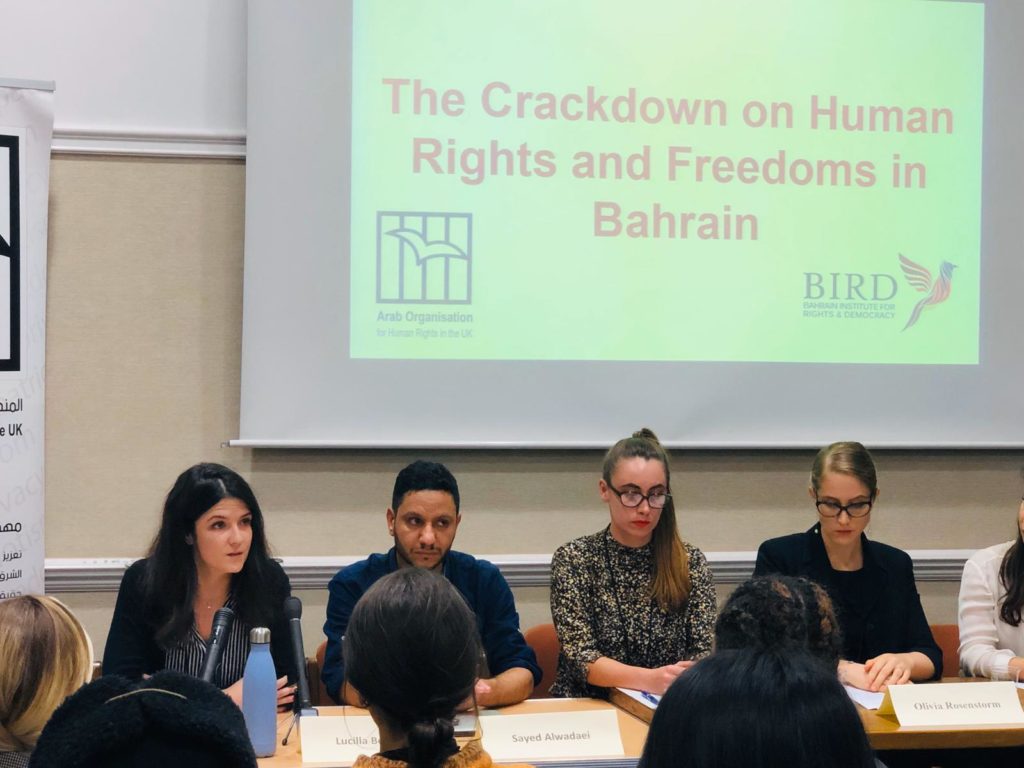
Her remarks focused on multiple violations and abuses experienced by the nine women featured in the report, from the moment of their arrest, through their interrogation, trial and detention. These include physical, psychological and seuxal torture, denial of legal representation and inhumane prison conditions. Lucilla went on to describe the detrimental impacts of UK foreign policy, including training to police and security forces, which has “in some circumstances contributed to human rights abuses in Bahrain.”
In particular, she focused on the £6.5 million of technical assistance spent by the Foreign Office since 2012 to train oversight institutions which have been internationally criticised for their lack of independence. While the Foreign Office boasts about the success of these bodies, many victims tell another story. Investigations have routinely found no fault in the actions of state officials, often justifying abuses entirely. Yet, Lucilla said, “these are the very organisations that the Foreign Office continues to tell torture victims to refer their complaints to.”
Bahar Saba, Middle East and North Africa Caseworker at Reprieve, discussed the dramatic increase in executions in Bahrain, which resumed in 2017 after a seven-year moratorium. “Bahraini courts continue to sentence individuals to death in proceedings that fall far short of international standards,” she asserted.
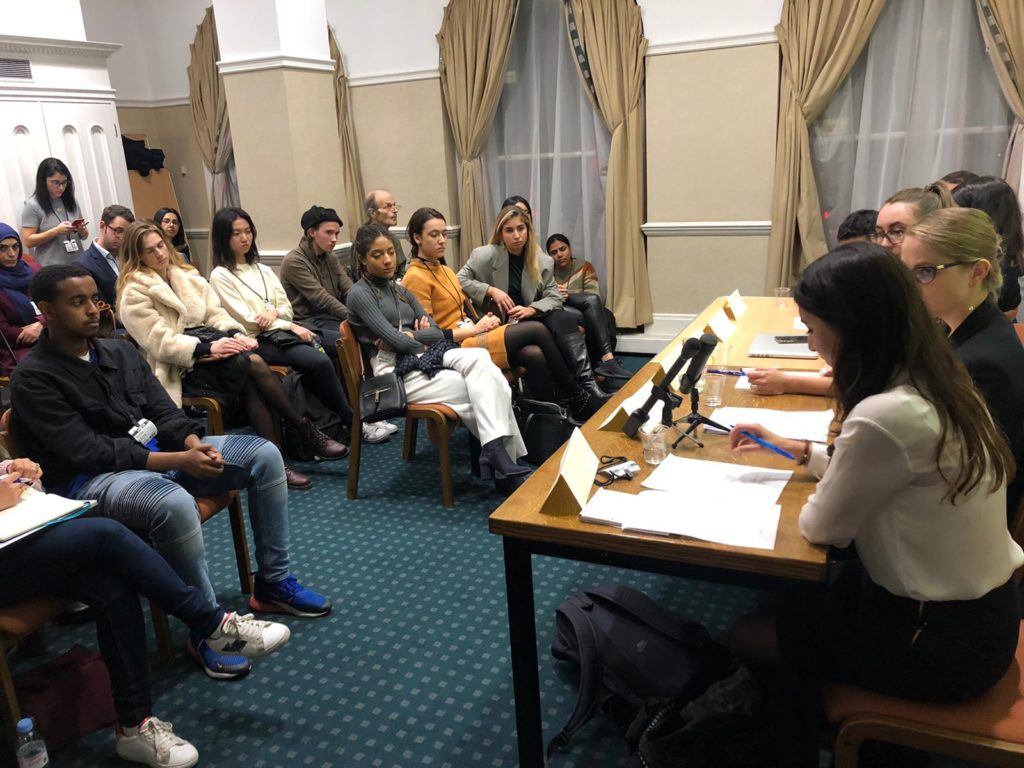
Bahar discussed the concerning cases of death row inmates Maher Al-Khabbaz, Mohammed Ramadan and Hussein Moosa, focusing on the torture they were subjected to to estract confessions. Not only does the death penalty itself conflict the International Covenant for Civil and Political Rights (ICCPR), of which Bahrain is a signatory, but those sentenced to death regularly report due process violations and torture. “Despite its international obligations, Bahrain’s use of the death penalty continues to infringe on the right to life” she emphasised.
Bahar concluded by discussing how the number of individuals on death row has tripled despite the UK’s technical assistance programme. She particularly criticised the Ministry of Interior Ombudsman and the Special Investigations Unit, two beneficiaries of the programme, who she asserted have continued to cover up cases of torture, allowing individuals to be sentenced to death on the basis of forced confessions. Bahar called for greater transparency and more robust investigations.
The third speaker, Bahraini activist Ali Mushaima, spoke about his experience in Bahrain’s prisons and imprisoned father, 71-year-old opposition leader Hassan Mushaima, who continues to be denied medical care while serving an unlawful life sentence at Jau prison. “I myself, was in prison three times. The first time was when I was only 15 years old. I remember all the details… how they tortured me, the dates, and the cell I stayed in” Ali recounted.
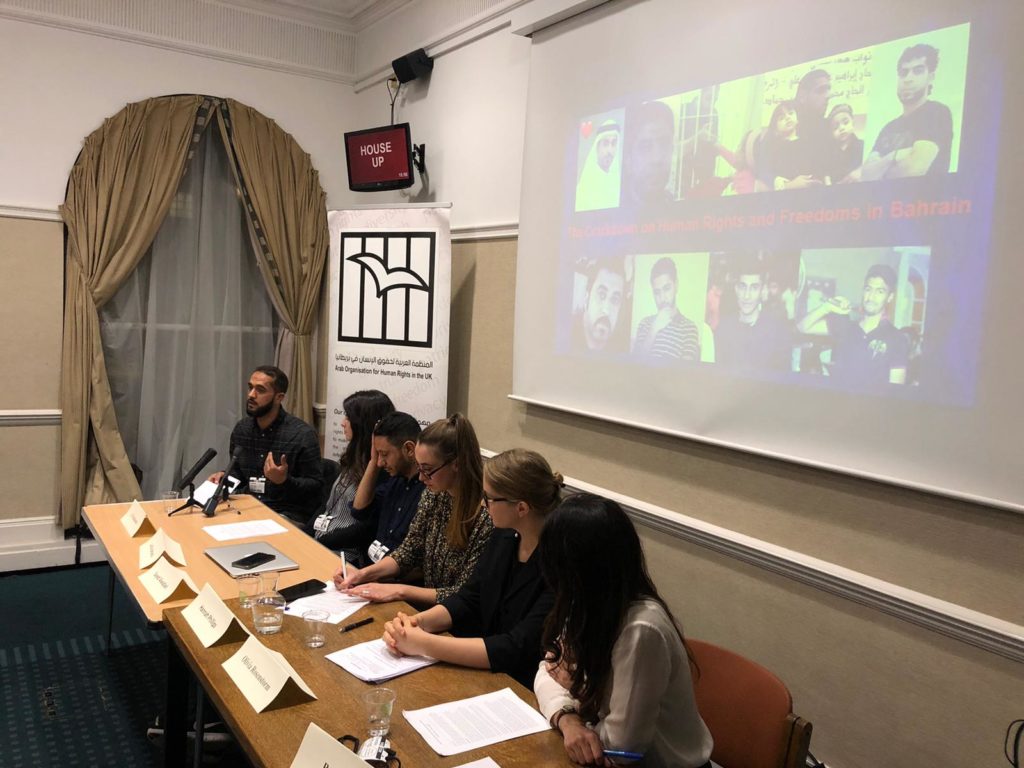
Hassan Mushaima is recovering from lymphoma and suffers from multiple health conditions including diabetes, gout and high blood pressure. However, prison authorities have routinely failed to provide him with specialist care. “In order to get medical treatment, you have to agree to be humiliated” Ali said, referring to the shackles the administration imposes on political prisoners which violate the Mandela Rules on the treatment of prisoners.
In August 2018, Ali spent 63 days protesting outside the Bahraini embassy in London to demand Bahrain provide him with medical care. For 46 of those days he was on hunger strike. “You can imagine the severity of the situation if someone has to sleep on the street in London to demand medical attention for their father in Bahrain.” Ali also drew attention to the wave of hunger strikes in Bahraini prisons since August, including dozens currently refusing food in Jau Prison.
Olivia Rosenstrom, a barrister at Temple Garden Chambers, discussed the types of violations the Bahraini government is implicated in and the legal remedies that can be taken in order to stop them.
She emphasised Bahrain’s failure to fulfil its international obligations. The detention and harassment of photographers, journalists and activists, and the general crackdown on freedom of expression violates several treaties, including the ICCPR. She also condemend the continued use of coerced confessions in Bahraini courts, which violates the Convention Against Torture and Other Cruel, Inhuman or Degrading Treatment or Punishment (CAT), to which Bahrain is party. Olivia also mentioned some of the consequences of citizenship revocation, including barriers to free movement and access to education, employment and medical care.
Olivia went on to assert the necessity of human rights conditions on trade and security agreements. Unfortunately, the UK and EU appear to be taking a “pragmatic and commercial” approach to their relationship with Bahrain, prioritising strategic aims over. Olivia concluded by providing some concrete solutions; 1) to push for a UN General Assembly inquiry into the human rights abuses in Bahrain; 2) to apply economic pressure and sanctions from the EU, UK and other countries and 3) refer human rights abusers to the International Criminal Court and impose sanctions to offenders travelling to the UK.
The final speaker, BIRD’s Director of Advocacy Sayed Ahmed Alwadaei, opened his remarks by playing a tearful message from his mother-in-law Hajer Mansoor, who complained about the poor and cruel conditions in the Isa Town Prison, where she is currently imprisoned in reprisal for Sayed’s work. The call reveals “the level of pain caused by the abuses taking place in prison” Sayed said.
Sayed went on to recount a phone call from Jau prison he received in July this year, which made him realise that two torture victims, Ali AlArab and Ahmed Almalali, would be executed within hours. “This is what I call the feeling of helplessness, and there’s nothing worse than helplessness.” Commenting on the failure of international condemnation to halt the executions, he emphasised the need for concrete action by states, rather than mere statements of concern.
He concluded by discussing the case of Moosa Mohammad, a Bahraini activist who climbed onto the rooftop of Bahrain’s London embassy to protest the executions. Moosa was brutally beaten by embassy staff members and police were forced to storm the building. He complained that Bahrain has faced “zero consequences” and criticised the UK government’s failure to respond. If Bahrain are emboldened to attack protesters in front of British police without consequence, imagine what they can do in Bahrain, when no one is watching, Sayed asked. He concluded by stressing the importance of parliament holding the UK government to account. “We do have a say,” he said, “and with everyone’s support, hopefully we can get there.”
The discussion was followed by a question and answer session, in which panelists reflected on the failures of governments and the international community to end abuses in Bahrain and hold the perpetrators to account. Solidarity was shown with Bahrainis from an audience member from repressive Eritrea, who shared her country’s experience with international human rights mechanisms and their limitations.
]]>
The Bahrain Institute for Rights and Democracy condemns these barbaric extrajudicial executions in the strongest possible terms.
The executions of AlArab and AlMalali went ahead despite significant international outcry and calls to halt the executions from the UN Special Rapporteur on Extrajudicial Executions, Amnesty International, Human Rights Watch and the US Congress.
Ali AlArab and Ahmed AlMalali were convicted and sentenced to death in a mass trial alongside 58 other men on 31 January 2018. In May 2019 – after they had exhausted all their legal appeals – five UN experts appealed to Bahrain to halt their executions amid “serious concerns” over the safety of their convictions and the fact that they have not received a fair trial.
Upon arrest, AlArab was ordered to kiss the boot of an officer and, when he refused, was repeatedly beaten. Later that day, he was taken to the prison clinic in a wheelchair. He was then coerced into signing a confession while blindfolded and subject to torture including electric shocks, severe beatings, and the removal of his toenails.
During his arrest, AlMalali was struck by at least two bullets in his hand and had his leg broken. The bullets were only removed 23 days later. He was held incommunicado for a month before being forced to sign a false confession. He was then sentenced in absentia.
Yesterday morning an inmate also informed BIRD that authorities at Jau Prison had tripled the presence of security officers and riot police in each building. In the afternoon, a Twitter account linked to Bahrain’s intelligence tweeted that the King had ratified the two men’s executions.
AlArab and AlMalali’s families received a phone call from the prison asking them to attend a “special visit” yesterday afternoon. According to Article 330 of Bahrain’s Criminal Procedure Code, relatives of those scheduled for execution will be permitted a final visit “on the date fixed for the execution,” before the sentence is carried out.
According to human rights defender Ebtisam AlSaegh, who was in contact with both families, the visits were conducted in the presence of a high number of police officers, who subjected the families to thorough searches. Ebtisam posted a video in which she shouts out “We are against the death penalty!” while attempting to comfort AlMalali’s mother.
Commenting, BIRD’s Director Sayed Ahmed Alwadaei, said: “This tragedy marks one of Bahrain’s darkest days. Ali and Ahmed were brutally tortured and forced to sign false confessions and have now lost their lives.
It appears that the Bahraini government planned this meticulously, timing the executions to coincide with US, EU and UK legislative recesses in order to avoid international scrutiny. These crimes only happened because of the unconditional support lent to dictator Hamad by Washington and London.”
Background
Both AlArab and AlMalali were arrested separately on 9 February 2017. Despite being brought to the court from prison, both men were prevented from attending proceedings and were sentenced to death in a mass trial alongside 58 others on 31 January 2018 on terrorism-related charges. AlMalali was sentenced in absentia. In addition, both men were stripped of their citizenship, but later had them reinstated by order of the King of Bahrain in a move where 551 individuals had their citizenship reinstated.
On 28 April 2019, a Twitter account connected with the Bahraini security forces tweeted that the Court of Cassation would uphold their death sentences. At that time, the legal representatives of AlArab and AlMalali had not been informed of the Cassation court date. This mirrored a similar incident relating to the unlawful executions of Abbas al-Samea, Ali al-Singace, Sami Mushaima in 2017, as this same account tweeted on 14 January 2017 – one day prior to the execution – that the King had ratified their sentences and that the executions would take place.
UN Documentation of Torture Allegations
Ali AlArab (UA BHR 7/2017)
AlArab, 25, was arrested by Ministry of Interior (MoI) security agents on 9 February 2017 at the home of an acquaintance, without presenting a warrant. He was charged with allegedly assisting in the 1 January 2017 escape from Jau Prison and killing a security officer on 29 January 2017. He was held at the Criminal Investigations Directorate (CID) until 7 March 2017.
During this time, officials coerced him into signing a confession while blindfolded. The UN expressed “grave concern” for the allegations of torture Alarab faced during his interrogation at the CID, including electric shocks, the removal of toenails and severe beatings.
On 7 March 2017, AlArab was transferred to Dry Dock detention centre. Upon arrival, he was taken to the administration office of the prison and was ordered to kiss the boot of an officer. Having refused to do so, AlArab was repeatedly beaten on his legs. Later that day, he was taken to the prison clinic in a wheelchair.
In their response to the UN documentation of AlArab’s case, Bahrain reaffirmed its position and refused to accept any of the allegations presented.
Ahmed AlMalali (UA BHR 6/2018)
AlMalali, 24, was arrested by the MoI’s Coast Guard, in a joint operation with the CID, the Special Security Force Command, and the National Security Agency. According to UN documentation, AlMalali was struck by at least two bullets in his hand – which fractured his bones – and broke his leg during his arrest. These bullets were not removed until 4 March 2017, after 23 days. He was charged with possessing arms, training in the use of arms, and membership in a terror cell and with killing a security officer on 29 January 2017.
After his arrest, alMalali was held incommunicado for a month, at which time officers tortured him. He eventually confessed under coercion, the contents of which were not known to him.
The UN had stated that they were “extremely concerned” by allegations of torture in cases involving the death penalty, especially those where coerced confessions form the basis of convictions, as in the cases of AlArab and AlMalali.
]]>At the event, experts on Bahrain discussed the human rights violations perpetrated by the government against civilians and shared the stories of those who have died at the hands of the oppressive Gulf state.
Among the speakers was Jodie Ginsberg, the CEO of Index on Censorship who talked about the decline of the right to freedom of expression in the last few years. Jodie expressed concern over Nabeel Rajab, Bahrain’s most prominent human rights defender, whose final appeal hearing will take place on 31 December 2018. In this regard, Jodie said that she hoped the date of his trial had not been chosen so that the outcome of the appeal would be overshadowed by New Year’s celebrations.

Khalid Ebrahim, the Executive Director at the Gulf Centre for Human Rights delivered a speech on state violence and human rights activists and condemned the impunity that torture perpetrators enjoy. “There is no future for Bahraini citizens without accountability”, Khalid said. He added: “The unconditional support of the UK and the US to the government is one of the main reasons for the human rights violations in Bahrain”.
Flavia Caronna, from the European Centre for Democracy and Human Rights (ECDHR) also discussed state violence and unfair trials. She highlighted the hypocrisy of western countries such as France, the UK and the US, given their decision to export arms to Bahrain while depicting themselves as promoters of human rights and democratic values.
Drewery Dyke, Chair at Rights Realization Centre talked more precisely about deprivation of nationality as a tool to silence Bahraini dissidents. He reminded the attendees that Bahrain is a signatory of the International Covenant for Civil and Political Rights (ICCPR), which forbids the stripping of nationality. “This is a policy of cruelty that shows no respect for human dignity”, he stated.

A testimony by human rights defender Ebrahim Al Demstani was also broadcasted at the event. Ebrahim was himself imprisoned and tortured by the Bahraini authorities for giving medical assistance to protestors. He also recounted the ordeal of his son, who died at the hands of the state because of his human rights activism; as well as that of his daughter, who was imprisoned and abused. “Our demands as a family are not any different than any European one, all we want is to continue the path to achieve our rights”.
Finally, Sayed Ahmed AlWadaei, Director of Advocacy at the Bahrain Institute for Rights and Democracy, shared a short documentary about 14-year-old martyr Ali Jawad Ahmad who was killed at the hands of the state in Bahrain in 2011. Sayed told the attendees that the martyr’s father was currently serving time in prison in reprisal for campaigning for justice for his son, including his participation in peaceful protests. He also touched upon the death penalty in Bahrain stating that “ [it] is the planned murder of political activists”.

The discussion was followed by a question and answer session, in which panellists further highlighted the role of Bahrain’s main Western allies, the UK and US, whose military bases in Bahrain as well as political support emboldens Bahrain to act with impunity towards its own citizens.
]]>