Canada’s leaders need to stop dignifying Alberta separatism by taking it seriously. Alberta is not the kind of thing that has a right to secede, and it won’t.
Under international law, secession is an act of self-determination, which in turn is a right enjoyed by “peoples.” Peoples are groups of individuals with a common identity grounded in culture, tradition, or sense of kinship who share an origin story, a collective historical narrative, and typically a language, a value set, and a belief system.
In seeking to exercise a right of self-determination, peoples have variously sought a state of their own (Palestinians), detachment from one state and attachment to another (Sudeten Germans), a greater degree of autonomy within an existing state (Scots), or deeper integration with an existing state (Falkland Islanders). Secession applies when the people in question is already under the jurisdiction of an existing sovereign state from which it seeks to separate for the first or second purpose. Because international law strongly favours stability and the territorial integrity of states, it limits the right of secession to extraordinary circumstances: namely, decolonization, alien subjugation, and (arguably) apartheid.
Albertans are not a “people,” because Alberta is not an ethnographic construct. It is an administrative unit, created in 1905 by an act of parliament for the purpose of providing effective governance over a more or less arbitrarily delimited space within an evolving Dominion of Canada. Administrative units have no right of self-determination. If they did, Calgary and Edmonton would have one, too.
Even if Albertans did qualify as a “people,” international law would still deny Alberta a right to secede. Albertans aren’t colonized, subjugated, or victims of apartheid. (Alberta’s First Nations, in contrast, are peoples who enjoy a right to self-determination and could probably mount a pretty good claim to a right to secede if they wanted to.)
Now, even though international law would not recognize Alberta’s right to secede, it would have no opinion on the legality of a unilateral declaration of independence, should Alberta attempt one. It would leave legal judgment on that matter up to Canada, the state with jurisdiction over the territory in question.
That judgment has already been rendered. In its 1998 ruling in Reference re Secession of Quebec, the Supreme Court of Canada unequivocally ruled that “Quebec could not, despite a clear referendum result, purport to invoke a right of self-determination to dictate the terms of a proposed secession to the other parties to the federation.” Quebec’s secession could only take place following a successful negotiation and a constitutional amendment. While the Court said that “the continued existence and operation of the Canadian constitutional order could not be indifferent to a clear expression of a clear majority of Quebecers that they no longer wish to remain in Canada,” nothing further necessarily followed: “There would be no conclusions predetermined by law on any issue. Negotiations would need to address the interests of the other provinces, the federal government and Quebec and indeed the rights of all Canadians both within and outside Quebec, and specifically the rights of minorities.”
Despite the fact that Quebec has no right to secede, it is at least plausible to say that French-Canadians have a right to self-determination, because they certainly qualify as a people. In the event of a clear majority of Quebecers backing independence in response to a clear referendum question, recognition of that right would likely motivate the rest of Canada to have a conversation on the matter. That conversation would almost certainly bog down, because the province of Quebec, like Alberta, is an administrative unit whose borders do not map neatly onto Francophone-majority districts in Canada. Also like Alberta, Quebec has large minorities whose rights would be difficult to accommodate.
But the fact that Albertans have no plausible claim to peoplehood whatsoever would, unlike in the case of Quebec, deprive Albertan separatism of sympathy elsewhere in the land. Canadians would be in no mood to negotiate dismembering the country to satisfy the whims of unpatriotic malcontents whose gripes are largely ideological and whose cause is supported by nefarious foreign actors – particularly in the face of existing treaty obligations to First Nations that predate Alberta’s creation and implicate the honour of the Crown.
The secession of Alberta, in short, is a non-starter, both legally and politically. We might as well acknowledge that now and stop wasting our collective breath – and feeding the beast – by treating it otherwise.
]]>Growing up in the United States, I was told in elementary school that I was fortunate to live in the best country on Earth. America was the first and finest democracy in the world. All Americans were equal. All Americans were free to say what they thought, worship as they liked, and grow up to be whatever they wanted to be, including President of the United States.
The Declaration of Independence famously said, “We hold these truths to be self-evident, that all men are created equal, that they are endowed by their Creator with certain unalienable Rights, that among these are Life, Liberty and the pursuit of Happiness.” Indeed, the government of the United States was designed, as the preamble to the Constitution declared, to “establish Justice, insure [sic] domestic Tranquility, provide for the common defence, promote the general Welfare, and secure the Blessings of Liberty to ourselves and our Posterity.”
In these troubled times, it is natural to wonder whether the United States can recover these founding ideals. With democracy under threat, authoritarianism on the rise, politics badly polarized, partisanship morphing into hatred, and intolerance and cruelty spreading like wildfire – directed mostly against immigrants, refugees, people whose native language is something other than English, Jews, Muslims, women, members of sexual and gender minorities, or even just anyone whose skin colour is something other than white – it seems as though the United States has fallen very far from grace.
In reality, the United States was never what I was then led to believe. It is not the world’s first democracy; that was ancient Athens. Nor, for the bulk of its history, was it particularly democratic. At the outset, most U.S. states limited the franchise to white males who owned property or paid taxes – something like six percent of the population. Only in 1870, via the Fifteenth Amendment to the U.S. Constitution, were Black people finally granted the right to vote nationally; but only Black men, and even then, in many states – including in the entire American South – Black men were discouraged or outright prohibited from voting by onerous voter qualification requirements that the overwhelming majority could not possibly meet, by threats of violence, by beatings, or by being killed. Women did not secure the right to vote nationwide until 1920, via the Nineteenth Amendment, and even then in many places women faced practical obstacles to voting deliberately thrown up by those who believed that a woman’s place was in the home, not in the public square. And Native Americans were not legally recognized as citizens and granted the right to vote nationally until 1924.
Nor have Americans ever been equal in other respects. There have always been a multitude of deeper, more insidious dimensions of structural privilege or disadvantage that made it easy for some Americans, and nearly impossible for others, to benefit from whatever formal equality they might otherwise have enjoyed at any given time. These included race and sex, of course, but also wealth and social status.
While polarization, partisanship, intolerance, and cruelty abound in the United States today, they have all been evident also at various other points in American history. In the 1760s, independence-minded revolutionaries would routinely tar and feather British loyalists, or terrorize them in some other way, until they fled to Canada. In the early 1800s, nativists routinely attacked and killed Catholics and immigrants in eastern-seaboard cities. Thousands of Native Americans died on the Trail of Tears, a massive, forced relocation from the American Southeast to territories west of the Mississippi River, and hundreds of thousands – perhaps millions – of others were killed outright, died from disease, were forced onto reservations, or experienced cultural genocide as white settlers moved westward. Pro-slavery and abolitionist forces did battle with kidnappings, assassinations, and terrorist attacks in the lead-up to the Civil War, which, when the guns finally fell silent, left somewhere between 600,000 and 750,000 Americans dead. According to the NAACP, 4,743 Black people were lynched between 1882 and 1968. Membership in the Ku Klux Klan – nothing if not a hate club – surged to perhaps six or eight million in the 1920s. 120,000 people of Japanese descent were interned in camps during the Second World War, two-thirds of whom were U.S. citizens. And so forth and so on.
Finally, what about the claim that anyone could grow up to be President of the United States? No woman has ever been president. All but one (Barack Obama) has been white.
What is there to recover?
All countries mythologize their past, embellishing some things, inventing or conveniently overlooking others, and generally cultivating a narrative of self-congratulation. My classroom experience in upstate New York was in no way unusual. But nostalgia for a non-existent past can be a dangerous thing, as it can shape unrealistic hopes and expectations. If there is a prior reality worth striving to recover in the United States, it must by definition have been real. What in America’s past is lacking in America today that is worthy of lament?
The answer to this question is not America’s founding ideals. Those have always been present, at least as aspirations and inspirations. What are missing today are certain norms and dispositions that at least opened up space for progress toward realizing these founding ideals. These are what are sorely missing in Donald Trump’s America, and these are what Americans can hope to recover. Three stand out as particularly important:
1. Politeness and decorum
Not all segments of any society have cared about – or consistently exhibited – politeness and decorum. But for much of American history, if not all, the norm was for public figures to disagree with their opponents without disrespecting, disdaining, or demonizing them. This kept open the opportunity for genuine communication and public deliberation. Students of American politics will recall that the Lincoln-Douglas debates of 1858, for example, contained fireworks on policy, but nothing more than gentle, often affable personal barbs. On the whole, they were very substantive exchanges. Bill Clinton, in his first televised debate with Republican presidential candidate Senator Bob Dole in 1996, opened with, “I want to begin by saying again how much I respect Senator Dole and his record of public service and how hard I will try to make this campaign and this debate one of ideas, not insults.” Democratic senator Hillary Clinton once said of Republican senator John McCain, “He is a patriot, and I am honored that he is also my friend.” In contrast, in the 2024 presidential campaign, Donald Trump publicly called his Democratic opponent, Kamala Harris, “horrible,” a “s— vice president,” and “not a smart person” with “a low IQ.”
2. Respect for expertise
America has traditionally always valued knowledge. It has lionized its scientists, inventors, and engineers. It has listened to, and respected, its journalists and public intellectuals. For much of its history, it has given its leaders the benefit of the doubt on contentious matters of public policy, deferring to their collective wisdom and judgment. Experts are not always right, of course, and from time to time following their advice will lead to disaster. But even experts who are wrong have knowledge that the rest of us do not have, and when they are wrong one can be sure that other experts will speak up and say so. In this way expert debate can help keep the ship of state upright as it strives for progress toward a more perfect union.
Throughout the history of American politics, experts generally enjoyed high levels of public respect. This began to change during the Vietnam War, when so-called experts led the United States into quagmire and disaster by mistaking a postwar decolonial struggle for a Cold War superpower confrontation. The Tet Offensive of 1968 showed the American people that their leaders had been systematically lying to them about how well the war was going. Walter Cronkite – America’s most trusted journalist – played a crucial role in turning the tide of American opinion on the war in a famous report from Vietnam that February: “To say that we are mired in stalemate seems the only realistic, yet unsatisfactory, conclusion. On the off chance that military and political analysts are right, in the next few months we must test the enemy’s intentions, in case this is indeed his last big gasp before negotiations. But it is increasingly clear to this reporter that the only rational way out then will be to negotiate, not as victors, but as an honorable people who lived up to their pledge to defend democracy, and did the best they could.” In response, President Lyndon Johnson is reported to have said, “If I’ve lost Cronkite, I’ve lost Middle America.” Such was the general respect for Cronkhite’s expertise.
In America today, everybody and nobody is an “expert.” YouTubers and Instagram influencers post nonsense videos about things they do not understand, generating thousands of likes and shares. Unqualified sycophants and hacks sit atop vital federal departments and agencies. The government tells researchers what they are and are not allowed to research, and tells teachers what they are and are not allowed to teach. “Stop trusting experts,” urged noted anti-vax conspiracy theorist (and Health and Human Services Secretary) Robert F. Kennedy, Jr. Both the government and a shockingly large share of the American public have done so. Who knows how many Americans will die prematurely as a result? Ignorance and quackery are antithetical to life, liberty, and the pursuit of happiness.
3. Openness to the world
American history has famously featured a long-running battle between isolationists and internationalists – between those who have felt that the problems of other countries and continents are not America’s problems, and those who have felt that, particularly in a tightly-coupled interdependent world, what happens abroad is bound to affect what happens at home. Isolationists tended to hold the upper hand in earlier periods of American history. But, since World War II, internationalists have tended to have the better of the argument. The postwar Liberal International Order that the United States helped build and maintain provided relative stability for decades, lifted hundreds of millions of people from poverty, and enabled astonishing improvements in quality of life.
In this effort, the United States has been both engine and beneficiary. “America’s Got Talent,” one might say, and that talent – in universities, in boardrooms, in civil society, and so forth – has over time increasingly been foreign-born. Throughout American history, foreigners have been a major driver of the country’s wealth and technical progress.
Today, driven by a populist, white-supremacist, anti-immigrant backlash against genuine egalitarianism, America is pulling the rug out from underneath the bases of its own success. By closing its doors, deporting many of its most productive workers, alienating its friends and allies, failing to stand up to its authoritarian adversaries, and squandering its power both hard and soft, the United States is sowing the seeds of its own demise as a great power. Other countries are left to proclaim and uphold the principles that America once championed – countries such as Japan, Canada, Australia, various members of the European Union, and Taiwan – but they lack America’s wealth and power. It remains to be seen whether they can maintain enough of the Liberal International Order to prevent the world from descending into a new dark age of domination and oppression.
It is unclear exactly what has caused the erosion of these three norms and dispositions, but I suspect a key driver is a decrease in “ontological security,” or a stable sense of self in a stable social milieu. Economic precarity, demographic change, and a decline in the social status of white working-class males have fed grievance, nativism, racism, misogyny, scapegoating, demonization, and a willingness to insult, mock, and disparage. As Sigmund Freud would put it: America’s superego is broken; its id is on full display.
Obstacles to overcome
What stands in the way of America recovering the best of what it used to be? Books could be written on this subject, but in closing I will stress the importance of three things.
First, America must find a way to better navigate its public information environment. The medium is the message, as Marshall McLuhan famously used to say. In the era before the dawn of the Internet, public deliberation relied heavily on a small number of traditional media and relatively few sources. But at least those sources had the virtue of quality control and an ethos of professionalism. People got their information and analysis from newspapers, network broadcasts, and publishers that were respected because they both exhibited and cultivated – wait for it! – politeness and decorum, respect for expertise, and openness to the world.
Today’s information environment is both siloed and cacophonous, largely devoid of quality control, and little concerned (if at all) with promoting collective problem-solving through genuine deliberation. Generative AI will soon make everything worse by cultivating intellectual laziness, eroding critical thinking skills, and regurgitating or hallucinating bad information.
Genies, once having escaped from bottles, are notoriously hard to put back in. But what is needed is a concerted effort to teach children how to distinguish good information from bad, what and whom to trust, and the importance of engaging with voices and viewpoints that might initially seem foreign or uncomfortable. The current information environment is not going to become any less cacophonous, but it can become less siloed, and the people navigating it can cultivate the circumspection and critical thinking skills that will make the ease of accessing information an asset for, rather than an obstacle to, deliberative democracy.
Second, America needs to have a wide-ranging conversation about buttressing what philosopher John Rawls called the social bases of self-respect. These are the public conditions that enable people to feel that society values and supports their capacity to formulate and pursue a meaningful plan of life, and this in turn requires making sure that everyone feels that they belong. Stronger protections for political and civil liberties, fair opportunities to participate in social and political projects, and institutions people can believe in and support are all important for giving them a stake in fixing what is wrong with the country. For the most part, the ideational resources such a project requires are already in place. They are the fundamental principles that my elementary school teachers trumpeted prematurely, and the norms that enable civil discourse and dialogue.
Third – and finally for now – America must confront its foundational myths and narratives. Democracy, liberty, freedom, and justice for all are fine aspirations not served by pretending that they have ever been fully achieved but by acknowledging that they are works in progress. The surest way to derail such a project, however, is to dwell on grievance and blame. No American alive today is personally responsible for the country’s historical failures. But all stand to gain from a collective effort to overcome them.
]]>Donald Trump’s assault on the United Nations continues. On Wednesday, he signed an executive order pulling the United States out of 31 UN bodies or agreements, in addition to another 35 that work closely with it.
These 66 entities do crucial work promoting world order and global wellbeing. They include the Framework Convention on Climate Change – the only truly global effort to prevent catastrophic overheating of the planet – as well as the International Law Commission, the Peacebuilding Commission, the UN Conference on Trade and Development, offices dedicated to fighting child soldiery, violence against children, sexual violence in conflict, and so on.
Their cardinal sin: not promoting Trump’s “anti-woke,” America-first agenda. Meanwhile, the Trump regime demonstrates its disregard for the UN Charter on an almost daily basis, most recently through a spectacular smash-and-grab kidnapping of Venezuelan leader Nicolás Maduro and by threatening to annex Greenland.
It has even made this disdain official policy via its new National Security Strategy. The UN Charter is “based on the principle of the sovereign equality of all its Members” and requires states to “settle their international disputes by peaceful means,” “refrain … from the threat or use of force against the territorial integrity or political independence of any state,” and “fulfill in good faith the obligations assumed by them.”
And that’s just Article 2.
At this point, the United States has lost any moral claim it had to play host to the UN’s headquarters. Canada should offer to do so.
The notion that Canada would be a better host has cropped up periodically, but the time is finally ripe to act. Unlike the United States, Canada actually believes in the UN and has a long, distinguished and unblemished history of supporting it. Canada has not always kept pace with the East River zeitgeist – we were notoriously slow, for example, endorsing the UN Declaration on the Rights of Indigenous Peoples – but no one questions our commitment to the long-term global project. Canada is already a microcosm of the UN. According to the 2021 Census, Canada is home to people of more than 450 ethnic and cultural backgrounds representing virtually every country.
Canada is also an attractive place for diplomats and officials to live and work, ranking high on indices of freedom, happiness, safety, human rights, quality of life, and prosperity.
Hosting the UN would benefit both Canada and the world community. For Canada, it would mean a boost in international standing and pump more than $4 billion into the economy annually. It would bring in more than 15,000 highly-skilled, well-educated, and cosmopolitan UN employees. And hosting the UN might add marginally to Canada’s ability to deter U.S. annexationism.
For the rest of the world, Canada would be a stable, reliable, and congenial host not too far from – but beyond the reaches of – important centres of political and economic power in the United States. Because of that proximity, relocating to Canada would also be relatively cheap compared to potential alternatives. And Canada would certainly refrain from delaying or refusing visas to officials from countries that Mr. Trump dislikes.
Relocating UN headquarters would also be an important signal that there are still countries that remain committed to the organization’s mission and its future survival.
Several Canadian cities could mount plausible and attractive bids, including Montreal (already home to nearly 70 international organizations), Ottawa (Canada’s diplomatic hub), Toronto (Canada’s most diverse city), and Vancouver (Canada’s most livable metropolitan area). Inviting competing designs and proposals would kick off an exciting national project.
How would moving UN headquarters work, and could or would the United States object? The UN’s current location is governed by a bilateral treaty between the United States and the UN itself, Section 23 of which states, “The seat of the United Nations shall not be removed from the headquarters district unless the United Nations should so decide.” The treaty came into effect in 1947 upon an exchange of notes following a vote of the General Assembly. The Security Council, where the United States wields a veto, was not – and would not be – involved. So, Mr. Trump could not stop it. Legally.
What would happen if the UN voted to decamp? According to Section 22, the land in the headquarters district would revert to the United States, by sale or otherwise. Imagine what Donald Trump – a Manhattan real-estate developer, and a UN-hater to boot – would think about that.
]]>On a recent visit, I decided to do an experiment: I would snap a photo of every painting that grabbed me and reflect later on what it was about it that had that effect. My hope was that I would learn something about my artistic sensibilities.
Well, I have now reflected and it is time to report. To cut to the chase: I think I learned something not only about my taste in art, but about my orientation to life.
I had an additional hope, too: namely, that Jody would be willing to comment on my comments. I felt sure that that would help me learn even more not only about myself, but also about art. That invitation is officially open.
Okay, here goes. I will present the paintings in chronological order and include the accompanying display text.

According to Roman history, the rape of the virtuous matron Lucretia by Tarquin, son of the king of Rome, incited the people to overthrow the monarchy and establish a republic around 510 BCE. Lucretia was hailed as a hero for subsequently committing suicide in an attempt to avoid any perceived dishonor to her family. With his characteristic expressive distortions of anatomy and space and vibrant treatment of light, Tintoretto depicted one of the most violent moments of the story. As Tarquin and Lucretia struggle, a pillow flies through the air, her pearl necklace breaks apart, and the fabric and carved post of the bed’s canopy collapses around them.
What immediately jumped out at me about this painting was its dynamism. Everything is in motion, or was in motion just moments before. It took me a few seconds to realize that what was being depicted was a horrific, ghastly crime. The exaggerated contrast between light and dark tones added to the dynamism and the use of colour enhanced awareness of the unfolding struggle between good and evil (Lucretia’s fair skin and Tarquin’s sickly pallid yellow skin).
Lucretia’s right hand seems to be in a downward motion, toward the dagger on the floor. I wanted to know if she would be able to grab it and thrust it upward and backward. The action felt unfinished, even if the painting wasn’t. So hard to look at; so hard not to.

This Flemish market stall overflowing with dead game is enlivened by fighting roosters, an aggressive cat, and a pickpocket. An early example of Frans Snyders’s animated combination of highly ornamental still-life elements with secondary figures and a low viewpoint, this scene might have adorned the dining room of an aristocratic collector. Snyders was the leading Flemish painter of monumental still lifes. He regularly collaborated with his fellow Antwerp artist Peter Paul Rubens, contributing fruits and animals to Rubens’s compositions.
This painting was huge, which amplified the sense of slaughter. But I soon realized that not all of the birds and animals were dead, so it quickly became a game of “Where’s Waldo” to find the living things. It took me a second to notice the pickpocketing kid, which seemed oddly comic given the cornucopia of death. Then I read the side panel. Still life? I don’t think so. Market? Maybe, but this vendor had no idea how to mount an appealing display. The main things that attracted my interest and intention, though, were the birds (not surprisingly). The enormous Whooper Swan and the Common Pheasant barely visible behind the hare certainly would have been fair game, but the Indian Peafowl was a domesticated, ornamental bird. Naughty, naughty!

This evocative character study is an early example of a type of subject that preoccupied the great Dutch master Rembrandt van Rijn throughout his long career. Although his large output included landscapes, genre paintings, and the occasional still life, he focused on biblical and historical paintings and on portraits. As an extension of these interests, the artist studied the effect of a single figure, made dramatic through the use of costume and rich, subtle lighting. Rembrandt collected costumes to transform his models into characters. Here, the gold chain and steel gorget suggest an honored military career, while the plumed beret evokes an earlier time. The broad black mass of the old man’s torso against a neutral background is a powerful foil for these trappings. The face is that of a real person, weathered and watchful, glowing with pride and humanity. The unidentified sitter, once thought to be the artist’s father, was a favorite model, appearing in many of the artist’s early works. The confident execution suggests that the young Rembrandt completed this picture about 1631, when he had left his native Leiden to pursue a career in the metropolis of Amsterdam; perhaps he wished to use this work to demonstrate his skill in a genre that combined history painting and portraiture.
I have always been a sucker for Rembrandt. I was pleased that I thought this painting was a Rembrandt even before I even looked at the display text. There is always something about the eyes: I don’t know if anyone ever painted more lifelike eyes, always expressive and always slightly rheumy — which was probably accurate, given the cool, damp conditions even rich people lived in at the time. The subject also seemed a bit drawn and gaunt, which struck me as an interesting contrast with his obvious wealth and stature. Finally, there were the dark tones: I don’t know how Rembrandt managed to convey so much detail in so many of his paintings with such subtle low-light variations. I could look at any random Rembrandt for hours.

With its low horizon line, monochrome palette, and efficient paint handling, this panel is characteristic of early river landscapes by Jan van Goyen. In a society that provided a broad market for art, Van Goyen executed both small- and large-scale paintings of waterways, with varying levels of detail, to appeal to buyers at the lower and higher ends of the market. Such views of Dutch canals, moody skies, and seafaring activities appealed to collectors in the young republic, which prided itself on its maritime prowess.

Aelbert Cuyp never traveled to Italy, yet he employed the golden light typical of southern Europe to dramatize his distinctly Dutch pastoral subjects. He enhanced views of the meandering rivers and flat terrain with cows and sheep, animals that abounded in the local countryside. In this relatively early painting, his use of a warm, monochrome color palette reflects the influence of his older contemporary, Jan van Goyen.
These two paintings were hung as a pair, which struck me as entirely appropriate. I have no formal art history training, but my first thought on seeing both was that they were in the wrong gallery. They seemed so modern — not in subject, but in style. Neither has a focal point or obvious subject other than, perhaps, a cloud. And everything is backlit. The point seems to be strictly atmospheric. I love that.

Long assumed to be by Francisco de Zurbarán, the leading painter in Seville, Spain, this work is now considered to be by his son, Juan de Zurbarán, who specialized in exquisitely painted still lifes during his short career. The precise, sensuous application of paint and dramatic lighting are typical of Juan, whose style can be identified through only a few signed paintings. The expensive imported Chinese porcelain bowl would have appealed to the wealthy clientele who purchased his refined yet exuberant compositions.
To me this painting is all about the bowl. I am sure the flowers and fruit are very well done, but the bowl is stunning. I really admire an artist’s ability to paint by hand so precisely and so symmetrically. It speaks of fine motor skills that I could only dream of. I was a bit surprised to see that it was a Chinese bowl; I was not sure how much trade in fragile fine craftwork Europe had with China at that time. I googled and discovered that the Portuguese had by this point been trading with China through Macau for nearly a century. This provenance made sense. I realized that another thing I really liked about this painting was that it made me want to google.

This still life may look like a snapshot of an abandoned meal, but the scene is carefully arranged, revealing the artist’s ability to create complex but harmonious compositions with a limited palette of neutral colors. William Claesz. Heda balanced the horizontal pewter chargers in the foreground with the vertical glass vessels and salt-cellar in the background and positioned the overturned ewer diagonally to connect the two planes. Faint creases in the tablecloth, plates hanging precariously off the table’s edge, and the window reflected on the pitcher’s surface demonstrate the artist’s observant eye as well as his virtuosity in handling paint.
What a stunningly beautiful mess! I am notorious for hating disorder, and yet I immediately thought that I would love to hang this painting in my house. The light and the technique took my breath away.
I was especially drawn to the glassware. I have always been somewhat amazed by painters who can paint glass. After all, it’s transparent, right? I looked particularly closely at the tall beer glass at the back. It’s hardly painted at all: just light edge strokes, some reflective highlights, and so on. Most of it matches the wall. And yet it has such substance.

This man’s suntanned skin, worn clothing, and rustic surroundings are rendered in shades of brown that mirror the contents of his pipe. The Spanish introduced tobacco into Northern Europe in the 16th century, and smoking quickly became a beloved pastime that was widely considered healthful and nourishing. By the early 17th century, single-figure images of smokers emerged as a subgenre of Dutch and Flemish painting. The theme posed an enticing challenge for artists, with its burning leaves, billowing plumes of smoke, and active facial expressions—here, the figure purses his lips and wrinkles his brow as he concentrates on lighting the pipe. German painter Johann Carl Loth blended the Northern emphasis on capturing textures with the dramatic illumination reminiscent of so-called Caravaggesque painters like Hendrick Terbrugghen.
This painting made me curious. My first thought was that the man must have accomplished something and a pipe was his reward. I wondered what he had done. He must have been out in the sun; his cheeks and nose are burned, and his hands and wrists (but not forearms) are tanned. But maybe all he had really accomplished was dinner, for there is food on the table. If so, he didn’t eat very much. Why not?
The old fellow had such an interesting face, too, and such a look of satisfaction. He seemed happy. It was hard not to smile. But I also wanted to know more.

Edwaert Collier was well known in his own time for his still lifes, which replicated in intricate detail actual maps and globes. Here, he reproduced a portion of Frederik de Wit’s 1660 map of the Americas and Jodocus Hondius’s terrestrial globe with a view of Mexico, both of which allude to the Dutch Republic’s international trade networks and the ambition to possess the world through cartographic knowledge. The extinguished candle and hourglass, in contrast, reference the fleeting nature of time. Through such highly illusionistic renderings of the symbols of worldly pursuits, Collier evoked the tension between humanity’s lasting contributions to the fields of art and science and the brevity of an individual life.
As a kid, I loved maps. I still do. But this house belonged to someone who loved them even more than I. It also belonged to a total scatterbrain who obviously couldn’t finish one thing before starting another and who had no sense of order. Those qualities are foreign to me. So, maps and mindsets — those are what grabbed me here (in addition to exquisite brushwork and light play).

Nicolas de Largillière was among the most highly esteemed and prolific portrait painters working in the time of Louis XIV of France, and his popularity continued through the period of the regency that followed Louis’s death in 1715. His portraits were admired for their deftly rendered textures and for the confident poses that lent a sense of grandeur and ease to the sitters. They were sought after by a diverse clientele, ranging from royalty and courtiers to the upper middle class. In this work, one of his many self-portraits, Largillière presented himself as fashionably dressed and self-assured, the master of his art. He depicted himself as ready to lay out a painting, working with a porte-crayon (a piece of chalk in a holder) on the blank canvas behind him.
I could not decide on first glance whether the subject of this painting was a good-natured soul or a pompous ass. I gradually inclined toward the latter, though I have no independent information for that judgment. But there were subtle clues: obviously an artist, he evidently thought it more important to paint himself than get going on the painting he is set up to do; and although he is in his studio (no doubt alone), rather than at court or in society, he is wearing a wig. Who does that? There are other unrealistic affectations, too. While he would obviously be using a mirror to paint himself, his gaze is slightly above it. And although he is holding his port-crayon in his left hand, suggesting that he was left-handed, he had to have been painting with his right.

The most eminent member of the family of Venetian artists, Francesco Guardi is renowned for his lively city views and fanciful depictions of architecture. Here, Guardi represented Venice’s spiritual and social epicenter, the Piazza San Marco, animated by the capricious interactions of humans and animals alike. Using a sweeping perspectival view, Guardi emphasized the vastness of the piazza, which is to this day the largest piece of open land on the crowded lagoon. Wealthy travelers making the Grand Tour of Europe — considered an essential part of an education for upper class men — constituted an important market for such paintings.
This painting grabbed me because I had been there — several times. Seeing something familiar from about 200 years before my first visit was quite captivating. I admired the artistry, too, of course, and, as I have learned in the course of this exercise, I have a thing for clouds. But something seemed off. Later, I realized what it was: Where were all the pigeons?

There was no commentary next to this portrait, only “Oil on mahogany panel” and “Gift of Catherine Colvin, 1921.88.” I did a little research and discovered that Savage painted at least seven portraits of Washington. I don’t know which this one was in the series, but it seems Washington sat for the first one during the first winter of his presidency (1789–1790), so this is likely the second or third. No matter; what first struck me about this one was Washington’s enormous nose and his oddly dropped chin. I wasn’t even sure it was Washington when I first saw it. I have always been struck that no two portraits of Washington make him look quite the same. Was he a shape-shifter? Were his portraitists incompetents? Did they paint doppelgangers and then claim they were Washington?
The second thing that struck me about this portrait was its dishonesty. Here, Washington has the soft, almost feminine hands of a 20-year old. By this point, he was 61 and had spent years outdoors surveying or conducting military operations. His real hands must have looked gnarly (in the literal sense of that word). And there is no sign of the smallpox scars on his face. We were being lied to.

This depiction of an enslaved man constituted a timely abolitionist appeal in the years leading up to the British Emancipation Act of 1833. The subject raises his head and eyes toward the heavens, echoing the conventional poses for Christian saints and martyrs. John Philip Simpson thus used familiar iconography to appeal to the sentimentality and supposed moral superiority of wealthy white viewers with the requisite power to sway public policy. But the deeply moving pose also reflects the artistic contribution of the man who modeled for the figure, now identified as Ira Aldridge, a free-born American actor famous for playing the title role in Shakespeare’s Othello. His performance in Thomas Morton’s musical drama The Slave may have been the immediate inspiration for Simpson’s painting. Aldridge was also renowned for his persuasive speeches for the abolitionist cause.
In a gallery full of portraits of wealthy, influential people, this one stood out for obvious reasons. It alone was morally disturbing. When I read the side panel and discovered that the subject was a freeman and an actor, I felt briefly hoodwinked, but reading all the way down I was reassured that it was all for a good cause. As far as technique was concerned, the side panel said everything better than could I. The pose and light play were symbolically obvious, but no less compelling.

There was no commentary on this piece on the side panel, either, which seemed oddly appropriate, given how spare the scene is. This painting prompted many questions. Why was the subject leaning awkwardly against an obviously comfortable bed rather than sitting or lying on it? Why was he wearing a hat and coat indoors? Why didn’t the shadow on the bed line up with the shadow on the floor? Why was neither shadow aligned with the light source? Why, if the book was as thick as it obviously was, did it appear to have no spine? What were the odds that he would be exactly halfway through it?

David Garrick, one of the most influential actors of 18th century Britain, appears here in the guise of the titular character from William Shakespeare’s King Lear, a role he played numerous times on the stage. The play follows Lear’s mental breakdown after he relinquishes his power and divides his kingdom between two of his daughters. In this portrait, made after Garrick’s passing and based on prints created from his death mask, the actor wears a crown of wheat and wildflowers in reference to a famous scene in the play during which the king rages at a storm, daring it to harm him.
King Lear is my favourite Shakespeare play, but I did not know that this was King Lear until I read the side panel. My first reaction was simply that this was a beautifully executed portrait. But then I began to notice odd things. Who puts wheat in their hair, even if they are mad — and with a rose, no less? Who bundles it so nicely if they do? And why clutch even more wheat? What happened to this guy’s nose? It looks like it has been displaced by an earthquake and is missing half a nostril. Did he break it playing Rugby? And would Lear have worn an ermine-collared robe out into the famous storm? So many questions; so few answers.

Finely dressed and carrying an elegant walking stick, influential French artist Édouard Manet appears before a stark background evocative of his own paintings as well as photographic portraits of the time. Created by his friend Henri Fantin-Latour, this depiction confronted the public perception of Manet as a radical bohemian painter of coarse and confrontational compositions (for an example of this, see his Jesus Mocked by the Soldiers). Fantin-Latour instead portrayed him as the genteel man-about-town he actually was.
I don’t know if this painting would have jumped out at me if I had not seen that it was a portrait of Manet. It just seemed so antithetical to Manet’s own work. But the side panel insisted that he was a “genteel man-about-town,” and who am I to doubt that? Just goes to show that you can’t judge a book by its cover art.

Moonlight floods through tangles of dark, crooked branches, casting deep shadows on the ground that crisscross tracks imprinted in the damp earth by wagon wheels. The moon is just out of view but fills the scene with a strikingly eerie, bright-green hue. In the middle distance, a single cart makes its way down the muddy road, evoking the Romantic trope of lone travelers. John Atkinson Grimshaw has been hailed as “the painter of moonlight” precisely for moody, atmospheric works like this one. Self-taught, he began to paint in the 1850s while working as a clerk at the Great Northern Railway company in Leeds, England.
I found the combination of the moonlight and the misty background utterly captivating. This painting evoked emotion immediately — a combination of sadness, resignation, and awe. It also struck me as photorealistic, including a compelling degree of noise, as though it were shot at very high ISO. But, of course, it is not photorealistic at all. It would be impossible to capture the tonal variations in this scene with a camera without saturating either highlights or darks.

Mary Cassatt chose a quintessentially Spanish subject, executing this composition of a bullfighter, or torero, in full regalia during an extended stay in Seville. Having trained in Philadelphia and Paris, Cassatt ventured to Spain to study the country’s Renaissance and Baroque works and to follow the path of French avant-garde artists like Édouard Manet. Depicting the performer at a relaxed moment, far removed from the spectacle and violence of the ring, Cassatt omitted narrative detail. Instead, with a modernist sensibility, she focused on the male figure in a casual pose, employing vigorous brushwork and rich pigment to describe the bullfighter’s costume and suggest his characteristic bravado.
This was one of the very few paintings that I encountered done by a woman, though of course I did not know that until I read the side panel. It immediately brought to mind Old Man Lighting a Pipe, which I had seen perhaps an hour earlier. More than two centuries separated these paintings, and yet they looked to me as though they could have been done at the same time. In terms of colour, light, mood, and technique, they were almost exactly the same. I loved them both. But there was no mystery about this one: one knows exactly what is going on here.

This subject, unusual for Pierre-Auguste Renoir, was painted during his stay at the home of Paul Berard in Wargemont, on the Normandy coast. Here, Renoir depicted a site untouched by urbanization or modernization. Rather than paint nature as an untamable elemental force, the artist deliberately brushed his wave in blue-violets that transform the work into a mood picture, whose effect is more decorative and melancholy than foreboding and stormy. It is nature tamed and poeticized by Renoir’s temperament and characteristic lightness of touch.
Nothing in this painting is realistic, especially the colours. But it may be the most beautiful seascape I have ever seen. Contrary to the text on the side panel, I thought it foreboding and stormy; I saw nothing decorative and melancholy about it. And was the touch light? I don’t know. It didn’t matter. I stared at this for a full five minutes before I could move on.

“He loves everything that is joyous, brilliant, and consoling in life,” an anonymous interviewer once wrote about Pierre-Auguste Renoir. This may explain why Two Sisters (On the Terrace) is one of the most popular paintings in the Art Institute. Here Renoir depicted the radiance of lovely young women on a warm and beautiful day. The older girl, wearing the female boater’s blue flannel, is posed in the center of the evocative landscape backdrop of Chatou, a suburban town where the artist spent much of the spring of 1881. She gazes absently beyond her younger companion, who seems, in a charming visual conceit, to have just dashed into the picture. Technically, the painting is a tour de force: Renoir juxtaposed solid, almost life-size figures against a landscape that—like a stage set—seems a realm of pure vision and fantasy. The sewing basket in the left foreground evokes a palette, holding the bright, pure pigments that the artist mixed, diluted, and altered to create the rest of the painting. Although the girls were not actually sisters, Renoir’s dealer showed the work with this title, along with Acrobats at the Cirque Fernando and others, at the seventh Impressionist exhibition, in 1882.
The impressionists were masters of colour, and this is no exception. The brush technique is engrossing, too — not quite pointillist, but jabbed in a similar way, though very heavy. There is nothing photorealistic here. But the authenticity of the subjects’ facial expressions is compelling. It is almost as though you can read their minds.

A lone peasant girl pauses her work to listen to a lark singing in the distance. Her emotional response to this moment of natural beauty is accentuated by the glow of the sun rising behind her, suffusing the landscape with golden light. Jules Breton specialized in scenes of rustic life in the countryside. Having been raised in the rural village of Courrières in northern France, he admired the people living there for their resourcefulness and connection to nature and gained immense popularity by painting them in his idealized style.
Another backlit scene. I find these captivating. They really create a mood. I had no idea that the girl had stopped to listen to a Lark (though I could not blame her). Most likely it was a Crested Lark, whose song you can listen to here.

Frederic Remington crafted this scene of bloody confrontation for white audiences east of the Mississippi River, who imagined the West as a place of both danger and opportunity. An unseen Sioux warrior has shot a cavalry scout, who slumps over his horse while the troops behind him flee the ambush. A sculptor and illustrator as well as a painter, Remington was famous for his dynamic compositions of frontier life, which presented mythologized views of encounters between Native and settler-colonial communities in tantalizing color and detail. Although he traveled to western locations to sketch or gather material on assignment, he executed most of his work in his New York studio, including The Advance-Guard, which was later reproduced in Harper’s Weekly alongside an article by the artist.
I loved the colours in this painting, as well as the overexposure effect. But the things I loved most about it were its dynamism and its compositional imbalance, which gave the impression of an image hastily taken, almost in surprise. In form, the painting brilliantly echoes the panic of the ambush, and the emotion it conveys is palpable. Even the horses contribute to the effect. The horse in the foreground is shot in the rump and is in obvious pain. The next horse is galloping away furiously. The third horse in the background is rearing. In the distance, you can just make out a wagon train. You can bet what lays in store for that. But I confess I found the title of the painting confusing. It looks to me as though the wagon train is moving in the other direction. Shouldn’t this be a rear-guard?

In American Gothic, Grant Wood directly evoked images of an earlier generation by featuring a farmer and his daughter posed stiffly and dressed as if they were, as the artist put it, “tintypes from my old family album.” They stand outside of their home, built in an 1880s style known as Carpenter Gothic. Wood had seen a similar farmhouse during a visit to Eldon, Iowa. When it was exhibited at the Art Institute in 1930, the painting became an instant sensation, its ambiguity prompting viewers to speculate about the figures and their story. Many understood the work to be a satirical comment on midwesterners out of step with a modernizing world. Yet Wood intended it to convey a positive image of rural American values, offering a vision of reassurance at the beginning of the Great Depression.
This is one of the most famous paintings at the Art Institute, and of course I was drawn to it in part because of its fame. But I can’t decide whether it is a good painting. The fact that there is no perspective on the house in the background is jarring. The pitchfork dominates in an odd way. The farmer looks stunned and uncomfortable. His daughter’s face looks squished side to side. The net effect was to make me squirm a little. And then I read the side panel, which I found disappointing. This was “intended to convey a positive image of rural American values”? To me, the daughter is gazing at her dad with intense hatred, as though he had done something horrible to her in the barn that we can barely see on the right. A friend of mine insists that good art is unsettling, though. If that’s the criterion, this is definitely good art.

About Nighthawks Edward Hopper recollected, “unconsciously, probably, I was painting the loneliness of a large city.” In an all-night diner, three customers sit at the counter opposite a server, each appear to be lost in thought and disengaged from one another. The composition is tightly organized and spare in details: there is no entrance to the establishment, no debris on the streets. Through harmonious geometric forms and the glow of the diner’s electric lighting, Hopper created a serene, beautiful, yet enigmatic scene. Although inspired by a restaurant Hopper had seen on Greenwich Avenue in New York, the painting is not a realistic transcription of an actual place. As viewers, we are left to wonder about the figures, their relationships, and this imagined world.
I love modernism, and this painting oozed it. But I found the side panel unsatisfying. Isn’t it obvious that the man and the woman sitting next to each other are there together? Isn’t it obvious that the waiter is either about to speak to them, or has just finished speaking to them? Where is the loneliness in that? And what did the artist mean by “unconsciously, probably”? How do you put a probability on something of which you claim not even to be aware? Perhaps this was another case, as Northrup Frye once put it, where “Ibsen is an indifferent critic of Ibsen.” Also: it was considered impolite for men to wear hats indoors in the 1940s.

Chicago artist Ivan Albright executed this grisly work for the 1945 movie adaptation of Oscar Wilde’s 1891 novel The Picture of Dorian Gray. In Wilde’s tale, a portrait of the young and attractive Gray decays as the protagonist leads an increasingly wayward life, recording the extent of his moral corruption in paint. Having established a reputation for capturing the macabre, Albright was the ideal choice to create such a horrific image that both attracts and repulses its viewers. The portrait appeared in vivid Technicolor, within the otherwise black-and-white film, causing a sensation. When Albright’s canvas was exhibited at the Art Institute later that year, the Chicago Tribune reported that the museum “is having a heck of a time handling the crowds flocking to see his painting.”
“Attracts and repulses” is right. That is exactly what this painting did to me. It was stunning — beautifully executed and faithfully evocative of Wilde’s creepy novel. But you couldn’t pay me enough money to hang it in my house.
So, what did I learn about myself? I would say three things about my taste in paintings specifically:
-
-
- I am fascinated by light.
- Dynamism blows me away.
- I am drawn to a painting that makes me want to google way more than to one that does not.
-
I would add four things about me in general that also just so happen to apply to paintings:
-
-
- I admire skill.
- I like to be challenged.
- I love puzzles.
- I am bored not learning.
-
None of these things in a painting alone is enough to move me, though. That’s probably why I don’t particularly care for The Mona Lisa. I can see the skill in it, but it ticks none of my other boxes. I have no idea why so many people think it the best painting of all time. But maybe that’s just me. To each their own, as they say.
]]>Donald Trump’s “dumb” trade war is on, and is looking dumber by the minute. By picking fights with some of the United States’ biggest trading partners, he is in the process of vandalizing an economy that was in excellent shape when he took office, and by targeting some of America’s best friends, he has trashed its reputation, undermined trust, squandered decades’ worth of goodwill, and reduced its soft power to zero.
It is tempting to look for method in Mr. Trump’s madness. Look in vain. Either he doesn’t know what he is doing or he just likes bullying. Likely both.
So far, Canadian leaders have handled the crisis well. Our messaging has been firm and clear. But Mr. Trump remains unchecked. Tactical retreats notwithstanding, he continues to hold tariffs over our head like a sword of Damocles, vowing to increase them when we respond with our own.
To tame Mr. Trump, Canada cannot rely on its traditional ways of managing relations with the United States – working the American system from within by cultivating friends and allies in Congress, statehouses, boardrooms, and chambers of commerce – because Mr. Trump listens only to people who tell him what he wants to hear and is largely shielded from functional checks and balances by a Congress that has caved to the MAGA cult, and a Supreme Court stacked with enablers.
No. We must target Mr. Trump directly.
There are several ways to do this, all of them complementary.
First, we must help turn Mr. Trump’s base against him. His own policies will do much of the heavy lifting. When inflation skyrockets; when Midwest farmers can’t sell their grain; when Medicare, Medicaid, or Social Security payments are late or don’t show up at all; when people’s kids can’t get into colleges or universities because they have shut down programs; when it becomes impossible or unaffordable to get avocados, insulin, or Wegovy – even Trump supporters will rise in fury.
Canada can help fuel their outrage by upping the ante when necessary. Ontario Premier Doug Ford’s now-paused 25-per-cent surcharge on electricity exports is a good example. Adding oil, natural gas, potash, and even toilet paper to the mix would surely help. The sooner Americans feel the pinch at the pumps, on their electricity bills, and in the checkout line, the sooner the uprising will begin. Trump voters are particularly sensitive to such things.
Second, Canada should throw the doors open to U.S. doctors, nurses, scientists, and entrepreneurs. Lower the barriers to entry and they will come. American voters will notice and fret.
Third, Canada should target the only other group that Mr. Trump cares about: billionaires. As captains of industry hate nothing more than missed opportunities, Canada should invite a number of other countries in Mr. Trump’s crosshairs to participate in a three-month total tariff and quota holiday. Let goods flow unimpeded between Canada, Mexico, and the EU, for example, forcing American exporters to watch from the sidelines in frustration. Three months is not long enough to cause wholesale structural disruption, say, to Canada’s supply management system, but it is long enough to make a point.
Fourth, Canada should also target symbolically potent U.S. national champions. Suspend orders and options for Boeing aircraft; cancel our purchase of F-35s, giving the contract to Sweden; redirect Canada’s rearmament spending to non-American suppliers.
Finally, Canada and what remains of the free world should demonstrate that the United States is not, in fact, the indispensable country that it thinks it is. Ottawa should call for the creation of a new group of wealthy, high-functioning, committed liberal democracies with economies big enough to have an impact to begin mapping a collective strategy for resisting the global turn toward socially regressive authoritarianism and salvaging what can be rescued of the liberal international order.
With Freedom House scores of 85 or better, GDPs of at least US$300-billion, and GDPs per capita of at least US$30,000, Australia, Austria, Belgium, Britain, Canada, Czechia, Denmark, France, Germany, Ireland, Italy, Japan, the Netherlands, Norway, Spain, Sweden, Switzerland and Taiwan represent almost a third of the global economy. This bloc would embolden genuinely liberal-democratic and progressive Americans – who themselves represent a significant portion of the U.S. population and economy – to amp up their resistance. It would give them hope. And it would embarrass them. With a Freedom House score of only 84 and dropping fast, the United States wouldn’t even qualify.
Canada has natural allies aplenty both in America and abroad. Let’s do what we can to strengthen their hand in our common vital cause: taming Mr. Trump.
]]>Until Saturday, the last time a state unleashed an aerial barrage against Israel was during the Gulf War. In 1991, Iraq, under Saddam Hussein, launched 39 Scud missiles at Israel in the hopes of provoking retaliation that would split the delicate multinational coalition that had amassed to drive his forces out of Kuwait. That coalition included Arab states such as Syria and Saudi Arabia, which he believed would refuse to be seen fighting alongside Israel.
Remarkably, that effort failed. Israel weathered the attack despite prewar pledges to retaliate and its own long-standing policy of swift and decisive response. The coalition held, Iraq was routed, and Kuwait was liberated.
States, however, generally respond when attacked, and so, shortly after the war, I travelled to Israel to find out why it hadn’t. What I learned, through interviews with Israeli cabinet ministers, military commanders, intelligence officers and defence analysts, was this: Israel’s actions, while wise, were not rational, and things could easily have gone the other way.
That bears directly on regional dynamics today – and sheds light on what we might expect next.
There are, of course, important differences between now and then. Most obviously, Iran today sees itself as settling a score, not trying to provoke. And escalation would be in neither country’s interest; Iran has its hands full domestically, while Israel has its hands full with Gaza. If cooler heads prevail, nothing more will happen.
One can argue that Israel had no interest in escalation in 1991, too. U.S. officials launched a full-court press to persuade Israel not to retaliate and promised to do everything in their power to seek and destroy Iraqi Scud missile launchers. They also sent Patriot anti-missile batteries, shared intelligence, enlisted the aid of the Israel Defense Forces in tactical planning and targeting, and kept multiple dedicated channels of communication open between U.S. and Israeli political and military leaders.
All of that worked – but only because of sheer dumb luck. No Israeli directly died from a Scud missile, though three died from heart attacks and one was likely killed by an errant Patriot missile. In the course of my interviews, I learned that Israeli leaders never made a decision in principle not to retaliate; they merely decided, after each attack, not to retaliate yet. They did so not on the basis of a rational cost-benefit analysis, but for largely emotional reasons, judged against Israel’s two operative “red lines.”
To estimate the likely casualties from Iraqi Scud attacks, Israeli intelligence used baseline data from the “War of the Cities” during the Iran-Iraq War, where an Iraqi Scud missile attack killed between nine and 10 people on average. So when Scud missiles regularly killed no one, Israeli leaders could feel that they were doing relatively well, making it easier for them to give the U.S. military more time to do its job. Had Iraqi Scuds killed a “significant” number, however, Israel would have attacked; what constituted a “significant” number, I was never able to determine, but Israeli leaders gave me numbers ranging from 30 to 300. This was Israel’s first red line.
Here is where luck comes in. Just before the war, Israeli civil defence inspectors shuttered a deficient shelter in an apartment building in suburban Tel Aviv and reassigned its 230 residents to another shelter next door. That first shelter took a direct hit early in the conflict.
Israel’s second red line concerned chemical weapons. It would be impossible for a state founded in the wake of the Holocaust to sit idly by if its citizens were gassed. While Iraq did have chemical warheads for Scud missiles, it did not use them against Israel – possibly, I learned, because Israel had signalled that it might respond with nuclear weapons.
Some of the international dynamics today are strikingly similar to 1991. There is no doubt that the U.S. government did all it could behind the scenes to help thwart Iranian attacks and persuade Israel not to respond. And as in 1991, Iran’s attacks caused far less damage than might have been expected.
But given Israel’s long-standing “shadow war” with Tehran, in which both sides see the other as provocateur and themselves as justified in acts of “self-defence,” it would be naive to expect the cycle of violence to end completely.
One can only hope that no future episode crosses anyone’s red lines, whatever they may be at the time, because emotion, not reason, has the final word in international conflict.
]]>I am not shocked that China has attempted to interfere in our elections –nor should anyone else be.
China is known to do this kind of thing in other countries. Attempting to influence elections is just one strand of a complex policy tapestry by which China attempts to cultivate pro-Beijing sympathies and narratives among governments, opposition figures, bureaucrats, citizens, and scholars in countries large (the United States), medium (Australia), and small (New Zealand). In 2015, I was told that even my name appeared on a list of Canadian academics whom Beijing thought worth trying to cultivate. (Talk about scraping the bottom of the barrel!)
China is not the only perp, either. A 2021 study from Simon Fraser University found that Russian and Iranian actors tried to sow chaos on social media around the 2015 federal election. And former prime minister John Diefenbaker plausibly accused John F. Kennedy’s administration of aiding the Liberals in bringing down his government in 1963. At least we have been spared more overt interference of the kind that succeeded in overthrowing democratically elected governments in Iran in 1953, Guatemala in 1954, and Chile in 1973 – or that has, for more than a year now, failed to overthrow the government of Ukraine.
But there are genuinely shocking aspects about China’s recent attempts to interfere.
One is how artless it was. Leaked CSIS documents paint a picture of amateurish efforts easily traced back to Chinese officials. China’s former consul general in Vancouver, Tong Xiaoling, even reportedly boasted about how she helped defeat two Conservative members of parliament. Whether this is evidence of incompetence or indifference to being discovered hardly matters; either one is frightening enough.
A second is how thin-skinned, haughty, and absurd China’s response has been. Xi Jinping’s public “dressing down” of Prime Minister Justin Trudeau on the sidelines of the G20 summit in Bali last November – for daring to report to the media, as he should, that he raised the topic of Chinese interference in Canadian elections with Mr. Xi – was profoundly paternalistic. Foreign Minister Qin Gang’s subsequent insistence that “China has never meddled” in other countries’ internal affairs was transparently ridiculous. One is reminded of China’s pointless insistence that the purpose of the balloon shot down off the coast of South Carolina last month was merely meteorological even after the United States recovered “priority sensors and electronics.”
The overall impression we are left with is of a Chinese government panicked by bad optics but prone to own-goals. This is precisely how we should understand the impossible position in which Beijing finds itself in the South China Sea. Despite attempts to project confidence, Chinese leaders evidently feel highly vulnerable to domestic disapproval. It appears as though they prefer anything to admitting error to their domestic audience and will act accordingly, no matter how otherwise irrational that action may be.
One thing we need not worry about, however, is the effect this episode will have on the relationship between Canada and China, which is so bad now that there is little that can make it worse, short of something that would trigger an outright rupture – such as a military conflict over Taiwan. At present, both sides seem reasonably committed to keeping channels of communication open, if nothing else; that, at least, is good news.
What should we worry about, then?
One: Why did the Trudeau government fail to take any meaningful action against any Chinese officials after being informed that they were involved in attempts to interfere with our elections? Chinese ambassador Cong Peiwu was summoned by Ottawa over a balloon and reports of illegal police stations on Canadian soil — but not over election interference. Political meddling is more than just a summoning offence. Why were no Chinese diplomats sent packing?
Two: Why is the Prime Minister so reluctant to slake Canadians’ thirst for an independent inquiry, both into China’s efforts and into the apparent close ties between certain Canadian politicians and Chinese officials? It may be, as many knowledgeable commentators have said, that there is little an independent inquiry can accomplish, given the imperatives of protecting intelligence sources and methods. But an accountable leader listens to what citizens want and finds a way to satisfy them. Politics is performance, after all, and performance is something our prime minister is supposed to be good at. It is shocking how miserably he is failing in this case.
]]>But the World Cup has problems, and so does the game itself. What to do, what to do…
Let me deal with the easy one first. The way to fix the World Cup is to disband FIFA, throw everyone associated with it in jail, and ask the Dalai Lama to pick the host countries.
The second problem is that modern soccer is dull. Watching a match is, as Aaron Copland once said of listening to Ralph Vaughan Williams’s 5th Symphony, “like watching a cow eat grass.” It is also fluky. The better team does not win anywhere near reliably enough. One might as well just flip coins and save all the trouble of playing the dull games.
These two issues are intimately related and boil down to one simple fact: soccer is too low scoring. In any sport, the occasional point can occur by fluke. But if points are plentiful, the laws of probability will restrict the number of fluky wins. When was the last time you heard someone say that Serena Williams didn’t deserve to win a tennis tournament, or that the Toronto Maple Leafs were really the best team in hockey in [insert here any given year since Lester Pearson was prime minister]?
So, the way to fix soccer is to make it higher scoring. The question is how. Fortunately, I have the answer. Just make three little adjustments.
First, do away with the offside rule. No, really. It’s gimmicky, pointless, hard to enforce accurately, and slows down the match. Soccer is a game of blissful simplicity where flow and momentum matter, so why gum it up by preventing talented, overpaid players from making the most of their expensive offensive skills? Open up the field. Dare the defence to let attackers outflank them. Incentivize the always-exciting long pass. Keep the whistle out of the referee’s mouth.
Second, make the goal larger. In the 1860s, the English Football Association established a standard goal size of eight yards wide by eight feet tall. This remains unchanged. Meanwhile, the average human has gained almost four inches in height and proportionately more in reach. Throw in the fact that a modern professional goalkeeper works out half the day, has a designer diet, and probably mainlines Red Bull, and the result is, effectively, a much smaller target for the offence.
Third, don’t let goalkeepers grasp the ball outside the crease (a.k.a. the “goal area”). In the penalty area, let them slap it, whack it, or punch it; but why let them range freely over a zone larger than the average Toronto residential lot immune to the threat of an attacker stealing the ball and burying it behind them in the (now much larger) net?
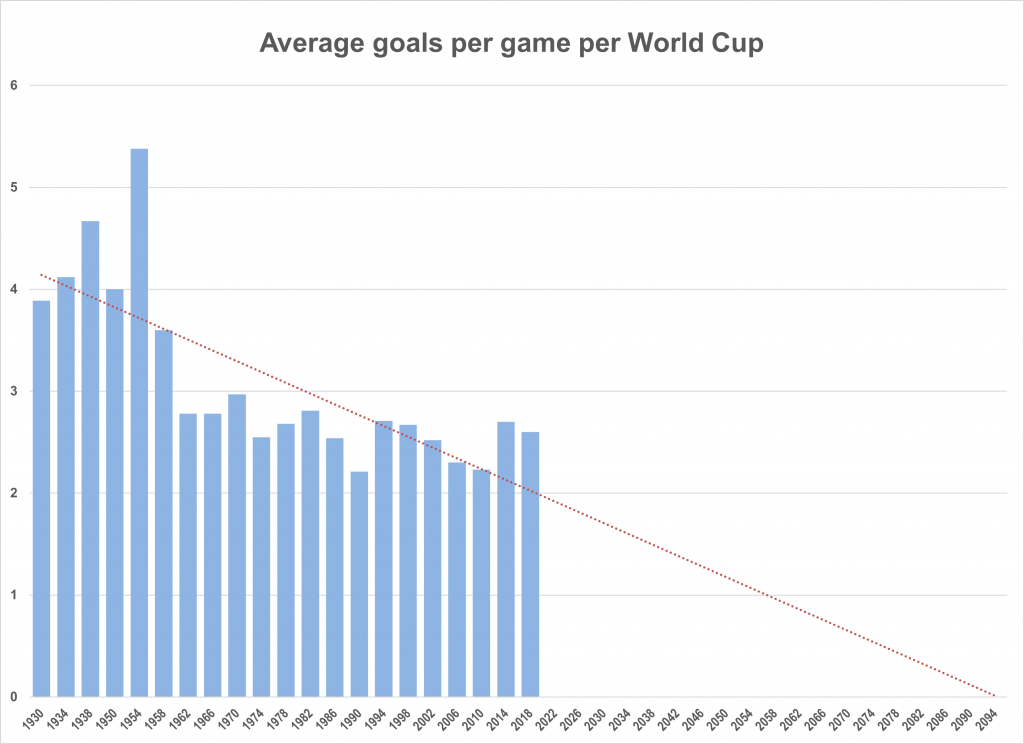
Together, these three changes would reverse the downward trend in average goals per game that we have seen over the course of World Cup history. Gone are the glory days of 1954 when Austria topped host Switzerland in a 7–5 thriller and in which the average game saw more than five goals. If the current trend continues, in 2094 the average number of goals per World Cup game will hit precisely zero.
And while we are at it, let’s outlaw heading the ball. Not that the header isn’t fun and exciting, mind you, but brains need protecting. God knows the players will need them to remember the new rules.
For every euro of military aid that Germany has given to Ukraine in the wake of Russia’s invasion, it has paid €200 for Russian energy imports. Ukrainian President Volodymyr Zelensky has called this “blood money.” Polish Deputy Prime Minister Jaroslaw Kaczynski recently declared it “inadmissible from a political and moral point of view.”
It is also tragic and unnecessary. For this, we can blame former German chancellor Angela Merkel.
Germany finds itself in an awkward position because of its heavy dependence on Russian coal, oil, and natural gas. While it has done an impressive job in recent years of shifting to renewable energy sources, fossil fuels still account for 77 per cent of Germany’s total consumption, and Russia is by far its single largest source (34 per cent in 2021). Berlin has managed to cut almost a third of its Russian energy imports since the invasion began on Feb. 24, but officials say that it could take two years to wean the country off the source completely.
Berlin’s dependence on Russian fossil fuels is the result of a conscious policy decision over a decade ago to abandon its domestic nuclear-energy supply. In the aftermath of the Fukushima Daiichi nuclear disaster in Japan, resulting from an earthquake and tsunami that devastated the Tohoku region on March 11, 2011 (colloquially known as “3/11″), Ms. Merkel abruptly decided to close eight of Germany’s nuclear plants and to phase out the rest by 2022. According to The New York Times, she reached this “momentous” decision “after discussing it one night over red wine with her husband.”
In so doing, of course, she was in sync with the global anti-nuclear zeitgeist of the day, which was fuelled by horrific images of destruction and stories of radioactive contamination emerging from Japan. Ms. Merkel was all the more in sync with German voters, whose anti-nuclear attitudes had for decades fuelled the rise of the Green Party. But for her, it represented an about-face.
The decision was also a failure of leadership. As a trained scientist, Ms. Merkel’s response to 3/11 should have been to follow the evidence and to use that evidence to educate her citizenry about the viability of nuclear power.
The Fukushima disaster was certainly an odd impetus for shuttering nuclear plants in Germany, where earthquakes are rare and weak and where tsunamis are non-existent. More importantly, however, the Fukushima disaster should not have happened in the first place. According to the International Atomic Energy Agency’s official disaster report, if the reactors at Fukushima had been decommissioned on schedule, if the plant had been built at its recommended elevation (rather than moved closer to sea level for operational ease) or – perhaps most significantly – if it had a fully Japanese (rather than partial American) design, the whole incident would have been avoided.
In the United States, where hurricanes and tornados are major threats, backup nuclear-power systems are placed underground. Japanese designs place them on high ground – precisely because of the danger of tsunamis. With vulnerable backup generators placed too close to sea level, one researcher noted, Fukushima Daiichi was a “sitting duck.” Even so, disaster could have also been averted had workers managed to jury-rig an emergency-power supply in time, as they did at Fukushima Daiichi’s near-twin Fukushima Daini plant down the coast, whose backup generators also flooded.
In sum, if any one of four perfectly plausible things had been different in the case of Fukushima, there would have been no nuclear disaster, and the global narrative would have been very different. Politicians would have been singing the praises of nuclear energy for its resilience.
Had Ms. Merkel stayed the course and kept Germany’s remaining nuclear plants in operation, they would be generating 208 terawatt-hours of electricity per year today, enough to replace two-thirds of the country’s current Russian gas imports. If Germany hadn’t ramped down its nuclear-power output from its peak output in 1997, that figure would be 96 per cent. Not only would far less blood money be flowing into Moscow’s coffers today, far less would have been fueling Russia’s corruption, military modernization and geopolitical ambitions over the past decade.
Hindsight is golden, of course. Ms. Merkel did not have the benefit of it while sipping wine with her husband 11 years ago. But one hopes, at least, that she now regrets a decision that was, for her, uncharacteristically unscientific.
]]>But I have never, to the best of my recollection, ever used it with reference to a woman. Not on principle, mind you. I could probably come up with some apt exemplars if given some time to think. I just don’t think I’ve ever had the occasion.
So I was immediately struck by the outraged reaction to Ontario Premier Doug Ford when he recently said to NDP leader Andrea Horvath, “It’s like nails on a chalkboard, listening to you,” as reported by the CBC:
“We need to address the misogynistic, sexist attitude of this Premier and his government,” NDP education critic Marit Stiles tweeted in part.
Ontario Liberal Leader Steven Del Duca also weighed in on Twitter, stating: “Misogynistic rhetoric like this has no place in the Ontario Legislature. For it to be hurled by a Premier is unthinkable,” he said, adding that Ford should apologize immediately.
Green Party Leader Mike Schreiner agreed, saying: “I thought the premier’s language was misogynistic and unacceptable and he should unequivocally apologize.”
Regular folks lit up Twitter, too:
https://twitter.com/KellB_M/status/1362373348370616325
Dear other men,
— Mike Gerald Gibbs
1. "Nails on a chalkboard" is absolutely misogynist and sexist.
2. When women say it is sexist and misogynist IT IS SEXIST AND MISOGYNIST.
Your *opinion* is worth NOTHING.
It would be nice if you could learn some f-ing decency.(He/Him) (@Mikeggibbs) February 17, 2021
As a communications expert, I can confirm: referring to a woman leader's criticism as like “nails on a chalkboard" is indeed misogynist. Totally offside and uncool. https://t.co/rc70NSKsH0
— Colleen Derkatch, mostly on hiatus from here (@ColleenDerkatch) February 18, 2021
There are some interestingly different hermeneutical principles at work in these responses. @KellB_M says that if you would only ever say “It’s like nails on a chalkboard, listening to you” to a woman, then the expression is sexist and misogynist. That sounds plausible to me. I don’t know if Doug Ford has ever said (or would ever say) this to a man, but if not, then he was probably being sexist and misogynist to Andrea Horvath when he said it. However, I have said it to (or at least of) men, so on the @KellB_M principle, the term itself is not inherently sexist or misogynist.
@Mikegibbs appears to be working with two different hermeneutical principles. The first is encapsulated in the locution, “Dear other men, ‘Nails on a chalkboard’ is absolutely misogynist and sexist.” This would seem to imply that the expression itself is inherently—and thus always—misogynist and sexist. It would imply that I was being misogynist and sexist when I used it to describe Linkin Park. This is patently ridiculous. The origin of the expression is—wait for it—the grating sound of nails on a chalkboard, which is ungendered, both literally and etymologically. Contrast this with the word “hysterical.” One can describe a woman (or a man) as hysterical without any sexist intent at all, but if you know your history of the English language, you will know that the word was originally inherently misogynistic, coming as it did from the Latin for “of the womb.” One could argue that using the word perpetuates the sexist trope that only women are crazy. More on this in a minute.
@Mikegibbs’s second hermeneutical principle is more interesting: “When women say it is sexist and misogynist IT IS SEXIST AND MISOGYNIST.” (He then spices this up with the chaser, “Your *opinion* is worth NOTHING.”) This principle establishes a class of people as authoritative arbiters of meaning. It is not entirely clear how one determines in any particular case who the authoritative arbiters of meaning would be, but the idea strikes me as problematic, paying as it does not the slightest attention to intent, etymology, context, or anything else that we ordinarily use as interpretive aids. It also generates the paradox that if one woman says the expression is sexist and misogynist but another says it is not, then it is both sexist and misogynist and not sexist and not misogynist at the same time and in the same respect, violating Aristotle’s law of contradiction.
@ColleenDerkatch’s principle is an appeal to authority. “As a communications expert,” she confidently says, “I can confirm: referring to a woman leader’s criticism as like ‘nails on a chalkboard’ is indeed misogynist.” Perhaps there is scholarly literature on this topic backing up this claim to authoritative expertise. If so, I would very much like to see it. But my online queries of scholarly journal databases turned up nothing.

I am not trying to defend Doug Ford here. At the very least, he was rude. To quote @Mikegibbs, “It would be nice if you could learn some f-ing decency.” But I just don’t see that the expression itself signifies what Horvath’s supporters and Ford’s critics seem to think it does.
Here I am heartened by the social media responses of people who agree with me. So far I have not yet seen much sign of the anti-woke/PC pile-on that we saw in response to horrified reactions to the use of the word “niggardly,” which sounds terrible but actually isn’t. Mostly I have only seen respectful challenge, puzzlement, or, at most, exasperation.
Now, the day may come when “like nails on a chalkboard” is only ever used in a transparently sexist or misogynistic way (though I suspect it will die off before then, killed by whiteboards and PowerPoint). English is a living language, and if this is the fate of the expression, I will readily concede that it has come to have that meaning. I have long since abandoned my quixotic tendency to resist usage-driven changes in the meanings of words such as “decimate” and “literally,” though both literally still grate like nails on a chalkboard. For this reason I myself now freely use the word “hysterical.” Nobody knows where it came from, so nobody cares. The last time I heard someone object was in 1979, and that fellow was a professional pedant, not an actual human being.
As for Doug Ford, neither I nor anyone else–probably not even he himself–knows whether he uttered the words with sexist or misogynistic intent. So never mind. If you really want to know what he thinks of women, look at his policies.
]]>