In Houston, Texas, air conditioning is important for staying comfortable during long, hot summers. Your HVAC system depends on a network of ducts to move cooled air throughout your home. When those ducts have gaps, loose connections, or damaged sections, conditioned air can escape before reaching its destination.
The good news is that you can look for several warning signs. Understanding these signs can help you decide when to investigate further and when to contact an HVAC professional.
In this guide, we explain the most common signs of leaking AC ductwork, why they matter in Houston homes, and how professional duct repair can help. If you need help investigating cooling problems, 75 Degree AC can be a local option to consider.
What Are the Most Common Signs of Leaking AC Ductwork?
The most common signs of leaking AC ductwork include uneven temperatures, weak airflow, rising electricity bills, high indoor humidity, musty odors, visible duct damage, and an AC system that runs longer than usual.
These symptoms do not always mean your ducts are leaking. A dirty air filter, blocked vent, refrigerant issue, or other HVAC problem can cause similar trouble. However, when several signs appear together, your ductwork may need an inspection.
Here are seven warning signs Houston homeowners should understand.
1. Some Rooms Stay Hot While Others Feel Cool
Does your living room feel comfortable while your upstairs bedroom stays hot? Do certain rooms never seem to reach the temperature set on your thermostat?
Uneven cooling is one possible sign of leaking air ducts.
Your HVAC system uses supply ducts to carry cooled air from the equipment to different rooms. If a duct has a gap or disconnected joint, some of that air may escape into an attic, wall cavity, or another unconditioned space. As a result, less cool air reaches the room.
This problem can be especially frustrating in Houston during summer. Rooms under hot attics may already face extra heat, making poor air delivery more noticeable.
However, leaking ducts are not the only possible cause. Poor insulation, blocked vents, closed dampers, and duct design problems can also create uneven temperatures.
What to check: Notice which rooms stay warm and whether the problem happens every day. Compare airflow at nearby vents and look for other signs of duct damage in safely accessible areas.
If the problem continues, a professional inspection can help identify the real cause.
2. You Notice Weak Airflow From Your AC Vents
When your air conditioner is working properly, you should feel air coming from your supply vents. If the airflow becomes weaker than normal, a duct leak may be one possible reason.
For example, a damaged supply duct may allow cooled air to escape before it reaches your bedroom or living room. A loose connection can also reduce the amount of air delivered to a particular area.
Pay attention to whether one vent has weak airflow or several rooms have the same problem. Weak airflow throughout the house may point to a broader issue with the HVAC system.
Other possible causes include:
- A dirty or clogged air filter
- A blocked or crushed duct
- A blower motor problem
- A dirty evaporator coil
- An airflow restriction inside the system
What to do: Check your air filter and make sure accessible vents are not blocked by furniture or other objects. If airflow remains weak, have an HVAC technician investigate the problem rather than assuming duct leakage is responsible.
3. Your Houston Electricity Bills Keep Increasing
A sudden increase in your electricity bill can be frustrating, especially during Houston’s long cooling season.
Leaking AC ductwork may contribute to higher energy costs because some of the cooled air never reaches your living spaces. Your air conditioner may need to run longer to bring the home to the temperature set on your thermostat.
For example, imagine that your thermostat is set to 74°F, but your bedroom remains warm because a supply duct is leaking. Your system may continue running while that room struggles to become comfortable.
Over time, this can affect energy use and comfort.
However, high electricity bills do not automatically mean you have leaking ducts. Hotter weather, changes in electricity rates, poor insulation, an aging AC system, and thermostat settings can also affect your costs.
What to check: Compare your recent electricity bills with previous bills from similar months. Consider whether your usage has changed and whether the AC runs longer than it used to.
If rising bills occur alongside weak airflow or uneven cooling, ask an HVAC professional to check your ductwork and overall system performance.
4. Your Home Feels Humid, Sticky, or Stuffy
Houston’s hot, humid weather makes indoor moisture control especially important. If your home feels sticky even when the AC is running, leaking ductwork may be one factor to investigate.
Your air conditioner removes some moisture from indoor air as it cools your home. However, duct leaks can interfere with the way air moves through the system.
For example, a return duct with gaps may pull humid air from an attic or another unconditioned area into the HVAC system. Depending on the duct’s location and the pressure conditions, this can add unwanted moisture and make humidity control more difficult.
You may notice:
- Indoor air that feels sticky
- A musty smell in certain rooms
- Condensation on some cool surfaces
- Rooms that feel uncomfortable despite a cool thermostat setting
Other causes include an oversized AC system, a clogged condensate drain, poor ventilation, or another cooling problem.
What to do: Use a simple indoor humidity meter to check moisture levels. If humidity remains high, have a technician inspect the ductwork and check the AC system’s ability to remove moisture.
5. You Notice More Dust or Musty Odors Near AC Vents
Have you noticed that dust returns soon after cleaning? Do some rooms smell musty when the air conditioner starts?
These issues can sometimes be related to leaking ductwork, particularly on the return-air side of the system.
Return ducts carry air from your home back to the HVAC equipment. If these ducts have gaps in an attic, garage, or another dusty area, they may draw unwanted particles into the system.
Damaged duct insulation and moisture problems can also contribute to unpleasant odors. However, dust and musty smells have many possible sources, so they should not be treated as proof of a duct leak.
Look for other warning signs, such as loose duct connections, unusual dust near vents, weak airflow, or rooms that remain uncomfortable.
What to do: Replace a dirty air filter with the correct type for your system. Keep accessible return vents clear and pay attention to when the smell occurs.
If the odor continues or you notice signs of moisture, arrange an HVAC inspection. A professional can help determine whether the issue involves the ductwork, the drain system, the equipment, or another source.
6. You See Damaged, Loose, or Disconnected Ductwork
Sometimes the clearest warning sign is visible damage.
Residential HVAC systems may use flexible ducts, sheet-metal ducts, or a combination of materials. Over time, duct sections can become loose, crushed, torn, or disconnected.
Check for these possible problems in areas you can access safely:
- Loose connections between duct sections
- Gaps around duct joints or seams
- Torn or damaged flexible ducts
- Crushed or sharply bent duct sections
- Damaged duct insulation
- Visible separation near a vent connection
A gap in a supply duct can allow cooled air to escape. A leak in a return duct can pull air from an unwanted space into the system.
Duct insulation also matters. Even when a duct has no major leak, damaged insulation in a hot attic can allow heat to enter the cooled air moving through it.
Safety tip: Do not climb through a hot attic or disturb electrical wiring just to inspect your ducts. Houston attics can become dangerously hot. Leave difficult-to-reach areas to a trained HVAC professional.
If you see damaged or disconnected ductwork, have it assessed to determine whether it needs sealing, repair, or replacement.
7. Your AC Runs Longer but Still Struggles to Cool Your Home
An air conditioner that runs for long periods without making your home comfortable deserves attention.
When ductwork leaks, some conditioned air may escape before reaching the rooms that need it. This can make it harder for your home to reach the thermostat’s target temperature.
You might notice that the AC runs frequently during the afternoon, the temperature drops very slowly, or certain rooms remain warm even after hours of cooling.
Still, longer run times do not always indicate leaking ducts. Extremely hot weather can increase cooling demand. Low refrigerant, a dirty evaporator coil, poor insulation, or an improperly sized system can also affect performance.
Avoid repeatedly lowering the thermostat to force the home to cool faster. This does not fix an underlying duct problem.
What to do: Note how long the system runs, which rooms remain warm, and whether the issue occurs at particular times of day. Share these details with your HVAC technician.
A proper diagnosis can help distinguish duct leakage from equipment or airflow problems.
Why Are Leaking AC Ducts a Concern in Houston?
Houston homeowners often rely on their air conditioners for extended periods because of the region’s hot summers and high humidity.
When ducts run through an unconditioned attic or another hot space, they can face additional heat. Poor insulation may allow that heat to affect the cooled air inside. Leaks can also allow conditioned air to escape or humid air to enter, depending on the duct’s location and pressure conditions.
This can create several problems:
Less consistent cooling: Rooms may not receive the amount of conditioned air they need.
Reduced efficiency: The system may need to run longer to maintain the desired temperature.
Humidity concerns: Unwanted moisture entering through certain duct leaks may make indoor humidity harder to control.
Comfort problems: Hot bedrooms, stuffy rooms, and uneven temperatures can make everyday life less comfortable.
Sealing leaks and correcting damaged insulation can improve the performance of a duct system. The best solution depends on the type of ductwork, where the leaks occur, and the condition of the HVAC equipment.
How Can You Check for Leaking AC Ductwork?
You can perform a few simple checks before arranging professional service. These checks can help you collect useful information, but they cannot confirm every hidden leak.
Homeowner ductwork inspection checklist
- Check the airflow. Compare the airflow from different supply vents and note any major differences.
- Inspect the air filter. Replace it if it is dirty and follow the manufacturer’s recommended maintenance schedule.
- Look at accessible duct connections. Check for visible gaps, loose joints, or damaged flexible ducts without entering unsafe spaces.
- Identify uncomfortable rooms. Record which rooms stay warm and when the problem occurs.
- Review your electricity bills. Compare recent usage with previous months while accounting for weather and rate changes.
- Monitor indoor humidity. A humidity meter can help you determine whether your home feels humid because of a persistent moisture problem.
If these checks reveal possible problems, contact an HVAC professional for a closer inspection.
A technician may examine the duct layout, check connections and insulation, measure airflow, and use suitable diagnostic equipment to assess leakage. Testing can help locate problems that are hidden behind walls or ceilings.
How Professional AC Ductwork Repair Can Help
The right repair depends on what the inspection reveals. A small gap may need sealing, while a torn or disconnected duct may require more extensive work.
A professional ductwork inspection may include the following steps:
- Inspecting the duct system: The technician checks accessible supply and return ducts, connections, and insulation.
- Finding air leaks: Appropriate inspection and testing methods help locate gaps or disconnected sections.
- Sealing duct joints: Suitable duct mastic or approved sealing materials may be used where appropriate.
- Repairing damaged ducts: Crushed, torn, or badly damaged sections may need repair or replacement.
- Checking insulation: Damaged or insufficient insulation may need attention, especially in hot attic spaces.
- Verifying system performance: The technician checks whether the repairs address the reported airflow and comfort problems.
Sealing the ducts alone may not solve every cooling issue. If the underlying problem involves the evaporator coil, blower motor, refrigerant system, or another component, that issue also needs attention.
If you suspect leaking AC ductwork or continue to experience poor cooling, 75 Degree AC is a local option to consider for help investigating your home’s air conditioning problems. Ask for a clear explanation of the findings and the recommended next steps before approving repairs.
When Should You Call an HVAC Professional in Houston?
Consider scheduling an inspection if you notice several warning signs or if the problem continues after basic checks.
You should seek professional help when:
- Certain rooms remain hot despite normal AC operation.
- Airflow from several vents is consistently weak.
- Your electricity bills rise without a clear explanation.
- Your home feels unusually humid while the AC is running.
- You see torn, loose, or disconnected ductwork.
- Your air conditioner runs for long periods but struggles to cool the home.
If your AC stops cooling, develops a water leak, or produces unusual electrical or burning smells, do not assume the ductwork is the cause. Turn the system off if there is a safety concern and seek appropriate professional help.
Early diagnosis can help you address the actual problem instead of spending money on repairs that do not solve it.
Frequently Asked Questions About Leaking AC Ductwork
1. How do I know if my AC ductwork is leaking?
Common warning signs include weak airflow, uneven room temperatures, higher electricity bills, excess indoor humidity, and visible gaps or damage in accessible ductwork. One symptom alone does not confirm a leak. An HVAC professional can inspect the system and use suitable testing methods to locate hidden leakage.
2. Can leaking AC ducts increase my electricity bill?
Yes. Leaking ducts can allow cooled air to escape before it reaches the rooms in your home. Your air conditioner may then run longer to maintain the thermostat setting. However, high bills can also result from hotter weather, poor insulation, equipment problems, or changes in electricity rates.
3. Can leaky air ducts make my Houston home humid?
They can contribute to humidity problems. For example, gaps in return ductwork may draw humid air from an attic or another unconditioned area into the system. However, an oversized air conditioner, a clogged condensate drain, or another HVAC issue can also cause high indoor humidity.
4. Where are AC duct leaks most commonly found?
Potential leak locations include duct joints, connections near the air handler, supply and return plenums, vent connections, and damaged sections of flexible ductwork. Ducts in attics and other unconditioned spaces deserve attention because leaks there can affect cooling efficiency and indoor comfort.
5. Can I seal leaking AC ducts myself?
You may be able to identify visible damage in safely accessible areas, but hidden leaks and difficult repairs are better left to an HVAC professional. Use only materials approved for the intended duct application. Ordinary cloth-backed household duct tape is not a reliable long-term solution for most duct-sealing needs.
6. Should I repair or replace damaged AC ductwork?
The answer depends on the type and extent of the damage. Small gaps or loose joints may only need sealing or reconnection. Severely crushed, torn, deteriorated, or poorly designed duct sections may require replacement. An inspection can help determine which option makes sense for your home.
7. How often should AC ductwork be inspected?
There is no single inspection schedule that fits every home. Consider an inspection when you notice cooling problems, after renovations that may affect ducts, or when routine HVAC service reveals a concern. Ductwork in difficult or harsh environments may need closer attention depending on its condition.
Conclusion: Get to the Bottom of Your Houston AC Cooling Problems
Leaking AC ductwork can contribute to weak airflow, uneven temperatures, rising energy bills, and humidity problems. In Houston, these issues can become especially frustrating during the hot summer months.
Watch for several warning signs rather than relying on one symptom. Check your air filter, observe airflow, and look for visible duct damage only in safe, accessible areas. If the problem continues, a professional inspection can help identify whether duct leakage or another HVAC issue is responsible.
If you suspect leaking AC ductwork in your Houston home, 75 Degree AC can help investigate your cooling problems and identify possible causes. Contact the team to discuss your concerns and explore the right AC repair in Houston solution for your home.
If your house is still humid when the AC is running, your system may not be removing enough moisture from the air. Common causes include short cooling cycles, incorrect thermostat fan settings, a dirty air filter, leaking ductwork, a clogged condensate drain, or an air conditioner that is too large for your home.
Houston’s hot, humid weather makes indoor moisture control especially important. Your AC needs to cool your home and remove moisture to help you feel comfortable.
In this guide, 75 Degree AC explains why your house may stay humid, what you can safely check yourself, and when to call an HVAC professional in Houston, Texas.
1. Why Is My House Still Humid When the AC Is Running?
Your air conditioner does more than cool the air. It also removes some of the moisture inside your home.
When warm indoor air passes over the cold evaporator coil, water vapor turns into liquid water. This water collects in a drain pan and flows out through the condensate drain line. The process helps lower indoor humidity.
However, your AC may cool your home without removing enough moisture. When this happens, your rooms can feel clammy even if the thermostat reaches the temperature you selected.
Several problems can cause this:
- Short cooling cycles: The AC shuts off before it removes enough moisture.
- Incorrect fan settings: The indoor fan keeps running after the cooling cycle ends.
- Dirty air filters: Restricted airflow affects system performance.
- Clogged condensate drains: Water cannot drain away as it should.
- Leaking ductwork: Humid air may enter the system through return duct leaks.
- Excess indoor moisture: Showers, cooking, and other activities add water vapor to the air.
The first step is to identify the cause. A simple thermostat adjustment may help in some homes, while other problems require professional inspection.
2. What Is the Ideal Indoor Humidity Level for a Houston Home?
The ideal indoor humidity level depends on the home and its conditions. The U.S. Environmental Protection Agency (EPA) recommends keeping indoor relative humidity below 60%, ideally between 30% and 50% when practical.
Relative humidity measures how much moisture the air holds compared with how much it could hold at that temperature.
In Houston, outdoor humidity can make it harder to maintain comfortable indoor conditions. If your home regularly stays above 60% relative humidity, investigate the cause. Persistent dampness, condensation, or musty odors are also signs that moisture may need attention.
A digital hygrometer can help you measure humidity instead of guessing based on how the air feels.
Place it in a commonly used room, away from direct sunlight, AC vents, and other sources of heat. Check the reading at different times of day to see whether the problem continues.
Remember that one reading does not tell the whole story. Look for a pattern and pay attention to signs of moisture around your home.
3. Common Reasons Your Houston Home Stays Humid With the AC On
Several HVAC problems can stop your air conditioner from controlling indoor humidity properly. Here are the most common causes and what you can do about them.
Your Thermostat Fan Is Set to ON Instead of AUTO
Check your thermostat’s fan setting. If it is set to ON, the indoor blower may continue moving air even after the cooling cycle ends.
The evaporator coil can remain wet after cooling stops. In some systems, continued airflow over the wet coil can return some of that moisture to the indoor air.
Try setting the fan to AUTO if your system supports this setting. In AUTO mode, the blower usually runs during active heating or cooling rather than continuously.
This simple adjustment may help, but it will not fix every humidity problem. If your home still feels damp, check for other causes.
Your Air Conditioner Is Too Large for Your Home
A bigger air conditioner is not always better. If your system is oversized, it may cool your home quickly and shut off before it removes enough moisture.
This is especially frustrating in Houston. Your thermostat may reach the desired temperature, but the indoor air can still feel sticky.
Frequent starting and stopping is called short cycling. It can affect comfort and may increase wear on system parts.
An oversized AC is not the only cause of short cycling. Thermostat problems and equipment faults can also play a role.
If you suspect the system is too large, ask an HVAC professional to assess its cooling capacity and your home’s needs. Proper sizing should account for factors such as insulation, windows, home layout, and local climate—not just square footage.
Your AC Filter or Evaporator Coil Is Dirty
A dirty air filter can restrict airflow through your HVAC system. When airflow becomes too low, the system may struggle to cool your home properly.
Dirt on the evaporator coil can also affect heat transfer and system performance. These problems may contribute to poor cooling or moisture-control issues.
Start by checking your AC filter. If it is dirty, replace it according to the manufacturer’s instructions. Make sure the new filter has the correct size and rating for your system.
If airflow remains weak after replacing the filter, the problem may involve the blower, evaporator coil, or ductwork. Do not try to clean internal components unless you know how to do so safely.
Your Condensate Drain Line Is Clogged
Your air conditioner removes moisture by turning water vapor into liquid water. That water must drain away through the condensate drain system.
Dust, algae, and other debris can block the drain line. A blockage may cause water to collect in the drain pan, leak near the indoor unit, or trigger a safety switch that shuts the system down.
Look for visible water near the indoor air handler. Do not open electrical compartments or touch electrical equipment near standing water.
A clogged drain does not always explain high indoor humidity, but it can signal a moisture-removal problem that needs attention. If water continues to leak or you suspect a blockage, arrange professional service.
Leaky Ductwork Is Letting Humid Air Into Your Home
Your HVAC system uses return ducts to carry indoor air back to the equipment and supply ducts to deliver cooled air to your rooms.
When return ducts leak in an attic or another unconditioned space, they may draw warm, humid air into the system. Leaking supply ducts can also waste cooled air and make some rooms less comfortable.
You may notice that one bedroom feels sticky while the rest of the house feels cooler. You might also notice uneven temperatures or weak airflow from certain vents.
A professional duct inspection can help identify leaks, poor connections, or damaged insulation. Sealing duct leaks may improve comfort and help your system operate as intended.
Your Home Has Too Many Indoor Moisture Sources
Sometimes the AC is working, but your home keeps gaining moisture faster than the system can remove it.
Showers, cooking, indoor clothes drying, and boiling water can add moisture to indoor air. Humid outdoor air can also enter through gaps around doors, windows, and other openings.
You can reduce avoidable moisture by using bathroom exhaust fans during showers and kitchen ventilation when cooking. Fix visible plumbing leaks and avoid drying wet clothes indoors unless you have suitable ventilation or moisture control.
If your home stays humid despite these steps, the issue may involve the AC system, building leaks, or another source of moisture.
4. What Can You Do When Your AC Is Running but Your House Feels Humid?
Before scheduling a service visit, you can perform a few simple checks. These steps may help you find an easy fix or give an HVAC technician useful information.
Measure Your Indoor Humidity
Use a digital hygrometer to check the relative humidity in your home. Record the readings at different times, such as morning, afternoon, and evening.
This helps you determine whether humidity stays high throughout the day or rises only under certain conditions.
Check the Thermostat Fan Setting
Look for the fan setting on your thermostat. If it is set to ON, try AUTO if your system supports it.
Give the system time to operate and check whether indoor comfort improves. Do not assume this setting will fix a blocked drain, oversized unit, or other mechanical problem.
Inspect the Air Filter
Check the filter for dust and buildup. Replace it if it is dirty or due for replacement.
Also, make sure furniture, curtains, or other items do not block the return-air grille or supply vents.
Reduce Indoor Moisture
Use bathroom exhaust fans, ventilate the kitchen when cooking, and repair visible water leaks. Keep windows and exterior doors closed while the AC is running when outdoor conditions are humid.
If humidity remains high after these checks, avoid repeatedly lowering the thermostat in an attempt to dry the air. The system may need a proper inspection.
Do not attempt refrigerant repairs, electrical work, or complex drain and coil repairs yourself.
5. Can High Indoor Humidity Damage Your Houston Home?
Yes. Persistent indoor moisture can affect both comfort and the condition of your home.
High humidity can contribute to condensation on cool surfaces, damp walls, musty odors, and conditions that support mold growth. Over time, moisture can affect paint, wood, furnishings, and other building materials.
You may notice water droplets on windows, damp areas near vents, or a musty smell in a room that rarely feels dry.
These signs do not always point to an AC problem. Roof leaks, plumbing leaks, poor ventilation, and moisture entering through the building can also contribute.
The best approach is to find and correct the source of the moisture. Simply lowering the thermostat or covering up an odor will not solve the underlying issue.
If you find extensive water damage or visible mold, consider getting advice from a qualified professional about safe cleanup and remediation.
6. When Should You Call an HVAC Contractor in Houston?
Basic troubleshooting can help, but some humidity problems require professional attention. Contact an HVAC contractor if your house stays humid even after you check the thermostat, replace a dirty filter, and reduce indoor moisture.
Watch for these warning signs:
- High humidity that will not go away: Your hygrometer regularly shows high readings, even while the AC runs.
- Frequent short cycles: The system starts and stops repeatedly without keeping your home comfortable.
- Weak airflow: Airflow remains low after you replace the filter and clear blocked vents.
- Water near the indoor unit: You notice a leaking drain pan, wet floor, or other signs of a drainage problem.
- Ice on the AC system: Ice forms on the indoor coil or refrigerant lines.
- Uneven comfort: Some rooms stay humid while others cool normally.
An HVAC technician can inspect the evaporator coil, condensate drain, ductwork, airflow, and equipment operation. They can also assess whether the system is properly sized for your home.
If you notice ice on the system, turn off cooling and seek professional guidance. If water is leaking near electrical equipment, keep away from the affected area and arrange safe service.
75 Degree AC can be a point of contact for Houston homeowners who need help with persistent AC performance or humidity concerns. Explain what you have noticed, when the problem started, and whether basic troubleshooting made any difference. This information can help guide the inspection.
7. Is a Dehumidifier a Good Solution for a Humid Houston Home?
A dehumidifier may help if your home’s humidity remains high even when your air conditioner is working properly. Unlike an AC system, which cools the home while removing some moisture, a dedicated dehumidifier focuses on pulling moisture from indoor air.
There are two main options:
- Portable dehumidifier: Works in a specific room or smaller area where humidity is a concern.
- Whole-home dehumidifier: Connects to a suitable HVAC setup to manage moisture across more of the house.
The right option depends on your home’s size, moisture levels, existing equipment, and the cause of the problem.
However, a dehumidifier should not replace necessary AC repairs. If a blocked drain, duct leak, or equipment fault is causing the issue, address that problem first.
For some homes, improving ventilation, sealing air leaks, or fixing moisture sources may also help. An HVAC professional can help you decide whether supplemental dehumidification makes sense for your home.
8. Frequently Asked Questions About AC Humidity Problems in Houston
Why is my house humid even though the AC is set to 72 degrees?
Your thermostat controls temperature, not necessarily humidity. Your AC may have short cooling cycles, restricted airflow, duct leaks, or another problem that prevents it from removing enough moisture.
Should I set my AC lower to reduce humidity?
Not necessarily. Lowering the temperature may make the system run longer, but it will not fix every humidity problem. Check your filter and thermostat settings first, and arrange an inspection if the issue continues.
Can a dirty AC filter make my house humid?
Yes, a clogged filter can restrict airflow and affect system performance. Replace a dirty filter according to the manufacturer’s instructions. If your house still feels damp, another HVAC or moisture problem may be involved.
Why does my Houston home feel sticky even when it is cold?
Your AC may be cooling the air without removing enough moisture. Short cycling, a continuously running fan, duct leaks, and indoor moisture sources can all contribute to that sticky feeling.
When should I call an HVAC technician for high humidity?
Call an HVAC professional if humidity stays high despite basic maintenance, your AC repeatedly starts and stops, airflow remains weak, or you notice water leaks or ice on the system.
Will a dehumidifier solve my home’s humidity problem?
A dehumidifier can help remove excess moisture, but it may not solve the underlying cause. If your AC has a drainage problem, leaking ducts, or another fault, that issue needs attention too.
Does Houston’s weather make indoor humidity harder to control?
Yes. Houston’s humid outdoor air can add moisture to your home through open doors, windows, and air leaks. A properly operating AC system and suitable moisture-control measures can help maintain more comfortable indoor conditions.
Conclusion: Get Your Houston Home’s Humidity Under Control
If your house is still humid when the AC is running, the problem may be more than Houston’s weather. Your air conditioner could be cooling the home without removing enough moisture. A dirty filter, incorrect fan setting, oversized unit, clogged condensate drain, leaky ductwork, or excess indoor moisture may be contributing.
Start by measuring your indoor humidity, checking the thermostat fan setting, inspecting the air filter, and reducing avoidable moisture inside your home. If the problem continues, a professional HVAC inspection can help identify the cause and determine the right solution.
At 75 Degree AC, we understand that Houston homeowners need more than cold air. They need a home that feels comfortable, too.
Still dealing with a sticky, humid home? Contact 75 Degree AC for professional AC repair in Houston, TX, and discuss your AC performance concerns, HVAC troubleshooting, or maintenance needs. Don’t let a persistent humidity problem keep your home from feeling comfortable.
]]>So, how often should you change your AC filter in Houston? Start by checking it once a month. Many Houston homeowners may need to replace a standard 1-inch filter every 30–60 days during heavy summer use. Some households can go 60–90 days between changes, depending on the filter and indoor conditions. Always follow the filter manufacturer’s instructions and replace it sooner if it becomes dirty.
At 75 Degree AC, we want Houston homeowners to understand how simple filter maintenance can help support reliable cooling. Here’s how to choose the right replacement schedule, spot a dirty filter, and know when your AC needs professional attention.
1. How Often Should You Change Your AC Filter in Houston?
For most homes, checking the AC filter every month is a good starting point. How often you need to replace it depends on your filter type, household conditions, and how much your air conditioner runs.
Houston’s long cooling season can mean more hours of AC use. When your system moves more air through the filter, the filter can collect particles faster.
Use this table as a general guide:
| Household conditions | Suggested filter maintenance |
| Home without pets and with little dust | Check monthly; replacement may be needed every 60–90 days |
| Home with heavy summer AC use | Check monthly; replacement may be needed every 30–60 days |
| Home with several pets | Inspect frequently; replace when dirty |
| Home with high dust levels | Inspect monthly or more often |
| Home using a thick, pleated filter | Follow the manufacturer’s recommended service interval |
These time frames are starting points, not fixed rules. A filter can become dirty before its expected replacement date. A thicker filter may also last longer than a standard 1-inch filter, but its actual service life depends on the product and operating conditions.
Do not wait until your AC stops cooling to check the filter. A quick monthly inspection helps you spot dirt buildup before it becomes a bigger concern.
2. Why Houston’s Climate Can Affect AC Filter Replacement
Houston’s weather creates several reasons to pay attention to your AC filter. Your home’s actual needs will depend on where you live, your indoor environment, and how often you use your air conditioner.
Long, Hot Summers and Heavy AC Usage
During Houston’s hot months, your air conditioner may run for long periods to maintain a comfortable indoor temperature. More operating hours mean more air passes through the filter.
As the filter collects dust and other particles, airflow may become restricted. Checking your filter monthly during the cooling season helps you identify buildup early.
Houston Humidity and Indoor Moisture
Houston is known for its humid climate. Your AC helps manage indoor humidity as it cools your home, but a clean air filter alone cannot solve every moisture problem.
If your home feels sticky even when the AC runs, the cause could involve system performance, improper sizing, drainage, or other issues. A dirty filter may contribute to poor airflow, but humidity problems need proper diagnosis.
Pollen, Dust, and Outdoor Debris
Pollen, household dust, and debris can collect on your air filter. Open windows, nearby construction, and outdoor activity may also affect the amount of dirt entering your home.
If you notice visible buildup, inspect the filter and replace it when needed. Keeping doors and windows closed while the AC runs can also help reduce the entry of outdoor particles.
3. What Affects How Often You Need to Change Your AC Filter?
Not every Houston home needs the same filter replacement schedule. These factors can help you decide how often to inspect your filter and when to replace it.
Pets and Pet Hair
Dogs and cats can add pet hair, dander, and other particles to indoor air. These materials can collect on your HVAC filter and reduce airflow as buildup increases.
If you have several pets, check your filter more often than you would in a home without pets. Do not assume that every filter needs replacing every 30 days. Inspect its condition and follow the manufacturer’s guidance.
Allergies and Indoor Air Quality
If someone in your household has allergies, choosing a suitable air filter may help capture certain airborne particles. However, no standard filter removes every indoor pollutant, and filtration alone cannot guarantee allergy relief.
Look at the filter’s efficiency rating and make sure it works with your HVAC system. You may also need to address dust sources, ventilation, and other indoor air quality concerns.
Filter Thickness and MERV Rating
MERV stands for Minimum Efficiency Reporting Value. It measures how effectively an air filter captures particles under standardized test conditions.
A higher MERV rating generally means the filter captures smaller particles more effectively. However, a higher rating is not automatically the best choice for every home. Some filters can create too much resistance for an HVAC system that is not designed to handle them.
Before upgrading to a higher-rated filter, check your system’s requirements or ask an HVAC professional for guidance.
Household Dust and AC Runtime
Home renovations, frequent foot traffic, and dusty indoor conditions can cause filters to collect debris faster. An AC system that runs for long periods may also load its filter more quickly.
Check the filter regularly and keep a record of how quickly it becomes dirty. This helps you create a replacement schedule based on your home’s actual needs.
4. What Are the Signs of a Dirty AC Filter?
A dirty AC filter does not always look completely blocked. Knowing the warning signs can help you decide when to inspect it.
Visible Dust and Dirt
Remove the filter according to your system’s instructions and inspect it under good lighting. If it has heavy dust buildup or looks clogged, check the manufacturer’s guidance and replace it if needed.
Do not judge a filter only by its color. Some filters naturally look darker after use, so visible buildup and the manufacturer’s replacement instructions matter.
Weak Airflow From Your Vents
If less air comes from your supply vents than usual, a dirty filter may be one possible cause. A clogged filter can make it harder for your HVAC system to move air.
First, check the filter and make sure your vents are not blocked. If airflow remains weak after you replace the filter, the issue may involve the blower, ductwork, evaporator coil, or another component.
Your AC Runs Longer Than Usual
Does your AC seem to run longer without making your home comfortable? Restricted airflow can affect cooling performance, but Houston’s outdoor temperatures, insulation, and equipment condition can also play a role.
Check the filter before assuming your system needs a repair.
Unusual Odors or Excessive Dust
A dirty filter may collect particles, but a musty smell does not always mean the filter is the problem. Moisture, drainage issues, and other system conditions can also cause odors.
If the smell continues after you replace the filter, arrange an inspection rather than relying on a new filter to solve the problem.
5. How to Change Your AC Filter at Home
Changing a standard disposable AC filter is usually simple. Follow these steps to help avoid common mistakes.
Step 1: Turn off the system. Follow your equipment manufacturer’s instructions before opening the filter compartment.
Step 2: Find the filter. It may sit behind a return-air grille or near the indoor air handler. The location depends on your HVAC setup.
Step 3: Check the size. Look for the dimensions printed on the old filter. If the size is unclear, check your equipment documentation before buying a replacement.
Step 4: Inspect the filter. Look for heavy dust buildup or other visible signs that it needs replacement.
Step 5: Install the correct filter. Match the dimensions and place the filter in the correct direction. Follow the airflow arrow printed on the filter frame.
Step 6: Close the compartment and record the date. Write down when you installed the new filter or set a reminder to check it next month.
Disposable filters should generally be replaced rather than washed. Reusable filters are different: clean them only as directed by the manufacturer, and let them dry as instructed before reinstalling them.
If you cannot find the filter or are unsure which type your system needs, ask an HVAC professional for help.
6. What Happens If You Don’t Change Your AC Filter?
Ignoring your AC filter can affect comfort and system performance. Although a dirty filter does not cause every AC problem, replacing it when needed is an important part of routine HVAC maintenance.
Reduced Airflow and Poor Cooling
A heavily clogged filter can restrict the amount of air moving through your system. Your home may take longer to cool, and some rooms may feel less comfortable.
Restricted airflow can also contribute to conditions that cause the evaporator coil to freeze. If you notice ice on the system, turn off cooling and seek professional guidance. Do not assume changing the filter will solve every cause of a frozen coil.
Higher Energy Use
When airflow is restricted, your HVAC system may not operate as intended. This can affect cooling performance and energy use.
The exact impact depends on your equipment, the severity of the restriction, and other operating conditions. There is no single energy-saving percentage that applies to every home.
Additional HVAC Problems
Long periods of poor maintenance can contribute to avoidable operating problems. A dirty filter may play a role in airflow issues, but refrigerant problems, electrical faults, and drainage issues have different causes.
The practical takeaway: Check your filter monthly and replace it when needed. If your AC continues to struggle after a filter change, investigate the underlying problem instead of repeatedly replacing filters.
7. Which AC Filter Is Best for a Houston Home?
The best AC filter is one that meets your household’s filtration needs while allowing your HVAC system to operate properly. A more expensive filter is not always the best option.
Fiberglass vs. Pleated Air Filters
Fiberglass filters are generally basic, disposable filters designed to capture larger airborne particles. Pleated filters have a folded surface that can provide more filtration area and may capture smaller particles, depending on their rating.
Your choice should depend on the filter’s specifications, your household needs, and your system’s requirements.
What MERV Rating Should You Choose?
Many residential systems can use certain mid-range MERV filters, but compatibility varies by equipment. A higher-rated filter may capture more particles, yet it can also create greater airflow resistance in some setups.
Check your HVAC manual before selecting a filter. If you want better filtration but are unsure what your system supports, an HVAC technician can help you choose a suitable option.
Are Thicker Filters Better?
Some HVAC systems use deeper filters that can offer more filtration area and longer replacement intervals. However, you cannot simply install a thicker filter if the equipment was not designed for it.
Always match the filter’s dimensions and specifications to your system. The right fit helps the filter work as intended and prevents air from bypassing its edges.
8. When Should You Call an HVAC Professional in Houston?
Replacing your air filter is a useful first step, but some problems require professional attention.
Your AC Still Has Weak Airflow
If airflow remains weak after you install a clean filter, there may be a problem with the ductwork, blower, evaporator coil, or another part of the system.
A technician can inspect the equipment and identify the cause instead of relying on guesswork.
Your Home Feels Humid Even When the AC Runs
A clean filter cannot correct every humidity issue. If your Houston home still feels sticky or damp, the problem may involve cooling performance, system sizing, drainage, or other factors.
An HVAC inspection can help determine why your system is not maintaining comfortable indoor conditions.
Your AC Freezes, Leaks Water, or Struggles to Cool
Ice on the indoor unit, water leaking near the air handler, or persistent poor cooling may point to a problem beyond the filter.
If you see ice, stop operating the cooling function and arrange professional service. If water is leaking, protect nearby belongings and avoid touching electrical equipment or standing water around it.
75 Degree AC can be a relevant point of contact for Houston homeowners who need help with persistent AC performance or cooling problems. When contacting an HVAC contractor, describe the symptoms, when they started, and whether changing the filter made any difference.
9. Houston AC Filter Maintenance Checklist
Use this simple checklist to keep your air filter maintenance on track:
- Inspect your AC filter every month.
- Replace disposable filters when dirty or when required by the manufacturer.
- Check more frequently during heavy summer use or dusty conditions.
- Confirm the filter size and airflow direction before installation.
- Keep return and supply vents clear of furniture and other obstructions.
- Record each filter change and note how quickly dirt builds up.
- Arrange professional service if cooling or airflow problems continue.
A few minutes of regular attention can help you spot a dirty filter before it affects your home’s comfort.
10. Frequently Asked Questions About AC Filters in Houston
Can I change my AC filter every month in Houston?
Yes. Monthly replacement may be suitable for homes with heavy AC use, pets, or dusty conditions. However, some filters can last longer. Inspect your filter monthly and follow the manufacturer’s replacement instructions.
Should I change my AC filter more often in summer?
You may need to. Houston’s hot summers can keep your AC running for long periods, which may cause the filter to collect particles faster. Check it monthly and replace it sooner if it becomes dirty.
Does Houston humidity make AC filters dirty faster?
Humidity alone does not determine how quickly an AC filter becomes dirty. Dust, pollen, pet dander, and system runtime are important factors. If your home has persistent moisture or musty odors, investigate the underlying cause.
What size AC filter does my Houston home need?
Check the dimensions printed on your existing filter or consult your HVAC system’s manual. Common filter sizes vary by equipment. Choose the correct dimensions so the filter fits securely without leaving gaps around its edges.
Can a dirty AC filter cause my AC to stop cooling?
Yes, a heavily clogged filter can restrict airflow and affect cooling performance. However, an AC that stops cooling may also have problems with its refrigerant system, electrical components, or other parts. If changing the filter does not restore normal performance, arrange an inspection.
Can I use a MERV 13 filter in my existing AC system?
It depends on your equipment. A MERV 13 filter can capture a range of fine particles, but some systems may not support the airflow resistance of a particular filter. Check your manufacturer’s specifications or consult an HVAC professional before upgrading.
How can I tell if my AC filter needs replacing?
Look for heavy dust buildup, visible debris, and signs of restricted airflow. Check the filter according to the manufacturer’s instructions rather than relying only on its color or a fixed number of days.
Does changing an AC filter help reduce energy bills?
A clean filter helps your HVAC system maintain proper airflow. Replacing a clogged filter may improve system operation, but actual energy savings depend on the equipment, the condition of the old filter, and other factors.
Conclusion: Keep Your Houston AC Running Smoothly With Regular Filter Changes
So, how often should you change your AC filter in Houston? Start by checking it every month, then replace it based on its condition, filter type, and manufacturer’s instructions. During Houston’s hot summer months, you may need to change a standard 1-inch filter every 30–60 days. Homes with less dust and lighter AC use may be able to go longer.
Remember that a clean filter supports good airflow, but it cannot fix every cooling or humidity problem. If your AC still struggles to cool your home, produces weak airflow, or shows signs of a leak or frozen coil, the system may need professional attention.
At 75 Degree AC, we want Houston homeowners to make informed decisions about their home cooling systems. Keep up with filter changes, pay attention to unusual symptoms, and seek professional help when a simple maintenance step is not enough.
Need help with an AC problem in Houston, Texas? Contact 75 Degree AC for reliable AC repair, expert troubleshooting, and professional air conditioning maintenance to help keep your system running efficiently.
]]>You check the thermostat. Dead. You head to the electrical panel. The breaker has flipped.
Sound familiar? You’re not alone. Houston homeowners deal with this every summer.
So, why is your AC tripping the breaker? An AC trips the breaker when it pulls more electrical current than the circuit can safely carry. The most common causes are a dirty air filter, a failing capacitor, a dirty condenser coil, loose wiring, and a shorted compressor.
At 75 Degree AC, we fix this problem across Houston every week. In this guide, we’ll show you what’s going wrong, what you can safely check, and when to call a pro.
One quick note before we start. A tripping breaker is a warning sign. It is not just an annoyance. Treat it like one.
What Does It Mean When Your AC Trips the Breaker?
Your breaker has one job. It protects your home from electrical overload and fire.
When too much current flows through the wire, the breaker shuts off the power. That’s the breaker doing its job. It’s saving your wiring from overheating.
So when your AC keeps tripping the breaker, the breaker is not the villain. It’s the messenger.
How Circuit Breakers Work
A breaker trips for three main reasons:
- Overcurrent: The AC pulls more power than the circuit allows.
- Short circuit: Wires touch when they shouldn’t.
- Ground fault: Electricity escapes to a metal part or the ground.
Each one points to a different problem inside your system.
Why Your AC Uses So Much Power
Your AC is one of the biggest power users in your home. When the compressor starts, it grabs a big burst of electricity. Pros call this a startup surge, or inrush current. After that, the power draw settles down.
Most central AC systems run on a dedicated 240-volt circuit. The breaker size is often 20, 30, 40, or 50 amps. You can find the right size on the nameplate of your outdoor condenser unit. Look for “minimum circuit ampacity” and “maximum overcurrent protection.” Those numbers follow National Electrical Code (NEC) rules.
If your AC pulls more than its limit, the breaker trips. Simple as that.
Why Houston ACs Trip Breakers More Often
Here’s the deal. Houston is tough on air conditioners.
Non-stop run time. From April to October, Gulf Coast heat and humidity keep your AC running almost all day. More run time means more wear. More wear means more electrical trouble.
Storms and surges. Summer thunderstorms and hurricane season bring lightning and power surges. A single surge can weaken a capacitor or damage a motor. You may not see the damage until weeks later.
Heat waves and grid strain. When temperatures spike across Harris County, the power grid works overtime. Voltage can dip. Your AC then has to work harder to run, and that pushes it toward a trip.
Older homes. Many Houston homes have older electrical panels. Aging breakers can trip early, even when the AC is fine.
All of this adds up. That’s why a smart maintenance plan matters here more than in cooler cities.
9 Common Reasons Your AC Keeps Tripping the Breaker
Let’s break it down. For each cause, you’ll see the signs, why it trips the breaker, and who should fix it.
1. Dirty or Clogged Air Filter
Signs: Weak airflow. Dust around vents. The AC runs but doesn’t cool well.
Why it trips: A clogged filter blocks air. The blower motor strains. The system overheats and pulls extra power.
Fix: You can handle this one. Swap the filter every 30 to 60 days. Houston’s pollen and dust clog filters fast.
2. Dirty Condenser Coil or Blocked Outdoor Unit
Signs: Warm air inside. Grass, leaves, or cottonwood stuck on the outdoor unit.
Why it trips: Your outdoor unit gets rid of heat. When the coil is dirty, heat can’t escape. The compressor works harder and draws more amps.
Fix: Keep two feet of clear space around the unit. Gently rinse the coil with a garden hose. For a deep clean, call a pro.
3. Failing Capacitor
Signs: A humming sound. The fan or compressor won’t start. The breaker trips right when the AC turns on.
Why it trips: The capacitor gives your motors a jolt to start. When it fails, the motor strains and pulls too much current. Houston heat wears capacitors out fast.
Fix: Call a pro. Capacitors hold a charge, even when the power is off. They can shock you.
4. Compressor Failure or Short to Ground
Signs: Loud clicking. A burnt smell. The breaker trips every time the compressor tries to start.
Why it trips: The wires inside the compressor can break down. Electricity then leaks to ground. That’s a ground fault, and the breaker shuts it down fast.
Fix: Call a pro right away. We test the windings with special tools. Then we tell you whether to repair or replace.
5. Low Refrigerant or a Leak
Signs: Warm air from vents. Hissing sounds. Ice on the lines.
Why it trips: Low refrigerant makes the compressor run hot and long. That raises the power draw.
Fix: Call a pro. Only a certified technician can handle refrigerant. We find the leak, fix it, and then recharge the system.
6. Frozen Evaporator Coil
Signs: Ice on the indoor coil. Water pooling near the unit. Weak airflow.
Why it trips: Ice blocks the air. The system strains. A clogged drain line is another common cause in our humid climate.
Fix: Turn the AC off and let the ice melt. Then call us to find out why it froze.
7. Loose, Corroded, or Damaged Wiring and Contactor
Signs: Burn marks. Buzzing near the outdoor unit. Chewed wires.
Why it trips: The contactor is the switch that turns your AC on. Humidity can corrode it. Rodents can chew the wires. Loose connections spark and overheat.
Fix: Call a pro. This is an electrical fire risk. Don’t touch it.
8. Worn or Faulty Circuit Breaker
Signs: The breaker feels hot. It trips even when the AC works fine. It keeps tripping after a repair.
Why it trips: Breakers wear out over time. An old or loose breaker can trip too soon.
Fix: A licensed electrician should replace it. We test your AC first. That way, we know if the breaker or the AC is the real problem.
9. Wrong Size System or Bad Installation
Signs: The AC turns on and off often. The problem started after a new install.
Why it trips: A system that’s too big or too small strains the circuit. A wrong breaker size or poor wiring makes it worse.
Fix: Call a pro. A proper install starts with a load calculation (Manual J) for your home.
What to Do When Your AC Trips the Breaker
Here are five safe steps for Houston homeowners. Follow them in order.
- Turn off the thermostat. Then switch off the AC at the outdoor disconnect box.
- Check the air filter. If it’s dirty, replace it.
- Look at the outdoor unit. Clear any leaves or debris. Look only. Don’t open any panels.
- Wait five minutes. Then reset the breaker one time. Flip it fully off, then back on.
- Turn the AC back on. If the breaker trips again, stop.
What not to do:
- Don’t keep resetting the breaker over and over.
- Don’t tape the breaker down.
- Don’t swap in a bigger breaker.
Warning: Repeated resets can overheat your wires. That’s a real fire hazard. If it trips twice, call a pro.
When to Call a Houston AC Repair Professional
Some things you can’t fix with a new filter. Call us right away if you notice any of these:
- A burning smell
- Buzzing or sparking sounds
- A breaker that won’t reset
- A hot electrical panel
- A breaker that trips again right after you reset it
How 75 Degree AC Finds the Real Problem
We don’t guess. Our technicians use real tools and a clear process. We:
- Measure amp draw with a clamp meter
- Test the capacitor
- Check the compressor windings for ground faults
- Check refrigerant pressure
- Inspect the wiring and contactor
Then we explain what we found in plain English. You’ll see the problem and the price before we start any work.
Why Licensed Pros Matter
Electrical AC repairs carry real risk. A licensed, insured Houston HVAC contractor knows how to work safely. We also follow local code. That protects your family, your home, and your warranty.
How Much Does It Cost to Fix an AC That Keeps Tripping the Breaker in Houston?
Cost depends on the cause. Here are rough ranges for the Houston area:
| Repair | Typical Cost Range |
| Air filter replacement | $15 to $60 |
| Condenser coil cleaning | $100 to $400 |
| Capacitor replacement | $150 to $450 |
| Contactor replacement | $150 to $400 |
| Refrigerant leak repair | $200 to $1,500+ |
| Compressor replacement | $1,500 to $3,500+ |
These are estimates. Your final price depends on your system and its parts. Call 75 Degree AC for an exact quote.
Here’s a simple rule. If your AC is over 10 years old and the repair costs more than half the price of a new system, replacement often makes more sense. A newer, high-efficiency unit can also lower your electric bill.
How to Prevent Your AC From Tripping the Breaker This Summer
A little prevention goes a long way in Houston. Try these tips:
- Book a spring tune-up. Do it before the heat peaks.
- Change filters every 30 to 60 days.
- Keep the outdoor unit clear. Trim plants and rinse the coil.
- Add a surge protector. It guards your AC from storm damage.
- Join a maintenance plan. 75 Degree AC offers tune-ups that catch small problems early.
A tune-up costs far less than an emergency repair in July.
Frequently Asked Questions About AC Tripping the Breaker in Houston
Why does my AC trip the breaker as soon as it turns on?
This usually points to a hard start. The most common causes are a bad capacitor, a shorted compressor, or a wiring fault. A pro should test it.
Can a dirty air filter cause my AC to trip the breaker?
Yes. A dirty filter blocks airflow. The system overheats and pulls extra power. Changing the filter is the easiest first step.
Is it safe to keep resetting my AC breaker?
No. Reset it once. If it trips again, leave it off and call a pro. Repeated resets can overheat wires and start a fire.
Why does my AC trip the breaker only when it’s very hot outside?
Hot weather makes your AC work harder. A weak part, like an aging capacitor or a dirty coil, may only fail under that extra load.
How do I know if it’s the breaker or the AC that’s bad?
If the breaker trips with the AC off, the breaker may be bad. If it trips only when the AC runs, the AC is likely the cause. A technician can test both.
Should I replace my AC breaker with a larger one?
No. The breaker size must match your AC’s rating. A bigger breaker lets too much current flow through the wires. That creates a fire risk.
How much does it cost to fix an AC that trips the breaker in Houston?
Most repairs run from under $100 for simple fixes to a few thousand dollars for a compressor. See the cost table above, or call us for a clear quote.
Does 75 Degree AC offer same-day service for tripped breaker problems?
Yes. We offer fast, same-day diagnostics across Houston, depending on availability. Call early for the best chance of same-day service.
Get Fast, Reliable AC Repair in Houston from 75 Degree AC
Let’s recap.
Your AC trips the breaker because something is wrong. It might be a dirty filter. It might be a failing capacitor. It might be a bigger electrical problem. Resetting the breaker over and over won’t fix it.
The smart move? Find the cause. Fix it right. Stay cool.
75 Degree AC is ready to help. Our licensed, insured Houston technicians show up on time, explain the problem clearly, and give you upfront pricing. No surprises. No pressure.
We serve Houston, Katy, Sugar Land, Pearland, The Woodlands, Cypress, and Spring.
Don’t sweat it. Call 75 Degree AC Now
]]>Then it happens. The air from your vents turns warm. The outdoor unit hums, but nothing cools.
Sound familiar? In Houston, that’s often a compressor problem.
Here’s the good news. Most compressor failures are preventable. At 75 Degree AC, our Houston technicians see them spike every summer. And the causes? They’re almost always the same.
In this guide, you’ll learn how Houston heat affects your AC compressor, the warning signs to watch for, and how to protect your system before the next heat wave.
What Does an AC Compressor Do?
The AC compressor is the heart of your air conditioning system. It moves refrigerant between the evaporator coil inside your home and the condenser unit outside.
Think of it like your heart pumping blood. No pump, no flow. No flow, no cooling.
Here’s how it works in simple steps:
- The compressor squeezes refrigerant gas. This raises its pressure and heat.
- The hot gas moves to the outdoor condenser coil. The coil releases the heat outside.
- The refrigerant cools down and travels to the indoor evaporator coil.
- The coil soaks up heat from your home’s air.
- The refrigerant returns to the compressor, and the cycle repeats.
Most homes use a scroll, reciprocating, or variable-speed compressor. Each one does the same job. Each one works harder when it’s hot outside.
The compressor is also the most expensive part to replace. That’s why protecting it matters.
Why Houston’s Climate Is Hard on AC Compressors
Houston is not an easy place for an air conditioner. Our Gulf Coast climate hits your system from four sides.
Extreme Heat and Long Run Times
Houston summers often top 95°F to 100°F. On those days, your AC may run 16 hours or more.
When it’s hotter outside, your compressor has to push harder to get rid of heat. That raises pressure inside the system. It also pulls more electricity.
More work means more wear.
Gulf Coast Humidity
Houston air is thick with moisture. Your AC must remove that moisture and cool the air. That’s called a latent heat load.
The result? Longer run times. Less rest for your compressor.
Moisture also eats away at electrical parts over time. That’s a quiet killer for outdoor units.
Power Surges and Storm Stress
Summer storms and hurricane season bring power surges, brownouts, and outages. When the voltage drops or spikes, the compressor motor suffers.
A single bad surge can fry a part. Repeated small ones wear it down.
Salt Air, Pollen, and Debris
Living near Galveston Bay or the coast? Salt air can corrode your coils. Inland, cottonwood, pollen, and yard clippings clog the condenser fins.
A clogged coil can’t release heat. And trapped heat cooks your compressor.
How Extreme Heat Damages Your AC Compressor
Heat doesn’t break a compressor in one day. It chips away slowly. Then one hot afternoon, the system quits.
Here’s what happens inside.
High Head Pressure and Overheating
Hot outdoor air makes it harder for the condenser to release heat. Pressure builds up. The compressor overheats.
This is called high head pressure. It’s one of the top causes of AC compressor overheating in Texas.
Thermal Overload and Motor Burnout
Inside the compressor is an electric motor. Its copper windings carry power. Too much heat breaks down the wire insulation.
A built-in safety switch, called a thermal overload protector, shuts the unit off to protect it. If the heat keeps coming, the motor can burn out for good.
Oil Breakdown
Your compressor needs oil to keep moving parts smooth. Heat thins that oil. Thin oil means more friction. More friction means faster damage.
Weak Capacitors and Contactors
Capacitors give your compressor the jolt it needs to start and run. Heat weakens them fast.
In Houston, a failing capacitor is one of the most common summer problems we fix. Catch it early, and it’s a quick, low-cost fix. Ignore it, and it can take the compressor down with it.
Dirty Coils and Low Refrigerant
A dirty condenser coil traps heat. Low refrigerant makes your system work harder to cool your home. Both stack extra stress on the compressor.
Warning Signs Your AC Compressor Is Struggling
Your AC usually gives you hints before it fails. Watch for these signs of a bad AC compressor:
- Warm air blowing from the vents while the outdoor unit runs.
- Loud noises like grinding, clanking, rattling, or buzzing from the outdoor unit
- Shaking or vibrating when the unit starts
- A tripped breaker that keeps tripping
- Higher electric bills with no change in how you use your AC
- Short cycling, where the AC turns on and off too fast
- A unit that won’t start
- Ice on the refrigerant lines
- A burning smell near the outdoor unit
When to Shut It Off
Hear grinding? Smell something burning? See sparks or oil?
Turn your AC off at the thermostat. Then switch it off at the breaker. Then call a licensed HVAC technician right away.
Running a damaged compressor can turn a small fix into a big bill.
Notice any of these signs? Schedule AC repair in Houston with 75 Degree AC today.
How to Protect Your AC Compressor During Houston Summers
You can’t change the weather. But you can protect your system. Follow these steps:
- Book a tune-up before summer. Spring is the best time. March and April work well. A technician checks refrigerant levels, electrical parts, amp draw, and coil condition. 75 Degree AC offers maintenance plans to make this easy.
- Keep the outdoor unit clear. Leave 2 to 3 feet of space around it. Trim plants. Clear leaves, grass, and dirt.
- Rinse the coil gently. Use a garden hose on low pressure. Never use a pressure washer. High pressure bends the fins.
- Change your air filter often. Do it every 1 to 3 months. A clean filter keeps airflow strong and helps prevent coil freeze-ups.
- Add a surge protector or hard start kit. A surge protector guards against storm damage. A hard start kit eases the strain when the compressor starts.
- Add shade, but don’t block airflow. A little shade helps. A wall of shrubs hurts.
- Use a smart thermostat. Hold a steady temperature, around 78°F in a heat wave. Avoid big temperature swings.
- Make your home more efficient. Seal your ducts. Add attic insulation. Use window coverings. Your AC will work less.
Small habits protect a big investment.
AC Compressor Repair vs. Replacement in Houston
So your compressor is struggling. Should you fix it or replace the whole system? Here’s a simple guide.
When Repair Makes Sense
Repair is often smart if:
- Your system is fairly new
- The problem is a capacitor, contactor, or other small part
- Your equipment is still under warranty
When Replacement Makes Sense
Replacement may be the better move if:
- Your AC is 10 to 12 years old or older
- It uses older R-22 refrigerant
- It keeps breaking down
- The repair costs close to half the price of a new system
A newer system with a higher SEER2 rating can also lower your energy bills. Many manufacturers cover compressors for 5 to 10 years when you register the product. Ask your technician to check your warranty.
Cost depends on unit size, refrigerant type, warranty, and labor. The best way to get a real number is an on-site check. At 75 Degree AC, we explain your options in plain English. No pressure. No surprises.
Why Houston Homeowners Trust 75 Degree AC
When your AC fails in July, you need help fast. You need someone who knows Houston homes and Houston heat.
That’s us.
75 Degree AC is a local AC repair and HVAC contractor serving Houston, Katy, Sugar Land, Pearland, Cypress, The Woodlands, Spring, and nearby areas. Here’s what you can expect:
- Licensed and insured technicians
- Clear, upfront pricing
- Honest advice on repair vs. replacement
- Fast scheduling when your home is heating up
We treat your home like our own. And we want your AC running long after we leave.
Need AC compressor repair in Houston? Call 75 Degree AC or book online today.
Frequently Asked Questions
How long does an AC compressor last in Houston?
With good care, an AC compressor lasts about 10 to 15 years. Houston’s heat and humidity can shorten that. Regular maintenance helps it last longer.
Can extreme heat cause an AC compressor to fail?
Yes. Extreme heat raises pressure and temperature inside the compressor. Over time, this wears out the motor, oil, and electrical parts.
Why does my AC compressor keep shutting off in hot weather?
The most common causes are thermal overload, a dirty condenser coil, low refrigerant, or an electrical problem. A technician can find the exact cause.
Is it okay to spray water on my outdoor AC unit?
Yes, gently. Use a garden hose to rinse dirt off the coil. Turn the power off first. Skip the pressure washer. It can bend the fins.
How much does it cost to replace an AC compressor in Houston?
The price depends on unit size, warranty, refrigerant type, and labor. Sometimes replacing the whole system costs less than the long-term repair. Call 75 Degree AC for an honest, on-site quote.
Should I run my AC all day during a Houston heat wave?
Yes. Keep it steady, around 78°F. Big temperature changes make your system work harder.
Don’t Wait for the Next Heat Wave
Houston heat is tough on your AC compressor. Long run times, humidity, storms, and dirt all add stress. But you’re not helpless.
Spot the warning signs early. Keep your outdoor unit clean. Book a yearly tune-up. These small steps can save you from a big breakdown.
And if your AC is already acting up, don’t wait. Summer failures always seem to happen on the hottest day.
Contact 75 Degree AC today for AC repair, maintenance, or replacement in Houston, TX. We’ll get your home cool again.
]]>
A common rule of thumb homeowners apply when making a decision what is the $5000 rule for HVAC?. This easy-to-understand formula assesses the age of your HVAC system against the potential repair cost. While it is not an official industry standard, it can give you an idea of whether a repair is worth it.
The $5000 Rule and Homeowners
The rule is mainly intended to offer a quick comparison of the cost of an HVAC repair to the age of the equipment.
A cheap fix may be warranted for a comparatively young unit that has otherwise served well but is now acting up. But an expensive repair to an older system could be a red flag for more costs down the road.
The rule can thus help homeowners begin to talk to an HVAC technician about whether further repairs are worthwhile.
HVAC Repair vs Replacement Cost
Before you can make a decision, you need to understand HVAC repair vs. replacement cost.
HVAC repair costs can be as low as minor service work and go up to costly component replacement. Prices vary based on the type of system, damaged part, labor cost, location, and the complexity of the repair.
Replacement costs are much higher, however, and may include new equipment, installation labor, modification of ductwork, electrical work, permits, and more.
However, replacement can provide benefits that repair can’t, such as improved energy efficiency, enhanced reliability, newer technology, and a new equipment warranty.
Instead of only considering the cost of your repair today, consider how much your old system will cost to run for the next few years.
You will read more about AC Repair Cost Houston 2026
When to Replace Your HVAC System
When to upgrade equipment within an HVAC system can be difficult to know, since age is not the only telltale sign that replacement is required.
Consider replacing it if it’s an old unit, if it’s in need of constant repairs, if its efficiency is declining, or if it’s not able to keep you comfortable.
A high repair cost for an older system might be a hint not to throw more money at it. HVAC Replacement may be more appealing if the repair is to a significant part or if it has already been repaired several times.
Energy efficiency is also another solid thing to consider. Some older units can use more energy than newer, higher quality ones, properly sized equipment. If you’re paying more for utilities and feeling less comfort, you might consider having an HVAC pro take a look.
HVAC Age and Repair Cost Calculator
The HVAC age and repair cost calculator can help you more easily use the $5000 rule.
You can calculate the basic value by hand:
System Age × Average Repair Cost = Result
A few examples:
| HVAC Age | Repair Cost | Calculation | Result |
| 5 years | $400 | 5 × $400 | $2,000 |
| 8 years | $500 | 8 × $500 | $4,000 |
| 10 years | $600 | 10 × $600 | $6,000 |
| 12 years | $500 | 12 × $500 | $6,000 |
| 15 years | $400 | 15 × $400 | $6,000 |
Results over $5,000, according to the basic rule, means replacement should be strongly considered.
But this calculation doesn’t consider every relevant factor.
The calculation is a tool to help guide you, not a guarantee.
Signs You May Need to Replace Your HVAC System
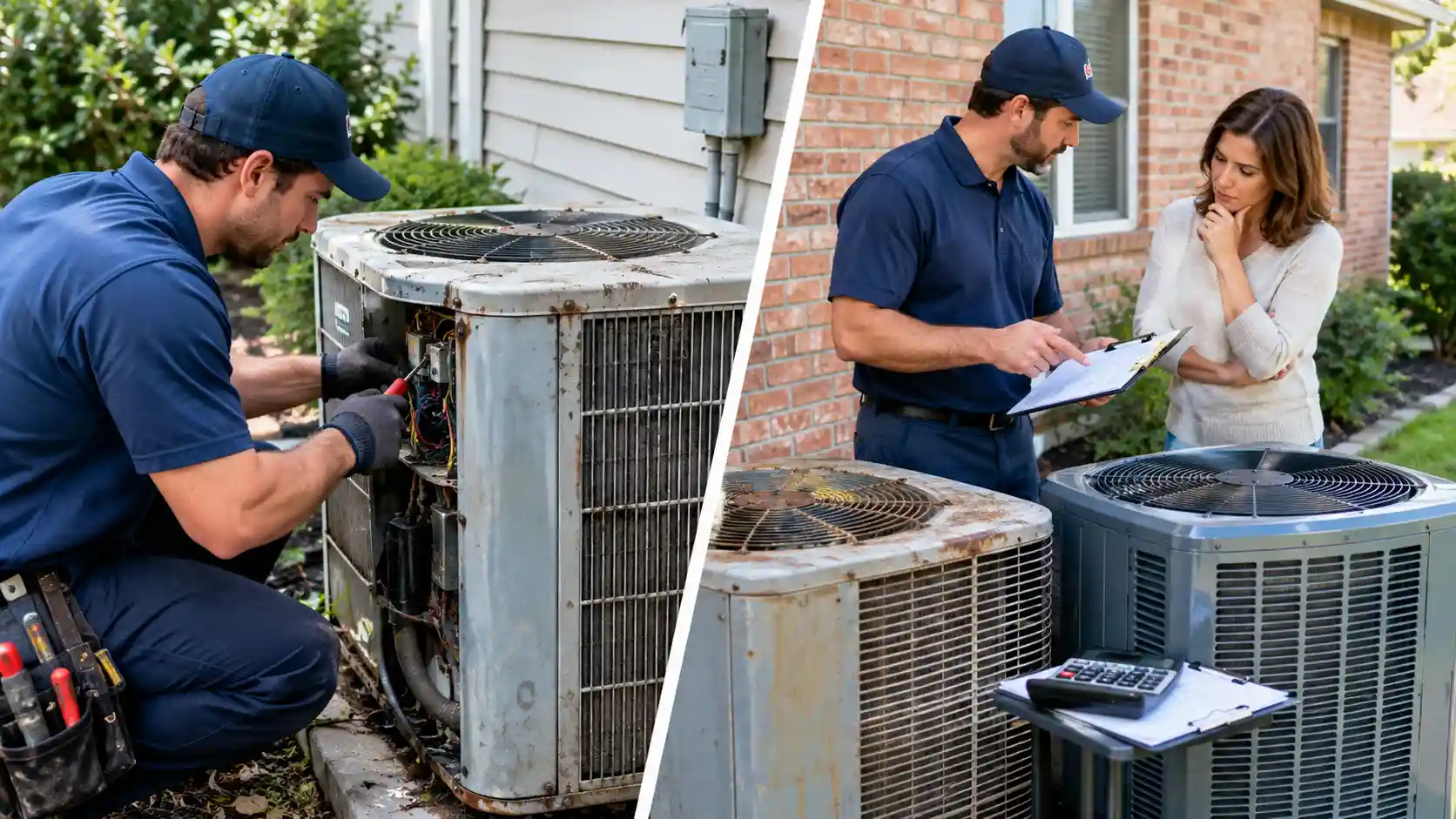
There are a few telltale signs that you need a new HVAC system.
1. Repairs Become Frequent
Repeated HVAC repairs can get expensive fast if you’re making appointments regularly. Several breakdowns may mean the unit is near the end of its service life.
2. Energy Bills Are Going Up
Energy use may gradually rise as HVAC equipment ages and becomes less efficient. But yes, there are a lot of other things that influence energy bills, such as insulation, thermostat settings, duct leaks, and weather.
3. Uneven Temperatures
If you have rooms that are always too hot or too cold, it’s a sign of an HVAC issue. Flow restrictions, ductwork problems, the wrong size unit, and old equipment can all be the culprit.
4. Strange Noises
Strange banging, grinding, rattling, or squealing noises are worth investigating. Some problems are fixable, but persistent mechanical troubles could be considered a sign that replacement is becoming more feasible.
5. Poor Heating or Cooling Performance
Long System Run Times. You should be concerned if your system has long run times, but you still can’t achieve the right temperature indoors.
6. Old Equipment
HVAC systems have a limited service life. As equipment ages, replacement parts can become harder to find, and the cost of repairs can go up.
Things to Think About Other than the $5000 Rule
The $5000 rule is practical, but it shouldn’t be the only factor you consider.
1. System Age
One of the most crucial factors is age. It makes more sense to repair a relatively new system than a very old system.
2. Repair History
Consider how much you have already had to spend on repairs in recent years. A single repair is one thing; repeated breakdowns are another matter.
3. Energy Efficiency
Older HVAC systems may not be as energy efficient. Have a qualified professional do a cost comparison estimate of the anticipated running cost of your existing system versus that of an appropriately sized replacement.
4. Warranty Coverage
See if your appliance, or parts from it, are still under the manufacturer’s or service warranty. Having coverage under warranty can alter the whole financial equation.
5. Whole System Condition
If your HVAC unit is a bit older, you may want to get a pro to tell you if your HVAC unit is overall healthy or showing signs of age in every cranny.
6. Comfort and Reliability
Even if an old system can be fixed in a technical sense, it is a hassle to have it breaking down constantly. Think about how reliable you want your heating and cooling system to be.
To Fix or Replace an HVAC System?
The age, repair cost, and the quality, efficiency, and extent of prior repairs of your system are taken into account.
If you own a relatively new HVAC system, it may be worth repairing based on the cost. But if it’s such an old system that keeps breaking down and needing a $1,000 repair bill, I would consider replacement options.
Before you make a final decision, 75 Degree AC an HVAC professional explain the issue, give you a detailed repair estimate, and an replacement estimate. You can make an informed decision by comparing both options and understanding the short-term and long-term costs.
Keep in mind that the $5000 rule of HVAC is a rule of thumb, not an industry standard. While it can help you make the decision, an HVAC system’s optimal choice is always based on its specific condition and needs.
Conclusion
The $5,000 rule for HVAC is a simple way to compare an HVAC system’s age to the cost of a recommended repair. Multiplying the repair cost by the age of the system, they can get a quick idea on whether replacing should be on their minds.
But energy efficiency and maintenance history, warranty coverage, comfort, reliability, and overall equipment condition matter just as much. Knowing the cost of HVAC repair vs. replacement and the signs you need a new HVAC system will assist you in making a sound choice.
If your heating and cooling system is getting old or giving you problems, don’t just buy a repair — get a replacement estimate, too.
FAQs
Is the $5,000 rule an official HVAC guideline?
The $5,000 rule is a rule-of-thumb financial guide and is not an official standard of the HVAC industry. It’s meant to serve as a guide for homeowners to help them determine whether the age of their equipment should be considered when repair costs are mounting.
Should I be replacing my HVAC system because of the $5,000 rule?
No. However, High Repair Cost Doesn’t Mean You Must Replace Your HVAC System If a repair tops $5,000, that doesn’t necessarily mean your HVAC unit is beyond repair. Other factors to consider are the condition, operational efficiency, repair history, warranty coverage, and estimated remaining service life of the system.
How do you know how much energy your furnace uses?
A trained HVAC technician can give you a written estimate showing the amounts for the defective component, the parts, labor, and any other fees. Getting estimates might also help you understand how much the repair will cost.
Should I replace my old HVAC system?
Possibly, but not always. An old unit that is well maintained and has been reliable could have years of life still left to be shared. Replacement usually becomes better when age combined with a history of frequent repairs, poor efficiency, or poor performance is involved, generally.
Should I get a second opinion before replacing my HVAC system?
A second professional opinion is advisable in most cases, other than in situations in which a sizable repair is needed, or you are apparently on the edge of replacing your entire system. It allows you to shop around for the diagnosis, the repair, and even second replacement estimates without having to make a decision.
There could be a couple of reasons why your furnace isn’t heating your home. Just a few simple things to check before you write the furnace off as a goner.
The filter acts as a barrier, and when it’s filled with dust, dirt, or other particles, it can impede the flow of air. When airflow gets restricted like this, the system can overheat and shut itself off as a safety measure.
Heat also will not get into rooms if supply vents are blocked or closed. Just be sure furniture, curtains, rugs, and the like aren’t blocking up your vents.
Additional causes include a bad blower motor, ignition issues, a soiled burner, defective limit switch, or problems with the fuel supply.

Why does My Furnace Blow Cold Air?
Having your furnace on but the air coming from it is cold is one of the most aggravating furnace issues you can experience. It’s not unusual to be wondering, “Why is the air coming out of my furnace cold?” and there are a few reasons for that.
Look at your thermostat first. Make sure it’s set to Heat, and check whether the fan is set to On instead of Auto — if it’s set to On, the fan will keep running even when the furnace itself isn’t heating, so the air coming from the ductwork can feel cool.
A dirty air filter can also be the culprit. Since the filter covers the airflow path, a clogged one restricts airflow, and that restriction can cause the system to overheat, which then trips the limit switch and shuts off the burners (but not the blower).
Both ignition and gas flow problems can cause the burners not to get hot in a gas furnace. That is usually the result of a dirty flame sensor; the flame would come on, then go off, then lock out. However, when your furnace is blowing cold air more than warm air, it’s time to call an HVAC tech — not get into the habit of trying to jump-start it by turning it off and on repeatedly.
Why Is My Furnace Not Running?
If your furnace is dead and you have turned up the temperature on your thermostat, but nothing is happening, then you are most likely thinking to yourself, “My furnace won’t turn on!” Begin with the simple things.
Verify if the thermostat is powered and is the correct one. Replace the batteries if necessary. Next, peek in your breaker panel for a breaker that’s tripped. A service switch may be located on or near the furnace, and it may look similar to a standard light switch. Check to be really sure it wasn’t just accidentally switched off.
For a gas furnace:
Is the gas being shut off to the house? Never try to work on gas lines or furnace gas elements yourself.
A clogged filter, bad thermostat, bad control board, failing ignition component, safety switch, and others could all be the cause of your furnace not lighting.
Once you have done your research and you still have a non-firing furnace, get it checked out by a pro.
Why Is My Furnace So Loud? Should I be concerned about this?
A gas furnace for the entire house will vibrate and hum on startup and while operating. When you’re busy trying to figure out, “Is my furnace making a loud noise?!” — write down the type of noises and the timing of the noise: can you hear it during startup, while running, or stopping?
It may be that the cover, a screw, or another part has come loose. Thumping noises may be caused by a late ignition in a furnace.
A squeal or screech sound could be the blower belt, the blower motor, or the blower bearings. Grinding sounds may also indicate other mechanical issues that necessitate immediate attention.
Never dismiss a new or louder furnace noise. Running a gas furnace with a mechanical problem could let that problem get worse. If you hear a loud bang, grinding, or anything else unusual, turn it off and call a licensed HVAC technician to come out for a full assessment.
Why Does My HVAC Smell Like It’s Burning?
There are a couple of different reasons why you may be getting a burning smell from your furnace. You are most likely thinking to yourself, “Why does my furnace smell like burning?” because you are smelling it as you power up the furnace for the first time after it has been sitting for a while.
The dust that has settled inside the system over this time gets heated, and that’s what you’re smelling — a bit like the system cleaning itself out as it warms up. This smell usually fades on its own after a short while. But you also have a valid reason to be concerned if you smell something burning, or there’s an electrical smell in your home. It could be an overheated motor, an electrical part, a wiring problem, or a mechanical malfunction.
If you feel heat or smell burning plastic, or see smoke, shut off your furnace and call a pro. If smoke or fire breaks out, get everyone out of the house immediately and call 911 or your local fire department.
Check the furnace air filter.
When a filter is clogged, its effect on airflow can be very similar to closing a vent, so the airflow across the furnace heat exchanger is reduced, causing the heat exchanger to get hotter. Dirty, clogged filters make your furnace work harder, lead to less efficient heating, shorten run times, use more energy, and potentially shut the system down or cause it to overheat.
If you use a washable filter, rinse it under water according to the manufacturer’s instructions, and check it regularly. If you use a disposable filter, change it as per the manufacturer’s recommendations. If you have pets, smokers, construction dust, or heavy dust in your home, you may need to change filters more often. Before installing a new filter, make sure it’s the correct size and type specified by your furnace manufacturer. (For general guidance on filter maintenance and home heating efficiency, the U.S. Department of Energy offers helpful resources.)
When Should You Call an HVAC Professional?
Furnace troubleshooting that a homeowner can attempt on their own includes thermostat inspection, filter replacement, and ensuring that the vents are not obstructed. Gas line repairs, electrical connections, burner maintenance, ignition issues, and control problems should be left to professionals.
An HVAC company should be called in when the furnace is short-cycling, meaning it repeatedly turns off and on. You should also call one if the furnace is making strange noises, emitting a burning odor, not producing enough heat, or showing several other signs of improper functioning.
HVAC repair services usually address minor problems that may arise in a furnace and fix them before they escalate into expensive and complicated repairs.
Final Thoughts
When you start wondering, “Why is my furnace not heating my house?” — the thermostat, the filter, the power supply, and blocked vents are usually the culprits behind the heating issues. Luckily, restoring proper airflow and inspecting these components can often fix the issue.
On the other hand, if the furnace is giving off cold air, making noises, giving off burning smells, or failing to turn on, the wisest choice would be to contact a professional technician for a more thorough inspection.
Regular furnace maintenance, frequent air filter replacements, and good troubleshooting habits can make a noticeable difference in your heating system’s efficiency and considerably improve your quality of life during the heating season.
FAQs
When should you service a furnace?
At a minimum, a professional cleaning and inspection of your furnace should be done once a year. Components can be replaced, energy efficiency can be improved, and unexpected breakdowns can be avoided through preventive maintenance.
How do I make my furnace work better?
Keep your filters clean, keep vents unobstructed, seal air leaks around windows and doors, and make sure your house is properly insulated. Regular furnace maintenance can also increase efficiency.
How long does a furnace last?
A properly maintained furnace will last 15 to 20 years. Keep in mind the life expectancy depends on furnace type, quality of installation, use, and maintenance.
Does a heater work harder with a dirty filter?
Yes, a dirty filter impedes airflow in the furnace, causing it to work harder to heat the house. Changing your filter often can help increase efficiency and airflow.
Should I replace or repair my old furnace?
It depends a lot on how old the furnace is, how much it will cost to repair, how efficient the furnace is, and what type of furnace it is. If a gas model with frequent, expensive repairs is approaching the end of its life, it may be better to invest in a modern, energy-efficient model.
]]>There are many different types of furnaces, the most popular being gas and electric furnaces. Furnaces are also built as single-stage or two-stage systems. A single-stage furnace runs at one fixed output, while a two-stage furnace has two heat settings low and high which lets it run more efficiently by matching output to how much heat the home actually needs.
A good quality single-stage furnace can be installed horizontally, vertically, or end to end. When you understand what your furnace is doing, it is easier to spot problems, improve efficiency, and know when it is time to call in the professionals.
Furnace – What Exactly Is It?
A heat-producing device in a sealed environment, such as a furnace. Warm air furnace: A warm air furnace is a forced air heating system that sends warm air through ducts and registers in your home.
The furnace’s when to turn itself on and off is determined by the thermostat. If you are wondering why your furnace keeps shutting off and on, it might tend to overexert itself to keep pace when the indoor temperature drops below the temperature that is set on your thermostat.
Heat is produced by the burning of natural gas or propane, or by electric heating elements (based on the type of furnace). When heat is created, a blower pushes the air across the furnace and through the ductwork.
Warm air is finally delivered into rooms through supply vents, while cooler air is drawn back to the furnace to be reheated.
Basic Furnace Heating Cycle
The basic furnace cycle is as follows:
- The thermostat senses that heat is required.
- A signal is sent to the furnace.
- The furnace starts the heating process.
- Heat is produced through the combustion of gas or through electrical elements.
- The blower circulates indoor air.
- Indoor air is heated as it passes through the furnace.
- Warm air is distributed throughout the home via the ductwork.
- Heated air is delivered to the rooms.
- Cooler air goes back to the furnace.
- The furnace then turns off at the thermostat’s desired temperature.
This repeats every time the house needs more heat.
How Does a Gas Furnace Work?
A furnace that uses gas is commonly known as a natural gas furnace.
When your thermostat calls for heat, the gas valve will open up on the control board of the furnace and let the gas into the gas furnace burners, where it will be ignited by an igniter.
The resulting flame from the burners then heats the heat exchanger of the furnace.
The indoor air should never be heated directly by the open flame; instead, the blower circulates the air over the heated heat exchanger in order to warm it up.
The fuel gases of combustion generated in the process are exhausted out of the building through the furnace vents. Safety switches continually observe the furnace while it’s running and will turn it off if there is a problem.
Explanation of the Furnace Ignition Process
The furnace ignition process plays an essential role in the functioning of a gas furnace.
Gas furnaces may have either standing pilot lights or electronic ignition systems, which are modern alternatives. Inside the electronic ignition systems, there may be either hot-surface or intermittent ignition systems.
The thermostat’s requirement of heat initiates the furnace’s ignition process. However, the first thing that the furnace control board does before starting the process is to run a set of diagnostics to make sure that everything is in order.
The igniter creates the spark needed to ignite the gas, and the flame sensor makes sure that there is a flame, which means the furnace has ignited. In case of failure, the furnace’s safety features ensure that the gas valves close, cutting off the gas supply to the furnace.
Overall, the furnace ignition process may vary depending on the type of furnace. However, the main principle of the ignition process remains the same, that is, to provide combustion.
Furnace Heat Exchanger Explained

A device that allows heat from the combustion chamber to be transferred to the air in your home while keeping the two isolated from each other.
In short, a heat exchanger is the part of the furnace which gets heated up by the burners and then warms up the air that circulates through the house.
The process is as follows: the air from the house is blown by the blower near the heated walls of the heat exchanger, further absorbing its heat, and then the air is distributed by the furnace’s duct system to the rooms.
The heat exchanger is a vital part of any gas furnace, one whose malfunction may lead to serious safety issues.
This is why any inspection that involves checking the integrity of the heat exchanger should be carried out by an HVAC professional.
How Does an Electric Furnace Work?
As you may already know, gas and electric furnaces are two of the most popular ways to heat a house. The main difference between the two lies in the mechanism of the heating process. Unlike gas furnaces, electric ones do not use gas to heat the air.
Instead, a heating element is used for the purpose. When the thermostat is set to heat, the circuit breaker opens, and electricity flows to the desired heating elements.
The elements heat up, and then the blower motor sends the air over them to pick up the heat. The heated air is then circulated through the vents and into the rooms.
It is important to note that almost all electric furnaces come with more than one set of heating elements. Various combinations of them can be used during the process. It also should be noted that there are no gas burners or combustion in electric furnaces. Nonetheless, there are also things that need to be taken care of, such as electricity, airflow, and maintenance.

What Does the Blower Motor Do?
Apart from that, the blower motor is a significant component in a furnace. Its main purpose is to allow air circulation.
The blower motor’s primary function is to move air through the heating system.
- After the heating elements have warmed up, the blower will distribute the air through the furnace.
- The air passes through the heat exchanger in gas furnaces, while it moves over the heating coils in electric furnaces.
- The air that has been warmed will then flow to the supply ducts and reach the house’s living space.
In addition to bringing the heated air into the house, the blower also reverses the flow of the air to suck the cooled air back to the furnace through return ducts. Without proper circulation of the air, the furnace will not efficiently heat your house. A clogged filter, blocked return vent, or narrow ducts can cause insufficient airflow, resulting in poor functioning of the furnace.
What Happens When the Desired Temperature Is Reached?
A furnace is constructed not to be on all the time.
Therefore, when the thermostat senses the temperature desired by the users, it will turn the furnace off to avoid running it longer than it should.
Depending on what type of furnace one has, either the burners will be shut off (if one has a gas furnace), or the heating elements (if one has an electric furnace).
The blower might continue running for a while to distribute the remaining heat.
After the temperature drops once again, the thermostat will inform the furnace to turn on once again.
Gas Furnace vs. Electric Furnace
Both types of furnaces are able to effectively heat up the house, but their principles of operation are greatly different.
Gas furnaces contain burners, a heat exchanger, and proper ventilation to produce hot air by burning gas. On the other hand, electric furnaces use electric coils to heat the air rather than burning gas, and thus are highly reliant on an electric supply.
Therefore, the decision between a gas or an electric furnace should be based on regional prices of electricity and gas, home’s size, climate, and other utility features. Furnace efficiency is usually measured by its AFUE (Annual Fuel Utilization Efficiency) rating the U.S. Department of Energy’s ENERGY STAR program sets the efficiency criteria that qualifying furnaces must meet.
Common Furnace Problems
Common problems with furnaces are:
- Dirty air filters
- Poor airflow due to various reasons
- Thermostat malfunctions
- Ignition switch problems
- Faulty flame sensor
- Blower motor issues
- Obstructed vents and ducts
- Electrical problems
- Gas line difficulties
- Heat exchanger cracks
Gas furnaces need to be taken care of with special attention because gas burning and gas exhaust must not have any issues.
How to Keep Your Furnace Working Efficiently
The furnace needs regular servicing.
Replace dirty or compromised air filters according to the manufacturer’s directions. Make sure vents are open and not obstructed by furniture or window treatments.
It is crucial to have a professional service company come and do a furnace tune-up/inspection before the heating season. The technician will examine the entire system, including all system components and parts, such as electrical wiring and safety devices, heating and air-conditioning systems.
Proper maintenance keeps the furnace running well and helps you avoid unnecessary repair costs.
Final Thoughts
It is much easier to comprehend how a furnace works if we split the process into major steps involved. These are as simple as the thermostat calling for heat, the furnace responding by creating heat, moving it with a blower, and finally sending it through ducts into your living space.
A gas furnace uses a combination of gas and air in the combustion process, whereas electric furnaces use heating elements for that purpose. The process of furnace ignition becomes even more important in gas furnaces due to the nature of open flame.
On a general note, regardless of what type of furnace you have, proper circulation of air, regular maintenance, and visits to a professional heating company can keep your system safe and efficient.
Frequently Asked Questions
How does a furnace work to heat a house?
The furnace makes use of its mechanism to create heat and push it to the house. The blower will then take the hot air and spread it to the house through the ducts. Part of the cooled air will then be sucked back to the furnace to repeat the process.
How does a gas furnace work?
Gas furnaces are known to make use of natural gas or propane to generate heat. The generated heat will then be used to heat the heat exchanger. The blower will then push the heated air to the house through the ducts. The exhaust gases will then be disposed of outside the house.
]]>HCHO stands for formaldehyde, a colorless, highly pungent gas that is present in both indoor and outdoor air. Indoor air often has a larger contribution of formaldehyde than outdoor air, since a variety of everyday household items release it more or less continuously.
When an air quality monitor displays a reading for HCHO, what it’s really showing is the concentration of formaldehyde in the air you are breathing. On the instrument, the value can be given in mg/m3 (milligrams per cubic meter) or in ppm (parts per million).
So your HCHO air quality reading is really just how much formaldehyde is in your air.
Why Is HCHO Present In Indoor Air?
There are multiple sources of formaldehyde in your home. One of the largest sources is pressed wood products made with certain adhesives.
The U.S. Environmental Protection Agency (EPA) states that formaldehyde can be emitted from products including particleboard, medium-density fiberboard (MDF), hardwood plywood, cabinets, shelving, and furniture. Because of its high resin content, MDF tends to emit more formaldehyde than other wood products.
Other potential sources include:
- New furniture and cabinets
- Pressed-wood flooring or shelving
- Glues and adhesives
- Certain paints and coatings
- Textiles and permanent-press fabrics
- Tobacco smoke
- Unvented fuel-burning appliances
- Some household products
Formaldehyde emissions from new products may be initially higher and decline over time, but emission rates do change with time. Temperature and humidity can also influence the rate of formaldehyde emissions.
HCHO Air Quality Meaning
In simple terms, HCHO air quality is a measure of formaldehyde concentration in the air.
A reading on the low side tells you there’s less formaldehyde in the air; a reading on the high side tells you there’s more of it. But you shouldn’t just take one number at face value without thinking about what units it’s using, how accurate the sensor is, whether it’s calibrated, and how it measures.
Consumer-grade air-quality monitors are useful gadgets for noticing changes or spotting potential problems, but that doesn’t necessarily mean they are instruments of lab quality.
If you notice a sudden spike in your HCHO reading after purchasing new furniture, installing cabinets, painting, or otherwise bringing new materials into your home, that shift is probably worth a closer look.
What Happens If You Are Exposed to Large Amounts of Formaldehyde?
Your eyes, nose, and throat can be irritated by formaldehyde. Symptoms of high exposure include watery and burning eyes, coughing, wheezing, and difficulty breathing. According to the EPA, very high levels of formaldehyde exposure may also trigger immediate effects among people with asthma. It’s also harmful to your health if you’re exposed to too much of it, or to lower amounts over a long period of time. Since formaldehyde is classified as a human carcinogen, minimizing high exposure is the best way to keep the air in your home clean.
That said, not every HCHO number you see is cause for panic. The potential for an effect depends on the concentration, duration, ventilation rate, and the sensitivity of the individual.
Safe Limit for HCHO Concentration
How much HCHO is safe is among the most commonly asked questions on this topic.
The World Health Organization (WHO) recommends that indoor formaldehyde levels be limited to 0.1 mg/m3 as a 30-minute average, to avoid irritant effects at any age. WHO advises not exceeding this 30-minute value.
Note that this is a WHO guideline, not a legally binding limit in every country, and it doesn’t necessarily mean your consumer monitor is accurate enough for anything beyond general, informative purposes.
The EPA has not established an official safe level for formaldehyde in indoor air, though it does provide toxicological information on the chemical’s health effects.
While the WHO guideline is a useful point of reference if your monitor reports HCHO in mg/m3, keep in mind that professional testing may be needed for anything more conclusive.
How to Reduce HCHO in the Home

If you’re wondering how to reduce HCHO in the home, the good news is that several effective strategies can help.
1. Improve Ventilation
Ventilation is one of the most effective ways to reduce indoor formaldehyde levels. Open windows and doors when outdoor conditions allow, and use exhaust fans where available. Ventilation is especially important right after new furniture, cabinets, flooring, or other formaldehyde sources have been brought into a home. Both the WHO and the EPA recognize ventilation as an effective way to reduce indoor exposure.
2. Watch Out for New Furniture
New pressed-wood furniture can give off formaldehyde. When selecting new products, choose those certified for lower formaldehyde emissions or that meet relevant emission regulations. Airing out new furniture in a well-ventilated room can also help lower indoor levels.
3. Control Moisture and Temperature
The EPA advises maintaining indoor temperature and humidity within a comfortable range by using air conditioners or dehumidifiers. There’s no real downside to keeping indoor conditions reasonably comfortable and humidity levels in check.
4. No Indoor Smoking
Tobacco smoke is a significant indoor source of formaldehyde, along with many other pollutants. A smoke-free indoor environment further improves indoor air quality.
5. Handle Air-Quality Meters With Care
An HCHO monitor allows you to track fluctuations in indoor air quality. If a reading rises sharply, think about whether there’s been a recent change in your surroundings: new furniture, construction work, painting, or reduced ventilation. But don’t rely on a single low-cost detector to confirm a serious indoor-air issue. If measurements stay abnormally high, a professional evaluation can offer more certainty.
Is HCHO the Same as VOC?
Not quite. HCHO is formaldehyde, while VOC stands for volatile organic compounds a broad group of chemicals that can turn into gas and enter the air.
Formaldehyde is a volatile organic compound, so it falls within the VOC category; it can be thought of as one of many VOCs. An HCHO reading doesn’t refer to the concentration of all VOCs in the air only to the concentration of formaldehyde specifically. This is why HCHO and TVOC readings are usually displayed separately on a monitor.
How to Lower HCHO Levels
Indoor air pollution is, in many cases, easier to prevent than to remediate. Choose low-emitting building products and furnishings when you can, ventilate adequately, avoid smoking indoors, and keep temperature and humidity at comfortable levels.
If you notice eye, nose, or throat irritation after redecorating a room or bringing in new furniture, the first step is to ventilate the space and try to identify the potential source. For persistent symptoms, consistently high readings, or both, professional indoor-air testing can confirm whether formaldehyde levels are elevated and help identify the source.
Conclusion
So, what is HCHO in air quality? HCHO is the short form for formaldehyde, a gas that may be emitted from certain building materials, furniture, household products, and combustion sources.
The HCHO reading on an air-quality monitor reflects the amount of formaldehyde in the air. The WHO has set a 30-minute indoor guideline of 0.1 mg/m³, while the EPA has not established an official safe level for formaldehyde in indoor air.
If your HCHO level is high, you can reduce exposure by increasing ventilation, managing temperature and humidity, avoiding indoor smoking, and choosing lower-emission products.
FAQs
What is a good HCHO value?
The WHO guideline for formaldehyde in indoor air is 0.1 mg/m3 as a 30-minute time-weighted average. This should be seen as a health-based guideline, not a legally binding value.
What raises HCHO levels in a house?
Common sources include pressed-wood furniture and cabinets (such as MDF, particleboard, and plywood), adhesives, certain coatings, tobacco smoke, and some combustion processes.
How do you get rid of HCHO?
Ventilate the space, manage temperature and humidity, avoid smoking indoors, and choose furniture and building materials that emit less formaldehyde. These steps can help minimize exposure.
]]>