With the Fibe loan app, eligible customers can explore personal loan options digitally and manage the application journey from their smartphones. This can be particularly convenient for salaried professionals who want to arrange their finances without spending time visiting a branch.
First, Decide How Much Your Vacation Will Actually Cost
Before looking for a loan, create a realistic travel budget. Start with the expenses you already know and then keep some room for unexpected costs.
Your vacation budget can include:
- Flight, train, or bus tickets
- Hotel or accommodation
- Local transportation
- Food and beverages
- Sightseeing and activities
- Travel insurance
- Shopping and personal expenses
- Emergency funds
Once you have estimated the total cost, subtract the amount you can comfortably pay from your savings. The remaining requirement can help you determine whether you actually need additional borrowing.
Why Consider Fibe for a Travel Loan?
Fibe brings convenience to the personal loan journey through its digital-first approach. Eligible borrowers can explore their loan options online, provide the required information, complete applicable verification, and review the available terms digitally.
For someone preparing for a vacation, this means the loan application can be managed around existing travel and work commitments.
The Fibe loan app can also make it easier to access relevant loan information from your smartphone instead of relying on repeated branch visits.
How to Keep Your Travel Loan Affordable
Taking a loan for a vacation means your holiday expenses will continue into your future monthly budgets. That’s why repayment planning should be part of your travel planning.
Choose Only the Amount You Need
Don’t borrow extra simply because a higher amount is available. Calculate the actual funding gap and consider whether the expense is essential.
Compare the EMI with Your Monthly Budget
Your EMI should fit comfortably alongside rent, household expenses, existing EMIs, savings, and other regular commitments.
Consider the Total Repayment
A lower EMI may look attractive, but extending the tenure can increase the overall interest payable. Compare different repayment periods before accepting an offer.
Keep an Emergency Buffer
Avoid spending every rupee of your savings on the vacation. Keeping some emergency money aside can help you handle unexpected expenses during or after the trip.
Is a Fast Cash Loan App Right for Your Vacation?
Looking for a fast cash loan app can be a practical option when you need funds for travel or another urgent expense. If you are planning to use a loan app, take some time to verify the lender, understand the applicable charges, review the terms and conditions, and check the repayment schedule before applying.
Avoid loan apps that promise guaranteed approval or ask for unnecessary sensitive information. Choosing a recognised digital lending platform and understanding the overall cost of borrowing can help you make a more informed financial decision.
]]>| TL;DR A keyword at 10,000 searches growing 20% month over month is usually a better target than one at 20,000 standing still.The same term reads differently over a 30-day window than a 12-month average. Tools rarely say which you are looking at.5,000 searches is huge in Germany and tiny in the US. Volume without a market attached is not a number.Ten keywords at 500 volume you can win beats one at 5,000 you cannot. Short version: volume is a size reading. Size is the least decision-relevant thing about a keyword. |
Six hundred people a month search the phrase “amazon search volume,” which tells you the metric matters to sellers and nothing about how they should use it. That is a fair illustration of the problem with the metric itself.
Search volume is the first number every keyword tool shows and the one most likely to be read as a verdict. It is not a verdict. It is one of four readings, and taken alone it reliably points at the terms hardest to win.
What the Number Is Actually Measuring
Volume estimates how many times a phrase was searched in a marketplace over a period. Three things about that sentence do more work than they appear to.
It is an estimate. No third-party tool has Amazon’s query logs. Every figure is modeled, and models carry error bars that the interface almost never shows. A stated volume figure is a modeled output, not a measurement, and the good tools say so.
It counts searches, not searchers. One person checking a term nine times over a week contributes nine.
It is bounded by a window. Which brings us to the reading most often got wrong.
Window: The Same Keyword, Two Different Numbers
A 30-day window and a 12-month average describe the same keyword and produce different figures, sometimes by multiples. Neither is wrong. They answer different questions.
The 30-day window answers “what is happening now,” which is the right question for inventory and bid decisions. The 12-month average answers “what is normally true,” which is the right question for whether to launch a product at all.
Sellers get burned when they read a 30-day figure taken during a seasonal peak as though it were the annual norm, order stock against it, and discover in February that the peak was the number. The reverse error is quieter and just as expensive: reading a 12-month average during a rising trend and under-ordering.
A useful discipline is to look at both and note the gap. A term whose 30-day figure sits well above its 12-month average is either seasonal or growing, and those need opposite responses.
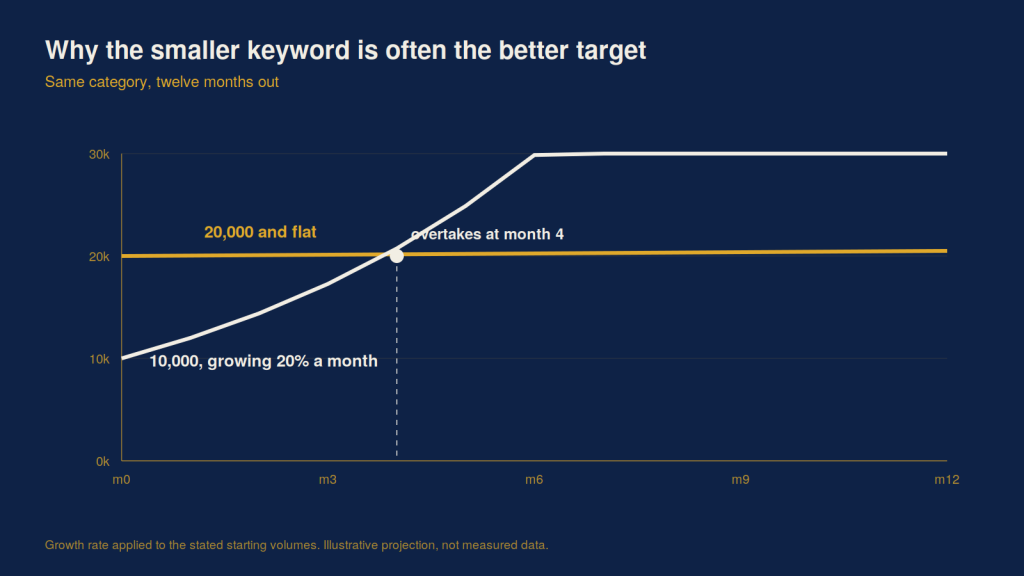
The smaller term overtakes the larger one inside a year, and costs far less to rank for while it does.
| Reading | Question it answers | Decision it should drive |
| 30-day window | What is demand doing right now | Bids, restock timing |
| 12-month average | What is normally true | Whether to enter the category |
| Direction of travel | Is it rising or decaying | Whether to build around it |
| Relative rank in market | Is this figure big for this country | Whether the number means anything |
Direction Beats Size
This is the reading that changes decisions most and appears in tools least.
A keyword pulling 10,000 searches a month and growing 20% month over month is generally a better target than one pulling 20,000 and flat. The smaller term is on its way to being the larger one, competition for it has not yet arrived, and the cost of ranking today is a fraction of what it will be after it doubles.
Seasonality is the same reading on a longer axis. The question is not whether a term peaks but how early it starts to move. If volume begins rising two months before the peak, that is your inventory lead time telling you when to order, and it is visible in the data long before it is visible in sales.
Volume Without a Market Is Not a Number
Five thousand searches in Germany is a large term. Five thousand in the US is a rounding error. The figure is identical and the conclusion inverts.
The same applies within a single market across categories. Fifty thousand searches is good in Electronics. A thousand can be excellent in industrial and scientific tools, where the buyers are few and the order values are not. Any volume figure read without knowing the size of the pond it came from is a decoration.
This is where a keyword tool earns its cost, because the useful output is not the raw figure but the figure in context. A good read on Amazon search volume pairs the number with what surrounds it: how the term’s traffic distributes across the listings already ranking, whether the leaders are entrenched, and whether the number is moving.
The Winnability Discount
The last reading is the one that turns volume into strategy.
A keyword might show 50,000 searches while the top ten results all carry 20,000-plus reviews. That is not an opportunity, it is a wall with a number painted on it. The volume is real and entirely unavailable to you.
The arithmetic that follows is straightforward and widely ignored. If you can dominate ten keywords at 500 searches each, you have 5,000 searches of genuinely addressable demand. If you fail to crack the top twenty on one keyword at 5,000, you have none. The second option looks better in a spreadsheet and pays nothing.
A workable scoring model is three axes out of five: demand, relevance, and ability to win. A term scoring 5, 5 and 2 totals 12 out of 15 and should be treated with suspicion, because the axis it fails is the one that determines whether the other two ever apply.
One last caution about the figures themselves. Because every volume number is modeled rather than measured, precision claims made for them deserve scrutiny. The FTC’s advertising and marketing guidance is direct that claims must be truthful and evidence-based and that companies have to be able to support them, which applies to a tool vendor’s accuracy claims as much as to a product listing. Treat a volume figure quoted to the nearest unit as a presentation choice, not a measurement.
Building the List
A practical target list runs 50 to 100 keywords in three tiers: one primary term above 10,000, roughly five support terms between 2,000 and 5,000, and ten or more long-tails under 1,000.
Note the shape. The long-tails outnumber everything else, and collectively they usually deliver more addressable demand than the primary term does, at a fraction of the cost to rank. The primary term is there to be aimed at over years, not won in a quarter.
When a whole category appears to move at once, check it against something outside your own account before reacting. The Census Bureau’s Monthly Retail Trade Survey publishes the equivalent reading at the whole-economy level, which is a cheap way to tell a genuine seasonal swing from an artifact of your own listings going in or out of stock.
Pull your current listing’s top five terms and write the 30-day and 12-month figures side by side. Where the two diverge sharply, you have either a seasonal term you are treating as evergreen or a growing one you are underinvesting in. Both are worth an afternoon.
]]>Day One: What To Do The Moment The Account Goes Live
Avoid clicking into the first fund that appears interesting right soon after activation. Spend a few minutes checking in, investigating the UI, and figuring out where the returns calculator, fund research, and historical performance are located within the application. Getting comfortable with the layout on day one saves real confusion later when an actual decision needs making under slight time pressure.
Week One: Picking A First Fund To Actually Invest In Mutual Funds
By the end of the first week, most people are ready to invest in mutual funds for the first time. This starts with a basic decision: lumpsum or SIP. A lumpsum works well for someone with a set amount ready to deploy immediately, while an SIP suits someone who’d rather commit a smaller, regular amount every month instead. Neither choice is permanent, and plenty of investors eventually use both once they’re more comfortable navigating the process.
Comparing Lumpsum And SIP For A First Investment
| Approach | How It Works | Best Suited For |
|---|---|---|
| Lumpsum | One larger transaction at current NAV | Investors with a ready sum and market conviction |
| SIP | Fixed smaller amount deducted at regular intervals | Beginners wanting to build a steady habit |
| Combination | Lumpsum for an initial base, SIP for ongoing additions | Investors wanting both a starting point and consistency |
Common First-Timer Questions Right After Getting Started
A few questions come up constantly once someone finishes setting up their account. How much should a first investment actually be? Most platforms allow starting with amounts as low as a few hundred rupees, so the answer is usually smaller than people expect. Does setting up an account automatically grant access to mutual funds too? Generally yes, since most modern platforms including HDFC Sky bundle stock and fund investing under the same login rather than treating them as separate products entirely.
Month One: Building A Habit, Not Just Completing A Transaction
A single purchase, however well researched, isn’t really the goal. By the end of the first month, the aim should be a repeatable habit, whether that’s a monthly SIP date circled on a calendar or a quarterly review of how a fund is actually performing relative to its stated benchmark. Investors who treat that first transaction as the beginning of a routine, rather than a one-off task to check off right after demat account opening, tend to build meaningfully larger portfolios over the following years.
What To Track Once Money Is Actually Invested
Once the first investment is live, a few things deserve regular attention: the fund’s NAV movement, whether SIP instalments are actually going through on schedule, and how the expense ratio compares to similar funds in the same category. None of this needs daily monitoring, but a monthly glance keeps small issues from turning into bigger surprises later, well beyond whatever setup happened during demat account opening itself.
Mistakes Worth Avoiding Early On
New investors commonly make a handful of avoidable mistakes right after getting started. Chasing last year’s best performing fund without checking whether that performance is likely to repeat is a common one. Ignoring the expense ratio entirely, assuming it barely matters, is another, even though it quietly compounds over a longer holding period. Redeeming units at the first sign of a market dip, rather than sticking with a chosen time horizon, tends to undo whatever benefit a disciplined approach was meant to provide in the first place.
Bringing It All Together
Completing demat account opening is just the starting line, not the finish. Getting comfortable with the platform, choosing between lumpsum and SIP, and deciding to invest in mutual funds with a clear first step all matter more than waiting for the perfect fund or the perfect moment. The habit built in that first month tends to matter far more, over time, than any single early decision.
]]>The Journey From Global Markets to Local Dealers
The price a buyer sees at a local shop is the result of a fairly layered process. It starts with continuous trading on international commodity exchanges, where silver’s dollar-denominated price responds to a combination of industrial demand, currency strength, and investor behaviour during periods of economic uncertainty. This international rate is then converted into rupees based on the day’s exchange rate, after which import duty and other applicable costs are added to determine the landed price of silver entering the domestic market. City-level bullion associations calculate a daily rate using this landed cost along with local wholesale conditions, and retail dealers generally price their silver products in line with this published figure.
Understanding Silver’s Unique Market Position
What sets silver apart from most other precious metals is its traditional role in jewellery and gifts as well as its heavy reliance on commercial use. A large part of the global demand for silver comes from areas such as electronics manufacturing, solar energy and many trade policies. When traded play options occur worldwide; calls on silver typically rise alongside it, occasionally triggering sharper interest rate action than typically seen in the gold market during comparable periods.
Popular Ways Silver Is Purchased
Silver is bought in several different forms depending on the buyer’s intent. Coins and bars are a common choice among those who want to invest in the metal without paying significant making charges, since their price is closer to the base metal rate with minimal craftsmanship cost added. Traditional silverware, including plates, bowls, and decorative pieces, remains a popular choice for religious ceremonies and festive gifting, as silver is considered auspicious in many Indian households. Silver jewellery, ranging from simple anklets to more elaborate designs, also continues to attract steady demand, particularly among buyers who want an affordable alternative to gold for everyday wear.
What Causes Silver Prices to Fluctuate
Several forces work together to move silver prices on any given day. Changes in global industrial output and manufacturing trends often have a direct impact on demand, given how widely the metal is used across various sectors. The strength or weakness of the rupee against the dollar also plays a meaningful role, since silver is priced internationally before being converted for local sale. Domestic demand tied to festivals and wedding-related purchases adds a further layer of movement, with buying activity typically rising during specific periods of the year and sometimes prompting dealers to adjust their pricing slightly during these busier stretches.
Tips for Buying Silver Wisely
Before making a purchase, it helps to compare and check fees between a handful of reputable dealers, as these costs can vary quite a bit even when the underlying silver price is the same on the market. Checking to see if the seller provides any purity certification is also a practical precaution, especially for large purchases with silver bullion units or investment-grade bars.
Closing Perspective for Silver Buyers
Silver remains an important part of everyday life and tradition across Indian households, valued for its affordability, cultural significance, and dual role as both a precious and industrial metal. Buyers who take the time to understand how its price is determined, along with the practical differences between various forms of silver available in the market, are consistently better equipped to make purchases that offer genuine value.
Key Points
- Households in India often check the Silver Rate Today as a practical step before shopping for festivals or family occasions.
- The price of silver in local markets is influenced by international commodity trading, currency strength, and added import costs.
- Silver is distinct from other precious metals due to its significant commercial use alongside its traditional roles in jewelry and gifts.
- Coins and bars are popular forms of silver purchased by investors to minimize craftsmanship costs.
- Silver prices fluctuate based on global industrial output, the strength of the rupee, and seasonal domestic demand related to festivals and weddings.
- Buyers should compare fees from multiple dealers and check for purity certification to ensure value in their purchases.
Every digital interaction begins with identity. Whether employees access cloud platforms, customers log into online services, or administrators manage enterprise systems, organizations must verify users before granting access. As digital ecosystems continue to expand, protecting identities has become one of the most important aspects of cybersecurity. This growing focus on Identity and Access Management is helping organizations build secure environments while supporting productivity and business growth.
Identity security is no longer limited to IT departments. It now influences operational resilience, customer trust, regulatory compliance, and long-term digital transformation. Organizations that invest in strong identity governance are better positioned to reduce cyber risks while maintaining seamless user experiences.
Managing Access Across Expanding Ecosystems
Modern enterprises operate across multiple cloud services, remote work environments, mobile devices, and third-party platforms. Managing access manually across these environments quickly becomes difficult and increases the likelihood of security gaps.
Identity governance centralizes user authentication and authorization, ensuring every individual receives appropriate access based on responsibilities. This structured approach minimizes unnecessary privileges while simplifying administration across complex infrastructures.
As organizations continue adopting new technologies, centralized identity management becomes increasingly valuable for maintaining both efficiency and security.
Reducing Risks From Stolen Credentials
Credential theft remains one of the most common methods used by cybercriminals. Phishing campaigns, password reuse, malware, and social engineering attacks frequently target user credentials because they often provide direct access to valuable systems.
Modern identity security solutions reduce this risk through layered authentication, continuous monitoring, and intelligent verification. Even if login credentials become compromised, additional authentication requirements significantly reduce the chances of unauthorized access.
Protecting identities at multiple stages creates stronger security than relying solely on usernames and passwords.
Building Smarter Authentication Processes
Authentication technologies have evolved considerably over the past decade. Traditional passwords are increasingly being replaced or strengthened through biometric verification, authentication applications, hardware security keys, and behavioral analysis.
Modern authentication systems adapt according to context. Routine logins from trusted devices may require minimal verification, while unusual login attempts automatically trigger additional authentication steps. Insights shared by Identity and Access Management (IAM) speakers continue to demonstrate how adaptive authentication improves both security and user experience across modern enterprises.
This adaptive security model strengthens protection while allowing legitimate users to work efficiently without unnecessary interruptions.
Strengthening Privileged Account Protection
Not every user requires the same level of system access. Administrative accounts often possess elevated privileges capable of modifying systems, accessing confidential information, or managing security settings.
Protecting these privileged identities requires additional safeguards. Organizations increasingly implement stricter authentication requirements, session monitoring, approval workflows, and detailed activity logging for high-privilege accounts.
Limiting privileged access reduces opportunities for attackers while improving accountability across critical business operations.
Supporting Secure Remote Work Environments
Remote and hybrid work models have permanently changed how organizations manage cybersecurity. Employees now connect from homes, shared workspaces, airports, and international locations using various devices and networks.
Identity-centered security allows organizations to verify users regardless of location. Instead of trusting network boundaries alone, access decisions consider user identity, device status, login behavior, and associated risks.
This flexible approach enables secure remote access while maintaining strong protection across distributed workforces.
Identity Governance Improves Compliance
Regulatory compliance increasingly requires organizations to demonstrate control over user identities and access permissions. Industries handling financial records, healthcare information, government services, and customer data must prove that only authorized individuals access sensitive resources.
Identity governance simplifies compliance by providing centralized visibility into permissions, authentication records, and access history.
Automated reporting, periodic access reviews, and policy enforcement help organizations meet regulatory expectations while reducing administrative workload.
Artificial Intelligence Enhances Identity Security
Artificial intelligence is transforming identity protection by making authentication systems more intelligent and responsive.
Instead of evaluating only passwords, AI continuously analyzes user behavior, login patterns, device characteristics, network activity, and historical usage. These insights allow systems to identify suspicious activity much earlier than traditional security methods.
Adaptive authentication powered by AI helps organizations respond immediately when unusual behavior is detected, reducing both response times and security risks.
Industry Collaboration Drives Innovation
Identity security continues evolving as cyber threats become increasingly sophisticated. Collaboration between technology providers, researchers, policymakers, and enterprise leaders plays an essential role in accelerating innovation.
Knowledge sharing allows organizations to evaluate new authentication methods, governance frameworks, and access control technologies before implementing them within their own environments.
Insights shared by Identity and Access Management (IAM) speakers often provide valuable perspectives on emerging risks, evolving compliance requirements, and practical implementation strategies. Their expertise helps organizations understand both current challenges and future developments in identity security.
Preparing For The Future Of Identity
The future of cybersecurity will depend heavily on identity-centered protection. Passwordless authentication, decentralized digital identities, behavioral biometrics, continuous verification, and AI-driven decision-making are expected to become standard components of enterprise security strategies.
Organizations investing in these capabilities today will be better prepared for tomorrow’s digital environments. Identity security will continue shifting from simple authentication toward continuous trust verification that protects users throughout every interaction.
Building flexible identity frameworks today creates a strong foundation for future innovation while supporting long-term resilience.
Creating Long Term Digital Trust
Digital trust is built through consistent protection of users, systems, and information. Strong identity governance enables organizations to maintain secure digital experiences without creating unnecessary complexity.
Employees gain reliable access to the tools they need, customers enjoy safer online interactions, and organizations strengthen confidence across their digital operations.
When identity management becomes an integral part of business strategy rather than an isolated security function, organizations create stronger operational resilience and improve their ability to adapt to changing cybersecurity challenges.
Conclusion
Identity protection has become one of the defining elements of modern cybersecurity. As organizations expand digital operations, stronger authentication, intelligent governance, adaptive access controls, and continuous verification are becoming essential for protecting both users and business assets. A comprehensive Identity and Access Management strategy helps organizations maintain secure access while supporting productivity across increasingly complex digital environments. It also strengthens regulatory compliance by ensuring that user permissions are monitored and updated consistently. As cyber threats continue to evolve, investing in robust identity security creates a stronger foundation for long-term resilience and digital trust. Ongoing collaboration and knowledge sharing continue to drive innovation across this rapidly evolving field, and industry events such as PhilSec 2026 Summit provide valuable opportunities to explore the future of secure identity management and digital trust.
]]>These events help professionals understand emerging threats, discover advanced technologies, and exchange practical experiences. For security leaders seeking industry insights and regional trends, attending the best cybersecurity conferences Indonesia provides opportunities to enhance cybersecurity strategies and connect with experts shaping the future of digital protection.
The Role of Cybersecurity Conferences in Knowledge Sharing
Cybersecurity is one of the fastest-changing technology fields, with new threats and defense techniques emerging constantly. Professionals must stay updated with the latest developments to protect their organizations effectively.
Global cybersecurity conferences provide an environment where experts share their knowledge through keynote presentations, panel discussions, workshops, and technical sessions. These discussions cover important areas such as cloud protection, network security, artificial intelligence-based security solutions, threat intelligence, and data privacy.
By learning from experienced cybersecurity professionals, attendees gain a better understanding of current challenges and possible solutions. They can explore how different organizations handle security incidents, improve their defense systems, and develop stronger cybersecurity frameworks.
Encouraging Collaboration Between Cybersecurity Professionals
One of the biggest benefits of cybersecurity conferences is the opportunity to build professional relationships. These events bring together cybersecurity experts, technology specialists, business leaders, and government representatives from different sectors.
Networking during these conferences allows professionals to share experiences and discuss challenges that affect their industries. Since cyber threats often impact multiple sectors, collaboration becomes essential for developing stronger security approaches.
For security executives and members of the CISO Indonesia community, these gatherings provide a valuable opportunity to connect with other cybersecurity leaders. They can exchange ideas about security leadership, risk management, compliance strategies, and methods for building effective security teams.
Strong professional networks help create a more connected cybersecurity ecosystem where organizations can support each other in responding to emerging threats.
Driving Innovation Through Cybersecurity Technology
Technology plays an important role in improving cybersecurity capabilities. As cyber attackers use more sophisticated methods, organizations must adopt advanced tools and strategies to protect their digital assets.
Cybersecurity conferences provide a platform for businesses to explore the latest innovations in security technology. Discussions often focus on emerging solutions such as artificial intelligence, machine learning, automation, cloud security, identity protection, and advanced threat detection systems.
These events help organizations understand how new technologies can improve security operations. Technology providers can also connect directly with cybersecurity professionals to understand industry requirements and develop better solutions.
Through collaboration between innovators and security experts, the cybersecurity industry continues to evolve and create more effective ways to defend against digital threats.
Supporting Better Cybersecurity Decision-Making
Cybersecurity decisions can have a major impact on business operations, customer trust, and long-term growth. Organizations need reliable information to choose the right security approaches and investments.
Cybersecurity conferences allow decision-makers to gain insights from industry experts and understand how other organizations are addressing security challenges. Sessions focused on cybersecurity leadership, risk assessment, compliance, and digital resilience help professionals make informed decisions.
These discussions are especially valuable for senior technology leaders who are responsible for creating security strategies and managing organizational risks.
By attending the best cybersecurity conferences, professionals can learn about regional cybersecurity challenges while gaining exposure to global security practices and solutions.
Strengthening Public and Private Sector Partnerships
Cybersecurity is not only a concern for private businesses. Governments and public organizations also face increasing risks involving critical infrastructure, citizen information, and essential digital services.
Global cybersecurity conferences encourage cooperation between the public and private sectors by providing a space for open discussions. Government representatives, industry leaders, and security experts can share perspectives on cybersecurity policies, regulations, and threat management.
These partnerships help create stronger security standards and improve coordination during cyber incidents. By working together, organizations can develop more effective responses to large-scale attacks and strengthen overall digital resilience.
Developing the Next Generation of Cybersecurity Experts
The growing complexity of cyber threats has increased the demand for skilled cybersecurity professionals. Organizations need experts who can understand advanced technologies, analyze risks, and develop effective defense strategies.
Cybersecurity conferences contribute to professional development by offering learning opportunities for students, beginners, and experienced professionals. Workshops, training sessions, and expert discussions help attendees improve their technical knowledge and leadership capabilities.
These events also encourage more individuals to explore cybersecurity careers and contribute to the future growth of the industry.
Building a strong cybersecurity workforce requires continuous education, practical exposure, and collaboration among professionals at different career stages.
How Cybersecurity Conferences Benefit Businesses
Businesses that prioritize cybersecurity are better prepared to handle digital challenges. A strong security framework helps protect sensitive information, maintain customer confidence, and support uninterrupted operations.
Participating in cybersecurity conferences provides businesses with several advantages, including:
- Understanding emerging cyber threats
- Learning from industry specialists
- Discovering innovative security solutions
- Expanding professional networks
- Improving cybersecurity planning
These opportunities help organizations stay ahead of potential risks and make better technology decisions.
For companies operating in competitive digital environments, cybersecurity knowledge has become an important factor in maintaining business stability and growth.
Conclusion
The best cybersecurity conferences Indonesia play an essential role in connecting professionals, encouraging innovation, and improving industry collaboration. These events help security leaders exchange knowledge, explore advanced technologies, and develop effective strategies to address evolving cyber threats. By bringing together experts from different sectors, cybersecurity conferences create opportunities for stronger partnerships, better awareness, and a more resilient digital ecosystem prepared for future security challenges.
Through global cybersecurity initiatives and professional networking opportunities, IndoSec connects cybersecurity professionals, technology experts, and industry leaders through specialized events focused on knowledge exchange, networking, and security innovation. The platform provides opportunities to explore emerging cybersecurity trends, discuss industry challenges, and build valuable professional relationships. Through expert sessions, collaborative discussions, and security-focused insights, IndoSec supports organizations in developing stronger cybersecurity strategies for the evolving digital landscape.
]]>Instead of choosing a product based solely on its packaging or marketing claims, it is important to consider quality, transparency, and manufacturing standards. A little research helps consumers identify products that are made responsibly and supported by clear product information.
Understanding Wellness Oils
Wellness oils are made with hemp extracts and are available in various formulations, depending on their cannabinoid profiles and manufacturing processes. Since every product is unique, beginners should take time to understand what the label says before making any decision. Learning about ingredients and production methods helps consumers compare products more effectively.
It is also helpful to know that quality is influenced by several factors, including the source of the hemp, extraction methods, and quality control. Reliable manufacturers focus on maintaining consistency throughout the production process while providing consumers with transparent information about their products.
Important Details to Check Before Buying
Reading product information carefully is one of the simplest ways to understand the quality of a wellness oil. Labels and product descriptions often contain valuable details that help consumers compare different options and understand what each product offers.
- Check the Ingredient List
A clear ingredient list helps consumers understand what the product contains. Transparent labeling reflects a brand’s commitment to quality and informed choices.
- Understand the Cannabinoid Content
Wellness oils may contain different cannabinoid profiles. Reading the product information helps beginners compare formulations more effectively.
- Look for Third-Party Testing
Independent laboratory testing verifies cannabinoid content and checks for contaminants. Certificates of Analysis add an extra layer of transparency and quality assurance.
- Review Manufacturing Information
Batch numbers, manufacturing dates, expiry dates, and storage instructions indicate that the product follows organized quality control practices.
- Learn About the Brand
Choosing a brand that shares clear information about its sourcing, extraction methods, testing standards, and educational resources reflects a commitment to transparency and responsible manufacturing. This can be especially helpful for consumers planning to buy Cannabidiol oil and looking for reliable product information.
Comparing Different Wellness Oils
With many wellness oils on the market, carefully comparing products can help beginners make better-informed decisions. Looking beyond pricing and packaging allows consumers to evaluate ingredient quality, cannabinoid information, and manufacturing standards.
Comparing product labels, laboratory testing, and company transparency provides a clearer picture of how different wellness oils are developed. Reliable brands usually explain their production processes and provide detailed product information to support consumer awareness.
Signs of a Quality Wellness Oil
Reliable products generally share several characteristics that reflect responsible manufacturing and quality assurance.
Before selecting a product, consider the following:
- Clearly listed ingredients
- Transparent cannabinoid concentration
- Third-party laboratory testing
- Responsible hemp sourcing
- Batch numbers and manufacturing details
- Proper storage instructions
- Easy access to Certificates of Analysis
- Educational resources explaining product quality
Paying attention to these factors helps consumers evaluate products based on transparency rather than marketing claims.
Making an Informed Choice
Choosing a wellness oil does not have to be complicated. By understanding product labels, reviewing ingredient quality, checking laboratory test results, and learning about manufacturing standards, beginners can make informed decisions based on reliable information. Taking time to research these aspects helps consumers better understand the products they are considering.
A thoughtful approach also encourages consumers to prioritize transparency over promotional messaging. As knowledge grows, comparing different wellness oils becomes easier, allowing beginners to choose products that reflect responsible manufacturing practices and consistent quality standards.
Conclusion
Choosing the right wellness oil begins with understanding product quality, transparency, and manufacturing practices. Consumers looking to buy THC oil for nerve pain online should carefully review product information, laboratory testing, legal compliance, and brand transparency before making a purchase. Evaluating these factors supports informed decision-making based on reliable product information.
Those who are looking for a trusted hemp wellness brand may consider Hempstrol. The brand is recognized for its quality-focused manufacturing, responsible sourcing, third-party-tested formulations, and educational approach to hemp-derived wellness products. By emphasizing transparency and comprehensive product information, Hempstrol helps consumers make informed choices while maintaining high standards for legally compliant hemp-based wellness solutions.
]]>What is Business Intelligence and Why Operational Efficiency Matters
Business intelligence refers to the tools, technologies, and practices used to collect, integrate, analyze, and present business information. The primary goal is to provide actionable insights that help businesses make faster, better decisions. Operational efficiency involves achieving optimal productivity with minimal wasted resources, time, and costs. When these two disciplines intersect, organizations unlock a stronger ability to achieve strategic goals through data-driven operations.
The Role of Data Collection and Integration
A foundational method to enhance operational efficiency with business intelligence begins with accurate data collection and integration. Fragmented data sets or siloed systems impede insights and consistency. Integrating data from different sources, such as sales platforms, customer support tools, and supply chain databases, creates a unified information repository.
When organizations implement robust data integration practices, the reliability of dashboards and reports increases, enabling real‑time evaluation of key performance indicators (KPIs). At an enterprise intelligence conference, data architects often present case studies showing how unified data ecosystems eliminate redundancies and reduce manual data reconciliation efforts, saving time and reducing errors.
Turning Data into Meaningful Insights
Once data is integrated and accurate, advanced analytical methods are applied to extract meaningful patterns. This translation from raw data to insights is central to business intelligence. Organizations use analytical workflows from descriptive analytics to predictive forecasting to anticipate outcomes rather than merely react to them.
For example, predictive modeling can forecast production delays or identify products likely to exceed budget constraints. These forecasts allow teams to proactively adjust operations before bottlenecks occur. In sessions on AI integration at global machine learning summits, experts share models that help streamline forecasting in inventory management and workforce allocation, proving how predictive insights directly support operational efficiency.
Improving Decision‑Making with Interactive Dashboards
Interactive dashboards are core tools in the business intelligence toolkit. These interfaces present data visually through charts, heat maps, and trend lines, making complex data patterns easier to digest. By empowering stakeholders with easily accessible dashboards, decision‑making becomes faster and more informed.
Operational teams use BI dashboards to monitor daily performance metrics and adjust processes promptly. For instance, logistics teams might instantly see delays in delivery times and respond with schedule changes. Key executives can monitor quarterly efficiency targets without relying on manual reports. This democratization of insights drives alignment across an organization. A business intelligence conference often features sessions on best practices in dashboard design, emphasizing clarity and relevance to specific operational goals.
Leveraging Machine Learning for Smarter Operations
Machine learning bridges the gap between traditional business intelligence and advanced data science. In a machine learning conference, practitioners discuss how algorithms can identify hidden patterns and optimize decision frameworks. These capabilities are especially valuable for repetitive or high‑volume decisions where human judgment alone may be insufficient.
Machine learning models can automate routine tasks such as anomaly detection in financial transactions, predictive maintenance scheduling in manufacturing, or demand forecasting in retail operations. Automating such workflows reduces manual intervention, cuts decision latency, and frees up personnel for strategic work. When machine learning is integrated with BI platforms, organizations achieve end‑to‑end analytical capabilities that significantly elevate operational performance.
Standardizing Data Governance and Quality Controls
Efficient operations hinge on trusted data. A common challenge in business intelligence adoption is inconsistent data quality and governance practices. Without standardized rules on data definitions, access, and quality checks, insights can be unreliable and misleading.
Implementing data governance frameworks enhances confidence in insights and encourages broader adoption of BI tools. Quality controls such as validation rules, regular audits, and metadata management ensure that analytical outputs are consistent and trustworthy. At enterprise intelligence conferences, discussions often focus on governance frameworks that align data policies with operational needs, reducing time spent on manual data corrections and ensuring teams trust the information at hand.
Embracing Self‑Service Analytics
Self‑service analytics allows non‑technical users, such as managers and business analysts, to explore data and generate insights without heavy IT involvement. By empowering stakeholders to ask their own questions through intuitive BI tools, organizations reduce strain on central analytics teams.
This approach accelerates the feedback loop between data insights and operational actions. Teams can generate their own reports, test hypotheses, and share insights quickly. The agility afforded by self‑service analytics is a hallmark topic at both machine learning summits and enterprise intelligence conferences, where experts highlight how it enhances adaptability and reduces backlogs in analytics requests.
Aligning BI with Strategic Operational Goals
Business intelligence should not operate in isolation from business strategy. To truly enhance operational efficiency, analytic initiatives must align closely with organizational goals such as cost reduction, quality improvement, or customer satisfaction.
Leaders must define clear objectives and map BI use cases to these priorities. This alignment ensures that analytical investments deliver measurable performance improvements. For example, if an organization’s strategic goal is to reduce customer churn, BI efforts might focus on customer behavior analytics and predictive modeling to identify at‑risk accounts. At industry gatherings like enterprise intelligence conferences, case studies and panels offer frameworks for aligning BI deployments with operational and strategic priorities.
Conclusion
Enhancing operational efficiency with business intelligence goes beyond tools. It requires structured data integration, analytics, governance, visualization, strategic alignment, and continuous learning. Organizations adopting these methods turn workflows into agile, data-driven engines of productivity. By leveraging insights from business intelligence conferences and machine learning summits, teams can benchmark best practices and accelerate their journey toward smarter, more efficient operations.
Discover innovations and industry best practices at The Smart Data & AI Summit in Saudi Arabia 2026. This premier platform brings together leaders in data science, business intelligence, and machine learning to explore operational efficiency and digital transformation. Attendees benefit from expert sessions, hands-on case studies, and networking with senior professionals. The summit also offers thought leadership panels, exhibitions of innovative solutions, and strategic insights tailored to industry needs.
Organizations are increasingly adopting business intelligence as a structured approach to analyze data and enhance operational performance in today’s rapidly evolving digital landscape. At a business intelligence conference, industry professionals come together to discuss how actionable insights improve efficiency across various business processes. This blog examines proven methods for boosting operational efficiency using strategic business intelligence practices and related technologies. Insights from leading industry events, including machine learning summits and data analytics summits, showcase real-world applications and innovative approaches that drive smarter, data-informed decision-making.
What is Business Intelligence and Why Operational Efficiency Matters
Business intelligence refers to the tools, technologies, and practices used to collect, integrate, analyze, and present business information. The primary goal is to provide actionable insights that help businesses make faster, better decisions. Operational efficiency involves achieving optimal productivity with minimal wasted resources, time, and costs. When these two disciplines intersect, organizations unlock a stronger ability to achieve strategic goals through data-driven operations.
The Role of Data Collection and Integration
A foundational method to enhance operational efficiency with business intelligence begins with accurate data collection and integration. Fragmented data sets or siloed systems impede insights and consistency. Integrating data from different sources, such as sales platforms, customer support tools, and supply chain databases, creates a unified information repository.
When organizations implement robust data integration practices, the reliability of dashboards and reports increases, enabling real‑time evaluation of key performance indicators (KPIs). At an enterprise intelligence conference, data architects often present case studies showing how unified data ecosystems eliminate redundancies and reduce manual data reconciliation efforts, saving time and reducing errors.
Turning Data into Meaningful Insights
Once data is integrated and accurate, advanced analytical methods are applied to extract meaningful patterns. This translation from raw data to insights is central to business intelligence. Organizations use analytical workflows from descriptive analytics to predictive forecasting to anticipate outcomes rather than merely react to them.
For example, predictive modeling can forecast production delays or identify products likely to exceed budget constraints. These forecasts allow teams to proactively adjust operations before bottlenecks occur. In sessions on AI integration at global machine learning summits, experts share models that help streamline forecasting in inventory management and workforce allocation, proving how predictive insights directly support operational efficiency.
Improving Decision‑Making with Interactive Dashboards
Interactive dashboards are core tools in the business intelligence toolkit. These interfaces present data visually through charts, heat maps, and trend lines, making complex data patterns easier to digest. By empowering stakeholders with easily accessible dashboards, decision‑making becomes faster and more informed.
Operational teams use BI dashboards to monitor daily performance metrics and adjust processes promptly. For instance, logistics teams might instantly see delays in delivery times and respond with schedule changes. Key executives can monitor quarterly efficiency targets without relying on manual reports. This democratization of insights drives alignment across an organization. A business intelligence conference often features sessions on best practices in dashboard design, emphasizing clarity and relevance to specific operational goals.
Leveraging Machine Learning for Smarter Operations
Machine learning bridges the gap between traditional business intelligence and advanced data science. In a machine learning conference, practitioners discuss how algorithms can identify hidden patterns and optimize decision frameworks. These capabilities are especially valuable for repetitive or high‑volume decisions where human judgment alone may be insufficient.
Machine learning models can automate routine tasks such as anomaly detection in financial transactions, predictive maintenance scheduling in manufacturing, or demand forecasting in retail operations. Automating such workflows reduces manual intervention, cuts decision latency, and frees up personnel for strategic work. When machine learning is integrated with BI platforms, organizations achieve end‑to‑end analytical capabilities that significantly elevate operational performance.
Standardizing Data Governance and Quality Controls
Efficient operations hinge on trusted data. A common challenge in business intelligence adoption is inconsistent data quality and governance practices. Without standardized rules on data definitions, access, and quality checks, insights can be unreliable and misleading.
Implementing data governance frameworks enhances confidence in insights and encourages broader adoption of BI tools. Quality controls such as validation rules, regular audits, and metadata management ensure that analytical outputs are consistent and trustworthy. At enterprise intelligence conferences, discussions often focus on governance frameworks that align data policies with operational needs, reducing time spent on manual data corrections and ensuring teams trust the information at hand.
Embracing Self‑Service Analytics
Self‑service analytics allows non‑technical users, such as managers and business analysts, to explore data and generate insights without heavy IT involvement. By empowering stakeholders to ask their own questions through intuitive BI tools, organizations reduce strain on central analytics teams.
This approach accelerates the feedback loop between data insights and operational actions. Teams can generate their own reports, test hypotheses, and share insights quickly. The agility afforded by self‑service analytics is a hallmark topic at both machine learning summits and enterprise intelligence conferences, where experts highlight how it enhances adaptability and reduces backlogs in analytics requests.
Aligning BI with Strategic Operational Goals
Business intelligence should not operate in isolation from business strategy. To truly enhance operational efficiency, analytic initiatives must align closely with organizational goals such as cost reduction, quality improvement, or customer satisfaction.
Leaders must define clear objectives and map BI use cases to these priorities. This alignment ensures that analytical investments deliver measurable performance improvements. For example, if an organization’s strategic goal is to reduce customer churn, BI efforts might focus on customer behavior analytics and predictive modeling to identify at‑risk accounts. At industry gatherings like enterprise intelligence conferences, case studies and panels offer frameworks for aligning BI deployments with operational and strategic priorities.
Conclusion
Enhancing operational efficiency with business intelligence goes beyond tools. It requires structured data integration, analytics, governance, visualization, strategic alignment, and continuous learning. Organizations adopting these methods turn workflows into agile, data-driven engines of productivity. By leveraging insights from business intelligence conferences and machine learning summits, teams can benchmark best practices and accelerate their journey toward smarter, more efficient operations.
Discover innovations and industry best practices at The Smart Data & AI Summit in Saudi Arabia 2026. This premier platform brings together leaders in data science, business intelligence, and machine learning to explore operational efficiency and digital transformation. Attendees benefit from expert sessions, hands-on case studies, and networking with senior professionals. The summit also offers thought leadership panels, exhibitions of innovative solutions, and strategic insights tailored to industry needs.
]]>Strengthening Collaboration Between Public Sector Leaders
Digital transformation in government requires more than adopting new technologies. It involves collaboration between multiple stakeholders who understand citizen needs, operational challenges, and long-term goals. Leadership forums help create meaningful discussions between government officials, IT experts, and industry specialists.
These platforms allow participants to share experiences, discuss successful initiatives, and identify strategies that can support better service delivery. When leaders from different areas come together, they gain a broader understanding of how technology can address real-world public sector challenges.
Creating Opportunities for Knowledge Exchange
Government technology decisions often involve complex considerations, including security, accessibility, scalability, and sustainability. Forums focused on digital leadership offer experts an opportunity to discuss these important areas and share practical knowledge.
Participants can explore:
- Successful digital governance models implemented across different regions
- Emerging technologies that can improve citizen engagement
- Strategies for managing large-scale technology adoption
- Approaches to creating secure digital ecosystems
This exchange of knowledge helps leaders make more informed decisions and avoid common challenges during digital initiatives.
Supporting Smarter Decision-Making Through Technology Insights
Modern public services depend heavily on accurate information and effective technology strategies. Leaders need access to new ideas and industry perspectives to make decisions that improve efficiency and citizen satisfaction.
A government digital transformation event provides an environment where decision-makers can understand evolving technology trends and evaluate solutions that align with public sector requirements. From artificial intelligence and automation to cloud infrastructure and data management, these discussions help governments identify opportunities to enhance operations.
Digital leadership forums also encourage conversations around responsible technology adoption. Instead of focusing only on innovation, these platforms highlight the importance of creating secure, inclusive, and reliable digital services that benefit communities.
Encouraging Innovation Across Public Services
Innovation plays a major role in improving how governments interact with citizens. Digital leadership forums bring together professionals who explore new approaches to solving challenges in areas such as healthcare, education, transportation, and administration.
Through discussions and collaborative sessions, participants can discover how technology can simplify processes, reduce delays, and improve accessibility. These conversations encourage public sector organizations to think beyond traditional methods and develop solutions that meet changing citizen expectations.
Exploring Emerging Technologies for Better Governance
Technology advancements are continuously influencing public service delivery. Leadership forums allow government representatives to understand how emerging solutions can support better outcomes.
Some key areas discussed in these platforms include:
- Artificial intelligence for faster and more accurate decision-making
- Data analytics for improving policy planning
- Cloud solutions for flexible and scalable infrastructure
- Cybersecurity strategies for protecting sensitive information
- Automation tools for improving operational efficiency
By understanding these technologies, leaders can create stronger digital strategies that support sustainable public service improvements.
Building Stronger Partnerships Between Governments and Technology Experts
Successful digital transformation requires cooperation between public organisations and technology partners. Leadership forums create opportunities for these groups to connect, understand shared goals, and explore potential collaborations.
Technology providers gain insights into government requirements, while public sector leaders discover solutions that can address specific operational needs. This relationship helps create a more effective approach to implementing digital initiatives.
A digital leadership conference brings together influential voices who discuss challenges, opportunities, and strategies for creating impactful technology-driven changes. These discussions help build stronger partnerships that support long-term digital progress.
Developing Future-Ready Public Service Strategies
Public sector organizations need strategies that can adapt to changing technology environments. Leadership forums help decision-makers focus on long-term planning rather than short-term solutions.
These discussions encourage leaders to consider important factors such as:
- Improving digital accessibility for citizens
- Creating flexible technology frameworks
- Strengthening data protection practices
- Preparing teams for future digital requirements
By focusing on strategic planning, governments can develop systems that remain effective as technology continues to evolve.
Improving Citizen-Centric Digital Experiences
The success of digital transformation is ultimately measured by how effectively services meet citizen needs. Leadership forums encourage discussions about creating simpler, faster, and more accessible digital experiences.
Citizens expect convenient access to government services through secure digital platforms. To achieve this, leaders must understand user expectations and develop solutions that prioritize ease of use.
Through shared knowledge and collaborative discussions, digital leadership forums help governments focus on solutions that improve public engagement. These conversations ensure technology serves as a bridge between government institutions and the communities they support.
Promoting Secure and Responsible Digital Growth
While technology creates new opportunities, it also introduces challenges related to cybersecurity, privacy, and responsible data management. Digital leadership forums provide a platform where experts can discuss methods for building secure digital environments.
Government leaders can learn from cybersecurity specialists and technology professionals about protecting critical systems and maintaining public trust. These conversations are important for ensuring that digital growth happens in a safe and responsible manner.
A strong focus on security allows governments to build confidence among citizens while expanding digital services across different sectors.
Conclusion
Modern public services require strong digital leadership, continuous innovation, and collaborative efforts among government stakeholders and technology experts. Leadership forums provide valuable opportunities to exchange knowledge, explore emerging solutions, and develop strategies that support more efficient, secure, and citizen-focused services. Participating in a digital leadership conference enables decision-makers to gain meaningful insights and understand the evolving approaches shaping digital governance.
Industry platforms also contribute significantly to advancing this transformation journey. Events such as DigitalCIO 2025 – Indonesia bring together government leaders, technology professionals, and digital innovators to discuss impactful strategies, emerging technologies, and future-ready solutions for the public sector. Through expert discussions, networking opportunities, and knowledge-sharing sessions, DigitalCIO 2025 – Indonesia helps leaders discover new perspectives to strengthen digital initiatives and create sustainable progress in modern public services.
]]>Recovered carbon black has become a valuable resource across numerous sectors, including tyres, plastics, coatings, inks, construction materials, and advanced manufacturing. Produced through the recovery of carbon-rich material from end-of-life tyres and other waste streams, it offers manufacturers an opportunity to improve sustainability without compromising functionality. However, its pricing is influenced by several technical, economic, and market-related factors that directly affect industrial operations and investment decisions.
What Is Recovered Carbon Black?
Recovered carbon black (rCB) is a sustainable material obtained through the pyrolysis of end-of-life tyres. During this process, tyres are heated in an oxygen-free environment, allowing valuable materials such as recovered carbon black, steel, oil, and gas to be separated and reused.
Unlike conventional carbon black, which is manufactured using fossil-based feedstocks, recovered carbon black supports circular economy principles by extending the lifecycle of valuable materials. This reduces landfill waste, lowers carbon emissions, and helps manufacturers achieve sustainability objectives while maintaining product performance in suitable applications. As industries continue to pursue environmentally responsible manufacturing, recovered carbon black is increasingly finding applications across diverse production processes.
Factors That Influence recovered carbon black price
Several factors determine the market value of recovered carbon black, making pricing more dynamic than many conventional industrial materials. From production quality and processing technology to supply chain conditions and global demand, multiple variables influence purchasing decisions. Understanding recovered carbon black price requires examining these interconnected factors rather than considering a single market indicator. Pricing often reflects both production capabilities and market demand.
Quality and Purity
Recovered carbon black is available in different grades depending on the feedstock and recovery process. Higher purity levels generally require advanced processing techniques, resulting in higher production costs. Manufacturers seeking consistent performance often prioritise premium-quality recovered carbon black, especially in demanding industrial applications.
Recovery Technology
The efficiency of pyrolysis technology significantly affects production economics. Advanced recovery systems produce more consistent material quality while reducing energy consumption and operational waste.
Modern processing facilities equipped with sophisticated quality control systems typically offer products with greater reliability, influencing market pricing.
Supply and Demand
Growing sustainability initiatives have increased demand for recovered carbon black globally. Industries such as automotive, plastics, and coatings are actively incorporating recycled materials into their manufacturing processes.
Transportation and Logistics
Recovered carbon black production facilities are not evenly distributed across all regions. Transportation costs, international trade policies, and supply chain disruptions can influence regional pricing considerably. Manufacturers often evaluate local availability alongside overall procurement costs before making purchasing decisions.
Government Regulations
Environmental regulations encouraging recycling and circular manufacturing have positively impacted market demand. Incentives supporting sustainable materials can improve adoption, while stricter compliance standards may also affect production costs.
Industries Benefiting from Recovered Carbon Black
Recovered carbon black has become increasingly valuable across multiple sectors due to its balance between sustainability and performance.
Tyre Manufacturing
The tyre industry remains one of the largest consumers of carbon black. Recovered carbon black is increasingly incorporated into selected tyre components to improve sustainability while reducing reliance on virgin materials.
Plastics Industry
Carbon black enhances UV resistance, durability, and colour consistency in plastic products. Recovered alternatives help manufacturers lower environmental impact while maintaining product quality in appropriate applications.
Coatings and Paints
Industrial coatings utilise carbon black to provide pigmentation, weather resistance, and protective properties. Sustainable material options are becoming more attractive as environmental regulations evolve.
Rubber Goods
Industrial belts, hoses, seals, gaskets, and various rubber products benefit from carbon black reinforcement. Recovered material contributes to sustainable production without sacrificing essential performance characteristics.
Sustainability and the Future of Carbon Materials
Sustainability has become a competitive advantage rather than simply a regulatory requirement. Manufacturers are increasingly evaluating every raw material through environmental, economic, and performance perspectives.
Recovered carbon black supports several important sustainability goals:
- Reducing landfill waste.
- Lowering greenhouse gas emissions.
- Conserving valuable natural resources.
- Supporting circular economy initiatives.
- Improving long-term resource availability.
The continued advancement of recycling technologies is expected to improve both material quality and production efficiency, making recovered carbon black an even more attractive industrial solution in the years ahead.
Innovation Driving Industrial Growth
Modern industries increasingly require materials capable of supporting both high performance and environmental responsibility. This demand has accelerated innovation across advanced carbon technologies. Research continues to improve recovery methods, material consistency, and application development. Companies are also investing heavily in specialised carbon materials designed for electronics, energy storage, advanced polymers, coatings, and emerging technologies.
The growing collaboration between manufacturers, research institutions, and material science experts is helping expand the commercial potential of sustainable carbon solutions while addressing evolving market expectations. Continued investment in research and technological advancement is expected to unlock new applications that were previously difficult to achieve using conventional manufacturing approaches.
Conclusion
Industrial sustainability is reshaping how manufacturers evaluate raw materials, balancing performance, environmental responsibility, and long-term economic value. As circular manufacturing gains greater momentum, recovered carbon black is expected to remain an important contributor to efficient and responsible production. At the same time, advanced applications involving conductive carbon inks demonstrate how carbon-based materials continue to support innovation across electronics, coatings, and other specialised industries.
Supporting this transition are organisations committed to advancing material science through continuous innovation and responsible manufacturing. Birla Carbon has established itself as a global leader by combining extensive research capabilities with a strong focus on sustainable carbon solutions, helping industries address evolving performance requirements while encouraging circularity and technological progress. Its continued investment in innovation, customised material development, and responsible production reflects its commitment to delivering dependable solutions for customers across a wide range of industrial applications.
]]>