
We travelled to Romania full of hopes and high expectations to see what had changed and what we would see.

During our trip we travelled along several UNESCO World Heritage sites, such as the city of Sighișoara.

Traversing Carpathians we thoroughly enjoyed folklore motifs,

until we reached the Danube, where we boarded the ferry.


After a well deserved sleep we visited Mačin mountain range. Here we got to know local custom to camp in the wilderness entertained by a very loud music. Besides that, we saw also many bird species and enjoyed a beautiful river delta view from above.

We found first bird paradises where people had difficulties to leave even when birds were eager to let us take pictures of them.

Tawny pipit (Anthus campestris)

As time passed, we had many chances to see some rarer bird species such as rollers (Coraccias garrulus)

and countryside changed dramatically. It looked as if we entered a completely different world.


City of Tulcea – the Danube delta river gate – welcomed us warmly. Some 200 Great white pelicans (Pelecanus onocrotallus) were flying high above our heads.


Grass snake (Natrix natrix)

Our first boat trip led us to Letea, where we tried local safari.

Common shelduck (Tadorna tadorna)

Ferruginous duck (Aythya nyroca)

During our safari we got to know many specific biotopes, many of which one would not expect to see in the river delta


and many birds, mostly Glossy ibises (Plegadis falcinellus) welcomed us there.

During the day one Little owl (Athene noctua) was checking us eagerly

and we had a company of wildly living horses.


We travelled to small harbour city Sulina, where one can travel only by boat. This city helped to save many Slovaks during the Second world was too.

As difficult as it is to bring something there, it is equally difficult to take something out of there.

Cemetery here is also very interesting and unusual, because it is a resting place of Romanians, Bulgarians, Ukrainians, as well as Turks and Jews.


This is the place where Danube finally meets the Black Sea.

Typical trip around the delta came next.

Common tern (Sterna hirundo)

Great white pelicans (Pelecanus onocrotallus), Great cormorant (Phalacrocorax carbo)

European white water lily (Nymphaea alba)

Eurasian coot (Fulica atra)

Squacco heron (Ardeola ralloides)

Night heron (Nyctycorax nyctycorax)

Red-necked grebe (Podiceps grisegena)

Whiskered tern (Chlidonias hybridus)

Dalmatian pelican (Pelecanus crispus)

Common tern (Sterna hirundo)


Someone visited Roman Empire remains,

while others tried to take some pictures.


Were they succesful?

Although there are many stray dogs in Romania, situation had become far better than in the very past. Regardless, we were inspected by some curious stray dog’s eyes.


We were thrilled by Romanian countryside,

just as we were of this white stork’s house, which also happened to be a nesting place of rare Spanish sparrows (Passer hispaniolensis).

Northern wheatear (Oenanthe oenanthe)

Lesser grey shrike (Lanius minor)


Eurasian hoopoe (Upupa epops) was quite abundant at some places.
Many birds were our companions.

Those braver of us splashed their bodies in the Black Sea.

After several storms, some roads became almost impassable, so we had to wade a little.

Red-footed falcon (Falco vespertinus)

Red-footed falcon (Falco vespertinus) sometimes occurred nicely in pairs

and finally we were lucky to see European pond turtle.


Road was lined by thousands of beautiful flowers.

One of the best and most beautiful biotopes was this abandoned factory,

that became a house of this Little owl.


On our way home we stopped by a geopark,

Pied wheatear (Oenanthe pleschanka)

Golden eagle (Aquilla chrysaetos)

where many bird species came to visit us, such as this Isabelline wheatear (Oenanthe isabellina).

We were lucky to witness a fight for food between buzzard chasing away ravens only to lose against the fox – the ultimate winner.

Bridge across the Danube River is a gigantic beast whose construction is thanks to subsoil very difficult and extensive.


At the end of our journey we stopped at some historical places and cities of Romania.
]]>We apologise, but due to not having enough capacities, we were not able to write our trip reports for quite a considerable time (although we have done a few).
During last couple of days, we have spent time at the wintering place of our heaviest flying bird – the magnificent Great bustard (Otis tarda). Wintering grounds are found not far from our capital city Bratislava (whole Great bustard observation was done in compliance with Slovak Nature and Landscape Protection Act, as well as taking specifically this species´ protection into account). We were privileged to host Mrs. Vymazalová, who has been (alongside her “daddy“, Ladislav Fiala) dealing with Great bustard protection in Znojmo area in Czech Republic for many years.
We started our observation from Slovak side. Almost immediately we saw four specimens flying towards nearby agricultural fields. On our way back we spotted a flock of approx. 77 Common linnets (Linaria cannabina).
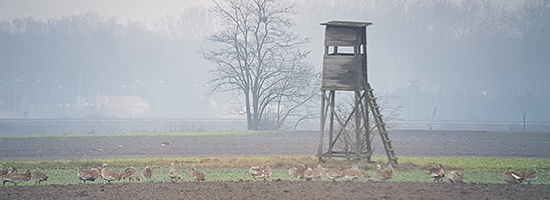
We continued to our next spot at Slovak’s side, where we were lucky to observe much bigger flock of bustards (we estimated their number to approx. 81 birds). As we were convinced, that the opposite side of their wintering area may hold even more birds, we moved through Hungary to Austria. Here we were able to observe them even better. We visited two watchtowers specifically built to Great bustard observations. At one of them we saw a Hen harrier (Circus cyaneus) attacking (in Slovakia) more and more uncommon Grey partridge (Perdix perdix). Although we had seen them there quite often in the past, this combination of birds is not a common sight in Slovakia.
During one of our transfers we spotted a bird of prey. After coming a little bit closer we positively identified this as an adult Imperial eagle (Aquila heliaca).
After this we stopped at even bigger flock of foraging Great bustards. And when another approx. 80 birds joined this flock, we were able to estimate their number to roughly 194. When taking our first four from a different area into account, the total number of these heavyweights was roughly 194 – 198 specimens. It was most definitely the biggest number of Great bustards we were able to see during whole three day observation process.
After this great spectacle we moved to another place, much more used by bustards during their mating and nesting season. We were not lucky to see any of them, but spotted three White-tailed eagles (Haliaeetus albicilla) quarrelling over some prey. Not far from them were also Stock doves (Columba oenas).
The end of our trip was Danube river’s Hrusov dam, where we observed beautiful male Common goldeneyes (Bucephala clangula) displaying in front of their female counterparts. We saw also much more uncommon Smews (Mergellus albellus) and later on even rarer Velvet scooters (Melanitta fusca) and Greater scaups (Aythya marilla). It surely was a great ending to our Great bustard observation trip.
Due to strict protection of this species and its conservation, walking in this Bird protection area is strictly forbidden outside marked tourist paths. We kindly advise visitors to respect it.


 ]]>
Beginning of summer is a time when animals are not as active as they were in spring period, so we at CK watching.sk also do not have that many activities. But, this year’s coming of the summer period was different, when we prepared two interesting canoeing trips. And although there were some small complications in the beginning, the result was second to none and we do not plan to end with this activity at all.
Out first canoeing trip became a reality on June’s last Saturday. We went to paddle down the main stream of one of the biggest of European rivers – might Danube. Many participants were surprised, that the main stream, so much used by cargo and other big ships, is also sailable by much smaller boats and canoes. Big ships are equipped with sonar, so they know where even the smallest of small boats are. Some people were scared of capsizing in the strong stream, but after initial briefing on how to safely dock a boat and how not to take too much water on bard, all that was scary started to be real fun. Non- (and close to non-) swimmers were instructed to thoroughly put their bodies into safety vests. Danube is a powerful river so every safety precaution and respect is always important yet there is no need to be afraid of it at all.
When we got to a meeting point in Bratislava early Saturday morning, it was still quite cold and heavy clouds gave us some mild share of raindrops from time to time. Altogether 12 people (including our guide Andrej) decided to “sail the distant seas” equipped with six laminated canoes were safely stored onboard a trailer. We got on a minibus and off we went for Austria. Our trip started at Donau Auen National park near the city of Stopfenreuth with our destination in Slovakia’s capital city of Bratislava. These last kilometres of Danube River in Austria are a part of project where all river’s solid (artificially made) banks will soon be gone giving way to natural forces, natural riverbanks with all indigenous plants and animals. To keep the river being sailable, an invisible artificial canal will be built in the river itself. When Andrej introduced to us this bold plan and national park itself, he showed of a proper paddling technique. Couples then hopped into the canoes and practiced in a small sheltered bay. God bless, no one suffered from sea sickness and we were soon ready to row. Entering the main stream was also not as dramatic as many expected and people barely noticed that they were moving at the speed of nice 15 kph. Canoeing was very smooth with occasional attempts to avoid bigger waves caused by passing cargo ships. During the way, Andrej showed us some of the newly built natural banks and islands, with smooth sand, barely visible from the river bank. Plovers love these sandy beaches to nest there undisturbed. We had a chance to stop on one island fully covered with invasive plant species to take a short break. Some of us, those more cold resisting, decided to take a little swim. Sun poked from behind the clouds and for that moment, it became really hot indeed. Soon after we paddled again and after a very short while, we spotted a familiar mountain Devínska Kobyla with majestic remains of Devin castle. This is the place, where Morava River meets Danube, so we needed to switch sides along which we were paddling. Under Devin castle, Andrej showed us an island called Slovanský ostrov. This river island is a strictly protected area with one of the last remaining alluvial forests, so entering this place is strictly limited. We had a chance to observe it from water level not only using a main stream of the river, but also from the other side where one of the river’s branches flows. As we were approaching our destination – Karloveské rameno, one of our canoes capsized when entering a still water inside the bay. Men over board had a great fun to swim towards the bank with towing the canoe behind them. They were chilled, and lost one paddle, but they were safe and sound and all smiles. It was when we noticed heavy clouds coming from Austria, so we had to use all our strength to land safely as soon as possible. Just when the last boat safely anchored, a heavy rain started, but all of us safely made it back home after 4 hours of paddling down the stream of one of the water giants of Europe.
July’s first Saturday we embarked on another canoeing trip, this time it was Hungarian side with its many branches, one of which, infamous Moson branch, was our destination. Although our minibus came a little bit later than agreed, it did not take us 14 (plus Andrej) long to reach the start of our trip – Rajka town in Hungary. Day was sunny and quite hot from a very beginning, so it was important that all participants had enough drinking water, because this canoeing trip was to take almost twice as much time as Austrian one. We distributed canoes evenly (what a surprise) some of which had very funny names (Catharsis, Rainbow, Seventh boat, etc.). Andrej was equipped with kayak, this time for a better manoeuvrability. He again showed us a proper paddling technique, for most of us had not participated on the trip to Austria one week before. Moson Danube is very similar to our Little Danube, but it’s shorter and wilder. In compare with a main stream, it’s significantly narrower and slower. Moson branch’s banks are very often covered with fallen trees one needs to avoid. And this was the doom of Catharsis and its crew. When trying to avid one of fallen trunks, Catharsis capsized with poor crew merrily splashing the water. Hot weather and shining sun made their bath significantly more pleasant had it been a week before. Maybe that was the reason why they repeated the same action soon after. Their hilarious sailing abilities were crowned when they not only saved all their paddles and gear, but (unbelievably) managed to find one more paddle on the way cancelling the losses from previous trip to Austria. This happy event marked the beginning of a very smooth and happy trip. First part of the trip was definitely most natural one, extremely calm, with trees fallen even to the half of the stream, breathtaking bays and forest all around. Not a single sign of civilisation, just an absolute wilderness. With temperatures over 30C, we were forced to make regular refreshment stops filled with eating and swimming. Firstly, stream was fast enough to limit our efforts to occasional paddling, but later, as the river broadened and flow almost stopped, we were forced to use our arms more. Again, we saw river banks untouched by humanity, but also numerous settlements fully using the advantages of water element, not to mention all those beautiful birds along the way. Shortly before our destination in a small town of Halászi, the big beach there was filled with families, and although we had scarcely seen a human being before, now we got a fair share of people, motor boats, and other small floating devices making safe navigating a real task. People just enjoyed the hot weather the best possible way. After landing, we did not miss a chance to taste some of local Hungarian cuisine specialities, got on the minibus and relaxed after a hot exhausting day on water. And because the reviews were largely positive, we definitely want to continue with such activities in future.
List of observed bird species:
Mallard (Anas platyrhynchos)
Little Bittern (Ixobrychus minutus)
Grey Heron (Ardea cinerea)
Great Egret (Ardea alba / Egretta alba)
Little Egret (Egretta garzetta)
Great Cormorant (Phalacrocorax carbo)
Black Kite (Milvus migrans)
White-tailed Eagle (Haliaeetus albicilla)
Marsh Harrier (Circus aeruginosus)
Common Buzzard (Buteo buteo)
Common Kestrel (Falco tinnunculus)
Coot (Fulica atra)
Little Ringed Plover (Charadrius dubius)
Common Sandpiper (Actitis hypoleucos / Tringa hypoleucos)
Common Kingfisher (Alcedo atthis)
Bee-eater (Merops apiaster)
Hoopoe (Upupa epops)
Black Woodpecker (Dryocopus martius)
Green Woodpecker (Picus viridis)
White Wagtail (Motacilla alba)
unidentified gull (Laridae sp.)
unidentified woodpecker (Picidae)
It has become a tradition, that every year in spring, we organize short walking courses on recognizing various bird calls in Zelezna studnicka leisure zone in Bratislava’s forested area. We did so this year as well, this time with a co-operation with Raptor Protection of Slovakia organization. Weather was second to none and thanks to that, mostly Saturday attracted an abundant number of nature loving people out of their homes. The beginning of our walk started at our traditional starting point which still is a former fast food area at Kacin junction (near Rotunda), where we had as well our information stall. Recently, this area is undergoing a reconstruction; so many people were surprised not to see even temporary fast foods around.
We did not do our April bird call walks in typical two-hour lengths, but (due to an astonishing number of registered facebook friends) we decided to start as early as 8 AM and since 10 AM begin to do our walks every hour. To manage so many eager bird loving eyes and ears, our bird call specialist Jan Dobsovic asked Raptor Protection of Slovakia’s expert, Mr. Roman Slobodnik on Saturday, and Nature Protection of Slovakia’s Andrej Kovarik on Sunday to help us cope with this task. Thanks to their immense help, the number of participants in each group was ideal. During those two days of walks, gentlemen guided almost 240 people and managed to observe 34 different bird species, which was a very nice number taking into account how relatively small the covered area was.
Thanks to a beautiful weather, songbirds were trying their best. Walk participants had an opportunity to learn how to distinguish calls of various species of tits, chaffinch, robin, but also a call of thrush and many others. All people were happy to see one of Slovakia’s tiniest birds – firecrest – that we managed to attract to a very close distance. We were lucky to see four species of woodpeckers, one of which, the middle spotted woodpecker, managed to be seen by many of our groups. On Sunday, our last walk was enlightened by the presence of mighty black stork, which paid us an uncommon visit.
We managed to discover several nests in various degree of completion. Feathered friends were not disturbed by our presence and were eagerly building homes for their young ones. Right next to our information stall, we had a very often used telescope aimed at chaffinch’s nest, so that people could see chaffinch at work. Nesting hole at the top of nearby electric pole provided a perfect nesting place for the great tit family, some tree holes became homes to Eurasian nuthatch and the Middle spotted woodpecker.
We would love to thank everyone who spent some time of that weekend with us and hope to see some, if not all, of you on our next Bird call walk, which will again be at Zelezna studnicka during the weekend of May 23 – 24, 2015.


List of observed bird species:
Mallard (Anas platyrhynchos)
Black Stork (Ciconia nigra)
Common Buzzard (Buteo buteo)
Stock Dove (Columba oenas)
Wood Pigeon (Columba palumbus)
Collared Dove (Streptopelia decaocto)
Lesser Spotted Woodpecker (Dendrocopos minor / Picoides minor)
Middle Spotted Woodpecker (Dendrocopos medius / Picoides medius)
Great Spotted Woodpecker (Dendrocopos major / Picoides major)
Black Woodpecker (Dryocopus martius)
Grey-headed Woodpecker (Picus canus)
Jay (Garrulus glandarius)
Raven (Corvus corax)
Marsh Tit (Poecile palustris / Parus palustris)
Willow Tit (Poecile montanus / Parus montanus)
Coal Tit (Periparus ater / Parus ater)
Great Tit (Parus major)
Blue Tit (Cyanistes caeruleus / Parus caeruleus)
Chiffchaff (Phylloscopus collybita)
Firecrest (Regulus ignicapillus)
Goldcrest (Regulus regulus)
Wren (Troglodytes troglodytes)
Nuthatch (Sitta europaea)
Common Starling (Sturnus vulgaris)
Blackbird (Turdus merula)
Song Thrush (Turdus philomelos)
Mistle Thrush (Turdus viscivorus)
Robin (Erithacus rubecula)
Black Redstart (Phoenicurus ochruros)
Dunnock (Prunella modularis)
Grey Wagtail (Motacilla cinerea)
White Wagtail (Motacilla alba)
Chaffinch (Fringilla coelebs)
Hawfinch (Coccothraustes coccothraustes)
Tuesday, January 6 and Sunday, January 11, 2015
We decided to start this year with our traditional action – observation of White-tailed Eagles near the Danube River. Although our plans had to be adjusted due to bad weather. There were several weather warnings issued on our planned date, that’s why we decided to change the date from Tuesday, January 6th, to Sunday, January 11th.
Just to be sure we made the trip also on the former date, in case some of the people did not get the message. And we did the right thing because many people showed up. The weather warning was canceled and the sun was shining all day long. Still the wind was quite strong. But ultimately, on Sunday (on our new date) was much worse weather than on Tuesday.
White-tailed Eagles (Haliaeetus albicilla) were not very active mainly because of the strong wind and we saw them only four times. Although we managed to see other species better. For instance Great and Pygmy Cormorants (Phalacrocorax carbo), (Phalacrocorax pygmeus), Great Crested Grebes (Podiceps cristatus), Common Coot (Fulica atra), Common Pochard (Aythya ferina) and Tufted Duck (Aythya fuligula). Some people were lucky and saw some very rare species, such as Long-tailed Duck (Clangula hyemalis), Greater Scaup (Aythya marila) and Horned Grebe (Podiceps auritus). In spite of bad weather, we were satisfied and are looking forward to see you next time.


List of observed bird species:
unidentified Goose (Anser sp.)
Mute Swan (Cygnus olor)
Wigeon (Anas penelope)
Mallard (Anas platyrhynchos)
Pochard (Aythya ferina)
Tufted Duck (Aythya fuligula)
Greater Scaup (Aythya marila)
Long-tailed Duck (Clangula hyemalis)
Common Goldeneye (Bucephala clangula)
Smew (Mergellus albellus / Mergus albellus)
Goosander (Mergus merganser)
Black-throated Loon (Gavia arctica)
Great Crested Grebe (Podiceps cristatus)
Horned Grebe (Podiceps auritus)
Grey Heron (Ardea cinerea)
Great Egret (Ardea alba / Egretta alba)
Pygmy Cormorant (Microcarbo pygmeus / Phalacrocorax pygmeus)
Great Cormorant (Phalacrocorax carbo)
White-tailed Eagle (Haliaeetus albicilla)
Common Buzzard (Buteo buteo)
Coot (Fulica atra)
Black-headed Gull (Chroicocephalus ridibundus / Larus ridibundus)
Common Gull (Larus canus)
large gull (Larus cachinnans/michahellis)
Feral Pigeon (Columba livia)
Common Magpie (Pica pica)
Jackdaw (Coloeus monedula / Corvus monedula)
Rook (Corvus frugilegus)
Hooded Crow (Corvus cornix)
Great Tit (Parus major)
Tree Sparrow (Passer montanus)
White Wagtail (Motacilla alba)
There were only two of us on the agreed place on Saturday morning. We assumed that it was due to the forecasted weather. According to the morning forecast the weather should be nice.
Although many people think that Bratislava has no pretty and well-preserved nature, the opposite is true. Among non-forest habitats we can find wetlands (especially around the Danube and Morava Rivers and Jurský šúr), meadows, reed beds, thermophilic habitats for Devínska Kobyla and of course forests. Besides spruce and mountain pine forests you can find virtually all vegetation levels in Bratislava, from floodplain forests, through the oak, hornbeam to the beech forests. During our bicycle tip we focused on the forests of the Small Carpathians.
We started with a lot of bird calls, since birds around sang, as it was early in the morning. We knew that thanks to the weather, today will be a perfect day for singing birds. Whenever we heard something interesting, we stopped and tried to find it. Gradually we caught the voice of Blackbird (Turdus merula), Song Thrush (Turdus philomelos), tits, Nuthatch (Sitta europaea) and Collared Flycatcher (Ficedula albicollis). We stopped at various types of forests, alder, but also hornbeam and beech . In beech forest, we eagerly awaited precious Red-breasted Flycatcher (Ficedula parva).
On several conifers we heard Firecrest (Regulus ignicapillus). We gradually moved to Kačín, where we managed to discover a cavity of Great Spotted Woodpecker (Dendrocopos major) and Starling (Sturnus vulgaris). Slowly we got to the Malý Slavín, where it started to rain heavily. Rain did not stop, so we end our trip. On the way back we were lucky and heard Red-breasted Flycatcher. The voice of this species is unmistakable, echoing as if someone wanted to start the engine that runs, but subsequently dies. Into human speech, its call could be transcribed as: “Ty ty ty tidla tidla dla dla dla”. In the end we, despite the merciless weather, managed to record up to 26 species of birds.


List of observed bird species:
Common Pheasant (Phasianus colchicus)
Mallard (Anas platyrhynchos)
Common Buzzard (Buteo buteo)
Feral Pigeon (Columba livia)
Wood Pigeon (Columba palumbus)
Common Cuckoo (Cuculus canorus)
Great Spotted Woodpecker (Dendrocopos major / Picoides major)
Green Woodpecker (Picus viridis)
Great Tit (Parus major)
Blue Tit (Cyanistes caeruleus / Parus caeruleus)
Barn Swallow (Hirundo rustica)
Chiffchaff (Phylloscopus collybita)
Blackcap (Sylvia atricapilla)
Firecrest (Regulus ignicapillus)
Wren (Troglodytes troglodytes)
Nuthatch (Sitta europaea)
Treecreeper (Certhia sp.)
Common Starling (Sturnus vulgaris)
Blackbird (Turdus merula)
Song Thrush (Turdus philomelos)
Robin (Erithacus rubecula)
Thrush Nightingale (Luscinia luscinia)
Collared Flycatcher (Ficedula albicollis)
Red-breasted Flycatcher (Ficedula parva)
Grey Wagtail (Motacilla cinerea)
Greenfinch (Carduelis chloris / Chloris chloris)
Great Bustard (Otis tarda), the heaviest flying bird of Europe, was the main aim of our next trip. This majestic king of the steppes was common also in Slovakia in the past. During 1890 -1900 lived in Slovakia estimated 2400 individuals. In the year 1956 it was 1165 individuals, but in the year 1973 only 410 – 693 individuals. The abundance of the nesting population in late 90´s was estimated only 5 -10 females. In present Great Bustard regularly occurs in Slovakia only at one site, during winter. So to observe the display of this majestic bird we went to our south-western neighbors to Austria. We went to the regular nesting area of several individuals.
After nearly one-hour drive we reached our destination. While driving slowly, we noticed on the field flying Northern Wheatears (Oenanthe oenanthe), so we stopped to take a closer look. Besides Wheatears there were also Whinchats (Saxicola rubetra). As we observed these small passerines, one of us suddenly took a glimpse of the first Bustard in the distance. As we looked if we saw some further individual, we noticed flying owl in a distance. It was Short-eared Owl (Asio flammeus). We had a good luck and nearly all participants observed it through spotting scope. It was a veryinteresting observation for us, as it is not a everyday matter to see this nocturnal animal and especially not during the day and while flying. After a while we went towards small observation tower. Here were also Stonechats (Saxicola torquata) and aslo other song birds. Here we saw more Bustards, and even while displaying. Displaying male flips his feathers, which is white from the underside, so a brown bird becomes a white ball. This way male flaunts before female, which he wants to impress. To see such behavior is really interesting. We stopped at another tower, from where we conveniently surveyed Bustards, and also other flying birds in the vicinity. We saw for example Montagu’s Harrier (Circus pygargus), Marsh Harrier (Circus aeruginosus) and Yellow Wagtail (Motacilla flava).
We continued to the canal at the Austro – Hungarian border, the line of former iron curtain. We saw several species of birds here, mainly small song birds. From the bigger ones we were pleased by Golden Oriole (Oriolus oriolus), which is a typical inhabitant of floodplain forests. We even spot one Imperial Eagle (Aquila heliaca) in a distance from this place. By attempt to take a picture of Common Cucko (Cuculus canorus) we had the opportunity to see at least a flying Curlew. Gradually we moved to the last observation tower, from where we went to Hungary.
We had a hearty lunch in a local csárda. As we sat outside, we saw House Martins (Delichon urbica) in the air and Jackdaws (Corvus monedula) sitting in a distance. After the lunch we went to the Fertő-Hanság National Park, where we saw several tens of Ruffs (Philomachus pugnax) from a short distance and Wood Sandpipers (Tringa glareola). Greylags (Anser anser) with gooslings, as well as Black-winged Stilts (Himantopas himantopus) and Spotted Redshanks (Tringa erythropus) were a bit further away. Two photographers stayed near the observation tower and the rest of us went to the colony of European Ground Squirrel (Spermophilus citellus), unfortunatelly we did not see any of them. This disappointment was saved by the observation of several Pied Avocets (Recurvirostra avossetta) in a short distance. We picked up our photographers and just the last part of our journey was ahead of us. We went to a short, approx. 2 km long, walk towards one of the observation towers. On our way we registered few warblers. The most fascinating was probably the meeting with a heard of several hundreds Racka Sheep. This domestic breed was on its way back to sheepfold, where they went with a loud bleating. About halfway we saw Purple Herons (Ardea purpurea) on the field. At tower a Common Cuckoo provoked us for a while, but managed to escape before our lenses. At a near water surface were all our common species of genus Anas. Besides those also Common Terns (Sterna hirundo), Black-headed Gulls (Larus ridibundus) and Mediterranean Gulls (L. melanocephalus) flew in the air here. On our return walk we saw three Whiskered Terns (Chlidonias hybrida). The last observation of our trip was a Barn Swallow sitting in a close distance. Satisfied with totally 85 observed bird species we set off home to Slovakia.


List of observed bird species:
Common Pheasant (Phasianus colchicus)
Greylag Goose (Anser anser)
Mute Swan (Cygnus olor)
Gadwall (Anas strepera)
Wigeon (Anas penelope)
Mallard (Anas platyrhynchos)
Northern Shoveler (Anas clypeata / Spatula clypeata)
Pintail (Anas acuta)
Garganey (Anas querquedula)
Teal (Anas crecca)
Red-crested Pochard (Netta rufina)
Pochard (Aythya ferina)
Great Crested Grebe (Podiceps cristatus)
White Stork (Ciconia ciconia)
Grey Heron (Ardea cinerea)
Purple Heron (Ardea purpurea)
Great Egret (Ardea alba / Egretta alba)
Pygmy Cormorant (Microcarbo pygmeus / Phalacrocorax pygmeus)
Great Cormorant (Phalacrocorax carbo)
Marsh Harrier (Circus aeruginosus)
Montagu’s Harrier (Circus pygargus)
Common Buzzard (Buteo buteo)
Eastern Imperial Eagle (Aquila heliaca)
Common Kestrel (Falco tinnunculus)
Great Bustard (Otis tarda)
Coot (Fulica atra)
Black-winged Stilt (Himantopus himantopus)
Avocet (Recurvirostra avosetta)
Lapwing (Vanellus vanellus)
Little Ringed Plover (Charadrius dubius)
Curlew (Numenius arquata)
Spotted Redshank (Tringa erythropus)
Common Redshank (Tringa totanus)
Common Greenshank (Tringa nebularia)
Wood Sandpiper (Tringa glareola)
Common Sandpiper (Actitis hypoleucos / Tringa hypoleucos)
Ruff (Philomachus pugnax)
Black-headed Gull (Chroicocephalus ridibundus / Larus ridibundus)
Mediterranean Gull (Ichthyaetus melanocephalus / Larus melanocephalus)
large gull (Larus cachinnans/michahellis)
Common Tern (Sterna hirundo)
Whiskered Tern (Chlidonias hybrida)
Feral Pigeon (Columba livia)
Wood Pigeon (Columba palumbus)
Turtle Dove (Streptopelia turtur)
Collared Dove (Streptopelia decaocto)
Common Cuckoo (Cuculus canorus)
Short-eared Owl (Asio flammeus)
Hoopoe (Upupa epops)
Green Woodpecker (Picus viridis)
unidentified woodpecker (Picidae)
Red-backed Shrike (Lanius collurio)
Golden Oriole (Oriolus oriolus)
Common Magpie (Pica pica)
Jackdaw (Coloeus monedula / Corvus monedula)
Rook (Corvus frugilegus)
Hooded Crow (Corvus cornix)
Great Tit (Parus major)
Blue Tit (Cyanistes caeruleus / Parus caeruleus)
Crested Lark (Galerida cristata)
Common Skylark (Alauda arvensis)
Barn Swallow (Hirundo rustica)
House Martin (Delichon urbicum / Delichon urbica)
Great Reed Warbler (Acrocephalus arundinaceus)
Sedge Warbler (Acrocephalus schoenobaenus)
Reed Warbler (Acrocephalus scirpaceus)
Grasshopper Warbler (Locustella naevia)
Blackcap (Sylvia atricapilla)
Common Whitethroat (Sylvia communis)
Common Starling (Sturnus vulgaris)
Blackbird (Turdus merula)
Common Nightingale (Luscinia megarhynchos)
Black Redstart (Phoenicurus ochruros)
Whinchat (Saxicola rubetra)
European Stonechat (Saxicola rubicola / Saxicola torquata)
Northern Wheatear (Oenanthe oenanthe)
House Sparrow (Passer domesticus)
Tree Sparrow (Passer montanus)
Yellow Wagtail (Motacilla flava)
White Wagtail (Motacilla alba)
Chaffinch (Fringilla coelebs)
Serin (Serinus serinus)
Greenfinch (Carduelis chloris / Chloris chloris)
Goldfinch (Carduelis carduelis)
Reed Bunting (Emberiza schoeniclus)