The post Students excel at international academic media festival appeared first on MJF In Touch.
]]>This year, the festival had over 300 student winners representing over 80 different schools. Missouri State University students brought home ten awards, including two awards for the “Co-Op” TV series and a first-place award for “Abstract Texture,” a multimedia sound design project.
These projects, among many others, were recognized for their excellence in media production. Below is a list of award recipients:
Audio: Multimedia Sound Design
- 1st Place: “Abstract Texture,” Tyler Windsor
Film & Video: Live-to-Tape Multi-Camera Studio or Remote Production
- Award of Excellence: “Co-Op, Season 2, Episode 2,” Desiree Roady, Rachel Bartel, Julia Rhea, Alexa Pfeiffer & Alicia Laffoon
- Award of Excellence: “Co-Op, Season 2, Episode 3,” Rachel Bartel, Nox Clark, Julia Rhea, Alicia Laffoon, Kaleigh Gilbert, Alexa Pfeiffer, Kong Thao & Evan McCall
Screenwriting: Narrative Feature
- 2nd Place: “Mack 2,” Johnny Dickens
- 3rd Place: “WHEELZ,” Jade Johann
- Award of Excellence: “Submerged,” Julia Makarsky
Graduate Scriptwriting
- 2nd Place: “Queen Augusta and Her Fabulous Bitches,” Joshua Malisos
- 3rd Place: “AZN,” Ellora Bultema
- Award of Excellence: “Solar Opposites, ‘Solar Opposites Telethon Extravaganza!,'” Matthew Neff
- Award of Excellence: “This Is My Body Broken For You,” Ellora Bultema
In addition to individual accomplishments, MSU received fourth place for 2023’s top winning overall programs out of 82 other colleges and universities.

This is a new category that BEA added last year. A school’s ranking is based on the creative achievements of all the individuals from the same academic institution within the last five years. It considers both the quantity and quality of student works. The ranking does not reflect an overall evaluation of the school, rather it evaluates the quality and consistency of the students’ creative works produced at one university compared to another.
MSU also ranked first place for top winning scriptwriting program, fourth place for top winning audio program, and fifth place for top winning film and video programs.
Established in 1955, the BEA (Broadcast Education Association) is committed to educators, students, and professionals as they pursue opportunities in electronic media. Competitions like the Festival of Media Arts showcase student and faculty digital media and broadcasting projects on an international level. With over 300 participating schools and more than 1,500 entries annually from all over the world, the BEA values excellence in media production within an academic setting.
Congratulations to the students and faculty of the media, journalism, and film department!
The post Students excel at international academic media festival appeared first on MJF In Touch.
]]>The post In Vain: A Musical World Premiere appeared first on MJF In Touch.
]]>“The music is the most emotional part of the show.”
– Cristina Pippa
Set in a contemporary society, the play follows the life of Vivian Wilde, portrayed masterfully by a talented cast. The play takes a unique perspective, humorously examining the materialistic aspects of modern society. The characters are well fleshed out and their backstories add a degree of depth and meaning to their roles. You’ll laugh, cry, and maybe even cringe a little, but most importantly, you will be intrigued by the dynamic social commentary and thematic symbolism.
“Many thanks to the Reynolds College of Arts and Letters for hosting this world premiere.”
– Cristina Pippa

The masterful direction by Broadway legend and professor, Robert Westenberg, and the Department of Theater and Dance’s own Karen Sabo, a well-crafted script, and the perfectly timed production cues all contribute to the overall success of the stage play. The attention to detail and nuanced performances by the actors transport the audience into the world of In Vain. Furthermore, In Vain also presents a thought-provoking but satirical take on modern American culture.

Overall, In Vain is a must-see experience that engages, entertains, and educates its audience. With its witty humor and engaging storyline, you will leave the theater smiling and pondering what it means to truly live. Don’t miss out on a chance to see this compelling and thought-provoking masterpiece.
Don’t miss it! There are still showtimes available!
Showtimes:
April 14 & 15 – 7:30 PM – Coger Theatre
April 16 – 2:30 PM – Coger Theatre
The post In Vain: A Musical World Premiere appeared first on MJF In Touch.
]]>The post Showcase: BEA Graduate Winners! appeared first on MJF In Touch.
]]>
Solar Opposites – BEA Graduate Screenwriting – Award of Excellence
Matt Neff is a second year graduate student in the Media, Journalism, and Film (MJF) Department’s MFA in Dramatic Writing program. He is set to graduate in May of 2024. Matt describes his inspiration for his favorite project, Solar Opposites, as a “spec episode for the series in which the main characters host a telethon to raise money for their own show to avoid getting canceled by Hulu.”
Matt has accomplished several goals while in the MFA program. Along with his work as a comedian, he’s also filmed his first short, How to F*ck Up a Heist, and is working on the MSU original sitcom Friends of Fiction, which is in pre-production for its pilot episode. After graduation, he plans to pursue a stand-up career in Chicago or L.A. and work towards a position in a professional writer’s room.

WHEELZ: Screenwriting – Narrative Feature – 3rd Place
Jade Johann was inspired by her desire for more inclusivity in characters portrayed on the screen. She also found inspiration in the idea that you shouldn’t be afraid to be yourself unapologetically.
Jade is a senior in the MJF’s Electronic Arts program with an emphasis in Visual Studies. She is also in the accelerated MFA in Dramatic Writing program. This means she takes credits in her undergraduate program and the MFA program at the same time, so she can earn graduate credit before finishing her undergraduate degree.
Her plans for the future include a Christmas movie that builds on the ideology of angels used in It’s a Wonderful Life and trying to see how that might look in today’s world.

AZN: BEA Graduate Screenwriting – 3rd Place
This is My Body Broken for You: BEA Graduate Screenwriting – Award of Excellence
Ellora Bultema’s inspiration for AZN came from a course she took on TV writing. “It examines the intersectionality of Asian-American identity and Midwest culture through the lens of a college campus sorority.” She describes the project as a Parks and Rec meets Glee mockumentary-style comedy. Ellora uses her own experience as a Chinese adoptee who has attended college in a Midwestern small town to inform her project.
Bultema’s inspiration for This is My Body Broken for You comes from the desire to write something darker and more cerebral, but still explore a comedic nature. She says she was trying to “channel her inner Charlie Kaufman.”
Ellora is a second year graduate student in the MJF Department’s MFA in Dramatic Writing. Even though the program is designed to be completed in three years, she is graduating in May of 2023. She uses writing to explore the different ways comedy can be expressed. After graduation, she wants to move to L.A. to pursue writing in either television, theater, or indie filmmaking.
Here’s a complete list of our winners!
Award of Excellence:
Graduate Student Scriptwriting Competition
2nd Place:
Award of Excellence:
Award of Excellence:
Multimedia Sound Design Category
Live-to-Tape Multi-Camera Studio or Remote Production
Awards of Excellence:
Student Scriptwriting Competition
Narrative Feature Category
2nd Place:
3rd Place (tie):
CONGRATS TO ALL THE WINNERS!
The post Showcase: BEA Graduate Winners! appeared first on MJF In Touch.
]]>The post Legacy: Dr. Andrew Cline appeared first on MJF In Touch.
]]>
Dr. Andrew Cline has served as a professor in Missouri State University’s Department of Media, Journalism, and Film, where he has taught a variety of courses ranging from journalism in both print and internet mediums to documentary film production and media convergence. Throughout his tenure at MSU, Dr. Cline has been a catalyst for change, inspiring students and shaping the field through his innovative teaching methods and his passion for journalism.
In addition to teaching, Dr. Cline also established a production company called Carbon Trace Productions. The name of the company was named after a bicycle blog and reflects Dr. Cline’s passion for cycling. During his time at Carbon Trace Productions, Dr. Cline made several documentaries, including “Downtown,” which won a category award at the 2016 New Urbanism Film Festival.
As a professor and a leader, Dr. Cline has been able to observe the changing landscape of journalism and media. He explains that he has noticed a cognitive shift from baby boomers who see themselves primarily as consumers of media messages to millennials who also see themselves as natural content and information producers. This shift in how students understand their relationship to media has been a major influence on Dr. Cline’s teaching and has helped students and colleagues better understand the industry.
After Dr. Andrew Cline’s many contributions to both the department and the field, he and his wife are leaving MSU and moving to Aveiro, a city two hours north of Lisbon, Portugal. Although he will be missed, the impact he has had on the department and its students will not be forgotten. His expertise and dedication to the field have left a lasting impression and have helped shape the future of media, journalism, and film.
“I cannot overstate how important it is for departments and universities to support faculty growth. I was fully supported by the Department of Media, Journalism, and Film as well as Missouri State.”
Dr. Cline expresses his gratitude for the support he received from the department throughout his time at MSU. He acknowledges the positive impact that the department has had on his life and career and is grateful for the opportunities that have been presented to him. As he sets out on a new adventure in Portugal, he leaves behind a legacy of excellence and innovation that will continue to inspire future generations of journalists and filmmakers.
The post Legacy: Dr. Andrew Cline appeared first on MJF In Touch.
]]>The post Walking the Red Carpet appeared first on MJF In Touch.
]]>Path from Houston
After premiering in Houston, Texas, the filming location, the next big step is to premiere in Los Angeles, California. Jocelyn explains that before the premiere happens in LA, however, they will try to make a profit by renting out theatres in locations with a built-in demographic including Birmingham, Memphis, and Atlanta.
Becoming the Producer
Networking is important in many industries and Jocelyn details its importance as it relates to the film industry. When Millana lived and worked in LA as a freelance filmmaker, she “thrived on getting any gig” and explains that during that time she applied to be a first assistant director with Jeffrey Taylor. After keeping in contact for years with Taylor, Jocelyn was contacted about an opportunity to co-produce Jacob, Broken by God. She explains that she is “very fortunate to know him and that we have a good relationship.”
The Director

Jocelyn mentioned that she didn’t want to direct the film when Taylor first offered her the role. In her own words, “He offered me the role as director, and I actually turned him down because I didn’t want to be known as a faith-based director.” Millana perused her contacts and network in an attempt to commission another director. She quickly realized that her contacts either have scheduling conflicts or otherwise can’t work on the film.
Jocelyn explains that when she realized that she would have to be the one who directed the film, she went through a period where she reflected and spoke to her mentors, eventually negotiating a great deal for her second feature film. Her negotiations gave her creative control and director’s cuts.
Time to Film
The project was filmed during the pandemic and utilized a lot of extras, many churches, and homes. Between the day she accepted the role of director and the day filming started was about 12 or 13 days. From Springfield, Jocelyn hired her crew while Taylor, in Houston, hired the musicians, cast, and other essential roles. She also completed all post-production in Springfield which included commissioning our Associate Professor, Andrew Twibell, as editor, Daniel Ketter, an in Assistant Professor in MSU’s Music Department, and Robert Murdaugh, a graduate student in the MJF Department, for sound design.
A Balancing Act
When I asked Jocelyn about balancing film obligations and teaching responsibilities, she explains that first of all, “filmmaking is not a one-woman job.” She says that sometimes the film credits seem just as long as the film itself. It takes a group of people, a network, to get something done. While filming and teaching, Jocelyn reiterates the essential nature of social platforms and technology like Zoom and text messaging used in tandem with in-person meetings to meet deadlines and balance her academic, producing, and directing responsibilities.
“Most of the time teaching doesn’t feel like teaching because I’m doing what I’m doing.” – Jocelyn Millana
Jocelyn actively blends her obligations as a professor and her filmmaking, since she teaches elements of producing and directing at Missouri State. She explains that it goes both ways; there have been instances where she has invited current and former students to work on her projects.

Advising the Future Film Maker
Jocelyn explains that the hardest part about becoming a film professional is realizing your career path. Screenwriting, producing, and directing are just a few avenues into the industry.
Here are a few things students can be doing right now to prepare themselves for a future in the film industry:
- Maintain a network
- Seek mentors
- Ask questions
- Avoid self-persecution
- Find your support system, “whether it be your family or your found family, surround yourself with those people.”
The post Walking the Red Carpet appeared first on MJF In Touch.
]]>The post Setting Standards appeared first on MJF In Touch.
]]>During her sophomore year, Dudenhoeffer began her journey with The Standard, MSU’s student-run newspaper, as copy editor for the sports section. Although she didn’t consider herself a sports buff, the skills of copy editing and the thrills of the busy newsroom had Dudenhoeffer hooked.
Eventually, Dudenhoeffer began expanding her passion for journalism beyond the written word and started experimenting with audio journalism. In February 2020, she started a podcast just before the world was thrown into chaos with the COVID-19 pandemic. As a way to adapt to the changes the pandemic brought with it, The Standard shifted to a more digital-forward approach to delivering news.
This wasn’t an entirely new concept for The Standard. The newspaper had been in the process of transitioning to an online-first format for several years. Rather than calling it an obstacle, Dudenhoeffer described COVID-19 as a catalyst for The Standard. It encouraged the organization to reevaluate the priorities of reporting and copy editing in the digital age. Dudenhoeffer became the digital editor in May 2020 so much of the responsibility of navigating this shift into an online format fell to her.
“Journalism is a profession of compassion and so many aspects of compassion go hand in hand with sustainability.” —Diana Dudenhoeffer
Nowadays, The Standard has fully embraced the online-first mentality. The newspaper’s regularly published content is released on its website and social media accounts, while print publications are reserved for specialized topics, such as homecoming or graduation news. Although there’s no denying that the publishing world has shifted to a digital mindset, Dudenhoeffer expressed her affinity for the printed word.
“One of the biggest reasons I still take print very seriously is just how fun it is to get to see your name printed on a piece of paper. That has a lot of value,” she said.
It wasn’t long before the position of editor-in-chief caught her eye. As she worked alongside the editor-in-chief at the time, Greta Cross, Dudenhoeffer began to understand the value that management style has on a team. Her approach to leading a newsroom, she described, is being student-centered when it comes to decision making and emphasizing the importance of excellence.
“We’re a student newspaper so I put a lot of emphasis on my writers to have their eyes and ears open to things happening on campus,” Dudenhoeffer said.
Dudenhoeffer sees her role as editor-in-chief as a way to bridge the gap between the reporter and the reader. She wants to accomplish two things as editor-in-chief: 1) create quality journalism that supports her community and serves her readers, and 2) foster an environment where a student can become the best reporter that they can be. She notes that many of her reporters started with no baseline when it came to journalism but, to her, that didn’t matter. What was important was giving her writers the tools, resources, and freedom to explore their writing style and shape their voice in a way that best served them.
“I want to empower my team.” —Diana Dudenhoeffer
From freshmen to seniors, students studying English to sustainability majors or minors, like Dudenhoeffer herself, The Standard helps students build relevant skills no matter what they’re studying.
To Dudenhoeffer, journalism is a profession that requires someone to explore and become proficient in many different subjects of the world without actually studying the discipline. It’s taking complicated nuanced information gathered from interviews and research and turning it into a digestible article that the common reader can understand.
When she isn’t reporting the news of MSU’s campus and the wider Springfield area, she’s using her storytelling skills to create a more compassionate world. Her vision for journalism is one that puts sustainability and empathy at its forefront.
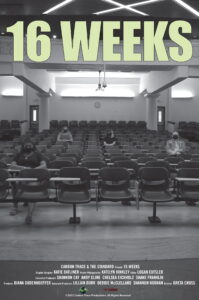
In August 2020, Dudenhoeffer was invited to work on 16 Weeks, a social media documentary that covers the lives of half a dozen MSU students during the 2020 fall semester. It was executive produced by MSU faculty member Dr. Andrew Cline’s nonprofit production organization, Carbon Trace Productions.
“There are so many different attitudes towards the pandemic. We wanted to show a brutally honest perspective of students trying and struggling through a COVID-19 semester,” Dudenhoeffer explained.
The idea was to capture an intimate glimpse into the pandemic from a student perspective. Student vloggers were asked to film themselves for 16 weeks doing anything relevant to student life during the pandemic. Whether that meant getting lunch with friends, attending classes over Zoom, or taking a COVID-19 test, the film sought to show day-to-day activities through the pandemic lens.
In the fall of 2021, Dudenhoeffer was nominated to be a Citizen Scholar, an annual award presented by the MSU Board of Governors to recognize students who exemplify the goals of the public affairs mission. Recipients were invited to a banquet dinner to celebrate their achievements.

As a soon-to-be-graduate, Dudenhoeffer sees her future as one with many unknowns but many possibilities, and journalism and sustainability have helped her understand her place in the world.
The post Setting Standards appeared first on MJF In Touch.
]]>The post Through the lens appeared first on MJF In Touch.
]]>This is what Dr. Holly Holladay asks herself when she sits down to watch TV. We’ll call it “the lens.”
To the untrained eye, it might sound exhausting to constantly be searching for the “deeper meaning” behind witty dialogue or spectacular set pieces, but for Holladay it’s almost instinctual. Holladay has been looking at media through this lens since she was in graduate school. She sees TV as a cultural storyteller that says something greater about what’s happening in reality while we’re watching the screen.
“It’s about more than just this television show. This show is just the mechanism or lens to let us think about something bigger.”—Dr. Holly Holladay
This approach to media analysis has garnered a world of truths in the shows we consume today—from the role masculinity plays in “Ted Lasso,” to the reflection of American culture during the Obama Era when “Parks and Recreation” aired. Once you get past the cringe-humor and “that’s what she said” jokes, the series finale of “The Office” sparked the exploration into post-object-fandom, how we deal with shows once they’ve ended. Even seemingly innocuous comedies, like “What We Do in the Shadows,” aren’t without their deeper meanings. The character Guillermo is a subtle yet undeniable metaphor for the low wage worker and the desire to work toward something higher in a society built upon capitalism.
When Holladay isn’t discovering the secret truths of TV, she’s teaching others how to do it themselves. As a tenured associate professor of media, film, and journalism at Missouri State University, Holladay teaches courses in media theory, social media, and media analysis and criticism.

With six years of teaching at MSU under her belt, Holladay describes the experience her students go through of learning how to look through “the lens” as a bell curve.
“When you first start thinking about media critically,” Holladay explained, “you don’t get it. Everything is just entertainment and it’s fine. But once you really start thinking theoretically, you want to burn everything down and you hate everything you loved, and it sucks. Then eventually you get to a place where you come back down.”
Holladay talked about her own experience with the bell curve. She uses “Parks and Recreation” as an example, a show that got her through her doctorate program.
“Parks and Rec was so special to me and there’s a lot wrong with it,” Holladay admitted. “And yet, I’m gonna keep watching it for the rest of my life because part of the reason I love it is not the show itself, but how it makes me feel and how it propels me to a particular time in my life. It’s like a hug. Nobody can take that away from me. You can be critical of something and still love it.” In fact, the show even inspired her latest book “TV Milestones: Parks and Recreation” which is anticipated to be published in the spring of 2023.
Beyond teaching students how to love something while being critical of it, Holladay’s classes get to the heart of what critical media studies is really doing—showing us why something works the way it does.
Holladay likes to begin the semester with an exercise where students question certain assumptions they have about the world and the way it works. Who gets to make decisions? Where do those decisions come from? Why are there particular stories that we see over and over and who makes those decisions about those stories? This eases her students into the act of looking at media critically. And more often than not, the students are already doing it. “It’s really interesting because my students talk to me in really chill and conversational language. The things that they’re saying are media theories, they’re just saying it super plainly.” She believes her role as a teacher is to give them the academic language to articulate what they already know.
“This isn’t quantum physics. This is social behavioral sciences. Humanities. Very much focused on how we live our day-to-day lives.”—Dr. Holly Holladay
So the next time you sit down to watch the latest episode of “The Umbrella Academy,” look through “the lens” and see if you can find the bigger picture.
The post Through the lens appeared first on MJF In Touch.
]]>The post Faculty Spotlight: Jack Dimond appeared first on MJF In Touch.
]]>
When asked how The Standard has changed since he joined the group a decade ago, faculty advisor Jack Dimond replied “How hasn’t it changed?” Back in 2011, The Standard was releasing two print newspapers a week and employed two full and part-time managers to take care of all administrative work. Now, The Standard focuses almost entirely on digital content such as articles, websites, videos, and podcasts. One special print edition is published every month and Dimond has taken over all the administrative duties for the newspaper while he searches for new managers. Dimond intends for the newspaper to focus mostly on digital content from this point forward to best prepare his students for life after college.
“Digital is the future. We want the students to be prepared for the 21st century.” — Jack Dimond
Dimond first became interested in journalism in high school. He already had an interest in politics and what was on the news, so once he realized he was a pretty good writer, he turned his focus toward reporting. Though both his undergrad and graduate degrees are in communications from Pittsburg State University, Dimond began his career in newspaper reporting. After three years of working on a newspaper in Pittsburg, Kansas, he decided to pursue teaching college and advising students. Dimond applied for several jobs before finding a posting from Missouri State for teaching journalism classes and advising The Standard.
Outside of advising The Standard, Dimond also teaches two journalism classes and works as an academic advisor. He also serves as a chair for the media, journalism, and film department‘s curriculum committee, which organizes changes in the course catalog and degree programs. Dimond used to serve as the recruitment coordinator for MJF, speaking to students at the fall, spring, and summer showcases, but has since handed the position over to Bobby Lewis. Dimond has continuously been a part of the Missouri College Media Association and helps to organize the group’s annual conference and administers their annual contest.
The most rewarding part of advising The Standard for Dimond is working with the students and building a program where they can work efficiently and effectively. Since students are constantly coming and going as the years pass, Dimond strives to build something that can be torn apart and built back up easily. He mentioned spending less of his time helping with actual journalism and more so helping students get organized, communicate, and work well in teams.
The post Faculty Spotlight: Jack Dimond appeared first on MJF In Touch.
]]>The post Faculty Spotlight: Andrew Twibell appeared first on MJF In Touch.
]]>“Prior to coming to Missouri State I was based in Austin, Texas, where I worked professionally in documentary, narrative, music video, and commercial production. These days, my work as a filmmaker is focused on directing, editing, and producing. Each year, I try to direct and edit a short film, and typically produce or co-produce a few student-created projects, outside of traditional classwork,” Twibell says.

Twibell studied film production at Florida State University, an intensive hands-on program where students spend a large portion of their time on set. This experience prepared him to mentor Electronic Arts (EA) students through their rigorous senior projects as the program’s coordinator. Twibell has taught at Missouri State since 2013 and has always been a part of EA faculty, earning the title of coordinator in 2019.
“I’m thrilled to continue to be a part of this program. I’m always amazed at the caliber of work our students produce, and I’m privileged to work with such a great group of faculty.” —Andrew Twibell
EA is an interdisciplinary program in which students explore filmmaking, audio production and post-production, computer animation, and interactive media creation. The EA faculty is made up of eleven professors from three different departments. “Students choose a primary ‘track’ to focus on, but will gain experience and skills related to all four of those areas. The curriculum is flexible enough for students to tailor the classes they take in those disciplines, depending on their interests. The program is meant to allow students to develop their voices as storytellers while honing a diverse set of technical skills,” Twibell explains.

The are certain requirements for admission to the EA program, including a “pre-admission core” in which students must complete nine credit hours in survey production courses in film, audio, animation, and digital art. “Those classes are meant to help students learn basic skills, decide what they want their primary focus within the program to be, and start building their portfolio,” says Twibell. He goes on to explains that “the portfolio, which includes 2-3 pieces of the students’ strongest work, is a key component of the application process. That process also includes an essay detailing the applicant’s creative, academic, and professional goals, and an interview with EA program faculty.”
The EA program is unique from other majors in the media, journalism, and film department due to its integrative nature. “You have a primary discipline that you focus on, but you’re also developing creative and technical skills in other creative fields. EA also affords students the opportunity to work on a year-long, large-scale senior project, which serves as the program’s capstone experience,” explains Twibell.
Outside of his work as coordinator, Twibell is currently in post-production on a short film he wrote and directed called “Blue Dot.” The cast and crew of “Blue Dot” consist mostly of students in the MFA in Dramatic Writing and other media, journalism, and film students, as well as alumni. He’s also editing an indie narrative feature film directed by fellow EA faculty member Joy Millana. During recent years, he’s worked on “Golden Age” (2018), which premiered at the 2019 Kansas City FilmFest International and later received an Award of Excellence from the Broadcast Education Association. Twibell edited the 2020 faculty production “Between the Creag and Sky” (2020), directed by Dr. Kurt Heinlein. This project is still in the process of being submitted to competitions but has been screened at seven national and international festivals to date.

The post Faculty Spotlight: Andrew Twibell appeared first on MJF In Touch.
]]>The post Journalism professor featured in news magazine appeared first on MJF In Touch.
]]>
After nearly a full year of online-focused learning, professors throughout Missouri State have all but perfected their various Zoom methods. One journalism professor has adapted so well that he earned the attention of popular news magazine Crain’s NewsPro. Leonard Horton, who has been teaching at Missouri State since 2013, was featured in the January edition of the magazine in an article titled “Among the Best in Class: Ten Educators Using Innovative Techniques to Train Students for a Brave New World.” Currently, Horton teaches Broadcast News Writing (JRN 381), Electronic News Gathering (JRN 388), Broadcast Performance (JRN 384), and TV Productions (MED 383).
Horton’s interest in broadcasting stemmed from, in his opinion, not being very popular or athletic in school. He carried around a Hi-8 camcorder in high school, which led to him being invited onto the field at a football game to film since he already had a camera. Before coming to Missouri State, he worked as an on-air reporter—experience that allows him to help students learn what to expect from the broadcasting field. He also spent some time as an assistant professor of journalism at Florida A&M University. Horton uses his collective experience to help former students currently in the news industry with their contracts, saying “Students, either in salary negotiations or who may have been laid off, contact me to help them with a transition plan.” In addition to this, Horton is currently a doctoral student in the cooperative doctorate program between Missouri State and the University of Missouri. With a focus in Educational Leadership and Policy Analysis, he will begin his dissertation in the fall of 2021.
“I began to realize that having a camera gives you VIP access to places and people. It’s been the same ever since!” —Leonard Horton
The transition to online learning hasn’t been all bad for Horton. His favorite class to teach, “Promoting Yourself in the Digital Age,” was offered online for the first time in summer 2020. It’s a one-week course covering resumes, cover letters, social media, and professional website creation. The switch to online allowed more students to take the course than usual, so the class will be offered online again in the summer of 2021. In his classes, Horton often includes Zoom interviews with professionals in the news business such as multimedia journalists, anchors, producers and news directors. Students were able to hear first hand from representatives of KOLR10, KY3 and the Springfield News-Leader on how newsrooms have adapted to the “new normal” with COVID-19.
Horton’s biggest challenge in transitioning to online classes hasn’t been the technology, but the loss of personal connection with students. Using Zoom makes it difficult for him to teach in his preferred style, which is very conversational and interactive. Another challenge he’s faced is being sensitive to the lives of his students, especially those who’s mental health have been affected by the isolation of online classes. Horton makes sure to check in with his students at the beginning of every class to see how they’re doing, a part of the class that’s extremely important to him.
Horton says that being named “Best in Class” is an honor and he appreciates the recognition for something he feels called to do. He went on to say he “would consider all of the faculty members in the media, journalism, and film department as Best in Class.” Horton’s one-credit hour intersession course will be offered online from May 17-21.
The post Journalism professor featured in news magazine appeared first on MJF In Touch.
]]>