The post Unmasking SEO Sales Emails: Google’s Content Standards appeared first on Blue Zoo Creative.
]]>Unmasking SEO Sales Emails: Google’s Content Standards
“Wow! Your website looks great, and you really look like an expert, but I noticed you’re not showing up in searches.”
Does this sound like a dozen emails you’ve gotten since your new website was launched?
Search Engine Optimization (SEO) is a cornerstone for any business in reaching new clients or educating potential clients. However, with the noise of SEO sales emails claiming that your website isn’t “showing up” in searches, it’s important to understand what truly matters to search engines like Google. Time to debunk the myths and explore what is really helpful content!
The Myth of Appearance Over Substance
How often have you received an email claiming your website looks great but isn’t ranking well in searches? While it’s true that aesthetic appeal matters to user experience by communicating your brand message, Google’s algorithm doesn’t rank websites solely based on looks. Instead, it prioritizes content quality, relevance, and user satisfaction.
Equating how ‘good your site looks’ to ‘showing up in search’ is not necessarily correlative (meaning you can have an ugly shoe, but it’s still super comfortable to wear and protects your feet).

Content Quality Reigns Supreme
At the core of SEO lies content quality. Google aims to provide users with the most relevant and valuable information for their searches. Your content must be well-researched, comprehensive, and engaging. Gone are the days of keyword stuffing and shallow articles. Instead, you must focus on creating content that genuinely addresses users’ needs and adds value to their experience.
Content can be text, videos, images, and more as long as search engines can index the information. Here are a few examples across different platforms and industries:
- Educational Video Series on Financial Literacy: A bank or financial institution creates a series of short, informative videos on topics such as budgeting, saving, investing, and managing debt. These videos are designed to address common financial questions and concerns that users may have. Each video provides practical tips and strategies that viewers can implement in their own lives to improve their financial well-being. By offering valuable educational content, the bank not only helps users make better financial decisions but also builds trust and loyalty with its audience.
- Recipe Blog with Nutritional Information: A food blogger who creates healthy and nutritious recipes. In addition to sharing delicious meal ideas, the blogger also includes detailed nutritional information for each recipe, such as calorie count, carbs, sugars, macronutrient breakdown, and key vitamins and minerals. This content helps users make informed choices about their diet and encourages them to try new dishes that align with their health goals. By providing tasty recipes and valuable nutritional insights, the blogger establishes themselves as a reliable source of culinary inspiration for health-conscious individuals.

Relevance is Key
Google’s algorithms excel at understanding context and intent. Relevance plays a pivotal role in search rankings. Your content must align closely with the search queries of your target audience. You need to do serious keyword research to identify the phrases your audience is using and tailor your content accordingly.
You can use semantic SEO tricks to give people what they’re looking for online. This means providing information that really matches what they want and making sure it fits the context.
An example of “contextually relevant information” is if someone searches for “best vacation rentals” in a particular city. In addition to listing top-rated vacation rentals, the search results would also include additional details like location details, customer reviews, ratings, booking availability, and local attractions and points of interest. This extra information helps the user make a more informed decision based on their preferences, enhancing their overall search experience.

User Experience Matters
Beyond content, user experience (UX) significantly impacts your website’s search visibility. UX isn’t just about how a user interacts with your site or how the design looks. Google prioritizes websites that offer seamless navigation (the same on all pages), fast loading times, and mobile-friendliness. Ensure your website is optimized for all devices and delivers a browsing experience that doesn’t confuse the user. Investing in UX improvements not only boosts your search rankings but also enhances overall user satisfaction.
Additionally, there are UX elements that are hidden, specifically for accessibility (vision, hearing, or other physical requirements). Images and photos that have alternative and descriptive text are indexable by search engines, and they are allowed to be displayed as search results.

Authority and Trustworthiness
Google values websites that demonstrate their expertise, authority, and trustworthiness. Establishing credibility within your niche builds trust with users and search engines. This can be done by:
- Quality Content Creation showcasing content that is accurate, comprehensive, and well-researched for your customers.
- Authoritative Backlinks where high-traffic websites in your industry refer to your website article.
- Share Expertise and include author bios, professional certifications, and awards.
- Transparency is easy to achieve by ensuring your content is accurate, up-to-date, and free from misleading or deceptive information.
- User Experience Optimization (as discussed above)
- Social Proof that includes customer reviews, testimonials, case studies, or endorsements from industry influencers.
- Regular Updates to your website with fresh, relevant content demonstrate your ongoing expertise in industry trends, developments, and best practices.
Lastly, avoid misleading or deceptive practices, like keyword stuffing, that may boost ranking in the short term but undermine your credibility and harm your rankings.

The Evolving Landscape of SEO
Recognizing that SEO is not a one-time endeavor but an ongoing process is essential. Google’s algorithms continuously evolve to deliver more accurate and relevant search results. Stay informed about industry trends, algorithm updates, and best practices to adapt your SEO strategy accordingly.
Some SEO resources:
- Official Google Search Central YouTube channel
- Search Engine Land News
- Moz Blog
- Yoast Blog (Blue Zoo includes the free version of Yoast on client websites)

Don’t be swayed by misleading sales emails prioritizing superficial aspects of your website over substance. Instead, focus on creating high-quality, relevant content that resonates with your target audience. By understanding what Google truly values—content quality, relevance, user experience, and authority—you can position your website for sustainable search success.
Embrace SEO as a holistic approach to digital marketing, and you’ll achieve increased visibility and organic traffic over time.

Want SEO?
When it's time for you to E-A-T (showcasing your expertise, authority, and trustworthiness), we have processes, tools, plugins, and plans ready for you.

About Eric
Eric Huber, Chief Creative Officer and Co-Owner of Blue Zoo Creative has 35 years in marketing, advertising, and graphic design for small businesses, a Fortune 100 company, and international organizations.

The post Unmasking SEO Sales Emails: Google’s Content Standards appeared first on Blue Zoo Creative.
]]>How to Optimize a Website Like a Pro
By Jon Trobaugh, SEO Consultant
“How do I optimize my website for search engines?”
The above is by far the most common question I am asked as an SEO consultant. To those outside the industry, it appears to be a question with a straight forward answer. But in reality, SEO optimization is a never-ending process with a list of complications from here to Mars. Today, I am going to scratch the Martian surface so to speak by giving you five steps you can take to increase your site’s search performance.
Step 1: Research keywords and user Intent.
Understanding what users search for and their intent in doing so is essential to SEO optimization. If you don’t know what potential customers are typing into Google’s search box to find products and services like your own, your SEO efforts will miss the mark.
The most popular tool for keyword research is Google’s Keyword Planner. The Keyword Planner lets you research monthly keyword search volumes based on your industry, location, and product type. You want to build a list of keywords with high search volume and low competition. Depending on site size and product diversity, this list may be hundreds of keywords long.
The keywords on your list should now be added to the site’s textual content in order to help the site rank for related queries. Your site only has so much content, so optimize for business critical terms first. Do not try to optimize for more than one or two keywords on any given page.
As with most aspects of SEO, keyword research is not a “set it and forget it” task. Keyword selection should be reevaluated quarterly.
Step 2: Create wonderful content.
The quality of your site’s content goes a long way in determining its search performance. Engaging, deep content is the expectation here. Optimizing content for search engines should always come second to creating a wonderful user experience. Instead of thinking in terms of landing pages, build “resource” pages, pages that are worthwhile to users even if they do not convert on their first visit.
For SEO, you want to make sure those mission-critical keywords appear in a page’s URL, title, and headings. Image alt-tags should also include keywords where applicable. Keyword use in a site’s meta description (the slug that appears under a URL on Google’s search results pages) does not affect rank, but a strong call to action in this description will increase click-through-rate.
Step 3: Think mobile.
Google recently announced that its mobile index would become the primary index for search. This means that Google will use what it judges as the site’s mobile quality to determine ranking decisions on all devices. It behooves webmasters to make sure their site is mobile friendly. No more excuses.
Step 4: Get social.
Facebook likes, Google +1s, and retweets no longer directly affect search engine rankings, but social media offers a perfect publishing platform to drive traffic to your newly created resource pages and promote your brand.
Step 5: Monitor and adapt.
After completing steps 1 through 4, use Google Analytics or a similar tool to monitor your site’s organic performance. Key metrics here are keyword rankings, organic visits/visitors, and organic conversions. By charting changes here, you can better shape your SEO strategy and always stay one step ahead of your competition.
Want to take your SEO to the next level? Get creative with the experts at Blue Zoo today!

About Blue Zoo
The post How to Optimize a Website Like a Pro appeared first on Blue Zoo Creative.
]]>Three Content Types You Should Never Gate
Gated content, sometimes referred to as premium content or paywall content, is any collateral that requires a user to give personal information (email address, phone number, etc.) and/or pay a fee to access.
Many website owners, especially those in business-to-business industries, gate far more content than they should. Here at Blue Zoo Creative, we know that having the right mix of gated and free, viral content is essential to a successful campaign. And to help make the “to gate or not to gate” decision easier for you, here are three content types we believe you should never gate.
1. Blog posts
Blog posts are a common content type, and they are meant to be read and shared through social platforms and linked to by other bloggers. Putting a single blog post behind a gate serves only to stifle that post’s usefulness and turn off potential readers. If a piece of content’s effectiveness is tied to its ability to be shared, it should never be put behind a web form.
2. Product information
Top level content, content that introduces your brand and services in a concise way, should never be gated. You want potential consumers to learn about your brand and products as easily as possible. Consumers shouldn’t have to give an email address in exchange for basic product specs or prices. And they won’t. They will move on, and you will lose the sale.
Two-step marketing is a viable strategy in some niche markets, but for 99% of businesses, asking consumers to spend valuable shopping time completing a long form is a non-starter.
3. Content designed for link acquisition
We know what you’re thinking. Content marketers are not supposed to build content simply to acquire links! True, but in reality that is exactly why many brands push out so many e-books, infographics, and videos each month. As in our discussion of blog posts above, content meant to be linked to needs to be available to everyone.
Studies show that gating a piece of content, no matter how popular or valuable that content is thought to be, dramatically decreases the number of downloads and shares, sometimes by as much as 95%.
Conclusion:
The decision to gate or not to gate should depend heavily on the content itself, your business’s niche, and the degree to which you rely on your house file for recurring sales. Content meant to create buzz, go viral, or to deliver essential product and service information should never be placed behind a wall. In our experience, a ratio of 70% free content to 30% gated works well for most brands.
Do you still have questions about how best to leverage your content? We can help with that; learn more about our content marketing and social media services for businesses in Northwest Arkansas and beyond.

About Emalie Cockrell
The post Three Content Types You Should Never Gate appeared first on Blue Zoo Creative.
]]>What Every Small Business Owner Should Know about SEO
What Every Small Business Owner Should Know about SEO
Search Engine Optimization (SEO) is often the most intimidating and confusing marketing activity for small business owners. But it doesn’t have to be. With a basic understanding of how search engines work and how they fit into the buying process, you can create a successful SEO campaign regardless of your budget.
What follows is a list of concepts that we feel every small business owner should understand regarding SEO, its strengths, and its pitfalls.
1) SEO is a marathon, not a sprint.
In a business culture predicated on immediate results, SEO is a misfit. It is rare to see any SEO technique affect the bottom line quickly. In fact, optimization efforts can take weeks or months to make a difference in search performance. Because of this, it is not recommended to rely on SEO marketing alone for new site or product launches.
SEO also requires continuous adjustment. Automated processes like those found in paid search marketing or social media are not always viable.
2) Paid search budgets do not affect organic search visibility.
Paid search, also known as Pay-Per-Click, PPC, or search advertising, has little to do with SEO, even though PPC and organic search results often appear together as seen in Figure 1 below.

Figure 1: A Google search results page for the query “2017 honda accord.” Paid search ads appear in the red box while organic results are below. Notice how paid ads are clearly indicated with a green “ad” button.
The position of paid search ads is determined in Google by a metric known as “Ad Rank,” a combination of bid amount, the relevancy of the ad’s landing page to the query, and some other factors. Ad rank works independently from the 200-plus factors that determine organic rankings. Your search advertising budget will not affect your SEO performance, and you cannot pay to rank well organically.
Does it make sense to buy search ads if your SEO is performing well?
Yes, search is not a linear event. Before users convert, they may conduct multiple searches over a long period of time. They may click on organic results, paid search ads, and visit your brand’s social media pages in the course of a few hours. In other words, the combination of paid and organic search can keep you in front of the user throughout the buying process.
3) Compelling content is essential.
You’ve probably heard content is king, and this is never more true than today. Compelling content engages the reader/viewer; helps increase search engine traffic; improves the chances that other sites will link to you (links are an important ranking factor); and increases the number of quality leads.
4) There are no shortcuts to SEO success.
Like all industries, SEO has its share of snake oil salesmen. We call these SEOs “black hat” because their strategies rely on aggressive tactics meant to con search engines into unfairly ranking a site above its competitors. These tactics are often in violation of search engines’ quality guidelines. Companies that guarantee dramatic rank improvement or attempt to sell your business links or social followers should be avoided. Remember, if it is too good to be true, it probably is.
If you always strive to deliver a quality online experience for your users, you should have no problems outranking your competition. Google and other search engines never punish good, honest work.
Discover more about Blue Zoo Creative’s SEO services by contacting a zookeeper today.

About Blue Zoo
The post What Every Small Business Owner Should Know about SEO appeared first on Blue Zoo Creative.
]]>Google Hummingbird Gets Social, but Content Still King
Google Hummingbird Gets Social, but Content Still King
Google created a search algorithm update called Hummingbird.

“Google has said content is king for years, and with long tail phrases and conversational searching, authoritative content will continue to win.” ~ Eric Ward, Search Engine Land
Hummingbird is the most significant update since Caffeine in 2010. The name references their goal for Google search to be fast and precise, continuing in their quest to dominate online search. Hummingbird allows Google to more quickly parse full questions (as opposed to single words), and to give back answers to those questions from the content they’ve indexed.
According to Search Engine Land and Tech Cocktail, here are the top impacts from Hummingbird:
- Google is placing additional emphasis on content that addresses customer needs and questions.
- Include search query results data in your ad content. This will help you rank better in voice search. Make sure your website content matches the search queries. If not, then it’s time to update your website.
- Google Analytics will no longer provide keyword data. Keyword information must be gleaned from other sources like Google Ads, your customers and social media.
- Quality, organic links are important. Content alone may not be enough. You must have trust and authority as evidenced by quality backlinks from trusted sources.
- Relational (think social media) information is more important. Google is connecting more information about people, places and things. This means social sharing, Open Graph Tags, and especially Google owned properties like YouTube and G+ are more important.
- Mobile is becoming more important to Google and search users. Make sure your site is optimized for mobile.
Google Conversational search is also live. Using the microphone in the search box, you can use your voice to have Google search be more conversational, understanding and feeding back information much like regular human conversation.

Image by Search Engine Land
Search Engine Optimization is still important, but the way you do it is changing. Dynamic and targeted content is becoming more important as Google works to improve search’s ability to help people find answers to their questions.
Key Takeaways:
- Discover the needs and questions of your customers.
- Answer them with quality content on your website. Blogs and FAQs are great ways to do this.
- Make your content easily sharable
This makes it an ideal time to update your website content.
If you want help, we have 3 great Content Packages designed to help you keep your information useful, relevant and engaging. Blogging, testimonials, FAQs and other social sharing content are more important than ever.
Quit Monkeying Around! Join the Zoo.™

About Blue Zoo
The post Google Hummingbird Gets Social, but Content Still King appeared first on Blue Zoo Creative.
]]>Don’t Feed the SEO!
Don’t Feed the SEO!
 You’ve probably heard of SEO (Search Engine Optimization), and wondered, is that something I need to be doing for my website? Well, we’re here to tell you all the reasons why you should not feed the SEO!
First, what if you did have your site optimized, and your website ranking shot up on Google? You’d suddenly start getting a lot more traffic to your site, which would probably increase the number of real clients contacting you about your service or product, and then where would you be? Who has time to handle all that extra work?!
And second, good SEO only puts an internet spotlight on your website, which is your best marketing instrument and already works for you 24/7. Surely you don’t want to make it work even harder for you, do you?
On top of that, good SEO will increase your sales without proportionately increasing your marketing costs, and then your budget will be all messed up! You might have to find some use for those extra marketing funds elsewhere in the company, which would just be annoying, wouldn’t it?
Paying for SEO analysis and improvement also might make you reach your financial goals and growth targets more quickly than planned, and then you’ll have to start all over setting new goals and working towards them!
By ignoring SEO, and not feeding the monster, you can avoid having a website that might be viewed by thousands of your best prospects and ideal clients. Don’t you want a website that you can leave to the whim and fancy of Google to rank at its will?
And finally, if you’re absolutely determined to ignore our best advice, and have decided that you must feed the SEO or have your website effectively die on the vine, please contact us for a quote, and we will do our best to make the process as painless as possible.
 About Kelly
Kelly was a Creative Content Strategist at Blue Zoo Creative. Her creative background in art, music and photography, experience in corporate HR, and Master's degree in English Literature from The College of William & Mary, she was able to adjust her style of writing for each unique client.
The post Don’t Feed the SEO! appeared first on Blue Zoo Creative.
]]>How to Win Friends and Influence Google
How to Win Friends and Influence Google
“Engagement” is a nebulous term referring to everything from social indicators to brand recognition to customer loyalty. In this post, when we say engagement, we mean the degree to which the design and content of your website are able to draw in and hook your visitors. In Google Analytics terms, this means page views, visit duration, bounce rate and returning visitors. In a nutshell, we’re talking about the amount of time visitors spend on your site and their tendency to return.
While more time spent on your site doesn’t necessarily translate directly to a higher conversion rate, it probably does mean that your visitor found value, has a positive impression of your brand and is more likely to return. Which, over time, increases the odds that casual visitors will convert to customers or subscribers.
There’s speculation that Google considers engagement, specifically bounce rate, in search engine result page (SERP) rankings. Matt Cutts, who heads the webspam team at Google, has said that Google does not consider bounce rate. Bounce rate data, he says, is too “noisy” to be a reliable indicator of engagement. But high-quality sites are engaging and engaging sites tend to be of higher quality, so it’s seems likely that Google is trying to crack this problem. Until they do, most of the things that engage your visitors also help with your SEO.
Things you can do to promote user engagement and make Google like you.

Open Strong
A 2012 eye-tracking study by the Missouri University of Science and Technology suggests that a website gets less than two-tenths of a second to make a first impression. When a visitor comes to your site for the first time, you have to let her know immediately that she’s in the right place.
- A clean, professional design establishes credibility, and helps your visitor quickly process your message.
- A compelling image or graphic leaps out and grabs user attention in those first crucial moments and communicates on a different level than text alone. Images evoke strong, immediate emotional responses.
- A succinct, clever headline communicates almost as quickly as an image, but with more precision. It’s your opportunity to let your visitor know he’s found what he was looking for and compel him to explore your content further.
With regard to SEO, the page layout algorithm improvement signaled that Google rewards sites that show content immediately, without ads and clutter at the top of the page. It’s also worth mentioning that while keyword density has lost much of its clout with Google (and can even hurt your SEO efforts if overplayed), keyword usage in headlines is still a characteristic of high-ranking sites. This according to two independent 2013 studies of search engine ranking factors: Moz’s 2013 Search Engine Ranking Factors and Searchmetrics’ SEO Ranking Factors 2013.

Socialize
SEO professionals have speculated for a while that search engines would begin to factor social signals as an indicator of content quality and authority. Both the Moz and Searchmetrics studies suggest this is happening. A high number of mentions on social media (particularly Google +1s) is a characteristic strongly correlated with high search rankings. Both studies are careful to point out that correlation does not equal causation. In other words, although content with strong social signals tends to rank highly in search, that doesn’t mean its rank is the result of social media.
With regard to engagement, we’re more likely to try something if it’s recommended by a trusted friend or colleague. Because of the value we expect based on our friend’s recommendation, we’re more likely to both click the link and give that content or product a chance, even if it doesn’t immediately appeal to us,

Be Verbose
Writing for the web has been guided by an intuitive wisdom to “Be Succinct.” The premise being that readers found on-screen text cumbersome and reading it unpleasant. Short and sweet still holds true on a certain level (Exhibit A: Twitter). However, technological advances, along with nearly two decades of acclimation to the medium, mean it’s no longer a given that your online audience prefers short content.
Over the last couple years, products like Pocket, Instapaper and Readability and sites like Longreads and The Atavist have found success catering to the demand for long-form online writing. And the principle extends to marketing copy. Neil Patel, co-founder of Crazy Egg, tested lead generation with 488 words vs. 1,292 words on the homepage of his blog. The long-form version converted 7.6% better. A split test by UX gurus 37signals found that, compared to a condensed version, a long-form sales page increased signups 37.5%!
Google, too, seems to like longer content. Both the Searchmetrics study and a study by serpIQ found a positive correlation between higher word count and higher SERP ranking. Of course, this effect has limits. Your 10,000-word blog post isn’t guaranteed first position in search results. The sweet spot appears to be 500 to 1,500 words.
But…

Break it Down
Especially important with longer texts, scannable content helps your visitors find what they came for and reduces the likelihood they’ll bounce to search elsewhere. Pages with plenty of subheadings and a sprinkling of lists are easier to digest, more visually appealing and are disproportionately represented at the top of search results.
- Use lots of headings and subheadings
- Write short paragraphs
- Highlight key phrases with bold or italic text
- Make lists
See how easy that was?
The things that improve your site’s search ranking are the same things that keep visitors coming back.
Some SEO techniques are faddish and may even be damaging in the long run (we’re looking at you, keyword density). We don’t have to guess at what Google will reward or devalue with the next update. Each tweak and refinement of the search algorithm is aimed at improving the ratio of high-value sites at the top of the results. We know what Google wants. It’s the same thing consumers of online media want.
Quality content on an appealing and functional website is a future-proof SEO strategy.
Quit Monkeying Around! Join the Zoo.™
Images via: http://iwdrm.tumblr.com/
About Dylan Hurd
The post How to Win Friends and Influence Google appeared first on Blue Zoo Creative.
]]>The post Getting Started with WordPress SEO appeared first on Blue Zoo Creative.
]]>
Search Engine Optimization (SEO) is a wild world with a constantly changing landscape. Trends change, algorithms come and go and it can be hard to know the best solutions. The good news is that WordPress is a very SEO friendly platform.
This post won’t teach you how to run a complete SEO campaign or all that WordPress can accomplish when it comes to search engine optimization. We’ll save those topics for another day. This post is about plugins! In particular there are two that can help your organization get results quickly with SEO.
Here are my top SEO contenders:
I. All-in-One SEO Pack
It is, as the title suggests, a fairly comprehensive solution for introducing easy-to-manage SEO components to WordPress. It offers the following:
-
Google Analytics support
-
Support for Custom Post Types
-
Advanced Canonical URLs
-
Automatically optimizes your titles for search engines
-
Generates META tags automatically
-
And more…
II. WordPress SEO by Yoast
Another comprehensive package that offers everything that All-in-One does, and also includes keyword and content analysis for your pages and posts.
Both plugins will improve your SEO without even changing the base options. They are configured with SEO standards in mind. With tweaking, however, both can become powerhouses. Do you want to integrate Google Authorship (and you should)? Done. Do you want to keep closer tabs on social media referrals? Done. These can be integrated without too much fuss.
Here are Blue Zoo, we use the SEO by Yoast plugin for our website and recommend it to our clients.
If you are wanting to explore these solutions yourself, it would be good to experiment a little. Don’t install both at the same time! Ideally, you would have two sites to use so that you could compare performance or try them one at a time.
Use the links above to download and then install via the plugin upload function in WordPress or just search for them within the plugin section of your admin panel. Before changing the settings too much, I would strongly recommend reading the following guides:
Have fun exploring WordPress SEO and feel free to leave a comment or question. We’re happy to help!
Quit Monkeying Around! Join the Zoo.™
The post Getting Started with WordPress SEO appeared first on Blue Zoo Creative.
]]>The post Essential Google Analytics Metrics – Part 3 appeared first on Blue Zoo Creative.
]]>
As mentioned in my previous posts on Google Analytics Metrics (part 1, part 2), there are many metrics that you can use to track your online results. Analytics uses data to find patterns, measure results and help make decisions about actions to achieve your goals.
This post covers the Demographics section of Google Analytics.
There are two subsections in the Demographics report, language and location.
1 – Your language is determined from your browser settings. When you visit a site, Google Analytics can request that information from the browser and determine the visitor’s preferred language. The codes are from one of two ISO specification (639, 3166). If you’re site is designed to have multiple languages like nwacaraccidentattorney.com, you can see which language is being viewed more and create more content for that language.
2 -Location information is provided by your ISP. Google Analytics can look up who your ISP is (Cox, Comcast, T-Mobile, etc.) and get an approximation of your location. You can do the same thing with sites like wheremyipaddress.com.
This method works well at isolating a location if you’re at home or at a business. However, mobile traffic is usually routed through a different region than your physical location. For example, if you live in Northwest Arkansas and have an AT&T iPhone, you’re probably being routed through Dallas, TX.
The initial location report is broken down by country. However, if you operate in the United States like Blue Zoo does, you can click on the name of the country and get a breakdown of traffic by state.
Since we’re in Fayetteville, Arkansas shows up as first on the list. Typically, you’ll see California, Texas and New York near the top of the list since they’re the most populous states. You will get random visitors from those states even if you’re a local company.
Once you get the list of states, you can select the state name and get a breakdown by city. If you’re trying to promote local businesses, this report will let you focus on the traffic that is closest to you physically. You can then get a better idea if your local online efforts are paying off.
If you need help interpreting Google Analytics or any of the various social media, mouse tracking, online ad tracking, or any of the other web metrics out there, please let Blue Zoo Creative know how we can help.
Measure your results for success.
Quit Monkeying Around! Join the Zoo.™
The post Essential Google Analytics Metrics – Part 3 appeared first on Blue Zoo Creative.
]]>The post Google Analytics Metrics-Part 2 appeared first on Blue Zoo Creative.
]]>Here are my tips on using Google Analytics metrics.
The first thing you see in Google Analytics is the Audience overview.
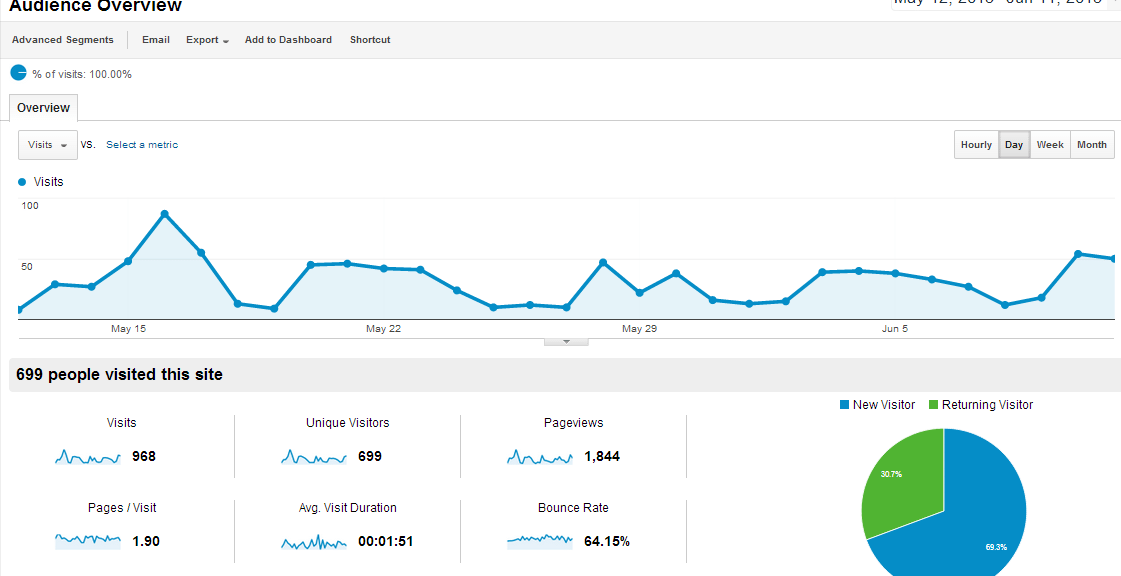
In the last post I talked about Visits, Pageviews, Pages/Visit and Avg. Visit Duration. These metrics cover how many people are coming to your site and how they are interacting with your site.
This post will cover % New Visits, Unique Visitors and Bounce Rate.
% New Visits tells you how many visitors to your site are first time visitors. As you first launch your site, this number will be very high. After you get some age on your site, it should level out. What is a good percentage for each metric? It depends on what you’re doing. If you have new products or services that you’re offering and you’re promoting them online, this number should be high. If you’re appealing to existing customers then the reverse should be true.
For more detailed information about New Visits, Look under Behaviors > New vs. Returning and look at the Avg. Visit Duration column. Are the Returning Visitors spending more time on site than the new visitors? If so, they might have a favorite category or section of the site that they’re revisiting. Explore the data to look for the engaging content. If the new visitors are spending more time on site than returning visitors, then you might not be updating your site enough or offering enough information that is different from the existing information on your site.
Bounce rate is the percentage of visitors that leave or “bounce” from your site on the first page. If you have a high bounce rate it might mean that your initial page is not compelling and needs to be redesigned. Try using A/B testing and mouse tracking to determine what keeps people reading on your site and clicking further into the site.
It could also mean that the content for the page doesn’t match the keyword that brought the visitor to the site. Ideally, each page on your should have just one focus so this doesn’t happen.
If you need help interpreting Google Analytics, social media, mouse or online ad tracking, or any other web metrics, please contact us for help.
Quit Moneying Around. Get Anaytics Today. Join the Zoo.
The post Google Analytics Metrics-Part 2 appeared first on Blue Zoo Creative.
]]>