Our plans did not turned out as we would have liked them to. Some games took too long to produce while others took too long to be released. To put it simply, we made some bets and they did not pay off.
Because of that, we do not have the resources to support the team in the current form. This is why we have to go back to our roots. We have to go on our own again – Wojtek and myself as Bushido Games.
Don’t worry, we will still make games. We just need to think really hard on what our next step will be.
Now, one man’s loss is another man’s gain. There are 4 great specialists on the market for you to grab. We had a great pleasure working with them. Bushido Games would be a completely different company without them. They put their heart and energy into everything they did.
Łukasz Sałałajczyk – Software Engineer, l.salajczyk[at]gmail.com – He started with us from the beginning. It has been 4 years. Obviously he is a great frontend and backend developer, specializing in creating games in HTML5. What is cool about him is that he is always looking at the big picture. He brings new ideas to the table. He can be left alone with the project and he will deliver. Łukasz led the development of Square Solitaire Duel from the idea to the finish line.
During his years in Bushido, he not only thought about how to improve the product but also the company.
Przemysław Szczepaniak – Marketing Specialist, p.szczepaniak_1980[at]o2.pl – The blog you are reading right now is his work. He wrote almost every post. Many of them were also published at Gamasutra. His activity brought new opportunities for partnership leads and raised our brand awareness. He handled our Twitter and Facebook pages. He was also responsible for Square Solitaire community on nk.pl.
Przemyslaw is very effective in finding new business partners and well organized in maintaining the day-to-day communication with them.
Agata Kowalewicz – Game Artist, agata_san_4[at]hotmail.com – She has brought quality graphics to our games. It is incredible at how many different styles she can create in her work. Agata has amazed us with the cartoon and light style of Animory, the African and minimalistic theme of Treasures of Sahara, and the heavy and rich casino style of Square Solitaire Duel.
Also (and in my opinion what is most important), she has a great work ethic. I have worked with many artists/graphic designers and only a few were on her level. She is patient when discussing her work; she always brings new ideas; she thinks about how to improve the product (beyond the artwork); and has a passion for games
Dawid Winiarczyk – Software Engineer, dawid.winiarczyk[at]gmail.com – He is fast! If there is a list of bugs and features on the scrum board, you can be sure they will be finished in no time. He is independent and is always looking for interesting techniques or technologies. What we really like about him is that he doesn’t like to reinvent the wheel. Be prepared because he will introduce new stuff like he did in Bushido Games with Coffeescript and Phaser.
What can I say at the end? I can only wish them good luck. Now somebody else will have the pleasure of working with them.
Now the situation in Bushido Games is changing, but in spite of that we cannot wait to see what the future holds. We already have a couple games planned for release. We will continue to support our previous games. We have one of the most exciting parts of game development in front of us – planning our new project.
Keep your fingers crossed!
]]>
CLICK THIS LINK TO PLAY THE GAME on Facebook.
With Square Solitaire Duel, we want to reach out to a worldwide audience. The rules and gameplay are the same as they were in the Polish version. The game with its features is more like a dueling game of multi-player solitaire than a typical poker match.

From a simple form of Poker for two, we developed it into more sophisticated and entertaining form. The idea behind some changes from an early version, has grown into two types of gameplay (NORMAL and PRO), with additional, entertaining features.
We hope you will enjoy the game as we do! Check out the trailer video, the game features, and join us in a game now!
Features of Square Solitaire Duel:
- Duel 1 vs 1 asynchronous – wait up to 24 hours for an opponents response.
- Freemium monetization: two virtual currencies: coins and gold.
- Weekly tournament
- Wheel of fortune as a daily bonus – players can win game boosters, drinks, gold and coins.
- Boosters are our original feature for the game. They allow players the option to see the next two cards from the deck, change the placement of two cards, withdraw the last used card, or reject the last card.
- Drinks are an addition to make the game more entertaining. Anyone can buy a drink to make the duel more enjoyable!
What are you waiting for? Log into your Facebook account and challenge us in game!
]]>Unfortunately the Polish HTML5 gaming market is not yet aware of the true potential of web based gaming (especially for mobile). On the other hand, we see a growth in the number of polish developers who find this niche not only challenging but also potentially profitable.
Despite our gaming market’s lack of support for web solutions, we do our best to show our products globally. Presently, we can provide examples of developers who release their games with major distributors around the globe. Our company Bushido Games, and our friends from Black Moon Design and Enclave Games have already proven that HTML5 gaming is working and can be profitable. I’m sure that other Polish developers have also tried their best to show on major HTML5 gaming sites. This is great, because it shows that not only it is happening in our country, but it is a fact.
HTML5 gaming worked out in other countries, and it may also have a chance to do that in Poland. The only problem of course is the lack of support from huge companies/publishers to help developers unleach their web gaming potential. The lack of knowledge and promotion of HTML5 gaming also isn’t very helpful for the market itself. If the market would like to reach another level, it should look out for new solutions because right now the app stores aren’t working as well as they used to.
Thanks to initiatives like the onGameStart conference, our dev friends also want to do something more for other developers. After reading his blog entry, I had a recent chance to chat with Andrzej Mazur. Unfortunately the blog is in the Polish language, so it may be a bit of problem for many foreign readers.
The article (CLICK HERE) promotes Workshops for developers, which are an idea of Andrzej Mazurs’s friend, Piotr Zwoliński. The workshops are planned to start in May or June, 2014 in select Polish cities depending on the number of people attending. If those workshops happen then Andrzej Mazur will be hosting them. (There may be about 6 workshop events.) Those events will also contain devmeetings and Phaser meetings. This sounds like a great opportunity for inexperienced game devs! This way, developers can not only learn more about HTML5 game coding, they can also find out what the future is for web gaming. It will also be possible to find out what the technology is like and how a developer can start his adventure in this still young gaming niche.
If you feel interested in this event, go to THIS SITE and fill in the form. The more interest, the bigger the chance for workshops to be successful and the more likely the workshops will be held in more locations. There are also opportunities to take part in similar events. If you are interested, please go to the gamedevjs.com website. You will find more information about upcoming workshops, hackathons and meet ups at that website. Sounds great, doesn’t it?
I really would like to see more of this happening in the Polish gaming market. Workshop events are not only a great place to learn about coding, but the promotion of similar events can bring a higher interest to the Polish gaming market and bring big companies into web gaming (especially mobile). If you like the idea – support it and join the workshop!
Image cover courtesy of [KROMKRATHOG] / FreeDigitalPhotos.net
]]>
Why does the future of mobile gaming reside with HTML5?
The growth in the number of mobile devices on the market and the way those devices are advancing can make everything possible. And in the terms of discussion about HTML5 gaming it became a fact. We see more advanced smartphones with multiple CPU’s and more RAM. They can easily cope with web games compared to how they did in the past. Devices have advanced so much nowadays that we really cannot imagine our lives without mobile internet access and mobile gaming.
Of course we still have native games which are a huge part of the mobile entertainment business, but HTML5 is growing rapidly and it has one big advantage – gaming in the cloud. As a confirmation I’d like to quote an article from XTND: “The main benefit of gaming on the cloud is that there is no need to store the whole game on the mobile device yet you can experience the high octane playing experience. With 3G and LTE coming up the internet speed is not a problem for many. Moreover, the Wi-Fi is available at most public and private places these days making cloud gaming all the more enriching experience”.
There is another reason. Native app stores are currently overloaded with a huge amount of games, and it is much more difficult for a small developer to stand out in the crowd. Only huge productions with huge marketing have a chance for success. Is HTML5 an answer? Yes. Let’s take the example of the game Flappy Bird. This game became one of most loved and hated games in years, and it was made in HMTL5 technology! Why am I mentioning this? According to words of Ross Grossberg, CEO of Tresensa which were posted in Techcrunch article, the reason why Tresensa focuses on HTML5 on mobile is that the “window of opportunity” in smartphone app stores has closed. Launching a game in those stores now is “almost like a Hollywood blockbuster,” he said, without much hope for independent developers who lack a big marketing budget. (That’s one of the reasons why people found the Flappy Bird story so fascinating.)”.
The other important reason is a lack of support for Flash on mobile devices. Recently we have been informed by Adobe, that it will give up on Flash. “Flash is a type of software called “middleware,” an add-on extension to the browser that allows rich content like video and games to be viewed. HTML5, by contrast, allows developers to embed that content right into a website without the need for middleware.” This is crucial and a very important argument. We all know that Flash will not be supported for the newer versions of Android based devices. That gives a huge advantage to HTML5.
The same thing is happening with Apple devices. It is worth mentioning the article “Thoughts on Flash” by Steven Jobs where he said that, “Flash is closed and proprietary, has major technical drawbacks, and doesn’t support touch based devices. There is an even more important reason we do not allow Flash on iPhones, iPods and iPads (…) New open standards created in the mobile era, such as HTML5, will win on mobile devices (and PCs too).” In this situation, what can really be the ultimate solution if not HTML5?
Unity CEO, David Helgason said for one of Gamasutra’s articles that, “Developers are moving away from Flash, and while Flash publishing has gotten little traction, our own Unity Web Player has seen unprecedented growth in recent months.”
It’s all about Unity and other powerful Javascript based engines now.
The Words of David Helgason confirm that Flash is no longer needed: “The popular game development platform Unity will no longer invest in Adobe’s Flash, as the company says that it does not believe that the future is certain for Flash.” We can now easily confirm that Unity, one of the Javascript based engines, is currently becoming the best alternative to Flash. In this situation we can only watch how much traction the Javascript based engines can get in the means of development of mobile apps.
Transition blog describes four of the most amazing alternatives to Flash, and they state that “Unity web Player, available for Windows and Mac OS X, is one of the most powerful software that can replace Adobe Flash Player easily. Unlike the other alternatives, any sorts of requirements like browser version, OS restrictions, etc. Along with playing online games and enjoying HD video streaming, it also gives you the power of developing 3D games with animated characters and mesmerizing graphics.” I think that this is one of the best comments that proves Javascript based engines and web mobile gaming can truly become one of the best alternatives.
I have already mentioned in my previous entries the power of such Javascript based engines. The performance of such engines really feels like a native application. For example, Unreal Engine 3 utilizes HTML5 technology to communicate with your video card, and this gives a lot of possibilities with browser-based gaming. I mean take a look at the tech demo of Epic Citadel. It looks astonishing and performs wonderfully on mobile devices!
HTML5 is the future of mobile gaming.
Currently, developers only prove that the impossible is meaningless. With all the examples I mentioned here, I can confirm that Flash for mobile is not necessary, because it is actually dead for mobile. Only HTML5 can truly unleash its plugin free power in the coming years. The new era of mobile fun has begun. With mix of web technology features, we will be able to play amazing games on multiple devices even online with our friends!
Image cover courtesy of [phanlop88] / FreeDigitalPhotos.net
]]>
-
The first issue we meet is the input or the steering.
Before developing a cross platform HTML5 game, we need to think about about the gamer’s experience and how they will operate the game. For PC’s or consoles it is pretty simple. Most games developed for those platforms use a keyboard and mouse or possibly a special input device such as a gamepad, joystick or steering wheel that can also be customized. But for smartphones, tablets or devices running similar OSes such as Smart TV’s, it is much more difficult. The touch, tap, or slide features limit the user in steering in a game, and we cannot customize it. The TV controller is also limited in its function. This is a very obvious issue, but it may be crucial to gameplay and game types available. Think about it seriously before creating a prototype, and then test it so you don’t run into future issues in the project’s development.
-
Testing the games may be difficult.
Creating the game code for many platforms in a multiplayer game can be difficult, especially since developers have to sacrifice extra time for testing and fixing issues for the various devices. It is fairly obvious that the slogan “One code, multiple devices” doesn’t really work as easy as it sounds. It may cause extra frustration. I’d like to quote one of Gamasutra’s articles “While HTML5 might be designed to run on a wide range of devices, there’s still no reliable way to maintain performance across varying hardware specifications“. In this article, EA creative director Richard Hilleman said that “On my own computer, which runs on an i7, I couldn’t get more than a few frames per second [from our demo]”. Futher in the article he explained that “high performance JavaScript is obtuse at best“, so it’s hard to predict how an app will run on a given hardware specification. For a developer there is a need to solve a lot of problems during the game testing. The variety of devices in your gaming studio has to be really big, and it’s not only limited to devices that have the latest system updates or simply the newest smartphones or tablets. Developers also have to think about older devices, the ones who are owned by gamers who don’t update their hardware or systems very often. Because of those issues the game may not simply work on bigger part of devices. The same issue occurs with older versions of browsers on multiple devices on various platforms.
-
The speed of the game on various devices requires code optimization.
This may be very difficult, and it is strongly connected with the game testing process because a game can work great on a PC, but the performance on a smartphone can be poor because of the lack of CPU power or memory (or vice versa if a game was designed for a smartphone in the early stages.) It is important to design the game while keeping the technology limitations in mind for various devices. For example, you might create a great game based on WebGL, but it simply will not work on a tablet, or worse will not work on a smartphone. This may sound obvious, but I believe you get the idea.
-
Issues with audio implementation for mobile devices.
Issues may occur with game lags or even the browser crashing while playing. Develop-online posted the words of Chris Herbert, technical lead of Remode Studios, where he says, “… audio is considerably behind the rest of the platform’s features, with problems such as lag and file support”, although he believes there could be vast improvements in this area in the future. There are clearly areas of HTML5 that need some work, audio being an area that’s lagging behind quite dramatically, particularly in mobile browsers (…) “The problems mainly relate to how sound data is swapped out of sound channels, many browsers are experiencing a lag, or in some cases jumps or pops (…) Also, the support for audio file formats is inconsistent, with some browsers favouring the ogg vorbis format whilst others – such as Safari – favour the MP3 format.” But further in the article, Sandy Duncan, CEO of YoYo Games, confirms that this issue is being worked on, and it just needs time to be fixed. Hopefully we will expect that fix soon, since this is one of the core elements of having fun. It hasn’t been the biggest issue for mobile since most HTML5 mobile games don’t have sound, but it is not acceptable by players who play those games on PC. It would be great to have same the sound experience for all platforms while playing a game.
-
Big screen vs small screen experience
The difference in screen resolution can be an issue. If for example developers make strategy or rpg games where there is a vast map that players have to move their units around on then there can be a problem. Players with lower resolution screens (smartphones) don’t have a chance to react as easily if they need to scroll the whole map to defend their city or send out troops. We may find similar problems with a difference in game design for the different size screens. On the other hand, simple games made for mobile devices may not look as nice on high resolution TV or PC screens, so this would also require a solution. The developers could only consider building the type of games that will not cause a problem for any platform.
-
Multi platform interface
During the start of development of an HTML5 game, developers have to design different types of game content on the screen (especially different user interfaces) for players on different platforms. This can become quite complicated, because every platform will use a different type of screen setup. Yes, it is very similar to resolution issues and for sure it requires planning of the screen setup. This is the moment where UX and easiness of game use comes in, and it is crucial to plan the interface according to the limitations of design possibilities for various devices.
Conclusion.
Those issues are not the reasons to give up on HTML5 cross-platform game development. These are just some obstacles that each developer meets during game creation. We have found out already that many past issues with games performance and speed have been solved. Nothing is impossible as long as developers and the companies which create browsers, operating systems, and coding languages find a way to solve some of these issues. Do you agree? Have you found other issues in HTML5 coding and solution you would like to share? I’d like to hear them from your point of view.
Image cover courtesy of [KROMKRATHOG] / FreeDigitalPhotos.net
]]>Some facts and numbers.
I’d like to quote a few facts collected by Spil Games in their state of the industry report for 2013. This report contains a couple pieces of interesting bits of information. Currently, the biggest focus is put into mobile, which is one of most preferred platforms for the future of HTML5 gaming. The mobile sector is growing very fast. The need for mobile devices since 2012 till now has reached almost the same level as for the PC’s, according to Spil Games’ report, and it will eventually change in favor to mobile. That means that having fun on mobile is just as important for users now as it is for users who spend their time on desktop devices.
“With iPads and other mobile devices (particularly Android-based systems) becoming cheaper and more widespread, and their users seeking out more opportunities to play games, in-browser and app-based gaming is exploding (…) Looking further ahead, it’s inevitable that more devices will be developed to support this growing area, and browser or app-based games will draw in the mass market as they offer the easiest entry point into gaming (…)
In 2014, tablet shipments are expected to increase 42.9%, with shipments reaching 263 million units. On top of this, mobile phone shipments are projected to grow around 5% to more than 1.9 billion units. Set this off against a projected 11.2% fall in traditional PC (desk-based and notebook) shipments, and it’s clear mobile is the way forward.”
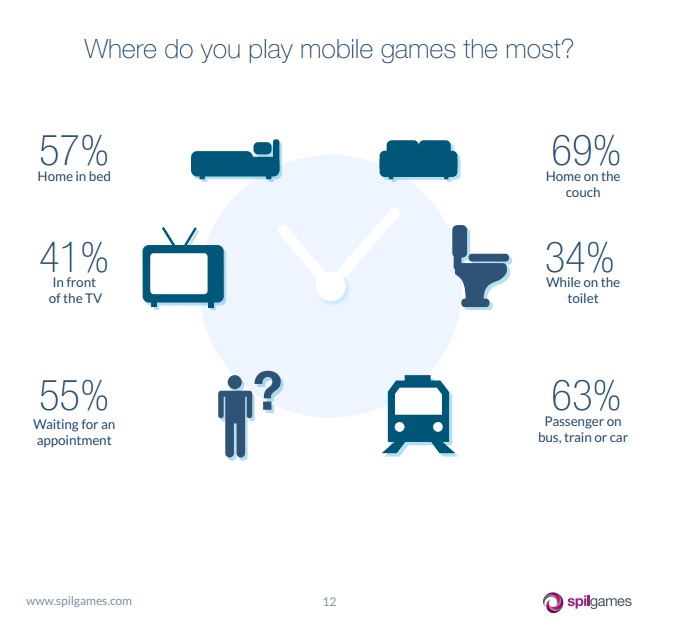
Since HTML5 gaming is seen as the future entertainment solution for mobile entertainment, we can easily find that Spil Games’ report is a very good base to show us realistic data. The graph below brings a straight answer to the question of what place is our favorite to play mobile games. I must admit that the toilet was, for me, a really hilarious discovery, and I honestly didn’t expect that to be featured in the report.  On the other hand, it is not a surprise. This data shows that we can really play mobile (HTML5) games anywhere, just like I claimed in the introduction.
Now, let’s leave the facts and numbers…
…and let’s dig a little deeper. We know from the introduction that regardless of platform, we can play HTML5 games using only a screen, a browser and internet access. A mobile device doesn’t limit you by the choice of where you play. Only the internet access is needed. Nowadays, it is not a problem because most airports, shopping center, cafés, clubs and even planes, buses and trains have internet access.
If we are on the move and there is no WiFi around, mobile phones can provide us with a fast 3G/4G connection which won’t slow down our entertainment because of the low bandwidth.
So what devices besides PC’s, tablets and smartphones can do that?
Practically any imaginable. The greatest feature of HTML5 gaming is the cross-platform feature. It allows you to play with friends who are using devices different from your own! You are able to play a simultaneous multiplayer game using your smartphone while your friends can play against you from a tablet or PC.
You can access mobile HTML5 games through HTML5 mobile networks such as Spil Games or Boostermedia. Those and other web mobile networks allow you to have instant HTML5 fun without downloads and redirects. This way you can play anywhere you like, no matter what device and system you use. Most mobile HTML5 games are optimized for iOS, Android, BlackBerry or Windows Phone systems.
A new era of devices brought many changes in the entertainment sector. By saying that any imaginable device can do that. I won’t forget to mention the Smart TV’s. Internet browser access not only allows you to search for news on the web or watch shows, but special services, such as It’s My Spielecenter, gives you access to many games, including HTML5 ones too. Those services also bring multiplayer games, so it could be possible to play from your TV with other devices. Sounds like fun, right :)?
One of the other ideas for HTML5 game platforms are consoles based on popular operating systems. One of them is OUYA which is based on Android. Since the beginning, it wasn’t welcomed warmly. The idea behind it was pretty cool and it became a successful Kickstarter project, but the current numbers don’t show an optimistic future for it. Why? Well, it is based on Android, so basically you could play all the games on your mobile device or tablet, so you wouldn’t need a console at all. The controller also isn’t always a must-have for gaming. On the other hand, it’s aim was to “…bridge the gap between Android and iOS mobile devices and traditional consoles like the Xbox 360 and the PlayStation 3.“ It’s pretty cheap in it’s price, but the market will decide if the need for such device is a mandatory.
Since we are focused on consoles, I have found pretty cool news regarding the next-gen consoles: Xbox One and Playstation 4. The next-gen consoles have a browser, and with internet access, they also may become platforms for HTML5 games! The idea stands behind two services: Xboxie and Sonyfied (Playboxie now).
“Xboxie and Sonyfied are two inspired ideas that allow next-gen Xbox One and PS4 owners to play online games through their console’s browser. This means plenty of free HTML5 games are already available.”
No limits?
It seems that there are no limits to make HTML5 games accessible anywhere on any possible device with a browser and internet access. If the trend of web mobile gaming grows rapidly, then in the next few years we may be surrounded by HTML5 cross platform fun anywhere we move. Can it be overwhelming? We can’t really tell. Web gaming is still very young. After a few years on the market and a couple ups and downs, 2014 seems the year where many issues can be solved. The technology and devices are moving forward, and thanks to that, web gaming is moving forward too. Over 3 years ago, some people thought that it would be impossible to launch an HTML5 game on a smartphone. Today, you can play them from many mobile devices simultaneously and the performance and quality has improved greatly. What will the future bring? Let’s not try to predict… Instead, let’s have fun and watch how how vast and amazing HTML5 gaming can become.
This blog entry was co-written by Bushido Games and Goo Technologies
Illustration in courtesy of Spil Games.
Image cover courtesy of [zirconicusso] / FreeDigitalPhotos.net
]]>For sure we can say that 2013 was more successful than 2012. From the time of stagnation, we moved to a more optimistic point of view thanks to the engagement of the developers community and important events. Can we expect 2014 to be more optimistic? Let’s try to find out.
One of the first reasons why the HTML5 gaming market may be doing fine in 2014 is…
… because of what we learned during the onGameStart conference which took place in September 2013. This event was the best summary and proof of the current state and future of HTML5 gaming. The presence of developers and especially the biggest HTML5 publishers showed that the market is growing and doing well. The presence of the publishers and sponsors also proved the they support this niche and want to promote it and grow it.
At onGameStart, we saw the status of business development, and we learned that huge publishing companies received investments in their HTML5 business growth. We were also introduced to a variety of monetization solutions that gave us new opportunities compared to the currently used business models. We also saw new technological solutions for development which will make it much easier to create the games.
Conferences like this are a great way to not only see the status of the HTML5 gaming market, but it is also a place where we can work together to build and develop the market to achieve common success.
Are there other optimistic points of view?
Yes, and I would like to quote some of the articles and promising news found during my research.
A readwrite article describes how better the new year can become for HTML5. Despite the fact that part of the market still seems to deny the HTML5 technology potential, it seems that web standards have made significant progress in 2013.
“Web APIs created by Mozilla gave HTML5 some much needed oomph that help it run apps on smartphones and tablets. Combined with CSS and JavaScript, HTML5 is what the Web will be built on in the future. And it will just be the Web, mobile or otherwise.” So, this is one of the reasons why it may also affect strongly on HTML5 gaming market development. This way we can see a bigger push for deploying future apps as a cross-platform applications which are accessible from any mobile or desktop device.
Another promising element is the awaited Tizen Store launch. Tizen itself is, ”An open source, standards-based software platform supported by leading mobile operators, device manufacturers, and silicon suppliers for multiple device categories such as smartphones, tablets, netbooks, in-vehicle infotainment devices, and smart TVs.”
This platform may revolutionize the web applications and games market. Part of it’s business development is a Tizen Store where HTML5 developers may upload their mobile web games and applications. It is not online yet, but we have already seen the buzz around the launch of the store, and we have noticed that there has been an active search to find HTML5 games and apps to feature at the Tizen Store. Along with Tizen, Amazon has also started support for HTML5 gaming, which can be seen in their own platform development. It is apparent that the need for HTML5 games is growing at a wider number of huge publishers.
In an article posted at Develop Online, we can see predictions by game developers for 2014. We can see a very optimistic view point towards the quality and development of the mobile gaming sector. Here, I would like to quote Ella Romanos, CEO of Remode Studios. Her words only confirm that developers look forward to seeing more high quality HTML5 games with bigger budgets put into development. “We’ll definitely be seeing more development in HTML5 and webGL, resulting in more games using these technologies being produced at the highest quality and with bigger budgets.”
This article also mentions Spil Games, one of the biggest players in the HTML5 gaming sector. With the investment that this company has received and their support for HTML5 gaming, we can already see that HTML5 gaming can truly jump much higher than in previous years. “HTML5 games could become much more viable, especially with Spil Games investing heavily into the sector. I also think we’re going to see a lot more sophisticated indie games cropping up now that there is a direct route to the major consoles,” said Daniel Da Rocha, Managing Director of Mudvark.
I’d like to add that also Boostermedia, the company that builds its success on HTML5 products, put a big focus into the web gaming sector development. Same as Spil Games they received an investment into the business development. These are a few big steps into making HTML5 more viable and visible in the gaming market, and hopefully we will see more events on a similarly large scale.
Apart from the business news, what else shows that HTML5 gaming is moving forward?
Engines! Yes, the possibility of engines that support HTML5 games development have already started to gain great shapes and performance in 2013. At the moment, they are more visible in the community, and their growing usage pushes the development boundaries further. I’d like to mention a couple of those solutions or events that I think will change much of the approach to game development.
One of most important events was the release of Unity version 4.3 with support for 2D games. Finally, it will be more much more convenient to produce, for example, native games based on JavaScript. This way developers may not only support the community by buying the Unity license, but they get the same benefits in the 3D version. They learn and develop coding skills further.
In one of my previous blog entries, I wrote about the Turbulenz engine which in my opinion was stunning! What’s better, Turbulenz made their game engine open source which is a fantastic opportunity for the community of developers. The 2D/3D possibilities of this engine are really amazing. You should check them out in the video posted below. Save the day game based on Turbulenz engine not only look and work great, but the gameplay is very entertaining, and I couldn’t step away from it easily.
It is also worth mentioning the two technological solutions that made a big impression on me during the last onGameStart conference. One of the was the amazing possibilities of WebGL engines introduced by introduced by Ross McKegney, CTO of Verold. The other impressive presentation was given by Ashraf Samy Hegab, who showed how to build a real time multiplayer cross-platform game with real time edit. This solution also helps to makes live updates or bug fixes to the games.
Definitely, it is not only worth researching for news on the web, but as you can see attending conferences and various events shows that developers and publishers are really working hard to make HTML5 much more visible and viable in the gaming community. HTML5 games are no longer slow and simple apps. They are growing bigger and better in quality.
A final conclusion?
We are aware that this is not the final moment of web gaming development. I believe that we are in a period of stability. Now, we know that much more is possible, and we have visible support from great companies. Of course, we still face especially difficult technical problems. Although, I have shown that the condition of the HTML5 gaming market has stabilized and grown to where further hard work and support from publishers may move the gaming development further. In 2012, the disbelievers had the loudest voice, but now we know that HTML5 won’t die.
Image cover courtesy of [renjith krishnan] / FreeDigitalPhotos.net
Image “onGameStart” courtesy of [onGameStart]
]]>
With this kind of distribution you you might experiment more and develop your skills, but it still brings risks. Those risks are not only connected with the costs of your work spent over the content integration, but there are also business and design issues that you need to think about before proceeding. You may be welcomed with open arms to any gaming network that accepts HTML5 games, but you need to know what you should avoid or be careful with.
Games are a huge business with enormous resources put into production, testing, marketing and design/UX . Those are the keys to satisfying the people who play them. Before entering the market with your game, you should seriously consider the various factors.
For you as a developer, it is important to ensure that your product will sell well if it is meant to be distributed for free. Free distribution of course lets you use various business models which allow you to earn your revenue, but even after implementing those business models, you will need to focus on the content itself and on the elements that will make your game a hit with players. I already mentioned some of the different factors you have to focus on during game production in my earlier blog entries. You should take a look at them to find out that making a game is not just a bit of coding and drawing. You need a plan, a prototype and a proper business approach to avoid further issues.
Now, imagine a situation where a publisher sends you a direct invitation to connect your great games to his network. You are excited and happy that a huge company has found your effort worth releasing and promoting. The truth becomes frequently more brutal.
First of all you have to focus on the goals you want to achieve in such cooperation. Before integrating the games, you need to think also about the business side which in the case of free distribution is very crucial. You are giving out your games in a purpose to earn on them. You need to be a serious partner for the publisher, so you also need to stay focused on what you want to achieve.
Since the distribution is free, you have to forget that a publisher will pay you for integration and sometimes for modification of the games, if needed. The entire time spent over the process needs to be planned so well that you won’t lose much of your time on fixing the bugs. Testing the games and ensuring that they won’t be faulty is one of the main steps before moving further.
Only in a perfect world does everything you plan work out. Your game is good and the publisher is a very good partner, but did he guarantee you anything? Have you ever wondered what could be achieved with free licensing? Think about this while you negotiate the terms of distribution.
So what should we focus on?
- Pay attention to the contract you sign and the conditions of such agreement.
- Free content will always be accepted but does it pay off for you?
- Your games have to be high quality because they will get a higher chance for promotion or being featured by the publisher.
- Publishers are very picky and they also pay high attention to target and game type.
- Try to ask for other business model types if yours is not accepted. Always look for better solutions during the negotiations.
- Ask for estimations of traffic and revenues that your game may achieve with their network, and try to have those in the contract.
- Don’t give out all of your games at once. Release one and see how it performs over time.
- Don’t get too excited when a new network launches and you are promised huge traffic – it is better to wait and see how it works and performs over the coming months.
- Try to work with non-exclusive licenses. This gives you more opportunities to distribute with other networks.
As you can see it is very easy just to contact the network and provide your games for free, but before doing that you should always think about certain factors that will give you benefits and satisfaction from cooperation. I’m sure that if you feel your games are good then you also should take care to make your efforts pay off by negotiating the best cooperating conditions. My entry may sound a bit obvious, but honestly – many inexperienced developers may not be aware of the risk they will meet in the market.
Image courtesy of [jscreationzs] / FreeDigitalPhotos.net
]]>
Why this model isn’t the only way to develop your HTML5 gaming business?
When HTML5 gaming was very young, the most common business model was to license games on a single fee basis. It worked practically the same way as it did for the Flash gaming market. But let’s think about it. Did this model really let developers achieve a stable income and development of their business? It is possible that some of the developers used this model as their main source of income, but in my point of view it is unlikely to bring the expected growth. Why is that?
Almost 3 years ago, prices for some HTML5 game licenses could reach even a few thousand dollars (even for the simplest games). This amount sounds unbelievably high comparing to today’s standards. In the past, market was in the stage of early development and there wasn’t very many developers and publishers. The saturation of the market wasn’t as high as it is now. Since the market has grown, there has been a large push for development and more games have been created. Today’s license per simple games varies around 250 to 500 dollars.
Many simple HTML5 mobile games are made quickly just to be sold quickly. This affects the quality of content and pricing itself. So here is the danger. Creating low quality graphics and engines by making a ton of simple and quickly made games produces products considered to be cheap overall. This way the market creates new standards. This is risky in my opinion because other simple games which are made with higher effort and quality can also be viewed as cheap games.
And here is another argument why I think that single fee licensing isn’t the only way. There are also developers who don’t use simple ways to build games, and they wouldn’t agree to sell the game license cheaper than it costed them to develop their product. In such cases, developers prefer to find stable income rather than a one time fee without long term partnerships and revenues. Why? Because it is important to know the quality of your product. You should find the best way to monetize your products and have a passive consistent income to develop your gaming business further.
Imagine if you keep selling simple, cheap games all the time, and all of a sudden the licensing market becomes saturated to the point that a single fee license becomes insufficient for you to keep your business going. What do you do then? Do you have a plan to change your model of cooperation with publishers? Did you change your games the way they would fit new standards and business solutions? Think about it.
So what is the conclusion?
From all the arguments comes my last thought against relying only on single fee licensing. Focusing on one licensing type doesn’t let you develop your skills in game development because you only keep to one standard. You may of course run your gaming studio this way and focus only on quickly made games and sell them the same way, but you may find yourself in a trap some day when it comes out that producing games for such licensing may become inefficient for you business.
I mean that I don’t see a problem with the licensing type itself. It works simply, quickly and easily. But it still only makes the market continue to be used to it, so much so that developers may not be looking toward the future and a change to their approach. Imagine that new markets and publishers would arrive and find HTML5 gaming interesting, but relying on only one model doesn’t open the door for new opportunities and business solutions.
It isn’t a model that works passively to earn income for your future business development. For the future, I think other types of monetization will overcome singe fee licensing. We should now try to find the best solution for us. We should experiment and talk to publishers if both sides want HTML5 gaming to grow.
Image courtesy of [jscreationzs] / FreeDigitalPhotos.net
]]>
I’m sure that not many of our readers had a chance to be at the onGameStart. Thanks to the courtesy of the onGameStart organizers I can proudly present you a video with our CEO’s presentation.
In my next blog entries I will present those mistakes as a series of short articles. This way you will have all the knowledge you need in writing. Meanwhile, enjoy the video and I hope that it will be helpful for you and your business plans.
(Video and blog icon in the courtesy of onGamestart)
]]>