⏳ Reading Time: 4 minutesThis week we wanted to highlight some changes we recently made in some of our multi-asset portfolios. We slightly increased our equity exposure and generally reduced our short-dated bond positions. At first glance, this might seem like a contrarian trade. There’s a lot of uncertainty in markets at present. Oil prices are high and that’s […]
The post A stronger economy and the role of AI appeared first on MoneyFarm Insights.
]]>This week we wanted to highlight some changes we recently made in some of our multi-asset portfolios. We slightly increased our equity exposure and generally reduced our short-dated bond positions.
At first glance, this might seem like a contrarian trade. There’s a lot of uncertainty in markets at present. Oil prices are high and that’s impacted gasoline and diesel prices around the world. Investors expect central banks to hike rates in the coming quarters. Geopolitical risk seems elevated, with the conflict in the Middle East still unresolved. Government bond yields have continued to rise, putting pressure on mortgage rates and government finances.
We are taking a more optimistic view and we think Artificial Intelligence (AI) has an important role here. We’ve seen strong demand as a result of AI spending across a range of industries and there’s an ongoing debate about whether it’s warranted and sustainable.
Our current view is that we are still relatively early in a phase of expansion and adoption, and that the strong demand we’ve seen for things like semiconductors, gas turbines and construction equipment can continue. Demand is outstripping supply in a number of AI value chain industries, with company order books in sectors like power supply fully committed for the next couple of years. As an example, the cost of renting older computer chips has risen sharply in recent months, reflecting limited supply. We’ve seen rapid adoption of AI tools across households and businesses. As the cost of token continues to fall, we observe an acceleration in demand, particularly with the growing adoption of AI agents. For all the strong growth we’ve seen, it could have been faster without these constraints.
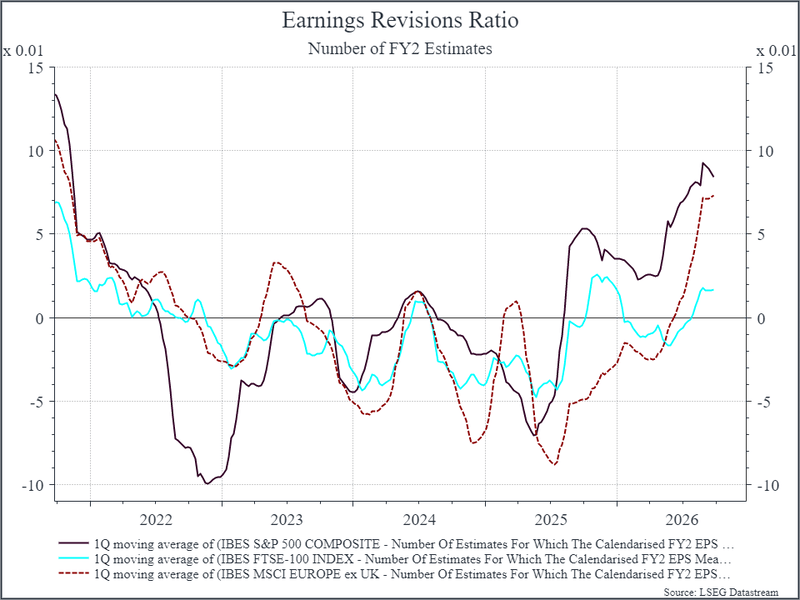
In this context, we see that expectations are not overly-exuberant and are moving higher. The chart below shows how many analysts are moving their earnings forecasts higher versus lower. Over the past couple of months, we’ve seen more upgrades than downgrades across the US, Europe and even the UK.
Looking at equity valuations, we think that the key point of focus at the moment should be less on the headline valuation and more on the earnings forecasts. For instance, the chart below shows the historical Forward Price/Earnings ratio for Emerging Market equities. It shows the lowest headline valuations in a decade. We think it highlights a couple of points. First, that earnings growth has been strong in Emerging Markets, particularly in the tech space. Second, that investors are not generally extrapolating that strong growth far into the future. They see these earnings as cyclical and expect some normalisation over time.
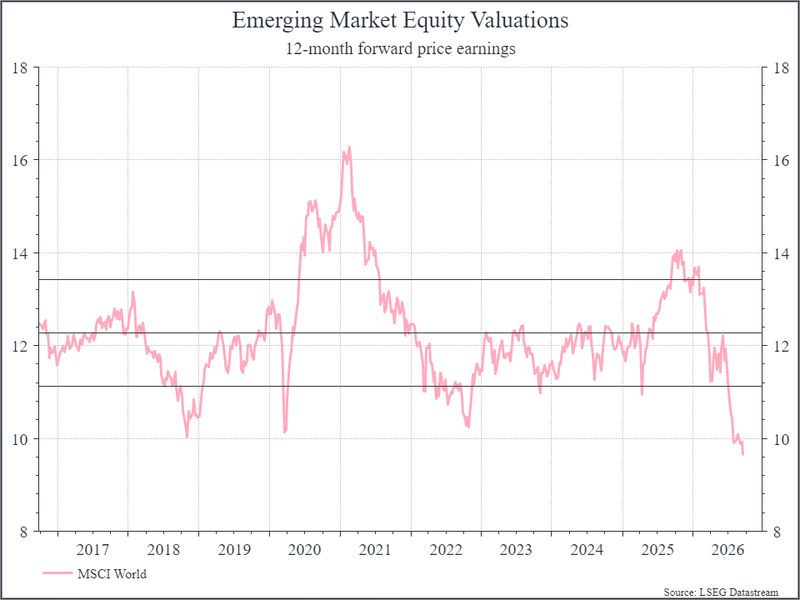
We think that’s a reassuring perspective. It suggests that investors haven’t forgotten that these are cyclical businesses and are mindful of past periods of over-enthusiasm. But if the cycle does last longer than many believe, we think earnings over the next couple of years could prove stronger than what’s embedded in these estimates.
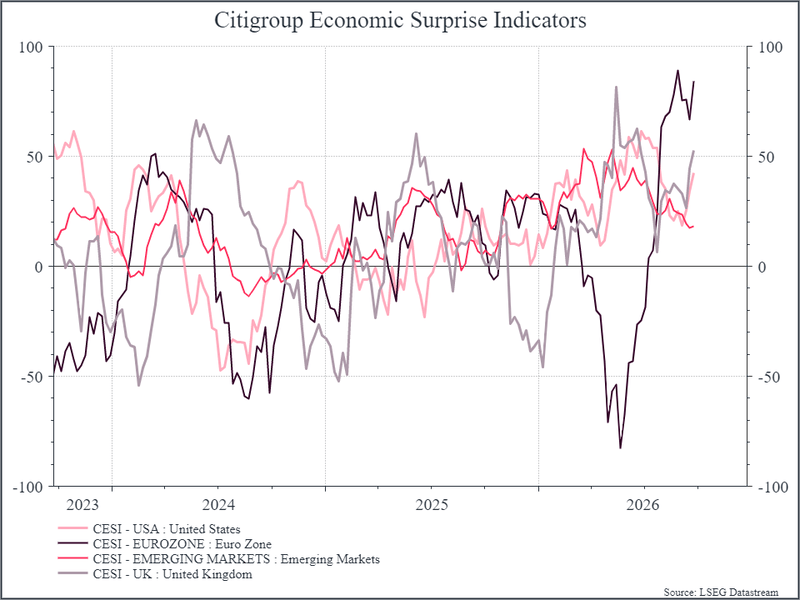
In terms of the macro outlook, the global economy has generally held up better than expected, despite the geopolitical headwinds. We think AI spending has had a lot to do with that. The chart below shows an index of economic surprises. It measures how actual economic data has compared with the forecasts from a range of economists. At present, macro data across the US, Europe and Emerging Markets is generally coming in better than expected.
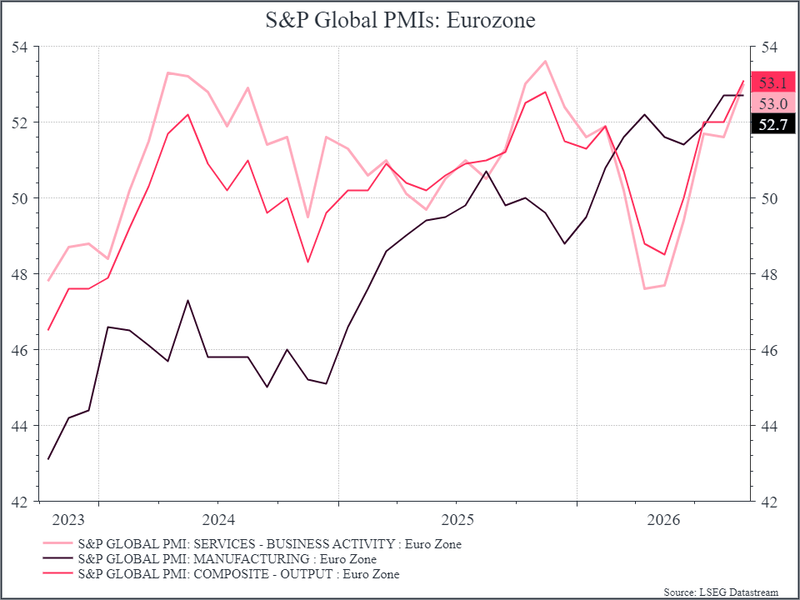
Drilling down a bit deeper, we can see that Purchasing Manager surveys (so-called PMIs) have also held up well. The chart below shows PMIs for the Eurozone – with a reading above 50 generally signalling a growing economy. The recent data looks pretty healthy even in Europe, generally regarded as having weaker growth. PMIs in the US showed a similar picture.
A couple of final points. First, we manage diversified portfolios and continue to look for a broad range of exposures across different asset classes.
Second, we remain mindful of the risks and the alternative scenarios. The outlook for the global economy is still uncertain, and higher energy prices or interest rates could weigh on demand. AI may also prove to be less transformative than the optimists expect, with fewer benefits and higher costs. We are therefore monitoring a clear set of variables – from energy prices and interest rates to the trajectory of earnings and AI investment – that could change our view.
For now, however, we remain constructive on markets and the outlook for earnings growth in the short to medium term, and that’s what has prompted us to increase our equity exposure.
The post A stronger economy and the role of AI appeared first on MoneyFarm Insights.
]]>⏳ Reading Time: 8 minutesLonger lives don’t always mean healthier ones. Rising healthcare and care costs are changing the way investors should think about retirement planning and long-term wealth. Our special contributor and Daily Telegraph’s columnist David Stevenson explores more. We all know the meta-narrative of our era by now, and no, I’m not talking about Artificial Intelligence but […]
The post The hidden cost of living longer appeared first on MoneyFarm Insights.
]]>Longer lives don’t always mean healthier ones. Rising healthcare and care costs are changing the way investors should think about retirement planning and long-term wealth. Our special contributor and Daily Telegraph’s columnist David Stevenson explores more.
We all know the meta-narrative of our era by now, and no, I’m not talking about Artificial Intelligence but aging. We’re all living longer, and that increases the financial pressure on us to accumulate capital. But the simple fact of living longer is a good news story, isn’t it? Maybe, but there’s a catch. Are we living longer, healthier lives? To which the answer in the UK may be no. The rate of longevity improvement has stalled dramatically since around 2011, and healthy life expectancy has actually fallen in recent years.
Male healthy life expectancy at age 50–54 fell from 19.9 years to 19.4 years between 2015 and 2025. Female healthy life expectancy at the same age fell from 21.1 years to 20.6 years. In England, women are now expected to spend a smaller proportion of their lives in good health than they did in 2011–2013.
Age UK’s 2025 State of Health and Care report put it bluntly: “We are living fewer years in good health”. Two-thirds (68%) of people aged over 80 are now living with two or more long-term conditions such as diabetes, arthritis, or heart disease. About 2 million people aged 65+ have unmet care needs.
Given these numbers, it’s no surprise that more 50- and 60-somethings are turning up at gyms, cycling in tight-fitting Lycra shorts, eating healthier, and, perhaps more importantly, making sure they are healthier by investing in personal medical insurance (PMI). Given that the NHS seems to be in a perma-crisis – although waiting lists are actually going down in aggregate – the option of making sure you are tip-top healthy via regular medical screenings, private GPs and hip replacement operations has become increasingly popular. But as with all the good things in life – red wine, carbon fiber bikes and avocados – this all comes at a cost.
Rocketing health insurance costs
A record 6.2 million people in the UK now have access to private medical insurance, with the LaingBuisson Health Cover report valuing the total UK health cover market at £8.64 billion by the start of 2025, reflecting an extraordinary 13.83% year-on-year growth. For context, the PMI market was worth around £4.83 billion as recently as 2022. That’s the market essentially doubling in a matter of years. The number of people covered by employer-provided PMI hit 4.7 million in 2023, the highest figure in more than 30 years of data collection, with a 7% overall uptick in both individual and workplace policies.
The price is obvious – increasing premiums as insurers and health care providers, increasingly busy, try to ration demand via price. Willis Towers Watson’s Global Medical Trends Survey found that UK private medical inflation was expected to hit 12.6% in 2024 – higher than the global average of 10.4% and more than three percentage points above the European average. Insurer Aon’s equivalent research was even more alarming, forecasting a medical trend rate of 15% for the UK in 2024. By 2025-26, WTW’s updated survey put UK healthcare inflation at 10.6% for the year, with 10% projected for 2026 – still among the highest in Western Europe.
The average cost of private health insurance for a single adult in the UK now sits at around £79.59 a month, with couples paying approximately £145.77 per month and a family of four shelling out around £166.52 monthly in 2026. A decade ago, those figures would have been closer to half that for many policyholders. Bupa’s indicative pricing suggests a non-smoking 25-year-old outside London pays around £50 a month, while a family with two adults in their 50s and two teenagers might pay around £220 a month – and that figure is rising every renewal cycle.
UK Private Medical Insurance: Key Market Metrics, 2004–2024
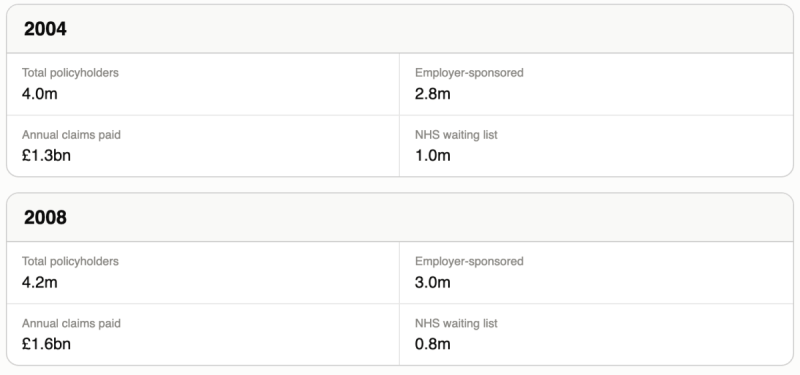
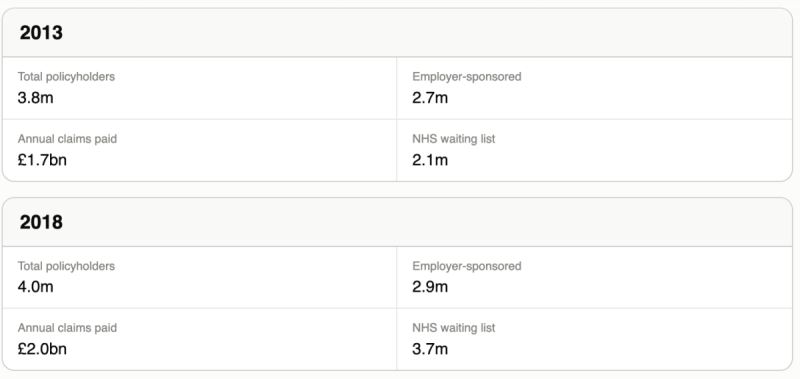
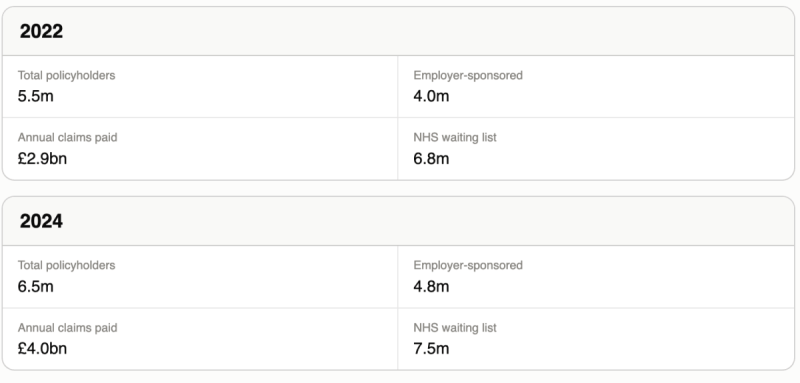
It would, of course, be easy to blame these rising costs on rampant profiteering by increasingly profitable healthcare providers and insurers, but that wouldn’t really be very accurate. The rapid increase in demand can’t be easily managed by a sudden increase in capacity – it takes years to build new hospitals and train competent, experienced medical staff. And whatever resources private healthcare businesses can deploy, they face a global challenge: healthcare inflation. By the first quarter of 2026 (versus a start date in 2015), the CPI for health products and services stood at 142.4, suggesting that health sector prices have risen by 42.4% since 2015, compared with overall price increases of roughly 35-36%. Healthcare inflation, in other words, has consistently outrun the general cost of living, even though the post-pandemic inflation spike that hit energy and food prices hardest.
Don’t forget care home costs
If the 50-, 60-, and 70-somethings are having a hard time paying for health insurance, pity their older peers in their mid-70s through to their 90s: they face a lottery with care home costs, with costs rising rapidly across the board, including for one-on-one home care.
UK care home costs have increased dramatically over the past two decades, from relatively modest but steady annual rises pre-2020 to double-digit surges in the post-pandemic era. The most authoritative annual dataset comes from LaingBuisson’s Care Homes for Older People report, which tracks weighted average weekly fees across the market.
The average weekly residential care home fee rose 19% in a single year from 2021-22 to 2022-23, compared to a headline CPI peak of 10.1% – care homes were roughly double the general inflation rate. By March 2025, Which magazine and LaingBuisson confirmed average fees had hit nearly £1,400 a week, a rise of more than a quarter since 2021-22 alone. One in seven independent nursing homes was charging over £1,800 a week for new residents by 2025. Three factors explain this sharp increase:
- labour costs (care homes are extremely staff-intensive and have been hit hard by National Living Wage increases and the employer NI rise in 2025),
- energy and food inflation,
- chronic underfunding of local authority rates that forces providers to push higher fees onto self-funders.
The King’s Fund notes that real-terms adult social care expenditure in 2023/24 was still only £4.6 billion more than in 2010/11 in real terms (remarkably little growth for 13 years) which tells you how much cost has been shouldered by individuals rather than the state.
To put the numbers in context: according to Which magazine, a self-funding resident in a standard residential care home now faces costs of roughly £70,000–£80,000 per year, rising to well over £90,000 in London and the South East. In 2005, a typical care home place cost around £20,000–£25,000 a year. That’s a near-tripling in nominal terms over 20 years, and a very significant real-terms increase even after adjusting for general inflation.
A plan of action?
I want to start with what many might consider a controversial statement: invest in a healthier lifestyle rather than conserve every last penny. Building on Seneca’s quote (Not how long, but how well you have lived is the main thing) and the wider Stoic and Epicurean traditions, it strikes me that if you reach your 60s, or even 70s, and are in good health, it’s worth investing to make sure you stay that way.
NHS waiting lists are steadily improving – really, they are, the hard data support that statement – but too many older folk resolutely refuse to spend money to get quicker treatment, even though they can afford it. Everyone is entitled to their views and politics, and clearly, we have all invested our taxes in the NHS and expect to get some payback, but I have lost count of the number of fairly comfortably well-off older folks who spend months in agony as they resolutely refuse to do anything other than wait their turn on the NHS list.
As I said, that is their prerogative, but it strikes me that an investment in private medical cover or, at the very least, private health services might be a sensible investment if you have the money (which many don’t). Until the left of the Labour Party abolishes private medicine – always a risk – it’s a free country, and spending money to keep you healthy is a great investment, arguably the greatest investment you can make. Unfortunately, it comes at a cost, which, as we have seen, is growing by the year. It’s not unreasonable to suppose that a couple in their 60s in decent health might be paying anything from £2 to £5k per annum for private medical cover.
Then there’s the risk that, as you hit your 70s and 80s, you might have to account for care home costs. Again, assuming the state will not underwrite your costs – more than likely, unless you live in Japan – it’s probably not unreasonable to assume you might need to keep anything between £50 and £200k as a reserve for the long term to fund those costs. You might be able to draw down some capital from home via equity release, but it’s best not to rely on that assumption.
So, from an investment perspective, where does this leave us? I would make three observations.
The first is that you might need more money than you pencilled into your wealth plan because of additional insurance costs or lump sums to cover care home costs.
That might prompt you to do one of two things: work later or stay invested in risky assets like equities longer, or even both. In many of my recent articles for Moneyfarm, I’ve noted that conventional asset allocation advice might no longer be quite fit for purpose. Traditional theory amongst financial planners argued that from your mid-50s, investors should dial down risk, do everything to conserve capital and then switch to de-accumulation (spend the money) by your mid-60s. This was predicated on actuarial data, which probably assumed retirement at 65 and living until 75, i.e., ten years of post-retirement. Those assumptions are no longer valid, and one could argue that the old, risk-reducing mid-50s have now become the mid-60s.
Given the costs of staying healthy longer and the increased longevity, more financial professionals suggest investing in riskier assets until you are older, and maybe not giving up work so early. This observation won’t work for everyone, and you should always seek professional advice, but I’d cordially suggest that taking on a bit more investment risk in your 60s might be worth exploring.
That leads me to the last suggestion: planning ahead for the care home hit. There’s a very decent chance you might never need to budget for care home costs, possibly because you’ve kept yourself healthy and addressed medical issues early on. You may not, though, be so lucky, and you may need, at the very least, to have a plan to pay for those costs – and relying on the local authority to pay for it does not constitute a plan. Again, this is where professional advice comes in handy, as they can walk you through various options, ranging from building buckets for different anticipated costs and associated investment strategies to less mainstream ideas like equity release. Every reader will have their own solution, but in all cases, by your late 60s, you need a plan.
I’ll finish with a more upbeat suggestion: why not capitalise on the trends I’ve discussed and build them into your investment strategy? By this, I mean considering investing in funds (or even stocks) that benefit from the durable, long-term trends I’ve discussed. Two ideas jump out: healthcare property funds and general healthcare funds. Healthcare property funds invest in everything from care homes for the elderly to GP surgeries. They are part of the wider infrastructure sector and tend to be income-oriented whilst also taking a conservative view of capital appreciation, in part by focusing on the quality of their property tenants and keeping leverage low.
More generally, there’s a growing number of funds that invest widely in an ageing society – across sectors from wealth management to healthcare – and, more specifically, in healthcare firms. That latter category tends to comprise two niches: much riskier biotechnology funds, which are better suited to really adventurous types, and lower-risk healthcare funds that invest in drug companies, hospitals and medical services firms. These funds haven’t shot the lights out compared with, say, AI and pure tech funds, but they do appeal to more defensive investors, especially if they pay out a decent income via dividends.
Please remember that when investing, your capital is at risk. The value of your portfolio with Moneyfarm can go down as well as up and you may get back less than you invest. Past performance is not a reliable indicator of future performance. The views expressed here should not be taken as a recommendation, advice or forecast. If you are unsure investing is the right choice for you, please seek financial advice.
The post The hidden cost of living longer appeared first on MoneyFarm Insights.
]]>⏳ Reading Time: 5 minutesBy mid-August, Bitcoin looked like an asset nobody wanted. It was trading at around $63,500, about 49% below its October 2025 peak, after ten months of decline. Thirty-day realised volatility had fallen to an annualised 27%, far below its long-term average, while direct Bitcoin trading volumes were among the lowest on record. Trading was thin […]
The post Bitcoin’s rebound: what drove the rally? appeared first on MoneyFarm Insights.
]]>By mid-August, Bitcoin looked like an asset nobody wanted. It was trading at around $63,500, about 49% below its October 2025 peak, after ten months of decline. Thirty-day realised volatility had fallen to an annualised 27%, far below its long-term average, while direct Bitcoin trading volumes were among the lowest on record. Trading was thin and volatility unusually low. Investors were paying up to protect against further falls rather than betting on a rebound, and some long-standing holders were selling.
That positioning explains the violence of what came next. In four sessions from 17 August, Bitcoin went from about $62,800 to a high of $79,241. Roughly $3 billion of short positions were liquidated across crypto, around $1.7 billion of them in bitcoin. The key detail is that open interest – the total value of outstanding positions in Bitcoin derivatives – fell by almost 9% during the move. The rise was driven by investors who had bet against Bitcoin being forced to close their positions, rather than by new bets made with borrowed money. At the same time, genuine demand emerged from investors buying Bitcoin directly. US spot bitcoin ETFs took in $517 million on 19 August and $606 million the next day, then posted nine straight days of inflows to 27 August.
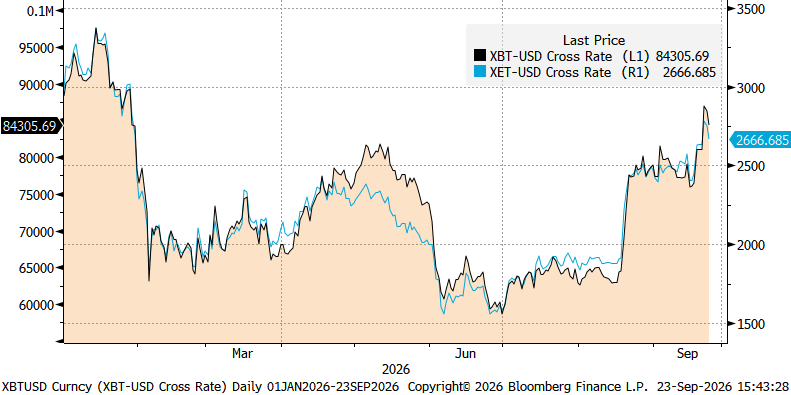
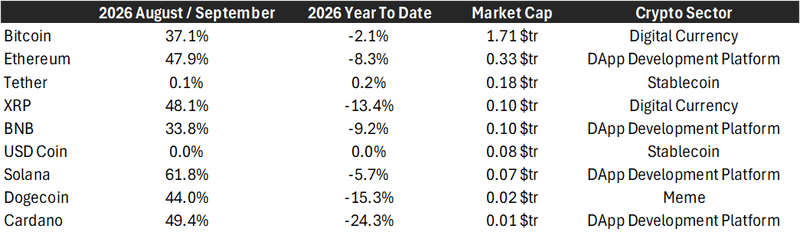
Within crypto, the rebound followed the usual pattern: it began with Bitcoin and then spread to more volatile cryptocurrencies, which recorded even larger gains. Ether rose about a third in August and outpaced bitcoin. Solana gained around 61.8% by late September, with August being its first positive month after ten consecutive declines. XRP was up more than 45% over the month to late September.
The macro moment
The macro conditions also helped. The macro backdrop is an inflation problem the Federal Reserve (Fed) now owns. Summer inflationary prints provided little clarity, keeping risks decidedly biased to the upside. Fed staff attributed the pressure to tariffs, higher energy costs from the Middle East conflict and the AI capex boom.
At its July monetary policy meeting (FOMC), the Fed kept interest rates unchanged at 3.50–3.75%, but three members (Hammack, Kashkari and Logan) dissented in favour of a hike. Meanwhile 10- and 30-year Treasury yields reached roughly twenty-year highs, with the 30-year above 5.25%.
Speaking at Jackson Hole on 28 August, Chair Warsh called interest rates the Fed’s “predominant tool” and said it must be confident inflation is moving to target “clearly and at sufficient speed. Otherwise, we have work to do.”
On 16 September the Fed delivered its first hike in more than three years, 25bp to 3.75–4.00%, unanimously, with projections pointing to one more. Bitcoin barely moved, edging from about $75,400 to $76,300, because the hike had been largely priced for two weeks.
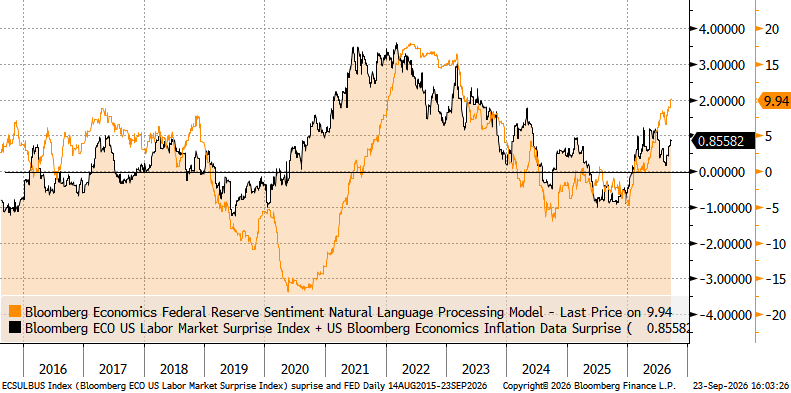
Fed communications have turned distinctly more hawkish than at any point since 2023, edging steadily upward even as employment figures and price pressures only partially warrant the shift. The chart below illustrates the tone of public FOMC statements alongside macroeconomic surprises in labor and inflation. The relationship typically holds, with central bankers leaning hawkish during periods of tight employment and elevated inflation; but the latest surge in hawkish rhetoric stands out sharply.
The Fed is only half of the story. The most interesting variable is the interaction between the Fed and the Treasury, not the Fed alone. On 19 August, Treasury said it would at least double its buybacks of 10–30-year bonds, from $2 billion to $4 billion per operation, between 9 September and 4 November. Secretary Bessent said yields “do not reflect underlying fundamentals” and pointed to a broader toolkit. Crypto reacted at once: the announcement coincided with the start of the ETF inflow run. The result is an unusual policy mix. The Fed is tightening at the short end, and Warsh has signalled that balance-sheet expansion is unlikely except as a one-off response to market failure. The Treasury, meanwhile, is trying to cap the long end with its own tools.
Asset correlations further underline this backdrop. Bitcoin’s co-movement with gold has surged to year-to-date highs, whereas its link to the US dollar remains skewed to the downside. Meanwhile, the relationship with expected Federal Reserve policy shifts has inverted; fewer anticipated rate reductions now serve as a constructive signal for bitcoin. Together, these dynamics reinforce a positive response function to growing macroeconomic anxieties surrounding the US fiscal balance.
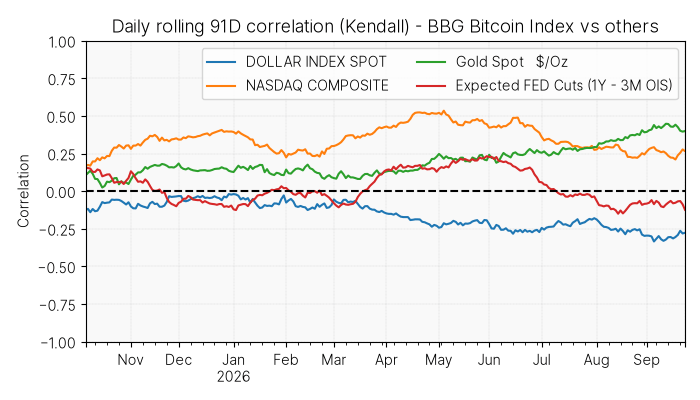
The customary caveat applies: macroeconomic drivers capture only a fraction of bitcoin’s trajectory, given that overarching co-movement measures stay subdued. As a result, factors specific to Bitcoin continue to drive much of its market performance.
On the regulatory side, the legislative route has closed for this year. When the Senate returned from recess, the CLARITY market-structure bill came to a procedural vote on 15 September and failed cloture 50-49, well short of the 60 votes needed. Negotiations ran right up to the vote. Republicans had released a revised 630-page text that took in some Democratic provisions, but many Democrats still judged the ethics language on officials’ personal crypto interests, including the President’s, to be too weak. The stablecoin-yield dispute between banks and crypto platforms was never fully settled either.
The failure matters more for the medium term than for this month’s prices. Without a statute, the US framework rests on agency action. That includes the SEC–CFTC joint interpretation from March, which says most crypto assets are not securities, the SEC’s proposed Regulation Crypto Assets offering regime, and continued ETF approvals. Both agencies have said they will keep going without Congress. Agency rules can move faster than legislation, but they are less durable, because a future administration can rewrite them far more easily than it can repeal a law. With control of Congress likely to be split after November, the next realistic window is the new Congress, and consequences for digital asset prices are uncertain.
The flows
As highlighted earlier, capital flows shifted sharply into positive territory throughout August, establishing the month as the strongest for US allocations since January. European investors similarly displayed renewed appetite, although aggregate volumes within the region continue to represent a minor fraction of overall activity.
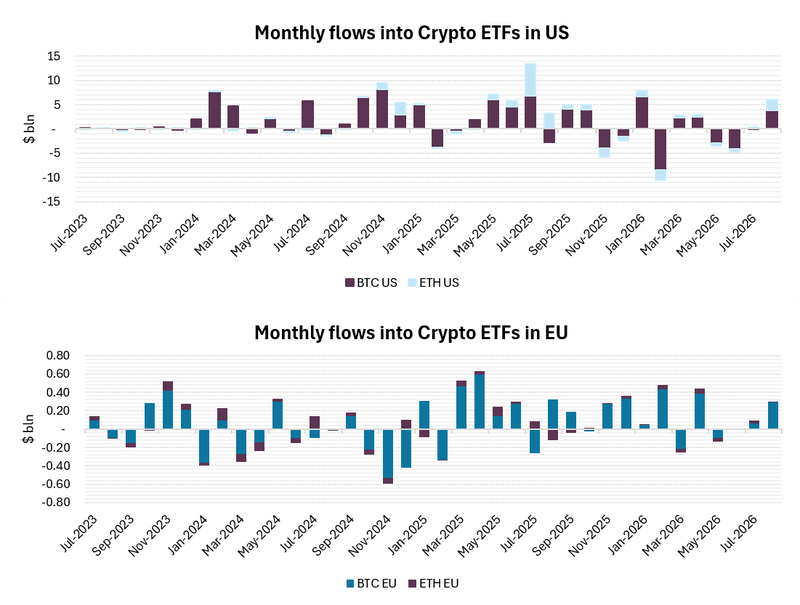
Taken together, the period illustrates a sharp shift where suppressed positioning intersected with macroeconomic catalysts, namely Treasury intervention and dollar softness, helped by genuine spot inflows through ETFs rather than speculative leverage.
While it is too early to call this a lasting shift, crypto continues to be driven largely by its own market dynamics. Bitcoin continues to function as a largely uncorrelated asset at a time when macro risk concentrates heavily in the equity market’s ongoing reliance on the Artificial Intelligence trade, providing a compelling vector for portfolio construction.
Investing in Crypto involves a high level of risk. You should not invest unless you are prepared to lose all of the money you invest. The value of your Moneyfarm portfolio can go down as well as up, and you may get back less than you invest. You may not be protected if something goes wrong. Past performance is not a reliable indicator of future results. The views expressed here do not constitute a recommendation, advice or forecast. If you are unsure whether investing is right for you, please seek independent financial advice.
The post Bitcoin’s rebound: what drove the rally? appeared first on MoneyFarm Insights.
]]>⏳ Reading Time: 8 minutesLondon is one of the most famous cities in the UK, but it is also one of the most expensive places to live. The cost of living in London depends on where you live, how often you use public transport, how much you spend on food and your lifestyle in general. For someone moving to […]
The post Cost of Living in London: a guide for 2026 appeared first on MoneyFarm Insights.
]]>London is one of the most famous cities in the UK, but it is also one of the most expensive places to live. The cost of living in London depends on where you live, how often you use public transport, how much you spend on food and your lifestyle in general. For someone moving to London, the biggest expense is usually rent.
So, how much does it cost to live in London in 2026? This guide looks at the main living costs in London and gives you current price estimates to help you plan your budget.
|
How much does it cost to live in London? |
A single person may need around £2,800–£3,500 per month, depending on rent and lifestyle |
|
Is London expensive? |
Yes, London is one of the most expensive cities in the UK, mainly because of high housing costs |
|
How much does it cost to rent a home in London? |
A one-bedroom flat costs around £1,700–£2,200 per month, depending on the location |
|
Is it worth living in London? |
For many people, yes. London offers good job opportunities, public transport and a wide range of cultural and social activities |
Rent and housing costs in London
Rent is normally the largest part of the cost of living in London. The price of accommodation varies considerably depending on whether you live in central London or further away from the centre. Transport also has an effect on prices: areas with fast connections to Central London can be expensive.
According to current Numbeo data, the average monthly rent for a one-bedroom flat is around £2,182 in the city centre. Here are some costs to consider:
|
Type of accommodation |
Approx. monthly cost |
|
1 bedroom flat in central London |
£2,182 |
|
1 bedroom flat outside the centre |
£1,738 |
|
3 bedroom flat in central London |
£4,077 |
|
3 bedroom flat outside the centre |
£2,794 |
|
Room in a shared flat |
Often around £750–£1,250 |
You should consider that private rents across the UK continued to rise in 2026. In July 2026, the average UK private rent was £1,393 per month, while London remained one of the most expensive rental markets in the country. If you are thinking about moving to London, accommodation is the first cost you should consider.
How to reduce your London rent
If you are moving to London with a limited budget, sharing accommodation is one of the easiest ways to reduce your monthly costs. You could also:
- Look outside Zone 1
- Compare several areas in London before choosing a home
- Consider a flat share rather than living alone
- Consider living further from central London
A cheaper flat can sometimes become less affordable if you spend a lot of money and time travelling, so it is important to consider rent and transport together.
You also have to consider Council Tax in London: this is a local tax that people living in homes in London usually have to pay. The amount depends on the property’s value, its Council Tax band and the place where you live. It helps pay for local services such as rubbish collection, roads and public services.
If you live alone, you may be entitled to a 25% discount, and full-time students can normally be exempt from Council Tax. Here are some tips on how to save money for a house.
Public transport in London
London has one of the largest public transport networks in the world. You can travel around the city using the Tube, buses, trains (London Overground and Elizabeth Line) or by tram. The amount you spend depends on the zones you travel through and how often you travel. Current London prices in 2026 are around:
|
Transport cost |
Price |
|
Local public transport single journey |
£3 |
|
Monthly public transport pass |
£186.00 |
|
Taxi starting fee |
Around £4.20 |
|
Taxi per kilometre |
Around £2.50 |
|
Petrol |
Around £1.55 per litre |
There are also several ride-sharing and car-sharing services available in London. These can be useful when public transport is not convenient, for example late at night. Using taxis and ride-sharing services regularly can make your monthly transport costs much higher. For this reason, most people use public transport for their daily journeys and ride-sharing services only when needed.
Energy, water and other household bills
Rent is not the only housing cost, you also need a budget for household bills. Let’s look at an example of basic monthly utility costs for an 85 m² flat, including electricity, heating, cooling, water and rubbish: the cost can be around £272. This can vary approximately from £150 to £500, because energy use and property size can vary significantly.
Internet costs around £31 per month, while a mobile phone plan with 10GB or more of data costs around £14 per month. A typical monthly bills budget might look like this:
|
Household cost |
Monthly cost |
|
Energy, water and other utilities |
£270 |
|
Internet |
£31 |
|
Mobile phone |
£14 |
For a smaller flat or a shared property, your personal share of the bills can be much lower. You should check exactly which bills are included in your rent before signing an agreement.
Is it cheaper to live further from Central London?
Living further from Central London can help you find cheaper accommodation, but this does not necessarily mean that your overall cost of living will be lower. If you live far from your workplace or university, you may need to spend more on public transport every day.
For example, a cheaper flat in outer London may seem like a good option, but higher transport costs could reduce the savings on rent. For this reason, it is useful to compare your total housing and transport costs, rather than looking at rent alone. The best location is often a balance between affordable accommodation and good transport connections.
You can also reduce your transport costs by walking or cycling when possible. If your home is close to your workplace, university or local shops, you may be able to save money on public transport while also spending less time travelling.
Grocery costs in London
Food shopping is an important part of the cost of living in London. For one person, a typical grocery budget is around £295 per month, but the exact amount will depend on where you shop and what you usually buy.
Buying from budget supermarkets and choosing own-brand products can save you money, while premium supermarkets, organic food and convenience stores can increase your spending. Cooking at home most of the time is also generally much cheaper than eating out regularly.
Eating out and coffee
Eating out is an important part of London life, but restaurant and café spending can quickly increase your monthly budget. A meal at an inexpensive restaurant currently costs around £20 per person, while meal for two people at a mid-range restaurant is around £80. A cappuccino costs around £4.29 on average.
If you eat out several times a week, food can become one of your biggest expenses after rent. One simple way to control your budget is to decide how many meals you want to eat out each month and include them in your budget from the start.
Healthcare costs in London
One advantage of living in the UK is access to the National Health Service (NHS). Many NHS services are free at the point of use for people who are entitled to NHS treatment. But some healthcare costs are not automatically free.
For example, you may have to pay for:
- NHS prescriptions, unless you qualify for free prescriptions
- Dental treatment
- Some eye tests and glasses
- Private healthcare
- Certain medicines or treatments
If you are planning to live in London, it is a good idea to register with a local General Practitioner (GP). A GP is your first point of contact for most healthcare needs and can provide medical advice, treatment and referrals to specialist services when necessary. You can choose a GP surgery in the area where you live and register as an NHS patient.
Entertainment costs in London
London offers a big choice of entertainment, from museums and parks to cinemas, theatres, gyms, concerts and nightlife. Some activities are free, including many of London’s museums, galleries and parks. Others can be quite expensive.
To give some examples, a cinema ticket costs around £13.50, while a monthly gym membership costs around £46.50. Renting a tennis court for one hour at the weekend costs around £16.50.
Childcare and education
Families can face significantly higher living costs than single adults. Private full-time nursery care is particularly expensive in London. The average monthly cost of a private full-time nursery place is around £2,150 per child. An international primary school can cost around £27,000 per year, although prices vary between schools.
These costs make childcare one of the most important factors for families deciding where to live. State schools do not charge standard fees for eligible children, but parents should still budget for costs such as school uniforms, activities, transport, meals and childcare outside school hours. Read this article to find out how to invest for your children’s future.
Clothing and personal expenses
Clothing prices in London vary from budget high-street shops to premium and designer brands. As a general guide, current average prices can be:
- Jeans: around £84
- High-street summer dress: around £41
- Mid-range running shoes: around £95
- Men’s leather shoes: around £115
These figures are useful as benchmarks rather than fixed prices. Shopping during sales or choosing budget retailers can reduce this part of your spending.
How much salary do you need to live in London?
There is no single salary that is enough for everyone in London: your ideal income depends mainly on your rent, whether you live alone or share accommodation, where you work and your lifestyle. To maintain a reasonable standard of living, an average net monthly income of around £3,000 may be needed.
Here is an example of what a monthly budget could look like for one person renting a one-bedroom flat outside the city centre:
|
Expense |
Estimated monthly cost |
|
Rent |
£1,740 |
|
Utilities |
£270 |
|
Internet and mobile |
£45 |
|
Council Tax |
£150 |
|
Transport |
£200 |
|
Groceries |
£280 |
|
Eating out and leisure |
£200 |
|
Total |
£2,885 |
This is only an example. A person who shares accommodation could reduce their housing costs considerably, while someone living in a central area or eating out frequently could spend much more.
Is London expensive compared with other UK cities?
Yes, London remains one of the most expensive places to live in the UK, particularly because of housing. This does not mean that every product is more expensive in London. Groceries, for example, can be relatively similar across different UK cities. The biggest difference is often accommodation.
For someone choosing between London and another UK city, comparing rent, transport and everyday spending gives a much more realistic picture than comparing rent alone.
How to reduce the cost of living in London
London can be expensive, but there are several practical ways to reduce your monthly spending:
- Share your home: flat-sharing is one of the most effective ways to reduce housing costs.
- Choose your location carefully: look for areas with good transport connections rather than automatically choosing the most central areas.
- Cook at home: preparing most meals yourself can make a significant difference to your food budget.
- Use public transport wisely: check all the costs and consider walking or cycling for shorter journeys.
- Take advantage of free activities: London has many free museums, parks, galleries and public spaces.
- Check your Council Tax status: if you live alone, you may qualify for a discount. Full-time student households may be exempt.
- Build an emergency fund: London expenses can change quickly, particularly rent and household bills. Having some savings can make unexpected costs easier to manage.
Once you have covered your essential monthly expenses and built some savings for unexpected costs, you may also consider putting part of your income towards investments. Investing can be a way to build wealth over the long term, but it always involves some level of risk.
A common approach is to invest regularly and create a well-diversified portfolio, rather than putting all your money into a single company, asset or market. Diversification can help spread risk across different investments, such as shares, bonds and other assets.
The amount you invest should fit your personal budget and financial goals. Remember that investments can go down as well as up, so you should only invest money that you can afford to leave invested for the long term. You can start investing with Moneyfarm easily and without hidden costs.
Frequently Asked Questions
A single person renting their own flat may need around £2,800–£3,500 per month, depending on rent and lifestyle. Sharing a flat can reduce the monthly cost.
A one-bedroom flat costs around £2,182 per month in central London and around £1,738 outside the city centre. Actual rents vary between zones and properties.
For one person, a net income of around £2,500–£3,000 per month can provide a reasonable lifestyle when sharing accommodation. If you want to rent a one-bedroom flat alone, you may need £3,000–£3,500 or more per month.
Yes, especially for housing. London has significantly higher rental costs than many other UK cities. Other everyday expenses, such as groceries, can be more similar between cities.
A single person who mainly cooks at home could budget around £200–£320 per month for groceries. Eating out regularly will increase this amount.
For many people, yes, London offers a large job market, excellent public transport, Universities, culture and entertainment. But you should consider that housing costs are high, so choosing the right area and planning your budget carefully are essential.
The post Cost of Living in London: a guide for 2026 appeared first on MoneyFarm Insights.
]]>⏳ Reading Time: 4 minutesIt’s been a busy couple of weeks for Central bankers. Last week, the European Central Bank (ECB) hiked its policy rate for the second time this year. This week, the US Federal Reserve raised its policy rate for the first time since 2023. The Bank of England failed to follow suit, with policy makers electing […]
The post Central banks rates and yields: what changes appeared first on MoneyFarm Insights.
]]>It’s been a busy couple of weeks for Central bankers. Last week, the European Central Bank (ECB) hiked its policy rate for the second time this year. This week, the US Federal Reserve raised its policy rate for the first time since 2023. The Bank of England failed to follow suit, with policy makers electing to leave rates unchanged. We wanted to dig into all this in a bit more detail.
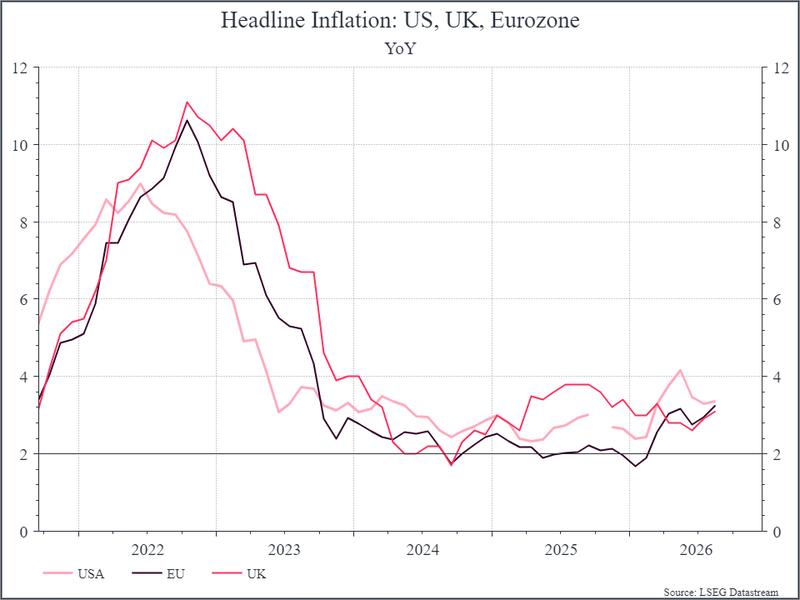
Let’s start with inflation. Central banks typically target 2% annual inflation. There’s lots of debate about why that number. But, when the dust settles, for now at least, the target is consumer price increases of 2%. And, as the chart below shows, inflation is running about that number and has been accelerating. All else equal, that normally means higher policy rates.
Inevitably there are nuances. The major nuance, as we’ve noted before, is that oil prices can have a significant impact on inflation and that’s something that central bankers can’t do much about. The chart below shows the relationship between oil and US consumer prices.
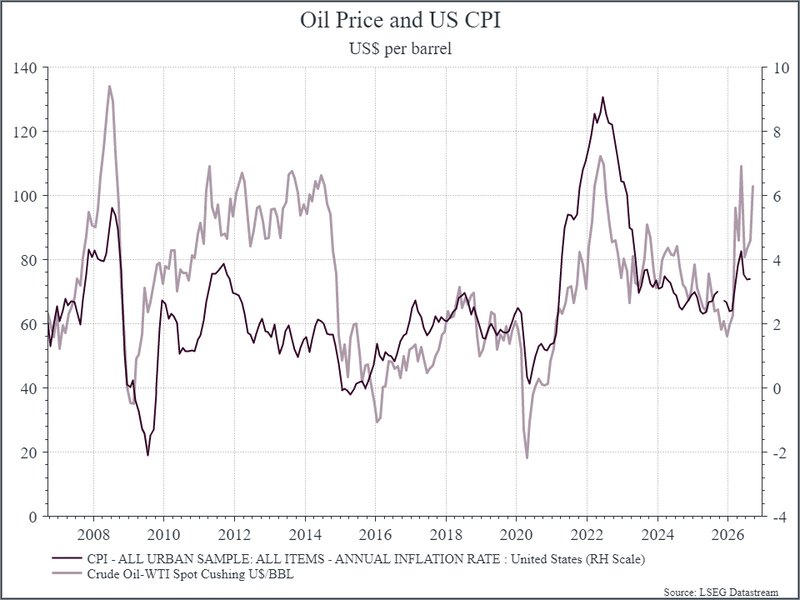
Usually, central bankers try to look past a supply shock like the one we’ve experienced, but if that shock (i.e. higher oil prices) persists for long enough, they usually feel obliged to act.
So, let’s come back to the recent decisions. Starting with the Eurozone, the ECBs decision was perhaps the simplest. The ECBs primary job is to keep inflation at target, and it has an institutional history focused on that mandate. The US Federal Reserve, in contrast, has a dual mandate of full employment and stable prices. Headline inflation is above target and looks set to stay there, so the ECB hikes rate. Investors expect to see more hikes in the future.
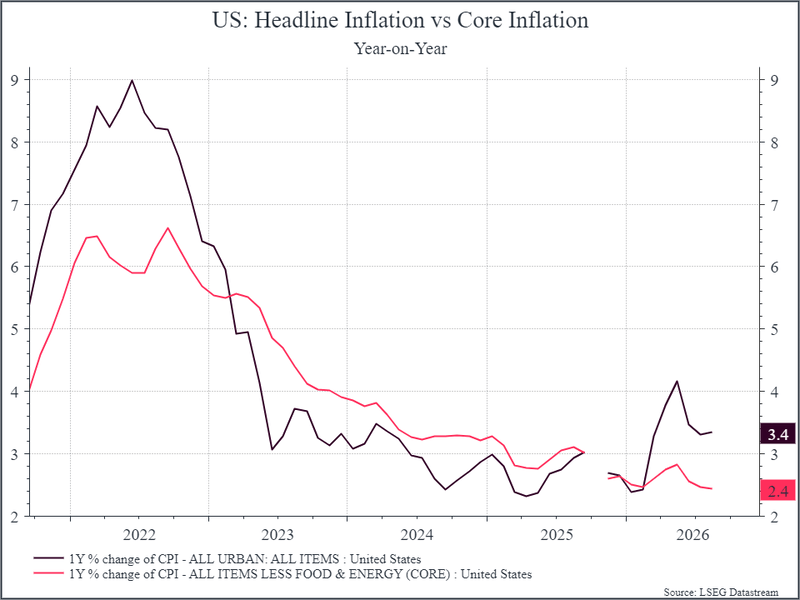
The decision of the US Federal Reserves was a bit more complicated for a couple of reasons. First, the US administration has been more open about expressing its preference for lower interest rates. Second, some analysts have noted that if you exclude more volatile items like food and energy, US inflation (so-called core inflation) has been comparatively well-behaved – still above 2% but heading in the right direction. From that perspective, you could make the case that a rate hike now is unnecessary.
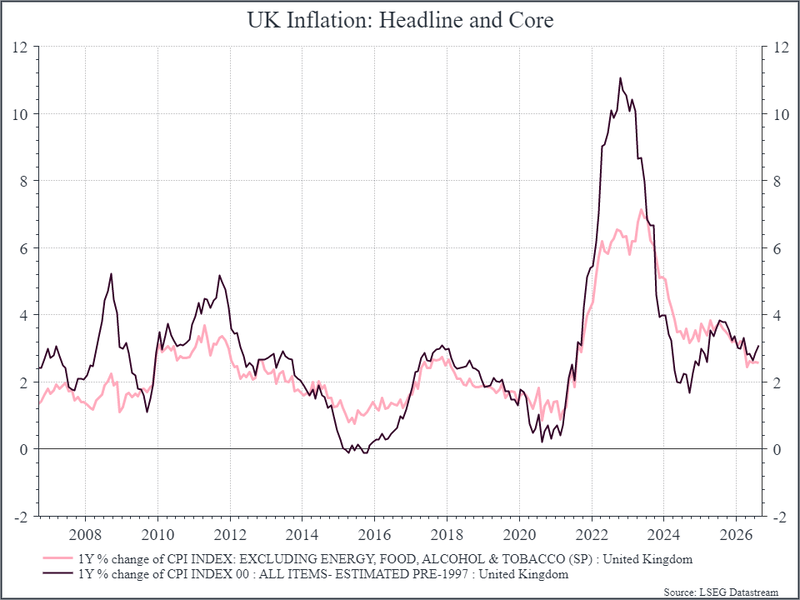
Finally, there’s the UK. Policy makers in the UK took a different stance this time around. They acknowledged the risks from higher oil prices but chose to keep rates unchanged at this point, even if three of the nine committee members voted to hike rates. Investors are expecting the Bank of England to hike rates in the coming months. The chart below shows core and headline inflation in the UK. There’s very little to choose between them at this point, unlike in the US. You’d think that the relatively weak UK growth outlook and decelerating wage growth also played a role in the Bank’s thinking.
In some ways, the more interesting part of the Bank of England’s statement was around their holdings of UK government bonds. After the Global Financial Crisis, and again during Covid, a number of central banks bought their government debt in order to stimulate the economy (so-called Quantitative Easing). The ECB, Bank of England and the US central bank have been unwinding those positions in recent years. The Bank of England has taken a more aggressive approach in actually selling UK government bonds in the market, rather than just letting them mature. The chart below shows their holdings over time. These sales have pushed up UK government bond yields (more bonds for sale means lower prices and higher cost of debt).
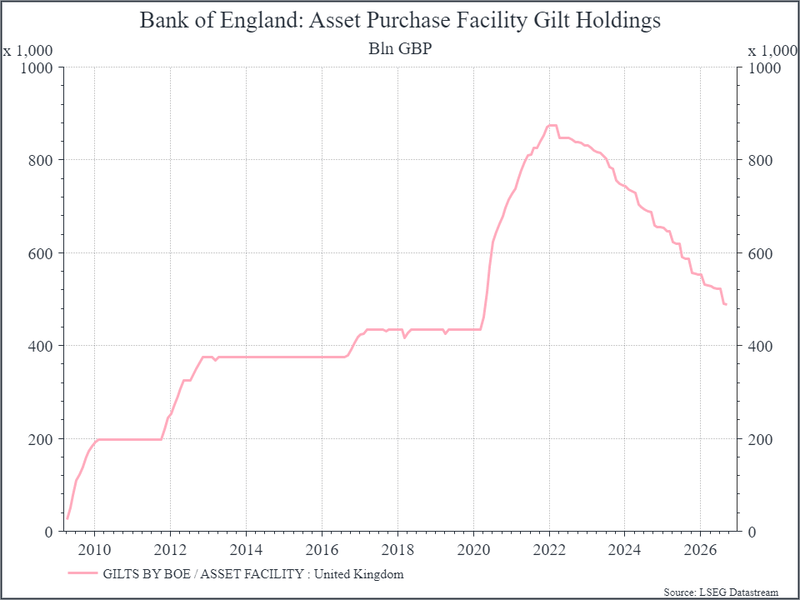
This week, the Bank announced that it would pause its auctions of this debt until April 2027 and then re-start at a slower pace than in the past. On the margin, that should help UK government bond yields.
So where does all this leave us? Central bankers are reacting to higher inflation, regardless of the source, and investors are expecting higher policy rates in the future. On the margin, that should mean tighter monetary policy conditions and possibly slower growth.
One interesting point is on the relationship between policy rates and the yield on longer-dated bonds. We’ve seen longer-dated bond yields rise quite sharply over the past couple of months. We think that partly reflects concern over inflation. You could argue that higher policy rates will give investors comfort that central bankers are focused on inflation. In that case, we could see long-dated yields remain relatively stable even if policy rates rise.
For now, central banks are erring on the side of caution – not willing to bet on a swift resolution to the energy shock of the past few months. We continue to have a bias towards shorter-dated bonds within most of our portfolios. That said, with long-dated bond yields rising and inflation above target, we think investors will view central bank prudence positively, even if it means that rates remain higher for longer.
The post Central banks rates and yields: what changes appeared first on MoneyFarm Insights.
]]>⏳ Reading Time: 4 minutesChoosing who manages your pension is one of the most consequential financial decisions you are likely to make. Yet retirement planning is often left until later in life, when the cost of putting things right can be considerably higher. A recent interim report from the UK’s Pensions Commission found that at least 15 million people […]
The post 8 ways to make more of your pension appeared first on MoneyFarm Insights.
]]>Choosing who manages your pension is one of the most consequential financial decisions you are likely to make. Yet retirement planning is often left until later in life, when the cost of putting things right can be considerably higher.
A recent interim report from the UK’s Pensions Commission found that at least 15 million people across the UK are not saving enough for retirement. The shortfall can compound quietly over decades, making the combination of disciplined investment management, sensible costs and flexibility in retirement increasingly important.
Whilst no provider can plug the gap in an underfunded pension, we aim to provide a comprehensive service, giving you the tools and flexibility to retire with confidence. Here’s how we do it.
1. Built to weather the changing economy
Markets hardly ever move in a straight line. Expansion, inflation, corrections and recoveries each test an investment strategy differently. Our portfolios are designed with the full investment cycle in mind: diversified across asset classes, regions and sectors, and managed with your time horizon in mind. Our aim is to build portfolios that can remain resilient as conditions change.
2. The same principles, without the traditional price tag
There is a common misconception that sophisticated portfolio management necessarily comes at a high cost.
In reality, many traditional advisory firms use broadly similar building blocks: diversified exposure to global equities, bonds and other asset classes, combined according to an investor’s objectives and attitude to risk. The difference can often be the cost. Even seemingly modest additional fees can have a meaningful impact over a long investment horizon, because the money spent on charges is money that is no longer compounding for your retirement.
This is why we focus on delivering investment management at a low cost that leaves more of your money invested.
3. A portfolio shaped around you
Your pension portfolio should reflect your circumstances. As retirement approaches, we also recommend lifestyling, carefully suggesting adjustments to your risk level as your investment horizon changes.
For investors who want their pension to reflect their wider values, our ESG-focused range provides an additional choice.
4. Reliable technology, with people behind it
Our app and web platform give you a clear view of your pension, how it is invested and how it is performing. But there is also a team of experienced consultants available when you want to discuss a change in circumstances, a major financial decision or simply make sense of what is happening with your pension.
It is investment management designed to be straightforward, with human interactions available when it matters.
5. One pension, different horizons
Retirement is not a single financial event. It can involve money you need soon, alongside money that may remain invested for decades. With Moneyfarm, investors can split their pension into individual risk levels, this allows each portion of the pension to be invested according to its own time horizon.
For example, money intended to fund nearer-term withdrawals can be held at a more appropriate level of risk, while capital that is unlikely to be needed for many years can remain invested for longer-term growth.
It is a simple principle, but an important one: different pots can have different jobs.
6. Making the most of contributions
For many people, the most powerful pension decision is simply putting more money to work.
Moneyfarm supports flexible contributions for both individuals and business owners. Employees can benefit from employer pension contributions and salary sacrifice where available, while directors and business owners can consider employer contributions as part of a wider tax-efficient remuneration strategy.
The right approach depends on your circumstances, but the principle is universal: the earlier and more consistently you invest, the longer your money has to compound.
7. Bringing old pensions together
A working life can leave you with pensions scattered across several employers, each with different charges, investment strategies and paperwork.
Our Find, Check and Transfer service is designed to simplify this. We locate your existing pensions, review them for charges, exit penalties, guarantees and other valuable features, and assess whether transferring them into a single Moneyfarm pension makes sense.
Consolidation is not automatically the right answer – some pensions contain benefits worth preserving – but knowing exactly what you have is an important first step towards making better decisions.
8. Flexibility when retirement arrives
The value of a pension ultimately comes from what it can do for you in retirement.
With flexi-access drawdown, you can choose when and how much income to take, whether that is monthly, quarterly, annually or through ad hoc withdrawals. Depending on your circumstances, this can be combined with a pension commencement lump sum, typically up to 25% of your pension tax-free, subject to the applicable rules and allowances.
You can also use uncrystallised funds pension lump sums (UFPLS), where each withdrawal is generally part tax-free and part taxable.
The most appropriate combination will depend on your wider finances, tax position and spending needs. That is where good planning matters: your pension should support the life you want to lead, rather than dictate it.
A smart way to manage your pension
Moneyfarm was recognised in 2026 by CNBC’s World’s Top Fintech Companies and the FT1000, the Financial Times and Statista’s ranking of Europe’s fastest-growing companies. We were also named Digital Wealth Management Provider of the Year at the Moneyfactscompare.co.uk Awards, alongside recognition at the Boring Money Best Buys.
But awards are only part of the story. The more important question is whether your pension is invested appropriately, managed with discipline, and doing so at a cost that makes sense.
Our approach combines institutional-style portfolio construction, modern technology and access to our team of experts, giving you the tools and flexibility to manage your retirement with greater clarity.
Please remember that when investing, your capital is at risk. The value of your portfolio with Moneyfarm can go down as well as up and you may get back less than you invest. Past performance is not a reliable indicator of future performance. Tax treatment depends on your individual circumstances and may be subject to change in the future. The views expressed here should not be taken as a recommendation, tax advice or forecast. If you are unsure investing is the right choice for you, please seek financial advice.
The post 8 ways to make more of your pension appeared first on MoneyFarm Insights.
]]>⏳ Reading Time: < 1 minuteWelcome to a new episode of A Matter of Interest podcast, your fortnightly reality check on global markets, hosted by Moneyfarm. Every two weeks, Richard Flax (our Chief Investment Officer) and Jack Amy (our Quantitative Trading Analyst) cut through the noise to serve up fresh market trends, data-driven insights, and strategic takeaways, minus the textbook jargon. In this episode, we explore […]
The post Triple Witching, fiscal traps & AI cracks appeared first on MoneyFarm Insights.
]]>Welcome to a new episode of A Matter of Interest podcast, your fortnightly reality check on global markets, hosted by Moneyfarm. Every two weeks, Richard Flax (our Chief Investment Officer) and Jack Amy (our Quantitative Trading Analyst) cut through the noise to serve up fresh market trends, data-driven insights, and strategic takeaways, minus the textbook jargon.
In this episode, we explore recent developments in UK fiscal policy, dissect the global sovereign bond sell-off, and examine the strategic debates surrounding the future of Artificial Intelligence.
We look at how the relocation of top taxpayers exposes the vulnerability of the UK’s narrow tax base, why shifting pension fund dynamics and rising corporate debt issuance are driving government bond yields higher, whether recent calls by tech leaders to slow down AI development are driven by safety or regulatory capture, and what the upcoming “Triple Witching” derivative expiration means for short-term market volatility.
Key takeaways
- UK fiscal policy: what’s happening? – from 0:37
- The future of AI and its market implications – from 20:23
- Exploring “Triple Witching” – from 28:19
You can also listen to the episode on Apple Podcast and YouTube.
The post Triple Witching, fiscal traps & AI cracks appeared first on MoneyFarm Insights.
]]>⏳ Reading Time: 8 minutesWhat is the retirement age in the UK? According to the UK government, there is no UK retirement age or default retirement age (forced age of retirement). It used to be 65, but it no longer applies. You can work as long as you can and decide, yourself, when to retire. However, there is something […]
The post UK Retirement Age: What is retirement age? When can I retire? appeared first on MoneyFarm Insights.
]]>What is the retirement age in the UK? According to the UK government, there is no UK retirement age or default retirement age (forced age of retirement). It used to be 65, but it no longer applies.
You can work as long as you can and decide, yourself, when to retire. However, there is something called the ‘compulsory retirement age’, where, in certain circumstances, an employer can enforce retirement based on jobs with a law-enforced age of retirement limits (e.g., fire service) or physical fitness limitations.
|
What is the mandatory age of retirement in the UK? |
According to the UK government, there is no mandatory UK retirement age |
|
What is the average retirement age in the UK? |
The average retirement age in the UK for females is 64 years, while the average retirement age in the UK for males is just over 65 years |
|
Can I defer my State Pension? |
Yes, you can postpone claiming your State Pension once you make it to the state pension age |
|
What is the current UK State Pension age? |
66 years |
What is the average retirement age in the UK?
As of 2026, the average retirement age in the UK is around 65.8 for men and 64.7 for women. These figures have changed only in recent years, with the average retirement age for both men and women remaining broadly stable since 2021.
There have been calls for the government to increase the state retirement age in the UK in terms of State Pension to 70 by 2046 to control its rising cost. The average retirement age in the UK (before it was abolished) had been on the rise since the mid-1900s, and an increase in the retirement age meant an increase in the average age of retirement for men and women.
However, there were and still are ages at which you can access your pensions, whether it be the State Pension, workplace pension or personal pension. Different minimum retirement ages are required to access the funds in these pensions.
What is the State Pension age?
The current retirement age in the UK for the State Pension is 66 for both men and women. In recent years, State Pension age (SPA) has been modified depending on when you were born.
The UK State Pension age is increasing from 66 to 67. The increase started in April 2026 and will be completed by April 2028. This means that during 2027, the State Pension age will gradually increase depending on a person’s date of birth. Some examples:
- If you were born before 6 April 1960, you can generally claim your State Pension from age 66.
- For people born from 6 April 1960 onwards, the State Pension age is gradually increasing from 66 to 67.
- By 6 April 2028, the State Pension age will be 67 for everyone reaching State Pension age.
It is important to note that the State Pension age is not the same as a compulsory retirement age. In most cases, you can continue working after reaching State Pension age if you choose to.
|
Current Sate Pension Age |
66 for both men and women |
|
Future increase |
The age will rise to 67 between 2026 and 2028 |
|
Final increase |
The age will rise to 68 between 2044 and 2046 |
If you’re unsure at what age you can apply to start receiving your State Pension, there’s a handy UK retirement age calculator on the Gov.uk website.
What are the factors that influence the UK retirement age?
Several factors can influence the UK State Pension age:
- Life expectancy: the government considers how long people are expected to live and how many years they are likely to spend in retirement. Life expectancy is one of the main factors considered when reviewing the State Pension age.
- The cost of the State Pension: the government also considers if the State Pension system is affordable and sustainable in the long term. This includes the cost of paying pensions to a growing number of older people.
- The economy and public finances: economic conditions, government finances and the cost of providing pensions can also be considered when deciding if the current State Pension age remains appropriate.
- The labour market: changes in employment, working patterns and the number of people remaining in work at older ages can also be taken into account.
A pension guide can help you to understand your options and make the best decision for your individual circumstances.
Can you retire before the State Pension age and still claim State State Pension?
You can retire before your State Pension age, but you cannot claim your State Pension early. Remember that:
- You can stop working at any age if you can afford to retire.
- You can claim your State Pension only when you reach your State Pension age.
- You may be able to access a workplace or personal pension before your State Pension age, depending on the rules of your pension scheme.
- The normal minimum age for accessing most private and workplace pensions is 55, but this is due to increase to 57 from 6 April 2028.
For example, if you retire at 55, you can use your private or workplace pension if you are eligible, but you will have to wait until your State Pension age to receive it.
Raising or lowering the State Pension Age: pros and cons
The SPA debate is a complicated one with both benefits and drawbacks. There are some pros and cons to raising or lowering it.
|
|
Pros |
Cons |
|
Raising the State Pension age |
-Reduces the cost of the State Pension for the government |
-People may have to wait longer before receiving their State Pension |
|
Lowering the State Pension age |
-Allows people to receive their State Pension earlier |
-Increases the cost of the State Pension for the government |
Deferring your state pension
You can postpone claiming your State Pension once you make it to the State Pension UK retirement age. If you reach State Pension age and choose not to claim your State Pension, you can defer it and receive a higher amount when you eventually claim it. However, deferring State Pension is a one-time decision; once you have deferred it, you cannot do so again.
If you reach State Pension age on or after 6 April 2016:
- You must defer your State Pension for at least 9 weeks.
- Your State Pension increases by 1% for every 9 weeks you defer it.
- This works out at just under 5.8% for every full year you defer your claim.
The extra amount is added to your regular State Pension payments when you eventually claim.
How much state pension will you get if you defer?
How much State Pension will I get at 66? The amount of State Pension you receive depends on your National Insurance record. From April 2026, the full New State Pension is £241.30 a week. You may receive less if you do not have enough qualifying National Insurance years.
You can check your State Pension forecast on the GOV.UK website to see how much you could receive and how many qualifying years you have.
If you reach State Pension age and choose to delay claiming your State Pension, you can receive a higher weekly amount later. For people who reach State Pension age on or after 6 April 2016, the State Pension increases by 1% for every 9 weeks it is deferred.
This works out at just under 5.8% for every full year of deferral. Based on the full rate of £241.30 a week from April 2026, deferring it for 52 weeks would add around £13.99 a week to your State Pension. The rules are different for people who reached State Pension age before 6 April 2016.
How to calculate and claim the State Pension
You can check your state pension amount online, and it can be calculated using the UK retirement age calculator mentioned earlier.
The government website gives a forecast of the state pension amount. It also provides you with information on the current triple lock, your pension credit qualifying age, when you are qualified for a free bus travel, when you will get your State Pension, and how you can increase it.
The State Pension does not get processed automatically. It needs to be claimed at least two months before you reach SPA in the UK. The process of claiming it can either be completed online, on the phone, or by downloading the State Pension claim form and sending it to your local pension centre. The last two digits on your national insurance number determine the day your pension is paid.
If you plan to continue working beyond your SPA you can still claim your pension as soon as you reach state pensionable age. You also have the option to defer claiming it. Any delay in taking it will increase the amount you receive when you claim it in the future.
A SIPP or an ISA – Which is best?
A State Pension may not be enough to provide the retirement income you want, so you may also consider a workplace pension, a SIPP or a Stocks and Shares ISA:
- A SIPP (Self-Invested Personal Pension) is a personal pension that lets you choose and manage your investments. Pension contributions can benefit from tax relief, subject to the relevant rules and limits. You can usually take up to 25% of your pension as a tax-free lump sum, up to a maximum of £268,275. The rest is normally subject to Income Tax when you take it.
- A Stocks and Shares ISA is an investment account rather than a pension. Investments can grow free from UK Income Tax and Capital Gains Tax, and withdrawals are normally tax-free. The ISA allowance is £20,000 for the 2026/27 tax year. Unlike a pension, you can normally withdraw money from an ISA at any time.
|
|
SIPP |
Stocks and Shares ISA |
|
Main purpose |
Saving for retirement |
Saving and investing for any purpose |
|
Tax relief on contributions |
Yes, subject to the rules |
No |
|
Tax on investment growth |
Generally tax-free within the pension |
Tax-free |
|
Tax when withdrawing |
Usually 25% can be tax-free, the rest is normally taxable |
Tax-free |
|
Access |
Usually from age 55. 57 from April 2028 |
At any age |
|
2026/27 annual limit |
£60,000 pension annual allowance, subject to the rules |
£20,000 ISA allowance |
|
Investment risk |
Depends on the investments you choose |
Depends on the investments you choose |
A SIPP and a Stocks and Shares ISA are not necessarily alternatives. Depending on your circumstances, you can use both: a SIPP for long-term retirement savings and an ISA for investments that you may want to access before retirement.
The UK retirement age, or default retirement age, underwent several amendments and was subsequently abolished. Ultimately, retirement age and the SPA can be different in the UK. You can retire early and claim your pension once you hit the SPA, or you can continue working even after reaching State Pension age.
It’s essential for anyone working in the UK to be fully aware of their State Pension age, the amount they’re likely to receive, pension options, and how the tax system works so that they can plan for a comfortable retirement.
Frequently Asked Questions
A forced or default retirement age no longer exists in the UK. When you can retire varies based on personal circumstances and employer policies. However, the current State Pension UK retirement age for men and women is 66. If you decide to work past your State Pension age, you will normally no longer have to pay National Insurance contributions. However, you can continue working and earning an income while receiving or deferring your State Pension.
No, you have to wait until you reach the State Pension age of 66 to claim It. Retiring early before you reach SPA can impact the amount of pension you receive.
There is no best age to retire for women, but the average female retirement age in the UK is 64.7.
The State Pension is a basic pension that the government pays. A private pension is paid to you through your employer or a personal pension plan. You can have multiple private/personal pension plans and amalgamate them into one through a pension transfer, but you can only have one State Pension.
In the UK, you can retire at any age, but you cannot receive a state pension at 65 because the minimum retirement age in 2025 is 66. However, you can access other pensions, such as company or private pensions, from the age of 55.
To plan your retirement in the UK, you first need to check when you can retire and how much you are likely to receive in pension payments. This will help you decide whether you need to supplement your pension with other long-term investments and ultimately determine the best time to retire.
Retiring at 65 in the UK is possible by accessing private pensions, as the minimum age for receiving a state pension is currently 66 and will rise to 67 between 2026 and 2028.
The post UK Retirement Age: What is retirement age? When can I retire? appeared first on MoneyFarm Insights.
]]>⏳ Reading Time: 6 minutesEvery September, Pension Awareness Week arrives with a simple and clear objective: to remind us about the importance of planning for our financial future. It is an opportunity for pension providers, employers and professionals to collectively raise awareness, spread education, and encourage people to take ownership of their pensions. For individuals approaching retirement, this week […]
The post When did you last think about retirement? appeared first on MoneyFarm Insights.
]]>Every September, Pension Awareness Week arrives with a simple and clear objective: to remind us about the importance of planning for our financial future. It is an opportunity for pension providers, employers and professionals to collectively raise awareness, spread education, and encourage people to take ownership of their pensions.
For individuals approaching retirement, this week carries even greater relevance. What was once a distant, abstract concept is gradually becoming a more tangible milestone, measured in years rather than decades. The period leading up to retirement also tends to coincide with peak earning potential: Office for National Statistics data (2025) shows that UK full-time employees’ median pay reaches its apex in the 40-49 age band.
Consequently, it could be argued that this stage of life might represent the point of greatest financial capacity and the point of greatest urgency – making it the window in which any decisions made can have a major impact on the lifestyle one can aim for in retirement. This is precisely why, at Moneyfarm, we aim to keep regular contact with our clients, thereby ensuring that investments and overall objectives are monitored, reviewed and adjusted periodically, allowing your portfolio to evolve as you near retirement.
Unfortunately, pensions have long attracted a specific connotation underpinned by complexity and possibly confusion. Part of this might be attributed to sheer terminology – terms like “crystallisation” and “drawdown”, alongside acronyms such as PCLS, UFPLS, LSA and LSDBA – which could understandably leave people wondering where to even begin taking control of their pension provisions.
A survey by the Financial Conduct Authority (2024) found that around 75% of Defined Contribution pension holders over the age of 45 have no defined plan for how they’ll go about taking pension benefits. Pension Awareness Week aims to address and overcome this, helping savers and investors embrace this topic in an approachable and digestible way. This is a mission that we also share at Moneyfarm: through our broad range of products and the support offered by our team of Investment Consultants, we aim to turn jargon into simplicity and perplexity into clarity.
A historical overview: ‘then’ vs. ‘now’
To fully grasp the importance of retirement planning in this day and age, it helps to consider how UK pensions have evolved over time.
For much of the 20th century, the gold standard model was the Defined Benefit (DB) scheme, often referred to as a “final salary” pension. Your employer generously promised a guaranteed income for life, while also carrying all of the risk that might arise from shortfalls caused by lackluster investment returns or members living longer than expected.
Fast forward to today, the DB model has largely disappeared from the UK private sector, replaced by the Defined Contribution (DC) scheme. Under DC arrangements, the amount you eventually have depends on the level of contributions made and how the underlying investments perform. This represents a significant paradigm shift – the risks have moved from the employer’s balance sheet onto the members’ shoulders – meaning the possibility of “running out of money” is now a scenario to be considered.
Another consequence of this transition is that income in retirement is no longer guaranteed, which has been further compounded by declining annuity rates over recent decades. Research by Edmund Cannon, Ian Tonks and Rob Yuille (2016) found that demand for annuities had fallen by nearly 75% from its 2012 peak following the pension freedoms reforms which have pushed many towards drawdown solutions instead, though this trend has reversed more recently primarily due to rising gilt yields.
The greater flexibility offered by drawdown solutions also brings a need for ongoing management throughout retirement however, to ensure the investments continue to support your future living costs, especially when accounting for the long-term effect of inflation.
The benefits of a DC pension
While DC pensions assign more responsibility on the individual, they also come with genuine advantages:
- Flexibility & control: in a DC pension you have the freedom to select an investment strategy that suits your risk profile and overall circumstances, moving away from a “one size fits all” approach towards a more bespoke solution.
This is important especially as life evolves and your financial priorities shift. A portfolio that was appropriate in your twenties may have been more exposed to an adventurous allocation, with the accumulation phase being generally characterised by higher risk tolerance as the pot has longer to recover from market corrections and generate compounded returns.
As you approach the decumulation phase, your overall allocation might shift towards a more cautious stance, as the risk of seeing big fluctuations in the pot you now rely on for your retirement income could carry meaningful implications.
- Tax efficiency for the self-employed: if you’re a company director running your business through a limited company, employer pension contributions may be considered as an allowable expense with benefits from a Corporation Tax standpoint.
Not only does this entail one of the most tax-efficient ways to extract profits, but it also means that contributions are invested with the possibility for even greater advantages: long-term market exposure for growth potential, exemption from Capital Gains Tax throughout, and no Income Tax until you draw funds in retirement.
If you are about to approach retirement, the number of working years left to make use of this may be fewer, thus causing the value of each remaining tax year to become more concentrated.
- Tax advantages for the employed: if you’re employed, you can still benefit from DC schemes such as Self Invested Personal Pensions (SIPPs) through personal contributions. Basic-rate taxpayers receive an immediate 20% boost, while higher-rate (40%) and additional-rate (45%) taxpayers may claim back further relief via self-assessment.
This may be even more advantageous when considering that, in retirement, individuals generally tend to earn less compared to their working years, meaning you may receive up to 45% tax-relief during the accumulation phase and only be subject to a lower Income Tax bracket once you’re drawing down the funds in retirement.
The path to a secure retirement
While no assurance exists on precisely how much retirement will cost, it is far more certain that the risk of running short of money later in life increases significantly without a well-defined plan. This is exacerbated by a rising State Pension age which pushes the influx of a guaranteed income stream further down the line, hence making private pension provisions fundamental to bridging any deficit once your salary ceases to provide security.
However, as per the famous quote, “The best time to plant a tree was 20 years ago; the second best time is now”. Even if you’re approaching retirement soon, it is never too late to implement valuable starting points to increase your chances of securing a comfortable retirement:
- Review and act as soon as possible. As ‘time’ is widely deemed one of the most valuable assets in the world of investing and personal finance, inaction can become more costly with every year that passes. However, taking action can help bring both clarity as well as peace of mind. This might entail assessing your current financial arrangements through a “gap-analysis” – identifying the shortfall between where you are today (current state) and where you would like to be in retirement (target state), then devising strategies to close the gap (e.g. increasing pension contributions, reviewing your portfolio’s risk level, or amending your target retirement date).
- Consider whether consolidating multiple pensions could benefit you. Accumulating several pension pots across different providers is becoming increasingly widespread in a job market where changing employers several times during the course of one’s career is a common occurrence. With this, however, comes the potential for losing track of where all of your individual pots reside, and some may even end up sitting forgotten for years. Research from the Pensions Policy Institute (2024) estimates the value of lost or unclaimed pensions in the UK to exceed £31 billion.
Bringing these pots together under a single Wealth Manager reduces administrative friction and can also lower overall management fees. At Moneyfarm, consolidation may also translate to reaching higher Wealth Tiers faster, unlocking enhanced benefits such as Guidance+ for an in-depth illustration of what your living standards in retirement might look like through cash-flow modelling and scenario forecasting.
Overall, Pension Awareness Week is a good moment to ask a simple question: is your current pension arrangement still the right one for where you are now, and where you’re heading?
If you would like personalised guidance to help you have clarity over this question and build a robust plan around your pension strategy, you can book a free appointment to talk through your financial situation. Our team of Investment Consultants would be glad to help.
Please remember that when investing, your capital is at risk. The value of your portfolio with Moneyfarm can go down as well as up and you may get back less than you invest. Past performance is not a reliable indicator of future performance. The views expressed here should not be taken as a recommendation, advice or forecast. If you are unsure investing is the right choice for you, please seek financial advice.
The post When did you last think about retirement? appeared first on MoneyFarm Insights.
]]>⏳ Reading Time: 4 minutesRetirement might feel like a problem for another day. But when it comes to building a pension, time can be worth just as much as money. In your 20s and 30s, there are plenty of financial priorities competing for attention. Rent or a mortgage, holidays, starting a family and simply enjoying life today can understandably […]
The post Your pension’s greatest asset? Time appeared first on MoneyFarm Insights.
]]>Retirement might feel like a problem for another day. But when it comes to building a pension, time can be worth just as much as money.
In your 20s and 30s, there are plenty of financial priorities competing for attention. Rent or a mortgage, holidays, starting a family and simply enjoying life today can understandably feel more important than planning for something that might be three or four decades away.
That makes pensions particularly easy to overlook. You might already be paying into one through work, see the deduction on your payslip each month, and assume retirement is something you can think about more seriously later.
But there is an irony here: the further away retirement is, the more valuable the decisions you make today can become. That is because younger savers have something that cannot be recovered later, regardless of how much they earn: time.
Why starting early matters so much
Investing £100 today and earning a hypothetical 5% return would leave you with £105 after one year. If that £105 then earns another 5%, you aren’t just earning a return on your original £100 anymore – you’re earning a return on the previous return too. That is compounding. Given enough time, the effect can become surprisingly powerful.
Consider three people who each invest £100 a month until age 65, assuming an average annual return of 7%.
| Starting age | Years investing | Total contributed | Illustrative value at 65 |
| 25 | 40 | £48,000 | £262,481 |
| 35 | 30 | £36,000 | £121,997 |
| 45 | 20 | £24,000 | £52,093 |
Of course, the 7% return used above is only an illustration; real investment returns don’t arrive in a straight line. Moneyfarm’s historical performance helps put that into context. Our Risk Level 5 portfolio returned 98.0% over the ten years to June 2026, compared with 80.6% for the ARC Steady Growth Private Client Index. This placed it in the top quartile of its peer group over the period. That journey included both strong years and difficult ones, including a fall of 11.6% in 2022.
For a younger pension saver, that is an important distinction. A long-time horizon doesn’t remove investment risk, but it can give you more time to ride out periods of market weakness. The right level of risk will still depend on your individual circumstances and how comfortable you are with fluctuations along the way.
Returning to our 7% illustrative assumption, the difference is striking. The person starting at 25 contributes only £12,000 more than the person starting at 35, yet finishes with more than twice as much under these assumptions. In fact, more than £214,000 of their final £262,481 comes from investment growth rather than the £48,000 they contributed themselves.
That doesn’t mean everyone in their 20s needs to make huge pension contributions. Quite the opposite. One of the advantages of starting early is that relatively modest amounts have longer to work.
Waiting doesn’t make building a retirement pot impossible. It simply means that you may eventually need to contribute considerably more to make up for the compounding time you’ve lost.
A pension gives compounding a helping hand
Time isn’t the only advantage pensions offer. The way pensions are funded can make each pound you save work harder too.
Personal pension contributions generally benefit from income tax relief. For a basic-rate taxpayer using relief at source, putting £80 of your own money into a pension results in £100 being invested after the provider claims £20 of tax relief. Higher and additional-rate taxpayers may be able to claim further relief, subject to their circumstances.
Your investments can then grow within the pension without UK Capital Gains Tax or Income Tax being charged on investment growth along the way. The trade-off is that pensions are designed specifically for retirement, so access is restricted until the relevant minimum pension age and withdrawals can be taxable.
For employees, there may be another valuable ingredient: your employer.
The important point is that there isn’t necessarily one way to fund retirement. A workplace pension, additional personal contributions, employer contributions and a personal pension or SIPP can potentially play different roles at different stages of your career.
Your pension can change as your life does
That flexibility can extend to how your pension is invested too. A Self-Invested Personal Pension (SIPP) can offer greater flexibility over how your retirement savings are invested. At Moneyfarm, we build and manage diversified pension portfolios around different levels of risk, allowing your investment strategy to reflect your circumstances, objectives and time horizon. For someone decades away from retirement, that may look very different from someone approaching the point at which they expect to start drawing an income.
For someone under 40, committing to the amount they’ll contribute for the next 30 years is unrealistic.
Your first job might leave little room beyond workplace contributions. A promotion could create scope to increase them. A bonus might provide an opportunity for a one-off contribution. Someone becoming self-employed might instead use a personal pension, while a business owner may consider employer contributions from their company.
That’s why it can be more useful to think of pension saving as a habit that evolves, rather than a contribution level you set once and forget.
One simple approach is to revisit your pension whenever your income increases. Even maintaining the same percentage contribution as your salary rises can mean progressively more money being invested without requiring a dramatic lifestyle change.
Don’t wait until retirement feels close
There is no perfect age, salary or contribution level at which retirement planning suddenly becomes important.
For someone under 40, the goal doesn’t necessarily need to be maximising a pension today. It can be much simpler: know what you already have, understand what you and your employer are contributing, and make a habit of reviewing it as your circumstances change.
Your 20s and 30s come with plenty of demands on your money. Retirement understandably won’t always be at the top of that list. But that’s also why starting early matters.
At Moneyfarm, we can help bring those pieces together: from understanding the pensions you already have and consolidating old pots where appropriate, to investing through a managed portfolio aligned with your risk profile and retirement goals. And as your career, income and priorities change, your pension strategy can change with them.
You can earn more money later. You can increase your contributions later. What you can never buy back is another decade of compounding.
Please remember that when investing, your capital is at risk. The value of your portfolio with Moneyfarm can go down as well as up and you may get back less than you invest. Past performance is not a reliable indicator of future performance. The views expressed here should not be taken as a recommendation, advice or forecast. If you are unsure investing is the right choice for you, please seek financial advice.
The post Your pension’s greatest asset? Time appeared first on MoneyFarm Insights.
]]>⏳ Reading Time: 3 minutesIt seems that every time you open any sort of business news, the story is about Artificial Intelligence (AI) – unless it’s the President of the United States declaring yet another victory over Iran this year. As such, any thoughts and narrative about markets is always driven by AI. This has led many commentators and […]
The post What the last 3 months taught us about diversification appeared first on MoneyFarm Insights.
]]>It seems that every time you open any sort of business news, the story is about Artificial Intelligence (AI) – unless it’s the President of the United States declaring yet another victory over Iran this year. As such, any thoughts and narrative about markets is always driven by AI. This has led many commentators and participants to believe that all financial markets are sat on a one-legged stool, and that leg is AI. Perhaps even extending as far as to say there is too much AI driven heat in all markets, or alternatively it has led others to believe that US tech is the only game in town and everything else follows.
But we have seen something interesting over the last three months. Admittedly three months is a short period of time, but there has been quite a meaningful sell off (followed by slight recovery) of US tech stocks. The Nasdaq went into correction territory in June and July, dropping by more than 10% in value. But this really wasn’t felt, why was that?

Apologies to those who don’t like charts, but I think this one tells the story really well. The key lines in question are the light pink (Nasdaq, representing US tech), the dark purple (European stocks index) and red (UK stocks index).
What we see here, is that while US tech was (almost) silently having a -10% correction, European and UK equities rallied nicely. This flies in the face of the theory that everything is linked to AI or US tech. In fact the constituents of these markets are very different. This shows there are many other factors driving markets in the world. Banking stocks did very well in both European and UK markets, somewhat driven by higher interest rates expectations. Defence stocks continued to push up the UK markets as, sadly, various wars continue to rumble around the world. On top of this, Aerospace and energy transition also helped to drive these markets higher.
This diversification becomes even more pronounced when you look at the performance of semi-conductor stocks over the same period, which have essentially driven the majority of AI related market growth:

This sector’s stocks fell over 27% in just over a month (from top to bottom), again without making much noise. You could argue that this was a market that was running very hot, but a decent amount of heat came out of this market and the broader market reaction was quite muted.
So, again, three months is a short period of time, but markets definitely showed that there is more than one leg to the stool that they are sitting on – with different parts moving at different times. This diversification is excellent news to portfolio managers and investors alike. As the semiconductor sector (the driver of AI returns in the last one-two years) went into a bear market (>20% drop), our equity allocation drifted up by 3% over the same period. This isn’t to say that markets would be immune to a more meaningful and consistent sell off in semi-conductors or other sections of the AI market place, but this would require a much bigger event to occur. In the meantime we remain happy with our equity allocation and continue to focus on making sure we maintain a well-diversified exposure.
If you have any questions about any of this, please don’t hesitate to reach out to our team, who would be more than happy to discuss your own portfolio with you.
Please remember that when investing, your capital is at risk. The value of your portfolio with Moneyfarm can go down as well as up and you may get back less than you invest. Past performance is not a reliable indicator of future performance. The views expressed here should not be taken as a recommendation, advice or forecast. If you are unsure investing is the right choice for you, please seek financial advice.
The post What the last 3 months taught us about diversification appeared first on MoneyFarm Insights.
]]>⏳ Reading Time: 3 minutesThe past few months in markets have been dominated by oil, inflation, bond yields and Artificial Intelligence (AI). The questions stay the same, even if the answers change. This week has continued that theme. A re-escalation in the Middle East has pushed oil prices back towards US100 per barrel. That’s raised concerns about inflation and […]
The post Oil, yields and the AI equation appeared first on MoneyFarm Insights.
]]>The past few months in markets have been dominated by oil, inflation, bond yields and Artificial Intelligence (AI). The questions stay the same, even if the answers change.
This week has continued that theme. A re-escalation in the Middle East has pushed oil prices back towards US100 per barrel. That’s raised concerns about inflation and prompted bond yields to rise. Intuitively that makes sense. As you’d imagine, there’s a link between changes in the oil price and changes in consumer prices – as the chart below illustrates.

And it’s not just the headline price of crude that’s at issue. Refined product prices have also risen. The chart below shows the crude oil crack spread – a measure of refiner profitability, which sits at its highest level in a decade.

Faced with potentially higher inflation, investors have asked to be better compensated for those risks. In other words, bond yields have risen. The chart below shows 10-year yields for Italy, the US and the UK. The move higher in yields has been quite sharp in recent months and that has put some pressure on fixed income markets, even if it’s much more muted than the 2022 experience. At the same time, central bankers have been forced to react. The European Central Bank raised its policy rate on Thursday and investors expect the US Federal Reserve to do the same at its next meeting.

In theory, higher government bond yields should also have an impact on equity valuations. And, perhaps reassuringly, we are seeing equity valuations come down. As an example, the chart below shows the forward Price/Earnings ratio for the S&P 500.

On these numbers, US equity valuations are back at their 10-year average. We’ve seen equities in a bit of a holding pattern over the past couple of months, following strong performance earlier in the year. At the same time, corporate earnings growth has been pretty robust and earnings expectations have moved higher.
It is worth noting that the relationship between government bond yields and equity valuations isn’t clear cut. All else equal, you might think that higher bond yields means lower equity valuations. But this scatter plot suggests the data is inconclusive. One possible explanation is growth expectations. If higher yields reflect stronger growth, equity investors might view that positively. And, if you’re an AI optimist, faster growth is exactly what you might be looking for going forward.

So where does this get us? Higher oil prices have persisted longer than many had hoped and that has complicated decisions for households, investors and central bankers. We continue to prefer shorter-dated bonds, although the rise in yields has been quite sharp. At the same time, equities have held up fairly well so far. We think that reflects strong earnings growth, particularly related to tech spending. For now, we remain constructive on the outlook for AI spending where we think that demand for Artificial Intelligence – broadly defined – is still running ahead of supply. That’s something we’ll continue to monitor closely in the coming months.
The post Oil, yields and the AI equation appeared first on MoneyFarm Insights.
]]>⏳ Reading Time: 5 minutesAs September rolls in and the children go back to school, it’s a good time to reflect on what, other than education, can be the best things for setting them up for the best future possible. For parents, grandparents, or guardians looking to give children a financial head start, the Junior ISA (JISA) is one […]
The post How to choose the best JISA for your child appeared first on MoneyFarm Insights.
]]>As September rolls in and the children go back to school, it’s a good time to reflect on what, other than education, can be the best things for setting them up for the best future possible. For parents, grandparents, or guardians looking to give children a financial head start, the Junior ISA (JISA) is one of the most powerful tools available in the UK today.
Introduced in 2011 as the successor to the Child Trust Fund, the JISA allows families to save or invest up to £9,000 per year (2026/27 allowance) in a tax-efficient wrapper. The money grows free of income tax and capital gains tax, and when the child turns 18, it automatically converts into an adult ISA that they can access or continue to grow.
The core benefits of a Junior ISA
Before comparing the two main types, it’s worth highlighting the key benefits that apply to all JISAs.
- Tax-free growth: all interest, dividends, and capital gains earned within a JISA are completely tax-free. Over 18 years, this can add up to thousands of pounds in saved taxes. This is on top of an adult’s ISA allowance – so it’s a perfect way to protect more of your family’s wealth against tax.
- Generous annual allowance: families can contribute up to £9,000 per child, per year. For those who can afford to use the full allowance, that’s £162,000 saved over 18 years – before growth is even factored in. But no amount is too small: in fact small amounts, regularly and early, can still help to put your child on the best track possible to hit adulthood. Remember, it’s not just the parents who can contribute, grandparents (and anyone else for that matter) are able to contribute to your child’s future. For those lucky enough to have plenty of savings, if you combine both parents and a child’s allowance, you can shelter £49,000 per year, with extra increments for each child. With increasing taxes on wealth and more difficulty in passing wealth to the next generation, the Junior ISA is a great vehicle for parents, guardians or grandparents.
- Locked away until 18: unlike ordinary savings accounts, the money in a JISA cannot be withdrawn until the child turns 18. While this might feel restrictive, it’s actually a benefit: it ensures the pot is preserved for the child’s future, whether that’s higher education, a first car, or a deposit for a home – giving them the perfect headstart in life.
- Flexibility at 18: at adulthood, the JISA converts into an adult ISA automatically. The child can either keep the money invested tax-free, or use it towards immediate needs.
Why stocks and shares JISAs have the edge
On the surface, the choice seems simple: you can open a Cash JISA, which works much like a tax-free savings account, or a Stocks and Shares JISA, which invests in equities, bonds, funds, or other assets. But which is best for your child’s long-term future?
While both types of JISAs carry clear advantages, the case for Stocks and Shares JISAs becomes particularly compelling when you take a long-term perspective:
Harnessing the power of compounding
Investing in Stocks and Shares JISAs allows money to benefit from the twin engines of growth and compounding. Historically, investments have shown that over long periods, they can outperform cash savings, particularly for those that have time to ride out the ups and downs of financial markets. Whilst past performance isn’t always an indicator of future performance, investing in a well diversified portfolio can help to boost your child’s start to adulthood.
For example, £10,000 in a Cash JISA growing at 3% per year becomes about £17,000 after 18 years, whereas £10,000 in a Stocks and Shares JISA growing at 6% per year becomes about £28,600 after 18 years.
Investing comes with risk, markets go up as well as down. The benefits of investing have been shown to be best experienced over the long term.
Protection against inflation
Cash is vulnerable to inflation. Even if a Cash JISA offers 3-4% interest, if inflation is running at 4-5% the child’s savings are losing value in real terms.
By contrast, equities represent ownership in companies, many of which can raise prices in line with inflation. This means they often preserve, and even grow, their real value over time.
Time horizon works in your favour
A JISA is locked away until age 18, which is a long-term time frame. Stock markets are volatile in the short run, but over periods of even 7+ years the probability of achieving positive returns rises dramatically.
Parents investing for a toddler, for example, can afford to ride out market cycles. Short-term dips matter less when the investment horizon is nearly two decades.
Also, stocks and shares JISAs can be different risk levels, some with more investments into safer investments such as bonds and others with more exposure to stock market investments – with a whole mix in the middle. You can adjust the risk of a Stocks and Shares JISA as your child gets closer to their 18th birthday.
Building financial education
There’s also a softer benefit: opening a Stocks and Shares JISA can be a great way to teach children about investing. Parents can show them how markets rise and fall, explain the concept of dividends, and instil good financial habits.
Cash vs Stocks and Shares JISA – looking at an example
To illustrate the impact of compounding over 18 years, let’s imagine a parent contributes £50 per month (that’s £600 a year) from the day their child is born until they turn 18.
We’ll assume:
- Cash JISA grows at 3% per year (optimistic for cash savings over the long term).
- Stocks and Shares JISA grows at a conservative 6% per year (broadly in line with long-term stock market averages).

That’s a difference of over £5,500, simply by choosing to invest rather than save in cash.
Now imagine if a family were able to contribute £200 per month (£2,400 per year):

The difference here is more than £22,000, enough for a deposit on a first home or to cover a large chunk of university costs.
A balanced approach: blending cash and stocks
The decision doesn’t have to be either/or. Many providers allow you to split contributions between a Cash JISA and a Stocks and Shares JISA, provided the total annual allowance isn’t exceeded.
This can be useful for families who want:
- Safety net + growth potential: keeping some funds in cash provides security, while investing the rest allows for growth.
- Age-based strategy: younger children might have a higher proportion in stocks, shifting towards cash as they approach 18.
However, one thing to be conscious of, is that you can only have one of each type of JISA per child. So one Stocks and Shares JISA and one Cash JISA, but not two of the same type.
So, which one should I choose?
Junior ISAs are one of the most effective ways to give children a financial springboard. Both Cash and Stocks and Shares JISAs offer valuable tax-free growth and the discipline of locked-in savings.
However, when considering the long-time horizon, the threat of inflation, and the potential for compounding growth, the argument leans strongly in favour of Stocks and Shares JISAs. While Cash JISAs offer safety and predictability, their returns are unlikely to deliver the same wealth-building power.
For parents willing to embrace some investment risk, starting a Stocks and Shares JISA early could transform modest contributions into a meaningful nest egg. It’s not just about building savings, it’s about giving the next generation the best possible financial start in life.
We offer low cost managed Junior ISAs within our Wealth offering, each portfolio expertly managed by our investment team in the same way as our ISAs and Pension portfolios. For more details, you can go to our website or speak to our team.
The post How to choose the best JISA for your child appeared first on MoneyFarm Insights.
]]>⏳ Reading Time: 3 minutesIt seems a long time ago now, but back in April 2025, the US raised trade tariffs aggressively. At the time, there was a lot of discussion about how much damage higher tariffs would do to global trade flows and global growth. For now at least global trade has held up better than we might […]
The post The AI signal in the macro data appeared first on MoneyFarm Insights.
]]>It seems a long time ago now, but back in April 2025, the US raised trade tariffs aggressively. At the time, there was a lot of discussion about how much damage higher tariffs would do to global trade flows and global growth.
For now at least global trade has held up better than we might have feared a year ago. The chart below shows global trade volumes over the past 25 years. On this measure, global trade volumes are running a little above long-term trends.
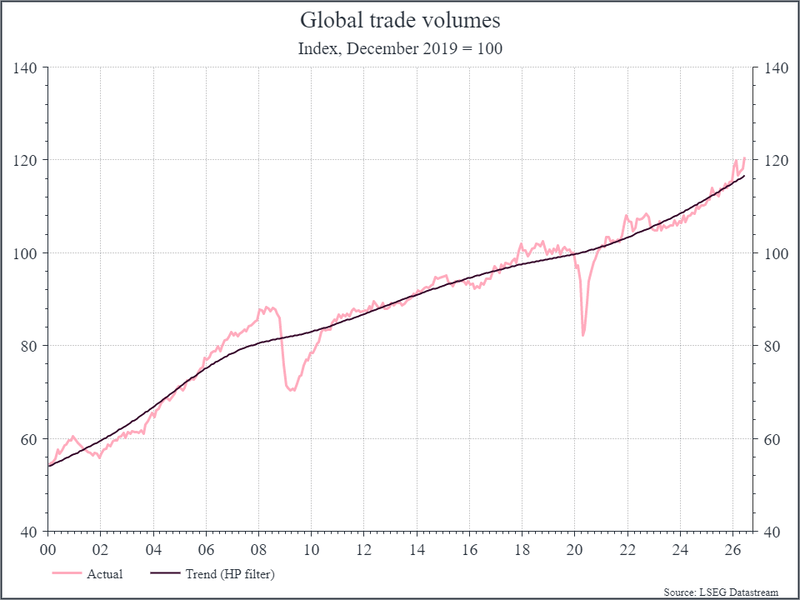
As you’d imagine, China has been an important part of this. The chart below shows Chinese exports globally and to the United States. There was a significant shift in trade flows – away from the US – in the wake of the 2025 tariff increases. In recent months, though, we’ve seen an increase in Chinese exports to the US. We think that’s a combination of increasing demand for capital goods, related to Artificial Intelligence (AI), and to legal challenges against US tariff policies.
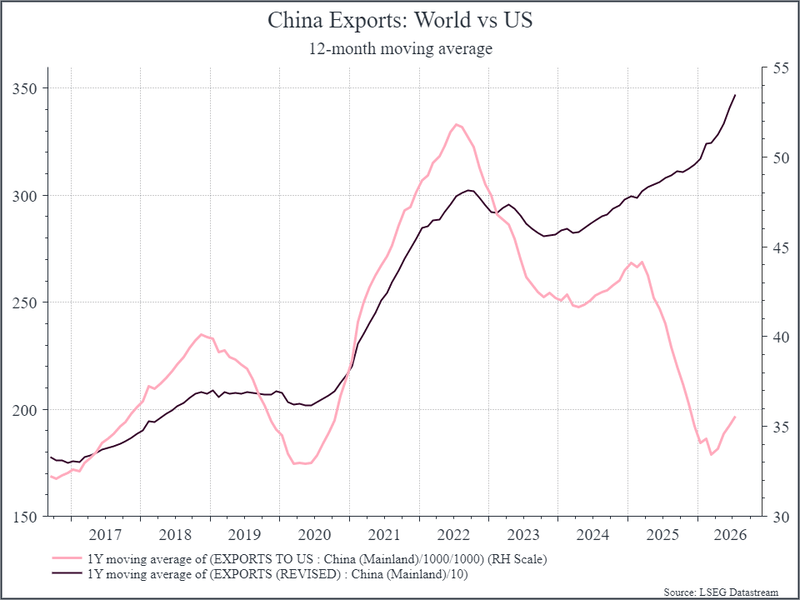
But stronger exports aren’t just a China story. The chart below shows export growth for the UK, Germany and Korea. The impact of the AI boom is clearly reflected in strong Korean export growth, but we’ve also seen export growth accelerating for both the UK and Germany in recent months.
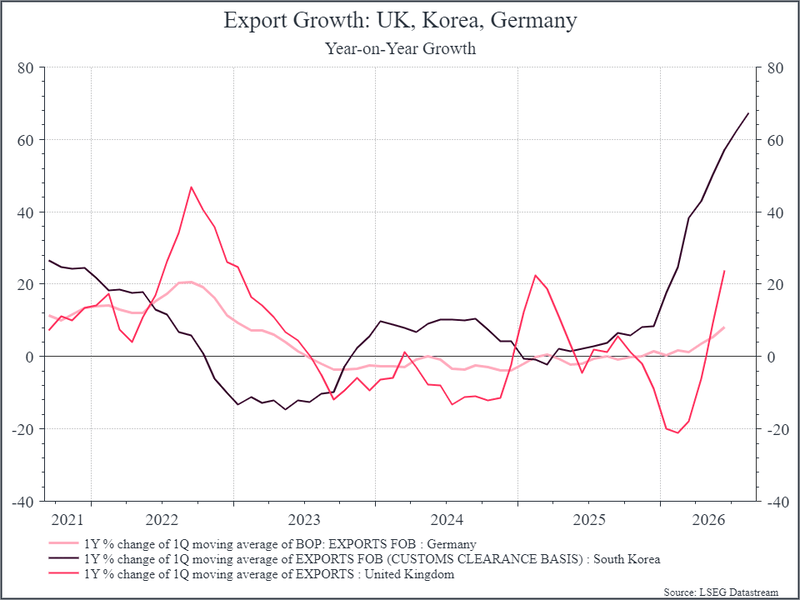
Where are these exports going? The US is still an important destination. The chart below shows the growth in imports of capital goods to the US, which are typically used in new manufacturing facilities. Growth in capital goods imports has correlated pretty well in the past with GDP growth. We’ve seen a significant acceleration in recent months, suggesting that US economic growth should hold up quite well going forward.
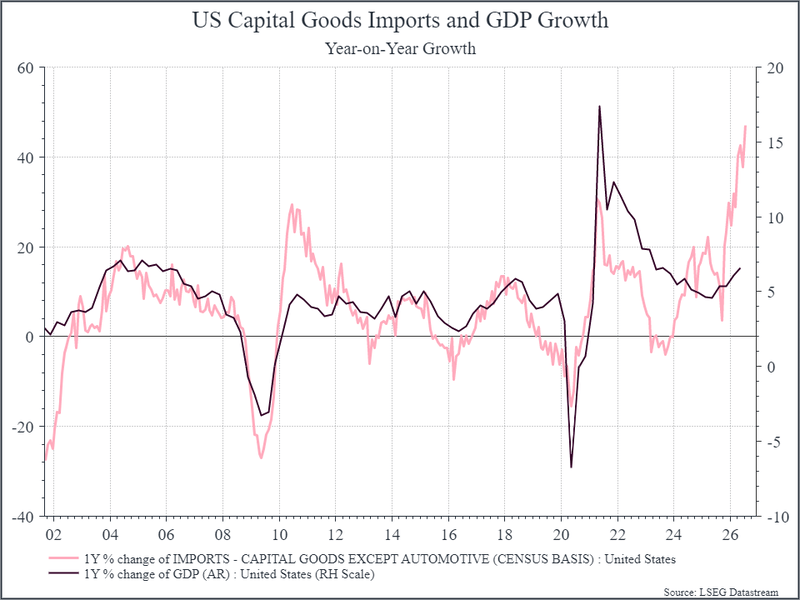
What does it mean for markets? Generally speaking you’d argue that stronger exports should mean stronger global growth and better corporate earnings.
This relationship seems to hold pretty well for Emerging Markets (EM) in particular. The chart below compares the growth in EM exports with earnings growth for these markets’ equities over time.
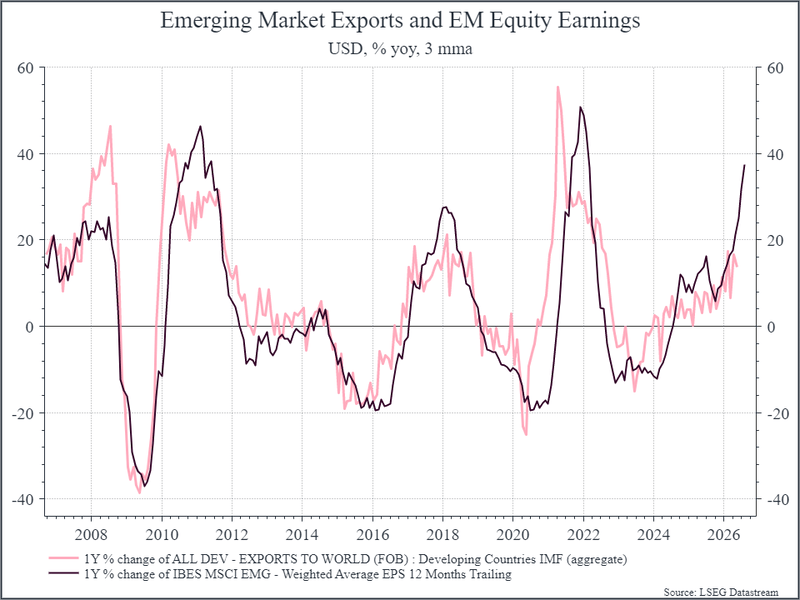
In 2026, it looks like EM earnings have grown even faster than export growth would suggest. We think that reflects the increasing importance of technology in Emerging Markets earnings. Replacing EM exports with Korean exports in this chart highlights the point, given the weight of tech hardware in Korean exports. Korean exports attract attention partly for their tech exposure, but also because they are among the most up-to-date macro data releases – coming usually only a few days after the end of the month.
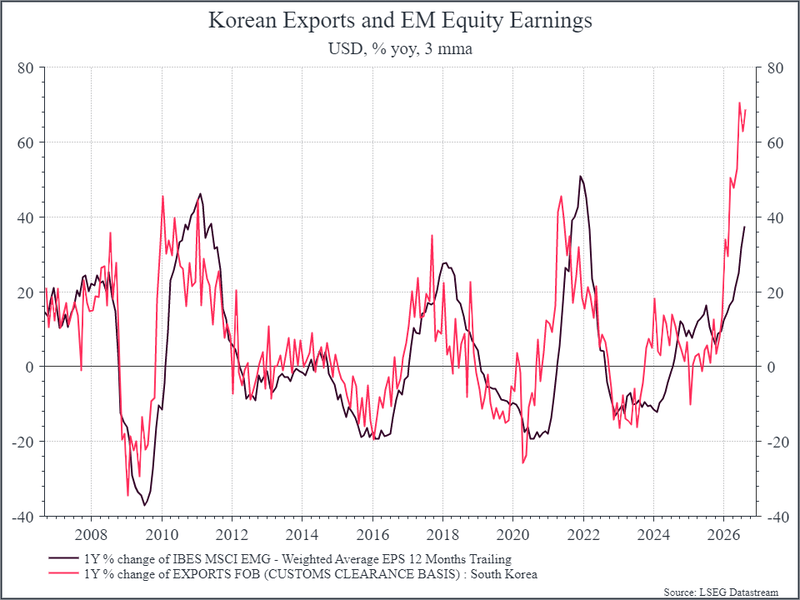
So where does this get us? In a world with so much uncertainty, this trade data highlights some areas of strength in the global economy over the past few months. We think it also highlights how the AI theme is driving macroeconomic data as well as financial market returns. Spending on AI might account for close to half of current US GDP growth, according to some estimates. It remains a key focus of attention as we think about how to manage our exposure to this important trend.
The post The AI signal in the macro data appeared first on MoneyFarm Insights.
]]>⏳ Reading Time: < 1 minuteWelcome to a new episode of A Matter of Interest podcast, your fortnightly reality check on global markets, hosted by Moneyfarm. Every two weeks, Richard Flax (our Chief Investment Officer) and Jack Amy (our Quantitative Trading Analyst) cut through the noise to serve up fresh market trends, data-driven insights, and strategic takeaways, minus the textbook jargon. In this episode we cover […]
The post When US policy meets Big Tech appeared first on MoneyFarm Insights.
]]>Welcome to a new episode of A Matter of Interest podcast, your fortnightly reality check on global markets, hosted by Moneyfarm. Every two weeks, Richard Flax (our Chief Investment Officer) and Jack Amy (our Quantitative Trading Analyst) cut through the noise to serve up fresh market trends, data-driven insights, and strategic takeaways, minus the textbook jargon.
In this episode we cover recent US fiscal and monetary policy decisions, then look at the growing regulatory pressure on Big Tech. Giving a bit more context, we explore what secret risks might be lurking in the US Treasury’s latest moves, why the Fed’s new stance could catch markets off guard, and whether multi-billion dollar fines and local data center pushback will actually dent Big Tech’s unstoppable momentum. Enjoy listening!
Key takeaways
- The new US policy landscape – from 0:28
- Big Tech’s momentum faces new challenges – from 17:26
You can also listen to the episode on Apple Podcast and YouTube.
The post When US policy meets Big Tech appeared first on MoneyFarm Insights.
]]>⏳ Reading Time: 6 minutesMany parents and grandparents want to provide not only love and guidance but also a strong financial foundation for their children or grandchildren. Two popular UK investment options for achieving this goals are the Junior ISA and the Junior SIPP. In this guide, we compare Junior SIPP vs Junior ISA, exploring their features, benefits, potential […]
The post JISA vs. Junior SIPP? How to Invest for Your Child’s Long-Term Future appeared first on MoneyFarm Insights.
]]>Many parents and grandparents want to provide not only love and guidance but also a strong financial foundation for their children or grandchildren. Two popular UK investment options for achieving this goals are the Junior ISA and the Junior SIPP.
In this guide, we compare Junior SIPP vs Junior ISA, exploring their features, benefits, potential drawbacks, and scenarios in which each may be most suitable.
At a glance
Both are tax-efficient; choice depends on goals and time horizon.
Junior ISA: £9,000 annual allowance, tax-free growth, access at 18.
Junior SIPP: £2,880 annual allowance plus 20% tax relief, access from age 55 currently, rising to 57 from 6 April 2028.
What is a Junior ISA?
A Junior ISA (Individual Savings Account) is a tax-efficient savings or investment account for UK residents under the age of 18. It can be cash-based or invested in stocks and shares.
- Annual allowance: £9,000 for the 2026/27 tax year (unchanged since 2020/21)
- Tax treatment: No income tax or capital gains tax on returns
- Access: Funds available when the child turns 18
- Typical uses: University fees, first-home deposit, starting a business, or travel
What is a Junior SIPP?
A Junior SIPP (Self-Invested Personal Pension) is a pension savings account for a child, offering the same tax advantages as an adult SIPP but with contributions made by parents, relatives, or guardians.
- Annual allowance: £2,880, with 20% tax relief added by the government, taking the total to £3,600
- Tax treatment: No tax on investment growth; withdrawals taxed as income in retirement
- Access: From age 55 currently. Under rules confirmed by HMRC’s Pensions Tax Manual, the Normal Minimum Pension Age will rise to 57 from 6 April 2028; no further increase to 58 has been confirmed.
- Typical uses: Long-term pension planning, maximising the benefits of compound growth
Junior SIPP vs Junior ISA: full comparison
| Feature | Junior ISA | Junior SIPP |
| Annual allowance | £9,000 | £2,880 + 20% tax relief (£3,600 total) |
| Tax on returns | None | None (taxable on withdrawal) |
| Access age | 18 | 57 (58 from 2034) |
| Ideal for | Medium-term goals | Retirement savings |
| Liquidity | High after age 18 | Very low (long-term lock-in) |
| Tax relief on contributions | No | Yes, 20% from the government |
| Risks | Market volatility | Market volatility, restricted access |
Example – Junior ISA
A parent invests £100 a month from birth until age 18 in a Stocks and Shares Junior ISA, with a 7% annual return:
- Total contributions: £21,600
- Estimated value at 18: ~£42,000
- Potential uses: University costs, house deposit, business start-up
Example – Junior SIPP
The same £100 monthly contribution to a Junior SIPP benefits from 20% tax relief, becoming £125 invested per month. Left untouched until age 60 at a 7% annual return:
- Total contributions (including tax relief): £27,000
- Estimated value at 60: £300,000+
- Potential use: Supplementing retirement income
Figures are illustrative only, assuming 7% annual growth. Actual returns will vary and are not guaranteed.
Practical example: splitting contributions between both accounts
The Bennett family wants to give their newborn daughter, Ava, both a flexible fund for early adulthood and a head start on retirement. They decide to contribute £150 a month between birth and age 18, split £100 into a Junior ISA and £50 (net) into a Junior SIPP, assuming 7% average annual growth:
| Junior ISA (£100/month) | Junior SIPP (£50/month net) | |
|---|---|---|
| Government top-up | None | £12.50/month (20% tax relief) |
| Total monthly amount invested | £100 | £62.50 |
| Total contributed by the family over 18 years | £21,600 | £10,800 (+ £2,700 tax relief) |
| Estimated value at 18 (7% annual growth, illustrative) | ~£42,000 | ~£26,000 |
| Access | Immediately, at 18 | Not accessible — keeps growing tax-free until at least age 55 (57 from 2028) |
Figures are illustrative only, assume constant 7% annual growth with no charges deducted, and are not a forecast. The example shows how allocating even modest sums to each account can build both a flexible fund for early adulthood and a head start on retirement — with the Junior SIPP portion left to compound untouched for several more decades before it can be accessed.
JISA or Junior SIPP – which is right for you?
Both Junior ISAs and Junior SIPPs (Self-Invested Personal Pensions) offer powerful, tax-efficient ways to invest for your child’s future. A Junior ISA is generally suited to medium-term goals like university or a first home, while a Junior SIPP is designed for long-term retirement planning.
Junior SIPP: You can contribute a maximum of £2,880 per tax year to a child’s SIPP, but you’ll benefit from 20% tax relief on contributions, bringing the total to £3,600 per year. It’s a longer-term option, as your child can’t access the money until later in life (currently age 57+), and the power of long-term compounding could make it a strong contender for building future wealth.know they can confidently manage their money and you’ve given them the best possible start in life.
Junior ISA: pay in up to £9,000 per tax year, tax-free growth, no capital gains or income tax, and your child can access the money at age 18. Ideal for education, travel, a deposit on a house, or even starting their own business. They can also transfer it to a standard ISA and keep investing after they turn 18.
Pros and cons
| Junior ISA | Junior SIPP | |
| Pros | – Accessible at age 18- Flexible use of funds- Higher annual allowance | – 20% tax relief on contributions- Long investment horizon with greater compounding potential- Encourages long-term savings discipline |
| Cons | – No tax relief on contributions- Risk of early spending at 18 | – Funds locked until at least age 57- Lower contribution limits |
Teach your children how money works
Creating wealth isn’t just about putting money away. It’s about mindset, too. As your children grow, helping them to understand how money works is just as important. Focus on teaching them how to budget, save, invest, and avoid bad debt.
Try these simple tips:
- Let them help you set a family budget.
- Use a pocket money account or app to teach saving, spending and giving.
- Introduce them to the concept of interest and investing using a simple app or calculator.
- Involve them in discussions about your own financial goals. Showing how you save or invest for life’s big events and purchases.
Build knowledge, not just their bank balance
Helping your children is about more than just a lump sum of money. It’s about giving them the tools, habits, and confidence to build their own financial future.
Small, regular contributions to a JISA or Junior SIPP are a great place to start. But the impact of your actions and teachings today could go far beyond childhood and into their adulthood, their retirement, and even into the lives of their own children.
On this Parents’ Day, consider starting that journey as soon as you can. And while setting up an account for them today is a great start, don’t forget to educate and involve them – the aim is to empower them for the future.
How to choose between a Junior SIPP vs Junior ISA
When deciding between a Junior SIPP vs Junior ISA, consider:
- Time horizon: will the funds be needed within 20 years (Junior ISA) or are you comfortable locking them away for decades (Junior SIPP)?
- Purpose: what is the main goal of this investment? Education, or a first home (Junior ISA) or retirement (Junior SIPP)?
- Balance: many families use both, allocating some funds to each for short- and long-term goals.
Key points to remember
- Both options offer tax-efficient growth and the potential for higher returns than traditional savings accounts.
- Junior ISA is more flexible, Junior SIPP benefits from government tax relief.
- Contribution limits and access rules differ significantly.
- Using both can balance medium-term needs and long-term financial security.
- Always consider your objectives, time horizon, and risk tolerance before investing.
Ready to get started? Contact Us
We make it easy to invest for your child’s future with a fully managed Junior ISA. You choose the monthly contribution, we do the rest – from selecting the right portfolio to managing it over time. And, when they’re ready, you’ll know they can confidently manage their money and you’ve given them the best possible start in life.
FAQ
Yes, you can hold both accounts at the same time. The two solutions have different limits, so you can pay up to £9,000 per tax year into a Junior ISA and £2,880 (plus £720 in government tax relief) into a Junior SIPP.
When the holder of a Junior ISA turns 18, the account is automatically converted into a standard ISA for adults and the holder gains full control of the funds. In the case of a Junior SIPP, ownership passes to the child when they turn 18, but the money remains locked in until they reach the minimum age for accessing the pension (currently 55, rising to 57 from 6 April 2028).
The right choice depends on your goals and time horizon. A Junior ISA is more flexible and can be used for early adult expenses such as university or a first home. A Junior SIPP offers tax relief and greater long-term growth potential, but the funds are not accessible until later in life.
The Junior ISA allowance for the 2026/27 tax year is £9,000, unchanged since 2020/21. As with adult ISAs, unused Junior ISA allowance cannot be carried over into the following tax year.
Not until they reach the Normal Minimum Pension Age, which is currently 55. According to HMRC’s Pensions Tax Manual, this is set to rise to 57 from 6 April 2028. Ownership of the Junior SIPP transfers to the child at 18, but they cannot withdraw from it before this age regardless.
The post JISA vs. Junior SIPP? How to Invest for Your Child’s Long-Term Future appeared first on MoneyFarm Insights.
]]>⏳ Reading Time: 7 minutesIn recent years, index funds have gained popularity among investors in the UK. These are passive investment vehicles that track the performance of a market index, such as the FTSE 100 or the S&P 500. Index funds offer a simple and efficient solution for those who want to diversify their portfolio without high costs. In this comprehensive guide […]
The post Investing in Index Funds: A Complete Guide for UK Savers appeared first on MoneyFarm Insights.
]]>In recent years, index funds have gained popularity among investors in the UK. These are passive investment vehicles that track the performance of a market index, such as the FTSE 100 or the S&P 500. Index funds offer a simple and efficient solution for those who want to diversify their portfolio without high costs.
In this comprehensive guide for 2026, we will look at what index funds are, how they work, what advantages and disadvantages they offer, and who they are best suited for. We will also provide some practical tips on how to integrate index funds into a long-term investment strategy.
| What are index funds? | Funds that aim to track the performance of a specific market index |
| How do they work? | They invest in the assets included in the index they track |
| Are they risky? | Yes, their value can fall when the underlying market falls |
| Are they the same as ETFs? | No: both can follow an index, but ETFs trade throughout the day, while index mutual funds are usually priced once a day |
What are index funds?
An index fund is a mutual fund or ETF (Exchange-Traded Fund), which is a passively managed financial instrument that replicates the performance of a benchmark index. This means that the fund manager does not actively select securities, but simply buys the same assets in the index, in the same proportions.
To give a concrete example, a fund that tracks the FTSE 100 holds shares in the 100 leading companies listed in London. This approach significantly reduces management costs, as no active selection or in-depth analysis is required. Here are some example of the best index funds in 2026, according to Morningstar:
- Fidelity 500 Index FXAIX
- iShares Core S&P 500 ETF IVV
- Schwab S&P 500 indexPX
- State Street SPDR Portfolio S&P 500 ETF SPY
- Vanguard S&P 500 ETF VOO
- iShares Core S&P Total US Stock Market ETF ITOT
- Schwab US Broad Market ETF SCHB
- State Street SPDR Portfolio S&P 1500 Composite Stock Market ETF SPTM
- T. Rowe Price Total Equity Market Index POMIX
- Vanguard Total Stock Market ETF VTI
- Fidelity Large Cap Growth Index FSPGX
- iShares Core S&P US Growth ETF IUSG
- iShares Russell 1000 Growth ETF IWF
- Schwab US Large-Cap Growth ETF SCHG
- Vanguard Growth ETF VUG
How do index funds work?
Before looking at when it is advisable to invest in index funds, it is important to understand how these financial instruments work. Specifically, when an investor buys shares in an index fund, the money is used to purchase all the components of the chosen index. The value of the fund therefore tends to closely track the performance of the index, net of management fees.
There are two main approaches to replicating an index:
- Physical replication: the fund directly purchases all the securities in the index, ensuring a direct and transparent match.
- Synthetic replication: the fund uses derivatives to achieve a return similar to that of the index without physically holding all the securities.
Generally, physical replication is more common in the UK, as they are considered clearer and more understandable for retail investors.
| Physical replication | Synthetic replication |
| Buys the shares or bonds in the index | Uses derivatives to track the index |
| Directly holds the underlying assets | Does not need to hold all the underlying assets |
| Simple and easy to understand | More complex structure |
| Generally more transparent | Less transparent for some investors |
| Lower counterparty risk | Higher counterparty risk |
Why choose index funds?
There are many reasons for the growing popularity of index funds. First of all, index funds have low costs thanks to the absence of active management. In fact, with passive management, management fees are usually lower than those of traditional funds. In addition, it is possible to achieve broad diversification even with limited capital, accessing hundreds or thousands of securities through a single transaction. This makes investing simple and transparent, with an approach that allows you to clearly understand where your money is being invested.
In terms of performance, however, it has been observed that over the long term, many index funds manage to achieve results in line with or even superior to actively managed funds. This is due, in part, to lower costs and the efficient nature of the market. So, the key benefits in 2026 are:
- Low costs: index funds generally have lower management fees than actively managed funds, helping investors keep more of their returns.
- Diversification: with a single investment, you can gain exposure to hundreds or even thousands of companies or other securities, helping to spread risk.
- Simplicity: index funds follow a specific market index, so they are easy to understand and monitor.
- Transparency: you can clearly see which index the fund tracks and what type of assets it invests in.
- Long-term potential: by tracking the performance of a market or sector, index funds can offer the opportunity to benefit from long-term market growth.
- Easy access to global markets: you can use index funds to have access to markets and sectors around the world without having to select individual investments.
- Suitable for regular investing: index funds can be used for regular contributions.
Risks and limitations of index funds
Of course, index funds are not without risk. Their return is closely linked to the performance of the benchmark index: if the market falls, the fund will also suffer losses. Furthermore, there is no active attempt to mitigate such declines through dynamic management, as the fund strictly follows the composition of the index.
Another aspect to consider is the so-called tracking error, i.e. the difference between the fund’s performance and that of the index. Although the tracking error is generally low in index funds, it can still affect overall returns over time and this aspect must be carefully considered when selecting funds for your portfolio. Index funds offer several advantages, but they also come with some limitations.
Here is a summary of the main pros and cons to consider:
| Pros | Cons |
| Low costs | Market risk |
| Diversification | No active protection |
| Simple and transparent | Tracking error |
| Long-term potential | Limited flexibility |
| Easy access to markets | Concentration risk |
How to choose an index fund
Choosing an effective index fund requires attention to several factors. It is important to evaluate the index that the fund intends to replicate, for example, the FTSE 100 for the UK market, the MSCI World for investors with a global outlook, or other thematic indexes. Another key factor is the level of fees, often represented by the Total Expense Ratio (TER): the lower it is, the higher the net returns for the investor.
A good fund should also have a low tracking error, meaning that it should always replicate the index accurately. Other important indicators are the size and liquidity of the fund, as these characteristics affect the stability and ease with which you can enter or exit the investment.
So when choosing an index fund, it is important to consider a few key factors:
- The index: check which market, region or sector the fund tracks.
- Fees: compare the Total Expense Ratio (TER) and other costs.
- Tracking error: look for funds that closely follow their chosen index.
- Fund size: larger funds may offer greater stability and liquidity.
- Liquidity: check how easily you can buy or sell the fund.
- Diversification: consider how many securities and markets the fund covers.
- Risk: make sure the fund’s risk level matches your investment goals and time horizon.
- Fund provider: consider the provider’s reputation, experience and track record.
Index funds and ETFs: what are the differences?
Although they share the philosophy of passive investing, index mutual funds and ETFs have some practical differences. ETFs are traded in real time on the stock market, just like stocks, while traditional mutual funds are valued and purchased only once a day, based on their net asset value.
This feature makes ETFs more flexible for those who want more control over the timing of their trades, although it requires more attention in day-to-day management. Mutual index funds, on the other hand, may be more suitable for those who prefer a “set and forget” approach. If you want to discover more about ETFs, you can visit our dedicated page.
| Index mutual funds | ETFs | |
| Trading | Once a day | In real time |
| Pricing | Based on daily NAV (Net Asset Value) | Market price |
| Flexibility | Lower | Higher |
| Management | Simpler | Requires more active management |
| Suitable for | Long-term investing | Who want more control |
A practical example: investing in the FTSE All-World Index
Let’s now consider a practical example, assuming an investor who wants to gain broad geographical and sector exposure. An ideal solution could be an index fund that tracks the FTSE All-World. This index includes thousands of globally listed companies, covering both developed and emerging markets.
This gives investors access to a wide range of stocks in different countries and sectors through a single instrument, resulting in a naturally balanced portfolio that can reduce specific risk.
Index funds and long-term strategy
Index funds are particularly effective as part of a long-term investment strategy. They are ideal, for example, for pension plans or for gradually accumulating capital for future goals. Thanks to the power of compound capitalization, even small regular contributions can translate into significant returns over time.
Adopting a “buy and hold” approach, combined with regular purchases over time (accumulation plans), allows you to benefit from the average purchase cost. This makes it possible to reduce the impact of market volatility and improve the stability of returns over time.
Index funds are a simple, inexpensive, and effective solution for building a diversified portfolio. Although they are not risk-free, index funds are a valuable tool for those who want to invest for the long term without any complications.
Moreover, the growing popularity of index funds in the United Kingdom confirms the confidence that many savers have in these passively managed financial instruments, which are a useful and attractive option for balanced long-term investing.
Frequently Asked Questions
An index fund is a type of mutual fund or exchange-traded fund (ETF) that tracks the performance of a benchmark market index, such as the S&P 500 or the FTSE 100.
The three largest index funds in the world are Vanguard, BlackRock (iShares), and State Street Global Advisors (SPDR).
Mutual funds offer a passive investment strategy by replicating the performance of a market index. This is achieved by investing the fund’s assets in the securities contained in the benchmark index, in the same proportions.
The main difference between ETFs and index funds is that ETFs are traded on the stock exchange throughout the day like stocks, while index funds are only bought or sold once a day, at the end of the day.
You can invest in index funds without using a traditional broker through an investment platform or a provider that offers direct access to funds. But it is important to check the fees, available funds and account options before investing.
Index funds can be suitable for beginners because they offer diversification, relatively low costs and a simple way to invest in financial markets. But you should always consider your goals, time horizon and risk tolerance.
Yes, many index funds and investment platforms allow investors to start with relatively small amounts. Regular contributions can also help build an investment over time.
The post Investing in Index Funds: A Complete Guide for UK Savers appeared first on MoneyFarm Insights.
]]>⏳ Reading Time: 9 minutesPension income is taxable in the UK. Whether it is your State Pension, a workplace scheme or a private pension, the income you receive counts towards your annual taxable income. At a Glance Pension income in the UK is taxable once your total income exceeds the personal allowance (£12,570 in 2026/27, frozen since 2021/22). The […]
The post Paying Tax on State Pension in UK: How it is taxed and how to calculate appeared first on MoneyFarm Insights.
]]>Pension income is taxable in the UK. Whether it is your State Pension, a workplace scheme or a private pension, the income you receive counts towards your annual taxable income.
At a Glance
-
Pension income in the UK is taxable once your total income exceeds the personal allowance (£12,570 in 2026/27, frozen since 2021/22).
- The State Pension is included in your taxable income, even though tax is not deducted at source.
- You can usually take up to 25% of your pension pot tax-free from age 55 (rising to 57 by 2028).
- Tax relief is available on pension contributions, but the process depends on the type of scheme.
- Different pension types (state, defined benefit, defined contribution) have different rules and tax implications.
| What is the personal allowance for pension income tax in the UK? | £12,570 for the 2022/23 tax year |
| What is the tax rate of pension income in the UK? | The basic taxpayer rate is 20%, the higher taxpayer rate is 40%, and the additional taxpayer rate is 45% |
| How much tax do I have to pay? | The tax paid depends on the amount of pension income received, your personal allowance and your tax code |
| Is pension contribution taxable? | No, pension contributions are not taxed |
Will you pay income tax on your state pension?
The State Pension is taxable income, although tax is not deducted at source. You usually receive the full gross amount, and if your total income for the year exceeds the personal allowance (£12,570 in 2026/27), you may have to pay income tax on it.
Any income above this threshold is taxed at your marginal rate (20%, 40% or 45%) according to the UK income tax bands: 20% basic rate applies from £12,571 to £50,270, 40% higher rate from £50,271 to £125,140, and 45% additional rate on income above £125,140.
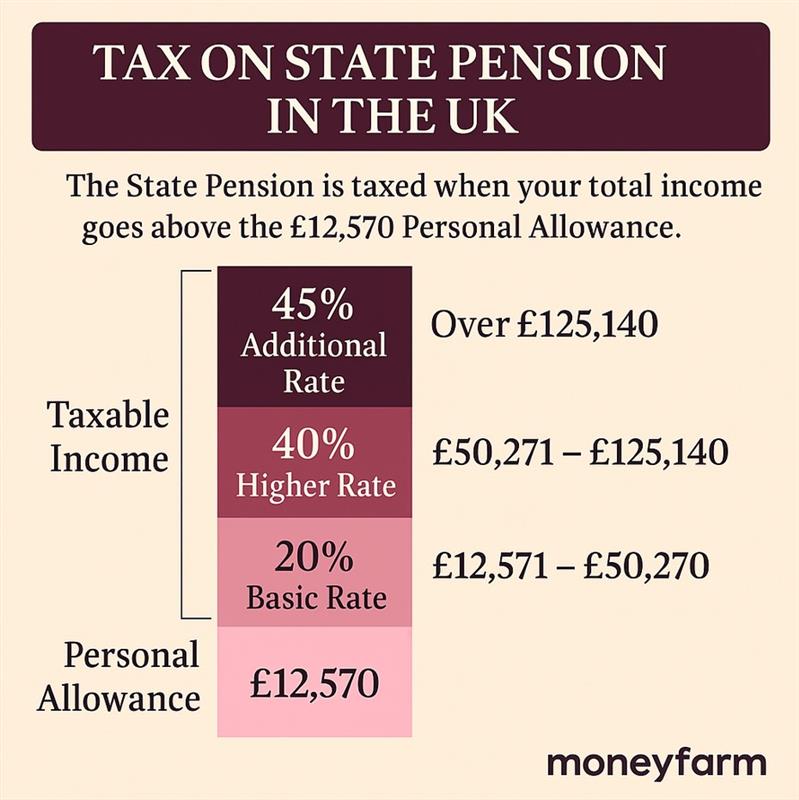
For any given tax year, your taxable income includes the following:
- Your state pension
- Other pension payments you receive
- Any earnings from self-employment
- Any receivables from rentals
- Any interest from banks and building societies
- Receivables from investments
How Much of Your Pension Is Tax-Free?
Pensions are not fully tax-free in the UK. From age 55 (rising to 57 in 2028), you can normally take up to 25% of your pension pot as tax-free cash. The remainder is treated as taxable income and will be taxed according to your income tax band when withdrawn. This 25% is capped in cash terms at £268,275 across all of your pensions for most people (Source: GOV.UK), so very large pension pots may not get the full 25% tax-free.
This tax-free amount can usually be taken either as a single lump sum or in stages, depending on your pension scheme rules. Any further withdrawals are subject to income tax.
Are other types of pension taxed as income?
Income tax is not deducted from your state pension. However, the full new state pension forms part of your total receivables.
According to GOV.UK, the full new State Pension for 2026/27 is £241.30 a week — £12,547.60 a year. This means that of your £12,570 personal allowance, someone receiving the full new State Pension has only £22.40 of tax-free headroom left before any other pension or income becomes taxable. This gap has narrowed sharply in recent years: the personal allowance has been frozen since 2021/22, while the State Pension keeps rising each April under the triple lock, so the two figures are now nearly level.
If you have other pensions that will use up this balance and exceed it, you will pay income tax on the excess pension income at the usual rates because the rates don’t change in retirement.
Practical example: State Pension plus a small private pension
Suppose Margaret receives the full new State Pension and also draws £5,000 a year from a small workplace pension. Here is how her tax bill for 2026/27 would be worked out:
|
Amount |
|
|---|---|
|
Full new State Pension (2026/27) |
£12,547.60 |
|
Private pension income |
£5,000.00 |
|
Total income |
£17,547.60 |
|
Personal allowance |
£12,570.00 |
|
Taxable income (total income minus personal allowance) |
£4,977.60 |
|
Income tax due (20% basic rate) |
£995.52 |
This is a simplified illustration assuming no other income or reliefs apply; HMRC normally collects this tax by adjusting the tax code on the private pension, since tax is not deducted from the State Pension itself.
National Insurance Contributions Explained
You must pay National Insurance contributions during your working life, whether you are employed or self-employed. It starts from the age of 16 and remains a requirement until State Pension Age.
Employees pay Class 1 contributions, deducted automatically from earnings.
Self-employed workers with profits above £7,105 a year no longer pay Class 2 contributions directly — since April 2024, these are treated as paid to protect your National Insurance record (Source: GOV.UK). Those with lower profits can still choose to pay Class 2 voluntarily, currently £3.65 a week, to protect their record. Class 4 contributions, based on annual taxable profits above £12,570, are charged at 6% up to £50,270 and 2% above that — down from 9% before the April 2024 reform.
The Other Types of Pensions in the UK and Their Tax Treatment
Aside from your state pension, the other pensions generally fall into one of two categories – defined benefits pensions and defined contribution pensions.
Defined benefit (DB) pension schemes
A defined benefit pension (DB) scheme pays you a retirement income based on your salary plus how long you worked for your employer. These are also referred to as “final salary” and “career average” pension schemes.
You only generally encounter these in older workplace pension schemes or as pension schemes in the public sector. But either type can fall into the bracket of a pension taxed as income if it pushes your annual income over your personal tax allowance.
Defined contribution (DC) pension schemes
Defined contribution (DC) pension schemes, sometimes called “money purchase” pension scheme, are usually personal or stakeholder pensions. They might be:
- Workplace pensions organised by your employer
- Private pension schemes set up by you
The money paid into these types of schemes is put into investments like stocks and shares by your pension provider. The value of pension pots can appreciate or depreciate depending on how the products they are invested in perform.
As you approach retirement (currently transitioning from age 66 to 67 — see below), providers may gradually shift your pot into lower-risk investments, though this is not automatic in all cases. You can also hold a Self-Invested Personal Pension (SIPP) alongside a workplace pension if you wish.
From age 55 (rising to 57 in 2028), you can usually take 25% of your pot tax-free, while the remainder is taxed as income when withdrawn.
OPEN A PRIVATE PENSION WITH MONEYFARM
Taxes on Pensions UK: State Pension vs Defined Benefit vs Defined Contribution
|
Pension / Account |
Tax treatment |
Tax-free element |
Access age |
|
State Pension |
Taxable as income (not deducted at source) |
None |
State Pension age (currently 66) |
|
Defined Benefit (DB) |
Taxable as income |
Up to 25% lump sum (commutation factor applies) |
Scheme-specific, often 60–65 |
|
Defined Contribution (DC) |
Taxable as income |
Up to 25% of pot tax-free from age 55 (57 from 2028) |
55 (57 from 2028) |
The State Pension age is no longer simply “66” for everyone: according to GOV.UK, the rise from 66 to 67 began in May 2026 for people born from 6 April 1960 onwards, who reach their own State Pension age at 66 years plus a number of months, with the increase completing by 2028.
Pension lump sums and taxation
Since the 2015 pension freedoms, individuals aged 55 and over (rising to 57 from 2028) can access savings from defined contribution pensions more flexibly. You are no longer required to buy an annuity or enter a drawdown plan. Instead, you can withdraw some or all of your pension pot.
Access to part of your pot will cause the remaining investments to appreciate, but a pension drawdown is required.
Most people now take advantage of the 25% lump sum tax-free rule instituted in 2006, taking 25% of their pot without paying any income tax. However, the remaining 75% will be taxed as income under the annual tax threshold rules.
The position with defined benefit schemes is a little more complex. Whereas you still have the option to withdraw 25% as a tax-free lump sum, what happens with a defined benefit scheme is that something called the “commutation factor” comes into play. It is a factor that calculates the amount of income you will receive in retirement after taking a tax-free lump sum upfront.
Pension contributions and tax relief
You get tax relief on the contributions you make to your pension, but the way you claim it depends on the type of pension scheme in question.
The net pay system
Some workplace pensions use the net pay system, and you don’t need to do anything to ensure you get full tax relief. That’s because your pension contributions are deducted from your salary before income tax is paid, and your pension scheme provider automatically claims back the tax relief at the appropriate rate. You do not need to take any further action.
The relief at source system
This system is applied to all types of personal pensions and some workplace pensions. In other words, you should take note if you have a private pension via an insurance company or a SIPP (Self Invested Personal Pension).
If your contributions are made via your employer, they will take 80% of your contributions from your salary. It is referred to as “net of basic rate tax relief.”
Your pension scheme provider then issues a request to HMRC, resulting in an additional 20% tax relief being paid into your Pension. However, with tax relief at source systems, higher or additional rate taxpayers have to fill out a self-assessment tax return form to receive the extra tax relief they are entitled to.
In some cases pension contributions reduce your taxable income, but you will have to claim any tax relief over and above the basic rate by yourself.
Tax-Free lump sums
From age 55 (rising to 57 in 2028), you can usually take up to 25% of each pension pot as tax-free cash. The remainder is treated as taxable income when withdrawn. If you have multiple pensions, each may offer its own 25% tax-free entitlement, up to a combined lifetime cap of £268,275 for most savers (Source: GOV.UK).
Scottish Tax Relief
The income tax bands in Scotland are slightly different from those in the UK. You can claim additional tax relief on:
- 20% up to the amount of any income on which you paid 40% tax
- 25% up to the amount of any income on which you paid 45% tax
As regards claiming additional tax relief on private pension contributions, you can claim:
- 1% up to the amount of any income on which you paid 21% tax
- 21% up to the amount of any income on which you paid 41% tax
- 26% up to the amount of any income on which you paid 46% tax
Withdrawals from private pensions are taxable, though there are strategies to reduce the overall tax burden.
Do I have to pay income tax on my pension if it is an ISA?
Individual Savings Accounts (ISAs) are not pensions but tax-efficient investment wrappers. Money held in an ISA grows free from both Capital Gains Tax and Income Tax, and withdrawals are also tax-free. This means that unlike pension income, which is taxable beyond your personal allowance, you do not pay income tax on money you take from an ISA. You also do not need to declare ISA holdings or withdrawals on your self-assessment tax return.
However, contributions to ISAs do not benefit from tax relief in the way that pension contributions do. For example, payments into a Self-Invested Personal Pension (SIPP) attract tax relief, while ISA contributions are made from post-tax income (read more on how to invest in a SIPP and SIPP vs ISA).
There are several types of ISA that can support long-term saving. A Stocks and Shares ISA allows investments in funds, equities and bonds to grow in a tax-efficient way, while a Lifetime ISA (LISA) can be used to save for a first home or retirement, with a government bonus on contributions up to £4,000 per year.
ISAs therefore complement, rather than replace, traditional pensions:
- pensions usually offer more powerful tax advantages for retirement planning;
- ISAs provide greater flexibility, as savings can be withdrawn at any time without additional tax charges.
Many people choose to combine the two, using pensions for long-term income in retirement and ISAs for accessible, tax-free savings.
Key Takeaways
-
Pension income in the UK is taxable once your total income exceeds the personal allowance (£12,570 in 2026/27).
- The State Pension counts as taxable income, but tax is not deducted at source.
-
The full new State Pension (£12,547.60 in 2026/27) now leaves only about £22 of personal allowance headroom before other income becomes taxable (Source: GOV.UK).
- You can normally take 25% of your pension pot as tax-free cash from age 55 (rising to 57 in 2028).
- Pension contributions receive tax relief, though the process differs between the Net Pay and Relief at Source systems.
-
The State Pension age is currently rising from 66 to 67, in stages between 2026 and 2028.
- National Insurance is not payable on pension income and stops at State Pension age.
FAQ
You have to pay pension income tax in the UK if your pension income (plus other incomes) exceeds your personal allowance.
You can take lump sums from your pension, but this may be subject to income tax. You can only take 25% of your pension as a lump sum without paying income tax. Any amount above the tax-free threshold will be subject to income tax.
Yes, the state pension is a taxable income in the UK. The income tax you will pay on your state pension depends on your total income (other private pensions, work pensions, earnings or investment income). But tax is t deducted after you have been paid and not at the source.
No. National Insurance contributions stop once you reach State Pension age, even if you continue working. Pension income itself is not subject to National Insurance, only income tax.
Yes, with careful planning. Spreading withdrawals across several tax years, using your personal allowance and taking advantage of the 25% tax-free cash can help reduce the tax you pay. Combining pensions with ISAs or other tax-efficient savings may also help manage your retirement income more effectively.
Because the personal allowance has been frozen at £12,570 since 2021/22, while the State Pension rises every April under the triple lock. For 2026/27 the full new State Pension is £12,547.60 (Source: GOV.UK), leaving only around £22 of allowance before any further pension or other income becomes taxable — a gap that has narrowed every year and may disappear entirely in a future tax year if both trends continue.
The post Paying Tax on State Pension in UK: How it is taxed and how to calculate appeared first on MoneyFarm Insights.
]]>⏳ Reading Time: 7 minutesFor many UK investors, the idea of becoming an ISA millionaire may feel out of reach. Yet with consistent contributions and long-term planning, it is more achievable than ever. According to HMRC, the most recent data — for the 2022/23 tax year, the latest year for which figures have been disclosed — puts the number […]
The post How to Become an ISA Millionaire: The Complete UK Guide appeared first on MoneyFarm Insights.
]]>For many UK investors, the idea of becoming an ISA millionaire may feel out of reach. Yet with consistent contributions and long-term planning, it is more achievable than ever.
According to HMRC, the most recent data — for the 2022/23 tax year, the latest year for which figures have been disclosed — puts the number of ISA millionaires in the UK at around 5,070, up roughly 5% on the year before (most are aged between 60 and 72, although the youngest ISA millionaire is 35): in this guide we will give you insight on how to become the next ISA millionaire.
At a Glance
-
To become an ISA millionaire try to maximise your ISA allowance (£20,000 in 2026/27 tax year).
-
Focus on Stocks and Shares ISAs for growth potential.
-
Reinvest dividends to harness compound returns.
- Consistency and patience are key.
| How to become an ISA millionaire? | Make full use of ISA allowance consistently |
| Which type of ISA account is recommended to achieve an ISA worth £1 million? | A stocks and shares ISA |
| How can you achieve an ISA worth £1 million? | Through long-term investments |
| What to abstain from to achieve a £1 million ISA? | Do not make withdrawals |
Invest Wisely: Let Your Money Propel You to ISA Millionaire Status
The first and most important tip is that you need to be putting your money to work. With the current inflation rate at 2.9% (Source: ONS, 12 months to July 2026), merely holding your money in cash may not be the best strategy for significant long-term growth because the presence of inflation can still lead to a gradual decrease in the real value of cash savings over time. Capital at risk.
For your ISA to reach £1 million you would need to invest the full £20,000 allowance for the 2026/27 tax year over roughly 26 years with an annual growth rate of 5% and if you were able to achieve returns of 7% the timeframe could fall to around 23 years, since no cash account offers interest rates anywhere near these levels it is important to consider your investment options.
|
Scenario |
Annual contribution |
Assumed growth rate |
Approx. years to £1m |
Key considerations |
|
Maximum allowance |
£20,000 |
5% |
~26 years |
Requires consistent full use of ISA allowance every tax year. Returns not guaranteed. |
|
Higher growth scenario |
£20,000 |
7% |
~23 years |
Achievable only with sustained higher returns and acceptance of greater market volatility. |
|
Moderate contributions |
£10,000 |
5% |
~34 years |
More realistic for many households, but takes longer to reach the £1m milestone. |
|
Lower contributions |
£5,000 |
5% |
~44 years |
Still builds a substantial pot over time, though inflation risk becomes more relevant. |
A stocks and shares ISA is our recommendation as understanding the power of compound interest of a stocks and shares ISA and reinvesting dividends can accelerate your journey.
It is important to remember that all investments carry risk: the value of your investments may fall or rise, and you could receive back less than the amount originally invested.
If you’re aiming for significant enough returns, financial markets may be your best bet. Also, utilizing an ISA millionaire calculator can help you plan and track your progress.
Practical example: Sarah’s journey to £1 million
Sarah starts investing at 30, contributing £15,000 a year into a Stocks and Shares ISA and reinvesting all dividends, with an illustrative average annual growth rate of 6%. Here is roughly how her ISA could grow over time:
|
Age |
Years invested |
Total contributed |
Estimated ISA value (6% growth, illustrative) |
|---|---|---|---|
|
40 |
10 |
£150,000 |
~£198,000 |
|
50 |
20 |
£300,000 |
~£552,000 |
|
60 |
30 |
£450,000 |
~£1,186,000 |
Figures are illustrative only, assume constant 6% annual growth with no charges deducted, and are not a forecast — actual returns will vary and are not guaranteed. The example shows how the bulk of the growth in the final decade comes from compounding on the contributions made in earlier years, which is why starting early matters more than the size of any single contribution.
Long-Term Vision: Building Your ISA Millionaire Portfolio
Becoming an ISA millionaire is a long-term goal. It typically takes decades of steady contributions and reinvested growth.
Avoid any kind of ‘get rich quick’ scheme or speculative trading. You can lose money with any investments, and backing the wrong horse on a speculative trading strategy can be disastrous. This extends to particularly volatile assets like cryptocurrencies or NFTs – people have made and lost a lot of money trading them, but we wouldn’t see them as part of any long-term strategy.
To safeguard your path to becoming an ISA millionaire, it’s crucial to avoid early withdrawals and short-term trading. These can significantly hinder the compound growth of a healthy portfolio. It’s important to take a long-term approach at all times and avoid being drawn into speculative trading.
How to Become an ISA Millionaire in 4 Steps
Step 1: Maximise Your Annual ISA Allowance
One of the most effective ways to build towards ISA millionaire status is to make the most of your annual ISA allowance. For the 2026/27 tax year, the allowance is £20,000. From 6 April 2027, confirmed reforms will cap the cash component of this allowance at £12,000 for savers under 65 (Source: GOV.UK), though the £20,000 combined limit is unaffected and Stocks and Shares ISAs — which matter most for this goal — keep their full allowance. Consistently investing close to this maximum each year can, over time, accelerate your progress towards a seven-figure ISA.
In practice, not everyone will be able to commit the full £20,000 annually. However, maximising contributions within your means remains valuable. Even smaller, regular amounts benefit from tax efficiency and compound growth over time.
Step 2: Put Lump Sums to Work
Lump sums, such as an inheritance or work bonus, can also be put to good use by spreading contributions across multiple tax years. For example, rather than holding £300,000 in cash, using the ISA allowance each year allows the funds to grow tax-efficiently, while reinvested dividends enhance long-term returns.
It is also worth remembering that the ISA allowance operates on a “use it or lose it” basis. Unused allowance cannot be carried over, so planning contributions before the 5 April deadline is essential. Whether your contributions are large or small, consistency and discipline are more important than reaching a specific figure.
Step 3: Stay Consistent and Avoid Withdrawals
Becoming an ISA millionaire is a long-term ambition, best approached with patience and realistic expectations. Few people will be able to invest £20,000 every year. Contributions of £5,000, or even less, can still result in a substantial ISA over time, provided they are made regularly and invested wisely.
Avoiding withdrawals is also fundamental, as this interrupts the compounding process that underpins portfolio growth. We recently produced a video explaining how important it can be for the value of your long-term investments. Watch it here.
Step 4: Focus on Long-Term Wealth, Not Just the “Millionaire” Label
The real focus should not be on the “millionaire” label, but on building sustainable wealth for the future. Consistency, diversification, and reinvesting dividends are the key drivers of long-term success.
The journey towards an ISA millionaire portfolio is about financial wellbeing, not a single number. A disciplined strategy, aligned with your goals and risk tolerance, will leave you better positioned for retirement and other long-term needs.
You can speak to a consultant who can help you create a plan that fits your long-term goals and financial situation.
Financial Planning: The Backbone of Your ISA Millionaire Ambition
You won’t become an ISA millionaire without some careful financial planning. Without it, you might have to commit the cardinal sin of having to withdraw your returns to pay for unplanned events. No one is exempt from falling foul of unexpected events that need money to cover them. The more well-off you are financially, the higher these unforeseen costs can be.
The place to start is by creating a budget. This budget needs to include all of your regular expenses and expected income. Only by establishing a budget can you accurately determine the amount of disposable income remaining once all expenses have been accounted for.
Firstly, before you earmark any surplus for investing, you should create an emergency fund, even if you are relatively wealthy. Regard your emergency fund as a short-term investment. It’s there to be tapped into when necessary, and the most popular vehicle for this type of short-term saving is an easy or instant-access savings account. Once you tap into the fund, you should top it up again, or it will surely dwindle away. This, too, should be a feature of the budget plan you create.
Having a healthy emergency fund means that you can safely invest the rest of your income in, say, a stocks and shares ISA as a long-term investment. By keeping all returns inside the tax wrapper, compound interest can get to work and help you along the road to one day becoming an ISA millionaire or at least being very comfortably positioned when retirement finally comes around.
Key Takeaways
- Maximising your ISA allowance each year can accelerate progress towards £1 million, but even smaller contributions build over time.
- Stocks and Shares ISAs offer higher growth potential than cash, though returns are not guaranteed.
- Reinvesting dividends is essential to benefit fully from compound growth.
- The journey typically takes decades, and the timeframe depends on market performance as well as contribution levels.
- Diversification, consistency, and patience are fundamental
-
From 6 April 2027, only £12,000 of the £20,000 ISA allowance can go into cash if you’re under 65 (Source: GOV.UK) — a reason to plan any large cash holdings destined for a Stocks and Shares ISA sooner rather than later.
FAQ
Yes, it is possible. The most recent HMRC data available, for the 2022/23 tax year, points to around 5,070 ISA millionaires in the UK, up around 5% on the year before. Most are aged between 60 and 72, although the youngest recorded ISA millionaire is just 35.
Maximise your ISA allowance each tax year, focus on a Stocks and Shares ISA for growth potential, and reinvest dividends to benefit from compounding. Diversification and discipline are essential.
With maximum annual contributions and 5–7% growth, reaching £1 million may take 23–26 years.
Not necessarily. Smaller but regular contributions can still grow into a significant ISA over time, especially if you start early and remain consistent.
The overall ISA allowance for 2026/27 is £20,000, unchanged from previous years. From 6 April 2027, confirmed reforms will limit the cash portion of this allowance to £12,000 for savers under 65 (Source: GOV.UK); Stocks and Shares ISAs, which are central to the ISA millionaire strategy in this guide, keep the full £20,000 limit.
The post How to Become an ISA Millionaire: The Complete UK Guide appeared first on MoneyFarm Insights.
]]>⏳ Reading Time: 9 minutesAre you thinking about gifting money to children but unsure of the tax implications? Understanding the rules around financial gifts, and how they interact with inheritance law and Inheritance Tax, is essential to making the most of your gift. In this guide, updated for the 2026–27 tax year according to Government rules, we explain the main factors […]
The post Inheritance and Gifting: How to Gift Money to Your Children Legally appeared first on MoneyFarm Insights.
]]>Are you thinking about gifting money to children but unsure of the tax implications? Understanding the rules around financial gifts, and how they interact with inheritance law and Inheritance Tax, is essential to making the most of your gift.
In this guide, updated for the 2026–27 tax year according to Government rules, we explain the main factors to consider before making a gift, from annual exemptions to the seven-year rule, and how to choose the most effective and tax-efficient way to give money to your children.
|
Can I gift money to my children? |
Yes |
|
How much money can I gift to my children? |
There is no amount limit |
|
How much is the annual tax-free gift allowance? |
£3,000. Any unused allowance may be carried forward, but only for one year, so you could give up to £6,000 in one year if you didn’t use the previous year’s allowance. |
|
What other gifts for children are tax free? |
Cash gifts up to the value of £250 and wedding gifts valued at £5,000 for a child or £2,500 for a grandchild |
Inheritance tax (IHT) in short: what it is and how it works
Inheritance tax (IHT) is a taxation on the value of a person’s estate, calculated at the time of death, and includes real estate, savings, investments and other assets. In the United Kingdom, the amount payable depends on:
- the size of the estate
- deductions, thresholds and allowances
- how the assets are distributed
Key thresholds and deductions for 2026-27
- Nil-Rate Band (NRB) of £325,000 for each person. If the value of the estate is less than this amount, no inheritance tax is payable.
- Residence Nil-Rate Band (RNRB), of £175,000 on top of the NRB, which applies if you transfer your main residence to a direct descendant (e.g. a child or grandchild). The RNRB is not automatically available when you leave your main residence to a child or other direct descendant. Certain conditions must be met, and the allowance cannot be more than the value of the qualifying residence. The RNRB is also reduced for estates worth more than £2 million, by £1 for every £2 above this threshold.
- Couples’ allowance: married couples and civil partners can combine their NRB and RNRB, potentially transferring up to £1 million tax-free. Any allowance not used by one partner can be transferred to the other.
Standard IHT rate
The standard IHT rate is 40% on the value of the estate exceeding the available allowances, reducible to 36% if at least 10% of the net estate is left to charity.
Some transfers and assets can be exempt from IHT or benefit from specific reliefs:
- Spouse or civil partner: transfers between spouses or civil partners are generally exempt from IHT, with no value limit. But special rules can apply where one spouse or civil partner is not a long-term UK resident. Since 6 April 2025, long-term UK residence has replaced the previous domicile-based rules for these purposes.
- Charitable gifts: gifts and bequests to qualifying charities are generally exempt from IHT. There is no general value limit on the charitable exemption. In addition, leaving at least 10% of the relevant net estate to qualifying charities may reduce the IHT rate from 40% to 36%.
- Business and agricultural property: certain qualifying business and agricultural assets can benefit from Business Property Relief (BPR) or Agricultural Property Relief (APR). From 6 April 2026, 100% relief is generally available on up to £2.5 million of qualifying agricultural and business property, with qualifying value above this amount generally receiving 50% relief. The £2.5 million allowance can also be transferable between spouses and civil partners in certain circumstances.
Gifting money to your children: 2026-27 rules and legal procedures
Many parents and grandparents choose to leave money to their children after their death. It is a convenient way of investing for children. But there is a growing trend to gift money before parents or grandparents die. Many give the gift of premium bonds to children, others may decide to open a child’s savings account.
Whether you decide to gift money to children through your last will and testament as part of your estate or earlier, you need to know how to navigate the tax rules. So first, let’s look at inheritance tax, sometimes referred to as hereditary tax in the UK.
Can I gift money to my children via my last will and testament?
Yes, you can, and there is one important, fundamental rule whereby inheritance tax gifts to children will be exempt from inheritance tax (IHT for short) if the total value of your estate is less than £325,000.
This is the inheritance tax allowance if no property is included in the estate. If property is included, the allowance increases to £500,000. Any excess over and above these allowances, and the answer to the question, “How much inheritance tax will be deducted,” is 40%, unless the excess goes to your spouse, civil partner, a charity, or an amateur community sports club.
It’s also worth knowing that if the IHT threshold belonging to your spouse or civil partners wasn’t used to its maximum, the unused value could be added to your own IHT threshold. Technically, any money you bequeath in your will is not counted as a gift but as part of your estate and is subject to inheritance tax rules.
UK rules outside inheritance tax to gift money to your children
How much money can you gift your children or grandchildren tax-free while you are still alive? It varies, as you will see when you read on, but you need to be aware that it can be subject to tax as a Potentially Exempt Transfer (PET) depending on the amount, and something called the 7-year rule.
If you die 7 years or more after you have gifted money to your children or grandchildren, it will not be subject to IHT. However, inheritance tax could be due if you die before seven years have elapsed.
So, if you’re asking yourself, “Can I gift money to my children tax-free?” – you can, but it depends on something called “taper relief”. In terms of years before your death, the rate at which taper relief comes into play is as follows:
|
Years between your gift and the death |
Rate of tax applied |
|
Less than 3 years |
40% |
|
3 to 4 years |
32% |
|
4 to 5 years |
24% |
|
5 to 6 years |
16% |
|
6 to 7 years |
8% |
|
7 years + |
0% |
PET taper relief only comes into consideration when the total amount of money gifted during the seven years preceding your death is over the £325,000 threshold.
Impact on family assets and estate planning
If you regularly make the most of your £3,000 per annum tax-free gift allocation, it’s important to fully understand the 7-year rule because it could potentially impact both the family assets and your estate planning. The more you gift, the less your estate could be worth, but on the other hand, the longer you survive such gifts, the less IHT tax will be due.
How much can you gift tax-free?
There is no general limit on how much money you can give to your children during your lifetime. But gifts that are not covered by a specific exemption may have Inheritance Tax implications if you die within seven years.
The annual exemption is currently £3,000 per tax year: this is a total allowance for the donor. If you have more than one child, you can divide the £3,000 allowance between them in whatever way you choose.
If you do not use the full £3,000 annual exemption in one tax year, you can carry the unused amount forward to the following tax year only. This means that, if you have not used your previous year’s allowance, you could potentially make gifts of up to £6,000 covered by the annual exemption in one tax year. The previous year’s unused allowance must be used after the current year’s £3,000 exemption.
What other gifts for children are tax free?
As mentioned earlier, you can bequeath your children or grandchildren up to £325,000 tax-free in your will as part of your estate.
But, of course, your estate also covers other things. When considering gifts and inheritance tax relating to your estate, it’s not only money you can include. Other things apply too, such as property and land, personal items (antiques, furniture, jewellery, etc.), and stocks and shares listed on the LSE.
Wedding gifts- including civil partner agreements
If you are planning to give money to your child, grandchild or another family member as a wedding or civil partnership gift, the gift may be exempt from Inheritance Tax (IHT), provided it meets the relevant conditions. For the 2026–27 tax year, the wedding and civil partnership gift exemption allows you to give:
- £5,000 to your child
- £2,500 to your grandchild or great-grandchild
- £1,000 to any other person
The wedding or civil partnership gift exemption can be combined with other IHT gift exemptions, such as the £3,000 annual exemption. But it cannot be combined with the £250 small-gift exemption for the same thing. For example, if your child is getting married, you could potentially give them a £5,000 wedding gift plus up to £3,000 using your annual exemption.
Paying regular gift money to your children
You can also regularly gift money to children to help with their costs of living. There is no ceiling to this, and it’s tax-free, provided you can afford such payments and pay them out of your regular monthly income, on which of course you have already paid tax. This “normal expenditure out of income” gift can be used to pay for the following.
Can I gift money to my children for education or housing?
Two of the biggest financial challenges any child will face in their lifetime are the cost of education and rent costs. Regular gift money can be offered to help with both, and this can come from parents and grandparents.
Providing a monthly allowance for children who become university students can be of huge benefit to the child. But because grandparents want to ensure that the money is used for the right causes and is not just frittered away, you might want to pay for specific expenses such as accommodation or monthly supermarket bills. Whatever you decide as a grandparent, it’s a good idea to have a discussion with the child’s parents first.
Gifting money into a child’s savings account
It is also possible to gift money to a child’s savings account, but it is important to choose the right type of account. Ordinary savings accounts for children and babies often offer low interest rates and risk losing value in real terms due to inflation.
For long-term savings, you may want to consider tax-efficient options such as a Junior ISA (annual allowance of £9,000 for 2026-27) or a bare trust, which can offer better growth potential and protect returns from tax.
The amount you can give also depends on the source of the funds:
- contributions from excess income that are paid regularly: these benefit from the exemption for normal expenses charged against income and are immediately excluded from the estate for inheritance tax purposes;
- contributions from savings or capital may be subject to other IHT rules, such as the annual exemption of £3,000 or the seven-year rule.
Key differences between regular lifetime donations and inheritance
|
Feature |
Regular Lifetime Donations |
Inheritance Gifts (via Will) |
|
Timing of gift |
While donor is alive |
After donor’s death |
|
Typical recipients |
Individuals, family members or organisations, depending on the type of gift |
Any beneficiaries (individuals or organisations) |
|
Payment frequency |
Regular (e.g., monthly, quarterly) |
One-off transfer on death |
|
Predictability for recipient |
High – supports long-term planning |
Low – depends on timing of probate |
|
IHT treatment |
Exempt from IHT |
May be subject to IHT unless within allowances/exemptions |
|
Special IHT reduction |
Taper relief may reduce IHT on certain gifts if the donor dies between three and seven years after making the gift |
A reduced IHT rate of 36% may apply where at least 10% of the relevant net estate is left to qualifying charities |
When should you start gifting money to children?
There is no single best time to start giving money to your children. Starting early can allow children to benefit from financial support or, where money is invested, from a longer investment period and the potential benefits of compound growth. But investments can fall as well as rise, so returns are not guaranteed. So, you should remember:
- Start early if possible, the earlier you begin, the more time investments have to grow, and the greater the potential benefit from compounding.
- Consider a Junior ISA (JISA): annual allowance is £9,000 for 2026–27.
- Cash JISA: lower risk, but interest rates may be modest and could be eroded by inflation.
- Stocks and Shares JISA: potentially higher returns over the long term, but carries investment risk.
- Use available exemptions and allowances: combine JISA contributions with other tax-free gift allowances (e.g., £3,000 annual exemption) where appropriate.
When investing money for a child, it is important to consider both the level of risk you are comfortable with and how long the money can remain invested. A longer investment horizon can provide more time to manage short-term market fluctuations, but investment returns are never guaranteed. How to mitigate risks:
- Diversify across different asset types.
- Invest for the long term; JISA funds are locked until the child turns 18.
If you are unsure how to invest or make the best use of allowances, consult an FCA-authorised financial adviser.
Frequently Asked Questions
The annual exemption allows you to give away up to £3,000 in gifts each tax year without the gifts counting towards your estate for Inheritance Tax (IHT). Any unused allowance can be carried forward for one tax year only, allowing you to give up to £6,000 in one year if the previous year’s allowance was unused.
Small cash gifts under £250 and gifts from the £3,000 annual exemption allowance don’t have to be declared to HMRC. However, if you receive any gift above these amounts, you must declare them to HMRC. Failure to declare gifts above said amounts can result in hefty fines.
Certain gifts can be taxed at 40% (IHT), but gifts such as the £3,000 annual exemption allowance and the £5,000 wedding gift are tax-free. Also, if you’re passing on an estate worth £325,000, your children won’t be liable for any Inheritance Tax. The seven-year rule also exempts your child from IHT as long as you live for at least seven years after giving a gift.
Yes, gifts above the £3,000 annual exemption may still be exempt from IHT, if another exemption applies, such as the wedding gift exemption or the normal expenditure out of income exemption. Otherwise, the gift may be relevant for IHT if you die within seven years.
Regular payments may be exempt from IHT under the normal expenditure out of income rules, provided specific conditions are met. The payments must form part of your normal expenditure, be made from your income and leave you with enough income to maintain your usual standard of living.
Not automatically. Money paid into a Junior ISA is generally treated as a gift for IHT purposes. The contribution may therefore be subject to the normal gift rules, including the £3,000 annual exemption and the seven-year rule. The JISA itself can provide tax advantages on interest and investment returns, but this is separate from the Inheritance Tax treatment of the original gift.
The post Inheritance and Gifting: How to Gift Money to Your Children Legally appeared first on MoneyFarm Insights.
]]>⏳ Reading Time: 8 minutesIn today’s financial climate, characterised by uncertainty, inflation and often volatile markets, long-term investing is one of the most effective strategies for building, maintaining and growing your wealth. For investors in the UK, this approach allows you to better weather economic turbulence and also offers significant tax advantages and growth opportunities. This in-depth guide aims to provide […]
The post A complete guide to long-term investing for UK investors appeared first on MoneyFarm Insights.
]]>In today’s financial climate, characterised by uncertainty, inflation and often volatile markets, long-term investing is one of the most effective strategies for building, maintaining and growing your wealth. For investors in the UK, this approach allows you to better weather economic turbulence and also offers significant tax advantages and growth opportunities.
This in-depth guide aims to provide a clear, accessible and comprehensive overview of long-term investing, explaining its characteristics, benefits and best strategies, with a specific focus on the UK context.
| What is a long-term investing? | Investing money for several years to grow your wealth |
| How does it works? | You invest in assets and keep them for a long time |
| Which is the main advantage? | Potential long-term growth and lower impact of short-term market changes |
| What are the risks? | You can lose money if investments fall in value |
What does long-term investing mean?
Long-term investing refers to the buying and holding of financial instruments for an extended period of time, typically longer than five years. It is an approach that favours consistency and patience over speculation, with the aim of benefiting from the overall growth of the economy over time.
Unlike speculative strategies or short-term investments, long-term investing is based on the assumption that markets, despite temporary fluctuations, tend to grow over the long term. This view allows investors to look beyond moments of crisis or market corrections and focus on long-term financial goals, such as retirement, buying a second home or building an inheritance.
Long-term investing has several important characteristics that make it different from short-term investing:
- Long investment period: long-term investments are usually held for more than five years. This gives the investment more time to grow and recover from temporary market falls.
- Patience and consistency: it requires patience. You should not react to short-term market movements but stay focused on your financial goals.
- Diversification: you can spread your money across different assets, sectors or markets. This can help reduce the risk of losing money.
- Regular investing: you can add money regularly, for example every month. This can help you build wealth gradually and reduce the impact of investing at the wrong time.
- Focus on long-term goals: the main aim is to build wealth over time for important goals, such as retirement, buying a property or leaving an inheritance.
The benefits of long-term investing
Choosing to invest with a long-term strategy offers several advantages. One of the main drivers of long-term capital growth is compound interest. This approach involves reinvesting the interest earned on an investment, which in turn generates further gains. With compounding, the longer you remain invested, the more this effect is amplified. Albert Einstein is said to have called compounding the eighth wonder of the world, and with good reason: over the years, even small investments can turn into considerable sums.
Financial markets are inherently volatile, influenced by political events, macroeconomic changes and geopolitical dynamics. However, history shows that investors who remain calm and stay invested during times of crisis tend to be rewarded in the long run. For example, the FTSE 100 index has shown an overall upward trend over the decades, despite financial crises, Brexit and pandemics.
The UK offers a number of tools that reward long-term investment, such as Individual Savings Accounts (ISAs) and Self-Invested Personal Pensions (SIPPs). ISAs allow you to invest up to £20,000 per year without paying tax on the profits. Personal pensions, on the other hand, offer significant tax advantages both during the contribution phase and when the capital grows.
| Benefit | Explanation |
| Potential for higher growth | Keeping your money invested for longer gives it more time to grow |
| Compound growth | Your returns can generate other returns, helping your money grow faster over time |
| Less impact of short-term volatility | Long-term investors have more time to recover from temporary market falls |
| Lower risk of poor timing | Investing over a long period can reduce the impact of entering the market at the wrong time |
| Tax advantages | UK options such as ISAs and pensions can offer important tax benefits |
| Helps achieve financial goals | Long-term investing can help you build money for retirement, a property or other future goals |
| Encourages financial discipline | Regular investing helps you develop a consistent saving and investment discipline |
A practical example of long-term investing
Here we are a practical example: imagine investing £200 a month in a diversified investment fund for 20 years. You would contribute a total of £48,000 over the period.
If the investment achieved an average annual return of 5%, your investment could grow to around £82,000 after 20 years. This means around £34,000 of the final amount would come from investment growth rather than your own contributions.
This is only an example, you should consider also that investment values can go down as well as up, and fees, taxes and inflation can affect the final amount. But the example shows how regular investing can make a significant difference over a long period.
Long term investing strategies
There are several strategies you can adopt to invest effectively for the long term. Here are the factors to consider before evaluating a long-term investment.
| Strategy | What is it for? |
| Portfolio diversification | Reducing overall investment risk |
| Regular investment | Investing gradually and avoiding poor market timing |
| Periodic rebalancing | Keeping the portfolio aligned with your risk level |
| Keeping emotions in check | Avoiding impulsive investment decisions |
You should also choose the right asset allocation to match investments with your risk level and goals, considering also to build an emergency fund.
1. Portfolio diversification
One of the best-known principles in finance is: “don’t put all your eggs in one basket”. Diversification involves spreading your investments across different asset classes (equities, bonds, real estate, commodities, etc.) and economic sectors in order to reduce the overall risk of your portfolio. In the long term, a diversified portfolio tends to be more stable and resilient.
2. Regular investment (pound-cost averaging)
Investing fixed amounts on a regular basis, regardless of market performance, is a strategy known as pound-cost averaging. This method involves buying more units when prices are low and fewer when they are high, reducing the average purchase price over time. It is an effective technique for avoiding investing all your capital at unfavourable times and for disciplining your approach to investing.
3. Periodic rebalancing
Some investments in your portfolio may grow more than others over time, altering the initial balance of the portfolio and, consequently, the level of risk. Rebalancing means returning the proportions between the various asset classes to the desired levels by selling excess instruments and buying those that are lacking. This allows you to maintain consistency with your risk profile and investment objectives.
4. Keep your emotions in check
One of the most common mistakes investors make is letting their emotions guide them. Fear during market downturns and euphoria during periods of growth can lead to impulsive and damaging decisions. Long-term investors have the advantage of being able to take their time to reflect and act according to a rational strategy rather than momentary market fluctuations.
Long-term investing: which instruments to consider in the UK?
To invest for the long term in the UK, you can choose between different types of assets that lend themselves to this approach, or choose a diversified investment fund with different asset classes already included.
1. Shares and equity funds
Shares represent ownership stakes in listed companies and, historically, are among the most profitable instruments in the long term. They can be purchased individually or through mutual funds and index funds, which offer greater diversification. Investors may also consider ETFs (Exchange-Traded Funds), which combine diversification and low management costs.
2. Bonds and Gilts
Bonds are debt instruments issued by governments or companies. Gilts, in particular, are bonds issued by the British government. They offer more stable returns and lower risk than equities, so they can be a good addition to a balanced portfolio.
3. Property investments
Property is traditionally one of the most popular forms of investment in the UK. Property can generate a steady stream of rental income and appreciate in value over time. Alternatively, you can invest in the sector through REITs (Real Estate Investment Trusts), as they offer greater liquidity and accessibility.
4. Pension accounts (SIPPs and workplace pensions)
In the UK, contributing regularly to a personal or company pension is one of the smartest forms of long-term investing. Contributions are often tax-deductible, and the funds grow in a tax-advantaged environment. When you retire, you can access your capital flexibly, benefiting from additional tax advantages.
Overcoming crises with a long-term view
Many investors abandon the market in times of crisis, driven by fear of losing everything. However, history shows that markets tend to recover over time, and that crises can offer opportunities to buy at favourable prices. Maintaining a long-term view helps you weather uncertainty with greater peace of mind.
This remains particularly relevant in 2026, as financial markets continue to face geopolitical tensions, higher and volatile energy prices, inflation concerns and uncertainty around interest rates. Patience and consistency pay off.
Long-term investing is not just a financial strategy, but also a philosophy that rewards discipline, foresight and trust in market mechanisms. For UK savers, it represents a practical way to achieve long-term financial goals while benefiting from tax-efficient tools.
With proper planning, good diversification and the support of qualified advisors, long-term investing can become a pillar of your financial security. Start investing in your future today: time is your most powerful ally.
Long-term investing vs short-term investing
Long-term and short-term investing have different objectives, time horizon and levels of risk. Long-term investing generally means keeping money invested for at least five years, giving investments more time to recover from short-term market fluctuations. Short-term investing, on the other hand, focuses more on near-term opportunities and usually requires greater attention to market movements.
| Feature | Long-term investing | Short-term investing |
| Time horizon | From 5 years | Usually months to a few years |
| Main goal | Building wealth over time | Making shorter-term gains |
| Risk | Market falls can be easier to manage over time | Higher risk from short-term volatility |
| Investment approach | Patient and consistent | More active and reactive |
| Common options | Shares, funds, bonds, pensions | Cash savings, short-term bonds and other liquid investments |
| Best suited for | Long-term goals such as retirement | Goals where the money may be needed soon |
Long term investing for beginners
Starting to invest for the long term does not have to be complicated. The first step is to understand your financial goals, investment timeframe and attitude to risk. Beginners should focus on building a simple and diversified portfolio.
A few basic principles can help:
- Start with an affordable amount: invest only what you can comfortably set aside after covering your everyday expenses and emergency savings.
- Invest regularly: monthly contributions can help you build your portfolio gradually.
- Diversify: spreading your money across different assets and markets can help reduce risk.
- Think long term: avoid making decisions based on short-term market rises and falls.
- Review your investments: check your portfolio from time to time to make sure it still matches your goals and risk level.
For UK beginners, ISAsand pensions can also be useful tax-efficient options for long-term investing. The key is to start with a clear plan, keep costs under control and remain consistent over time. You can do this with Moneyfarm in a easy and transparent way.
Frequently Asked Questions
Long-term investing means holding assets for more than five years, focusing on steady growth over time.
It offers the potential for long-term capital growth and allows investors to benefit from compound returns.
UK investors can also benefit from tax-efficient options such as ISAs and SIPPs. A longer investment horizon can also reduce the impact of short-term market volatility and support long-term financial goals.
You can diversify your portfolio across different assets, invest regularly and rebalance it periodically.
It is also important to choose an asset allocation that matches your risk level and financial goals.
Keeping emotions under control can help you avoid impulsive decisions during market volatility.sify your portfolio, invest regularly and rebalance periodically to keep risk under control.
Shares and equity funds can offer long-term growth, while bonds and Gilts can help balance risk.
REITs provide exposure to property, while ISAs and pensions offer tax-efficient ways to invest.
There is no fixed amount needed to start. Even small, regular contributions can grow over time through compound returns. The important thing is to invest an amount that fits your budget and financial goals.
Yes, although inflation can reduce the purchasing power of your money. Long-term investing gives your capital the potential to grow over time and may help you achieve returns above inflation, although this is not guaranteed.
Consider your financial goals, investment timeframe and tolerance for risk. A diversified portfolio and regular investing can help you build a strategy that is suitable for the long term.
The post A complete guide to long-term investing for UK investors appeared first on MoneyFarm Insights.
]]>⏳ Reading Time: 7 minutesISAs (Individual Savings Accounts) are one of the UK’s most powerful vehicles for tax-efficient saving and investing. With generous tax advantages and a wide range of account types, they can help you build wealth over time, provided they are used wisely. However, many savers and investors make costly ISA mistakes that can reduce returns, trigger […]
The post 8 ISA Investing Mistakes to Avoid: A Practical Guide to Smarter Tax-Free Savings appeared first on MoneyFarm Insights.
]]>ISAs (Individual Savings Accounts) are one of the UK’s most powerful vehicles for tax-efficient saving and investing. With generous tax advantages and a wide range of account types, they can help you build wealth over time, provided they are used wisely.
However, many savers and investors make costly ISA mistakes that can reduce returns, trigger avoidable tax, or even lose the benefit of an annual allowance.
In this Moneyfarm blog we will take a closer look at the most common ISA investing mistakes and how you can avoid them.
1. Failing to Use Your ISA Allowance Before the Deadline
Every UK resident over 18 is entitled to an annual ISA allowance of £20,000 for the 2026/27 tax year — the same amount that has applied since 2017/18.
The allowance operates on a ‘use it or lose it’ basis: if you don’t use your full allowance by 5 April, you can’t roll it over into the next year.
This is set to change, however: under ISA reforms confirmed in the Autumn Budget 2025 ISA reform factsheet (GOV.UK), from 6 April 2027 the cash component of the allowance will be capped at £12,000 for savers under 65, while the £20,000 cash limit is retained for those aged 65 and over. The overall combined ISA limit stays at £20,000 either way.
Example: Lisa, 34, planned to invest £5,000 in her Stocks & Shares ISA but missed the deadline. That unused allowance was lost permanently, along with the opportunity to protect those savings from tax.
Tip: Set a reminder for mid-March and review your finances in advance to make additional contributions where possible.
2. Selecting the Wrong ISA Type for Your Goals
ISISAs serve different purposes, and choosing the wrong type may lead to missed opportunities or unnecessary risk.
| ISA type | Best suited for | Key features |
|---|---|---|
| Cash ISA | Short-term savings | Interest rates are often low and may not keep pace with inflation |
| Stocks and Shares ISA | Long-term investing | Potential for higher growth but subject to market fluctuations |
| Lifetime ISA | First-time home buyers and retirement savings | Contributions capped at £4,000/year, with a 25% government bonus; available ages 18-39, contributions permitted until 50 |
| Innovative Finance ISA | Peer-to-peer lending | Higher risk, including the possibility of capital loss |
The Lifetime ISA in particular may not stay in its current form for much longer: the government has proposed replacing it with a new First-Time Buyer ISA focused solely on property purchases, removing the pension-savings option and the early-withdrawal penalty entirely. A public consultation on the First-Time Buyer ISA (GOV.UK) closed in mid-August 2026. Existing Lifetime ISAs will continue to operate as normal while the details are finalised, and current LISA holders are not expected to be able to transfer their savings into the new product.
Example: Alex, 40, kept all his long-term savings in a Cash ISA earning 1.5% interest. Over 10 years, he missed out on the compounding growth that a diversified Stocks & Shares ISA might have delivered.
Tip: Match your ISA choice to your time horizon and risk tolerance. For short-term goals, a Cash ISA may be appropriate. For long-term growth, a diversified Stocks & Shares ISA is often more suitable.
3. Overlooking Fees and Charges
While ISAs themselves are tax-free, investment platforms and fund managers may charge fees, which can significantly reduce returns over time.
Charges to look out for include:
- Platform fees
- Fund management fees (Annual Management Charges, or AMC)
- Exit charges (on transfers or withdrawals)
Example: Claire opened a Stocks & Shares ISA with a major provider but did not realise she was paying 1.2% in ongoing charges. Over 10 years, those charges reduced her returns by more than £5,000 on a £30,000 investment.
Tip: Always review the fee structure before investing. Even small differences in charges can make a substantial impact over time.
4. Not Reviewing or Rebalancing Your Investments
Many ISA investors adopt a “set and forget” approach to their portfolios. However, markets can be turbulent, and investment strategies should be reviewed and adjusted accordingly.
Example: David, 55, invested heavily in technology stocks in 2021. Following the market correction in 2022, his ISA fell by 18%. Regular portfolio reviews could have helped him reduce risk and rebalance his holdings.
Tip: Review your ISA portfolio at least annually. Rebalance where necessary to keep your investments aligned with your risk profile and long-term objectives.
5. Withdrawing Funds Without Understanding the Rules
Not all ISAs allow you to withdraw funds and replace them without affecting your annual allowance. Only Flexible ISAs permit this feature, and many ISAs are not flexible.
Example: Priya withdrew £3,000 from her ISA for an emergency expense. A month later, she attempted to replace the funds, only to discover she had already used her annual allowance and was unable to do so.
Tip: If flexibility is a priority, confirm that your ISA is designated as “flexible” before making a withdrawal.
6. Transferring ISAs Incorrectly
You can transfer ISAs between providers to obtain better rates or features, but this must be done through a formal ISA transfer rather than by withdrawing the funds directly.
From 6 April 2027, the rules around transfers will also tighten as part of the ISA reform’s anti-circumvention measures: transfers from a Stocks & Shares or Innovative Finance ISA into a Cash ISA will no longer be permitted, though transfers in the other direction will remain possible (Source: GOV.UK). This restriction will not apply to savers aged 65 and over.
Example: Tom wanted to switch providers, so he withdrew £20,000 from his ISA and opened a new account. As he had not requested a formal transfer, the new deposit counted towards his annual allowance, preventing him from making further contributions that year.
Tip: Always initiate ISA transfers through your new provider, who will manage the process while preserving your tax-free status.
7. Keeping All Savings in Cash Long-Term
Cash ISAs provide security and easy access, but over long periods their returns may fail to keep pace with inflation. This means that while your balance grows, the real value of your money could decline.
Example: Emma, 38, kept £15,000 in a Cash ISA for over a decade. With interest averaging 1%, her savings grew slowly, while inflation rose by more than 2% each year. In real terms, her purchasing power fell.
Tip: Use Cash ISAs for short-term savings or emergency funds, but consider Stocks & Shares ISAs for long-term goals where growth potential is important.
8. Ignoring Inheritance Tax Treatment
Although ISAs are tax-efficient during your lifetime, they usually form part of your estate for Inheritance Tax (IHT) purposes. This means they may be taxable on death, which can come as a surprise to many investors. The main exception is the Additional Permitted Subscription (APS), which allows a surviving spouse or civil partner to inherit the ISA allowance.
As things stand, the standard Inheritance Tax nil-rate band is £325,000, rising to as much as £500,000 when the additional residence nil-rate band applies to a main home left to children or grandchildren (Source: GOV.UK). Estates above this threshold are generally taxed at 40% on the excess, and ISA holdings count towards that total.
Example: After Mark passed away, his £50,000 ISA was included in his estate and counted towards IHT. His wife, however, was able to use the Additional Permitted Subscription rules to continue sheltering the funds in her own ISA.
Tip: If estate planning is a priority, factor in how your ISA will be treated on death and consider professional financial advice to explore available allowances.
Practical example: preparing for the 2027 cash ISA reform
Suppose a saver under 65 currently puts their full £20,000 annual allowance into a Cash ISA. From 6 April 2027, only £12,000 of that allowance can go into cash — here is how their options change:
| Before 6 April 2027 | From 6 April 2027 (under 65) | |
|---|---|---|
| Maximum in a Cash ISA | £20,000 | £12,000 |
| Remaining allowance | £0 | £8,000 — must go into a Stocks & Shares or Innovative Finance ISA to stay tax-free |
| Transfers from Stocks & Shares ISA into Cash ISA | Allowed | No longer allowed |
| Total tax-free ISA allowance | £20,000 | £20,000 (unchanged) |
This is a simplified illustration based on the rules confirmed in the Autumn Budget 2025 and is not financial advice. Savers who rely on the full £20,000 cash allowance may want to start thinking, well ahead of April 2027, about how much of their new savings they are comfortable moving into stocks and shares.
Making the Most of Your ISA
Avoiding common mistakes can make a substantial difference to the long-term growth of your savings. Whether you are preparing for retirement, saving towards a first home, or aiming to make your money work more efficiently, using your ISA appropriately is essential.
Tax-efficient growth is a valuable benefit, but it only delivers its full potential when combined with fully informed decisions and a disciplined approach.
If you are uncertain whether your current ISA arrangements align with your objectives, consider seeking guidance from a regulated financial adviser who will help ensure that your strategy remains effective and well-suited to your circumstances.
Key Takeaways
- Use your ISA allowance before the 5 April deadline — it cannot be rolled over.
- Select an ISA type that suits your savings goal, whether short-term security or long-term growth.
- From 6 April 2027, only £12,000 of the £20,000 allowance can go into a Cash ISA if you’re under 65 — plan ahead for where the rest will go (Source: GOV.UK).
- The Lifetime ISA may be replaced by a new First-Time Buyer ISA; existing LISAs continue as normal for now.
- Be aware of all charges, even small percentage fees compound into large sums over time.
- Review your portfolio annually and rebalance to stay on track with your risk profile.
- Confirm whether your ISA is flexible before withdrawing funds.
- Always transfer ISAs through the new provider to avoid losing tax benefits.
- ISAs do not usually avoid Inheritance Tax, except through spousal Additional Permitted Subscriptions.
Frequently Asked Questions
What is the ISA allowance for 2026/27?
The overall ISA allowance for the 2026/27 tax year is £20,000, unchanged from previous years. From 6 April 2027, however, the cash portion of this allowance will be capped at £12,000 for savers under 65, following reforms confirmed in the Autumn Budget 2025.
Is the Lifetime ISA being scrapped?
Not immediately. The government has proposed replacing it with a new First-Time Buyer ISA focused on property purchases, and closed a public consultation on the plan in mid-August 2026. Existing Lifetime ISAs continue to operate under the current rules while the details are worked out.
Do ISAs form part of my estate for Inheritance Tax?
Yes. ISAs are generally included in your estate for Inheritance Tax purposes and are taxed at 40% above the standard nil-rate band of £325,000 (up to £500,000 with the residence nil-rate band), except where a surviving spouse or civil partner uses the Additional Permitted Subscription to inherit the ISA allowance.
Can I pay into more than one ISA of the same type in a tax year?
Yes. Since 6 April 2024, savers have been able to open and pay into multiple ISAs of the same type in a single tax year, as long as the combined contributions stay within the overall £20,000 allowance (Source: legislation.gov.uk).
What happens if I transfer my ISA incorrectly?
If you withdraw funds and deposit them into a new ISA yourself, rather than requesting a formal transfer through your new provider, the deposit counts as a new contribution against your annual allowance and you lose the continuity of your tax-free status.
The post 8 ISA Investing Mistakes to Avoid: A Practical Guide to Smarter Tax-Free Savings appeared first on MoneyFarm Insights.
]]>⏳ Reading Time: 7 minutesHaving a balanced portfolio is an effective way to manage risk and support long-term growth, whether you’re just starting your investment journey or managing your long-term savings. But what exactly is a portfolio, and what does “balanced” really mean in the context of your financial life? In this Moneyfarm blog we’ll explore the answers by […]
The post Balanced Portfolio: What It Is and Why It Matters for Your Financial Future appeared first on MoneyFarm Insights.
]]>Having a balanced portfolio is an effective way to manage risk and support long-term growth, whether you’re just starting your investment journey or managing your long-term savings.
But what exactly is a portfolio, and what does “balanced” really mean in the context of your financial life?
In this Moneyfarm blog we’ll explore the answers by using practical examples, age-specific strategies, and straightforward tips to help you build a healthier investment mix.
At a Glance
- A balanced portfolio spreads risk across asset classes.
- The right mix depends on age, goals, and risk tolerance.
- Regular reviews and rebalancing help keep portfolios aligned.
- Capital at risk. Returns are not guaranteed.
What Is a Portfolio?
In simple terms, your investment portfolio is the total collection of assets you own, such as:
- Cash holdings
- Shares or investment funds
- Bonds or Gilts
- Property funds
- Commodities (i.e. gold or oil)
Your portfolio shows how your assets are allocated and the level of risk and potential return you are exposed to.
What Does “Balanced Portfolio” Mean?
A balanced portfolio spreads investments across different asset classes to help reduce overall risk and improve long-term stability.
By combining higher-risk assets (such as equities) with lower-risk ones (such as bonds or cash savings), a balanced approach can help manage volatility and support more stable long-term outcomes. However, returns are not guaranteed.
For example, Anna, aged 35, holds 70% of her investments in equities and 30% in gilts. When equity markets fall, her gilt allocation helps to mitigate losses and supports her long-term objectives.
Why Is Portfolio Balance So Important?
An unbalanced portfolio can expose you to excessive risk, or limit your potential for long-term growth.
If your portfolio is too aggressive, you may experience significant losses during market downturns. If it is too conservative, inflation may erode the real value of your returns, reducing your purchasing power in retirement (e.g. £1,000 today being worth £740 in 20 years at 2% inflation). This is not just a theoretical risk: according to the Office for National Statistics, UK CPI inflation stood at 2.9% in the 12 months to July 2026 — above the 2% illustration used here, which would erode purchasing power even faster.
A balanced portfolio can help you:
- Manage volatility
- Align risk with your financial objectives and investment horizon
- Reduce the risk of emotional decision-making
- Remain invested through periods of market uncertainty
ISAs and Pensions in a Balanced Portfolio
When building a balanced portfolio, it is not only the mix of assets that matters but also the tax wrapper in which you invest.
A Stocks & Shares ISA offers tax-free growth and withdrawals, with an allowance of £20,000 per year (2026/27). From 6 April 2027, confirmed reforms will cap the cash component of this allowance at £12,000 for savers under 65 (Source: GOV.UK), though the £20,000 combined limit and Stocks & Shares ISAs themselves are unaffected. It is flexible, but contributions do not receive tax relief.
Pensions, including workplace schemes and SIPPs, provide tax relief on contributions and often benefit from employer top-ups. Most people can contribute up to the standard £60,000 annual allowance each tax year and still receive tax relief (Source: MoneyHelper), though this tapers down for higher earners and is restricted to £10,000 for anyone who has already flexibly withdrawn from a defined contribution pension. They are designed for long-term saving and usually cannot be accessed until at least age 55 (rising to 57 in 2028). SIPPs also give more control over investment choices but require greater involvement.
In short, ISAs provide flexibility, while pensions and SIPPs deliver powerful tax advantages for retirement — and using the right wrapper can be as important as the asset mix itself.
Here is how the two compare at a glance:
| Feature | Stocks & Shares ISA | Pension / SIPP |
|---|---|---|
| Annual allowance | £20,000 (2026/27) | £60,000 standard (tapered for high earners; £10,000 if MPAA applies) |
| Tax relief on contributions | No | Yes |
| Tax on growth | None | None |
| Access age | Any time (funds are not locked) | 55 now, rising to 57 from 2028 |
| Employer contributions | Not applicable | Common in workplace schemes |
| Investment control | High | High (especially with a SIPP) |
How Your Portfolio Should Evolve With Age
Your investment strategy should reflect your stage of life as well as market conditions.
In Your 20s–30s: Building for Growth
- With a long investment horizon, you can usually take on more risk.
- A higher allocation to equities (up to 70–80%) may support long-term growth, balanced by bonds or other defensive assets.
- Short-term volatility is less important than long-term compounding.
Example: Marc, a 27-year-old investor, contributes monthly to a global equity tracker through a Stocks & Shares ISA.
In Your 40s–50s: Diversifying for Stability
- Life goals become clearer (property, children, retirement planning).
- A more balanced mix, such as 60% equities and 40% bonds or other lower-risk assets, may help reduce risk while maintaining growth potential.
- Equity income funds or gilts can add income and stability.
Example: Jack, a 48-year-old investor, holds a diversified mix of equity funds, UK gilts, and property exposure via a REIT.
In Your 60s and Beyond: Preserving Capital
- The focus shifts to protecting accumulated wealth and generating reliable income.
- Lower-risk allocations (for example, 40% equities and 60% bonds or cash savings) can help reduce volatility.
- Income drawdown, annuities, or equity income funds may provide more predictable returns.
Example: Louise, a 63-year-old investor, reduces equity exposure and reallocates part of her ISA into short-term bonds and equity income funds.
Portfolio Evolution by Age (Illustrative Table)
| Age Group | Typical Focus | Example Allocation | Key Considerations | Risks if Not Adjusted |
| 20s–30s | Growth and wealth building | ~70–80% equities, 20–30% bonds/cash | Long time horizon, ability to take more risk, compounding benefits | Too conservative could limit growth, missing out on long-term potential |
| 40s–50s | Balance growth and stability | ~60% equities, 40% bonds/other defensive assets | Clearer life goals such as property, family, retirement, need to diversify income sources | Overexposure to equities could mean sharp losses before retirement |
| 60s+ | Capital preservation and income | ~40% equities, 60% bonds/cash | Focus on protecting accumulated wealth, generating reliable income, planning drawdown | Too aggressive may risk capital at retirement, too cautious may allow inflation to erode value |
Important: These allocations are for illustrative purposes only and do not constitute financial advice. The right mix depends on your personal circumstances, goals, and risk tolerance.
The Risk of Neglecting Portfolio Reviews
Even a well-constructed portfolio will not remain balanced indefinitely. Markets change, circumstances evolve, and objectives shift.
If you do not review your portfolio periodically:
- Asset allocations may drift, leaving you overexposed to one sector.
- Risk levels can increase without you realising.
- Your investments may no longer match your time horizon or retirement needs.
Example: an investor built a balanced portfolio at age 45. Ten years later, without rebalancing, equities now account for 85% of holdings. A market downturn close to retirement could significantly reduce future income.
It is advisable to review your portfolio at least annually, and after major life events such as a new job, inheritance, or approaching retirement.
Practical example: portfolio drift without rebalancing
An investor built a balanced portfolio at age 45, targeting the 60% equities / 40% bonds mix typical for that stage of life. Ten years later, having never rebalanced, strong equity market performance has pushed the split far from the original target:
| Target at age 45 | Actual at age 55 (no rebalancing) | |
|---|---|---|
| Equities | 60% | 85% |
| Bonds / defensive assets | 40% | 15% |
| Effective risk level | Moderate, aligned to a decade from retirement | High — more typical of an investor in their 20s or 30s |
| What rebalancing back to target would involve | — | Selling roughly a quarter of equity holdings and reinvesting into bonds/defensive assets |
A market downturn shortly before retirement could hit this portfolio far harder than the investor originally intended — a risk that a simple annual review and rebalance could have avoided. This is a simplified illustration and not a recommendation for any specific allocation.
5 Tips to Rebuild and Maintain a Balanced Portfolio
If your portfolio no longer reflects your objectives, or you have never actively reviewed it, here are five steps to consider:
- Check your current asset allocation
Use your investment platform or ask your provider for a breakdown of your holdings. - Reassess your goals and investment horizon
Shorter time horizons usually require a lower-risk approach. Longer-term goals may allow for a greater allocation to growth assets. - Diversify across asset classes and regions
Avoid concentrating solely in UK equities. Consider adding global funds, bonds, or property exposure to spread risk. - Automate where appropriate
Many platforms offer ready-made portfolios or robo-advisers that align with different risk levels. - Rebalance annually
Over time, some assets will grow faster than others. Rebalancing helps bring your portfolio back in line with your target mix, keeping risk and return aligned with your long-term plan.
Key Takeaways
- A balanced portfolio spreads risk across asset classes and should reflect your stage of life.
- Your allocation typically shifts over time, moving from a growth focus to capital preservation.
- Regular reviews are essential to ensure your portfolio continues to align with your objectives.
- Rebalancing helps manage concentration risk and keeps your investments on target.
- If uncertain, consider seeking regulated financial advice — small adjustments today can improve your long-term financial position. Since 6 April 2026, firms can also offer “targeted support” under new FCA rules — ready-made suggestions for people with similar circumstances to yours — which can be a lower-cost way to get pointed in the right direction without full regulated advice.
Capital at risk. Returns are not guaranteed. Tax rules can change and their effects depend on your circumstances.
FAQ
A balanced portfolio spreads investments across different asset classes, reducing the risk of being overexposed to one area.
Over time, asset allocations drift as some investments grow faster than others. Without rebalancing, you could unintentionally take on more risk than intended, leaving your portfolio misaligned with your goals and time horizon.
Yes. Tax wrappers can be just as important as asset allocation. ISAs offer flexibility and tax-free growth, while pensions provide tax relief and, in many cases, employer contributions, making them highly effective for long-term savings.
No. While diversification helps manage risk, all investments carry the possibility of loss. A balanced portfolio cannot eliminate volatility, but it can support more consistent long-term outcomes compared to concentrating in a single asset class.
The overall ISA allowance for 2026/27 is £20,000, unchanged from previous years. From 6 April 2027, however, only £12,000 of this can go into a Cash ISA if you’re under 65, following reforms confirmed in the Autumn Budget 2025 (GOV.UK); Stocks & Shares ISAs, which are typically used for balanced portfolios, are unaffected.
Potentially, yes. Since 6 April 2026, the FCA’s targeted support regime allows firms to offer ready-made suggestions for people with similar circumstances to yours on pensions and investment decisions, without the cost and formality of full regulated financial advice. This sits alongside, rather than replaces, regulated advice for more complex situations.
The post Balanced Portfolio: What It Is and Why It Matters for Your Financial Future appeared first on MoneyFarm Insights.
]]>⏳ Reading Time: 3 minutesA few different things have caught our attention this week. First, there’s the ongoing debate around the decision of the US Treasury to increase its purchases of long-dated government bonds. Second, there’s the announcement of a US$16.7 billion settlement between Meta and various US states on the question of social media harm. Finally, Bill Gates […]
The post AI, taxes and markets: three signals worth watching appeared first on MoneyFarm Insights.
]]>⏳ Reading Time: 3 minutesA few different things have caught our attention this week. First, there’s the ongoing debate around the decision of the US Treasury to increase its purchases of long-dated government bonds. Second, there’s the announcement of a US$16.7 billion settlement between Meta and various US states on the question of social media harm. Finally, Bill Gates has released an essay highlighting the significant potential risks and opportunities from Artificial Intelligence – highlighting the need, in his view, for significant adjustments to tax regimes around the world. We wanted to explore how these various points might be related and what they could mean for portfolios.
We think there are a few points worth highlighting. First, the fiscal picture in Europe and the US is generally quite challenging. Debt to GDP is generally rising, notably in the US, and societies are ageing. As we discussed last week, that might be part of the reason why long-dated yields in the US have been drifting higher – prompting some intervention from the Treasury. The current consensus view is that intervening in the Treasury market isn’t a long-term solution for rising rates. Most investors would argue that having a lower fiscal deficit is the correct answer. But there’s currently little political will to achieve that, in the US and elsewhere.
Rising bond yields provide an important context for the ongoing debate about the future of work in the age of AI. Many believe that AI will usher in an age of sustainably higher unemployment – potentially reducing tax revenues and increasing costs. By way of background, in the UK income tax accounts for around 28% of total government tax revenue. National insurance (another tax on labour) accounts for a further 18%. Value-added-tax (VAT) – call it a tax on how people spend the money they earn – accounts for another 17%. That’s a pretty big percentage coming from labour, one way or another. If employment, and possibly household spending, is going to be structurally lower (and it’s still a big if), governments will need to find some alternative sources of revenue. Hiking taxes on households and employers even further probably won’t do the trick.
That brings us to the settlement between Meta and the US states. Whatever the merits of the case against Meta may be, these days, if you’re looking for money, you can find it in large US corporates, particularly in tech. Or you could before they started to spend all of it on data centres and chips. US corporate profits as a percentage of GDP are at a seventy year high, while wages and salaries as a percentage of GDP – starting at a much higher level than corporate profits – have steadily drifted lower since the 1970s.
What does all this mean for markets and portfolios? We’d make a few points. It highlights again the complexities of the current environment – as businesses, governments and workers try to make sense of the potential changes from AI. These questions won’t get resolved in a month or a quarter. These are long-term considerations.
If AI does damage employment, then that could have a significant impact on the tax base for many governments. In that sense, AI isn’t just about equities, private markets or even private credit. It can have an impact on government bond markets as well and that could increase the focus on the potential winners from the AI revolution. As we saw bank levies in the wake of the Global Financial Crisis, we could eventually see more targeted levies on the beneficiaries of AI efficiency – not just tech businesses. That’s not necessarily a bad outcome for investors – it would likely reflect a scenario where AI has helped drive stronger productivity growth. We think we’re in a period of great potential but also considerable uncertainty, and that argues for maintaining a well-diversified portfolio.
The post AI, taxes and markets: three signals worth watching appeared first on MoneyFarm Insights.
]]>⏳ Reading Time: 8 minutesToday, almost everything can be done from a smartphone, including buying and selling financial assets. Finding the best trading app can make a big difference for anyone who wants to start investing or trading online. A good trading app allows users to access markets and manage investments. But you should consider that not every app […]
The post Best Trading App: how to choose the right one appeared first on MoneyFarm Insights.
]]>Today, almost everything can be done from a smartphone, including buying and selling financial assets. Finding the best trading app can make a big difference for anyone who wants to start investing or trading online. A good trading app allows users to access markets and manage investments.
But you should consider that not every app offers the same services. Some are designed for experienced traders, while others are the best choice for beginners. Choosing the right app is important to have a platform that is safe and easy to use.
The ideal trading app should simplify the trading process without hiding important information. It helps users understand the markets, reduce mistakes, and make investing more accessible. Before downloading any app, it’s important to know which features really matter.
| What is a trading app? | It is a mobile application that allows users to buy and sell financial assets, monitor markets and manage investments directly from a smartphone |
| How to choose the best trading app? | Choose an app based on security, ease of use, available markets and tools that match your experience level and investment goals |
| Is a trading app safe for beginners? | Yes, but beginners should choose regulated platforms with simple interfaces, educational content and tools that help them understand markets |
| Can I invest in global markets with a trading app? | Yes, many trading apps provide access to international shares, ETFs and other assets |
Why it is important to choose the right Trading App
Choosing the right trading app is important because it directly affects the investing experience. If you want to learn more about the difference between trading and investing, you can read this article. A reliable app should provide a user-friendly interface, similar to desktop trading platforms. Security is a key factor when selecting a trading app. The right trading app should also offer useful tools and resources, such as market analysis, educational content, price alerts and portfolio tracking.
Choosing a trading app that matches your investment goals and trading style can make trading more efficient. Whether you are a long-term investor or an active trader, selecting a platform with competitive fees, responsive customer support and the right range of assets can help you achieve your financial objectives more effectively.
Trading App vs Desktop Trading Platform
Trading with a mobile app and using a desktop trading platform both allow you to buy and sell financial assets, but they offer different experiences. Mobile apps are ideal for trading anywhere, while desktop platforms usually provide more advanced tools for market analysis and professional trading.
| Characteristic | Trading App | Desktop Trading Platform |
| Flexibility | Trade anywhere with your smartphone | Best for trading from home or the office |
| Ease of use | Simple and user-friendly | More advanced interface |
| Tools | Basic charts and indicators | Advanced charts and technical analysis |
| Best for | Beginners | Experienced and active traders |
| Multi-tasking | Limited | Easy to monitor several markets at once |
Best Trading App: key characteristics
When choosing a trading app or platform, it is important to look at the main features that can make your trading safe. A good platform should match your experience level and provide the right tools to help you make better trading decisions. Here are some important characteristics that you should consider.
1. Simple navigation
One of the most important features of a good trading app is easy navigation. The app should offer a clear interface and simple steps, even when used on a smartphone. Traders should be able to move easily between different sections of the app, have a clear view of their investment portfolio, and quickly access useful data and charts for online trading.
The design and features should be well organised, allowing you to find the options you need quickly without wasting time. A simple and efficient layout can make the trading experience easier and more effective.
2. Account types
When choosing an investment app in the UK, it is important to check which types of accounts are available. The best investment apps often provide different account options designed to help users manage their money more efficiently and reduce tax costs. The main account types to consider are:
- Stocks and Shares ISA: allows people to buy shares, ETFs and other assets while protecting investment gains and income from UK tax, within the annual allowance limit.
- Lifetime ISA (LISA): designed for people saving for their first home or retirement. You can contribute up to the annual limit and receive a 25% government bonus on eligible contributions.
- SIPP (Self-Invested Personal Pension): a retirement account that allows you to choose your own investments and benefit from tax relief on contributions, making it suitable for long-term pension planning.
- General Investment Account (GIA): offers more flexibility because there is no annual contribution limit. But investment gains and income may be subject to tax rules.
- Junior ISA: allows parents or guardians to invest money for children, helping them build savings for the future.
Before choosing a trading or investment app, you should check which account types are available and select the option that best matches your financial objectives and investment strategy.
3. Fast performance
Speed matters when trading: markets can change within seconds, and delays may affect the outcome of a trade. A reliable trading app should load quickly, update prices and process orders without unnecessary waiting. Stable performance is especially important during periods of high market activity.
The app should also work across different devices, allowing users to continue managing their investments whether they use a smartphone or a tablet.
4. Strong security
Security should never be overlooked: a good trading app protects personal information and financial assets. Many modern apps include features such as two-factor authentication, biometric login using fingerprint, secure passwords, and encrypted data transmission. Users should also have access to account notifications so they can quickly identify any unusual activity.
It is important to remember that choosing the broker behind the app is the first step. You should always choose platforms that are regulated by UK authorities, such as the FCA, and that follow transparency rules and requirements.
5. Real-time market information
Accurate information helps you to make better decisions. A quality trading app should provide live market prices, interactive charts and updates throughout the trading day. The ability to monitor price movements in real time allows you to react more quickly to market conditions.
You also need to know economic calendars, dividend calendars, company announcements and financial news to invest more effectively.
6. Easy order management
An efficient trading app should allow you to buy or sell assets at any time during market hours. You should be able to check your investments, make changes when needed, and monitor your profits and potential losses. A trading app should also give all the essential tools for buying and selling.
7. Educational resources
Especially for beginners who are starting to trade online, it is very important to have access to educational resources that can help make better investments. Informative content can include:
- Tutorials
- Articles
- Videos
- Practical guides
These tools are sometimes available directly inside trading apps and can be accessible from a smartphone. Anyone looking for a good trading app with no previous experience should also consider these features. Trading apps often also include AI support tools.
8. Customisable watchlists
Every investor follows different markets and assets. A useful trading app should allow you to create personalised watchlists that include the financial products you want to monitor most closely. This feature saves time because you can immediately see price movements without searching for each asset individually.
9. Alerts and notifications
Price alerts are another helpful feature. Instead of constantly checking the app, you can receive notifications when an asset reaches your chosen price level or when important market events occur. This helps you stay informed while managing your daily activities.
10. Customer support
Even the best apps sometimes require assistance: good customer support can help solve technical problems, understand account features, or answer general questions. Fast and accessible support improves confidence, especially for beginners who may need extra guidance.
Trading App Fees: what are the costs?
Before choosing a trading app, it is important to understand the costs involved. A platform with low fees can help you keep more of your returns, especially if you trade regularly. Anyway, the cheapest app is not always the best choice.
Trading apps can include different types of charges depending on the services they offer. Some platforms advertise commission-free trading, but you should always check the full fee structure, including hidden costs such as currency exchange fees or charges related to specific services. Understanding these costs helps you choose an app that matches your investment style and avoid unexpected expenses.
| Cost | Explanation |
| Trading commission | A fee that may be charged when buying or selling financial assets. Some apps offer commission-free trades on certain products |
| Currency exchange fee | A cost that may apply when investing in assets traded in a different currency, such as US shares from the UK |
| Deposit and withdrawal fees | Some platforms may charge fees when adding or removing money from an account |
| Account fees | Some trading apps may include monthly or yearly charges for using specific services or premium features |
Best Trading App for beginners
Beginners often feel overwhelmed by financial markets because of new terminology and the large amount of available information. The best trading app for beginners should reduce this complexity instead of adding to it. A beginner-friendly app should explain financial concepts using simple language and provide step-by-step guidance for common actions such as:
- Opening an account
- Placing a trade
- Monitoring investments
- Searching for financial assets
- Understanding market prices and charts
- Setting price alerts
- Checking profits and losses
- Managing a portfolio
Educational content is particularly valuable to understand the basics before making important financial decisions. A clear dashboard is another important advantage. Many beginners also appreciate the possibility of practising with virtual funds before investing real money. Simple risk management tools can also make a difference. If you are a beginner, you can start trading with Moneyfarm, opening a trading account.
Best Trading App for global investing
Today many traders choose to invest in global markets, for example by selecting foreign markets or specific sectors. With some assets, such as ETFs, it is possible to invest in fast-growing areas in 2026, including technology, artificial intelligence, and ESG-related sectors.
Investing in foreign markets can be useful for diversifying a portfolio. For this reason, anyone who wants to expand their investment opportunities should choose a trading app that offers a wide range of assets and takes different currencies into account.
If you are interested in international investments, you should look for a trading app that supports global buying and selling, with clear information about exchange rates, currency values and related risks.
| Type of trader | Ideal trading app |
| Beginner trader | A simple and intuitive app with educational resources, tutorials, demo accounts, clear portfolio views and step-by-step guidance to help users understand trading |
| Long-term investor | An app focused on portfolio management, access to shares and ETFs, tax-efficient accounts such as ISA and tools to monitor investment growth over time |
| Active trader | A fast and reliable app with real-time prices, advanced charts, market alerts and quick order execution to react to market movements |
| Global investor | An app offering access to international markets, different currencies, global shares and ETFs, with tools to analyse opportunities and manage a diversified portfolio |
| Trend-focused investor | An app with access to thematic investments, market news and analysis tools to follow sectors such as technology, AI, ESG and emerging markets |
Best Trading Apps in the UK: trends for 2026
To choose the best app for making money through trading, it is important to first have a clear investment strategy, for example with the support of an experienced financial adviser. An effective trading app in 2026 should allow users to follow some of the most important investment trends of the moment, as shown in the table below.
| Trend 2026 | Details |
| Financial education | Financial education is becoming increasingly important in the UK. For this reason, it is recommended to choose an app that provides educational tools and learning resources |
| Artificial intelligence | AI is expanding quickly, including in the financial sector. A good trading app should include AI tools that can help users analyse information and improve their investment decisions |
| ESG | Many traders are now choosing shares and ETFs linked to companies that follow ESG principles and sustainable practices. A good app should offer access to these types of assets |
| Emerging markets | Investing a small part of a portfolio in emerging markets can help with diversification and create new investment opportunities |
| Commodities | Having access to commodity-based assets, such as gold and silver, can provide some protection against inflation |
In particular, AI Trading is becoming increasingly popular. This means the use of artificial intelligence tools in online trading. These tools can analyse large amounts of data, help understand market movements, and support investment decisions. In addition, the number of AI-related investment opportunities is growing, including AI ETFs and individual shares linked to technology companies.
Frequently Asked Questions
The most important feature is ease of use, with strong security. A simple interface helps users trade confidently while keeping their account protected.
Yes, many trading apps are designed for beginners and include educational resources, simple navigation, and helpful tools to support learning. If you are starting to trade, choose an app that has these features and includes specific learning tools.
Yes, most trading apps allow users to monitor markets, manage portfolios and place trades directly from a smartphone without needing a computer.
Yes, educational content such as articles, videos, tutorials and market explanations can help users improve their knowledge about finance.
Look for security, ease of use, fast performance, educational resources, market analysis tools, reliable customer support and clear portfolio management features. Beginners should choose a simple and intuitive app that can guide them through each step. More experienced traders who want to invest globally should look for an app that offers a wide range of international markets and different asset classes.
The post Best Trading App: how to choose the right one appeared first on MoneyFarm Insights.
]]>⏳ Reading Time: 9 minutesAre you looking for a way to make your savings work better? If you have money you don’t need to access immediately, you may be considering putting it into a fixed-rate bond or an ISA. But what’s the difference between the two, and which option could be right for you? In this article, we’ll explain […]
The post Premium Bonds vs ISA: The Difference appeared first on MoneyFarm Insights.
]]>Are you looking for a way to make your savings work better? If you have money you don’t need to access immediately, you may be considering putting it into a fixed-rate bond or an ISA. But what’s the difference between the two, and which option could be right for you?
In this article, we’ll explain how ISAs and bonds work, compare their key features and look at the pros and cons of Premium Bonds and ISAs. We will also talk about the term “ISA bond.” Please read on to find out more. Here is a more detailed overview of Stocks and Shares ISAs.
|
Bonds or ISA? |
It depends on how much you want to invest and your risk tolerance |
|
Are income bonds a viable option? |
Yes, if you have more than £500 to invest |
|
Are premium bonds a safe investment? |
They are not really an investment; they are more like a lottery |
|
What are some ISA benefits? |
1. Tax-free withdrawals 2. Wider range of investment options 3. Portability 4. No wrapper charges 5. No extra charges |
What is the difference between an ISA and a bond?
The term “ISA bond” is something of a misnomer. ISAs and bonds are not the same thing. They are similar in some ways, but they are different products. The difference between an ISA and a bond is that with an ISA, you have access to your savings, whereas with a bond, you do not. Also, an ISA is an investment account, while a bond is an investment security.
When you compare fixed-rate ISAs together with fixed-rate bonds, at least you have the peace of mind of knowing how much your investment could be worth upon maturity. But what about the stocks and bonds ISA, also known as an investment ISA?
|
Bond |
ISA |
|
A bond is a savings or investment product |
An ISA is a tax-efficient account for saving or investing |
|
A fixed-rate savings bond can pay a fixed rate of interest for a set period |
An ISA can hold cash or investments, depending on the type of ISA |
|
Access to your money depends on the type of bond |
Access to your money depends on the type of ISA. Some allow withdrawals, while others may have restrictions or charges |
|
Interest or returns may be taxable |
Interest and investment returns are generally tax-free within the ISA rules (with annual allowance) |
|
The level of risk depends on the type of bond |
The level of risk depends on the type of ISA and the investments |
About fixed-rate bonds
What is a bond? Is a fixed-rate bond an ISA? No, it is not. A fixed-rate bond is a type of savings account. This kind of account has a specific date at which you will be able to access the money you’ve invested: this is known as the maturity date.
You can initially put any amount of money into the account, subject to the product provider’s terms. You will be advised exactly how much money your account will have accumulated at the end of the term. However, you will not be able to access this money before the said maturity date.
The benefits of fixed-rate bonds
Fixed-rate bonds can be a good option if you want to save money for a set period and know in advance how much interest you could earn. The interest rate is fixed for the agreed term, so you are protected from changes in savings rates during that period. They can also help you plan ahead, as you know when your money will become available and how much you could have at maturity. You should check the terms carefully, as you may not be able to access your money before the bond matures.
For example, if you invest £10,000 in a fixed-rate bond paying 4.5% interest for two years, you could earn £450 in interest each year, giving you a total of £900 in interest over the two-year term. At maturity, you would receive your original £10,000 plus the interest earned, giving you £10,900 in total.
About fixed-rate ISAs
A fixed-rate ISA is a savings account that allows you to save up to a specific amount of money every year. For the 2026/2027 tax year, this amount is capped at £20,000. As with a fixed-rate bond, a fixed-rate ISA will run for an agreed period of time. Any interest earned in the ISA will be tax-free.
For fixed-rate products, the main difference is that you may not be able to access your money before a fixed-rate bond matures. With a fixed-rate ISA, you can usually withdraw your money early, but you may have to pay an early withdrawal charge. The same may apply if you close the account or transfer it to another provider before the end of the fixed term.
The benefits of fixed-rate ISAs
Fixed-rate ISAs, being a type of savings account, offer additional benefits beyond those previously mentioned. In total, they can be summarised as:
- Being able to make tax-free withdrawals
- Having a wider range of investment options
- Portability
- No wrapper charges
- No extra charges
- Any income from an ISA doesn’t affect your age-related personal allowance
- There are no upper-age limitations
- Savings can be passed on to a deceased investor’s spouse via an inherited ISA allowance.
There are several different types of ISAs, each aimed at a specific type of investor, with different annual allowances. These include:
|
Type of ISA |
How it works |
Annual allowance 2026/27 |
|
A tax-free savings account. You can earn interest without paying tax on it |
£20,000 |
|
|
An investment account where you can invest in shares, funds, bonds and other eligible investments |
£20,000 |
|
|
A tax-free account for certain alternative investments, such as peer-to-peer lending and crowdfunding investments |
£20,000 |
|
|
A tax-free account designed to help you save for your first home or for retirement |
£4,000 |
|
|
A tax-free savings or investment account for children under 18 |
£9,000 |
From 6 April 2027, the annual Cash ISA allowance will be reduced to £12,000 for people under 65. The overall ISA allowance will remain at £20,000, so you can still save or invest up to £20,000 across your ISAs each tax year. For people aged 65 and over, the Cash ISA allowance will remain at £20,000 a year.
Stocks and Shares ISAs can contain an ISA bond or two (or more). The reason that they include an ISA bond is to even out the risk element. Discover the benefits of a Stocks and Shares ISA in this article.
What are Income Bonds?
Income bonds are another type of investment vehicle that pays regular interest to the investor. You can invest anywhere from £500 up to a maximum of £1 million, spread across any number of different income bond accounts.
One big advantage of this type of savings account is that you have continual access to your funds at any time (no prior notice period is required) and without any financial penalty. Any interest earned on your account (variable interest rate) is transferred directly to your bank account or Building Society account. You pay income tax on the gross interest.
Here the main characteristics according to NS&I (National Savings and Investments).
|
What’s the interest rate?
|
3.69% gross/3.75% AER, variable
|
|
Can you take money out?
|
Yes: no notice and no penalty
|
|
Will you pay tax?
|
Yes: tax on your gross interest
|
|
What’s the min. to pay in?
|
£500
|
|
What’s the max. to pay in?
|
£1 million per person
|
What about Premium Bonds?
Premium bonds can be purchased by anyone over the age of 16. Premium bonds for children are also available. For anyone under 16, their parents, legal guardians, or grandparents are able to invest on their behalf. Each bond has a financial value of £1. The minimum investment is £25, and the maximum holding is £50,000.
Rather than paying interest, premium bonds get entered into a monthly prize draw. The cash prizes that bondholders can win every month are:
|
Prize value |
Estimated September 2026 draw |
|
£1 million |
2 |
|
£100,000 |
95 |
|
£50,000 |
192 |
|
£25,000 |
382 |
|
£10,000 |
954 |
|
£5,000 |
1,909 |
|
£1,000 |
19,892 |
|
£500 |
59,676 |
|
£100 |
2,366,135 |
|
£50 |
2,366,135 |
|
£25 |
1,717,659 |
The thing to understand when debating Premium Bonds vs ISAs is that people who invest in premium bonds do so as a gamble, as there are chances of winning big in the monthly prize draw. But bonds are only ever worth their face value, so if you don’t win a premium bond prize, your investment doesn’t grow. In real terms, it diminishes in value. Nonetheless, this is the UK’s most popular form of investment, with over 23 million people investing a total of more than £100 million.
For example, if you have £10,000 in Premium Bonds, all your bonds are entered into the monthly prize draw. If one of your Bonds wins, you could receive a prize of £25, £50, £100 or more, depending on the prize.
Premium Bonds vs ISA: Which is better?
When it comes to the question between ISA vs Premium Bonds, which way should you lean?
|
Characteristic |
Premium Bonds |
ISAs |
|
Purpose |
They are a savings product from NS&I. Instead of paying interest, Premium Bonds give you the chance to win tax-free prizes in a monthly prize draw |
A tax-efficient account that can be used to save or invest money. The type of ISA determines how your money is held or invested |
|
Contribution limit |
You can hold up to £50,000 in Premium Bonds |
The overall ISA allowance is £20,000 per tax year. Junior ISAs and Lifetime ISAs have separate limits of £9,000 and £4,000 |
|
Returns |
There is no guaranteed return. You may win a tax-free prize, but you may also hold Premium Bonds without winning anything |
Returns depend on the type of ISA. A Cash ISA pays interest, while a Stocks and Shares ISA can generate investment returns, but the value can go up or down |
|
Access to your money |
You can normally cash in your Premium Bonds at any time without an early withdrawal penalty |
Access depends on the type of ISA and the provider. Some ISAs allow easy access, while others may have restrictions or charges for withdrawals |
|
Risk |
Your original investment is protected, but there is no guarantee that you will win a prize |
A Cash ISA is generally low risk. Investments held in a Stocks and Shares ISA can rise and fall in value, so you could get back less than you invest |
Premium bonds are nothing more than a savings account that serves as a lottery whereby Ernie, short for “Electronic Random Number Indicator Equipment”, selects random numbers that get compared to the serial numbers of bonds in the pool. The interest is swapped with the chance to win a tax-free prize, which you may never win. ISA is a tax-efficient investment account where you can save or invest money without paying taxes on the returns or interests.
The fact remains that, over time, when you compare a cash ISA or premium bond, money invested in premium bonds erodes in real terms, but less so than with a Cash ISA. So, you are probably best advised to spread your savings across various options by creating a well-diversified investment portfolio. Read this article to discover which is the Best ISA for you.
ISA bonds
Some people may refer to an ‘ISA bond’ when talking about Stocks and Shares ISAs, also known as investment ISAs. These products are interesting because, whereas the interest on fixed-rate cash ISAs and bonds is relatively low, you can earn a much higher interest rate with an investment ISA. But what it all boils down to is your attitude towards risk.
A Stocks and Shares ISA can offer a higher interest rate, but it’s dependent on the ups and downs of the stock markets, and there is no guarantee that you will recoup your investment in full when your policy matures. You can, however, opt for different risk options; high, low, or medium and the thing that helps to facilitate these options is the ISA bond element. In theory, the more bonds included, the less the risk.
The more diversified your investment portfolio, the less risky it could be. It’s one reason why many people are now looking at ETFs (Exchange Traded Funds), particularly bond ETFs and ETF ISAs.
Premium Bonds vs ISA: how to choose
Is a bond the same as an ISA? Having read through this blog, you will now appreciate the difference between a bond and an ISA, and the choice you make will depend on your individual circumstances and personal savings goals. You will also have an understanding of the ISA bond element and its impact.
Many factors should be taken into account when evaluating the advantages and disadvantages of investment bonds and ISAs to make an informed decision. You may also want to consider opening a general investment account.
You can build and manage your own bond portfolio with Moneyfarm. You have access to a range of bonds in one place, choose investments that match your goals and take greater control of how you invest. Whether you’re looking to generate income, diversify your portfolio or invest for the longer term, Moneyfarm gives you the flexibility to make your own investment choices.
Frequently Asked Questions
It depends on several factors, such as an investor’s risk tolerance, ready access to savings and investments, and financial goals.
No, but the value can diminish with inflation. There is no guaranteed return, as Premium Bonds do not pay interest. Instead, your Bonds are entered into a monthly prize draw, giving you the chance to win tax-free prizes.
Yes, if you are risk-averse, especially if you have a lot of money, because the more bonds you buy, the bigger your chance of winning a prize.
Premium Bonds do not pay interest. Instead, your money is entered into a monthly prize draw, giving you the chance to win tax-free prizes. A Cash ISA pays interest on your savings, and the interest is tax-free within the ISA rules. Both can be suitable for lower-risk saving, but they offer different ways of generating a return.
Yes, any prizes you win from Premium Bonds are free from UK Income Tax and Capital Gains Tax. But Premium Bonds do not pay interest, so there is no guaranteed return on your money.
Yes, Premium Bonds and ISAs are separate products, so you can hold both. Your Premium Bonds do not use up your annual ISA allowance. In the 2026/27 tax year, you can invest up to £20,000 across your adult ISAs, subject to the rules for each type of ISA, while you can hold up to £50,000 in Premium Bonds.
Yes, depending on the provider and the type of bond. A Stocks and Shares ISA can hold a range of eligible investments, which may include individual bonds, bond funds and bond ETFs. Holding these investments within an ISA can make the interest and investment returns tax-efficient, subject to ISA rules and allowances.
The right choice depends on your savings goals, how much access you need to your money and the type of return you are looking for. Premium Bonds may suit you if you want to keep your money accessible and have the chance to win tax-free prizes, but there is no guaranteed return. A Cash ISA may be more suitable if you want to earn tax-free interest, while a Stocks and Shares ISA could be an option if you are looking for long-term investment.
The post Premium Bonds vs ISA: The Difference appeared first on MoneyFarm Insights.
]]>⏳ Reading Time: 10 minutesAccessing your pension before the age of 55 is subject to strict rules in the UK. For most people, you cannot normally access your pension until you reach the minimum pension age, but there are some exceptions that may allow you to take your money earlier. Withdrawing money from your pension before you are ready […]
The post Can I withdraw my pension before turning 55? appeared first on MoneyFarm Insights.
]]>Accessing your pension before the age of 55 is subject to strict rules in the UK. For most people, you cannot normally access your pension until you reach the minimum pension age, but there are some exceptions that may allow you to take your money earlier.
Withdrawing money from your pension before you are ready to retire can also have important tax implications and may affect your long-term retirement income. In this article, we explain the current rules around accessing your pension early, the circumstances in which you may be able to withdraw money before the normal minimum pension age, and how pension withdrawals are taxed.
Please note that Moneyfarm does not offer this service. While we strive to provide comprehensive retirement planning services, facilitating early withdrawals from pensions is outside the scope of our services.
|
Can I withdraw my pension before 55? |
No, only in exceptional circumstances |
|
Can I transfer my pension? |
Yes, some pensions can be transferred, however, you need to be careful not to lose protected benefits or guarantees. We suggest talking to one of our Investment Consultants if you need some guidance. |
|
Is there a limit to pension withdrawals? |
No, but if you withdraw more than 25% of your pension savings, you will have to pay income tax. However there may be exceptions to this if you have protected tax-free cash. |
|
Can I work while drawing my pension fund? |
Yes, and many people do. |
Is it possible to take your pension before 55?
The earliest you can take money from your private or workplace pension is 55 (due to change to 57 from 2028) unless there are specific exceptional circumstances.
Pensions are specifically created as a long term investment vehicle, allowing you to save towards retirement, with additional top-up contributions from the government, meaning your investments are boosted by 25% (or more if you pay a higher rate of tax). These tax-efficient wrappers mean you will have more than just the state pension to live on when you choose to stop working.
The State Pension is not available until you reach State Pension age, which is currently 66 but will rise to 67 in 2028. Modern private pensions allow you to access your money from the age of 55 allowing you to retire earlier should you wish to. If you like the idea of an early retirement, read our article to find out how to retire at 55.
The caveat here is that there are still older pensions that may have specific guarantees or benefits that apply from a specific point in time, and defined benefit schemes (also known as final salary schemes) which have their own specific rules.
When can you access your pension?
The age at which you can access your pension depends on the type of pension you have. The table below gives a simple overview based on your year of birth.
|
Year of birth |
Private or workplace pension |
State Pension |
|
Before 1951 |
Usually from age 55, but older schemes may have different rules |
State Pension age was generally 65 for men and 60 for women |
|
1951–1955 |
Usually from age 55 |
State Pension age varies from 60 to 66 depending on your exact date of birth |
|
1956–5 April 1960 |
Usually from age 55 |
66 |
|
6 April 1960–5 March 1961 |
Usually from age 55 |
Between 66 and 66 years and 11 months depending on your date of birth |
|
6 March 1961–5 April 1977 |
Usually from age 55 |
67 |
|
6 April 1977 onwards |
Usually from age 55 until 5 April 2028; from 6 April 2028, the minimum age will be 57 |
67 |
Can you take money out of your pension before 55 if it’s a private scheme? – In a nutshell, no. There are exceptional circumstances where you may be able to access your pension before you’re 55, due to very ill health, or when life expectancy is under 12 months, but these are exceptions and it will still be up to the pension provider to approve any requests.
Withdrawing from your pension pot before 55 isn’t illegal, but you will have to pay tax of up to 55% on the amount you take out. You may see or be contacted by unregulated companies that will offer to help you access your pension before the age of 55. These companies are most likely to be pension scams and you risk losing all or most of your pension savings rather than getting hold of your money early. Remember, if it sounds too good to be true it most likely is. A regulated pension provider will not allow you to withdraw your pension before you reach the set age.
When can you access your pension before 55?
There are only two exceptions that allow early access to your pension before the age of 55:
1. Ill health
You may be able to access your pension early if you’re seriously ill and unable to work, or if you’re under 55 and have a terminal illness with less than a year to live.
2. Protected Retirement Age (PRA)
A Protected Retirement Age typically applies to certain professions where early retirement is the norm, such as professional athletes or members of the armed forces. To qualify, the PRA must have been granted before 6 April 2006.
Keep in mind that if you transfer a pension with a PRA to a new provider, the protection might no longer apply. If you don’t have a PRA, you’ll need to wait until the normal minimum pension age — currently 55, increasing to 57 in 2028 — to access your funds.
These exceptions are also explained by the UK Government in its guidance on early retirement and personal and workplace pensions. Here the main circumstances:
|
Circumstance |
When can you access your pension |
How does it work |
|
Normal pension access |
Usually from age 55 |
Most people can access their private or workplace pension from age 55 |
|
Ill health |
Potentially before age 55 |
You may be able to access your pension early if you retire because of ill health. Your provider will assess your circumstances and the rules of your scheme |
|
Serious illness with less than 12 months to live |
Potentially before age 55 |
If you are under 75, you may be able to take your entire pension as a tax-free lump sum, subject to the relevant rules and allowances |
|
Existing right to early access (PRA) |
Potentially before age 55 |
If you joined your pension scheme before 6 April 2006 and had a right under the scheme to take your pension before 55, you may be able to keep this right |
|
Unauthorised early access |
Not normally allowed |
If a company offers to help you access your pension before you are legally entitled to do so, the payment may be treated as an unauthorised payment. You could face tax of up to 55% |
Can I cash frozen pensions from old employers?
If you have changed jobs several times, you may have built up several workplace pension pots with different employers.
Under the UK’s Automatic Enrolment rules, introduced under the Pensions Act 2008, eligible employees are normally enrolled into a workplace pension by their employer. The main characteristics are:
- Age: you are normally eligible if you are aged between 22 and State Pension age.
- Earnings: you must currently earn at least £10,000 a year.
- Employer contributions: your employer must contribute to your workplace pension. You can also contribute.
- When you leave your job: your pension normally remains invested in the scheme and you cannot usually cash it in straight away.
- Accessing the pension: you can normally access your pension from age 55, rising to 57 from 6 April 2028, unless an exception applies.
Transferring a pension
The more pensions you have, the more difficult it is to keep track of them, so you might want to think about a pension transfer. So you should find all your pension accounts.If you have lost track of any of your pensions, you can try using the government’s pension tracing service. If you can find what you’re looking for, check whether the pension in question is a defined benefit or contribution pension before attempting to transfer anything.
- If it is a defined contribution scheme, it may have unique benefits, so do your research before you act or seek professional financial advice.
- If you are going to transfer pensions to consolidate your pensions, you’ll find some helpful advice on the Gov.UK
If you have several old pension pots, Moneyfarm’s pension consolidation service can help you bring them together in one place, making it easier to keep track of your savings, fees and investment performance. Moneyfarm can handle the transfer process and contact your existing providers for you.
But remember that before asking yourself about withdrawing money from your pension, you need to review your retirement planning. Taking money out of pension funds early will significantly affect the amount you will be due when you retire.
Withdrawing money from your pension at 55
Once you reach the normal minimum pension age, you can usually start taking money from your private or workplace pension. In most cases, you can take up to 25% of your pension pot tax-free, subject to the relevant rules and allowances. You should consider that in 2026 the standard Lump Sum Allowance is £268,275 across all your pension schemes.
You can also choose to take more than 25%, but the remaining amount will generally be subject to Income Tax. The amount you pay depends on your total taxable income and your applicable tax band. If you decide to access your pension, you should contact your pension provider first. They can explain the options available to you and provide the forms or information you need to make a withdrawal.
If you are ready to access your pension, there are a few key steps to follow:
- Check that you can access your pension: make sure you have reached the normal minimum pension age or qualify for an exception.
- Check your pension options: contact your pension provider to find out how much you have saved and what withdrawal options are available.
- Decide how much you want to take: you can usually take up to 25% of your pension as a tax-free lump sum, subject to the applicable allowances. The rest will normally be subject to Income Tax.
- Ask your provider: the pension provider will explain the process.
- Review your remaining pension: taking money out earlier can leave you with less to fund your retirement, so consider how the withdrawal may affect your long-term income.
Continuing to work while drawing your pension
Taking 25% of your personal pension as cash from your pension when you turn 55 is only an option, it is not obligatory. If you are reasonably well off, you can defer the age you receive a private pension, and some people do. The choices open to you are:
- Withdraw a part lump sum and leave the balance where it is.
- Turn your pension savings into an annuity
- Continue to work and leave your pension untouched
So you can continue to work while drawing your pension fund? Is it even possible? The answer is, yes, you can. It is wholly possible, and many people do so. There is no longer a defined default date when you are expected to retire. It is down to the individual, the companies and their business ethics and practices. So you can continue to work after you’ve reached the state pension age if you wish and your company agrees.
You can cash out a pension or receive your state and private pension while you continue to work, but there are advantages and disadvantages.
|
Advantages |
Disadvantages |
|
Gives you immediate access to cash and can help with large expenses |
Reduces the amount left in your pension and may increase your taxable income if you take more than your tax-free allowance |
|
Gives you flexibility over how much and when you withdraw |
Your income is not guaranteed and the value of your pension can fall |
|
Keep working and stay socially active later in life |
Drawing from your pension sooner can mean less money for later retirement |
|
Working part-time can provide a gradual move into retirement |
More income tax |
|
Stop paying National Insurance |
Taking money out means less of your pension remains invested |
Dealing with a pension deficit
What to do if you have a pension deficit? As far as your state pension is concerned, in order to receive your full pension, you must have paid sufficient National Insurance contributions. You might have a pension shortfall if there are gaps in your contributions over the years. You can check your state pension status by using the government NI record checker
You can make up the shortfall if you so wish and the government NI checker will tell you how much shortfall you owe for each year that is not full. Be aware though, there are limits as to how far back you can go to top up. Knowing how much you will need in your pension for your retirement years is difficult to predict, but plenty of helpful advice is available. You can read this article on 5 practical ways to take control of your pension.
How taking your pension early could affect your retirement
It’s important to consider the long-term implications: while it may seem appealing in the short term, early pension withdrawal can significantly reduce your pension amount in the future, potentially leaving you with insufficient funds to live on during retirement.
The early withdrawal of pension funds, often referred to as a pension drawdown, means you start dipping into your pension pot before retirement. It’s like opening the oven before your cake is fully baked, and the result is a lot less appetising. The more money you take out of your pension pot now, the less you will have when you retire. Compound interest plays a crucial role here – the longer your money is invested, the more opportunity it has to grow.
Another point to note is that if you’re considering cashing in small pension pots this could drain your pension resources quicker than you expect. These small pots might seem insignificant now, but they can add up to a considerable sum by the time you hit your retirement age. You may want to consider different options, like consolidating these small pots into a single pension pot to maximise the benefits.
You can find comprehensive insights into how to retire early in the UK. Finally, it is crucial to familiarise oneself with the rules and regulations governing pensions in the UK. For more information, please visit the UK government’s pension page or check the Wikipedia page on pensions in the United Kingdom. Remember, taking the step to withdraw your pension before 55 is a significant decision:
- Consider all the facts, seek advice, and make a choice that ensures your financial security in the long run.
- Making sure you have enough money to draw on in your retirement years is critical. You need to be aware of your pension optionsand seek professional financial advice.
If you’d like to find out more about pensions, the pension guide on the Moneyfarm website provides excellent additional information.
Frequently Asked Questions
Typically, you can not withdraw from your pension before the age of 55. But, withdrawal exceptions depend on your health and pension scheme. For example, terminally ill individuals with a life expectancy of less than a year may withdraw from their pension before age 55. Also, early retirement due to poor health may enable you to qualify for an ‘ill-health’ pension which allows you to access to your pension before age 55. Otherwise, unauthorised payments before age 55 come with high tax implications, most pension schemes will not let you take such an action and any companies that claim to help you to do so, are likely to be scammers.
The earliest you can withdraw from a private pension without a penalty is at age 55 (57 from 2028).
No. Only in exceptional circumstances. You normally have to wait until you reach the normal minimum pension age, which is currently 55. There are limited exceptions, such as certain cases of ill health or if you have a protected pension age, which may allow you to access your pension earlier.xceptional circumstances.
Yes, you do not normally have to stop working when you start taking a private or workplace pension. You can continue working while drawing pension benefits, subject to your pension scheme’s rules.
You can usually take up to 25% of your pension as a tax-free lump sum, subject to your available Lump Sum Allowance. Any taxable pension income you take is normally subject to Income Tax. The standard Lump Sum Allowance is £268,275 in 2026.
Yes, the rules depend on your circumstances and your pension scheme. If you have a life expectancy of less than 12 months, different rules may apply. Check with your pension provider before taking any action.
Transferring a pension does not normally allow you to access it earlier. But it can affect valuable benefits or protections attached to your existing pension. Before transferring, check if you have a Protected Pension Age, guarantees or other special benefits that could be lost.
The post Can I withdraw my pension before turning 55? appeared first on MoneyFarm Insights.
]]>⏳ Reading Time: 7 minutesSaving for your first home or simply building a rainy-day fund? Two of the UK’s most popular tax-efficient wrappers, Cash ISAs and Lifetime ISAs, can both be good choices. A Cash ISA can be a good option if you want to keep your savings in cash while benefiting from tax-free interest. A Lifetime ISA, on […]
The post Cash ISA vs Lifetime ISA: Which one is best for you? appeared first on MoneyFarm Insights.
]]>Saving for your first home or simply building a rainy-day fund? Two of the UK’s most popular tax-efficient wrappers, Cash ISAs and Lifetime ISAs, can both be good choices. A Cash ISA can be a good option if you want to keep your savings in cash while benefiting from tax-free interest.
A Lifetime ISA, on the other hand, is designed specifically to help you save for your first home or for retirement. The right choice will depend on what you are saving for, when you need the money and how much flexibility you want. In some cases, you should use both, depending on your circumstances and goals.
In this guide, we explain how Cash ISAs and Lifetime ISAs work, including their main benefits, limits and risks. This can help you understand the key differences and decide which option may be right for you.
| What is a Cash ISA? | A tax-efficient savings account where you can earn interest without paying UK tax on it |
| What is a Lifetime ISA? | A tax-efficient savings or investment account designed for buying your first home or saving for later life |
| Are they risky? | A Cash ISA generally involves less investment risk, a Lifetime ISA can be low or higher risk depending on whether you choose cash or investments |
| Which is better? | It depends: a Cash ISA may suit short-term savings and easy access, while a Lifetime ISA may be more suitable for a first home or long-term savings |
Cash ISA vs Lifetime ISA at a Glance
The table below summarises the main differences between the two types of ISA for the 2026/27 tax year.
| Feature | Cash ISA | Lifetime ISA |
| Annual allowance | Up to £20,000 (ISA allowance shared across all ISAs) | Up to £4,000 (counts towards £20k ISA limit) |
| Government bonus | None | 25% bonus on contributions, max £1,000 a year |
| Access to savings | Anytime, tax-free | Penalty-free only for first-home purchase (≤ £450k), age 60+, or terminal illness. Otherwise 25% withdrawal charge |
| Age limits | 18+ | Open between 18-39, contribute until age 50 |
| Interest/returns | Cash interest (variable or fixed) | Cash or Stocks & Shares version—your choice |
| Best for | Flexible, short-term goals & emergency funds | First-home buyers & complementary long-term savings |
Remember that for the 2026/27 tax year, the Cash ISA allowance is £20,000, but from 6 April 2027, the Cash ISA limit will fall to £12,000 for people under 65, as announced by the Government.
How a Cash ISA Works
A Cash ISA generally carries less investment risk than other ISAs, like a Stocks and Shares ISA or some Lifetime ISAs, because your money is held as cash rather than invested in assets such as shares or funds. This can make it a suitable option if you want to protect your savings from market fluctuations and have greater certainty about the value of your money.
A Cash ISA is one of the simplest types of ISA. You can deposit up to £20,000 in the 2026/27 tax year and earn interest on your savings without paying UK tax on the interest. The amount of interest you receive will depend on the account and if you choose a variable or fixed interest rate. You should consider that:
- some Cash ISAs allow you to access your money whenever you need it
- other Cash ISAs may offer a higher rate in exchange for locking your money away for a set period or limiting withdrawals
This makes Cash ISAs particularly suitable for short- to medium-term savings goals, such as building an emergency fund, saving for a holiday, wedding or a future purchase. But if the interest rate you earn is lower than inflation, the real value of your money may gradually decrease.
How a Lifetime ISA Works
A Lifetime ISA was introduced in 2017 to encourage two life milestones:
- Buying your first home (property price ≤ £450,000, UK-based, purchase completed within 90 days of withdrawal)
- Retirement (access funds penalty-free from age 60)
You can open the account any time between your 18th and 40th birthdays, pay in up to £4,000 a year until turning 50, and HMRC tops it up with a 25% bonus of up to £1,000 annually. Contributions count toward your overall £20k ISA allowance.
So, if you want to buy your first home in UK, a Lifetime ISA can be particularly useful because the Government bonus can provide a significant boost to a house deposit. But there are important conditions, according to the UK Government:
- The property you are buying must cost £450,000 or less.
- The amount you withdraw from your Lifetime ISA must be less than the purchase price of the property.
- You must expect to complete the purchase within 90 days of withdrawing the funds from your Lifetime ISA.
- You must live in the property as your main residence.
- You must buy the property with a mortgage or another loan secured against the property. A Buy to Let mortgage is not allowed.
- At least 12 months must have passed since you made your first payment into your Lifetime ISA when you make the withdrawal.
For this reason, a Lifetime ISA is generally better suited to money you are confident you will not need for other purposes in the short term. As with other ISAs, you do not pay UK tax on interest, income or capital gains generated within a Lifetime ISA.
Lifetime ISA Withdrawal Rules
A Lifetime ISA is designed for two main purposes: helping you buy your first home or saving for retirement. Because of this, there are specific rules about when you can access your money without paying a withdrawal charge.
| Scenario | Withdrawal penalty? |
| First-home purchase meeting LISA rules | No |
| After age 60 | No |
| All other reasons | 25% charge (reclaims bonus plus part of your capital) |
The 25% charge applies to the amount withdrawn, including the Government bonus. So you may receive back less than you originally paid into your Lifetime ISA. For example, if you contribute £800 and receive a £200 Government bonus, your LISA would contain £1,000 before any growth or interest. If you then make an unauthorised withdrawal of the full £1,000, a 25% charge of £250 would apply, leaving you with £750.
For this reason, a Lifetime ISA is generally most suitable for money you are confident you can leave untouched until you either use it towards an eligible first-home purchase or reach age 60.
Should I pick a Cash ISA, a Lifetime ISA or both?
The right ISA depends on what you are saving for, when you will need the money and how much flexibility you want. A Cash ISA can offer easier access to your savings, while a Lifetime ISA can provide a valuable Government bonus if you meet the eligibility and withdrawal rules. In some cases, using both can make sense.
Choose a Cash ISA if you:
- Need a liquid emergency fund you can tap instantly.
- Are likely to exceed your Personal Savings Allowance (£1,000 basic, £500 higher-rate).
- Want certainty: no penalties, simple interest.
Choose a Lifetime ISA if you:
- Are a first-time buyer targeting a home within the next few years.
- Want a Government “boost” that beats even top cash rates.
- Can leave the money untouched until you meet the qualifying criteria.
Blend the two when:
- You’re saving more than £4,000 a year—use the LISA for the first tranche, then overflow into a Cash ISA.
- You need short-term liquidity and a long-term home-buying or retirement pot.
Anyway, having both a Cash ISA and a Lifetime ISA can make sense if you have different savings goals. For example, you could use a Lifetime ISA to build savings for your first home, while keeping some money in a Cash ISA for emergencies or shorter-term needs. This can give you a balance between long-term savings and easier access to your money.
Can You Transfer Between a Cash ISA and Lifetime ISA?
You can move money between a Cash ISA and a Lifetime ISA, but the rules are different depending on the direction of the transfer. It is important to use the correct ISA transfer process rather than simply withdrawing the money and paying it into another account, as this can affect your ISA allowance and, in the case of a Lifetime ISA, potentially modify a withdrawal charge.
1. Cash ISA to Lifetime ISA
You can transfer money from a Cash ISA to a Lifetime ISA, provided you are eligible to open and contribute to a LISA. But the amount transferred will count towards your £4,000 annual Lifetime ISA contribution limit. It will also count towards your overall annual ISA allowance. This could be useful if you have already built up savings in a Cash ISA and later decide that a Lifetime ISA is more suitable for your goal, such as buying your first home. Moving money into a LISA can also make it eligible for the 25% Government bonus, subject to the LISA rules and annual contribution limit.
For example, if you transfer £3,000 from a Cash ISA into a Lifetime ISA, this would use £3,000 of your £4,000 LISA allowance for that tax year. You could then receive a £750 Government bonus on the contribution.
2. Lifetime ISA to Cash ISA
Moving money from a Lifetime ISA into a Cash ISA is more restrictive. You cannot simply transfer the money out of a LISA without considering the Lifetime ISA withdrawal rules. Unless the withdrawal is for an eligible first-home purchase, you are aged 60 or over, or you meet the rules for terminal illness, a 25% withdrawal charge will normally apply.
This means that moving money from a LISA to a Cash ISA may leave you with less money than you originally contributed. For this reason, a LISA is generally best used for money that you are confident you can keep there until you meet one of the permitted withdrawal conditions.
If you are considering moving money between ISAs, it is therefore important to check the provider’s transfer process and the current ISA rules before making a withdrawal.
So, can you transfer between a Cash ISA and Lifetime ISA?
- Cash ISA → Lifetime ISA: yes, counts toward this year’s £4k LISA limit. Doing so makes sense if you decide a first-home purchase is on the horizon and you’ve yet to reach the LISA contribution cap
- Lifetime ISA → Cash ISA: allowed, but treated as a withdrawal and may incur the 25% penalty if you’re under 60 and not buying your first home.
Frequently Asked Questions
The Government bonus is usually added to your Lifetime ISA monthly. This means your contributions can start earning interest or investment returns, including the bonus, relatively quickly.
You can open a Lifetime ISA up to the day before your 40th birthday. Once you have opened one, you can continue contributing until you turn 50 and receive the 25% Government bonus on eligible contributions.
Not at all. The Cash ISA’s tax shield is still valuable for higher-rate taxpayers and anyone who prizes access over additional government incentives.
Yes, you can have both and use them for different savings goals. For example, you could use a Lifetime ISA to save for your first home or retirement, while keeping your emergency fund or short-term savings in a Cash ISA.
You can withdraw money from a Lifetime ISA at any time, but a 25% withdrawal charge usually applies unless you are using the money to buy your first home, you are aged 60 or over, or you meet the rules for terminal illness.
A Lifetime ISA can be more suitable if you are eligible and plan to buy a qualifying first home, because the Government adds a 25% bonus to your contributions. A Cash ISA may be more suitable if you need easier access to your savings or are not sure when you will need the money.
There are several types of ISA, including Cash ISAs, Stocks and Shares ISAs, Lifetime ISAs and Innovative Finance ISAs. Each type is designed for different savings or investment goals. Cash ISAs are suitable for saving in cash, while Stocks and Shares ISAs allow you to invest your money. Lifetime ISAs are designed for saving for your first home or retirement, while Innovative Finance ISAs can be used to invest through peer-to-peer lending and other qualifying investments.
Source
The post Cash ISA vs Lifetime ISA: Which one is best for you? appeared first on MoneyFarm Insights.
]]>⏳ Reading Time: 8 minutesWant a safe and tax-free way to grow your savings without paying a single penny in tax? A Fixed Rate Cash ISA could be the right solution for you: no guesswork, no tax, no stress. A fixed-rate ISA gives you the certainty of a guaranteed interest rate for a set period, making it easier to […]
The post What Is a Fixed Rate Cash ISA? A Simple Guide to Tax-Free Saving appeared first on MoneyFarm Insights.
]]>Want a safe and tax-free way to grow your savings without paying a single penny in tax? A Fixed Rate Cash ISA could be the right solution for you: no guesswork, no tax, no stress. A fixed-rate ISA gives you the certainty of a guaranteed interest rate for a set period, making it easier to know exactly what your savings could earn.
Let’s see what a fixed rate cash ISA is, how it works, how much you can really earn and what your options are when your ISA matures.
| What is a Fixed Rate Cash ISA? | A tax-free savings account that pays a fixed interest rate for a set period |
| How does it work? | You deposit money, usually leave it untouched for the fixed term, and earn interest at the agreed rate |
| Who is it for? | Individuals with a lump sum who won’t need access to their funds for a certain amount of time |
| What are the main advantages? | Guaranteed, tax-free interest earnings |
What Is a Fixed Rate Cash ISA and How Does It Work?
A Fixed Rate Cash ISA is a tax-free vault for your savings in which you put in a lump sum, lock it in for a set period and earn a guaranteed rate of interest.
Unlike standard savings accounts, where your interest might get taxed once you exceed your Personal Savings Allowance, a Fixed Rate Cash ISA lets you keep every penny of the interest you earn up to your annual ISA limit (£20,000 for 2026/27).
You’ll know upfront exactly how much you’ll get at the end of the term, which makes planning easier, especially if you’re saving for something big, like a wedding, a home deposit or a rainy-day fund.
Example 1 – The Lump Sum Saver
You’ve just received a £10,000 work bonus, and you don’t need to spend it right away. So, you decide to lock it in a 3-year Fixed Rate Cash ISA at, say, 4.2% AER. When it matures, you’ll have earned over £1,300 — completely tax-free.
Example 2 – First-Time ISA User
You want to make the most of your £20,000 ISA allowance this year. You put £5,000 into a 2-year Fixed Rate Cash ISA to secure a good return, and keep the remaining £15,000 in an easy-access ISA. This gives you both a solid interest rate and the flexibility to dip into your savings if needed.
So, remember the characteristics of a Fixed Rate Cash ISA:
- Tax-free earnings
- Fixed returns
- £20,000 ISA allowance for tax year 2026/27
- No early withdrawals (unless you are prepared to lose money on interest)
How Fixed Rate Cash ISAs Work at a Glance
| Feature | Details |
| Interest Rate | Fixed for the full term (e.g. 1 to 5 years) |
| Tax Status | 100% tax-free (up to £20,000 ISA limit per year) |
| Interest Calculation | Usually daily; paid annually, monthly, or at maturity |
| Example Return | £1,000 at 4% AER = ~£1,040 after 12 months |
| Minimum Deposit | From £1 to £1,000 depending on provider (i.e. £1 Nationwide, £500 Santander and Post Office, £1,000 NatWest) |
| Maximum Deposit | £20,000 per tax year (across all ISA types) |
| Top-Up Window | Typically 10–30 days after account opening only |
| Early Access Penalty | Loss of interest (e.g. 90 to 360 days’ worth, depending on term) |
| Maturity outcome | Money moved by default to easy-access ISA if no action taken (that usually means lower rate) |
A Fixed Rate Cash ISA isn’t for everyone, but if you’ve got a lump sum you won’t need to touch, it’s one of the most predictable and tax-efficient ways to grow your savings.
You should consider that from 6 April 2027, the rules for Cash ISAs will change. If you are under 65, you will be able to save up to £12,000 a year in Cash ISAs, down from the current £20,000 limit. Consider that the overall ISA allowance will remain £20,000 per tax year, so you can still save the remaining £8,000 in other types of ISAs, such as a Stocks and Shares ISA. If you are 65 or over, the Cash ISA limit will remain £20,000.
How to Open a Fixed Rate Cash ISA
When you decide to open a Fixed Rate Cash ISA, you do not necessarily have to use a traditional bank. You can also open an ISA through a financial platform or investment provider, depending on the type of Cash ISA they offer. The important thing is to understand how the account works, where your money is held and what protection applies before you choose a provider.
A bank will normally offer a Cash ISA as a savings product. Your money is held as a bank deposit and you receive interest according to the terms of the account. With a Fixed Rate Cash ISA, the interest rate is fixed for a set period, giving you greater certainty about how much you could earn.
A broker or investment platform may also offer a Cash ISA, but the structure can be different. Remember the differences:
| Bank | Investment platform |
| Usually a traditional savings deposit | May use deposits, money market funds or other structures |
| Fixed-rate options are widely available | Product choice depends on the platform |
| Interest rate can be fixed for the agreed term | May offer variable rates rather than fixed rates |
| Usually covered by FSCS deposit protection, subject to the rules and limits | The type of FSCS protection depends on how your money is held |
| Often available through online banking, branches or telephone banking | Usually opened and managed online or through an app |
The FSCS protection is particularly important. With a bank deposit, eligible deposits are protected in 2026 up to £120,000 per person, per authorised institution if the bank fails. The protection that applies to money held through an investment platform can be different, so you should check the provider’s terms.
If you prefer flexibility rather than locking your money away for a fixed period, you may want to consider the Moneyfarm Cash ISA. It is different from a Fixed Rate Cash ISA because its interest rate is variable, meaning it can change over time. The service has the security of FSCS protection up to £120,000.
Managing a Fixed Rate Cash ISA
Once you’ve opened a Fixed Rate Cash ISA, you generally cannot add more money to it as these accounts are designed for lump sum deposits only. Most providers allow you to fund the account within a limited window after opening, usually between 10 and 30 days, depending on the provider.
Management options vary by provider, but in general, you can view or manage your ISA through:
- Online banking (some accounts are view-only)
- Mobile banking apps
- Telephone banking
- In person, by visiting a branch
Always check the specific terms and restrictions with your provider — including whether you can make changes or just monitor your balance.
In many cases, you can not add more money once the initial funding period has ended. Some providers require the full deposit when you open the account, while others give you a short period in which to add money. The rules vary, so it is important to check the terms before opening the account. You can normally check your interest through your provider’s online banking service or mobile app.
You should know that you usually do not need to actively manage the account during the fixed term. The bank or platform will normally calculate and add the interest automatically.
Can I Withdraw My Money Early?
Depending on the provider, you may be able to withdraw your money, transfer it to another ISA or move it into a new fixed-rate product. Some providers may automatically reinvest your money into another ISA if you do not give them instructions, while others may move it into an easy-access or variable-rate ISA. Withdrawal will cost you. These accounts come with early withdrawal penalties — usually a set number of days’ interest depending on the term, for example:
- 1-year term: 90 days’ interest
- 2-year term: 180 days
- 3-year term: 240–270 days
- 5-year term: 360 days
Example: If you invested £5,000 in a 3-year ISA at 4% AER and decide to withdraw after 18 months, you could lose over £140 (this is up to 270 days of interest).
In some cases, withdrawing early might leave you with less than you originally deposited.
Transferring an ISA to Another Provider
If you want to move your ISA to a different provider while preserving its tax-free status, you must request a formal ISA transfer through your new provider.
Never withdraw the funds yourself and then try to reinvest them into a new ISA. Doing so will result in loss of the tax advantages, as HMRC no longer considers it an ISA transfer. But as a standard withdrawal, so even if you reinvest it later, it will count toward your new ISA allowance.
Can I Hold More Than One Fixed Rate ISA?
According to UK law, you can. From April 2024, you’re allowed to open and contribute to multiple Fixed Rate Cash ISAs in the same tax year, as long as you stay within the overall £20,000 ISA limit. This is your total allowance across the different types of ISA you use, not £20,000 for each account.
For example, you could put £10,000 into one Fixed Rate Cash ISA and £5,000 into another Fixed Rate Cash ISA, then use the remaining £5,000 in a Stocks and Shares ISA. You could also split your money between several Cash ISAs with different providers, as long as your total new ISA subscriptions do not exceed £20,000 during the tax year.
What’s the ISA Allowance for Tax Year 2026/27?
For the 2026/27 tax year, you can invest up to £20,000 across all types of ISAs. Having more than one account can be useful if you do not want all your savings locked away for the same length of time. You should also consider other ISA allowances:
| ISA type | 2026/27 annual limit |
| Cash ISA | £20,000 |
| Stocks and Shares ISA | £20,000 |
| Innovative Finance ISA | £20,000 |
| Lifetime ISA (LISA) | £4,000 |
| Junior ISA (JISA) | £9,000 |
How Much Can You Earn with a Fixed Rate Cash ISA?
How much you earn depends on the amount you deposit, the interest rate and the length of the fixed term. For example, if you deposit £10,000 at 4% AER, you could earn around £400 over one year. Because the interest earned inside an ISA is tax-free, you do not normally pay UK Income Tax on that interest.
The benefit becomes more noticeable when you keep your money in the account for several years and interest is added to your balance. Remember that a higher rate is not the only thing to consider. You should also look at the fixed term, minimum deposit, early withdrawal rules and what happens when the account matures.
With the AER (Annual Equivalent Rate) you can compare savings products by showing the annual rate while taking the effect of interest payments into account.
Fixed Rate Cash ISA vs Flexible Rate Cash ISA
The main difference is certainty vs flexibility. A Fixed Rate Cash ISA gives you a guaranteed interest rate for a set period, while a Flexible Rate Cash ISA has an interest rate that can go up or down over time. Both can offer tax-free interest, but they may suit different types of savers. So, the right choice depends on how long you can leave your money untouched and how important flexibility is to you.
| Characteristic | Fixed Rate Cash ISA | Flexible Rate Cash ISA |
| Interest rate | Fixed for an agreed period | Can change over time |
| Return | Predictable | May increase or decrease |
| Access to money | Usually limited during the fixed term | Usually more flexible |
| Early withdrawal | May involve a charge or loss of interest | Usually easier, depending on the account |
| Main advantage | Certainty about your interest rate | Flexibility if your needs change |
What Happens When a Fixed Rate ISA Matures?
Usually your provider will contact you a few weeks before your Fixed Rate ISA term ends in order to let you know what you can do next.
You usually have 3 options:
- Reinvest into a new Fixed Rate ISA with the same provider, as many of them offer special “maturity” rates for existing customers.
- Transfer to another provider with better rates, but make sure you request a formal ISA transfer (see “Transferring an ISA to Another Provider”).
- Withdraw your funds.
If you don’t take action when your ISA comes to an end, the majority of providers will automatically move your money into a default easy-access ISA, often with a much lower interest rate. To avoid missing out on higher returns, always remember to review your options in advance.
Frequently Asked Questions
A Cash ISA is a UK savings account where the interest you earn is free from UK Income Tax. You can choose from different types, including easy-access, variable-rate and fixed-rate Cash ISAs. For the 2026/27 tax year, the ISA allowance is £20,000.
A Fixed Rate Cash ISA can be a good option if you want a guaranteed interest rate for a set period and do not expect to need access to your money during that time. You also benefit from tax-free interest.
Fixed Rate Cash ISAs are available with different terms, depending on the provider. Common options include 1, 2, 3 and 5 years. A longer term may offer a competitive rate, but it also means you have less flexibility.
It depends on the provider and the specific account. Some Fixed Rate Cash ISAs allow early withdrawal or closure, but you may have to pay a charge, often based on a number of days’ interest.
Yes, you can subscribe to multiple Cash ISAs in the same tax year, if you stay within the overall ISA allowance. For 2026/27, that allowance is £20,000.
When the fixed term ends, your provider will normally tell you about your options. You may be able to withdraw the money, transfer it to another ISA or reinvest it into a new fixed-rate product. If you do nothing, the provider may move the money into another account according to its terms.
The post What Is a Fixed Rate Cash ISA? A Simple Guide to Tax-Free Saving appeared first on MoneyFarm Insights.
]]>⏳ Reading Time: 6 minutesGovernment bond yields have moved relentlessly higher this year, and the striking feature of that move is how little it seems to care about the economic backdrop. Whatever the data, whatever the signal on growth, the direction of travel has remained remarkably consistent. Last week captured that paradox perfectly: encouraging inflation data, with a softer-than-expected […]
The post The structural forces behind higher bond yields appeared first on MoneyFarm Insights.
]]>Government bond yields have moved relentlessly higher this year, and the striking feature of that move is how little it seems to care about the economic backdrop. Whatever the data, whatever the signal on growth, the direction of travel has remained remarkably consistent. Last week captured that paradox perfectly: encouraging inflation data, with a softer-than-expected Consumer Price Index (CPI) followed by a subdued Producer Price Index (PPI), gave US Treasuries a strong week of gains, only for those gains to reverse on Friday after weaker activity data. It was a telling sequence. With markets now firmly anchored in their view of monetary policy, even a run of favourable economic data struggled to sustain the rally.
The forces behind higher yields are multiple and deeply interconnected: inflation, central banks, fiscal policy and, increasingly, Artificial Intelligence (AI). Viewed from one angle, rising bond yields are simply another expression of the broader AI investment story.
Where are yields?
To understand today’s market, it helps to step back. The reopening of the global economy after Covid, followed by the war in Ukraine, marked a genuine regime change for interest rates, pulling bond yields out of the low-rate environment that had defined the decade after the Global Financial Crisis. For a while, it seemed yields had found a new equilibrium. Then the conflict in Iran and the resulting energy shock pushed them higher once again.
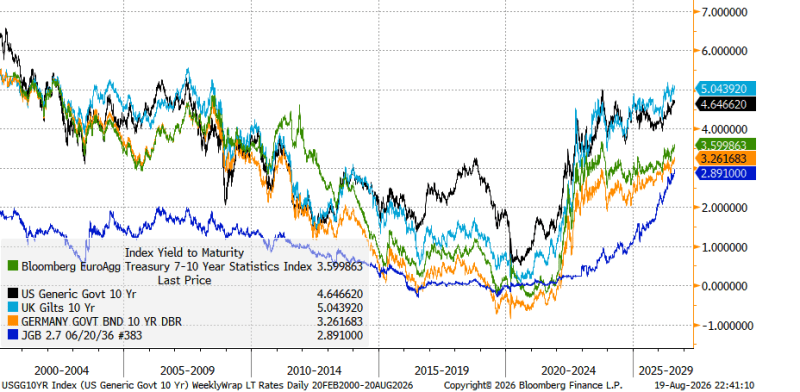
More interestingly, however, 2026 has proved more nuanced than it first appears. While inflation concerns have undoubtedly returned, the rise in yields has been driven overwhelmingly by a repricing of real interest rates, rather than higher inflation expectations. We typically break government bond yields into two components: expected inflation and the real yield, which reflects monetary policy, economic growth and the underlying cost of capital.
As the chart below shows, almost all of this year’s increase has come from the real component. That tells us a great deal about the environment investors are navigating. Long-dated US real yields now stand close to 3%, their highest level in nearly twenty years, even though inflation breakeven rates have remained relatively contained despite the rise in energy prices.
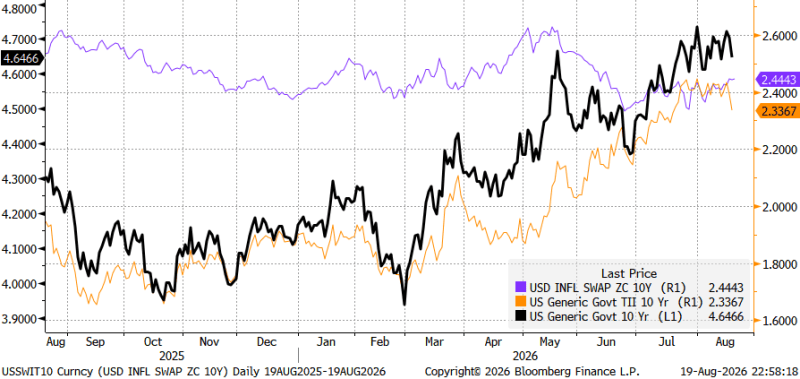
Central banks are maintaining a hawkish stance
Part of this reflects the tone adopted by central banks. The conflict with Iran has not translated directly into higher inflation expectations, but it has affected bond yields through the policy channel. Central banks remain determined to prevent inflation from becoming entrenched, and markets have priced in that vigilance.
Using machine learning techniques, we monitor the language used by central banks around the world. As the chart below illustrates, their communication has become noticeably more hawkish since late 2025.
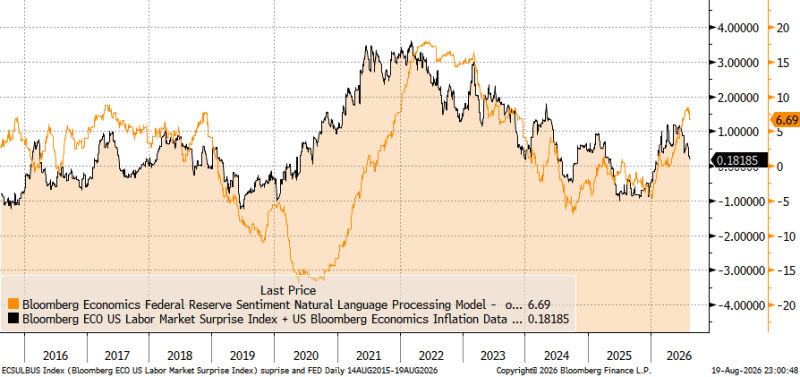
Interestingly, this closely mirrors economic surprise indices – in other words, whether inflation and labour market data have come in stronger or weaker than economists expected. Inflation surprises remained consistently positive during the first half of 2026, although they have moderated more recently. That may begin to support a more constructive outlook, both for central bank rhetoric and, eventually, for the path of bond yields.
It is also worth recognising that higher yields partly reflect stronger underlying growth, particularly through the AI investment cycle. Investment linked to Artificial Intelligence is now making a meaningful contribution to both the level and the growth rate of Gross Domestic Product (GDP). Stronger growth has historically been associated with higher real interest rates, and today’s bond market appears no different.
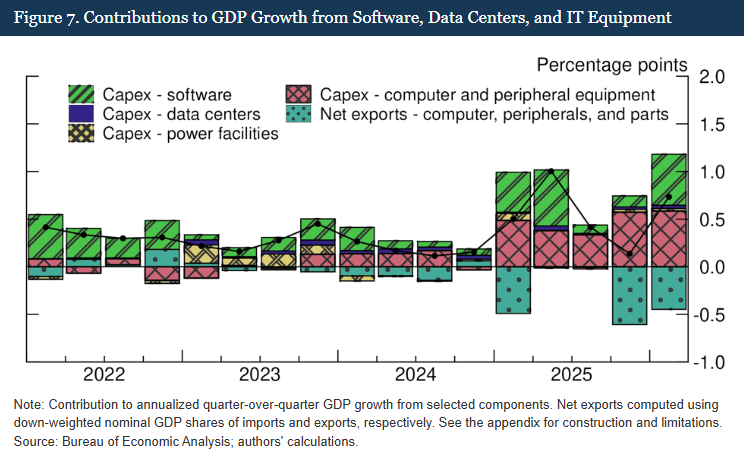
Is the government being crowded out?
One of the most fascinating developments this year is whether the extraordinary wave of AI-related corporate borrowing – led by the hyperscalers, but certainly not limited to them – is beginning to compete directly with governments for investor capital. The evidence is becoming increasingly compelling.
Traditionally, crowding out describes a situation in which excessive government borrowing absorbs savings that would otherwise finance the private sector, pushing borrowing costs higher across the economy. Today’s dynamic looks almost reversed. Massive corporate debt issuance, particularly from the technology sector, is contributing to higher borrowing costs for governments themselves.
The same pension funds and insurance companies that finance sovereign deficits are now being asked to absorb an unprecedented supply of long-dated corporate bonds. As that supply grows, investors naturally demand higher yields. Bank of America estimates that corporate and mortgage issuance together have added around 0.3 percentage points to the US 10-year Treasury yield this year alone.
The scale of issuance is remarkable. By early July, Amazon, Alphabet, Meta and Oracle had issued around $194 billion of bonds, roughly 80% more than during the whole of 2025. Goldman Sachs expects the five largest hyperscalers – including Microsoft – to issue around $250 billion this year, rising towards $400 billion by 2027. For context, these companies issued an average of just $28 billion annually during the five years preceding 2025.
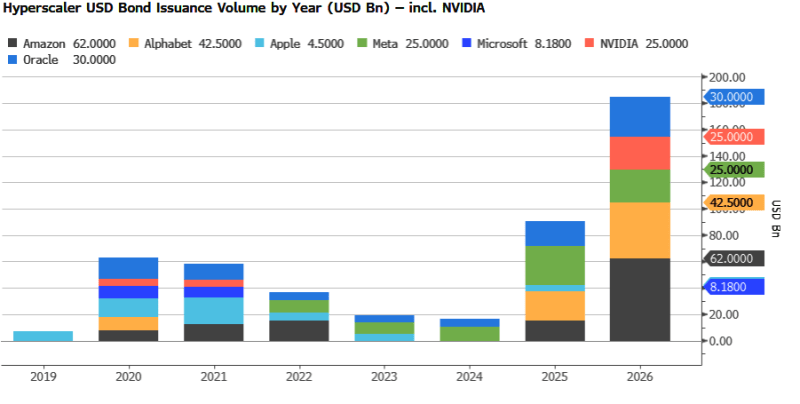
Nor is this purely a technology story. Issuance of investment-grade corporate debt has reached exceptionally high levels across the wider corporate sector. The chart below shows quarterly issuance of US dollar-denominated investment-grade and high yield bonds. The first half of 2026 has already broken previous records, with total issuance on course to approach $2.5 trillion for the year. That represents an enormous volume of high-quality debt competing for the same pool of investor capital – and increasingly competing directly with US Treasuries.
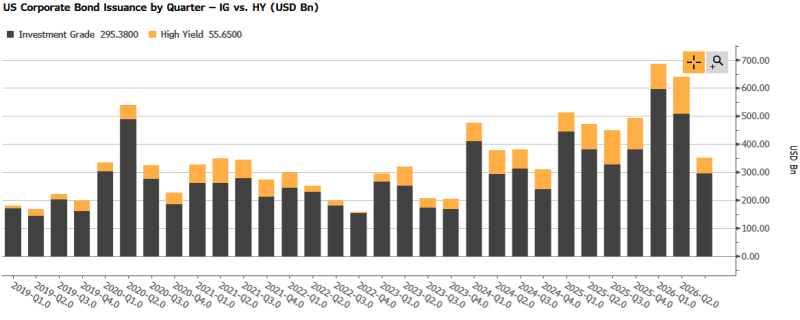
Fiscal pressure
The final piece of the puzzle is the fiscal position of developed economies. Since Covid, government finances have become noticeably more fragile. Budget deficits have widened across much of the developed world, including countries that were once viewed as models of fiscal discipline.
Germany has loosened fiscal policy to finance higher defence and infrastructure spending, pushing Bund yields back to levels last seen in 2011. In the United States, the federal deficit is approaching $2 trillion, an extraordinary figure outside periods of crisis. In the United Kingdom, thirty-year gilt yields have moved towards 6%, their highest level since the late 1990s, as investors focus on the sustainability of public finances ahead of the autumn Budget. France faces similar pressure, with long-dated yields at their highest since 2008 amid persistent political difficulties in delivering fiscal consolidation.
Against the backdrop of an exceptionally capital-intensive AI investment cycle, this fiscal deterioration matters even more. Investors are simultaneously being asked to finance record levels of corporate investment and increasingly indebted governments, while many of the traditional buyers of long-duration bonds – from the Federal Reserve to Japanese institutions – have become less active. It is the combination of these structural forces, rather than any single factor, that explains why long-dated bond yields have continued to rise despite mixed economic data.
The pressure on governments is undeniable, and it is in this light that we should read the US Treasury’s recent announcement that it will step up its buybacks of long-dated bonds in an effort to contain the cost of its own borrowing.
Staying conscious of the tide
Where does this leave investors? Above all, it calls for humility. There will undoubtedly be periods when bonds appear oversold, and economic data may occasionally justify a tactical decline in yields, as last week’s inflation and employment figures briefly suggested. Yet throughout 2026, buying long-duration bonds has largely meant swimming against a powerful structural tide.
The recent moderation in both inflation and labour market data may strengthen the case for lower yields over time, and we are watching closely for signs that the improving tone of central bank communication begins to translate into the bond market itself. We will continue to monitor these drivers carefully – particularly the stance of central banks – and adjust portfolios accordingly.
Ultimately, identifying the turning point, if and when it arrives, is likely to be one of the defining challenges for fixed income investors in the years ahead.
The post The structural forces behind higher bond yields appeared first on MoneyFarm Insights.
]]>