The post Best of the Bay 2026 Editors’ Pick: Slumberland Records appeared first on 48 hills.
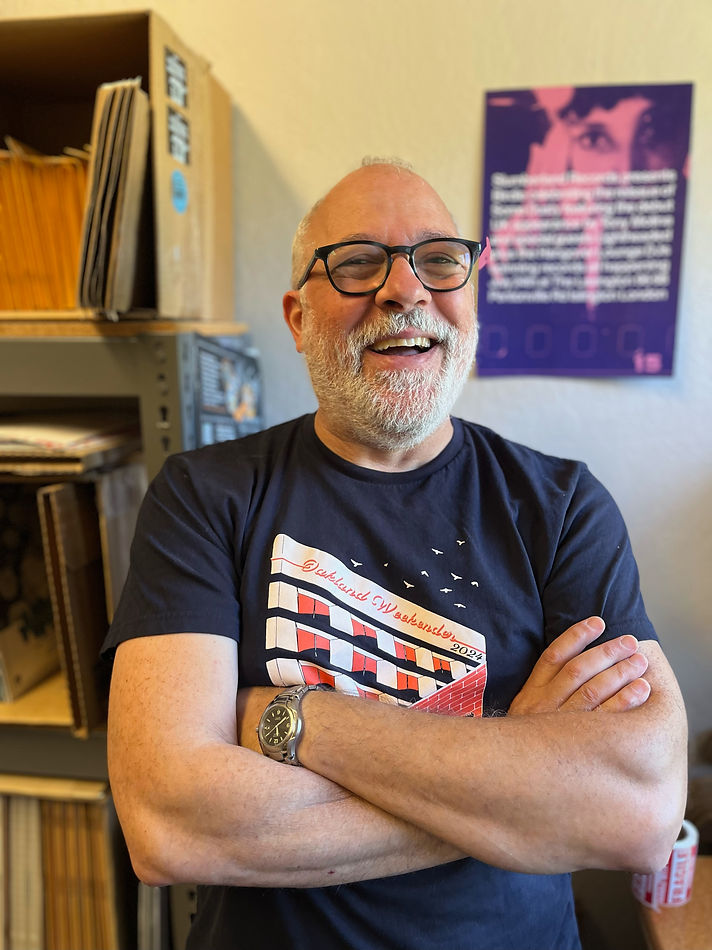
]]>San Francisco is known for expanding sonic tropes. Mike Schulman’s one-man operation Slumberland Records has built up a 21st-century mini-empire of an imprint that involves him working with his friends and represents the Bay Area now with its fog-pop fixation and indie-jangle twang, advertising to the world the types of bands you can see on a Wednesday night at any independent venue in the Tenderloin, The Mish, or North Beach/Chinatown.
Listen, Fog City remains a real fickle cross-pollination of a metropolis when it comes to the music that it represents. Like its weather patterns, the Bay Area is flush with microclimates—bass-heavy hip-hop from the East Bay, chillaxed or very intense electronic music flowing from the Western Addition down to the slower Haight—and so much history surrounding the Grateful Dead’s mysticism that it has made Haight-Ashbury a rite of passage for Deadheads worldwide, where that monetized fascination has turned Golden Gate Park and the bordering environs into a $200 million bonanza in tourism for the city over the past couple of years.
Yet, Slumberlands’ bands and sounds operate outside the moneybelt; that’s where the art thrives.
From the way Glenn Donaldson presents his album cover art for his band The Reds, Pinks & Purples‘ creations, so close to the way the big little town of San Francisco looks in the Richmond district, you can smell those magnolias blooming just beneath the frame as he spins yarns about bands, artists, and writers who had to leave SF on Greyhound, returning to small towns anywhere in the USA because they couldn’t cut it.
Or observe The Umbrellas, with their winsome, heart-on-sleeve presentation—even if it’s a bit difficult at times to make out what Matt Ferrera is exactly enunciating with that grave baritone. Formed in 2018, the festive four-piece has associations with the almighty San Francisco vinyl record consortium, Amoeba Music, but in concert and on wax maintains that identifiable aesthetic of ripping solos, squelching feedback, and playful energy.
Or Chime School, the solo project of San Franciscan Andy Pastalaniec—former drummer for the now-defunct Seablite—a melodic, perfectly Fogust-appropriate guitar-pop entity initially created using a gifted cassette four-track portastudio “almost as a dare,” by and from his partner, compelling him to step out of the drum kit and into the spotlight. Dares advance progress, right? That launch manifested and bespoke an ongoing, ceaseless, bountiful, many-sided Bay Area jangle-friendly movement.
Add to this treasure trove of soundscapes: reissues such as 2025’s Evolver, from the Oakland outfit Lunchbox, which at times feels like Stereolab’s Dots and Loops, but cooked, boiled, and simmered just a bit longer, so the sound, aka flavor, goes more experimental than conventional.
Yes, the Slumberland imprint tells a bit of a different tale from these mist-swept area codes. Something a bit more daily and “chill” from the area that actually feels like an early winter come 4th of July in Alamo Square Park.
The post Best of the Bay 2026 Editors’ Pick: Slumberland Records appeared first on 48 hills.
]]>The post Good Taste: Indulge in our favorite Restaurant Week deals appeared first on 48 hills.
]]>Participating restaurants in this season’s edition of SF Restaurant Week are asked to offer brunch, lunch, or dinner at the following price points: two-plus-course brunch or lunch for $15, $25, $35, or $45, and/or three-plus-course dinner for $30, $45, $60, $75, and $90. I took a spin through the published offerings in order to make restaurant recommendations from the various price points.
Brunch/lunch
$15
Creative Ideas Café in Bayview usually holds it down for the $15 brunch category; the Colombian and Mexican restaurant also has $25 and $35 brunch menus as well as $30 and $45 dinner menus, respectively, but hasn’t posted what they are to the site as of this writing.
$25
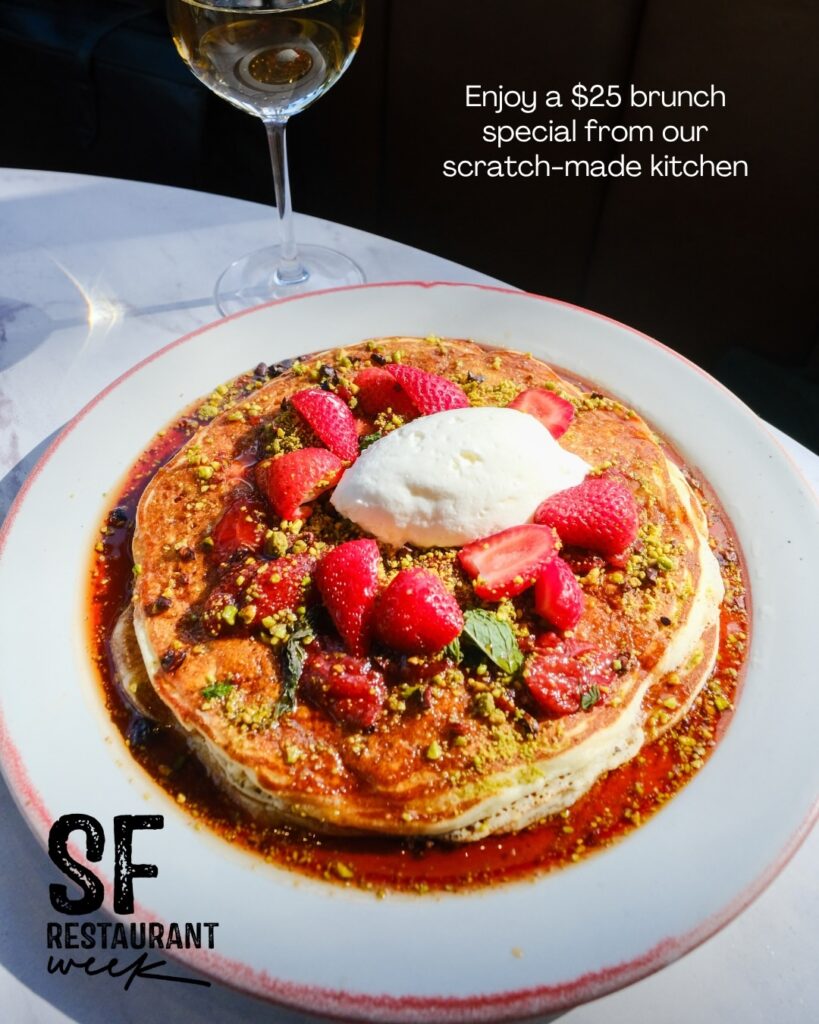
Early to Rise loves making everything possible from scratch and is offering a warm sugar donut with coffee and the choice of strawberry pancakes or eggs Benedict for SF Restaurant Week, so that’s my $25 brunch suggestion.
Popular new spot Grand Lake Kitchen has a good looking $25 lunch menu with a lot of options: half of a classic Caesar, an Oregon Bay shrimp salad, or mushroom arancini for an appetizer and the choice of pork saltimbocca, king salmon with zucchini cakes, potato gnocchi, and eggplant parm for an entrée.
$35
Bombay Brasserie in the former Campton Place space is such a beautiful and delicious restaurant, and you’re probably not going to get out of there for this price point on any other occasion than for this brunch. There’s a long list of 10 dishes—choose two for $35. I’d personally go for the carrot-halwa French toast and the potato masala dosa.
I’d also probably be eyeing up a cute $35 outdoor lunch at Parasol at Cafe Flore in the Castro, where the people-watching is on point. The menu hasn’t been shared yet.
$45
The usual brunch at classy Filipino restaurant Abacà has been a personal favorite for years, and the SF Restaurant Week brunch menu looks even better—a sarap (snack sampler) and choice of five entrées (the Wagyu silog is especially appealing). Dessert is a strong suit here, and there are three to consider for a supplement of $8 each. Coffee crunch cake with mango marmalade, honeycomb, and coffee buttercream is a Filipino riff on the San Francisco classic.

In the $45 lunch category, consider Casa Sofia, the newest restaurant from Chef Carlos Altamirano that’s named after his daughter. He’s offering a three-course lunch with a number of choices and supplement possibilities. There probably aren’t any wrong answers here, but he makes a mean burger — just saying.
Dinner
$30
Both locations of Cinderella Bakery, including the brand new outpost in the Mission, are serving a two-course dinner. Entrée options are beef Stroganoff, chicken cutlet, and grilled salmon, followed by a slice of honey cake or sour cream cake. Warning: it’ll be tempting to buy some cookies and other sweets from the bakery case on the way out.
$45
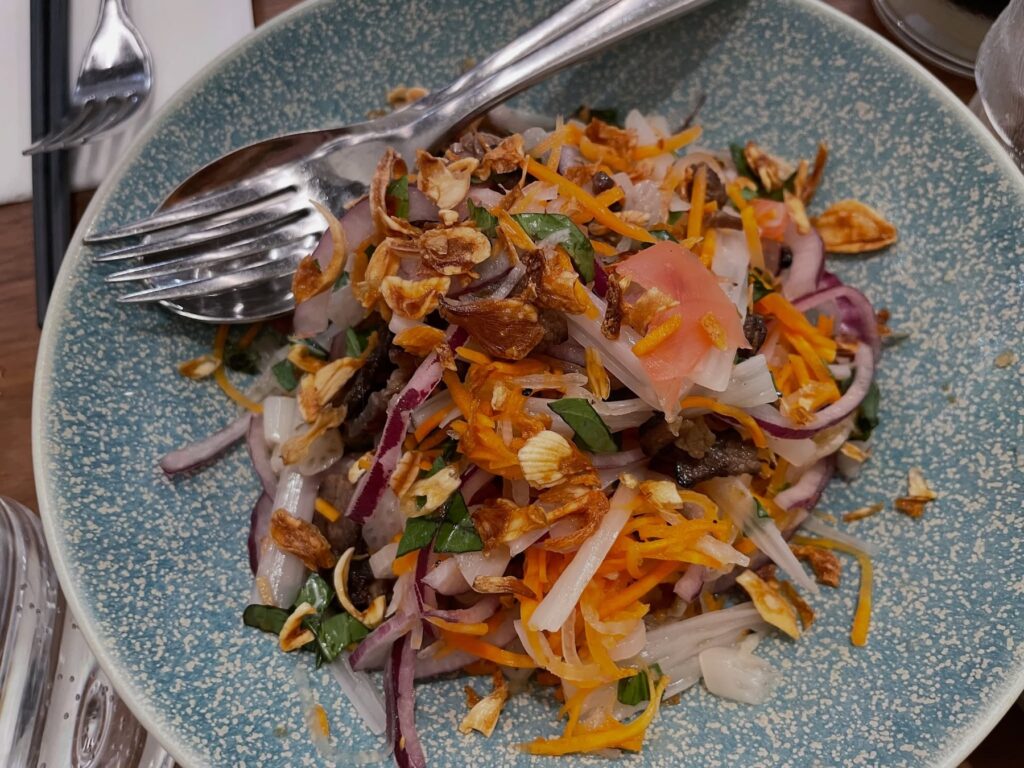
The family-owned Le Soleil Stonestown is truly fantastic, and it would be easy to spend way more than this for dinner on another occasion. Their SF Restaurant Week dinner menu consists of three courses. The baby lotus root salad is amazing (just had it again a couple weeks ago), as is the shaken beef. That’s what I’d order, with five spice sugar dusted mochi donut holes for dessert.
$60
Palette Tea House, the Cantonese restaurant in Ghirardelli Square, impresses with two $60 multi-course menus for SF Restaurant Week consisting of salad/appetizers, dim sum, entrée, and dessert. One is omnivorous, the other vegetarian—hello, black truffle morel chow mein!
$75
We’re getting into the upper price categories, but Tony’s Pizza Napoletana, which was featured in last week’s column, is offering a $75 menu that feeds two people, with eight different pizza styles to ogle, plus a glass of Prosecco or wine, salad or antipasti, and dessert.
$90
The exact menu hasn’t been posted, but the beautiful Indian restaurant Copra never disappoints. Despite the cavernous size of the room, it feels serene and intimate to eat there.
Once again, take a peek at the full list of participating restaurants to scout more deals on your own.
The post Good Taste: Indulge in our favorite Restaurant Week deals appeared first on 48 hills.
]]>The post At 87, the great Judy Collins sings farewell—but stays in the now appeared first on 48 hills.
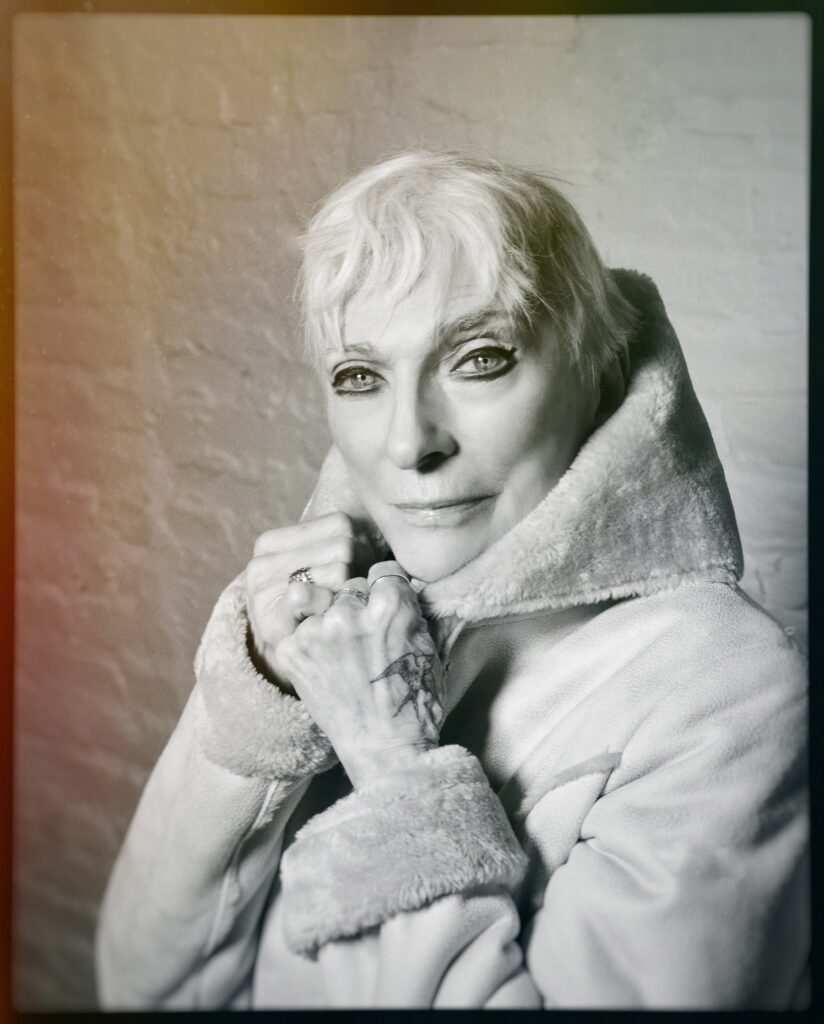
]]>Judy Collins’ clear, luminous soprano can make a complicated lyric feel immediately understandable. On her recording of “Both Sides Now,” for example, the melody floats, the words land cleanly, and Joni Mitchell’s questions about love and experience unfold with the intimacy of someone thinking aloud.
That combination of musical elegance and emotional directness has carried Collins through folk ballads, Broadway, gospel, and her own songwriting.
In “Suzanne,” she draws listeners into Leonard Cohen’s dreamlike world. With “Send in the Clowns,” she gives Stephen Sondheim’s rueful accounting of missed opportunities a delicacy that makes its hurt linger. Her rendition of “Amazing Grace,” preserved by the Library of Congress’ National Recording Registry, offers the reassurance of a familiar hymn through a voice capable of holding a room’s attention without hurrying.
Now, at 87, she brings her “Sweet Judy Blue Eyes” farewell tour to Berkeley’s Zellerbach Hall (Sun/18), with Norwegian folk-pop duo Oakland Rain opening the Cal Performances concert.
Collins sounds enthusiastic about the shows ahead. Asked what life after touring might look like, she leaves the question open.
“The future is there for us to handle, which is wonderful,” she says. “And the tour itself is just marvelous, so I’m doing what they tell me to do, which is to stay in the now.”
The concerts have featured guests and onstage conversations, and a documentary is planned. A later “Celebration Encore” series will give her further opportunities to revisit neglected songs and stories.
Collins grew up hearing her father sing Irish, English, and Scottish folk songs alongside American standards, while her own training centered on classical piano. At 13, she performed with an orchestra and seemed headed toward a career as a concert pianist. Then, at 16, she heard “Barbara Allen” on the radio and asked her father for a guitar, turning toward the folk music that had surrounded her since childhood.
Her piano teacher, conductor Antonia Brico, still hoped she would pursue that classical career.
Backstage after one of Collins’ shows, Brico took her hands and told her, “You could have gone places, little Judy.” Collins eventually made the Oscar-nominated documentary Antonia: A Portrait of the Woman, helping renew attention to her mentor’s career.
Her instinct for amplifying other gifted artists became central to her own recording career.
Her 1967 album Wildflowers brought Mitchell’s “Both Sides Now” to a wider public. Cohen’s “Suzanne,” Ian Tyson’s “Someday Soon,” and Sandy Denny’s “Who Knows Where the Time Goes?” likewise became inseparable from Collins’ interpretations.
“I got their songs where they had to go and sang them live, and then people would pick them up,” says Collins. “It’s like scattering seeds for new growth.”
Cohen also pushed her toward writing. In 1966, she remembers, he asked why she wasn’t composing her own songs.
“So I started writing, and I’ve never stopped,” Collins says.
She returned the encouragement by urging him to sing his own work. Their friendship became a lasting creative exchange, though Collins laughs at the suggestion of another kind of intimacy.
“Everything about him appealed to me,” says the singer. “Except the sex part. I couldn’t have handled any of that. He was too dangerous.”
The beauty of her singing has always coexisted with a willingness to speak up. In 1967, she performed at the anti–Vietnam War rally at San Francisco’s Kezar Stadium, adding her voice to the city’s gathering protest movement, alongside artists like Country Joe and the Fish, Quicksilver Messenger Service, and Big Brother and the Holding Company.
“Oh my, that was a very big and important show,” Collins says.
A couple of years later, she testified in support of the Chicago Seven and attempted to sing Pete Seeger’s anti-war song “Where Have All the Flowers Gone?” in court. She still bristles that Aaron Sorkin’s feature film about the trial omitted that episode.
She calls the exclusion “a slap in the face of what I was standing for and what the Chicago Seven were standing for.”
In San Francisco, her appearances continued through the Civic Auditorium in 1970, Masonic Auditorium in 1973, and Davies Symphony Hall for the 1989 TV special “Sing Out America! With Judy Collins.” Her commitment to making music accessible also brought her to Laguna Honda Hospital’s Gerald Simon Theatre in 1985 for a Bread & Roses concert.
Founded by Mimi Fariña, Bread & Roses brought live performance to people in hospitals, prisons, and other institutions.
“Mimi was a very big part of my life,” she says. “She was a wonderful singer and a wonderful artist.”
She remains close to Fariña’s sister Joan Baez and fondly remembers their mother’s loyal encouragement. She adds a teasing complaint she shared with Baez: “You never did write me notes as your mother did.”
When Fariña died, Collins joined Holly Near and Maria Muldaur to sing “Bread and Roses” at the 2001 memorial at Grace Cathedral. Afterward, she released a dove on the plaza.
In 2019, Collins returned to Golden Gate Park for Hardly Strictly Bluegrass and sang “Masters of War,” “Suzanne,” and “Both Sides Now” on the Banjo Stage.
The farewell tour’s title carries its own personal history. Stephen Stills’ “Suite: Judy Blue Eyes” captured the anguish of their romance’s ending. When he played it for her birthday in California in 1969, she remembers saying, “It’s a beautiful song, but it’s not going to get me back.”
They remained friends, reunited for tours in 2017 and 2018, and still talk often.
“It’s one of those enduring things,” says Collins. “And you don’t get too many of those in life.”
Her newer writing carries the influence of her second husband, industrial designer Louis Nelson, best known for designing the Mural Wall for the Korean War Veterans Memorial on the National Mall in Washington, DC.
He encouraged her to produce a poem every day for a year. That work helped generate 2022’s Spellbound, her first album consisting entirely of her own songs, and her 2025 poetry collection, Sometimes It’s Heaven: Poems of Love, Loss and Redemption. She brings the book to concerts and reads selections aloud.
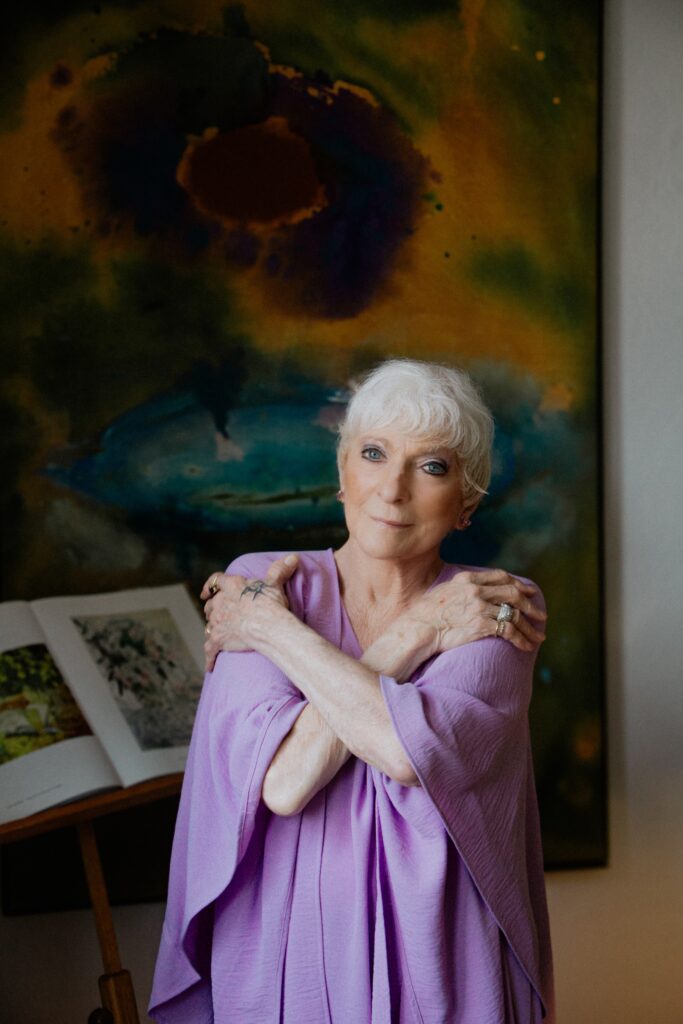
Nelson died in 2024 after 46 years together. Asked which songs bring her closest to him, Collins answers, “All of them.”
Performing had helped her through loss before. After her only child, Clark Taylor, died by suicide in 1992, Collins canceled her shows. Joan Rivers, who had lost her husband, Edgar, to suicide five years prior, called with advice drawn from her own grief.
“‘You can’t cancel all your shows,’” she recalls Rivers telling her.
Collins restored the dates and returned to performing with her family by her side. “It saved my bacon,” she adds. “It was exactly the thing to do.”
Years later, she drew on that experience after losing Nelson. “When Louis died, I just jumped in the car and on the plane,” says Collins.
Singing has helped her through both losses, and that’s why she describes “Who Knows Where the Time Goes?” as “a song of triumph.”
Collins is still finding room in her concerts for new poems, younger artists, and songs she hasn’t sung in years.
In Berkeley, they’ll share the program with the classics that audiences have carried with them for decades—all connected by that clear, luminous soprano and her gift for making a familiar lyric feel newly understood.
JUDY COLLINS: SWEET JUDY BLUE EYES: THE FAREWELL TOUR Sun/18, Zellerbach Hall, Berkeley. More info here.
The post At 87, the great Judy Collins sings farewell—but stays in the now appeared first on 48 hills.
]]>The post Another bad Congressional ‘debate’ reflects the failures of local media and US politics appeared first on 48 hills.
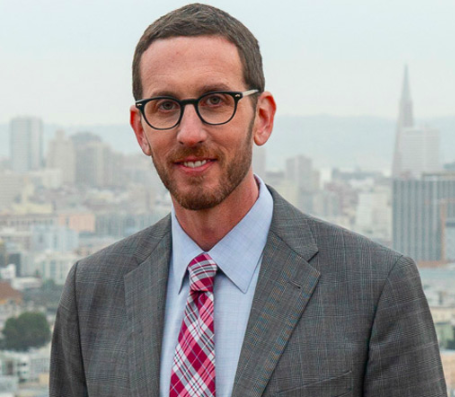
]]>I’m going to start with the housing question, because that’s been central to the Wiener campaign’s attacks on Chan.
Wiener asked: If you care about climate change, why did you oppose my bills allowing more housing near transit and oppose the mayor’s upzoning plan?
The moderators just sat back and listened. Chan didn’t respond directly to the question.
The problem is that the question contains an assumption that is almost certainly not true. Wiener is arguing that transit-adjacent housing will reduce the amount of driving and thus the consumption of fossil fuels, and will help limit global climate change.
That might be the case of we were talking about 100 percent social housing, but that’s not what Wiener’s bills and the mayor’s upzoning promote. In fact, none of Wiener’s housing bills include a single dollar for affordable housing.
Instead, Wiener and Mayor Daniel Lurie want more market-rate housing, which these days means $6,000-a-month apartments and $2 million one-bedroom condos.
Let’s parse this for a second.
Suppose a private developer builds 500 units of market-rate housing, with 10 percent (under Wiener’s law) set aside for below-market-rate units, near the Civic Center BART station and multiple Muni stops. (BMR housing is based on the average median income in the city; now that the AI boom has driven the number way up, a $2,800-a-month apartment can qualify as “BMR.”)
So 90 percent of the people moving into this new building will be, in a word, rich. The building is right next to abundant transit options, but the rich people (the cheapest condo is $2 million; some are much more expensive) are the least likely ever to take public transit. They’re not walking to Civic Center, waiting for a BART train, or standing on Market St. waiting for a bus. (Wealthier commuters in the East Bay will take BART into the city, but data shows they don’t use buses.) When they need to travel, they will call an Uber or a Waymo—a private vehicle that adds to traffic congestion and thus emissions. Some of those vehicles are electric, but they still need energy, and much of Northern California’s electricity still comes from natural gas plants, which emit carbon.
They will order household goods from Amazon, which will arrive in a truck. They will order food from Doordash, which will arrive in a car. None of this helps the climate crisis.
The global data is immensely clear: An individual’s climate footprint increases directly with that person’s income and wealth. These days, with so much commerce and transportation conducted through delivery and transportation apps, the situation is even worse.
(New York City, where even relatively wealthy people take the subway, is an exception based on 100 years of habit and tradition—and the fact that so many people are in such a small space with such narrow, congested roads that it’s hard to get anywhere in a car.)
So there is no evidence that transit-oriented housing in San Francisco will do anything to address climate change.
Even if Wiener were correct, the impacts of his policies will be so tiny that it can’t even be measured. Addressing global climate change will also require addressing the other existential threat to humanity—economic inequality. It will require a massive transfer of wealth, both from the tech barons who support Wiener to the working people who support Chan, but frankly, from the global North to the global South.
It will also require us to rethink the fundamental tenet of modern capitalism: The notion that growth is not only good but essential. If we as a society continue to focus on making the economic “pie” bigger, at a fatal cost to the planet, instead of focusing on how that wealth is divided up, we will fail, transit-oriented development or not. I have never heard Scott Wiener suggest that we slow economic growth or take vast amounts of money from his donors and use it for sustainable development in the global South.
You can’t put that in a 30-second ad or a campaign mailer, and it’s hard to address in a “debate” that features two candidates making speeches and two moderators who don’t moderate. Neither of them said: Senator Wiener, your question assumes facts not in evidence.
You can’t explain it to voters unless the major news media are willing to challenge their basic assumptions about late-stage capitalism. That’s one of the fatal flaws of US politics today.
So on to AI.
Chan asked Wiener how he could be trusted to regulate AI when an IE funded in part by Anthropic put up more than $3 million to help him win. Wiener said “there is no Anthropic money in this race.”
Again, let’s parse that.
A group called Public First Action has, indeed, put more than $3 million into electing Wiener. It’s a matter of public record that Anthropic put $40 million into that organization.
Anthropic says that money was just for “public education,” and wasn’t used for political ads. Maybe: We don’t know that for sure, because Public First Action, Inc., is a dark money PAC that doesn’t disclose its donors or the amounts they gave or where the money went. We do know that Anthropic’s money was the seed funding that made this operation possible.
We do know that employees of and investors in Anthropic and Open AI have given more than $300,000 to Wiener’s campaign. So there is absolutely Anthropic money in this race. We know that the AI industry wants Wiener, not Chan, in Congress.
Wiener insisted that he pushed an AI regulation bill that the AI companies hated. But the version of the bill that passed had the full support of… Anthropic.
Joe Eskenazi, one of the two moderators, knows all of this. He’s written about it. He did nothing to correct the record.
That’s in part because of the format of the “debate,” which gave the moderators no room to challenge what the candidates said. That’s a complete failure.
For the record: My independent adult daughter works on the Connie Chan for Congress campaign. Wiener’s campaign has said that he will not participate in any debate or forum that includes me on the panel. Too bad: I would love to debate Scott Wiener on housing policy, any time, anywhere. But the guy won’t even respond to my texts.
The post Another bad Congressional ‘debate’ reflects the failures of local media and US politics appeared first on 48 hills.
]]>The post BIG WEEK: Market Street Arts Fest, BAS Day, Shipyard Open Studios, Paul Madonna… appeared first on 48 hills.
]]>GENERAL ARTS
Marke B. keeps an eye and ear and everything else out.
FRI/16-SUN/18: SHIPYARD OPEN STUDIOS One of our favorite art extravaganzas of the year, when more than 130 artists, food, a Beer Garden, live music and more light up the historic Hunters Point Shipyard and Islais Creek studios. Don’t miss the projections on the giant crane. Hunters Point Shipyard, SF. More info here.
FRI/16-DECEMBER 3: PAUL MADONNA: FROM LIFE The iconic SF artist recently caught a very bad break: “Following a near-fatal accident in 2022, drawing became an intentional act of coming back to life, resulting in a remarkable new body of cityscapes, portraiture, and work drawn from life. His new book, From Life, accompanies the exhibition.” There might be a lot of people you might recognize in this exhibit, and definitely a lot of hallowed local spots. Opening reception Fri/16, 4pm-9pm. Nelson Duni Gallery, SF. More info here.
SAT/17: MARKET STREET ARTS & THEATER FESTIVAL Market Street come alive! Look, it gets a bad rap lately but Mid-Market still has tons going on, and I find myself there quite often. This bonanza of performance and arts brings together 50+ experiences at 35+ locations over eight hours, most of it free, including contributions from Bandaloop, SF Neo-Futurists, Skywatchers, DJ Mark Farina, ACT Young Conservatory Cabaret, 200 Channels, People’s Circus Theatre, and tons more. Let’s activate it, baby. More info here.
SAT/17: 2ND ANNUAL BROKE-ASS STUART DAY Best of the Bay-winning Best Local Website Broke-Ass Stuart has been up and running for almost two decades, and namesake Stuart Schuffman is a legendary local personage—to the point that the city recognized October 17 as Broke-Ass Stuart Day. He’s celebrating this year by going big, joining forces with the Clement Street Art Fair for a free full day of live musical performances, artist activations, local makers, community building, and fun for the whole family. Go Broke! Noon-5pm, Clement Street between 6th and 8th Avenues, SF. More info here.
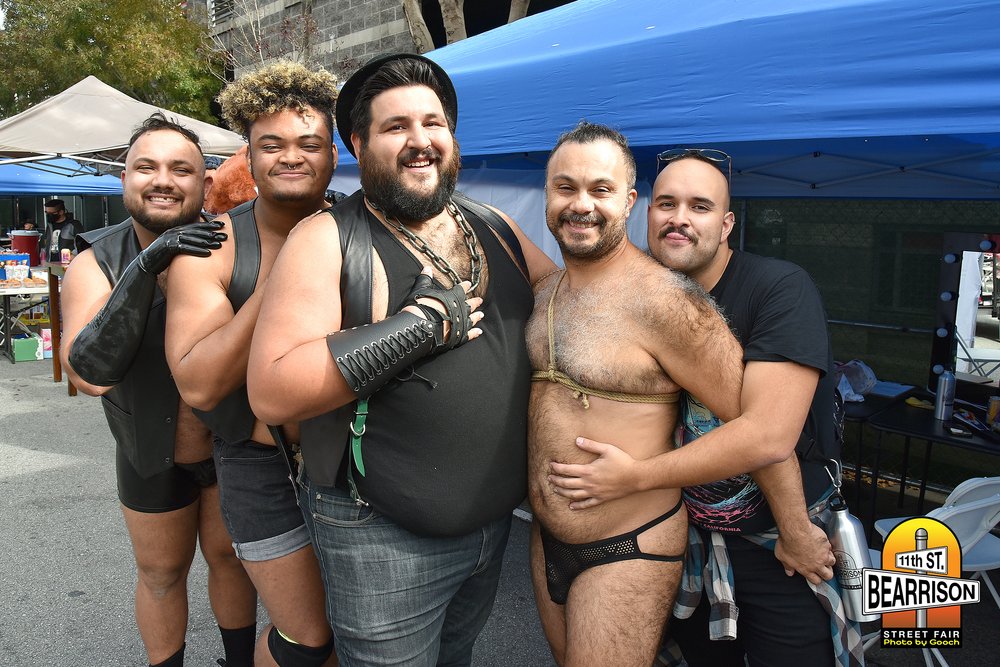
SAT/17: BEARRISON STREET FAIR Big, brawny, hairy (and otherwise) queer folks flood Harrison Street in SoMa to celebrate furry liberations with music, wrestling, carnival games, a deadlift competition, a “spooky haus,” of course tons of food, and other hirsute pursuits. There is even a pop-up bear vogue ball! Whether you’re a grizzly, cub, otter, or chaser, missing out on this would just be em-bearrison. Noon-6pm, 11th and Harrison Streets, SF. More info here.
SAT/17: 51ST ANNUAL POTRERO HILL R&B FESTIVAL This longtime tradition benefits public schools and comes loaded with tunes. Performing on two stages will be Andre Cruz & Chris Lujan, groove-infused California Soul; and the Curtis Family, the internationally acclaimed family band; Josh Klipp & The Klipptones, a lively jazz and swing band; the JC Smith Blues Band, jumping blues to old school soul; Mitch Woods & His Rocket 88s, modern day boogie-woogie; a youth talent show, and more. 10am-4:30pm, 20th Street, SF. More info here.
SAT/17: INTERNATIONAL VAMPIRE FEST Sharpen those fangs, it’s a Nosferatu-palooza at the Balboa Theater, with a full day of blood-suckers on-screen. Modern classics like Let the Right One In and A Girl Walks Home Alone at Night slip out of the coffin with classics like El Vampiro and Horror of Dracula. 11:30am-midnight, Balboa Theater, SF. More info here.

MUSIC
Hit up John-Paul Shiver’s Under the Stars column for great tunes and shows every week.
THU/15: abracadabra PEEL AWAY EP RELEASE PARTY So much dub-influenced low-end patterns from this Oakland collective featuring Hannah Skelton (vocals, synthesizers) and Chris Niles (bass, synthesizers). They make tunes, CHOONS rather, that possess their own bodily high and narratives about inequality and abundance (during an election year no less). Are there references to past New Wave and Art-Funk legends? Yes. But that Bay-Area cool persists through sleek rhythm soundscapes that hit DIY and, comprehensively speaking, “I’ll take art in my boogie every time.” Rhymies, the Lauren Matsui synth-pop project, is on the bill in support, along with Galore. 8pm, Rickshaw Stop, SF. More info here.
SUN/18: WOMEN’S REBEL VOICES FILM + MUSIC TOUR EVENT ft. MIKO MARKS, Highlighting a film screening of THE 9 LIVES OF BARBARA DANE at The Roxie at 3pm, followed by a Q&A with Director Maureen Gosling, Producer Jed Riffe & Miko Marks at The Chapel at 6pm, with a performance by Marks at 6:45pm to close out the event. The afternoon and early evening promise art inspired by social justice and new music from Marks’ release Hell Or High Water, her first blues album, via Redtone Records. 3pm, Roxie, SF. More info here.
FOOD & DRINK
Tamara Palmer’s weekly Good Taste column tells you where to stick your fork.
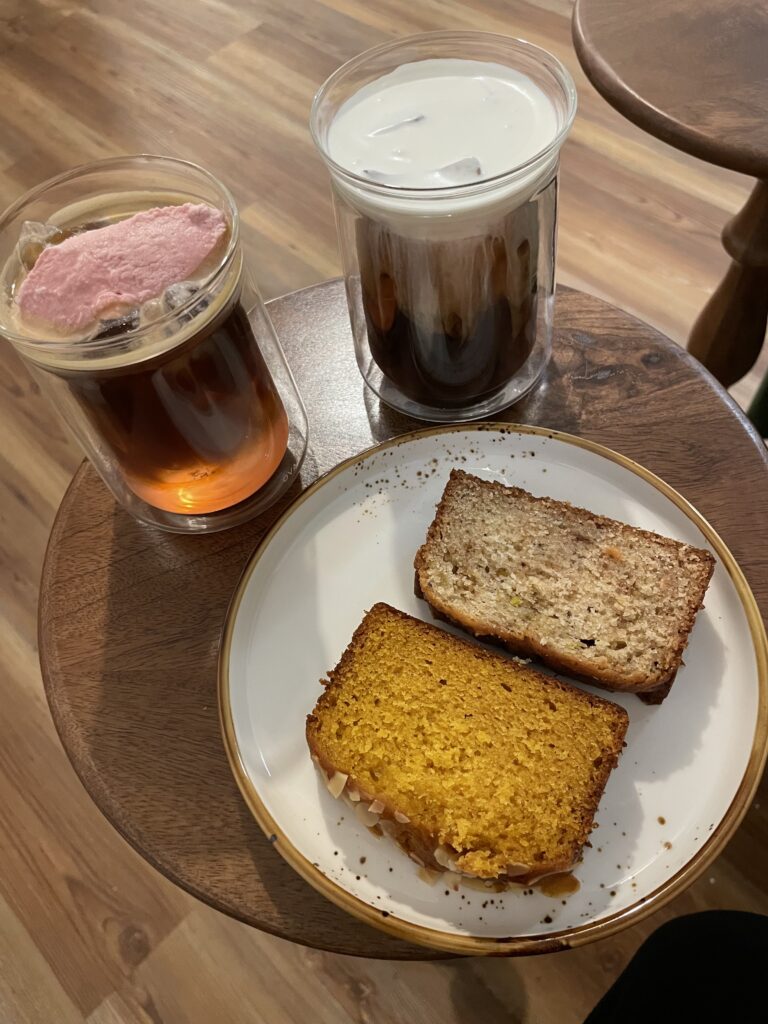
LE MIL’S COFFEE You can feel the origin love story and the community brewing inside this new Indian coffee shop, which opened in mid-August. I loved tasting the spiced cold brew, which has fennel, clove, nutmeg, and ginger, and the sparkling Blossom tonic, which has subtle floral notes. A selection of both vegan and eggless pastries help soak up the buzz, because these beans—sourced from India and roasted in Berkeley—are definitely strong! 1330 Polk Street, SF. More info here.
STAGE
Charles Lewis III checks out theaters and performance spaces every week in the Drama Masks column.
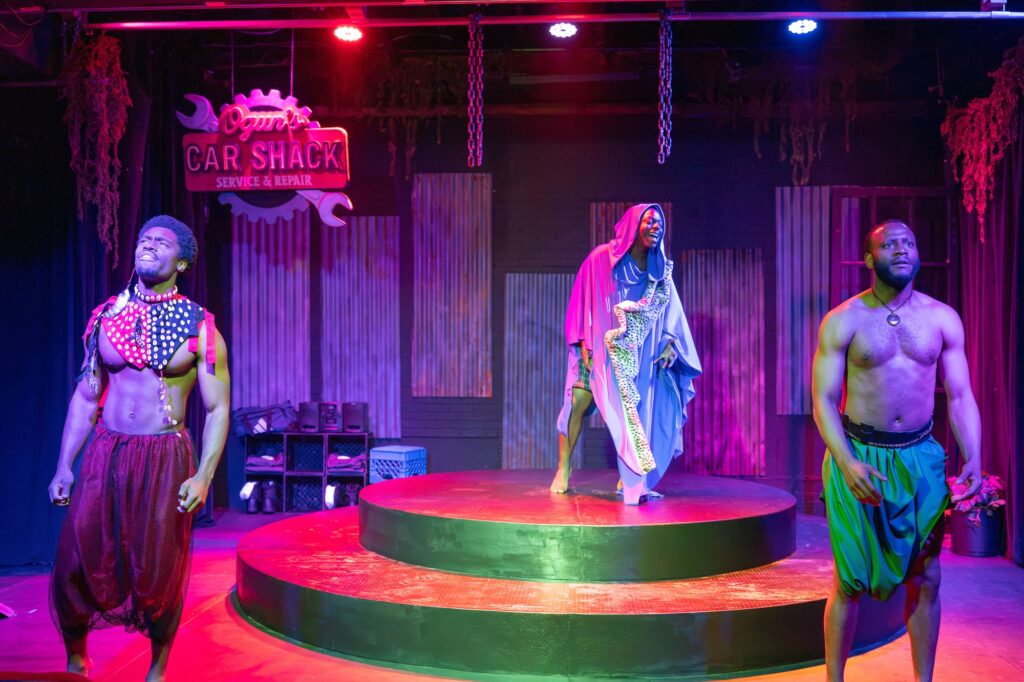
THROUGH NOV/1: AF-AM SHAKES PRESENTS THE BROTHERS SIZE Before he made Hollywood take notice with Moonlight, playwright Tarell Alvin McCraney planted his flag onstage with this gripping portrait of Black brotherhood in a world that’s never kind to Blackness. Directed by the Bay Area’s own James Mercer, McCraney’s critically-acclaimed text becomes a walking dream—equal parts fantasy and nightmare—exploring familial responsibility, queer identity, self-hating Blackness, and the fealty of running for a finish line that’s constantly moving. All within the intimacy of Theater 33 on Sutter. Theater 33, SF. Further information here.
THROUGH NOV/1: GOLDEN THREAD PRODUCTIONS’ REORIENT FESTIVAL 2026 Despite all the “progressive” theatre troupes in the country, can you imagine pitching a play about the Middle East? Hassan Abdulrazzak did. His idea of such a pitch meeting is just one of the hilarious and heart-breaking plays in the 2026 edition of Golden Thread’s annual short play collection. You may be surprised at how often you laugh out loud at the flawed, complex portrayals of MENA characters who happily celebrate what life has given them. You’ll also notice the dark cloud of death hovers above each and every story. Forget what you know about the Middle East from biased headlines; ReOrient offers a refreshing, realistic insight into the people who live on the land everyone fights for. Potrero Stage, SF. Further information here.
FILM
Dennis Harvey’s long-running Screen Grabs has tons more flicks to recommend.
OPENING FRI/16: ATONEMENT Based on a New Yorker article by Pulitzer-winning war reporter Dexter Filkins, writer-director Reed Van Dyk’s accomplished debut feature offers a ground-level view of the consequences to reckless American aggression abroad. Boyd Holbrook plays a US Marine in a unit exchanging gunfire with insurgents early in the Iraq War, with catastrophic results to a Bagdad family of Christian civilians whose car gets caught in the middle. A decade later, he and their survivors are both living in So. Cal. The guilt-riddled and PTSD-afflicted soldier begs a journalist (Kenneth Branaugh) to act as intermediary so he can meet them, and apologize. Eschewing overt politics, this is a deft, potent drama focused on thorny individual emotions, with powerful performances, especially by Hiam Abbass as the family matriarch, that never settle for the obvious hand-wringing. It opens Fri/16 at SF’s Opera Plaza and Marin’s Smith Rafael Film Center.
NIGHTLIFE
Marke B. usually knows what’s up.
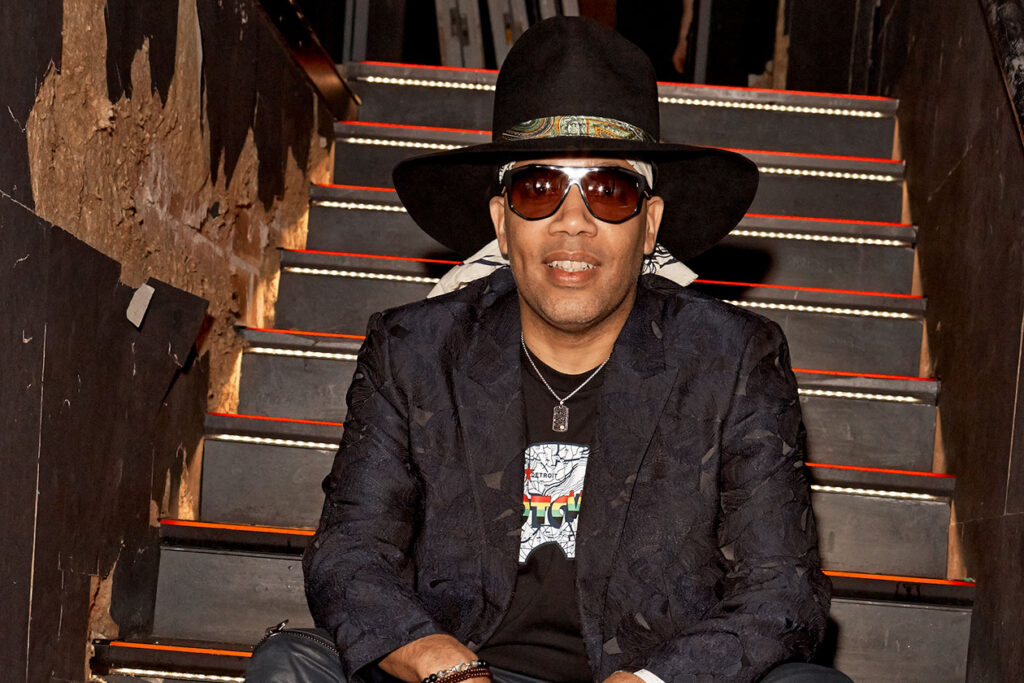
FRI/16: DETROIT LOVE Questions are still swirling around why Moodymann disappeared from the lineup, but you still get tons of classic Detroit techno love from Carl Craig, Octave One, and Stacey Pullen at this massive blowout. It’s all part of Public Works’ 16th anniversary. 9pm-3am, Public Works, SF. More info here.
FRI/16: NOW THAT’S WHAT I CALL ITALO-DISCO VOL. 25 Who can resist the sometimes cheesy yet often profound sound of Italo, which ruled at least one part of the world in the ’70s and ’80s? A quartet of ace DJs—Mo’ski, Infinite Jess, Meikee Magnetic, and Playstation—aim to “showcase the multifaceted genre in all its forms, from classic to contemporary.” 10pm-2am, Paris75, SF. More info here.
SAT/17: BEATPIG 16TH ANNIVERSARY Juanita More, Walter Gomez, and Stanley Frank Sensation’s glamorous yet filthy “queer leather, fashion, and drag party” has lasted 16 years, which is exhausting to think about! It’s also raised more than $30,000 for local LGBTQ causes, so spanks and kudos to them. Come have a drink and twirl, possibly with a side of bacon. 10pm-2am, Powerhouse, SF. More info here.
SUN/18: DAVID HARNESS & DJ SPEN Billed as “The Praise Party,” this afternoon affair at Audio with two of the biggest soulful house DJs around will summon the ghosts of the Trocadero Transfer and Endup Tea Dance, and lift your spirits as well. 3pm-8pm, Audio, SF. More info here.
The post BIG WEEK: Market Street Arts Fest, BAS Day, Shipyard Open Studios, Paul Madonna… appeared first on 48 hills.
]]>The post Screen Grabs: ‘NAZA’ doc chillingly excoriates Israel’s killing machine appeared first on 48 hills.
]]>Three documentaries that kicked up considerable controversy in recent festival premieres are now in theaters, all entirely or at least largely driven by personality types that not long ago we assumed we were “better than”—in the sense that common-sensical Americans couldn’t possibly be fooled by such obvious manipulators and charlatans, could they? Well, that question ceased to have a flattering answer some time back. Now it’s clear: We can be had, by the millions. Whatever the future holds, when others some day wonder “What the hell happened back then?,” this trio of films—totaling a hefty eight hours or so—will provide some substantial clues.
NAZA, which opened in area theaters last weekend, is the British-funded latest by the makers of last year’s Oscar-winning No Other Land. It is about policy, not a person, but there is enough footage of Benjamin Netanyahu (and others) spewing inflammatory rhetoric to make it clear what kind of authoritarian mindset and justifying propaganda is at work here. (A subtext for most viewers will be that alongside Putin, Netanyahu appears the foreign leader who exerts the most influence on our own.)
The Prime Minister himself as already described the film as “global antisemitic incitement,” saying he will pursue having the citizenship of born-and-raised Jewish Israeli directors Yuval Abraham and Rachel Szor revoked, and charges brought against them for alleged defamation, treason, etc. They have also received death threats from the public. Of course, if they are guilty of treason for revealing governmental secrets… that pretty much blows the notion that the film’s claims aren’t true.
The title is a term Israeli Defense Forces have utilized to render casualties abstract: After a strike, they can say x number of “NAZA” (Nezek Agavi, Hebrew for “collateral damage”) were eliminated, rather than civilians killed, let alone “women and children.” The 24 IDF soldiers and officers interviewed here in identity-obscuring silhouette say their missions were dehumanized, even made “fun,” by its video-game-like qualities, given that they generally used drones to bomb targets far from their control centers.
Those targets were ostensibly Hamas operatives, tracked easily enough because Israel has more or less complete control the over Gaza infrastructure it built—including the entire phone system. They can hack into anyone’s device and determine its whereabouts. But several interviewees here note that there were occasions when a phone was somewhere its owner wasn’t, so a bombing killed not the presumed Hamas person but “only” their entire family, immediate neighbors, etc. This was not ideal, but excused by an understanding that “collateral damage” might involve up to 20 civilian deaths to claim one intended “target.” (We’re also told sometimes that number went as high as 500. As one soldier flatly puts it, “The goal is quantity, not quality.”)

While hardly a big-picture view of the entire historical conflict—for one thing, it’s only 77 minutes long—NAZA does note the horrors of Hamas’ Oct. 7 attacks. But what emerges here is not arguably-righteous payback, but use of those events (and the Holocaust, a constant cultural touchstone as portrayed here) as justification for deliberate genocide, ethnic cleansing, or whatever term you prefer. Private homes at night are typically targeted, never mind the increased toll in innocent lives entailed.
This “mass killing on a huge scale” (to quote one technician who nonetheless protests he’s “just a small cog” in a killing machine) is also tactical, in that entire areas are leveled to decimate or drive out remaining Palestinians, forcing the populace further south—clearing land for an ever-growing Israel whose gleaming Tel Aviv highrises and endless construction are a major visual motif. The actual carnage of war is barely glimpsed, aside from late footage of a panicked father trying to find any surviving children in rubble, and one shot of myriad corpses’ feet protruding from under a collapsed floor.
Very different from the urgently personal No Other Land, in which we got to know some individual subjects quite well, NAZA is almost a coolly poetical abstract, alternating metronomically between borrowed mass-media input (Israeli and international), eerie night cityscapes, and the interviews with anonymous military. The latter are occasionally emotional in what they reveal.
But mostly what strikes us (and sometimes them, too) is the extent to which institutionalized dehumanization and a “general climate [of] hatred” towards Palestinians deadens their ability to feel guilt or horror—despite frequent full knowledge of mistakes made, children killed, and so forth. They are capable of mentioning how people desperate to reach food distribution points get “taken out” by snipers, or bodies left to rot are eaten by dogs, as if these were bland everyday factoids.
They’re aware that peace is not the goal: Or rather, “peace” through eliminating and/or exiling the enemy is now the goal. There is no “two-state solution” or other compromise still on the agenda. Its brief runtime over before you know it, NAZA is a chilling admittance that should be seen, and whose claims the Israeli government (as well as our own complicit one) have denounced without actually disproving.
NAZA is currently playing Bay Area theaters, including SF’s Presidio, Roxie, Alamo New Mission and (starting Fri/16) Opera Plaza.
By contrast, Alex Gibney’s Musk—opening this Fri/16 in area theaters—is almost four hours long, complete with a 10-minute “intermission.” Even so, it feels like a compacted overview of an almost impossibly complicated and far-reaching subject. It’s not that Elon Musk himself is so complex. It’s just that he seems to have had his hands in everything, so driven and shameless and monomaniacal is he—not to mention so unreliable a fact source, obscuring his real-world achievements in constant revisionism and hyperbole.
After this whirlwind survey, I was surprised to realize that some aspects of his life and career had been touched on barely, or not at all: The dubious legality of his immigration to the US (via a student visa he never used, instead going directly into Silicon Valley employment), for starters. But those gaps don’t delegitimize Musk so much as underline that it could have been six, even eight hours, and still far from an exhaustive overview of a person who seems compelled to consume and control the whole world. Gibney’s fear, raised in occasional first-person narration, is that he is managing just that.
The documentarian whose prior subjects have included Scientology, Wikileaks, Enron, Putin, Steve Jobs, the FBI, political “dark money,” Russian election interference, clerical sex abuse, the opioid and COVID epidemic, and much more—as with Musk, you have to wonder when he sleeps—is a master of the methodical, evidence-heavy expose. So of course Musk himself refused cooperation with what he assumed would be a “hit piece.” To make up for that lack, Gibney drew on Musk’s own voluminous public utterances, “spoken” onscreen by a CGI avatar that is, really, rather flattering. (It resembles Hugh Grant as much as it does Elon.) That’s not the only thing here that makes Musk look good—some older archival footage shows him in charming form, and credit for his accomplishments is given when due.
But it is also amply chronicled that he has often been in the business of “reward hacking,” whether it’s claiming authorship for other people’s deeds or alleging his cars, rockets etc. have present-tense capabilities that in fact are only theoretical as yet. These things inflate his financial value and control as well as ego, no matter how much they’re built on a foundation of sand. The world’s on-and-off richest man seldom addresses how much of that fortune is from governmental loans, contracts, credits—he is the empress of “welfare queens” in that regard—or how often hyperbole has masked failed ventures and non-profitability. Indeed, he’s been ousted from a couple companies because others involved realized the ideas he insisted on would be financially ruinous…worse, that he did not seem to care.
No doubt that Musk’s sense of personal grandiosity makes money both an object for endless acquisition and a trivial concern. But even more potentially harmful are his statements suggesting limited grasp on reality in general, from the notion that perhaps we’re already living “in a simulation” to his take on empathy as something of a con. The deep weirdness of his relations to myriad female partners and progeny is probed, to which one can only say “Ick.” One woman says “He wanted me to use a surrogate because it was the only way we could raise a legion of children before the civil war.” His first wife says she learned all about gaslighting from him, and that he told her “If you were my employee I would fire you.” Misogyny seems one characteristic inherited (as well as money) from his father, a supportive interviewee here despite their apparent estrangement.
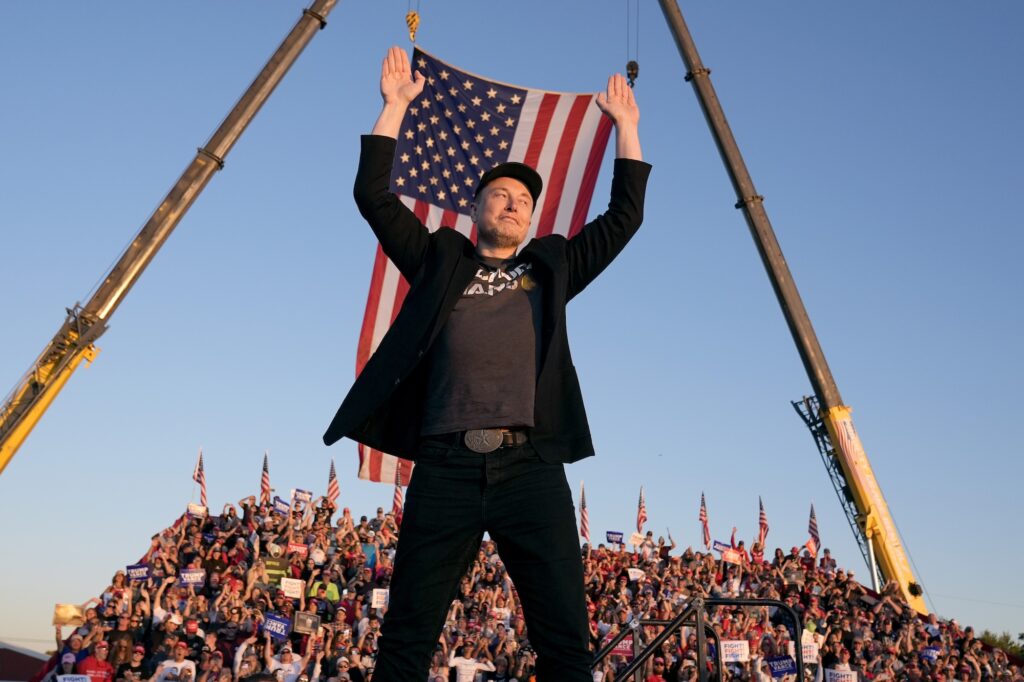
As Elon’s increasingly gone down a rabbit’s hole of embracing fascistic fellow travelers and concepts, a prior “climate savior” image long gone, that casting of himself as an “alpha” who’s the “real-life Iron Man” etc. has become ever more cartoonish. His core worldview seems shaped more by video games, sci-fi, comic books and so forth than any sense of shared humanity. He publicly denounced his own eldest child as “killed by the woke mind virus” once she came out as trans. In the name of “free speech” after censorious blowback to the Jan. 6 insurrection, he acquired Twitter (now X), drove away much of its staff, alienated advertisers, and turned it into a propaganda cesspool aligned with despots around the globe. As the Biden administration circled different investigations of Musk’s activities, he openly told Tucker Carlson “If [Trump] loses, I’m fucked,” ensuring that did not happen in ways we still can’t be entirely sure of.
The film’s most damning section deals with DOGE, a giant boondoggle that would purportedly “cut fraud and waste.” Instead, its barely adult hackers hacked away at government agencies they knew nothing about (often ones regulating concerns like Musk’s), ending vital programs and 86’ing key personnel. DOGE claimed to “save” Americans hundreds of billions in $$. Real-world analysis shows it actually COST us at least 3 billion, while greatly increasing the federal deficit. Who pays for that? Certainly not Elon Musk.
There’s no time for repetition in Gibney’s 235 minutes, which are scary, colorful, bizarre, and enraging by turns. How did a South African emigre, whose titanic self-promotion has so far outstripped the innovations he can honestly lay personal claim to, get so far? That may soon no longer matter: As some parting words here ominously warn, this very special “someone with a fairly limited skill set…[who] operates as if he knows and understands everything” is fundamentally flawed. Yet arguably, “it’s already too late. He has the control.” Musk begins and ends with graphics of the planet exploding. Paranoid fantasy? Maybe—but Musk sells that, too, albeit in versions where somehow only he can rescue us. It’s hard to find anyone or anything that Elon Musk has ever rescued…beyond the seemingly unstoppable wealth and fame Elon Musk of, course.
Musk opens in theaters nationwide this Thu/15, including SF’s AMC Metreon.
One reason Musk’s subject declined to cooperate is no doubt because Alex Gibney has stripped the gift-wrapping from Silicon Valley to reveal some scurvy doings several times before. In 2019 he made The Inventor about Elizabeth Holmes, who had raised billions for her company Theranos on the promise of extraordinary advances in medical blood testing—and was heading to prison after it turned out those claims were little but smoke and mirrors. Press, public, and eventually our legal system had no doubt it was a scam, but the most remarkable aspect was Holmes’ apparently delusional insistence that it wasn’t, despite a giant case of “no ‘there’ there.” The Icarus-like fall from feminist entrepreneurial role model to seeming wackjob was all the more dramatic for her having previously buffaloed so many prominent people who should have known better.
As she and longtime business and domestic partner Ramesh “Sunny” Balwani were investigated, then tried and convicted of fraud on a grand scale, she avoided press contact for years while filing appeals. It was wholly unexpected, then, when she and subsequent spouse Billy Evans (a younger hotel-chain heir) invited Canadian comedian, actor, and filmmaker Nathan Fielder into their lives with near-unlimited access in the weeks leading up to the already long-delayed start of her incarceration. He brought along documentarian Lance Oppenheimer and a full crew, as evidenced by the narrative-cinema-like multicamera flow with which the filmmakers record themselves as well as Holmes, Evans, and their two very young children in You Can See Everything.
The couple continue to insist she is wholly innocent of all charges… even that she has never lied about anything in her entire life. (To the extent that she admittedly any faults in Theranos’ operations, she pretty much claimed those were all Balwani’s doing, which he’s vigorously denied.) But if the idea was to turn around public perception of her, why use Fielder as their medium? Did they find his comedic prior semi-docu projects and slackerish persona endearing? Did they think his fumbling inquiries, as well as lack of medical-scientific knowhow, would somehow distract from any tough questions about Theranos that they clearly don’t want to address? Why do they (in particularly the sometimes visibly displeased Evans) continue to let Fielder & co. camp out when it must be obvious that if the filmmakers still aren’t convinced of her “innocence,” how can the public be?
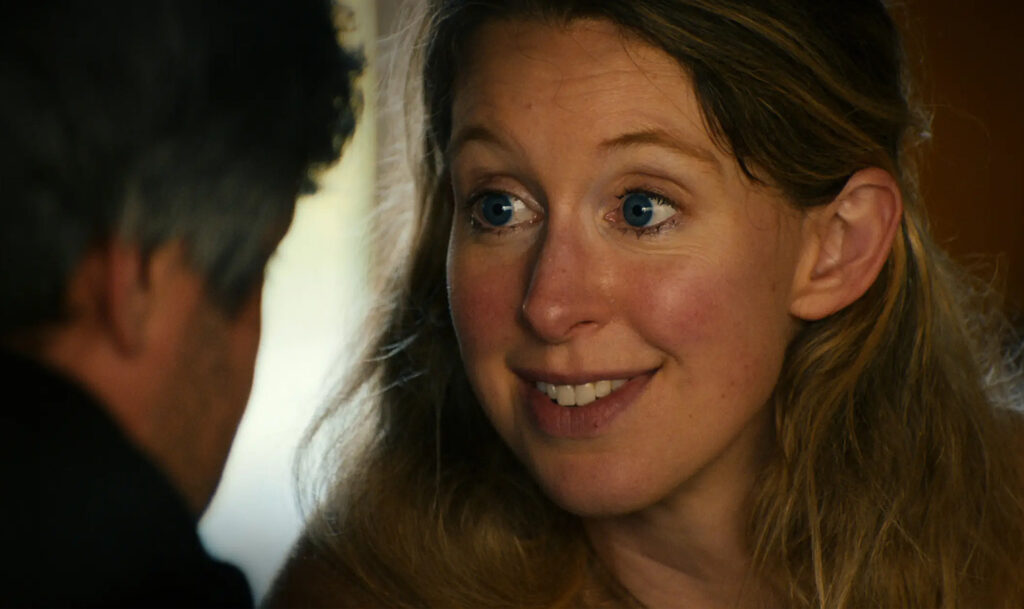
Sometimes a little repetitious and frustrating, the movie’s first half provides perverse fascination if not much insight. All we can figure out is that Holmes seems to truly believe her own dubious logic, even if wouldn’t absolve her in anyone else’s mind. But at a certain point she is delivered to federal prison, leaving the film’s “star” MIA. That is when Everything gets really interesting. I don’t want to provide any spoilers, but suffice it to say that the questions of truth, sanity, manipulation etc. long been applied to Holmes turn out to be quite relevant to her common law husband, too. And the actress Amanda Seyfried, who won an Emmy for playing her in dramatic miniseries The Dropout, becomes entangled in Fielder’s quest to ends that are by turns bizarre, hilarious, and more than a bit flummoxing.
Against all odds, You Can See Everything’s three full hours do the opposite of clarifying Elizabeth Holmes’ actions, motivations and beliefs. Her telling Fielder “I’m always being real” plays evermore like sheer mindfuckery, though we can’t be sure if she’s even conscious of any deception at work. Evans himself says “She’s really weird. She’s not normal”—and he’s defending her. (We eventually realize those terms might also apply to him.)
So meta it’s like the documentary equivalent of an Escher image, an endless snake-eating-self, this movie must be seen to be disbelieved. You may have thought its subject was already an ultimate illustration of our era’s enabling of untrustworthy, attention-needy, world-class self-promoters. But as they saying goes, you ain’t seen nothin’ yet.
You Can See Everything opens around the country Thu/15, including at SF’s Apple Van Ness, Kabuki, Marina, Metreon, Balboa and Alamo New Mission theaters.
The post Screen Grabs: ‘NAZA’ doc chillingly excoriates Israel’s killing machine appeared first on 48 hills.
]]>The post Drama Masks: Dark fantasy and darker reality in powerful ‘The Brothers Size’ appeared first on 48 hills.
]]>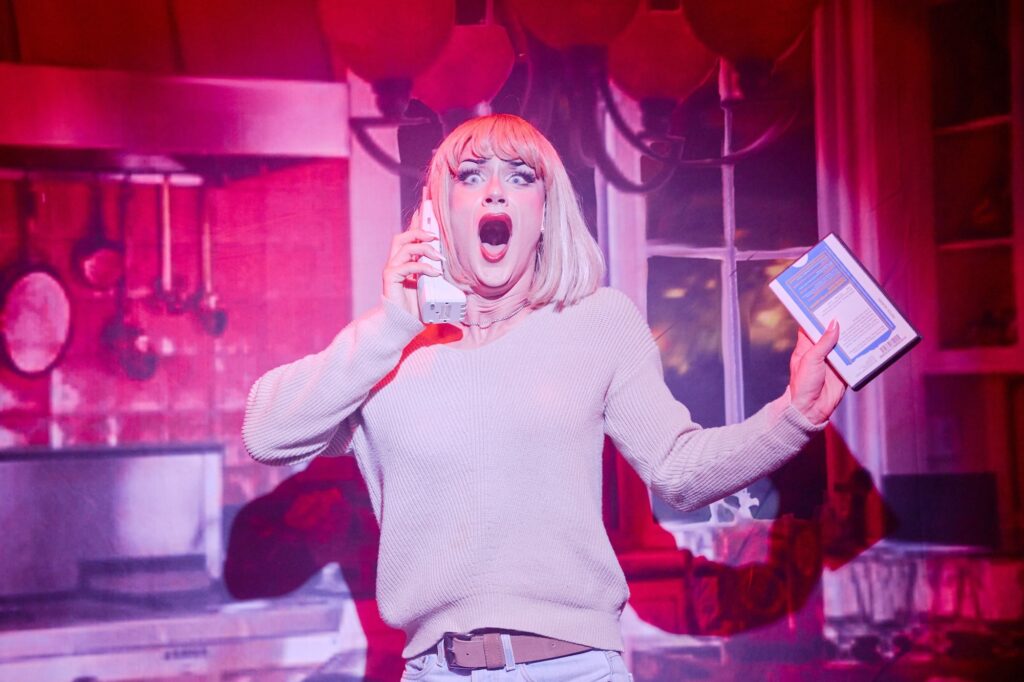
Sqream at Oasis
There’s a lot about Sqream (through November 7 at Oasis, SF) that works in its favor: the production design is amazing; the subject matter is ripe for lampooning; and the cast are committed 110%. Yet, the one major thing working against this drag horror musical parody of the ‘90s slasher is that it doesn’t seem all that interested in its subject so much as the era in which it premiered.
It starts out an absolute high note, with Oasis’ lobby crudely-yet-intricately transformed into the home of bobcut-blonde ingenue Drew Buriedmore (Evian) just as she’s ready to make it a Blockbuster night. That’s when she gets a call on her large, clunky phone from some mouth-breathing masked killer who quizzes her on mid-‘90s pop music before he shows her the wrong end of his butcher knife. It’s a hilarious kick-off that not only has Ghostface dancers prancing around audience members, but also has a firm grasp on the genre being spoofed.
But playwright Michael Phillis doesn’t show much interest in satirizing the slasher in the following scenes. Instead, Sqream is an extended parody of TGIF sitcoms that’s less Scream and more Saved by the Bell. yet the show is preceded by a montage of gruesome horror footage from genre staples like Waxwork and the Hellraiser flicks. Why Phillis doesn’t go all-in on the cliche-ridden genre is anyone’s guess.
Granted, there are several points where characters acknowledge they’re in a play riffing on a movie that riffed on several other movies. Perhaps he thought there was nowhere else to take the material, but that just raises the question of why to pick Scream in the first place? After all, it didn’t stop the Scary Movie folks.
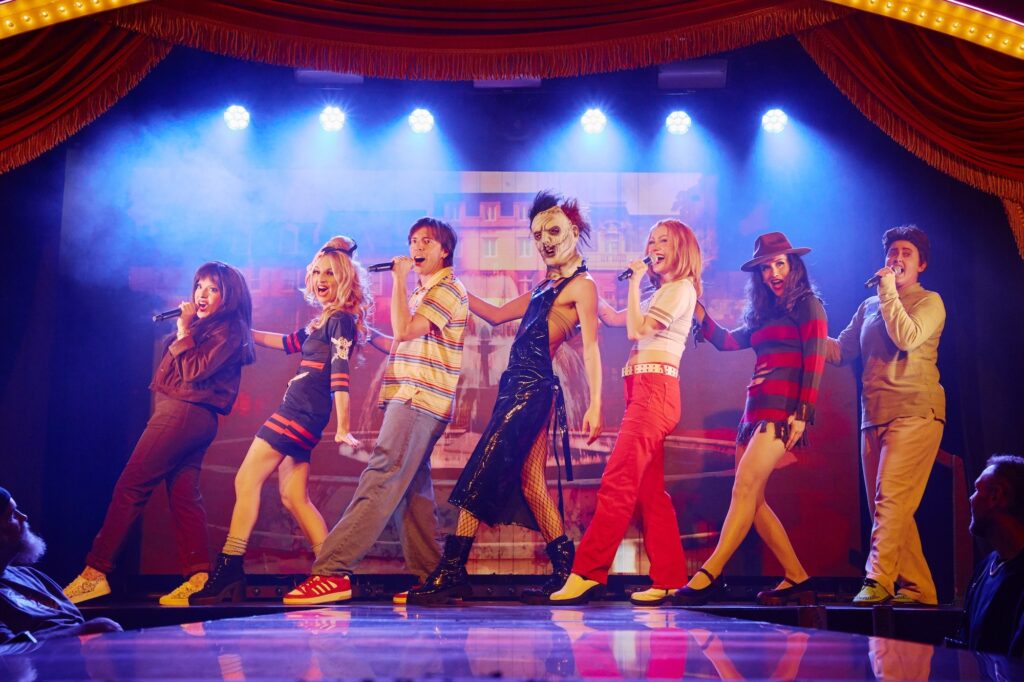
Still, the cast go all-in on their parody characters of the virginal Neve Sidney Campbell Prescott (Lisa Frankenstein), the obnoxious Randall Jamie Kennedy (Coco Merrell), and super-bitch reporter Courtney Love-Cocks (Evian). They take to the Clinton-era cover songs and network TV-style shenanigans with just the right over-the-top affinity to keep the audience hooked on their every word. Hell, you may be surprised at how much you actually root for them to survive the carnage.
The only thing close to a real scare was seeing how high CO² levels got at Oasis. My Aranet4 peaked around 2,314ppm before dropping down to 2,165ppm by the final bow.
Sqream is a good way to show off all the tools Oasis has at its disposal: the amazing designers, the pitch-perfect cast, and a pre-show go-go dance set to Janet Jackson’s “Black Cat.” Had the show proper stayed on subject, it would have had that going for it, too.
SQREAM runs through November 7 at Oasis, SF. Tickets and further info here.
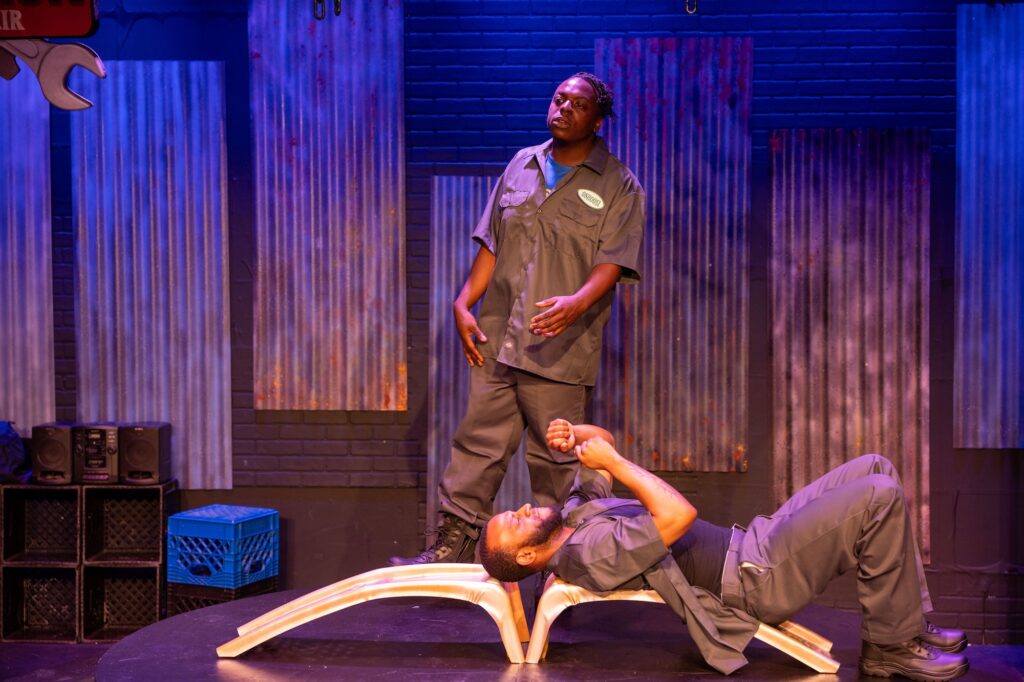
African-American Shakespeare Company presents The Brothers Size
There’s an odd sense of comfort to be found in The Brothers Size (through November 1 at Theater 33, SF). That may seem an odd choice of words, given how its characters seem to be trapped in an almost Kafka-esque set of circumstances. Still, there’s something reassuring about the allusions playwright Tarell Alvin McCraney weaves into his script. The nods to Yoruba deities, classic Black soul, and even self-hating Blackness (via law enforcement, no less) are oddly reassuring in this Southern Gothic story.
Ogun Size (Gary Moore) owns the auto body shop that he hopes will keep his recidivist brother Oshoosi (Judge Cantrell) out of trouble for once in his life. That isn’t likely, given Oshoosi’s lack of interest in the work and the sudden appearance of his handsome, charismatic, fellow-ex-con friend Elegba (Brandon Milligan). On the surface, it’s the classic “my brother’s keeper” story with Oshoosi as Ogun’s cross to bear after the death of their mother.
Beyond that, McCraney’s script is a rebuke to the condescending idea of hard work being all one needs to overcome the hand life’s dealt them. That’s an idea born of privilege and promoted by those who either don’t know better or gain power from repeating the lie. The eponymous brothers know that the only guarantee in their life is one another, for better and for worse. That’s how the road to Hell ends up paved with the best of intentions.
I caught the show during a sparsely-attended matinee, so CO² levels were noticeably lower than what they likely would have been. They peaked around 686ppm during the 90-min. show, dropping down to 660ppm by the final bow.
Under the guidance Af-Am Shakes’ own James Mercer II (who also directed last year’s fantastic production of Les Blancs for OTP), The Brothers Size takes on a dreamlike quality that never loses its sense of grounding. It’s almost as if the characters themselves are unable to wake up from the dark fantasy in which they find themselves, and it’s almost perverse how easily we leave them there when the show is over. Dealing with family is often both boon and burden, but watching it makes for compelling drama.
THE BROTHERS SIZE runs through November 1 at Theater 33, SF. Tickets and further info here.
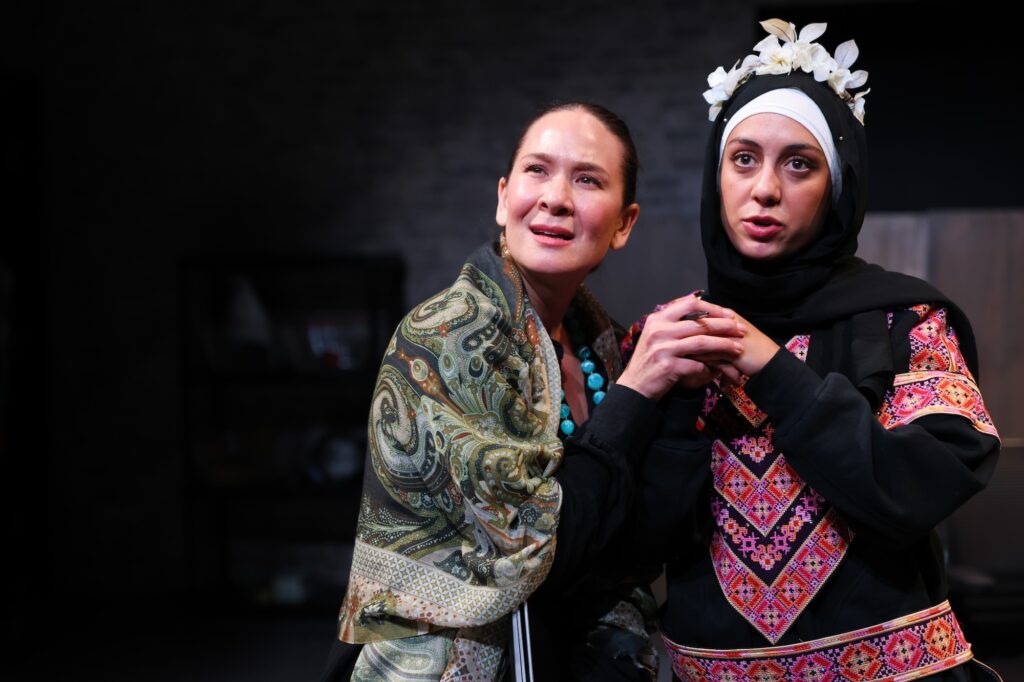
Golden Thread’s ReOrient 2026
I didn’t expect a MENA-centric collection of shorts to open with a boner joke, but here we are. Golden Thread’s 2026 ReOrient Festival (through November 1 at the Potrero Stage, SF) takes its characters through many irreverent and unconventional directions, most of them overtly comedic (a teenage girl has her first real crush, a cab driver laments the slim-pickin’s on Tinder in Gaza, a Palestinian actor ponders the gift and curse of working regularly in Israeli film and television).
Yet the humor is often gallows-oriented before shirking any laughs at all. Death waits in every story like a shark waiting to strike. Whether it comes from the totalitarian government of Iran or the genocidal government of Israel, the characters of the eight short plays find themselves in a constant state of alert that things can take a turn at any moment. It’s as enlightening a look into the lives of MENA characters as it is heart-breaking.
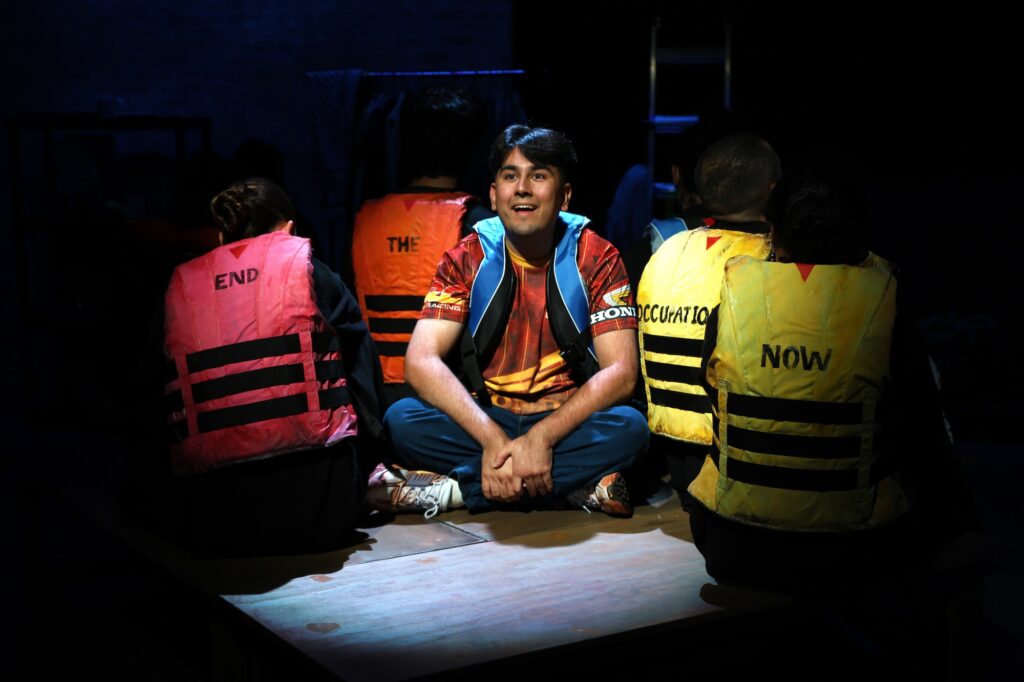
All of the plays in this year’s two-hour collection are astounding in how they all weave comedy and tragedy as intricately as threads in a quilt. It’s as entertaining as it is humanizing, and a fine example as to why Golden Thread existence has become all the more necessary over its 30-year lifespan. (Co-founder Torange Yeghiazarian attended the opening performance.) Given how most folks’ idea of the Middle East comes from skewed headlines—often the result of violence paid for with US tax dollars—supporting a genuinely great show like ReOrient serves as a great alternative.
The opening-night near-full house came with rather “normal” CO² levels (or maybe my expectations have skewed after six years?), with my Aranet4 peaking 1,608ppm in the second act.
REORIENT 2026 runs through November 1 at the Potrero Stage, SF. Tickets and further info here.
The post Drama Masks: Dark fantasy and darker reality in powerful ‘The Brothers Size’ appeared first on 48 hills.
]]>The post Best of the Bay 2026 Editors’ Pick: Stuff by Luxe appeared first on 48 hills.
]]>The Mission’s Stuff by Luxe (1830 Harrison) caters to fans of all things vintage—and how. The two-story, 20,000-square-foot warehouse opened last October and features mid-century modern and antique furniture, clothing spanning a range of eras, records, art, home decor, and much more from its 50-seller collective.
“We have a variety of vendors who curate many unique items you can’t find anywhere else,” said Ha Kwan, who co-owns the store with her husband, Fred. “I think that’s what makes us special. There’s something for everyone.”
As reported by Mission Local last year, the couple opened their first, smaller Stuff by Luxe location in Russian Hill (1545 Pacific) in 2024 after the Valencia Street store Stuff shuttered the year before due to failed lease negotiations. Kwan had been a vendor at Stuff, where she sold furniture under the name Luxe. With the owners’ blessing, she modified the Valencia store’s name when she and Fred decided to carry on the Stuff tradition.
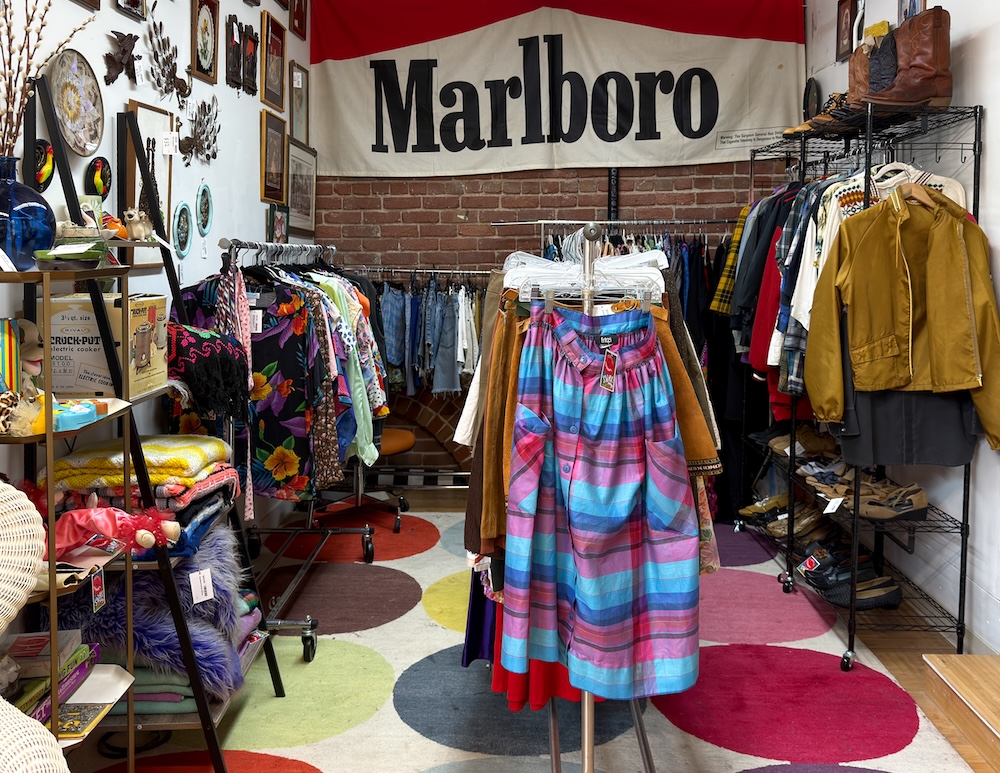
Besides being the largest vintage consignment store in the Bay Area, Stuff by Luxe in the Mission may also be its finest. The Kwans have high standards for their vendors, who curate their individual spaces and set their own prices. Working with such a large stable of vendors also means fresh inventory is always hitting the showroom floor.
“We also host a monthly outdoor market,” Kwan told 48 Hills. “We have vendors outside in our driveway and parking lot selling furniture, art, home decor, clothing, and jewelry. The market happens on the second Saturday of each month.”
Whether you’re just browsing for fun or on the hunt for the perfect Scandinavian living room set or a slick leather jacket, the light and airy warehouse is an inviting place to shop. High ceilings with exposed beams, plus hardwood and concrete floors give the space an industrial-chic vibe.
And with all that room, plus an easy-to-navigate layout, you don’t have to elbow your way past other shoppers to get a closer look at the items that catch your eye—luxe stuff, indeed.
The post Best of the Bay 2026 Editors’ Pick: Stuff by Luxe appeared first on 48 hills.
]]>The post Photos: Indigenous Peoples’ Day Sunrise Gathering commemorated Alcatraz reclamation appeared first on 48 hills.
]]>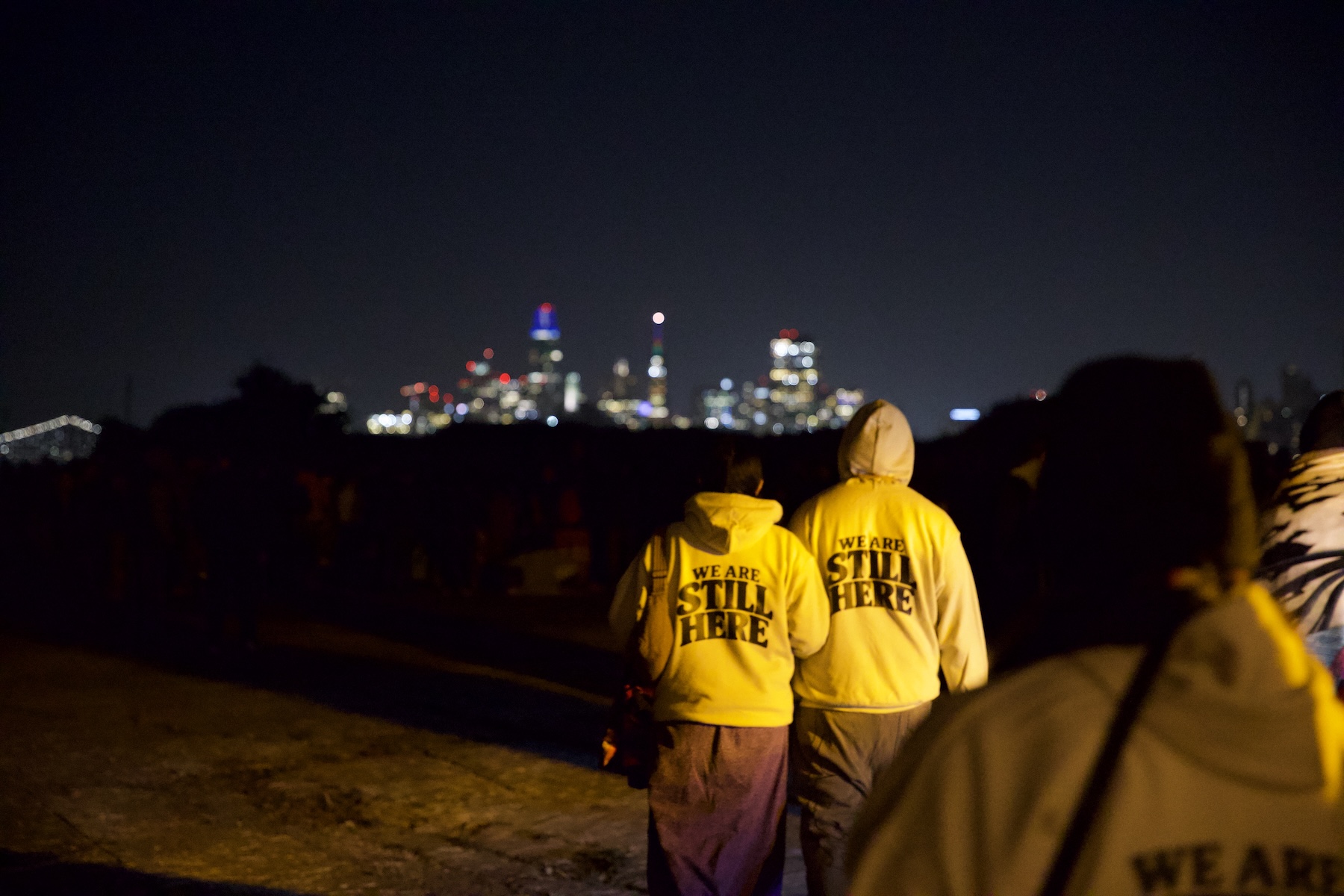
Indigenous Peoples’ Day Sunrise Gathering 2026. Photo by Emma Garcia 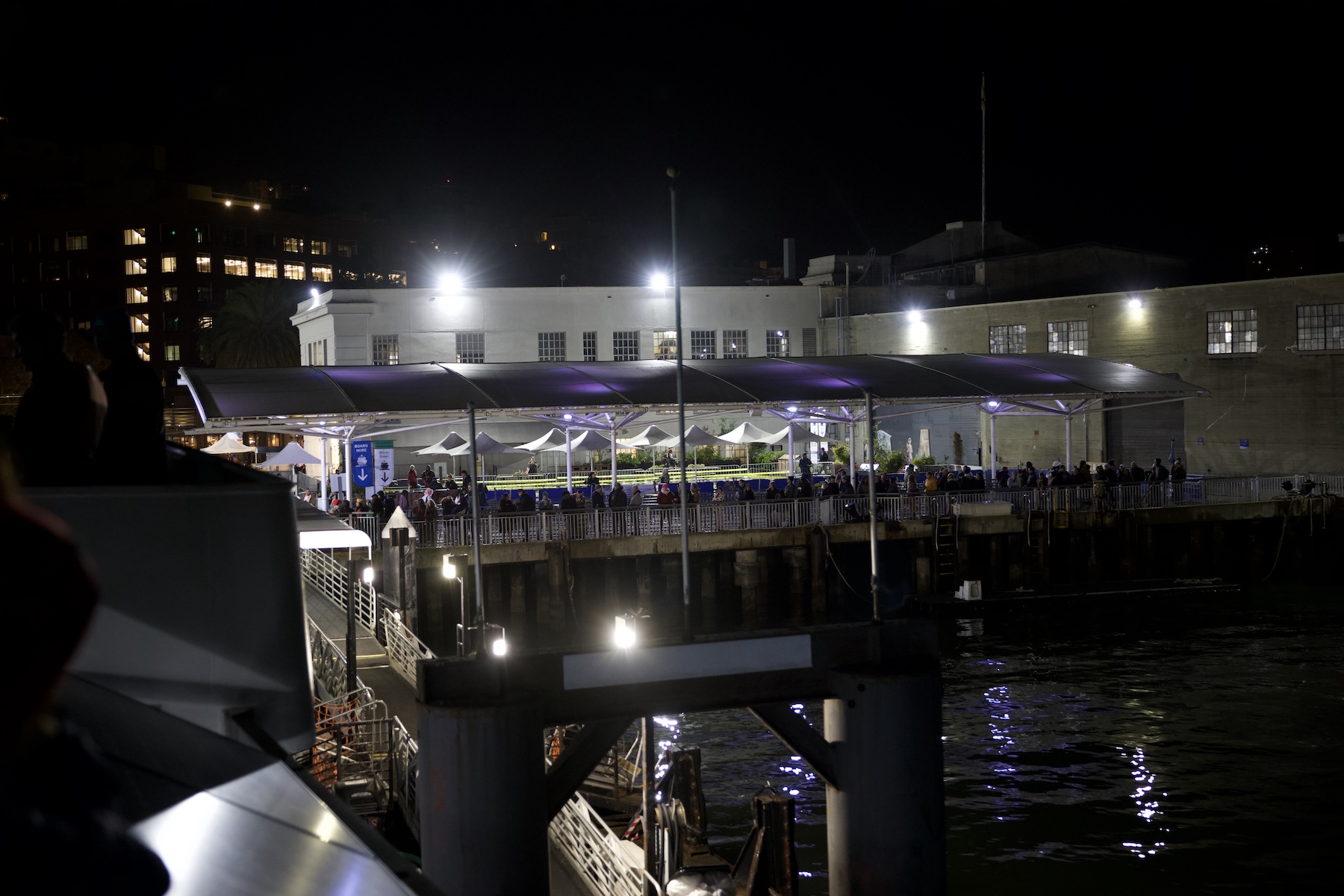
Indigenous Peoples’ Day Sunrise Gathering 2026. Photo by Emma Garcia 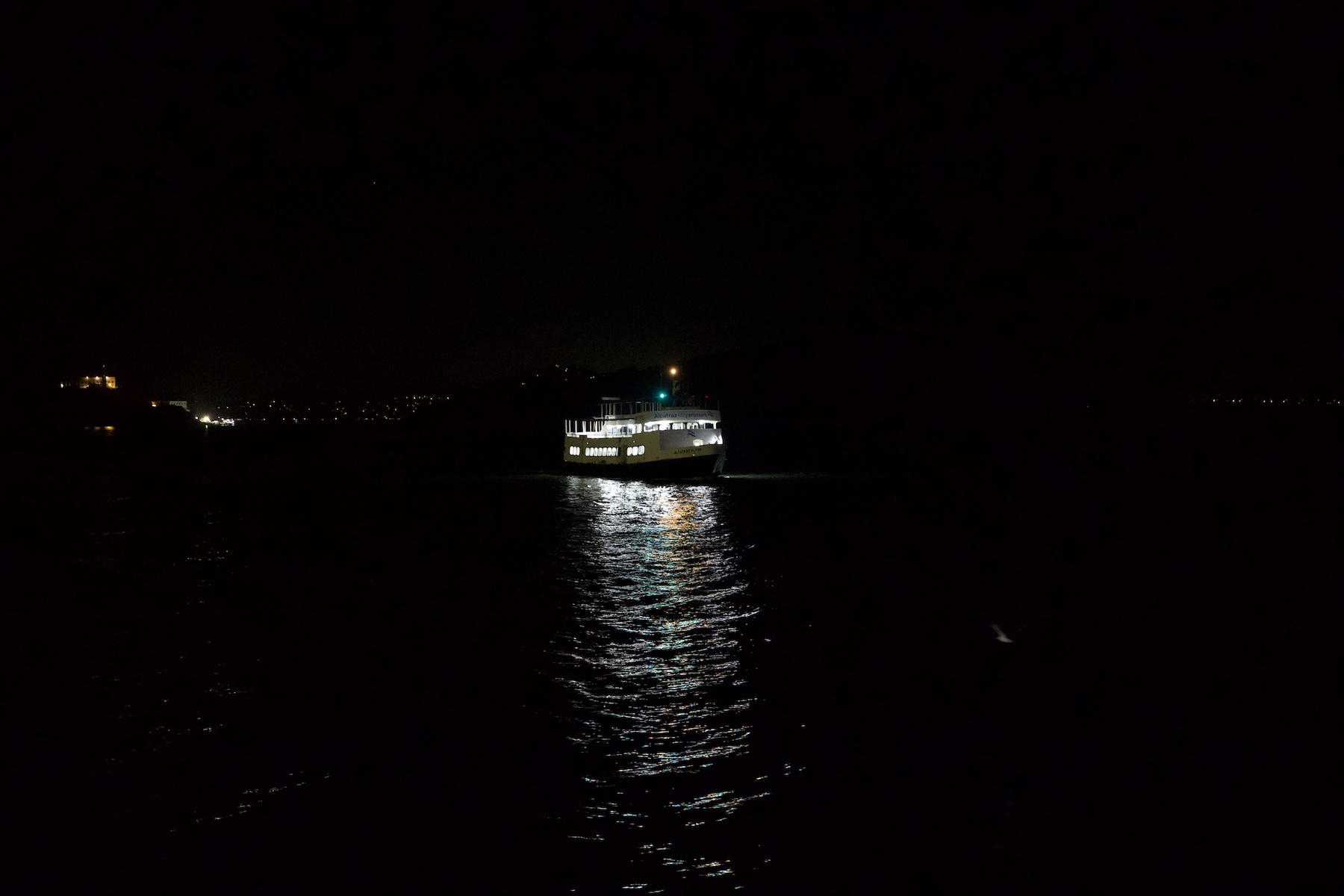
Indigenous Peoples’ Day Sunrise Gathering 2026. Photo by Emma Garcia 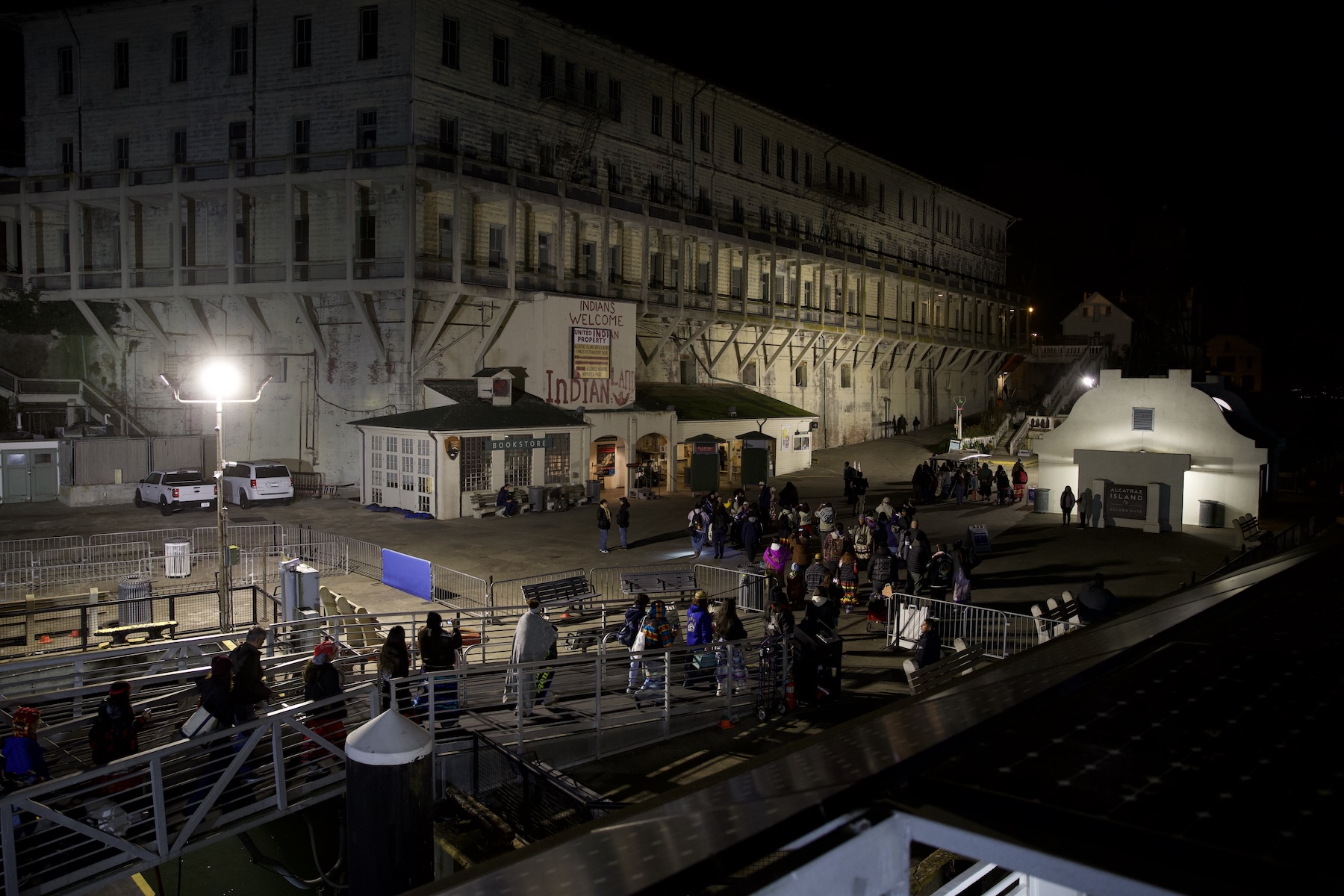
Indigenous Peoples’ Day Sunrise Gathering 2026. Photo by Emma Garcia 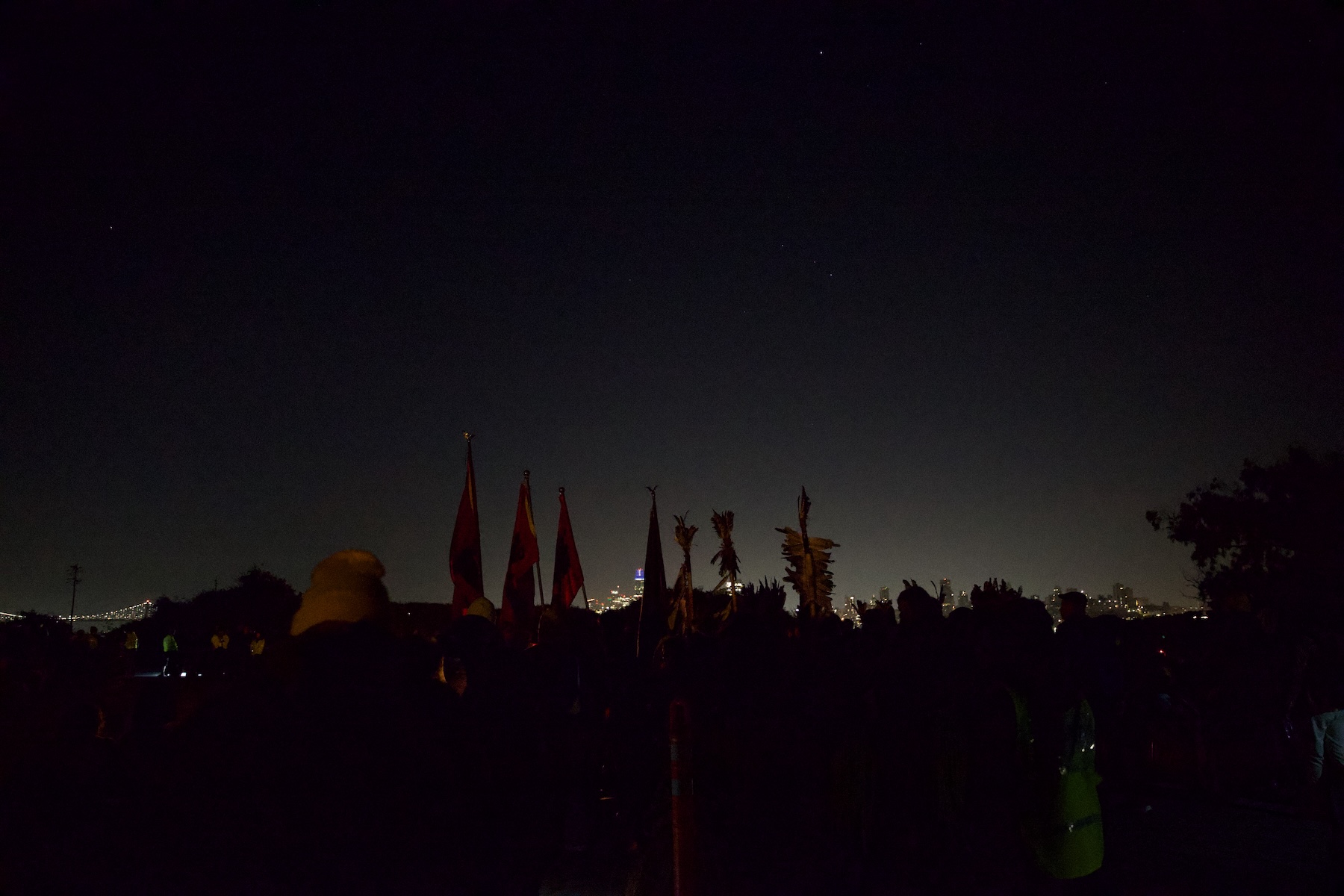
Indigenous Peoples’ Day Sunrise Gathering 2026. Photo by Emma Garcia 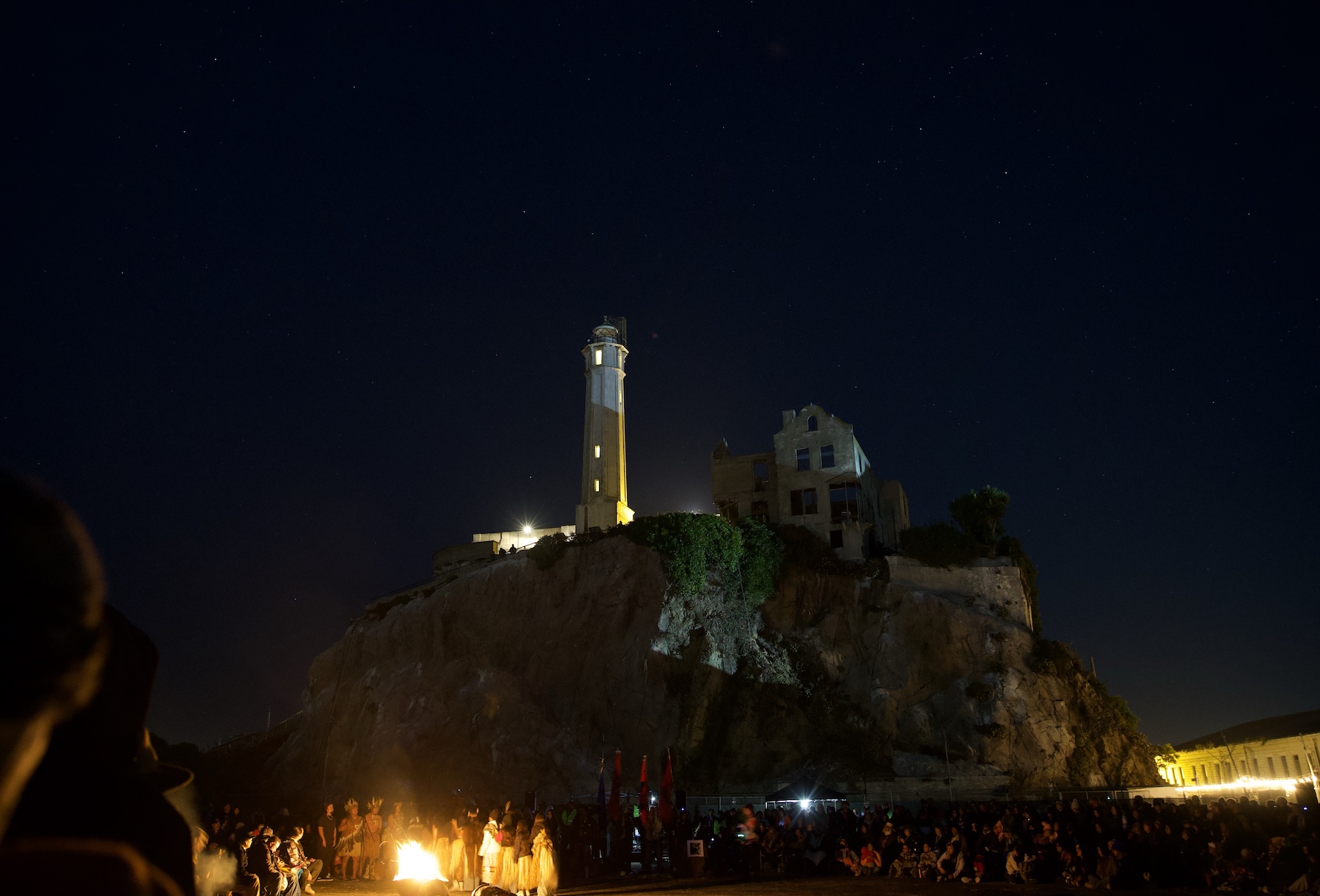
Indigenous Peoples’ Day Sunrise Gathering 2026. Photo by Emma Garcia 
Indigenous Peoples’ Day Sunrise Gathering 2026. Photo by Emma Garcia 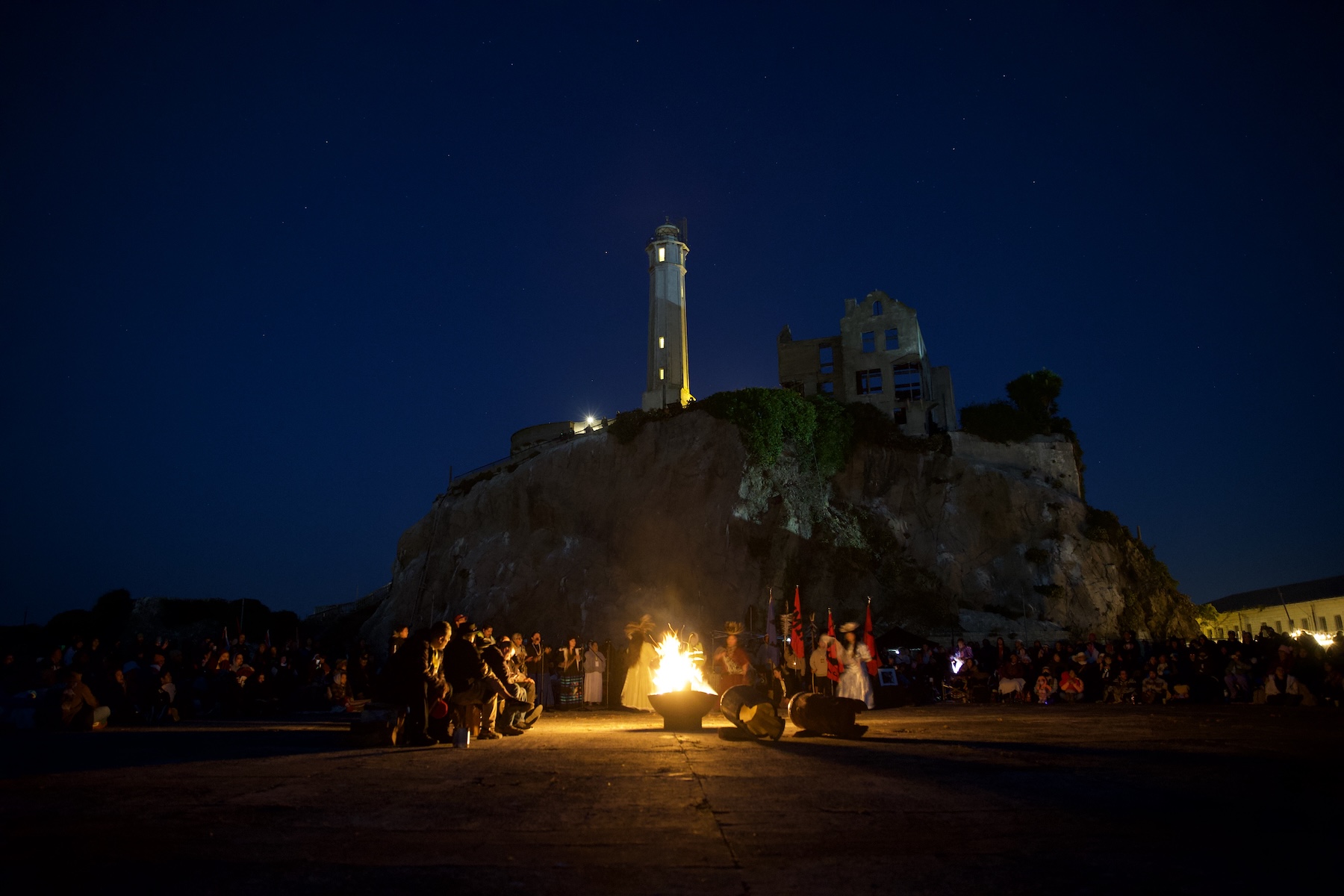
Indigenous Peoples’ Day Sunrise Gathering 2026. Photo by Emma Garcia 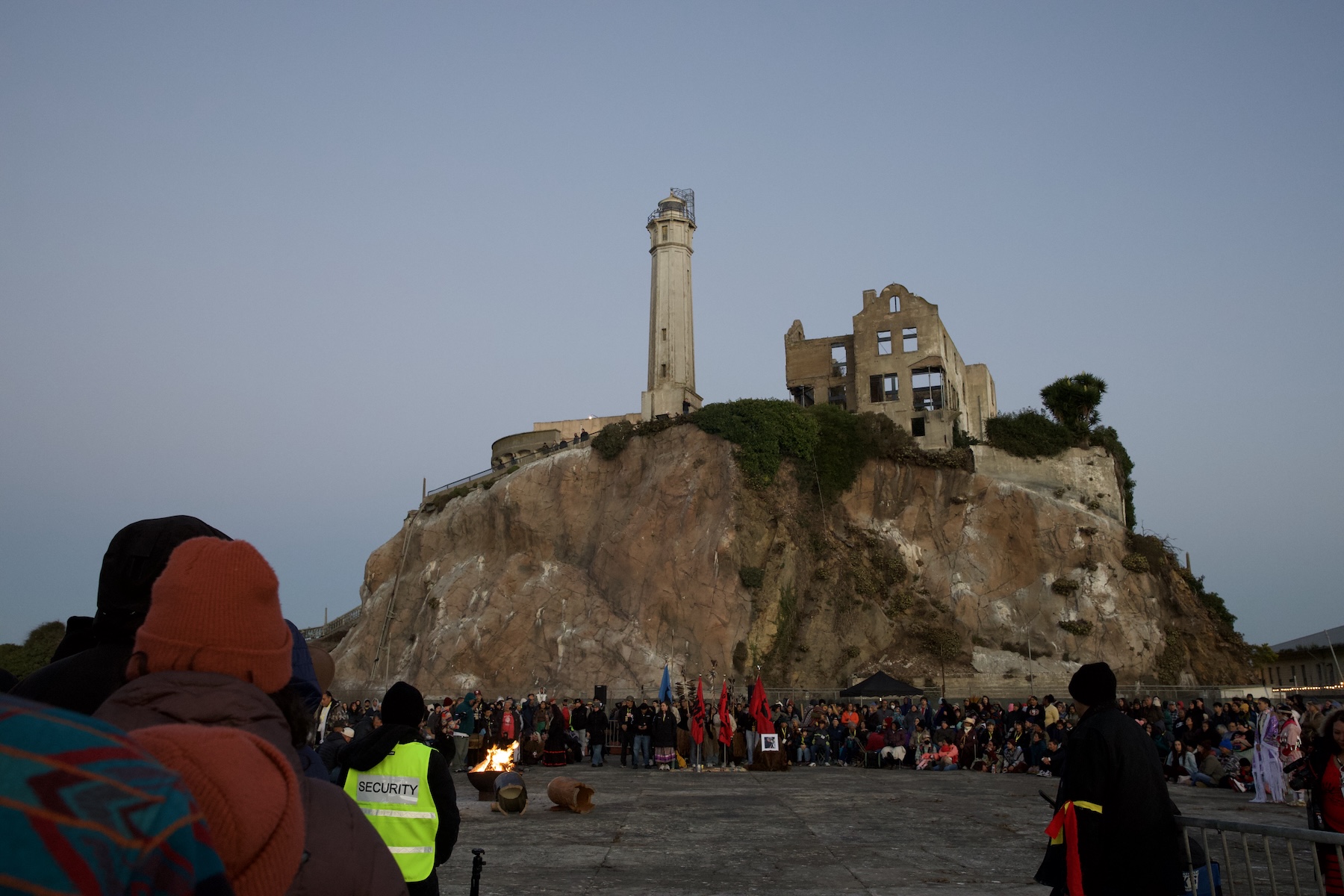
Indigenous Peoples’ Day Sunrise Gathering 2026. Photo by Emma Garcia 
Indigenous Peoples’ Day Sunrise Gathering 2026. Photo by Emma Garcia 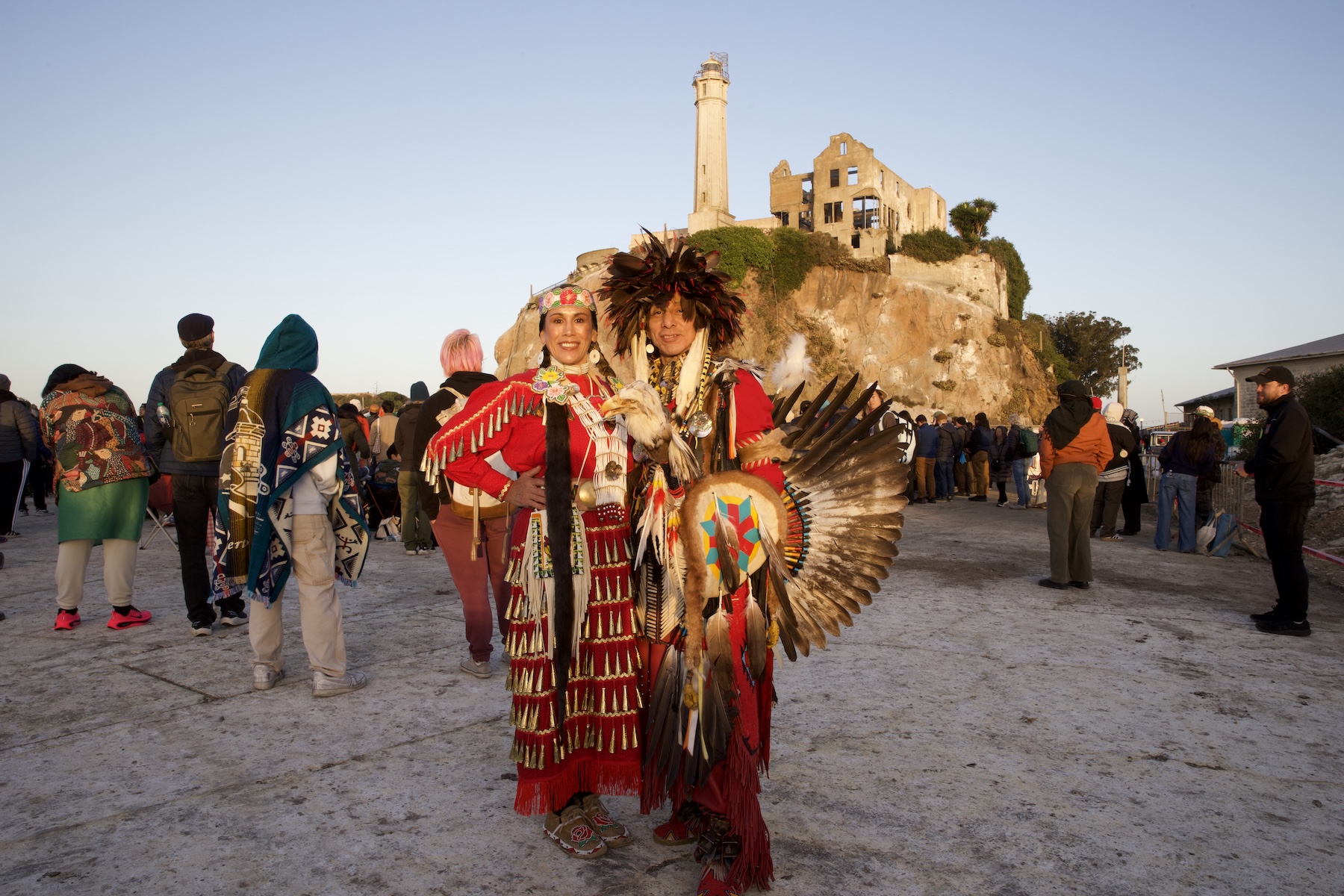
Indigenous Peoples’ Day Sunrise Gathering 2026. Photo by Emma Garcia 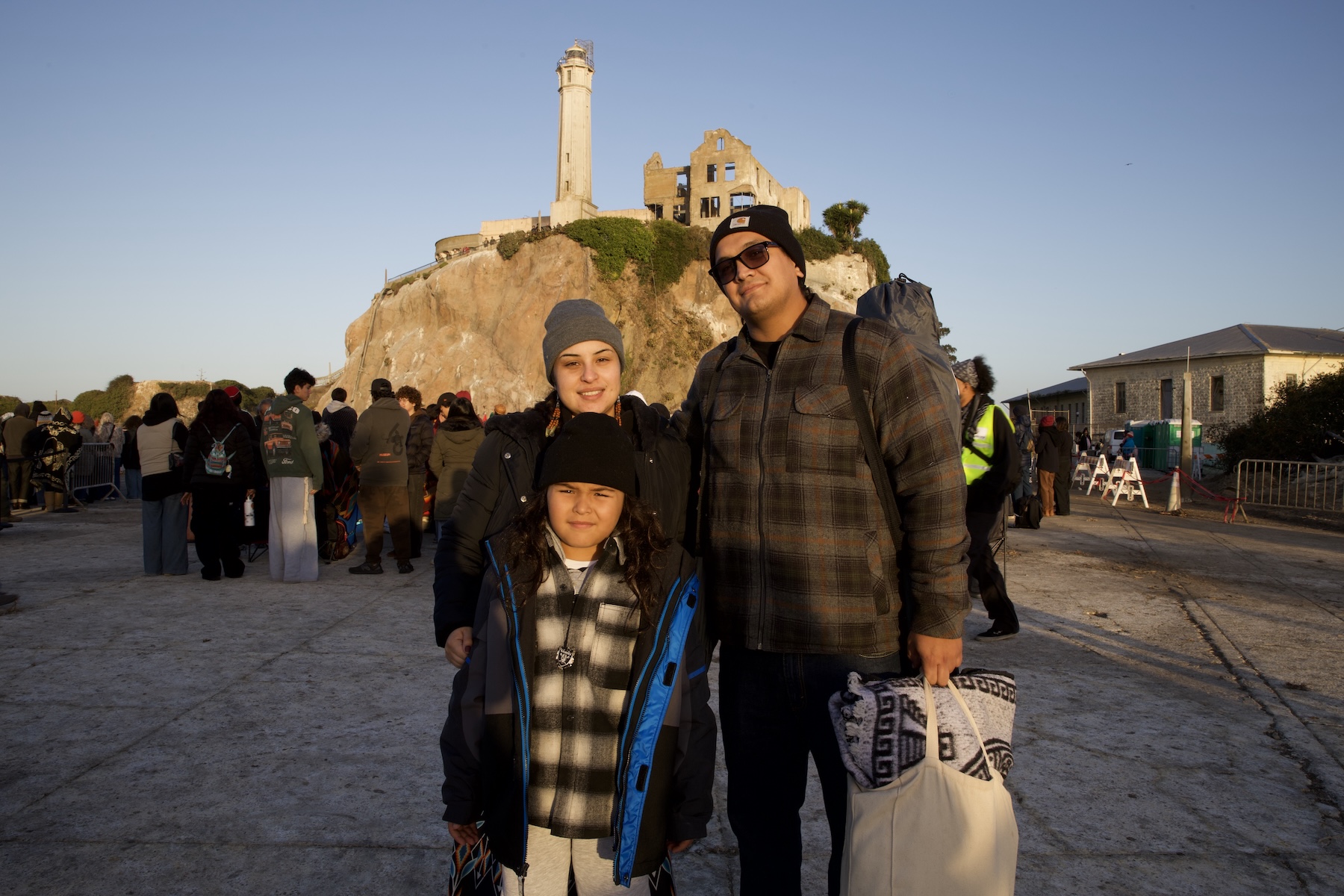
Indigenous Peoples’ Day Sunrise Gathering 2026. Photo by Emma Garcia 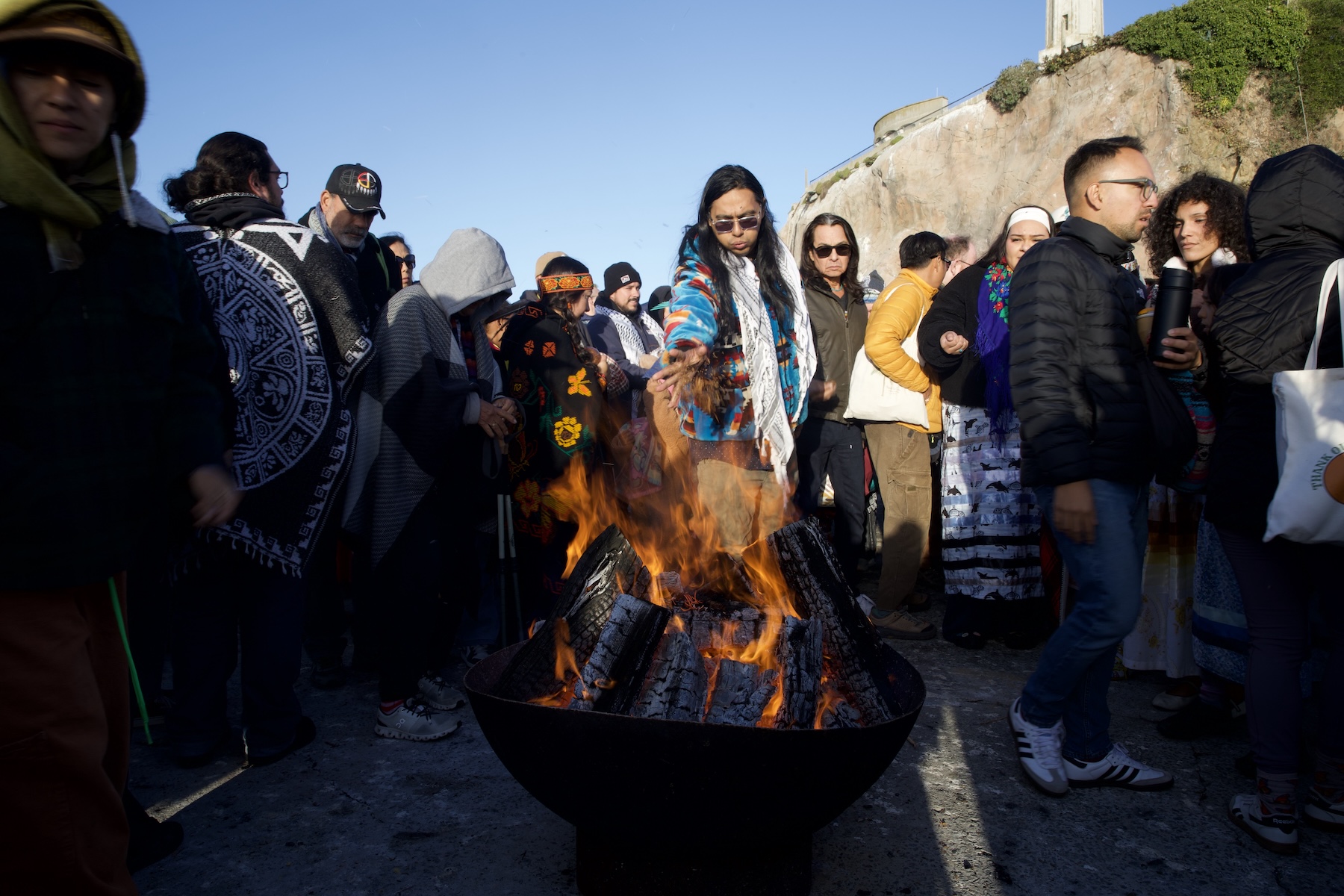
Indigenous Peoples’ Day Sunrise Gathering 2026. Photo by Emma Garcia 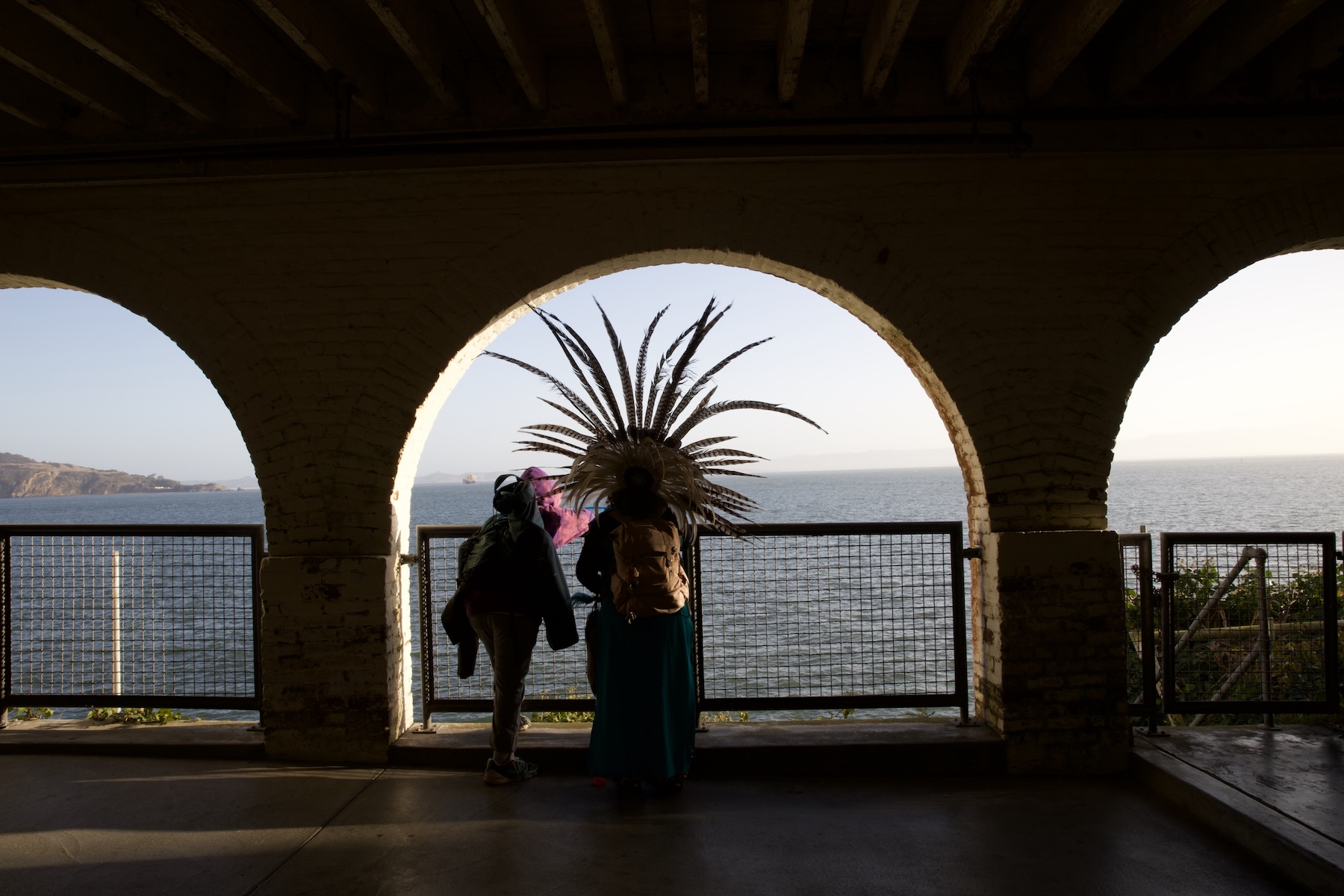
Indigenous Peoples’ Day Sunrise Gathering 2026. Photo by Emma Garcia
The post Photos: Indigenous Peoples’ Day Sunrise Gathering commemorated Alcatraz reclamation appeared first on 48 hills.
]]>The post Best of the Bay 2026 Editors’ Pick: Creative Collective appeared first on 48 hills.
]]>With all the dire news about the AI invasion pricing artists out of San Francisco and killing the city’s creative soul, it’s easy to get depressed about our communal future. Aprill Lacey, co-founder and executive director of nonprofit Creative Collective, gets that. Yet in spite of the challenges artists face in our current climate, she remains optimistic about the city’s art scene.
“In the event world, I see lots of opportunities for musicians, other artists, and makers,” Lacey, who has 25 years of experience managing events in the Bay Area, explained to 48 Hills. “In San Francisco, there are lots of things happening, often on the same day. On our end, artists we reach out to aren’t always available because they’re already involved in so many other things.”
Formed two years ago, Creative Collective partners with community benefit organizations and businesses to provide commission-free gig opportunities and resources for artists. Their events include the Fern Alley Music Series and an art space pop-up in Lower Polk as part of SF First Thursdays. Attendees enjoy an evening of exploring galleries, artist-run spaces, and neighborhood businesses.
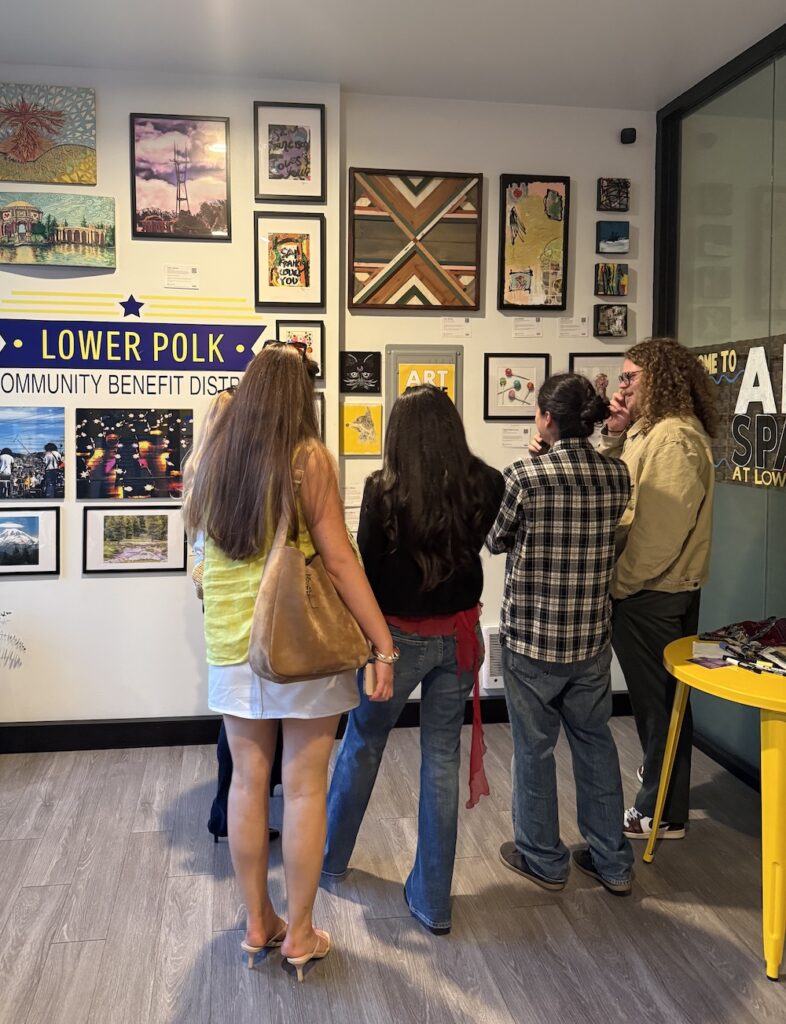
“The pop-up storefront features a rotation of anywhere from 15 to 20 artists we showcase each month,” said Lacey. “Our main focus is artists who are hyper-local to the surrounding areas, from Lower Polk, the Tenderloin, North Beach, and then greater San Francisco and Bay Area artists.”
While she loves advocating for creatives in all of these places and producing events throughout San Francisco, she has a soft spot for Lower Polk. Lacey sees the neighborhood as having vibrant arts community that is chronically overlooked. She’s on a mission to change that.
“It’s a great place to come and see art and experience events,” Lacey said. Working with the Lower Polk Community Benefit District, Lacey and her team are gearing up for one of the neighborhood’s biggest events, the second annual Lower Polk Live! night market happening on October 23.
Her team is also wrapping up work on Pier Party, a free summer concert series at Fisherman’s Wharf. And in partnership with the Yerba Buena Gardens Conservancy, the collective is busy preparing for the San Francisco Diwali Festival on November 8.
“San Francisco is still a wonderful, creative place with lots of stuff happening and people just like us (event producers) who are doing great things in the city,” said Lacey. Attending a Creative Collective event might just be one way for SF doomers to start believing her.
Get more information on Creative Collective’s events here.
The post Best of the Bay 2026 Editors’ Pick: Creative Collective appeared first on 48 hills.
]]>