Two parametrizations for the ‘unit’ ellipse in the i^2 = -1 + i kind of multiplication.
Ok, all in all this is not a very ‘important’ post like lately when I showed you how you can do integration in say 3D space using a primitive. But I considered the two parametrizations elegant enough to write this new post about them.
In the post from Jan 2024 I showed you how to parametrize or cover the complex ellipse with two cosines with a time lag of one third of a period between them. The unit circle in the complex plane can be viewed as two cosines with a quarter of a time lag between them because that transforms a cosine into a sine and you get the familiar expression for the complex exponential.
This post is six images long and I added three appendices to it for the graphs that hopefully make all the stuff a bit more transparant. I hope you like it and that we are not in a situation where say in half an hour your neighbors phone the police one more time with “He is shouting at the mirror again, please come help and save us”. Ok, here we go:


As you see it’s not very hardcore but it is all relatively simple. Just some covers of two ellipses. Thanks for your attention.
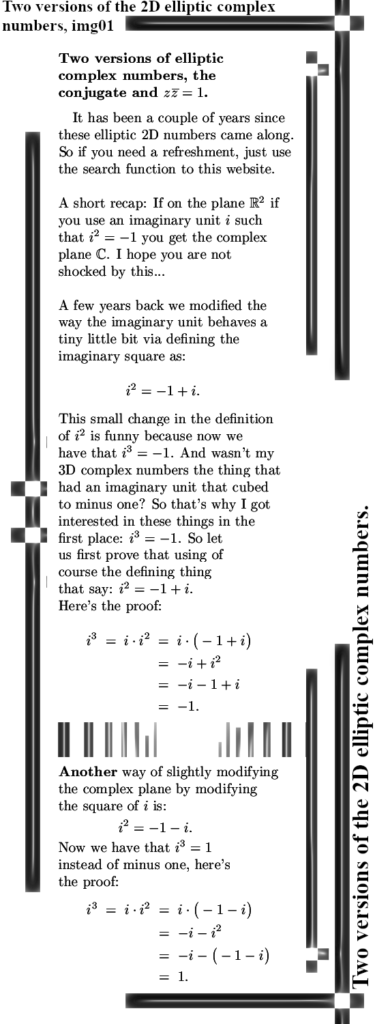
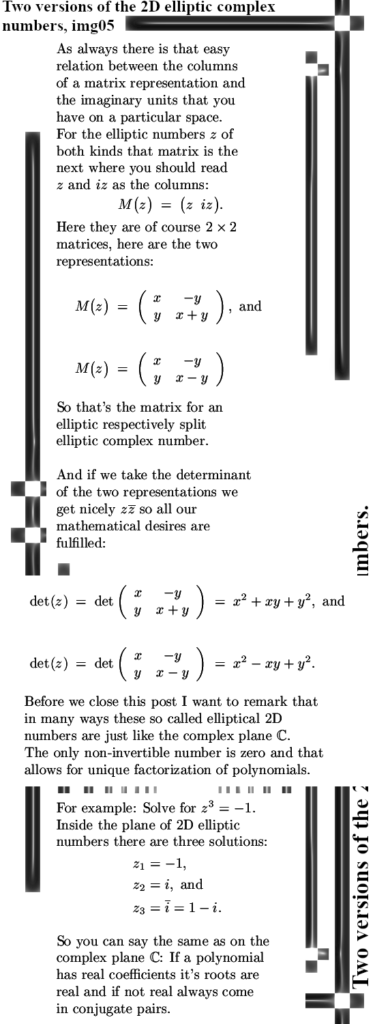
]]>i^2 = -1 + i, this gives the elliptic complex numbers. And if we do
i^2 = -1 – i that gives the split elliptic numbers.
Try it yourself: The third power of these imaginary units are -1 in the first case and the third power is +1 for the split elliptic numbers. That is why I name those the split complex numbers, just like there are ordinary complex and split complex numbers are defined by i^2 = +1.
The basic idea behind this post is that the derivative of the log equals the inverse and the other way around: integration of the inverse must yield the logarithm. Of course outside the real line complex exponentials can have periods and sometimes people use that to say the log is a multi valued function. That is also why people often leave a cut out of the complex plane, for example the complex plane without the negative real numbers. Now the log is not multi valued. Well I skip all such considerations and beside that in this post we only calculate a number and we do not study the log in itself.
So integration of the inverse in a 2D number system, that’s basically what this post is. It is more or less the royal road paved with silver and gold that leads to defining complex exponentials while as we will see in the next post that if we want to parametrize these complex exponentials we don’t need knowledge about the actual number tau at all.
This post is seven images in itself and one addendum so 8 images in total.
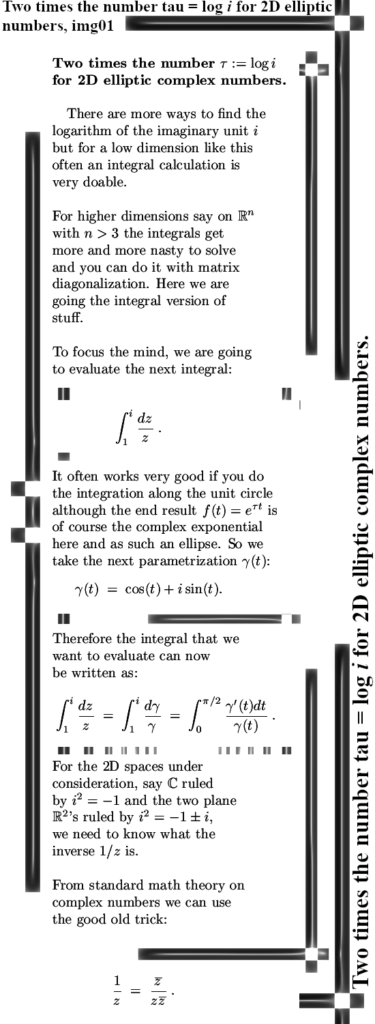
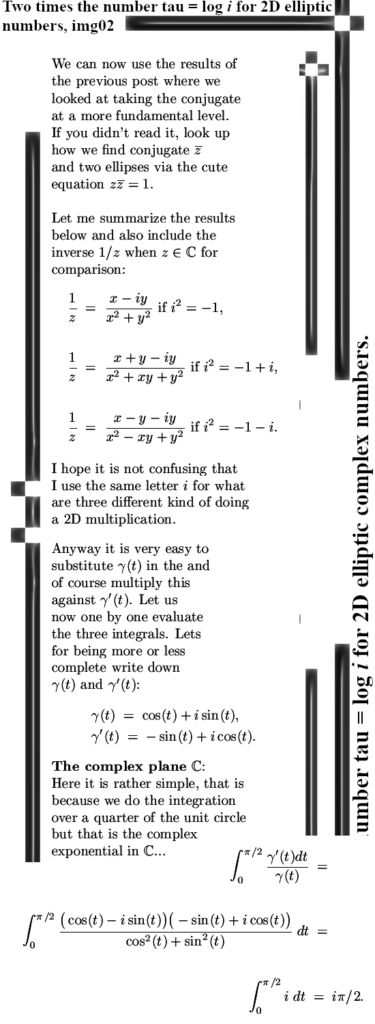
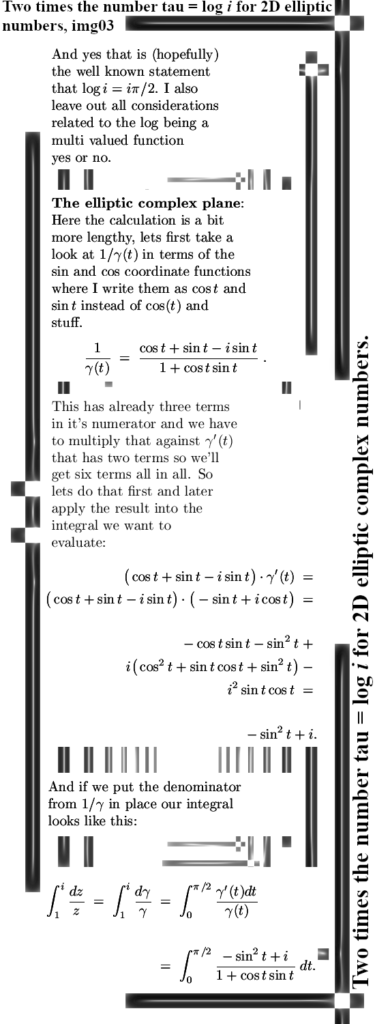
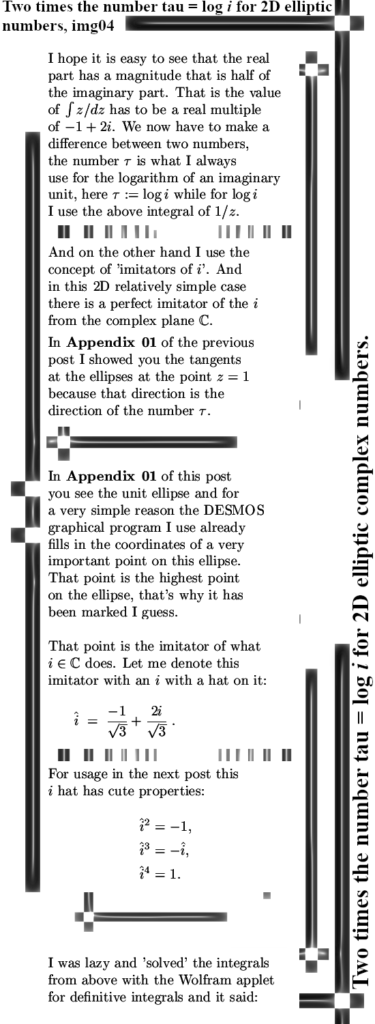
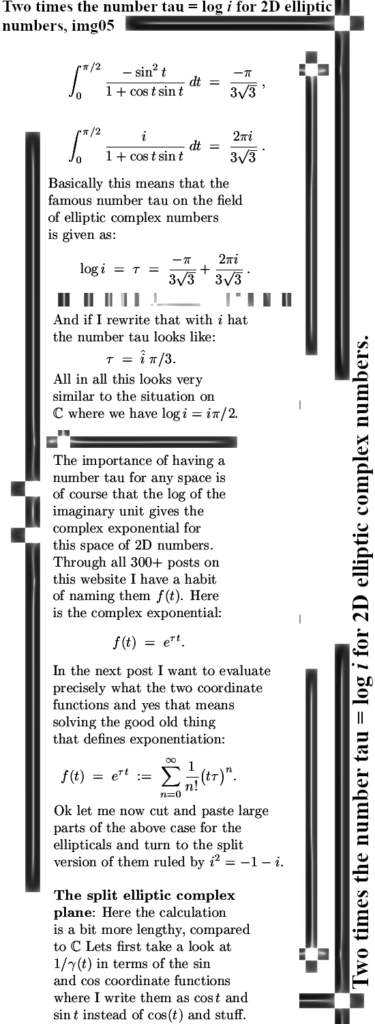
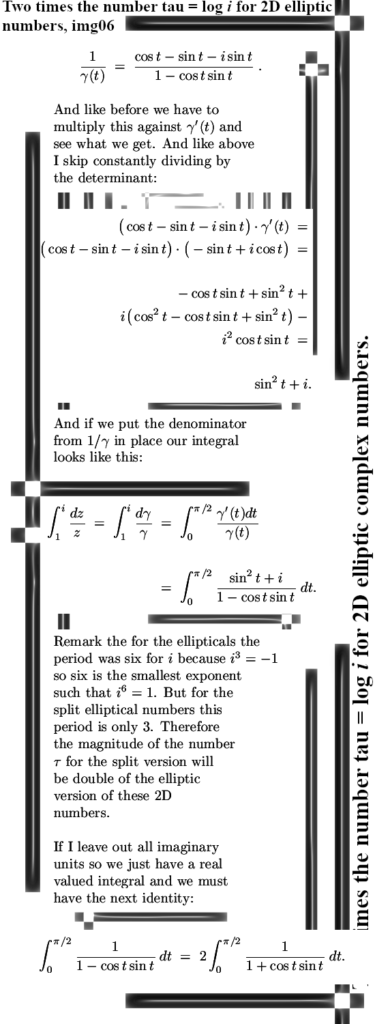
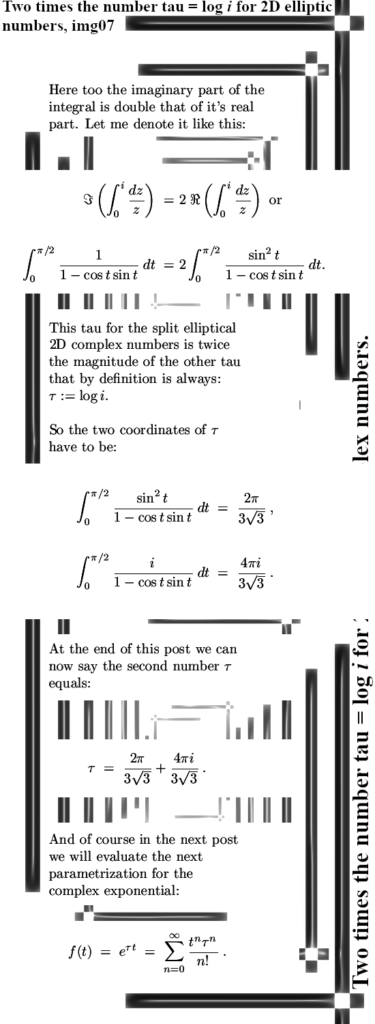
That was it for this post, thanks for your attention and I hope you liked it a bit. Or may be you didn’t vomit at all and that would also be a great thing, that would still be progress although may be you didn’t like it like I hoped for… Enough of this silly talk, let me upload the whole bunch and see you in a future post.
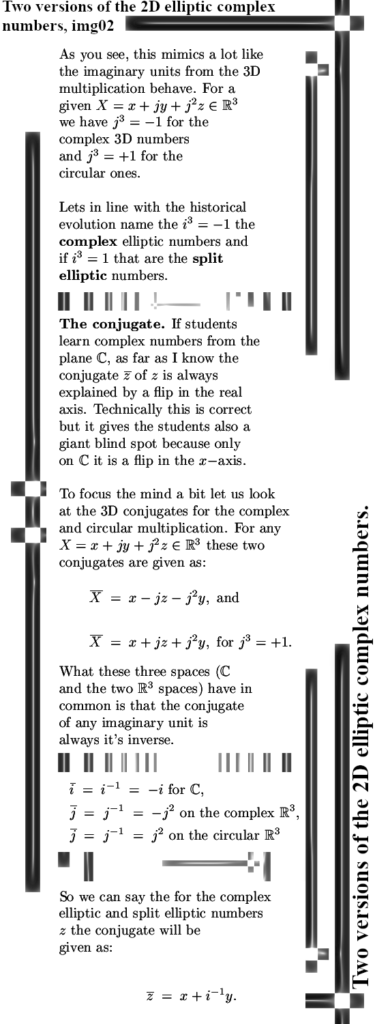
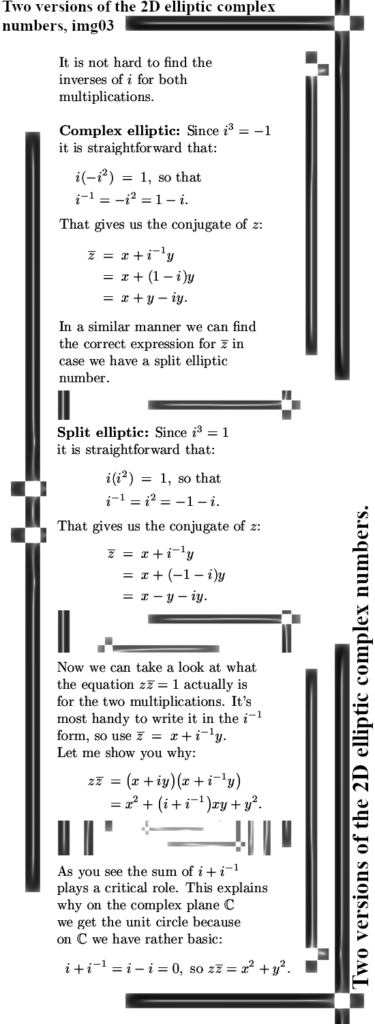
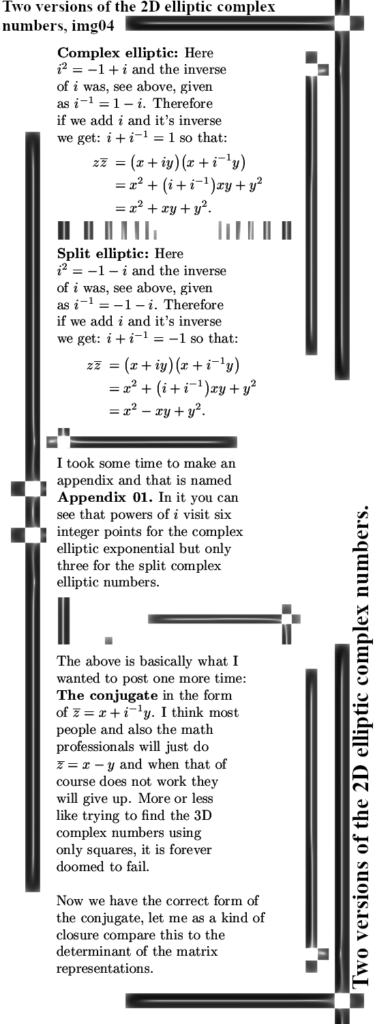
]]>A better way of formulating a conjugate is the next: Replace all imaginary units by their inverse. And yes, in case of the standard 2D complex plane that is a reflection in the x-axis. But that does not mean that in every space where a conjugate is a meaningful thing it will be a reflection. In the case of this post it surely is not a reflection and likely that is the reason that these kind of elliptic complex numbers are completely unknown to the professional math profession. In that regard it is the same as say the 3D complex numbers; also completely unknown because they are to stupid to adjust the math when that’s needed. In some highly autistic version of reality the conjugate must be a flip in the real axis and these people are totally blind for what they do wrong.
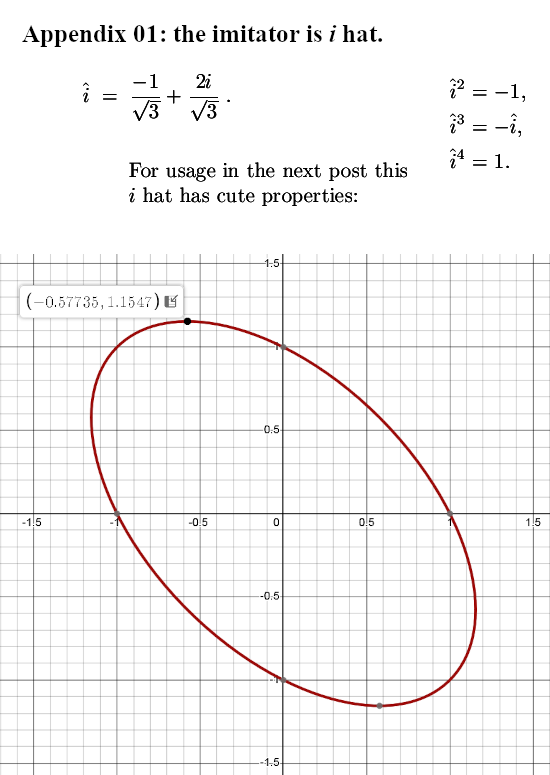
This post is five images long and an extra addendum with the two graphs of the ellipses that form the complex exponential on these two relatively simple spaces. May be the next post is about finding those famous numbers tau, on this entire website a number tau is always the logarithm of a suitable imaginary unit. Because a 2D number space is very simple we have only one imaginary unit of course written as i and tau is the log of i.
The direction of the tangents in the point z = 1 is the direction of the number tau. That is a simple yet effective idea from Sophus Lie who a long long time ago invented those things we now know as Lie algebra’s and Lie groups. So on the one hand if you already know what tau is, all you do is differentiate the complex exponential. And if you haven’t found the precise value for tau you can always use implicit differentiation on the equations that define the complex exponential, in this case the equations for the two ellipses. You can use that for checking your calculations for the number tau because those calculations have a strong tendency to run if the rails but if you get the wrong direction you now know there must be a calculation error somewhere…
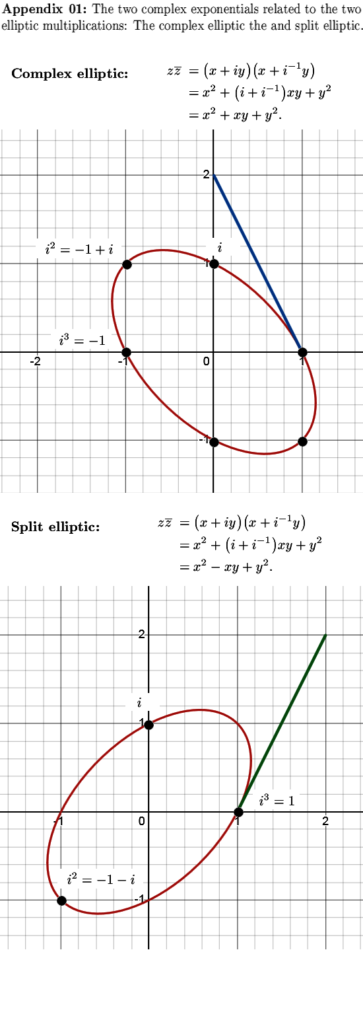
Ok that was it for this post and this is the 300-th post on this website. As you might have noticed I don’t write more or less two posts a months, only about one. With 300 posts on higher dimensional number systems I have done enough and there is no use in repeating things over and over again. That was it for this post, as always thanks for your attention.
]]>One of the reasons I decided to write another post on this relative simple stuff is that historically speaking the square was the thing that gave the complex plane. And for some reason professional math people are completely fixated on that when they try for example find 3D complex numbers: It has to be based on some stuff with a square. Just like say the 4D quaternions from Hamilton: Basically it’s all based on the squares of the three imaginary components and an extra rule for multiplying different imaginary units.
Without much ado let me hang in the 8 images:
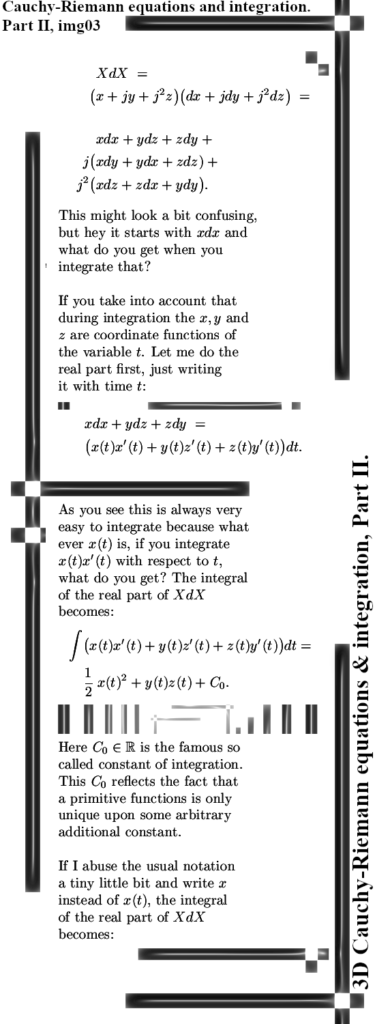
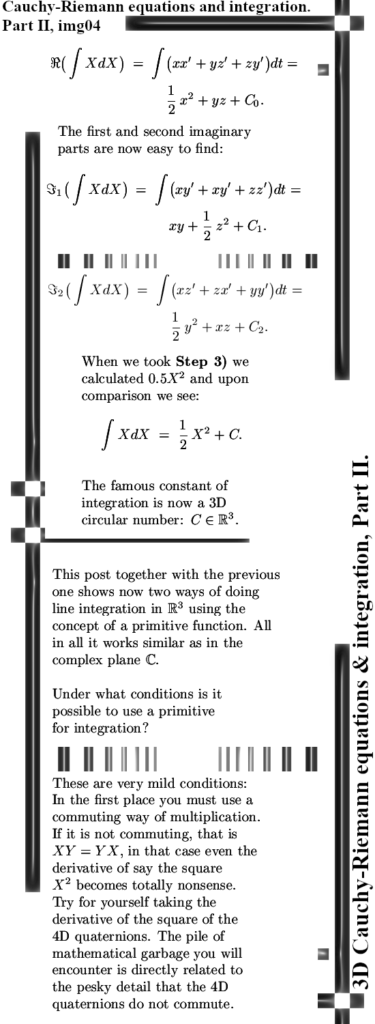
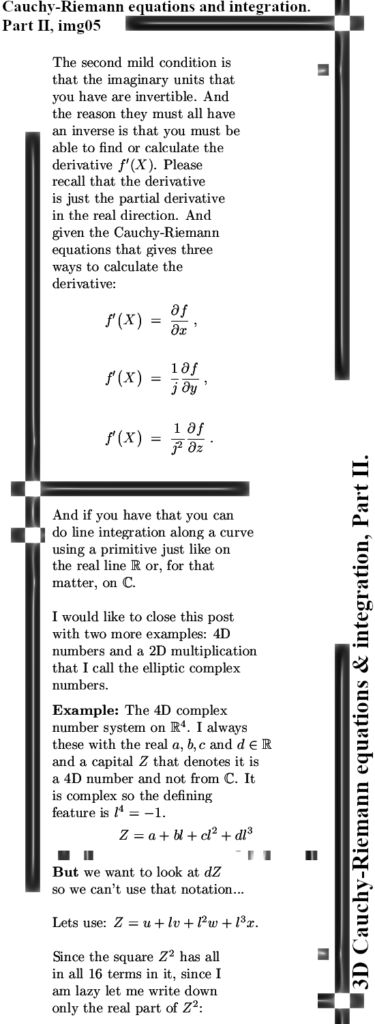
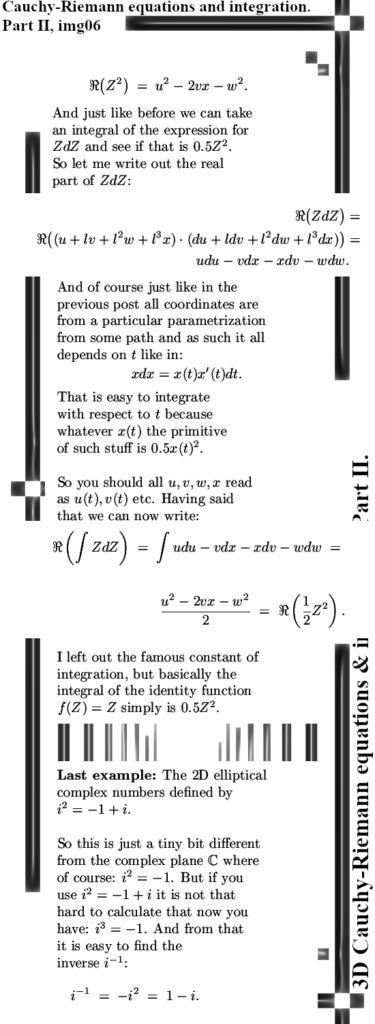
It is no secret that inside the profession of math at the universities they can only perform integration with a primitive when it comes to the real line and the complex plane. In the last two posts I showed you again and again how to do this on other spaces. Will the professional community ever change ways and include more spaces where you can perform integration ‘Just like on the real line’? No, after all these are university people and as such it is mostly a giant balloon of hot ego air and not much substance when it comes to math.
By accident I came across a work of professor Tom who happily informs his audience of the miracles of the 4D quaternions. You know for me math is a hobby, it’s an important hobby but it’s just a hobby. And because after all the subject is math I take it seriously. But decade in decade out the only thing professional math professors do is fuck around and that’s it.
Here’s the link to the garbage from professor Tom:
Stop 3: Multi-dimensional World
These people just never make any kind of progress, if it’s the year 1990 or the present 2026 it just does not matter. They can’t go beyond the square and also they are very unwilling to go beyond the square.
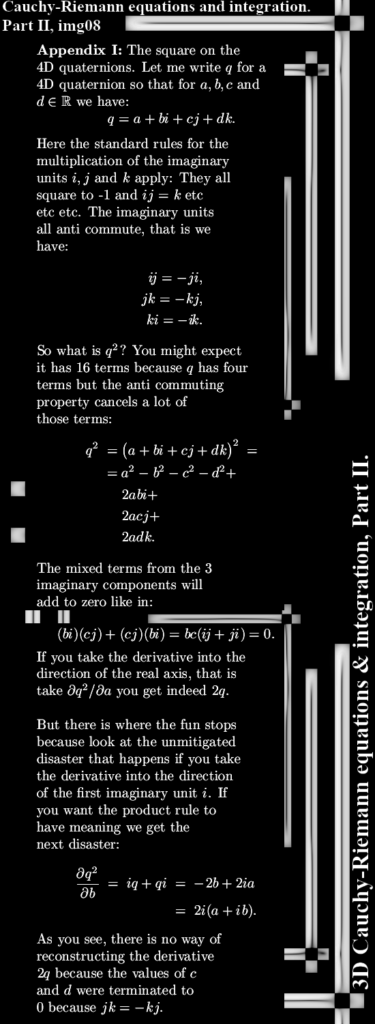
Let me leave my little rant with that, here’s what missing in literally all texts on quaternions: The square of a quaternion…
Ok that was it for this latest post. Likely the next post is one on magnetism in particular electron pairs in chiral molecules. Thanks for your attention.
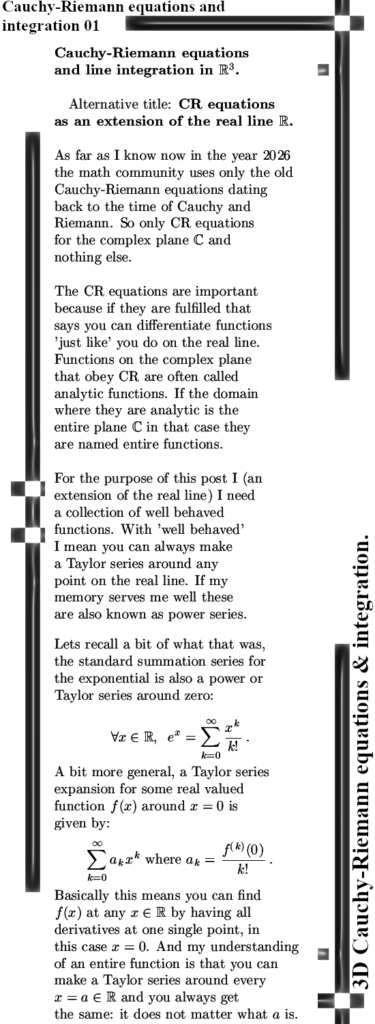
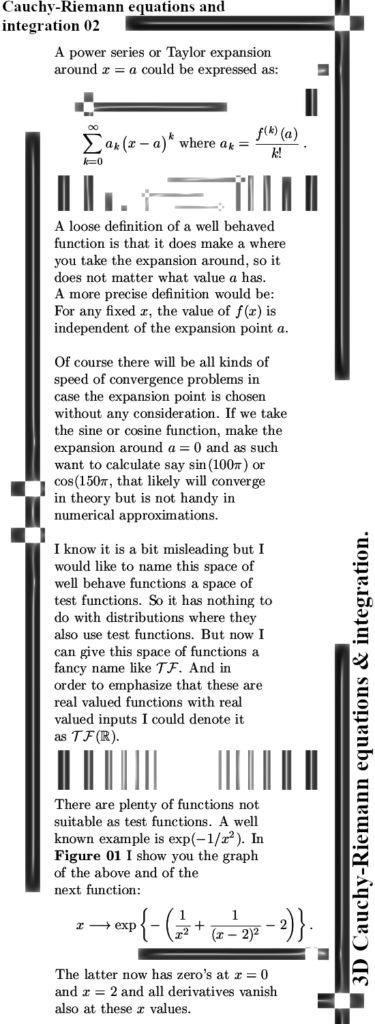
]]>So more basic as this is not possible, only boring stuff like how to add two 3D complex numbers is even more basic. And for me it was actually fun to write it down one more time after so many years. Also as far as I remember, I never had differentiation and integration in one post combined. Mostly I treated them separately.
Because this subject was so elementary I allowed myself for one time to not skip a lot of stuff. Just pen down whatever crossed my mind. As a result this post is now 15 images long and I guess that is a decade long record at least.
I also included a link to a wiki about line integration in say 3D in order to demonstrate it clearly that the entire math community still can’t do a line integration in 3D using the good old concept of a primitive. Just like we integrate on the real line and the complex plane. After a third of a century of time, those people still have no clue at all. If I remember it all correctly, it is so long ago, it was in 1991 or may be 1992 I found these results. But the local professors here at the university of Groningen did not want to look at stuff like this. That’s how they do science over here…
Anyway the math part is 13 images long and I included two so called advertisement images as I use them on the other website. Ok lets now turn to the 15 images:
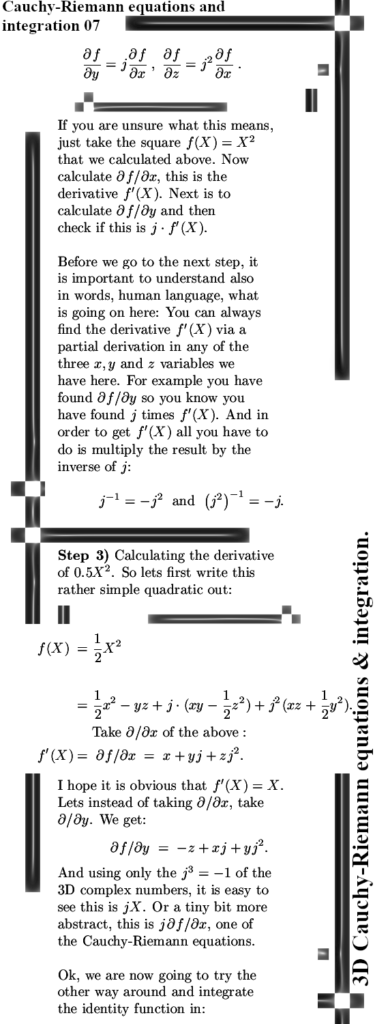
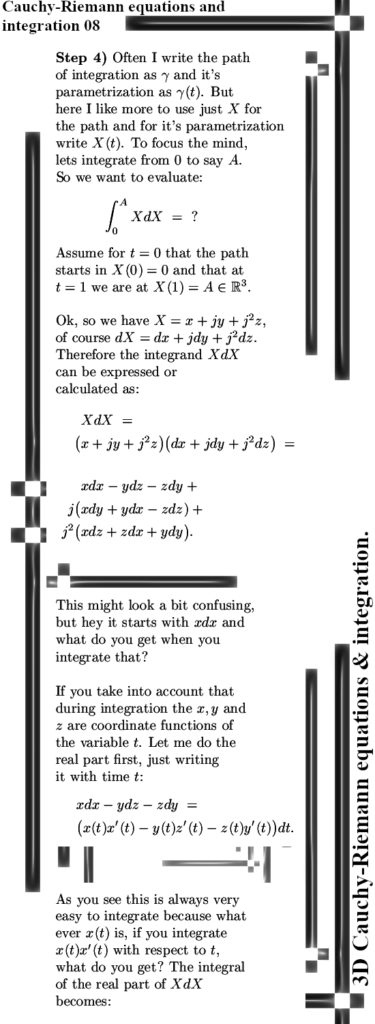
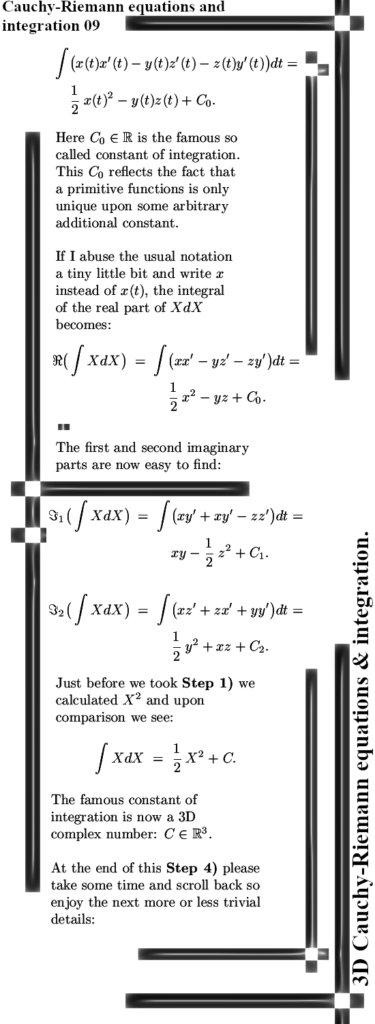
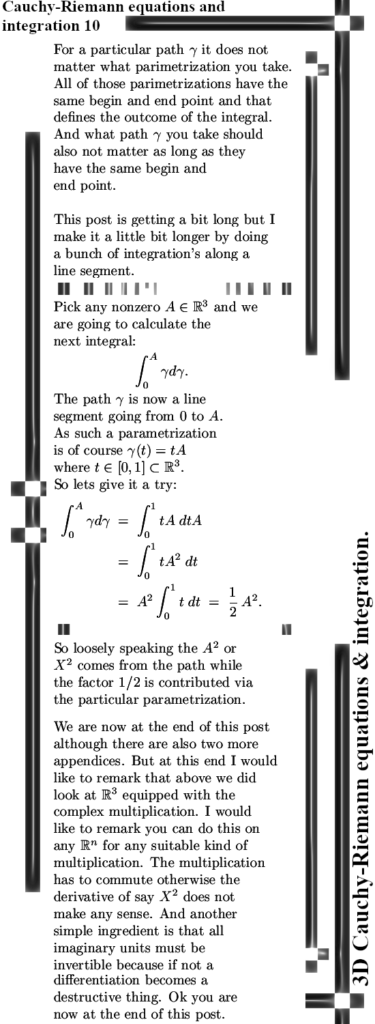
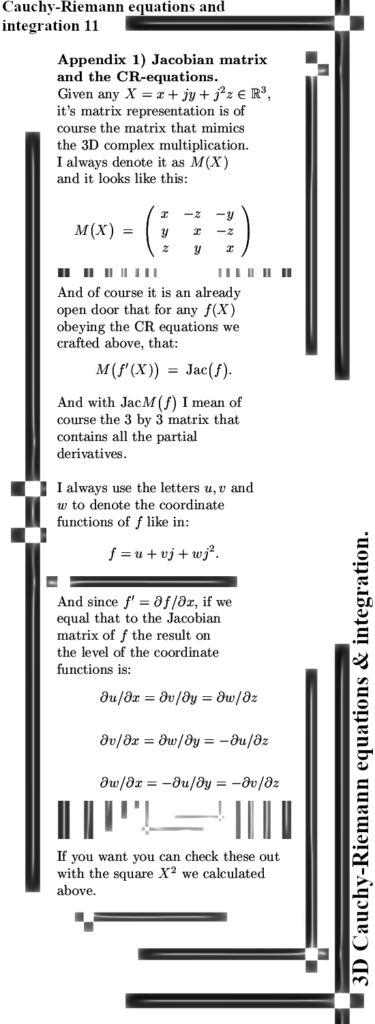
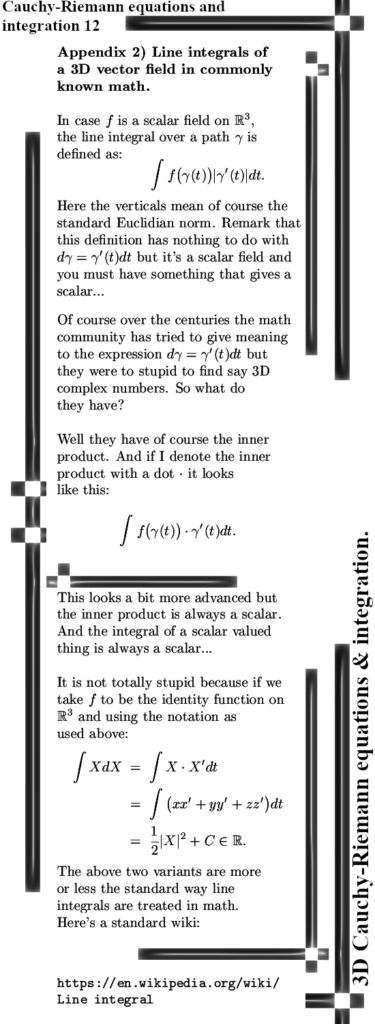
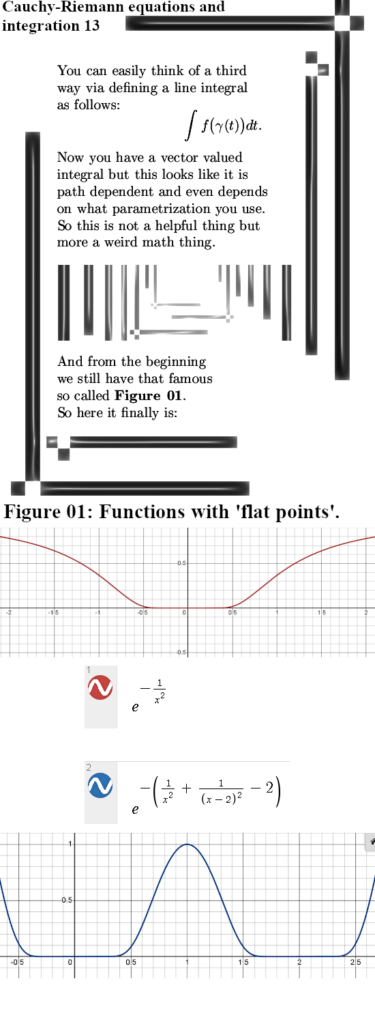
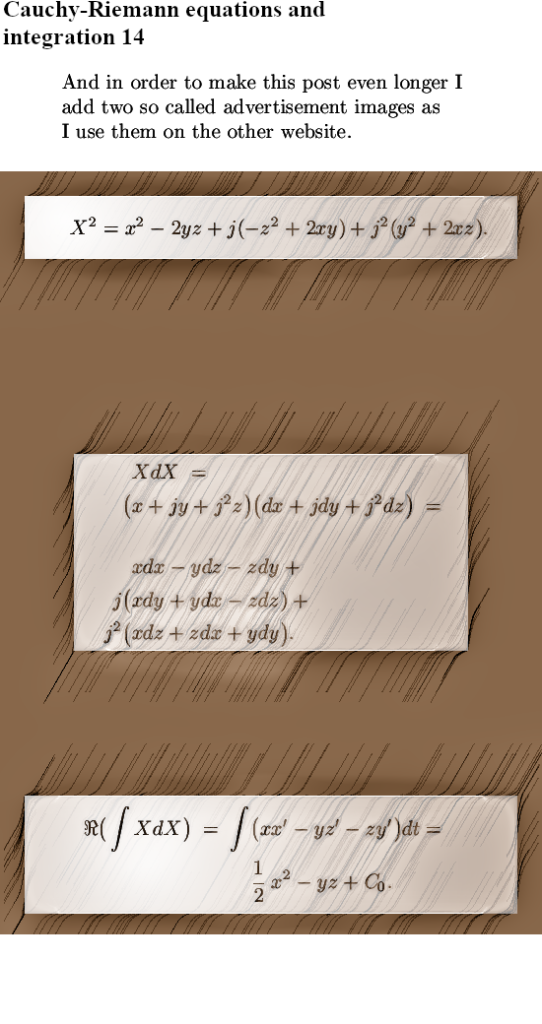
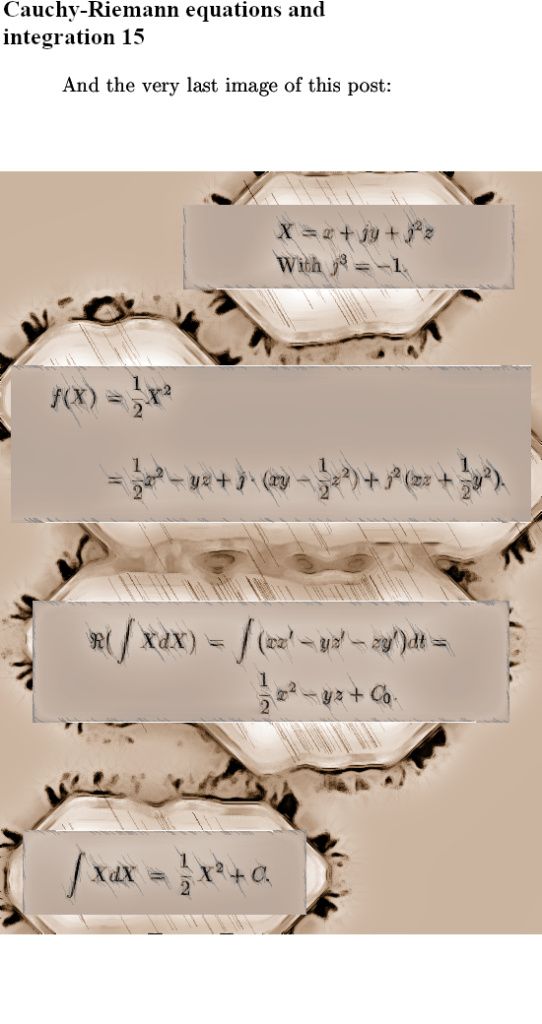
That was it more or less for this post. The previous post about circular photons and magnetic domains was a number one search result on Google within 24 hours! Now you must not think I am looking at my search ratings all the time, actually I almost never do that may be less as once a year I don’t know. But I had sought only once on “Circular light and magnetic domains” that just one day after the publishing of the last post I decided to take a look again. And to my surprise my own post on it was the no one result. And ok ok, my search text was more or less precisely the title of my post but on number one in about 20 hours of time?
You also must not jump to the conclusion that a most on the magnetic properties of an electron so fast at number one will make a dent in the attitude of the physics people at universities. My estimation is that they will keep on pretending that electrons are more or less tiny magnets. And just entertaining the idea that magnetic properties and electric properties of electrons are the same so monopole and permanent is just bad for their career. Just as the math profs do with say this post for the last 35 years. Never forget you are dealing with university people and that means most of the time it is more ego and not much science…
With that it is time to end this post and may I thank you for your attention to the matter of line integration in 3D complex space using a primitive?
Let me very short describe what I expected and how I think it all works:
1) Electrons are magnetic monopoles and as such there are two kinds of them. 2) The photons produced by these two types of electrons have their magnetic field phase shifted by 180 degrees. 3) The way these photons react on other electrons depends on what kind of electron it is. Therefore you should see a difference for neighboring magnetic domains in a material that has magnetic domains. Furthermore the magnetic domains have surpluses of one kind of electrons and a deficit of the other kind of electrons. So that’s 4) Domains have surpluses of one kind. And, also very important, the domain walls keep these surpluses/deficits as they are. So if a domain has a surplus of say north pole like like electrons or n-electrons as I name them in the post below, the n-electrons get repelled by the domain wall.
So what are we going to see if we shine a circular light source on a piece of condensed matter that has magnetic domains (I think the authors used a film or a flat kind of material)? I will link my source file below but first we take a look at the four pictures that make up this new post:


As you see the results are very similar but also very different. If you use a standard setup for a Kerr microscope with linear polarized light and also use a so called analyser, that jacks up the contrast. And with using circular polarized light you get a much more subtle picture. What I found very interesting is that the domain walls become darker so that more or less confirms domain walls repel unpaired electrons.
Ok, all that’s left is the source file link:
Analyzer-free, intensity-based, wide-field magneto-optical microscopy
Link used: https://pubs.aip.org/aip/apr/article/8/3/031402/124820/Analyzer-free-intensity-based-wide-field-magneto
I think the time has come to end this post, thanks for your attention and may be see you around in a new post.
I want to remark that these two people are not selected because of their individual properties like belief in bipolar magnetism, but I let them stand for the entire quantum computing crowd out there. The weirdo’s that think you can explain the result of the famous Stern-Gerlach experiment via electrons that by chance either align their closed magnetic field or anti-align themselves. No my dear crowd: Bipolar magnets large and small do not anti-align themselves because that is a spontaneous rise in potential energy. And nature does not do that; there is a long long list of energy problems related to bipolar electron magnetism buy hey: Try to explain that to the quantum computing crowd in general and those working on qubits based on electron spin in particular.
The video itself contains no new information, anyway not for me. The interviewer is as so often a person from outside physics and as such he has no clue what the quantum computing crowd means with concepts like entanglement. The video is about half an hour long, it is more a social snapshot of how it goes into the world of quantum computing and contains almost nothing worthwhile knowing. So don’t blame me if you think you are wasting your time watching it. There are three intro pictures and of course I also have one of those very famous Figure 1 images included. That makes my hobby work look very professional: Oh he has a Figure 1 in it, wow that really must be something!
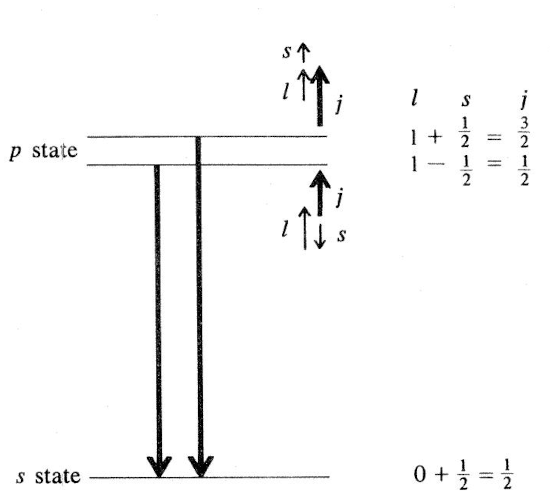
Here’s the famous Figure 1 of this post: It is about the fine splitting en atomic spectra due to the monopole magnetic permanent charge each and every electron has. If electron spin was a vector as the quantum crowd always claim, how come these spectral lines are that sharp?
And finally the video itself:
That was it for this post, thanks for your attention and may be meet you again in a future post.
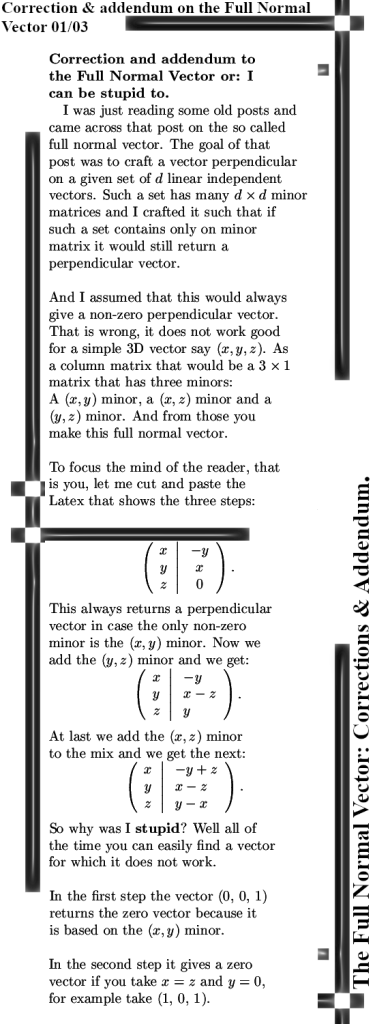
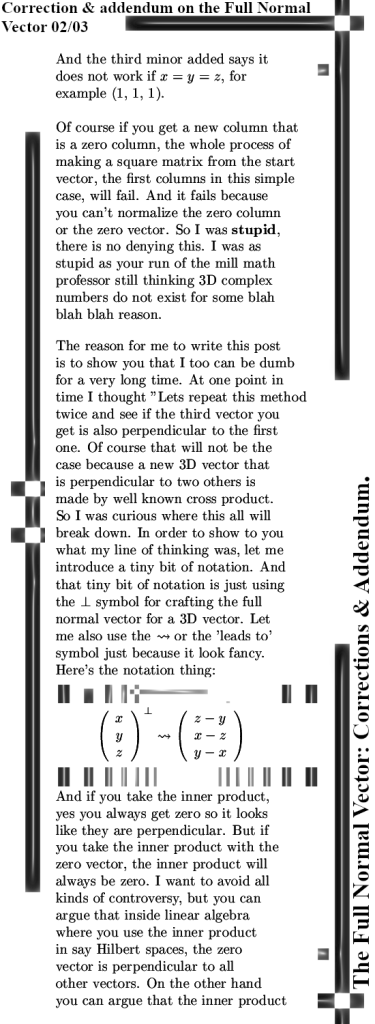
]]>That full normal vector is something you can use if you want to make a non square matrix into a square one. In doing so you must craft new columns perpendicular to all previous columns and normalize them. And there is the problem of course: If you get a zero vector, you cannot normalize it to length one.
The reason I decided to write this post is that during my scribbling I soon got one of those cylinder equations that don’t look at all like the equation of a cylinder. But in the 3D numbers, both complex and circular, you can factorize the determinant with a plane and a cylinder equation. So in that sense it is very vaguely related to the 3D numbers.
For 3D numbers you can factorize the determinant using it’s eigenvalues and stuff like that I always name “Eigenvalue functions” because you just plug in the coordinates of a number and voila: There are your eigenvalues. It’s much easier compared to every time by hand calculating the 3 eigenvalues every 3D number has.
This post is four images long and an extra graph in a so called “Figure 01“. With the 3D version of Desmos, a free browser based app for drawing graphs, you can try a bit for yourself. I used two versions of the cylinder equation, don’t get confused by that because the one is only the minus of the other. That’s why in Desmos you sometimes must equal the cylinder equation to a positive number or a negative number. Here we go:
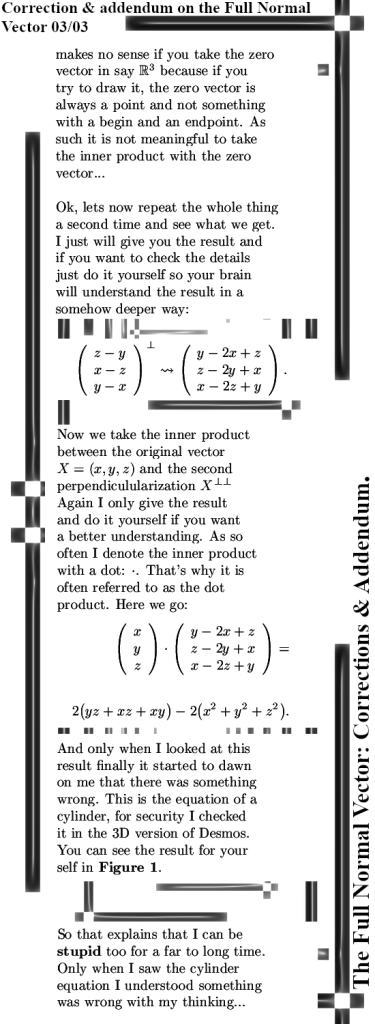
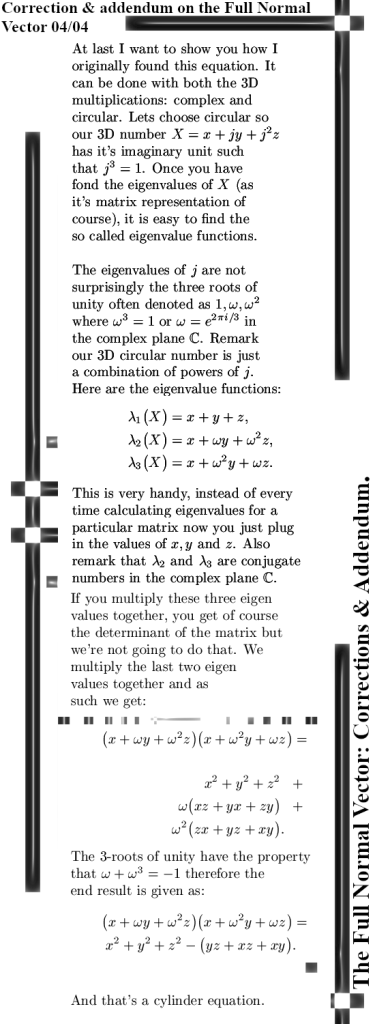
Again: If you try it in Desmos you must either use positive or negative numbers for your cylinder equation.
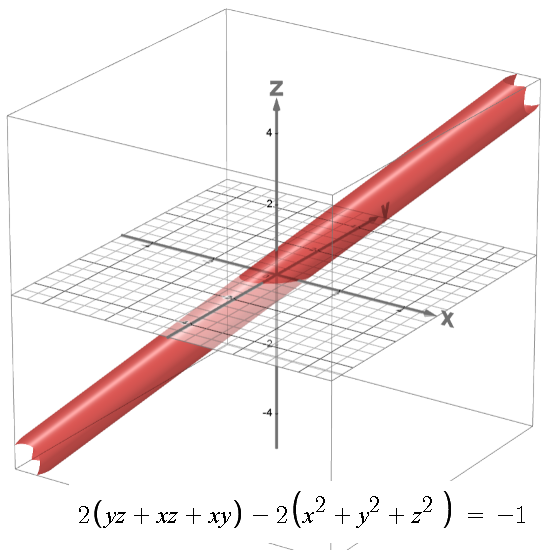
In case you want to know a bit more about the eigenvalue functions, just use the search function of this website and you will find plenty of stuff to think about. Ok, I hope you learned something and if not lets hope you are not one hundred % bored because math is just a boring thing or not?
The next post is likely about magnetism but it is also tempting to write one more post on all the possible factorizations you can do with the determinant of 3D numbers and the many ways there are to find the 3D complex exponential as the intersection of a whole lot of geometrical objects.
We’ll see.
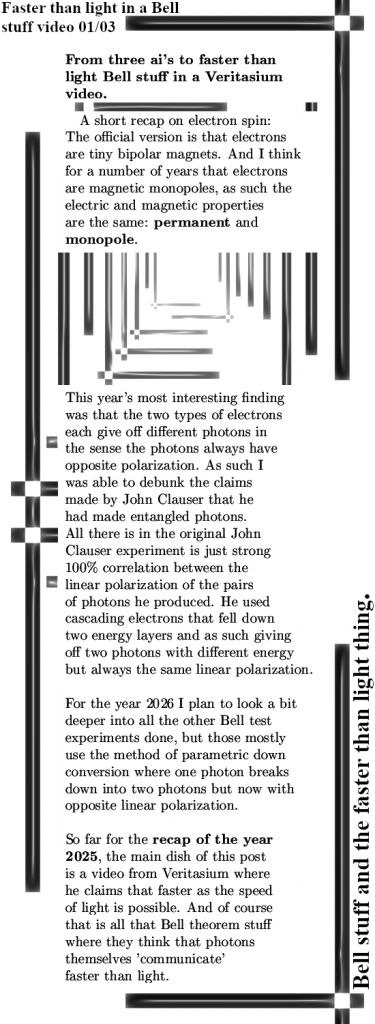
Last year 2025 (by the way happy new year) we looked in details to the first experiment from John Clauser who used cascading electrons to generate pairs of photons and he got the Nobel prize because he showed that those photons always have the same linear polarization.
Since the year 2015 I started seriously doubting that electrons are indeed tiny bipolar magnets as a possibility to explain the results from the Stern-Gerlach experiment from the year 1922. Back in the time when people tried to explain this result of Otto Stern and Walter Gerlach in the letters they did send to each other it often started with the Gauss law for magnetism and that they ‘should find a solution within this framework of the Gauss law’.
So it never dawned on them that instead of finding a solution within this Gauss framework (magnetic monopoles do not exist) their scientific task should have been: Checking if the Gauss law for magnetism is indeed valid for unpaired electrons. After all, electrons being magnetic monopoles is indeed a perfect explanation for the Stern-Gerlach experiment. But no they did not do it, no one dared to take on the Gauss law that after all is just a fancy piece of math not rooted in any experimental evidence.
That is why even today in this new year 2026 we have crazy stuff like electrons that anti-align themselves with an applied external magnetic field like they did in the SG experiment explanation. And the most crazy thing in my view is the official version of the electron pair where the present day belief is still that because of the Pauli exclusion principle the electrons must have different spin numbers while in practice this simply means the two tiny magnets somehow must be anti-aligned to form a pair while from chemistry we know that electron pairs are very important in keeping molecules together.
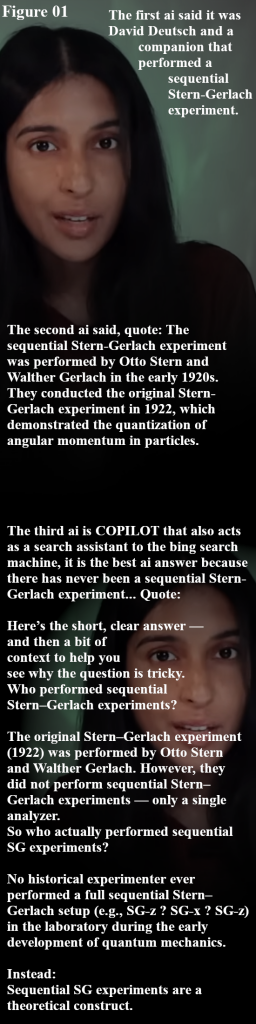
But let me stop ranting against the belief that magnetic monopoles do not exist and turn to the beef of why I selected this video: It is all that Bell theorem stuff that says or validates all those ‘faster than light’ kind of collapsing of the wave function that they think actually happens. There is an old proof out that proves that Einstein’s idea’s of so called hidden variables cannot be true. It was only last year in 2025 that I looked into that and guess what? This proof uses the results of a repeated or sequential Stern-Gerlach experiment that gives all those probabilities for measuring electron spin. There is only one little pesky detail: In a century of time there has never ever such an experiment done. And if my idea’s of simply electrons having a permanent magnetic charge, just like their electric charge, are true, in that case measuring electron spin is the same as measuring the electric charge of the electron: It will always be the same no matter what. So that is why John Clauser always had the same linear polarization in his pairs of photons, the root cause or the ‘hidden variable’ if you want to frame it that way of finding always equal linear polarity is that the photons are made by the same electron. You really don’t need all this ‘faster as light’ crazy stuff to explain the outcome of the experiment John Clauser did.
I am more or less planning to look in this new year a bit deeper into all those other experiments done that show the ‘faster than light’ weirdo stuff but almost all experiments use crystals that do the parametric down conversing thing and break down one photon into two lower photons with opposite linear polarization. In my view the only logical explanation using electron permanent monopole properties is that an electron pair gets ejected into a higher energy state and later falls down and as such it will always generate an electron pair with opposite linear polarization.
But lets turn to the video: If electron spin is just a permanent monopole magnetic charge, in that case measuring electron spin is not probabilistic at all and as such the ‘proof’ as presented in the video is clear cut wrong. You can find the video at the end, this post is 3 images and one extra so called Figure 1. Here we go:
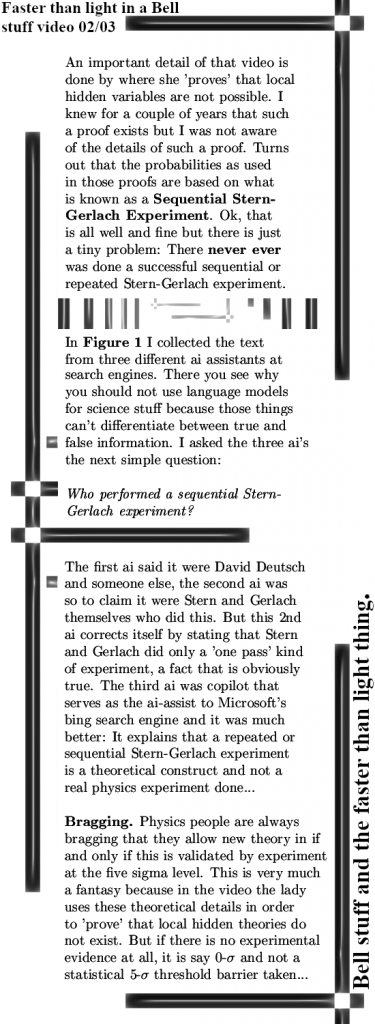
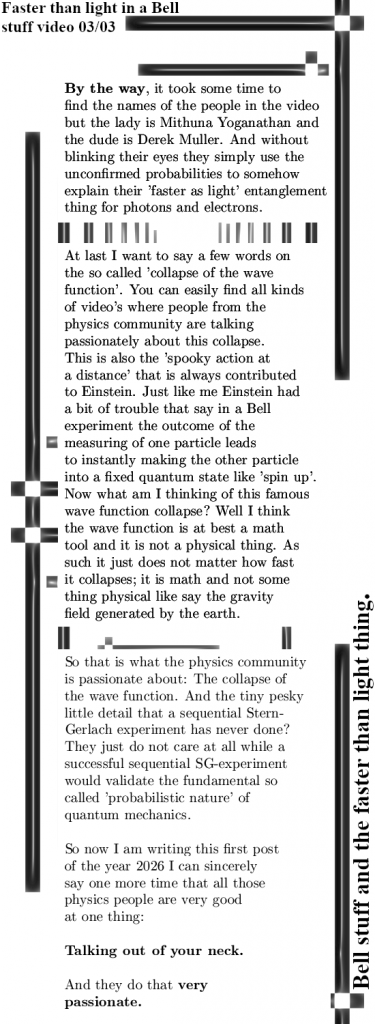
Furthermore if electron spin is a permanent monopole feature and depending on the kind of magnetic charge is what gives the two opposite polarization states of the photons they produce. As such the photon pairs as mentioned in the video are never in a superposition let alone that measuring one photon’s polarization leads to a collapse of the wave function and forces the other photon to take on the opposite (linear) polarization. And as such there is no ‘faster than light’ stuff going on at all.
And finally the video:
It has to be remarked that both Mithuna Yoagnathan and Derek Muller do nothing strange here. All physics professionals believe this kind of weird stuff to the extend there are even Nobel prizes handed out for this kind of crap. So both Mithuna and Derik are nice people and do only what is accepted as truth. Even the usage of these faulty probabilities related to a sequential or repeated Stern-Gerlach experiment is what they all do while bragging that physics is the only five-sigma science…
Well no it just isn’t, never ever a sequential Stern-Gerlach experiment was performed there is also zero experimental validation for their fantasy that monopoles are tiny bipolar magnets. Another very fundamental piece of experimental validation that is missing is that if it was true that electrons are tiny magnets, in that case they will not be accelerated by a constant homogeneous magnetic field. That is a cornerstone of their thinking but once more: Where is that fucking experimental validation for this?
And after that those people do some calculations or math manipulations, find something that contradicts and voila the conclusion is:
3D complex numbers do not exist.
Some people, but not many, are a bit sharper by stating this proofs that there is no 3D extension that includes the 2D complex plane.
But 3D or 5D or any dimension numbers do exist in there own way. In 3D space there is an imaginary unit who’s third power equals minus one, in 5D space the fifth power is minus one etc etc. And in all of those spaces you can do complex analysis because you can differentiate and perform integration ‘just like’ in the complex plane. As a comparison on those overhyped quaternions you can’t even differentiate the function that squares a quaternion. Those 4D quaternions have their own right of existence but they are not the 4D complex numbers, but I digress.
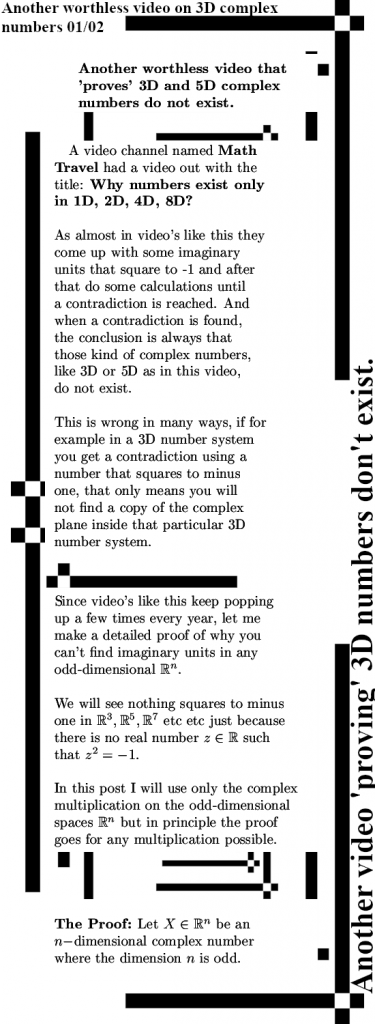
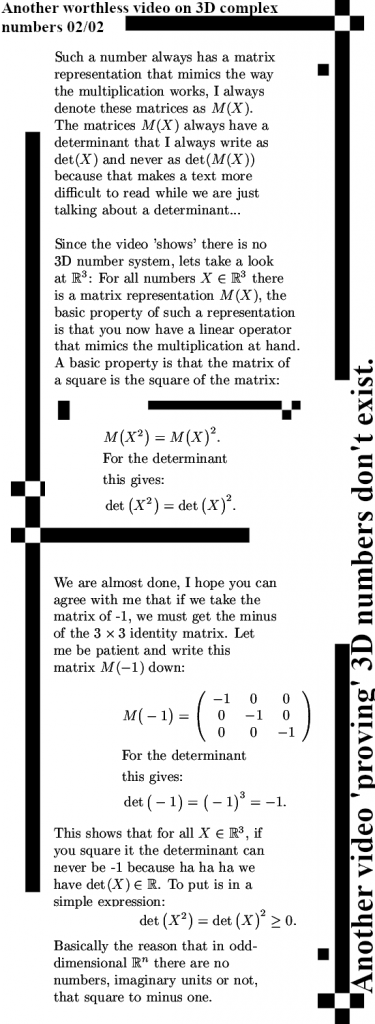
I wrote a very small math post, it is only two images long, with a proof as simple as possible that shows in real spaces with an odd number for the dimension, there are no numbers that square to minus one.
Now we all know that on the real line there is nothing that squares to minus one and in all other higher dimensional spaces if we take the determinant we get always get a real number. As such there is no determinant of any number that squares to minus one. And if you calculate the determinant of -1 (as a matrix in odd dimensions) you always get -1…
The proof below is all utterly simple but it’s relevance lies more into that it now goes for all multiplications in one single strike. So not only the so called complex multiplication but just everything that is a multiplication. If for some strange reason you want to think a bit of what all can pass as a multiplication, just use the search function of this website and search for big E. Big E is just a multiplication table although I present it like a square matrix for reasons that are obvious if you read that post.
At last I want to remark that although the title is a bit negative, I wish the composer of the video good luck with his math travels. That, by the way is the name of the video channel: Math Travel. Let me first post my two images and later the video.
Ok, lets now all smile and wave at youtube so the next video will get shown to you:
Well that was it my dear reader, thanks for making it all to the end with all that boring math stuff and so.
]]>