The post The high cost of Arizona’s energy cancel culture first appeared on Arizona Capitol Times.
]]>
As a lifelong conservative who has spent decades working on energy-related issues, including serving as a campaign surrogate on energy for John McCain’s 2008 presidential run, I recall that our ethos on energy has been solidly rooted in the catch-phrase “All of the Above.”
That phrase is in keeping with a genuinely conservative belief in the free market and its ability to drive investment to the smartest and most cost-effective energy technologies.
Not only is that approach naturally suited to keeping our energy costs low, it also can best ensure that America leads in the global race to dominate future energy markets.
So, why on earth have so many Arizona elected officials suddenly abandoned the All of the Above approach in favor of whacky, hairbrained energy cancel-culture?
And how ironic is it that the energy source being cancelled in the sunniest state in the union is solar?
It defies logic that Republicans in the state Legislature and on the Arizona Corporation Commission (ACC) have essentially declared war on the state’s cheapest, most price stable and most abundant energy source.
As folks labor under skyrocketing electricity costs and one utility rate hike after another, it’s worth pointing out that the price of solar generated electricity in Arizona (with storage) is less than half the cost of the electricity being generated by the state’s natural gas and coal plants.
In the current legislative session we’ve seen a parade of anti-solar bills being pushed by Republican state Reps. David Marshall and Ralph Heap.
These include House Bill 2331 that would require 85% of utility power generation come from sources other than solar and wind.
Perhaps Marshall and Heap would be surprised to learn that last year 40.2% of electricity in the state of Texas was generated by solar and wind.
Think about that. More than 40% of Texas power comes from the two cheapest and most price stable sources of electricity, yet this pair of energy cancel-culture warriors want to limit Arizona’s use of these to only 15%.
And energy cancel culture doesn’t stop there. These two also introduced House Bill 2267 that would declare utility-scale wind or solar farms a public nuisance when located within four miles of residential property, and House Bill 2975, which requires the State Land Department (SLD) to suspend the use of solar scores or similar solar evaluators in land use planning decisions.
The ACC, for its part, has enacted multiple measures designed to disadvantage homeowners with rooftop solar and discourage others from investing in the technology.
It has reduced the rate utilities must pay solar homeowners for the excess energy they feed back into the grid. The agency also approved a new monthly grid access fee which forces Arizona Public Service (APS) customers with rooftop solar to pay the utility even if they didn’t use a single watt of APS-generated electricity.
The ACC also recently repealed the state’s paltry 15% Renewable Energy Standard and Tariff (REST) that had been in place for the past 20 years. Neither APS nor Tucson Electric Power (TEP) has managed to meet that 15% mark, which they were supposed to do by 2025.
What a colossal failure. In terms of energy from the sun (solar irradiance), Arizona receives more than any other state. Texas, by the way, ranks 5th. Yet, many elected officials in this state are actively trying to prevent Arizonans from taking advantage of it.
Apparently, these geniuses have decided that because solar energy has been embraced by folks on the political left, they must be against it.
That logic is as dimwitted as you and me deciding to boycott all vegetables because some liberal vegetarians also happen to like them.
Solar energy is Arizona’s cheapest, most abundant, and most secure source of energy. It is produced in-state and not subject to global supply disruptions.
In this age of ever-rising electric bills, power hungry datacenters and global unrest, Arizonans need leaders who will ditch the foolishness and get serious about lowering energy costs.
That means a common-sense return to All of the Above, rejecting this whacky energy cancel culture, and fully embracing this state’s God-given solar.
David Jenkins is President of Conservatives for Responsible Stewardship, a national organization with more than 1,000 members in Arizona.
The post The high cost of Arizona’s energy cancel culture first appeared on Arizona Capitol Times.
]]>The post Powering Arizona’s economy takes foresight and investment first appeared on Arizona Capitol Times.
]]>
Everywhere you look, you can see Arizona’s incredible growth happening in real time. But what we don’t always stop to fully appreciate is that beyond growing in population, we’ve completely transformed our economy along the way.
Once looked down on as a “flyover state,” Arizona has become the place to be for the biggest industries in our economy, from advanced manufacturing to high-tech startups.
We are now internationally recognized as the hub for semiconductors. All this growth isn’t only powering our economy with great jobs; it’s also supporting the onshoring of American manufacturing and bolstering our national security.
This success didn’t just happen by accident. It was the result of intentional policy and strategic investments in infrastructure that allowed Arizona to strike when the iron was hot.
And following the Great Recession, when Arizona was hit harder than almost any other state due to our reliance on homebuilding, our leaders developed an aggressive plan to diversify our economy.
Today, Arizona faces new challenges — and once again, bold action is needed.
Utility providers like APS and SRP now project that Arizona’s electricity demand will double in just six years. That’s the same amount of growth it took more than a century to reach before.
It’s not stopping anytime soon. Nearly 500 manufacturing companies are currently in the pipeline to move or expand in our state, according to the Arizona Commerce Authority. These projects represent jobs, investment, opportunity, and rising quality of life for Arizonans — but only if we’re ready.
Our energy infrastructure must rise to meet this demand. Fortunately, Arizona already has a strong foundation. We’ve built a balanced energy mix: 45% natural gas, 27% nuclear, 8% coal, and 19% renewables as of 2024. This diversity is one reason why our state has experienced no significant blackouts or brownouts, even as demand has climbed. It’s proof that smart energy policy works. You can’t say the same for some of our competitors, like Texas.
We’re also leading the way on renewable energy. Arizona ranks among the top five states in solar-powered generating capacity, with more than 6,100 megawatts installed. In 2024, solar accounted for 82% of all newly approved energy generation capacity statewide — a clear sign we are embracing innovation while maintaining reliability.
But innovation without investment won’t be enough. If we fail to act, our ability to support new businesses, power our communities, and keep utility costs affordable will be at risk.
That’s why we formed Arizonans for Responsible Growth, a coalition of business and community leaders committed to keeping Arizona’s economy strong by advocating for smart, forward-looking investments in our energy and water infrastructure. We believe that preparing for tomorrow means acting today.
Our goal is to identify, recruit, and support candidates who understand the relationship between responsible growth and healthy utilities. Our candidates will support diverse energy sources, data-driven demand projections, and provide the most affordable and reliable power to our residents and businesses.
We felt compelled to form Arizonans for Responsible Growth to push back against an ideological anti-growth contingent pursuing energy policies that have failed in states like California.
Reliable power isn’t a luxury — it’s a necessity. It’s about protecting the Arizona we’ve built and securing the opportunities we want to pass on to future generations.
Arizona’s success story is still being written. With responsible planning and united leadership, we can make sure the next chapter is even brighter than the last.
Jimmy Lindblom is a native of Arizona. He is a founding member of Arizonans for Responsible Growth and currently serves as Chairman of the Maricopa County Planning and Zoning Commission, Co-Chairman of the Political Affairs Committee for the Arizona Chamber of Commerce, and Vice President of Economic Development & Infrastructure at Willmeng.
The post Powering Arizona’s economy takes foresight and investment first appeared on Arizona Capitol Times.
]]>The post Rural hospitals get lifeline from $50 billion fund first appeared on Arizona Capitol Times.
]]>Key Points:
-
Trump administration announces $50 billion Rural Health Transformation Fund for all 50 states
-
Funds aim to stabilize rural hospitals and bolster health care workforce in rural communities
-
States will submit regular updates to track progress and demonstrate results
The Trump administration on Monday announced that all 50 states will receive a portion of a new $50 billion Rural Health Transformation Fund, a one-time grant program billed by federal officials as the largest investment in rural health care in decades.
The awards are intended to help states stabilize rural hospitals, bolster the health care workforce and test new ways of coordinating care across rural communities, according to a Centers for Medicare & Medicaid Services press release. The funding will begin flowing in fiscal year 2026.
“This historic investment puts local hospitals, clinics, and health workers in control of their communities’ healthcare,” Health and Human Services Secretary Robert F. Kennedy Jr. said in a statement. “Thanks to President Trump’s leadership, rural Americans will now have affordable healthcare close to home, free from bureaucratic obstacles.”
Mississippi Gov. Tate Reeves, a Republican, called his state’s $205.9 million award for fiscal year 2026 “a big win for Mississippi,” saying his administration was ready to deploy the funds on behalf of the state’s more than 3 million residents.
Mississippi’s proposal outlines six initiatives focused on assessing rural health needs, coordinating regional care systems, expanding the workforce, modernizing health technology, scaling telehealth and strengthening rural health care infrastructure.
Congress created the Rural Health Transformation Program in the One Big Beautiful Bill, which Trump signed into law in July amid bipartisan concern over a wave of rural hospital closures and mounting financial pressure on safety-net providers.
Read more: States look to overhaul how rural health care is paid for
Under the law, half of the fund was to be distributed evenly among approved states, raising early questions about whether some states could be excluded for technical reasons, even though all 50 states submitted applications before a November deadline.
Those concerns were put to rest Monday. First-year awards average about $200 million per state, ranging from roughly $147 million for New Jersey to $281 million for Texas.
However, the Centers for Medicare & Medicaid Services did not disclose how much each state could receive in future years or release state-by-state application scores. The program includes an additional $10 billion per year from fiscal years 2026 through 2030.
“The below line detail is what is particularly interesting,” said Kody Kinsley, the former North Carolina secretary of Health and Human Services, who said he was interested in whether any portions of state applications were rejected and how the awards corresponded to a Centers for Medicare & Medicaid Services scoring process laid out in guidance the Trump administration issued in September.
Asked for more information, a spokesperson for the Centers for Medicare & Medicaid Services pointed to the press release, which said that applications were evaluated through a “rigorous merit review process” and that the agency’s September guidance ensured “a fair and consistent process across all 50 states.”
That guidance specified that 25% of the funding would be awarded based on rural population and hospital data. Another 7.5% — $3.75 billion — would be allocated based on states’ commitments to legislative and regulatory priorities backed by the Trump administration. Critics have argued that those criteria have little connection to rural health outcomes and could favor conservative-led states.
Some health policy advocates have also said the temporary funding falls far short of offsetting the estimated $911 billion in Medicaid cuts projected over the next decade under the law.
“These short-term funds fail to make up for the massive cuts to Medicaid, Marketplace and SNAP enacted elsewhere in the One Big Beautiful Bill Act, which are changes that are intended to permanently shift costs away from the federal government and onto states, providers and patients,” Geraldine Doetzer, an attorney for the National Health Law Program, said Monday.
North Carolina Gov. Josh Stein, a Democrat, echoed those concerns in a statement Monday, even as he welcomed the new funding. North Carolina has the nation’s second-largest rural population, after Texas, and will receive $213 million in fiscal year 2026.
In its application, North Carolina outlined a six-part strategy for using its $213 million award that includes launching locally governed care networks, called “NC ROOTS” hubs, to knit together medical, behavioral health and social services; expanding prevention and chronic disease programs; increasing access to mental health and substance use services; investing in workforce development; supporting rural providers’ transition to value-based care; and upgrading broadband and digital health technology.
The state is “eager to maximize” the award, the press release said, but faces “significant funding losses,” including nearly $50 billion in projected federal Medicaid cuts over the next decade.
“North Carolina has long been a leader in advancing rural health care solutions,” Stein said. “This grant will connect more people to more high-quality health care.”
Indiana Gov. Mike Braun, a Republican, said the state’s initial $207 million award was $7 million more than requested. The state’s five-prong initiative focuses on preventive care and chronic disease prevention; helping rural providers coordinate their operations through regional primary, specialty and emergency care systems; workforce retention and recruitment; promoting innovative care and payment models; and expanding the use of technology to improve care delivery and data sharing.
“Indiana’s rural communities are the backbone of our state, and this investment will help ensure that every Hoosier, regardless of where they live, has access to high-quality, sustainable healthcare,” Braun said in a statement.
Kinsley, the former North Carolina official, said states still have a lot of work ahead of them.
“As tough as it was for states and CMS to pull this together so quickly, now the rubber meets the road — finalizing budgets, contracting, building teams to execute the work, and most of all, testing if the transformational strategies in the plans actually work and work at the pace required,” he said. “All this while people are losing their coverage and hospitals are losing other supplemental payments. Which will only further complicate the process. States need to continue to be transparent, and CMS needs to continue to shine a bright light on their goals and what they’re holding the states accountable for.”
Now that the awards have been announced, the Centers for Medicare & Medicaid Services will convene program kickoff meetings in every state and provide ongoing guidance and technical assistance. States will be required to submit regular updates so the agency can track their progress, identify successful programs and ensure strong program oversight, according to the agency.
States will also convene annually at the agency’s Rural Health Summit to share their experiences. States that don’t demonstrate progress toward goals outlined in their application risk having their awards clawed back.
The post Rural hospitals get lifeline from $50 billion fund first appeared on Arizona Capitol Times.
]]>The post Do the right thing? Redistricting in mid-decade is unethical first appeared on Arizona Capitol Times.
]]>
According to recent reports, President Trump has pressured Texas Republicans to do a mid-decade redistricting. The drawing of new district boundaries is done after each decennial census, as required by the U.S. Constitution to (re)allocate voting power based on population changes. However, with the U.S. House Republican majority at risk in the 2026 elections, pressure is building to further gerrymander an already-unfair map in Texas, to potentially gain as many as five seats in the chamber. This would probably be done by packing even more likely Democratic voters into a smaller number of districts and would also likely be a racially gerrymandered map.

While this Texas change has not yet been done, the fact that it is being pursued has evoked a rapid response from prominent progressives, ranging from Governor Newsom in California to Democracy Docket’s Marc Elias and Indivisible co-founder Ezra Levin. They have all pointed out that Democrats, too, can play the same game, potentially manipulating congressional district boundaries in a mid-decade gerrymander in strongly blue states like California, matching the effect of Republican efforts in Texas, Ohio, and elsewhere.
Mid-decade redistricting, undertaken with the explicit goal of achieving a partisan advantage, will undermine the democratic process, stifle genuine representation, and further erode public trust in the integrity of our elections. Texas Republicans want to capture votes, not earn them. As undemocratic as this effort is, in Texas, it is legal. But that does not make it right, or even smart. It could easily fail.
For the record, the Princeton Gerrymander Project gave the existing congressional map an “F” for partisan fairness, giving Republicans 25 seats and Democrats 13. The Texan Republicans had already gerrymandered this map to extreme partisan advantage. A more aggressive re-do threatens a “dummymander” — a loss of seats because you are greedy.
Sam Wang, author of Fixing Bugs in Democracy, has this to say: “… analysis by the Electoral Innovation Lab suggests that Trump’s redistricting push could backfire spectacularly. Indeed, in 2026, such an aggressive map could end up giving Democrats 25 out of 38 seats.”
To paraphrase Newton, every action has an equal and opposite reaction: Voting rights champions are getting on board with the idea of retaliatory gerrymandering. Marc Elias says, “Finally, states with Democratic trifectas should restart their redistricting processes now to explore the feasibility of reducing — or eliminating — Republican leaning congressional districts in their states. There will no doubt be barriers, legal and political, in some places, but now is the time to think creatively and strategically about how we overcome them.”
This tit-for-tat strategy may be rational when considering the rapid-(d)evolution of the Roberts court’s refusal to protect voting rights for racial minorities in redistricting, coupled with their passive or supportive views on redistricting for partisan advantage. It seems like every day, there is a new detail or analysis on the likely success or impact of such actions. Lawyers and pundits will be busy for months.
We do hope that these reactions don’t signal the end of a trend toward the creation of Independent Redistricting Commissions (IRCs), which can, in principle, generate district maps that lead to fairer representation. Perhaps reactive Democratic gerrymanders can be implemented explicitly as temporary measures. Or perhaps when there is a better federal government in place, a law can be passed mandating IRCs (one of the provisions of the “Freedom to Vote Act” introduced in 2019 and again in 2021), removing the temptation for politicians to choose their preferred voters.
As non-lawyers and Arizonans, we can only offer a “big picture” perspective. Government exists to serve the needs of the community, not the other way around. While Texas Republicans are busy seeking ways to retain and expand their political power in the next election, they are failing the citizens of their state to meet their needs right now. And this is not confined to electoral politics — for instance, recent flooding in Texas was a natural disaster, but the slow FEMA response was purely manmade and political.
Fair elections start with fair maps; fair maps lead to a responsive democracy. If we want a better government, we need to elect people who want to govern for the common good: those who will do the right thing.
Deborah Howard served as a special assistant in the U.S. Department of Labor under President Reagan and is a candidate for the Arizona House of Representatives, LD27.
Nelson Morgan is a retired University of California at Berkeley faculty member and research scientist, and is the chair of the Census and Redistricting Committee for the Arizona Democratic Party.
The post Do the right thing? Redistricting in mid-decade is unethical first appeared on Arizona Capitol Times.
]]>The post Census reveals where Arizonans are going to and coming from first appeared on Arizona Capitol Times.
]]>Wondering where all those new Arizonans are coming from?
New estimates from the U.S. Census Bureau show that more than 256,000 people moved here last year from somewhere else. And close to a quarter of them arrived here from another country.
Still, there was a lot of what’s called domestic migration.
That includes more than 54,000 former Californians who, if you believe some of the political rhetoric, are people fleeing because of that state’s liberal policies.
Yet if things are that bad there, that fails to explain the fact that some 21,000 Arizonans concluded during the same period that life is better on the West Coast.
And surely, if what has been driving people to Arizona is this state’s more conservative politics, that doesn’t explain the nearly 17,000 from deep-red Texas who decided they prefer Arizona. Still, that was dwarfed, if only slightly by the 19,900 Arizonans who decamped to the Lone Star State.
All this, of course, is speculation.
People move for all sorts of reasons, like better weather.
Consider the weather. More than 6,700 of new Arizonans last year came from Michigan and almost 5,700 from Minnesota.
Yet those bitter winters apparently were not a deterrent to everyone.
Some 4,000 Arizonans decided they would rather live in the Great Lakes State. And almost 4,800 decided they want to be in the Land of 1,000 Lakes.
Better fishing?
A lot of it comes down to people going where the jobs are.
Figures from the Bureau of Labor Statistics for 2023 show the number of jobs in Arizona grew by 2.1%. That was enough to rank it No. 12 in the nation.
By contrast, New York was fifth from the bottom at less than half that figure.
So it’s probably no surprise that more than 7,600 New Yorkers packed up and move to Arizona last year. Yet about 3,500 Arizonans went the other way, perhaps because of the bright lights of Broadway.
Another big contributor to Arizona’s growing population was Oregon, where almost 10,500 of its residents chose the Grand Canyon State. That compares with 7,144 Arizonans who went the other way.
And, speaking of the Northwest, more than 12,800 current Arizonans came from Washington versus 10,675 who went the other way.
There are some places beyond Texas that apparently were bigger lures for Arizonans than the number of their residents who came here.
For example, Arizona picked up 1,373 folks from Alabama last year. Yet nearly 4,500 residents here decided they’d rather be there. And more Arizonans moved to Colorado than residents of that state came here.
Ditto Kentucky and Nevada. And both North and South Carolina, which have growing economies, also attracted more Arizonans than those who came here from there.
And, for some reason, the number of Arizonans who left for West Virginia is 22 times higher than those who left the Mountain State.
Still, Arizona ranks No.14 in overall state population.
While the latest Census figures are just for 2023, other statistics from the federal agency show these migration patterns aren’t isolated.
Out of more than 7.43 million Arizonans, just 2.91 million actually were born here. That’s less than 40%.
By contrast, nearly 1.1 million current residents were born in a foreign country, about one out of every five Arizonans. The Census Bureau has no breakdown of their legal status.
Domestically, more than 768,000 current residents were born in California. Put another way, out of any random group of 10 Arizonans you meet on the street, one is from the Coast.
The state has more than 177,000 New York-born residents and 155,000 from the Lone Star State.
Other
Other big contributors to Arizona’s population include more than 138,00 from Michigan, 120,000 from Washington, close to 100,000 from Minnesota and about 98,000 from Pennsylvania.
State / 2023 inflow / 2023 outflow / Residents born there now living here
Alabama / 1,373 / 4,470 / 13,610
Alaska / 2,017 / 618 / 18,490
Arkansas / 1,896 / 1,112 / 23,352
California / 54,222 / 21,152 / 768,642
Colorado / 8,344 / 12,378 / 91,143
Connecticut / 1,085 / 657 / 29,281
Delaware / 514 / 476 / 6,078
District of Columbia / 74 / 242 / 10,488
Florida / 12,762 / 8,361 / 48,740
Georgia / 6,326 / 2,706 / 22,591
Hawaii / 2,226 / 1,932 / 20,750
Idaho / 5,132 / 4.026 / 34,232
Illinois / 9,030 / 4,417 / 279,846
Indiana / 2,974 / 2,123 / 86,553
Iowa / 6,805 /3,078 / 81,080
Kansas / 3,383 / 2,365 / 50,324
Kentucky / 1,555 / 2,484 / 17,545
Louisiana / 2,514 / 669 / 19,368
Maine / 350 / 375 / 14,041
Maryland / 1,972 / 2,202 / 30,780
Massachusetts / 3,316 / 1,427 / 50,093
Michigan / 6,740 / 4,049 / 138,544
Minnesota / 5,582 / 4,770 / 99,569
Mississippi / 816 / 1,356 / 11,783
Missouri / 7,390 / 5,699 / 61,681
Montana / 2,261 / 823 / 26,582
Nebraska / 2,694 / 1,367 / 48,650
Nevada / 6,341 / 7,972 / 34,802
New Hampshire / 612 / 702 / 8,237
New Jersey / 2,082 / 1,140 / 71,450
New Mexico / 6,397 / 3,535 / 86,125
New York / 7,627 / 3,934 / 177,725
North Carolina / 3,646 / 6,443 / 25,343
North Dakota / 424 / 1,325 / 29,388
Ohio / 3,091 / 4,352 / 128.803
Oklahoma / 2,925 / 3,093 / 34,474
Oregon / 10,465 / 7,144 / 63,426
Pennsylvania / 4,740 / 3,773 / 97,807
Rhode Island / 145 / 79 / 6,598
South Carolina / 1,186 / 2,578 / 11,564
South Dakota / 1,892 / 908 / 25,370
Tennessee / 4,498 / 3,907 / 23,976
Texas 16,679 / 19,900 / 155,610
Utah / 5,766 / 6,639 / 78,342
Vermont / 242 / 419 / 4,093
Virginia / 4,441 / 4,091 / 34.859
Washington / 12,844 / 10,675 / 120,355
West Virginia / 40 / 897 / 10,243
Wisconsin / 4,015 / 3,304 / 82,874
Wyoming / 2,501 / 1,526 / 17,266
Foreign country / 58,640 / NA / 1,078,602
– Source: U.S. Census Bureau estimates
The post Census reveals where Arizonans are going to and coming from first appeared on Arizona Capitol Times.
]]>The post Battle for Senate majority escalates as Democrats spend $25 million to reach voters in 10 states first appeared on Arizona Capitol Times.
]]>ATLANTA (AP) — Trying to defend their narrow Senate majority with a challenging slate of contests on Republican-leaning turf, Democrats are pumping $25 million into expanded voter outreach across 10 states.
The new spending from the Democratic Senatorial Campaign Committee, first shared with The Associated Press, comes less than two months until the Nov. 5 election and as Democrats are benefiting from a fundraising surge since President Joe Biden ended his reelection bid in July and endorsed Vice President Kamala Harris as the party standard-bearer.
“A formidable ground game makes all the difference in close races,” DSCC Chairman Sen. Gary Peters of Michigan said in a statement. “We are reaching every voter we need to win.”
The latest investment will be distributed across Arizona, Florida, Maryland, Michigan, Montana, Nevada, Ohio, Pennsylvania, Texas and Wisconsin. The money will go toward efforts to defend five Democratic incumbents and open seats in Michigan, Maryland and Arizona that are currently included in Democrats’ majority, as well as efforts to unseat GOP incumbents in Florida and Texas.
Plans for the money will vary by state but will include hiring more paid field organizers and canvassers; digital organizing programs targeting specific groups of voters online; texting programs; and in-person organizing events targeting younger generations and nonwhite voters.
Democrats currently hold a 51-49 Senate advantage, a split that includes independent senators who caucus with Democrats. But of the 33 regular Senate elections this November, Democrats must defend 23 seats, counting the independents who caucus with them to make their majority. They’ve devoted few national resources to West Virginia, a Republican-leaning state where Sen. Joe Manchin, a Democrat-turned-independent, is retiring.
The playing field gives Democrats little margin for error. If they lose West Virginia and hold all other seats, they still would have to upset Florida Sen. Rick Scott or Texas Sen. Ted Cruz to win a majority or hope Harris wins the presidential election — an outcome that would allow her running mate, Tim Walz, to cast the tiebreaking vote for Democrats as vice president, as Harris did in a 50-50 Senate during the first two years of Biden’s administration.
The DSCC declined to disclose a state-by-state distribution of the $25 million. But it’s no secret that Democrats’ defense of the majority starts with tough reelection contests for Sens. Jon Tester of Montana and Sherrod Brown of Ohio. Both are relatively popular, multiterm incumbents, but they’re running in states where Donald Trump, the former president and current Republican nominee, has twice won by comfortable margins. That means Tester and Brown would need a considerable number of voters to split their tickets between Trump and their Senate choice.
Senate Democrats already have financed field offices in Montana and Ohio, since those are not presidential battleground states where the Harris campaign leads Democrats’ coordinated campaign operations. And even with the money coming from national coffers, the additional on-the-ground spending will reinforce the two Democratic senators’ strategies of distancing themselves from Harris and the national party.
Five of the 10 states getting money, meanwhile, overlap with the presidential battleground map: Arizona, Michigan, Nevada, Pennsylvania and Wisconsin. Biden won all of them four years ago, while Trump won all except Nevada in 2016. Both presidential campaigns see the states as tossups this fall.
The voter outreach spending comes alongside an ongoing $79 million advertising effort by Democrats’ Senate campaign arm and builds on staffing and infrastructure investments that the national party arm already has made.
The outlay comes after Harris, who has raised more than $500 million since taking over the Democratic presidential ticket in July, announced plans to distribute $25 million to party committees that focus on down-ballot races. Senate and House Democrats’ respective campaigns each got $10 million of that money, an acknowledgment that Democratic majorities on Capitol Hill would make a Harris presidency more successful and that Harris and down-ballot Democrats can help each other at the ballot box.
Democratic aides said the on-the-ground spending was always in the Senate committee’s plans, but Harris’ bounty certainly expands options for all party-affiliated campaign groups. Democrats believe they have a superior campaign infrastructure to Trump and the rest of the GOP in a campaign year where the White House and control of Capitol Hill could be decided by marginal turnout changes among the parties’ core supporters and a narrow band of persuadable voters.
Still, the National Republican Senatorial Committee has outraised and outspent Senate Democrats this cycle, though Democrats had more cash on hand at the end of July, the last reporting period disclosed to the Federal Election Committee.
Through July 31, the NRSC had raised $181.3 million and spent $138.5 million. Republicans reported a balance of $51 million. Democrats had raised $154 million and spent $103.3 million. They reported a balance of $59.3 million.
The post Battle for Senate majority escalates as Democrats spend $25 million to reach voters in 10 states first appeared on Arizona Capitol Times.
]]>The post Cars are spying on their owners – how to stay protected first appeared on Arizona Capitol Times.
]]>Cars today are full of convenience and new technology, capturing wide-ranging personal information in the process. General Motors Insurance, which first launched in Arizona, uses data collected from vehicles to customize insurance rates. Now, Texas is suing General Motors for allegedly collecting and selling over 1.5 million Texans’ private driving data to insurance companies without their knowledge or consent.
Collecting drivers’ information from their cars isn’t limited to General Motors. Driver rating systems on your car’s app may be sharing your information with data brokers, such as Honda’s “Driver Feedback” or Kia’s “Driving Score.” Make sure to call your insurance company to see how these apps may be impacting your premium.
A recent report by the Mozilla Foundation shines the light on privacy compromises individuals give up just by getting behind the wheel. It asserts that car brands have “quietly entered the data business by turning their vehicles into powerful data-gobbling machines.” The report goes on to state that the car brands they researched use their built-in apps to collect personal information about the connected services one uses in their car including medical information, how fast one drives, where one drives, what songs one plays and genetic information.

Here’s the kicker, according to Mozilla 84% of the 25 brands they researched say they can share a driver’s personal data with service providers like data brokers and 76% say they can sell that data. Moreover, 56% of these brands say they can share information collected by the car with government agencies in response to an informal request. Mozilla says that only two of the brands it researched say that drivers have the right to have their personal data deleted.
In Arizona, over 98% of those who are 16 or older have their driver’s license. With so many drivers, it’s crucial to be responsible and aware of what we can do to manage our data in the cars we drive.
– Consider someone who rents a car and connects their phone for access to apps, contacts, music, etc. Many of us do this without thinking about it because we like the convenience. But, unless one deletes that data before you return the car, the FTC says future renters or rental car employees may be able to see it. The FTC recommends that if a phone is connected to a rented vehicle, that the driver pay attention to screens that allow the driver to specify which types of information the system can access.
– For those renting or borrowing another car where they have connected their phone, the FTC suggests deleting the device from the vehicle’s system settings.
– For those who own a car and decide to sell it privately or trade it in, reset the system to factory settings, remove Bluetooth pairings, delete contacts, and clear GPS data and login information.
– Check the privacy options in your car’s apps and infotainment system. Under settings labeled “Data Privacy” or “Data Usage,” opt out of sharing data with third parties.
The FTC Safeguards Rule requires automobile dealers to undertake a series of procedural, technical, and contractual steps to protect consumer and other personal data. Be mindful of how much your car might already know about you and do thorough research before selling or renting a car. As we embrace the convenience of connected cars, it is essential to implement safeguards that prioritize privacy.
Marc Lamber is a public safety advocate and an attorney in Arizona with 30 years of experience.
The post Cars are spying on their owners – how to stay protected first appeared on Arizona Capitol Times.
]]>The post GOP lawmakers pushing leaders to put border legislation on ballot first appeared on Arizona Capitol Times.
]]>Not content with all the social and political issues they already are putting to voters in November, a majority of House Republicans want a special hearing to add one more: enacting a Texas-style border enforcement law here.
And they’re doing it very publicly — and in a way that has left House Speaker Ben Toma miffed.
In a floor speech earlier this week, Rep. Alexander Kolodin noted that Gov. Katie Hobbs already vetoed such a proposal. And the Legislature is at a point in the session where no more committees that could review a plan to get around the governor are scheduled to meet.
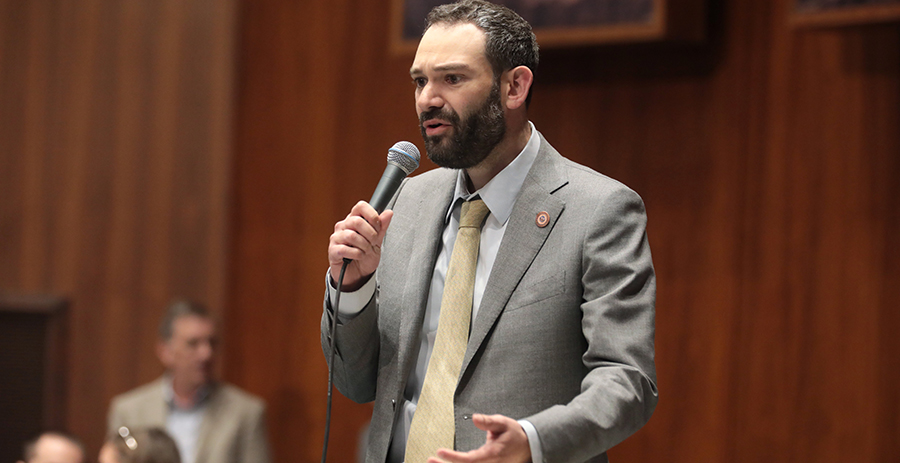
So, with Toma in the chair, the Scottsdale Republican said he and others want “a special committee hearing” to advance the issue to the November ballot. And he even put it in the form of a letter, signed by 25 of the 31 House Republicans. And to make sure it was widely distributed, Kolodin posted the letter and signatures online.
Toma appeared miffed that Kolodin was making a public issue out of it. And the speaker told Capitol Media Services that he and Senate President Warren Petersen already have been talking about what should go on the ballot.
“I’m not sure what he’s doing,” he said of Kolodin.
“He should have asked before he did it,” Toma said. “Because, now, it just sort of makes it strange considering we were already planning on having a conversation on border issues and a possible ballot referral.”
Toma said Kolodin and the others who signed the letter were “sort of jumping the gun on things.”
“I’m not sure what the benefit is,” he said.
“And I definitely don’t understand the timing,” Toma continued. “It sounds like they don’t know what they’re doing and are new at this.”
Kolodin is a first-term lawmaker as are many of the signers. But the list includes a number of veterans like Rep. David Livingston, R-Peoria, who was first elected in 2012.
Toma said he is sympathetic to the issue. He even is trying to advance his own, separate, border security proposal which, for the moment, is stuck in the Senate.

But as to the Texas-style law, the speaker said the push to send it to voters is premature. And that, Toma said, starts with the fact that the legality of the Texas measure is still being litigated.
That statute, like the one Republican lawmakers here approved earlier this year only to be vetoed by Hobbs, would empower state and local police to arrest anyone who entered this country at anywhere other than an official port of entry. It also would allow judges to suspend prosecution if the person agreed to return to his or her own country.
Democrats said the Arizona proposal would have led to racial profiling, as there would be no way for a police officer who is not standing at the border to know how someone entered this country or whether or they actually are citizens.
Hobbs, in her veto, said the issue is simpler: Problems at the border are a federal issue.
Toma isn’t buying that. But he said it makes no sense to push ahead right now.
He pointed out that a federal appeals court in Texas is reviewing the law there after the Department of Justice filed suit. More to the point, the three-judge panel has put the law on hold, with Chief Judge Priscilla Richman writing that it is the president’s role “to decide whether, and if so, how to pursue noncitizens illegally in the United States.”
With the legal issue up in the air, Toma said there is no reason to act now on something that, once approved by the Legislature, would automatically go to voters in November. He said the court could decide, for example, that only some parts of that Texas law that Arizona wants to emulate are constitutional.
“You don’t want to rush and put something on the ballot when there is no deadline,” Toma said, with no sign that the Legislature is anywhere near ending this year’s session.
“November is not coming any faster if you put something on the ballot today or you put something on the ballot in a month when we’re ready to sine die,” he said, the Latin phrase that literally means “without a day” but is used to refer to the last day of the session when lawmakers adjourn without a date to reconvene.
Kolodin, however, questioned the idea of waiting for the appellate court to rule on the Texas law. And regardless of what it rules, he said it won’t be the last word, with whoever loses in the fight, whether Texas or the U.S. Department of Justice, virtually certain to take the case to the U.S. Supreme Court.
“We know we’re not going to have a SCOTUS ruling prior to the election,” Kolodin said. So he said there’s no reason for lawmakers here to wait.
Anyway, Kolodin is presuming that the high court will allow the Texas law to stand.

That is based on the fact that the justices, in a divided decision, had agreed to let the Texas law take effect while the case is pending. But the justices did not rule on its constitutionality. And that allowed the appellate court, in the interim, to subsequently issue a stay.
What must be addressed more immediately, Kolodin said, is the logistical question of how to get such a measure on the ballot here in Arizona. And that has to do with the legislative calendar and rules which preclude introduction of measures and amendments not already in the pipeline
The only thing is, no one ever introduced a formal resolution to enact a Texas-style law, instead putting all their legislative eggs into pushing statutory proposals subject to gubernatorial vetoes.
“The immediate deadline issue is we’re past the bill introduction deadline,” Kolodin said.
Toma, however, said those concerns ignore the fact that there are various procedures to get around that deadline. That includes the power of the Rules Committee in either chamber to allow a late introduction of legislation and his ability and that of Petersen to allow a committee to meet even though the deadline has passed.
Kolodin, however, said he and the other GOP lawmakers who signed the letter want to push the issue along beyond claims that something could happen — in the future.
“There have been talks about this, that or the other thing,” he told Capitol Media Services. “I haven’t heard anything concrete in terms of it.”
What Kolodin said he is trying to do is ensure as soon as possible that there really will be a committee to hear and approve a measure to put the issue on the ballot.
“And I would like to let leadership and everybody else know that that’s the desire of the body,” he said.
Kolodin insisted, though, he wasn’t trying to pressure the speaker into calling a special committee hearing.
“I just want him to know that the body would like to see that,” he said. “That’s all.”
But Toma isn’t alone in wondering why Kolodin believes that leadership needed to hear that message. Petersen said there has been a plan since before the session began in January.
“Our plan has been to put the rest of the bills on her desk, see what happens with SB 4, and have a ‘border security day’ where we look at initiatives,” he said.
“If the governor signs our stuff, great,” Petersen said. “If the governor vetoes our stuff, then we’re looking forward to putting an initiative” on the ballot.
And the public push?
“I didn’t understand the letter when we’ve already talked about it,” Petersen said.
He also said that what eventually makes it to the ballot on border security may go beyond SB 4. What is also still pending is HCR 2060.
This measure, crafted by Toma, seeks to put teeth into existing laws that require employers to use the federal E-Verify system to determine if job applicants are in the country. And it would extend the requirement to use E-Verify to applicants for certain public benefits.
HCR2060 cleared the state House. But it never got a hearing in the Senate before the deadline for committees to hear bills amid questions about its effects on some businesses.
Petersen, however, said there is still the possibility of resurrecting some of the provisions and putting them into a single border plan — along with the Texas-style law — that would go on the November ballot. The key, he said, is getting something that is acceptable to the 16 Republican senators and 31 House Republicans.
What Republican lawmakers already have placed on 2024 ballot:
– Adds a $20 fee on any criminal conviction to provide a death benefit to the family of any first responder killed in the line of duty.
– Limits how long an emergency declaration by any governor can go on to 30 days unless extended by the Legislature.
– Provides for life imprisonment of any individual who is convicted of sex trafficking of a child.
– Allows property owners to seek a tax refund if they can show that a local government is not enforcing laws dealing with the homeless and others like illegal camping, begging, public drinking and use of illegal substances.
– Puts a provision in the Arizona Constitution to ban “ranked-choice voting” and open primaries by ensuring each party gets to choose its own nominees for the general election.
– Adds an additional hurdle to those seeking to put their own measures on the ballot by requiring them to get a certain number of signatures from each of the 30 legislative districts.
— Capitol Media Services
The post GOP lawmakers pushing leaders to put border legislation on ballot first appeared on Arizona Capitol Times.
]]>The post GOP lawmakers to return vetoed border bill to Hobbs first appeared on Arizona Capitol Times.
]]>Get 24/7 political news coverage and access to events honoring top political professionals
The post GOP lawmakers to return vetoed border bill to Hobbs first appeared on Arizona Capitol Times.
]]>The post US closes border crossing to vehicles and limits traffic at another in response to illegal entries first appeared on Arizona Capitol Times.
]]>Get 24/7 political news coverage and access to events honoring top political professionals
The post US closes border crossing to vehicles and limits traffic at another in response to illegal entries first appeared on Arizona Capitol Times.
]]>