The post Andy Wilson 1958-2026: Noise maker, writer, publisher, political activist appeared first on Datacide.
]]>A personal obituary full of mistakes and digressions by Simon Crab

I wasn’t surprised when I heard in May this year (2026) that my friend, collaborator and sparring partner, Andy Wilson, was about to die. I had been present at Andy’s first death in 2005 when a brain aneurysm had him committed to the intensive care ward of the London Hospital in Whitechapel. 1Andy had got a message to me to rush to the ward and record his final thoughts and words – I still have the DAT tapes somewhere – mostly a jumble of opioid incoherency punctuated by moments of clarity, for instance, how he heard a saxophone performance by Geoff Leigh with astonishing clarity when, earlier that day, the surgeon placed a tiny platinum mesh tube in his brain to reinforce the exploded blood vessel ( having first inserted the tube through an artery in his groin).2 Andy did, in fact, die later that night but woke up some hours later on the surgeon’s slab, slightly confused but ready to go.
He was to live another twenty one years until finally succumbing to cancer in May this year, 2026. His later health was always precarious, but apparently oblivious of this – he probably smoked less and drank a bit less – he continued his energetic investigations into politics, music, literature and anything else he could argue about, for instance: why speaking a foreign language was “middle class”, that Feminism was contrary to the important work of class war, that the Kronstadt anarchists should have been shot, that Latin American music was an expression of brutal Fascism “Dance you fuckers!”, that Social Media was simply the unpaid outsourcing of labour, that W. G. Sebald was a “boring bourgeois bastard” and the work of Steve Reich was the anthem of American industrial Capitalism – were just a few of his eclectic but strongly argued opinions that spring to mind.3

Having grown up ‘underprivileged’ in an outrageously dysfunctional family with no access to a ‘good’ education or the trappings of culture and intellectualism, Andy was, despite this, one of the most erudite and eloquent people I have ever met – he could and did fearlessly hold his own in debates with privately schooled elites, captains of industry, TV politicians and dogma-infused apparatchiks of the left. We, of course, argued fiercely and often but always with good humour. Some of his debating partners were less lucky; Andy had a Debordian habit of permanently excommunicating those he considered too stupid or unworthy of discussion.
Escaping poverty and family, Andy fled his home town of Coventry in the late 1970s and joined the British Navy on a scholarship – not, you might think, the ideal destination for a spiky-haired punk, chairman of the Midlands David Bowie Fan Club and proto-radical thinker. However, it was here that he came across technology, learned basic programming techniques, Industrial music (particularly Throbbing Gristle), gymnastics (he was part of the Navy display team, believe it or not), a talent for political agitation, and a deep hatred of Imperialism, Hierarchy, and class hegemony.
Some years later, Andy, now married with an infant daughter (Hello Ruth!) was expelled from the Navy; his political agitation within the ranks in support of the Irish Republican Army in their war against the British military occupation of Northern Ireland was deemed, not surprisingly, incompatible with membership of that very same occupation force.4 It was also during this period – around 1980 – that Andy became particularly interested in electronic and industrial music inspired primarily by Throbbing Gristle, not just as a listener but as a maker.5
His first audio product was by his group Raudive Bunker Experiment (RBE) – essentially a solo outfit of Andy Wilson, a Korg MS20 and a copycat echo machine with ‘various collaborators’- who produced one LP release, Industrial Estate / a Knot in 19826. (Tracks 15 and 16 on the Interdistrict 1980-2016 compilation).

After his expulsion from HM armed forces, Andy enrolled on a degree course in philosophy at York University. In the days of free tertiary education, many universities were a hotbed of radical debate and opposition to the Thatcher regime. Here, Andy joined a circle of like-minded left-wing radicals – many of whom became lifelong friends and colleagues – and eventually he joined the Socialist Workers Party (SWP) group at York.7 Andy’s time at York coincided in 1984 with the Miners’ Strike, the largest opposition movement to the Conservative government, with, on one side, Margaret Thatcher bent on destroying union power and privatising industry and the other, the Miners’ Unions aiming to defend their industry and communities and, ultimately, to bring down the government. 8 For The SWP, the political vacuum caused by the democratic left’s ambivalent support for the strike was a huge opportunity to organise and recruit, and they became actively involved in supporting the strike. Andy, as a rising talent in the party, became the North West regional organiser based in Liverpool and honed his rhetorical and organisational skills.
Yet, once again, Andy fell foul of inflexibility and authoritarianism built into mass organisations. Calling for a SWP cultural policy that embraced radical experimental and electronic music in a series of pamphlets distributed at SWP events, Andy clashed with the SWP central committee and was censured for unauthorised publications and questioning party policy. Andy, along with a number of other comrades, refused to back down and were expelled from the party as dangerous ‘anarchists’. Andy ever after reserved a particularly vicious form of ire towards the SWP central committee members.9 What Andy was trying to advocate for was something that both he and I vehemently agreed on: Music’s political function is not as a vehicle for propaganda, but that its form is fundamentally revolutionary – to achieve this it must be ‘free’, free from party policy and control – something the SWP would never understand or agree to.
Disconnected from the organisation, and, presumably, their paycheck, Andy moved to London in the early 1990s and began working in technology – specifically the emerging creative programming scene in London.10 That’s when I first met Mr Wilson. In the early 1990s I was involved in ‘creative tech’, I met Andy, as ever at the centre of organising, as a founding member of the UK Director User Group (DUG), a motley collection of programmers, film makers, designers, animators who went on to be hugely influential on the UK creative tech industry. Andy was a dynamic organiser and a confident and eloquent public speaker, but most unnerving to me was that he recognised me as a member of Bourbonese Qualk and even had some of my records in his vast collection.11 We became instant friends.12 Andy and I collaborated commercially on a number of tech projects but also musically. In what I think was some of his best work – best in that through a truly musical objective it subverted conventions – Andy had ‘released’ several audio/tech projects including Sound Raider, a computer application, virus maybe, that, unknown to the user, searched for audio files on the users computer and then processed and combined them into an endless stream of ambient sound and noise, and the Infinity Player for the group K-Space, what Andy hoped would be adopted as a new non-linear audio format (alongside ‘linear’ unchanging MP3 or WAV formats). It was essentially an improvising, always changing music format that would never play the same sound twice but retain some of its musical qualities – bpm, rhythm pitch etc.13 A musician could record a CD of compositions, and it would subtly change every time it was played.

Along these lines, in 2000, Andy and I began to work together with the audio programming language SuperCollider that I had been using for a few years.14 At first he was the Bourbonese Qualk in-house programmer (he was a much better programmer than me) alongside Miles Miles and me, but then became a ‘full member’ of the group. As Miles’s health deteriorated, Bourbonese Qualk, for a short period, became a duo of Andy and me. We performed several live shows using a series of interlinked laptops which, if they didn’t overheat and crash, generated constantly varying but consistent rhythms and sound, sometimes accompanied by me on bass guitar and a live percussionist whose audio was fed back into the computers to be manipulated and amplified.15 Much of my time performing live with Andy was dedicated to limiting his infatuation with extreme, loud and unvarying noise in favour of, dare I say, more musically fluctuating space – in what he called my “pissy intransigence” – such was our creative dynamic.16

Andy and I continued to work together after Bourbonese Qualk ended in 2003; one result of this was Andy’s new SunSeaStar project, where he manipulated and arranged field recordings that we made together in London, the underground Quarries of Portland Bill, Orford Ness, and Fjaerland, Norway, into the Fjærland album of 2007. Despite our best efforts and plans – we were both busy with family life (I was now father to Finn, Hello Finn! And Andy to Huxley, Hello Hux!), our various businesses and personal intrigues – it was to be our last sound work together. Yet somehow Andy found time and energy in 2006 write a book on the German experimental rock group Faust, ‘Faust: Stretch Out Time 1970-1975’17, in 2010 to set up the Association of Musical Marxists (AMM) “to combine revolutionary politics with free improvisation and avant-garde music”, essentially, a real-world version of what he wanted the SWP to support in the 1980s, and then to found, with Ben Watson in 2011, a radical publishing house, Unkant Books.
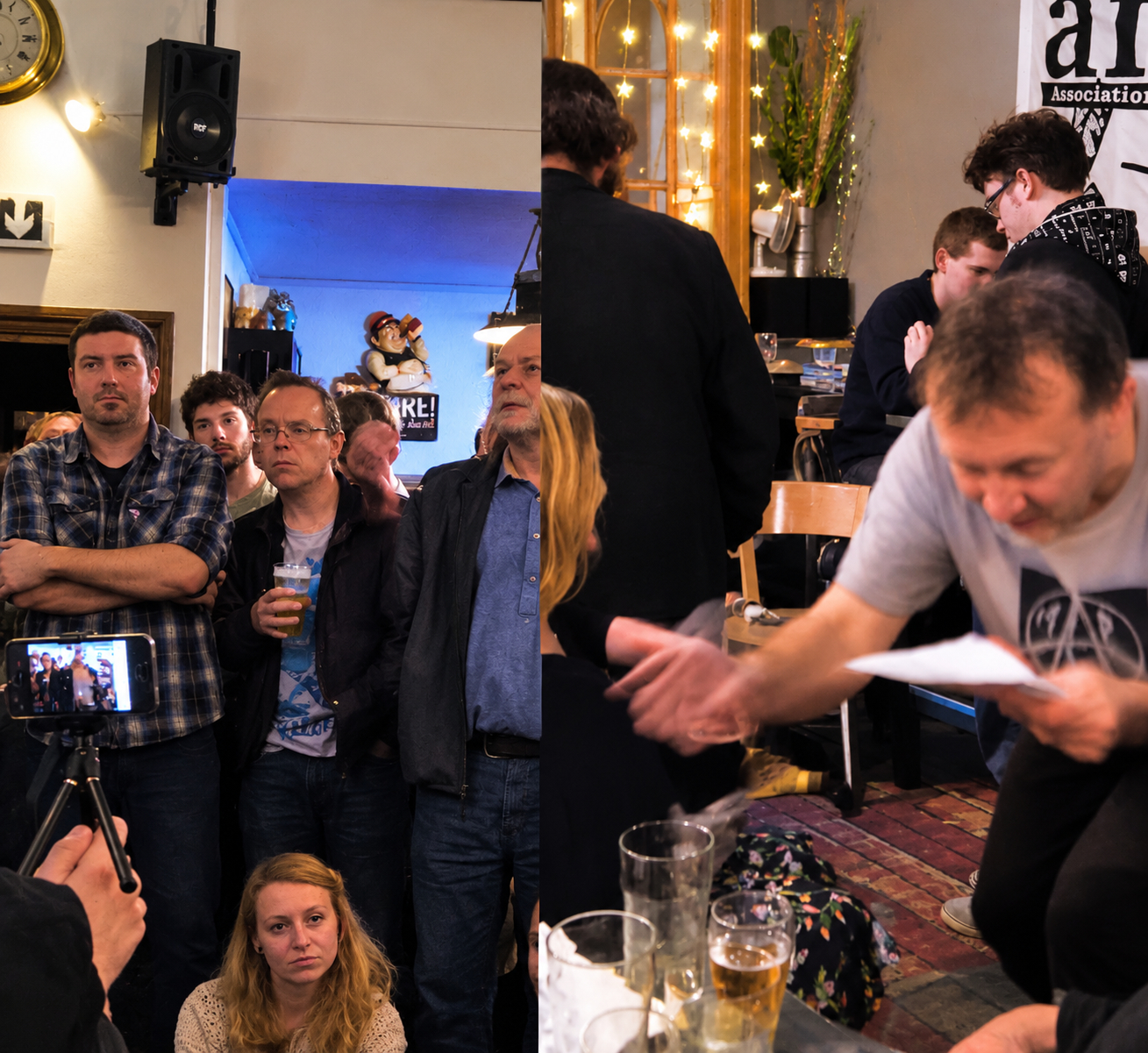
Towards the end of his life, Andy became fascinated, obsessed maybe, by the work of William Blake and through Blake’s radical mystical vision, Andy became what he called a ‘radical Christian’. 18 This may seem an unusual and contradictory step considering his dialectical materialist past, yet he wasn’t afraid of contradiction, and, in the end, Andy wanted to belong. He understood the power of community and of organising, and he wanted to be at the centre of action, to be part of something, whether it was the Royal Navy, the Temple of Psychick Youth, the Midlands David Bowie Fan Club, the Socialist Workers Party, Bourbonese Qualk, LShift, A.M.M., The William Blake Society. Perhaps his ultimate community was his acceptance into the Christian church and, through his death, the final community of becoming one with the atomic universe. I can’t help thinking, though, that if there is a heaven he would quickly find issue with some aspect of heavenly dogma or policy and be cast out, expelled from the Elysian plains to found a new, heretical and freer version of the afterlife.
Simon Crab

1 A sombre, dilapidated Victorian edifice on the Whitechapel Road waiting for demolition: Ripper territory, home of the Elephant Man and obscure stage for Iain Sinclair’s company of outcasts. See https://www.travellerintheevening.com/p/lifes-a-long-song for Andy’s musings on mortality.
2 Geoff Leigh: Saxophone player, Flautist and multi-sound maker ex of Henry Cow, Ex Wise Heads, Artaud Beats, Radar Favourites and others.
3 However, in a habit that was to continually annoy me, he later changed his mind on all of these subjects – apart from Steve Reich perhaps.
4The IRA war against British Forces was at it’s height at this time. In 1984 they bombed the Conservative Party Conference in Brighton almost killing Prime Minister Margaret Thatcher. It is surprising that Andy was not jailed by a military court.
5 Previous to his discovery of Throbbing Gristle, Andy’s tastes included Midlands pop-rock superstars Slade, David Bowie and the Beatles amongst others. Andy remained a critical fan of TG and later Psychic TV – he probably wouldn’t like to be reminded of it, but he had a TOPY tattoo emblazoned on his arm and moved to the London Borough of Hackney, close to Martello Street and the ‘Death Factory’ to be nearer to the genesis of industrial music. Andy later distanced himself from this wing of industrial music when it increasingly became aligned with far-right politics and ‘transgressive’ fan-boy culture. See; Who Makes the Nazis for a critique of industrial music’s infatuation with Fascisms.
6Founded in Weymouth, UK in 1980 RBE’s Industrial Estate was first released on vinyl in 1982 and later re-released in 2009 on Youdonthavetocallitmusic – YouDo 04, Germany as a double album/booklet. The RBE project continued as a vehicle for Andy’s music, he planned to release an album, Rosa Obscura in 2001 which remains unpublished. https://rbe23.bandcamp.com/
7 The SWP was by far the largest party of the revolutionary left during the late 80s, adopting an internationalist Trotskyist Marxist-Leninist (i.e. create a mass revolutionary proletarian movement to seize power in a revolutionary moment) line in contrast to the pro Soviet Marxist parties of the era. To us Anarchists, the SWP was one of our chief adversaries due to their cult-like behaviour, blind adherence to political theory (Stalin was bad, Lenin was good) and hierarchical structure dominated by an elite of schooled ‘thinkers’ and their annoying habit of co-opting (and then abandoning) grass roots movements in order to recruit new members.
The SWP continues to this day but is much reduced in power, status and credibility after a series of sexual abuse and misogynistic scandals committed by central committee members during the 1990s.
8 This was a real possibility, they had done just this in the early 1970s with the Ted Heath Conservative government.
9 Andy Wilson and other dissident SWP expellees set up the International Socialist Group (ISG) as a more libertarian version of the SWP in 1994. By naming the group the ISG they were aiming to irritate the SWP politburo by claiming ownership of the founding spirit of the SWP, originally called the International Socialists. This splinter group, however, like many of the groups of the UK left, didn’t last long.
10 This was a now mostly forgotten early 90s tech scene built around interactive programming, animation and design. It was inspired by the emergence of the Apple Mac, Hypercard and particularly Macromedia Director, an application that allowed the control of visual and audio elements with a scripting language, Lingo. One of the most prominent early examples of this was Danny Brown’s Noodle Box of 1997 – not that you will be able to see it as the technology is long obsolete.
11 All of his life Andy was a fan and collected everything from an artist. The front room of his Hackney house was secondary-insulated with thousands of records varying from: Frank Zappa (lots of Zappa, sadly), Townes van Zandt, Faust, Cecil Taylor, The Beatles, Gong, Throbbing Gristle, John Coltrane, Slade, Nurse With Wound, John Lennon, Xenakis, Krautrock, Bob Dylan, Derek Bailey,The Fall, Beefheart etc. oh, and Bourbonese Qualk. An eclecticism I found way too promiscuous but also lacking in certain areas: no dub, no techno, no Kraftwerk infact no dance music – his was a music of the intellect not the body .
12 Unnerving because I never talked about this part of my life in the commercial world. I wanted to be anonymous, under the radar. Andy blew my cover.
13 K-Space were an experimental group consisting of : Ken Hyder, Tim Hodgkinson and Gendos Chamzyryn. Andy was slightly aggrieved that he was demoted to ‘Technical advisor’ rather than a group member by the band, considering the Infinity album was constructed around his idea and technical skill. See; https://en.wikipedia.org/wiki/Infinity_(K-Space_album)
14 Super Collider is a realtime audio maniuplation and synthesis language developed by James McCarthy, it still exists but perhaps due to its complexity and steep learning curve has somewhat been superceded by Max. Some of this Super Collider based music can be heard on Bourbonese Qualk Moscow Live 7” EP on Klanggalerie 2000.
15 As far as I remember these were all in 2001: April 2001 Spitz, London, Leipzig, Dresden, Berlin Poderwil, Naples Sintesi Festival. One of the percussionists at one of the shows was Steven Tanza, original drummer from Bourbonese Qualk – he found the concept of computer improvisation a bit trying and walked off halfway through the show.
16 Andy would often go, eyes closed, into a kind of trance during these long passages of loud unchanging noise and would have to be physically jolted back into the present.
17 Unkant Books: Adorno for Revolutionaries by Ben Watson (2011). 1839: The Chartist Insurrection by David Black and Chris Ford (2012). More Years for the Locust: The Origins of the SWP by Jim Higgins (2012): An exploration of the origins of the Socialist Workers Party (review in Datacide HERE). Splitting in Two: Mad Pride & Punk Rock Oblivion by Robert Dellar (2014). Socialism from Below: Writings from an Unfinished Tradition by Dave Renton (2013). Azmud: An Oily Saga on the Surface of the Wordbath in 5 Expired Generations by Ken Fox (2013). Psycho Politics by Peter Sedgwick (2015). Yealm: A Sorterbiography by Sheila Lahr (2015).
A.M.M.: Most of the meetings of AMM, usually at the Blue Post pub in Soho (apparently one of Karl Marx’s favourite drinking haunts), were extraordinarily boozy events with underground luminaries from the free music movement. AMM existed for a short, glorious period before it collapsed due to obscure doctrinal and personal conflicts.
18 See; https://www.travellerintheevening.com/p/lifes-a-long-song for Andy’s sometimes bleak, sometimes hilarious writings on his illness, mortality and Blake. Regarding Andy’s conversion to Christianity; I feel slightly responsible for this – I had Andy dress as a vicar to officiate at my wedding in 2005, a role he took to with enthusiastic seriousness, inventing his own church, the ‘Church of Splendid Indifference’ and reading the marriage vows from the ‘Book of Shock Headed Peter’ – he got a feel for the cloth, as they say.
SUPPORT DATACIDE – ORDER A COPY, TAKE OUT A SUBSCRIPTION OR MAKE A DONATION – You can do all this through the form on the right of this web page (on mobile devices scroll down), or by clicking HERE for more information and payment options. THANKS!
The post Andy Wilson 1958-2026: Noise maker, writer, publisher, political activist appeared first on Datacide.
]]>The post Will the New EU Packaging Regulation Kill Small Businesses? appeared first on Datacide.
]]>The European Unions’s EU Regulation 2025/40, usually referred to as the Packaging and Packaging Waste Regulation (PPWR) came into effect on February 11, 2025 and became applicable in the whole of the EU on August 12, 2026. Its stated aim is to reduce packaging waste, phase out toxic plastics, increase recycling and general sustainability. The intention is making businesses that cause the waste responsible for the international recycling.
So far so good.
Partially this is targeted at international/intercontinental direct to customer mail order companies who increase the recycling load in Europe and may use packaging materials that don’t comply with European standards of safety and recyclability. It also applies to European companies selling to other European markets. There is no single organisation for either of them where to register and account for the waste, instead each EU country is running their own.
This is where we leave the good intentions and enter the bureaucratic nightmare.
In short: If any international business intends to send packages from one EU country to another, it has to register with a legal entity in the destination country and report the package/packaging waste use. Each company, from the smallest one-person record label to huge corporations, also has to appoint an Authorised Representative in every EU country it wants to ship to. Only the country where the company is based in – and countries outside of the EU – are exempt.
This is a part of what’s referred to as Extended Producer Responsibility (EPR). And while the annual bill will depend on the amount of waste created, there are fixed costs that amount to the same for the tiniest business as for the biggest corporation.
In the run-up to the date it had already caused considerable irritation and fear if not panic with some of the small businesses affected by it, which – as mentioned – includes all companies who sell their wares via direct mail order across different EU countries.
Trying to find out what the fixed costs for each company will actually be is not as easy as you would expect from a regulation that is mandatory for all companies. Search engines and AI agents (quoting actual sources) come up with a dazzling spread of possible costs. The lowest estimate I have found was €2.600, the highest one was pricing total compliance at €39.000… Concrete quotes by intermediary companies that would take care of the bureaucracy for you add up to around €9.000 for the whole of the EU. That’s before paying for an actual piece of package waste to be recycled – all that comes on top!
All of this is peanuts for a multinational company which already has a presence in most or all the countries – it just adds another set of tasks to an already existing bureaucratic structure. For the small businesses typical for cultural productions or someone running an international mail order as a side hustle, it means entirely new tasks as well as a redistribution of scarce revenue towards a bureaucratic monster.
Tackling with waste or destroying the “commons”/common market created by online business?
No one in their right mind would deny that there is a need for tackling the enormous waste being created in a business environment that thrives on home delivery of all kinds of goods. But why make it easy for everybody if it can be done difficult! Smaller players in the market are faced with a bureaucratic monster that, if fully implemented and enforced, will lead to tens of thousands of bankruptcies. Smaller companies will disappear leaving higher market shares for bigger ones.
It seems to me that the two types of waste-creators could easily have been separated. The ones originating from outside the EU could have been charged some fee at the point of customs – which they already are as far as VAT and/or import duties and tariffs are concerned.
Inner-EU waste creators could have been charged at the point of manufacturing which then could have been distributed across the different regions or countries in a process like the one regulating inner EU commerce – a process that also already exists.
But perhaps another aspect is at play – a clearance of the online market in favour of large multinational companies as long as they are based in the EU, at least with subsidiaries. Because in fact, as the expansion of the likes of Amazon (starting in 1995) contributed to countless brick and mortar companies going out of business, new possibilities for small businesses opened up with the availability of open source online shop systems and relatively cheap international shipping options (starting around 2005).
In the bigger economic picture it is indeed just as much an “Attack on the small businesses”, as the German political monthly Blätter titled its article about the PPWR (July 2026) as it is a way of tackling with packaging waste.
Pending issues
At the time of writing there is still a massive issue pending: The question whether all companies, regardless of their size are required to name an Authorised Representative (AR) in each of the 26 EU countries. This is the part that would cost the most and would be an impossible hurdle for the smallest companies. Currently there are negotiations whether there will be an amendment to the PPWR exempting small businesses from AR rule, however several countries have voiced their opposition to allowing such exeptions, even temporary.
But even if the AR rule falls, which would change the threshold of feasibility for smaller businesses, the PPWR will still significantly change the way goods are handled and distributed by smaller sellers. This is particularly true in our world of marginal cultural commodities (and other marginal fields). The bureaucratic load by itself may be too overwhelming for a one- or two-person enterprise to handle and force them to abandon all or most of the “common market” outside their national borders.
Possible scenarios
Here are the different scenarios how this might play out:
- The EU might abandon the idea of Authorised Representatives and/or introduce “de minimis” rules that exempt businesses of a small or very small size from compliance, at least temporarily.
- Or the full weight of the PPWR remains as it has come in on August 12. This puts very small companies that do a significant part of their trade across the wider EU either completely out of business or forces them to pivot
Ways small companies could pivot:
- Choose a couple of its main markets, become compliant there, and stop supplying customers in other countries.
- Team up with other small businesses to create intermediary companies handling registration and fullfillment.
- Focus on business to business (B2B) sales. Building a network of retailers over the continent that supply each other as businesses and do the retailing in their domestic national markets.
- For extremely small companies it might be an option to handle all or parts of their orders across the EU as private sellers who are exempt from the PPWR rules. However only ever smaller amounts of orders qualify as private.
- Focus on brick and mortar business again and restrict mail order to the country you’re based in and overseas.
Each or a combination of these scenarios could provide avenues for survival. Or even a resurgence of underground cultural artifacts only being available from select outlets.
The perspective that small businesses could carve out more defined niches might sound somewhat positive. However, it mustn’t be forgotten that the economic macro-conditions also changed to the disadvantage of niche businesses, especially if we consider shop and office rents.
The relative ease of access to markets for very small players is being eroded by developments of which the PPWR is only the latest chapter. Overregulation of platforms, rising prices of shipping for sellers with low order quantities and guidelines that demand more bureaucracy than makes sense make it increasingly difficult, the PPWR may make it impossible.
When will it be enforced and how?
Another question is if, how and when the rules will be enforced. Those who hope to stay under the radar and keep acting as if nothing happened may experience a rude awakening pretty soon. If they are selling on platforms such as Abebooks, Amazon, Discogs, eBay, Etsy, Vinted etc, as these will start demanding proof of registration with the recycling agencies in the countries the sellers ship to.
Since tiny niche operators have no lobby in Brussels, it could ironically be the companies running the platforms who might be able to put pressure on the legislators, since presumably the likes of eBay don’t want to lose the tens of thousands of small commercial sellers. Conceivably there could be a solution whereby the platforms become accountable for their sellers and factor in the costs into higher fees. This could further disadvantage independent small shops.
In the meantime the shitstorm on social media has shown some results. The second version of the FAQ published by the European Commission assures us “the enforcement of the obligations applicable as from 12 August 2026 should not disrupt trade flows, supply chains or consumer access to goods. In line with Article 62 of the PPWR, if a Member State becomes aware of any of the instances of non-compliance set out in that Article, it must first require the relevant economic operator to put an end to that non-compliance. In other words, the economic operator should first receive a warning that non-compliance has been identified, and an opportunity to take corrective action, before any other action is taken on the side of the Member State.”
I don’t find this particularly reassuring. Just as I didn’t find it reassuring when the (apparently official) EU Environment account posted on social media that the PPWR “is not a ‘big bang’ for small businesses” which seems to contain a fundamental misunderstanding of what the ‘big bang’ is meant to be – a beginning, not an end.
Depending how you look at it, this regulation is either completely flawed, in so far that a whole layer of small businesses trading internationally or people running a side hustle are prevented to do so. Or it’s a perfect set of rules to put a whole section of the trade economy out of business with markets that can be absorbed by larger corporations – under the green mantle of sustainability.
Despite the fact that media coverage has been quite scarce, it looks like some aspects of the PPWR may be revised in the coming months in the form of amendments or longer terms of implementation. We’ll add updates to this article as they become available.
Christoph Fringeli
Sources:
EU law: https://eur-lex.europa.eu/eli/reg/2025/40/oj/eng
European Commission: PPWR FAQ: https://op.europa.eu/en/publication-detail/-/publication/ad14cb8f-8d4f-11f1-9262-01aa75ed71a1
Article in Blätter (German): https://www.blaetter.de/ausgabe/2026/juli/eu-verpackungsverordnung-angriff-auf-die-kleinunternehmen
Article on heise.de (German): https://www.heise.de/news/Verpackungsverordnung-und-Onlineshops-Land-in-Sicht-11414163.html
Other articles and reviews by Christoph Fringeli on datacide-magazine.com
SUPPORT DATACIDE – ORDER A COPY, TAKE OUT A SUBSCRIPTION OR MAKE A DONATION – You can do all this through the form on the right of this web page (on mobile devices scroll down), or by clicking HERE for more information and payment options. THANKS!
The post Will the New EU Packaging Regulation Kill Small Businesses? appeared first on Datacide.
]]>The post Class War Across the Channel: How German Radical Communists Saw Britain’s 1926 General Strike appeared first on Datacide.
]]>It did so successfully and it has been debated ever since, why – despite the overwhelming support for the strike – workers largely obeyed the orders of the trade union bureaucracy. The miners in the meantime kept fighting, but were starved into submission, and many workers were not re-hired after the strike.
Some – mainly in the Bolshevik tradition – have argued that what had been missing was a strong communist party to lead the class. As we shall see, the left communists argued that only the true organs of the class – the workers councils – could become the genuine (self-)organisers of the revolutionary struggle.
Below we document the reception the strike received in the left communist press in Germany at the time, in this case specifically in the Kommunistische Arbeiter-Zeitung, the paper of the Communist Workers Party (Kommunistische Arbeiterpartei Deutschlands, KAPD), an important outlet of the left communist milieu in Germany at the time, a dissident voice to the left of the “official” Communist Party (the KPD).
The KAPD was a product of a major split of the KPD in 1920, when the party was torn between taking part in elections vs. focusing on direct action and armed insurrection. Lenin famously sided with the more moderate KPD or rather dictated its course [in his pamphlet “Left Wing” Communism – An Infantile Disorder, originally titled The Infantile Sickness of “Leftism” in Communism, (Moscow 1920)].
Initially the split was roughly even in terms of the numbers of rank and file membership, in some key constituencies, among them Berlin, the majority of party members initially joined the more radical KAPD. The party sought affiliation to the Communist International, which the Bolsheviks initially granted as a ‘sympathising’ member party under the condition that it would reunite with the KPD.
This status was soon revoked. In the meantime the KPD massively grew in membership as they united with the left wing of the Independent Socialists (USPD). Over the following years the KPD engaged in electoral “realpolitik”, got “bolshevised”, i.e. purged, by Stalin, and became an outpost of Russian foreign policy. It also became the only official German section of the Third International.
The KAPD was extremely critical of the “official” KPD from early on and denounced in their press the collaboration of the Soviet Union with various bourgeois factions around the world. The left communist press of the 1920s – represented not just by the KAPD, but also by other groups and factions – contains much prescient criticism of the developments in the Soviet Union and the international communist movement.
The KAPD soon split into several sub-movements of council communist and revolutionist groups. Here is not the point to dissect this (imo quite interesting) history, but it should be mentioned that by 1926 there were two organisations operating as KAPDs, both publishing their respective Kommunistische Arbeiter-Zeitung. One was mainly based in Essen, the other (larger one) in Berlin. We’re here looking at the the paper of the “Berlin Tendency”.
The party still had an estimated 2000-4000 members at this time – down to about a tenth of its size of five years earlier – but still an impressive number if we compare it to left communist groups in the present. In addition, the AAU – the workers union associated with the party – still had over 10.000 members, but this represented an even bigger decline from its peak in 1920/21 with about 200.000 members.
Reading the documents presented here we can sense the hope for a revolutionary upheaval, a process of clarification and rejection of reformism at the beginning – and then the frustration in several directions. That the KAPD would see the trade union bureaucracy as an enemy rather than an ally is of no surprise, but the frustration that the workers continued to follow either the “right wing” trade unions or the “left wing” Leninists instead of forming their own revolutionary organs in the form of workers councils is palpable.
Both the “righ wing” trade union leader as well as the Bolsheviks had essentially patriotic orientations, according to the KAPD, either for their British or German fatherlands or for the Soviet Union via the treacherous Third International. The Soviet Union is already seen as just as bad of a capitalist country as the others by that point.
In the “Lessons” of the strike, the other radical left groups are accused of revolutionary phraseology, but this charge could be thrown back at the KAPD itself. After all it was no more able to practically intervene into these struggles and steer the conflict towards revolutionary escalation than the Syndicalists or the Korsch-Group it criticises in its text.

All texts were published in May 1926. The editions of the paper are numbered and while they indicate in which month they appeared, they don’t feature the exact publishing date. At this point – 1926 – the KAZ appeared twice a week. The articles below are from issues 35, 37, 38 and 39. Unfortunately the issue number 36 is missing from the online Antonie Pannekoek Archive, but even if it does contain more material on the General Strike, it seems to me that the coverage presented here gives a pretty comprehensive overview over the aspects under which the Strike was perceived in the German left communist circles and beyond at the time. CF
Documents:
- The General Strike in England (Kommunistische Arbeiter-Zeitung, Nr. 35, May 1926) – Leader article on front page
- The Order of the Day – The Struggle in England and the German Proletariat (Kommunistische Arbeiter-Zeitung, Nr. 37, May 1926) – Leader article on front page
- Collapse of the English Mass Strike (Kommunistische Arbeiter-Zeitung, Nr. 38, May 1926) – second article on front page, mostly press clippings and short reports from other sources.
- The English Trade Unions as Executioners of the Strike (Kommunistische Arbeiter-Zeitung, Nr. 39, May 1926) – a commented news piece from the more mainstream Vossische Zeitung page 3.
- England – Poland – Russia (Kommunistische Arbeiter-Zeitung, Nr. 39, May 1926) – front page leader.
- Lessons of the English Strike (Kommunistische Arbeiter-Zeitung, Nr. 39, May 1926) – main article on page 3.
The articles appear here in full length and for the first time in English.
The General Strike in England
(from Kommunistische Arbeiter-Zeitung 35, May 1926, front page)
The General Strike in England will be of historic significance for the future development of the English labour movement and the labour movement as a whole. It represents an attempt by the English working class to fend off the capitalist offensive against the living standards of the English working class. Before the war in particular, and to a certain extent even after the war, the English proletariat benefited from English colonial policy. As competition amongst global capital on the world market becomes ever more intense, English capitalism is resorting to its last resort: wage cuts and rationalisation. The Coal Commission proposed this course of action to the government; Hodges was in favour of extending working hours, whilst MacDonald advocated a ‘temporary sacrifice’.
The British trade union leaders indignantly reject the accusation that this strike—in which miners, railway workers, transport workers, seafarers and inland waterway skippers, as well as gas and electricity workers are taking part—is a revolutionary action against the government. The reformist tactics of the trade unions reached their peak after the English strike collapsed in 1921 and the government sidestepped the conflict in 1925. ‘Red Friday’ was a postponement of the major confrontation by English capitalism.
The mining industry continued to be supported by state subsidies. The cost of this over the past nine months has amounted to 19 million pounds sterling, which would amount to 25 million pounds sterling over the year. The other capitalist industries are unwilling to bear this burden. Nor does the increasingly deteriorating economic situation allow for this any longer. The balance of trade for the first quarter of 1926 shows a shortfall of 51 million pounds sterling compared with the first quarter of 1925. Exports have fallen by 19 million pounds sterling. The British capitalist class is therefore faced with the necessity of bringing about a decision.
The fact that, in view of this situation, Thomas declared in the House of Commons: ‘I am convinced that if a vote were held today on the question of who wants a revolution, not even two per cent of the population would answer “yes”’, is indicative of the situation.
Nevertheless, the spirit of the English workers is different from that of the Germans. The English proletariat has not yet been so thoroughly crushed as the German, but its present strength stems from an astonishing naivety regarding the conditions of struggle. The English proletariat is still imbued with a strong awareness of its role in the bourgeois class state; it does not wish to be deprived of its role as an equal citizen. Just as little as the English working class thinks of revolution, so impetuously does it, through its actions, exacerbate the crisis and thereby create the conditions which will make it clear that its future cannot be secured within the capitalist class state, but only through revolution.
What character this process will take on, and at what pace this ideological clarification will proceed, cannot be predicted at present. That it will take place, and that the current conflict will be the prelude to it, is certain. The English capitalist class is going into battle shouting: ‘Freedom for the nation! Down with the terror of the streets! We want no Soviets!’ The English working class is rising up and, in the course of the struggle, will see through the limitations of reformist tactics.
At the decisive moment, the major English trade unions, as in every country, will side with capital and make the proletariat realise that, with the culmination of capitalist development, the zenith of reformist tactics has also been reached; that the struggle against capitalism as a system is, at the same time, a struggle against the trade unions [Gewerkschaften] as its ultimate pillars; and that the struggle for the workers unions [Unionen – the KAPD’s revolutionary workplace organisations] as the foundation of the councils must begin.
The German trade unions view this action by the English workers with great unease. The inspiring example set by the English workers is highly unwelcome to these gentlemen. Secretly, they are hoping for defeat; they hope that, as a result of this strike, German capital will seek to conquer new markets, so that they can harp on about falling unemployment. Under no circumstances, of course, do they wish for the British example to have a contagious effect. That would certainly not be ‘reconstruction’.
They hope that German capital will emerge victorious from this struggle, and all this talk of solidarity is a sham. Naturally, they cannot dare to openly ship strike-breaker coal to England, but they firmly believe that German coal will find its way into markets outside England, and that the reduction in state subsidies in England will make the German coal mining industry competitive once more. And they are genuinely opposed to an extension of working hours and to wage cuts, so that the conditions for competition remain as favourable as possible, whilst thinking: God save our beloved fatherland, our democratic republic, from the great misfortune of such a strike.
The Third International need not show any consideration for this movement. Russia is not bound to Britain by a treaty, as is the case in Germany; rather, the weakening of British imperialism is a key point in the policy of the Third International. The Third International therefore applies its ‘short-term’ perspective in this struggle. Not, mind you, to help the British workers to victory – that is a mere side issue for the Third International – but to make the British rivals amenable to an alliance, or rather to weaken British imperialism. Precisely at the moment when it is necessary to make the proletariat aware of the impossibility of victory on a reformist basis, to warn the proletariat against the treacherous trade unions, and to urge it to wage the struggle against capitalism through its own organs and action committees, the Third International declares in a call published in the Rote Fahne (official organ of the KPD) on May 4:
“The Communist International declares once again, mindful of its responsibility: We are prepared to set aside all differences of opinion which fundamentally separate us from the reformist elements of the labour movement, in order to bring about international solidarity action at any price and under all circumstances.”
In plain English, this means: The Third International is prepared to betray the movement at any cost to the enemies of the proletariat, to the henchmen of capital.
If ‘differences of opinion’ take a back seat in a struggle of such far-reaching historical significance, it means that these differences of opinion are nothing but a ridiculous, hypocritical platitude. Revolutionary theory must prove itself in the struggle itself; otherwise – as with the Third International – it is merely a means of deceiving and misleading the workers.
The struggle of the English working class will – one way or another – draw a line under a bygone era of the reformist labour movement. The classes are coming into too close a confrontation; they can no longer avoid one another. The decisive struggle has also begun in old England, and capitalism is forced to show its true colours there too. The millstones of the international proletarian revolution may grind slowly at times. — But they do grind!
WTB. [Wolffs Telegraphisches Bureau news agency report:] Leave in the army has been suspended. All troops have been ordered to remain on standby at all times. The railways have been placed under state control for the duration of the strike. Two battleships have dropped anchor in Liverpool roadstead. A troop transport ship has landed two battalions of infantry in field marching order, wearing steel helmets, in Liverpool. All special constables have been called up. Warships have been dispatched from Portsmouth to various parts of the country to ‘maintain order’.
***
The Order of the Day
(from Kommunistische Arbeiter-Zeitung 37, May 1926, front page)
The Struggle in England and the German Proletariat
Workers! Fellow class comrades!
You read in all the newspapers about the struggles of the English proletariat. You read about the solidarity actions of the Social Democrats and the trade unions. You do not know how the struggle will turn out, yet you believe that the struggle of the English workers itself will give you breathing space, that your wretched situation might somehow be improved. You read of the unity of the English workers and of the armaments of capital: the state of siege, the emergency technical assistance, the police firing and beating, the military standing by, the tanks, cannons and poison gases. Your trade unions have issued collection lists and you are signing them. Otherwise, you are following the slogan of the ADGB [main German trade union] and the Social Democrats, which goes: Workers of Germany, calm yourselves.
Proletarians!
Anyone who is content with this reduces proletarian class-struggle solidarity to a means of appeasing their own conscience. Anyone who acts on this slogan replaces class solidarity with sleazy handouts. Anyone who endorses this policy claims the right to have their own cowardice certified with the label of ‘solidarity in struggle’. Anyone who tolerates this policy without protest supports the colossal betrayal of the trade unions and the Social Democrats, and throws proletarian class solidarity—the proletarian class morality—at the feet of the bourgeoisie and its lackeys.
What is the substance of the ‘alimony and collection-box solidarity’ practised by the trade unions and their Social Democratic henchmen, whatever their political hue?
They do not want German workers to attack their own bourgeoisie. They want the opposite: they want German capital to penetrate English markets and thereby alleviate its own difficulties. Through their Judas silver, they wish to support the strike in England, indeed even to prolong it, so that they can point to ‘successes’ in falling unemployment figures at the expense of English workers. They do, however, want wages in England not to be cut and working hours not to be extended, but only so that German capital can become and remain competitive!
Their deceitful ‘collection-box’ and ‘charity’ solidarity is merely a mask to conceal their solidarity with their own bourgeoisie. They donate money to war bonds for Ludendorff and Eckener’s fundraising campaigns. They ‘support’ the struggle of the English miners solely in the interests of their bread-and-butter employers, the German capitalists. Their policy is the very policy that became apparent to everyone during the World War, and they have not abandoned this line—the line of proletarian class betrayal—nor can they, nor will they, ever abandon it!
The Moscow International is also marching along this line!
It openly declares: ‘We are prepared to set aside all differences of opinion that separate us from these organisations in order to actively organise, together with them, the international solidarity campaign for the British miners.’ They are, by their own admission, prepared to hand over the English, the German and the international proletariat to the class enemies of the proletariat.
The Moscow International ‘organises’ fundraising campaigns in Russia and boasts of the millions raised. It conceals the fact that these campaigns are state-led initiatives rooted in Russia’s imperialist struggle against British imperialism. It conceals the fact that in Russia there are over a million unemployed and over a million homeless and parentless children. The treaties with German capital and with the Turkish government characterise Moscow’s line as one of capitalist bloc politics, which inherently entails a truce with the proletariat of every country. The Moscow International betrays the workers by means of the revolutionary rhetoric of the Second and Amsterdam Internationals, because Russia needs machinery from Germany for its ‘communism’ and loans for its ‘socialist accumulation’. Through this dazzlingly revolutionary rhetoric, the German workers’ judgement is to be clouded, the united front with the trade unions consolidated, – and to give German capital a respite; the German, British and international proletariat are to be betrayed and rendered incapable of action, whilst the Russian proletariat is to be starved and deceived, all the whilst the new bourgeoisie, like the Soviet bureaucracy, feasts and drinks.
What is at stake in Britain?
Until now, British imperialism has been able to throw the workers scraps that fell from the capital profits of its colonial policy, thereby obscuring the class antagonism. After the war, however, fierce competition set in. The market shrank, whilst the productive forces in all countries grew. However, each country’s competitiveness could only be maintained time and again through wage cuts, longer working hours and inflation – in other words, through the most ruthless offensive against the proletariat. The German proletariat has endured this struggle to the very end. The exploited receive just enough to barely sustain the most basic renewal of their labour power. The surplus labourers are dying off.
French capital remains competitive thanks to the inflation of the franc. English capital is once again opening fire on the proletariat and attempting to cut its standard of living in order to maintain its rate of profit. The struggle is systematic, so carefully prepared. It was postponed in 1924 because the preparations were incomplete. At the time, the Third International prattled on about a ‘victory’, about a ‘Red Friday’. The struggle in England will be fought to the bitter end.
The task of the German proletariat
is to remind their English brothers of the lessons of the German workers’ struggles, which are as follows:
No victory without power!
No victory without power: this means that the proletariat of all countries today faces the catastrophe of capitalism; capitalism is incapable of feeding its own slaves, incapable of resolving its own contradictions, incapable of overcoming its own crisis. It is capable only of killing millions of workers, by whatever means. ‘No power, no victory’ also means that the call of the German proletariat, the counsel of the German proletariat, must be:
Comrades in England! There can be no more peace with capital.
There can be no further ‘victory’ for the proletariat whilst the capitalist mode of production is maintained, under the rule of the bourgeoisie with its mercenary armies, its class state, its prisons, its democratic stupefaction. Your struggle must be a struggle against the bourgeoisie as a whole. A struggle in which the decisive moment can no longer and must not be avoided, a struggle for the revolutionary dictatorship of the proletariat – otherwise you are lost, and you and we with you are defeated.
This realisation must be immediately followed by action on the part of the German workers!
The struggle in England is a struggle on the international class front. The German proletariat makes a mockery of solidarity if it continues to trudge off to the factories, and at a cost that has not even yet been exacted of the English workers. The response to the mass strike in England must be:
Mass strike in Germany! –
with the aim of taking over production and establishing workers’ rule. A mass strike in Germany—that alone can serve as a bridge of solidarity and joint struggle; and when the factories in Germany are stormed and the revolutionary workers’ dictatorship is established, then the English workers will also follow this example.
If the attack is launched on two of the most vulnerable fronts of European capitalism, the eyes of the workers of all countries, the hearts of all revolutionary-minded workers of all countries, will be on our side. Then we will win the battle; then we will triumph!
Liberation, however, can only be our own doing!
The struggle for proletarian power can never become a struggle of the trade unions and political parties. The ruling bourgeoisie does not share in the sufferings of the proletariat. The English trade union leaders have not yet had the opportunity to expose themselves as openly as the Germans did in their Noske course, but they are not a hair’s breadth better; they will expose themselves openly in this struggle. They have long been haggling over the proletariat’s fate.
The revolutionary organs of struggle must grow out of the factories, out of the work shifts. The revolutionary action committees as the pioneers of the proletariat’s revolutionary councils!
Once again, history calls upon the German proletariat to fulfil its revolutionary duty; once again, the German proletariat is offered the opportunity to rise from its humiliating disgrace, from its unheard-of exploitation, from the defeats inflicted upon it by its ‘tried and tested organisations’, and to strike a fatal blow against its mortal enemy—capitalism, the murderer of workers—with the weapon of proletarian class solidarity. Once again, the question stands clear and stark on history’s agenda: Victory or defeat!
Proletarians of Germany, make up your minds, make up your minds quickly!
Communist Workers Party of Germany.
General Workers Union.
Communist Workers Youth.
***
The Collapse of the English Mass Strike
(from Kommunistische Arbeiter-Zeitung 38, May 1926, second article on front page)
From the very outset, we have pointed out the contradiction inherent in the apparent mass character of the English general strike and its actual substance. Although it was clear from the start that the leaders of the Labour Party were doing everything in their power to break this strike as quickly as possible, the audacity of these fellows is nonetheless astonishing. To give our readers a picture of the situation, we present the most characteristic reports below:
The terms of peace.
London, 12 May. (WTB.) The memorandum sent by Sir Herbert Samuel, Chairman of the Coal Commission, to the General Council of the Trades Union Congress states: Firstly, negotiations on the situation in the coal industry are to be resumed, with the subsidy being renewed for a reasonable period necessary for the negotiations; secondly, negotiations would be unlikely to succeed unless a means is found to settle disputes within the industry not merely through negotiations between mine owners and miners alone. A national wage board should therefore be established, comprising representatives of both parties, along with neutral assessors and an independent chairperson. The relevant proposals contained in the Coal Commission’s report should be formulated more precisely, and the powers of the wage board should be extended. Thirdly, the parties should be entitled to raise long-standing issues which they consider essential, and the Wages Board should take such issues into consideration. Fourthly, there should be no revision of previous wage rates unless there are sufficient (!) prospects that the reorganisation measures proposed by the Commission will actually be adopted. A committee, which should also include representatives of the miners, is to be set up to work with the Government in preparing the necessary legislative and administrative measures. The same committee or the National Wages Board is to ensure that the necessary steps are not neglected or unduly delayed.
The memorandum also sets out detailed proposals for providing for those workers who lose their jobs as a result of the closure of unprofitable mining operations.
A message from the General Council.
London, 12 May. (Own telegram.) The General Council of the Trades Union Congress has issued a message to all affiliated trade unions, concluding: ‘The trade unions, which have come to the aid of the miners with such determination and unity, can rest assured that an honourable settlement has been reached. The General Council accepts the consequences of its decision, mindful of its responsibility not only to the trade unions but to the nation as a whole. The General Council has endeavoured to conduct the struggle in the manner in which industrial disputes have always been conducted by British trade unions in the past, namely without aggression and without violence. At the very moment when the General Council is taking steps to bring the struggle to an end, it expresses its conviction that the British trade union movement has, in this struggle, set an example of unity and solidarity that is without precedent in history.
A message from the King.
London, 12 May. (WTB.) The King has issued a message stating: ‘The nation has just gone through a period of extreme anxiety. It has become known today that the general strike has ended. At such a moment, it is of the utmost importance to bring my entire people together to face the difficult situation that remains. This task requires the cooperation of all capable and well-meaning people in the country. Even with such help, it will be difficult. But the task will not be impossible. Let us forget whatever bitterness the events of the last few days may have caused. Let us focus only on how steadfast and law-abiding the country has remained throughout this difficult ordeal, and let us set about the task immediately of bringing about a lasting peace. The message concludes with a call to forget the past and look to the future with the hopeful spirit befitting a nation of this calibre.
15 miners sentenced to hard labour.
WTB. London, 12 May. In Doncaster, fifteen miners were each sentenced to three months’ hard labour for having, together with others, forcibly stopped a lorry, severely damaged it, scattered the goods it was carrying across the road, and assaulted the driver (a strike-breaker).
The disappointment of the masses.
London, 13 May. (Inprekorr.) The miners are in open opposition to the General Council’s capitulation. The General Council had taken its decision without consulting the miners. An official statement from the miners states that, having carefully considered the draft proposals—that is, Sir Herbert Samuel’s memorandum, which the General Council had approved as the best terms that could be secured—the leadership of the Miners’ Federation rejects these proposals.
***
The role of the English trade unions as executioners of the Strike
(from Kommunistische Arbeiter-Zeitung 39, May 1926, page 3)
The Vossische Zeitung of 13 May (morning edition) carries the following report on the shameless role played by the English trade union strategists, which is perhaps best left to speak for itself without further comment:
“The unconditional surrender of the major trade unions, which had been on a solidarity strike, to the government was announced in the House of Commons by Baldwin—who received ovations lasting several minutes—in the presence of the King’s sons, as follows:
‘The General Council of the Trades Union Congress came to see me at midday today to inform me that the general strike is to be called off immediately.
I then informed the General Council that my colleagues and I would now endeavour once more to resume negotiations between the miners and the mine owners, so that this dispute may be resolved as soon as possible. The peace that has been achieved represents a victory for common sense.”
In response to a question from Macdonald, Baldwin stated that more detailed explanations would be given tomorrow. Baldwin then left the House of Commons together with Macdonald.
In the corridors of the House of Commons, the prevailing view was that the complete collapse of the general strike demonstrated a lack of solidarity amongst the English working class and was primarily attributable to the financial difficulties of the trade unions, which had called the general strike without even having enough cash to pay out the first strike pay due on Friday.
The miners’ leader, Cook, declined to comment on the statements made by the other trade unions, but explained that the Miners’ Executive had sent telegrams to all districts urging the miners to continue striking until after the decision of the delegates’ conference on Friday. The Executive would recommend to the delegates’ conference that the strike be continued.
When, at 1.15 pm, news of the general strike’s cancellation reached the stock exchange, there was unprecedented jubilation, which brought trading to a halt for a few minutes before spontaneously erupting into a frenzied sell-off of all English government securities, railway shares and industrial shares. Price rises of several per cent were recorded within a few minutes, and the close of trading was still marked by persistent optimism.
However, the flip side of the coin is likely to become apparent as early as tomorrow or the day after, in the redeployment of the army of unemployed. All major employers, led by the large railway companies, state that, as a result of the decline in production during and after the strike, they will be able to carry on their day-to-day business with a considerably reduced workforce of clerks and labourers. They would therefore, when reassembling their normal workforces, retain first and foremost those willing to work and the voluntary labourers they deem suitable, and would re-employ from among the strikers only those numbers necessary to keep operations running and to supplement the emergency workforces.
Conservative estimates suggest that, of the one million unemployed in England prior to the strike, around 800,000 have found permanent employment, and that the ranks of the unemployed—which are expected to rise to 1½ million—will be swelled by up to one million of those previously identified as strikers.
As the trade union congress was forced to capitulate unconditionally, it was unable to secure any guarantees regarding the reinstatement of the strikers or payment for the days on strike. In well-informed political circles, the view is held that the new army of unemployed, consisting of the abandoned strikers who will receive no unemployment benefit, will form the core of a Communist Party, as these victims of the general strike will undoubtedly have lost all faith in the effectiveness of trade union policy.
In order to publicise the unconditional nature of the trade unions’ capitulation to the widest possible audience, the government, as a final measure before the state of emergency was lifted, had the stenographic minutes of the Prime Minister’s meeting with the trade union leaders read out on the radio. Following the announcement by Pugh, Chairman of the Trade Union Congress, that the general strike would be called off immediately, and Baldwin’s assurance that he would now endeavour to bring the mine owners and miners back to the negotiating table, Thomas and Bevin, in impassioned terms, asked the Prime Minister to bring the full weight of the Government’s influence to bear so that justice might be done to the miners and, where possible, the strikers might be reinstated.
Baldwin stated that he could make no promises on the matter, but that he would have to give his Cabinet a completely free hand in this regard. He recommended that the trade unions contact the employers as soon as possible regarding the issue of reinstatement, whilst he himself would attempt to ascertain whether a basis for negotiation between the miners and the mine owners could be found. He demanded that the trade union leaders place their unconditional trust in his sense of justice and his desire to restore industrial peace.”
Any child can work out that a general strike or a large-scale mass strike cannot be financed. But the scoundrels did not want to fall out with their government under any circumstances and simply kept their coffers shut. Not even the millions from Moscow could persuade them to deviate even a single step from their plan — to crush the proletariat and eliminate strikes altogether. But the cynicism revealed in this report will surely open the workers’ eyes. It will mark the beginning of the end for a policy that breeds ideological scoundrels and spares the state the struggle against the rebellious proletariat. And if the bloody mockery of the English bandit government and its lackeys opens the workers’ eyes, then the English strike will not have been in vain.
***
England – Poland – Russia
(from Kommunistische Arbeiter-Zeitung 39, May 1926, leader on frontpage)
The catastrophic collapse of the English mass strike has somewhat confused the senses of the Third International’s press, which has been behaving in a downright repugnant manner. This English trade union strategy and its ‘left-wing’ leaders have, on closer inspection, turned out to be an insidious trap into which the Third International has lured not only the English workers but also the entire proletariat. The ‘left-wing’ leaders, foremost among them the phraseologist Cook, are hiding from the outraged workers demonstrating outside the trade union headquarters in London, whilst the police sabres are demonstrating to these workers that these right-wing and ‘left-wing’ leaders are the most precious asset of the capitalist class, to be defended with the strongest police forces. Even the Imprekorr is forced to report that in London, 40 workers were beaten to the ground outside the trade union offices. It ‘forgets’ to add that among those under the protection of the London police was also the Russian’s favourite, Cook. Thus the guard of the international counter-revolution defends the darlings of the Third International, in front of whom the ‘Red’ Army in Moscow presented its arms.
The international counter-revolution appears in the most varied guises, yet history time and again mercilessly strips away its treacherous masks. The victory of the English capitalists and their White Guards was prepared by Moscow. Moscow laid the trap in its trade union strategy. Zinoviev’s rhetoric about the ‘right-wing’ traitors is intended merely to salvage a bankrupt policy, to conceal from the workers, as far as possible, the system and method of betraying the working class. If the workers of the KPD do not realise that, through their ridiculous blind faith in authority, they are making themselves complicit in the treacherous assault on the English workers—because they have denied their own experiences in the struggles of the German proletariat and enthusiastically endorsed this treacherous assault—then the last remnants of proletarian consciousness must have gone to the dogs.
An open civil war is raging in Poland. According to the reports available, the petty-bourgeois Piłsudski, the ‘democrat’, has not shied away from attacking the nationalist Witos government with arms, seeking to seize power through a violent coup. For years, an indescribable reign of terror has prevailed in Poland against the proletariat. A network of informers, extended across the whole of Poland, brings anyone suspected of communism before the executioners. Entire villages have been forced to flee, as the Imprekorr reported as early as last year. If the wanted individuals cannot be found, women and children are arrested. To cast out the communist spirit, water mixed with spirits and urine is pumped into their stomachs via tubes until their bellies are bloated. Then the police begin to trample on their bellies with their heavy boots.
The ‘Social Democrats’ — so states this report in the Imprekorr — ‘do not lift a finger, even though they are complicit in these acts of terror. They denounce everything to the government, thereby providing a pretext for these inhuman acts of terror.’ — At the same time, in November 1925, Chicherin was in Warsaw, and the Witos government organised a grand banquet in Chicherin’s honour.
The conflict currently unfolding does not reflect the activity of the proletariat. In Poland, the proletariat is, quite literally, for the most part on the brink of starvation. Bourgeois newspapers report that nearly half the workers are unemployed, and there is no mention whatsoever of any significant support for the unemployed. Massive inflation is driving prices sky-high. The proletariat has been deprived of its revolutionary organisation; its finest members have been tortured to death or are languishing in prisons. Yet, naturally, the civil war between the petty-bourgeois Piłsudski and the nationalist Witos government is giving the masses some breathing space.
What is lacking is the support of the International, the bold wake-up call from ‘the iron cohort of the world revolution’ —. As has been reported on various occasions, the Russian government has declared that it has no intention of interfering in the situation in Poland! Why? Unemployment in Russia is almost just as high. Russia seeks ‘friendly relations’ with capitalist governments, whatever their persuasion. The truly revolutionary-minded proletariat saw through this deception long ago and knows that capitalist Russia can no longer even think of helping the workers. It has other concerns—the concerns of the medium and large-scale farmers.
We ask the workers of the KPD, who still believe in the ‘iron cohort of the world revolution’ and the ‘standing-by “Red” Army’! Does no blush of shame rise to your cheeks in the face of the conditions at the ‘Red Frontiers’, in the face of the open mockery of the Polish proletariat by the Russian peasant government? In the face of the ‘Soviet’ government’s explicit assurance that it will not ‘interfere’. Do you not realise that the bogeyman of the ‘iron cohort of the world revolution’ exists solely to make complete fools of you through hope and waiting?
The Third International has also sent its supporters to the PPS in Poland, with the task of forming a ‘united front’. The reply was that they should get lost. The PPS had no desire to get involved with them, whilst the representatives of the Russian government go about their business and lend strong support to the new exploitative government.
When will the workers of the Third International realise that anyone who supports this ‘International’ and its policies is digging the grave of the proletarian revolution?
***
The Lessons of the English Strike
(from Kommunistische Arbeiter-Zeitung 39, May 1926, main article on page 3)
It is truly no easy task to scrutinise the substance of the slogans, opinions and propaganda – designed to have a suggestive effect – put forward by the most diverse ‘Workers’ Internationals’ and organisations, which were intended to glorify a bankrupt policy and obscure its true nature. Entire books would have to be written, for every superficial phrase ‘refutes’ no fewer than ten issues simply by virtue of its presentation and intrusiveness.
The English general strike has come to an end, a conclusion which any thinking worker could surely have foreseen. What could not be foreseen, despite all this, was the inner hollowness and inconsistency on such a scale that the English trade union bureaucrats—and specifically the ‘Right’—have proved to be the only players who knew exactly which horse they were backing. And this is also the reason for their audacity in bringing this farce — as they are quite entitled to regard this mass movement from their standpoint — to an abrupt end whilst it was still in full swing.
First, a few observations which, however self-evident they may be, do not yet seem to be so to the workers. The British government has made it very clear that it was determined to have its way, come what may. The Coal Commission’s report unequivocally provided for wage cuts and longer working hours; the government anticipated this strike and provoked it. The lockouts began long before the negotiations were concluded. When the typesetters refused to set an article in which the strike was ‘denounced’ as a revolutionary struggle against the government, the government forced the trade unions to issue a statement condemning this act. That alone was enough to make one shake one’s head. For the typesetters would surely have refused to set an article describing the strike as a political revolution even if that had been the view of a workers’ organisation.
The government, however, immediately turned the tables and turned it into a matter of prestige. It demanded once and for all that workers in general, and printers in particular, should not undermine the instruments of power which the government intends to use against the proletariat. This includes ideological condemnation, the preparation of strike-breaking across the board, the organisation of the White Guards, and so on. Thus, whilst the government concentrates its apparatus of power across the board to keep the strikers in check, imposes a state of siege, orders the truncheons to be wielded, and sentences any worker who stops a car carrying strike-breakers to forced labour: — in short, whilst the government is preparing for a power struggle by every means possible, the typesetters say, we do not see this as a power struggle; that is slander. Anyone who speaks of a revolutionary action is our enemy.
We are facing a purely economic strike. Let the government arrest or hang anyone who steps out of line in this purely economic action: the strike is and remains apolitical. — Faced with this divine naivety, the trade union bosses could risk anything, and it was only through their precise understanding of the English workers’ mindset that they were able to act so ruthlessly and burst the bubble at any moment. They need only — which will not be difficult for them — prove that the struggle was already what the workers, and above all the trade unions, did not want: a political struggle that threatened to break the trade unions’ necks; and the proof that, in the interests of the trade unions, the struggle had to be brought to an end swiftly and without sentimentality, is there.
And indeed: any further escalation of this mass strike would have given rise, from below, to the bodies that would have taken the lead. The revolutionary front and organisation—action committees, councils—would have grown up with iron-fisted determination in opposition to the capitalist-trade unionist forces, under the slogan: ‘Struggle for power!’ — To suppress these ideas, this lesson, the government and the trade unions concluded a ‘peace treaty’ and burst the bubble. And when the General Council issued its appeal, the masses were left bewildered, and all around them there was nothing but emptiness. They had, and still have, no will, no power, no organisation, no goal, no perspective.
Their will, their organisation, their power and ‘unity’ were the ‘unity’, the power and the will of the leader, who fought not only for the interests of the workers—as they unabashedly proclaim in their ‘message’—but for the ‘nation’. The King, too, ‘fights’ for the nation, as do the English industrialists, led by the mining barons. In doing so, the English trade unions have also openly unmasked themselves as the pillars of the capitalist state, which drain the proletariat’s capacity for action and absorb this force, leaving the proletariat helplessly at the mercy of the enemies of its class.
Thus, the strongest cornerstone of the trade union policy and tactics of the Third International has crumbled! The root cause of the movement’s lack of substance and its catastrophe is to be found in the strength of the trade union organisation! To hold up the British trade union movement as a model for the German movement means constantly delivering the workers into the hands of the class enemy; it means keeping the proletariat perpetually incapable of action. The proletariat’s own initiative in action and organisation, its understanding of its class position and the conditions of its own struggle, is the prerequisite for preparing the proletariat’s revolutionary struggle for power. Anyone who has not grasped this, and who still fails to grasp it following the spectacular collapse of the British strike, is a petty-bourgeois who fails to see that the proletariat must take up the struggle for power, because capitalism is coming up against the limits of its own conditions of production, even in Britain!
It must also be noted that the ‘left wing’ of the British trade unions was precisely what made this spectacular deception of the British proletariat possible in the first place. Not one of those who heaped praise upon Moscow—and continue to do so—has put forward a platform that would have enabled the workers to act with a clear objective. Admittedly, they have also spoken in Germany of ‘struggle’ and of being there solely ‘for the interests of the proletariat’ and ‘not for those of the capitalists’. A cheap, meaningless phrase, designed to win trust. Mr Cook had not a word of protest when the British government organised the strike-breaking during the American miners’ strike. This was precisely — and this is the true meaning of his words — in the reformist interests of the English miners. The bluff regarding the English ‘left’ wing of the trade unions has been exposed. It was a fabrication from the outset, and this fabrication was a product of the NEP course of the Third International.
Solidarity with such a strike is a matter of the utmost importance. Here it must be clearly stated that, from a reformist perspective, Mr Osterroth, a Social Democratic member of the state parliament and director of Bergwerks-Hütten-A.-G., is the most consistent. He says: the German coal industry must make use of the British strike and wrest market share from the British coal industry. He is, of course, opposed to a solidarity strike. It may sound paradoxical, but it is in fact the only means, insofar as the English miners wish to wage a ‘purely economic’ struggle, of compelling their mine barons to give in. For this reason, the trade unions’ provision of international ‘financial support’ is entirely understandable. The longer the strike lasts, the better it is for German capital. Only if the English mine barons were to fear a reduction in their rate of profit due to the loss of markets would any risk be created for them at all.
The consequence, however, would be an organised break in the strike and, if necessary, an immediate extension of the working hours of German miners. This ‘solidarity’ is solidarity with German capital; it has absolutely nothing to do with class solidarity – quite the contrary. Yet it is necessary to point out what means alone would be possible for practising ‘solidarity’ on an ‘apolitical’ platform. It amounts to abandoning the idea of international solidarity. But what lengths the trade unions up there will go to for their fatherland!
In fact, this was one of the reasons why the English mining barons chose not to frame the issue of prestige in all too pointed terms. Not, that is, the campaign for strike pay. One must consider the following: the call for solidarity in the form of a ban on exports to all English markets, and its consistent implementation, would remove any risk whatsoever for the English mine owners. The whole affair would boil down to a question of who could endure the strike the longest: the workers, or the capitalists. Without resorting to political struggle, every worker can surely work out for themselves who, in the end, would be the first to suffer sleepless nights from hunger. This slogan of a ban on exports to English markets affected by the strike is practical — it will probably never be implemented, but the point is to prove the futility of this slogan too — without solidarity with English capital; after all, this is essentially the ‘revolutionary’ slogan of the KPD and the Third International.
The syndicalists, for example, are even more ‘revolutionary’, and recommend the seven-hour or six-hour shift. In their minds, the world takes on a particularly absurd form. They forget that the global economy is not a unified whole, but that every state is engaged in a desperate struggle for markets. The Korsch group takes the cake by accusing the KPD of failing to organise an international strike by transport and coal workers as a sign of solidarity. This would, for one thing, put an end to the penny-a-day support, because the funds are needed at home, and the English capitalists could wait even more calmly, without risk, until the English workers were starved out. It is a real sorry state of affairs. One side wants to outdo the other with ‘revolutionary’ slogans. — Not the slightest concern is given to the possibility of putting them into practice. In the case of the KPD Left, this is probably due to the fact that they constantly present themselves as the only true faction of Leninism, and do not wish to contravene this. Even a horse would soon realise that.
The international class solidarity of the proletariat must not be reduced to empty phrases; the strike by the English workers demonstrates this. The revolutionary proletariat within the revolutionary party has a class duty to direct the struggling workers towards the existing basis of the class struggle and to combat the illusion of a ‘purely economic struggle’. The proletariat is fighting today at a turning point in history, where capitalism seeks to ‘resolve’ the contradiction between the enormously increased productive forces and the market, which cannot be expanded, by intensifying exploitation and condemning masses of workers to ruin in order to maintain its rate of profit. The question of international solidarity is therefore the question of the proletariat’s international action, of the conscious revolutionary international struggle for power. To obscure these harsh realities with revolutionary rhetoric and empty slogans amounts to a betrayal of the proletarian revolution.
SUPPORT DATACIDE – ORDER A COPY, TAKE OUT A SUBSCRIPTION OR MAKE A DONATION – You can do all this through the form on the right of this web page (on mobile devices scroll down), or by clicking HERE for more information and payment options. THANKS!
- Other articles and reviews by Christoph Fringeli on datacide-magazine.com
The post Class War Across the Channel: How German Radical Communists Saw Britain’s 1926 General Strike appeared first on Datacide.
]]>The post konkret goes Digital – History and Challenges appeared first on Datacide.
]]>Pre-History from the 50s
The history of konkret starts in 1955, when Klaus Hübotter and Klaus Rainer Röhl founded the paper Studentenkurier in Hamburg. Hübotter was a member of the KPD (Communist Party of Germany) and a functionary of its youth organisation FDJ (Freie Deutsche Jugend, Free German Youth). He got into legal trouble after the FDJ was banned in West Germany in 1951.
Hübotter used his good contacts to East Germany and obtained financial backing from the East German state via the main FDJ organisation. In 1957, by which time Röhl had become the official publisher, the Studentenkurier was renamed konkret.
konkret became a success story of left wing publishing in the Federal Republic. It attracted many well known writers. A modern layout and critical tone made it attractive to its young academic audience. The money flow from the GDR was successfully obscured even to some of the closest collaborators.
Gradually the critical tone was also annoying the East German paymasters who wanted to exert more influence. But Röhl and his wife Ulrike Meinhof, who by now was editor in chief, didn’t want to give up their editorial independence. The money dried up and new strategies had to be found to finance the operation.


Sex Sells
Since then the covers often featured the word “SEX” and later on – from 1969-1973 – the magazine even featured pin up girls and “confessions” next to political articles. It worked. The print run rose to around 200’000, at one point the publication frequency was increased from monthly to bi-weekly, for a while even weekly.
But this “sex sells” strategy was also controversial. Ulrike Meinhof, star columnist of konkret for many years, left the paper – and her husband – and became one of the most vocal critics. She and her new comrades smashed up the villa she and Röhl had inhabited. Her path lead her from writing and publishing to the formation of the urban guerilla group Red Army Faction.
In 1973, Meinhof was already in prison by then, an internal coup deposed of Röhl and tried to steer the paper back into a more purely political direction. But the realignment and re-design wasn’t successful and the old konkret went out of business.


Röhl started his own new publishing project which continued the sex & politics line of the early 1970s konkret under the name das da and dasda/avanti. He managed to take several of the old konkret authors with him and for a while it looked like West Germany would have two independent left wing monthlies, after the successful relaunch of konkret without him.
However Röhl and his das da empire eventually went bankrupt. He gradually moved to the political right, bitterly denouncing his communist past and blaming interference from the East German secret state in the undoing of his publishing project.
Launch of the Gremliza konkret in 1974
Re-enter Klaus Hübotter who had become a successful architect and real estate developer in the 1960s. He intervened by purchasing the title rights and intellectual property from the insolvency estate. This allowed the magazine to be relaunched with the same name, effectively insulating the new publication from the debts of its predecessor in 1974.
Thus the new konkret was born. Hermann L. Gremliza, a former journalist at Der Spiegel who had joined the old konkret in spring 1972, became the editor from the new beginning in 1974, a position he held until his death in 2019. While it became less of a mass market magazine, he managed to steer it through the troubled developments of the German left in the 70s and 80s, managing to bridge the gaps between orthodox Marxists, the left wing of Social Democracy and various products of the New Left.
So it was Gremliza’s new konkret that became one of the few leading media voices of the independent left in the 1980s and beyond.


German Unification
Despite being a self-described communist, it took Gremliza until 1989 to give up his membership in the (centre left) SPD, reportedly when, after the wall came down, the Social democratic members of parliament sang the German national anthem alongside the MPs all the other parties.
While konkret was still pandering to the mainstream anti-Reagan, somewhat anti-American “mainstream left wing” sentiments in the 80s, the focus started changing with the reunification and the first Gulf War.
The seismic shifts caused by the demise of the Eastern Bloc propelled the fear of a Fourth Reich to the fore for many on the radical left. The danger of a new German imperialism that would make yet another attempt at world domination seemed real in the face of awakening nationalism in the mainstream and a wave of neo-Nazi violence.
A faction in the Communist League (Kommunistischer Bund, KB) was soon defining itself as “anti-deutsch” (anti-German). An initiative called “Radikale Linke” (Radical Left) tried to unite different forces in this direction. Besides Arbeiterkampf (the paper of the KB) and later Bahamas, konkret became an important mouthpiece of this “Nie Wieder Deutschland!” movement.
Wolfgang Pohrt, the left wing publicist who had already in the early 80s denounced anti-Americanism and anti-Semitism in the so called peace movement – so to speak – dropped the atom bomb in konkret in March 1991 in the context of the Gulf War, when he suggested that if attacked by Saddam Hussein’s Iraq with poison gas, Israel should retaliate with nuclear weapons.
This didn’t go down too well with the more traditional anti-imperialist clientele and konkret lost thousands of subscribers. Nevertheless, and despite being a feared polemicist himself, Gremliza managed to continuously bridge gaps in the radical left – or at least keep konkret so relevant that everybody had to read it.
The 1993 Kongress – Looking for a position for the 90s
konkret regularly came under fire from various sections of the left, whether “anti-deutsch” or anti-imperialist. But the early 90s were a different time than today and konkret organised an important congress in 1993 in which very different factions of the radical left shared the same stage: Hermann L. Gremliza himself, Wolfgang Pohrt, but also Karl Held (from GegenStandpunkt), Georg Fülberth (DKP), Robert Kurz (Krisis), Karl Heinz Roth (a historian with an autonomist background), Joachim Bruhn (ISF) and many others – all of who were contributors to the magazine. Sarah Wagenknecht (now head of a left nationalist group named after herself) and Jürgen Elsässer (who later migrated to the radical right and became the editor of Compact) also make an appearance.
It has been said that this wide spectrum of the German Left never reappeared under one umbrella since then. This might be the case on some level, but the conference also showcased that the differences were deeper than the will for unity.
Wars in the Gulf and the Balkans
In the meantime konkret was trying to find its own position in the changed global context, which was closely linked to Gremliza’s ideas and opinions. While the editorial line of konkret was critical of the wars on the Balkans in the 1990s, and of the German involvements in them in particular, its position regarding the 2003 Iraq war was more ambivalent. In the context of the first Gulf War he said:
“In a situation determined by the threat to Israel from German poison gas missiles and the ‘pacifist’ stance of German politics towards their client Saddam, I hoped that the right thing would be done for the wrong reasons, namely that Saddam would be disarmed by the US Army.”
So Gremliza saw Israel as a specific case that should be defended. At the same time George W. Bush was portrayed as a “barbarian in civil clothing”. In other words: konkret tried to be “anti-deutsch” and “anti-imperialist” at the same time.
Into the 21st century
Authors from various factions of the German radical left came and went. Former authors often turned into vocal critics of the direction the magazine was taking. But at least as long as Gremliza was alive, he was able to steer the paper on a course where it never completely lost its relevance and several times regained its position as an important place for discussions and direction.
Gremliza also added his “handwriting” to every single issue for decades by writing an editorial at the start of every issue and providing a collection of press clippings with ideology-critical notes and comments on the last page. This framework guaranteed a continuity, regardless of the meanderings of the wider German left.
By this time the magazine still sold close to 40’000 copies on average every month. However this number was dwindling under the new editorship to about half by late 2023.
It would be unfair to point to the change in editorship as the sole reason. Obviously other factors play a role too: Print media is getting less important in the way we consume news and analysis. Political trends also play a role in an increasingly splintered left. konkret’s aspiration to be an outlet for the broad left at the same time as being a polemical voice within it has become more difficult to maintain.
So economic and political issues contributed to a worsening crisis of the magazine. In 2022 konkret lost a fairly large number of important contributors after the blunder of publishing a cover story “Nato aggression against Russia” which went to print before, but on sale after the Russian aggression against Ukraine started.
Other left wing publications going (more) digital
Germany had until recently several left wing daily papers appearing in print: Die Tageszeitung (taz), Neues Deutschland (nd) and Junge Welt. These three have quite distinct histories (which I won’t go into in detail here). The taz comes out of the undogmatic left of the 1970s and appeared as a daily newspaper since 1979. Over the last years a slow transformation was initiated which included the launch of a new weekly printed edition (wochentaz) and a daily digital edition on the web and a dedicated app. The last printed edition of the daily came out in October 2025.
Neues Deutschland was the former official daily newspaper of the East German ruling Socialist Unity Party (Sozialistische Einheitspartei, SED) and became an independent left wing daily after the collapse of the GDR. Recently renamed nd, the paper more or less followed the course of the taz – and is now publishing a weekly print edition and a daily digital one.
This ironically leaves only the smallest of the three, the orthodox communist/anti-imperialist (and former organ of the Stalinist youth organisation of the GDR, the FDJ) Junge Welt as the only “left wing” paper that still appears in print every day.
Perspectives for a digital konkret
It is perhaps unavoidable that daily print editions become obsolete and get replaced with a more voluminous weekly one, while the flow of information continues online in real time. The decision of the monthly konkret to go digital seems a dangerous one however, especially as it was not prepared with a broader digital strategy in mind. konkret barely has any relevant social media channels, half-assed attempts to launch a YouTube channel and a podcast went nowhere years ago.
Sadly this is in stark contrast to the model developed by former konkret author Jürgen Elsässer’s Compact magazine. Elsässer gradually moved to the far right to become an important media figure and agitator of the spectrum of the right wing/to the right of the AfD. Compact has successfully built up fairly massive social presences on X and especially YouTube with daily videos, all the while still publishing their monthly print edition. Online their brand of “patriotic” agitation, conspiracy narratives, xenophobia and historical revisionism, mixed with anti-EU, anti-Israel, and after a recent u-turn on Trump, anti-American, propaganda, seems to at least lead to clicks – always connected to relentless fundraising efforts.
Lagging behind media efforts of the far right
It seems the political (far) right is (far) ahead of the left in these matters, but even within the left, konkret seems particularly badly prepared for a digital-only future. Digital publishing can’t just mean to replace the printed magazine with a pdf-version, hoping the subscribers will remain faithful. Perhaps the magazine waited too long until the crisis forced this step, but they will have to expand their activities in the digital realm and beyond if they want to stay relevant.
The question is if the will and vision for this is actually there. A sign that it may be is the launch of a new podcast which, the first of which was released on April 16, compiling three half-hour interview-presentations of articles published in the April issue, all concerned with the current Iran war. The first, with author Detlef zum Winkel is very detailed and informative about the development and current state of the Iranian nuclear program and – if you understand German – definitely worth listening to. The second and third part not so much.
Whether konkret will slowly go under or, perhaps even worse, collapse into a monthly, formally “anti-anti-Semitic” junge Welt – or manage to stand its ground and grow from there is unclear at this point.
Christoph Fringeli
- konkret website
- Other articles and reviews by Christoph Fringeli on datacide-magazine.com
SUPPORT DATACIDE – ORDER A COPY, TAKE OUT A SUBSCRIPTION OR MAKE A DONATION – You can do all this through the form on the right of this web page (on mobile devices scroll down), or by clicking HERE for more information and payment options. THANKS!
Statement of the writers who left after the “NATO vs Russia” disaster:
Why we don’t write for konkret anymore (German):
The post konkret goes Digital – History and Challenges appeared first on Datacide.
]]>The post Datacide – Most read articles and most viewed videos of 2025 appeared first on Datacide.
]]>Again at number 1 in 2025 – as in the year before – is Ross Wolfe’s Marxism Contra Justice – A Critique of Egalitarian Ideology. And also elsewhere in the list we spot some familiar texts in the top 10. Six out of ten, perhaps through links and SEO, of the most read articles on the site are the same as last year. The only brand new article that made it into the top 10 was The Reverend’s tribute to our friend and author Ian Miley who died last year. It was also a comparatively quiet year at datacide and majority of articles posted was from issues of Howard Slater’s Break/Flow magazine from the 90s.

- 1 Ross Wolfe: Marxism Contra Justice – A Critique of Egalitarian Ideology (2024: 1)
- 2 Controlled Weirdness: You’re too Young to Remember the Eighties – Dancing in a Different Time (2024: 4)
- 3 Christoph Fringeli: Anti-Semitism from Beyond the Grave – Muslimgauze’s Jihad (2024: 2)
- 4 Strelnikov: Just Say NON – Nazism, Narcissism and Boyd Rice (2024: 3)
- 5 Datacide News: National Action Terror Group – Connections to Neofolk Scene (2024: not in charts)
- 6 The Reverend: Ian Miley Obituary (New in 2025)
- 7 Christoph Fringeli: Ernst Jünger’s Waldgang (2024: not in charts)
- 8 Christoph Fringeli: François Genoud – The Life of a Swiss Banker and Fascist Anti-Imperialist (2024: 10)
- 9 Christoph Fringeli: Interview with Mark Newlands/Bloody Fist (2024: 6)
- 10 Christoph Fringeli: Battlenoise (Book review) (2024: 12)
- 11 Stewart Home: We Mean it Man – Death in June Not Mysterious (2024: 19)
- 12 Neil Transpontine: Spiral Tribe Interview (2024: 13)
- 13 Jo Burzynska: Cosey Fanni Tutti – Memoirs of a Woman of Extreme Pleasures (2024: not in charts)
- 14 Christoph Fringeli: From Subculture to Hegemony – Transversal Strategies of the New Right in Neofolk and Martial Industrial (2024: 14)
- 15 Ian Trowell: Industrial Music for Industrial People (2024: 7)
- 16 Stewart Home Interview Part 3 (new in 2025)
- 17 Neil Transpontine: Revolt of the Ravers – The Movement Against the Criminal Justice Act in Britain 1993-95 (2024: not in charts)
- 18 Howard Slater: Graveyard & Ballroom – Factory Records Scrapbook (new in 2025)
- 19 Controlled Weirdness: Journey in the Naked City – Adventures in New York before the Rain (2024: not in charts)
- 20 Christoph Fringeli: Compact Magazine Wins in Court – Ban Lifted (new in 2025)
- 21 Stewart Home: Dope Smuggling, LSD Manufacture, Organised Crime & the Law in 1960s London (2024: not in charts)
- 22 Howard Slater: Abreaction – Notes on the Unconscious and Music (new in 2025)
- 23 Howard Slater: Burnt Money Weekend (new in 2025)
- 24 Strelnikov: Siege Mentality – Mason, Manson, Moynihan – On the Fringes of the American Nazi Movement (2024: not in charts)
- 25 Stewart Home Interview Part 2 (2024: not in charts)
- 26 Digital Hardcore Recordings – Alien Underground Questionnaire 1994 (2024: not in charts)
- 27 Ronald Sukenick: You Don’t Need to Understand (Break/Flow Interview) (2024: not in charts)
- 28 Christoph Fringeli: The Brain of Ulrike Meinhof (2024: not in charts)
- 29 Stewart Home Interview Part 1 (2024: not in charts)
- 30 John Eden: They Hate us, we Hate Them – Resisting Police Corruption and Violence in Hackney in the 1980s and 1990s (2024: not in charts)
YouTube Videos 2025
In the 2025 video charts we also find a
- 1 Spiral Tribe + Free Party History – Q & A with Mark Angelo Harrison at Datacide Conference 2013 (2024: 2)
- 2 Stewart Home Full Interview Pt.1: From SMILE & Pure Mania to the Assault on Culture & the Art Strike (2024: 3)
- 3 Stewart Home Full Interview Pt.3: Non-linear Fiction, Psychedelic Bordigism and Fascist Yoga (2024: not in charts)
- 4 Full Interview with Peter Votava, aka Pure / Current 909 / Ilsa Gold (2024: 6)
- 5 Fuckparade 2023 – Un.Core.Bar truck with Nihil Fist Zara Paz (2024: 1)
- 6 Stewart Home Full Interview Pt.2: Brucesploitation, Genre Theory, Glam & Punk (2024: not in charts)
- 7 The Molehill Report #6 – Hakim Bey / Peter Lamborn Wilson / TAZ (2024: 4)
- 8 Full Interview with Nihil Fist (2024: 7)
- 9 Hekate Sound System presents: COLLISION (2024: not in charts)
- 10 Full Interview with Dan Hekate on Sound System History, Music and Movie Making (2024: 10)
For more Charts regarding 2025 go to the more comprehensive article on the Praxis Website, where also record sales, downloads and streaming are detailed!
SUPPORT DATACIDE – ORDER A COPY, TAKE OUT A SUBSCRIPTION OR MAKE A DONATION – You can do all this through the form on the right of this web page (on mobile devices scroll down), or by clicking HERE for more information and payment options. THANKS!
The post Datacide – Most read articles and most viewed videos of 2025 appeared first on Datacide.
]]>The post “The Urge to Speak Where Form Collapses” – London 18-01-2026 appeared first on Datacide.
]]>Falsehood Union event featuring artists from Hekate and Praxis and a series of talks from Datacide Magazine in London January 18, 2026

“THE URGE TO SPEAK WHERE FORM COLLAPSES”
3-5pm Datacide – the Magazine for Noise & Politics
Talks, readings, discussion with
- Stewart Home – discussing his new book Fascist Yoga
- Dan Hekate – reading two of his recent short stories
- Christoph Fringeli – presenting a critical investigation into the concept of counterculture.

From 5pm onwards
A music/noise lineup featuring:
- Psychic Defence
- Incirrata
- Vera Spektor
- Xname
- Luke Hekate
- Void Response
- Turbo Miffy
- Void Stepping.
Bass music/Noise/Breakcore/IDM
Tickets £11.50 from Resident Advisor
SUPPORT DATACIDE – ORDER A COPY, TAKE OUT A SUBSCRIPTION OR MAKE A DONATION – You can do all this through the form on the right of this web page (on mobile devices scroll down), or by clicking HERE for more information and payment options. THANKS!
The post “The Urge to Speak Where Form Collapses” – London 18-01-2026 appeared first on Datacide.
]]>The post Autonomous Astronauts at MayDay Rooms appeared first on Datacide.
]]>
Launch in 1995
In 1995 the launch of balloons near to Windsor castle marked the inauguration of the Association of Autonomous Astronauts (AAA), proclaiming itself the world’s first independent community-based space exploration programme.
The 30th anniversary of this launch was marked with an event in April 2025 at London radical archive, the MayDay Rooms, to explore the legacy of the AAA and its relevance today. Over a five year period, the AAA developed into an outernational network of groups that, as the invite to the MayDay Rooms event put it: ‘organized raves in space, played three-sided football tournaments, built spaceship launchpads in the heart of the city, took part in intergalactic conferences and experienced zero-gravity training flights—all while mounting a radical critique of government, military, and corporate control of space travel’.
At the time and in the years since, people have struggled to pin down what the AAA actually was. A situationist-inspired prank? An (anti)art project? A serious attempt an an interstellar revolutionary movement? A gathering of technoheads? Its strength is that it was all and none of these things, reflecting the diverse backgrounds and interests of those involved which included ultra-left politics, magick, electronic and industrial music, mail art and many other strands, woven together in various strange combinations.
From these different starting points the AAA was able to ‘move in several directions at once’, as Jason Skeet (Inner City AAA) highlighted in his talk, ‘What makes it possible to attempt the impossible?’.

Moving into several directions at once
The AAA did not, as far as is known, launch any physical rocket ships into outer space, but it did generate an incredible field of space-themed activity. And at least two AAA members did get to explore zero gravity, taking part in high altitude parabolic flights used for Russian cosmonaut training. Ewen Chardronnet (AAA Rosko), over from Paris, was one of these and as he told the MayDay Rooms event he has continued to be active in space-themed creative projects, including ‘Space without rockets’, which challenged the environmental impact of traditional space programmes.
The AAA predicted that space would soon become the banal preserve of wealthy space tourists, and today that is the avowed aim of some of the world’s richest people. Just before the MayDay Room event, pop star Katy Perry and others reached space in a short trip aboard Jeff Bezos’s Blue Origin rocket. In his contribution streamed direct from Italy, Riccardo Balli (AAA Bologna) proclaimed ‘Forget about Musk, Bezos & Branson, this was the AAA (and it will always be)!’
The AAA critiqued too the militarisation of space, which has expanded exponentially in recent years. A speaker from Space Watch UK described the ‘UK’s military space programme in 2025’, with the Government’s UK Space Agency working hand in glove with the military’s UK Space Command, including developing a network of UK spaceports at locations including Shetland.

Archives at MayDay Rooms
The MayDay Rooms has now collected together an extensive archive of AAA material, and this was introduced by myself and John Eden (Raido AAA). Others astronauts present included Juleigh (Disconaut AAA), Fabian (East London AAA) , Rob (Parasol AAA) and Paul Meme/Grievous Angel (WiccAAA)
In the evening there was a party with space sounds and a showing of Aaron Trinder’s film ‘Free Party: a folk history’, covering the 1990s sound system scene. The overlap between the AAA and electronic/experimental/dance music scenes was extensive. Most of the London AAA people were involved with or at least hung out at Dead by Dawn, the techno night at Brixton’s 121 anarchist centre, which was of course also a big part of the Praxis/Datacide story. Indeed several people around the AAA were helping to invent breakcore at the same time, but that’s another story…
Three sided football
The following day saw a three sided football match in Victoria Park. The game, conceived of by Danish situationist Asger Jorn, was utilized by the AAA for space training, orienting astronauts to sudden shifts of perspective and non-binary thinking.
But enough looking back, some of us are still looking at the stars. As the Wu Ming collective – who include sometime AAA collaborator Roberto Bui – put it recently: ‘When human beings feel cornered, constrained, oppressed, distressed, they turn their eyes to the sky, to the firmament. The act of looking at the starry sky is the prelude to any liberation, any revolution […] because looking at the sky broadens the perception of space and therefore of possibility, relieves the head from the ballasts of the present’ (‘UFOs and the longing for the unidentified’, 2023).
Neil Transpontine/Disconaut AAA
- Other articles by Neil Transpontine on datacide-magazine.com
- Neil’s South London blog
- Neil’s blog History is Made at Night
SUPPORT DATACIDE – ORDER A COPY, TAKE OUT A SUBSCRIPTION OR MAKE A DONATION – You can do all this through the form on the right of this web page (on mobile devices scroll down), or by clicking HERE for more information and payment options. THANKS!
The post Autonomous Astronauts at MayDay Rooms appeared first on Datacide.
]]>The post The Situationist International as World Cultural Heritage? appeared first on Datacide.
]]>“The Most Dangerous Game” was the title of an exhibition in 2018 about the Situationist International and it’s “way to May 68” at the Haus der Kulturen der Welt in Berlin. It was the latest in a long development in the historicisation of the group. Founded in 1957 it is seen by some as the “Last Avantgarde”, an art movement that abandoned art for revolutionary action and served as inspiration if not instigation of the May 1968 events in Paris and elsewhere.
This seems in stark contrast to the fact that at the time of their self-dissolution in 1972 the group consisted of only three active members. Others again see their heritage picked up and amplified in cultural, social and activist movements from Punk to Reclaim the Streets. Their concrete contribution to the Communist Left, the part of the revolutionary movement the SI was actually part of, often remains obscured. Mystifications abound, and the question must be asked: Is there still danger in this game, or has the SI just turned into fodder for recuperation by the “spectacle”?
What follows is the text of a talk I did at one of the talk events Datacide and Next:Now organised at Vétomat in Berlin in 2018/2019. It took place December 17, 2018 alongside a spoken word performance by Joke Lanz which has been posted both on our YouTube channel and published in print in datacide nineteen and online here.
I can’t remember why we didn’t put the talk online right away back then. Perhaps I wanted to go over the text again to further clarify the contradictions incurred when an establishment institution contributes to the historicisation of a an artistic avant-garde movement that mutated into a revolutionary group. Or I was too busy with my talk about the German Revolution 1919 which I held a few weeks after the one on the SI and which was included in the print edition of datacide eighteen and online here.
Either way, I stumbled across the text again in the process of editing datacide twenty and decided to publish it in the form of the original talk. Whether my stated intent to contribute to a de-recuperation/re-radicalisation was successful in this instance I leave the reader to decide…
Christoph Fringeli, December 2025
The “Way of the Situationist International to May 68” and its representation in an establishment culture context
On a recent [2018] exhibition and the wider topic of historicisation of a revolutionary group of the communist left.
The Situationist International (1957-1972)
The Situationist International was founded in 1957 by a group of artists and writers and absorbed a number of smaller post war Avantgarde groups, such as the Letterist International, the group CoBrA, the International Movement for an Imaginist Bauhaus and the London Psychogeographical Association.
These stood more or less in a tradition of the radical Avantgarde movements of the inter-war years, such as Dada and Surrealism. In particular the Surrealist group led by André Breton was a decisive influence, both in that the Situationists set out to emulate their uncompromising revolutionary attitude, but also in the sense that they sought to distance and emancipate themselves from it.
Where the surrealists went beyond the traditional artistic and political vocabulary with methods such as automatic writing, dream protocols, and violent provocations, the Situationists devised their own strategies that they added to the arsenals in their weaponry. They also sought to set themselves apart from the aging surrealist group which they saw as a assortment of old fogeys dabbling in occultism and mysticism.
Initially the SI was mostly composed of artists who still used brush and canvas as their field of activity. But around 1962 most of them were expelled in an effort to become a purely revolutionary group. Then, so the story goes, it worked towards revolution and managed to inspire if not trigger the famous events of May 68 in Paris and elsewhere. It did this with its journal Internationale Situationniste, books of theory, graffiti, detourned comic strips, flyers, scandals and finally participation in the occupations.
The SI had sections in several countries and convened conferences in cities around Europe. It developed the arsenal of subversion and intervention with techniques such as détournement, dérive, psychogeography, unitary urbanism and the construction of situations.
In 1972 the organisation dissolved itself at a time when due to endless expulsions it had shrunk to only three active members.


2018 exhibition at the Haus der Kulturen der Welt in Berlin
“The Most Dangerous Game” was the title of a recent [2018] exhibition about the Situationist International and it’s “way to May 68” at the Haus der Kulturen der Welt (House of the Cultures of the World) in Berlin. This establishment institution is situated in immediate vicinity of the Bundeskanzleramt (Federal Chancellery), an institution at the very centre of political power in the federal republic.
The Haus was built in 1957, the same year as the SI was founded. It was the US-American contribution to the international building exhibition Interbau in that year. It first served as a congress hall, which included calculated provocations by the West German state against the GDR and the USSR by convening sessions of the Bundestag, the West German parliament. This was provocative because the Eastern states did not recognise West Berlin as a part of the federal republic.
The congress hall became the Haus der Kulturen der Welt in 1988/89 after extensive refurbishing and now hosts a number of lecture halls, exhibition spaces, venues, a book shop and a restaurant.
The exhibition took place in the framework of a series of exhibitions called 100 Jahre Gegenwart (100 Years of the Present), sponsored by the Commissioner of the Federal Government for Culture and Media based on a decision of the Bundestag (Parliament of the Federal Republic of Germany).
It’s not my agenda to simply denounce such an exhibition as an act of recuperation. This would be banal since it goes with the territory and is unavoidable, even or especially if the curators are specialists in the field, and even if they do their best to take the revolutionary content of their object serious.
Much rather I would like to raise the question if or how we can instigate a process of de-recuperation or re-radicalisation. This can not be a simple attempt to “reclaim” the SI for the current pro-revolutionary movement, and certainly not to indulge in nostalgia.
The “Most Dangerous Game” combined the showing of situationist films, the collection of a situationist library and documents, a juxtaposition of images of the exploding consumer society of the late 60s with press clippings and police photographs of May 1968. Added in this section were documents showing the recuperation of the so called sexual revolution. This section documented the semi-clandestine production of erotic and pornographic material in the 50s up to the point when it became accessible on a mass market. This was also a business sideline and one afterlife of the SI shown in the chapter Detournement vs. Sexploitation.
Finally, a part of the exhibition consisted of paintings, which were presented as “anti-situationist art”, as this way of expression was more or less banned from the SI’s arsenal after 1962. Here the aim was to show a solo painting by each member of the SI who did paint on one wall, and collective works on the opposite. The latter included a piece to which the artist Yves Klein contributed, which the curators were particularly proud to have shown for the first time in public. This section was amended with documents dealing with the very issue – and the rejection – of exhibitions.
A voluminous catalog was published to go along with the exhibit, and in fact without it at least parts of the “The Most Dangerous Game” barely made sense. For example the paintings only had numbers referring to the catalogue rather than credits to the painters. Unfortunately the reverse is true as well, at least to some degree.

The 900 page catalogue only cost 2 euro at the exhibition and contains a staggering amount of detailed information about the 730 exhibited items. But the visual section is more like a collage of items from the exhibition than a traditional catalogue with corresponding images. Fair enough, but whether that is somehow anti-spectacular is to be doubted.
All the different aspects were by themselves highly interesting, but at least some seemed quite unconnected to the promise to show the way of the SI to May 68. It also left out significant portions of the milieu that the SI moved in after it expelled the artists.
Bibliothèque Situationniste de Silkeborg
The starting point of the exhibition and by far the largest section with 453 items was the collection of documents and publications under the title of Bibliothèque Situationniste de Silkeborg. This was based on some notes Guy Debord, one of the driving forces in the SI, wrote down in 1959-61. At the time he suggested to Asger Jorn to include a situationist library in the art museum of Silkeborg. The plan was made to present a library with printed documents leading up to and presenting the SI. Back then this project was not realised although Debord had written a list of items and already sent material to Silkeborg.
The Berlin exhibition makes the claim to be the first complete realisation of this library, although what was presented in Berlin went way past 1961. As we shall see this extension poses some problems.
Debord’s selection is interesting, but in retrospect one could say predictable. It sets the SI as firmly embedded in a tradition that includes revolutionary surrealism, lettrism, and the other groups that came together to found the SI in 1957. These were clearly inheriting ideas from their dadaist and surrealist precursors. The tradition the SI seeks to embed itself at the time is that of the radical artistic Avantgarde. However by 1962 this focus had shifted. “The Most Dangerous Game” however retains the perspective of the Debord of 1961.
Socialisme ou Barbarie and the tradition of the Communist Left
One can assume that the brief double membership of Debord in the SI that he was a co-founder of and in the group Socialisme ou Barbarie played a decisive role. Socialisme ou Barbarie came from a totally different very defined tradition.
The group had been founded in 1948 by Cornelius Castoriadis and Claude Lefort as a breakaway of the (Trotskyist) Parti Communiste Internationaliste. They started repudiating Leninism and picked up the ideas of the council communists and the communist left of the 1920s and 30s.
To put these developments into historical perspective I will try to sum up the diverse strains of the communist left and argue that in the early 60s Debord and his comrades made a turn away from the artistic Avantgarde tradition to what was at the time the purest revolutionary current.
The history of the communist left can be traced back to the very beginning of the communist movement. At the first two congresses of the Communist International in 1919 and 1920 the Left had a strong presence. While Lenin and Trotsky were rapidly establishing a dictatorship of the party, the Communist Left insisted on the role of the workers councils as decision making bodies and executive organs of the dictatorship of the proletariat. These would be spontaneously formed by the revolutionary workers and should not be controlled by any party. Some came to reject the idea of a party altogether.
Lenin wrote a nasty pamphlet against what he considered the “infantile disorder” of the movement and the Left was pushed out of the International. It came to a split of the wider communist movement in many countries over questions such as whether it made sense to participate in parliamentary elections and the role of the revolutionary party.
Challenging the hegemony of Bolshevism
Of course the Bolsheviks had immense prestige in the wider movement due to their successful revolution in Russia and hence had a strong influence on the international movement. Nevertheless the (anti-Bolshevik) Left at least initially enjoyed massive support in the revolutionary milieus around the world. But with the defeat of the revolution in Germany, Hungary and other countries where it had looked like it could have been successful in the early 20s, the Communist Left entered a phase of decline, but still continued to develop organisationally as well as theoretically.
This history was little known after the second world war for a number of reasons. Due to the fact that they rejected participation in parliamentary elections this conventional measurement of numerical strength of political groups did not apply. In the Eastern Bloc in the meantime the industry of historical falsification tried to write the whole of the Communist Left out of history. Infighting and splits didn’t help the situation.
Some of the tiny groups that survived the war, fascism and stalinism, hoped that at the end of World War Two a new revolutionary situation would arise. So did the small Bordigist groups, with the International Communist Party publishing Le Prolétaire since 1963 in French and Jacques Camatte publishing Invariance since 1968, as well as the – at the time – more council communist Revolution Internationale starting in the same year, and many others.
In the meantime the Trotskyist Left Opposition, not to be confused with the Communist Left, had formed a Fourth International in 1938, but soon was in disarray about the question how to interpret the developments in Russia and the Eastern Bloc countries. Socialisme ou Barbarie was initially one of these groups.
They were closely following what was happening in the bureaucratic societies of the Eastern bloc and the working class revolts in East Germany, Hungary and Poland. Experiments were being conducted with writing about the proletarian experience in the factory and everyday life. At the same time the group theorised a new type of class society of order-givers and order-takers and the counter measures of the working class: the workers councils, the organs of self-organisation and generalised decision making. They rediscovered the radical critique of the communist left and even made contact with some of its key figures like Anton Pannekoek.
SouB was also part of an international network that included the Johnson-Forest Tendency in the US and the Solidarity group in the UK. As Castoriadis was trying to prove that Marx’s theory of the tendency of the rate of profit to fall was wrong and that Marxism had to be overcome to retain the revolutionary project, the group split and eventually dissolved itself. However its successor organisations and other left communist groups like Information Correspondence Ouvrières stayed active and others sprung up.
Situating the SI in the revolutionary milieu to the left of Leninism
The exhibition however only showed a tiny number of publications from that current. Amongst them Pour l’Organisation Conseilliste. Bulletin Révolutionaire de liaison, edited by Jean-Louis Rançon. These are portrayed as small circles who picked up situationist ideas, and while this may be the case in some instances, the flow of ideas also worked in the opposite direction. One shouldn’t forget that it was the situationists who picked up many of these ideas from SouB, who picked them up from Anton Pannekoek and other German-Dutch council communists. Parallel to this milieu, but undoubtedly connected to it, were some Anarchist groups who also had some interactions with the SI.
In any case there was a scene in Paris (and elsewhere) at the time that upheld positions to the left of Leninism, meaning both of the mainstream Communist Party and the Trotskyist and Maoist groups, which were all rejected for their fetishisation of the party form and their idea of representing and/or leading the working class. Instead this “Ultra-Left” promoted workers self organisation in the councils.
This is the milieu that the post-1962 SI has to be seen in. There are still characteristics that set them apart from the other groups, which are the creative tools to perform their subversive tasks. Their theory also tried to develop a more up to date version of the capitalist system at the time by analysing it as a “Society of the Spectacle” (the title of Debord’s main theoretical work).
The key point I’m trying to make here is: had the SI just been the group it was from 1962 onwards, no establishment institution would dedicate a major show or retrospective to it.
Maintaining the artistic “merits”…
Those expelled from the SI also continued their activities. What is interesting about the exhibition is that the extrapolation of the Silkeborg library project beyond 1962 continues the path of the original, more art oriented, SI as it manifested itself in the Second Situationist International, the Gruppe Spur and other groups and individuals. Many of these continued to investigate the territory first mapped out by the original SI and its precursor groups. Asger Jorn, who was the commercially most successful of the artists at the time, temporarily even bankrolled both situationist groups, that of Debord and comrades as well as the Second international founded by his brother Jørgen Nash.
I find it nonsensical to take sides in these conflicts from decades ago, many of which were fought with bitter acrimony, but there are acutely problematic aspects of the historicisation process exemplified by “The Most Dangerous Game”. This is by no means the first one. Already in 1989 – most of the former situationists were still alive then – there was a retrospective at the Centre Pompidou in Paris, the London ICA and the Boston ICA under the title “On the Passage of a few People Through a Brief Period of Time”. Later there were exhibitions in Vienna (1998), as well as one that was shown in Utrecht and Basel (2006/07).
The location and financing could with some effort still be sweet-talked as a creation of a subversive situation. But the fact that the exhibits remain under glass and the catalogue doesn’t show them erects an invisible barrier, the archival material is at once presented and obscured. The catalog served as a map for the exhibition, but as we know, the map is not the territory. And with the exhibition closed, it’s a map without territory.
The director of the Haus der Kulturen der Welt, Bernd Schwerer, wrote in the introduction of the catalogue: “The past is not past. Archives are the laboratories of new conceptions of time for past, future and present.”
The problem is that the Haus only showed us the collection, but it certainly didn’t let us use it as a laboratory. Shiny objects of desire under glass. Surely to make the content of the exhibits available for new generations, which would necessarily be new generations of revolutionaries could be achieved in a different way, be it by scanning everything and putting it online or by providing reprints.
…or towards an Aufhebung of the SI?
As much as I enjoyed seeing the items, even under glass or on a gallery wall, I think the practical critique of the SI, its actual Aufhebung is a process that is still ongoing. But it’s also a process that has been ongoing ever since the SI was dissolved, if not before.
There have been left communist critiques of the situationist theory by Gilles Dauvé (1979), Henri Simon in 2006 and more recently Chemins non tracés in Histoire Critique de L’Ultragauche, undertitled Trajectory of the Bullet in the Foot.
The SI has also been historicised as an episode in the development of Utopian Currents since the second world war, followed by Auto-Destructive Art, the Provos, Kommune 1, Yippies, Motherfuckers and White Panthers, as well as Mail Art, Punk, Neoism and Class War. This list could be expanded from the 80s into the present, which could include aspects of the underground rave culture, the collective cultural production, anonymity and occupation of space in some aspects of sound system culture, “Reclaim the Streets” as a militant form of party-protest, or harsh electronic dance music as a critique of the culture industry.
All these added their own tools to the arsenals of subversion and were exposed to mechanisms of recuperation in turn.
With art, fashion and academia pillaging the arsenals of revolt and a superficial reading and repeating of situationist slogans making for trendy credibility, we have to remind ourselves of the depth of the antagonistic movement. As one of those slogans went: Those who make half a revolution only dig their own grave. So let’s make a whole one.
Christoph Fringeli
Notes
- The Most Dangerous Game on the HKW website
- Catalogue published by Merve: Wolfgang Scheppe, Roberto Ohrt: The Most Dangerous Game, ISBN 978-3-96273-017-8
- Other articles and reviews by Christoph Fringeli on datacide-magazine.com
SUPPORT DATACIDE – ORDER A COPY, TAKE OUT A SUBSCRIPTION OR MAKE A DONATION – You can do all this through the form on the right of this web page (on mobile devices scroll down), or by clicking HERE for more information and payment options. THANKS!
The post The Situationist International as World Cultural Heritage? appeared first on Datacide.
]]>The post Ian Miley Obituary appeared first on Datacide.
]]>
“Blackmass Plastics had a wizard’s knack for pairing together elements to create some of the grimiest unhinged atmospheres out there. Whether making Techno, Electro, Hardcore or Breakbeat, or something teetering between, his tracks were naturally dark and lurched forward with a dramatic villainous edge always present. Those who are familiar with his sound will recognise the common theme that links everything together. Dripping with dread and doom, but with a deft skip to it’s step, there were never any unnecessary parts used, never an ounce of fat on his tracks, everything was there for a reason and pulled its weight. His ear for an off-key melody was up there with The Mover, though Ian was a man whose music stood on its own, skulking in the shadows refusing to join in with the rabble. And that’s why I love his tracks.” Jerome Hill
“Blackmass Plastics music was distinctive. A dark and twisted style that was very much Ian. You can tell it a mile away. He could absorb the latest underground tendencies, but rather than just spew out something derivative, he’d cross pollinate those ideas with where he was currently at, arriving at some mutant uniqueness, and this is what made his output perfect for Rag & Bone.” DJ Warlock
“Anyone who knew Ian knew this time would come, due to the totally tragic circumstances of his adventure…he hardcored it to the total end in total awareness of the ultimate ending.” Gilly (Ms Bones)
I met Ian at a party in the Autumn of 1989 when he was 17. We started talking about music and we never really stopped. By then he had already been a nine-year-old Sta-Prest Two Tone mod, an electro freak and a long-haired thrash metal monster. At that time he was into some heavy, dark music like Ministry. I realise now that he had done a lot of very grown-up thinking at a remarkably young age.
Perhaps because he was adopted, he had thought a lot about who he was and where he belonged in the universe. He was fearless and free and very funny. And when I say funny, I mean bloody hilarious. All the time. And when I say free, I mean like outlaw free. I learned later that his school days, at Hemel School, had been characterised by him annoying the teachers with clever remarks and usually being sent out into the corridors where he would read books of his own choosing.
He loved finding out about new music that I was into that he hadn’t heard. And he loved to share new music that he had discovered. This was always a constant with Ian. He seemed to plough his way through groups of friends, always pushing forward. And I’d never met anyone who was such a dreamer. He was always hatching mad plans for the future.
Ian had a very no-nonsense attitude towards life. I always put that down to his Northern family roots. It was apparent in his day-to-day dealings but also in his broader outlook on life. He regarded us all as specks in a vast universe. And this being the case, why on Earth would you waste your time dwelling on the hypocrisy and violence of the human race? He described my own angst-ridden interest in such things as ‘scatological’. It didn’t stop him taking part in some political protesting though. He was at the anti-Criminal Justice Bill protests, Trafalgar Square, in the Summer of 1994, yelling at the riot police “Where are your numbers?” because they had all removed the ID from their uniforms. We shared a distrust of authority.
He was always very good at putting you in a position where you had to justify your point of view. When I told Ian about my son’s interest in Japanese Culture, knowing that this was something of interest to him, he launched into a ten-minute rant about everything that was messed up about Japanese culture and why would anyone want to study that? He turned it on its head, just to keep things interesting. He used to find it frustrating that, because of the way he spoke and his manner, people who considered themselves well-educated, would sometimes assume he was stupid. Such is life in England. He liked to distance himself from the English by drawing attention to the fact that he was born on the Isle of Man.
Having been burned in the alchemical fires of rave, primarily at the Labyrinth in the early ‘90s, we ended up going to our first Teknival in the Summer of ‘94. This was thanks to a tip-off from Claire Fryer, sometimes known as Hekate Claire. Ian took his records with him. We’d come a long way from when we drove, in his beloved beige Austin Allegro, down to the Reading Festival in 1990 (The Cramps, Psychic TV, The Fall). By the mid-’90s he was beginning to regard himself as a DJ. Naturally enough, down in the fields outside Clermont-Ferrand he played dark and heavy and strictly hardcore beats. The Silence of Eternity (Lenny Dee vs. DJ Edge) being a particular favourite at that time.
As the euphoria of early ‘90s breakbeat rave mayhem moved forward, I got into jungle/drum n bass and he was more into hard techno. But, of course, being Ian, he knew more about jungle/drum n bass than I did and he would regularly suggest what tunes I should get hold of. He always did this, right up until the last time I saw him. He was a true DJ, always hungry for new beats, fresh sounds. Again, he was someone who pushed forward.
We squatted together in Stockwell Park in ‘96/’97, again thanks to Claire Fryer. It was a really good time. We were part of a scene made up of numerous sound systems all playing their own styles. Ian didn’t like the idea of being strictly associated with one single sound, he was too independent-minded for that. But it was really the mighty Crossbones sound system where he fitted in best. The sound of the doom. He loved the fact that when he first met the Bones crew it was just speakers, a strobe and a rudimentary Crossbones backdrop. Nothing fancy. No nonsense. And hostile, outlaw music. There was an interesting connection-through-time here because in 1994 I had written to ‘Techno Connection’, a tape distributor based in Sheffield, asking them for the most brutal techno tape that they had. Of course, I planned to give it to Ian.
Techno Connection wrote back to me explaining that the tape – of Slim Jim on Planet FM – had been chosen not just because the music was very hardcore techno/gabba but because the DJ, Slim Jim, added an extra layer of menace between the tracks. This made it, according to Techno Connection, their most hardcore tape! Years later, in the free party and Teknival days of the later ‘90s we realised that Slim Jim was none other than Jim Bones from the Crossbones sound system. I sent Ian that tape, along with a James Stinson (from Drexciya) interview that featured in the Techno Connection zine, when he was out travelling in Australia. Ian told me he was very influenced by the interview and that it had inspired him to take his DJing more seriously. He had also been DJing in Australia at this time, smashing up small venues and a few festivals.
At the end of the ‘90s Ian contracted Typhoid fever while travelling in South East Asia. He was in the Hospital for Tropical Diseases (University College London) for a while. Sadly, his physical condition gradually deteriorated from this time onwards. Once out of hospital, he lived in New Cross, South London, and began to make music with Ben, Ren and Simon from the Deadsilence Syndicate. Ultimately this led to a period of him making two or three tunes per day for about ten years and more. He told me that learning how to make electronic dance music had given him a confidence that he had never had before. He recognised himself both as an artist and as someone who could learn anything.
This was very significant for him. He used to say that his whole life could have been different if he had discovered and had more confidence in his creative side earlier in his life. I would say that he was always creative. He released tunes regularly from 2000 onwards on an array of different labels. These included SMB Records, his own Thorn Industries, Rag & Bone, Ugly Funk and many more. His style mixed up heavy bass, crunching breaks and dark atmospherics. It was always aimed at the dance floor. There is consistently something of the original rave energy in his music. No pretentious concepts. No after-hours chillers for Ian. One time he did play me some of his tunes that had more of a melancholy, Detroit techno sound to them. They are unreleased.
He went on to learn all about building modular synthesisers which only confirmed his sense that anything was possible. By now, his body was becoming so weak he couldn’t really walk anywhere and he was beginning to have to use a wheelchair. But his mind was on fire. Constantly coming up with new creative ideas just like when I first met him. He was a whole lot skinnier though. Ian had been a big guy when I first met him.
He told me about occasions when he had been shouted at in the street for being bent over with a walking stick. Once, when he was out with his girlfriend Christelle, a group of young men made fun of him by mocking her for being with him. They would never have dared to say that to a younger Ian who would have destroyed them with his Taikwondo moves and Ninja throwing stars.

Being Ian, he marched forward from synthesisers and got right into making sculptures. With the help of a friend in Bristol he was designing and 3D-printing all sorts of amazing toys and creatures and robots. He just didn’t stop. All of this was at a time when he did not leave the living room in his flat, for year after year, because his body was becoming weaker and weaker. His mental strength to cope with this was formidable. The room itself was totally lined with Japanese Sofubi soft vinyl toys. It was an incredible sight to behold: rows and rows of unbelievably weird looking alien beings. I maintained communication with him throughout this period. It wasn’t always easy because he was aware that his condition was becoming worse and worse.


We would have long phone calls, often on Sundays, where he would tell me about loads of fantastic films and books and of course music and even sometimes recipes. Brilliantly, one time, he told me that I had to pass through the Seven Gates of Death Metal. I accepted this challenge and he told me that to pass through the First Gate I had to write a review of Bolt Thrower’s 1986 album ‘War Master’.
I listened to it a lot and, having studied the lyrics, submitted a 900 word essay. It was considered of good enough quality for me to ascend to the Second Gate: to write a review of a gig by Texan death metal bands Frozen Soul and Creeping Death (Camden Underworld 12.02.24). I wrote 1300 words and Ian said that reading it was like being at the gig and that I had automatically passed through the next five gates!
By this time Ian was not making much music. The incredible synthesisers that he had built were not in use at all. However, there were still vinyl releases through Rave Radio Records. This label puts out music that sounds like it was forged in the original hardcore rave explosion of the early ‘90s. For Ian this was a return to where it had all begun.
He was very moved by the fact that at his very first rave he had climbed up the ladder at the Labrynth to ask DJ Billy Bunter what the tune was (it was Narra Mine by Genaside II). And now, 34 years later, Billy Bunter is playing his tunes out at raves. And I know that Bunter regarded Ian as a unique talent, a one-off artist with his own distinctive style. Ian told me that, for him, this acknowledgement from one of the true originals of the rave era was like the closing of a circle. It was Ian’s way of telling me he knew that his own life had come full circle.
He did not compromise. He was a true underground soldier.
The Reverend
LINKS
- Blackmass Plastics Soundcloud
- Blackmass Plastics on Discogs
- Blackmass Plastics YouTube
Ian Miley, aka Eun, was also a frequent contributor to the record review sections of datacide issues 1-11
He also performed at the party after the 2008 Datacide Conference in Berlin.
More recently he contributed this wonderful mix to the Hekate 25th anniversary activities. You can also find it on on YouTube with nice footage, but it’s blocked from being embedded on other sites, so we’re embedding here the audio from Soundcloud:
And just uploaded on the Praxis Soundcloud: A unreleased Dubplate (re-)mix of Anti-Christ from Sub/Version 002, originally from 1998. Ian made this dubplate mix in 2007.
SUPPORT DATACIDE – ORDER A COPY, TAKE OUT A SUBSCRIPTION OR MAKE A ONE-TIME or MONTHLY DONATION BY USING THE FORM BELOW, or by clicking HERE for more information and payment options. THANKS!
The post Ian Miley Obituary appeared first on Datacide.
]]>The post Compact Magazine Wins in Court – Ban Lifted appeared first on Datacide.
]]>I decided to move the focus on the particular case of Compact and published the article online. In this update I will try not to repeat the background information contained in last years report. You can read it HERE before continuing to read this update if you want.
In short: Compact is a far right magazine which appears in print on a monthly basis since 2010. They also produce daily online and video content. Their YouTube channel exists since 2015. By summer 2024 Compact was the far right medium with the largest reach in Germany. It was founded and is edited by former leftist activist and journalist Jürgen Elsässer.
Red-Brown Alliance
Compact’s intention was initially to bring together elements of the far left and the far right in what in German is called a “Querfront” (and in English is known as a “Red-brown Alliance”). Except for a small section of the nationalist left, this was not very successful, and Compact soon was almost entirely focussed on the populist and far right. This included pro-AfD, pro-Trump, pro-Putin and pro-Iran points of views getting aggressively promoted.
Compact is positively referring to ideologists of the “Conservative Revolution” of the 1920s and 1930s that included authors such as Moeller van den Bruck, Ernst Jünger, Ernst Niekisch and others, some of who advocated a united front of the “proletarian nations” Germany and Russia against the liberal, “decadent” West. However it’s not a purely “conservative revolutionary” publication, instead it picks up on all the different trends in the far right spectrum and tries to merge them into their constant mobilisation.
Elsässer continues using a “revolutionary” rhetoric “against the system”. Proponents of the “system” are depicted as criminals/dictators/war criminals who should be locked up in prison on lurid front pages which have been prominently on display at many newsagents all over the country.
Compact challenged the ban in court. The court granted an almost immediate stay, final decision by the Federal Administrative Court pending. As a consequence Compact could resume publication after a short time.
A year on and the final court decision by the Federal Administrative Court stands: The ban was lifted and Compact is allowed to continue publishing.
“Dear readers, dear fighters for truth, for more than a decade we defend democracy and freedom against dictatorship and lies” Jürgen Elsässer on the fundraising page of Compact.
*****
Part 1
Context of far right activities
The context of the ban has to be seen in the surge of far right wing activism and its various successes and failures in the last few years. Here is a brief overview:
– Alternative für Deutschland (AfD)
The Alternative für Deutschland was founded as an anti-EU, national conservative, pro-business party in 2013. Since then, and after several splits with usually the more moderate forces splitting off to form their own tiny “parties”, the main body of the AfD has enjoyed electoral successes unprecendented for a far right party in Germany since the Second World War.
The AfD has not only grown more successful over the years, it has also radicalised its positions. Some of its regional sections have driven this radicalisation, notably the “wing” (Der Flügel) around Björn Höcke in Thuringia. Compact has played a role in this radicalisation, supporting the most right wing elements inside the party.
– Querdenker, anti-Vaxxers, conspiracy narratives
The so-called “Querdenken” movement emerged early on in the COVID pandemic as a protest movement against lockdowns, vaccination drives and social distancing measures. While there were organised structures, the movement(s) never became coherent, but had many touching points with the more organised far right. Compact incessantly supported the mobilisation against the vaccination drives with numerous front pages during the pandemic, obviously sensing fertile recruitment possibilities for the far right by connecting the “vaccine dictatorship” with far right conspiracy narratives about a “Great Reset”.
– Reichsbürger
A more fringe phenomenon is the so-called Reichsbürger movement. The “Citizen of the Reich” believe that the Federal Republic is not a legitimate state, but some kind of business entity set up be the allied occupation forces after the war and that the German Reich was (and is) still the only legitimate nation state on German soil. This nonsense has lead to a sub-scene of self-declared pseudo-states and even plans for a coup d’etat.
– Coup d’etat plan of Prince Reuss & co: A group of “Reichsbürger” were planning a coup d’etat which was supposed to install an obscure aristocrat into leadership in Germany remodelled as a monarchy. This coup attempt in the making included a former AfD MP. Preparations for the coup were at a somewhat advanced stage when it was foiled by the state in December 2022. Several dozen of the conspirators are now in court. This was only the latest, but so far the largest attempts at preparing a coup.
– Königreich Deutschland: Another section of the Reichsbürger movement have set up their own fake states with bank-like institutions, “legal” structures, currencies and “kings”. One of these, the “Königreich Deutschland” (“Kingdom of Germany”) was recently banned.
– Identitarian Movement
More important than those groups in our context is the Identitarian Movement, because it connects again to Compact and AfD. The most well known proponent of the Identitarians is the Austrian Martin Sellner, who often writes for Compact. His latest book is called Regime Change from the Right, published by far right publisher Götz Kubitschek.
– “Secret Plan Against Germany”: Sellner was also present at a meeting of “frontmen of right-wing extremist ideas, representatives of the AfD and wealthy sympathisers” (exposed by a investigation by correctiv.org in January 2024) where he presented his “Masterplan for remigration”. This meeting made it clear that networking by far right elements connecting right wing conservatives, populists and extremists is a thing, and that these networks include wealthy sponsors.
– Traditional Neo-Nazis and new youth gangs
Compared to these developments the straight up neo-Nazi parties Die Rechte, Der III. Weg and Die Heimat (formerly NPD) almost look a bit boring, but while their reach is limited, they have their local strongholds.
There is also a trend towards militant and violence-prone gangs of young activists. Some are connected with activists of these mini-parties, especially Der III. Weg. A large number of these smaller groups with names such as “Letzte Verteidigungswelle” (Last Wave of Defense) or “Deutsche Jugend voran” (German Youth Ahead) are formed by extremely young members, often in their teens and networked via Whatsapp, Instagram and Tiktok. Racism, xenophobia and homophobia as well as violent direct action is central to these groups, who are orientating themselves after the 90s Nazi skinhead subcultures. Except that they use social media in their bid for escalation.
– Far right media
The far right mediascape would also deserve a closer look. Beyond the print media mentioned in the previous article dealing with the ban of Compact, there are also networks of far right “influencers”. As mentioned Compact is by no means the only, but it seems to be the most successful media organisation connecting the parliamentary and revolutionary far right scenes and working towards a united front with nationalist and anti-imperialist forces against the West.
******
Part 2
Legal Basis – Bans against “anti-constitutional” organisations in the Federal Republic.
The legal basis of the Compact ban was the laws concerning associations (Vereinsrecht). This is a completely different set of rules than what concerns for example political parties.
It’s also different from the legal provisions that have been historically used to ban left wing papers in the Federal Republic.
Bans of political parties
In German law it is extremely difficult to ban political parties, even if their aims are seen as anti-constitutional. The competent institution here is the Federal Constitutional Court.
Ban of the Sozialistische Reichspartei (1952)
The original Nazi Party (Nationalsozialistische Deutsche Arbeiterpartei, NSDAP) and all its component and associated entities were banned by the allies in October 1945. It continues to be banned in the Federal Republic and so are – in theory – any successor-organisations. Different organisations have tried to become the contemporary version of a National Socialist party in the post war years, at the same time evading the probable ban if they would too closely follow in the path of Hitlerism.
Only once an actual Neo-Nazi party, the Sozialistische Reichspartei, was banned as a successor-organisation of the NSDAP in 1952.
Ban of the Communist Party (1956)
The only other party getting banned in the Federal Republic was the Communist Party of Germany, the KPD. It was banned in 1956. This ban is technically still in place, although there is a clear re-constitution in the form of the Deutsche Kommunistische Partei (DKP). Several other parties using the name of the KPD have since been founded as well.
Two attemps to ban the National Democratic Party of Germany (NPD), an undoubtedly neo-Nazi party, one in 2003 and one in 2017, both failed for different reasons. The party still exists, now operating under the name “Die Heimat”.
There is a historic precendent on the far right which is closer to the attempted Compact ban: The ban of the Freiheitliche Deutsche Arbeiterpartei (FAP). At first the FAP was meant to be banned as a political party.
However the Federal Constitutional Court deemed the organisation not to be a proper party, lacking certain qualities and procedures, but merely an association.
This made it possible for the interior minister to ban the organisation in 1995 under the laws ruling associations rather than provisions regulating political parties. A challenge against the ban was rejected by the Federal Administrative Court and the ban was upheld.
Bans of left wing papers
A large number of radical left papers were banned in the FRG, mostly in the 1970s and 1980s. In these instances it was mostly specific issues getting banned under a number of provisions such as §88a of the criminal code, prohibiting “endorsement of criminal acts”.
This law was in force from 1976-1981 and extensively used against left wing publications at the time.
Also used were §130a (instructions for criminal acts) and §131 (glorifying depictions of violence). These paragraphs are still part of the criminal code, while §88a was abolished in 1981.
Other paragraphs that could be used are §129/129a (forming a criminal/terrorist organisation) and §130 (incitement to hatred against a national, racial, religious or ethnic group).
Hundreds of raids on left wing papers, editorial offices, print shops and booksellers were conducted by the authorities. Usually specific issues of a publicatoin were confiscated and publishers, printers and booksellers taken to court – and sometimes to prison – for distributing them.
Association law was less used against German left wing groups. Only the internet plattform “linksunten” (a part of the German indymedia) was banned as a anti-constitutional in 2017. (1)
*******
Part 3
The Compact Ban and its Reversal
The interior minister Nancy Faeser must have expected or hoped that her ban of Compact would also be upheld, as was the case with the FAP.
Instead, while the judges agreed that Compact was promoting anti-constitutional content, they saw this only as a part of its output and purpose. They also confirmed that in principle the Association Law (Vereinsgesetz) was the appropriate legal basis for such a ban, regardless of the fact that Compact’s business status was a GmbH (Limited Company) rather than an e.V. (a registered association), and regardless of being a media outlet, which gave it additional special protections.
So while agreeing that the association law was appropriate, the judge insisted that the law had to be interpreted in a narrow way to determine whether the whole of Compact was an organisation which was fully dedicated to the overthrow of the constitution or a media outlet using its right to express different opinions, including, among others, anti-constitutional ones.
In other words, while it could be argued that the whole raison d’être of the FAP had been to bring about a Forth Reich, this couldn’t be said of the media organisation Compact, since it also published all kinds of other drivel alongside its “revolutionary” rhetoric. Hence, the judge ruled, what Compact published, was protected by Article 5 of the Grundgesetz (German “Basic Law” = Constitution), the article that guarantees the freedom of the press.
Unsurprisingly Compact and the far right in general saw this outcome as a big victory. Editor Jürgen Elsässer went as far as calling Compact the “Sturmgeschütz der Demokratie” – comparing it to the tumultous events surrounding the failed attempts at silencing the liberal news magazine Der Spiegel in 1962 – and is presenting himself as someone who “defeated the government”.
Elsässer’s bath robe…
One could argue that Faeser’s – as it turns out ill advised – attempt at banning Compact has only helped them. The number of subscibers on their YouTube channel has grown from 335’000 at the time of the ban by nearly 190’000 to 522’000 (July 2025). YouTube already demonetised the channel and took it completely offline when the ban came into effect. It is back online now, serving as a powerful propaganda tool.
It’s hard to gauge how the events since summer 2024 have affected the overall sales of the magazine and its overall financial situation. Any audited figures I could find were from before the attempted ban. At least some of the mainstream press outlets decided to keep Compact – and in some cases other far right magazines – off their shelves.
…and other fundraising efforts
But Compact has always been somewhat creative in their fundraising. As mentioned in my earlier piece, they were minting silver coins celebrating German-Russian friendship, as well as coins with the faces of Höcke, the far right AfD leader, and Donald Trump, the US president beloved by otherwise anti-Americans. These coins retail at a multiple of the value of the silver contained in them.
Irony: Trump was featured alongside Putin and a peace dove on the cover of Compact in April 2025. But after Trump decided to support Israel’s attempt to knock out the Iranian nuclear program, he was demoted from the Compact pantheon of far right leaders and the Trump “hero coin” was pulled from the fundraising items. Now that Trump is seen as a traitor, the “Ami Go Home” flag is also available again for €14.95 and indeed a whole section of the Compact website is now called “Ami Go Home”.
Instead of the Trump coin a “Jürgen und Steffi Elsässer” coin was minted as a “victory medal” showing editor Jürgen Elsässer and his wife Stefanie. The two are also modelling bath robes retailing at € 149.95. “Confront state power with elegance”, the promotional blurb declares about the black robe with white stitched “Elsässer” and a Compact “C” logo.
How many people would want to impersonate Jürgen Elsässer in the outfit he was wearing when opening the door to the police ready to raid the Compact premises in July 2024? I don’t know…
The reaction of the press
The reaction of the press from the Stalinist Junge Welt to the conservative Frankfurter Allgemeine Zeitung (FAZ) was positive to the court verdict to lift the ban of Compact. The verdict – according to the FAZ – “strengthened press freedom” (FAZ, 25-06-2025, p. 13), but according to Junge Welt this victory of the free press was only superficial: “On the surface, the attack on press freedom seems to have been repelled, and the fundamental right to write and publish even the most repulsive and abhorrent drivel appears to have been preserved. Is this a victory for a principle, regardless of the content? One may well doubt it.”
Junge Welt insinuates that “In light of the Leipzig [seat of the court] ruling, the annual mention in the Constitution Protection Report (Verfassungsschutzbericht) now appears to be a preliminary step towards a possible ban. A left-wing media outlet cannot expect the same leniency shown to right-wing groups. German case law is well known.”
Junge Welt is referring to the lopsided history in German judiciary practice to have a tendency to strike much harder against the left than the right. Of course this is diametrically opposed to the whiny narrative of the right about a supposed woke/EU/globalist dictatorship.
But whether a ban of Junge Welt – who is regularly mentioned in the annual report of the Verfassungsschutz – is on the horizon is doubtful.
********
Part 4
Perspectives:
The pseudo-revolutionary “Blue Wave”
Elsässer might turn out to be wrong in his assessment that with the failure to ban Compact, an attempt to ban the AfD would be doomed to fail as well. Interestingly the opposite might be true: If Martin Sellner’s anti-constitutional ideas were not prominent enough in the pages of Compact to be defining its overall message, then this needn’t be the measure applied to a Party if the party is subscribing to his ideas about “re-migration”. (2)
Whether an attempt at banning the AfD could actually be successful is a different question and we’ll have to wait and see. I find it very unlikely. Not least for the following reasons:
The AfD is a thoroughly pro-capitalist party. And there are clearly those in the conservative establishment who would much prefer an alliance with the radical right than with the Left. That this is not happening yet (except to some degree on a local level), is because of the anti-Western stance of the party.
Several of its local units have been described by the Office for the protection of the Constitution as “proven far right extremist”.
This has already caused some leading AfDers to tune the appearance of their positions, which has arguably caused frictions between some in the party establishment and the New Right ideologists around Kubitschek.
Recent covers of the magazine

Elsässer and Compact will continue to try to push the AfD to the right. It’s recent covers illustrate the drift:
- January 2025: “War or Peace”, confronting Friedrich Merz vs. Alice Weidel, the candidate of the AfD for chancellor – of course positing Weidel as the politician of “Peace”. This was during the election campaign of the last federal elections.
- February 2025: “Super!” shows Elon Musk as Superman carrying (!) Alice Weidel.
- March 2025: “The blue Revolution” shows a blue female figure holding a German flag. It’s about the AfD taking power through elections and getting rid of asylum seekers, “wokism”, “gender madness” and instituting an “economic policy that deserves its name” (whatever that means…).
- April 2025: “Peace” shows Trump and Putin with outstretched hands letting go of a peace dove. Subtitle: “Why the EU warmongers still carry on”.
- May 2025: “The Dictator” shows Ursula von der Leyen in military garb. Subtitle: “Blitzkrieg against the peoples”.
- June 2025: “The Last Pope” talking about “occult rituals, political intrigues and dark alliances” in the Vatican.
- July 2025: “The Arsonist – How Netanyahu sets the world on fire”.
- August 2025: “Women in Fear” shows a young blonde woman with a terrified expression in a public swimming pool getting looks from dark skinned young males.
- September 2025: “The Undertaker” shows chancellor Friedrich Merz’s face over a soldier’s graveyard – “How Merz shovels the grave for Germany”.
What’s next
And so it will go on. The mix of conspiracy narratives (of the “Deep State”, “Satanic” or anti-Semitic/Masonic variety) and pro-AfD, pro-Trump (until June 2025), pro-Putin, pro-Iran and anti-Western, anti-American, anti-EU, anti-immigration, anti-Catholic, anti-Zionist points of views.
It’s an ideology of constant fear, enragement and mobilisation that will continue as long as it surfs on a blue wave and sells papers – and the money from silver coins and bathrobes keeps coming in.
Nancy Faeser probably recognised that with Compact the line between populism and fascism gets blurred to say the least. But perhaps she also couldn’t forgive the magazine for portraying her as a new fascist (!) – on the cover of issue March 2024 – or as the looming evil figure behind the “Asylum Bomb” causing an invasion of dark skinned men, as on the cover of the November 2023 issue.
Her attempt to crush the magazine failed. Whether it will be able to use it’s “Victory!” (headline of issue 9/2024) to usher in the dictatorship of a radicalised fascist racket with Elsässer as some kind of propaganda minister remains to be seen. More likely he will end up as the narcissistic crank and opportunist who thought that if communism – he was in the leadership of the Kommunistische Bund at one point after all – didn’t work, maybe the far right could lead him to a position of prominence.
Christoph Fringeli
(1) A total of 20 far right organisations have been banned using the legal possibilities of banning associations. One far left and 19 Islamist. However most bans on associations have been against organised crime.
(2) https://taz.de/Nach-Compact-Verbot/!6094336/
Press release of the Federal Administrative Court: https://www.bverwg.de/pm/2025/48
The Thumbnail for this article is a collage using screenshots of one of the Compact covers depicting Nancy Faeser and of the Elsässers modelling their bathrobes.
- Other articles by Christoph Fringeli on datacide-magazine.com
SUPPORT DATACIDE – ORDER A COPY, TAKE OUT A SUBSCRIPTION OR MAKE A DONATION – You can do all this through the form on the right of this web page (on mobile devices scroll down), or by clicking HERE for more information and payment options. THANKS!
The post Compact Magazine Wins in Court – Ban Lifted appeared first on Datacide.
]]>