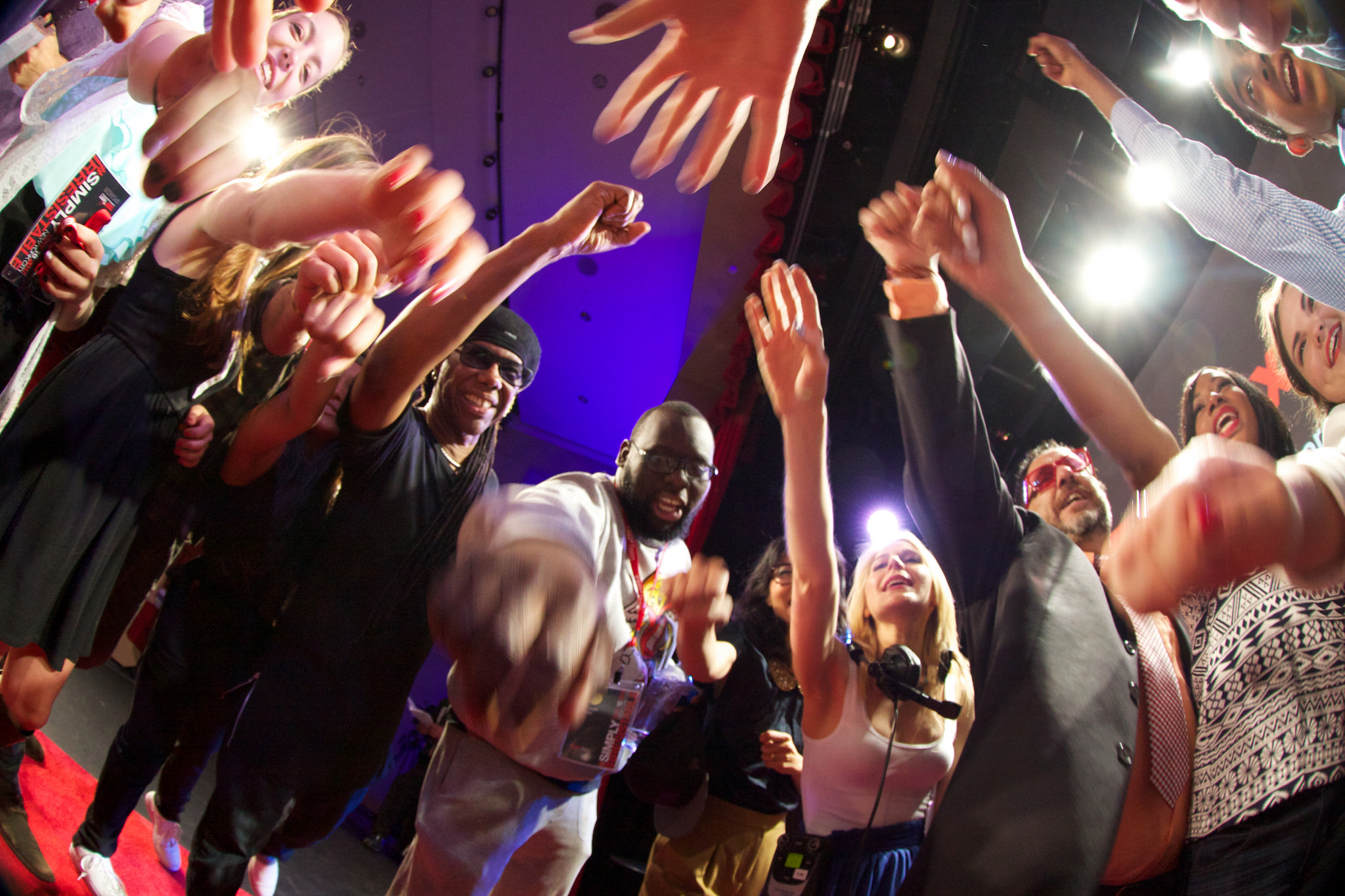
The speakers at TEDxTeen 2015 were all in their teens and early 20s. The group got pumped up to speak together before the event began. Photo: Courtesy of TEDxTeen
“If you’re a teen, you’ve been called apathetic, narcissistic and social-media obsessed,” said Taylor Trudon, the youth editor at Huffington Post. Standing tall in a crisp white blazer, the 25-year-old shared how she went from keeping a high school diary — decorated with stickers and magazine clippings of John Mayer and Uggs — to becoming the website’s curator of young voices.
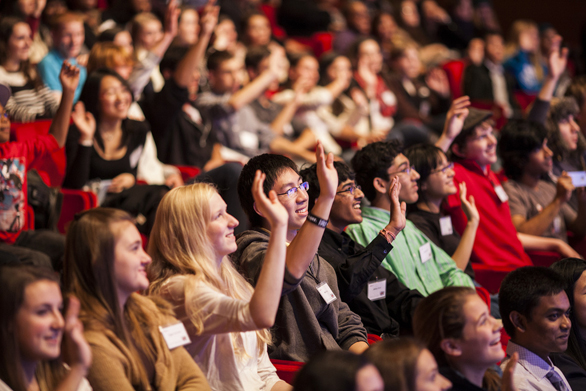
The 400 bright-eyed teenagers listening to her in the Scholastic Auditorium in New York City didn’t quite fit the stereotype of Generation Z. Each of them had sacrificed a Saturday in May to attend TEDxTeen 2015 and listen to speakers like a high schooler who created fruit fly-inspired drones, a young artist who translates sound into 3D-printed sculptures and a 20-year-old mathematician who sold an algorithm that predicts wars to the US government.
With the theme “Simply Irresistible,” this year’s TEDxTeen highlighted simple but powerful ideas from young men and women. Curated by a team of adults, the content was by youth, for youth — but there wasn’t a cut-off line at age 19. “Many speakers are in their early 20s, and started something in their teens,” said organizer Jess Teutonico. “It’s important to show progress, and that it is possible to make an impact when you are young.”
As they waited for the event to start, groups of teenagers chatted near the escalators to the theater. Once in the theater, the lights dimmed and electronic musician Thomas Uliasz approached a miniature vintage TV set in the center of the stage. This device was his TV Synth, a synthesizer connected to a wand that buzzed and pulsated as he marked a beat in the air.
As he finished his electrifying set, host Monique Coleman — whom most of the audience recognized from the High School Musical series (she’s also the UN’s first Youth Champion) — invited out the first speaker. The audience hushed as Lauren Singer, an NYU environmental studies grad, held up a Mason jar that contained every bit of trash she’s generated over the past three years.
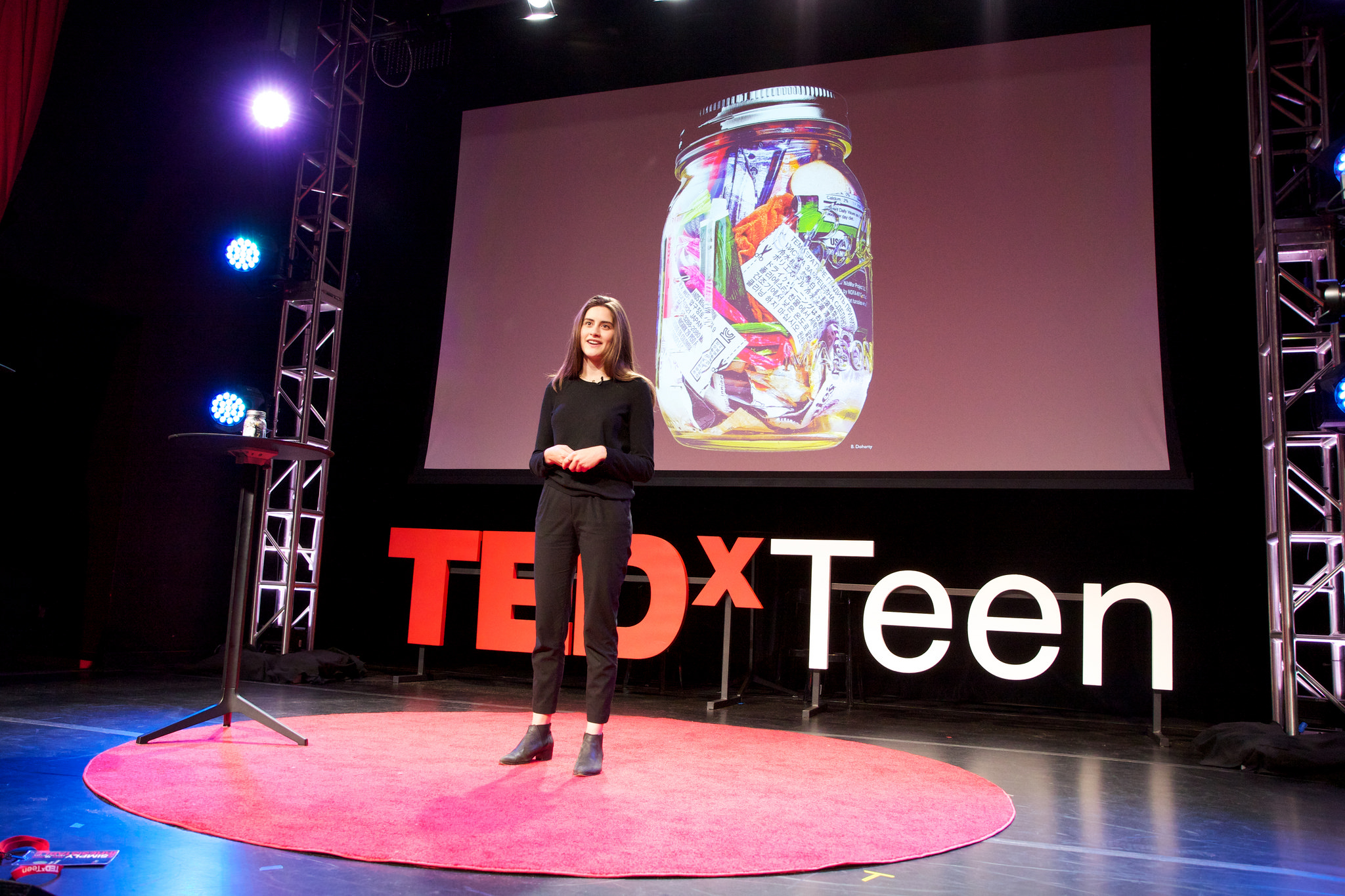
This jar contains all of the trash Lauren Singer has created for the past three years. Photo: Courtesy of TEDxTeen
Between sessions, attendees split into breakout groups on design thinking, community building and social media, as well as workshops on digital storytelling and silk-screening. Attendees could get tips from a speaker coach, and then tape a video audition to speak at next year’s TEDxTeen — a method Teutonico’s team uses to scope out future speakers.
Sisters Sydney and Sarah Walters met fellow attendee Ruchita Zaparde in a workshop called “Create and Connect.” In it, attendees talked about what they were passionate about — and how members of the group could help one another get where they wanted to be.
“The craziest thing I’ve learned today,” said Sydney, “was that you don’t have to restrict yourself to one thing and be one person. You can be a multitude of things.”
Zaparde added, “Teenagers are really powerful. Sometimes we forget that. TEDxTeen is an obvious reminder.”
Today’s TEDxTeen took a year to plan, but the first TEDxTeen event was planned in two weeks, says Teutonico. Five years later, the event has gone international. TEDxTeen held its first event in London last year. And groups in more than 150 countries now tune in to watch the event livestream.
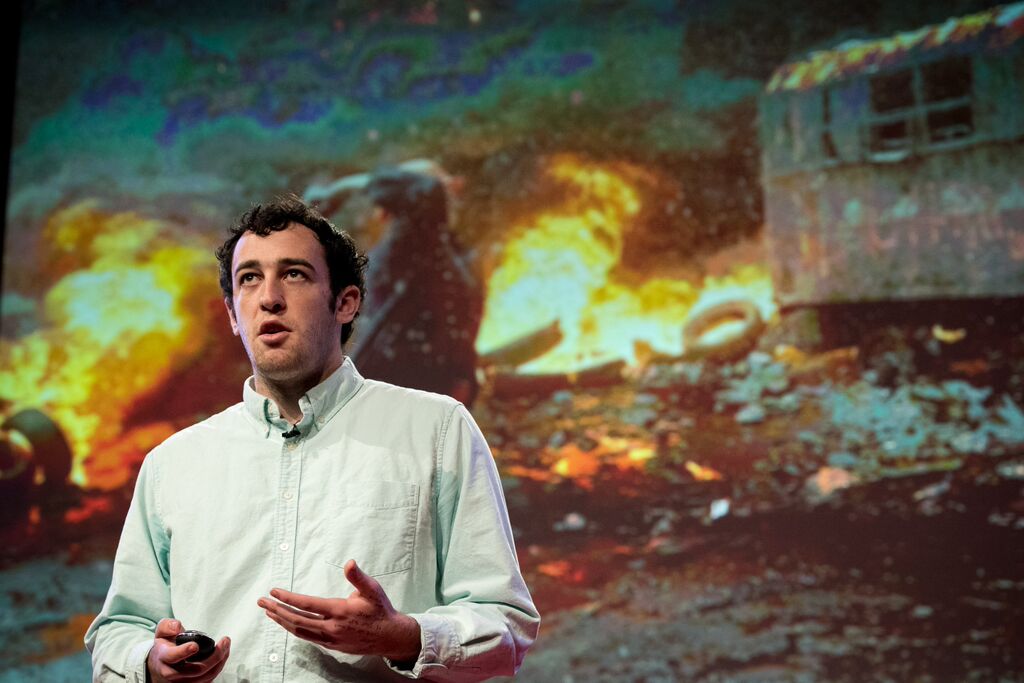
David Mace created an algorithm designed to predict wars. Photo: Courtesy of TEDxTeen
Charvi Radia, a freshman at American University, is attending her second TEDxTeen. “[People are] always like, ‘Oh you’re so young. You can’t really do anything with your life,’” she said, “But you come to conferences like these and get a whole different perspective.”
She’s impressed by the speakers’ drive. “It’s time for me to kick it up a notch,” she joked.
To launch the final session, YouTube star Alessia Cara took the stage to perform her teenage party anti-anthem “Here.” It’s a song about the girl in the corner who doesn’t fit in. “We can kick it and just listen to / some music with a message, like we usually do / We’ll discuss our big dreams, how we plan to take over the planet,” she sang. The audience erupted into a standing ovation.
By the end of the day, those who had wandered into the event alone left in groups, with social media details exchanged. A Post-it note mural by the snack area was dotted with ideas the attendees had jotted down throughout the day on white paper: birthday cards for foster children, more mentorship opportunities and comic books with diverse characters. One yellow note stood out in a sea of white: “Be different.”
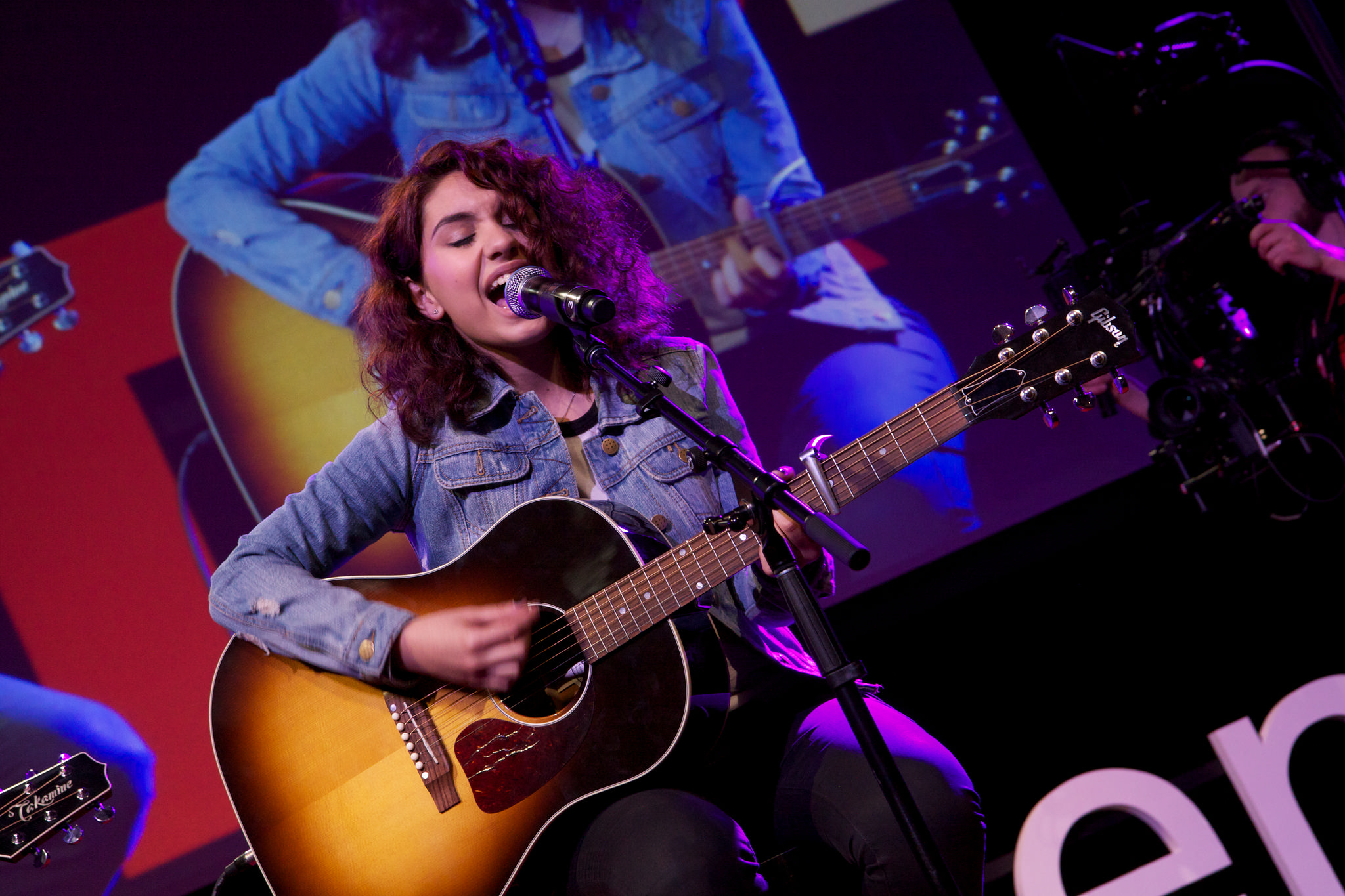
YouTube star Alessia Cara performed her song, “Here,” to great applause. Photo: Courtesy of TEDxTeen
Watch — but more important, listen — to these three inspiring perspectives on body image, beauty and bullying from teenagers in three different countries.
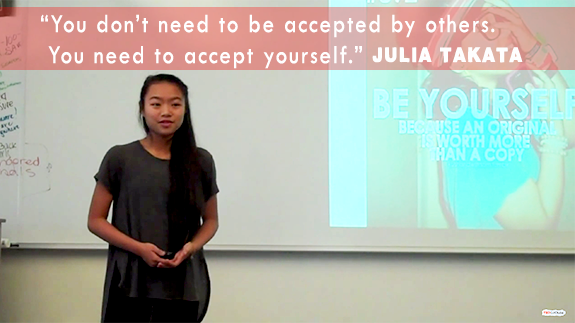
A presentation on body image: A competition with yourself
Julia Takata starts her presentation by recalling an experience she had in dance class. The short story: She started comparing herself to a classmate. “Because I was younger, I was very susceptible to what other people had to say about me. [I kept wondering], ‘How I could change myself?’” says Takata, a student in the TED-Ed Club at the Punahou Summer School in Honolulu, Hawaii. “What I didn’t realize was: I was letting someone who barely knew me tell me who I was.”
Takata sees a connection between this experience and eating disorders, which she thinks of as “your mind having a competition with your body.” “It’s a constant battle between being skinny and being well-nourished. During this battle, your body is really taking a beating,” she says. “All of this to achieve what society often portrays as beautiful.”
“But you don’t have to be skinny to be beautiful,” she says. “To be beautiful means to be yourself. You don’t need to be accepted by others. You need to accept yourself.”
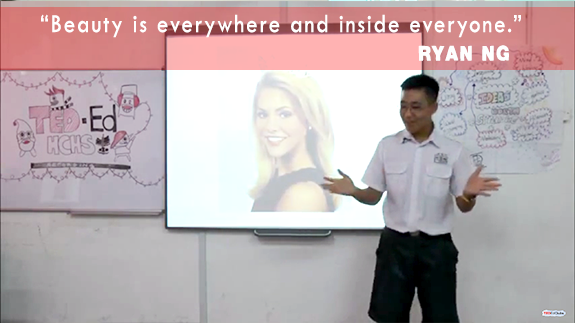
A presentation on beauty: What is it exactly?
In a presentation on the meaning of the word ”beauty,” Ryan Ng from the Han Chiang High School in Penang, Malaysia, asks a simple and honest question: “Why put so much importance and value on the way we look?”
Ng takes aim at our modern ideas of beauty, which lead people to constant self-evaluation. He shares his thoughts on plastic surgery, beauty pageants and the television show The Swan. “‘Beauty’ is one of the most overused, misunderstood, poorly defined words in the English language,” he says. “If no one can define beauty, then how can someone or something be ugly?”
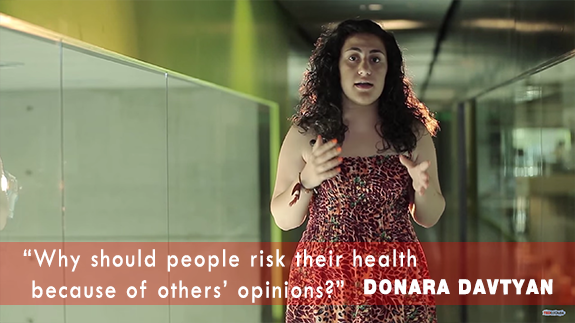
A presentation on bullying: It’s often focused on appearance
“The main reason for bullying is appearance,” says Donara Davtyan, a high school student at the Tumo Center for Creative Technologies in Yerevan, Armenia. In her TED-Ed Clubs presentation, she explores what happens when teenagers pick on each other for the way they look. “I think bullying people for their appearance is one of the most stupid and inhumane things, as one doesn’t choose how they are born,” she says.
Davtyan has experienced this herself. “My classmates say that I have a big nose, but you know what, my big nose isn’t their problem,” she says. She knows she isn’t alone — Lady Gaga has talked about being bullied for her looks, and in an informal survey of her friends, Davtyan found that about half had been bullied.
“It’s time to understand that we shouldn’t change our appearance, but our thinking and behavior,” she says. “Your nose isn’t big — you just breathe better than others.”
These three TED-Ed Club members represent a fraction of the more than 10,000 students now sharing and presenting their ideas in TED-Ed Clubs around the world. Interested in starting a TED-Ed Club at your school? Find out more.
This story originally ran on the TED-Ed Blog. More great articles:
]]>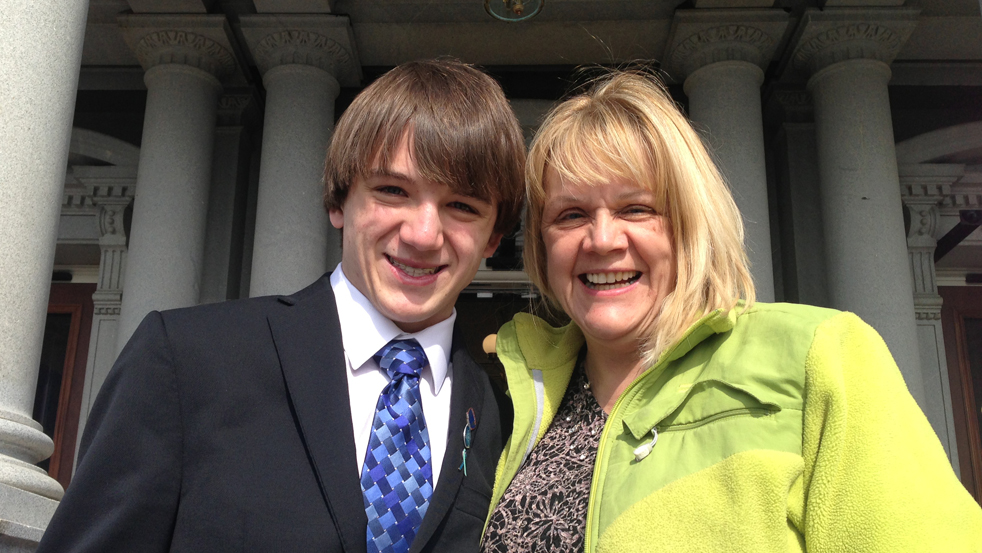
Teenage cancer innovator Jack Andraka stands proudly with his mom, Jane Andraka. In this Q&A, Jane shares how she encouraged her sons to be resilient in the face of rejection. Photo: Courtesy of the Andrakas
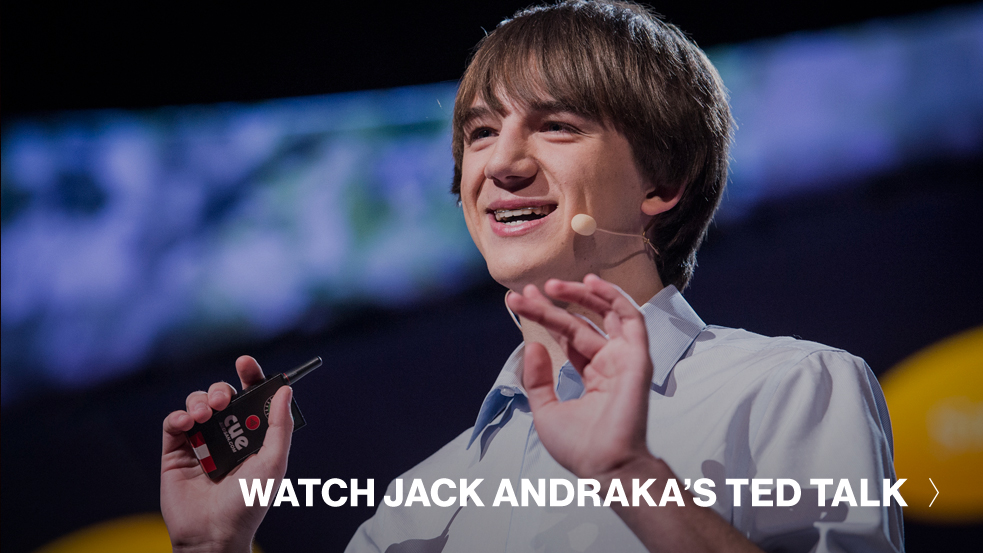
Jane Andraka has raised two remarkable sons. Luke, age 20, is studying electrical engineering at Virginia Tech. “He was always tinkering and taking things apart — wondering how they worked, wondering how they could be made better. He had ideas coming out of his brain like a firehose,” she says. Meanwhile, Jack, age 18, is a teen innovator and scientist who gained international attention when, three years ago, he created a promising method of early cancer detection. In a talk at TED2013 that’s been viewed nearly 4 million times, Jack Andraka shared the story behind the four-cent strip of paper that appears to be 400 times more sensitive in detecting pancreatic cancer than the previous standard — and that could work for ovarian and lung cancer too.
On the heels of the release of Jack’s memoir, Breakthrough: How One Teen Innovator is Changing the World, we spoke to Jane about raising two inspiring children — and how she’s doing it with dignity and a sense of humor.
You gave a talk at TEDxQUT about hijacking your kids’ education. What does that mean, exactly?
I saw all these kids who had made themselves into little hoop-jumpers. All of a sudden, for seniors in high school in October, it’s, “Oh, jeez, I need to join some clubs and get my grades up, and then I’ll go to Harvard.” And then whining, “Well, I got all ‘A’s, and I joined Model U.N.” But that’s just not what it’s about. You have to make your own self remarkable. Make them say, “Wow, this couldn’t be any other child.” Don’t be like everybody else.
How did you encourage creative thinking in your household?
I beat my head against the wall for years because I wanted to develop creative and resilient kids who were going to fulfill their own potential and not just be able to fill in [standardized test] bubble marks. But you can’t make a cat bark. I can’t make schools change, no matter how much I advocate and complain. So I gave up on that and said, “You know what? I’m not going to change that. I send them to school, they do whatever they’re going to do, and it’s not very challenging and it doesn’t promote creativity. And then when they get out of school, it’s time for parents to shine.”
How, specifically?
By trying to guide them to a place where they can excel and find some measure of success. It really drives me crazy when parents say, “I just want them to be happy.” I want more than that. Sometimes being happy can be just laying around, but real happiness comes from fulfilling what you were meant to do. Struggling and succeeding. That’s a much cooler idea.
You talk about how it’s important to take initiative to hunt for opportunities for your kids. What did you do along those lines?
Jack says, “With the Internet, anything is possible.” Well, yeah — and he learned that from me. I would go online and Google programs like the Johns Hopkins Center for Talented Youth or science competitions. You ask yourself, “What is my child interested in? What are they good at? What’s this program or this book? What are they reading? What are they thinking about?” That will help inform your decisions. You might say to them, “There’s this wonderful international science competition; let’s learn more about it.” Then there’s validation — they can see that there are other kids like them out there. It would be the same if your kid were into sports or music — you get on the Internet and look, look, look, and see what other people are doing. See if your kid would fit into any of those molds.
What if a child doesn’t have a passion?
Kids don’t [really] know what they like, and so that’s your job [as a parent], to expose them to as much as you can. It doesn’t have to cost a lot of money. You can take them to the library and see what books they pull out. See what kind of skills they have. Your job as a parent is not to say, “Tell me what you want to be when you grow up.” Instead, if you just try everything and are super attentive — not in a helicopter-y, my-child’s-a special-snowflake way — you can be aware of what they gravitate to, and encourage them to do more of it. See if that light still shines in their eyes. Pay attention to what sparks them.
“Pay attention” is a powerful phrase. It’s easy to be in the same room with your kids and be multitasking or on your phone. I’m guilty of that, though I’m making a conscious effort not to do so.
It doesn’t have to be that you’ve got a semi-psychotic laser eye on them, or treat everything they say as if it’s pearls of wisdom. But when your child is sitting there thinking and goes, “Mom!” — you know, in that voice — it’s not about going to Toys ‘R’ Us and getting SpongeBob. It’s a question.
You encouraged your sons to keep “idea books.” Tell me about that.
It was all Luke’s fault. He generated so many ideas that he was making himself anxious. Was he ever going to be able to accomplish these ideas? Was he even going to be able to remember all these ideas? And I said, “Here is a dollar journal. Why don’t you just start writing.” He would sketch and then go, “But I don’t know how to do that.” And I’d say, “That’s fine. Get the idea down and then, as you learn more, you can reflect back.”
What do you think of Jack being called the “Edison of our times” by his mentor, Johns Hopkins pathologist and pancreatic cancer researcher Anirban Maitra?
I think Dr. Maitra a patient and wonderful man who has a soft spot for kids and giving them a chance. Those are very kind words; any parent would like to hear them. But when you go to science fairs and hear kids talking about their projects — I just have such optimism about the world. There are so many kids out there who are innovating, and they just need a chance to be heard and to learn how to communicate better. That’s the big thing that Dr. Maitra was picking up — Jack doesn’t mind putting in a lot of time. He’s very persistent, he’s very resilient, and he can communicate. He has that personality that people want to hear more about, just like Edison with his crazy hair.
How did you feel when you first read Jack’s book, which covers, among other things, overcoming depression and homophobic bullying?
It was very painful. I was surprised by the depth of his depression. You send your child off to school, they come back, they’re moody, and you don’t know that he ate his lunch in the bathroom or that teachers were telling him that he was going to be a failure. You have no idea that he’s so lonely. You just think, “You’re 14 — of course you’re a disaster. Go to school.” I feel really bad about that. But kids are like oysters when they’re 11, 12, 13. The more you try to dig their feelings out, the more they’ll clamp down. You can’t beat yourself up too much.
Jack had to reflect on really personal things for the book, and I was concerned that it would stir up bad memories. He had to relive some of those experiences. But it was more like lancing the abscess — getting it out and realizing that you’re going to be okay.
The cool thing is that he’s getting emails from folks now who are like, “I was going to kill myself, I was feeling like there was no hope,” or “I was ashamed that I was gay and that nobody would like me, but I listened to you talk, and so I told my my parents.” That makes him feel much better about sharing his story.
Is it true that Jack got 200 “nos” from scientists regarding his cancer detection system?
Yes. He got a lot of “nos.” But that was the best thing ever because we’d talk about how he needed to have a snappy [email] subject line. I’d say, “Make me care, because I’m old and I’m tired.” You have to make me care quickly, or I will move on.
Do you feel like you’ve raised teenage geniuses?
No, I hate those labels. I am just raising kids who have the tools to realize their own potential and to make their own way in the world and be competitive in this ferocious, ever-changing world.
At the end of the day, how would you describe yourself as a mom?
I’m hands-on but hands-off. I have a vision of the final results, but I’m willing to follow their lead on how to get there. I believe in their potential. That’s the kind of parent I am. I’m not satisfied until I see them working toward it.
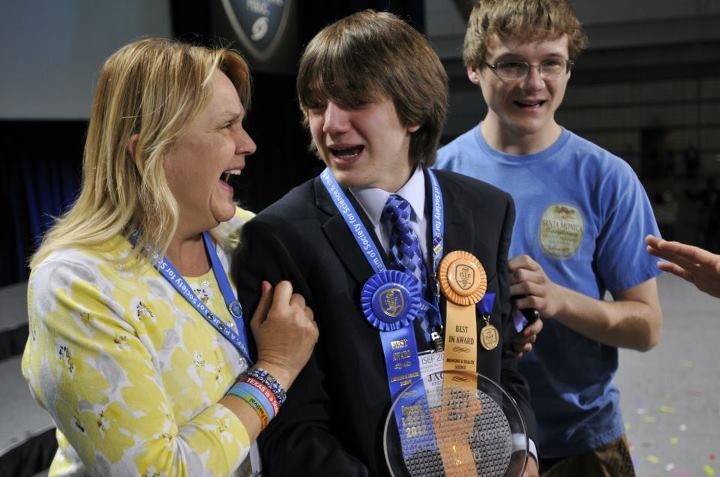
Jane (left) congratulates Jack (center) on his win at The Intel International Science and Engineering Fair. Photo: Courtesy of the Andrakas
 The speakers at TEDYouth 2014 are a fascinating group, ranging from a paleontologist to a teenage chef. But the middle and high school students who’ll attend are just as interesting.
To apply for this annual conference — which brings together students for a no-cost day of mind-blowing TED Talks — attendees are asked to share a piece of creative writing, to make a video, to snap some photographs or to showcase another skill of their choosing. Every year, we’re amazed by the wildly imaginative applications we receive.
TEDYouth 2014, themed “Worlds Imagined,” took place on Saturday, November 15, at the Brooklyn Museum in New York. Below, just a few of the submissions from this year’s attendees.
In this video, the “Fed Heads” — a group composed of high schoolers Alexis Cirrotti, Julia MacDonald, Julia Vallone, Jugdip Khokher and Jessica Heine — adorably share why they want to go to TEDYouth, based on what they’ve learned from TED Talks so far.
The “Vita Lights” — aka Nebill Salih, Michael Harris, Matthew Chung and Arif Mahmud — told us about an impressive project they worked on together.
“As a team, our mission is to provide an energy-efficient, cost-effective surgical lamp for third world countries so that when a blackout occurs, medical procedures can be continued. In just a couple of weeks we were able to design, get funding and build a prototype. After hearing about TEDYouth, we thought it would be a great idea to learn from successful scientists and entrepreneurs … It would allow us to further develop our product.”
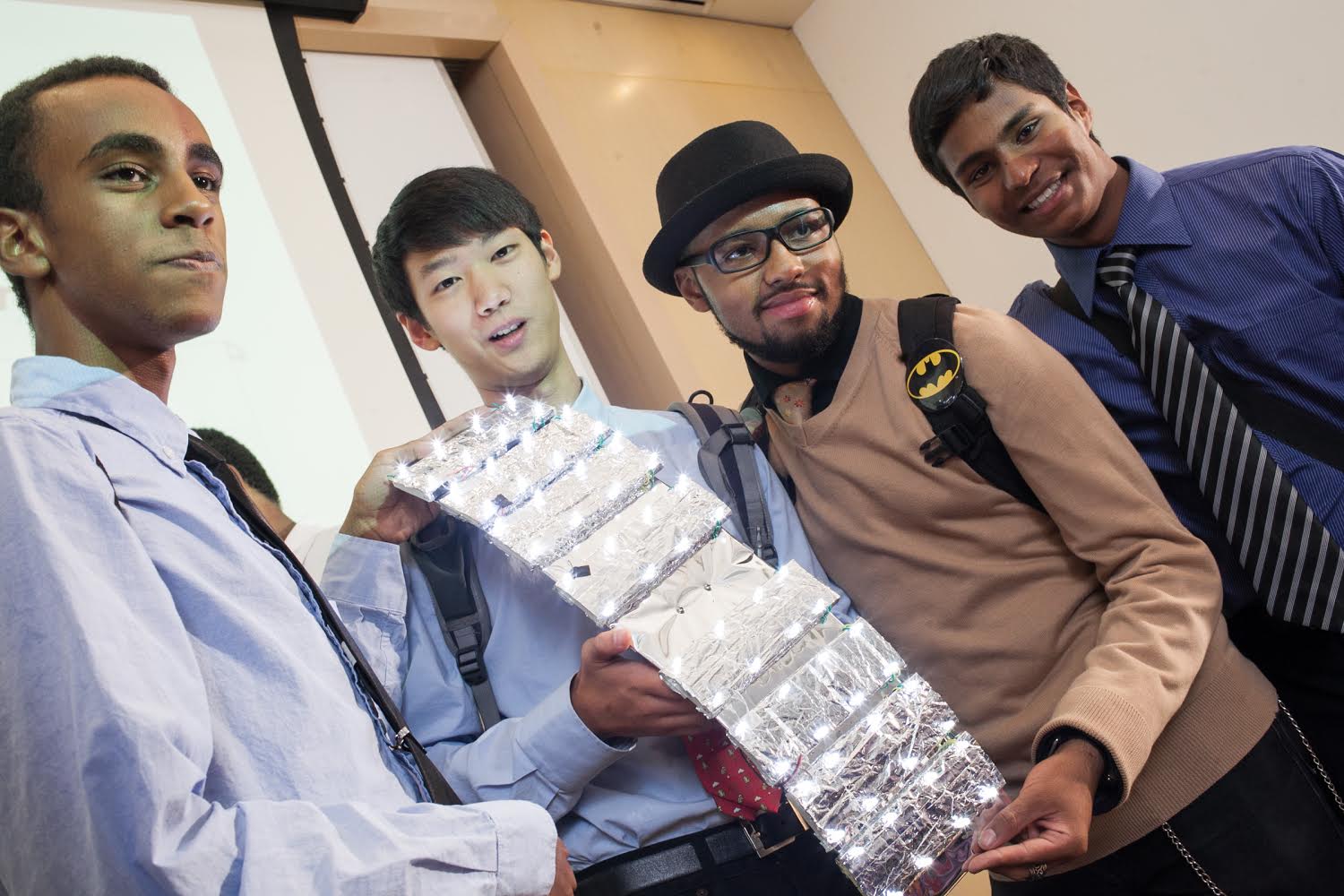
This group of teens wants to attend TEDYouth to fuel deeper their thinking on their surgical lamp for third world countries. Photo: Timothy Lee Photographers
Genevieve Pierre Charles wrote a poem about how she hopes attending TEDYouth will help open her mind to new career options:
I want to be
Somebody.
I want to do
Something.
But I don’t know
What to choose.
I am
A song
Never written
A story
Never told
A play
Never performed
The stones that I step on
Lead me to nowhere.
I don’t know what to do,
How will I choose?
Sophia Cotter, Renata Francesco, Myung Jin Kang, Kiana Luscher and Alexandra Meyers call themselves the “TED’s Angels.” For their application, they made the following video, which features each of them giving a short TED-style talk.
And the “Science Research Squad” — aka Samuel Roth, Henry Jaensch, Armand Pappas and Olivia Shaw — coded their application essay. They write:
</!DOCTYPE html> <title>TEDX Youth Conference</title> <html> <head> <meta http-equiv=”content-type” content=”text/html;charset=utf-8″ /> </head> <style> body { background-color:black; } h1 { color:#00FFFF;text-align:center;font:Verdana;font-variant:small-caps; } p { color:#00FFFF;text-align:left;font:Verdana;font-variant:small-caps;font-size:16pt;text-indent: 50px; } h2 { color:#00FFFF;text-align:left;font:Verdana;font-variant:small-caps;font-size:16pt;font-weight: normal; } </style> <body> <h1>TEDX Youth Conference</h1> <h2>Dear TEDYouth,</h2><br> <p> The application suggested that we come up with a clever and creative way to present our value to your conference and our desire to be here. Some of the medium suggested were classic essay writing, poetry, and even through film. When all of us sat and looked at the application, we knew we wanted to stand out. Then someone suggested “code.” … We wanted to present to you our story written in another language. And if you accept us into your conference, we would be happy to teach you what we know. <br> </p> </p> </body> </html>
Finally, middle schoolers Elizabeth Goldstein, Jordan Sihaga and Sheila Hahn shared this amazing Lego animation.
]]>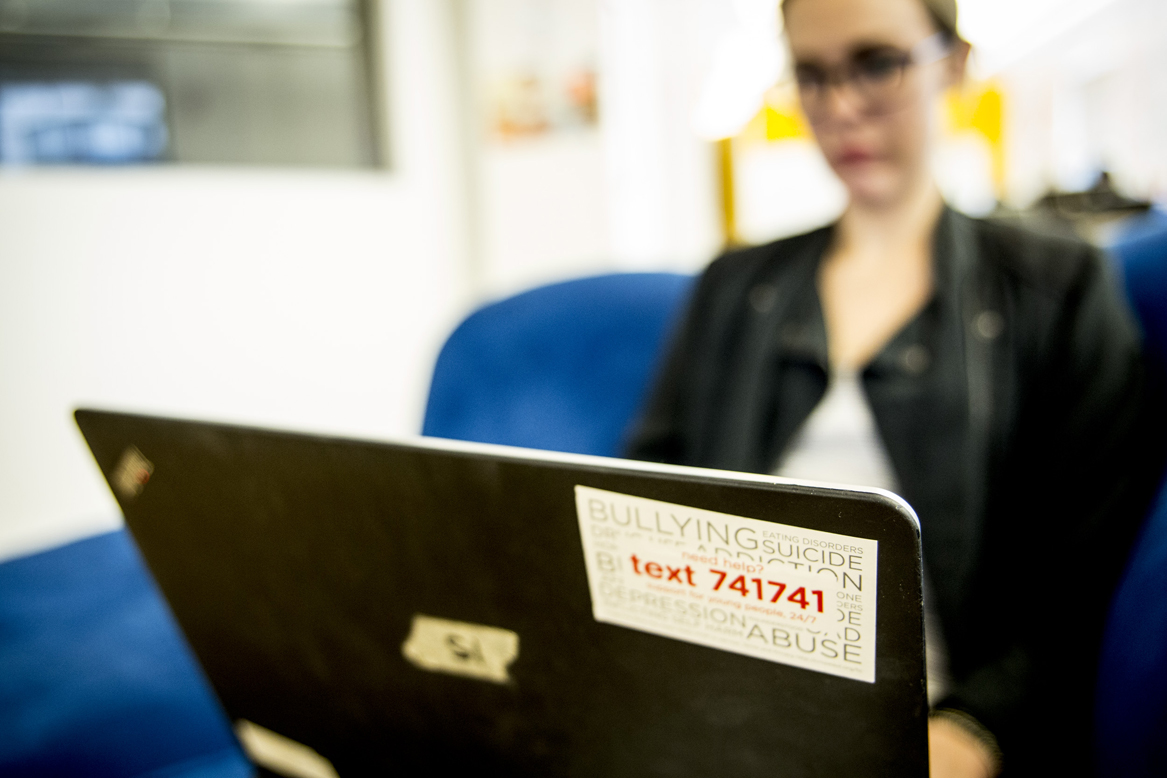
Specialists at Crisis Text Line chat with teenagers in distress through a web platform. This month, the service will respond to its 2 millionth message. Photo: Keri Goff
Teenagers love to text—their thumbs pound out an average of 3,339 texts per month. Crisis Text Line turns this into a way to help teens through their hardest times: family issues, stress or suicidal thoughts. Trained counselors text back and forth with advice and resources—and, in the process, collect (anonymous) data that could lead to better policy to protect teens.
Crisis Text Line gets 11,000 messages from teenagers in distress a day—the service will respond to its 2 millionth message this month. And founder Nancy Lublin says the service simply wouldn’t exist if she hadn’t been asked to give a TED Talk about it.
Lublin met TED curator Chris Anderson in December 2011, and told him something she’d noticed while working with teens at DoSomething.org: They’re shockingly honest via text message. She wondered out loud if a Crisis Text Line might be more effective than traditional crisis hotlines.
Anderson was intrigued, and asked Lublin to talk about it at TED University, a special TED session where audience members are invited to give short talks. Lublin said yes, but there was a problem: Crisis Text Line was only an idea. To give a talk on it, she’d need to figure out exactly what it could be.
So she started researching. Lublin came across some other crisis-response services that used text messaging, but many of them were using it for a single issue, often suicide prevention. She felt that much could be improved in the breadth of service offered, and in the user experience for counselors.
“Giving that TED U talk forced me to organize my thoughts coherently,” says Lublin now, two years after stepping onto the TED stage. “It made my crystallize what it is and what it isn’t … There were so many things that I wanted to explain about the logistics, about the ‘how’ it would work, and at the end of the day, that’s not as interesting about the ‘why’ it would work. I tried to explain the ‘why’ so it would make sense, and make it more relatable to everybody in the audience.”
In the talk, Lublin does a beautiful job of that, sharing her vision for how texting could save lives by getting teens help in the moment and by gathering real-life data on their issues. As she finished her talk, she got a standing ovation.
“I had so many people come up to me and say, ‘My daughter is anorexic and needs this,’ or tell me about a bullying situation. All of them said, ‘The primary way that I communicate with my child is text,’” says Lublin. “It affirmed that there was a real need for this.”
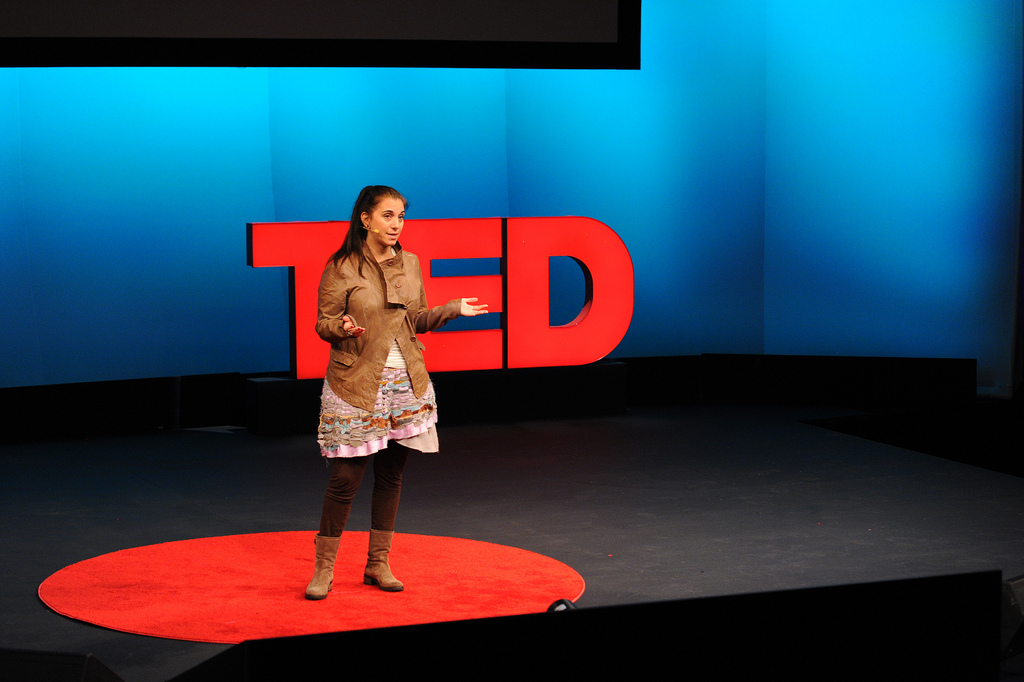
Nancy Lublin clarifies the idea behind Crisis Text Line at TED U in 2012. Photo: James Duncan Davidson
Invigorated by the response to her vision, she started writing a plan for the Crisis Text Line, then raising the money to start it.
“It was really hard to raise the money,” she says now. “It took much longer than it should’ve for something that’s this clear and obvious.” The talk helped on this front. “It gave legitimacy—it was such a stamp of approval. I don’t think it actually led to money, but it definitely opened doors.”
Eighteen months after giving her talk, Lublin made the first two hires for the Crisis Text Line: a chief technology officer and a data scientist. Rather than setting them up in an office, Lublin sent them out to visit crisis call centers around the country. There, they watched how counselors responded to calls and took note of the problems and hangups in the systems they were using. It helped the two design a new system for counseling via text message.
“The user interface for counselors is really friendly and clean,” says Lublin. “The counselors have had a terrific response. They’re like, ‘This is exactly what I’ve been wishing for.’ Because we sent our geeks on the road.”
The Crisis Text Line went live on August 1, 2013. When a teenager texts the service, the message gets pinged to a certified counselor who sees it onscreen. From there, the counselor texts back and forth to get more information and offer resources. The average conversation runs for 66 minutes.
And if a specialist needs to go on a bathroom break, or simply feels they don’t have the experience to respond to a particular problem, they can ask for backup without disrupting the conversation by transferring the call.
“Two counselors—it might be someone in Miami and someone in Seattle—can look at the same thread on the screen from the texter and, in the pop-up, talk about how best to respond to this person,” Lublin says. “From the user’s perspective, they haven’t been passed off to anybody — they’re still just talking to Crisis Text Line. But from the counselor’s perspective, the counselor has been supported.”
In her talk, Lublin outlines why the Crisis Text line could be so vital—beyond helping teens one-on-one, it can provide data with implications for parents, teachers, school administrators, even policy makers. The Crisis Text Line plans to open up its data in June. (You can look at a sample set now.)
“In real time, you’ll be able to look up any area code, any time of day, any day of the week, any issue and see what’s going on. Some of the learnings have already been kind of mind-blowing,” says Lublin.
For example, Crisis Text Line data reveals that teens struggle much more with eating disorders on Sunday night and Monday than at any other point during the week.
“Think about what that data does for a school. It changes how school guidance counselors can watch kids at risk; how the school food vendors should plan meals for Monday; how teachers should watch kids; how families should watch kids; how the local intake center should staff up,” says Lublin. “That one piece of information can inform so many people. It changes so many things.”
Another data point revealed an unexpected patterns for cutting and self-harm. It doesn’t just happen at night—teens are doing it during school hours. “That changes how people think about it. Like maybe [a school] shouldn’t have a separate staff and student bathroom. Maybe having the staff use the same bathroom as students is a better idea,” says Lublin.
Bob Filbin, Crisis Text Line’s chief data scientist, says the organization just closed its first data visualization contest to help make this information more understandable. “Opening up the data could inform academic research, public policy and community efforts to improve outcomes for teens in crisis,” he agrees.
“And we can also use data internally to improve our service.” Data could give Crisis Text Line specialists the power to predict what’s going on with the teens they’re texting. Late this fall, the service will launch a tool to help counselors identify patterns they might not notice on their own.
“A little pop-up will say to the counselor, ‘This texter has used these six words. There’s a 90% match with alcohol abuse. You might want to ask one of these questions,’” Lublin says. “It’ll mean we won’t miss issues—we’ll catch imminent harm situations even more quickly.”
As Lublin points out, crisis call centers have been around for decades—they’ve shown great success and developed processes about when to interact with police, EMTs and other authorities. The Crisis Text Line is a chance to use these proven methods with a new technology, one that teenagers are comfortable with — and that offers new ways to support staff specialists, who are doing emotionally difficult work.
Speaking of staff, Lublin says her TED Talk helped on this front too. The talk has helped her recruit top talent, and brought in board members and volunteers who are passionate about helping teens. For adults, “It’s often the first introduction,” says Lublin.
Teenagers, on the other hand, are much more likely to hear about the service in other ways. When the Crisis Text Line launched in Chicago, and El Paso, Lublin met with local school officials and community members to let them know it was available. They also sent a text message out to teens in the areas who were in DoSomething’s database. From there, news of the service spread by word-of-mouth. “Kids know other kids,” says Lublin.
The talk has spread interest to other countries—the Crisis Text Line has gotten inquiries about extending the service to Turkey, France, the U.K., Canada and South Africa. “We’ve been talking to one major global carrier,” says Lublin. “Right now, for this year, it’s expand the service in the U.S. and roll out the data. Then in 2015, the plan is to roll it out around the world.”
But for now, Lublin and her team keep their heads down, responding to texts.
“We’ve got so much to do—we feel like we’re only at the beginning,” says Lublin. “There’s so many more kids that we could be helping.”

Two Crisis Text Line specialists consult on a text chain. It was very important to Lublin that counselors feel supported. Photo: Keri Goff
Do you have a story of how a TED Talk has led to tangible change? Email kate (at) ted (dot) com to tell her about it.
]]>
When Brittany Wenger was a sophomore in high school, her cousin was diagnosed with breast cancer. She saw firsthand how the disease strikes a woman and her family, and she wanted to help. While some of us might offer to bake a casserole or lend a listening ear, Brittany went the extra mile: She created a breast cancer test that could someday help millions of women catch the disease early.
Brittany, now a freshman at Duke, is an enthusiastic, articulate young woman who is so well versed in the science she studies that it can be tough to follow her rapid technical explanations. She may still be a teenager, but she’s been conducting impressive research for years. As early as the seventh grade, Wenger was experimenting with advanced computer science and artificial intelligence programs. (She of course taught herself to code.)
From those early experiments, Wenger has gone on to write computer programs that improve the accuracy of tests for breast cancer and leukemia (below, she explains how they work). Her work has been honored by the Intel Science Talent Search, the Google Science Fair, and the Intel International Science and Engineering Fair, and she was just named one of Time Magazine’s 30 under 30. Wenger’s breast cancer test, which has its own app, is now in beta tests with two cancer research centers.
We chatted with Wenger about her first computer program, her impressive research, and some recent words of encouragement from President Barack Obama. Below is an edited version of our conversation.
My first question: When did you first get excited about computer programming? Here’s Brittany —
I had to write a final term paper on any aspect of the future, so I decided that I would write about technologies of the future. I Googled things that may happen fifty, a hundred years from now, and I came across the concept of artificial intelligence. I was just enamored by it. I went home, I bought a coding textbook, and started teaching myself how to code.
What was your first program?
An artificial intelligence program that learned to play soccer. I worked on that for three years.
And were you successful? Did the program learn how to play soccer?
Yeah, and it won about 95 percent of its games.
How do you teach a computer to play the game?
Basically, the program would look up scenarios that it had been in before. So there are x number of players in front of me; I am this far away from a corresponding player; I have the ball; I don’t have the ball. And based on [that information], it would come up with the best response in that situation.
So it was learning as you ran it?
Yeah. Exactly. It was really funny! At first, they played like 4-year-olds. They couldn’t do anything. They would just stand there the whole time.
At what point did you decide to apply your interests in artificial intelligence and computer science to breast cancer?
When my cousin got breast cancer, she was telling me about how difficult the diagnostic process was. I researched and found out about fine needle aspirates, which are the least invasive, quickest and cheapest [diagnostic] procedures that a woman can have. Right now, they’re wildly inconclusive, so a lot of doctors refuse to use them. Only about five hospitals in the United States still use the procedure. I was really interested in trying to revive them, and when I found out that the major problem was how difficult the patterns were for pathologists to diagnose, I wanted to create a tool to aid the doctors.
I have to admit, I’m still a bit mystified about how this breast cancer detector works. Can you break it down for me?
Based on cell morphology, which is how the cells look, the program will look for patterns and try to determine whether a person has cancer or not. For example, multi-layered cells are an indicator that a person may have cancer. It’s a little more complicated than that, though, because masses will exhibit both characteristics of non-cancerous masses and cancerous masses, even though clearly one mass can only be cancer or not cancer.
And does the detector work for all different types of breast cancer?
Right now, the detector is meant to be an initial screening mechanism—it’s trying to go through and determine whether the cells are cancerous or not. If it returns a diagnosis that the cells are cancerous, further testing would be required to determine the specific type.
So it can’t necessarily tell the difference between a fast-growing malignant tumor versus a slow one. This is a step before that.
Exactly. But the program would have the capacity to do that if I had data. For example, I extended the program to work with genetic expression programming and leukemia diagnostics. For that, I actually go through and identify which subtype of leukemia a person had, and then I’m able to infer how aggressive the cancer would be.
What’s happened since you created the breast cancer program?
So much. I think one of the most exciting things that’s happened is doctors have really started taking my research seriously. I’m beta-testing the breast cancer program with two hospitals, which has been incredible. I also got to go to the White House Science Fair and explain my research to President Obama!
What did he say to you?
He had an intense look of concentration on his face, showing me he really cared about [my research], and he said something along the lines of that he was really proud of me. This is the President of the country saying that, so I was really taken aback. I’ll always really treasure those words. And this was also the first election I got to vote in, so I think it made it even more special.
There’s so much talk about the lack of women in science. What has your experience been as a young woman in science?
I’ve always felt empowered to pursue [science]. I had a lot of strong female role models. For example, my computer science teacher in high school was a woman. I was really lucky to grow up in that sort of environment.
Do you have any advice for inventors or entrepreneurs, especially young scientists?
If you find your passion, just follow it and have the persistence to stick through it. I mean, for me, the breast cancer program failed completely two times before it succeeded. But what’s great about science is that you learn a lot from those experiments. They can really help you move forward.
This article is part of a series on young voices, exploring the spirit and wisdom of youth. Read the full series here.
]]>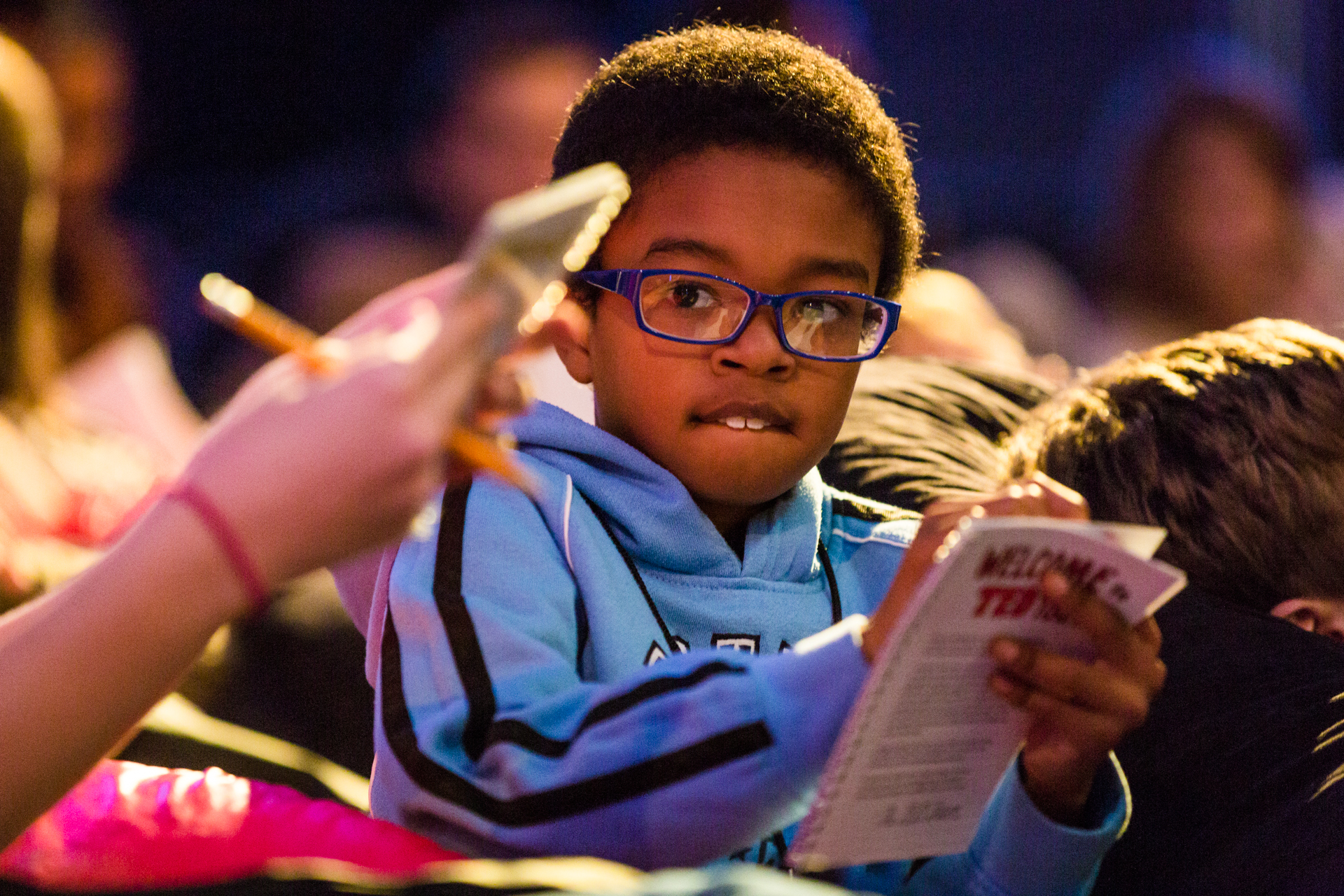
A TEDYouth attendee on the edge of his beanbag chair. Photo: Ryan Lash
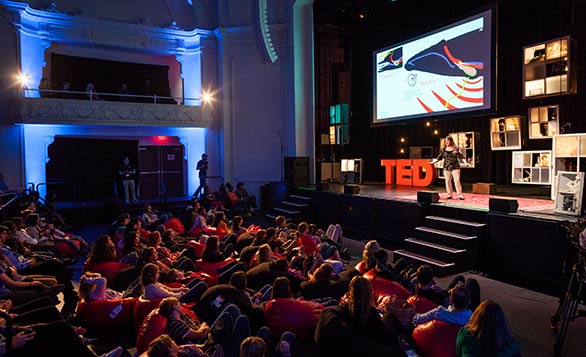
TEDYouth 2013 was a blast. In session 1, Suzanne Simard taught us about the familial relationships of trees. In session 2, Maya Penn shared how she launched a business at 8 years old. And in session 3, Ashton Kutcher thrilled the crowd with a surprise talk on what it means to be a “magnificent failure.” Throughout it all, the 400 middle and high school students in attendance clapped, cheered, absorbed knowledge and shared a lot of their own.
Here, some incredible photos from TEDYouth. Half of them were taken by TED photographer Ryan Lash, while the other half were snapped by an intrepid group of youth volunteers, who brought a wonderfully unique eye to documenting the event.
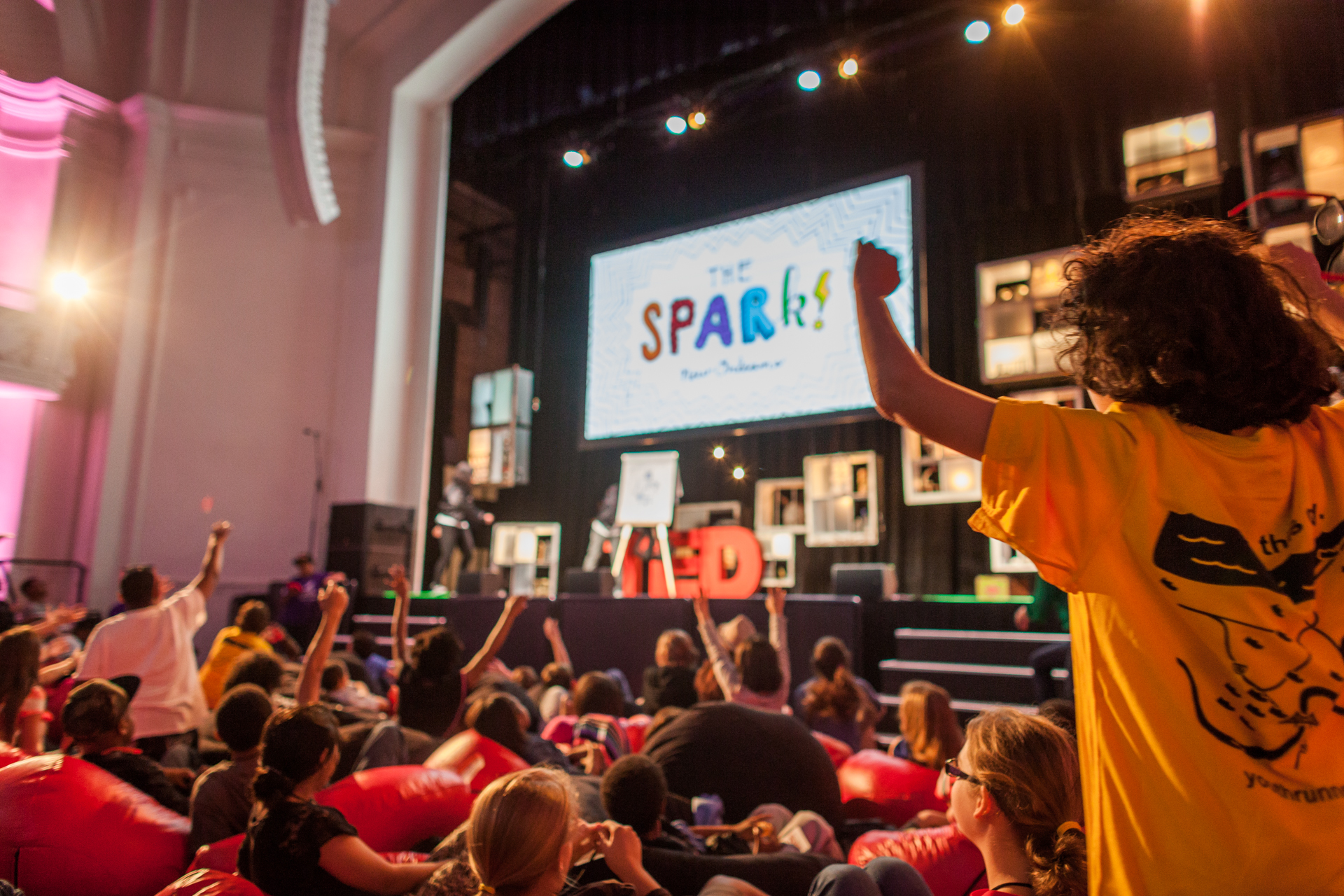
The audience at TEDYouth often jumped to their feet. Oh, and kids got to take beanbag chairs home with them after the event. Photo: Ryan Lash
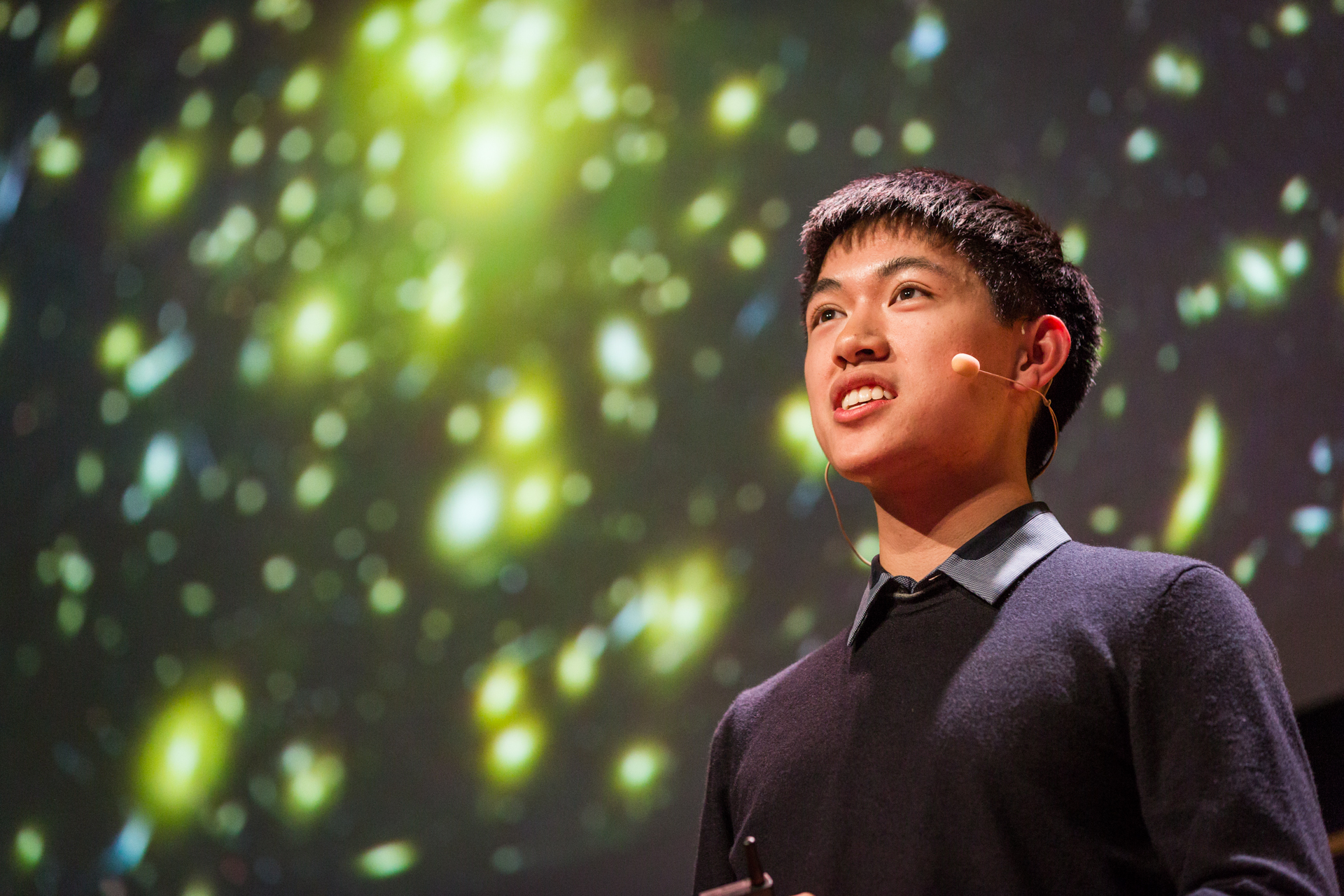
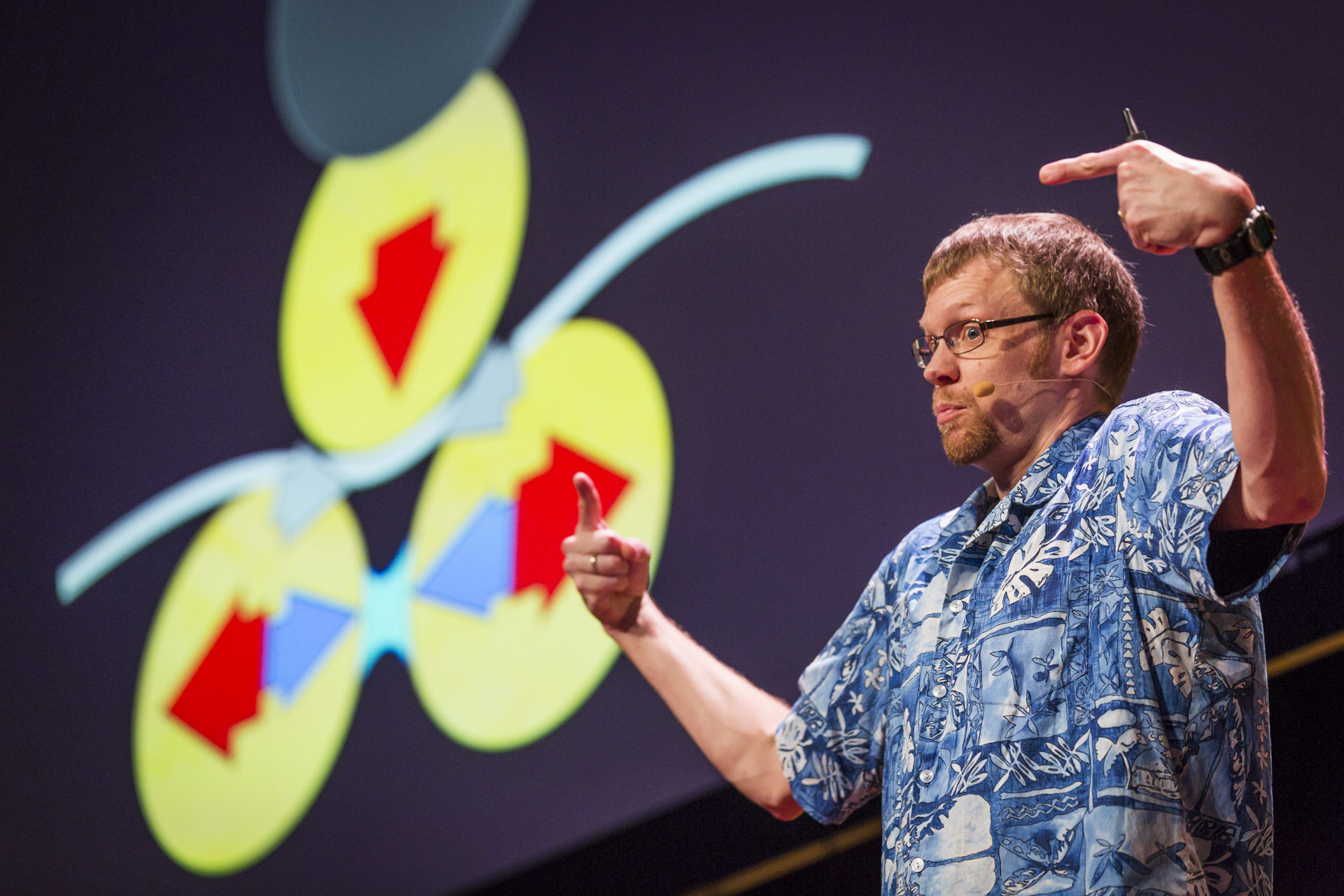
Henry Lin, who won this year’s Intel Science Fair for his models of galaxy clusters, delivers the message: “Science is a rough draft. There is so much that baffles us and challenges our understanding.” Photo: Ryan Lash
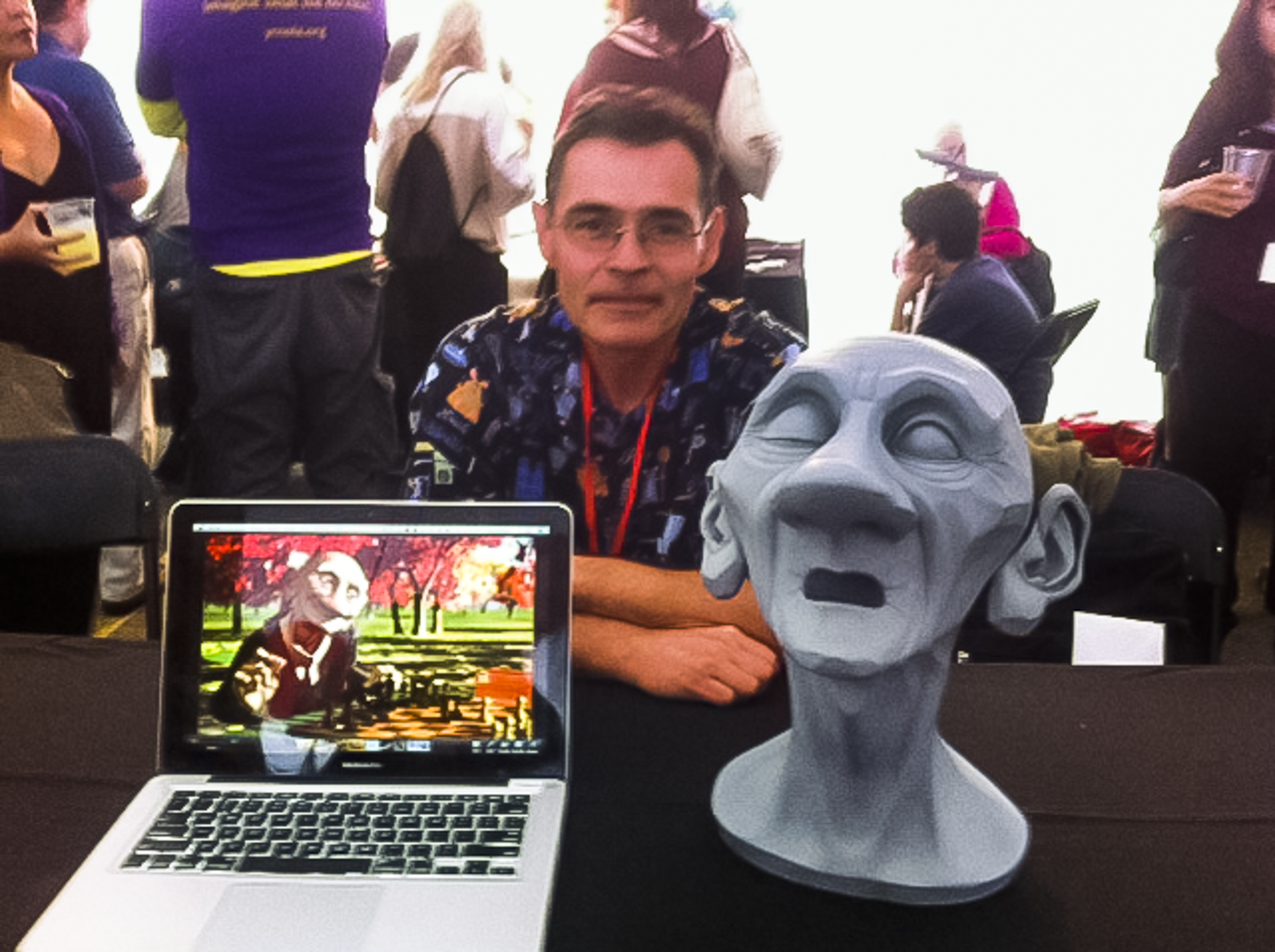
Attendee Sevanah Howard shot this image of Tony DeRose, Senior Scientist at Pixar Animation Studios. She explains, “He designed this really cool model of the old man playing chess. It was amazing to see what he could do with animation.” Photo: Sevanah Howard
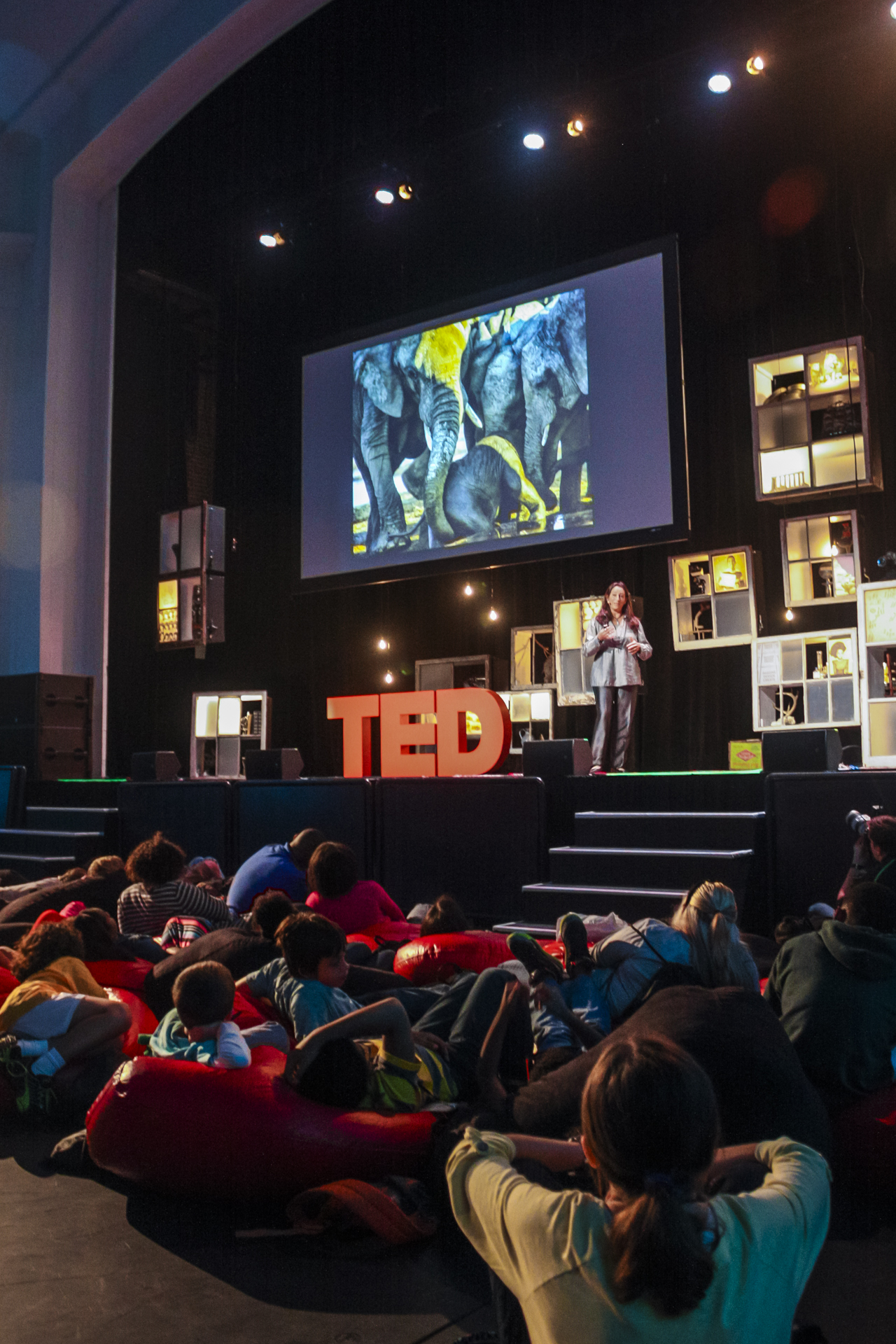
Attendee Sarah Grammar snapped this photo of the TEDYouth audience, enrapt in a talk by Caitlin O’Connell-Rodwell, who studies the ways elephant communicate and form family bonds. Photo: Sarah Grammar
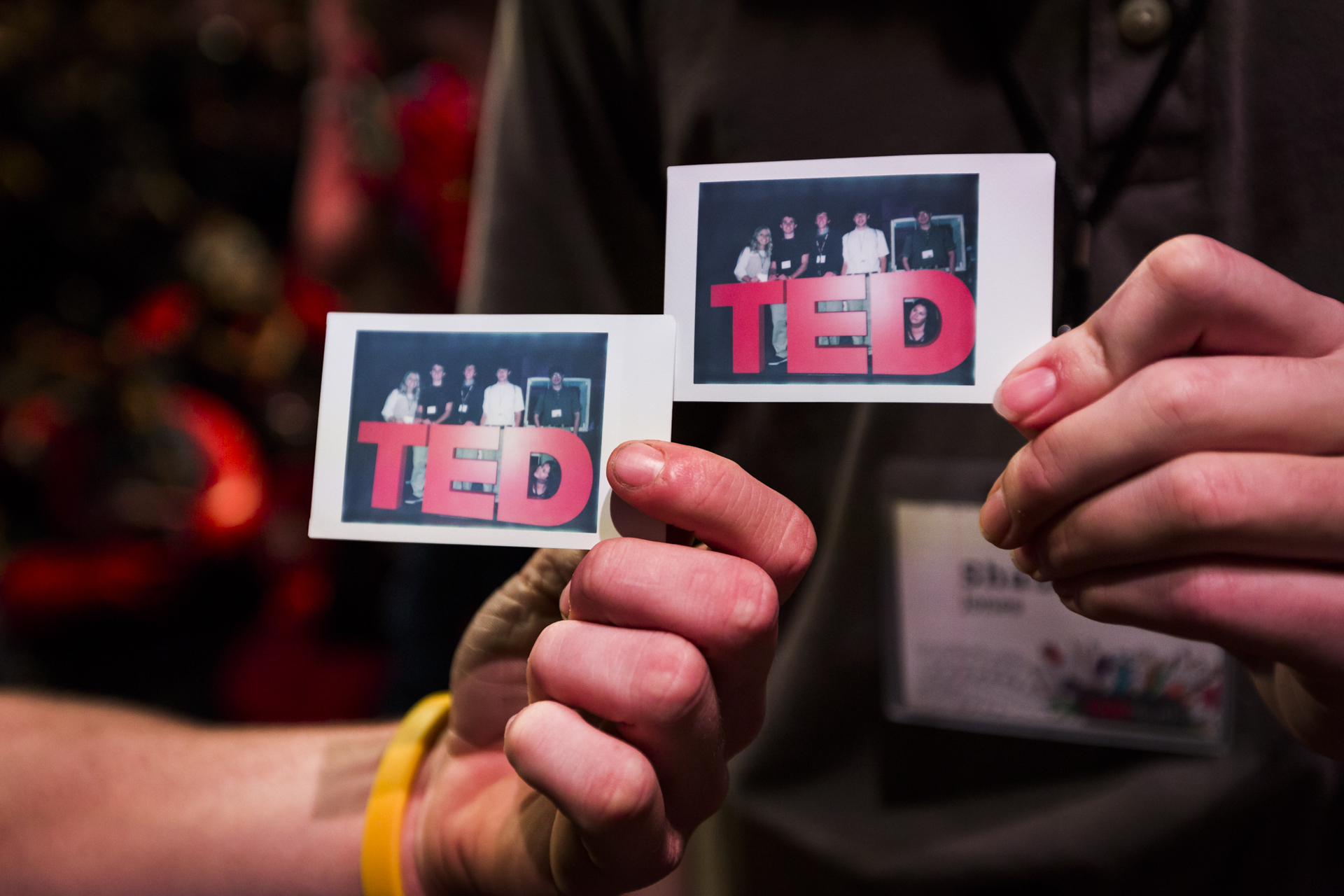
During breaks, kids and teens at TEDYouth got to snap photos of themselves with the TED logo. Photo: Ryan Lash
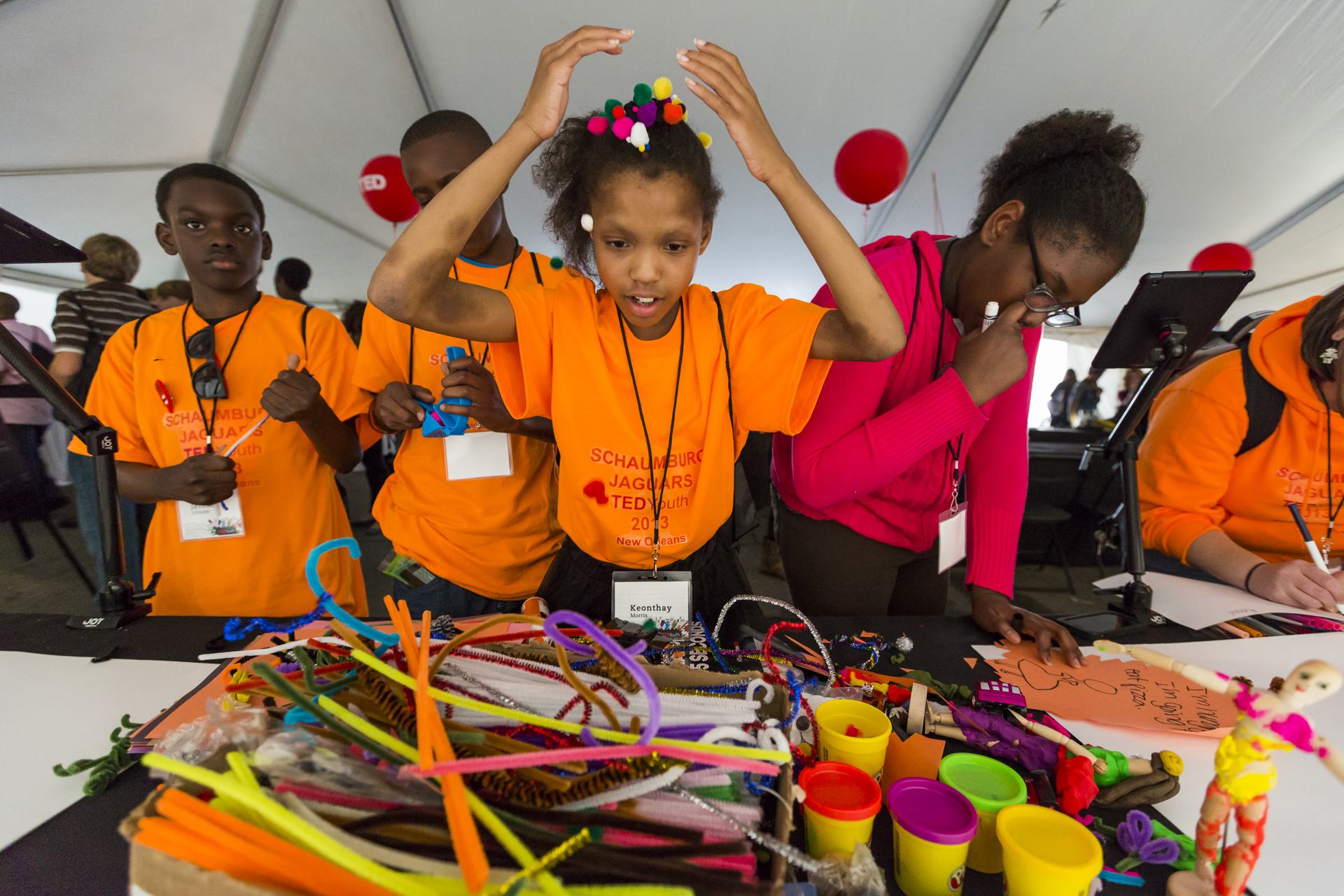
Booths around the event challenged attendees to use their creativity and make something. Photo: Ryan Lash
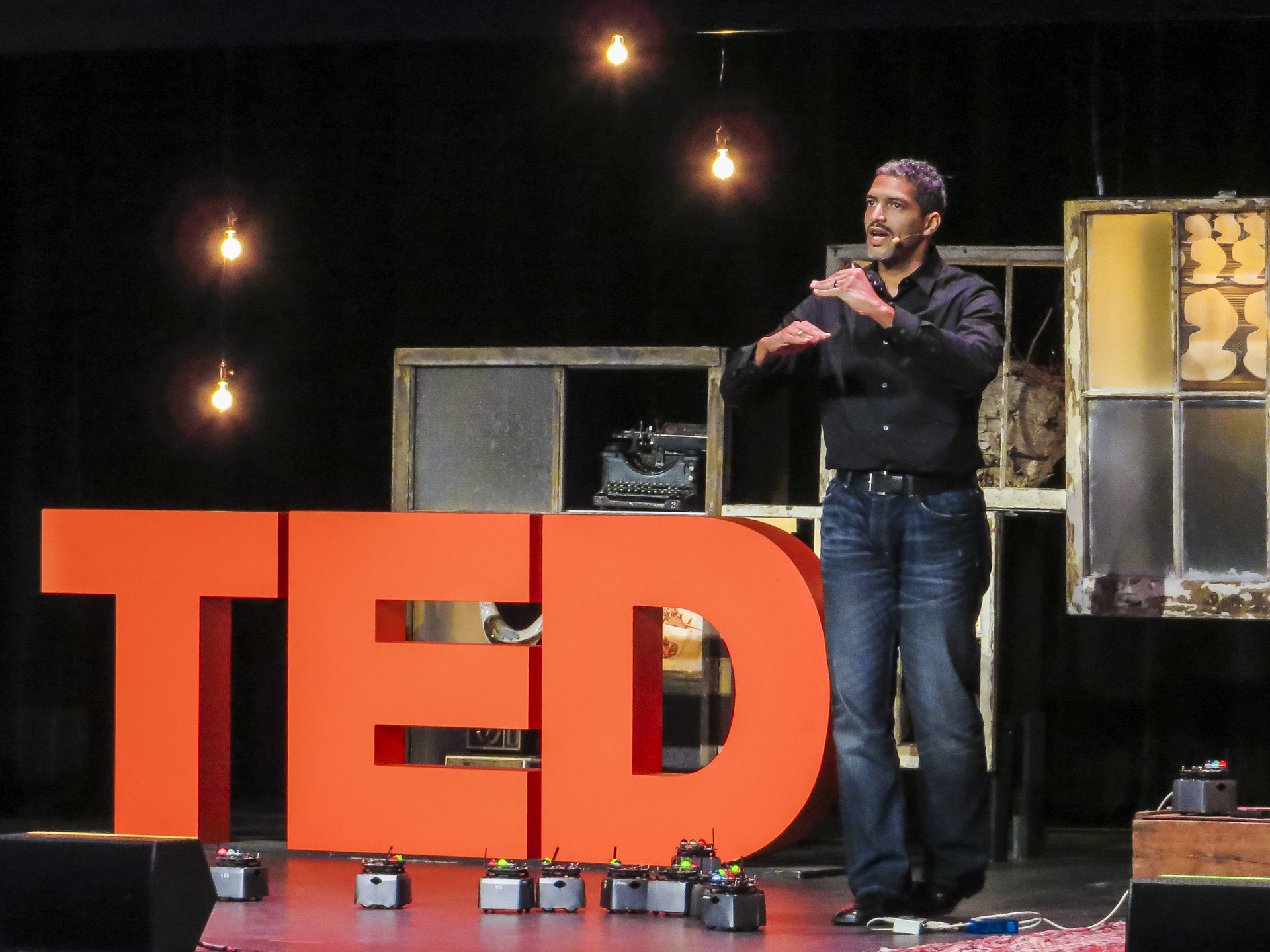
Attendee Sophie Fuselier was highly amused by James McLurkin, whose swarm of tiny robots demonstrated how they communicate to form a straight line. Photo: Sophie Fuselier
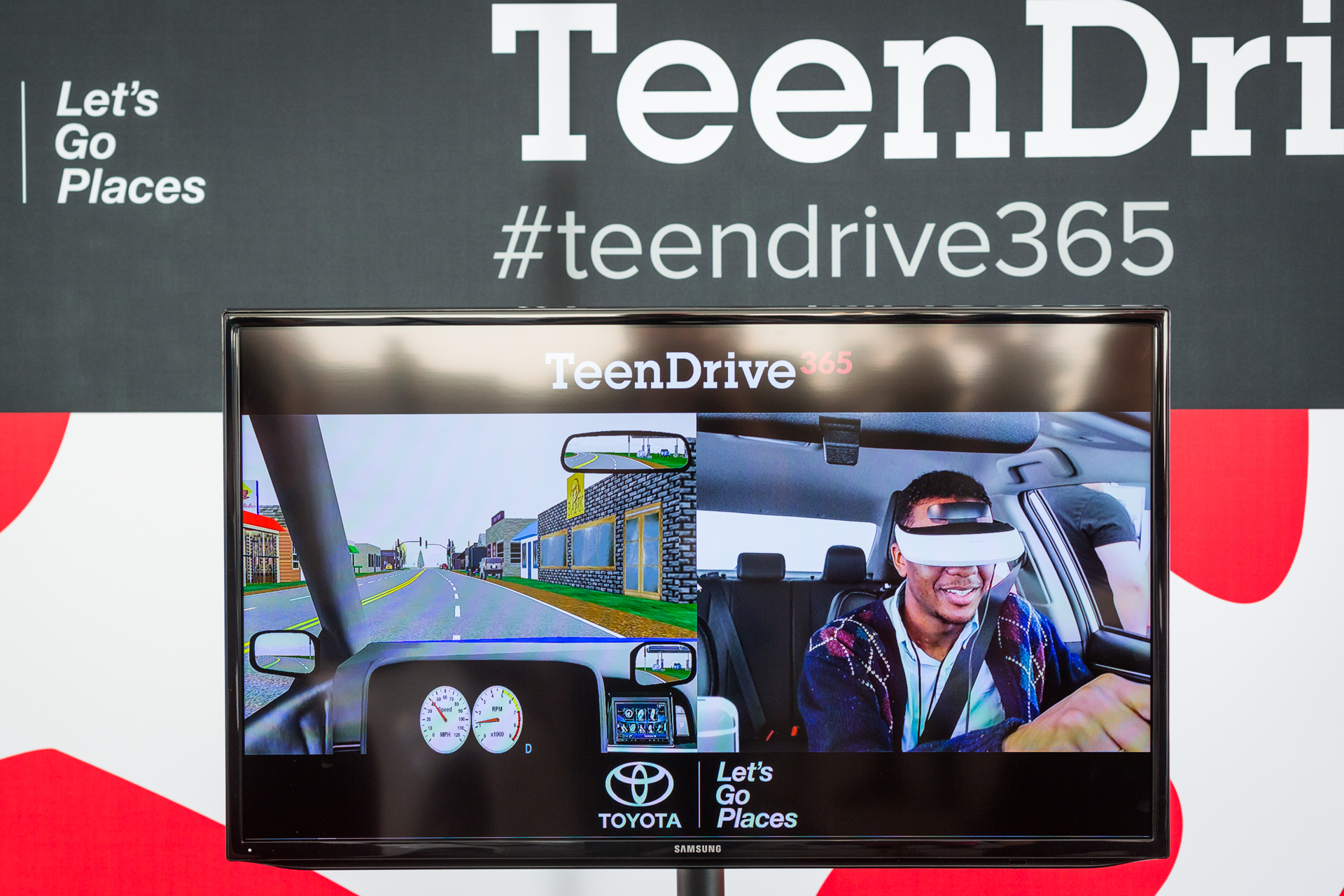
Toyota was on the scene of TEDYouth, with a distracted driving simulator that underscored just how much of a driver’s attention is zapped by reaching for something in the backseat or sending a text message. Photo: Ryan Lash
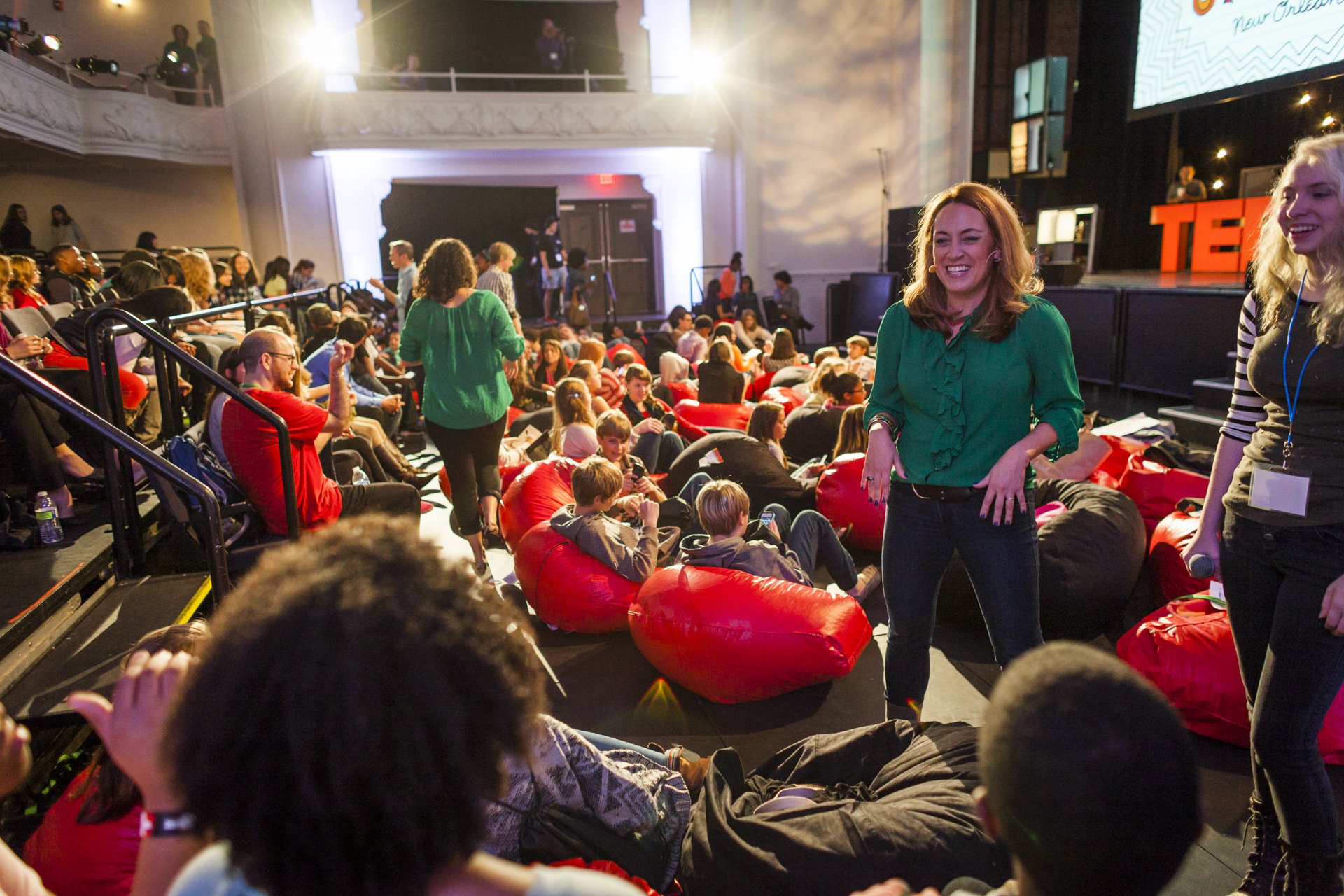
TEDYouth co-host Kelly Stoetzel talks to a group of kids. Photo: Ryan Lash
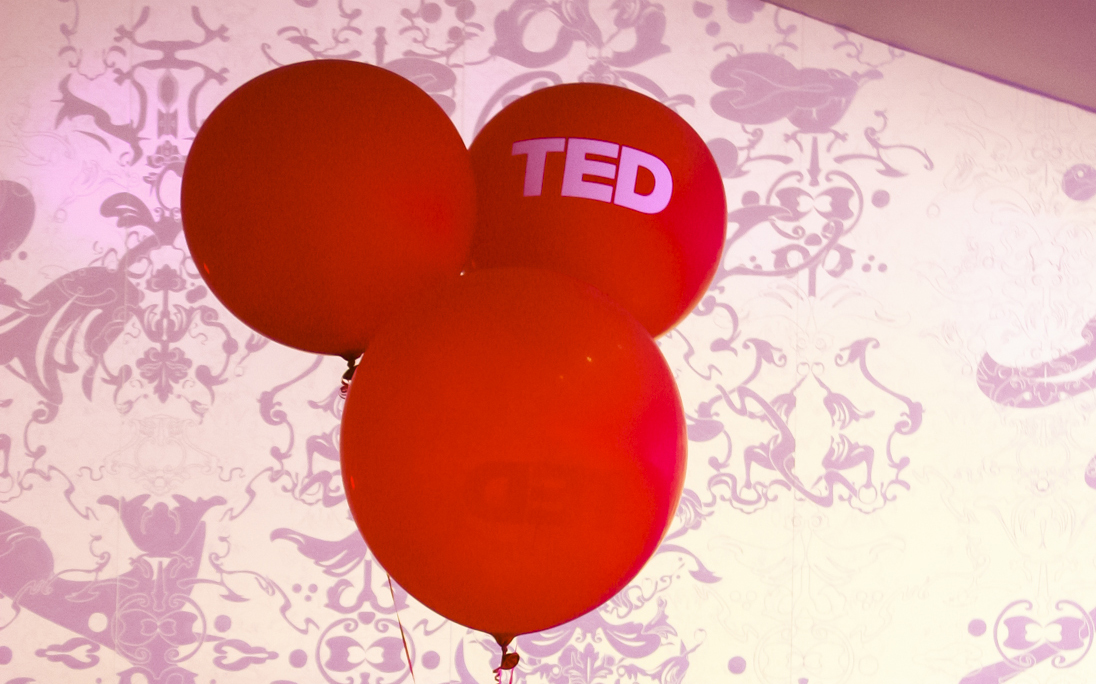
Appearing throughout the Civic Theater in New Orleans—big, red, TED balloons. Photo: Sarah Grammar
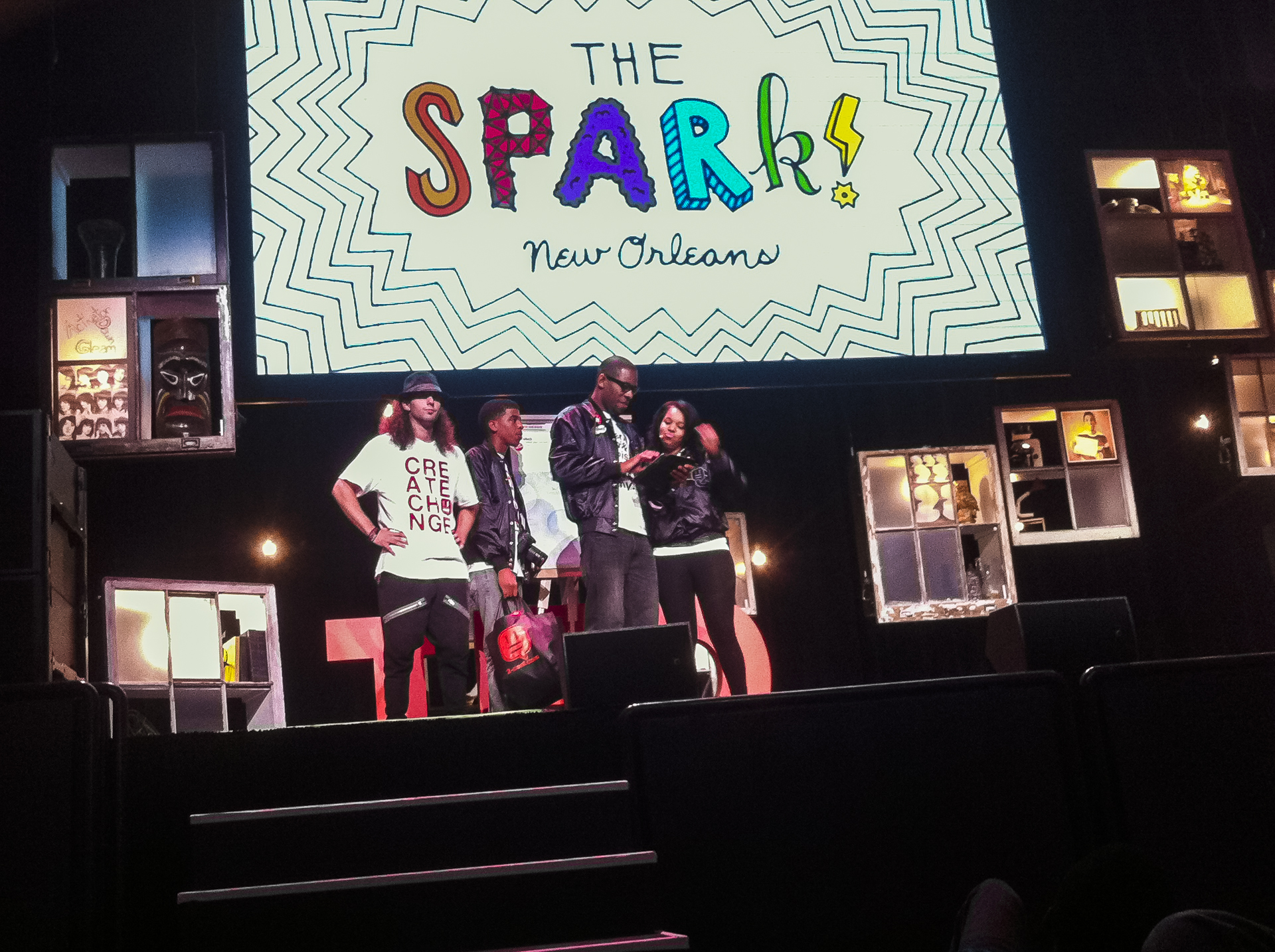
One of the moments that most electrified the audience—a talk from Brandon Odums, who founded New Orleans’ 2-Cent Entertainment. Photo: Sevanah Howard
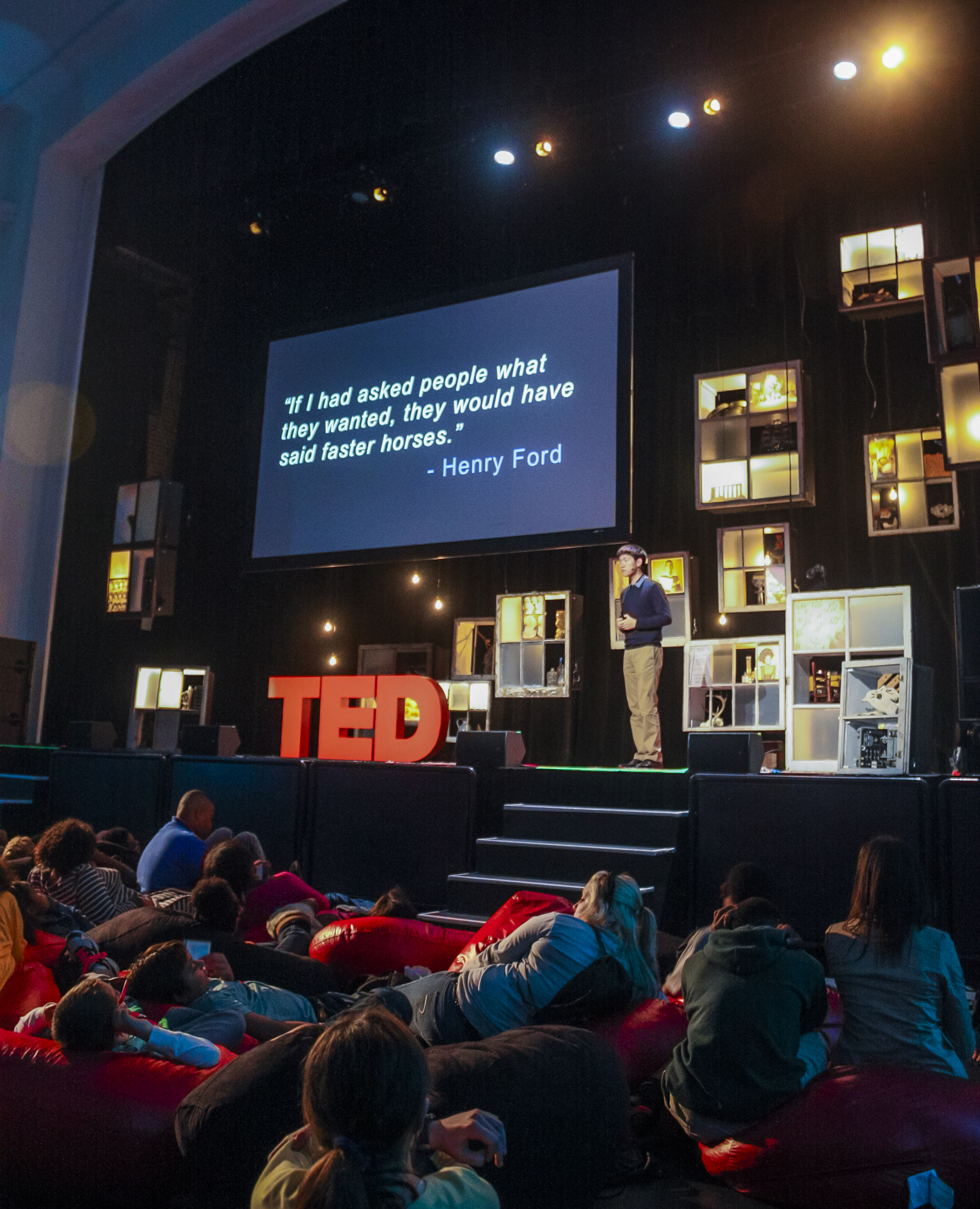
Henry Lin looks to Henry Ford for an explanation of why we need to continue the study of space, even if it doesn’t make sense to everyone. Photo: Sarah Grammar
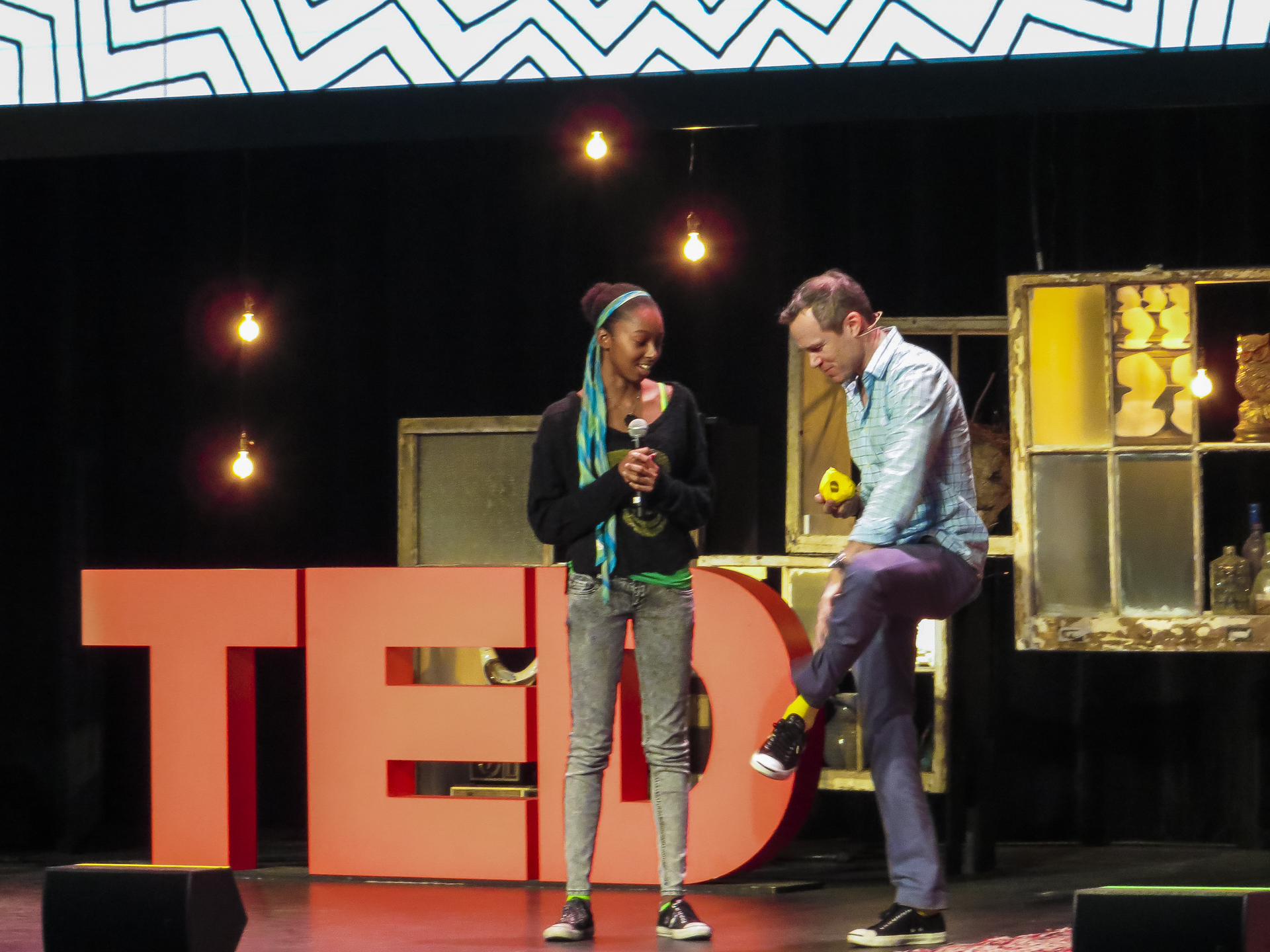
TEDYouth co-host Rives shows off his socks. Photo: Sophie Fuselier
Matt Kuchta’s big idea: build with sand. Photo: Ryan Lash
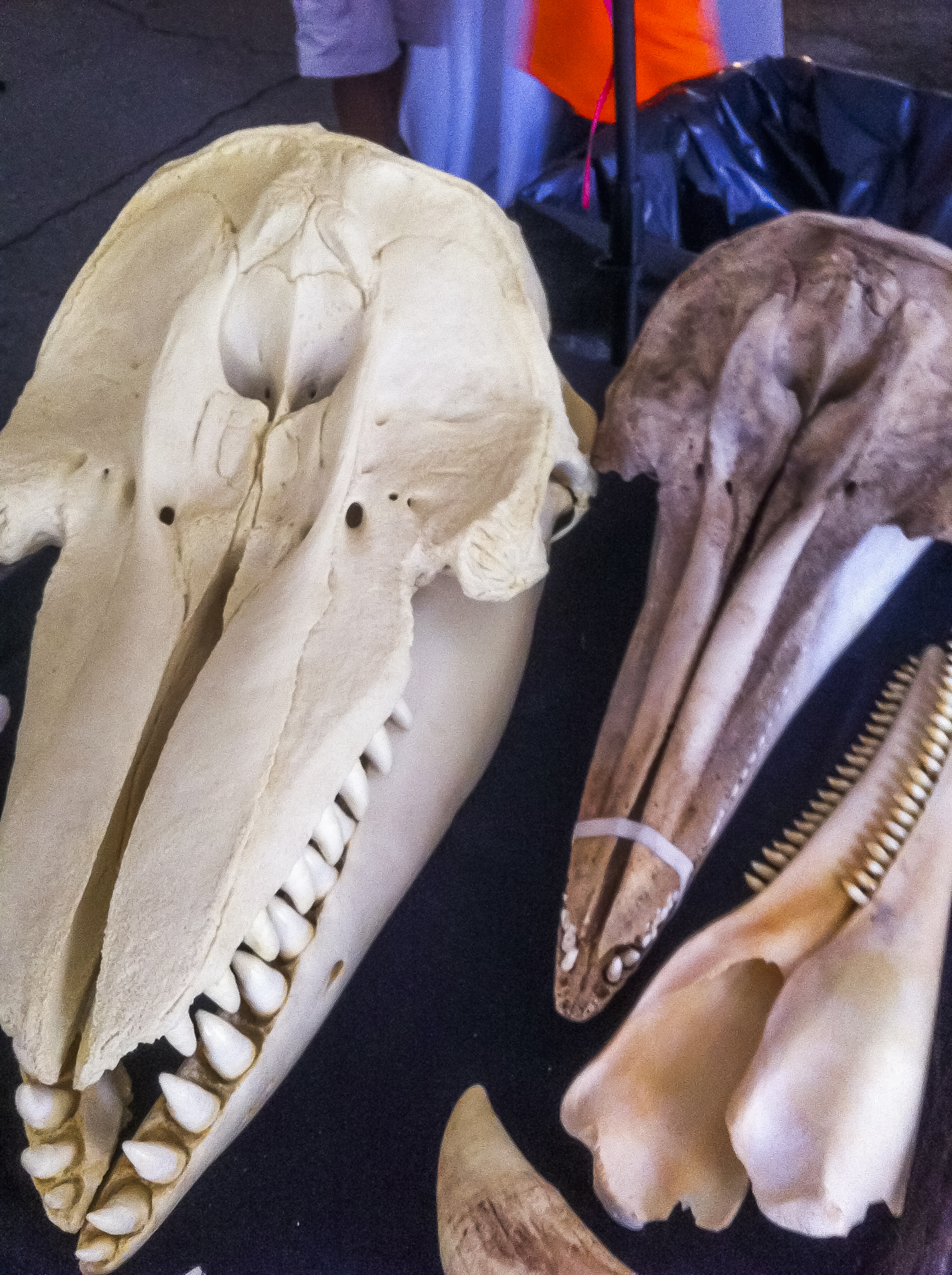
Speaker Joy Reidenberg had an exhibition table full of whale parts. Photo: Sevanah Howard
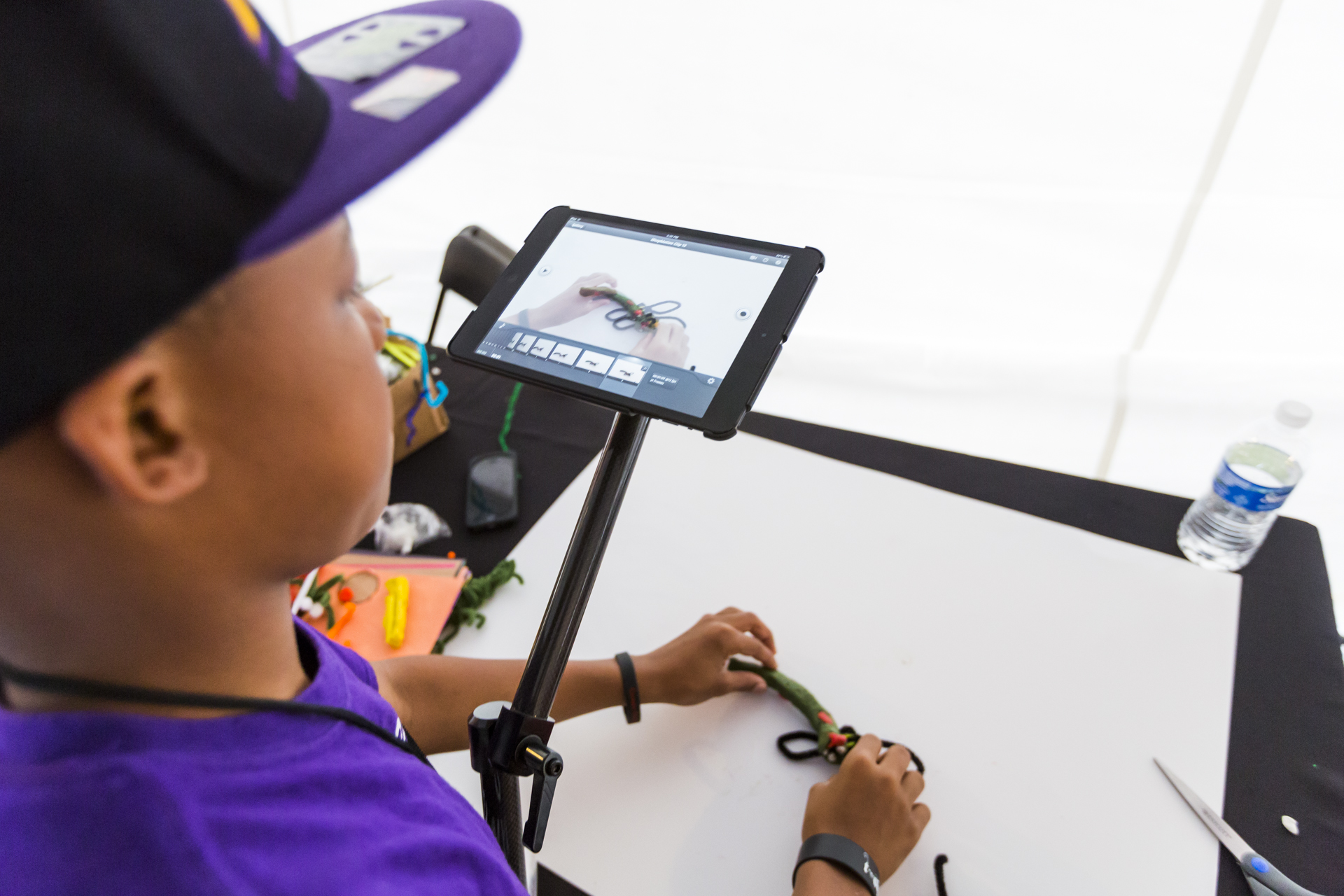
An attendee tries his hand at stop-motion, at TED-Ed’s Animation Station. Photo: Ryan Lash
A big thanks to the young photographers who helped out with this post!
]]>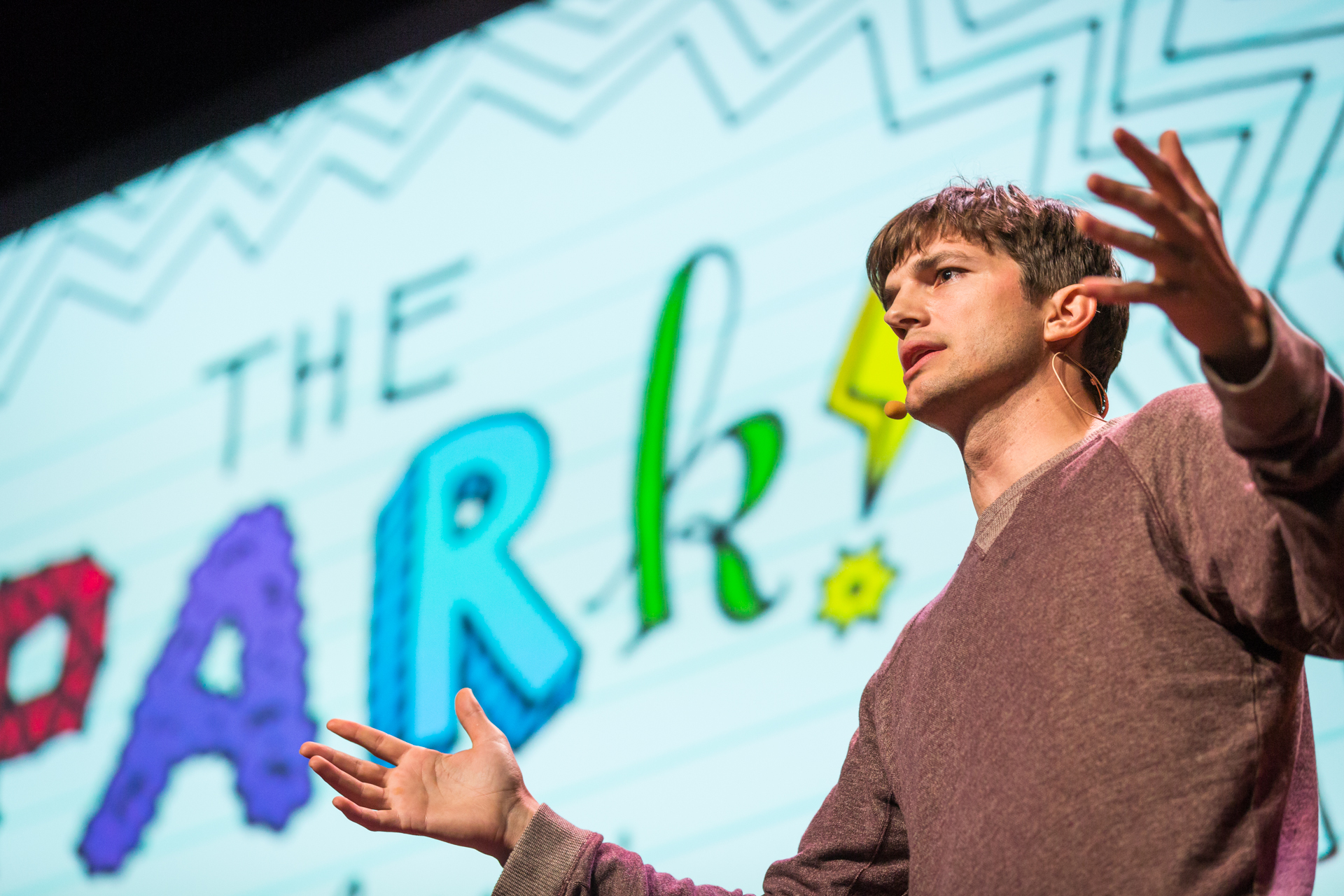
To close out TEDYouth, Ashton Kutcher gave a talk on failure. The kids in the audience had no idea he’d be stepping on the stage; his appearance caused quite a commotion. Photo: Ryan Lash
“I am a magnificent failure,” Ashton Kutcher announced on the TEDYouth stage in New Orleans earlier today. “I screw up so much it hurts.”
The star of television show Two and a Half Men said this not to be self-deprecating or to beat up on himself, but to drive home the point that failure is a part of life — and one that can prompt profound “aha” moments. “You see, you have to take a risk to be a magnificent failure. The most successful people I know in the world are magnificent failures,” he said. (Read a write-up of Kutcher’s talk, as it is not yet available on video. While you’re there, read recaps of the other wonderful speakers at today’s conference.)
Kutcher was originally slated to give a much lighter talk at TEDYouth — on the things he learned working as a dishwasher, a butcher and a deli employee on his way to becoming an actor and producer. But he says that, as he sat down to write his talk, it didn’t feel completely honest. The TED Blog spoke to him after he left the stage to discuss why.
What made you decide to switch from giving a talk about what you learned from assorted jobs to this much bolder talk?
I thought about the audience that I was addressing. The kids who are here, they actually had to work to come to TEDYouth. They’re kids who are curious enough to go online and look up TED, which is probably not required learning for them. They’re already adventurous, curious, hard-working people. So to talk about work and hard work seemed safe and it seemed like, for them, it would be redundant. Whereas talking about failure is something that everyone is afraid to talk about. And yet the only way you can really learn from failure is if you’re verbal about the fact that you failed so that the smartest people that you have around you in your life can help you learn.
Why do you think we’re hesitant to talk about failure?
Well, I think we’re taught that success is the ultimate outcome. Failing is looked down upon. I think there’s an entrepreneurial collective that’s starting to change that perception of failure — that’s starting to recognize that when you fail, it can be one of the greatest moments of your life if you approach it with a determination to actually learn from your mistakes.
Was there an element of letting the audience know, if they run into circumstances like the ones you mentioned, it’s okay?
I’ll hope not these exact things. But getting in trouble with the law is something that people face. One big reason to talk out loud and admit your failures to young people is so that when they fail, they don’t feel like they’re “bad kids.” I don’t think there are bad kids, just good kids who make bad choices. But I think you can really lock yourself into thinking you’re a bad kid if the adults you admire in the world never talk about how they fail.
You said in your talk, “I don’t know what I want to be when I grow up.” How do you get past the idea that there is going to be one thing you do in your life?
You just never allow yourself to believe that there is one thing. I mean, for some people there very much is–some people find their passion early in life. They know exactly what they want to do and they pursue it and they take higher and higher education in that thing. But a lot of people right now go to college and they don’t even know what they want to do. I sometimes wonder if they’d be better off going and getting a job and working for passionate people and then deciding what their passion is.
I’m curious: what’s the last piece of incredible advice you got from a kid or teenager?
It was something really simple. I remember a kid came up to me and said, “Dude, just have fun.” I think that’s great advice. Sometimes we get way too serious. “Just have fun” is pretty incredible advice.
]]>The morning session of TEDYouth “The Spark” was incredible. But in many ways it was just an appetizer. In the afternoon, Sessions 2 and 3 delivered talks on topics ranging from how to make an Easy Bake Oven gender-neutral to the mathematics of Pixar animation to the familial structures of elephants. And it all ended with a surprise appearance from Ashton Kutcher, talking about his “magnificent” failures, and what he learned from each one. Here, a recap of the two sessions.
A grand tradition at TEDYouth — seriously slammin’ spoken word performances. Here to continue it: Justin Lamb, performing his poem “Sweaty Teacher.” The basic idea, in two lines: “I’d love to be the compassionate teacher, the tough-but-fair teacher. … But it’s no use, because I am the sweaty teacher.”
Maya Penn talks about launching a business at age 8. Photo: Ryan Lash
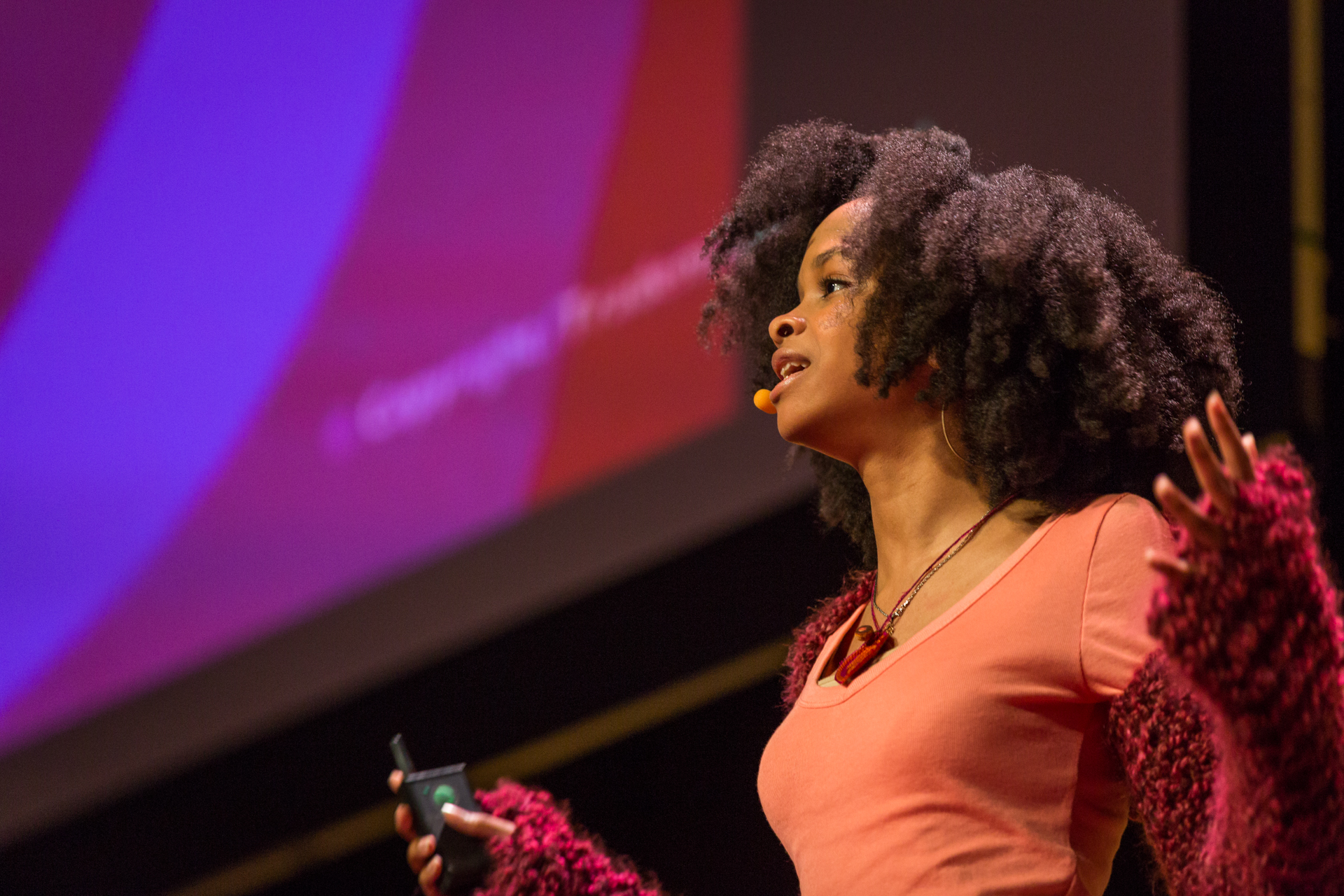
Maya Penn is an entrepreneur who makes eco-friendly fashion, and who had the chops to build and maintain her retail website. Did we mention that she is also 13 years old? Here at TEDYouth, Penn shares why she decided to open a shop in the first place — because people always commented on her creations — and why she decided to branch out into animation. “I didn’t have a business plan. I was only 8!” she says, to laughs. Her advice to the crowd? “Do what you love, have fun and just go for it.”
Erika De Benedictis has a bumper sticker on her car that reads, “Honk if you think Pluto is still a planet.” The 20-year-old, who works at NASA’s Jet Propulsion Laboratory and who, two years ago, created software to make space travel more fuel-efficient, explains why Pluto was downgraded from planet status in 2006. And she reminds us that the solar system is deeply complicated. “There aren’t eight objects,” she says, referring to the now-eight planets we all know by heart. “There are millions of objects, and each one’s gravity affects the movement of all the other objects.”
Why chase dreams when you can chase storms? Based at the Center for Severe Weather Research in Boulder, Karen Kosiba is an atmospheric scientist who studies how tornadoes form and do damage. (Did you know we still actually aren’t sure how they begin? Huh!) Trouble is, most prolific tornado producers, so-called “supercell thunderstorms,” may well not amount to much. What really matters is how a storm acts at the building level, and just because those ones rotate high in the air doesn’t mean they rotate nearer the ground. (Another problem? It’s hard to get near the damn things; apparently most people aren’t too keen on driving right into tornadoes. Weird.) But through observations and modeling, Kosiba was able to catch a rare data set, a tornado her team tracked throughout its entire lifespan: from before it formed, throughout its duration and even after it dissipated.
When McKenna Pope was 13 (she’s now an ancient 14) she was pretty psyched that her four-year-old-brother’s favorite thing to do was cook. But when he decided “Only girls cook,” she was distressed. Then she noticed that Hasbro’s Easy-Bake Oven, a toy her brother had previously been dying for, only came in pink and purple, and only featured girls in its commercials. So she did what any 13-year-old would do: She uploaded her complaint as a YouTube video and petitioned the CEO of Hasbro to change the company’s marketing strategy to be more gender-neutral. Here’s the kicker: It worked. In a matter of weeks Pope got 46,000 signatures, and she was invited to the Hasbro headquarters to see the unveiling of a brand new product. Says Pope to the theater, filled with teenagers: “I realized that my voice mattered, and your voice matters too.”
Bivian “Sonny” Lee has a powerful request: Every time you hear or use the “n-word,” replace it with the word “slave.” Then see how you feel about saying it. Because, says Lee, head of the Son of a Saint Foundation, they’re essentially synonymous. In a sobering talk, he makes the case that the n-word should never be uttered again. The word is simply too hateful, not to mention entirely disrespectful to the generations of enslaved and then segregated black men, women and children in the US for whom the word was a terrible slur. As for the defense put up by rappers and the like that by using the word over and over, they’re “owning it.” Not so, says Lee.
Can pop culture be used to feed social awareness? Absolutely, says New Orleans’ own Brandon Odums, who transformed walls in the 9th Ward with his murals of civil rights leaders. “8,300 students drop out of school every day,” says Odums, also the founder of 2-Cent Entertainment. “If a business lost 8,300 customers every day, it would be a state of emergency.” Odums has a strong message for the crowd: people are listening on social media; use it to create real change.
Tony DeRose is a Senior Scientist at Pixar Animation Studios, which means, naturally, he spends all day thinking about math. Hm? What’s that you say? DeRose is here at TEDYouth to demonstrate that what you learn in middle and high school math class is used all the time in animation. When Toy Story‘s Woody moves across the screen, gets bigger and smaller or rotates, that’s a combination of coordinate geometry and trigonometry. DeRose also introduces “sub-division surfaces,” which creates smooth curves. Turns out, most Pixar characters, including Ariel from The Little Mermaid, are made up of sub-division surfaces.
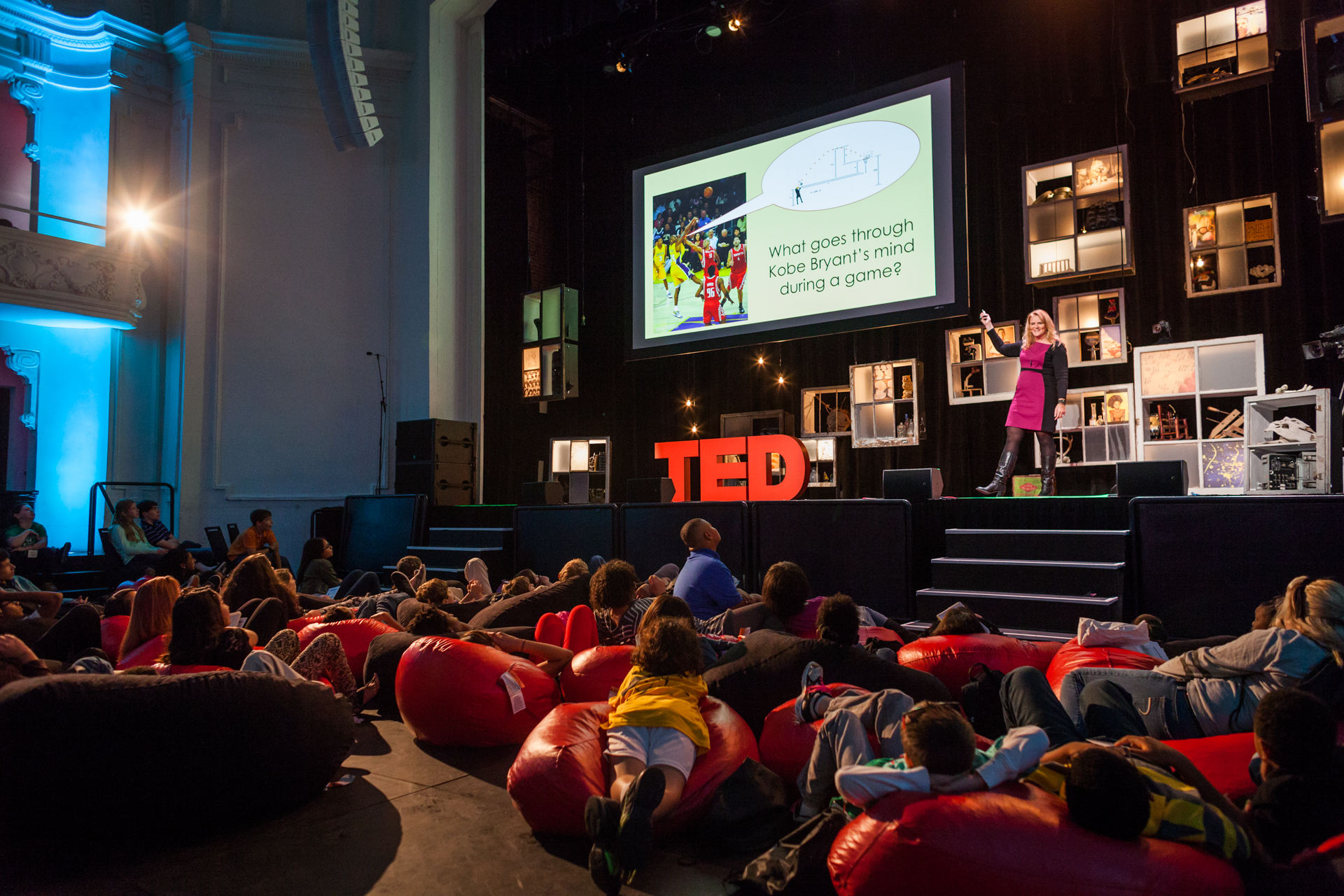
Cynthia Bir looks at how math and science make a difference on the basketball court. Photo: Ryan Lash
Cynthia Bir, a biomedical engineer at the University of Southern California and one of the minds behind the ESPN TV show Sport Science, wants us to think about the physics of basketball. “Basketball players, baseball players, football players — they all rely on trajectories for their shots,” she explains. Bir walks us through the factors that determine whether a basketball player gets a swish of the net or the crowd yelling “airball”: launch angle; velocity and range.
Science blogger Rhett Allain is the author of Angry Birds Furious Forces and an associate professor of physics at Southeastern Louisiana University. (Yes, his book uses the game Angry Birds to demonstrate basic physics concepts.) Today Allain is at TEDYouth to talk about models. Models are important to figure out how, physically and mathematically, things are supposed to work. Important examples: Helicopter rotors, comets and… people trapped in rooms with zombies?? (Hint: If you just keep running around in a circle, the zombie will never catch you.)
Caitlin O’Connell-Rodwell spends a lot of time with elephants, studying the ways they communicate and form family bonds. Her conclusion after 20 years of research — they are a lot like us. A professor at the Stanford School of Medicine in California, O’Connell-Rodwell describes elephant family reunions, and how male elephants strike out on their own between the ages of 13 to 15. (Sound vaguely familiar? Yes.) She looks at how the character of an elephant family is influenced by its matriarch, and gives us an understanding of the hugely varied elephant personalities, all while showing amazing photographs of the animals in action.
Clayton Cameron — aka the “Brush Master” — is a renowned drummer and brush player who bends genres — jazz, funk, hip hop, pop, R&B, Latin, you name it. On stage today he has one drum, two brushes, and… math. He likes to think of the marriage between rhythm and arithmetic as “a-rhythm-e-tic.” A dollar can be divided into four quarters, and so can a 4/4 measure. For six minutes Cameron doesn’t stop the beat — or the brushing — or the ballerness. Watch his performance from TEDxManhattanBeach »
Sicily Kolbek is building a tiny house. No, not a dollhouse. A miniature house that a person could actually live in. With the help of her parents, this 13-year-old has created “La Petite Maison,” a 128-square-foot abode. In this talk, she shares where the idea for the project came from and how she almost gave up when her father was killed in a car accident. But, she says, he was always inspired to think about what came next, and now that the house is done she’s inspired to think similarly.
Jonathan Mannion has photographed most of the big names in hip hop and R&B from the past 15 years. He was on stage with Biggie, he bonded with Aaliyah, he shot eight album covers for Jay-Z, he hung out with Drake and his grandmother and he notably persuaded DMX it was totally cool to dive on into a pool of blood. Yet he’s not just here to namedrop. The most important parts of his work, he says, are capturing a moment, connecting with a subject and not taking a photo, but giving it.
“Science is a rough draft,” says Henry Lin. “There is so much that still baffles us and challenges our understanding.” This Harvard student, who hails from Shreveport, Louisiana, won this year’s Intel Science Fair for his models of galaxy clusters. On the TEDYouth stage, he shares why he is researching these clusters, which are very big, very hot and very strange: “We can learn a lot about the universe by tracking its largest pieces.”
Eddy Cartaya is a law enforcement officer at Deschutes National Forest in Oregon. He’s also a cave explorer. Through beautiful vivid photos he tells the story of the Mount Hood region near Portland, Oregon, where he and photographer Brent McGregor discovered and explored a series of previously unexplored caves. In fact, they were a rare type of cave, made of glacier instead of solid rock. That means two things: each year, entirely new tunnels form, and every day the whole cave is moving. With their survey tools, Cartaya and McGregor were able to make a 3D map of the Mount Hood caves. But really, anyone can be an explorer, concludes Cartaya. All you have to do is, “look and go where people don’t often go.”
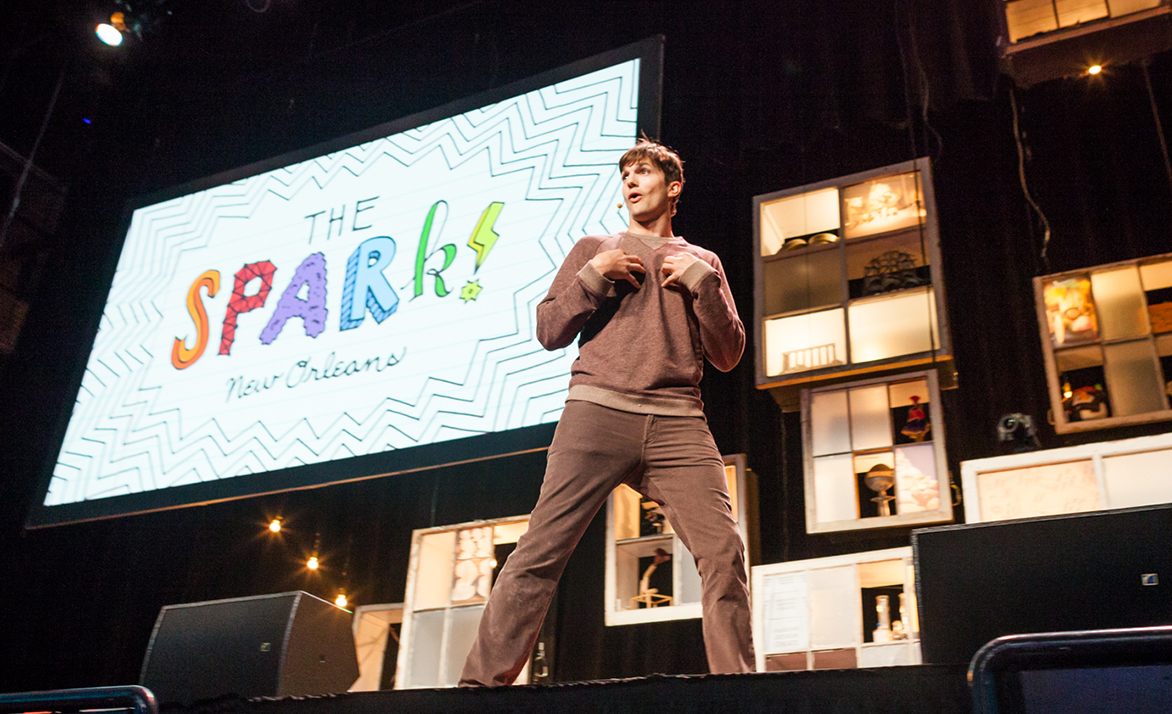
Ashton Kutcher appeared for a surprise talk. Photo: Ryan Lash
Surprise guest Ashton Kutcher comes clean at TEDYouth: he didn’t like school. And while he once studied to be a biochemical engineer, he declares that his greatest learnings in life came from failures rather than teachers. “I am a magnificent failure,” he says, going on to share three big lessons that came from crashing and burning. First, he shares the tale of getting caught breaking into his high school. Lesson learned: Own up to your mistakes. Next, he reveals feeling that he had failed his moral upbringing when a former girlfriend got an abortion. Lesson learned: “Your morals evolve based on life experiences. As you evolve through experience, you create your beliefs.” Finally, he tells the story of deciding to end his engineering education and try life as a model. Lesson learned: you have to take risky chances to find your purpose. And that finding your purpose, actually, is not a one-time thing, but a constant in life.
And… that’s a wrap. Our thanks to all the speakers, impeccable hosts Kelly Stoetzel and Rives, the entire TED crew on the ground, the incredible, energetic audience and all those hosting TEDxYouth events or tuning in to watch the livestream. Hope you enjoyed it. See you next year!
]]>TEDYouth is like a typical TED Conference — with its hair let down. The talks are shorter, less formal and, well, a whole lot of fun. This year’s conference was held in New Orleans and was themed around the concept, “The Spark.” Here’s a look at what happened in the first session, including thoughts on whales and their fat lips, the story of barbecue and an homage to that humble-seeming material, sand.
Joy Reidenberg studies animals that live in extreme environments, notably whales. Photo: Ryan Lash
Comparative anatomist Joy Reidenberg studies similarities and differences in the anatomy of different species. In particular, she studies animals that live in extreme environments, in the hope of adapting their unique qualities for human applications. Her favorite animal? The whale. Reidenberg is here to tell us how whales make their unique sounds. It turns out, they fart with their faces. Excuse me? Showing awesome photos of these great mammalian beasts of the deep, Reidenberg explains: A whale takes its fat lip and rolls it over its nose to create a vibration. A system of powerful voice boxes and air sacs allow the whale to amplify the vibrations without having to breathe through its mouth or nose. That farting sound? It’s actually echolocation.
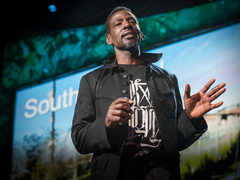 Ron Finley: A guerrilla gardener in South Central LA
Ron Finley firmly established his motto at TED2013: “If you ain’t a gardener, you ain’t gangsta.” South Central Los Angeles’ notorious guerrilla gardener — who recently strong-armed a change in the city’s laws about planting in public spaces — is at TEDYouth to inspire young people to do something radical — to pick up their shovels and grow their own food. Why? Because it’s a way every young person can positively affect their health — and the dynamics of their communities. “You can design your own life. Don’t let some other clown do it for you,” says Finley. “Gardening is the gateway for you to design your life.”
Ron Finley: A guerrilla gardener in South Central LA
Ron Finley firmly established his motto at TED2013: “If you ain’t a gardener, you ain’t gangsta.” South Central Los Angeles’ notorious guerrilla gardener — who recently strong-armed a change in the city’s laws about planting in public spaces — is at TEDYouth to inspire young people to do something radical — to pick up their shovels and grow their own food. Why? Because it’s a way every young person can positively affect their health — and the dynamics of their communities. “You can design your own life. Don’t let some other clown do it for you,” says Finley. “Gardening is the gateway for you to design your life.”
Seventeen-year-old Cam Perron has been collecting baseball cards and writing to pro players since he was eight. So invested is he that he dug into the history of the game to discover the Negro Leagues, baseball leagues for African-Americans playing from the 1920s to the 1960s, before the game was desegregated. Later he realized that many of the Negro League players were unrecognized, undocumented and completely disconnected from the game and their old teammates. Just as outrageous, they didn’t have their own baseball cards. Perron started calling them up and found many of them wanted to share their stories. Since then he has established programs to bring together old Negro League teammates and even earn them pensions.
We’ve all heard of a family tree. But did you know this concept has a basis in science? Suzanne Simard, a professor of forestry at the University of British Columbia, shares the moment she walked through a forest and realized it was built on relationships. “Wow! Forests are just like human families,” she thought. Simard describes the incredible underground fungal network in forests that links plant to plant and tree to tree. This system grows around “mother trees,” which send nutrients down their trunks and out to their seedlings. Kind of like a human mother.
Sand is functional, gorgeous … and everywhere. It’s used in computer chips, camera sensors, silicon… The list goes on and on. And geologist Matt Kuchta can’t get enough of its endless shapes and patterns. But how do you hold up a sand structure when it’s met with wind, water or brute force? Kuchta shows a fascinating demo of how something as simple as a window screen can be used to keep sand in its place — and even be used to build a sand structure so sturdy it can hold up a bowling ball. Says Kuchta, these geofabrics are important on Earth; just imagine their applications on other planets.
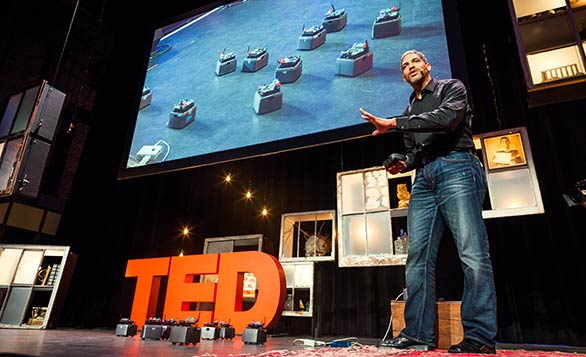
Could robots work with firefighters to put out a blaze? Computer scientist James McLurkin is working to find out. Photo: Ryan Lash
James McLurkin works with robots that behave like ants or bees. A professor of computer science at Rice University, McLurkin creates multi-robot systems in which large numbers of small ‘bots work together, by sharing information and communicating with each other to achieve a big goal. Could these robots work with firefighters to put out a blaze? Or help us explore Mars? McLurkin hopes so. Here in New Orleans, he demonstrates the possibilities by showing how these robots can use distributed algorithms to organize themselves into a straight line.
Geographer Anne Knowles is really into Geographic Information Systems. Aren’t you? Knowles, who uses GIS to reimagine the past, paints a scene from American history. She challenges us to picture the fateful night of July 2, 1863, before the final day of the Civil War’s Battle of Gettysburg. Robert E. Lee, commanding the Confederate Army, is about to make a series of crucial mistakes that will cost him the war. But how did he come to make those decisions? Using “viewshed analysis,” Knowles used maps to create a simulation of what Lee had actually been able to see. This revealed that on the morning of July 3, right before Lee ordered the fateful Pickett’s Charge, he was blind to about a third of the Union Army – nearly 18,000 soldiers.
Mmm, BBQ. The fall-off-the-bone meat, the tangy sauces, the delicious mingling with the bun. Lolis Elie, best known as the story editor of the show Treme, takes the TEDYouth stage to give a history of Southern BBQ. This delicious food has been one way the many different people living in America have been able to create one culture. And yet, there are regional differences. “These traditions moved with the people,” says Elie, and yet, they’ve remained distinct, with several different styles of cooking existing side-by-side in some large cities. “It’s not e pluribus unum,” he says, quoting one of the mottos of the United States. “It’s e pluribus pluribus.”
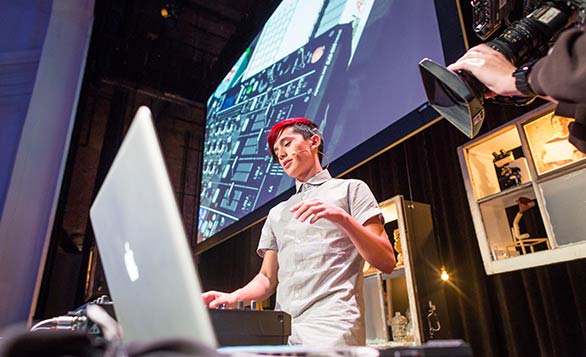
DJ Cole Plante regularly plays to crowds of thousands. At TEDYouth, he shared tips for aspiring young DJs. Photo: Ryan Lash
Cole Plante is the perfect TEDYouth speaker for so many reasons — not least the fact that he is 16 himself. Plante grew up playing with his parents’ music equipment and now he is a well-known DJ who regularly plays for crowds of thousands. Here in New Orleans, he shares the websites aspiring young DJs should visit to learn the craft (YouTube, Beatport) and gives a look at how he layers music to create brand new sounds.
]]>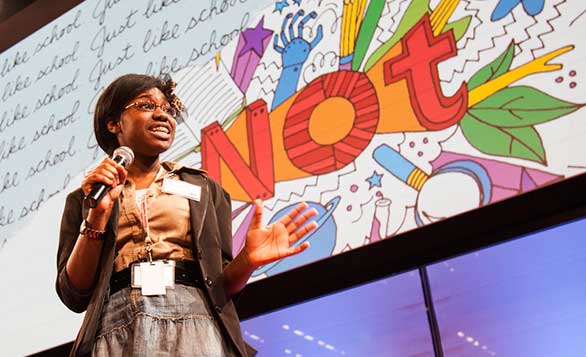
A student from the audience introduces a speaker at TEDYouth 2012, themed “Just like school … not.” Photo: Ryan Lash
What conference, besides TEDYouth, could bring together an elephant communication expert, the head of research at Pixar, a professional storm chaser, and a 16-year-old DJ? TEDYouth 2013, “The Spark,” happens tomorrow, November 16, at 11am CST in New Orleans, Louisiana. And you can watch along via the live webcast, which will be available in English, Spanish and Arabic. To get you ready for this fast-paced, mind-blowing conference, here’s a playlist of some of the best talks from TEDYouths past.
Adam Savage: How simple ideas lead to scientific discoveries
Adam Savage is the host of Mythbusters, and the king of making scientific analysis fun. In this talk from TEDYouth 2011 — which happens to be half animated — he shows how simple methodologies led to two of the most exciting scientific discoveries of all time: Eratosthenes’ calculation of the Earth’s circumference and Hippolyte Fizeau’s measurement of the speed of light.
Greg Gage: The cockroach beatbox
At TEDYouth 2011, Greg Gage dissected a cockroach on stage. In this talk, amped up with animation, we get a deeper look at how their brains work as he manipulates the electrical impulses between the leg and brain. Because roach brains are so much like ours, if we understand how they work, we can understand how we work.
Carvens Lissaint: “Put the Financial Aid in the Bag”
Education should be more affordable. In this spoken-word gem from TEDYouth 2011, performance artist Carvens Lissaint imagines what would be said during a robbery for scholarships and Pell Grants.
Katherine Kuchenbecher: The technology of touch
At TEDYouth 2012, Katherine Kuchenbecher shares why she is working hard to make haptic feedback a part of everyday technology. What is “haptic”? Anything related to the sense of touch. Imagine being able to touch a fabric as you shop online, or your dentist being able to “feel” a cavity from a scan.
[ted id=1371]
Kevin Allocca: Why videos go viral
Kevin Allocca watches YouTube videos professionally (he is the site’s trends manager). At TED2011, he shares the magic behind what makes videos go viral, narrowing it down to four factors.
Maurice Ashley: Working backward to solve a problem
Maurice Ashley is a chess grandmaster. And in this talk from TEDYouth 2012, he shares one method he uses to improve his game — using retrograde analysis to work backward from the endgame he desires. He shares why this is useful in chess … and life.
Tom Chi: Rapid prototyping Google Glass
It didn’t take years, or even months, to prototype Google Glass. It was done in a single day. In this talk from TEDYouth 2012, Tom Chi — who was on this prototyping team — shares how they did it using binder clips and clay.
Robert Full: Curiosity, discovery and gecko feet
How do geckos stick to walls and trees? It has to do with their hairy toes. At TEDYouth 2011, Robert Full tells the story of how a sophomore in college solved this mystery by creating a beautifully simple way to measure the force of a single gecko hair.
William Gurstelle: A call to invention
Speakers, made of a used yogurt cup? In this talk from TEDYouth 2012, tinkerer William Gurstelle shows you how to make them.
David Fasanya and Gabriel Barralag: “Beach Bodies”
In another truly amazing spoken-word moment, this time from TEDYouth 2012, David Fasanya and Gabriel Barralag bring down the house. This reflection on self-image begins, “I don’t know about you, but I’m trying to get this beach body…”
 15-year old Julia Bluhm is a ballet dancer and body image activist. That’s right. Ballet, an activity that conjures images of super slim prima ballerinas gracefully passing up french fries in favor of pirouettes. And body image activism, where passionate advocates remind us all that we’re beautiful just the way we are. You might see a disconnect, but Julia sees an opportunity; having seen her ballet friends struggle with body issues, she decided to do something about it.
In April 2012, she and her friend Izzy started a Change.org petition asking Seventeen magazine to feature fewer photoshopped images of models. They didn’t expect a big response, so what happened next was a shock.
Within days, the petition had over 25,000 signatures. One night in early May, Julia came home from ballet to find that she was booked to fly from Maine to New York the next morning to appear on CNN and ABC Nightline. While she was in New York, she met up with SPARK, a feminist organization she blogs for, and staged a protest in front of Seventeen magazine’s headquarters. The media showed up in droves. In the end, over 86,000 people signed Julia’s petition.
That July, Seventeen magazine issued a Body Peace Treaty, signed by all the editors, agreeing to show real girls in their pages. For Julia, it was proof that she could make a difference. It has inspired her to keep blogging about body image issues, and she’s excited to see that other girls have followed her lead, petitioning other magazines such as Teen Vogue and companies including H&M.
We spoke with Julia about body image and teen activism for our series on inspiring young voices. An edited version of our conversation follows. My first question: how does she see the disconnect between ballet and body image? Here’s Julia —
The ballet world is changing. There was a time when you had to be super skinny, but now there are a lot more dancers who are muscular. Misty Copeland is one of my idols — she’s a soloist at American Ballet Theatre — and she’s a really muscular, strong dancer. A lot of people really like that about her. There are more and more dancers like her who don’t fit the perfect definition of a ballet body.
When it comes to body image and media issues, what would you say to other girls your age?
Talk about it. Some teenagers feel weird talking about issues like feminism or body image, even though we think about it. But you can watch an ad with your friends and say, ‘we shouldn’t be thinking like that.’ You might feel like a know-it-all at first, but if we all get involved, then it won’t feel so weird.
And what would you say to the boys?
The same thing: question the media. Boys see these messages about girls being less strong or important than men, or being passive and sexualized, and that can be really harmful. It’s important for them to start questioning the media too. To say, that’s not realistic, the girls in my school or town don’t look like that, and to start realizing that the media is not always truthful.
I didn’t really learn about the sexualization of women in the media until college. How did it come onto your radar when you were still so young?
I always knew it was there. I saw ads [sexualizing women] on TV, but just didn’t know the word for it. Then, when I was 13, I joined SPARK. They educated me about what sexualization really was and what I could do about it. That’s how I started to learn.
Are there other changes you see happening now that make you say, ‘yes! more of that!’?
A lot of little things, like H&M had a plus-size line, and in Seventeen magazine, I remember reading a spread about plus-size models. Girls want to see media that’s not shaming girls’ bodies but embracing them. And that’s a good step, but the problem often is that it becomes kind of hypocritical. There might be a spread in Seventeen that talks about positive body image, then flip down a couple pages and there’s a diet plan for flat abs for the summer.
Your generation often gets criticized for not getting involved in some of those issues.
A big problem is that we don’t know where to start or don’t think we can do it, especially because we’re younger. I would say: ‘Do it anyways, even if you’re not sure you’ll be successful’. If there’s something you’re passionate to change, try to change it.
So how can other teens get involved in activism?
Use online resources; there are tons of them. I also encourage people to join organizations and activist groups. Most of the young people who’ve taken action had a group that helped them out. It’s hard to do an action all by yourself, but if you have a team, it makes it a lot more possible.
And finally…what is one thing you know that you wish everyone knew?
That teenagers offer a lot. A lot of times, people think of teenagers as not caring, and that’s a big mistake. We do care about a lot of things, we just don’t know where to start. What’s important for adults to know is that we are passionate about these issues, we care, and adults can help by giving us the resources to make a difference.
Watch Julia’s talk at TEDxWomen 2012 »
And here, an illustration of Julia created especially for this piece by TED’s own Emily Pidgeon!

This article is part of a series on young voices, exploring the spirit and wisdom of youth. Read the full series here.
]]>
The scene at TEDYouth in 2012. The theme this year is “The Spark.” Photo: Ryan Lash
Four hundred middle and high school students will fill the TEDYouth auditorium this Saturday — and many of them will be put straight to work. Students who’ve expressed interest in cinematography will shadow our video production team, students who want to be event planners will hang out with our producers, and those interested in journalism will shadow the TED Blog team.
So this felt like a good moment to ask these assorted staffers: What advice would you give your teenage self?
“Do not waste any part of the last summer before you graduate on the boring internship you think will look good on your resume. Instead, do something you love. If you love being a camp counselor, you will learn far more doing that job than you will doing data entry in a cubicle. Also: It really and truly doesn’t matter what they think. Just be you. I know people always give this advice, but if my future self could have given it to me then, it might have saved me some teen angst. And, with any luck, I might not have succumbed to quite as many of the horrible fashions that dominated Texas in the Eighties.” — Kelly Stoetzel, Content Director
“Learn as much as you can, for as long as you can. Basic concepts in seemingly intimidating disciplines are not as hard to master as they may seem. And apathy is stupid.” — Thu-Huong Ha, Editorial Projects Specialist
“Do not be afraid of failure, because failing often means a chance was taken. Taking a chance and facing that risk head-on is the most rewarding way to achieve your dreams, even if there are a few stumbles along the way.” — Chris Hardy, Media Production Specialist
“Dear teenage self, you know how you’re always writing ideas down and shoving them into your back pocket? Don’t wash those pants. Later in life you’ll look back at the ideas that somehow avoid the laundry and you’ll find them hilarious/terrible/telling/exciting/motivating/worthless/ priceless … and you might even pursue one or two of them.” —Logan Smalley, Director of TED-Ed
“The smartest thing you can ever do is to love the people around you unconditionally, make new friends whenever you can, and always have a YES attitude — opportunities are going to arise, and you want to be the one people think about.” — Jordan Reeves, TED-Ed Community Manager
“I’d tell my teenage self that cheesy but helpful quote: ‘That which is yours will not pass you by.’” — Angela Cheng, Video Production Lead
“When school feels tedious and uninteresting, don’t lose your curiosity. Enjoy exploring and learning everything you can, while you can.” — Nick Weinberg, Content Coordinator
“I’d tell myself: Wear the helmet in Connecticut. Pack the sleeping mat in Utah. The sun sets 10 minutes earlier in Spain than you’ll expect it to. Take a friend’s car through a car wash after borrowing it. Don’t pray: pray. The same goes for skinny-dipping. G. is in love with you; be gentle with her heart. R. is not in love with you; be gentle with your heart. You can afford to be an artist, grapes will always be your favorite food and Grandma adores (and I mean adores) a sentimental man.” — Rives, TEDYouth co-Curator (yeah, watch one of his five equally fast-paced TED Talks)
“Your knowledge of the kinds of careers out there is pretty limited — to your parents, your teachers, your doctors, the people who help you every day — and the best thing you can do for yourself is expand it. Try internships and after-school jobs in fields other than ones you’re familiar with. Even if you think you know what you want to do, make sure you get a taste of something else, too.” — Morton Bast, Editorial Assistant
“Indecision is, in essence, a decision to stay stuck. Take action and make note of what excites you. Keep moving in that direction and trust your instincts. Often what makes you a little scared is the thing you must do!” — Dian Lofton, Photo Editor
“Go to more shows, be in more shows, work at more shows. Nothing in high school is as real as doing theater.” — Emily McManus, Editor of TED.com
“If you have a crush on someone, go for it. There’s nothing to lose. You might feel embarrassed for a few days if it doesn’t work out, but you’ll get over it quickly and look back on it with fondness. You’ll learn more from your relationships than from most of your classes.” — Cloe Shasha, TED Projects Coordinator
“Do not let career counselors fool you—you do not need to know what you want to do right now. Your career trajectory will span, oh, about 40 years, so there is a lot of time to experiment, try new things, make subtle adjustments and find the right intersection of your skills and someone who needs them.” — me, Writer
Not able to make it to TEDYouth in person? Totally fine. The event will be webcast on Saturday, November 16, from 11am to 6pm CDT. Or find a TEDxYouthDay event near you. They are happening all over the world, in the 48-hour period surrounding TEDYouth.
]]>The attendees for TEDYouth were selected via online applications. And with the conference just five days away, we wanted to give shout-outs to some students who submitted extra credit. Here are just a few of the amazing songs, poems and videos submitted with TEDYouth applications — run with permission, of course.
Not able to attend TEDYouth in the flesh? Never fear! The event will be webcast, live and for free, on Saturday, November 16, from 11am to 6pm CDT in English, Spanish and Arabic. Or, if you’d prefer to make watching a social event, find the TEDxYouthDay event nearest you. These events are happening all over the world, in the 48-hour period surrounding TEDYouth.
And now, for those stand-out applications…
This anthem is the creation of the TEDivas: Saren McAllister, Natosha Humphrey, Izzie McAllister, Janis McAllister and Cassidy Monk.
Here, a poem from Luis Duarte called, “Why I want to go to the TEDYouth Conference.”
The TEDYouth conference will be lots of fun.
I’m usually used to having to go on a run.
I get to be creative and dance and do new stuff.
I’ll meet designers and scientist that aren’t too tough.
It will be exciting and entertaining and I’ll learn stuff too.
Maybe I’ll get to dance, eat food and see art an artist drew.
I’m sure I’ll get to meet new people and friends.
We’ll all be pretty sad when the day ends.
I can’t wait to get back to school to impress all of my teachers.
TEDYouth conference will help us become awesome leaders.
I really want to go to the TEDYouth conference this season.
I’m not real sure you need another reason.
The “Above Average Joes” — Elyse Gertsch, Kaleb Clark, Joshua Dunning and Cora Gertsch — created a very cool suspense film, which leads into a conference they call TEDMini. Talks included: “How the world isn’t fair,” “Why I want to work with computers” and “How kids confuse popularity and leadership.”
Another TEDYouth song, from the “Charging Bucs,” aka Berwick Nero, Jouan Terrance, Israel Howard and Saunders Briscoe.
Here, a poem from Alyssa Tripps called “Metaphorically Speaking.”
I lay down
Staring at the ceiling
Thinking to myself
The world is needy
Constantly bleeding
For other people’s empathy
Sympathy, comforting
It’s time for us to step up to the plate
Help them carry this weight
And let them know
Education is bait
To success
We constantly run across
The lost
We see them stuck in the world
They’re stuck in their issue like Jack Frost
It’s time we let the world shine bright
Rudolph
Starting with you all
We’re going to change the world
And this is the first way to start off
Using TED
It’s an earthly med
Healing the world
With a particular ed
It starts off with you
What will you do
I’m going to change the world
How about you
And finally, Mollye Ladner, Sarah Grammar, Emily Overmyer and Brielle Jordan — who call themselves “Those Theatre Kids” — share why they want to be at TEDYouth. Bear joke included at the end.
]]>A stark contrast on last night’s episode of 60 Minutes: veteran journalist Morley Safer, age 81, interviewing Jack Andraka, age 16, who has developed a promising new test for pancreatic cancer.
 Jack Andraka: A promising test for pancreatic cancer ... from a teenager
In the segment, Andraka tells the story he told on the TED2013 stage, of how a family friend succumbing to this deadly disease triggered his curiosity in creating a test that would be cheap, non-invasive and an option for early detection. But the segment also gives us outsider’s perspective of Andraka, his family and his big idea to create this test that, if it makes it through clinical trials, could cost just pennies.
Jack Andraka: A promising test for pancreatic cancer ... from a teenager
In the segment, Andraka tells the story he told on the TED2013 stage, of how a family friend succumbing to this deadly disease triggered his curiosity in creating a test that would be cheap, non-invasive and an option for early detection. But the segment also gives us outsider’s perspective of Andraka, his family and his big idea to create this test that, if it makes it through clinical trials, could cost just pennies.
Anyone who saw Andraka’s talk will be fascinated to see this teenager’s lab, which is in the basement of his suburban Maryland home. The lab is, to put it kindly, a pigsty — and yet in it, Andraka and his brother, Luke, conduct the science experiments of their dreams with just one rule: “don’t burn the house down.”
The 60 Minutes segment above also introduces us to Dr. Anirban Maitra, the professor Andraka mentions in his TED Talk who — after he’d received 199 rejections — gave him a corner in his lab and a touch of supervision with which to conduct his research. Dr. Maitra, who urges patience as this test will take years to test, shares why he was inspired to help Andraka.
“It’s not every day you get an email from a 15-year-old that comes with a detailed protocol,” says Maitra. “He did hone in on the most important missing aspect in terms of pancreatic cancer, which is that we don’t really have good early detection — there is nothing like a PSA test or a colonoscopy or mammogram that you can get for the pancreas at this time.”
In this segment, Andraka describes working in the lab as “the funnest thing ever,” and shares that he prefers to pass on the idea for this test to those who can make it a reality rather than keep working on it himself. He’d prefer to move on to his next medical idea, he says.
“I don’t think it’s that I’m really smart—I know people that are way smarter,” says Andraka, with his signature teenage humilty. “But if you don’t have the creativity to put that knowledge to use, than you’re just as good as my smartphone.”
]]>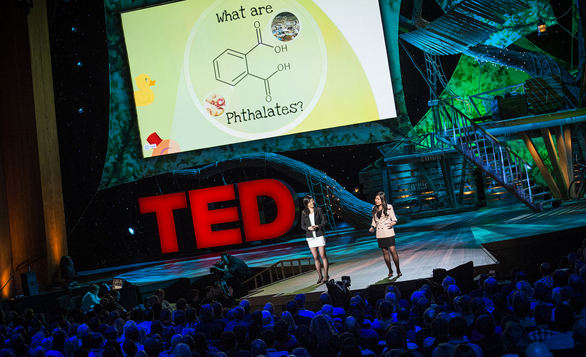
Teen scientists Miranda Wang and Jeanny Yao share an incredible use of bacteria — for breaking down the pthalates in plastic. Photo: James Duncan Davidson
When you think of bacteria, the word ‘heroic’ hardly pops to mind. Bacteria don’t have the best reputation (case in point: the poop problem). But, we are reminded in today’s talk, from teen scientists Miranda Wang and Jeanny Yao, that not all bacteria are our enemies.
Wang and Yao found themselves faced with an immovable problem: an enormous pit of plastic waste at their local Vancouver waste station with nowhere to go except back into the ecosystem, where it would sit for more than 1000 years. They asked: What if you could make a plastic carton disappear as quickly as an apple core, which takes only days to decay.
Bacteria is the invisible solution to this highly visible problem. The duo, with the help of expert mentors, harnessed the degradation potential of the bacteria in the soil of their local Frazer river and cultured it so that it could live off pthalates — a highly pollutant substance in plastic — as its sole source of carbon, and thus break them down.
Wang and Yao aren’t alone in using the incredible powers of these microorganisms to solve everyday problems. Here are six more ways of thinking about helpful bacteria and their uses:
 Magnus Larsson: Turning dunes into architecture
Magnus Larsson: Turning dunes into architecture Imagine a 6,000-kilometer-long wall, the size of the Great Wall of China, made from only bacteria and sand. Yes, it can be done, says Magnus Larsson at TEDGlobal 2009. Bacillus pasteurii is a microorganism that takes a pile of sand and transforms it into sandstone. Sand, in this solidified state, would help architects build structures to support human life in the most extreme environments. |
 Jonathan Eisen: Meet your microbes
Jonathan Eisen: Meet your microbes Every person exists in a microbial cloud — we have 10 times as many microbial cells on us as we do human cells. It could be the delicate balance of these microbes — which include bacteria, archaea, eukaryotes and viruses — that keeps us healthy. In this talk from TEDMED 2012, biologist Jonathan Eisen shares some surprising ways that microbes could be used to improve health. |
 Damian Palin: Mining minerals from seawater
Damian Palin: Mining minerals from seawater At TED2012, Damian Palin tackles two pervasive problems at once: inadequate access to clean water and mining for minerals. Filtering seawater is a costly process and leaves behind a salt solution or brine that’s usually tossed back into the ocean, even though it’s toxic. The bacteria Palin is studying can accumulate, precipitate and deposit minerals from the desalination brine. |
 Bonnie Bassler: How bacteria "talk"
Bonnie Bassler: How bacteria “talk” We can learn a lot from how bacteria communicate, says Bonnie Bassler in this talk from TED2009. The bacteria covering our body are an “invisible body armor” that protects us from other environmental dangers. Most importantly, they teach the body to keep bad bacteria out. |
 Suzanne Lee: Grow your own clothes
Suzanne Lee: Grow your own clothes Suzanne Lee grows fabric from a kombucha-like cocktail of bacteria, yeasts and other microorganisms. During the fermentation, cellulose threads form and transform into layers. At TED2011, she unveils some of her creations from this material — one is an airy, lightweight, transparent jacket with the feel of vegetable leather. |
 Jessica Green: We're covered in germs. Let's design for that.
Jessica Green: We’re covered in germs. Let’s design for that “These creatures define who we are,” says Jessica Green in this talk from TED2013, referring to the trillions of microbes that cover our bodies. What happens when we design the invisible ecosystems and pathways for microbial exchanges? Then, we could have a profound impact on our health and our visible environments. |
 E.O. Wilson: My wish: Build the Encyclopedia of Life
E.O. Wilson calls for an Encyclopedia of Life Bacteria is a crucial part of E.O. Wilson’s proposed Encyclopedia of Life. He emphasizes that bacteria, though not visible, play a significant role in our world and represent an enormous source of biodiversity. Our lives, the lives of other animals, the sea – we all depend on these creatures. Cool fact: There are 500 species of friendly bacteria living in our mouths and throats, keeping the bad ones at bay. |
And as a bonus: imagine what we can learn from the oldest living bacteria. Rachel Sussman shares in the talk, “The oldest living things”…
[ted id=948]
]]>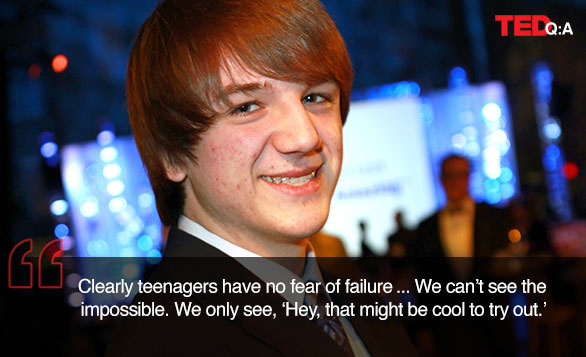
Jack Andraka is not your typical teenager. The high schooler spends his free time in the science lab concocting better, cheaper ways to spot disease. One such project — a test for the early detection of pancreatic cancer — won Andraka first place in the 2012 Intel International Science and Engineering Fair.
As Andraka explains in his talk, his “teenage optimism” played a big role in this accomplishment.
Jack Andraka: A promising test for pancreatic cancer ... from a teenager
At age 13, after losing a close family friend to pancreatic cancer, Andraka began researching the disease to better understand what had happened. Andraka was shocked to find that 85 percent of all pancreatic cancer cases are diagnosed late, when a patient has less than a 2 percent chance of survival. Alarmed at the lack of affordable and accurate tests to detect this cancer at its earliest stages — when treatments can actually work — he pored over a list of 8,000 proteins associated with the disease, trying to find an appropriate target for a theoretical detector. On the 4,000th try, he hit on mesothelin — which is found at high levels in the bloodstream during early stages of pancreatic cancer.
Then, in a serendipitous stealth reading of an unrelated technical paper during his high school biology class, Andraka had the idea to interweave antibodies sensitive to mesothelin into a network of carbon nanotubes, incredibly thin carbon cylinders. High levels of mesothelin in a drop of blood from a pancreatic cancer patient would attach to the antibodies and change the electrical charge of the network. Essentially what Andraka was doing was eliminating the need for an invasive test, and creating one that could be done cheaply and easily.
In his charming talk, Andraka walks us through the “aha” moments that led to this big idea, and the long, winding path he traveled in order to get lab space to perfect his cancer detector — which takes five minutes to run at nearly 100% accuracy at a cost of just 3 cents. By Andraka’s calculations, this test is 168 times faster, 26,000 times cheaper and over 400 times more sensitive than ones currently available. The detector might also work for both ovarian and lung cancer and, with a different set of antibodies, could be tweaked to detect a long list of other diseases — from other cancers to malaria to AIDS.
Andraka holds the patent for this test and is looking to partner with a biotech company to bring it to market. He estimates that — if all goes well — in about 10 years it could have FDA approval and be widely available.
The TED Blog caught up with Andraka to talk about his research, his friendly sibling rivalry, and how to use the Internet for innovation.
When someone asks you to explain your pancreatic cancer detector, especially someone who might not have a science background, how do you explain it to them?
It’s [like] a pregnancy test but for cancer. And potentially, it can detect nearly any disease. That’s kind of like my shorthand description of it — it’s like a diabetes test, a skin prick, for cancer. You draw a drop of blood and put it onto the sensor, and it would actually be the exact same set up for measuring their electrical conductivity. So, essentially you could just modify the antibodies and be able to detect pancreatic cancer.
[Clarification: Andraka added later that the diabetes test is an analogy, and that his detector works very differently in principle.]
In your TED Talent Search talk, you mentioned you were reading a paper on carbon nanotubes in your biology class when you first came up with the detector idea — and that it was something you were reading on the sly. What paper was it?
The name of the paper was “Carbon Nanotubes—The Route Toward Applications” and essentially I had stumbled across it when I was fooling around on Google. I had learned about these things called carbon nanotubes — those long thin pipes of carbon that are an atom thick and 1/50,000th the diameter of your hair. So I found this paper and thought, “Huh, that looks very cool.” I was just skimming through the top bit, so then all of a sudden I thought, “Hey! Maybe I should just bring this to biology class!” Because I got really bored in that class.
Because that’s a subject that is easy for you?
Well, I had learned a lot of the stuff in biology already and so I kind of just sat in the back of the room and read random articles during class. I wasn’t the teacher’s favorite student.
When I heard that story, I was picturing you with your biology book, but with the advanced carbon nanotube paper tucked into it like a comic book. Can you tell me about that moment?
I had already known that I had to detect this one cancer biomarker called mesothelin. That’s a protein that is normally found in your blood, but when you have pancreatic cancer you have it at very high levels — also at very early stages of the disease. And so I knew that I wanted to detect this one specific protein, and I wasn’t quite sure how. I was kind of just like trying to look up different ways of detecting proteins.
So I was reading through this article on nanotubes and on this one page it talked about their electrical properties [in a network]. [In class], we were learning about antibodies — well, the teacher was just blabbing about them in the background. I thought, “Antibodies! Those could provide some specificity so you would only target it at one protein.” But then the carbon nanotubes have this electrical property: when you separate them, essentially what happens is it increases the resistance. So then I thought maybe if I combine those two, then it could work. And then I kind of just rolled that around my brain until I finally put together the pieces of the puzzle in the right way.
So it was something in class that you heard. You were sort of just half listening, and something in the lecture floated in while you were reading.
Yeah. If [the teacher] hadn’t have been talking about antibodies, I would have completely passed that possibility over.
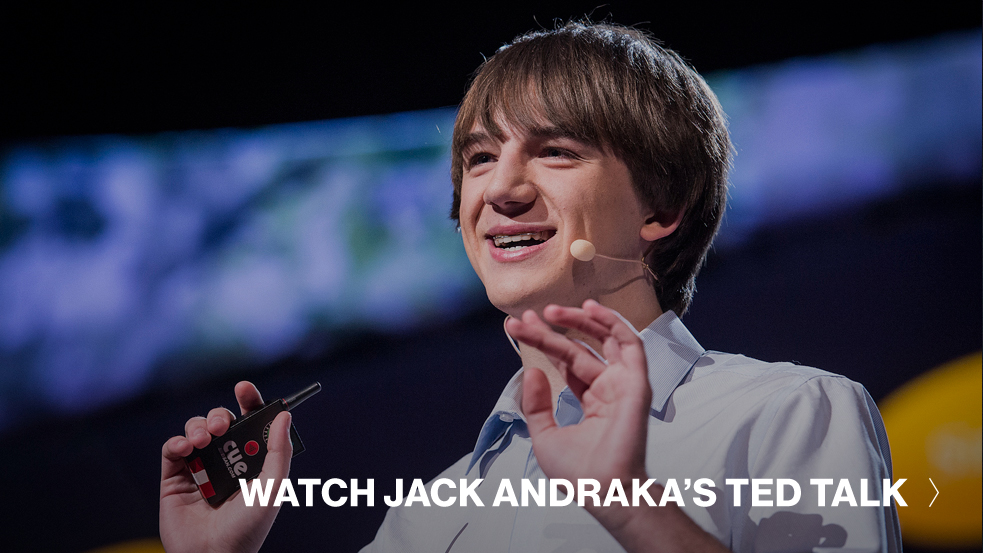
In your TED2013 talk, you mentioned that you had a family friend who had passed away from pancreatic cancer. At what point during that difficult experience did you decide to do research on this?
I was 13 when the close family friend passed. And so essentially what happened is I soon became interested in pancreatic cancer. I mean, because in the course of three months he had passed away. After that, I just did a bunch of research because I didn’t have anything to do on that day. So I decided to look up pancreatic cancer and that was when I discovered all these statistics on it.
Were you surprised that there weren’t any modern techniques for detecting this cancer early that was so devastating so many people?
Yeah, I was really shocked by the fact that we didn’t have any way to detect pancreatic cancer. I mean, with a lot of diseases you have one test that can detect it. Like with breast cancer you have the mammography, or with HIV/AIDS you have that screening test. But with pancreatic cancer you have to have this really invasive biopsy or you have to go through an MRI or CT scan. All those are really invasive and I couldn’t believe there wasn’t just a routine assay you couldn’t just get to see if you had pancreatic cancer.
Are such techniques common for other kinds of cancers? Is this something about cancer in general or is this something that is unique to pancreatic cancer?
Some diseases do have a standard test. However, they can only really be used in developed nations because of the inhibitive costs. But also, for a lot of the diseases, there just isn’t a test for early detection. And for a lot of different things, even gold-standard assays, they’re still very expensive and miss a lot of the cancers in the earlier stage. So that’s why this is such a crucial breakthrough.
What’s going on with the detector right now? Where is it in development, and what are the next stages that it will probably go through?
Well, currently what’s happening is that I have an international patent on it and I’m talking with several large biotech companies on licensing out the patent and getting it on the market as soon as possible and negotiating a deal with some of them. So it’s been very, very exciting. It’ll be probably be a further 10 years after that until I can get FDA approval and have it mass-produced on the market.
You’ve won some impressive awards for your science, and I’ve read that your older brother, Luke, is also accomplished in this area. Is there any friendly sibling rivalry between the two of you?
There has been sibling rivalry since I started science fairs. My brother, he was in seventh grade when he got fourth in the national science fair. Then, when I was 16, I beat him at the science fair. We’ve been battling ever since.
Is it fun, having a sibling who’s into the same thing that you’re into, and who knows the world of the science fairs like you do?
Yes, for sure. We joke around a bit. And it’s also extremely helpful because my brother — he is really good at chemistry and physics. And I’m really good at medicine and biology. So whenever I have a question about anything to do with physics and chemistry I go up and quiz him to explain those subjects to me. He’s really good at explaining stuff.
Does your brother have any patents at this point?
He has a patent on two different things, but I also have a patent on another technology — so we’re tied in the patent race.
Is it fair to assume that your favorite subject in school is science?
Actually, my favorite subject was AP U.S. Government this year. That was a lot more fun than basic chemistry.
More fun than chemistry?
There was a lot more interesting stuff to read [in history] than just, like, sitting there and doing a bunch of practice problems [in chemistry]. Basic chemistry is actually kind of drab.
It seems like you have a really broad interest in the sciences. What are your plans for college or for your career in general? Do you want to narrow your focus to a specific field or do you want to go for a multidisciplinary program?
I actually have no clue as to where I want to go — and I have no clue as to what I want to do. I’m thinking medicine, probably, or something related to it. I can’t decide if I want to do something like public policy or go into medical practice or academia or business. Also, I like a lot of colleges. I do like a certain one out in California for its weather and its close proximity to Silicon Valley, and a lot of my friends are going there. However, I am still undecided for what college I would want to go to.
What are the next projects you want to work on?
Currently, I’m working on something called the Tricorder XPRIZE, which is sponsored by the Qualcomm Foundation. That involves something the size of a smartphone that can pass through your skin and identify any disease instantly. So currently there are 300+ teams of all adults working on it, and then I have a team of all kids — all teenagers who are my friends from the science fair, and we are going for the $10 million [prize]. So it’ll be pretty exciting.
Was the team of high school students your idea, or was that part of what the foundation was looking for?
Anyone can enter the Tricorder exercise but I decided to go for all teenagers because, really, teenagers are at the epitome of scientific knowledge and creativity. Especially since we can come up with these crazy ideas but still have enough knowledge to bring them to life.
Do you think these crazy ideas that you’re talking about come from being young and not being so cautious? Perhaps because you’re starting out and it seems like anything is possible?
Yeah. Clearly we have no fear of failure and we have no clue about anything in the field. So we can’t see the impossible. We only see, “Hey, that might be cool to try out.” That’s what science really should be about instead of just doing these really interesting experiments.
Do you have an advice for other young — or old! — inventors and scientists out there?
Well, if anything, it’s something I said in my TED Talk. I just used Google and Wikipedia. Literally you just go on Google for a couple of hours and look up cool articles and stuff. Just by using the Internet in really cool and interesting ways, we can solve so many of the world’s problems and we can tap the minds of so many more innovators and have a much more collaborative spirit. So really, just use the Internet in cool ways to solve your problems.
When you say using it in cool ways to solve your problems, how are you using Google in ways that are different?
Well, the typical teenager doesn’t use Google to find scientific articles. They are typically on Tumblr, Facebooking, liking pictures a person posted of their food on Instagram. And so that’s why I am really passionate about showing them that, hey, you can be changing the world.
.
This piece was originally published in July of 2013. It was updated on February 4, 2015, for World Cancer Day,
Taylor Wilson has been called “The Boy Who Played With Fusion” by Popular Science magazine. At age 9, Wilson stunned tour guides at the U.S. Space and Rocket Center in Huntsville, Alabama, with his complex understanding of rocket science. At 12, he set out to make a “star in a jar.” By 14, Wilson had become the youngest person to achieve nuclear fusion with a working reactor. Built in his parents’ garage, the deuterium-hurling device is now housed in the physics department of the University of Nevado, Reno.
At TED2013, Wilson made his second appearance on the TED stage, above. Now 19, he arrived with a bold new idea — a way to make nuclear energy safe and portable, on a scale where it has the potential to address the global energy crisis. In today’s talk, Wilson shares his latest innovation — Small Modular Fission Reactors. These reactors are small, meaning that they can be built in factories and shipped around the globe. They run on already-molten material, so meltdowns won’t be an issue. They’re installed three meters underground, making them hard to tamper with, and yet, in the event of a disaster, the core can be drained to a tank underneath, stopping the reaction. And while traditional nuclear power plants run for 18 months before needing refueling, the small-scale versions could run for up to 30 years, after which they could be sealed for discarding.
To hear how these reactors work — and a few potential applications, from bringing carbon-free energy to the developing world to propelling rockets into space — watch this talk.
A year ago, at TED2012, Wilson took the TED stage to talk about the nuclear fusion reactor he created in his basement. “I would like to make the case that nuclear fusion will be … our energy future,” he says in this talk, “Yup, I built a nuclear fusion reactor.” “I’d also like to make the case that kids can really change the world.”
[ted id=1397]
Wilson isn’t the only teenager who has shared an energy innovation on the TED stage. At TEDGlobal 2007, William Kamkwamba answered questions about his incredible creation – a homemade windmill he built at age 14.
Kamkwamba set out to make a windmill to bring electricity to his family’s home in rural Malawi. He got the basic plans from a library book, reimagining the design out of spare parts, like a bicycle frame and plastic pipes. Kamkwamba made significant alterations in the design to improve upon it, adding an extra blade to increase the windmill’s power production. In the end, the windmill created 12 watts of energy – enough to power four lightbulbs and two radios in his family’s home. At TEDGlobal 2009, he returned to the stage to tell the story in more detail in the talk “How I harnessed the wind.”
[ted id=642]
After his TED experience, Kamkwamba set his sights on building a bigger windmill to pump water and power irrigation for his entire village. Kwambama’s story was recently the subject of the documentary William and the Windmill, which won the Grand Jury Award at SXSW.
Bill Gross, the founder of Idealab, is an adult now. But in his talk from TED2003, he revealed that he started his first energy company — called Solar Devices — when he was 15 years old, building on what he learned in school about how parabolas could concentrate rays of light onto a single point. At the height of the gas shortage in 1973, Gross developed his own design for a Stirling engine in metal shop.
“I sold the plans for this engine and for this dish in the back of Popular Science magazine, for $4 each,” he says in this talk, “Bill Gross on new energy.” “I earned enough money to pay for my first year of Caltech.”
[ted id=450]
Want more talks with ideas for energy (regardless of the speaker’s age)? Watch the TED playlist “The End of Oil.” It begins with Wilson’s talk about his nuclear fusion reactor, continues with Donald Sadoway sharing the missing link to renewable energy, and continues with eight more great ideas for moving beyond our reliance on oil.
]]>
Some teenagers spend their free time playing video games. Others dedicate their after-school hours to a job, scooping ice cream or taking movie tickets. Still others play a sport, or are star members of a debate team. And still others spend their free time in a lab, working on ways to prevent, diagnose and treat cancer.
In his TED Talk, “A promising test for cancer … from a teenager,” 16-year-old Jack Andraka shares what got him interested in studying pancreatic cancer — a close family friend succumbing to the disease in just three months time. Pancreatic cancer is brutal, with only 5.5% of those diagnosed surviving past five years — in part because it is usually diagnosed very late. After Googling and finding terrifying statistics on the disease, Andraka had an idea: could there be a noninvasive test for pancreatic cancer to diagnose it early?
In this charming talk, Andraka reveals the many lightbulb-over-head moments that led him to create a test for pancreatic cancer that costs three cents and is close to 100% accurate. It’s a must-hear story, as one can imagine this test someday being given during routine checkups, if all goes as planned.
Here, more talks from four more incredible young people who’ve taken the TED stage to talk about their cancer research.
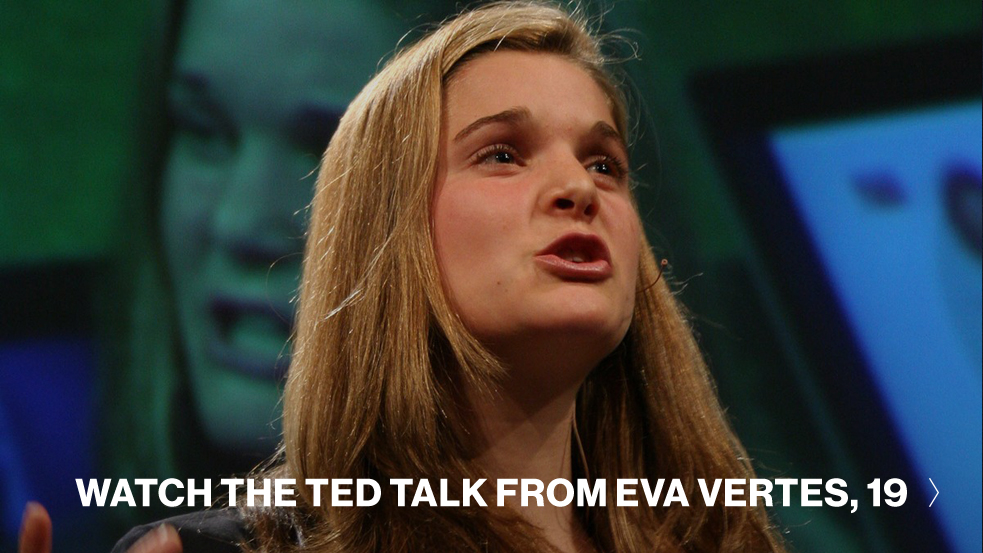
Eva Vertes: Do stem cells cause cancer?
Microbiology prodigy Eva Vertes was only 19 years old when she spoke at TED2005 about cancer stem cells. In the talk below, she presents research that suggests cancer might be a repair response to damage to stem cells in the lungs, liver, bones, etc. The implication she is testing? “It’s possible, although far-fetched, that in the future we could think of cancer being used as a therapy,” she explains in her talk.
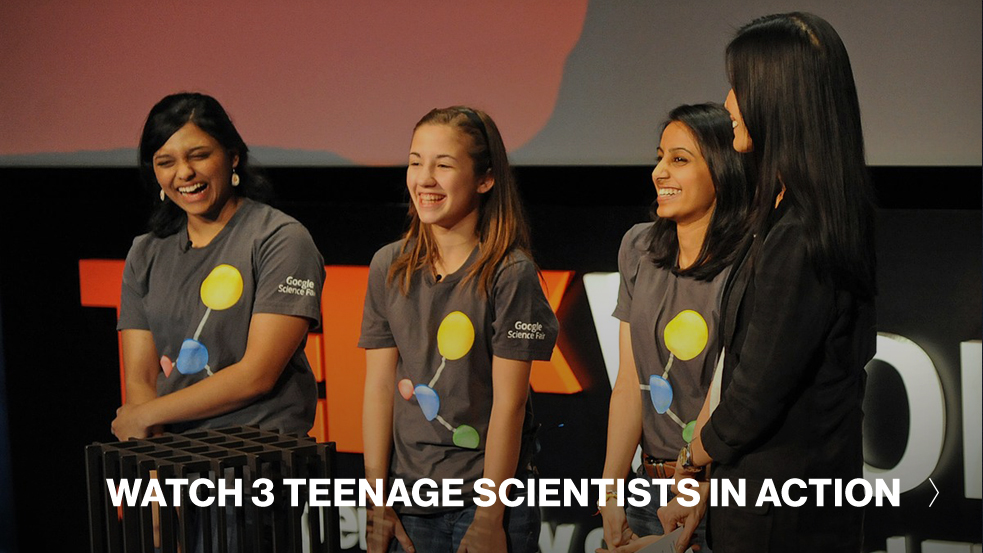 Lauren Hodge and Shree Bose: Award-winning teen-age science in action
At the 2011 Google Science Fair, three young women swept the top prizes. The trio presented their award-winning projects at TEDxWomen that year. Then-13-year-old Lauren Hodge studied the formation of carcinogens in cooking chicken and found a surprising result — that maybe you don’t really want the grilled chicken after all. Meanwhile, Shree Bose researched how chemotherapy resistance happens in ovarian cancer — a breakthrough that could improve future treatments. Watch both young women present their findings.
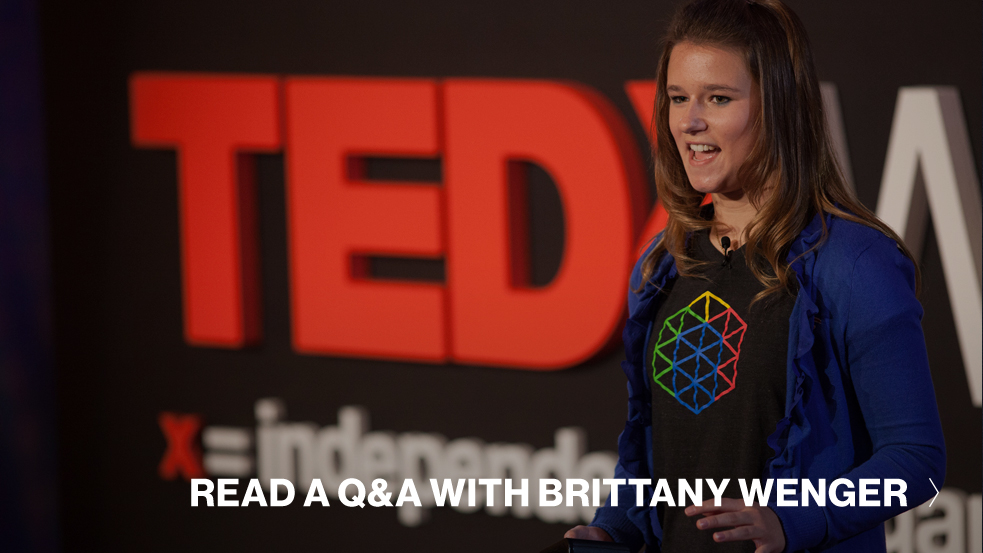
Brittany Wenger: This college freshman is a cancer detective
Brittany Wenger taught a computer to diagnose breast cancer, a feat that required 600 hours of coding and the running of 7.6 million trials. She did this before she was even old enough to vote. She started in the 7th grade, with just a computer programming book, and shared at TEDxWomen 2012 what sparked the idea to create an artificial neural network — a program that learns as it encounters more data — and train it to differentiate between benign and malignant breast tissue. The data she used came from fine needle aspirates — currently the least invasive but also the least conclusive test for breast cancer. Wenger’s network, Cloud4Cancer, is 99.1% sensitive to malignancies and, as it learns more, should only get better. Wenger hopes to open up the network to hospitals and, with more research, the least invasive test for breast cancer could become the most accurate.
This post originally ran on July 25, 2012. It was revised on February 4, 2015 for World Cancer Day.
]]>