
Eastern hellbender. Photo by Julie Larsen Maher / WCS.
The WCS’s Bronx Zoo is joining the fight to save the world’s largest salamander, the Eastern Hellbender, by teaming up with the New York State Department of Environmental Conservation and the Buffalo Zoo in reintroducing 38 of these animals into wild streams in the state of New York. Juvenile eggs were collected from the Allegheny River drainage at the start of the program, and they were raised off-location and returned to that same drainage. Each amphibian was tagged with a chip for future surveys and species health assessments after exposure to their natural environment.
This program will enable conservationists to release young hellbenders back to the wild at an age that will enable them to survive and live a full life in the state of New York. Currently this state lists the Eastern Hellbender as a species of Special Concern, due to several factors including disease, pollution, and habitat destruction.
Hellbenders are found in rocky streams and are entirely aquatic. Some of their nicknames include devil dogs, Allegheny alligators, and snot otters. Hellbenders can measure nearly two feet in length as adults, and join a category of two other giant salamanders, the Japanese giant salamander and the Chinese hellbender, which can grow to up to six feet long.

Photo by Julie Larsen Maher / WCS.

Photo Credit: Julie Larsen Maher © WCS
The Prospect Park Zoo in Brooklyn, New York City, is now home to five critically endangered Kaiser’s spotted newts (Neurergus kaiseri).
These black, white, and orange amphibians are found only in a five-square-mile region in Iran. Severe habitat loss and the illegal trade of these rare amphibians has driven the species to possibly be extinct in the wild, and they are officially ranked as critically endangered by the IUCN. The Kaiser’s spotted newts live in the Animals in Art exhibit at the WCS Prospect Park Zoo, which is also home to a Amphibian Crisis exhibit that highlights the serious challenges amphibians face around the world.
For related information, see the article: Forgotten Species: the fiery Luristan Newt
]]>Males gobbling babies. Wiggly tadpoles bulging beneath the skin. Yeah, okay, that’s bizarre, but it’s also the lifestyle of Darwin’s frog (Rhinoderma darwinii), an endangered species that was found by Charles Darwin himself. While the females carry the eggs, the male Dawin frogs carry the young tadpoles in its vocal sac (of all places!) for a fortnight. The footage was filmed and produced by EDGE Fellow Claudio Soto-Azat.
To read more about Darwin’s frog, see the EDGE blog: Life Within a Vocal Sac.
]]>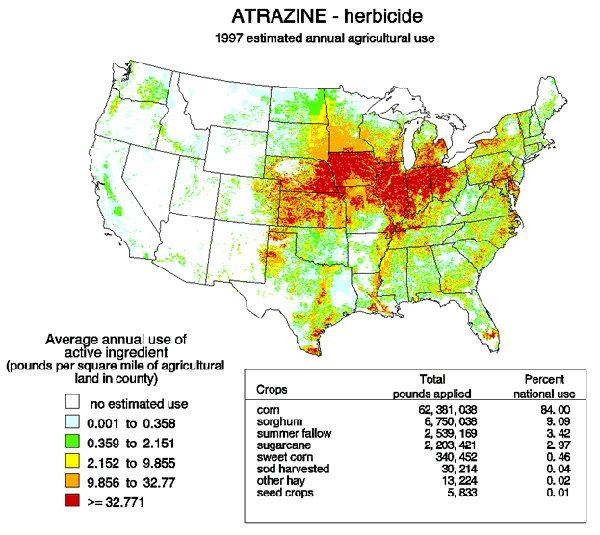
For the third annual Save the Frogs Day (Friday, April 29th), amphibian-lovers are taking the fight to Washington DC to rally at the Environmental Protection Agency for a ban on the herbicide Atrazine. Banned in the EU since 2004, Atrazine has been shown to chemically-castrate frogs at incredibly small quantities. In addition, the herbicide has been shown to cause cancer in mammals.
Save the Frogs! petition: Atrazine – Let’s Get It Banned.
According to the organization Save the Frogs! : “Atrazine is an endocrine disruptor that turns male frogs into females at concentrations as low as 2.5 parts per billion. This horrible chemical causes cancer in laboratory mammals and developmental problems in fish. Atrazine is one of the most commonly detected pesticides in rainwater, groundwater and tapwater in the USA: atrazine spray gets lifted into the clouds, travels hundreds of miles and then falls down from the sky in rainwater — half a million pounds of it each year. Atrazine is one of the world’s most common pesticides: over 80 million pounds of it were used on American crops last year, and it has been in use for 50 years. Frogs and humans share half our DNA, so Atrazine can’t be good for humans either. That’s likely why the European Union banned the harmful pesticide in 2004. Now we need your help to get it banned in the United States.”
For more information on Save the Frogs! and the global Save the Frogs Day:
Save the Frogs Day focuses on banning Atrazine in US

(04/26/2011) This year’s Save the Frogs Day (Friday, April 29th) is focusing on a campaign to ban the herbicide Atrazine in the US with a rally at the steps of the Environmental Protection Agency (EPA). Kerry Kriger, executive director of frog-focused NGO Save the Frogs! and creator of Save the Frogs Day, says that Atrazine is an important target in the attempt to save amphibians worldwide, which are currently facing extinction rates that are estimated at 200 times the average. “Atrazine weakens amphibians’ immune systems, and can cause hermaphroditism and complete sex reversal in male frogs at concentrations as low as 2.5 parts per billion,” Kriger told mongabay.com.
]]>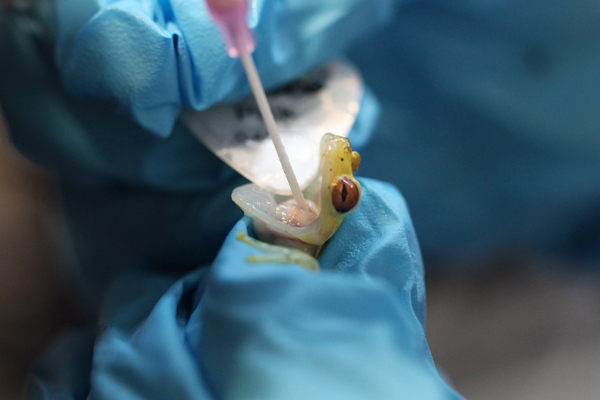
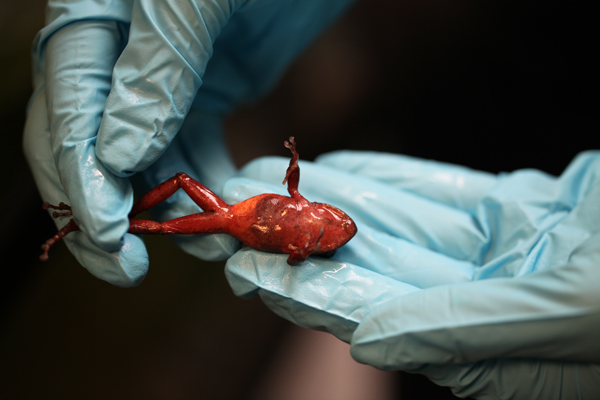
Hand-feeding a sick Hyloscirtus colymba tree frog.
The Panama Amphibian Rescue and Conservation Project is racing to save amphibians as the deadly chytrid fungus spreads down Central America. The disease is presently between Panama City and Colon.
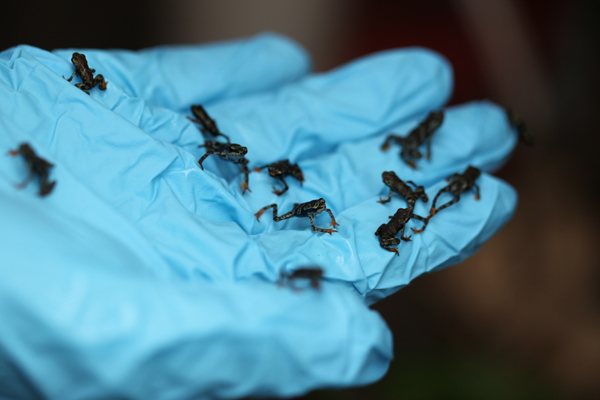
Juvenile Atelopus certus.
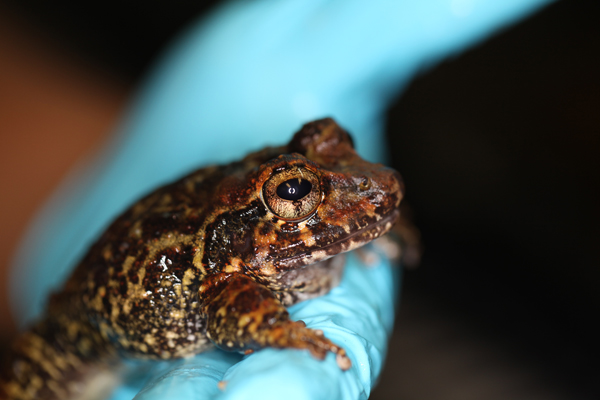
Pristimantis species.
Undescribed Pristimantis species.
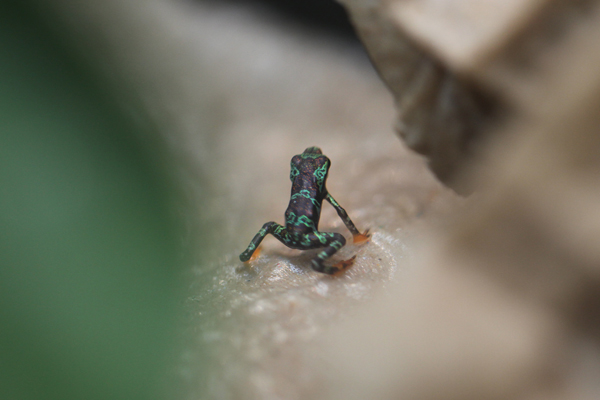
Juvenile Atelopus certus.
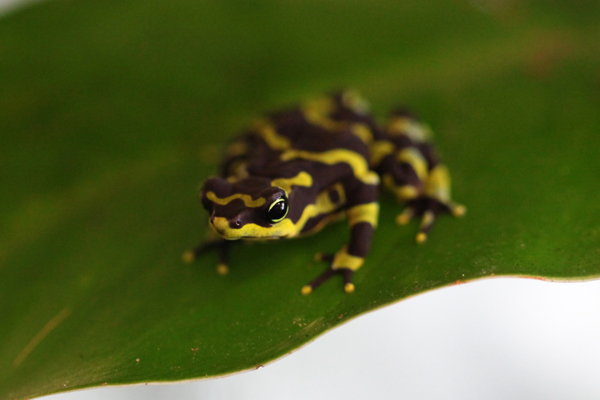
Atelopus limosus.
More photos to come. All photos by Rhett A. Butler
]]>
The Bornean gliding leopard tree frog (Rhacophorus pardalis). Shots taken from a recent visit to Gunung Palung National Park in Kalimantan. Photos by Rhett A. Butler, 2011.


A tree frog photographed in Amacayacu National Park, Colombia, 2010. We have been unable to identify this species, if you know please contact us. Photo by: Rhett A. Butler. ]]>
Native to India, the purple frog (Nasikabatrachus sahyadrensis) is listed as Endangered by the IUCN Red List. The species is also a focal amphibian for the innovative ZSL EDGE program, which selects the species it works with based on their evolutionary uniqueness and threat level.
According to the EDGE website: “The purple frog is the sole representative of an ancient lineage of frogs that has been evolving independently for over 130 million years. […] Formally discovered in 2003, the purple frog spends most of the year underground, surfacing only to breed during the monsoon. It was the first new family of frogs to be discovered since 1926. This species is threatened by ongoing forest loss for coffee, cardamom and ginger plantations.” Video courtesy of ZSL EDGE-TV.
]]>
Look closely to spot the Green and black poison dark frog (Dendrobates auratus in the rainforest canopy in Colombia. See more photos below of the frog in Colombia. Unlike many Neotropical frogs, this species is listed as Least Concern by the IUCN Red List. Photos by Rhett A. Butler.


Click to see more photos of poison dart frogs.
]]>
Anderson’s crocodile newt (Echinotriton andersoni) larvae. Photo by Rhett A. Butler
Anderson’s Crocodile Newt is found in a range of tropical and subtropical habitats Japan and Taiwan, but is listed as Endangered on the IUCN Red List due to habitat loss. This individual is part of a captive-breeding program at the Wildlife Conservation Society’s Bronx Zoo.
]]>