Advertise with Googlier.com | AZ Jewish Post https://azjewishpost.com The Voice of the Jewish Community of Southern Arizona Mon, 23 Mar 2026 23:17:44 +0000 en-US hourly 1 Vandalism at the UA Jewish Community Represents a Recurring Discrimination https://azjewishpost.com/2026/vandalism-at-the-ua-jewish-community-represents-a-recurring-discrimination/ Thu, 26 Feb 2026 22:43:08 +0000 https://azjewishpost.com/?p=55448 Read more »]]>
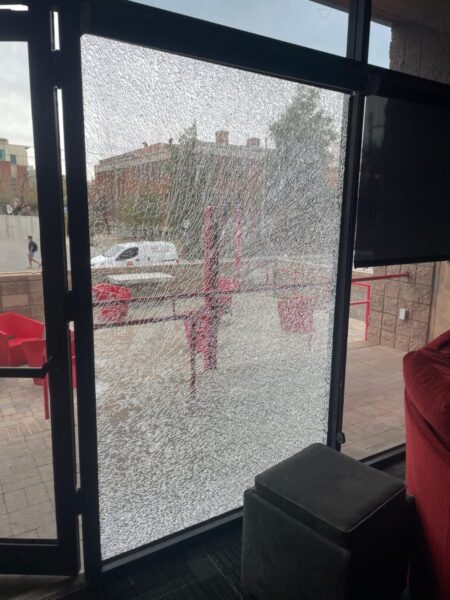
A window shattered by an act of vandalism at the University of Arizona Hillel building near the entrance off of 2nd Street. (Photo: Lea Thomas)

The University of Arizona Hillel building was vandalized on the morning of Saturday, Feb. 14. As the center for Jewish students on campus, this act brings a wave of fear for Jewish students.

Since Oct. 7, 2023, when Hamas terrorists invaded Israel, murdered over 1,200 citizens and took hundreds of innocent civilians hostage, antisemitism has reached an all-time high in the United States and around the world. During the 2024-2025 academic year, there were 2,334 antisemitic incidents across United States college campuses, a 700% increase from the 2022-2023 academic year.

While the increase in antisemitism can be felt in all sectors, terrifying hostility has especially been growing on college campuses. Being a Jewish student on campus has become an unnecessary challenge. Managing classes and extracurriculars is already a huge undertaking. Worrying about safety as a Jewish student on campus represents additional burdens that no student should encounter.

Antisemitism at the UA has appeared in forms of discriminatory chants, flyers and graffiti. For example, in December 2023, “HITLER IS RULER” was drawn on a classroom whiteboard, fliers reading “there will be more October 7ths” were distributed in August 2024 and a swastika was found painted on a campus light post. With a shift from graffiti and flyers to vandalism, many students wonder if the next act will include physical violence.

While thankfully, no one was in the Hillel building at the time of vandalism, this act took place on Shabbat, a holy day for Jewish people.

Throughout the week, Hillel is bustling with students doing homework, hanging out with friends and looking for a place where it is safe to be Jewish. This act of violence disrupted one of the few places where we’re able to be faithful and proud of our identity and community in a seemingly safe environment.

The past several years in America have shown that Jewish people can never feel completely safe in their own synagogues or community centers, like Hillel.

On Oct. 27, 2018 on Shabbat morning, 11 Jewish people were shot dead in the Tree of Life Synagogue in Pittsburgh, Pennsylvania. On Jan. 15, 2022,  Congregation Beth Israel in Colleyville, Texas was held hostage on Shabbat morning. More recently, on Dec. 14, 2025, 15 Jewish people were shot dead at a Chanukah celebration at Bondi Beach, Australia. As history has shown, Jewish people are never completely safe. This unfortunate fact has been combatted with incredible security measures at Jewish institutions and events in my own community and across the world, such as police presence, bulletproof glass and frequent safety drills.

While the lack of Jewish people’s safety has become a not so new normal for the community, this cannot be passively observed by the UA community. No group should be targeted with hate on campus. Violence can never be accepted on campus. Instead of ignoring this act of antisemitism or sweeping it aside as another new normal, the UA community must take actions to ensure that never again truly means never again. 

As the Hillel student board president, curating a positive community for all Jewish students is vital to my role and personal desires for the Jewish community and UA community at large. This is difficult when vandalism or other antisemitic attacks threaten the safety of Jewish students.

As a community, we must choose to care for all students, regardless of religion or identity. In the same vein, education must be a priority for students. Learning about other cultures and people is imperative to ensure trust and respect for each other.

Holocaust survivor and author Elie Wiesel notably wrote that “Education is the key to preventing the cycle of violence and hatred that marred the 20th century from repeating itself in the 21st century.”

It is crucial for the collective UA community to be aware of what is happening on our campus and the greater world, regardless of one’s direct connection. Especially with great division spreading across the country, now is the time to provide support and kindness to all people. All students deserve to feel comfortable on campus and in their respective smaller communities; however, this can only be achieved by individually doing one’s part and showing up for each other every day with kindness.

]]>
The Circle of Life (Apropos the JCC Maccabi Games)  https://azjewishpost.com/2025/the-circle-of-life-apropos-the-jcc-maccabi-games/ Tue, 29 Jul 2025 18:52:57 +0000 https://azjewishpost.com/?p=54826 Read more »]]>
Judith Manelis danced ballet as a child.

I was never much of an athlete. Whether it was softball, basketball, volleyball, or swimming, the situation was the same. I played every activity, but nothing well. In volleyball, I couldn’t serve; in basketball, I couldn’t make a basket; in softball, I couldn’t get a hit or catch a fly ball. And in swimming, I hated to put my face in the water.

To my chagrin, and perhaps embarrassment, I was one of the last girls chosen for team sports at Pembroke, my Jewish summer camp in Massachusetts. Painful as it was, I accepted my athletic ineptitude. At the same time, I looked with great admiration at my peers who demonstrated the athletic ability I could only dream of.

During those years, when I felt physically inadequate, I read a lot of comic books. I wasn’t particularly interested in Superman, Batman, or Spiderman. My interest was in Mary Marvel and Wonder Woman. They were female and I could identify with them.

One afternoon when I was 11, I decided to make myself a cape. I wanted to emulate the superheroes. I took an old café curtain from the attic, bought iridescent pink ribbon from the five-and-dime, and sewed it all around the edge of the curtain. Then, I attached a safety pin to the ribbon and worked it through the rod opening to make a tie. I had my cape. 

I remember feeling a little hesitant. Nonetheless, I tied the ribbon around my neck and went bike riding around my neighborhood, the cape flowing behind me. For a few short blocks, I was the superheroine of my fantasies. No more the weak, unathletic camp girl!

Later, my interest in sports expanded to include Olympic events such as gymnastics, figure skating, ski jumping, and track. Once more, I watched athletically gifted young women and cheered them on. I felt empowered vicariously.

It wasn’t until years later (around the age of 39) that I found a sport that I could do: jogging. I didn’t have to be the best or even great. Thankfully, it wasn’t a team sport. No chance I would be picked last! I could just run and feel good about myself. 

Eventually, I ran short races — 3K, 5K. My first race was a mixed bag. I came in last. So while I congratulated myself for completing the race, it reminded me of camp days. I decided I didn’t care if I ever won a race, but I never wanted to come in last again. And, I never did.

Judith Manelis runs a half-marathon in the 1970s.

The highlight of my jogging career was running a half-marathon in Philadelphia. I trained for months with my friend and running partner. As I was commuting from Maplewood, New Jersey, to my job at national United Jewish Appeal in New York City, I had to get up very early to run. Five a.m. was the usual.

As it turned out, the race was an opportunity to combine my jogging with my Jewish commitment: I wore a shirt, especially printed for the occasion, emblazoned with the message: I run for IDA NUDEL, Prisoner of Zion. The Soviet Jewry movement was heating up, and I was thrilled to call attention to one of my Jewish heroines.

I could hardly believe that I completed the 13.1-mile course. For the first time in my life, I felt like an athlete.

I jogged for many years until I developed plantar fasciitis in both feet. It took one full year for the pain to go away and for me to walk normally again. I was too frightened by the experience to try running again. 

It would be some years before I found a substitute sport. By then I was living in Boston and was in my 60s.

It was Zumba, a Latin-inspired fitness program combining music, dance, and exercise. As I had been a ballet dancer as a child, I loved the opportunity to feel like a dancer again. Whether in Boston, where I lived at the time, or later at the J in Tucson, Zumba classes were a joyful experience. I loved the program and was excited every time I went to class. 

Then COVID struck. Once more, I was faced with circumstances not of my own making. By now, I was over 80, a widow, and feeling the need to protect my health. No more group exercise classes. Zumba had to go. It was a loss I still feel keenly. 

Where am I today? At 87, I am much more sedentary. And not by choice. For the last year, I have experienced periodic back pain that has impacted my life in a negative way. Once again, I am looking longingly at my peers who are able to run, hike, dance and play tennis. But that will never be me. I cannot stand too long nor walk down from Sabino Canyon as I so loved to do. Of course, Zumba is out of the question.

Instead, I try to be thankful that my head still works and to keep as active as my body allows.

And so life has come full circle …

As Yogi Berra would say, “It’s déjà vu” all over again. 

Judith Manelis is a writer, editor, and journalist whose work has appeared in American Jewish newspapers and magazines. Her book “This Shall Tell All Ages: Art, Music and Writings of the Holocaust” was published by United Jewish Appeal

Editor’s note: For updates on the JCC Maccabi Games, happening through Aug. 1 in Tucson, follow the @tucsonjcc and @jccmaccabitucson on social media.


]]>
Chaim Grade Manuscript Discovered: Where Has It Been and Why Do I Care? https://azjewishpost.com/2025/chaim-grade-manuscript-discovered-where-has-it-been-and-why-do-i-care/ Tue, 01 Apr 2025 22:12:24 +0000 https://azjewishpost.com/?p=54426 Read more »]]> A dust jacked photo of Chaim Grade
Chaim Grade

On Wednesday, Feb. 26, The New York Times ran a front-page article by Joseph Berger entitled “A Discovery of Lost Pages Brings to Light a ‘Last Great Yiddish Novel.’” The article detailed the search for a missing manuscript by a giant of 20th century Yiddish literature, Chaim Grade, its subsequent discovery and translation. 

What?  You never heard of Chaim Grade? You know about Isaac Bashevis Singer, the Nobel Prize winner.  But Grade? Who is he, and why is he such a mystery? Let’s compare them.

Grade’s work, like Singer’s, was written in Yiddish and translated. Both authors focused on Vilna and Eastern European Jewish life. Grade’s literary output includes several novels, essays, and nine books of poetry.  Singer was more prolific and authored novels, short stories, essays, children’s books, and memoirs. 

Grade (pronounced GRAHD-uh) focused on the minutiae of Orthodox Jewish life and customs (one of his especially esteemed works was the two-volume “The Yeshiva”). Singer, whose oeuvres often pulsed with demons and otherworldly figures, was more reader-friendly and accessible. 

 Personality-wise, the two men were totally different.  Singer had an outsize personality and a flair for showmanship. He lectured in English with humor and charm. Grade was not a public figure and lived a more solitary and reclusive life. Neither he nor his works entered the public consciousness.

Because Singer was more well-known and his work more accessible, his stories found their way to Hollywood. “Yentl” with Barbra Streisand was based on Singer’s story, “Yentl the Yeshiva Boy.”

Last, but not least, while each writer was married, their relationships were  vastly different. Singer’s wife appeared to be a helpmate, especially in her husband’s early years, encouraging and nurturing his aspirations to be a writer of note.  Grade, whose first wife, child, and mother had died in the Holocaust, had remarried.  His second wife, Inna, appeared less a helpmate than an adversary.  

Thus, this illustrious writer, whose work by those in the know has been compared to that of Tolstoy, has remained somewhat of a mystery to most readers, Jews as well as gentiles.  

So what happened?

The contrasts between the two giants of Yiddish literature help explain the difference in their reception and recognition.  But the relationship between Grade and his wife is something else. And it has impacted his reputation and visibility over the years.

I am no literary scholar.  Nor am I an expert in the works of Singer or Grade.  But 50 years ago, when I interviewed Chaim Grade, I got a close-up view of the relationship between the writer and his wife and saw how it might have impacted negatively on his reputation and legacy. 

Grade died in 1980, Inna in 2010, some 30 years after her husband. During those 30 years, her behavior vis-à-vis her husband reflected my observations during the interview.  

My article was published on  Dec. 5, 1974,  in The Jewish News of Metropolitan New Jersey, where I worked as a journalist.  Curt Leviant, an old friend and translator of several Grade novels, called me about writing a review of Grade’s latest book, “The Agunah,” which he had translated. I agreed to do it but wanted the chance to interview Mr. Grade. I promised to print both the review and interview simultaneously, which I did. Curt facilitated the interview.

My experience at the interview was disconcerting. Even all these years later, I find it hard to process. My career as a journalist had many unusual twists and turns, but I was unprepared to interview someone whose partner (in this case,  Inna) did everything she could to disrupt the conversation and insert herself into the interview process. 

During my interview with Grade in that overstuffed Bronx apartment, Inna rarely left the room. But she walked in and out, back and forth, in a nervous manner.  She often interrupted our conversation, constantly interjecting her own comments.  Her tone was full of bitterness and jealousy.  She said she wanted me to include her and her accomplishments in my article.  I told her I could not promise to do so.

She kept mentioning her career and how she had given it up for him.  And she was angry.  Throughout it all, Grade never said a word to her and behaved as if she wasn’t in the room. It was clear to me that their relationship was tumultuous, conflictual, and highly combative.

After Grade’s death, his wife sought ways to undermine his reputation and exert control over his legacy.  A case in point was her refusal to grant permission for the publication of one of his poems in an anthology of prominent Yiddish writers. One could also point to the “discovery” of the unpublished manuscript. It was among his papers for almost 30 years, but requests for access to his vast files and manuscripts by Yiddish scholars were denied.  

Over the years, some critics called her behavior mercurial and a mystery. Others suggested she was being overly protective of his work. Through three decades, she remained unresponsive to calls or letters requesting assistance or permission to use her husband’s work.

In my opinion, her jealousy and anger reached their peak after his death.  She was now in control and had found a way to spite him by reducing his imprint in the literary world. When she died, I remember thinking that at least she didn’t destroy his papers. I really thought she was capable of it.  

My last interaction with the Grades occurred some months after my interview.  The author was scheduled to give a presentation at New York’s 92nd St. Y. In Yiddish. My own Yiddish was non-existent, but I decided to go out of respect for him.  I brought flowers to give him after the lecture.  

After sitting through a long presentation in Yiddish, none of which I understood, I approached the stage with my bouquet. Inna saw me coming.  She rushed over, grabbed the flowers out of my hands, mumbled something about them being bad luck, and threw them into the nearest wastebasket. Whether she was angry with me for not including her in my article or simply wanted to divert attention away from her husband remains a mystery.  

Hopefully, the publication of this rediscovered work will bring Grade some of the appreciation and recognition he so rightly deserves.

Judith Manelis is a writer, editor, and journalist whose work has appeared in American Jewish newspapers and magazines. Her book “This Shall Tell All Ages: Art, Music and Writings of the Holocaust” was published by United Jewish Appeal.


]]>
Letter to the Editor: Now More Than Ever, Invest in Jewish Education https://azjewishpost.com/2025/letter-to-the-editor-now-more-than-ever-invest-in-jewish-education/ Fri, 28 Mar 2025 19:00:09 +0000 https://azjewishpost.com/?p=54415 Read more »]]> Melissa Spiller-Shiner with her husband and their two childrenAs a parent, a Tucson Hebrew Academy board member, and a proud member of this community, I’ve seen firsthand how Jewish education shapes not only our children’s minds but also their hearts.

When my husband and I enrolled our son at THA, we were initially drawn by the small class sizes and sense of community. What we found was something deeper — a school rooted in Jewish values, where our children are celebrated, nurtured, and challenged. My son is not only receiving an excellent secular education — he is also learning who he is, where he comes from, and why that matters.

In the wake of October 7, I felt a renewed urgency to strengthen our community. I joined the THA board and began volunteering with efforts to combat antisemitism locally. For me, supporting Jewish education is no longer optional – it’s essential.

Arizona’s dollar-for-dollar tax credit allows individuals and businesses to redirect their state tax dollars to provide scholarships for Jewish day school students. 

Here’s how it works:

  • Individuals can donate up to $1,459 (or $2,910 for married couples filing jointly) and receive the full amount back as a credit on their Arizona state taxes. Donations for the 2024 tax year can be made up until April 15, 2025.
  • Businesses can also contribute through the corporate tax credit program, which has no individual cap.

This is a chance to directly support Jewish education in Tucson and ensure more families can access the kind of community and academic excellence we have found at THA.

To make your contribution, visit www.jetco.org or call (520) 647-8442 for help navigating the process.

Now more than ever, let’s invest in our children, our values, and our future.


]]>
A Tucson Portrait: Old Man with a Dog https://azjewishpost.com/2025/a-tucson-portrait-old-man-with-a-dog/ Thu, 06 Mar 2025 17:22:12 +0000 https://azjewishpost.com/?p=54381 Read more »]]>
Judith Manelis, second from left; her daughter, Aliza Kaplan; mother, Mildred Manelis, and son, Seth Kaplan, with Lazarus (in wheelchair), circa 1980. The boy on the far left is a neighbor’s child. (Photo courtesy Judith Manelis)

He was standing at a busy intersection when I drove by.  What caught my attention was the small dog wrapped in a blanket that he pushed in a stroller. Also, his sign had a name on it: Leo.

It seemed every major intersection had people with signs, pleading for financial assistance.  They were men and women, old and young, mostly disheveled and homeless, the detritus of an affluent culture.  Couldn’t we do better, I often asked myself.

It was almost easy to drive by because there were so many of them, and so many corners, and it was impossible to help them all, even if you were willing and able.  But this old man had a dog and a sign with his name on it.  I must admit I’m partial to homeless people with dogs. First, I love my dog and know how important she is to me.  Second, a homeless person with an animal to take care of is less likely to be an addict who will use money for drugs, or so I think. And then, most importantly, the sign … this man had a sign with a name.

Years ago, when I volunteered at Daughters of Israel, a nursing home in West Orange, New Jersey, I discovered the importance of names. I had volunteered to visit an old Jewish man who had no family. His name was Lazarus. On most Sundays, I would drive to the nursing home to spend some hours with him. At the end of each visit, in a ritual he followed every Sunday, he would say in a voice mixing resignation with hope, ”Judy, if you can’t come next week, I’ll understand.”  In response, I would reassure him that I would return.

Unlike Lazarus, many people at “Daughters” never or rarely had visitors.  They walked the halls with dead eyes, going nowhere and seeming to see no one. In contrast, my friend was lively and feisty. I wondered if my regular visits made the difference and what, if anything, I might do for the other residents.

I decided to learn the names of the men and women who lived on Lazarus’s floor and greet them personally when I visited. The results were immediate!  Eyes would light up … smiles appear.  Suddenly, these people had names.  And identities.

When I thought about it, I realized that Judaism is very clear on the importance of names. The second book of the Torah is called Shemot, or Names, in Hebrew, acknowledging the importance of one’s identity. When I am called to the Torah, my name is announced along with those of my father and mother. And Adam appears open to human companionship only after he gives names to all the animals in the Book of Genesis.

All these thoughts and memories flooded my mind after I saw Leo with his unkempt appearance, dog in stroller, seeking funds, his name printed in red on the sign he held in his hand.  It could have read:  “Hey, look at me … I have a name.”

After that first encounter, it became impossible for me to look away. Leo was no longer just one of the many homeless individuals on a Tucson street corner. He was a person, a person with a past, a person with a story, a person with an identity.

And that is how Leo became my special homeless person.

I looked for him whenever I went by that particular corner. Sometimes he was there, sometimes not. When he was there, I gave him money for himself and his dog; when he wasn’t there, I worried about him.  On a recent sighting, I asked Leo how he was doing. “Not too well,” he answered.

After that interchange, weeks went by with no Leo. Where was he? Had he died? Was he in the hospital? In spite of my giving money to other homeless men or women or even buying them lunch, Leo and I had bonded. And I found myself concerned about his welfare.

Did he have enough to eat? What would happen to the dog if he died? Where was he?

Leo seemed to have vanished. And I was in distress.

And then last week, as I approached that special corner, there he was with his sign and his beloved dog in the stroller.  I rolled down my window to give him some money.  “Leo,’’ I said, “I was worried about you … haven’t seen you for weeks now.  I heard an old man with a dog died, and I was afraid it was you.”

“No,” he answered, “it wasn’t me.”

“So glad,” I said, as I handed him money. And then I turned my car toward home.

Judith Manelis is a writer, editor, and journalist whose work has appeared in American Jewish newspapers and magazines. Her book “This Shall Tell All Ages: Art, Music and Writings of the Holocaust” was published by United Jewish Appeal. 

]]>
I Remember Willy https://azjewishpost.com/2025/i-remember-willy/ Fri, 28 Feb 2025 20:19:38 +0000 https://azjewishpost.com/?p=54362 Read more »]]>
Willy Halpert in Eilat, Israel, 1962

The Arizona Jewish Post issue of September 27, 2019, has a wonderful article on Willy Halpert, a nonagenarian living in Southern Arizona who had escaped the Holocaust as a young boy. I happened to be looking up names from my past and came upon the story.  I didn’t know Willy had the complex childhood he described in the interview or most of the other things he tells of his long life. I only knew him for a few months during his forty-year residence in Israel when he was running the Aqua Sport diving business in Eilat teaching SCUBA, renting out snorkeling equipment, and hosting experienced divers from all over, who attested that Eilat was one of the best underwater dive spots they knew of.

I met Willy there when I was in my early twenties after I had graduated from Temple University as a French major and after having spent a year in Paris. I was ready to come back to the states. My mom suggested I stop in Israel first. I figured why not? She was probably hoping I would meet a hunky sabra and decide to stay.  It didn’t happen.

In Jerusalem I visited Aunt Mira, an original pioneer who had been there since the forties, and then I took a bus to see some more of the country, including the Golan Heights with its aftermath of the Six Day war. Finally, I took a six- hour bus ride down to Eilat, thinking I’d spend a few days in the far southern tip of the country. I had no idea what to expect, no idea what to do with myself really. That trip would end up lasting ten months and prove unforgettable.

(l/r) Helen Leon Gendler and Welsh diver, David Jones

Once in Eilat, I hitchhiked on a dusty road three kilometers outside the town to Coral Beach or Hof Almog. Near some tin one-room shacks across the road from the sole modest hotel, I discovered the Aqua Sport dive center right by the ocean, with Willy and a few SCUBA instructors on staff from around the world. I asked about working there and was hired on as a cook. I was very excited but worried about my culinary skills, which were limited to a weak attempt at spaghetti and meatballs trying to duplicate the thick pasta sauce I recalled from childhood. Taking pity on me, one of the British Sub-Aqua Club diving guests helped me shop and prepare a passable chicken dish. I barely survived the first week.

Willy was always a competent and knowledgeable gentleman. I was provided complimentary SCUBA lessons when the guys had down time, but I was never completely comfortable in the water. I had only reached a Red Cross intermediate swimming level as a city girl at summer camp. The underwater world was amazing, but as you might imagine, I didn’t last too long at the diving center. The memories of Eilat, Aqua Sport and the name Willy Halpert, however, remained lodged in my mind.

Back in the USA over 55 years later, I recently checked out Willy’s name and found a very exhaustive article on him and a fascinating video that he narrates about his life.  Just search his name as I did!  I saw that Willy lives in Arizona part of the year and has been sharing his life story in talks and interviews, going back to the day when he was separated at seven years old from his family during WWII. I knew none of this before about him.

I am so glad to find out that he is well and speaking out about his experiences. Willy is fluent in at least five languages and has lived in many places during his ninety-plus years. Forty years in a younger Israel running Aqua Sport is only a small part of his long story. He, however, will always be a big part of mine.

Editor’s note: Willy Halpert, 92, and his wife, Marilyn, divide their time between homes in Toronto, Canada, and SaddleBrooke, Arizona. Willy is writing a memoir, paints watercolors, and collaborates with a cousin in London who speaks about the Holocaust based on Willy’s life as a hidden child in Belgium.

Helen Gendler is a retired community college English as a Second Language instructor.

She is an occasional but enthusiastic writer whose credits include a colorful children’s picture book and a unique novel authored with five other Jewish women.

]]>
A Tucson Portrait: And Then There Was One https://azjewishpost.com/2025/a-tucson-portrait-and-then-there-was-one/ Thu, 13 Feb 2025 00:00:00 +0000 https://azjewishpost.com/?p=54318 Read more »]]>
Judith Manelis

Some years ago, I had a 93-year-old client who was depressed. Try as I did to interest her in attending programs in the medical day care program where I worked, she resisted. One day, in response to my encouragement, she made a comment that has stayed with me ever since. “It’s hard being the last one.”

I was reminded of this comment 10 years later when I traveled to New Bedford, Massachusetts, to visit Ethel, my mother’s last living friend. My mother had died at 95 after eight years of increasing dementia. Ethel, on the other hand, was still youthful, vibrant, sharp, and independent at 97. She lived alone in a small apartment, took care of her own needs, and drove herself to the synagogue every Sabbath morning.

Ethel, who was to die two years later of ovarian cancer, insisted on meeting me at the synagogue. She would drive there herself, she said. Later, as we sat in her living room and reminisced about New Bedford and the friendship she shared with my mother, she talked about her life, her children and grandchildren, her daily routine, and the highlight of her week: attending synagogue services as she had done for decades.

Now, she confided, it was not the same. For years, she had sat in a row with six friends, all widows. Now, they had all died and she was alone.

“I go to the synagogue every Saturday morning just as I always have. But now, I shut my eyes and make believe that I am sitting there with all my friends. It is not easy being the last one,” she said.

Same message; different messenger.

In the recent past, I have lost many people in my life including my husband, Shelby. Four friends have died. Others have moved away to be closer to their children or other relatives. Some days, I sit and count those of my friends who are left. My list is growing shorter.

One morning I spoke to Phil, a dear friend and neighbor who was 74. Phil has Parkinson’s disease and his condition was making it hard for him to live alone. His husband died six years ago from melanoma. Phil is an inspiration. He greets each day with a smile and does what he can to live a full life. He is a painter, filling canvases with bright, eye-catching colors and shapes. He had continued to bowl, play pickleball, and walk, all activities compromised by his weakening body and the lack of control of his movements. Phil is Christian and I am Jewish, a fact of eternal fascination in our relationship in which we share our diverse customs and practices.

Some weeks later, Phil decided, reluctantly, to move to the East Coast to be near his two nieces. His condition had continued to deteriorate, and it was time, he thought, to relocate. During our last conversation, I wished him Godspeed and promised to visit him in Pennsylvania when I visited the East Coast. “You can’t get away from me that easily,” I said jokingly. Phil choked up and announced that he was going to quote me something from “Fiddler on the Roof.” Then he recited with feeling, ”Mazel tov, mazel tov, mazel tov…” (good luck). He left a week later for Pennsylvania.

The next day, I looked for my neighbor Stuart. We always tried to schedule our respective dog walks close to four in the afternoon so we could schmooze. When I returned to Tucson from the East Coast that September, I brought Stuart a blue hat with WOOF across the brim. We matched: my Woof hat is black; his is blue. My dog is Farfel; his is Teddy.

The conversation was devastating. Stuart’s wife, Carol, had decided they had to sell their house and move to Palm Springs to be near their son. Carol has neck and back problems and can no longer play golf and tennis as she did when she was younger. Her two closest friends in Tucson had died. Stuart could no longer play golf because of his arthritis and now, he said, his memory is not the best. It would be better, his wife decided, to be near their son. She has taken charge, he noted ruefully.

Two days later, I returned home from an errand and saw the For Sale sign hanging on Stuart and Carol’s house. I knew it was coming, but seeing the sign was painful. Here today and gone tomorrow, I thought. In a month or two, they will have moved and most likely, I will never see them again. I will not be driving to Palm Springs and they will not be returning to Tucson.

Change came all too fast … a mere two weeks later. I had told Stuart not to move without a big hug from his friend and fellow dog walker. And so I sat with them in the backyard of their home while the movers wrapped their furniture and carried their possessions to a waiting moving van. We hugged; we said goodbye and then, in a second, they were gone. Had they really lived here? Our friendship seemed gone in an instant.

And so it goes. We can celebrate our grandchildren, talk about our latest excursions, or take pride in our pickleball victories. But the downside of aging is the losses that start coming ever more frequently as time goes on.

Some days I wonder if it will be me saying, “It is hard being the last one.”

Judith Manelis is a writer, editor, and journalist whose work has appeared in American Jewish newspapers and magazines. Her book “This Shall Tell All Ages: Art, Music and Writings of the Holocaust” was published by United Jewish Appeal. Names in this article were changed to protect privacy.

]]>
Op-Ed: The School Choice – A Tension for Liberal Jews https://azjewishpost.com/2024/op-ed-the-school-choice-a-tension-for-liberal-jews/ Fri, 06 Dec 2024 00:42:29 +0000 https://azjewishpost.com/?p=54182 Read more »]]>
Classmates at Tucson Hebrew Academy. Photo courtesy of Ali Reynolds

Everyone holds a multitude of identities that guide our choices: gender, race, occupation, sexuality, and more. As a professor, my research expertise is in how individuals negotiate these many, and often competing, identities when making choices.

Perhaps it shouldn’t have come as a surprise to me, then, that I would one day negotiate between my own competing identities when deciding where to send my kids to school.

When it comes to my ideological views, I identify as liberal. Like for many liberals, this encompasses a commitment to public schooling. I was always educated by public schools and I learned that as a liberal, I should commit my support and my children as students to the public school system. When my first of three kids was ready for kindergarten, I felt lucky that Tucson has a robust public school system with a variety of great schools to choose from.

But then came the pandemic and my family faced the prospect of sending our son to online kindergarten. Given that my husband and I work outside the home, this was not an option for us, and, for the first time, we had to consider alternatives. My family is Jewish, but it was only these circumstances beyond our control that pushed us to try out our local Jewish day school. We figured we would return to public school once the pandemic subsided and in-person classes resumed. But our experience instead led us to reprioritize the significance of our identities for our kids’ education.

At the Tucson Hebrew Academy (THA), my children get an excellent academic education. In addition, they learn to write and speak Hebrew—a complex and historic language—starting at 5 years old. They learn about Jewish heritage, holidays, and history. They talk about morality and values every day. They are encouraged to ask broad, philosophical questions about where they come from and why we are here. Some kids at our school come from religiously observant families, while many do not (our family included). A significant and growing proportion are not Jewish at all but choose THA for its academics, language education, and school community. The students each approach Jewish studies from their unique backgrounds, learning to respect one another. The school is diverse in ways that I could not have imagined (in large part thanks to generous financial aid).

As enrollment drops at Jewish day schools across the country and many struggle to survive, I have commiserated with so many parents like me: liberals who feel deeply uncomfortable about turning their backs on the public school system. The Pew Research Center has found Jews to be the most liberal religious group in America. Nearly 90% of Jewish women voted for the Democratic Party in the 2024 election. We are an ethnic group with an unusually high level of commitment to liberal values—and with that comes a commitment to public schools.

Classmates at Tucson Hebrew Academy, Photo courtesy of Ali Reynolds

I once assumed that our liberal values meant public school was our family’s obvious and only choice. But now, as a parent and a liberal Jew, I believe that Jewish education needs my family much more than my public school does. Our Jewish community is a tiny ethnic minority– still smaller than our pre-Holocaust numbers. In recent years, my husband and I have started to see antisemitism that we didn’t in our childhoods. The Jewish community needs us to fight for it with the passion that I always thought a liberal should devote to fighting for public schools.

We still donate money to the public school system, and we are proud to live in a TUSD neighborhood where our tax dollars support our strong public schools. But when I bike past my local public school during the wintertime on my way to work, the Christmas decorations and teachers dressed up in Santa Claus hats remind me that my child will always be exposed to Christianity no matter what school they attend. But only by attending a Jewish school can they really be exposed to Jewish heritage.

I do still believe that, as a liberal, I should support the public school system. But I also feel that, as a Jew, I should support our Jewish school. This tension is real, and it is not easy for families like mine to navigate. But it is up to each of us to decide, for ourselves, which identities guide how we live our lives and raise our children. For me, our exceptional local Jewish day school is the right choice both for my kids and for my community.

Samara Klar is a professor at the University of Arizona and a parent of 3 great kids.

The views and opinions expressed in this article are those of the author and do not necessarily reflect the views of the Arizona Jewish Post or its publisher, Jewish Philanthropies of Southern Arizona.

]]>
Hillel is Home for UArizona Student https://azjewishpost.com/2024/hillel-is-home-for-uarizona-student/ Tue, 26 Mar 2024 17:11:08 +0000 https://azjewishpost.com/?p=53579 Read more »]]>
Zach Schawelson

Hey everyone! My name is Zach “Schwally” Schawelson and I have been a Jewish student at the University of Arizona for the past FIVE years! I study engineering and when I’m not stressing about homework, projects, or finals, I spend my time at the Hillel building. During my 5 years here, I have seen and experienced a lot, and I hope you can take a few things away from reading this. This spring (really, in May) is when I bid my farewell, but… we still have a few months until we get there, and I plan to make every moment count. But, since I am on my way out, let me tell you a few things I saw and learned, some advice, and my hopes for the future of Hillel after I leave.

Before I get into all of that, let me tell you about my involvement with Hillel so you can hear some of my qualifications to write this. I got involved with Hillel before I even stepped foot on campus. The summer before I started school (in Fall 2019) I was at summer camp (Camp Stein) when my co-counselor was telling me how he wanted me to start helping out service leading when I got to campus. From that moment on, I just got more and more involved at Hillel. During my second semester and beyond, I joined the engagement intern team, got more involved with the Jew Crew (service planning), took some of the learning fellowships offered, was a student board member, served on student leadership, and have hosted many events.

Over the course of 5 years, Hillel has changed (of course it has, what organization doesn’t change over a 5 year duration?). Just when looking at the staff, I have seen 3 executive directors, 2 assistant directors, 3 building managers, 2 springboard fellows, and 3 Israel fellows. The interior of the building looks different now then when I first arrived in 2019; the way we host events is different; services are different; student leadership is different; campus feels different; and I am different. I have grown and changed as a Jewish person through my time at Hillel; and I like who I am on the other side.

Before coming into Hillel, I spent a lot of time as a camp counselor and working with kids – which is a whole different vibe than working with college students. Hillel helped me get my feet planted in my studies and provided me space and resources to help me through my transition of starting college. In fact, I had a designated “napping corner” at the Hillel building when I needed a nap during my school day. Through my various leadership roles here, I’ve been able to hone in on invaluable skills such as communication, collaboration, and empathy. Through engaging with Jewish traditions, rituals, and “All Kinds of Jewish” within Hillel, I discovered a profound connection to my heritage. The inclusive and supportive experiences at Hillel have not only shaped me as a leader but have also contributed significantly to my personal and spiritual development as a proud Jewish individual and student at the University of Arizona.

As I start to say my farewells around town, I do want to share some of my hopes for the future of Hillel at the University of Arizona. First, I hope that our Hillel continues to grow and evolve. Every year I’ve been here, something has changed, and it always helps our student population, meeting them where they are, offering resources and opportunities when necessary. I hope the students thrive and take advantage of every opportunity that Hillel offers. Every semester, the Hillel event calendar gets more and more full. Each event is an exciting opportunity to make a new friend or connection. Each event has something unique about it that you won’t be able to find elsewhere. Students, take advantage of what Hillel can offer you, before you have to leave. And finally, I hope the staff get some rest. Whether you see it or not, the staff at our Hillel have been working super hard this year to make sure the students feel safe and are okay. There is so much that goes on behind the scenes that students don’t know about, and the staff are always still there for whatever students need. So, thank you to the staff, y’all deserve a rest, and all the recognition in the world. I hope our Hillel will continue to thrive.

I’m slowly making peace with leaving this home away from home. Hillel has become a place where I’ve gotten the chance to grow, learn, and lead in a space where I am comfortable. I will be taking everything I’ve learned here with me as I continue on my journey after I graduate. No matter where I end up, I plan on finding a Jewish community I can call home. I hope to find a place that can allow me to thrive in my community the same way Hillel has helped me these last 5 years.

]]>
Letter to the Editor: A Jewish Heart https://azjewishpost.com/2023/letter-to-the-editor-a-jewish-heart/ Tue, 28 Nov 2023 21:51:30 +0000 https://azjewishpost.com/?p=53355 Read more »]]> Several years ago, a coworker who knew I was a Christian, told me that I was more Jewish than she was.

Coming from a “sabra” (native born Israeli), sealed the deal for me and I’ve never looked back.

Since then, I have told some that I am a Christian, but I have a Jewish heart.

But I didn’t just wake up one day with a Jewish heart.

Instead, I would trace it back to two things that happened around the same time that started my curiosity and love for this people.

I was around 10 years old, not older than 11 when my little heart started beating for this peculiar people…

It was around this age, that I took it upon myself to be like some of the adults at my grandpa’s church, and read the entire Bible in a year.

It was called the BREAD program and stood for Bible Reading Enhances Any Day.

B.R.E.A.D. eaters were given a pamphlet with a schedule to follow with little boxes to check off for every day of scheduled Bible reading you completed.

I was already a geek at this age, and the checking off of boxes every day for completed reading assignments, appealed to me.

Today at the age of 50, I still remember the moment while reading my Bible, somewhere in the Old Testament about the Hebrew children, when I wondered who these people were, and what made them so special that God handpicked them?

Ever have thoughts like this around the age of 10/11 while reading the Old Testament?

I was determined to pay close attention every time I came across God and his Hebrew children during my Bible reading to get some answers to my questions.

It so happened during this time, I saw the movie, The Hiding Place, about the Ten Boom family who lived in the Netherlands and were heavily involved with the resistance during World War ll in Europe.

Being so young, I couldn’t fully understand the Holocaust, but I understood that it had to do with God’s chosen people.

And so, a little seed of wanting to know more, wanting to understand more, was planted.

Throughout my life, I have watered this seed and I’ve watched it grow into something special.

Reading and studying about the Holocaust became a passion.

I’m reminded of the time I took a college course about it, and I was so disappointed at my teacher’s lack of emotion while she taught.

I had the audacity to think that I could have taught the class better.

And there was a time when all I wanted to do in the world was teach about the Holocaust in a college setting until I found out how much college I would need to be able to do just that.

As much as I believe in education, I never wanted to do more than a bachelor’s.

When I found out from the student advisor over the Judaic Studies program at the University of Arizona that I wouldn’t be able to do anything with just a Judaic Studies Bachelor of Arts, I was crestfallen.

Of course, I found this out after taking four semesters of Hebrew for my foreign language, but that was my fault.

My Hebrew class was the hardest class I ever took but to this day, it’s one of the things I have done in my life that I am the proudest of.

I never did finish the Judaic Studies program at the U of A.

At the time, it seemed to me to be a waste of money if I couldn’t do anything with said degree by itself because that’s all the degree I wanted to do.

At some point in my life, I got a job working the front desk at the Jewish Community Center in Tucson, Arizona because I wanted to be in a Jewish environment although of course, the JCC opened its doors to everyone.

I worked with and met wonderful people while working there.

I met rabbis, Holocaust survivors, and I saw children dressed up for Purim.

I too knew the story of Esther and this group of children parading throughout the building, was testament to continued survival.

When I walked away from the front desk at the JCC for the last time, I made sure to take my name tag home with me because the Star of David next to my name meant everything to me.

In 2019, I faced my adult fear of flying and got back on a plane again in Tucson and headed to New York City with my sister, Priscilla and her daughter, Aiden.,

It took a special exhibition about Auschwitz to get me back on one.

It took two planes to get to New York and two planes to get back to Tucson and I would say, I sat there terrified around 95% of the time.

During the flights, I kept my complete Jewish Bible on my lap. It was a gift from my parents, years prior.

It’s written mostly in English, but all names have been translated to Hebrew where possible (not all names translate), along with a sprinkling of other Hebrew words.

And I would remind God of his promise to Abraham found in the book of Genesis chapter 12 verse 3.

” And I will bless them that bless thee… “

It was this scripture that helped me stay sane during these four flights.

Lord, I would tell him, the only thing I have to lay at your feet is I have blessed your people by loving them, respecting them, and wanting to know them, their history and culture. Now you have to bless me back by bringing me home safely.

Dear Reader,

If you haven’t noticed already, I am writing a love letter to Israel and to all the Jewish people throughout this world…

My heart aches for Israel. My spirit groans with sadness and disbelief.

But because I know you Israel, I know you will prevail.

You always will because God is on your side.

I found this out about you when I was first getting to know you, when around the age of ten, I opened my Bible and I started to read its pages.

Shema Yisrael, Adonai Eloheinu, Adonai Echad – Deuteronomy 6:4

Missy Salcido Wead was born in Tucson. She has been married to the same guy for 27 years and they currently live in Red Rock with their rescue dog, Brady. She enjoys writing and earlier this year started a blog, knickerbockerstreet.com.

]]>
Op-Ed: Antisemitism in the Workplace and How to Fight It https://azjewishpost.com/2023/op-ed-antisemitism-in-the-workplace-and-how-to-fight-it/ Mon, 27 Nov 2023 22:54:42 +0000 https://azjewishpost.com/?p=53346 Read more »]]> It’s there. It has to be. According to Anti-Defamation League Director and CEO Jonathan Greenblatt, antisemitism has increased 388% since October 7 over the same time period last year. Christopher Wray, FBI Director calls it at a historic level and points out that Jews are the target of international and domestic terrorists. Both the extreme left and the extreme right are culpable.

I’ve heard that 70% of Jews no longer feel safe in the U.S. Maybe that’s because 2021 had the largest number of antisemitic events ever recorded in the U.S. And then 2022 topped that. And now 2023 goes way beyond.

No other ethnicity has had such relentless attacks over such a long period of time. No other religion faces such persecution in the U.S.. Right now, Jews are on the receiving end of about 55% of the religious hate crimes that occur in the U.S., while they only make up 2.4% of the population.

So how does this play out in the workplace? Antisemites work. And unless they own their own business, they’re in someone’s workplace. It’s possible that they could reserve their antisemitic behavior and words for outside of work. But not probable.

Dealing with antisemitism in the workplace is similar to dealing with any other discriminatory or offensive behavior targeting people of a particular race or religion. Except for one big thing–with Jews it’s both an ethnicity and a religious practice and can be both, or one or the other. Make that two big things–4,000 years of horrendous persecution and atrocities including the Holocaust and the Spanish Inquisition.

The following steps could help in dealing with antisemitism should it manifest in your workplace:

Don’t ignore it. Don’t pretend like it isn’t there. If it’s in society as rampantly is, it is in workplaces and could be in yours.

Use Your Policies. I’m not of the opinion that you need another policy. Policies don’t change behavior that much. If they did, there would be no sexual harassment and no illegal discrimination as such policies are in every company. But you can dust off those existing policies and talk about how relevant they are right now, specifically to this issue.

Zero Tolerance. Many companies call it that when referring to violence, discrimination, or sexual harassment. Make it your standard. It won’t alleviate all antisemitism or other illegal discrimination, but it sends a message that it will be dealt with if it happens. And then deal with it if it does, as severely as needed to ensure it doesn’t happen again. Sometimes, people with behavior problems get a “wake up call” when their job is on the line and it changes their lives for the better.

Be Proactive. There is a lot of rhetoric and there are a lot of emotions regarding the surprise attack by Hamas leading to 1,400 deaths, captives, decapitated babies, and horrific treatment of innocent people. And there is a lot of rhetoric and there are a lot of emotions regarding Israel’s war on Hamas and the over 10,000 people killed in Gaza so far. If all this spills over into your workplace, there will be sides whether those are verbalized or not. Instead, a savvy boss can be proactive by acknowledging that this and everyone’s feelings about it are very real and demonstrating how to have a civil dialogue.

Draw the Boundaries. Dealing with issues like everything that’s happened since October 7 is not a science; it’s more of an art. If you crack down too much on talk about current events, you could impact your culture and take some of the fun out of the workplace. Shutting down all of it could sound a bit draconian and impact morale and perceptions of leadership. However, if you are too lenient, you could have increasing hostilities between employees of different persuasions, and a decrease in productivity. You have to gauge the appropriate balance between both.

Listen. We can only see through our own eyes. Behaviors and language that we might think are non-offensive to someone of a different group may be highly offensive or at least insensitive to someone of that group. It hasn’t been that long since Whoopi Goldberg was surprised that something that seemed innocuous to her was actually very offensive to Jews. It’s unfortunate when we have to learn that way, and way better when we learn awareness in advance. The best way to do that is to build trust with those who see through different eyes than your own. And then listen. That’s empathy.

Communicate. If 70% of Jews no longer feel safe in the U.S., see to it that they feel safe in your workplace. That doesn’t happen by making company-wide statements about how you want everyone to feel safe. And it will not happen with a photo shoot or press release. Have one-on-one talks to let people know you stand with them, have their back, and want to know if there’s ever an issue that makes them feel unsafe.

Use Your Culture. If you’ve taken the time to establish group norms that everyone knows and is accountable to, those should go a long way in terms of setting the boundaries for appropriate behaviors even when discussing issues as complex as what’s happening now. If your group norms and culture create a sensitive environment where everyone will be treated with the utmost dignity and respect, some subjects can be touchy. If your group norms and culture make it clear that being blunt is ok, and that having a thicker skin is a needed trait, anything may be fair game. This is an excellent time for you to set an example and reinforce the standard. Lead on.

Everything in this can apply to dealing with behavior that is anti-Palestinian, anti-Arab, anti-Moslem, anti-Hispanic, anti-Asian, anti-Budhist, anti-Christian and any other ethnic or religious group. I’m focusing on antisemitism right now because of two numbers – 388% and 4,000 years.

As owner of Open Door Organizational Solutions, Mark consults with organizations on culture, team, and leadership. You can reach him here.

]]>
Op-Ed: Awareness and Diligence Save Lives https://azjewishpost.com/2023/op-ed-awareness-and-diligence-save-lives/ Thu, 26 Oct 2023 22:13:06 +0000 https://azjewishpost.com/?p=53314 Read more »]]>
Left/right: Ginny Clements, founder of the Ginny L. Clements Breast Cancer Research Institute, and Lindsey Baker

This article was first published in the October 2023 issue of DesertLeaf magazine.

My Aunt Jan saved my life.

The overall risk of a woman developing breast cancer during her lifetime is approximately 13%. My risk was much higher—55%-72%—due to a genetic predisposition known as a BRCA1 mutation. I learned of my high risk thanks to my aunt, who, after she was diagnosed with BRCA1-positive ovarian cancer, encouraged me to become proactive about my health and screening.

Learning of my BRCA1 status at the age of 33 prompted me to diligently undergo screening due to my high-risk status. Despite my attentiveness, my triple negative breast cancer (TNBC) was already stage 2b, by the time it was diagnosed when I was 35. During the height of the global pandemic in December 2020, my surgical oncologist confirmed my biggest fear: the lump I had felt during a self-check was, in fact, breast cancer. TNBC grows quickly, and had I not been aware of my genetic mutation or was not closely monitored, my diagnosis could potentially have been later stage and possibly terminal.

The next 18 months were grueling. Undergoing cancer treatment during the midst of the
pandemic was terrifying and extremely isolating. Six months of chemotherapy; multiple
surgeries, including a double mastectomy; blood transfusions; and countless bags of IV fluids, blood draws, and doctors’ appointments were all done solo, masked, and with the fear that I would not reach my 40th birthday.

October is Breast Cancer Awareness Month, and I want to urge my beloved Tucson community to become aware of the risk factors and the importance of screening for breast cancer. One in eight women will develop breast cancer in their lifetime. But, with earlier screening and awareness as well as newer treatment modalities, death from breast cancer has been decreasing steadily since 1989, with a decline of approximately 43% since 1989.
However, in recent years, that decline has slowed down.

It is important to know your risk factors. Know your family history: Has your mom, sister,
grandmother, or aunt been diagnosed with cancer? Do you or a family member have a
genetic mutation like mine (e.g., BRCA1 or BRCA2)? Are you over the age of 40? Do you have dense breasts? Know the answers to those questions and discuss them early on with your physician. As of May 2023, the US Preventative Services Task Force recommends women begin screening mammograms at the age of 40, younger than the prior recommendation of age 50. Starting screening 10 years earlier could save thousands of lives annually. Despite advances in treatment, an estimated 43,000 women die of breast cancer in the US every year.

I learned about “feel it on the first” from an incredible organization, The Breasties, which supports breast and gynecological ‘previvors,’ survivors, and caretakers. “Feel it on the first” is an initiative encouraging women to conduct a monthly breast self-exam at the same time every month (some suggest the first day of every month) so you “get to know YOUR normal.” While monthly self-exams do not replace mammogram screenings, becoming aware of your own breast changes with this quick self-check could save your life or that of a loved one. For me personally, despite completing breast imaging in June 2020, I developed a palpable lump in between scans. Discovering my lump while doing a self- exam in the shower is one of the reasons I am alive today.

Additionally, I strongly believe in advocating for yourself. You know your body better than
anyone. If something feels off, talk to your healthcare provider about it. As a nonprofit
consultant who works to address social inequities, I am highly aware that significant health
disparities exist in terms of access to care and clinical trials. Having met survivors of all ages, and from all races and socioeconomic backgrounds, I’ve heard too many stories of patients being dismissed. If you feel unheard, bring a trusted loved one with you to your doctor’s appointment and/or consider switching physicians.

Lastly, remember that no one fights alone. Should you find yourself diagnosed or caring
for a loved one with breast cancer, we are fortunate to have many great local resources here
in Southern Arizona, including Tucson Cancer Conquerors and Arizona Oncology
Foundation, among others. And perhaps a silver lining of the COVID-19 pandemic is the
increase in the number of virtual support groups. As a 2-plus year survivor as well as a proud Tucsonan, I am here for you and am always willing to be a resource as someone who has sat in the chemo chair.

Lindsey Baker is a breast cancer survivor and can be reached at lrbakerconsulting@gmail.com.

]]>
Op-Ed: Tucson’s Multifaith Coalition Shows Up for Pride https://azjewishpost.com/2023/op-ed-tucsons-multifaith-coalition-shows-up-for-pride/ Wed, 20 Sep 2023 16:31:29 +0000 https://azjewishpost.com/?p=53285 Read more »]]> What comes to mind when you think of a parade? Music, dancing, fanciful clothing, even a float or two? A  Pride parade is all that and more: it marks an exuberant and enthusiastic celebration for and by the LGBTQIA+ (Lesbian, Gay, Bisexual, Transgender, Queer, Intersex, and Asexual) community. (The additional “+” stands for all of the other identities not encompassed in the short acronym.)

But Pride is more than just a party; Pride is also protest. Both the month (celebrated June in more temperate climates around the world) and the movement arose out of the 1969 Stonewall Uprising in Manhattan, when gay and trans folks stood up to police violence and forever changed the struggle for LGBTQIA+ rights in the United States.

The struggle is real. There are, to date, more than 500 pieces of anti-LGBTQIA+ legislation that have been introduced in statehouses across our country this year. Almost 300 of those are anti-trans, and many of them target trans youth.

Even though research strongly shows that affirming and inclusive environments, such as households and educational settings, actively reduce the rate of suicide among this population, the Arizona State Legislature introduced thirty anti-LGBTQIA+ bills this past session.

Among the proposals was legislation that would have made it illegal for teachers and other school personnel to respect the pronouns of a trans or non-binary student without written parental permission (AZ SB 1001); a bill that would have put schools at risk of litigation for providing supportive and affirming spaces for LGBTQIA+ students (AZ SB 1005); and a bill which would have banned trans students and school personnel from using school restrooms that match their gender identity (AZ SB 1040).

Few of the Arizona bills passed, and none was signed into law by Gov. Katie Hobbs. But merely introducing anti-transgender bills and peddling anti-transgender rhetoric has a damaging impact on youth in Arizona. A Trevor Project survey shows that a startling 85% of transgender or gender non-binary youth say their mental health has been negatively affected by these legislative attacks. The Human Rights Campaign asserts that these and similar bills “stoke fear, create stigma, and harm the well-being of LGBTQ+ people.”

Numerous faith traditions explicitly embrace and espouse the inherent worth and dignity of all people. Some say that we are each made in the image of G-d (b’Tzelem Elohim); others view our creation as a reflection of the awesome mystery of the Universe.

However the sentiment is articulated, members of Tucson’s Multifaith Coalition take it seriously. As faith leaders and community organizers, our work calls us to advocate on behalf of oppressed communities and affirm marginalized people as a lived expression of those values.

On Friday, September 29, we will show that support with our feet, when the Jewish Community Relations Council joins members and clergy from several local congregations to walk in Tucson’s Pride Parade. Together, we will show up for our LGBTQIA+ friends and loved ones, celebrating the beauty and humanity of our diverse community while acknowledging the challenges that we still face.

Pride weekend will also include a special multifaith service to recognize and affirm the gender identities and chosen names of our transgender and nonbinary siblings.

We hope you will join us. For more information, or to register for these and other events please visit www.tjmhc.org. To learn more about Tucson’s Multifaith Coalition, contact Lynn Davis at ldavis_jcrc@tjmhc.org.

Read more about Pride at the Library of Congress.

Members of the Tucson Multifaith Coalition Steering Committee Include:

Reverend Matthew Funke Crary, Mountain Vista Unitarian Universalist Congregation

Lynn Davis, Director, Jewish Community Relations Council for Tucson & Southern Arizona

Ben Garren, Episcopal Campus Ministry, University of Arizona

Pastor Naomi Hartman, Foothills Lutheran Church

Reverend Meredith Joubert, St. Paul’s United Methodist Church

Chris Tackett, Music Director, Mountain Vista Unitarian Universalist Congregation

Reverend Amalia Vagts, Our Saviour’s Lutheran Church

]]>
OP-ED: Say “No” to the Nazi Salute, Pima County. Just Say “No.” https://azjewishpost.com/2023/op-ed-say-no-to-the-nazi-salute-pima-county-just-say-no/ Tue, 20 Jun 2023 19:29:39 +0000 https://azjewishpost.com/?p=53215 Read more »]]>
Lynn Davis, JCRC Director

The views and opinions expressed in this article are those of the author and do not necessarily reflect the views of the Arizona Jewish Post or its publisher, Jewish Philanthropies of Southern Arizona.

At a Pima County (Arizona) Board of Supervisors meeting in early June, an attendee made a straight-arm Nazi salute. Repeatedly. And nobody said a word.

What’s going on here?

The Jewish Community Relations Council for Tucson & Southern Arizona, which I head, works in coalition to combat identity-based hate in all its forms. JCRC work is grounded in the belief that Jews and other marginalized communities can only thrive in a robust civil society, and we have our work cut out for us: The Anti-Defamation League tallied nearly 4,000 antisemitic incidents in the U.S. last year, according to their most recent audit. The Southern Poverty Law Center, which tracks extremist and antigovernment groups in our county, is currently monitoring 1,225 such organizations in the United States.

Hate speech has been normalized. Extremists and hate group members now mingle freely with celebrities, and the rhetoric of white nationalist groups rolls off the tongues of major party politicians. These coordinated efforts use intimidation and other tactics to exclude countless numbers of our fellow citizens, particularly LGBTQ+ folks and people of color, from the democratic process.

I attended my first Board of Supervisors meeting earlier this week, eager to celebrate a proclamation declaring June 2023 as Pride Month in Pima County. Pride, both the month and the movement, commemorates the 1969 Stonewall Uprising in Manhattan, when gay and trans people stood up to police violence and forever changed the struggle for LGBTQ+ rights in the United States. The Pima County proclamation states, in part, that “celebrating Pride Month…is an opportunity to take action and engage in dialogue to strengthen alliances, build acceptance and advance equal rights.”

As Supervisor Rex Scott made the presentation and acknowledged members of the county workers’ union, AFSCME 449, who spearheaded this recognition, the man seated in front of me raised his right arm in a Nazi salute. More than once. With impunity. As mentioned earlier, nobody said a word at the meeting.

Supervisors’ meetings have been especially contentious lately. The Board has been subjected to disrespectful, raucous behavior – even, in the case of Supervisor Matt Heinz, slanderous accusations that have no place in a community forum. In order to diffuse the “volatile and time-consuming sessions that right-wing speakers have dominated for several months.” (Arizona Daily Star, June 7, 2023), Supervisor Scott proposed reducing the amount of time granted to public comments, and that item was included on this meeting’s agenda.

The Pima County GOP has protested these changes, and Supervisors Steve Christy and Sharon Bronson voted against them. Those opposed assert that this was an assault on free speech, but the motion passed 3-2.

Even in today’s polarized world, being confronted with a Nazi salute in a public meeting with elected officials elicits a visceral response. The man in this meeting intended to intimidate, to bully others into submission and complicity with their silence. And it worked.

Although the Board has a policy requiring meeting attendees to observe rules of propriety, decorum, and good conduct, this man was allowed to remain and take his turn at the mic, sharing his vile ideologies out loud. Supervisor Grijalva eventually cut him off for being “offensive,” but neither the Daily Star nor the Tucson Sentinel reported on his Nazi salutes in their coverage of the meeting.

Have we become a community where this aberrant behavior goes unmentioned and unchallenged? Let’s put an end to this. The JCRC for Tucson & Southern Arizona applauds Supervisors Grijalva, Scott, and Heinz for their efforts to safeguard a civil, democratic forum where all citizens’ voices are heard. And we call upon Supervisors Christy and Bronson to state publicly whether the Nazi salute is really the type of speech that they are eager to protect.


]]>
It’s Human to Want to Give https://azjewishpost.com/2023/its-human-to-want-to-give/ Wed, 03 May 2023 19:59:50 +0000 https://azjewishpost.com/?p=53162 Read more »]]>
Amy Hirshberg Lederman and her mother

Arizona. California. Israel. Peru. Boston. No matter what state, country, time zone or zip code, I call my mother every day. And at 97, she still answers the phone with energy and excitement.

Calling home was a decision I made over two decades ago to intentionally stay connected to my parents who lived 3,000 miles away. I would call while fixing dinner, folding clothes or making lunches, just to chat and hear about their day. Sometimes I got advice, other times, a recipe or tidbit about a family member. I called because I missed them. But I also called because I wanted my own children to see that in order to stay close to family, you have to work at it.

Now, at 97, my mother lives alone, surrounded by loving caretakers. Her world has become restricted by age, physical limitations and the loss of much of what and whom she cherished all her life. Most of her friends are gone and my father, her husband of 68 years, died over four years ago. And while Mom is wheelchair bound, her mind is impressively agile. I marvel at her deep interest in politics, the two book clubs to which she belongs, her weekly bridge game and most of all, her constant contact with her ever growing family. And while she may be limited in movement, she is boundless in her capacity to offer guidance, inspiration and wisdom.

One such moment came the year after Dad died at Thanksgiving when a dozen family members came together to be with her. Amidst the turkey and cranberry sauce, Mom opened up conversation, sitting regally like a queen at the head of the table. She had something special in mind: she wanted to elevate the conversation beyond the incessant talk of national and global politics and sweet potato casserole recipes.

“What’s important to you now?” she turned and asked her 16-year-old great grandson.

After some serious blushing and stammering, he thoughtfully turned the conversation to the crisis of immigrants and refugees. He had been taught about it in school but he shared that he talked a lot about the situation with his friends, many of whom were concerned about what is happening in their “not-so-privileged” world.

Then his younger brother piped in, with thoughts about volunteering for underprivileged kids near the Philadelphia neighborhood where they live. And their uncle told of his work as a Big Brother in California while my mother continued to ask pointed questions getting them to share more of their thoughts and feelings.

I watched in amazement as she held counsel, guiding the conversation skillfully until it reached a natural conclusion – dessert. Then mom said: “I want to give more, too. It’s very human to want to give. And it’s important to figure out what means the most to you and why.”

Bingo! Mom had just made the elevator speech for philanthropic giving: it’s all about your priorities and the values upon which you base your need to give.

In my previous work as a Legacy Consultant for the Jewish Community Foundation of Southern Arizona, I saw first-hand the impact of thoughtful philanthropic giving. I saw our Tucson community – both Jewish and non-Jewish – grow from the endowments and gifts of people who cared about issues from social justice and climate change to cancer, pet care and the arts.

But giving requires some soul searching and questions often asked include: How much should I give? How do I prioritize my gifts? Should I support Jewish organizations over secular ones? Should I give now or wait until I die?

The Jewish tradition doesn’t speak in terms of charity. Rather, we take our marching orders from the mitzvah of Tzedakah, or righteousness in Hebrew. Tzedakah is the handmaiden to Tikkun Olam, the Jewish obligation to repair the world. Together, they form a call to action, to consciously distribute a part of what we have to care for others. We don’t give because it feels good (although it does feel good.) We give because we’re Jews.

Jewish law prioritizes the poor of our own community over the poor living elsewhere, except priority is given to the poor in Israel. We give in concentric circles: starting with our own family and community and then expanding out into the larger world, which includes Jews and non-Jews alike. The Talmud specifically recognizes that any needy person who lives peacefully with us is worthy of charity.

Jewish law is fairly specific about how much we should give. Maimonides established actual parameters: Ten percent is average, 20 percent is ideal. Regardless, the goal is to give a meaningful gift but never so much that it would cause our own impoverishment.

During our lives we will have times when our ability to give may be limited. An unexpected tragedy, the loss of a job or an illness can dramatically change our ability to give to others. But tzedakah is an “equal opportunity mitzvah” and applies to everyone, no matter how much or how little we have. That is why our sages assured us that everyone is capable of giving when they said: “To the one who is eager to give, God provides the means.”


Amy Hirshberg Lederman is an award-winning author, nationally-syndicated columnist, Jewish educator, international public speaker and attorney. She has written more than 400 columns and essays that have been published nationwide, amyhirshberglederman.com.

]]>
Guest Columnist: Rosh Hashanah Reminds Us That We Have the Power to Change https://azjewishpost.com/2022/guest-columnist-rosh-hashanah-reminds-us-that-we-have-the-power-to-change/ Thu, 15 Sep 2022 16:26:39 +0000 https://azjewishpost.com/?p=52907 Read more »]]>
Amy Hirshberg Lederman, guest speaker at upcoming JPSA Advanced Gifts/Summit dinner

Amy Hirshberg Lederman will be a guest speaker at Jewish Philanthropies of Southern Arizona’s (JPSA’s) Campaign Summit & Advanced Gifts Dinner, October 25, 2022, details are forthcoming.

It’s that time of year again. Backpacks and school binders tumble off the shelves at Target, crossing guards in bright orange vests patrol the road and parents are bemoaning the frenzied schedule that “back to school” requires. But there’s a positive energy in the air as kids, tanned and freckled from the summer, greet each other in the school yard as they begin a new school year.

The fall is a time for new beginnings and the Jewish calendar is right on track. Rosh Hashanah, which in Hebrew literally means “head of the year,” kicks off the parade of holidays with a spirit of perennial optimism. When we wish one another  L’shanah tovah tikatevu v’taihatemu” (May you be inscribed and sealed for a good life), we are saying that we hope this year will be a good one all around; a year of good health and  well-being in relationships, family, work and life.

But if that isn’t enough, we are given another ten days between Rosh Hashanah and Yom Kippur (called the Days of Awe or Yomim Noraim), to reflect on where we have been, where we are going, and what we want to do differently in the coming year. It’s a time of personal and spiritual introspection grounded in the idea that we have the continuing capacity, each and every year, to change the way we live. Judaism promotes and is based upon this powerful idea: that in each one of us, at every age and stage of life, is the capacity to change. This power of personal transformation is not beyond us but within us, and Judaism gives us guidance by which to the make it real.

We encounter this wisdom in a prayer that is unique to Rosh Hashanah and Yom Kippur called the Unetaneh Tokef, which inscribes our fate for the coming year on Rosh Hashanah and seals it on Yom Kippur. This prayer tells us that through repentance, prayer and charity (teshuvah, tefillah and tzedakah), we can change the severity of God’s decree and alter our own fate.

I ask you: If repentance, prayer and charity are strong enough to change God’s mind, then shouldn’t we consider them as worthy tools to help us change our own minds and lives in the year ahead?  And if so, doesn’t it require us to take a closer look at how we can harness Jewish wisdom to help us build a stronger, more united Jewish community as well?

Repentance requires us to recognize that we have done something hurtful or wrong and to feel badly, maybe even guilty, about it. But we can’t stop there.   Repentance mandates that we commit to behaving differently in the future. In essence, it demands that we become a “new” person the next time we are tempted to gossip, cheat on our taxes or misrepresent the truth.

Prayer means different things to different people but many of us intuitively feel that prayer has the power to heal, comfort and even change circumstances.  A sick parent or a marriage on the rocks, the birth of a child or a new job, the loss of a loved one or the loss of a friendship; all of these can elicit an urge to speak to the divine.  Whether we pray formally using the words of our liturgy or informally drawing upon words from the heart, prayer is a language and a pathway that lets us be in relationship with something greater than ourselves- something that reminds us of our humility as human beings in a universe where anything is possible.

Tzedakah is often translated in English as charity but in truth, it is much more than that.  Charity suggests benevolence and generosity and is purely a voluntary act. Tzedakah comes from the Hebrew word Tzedek, which means righteousness or justice. The justice we speak of stems from the idea that everything we have or possess comes from God who is, in a sense, the Ultimate Landlord of the earth. As tenants, we don’t really “own” anything we have; rather, we are given the gift of using it for our benefit during our lives.  But this privilege comes with responsibility, and we are commanded to care for the world and those in need. That’s why in Judaism, we don’t give to the poor because we want to. We give tzedakah because we are obligated, whether we want to or not.

In its broadest sense, Tzedakah means acting righteously, which in the Jewish tradition means following the commandments. Tzedakah reinforces our humility and our humanity; it reminds us that regardless of what we want to do, we must do more simply because it is the right thing to do. Knowing that we can and must do the right thing requires us to admit to ourselves what we already know: that we have the power to become the person we want to be.

Noted author James Baldwin once wrote: “Not everything that is faced can be changed, but nothing can be changed until it is faced.”  Jewish tradition gives us an annual reminder of the power to change in this three step process, beginning with acknowledging our failings and deciding that we want to change.   Repentance, prayer and justice are available to each of us, regardless of wealth, status, or education.  It is up to us to take the first step.

Amy Hirshberg Lederman is an award-winning author, nationally-syndicated columnist, Jewish educator, international public speaker and attorney. She has written more than 400 columns and essays that have been published nationwide, amyhirshberglederman.com.

]]>
My Single, Senior, Challenging, Meaningful Life https://azjewishpost.com/2022/my-single-senior-challenging-meaningful-life/ Wed, 02 Feb 2022 16:44:54 +0000 https://azjewishpost.com/?p=52611 Read more »]]>
Barbara Russek, picture by Meredith Mullins

My birthday this year came and went with no bouquet of roses gifted to me by a special man and nary a sweet nothing whispered in my ear. It’s just not fair, I silently reproached the universe.  Why are there so many more women than men over 60 looking for a relationship? Why have you made the senior world so lopsided?

As a devout cardiac Jew (Jewish in my heart) I have no idea if this unequal state of affairs is part of “some vast eternal plan,” as Tevye argues with God in Fiddler. Nevertheless, fair or not, c’est la vie.

Having lost my fiancé Ben some years ago to that evil pancreatic cancer, I’m part of a cast of thousands. So many women, officially married or not, are in the widow’s club. We did not ask to be members. Yet sadly we qualify.

And we are partly to blame.

Since most women outlive most men, why do practically all of us get involved with older men? Mea culpa. I did exactly the same thing. A seven-year age difference didn’t seem like such a big deal back then. But after far too short a time together, Ben was gone. No children. Thankfully, I was teaching during that very tough period. It saved me.

As time went by and I felt ready to date, I could see that the odds of meeting a nice guy were against me. Many age-appropriate men had already passed. Most of the others were married. I was told by several disillusioned female acquaintances that the few single guys were looking for a nurse with a purse 20 years younger. Paddling in the choppy waters of the dating scene, including dating sites, got me to thinking, “Could they be right?”

“Forget liking someone,” I confided to a friend in a feeble attempt at humor. “I can’t even meet an available man I don’t like!”

So, what’s a nice Jewish girl supposed to do? Rule number one: suck it up. What other choice do we have? Several other strategies work for me in my solo journey in a couples society.

First and foremost, I do all I can to stay as healthy and fit. A simple sniffle, (is that a symptom of Covid I wonder in a panic) or noticing that the cleaners have “mysteriously shrunk my clothes” can send my spirits spiraling down. Feeling well and good about myself gives me a fighting chance in navigating the world.

To this end, I try to maintain a balanced diet, with a small gelato or mini cone here and there, so I don’t feel too deprived. Since I’m triple vaccinated and always wear a mask when out and about, I’ve started taking a few indoor yoga (and other) classes at the J where a mask is de rigueur.

I also do my best to socially distance when out, and after returning home wash my hands, face, mask and even the car keys!

Equally important, I try to simultaneously focus on something greater than myself. Writing does that for me. Behind every article is the hope that it will have a positive effect on someone’s life.

I’m hard wired to socialize and enjoy going out for coffee or lunch al fresco with a friend, weather permitting. Attending a French conversation group on the terrace of the Alliance Francaise, craft festivals, and various other outdoors events are also on my agenda.

Other tools for living life as a single senior include appreciating such simple pleasures as tending to my flower box, bicycling on the Rillito, and browsing in my favorite thrift stores and consignment shops, which feed my love of style and color.

Occasionally my emotional toolbox is empty, and I need an extra dose of wisdom to replenish it.  A few years ago, Rabbi Richard Agler came to Tucson for a scholar-in residence weekend. He and his wife had suffered the unspeakable: loss of a child. Although our losses were quite different, I was impressed by Rabbi Agler’s words and asked if we could meet, hoping that he could give me another coping skill. He actually gave me three.

The first was to stay connected to the Jewish community, where I can feel accepted for who I am at services and other events, regardless of marital status.

He also encouraged me to continue involvement in the greater Tucson community, and to remain optimistic about the future.

So, following the rabbi’s advice, I’m toasting my new birth year and look forward to discovering what nice surprises—small or great—could be in store.

The views and opinions expressed in this article are solely those of the author and are not meant to be construed as medical advice.

Barbara Russek, a local freelance writer, welcomes comments at Babette2@comcast.net

]]>
Tzedek Project: Comparing trial processes then and now https://azjewishpost.com/2021/comparing-trial-processes-then-and-now/ Thu, 20 May 2021 16:06:21 +0000 https://azjewishpost.com/?p=52314 Read more »]]> Watching a TV drama unfold as a crime is committed, the suspect is apprehended, tried, and convicted in one hour (including commercials) has always been unrealistic to those of us who have been participants in both sides of “law and order.”

The juxtaposition of watching the entire trial seeking justice for George Floyd in real time, and celebrating my fiftieth law school graduation earlier this month has prompted me to think about the striking differences between trials then and trials now.

The famous story of King Solomon and the baby dilemma dealt with psychological prodding which ultimately resulted in a fair decision. Arguments to juries, if done well and truly based on the facts presented, can also result in fair decisions. We have come a long way from “trial by ordeal” to trial by jury.

As a public defender, I often argued to juries that subjecting a defendant to being submerged in water or having to walk through fire may have served some limited purpose in the Middle Ages, but the jury system is our best modern alternative to finding guilt or innocence.

Jury Selection

Jury selection many years ago was quite unsophisticated. Without computers, information-gathering was often hit or miss, depending on who was gathering and what their contacts were. Modern jury selection is light years away from the earlier non-system. Jury questionnaires are submitted, facts can be checked instantaneously online, and with unlimited funds for some defendants, jury consultants can be hired to not only preview information, assist in jury selection, but also to assist at the defense table during trial to monitor juror attention, boredom and body language.

Demonstrative Evidence

In the far, far past, demonstrative evidence or non-testimonial evidence usually consisted of cardboard panels showing charts, graphs, pictures or lists thought to be relevant for trial. The panels were akin to storyboards that preceded today’s teleprompters. Now, technology has entered the courtroom by storm. Evidence can be presented via video; judges and counsel have access to computers in the courtroom; juries are given access to video evidence in the jury room. As a judge, I once had a Small Claims Court case where the defendant brought in an antique car fender that had been improperly coated, resulting in unsightly and unacceptable surface pitting. The defendant refused to pay and was being sued for the amount due. In today’s world, the fender would have appeared in a close-up video; either way, it was certainly demonstrative. (The case against him was dismissed.)

Interpreter Services

Litigants who do not speak English as their primary language or are unable to understand the proceedings because they are deaf face additional challenges in court. I remember a hearing in a criminal case that required a Spanish interpreter for the witness. Because all of the usual court interpreters were involved in other cases on that day, my staff contacted a local agency that provided interpreters for many different languages. With my limited understanding of Spanish, I became aware that the Spanish-speaking witness and the interpreter were having an argument as to the meaning of a word. I was forced to strike all of the witness testimony and adjourn to another day when we could get a properly trained court interpreter.

Fast forward to the present. My friend in Milwaukee, Debra Gorra Barash, a court-certified American Sign Language interpreter, has come up with a brilliant one-year program to train interpreters for court and other work. Concerned that interpreters were not receiving proper training, her program is being implemented at the University of Wisconsin-Milwaukee School of Continuing Education and will graduate its first class in August. Participants will have taken 280 hours of instruction in seven different areas. Wisconsin currently has no minimum standards for court interpreters, making this program a much needed first. According to Barash. “If they’re not able to understand, a person’s constitutional rights could be violated.” Amen to that.

The administration of justice is constantly evolving. What will technology and human ingenuity bring to the courts of the future?

“Tzedek, tzedek tirdof, l’maan tichyeh” – Justice, justice you shall pursue – that you may live…

Audrey Brooks is an Emeritus Judicial Member, State Bar of Wisconsin, lifelong volunteer, and current Tucson Hebrew Academy Board Trustee.

]]>
Honoring on the legacy of the Arizona Jewish Post https://azjewishpost.com/2021/honoring-the-legacy-of-the-arizona-jewish-post/ Wed, 17 Feb 2021 19:25:57 +0000 https://azjewishpost.com/?p=52185 Read more »]]> The Arizona Jewish Post (AJP), like the Southern Arizona Jewish community, grew, blossomed, and transformed over the past 75 years. The Jewish Federation of Southern Arizona (JFSA) honors and celebrates the rich history of the AJP and its special place in our community.

Timeline

A powerful team

Phyllis Braun

Over the almost 75 years of publication, the Arizona Jewish Post has been strengthened and supported by the incredible staff. We are grateful for their hard work and contributions to our community. We extend our special thanks to Phyllis Braun, executive editor, for her 25 years of service.

Braun started with the AJP as an assistant editor in 1996, becoming executive editor in 2002. Prior to moving to Tucson in 1995, she was assistant copy chief at Pocket Books in New York, after working at the legendary Book of the Month Club.

Her dedication to integrity, hardworking attitude, and embodiment of Federation values have been consistent threads throughout her long tenure.

Making a change

JFSA announced that the AJP would be ceasing publication in February 2021 in part due to mounting budgetary pressures, exacerbated by the global pandemic, coupled with the shifting journalistic landscape. This move was made in consultation with and support from the Federation Board of Directors. This story was covered in a Jewish Telegraphic Agency article.

What comes next

Far from being retired or collecting dust, the Arizona Jewish Post will continue to live in many different forms.

As a matter of community history, the Federation is exploring avenues for preserving existing records of the Arizona Jewish Post publication. We will be collecting and cataloging physical and digital copies so that they can be referenced by current and future generations in an archive.

The archive will be a static reference point, an important reminder of this essential piece of communications history in Southern Arizona. But the most meaningful elements of the AJP – as expressed by community members in a variety of ways, including our 1,800-person community planning survey – will find home in new channels. These include lifecycle events, obituaries, and local news stories.

The face Southern Arizona Jewish community’s communications landscape continues to evolve. We look to a bright future of stories and simchas woven throughout a variety of different media. The newspaper that served Southern Arizona in 1946 will be reshaped into a modern vehicle; not under same name, but with the same spirit of togetherness and kehillah.

]]>
What I wish they taught us in Hebrew school https://azjewishpost.com/2020/what-i-wish-they-taught-us-in-hebrew-school/ Wed, 12 Aug 2020 19:14:48 +0000 https://azjewishpost.com/?p=51256 Read more »]]> This story originally appeared on Alma.

I received what I believe to be an average Jewish American Conservative synagogue education. I attended Jewish preschool, the full run of weekly, then biweekly Hebrew school, and completed “Hebrew high school” all the way through the rabbi’s confirmation class. This was all at my synagogue outside of Philly, with a predominantly Ashkenazi congregation in a predominantly Ashkenazi part of the Jewish Diaspora. And, of course, I am of Ashkenazi descent (99.2%, according to 23andMe).

So what exactly did these many years of Jewish education teach me? I learned the fundamentals of Judaism: stories from the Torah and ancient Israel, holidays and their traditions, Jewish values, to read and write Hebrew (but not actually to understand the meaning), and to decipher trope for cantillation. I also learned about Zionism, the Holocaust, the birth of the State of Israel, and modern-day Israeli culture, providing some context for the past century of Jewish life.

I appreciate what I learned, but Jews have been around for millennia. Why did I only learn about the biblical and early post-biblical times, and then select topics from recent centuries? What happened to us during all those years in between? Again, Jews have been around for millennia, and a lot of this time was not spent in Israel.

I wish I had learned more about the Jewish Diaspora. How has the Diaspora grown throughout history? What are all of the unique Jewish Diaspora populations that have formed? What languages did/do they speak? What pressures have these populations faced and how were their respective cultures shaped? How are these populations doing today?

In Hebrew school, I did hear and learn the terms Ashkenazi, Sephardic and Mizrahi. We even briefly discussed Ethiopian Jews. I didn’t give these terms much thought. But of course, these terms — these people — mean so much more. It wasn’t until I took a deep dive into Wikipedia’s page on the Jewish Diaspora that I learned about more specific cultures within these labels. Apparently there’s a large Bukharian Jewish population in New York, which is fascinating to me considering I had never even heard the term Bukharian before. There are “Mountain Jews” in the Caucasus of Persian Jewish origin. Who knew? Not me! Communities like the Cochin Jews persisted in India for centuries. I certainly had no idea! After a combined 13 years of Jewish education, it’s all the more baffling that I’m just learning about these communities now through some random clicks on Wikipedia.

Even when it came to my own Ashkenazi ancestors, I got a better picture of old-world Ashkenazi life from watching Fiddler on the Roof than anything I learned at my synagogue. I always wondered why, when reciting the Mourner’s Kaddish at services, my older relatives chanted “Yisgadal v’yiskadash” while my peers and I said “Yitgadal v’yitkadash.” It wasn’t until reading Aaron Lansky’s book Outwitting History that I learned “Conservative congregations across the country changed from Ashkenazic to Sephardic Hebrew. The ostensible reason was to bring liturgical Hebrew in line with the spoken language of the young State of Israel.” While I understand the decision to unify Jews of the Diaspora with the official language of Israel, my family came to the U.S. speaking Yiddish. Now that I am aware of it, I don’t love this erasure of Yiddishkeit. What else was omitted from my Jewish education?

Maybe if it were 1850, I’d be busy in the throes of shtetl life with very little knowledge or care for Jews outside of my personal community. But it’s 2020, and I live in the great American melting pot with a high-speed internet connection. My country’s Jewish population and my congregation may be predominantly white European Ashkenazim, but we have diverse Jews among us everywhere we look. We have the ability to connect with and learn about Bukharian Jews, Beta Israel, Moroccan Jews, Jews of color and Jewish converts of different backgrounds.

There’s no reason we should have to embark on these Jewish studies on our own. Education on Jewish Diaspora cultures and the diversity of Jewish identities should be an integral part of formal Jewish education. Without this, we are left in a state of ashkenormativity that is damaging to those who don’t fit a Eurocentric definition of being Jewish. By taking the time to learn about the different origins and customs of all Jewish backgrounds, we will end up united in a more holistic understanding of Judaism.

Personally, I am in awe of Jewish resilience. But I cannot properly understand or appreciate this resilience without seeing the full spectrum of the Jewish people. I wish my Jewish education could have at least tipped me off to all I was missing.

Samantha Tener is a biomedical graduate student in New York City.

The views and opinions expressed in this article are those of the author and do not necessarily reflect the views of the AJP or its publisher, the Jewish Federation of Southern Arizona. 


]]>