The post Bringing chemistry to life appeared first on Chemistry Blog.
]]>From developing safer laboratory methods to advancing food safety technologies, students are applying their knowledge in meaningful ways. Among them are senior Kyle Ramaker and graduate student Trishna Timalsena, whose research explores how chemistry can address pressing issues in health care and sustainability.
Ramaker
A Springfield, Missouri, native, Ramaker’s interest in science began early, but a high school chemistry class turned that curiosity into a clear academic path.
“I’ve been fascinated with science since middle school, but chemistry really made everything click for me,” he said.
After graduating high school early, Ramaker pursued chemical engineering at Missouri University of Science and Technology. However, after a year in the program, he realized his goals aligned more with chemistry. He returned to Springfield and enrolled at Missouri State in spring 2024 to study biochemistry.
“I want to work in drug discovery and development. Biochemistry felt like the best way to prepare for that path,” he said.
At Missouri State, Ramaker is involved in multiple research projects in the lab of Dr. Keiichi Yoshimatsu, associate professor of chemistry and biochemistry. One focuses on synthesizing peptides to test a machine that sorts molecules by their structure.
Another project aims to make peptide synthesis more environmentally friendly. Traditional methods rely heavily on dimethylformamide (DMF), a solvent that can be hazardous and costly.
“If we reduce DMF usage, labs could lower costs and minimize environmental impact,” Ramaker said.

His third project examines one of science’s fundamental questions: why biological molecules exist in only one chiral form — sharing the same orientation rather than appearing as a mix of mirror-image versions. By designing reaction systems to study molecular interactions, he hopes to better understand how this selectively emerged.
Ramaker’s work has real-world implications across different areas of chemistry, from improving analytical tools to advancing sustainable lab practices.
In August 2025, he became a NASA Missouri Space Grant Consortium intern, gaining hands-on experience while contributing to ongoing research involving organic synthesis and analytical chemistry techniques.
The most rewarding part of his research comes when experiments confirm his hypothesis — something that does not happen often in research.
“You can spend 20 hours on an experiment and not get the result you expected,” he said. “That’s why it’s so exciting when something actually works.”
Through his research, Ramaker has developed technical skills using instruments like nuclear magnetic resonance, liquid chromatography-mass spectrometry and infrared spectroscopy, as well as strengthened his critical thinking and experimental design abilities. He credits Yoshimatsu for giving him both guidance and independence.
“He’s given me the freedom to design experiments while still mentoring me through the process,” Ramaker said.
He has presented his research at the American Chemical Society 2025 Midwest Regional Meeting at the University of Missouri and will present at another conference at Missouri S&T this semester.
After graduating this spring, he plans to pursue a master’s degree in chemistry at Missouri State and potentially a PhD in medicinal chemistry. His goal is to work in the pharmaceutical industry.
Timalsena
From Lalitpur, Nepal, Timalsena is combining her interests in chemistry and biomedical science to address a global health challenge: food safety. She started her journey at Missouri State in fall 2021 and has since obtained her bachelor’s degree in chemistry and biochemistry and started her graduate research.

“I chose this path because I want to become a research scientist and make discoveries that improve health care,” she said.
Her research focuses on detecting pathogen-contaminated food — a problem that often goes unnoticed until illness occurs. Unlike spoiled food, contaminated food may appear completely normal. Timalsena is developing a biosensor using nanomaterials that can detect harmful pathogens with speed and accuracy before food is consumed.
“The goal is to create something rapid, sensitive and easy to use. It could be applied in supermarkets or even at home,” she said.
Her work has particular significance in developing countries, where foodborne illnesses remain common. A reliable detection system could help prevent outbreaks and improve public health outcomes.
One of the most exciting aspects of her research is seeing chemical reactions come to life in the lab.
“During a step, the solution changes from faint yellow to deep wine red. It’s simple but satisfying confirmation that the synthesis worked,” she said.
Through her research experience, Timalsena has developed problem-solving skills, persistence and the ability to balance multiple responsibilities. She is grateful to her advisor Dr. Santimukul Santa, professor of chemistry and biochemistry, other faculty and peers, for their support.
She has shared her work at events, such as the American Chemical Society 2024 Midwest Regional Meeting in Omaha, Nebraska, and Missouri State’s CNAS Undergraduate Research Symposium in 2025.
After graduating with her master’s degree this summer, Timalsena plans to pursue a PhD in translational science and continue her journey as a research scientist.
“I believe the skills I’ve gained here have prepared me well for the future,” she said.
Explore chemistry and biochemistry
The post Bringing chemistry to life appeared first on Chemistry Blog.
]]>The post Dr. Cyren Rico featured in Mind’s Eye appeared first on Chemistry Blog.
]]>Rico and his students use advanced analytical techniques to study antioxidants, amino acids and other essential nutrients in crops, such as wheat, barley and lettuce. His research examines how pollutants and environmental stressors affect plant growth, nutrition and resilience, with implications for sustainable agriculture and global food security.
Congratulations Dr. Rico!
The full story is now available online.
Excerpt:
Imagine passing a vibrant garden on a spring afternoon — a scene made possible by antioxidants and amino acids that nourish both people and the soil.
Driven by a commitment to improving food quality, Dr. Cyren Rico uses state-of-the-art methods to precisely measure plant nutrients and understand how even trace pollutants can disrupt plant health and productivity.
The post Dr. Cyren Rico featured in Mind’s Eye appeared first on Chemistry Blog.
]]>The post A focus on building resilience appeared first on Chemistry Blog.
]]>A junior chemistry and biochemistry major, she received a $150 cash award at the awards presentation on Nov. 6.
“This recognition motivates me to continue learning about ethical leadership, cultural competence and community engagement. To me, this award is not only a prize, but also a meaningful acknowledgment of my efforts to align with Missouri State’s public affairs mission,” she said.
This year’s essay theme was based on the annual public affairs theme for 2025-26, “Resilient People, Resilient Future.” There were 32 submissions for the contest.
Roots of her essay
Huynh learned about the contest from Dr. Adam Wanekaya, chemistry and biochemistry department head. He encouraged her and other students to participate.

“When I saw the essay contest theme, I immediately thought about the image of bamboo trees – symbols of strength and flexibility despite facing challenges,” she said.
The message she wanted to convey through her essay is that resilience is not something people are simply born with; it’s built through everyday actions, supportive communities and meaningful engagement.
“Like bamboo, resilience grows through flexibility, strong roots and steady nourishment,” Huynh said.
“I wanted to show that resilience operates on many levels – personal, community, societal and environmental – and that resilient individuals ultimately help build resilient communities and a sustainable future.”
Learning and getting involved
Once Huynh learned about this contest, she began attending public affairs meetings and volunteering at the Bear Pantry to better understand the hardships faced by underprivileged students.
“These experiences encouraged me to participate more in community engagement and strengthened my belief in ethical leadership and cultural competence as essential elements for creating an equitable and healthy environment for student growth,” she said.
Learn more about chemistry and biochemistry
The post A focus on building resilience appeared first on Chemistry Blog.
]]>The post From equations to enzymes appeared first on Chemistry Blog.
]]>Yet both faculty members have a shared purpose to make challenging concepts approachable, relevant and fun for their students.
The duo brings fresh perspectives, strong research backgrounds and a genuine love for teaching to the classroom.
Fleece
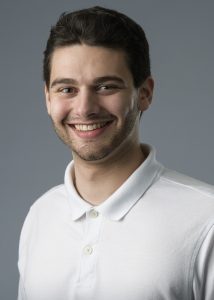
Originally from New Baltimore, Michigan, Fleece’s path to the College of Natural and Applied Sciences started at Evangel University as an undergraduate in 2016.
He then completed his master’s degree in mathematics at Missouri State in 2021 and later in 2025, earned his PhD in Group Theory from Missouri S&T.
“I had such a great experience as a graduate assistant at Missouri State. When the opportunity came up to come back to teach, it felt like coming home,” Fleece said.
Wymore
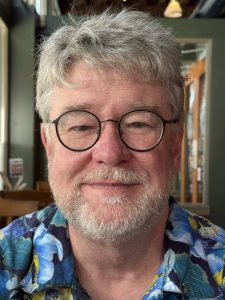
A Kansas City, Missouri, native, Wymore earned his bachelor’s and PhD degrees in chemistry at the University of Missouri. He spent over a decade conducting research at institutions, such as Carnegie Mellon, Oak Ridge National Lab, University of Michigan and Stony Brook University.
He joined Missouri State as faculty member when his wife accepted a leadership role on campus.
“The timing with an open chemistry faculty position aligned perfectly,” Wymore said.
Innovating in the classroom and lab
Fleece focuses on group theory and encourages students to model their thinking after his own as he works through problems in class.
“I want students to see how I’m approaching a problem, not just the solution, but the process,” he said.
His courses often include collaborative review sessions and game-based learning, with a focus on creating an open, comfortable space for students to engage and make mistakes.
Wymore’s research dives into enzyme mechanisms, especially how they evolve and interact with light. His lab brings together quantum chemistry and evolutionary biology, two fields rarely combined.
“The quantum-level view of enzymes and their evolutionary pathways is something you don’t see very often,” Wymore said. “It helps us tell deeper stories about how nature works.”
Advice for learners and educators
Fleece believes passion is key: “If it feels like work, it’s going to be harder to succeed. You’ve got to love what you do, teaching, researching, all of it.”
Wymore emphasizes patience and empathy.
“Many students aren’t struggling with the material itself but with everything else happening outside the classroom,” he said.
He encourages using historical context and storytelling to help students connect with scientific ideas.
Both faculty members, beyond teaching, dedicate themselves to mentoring, research and guiding the next generation of mathematicians and scientists. Their combined expertise and enthusiasm strengthen the college’s mission to advance discovery and inspire learning.
Learn more about the College of Natural and Applied Sciences
The post From equations to enzymes appeared first on Chemistry Blog.
]]>The post Rising to the research challenge appeared first on Chemistry Blog.
]]>The 3MT competition at Missouri State University challenges graduate students to present their research project in just three minutes. Designed to help students communicate complex ideas clearly and engagingly to a non-specialist audience, the competition emphasizes clarity, focus and effective storytelling.
The winner of the 3MT competition will represent Missouri State at the regional competition during the Midwest Association of Graduate Schools (MAGS) annual conference.
The four CNAS students are:
- Kaitlyn Bebensee, biology
- Emma Braun, biology with a secondary emphasis in chemistry
- Tony Nyabayo, chemistry
- Trishna Timalsena, chemistry with a secondary emphasis in biomedical sciences
The students’ research
Bebensee presented her thesis, “Small mammal community composition and diet in Southwestern Missouri prairies.” Her advisor, Dr. Sean Maher, associate professor of biology, helped her to examine the impact humans have on wildlife.
“My project looked at whether two dominant small mammal species in the prairies compete for food resources,” Bebensee said. “I found they do not as they had different diets. This finding can be useful in land management decisions that protect prairie communities.”
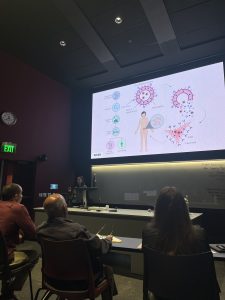
As for Braun, her presentation was on “Developing a cell specific drug delivery system for enhanced cervical cancer treatment.” Her research focused on reducing chemotherapy side effects by making cancer chemotherapeutics more specific.
According to Braun, she found inspiration for her thesis topic during her undergraduate studies after seeing posters at a conference that discussed targeted drug delivery. When she began her graduate studies, her advisor, Dr. Kyoungtae Kim, department head of biology, helped her refine the idea into a thesis.
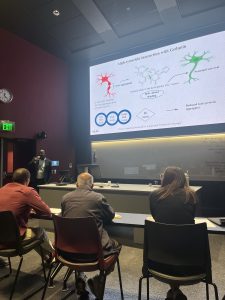
Growing up surrounded by the rainforest in Kenya, Africa, where everything was alive and healing, Nyabayo learned that nature “always finds a way to restore balance.” This inspired him to study Gedunin, a molecule from the forest, to explore its potential in healing the human brain.
His presentation titled, “From rainforest roots to brain rescue,” dives into how Gedunin interacts with alpha-synuclein, a protein linked to Parkinson’s disease. His advisor, Dr. Tuhina Banerjee, assistant professor of chemistry, aided him in this process.
In her presentation, “No more gut feelings: nanotech detects bad food before your stomach does,” Timalsena explored translational research, with help from her advisor, Dr. Santimukul Santra, professor of chemistry. As she is drawn to research that has a direct impact on people’s lives, this project was especially compelling to her.
Excited for the next round
All four students are ready for the upcoming competition, hoping to be chosen to represent Missouri State at the MAGS conference.
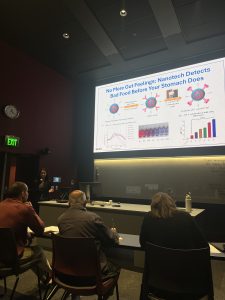
“I look forward to learning about other research taking place across Missouri State’s campus,” Bebensee said. “I hope that by sharing my research, more people will understand the importance of small mammals.”
Nyabayo sees the experience as a way to honor the people who helped him get here.
“Representing CNAS feels like carrying the voices of my mentors, lab mates and every student who dares to dream big,” he said.
Meanwhile, Timalsena says she has a “good gut feeling” about the next round, a playful nod to her presentation title. She looks forward to hearing from all the other presenters.
Learn more about the 3MT competition
The post Rising to the research challenge appeared first on Chemistry Blog.
]]>The post Recognized for teaching excellence appeared first on Chemistry Blog.
]]>The Governor’s Award for Excellence in Teaching is given to an outstanding faculty member from each participating higher education institution in the state. The award recognizes:
- Effective teaching
- Effective advising
- Service to the university community
- Commitment to high standards of excellence
- Success in nurturing student achievement
“Winning this award made me feel incredibly appreciated,” said DeVore from the department of chemistry and biochemistry. “We all put so much effort into teaching and working one-on-one with students. I feel honored to be recognized.”
Research and support
Devore began her time at Missouri State in fall 2019. She has found the university offers the right balance of teaching responsibilities and research opportunities.
“MSU incorporates a lot of undergraduate and graduate research, which is important for a chemist,” she said.
Her current research involves synthetic fluorescent proteins . These proteins are useful because they can track activity in living cells. They can be used for a range of research activities.
“We’re trying to make them better in terms of thermal stability,” DeVore said.
She gives aspiring researchers the opportunity to conduct research as well.
“Right now, I have three high schoolers from local schools in my lab,” she said. “They’re fun to work with and excited about doing real science.”

She and a group of students are currently revising a manuscript that will be published in the summer.
“The students who are authors are mostly graduate and undergraduate students, but I do have some high schoolers who have contributed enough to have their names on the papers too” she said.
DeVore has committed to high standards of excellence for herself and her students.
“I put a lot of time and effort into the development of materials for my classes,” she said. “I want everything in the lab and research process to run smoothly.”
She also ensures her content is current and engaging to students.
“It’s an evolving field and I encourage students to ask questions. The extra mile I go to is trying to make sure my lectures are interesting and pull from what’s going on in terms of recent research,” she said.
She also makes it a point to know her students as people.
“Once you know students’ future and career goals, you can really help them excel in the classroom,” DeVore said. “I want to build a relationship with them so they’re comfortable to visit during my office hours or catch me after class if they need help.”
Learn more about the chemistry and biochemistry department
The post Recognized for teaching excellence appeared first on Chemistry Blog.
]]>The post A catalyst for a greener future appeared first on Chemistry Blog.
]]>Growing up in an agricultural town in Nigeria, Fakunle understood the importance of creating a sustainable environment.
With a passion for science, she is opening doors to create eco-friendly solutions.
“My love for chemistry started when I was in high school actually. We have all these lab practicals. Then we mix our reagents together and [see] color change. It kind of sparked my interest,” Fakunle said.
One science led to another, and eventually, Fakunle also discovered that she had a natural talent for mathematics.
Combining her interests, she majored in chemical engineering at Ladoke Akintola University of Technology.
Fast forward to today, Fakunle can now be found at Missouri State working on her next big step: a master’s degree in chemistry.

From greenhouse gloves to lab coat
Right from the start, chemistry was Fakunle’s first choice for graduate studies.
Beyond fascinating chemical reactions and impactful discoveries, she saw chemistry as a means to contribute to, as she says, “the feeling of research that is going on in the world of chemistry these days, like sustainability and how to clean the environment.”
“I see chemistry giving me the opportunity to give back to the environment to develop new techniques and methods for analysis and remediation of contaminants.”
The key element that brought her from Nigeria to Missouri State was her fascination with the research of her current advisor, Dr. Cyren Rico.
“He works on the analysis of contaminants and also the effects of contaminants in the environment,” she said.
Fakunle has been very appreciative of Rico’s guidance, as he was able to help her navigate the transition from chemical engineering to chemistry.
“I look up to him, because he is hard working, passionate about his research and very supportive,” she said. “He offers guidance and support with my research and recommends opportunities for me to advance in my career.”
Involved in Rico’s research lab, Fakunle is currently studying the effects of molybdenum disulfide and sulfur nanoparticles on lettuce.
For her research, she grows lettuce in a greenhouse and exposes the lettuce to the nanoparticles.
“We check the effect of the nanoparticles on the growth of the plants, the nutrients and elements in the plants and also how they affect the soil,” Fakunle said. “In general, we are looking at all environmental effects and how they affect the plants, and then draw conclusions on the effect of using nanoparticles as fertilizers and what could be the adverse effects on the environment or on the soil.”

Accelerating growth in chemistry expertise
Aside from Rico’s research, Fakunle was drawn to Missouri State for its size and affordability.
“My hometown is country and Springfield is, more or less, not a very big city, so it’s affordable to live in,” Fakunle said. “Missouri State kind of fits in my choice of school, and it also offers a balanced curriculum [and] the lifestyle with the community.”
Fakunle has been overjoyed with immersive experiences, like attending conferences — some of which were fully funded by the organizers — and securing an agriscience internship that was closely related to her research.
She is grateful that MSU has given her a wide spectrum of academic opportunities.
“With the Graduate College, currently, it’s been an awesome experience with all of the classes I’m taking. The chemistry faculty and my professors have been really helpful and supportive, and I am grateful for the opportunity to teach entry-level chemistry lab courses. It’s been a wonderful experience so far in Missouri State.”
Fakunle aims to graduate with her master’s degree in December 2025.
After turning her tassel, she is confident and ready to jump directly into chemistry practice.
“Looking at all of the classes I am taking, the professors in my department, my research and also the community here in Missouri State, I’ve been able to understand more about the dynamics of chemistry and also I understand more about how research is done,” Fakunle said. “The research we do in the lab serves as an eye opener as it exposes me to what to expect in the industry after graduation.”

The post A catalyst for a greener future appeared first on Chemistry Blog.
]]>The post Beyond the microscope: Exploring the barriers of neurodegeneration appeared first on Chemistry Blog.
]]>
Front row, left to right: Neelima Koti, Dr. Tuhina Banerjee and Sathvika Balerao; back row, left to right: Kristos Baffour, Zachary Flint, Ethan Grier and Carissa Sutton
Dr. Tuhina Banerjee’s research on insulin featured in ACS Chemical Neuroscience
The World Health Organization estimates that 50 million people worldwide battle neurodegenerative disorders — and that number should increase as our population ages.
At Missouri State University, Dr. Tuhina Banerjee’s research offers promising insight on potentially revolutionizing treatment approaches for these conditions.
Banerjee is an assistant professor of chemistry and biochemistry. Soon after joining the university in 2021, she began her research on insulin with a team of students.
Banerjee’s research, “Mechanistic Insights Behind the Self-Assembly of Human Insulin under the Influence of Surface-Engineered Gold Nanoparticles” was recently published in ACS Chemical Neuroscience. Graduate students Zachary Flint, Haylee Grannemann, Kristos Baffour and Neelima Koti played a pivotal role in driving the success of this innovative research project.
“Without their hard work, this publication would not have been possible,” Banerjee said.
About ACS Chemical Neuroscience
ACS Chemical Neuroscience is a monthly peer-reviewed scientific journal published by the American Chemical Society (ACS). It focuses on research at the interface of chemistry and neuroscience, covering a broad range of topics related to the molecular mechanisms of neurological disorders.
The journal publishes original research articles, reviews and editorials in these areas. It provides a platform for scientists to share their findings and contribute to advancements in the field of chemical neuroscience.
“As a researcher, I’ve always wanted to venture into protein misfolding diseases associated with neurodegenerative diseases,” Banerjee said. “Due to MSU’s support in my research and other facilities, my lab was successful in this effort.”
More about the research
The focus of Banerjee’s research is on understanding the aggregation dynamics of proteins associated with neurodegenerative diseases, such as Parkinson’s and Alzheimer’s.
Specifically, her team is examining the self-assembly of human insulin under the influence of surface-engineered gold nanoparticles.
They chose insulin as a model protein for their research due to its structural similarities to proteins implicated in neurodegenerative diseases, such as alpha-synuclein and amyloid beta.
The study found that modifying gold nanoparticles with hierarchical polyethylene glycol (PEG) structures influences how insulin proteins clump together into amyloid fibrils. Larger PEG molecules on the nanoparticles enhanced the formation of these fibrils, which are associated with diseases like Alzheimer’s.
This fibril formation also reduced the toxicity of insulin clumps. The research suggests that tailoring nanoparticle surfaces could offer new ways to treat diseases involving amyloid proteins.
Banerjee and her team plan to continue their research with the goal of explaining the molecular mechanisms underlying protein aggregation and exploring novel therapeutic interventions.
Explore opportunities in chemistry and biochemistry
The post Beyond the microscope: Exploring the barriers of neurodegeneration appeared first on Chemistry Blog.
]]>The post Empowering futures appeared first on Chemistry Blog.
]]>
A recent trip to Washington D.C. enabled two Missouri State University students to collaborate with other young scientists. James Wilson and Victoria Ogbeifun attended the 12th annual Emerging Researchers National (ERN) conference. The students attended the conference from March 14-16 along with Dr. Tayo Obafemi-Ajayi, associate professor in the cooperative engineering program.
The conference helps undergraduate and graduate students to enhance their scientific communication skills and better understand how to prepare for science careers in a global workforce.
Students got to hear from keynote speaker Dr. Aprille Ericcson, who was recently appointed as the U.S. Assistant Secretary of Defense. Ericcson also previously served as a long-standing aerospace engineer at NASA.
Both Wilson and Ogbeifun received travel awards to attend the conference for their research. They presented their research and attended various workshops.
Ogbeifun
Ogbeifun is a senior from Republic, Missouri. She is majoring in chemistry and microbiology. Ogbeifun is also a pre med student. After graduation, she plans to attend medical school and work toward a career as a general or trauma surgeon.
At the conference, her research won first place in the chemical sciences oral presentation category. She received $300 prize for her placement.
“I never thought I was going to win,” Ogbeifun said. “I saw other students from giant institutions and was shocked to hear my name. I was happy to see my research pay off.”
Ogbeifun’s research focused on the manipulation of fluorescent proteins. These proteins are essential tools for bioimaging and can be used as markers. These markets can be used to view various metabolic processes and things living inside different organisms.
“We mutate a yellow thermostable protein and introduce other mutations into it to make it more chemically stable and more temperature stable,.” Ogbeifun said. “Once stable, we work to crystalize the protein.”
Ogbeifun has been working in the research lab for two years. She researches under Dr. Natasha DeVore, assistant professor of chemistry and biochemistry.
“Victoria has tackled several different projects and is always willing to be challenged.” DeVore said.
Ogbeifun credits her research to previous MSU student Caitlin Padgett. Padgett had worked on this project and first introduced the mutations used in studying these proteins.
Wilson
Wilson is a senior from Olathe, Kansas. He is studying chemistry with a minor in biomedical sciences. Upon graduation, Wilson also wants to work in the medical field. He plans to move to Kansas City with the goal of becoming a paramedic.
Wilson has been working in the lab looking at the fundamental properties of DNA and RNA. The properties affect how these important molecules function in the cell and may lead to better biomedical applications in the future.
He is specifically working on a DNA-RNA hybrid, which is a molecule where one strand of the helix is DNA and the other one is RNA. He assigns the individual atoms in a short hybrid to monitor the energy between different structures.
“We’re essentially dissecting the molecular puzzle,” Wilson said. “This is to understand how DNA repairs itself and identifies errors.”
Wilson has been working in the lab for two years, guided by Dr. Gary Meints, professor of chemistry and biochemistry. “This is a very high-risk, high–reward study,” Meints said. “I credit James for his invaluable efforts and willingness to work on such a difficult project.”
Explore opportunities in the College of Natural and Applied Sciences
The post Empowering futures appeared first on Chemistry Blog.
]]>The post Empowering research in nanomedicine appeared first on Chemistry Blog.
]]>
Chemistry professor receives federal award of $334,267 to advance his research.
An award of $334,267 from the National Institutes of Health will enable Missouri State University’s Dr. Santimukul Santra to further his research in nanosensor technology.
He is a faculty member in the department of chemistry and biochemistry.
As an organic chemist, Santra works on creating small molecule therapeutics for conditions like cancer. He also develops special molecules called dendrimers and hyper-branched polymers. These large molecules carry drugs and deliver them to specific parts of the body such as tumor cells.
In the lab, Santra and his students design and make their own drug delivery systems from scratch. They make them into unique three-dimensional shapes. This soccer ball-like system can carry more medicine to the targeted tumor.
“This approach helps minimize side effects and makes treatment more effective by targeting only unhealthy cells,” Santra said.
Investigating nanosensor technology
The award supports Santra’s work on nanosensors. These sensors detect certain proteins like those found in influenza and other viruses. They have a core made of superparamagnetic iron oxide coated with degradable polymers.
The study focuses on understanding the fusion of these viruses with host cells. By studying how the virus interacts and fuses with these cells, Santra aims to uncover how the infection works.
This discovery could lead to the development of antiviral therapies, such as small molecules or antibodies, that could inhibit this fusion process. Santra’s goal is to find ways to prevent viral infections by targeting these fusion interactions.
Inspiring students
Santra sees his students as a vital part in this research process and the reason behind the award. Undergraduate students work hand in hand with graduate students in the lab. They research, conduct experiments and record findings.
“The students are the ones driving this research,” Santra said.
Santra advocates for students interested in biochemistry and other science fields. He often spends his free time in the community spreading awareness of the field. He works with schools in the community and encourages those interested in studying biochemistry and other related fields.
“Our research is focused on helping society,” Santra said.
Santra’s achievement is no surprise to Dr. Tamera Jahnke, dean of the College of Natural and Applied Sciences.
“He has an outstanding record of including students in his research and this is no exception,” Jahnke said.
Santra and his students plan to present their research in April during the CNAS Undergraduate Research Day.
Explore opportunities in chemistry and biochemistry
The post Empowering research in nanomedicine appeared first on Chemistry Blog.
]]>