Megan Manning
manningm@ash.org
(202) 659 – 4310
Corte Madera, CA Passed the 1st Tobacco Sales Ban Without Exemptions
The Sale of All Tobacco and Nicotine Products will Phase Out
WASHINGTON, DC – SEPTEMBER 16, 2026 – Last night, Corte Madera, in Marin County, California made history by passing a comprehensive, life-sustaining, and life-saving tobacco policy – a complete end-of-sales policy for all tobacco and nicotine products, except FDA-approved cessation aids. Corte Madera’s end-of-sales ordinance will become enforceable on February 1, 2027.
“Corte Madera has our full support as they become global leaders in public health,” said Laurent Huber, Executive Director of Action on Smoking and Health. “The new standard has been set, and it’s time for more cities, states, and countries to follow Corte Madera’s lead in prioritizing their citizens’ lives over the profit of the tobacco industry.”
This ordinance is the logical next step to address the fundamental problem that exists: commercial tobacco and nicotine products are still being sold.
Corte Madera Councilmember Pat Ravasio, who championed the ordinance from the outset, explained, “Since our federal and state governments have been unable to stop Big Tobacco’s onslaught against our community’s health, local governments have to lead. It was time for Corte Madera to step up for local youth who were pleading with our Council for protection against aggressively marketed products directly targeted at them — conventional products such as cigarettes and cigars, and new, more addictive, more discreet products – all that clearly harm their health. By setting this example for other towns and cities, we hope that together we can all eventually achieve a tobacco-and-nicotine-free society.”
“Our Corte Madera teens and community members championed this long-overdue effort to improve our community’s health and our environment. Together, we called on our Town Council to protect our community from the relentless tobacco and nicotine industry, and the Council took a stand,” said Dr. Jeremiah Mock, Corte Madea resident and Professor at the University of California San Francisco. “Through the pandemic, we’ve seen that businesses can pivot. We are confident they can end their addiction to easy, ill-gotten profits from selling tobacco and nicotine. Building on the pioneering efforts of Beverly Hills, Manhattan Beach, Tiburon, and Ross, we in Corte Madera urge other communities in Marin County and throughout California, the nation, and the world to take the strongest possible stand to promote health and protect environments.”
Commercial tobacco and nicotine products remain the leading cause of preventable death in the United States, in large part because these products kill when used exactly as intended. No overuse or misuse is required to cause devastating harm. No other consumer good could be sold with a death toll of about 8.6 million annually worldwide.
Corte Madera Councilmember Eli Beckman also noted at the September 15th Council Meeting that all community members share the exorbitant healthcare costs associated with tobacco use, regardless of their own use. Tobacco products are a burden on every facet of the community.
One key element noted in the Town Council’s Staff Report: “The ordinance would not prohibit personal possession, purchase, or use of tobacco or nicotine products by individuals and would preserve the ability to sell FDA-approved tobacco and nicotine cessation products when marketed and sold solely for that approved purpose.”
Corte Madera Vice Mayor Fred Casissa noted, “I was truly inspired and moved by the high school students with whom I had the opportunity to speak and get their insight and thoughts on the issue of young adults and tobacco. What hit me the most is that our youth are getting addicted to tobacco at a young age, with no understanding of the long-term effects. Hopefully what started out as a grassroots effort can take hold and spread throughout the country.”
This ordinance, along with measures to help those who are addicted to nicotine become nicotine-free will be a major step in achieving better health for all Californians.
For nearly a decade, ASH has worked with communities, governments, and public health leaders around the world to advance tobacco endgame policies, including phasing out the sale of commercial tobacco products. Beverly Hills and Manhattan Beach, CA led the fight for stronger tobacco endgame policies and now Corte Madera is demonstrating what’s possible.
ACTION ON SMOKING AND HEALTH
Founded in 1967, Action on Smoking and Health (ASH) is America’s oldest anti-tobacco organization, dedicated to a world with ZERO tobacco deaths. Because tobacco is the leading cause of preventable death worldwide, ASH supports bold solutions proportionate to the magnitude of the problem. https://ash.org
 Auteur: Dr Eduardo Bianco, directeur du Programme de formation en addictologie pour les professionnels de santé (ATHP) de la Fondation Frank et coordinateur de l’Initiative pour le traitement de la dépendance à la nicotine et du tabagisme (NATTI)
16 septembre 2026
[Read in English] | [Leer en español]
Ne pas poser de questions sur la consommation de tabac n’est plus seulement une occasion manquée : Il s’agit d’une question de sécurité des patients..
Chaque année, des millions de patients se rendent à des consultations médicales pour de l’hypertension, du diabète, des maladies cardiaques, un cancer ou des maladies respiratoires. Pourtant, beaucoup repartent sans qu’on leur ait posé une question qui prend moins de dix secondes et qui peut réduire considérablement leur risque de décès prématuré : « Avez-vous fumé ou consommé des produits du tabac ou à base de nicotine au cours des sept derniers jours ? »
Cette année, la Journée mondiale de la sécurité des patients 2026 met l’accent sur la sécurité des soins liés aux maladies non transmissibles (MNT) — ces pathologies responsables de 74 % de l’ensemble des décès dans le monde. Si la sécurité des patients consiste à prévenir les risques évitables, alors aider les patients à arrêter de fumer doit devenir une pratique courante dans le cadre de soins de santé de qualité.
L’arrêt du tabac, c’est la sécurité des patients
La dépendance au tabac est une maladie chronique sujette aux rechutes et l’une des principales causes de maladies cardiovasculaires, de cancers, de maladies respiratoires chroniques et de complications liées au diabète. Continuer à fumer après le diagnostic de ces pathologies expose les patients à des risques accrus, et pourtant tout à fait évitables, de crise cardiaque, d’accident vasculaire cérébral, de progression du cancer et de décès prématuré.
C’est pourquoi s’enquérir de la consommation de tabac, la consigner dans le dossier médical et prodiguer de brefs conseils doivent être considérés comme des pratiques essentielles de sécurité clinique — au même titre que la prise de la tension artérielle, la vérification des allergies ou la confirmation des traitements médicamenteux.
 Une à trois minutes peuvent changer une vie
L’Organisation mondiale de la Santé recommande à chaque professionnel de santé de systématiquement :
- S’enquérir de la consommation de tabac et de nicotine.
- Consigner ces informations dans le dossier médical du patient.
- Conseiller à chaque fumeur d’arrêter de fumer.
- Et, s’il ou elle est intéressé(e) : proposer un accompagnement ou l’orienter vers un spécialiste.
Cette brève intervention peut être réalisée en 30 secondes à 3 minutes, mais elle permet également d’orienter les patients vers un accompagnement comportemental efficace et des médicaments dont l’efficacité est prouvée, tels que les substituts nicotiniques, la varénicline, le bupropion ou la cytisine, lorsqu’ils sont disponibles.
Les preuves sont accablantes
Les recherches montrent systématiquement que même un bref conseil prodigué par un professionnel de santé augmente les chances qu’une personne qui fume tente d’arrêter et y parvienne.
Lorsque l’on arrête de fumer, les bienfaits pour la santé sont quasi immédiats. En quelques mois, la fonction pulmonaire s’améliore. En l’espace d’un an, le risque de maladie coronarienne diminue considérablement. Au fil du temps, les risques d’accident vasculaire cérébral, de nombreux cancers et de décès prématuré continuent de baisser.
Peu d’interventions cliniques offrent des bienfaits aussi étendus à un coût aussi faible.
L’une des interventions les plus rentables en matière de santé
L’arrêt du tabac figure parmi les interventions les plus rentables disponibles en soins primaires. Il prévient les hospitalisations, réduit les dépenses de santé et améliore à la fois la qualité et la durée de vie.
Cependant, dans de nombreux systèmes de santé, le tabagisme n’est toujours pas évalué de manière systématique, et aucun accompagnement à l’arrêt du tabac n’est proposé dans le cadre des soins de routine.
Cette lacune a des conséquences importantes.
La plupart des pays s’y sont engagés.
En vertu de l’article 14 de la Convention-cadre de l’OMS pour la lutte antitabac, plus de 180 Parties se sont engagées à mettre en œuvre cette intervention. Les pays ont donc la responsabilité d’améliorer leurs mesures en faveur de l’arrêt du tabac.
Quand l’omission devient une mauvaise pratique
Imaginez un patient hospitalisé à la suite d’une crise cardiaque. Son taux de cholestérol est traité. Sa tension artérielle est contrôlée. Ses médicaments cardiovasculaires lui sont prescrits.
Mais personne ne lui demande s’il fume encore.
Peut-on vraiment affirmer qu’il a reçu les meilleurs soins possibles ?
Lorsqu’une intervention est simple, fondée sur des données probantes, peu coûteuse et capable de prévenir des dommages graves, ne pas la proposer va bien au-delà d’une occasion manquée. Cela devient un manquement à la qualité des soins — et, de plus en plus, un problème de sécurité des patients.
Chaque professionnel de santé a un rôle à jouer
L’arrêt du tabac n’est pas la seulement la responsabilité des spécialistes.
Tous les professionnels de santé, y compris les médecins généralistes, les cardiologues, les oncologues, les pneumologues, les psychiatres, les dentistes, les infirmiers, les pharmaciens et chaque membre de l’équipe soignante, peuvent agir.
Chaque consultation est une occasion de sauver une vie.
Agissez dès aujourd’hui
Alors que le monde progresse vers des soins plus sûrs face aux Maladies Non Transmissibles, prenons un engagement universel :
Interrogez chaque patient sur là sur la consommation des produits de tabac et de nicotine. Conseillez chaque fumeur. Faites-le à chaque fois.
Faire de la consommation de tabac un signe vital clinique systématiquement évalué et proposer systématiquement de brefs conseils pour arrêter de fumer ne constitue pas seulement une bonne mesure de prévention : c’est aussi une approche plus sûre des soins de santé.
« Chaque consultation devrait inclure une intervention qui sauve des vies. »
Interrogez chaque patient sur sa consommation de tabac. Conseillez à chaque fumeur d’arrêter de fumer.
]]>Author: Dr. Eduardo Bianco, Director, Addiction Training Program for Health Professionals (ATHP), Frank Foundation and Coordinator, Nicotine Addiction and Tobacco use Treatment Initiative (NATTI)September 16, 2026
[Leer en español] | [Lire en français]
Failing to ask about tobacco use is no longer just a missed opportunity—it is a patient safety issue.
Every year, millions of patients attend medical appointments for hypertension, diabetes, heart disease, cancer, or respiratory illness. Yet many leave without being asked a question that takes less than ten seconds and can significantly reduce their risk of premature death: “Did you smoke or use any tobacco or nicotine products in last seven days?”
This year, World Patient Safety Day 2026 puts the spotlight on safe care for noncommunicable diseases (NCDs)—the conditions responsible for 74% of all deaths worldwide. If patient safety means preventing avoidable harm, then helping patients quit tobacco use must become a routine part of quality healthcare.
Tobacco cessation is patient safety
Tobacco dependence is a chronic relapsing disease and a leading cause of cardiovascular disease, cancer, chronic respiratory disease, and diabetes complications. Continuing to use tobacco after diagnosis of these conditions exposes patients to increased, completely preventable risks of heart attack, stroke, cancer progression, and premature death.
That is why asking about tobacco use, documenting it in the medical record, and offering brief advice should be viewed as essential clinical safety practices—just like checking blood pressure, reviewing allergies, or confirming medications.
One to three minutes can change a life
The World Health Organization recommends that every healthcare professional routinely:
- Ask about tobacco and nicotine use.
- Record the information in the patient’s health record.
- Advise every tobacco user to quit.
- And, if he/she is interested: offer support or refer to an specialist
This brief intervention can be delivered in 30 seconds to 3 minutes but also connects patients to effective behavioral support and proven medications such as nicotine replacement therapy, varenicline, bupropion, or cytisine where available.
The evidence is overwhelming
Research consistently shows that even brief advice from a healthcare professional increases the likelihood that a person who smokes will make a quit attempt and successfully stop smoking.
When quitting, the health benefits begin almost immediately. Within months, lung function improves. Within one year, the risk of coronary heart disease falls dramatically. Over time, the risks of stroke, multiple cancers, and premature death continue to decline.
Few clinical interventions offer such broad benefits at such a low cost.
One of the best-value interventions in healthcare
Tobacco use cessation is among the most cost-effective interventions available in primary care. It prevents hospital admissions, reduces healthcare expenditures, and improves both quality and length of life.
However, in many health systems, tobacco use is still not systematically assessed, and cessation counseling is not offered during routine care.
That gap matters.
Most Countries are committed to that.
Through Article 14 of the WHO Framework Convention on Tobacco Control, more than 180 Parties are committed to implementing this intervention. Therefore, countries have a responsibility to improve their tobacco cessation responses.
When omission becomes poor practice
Imagine a patient hospitalized after a heart attack. Their cholesterol is treated. Their blood pressure is controlled. Their cardiovascular medications are prescribed.
But nobody asks whether they still smoke.
Can we truly say they received the safest possible care?
When an intervention is simple, evidence-based, inexpensive, and capable of preventing serious harm, failing to provide it moves beyond a missed opportunity. It becomes a quality-of-care failure—and increasingly, a patient safety concern.
Every health professional has a role
Tobacco cessation is not the responsibility of specialists alone.
All healthcare professionals, including primary care physicians, cardiologists, oncologists, pulmonologists, psychiatrists, dentists, nurses, pharmacists, and every member of the healthcare team can make a difference.
Every consultation is an opportunity to save a life.
Take action today
As the world advances toward safer care for NCDs, let us make one commitment universal:
Ask every patient. Advise every tobacco user. Do it every time.
Making tobacco use a routine clinical vital sign and systematically offering brief quit advice is not simply good prevention—it is safer healthcare.
“Every consultation should include one life-saving intervention.”
Ask every patient about tobacco use. Advise every tobacco user to quit.
]]>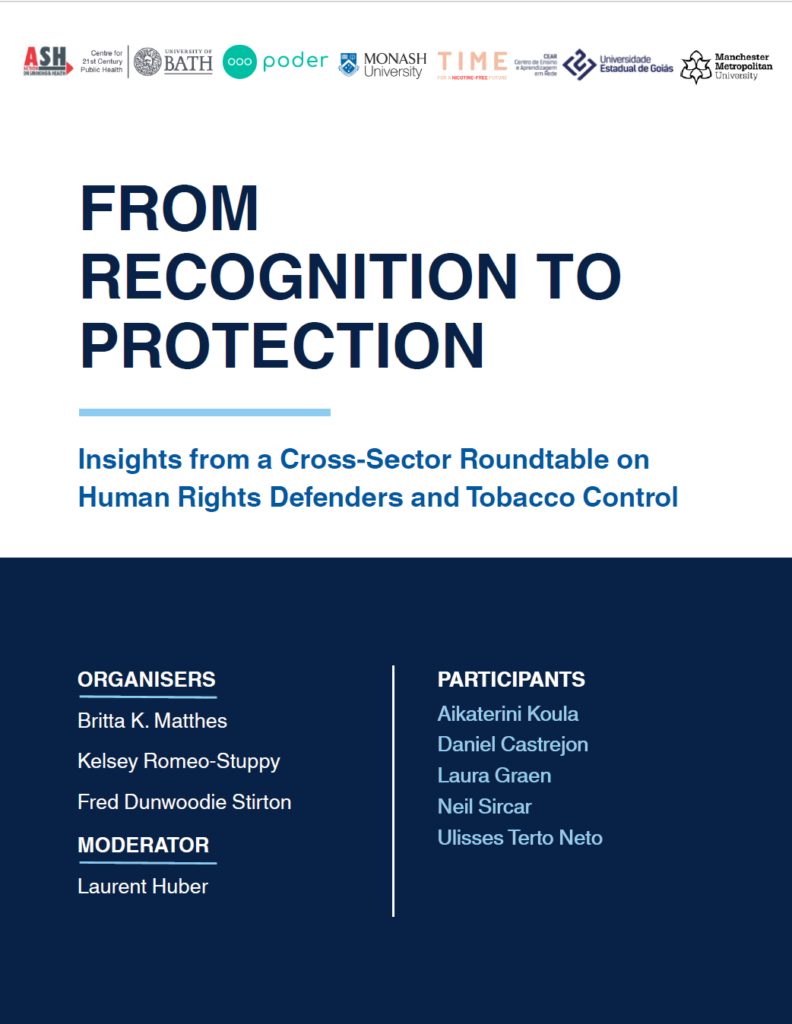
Should tobacco control advocates be recognized as human rights defenders?
Growing awareness of intimidation faced by tobacco control advocates has prompted consideration of whether and how the legal framework used to protect human rights defenders (HRD) in the international system might strengthen protection for tobacco control advocates as well.
ASH Managing Attorney Kelsey Romeo-Stuppy and Tobacco Control Research Group (TCRG) research fellow Dr. Britta Matthes published a paper on the topic in 2025.
To further consider this question, including how to encourage both the human rights and tobacco control communities to take action, ASH and the University of Bath convened a meeting of experts.
The experts identified some clear standards, as well as suggested paths forward for the future of tobacco control advocates as human rights defenders.
Read the brief, From Recognition to Protection, here.
]]>July 27, 2026
Zyn is sold as tobacco-free. The claim is accurate, and it is also very effective marketing. A nicotine pouch contains no tobacco, but what it does contain is nicotine, the ingredient that creates dependence and keeps people coming back. Moving a product out of the tobacco category does not move it out of the addiction business.
The brand is owned by Philip Morris International, which acquired Swedish Match for roughly 16 billion dollars in a deal completed in 2023. PMI is one of the companies ASH tracks in state lobbyist registrations every year. The pouch is a new product, but the company selling it has been in this market for a very long time.
Tobacco-free is a marketing term, not a health finding.
Nicotine pouches are small, permeable bags of nicotine, flavoring, and filler that the user tucks between the lip and gum. The nicotine is usually synthetic or extracted, and that is what allows the tobacco-free label. It does not change what nicotine does in the body. Nicotine is addictive, it affects the adolescent brain while it is still developing, and dependence brings tolerance and withdrawal.
In January 2025 the FDA authorized 20 Zyn products. It’s worth being clear about what that decision meant, because the tobacco industry has not been. The agency concluded that the products were appropriate for the protection of public health, a standard that weighs whether adults who already smoke might switch to something less harmful. It’s a comparison, not a safety rating. Since then, the authorization has been used by the industry in marketing and in argument as though the FDA had declared these products safe. It’s crucial to understand that the FDA did not—they noted nicotine products as being less harmful than something combustible like cigarettes, but still harmful themselves.
The switching argument depends on people actually switching.
The public health case for pouches is substitution: adults who smoke move to something less harmful, and overall harm goes down. This logic holds only if the pouch completely replaces the cigarette.
For young people, it usually does not. A Truth Initiative study published in Preventive Medicine Reports, surveying 15 to 24 year olds, found that 73 percent of those currently using oral nicotine pouches also currently smoked cigarettes, and 49 percent also currently used e-cigarettes. Eighty-one percent had smoked cigarettes at some point. Among high school students, co-use of pouches and e-cigarettes almost doubled from 2023 to 2024.
Youth use of pouches rose quickly and then settled. It also roughly doubled among high school students between 2023 and 2024. In 2025, about 1.7 percent of middle and high school students, around 460,000 young people, reported current use, which was close to the year before.
To speak honestly, these numbers are lower than the vaping numbers that alarmed everyone five years ago. The concern is the pattern rather than the total. For most young users, a pouch is not taking the place of anything. Instead, it’s added on top of what they already use, which increases the amount of nicotine they take in rather than reducing it. Dual use is not a step toward quitting, and for an impressionable teenager it usually means picking up a second dependence rather than ending the first. The researchers behind that study reached the same conclusion, warning that using pouches alongside other products “could heighten nicotine addiction and dependence among young people.”
The marketing is not aimed at people trying to quit.
Zyn grew through social media, largely through young men who became known as “Zynfluencers.” Researchers who analyzed #Zyn content on TikTok found that the videos are overwhelmingly positive or comedic, are posted mostly by young white men, and rarely mention cessation, addiction, or dependence at all. That is the part worth sitting with. An addictive product is circulating as a running joke and a lifestyle marker, with the consequences edited out of the frame.
The paid advertising works along the same lines. The top six nicotine pouch brands spent $11.2 million on advertising in 2019, and content analyses found those ads built around ease of use, flavor variety, and claims of being spit-free and smoke-free. A separate review of direct-mail advertising found the same claims, including the promise that the product contains no tobacco leaf. Other research has documented pouch marketing aimed specifically at women, people of color, and LGBTQ+ consumers, using the same kind of youthful imagery that made JUUL’s Instagram strategy so effective. Unit sales rose 305 percent between 2016 and 2020, and the vocabulary came out of wellness culture rather than tobacco advertising. Nicotine gets described as something that sharpens concentration or steadies the nerves, and is often compared to caffeine or sold near supplements. ASH’s own World No Tobacco Day webinar this year traced this exact shift, with nicotine repositioned as a product for focus and energy.
That pitch is not built for a 45-year-old who has smoked for decades and wants to stop. It’s built for someone who hasn’t really used nicotine at all. The same is true of the product design. Flavors, small discreet tins, no smoke and no smell, and the ability to use one in a classroom or a meeting without anyone noticing are all features that dramatically lower the barrier to starting. They do very little for someone trying to finish.
The evidence is thinner than the confidence around it.
The honest version of the science is more complicated than either side usually admits. Chemical analyses generally find fewer harmful substances in pouches than in cigarettes, and in some analyses of Zyn, most of the compounds tested, including nitrosamines, came in below the level at which they can be measured. Claiming that pouches are as dangerous as smoking is not supported by the evidence, but we do not need to make that claim.
A product being less harmful than cigarettes is a very low bar. Broader analyses across nicotine pouch manufacturers have identified 186 chemical components besides nicotine, eight of them classified as hazardous under European rules, and three of them, methyl eugenol, benzophenone, and beta-myrcene, listed by the International Agency for Research on Cancer as possibly carcinogenic to humans. Chromium and formaldehyde have been measured at levels that can be quantified. These products have only been widely available for a few years, so nobody can say yet what daily use starting at fifteen does to a person over a lifetime.
The real question is not whether a pouch is safer than a cigarette; it’s whether we should accept a nicotine product being marketed to people who would otherwise use nothing at all, on the strength of a favorable comparison to the deadliest consumer product ever sold.
What should happen
Tobacco-free has carried this product a long way. It has lifted nicotine out from under a word that carries a century of evidence and stigma, and handed it to a generation that did not live through the worst of it.
The steps from here are not complicated. Restrict the flavors and the marketing that make these products appealing to young people. Enforce the youth access rules that already exist. Require independent, long-term research instead of accepting studies funded by the companies doing the selling. And stop letting a claim about tobacco answer a question about nicotine.
At ASH, we have spent decades watching this industry engineer new ways to sell the same addiction. This is just the current one, and it deserves the same scrutiny we gave the last.
__________
Sources
- ASH, Tobacco Companies Tracked.
- FDA, FDA Authorizes Marketing of 20 ZYN Nicotine Pouch Products.
- Preventive Medicine Reports, Patterns of Oral Nicotine Pouch Use Among U.S. Adolescents and Young Adults.
- JAMA Network Open, Nicotine Pouch and E-Cigarette Use and Co-Use Among US Youths in 2023 and 2024.
- USC Keck School of Medicine, Use of Nicotine Pouches Increases Significantly Among U.S. Teens.
- FDA, Results From the Annual National Youth Tobacco Survey.
- Substance Use & Misuse, Exploring #Zyn-Related Video Content Posted by Zynfluencers on TikTok.
- JMIR, Tobacco Derived Nicotine Pouches: A Content Analysis of Brands and Marketing Messages on Internet and Traditional Media.
- Tobacco Control, Oral Nicotine Marketing Claims in Direct-Mail Advertising.
- Tobacco Control, ‘No-Barriers’ Tobacco Product? Selling Smokeless Tobacco to Women, People of Colour and the LGBTQ+ Community in the USA.
- Tobacco Control, Characterising JUUL-Related Posts on Instagram.
- JAMA, Nicotine Pouch Unit Sales in the US, 2016-2020.
- ASH, World No Tobacco Day 2026: Unmasking the Appeal.
- BMC Chemistry, Harmful and Potentially Harmful Constituents (HPHCs) in Two Novel Nicotine Pouch Products.
- Frontiers in Public Health, Nicotine Pouches: A Narrative Review of the Existing Literature.
 addiction” — recognizes a troubling reality: the tobacco and nicotine industry has not abandoned its business model of addiction. It has modernized it.
Tobacco and nicotine companies employ candy flavors, influencer marketing, and minimalist packaging as part of a deliberate strategy to recruit and retain new users, especially youth. This year’s World No Tobacco Day theme appropriately focuses on “unmasking” because the industry’s modern tactics depend upon concealment. Addiction is masked as lifestyle. Products are masked to look less dangerous.
Addiction manufactured through deception, targeted marketing, and product engineering is a human rights issue. Everyone has the right to the highest attainable standard of health. the right to accurate information, bodily autonomy free from manipulation, and protection from exploitative commercial practices. When corporations intentionally design products and campaigns to maximize addiction, these rights are undermined. The result is a cycle in which corporate profit depends upon chronic dependence and preventable illness.
Human rights frameworks offer an important lens for responding to this crisis. Governments have obligations not only to regulate dangerous products, but also to protect children and communities from predatory commercial determinants of health. That means comprehensive advertising bans, plain packaging requirements, and protections against industry interference in public policy. These are evidence-based safeguards, set out in the WHO Framework Convention on Tobacco Control (FCTC) are consistent with the right to health.
But regulation alone is not enough.
We must also discuss tobacco and nicotine “endgame” strategies — policies designed not merely to manage the epidemic, but to bring it to an end.
For decades, tobacco control efforts focused primarily on reducing consumption incrementally. Those policies saved millions of lives. Yet the tobacco and nicotine industry adapted, diversified, and repositioned itself. Endgame thinking recognizes that a business model dependent on lifelong addiction cannot be fully solved through partial measures alone.
Around the world, governments and advocates are now exploring bold endgame approaches: phasing out commercial cigarette sales, creating nicotine-free generations, drastically reducing nicotine content to non-addictive levels, limiting retail availability, and preventing future generations from becoming addicted in the first place. These strategies shift the conversation from coexistence with the tobacco and nicotine epidemic to its eventual elimination.
A true endgame is within reach. It is a public health necessity grounded in human rights. Future generations deserve to inherit societies where addiction is not engineered for profit, where children are not targeted “by design,” and where commercial success is no longer measured by how effectively companies can keep people dependent.
The appeal of tobacco and nicotine products is manufactured. The suffering they cause is real. Unmasking that contradiction is the first step toward ending the epidemic for good.
]]>ASH is proud to share that a Letter to the Editor from ASH Board Chair Carolyn Dresler was published in The Washington Post in response to the April 23 editorial, “Butt out, cigarette banners.”
Originally published by The Washington Post on May 5, 2026. Read an excerpt below.
Champion tobacco bans
“Nicotine is highly addictive, and the majority of people who smoke cigarettes want to quit and repeatedly try to do so.
Britain’s Tobacco and Vapes bill is for them: the people who want to quit tobacco and live to enjoy their retirement — and hope their children do, too.”
Kelsey Romeo-Stuppy
(202) 659-4310
The UK is the largest nation to enact a Tobacco Endgame Policy
WASHINGTON, DC – APRIL 29, 2026 – Today, After a parliamentary proceeding with strong cross-party support, today King Charles III signed the Tobacco and Vapes Bill into law in the United Kingdom.
The UK’s Tobacco-Free Generation law will achieve a Tobacco Endgame by ending the sale of tobacco products to anyone born after 2008. Tobacco products are defined as any products containing tobacco leaf, including cigarettes, cigars, loose tobacco, chew, and heated tobacco (i.e. IQOS).
“Today, the United Kingdom has taken a historic stand to protect future generations from the deadly, aggressive, and highly addictive tobacco industry,” said Laurent Huber, Executive Director of Action on Smoking and Health in the US.
“Creating a tobacco-free generation is not just a policy milestone – it is a profound commitment to public health, ensuring that young people will grow up free from the harms of tobacco. This courageous action sets a powerful precedent for the world, a precedent we hope to see more cities, states, and countries follow through the wide array of Tobacco Endgame policies available.”
The UK’s Tobacco-Free Generation (TFG) law is one of many Tobacco Endgame policies. Tobacco Endgame policies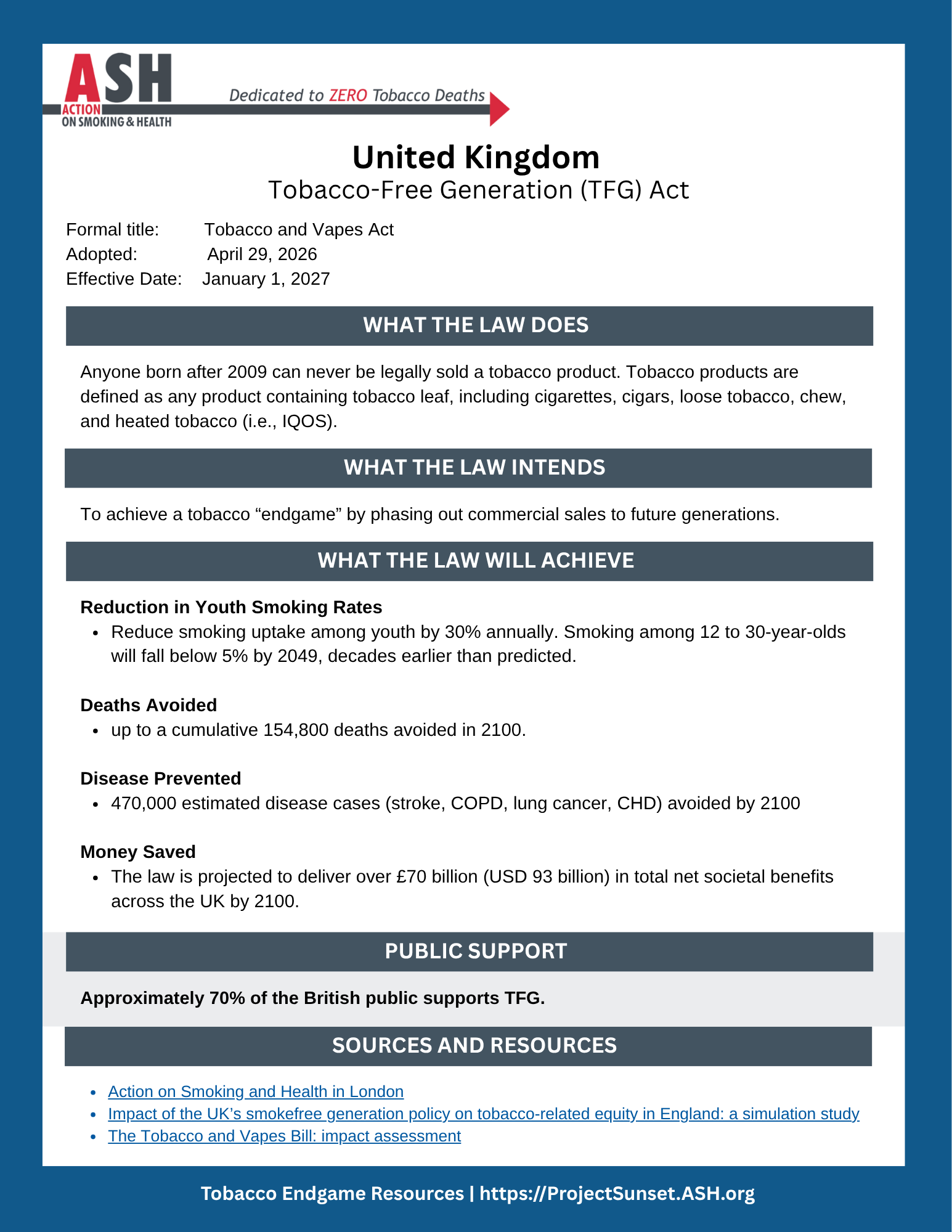 are initiatives designed to change/eliminate permanently the structural, political and social dynamics that sustain the commercial tobacco epidemic, in order to end it within a specific time. In practice, Tobacco Endgame policies phase out the sale of commercial tobacco products.
In the US, Tobacco Endgame policies started to pass in 2019 with a tobacco retail license phase out policy in Dolgeville, NY and a complete sales ban in Beverly Hills, CA. Since then, a total of 4 cities in California have passed a tobacco sales ban, 6 cities have passed a tobacco retail license phase out, and 23 cities in Massachusetts have passed a Nicotine-Free Generation policy. The Massachusetts movement is growing every day with more cities recognizing that they don’t want tobacco or nicotine products to be a part of their future.
Globally, the Maldives has passed a Smoke-Free Generation policy, and there are bills pending in France and South Australia for a Tobacco-Free and Nicotine-Free Generation policy, respectively.
Tobacco Endgame policies are a natural policy progression to regulate tobacco products in proportion to the harm they cause. Tobacco products kill when used as intended, therefore they should not be sold.
The United Kingdom has joined the Maldives in setting a new global standard for tobacco regulation, one where tobacco products are never sold to future generations.
ACTION ON SMOKING AND HEALTH
Founded in 1967, Action on Smoking and Health (ASH) is America’s oldest anti-tobacco organization, dedicated to a world with ZERO tobacco deaths. Because tobacco is the leading cause of preventable death worldwide, ASH supports bold solutions proportionate to the magnitude of the problem. https://ash.org
One of the biggest successes for the tobacco industry was convincing the world that the tobacco epidemic is caused by people who smoke.
Wrong. The tobacco industry has created the demand by addicting youth, partially through marketing but mostly by changing the chemistry of the tobacco product to be as addictive as possible.
As a retired thoracic surgeon who has seen the human death toll of the tobacco epidemic firsthand, I can tell you unequivocally that addiction removes choice. The data also shows that the majority of people who smoke want to quit, wish they had never started, and hope their children never start.
The tobacco industry’s business model is based on a product they’ve engineered to addict their customers before they become adults. If a new product came on the market tomorrow that was unnecessary, highly addictive and killed when used as intended, it would be immediately removed from shelves, and the directors of the company behind it would likely be prosecuted. But we’ve given the tobacco industry a pass and came to accept this massive unnecessary death toll as part of the fabric of society.
The United Kingdom is ready to change that, joining the tobacco endgame pioneers in the Maldives, 23 towns in Massachusetts, 4 cities in California, 4 cities in Minnesota, and 1 city in New York.
The United Kingdom’s Tobacco and Vapes Act will end the sale of tobacco products to anyone born after 2008. For this bill, tobacco products are defined as any product containing tobacco leaf, including cigarettes, cigars, loose tobacco, chew, and heated tobacco (i.e. IQOS).
Globally, this is called a Tobacco-Free Generation (TFG) policy which falls under the Tobacco Endgame umbrella category of new, greatly needed policies to phase out the sale of commercial tobacco products. These are not radical measures but rather a necessary and rational next step to protect future generations from addiction and their subsequent deaths.
Other Tobacco Endgame policies being implemented include a complete ban on the sale of tobacco products (as we see in California cities), a similar age-based phase out of the sale of all nicotine products (as we see in Massachusetts cities), and a phase out of tobacco retailer licenses (as we see in Minnesota, New York, and Massachusetts cities).
Current tobacco control regulations have saved millions of lives and their implementation and enforcement must be accelerated, but the majority are almost entirely demand-based; very few address the supply of tobacco products, and this is a problem as there is a limit on what demand-reduction policies can accomplish for the tobacco epidemic.
Today, 490,000 Americans still die annually from a completely preventable tobacco-related disease. Tobacco products remain a leading cause of preventable death both in the US and worldwide. This is an addiction problem that we must address more proactively, and tobacco endgame policies are that accelerating solution.
In the US, a 2023 CDC Survey revealed that 57% of adults supported a policy prohibiting the sale of all tobacco products. The Research Brief clarifies, “More than 61% of respondents who did not currently use tobacco products and about one-fourth of respondents who currently used tobacco products supported this policy.”
In Great Britain, raising the age of sale to create a smokefree generation is supported by 69% of people, with just 12% opposed.
In both Great Britain and the United States, youth and adults are required to drive with seatbelts and without being intoxicated. Neither of these public health measures are indicative of a nanny-state regulation, nor is a Tobacco-Free Generation policy.
The public is with us. It’s policymakers who need to catch up, stop taking tobacco industry donations, and begin strengthening the policies to protect citizens from the aggressive tobacco industry.
There is no freedom in addiction which means it is not a choice to make. We must treat nicotine addiction with the same sensitivity and support as we treat alcohol and drug addiction – nicotine is more addictive than heroin and cocaine. Tobacco products cannot be sold as though they are an ordinary consumer good; tobacco products kill when used exactly as intended, requiring no overuse or misuse to cause death.
Tobacco and nicotine regulation policies must reflect the reality of their addictiveness and harm. It’s time to phase out the sale of commercial tobacco products.
]]>The 9.9% cigarette smoking prevalence rate is progress but not the complete story. Unfortunately, unless we do more, we are still losing the battle for health against the commercial tobacco and nicotine industry.
It is now well established that cigarettes are the only consumer product that kills when used as intended.
This means that if today, over 9% of the U.S. population smokes cigarettes, between 4-5% of the U.S. population could die because of tobacco. Using a conservative number, that would mean 13.8 million Americans who are currently smoking could die because of tobacco related diseases. And many more Americans will see their quality of life reduced because of these products.
In addition, while there has been a drop in cigarette consumption, the overall consumption of other tobacco products remains at 18%, and even if some of these products may be less harmful than cigarettes, they are not harmless and still addictive. How can any of this be acceptable?
At ASH, we are privileged to work with colleagues in the US and around the world on the implementation of evidence-based measures to reduce tobacco use, like smoke-free environments, advertising bans, health warnings, and increases in tobacco taxes among others. But despite these advances, tobacco use remains the leading cause of preventable death in the United States, responsible for more than 480,000 deaths annually—nearly one in five deaths, according to the Centers for Disease Control and Prevention (CDC). And tobacco use still causes more deaths each year than alcohol, illegal drugs, car accidents, HIV/AIDS, and firearms combined.
Today in the United States, everyone is NOT equally protected from the tobacco industry.
All U.S. states do NOT have comprehensive smoke-free air policies, and in many jurisdictions, tobacco products are cheap, making them extremely affordable to youth who will become addicted before the age of 18. And Americans are less protected than citizens in other countries where tobacco products are sold in plain packaging with large pictorial health warnings.
Furthermore, as Dr. Agaku points out, not only are we far from reaching the U.S. goal of a prevalence at 6.1% or less, but there are also equity challenges when it comes to protecting Americans from tobacco and nicotine addiction. Vulnerable populations are disproportionately impacted by tobacco use; there are much higher prevalence rates among low income and less educated segments of the population.
ASH believes that in addition to accelerating the tobacco control measures that are recommended by the World Health Organization and the WHO Framework Convention on Tobacco Control, elimination of commercial tobacco sales is the next frontier to equitably protect the right to health of all Americans. There is no silver bullet policy that will help solve this major public health catastrophe in the United States. As the 2024 U.S. Surgeon General’s Report concluded, “The time is now to accelerate a whole-of-society effort to reach the tobacco endgame: a world in which zero lives are harmed by or lost to tobacco use.”
ASH has been dedicated to this vision and will continue to do so until no one has to die or be harmed by tobacco products.
Please, join us in this fight for the health of all Americans, no matter where they live. It is time to end this completely preventable epidemic that kills so many Americans every year.
]]>