Why Focus on EMFs? The purpose of this article is to give a high-level introduction to …
EMFs and EHS – What You Must Know to Stay Healthy Read more →
The post EMFs and EHS – What You Must Know to Stay Healthy appeared first on Blue Bear Healing.
]]>Contents
Why Focus on EMFs?
The purpose of this article is to give a high-level introduction to electromagnetic fields (EMFs), how they may affect health, and practical ways to reduce unnecessary exposure. My intention is to distill a complex subject into a usable resource and point readers toward further research.
A fair reading of the literature today shows two things at once: first, major public-health bodies continue to say that established adverse health effects have not been demonstrated for typical wireless exposures below current limits; second, important scientific debate remains about whether existing standards adequately capture long-term, non-thermal, cumulative, and biologically complex effects. That tension is why this subject remains worth paying attention to rather than dismissing out of hand.[1]
Many people looking into EMFs are doing so because their symptoms do not fit neatly into conventional explanations. That does not automatically prove causation, but it does help explain why interest in EMFs, EHS, and environmental sensitivity has continued to grow. More recent WHO-commissioned review work has expanded the formal evidence base on cancer, symptoms, cognition, oxidative stress, and fertility, which means the subject has advanced since 2019 even if it has not resolved cleanly in one direction.[1]
[UPDATE 2020–2025]
Since this article was originally written, there has been a significant increase in large-scale systematic reviews examining RF-EMF exposure, including those coordinated through global health agencies such as the World Health Organization. The World Health Organization acknowledges that wireless technologies expose populations to low-level electromagnetic fields continuously, and that research is ongoing into possible long-term effects[49].
These newer reviews have focused on:
- cancer risk
- cognitive effects
- sleep
- subjective symptoms (EHS)
Important shift in the field:
The scientific question has evolved from: Do EMFs have any biological effects? to: Do observed biological effects translate into meaningful health risks at real-world exposure levels? This distinction is now central to the ongoing debate.
The National Cancer Institute notes that while some studies (including animal research) have shown associations between RF radiation and tumors, human studies have not consistently demonstrated a causal relationship[50].
What are EMFs?
Simply put, an electromagnetic field (EMF) is the radiation of energy emitted by electrical charges. Physicists tend to think of this as a physical phenomenon as fields are attributable to atomic elements such as electrons. However, the electron has also been known to act as both wave and particle, making the field something more. For the purposes of this article, think of the sensation you experience when you have two magnets. If you attempt to introduce the positive to positive or negative to negative sides to each other, you feel how they repel each other. There’s a shape that you can feel the circumference of. Now imagine that this invisible shape extends from all electronic devices, light switches, refrigerators, microwaves, cell towers, etc. These emissions travel at different rates and distances depending on the amount of power and the frequency behind the field.
[UPDATE 2020–2025]
The basic physics description remains accurate. However, current discussions emphasize that:
- RF-EMFs used in wireless communication are non-ionizing, meaning they do not directly break chemical bonds like ionizing radiation
- Research continues into non-thermal biological interactions, which remain an area of active investigation rather than settled consensus
Frequencies
To understand frequency, it’s easiest to see the picture of a waveform.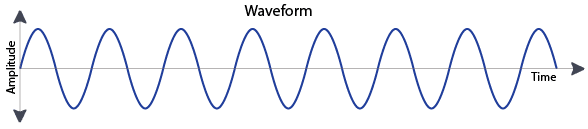
Sound and color are two ends of a huge spectrum of measurable oscillations of vibratory energy. These oscillations are measured in cycles per second or Hertz. For instance, an AM radio transmitter emits waveforms in the range of 540kHz – 1605kHz. The “k” is for kilo or 1,000. FM radio transmits over the vibrational spectrum in the megahertz range from 88-108mHz. Mega is Greek for million. The range in which a frequency is transmitted is known as a “band.”
Color is a vibration as well, and is seen in the spectrum at the level of terahertz. Tera in Greek is trillion. Giga or billion is in between mega and tera, leaving open a wide range of vibrational spectrum to transmit over. This is where cell phones and wifi generally transmit.
The Problems with EMFs
The bodies of mammals including humans, and probably most other life forms on the planet have evolved to harmonize with the frequencies that occur in nature; for instance, the resonance of the Earth itself and the spectral colors in the range of light emitted by the sun. Other frequencies of radiation from the sun and other parts of the galaxy are filtered by the ozone layer of our planet. Because of this, life forms on Earth are increasingly shown to have biological processes be affected by anything below 2000kHz[48]. The problem lies with man-made frequencies. Transmitters are being used to send radio waves through the air in different frequency bands. Electricity, although often using lower frequencies like 50-60Hz can generate spikes of higher frequencies called transients at much higher frequencies beyond 2000kHz. These frequencies can penetrate our bodies.
[UPDATE 2020–2025]
Recent discussions now focus on:
- Environmental RF densification (multiple overlapping signals from routers, towers, smart devices)
- Continuous exposure vs. intermittent exposure of earlier decades
Even sources that do not conclude harm acknowledge that exposure patterns today are fundamentally different than in the past.
Wavelengths
To give you an idea of the physical length in measurement of waves, a wave with a frequency of 2000 kHz would be close to 7in. or 17cm. long. 108mHz would be .00012in. or .0031mm. 2.4gHz which is our current cellular transmission frequency would be .0000055in. or .00014cm. As you can see, the higher the frequency of transmission, the greater that amount of these waves entering the body. Keep in mind that nothing in nature historically has ever been subjected to these types of electromagnetic fields. Nothing in nature is equipped with a microbiome[16] nor an immune system to properly deal with these EMFs.
Why Now?
The argument some have is that we’ve been using electricity for a century and many people have worked with radio waves in different forms for all this time and didn’t get sick. Why are we having problems now? The truth is, we’ve always had these problems but didn’t know what it was. Health has deteriorated in major metropolitan areas over the last 100 years as proven by Weston A. Price. In his studies of diet, those that were raised in remote regions with local food sources had noticeable health decline when relocating to major metropolitan areas where fresh foods weren’t as accessible. He was tracking diet, but this was probably only one factor that led to the gross health consequences of these relocations. There are plenty of reports of over-radiation and its effects when working with high voltage transmissions in high frequency radio and radar. However, the problem isn’t just with high frequencies. It’s also with non-thermal effects of ELF or extremely low frequencies from 3-30Hz and low frequencies (LF) from 30-300Hz[20].
[UPDATE 2020–2025]
The comparison to historical environmental changes (diet, industrialization) remains conceptually valid, but:
- Modern research separates confounding factors more rigorously
- Urban health decline is now understood to involve:
- diet
- pollution
- stress
- lifestyle rather than any single variable
Aren’t Things Better Outside the City?
On another note, this isn’t just a problem for greater metropolitan areas. Rural areas can be even worse for some because the transmitters are further apart. To compensate for distance, the utility will increase the voltage. If you’re close to a transmitter the field will be greater. With electrical transmission towers, it has been shown that incidents of childhood leukemia are common. Studies show the nature of the signal is more harmful than the power. This is especially true at higher exposure levels.
What About 5G?
5G stands for the 5th generation of wireless services offered by the telecommunications industry. The new transmission frequency will include 5GHz, doubling our current 4th generation (4G) transmission frequency of 2.4GHz, allowing for faster data download speeds. In fact, 5G operates across low band (<1 GHz), mid band (1–6 GHz), and high band (millimeter wave). Because the wavelength is shorter, they’ll be boosting voltage for transmissions to send them further, as well as adding more transmission towers. Over 180 scientists from 35 countries have asked for a moratorium on the release of 5G networks due to health damage[21][31]
Aren’t There EMF Regulations?
This would all make you wonder, aren’t there regulations about these sorts of the things? Isn’t that what the FCC is for? Well, yes, there are some regulations around thermal effects. The problem is not with heat. It’s cellular disruption which is 7 millions times more sensitive than epidermal effects of heat and it happens over a longer period of time. To make matters more difficult, the 1996 Telecommunications Act limits local governments from regulating wireless infrastructure based on health concerns if FCC exposure limits are met[4]. FCC guidelines remain largely based on thermal effects. Debate continues about whether non-thermal effects are adequately addressed.
What’s Happening Outside the US?
It is true that the safety guidelines and recommendations are very lenient in the US compared to other parts of the world[3]. Also, the regulations around wireless are stricter and in higher recognition in other countries. For instance, Sweden recognizes Electromagnetic Hypersensitivity (EHS) as a disability whereas in the US, it’s simply a buzzword. In France, internet connected devices are banned in schools. Currently, there are no federal regulations on EMFs in the US. In the UK and EU, they passed a directive and guidelines on occupational exposure in 2013[22]
Do You Smell Cigarettes?
Some claim that what’s happening in the US is just like what took place with the tobacco industry. Although there are thousands of studies from around the world that show the detrimental effects of EMFs on humans, animals[11], crops, and even seed germination, the media is silent. Researchers are bought and paid for by the telecommunications industry, and those that are not are discredited. The public is psychological ensnared into believing that we can’t live without these technologies and the devices themselves are designed to be addictive.
It cannot be denied that there’s a lot of money at stake. The telecommunications industry is a trillion dollar industry. It would rather not have to deal with a few people getting sick. Estimates are that 1/3 of the global population is sensitive and may not even know it yet. The problem is that chronic disease is ruining the quality of life for people, mostly in the US and Europe, but the intended rollout for 5G is worldwide. This may have massive consequences of which we’ve not seen the likes of. Wouldn’t it be better to prove that something is good for us rather than deny that it may be bad for us?
What is Dirty Electricity?
Dirty electricity is a byproduct of wiring errors, wiring designs, and methods of delivering electricity from power companies. All buildings are equipped with a power box or breaker panel attached to a power line that feeds the home or business electricity from the grid. As the electricity moves into a building, what’s not used should return to the panel via a neutral line that runs next to the wire that carries the current, i.e., the hot wire. Many old homes having wiring where the neutral is separated from the hot wire creating a measurable magnetic field in the area where the wires are separated. Another issue is that back in the 70’s, utility companies started running the neutrals from the power poles into the ground to dissipate the neutral rather than return it back to the grid causing an electrical field in the ground itself. You can measure this with a body voltage meter or sensitive EMF meter that measures in nanotesla.
One of the biggest problems that creates dirty electricity are electronic devices themselves. We’re on an alternating current (AC) electrical grid which mean that electrical current flows back and forth. Most devices use direct current (DC) which flows evenly in one direction. Those wall warts or transformers that you get with many devices like computers changes AC to DC current so that the device can use the electricity in the way it needs to. Also, many devices use variable amounts of electrical current like dimmer switches and ceiling fans. This changing and moderating current can cause many harmful transients that are fed back into the neutral wiring and back into the grid, being picked up by your neighbors. Devices like televisions, modems and Wi-Fi routers and especially solar panels are responsible for creating dirty electricity.
The Facts about EMFs and Our Health
To understand why EMFs affect our health, Dr. Martin Pall Ph.D. from Washington State University researched the effects of EMFs on our cells. Up until this point, all FCC recommendations are based on the thermal or heat effects of EMFs. However, it’s not thermal effects that cause the long list of symptoms and maladies, it’s electrical biological effects on the cells of the body themselves.
In a nutshell, human cells should not have much calcium in them. There should only be enough to assist with signal transduction and the transcription of genes. On the cells surface are voltage gated calcium channels (VGCC) that are regulated by metal ion dependent adhesion sites (MIDAS) to control the amount of calcium getting into the cells. EMFs have been shown up open these VGCCs, flooding the cells with calcium and disturbing the communication in the mitochondria of the cells. This would explain the conclusions in studies[10] showing adverse health effects such as:
- Neurological / neuropsychiatric effects
- Lowered fertility
- Oxidative stress
- Cellular DNA damage
- Cell death (apoptosis)
- Excessive intercellular calcium and false signaling
- Endocrine effects
- Cancer[5][51] and free radical damage
- Electrical control of the heart
- Early onset Altzheimers
- Dementia
- Inflammation
- Excitotoxicity
List of EMF metabolic changes
- Inflammation
- Gut health
- Poor nutrition
- Low minerals
- Low melatonin
- Oxidation
- Disrupted circadian rhythm
- Poor sleep
- Toxin load
- Weak immune system
- Infections
Another way that calcium gets into the cell is via glutamine receptors. These receptors are affected by EMFs and glyphosate, the weed killer found in RoundUp. These are responsible for the false signaling happening inter and intracellularly with our cells. This indicates a communication impairment happening throughout the body which will trigger an immune response and sense of threat to the fight or flight system in the body. The body, perceived as being constantly under threat is triggering cortisol and adrenalin from the adrenals which would explain why so many people, especially women are experiencing adrenal blowout. When the cell membrane is disrupted in this way, it can’t let the proper nutrients in or the toxins out. The immune system itself gets overwhelmed.
Effects on Sleep
Sleep is another huge factor that is affected by EMFs. Sleep is essential for the body to rejuvenate and repair itself, balance ourselves mentally and emotionally, and support immune function. There are studies that show disturbances and those that don’t. The problem with all of these studies is the variance in current health of the participants, the frequencies that are studied, and the conditions and period of time in which the studies are conducted. It is conclusive that EMFs affect sleep EEG and cognitive performance, memory, and learning functions, but how much is still being argued. Studies done by the International Committee of Non-Ionizing Radiation Protection (ICNIRP) have declared no significant affectation of EMFs upon sleep. However, other studies have drawn the opposite conclusion. In fact, they’ve shown significant disruption of melatonin levels produced by the pineal gland, which should aid in sound sleep[23].
Unfortunately, the time at which the body heals and rejuvenates is when we’re sleeping. However, the exposure to EMFs NEVER STOPS! We’re inundated by 24/7 365, everywhere on the planet.
[UPDATE 2020–2025]
Recent reviews have not found consistent evidence that RF-EMF exposure affects cognitive performance or causes measurable short-term symptoms under controlled conditions, though real-world variability remains a factor.
Oxidative Stress
EMFs can cause oxidative stress[12]. This can create a substantial deficiency in nicotinamide adenine dinucleotide (NAD), an important metabolic cofactor that’s essential to life by transporting electrons into cell mitochondria. Without proper NAD production, cellular function stops. One of the most important endogenous (internal) antioxidants for preventing oxidative stress is glutathione[14]. Antioxidants should help heal the effects of EMFs, however EMFs have been shown to dramatically decrease levels of glutathione and catalase (an antioxidative enzyme) in the body.
The Microbiome
The microbiome[16] (microorganism colonies in and on the body) is an emerging area showing possible high sensitivity to EMFs. Our knowledge of this has really only surfaced since the genome started to be explored. The more the diversity, the healthier the body. What studies are showing is that EMFs disrupt quorum sensing, the electromagnetic method by which microbiome colonies communicate. The results are inflammation from immune response, microbial imbalances, and proliferation of pathogenic bacteria.
Heavy Metals
Metal in the body from teeth fillings and implants to heavy metal exposure present in the blood can act as an attractor to EMFs. It’s highly advised to get metal amalgams removed from the body in a safe and effective way. IAOMT.com has a list of dentists trained to correctly remove fillings without dumping mercury into the body.
Mold Growth
Mold growth has also been shown in studies to be stimulated by EMFs[17][18]. This means that the allergy symptoms we experience that keep getting worse year after year are a result of EMFs stimulating mycotoxins and allergens from the environment.
Children are most susceptible to the effects of EMFs.[1]
Symptoms of EMFs and EHS
Why is that we’re not falling apart more rapidly? The symptoms start out rather innocuously as insomnia, headaches, foggy head, lethargy, and maybe being a little emotional or unmotivated. What’s happening is a slow cellular breakdown resulting in inflammation. It happens over years until you have a significant health challenge and find yourself having electromagnetic hypersensitivity (EHS) and normal life comes to a halt.
It may be said that the only true escape from this onslaught of EMFs is a faraday cage. Simply put, a faraday cage is a complete protective enclosure made from grounded fine metal mesh or perforated sheet metal where the holes are smaller than the wavelength of the external electromagnetic radiation it’s blocking. Materials woven with a fine mesh of cotton and silver can be found in the form of clothing and bed canopies[46], the latter used to create a faraday cage around your bed. People that are EHS who start to use a canopy at night while sleeping can experience a cytokine storm where the immune system floods the body with cytokine peptides (immune modulating proteins) resulting in extensive inflammation. It’s important to gradually introduce this kind of protection when symptoms of EHS are severe, however, at this time it is the only true measurable relief from EMFs.
Autoimmune disease[15] affects 1 in 5 people in the western world; chronic disease about 60% of the adult population. The Australian biomedical scientist, Trevor Marshall said, “Anyone that has chronic inflammatory disease has a problem with EFMs even if they don’t realize it… When somebody is taking a drug which is no longer working the way the physician would expect or doing a therapy which is no longer working, the physician must start thinking in terms of EHS.”
The benefits of life don’t come from telecoms. They come from relationships with people, families, communities and nature and with innovation from within ourselves. Creativity, inspiration, and intuition. These are all things that are being dumbed down and not considered important in this high speed tech world.
~ Camilla Rees
[UPDATE 2020–2025]
Recent systematic reviews associated with WHO research efforts have found that individuals with electromagnetic sensitivity generally do not detect EMF exposure under blinded conditions, although the symptoms themselves are recognized as real and impactful.
Recommendations for Dealing with EMFs
- Start with decreasing your exposure to devices that carry signals.
- Make changes to dirty electricity problems in the home.
- Make changes to your diet to stimulate cellular repair and decrease inflammation.
- Consider the MTHFR test to find your susceptibility to cellular EMF damage.
1. Decreasing Your Exposure
- At a minimum, unplug your wireless router before bed.
- At best, use ethernet cables to connect your computers to your router. You can connect tablets with an ethernet adaptor. Then, turn off your wireless completely.
- If possible, turn off the circuit breaker to your bedroom at night while you’re sleeping. There are remote controlled breakers you can obtain.
- Cell phones should be in airplane mode if it’s in your bedroom at night and any time it’s on your body.
- Never talk on the cell phone closer than arms length from your body. Use an Air Tube headset or speaker mode.
- If your cell phone is not in airplane mode, do not put it closer than arm’s length to your body.
- Do not have a smart meter on your home[6]. You can get it removed and there is shielding[7] you can obtain. Here’s a good article[47] on smart meters.
- Cordless phone bases are huge emitters of EMF[8] and they constantly emit unless you buy a more expensive phone that only emits during a call.
- Bluetooth is not your friend. Apple watches and FitBits should not be used until they build in the ability to be self initiated to transfer data. Right now, they’re constantly sending and receiving EMFs.
- No baby monitors unless it is life or death, and then, keep it as far from your baby as possible.
- There has been talk about coiled mattresses and metal bed frames acting as antennae for RF signals. This hasn’t been substantiated but if you’re EHS, it can’t hurt to have at a minimum, individually wrapped coiled mattresses to prevent circuits, and to have a wood frame.
- Check out having a TriField meter to make measurements of electric, magnetic and RF frequencies around your home and compare to the Bioinitiative Report recommendations[24].
- No plugin alarm clocks by your head while you’re sleeping.
- Electric and Hybrid vehicles are huge emitters of EMFs. If you’re EHS, this is highly risky.
- Remove CFL light bulbs from your home and business. They’re a terrible source of EMF polution.
- If you need to use your microwave, don’t stand with 15ft. of it while in use.
2. Addressing dirty electricity in the home
There are two locations for dirty electricity. The first is the power coming into the breaker box of the building from the main power line. Transients get introduced from other parts of the network via homes and businesses nearby into the power line itself, and these travel into your home or business. You can filter with more expensive “whole-home” filters at the box itself to ensure that only clean electricity is coming into your building.
Once the power is in the building, whatever devices you have plugged or wired into the building can also create transits and these can be filtered right at the outlets. There are different filters with varying capacities to clean the circuits. Some are for each individual circuit and some can handle an entire room. Two things to consider are the placement of filters and the magnetic fields they may emit if you have wiring problems. Older homes with knob and tube wiring can have magnetic fields that the filters can make worse. It’s important to be able to test and measure the fields that you’re fixing.
The simplest thing to do is to purchase a Dirty Electricity Meter which gives you a simple digital readout that will produce a number when you plug it in indicating the amount of dirty electricity in that circuit. It’s measured in Graham Stetzer (GS) units. 50 is equal to 2000Hz. You want your reading as low as possible so if you’re over 50, you have a problem and want to apply a plugin filter to that circuit. If you’re in a room that has a lot of equipment, you may either need multiple filters per circuit, or you might go the route of a whole room filter. If you have an older home with knob and tube wiring, you may want to get a magnetic field meter or combo meter to measure the magnetic fields to ensure you’re not creating another problem. Note that magnetic fields cut off pretty quickly, meaning that don’t travel far. However, if you’re EHS, this could be an issue that you want to simply avoid. I highly recommend Oram Miller as a Building Biologist[25] who has a very comprehensive web site with a lot of information to further assist you.
Meters for Measuring Dirty Electricity and EMFs and Filters
Magnetic Field Meters
- Gigahertz ME3851A
- Acoustimeter
- Gigahertz ME3030B
- Cyprus – Model 4080 Triaxial ELF Magnetic Field Meter
Dirty Electricity Meters
- Stetzer “Microsurge” Meter
- Greenwave Line EMI Meter – Measures from 3kHz – 10mHz
Radio Frequency (RF) Meters
- Acousticom 2 RF Detector – 200mHz – 8gHz
Combo Meters
- Corronet ED88T
- ENV RD-10
- TriField TF2
Filters
- Dave Stetzer – Stetzerizer
- Noble Electronics – MxDNA series
- Alan Maher Designs – DED
- Ben Lonetree, Iona Miller – Clean-E Filters
- Greenwave – DE Filters
- Satic Technology – Pure Power Plug-in
- Cratus Canada Ltd – SineTamer
3. Health Support Recommendations for EMF Sensitivity
Tips for maximum recovery
- Get more minerals from trace mineral additives
- Get more magnesium from epsom salt baths, coconut water, trace mineral additives and supplements.
- Add lipids from good oils, especially olive, avocado, and coconut.
- Improve your sleep
- Improve your gut health
Foods and Herbs (eat organic to avoid glyphosate)
Cruciferous vegetables increasing polyphenols as antioxidants to improve overall health such as:
- Arugula
- Bok choy
- Broccoli
- Brussels sprouts
- Cabbage
- Cauliflower
- Collard greens
- Daikon
- Water cress
- Kale
- Wasabi
Foods rich in the sulphur help the body detoxify:
- Avocados
- Eggs
- Grass-fed cow’s milk
- Mustard greens
- Nuts
- Onions
- Seafood
- Sweet potatoes
- Tomatoes
- Turnips
- Watermelon
Foods high in polyphenols and antioxidants to protect against radiation and pathogens like:
- Apples
- Artichokes – highly recommended
- Asparagus – highly recommended
- Berries – especially blueberries and cranberries
- Cinnamon
- Coffee
- Cumin
- Dark chocolate
- Fermented foods such as sauerkraut and yogurt
- Garlic
- Grass-fed beef
- Hemp seed oil
- Mushrooms
- Olive oil – highly recommended combined with Carbon 60
- Pears
- Pomegranate juice
- Prune
- Red beans
- Salmon
- Seaweed
- Tart cherries – highly recommended
- Turmeric
- Walnuts
- Whey protein
Herbs to improve detoxing
- Coriander – highly recommended
- Milk thistle – Activates natural glutathione[14] production in the body.
- Pau d’arch – helps with nicatinomide riboside / B3 for NAD production.
- Rosemary – Protects against radiation[26].
- Yarrow – Detoxification
- Yellowdock root – Immune system support
Essential Oils, Supplemants and More…
Essential oils to diffuse
- Frankencinse – Helps with sleep
- Lavender
- Peppermint
- Rose
- Rosemary – highly recommended[26]
Stayed hydrated
- The purest water is distilled water. You can add trace minerals.
- Molecular hydrogen[19] has huge health benefits.
Supplements
- Niacin (B3) – Responsible for over 400 reactions in the body.
- Magnesium – Responsible for over 800 reactions in the body.
- CBD oil can increase NRF2[9] to support mitochondria function promoting detoxification, increasing antioxidant activity, and creating anti-inflammatory actions.
- Hemp Seed Oil – Protective against radiation by increasing omega 3 and 6 for cell membrane health.
- Vitamin C with bioflavonoids – Antioxidant
- Vitamin E – Prevents oxidative stress and lipid peroxidation.
- Vitamin B9 – Helps the cells make, repair and methylate DNA. Also an antioxidant.
- Glutathione[14] – Especially important antioxidant that may need to be replenished due to EMF exposure and EHS.
- Astaxathin – Extremely powerful antioxidant
- N-acetyl cysteine – Activates natural production of glutathione in the body.
- Cytodetox – Protects against the effects of radiation in the body.
- Propalis – highly recommended for EHS
- Methylated folate – highly recommended for EHS
- L-thianine – For calming the body
Alternative or Not Conventionally Measurable
- Carbon60[30]
- Shungite[29] – This can create measurable effects with conventional meters though the claim is that the fullerenes[30] change the spin of EMFs which itself is not measurable conventionally.
- Chips, pendants, and other home devices – There are a ton of these on the market with scientifc claims. Again, these are rarely measurable with conventional devices. You must either do darkfield microscopy or rely on pendulums or kinesiology. Do what’s measurable first before exploring this types of items.
- Earthing Mats – Building Biologists and Engineers have mostly not supported these, however, like pendants and other home devices, people feel better when using them. There is science supporting their usage[28]. It is important to have a clean ground circuit because these can act a amplifiers if not.
- Energy Medicine
4. MTHFR Test
MTHFR Tests for A1298C C677T – This test checks for gene mutations that contribute to blocked detox pathways which could contribute to EHS[27].
Resources and Scientific Studies Related to EMF Health
- World Health Organization – Report from Russia on the effects of non-ionizing radiation and the recommendation that children under the age of 18 should not use cell phones due to certain health risks.
- FCC Maximum Permissable RF Exposure Regulations – RFCafe.com
- Exposure limits on EMFs worldwide
- 1996 Telecommunications Act
- Clear evidence in NIH studies that cell phones cause cancer in rats
- Take Back Your Power – The Movie
- Smart Meter Shield
- Hardell Group – Mobile phones, cordless phones and the risk for brain tumors.
- Dr. Martin Pall – Nrf2, a master regulator of detoxification and also antioxidant, anti-inflammatory and other cytoprotective mechanisms, is raised by health promoting factors.
- EHTrust – More than enough scientific articles and research to prove the detrimental health effects of EMFs.
- Effect of Communication Towers on Migratory Birds
- Effects of electromagnetic fields exposure on the antioxidant defense system
- EMFs.info – Highly informative site on EMFs
- Glutathione – MedicalNewsToday.com, Mercola.com
- Electrosmog and autoimmune disease
- MicrobeMinded.com
- Nonthermal effects of millimeter microwaves on yeast growth.
- Resonant microwave effect on locally fixed yeast micro colonies.
- Molecular hydrogen: a preventive and therapeutic medical gas for various diseases
- Experimental model for ELF-EMF exposure: Concern for human health
- Moratoreum request for 5G
- DIRECTIVE 2013/35/EU OF THE EUROPEAN PARLIAMENT AND OF THE COUNCIL
- Pineal melatonin level disruption in humans due to electromagnetic fields and ICNIRP limits
- The Bioinitiative Report 2012
- Oram Miller, Building Biologist and Instructor – Create Healthy Homes
- Radioprotective potential of Rosemarinus officinalis against lethal effects of gamma radiation : a preliminary study.
- MTHFR Test
- Groundology
- Karelian Heritage – About Shungite
- Fullerenes and C60
- 5G Crisis – Excellent jump off point for research about the potential effects of 5G.
- Lloyd Burrell – Years of gathered info for the public.
- Dr. Madda Havis,PhD – EMF expert and professor
- Comprehensive list of studies on health effects of EMFs
- International EMF Scientist Appeal
- Dr. Jerry Tennant – Author of “Healing is Voltage
- Dr. Deitrich Klinghardt – Essential understanding of EMFs and health.
- Annie Hopper – Retraining the Brain
- Dr. Ben Lynch – Author of Dirty Genes
- WEEP EHS Survival Guide – Canadian group advocating health recommendations for EHS
- Exposed: The Electronic Sickening of America and How to Protect Yourself by Bill Cadwallader
- The Non-Tinfoil Guide to EMFs by Nicolas Pineault
- Overpowered by Martin Blank
- Dirty Electricity by Sam Milham
- The Body Electric by Robert O. Becker
- Less EMF – Bedding
- Smart Meter Radiation: What You Should Know by Adam Short
- PubMed
- WHO
- National Cancer Institute RF Fact Sheet
- National Toxicology Program (NTP)
The post EMFs and EHS – What You Must Know to Stay Healthy appeared first on Blue Bear Healing.
]]>In order to sing for 4 days at a sun dance or any other song driven …
Vocal Care for Singing Read more →
The post Vocal Care for Singing appeared first on Blue Bear Healing.
]]>In order to sing for 4 days at a sun dance or any other song driven ceremony, you run up against all kinds of limitations of the vocal cords. It’s important to take care of the throat to avoid lasting damage. Laryngitis is the result of phlegm from the lungs being expelled and collecting on the vocal cords, preventing their movement. In order to prevent laryngitis, you need to prevent phlegm. The other thing is to drink plenty of water to prevent the phlegm from thickening and keep the throat lubricated.
Medicines
- Thayers Slippery Elm Lozenges – soothes throat.
- Traditional Medicinals Tea – Throat Coat and Breathe Easy – support breathing and vocal cord health.
- Enzymes – Papaya and Bromelain – reduces phlegm
- Singers Throat Spray – Professional – supports the vocal cords.
- Vicks Lozenges – Vapo Cool – keeps the phlegm down and opens the lungs.
- Lemon – reduces phlegm.
- Honey – supports coating the throat for lots of singing.
- Ibuprofen – reduces inflammation.
Usage
- Ibuprofen – Use at night before bed to reduce inflammation of the vocal apparatus.
- Tea – Combine Throat Coat and Breathe Easy teas with honey and lemon at the end and beginning of the day.
- Throat Spray and Lozenges – Use intermittently throughout the day.
- Enzymes – Use at the beginning and end of the day.
Foods
- Avoid sugar.
- Determine if you have any subtle allergies that may constrict your throat.
- Caffeine isn’t great for your vocal abilities.
- Avoid dairy products as they produce phlegm.
- Drink lots of water.
Vocal Warmups
Do these before singing.
- Hum to invigorate the vagus nerve and start up the vocal cords. 30-60 seconds.
- Sweep Hum starting at lowest possible note to the highest possible note and back down. 30-60 seconds.
- Oh – Up a third and down a second from lowest note to highest note and back down.
- Ah – Move up in whole steps to a fifth and back down. Move up a whole step and repeat the process and go to the highest not possible, and back down the lowest.
- Purse the lips and repeat the above exercises forcing air from the lungs to vibrate of the lips.
The post Vocal Care for Singing appeared first on Blue Bear Healing.
]]>Coaching is distinct from similar personal growth modalities. It's highly advantageous to compare coaching vs therapy,…
The post Coaching For You? Coaching Vs Other Personal Growth Modalities appeared first on Blue Bear Healing.
]]>As a dedicated student of personal development, I’ve always believed in the power of guidance to bring about transformative change. With that in mind, I am excited to delve into the world of coaching, a unique modality that stands distinct from other similar practices and approaches. It’s imperative to understand, however, that while coaching may share some similarities with other modalities such as therapy, counseling, and mentoring, it is indeed a unique discipline with its specific goals, processes, and outcomes.
Contents
What sets coaching apart, in my belief, is its forward-looking and goal-oriented nature. Instead of dwelling on the past (as therapy often does), coaching focuses on the here and now and plans for the future. It’s a process that empowers individuals to unlock their fullest potential, to overcome barriers, and to reach their desired goals, whether personal or professional. Interestingly, the coach does not act as a problem solver, but as a facilitator who enables the coachee (the individual receiving the coaching) to find their own solutions.
Before we delve into the distinctions between coaching and other modalities, it is essential to recognize the value and purpose of each approach. Each has its place and function, depending on the individual’s needs, circumstances, and goals. Going forward, let’s embark on a journey to distinguish coaching from therapy, counseling, and other similar modalities, to help determine if coaching is the right path for you.
Coaching vs Therapy
As we delve into the realm of professional support, it’s critical to distinguish between coaching and therapy, two avenues that, while appearing similar on the surface, serve distinct purposes and cater to different needs. There’s a tendency to conflate the two due to overlapping methodologies and shared objectives of catalyzing personal growth and enhancement. However, a closer examination reveals nuanced differences that can aid in making an informed decision regarding which service is more apt for any given situation.
Therapy, in my experience, is most often sought by individuals grappling with past traumas or psychological issues that hinder their present functioning. It’s a healing process that involves delving into past experiences, unearthing deep-seated emotions and patterns, and working through these to achieve better mental health and wellbeing. Therapists are trained health professionals who diagnose and treat mental health disorders, and therapy is often a long-term process that can involve medication.
Coaching, on the other hand, is a forward-focused practice predominantly concerned with the present and future. The role of a coach is not to diagnose or treat mental health disorders, but to work with clients to help them clarify their goals, identify obstacles, and develop actionable strategies to achieve their objectives. Coaches are not mental health professionals, but they are certified and trained in helping individuals maximize their personal and professional potential. Coaching is typically a shorter-term engagement that focuses on specific outcomes and is action-oriented.
While therapists delve into the ‘why’, coaches focus on the ‘how’. The former helps you heal, the latter helps you grow.
Consider the following comparison:
| Therapy | Coaching | |
|---|---|---|
| Purpose | Healing | Personal Growth |
| Focus | Past & Present | Present & Future |
| Outcome | Better mental health | Goal achievement |
| Duration | Long-term (often) | Short-term (usually) |
Why You Might Seek Therapy
So, who benefits from these services? Principally, anyone and everyone can. If you’re struggling with mental health issues or find yourself continually impacted by past traumas, therapy could provide you with the healing you need. On the other hand, if you’re seeking to improve specific areas of your life, achieve certain goals, or maximize your potential, a coach could be just the person to guide you on your path to success.
It’s worth noting that the two are not mutually exclusive – many individuals engage in both therapy and coaching, utilizing each to address different aspects of their personal development. A blend of both can often provide a holistic approach to personal growth and wellbeing.
Hypnotherapy With Coaching
It’s important to include Hypnotherapy as a possible adjunct to Coaching. Because coaching generally focuses on the present as it relates to the future, Hypnotherapy can the a perfect compliment to deal with past issues, even traumas that are standing as obstacles to the goals Coaching is helping you with. If you don’t address the obstacles, chances are Coaching may not get you to your destination.
Different states and countries have different laws around Hypnotherapy so it’s good to consult with someone to find out whether this is available to you without the need to hire a psychotherapist or not. Regardless, a good Hypnotherapist should be trained to guide you through past experiences to bring healing to them. I myself am licensed in the state of California under the State Bureau for Private Postsecondary Education.
To learn more about Hypnotherapy, read “Heal Your Mind with Hypnosis and Hypnotherapy.”
Coaching vs Mentoring
When discussing how to improve professionally or personally, one often stumbles upon the concepts of coaching and mentoring. While both are valuable tools for personal and professional development, they serve different purposes and follow different methodologies. Understanding these differences is crucial in choosing the right approach for your situation.
Coaching, in essence, is a structured process driven by goals and objectives (typically short-term) that the individual (or the coachee) wants to achieve. It involves a professional relationship where the coach provides the coachee with the tools, strategies, and perspectives needed to achieve these goals. The coach does not necessarily need to have specific knowledge about the coachee’s field; instead, the emphasis is on facilitating the personal growth of the coachee and development so they can meet their objectives.
On the other hand, mentoring is a relationship-based process, typically long-term, where the mentor shares their knowledge, expertise, and experience with the mentee. The mentor, who is usually an experienced professional in the mentee’s field, provides guidance, support, and advice to help the mentee navigate their professional journey.
| Coaching | Mentoring | |
|---|---|---|
| Focus | Goal-oriented | Relationship-oriented |
| Duration | Short-term (usually for a specific goal) | Long-term (often lasting for several years) |
| Knowledge of the field | Not necessary | Necessary |
How to Decide
Despite their differences, both coaching and mentoring can bring significant benefits. The choice between the two often depends on what you aim to achieve. If you’re looking to develop specific skills or achieve a particular goal in a relatively short timespan, a coach might be more suitable. On the other hand, if you’re seeking guidance and advice to navigate your professional journey in a broader sense, a mentor would probably be a better fit.
“The best way to predict your future is to create it”
~Peter Drucker
This quote truly encapsulates the essence of both coaching and mentoring. Whether you choose to engage a coach or a mentor, remember that it’s about creating your best future. You are the master of your destiny, and coaching and mentoring are tools that can help you shape it the way you want.
Coaching vs Counseling
Before we delve into the various types of coaching, it is imperative for us to distinguish between coaching and counseling. These two concepts, though often used interchangeably, are fundamentally different in their approaches and objectives.
Coaching, to put it in simple terms, is a process-focused approach that aims to enhance an individual’s performance, skills, or knowledge (often in a specific field). Unlike counseling, coaching tends to be future-oriented and often works on the premise of the coachee already possessing the necessary skills, but needing guidance to utilize them more effectively and to help the coachee see what they made to blind to. The coach is seen as a facilitator of learning, rather than an expert imparting knowledge.
On the other hand, Counseling is more of a therapeutic intervention focused on helping individuals overcome emotional, psychological, or behavioral issues. Counselors delve into the individual’s past experiences and emotions to identify and resolve issues that may be affecting their present life and inhibiting their potential. The counselor’s role is more of an expert or guide in the process of healing or resolving these issues.
In essence, while coaching focuses on development and performance, counseling leans towards healing and resolution. Coaches typically work with individuals who are well and wish to improve, whereas counselors work with individuals who are unwell or distressed and need help to get better.
It is important to remember that both coaching and counseling have their own unique merits and are suited to different circumstances. Choosing between the two totally depends on what you hope to achieve. If your main focus is to improve performance, skills, or knowledge in a certain area, coaching would be more beneficial. However, if you are dealing with emotional, psychological, or behavioral issues, counseling would be the more appropriate route.
Who would benefit from coaching vs counseling?
People at various stages of their life or career can benefit from both coaching and counseling.
Those who could benefit from coaching include:
- Executives and managers seeking to improve their leadership skills
- Individuals looking to make a career transition
- Teams wanting to improve their dynamics and performance
- Professionals wishing to enhance specific skills, such as public speaking, negotiation, or time management
Individuals who might benefit from counseling, on the other hand, could include:
- People going through a difficult life event, such as a divorce or bereavement
- Individuals struggling with mental health issues like depression or anxiety
- People dealing with trauma or unresolved issues from their past
- Individuals who are having difficulty coping with stress or change
As you can see, there’s a distinct difference between coaching and counseling, and understanding this difference is key to choosing the correct path for your personal or professional development.
Coaching Combined With Energy Healing
Counseling has similarities to therapy in that it looks to resolve issues stemming from the past. Similarly, Coaching combined with Hypnotherapy, or Coaching and Energy Healing can produce similar results to Counseling. The energy healer and hypnotherapist can address the blockages that are preventing the coachees’s goal from being attained. This is possible even if that blockage was created in a previous life experience or trauma. From my experience, a Coach / Energy Healer or Coach / Hypnotherapist is uniquely armed to deal with most anything. They can bring about results quickly and more directed to an outcome. Create a Consultation.
Coaching vs Training
At first glance, it’s easy to conflate coaching with training. However, these two concepts, while closely related, have distinct characteristics and methodologies. To fully appreciate the value of coaching, we must first explore its differences from training.
Training is primarily skill-based (i.e., it’s about the transfer of specific skills or knowledge from the trainer to the trainee). It’s typically a structured process with a defined curriculum and predetermined learning outcomes. In training, the trainer is the expert who imparts knowledge or skills with the expectation that the trainee will apply these in a specific way.
Coaching, on the other hand, is a more tailored and individualized process (it’s as unique as the person being coached). In coaching, the coach is not necessarily an expert in the field of the coachee but rather an expert in the coaching process itself. The coach’s role is not to deliver knowledge, but rather to facilitate the coachee’s self-discovery and self-improvement. This is accomplished by asking insightful questions, challenging assumptions, and helping the coachee to see different perspectives.
So, while there are overlaps, both aim to improve performance and facilitate personal growth. The core difference lies in the approach and the dynamic between the coach/trainer and the coachee/trainee. Training is more directive and prescriptive, while coaching is more facilitative and exploratory.
Remember, neither approach is inherently superior. The best method depends entirely on the individual’s needs, goals, and circumstances. For instance, if you need to learn a new skill quickly (like public speaking for an upcoming presentation), training would be ideal. However, if you’re looking to enhance your overall communication skills or leadership ability, coaching would be the more fruitful avenue.
It’s also important to note that coaching and training can complement each other beautifully. A blend of both methods can be highly effective for ongoing professional development and personal growth.
Coaching vs Managing
Let’s first delve into the differentiation between coaching and managing, which often gets convoluted in the corporate sphere. As a seasoned coach and manager myself, I have come to understand the distinct nuances that separate the two roles. While both are essential in a working environment, understanding their individual implications can help determine when each is required.
Management, as a concept, revolves around the administration and control of an entity. That may be a team, a project, or an entire organization. It is about directing and making decisions about resources, procedures, and policies to achieve specific goals. A manager’s primary role, then, is to guide a team in line with the company’s vision and objectives.
“To manage is to bring about, to accomplish, to have charge of or responsibility for, to conduct. Leading is influencing, guiding in a direction, course, action, opinion. The distinction is crucial.”
~Warren Bennis
On the contrary, coaching is a more individual-centric approach. It focuses on personal development, skill enhancement and unlocking potential. A coach’s role is not to direct but to facilitate self-discovery, inspire, encourage, and provide constructive feedback.
- Management: It is about directing and decision-making.
- Coaching: It is about facilitating and inspiring.
Which is Better?
Importantly, the distinction does not imply one role is superior to the other. Both are crucial for different reasons. A manager ensures tasks are completed promptly and effectively, aligning with the organization’s objectives. A coach, on the other hand, helps an individual grow in their role, improve their skills, and gain confidence.
So, who would benefit from coaching versus managing? A person operating in a well-defined role with specific responsibilities would benefit from effective management. Conversely, anyone looking to grow, learn, and develop their abilities would find immense value in a coaching relationship. This could be an employee aspiring to reach new career heights, a student aiming to improve their academic prowess, or an athlete wanting to hone their skills.
Often, the best leaders seamlessly blend both coaching and managing. They know when to wear each hat is the key to fostering an environment where individuals, and therefore organizations, can thrive.
Finding the Right Coach
It’s crucial to understand, before we delve deeper into the subject, that finding the right coach involves much more than just the type of coaching. The chemistry between the coach and the coachee (that’s you!) is of utmost importance. A coach who’s a master in their field but doesn’t resonate with your needs and personality might not be the best fit. A perfect coach, in my opinion, is someone who can guide you towards your goals while taking into consideration your personality, circumstances, and ambitions.
But how do you find this elusive perfect coach? It’s not as complicated as it seems. Here’s a glimpse into an upcoming article that will guide you through the process:
- Understanding Your Coaching Needs: The first step, as always, is self-awareness. What do you want to achieve through coaching? Think about the goals you want to achieve. Consider what limitations you believe you’ll be facing. This clarity will serve as the foundation for your search.
- Researching Potential Coaches: Once you know what you’re looking for, it’s time to start your search. Look for coaches who specialize in your area of interest and have a proven track record. You might look for credentialing through organizations such as International Coaching Federation (ICF), European Mentoring and Coaching Council (EMCC), ADHD Coaches Organization (ACO), or a Board Certified Coach (BCC), for instance. Chances are, you know someone who’s benefited from using a coach. As your network for referrals.
- Evaluating their Expertise and Coaching Style: Not all coaches are created equal. Some may have a more directive approach, while others may be more facilitative. It’s crucial to find a coach whose style aligns with your preferences. Nothing beats a consultation to get the ball rolling. Seek out coaches who offer free consultations and schedule with a few. Prepare a list of questions about how they serve your particular needs and goals, and how they work with any special limitations you may have. Also look for testimonials and reviews on their web site, in social media, or on Google.
- Making the Choice: Lastly, trust your gut. After all, this is someone you’ll be working closely with. If something doesn’t feel right, it probably isn’t!
The article titled “How to Hunt Down the Right Coach” will provide a step-by-step guide to finding the right coach. It will cover aspects such as understanding your coaching needs, researching potential coaches, evaluating their expertise and coaching style, and finally making the choice.
If you’re considering coaching with me, create a consultation with me to discuss your goals and see if we’re a good fit to work together.
In Conclusion
Now that you have a clearer understanding of what coaching is, I recommend reading, “Reviewing the Best Domain of Coaching For You.”
The post Coaching For You? Coaching Vs Other Personal Growth Modalities appeared first on Blue Bear Healing.
]]>The term 'shamanism' often conjures images of mystical figures invoking spirits in a trance-like state. There…
The post Shamanism: Using Ancient Medicine in a Modern World appeared first on Blue Bear Healing.
]]>When one delves into the vast ocean of world spirituality, few practices hold as deep and abiding a mystery as Shamanism. The term ‘shamanism’ often conjures images of mystical figures, draped in ceremonial garb, invoking spirits in a trance-like state. Yet, as profound as these images may be, they often lend to misconceptions about what shamanism is – and isn’t.
Contents
Shamanism Is Not a Religion
Shamanism is not a religion per se but rather, an ancient spiritual practice that permeates many diverse cultures, from the Inuit tribes of the Arctic to the indigenous societies of the Amazon. It’s an ancestral tradition, a bridge between the physical and spiritual worlds, an interaction with the unseen dimensions woven into the fabric of our existence. But the practice of Shamanism is not confined to tribal societies. Its relevance echoes in the modern world too, providing spiritual guidance and healing in a world often devoid of both.
Shamanism is, at its core, a journey. A journey within oneself, a journey into the spirit world, a journey toward healing and understanding. It is inherently a practice of connection – with oneself, with nature, with the spirit world, and with the community.
Shamanism, however, is not an escape from reality or an excuse to partake in hallucinogenic substances. Nor is it a quick-fix solution to life’s myriad problems or a means to attain supernatural powers. It is important to dispel such notions to truly respect and understand the depth of shamanism.
- Shamanism is:
- An ancient practice spanning thousands of years and diverse cultures.
- A spiritual tradition involving the invocation and interaction with spirits for guidance and healing.
- A powerful tool for personal growth and understanding yourself and the world around you.
- Shamanism is not:
- A religion with a defined set of doctrines and dogmas.
- An escape from reality or an excuse to use hallucinogenic substances.
- A quick-fix solution to life’s problems or a means to attain supernatural powers.
The Roots of Shamanism: Understanding its Origins
I believe it is essential to start by stating that the term ‘shaman’ originates from the Tungus tribe in Siberia. It was through the advent of anthropological studies and explorations that the term was adopted and applied to similar spiritual practices found across various cultures around the world. The term represents a figure who is considered a bridge between the physical world and the spiritual realm, a mediator if you may (though this is a simplification of a complex role).
Early evidence of shamanistic practices dates back to the Stone Age, as seen in cave paintings and artifacts discovered across Europe, Asia, and the Americas These. early shamans were not only spiritual leaders but also healers, counselors, and storytellers. They played a crucial role in their communities, providing guidance in times of crisis, healing sickness, and communicating with the spirit world for the well-being of their tribes.
Cave paintings in the Lascaux caves in France, for instance, depict scenes believed to represent shamanic journeys or rituals, including figures that appear to be in trance-like states surrounded by various animals (seen as spiritual guides or allies).
As societies evolved, so did shamanism. Each culture developed its own unique practices, rituals, and beliefs based on its environment, needs, and experiences. In many societies, shamans would undergo rigorous training and initiations, often involving physical hardships and altered states of consciousness (though not always through substances as it is popularly portrayed).
Cultural Commonalities
Despite the many different forms of shamanism, they all share some common features. The belief in a world inhabited by spirits, the use of altered states of consciousness to interact with these spirits, and the role of the shaman as a mediator between the human and spirit worlds – these are universal aspects of shamanism that permeate across cultural boundaries.
Interestingly, shamanism did not disappear with the advancement of modern societies. Instead, it adapted and transformed in new and unexpected ways. Today, shamanism continues to be practiced in traditional cultures, and has also found a place in modern societies where it is often blended with other spiritual and therapeutic practices.
In its essence, shamanism is not about escaping reality or achieving supernatural powers, but about understanding and embracing the interconnectedness of all life, and using this wisdom to bring about healing and balance. It is a path of service, for the self, the community, and the Earth.
For more on Shamanic Healing, read “Coaching and Healing Through the Spirit of Shamanism.”
Shamanism Throughout History: How it Transformed Over Time
As we delve deeper into the annals of our human history, it becomes more evident that shamanism is not a recent phenomenon, but something deeply intertwined with the tapestry of our collective past. The transformative journey of shamanism, from its humble origins to its modern-day interpretations, is nothing short of awe-inspiring. I firmly believe that by understanding this evolution, we open ourselves to a deeper appreciation of its rich and intricate complexities.
The Genesis of Shamanism: An Ancient Ritual
The roots of shamanism stretch back to the Paleolithic era (approximately 40,000 BC). It was during this time that early humans began to depict shamanic rituals in their cave paintings. These early shamans were considered intermediaries between the human and spirit worlds, harnessing their abilities to heal, divine, and guide their communities through their otherworldly connections.
Shamanism in Antiquity: A Global Phenomenon
As civilizations began to develop and expand, so too did the practice of shamanism. It transcended geographical boundaries and cultural distinctions, ingraining itself in societies from Siberia to South America, and from Africa to Australia. In each of these cultures, shamans held significant roles, often revered as healers, seers, and spiritual leaders. Their practices, while unique to each culture, shared certain core principles, chief among them being the belief in a world inhabited by spirits and the ability to traverse this spiritual plane.
The Middle Ages and Shamanism: A Period of Persecution
From the dawn of the Middle Ages, shamanism faced growing persecution. The rise of monotheistic religions, particularly Christianity and Islam, often viewed shamanism as heretical or demonic. The Shamanic practices, once revered, were now feared and suppressed. Despite this, shamanism persisted, often under the guise of folklore and traditional healing practices. This resilience speaks volumes about the inherent human connection to the spiritual, mystical, and the unknown.
Modern Shamanism: A Resurgence and Transformation
In the modern era, we are witnessing a resurgence of interest in shamanic practices. People from all walks of life are drawn to its allure, often seeking solace in its ancient wisdom and healing properties. The practice of shamanism today is colored by a blend of traditional practices and modern adaptations. Contemporary shamans often incorporate elements from psychotherapy, holistic healing, and New Age philosophies, demonstrating the adaptability and resilience of shamanic practices.
Our collective journey through the ages with shamanism is a testament to its enduring appeal and its profound resonance with our human spirit. From its ancient roots to its modern-day adaptations, shamanism remains a compelling spiritual path that continues to evolve with us, deeply ingrained in our shared human experience.
Shamanic Rituals: A Look at Ancient and Modern Practices
When we delve into the world of shamanic rituals, we find ourselves engaging with a practice that is both deeply rooted in ancient traditions and deftly entwined with the complexities of the modern world. Here, we embark on a journey to understand the dimensions of shamanism, both in its ancient form and its contemporary manifestations.
Shamanic rituals, at their core, are about fostering connections. They represent a bridge between the spiritual and the physical realms, serving as an avenue for shamans to communicate with the spirit world and bring back wisdom and healing to their communities.
The Ancient Practice of Shamanic Rituals
Historically, shamanic rituals were a crucial part of tribal life, practiced by indigenous communities across the globe (from the Tungus tribes of Siberia, which gave us the term ‘shaman’, to the native tribes of North and South America, Africa, and Australia). Each culture had its own unique set of rituals and practices, but there were some recurring themes we see echoed across traditions.
- Entering the Spirit World: This is typically achieved through trance states, induced by various means (like drumming, dancing, or the use of plant medicines). The shaman would journey into the spirit world, seeking wisdom, answers, or healing energies.
- Healing Rituals: Shamans were often called upon to perform healing rituals, aimed at restoring balance and harmony within the individual or the community. These rituals could involve energy work, plant medicine, soul retrieval, or divination.
- Communing with Nature Spirits: Many ancient shamanic cultures held a deep reverence for the natural world, believing it to be inhabited by spirits or deities. Rituals were often performed to honor these entities, ask for their guidance, or appease them.
Modern Shamanic Practices
Fast forward to the 21st century, and we find that shamanism has not only survived but has adapted and evolved to resonate with the modern seeker. While the essence of the practice – connection, journeying, healing – remains the same, it’s adapted to our contemporary contexts. It’s fascinating to see how these ancient rituals have been reinterpreted and repurposed to suit the needs of today’s world.
- Shamanic Journeying: This practice has been popularized in recent years, with workshops and classes being offered worldwide. It involves using drumming or other rhythmic sound to enter a trance state and journey into non-ordinary reality, often with the aim of self-exploration or personal healing.
- Energy Healing: Drawing from the ancient traditions of shamanic healing, modern practices often incorporate elements of energy work (similar to Reiki, chakra balancing, or aura cleansing).
- Plant Medicine Ceremonies: The use of plant medicines like Ayahuasca or Peyote in a ritualistic setting has seen a resurgence in popularity, often touted as a path to profound personal transformation and spiritual awakening.
Shamanic rituals, both ancient and modern, are a testament to the enduring power of these spiritual practices. Whether carried out in the heart of a Siberian forest or in a New York City apartment, these rituals continue to offer individuals a pathway to connect with the spiritual dimension of our existence, heal past traumas, and derive wisdom for leading a balanced life.
Journeying Through the Spirit World: A Guide to Shamanic Travel
My journey into the world of shamanic travel has been an enlightening one, fueled by an insatiable curiosity and a yearning to understand these ancient practices that continue to resonate with so many today. Shamanic journeying, I have found, is not only a practice of ancient cultures but a deeply personal spiritual experience that transcends time and geographical boundaries.
As a spiritual traveler myself, I believe the most significant aspect of shamanic journeying is its ability to connect us directly with the spirit world, offering a bridge between the physical and the spiritual, between the known and the unknown. Through this connection, we can communicate with spirit guides, seek healing, and gain wisdom. This connection is often facilitated through altered states of consciousness, induced by rhythmic drumming or other shamanic practices.
Understanding Shamanic Journeying
Understanding the intricacies of shamanic journeying requires an understanding of the spirit world’s structure, according to shamanistic beliefs. This world, as I have come to understand it, is typically divided into three realms: the Upper World, the Middle World, and the Lower World. The names for these realms was popularized by the anthropologist, Michael Harner in Way of the Shaman.
- The Upper World (Cosmic Realm): This realm is often associated with celestial bodies and the sky. Here, shamans may encounter ascended masters, angelic beings, and spiritual teachers.
- The Middle World (Surface Realm): Not to be confused with our physical world, this realm is a spiritual reflection of it. Interactions in this realm can involve spirits that are neither benevolent nor malevolent.
- The Lower World (Earth Realm): Often associated with the earth and underground, this realm is where shamans typically meet their power animals or spirit guides. Despite its name, this realm is not a place of evil or negativity. It is for this reason that I renamed the realms in my book, “Living a Sacred Life: The Path to the Superconscious through Meditation and Spirit Contact“.
Embarking on the Journey
To embark on a shamanic journey, one must typically enter a trance-like state, often facilitated by rhythmic drumming or other forms of sound therapy. This altered state of consciousness allows the shaman to traverse the realms of the spirit world. Each journey is unique and depends greatly on the individual’s intentions and the guidance they receive from their spirit guides.
The shamanic journey is a practice common to all shamans—classic and contemporary. It’s been the vehicle by which a shaman interacts with the spirit world for millenia. It’s a way of using rhythm and intent to tune the mind, to make it a receiver of spiritual information.
Modern practitioners of shamanic journeying often use it as a tool for personal growth and healing. By connecting with spirit guides or exploring symbolic landscapes of the spirit world, individuals can tap into deep, often unconscious, insights that can facilitate personal transformation. In essence, shamanic journeying provides a means of spiritual exploration that empowers us to discover, heal, and grow.
Shamanic Tools: From Drumming to Plant Medicine
In the vast and varied world of shamanism, diverse tools and practices have been harnessed over the millennia to facilitate the work of the shaman. Among these, drumming and plant medicine stand out as particularly significant. As we delve into these unique aspects of shamanism, I would like to share my own understanding of their role, use, and significance in the shamanic tradition.
The Sacred Beat: Shamanic Drumming
Drumming holds a central place in many shamanic practices, often serving as the primary means of altering the shaman’s state of consciousness to facilitate journeys to the spirit world. The drum, often referred to as the shaman’s horse, carries the shaman on his or her spiritual journeys. The rhythmic beat of the drum (typically a steady, repeating pattern known as the “shamanic heartbeat”) at a quick rate that induces a trance state (often referred to as the shamanic state of consciousness or SSC).
Plant Medicine: A Bridge to the Spiritual Realm
Plant medicine plays a similarly essential role in shamanism. Various cultures around the world have their unique plant medicines – for instance, Ayahuasca in the Amazon, Peyote in North America, and Iboga in Africa. These substances, when used under the guidance of a trained shaman, can create profound spiritual experiences. They are believed to open the doors to the spiritual realm, helping the shaman and those participating in the rituals to access deep psychic and spiritual insights.
I must stress that the use of these substances requires utmost respect and caution. They are powerful tools that can bring about deep healing as well as intense experiences, and they should always be used with the guidance of a knowledgeable and experienced shaman.
For more on this subject, read “Shamanism: Entheogens and Alternatives to Greater States of Consciousness.”
Additional Shamanic Tools
While drumming and plant medicine are key elements in shamanic practice, they are by no means the only tools employed by shamans. Other tools may include:
- Rattles: Another common tool for inducing trance states, rattles are often used in South America, especially the Peruvian jungles.
- Feathers: Used in healing rituals, feathers are believed to carry the spirit of the bird they come from, thus adding a different layer of power to the shaman’s work.
- Crystals: Many shamans use crystals for healing and protective purposes, harnessing their energy for various rituals.
- Smudging: The practice of burning sacred plants (like sage, cedar, or sweetgrass) to cleanse and purify a space.
Shamanic tools, whether they be a drum, a plant, a feather, or a crystal, are not just mere physical objects. They are imbued with spiritual significance, serving as bridges between the physical and spiritual realms. Respect for these tools and practices is central to their effective use and to the journey of the shaman.
Shamanic Traditions Across Cultures: A Global Perspective
It is my firm belief that the understanding of shamanism cannot be complete without recognizing its global manifestation. Shamanistic practices, though varying in specifics, are rooted in a universal human need to connect with the spiritual realm, interpret the unseen world, and find meaning in our existence. Across the globe, in cultures both disparate and distant, shamanic traditions have evolved to meet these needs.
The Shamanic Practices of Asia
In Asia (specifically Siberia, the birthplace of the term ‘shaman’), shamanism is deeply ingrained in the social fabric. The Tungus people, from whom the term originates, believe in a multitude of spirits inhabiting the natural world. The Tungusic shamans, in their distinctive attire adorned with symbols representing their spirit helpers, serve as intermediaries between the human and spiritual realms. They access these realms through trance states, induced by drumming, dancing, or ingesting psychoactive substances.
The Native American Shamanic Traditions
Shamanism is equally integral to many Native American cultures. The Native American shamans, often referred to as ‘medicine men’ or ‘medicine women’, are tasked with the dual responsibilities of healing (physical and mental ailments) and receiving guidance. These duties are carried out through a combination of herbal medicine, ritualistic practices, and communing with spirit. The spirit journey, a core shamanistic practice, involves the medicine person’s spirit leaving the body and traveling to other realms to seek wisdom or assistance from spiritual helpers.
African Shamanism: An Intricate Web of Beliefs
Shamanic practices in Africa are as diverse as the continent itself, often blending with animistic beliefs. African shamans, known by various names such as Sangomas, Inyangas, or Nyangas, depend heavily on ancestral spirits for guidance and healing. Interestingly, African shamanism often dovetails with a belief in witchcraft – the shamans are not only healers but also protectors against malevolent witchcraft.
The Contemporary Western Engagement with Shamanism
In recent decades, there has been a surge of interest in shamanism in the Western world. This has led to a confluence of traditional shamanic practices with modern psychotherapy and self-help philosophies in an attempt to address the existential crises of our times. Despite controversy over its authenticity and potential cultural appropriation, this ‘neo-shamanism’ underscores the enduring relevance of shamanic wisdom across ages and cultures.
“Shamanism isn’t a religion. It’s a method. And when this method is practiced with humility, respect, and generosity, it can provide us with a practical and effective way to heal our communities, our planet, and ourselves.”
~Sandra Ingerman
It is critical to acknowledge that these shamanic traditions are not relics of the past. They continue to thrive and adapt to the changing world, a testament to their intrinsic value to human society. Shamanism, both ancient and modern, remains a powerful tool for navigating the complex mysteries of our universe.
Spiritual Awakening Through Shamanism: Connecting with Nature
When I speak about shamanism, I often emphasize its profound connection with the natural world. This is no mere romanticism or aesthetic appreciation (though those aspects certainly have their place), but a deep and abiding belief that every rock, tree, and river has a spirit and a consciousness. This core tenet of shamanistic philosophy opens the door to a truly transformative spiritual awakening: the recognition of our interconnectedness with all life and the dissolution of the illusion of separateness.
As a practitioner (and, I believe, as someone genuinely committed to personal and planetary healing), I’ve made it my life’s work to bridge the gap between the modern world and the ancient wisdom of shamanism. The journey toward this spiritual awakening through shamanism is multi-faceted and deeply personal, but I can offer some key insights and practices that can guide you on your path.
Practices
- Communing With Nature: Spend time with the natural world. Immerse yourself in nature as often as you can. Listen to the wind, touch the bark of trees, and gaze upon the stars. Understand that these are not just passive elements in your environment, but living, breathing entities with their own spiritual essence.
- Animal Totems: In shamanic tradition, animals are seen as guides and teachers. You might find a particular animal continually appearing in your life—in dreams, in real life, or in other synchronistic ways. These are your animal totems, offering wisdom and guidance from the spirit world.
- Plant Medicine: Many shamans work with plant medicine for healing and spiritual insight. This can range from the use of herbs for physical healing to the ritual use of psychoactive plants for spiritual journeys. Always approach plant medicine with respect and ideally under the guidance of a knowledgeable mentor.
Shamanism teaches us that we are not separate from the natural world; we are intrinsically connected to it. To harm nature is to harm ourselves. To heal nature is to heal ourselves.
I believe that by rekindling this ancient understanding and realigning ourselves with nature, we can experience a profound spiritual awakening. This is not a path for the faint of heart—it requires courage, humility, and the willingness to confront the aspects of ourselves that we’ve been conditioned to ignore or suppress. But for those who dare to walk it, the rewards are immeasurable. I invite you to join me on this incredible journey, to awaken your spirit and connect deeply with the world around you through the wisdom of shamanism.
In Conclusion
Shamanism and related practices offer a look into our relationship with Mother Earth in a profound way. If you’re interested in exploring this further, consider my course, Living a Sacred Life or my book, “Living a Sacred Life: The Path to the Superconscious Through Meditation and Spirit Contact.”
I also highly recommend reading the article, “Shamanism: The Awakening of the Mind.”
The post Shamanism: Using Ancient Medicine in a Modern World appeared first on Blue Bear Healing.
]]>Many people already feel connected to Mother Earth as a loving consciousness. I want to present…
The post Who and What is Mother Earth? appeared first on Blue Bear Healing.
]]>
Tree huggers and atheists alike can benefit from taking in a little of what I’m about to share. I’m going to use the word “spirit” to represent the creative force that brings consciousness into the human form. It undeniably exists or you wouldn’t be reading this. Many people already feel connected to this planet as a loving consciousness. I want to present some ideas that will give you some grounded points worth considering. For everyone else, I hope to present content to give you a greater appreciation for our home. Hopefully I’ll give you some jumping off points for further understanding.
Contents
Mother Earth is a Spiritual Being

There are number of ways to define the word, “spiritual”. Please refer to What Does it Mean to be Spiritual for further clarification. Suffice it to say, it doesn’t matter whether you believe in God or not. What I’m referring to is the force of conscious awareness. “I” is the awareness of self. It also knows others as “you”. When someone is awake, this force is attached to the physical body. It is still self aware in dreams when the physical body sleeps. I would call that force “spirit”, as it utilizes consciousness to become self aware.
Awareness is the harnessing of consciousness by the spirit to create experience. The brain directs and shapes the experience that the spirit is having by way of the self or personality. We can use our own personal experience as described above as an analogy. Mother Earth is just the same as us but on a much grander scale.
Mother Earth harnesses consciousness which I define as the all pervasive fabric of form and space. Her spirit is having an evolutionary experience similar to our human species. We can conceive of this experience as a life journey that spans millennia. It follows the premise that all beings rise and fall, are born and die, have periods of growth and decay, and many events in between that connote transition states. A powerful meditation called The 5 States of Being from the Living a Sacred Life course further elaborates on this.
How Old is Mother Earth?
There are many spiritual and religious traditions from around the world that go back thousands of years. They have regarded fertility, birth, life and death, and the cycles of nature as being related to a female deity or goddess. Statues of fertility goddesses have been carbon to be as old as 35,000 years. Women give birth and nurture the newborn. This explains why these statues that represent the Earth are female instead of male. This has led to the personification of planet Earth as a mother-like being. People have ascribed attributes such as mothering, life and death, endurance, fortitude, strength, and others to Earth.
Is Mother Earth a Goddess?
To honor the forces of nature on Earth, people have honored Goddesses and other female personifications for thousands of years. These are all spiritual manifestations. This means that they live in the fabric of consciousness. Adepts, yogis, monks, disciples, shamans, and contemplatives have developed various skills. They use Meditation, altered states and prayer to communicate with these forces or intelligences. These practitioners have passed their knowledge down through tomes like the Bible, Koran, Vedas, Upanishads. They’ve also shared their secrets via oral traditions for centuries.

The Arbor Meditation is designed to help you do two things at once and connect you deeply to Mother Earth.
If you’re interested in learning techniques that give you these abilities, check out the Living a Sacred Life course.
Earth goddesses show up in different traditions like the Egyptians, Greeks, Babylonians, and Hindus. Let’s look at some of them to understand how they relate to Mother Earth.

Goddesses
Around 6,000 years ago, 1,500 years before the Egyptian goddess Isis, there was Inanna. She was the Mesopotamian goddess of war, justice, and political power, as well as sex, love and beauty. Inanna was known as the Sumerian goddess “Ishtar.”
Ishtar features in the epics of Gilgamesh. Ishtar was associated with Venus, the planet. Many creation myths revolved around her. Venus features heavily in Electric Universe theories. Cults of Ishtar were gender binary and engaged in same-sex acts. Like Isis, both Inanna and Ishtar have a connection to sexual energy and life force.
Isis, the Egyptian goddess, is the mythical wife of Osiris who is the primeval king of Egypt. She is arguably mother to Horus who is god of kingship and the sky. Both the Egyptians and the Greeks worshipped Isis, beginning roughly 4,500 years ago. As with mythical traditions that span such large numbers of years, they tend to become a confluence of many myths. The original myth is fortified with new stories and rituals that suit later observers and cultures. Isis helps to restore the souls of deceased humans. Thus, she is a custodian of the physical body moving into the afterlife.
Hindu Goddesses
In the Hindu pantheon of goddesses, Parvati is the wife of Shiva, protector and transformer of creation. Parvati shows up in the epics, “The Mahabharata” and the “Ramayana”. A version of Parvati’s name is also found in the Rigveda and Upanishads in the first millennium B.C. Parvati is the manifesting power of the universe, and is both nurturing and destructive. She represents the power found within oneself to embrace human strengths as well as flaws. Parvati also represents the ability to achieve greatness with dignity. She is reason and encouragement as well as protector and destroyer of evil.
Other manifestations of Parvati include Durga – the demon-fighting form; Annapuma – completeness and food; and Gayatri – the embodiment of knowledge of the spiritual tradition brought forth in the Vedas, the sacred Hindu texts.
What is Gaia?
Gaia, the mythical Greek goddess came around 800 years after the mythology of Isis began, roughly 1,800 B.C. Gaia is considered the ancestral mother of all life. Therefore she is a personification of Earth. She bore the Titans who later bore the Olympian gods such as Zeus, Demeter, Hades, Hestia, Hera, and Poseidon. The Olympians gods are the subject of many Greek myths.
Gaia is also the mother of the mountains, the sea, and formed the sky around her. With her son Uranus, the sky, she has many children. Mythically speaking, these children have names, but we can imagine that they represent all manner of creatures and life upon this planet. Being that Earth is billions of years old, we can surmise many different types of beings that have come and gone, like the dinosaurs, which now seem incredible and yet indicate ages unfathomable by our human standards.
Where is Mother Earth Celebrated?
In the Incan traditions of Peru, there is an important concept of Mother Earth is known as Mama Pacha, or Pachamama. Pachamama is a name given to the idea of a mother of power. Mama means mother and pacha denotes an intersection in time and space. It’s not the Earth herself but a greater creative force that is the creator of the waters, earth, sun and moon. She is fertility and presides over planting and harvesting, as well as the mountains which are the grounds by which the Peruvians grow their maize and potatoes. Knowledge of her goes back to at least 500 A.D., and her acknowledgement in ritual and prayer is very much alive today.

Who is Mother Earth to the Native Americans?
There are many Native American myths and to encapsulate them in one place is beyond this writing. One of note is the idea of Unci Maka or Grandmother Earth respectively. This concept of the Lakota peoples of the plains recognizes Earth as a female form that is mother to all living beings including the trees and plants, animals of both sea and land, and humans. In reverence to Grandmother Earth, the Lakota have Inipi or purification ceremonies. In these ceremonies, a lodge is constructed from branches and material coverings such as blankets. Inside this structure, one symbolically enters the womb of the mother and returns to their innocence to purify and ask for healing and the acknowledgement of prayers.
In Conclusion
These examples show how different cultures both recent and ancient, have considered Mother Earth as a sacred being. The personifications of goddesses and deities are similar to those of Earth herself. One might consider a shift in perspective from Earth as a resource to Mother Earth as a family member. Would you treat Earth differently if you saw yourself as her son or daughter? Food for thought…
I highly recommend reading, “How to Protect, Serve, and Save Mother Earth.”
The post Who and What is Mother Earth? appeared first on Blue Bear Healing.
]]>Wondering why some people seem to be constantly achieving their goals while others are stuck in…
The post Habits of Success: What You Need to Do appeared first on Blue Bear Healing.
]]>Ever wondered why some people seem to be constantly achieving their goals while others are stuck in a never-ending cycle of wishful thinking? It’s all about habits, my friends. Believe it or not, our daily actions, those seemingly insignificant routines, have an enormous impact on our end game.
Contents
Productive Habits
Productive habits are our unwavering allies in the quest to reach our goals. They are the small steps that lead us to big victories.
- The morning jog that keeps your body energized and your mind sharp.
- The daily journaling that helps you to reflect, plan, and grow.
- The continuous learning that equips you with knowledge and skills.
These habits, among others, are not just tasks to be done. They are investments in our future selves. They are the building blocks of success. But why are these habits so vital? Let’s delve into this.
“We are what we repeatedly do. Excellence, then, is not an act, but a habit.”
~Will Durant
Will Durant hits the nail on the head. Our habits shape our identity, and our identity determines our destiny. If you want to be successful, then you must cultivate the habits of success. Aim to be someone who values productivity, who embraces learning, and who relentlessly pursues their goals. Start the journey by identifying and embracing the habits that align with your vision.
- Define your goals: Be clear about where you want to go. This clarity will guide your actions.
- Identify the habits: Once your goals are clear, identify the habits that will aid you in achieving them.
- Commit to the habits: Understanding your desired habits is not enough. Commit to them. Make them part of your daily life.
Remember, the power of our habits is often underestimated, but it’s a force that can propel us to unimaginable heights. So, let’s embrace these productive habits, and watch as they lead us to success.
Why Habits Matter More Than Talent
Before we delve into the heart of the matter, I firmly believe it’s necessary to address an essential question: why do habits matter more than talent? It’s a widely held belief that talent is the key to success. However, as I’ve discovered, and many successful individuals would agree, talent is only a part of the equation. The other, often overlooked part, is habits. Habits, I assert, are the invisible architecture of our lives, shaping our actions, decisions, and ultimately, our outcomes.
Here’s a simple way to illustrate this point. Take two individuals with the same talent, but one has developed beneficial habits while the other has not. The one with the positive habits will almost always outperform the other. Do you know why? Because habits are a compounding of our efforts. They make time our ally, not our enemy. They enable us to achieve more with less effort over time, whereas, without them, we would need to constantly exert the same amount of effort or even more.
The Power of Habits Over Talent
So, let’s break this down even further. Here’s why I believe habits have more power than talent:
- Consistency: Habits ensure consistency. They foster discipline and keep us on track even when motivation is low. Talent alone cannot guarantee this level of consistency.
- Growth: Habits promote continuous learning and growth. They push us to improve and get better every day, while talent can often lead to complacency.
- Resilience: Habits help us build resilience. When we face challenges or setbacks, our habits can keep us moving forward. Talent, on the other hand, offers no such guarantee.
As we can see, habits play a vital role in our journey to success. So, the next time you find yourself over-relying on your talent, remember that it’s your habits that will ultimately determine your success.
My aim in this section is not to undermine the value of talent. Instead, I wish to emphasize the importance and power of habits over talent, as they are the real deal-makers in the quest for success. Let’s now delve deeper into the specific habits that can fuel your journey to success.
Creating a Morning Routine for a Successful Day
In my years of experience, I’ve found that the way we begin our day sets the course for the rest of it. A well-thought-out and consistent morning routine can be the catalyst for a successful, productive day. It is that powerful tool which, when used correctly, can transform our lives and help us achieve our goals. So, let me share with you some crucial components of a solid morning routine, which I believe are the stepping stones towards a successful day.
Early Wake-Up
There’s a reason why ‘early to bed, early to rise’ is a well-worn adage. Waking up early (ideally before sunrise) gives you a head start on the day. It’s a time when the world is still quiet, allowing you to focus on your tasks without distractions. Plus, it’s a psychological boost knowing you’re up and active while others are still asleep. Of course, waking up early means you need to ensure you’re going to bed early enough to get sufficient sleep as well.
Now, I have to be honest that I have a hard time with this one as I’m a night person. Early risers will often refute that this is a thing, but it’s a thing. So, if you’re like me, try not to stay up too late. Find your sweet spot, which may change over time as mine has. When I was in my 30-40s, my cutoff time was 1am for bedtime. I noticed that if I stayed up later than that, the next day I was dragging. When I reached my 50s, my cutoff time started changing and now it’s 12am. But I prefer to get to bed between 11-11:30pm.
What I do know is that having time with the world when it’s quiet is really important. It allows my head to be quiet so I can decompress and allow in insight that I may not normally get access to. The power is in the routine.
Hydrate and Fuel
After several hours of sleep, your body is dehydrated and needs replenishing. Drinking a glass of water first thing after waking up is a habit you must cultivate. It helps in kick-starting your metabolism (which has been in sleep mode) and flushing out toxins. I also strongly advise a nutritious breakfast. It provides you with the energy required for the morning’s activities and boosts your concentration levels.
Meditation and Exercise
Physical and mental wellbeing are equally important for a successful day. Regular exercise (even a short workout) in the morning gets your blood flowing and boosts your energy levels. Meditation, on the other hand, helps in calming the mind, reducing stress and increasing focus. Combining these two can give you a balanced start to your day.
Planning Your Day
Before you dive into your daily tasks, take some time to plan your day. This could involve listing your tasks, prioritizing them, and deciding on a schedule. Having a clear plan gives you a sense of direction and helps you manage your time effectively, reducing unnecessary stress.
Remember, a good morning routine is not about stuffing as many tasks into your morning as possible, but about starting your day with intention, focus, and a positive attitude. It’s about setting yourself up for success.
Your routine might look different from what I’ve outlined here, and that’s perfectly fine. The key is to find a routine that works best for you, one that makes you feel energized, motivated, and ready to take on the day. And remember, consistency is key.
Developing a Consistent Exercise Regimen
In my personal and professional experience, I’ve found that developing a consistent exercise regimen is one of the most effective ways to enhance overall success. Undoubtedly, it is not merely about physical fitness or maintaining an appealing physique. Exercise, as an integral component of a healthy lifestyle, fosters mental clarity, boosts productivity, and promotes a sense of well-being—all of which are critical to achieving our goals.
Firstly, let’s talk about the importance of consistency in exercise. Consistency is the key to improving fitness and maintaining the benefits of physical activity. Exercising sporadically or intermittently may provide temporary relief or short-lived boosts, but it’s the regular commitment to this habit that brings about significant changes. Developing a consistent exercise routine (be it daily or several times a week) sets the stage for a disciplined mind, a trait that is invaluable in all other aspects of life.
How to Exercise
Now that we’ve established the importance of consistency, let’s move on to the ‘how’. How can one develop a consistent exercise regimen? Here are a few strategies I’ve found effective over the years:
- Set realistic goals: It’s essential to start with achievable, realistic goals. Attempting to run a marathon right off the bat or committing to two hours of intense workout daily might seem ambitious, but it’s often unsustainable and can lead to burnout.
- Choose an enjoyable form of exercise: Exercise should not be a chore. Find an activity you enjoy, be it dancing, swimming, yoga, or cycling. You are more likely to stick to your regimen if you look forward to it.
- Plan and schedule: Treat your exercise time as an important appointment. Schedule it into your day and prioritize it. Consistency will follow when exercise becomes a non-negotiable part of your routine.
Remember, the best exercise regimen is the one you can stick to. It’s about developing a habit that can be maintained over a long period, not just a quick fix.
In addition to these strategies, it’s important to note that everyone’s journey to a consistent exercise regimen is unique. You may need to tweak and adjust as you go along, learning what suits you best. And that’s perfectly okay. The ultimate goal is to create a habit that contributes positively to your overall well-being and success.
Finally, it’s worth highlighting that a consistent exercise regimen is only one part of the success equation. It needs to be complemented with other healthy habits such as balanced nutrition, sufficient sleep, positive thinking and mindfulness. However, by establishing a regular exercise routine, you’re taking a significant step towards creating a foundation of discipline and routine—two vital pillars of success.
Eating Well for Optimal Performance
Indeed, the importance of nutrition in the pursuit of success cannot be overstated. As a seasoned professional and a health enthusiast, I have always believed that one’s dietary habits significantly influence their performance in various life pursuits. What we put into our bodies (our fuel, if you will) has a profound effect not only on our physical well-being but also on our cognitive function, energy levels, and overall productivity.
The Importance of Balanced Nutrition
Firstly, let’s delve into the importance of balanced nutrition. A well-rounded diet is critical to maintaining optimal health and enhancing cognitive performance. Research shows that certain foods can improve memory, concentration, and brain function (such as omega-3 fatty acids found in fish and antioxidants found in fruits and vegetables). These nutrients provide the brain with the necessary fuel to function effectively and efficiently, thereby increasing productivity and the potential for success.
- Omega-3 fatty acids: Found in fish, flaxseed, and walnuts, these essential fats are known to enhance brain function.
- Antioxidants: Foods rich in antioxidants, such as berries, dark chocolate, and pecans, can protect the brain from damage and improve memory and mood.
I’m big on smoothies to cram a lot of goodness into a small container. If you’re interested in a highly nutritious breakfast that I have almost everyday, check out The Purple Savior Smoothie.
Dietary Habits for Success
Establishing healthy dietary habits is vital for anyone striving for success in their endeavors. Here are some practices you might consider adopting:
- Eating a healthy breakfast: Breakfast is often called the most important meal of the day, and for a good reason. A nutritious breakfast not only provides energy for the day but also helps maintain focus and concentration.
- Staying hydrated: Adequate hydration is crucial for overall health, including brain function. Being dehydrated can impair your ability to concentrate and make decisions.
- Regular meals: Regular meals help maintain energy levels, manage hunger, and prevent overeating. Try to incorporate a mix of proteins, carbohydrates, and fats in your meals.
It’s crucial to remember that while these guidelines can be helpful, individual nutritional needs can vary. Therefore, it could be beneficial to consult with a registered dietitian or nutritionist to tailor a diet plan that meets your specific needs and goals, and read, “How to Feel Good With Healthy Eating.”
“Let food be thy medicine and medicine be thy food.”
~Hippocrates
The Importance of a Good Night’s Sleep
In my experience, one of the most underrated elements of a successful lifestyle is a good night’s sleep. The rejuvenating power of sleep cannot be overlooked, as it serves as a fundamental pillar for our well-being and productivity. Some might argue that burning the midnight oil is the secret to achieving more, but I beg to differ. Overworking and depriving oneself of sleep might lead to short-term gains, but the long-term repercussions can be severe.
It’s crucial to understand that sleep is not merely a passive state but an active and restorative process. During sleep, your body works tirelessly to repair muscle, consolidate memory, release hormones regulating growth and appetite, and strengthen the immune system. Consequently, consistently getting a good night’s sleep can significantly enhance your physical health, cognitive functions, and emotional well-being.
“Early to bed and early to rise makes a man healthy, wealthy, and wise.”
~Benjamin Franklin
Now, let’s delve into what constitutes a good night’s sleep and how it can contribute to our success. According to the National Sleep Foundation, adults, on average, require 7 to 9 hours of sleep each night. But it’s not just about the quantity; the quality of sleep matters as well. A healthy sleep pattern (also known as sleep hygiene) includes uninterrupted sleep, going to bed and waking up at consistent times, and ensuring that the sleep environment is conducive to rest.
The Direct Impact of Sleep on Success
There’s a strong correlation between sleep and various elements of success. Let’s consider a few of them:
- Cognitive Performance: Good sleep enhances cognitive capabilities such as memory, attention, creativity, and decision-making. These skills are vital for problem-solving or generating innovative ideas, both of which are key components of success.
- Emotional Resilience: Lack of sleep can lead to mood swings, stress, and increased vulnerability to mental health issues. On the other hand, ample sleep boosts emotional stability and resilience, allowing you to deal with challenges more effectively.
- Physical Health: Continuous sleep deprivation can lead to numerous health issues, including obesity, heart disease, and diabetes. Good sleep maintains optimal physical health, ensuring you have the energy to pursue your goals.
Cultivating a healthy sleep habit is not just about preventing dark circles or avoiding caffeine overuse. It’s about building a foundation for success by enhancing your cognitive performance, emotional resilience, and physical health. It’s about respecting your body’s needs and acknowledging that rest is just as essential as work. Remember, the first step towards success is taking care of yourself, and a good night’s sleep is a significant part of that.
Staying Organized for Increased Productivity
As someone who has experienced the trials and tribulations of the quest for success, I cannot stress enough the importance of staying organized. This isn’t just about keeping your workspace tidy or your calendar in order (though those certainly help). No, staying organized has a deeper implication for productivity, a correlation that many people overlook. It’s about arranging your thoughts, your plans, and your time in a way that optimizes your efficiency and effectiveness.
The Nexus Between Organization and Productivity
It may come as a surprise to some, but the relationship between organization and productivity is as close as it is complex. It’s a symbiotic relationship that is often underestimated, but in my experience, it is one of the most crucial aspects of success.
When you’re organized, you’re in control. You know exactly what needs to be done and when, and you’re able to manage your time and resources efficiently. This level of organization leads to less wasted time and less stress, resulting in a significant increase in productivity (and who doesn’t want that?). Conversely, a lack of organization can lead to confusion, missed deadlines, and ultimately, lower productivity.
Key Habits to Foster Organization and Boost Productivity
I’d like to share some of the key habits that I have found to be instrumental in staying organized and boosting productivity.
- Plan Ahead: Every successful journey begins with a plan. Set clear, achievable goals for each day, week, and month. This will give you a roadmap to follow, ensuring that you stay on track and focused on your objectives.
- Delegate: Understand that you can’t do everything yourself. Delegate tasks that others can handle, freeing up your time to focus on the things that only you can do.
- Eliminate Distractions: Whether it’s your phone buzzing with notifications or a cluttered workspace, distractions can significantly hamper your productivity. Make a conscious effort to eliminate these distractions and create an environment conducive to work.
- Take Regular Breaks: This might seem counterintuitive, but taking regular breaks can actually improve your productivity. It gives your brain a chance to rest and recharge, preventing burnout and maintaining your focus.
Remember, organization is not a destination but a journey. It requires consistent effort and conscious decision-making. But trust me, the payoff in terms of increased productivity is well worth the effort.
Staying organized is not merely about cleaning up but about creating systems and habits that promote efficiency and effectiveness. It is about taking charge of your life and steering it in the direction of success. As someone who has walked this path, I can affirmatively say that this is one habit that can truly make a difference in your pursuit of success.
The Power of Daily Goal-Setting
As a staunch believer in the transformational power of daily goal-setting, I’ve seen firsthand how this simple habit can bring about monumental changes in one’s life. Setting goals on a daily basis sharpens your focus, gives you a clear sense of direction, and provides a roadmap to success. It becomes a catalyst that propels you to achieve more and reach your true potential.
One might wonder why daily goal-setting is so powerful. The answer lies in its ability to break down larger, often intimidating, goals into manageable tasks (those that can be accomplished in a day). This makes the journey towards success less overwhelming and more achievable. Moreover, it keeps you motivated as you can see progress each day, which is infinitely more gratifying than waiting for the final accomplishment.
Key Practices
Let’s delve into some key practices that can help you harness the power of daily goal-setting:
- Define Clear, Specific Goals: The first step in effective goal-setting is to define what you want to achieve. Your goals should be clear, specific, and measurable. Rather than saying “I want to be healthier,” specify what that looks like for you. For example, you might say, “I want to lose 10 pounds in two months by exercising for 30 minutes each day and reducing my sugar intake.”
- Write them Down: The act of writing down your goals solidifies them, making them more tangible. It is a constant reminder of what you need to achieve and keeps you focused and committed.
- Make it a Ritual: Incorporate goal-setting into your daily routine. Make it a ritual to set your goals each morning and review them each night. This will help instill the habit and keep your goals at the forefront of your mind.
- Be Consistent: Consistency is the key to successful goal-setting. Even on days when you don’t feel motivated, stick to your goal-setting routine. Remember, it’s the daily, consistent actions that lead to massive results.
It’s Not About Perfection
It’s important to note that daily goal-setting is not about perfection. There will be days when you won’t meet your goals. The key is to not get disheartened but instead, use it as a learning experience. Understand what went wrong and how you can improve. Remember, it’s about progress, not perfection.
Let me share with you an impactful wisdom nugget that has stuck with me:
“Success is the sum of small efforts, repeated day in and day out.” – Robert Collier
This sums up the power of daily goal-setting perfectly. It’s the small, consistent efforts that compound over time to create spectacular results. So, start setting your daily goals today and witness the remarkable shift it brings to your life and your pursuits towards success.
Being Accountable for Your Actions and Decisions
First and foremost, let’s engage ourselves in a crucial conversation about accountability. Accountability, to me (and hopefully to you, as well, after reading this), is a cardinal virtue for attaining success. It is the driving force that pushes us to admit, face, and correct our mistakes, and, in the process, evolve as better individuals. It’s an essential habit to be cultivated and nurtured, albeit, it might be quite challenging initially.
By being accountable, we accept responsibility for our actions and decisions, both the right ones and the wrong ones. It’s about being honest with ourselves, openly acknowledging our failures (which is not a sign of weakness, contrary to popular belief), and taking corrective measures. Accountability, thus, paves the way for individual growth, self-improvement, and, subsequently, success.
“Accountability breeds response-ability.”
~Stephen R. Covey
Now, let’s delve a bit deeper and identify key habits that can help us become more accountable:
- Admitting mistakes: It’s important to understand that everyone makes mistakes. The key is to admit them, learn from them, and make sure not to repeat them. This, in my experience, is the first step towards being accountable.
- Seeking feedback: Frequently ask for feedback from your peers and superiors. This will help you understand your strengths and areas of improvement. Remember, feedback is fundamental to growth.
- Setting clear, realistic goals: Set SMART (Specific, Measurable, Achievable, Relevant, and Time-bound) goals. This will give you a clear direction and also make it easier for you to assess your progress.
- Practicing self-reflection: Take time out to reflect on your actions and decisions. This will help you understand your thought process, recognize patterns, and make necessary changes.
- Keeping commitments: If you promise something, make sure you deliver. Keeping commitments not only enhances your credibility but also boosts your self-confidence.
Practicing Accountability
So, how can we practice accountability in our day-to-day life? Here are some practical steps:
- Start small – Begin with small commitments. Once you successfully fulfill them, gradually move to bigger ones.
- Be proactive – Don’t wait for things to happen. Take charge and make things happen.
- Get a mentor or accountability partner – Having a mentor or an accountability partner can be a great source of motivation. They can provide you with valuable advice, guidance, and constructive criticism. If you’d like to discuss coaching with me, contact me.
- Use tools and apps – There are numerous tools and apps available that can help you manage your tasks effectively and be more accountable. I’ve tried a ton of apps. Trello is a favorite, but so are plain ol’ post-it notes.
Accountability, in essence, is about taking ownership of your life. It’s about not blaming others for your mistakes or failures but instead, learning from them and moving forward. It’s about standing tall in the face of adversity, taking charge, and steering your life in the direction you want.
Remember, the road to success is not always smooth. You will encounter bumps and roadblocks. However, by being accountable, you can navigate through these challenges and reach your destination.
In Conclusion
There are other articles that I recommend reading:
- Focus: The Science and Spirituality Behind Focusing Your Mind
- Being the Brain: The Science of Addiction, Habits, and Patterns
- Habits, Addictions, Patterns: How to Retrain the Brain
- The Secrets of Productivity and How to Overcome Inertia
- What Mindset Will Free Your Mind?
- From Distraction to Action: How Mindfulness Makes It Happen
The post Habits of Success: What You Need to Do appeared first on Blue Bear Healing.
]]>Consciousness gives us the ability to think and be creative. Although it has been a subject…
The post Consciousness From the Grand Scientific Perspective appeared first on Blue Bear Healing.
]]>If you’ve ever pondered the question, “What gives us the ability to think and be creative?”, you’re not alone. This question has been a subject of curiosity and intense study within the field of science for ages. The answer lies within a unique aspect of our nature, something that we all possess but often don’t give much thought to – our consciousness.
Contents
Consciousness, by definition, is the state of being aware of and able to think about what is happening around you (including your own actions, thoughts, feelings, and perceptions). It’s what allows us to experience the world, to think critically and creatively, and to make decisions based on our observations and experiences.
The study of consciousness, often viewed as a multidisciplinary endeavor, encompasses a broad range of scientific perspectives. Some of these perspectives include:
- Neuroscience (which investigates the biological processes that underlie consciousness),
- Psychology (which studies the mental and behavioral aspects of consciousness),
- Cognitive science (which explores how information processing and representation relate to consciousness), and
- Quantum physics (which delves into the potential quantum mechanical properties of consciousness).
In this article, we will delve deeper into these scientific perspectives to provide a comprehensive understanding of consciousness and its incredible role in our ability to think and be creative. We will also explore fascinating theories and cutting-edge research related to this complex subject.
Remember, while the topic of consciousness can seem daunting at first glance, it essentially revolves around understanding ourselves better. And isn’t that the most exciting journey of all?
The Scientific Perspective on the Mystery of Consciousness
As we delve into the fascinating realm of consciousness, it’s crucial to acknowledge that consciousness is often regarded as one of the greatest mysteries of science. There are multiple perspectives on what consciousness exactly is and where it comes from.
My belief is that consciousness is a multi-faceted concept that cannot be wholly comprehended without considering various scientific and spiritual perspectives. Be it neuroscience, cognitive science, psychology, or even quantum physics, each provides unique insights and contributes to our understanding of consciousness. Let’s explore some of these perspectives.
Neuroscience’s Take on Consciousness
From a neuroscience perspective, consciousness is often associated with the brain’s complex network of neurons. In this view, consciousness is seen as an emergent property of certain complex, adaptive, and evolutionarily advantageous biological systems (such as the human brain).
It is the neural activities, particularly in the prefrontal cortex (which is responsible for complex cognitive behavior, personality expression, decision making, and moderating social behavior), that gives rise to our conscious experiences. This “neural correlates of consciousness” theory, while it does not fully explain the nature and origin of consciousness, provides a solid basis for further exploration.
Cognitive Science and Consciousness
In the realm of cognitive science, consciousness is often related to our ability to integrate information from our sensory experiences and our cognitive processes. It is seen as a result of our brains’ capability to process information, create mental representations, and make predictions about the world. This is what allows us to experience, interpret, and interact effectively with our environment.
This perspective emphasizes the role of consciousness in enabling us to construct a coherent narrative of the world. It suggests that our conscious experiences are not just passive perceptions of the external world, but active constructions shaped by our cognitive processes and past experiences.
The Psychological View of Consciousness
Psychology takes a somewhat different stance, positing that consciousness is tied to our subjective experiences, emotions, and thoughts. It focuses on how consciousness enables self-awareness and introspection, allowing us to reflect on our actions, plan our future, and form a sense of self.
Psychologists study consciousness through introspection (self-examination of one’s conscious thoughts and feelings) and behavioral experiments. While this perspective doesn’t provide a clear-cut answer about the origin of consciousness, it sheds light on how consciousness affects our behavior and mental health.
Quantum Physics and Consciousness
Finally, there’s the intriguing perspective of quantum physics. Some theories propose that consciousness might be a fundamental aspect of the universe, similar to space and time. However, these notions are still speculative and highly controversial within the scientific community.
Despite the lack of a universally accepted theory of consciousness from the quantum viewpoint, it opens up fascinating possibilities for our understanding of consciousness and its relation to the fundamental nature of reality.
As you can see, consciousness is indeed a profound and complex phenomenon. Each scientific perspective offers its own unique insights, shedding light on different aspects of consciousness, and contributing to our overall understanding. Yet, the mystery of consciousness remains, inviting us to delve deeper and continue our exploration.
Spirituality and Consciousness
The Quantum Physic approach to consciousness is probably the closest to how advanced spiritual philosophies view consciousness. In my esoteric training, consciousness comes first and everything else follows. It’s the beadrock of spirit coming into matter. The closest framework of scienfitic reasoning that explains this relationship would be that of Rupert Sheldrake’s theory of Morphic Resonance.
In this theory, consciousness is a feedback mechansim that both sends and receives data from life. That data, if reproduced enough generates the strength of a field of data that reinforces its own validity and shapes its manifestation in the material world. This goes for objects, animals, trees and plants, including but not limited to how we thing, emote, believe, and evolve.
Far from being a scientific exploration, if you’re interested in how Morphic Resonance and Shamanism overlap, consider reading Living a Sacred Life: The Path to the Superconscious through Meditation and Spirit Contact. You can even take the complete and comprehensive Living a Sacred Life – online course.
The Philosophical Perspective: How We Perceive Consciousness
I’ve always been fascinated by the philosophical perspective on consciousness, and it brings me great joy to delve into the topic here. Consciousness, from a philosophical standpoint, is often examined in terms of our subjective experiences, thoughts, and perceptions. It’s the lens through which we view, interpret and engage with the world around us.
Renowned philosopher, Thomas Nagel, famously proposed a thought experiment in his paper “What is it Like to be a Bat?” (1974). Nagel suggests that the essence of consciousness is the subjective nature of experience; that is, what it is like for an organism to be in a particular state. This subjective aspect of consciousness is often referred to as “qualia“.
“An organism has conscious mental states if and only if there is something that it is like to be that organism—something it is like for the organism to be itself.”
~Thomas Nagel
Other Philosophers
But let’s not stop there. Other philosophers have also contributed significantly to our understanding of consciousness. For instance, dualists (thinkers such as Descartes) argue that the mind and body are distinct, with consciousness being a property of the mind. On the other hand, physicalists maintain that consciousness arises from physical processes within the brain. And then there are panpsychists (like Spinoza and more recently, Galen Strawson), who propose that consciousness is a fundamental aspect of the universe, akin to space and time.
- Dualism: Consciousness is a property of the mind, separate from the physical body (e.g., Descartes).
- Physicalism: Consciousness arises from physical processes within the brain (e.g., Daniel Dennett).
- Panpsychism: Consciousness is a fundamental aspect of the universe, like space and time (e.g., Spinoza, Galen Strawson).
Indeed, these philosophical perspectives have shaped much of the scientific discourse around consciousness. But it’s important to remember that none of these views have been definitively proven or disproven. They represent different ways of interpreting the same phenomenon, and each comes with its own set of strengths and weaknesses. As we continue to explore the mystery of consciousness, I encourage you to keep an open mind and engage with these diverse perspectives.
The Biological Basis of Consciousness: What Science Tells Us
As we delve into the biological aspect of consciousness, it’s crucial to understand that science believes that our consciousness, that remarkable ability to perceive, process, and respond to our environment, resides in our brain. The brain, a three-pound organ made up of billions of neurons, is indeed an incredible marvel of nature. This dense network of cells is responsible for our thoughts, our emotions, our sensations, and our consciousness.
From a biological perspective, consciousness is often seen as an emergent property of complex computation among brain neurons. In other words, our consciousness arises not from any single brain area, but from the intricate interactions among multiple brain areas. Several scientific theories seek to explain this phenomenon.
The Global Workspace Theory
The Global Workspace Theory, proposed by cognitive psychologist Bernard Baars, is one such theory. According to this model, consciousness is like a theater – a metaphorical “stage” where selective information is “broadcast” to the rest of the brain. This theory emphasizes the role of widespread brain networks in consciousness. As a metaphor, imagine you’re in a theater. The light on the stage only illuminates selected actors (or thoughts), which are then visible to the entire audience (or the rest of the brain).
The Integrated Information Theory
Another compelling scientific explanation is the Integrated Information Theory (IIT) proposed by neuroscientist Giulio Tononi. IIT suggests that consciousness arises from the brain’s ability to integrate information. The theory quantifies the level of consciousness by a value called Phi (Φ), which measures how much a system can integrate information. In this view, a system (like our brain) that integrates a large amount of information has a higher level of consciousness.
The Neural Darwinism Theory
Neural Darwinism, proposed by Gerald Edelman, suggests that consciousness arises from the selection of neural circuits, akin to the evolutionary principle of natural selection. According to this theory, our brain’s complexity and adaptability give rise to our consciousness, allowing for the emergence of unique, individual experiences.
While these theories differ in their specifics, all agree on one thing: the biological basis of consciousness is a highly complex and dynamic process involving vast networks of neurons in the brain. However, it’s important to note that while neuroscience has made significant strides in understanding the brain’s role in consciousness, much still remains a mystery. For instance, how specific neural circuits give rise to specific conscious experiences (the so-called “neural correlates of consciousness”) is still largely unknown. Also, while the brain’s role in consciousness is undeniable, what gives us the ability to think and be creative is a question that extends beyond the biological and into the realms of psychology, philosophy, and even spirituality.
To say that consciousness is simply a result of our biology can be seen as reductionist. Yet, it provides a foundation for understanding this profound aspect of our existence. As we continue to explore, we may find that consciousness is not just a product of our brain, but a fundamental part of reality, a thread that weaves itself through every aspect of our universe.
The Neuroscience of Consciousness: The Brain’s Role in Our Awareness
As we delve into the realm of neuroscience, it’s crucial to understand that the scientific perspective on consciousness is a complex mix of biology, psychology, and philosophy. Neuroscience’s main point of contention is that consciousness—our ability to think, create, and be self-aware—resides in the brain’s intricate networks of neurons. This assertion is underpinned by decades of research and countless experiments that have allowed us to map out the brain’s functions in an astounding level of detail.
The Role of the Brain’s Networks
Every thought, feeling, or idea you’ve ever had can be traced back to a specific pattern of activity within your brain’s complex web of neurons. This is not just a hypothesis, but a fundamental tenet of cognitive neuroscience. It postulates that our consciousness is the product of the brain’s ceaseless chatter amongst its 86 billion neurons (a number which, incidentally, is roughly equivalent to the number of stars in the Milky Way galaxy).
The Frontal Lobe: The Seat of Higher Thinking
Let’s take an example. The frontal lobe, the part of your brain just behind your forehead, is responsible for what neuroscientists refer to as “executive functions.” These include decision-making, problem-solving, and creative thinking—elements that form the foundation of what we perceive as consciousness. The frontal lobe is the part of the brain that separates us from other animals, giving us the ability to plan for the future, imagine unseen realities, and engage in complex social interactions.
Consciousness and Brain Damage
Consciousness, however, is not localized to just one part of the brain. This fact becomes starkly evident when we observe cases of brain damage. Even severe injuries to the frontal lobe do not completely obliterate consciousness. Although such injuries can profoundly alter a person’s personality or cognitive abilities, the individual remains conscious. This suggests that consciousness is a distributed process, involving multiple areas of the brain working in concert.
Interestingly, it turns out that you actually need very little of your brain to live life adequately. Read Scientists research man missing 90% of his brain who leads a normal life.
Indeed, consciousness appears to be a symphony, not a solo. It is the result of the complex interplay of various brain regions, each contributing a unique note to our subjective experience of being.
The Search Continues
Despite these strides in understanding, consciousness continues to be one of the most elusive and fascinating subjects in all of science. While we have made significant progress in mapping the physical terrain of the brain, the subjective landscape of consciousness—the thoughts, feelings, and experiences that constitute our inner world—remains largely uncharted. The journey to understand consciousness, it seems, is far from over.
Consciousness and Quantum Physics: Exploring the Possibilities
As we delve deeper into the realm of consciousness, it is essential to consider the intriguing, albeit controversial, perspective offered by quantum physics. Quantum theory, the study of the smallest particles in the universe, has presented a radical shift in our understanding of reality. As I see it, the quantum perspective on consciousness fundamentally challenges the traditional, mechanistic view of the mind as a byproduct of physical processes in the brain. Instead, it proposes a far more interconnected universe where consciousness may play a crucial, active role.
The cornerstone of this perspective is the principle of quantum superposition, which suggests that a quantum particle can exist in multiple states simultaneously until it’s observed or measured. Upon observation, the particle “collapses” into one of its possible states. This phenomenon begs an important question: Is consciousness itself responsible for this collapse, thereby playing an active role in shaping reality?
Physicist Roger Penrose and anesthesiologist Stuart Hameroff proposed one of the most well-known theories in this area, known as Orchestrated Objective Reduction (Orch-OR). According to their theory, quantum processes within the brain’s microtubules (structures within the cell’s skeleton) are the root of consciousness.
“According to Orch-OR, consciousness resides in the microtubules of the brain cells, which are the primary sites of quantum processing.”
~Roger Penrose & Stuart Hameroff
While this view is intriguing, it’s important to recognize the considerable criticism it has faced from both the scientific and philosophical communities. Detractors argue that the brain’s warm, wet, and noisy environment would prevent delicate quantum processes from unfolding. They also question the lack of empirical evidence supporting quantum consciousness theories.
Nevertheless, the quantum perspective on consciousness remains a fascinating frontier in the scientific exploration of consciousness. It pushes the boundaries of our understanding and invites us to consider whether our minds are more than just the sum of our physical parts.
Summary
- Quantum superposition: A quantum particle can exist in multiple states simultaneously until observed or measured.
- Orch-OR theory: Quantum processes within the brain’s microtubules are proposed to be the basis of consciousness.
- Criticism: The theory faces substantial criticism due to a lack of empirical evidence and the unlikelihood of quantum processes in the brain’s environment.
While we must approach the quantum perspective with skepticism, I believe that it is essential to keep pushing the boundaries of our understanding. After all, the exploration of consciousness is ultimately an exploration of ourselves—our thoughts, our creativity, our very essence. And who knows? Perhaps the answers we seek lie in the realm of the infinitesimally small, right at the heart of quantum physics.
In Conclusion
If you’d like to define the subjective experience of consciousness further, read, “The Exquisite Truth: Consciousness Is Not Perception Or Awareness.”
If you’d like to read about the types of consciouses: superconscious, subconscious, unconscious, and conscious, read “The Beautiful Differences of the Consciouses.”
You may also like to read, “You Need to Know Consciousness from Spirit to Science.”
The post Consciousness From the Grand Scientific Perspective appeared first on Blue Bear Healing.
]]>Shamanism, a spiritual practice that has been around for centuries, holds a profound potential for awakening the mind…
The post Shamanism: The Awakening of the Mind appeared first on Blue Bear Healing.
]]>Shamanism, a spiritual practice that has been around for centuries, holds a profound potential for awakening the human mind to the realities of the spiritual world. Shamans, as the practitioners are called, utilize a variety of methods to access these hidden realms, offering insights into the very fabric of existence. These methods range from the use of psychoactive substances, or entheogens, to meditative and contemplative practices that don’t involve any substances at all.
Contents
This article aims to delve into these varied aspects of shamanism, offering a comprehensive exploration of both entheogenic methods and non-entheogenic alternatives for those seeking spiritual experiences.
Exploring Shamanism: An Introduction to Entheogens and Non-Psychadelic Alternatives for Spiritual Awakening
In my extensive exploration of shamanism, I’ve encountered a fascinating world of psychoactive substances, often referred to as ‘entheogens,’ ‘psychadelics,’ or ‘hallucinogens,’ which serve as spiritual tools helping to facilitate profound experiences of self-discovery and enlightenment. The term, ‘entheogen,’ derived from Greek, means “generating the divine within,” which is a fitting description for these mystical substances. Despite the potential these substances hold for spiritual awakening, it’s essential to note that they are not the only path to profound spiritual experiences. There exist alternatives that are equally potent in catalyzing transformation and growth.
The most prevalent entheogens used in shamanic practices include LSD, Ayahuasca, Psilocybin Mushrooms, Peyote, Kambo, and San Pedro cacti. These substances, when used in a ritualistic setting, are believed to induce a state of heightened awareness, allowing the user to tap into deeper aspects of their consciousness (and often, the collective consciousness) beyond the limitations of the egoic mind. However, these substances demand respect and careful guidance, both for safety and to facilitate the most beneficial experiences.
Entheogens are like keys to hidden doors within the human psyche, doors that lead to profound insights and healing. Yet, not everyone is comfortable with using these keys, which is perfectly okay. For there are other doors, other paths, that lead to the same destination.
Alternatives to Entheogens
I’ve found that practices such as journeying, meditation, breathwork, yoga, hypnosis, and even certain forms of dance can provide similarly profound experiences to those elicited by entheogens. Each of these practices has a deep-rooted spiritual tradition and can serve as an effective tool for self-discovery and spiritual growth. They enable individuals to reach altered states of consciousness without the use of substances, providing an alternative path for those who prefer to avoid psychoactive substances.
- Shamanic Journeying: With the use of repetitive sound and a relationship with spirit guides, one can achieve their spiritual goals. This requires practice and some facilitation.
- Hypnosis: Though this can be done alone with Self-Hypnosis, working with an experienced facilitator can have profound results.
- Meditation: Through disciplined practice, meditation can lead to transcendental states of consciousness, revealing insights into the nature of self and reality.
- Yoga: The physical postures and breath control techniques of yoga can generate heightened states of awareness and a deep sense of interconnectedness.
- Breathwork: By consciously manipulating the breath, individuals can access non-ordinary states of consciousness, facilitating self-discovery and healing.
- Dance: Certain forms of dance, like ecstatic dance, tap into primal energies, allowing for catharsis and deep emotional release.
While entheogens have played a significant role in shamanic practices, they are not the sole means to spiritual awakening. Alternatives exist, encompassing a broad spectrum of practices that can facilitate profound shifts in consciousness. Each path has its unique characteristics and benefits. The key is to find the one that resonates with you, honoring your personal journey towards awakening.
Understanding the Role of Psychoactive Substances in Shamanism
In the realm of shamanic practices, the role of psychoactive substances—often referred to as entheogens—takes on a unique and profound significance. Entheogens, derived from the Greek words ‘entheos’ (god within) and ‘genesthai’ (to generate), are substances used to induce spiritual experiences, often facilitating a deeper connection with the divine or spiritual realms.
In a survey, 55% of participants reported using psychoactive substances during shamanic practices.
Traditionally, shamans have used an array of psychoactive substances—from the Ayahuasca vine in South America, to the psychedelic mushrooms of Central America and the peyote cactus in North America. The purpose of these substances is not to simply alter consciousness, but to provide an avenue for the shaman or the participant to access spiritual dimensions, obtain wisdom, experience healing, and engage in problem-solving at a spiritual level.
The Nature of Entheogens in Shamanic Practice
Entheogens, in the context of shamanism, are not viewed as recreational drugs or means for escapism. Instead, they are sacred tools, designed to facilitate a profound shift in consciousness (often referred to as altered states of consciousness or ASC). In these states, individuals might experience a dissolution of the ego (the ‘I’ consciousness), a feeling of unity with the universe, or perhaps even direct encounters with spiritual entities.
It’s important to note, however, that these experiences are not orchestrated by the substances themselves. Rather, the substances serve as catalysts, unlocking doorways to realms typically beyond our perceptual reach. The shamans, with their extensive knowledge and training, guide this process, maintaining the safety and well-being of the participants while helping them interpret their experiences.
Respect and Caution
While the use of entheogens in shamanic practices can offer profound insights and healing, it is crucial to approach them with a deep sense of respect and caution. These are powerful substances that can have both positive and negative effects, depending on the set (mindset of the user), setting (the environment in which the substance is consumed), and dosage. Furthermore, not all individuals are suitable candidates for entheogen use, particularly those with certain mental health conditions or those on specific medications.
Entheogens play a pivotal role in shamanic practices, acting as tools for healing, insight, and spiritual exploration. However, their use should always be approached with respect, caution, and under the guidance of an experienced shaman or facilitator.
The Pros and Cons of Using Entheogens for Spiritual Transformation
In the broad and intricate landscape of spiritual transformation, the use of entheogens (psychoactive substances utilized in religious or spiritual contexts) often spark vigorous debates. As someone who deeply values the sacredness of these experiences, I believe it is crucial to provide balanced, unbiased information about the pros and cons of using these substances for spiritual growth.
On one hand, entheogens such as Ayahuasca, psilocybin mushrooms, and LSD have been known to catalyze profound spiritual revelations. These substances are able to dismantle the ego, allowing for an unfiltered connection between the individual and the cosmos (what some might call the divine or the universal consciousness). This connection can lead to a heightened sense of oneness, increased empathy, and a broader perspective on life—valuable outcomes that can deeply enrich one’s spiritual path.
Once you’ve done an entheogen, you’ll get a different perspective on reality. The ego or survival mechanism gets temporarily turned off during the experience, and when it turns on again, it takes on a significantly different flavor. It’s as if there’s no longer a need to do battle with reality, but rather a profound feeling of interconnectedness with all life. This new awareness dissipates a little but never entirely goes away. Timothy Leary, the famed LSD evangelist believed that the entire world should “turn on, tune in, and drop out.”
Entheogens can lead to profound spiritual revelations, allowing for an unfiltered connection between the individual and the cosmos.
Risks and Drawbacks
However, like any powerful tool, entheogens also come with their share of risks and drawbacks. The experience of taking these substances is often unpredictable and can lead to uncomfortable or even terrifying experiences (commonly referred to as “bad trips”). You may even use the same substance at differing amounts and have completely different experiences. Environmental factors play a part as well as current circumstances in one’s life.
Many substances induce vomiting, what is often referred to as ‘getting well’. This can lead to catharsis, but during the process, it is most uncomfortable, possibly beyond someone’s personal comfort zone. The getting well process purges the body of stuck energy and can heal mental and emotional sickness, but this is not guaranteed.
Long-term misuse of these substances can result in psychological disorders like psychosis or depersonalization. I’ve also seen it distort thinking processes and create nervous ticks in others. It can also lead to a personal clarity that can be seen by others as emotional distancing. The same can occur with extensive meditation and is not necessarily a bad thing. It depends on whether this is appropriate for your lifestyle.
Furthermore, not everyone is in a mental or physical state where taking these substances would be safe or beneficial. Those with a history of mental illness, for example, should exercise extreme caution and only pursue this with an experienced practitioner who is available after the episode, not just during. It may be better to consider an alternative which is gentler.
Potential Advantages of Using Entheogens
- Deep spiritual revelations: Many users report profound insights and spiritual experiences that can significantly contribute to personal growth and understanding.
- Increased empathy and connectedness: Entheogens can help individuals feel more connected to others and the world around them, fostering a sense of unity and compassion.
- Therapeutic potential: Research suggests that some entheogens, under the right circumstances, may have therapeutic benefits for individuals suffering from conditions like depression, anxiety, and PTSD.
- Profound connectness: A true awakening of your connection to all life and the importance to uphold it.
Potential Drawbacks of Using Entheogens
- Unpredictable experiences: The impact of entheogens can be significantly influenced by one’s current mental and physical state, making their effects unpredictable.
- Physical discomfort: It’s difficult to escape the vomiting that ensues from early use. After more prolonged use, this generally disappates and goes away.
- Risk of negative psychological effects: Misuse or overuse of entheogens can lead to various psychological issues, such as psychosis or depersonalization.
- Potential legal issues: In many jurisdictions, the use and possession of many entheogens are illegal, leading to potential legal consequences.
While entheogens can serve as powerful tools for spiritual transformation, they should be approached with respect, caution, and a commitment to personal responsibility. It’s also essential to remember that these substances are not the only path to spiritual growth and enlightenment. For those who prefer not to use entheogens, there are a multitude of alternative methods available, which can also lead to profound spiritual experiences.
Ayahuasca: The Amazonian Brew and its Spiritual Benefits
In my years of exploration and introspection, I’ve come to understand the profound spiritual depths that Ayahuasca, a powerful brew from the Amazonian regions, can reach. This entheogen, a substance intended to bring about a spiritual experience, is brewed from two specific plants: Banisteriopsis caapi and Psychotria viridis. The former contributes the harmala alkaloids necessary for the latter’s DMT to become orally active, resulting in a potent concoction known for its transformative potential.
The spiritual benefits of Ayahuasca are manifold and deeply personal. In essence, what you receive from the experience is often reflective of what you bring into it (a concept often discussed in shamanic circles). However, for the sake of understanding, I will delineate some common threads observed across many Ayahuasca experiences.
- Heightened Self-Awareness: It’s not uncommon to experience a sense of enhanced self-perception, where you can confront aspects of your character, behavior, and life choices with a newfound clarity.
- Emotional Catharsis: Ayahuasca often facilitates profound emotional release, allowing the participant to address, process, and heal from past traumas or emotional blockages.
- Existential Insights: Many participants report a deeper understanding of life, death, and their place within the universe. This often leads to a reshaping of belief systems and personal philosophy.
- Connection with Nature: The experience often cultivates a profound appreciation for the interconnectedness of all life, fostering a sense of stewardship for our planet and its inhabitants.
Not a Panacea
Yet, despite these profound benefits, I emphasize that Ayahuasca is not a panacea, nor is it a path everyone should tread. The brew’s intense effects can be overwhelming, even traumatic, without the appropriate guidance and preparation. A trusted and experienced shaman, as well as a supportive and safe environment, are crucial to navigate the challenges and reap the rewards of an Ayahuasca journey.
Ayahuasca isn’t a pathway to enlightenment for the masses, but a tool for introspection, healing, and spiritual exploration that demands respect and responsible use.
Lastly, it’s paramount to remember that the same spiritual heights can often be achieved without entheogens. Practices such as shamanic journeying, deep meditation, breathwork, yoga, and even certain forms of expressive art can unlock similar states of consciousness and self-understanding. It’s all about finding a path that aligns with your individual needs, beliefs, and circumstances.
Psilocybin Mushrooms: The Magic Fungi for Consciousness Expansion
In the realm of entheogens that lead to heightened states of consciousness, Psilocybin mushrooms (often referred to as “Magic Mushrooms”) dominate the folklore of many cultures. A powerful psychedelic compound, psilocybin, is found in over 200 species of mushrooms, revealing its wide-spread adoption and use in spiritual practices.
The psilocybin journey is not a casual affair. It requires preparation and intentionality, which (in a traditional shamanic context) often involves days or even weeks of fasting, preparation, and ceremonial rituals. The experience itself, which I’ve been privy to on a number of occasions, is a profound and deeply transformative journey through one’s inner landscape. It’s like peeling back the layers of the self to reveal, confront, and integrate the raw, unfiltered essence underneath.
Users often report experiences of ego dissolution (a loss of the sense of self), intense emotional insight, and a feeling of interconnectedness with nature and the universe. The potency of these experiences often leads to significant personal growth and lasting positive changes in one’s life.
Yet, as powerful as they are, psilocybin mushrooms aren’t for everyone. The experience can be intense and challenging, and not everyone is ready or able to navigate the inner terrain that psilocybin reveals. There’s also the legal aspect to consider; in many parts of the world, psilocybin mushrooms are illegal, and their use can lead to severe legal repercussions.
If you’re interested in delving deeper into psylocybin, it would be a good idea to read Terence McKenna, who many considered to be the expert on the mushroom and associated psychadelic experience. Whatever path you choose, be sure to titrate your experiences and not do high dosages without previous experience and facilitation.
Mescaline: The Visionary Cactus for Spiritual Healing and Insight
As we delve deeper into the world of shamanic practices, we can’t overlook the significant role that Mescaline, a naturally occurring psychedelic alkaloid, plays in spiritual healing and insights. Derived primarily from the Peyote cactus (Lophophora williamsii), the San Pedro cactus (Echinopsis pachanoi), and a few other members of the cactus family, Mescaline has been used for centuries by indigenous tribes of North and Central America for its powerful visionary effects.
When ingested, Mescaline (3,4,5-trimethoxyphenethylamine) is known to induce a deep introspective state. This altered state of consciousness, often characterized by vivid visualizations and a profound sense of interconnectedness with the universe, has been leveraged for spiritual and therapeutic purposes (as in the case of treatments for alcoholism and depression). It’s important to understand, however, that while many report profound revelations and personal insights, these experiences can also be challenging and require proper guidance and preparation.
Mescaline acts as a doorway to the subconscious, providing access to deeply ingrained patterns of thought and behavior that can be difficult to reach in ordinary states of consciousness. It allows for a deep dive into the psyche, bringing forth feelings and memories that might have been repressed.
The Huichol Indians and their Usage of Peyote
Communities residing in the Sierra Madre Mountains of Mexico, the Huichol Indians, are one such group that has been utilizing the psychoactive properties of peyote for centuries. Their use of this powerful entheogen is not merely recreational; rather, they view it as a crucial component in their spiritual practice.
- Peyote as a Sacred Entity: The Huichols regard peyote as a sacred entity, referring to it as “Hikuri,” which translates to “the one that enlightens.” For them, consuming peyote is akin to communing directly with the divine.
- Role in Rituals: Peyote features prominently in their religious rituals, including healing ceremonies and rites of passage. The effects of the plant are believed to provide direct spiritual insight and guidance.
The Native American Church and their Usage of Peyote
Similarly, the Native American Church, an indigenous organization found mainly in North America, considers peyote as a vital part of their religious and spiritual practices.
- Peyote Meetings: The Church conducts what they refer to as “Peyote Meetings,” where the plant is consumed in a highly ritualized setting. These meetings serve as a means for spiritual exploration and personal growth.
- Symbol of Resilience: For many Native American communities, peyote became a symbol of resilience in the face of cultural erasure during colonization. By maintaining the tradition of peyote usage, they were able to preserve a key element of their spiritual heritage.
In these contexts, mescaline, the active compound in peyote, is not a substance to abuse. Instead, it is a powerful tool for spiritual exploration and self-discovery, a means to connect with a higher power and to delve into the subconscious mind.
While Mescaline offers a potent pathway to spiritual insight, it’s not the only path available. The goal is not the substance or the practice itself, but the state of expanded awareness and self-understanding that it facilitates. Remember, each person’s journey is unique, and what works for one may not work for another. As always, seek guidance and make informed decisions about your spiritual practices.
Learning the Power of the Shamanic Journey Without the Use of Entheogens
There’s a common misconception that the shamanic journey is intrinsically linked to the use of entheogens. While it’s true that many shamanic traditions around the world utilize psychoactive substances to facilitate altered states of consciousness, this is not a universal requirement. In fact, it’s entirely possible, and often even beneficial, to learn and practice shamanic journeying without the use of entheogens.
One of the primary methods employed to induce a shamanic journey without the use of entheogens is through the use of rhythmic drumming. The repetitive, entrancing sounds of a drum can help the practitioner enter a trance-like state, which is conducive to journeying. I have personally found this method to be highly effective in achieving the desired state of consciousness without the need for any substances. Rattles can be equally effective to entrain the brain to enter into a deeper trance-like state.
Not One Size Fits All
It’s also worth noting that different individuals may find different methods more effective for them. When choosing a technique, it’s crucial to consider personal comfort and preference. The most important thing is to find a method that allows the individual to relax and focus their mind, preparing them for the journey ahead.
While entheogens can indeed play a role in shamanic practices, they are by no means essential. The essence of shamanism lies in the ability to connect with the spiritual world and gain insights and wisdom from that realm. This connection, when achieved without the use of substances, can lead to a more profound and sustainable spiritual practice.
In conclusion, entheogens are not a prerequisite for a successful shamanic journey. Through various techniques such as rhythmic drumming, meditation, controlled breathing, and dancing, an individual can potentially achieve the same, if not greater, levels of consciousness and spiritual connection.
Non-Drug Alternatives to Shamanic Practices: Breathwork, Meditation, and Yoga
In my experience and observation, there is a richness in non-drug alternatives to shamanic practices that ought not to be underestimated. Often overlooked, techniques such as Shamanic journeying, breathwork, meditation, music and dance, and yoga can provide pathways to spiritual experiences and altered states of consciousness that are as profound and transformative as those induced by psychoactive substances.
Breathwork
Breathwork, for instance, is a powerful tool for accessing non-ordinary states of consciousness. The transformative potential of breath is something we typically take for granted, yet when harnessed with intention, it can facilitate deep inner journeys. Holotropic Breathwork, developed by psychiatrist Stanislav Grof, involves rapid, deep breathing to induce altered states of consciousness, often resulting in profound insights and emotional purges (a therapeutic release of repressed emotions).
“Breath is the bridge which connects life to consciousness, which unites your body to your thoughts.”
~Thich Nhat Hanh
Meditation
Meditation, a cornerstone of numerous spiritual traditions, offers another non-drug alternative. Its proponents have long claimed the ability to achieve altered states of consciousness through disciplined mental practice. While the experience of meditation can vary widely depending on the practice (from focusing on a single thought or mantra to open-monitoring meditation where one is receptive to all thoughts and sensations), the end goal is often similar: the attainment of a state of inner peace and heightened awareness.
To learn more about Meditation, read “How to Meditate – 3 Things You Must Know“.
Yoga
Yoga, both in its physical postures (asanas) and its philosophical teachings, is another pathway to spiritual experiences. By connecting body, mind, and spirit, yogic practices aim to unify the self with the divine. Through asanas, pranayama (breathing techniques), and dhyana (meditation), practitioners can reach states of consciousness not unlike those reported in shamanic journeys.
It’s important to note that while these practices are non-drug alternatives, they are not shortcuts or easy routes to spiritual enlightenment. They require discipline, dedication, and often, guidance from experienced practitioners. Yet, they offer a different perspective, one that sees the potential for spiritual growth and transformation not in external substances, but within our own bodies and minds.
Ultimately, the choice between entheogens and non-drug alternatives for spiritual exploration is a personal one, often influenced by individual beliefs, circumstances, and comfort levels. It’s essential, however, to remember that neither path guarantees a spiritual experience; both are simply tools that can assist us on our journey towards greater understanding and consciousness.
The Power of Sound Healing: How Music and Frequencies Can Alter Consciousness
In the realm of consciousness exploration, we (as seekers, healers, and spiritual enthusiasts) often turn to entheogens—psychoactive substances that induce alterations in perception, mood, and numerous other cognitive processes. However, it is essential to remember that entheogens are not the only portals to expanded states of awareness. One potent, natural, and accessible method of catalyzing profound inner experiences is through the power of sound healing.
Sound, a fundamental aspect of our universe, carries in its waves the potential to transform consciousness in extraordinary ways. It has been utilized since ancient times as a potent tool for healing and spiritual development. Modern science is now catching up, offering empirical backing to these age-old spiritual practices. I believe that understanding and harnessing this power can provide a rich and fulfilling alternative to entheogenic substances, and here’s why:
The Science of Sound Healing
Firstly, let’s delve into the science behind sound healing. Sound waves are essentially vibrations, and as such, they have a direct impact on the matter they interact with. In the context of our bodies, these vibrations can affect our cells, tissues, and neurological processes, leading to shifts in both physical and mental states.
Research has shown that certain frequencies and rhythmic patterns (like those found in traditional shamanic drumming or Tibetan singing bowls) can induce a trance-like state, facilitating deep meditation and promoting self-healing. The frequencies emmited from instruments and devices affect the nervous system and can faciliate coherence and harmony to the body. Because frequencies can synchronize with and alter our brainwaves, the electrical wave patterns in the brain. Here’s a simple table to illustrate this:
| Brainwave State | Frequency Range | Associated States of Consciousness |
|---|---|---|
| Beta | 13-30 Hz | Normal wakefulness, focused attention |
| Alpha | 8-13 Hz | Relaxed wakefulness, pre-sleep and pre-waking drowsiness |
| Theta | 4-8 Hz | Deep meditation, REM sleep, insight, high creativity |
| Delta | 0.5-4 Hz | Deep dreamless sleep, healing, and regeneration |
Practical Applications of Sound Healing
Sound healing can be incorporated into our lives in a variety of ways. Whether through the use of instruments like gongs, singing bowls, and tuning forks, or through the human voice and music, there are numerous paths to explore. Some of the most popular methods include binaural beats (two tones at slightly different frequencies played in each ear), guided meditations with soundscapes, and sound baths (immersive experiences often led by a sound healer).
If you’d like to experience binaural feedback in music, listen to NeuralAmbience, music that I personally created to help induce a deep trance-like state for meditation and personal healing.
While the substances often used in shamanic practices can provide profound spiritual experiences, they are not suitable or desirable for everyone. Sound healing, in contrast, is accessible to all. It requires no ingestion of substances, has no known adverse effects, and can be tailored to individual needs and preferences.
“Music in the soul can be heard by the universe.”
~Lao Tzu
Ultimately, the pursuit of expanded consciousness is a profoundly personal journey. As we navigate this path, we must remember that there are numerous ways to unlock our potential, and what works for one may not work for another. Whether through the use of entheogens or the power of sound, may all our journeys lead us closer to the source of our being. Through exploration and experimentation, we can find the tools that resonate with our individual souls and guide us towards greater awareness and understanding.
If you’re interested in sound healing, check out Blue Bear Healing – Sound Healing. Also, I lead a free monthly online healing session, Evening of Shamanic Sound Healing.
Nature as a Shamanic Teacher: The Sacred Connection Between Humans and the Environment
There’s a profound wisdom that I believe resonates within each of us, an understanding that everything in the universe is indeed interconnected, and to fully grasp this, we must first understand our relationship with Nature – the great Shamanic teacher. It is through this connection that we can access unique states of consciousness, independent of the use of entheogens (psychoactive substances used for spiritual purposes).
Our ancestors, the earliest practitioners of shamanism, recognized the critical role of the environment in their spiritual work. They acknowledged the spirits of the trees, rivers, and animals, understanding that these entities held wisdom and knowledge. Every aspect of the natural world was considered a guide, a teacher. They found their visions in the rustling leaves, their messages in the behavior of the animals, and their healing in the herbs scattered across the plains.
Just as they did, we can connect with the natural world in a profound and spiritual way. This connection, when deeply explored and nurtured, offers a pathway to greater states of consciousness. But how do we cultivate this sacred relationship? How might we dive deeper into this wellspring of wisdom waiting to be tapped?
Practices for Deepening Your Connection with Nature
First, we must learn to quiet our minds (a task easier said than done in today’s hustle and bustle world). By spending time in nature, whether it’s a local park or a remote wilderness, we can work to silence the internal chatter. When our minds are quiet, we’re more receptive to the subtle messages and teachings of the environment around us. This is the essence of meditation and mindfulness, to be fully present in the moment. And in that presence, we connect.
- Observation: Simply observe your surroundings. Watch the way the leaves move in the wind. Listen to the songs of the birds. Feel the coolness of the soil. By actively observing, we engage all our senses, opening ourselves to the lessons nature has to offer.
- Respect: Respect for nature is paramount. This is not just about avoiding litter or adhering to the “leave no trace” principle. It’s about recognizing the inherent worth of every living thing and understanding that we are just one part of a larger ecosystem.
- Communication: This might seem odd, but try talking to plants or animals. This doesn’t have to be out loud; internal dialogue works just as well. Ask them questions, thank them for their presence. You’d be surprised at how much you can learn in these silent conversations.
As a Regular Routine
By incorporating these practices into our regular routines, we can begin to realign ourselves with the rhythms of nature. This reconnection can, over time, lead to those greater states of consciousness we seek.
As we walk this path, we should remember that this is a journey of discovery, not a destination. The teachings of nature are vast and varied, ever-changing with the seasons. And, like all great teachers, nature requires patience and attention to reveal its secrets. It’s an ongoing process, a lifelong journey, but one I can assure you is worth the journey.
“In every walk with Nature, one receives far more than he seeks.”
~John Muir
So, whether you choose to use entheogens as a pathway to a greater state of consciousness or prefer the teachings of nature, it’s important to understand that these are just tools in the broad spectrum of spiritual experiences. They are not the experience itself. Ultimately, the spiritual journey is deeply personal and unique to every individual. It’s up to each of us to find our own path and walk it with courage, curiosity, and respect for the interconnected web of life that we are all a part of.
Hypnosis and Hypnotherapy
Long before the popularization of psychoactive substances in spiritual and therapeutic explorations, techniques like hypnosis were being employed to access deeper states of consciousness. To some, the experiences under hypnosis can be as profound as those induced by entheogens. Equally, they come without the potential risks often associated with substance use.
Hypnotherapy, a therapeutic technique that employs hypnosis, has been recognized for its effectiveness in addressing a range of issues, from smoking cessation to trauma recovery. It’s not uncommon for patients to share they’ve had profound, psychedelic-like experiences during their sessions, despite the absence of any psychoactive substances.
- Regression therapy: One of the most potent techniques in hypnotherapy, regression therapy allows individuals to revisit past experiences, often with a new perspective. This can be a deeply transformative process, similar to the reflective states that some individuals reach under the influence of entheogens. Read: “Past Life Regression and How Does It Work?“
- Guided imagery: Through guided imagery, one can embark on vivid, dream-like journeys that can be as complex and symbolic as the visions experienced on a psychedelic trip. The difference is, the imagery in hypnosis is guided by the therapist and the subconscious of the client, rather than a substance. Read: “Heal Your Mind with Hypnosis and Hypnotherapy“
- Body scan: A technique often used in mindfulness and hypnosis, a body scan can lead to a heightened awareness of one’s physical presence, which can be likened to the heightened senses some experience under the influence of psychedelics.
Although hypnotherapy doesn’t involve any substances, the experiences it can evoke can be intense and transformative. It is essential, however, to remember that as with any form of therapy, individual experiences can greatly vary.
While hypnosis can indeed lead to deep self-exploration and transformative experiences, it is not a magic solution or a quick fix. It requires a skilled therapist and the individual’s willingness to engage with the process.
The importance of Integration: How to Use Shamanic Experiences for Personal Transformation and Healing
It is essential for us to understand that shamanic experiences, when properly integrated into our lives, hold the potential for profound personal transformation and healing (as I have personally witnessed countless times). These experiences are not merely about momentarily stepping into a different dimension or reality, rather they serve to reveal deep psychological, emotional, and spiritual insights that can catalyze significant shifts in our consciousness and our understanding of ourselves and our place in the universe.
When an individual undergoes a shamanic journey, they invariably encounter archetypal symbols, entities, and narratives that reflect aspects of their psyche and their life’s story. These experiences can trigger deep emotional release, facilitate the healing of past traumas, and provide guidance for personal growth and transformation. However, these insights and revelations are of little value if they are not properly integrated into one’s daily life (which I have seen to be a common pitfall among novices in the shamanic path).
The Importance of Integration
The importance of integration cannot be overstated. It is the bridge that connects the powerful revelations of the shamanic experience with the practical realities of daily life. Without it, the transformative potential of these experiences remains untapped.
To effectively integrate the insights and lessons gleaned from a shamanic journey, one must be willing to engage in the hard work of self-reflection, introspection, and personal transformation. This often involves confronting and resolving one’s shadows and traumas, cultivating self-awareness, and implementing necessary changes in one’s behavior and lifestyle. This process can be facilitated through various means:
- Journaling: Writing about your experiences can be a powerful tool in the integration process. It allows you to revisit your journey, gain clarity on the insights and messages received, and formulate a plan for implementing these insights into your daily life.
- Meditation and mindfulness practices: These practices can help anchor the insights and transformations gained during the journey in your day-to-day consciousness. They promote self-awareness, emotional regulation and, inner peace, which are essential for personal transformation.
- Coaching: A skilled coach can offer invaluable assistance in integrating and making sense of your shamanic experiences. They can provide a safe space for you to explore and process your experiences, and can offer guidance on how to apply the insights in a practical and healthy manner.
- Community support: Sharing your experiences and insights with a supportive community can be a cathartic and empowering part of the integration process. The shared understanding and common language within such communities can provide much-needed validation and encouragement.
By engaging in this rigorous process of integration, one can harness the transformative power of shamanic experiences for personal growth and healing. It is through this process that the seeds of transformation planted during the journey can take root and bear fruit in our daily lives.
If you’re interested in having a facilitated shamanic healing experience, contact Sean Imler for a consultation.
Also read “Coaching and Healing Through the Spirit of Shamanism.”
Living a Sacred Life
If you’d like to learn more about how to create Shamanic experiences for yourself at your own pace, consider the complete Living a Sacred Life course. Living a Sacred Life is a course designed to teach the arts of meditation and spirit contact to promote a more fulfilling way of being in the world by transforming your Spiritual Learning.
If you’re interesting in reading more, check out “Shamanism: Using Ancient Medicine in a Modern World.”
The post Shamanism: The Awakening of the Mind appeared first on Blue Bear Healing.
]]>In the landscape of human connection, we encounter a myriad of intimate relationship types. These forms…
The post Unusual Intimate Relationships: One Size Does Not Fit All appeared first on Blue Bear Healing.
]]>As we navigate the vast landscape of human connection, we encounter a myriad of intimate relationship types that exist in the world today. These forms of intimate bonds, much like humans themselves, come in all shapes and sizes, reflecting the rich diversity and complexity of human experience. In our journey of understanding these intimate relationships, it is crucial to acknowledge that the traditional model of monogamous, heterosexual relationships is not the only path to emotional fulfillment and companionship. There are countless other forms of relationships that resonate with different people, each as legitimate and enriching as the next.
Contents
Examples of Intimate Relationship Paradigms
- Monogamy – typically, a relationship involving two people who are exclusively committed to one another.
- Non-monogamy – a relationship structure that allows for intimate involvement with more than one person, encompassing many subtypes like polyamory, swinging, and open relationships.
- Queer relationships – these relationships exist outside the heteronormative paradigm and include a broad spectrum of identities and orientations.
Knowing where we lean in this spectrum is not just about self-awareness, but also about authenticity, self-respect, and respect for others. It is about living our truth and allowing others to live theirs without judgment or imposition. It is about acknowledging that love, intimacy, and connection come in many forms, and there is no one-size-fits-all approach to relationships.
“Understanding our relationship leanings is less about labels and more about understanding our own needs, desires, and boundaries. It is a process of self-discovery that can lead to more fulfilling and authentic relationships.”
In the following sections, we’ll delve into these relationship types in greater detail, exploring their nuances, challenges, and potential rewards. By doing so, my hope is that we can broaden our understanding of what it means to connect with others. Perhaps we can find a relationship model that feels right for us, one that truly resonates with our unique selves.
Breaking Down the Stigma of Non-Monogamous Relationships
Let’s begin this journey by challenging the societal perceptions that often unfairly stigmatize non-monogamous relationships. When most people think of relationships, they imagine a monogamous pairing between two individuals. This is primarily due to societal norms, religious beliefs, and cultural practices that have been entrenched over centuries. However, it is critically important to recognize that human relationships are as diverse as humanity itself. Non-monogamous relationships are a valid and significant part of that vast spectrum.
Non-monogamous relationships, as the name suggests, involve more than two individuals in an intimate relationship. This does not imply infidelity or deception, as is often mistakenly believed. Non-monogamous relationships are based on mutual consent and understanding, with all parties aware of and agreeing to the relationship’s structure. They can come in various forms, such as polyamory, open relationships, and swinging, to name a few.
Remember, the nature of a relationship does not determine its validity or value. What truly matters are the principles of understanding, respect, consent, and love.
If you would like a more in-depth review of what makes for a strong relationship, read “Is Change Ending Your Relationship? How to Figure It Out.”
Forms of Non-Monogamous Relationships
Below are brief descriptions of some of the various forms of non-monogamous relationships:
- Polyamory: This involves multiple people engaging in an intimate relationship with the full knowledge and consent of all parties. Polyamorous relationships can be hierarchical (where there is a primary partnership and other relationships are secondary) or non-hierarchical (where all relationships are considered equal).
- Open Relationships: In this type of relationship, a couple allows each other to have other sexual and/or romantic relationships. The terms of an open relationship vary widely and are often defined by the individuals involved.
- Swinging: Often considered a form of open relationship, swinging typically involves committed couples swapping partners for sexual activities. It is typically more about recreational sex rather than forming romantic relationships.
Each of these forms of non-monogamous relationships has its own unique dynamics, benefits, and challenges. It is vital to remember that what works for one person or couple may not work for another. The key is to find what feels right for you, without allowing societal pressures or misconceptions to dictate your choices.
Breaking down the stigma of non-monogamous relationships requires both understanding and acceptance. It requires challenging preconceived notions and embracing diversity in human relationships. As we move forward in this journey of understanding, let’s remember to respect all forms of relationships, and to honor the choices of individuals in how they choose to express their love and intimacy.
The Rise of Polyamory and Open Relationships
Like an unfolding kaleidoscope, the ways in which we relate to and interact with one another are ever-changing and redefining themselves, much like we do as individuals. And, while these types of relationships are not new in the grand scheme of human history, they are certainly experiencing a resurgence in modern times.
Open relationships and polyamory (poly, from the Greek polys, or “many,” and amor, from the Latin for “love”)—relationships where individuals have more than one intimate partner, each of whom is aware and consenting—challenge the traditional monogamous model that has been the standard for centuries. It’s important to note that this is not about promiscuity or lack of commitment, rather it is about honesty, freedom, and a different form of commitment—one that acknowledges and embraces the complexities and fluidity of human love and attraction.
“While these forms of relationships are often conflated, they are distinct in their own ways. An open relationship typically refers to a couple who allow each other to have sexual relationships outside their union. Polyamory, on the other hand, often refers to having multiple loving relationships, which can also include emotional connections, not just sexual ones.”
~Health Line
Acceptance of Alternative Relationships Models
The rise of polyamory and open relationships can be partially attributed to the increasing public awareness and acceptance of alternative relationship models. As norms shift and evolve, more people are feeling empowered to explore different forms of intimate connections that align with their individual desires, needs, and values. This can be seen as a form of personal and societal evolution. Its a breaking away from confining norms and an embrace of diversity in human connection.
It’s critical, however, to understand that these relationships require a great deal of communication, openness, honesty, and mutual respect. The participants must always uphold consent, not only with regards to sexual activity, but also in maintaining the relationship structure itself. Any form of relationship, regardless of its type, can only thrive when these elements are in place.
Each of these relationship structures, whether traditional monogamy, open relationships, or polyamory, have their own unique benefits and challenges. For some, the ability to pursue multiple connections provides a sense of freedom and fulfillment. For others, the challenge of managing multiple relationships and the potential for jealousy and insecurity may be overwhelming. Ultimately, there is no one-size-fits-all model for relationships, and it’s up to each individual to discover what works best for them.
Exploring Asexual and Aromantic Relationships
As we embark on this journey of exploring the different realms of intimate relationships, it’s integral that we acknowledge and understand the concepts of asexuality and aromanticism. These terms, often misunderstood or overlooked, represent distinct spectrums of human attraction (or the lack thereof). My belief (and one that’s shared by many experts in the field) is that an understanding of these spectrums can lead to a more inclusive and empathetic society.
Asexuality, for those unfamiliar with the term, refers to a lack of sexual attraction towards others. This doesn’t suggest that asexual individuals are incapable of romantic affection, but simply that they don’t experience sexual attraction. An important point to note is that asexuality isn’t synonymous with celibacy (a conscious choice to abstain from sexual activity), as it exists irrespective of one’s sexual activity or inactivity. Asexual people can, and often do, engage in romantic relationships—it’s the sexual attraction component that’s missing.
On the other hand, aromanticism pertains to individuals who do not experience romantic attraction. Aromantic people can form strong, intimate bonds with others, but these relationships generally lack the romantic component typically associated with such bonds. Some aromantics may engage in sexual relationships, while others may not. The absence of romantic attraction doesn’t negate the capacity for other forms of attraction, such as aesthetic or platonic.
It’s vital to remember that asexuality and aromanticism are spectrums, not absolutes. This means there are varying degrees within each category (with terms like graysexual and demiromantic detailing some of these nuances). The experience of every asexual or aromantic individual is unique, and it’s crucial we respect these differences instead of painting everyone with the same brush.
Exploring Nonbinary Relationship Dynamics
As we delve deeper into the realm of relationships, it is essential that we take a moment to explore the dynamics of nonbinary relationships. Often overlooked in traditional discussions of partnerships, these relationships provide a unique set of experiences and challenges that are both enlightening and enriching.
I firmly believe that understanding these dynamics (which often lie outside the normative spectrum) is fundamental to fostering a more inclusive, comprehensive understanding of human intimacy. By acknowledging and validating these less conventional relationships, we move closer to creating a society that respects and celebrates diversity, even in matters of the heart.
Nonbinary relationships, in their essence, involve individuals who do not strictly identify as male or female. This can also include those who identify as both genders, neither, or a combination thereof. It’s a broad and complex spectrum, and the dynamics within these relationships can differ greatly from those in binary relationships.
In the context of a relationship, nonbinary can also refer to the relationship structure itself, not just the gender identity of the individuals involved. The relationship may not follow traditional scripts of monogamy or heteronormativity, and could include polyamory, relationship anarchy, or other forms of non-monogamous partnerships.
Key Aspects of Nonbinary Relationship Dynamics
- Flexibility: Nonbinary relationships often involve a greater degree of flexibility in roles and expectations. There is less pressure to conform to societal norms, allowing the individuals involved to define the terms of their relationship themselves. This can lead to a diverse range of relationship structures, each unique to the people involved.
- Open Communication: These relationships necessitate open, honest communication about identities, boundaries, and expectations. Nonbinary individuals might feel misunderstood or misrepresented in societal discourse, making clear communication within the relationship all the more crucial.
- Inclusivity: Nonbinary relationships inherently defy heteronormative standards, making them inclusive spaces for individuals who fall outside traditional gender binaries. This results in a relationship dynamic that prioritizes understanding, acceptance, and validation of the other’s identity.
| Characteristic | Impact on Relationship Dynamics |
|---|---|
| Flexibility | Allows for exploration and personalization of relationship roles and expectations. |
| Open Communication | Enhances understanding and transparency within the relationship. |
| Inclusivity | Provides a safe space for self-expression and validation of non-traditional identities. |
Understanding nonbinary relationship dynamics is a journey, one that invites us to challenge our preconceptions and expand our definition of what relationships can be. It’s a testament to the wonderful diversity of human experience and a reminder that, in love and relationships, there truly is no one-size-fits-all.
Relationships with Different Sexual Orientations
At the heart of every intimate relationship lies a fundamental truth: they are as diverse and unique as we are. We each bring our individual experiences, identities, and orientations to the table, creating a rich tapestry of human connection. This is particularly true when it comes to relationships involving individuals with different sexual orientations. These relationships, whether they be friendships, romantic relationships, or something in between, can offer unparalleled opportunities for growth, understanding, and connection. But they also often involve unique challenges and considerations.
Around 10% of adults in the United States identify as LGBTQ+.
Understanding Different Sexual Orientations
Sexual orientation, often classified as heterosexual, homosexual, or bisexual (but extend to other identities such as asexual, pansexual, and more), refers to an individual’s enduring pattern of emotional, romantic, and/or sexual attractions. For some, this orientation aligns with society’s traditional expectations (i.e., heterosexuality). For others, it may not (i.e., homosexuality, bisexuality, et al.). There are also those who identify as queer. This term that encompasses a spectrum of sexual and gender identities that are not exclusively heterosexual or cisgender. It’s crucial to understand this diversity in order to navigate relationships with respect and empathy.
Navigating Relationships with Different Sexual Orientations
When it comes to navigating relationships where sexual orientations differ, the key is open-mindedness and open communication. It’s about understanding and acknowledging each other’s experiences and identities, while maintaining mutual respect and consent.
- Communication: Honest, open communication is crucial in any relationship, but it becomes even more important when navigating differing sexual orientations. Discussing feelings, attractions, and concerns openly and without judgment can foster a deep sense of trust and understanding.
- Respect: Respect for each other’s identities and orientations is paramount. This means recognizing and valuing the individuality of the other person. It means not making assumptions or judgments based on their sexual orientation.
- Consent: In any intimate relationship, consent is key. This is especially true when sexual orientations differ. Both parties must feel comfortable and agree with the dynamics of the relationship, whether it be in emotional, romantic, or sexual contexts.
Remember, our sexual orientation does not define us completely; it is just one facet of who we are. In relationships with differing orientations, it’s critical to maintain an open dialogue, respect each other’s identities, and always prioritize consent.
Relationships involving individuals with different sexual orientations can be as rewarding and fulfilling as any other. They may present unique challenges, but these can be navigated successfully through understanding, open communication, and respect. Let’s continue to embrace the diversity of human connection. Let’s strive towards a world where all relationships, regardless of sexual orientation, are valued and recognized for their unique richness and potential.
The Two-Spirit Tradition in Native American Spirituality
As we continue to explore the varied landscape of human relationships, it’s important to recognize that the concept of diversity in intimacy is not a novel phenomenon. Indeed, for centuries, certain cultures have recognized and respected a variety of relational structures. They’ve often gone far beyond the traditional dyadic model. One such example is found within Native American spirituality, where the tradition of the Two-Spirit holds a significant place.
The term Two-Spirit is a contemporary one, adopted in the 1990s by Indigenous communities in North America. However, the concept it represents — that of an individual embodying both masculine and feminine spirits, and occupying a special social and spiritual role within their community. It is deeply rooted in the traditions of many Indigenous cultures.
“Two-Spirit” serves as an umbrella term for the myriad ways in which this concept has been understood and lived across diverse Indigenous cultures. Not merely a matter of sexual preference, it encompasses a holistic view of one’s identity, role and relationships within their community.
The Two-Spirit in Relationships
Two-Spirit individuals often held, and continue to hold, unique roles within their communities. Their relationships were not confined by the conventional boundaries of gender or sexuality. In fact, they often transgressed these boundaries, reflecting a fluid understanding of love and intimacy. This fluidity allowed for relationships of all shapes and sizes.
- Some Two-Spirits formed relationships with people of the same biological sex, often serving as a bridge between genders.
- Others entered into relationships with people of the opposite sex, in roles that may not conform to traditional gender expectations.
- Many Two-Spirits held special roles as mediators, healers or leaders, shaping their relationships within the community.
In our quest to understand the diverse forms of human intimacy, the Two-Spirit tradition offers valuable insights. It challenges our conventional understanding of relationships and invites us to question the boundaries we often take for granted. Ultimately, it demonstrates that relationships can truly come in all shapes and sizes, each one offering its own unique contribution to the fabric of human connection.
Challenges Faced by Interfaith Relationships
Entering into a discourse on the challenges faced by interfaith relationships, I am reminded of the old adage, “Love conquers all.” It’s a beautiful sentiment, one that, in an ideal world, would hold true for all forms of love. However, reality often presents us with a complex maze that goes beyond simply falling in love and living happily ever after. This is especially true for interfaith relationships where differences in religious beliefs can present unique challenges.
In my experience, I’ve discovered that interfaith relationships, like all other relationships, have their fair share of hurdles. However, they also have specific struggles that are uniquely their own. I will, therefore, attempt to shed light on some of these challenges.
1. Disapproval from Family and Society
One of the most common issues faced by interfaith couples is the disapproval from their families or from society (sometimes even both). These are the people we turn to for solace and support, and when they don’t approve of our choices, it can be incredibly heart-wrenching. And while it’s easy to say, “Ignore the naysayers,” doing so can be quite difficult. Especially when those naysayers happen to be your loved ones.
2. Differing Religious Practices and Traditions
Another common challenge faced by interfaith couples is the differences in religious practices and traditions. Holidays, rites of passage, dietary restrictions, and even daily prayers can be a source of conflict if not addressed appropriately. Being respectful and open to each other’s beliefs, traditions, and practices is essential, but it can require a significant amount of effort and understanding.
3. Raising Children
When it comes to raising children in an interfaith household, the challenges can multiply. Questions about which faith the children will be raised in, how to celebrate religious holidays, and how to handle rites of passage can create conflict and confusion. It’s a delicate matter that requires thoughtful discussion and compromise from both partners.
While these are some of the most common challenges faced by interfaith couples, they are by no means the only ones. Each relationship is unique and will face its own set of challenges. However, I firmly believe that with open communication, understanding, and respect, interfaith relationships can thrive. After all, love should be about embracing our differences, not letting them divide us.
Remember, a successful interfaith relationship, like any successful relationship, needs constant communication, mutual respect, and a whole lot of love. Embrace the differences, celebrate the commonalities, and let love guide you through the challenges.
Next, I will be discussing various strategies that can be employed to navigate through these challenges, to aid those in interfaith relationships in forging strong, lasting bonds despite the difficulties.
Strategies for Navigating Interfaith Relationships
The journey of interfaith relationships, while filled with challenges, can be an enriching experience that fosters mutual respect and understanding. Here, we delve into several strategies that can help individuals navigate the complexities of such relationships.
- Open Communication: This is the cornerstone of any successful relationship, more so in an interfaith context. By openly discussing your beliefs, customs, and traditions, you can foster an atmosphere of mutual respect and understanding. It is essential to approach these discussions with an open mind and a willingness to learn.
- Shared Values: While the faiths may differ, there is often a common ground in the form of shared values. Identifying and focusing on these shared values can help strengthen the bond between partners.
- Respect for Differences: It is important to accept and respect that your partner’s beliefs may be different from yours. This acceptance is a stepping stone to embracing and celebrating these differences.
- Seeking Counsel: When faced with difficulties, seeking advice from a neutral third party, like a counselor or a spiritual guide, can provide valuable insights and guidance.
- Compromise: All relationships require compromise, and interfaith relationships are no exception. It may be about celebrating different holidays, dietary restrictions, or ways of worship. Finding a middle ground that respects both faiths can go a long way in ensuring the relationship’s longevity.
In interfaith relationships, it is not about changing the other person’s beliefs but about understanding, honoring, and respecting them. The differences in faith can be a source of strength rather than a cause of friction, fostering a sense of unity in diversity.
Interracial Relationships: Challenges and Rewards
As we embark on this exploration of interracial relationships, it’s important to hold in our minds both the unique challenges that these relationships may face, but also the incredible rewards they often encompass. In my journey as a coach and counselor, I have come to deeply understand that every relationship, regardless of its composition, has its unique set of hurdles to overcome. However, in the case of interracial relationships, these hurdles often take on a specific societal and cultural dimension.
Let’s begin by acknowledging that the primary challenge faced by those in interracial relationships is prejudice and discrimination (yes, even in our so-called modern society). This can originate from various sources such as family, friends, or even random strangers on the street. Although it’s incredibly disheartening, it’s a reality many interracial couples face. It is often fueled by ignorance and a lack of understanding about various racial and ethnic backgrounds.
“A strong interracial relationship is built on the foundation of open communication, understanding, and mutual respect.”
However, it’s significant to note that this is not merely a one-sided conversation about overcoming adversity. On the contrary, there is an abundance of rewards that can be reaped from these relationships. By integrating diverse cultures, traditions, and perspectives, interracial couples often have a depth of understanding and appreciation for differences that many homogeneous couples do not. This can lead to enriching experiences and a broader worldview.
Common Challenges and Rewards in Interracial Relationships
| Challenges | Rewards |
|---|---|
| Societal Prejudice and Discrimination | Global Perspective and Cultural Understanding |
| Family Disapproval | Integration of Diverse Traditions |
| Misunderstanding or Ignorance about Partner’s Culture | Personal Growth and Increased Empathy |
Ultimately, the strength of any relationship, interracial or otherwise, is determined by the individuals involved. A strong interracial relationship is built on the foundation of open communication, understanding, and mutual respect. The trials faced can often fortify the relationship, leading to an unshakeable bond. While we cannot control the prejudices and discriminatory attitudes of others, we can control our reactions to them. The focus should always be on the love and mutual respect between individuals and not the negativity cast by others.
So, for those of you in interracial relationships or considering entering one, remember that every relationship comes with its own unique set of challenges and rewards. Embrace the diversity, learn from each other, and continue to grow together. As we navigate through life, let’s strive not only to accept but to appreciate and celebrate our differences. For it’s in these differences that we discover our true selves and enrich our lives.
Exploring BDSM and Kink in Relationships
When it comes to the wide expanse of the relationship landscape, BDSM and kink-based relationships often lie in uncharted territory for many folks. Despite their mystery (and perhaps because of it), these types of relationships can offer a unique mix of intimacy, trust, and excitement that deviates from the norm. But what exactly does it mean to incorporate BDSM and kink into your relationships? Let’s delve into this interesting and often misunderstood world.
What are BDSM and Kink?
The term BDSM stands for Bondage, Discipline, Dominance, Submission, Sadism, and Masochism. It’s a collective term that encapsulates a variety of sexual practices or fetishes that deviate from what society considers ‘vanilla’ or traditional. Kink, on the other hand, is a broader term that covers any sexual preferences that are out of the ordinary, including BDSM. They include role-play, fetishism (such as a fixation on a specific body part or item), and many other practices.
The Dynamics of BDSM and Kink Relationships
The dynamics within BDSM and kink relationships can be incredibly diverse. One common aspect, however, is the balance of power. In these relationships, power dynamics are often explicitly negotiated and agreed upon (like a dominant and submissive role). This requires a high level of trust and communication from all involved parties. As a result, these relationships often have a deep emotional connection, even if they might appear strange or unorthodox to an outsider.
Key Principles in BDSM and Kink Relationships
- Consent: Consent is crucial in all relationships but is particularly emphasized in BDSM and kink. All activities should be agreed upon by all parties involved.
- Communication: Clear and open communication is key to understanding boundaries, comfort levels, and ensuring mutual enjoyment.
- Respect: Respect for each person’s limits, desires, and safewords (a predetermined phrase or signal to stop the activity) is essential.
- Trust: Trust in your partner(s) to respect your boundaries and care for your well-being is of utmost importance.
Long-Distance Relationships: Challenges and Advantages
As I’ve often said, no two relationships are the same, and this certainly applies to long-distance relationships (LDRs). There’s a popular perception that LDRs are fraught with challenges (and this is not entirely unfounded), but it’s also important to remember that these relationships can also bring about certain unique advantages that may not be present in geographically close relationships.
Challenges of Long-Distance Relationships
- Communication: In any relationship, communication is paramount. For LDRs, the inability to express thoughts, feelings, and concerns face-to-face can sometimes lead to misunderstanding and miscommunication.
- Physical intimacy: The lack of physical presence can be challenging. People in LDRs often miss the simple acts of affection (like holding hands or sharing a hug) that those in close-proximity relationships take for granted.
- Time zone difference: If you and your partner are in different time zones, simple acts like coordinating calls can become a challenge.
- Trust and insecurity: The physical distance can create insecurities and trust issues, especially if communication gaps arise. Trust is a foundational pillar in any relationship, and it’s often tested more in LDRs.
Remember, challenges in a relationship can often serve as a means to strengthen the bond between partners. Challenges provide opportunities for growth and learning, both individually and as a couple.
Advantages of Long-Distance Relationships
- Independence: LDRs often allow individuals to maintain their independence and identity. It creates space for personal growth and self-development which is healthy in any relationship.
- Communication skills: Due to the geographical distance, LDRs often force couples to communicate more effectively and openly. This can lead to a deeper emotional connection.
- Appreciation: The old saying, “Absence makes the heart grow fonder,” often rings true in LDRs. The time spent apart can make the moments together more meaningful and cherished.
- Planning: The need to plan visits can enhance the excitement and anticipation in the relationship, adding a unique flavor to it.
Long-distance relationships, like any other type of relationship, require effort, commitment, and understanding. They are not for everyone, but for some, they work wonderfully. It’s all about finding what works best for you and your partner and nurturing your relationship in the way that feels right for both of you. As always, it’s important to remember that a successful relationship is built on trust, communication, mutual respect, and love, no matter the distance.
The Role of Technology in Modern Relationships
In this digital age, technology plays an undeniably impactful role in our lives, and it’s no surprise that it has infiltrated our intimate relationships as well. From the dawn of online dating to the utilization of social media platforms for communication, the landscape of modern relationships has been fundamentally changed by technology; not necessarily bad, but undoubtedly different.
In the realm of dating and relationships, technology has not only expanded the pool of potential partners through platforms like online dating sites and apps (think Match.com or Tinder), but it has also made it possible for people to explore non-traditional types of relationships that might not have been possible or socially acceptable in the past. For instance, long-distance relationships have become more viable with the advent of video calling and instant messaging.
Moreover, technology has allowed for the exploration of different kinds of relationships outside the traditional monogamous model. With online communities, people can learn about and engage in polyamorous, open relationships, or other types of non-monogamous relationships. They have the means to connect with like-minded individuals, seek advice, and share experiences.
More than 1 in 3 people in the US have tried online dating
Pros and Cons of Technology in Relationships
Just as with anything, the intersection of technology and relationships brings both benefits and downsides. To really understand the role of technology in modern relationships, it is important to evaluate both sides.
Technology brings people together, but it can also create distance.
On the positive side, technology certainly makes communication easier. With a plethora of platforms at our disposal (ranging from social media, texting, video calls, etc.), connecting with our partners, especially those who are geographically distant, is more convenient than ever. Moreover, it’s easier to meet new people and explore potential relationships.
However, the downside is that these same technologies can also create feelings of distance and disconnection. An over-reliance on digital communication can lead to lack of depth and intimacy, as nothing truly replaces face-to-face interaction. In extreme cases, it can even foster infidelity or deceit, as the anonymity of the internet allows people to explore relationships outside of their committed ones without immediate consequences.
Managing Technology in Relationships
Given the integral role that technology plays in modern relationships, it is crucial to learn how to manage it effectively. Here are a few steps to ensure technology serves as a tool to enhance your relationships rather than a hindrance:
- Set boundaries: It’s important to have conversations about what is and isn’t acceptable when it comes to using technology in your relationship. This can range from deciding when it’s appropriate to use phones when you’re together, to agreeing on what kind of online interactions are appropriate with others.
- Maintain balance: While technology can be a great tool for communication, it’s important to balance digital interaction with face-to-face communication. Ensure that technology does not replace quality time spent together.
- Use technology to enhance connection: Rather than allowing technology to create distance, use it as a tool to increase intimacy. For instance, sharing articles, pictures, or videos that remind you of your partner can help create a shared digital experience.
Technology is now an intrinsic part of most modern relationships. While it can bring challenges, if managed correctly, it can also serve as a powerful tool to enhance connection and communication. It’s up to us to use it wisely and intentionally in order to foster healthy, fulfilling relationships of all shapes and sizes.
Reaching Out
Helping people see, feel, hear and openly communicate with each other is an incredibly important part of my coaching business.
If you’d like to consult with me about exploring your intimacy type further, or helping you and your partner explore together, create a consultation on my calendar.
The post Unusual Intimate Relationships: One Size Does Not Fit All appeared first on Blue Bear Healing.
]]>Past Life Regression works as a method of hypnosis that takes someone into a trance state…
The post What is Past Life Regression and How Does It Work? appeared first on Blue Bear Healing.
]]>
Past Life Regression works as a method of hypnosis that takes someone into a trance state to give them access to both the subconscious and superconscious minds. The method should be done with a trained professional who has studied techniques to manage the experience. There some important ways in which an optimal session is conducted that we’ll explore below.
Contents
How Does Past Life Regression Work?
Regression is a method utilizing hypnosis to help a subject access a memory. The subject is taken into an hypnotic trance using relaxation, suggestion, repetitive sounds, visual confusion, or other techniques to bring about a suggestive and deeply relaxed state. Past life regression is an Hypnosis related method of regression in which the accessible memory is not in this lifetime but gathers information from another life with a different body and personality.
A Typical Session
In a typical session, an interview is conducted to determine the results that the client would like to have from the session. A list of questions is composed that the client would like to have the answers to, and a list of what they’d like a healing for. I also ask about relationships with others that feel timeless. Which people in the client’s life, friends, family and acquaintances elicit a feeling like they’ve known them forever. These people often come up in the past life regression itself.
Once we’ve finished with the interview, I’ll have the client lay down. I’ll guide them into a deep relaxation just like in a Meditation. Then I’ll use an induction to take them into trance. I’ll also engage my client to answer questions. This is so they get used to the process of answering questions about what they’re experiencing. They’ll be lead back in time until they arrive at the past life that’s going to reveal the answers to the questions from the interview. I’ll lead them through that life with as much experience as can be obtained, right through the death process.

The focus meditation is designed to help your ability to gather your focus and learn to maintain it.
Depending on which technique I’m using and what the client’s objective is, I’ll take them through other steps to lead them to what’s most appropriate. When we’ve gotten what the client is after, I’ll bring them out of trance.
Is Past Life Regression Safe or Dangerous?

There’s nothing dangerous about past life regression. Let’s dispel some of the fears of past life regression:
- The fear that you’ll see something in the past that will greatly disturb you and cause a psychological break. First of all, with 95% of people, when you’re in trance, the level of clarity experienced during a session is not like it is in ordinary reality. It’s difficult to make things out with any real level of visual, audial, and kinesthetic clarity. Thus, we’re not impacted by events at a significant enough level to trigger something that extreme. Also, a good hypnotherapist will not allow you to experience your emotions deeply enough to cause a significant level of impact.
- The fear that the knowledge you’ll recover from the session will reveal some truth to you that will cause you distress. It’s important to consider that past life regression is a therapeutic process. A good hypnotherapist will not allow you to leave the session without fully assimilating and processing the experience. In Dolores Cannon’s Quantum Healing Hypnosis Technique (QHHT) method, the subconscious or superconsciousness is presenting the past lives to be examined. This part of yourself would not allow you to see or experience anything that would be devastating in any way. It is controlling the show and choosing what to present based on what you’re wanting to resolve in your life.
- The fear that you’ll in some way disrupt the timeline and cause a rift of some sort. You are only going back and observing the experience. This is a past event and you are getting the fragments from the experience that pertain to the issue that you want to resolve in the past life regression session. This is especially the case in QHHT sessions where the subconscious or superconscious is guiding the life that’s being presented.
- The fear that you’ll get stuck in the past life and not be able to return. There have never been reports of someone getting stuck in a past life and it seems highly impossible to get stuck in one. You are always somewhat aware consciously of what is going on. Nothing that the conscious mind and personality are unwilling to accept can take place.
Can Past Life Regression Heal?

There are a number of challenges that come up for people that don’t have their origin in any memorable event. People are often born with defects that are not genetically traceable. People often have fears and phobias that they recall as having always been there. I’ve met people with extreme fear of birds, fire, water, the dark, and these fears can be paralytic. Sometimes the fear and illness come out of nowhere at an adult age. These types of things can have an origin in the past. Past life regression is a great tool to find the beginning of the problem.
Healing Trauma
Consider how trauma affects someone’s life. The natural processing of emotions through the body should happen naturally by way of the internal organs. This is more of a Chinese medicine perspective. The large intestine and urinary bladder are the two gateways for processing all waste material from the body. This includes emotions the body energetically needs to let go of. When the system is overloaded with an event that is deeply emotionally charged, it causes the body’s natural processing to get overloaded. The body may store the emotion in an organ or somewhere in the muscles or fascia to be processed later. If the conditions that caused the trauma aren’t dealt with, they’ll recur. The system may continue to store the emotional energy in the same place until it gets congested and a pathology occurs. This is common in the heart and the back.
Now imagine something similar happens in a past life where an event triggers a trauma that doesn’t get resolved. If the person dies as a result of the trauma, the energy of the trauma goes into the soul sheath which travels with the soul to the next incarnation. When the soul inhabits the new body, the sheath forms into the energy blueprint of the new body. It then starts to impress on that body the energy of the previous life’s trauma. The new body starts to experience the trauma because the energy of the trauma still needs to be resolved. This is what we call karma.
All events that throw the soul out of balance need to come back into balance. The new body and personality start to exhibit reverberations of the life where the trauma began. This is at a subconscious level not detectable to the consciousness of the new personality. Sometimes, the trauma and related subconscious material doesn’t replay until the new body reaches the age of the old body at the time of its trauma.
Bringing the Trauma to Consciousness
The past life regression process can help the new body and mind remember the origin of the event that triggered the trauma. When the conscious mind becomes aware of the origin of the problem, a process can take place that corrects it. The conscious and subconscious minds will communicate the misunderstanding and bring awareness to the situation.
How Does QHHT Heal?
In QHHT, the subconscious or superconscious can be asked to perform a more profound level of healing. When there’s a physical issue that needs attention, past life regression can treat problems that haven’t been able to be treated by modern medicine. This is because medicine can’t find the origin of the problem. Many mental, emotional and physical problems can be addressed in this way. Past life regression, Life Between Lives Therapy, and QHHT can be used healing for depression, fears, phobias, pain, illnesses, diseases, relationships, trauma, and many more things.
Can Past Life Regression Be Used While On Medication?
People often ask if it can be used when they’re under the supervision of a psychiatrist and on prescription medication. This should be addressed on a case by case basis. Some medications can be highly psychoactive and may interfere with the session. Past life regression should by no means be done while the client is on intoxicants of any sort.
Can Past Life Regression Be Done Online?

The problem with doing any hypnosis online is that you don’t want to lose an internet connection that would leave the client in limbo. I only know of one incident in which a person got left in a limbo state.
My Teacher’s Experience
One of my hypnotherapy teachers used to be a stage hypnotist. Every year he would get a gig at a high school graduation ceremony and put the kids into a trance and have them do funny things. It would be a lot of fun and then he’d go home. He’d done this for quite a few years. In part of his act, he would have the kids lay down and he’d have them deep sea dive. Some of the kids he’d turn into mermaids and mermen and others into sailors. The kids would always act out in the most outrageous ways and it was fun for everyone. At about midnight, he finished the session and brought everyone out of trance, shook some hands, packed up, and went home.
At about 2am, he got a call from the principal urging him to come back to the school. One of the kids was having problems. When my teacher arrived, he found one of the kids still laying on the floor swimming and gyrating. He went over and talked to the kid who was verbally unresponsive. My teacher went through his procedure and brought the kid out of trance without a problem. The principal was surprised because he’d always considered the show to be make believe. My teacher was never invited back to the high school.
So what happened? Apparently the kid didn’t hear the procedure to come out of trance because the room was so loud with kids having fun. The issue here is that some people are more suggestible than others. Their subconscious mind is more willing to receive instruction than others. In the case of following the instructions of the hypnotist, there is a small part of the population that has a hard time exerting control over themselves. They may have difficulty resuming a natural state of awareness. I do believe that if my teacher hadn’t returned to bring the student out of trance, he would eventually bring himself out.
Challenges With Online Sessions
If while doing an online session the connection is broken, it may leave the client in a vulnerable place, especially if that moment is in the middle of a past trauma that needs to be brought to a conclusion. This may leave the client feeling incomplete. Eventually this would resolve itself but it’s not the best use of time and may take a while to get over. It could even cause a mental emotional imbalance that compounds the problem that was there to begin with until the session can be resumed.
If the hypnotherapist is adept at his practice, they will build in suggestions to the client to preempt any such problems. If this can’t be accomplished effectively, then it’s best not to do the session online. The advantage to doing the past life regression session over video is the ability for the practitioner to see the client. This creates the ability oo be able to watch the body and know how deep the client’s trance is. This is not possible over the phone and I would not suggest doing a session like that.
With QHHT, they ask their practitioners not to use their technique for online sessions. I don’t know exactly when that request went out. When I first studied with Dolores Cannon in 2011, this was not an issue at the time. I did all of my initial sessions online because many of my clients were out of state. I got my stripes before this request was made and I’ve never had any problems.
In Conclusion
Past life regression, Life Between Lives Therapy, and QHHT are all fantastic methods for providing healing and information to your life. Each method serves a slightly different purpose. Past life regression can be used to simply access a past life to get information and resolve current life conflicts. QHHT is especially good for healing and answering a lot of questions in one session. Live Between Lives is especially good for understanding more about the current life’s incarnation, why it’s designed the way it is, what lessons are being learned, and more about your soul group.
If you’re interested in a session, please use my calendar to create a consultation. We can discuss your situation and what you’d like to get out of a session.
The post What is Past Life Regression and How Does It Work? appeared first on Blue Bear Healing.
]]>