
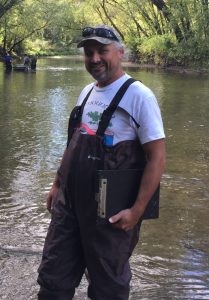
Will Kopp started at the Allamakee SWCD in 2025 as the watershed coordinator for the Yellow River Watershed Project. He graduated in May 2024 from Upper Iowa University with a Bachelor of Science degree in Conservation Management and a minor in Earth Systems. He and his family live in Howard County.
The Yellow River Watershed project has been administered in the past through the Winneshiek County office. In 2025, the project administration moved to the Allamakee County office. Along with this change, our focus area is expanding from the original “Headwaters of the Yellow River” watershed into the Upper Yellow River, an area covering more than 30,000 acres mostly in Allamakee County. This expansion will allow us to reach more producers, support more conservation projects, and continue addressing local water quality concerns identified in the Yellow River Watershed Management Plan.
The Yellow River Headwaters Project is funded through the Iowa Department of Agriculture and Land Stewardship (IDALS) and the Iowa Department of Natural Resources (DNR) with Section 319 and Water Protection Fund support. These programs provide cost-share assistance up to 75% in some cases for conservation practices that improve soil health, reduce erosion, and protect water quality.
Practices eligible for cost-share include water and sediment control basins, which reduce gully erosion and capture field runoff; filter strips, which intercept nutrients and sediment before they reach streams; and grassed waterways, which stabilize areas of concentrated flow and improve field efficiency. Each of these practices supports both environmental protection and long-term agricultural productivity.
For livestock producers, there are also opportunities to implement managed grazing systems and stream corridor improvements. When livestock access to streambanks is managed through rotational grazing, fencing, and off-stream watering systems, both the land and the herd benefit. Streambank vegetation recovers, water quality improves, and well-managed pasture systems tend to produce healthier forage and more resilient grazing conditions.
These conservation efforts are about more than compliance or funding; they reflect a shared responsibility to care for the land that sustains us. Good stewardship ensures that our soil remains productive and our waters stay clear for future generations. It’s a practical investment rooted in the understanding that we are part of something larger than ourselves, and that the health of our land is closely tied to the strength of our communities.
Producers and landowners throughout the Upper Yellow River watershed are encouraged to reach out to Will to learn more about available programs, upcoming field opportunities, and technical support. Working together, we can continue to make measurable improvements in the Yellow River watershed while supporting productive and profitable agriculture across our region.
]]>Allamakee SWCD
770 11th Ave SW
Waukon, IA 52172
Applications received after the deadline will not be considered.
Requirements
• Must live in Allamakee County
• Must be planning on studying Agriculture or Natural Resources at the collegiate level.
The Scholarship program is funded by donations to the district conservation club. Scholarships are usually $500 each but can vary depending on number of applicants and available donation funds. We have presented scholarships totaling $20,000 over the last ten years!
Any questions please call our office at (563)568-2246 Ext. 3
]]>
I’m Janet Borchardt, the new Pheasants Forever Farm Bill Wildlife Biologist covering Winneshiek, Allamakee, Fayette, and Clayton counties! I graduated from Luther College in 2024, where I studied biology and environmental studies. I held positions with the Raptor Resource Project, Iowa DNR, Iowa Natural Heritage Foundation, and Butler County Conservation Board in my 4-year span in college. Since then, I’ve been working as a partner on an NRCS easement team covering 28 counties in NE Iowa, which has grown my passion for private lands conservation immensely. I am thrilled to get the chance to work for Pheasants Forever in my favorite part of the Midwest, the Driftless area, where I went to college and now live with my fiancé near his family’s farm in SE Minnesota. In my free time I enjoy hiking, reading, sourdough making, hawk trapping, playing pickleball, and getting good eats with friends and family.
In the 5 months I’ve been in this position, I’ve been learning all about the programs I’ll be implementing, plant identification, landscapes and geography of the area, and best management practices. A busy season of CRP planning has come and gone in that time, which has given me many opportunities to work on new and re-enrolling CRP plans. This allowed me to make an immediate impact, working with passionate landowners who want to create or improve their wildlife habitat. Spending time in the field, connecting with landowners, colleagues, and partners to put habitat on the landscape has been incredibly rewarding. I look forward to making an impact in this area in the future!
If you would like to reach out to Janet, she can be reached at 319-883-1321 or email jborchardt@pheasantsforever.org.
]]>A Kernza field day will be held in the afternoon from 1-3. The Allamakee SWCD has a Kernza test plot across from the office (next to the US Cellular office). Topics covered will include “what is kernza”, tips for growing Kernza for grain vs. hay, and grazing.
Refreshments will be provided. If you have questions, please call the office at 563-568-2246 ext. 3 or email anders.lovstuen@ia.nacdnet.net. The office is located at 770 11th Ave. SW in Waukon.


Non-chemical control of knotweed is usually not as effective as chemical control. Small populations can be suppressed by mowing at least 4 times a year. Make sure to use a mower with a bag or rake and bag the material. If you mow it but don’t remove the cut material, you will just be spreading the plants. Multiple years would be required to have much impact on the knotweed. Cutting prior to herbicide application can be much more effective. Cut knotweed in June and wait at least 8 weeks to apply herbicide to the resprouting plants.
Prescribed burning as a stand-alone practice is not very effective in managing knotweed. Spring burns can kill seedlings and set-back established plants, however they will likely resprout quickly. Fire may be most beneficial in fields with native grasses and forbs (such as some CRP practices) to help the natives better compete against the knotweed.
For small areas, a tarp can be spread over the area to block out sunlight and slow the spread of knotweed. Plants must be covered for at least 2 years to this method to be effective.
Late season application of herbicides can be most effective because the plants are sending sugars to the roots, carrying herbicide with sugar. However, this will still require at least 2 years of application to kill the knotweed and will require continued monitoring. Herbicide applied too early may injure the above ground plant but not have an effect on the robust root system.
According to Penn State Extension, glyphosate is often recommended for chemical control of knotweed as it can be found in aquatic-labeled products, has low toxicity to nontarget organisms, and has no soil activity. It should be broadcasted as a foliar application. Due to its non-selective nature, overspray or drift can damage nearby desirable plants. Imazapyr may also be effective at managing knotweed but has the potential to injure nearby trees through root uptake and remains in the soil for several months. Triclopyr and 2,4-D can damage or kill the top-growth but has little impact on the root system. The University of Wisconsin Extension (UWEX) also indicates that glyphosate can be used on cut stumps while the plant is actively growing. Chemicals such as glyphosate and triclopyr can also be injected directly into the stem between the ground and the top of the second basal joint. This method is fairly effective, but very labor intensive.
If small areas of Japanese Knotweed are found on a property, start treating it as soon as you can to minimize spread, especially in riparian areas.
Additional information can be found below:
]]>Wage: $14/hour
Duration: 480 hours, Full Time, Temporary (Start in May)
Deadline to apply: Applications must be received by February 28, 2025
Location: Waukon, Iowa
Contact: Brianne Wild, Conservation Assistant
Address: Allamakee Soil & Water Conservation District
770 11th Ave. SW Waukon, IA 52172
How to apply: Submit cover letter and resume to address above or email to brianne.wild@ia.nacdnet.net
Job Description: This position involves providing technical assistance to landowners and operators in Allamakee County to carry out the mission of the Allamakee Soil & Water Conservation District. Individual works in office and in the field on the promotion, documentation, contracting, installation, and maintenance of conservation practices for both state and federal financial assistance programs, with a significant portion of time spent on Conservation Reserve Program (CRP) activities.
The successful candidate will assist field office staff with engineering surveys, designs, seeding plans, layout and checkout of conservation practices, status reviews and follow up with landowners.
Intern will assist with website maintenance, writing news articles, organizing field days, informational meetings, educational/outreach events to schools, producers, and other groups.
Required Education: Must be enrolled in high school or college with studies focusing on conservation, agriculture or any field related to the internship duties listed above. Recent college graduates are not eligible for this internship.
Job Qualifications and Experience: Ability to assist with fieldwork that requires walking through rough terrain. Must possess good communication skills both verbally and in writing in order to provide one-on-one assistance to landowners and conservation partners. Experience with Arc GIS software and developing websites is desirable. Ability to manage and prioritize multiple tasks. When working independently, must have the discipline to complete assignments efficiently and timely. Need to possess a valid driver’s license. Successful candidate will need to undergo a federal background investigation and fingerprint check.
Allamakee Soil & Water Conservation District is an Equal Opportunity Employer and Provider. ]]>
Location: Waukon, Iowa
Contact: Allamakee Soil & Water Conservation District (SWCD)
770 11th Avenue SW
Waukon, IA 52172
Phone: 563-568-2246 ext. 3
Email: Brianne.wild@ia.nacdnet.net
Job Description: Identify and promote conservation practices to producers within the Yellow River Headwaters Watershed. The coordinator will be expected to provide assistance to landowners and ensure implementation of conservation practices within the watershed. This position will perform professional and technical duties that relate to the demonstration of conservation practices through social media, land treatments and daily interaction with producers and partners.
Job Qualifications: Have knowledge of principles, practices, terminology and techniques of agricultural science related to water quality and soil conservation. Have knowledge of state, federal and local environmental laws and regulations. Follow policy and cooperate with commissioners and staff. Display high standards of ethical conduct. Work with minimal supervision and prioritize work schedule. Possess skills in interpersonal relationships, written and verbal communication with producers and partners to meet their needs in a courteous and cooperative manner. Ability to generate reports and educational materials with attention to detail. Have familiarity with social media outlets. Utilize computer software programs, including ArcGIS. Organize, market and conduct public outreach programs to inform watershed landowners and producers of available funding to address their resource management concerns. Ability to walk through rough terrain and carry equipment. Possess a valid driver’s license. Successful candidate will be required to undergo a federal background investigation and fingerprint check.
Required Education: A degree from an accredited college or university with major coursework in an agricultural or environmental science field. Two years of equivalent experience in an agricultural or environmental field would also be considered.
Wage: $25.12/hr., commensurate with experience.
Benefits: Paid time off (PTO), federal holidays and IPERS. There are no other benefits associated with this position.
Hours: Full-time (40 hours per week, no overtime)
Duration of Position: Until funds are exhausted; funding extensions based on funding availability and project interest. This is an at-will position.
Opens: January 16, 2025 Closes: March 21, 2025
Method of Application: Submit resume and cover letter in person, by mail, or email to the address above by 4:00 PM March 21, 2025.
]]>
The Allamakee Soil and Water Conservation District Commissioners made their selection for this year’s Allamakee Scholarship Fund recipients at their March 2026 meeting.
The board awarded 5 scholarships totaling $3,750. The scholarships were awarded to Kendra Gibbs, Keagan Palmer, Trevor Block, Hannah Hagen, and Ella Homewood. To be eligible for the scholarship the applicants must be living in Allamakee County, and enrolling in an agricultural or natural resource based major.
The SWCD was able to present these scholarships due to the generous donations that we receive from the members of the Conservation Club.
(left to right in the photo above: Keagan Palmer, Ella Homewood, Trevor Block, Kendra Gibbs, and Hannah Hagen)
Because many of these CRP fields are hard to access, we often utilize a UTV. Many times, we call prior to going out, but sometimes will stop at a site if we are in the area already. If you have trail cameras, you may see us on our gator. Please call the office if you have questions.
