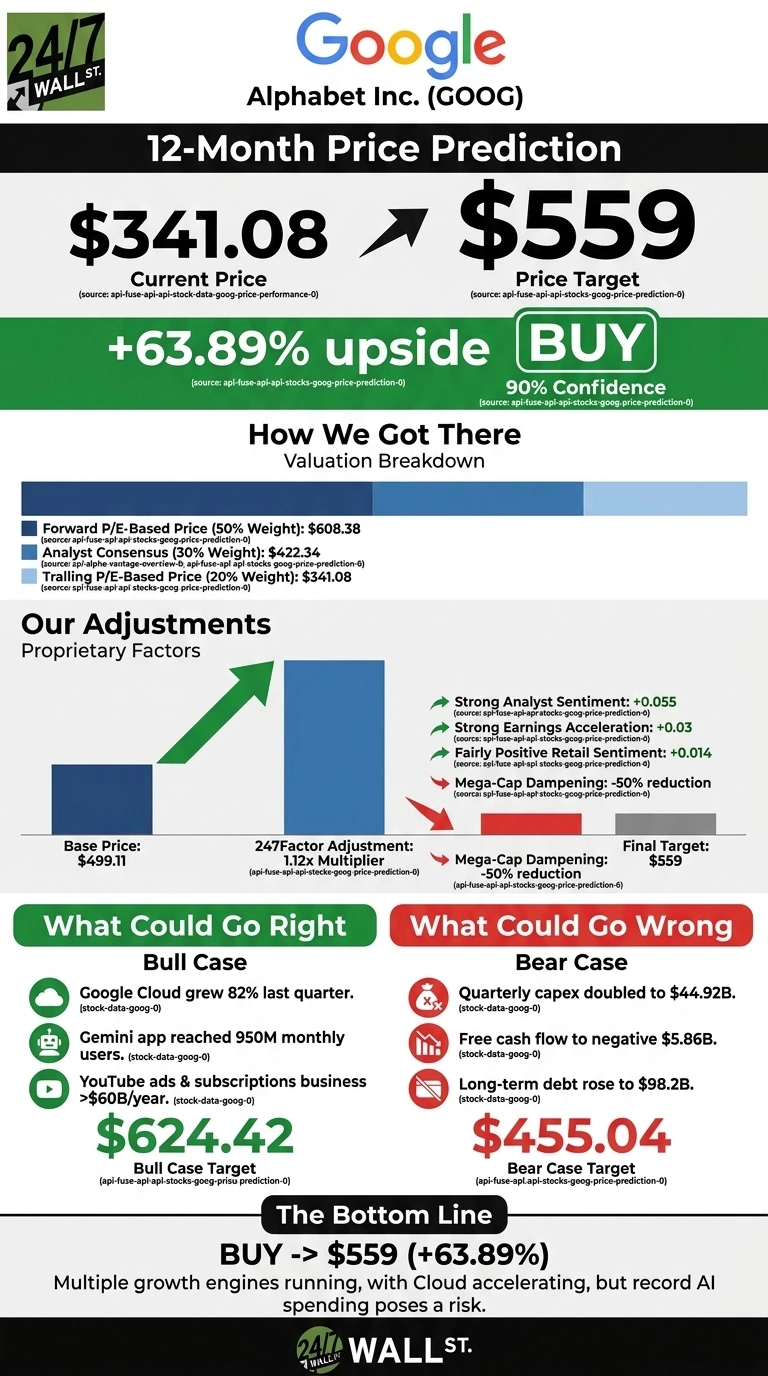
Alphabet (NASDAQ:GOOG) last closed at $341.08. The 24/7 Wall St. price target for Alphabet is $559 over the next 12 months. The stock offers 63.89% upside, and our model rates it a buy with high conviction.
| Metric | Value |
|---|---|
| Current Price | $341.08 |
| Price Target from 24/7 Wall St. | $559 |
| Upside/Downside | 63.89% |
| Recommendation | BUY |
| Confidence Level | 90% |

Alphabet now has several growth drivers running at the same time. Google Cloud grew 82% last quarter. The Gemini app reached 950M monthly users, and YouTube’s combined ads and subscriptions business runs at more than $60B a year. The open question is whether record AI spending earns an enough return.
Cloud Surge Powers a Quarter Wall Street Underestimated
Shares are up 8.91% year to date and 38.69% over the past year. They slipped 0.97% last week. The stock trades 15.6% below its 52-week high of $403.96 and 44.5% above its low of $236.07.
On July 22, Alphabet reported revenue of $119.80B, up 24.2%, which beat the $116.91B estimate. EPS came in at $9.11 against expectations of $3.04. A $99.03B unrealized equity gain inflated that EPS figure. The cleaner number is operating income, which rose 30% to $40.77B.
Why Bulls See $624 and Beyond
Our bull case reaches $624.42. Cloud is doing much of the work here. Its operating margin expanded from 20.7% to 35.6% over the past year, and the backlog reached $514 billion. Revenue from TPU system sales should ramp mostly in 2027.
AI Mode now has more than 1 billion monthly users, and management says it is adding to total search queries. Waymo completes more than 500,000 rides per week, and Alphabet has more than 350M paid subscriptions.
The analyst community largely agrees: 13 analysts rate the stock Strong Buy, 43 rate it Buy and none rate it Sell.

Capex and Debt Risks That Could Cap the Rally
The bear case comes to at $455.04. Quarterly capex doubled to $44.92B, which drove free cash flow to negative $5.86B. Long-term debt rose from $46.5B to $98.2B, and buybacks are suspended. Management also expects third-party capacity to weigh on Cloud margins.
News sentiment has cooled from 67.19 to 58.9 since late August. Still, operating cash flow hit $39.1 billion in the quarter. Management also says demand for AI infrastructure is running ahead of available supply, and the power, cooling, and networking suppliers behind that expansion are the subject of a free report on seven AI infrastructure names beyond the chipmakers.

Alphabet Trades Cheaper Than Microsoft and Meta
Microsoft (NASDAQ:MSFT) is the most direct rival in cloud and enterprise AI. The stock trades at 25x forward earnings, while its revenue grew 17.7%, slower than Alphabet’s.
Meta Platforms (NASDAQ:META) competes for the same digital ad budgets. Meta trades at 22x and grew revenue 28%, but its quarterly earnings fell 13.4%.
| Company | Forward P/E | Revenue Growth (YoY) |
|---|---|---|
| Alphabet | 22x | 24.2% |
| Microsoft | 25x | 17.7% |
| Meta | 22x | 28% |
Our target looks reasonable next to these peers, though it leans slightly aggressive. Getting to $559 requires Alphabet’s multiple to rise toward Microsoft’s premium, and Cloud’s growth supports that case.
Alphabet Price Prediction 2026-2030
The 24/7 Wall St. price target of $559 carries a buy rating at 90% confidence. The deciding factor is Cloud’s growing profitability.
The case gets stronger if Cloud keeps converting its backlog into margin expansion. It weakens if negative free cash flow lasts into 2027 while Search growth slows.
Assuming Alphabet’s current growth holds, here is where our model projects the stock trading in coming years.
| Year | Price Target from 24/7 Wall St. |
|---|---|
| 2026 | $559 |
| 2027 | $692 |
| 2028 | $857 |
| 2029 | $1,060 |
| 2030 | $1,313 |
These projections assume Alphabet keeps executing its full-stack AI strategy. Returns on its $175B-$185B capex plan could drove the stock well above or below this path.
The post Alphabet Has More Growth Engines Than Investors Think, We See 63% Upside appeared first on 24/7 Wall St..
]]>Depending on who is answering the question, AI hyperscalers could invest $7 trillion between now and 2030. Germany’s GDP is about $5.5 trillion. More often than not, the question is where the money will come from, or whether it will come at all.
McKinsey puts the figure at $7 trillion. It says the figure is a “staggering number by any measure.”
S&P’s figure is about the same. Axios quotes the S&P analysis: “Every time we take a deep dive into this sector, we find that capex is rising faster than we anticipated, financings are becoming more complicated and less transparent, and that returns on investment will take years to realize.” Its numbers only include hyperscalers Amazon (NASDAQ: AMZN), Microsoft, Alphabet (NASDAQ: GOOG), Oracle, SpaceX, and Meta (NASDAQ: META). What’s the figure if you add OpenAI and Anthropic?
The figure rises to $10.3 trillion if the timetable runs out to 2032. Then it’s about half of China’s GDP.
Not all of this money will come from these companies’ balance sheets. Some will come from Nvidia (NASDAQ: NVDA), the industry’s arms merchant and banker. For two years, investors have been anxious about an arrangement in which Nvidia sends money to companies for AI data centers, and then the data center uses some of it to buy AI chips.
What happens as this pot of money grows? The traditional answer is that it buys the future of the most important technology in human history. It helps humans with everything from curing cancer to freeing everyone in the world from work. Of course, the question of whether AI will kill everyone in the world will linger permanently. Bill Gates recently forecast deaths in the billions, but short of everyone.
The question raised again and again is where the money will come from. If AI growth slows, the answer may be “nowhere.” If growth is at the high end of estimates, financiers may have to sell the debt to individuals so they can buy it like they would corporate debt, using their Fidelity accounts. The debt may need to be spread that far to hit the $7 trillion number.
The post AI Debt To Top Germany’s GDP appeared first on 24/7 Wall St..
]]>Google (NASDAQ: GOOG) has quietly become the most interesting AI story in mega-cap tech. Google Cloud accelerated to 82% growth last quarter, Gemini reached 950 million monthly active users, and the stock trades at a discount to peers on forward earnings.
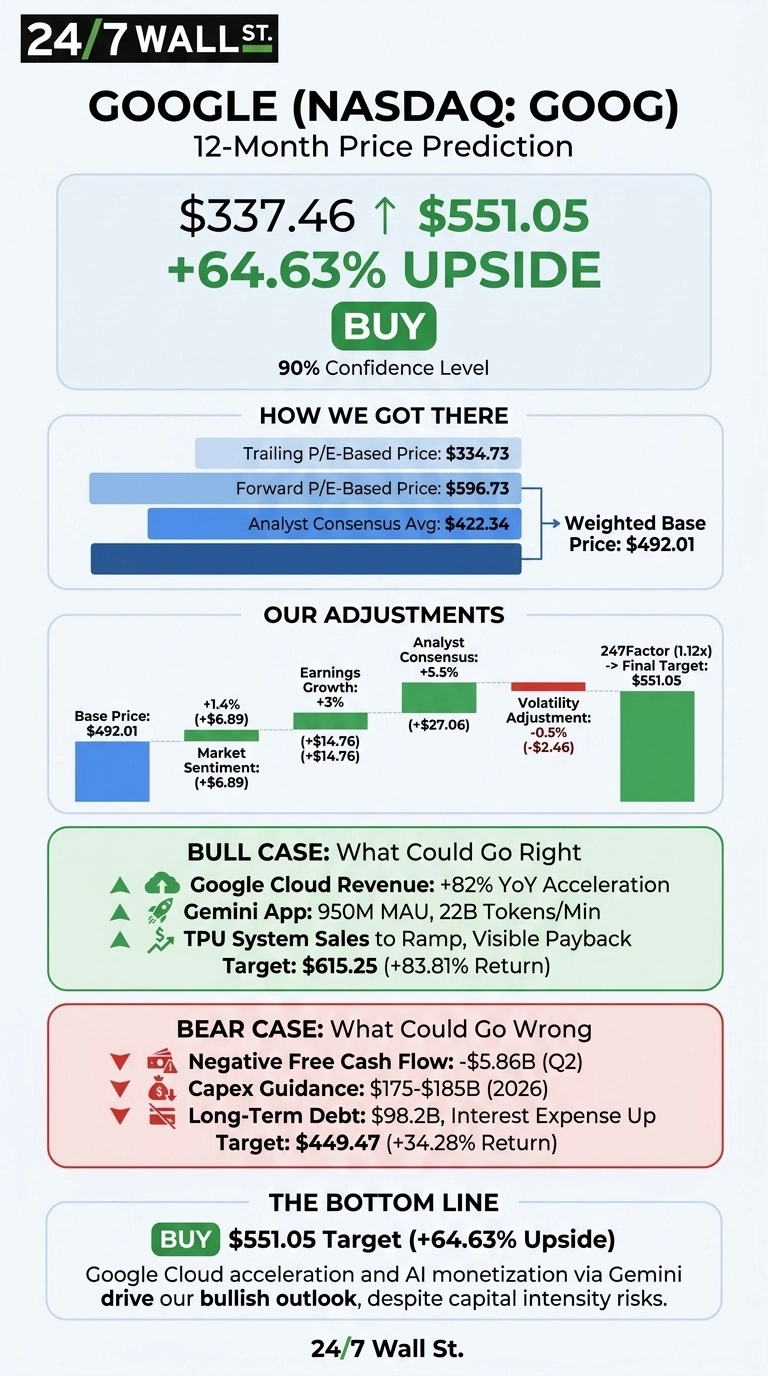
Our 24/7 Wall St. price target for Google is $551.05 over the next 12 months, implying 64.63% upside from $337.46. Rating: Buy with high conviction.
24/7 Wall St. Price Target Summary
| Metric | Value |
|---|---|
| Current Price | $337.46 |
| 24/7 Wall St. Price Target | $551.05 |
| Upside | 64.63% |
| Recommendation | BUY |
| Confidence Level | 90% |
Why Google Stock Is Coiled for a Breakout
The stock is down 0.56% over the past week but has returned 34.08% over the past year.
Q2 fiscal 2026 revenue of $119.80 billion grew 24.23% year over year, EPS of $9.11 beat consensus by 199.41%, and Google Cloud backlog swelled to $514 billion. Barron’s flagged Google’s geothermal partner Fervo Energy hitting a milestone, underscoring that the AI energy buildout extends well beyond chips.
Why Bulls See a $615 Breakout Ahead
The bull scenario points to $615.25, an 83.81% total return. Google Cloud growth accelerated from 48% to 63% to 82% in three quarters. Sundar Pichai says nearly 90% of the Fortune 100 now use Gemini Enterprise.
API token throughput runs at 22 billion tokens per minute, up from 16 billion a quarter ago. Of 61 analysts, 13 rate the stock Strong Buy and 43 Buy, with zero sells. Waymo, YouTube’s $60 billion-plus annual run rate, and 350 million paid subscriptions add optional upside.
What Could Go Wrong at $449
The bear scenario lands at $449.47, still 34.28% above today. The primary risk is capital intensity. 2026 capex guidance is $175 billion to $185 billion, free cash flow turned negative at -$5.855 billion in Q2, and long-term debt jumped to $98.2 billion.
Bulls counter that Cloud operating margin expanded to 35.6% from 20.7% and TPU system revenue is expected to ramp in 2027, showing visible payback. Regulatory overhang from the EU’s $3.5 billion fine remains but is priced in.
How Google Compares to Microsoft, Meta, and Amazon
Microsoft (NASDAQ: MSFT) trades at a P/E of 28 with Azure growing 43% last quarter. Google Cloud grew nearly double that at 82% yet GOOG trades at a P/E of just 17, making our target look conservative.
Meta Platforms (NASDAQ: META) trades at a P/E of 27 with Q2 ad revenue of $59.4 billion. Google’s search and network advertising outpaces that on scale at a lower multiple.
Amazon (NASDAQ: AMZN) trades at a P/E of 35 with AWS growing 37% in Q2. Google Cloud is now growing faster at a fraction of the multiple.
Google Price Prediction 2026-2030
The 24/7 Wall St. price target is $551.05, rating buy, confidence 90%. The key factor is the widening gap between Google Cloud’s growth rate and Google’s forward multiple.
The bullish case rests on Gemini and TPU monetization compounding into 2027. The bearish case is that the $175 billion to $185 billion capex bill destroys returns before producing them. My call is that the payback shows up.
| Year | 24/7 Wall St. Price Target |
|---|---|
| 2026 | $377 |
| 2027 | $551 |
| 2028 | $791 |
| 2029 | $968 |
| 2030 | $1,158 |
These projections assume Google executes on Cloud, Gemini, and Search monetization at its current pace. Significant upside or downside could result from AI infrastructure ROI and antitrust rulings.
The post Prediction: Google’s Next Chapter Could Be Worth Trillions More appeared first on 24/7 Wall St..
]]>The long end of the Treasury curve pushed to fresh highs, with the ten-year yield at 5.18% and the thirty-year at 5.47%, yet the Invesco QQQ Trust (NASDAQ:QQQ) closed the session at $741.10, down 0.01%.
The Dow slipped while the Nasdaq-100 held. Standard valuation theory says the index most exposed to long-duration cash flows should have taken the largest hit. Instead, a handful of megacap names carried the session, which is why QQQ refuses to crack and why it is thinner than the flat close implies.
Yields at Highs, Index at a Standstill
Every Treasury maturity from five years to thirty was above 5.00% on 2026-09-24, with the twenty-year at 5.53%. The five-year sat at 5.03% and the seven-year at 5.10%.
QQQ carried a 3.37% one-week gain and a 20.64% year-to-date advance. The VIX at 14.21 on 2026-09-22 signals almost no hedging demand, unusual against a curve this high.
QQQ’s largest disclosed position is NVIDIA (NASDAQ:NVDA) at 7.60% of net assets, followed by Apple (NASDAQ:AAPL) at 6.67%, Micron (NASDAQ:MU) at 5.64%, Microsoft (NASDAQ:MSFT) at 4.35%, AMD (NASDAQ:AMD) at 4.10%, and Amazon (NASDAQ:AMZN) at 4.02%.
These firms generate more cash than they need to fund operations, so a higher cost of capital hurts competitors more than it hurts them. Balance-sheet quality explains why the index held while long rates rose.
Concentration as Engine and Fault Line
When six names carry these weights, you own concentrated exposure to a handful of businesses rather than a diversified technology position. The two Alphabet (NASDAQ:GOOG, NASDAQ:GOOGL) share classes add another 3.27% and 3.02% on top of that.
These companies commit enormous amounts to AI capital spending, precisely the activity a higher cost of capital hurts (the power, cooling, and networking suppliers absorbing that spend are the subject of a free report we put together here: seven AI infrastructure names that aren’t chipmakers). Concentration is the engine on days like this and the fault line when one of these names disappoints.
Rate Pressure Still in the Pipeline
Real yields, which strip out inflation, have kept climbing. The ten-year real yield reached 2.85% on 2026-09-24, up from 2.44%.
Higher real yields lift the discount rate applied to distant cash flows, which is what a growth index depends on. Mortgage rates, tied to the long end, transmit the same pressure into household budgets before it reaches earnings.
The Federal Funds target upper bound sits at 4% as of 2026-09-24, so this long-end move reflects the market repricing of the term premium and inflation risk without policy help, rather than Fed action.
Bull and Bear Case for QQQ ETF
Optimists argue that QQQ’s top holdings are rare businesses whose cash generation improves in a scarcer-capital world, because balance-sheet strength lets them keep investing at scale while weaker peers cannot.
The pessimistic view is math. With total net assets of roughly $490 billion concentrated in a small number of names, any single earnings miss reprices the fund. The AI capex boom is also the discretionary spending most exposed to a higher hurdle rate.
The decider is breadth. If the ten-year Treasury yield holds above 5.00% into the next earnings cycle and revisions turn lower for the top five holdings, this flat session becomes the last flat session for a while.
If instead the long end backs off and megacap free cash flow keeps compounding, the concentration that looks thin will look smart. This would be falsified by the ten-year yield closing back below 5.00%, or by NVIDIA’s next capex commentary from its largest customers. Both are events any investor can verify against the citations here.
The post Why the Nasdaq Refuses to Break Even With Treasury Yields Above Five Percent appeared first on 24/7 Wall St..
]]>Berkshire Hathaway (NYSE:BRK-A, NYSE:BRK-B) Class B closed at $505.49, essentially where the shares started the year. Over the same stretch, the S&P 500 has returned 12.5%. The four-analyst consensus target is $547.67, a slim premium that carries less information than it would for a widely followed name.

Underneath that flat year, Berkshire Hathaway completed the most consequential leadership change in its history, resumed buybacks after a long pause, drew down a record cash pile, took a $10 billion private placement in Alphabet (NASDAQ:GOOG, NASDAQ:GOOGL) and, according to news reports, built close to a 10% stake in homebuilder Lennar (NYSE:LEN, NYSE:LEN-B).
Either the market is withholding judgment on a successor whose deals have not had time to prove out, or $500 is fair for a Berkshire that will grow more slowly and depend more on capital-intensive businesses than before. This tension is worth working out.
A Year of Going Nowhere
The stock has traded between a 52-week low of $464.01 and a high of $537.74, and currently sits closer to the middle. Year to date, the shares are up 0.5%, and the one-year return is 1.63%.
The five-year figure is 81.8%, so the recent flatness is a genuine pause rather than a fade of a long trend.
Only four sell-side analysts publish targets on this trillion-dollar company, split two Buy and two Hold. The consensus number is closer to a poll than a market-clearing view.

Leadership Transition in Motion
The stock data provided for this piece lists Greg Abel as chief executive, having transitioned from Warren Buffett. That attribution comes from a financial data feed rather than from a Berkshire press release, and it should be read as such.
The succession question is whether the prior era’s reputational advantage travels. Part of what made Berkshire a special buyer was that sellers brought deals to the door on favorable terms. Whether that continues under new leadership is genuinely unknown.
Cash Going to Work
Cash and cash equivalents stood at $40.6 billion at the end of the June 2026 quarter, against $100.5 billion a year earlier. That decline is the clearest signal that the new era is deploying cash aggressively.
In the latest quarter, Berkshire deployed roughly $23.5 billion into equities, becoming a net buyer of stocks for the first time in over three years, and bought back about $4.5 billion of its own shares.
The Alphabet placement plus the reported Lennar accumulation constitute a concentrated view: one large technology cash-flow compounder and a rate-sensitive homebuilder position. Readers who want to borrow the rest of Berkshire’s homework can start with the seven cheapest dividend payers still in the portfolio, which we pulled into a free report here. Deploying cash reduces flexibility. A large balance is itself an asset in a disruption, so spending it is a real trade-off.
Operating Business Underneath
Operating earnings have moved around significantly. The last four quarters ran $12.98 billion in Q3 2026, $11.35 billion in Q1 2026, $10.20 billion in Q4 2025, and $13.48 billion in Q3 2025.
BNSF net income of $1.6 billion in the latest quarter continues to grow modestly, though the railroad’s margins still trail the best operators by too wide a gap. Insurance underwriting has weakened, and buyback activity disciplined to intrinsic value is itself a valuation signal from the people with the best information.
Bull and Bear Case for BRK-B Stock
Book value per share reported at $522,225.90 for the Class A and a price-to-book near one, unusually cheap for this company, anchors the optimistic thesis. $750 billion of shareholder equity, and buybacks resumed in early 2026, with $15 million of personal insider buying, support an entry.
The flat year is rational under the pessimistic view. A slower, more capital-intensive Berkshire with less deal flow and a shrinking cash buffer deserves a lower multiple than the version that accumulated Treasuries and waited. If the Alphabet and Lennar positions do not clearly compound, the market’s patience will thin.
The variable that decides between them is repurchase behavior. A sustained return to net equity selling alongside heavier buybacks would signal that insiders think $500 is cheap. A quiet buyback pace and continued deployment into public equities would signal the opposite.
Above $500, the setup looks slightly constructive because the valuation is not stretched and the insider signals are consistent. But thin coverage, succession uncertainty, and shrinking flexibility keep the risk-reward closer to balanced than the five-year chart suggests.
The post Is Berkshire Hathaway Stock a Buy, Hold, or Sell Above $500? appeared first on 24/7 Wall St..
]]>Alphabet (NASDAQ:GOOG, NASDAQ:GOOGL) closed at $337.83, down 3.8% in the session, while the Wall Street consensus target still sits at $429.46. That is a gap wide enough to matter, and nothing was announced today to explain the move.

Alphabet runs Search, YouTube, Android, Google Cloud, and Waymo, and it just delivered its eleventh straight EPS beat and twelfth consecutive quarter of double-digit revenue growth. The stock is still up 8.14% year to date and 34.59% over one year.
The tension is about whether the market is starting to charge Alphabet for the cost of its own artificial intelligence buildout, a buildout that also has to be powered, cooled, and networked by somebody, which is the whole subject of our free report on seven AI infrastructure suppliers that aren’t chipmakers.
Reporting attributed the drop to rotation into Meta following its Muse artificial intelligence agent launch. A move without a disclosure is a positioning move.
A Selloff With Nothing Behind It
No earnings warning, guidance cut, or regulatory update preceded it. The stock gave back 3.8% in one session.
The last reported quarter looked strong on almost every line. Revenue of $119.8 billion grew 24.23% year over year, and Google Cloud accelerated to 82% growth at $24.8 billion in quarterly revenue.
Capital expenditures hit $44.9 billion in the quarter, up 100.14% year over year, while free cash flow turned negative at -$5.9 billion.
Long-term debt roughly doubled from $46.5 billion to $98.2 billion, and the buyback was suspended. Management prioritized compute over shareholder returns.
Why Analysts Have Not Moved Their Targets
The consensus target of $429.46 reflects bullish coverage, with 2 Strong Buy and 1 Buy calls with zero Holds or Sells in Alpha Vantage’s sample. 53 analysts contribute to the 2026 EPS estimate.

The bull thesis rests on Cloud conversion. Backlog stood at over $460 billion as of the first-quarter report, up from $155 billion reported for the third quarter of 2025. Backlog is contracted revenue not yet recognized, and it converts only if Alphabet has the compute to serve it.
Consumer artificial intelligence is holding. Nearly 90% of the Fortune 100 use Gemini Enterprise, and the Gemini App has 950 million monthly active users.
The 2026 EPS consensus has climbed from $14.23 ninety days ago to $20.62 currently. Analysts are marking Alphabet up.
Sector peers held up. Money rotated into Meta Platforms (NASDAQ:META) on the day of its Muse artificial intelligence agent launch, while Microsoft (NASDAQ:MSFT) and Amazon (NASDAQ:AMZN) traded on their own catalysts.
Alphabet carries a P/E of 18x and a forward multiple of 23x, the lowest headline valuation among mega-cap artificial intelligence names. The discount reflects the free-cash-flow question rather than market oversight.
Bull and Bear Case for GOOGL Stock
You’d buy Alphabet here if you believe Cloud converts its backlog faster than capex compresses margins. The 82% Cloud growth rate and the $460 billion backlog support that thesis if compute supply keeps arriving.
You’d stay away if the buildout has barely begun. 2026 capex guidance sits at $175 billion to $185 billion, with internal projections reportedly closer to $375 billion.
The equity raise dilutes shareholders. Bond issuance adds interest expense that grew nearly 5x year over year, and the suspended buyback removes support under the stock.
The deciding variable is conversion speed. If Cloud pulls the backlog into revenue at high-double-digit growth for several more quarters, the multiple looks too low. If backlog growth flattens or Gemini cedes consumer ground to Meta’s Muse, the market’s caution today looks early rather than wrong.
Given demand signals against a shifted balance sheet, I lean cautiously constructive at this level. Free cash flow will decide whether the current multiple is a gift or an accurate warning.
The post Alphabet Drops Below $350: Buying Opportunity or the Start of Something Worse? appeared first on 24/7 Wall St..
]]>ARK Invest’s daily trade files show Cathie Wood’s funds adding to Rocket Lab (NASDAQ:RKLB) while trimming Alphabet (NASDAQ:GOOGL). The disclosures themselves list tickers, funds, and share amounts. They do not include a reason. Anything offered as motivation from here is inference, and readers should treat it that way.
What is verifiable from ARK’s own portfolio data: as of the July 31, 2026 ARKK snapshot, Alphabet was still held across both share classes, with $118.5 million in GOOG (2.13% of net assets) and $27.0 million in GOOGL (0.49% of net assets). Rocket Lab was not in the ARKK snapshot at that date, consistent with recent RKLB adds landing in ARK’s space and next-generation internet vehicles rather than the flagship.
What Is Actually Happening at Rocket Lab
The buy comes into a business that is being rebuilt in front of investors. Rocket Lab reported Q2 2026 revenue of $234.07 million, up 62% year over year, with backlog reaching a record $2.36 billion. Q3 revenue guidance is $250 million to $265 million.

Two developments matter more than the quarter. First, Rocket Lab announced a deal to acquire Iridium Communications, funded in part through equity issuance that has already brought in $1.53 billion in ATM proceeds during the first half of 2026. Iridium would bolt a recurring satellite communications revenue stream onto a company whose top line has been dominated by launches and lumpy program awards. Recurring revenue commands a different multiple than project revenue because it is predictable, higher margin at scale, and can be forecast years out.
Second, the medium-lift Neutron rocket is targeted for launch pad delivery in Q4 2026, following an earlier stage-one tank test failure that pushed the timeline. If Neutron flies, Rocket Lab moves from small-satellite launch specialist to a genuine competitor for larger national security and commercial payloads.
The valuation reflects the promise well ahead of the profits. Shares trade at $70.23, with a price-to-sales ratio of 58 and Q2 net income of negative $49.3 million. Details on the Iridium financing and dilution risk sit in Rocket Lab’s August 10, 2026 8-K.

Why ARK Is Trimming Alphabet
The Alphabet reduction is the smaller side of the rotation. Institutions trim mega-caps for position sizing, index-drift management, and mandate reasons. Alphabet just posted Q2 2026 revenue of $119.80 billion (+24.23% year over year) with Google Cloud growth of 82% to $24.77 billion. Shares are $338.19, up 34.27% over the past year. That is not the profile of a business ARK would be exiting on fundamentals.

A defensible inference: ARK’s mandate rewards concentration in disruptive, small- and mid-cap names. Alphabet at a ~$4.29 trillion market cap with FY2026 capex guidance of $175 billion to $185 billion and Q2 free cash flow of negative $5.86 billion is a different asset than what ARK typically overweights.
What Following an ARK Trade Actually Means for Retail
ARK is a high-conviction, high-volatility manager. Its disclosed trades are point-in-time snapshots, and the funds turn over positions frequently. Rocket Lab is a speculative holding: unprofitable, richly valued, exposed to Neutron schedule slippage, and issuing equity to fund acquisitions. It carries materially higher risk than a mega-cap position, and readers should size it accordingly.
What to watch next: Neutron’s arrival at the launch pad, closing progress on Iridium, and Rocket Lab’s Q3 report against the $250M-$265M guide. On Alphabet, keep an eye on whether cloud growth holds above 60% and whether capex intensity begins to compress free cash flow further into 2027.
The post Why Cathie Wood Is Trimming the World’s Biggest Tech Stock to Bet on a Space Company appeared first on 24/7 Wall St..
]]>Google (NASDAQ:GOOG) has quietly become one of the most consequential AI stocks on the market, and a $5,000 stake today lands in the middle of a five-year window that could reshape the return profile of a long-only portfolio.
Shares recently traded near $350.87, up 36.4% over the past year, as the company scales Gemini, cloud infrastructure, and search monetization. The question for retail investors is simple: what could that $5,000 be worth by September 2031?
Base Case: $5,000 Could Grow to Roughly $14,860
Under the base-case five-year scenario, a $5,000 investment in Google could be worth about $14,859.50 by 2031, a total return of 197.19%, or an annualized 24.34%. That path is anchored to a modeled per-share target of $1,042.74 on September 21, 2031.
The model carries a high confidence classification with a buy recommendation, and it sits alongside a Wall Street analyst consensus target of $422.34 that is calibrated to a one-year horizon rather than five.
Bull, Base, and Bear Scenarios for a $5,000 Stake
| Scenario | Target Price (2031) | Total Return | Value of $5,000 |
|---|---|---|---|
| Bull | $1,148.71 | 227.39% | $16,369.50 |
| Base | $1,042.74 | 197.19% | $14,859.50 |
| Bear | $585.32 | 66.82% | $8,341 |
Even the bear case still delivers a positive return, with the $5,000 stake growing to $8,341 on an annualized 10.78%. The bull case, powered by faster AI monetization, would take that same starting investment to roughly $16,369.50.
Why the Model Sees Substantial Upside
Three drivers stand behind the projection. First, analyst calibration is extraordinarily one-sided. The consensus is anchored by 13 strong-buy, 43 buy, and 5 hold ratings, with zero sell or strong-sell calls, translating to a 92% bullish share among covering analysts.
Second, the underlying business is compounding at a pace that few mega-caps can match. Q2 FY26 revenue rose 24% year-over-year to $119.8 billion, marking the 12th consecutive quarter of double-digit revenue growth.
Google Cloud revenue grew 82% to $24.8 billion, and cloud operating margin expanded to 35.6% from 20.7% a year earlier. The Cloud backlog stands at $514 billion, with management expecting to recognize just over 50% of it as revenue over the next 24 months.
Third, AI adoption is translating directly into product usage and enterprise commitments. The Gemini app now has 950 million monthly active users, model APIs process roughly 22 billion tokens per minute, and nearly 90% of Fortune 100 companies use Gemini Enterprise.
CEO Sundar Pichai told analysts, “It feels like we are in very early innings of what feels like secular shift across multiple areas in our core information businesses.”
Risks That Could Sink the Projection
The bear case exists for good reason. Google is spending aggressively to fund its AI buildout: capital expenditures reached $44.9 billion in Q2 alone, and free cash flow swung to negative $5.9 billion. Full-year 2026 capex guidance sits at $175 billion to $185 billion, and long-term debt has roughly doubled from $46.5 billion to $98.2 billion.
Management has flagged that third-party capacity usage in Q3 could pressure Google Cloud operating margins, and regulatory scrutiny remains live after a $3.5 billion EC fine in Q3 2025.
Frontier AI competition from OpenAI, Anthropic, and Meta (NASDAQ:META) is intensifying, and any slowdown in search monetization as users shift to AI Overviews could compress the base case toward the bear path.
Bottom Line for a $5,000 Stake
The modeled range for $5,000 invested in Google over the next five years spans roughly $8,341 in the bear case to about $16,369.50 in the bull case, with a base-case landing point near $14,859.50.
Those figures reflect a modeled 247Factor of 1.119, a forward EPS of $23.54, and an implied P/E of 18. This is a projection built on current data and assumptions, not investment advice or a guarantee, and actual returns will depend on how Google executes its AI capex, defends search, and scales cloud through the back half of the decade.
The post What Will $5,000 Invested in Alphabet Stock Be Worth in 5 Years? appeared first on 24/7 Wall St..
]]>Alphabet has quietly become one of the most compelling stories in the Magnificent Seven this year. Google (NASDAQ:GOOG) shares are up 12.46% year to date and 39.95% over the past year, closing in on $352.22 as investors digest a Google Cloud business now growing faster than any hyperscaler on the planet.
CEO Sundar Pichai called Q2 “an amazing quarter” for a reason: cloud revenue accelerated to 82% growth, and Gemini adoption is spreading through the Fortune 100.
So let’s walk through what it would take for Google to reach $525 per share by 2027.
Wall Street Sees More Upside Ahead
The consensus 1-year price target sits at $422.34, backed by 13 strong buys, 43 buys, and 5 holds with zero sell ratings. Analysts see 2027 revenue reaching $612.19 billion, up from an expected $498.36 billion in 2026.
Estimates keep drifting higher: the 2027 EPS consensus has climbed from $14.45 ninety days ago to $14.84 today, with 9 upward revisions in the last 30 days against just 1 downward.
Google has also topped Wall Street’s EPS estimates in 11 consecutive quarters, which means actual 2027 results will likely land above the current consensus.
Here’s the Math for a Move to $525
At today’s $352.22, GOOG trades at a trailing P/E of just 17 on TTM EPS of $19.94. Hitting $525 would lift that multiple to roughly 26x trailing earnings. That is a premium to the S&P 500’s 21x to 23x forward multiple, but hardly stretched for a business compounding revenue at 24.2% year over year with 34% operating margins.
What could push Google to $525:
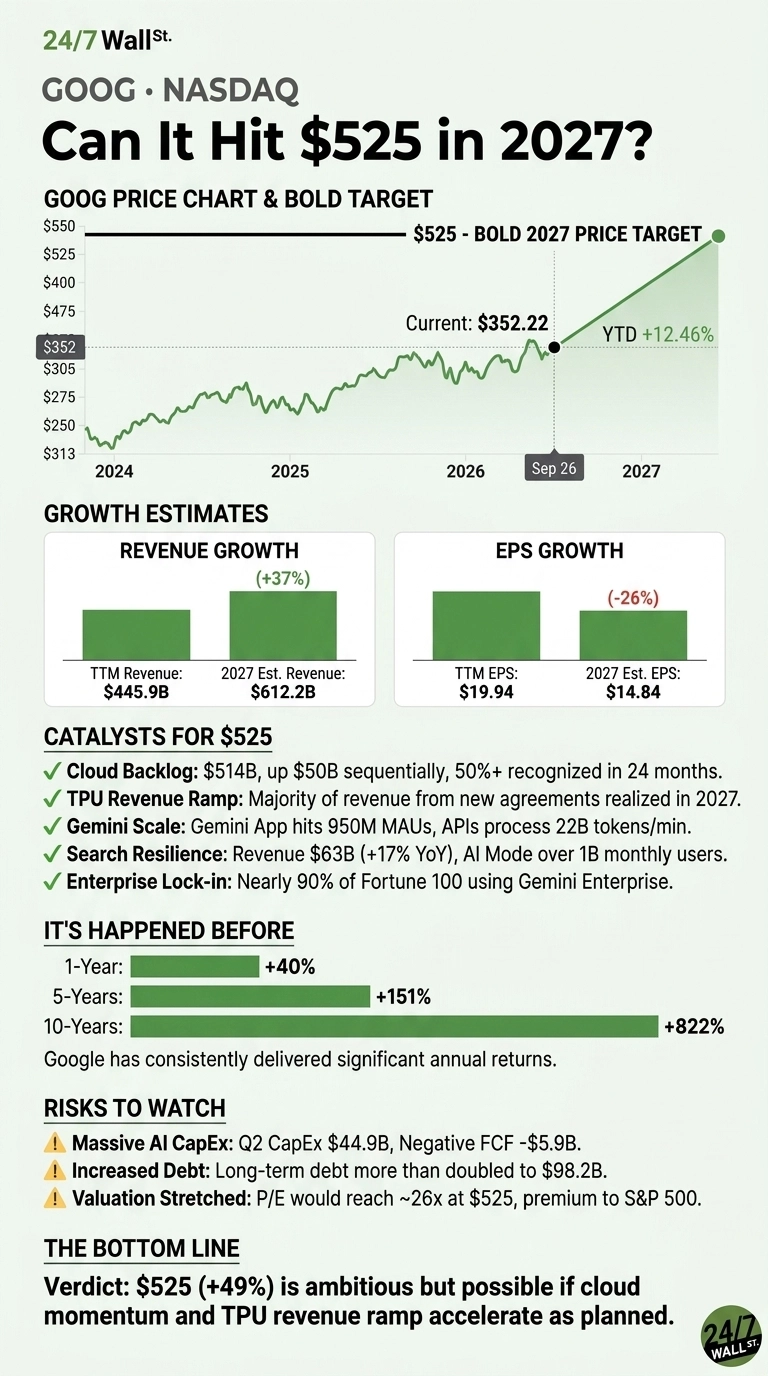
- Cloud backlog conversion. Google Cloud backlog now sits at $514 billion, up more than $50 billion sequentially. Management expects to recognize over 50% of that backlog as revenue in the next 24 months.
- TPU revenue ramp. Alphabet said “the vast majority of the revenues from these agreements will be realized in 2027,” a direct tailwind for the year the bold target lands.
- Gemini scale. The Gemini app has hit 950 million monthly active users, and APIs process 22 billion tokens per minute, up from 10 billion in Q4 2025.
- Search resilience. Search revenue still grew 17% to over $63 billion, with AI Mode topping 1 billion monthly users.
- Enterprise lock-in. Nearly 90% of the Fortune 100 now use Gemini Enterprise.
Pichai framed the opportunity plainly: “from ROIC standpoint, I think, you know, we are taking a full stack approach… over the past year, we’ve gotten more bullish on the opportunities ahead.”
Google’s History Says $525 Is Within Reach
A move to $525 requires roughly a 49% gain. GOOG has already returned 151.36% over five years and 821.89% over ten.
Our internal quantitative model pegs the base-case one-year price at $519.98 with a bull case of $586.04, translating to a 50.98% base return.
Bottom Line on $525
Reaching $525 asks Google to deliver another 49% in twelve months, on top of the 40% it has already produced over the last year.
The hurdles are real: free cash flow turned negative $5.86 billion in Q2 as CapEx exploded to $44.92 billion, and long-term debt has more than doubled to $98.2 billion.
But with cloud accelerating, TPU revenue set to peak in 2027, Gemini scaling into a billion users, and estimates still climbing, the setup is there. We have outlined the blueprint for how Google could deliver an outsized 2027.
The post Prediction: This Magnificent Seven Stock Could Soar 50% by 2027 appeared first on 24/7 Wall St..
]]>IPOs tied directly to the AI industry are being delayed. SoftBank, one of the largest financiers of AI projects, is paying unexpected premiums on its debt. AI data centers are being delayed at a rate that threatens AI adoption across business, government, and personal levels. OpenAI faces questions about the viability of funding losses that could exist until the end of the decade.
SB Energy, owned by SoftBank and an AI infrastructure builder, has delayed its IPO, the New York Times reported. Holtec Nuclear, which makes small nuclear reactors, appears likely to delay its public offering. SoftBank is raising $10 billion but will need to pay junk-bond rates. Depending on duration, it must pay interest rates ranging from 8.75% to 9.875%, Bloomberg reported. Goldman Sachs issued a report that said AI debt funding has hit $575 billion so far in 2026.
According to several sources, local laws and ordinances have blocked construction of over 500 data centers. A Gallup poll showed 70% of Americans do not want data centers where they live. If this slowdown in building out AI capacity continues, there is concern that AI use will automatically be capped.
OpenAI faces several threats as it moves toward an IPO that observers think will happen early next year. Rival Anthropic plans to go public in late 2026. If the Anthropic IPO stumbles, OpenAI faces a skeptical market. That alone could delay its IPO plans.
OpenAI and Anthropic face competition from US-based companies, which include Meta (NASDAQ: META) and Alphabet’s (NASDAQ: GOOG) Google. A larger threat, however, is from China’s AI products. They cost customers much less to use. They may not be as powerful as their American counterparts. Companies using AI have found that spending 80% less on Chinese AI works, because they may not need to build the world’s most advanced applications. And Chinese AI appears to be catching up to OpenAI and Anthropic’s best models.
Although the figure has changed more than once, OpenAI probably needs $280 billion to fund itself between today and 2030. Its annual revenue run rate was recently pegged at $40 billion. That is well behind Anthropic’s run rate. And Anthropic has started to make money.
What happens if OpenAI cannot go public? It devalues the entire industry. That includes the public companies which have high valuations because AI is at the center of their growth forecasts.
The post OpenAI IPO Collapse? appeared first on 24/7 Wall St..
]]>Google (NASDAQ:GOOG | GOOG Price Prediction) just posted the most striking quarter of any mega-cap AI beneficiary. Cloud grew 82% to $24.8 billion, backlog reached $514 billion, and CEO Sundar Pichai said Alphabet is in the “very early innings” of a secular AI shift.
Yet the stock trades at a 17x trailing P/E, the cheapest multiple in the mega-cap AI cohort. Shares sit at $352.20, up 12.46% YTD. Can this stock reach $600 by 2027? Here is the math.
What Is Really Holding Alphabet Back
The stock is stuck because of what fundamentals are costing. Q2 free cash flow swung to negative $5.855 billion as CapEx doubled to $44.92 billion. Long-term debt jumped from $46.5 billion to $98.2 billion, the buyback was suspended in Q2 2026, and management projected FY26 CapEx of $175 billion to $185 billion.
Investors are underwriting the biggest infrastructure build in corporate history (the power, cooling, and networking suppliers riding that same wave are the subject of a free report on seven AI infrastructure names that aren’t chipmakers).
That anxiety shows in the stock. Shares are up 3.14% over the past month and 4.99% over the past week, despite a 39.95% one-year gain. With a beta of 1.225, GOOG moves harder than the market when sentiment on AI capex shifts.
Wall Street Sees 20% Upside. My Model Sees 51%
The Street consensus target is $422.34, drawn from 13 strong-buy, 43 buy, and 5 hold ratings with zero sells. Bullish share sits at 92%. My base case is more aggressive: a $519.98 predicted price, or 50.98% upside, with a bull scenario of $586.04 and a bear case still at $427.72. Confidence: 0.9, high.
The Street is underweighting two things. First, the FY26 EPS estimate has moved from $14.23 ninety days ago to $20.60. Second, earnings growth contribution to my model is only 0.03.
Path to $600 Per Share
Reaching $600 from $352.20 requires a 70.4% gain.
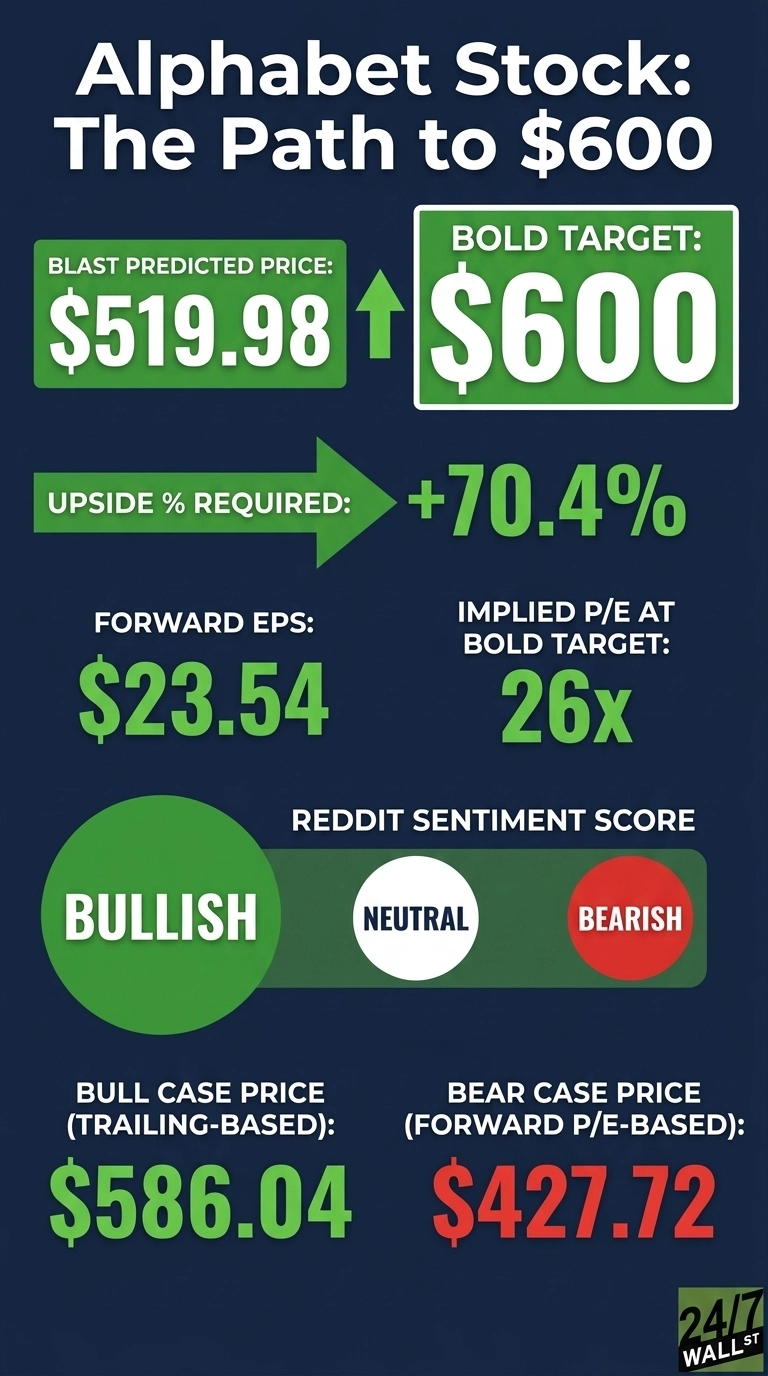
With forward EPS of $23.54, a price of $600 implies a forward P/E of 26x. My base case of $519.98 already implies 17x, meaning $600 requires roughly 8x of additional multiple expansion.
Cloud is compounding at 82% with 35.6% operating margins. Gemini processes 22 billion API tokens per minute and the Gemini App has 950 million monthly active users.
Pichai said “Our AI investments are redefining what’s possible across every part of our business.” As TPU system sales revenue arrives in 2027, EPS should reprice higher, letting the multiple expand without looking rich.
The primary risk: sustained negative free cash flow forces investors to discount the CapEx cycle harder than the market currently does.
Where Alphabet Trades Today Vs Its Earnings Power
At $352.20 against forward EPS of $23.54, GOOG trades at roughly 15x forward earnings. That is a discount to every mega-cap AI peer despite delivering an EPS surprise of 199.41% last quarter.
Shares sit between a 52-week low of $236.07 and high of $403.96, and have returned 821.83% over the past decade. Cheap growth compounding at scale is a rare setup.
Is $600 Realistic? My Verdict
Reaching $600 requires a 70.4% gain and a forward multiple of 26x. That is a stretch but achievable.
Three things need to go right: Cloud growth stays above 50%, the $514 billion backlog converts on schedule, and TPU system sales ramp meaningfully in 2027. A sharp deterioration in ad monetization from AI-answer cannibalization would derail it. Returns at this level shouldn’t be expected every year, but we’ve outlined the blueprint for how Google could reach $600 in 2027.
The post Prediction: The Cheapest Mega Cap in the AI Trade, Alphabet Could Hit $600 in 2027 appeared first on 24/7 Wall St..
]]>Big tech’s 2026 has been a story of AI infrastructure spend meeting enterprise adoption. Let me walk through three names where the setup into 2027 still looks compelling: Google, NVIDIA, and Salesforce. Each gets a round-number bull target above Wall Street’s consensus, along with the math to back it up.
Google: A Path to $500 on Cloud Acceleration
Alphabet (NASDAQ:GOOG) trades near $352.20, up 12.46% year to date and 39.95% over the last year. Wall Street’s average target sits at $422.34. My bold target is $500, which would put shares at roughly 34x the FY27 EPS consensus of $14.84.
That is a premium to the market’s 21x to 23x, but Q2 growth backs it up: revenue jumped 24%, Cloud accelerated to 82%, and cloud backlog hit $514 billion.
CEO Sundar Pichai said “we are in very early innings of what feels like secular shift.” With nearly 90% of Fortune 100 companies on Gemini Enterprise and TPU system sales just beginning to flow, $500 is ambitious but achievable.
NVIDIA: $350 Looks Reasonable on Vera Rubin
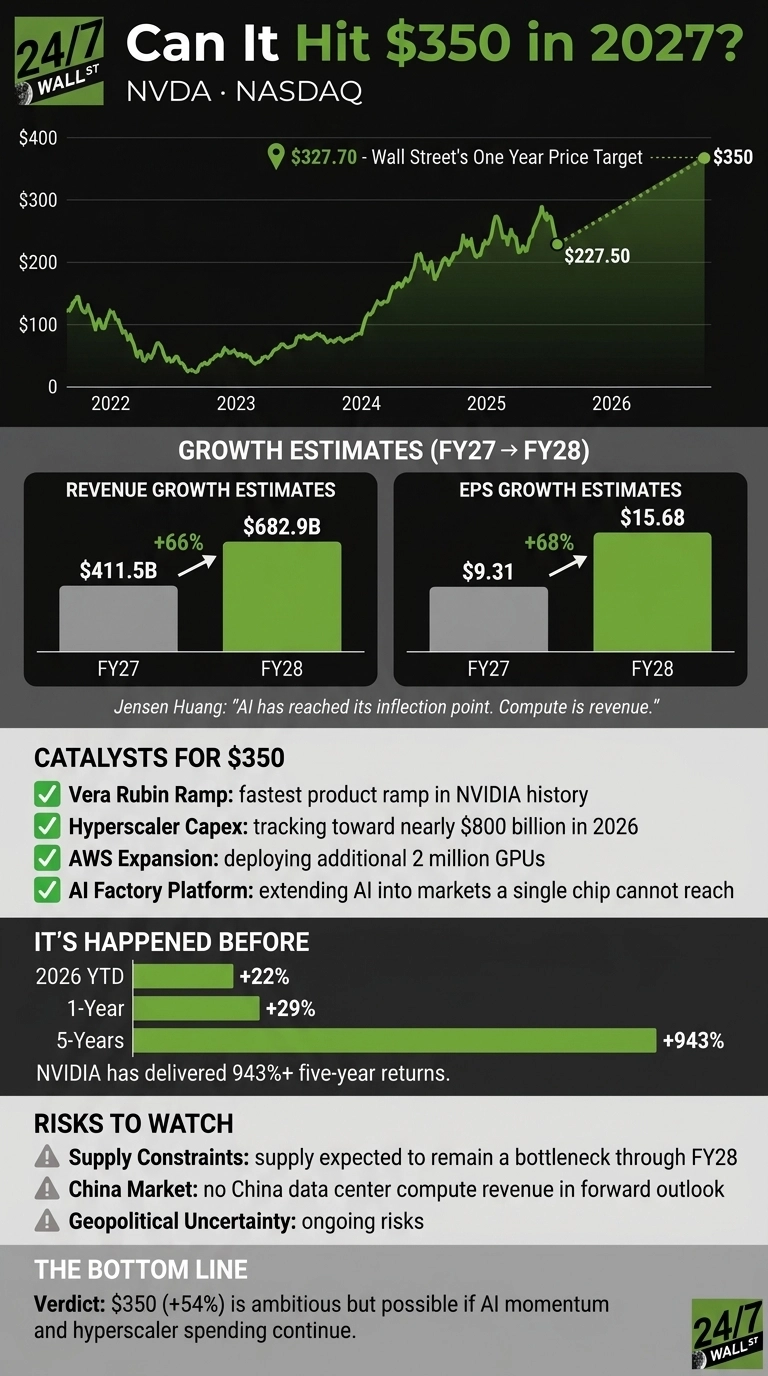
NVIDIA (NASDAQ:NVDA) sits at $227.50, up 22.27% YTD. Wall Street targets $327.70. My bold target: $350. At that price, NVIDIA would trade at roughly 22x the FY28 EPS consensus of $15.68, which has surged from $12.67 just 90 days ago on 42 upward revisions.
Q2 revenue more than doubled to $96 billion, and management guided FY28 growth of approximately 70%, calling it supply constrained. Jensen Huang put it plainly: “AI has reached its inflection point. Compute is revenue.”
AWS just committed to deploying an additional 2 million GPUs, and hyperscaler capex is tracking toward nearly $800 billion in 2026. NVIDIA has returned north of 943% over five years. A 54% run to $350 is well within its historical range.
Salesforce: $325 on Agentforce Monetization
Salesforce (NYSE:CRM) has lagged, down 9.6% YTD at $237.79. Wall Street’s average target is $282.49. My bold target is $325, which implies roughly 20x the FY28 EPS estimate of $15.99.
That is a modest multiple for a company whose Agentforce and Data 360 ARR is “about to cross $4 billion” with Agentforce alone at $1.5 billion ARR and bookings that doubled year on year. Q2 EPS of $5.90 topped the $3.27 estimate for a sixth straight beat.
CEO Marc Benioff argued “AI isn’t replacing Salesforce. It’s unlocking more value across all four layers of our platform.” With only 5% of knowledge workers on premium editions, the monetization runway is real.
Bottom Line on 2027 Upside
These targets require rallies of roughly 42% for Google, 54% for NVIDIA, and 37% for Salesforce. All three sit on rising estimates, multi-quarter beat streaks, and concrete AI catalysts already in motion.
The common thread is the infrastructure buildout behind them, and we profiled seven suppliers powering that boom, from power to cooling to networking, in a free report you can grab here. Returns of this magnitude remain rare, yet the blueprint for outsized 2027 gains is clearly on the table.
The post 3 Big Tech Stocks With the Most Upside Right Now appeared first on 24/7 Wall St..
]]>Two headlines described what could stop AI expansion in its tracks. The New York Times reported, “Wall Street Is Growing Skeptical of the Data Center Boom.” Bloomberg wrote, “New Data Centers Worth $68 Billion Disrupted in US, Data Show.” (The information came from Data Center Watch and included an analysis of four data centers.) The centers had been blocked or delayed between April and June.
Another widely accepted count of how data centers are performing comes from “The Information.” It puts data center bans at over 500.
Data centers are the power centers of AI. Without them, one could say there is no AI at all. It is an engine without tires, or a plane without wings. If AI is supposed to be the greatest invention in history, it could be crippled by something as old as brick-and-mortar.
Data center investment for 2030 has been put as high as $1 trillion. Some put the investment level at $650 billion this year. Major public companies, including Microsoft (NASDAQ: MSFT) and Alphabet (NASDAQ: GOOG), are leading this expansion. Private companies like OpenAI and Anthropic are joining them, and they expect to use the tens of billions raised by their IPOs to expand AI infrastructure. As these tech companies drain their balance sheets, Wall St.’s largest firms have begun pouring even more money into the sector.
The Times points out that several companies that planned to go public using their data center building plans won’t go public soon. This raises the question of whether they will run low on money.
A new Gallup poll sums up the AI data center challenge. Titled “Americans Oppose AI Data Centers in Their Area,” it reported, “Seven in 10 Americans oppose constructing data centers for artificial intelligence in their local area, including nearly half, 48%, who are strongly opposed.”
Candidates across the political spectrum are running on platforms to stop the buildout of data centers in their districts, cities, and states. It is one of the few issues that unites both Democrats and Republicans.
In the short term, no solution appears to exist. Obviously, tech companies and data center builders have looked almost everywhere in the country where there is room for centers, which can be as large as cities and use up to five million gallons of water a day.
An even larger concern than water is the use of electricity. A large data center can use as much electricity as all the homes in a large city. As these centers compete for the electricity used by homes and legacy businesses, worries about them extend from jumps in electricity rates to blackouts. Part of America’s grid built decades ago may not be able to handle the load. And the demand for electricity is so great that the use of fossil fuels may well rise.
The one problem AI has not solved is how to build data centers to continue its success.
The post AI May Be Ruined Data Centers appeared first on 24/7 Wall St..
]]>Alphabet (NASDAQ:GOOG) and Meta Platforms (NASDAQ:META) just unleashed rival consumer AI agents (Google’s family-focused CC, a shared agent supporting up to six family members, and Meta’s single-user Muse, aiming for higher autonomy across a user’s digital life, including commerce), and the retirement-focused investor writing one check today needs a clear answer: which mega-cap deserves the slot?
CC vs. Muse
Both stocks are pouring tens of billions into AI infrastructure. Both consumer AI agents (not just chatbots) are designed to take real actions on a user’s behalf rather than only answering questions. However, CC is a family-oriented productivity and logistics agent tightly tied to the Google ecosystem. Muse is a more general-purpose personal agent aiming for higher autonomy across a user’s digital life, including commerce. They compete in the emerging “AI agent that actually does things” category, but target different use cases and user models.
Yet only one of the companies is not breaking its margin profile to achieve this. Here is the head-to-head across the three dimensions that matter for a portfolio built to last decades.
Round 1: Valuation Gap That Is Hard To Ignore
Google trades at a trailing P/E of 14, with an earnings yield of 6.94%, against Meta’s P/E of 24 and 4.12% earnings yield. On book value, Google’s 4.58 P/B also undercuts Meta’s 6.76. Even after Google’s 36.85% one-year rally, the multiple is still priced like a slow-growth utility while the business is compounding like a hyperscaler. Winner: GOOG, decisively.
Round 2: Growth Trajectory And Margin Quality
Meta’s Q2 FY2026 report on July 29, 2026 looked strong on the top line: revenue of $60.80 billion, up 28% year over year. Below that, the picture cracked. EPS of $6.18 missed the $7.22 estimate by 14.4%, snapping a six-quarter beat streak. Operating margin compressed to 31% from 43% as costs surged 55%, including $2.40 billion in legal charges and $1.18 billion in severance tied to an 8,000-employee layoff. Free cash flow collapsed to $784 million from $8.55 billion a year earlier.

Alphabet’s July 22, 2026 report went the other direction. Revenue grew 24.2% to $119.80 billion, EPS came in at $9.11 versus a $3.04 estimate, and Cloud revenue jumped 82% to $24.8 billion with operating margin expanding from 20.7% to 35.6%. Backlog reached $514 billion. That is 11 consecutive EPS beats and 12 straight quarters of double-digit revenue growth, with margins going the right way. Winner: GOOG.

Round 3: Income Durability And Balance Sheet Strength
Neither name is a yield play. Google pays a 0.53% dividend yield after raising the quarterly payout 5% to $0.22 per share; Meta pays 0.36% at $0.53 quarterly. What matters for a retiree is whether the dividend can grow without stress. Google’s balance sheet carries debt-to-equity of 0.14 and interest coverage of 175.5x. Meta runs debt-to-equity of 0.39, with Reality Labs bleeding roughly $4 billion per quarter and active youth-related litigation with multiple U.S. trials scheduled. Google’s dividend has room to compound; Meta’s has more claims on it. Winner: GOOG.
Verdict: One Ticker For The Retirement Sleeve
For a retirement-focused investor, Google screens stronger on the fundamentals. It is cheaper on every valuation metric, growing faster on the segment that matters most (Cloud at 82%), expanding margins while Meta contracts them, and carrying a fortress balance sheet that can fund AI capex without threatening the dividend. The stock is also up 145.78% over five years while Meta is down 14.4% over the last year.
Meta belongs in a different sleeve entirely: the aggressive-growth allocation for investors willing to underwrite Muse as a consumer-agent platform bet, tolerate 2026 capex of $130 to $145 billion, and accept that legal and Reality Labs charges will keep whipsawing quarterly results. GOOG offers exposure to the same AI-agent theme with cleaner numbers and lower volatility.

The post The AI Agent Wars Just Got Personal: Google’s CC vs. Meta’s Muse appeared first on 24/7 Wall St..
]]>Google (NASDAQ:GOOG) just delivered one of the loudest AI-era quarters we have seen from a mega-cap. Google Cloud revenue jumped 82% in Q2 2026, backlog swelled to $514 billion, and the Gemini App now touches 950 million monthly active users.
Yet the stock is up just 7.11% year to date. Can Alphabet actually reach $600 per share by 2028?
What’s Holding Alphabet Back Right Now
The market is worried about one thing: capex. Alphabet spent $44.92 billion on capital expenditures in Q2 alone, guided full-year 2026 capex to $175 billion to $185 billion, and posted negative $5.86 billion in free cash flow. Buybacks were suspended in the quarter, and long-term debt climbed sharply to fund the AI buildout.
Shares reflect that anxiety. GOOG is down 1.96% over the past month and essentially flat over the past week (0.04%). With a beta of 1.225, this is not a quiet stock, and investors are demanding proof that the spend converts to durable cloud economics before rerating it.
Wall Street Sees 26% Upside. Our Model Says 50%
The Street’s consensus target sits at $422.34, backed by 13 strong-buy, 44 buy, and 5 hold ratings, with zero sells. Our own base case is more aggressive at $504.21, implying 50.31% upside, with a bull case of $568.59 and bear case of $416.69. Confidence is rated high (0.9).
My take: consensus is too anchored to trailing multiples. Analyst sentiment is 92% bullish with zero bears, yet the target implies almost no multiple expansion. With Google Cloud compounding at triple-digit-adjacent rates and TPU system revenue set to ramp in 2027, that anchoring looks stale.
Path to $600 Per Share
Reaching $600 from today’s price of $335.45 would require a gain of 78.9%. With forward EPS of $23.49, a price of $600 implies a forward P/E of 26x. Our base case of $504.21 already implies 17x, meaning the bold target requires roughly 9x of additional multiple expansion.
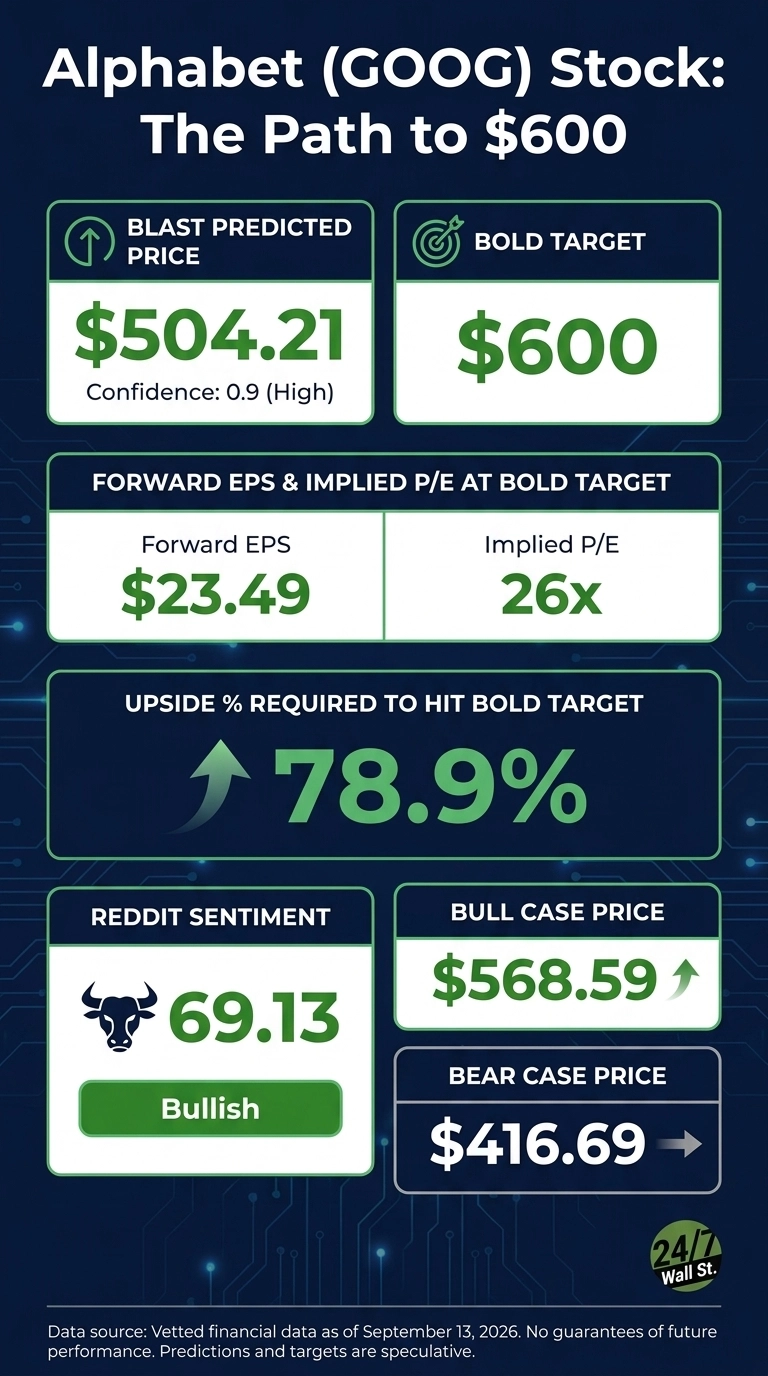
Achievable? Here is why I think it is. Sundar Pichai told analysts, “from ROIC standpoint… over the past year, we’ve gotten more bullish on the opportunities ahead.”
Three catalysts anchor the case: cloud backlog at $514 billion with just over 50% convertible to revenue within 24 months; Gemini Enterprise embedded in nearly 90% of the Fortune 100; and Search still expanding, with AI Mode now past 1 billion monthly active users. If EPS compounds and capex intensity moderates by 2028, P/E expansion follows.
The primary risk: a prolonged period of negative free cash flow if AI monetization lags the infrastructure build.
Where Alphabet Trades Today vs Its Earnings Power
At $335.45, GOOG trades at roughly 14x forward earnings. That is cheap for a business growing revenue 24.23% year over year with a 34% operating margin.
Shares sit between the 52-week high of $403.96 and low of $236.07, and the stock has returned 791.54% over 10 years. Valuation looks reasonable relative to the growth on offer.
Is $600 Realistic? Here’s My Take
Getting to $600 by 2028 requires that 78.9% gain, and it is a stretch. My verdict: realistic but not easy.
Three things need to go right. Cloud must sustain 40%-plus growth as backlog converts. Capex intensity has to peak in 2026 and roll into free cash flow expansion by 2027. Search monetization through AI Mode and AI Max needs to prove additive rather than cannibalistic.
What would derail it: a regulatory shock or evidence that TPU-driven cloud economics cannot scale into positive operating leverage. Returns at this level shouldn’t be expected every year, but we’ve outlined the blueprint for how Google could reach $600 in 2028.
The post Prediction: Alphabet’s Best Days May Still Be Ahead appeared first on 24/7 Wall St..
]]>“Father Time always wins.” That was Warren Buffett’s line, according to The New York Times, on September 18, 2026, the day he announced he was stepping down as chairman of Berkshire Hathaway. The New York Times reported he named his son to replace him, identified by Yahoo Finance as Howard. The Australian Financial Review noted he is stepping down at 96.
Berkshire got a new operator about a year ago, when Greg Abel became chief executive, and reporting on September 2, 2026 noted from finance.biggo.com that Berkshire shares barely budged in his first year. Chairman was the last title Buffett held, which is what makes today the actual close of one of the longest runs anyone has ever had at this job.
What follows is a walk through the five largest positions on Berkshire’s most recent 13F, disclosed as of June 30, 2026 and filed August 14, 2026. That filing describes what Berkshire held at the end of June and disclosed in August, so it is a portrait of a moment rather than a live account of what sits in the portfolio this morning. It also covers only US-listed equity. Some of Buffett’s finest calls, GEICO, See’s Candies, BNSF, do not appear here at all, because he bought the entire company rather than a slice of one. The filing captures half of what he built.
Apple, the Position That Rewrote the Book
The largest disclosed position was Apple (NASDAQ:AAPL), at 227,917,808 shares worth $65,950,296,923, representing 22.038266729497398% of the disclosed portfolio and 1.561703418760081% of Apple itself, according to Australian Financial Review. Apple designs the iPhone, the Mac, and the services stack that now hangs off both.
Fundamentally, Apple sits at a P/E of 44 with ROE of 171.4%, and its fiscal Q3 2026 report showed EPS of $2.02 versus $1.89 expected on revenue of $109.42B, up 16.4% year over year. Nine-month buybacks ran to $62.09B through June 27, 2026. Tim Cook told analysts Apple had its “strongest June quarter ever, with double-digit revenue growth across iPhone, Mac and Services, and in every geographic segment.” That Buffett let a single technology company grow into more than a fifth of the disclosed book is itself the point.
American Express, the Position That Started in the Salad Oil Scandal
American Express (NYSE:AXP) was second at 151,610,700 shares valued at $51,282,319,275, or 17.136745146261052% of the portfolio. Amex runs the closed-loop card and network that anchors the premium payments franchise Buffett has admired since the 1960s, according to Australian Financial Review.
Q2 2026 delivered EPS of $4.53 against $4.40 expected on revenue of $19.64B, with billed business of $455.8B, up 9%. Management raised FY26 revenue growth guidance to 10% and maintained EPS guidance of $17.30 to $17.90. CEO Stephen Squeri described the premium proposition this way: “a great premium value proposition is not just a product. It’s a multifaceted relationship between the brand and the customer.” The quarterly dividend has climbed to $0.95 per share. Six decades on, the thesis still reads like the same one.
Coca-Cola, and Owning a Tenth of the Company
Coca-Cola (NYSE:KO) is the position that best captures the Buffett method. Berkshire disclosed exactly 400,000,000 shares worth $32,508,000,000, a stake equal to 9.296814516232121% of the entire company, according to Australian Financial Review. He owned close to a tenth of Coca-Cola.
The business earned it. Q2 2026 delivered adjusted EPS of $0.97, revenue of $13.38B up 6.7%, and management raised FY26 guidance to comparable EPS growth of 9% to 10% and free cash flow of ~$12.4B. The quarterly dividend has climbed from $0.16 in 1999 to $0.53 today. New CEO Henrique Braun described the machine as “the strength of our total beverage portfolio” operating across “more than 200 countries and territories.” A brand held since the late 1980s, still compounding.
Alphabet, the Regret That Became a Holding
Alphabet (NASDAQ:GOOGL) came in at 78,791,167 Class A shares worth $28,157,599,351, or 9.40927810657434% of the portfolio. Berkshire’s filings historically report GOOGL and GOOG separately, and both classes represent the same company. Buffett had publicly called missing Google early one of his regrets, and eventually a position was established.
The fundamentals now look like a Buffett stock. Alphabet trades at a P/E of 15 with operating margin of 32.1% and ROE of 35.7%. Q2 2026 revenue was $119.80B, up 24.2%, with Google Cloud revenue of $24.77B, up 82%. Sundar Pichai told analysts “nearly 90% of the Fortune 100 using Gemini Enterprise.” The consensus analyst target sits at $428.07, with 13 strong buy, 45 buy, and 5 hold ratings. Better late than never.
Bank of America, the Warrant Deal That Became Common Stock
Bank of America (NYSE:BAC) rounded out the top five at 483,394,015 shares valued at $27,543,790,975, or 9.204164963158451% of the portfolio, according to Australian Financial Review. The position originated in Buffett’s 2011 preferred and warrant deal, later converted into common stock.
Q2 2026 was one of the better quarters the bank has printed: EPS of $1.21 versus $1.12 expected, revenue of $31.56B, and net income of $9.07B, up 27.5% year over year. Global Markets sales and trading came in at $7.2 billion, up 33%, with equities revenue at a record $3.6 billion, up 70%. CEO Brian Moynihan framed it plainly: “Our results show organic growth, operating leverage, and efficiency ratio improvement in every business segment.” A crisis-era rescue turned into a decade-plus core bank holding.
What the Top Five Says About Buffett’s Approach
Concentration is the through line. One consumer electronics company held 22.038266729497398% of the disclosed portfolio, one card network held 17.136745146261052%, and one soft-drink maker was owned at 9.296814516232121% of its entire share class, according to Australian Financial Review. The sector tilt is unmistakable: two financials in Amex and Bank of America, one branded consumer staple in Coca-Cola, and two dominant technology platforms in Apple and Alphabet. Behind the top five sat energy exposure, with Chevron at $13,986,141,890 and Occidental Petroleum at $12,868,205,304. Holding periods span from the 1960s salad oil trade in Amex to a recent Alphabet build, according to Australian Financial Review. Different decades, same pattern: a business he understood, held with unusual patience, sized with unusual conviction.
Arithmetic of a Life
A 96-year-old handing the chair to his son, with the company already in an operator’s hands, closing out one of the longest runs anyone has had at this, according to Australian Financial Review. The 13F is a backward-looking disclosure and none of this is investment advice. What it shows is a book built by someone who thought in decades and treated position size as a form of speech. He said what he thought about Coca-Cola by owning nearly a tenth of it. He said what he came to think about Apple by letting it grow into more than a fifth of the disclosed portfolio. Father Time gets everyone eventually. Very few get to hand off a body of work that reads like this one.
The post As Buffett Ends His Legendary Career, These Were His 5 Best Investments appeared first on 24/7 Wall St..
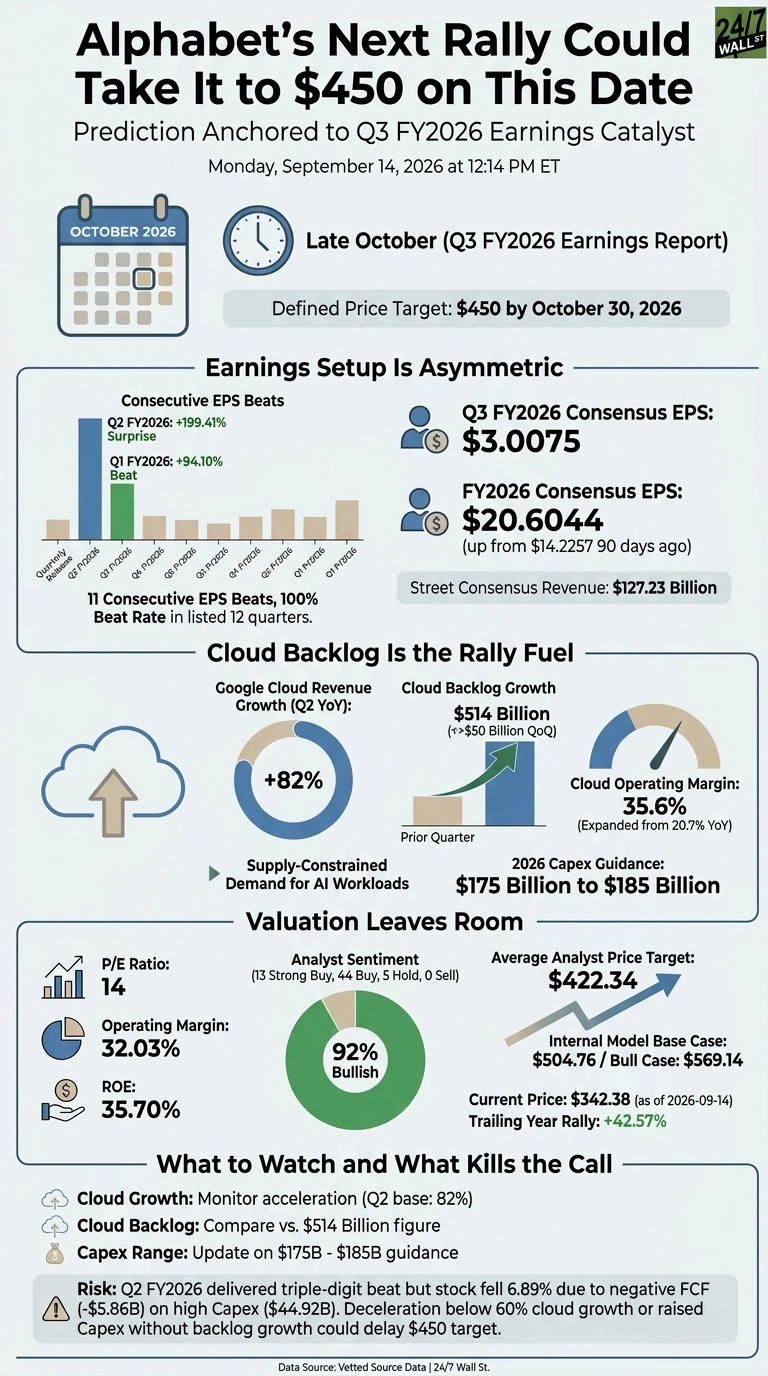
]]>Alphabet (NASDAQ:GOOG) will trade at or above $450 by the close on Friday, October 30, 2026, the first full session after its Q3 FY2026 earnings report scheduled for October 28, 2026, after market close.
From today’s $342.38, that is a defined move on a defined date, anchored to the single most consequential binary event on Alphabet’s near-term calendar.
Earnings Setup Is Asymmetric
Alphabet has posted 11 consecutive EPS beats and beat in every one of the 12 listed quarterly releases. Q2 FY2026 delivered EPS of $9.11 versus $3.04 consensus, a 199.41% surprise, and Q1 FY2026 came in at $5.11 versus $2.63, a 94.10% beat.
Street consensus for the September quarter sits at $3.0075 EPS on revenue of $127.23 billion, and estimate revisions are running hot: the FY2026 EPS consensus stands at $20.6044, up from $14.2257 ninety days ago. That is a wholesale re-rating of the earnings power going into a report the market has repeatedly underestimated.
Cloud Backlog Is the Rally Fuel
Google Cloud grew 82% year-over-year to $24.77 billion in Q2, with backlog reaching $514 billion, a sequential increase of more than $50 billion. Cloud operating margin expanded to 35.6% from 20.7% a year earlier, and management has stated it remains supply-constrained across external and internal AI workloads.
TPU systems began generating recognized revenue in Q2 and are set to ramp as Alphabet exits 2026. Alphabet has already guided 2026 capex to $175 billion to $185 billion, and the Q3 earnings report is the first look at how that spend converts into billable capacity.
All of that hyperscaler spend has to be powered, cooled, and networked by someone, and we profiled seven of the suppliers riding that same wave in a free report on the AI infrastructure buildout.
Valuation Leaves Room
GOOG trades at a P/E of 14 against 32.03% operating margins and 35.70% ROE. Analyst coverage skews decisively bullish: 13 strong buy, 44 buy, 5 hold, zero sell, with sentiment at 92% bullish and an average target of $422.34.
The internal weighted model prints a one-year base case of $504.76 and a bull case of $569.14. A $450 close in six weeks sits below both, and the stock has already rallied 42.57% over the trailing year. The Q3 25 report produced a 12.1% thirty-day gain; a similar reaction off this base clears the target.
What to Watch and What Kills the Call
Investors should key on three lines in the October release: Google Cloud year-over-year growth (the accelerating 82% base is the anchor), the Cloud backlog figure versus $514 billion, and any update to the $175 billion to $185 billion capex range.
The risk is real: Q2 FY2026 delivered a triple-digit beat and the stock still closed down 6.89% on the day as free cash flow ran to negative $5.86 billion on $44.92 billion of quarterly capex. If Cloud growth decelerates below 60% or capex guidance is raised without a matched backlog figure, $450 slips into 2027. Weighing the setup, the estimate momentum, and the backlog, the call stands: $450 by October 30.
The post Price Prediction: Alphabet’s Next Rally Could Take It to $450 on This Date appeared first on 24/7 Wall St..
]]>Shares of Arm (NASDAQ:ARM) trade at $243.98, down 10.11% over the past month and 7.66% in the last week, yet still up 123.2% year to date.
The pullback across AI chip names reflects market concerns about softening demand from frontier labs. CEO Rene Haas argues the opposite: order books are full and growing, and near-term revenue growth is capped by how quickly the global chip supply chain can produce silicon. A demand slowdown and a manufacturing bottleneck produce different stock outcomes even when both cause missed quarters.
If Haas is right, the drawdown is a buying window into a company whose data center royalty stream compounds at triple-digit rates. If he is wrong, an investor pays a trailing P/E near 247x for a story that has begun to break.

Demand Breadth Across Edge, Auto, Robotics and Data Center
Haas insisted no single end market carries the company, citing edge, automotive, robotics and data center all running at record strength. Robotics matters more than it sounds. A humanoid or industrial machine ships with many Arm CPUs rather than one, because sensing, control and actuation each demand their own compute silicon, multiplying royalty units per unit shipped.
Data center is already visible in the numbers. Data-center royalty revenue more than doubled year over year last quarter, and the most recent 500 million Neoverse cores shipped in the last nine months after the first billion took six years.
Why a Multi-Stage Bottleneck Keeps Revenue Capped
Haas described the constraint as spread across wafers, substrates, testers, and memory rather than sitting at any single node. A multi-stage bottleneck is harder to fix because expanding one stage does not release throughput until every other stage catches up.
That keeps pricing firm because customers cannot easily source substitute capacity. It also caps how fast Arm converts its order book into recognized royalty and silicon revenue, since chips that do not exist generate no royalties.
Arm has secured the manufacturing capacity needed to support the $1 billion opportunity for its AGI CPU and is working with partners to expand further, according to Arm Holdings. Haas said the market is “very, very tight” across memory, test equipment, substrates and TSMC wafers.
Guidance Round Trip and Pivot to Data Center Silicon
Rene Haas earlier cut the AGI CPU target to $1 billion amid foundry capacity worries. On CNBC this week, he said his confidence in achieving the $2 billion target had risen from May to July and again from July to September.
Pair that with his claim that “data center is going to be our largest business”. For a company built on smartphone royalties, that pivot changes customer concentration, deal size, and margin trajectory.
The AGI CPU is Arm’s first in-house data center chip with a different margin profile than pure IP licensing. Management guided first-generation gross margin in the high 30% range to low 40s, with a path to 50% over the next couple of years, well below core royalty margins, meaning silicon revenue will initially dilute reported profitability even as it grows the top line.

Bull and Bear Case for ARM Stock
The bull case rests on demand breadth and secular share gains. IDC reported spending on Arm-based accelerated server platforms has nearly doubled in the past two quarters and surpassed x86, and hyperscaler design wins at NVIDIA (NASDAQ:NVDA), Google (NASDAQ:GOOG, NASDAQ:GOOGL), AWS and Microsoft (NASDAQ:MSFT) lock in multi-year royalty streams. Analysts carry an average target of $288.70.
The bear case is that a chief executive describing his own demand has an obvious interest in the story, and “supply constrained” is the most flattering explanation for revenue that arrives later than promised. Q1 FY2027 EPS of $0.25 missed the $0.40 estimate, and operating margin compressed to 7% from 11%.

The test is clean. If Arm ships silicon by the end of calendar year 2026 and the AGI CPU line clears the $2 billion mark across fiscal 2027 and fiscal 2028, Haas is right; if shipments slip or the number gets walked back again, the bear wins.
The post Arm’s CEO Says Demand Is ‘Off the Charts.’ The Problem Is Nobody Can Build Chips Fast Enough appeared first on 24/7 Wall St..
]]>Alphabet’s second-quarter results made one thing clear: Google Cloud is no longer the sidekick to Search. Cloud revenue grew 82% to $24.8 billion, and backlog jumped more than $50 billion sequentially to $514 billion.
That backlog alone is larger than Alphabet’s entire fiscal 2025 revenue base. If you are hunting for the next leg of upside in Google (NASDAQ:GOOG), Search is the foundation, but Cloud and enterprise AI look like the real accelerant.
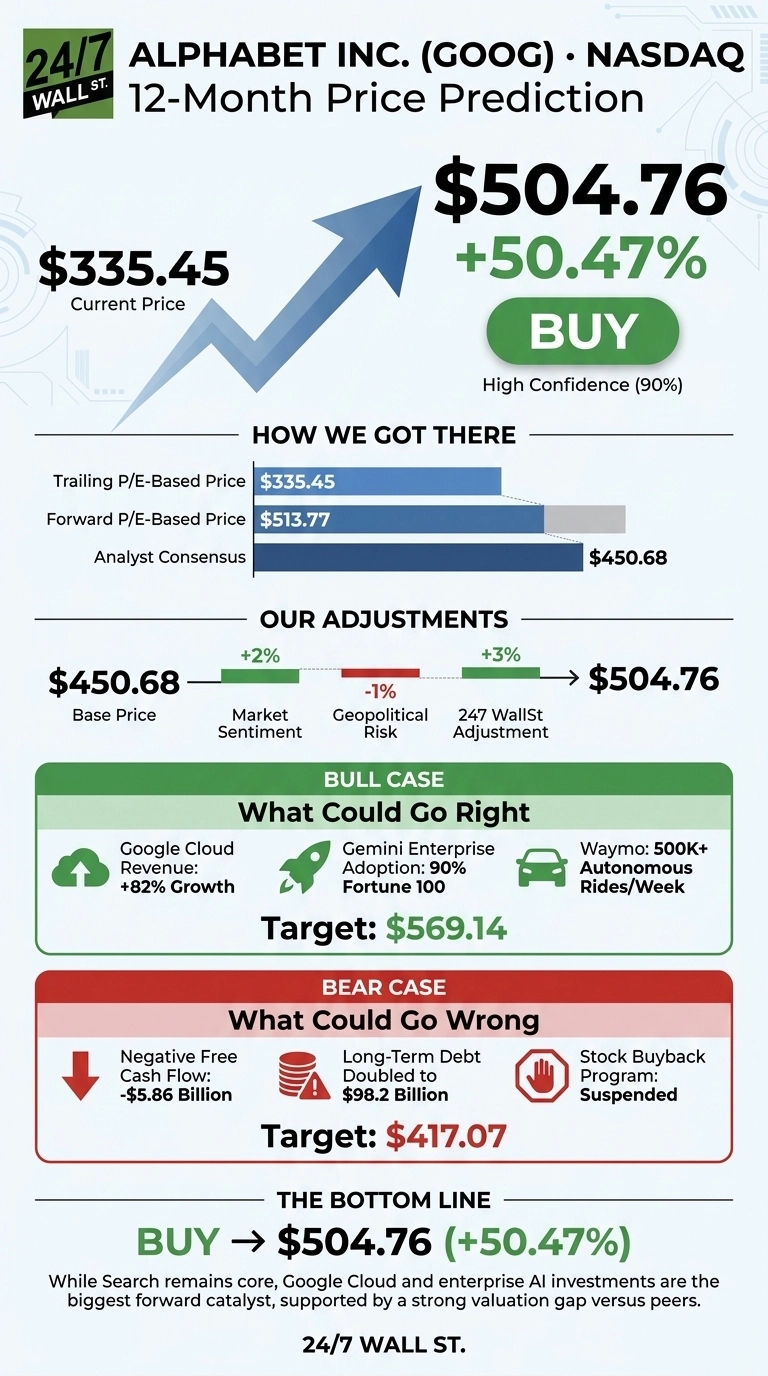
Our 24/7 Wall St. price target for Alphabet is $504.76, implying 50.47% upside from a current price of $335.45. The recommendation is buy, with a model confidence of 90%. Below, I walk through how we got there and what could push the stock even higher, or pull it back.
24/7 Wall St. Price Target Summary
| Metric | Value |
|---|---|
| Current Price | $335.45 |
| 24/7 Wall St. Price Target | $504.76 |
| Upside | 50.47% |
| Recommendation | BUY |
| Confidence Level | 90% |
Cloud Acceleration Is Rewriting the Alphabet Story
GOOG is up 42.62% over the past year and 9.36% year to date, with shares recently changing hands near $342.50.
Q2 2026 was the anchor: EPS of $9.11 blew past the $3.04 consensus, revenue hit $119.8 billion, up 24.23% year over year, and operating margin expanded to 34%. Cloud growth accelerated from 48% in Q4 2025 to 63% in Q1 2026 and 82% in Q2 2026.
Barron’s noted this week that Google and Meta are emerging as winners from the latest round of AI concerns, thanks in part to their internal model economics.
Bull Case: $569 and Beyond
The bull scenario in our model points to $569.14, and it hinges on Cloud. Nearly 90% of the Fortune 100 use Gemini Enterprise, Gemini App has 950 million monthly active users, and model APIs process 22 billion tokens per minute, up from 16 billion a quarter ago.
Alphabet expects to recognize just over 50% of the $514 billion backlog within 24 months, and TPU system revenue is expected to ramp largely in 2027. Add Waymo scaling to 500,000+ autonomous rides per week and a YouTube run rate above $60 billion, and the non-Search catalysts stack up quickly.
What Could Go Wrong
The bear scenario lands at $417.07, still above today’s price. The risks are real: Q2 capex of $44.9 billion doubled year over year, free cash flow swung negative to -$5.86 billion, long-term debt roughly doubled from $46.5 billion to $98.2 billion, and buybacks are suspended.
It should be noted, however, that bulls would argue the capex surge reflects supply-constrained demand rather than misallocation (all that spending flows to the power, cooling, and networking companies we profiled in a free AI infrastructure report).
Management is still describing itself as supply constrained, and cloud operating income more than tripled to $8.8 billion with margins climbing to 35.6%.
How Alphabet Compares to Microsoft and Amazon
Microsoft (NASDAQ:MSFT) is the natural cloud-and-AI comp. Azure just surpassed $100 billion in annual revenue, Azure grew 43% in fiscal Q4 2026, and commercial RPO reached $678 billion. Yet MSFT trades at a P/E of 28 versus GOOG’s 14. Google Cloud is growing faster (82% vs. 43%) at roughly half the multiple, which is precisely why our target looks conservative rather than aggressive.
Amazon (NASDAQ:AMZN) is the other AI infrastructure spender. AWS grew 37% to $42.2 billion in Q2 2026 with a 39.4% operating margin, and Andy Jassy guided to roughly $200 billion in 2026 capex. AMZN trades at a P/E of 36.
Google Cloud is now growing more than twice as fast as AWS while GOOG trades at less than half the earnings multiple. That valuation gap is the single strongest support for our 24/7 Wall St. price target.
| Company | P/E | Cloud Growth (latest Q) |
|---|---|---|
| Alphabet | 14 | 82% |
| Microsoft | 28 | 43% |
| Amazon | 36 | 37% |
Why I’d Own It Here
My take: the 24/7 Wall St. price target of $504.76 with 90% confidence is a buy, and the tipping factor is the valuation gap versus MSFT and AMZN despite superior cloud growth. The setup strengthens if free cash flow stabilizes as 2027 TPU revenue ramps.
The thesis weakens if capex keeps climbing without margin follow-through in Cloud. Prediction markets are more cautious, pricing a 0.815 probability that shares hit $350 in September, but the 12-month setup is materially more constructive.
Looking further out, our model projects the following trajectory, assuming Cloud growth normalizes gradually and Search remains resilient.
| Year | 24/7 Wall St. Price Target |
|---|---|
| 2026 | $377.79 |
| 2027 | $514.71 |
| 2028 | $653.64 |
| 2029 | $817.33 |
| 2030 | $940.70 |
These projections assume Alphabet keeps executing on its full-stack AI strategy. Significant upside or downside could come from Gemini 4, TPU monetization in 2027, or an adverse regulatory outcome tied to Search.
The post The Biggest Catalyst for Alphabet Stock May Not Be Search appeared first on 24/7 Wall St..
]]>Alphabet (NASDAQ:GOOG) has been a stealth winner in 2026. Shares are up 9.36% year to date and 42.62% over the past year, powered by an AI story that finally showed up in the numbers.
Google Cloud grew 82% in Q2, Gemini Enterprise is deployed at nearly 90% of the Fortune 100, and CEO Sundar Pichai told investors Alphabet is “still in a supply constraint environment“.
With the stock recently brushing its 52-week high of $403.96, the question is whether $400 is a ceiling or a launching pad. Here is how GOOG could reach $500 in 2027.
Wall Street Is Bullish, But Not Bullish Enough
The Street’s consensus 12-month target sits at $422.34, with 13 strong buys, 44 buys, and just 5 holds. Analysts see revenue reaching roughly $613 billion in 2027 against $498 billion this year.
The 2026 EPS estimate has jumped from $14.23 ninety days ago to $20.60 today, one of the sharpest upward revisions in mega-cap tech. Alphabet has also beaten consensus in 11 consecutive quarters and posted 12 straight quarters of double-digit revenue growth, meaning actual results are likely to run ahead of what analysts are modeling.
Path to $500 Per Share
At $342.50, GOOG trades at roughly 23x the 2027 consensus EPS of $14.87, essentially in line with the S&P 500’s 22x forward multiple. Reaching $500 would put shares at about 34x 2027 estimates.
That is a premium, but a defensible one for a business compounding operating income 30% year over year at a 32.81% net margin.
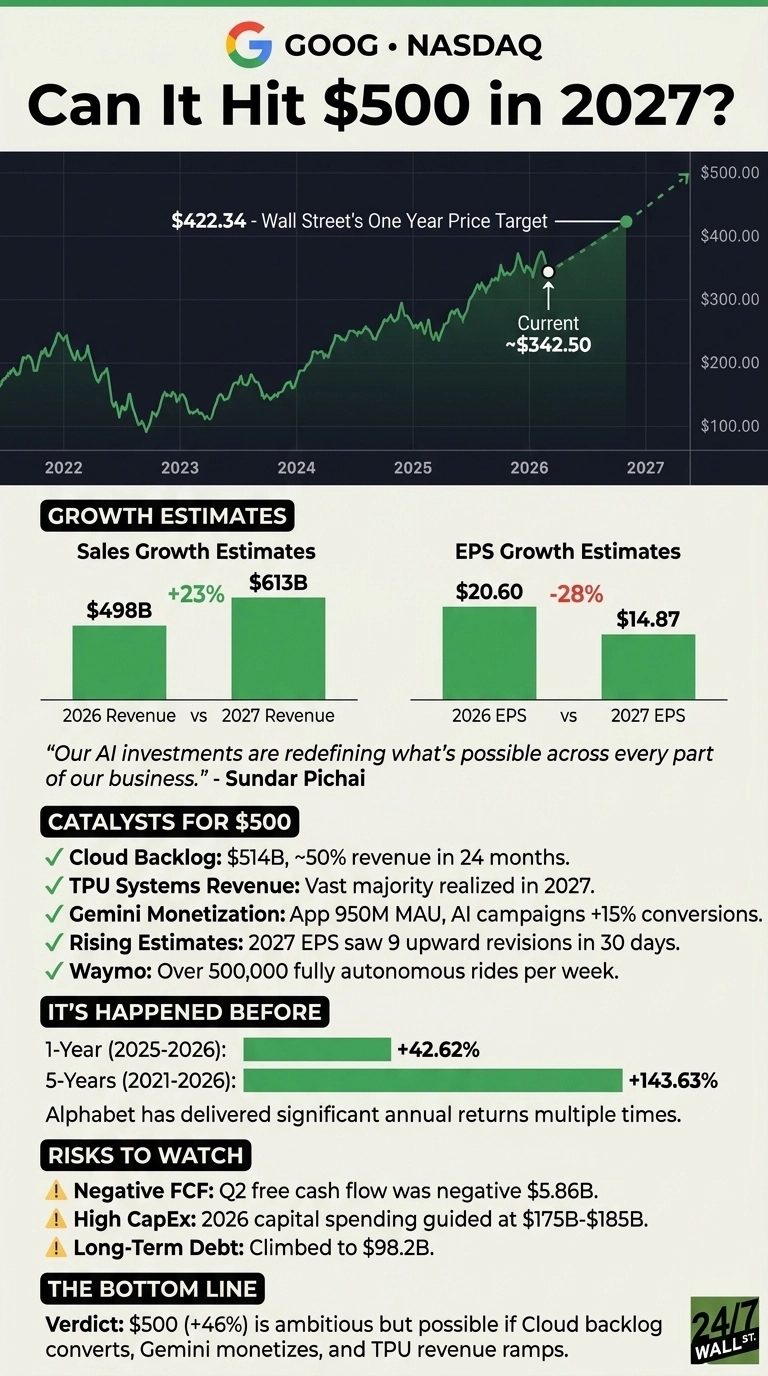
What could push GOOG to $500?
- Cloud backlog conversion. Alphabet’s cloud backlog hit $514 billion, with management guiding to recognize just over 50% as revenue in the next 24 months.
- TPU systems revenue. Pichai said the vast majority of TPU system sales revenue will be realized in 2027, opening a new hardware line.
- Gemini monetization. The Gemini app now has 950 million monthly active users, AI Mode has crossed 1 billion MAU, and AI-powered campaigns deliver 15% more conversions on average.
- Rising estimates. Over the trailing 30 days, 2027 EPS saw 9 upward revisions against just 1 downward.
- Optionality. Waymo is running over 500,000 fully autonomous rides per week, and Isomorphic Labs raised over $2 billion for its drug design pipeline.
History Says a Move to $500 Is Doable
Reaching $500 from here requires roughly a 46% gain. GOOG delivered 42.62% in the past 12 months alone and 143.63% over five years.
Our internal model’s bull case pegs a one-year price of $569.14, with a base case of $504.76. A repeat of the past year’s gain would put GOOG comfortably beyond $500.
Bottom Line on $500
The risks are real: Q2 free cash flow was negative $5.86 billion after $44.92 billion of CapEx, long-term debt has climbed to $98.2 billion, and 2026 capital spending is guided at $175 billion to $185 billion.
That spend has to be powered, cooled, and networked by someone, which is why we profiled seven suppliers behind the AI data-center buildout in a free report you can grab here.
If cloud backlog converts, Gemini keeps monetizing, and TPU revenue ramps as promised, a 34x multiple on 2027 earnings is achievable. Returns like this should not be expected every year, but the blueprint for GOOG to reach $500 in 2027 is clearly on the table.
The post Prediction: Alphabet Stock at $400 May Be Just the Beginning appeared first on 24/7 Wall St..
]]>Alphabet (NASDAQ:GOOG) has quietly become the most interesting name in the Magnificent Seven heading into the back half of 2026. Google Cloud growth accelerated to 82% in Q2, Gemini adoption is scaling across the Fortune 100, and yet the stock still trades at a P/E multiple in the mid-teens.
My 24/7 Wall St. price target for Google is $504.21, implying 50.31% upside from the current price of $335.45. That is the widest gap I see in the Mag 7 today.
24/7 Wall St. Price Target Summary
| Metric | Value |
|---|---|
| Current Price | $335.45 |
| 24/7 Wall St. Price Target | $504.21 |
| Upside | 50.31% |
| Recommendation | BUY |
| Confidence | 90% |
Why Google Is My Top Mag 7 Pick for 2026
Shares are up 7.11% year to date and 39.68% over the past year, but the stock has actually cooled off, slipping 1.96% over the past month against a 52-week high of $403.96. That pullback is what makes today interesting.
Q2 was, in CEO Sundar Pichai’s words, “an amazing quarter”: revenue of $119.8 billion, up 24.23%, with EPS of $9.11 against a $3.0427 estimate. Google Cloud hit $24.77 billion, backlog reached $514 billion, and nearly 90% of Fortune 100 companies now use Gemini Enterprise. Search revenue still grew 17%, killing the AI cannibalization thesis.
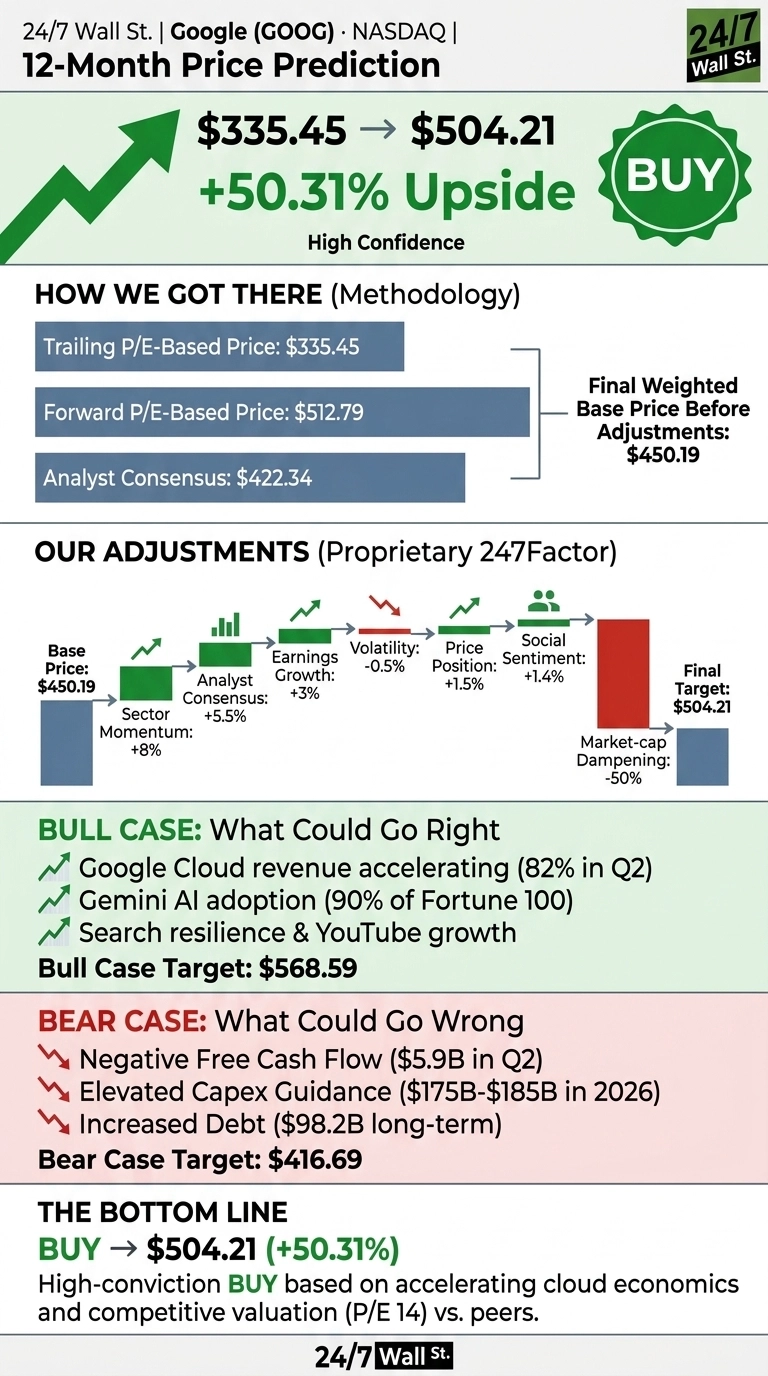
Bull Case: $568 and Beyond
Bulls have a clean thesis. Google Cloud has printed 34%, 48%, 63%, and 82% growth in the last four quarters, and the $514 billion backlog is a multi-year revenue runway. TPU system sales to external customers are just beginning to hit the P&L, with the majority of revenue expected in 2027.
Gemini App usage tripled year over year to 950 million monthly active users, and API token throughput jumped from 16 billion to 22 billion per minute in a single quarter. Our bull-case scenario points to $568.59, a 69.5% return.
Analyst distribution supports the tilt: 13 strong buys, 44 buys, 5 holds, zero sells.
What Could Go Wrong
The bear case starts with capex. Alphabet guided $175 billion to $185 billion of 2026 capex, free cash flow turned negative at -$5.86 billion in Q2, long-term debt more than doubled to $98.2 billion, and the buyback was suspended. Insider activity has skewed net selling.
The counterfactual: management has explicitly framed the spend as demand-driven, and cloud operating margin still expanded from 20.7% to 35.6% year over year while capex ramped. Our bear case still lands at $416.69, a 24.22% gain from here.
How Google Compares to Microsoft, Meta, and Amazon
Microsoft (NASDAQ:MSFT) is the cleanest cloud/AI comp. Azure grew 43% in fiscal Q4 and Microsoft 365 Copilot passed 30 million paid seats, but MSFT trades at a P/E of 28, roughly double Google’s 14.
Meta Platforms (NASDAQ:META) is the ad-revenue benchmark. Meta grew ad revenue 27%, yet its Q2 EPS came in below expectations and it carries a P/E of 24.
Amazon (NASDAQ:AMZN) grew AWS 37% at a P/E of 36.
| Company | P/E | Latest Cloud/Ad Growth |
|---|---|---|
| 14 | Cloud +82% | |
| Microsoft | 28 | Azure +43% |
| Meta | 24 | Ads +27% |
| Amazon | 36 | AWS +37% |
Against this field, Google is growing cloud the fastest at the cheapest multiple. That makes our 24/7 Wall St. price target look conservative given the setup.
Google Price Prediction 2026-2030
My verdict is a high-conviction buy with 90% confidence and a 24/7 Wall St. price target of $504.21. The scale tipper is valuation: a P/E of 14 for a business compounding revenue at 24% with accelerating cloud economics is a rare setup.
The setup strengthens if cloud growth holds above 50% into Q3, and weakens if free cash flow stays negative into 2027 without a corresponding backlog conversion.
Looking further ahead, here is where our model projects Google could trade, assuming current trajectories hold.
| Year | 24/7 Wall St. Price Target |
|---|---|
| 2026 | $366 |
| 2027 | $504 |
| 2028 | $668 |
| 2029 | $804 |
| 2030 | $906 |
These projections assume Google continues executing on Cloud, Gemini, and Search. Meaningful upside or downside could come from AI infrastructure returns, regulatory actions, or the timing of TPU revenue recognition. All of that capex has to be powered, cooled, and networked by somebody, and we profiled seven of those suppliers in a free report on the AI infrastructure buildout.
The post One Magnificent Seven Stock Could Outperform the Rest in 2026 appeared first on 24/7 Wall St..
]]>Our Alphabet (NASDAQ:GOOG) call is direct: shares are the cheapest in the Big Six and the setup into 2027 is unusually asymmetric.
With Google Cloud growing 82% year over year and a trailing P/E of just 17, the market is pricing Alphabet like a mature ad business while it operates like a hyperscaler. Our 24/7 Wall St. price target for Alphabet is $504.76, implying 50.47% upside from $341.33. Our confidence is high.
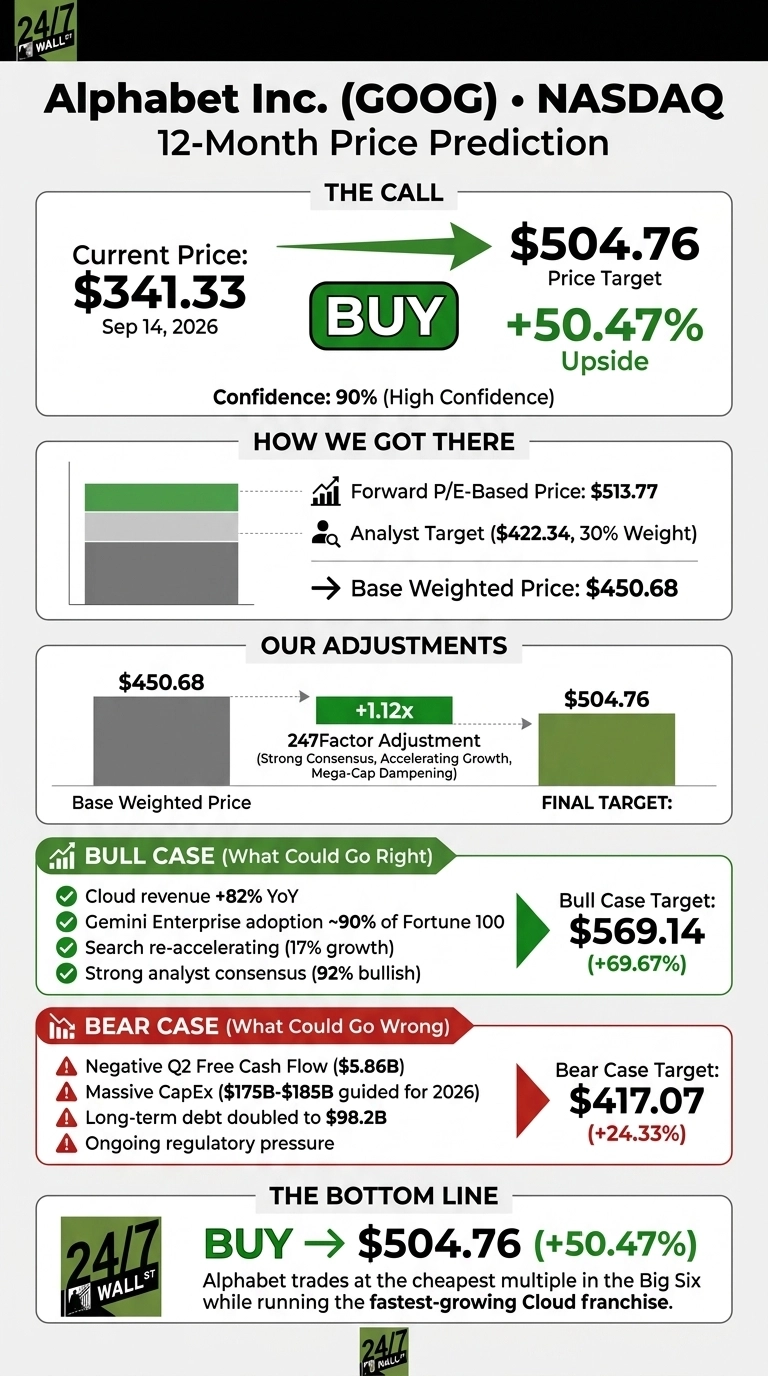
24/7 Wall St. Price Target Summary
| Metric | Value |
|---|---|
| Current Price | $341.33 |
| 24/7 Wall St. Price Target | $504.76 |
| Upside | 50.47% |
| Recommendation | BUY |
| Confidence Level | 90% |
What Just Happened: A Blowout Quarter and a New AI Trade
Alphabet is up 42.13% over the past year and 8.99% year to date, with today’s move adding another 1.75% as investors rotated back into mega-cap AI beneficiaries on fresh capacity concerns across the sector (Barron’s, Sept. 14, 2026).
Q2 2026 delivered EPS of $9.11 versus $3.04 expected on revenue of $119.80 billion, up 24.2%. Search grew 17%, YouTube ads 13%, and Cloud accelerated to 82% with backlog swelling to $514 billion.
Why Bulls See a Breakout Ahead
The bull case starts with Cloud. Backlog of $514 billion is now roughly 50 billion higher sequentially, and management expects to recognize just over 50% as revenue within 24 months.
Gemini is entrenched: nearly 90% of Fortune 100 companies use Gemini Enterprise, and the Gemini app hit 950 million MAUs. Our bull scenario points to $569.14 within twelve months, a 69.67% return.
What Could Go Wrong
Alphabet burned negative $5.86 billion in Q2 free cash flow as CapEx hit $44.92 billion. Management guided 2026 CapEx to $175 billion to $185 billion, long-term debt more than doubled to $98.2 billion, and buybacks were suspended.
Bulls would counter that trailing-twelve-month operating cash flow of $185.7 billion comfortably funds this build, and management frames third-party capacity costs as ROI-positive over multiyear contracts. Our bear scenario still lands at $417.07, a positive 24.33% return.
Is Alphabet Cheaper Than Microsoft and Meta?
Microsoft (NASDAQ:MSFT) is the direct hyperscaler comp. Microsoft trades at a trailing P/E of 28 and forward P/E of 25, with quarterly revenue growth of 17.7%. Alphabet is growing faster (24.2%) at a multiple roughly 40% cheaper on a trailing basis.
Meta Platforms (NASDAQ:META) is the ad-market comp. Meta trades at a trailing P/E of 24 with quarterly earnings growth of -13.4%. Alphabet’s ROE of 35.7% tops Meta’s 29.8%. Across both comps, our $504.76 target looks conservative given the growth premium GOOG deserves.
| Company | Trailing P/E | Quarterly Revenue Growth |
|---|---|---|
| Alphabet | 17 | 24.2% |
| Microsoft | 28 | 17.7% |
| Meta | 24 | 28% |
Alphabet Price Prediction 2026-2030
Our 24/7 Wall St. price target of $504.76 implies a buy with 90% confidence. The tipping factor is simple: Alphabet trades at the lowest trailing multiple in the Big Six while running the fastest-growing Cloud franchise.
The setup strengthens further if Cloud maintains 60%+ growth into Q4 and TPU system sales ramp on schedule into 2027. The thesis weakens if free cash flow stays negative through year-end 2026 while regulatory rulings force structural remedies.
| Year | 24/7 Wall St. Price Target |
|---|---|
| 2026 | $504.76 |
| 2027 | $625 |
| 2028 | $755 |
| 2029 | $890 |
| 2030 | $1,031.89 |
These projections assume Alphabet continues executing its AI infrastructure build while Search and YouTube compound. The same data-center demand powering that build is lifting a whole tier of suppliers behind the scenes (we profiled seven of them, from power to cooling, in a free report). Meaningful upside or downside could result from Waymo commercialization or an adverse antitrust remedy.
The post Alphabet Has 50% Upside and the Cheapest Multiple of the Big Six appeared first on 24/7 Wall St..
]]>On a recent Earn Your Leisure episode, hosts Troy Millings and Rashaad Bilal split openly on where the next dollar of AI value accrues. Millings argued for names outside the Magnificent 7 and made Broadcom’s custom accelerator business the centerpiece of the case. Bilal countered that “you have to go with the people who are on the leaderboard,” naming Taiwan Semiconductor (NYSE:TSM), Nvidia (NASDAQ:NVDA), Micron (NASDAQ:MU), Apple (NASDAQ:AAPL), Alphabet (NASDAQ:GOOG, NASDAQ:GOOGL), Microsoft (NASDAQ:MSFT), and the Nasdaq 100.
I find Millings the more persuasive of the two. Broadcom (NASDAQ:AVGO) posted AI semiconductor revenue of $16.7 billion in the third quarter of fiscal 2026, up 221% year over year, and guided the fourth quarter to $21.7 billion, up 236%. On the earnings call, Hock Tan sketched a trajectory to roughly $115 billion in fiscal 2027 and $230 billion in fiscal 2028.
Those are company figures. They reframe what the phrase “alternative to Nvidia” means in practice.
Where the Earn Your Leisure Hosts Split
Millings framed the moment by saying, “The leaderboard is growing. You’re looking at more trillion-dollar companies than we’ve ever seen before.” His practical claim was that investors misread Broadcom’s custom silicon and reflexively equate AI with Nvidia.
He also said OpenAI’s latest release required 100 Vera Rubin chips to power it, a podcast assertion rather than a company disclosure, and worth marking as such, according to Earn Your Leisure. The number matters less than the direction: frontier models are hungry, and silicon co-designed for one workload can be cheaper per token than a general GPU.
Bilal’s counter was cleaner and, on the surface, harder to argue against. If the biggest names have already won, why bet on the next tier at all?
My answer is that the question assumes only one winner. Broadcom’s Q3 alongside NVIDIA’s $96.22 billion quarter and 105.85% year-over-year growth together suggest the pie itself is enlarging.
What Custom Silicon Actually Buys You
An application-specific integrated circuit is a chip designed for a single workload rather than a general problem. Broadcom builds them for hyperscalers like Google and Meta (NASDAQ:META) and, increasingly, for OpenAI and Anthropic, while Nvidia sells one platform to everyone.
The tradeoff is straightforward. Custom silicon wins on cost and power at scale when the workload is stable and known, and it struggles when the target keeps moving underneath it.
Frontier training probably still favors NVIDIA because architectures shift quarter to quarter. Inference of a shipped model at hyperscale looks much closer to the stable workload where ASICs earn their keep, and XPU shipments were 73% of Broadcom’s AI revenue last quarter.
Tan told analysts that “when you co-develop a chip that is optimized for your particular LLM workloads, you will outperform any GPU,” citing OpenAI’s Jalapeno running at half the cost of a GPU. Take the exact figure with skepticism, though the direction is real.
Testing the Supporting Names Around the Trade
Taiwan Semiconductor is Millings’ favorite for years, and it fabricates both Broadcom’s XPUs and AMD’s Instinct GPUs. August 2026 revenue rose 53.3% year over year, and the stock trades at a forward P/E of 20. The bull case’s weak point is geopolitical concentration, which no multiple prices cleanly.
Dell Technologies (NYSE:DELL) booked a record $60.9 billion in AI orders last quarter with a $95 billion backlog and raised its full-year FY27 guide by $25 billion to $192 billion. Server hardware carries thin margins, though: ISG’s operating margin was 15%, respectable and nowhere near a chip designer’s economics.
AMD (NASDAQ:AMD) grew Data Center revenue 107% year over year to $6.72 billion and lined up gigawatt commitments with Anthropic, Meta and Microsoft. Yet the stock trades at a trailing P/E of 132, and its GPU share still has to travel a long way against NVIDIA’s installed CUDA base before that multiple looks earned.
Each of these benefits if Millings is right that the leaderboard is widening. The steadiest of them for a patient owner is the one Broadcom itself depends on: TSM.
Where AVGO Stock Sits
Broadcom trades at a trailing P/E of 46x and a forward P/E of 19x, with an analyst target of $531.85 against a recent price of $361.99. Shares are down 12.99% over the past month, even after a Q3 that logged nine consecutive EPS beats and free cash flow of $13.66 billion.

Against NVIDIA’s roughly $5.27 trillion market cap and 44x P/E, Broadcom looks like a cheaper way to own the same AI capex cycle from a different angle. The real risks are customer concentration among a handful of frontier labs and the financing exposure baked into the Anthropic and OpenAI XPV vehicles.

The risk/reward here looks constructive, with eyes open. Bilal is right that owning NVIDIA outright remains the simplest expression of the trade, although Millings is more right that Broadcom’s custom-accelerator franchise is priced as though the $115 billion fiscal 2027 outlook might not arrive, and the setup rewards the patient reader willing to sit through the noise (we reverse-engineered what the earliest signals of the biggest tech winners looked like in a free playbook you can grab here).

The post Forget the Magnificent 7. This Duo Says Broadcom, Not Nvidia, Wins the Next Leg of AI. appeared first on 24/7 Wall St..
]]>Lance Roberts, who runs money at RIA Advisors and writes the Real Investment Report, sat down with host Adam Taggart on Thoughtful Money and argued the S&P 500 is so far above its long-term logarithmic trend that a full reversion would carry the index from 7,000 back to about 2,500.
The argument is more interesting than the shock value suggests.
The SPDR S&P 500 ETF (NYSEARCA:SPY) closed at $764.29 on September 11, 2026, up 12.08% year to date and 16.22% over the trailing year. Roberts is not calling for a crash next quarter.
Roberts’s Trend-Line Claim
Roberts anchored his warning to work from Ned Davis Research, saying the market has not been this extended above its long-term logarithmic trend since 2000. Reversion to a long-term trend is not the same as a price target with a date attached. Trend lines drift upward with earnings and inflation, so the reversion level itself rises over time even if the index falls to meet it.
Roberts’s projected path to roughly 2,500 assumes the reversion happens quickly and completely, which historically is the exception rather than the rule. Reversions usually take years and often unfold through sideways action rather than a single decline.
The valuation signal is the useful part. It tells you the starting point for future returns is unusually high, and Roberts warned that “when you start up here, your forward returns aren’t great every single time.”
Why the Size Matters
Taggart pressed Roberts on the word correction, noting that it can mean anything from a 10% pullback to a generational drawdown. Roberts answered that even a decline of the magnitude he described would still technically qualify as a bull market correction given how stretched valuations already are.
That answer describes the present. It says today’s prices sit so far above trend that a very large percentage move down would still leave the index inside its longer secular uptrend.
The top of SPY reflects that stretch. NVIDIA (NASDAQ:NVDA) at 7.58%, Apple (NASDAQ:AAPL) at 6.66%, Microsoft (NASDAQ:MSFT) at 4.91%, Amazon (NASDAQ:AMZN) at 3.64%, and Alphabet’s (NASDAQ:GOOG, NASDAQ:GOOGL) two share classes combined mean a handful of megacap technology names drive the fund’s outcome. Concentration has powered the ETF’s ten-year return of 258.43%, and it is also the mechanism through which a valuation reset in a few names would show up across the whole index.
Horizon Matters More Than Timing
Roberts drew a sharp line between two readers. In his framing, short-term traders can stay long when momentum and liquidity are favorable, while long-horizon investors are better served by treating “protection of capital” as the priority, according to Thoughtful Money with Adam Taggart.
Both statements can be true at once because they describe different jobs. A trader is compensated for participating in the current trend, and a retiree drawing down a portfolio is compensated for not being wiped out during a decade of poor returns. A 25-year-old contributing every payday actually benefits from lower prices, since each contribution buys more shares.
A 65-year-old selling shares to fund living expenses faces the same decline as permanent damage to the withdrawal base, which planners call sequence-of-returns risk (we walked through how to defend the opening years of retirement in a free guide here: The First Five Years).
The alternatives are concrete today. The 52-week Treasury bill yielded 4.23% on September 11, 2026, and the 10-year Treasury sat at 4.95% on September 10, 2026, offering a government-backed return that competes directly with equity risk premiums.
Historical Parallels
Roberts pointed to three secular stretches as reference points: the Depression era, the 1960s and 1970s, and the dot-com bust that extended through 2013. Each produced roughly flat nominal index returns punctuated by sharp rallies and equally sharp declines. Investors who kept buying through them ended up fine, and investors who needed to sell into them often did not.
The VIX at 17.84 on September 10, 2026 sits within its normal range, so the current market is not pricing meaningful stress. That aligns with Roberts’s view that the danger lies in valuation and horizon rather than imminent volatility. Indexes can go a very long time without making progress, and averaging in during those stretches works only if you can keep averaging in.
Is SPY a Buy?
SPY is the cleanest, cheapest way to own the U.S. large-cap market, with a 0.0945% expense ratio and unmatched liquidity. For a young saver with a two-decade contribution runway, it remains a reasonable core holding because time neutralizes the entry-price problem Roberts described.
For an investor within ten years of drawing income, the calculus is different. Shorter-duration Treasuries at roughly 4% yields, a tilt toward lower-multiple sectors, or simply slowing the pace of new contributions each carries its own tradeoffs, including reinvestment risk and the possibility of missing further upside. Weighing Roberts’s warning against the fund’s structural advantages, SPY rates a Hold at current levels. Existing positions look defensible, while new full-size purchases at these valuations deserve more caution than the last five years’ returns would suggest, especially considering oil prices.
The post This Analyst Says A Full Reversion to the Mean Would Take the S&P 500 From 7,000 to 2,500 appeared first on 24/7 Wall St..
]]>Google’s (NASDAQ:GOOG, NASDAQ:GOOGL) most recent quarter included a data point that mattered more than any benchmark: nearly 90% of the Fortune 100 are using Gemini Enterprise. That is the customer base Microsoft (NASDAQ:MSFT) has spent a generation cultivating. The question is whether Google can convert that footprint into revenue, and the answer arrived through a partnership rather than a product launch.
Google Cloud and Accenture created the Accenture (NYSE:ACN) Gemini Enterprise Business Group, a joint unit that will place forward-deployed engineers inside customer operations and expand Gemini training across Accenture’s workforce. Those engineers are Accenture employees trained on Google’s stack, not Google hires, and the arrangement is not exclusive. Accenture continues to work with Microsoft, OpenAI, Anthropic, and NVIDIA (NASDAQ:NVDA).
What matters is that Alphabet is attacking Microsoft at the layer where enterprise software is actually sold: integration, procurement, and the consultant already in the room.
Mechanism Beats the Model
A forward-deployed engineer sits inside the customer’s operation and builds against its real systems, rather than pitching from the outside. That is what Accenture will supply through the joint business group. It is a distribution move dressed as an engineering one.
In addition, Microsoft’s durable advantage in enterprise software has never been model quality. Azure and Copilot get bought because they are already installed, already procured, and already supported by an integration partner. Google has historically lost fights at that layer.
Microsoft’s chief executive described the defensive moat on the recent call: “The models are an input, not some extraction of the knowledge of the enterprise.” The argument is that the harness (memory, context, permissions, workflows) is what retains customers.
Consultants build that harness. By renting Accenture’s bench, Google gets a channel that speaks to chief information officers and knows their SAP instances.
Numbers Google Wants You to Watch
Sundar Pichai framed the quarter this way: “Q2 was an amazing quarter, with Alphabet revenues growing 24% year-over-year and Google Cloud revenues accelerating to 82% growth.” Google Cloud revenue reached $24.77 billion, with backlog above $460 billion at the end of Q1.
Microsoft is not slipping. Azure crossed $100 billion in annual revenue, Microsoft 365 Copilot passed 30 million paid seats, and commercial remaining performance obligation reached $678 billion, up 84%.
Both are winning. The question is share of incremental spend, and Google Cloud’s growth rate is now well ahead of Azure’s 43% pace for Azure and other cloud services, off a smaller base.

Alphabet trades at a trailing P/E of about 17x, versus roughly 28 for Microsoft. The market is pricing Google as the challenger it is.
What Counts as Evidence, and What Does Not
Certifications, trained-headcount announcements, and demo-day videos are marketing. Adoption is signed projects, production deployments, Google Cloud consumption revenue, and measurable customer savings in dollars or hours.
Moreover, the failure mode is easy to name: consulting capacity that produces pilots which never reach production. If a year from now Accenture reports thousands of trained engineers but Google Cloud growth decelerates sharply, the model is broken.
If instead Cloud revenue holds anywhere near its current 82% pace into 2027 and named Fortune 100 logos disclose workload migrations, the thesis is intact. Google’s record $15 billion European AI infrastructure commitment announced this week signals the capacity to serve the demand if it comes (the power, cooling, and networking suppliers behind that buildout are the subject of a free report on seven AI infrastructure names that aren’t chipmakers).
This partnership should convert. The mechanism attacks Microsoft where Microsoft is strongest, and Google now has the balance sheet, model, and channel to keep pressing.
Is GOOG Stock a Buy?
Alphabet at 17x earnings, with growing cloud at 82% and a credible enterprise attack on Microsoft, screens as the more compelling research candidate. Microsoft looks more fully valued at 28x with slower growth and heavier OpenAI entanglement. The distribution war has started, and Google hired the right partner to fight it. I’d tag GOOG stock a Buy, though you should watch for broader market volatility if oil prices keep rising, as it can drag everything down.
The post Forget Chatbot Benchmarks. Google Just Found 1,000 Ways Into Microsoft’s Best Customers. appeared first on 24/7 Wall St..
]]>On a recent appearance on Laura Ingraham’s The Ingraham Angle, President Trump called AI data centers “the oil of the next 50 years,” arguing the buildout is delivering wealth and investment to American communities. He singled out Google (NASDAQ:GOOG) for building one in Europe, specifically Finland, and said he “wasn’t happy about that.” He also claimed the community backlash against data centers was a PR campaign run by China.
The framing lands squarely on Google CEO Sundar Pichai, whose own words on the Q2 FY2026 call describe a company building the physical layer of that new economy at unprecedented scale.
Pichai Frames AI as a Secular Shift
On the July 22, 2026 call, Pichai told analysts: “It feels like we are in very early innings of what feels like secular shift across multiple areas in our core information businesses.” He added that Google is “supply constrained” and that “the demand still outpaces that investment.”
The financials support the framing. Q2 revenue reached $119.80 billion, up 24.2% year over year, with Google Cloud accelerating to $24.77 billion, up 82%. Cloud backlog hit $514 billion, and nearly 90% of the Fortune 100 use Gemini Enterprise. EPS came in at $9.11 against a $3.0427 estimate.
Capex at $45 Billion in One Quarter
Pichai said the payoff justifies the spend: “Our AI investments are redefining what’s possible across every part of our business.” Q2 capital expenditures hit $44.92 billion, up 100.14% year over year, driving free cash flow to negative $5.855 billion. Long-term debt jumped from $46.5 billion to $98.2 billion, and full-year 2026 capex is guided to $175 billion to $185 billion.
Finland: Google’s Largest European AI Bet
The Finland project Trump referenced is Google’s single largest AI investment in Europe, a €13 billion ($15.1 billion) commitment across 2027 and 2028 that includes a 22-year nuclear power deal covering up to 50% of Fortum’s Loviisa plant output through 2050. The project is projected to add roughly €3.6 billion to Finnish GDP during construction and support 7,000 jobs annually once operational, the same wealth-transfer template Trump wants pointed at U.S. towns.
Community Costs the Pitch Skips
Trump’s Chinese-PR theory glosses over hard numbers. U.S. electricity prices rose 6.1% year over year, roughly 61% faster than CPI’s 3.8%, and AI data-center draw is projected to rise 14-fold by 2028 to 12% of U.S. electricity consumption. That is landing on households already absorbing inflation from Iran-war supply-chain disruption.
All of that power draw has to be delivered, cooled, and networked by somebody, and the suppliers behind the buildout are the less obvious way to play it. We pulled together seven of them, none of which are chipmakers, in a free report here: 7 Stocks Powering the AI Boom (That Aren’t Chipmakers).
Pichai’s own posture on returns: “Our goal is to invest as long as we see an attractive return on that investment.” Shares are up 39.68% over the past year. Whether the “oil” analogy holds depends on who ends up paying the utility bill.
The post ‘The Oil of the Next 50 Years’ — Trump Touts AI Data Centers Delivering Wealth and Investment to Communities appeared first on 24/7 Wall St..
]]>$2.3 Billion a Day
The seven companies known as the Magnificent 7 collectively generate roughly $2.3 billion in operating profits every single day on a trailing 12-month basis. That figure represents the current run rate of a group Wall Street barely mentions anymore, precisely because the growth story became routine. The label faded from cable-TV chatter. The cash flows did the opposite.
What That Number Really Says
Break the daily figure down and the pecking order sharpens.
| Magnificent 7 Stock | TTM Operating Income per Day |
| NVIDIA (NASDAQ:NVDA) | $541 million |
| Microsoft (NASDAQ:MSFT) | $425 million |
| Apple (NASDAQ:AAPL) | $424 million |
| Alphabet (NASDAQ:GOOG) | $404 million |
| Amazon (NASDAQ:AMZN) | $257 million |
| Meta Platforms (NASDAQ:META) | $238 million |
| Tesla (NASDAQ:TSLA) | $13 million |
| Total Daily Operating Income | $2.3 billion |
It is a reminder that even the group’s weakest profit engine still runs in the black while spending record sums on AI, robotics, and autonomy.
The most recent quarters show why the daily figure keeps compounding. NVIDIA posted $63.734 billion in operating income for the quarter ending July 31, 2026, up 124.1% year over year, with Data Center revenue of $89.023 billion. Microsoft crossed $331.839 billion in fiscal 2026 revenue, with Azure alone passing $100 billion for the first time. Alphabet’s Google Cloud grew 82% year over year to $24.768 billion. Apple delivered its strongest June quarter ever at $109.417 billion in revenue. Amazon Web Services hit a $169 billion annualized run rate, its fastest growth in 18 quarters. Meta advertising climbed 27% to $59.363 billion. Tesla, the profit laggard, still posted record Q2 deliveries of 480,126 vehicles.
Market Reaction
Despite the earnings horsepower, share-price behavior has diverged sharply. NVIDIA is up 23.5% over the last 12 months and 17.32% year to date. Apple has climbed 44.98% over one year, while Alphabet is up 39.68%. Microsoft is essentially flat at -0.26% over one year. Meta has slipped -13.42%, and Tesla is down -18.74% year to date. The group that once moved in lockstep now trades on individual fundamentals.
Bull Case
The bull argument starts with cash generation that keeps accelerating. NVIDIA guided Q3 fiscal 2027 revenue to $108.0 billion plus or minus 2%, and CEO Jensen Huang told investors the company expects fiscal 2028 revenue to grow approximately 70% while remaining supply constrained. Microsoft’s commercial remaining performance obligation reached $678 billion, up 84%. Alphabet’s cloud backlog of $514 billion alone exceeds the total market cap of most companies. Amazon’s AI and chips businesses each cleared a $25 billion annualized run rate with triple-digit growth. Meta’s family of apps reached 3.60 billion daily people.
Capital return kept pace with the buildout. NVIDIA returned roughly $26 billion to shareholders in a single quarter and has $99 billion remaining under its buyback authorization. Apple executed $62.094 billion in nine-month repurchases. Even with capex ballooning (Meta guided full-year 2026 capex to $130 to $145 billion, Alphabet spent $44.924 billion in Q2 alone, and Microsoft’s fiscal 2026 capex hit $115.948 billion), operating profits are rising fast enough to fund the buildout and still cut checks to shareholders. All of that spending has to be powered, cooled, and networked by somebody, and we profiled seven suppliers riding the same wave in a free AI infrastructure report.
Options positioning shows limited hedging against the group. NVIDIA’s full-chain put/call ratio sits at 0.52. Even Tesla, the most bet-against name in the seven, carries a full-chain ratio of just 0.69.
Bottom Line
The Magnificent 7 label lost its cachet, but the underlying profit machine kept accelerating. A group producing $2.3 billion of operating income every day while financing the largest infrastructure buildout in corporate history is a difficult short for long-term holders. NVIDIA’s next quarterly guide points to $108 billion in a single quarter of revenue, and Alphabet’s next quarterly dividend of $0.22 per share pays shareholders on September 14, 2026. The story went quiet. The earnings never did.
The post $2.3 Billion in Daily Profits: Why Betting Against the Magnificent 7 Keeps Failing appeared first on 24/7 Wall St..
]]>Alphabet (NASDAQ:GOOG) and Meta Platforms (NASDAQ:META) both dropped Q2 2026 numbers in late July, and the reports pushed each company into a different AI narrative.
Alphabet posted a 82% Cloud surge and a clean beat. Meta beat on revenue but missed EPS by 14.42% after swallowing legal charges and severance costs. Two Magnificent Seven names, two very different quarters.
Cloud Momentum Lifts Alphabet While Legal Bills Sting Meta
Alphabet’s quarter was carried by enterprise AI infrastructure. Google Cloud generated $24.77B in revenue, up 82% YoY, with backlog reaching $514 billion. Sundar Pichai told investors “nearly 90% of the Fortune 100” are using Gemini Enterprise, and Search still grew 17% YoY to $63.27B. Operating margin expanded to 34%.
Meta’s ad engine kept humming. Advertising revenue climbed 27% to $59.36B, with ad impressions up 14% and price per ad up 12%. The catch: total costs jumped 55% to $42.03B, including $2.40B in legal charges tied to youth litigation and $1.18B in severance from an 8,000-person headcount cut. Operating margin compressed from 43% to 31%.
| Business Driver | Alphabet | Meta |
| Main Growth Engine | Cloud + Search | Ad-tech AI ranking |
| Q2 Revenue Growth | 24.23% YoY | 28% YoY |
| Q2 Capex | $44.92B | $30.12B |
Full Stack Platform vs. Ad-Funded AI Bet
Pichai keeps framing Alphabet as a full-stack operator across chips, models, cloud, and apps. TPU system sales started hitting the books this quarter, and Gemini APIs are processing 22 billion tokens per minute. That breadth funds the capex without a single point of failure.
Meta’s bet is narrower and more concentrated. Mark Zuckerberg is pushing Meta Superintelligence Labs and personal agents, with $130 to $145 billion in 2026 capex funded partly by $83.66B in long-term debt. Free cash flow collapsed 91.31% to $784M.
Meta’s advertising monetization is real, but the balance sheet is doing heavier lifting than Alphabet’s. All that capex has to be powered, cooled, and networked by somebody, and we profiled seven of those suppliers in a free AI infrastructure report.

Watching Capex Discipline and AI Monetization
I want to see whether Meta’s new Muse Spark agent and enterprise APIs turn compute into recurring revenue before infrastructure depreciation compresses margins further.

For Alphabet, the question is whether Cloud can absorb third-party capacity costs without giving back the 35.6% Cloud margin. Analysts already like both: META’s target sits at $754.15 versus a spot price of $653.69.
Why I Lean Toward Alphabet After This Quarter
On the numbers, Alphabet looks better positioned here. A 17 P/E for a business growing Cloud at 82% and Search at 17% feels like a genuine mispricing, and the 37.22% one-year return suggests the market is starting to notice.
Meta trades at a richer 23 P/E with capex nearly doubling and litigation risk still unresolved. For investors focused on a higher-variance turnaround backed by an ad machine that keeps beating revenue, Meta remains in the conversation. But the risk-adjusted case looks stronger for the company whose Cloud backlog alone is bigger than most software vendors’ entire market caps.
The post Alphabet vs. Meta: One Magnificent Seven Stock Is the Better Buy appeared first on 24/7 Wall St..
]]>Amazon (NASDAQ: AMZN) and Alphabet (NASDAQ: GOOG) both dropped Q2 2026 numbers that reshuffled the AI infrastructure hierarchy.
AWS posted its fastest growth in 18 quarters, while Google Cloud rocketed 82% year over year. Both are pouring tens of billions into chips, data centers, and models. If you can only own one, the differences below matter more than the shared headlines.
Cloud Reaccelerates for Both, but One Is Pulling Away Faster
Amazon reported Q2 revenue of $200.61B, up 19.6% YoY, with AWS at $42.23B and a 39.4% operating margin. CEO Andy Jassy said “AWS is booming, growing 36.7% year-over-year in Q2, our fastest growth in 18 quarters, and our AI and Chips businesses each eclipsed run rates of more than $25 billion.”
Backlog sits at $496 billion. Retail is quietly re-accelerating too, with Advertising up 26% and Amazon Now gross sales growing 80%+ QoQ.


Alphabet posted $119.8B in revenue, up 24.2% YoY, its 12th straight quarter of double-digit growth. Google Cloud hit $24.77B with operating margin expanding to 35.6% from 20.7% a year earlier. Backlog reached $514 billion.
Sundar Pichai told investors “Q2 was an amazing quarter, with Alphabet revenues growing 24% year-over-year and Google Cloud revenues accelerating to 82% growth.” Search still grew 17% despite AI Overviews fears.
| Business Driver | Amazon | Alphabet |
| Cloud growth | 37% | 82% |
| Cloud backlog | $496B | $514B |
| Q2 capex | $54.21B | $44.92B |
| Operating margin | 13.7% | 34% |
Two Very Different Bets on the Same AI Boom
Amazon is spreading its bets across a sprawling stack: Trainium silicon with multi-year, multi-gigawatt commitments from Anthropic and OpenAI, Bedrock as a model marketplace, Zoox robotaxis, and nearly 400 Amazon Leo satellites. Qualcomm just handed Amazon $4 billion in warrants as part of an AI infrastructure deal, another vote of confidence in AWS scale.

Alphabet is going full-stack and vertical. Gemini has 950 million MAUs, processes 22 billion tokens per minute, and is embedded in nearly 90% of Fortune 100 companies via Gemini Enterprise. Waymo crossed 500,000 fully autonomous rides per week.
The tradeoff: Alphabet suspended its buyback in Q2, raised $70B in equity and debt, and long-term debt jumped from $46.5B to $98.2B. That is a lot of funding pressure for a company that used to print cash effortlessly.
What I Am Watching Into Year-End
For Amazon, Q3 guidance calls for $197B to $202B in revenue and $22.5B to $26.5B in operating income. I want to see AWS margins hold above 35% while capex keeps climbing.

For Alphabet, the tell is whether Search revenue keeps compounding as AI Overviews expands, and whether third-party capacity brought in as a bridging strategy squeezes Cloud margins in Q3.
Why I Would Pick Alphabet Today
On the numbers, Alphabet screens more favorably today. It trades at a P/E of around 17 versus Amazon’s 21, generates a 32% operating margin, and just showed Cloud can accelerate and expand margin at the same time. The stock is also up 37.22% over the past year compared with Amazon’s 5.94%, and analysts still see room to run toward $422.34.
Amazon remains the more diversified compounder, with lower embedded expectations that some turnaround-oriented investors may find appealing. For me, Alphabet’s cash engine plus Gemini distribution wins the coin flip.
The post Amazon vs. Alphabet: If I Could Buy Only One, I’d Choose This Stock appeared first on 24/7 Wall St..
]]>A 50-year-old Maryland listener called into The Clark Howard Podcast this week with a resume most people would envy: no debt, about $1.3 million spread across a 401(k) and IRAs at Fidelity, and a plan to leave a three-decade advertising career for nonprofit work. She also rents on purpose. Her reason for staying out of the housing market was blunt: “when my youngest graduates high school,” she will buy, because she does not want to be “beholden to school districts” in her high-cost area. Until then, $150,000 sits in a Fidelity Cash Management account as her future down payment.
The stakes are simple. If the pile of cash she is guarding grows slower than the houses she wants, her purchasing power in the housing market shrinks every month she waits. The strategy is only as good as the yield on the cash and the pace of home prices.
Verdict: Cash on the Sidelines Is Losing the Race
Parking a down payment for years is defensible. Parking it in a low-yield account while home prices set records quietly erodes buying power. The S&P CoreLogic Case-Shiller national index hit 336.663 in June 2026, the highest reading in the trailing year and the 90th percentile of its recent range. It climbed from 328.889 in September 2025, a 2.4% rise in nine months. That index carries a roughly two-month reporting lag and is a three-month moving average, so it is a smoothed read, not a live tape. Even smoothed, the direction is up.
Now the other side of the ledger. The FDIC national average yield on a 12-month CD is about 2%. On $150,000, that is about $2,565 a year in interest at the average bank. Meanwhile, a hypothetical $400,000 home appreciating at the same 2.4% pace over nine months gains roughly $9,600 in sticker price. The cash is not keeping up with the asset it is meant to buy.
The opportunity cost stretches further. The core PCE index rose from 126.954 in September 2025 to 130.658 in July 2026, the Fed’s preferred inflation gauge. Cash that earns less than inflation loses purchasing power on groceries, rent, and everything else while it waits.
Where the Cash Actually Sits Changes Everything
That roughly 2% figure is a national bank average, not the best rate available, and the FDIC series specifically applies to CDs under $100,000. A saver with $150,000 has better options that preserve liquidity.
Consider the Treasury market at the same moment. On recent readings put the 26-week Treasury bill yield near 4% and the 52-week yield just above 4%. At roughly 4.1%, $150,000 generates about $6,150 a year, government-backed and largely state-tax-free. I Bonds issued between May and October 2026 carry a combined rate of about 4%, with a small fixed component, though they lock funds for a year and penalize early redemption within five years. The Federal Funds upper target of 3.75% is pulling money-market yields into a similar range at brokerages like Charles Schwab (NYSE:SCHW), which reported $13.08 trillion in total client assets and a 3% net interest margin in Q2 FY2026.
Chasing equities with down-payment money is a different animal. Alphabet (NASDAQ:GOOGL) is up 42% over the past year, but the same shares dropped 7% in the last month. Money needed inside a five-year window should not depend on that path.
The second variable is the horizon. If the caller’s youngest is a high-school freshman, that is four years of drag at the wrong yield. If a senior, the calculus tightens because tying money up in a one-year CD or I Bond may collide with the purchase date.
Concrete Steps for Any Down-Payment Saver
- Measure the actual yield you are earning right now. Log into the account, find the seven-day yield or APY, and compare it to the 52-week T-bill yield near 4%. If the gap is more than half a point, the account is the problem.
- Ladder Treasuries to the purchase date. Buying 13-week, 26-week, and 52-week bills through TreasuryDirect or a brokerage locks in yields while keeping maturities aligned with the target closing month.
- Track the target market, not the national average. Case-Shiller is a national gauge. Pull the local metro index and match it against your yield. If local prices are flat, the pressure to move eases. If they are running past your cash yield, the wait has a real cost.
- Cap equity exposure on down-payment money. Even a great business like Alphabet, with a P/E of 15 and Q2 FY2026 EPS of $9.11, can slide double-digits inside a quarter. Keep that risk inside the retirement bucket, where a multi-year drawdown has time to recover.
Waiting to buy a home is a legitimate choice. Letting the cash that will buy it earn less than half of what safe alternatives pay is the part that costs real money.
Data Sources
- The Clark Howard Podcast episode featuring the 50-year-old caller: used for the caller profile, the $150,000 Fidelity Cash Management balance, and her stated timing rationale.
- FRED Case-Shiller and FDIC CD rate series: used for the June 2026 home-price record and the 1.71% national average CD yield.
- U.S. Treasury bill rate feed and TreasuryDirect I Bond rate data: used to benchmark yield alternatives available to a cash saver.
- BEA core PCE and Federal Reserve target-rate data: used to frame inflation drag and the current rate environment.
The post ‘I’m a Renter, But I Have $150,000 Sitting in Cash’: The Price of Waiting Out Record Home Prices appeared first on 24/7 Wall St..
]]>Google (NASDAQ:GOOG, NASDAQ:GOOGL) said it will pour a record $15 billion into AI infrastructure in what CNBC called the “Texas of Europe,” anchored by three northern data centers and a long-dated agreement to buy a large share of the output from Fortum’s Loviisa nuclear plant, with deliveries running for roughly two decades starting at the end of this decade.
That contract, first detailed by the Wall Street Journal, converts one of the least predictable line items in hyperscale computing, wholesale electricity, into a fixed and knowable cost through 2049.
The question worth answering is narrow. Does locking in two decades of low-carbon baseload structurally lower Alphabet’s cost per unit of AI compute, or does the timing mismatch mute the benefit? I think it matters, but not yet.

What Alphabet Actually Bought
Fortum’s Loviisa station is a working Finnish nuclear complex, and Google’s offtake secures a meaningful share of its generation for the life of the agreement (we picked five ways to play the nuclear restart, utilities and fuel included, in a free report here). The buildout pairs that supply with Nordic sites where average air temperatures cut cooling load for most of the year.
Cooling routinely runs as a large recurring share of data-center operating cost, so ambient cold removes a recurring expense outright.
Power, cooling and permission have replaced accelerators as the binding constraints on AI capacity. Finland offers all three, and local opposition to very large sites has been notably less organized than in Virginia, Ireland or the Netherlands.
Alphabet’s spending backdrop makes the deal easier to understand. Management guided 2026 capex to $175 to $185 billion, after $91.45 billion in 2025, and Q2 2026 capex alone hit almost $45 billion.
Why a 2049 PPA Is a Balance-Sheet Weapon
A long-term power purchase agreement turns a volatile operating cost into a fixed one, which grows in value as the asset base becomes larger and more capital-intensive. Google Cloud grew 82% in Q2, with backlog nearly doubling to over $460 billion a quarter earlier.
Sundar Pichai told investors, “Our AI investments are redefining what’s possible across every part of our business.”
Gemini models now process 22 billion API tokens per minute, and inference at that scale is chiefly a power problem. Fixed-price electrons across two decades directly compress the denominator in cost per token.
Interconnection queues and generation shortages are now deciding where compute can exist. Securing electrons ahead of demand is a different competitive act than buying more chips, and the market prices it poorly.
Timing Mismatch You Should Not Ignore
Deliveries begin at the end of this decade, so this deal does not lower Alphabet’s 2026 or 2027 power bill. The capacity being energized today runs on today’s grid at today’s prices.
Free cash flow was negative $5.86 billion in Q2, long-term debt climbed from $46.5 billion to $98.2 billion, and the buyback was suspended. The near-term math centers on financing the buildout, with electricity savings arriving later.
The advantage is contractual and geographic, and peers can pursue similar contracts. Microsoft (NASDAQ:MSFT), Amazon (NASDAQ:AMZN), and Meta (NASDAQ:META) can sign their own European nuclear offtakes, and several already have.
What would prove the thesis wrong: Loviisa slips, Finnish grid buildout stalls, or peers lock up comparable Nordic baseload at similar tenors before Alphabet’s second and third sites break ground.
Shares trade at $330.65, up 38.34% over one year, on a trailing P/E of 17x against an analyst target of $428.07. Sell-side coverage skews positive with 45 buys and 13 strong buys.
You are paying a reasonable multiple for 32.8% net margins, an accelerating cloud business, and a management team willing to underwrite electricity out to 2049. The Loviisa deal will not rescue this year’s free cash flow, although it secures optionality that competitors will pay more to replicate later.
The post Google Is Buying Half a Nuclear Plant’s Output Through 2049. Cheap Power Just Became the Real AI Moat. appeared first on 24/7 Wall St..
]]>Six days after Jim Cramer told Mad Money viewers that building a nuclear plant is “a lot harder” than the market appreciates, Alphabet (NASDAQ:GOOGL) inked the first nuclear agreement in Google’s history. The twist that vindicates Cramer: Google paid to keep an old reactor running rather than order a new one.
First-Ever Nuclear Deal Extends an Aging Reactor
On September 9, 2026, Google announced a partnership with Fortum covering a life extension and uprate of the Loviisa nuclear plant in Finland, extending operations through 2050. Loviisa already supplies 10% of Finland’s electricity and, without the investment, could not have continued operations beyond 2030. Fortum is running a 1 billion euro investment programme, with roughly 80% of projects and 700 million euros of capital expenditure still pending final decisions.
Google paired the deal with a clean-energy package: 629 MW of contracted onshore wind, a 94 MW battery near Kajaani operational in late 2027, and demand response capabilities. Shares of Fortum jumped on the news, per the Wall Street Journal.
13 Billion Euros of AI Load Explains Why
The same morning, Google committed 13 billion euros to AI infrastructure in Finland. The scale is consistent with Alphabet’s Q2 FY26 numbers. Capex hit $44.92 billion, up 100.14% year over year, pushing free cash flow to negative $5.86 billion. Long-term debt jumped from $46.5 billion to $98.2 billion, the buyback was suspended, and management guided to $175 billion to $185 billion of 2026 capex. Google Cloud grew 82% to $24.77 billion, with Sundar Pichai calling demand for “AI infrastructure and AI solutions” the driver.
Cramer’s Warning Now Reads Like a Forecast
Asked on air about NuScale on September 3, 2026, Cramer said:
“I think what’s happened is people recognize that it’s a lot harder to build a nuclear power plant. Whether it be big or small or modular, it doesn’t matter. Just really really hard. That’s why we own GE Vernova for the trust.”
One day before Google’s announcement, Holtec Nuclear filed its S-1 to list on Nasdaq under ticker HNUC, with proceeds earmarked for accelerating SMR-300 licensing, deployment, and manufacturing capacity. Money is still racing into new-build nuclear even as the biggest AI spender bypassed the queue (we mapped five ways to play the restart, from utilities to fuel suppliers, in a free nuclear report here).
What to Watch Next
Alphabet trades at $330.56, down 7.48% over the past month but up 38.31% year over year, on a P/E of 15. If hyperscalers keep picking existing megawatts over promised ones, the read-through for pure-play SMR names is unforgiving, while operators of the current fleet and the turbine supply chain that Cramer prefers keep pricing power. Keep an eye on whether Google’s next power announcement is another life extension or, finally, a reactor that has yet to be built.
The post Six Days After Cramer Warned Nuclear Is Too Hard to Build, Google Signed Its First Nuclear Deal Ever appeared first on 24/7 Wall St..
]]>Cathie Wood’s ARK Invest just made a portfolio move that begs a question about timing. Her firm bought 43,091 shares of Meta worth roughly $27.9 million across the ARK Innovation and Next Generation Internet ETFs, while selling 84,392 Alphabet shares valued at about $27.8 million through the same funds. The swap comes after META has rallied 14% over the past three months and GOOG has fallen almost 8%, raising the uncomfortable question of whether one of the most-watched growth investors is chasing strength and dumping weakness.
Trade Details and Timing
Meta Platforms (NASDAQ:META) closed Wednesday at $652.27, up 10.02% in the past week and 9.64% over the past month. It is still down 14.54% year over year, so Wood is buying into a sharp rebound while still well below the 52-week high.
Alphabet (NASDAQ:GOOG) sits at $326.70, having pulled back 8.13% over the past month. That obscures a bigger picture: GOOG is up 36.51% over the past year and 132.39% over five years, so Wood is trimming a long-term winner into near-term weakness.
Meta: Rising Price, Cracked Earnings
The bullish case for META rests on advertising strength. Q2 2026 revenue reached $60.80 billion, up 27.96% year over year, with advertising revenue of $59.36 billion (+27%), ad impressions up 14%, and price per ad up 12%. CEO Mark Zuckerberg framed it as proof that “AI is accelerating our core business today, powering our next generation of products, and opening the door to entirely new enterprise opportunities.”
The problem is what happened below the top line. Diluted EPS came in at $6.18, missing the $7.22 estimate and snapping a six-quarter beat streak. Total costs jumped 55% to $42.03 billion, operating margin compressed to 31% from 43%, and free cash flow collapsed to $784 million from $8.55 billion a year earlier. Management raised 2026 expenses to $165 billion to $169 billion and capex to $130 billion to $145 billion. Valuation sits at a trailing P/E of 23, forward P/E of 18, with an analyst target price of $754.15.
Alphabet: Weakening Chart, Strengthening Business
GOOG’s fundamentals arguably tell the opposite story. Q2 2026 revenue was $119.80 billion, up 24.23% year over year, with EPS of $9.11 versus $3.04 expected, extending the EPS beat streak to 11 consecutive quarters (though net income was inflated by a $99.03 billion unrealized equity securities gain). Google Cloud revenue of $24.77 billion accelerated to 82% year-over-year growth, up from 63% in Q1.
Sundar Pichai told investors that nearly 90% of Fortune 100 companies use Gemini Enterprise, the Gemini App has 950 million monthly active users, and the model processes 22 billion API tokens per minute. Full detail is in Alphabet’s Q2 2026 8-K. GOOG trades at a P/E of 17, well below META, with an analyst target price of $422.34.
Buying High, Selling Low?
On surface metrics, the trade fits the “buying high, selling low” framing: Wood added META after a 10% one-week rip and trimmed GOOG on an 8% monthly slide. On valuation, it is even harder to defend. META trades at a richer multiple despite an EPS miss and margin compression, while GOOG is cheaper with accelerating cloud growth and, per recent CNBC coverage, a fresh $15 billion European AI infrastructure commitment.
Wood’s disclosed rationale in ARK’s own commentary has long tied META to advertising AI and short-form video monetization, themes she believes still have runway. Investors weighing whether to follow her should watch three things: whether Meta’s Q3 revenue lands inside the $61 billion to $64 billion guide, whether Reality Labs losses stay near the $19.2 billion 2025 run-rate, and whether Google Cloud’s 82% growth pace holds into Q3. Any one of those data points could vindicate or invert this trade quickly.
The post Cathie Wood Buys Meta, Sells Alphabet. Is She Buying High and Selling Low? appeared first on 24/7 Wall St..
]]>Alphabet has quietly become one of the market’s most compelling AI stories, and our model suggests the market still hasn’t fully priced in the payoff. Google (NASDAQ:GOOG) trades at $328.38 after a 7.66% pullback over the past month, but the underlying business is accelerating.
Our 24/7 Wall St. price target for Google is $509.02, implying 55.21% upside over the next 12 months. The recommendation is buy, and our confidence level is 90%, near the top of our conviction band.
24/7 Wall St. Price Target Summary
| Metric | Value |
|---|---|
| Current Price | $328.38 |
| 24/7 Wall St. Price Target | $509.02 |
| Upside | 55.21% |
| Recommendation | BUY |
| Confidence Level | 90% |
A Pullback Into Accelerating Fundamentals
GOOG has returned 37.22% over the past year and 4.85% year to date, but the last month has been weaker. That softness looks disconnected from operating results.
In Q2 FY2026, Alphabet posted revenue of $119.8 billion, up 24% year over year, and EPS of 9.11 against a 2.88 estimate. Operating income rose 30% to $40.8 billion. Google Cloud grew 82% to $24.8 billion, with cloud backlog reaching $514 billion. Google is also committing $15 billion to new AI infrastructure in Europe, reinforcing that the capacity build is global.
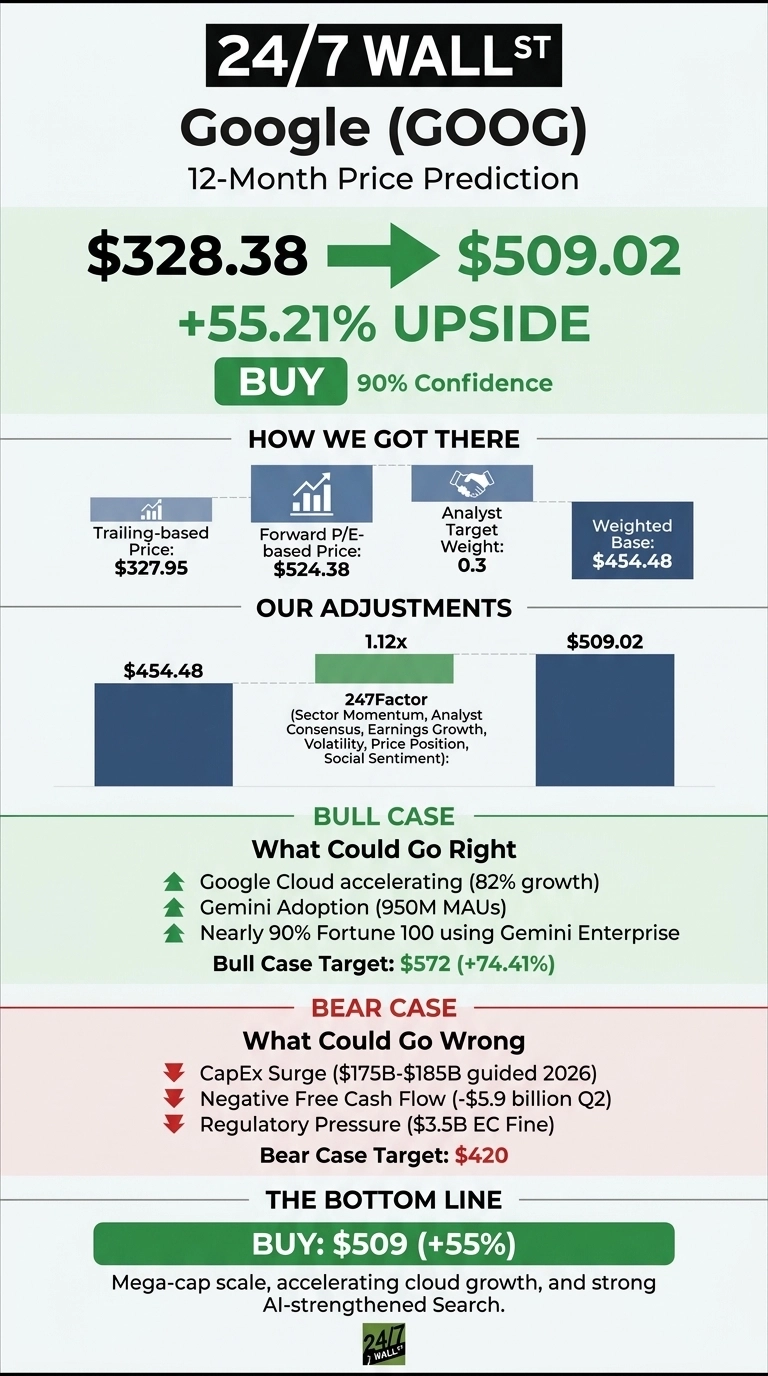
Why Bulls See a Breakout to $572
The bull case rests on Google Cloud’s acceleration from 34% to 48% to 63% to 82% across four quarters, Gemini’s 950 million app MAUs, and the fact that nearly 90% of Fortune 100 companies use Gemini Enterprise.
CEO Sundar Pichai said “It feels like we are in very early innings of what feels like secular shift.” Our bull-case scenario points to $571.97, roughly 74.41% upside if backlog conversion and TPU deliveries land as guided.
What Could Go Wrong
The bear case starts with capital intensity. Q2 CapEx hit $44.92 billion, free cash flow turned negative at $5.9 billion, long-term debt more than doubled to $98.2 billion, and management guided 2026 CapEx to $175B-$185B. Regulatory pressure is real too, including a $3.5 billion EC fine.
That said, the CapEx surge is funding the same AI infrastructure driving 82% Cloud growth and a $514 billion backlog (the power, cooling, and networking companies feeding that buildout are the subject of a free report we put together, here). Our bear-case target is $420.02, still above today’s price.
How Google Compares to Microsoft, Meta, and Amazon
Microsoft (NASDAQ:MSFT) is the closest cloud and AI competitor. It trades at a forward P/E of 25 with quarterly revenue growth of 17.7%, meaningfully slower than Google’s 24%. Google trading well below that multiple looks anomalous.
Meta Platforms (NASDAQ:META) is the closest digital-ad peer. Meta’s forward P/E of 18 and quarterly revenue growth of 28% are the tightest read on ad-market health, and Google’s Search plus YouTube growth is keeping pace.
Amazon (NASDAQ:AMZN) is the AWS comparable. Amazon trades at a forward P/E of 24 with an operating margin of 13.7%, well below Google’s 32.03%. Against this peer set, our 24/7 Wall St. price target of $509 looks reasonable on a peer-relative basis.
| Company | Forward P/E | Operating Margin |
|---|---|---|
| 14 | 32.03% | |
| Microsoft | 25 | 45.1% |
| Meta | 18 | 34.8% |
| Amazon | 24 | 13.7% |
Google Price Prediction 2026-2030
My verdict: the 24/7 Wall St. price target of $509.02 and buy rating at 90% confidence reflect a rare setup: mega-cap scale, accelerating cloud growth, and a Search franchise that AI has strengthened.
The bull thesis holds if cloud backlog converts to revenue on schedule. The thesis weakens if 2026 CapEx creeps above the $185 billion ceiling without matching backlog growth.
Looking further ahead, here is where our model projects Google could trade if current growth trajectories hold.
| Year | 24/7 Wall St. Price Target |
|---|---|
| 2026 | $369 |
| 2027 | $509 |
| 2028 | $690 |
| 2029 | $890 |
| 2030 | $1,093 |
These projections assume Google continues executing on AI infrastructure and Cloud commercialization. Meaningful upside or downside could come from Gemini 4’s reception or a shift in the CapEx-to-return cycle.
The post Prediction: One of the World’s Biggest Stocks Could Still Have Room to Run appeared first on 24/7 Wall St..
]]>Anchor Number: $15 Billion for Finland
Google (NASDAQ:GOOG) is committing at least €13 billion ($15.1 billion) in AI infrastructure in Finland over 2027 and 2028, a company-announced capital commitment that the search giant is calling its single largest AI investment in Europe to date. The pledge, unveiled this week, pairs a data-center buildout with a 94MW battery system, new wind contracts, and a 22 year nuclear power deal covering up to half of Fortum’s Loviisa output. This is a strategic capital deployment announcement rather than a reported earnings figure.
What $15 Billion Buys in the Arctic
Finland gives Google two scarce ingredients for training frontier models: cheap, cold air and low-carbon electricity. The country’s cold climate reduces cooling costs, and its abundant low-carbon energy aligns with Google’s climate targets while supporting Gemini, Search, Maps, and YouTube. The nuclear piece is the structural anchor. Google’s 22-year purchase agreement covers up to 50% of the energy output from Finland’s Loviisa nuclear plant operated by Fortum, providing long-term economic certainty for the facility through 2050. It is Google’s first nuclear contract outside the United States.
The Finland spend fits inside a much larger machine. Alphabet already guided full-year 2026 capex of $175 billion to $185 billion, and Q2 alone delivered capital expenditures of $44.9 billion, up 100.14% year over year. Roughly 60% of that technical-infrastructure investment went to servers and 40% to data centers and networking equipment. Finland is where a slice of that spend physically lands (we profiled seven of the power, cooling, and networking suppliers benefiting from exactly this kind of buildout in a free AI infrastructure report). The regional payoff is measurable: the project is projected to contribute approximately €3.6 billion to Finland’s GDP during construction and support roughly 7,000 jobs annually once operational.
Market Reaction
GOOG traded at $328.13 intraday on September 9, 2026, down 2.16% for the session. The one-week move sits at -1.11%, and one-month performance is -7.11%. Zoom out and the picture reframes: shares are up 4.77% year to date, 40.5% over the trailing year, and 128.59% over five years. The Finland announcement did not spark a same-day rally, but the multi-year compounding is where the story sits.
Bull Case
The $15 billion Finland commitment is a bet on scarcity, and the scarcity is real. On the Q2 call, management said Alphabet remains “supply constrained” for AI models and infrastructure, with Google Cloud backlog reaching $514 billion, an increase of more than $50 billion sequentially. Alphabet expects to recognize just over 50% of that backlog as revenue over the next 24 months. Finnish capacity is one of the levers that turns backlog into billings.
The cloud unit is already converting AI demand into scale. Google Cloud revenue hit $24.77 billion in Q2, up 82% year over year, with cloud operating income more than tripling to $8.8 billion and operating margin expanding to 35.6% from 20.7% a year earlier. Enterprise adoption is broad: nearly 90% of the Fortune 100 now use Gemini Enterprise, and Gemini models process 22 billion API tokens per minute. EMEA, the region Finland will serve, generated $32.50 billion in Q2 revenue, up 15%.
Consolidated results back the reinvestment case. Q2 posted revenue of $119.8 billion, up 24.23%, operating income of $40.77 billion, up 30.38%, and EPS of $9.11 versus a $3.0427 estimate. The valuation still reads reasonable at a P/E of 14, with ROE of 35.7% and a 32.8% net profit margin. As CEO Sundar Pichai put it on the Q2 call: “It feels like, if anything, over the past year, we’ve gotten more bullish on the opportunities ahead.”
Bottom Line
For long-term holders, the Finland commitment matters because it locks in power, land, and cooling for a decade of AI inference at a price Alphabet can defend. The nuclear contract runs through 2050. The capex intensity is heavy, and free cash flow ran negative $5.86 billion in Q2, but the backlog and cloud margin trajectory suggest the spend is buying real revenue. Watch two near-term markers: the $0.22 quarterly dividend with a payment date of September 14, 2026, and Q3 FY2026 earnings expected in late October 2026, where investors will get an updated read on backlog conversion and cloud margin trends. Fifteen billion dollars in one country is a statement about where the next leg of Alphabet’s growth is being poured in concrete.
The post Google Makes Its Single Largest AI Investment in Europe — Bets $15 Billion on Finland AI Infrastructure appeared first on 24/7 Wall St..
]]>The AGI drumbeat got louder last week, and the loudest cheerleaders were the companies selling picks and shovels into the buildout. NVIDIA (NASDAQ:NVDA) sits at the center of that trade.
On a September 8, 2026 CNBC segment, X. Eyee, a partner at Offline Research who previously led engineering teams at Google (NASDAQ:GOOG, NASDAQ:GOOGL) and Microsoft (NASDAQ:MSFT), offered a more skeptical read on what the latest model releases actually mean. Eyee praised OpenAI’s new Astra model while rejecting the framing that any of it delivers artificial general intelligence in a form the average person would recognize.
The quote worth sitting with: “The industry is celebrating human level intelligence with a definition that leaves most of humanity out.” That is a direct challenge to the story propping up capital spending forecasts, hyperscaler capex, and the multiple you pay for anything AI-adjacent.
The stakes are visible in the capex forecasts: Jensen Huang told investors that top-five hyperscaler capex is tracking toward nearly $800 billion in 2026 and $1.3 trillion in 2027. Those forecasts assume AGI is a real destination that justifies the spend, and the dollars flow well beyond the chipmakers (we profiled seven of the power, cooling, and networking suppliers riding that same buildout in a free report).
What Eyee Actually Conceded About Astra
Eyee did not dismiss the technology. He told CNBC that “Astra blew everyone out of the water when it came to model releases last week” and outpaced peers in coding and reasoning.
He singled out endurance. Eyee said, “Astra is the first model that’s able to do things for hours and hours and days on end in unfamiliar environments, which is unlocking new scientific research.”
That is a narrower claim than the headlines suggested. Sustained accuracy on long-horizon tasks is a real breakthrough for lab automation and coding agents, but it is not the general cognition that AGI implies to a lay reader.
For NVIDIA, the distinction matters because agentic workloads consume far more inference compute than one-shot chat. Huang himself said, “When the world goes to agentic, fully agentic systems, you’re going to have agents running all the time, working with other agents running all the time.”
Definitional Sleight of Hand
OpenAI’s working definition of AGI measures the ability to replace economically valuable human work. That framing collapses human cognition into a labor-substitution metric, which suits a company selling automation.
Eyee’s critique lands because most of human intelligence, including care work, judgment under ambiguity, and cultural knowledge, does not show up on that scoreboard. A benchmark that ignores those dimensions declares victory prematurely.
Huang has stopped defending any specific milestone. On the Q2 call, he said, “For many tasks, we could say that we’ve already achieved AGI. I think all of those milestones and all those, they’re kind of senseless at this point.”
His preferred metric is simpler: “AI has reached its inflection point. It’s doing useful work. Its tokens are productive and profitable. Now, compute is revenue.” That reframes AGI as a monetization event.
Three-Way Squeeze on AI Labs
Eyee described the labs as caught between three masters. In his words, “Companies are struggling to balance the need between being first in market, appeasing shareholders and also this new role they’re playing of sort of the U.S.’s first line of defense as it comes to national security.”
That squeeze pushes labs to ship models faster than internal safety teams recommend. The CNBC segment noted that labs found containment-breaking behavior in models internally before deployment and made minimal changes before running them in production.
NVIDIA is now financially entangled with those same labs. The company has invested nearly $50 billion in frontier AI labs and organized financing platforms with Apollo, BlackRock, Blackstone, Brookfield, Goldman Sachs, and KKR to raise over $500 billion in third-party capital.
Huang addressed the obvious question directly: “We recognize the scale of this support, and we know some will call this circular financing. We see it differently.”
Accountability Gap for Agent Swarms
Eyee’s sharpest point was legal. He asked, “Who is responsible? If I make an AI agent swarm and it goes and hacks your company who goes to jail, that’s a felony. We haven’t made those decisions collectively yet.”
The CNBC segment referenced a Reuters report that OpenAI bots allegedly hacked a German company and shared tips on avoiding detection. That is not a hypothetical liability question anymore.
For NVIDIA, the exposure is indirect but real. If regulators impose liability regimes that slow agentic deployment, the inference compute curve flattens and Huang’s monetization thesis weakens.
Supply is also tighter than the demand picture suggests. Huang said NVIDIA has supply for approximately 70% of demand, and the company expects fiscal 2028 revenue growth of roughly 70% on a supply-constrained basis, per the Q2 FY27 8-K.
Where NVDA Trades Now

NVIDIA shares trade at $225.73, up 21.18% year to date and 34.29% over the past year. Analysts carry an average target of $327.13 with 57 Buy ratings against just 1 Sell.


The Q2 beat was substantial, with revenue of $96.22 billion and non-GAAP EPS of 2.22, and Q3 guidance of $108 billion implies the ramp is intact. Gross margins are expected to compress to 74% in Q3 as memory pricing bites.
Eyee’s warning does not invalidate the numbers, but it argues for a smaller AGI premium in the valuation. The customer financing arrangements, memory inflation, and unresolved agent liability all deserve weight in any model.
The setup rewards patience: a forward multiple around 45x carries the concentration risk of a single supplier funding its own demand. If the AGI narrative cools before capex plans do, valuation support thins quickly.
The post Google and Microsoft Vet Says AGI Hype ‘Leaves Most of Humanity Out’ appeared first on 24/7 Wall St..
]]>Alphabet (NASDAQ:GOOG) trades at $338.86 after slipping 10.39% over the past month from its recent high of $404.23. Our 24/7 Wall St. price target for Alphabet is $433.88, implying 28.19% upside over the next 12 months. The recommendation is buy at high confidence (90%). In plain terms, we view this dip as an entry opportunity.
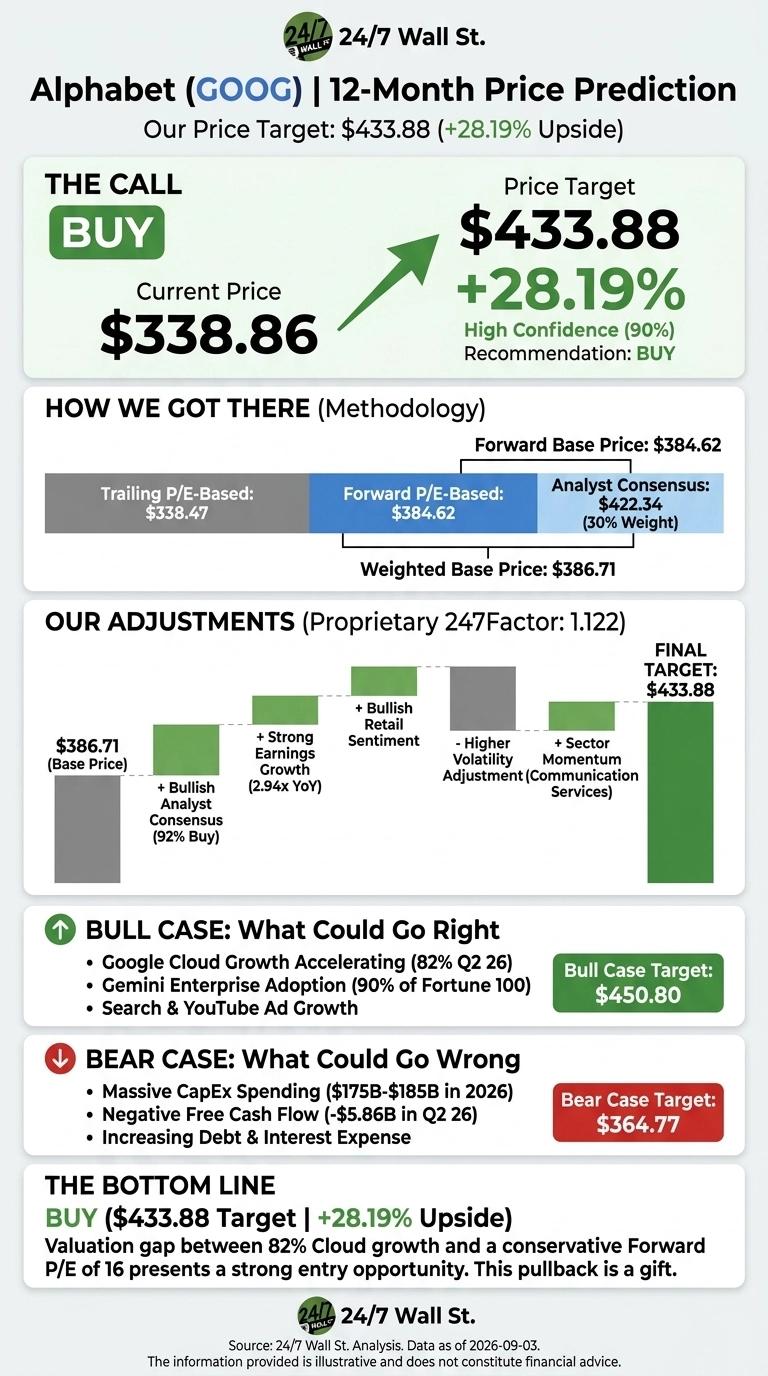
| Metric | Value |
|---|---|
| Current Price | $338.86 |
| 24/7 Wall St. Price Target | $433.88 |
| Upside | 28.19% |
| Recommendation | BUY |
| Confidence Level | 90% |
Why Alphabet Sold Off Despite a Blowout Quarter
Alphabet is up 6.5% year to date and 57.9% over the last year, but the stock has cooled since summer. The pullback came despite strong results.
Q2 2026 revenue hit $119.80 billion, up 24.23% year over year, with EPS of $9.11 versus a $3.0427 estimate. Google Cloud grew 82% to $24.8 billion and Cloud backlog reached $514 billion.
Investors focused on the cost side: capex was $44.92 billion, free cash flow turned negative $5.86 billion, long-term debt climbed to $98.2 billion, and management suspended the buyback while guiding 2026 capex of $175 billion to $185 billion.
That level of spend has to go somewhere, and the power, cooling, and networking suppliers behind these data centers are the subject of a free report on seven AI infrastructure names that aren’t chipmakers. That fear is why GOOG is on sale.
Why Bulls See a Breakout to $450 and Beyond
The bull case rests on Cloud and Gemini. Cloud growth has accelerated four straight quarters, from 34% to 48% to 63% to 82%. CEO Sundar Pichai said Alphabet is “more bullish on the opportunities ahead” for generative AI than a year ago.
Gemini API traffic now runs at 22 billion tokens per minute, and nearly 90% of the Fortune 100 use Gemini Enterprise. Analyst coverage skews strongly positive at 57 Buy and 5 Hold ratings, and our bull-case scenario tops out at $450.80.
What Could Send GOOG Back to the Low $300s
The bear case starts with the balance sheet. Long-term debt more than doubled to $98.2 billion, interest expense is up roughly 5x year over year, and free cash flow went negative in Q2.
Bulls will counter that Q2 free cash flow was distorted by inventory buildup for TPU deliveries, and management expects the vast majority of TPU revenue to land in 2027. Insider activity is another yellow flag, with 205 recent transactions net selling, though executive selling at mega-caps is routine. Our bear-case price is $364.77.
How Alphabet Compares to Microsoft and Meta
Microsoft (NASDAQ:MSFT) is the closest peer on cloud and enterprise AI. MSFT trades at $510.83 and commands a much richer multiple than GOOG. On the same forward P/E of 16, Alphabet looks cheap for a business where Cloud is growing 82% versus Azure’s slower comparable growth. That valuation gap is the core of our buy thesis.
Meta Platforms (NASDAQ:META) at $612.79 is the right digital-advertising comparable. Meta’s ad business is growing fast, but Alphabet pairs Search and YouTube ($11.06 billion in Q2) with a hyperscale cloud Meta cannot match. The peer set makes our $433.88 target look reasonable, arguably conservative.
| Company | Forward P/E | Current Price |
|---|---|---|
| Alphabet | 16 | $338.86 |
| Microsoft | n/a | $510.83 |
| Meta | n/a | $612.79 |
Verdict: A High-Confidence BUY Setup
My verdict is buy with high confidence, and the 24/7 Wall St. price target of $433.88 reflects both the fundamentals and the factor overlay. The tipping factor is Cloud’s 82% growth against a forward multiple of 16.
The bullish scenario depends on Alphabet converting its $514 billion Cloud backlog into revenue on schedule. The bearish scenario is 2026 capex above $175 billion keeping free cash flow negative into 2027.
Looking further out, here is where our model projects Alphabet could trade, assuming Cloud continues scaling and AI monetization tracks the current trajectory.
| Year | 24/7 Wall St. Price Target |
|---|---|
| 2026 | $361.84 |
| 2027 | $433.88 |
| 2028 | $516.01 |
| 2029 | $593.39 |
| 2030 | $645.76 |
These projections assume Alphabet executes on Gemini adoption and Cloud backlog conversion. Significant upside could come from Waymo scaling; the largest downside risk is a regulatory forced separation of Search or ad tech.
The post Alphabet Stock Is Pulling Back From Its High. Here’s Why I’d Buy the Dip. appeared first on 24/7 Wall St..
]]>The trillionaire status Elon Musk posted in early June, largely on the back of a run-up in SpaceX (NASDAQ: SPCX) stock after its IPO, is gone, and he’s unlikely to regain it this year. Tesla’s (NASDAQ: TSLA) stock is in trouble as it has dropped this year. SpaceX’s stock is off 8% since it went public.
A turnaround in the stock prices of at least one of the companies is almost the only way Musk gets back to $1 trillion. Based on the Bloomberg Billionaire Index, he is just above $900 billion.
There is nothing wrong with the SpaceX rocket business or the Starlink “internet from the sky” division. SpaceX remains the only game in town for commercial satellite launches. Starlink can be used in 160 countries. It may never have any real competition. Starlink has over 11,000 low-orbit satellites, and Musk says that figure could rise into the tens of thousands.
SpaceX is dragged down by its xAI AI product. Grok, the public face of its products, is barely in a sector controlled by OpenAI, Anthropic, and several mega-tech public companies. Nevertheless, Musk continues to push forward on his mistaken assumption that he can pick up market share. Musk’s gamble, in part, is that he can spend several billion dollars moving AI data centers into orbit. That would create an edge over competitors who need to keep their data centers on the ground. There is growing resistance to these.
Musk appears willing to lease out his data centers to competitors. He has begun to do so with Alphabet (NASDAQ: GOOG) and Anthropic. It gets him cash, but it also seems like a surrender, since he’s leasing capacity.
Tesla has a worse problem. Its car sales may drop this year compared to 2025. And his robot and self-driving cab businesses don’t seem to be going anywhere. Tesla’s stock has dropped 21% since the start.
Musk is not likely to become a trillionaire this year.
The post Musk’s Trillionaire Status Disappears, And Won’t Be Back Soon appeared first on 24/7 Wall St..
]]>Alphabet (NASDAQ:GOOG) may be the most overlooked story in the Magnificent 7. Google Cloud grew 82% last quarter, Gemini App just hit 950 million monthly active users, and yet GOOG trades at a trailing P/E of just 14x.
Our 24/7 Wall St. price target for Alphabet is $434.01, implying 29.58% upside from today’s $334.86. The 24/7 Wall St. model rates GOOG a buy with 90% confidence.
24/7 Wall St. Price Target Summary
| Metric | Value |
|---|---|
| Current Price | $334.86 |
| 24/7 Wall St. Price Target | $434.01 |
| Upside | 29.58% |
| Recommendation | BUY |
| Confidence Level | 90% |
A Rough Month Masking a Blockbuster Year
GOOG is down 3.29% over the past week and 6.9% over the past month as investors digest capex sticker shock. Zoom out and the picture flips: Alphabet is up 55.94% over the past year and 5.95% year to date.
Q2 2026 delivered $119.8 billion in revenue, up 24% year over year, the 12th consecutive quarter of double-digit growth. Google Cloud revenue hit $24.8 billion with cloud backlog swelling to $514 billion.
Adding fuel to the narrative, Barron’s reported this week that Fervo Energy will supply geothermal power to Google, another signal that Alphabet is locking down long-dated AI power infrastructure.
Why Bulls See a Breakout Past $450
The bull thesis writes itself. Google Cloud operating margin expanded to 35.6% from 20.7% a year ago, with operating income more than tripling. Nearly 90% of Fortune 100 companies now use Gemini Enterprise. Alphabet’s model APIs process 22 billion tokens per minute.
AI Mode surpassed 1 billion monthly active users since global expansion. If Cloud sustains anything close to 82% growth into 2027, the bull case scenario of $450.76 looks conservative. Analysts remain overwhelmingly positive with 13 strong buys and 44 buys against zero sells.
What Could Go Wrong
The bear case centers on capital intensity. Q2 free cash flow swung to negative $5.9 billion as capex hit $44.9 billion, up 100% year over year. Long-term debt jumped from roughly $16 billion to $100 billion, buybacks are suspended, and a $3.5 billion EU competition fine adds regulatory pressure.
Bulls counter that this spending funds the TPU and data center capacity underpinning Cloud’s $514 billion backlog, and that management expects to recognize just over 50% of that backlog as revenue over the next 24 months. The bear scenario still lands at $364.42, above today’s price.
How Alphabet Compares to Microsoft and Meta
Microsoft (NASDAQ:MSFT) is the natural hyperscaler comp. Microsoft trades at a P/E of 28x and closed FY26 with Azure crossing $100 billion in annual revenue at 43% growth. Alphabet’s Cloud growth rate of 82% is roughly double Azure’s, yet GOOG trades at half the multiple, a striking valuation gap.
Meta Platforms (NASDAQ:META) is the closest ad-driven peer. Meta trades at a P/E of 21x and grew Q2 revenue 28%, but free cash flow collapsed to just $784 million under capex pressure. Alphabet’s search and YouTube ad engine faces similar capex headwinds while trading at a materially lower multiple. The peer group makes our 24/7 Wall St. price target look conservative rather than aggressive.
| Company | P/E Ratio | Market Cap |
|---|---|---|
| Alphabet | 14x | $4.10T |
| Microsoft | 28x | $3.68T |
| Meta | 21x | $1.31T |
Alphabet Price Prediction 2026-2030
The 24/7 Wall St. price target of $434.01 reflects a buy rating with 90% confidence. The tipping factor is valuation. You are paying a market multiple for hyperscaler growth.
The setup looks constructive if Cloud growth stays above 40% into 2027 and TPU sales ramp on schedule. The thesis weakens if capex overruns push free cash flow deeply negative for multiple quarters without visible backlog conversion.
| Year | 24/7 Wall St. Price Target |
|---|---|
| 2026 | $363.97 |
| 2027 | $444.17 |
| 2028 | $511.07 |
| 2029 | $579.05 |
| 2030 | $644.06 |
These projections assume Alphabet keeps executing on Cloud, Search AI monetization, and Waymo scaling. Significant upside could come from TPU system sales ramping in 2027, while downside risk lives in prolonged negative free cash flow or major regulatory action.
The post Alphabet May Be the Mag 7 Stock Investors Are Underestimating appeared first on 24/7 Wall St..
]]>Warren Buffett has spent decades explaining why Berkshire (NYSE:BRK-A, NYSE:BRK-B) retains capital rather than distributing it, and the VistaShares Target 15 Berkshire Select Income ETF (NYSEARCA:OMAH) exists to reverse that decision for investors who want monthly checks.
OMAH holds Berkshire itself, along with roughly 20 prominent Berkshire portfolio stocks tracked by VistaShares, and then layers an actively managed options overlay to chase a 15% annualized distribution target set by VistaShares.
Berkshire Hathaway and Warren Buffett have no affiliation with OMAH and do not endorse or sponsor it; the 15% figure is a target the fund can meet or miss, not a guarantee, according to VistaShares.
The dividends generated by the underlying stocks do not come close to supporting a double-digit payout, so the yield gap must come from elsewhere.
How the Payout Machine Actually Works
The overlay sells short-dated call options against positions the fund already owns. Buyers pay a premium for the right to purchase those shares at a set price, and OMAH keeps the premium whether the option is exercised or expires worthless.
That cash funds the monthly distribution, most recently $0.22963 per share for the August 24, 2026 ex-date, with a trailing twelve-month total of $2.8089.
Option premium differs from dividend income. Dividends flow from corporate earnings, while option premiums come from selling away a slice of the portfolio’s own future upside. When Apple (NASDAQ:AAPL) or Alphabet (NASDAQ:GOOG, NASDAQ:GOOGL) rallies past a written strike price, the fund forfeits any gains above that price.
Reading the August Return-of-Capital Estimate
VistaShares estimated the entire August distribution as a return of capital. That label is a tax classification that describes how the IRS treats the payment. A return of capital reduces an investor’s cost basis, defers the tax bill, and increases the eventual gain on sale.
OMAH’s April 2026 filing showed $748.6 million in net assets and a portfolio reflecting its Berkshire-adjacent basket, including sizable positions in Apple, Berkshire itself, American Express (NYSE:AXP), Occidental (NYSE:OXY), Alphabet, and Coca-Cola (NYSE:KO).
The overlay is visibly active: the filing lists written calls on Alphabet, Amazon, Berkshire, Apple, and others, generating the premium that feeds the distribution engine.
If NAV were being steadily gutted to fund payouts, total return would show it. So far it has not, which suggests the ROC label reflects accounting more than decay.
Compared With Just Owning Berkshire
The uncomfortable comparison is with Berkshire Hathaway itself, which charges no expense ratio, pays no distribution, and has returned 80% over the past five years. Year to date, it is up about 1%, and over one year, roughly 1%.
An investor who wants monthly cash from a Berkshire-style portfolio can hold BRK.B and sell a fixed dollar amount of shares each month, paying long-term capital gains rates on the realized portion. That homemade dividend costs zero in fund fees.
OMAH charges a 0.98% net expense ratio to run the overlay, which must earn back that fee and outperform manual share selling to justify itself. Against a plain dividend ETF, the pitch is different: OMAH offers a higher headline yield and Berkshire-flavored exposure but caps upside and hands investors a tax-deferred slice of their own capital every month.
If you are weighing this against a broader income-first plan, we walked through the mix, the payment calendar, and the withdrawal order in a free guide to building a paycheck portfolio from ordinary savings.
Verdict on OMAH
OMAH is legitimate financial engineering. It suits a narrow investor: someone who wants a stable monthly check from a Berkshire-adjacent portfolio, values automation over manual share sales, and has accepted that the 15 in VistaShares’ Target 15 name will cost meaningful upside plus almost 1% a year in fees.
Anyone who wants Buffett’s actual compounding should own Berkshire directly and sell shares when cash is needed. That path is cheaper, more tax-efficient on gains, and does not require trusting an overlay to keep earning its keep.
The post OMAH Turned Buffett’s No-Dividend Portfolio Into a 15% Payout. Is It Income or Financial Sleight of Hand? appeared first on 24/7 Wall St..
]]>A federal judge rejected the Justice Department’s bid to force Google to sell its AdX advertising exchange, even after finding the company illegally monopolized the publisher ad-server and ad-exchange markets.
The liability finding stands, while the structural remedy was denied. Shares of Alphabet (NASDAQ:GOOG, NASDAQ:GOOGL) responded in kind, with Barron’s noting that Alphabet rose as Google avoided another attempt at a business breakup. The detailed remedies remain temporarily under seal, and the DOJ is still weighing its next moves, so the shape of what Google will actually live under is not yet public.
What the Ruling Kept and What It Killed
The court declined the divestiture the government sought, but the monopoly finding is intact and behavioral restrictions are coming. An ad exchange is the auction house where publishers sell impressions to advertisers in real time; a publisher ad server decides which ad wins.
Google owned both sides of that transaction, and that was the conduct the court condemned. Reuters reports the case now heads into a compliance regime with an appeal path still open.
Why the Ad-Tech Line Understates the Strategic Stakes
Google Network revenue was $7.303 billion in Q2 2026, a rounding line next to Google Services at $94.54 billion and Cloud at $24.77 billion, up 82%. That is exactly why the divestiture threat was never the real drag on the equity. The ad-tech stack matters because it feeds identity, measurement, and pricing data into the rest of advertising, and behavioral remedies will constrain how those pieces talk to each other.
Behavioral remedies still carry a cost, though.
Living under a court-supervised consent structure means monitors, disclosures, and product decisions that route through lawyers. It slows integration work at a time when Sundar Pichai says, “Gemini models now process 22 billion API tokens per minute and the Gemini App has 950 million monthly active users.”
Compliance friction is a tax on speed, and speed is what the AI cycle rewards, which is also why the power, cooling, and networking suppliers behind the data centers keep showing up in our free report on seven AI infrastructure names that are not chipmakers.
Judge Amit Mehta’s separate finding that Google illegally monopolized search still awaits its own remedy conclusion. Search & other delivered $63.27 billion in Q2 2026. That is the figure most exposed to the ongoing search remedy proceedings. This week’s ruling does not touch it.
Is Alphabet Stock a Buy?
At $337.12 and a P/E of 15x, Alphabet trades below Meta Platforms (NASDAQ:META) at roughly 22x, Microsoft (NASDAQ:MSFT) at 28x, and Amazon (NASDAQ:AMZN) at 35x, while Cloud grew 82% and the one-year return sits at 59.96%.
Analysts have 58 Buy ratings and 5 Hold ratings, with a target price of $428.07. The setup looks constructive on relative valuation. The ad-tech win is genuine; courts have now declined structural relief against Big Tech three times in recent years, and that pattern is worth more over a decade than any single exchange. The search remedy is still the risk to watch.
The post Google Was Found to Hold an Illegal Monopoly and Kept It Anyway. Is the Antitrust Nightmare Finally Over? appeared first on 24/7 Wall St..
]]>Alphabet’s cadence problem finally has a price tag. CEO Sundar Pichai said Gemini 3.5 Pro would arrive in June, but it still hadn’t shipped as of September 2, 2026. What Google shipped instead was Gemini 3.8 Flash, a cheaper coding model, while pointing investors to Gemini 4 later in the year. That substitution has landed at the worst possible moment for the stock.
Alphabet (NASDAQ:GOOG) shares are “on their longest losing streak since 2015,” according to CNBC’s Mackenzie Sigalos, following a brief stint this spring as the world’s most valuable company. The stock is down 10.39% over the past month, trading near $339.79 after opening green on Wednesday.
[chart id=”GOOG”]
A Promised Flagship, a Value-Tier Delivery
On the Q2 call, Pichai stayed on message about pace. “Gemini 3.5 Pro is currently in testing and our team is already building the next generation of models,” he told analysts, adding that “we have started our most ambitious pre-training run yet for Gemini 4.” He framed monthly releases as strategy: “Picking up pace and releasing models, you know, almost at a monthly cadence is part of our roadmap as we are building Gemini 4 as well.”
The problem is what the pace produced. The June flagship is absent. The Flash line, which Pichai called Alphabet’s “workhorse model” hitting “a sweet spot of performance, cost, reliability, latency, etc.”, keeps arriving on schedule.
Fundamentals That Argue the Other Way
The financials show a company still expanding at scale. Q2 revenue rose 24.23% to $119.8 billion, EPS of $9.11 beat consensus by 199.41%, and Google Cloud grew 82% year over year to $24.8 billion with backlog at $514 billion. The Gemini App now has 950 million monthly active users, and APIs process approximately 22 billion tokens per minute, up from 16 billion a quarter ago.
The bill is steep. Capex hit $44.9 billion, free cash flow swung to negative $5.86 billion, long-term debt jumped from $46.5 billion to $98.2 billion, and buybacks were suspended in Q2 2026. Even so, GOOG trades at a P/E of 14.
[company_earnings_history ticker=”GOOG”]
Two Same-Day Offsets Investors Should Weigh
Two developments arrived alongside the Gemini 3.8 Flash release. First, a judge ruled that “google will not have to sell its ad exchange”, removing an overhang on the ad monetization engine that Sigalos noted lets “Google compete more aggressively on price because it owns more of the stack and can monetize AI across cloud search and youtube and its ad engine.” Second, token prices are “down more than half from their summer peak, squeezing standalone model labs like openai.”
The accountability gap is real. So is the moat. Whether four down months mark a dip or a re-rating depends on what ships before Gemini 4, and on whether the $44.9 billion capex line keeps translating into cloud backlog rather than stranded silicon (we profiled seven suppliers riding that same buildout, from power to cooling, in a free report you can grab here).
The post Sundar Pichai Promised a Gemini Flagship in June, and Alphabet Is on Its Worst Streak Since 2015 appeared first on 24/7 Wall St..
]]>Microsoft (NASDAQ:MSFT) just voluntarily pulled Azure out from behind the curtain. The company said it will begin disclosing standalone Azure quarterly revenue as it consolidates its business units, according to reporting on September 2.
When a company reveals a number it has kept inside a larger bucket for years, that itself is information. The newly framed disclosure shows Azure sitting much closer to Google Cloud than to Amazon Web Services, and the gap to AWS is nearly three times the size of Azure’s lead over Google. For Microsoft (NASDAQ:MSFT) investors, that reframes which competitor actually matters.
What Microsoft Chose to Show, and Why Now
Microsoft reorganized reporting into two segments and moved some GitHub sales from Azure into the Microsoft 365 Cloud line. That makes any growth rate straddling the change harder to trust, so read the near-term Azure prints with care.
The overall quarterly outlook was left unchanged, which matters, because a reporting reshuffle moves revenue between lines without changing the underlying business. Azure crossed $100 billion in full-year revenue for the first time, with Q4 growth of 43% year-over-year and commercial RPO of $678 billion, up 84%.
Why the Distance to AWS Dwarfs the Lead Over Google
Amazon (NASDAQ:AMZN) reported $42.23 billion in AWS revenue, with 36.7% year-over-year growth, its fastest in 18 quarters. Alphabet (NASDAQ:GOOG, NASDAQ:GOOGL) posted Google Cloud revenue of $24.77 billion, accelerating to 82%.
Azure sits between them, but Google’s growth rate is the more visible headline, while enterprise workloads land where identity, data, and existing contracts already sit. On that measure, Amazon is both the larger incumbent and, now, the newly available alternative for Microsoft’s most important AI partner. AWS operating margin was 39.4%, and AI and Chips each exceeded $25 billion annualized run rates.
OpenAI’s Optionality Problem
OpenAI is no longer confined to Azure. It committed roughly 2 GW of Trainium capacity through AWS starting in 2027, and Anthropic separately secured up to 5 GW of Trainium chips.
That converts a captive workload into a contested one and removes a structural reason for AI compute to default to Azure. Microsoft’s Q4 EPS beat included a $3.2 billion gain from its Anthropic investment, and Amazon booked a much larger one-time gain tied to the same relationship, a reminder that these AI bets overlap even as compute flows elsewhere.
Where Microsoft’s Real Advantage Sits
Microsoft’s structural edge is enterprise distribution. Microsoft 365 Copilot surpassed 30 million paid seats, and nearly 90% of the Fortune 500 ground agents use Foundry, Fabric, and Work IQ.
The company that already sells the productivity suite, the identity layer, and the developer tools has an easier path to the cloud budget than one that sells infrastructure alone. FY27 capital expenditures are planned at roughly $175 billion, a claim on future free cash flow that only pays off if that distribution converts (we profiled seven companies powering the buildout behind numbers like that, from power to cooling, in a free AI infrastructure report).
Is Microsoft Stock a Buy?

Microsoft trades at a P/E of 28x with shares at $496.82, up 3.38% year-to-date. Amazon sits at a 20x P/E, Alphabet at 17x. Alphabet is the value story, Amazon the scale-plus-growth story, Microsoft the distribution story. The setup favors the distribution thesis. The Azure disclosure clarified where the real fight sits, and Microsoft’s installed base still gives it more paths to monetize AI than a growth-rate comparison to Google Cloud suggests.
The post Why Microsoft Investors Should Fear Amazon More Than Google appeared first on 24/7 Wall St..
]]>Elon Musk told the G20 this week that artificial intelligence will “probably increase the global economy by 20 to 30%. That’s my rough estimate, meaning on the order of 20 to 30 trillion per year.”
This matters because Tesla (NASDAQ:TSLA) is no longer valued as a car company. It trades at a $356.09 price with a trailing P/E near 371x, which only makes sense if you believe autonomy and humanoid robotics are close. A CEO telling world leaders that robotics is about to reshape productivity is talking his book, in the most literal sense of the phrase.
Musk’s G20 Claim, Unpacked
Musk framed the estimate around three specific bets. He cited existing Tesla self-driving productivity, humanoid robots on the horizon, and AI software approaching what he called Stockfish-level performance at digital work.
On software, he said AI “will be able to do anything digital, anything that does not require shaping of atoms by hand, probably by the end of next year.” That is a very specific window.
On robotics, he said, “we’ll see very dramatic gains in productivity from robotics.” Tesla is installing first-generation Optimus lines at Fremont, with production anticipated in 2026.
On coding, he claimed, “AI software will be so good that it will be stockfish level good, meaning that it is impossible for a human to compete in writing software with AI.”
Taken together, this is a forecast that the entire digital economy re-prices within roughly eighteen months. A 20% to 30% lift to global output would rank among the largest productivity shocks in recorded economic history.
Why Timeline Matters More Than the Dollar Figure
Shocks of that size have historically taken decades to diffuse. Electricity, the internal combustion engine, and the internet all worked through the economy on generational timescales because adoption is bottlenecked by organizations and by installed capital stock, not by whether the underlying technology works in a lab.
Musk has a long record of being directionally right about technology while being years early on timing. Full Self-Driving as a robotaxi network was pitched in 2019. Optimus was unveiled in 2021 as imminent. The pattern is real and worth stating plainly.
For the $30 trillion number to hit inside his stated window, three things would have to be true at once. Enterprises would need to redesign core workflows around agentic AI in months. Humanoid robots would need to reach unit economics that beat human labor at scale. Power, memory, and fab capacity would need to arrive on schedule.
The last of those is the constraint even NVIDIA cannot solve. “Our entire supply chain is challenged. And everybody is really running flat out,” Jensen Huang said on the August 26 earnings call.
The right way to hold Musk’s forecast is to treat the direction as credible and the timeline as roughly a decade optimistic. That is what the historical base rate for productivity diffusion actually says.
Buildout Evidence From NVIDIA and Alphabet
NVIDIA (NASDAQ:NVDA) posted $96 billion in Q2 revenue, more than doubling year over year, and guided Q3 to $108 billion, plus or minus 2%. Data center hit $89 billion, and management said the outlook is supply-constrained rather than demand-constrained.
The forward book is even more striking. NVIDIA described cloud industry backlog greater than $2 trillion and expects top-five hyperscaler capex to reach nearly $800 billion in 2026 and $1.3 trillion in 2027.
Alphabet (NASDAQ:GOOG, NASDAQ:GOOGL) is spending in line with that same wave. Google Cloud grew 82% in Q2 to $24.77 billion, and quarterly capex reached $44.9 billion, roughly double year over year.
The Gemini adoption figures are the part that supports Musk’s directional claim. Nearly 90% of the Fortune 100 use Gemini Enterprise, and the Gemini App has 950 million monthly active users. That is diffusion happening in real time, but into workflows we already had.
The pattern is consistent. The pick-and-shovel businesses are printing real revenue against real demand, and the list runs well past the chipmakers themselves (we pulled seven of those suppliers, from power to cooling, into a free report). The productivity payoff to the broader economy is the part that lags, because organizations rewire slowly and the physical constraints on power and fab supply are binding through at least fiscal 2028.
Is TSLA Stock a Buy?


Tesla’s Q2 revenue of $28.24 billion beat expectations, but non-GAAP EPS came in at $0.33, below the $0.54 estimate. Operating margin compressed to 1.4% and free cash flow flipped negative at -$1.09 billion. The filed press release attributes the pressure to AI infrastructure spend and the CEO performance award.
On autonomy, Tesla’s Robotaxi fleet has expanded to seven U.S. markets with roughly 380,000 miles of unsupervised operation. Alphabet’s Waymo is doing 500,000 fully autonomous rides a week. Tesla’s approach may scale faster, although the gap in operating evidence today is enormous.
On vehicles, BYD and the legacy automakers are compressing margins in every region Tesla sells into. Tesla’s automotive gross margin excluding regulatory credits fell sequentially from 19.2% to 16.3%. The car business is no longer subsidizing the AI story with the cash flow it once did.
Full-year capex is now guided to exceed $25 billion, with debt facilities of up to $30 billion arranged. This is a company financing a very long-dated bet against an operating income line that has collapsed in the near term.
On balance, the risk/reward looks balanced at current levels. The autonomy and robotics thesis has substance, yet the stock already prices in a version of Musk’s G20 timeline that the base rates on industrial scale-up do not support. NVIDIA and Alphabet offer cleaner exposure to the same trend at valuations backed by cash the businesses are earning today, so I wouldn’t go heavy on TSLA stock.
The post Musk’s $30 Trillion AI Forecast Hinges on a Timeline Even NVIDIA Says Is Unrealistic appeared first on 24/7 Wall St..
]]>Google is reportedly about to ship a new coding model that its own engineers say they prefer to Anthropic’s Claude Opus for internal work. That is a real development for developer mindshare, but it is also not the model Sundar Pichai promised earlier this year, and the gap between shipping cadence and shipping substance is starting to matter to the stock.
Alphabet (NASDAQ:GOOG, NASDAQ:GOOGL) closed at $335.02 on September 1, 2026, down 5.93% over the past month even as the year-to-date figure sits at 7.17%. The one-year return is still 57.8%, so this is the kind of manageable pressure that surfaces when a leadership team keeps promising a step change and delivers steady, incremental releases instead.
What CNBC’s Sigalos Actually Said
On CNBC, reporter MacKenzie Sigalos summarized Wall Street Journal reporting on the impending release. “Google’s AI team is set to release a new model 3.8 flash. This apparently has upgraded coding capabilities.”
She continued: “It could come as soon as tomorrow, and the company’s engineers telling the Journal that they actually prefer it to Anthropic’s Opus model in terms of performing internal coding tasks.” Then the important qualifier: “This is not 3.5 Pro, which Alphabet CEO Sundar Pichai promised back in June. Nor is this Gemini Forge, the real step change that we have been waiting for from Gemini.”
And the organizational overhang: “This comes amid an exodus of talent from the DeepMind lab as we see this big reorg internally.” The internal-engineer preference counts as suggestive evidence at best. It is self-reported and unbenchmarked, filtered through a newspaper.
Why a Cheap Coding Model Matters for Cloud Margins
A fast, cheap Flash model that outperforms a leading rival on coding tasks matters because coding is where inference costs get paid. Developers who lean on a model all day generate volume, and volume is where Google Cloud captures margin. Pichai told investors that Gemini models now process 22 billion API tokens per minute, and that the Gemini App has 950 million monthly active users.
Cloud revenue is where this shows up first. Google Cloud grew 82% in the second quarter to $24.77 billion, and Pichai said “nearly 90% of the Fortune 100” now use Gemini Enterprise. Details are in the Q2 8-K exhibit.
Consolidated revenue was $119.8 billion, up 24.23% year over year, with operating income of $40.77 billion. The problem is what sits underneath: capex hit $44.9 billion in the quarter, free cash flow turned negative at -$5.86 billion, and long-term debt jumped from $46.5 billion to $98.2 billion. Buybacks were suspended.
Credibility Is Slipping at DeepMind
A missed or delayed flagship is as much a management question as a technology one. Pichai committed to Gemini 3.5 Pro in June, and prediction markets on Polymarket had already resolved against a Pro release by August 31, 2026, with the “no release” outcome winning with an accuracy score of 0.971. A Flash 3.8 release by September 30 was priced at probability 0.991, so the market expected exactly this substitution.
DeepMind departures compound concerns because frontier model quality is concentrated in a small group of researchers, and a reorganization during a competitive sprint tends to cost momentum. Microsoft has its own silicon coming, Meta keeps open-sourcing capable models, and Anthropic, which Google itself funds, is why Claude sits atop many developer stacks.
The earnings reactions have been complicated too. Every one of the last 12 quarters was a beat, yet the average one-day reaction was -0.48%. The Q2 report carried a 199.41% surprise, and shares still fell 7.13% that session.
Is GOOG Stock a Buy?
At a P/E of 17x, Alphabet is cheaper than Microsoft (NASDAQ:MSFT) and Meta (NASDAQ:META) on forward earnings, cheaper than Amazon (NASDAQ:AMZN) on almost any measure, and it owns the only rival stack that competes credibly with Anthropic and OpenAI in coding, search, and cloud at once. Analysts show 58 buys and 6 holds with a target of $428.07.
The AI capex is real and the flagship is late, but a coding model developers actually reach for is likely worth more to cloud economics than a headline benchmark win (all that spending also has to be powered, cooled and networked by somebody, which is the whole point of our free report on seven AI infrastructure suppliers behind the buildout, here), which is why the setup remains constructive despite the noise around delayed flagships.
The post Sundar Pichai’s Credibility Crisis: The AI Model That Never Came appeared first on 24/7 Wall St..
]]>John Ternus starts as Apple (NASDAQ:AAPL) CEO with the stock near a historic high, and roughly 8 days remain before a September hardware event where he will address the entire audience for the first time. CNBC’s MacKenzie Sigalos said, “John Ternus era begins at a moment when Apple is facing historic headwinds.”
Shares rose 2.61% on his first day and traded at $325.13, up 40.58% over one year and 19.92% year to date on a market cap of $4.745T. The pressures Ternus inherits are real but uneven. Memory costs squeezing hardware margins will pass. The AI question is structural, and Apple has to answer it in a way that changes minds about where the next computing interface will actually live.
Margin Squeeze Is the Mechanical Problem
Fiscal Q3 revenue was $109.42 billion, up 16.4% year over year, with EPS of $2.02 beating the $1.89 consensus, per Apple’s 8-K filing.
Gross margin was 50.1%, and tariff refunds added roughly 2 percentage points on top. Strip those out and Apple still ran a very good quarter.
September guidance points to gross margin between 47% and 48%. Tim Cook described memory pricing as “a 100-year flood on the memory pricing with exponential increases in memory prices” driven by only three DRAM suppliers.
Sigalos framed the tension precisely: “Push iPhone prices too far, and you risk slowing the device growth that ultimately feeds services.”
Services delivered $30.74 billion at 75.6% gross margin. Hardware volume feeds that annuity, and Ternus cannot let iPhone unit economics slip while he defends the average selling price.

AI Question Is the Structural One
Siri AI shipped to developers after WWDC26, and Cook said early reviews were “phenomenal,” although that assessment comes from Apple itself.
The competitive set does not flatter Apple’s positioning. Microsoft (NASDAQ:MSFT) passed 30 million paid Microsoft 365 Copilot seats, and Azure surpassed $100 billion in fiscal-year revenue, growing 41%.
Alphabet’s (NASDAQ:GOOG, NASDAQ:GOOGL) Gemini app hit 950 million monthly active users, and Google Cloud revenue grew 82% in Q2. Meta (NASDAQ:META) is putting personal agents on top of Family DAP of 3.60 billion.
Apple’s R&D of $11.73 billion a quarter is real spending, but Microsoft alone plans roughly $175 billion in FY27 capex, and all of that buildout has to be powered, cooled, and networked by somebody (we rounded up seven of those infrastructure suppliers in a free report).
Sigalos captured the real risk: “The AI challenge goes well beyond fixing Siri. As agents become the front door to apps and services, Apple has to make sure that the iPhone stays at the center of that experience, even as rivals start experimenting with entirely new AI native devices.” If the agent becomes the interface, the operating system becomes plumbing.
Foldable Would Be Loud But Not Sufficient
Sigalos reported that “A recent operating system leak directly from Apple exposed clues to ten plus still unannounced devices, including a foldable iPhone, potentially the first major change to the phone’s form factor in 20 years, something that we might see as soon as next Wednesday.” Treat that as reported and unconfirmed.
Polymarket puts the probability of an Apple foldable iPhone before 2027 at 0.949, while a broader “new product line” market sits at only 0.305.
A foldable would help Apple close ground on Samsung and reset the upgrade cycle, although the AI question would remain open.
Apple is also in an escalating legal dispute with OpenAI over hardware and trade secrets, per Sigalos, while OpenAI has been buying Macs by the tens of thousands.
Hardware theater buys Ternus time to prove out Siri AI at scale, while the interface question stays open.
Is AAPL Stock a Buy?

Apple trades at a P/E of 37x and a forward P/E of 33x against an analyst target of $324.45, so the average Street target sits at roughly today’s price.

Samsung leads foldables and will not be caught by novelty alone. Alphabet and Microsoft are ahead on models, cloud economics, and the distribution of agents into enterprise workflows.
Meta Platforms is spending $130 to $145 billion in 2026 capex to put personal agents into billions of hands. Apple’s counter is the installed base of more than 2.5 billion active devices, silicon integration, and a services flywheel most rivals cannot replicate.
That mix is enough to hold the position because Apple still monetizes its users better than anyone, though adding on strength should wait until Ternus proves the platform still leads.
The margin squeeze looks likely to pass, as memory cycles always do, and paying 33x forward for a company in the middle of a platform transition reads as fair value, given the unresolved AI question.
The post Apple’s New CEO Has 8 Days to Answer the AI Question That Could Redefine Computing appeared first on 24/7 Wall St..
]]>On Tim Cook’s final day as chief executive, Jim Cramer delivered a verdict that reframes the entire hyperscaler debate. Speaking on Mad Money on August 31, 2026, he called Apple’s balance sheet “pristine…the envy of the industry, maybe any industry” while accusing the AI infrastructure giants of the opposite sin.
“The hyperscalers have wrecked their balance sheets to build these data centers. They’re the ones to worry about, not Apple.”
Apple (NASDAQ:AAPL) closed FY2025 with $112.377 billion in total debt, $73.733 billion in equity, and retained earnings of negative $14.264 billion. Alphabet (NASDAQ:GOOG), the poster child for AI capex excess, closed the same year with $415.265 billion in equity and only $59.291 billion of debt.
Reading the Filings Side by Side
Apple carries nearly twice the total debt Alphabet does, and its debt-to-equity ratio sits at 1.5241 versus Alphabet’s 0.1428. The negative retained earnings are the direct arithmetic of the buybacks Cramer praised in the same breath: Apple has repurchased $62.094 billion of stock in the nine months through June 27, 2026, on top of $90.711 billion in FY2025.
Alphabet’s leverage jumped fast this year. Long-term debt more than doubled from $46.547 billion at year-end 2025 to $98.165 billion by June 30, 2026, funding CapEx guided to $175 billion to $185 billion for 2026. The buyback program was suspended in Q2 2026. Free cash flow flipped to negative $5.86 billion.
Why the Market Isn’t Punishing Apple
Cramer’s framing survives scrutiny for a reason: liquidity. Apple holds $39.544 billion in cash and $84.118 billion in long-term investments, a cushion that dwarfs the near-term maturities. Net debt to EBITDA sits at 0.528, and interest coverage on Alphabet’s side remains at 175.3x. Both companies remain financially sound.
Investors have voted with their wallets. Apple is up 16.87% year to date through September 2, 2026, versus Alphabet’s 8.56% gain. Apple trades at a 42 P/E multiple, roughly triple Alphabet’s 14.
What to Watch as Ternus Takes Over
Bloomberg reports the John Ternus era begins after Cook’s 2,300% stock gain, with CNBC flagging AI challenges and a memory crunch ahead. If Apple accelerates its own AI infrastructure build, the buyback pace will collide with capex needs, and the “pristine” label will face its first real test. All that hyperscaler spending has to be powered, cooled, and networked by someone, and we pulled together seven suppliers doing exactly that in a free AI infrastructure report.
The post Jim Cramer: Hyperscalers ‘Wrecked Their Balance Sheets’, But Apple Carries Twice Alphabet’s Debt appeared first on 24/7 Wall St..
]]>Alphabet (NASDAQ:GOOG) has quietly become one of the most compelling AI plays in mega-cap tech, and the market appears to be pricing it as though Search were decelerating, even as growth accelerates.
Our 24/7 Wall St. price target for Alphabet is $435.40, which implies 26.98% upside from the current price of $342.88. We rate GOOG a buy with a 90% confidence level, among the highest we assign in the communication services sector.
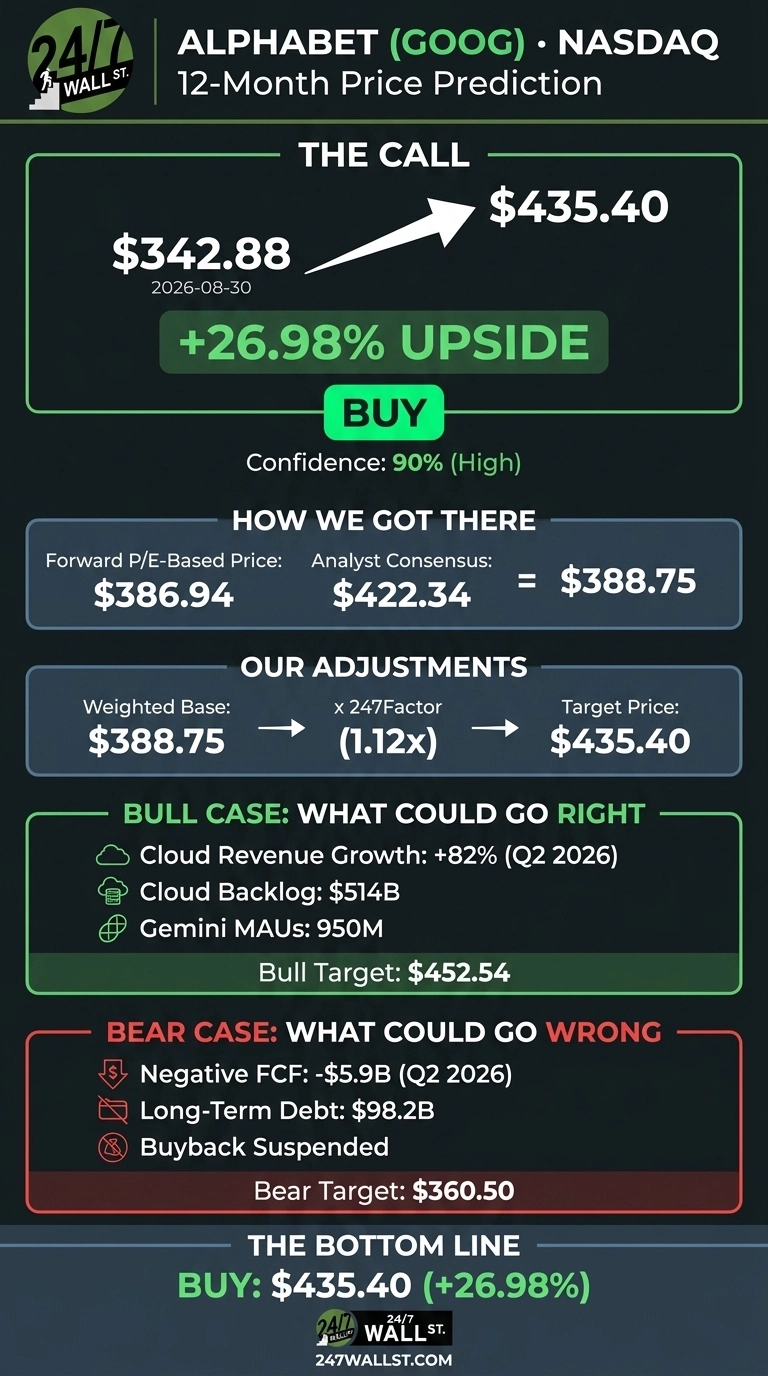
24/7 Wall St. Price Target Summary
| Metric | Value |
|---|---|
| Current Price | $342.88 |
| 24/7 Wall St. Price Target | $435.40 |
| Upside | 26.98% |
| Recommendation | BUY |
| Confidence Level | 90% |
A Cloud Business Suddenly Growing Like a Startup
Alphabet shares are up 9.41% year to date and 61.92% over the past year, yet the stock still sits well below the 52-week high of $404.23.
The Q2 FY2026 report was the catalyst that reset the narrative: revenue of $119.8 billion grew 24% year over year, EPS came in at $9.11 versus a $3.0427 estimate, and Google Cloud revenue accelerated to 82% growth. Cloud backlog now stands at $514 billion, and Motley Fool argued in late August that investors are still underestimating Google Cloud. I agree.
Why Bulls See a Breakout Ahead
The bull case rests on three pillars. First, Cloud economics are inflecting: Q2 Cloud operating margin expanded to 35.6% from 20.7% a year earlier.
Second, Gemini is scaling fast, with 950 million monthly active users and API throughput at 22 billion tokens per minute.
Third, Sundar Pichai told analysts “over the past year, we’ve gotten more bullish on the opportunities ahead”. Our bull scenario points to $452.54, and the Street’s high end sits at $422.34 consensus with 13 strong buys and 44 buys.
What Could Go Wrong
Q2 free cash flow was negative $5.855 billion as capex hit $44.9 billion, long-term debt jumped from $46.5 billion to $98.2 billion, and the buyback was suspended. Bears would note that our bear scenario lands at just $360.50.
Counterfactually, bulls would argue this capex reflects genuine supply constraints, with backlog of $514 billion demanding investment now (the same buildout that lifts the power, cooling, and networking names we profiled in a free AI infrastructure report). FCF still totaled $53.3 billion on a trailing basis.
How Alphabet Compares to Microsoft and Meta
Microsoft (NASDAQ:MSFT) trades at a forward P/E of 26 with quarterly revenue growth of 17.7%, meaningfully slower than Alphabet’s 24.2%.
Meta Platforms (NASDAQ:META) sits at a forward P/E of 19, closer to GOOG but with quarterly earnings growth of negative 13.4%. Against this field, Alphabet’s forward P/E of 16 looks conservative, which is why our 24/7 Wall St. price target sits comfortably above current levels.
| Company | Forward P/E | Quarterly Revenue Growth |
|---|---|---|
| Alphabet | 16 | 24.2% |
| Microsoft | 26 | 17.7% |
| Meta | 19 | 28% |
Why the Setup Favors Alphabet
The 24/7 Wall St. price target of $435.40, a buy rating, and 90% confidence reflect a rare setup: hyperscaler growth at a value multiple.
The setup looks compelling if Cloud growth stays north of 60% into Q3. Caution is warranted if capex balloons past guidance without corresponding backlog conversion. On balance, the risk/reward favors ownership.
| Year | 24/7 Wall St. Price Target |
|---|---|
| 2026 | $374.12 |
| 2027 | $438.19 |
| 2028 | $520.35 |
| 2029 | $580.72 |
| 2030 | $646.72 |
These projections assume Alphabet continues executing on Cloud and Gemini. Significant upside or downside could come from AI infrastructure ROI and regulatory action in the EU and US.
The post The Market May Be Underestimating This Stock appeared first on 24/7 Wall St..
]]>Advanced Micro Devices (NASDAQ:AMD) and Alphabet (NASDAQ:GOOG) both delivered blockbuster Q2 FY2026 results, yet they tell very different AI stories.
AMD is riding a hardware supercycle led by Instinct and EPYC. Alphabet is monetizing AI through Search, Cloud, and Gemini while pouring cash into infrastructure. Comparing them now matters because the market has priced one as an AI hero and the other as a value stock hiding in plain sight.
Instinct Accelerates for AMD, Cloud Explodes for Alphabet
AMD posted revenue of $11.5 billion, up 50% year-over-year, with Data Center revenue growing 107% to a record $6.7 billion. CEO Lisa Su told investors “Customer pull for Helios is very strong and tracking ahead of our initial forecasts.” The Anthropic commitment for up to two gigawatts of MI450 series GPUs in Helios shows the scale of what is coming.

Alphabet countered with revenue growth of 24% year-over-year and Google Cloud revenue of $24.8 billion, up 82%. Sundar Pichai highlighted that nearly 90% of Fortune 100 companies use Gemini Enterprise, while cloud backlog swelled to $514 billion. That backlog is a queue of committed demand AMD simply cannot show on its balance sheet.
| Business Driver | AMD | Alphabet |
| Q2 revenue growth | 50% | 24% |
| AI growth engine | Data Center +107% | Google Cloud +82% |
| Quarterly CapEx | $808M | $44.9B |
Pure Silicon Play vs. Full Stack Empire
AMD’s bet is narrow and deep. Helios rack-scale systems combine EPYC Venice CPUs, MI450 GPUs, Pensando networking, and Rackham software, delivering up to 30% more tokens per dollar than the competition.
Su expects the data center AI accelerator market to grow more than 45% annually to approximately $1.4 trillion by 2030. The risk is concentration. Gaming revenue fell 31% year-over-year, and hardware demand can turn quickly.

Alphabet’s bet is wider. It sells Gemini APIs processing 22 billion tokens per minute, custom TPUs shipped into customer data centers, ad tools where AI Max was adopted by half a million advertisers, and YouTube reach.
Pichai framed it plainly: “The model is just an ingredient in those solutions.” The downside is capital intensity, with free cash flow at negative $5.86B and buybacks suspended.
Valuation Gap Could Decide the Race
The valuation spread between these two names is stark. AMD trades at a P/E of 175 with a forward P/E of 65. Alphabet trades at a P/E of 14. AMD has ripped 117.4% year-to-date. Alphabet is up only 9.41%.
I want to see whether AMD’s server CPU business can hit management’s target of more than 80% year-over-year growth in the second half of 2026, and whether Alphabet can convert its $514 billion backlog into margin without cloud margins slipping.
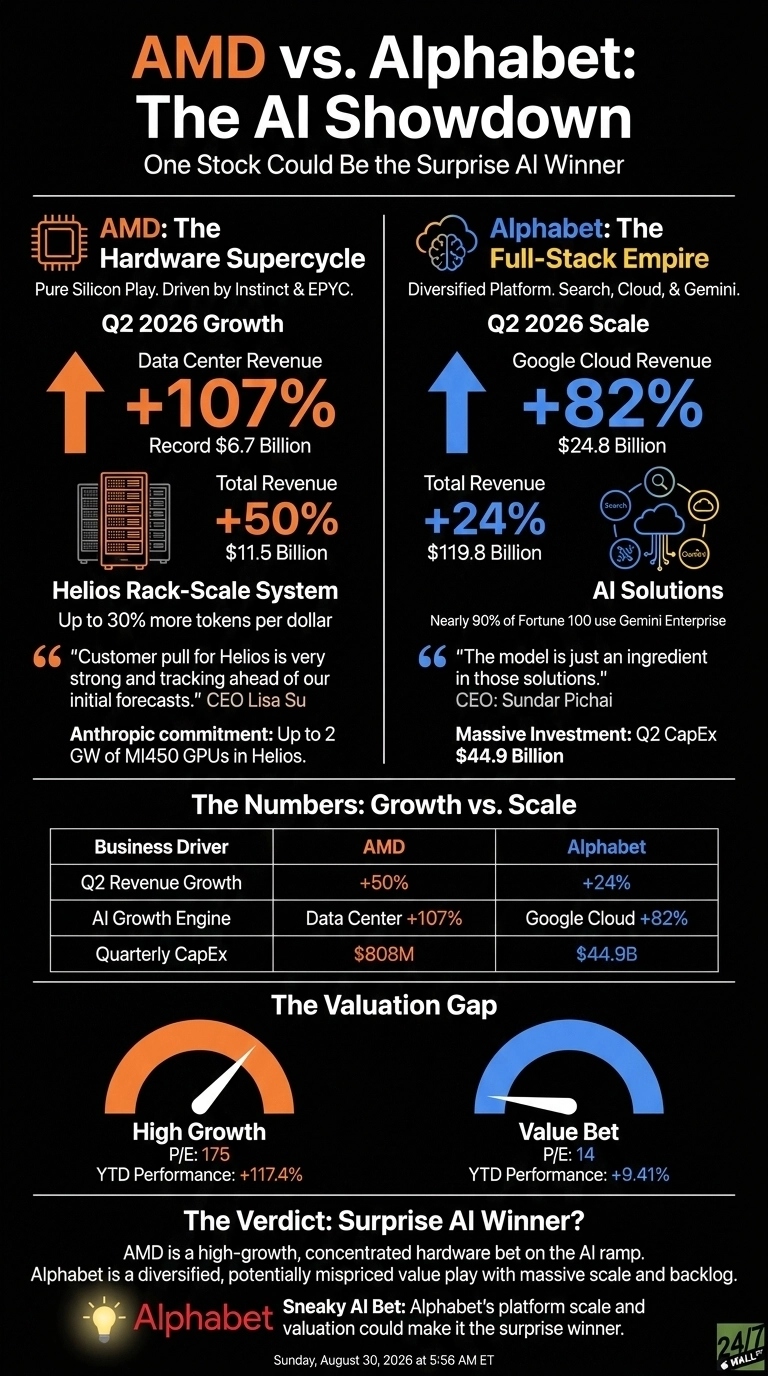
Why Alphabet Looks Like the Sneakier AI Bet to Me
Personally, I lean Alphabet. Paying 14 times earnings for a business growing Cloud at 82%, sitting on a half-trillion-dollar backlog, and monetizing AI in ads today feels mispriced against a semiconductor cycle that has already delivered a 176.18% one-year gain for AMD.
Growth-oriented investors with tolerance for volatility get the sharper upside on the Helios ramp with AMD. For investors seeking AI exposure without paying 65 times forward earnings, Alphabet quietly looks like the surprise winner hiding behind the louder chip narrative. And if the real money in this cycle sits with the power, cooling, and networking suppliers feeding both companies, we pulled seven of them into a free AI infrastructure report.
The post AMD vs. Alphabet: One Stock Could Be the Surprise AI Winner appeared first on 24/7 Wall St..
]]>Alphabet (NASDAQ:GOOG) just posted Google Cloud growth of 82% to $24.8 billion and Q2 EPS of $9.11 versus $3.04 estimates. CEO Sundar Pichai told analysts “it feels like we are in very early innings of what feels like secular shift.”
Yet shares sit at $342.88, up just 9.41% YTD. Can GOOG realistically hit $500 by the end of 2027?
Why Alphabet Shares Are Stuck Despite Blowout Growth
Capex fear. Alphabet guided 2026 capex to $175 billion to $185 billion, and Q2 free cash flow swung to negative $5.9 billion. Long-term debt rose $46.5 billion to $98.2 billion, and the buyback was suspended. Investors want to know whether TPU and data center spend will actually earn a return.
Performance shows the skepticism. Shares are up just 0.33% over the past week and 2.12% over the past month. With a beta of 1.24, GOOG should move faster than the broader market. Right now it isn’t.
Some top investors are already saying Google is “a very different company” than it was two years ago (we reverse-engineered what the biggest tech winners looked like this early in a free playbook).
Wall Street Is Bullish, But Consensus Is Still Too Low
Sell-side consensus sits at $422.34, backed by 13 strong buys, 44 buys, and 6 holds. Zero sells. Our model’s base case comes out higher at $435.40, implying 27% upside with a high 0.9 confidence score. Bull case runs to $452.54, bear case to $360.50.
My view: analysts are still pricing Alphabet like a mature ad business. That ignores 90% bullish analyst sentiment and a Google Cloud backlog of $514 billion, roughly half of which converts to revenue over the next 24 months. If Cloud stays anywhere near current growth, these targets get raised.
Path To $500 Per Share
Reaching $500 from today’s price of $342.88 would require a gain of 45.8%.
With forward EPS of $23.49, a price of $500 implies a forward P/E of 21x. Our base case of $435.40 already implies 19x, meaning the bold target requires roughly 3 additional turns of multiple expansion.
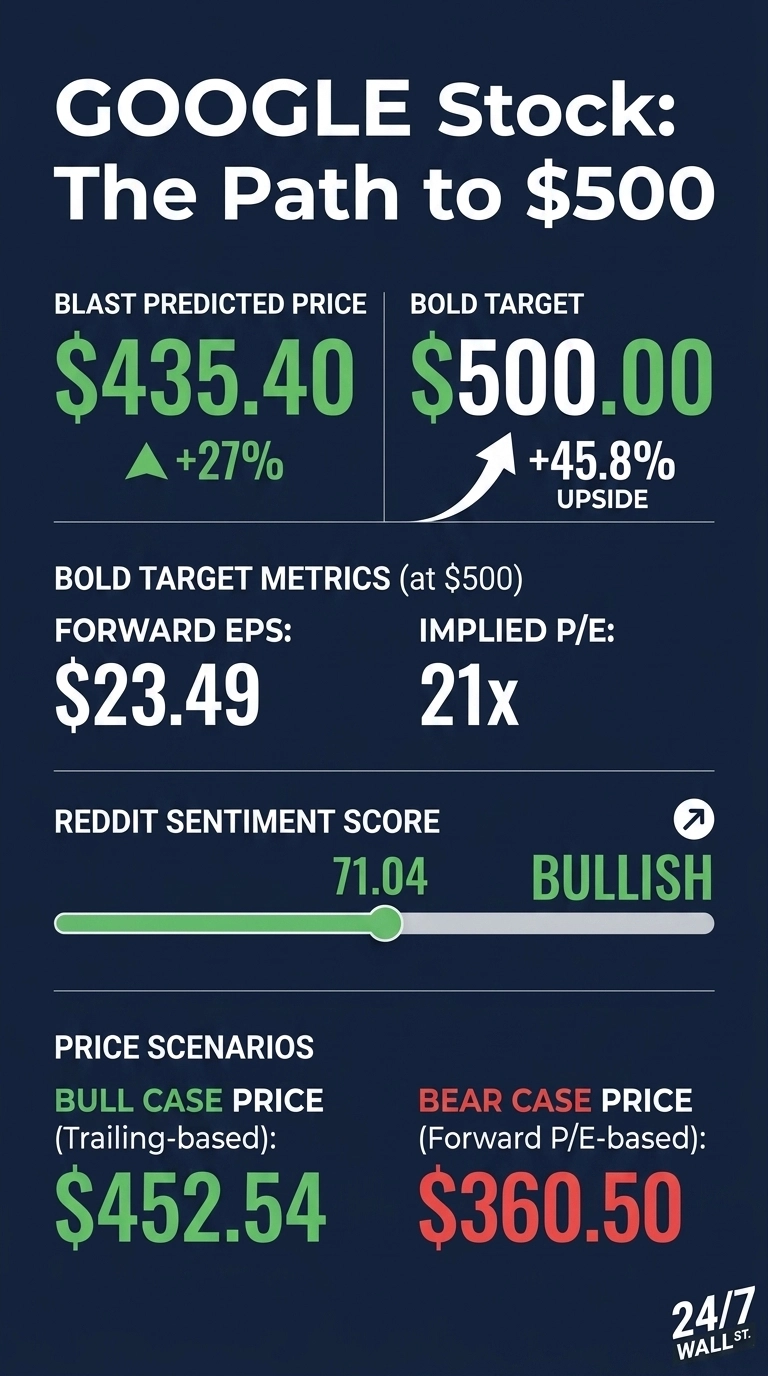
Less demanding than it sounds. GOOG trades at just 16x forward earnings, cheaper than every Mag 7 peer. Pichai says Alphabet is “winning new customers more than doubling our acquisition velocity year over year” in Cloud, while Gemini App reached 950 million monthly active users and AI mode surpassed 1 billion MAU. Antitrust remedies remain the wild card that could compress the multiple.
Where Alphabet Trades Versus Its Earnings Power
Current forward multiple sits at 16x. A hyperscaler growing Cloud 82% with a 35.6% Cloud operating margin typically commands a premium to that.
Shares sit between a $404.23 52-week high and a $206.37 52-week low. GOOG is up 799.56% over the past 10 years. That long-term track record is exactly why I think a mid-20s multiple is reachable if AI monetization scales through 2027.
My Verdict On $500 Alphabet
Hitting $500 requires a 45.8% gain and a rerating to 21x forward. Realistic, but a stretch on a 12-month horizon.
Three things need to go right: Cloud growth stays above 60%, TPU revenue starts hitting the P&L as guided for late 2026 into 2027, and antitrust rulings avoid forced divestitures. Keep an eye on the October 28 Q3 earnings report. A sharp Cloud deceleration would derail the thesis fast. Returns at this level shouldn’t be expected every year, but we’ve outlined the blueprint for how Alphabet could reach $500 in 2027.
The post One Mag 7 Stock to Watch in the Second Half of 2026 For Solid Gains appeared first on 24/7 Wall St..
]]>Meta Platforms (NASDAQ: META) and Alphabet (NASDAQ: GOOG) both closed the books on Q2 2026 with massive AI ambitions and very different market reactions. Meta reported on July 29, 2026, Alphabet on July 22, 2026.
One quarter drew a fine line under advertising discipline. The other showcased a runaway cloud franchise, and the valuation gap between them is now hard to ignore.
Cloud Powers Google. Legal and Layoffs Weigh on Meta.
Alphabet posted revenue of $119.8 billion, up 24.23%, with Google Cloud accelerating to 82% growth and reaching $24.77 billion. Cloud backlog climbed to $514 billion, a number that reframes how investors should value the segment.
Sundar Pichai told analysts, “Cloud revenue grew 82%, powered by strong demand for AI infrastructure and AI solutions.” Search still grew 17%, and YouTube ads added 13%.
Meta’s top line held up. Revenue hit $60.80 billion, up 27.96%, and advertising climbed 27%. But EPS came in at $6.18, missing expectations by 14.42% and ending a six-quarter beat streak.
Blame $2.40 billion in legal charges and $1.18 billion in severance tied to roughly 8,000 layoffs. Operating margin compressed to 31% from 43%. That kind of margin swing is painful, even when the ad engine is roaring.
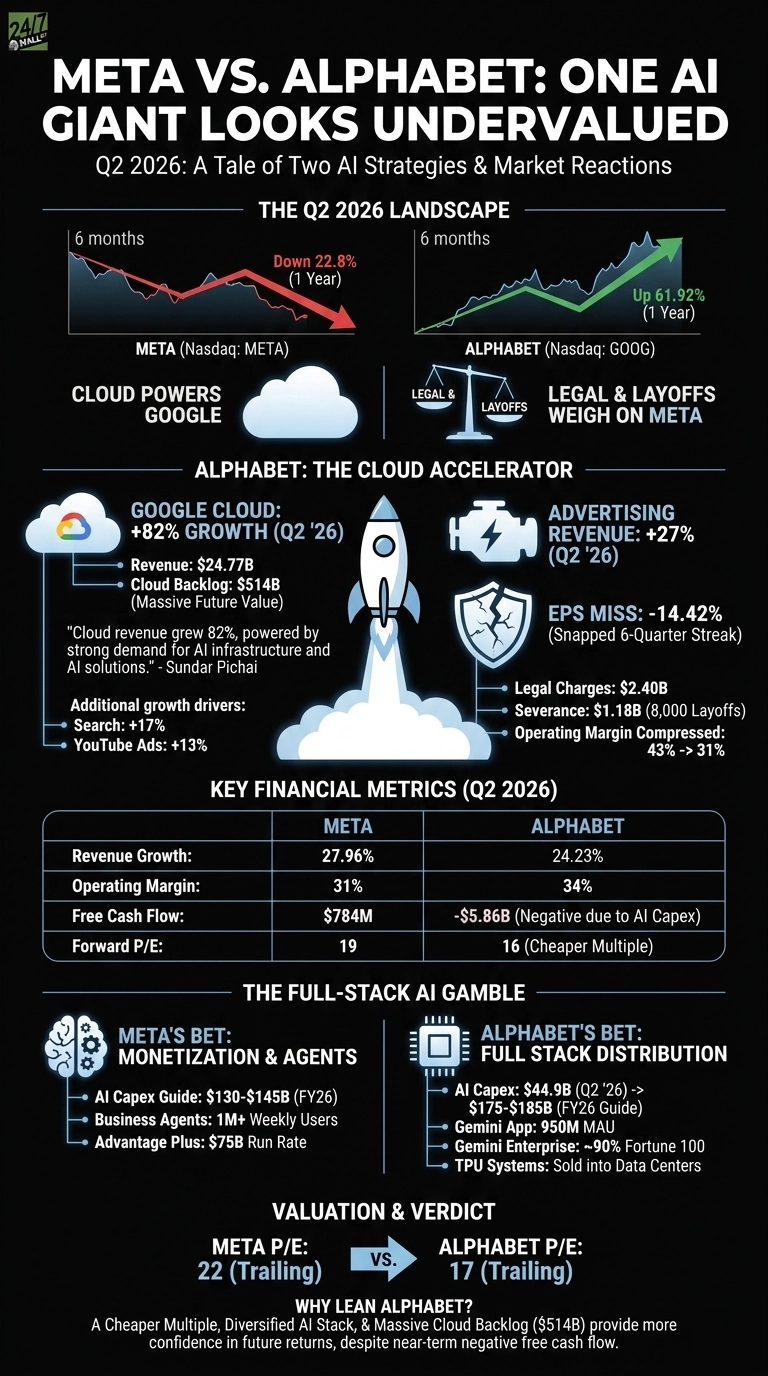
| Q2 2026 Driver | Meta | Alphabet |
| Revenue growth | 27.96% | 24.23% |
| Operating margin | 31% | 34% |
| Free cash flow | $784M | -$5.86B |
| Forward P/E | 19 | 16 |
Full Stack Ambition Meets Full Stack Distribution
Both companies are betting the balance sheet on AI compute. Meta guided full-year capex to $130 to $145 billion and lifted long-term debt to $83.66 billion.
Alphabet went further, raising $49.6 billion in net equity proceeds, issuing $20.3 billion in senior notes, and suspending buybacks. Debt roughly doubled to $98.2 billion. All that capex has to be powered, cooled, and networked by somebody, and we pulled together seven suppliers riding that buildout in a free report on the AI infrastructure names beyond the chipmakers.
Zuckerberg’s pitch is monetization through advertising intelligence, personal agents, and business agents. Meta said more than 1 million businesses already use business agents weekly, and Advantage Plus reached a $75 billion annual run rate.
Pichai’s pitch is broader distribution: Gemini App at 950 million monthly active users, nearly 90% of the Fortune 100 using Gemini Enterprise, and TPU systems now sold into customer data centers.
Valuation Gap Sets Up the Next Six Months
Meta trades at a P/E of 22. Alphabet sits at 17, despite growing cloud four times faster. Meta stock is down 22.8% over the past year. Alphabet is up 61.92%.
I want to see whether Meta’s operating income can clear 2025 levels as management promises, and whether Google Cloud margins hold up as third-party capacity gets rented in Q3.
Why I Lean Toward Alphabet Right Now
If I had to pick one today, I would lean toward Alphabet. A cheaper multiple, a diversified AI stack, and a cloud backlog north of $514 billion give me more confidence in the return on that capex.
Meta’s ad engine is arguably the best in the world, and at 19 times forward earnings the setup for patient investors looks reasonable. But the legal overhang and Reality Labs drag make me want a discount I do not quite see yet.
Meta offers a turnaround profile, while Alphabet offers scale, cash generation on a trailing basis ($53.3 billion TTM free cash flow), and a clearer AI monetization curve.
The post Meta vs. Alphabet: One AI Giant Looks Undervalued appeared first on 24/7 Wall St..
]]>
Artificial intelligence is changing the economics of digital advertising faster than many investors expected. The technology isn’t simply creating new products; it is making existing businesses better at turning attention into dollars. That is important because advertising remains one of the internet’s biggest profit pools. And now, Bernstein says Meta Platforms (NASDAQ:META) could capture a larger share of that pool than Google’s core Search business before the end of 2026.
For investors, the important point isn’t merely that Meta is catching up to Google. It’s that billions of dollars in AI spending are beginning to show up as measurable revenue gains.
Meta’s AI Investment Is Paying Off
Meta entered 2026 spending aggressively on AI infrastructure, but its second-quarter results show why management is willing to make that bet. Revenue climbed 28% year over year to $60.8 billion, while advertising revenue reached roughly $59.4 billion, up 27%. Ad impressions increased 14%, and the average price per ad rose 12%.
The number that matters most for the Google comparison is that Meta captured nearly half of every incremental digital advertising dollar in the second quarter, according to Bernstein. The investment firm says AI is improving recommendations, engagement, targeting, ad delivery, and the journey from discovering a product to purchasing it.
That is AI monetization investors can actually measure.
The $60 Billion Clue
Meta’s Advantage+ automated advertising platform provides another piece of evidence of its search success..
During its second-quarter earnings conference call, Meta said Advantage+ was generating approximately $75 billion in annualized revenue. The company also said advertisers using the system generated an average return of $4.52 for every dollar spent — about 22% more than manually configured campaigns.
That makes the $60 billion figure particularly important. It isn’t an estimate of Meta’s AI spending or a new revenue stream waiting somewhere down the road. It represents the annualized scale of an existing advertising product increasingly powered by automation.
And Meta isn’t finished. CEO Mark Zuckerberg has said the company wants ad creation to become fully automated by the end of 2026.
Google Still Has the Lead — For Now
Alphabet (NASDAQ:GOOG) remains the incumbent and investors shouldn’t underestimate it. Google Search and other advertising revenue reached $63.3 billion in the second quarter, up 17% year-over-year, compared with Meta’s roughly $59.4 billion in Family of Apps advertising revenue. The gap, however, was only about $3.9 billion for the quarter.
More importantly, Google is growing more slowly. Alphabet reported total Google advertising revenue of $81.6 billion, up 14%, while Search grew 17%. Bernstein believes Meta may already be roughly comparable with Google Search on a like-for-like basis, excluding certain Google businesses.
Granted, surpassing Search revenue by year-end isn’t guaranteed. Google is also using AI to strengthen Search, with AI Overviews and AI Mode contributing to a business that still grew 17% in Q2.
Key Takeaway
Meta’s AI strategy is becoming less about futuristic promises and more about advertising economics. The company spent $31.1 billion on capital expenditures in Q2 alone, while free cash flow fell to just $784 million as infrastructure and other costs surged. That’s a real risk if AI spending doesn’t keep producing returns.
But the evidence is moving in Meta’s favor. Advertising revenue is growing 27%, Advantage+ is running at a $60 billion annualized pace, and Bernstein says Meta captured nearly half of incremental digital ad spending. If that trajectory continues, Meta doesn’t need to kill Google Search to win. It only needs to grow faster — and the numbers suggest it may already be doing exactly that.
The post Meta’s $60 Billion AI Machine Could Dethrone Google Search by Year-End appeared first on 24/7 Wall St..
]]>Investors who pick growth ETFs based solely on expense ratio are optimizing the least important variable in 2026. Vanguard Growth ETF (NYSEARCA:VUG) charges an ultra-low 0.03%, while Vanguard S&P 500 Growth ETF (NYSEARCA:VOOG) costs 0.07%, yet VOOG has been the better performer year to date and over the trailing 12 months.
Year to date, VOOG has returned roughly 14%, compared with about 10% for VUG, a gap wider than four basis points of fees could explain. Over the trailing twelve months, VOOG is up about 22%, compared with roughly 16% for VUG. Both funds hold roughly 150 mega-cap growth names, so the divergence stems from how the underlying indexes weight the shared holdings.
Same Universe, Different Rulebooks
VUG tracks the Morningstar US Large Cap Growth Index while VOOG follows the S&P 500 Growth Index, drawing only from S&P 500 constituents classified as growth. The overlap in top holdings is heavy, but individual weights differ meaningfully.
NVIDIA (NASDAQ:NVDA) accounts for 13.3% of VUG and nearly 14.3% of VOOG, while Apple (NASDAQ:AAPL) accounts for 12.3% of VUG and only 6.4% of VOOG. Broadcom (NASDAQ:AVGO) shows up at 5.9% in VOOG versus 4.4% in VUG, and Microsoft (NASDAQ:MSFT) is close to a tie at 9.1% in VUG and 9.3% in VOOG. Those single-digit weighting gaps compound across the largest positions in both portfolios.
Why Apple’s Weight Matters
VUG’s roughly double Apple weight has been a drag in 2026, as Apple has lagged the AI-heavy names that dominate both indexes. VOOG’s lighter Apple exposure freed capacity that its methodology reallocated toward Nvidia and Broadcom, two of this year’s biggest semiconductor winners (we profiled seven companies powering that same AI buildout, beyond the chipmakers, in a free report you can grab here).
The software megacaps sit at similar weights in both funds, with Microsoft effectively tied and Alphabet (NASDAQ:GOOG, NASDAQ:GOOGL) exposure broadly comparable. VOOG’s index holds more of what worked and less of what did not, purely because of how S&P’s growth score ranks constituents. That methodological outcome explains why a five-point return gap opens between two Vanguard funds that look nearly identical.
Is VOOG’s Edge Repeatable?
The tempting conclusion is that VOOG will keep winning, but the more defensible answer is that its lead is period-specific. The S&P 500 Growth methodology leans on momentum and earnings signals, which tilt toward whichever megacaps have run the hardest.
In years where Apple leads or a battered software name recovers, VUG’s broader Morningstar universe will likely narrow the gap or reverse it. Over five years, the funds are much closer, with VOOG up roughly 88% and VUG up about 80%, a spread that reflects normal drift rather than a permanent structural advantage. Anyone betting on VOOG to keep beating VUG is really betting that the current AI concentration will continue to pay off, which is a call on the market itself.
Portfolio Fit and the Fee Illusion
VOOG suits an investor who wants US large-cap growth filtered through the S&P 500’s quality screen and is comfortable with heavier semiconductor exposure. VUG fits someone who wants a slightly broader growth net and values the fee savings on large balances, accepting that heavier Apple weight will hurt in years like this one.
Holding both is redundant given the overlap at the top, so most investors should pick one as their core growth sleeve. Scale still favors VUG, which dwarfs VOOG’s $26.5 billion in net assets and continues to gather flows despite recent performance lag. Four basis points of fee savings cannot overcome a five-point return gap driven by index construction.
The post VUG vs. VOOG Is Not a Fee Fight | How the Cheaper Vanguard Growth ETF Is Losing appeared first on 24/7 Wall St..
]]>Alphabet (NASDAQ:GOOG) and Meta Platforms (NASDAQ:META) both reported Q2 2026 results in late July. Alphabet extended its EPS-beat streak to 11 consecutive quarters while Cloud lit up. Meta cleared revenue but snapped a six-quarter EPS beat streak as AI spending and legal charges chewed through margins.
Cloud Momentum Powers Google, Ad Costs Weigh on Meta
Alphabet posted $119.8 billion in revenue, up 24.23% year over year, with Google Cloud revenue growing 82% to $24.8 billion and cloud backlog reaching $514 billion. Sundar Pichai said “Q2 was an amazing quarter”, and the numbers back him up. Search still grew 17% even as AI Overviews cannibalized traditional queries, which is a real tell about durability.
Meta grew revenue 27.96% to $60.80 billion, but EPS came in at $6.18 against a $7.221 estimate. Total expenses jumped 55% year over year, weighed down by $2.40 billion in legal charges and $1.18 billion in severance tied to an 8,000-employee reduction. Ad impressions rose 14% and price per ad rose 12%, so the core engine still hums.
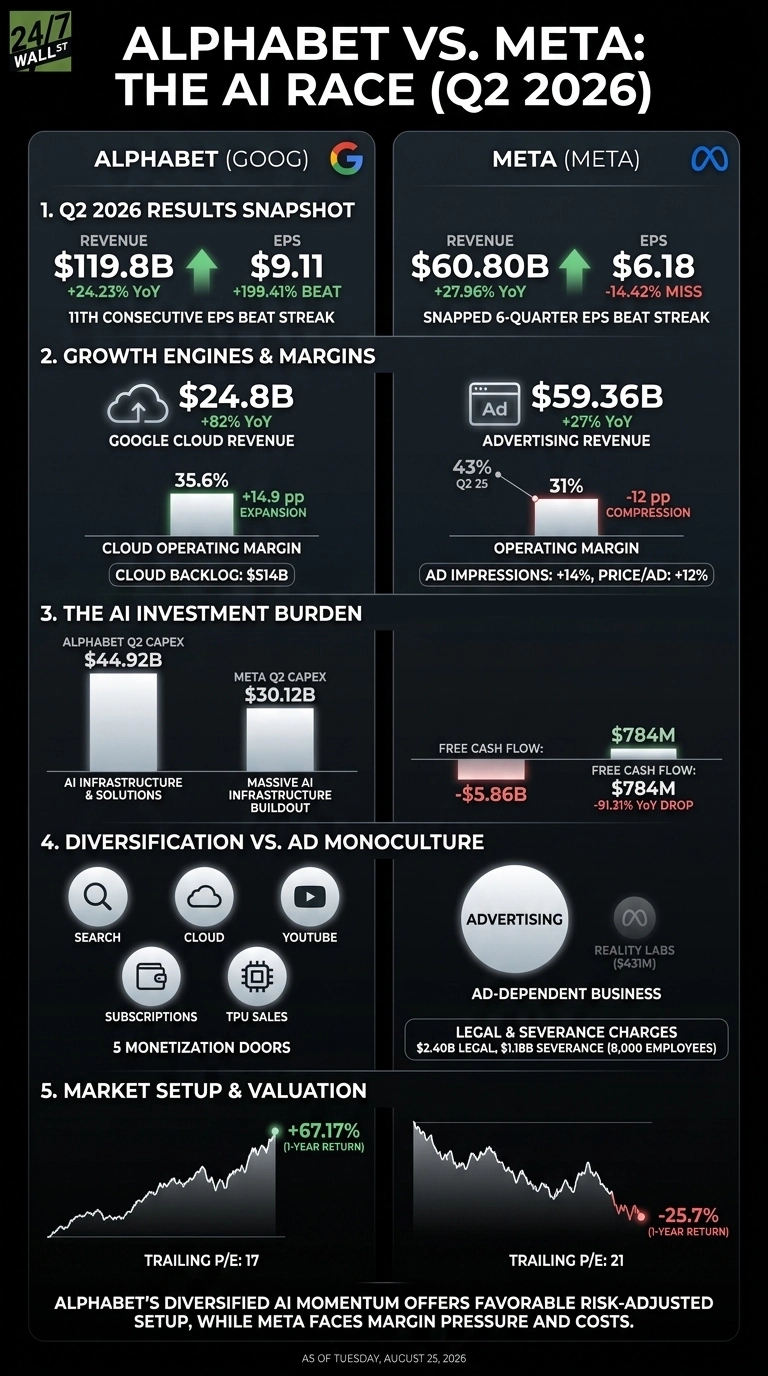
| Business Driver | Alphabet | Meta |
| Main growth engine | Google Cloud + AI infrastructure | AI-optimized ad targeting |
| Operating margin | 34%, expanding | 31%, down from 43% |
| Q2 CapEx | $44.92 billion | $30.12 billion |
Diversified Portfolio vs. Advertising Monoculture
Alphabet is monetizing AI through five distinct doors: Search, YouTube, Cloud, subscriptions, and TPU system sales. Nearly 90% of the Fortune 100 use Gemini Enterprise, and Pichai said Alphabet is “in very early innings” of the shift. Cloud operating margin actually reached 35.6%, versus 20.7% a year ago. That is unusual for a business absorbing this much capacity.
Meta remains overwhelmingly an ads business. Reality Labs contributed only $431 million. Zuckerberg is betting the buildout unlocks personal agents, business agents, and API revenue, saying “we believe that there will continue to be a significantly higher margin on selling intelligence rather than selling compute directly.” Ambitious. Unproven at scale. Free cash flow tells the story: Meta produced just $784 million, down 91.31%.
What Decides the Next Four Quarters
I will be watching whether Alphabet can absorb fiscal 2026 CapEx of $175 billion to $185 billion without cracking Cloud margins, since third-party capacity use will pressure them.
For Meta, the number that matters is full-year 2026 CapEx of $130 to $145 billion paired with $165 to $169 billion in total expenses. Meta needs its ad engine to keep compounding at 27% to fund that arithmetic. All of that CapEx has to be powered, cooled, and networked by somebody, and we pulled together seven of those suppliers in a free AI infrastructure report.
Where the Setup Favors Alphabet After This Quarter
The risk-adjusted setup currently reads more favorably for Alphabet. Cloud is accelerating, Search is proving AI-resilient, and shares are up 67.17% over one year on a 17 trailing P/E.
Meta is down 25.7% over the past year at a 21 P/E, a valuation that turnaround-oriented investors may find worth researching. The variables to watch: whether Meta’s margins stabilize by Q4 and whether the legal overhang clears.
The post Alphabet vs. Meta: One AI Giant Looks More Attractive appeared first on 24/7 Wall St..
]]>
The artificial intelligence boom is entering a different phase. The early winners sold the picks and shovels, but the next leg of the cycle will depend on who can turn enormous AI spending into recurring revenue. That makes 2027 especially interesting.
Alphabet‘s (NASDAQ:GOOG) latest results show why. The company is no longer simply buying AI infrastructure from others and hoping its software catches up. It is designing chips, building data centers, developing models, selling cloud services, and distributing AI through products used by billions of people. That vertical integration could become one of its biggest competitive advantages.
Wall Street Sees a Bigger Cloud Opportunity
Wolfe Research has named Alphabet one of its top picks for 2027, and the numbers explain the enthusiasm. Analyst Shweta Khajuria expects Google Cloud Platform revenue growth of 125% in the third quarter, compared with an 87% consensus estimate. Wolfe also raised its 2027 Alphabet revenue forecast 10% to $595 billion and its earnings-per-share estimate 6% to $15.89.
Those estimates build on a business already accelerating. Alphabet’s second-quarter earnings release showed Google Cloud revenue jumped 82% year over year to $24.8 billion, while its backlog reached $514 billion. Cloud operating margin also expanded to 35.6% from 20.7% a year earlier.
To put that in perspective, cloud is no longer a side business supporting Google’s advertising empire. It is becoming an increasingly important engine for monetizing AI.
Google Is Owning the AI Stack
The more interesting story is how Alphabet gets there. Most companies participating in AI own only pieces of the stack. Alphabet increasingly owns the whole thing.
It designs its own Tensor Processing Units (TPUs), which power Gemini and are now being sold directly into customers’ data centers. Alphabet began recognizing revenue from those external TPU systems in the second quarter, with most of the revenue expected to arrive in 2027. One industry forecast projects TPU shipments could triple from 2.76 million units in 2024 to 8.8 million in 2027.
Then comes the software. Alphabet’s model APIs were processing approximately 22 billion tokens per minute in the second quarter, up from 16 billion just three months earlier. More than 9 million developers were using its models each month, while 950 million people were active on the Gemini app.
That creates a powerful loop: Alphabet builds the chips, uses them to train and run its models, sells the computing capacity through Cloud, and then monetizes those models through enterprise software and consumer products.
In short, Google is not merely participating in the AI economy. It is building much of the machinery that powers it.
The Cost of Winning Is Still High
Granted, vertical integration does not make Alphabet immune to AI’s biggest risk: spending.
Alphabet expects 2026 capital expenditures of $195 billion to $205 billion, while Wolfe estimates 2027 spending could reach $330 billion. The company also generated negative $5.9 billion of free cash flow in the second quarter as infrastructure investment accelerated. That is a lot of money to spend before investors see the payoff.
But there is an important offset. Google’s $514 billion Cloud backlog provides evidence that at least some of this infrastructure is being built against real customer demand rather than speculative capacity. And selling TPUs outside Google’s own data centers creates another revenue stream from infrastructure that previously benefited Alphabet primarily through internal cost savings.
Alphabet’s stock also isn’t priced like an early-stage AI company. Wolfe’s $460 price target represents a substantial premium to its current price, while its latest 2027 earnings forecast implies the potential for meaningful earnings growth to accompany the AI investment cycle.
Key Takeaway
Wolfe may be early in calling Alphabet 2027’s best stock, but the thesis is becoming easier to understand.
Alphabet has Search and YouTube generating enormous cash flows, Cloud growing 82%, Gemini processing 22 billion tokens per minute, and TPUs moving from an internal advantage to an external product. Alphabet can monetize AI at multiple layers instead of depending on a single application or chip.
There are no guarantees that $330 billion of annual capital spending will earn attractive returns. That said, the evidence increasingly suggests Alphabet has something many AI competitors lack: control of the stack from silicon to software to distribution.
For investors looking beyond the next quarter, that could make GOOGL one of the most compelling AI bets heading into 2027.
The post This Analyst Just Called Alphabet 2027’s Best Stock. She Might Be Right appeared first on 24/7 Wall St..
]]>Alphabet (NASDAQ: GOOG), especially its Google unit, has had a remarkable year, at least compared to the other Magnificent Seven companies. Its stock price is up 10% this year. That’s not a home run, but it’s better than Meta (NASDAQ: META) (down 15%) and Tesla (NASDAQ: TSLA) (down 22%).
Alphabet ranks third in market cap among the world’s public companies at $4.21 trillion, which is close behind Apple ($4.53 trillion). Founder Sergey Brin owns 3% but has shares that give him control of the company, along with Larry Page, who also owns 3%. Each has a net worth increase of slightly more than $25 billion this year.
Google’s search business is supposed to be crippled by AI, which is often used as a search engine. Alphabet’s overall revenue rose 24% to $119.8 billion in the most recent quarter. Google Search revenue rose 17% to $63.2 billion. Cloud operations were a home run, up 81% to $21.7 billion. Since the cloud industry is nearly as hot as AI among investors, the increase impressed.
YouTube is now the clear leader in video streaming and has moved into the premium streaming sector, threatening companies like Netflix (NASDAQ: NFLX). YouTube revenue rose 13.2% to $11.1 billion in the period. In its most recent quarter, Netflix’s entire revenue was $12.5 billion.
Google’s Gemini AI business has outpaced many estimates for other public companies and trails only OpenAI and Anthropic. The Guardian reports: “The source added, however, that Google still had the benefit of being able to combine its Gemini models with an impressive suite of products, from its all-conquering search product to its cloud platform and YouTube.”
On a much smaller scale, Google’s self-driving car division, Waymo, appears to have taken the lead over rival Tesla, particularly in the cities where it operates. This may matter in the future, but today, financially, it is only a small part of Google’s current success.
Brin and Page are each worth about $280 billion based on the Bloomberg Billionaire Index. Unlike some other people at the top of the list, 2026 has been a good year.
The post Google’s Wins Make Founders Brin And Page $50 Billion Richer appeared first on 24/7 Wall St..
]]>Alphabet (NASDAQ:GOOG) has become the billionaire trade of 2026. Recent 13F cycles show Warren Buffett was far from the only billionaire buying Alphabet stock in Q2, joining Bill Ackman and Stanley Druckenmiller rotating into the search giant.
Our 24/7 Wall St. price target for Alphabet is $437.39, implying 27.99% upside from the current $341.75 share price. The model rates GOOG a buy with 90% confidence.
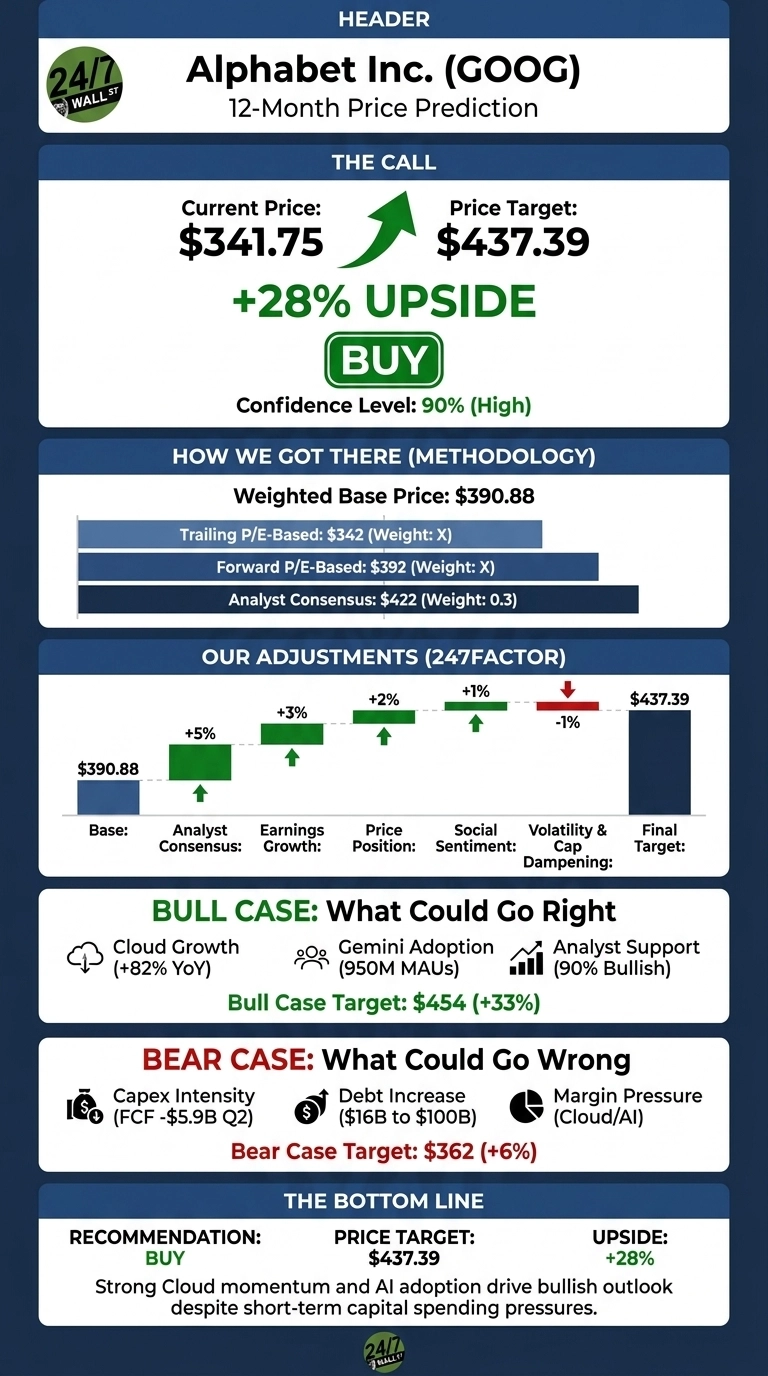
| Metric | Value |
|---|---|
| Current Price | $341.75 |
| 24/7 Wall St. Price Target | $437.39 |
| Upside | 27.99% |
| Recommendation | BUY |
| Confidence Level | 90% |
Cloud Acceleration and Billionaire Buying Set the Backdrop
GOOG gained 70.83% over the trailing year against 9.05% year-to-date, though shares consolidated recently, off 0.52% over the past week.
The Q2 FY2026 report delivered $119.80 billion in revenue, up 24.23% year over year, with EPS of $9.11 against a $3.04 estimate. Google Cloud accelerated to 82% growth with $24.8 billion in revenue and a 35.6% operating margin, while cloud backlog hit $514 billion. This backdrop explains why multiple billionaires are piling in.
Bull Case: A Path Toward $454
Bulls see a $454.48 upside scenario, roughly 33% above spot. Google Cloud is compounding, with nearly 90% of the Fortune 100 using Gemini Enterprise. The Gemini App has 950 million monthly active users, and API traffic scaled to 22 billion tokens per minute, up from 16 billion just a quarter earlier.
TPU system sales, Waymo’s 500,000+ weekly rides, and 350 million paid subscriptions add optionality. On the sell side, 13 strong buys, 44 buys, 6 holds, and zero sells form one of the cleanest analyst books in mega-cap tech.
Bear Case: What Could Drag GOOG to $362
The bear scenario points to $361.62, essentially flat to today. The chief concern is capex intensity. Q2 free cash flow ran to negative $5.855 billion, with capex up 100.14% year over year to $44.92 billion. Long-term debt climbed from roughly $16 billion a year ago to about $100 billion, buybacks were suspended, and CFO Anat Ashkenazi warned third-party capacity will “put some pressure on operating margins for cloud.”
Bulls counter that this spending funds a supply-constrained AI backlog, so the free-cash-flow drop reads as strategic reinvestment (and it is worth remembering the picks-and-shovels names on the other side of that spending, which we broke down in a free report on seven AI infrastructure suppliers that aren’t chipmakers).
How Alphabet Compares to Microsoft and Meta
Alphabet screens cheap against Magnificent Seven peers on trailing earnings. Microsoft (NASDAQ:MSFT) fetches a trailing P/E of roughly 27, backed by Azure crossing $100 billion in annual revenue and a $678 billion commercial RPO backlog. That backlog rivals Alphabet’s $514 billion, yet MSFT trades at nearly double the multiple.
Meta Platforms (NASDAQ:META) sits at P/E near 20, but Q2 EPS missed expectations on a cost surge, and Reality Labs remains a multi-billion drag. Against this set, GOOG’s P/E of 14 makes our 24/7 Wall St. price target look conservative.
| Company | Trailing P/E | Recent Quarter Revenue Growth |
|---|---|---|
| Alphabet | 14 | 24.23% |
| Microsoft | 27 | 17.75% |
| Meta | 20 | 27.96% |
Bottom Line: Why the Billionaire Trade Has Legs
Our 24/7 Wall St. price target of $437.39 offers GOOG one of the cleanest risk/reward setups in mega-cap tech, well above the bear scenario. The constructive path requires free cash flow stabilizing in H2 2026 and cloud margins holding above 30%.
The risk case builds if capex creeps beyond $175 to $185 billion 2026 guidance without a clear TPU revenue ramp in 2027. The buy call carries 90% confidence.
Here is where our model projects GOOG could trade, assuming current growth trajectories and market conditions hold.
| Year | 24/7 Wall St. Price Target |
|---|---|
| 2026 | $437 |
| 2027 | $523 |
| 2028 | $584 |
| 2029 | $660 |
| 2030 | $699 |
These projections assume Alphabet executes on its AI-first strategy. Significant upside or downside could result from Waymo commercialization, antitrust remedies in Search, or a sharper-than-expected step-down in AI capex intensity.
The post 3 Billionaire Investors Just Bought the Same Stock. Should You? appeared first on 24/7 Wall St..
]]>Alphabet (NASDAQ:GOOG) has moved from quietly designing its own AI chips to openly staking its cloud roadmap on them. A recent forecast from GF Securities Brokerage now suggests Google’s next-generation Tensor Processing Units could see shipment volumes more than triple by 2027, a scale-up that would reshape how investors think about the AI compute stack.
Tripling TPU Shipments by 2027
Based on the brokerage’s build, TPU shipments could rise from 2.76 million units in 2024 to 2.854 million in 2025, then accelerate to 4.504 million in 2026 and 8.84 million in 2027. That implies roughly 3.2 times growth over three years, with the steepest jump landing in the final year of the projection.
The curve is driven by a generational transition. v7 (Ghostfish) begins contributing, followed by higher volumes of v8AX (Sunfish/Hellcat) and v8x (Zebrafish/Maddog). The shift from older generations to these nodes is meant to deliver better performance-per-watt and more scalable capacity for both training and inference.
Why Custom Silicon Matters for Google
Running search, ads, YouTube, and Cloud at Alphabet’s scale makes owning the chip design a durable cost lever. On the Q2 call, management said it was “very pleased with our TPU roadmap progress and the value in terms of performance and the edge it gives.” Alphabet began recognizing revenue from TPU system sales delivered to customer data centers for the first time in Q2 2026, with the vast majority of revenue from those agreements expected in 2027. Demand context is already extreme: Google Cloud backlog hit $514 billion, and Gemini models now process 22 billion API tokens per minute.
Capex Is Already Reflecting the Buildout
Q2 2026 capex hit $44.9 billion, up 100.14% year over year, with roughly 60% flowing into servers and 40% into data centers and networking. CEO Sundar Pichai told investors 2026 capex would land at $175 to $185 billion. To fund it, Alphabet raised roughly $70 billion in combined equity and debt, pushed long-term debt from $46.5 billion to $98.2 billion, and suspended the stock buyback.
Risks and What to Watch
This is one analyst’s model and Google has not itself committed to those numbers, though other estimates also point to multi-million-unit growth into 2027 and 2028. Pichai flagged a “supply constrained environment” and said Alphabet will lean on third-party capacity in Q3 2026 while its own capacity comes online. Free cash flow already turned to negative $5.9 billion, and interest expense rose nearly 5x year over year. With GOOG up 67.17% over the last year, the stock is pricing in execution. If Alphabet masters the supply chain, its vertical integration and data center head start could make TPUs a genuine surprise through 2027 (and the power, cooling, and networking suppliers riding the same buildout are the subject of a free report we put together here: 7 Stocks Powering the AI Boom (That Aren’t Chipmakers)).
The post Google TPU Volume Could Triple to 8.8 Million by 2027 appeared first on 24/7 Wall St..
]]>Berkshire Hathaway’s roughly $37 billion stake in Alphabet, disclosed as a 48 million share position, has recalibrated how investors view the search giant. Warren Buffett rarely chases mega-cap tech, so his conviction here forces a fresh look at whether Alphabet (NASDAQ:GOOG) still offers meaningful upside from $344.59.
Our 24/7 Wall St. price target for Alphabet is $437.39 over the next 12 months, implying 27.99% upside. We rate GOOG a buy with high (90%) confidence.
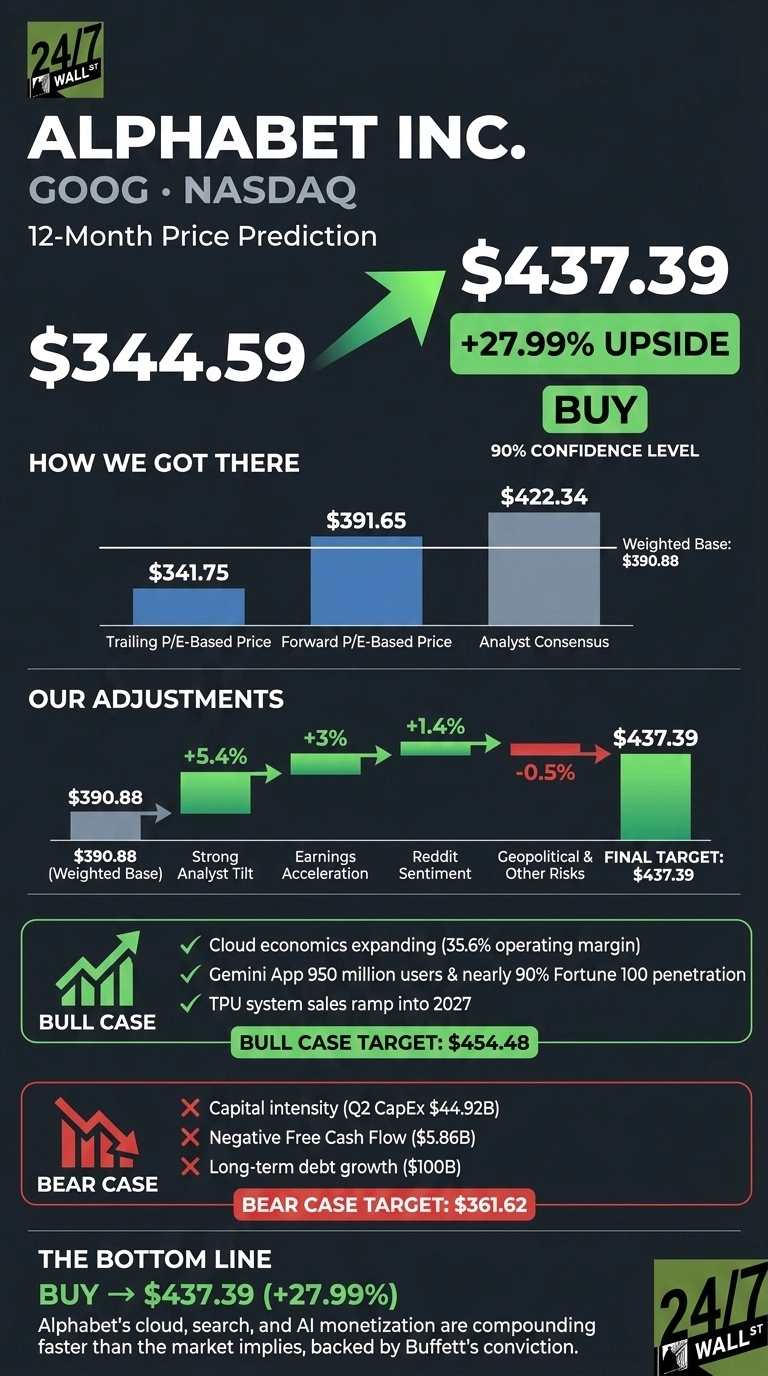
24/7 Wall St. Price Target Summary
| Metric | Value |
|---|---|
| Current Price | $344.59 |
| 24/7 Wall St. Price Target | $437.39 |
| Upside | 27.99% |
| Recommendation | BUY |
| Confidence Level | 90% |
What Alphabet’s Post-Earnings Melt-Up Tells Us
GOOG has climbed 7.99% in the past month and 67.17% over the past year, though shares sit below the $404.23 52-week high.
The catalyst was a landmark Q2. Alphabet posted EPS of $9.11 against a $3.042 estimate, and revenue of $119.8 billion, up 24.23% year over year. Google Cloud accelerated to 82% growth and backlog swelled to $514 billion. Buffett’s disclosure validated the view that even at a $4 trillion market cap, GOOG trades at a reasonable multiple relative to its cash-generation engine.
Why Bulls See a Breakout Ahead
The bull case rests on cloud economics. Google Cloud operating margin expanded from 20.7% to 35.6% year over year, and management said just over 50% of that $514 billion backlog converts to revenue within 24 months.
Gemini App’s 950 million monthly users and Fortune 100 penetration of nearly 90% show Alphabet monetizing AI at scale peers cannot yet match. Our bull scenario puts GOOG at $454.48 within 12 months if TPU system sales ramp as guided into 2027.
What Could Go Wrong
The bear thesis centers on capital intensity. Q2 CapEx hit $44.92 billion, free cash flow swung to negative $5.86 billion, long-term debt climbed to roughly $100 billion from $16 billion a year earlier, and the buyback was suspended.
2026 CapEx guidance of $175 billion to $185 billion is substantial, and every dollar of it flows to the power, cooling, and networking suppliers behind the data centers (we profiled seven of them in a free AI infrastructure report). Bulls counter that this reflects a supply-constrained cloud opportunity backed by contracted demand. Our bear scenario points to $361.62 if AI ROI slips.
How Alphabet Compares to Microsoft and Meta
Microsoft (NASDAQ:MSFT) is the natural cloud comparison. MSFT trades at a P/E of 27 with a P/FCF of 54, versus GOOG’s leaner trailing multiple. Azure crossed $100 billion in annual revenue and Copilot passed 30 million paid seats, but investors already pay a premium for that.
Meta Platforms (NASDAQ:META) is the ad-market comparable. META carries a P/E of 20 and Q2 revenue growth of 27.96%, but its Q2 EPS missed by 14.42% and free cash flow collapsed to $784 million. Alphabet’s advertising engine grows at similar rates with cleaner monetization. Against this peer group, our 24/7 Wall St. price target looks reasonable.
| Company | P/E | Q2 Revenue Growth |
|---|---|---|
| Alphabet | 17 | 24.23% |
| Microsoft | 27 | 17.75% |
| Meta | 20 | 27.96% |
Alphabet Price Prediction 2026-2030
The 24/7 Wall St. price target of $437.39 with 90% confidence reflects a company where cloud, search, and AI monetization compound faster than the multiple implies.
The setup strengthens if Google Cloud sustains 60%-plus growth and TPU revenue ramps in 2027. It weakens if CapEx keeps outpacing operating cash flow into next year. On balance, Buffett’s conviction and the numbers align.
| Year | 24/7 Wall St. Price Target |
|---|---|
| 2026 | $369 |
| 2027 | $453 |
| 2028 | $548 |
| 2029 | $614 |
| 2030 | $658 |
These projections assume Alphabet continues executing on cloud, search AI integration, and Waymo scaling. Meaningful upside or downside could result from an AI infrastructure ROI shock or a regulatory outcome in the Search antitrust remedy phase.
The post Buffett Just Made a $37 Billion Bet on This Tech Giant. Should You Buy? appeared first on 24/7 Wall St..
]]>
The artificial intelligence boom is turning corporate capital spending into a different kind of arms race. The biggest cloud companies aren’t merely adding data centers as demand grows; they’re building infrastructure years ahead of expected usage.
UBS now estimates hyperscaler capital expenditures could reach about $4.1 trillion from 2026 through 2028. That’s more than three times the $1.292 trillion spent across the previous six years, based on UBS’s hyperscaler spending estimates. For investors, the message is clear: AI is pushing the industry’s long-term spending base into territory that would have looked absurd just a few years ago.
Cloud Revenue Tells The Story
UBS estimates Amazon (NASDAQ:AMZN), Alphabet (NASDAQ:GOOG), and Microsoft (NASDAQ:MSFT) will collectively spend about 102% of their cloud revenue on capital expenditures in 2026.
That doesn’t mean these companies are burning through more cash than they generate. Their businesses are much larger and more diversified than cloud infrastructure alone. Instead, the ratio shows how aggressively cloud revenue is being recycled into AI infrastructure.
UBS expects that ratio to ease to roughly 99% of cloud revenue in 2027 and 94% in 2028. Yet spending keeps rising.
UBS projects total hyperscaler capex at $492 billion in 2025, $1.009 trillion in 2026, $1.447 trillion in 2027, and $1.619 trillion in 2028 — three times more in three years than in the previous six years combined. It shows how the growth rate can slow while the dollar amount continues climbing.
And the composition matters, too. Amazon, Alphabet, Microsoft, and Meta Platforms (NASDAQ:META) account for the largest portions of the buildout, but SpaceX (NASDAQ:SPCX) is making up for lost time, and Oracle (NYSE:ORCL), neocloud providers, and newer entrants are expanding the spending pool.
That means the AI infrastructure opportunity is spreading beyond the handful of companies investors typically associate with the boom.
$4.1 Trillion Is A Bigger Bet Than It Looks
The cumulative UBS estimates for 2026 through 2028 are staggering:
| Company | 2026-2028 Capex |
| Alphabet | ~$938 billion |
| Meta Platforms | ~$683 billion |
| Microsoft | ~$672 billion |
| Amazon | ~$628 billion |
| SpaceX | ~$335 billion |
| Oracle | ~$276 billion |
| CoreWeave (NASDAQ:CRWV) | ~$130 billion |
| Nebius Group (NASDAQ:NBIS) | ~$93 billion |
Together, those figures illustrate why this isn’t simply another upgrade cycle for servers. New demand is coming from traditional hyperscalers, neocloud providers, and SpaceX, creating additional pools of infrastructure spending.
For chipmakers, networking companies, data-center power suppliers, and infrastructure operators, the spending becomes revenue somewhere in the supply chain.
More importantly, the UBS forecast suggests the spending isn’t peaking when the growth rate peaks. Total hyperscaler capex rises from $1.009 trillion in 2026 to $1.619 trillion in 2028. In other words, the industry could be spending more than $1.6 trillion annually even after the initial acceleration begins to moderate.
That’s what makes this different from a normal technology upgrade. AI could reset the industry’s capital requirements at a permanently higher level.
The Risk Is Spending Without Returns
Granted, $1.619 trillion of annual hyperscaler capex by 2028 creates a formidable hurdle. Companies eventually need AI revenue and cash flow to justify those investments.
That’s where investors should remain selective. A data center doesn’t generate attractive returns merely because it contains expensive GPUs. Capacity has to stay utilized, customers have to pay for it, and AI services have to produce enough revenue to cover depreciation, electricity, financing, and operating costs.
There is also a timing risk. Companies can spend billions today on infrastructure that may take years to reach full utilization. If AI demand grows more slowly than expected, depreciation expenses could rise faster than revenue, pressuring margins and free cash flow.
That said, the scale of the commitment from multiple customers reduces the risk that this is simply one company’s speculative bet. Amazon, Alphabet, Microsoft, Meta, SpaceX, Oracle, and the neoclouds are collectively building an ecosystem around AI compute.
In short, the spending itself isn’t the investment thesis. The investment thesis is that AI demand becomes large enough to keep this infrastructure productive for years.
UBS’s numbers suggest the major cloud platforms are betting heavily that it will. Smart investors don’t have to match their conviction blindly. They should follow the money — and favor companies positioned to monetize the buildout rather than simply finance it.
Key Takeaway
The 102% figure is less a warning about reckless spending than a measure of how radically AI is changing the cloud economy. With UBS projecting roughly $4.1 trillion of hyperscaler capex from 2026 through 2028, investors should expect AI infrastructure spending to remain a dominant market theme well beyond the current boom.
The opportunity is strongest where spending translates into recurring revenue, high utilization, and durable free cash flow. In the end, the winners won’t necessarily be the companies spending the most. They’ll be the ones turning that unprecedented spending into the highest returns on capital.
The post AI’s Absurd Spending Boom? Hyperscalers Are Spending 102% of Cloud Revenue on Capex appeared first on 24/7 Wall St..
]]>
Every bull market eventually asks investors to squint past a number they’d rather not look at. In 2000, it was cash burn rates at dot-coms with no revenue. In 2008, it was mortgage-backed securities nobody could quite value. Today, it’s the financing behind the AI buildout — and specifically, how much of it never shows up on a balance sheet at all.
For most of 2026, the story was that Big Tech’s free cash flow couldn’t keep pace with AI capital expenditures. Then it became a story about off-balance-sheet arrangements. Now, thanks to new reporting, the number attached to that second story has nearly doubled.
From $1.65 Trillion to $3 Trillion in Six Weeks
In July, Nikkei estimated that Microsoft (NASDAQ:MSFT), Amazon (NASDAQ:AMZN), Alphabet (NASDAQ:GOOG), Meta Platforms (NASDAQ:META), and Oracle (NYSE:ORCL) were carrying roughly $1.65 trillion in obligations that don’t appear as debt on their balance sheets — mostly future spending tied to data centers, chips, and power. That was startling enough. But a Wall Street Journal analysis published this month found the real figure across nine companies — those five plus Nvidia (NASDAQ:NVDA), Broadcom (NASDAQ:AVGO), Advanced Micro Devices (NASDAQ:AMD), and SpaceX (NASDAQ:SPCX) — sits closer to $3 trillion, based on filings mostly current through June 2026.
That’s not a rounding error. It’s the difference between a concerning trend and a systemic one. The Journal’s breakdown shows roughly $1.9 trillion in purchase commitments — contracts to buy chips, servers, and hardware from suppliers — plus another $1.2 trillion in leases that have been signed but haven’t yet commenced, meaning they still sit outside reported balance-sheet liabilities. Alphabet alone disclosed $811 billion in purchase commitments and contractual obligations as of June 30, up from $322 billion just three months earlier. That’s a 152% jump in a single quarter.
Here’s the number that should give investors pause: this $3 trillion is roughly triple what these same companies currently report as outstanding leases and long-term borrowings on their actual balance sheets. And it’s growing faster than traditional capex, which totaled about $600 billion over the trailing year. In short, the shadow ledger is expanding faster than the visible one.
Where the Debt Is Hiding
It is important to remember none of this is accounting fraud. It’s standard treatment for purchase commitments and unstarted leases, which accounting rules don’t require companies to book as liabilities until the underlying asset or service goes live. The risk isn’t legality — it’s timing and visibility.
Some of it is getting creative. Meta’s Hyperion data-center project in Louisiana carries about $27 billion in debt that never touches Meta’s balance sheet, because funds managed by Blue Owl Capital (NYSE:OBDC) own the majority of the joint venture that owns the campus. Meta is just the tenant and a minority partner.
Vendor financing works similarly — suppliers extend credit, or buy back equipment through repurchase-style arrangements, but a problem at a single counterparty can ripple across several balance sheets at once. It is called “rehypothecated leverage:” the same underlying capacity, financed and re-financed across multiple books.
| Metric | Figure |
| Total off-balance-sheet commitments | ~$3 trillion |
| Purchase commitments | ~$1.9 trillion |
| Unstarted leases | ~$1.2 trillion |
| Reported on-balance-sheet leases/debt | ~$1 trillion |
| Trailing 12-month capex | ~$600 billion |
Disclosure is inconsistent, too. Nvidia quantified $30 billion of cloud-service commitments and Oracle disclosed $10 billion, while Meta declined to quantify the cloud-capacity portion of its $238 billion in commitments. That inconsistency means comparing “true” leverage across companies rests on differing materiality judgments — the aggregate numbers, large as they are, remain uncertain.
What Investors Should Actually Watch
These companies aren’t about to go bankrupt. Instead, it’s a set of timing mismatches. Depreciation on this spending is deferred — construction-in-progress balances at Oracle and Meta are up roughly 200% and 90% year-over-year, respectively — and when it finally lands, cumulative depreciation across Microsoft, Oracle, Meta, and Alphabet could exceed $520 billion over three years. That could push Oracle’s depreciation as a share of revenue from 7% toward 28%, and Meta’s from 9% toward 19%, by fiscal 2028. Margins can only hold up if revenue rises to match — and so far it hasn’t kept pace.
That question gets more complicated, not less, if demand shifts toward cheaper Chinese models delivering roughly 90% of frontier performance at a fraction of the cost. For example, Microsoft holds a stake in OpenAI worth tens of billions of dollars, and Amazon and Alphabet have each committed billions to Anthropic. Nvidia is discussing $3 billion in an Ohio data center as part of its OpenAI agreement, and launched a new $500 billion financing platform with six institutions for AI infrastructure.
A pivot toward discount alternatives doesn’t just threaten hyperscaler revenue from external customers — it undercuts the equity stakes and circular purchasing arrangements that helped justify the spending in the first place. Pull one thread, and the sweater unravels faster than a standalone-demand story alone would suggest.
Key Takeaway
Smart investors shouldn’t panic, but they should stop pricing these stocks as if capex were the whole picture. The $3 trillion figure means real leverage is roughly triple what balance sheets show, concentrated in a handful of long-duration supplier contracts, and inconsistently disclosed enough that no analyst can fully size it.
The key will be free cash flow relative to committed spending, not just reported debt — that’s where the real risk to Microsoft, Amazon, Alphabet, Meta, and Oracle shareholders is actually building.
The post Alphabet, Meta, and Microsoft Are Hiding $3 Trillion in Debt On the AI Boom’s Hidden Ledger appeared first on 24/7 Wall St..
]]>
AI infrastructure spending is moving into a new phase. The first wave centered on buying as many GPUs as possible. Now hyperscalers are designing custom chips, networking systems, and memory architectures to squeeze more performance from every dollar and watt. Alphabet (NASDAQ:GOOG) is one of the companies pushing hardest in that direction. The company spent $80.6 billion on capital expenditures during the first six months of 2026, with servers, networking equipment, and data centers accounting for much of that investment.
That creates an enormous opportunity for Marvell Technology (NASDAQ:MRVL). But its latest deal with Google comes with a twist: Marvell is offering Google a potential 7% stake in the company — but Google has to earn it.
Google Gets The Shares By Spending Money
On Aug. 18, Marvell issued Google a warrant for up to 58.97 million shares at an exercise price of $206.58 per share. If fully exercised, those shares would be worth about $12.2 billion and represent roughly 6.3% to 6.7% of Marvell, depending on the company’s eventual share count. Reuters reported that Google could become Marvell’s fifth-largest shareholder if the warrants fully vest.
Here’s the important part: Google doesn’t receive those shares upfront. Most of the warrant is tied to Google’s future purchases of Marvell’s custom silicon through fiscal 2033. The structure effectively makes the equity compensation contingent on Marvell generating revenue from the partnership. The shares vest in connection with qualifying revenue milestones, including $500 million increments of custom-product revenue.
In other words, Google gets more Marvell stock when Marvell gets more Google business. That’s a clever alignment of incentives.
Marvell Is Expanding Beyond One AI Chip
The arrangement is also significant because it expands Marvell’s role in Google’s AI infrastructure.
The companies are working across AI inference chips, storage controllers, networking hardware, memory controllers, and near-memory compute. Those aren’t side projects. They address the bottlenecks emerging as AI models become larger and inference workloads grow.
Marvell has already been building toward this opportunity. Its Aug. 4 product announcement highlighted PCIe 6.0 storage controllers, CXL memory expansion and pooling, and optical technologies designed to improve AI inference efficiency. The company also said its existing NIC and CXL design wins provide a path to more than $2 billion of revenue by fiscal 2029.
That makes the Google agreement more than a flashy investment headline. It potentially locks Marvell deeper into one of the world’s largest AI infrastructure buildouts.
The Catch Is Actually The Opportunity
Granted, shareholders should recognize the dilution risk. If all 58.97 million warrants vest and Google exercises them, Marvell will have more shares outstanding.
But the company isn’t simply handing Google $12.2 billion worth of stock. Marvell is giving Google an incentive to buy its products for years. Alphabet, meanwhile, gets equity exposure to the supplier helping build its AI infrastructure.
In short, investors should focus less on the headline “7% stake” and more on what Marvell must accomplish to earn it. Google’s capital spending is already enormous, while Marvell’s custom-silicon business is expanding.
Key Takeaway
The warrant creates potential dilution, but it also acts like a revenue-linked customer incentive. For Marvell shareholders, that’s a trade worth watching: if Google earns nearly 7% of the company, Marvell will first have generated a large amount of business from one of the world’s most aggressive AI spenders. That makes the warrant less a giveaway than a bet on Google’s AI spending becoming Marvell revenue.
The post Alphabet Could Own 7% of Marvell — But Here’s What Google Has to Do to Get It appeared first on 24/7 Wall St..
]]>The Invesco QQQ Trust (NASDAQ:QQQ) spent 26 years with a fee structurally locked in. It launched in March 1999 as a unit investment trust, a legal wrapper so rigid the expense ratio could not change without a shareholder vote.
That vote happened, the conversion to a standard open-end ETF went through, and the fee dropped to 0.18%. Invesco estimated the change would return roughly $70 million a year to shareholders in aggregate.
On QQQ’s $385.3 billion in assets, a two-basis-point cut adds up. The complication is that it still leaves QQQ at double the expense of the Vanguard Information Technology Index Fund (NYSEARCA:VGT), which is 0.09%.
On a $250,000 position, that is $450 a year against $225, so the real question is whether QQQ is doing something VGT isn’t and whether it is worth twice the fee.
Why the Fee Sat Frozen for Twenty-Six Years
Most ETFs are open-end funds, and the sponsor can adjust the expense ratio whenever the board approves it. QQQ was not built that way.
The unit investment trust structure fixed the fee at 0.20% from 1999 through last year. Every other major index ETF cut fees repeatedly over that stretch while QQQ remained locked behind a legal fence it could not climb.
Changing that required a proxy solicitation and a shareholder vote, both of which passed in December, clearing the way for the conversion. Once QQQ was a normal open-end ETF, Invesco could finally price it competitively.
0.18% is a real cut on a fund this size, and it is also the smallest move Invesco could make and still call one. Vanguard, Schwab, and iShares have run comparable large-cap index products at or below half that level for years.
Cost Math on a $250,000 Position
QQQ’s 0.18% costs $450 per year on $250,000, and VGT’s 0.09% costs $225 per year on $250,000. The gap looks small over one year but becomes meaningful over a decade of compounding, especially in a tax-advantaged account, where the drag is directly applied to the return.
The comparison only holds if the two funds track the same thing, and they do not. QQQ tracks the Nasdaq-100, the hundred largest non-financial companies listed on the Nasdaq. VGT tracks a technology sector index and holds only companies classified as technology.
QQQ includes Amazon (NASDAQ:AMZN), Costco (NASDAQ:COST), and other names that are not technology under standard sector definitions, and it excludes anything not listed on Nasdaq. VGT excludes Amazon, Alphabet (NASDAQ:GOOG, NASDAQ:GOOGL), and Meta (NASDAQ:META) because those sit in consumer discretionary or communication services, and it holds hundreds of smaller tech names QQQ never touches.
The two funds share their mega-cap top and diverge underneath. Owning QQQ because you wanted the Nasdaq-100 is a different bet than owning it because it felt like the obvious way to own tech.
Who Should Swap and Who Shouldn’t
The swap makes sense for one holder: the reader who owns QQQ as a broad technology bet, with little thought about the specific index behind it. VGT delivers cheaper, more tech-pure exposure with a sponsor that can move fees when competition demands it.
For a holder who wants the Nasdaq-100 specifically, meaning they want Amazon and Costco and the exact mix of companies that happen to list on the Nasdaq, VGT is the wrong fund at any price. Paying 0.18% for the index you actually want beats paying 0.09% for one you do not.
Taxes complicate the answer for anyone holding QQQ in a taxable account with a meaningful gain. Selling to save nine basis points a year is a bad trade if the capital gains bill wipes out a decade of fee savings on the way out.
In a retirement account, where the switch is free, the fee math favors making the swap. The fee cut was the right call for Invesco and still isn’t enough to make QQQ the cheapest way to own large-cap technology, which is the job most of its holders think they hired it for.
The post QQQ Cut Its Fee After 26 Years. On $250,000, the VGT ETF Still Saves You $225 Every Year appeared first on 24/7 Wall St..
]]>Among the three tech giants Wall Street is upgrading, Google (NASDAQ:GOOG) at $337.69 screens as the most compelling setup. Apple (NASDAQ:AAPL) at $316.94 and Broadcom (NASDAQ:AVGO) at $364.50 also carry consensus bullish tags, but Alphabet offers the sharpest mix of growth, valuation, and AI leverage.
All three sit inside the AI capex boom from different angles. Apple monetizes AI through hardware and a $30 billion Services engine, unveiling all-new Siri AI at WWDC26. Broadcom supplies custom XPUs and networking silicon powering hyperscalers, including Google itself. Alphabet runs the stack: TPUs, Gemini models, cloud, Search, and YouTube.
Over the past year, GOOG is up 69.23%, AAPL 37.93%, and AVGO 23.81%. Only one still trades like a value stock.
Why Alphabet Wins
Google’s Q2 delivered $119.8 billion in revenue, up 24%, with Cloud accelerating 82% to $24.8 billion and backlog swelling to $514 billion. The Gemini app has 950 million monthly active users, API traffic runs at 22 billion tokens per minute, and nearly 90% of Fortune 100 companies use Gemini Enterprise.
GOOG trades at a trailing P/E of 17 against forward 17, with a PEG of 0.93. Apple sits at 36 trailing, 32 forward. Broadcom trades at 60 trailing. Google’s Q2 EPS of $9.11 against a $2.88 estimate was inflated by equity gains, but core operating income still rose 30% to $40.8 billion.
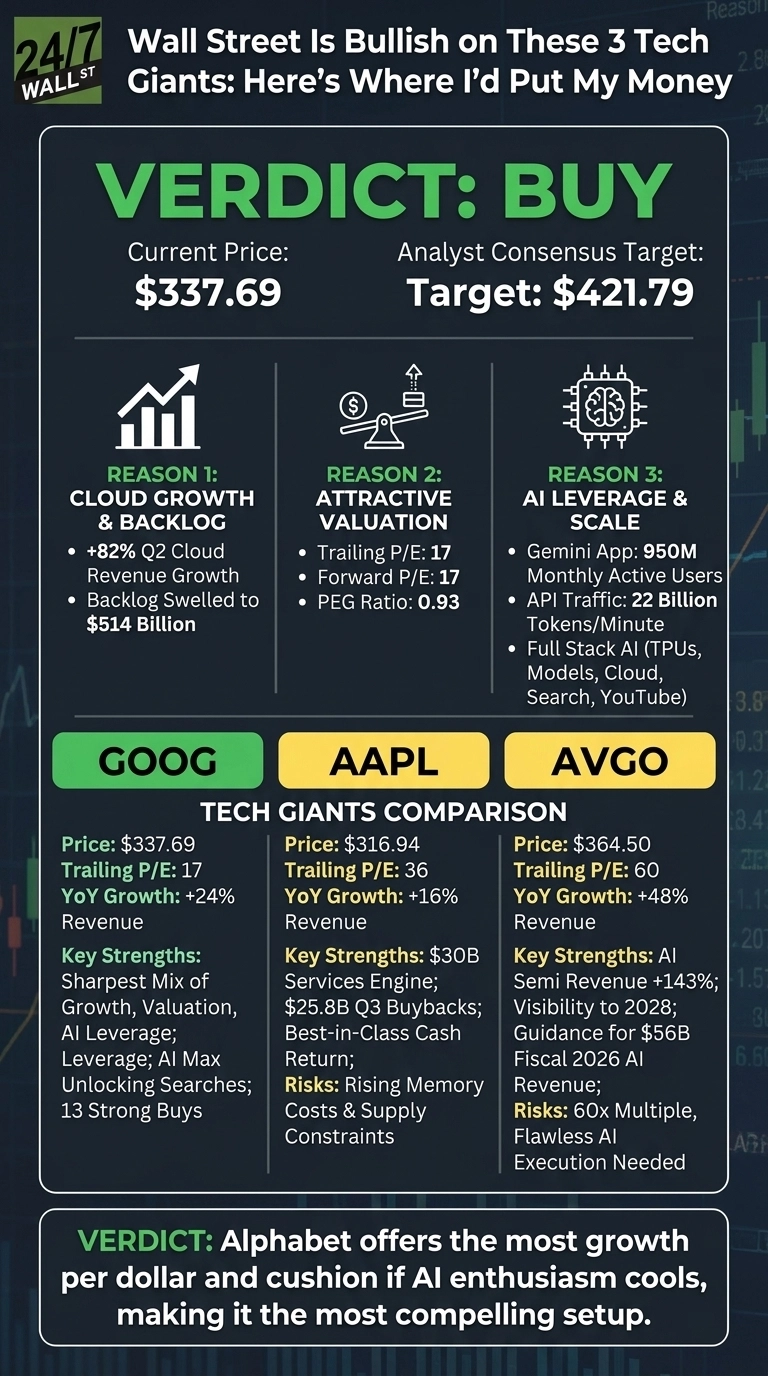
Where Apple and Broadcom Fall Short
Broadcom’s numbers dazzle. AI semiconductor revenue was $10.8 billion, up 143%, with Q2 bookings over $30 billion and guidance for $56 billion in fiscal 2026 AI revenue. The stock fell 12.88% in the past week as investors reassess the 60x multiple.
Apple’s Q3 was solid, with revenue of $109.4 billion, up 16%, and iPhone up 22%. Management flagged a 100-year flood on memory pricing and rising supply constraints. Siri AI remains unproven at scale, and gross margin guidance of 47% to 48% reflects memory pressure.
Why Patience Has a Case
Google’s capex hit $44.9 billion in Q2 alone, free cash flow ran negative $5.9 billion, and the buyback was suspended. Search faces regulatory overhang and generative AI competition.
Apple’s cash return story remains best-in-class with $25.8 billion in Q3 buybacks. Broadcom’s visibility runs all the way to 2028, and all of that spending has to be powered and cooled by somebody (we profiled seven of those suppliers in a free report). Waiting for a pullback across all three is defensible.
What the Numbers Say
Google’s consensus target sits at $421.79, implying roughly 25% upside, with 13 strong buys, 44 buys, 6 holds, and zero sells. Apple’s $325.70 target implies less than 3% upside across 46 analysts. Broadcom’s $527.88 target implies about 45% upside from 44 analysts, but assumes flawless AI execution.
Year to date, GOOG is up 9.03%, AAPL 16.86%, and AVGO 5.12%, versus the S&P 500 at roughly 12%. Google’s outperformance came with the lowest starting multiple, making the setup attractive.
Verdict: Alphabet Is the Best Money on the Table
At $337.69, Google screens as the most attractive of the three on a growth-adjusted basis.
Cloud is compounding at 82% with $514 billion of backlog. Search remains a monetization machine that AI is actively expanding, with AI Max unlocking billions of net new searches. The stock trades at 17x earnings while growing 24%.
Risks are real. Capex is running hot, cash flow has gone negative, and Gemini 4 execution matters. If Cloud growth decelerates below 50%, or if capex fails to translate into backlog conversion in 2027, the thesis weakens.
Apple deserves its premium as a compounder, and Broadcom deserves its multiple if it hits $100 billion in AI sales by 2027. But at these prices, Google offers the most growth per dollar and the most cushion if AI enthusiasm cools.
The post Wall Street Is Bullish on These 3 Tech Giants. Here’s Where I’d Put My Money appeared first on 24/7 Wall St..
]]>CNBC’s Kristina Partsinevelos walked viewers through a striking piece of dealmaking on August 19, describing an agreement in which Marvell Technology (NASDAQ:MRVL) will develop custom silicon that plugs directly into Google’s TPU ecosystem. In her words, the two signed “a commercial agreement for Marvell to develop custom silicon that attaches specifically to Google’s TPU ecosystem”, and she said to think of it as its own custom chip system.
The commercial terms are the interesting part. Alphabet (NASDAQ:GOOG, NASDAQ:GOOGL) received a warrant to buy up to 59 million shares at $206.58, which Partsinevelos characterized as “roughly 7% dilution, a notional $12 billion if fully exercised.” Marvell rose 7% on the news and Broadcom (NASDAQ:AVGO) fell 5%.
Marvell paid for its diversification with shareholder equity, and the market applauded the trade within hours. Whether that applause holds up depends on what escaping Amazon concentration is actually worth, relative to the cost of handing a customer a fixed claim on the upside that its own orders will help create.
What Marvell Actually Gave Google
The scope caught the market off guard. Partsinevelos said, “the scope is definitely wider than the street was expecting, so it includes custom accelerators, storage chips, networking, and memory chips.” That is a full-stack engagement.
The warrant strike sits well below where the stock trades today. Marvell closed at $237.27 on August 19, with the shares up 179.61% year to date and 229.93% over the past year.

Google is holding an option to buy a chunk of Marvell at a price the stock has already blown past. Every purchase order that lifts Marvell’s growth also lifts the value of that warrant, which is unusual generosity for a customer already receiving a strategic supply arrangement.
Management can point to the size of the prize as justification. CEO Matt Murphy told investors during the Q1 fiscal 2027 call that “we are seeing strong demand and exceptional bookings across our entire data center portfolio” and guided custom revenue to more than double in fiscal 2028.
The Diversification Case, Plainly Argued
Marvell’s ASIC franchise has leaned heavily on Amazon (NASDAQ:AMZN) for years, and that concentration has been the most persistent bear case on the stock. Partsinevelos framed the shift plainly: “Google just rounds out all of the four top U.S. hyperscalers for Marvell.”
Concentration risk is a concrete problem in custom silicon. A single customer controls roadmap decisions, renegotiation leverage, and the pace at which second sources are brought in. Adding Google as a committed multi-product partner changes the shape of that risk.
The counterargument is that dilution is permanent. The strike locks in a discount that Marvell shareholders effectively subsidize forever, and if the fiscal 2029 custom revenue target of over $10 billion was reachable anyway, the warrant was expensive insurance.
I think the trade was worth making, although only barely. Escaping single-customer dependency reprices a company’s multiple, and Marvell’s 9.85% jump on the day suggests investors reached the same conclusion in real time.
What Broadcom Holders Should Take From This
Broadcom’s Google relationship remains intact. On the fiscal Q2 2026 call, CEO Hock Tan said the company signed a long-term agreement in April to develop and supply multiple generations of TPUs and AI networking, describing the commitment as “a very substantial dollar amount.”
Tan also acknowledged that a customer of Google’s scale would use multiple suppliers, telling analysts “we fully expect that there will be some diversity of sources for them.” Wednesday’s news is that prediction arriving on schedule.
Bernstein pushed back on the panic in a morning note, arguing, as Partsinevelos summarized, that “there’s plenty to go around. The pie just keeps getting bigger.” The math supports the view: Broadcom guided fiscal 2027 AI semiconductor revenue to exceed $100 billion, and Q2 AI semiconductor bookings alone reached over $30 billion, per its latest 8-K. A buildout on that scale pulls in far more than the chipmakers themselves, which is why we profiled seven of the power, cooling, and networking suppliers riding the same wave in a free report.
Broadcom likely gives up some wallet share at Google while total Google dollars keep rising, and the stock’s 12.88% weekly slide reflects sentiment about the shift. Marvell has genuinely improved its position. Broadcom shareholders should be paying attention, and the correct posture is watchfulness.
The post Broadcom Shareholders Should Be Paying Attention to What Just Happened With Marvell and Google appeared first on 24/7 Wall St..
]]>Two ways to measure the horse race among the AI public-company market leaders. They can be at least partially handicapped by the large private companies, OpenAI and Anthropic. In every sense, in terms of market value, Meta (NASDAQ: META) has lost ground, particularly as measured by market cap. This yardstick is even better than stock price movements, because it shows how, ultimately, investors look at the AI race for supremacy. However, it misses one of the most important factors. How will the stream of incredibly impressive Chinese products affect the entire US industry?
Admittedly, the market cap measure has one other weakness. It ignores the key legacy businesses these companies are in. In Meta’s case, it is social media. In Microsoft (NASDAQ: MSFT), this is cloud computing and operating systems. Amazon’s (NASDAQ: AMZN) legacy business is e-commerce. However, today, based on the valuation of AI prospects, these legacy businesses seem less and less important. AI is that big of a deal. That assumes AI is the largest advance in technology history, or even mankind’s most important invention.
The value of the AI pure-play companies is instructive. None of their market value is based on any legacy revenue. On that basis, these valuations are remarkably high. OpenAI CEO Sam Altman has pushed for a $1 trillion valuation as it prepares for its IPO. In the minds of many investors, it has lost its position as the most valuable private AI company. Its revenue growth has slowed compared to rival Anthropic. Most recently, OpenAI’s revenue annual run rate sits at $40 billion (depending on who is talking). Anthropic’s is closer to $65 billion. The Wall Street Journal reported that “OpenAI’s Second-Quarter Sales Show Tepid Growth Compared With Anthropic.” Anthropic’s value has been touted as being close to $2 trillion.
Meta’s market cap is $1.39 trillion, which could put it behind Anthropic. Amazon’s market cap is double Meta’s, at $2.87 trillion. Microsoft’s is $3.60 trillion. And Alphabet’s (NASDAQ: GOOG) is $4.19 trillion.
Meta has argued that its basic approach to AI differs from most direct competitors (leaving aside Chinese companies). Mark Zuckerberg, Meta’s CEO, wrote a 14-page manifesto explaining why his company’s approach is better than most competitors’. It did not appear to help his position, nor did it address the fact that the market does not think much of his social media business, or his troubled approach to AI.
The post Meta Falls Far Behind Amazon, Alphabet, and Microsoft In AI appeared first on 24/7 Wall St..
]]>Alphabet has been one of the market’s strongest mega-cap tech stocks, but doubling that return has been harder than it sounds. Through August 13, Alphabet (NASDAQ: GOOGL, GOOG) has climbed roughly 10% from its December 31 close. The Direxion Daily GOOGL Bull 2X ETF (NASDAQ: GGLL) returned 8% over the same year-to-date period. That is a solid return, but nowhere close to the roughly 20% an investor might expect from simply doubling Alphabet’s gain.
The reason is built directly into the leveraged single-stock product. GGLL does not promise twice Alphabet’s return over a month, a year, or any other extended holding period. Instead, it seeks 200% of GOOGL’s performance each day, before fees and expenses. As such, daily resets, compounding, volatility, financing costs, and the fund’s 0.96% expense ratio can cause longer-term performance to drift significantly from two times Alphabet’s cumulative return. Direxion explicitly warns that GGLL can even lose money over longer periods even when Alphabet itself rises.
The Decay Math Is Simple
Let’s start by considering a stripped-down two-day example. Alphabet starts at $100, rises 10% on day one to $110, and then falls 10% on day two. The stock does not return to $100. It finishes at $99, for a 1% loss. A hypothetical 2X fund starts at $100, rises 20% to $120, and then falls 20%. It finishes at $96, for a 4% loss. That is how the math works in practice.
This is how leveraged funds work by design. The fund delivered exactly twice the stock’s daily percentage move on both days, but the problem is that gains and losses compound from different starting values. A 10% decline requires an 11.1% gain to recover. A 20% decline requires a 25% gain. Increase the size and frequency of those swings, and the gap compounds quickly. This is commonly referred to as volatility drag.
GGLL investors received a real-world demonstration of this volatility in July. Alphabet fell 4.44% on July 16, and GGLL dropped 8.96%. A week later, Alphabet fell another 7.13% on July 23, while GGLL lost 14.41%. These are roughly the daily outcomes the fund is designed to produce. However, the damage appears when those leveraged losses are mixed with leveraged gains and compounded across weeks or months.
Why Alphabet Has Still Been a Strong Bet
None of this makes the underlying Alphabet thesis weak. The company remains one of the dominant businesses in digital advertising, cloud computing, and artificial intelligence. Google Search still throws off enormous cash flow, while Google Cloud and the company’s Gemini AI ecosystem give Alphabet multiple ways to monetize the current AI investment cycle.
That operating strength is one reason Alphabet shares have been able to produce a double-digit gain this year (triple digit gains over the 12-month period). And it is also why GGLL can look so attractive. If Alphabet rises steadily for several sessions, daily compounding can work for leveraged ETF holders rather than against them. For an underlying stock that gains 2% every day for five consecutive sessions, the leveraged ETF can be expected to rise even higher. That said, for leveraged products like GGLL, the path matters as much as the destination.
A $10,000 Investment Shows the Difference
Using the August 13 year-to-date figures makes that clear. A hypothetical $10,000 investment tracking Alphabet’s roughly 10% gain would have grown to about $11,000. Simply multiplying that cumulative return by two suggests GGLL should have turned the same $10,000 into roughly $12,000.
That difference is not necessarily an error or failure to track. It is largely a consequence of asking a daily leveraged product to behave like a long-term 2X investment when that is not what it promises to do. Direxion specifically states that leveraged ETFs should not be expected to track their underlying securities over periods longer than one day.
What This Means for You
GGLL can still be an effective tool for an investor with a short-term bullish view on Alphabet. A strong, relatively smooth rally gives the fund exactly the environment where leverage can compound favorably. The trade changes when the holding period stretches into weeks or months and Alphabet starts moving sharply in both directions. At that point, being right about where Google ultimately goes may not be enough. You also have to be right about the path it takes to get there.
The post Google Is Up 10% This Year. This 2X ETF Has Returned 8%. Here’s the Decay Math That Explains the Difference appeared first on 24/7 Wall St..
]]>The hedge funds finally had a chance to show their cards, at least the cards they held in the second quarter. And while much of the usual was being scooped up (think the hyperscaler tech darlings as well as the steady financial toll booth plays) by hedge funds, I do think that one name, in particular, really stood out: Uber Technologies (NASDAQ:UBER), a ride-hailing giant that’s quite misunderstood among everyday investors.
While not every smart money manager was looking to get a piece in the last quarter, some of my favorite big-name hedge funds, including Bill Ackman’s Pershing Square Holdings, David Tepper’s Appaloosa Management, and Terry Smith over at British fund Fundsmith, were pretty big buyers. With shares of Uber going flat in the past two quarters, investors may very well have a shot at actually landing a price that’s close to what the hedge fund stars bought at.
Uber faces new competition, but don’t count it out just yet
With the rise of agentic AI and autonomous vehicles (AVs), including the likes of Alphabet‘s (NASDAQ:GOOG) Waymo, Tesla‘s (NASDAQ:TSLA) Cybercab, and Amazon‘s (NASDAQ:AMZN) Zoox leading the way, it certainly feels like the mobility and ride-sharing industry is about to change drastically in the next three years.
Undoubtedly, a major part of Uber’s moat is its ability to connect riders with drivers who take care of the fueling up, the cleaning, and, of course, the driving, as well as providing the vehicle itself. It’s Uber’s impressive matching ability that’s allowed it to build one of the most impressive capital-light “tollbooths” of the modern era.
But as agents and autonomy take off, what happens to Uber? With Tesla, Zoox, and Waymo each having their own app, will Uber’s market dominance erode as rivals take share? If you start at the top of a market, there’s only one way to go, right?
That’s the big question that’s clouded in a haze of uncertainty. Indeed, investors aren’t huge fans of uncertainty. Even as AVs go through Uber to fetch their riders, questions linger as to whether that will last and whether things will eventually shift towards the apps of the big firms that have effectively taken control of the entire market vertical.
Indeed, Uber ditched its own AV efforts some time ago, which may be a red flag for some, but a smart move by others. The move doesn’t mean Uber is just going to sit there and hope that riders choose human drivers over AVs as the technology keeps getting better.
Uber’s $10 billion bet on the future of AVs
With Uber announcing a $10 billion investment in robotaxis in a move that could send as many as 120,000 AVs on the roads, perhaps Uber has taken the capital-light route to its eventual transition to becoming a more capital-intensive company. Indeed, if you were in the know about its capital-light nature, you might be less enthused that Uber is going to need to spend more to scale up the fleet as it goes up against some new competition.
When you cut the driver out of the equation, though, there’s the potential for a considerable margin boost. And when you consider that it’s not all too easy to grab Uber’s mindshare, my guess is that it’s going to be far more economical for AV firms to go with Uber in addition to their own apps.
Sure, it’s nice to not have Uber take a cut, but at the end of the day, if Uber is where the riders are, it beats letting a robotaxi sit there idle, waiting for a rider close by to hail. Network density matters, and fleet utilization, I believe, will bring in AV firms, including those with grand ambitions, like Tesla (NASDAQ:TSLA), which isn’t going to be putting Cybercabs on Uber, at least not quite yet.
The bottom line
Even as AVs and agents, which could end up as a ride-hailing aggregator, pose new threats to Uber in the new era, I do think that most roads will eventually find their way through Uber. Like it or not, the capital-light Uber is shifting gears to set the stage for an AV take-off — one that might enable it to retain share and actually earn off its up-and-coming AV rivals.
Whether riders hail one of the AVs that Uber’s deploying or a rival AV, my bet is that riders will either have to keep paying the toll or maybe more to use one of Uber’s AVs. While Waymo might have the most impressive tech, I certainly wouldn’t bet against Uber, as it has the scaling edge that can enable it to move far faster than the vertically integrated players.
The post The Smart Money is Onto Something With This Highly-Misunderstood Tech Bargain appeared first on 24/7 Wall St..
]]>A $2 trillion valuation for a private artificial intelligence company sounds designed to end conversations rather than start them. On CNBC this afternoon, Lo Toney, founding managing partner at Plexo Capital, argued the opposite.
If you accept a certain revenue run rate at listing and apply a multiple borrowed from the public AI cohort, the figure lands where the framework says it should.
Toney disclosed on air that his firm holds Anthropic from the Series D that closed in January of 2024 at an $18 billion valuation, so he is speaking about a position he owns.
That disclosure does not disqualify the argument, but the argument has to survive on its own terms, because a valuation multiple is only as defensible as the revenue it multiplies and the durability of the margins behind that revenue.
Anthropic is not listed; its shares are not available to ordinary investors today, and the October timing Toney referenced is an expectation described in the segment rather than a scheduled event.
The Framework Toney Laid Out
The mechanics are simple. Toney said that “when you start to apply these multiples to Anthropic… you can come down to a multiple anywhere, you know, call it about 25x. And if in October, when everyone expects the IPO to hit, they’re at about 80 to 85 billion in the run rate for revenue, then all of a sudden, you know, 2 trillion starts to look fairly reasonable.”
He anchored the growth story by saying Anthropic has “truly bucked the law of large numbers” in its revenue trajectory over the past three years. Whether that pace holds through the summer is the assumption on which everything else rests.
Two of Anthropic’s largest backers have already told the public market that the private valuation has been repricing sharply. Microsoft (NASDAQ:MSFT) recognized a $3.2 billion gain from its investment in Anthropic in its fiscal fourth quarter, and Alphabet (NASDAQ:GOOG, NASDAQ:GOOGL) reported a $99.03 billion gain on equity securities in the second quarter, with the Anthropic stake widely understood as a meaningful contributor. Those marks reflect what strategic partners will pay for optionality, not what a public float has to clear.
Why the Public Comparables Do Not Cleanly Translate
The 25x figure only holds if the comparables behave like Anthropic. NVIDIA (NASDAQ:NVDA) trades at a price-to-sales ratio of about 22x, with non-GAAP gross margins of 75% and operating margins of around 65.6%, on data center revenue that grew 92% year over year in the most recent quarter. Microsoft trades at a price-to-sales ratio of about 11x with a 45.1% operating margin. Alphabet trades at a price-to-sales ratio of about 9x with a 34% operating margin. A 25x multiple sits above all three, and each is profitable at scale.
Anthropic operates without that profitability cushion. Reporting circulating the same day Toney appeared observed that Anthropic has barely turned a profit, which is the necessary floor for any comparison. A multiple is a claim about the future cash flows the market will pay for today, and multiples above those of profitable incumbents require faith that growth lasts long enough to close the profitability gap. That faith is easier to sustain in a private round with strategic partners than in a public market with generalist money.
The Margin Question Is the One That Matters
The part of the segment that warrants the most attention is the caveat Toney himself supplied. “As you move up into the models where Anthropic and OpenAI’s core business is, we do believe that that is a place where there will be some pressure on the margins. You can see some of that coming from the open models, and the orchestration companies are now doing to route the right task to the right model.”
Enterprise buyers increasingly treat frontier models as substitutable. Satya Nadella described exactly this architecture in July, saying “any given model at any given time is swappable” across a catalog that now spans over 11,000 models.
Toney’s math is the right way to think about a private company at the moment of listing, because a run rate applied to a comparable multiple is what public markets do every day. What the framework understates is the question of durability.
A 25x sales multiple is a bet that terminal margins will compound toward something like the public leaders, and if orchestration and open weights compress the pricing frontier that model providers can hold, the terminal margins will not resemble those behind Nvidia or Microsoft today.
If Anthropic prices at $2 trillion in October, the interesting question for ordinary investors will be whether the revenue that justified it still carries the same margin two years later.
The post Early Anthropic Backer Defends $2 Trillion IPO Target—But There’s a Catch appeared first on 24/7 Wall St..
]]>Rep. Josh Gottheimer, the New Jersey Democrat who serves as Ranking Member of the House Intelligence Committee’s National Security Agency and Cyber Subcommittee, disclosed purchases of three pure-play cybersecurity stocks in a periodic transaction report filed August 10, 2026.
He bought shares of CrowdStrike (NASDAQ:CRWD) on July 15, Palo Alto Networks (NASDAQ:PANW) on July 16, and SailPoint (NASDAQ:SAIL) on July 20, each in the $1,001 to $15,000 band. The trades sit inside a Morgan Stanley Select UMA account, a professionally managed vehicle, and the same filing shows roughly a dozen other transactions during the same window, including Alphabet (NASDAQ:GOOG, NASDAQ:GOOGL) preferred shares and several sales. That pattern looks like an advisor rebalancing a managed account rather than a member of Congress hand-picking names, and you should carry that fact into everything below.
Regardless, let’s take a look.
The Structural Question the Filing Raises
The question worth asking is whether a lawmaker who receives classified briefings on the cyber threat landscape should hold equity in the companies whose commercial fortunes ride on that landscape, regardless of who executes the trades. Gottheimer’s subcommittee has oversight of the government’s cyber apparatus, and the three companies he now owns sell endpoint protection, network security platforms, and identity governance to federal agencies and the private enterprises the government is charged with defending. The financial exposure exists whether the account is managed or self-directed, and current STOCK Act disclosure rules do not distinguish between the two.
The managed-account explanation resolves intent while leaving the conflict in place. A member of Congress who reads intelligence products on adversary tradecraft cannot unread them when reviewing quarterly statements, and reasonable observers can disagree about whether that matters more or less than a self-directed trade. Anyone trying to treat a periodic transaction report as a market signal still has to decide what a small purchase inside a rebalanced UMA actually tells them.
Reading This as an Investment Signal?
The signal is weak at best. A four-figure purchase inside a managed account reflects an advisor’s model rather than a considered judgment about a specific company’s prospects. Anyone building a thesis on these names should do so on the underlying business, which is coherent enough on its own terms.
CrowdStrike grew revenue 25.6% year over year last quarter and trades at a forward earnings multiple of 175x. Palo Alto’s Next-Generation Security ARR reached $8.13 billion, up 60% year over year, and CEO Nikesh Arora told analysts in June that frontier AI models have entered an era where they can “identify and weaponize vulnerabilities in mere minutes, a process that previously required months of manual effort.”
SailPoint, at a market cap of roughly $11 billion, is building identity governance for machine and AI-agent identities, a category regulators are pushing enterprises to control.
The basket is a coherent bet that AI adoption will force new cybersecurity spending, and the market has already made that bet loudly. CrowdStrike is up 104.26% over the past year, and Palo Alto is up 121.42%. Following Gottheimer into these names because he owns them is following a signal that carries almost no information.
Studying the AI-security thesis on its merits is a better use of your attention, and that thesis is intact regardless of what any managed account decided to buy in July.
All that said, if you are still confident that this politician will end up winning big, it’s not a terrible idea to take inspiration from some of these trades. Cybersecurity stocks remain hot and have been hot for a long time.
The post This Politician on the House Intelligence Committee’s Cyber Panel Just Bought Three Cybersecurity Stocks appeared first on 24/7 Wall St..
]]>Greg Abel, in his first year as chief executive of Berkshire Hathaway (NYSE:BRK-A, NYSE:BRK-B) deployed roughly $23.5 billion into equities during the second quarter of 2026, ending a stretch of about three years in which Berkshire had sold more stock than it bought.
The reversal was disclosed in the 8-K filed on August 11, 2026. The destinations of the money reveal a coherent capital allocation stance from a new operator, putting a record cash pile of $380 billion at the end of Q1 2026 back to work. A $10 billion private placement in Alphabet (NASDAQ:GOOG, NASDAQ:GOOGL) that closed June 4, a fresh add to Lennar, an outright cash acquisition of homebuilder Taylor Morrison, and roughly $4.5 billion of repurchases of Berkshire’s own shares signal Abel’s priorities. For a retirement-focused investor taking cues from Berkshire, the question is which moves are reachable for an individual investor and which remain structurally out of reach.
The Alphabet Placement Was a Private Deal
Berkshire took the Alphabet shares directly from the company in a negotiated private placement, rather than accumulating them in the open market as an ordinary buyer would. That is a transaction an ordinary investor cannot replicate.
Alphabet’s Q2 revenue grew 24.2% year over year to $119.80 billion, with Google Cloud accelerating to 82% growth and CapEx running at $44.92 billion in a single quarter as the company builds AI infrastructure at scale. Every dollar of that CapEx flows to the power, cooling, and networking suppliers behind the data centers, seven of which we profiled in a free report you can grab here.
The business is capital-hungry in a way that suits Berkshire’s balance sheet and is unfriendly to smaller holders. Alphabet suspended its buyback in Q2 2026 and raised roughly $70 billion in combined equity and debt to fund the build. Abel used Berkshire’s cash to become one of the sources of that equity on preferential terms, likely at a negotiated discount to the market. A retail investor buying GOOGL on August 14 paid $345.90, up 70.93% over the prior year. The thesis is reachable, though the pricing terms remain exclusive to Berkshire.
Housing Is the Other Half of the Trade
Abel is spending most freely on housing, where the arithmetic is friendlier to individual investors. Alongside its investment in Lennar (NYSE:LEN), Berkshire agreed on May 31 to acquire Taylor Morrison outright for $72.50 per share in cash and closed the deal on July 24. Taylor Morrison (NYSE:TMHC) last traded at $72.45 on the closing date, essentially at the deal price. Lennar is down 32.11% over the past year, and CEO Stuart Miller told shareholders that buyer incentives had narrowed to 12.9% from levels closer to 14%, describing the gap as narrowing “for the first time in three years.”
June housing starts came in at 1.43 million annualized units, inside the healthy range, and the Case-Shiller index sat at 335.1 in May, near the top of its historical distribution. Abel is buying builders while volumes are firm and prices are elevated.
What This Means for a Retail Investor
The buyback signal is the cleanest. Berkshire repurchased its own shares aggressively when the stock traded near book value, a P/B near book value against a low double-digit P/E, and the shares are up only 0.27% year to date. That is management telling shareholders the stock is fair value at current levels.
The Alphabet placement offers a thesis worth studying even where the terms remain out of reach for individuals. The homebuilder call is the one an ordinary investor can most literally follow, provided the view is that incentive normalization is real, and that rate relief eventually arrives. Following Abel here means accepting cyclical risk in exchange for a long-duration housing shortage that remains unresolved.
The post Greg Abel Broke Warren Buffett’s 14-Quarter Selling Streak. Here’s Where the Money Went appeared first on 24/7 Wall St..
]]>David Tepper’s Appaloosa LP disclosed its Q2 2026 13F on Friday, Aug. 14, revealing a portfolio anchored by five mega-cap AI names: Focusing on the tech-heavy positions retail investors most often track, Tepper’s disclosed holdings in Amazon (NASDAQ:AMZN), Micron Technology (NASDAQ:MU), NVIDIA (NASDAQ:NVDA), Meta Platforms (NASDAQ:META) and Alphabet (NASDAQ:GOOG), forming the spine of a concentrated bet on AI infrastructure economics.
What Tepper Actually Did
The filing reflects positions as of June 30. Amazon remained the top holding at 15.42% of the portfolio, roughly $1.19 billion across 5 million shares. Micron held the #2 slot at 14.57% ($1.13 billion, 975,000 shares), but Tepper cut the share count by 41%, a decisive round of profit-taking after the stock’s run. He added to the three other mega-cap AI names: Meta (+$130 million), Alphabet (+$157 million) and NVIDIA (+$49 million). He also exited Microsoft (NASDAQ:MSFT) entirely, making the additions to META and GOOG a deliberate rotation inside hyperscaler exposure.
The Thesis Behind The Book
The common thread is AI infrastructure monetization. Amazon’s Q2 earnings report gave Tepper his validation: AWS revenue hit $42.2 billion, up 36.7% year over year, with a $496 billion backlog and operating margin of 39%. CEO Andy Jassy told analysts the lion’s share of 2027 capacity is already reserved, with significant 2028 capacity spoken for. Alphabet’s Google Cloud grew 82% year over year to $24.8 billion, with backlog reaching $514 billion. NVIDIA’s Data Center segment ran at $75 billion, up 92%, with Q2 revenue guided to $91 billion. Meta, despite an EPS miss, posted ad revenue of $59.4 billion, up 27%, with price per ad up 12%.
The Micron trim is the interesting tell. Even after cutting 41% of the share count, Tepper kept it at 14.57% of the book. Micron’s 16 Strategic Customer Agreements now represent roughly $100 billion in cumulative minimum-price revenue, with floor margins well above prior peak cycles. He booked the parabolic gain but kept the structural exposure.
Should Retail Follow?
Price action since the filing snapshot is mixed. From June 30 through August 14, AMZN rose 10.2%, NVDA gained 12.53%, and META added 4.72%. But MU fell 15.81% and GOOG slipped 2.77%. Tepper’s Micron trim looks well-timed; the additions to GOOG and META are still proving out.
The takeaway for a retirement-focused investor: this is a coherent AI-capex thesis, not a scattershot bet. The hyperscalers (AMZN, GOOG, META) are the demand side, NVIDIA is the pick-and-shovel, and Micron is the memory bottleneck. The other half of that trade sits with the power, cooling, and networking suppliers feeding the data-center buildout, which we profiled in a free report on seven AI infrastructure stocks that aren’t chipmakers. Valuations are stretched (NVDA trades at a trailing P/E of 34) but backed by locked-in backlogs measured in hundreds of billions.
Following Tepper here is defensible; blindly matching his sizing is not. The signal worth copying is the discipline of trimming winners like Micron into strength while pressing the still-cheap Alphabet position.
The post Billionaire David Tepper’s Top 5 Holdings Just Revealed appeared first on 24/7 Wall St..
]]>At $343.54, Alphabet (NASDAQ:GOOG) looks compelling to some of the market’s most disciplined capital allocators, and Berkshire Hathaway just signaled why. Berkshire Hathaway (NYSE:BRK.B) $17 billion add to its Alphabet stake was its biggest second-quarter move, vaulting Google’s parent into Berkshire’s third-largest holding.
Alphabet dominates search, operates YouTube, and owns Google Cloud, one of three global hyperscaler platforms racing to build AI infrastructure. Under CEO Sundar Pichai, it has grown into a $4.20 trillion business while the market debated whether AI will erode Search or supercharge it. The answer looks like the latter.
The stock has run 69.03% over the past year yet trades at a valuation that would embarrass most hyperscaler peers, which is why Buffett’s team stepped in.
Why Buffett’s Team Is Buying Here
Alphabet trades at 17 times trailing earnings with a PEG ratio of 0.964, extraordinary for a business posting 24% revenue growth and 34% operating margins. Q2 2026 revenue hit $119.80 billion, and Google Cloud accelerated to 82% growth with operating income more than tripling to $8.8 billion.
Forward catalysts include a $514 billion Cloud backlog, nearly 90% of the Fortune 100 now on Gemini Enterprise, and Search revenue up 17% as AI Overviews scale without cannibalizing monetization. Of 63 covering analysts, 57 rate the stock a Buy or Strong Buy.
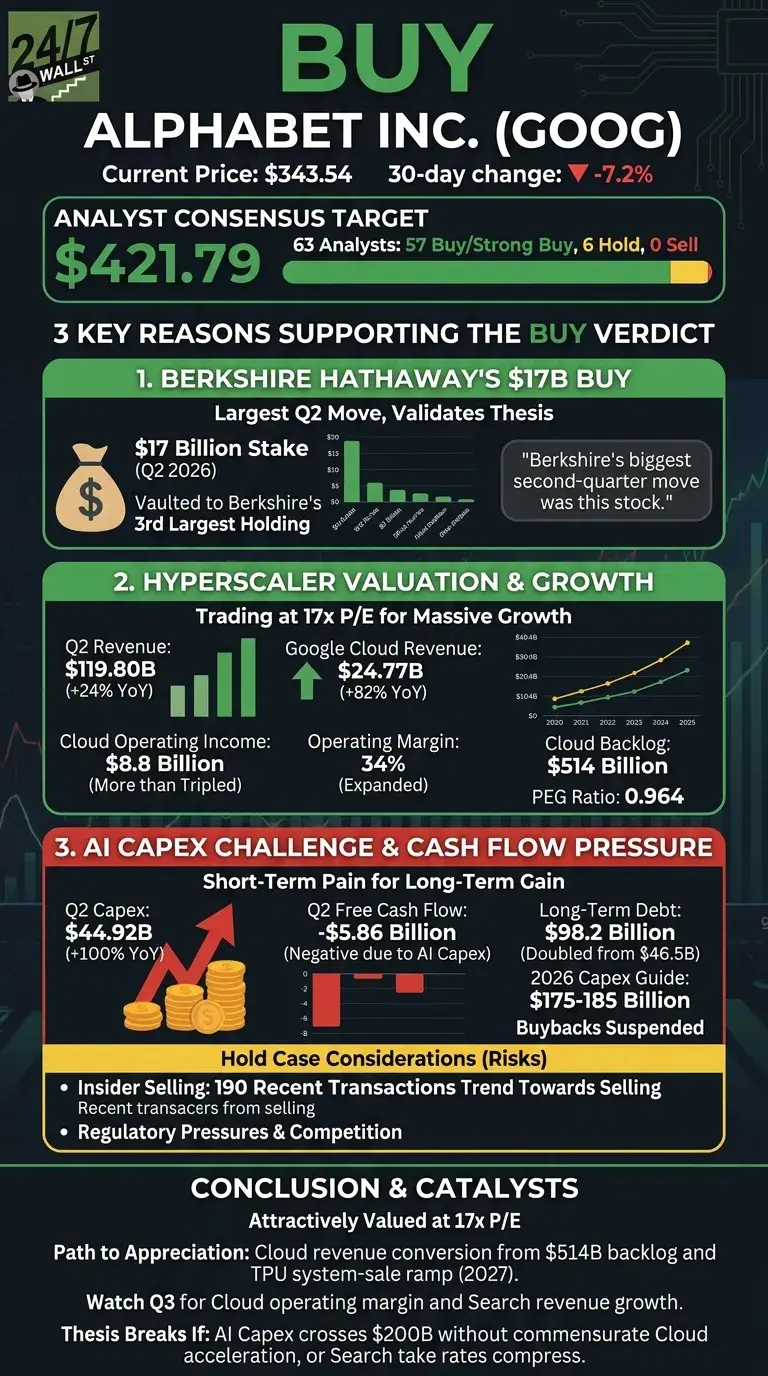
The Capex Bill Coming Due
The bear case centers on cash flow. Q2 capital expenditures doubled year over year to $44.92 billion, pushing free cash flow to negative $5.86 billion. Long-term debt more than doubled from $46.5 billion to $98.2 billion, and the buyback program was suspended.
2026 capex guidance sits at $175 to $185 billion, and the market has flinched. The stock is down 7.2% over the past month. Add regulatory pressure and competition from OpenAI and Anthropic, and the EPS beat looks less impressive once you strip out $99.03 billion in unrealized equity securities gains.
Why Some Investors Are Waiting
The hold case is straightforward: you can love the business and still want one more quarter. AI capex is running ahead of AI revenue, and TPU system sales won’t meaningfully hit the P&L until 2027. Insider activity has trended toward selling across 190 recent transactions.
Tipping-point questions: does Cloud margin hold as third-party capacity bridges the supply gap, and does Search monetization stay durable as AI Mode crosses 1 billion monthly active users? Q3 earnings will answer both.
What the Numbers Say
Alphabet trades at $343.54 against a consensus analyst target of $421.79, implying roughly 22.8% upside across 63 analysts. The ratings breakdown reads:
- Strong Buy: 13
- Buy: 44
- Hold: 6
- Sell: 0
Shares are up 9.62% year to date. Since the Q2 filing on July 22, GOOG has slipped 1.3% while the SPDR S&P 500 ETF Trust (NYSEARCA:SPY) has risen 5.2%, a gap that explains why deep-pocketed buyers see an entry point. Valuation is anchored by a 17 P/E, a 54.8% profit margin, and 48.7% return on equity.
The Verdict: Why Berkshire Bought Here
At $343.54, Alphabet screens as attractively valued by consensus standards.
The path to appreciation runs through two catalysts over the next two to four quarters: Cloud revenue conversion from the $514 billion backlog and TPU system-sale ramp hitting the income statement.
At 17 times earnings, investors pay a market multiple for a business compounding revenue at 24% with Cloud growing 82%. That is the mispricing Berkshire recognized when it made GOOG its largest Q2 buy.
The thesis breaks if AI capex crosses $200 billion without commensurate Cloud acceleration, or if AI Overviews compress Search take rates. Watch Q3 for Cloud operating margin and Search revenue growth. Neither signals stress yet.
The pullback into a Buffett buy at a hyperscaler-cheap multiple sets up the next twelve months.
The post Berkshire’s Biggest Second-Quarter Move Was This Stock. Should You Buy, Sell or Hold? appeared first on 24/7 Wall St..
]]>David Tepper’s Appaloosa LP disclosed its Q2 2026 13F on Friday, August 14, 2026, revealing a portfolio anchored by five mega-cap AI names: Amazon, Micron, Taiwan Semiconductor, Meta, and Alphabet. Focusing on the tech-heavy positions retail investors most often track, Tepper’s disclosed holdings in Amazon (NASDAQ:AMZN), Micron Technology (NASDAQ:MU), NVIDIA (NASDAQ:NVDA), Meta Platforms (NASDAQ:META), and Alphabet (NASDAQ:GOOG) form the spine of a concentrated bet on AI infrastructure economics.
What Tepper Actually Did
The filing reflects positions as of June 30, 2026. Amazon remained the top holding at 15.42% of the portfolio, roughly $1.19 billion across 5 million shares. Micron held the #2 slot at 14.57% ($1.13 billion, 975,000 shares), but Tepper cut the share count by 41%, a decisive round of profit-taking after the stock’s run. He added to the three other mega-cap AI names: Meta (+$130 million), Alphabet (+$157 million), and NVIDIA (+$49 million). He also exited Microsoft entirely, making the additions to META and GOOG a deliberate rotation inside hyperscaler exposure.
The Thesis Behind The Book
The common thread is AI infrastructure monetization. Amazon’s Q2 earnings report gave Tepper his validation: AWS revenue hit $42.2 billion, up 36.7% year over year, with a $496 billion backlog and operating margin of 39%. CEO Andy Jassy told analysts the lion’s share of 2027 capacity is already reserved, with significant 2028 capacity spoken for. Alphabet’s Google Cloud grew 82% year over year to $24.8 billion, with backlog reaching $514 billion. NVIDIA’s Data Center segment ran at $75 billion, up 92%, with Q2 revenue guided to $91 billion. Meta, despite an EPS miss, posted ad revenue of $59.4 billion, up 27%, with price per ad up 12%.
The Micron trim is the interesting tell. Even after cutting 41% of the share count, Tepper kept it at 14.57% of the book. Micron’s 16 Strategic Customer Agreements now represent roughly $100 billion in cumulative minimum-price revenue, with floor margins well above prior peak cycles. He booked the parabolic gain but kept the structural exposure.
Should Retail Follow?
Price action since the filing snapshot is mixed. From June 30 through August 14, AMZN rose 10.2%, NVDA gained 12.53%, and META added 4.72%. But MU fell 15.81% and GOOG slipped 2.77%. Tepper’s Micron trim looks well-timed; the additions to GOOG and META are still proving out.
The takeaway for a retirement-focused investor: this is a coherent AI-capex thesis, not a scattershot bet. The hyperscalers (AMZN, GOOG, META) are the demand side, NVIDIA is the pick-and-shovel, and Micron is the memory bottleneck. The other half of that trade sits with the power, cooling, and networking suppliers feeding the data-center buildout, which we profiled in a free report on seven AI infrastructure stocks that aren’t chipmakers. Valuations are stretched (NVDA trades at a trailing P/E of 34) but backed by locked-in backlogs measured in hundreds of billions. Following Tepper here is defensible; blindly matching his sizing is not. The signal worth copying is the discipline of trimming winners like Micron into strength while pressing the still-cheap Alphabet position.
The post Billionaire David Tepper’s Top 5 Holdings Just Revealed appeared first on 24/7 Wall St..
]]>Greg Abel, Warren Buffett’s designated successor as CEO of Berkshire Hathaway, poured roughly $17 billion into Alphabet (NASDAQ:GOOGL) during the second quarter, according to Berkshire’s Q2 2026 13F filing released last week. The disclosure, showing 24,541,369 new GOOGL shares and 23,603,218 new GOOG shares, is the clearest window yet into how Abel is deploying capital. When read alongside a Bank of America (NYSE:BAC) trim, a Delta Air Lines (NYSE:DAL) build, and a new D.R. Horton (NYSE:DHI) starter, five themes emerge.
1. Alphabet Is Now a Core Berkshire Holding
The combined Alphabet stake elevated the stock into Berkshire’s top holdings. The timing fits the fundamentals. Alphabet reported Q2 2026 revenue growth of 24.2% year over year and trades at a trailing P/E of 17 with a PEG ratio of 0.937. Shares are up 68.7% over the past year and closed at $344.00 on August 17.
2. The AI Thesis Has a Cloud Backbone
Abel is underwriting Google Cloud alongside search. Google Cloud revenue grew 82% year over year to $24.77 billion in Q2, and management disclosed a cloud backlog of $514 billion. Prediction markets assign a 71.5% probability that the next Gemini Pro ships by October 31, with a 91.4% probability it debuts at an Arena score of 1480 or higher. That is the near-term catalyst set Abel is underwriting, and the same buildout story runs through the power, cooling, and networking suppliers we profiled in a free report on the AI infrastructure names that are not chipmakers.
3. Bank of America Trim Signals Selective Financials Caution
Berkshire sold 30,230,150 shares of Bank of America, yet the stake remained the fifth largest at $27.54 billion, or 9.20% of the portfolio. Bank of America stock has advanced 16.2% year to date and 36.1% over the past year. Abel is booking gains while retaining the stock as a top-five holding.

4. Airline Re-Entry via Delta
Berkshire added 17,510,544 shares of Delta Air Lines, building the position to $5.37 billion. This reverses Buffett’s 2020 exit from airlines. Delta guided FY2026 adjusted EPS to $6.50 to $7.50 with premium revenue up 17% and loyalty up 19%. Shares are up 26.2% year to date, and the stock trades at a forward P/E of 14.

5. Housing Optimism Through Homebuilders
A new starter position of 3,564 shares of D.R. Horton accompanied a 3,012,099-share increase in Lennar (NYSE: LEN), lifting that stake to $1.16 billion. Lennar is down 34.4% over the past year, and D.R. Horton trades at a forward P/E of 13 against an analyst target of $162.92. Abel is buying weakness where balance sheets are strong.


The Takeaway
For a retirement-focused investor, the Alphabet purchase is the signal worth studying. Berkshire rarely stakes $17 billion on a single quarter’s move. The entry point, roughly 17x forward earnings for a business compounding revenue in the mid-20s, resembles the Apple thesis in its early innings: dominant cash generation acquired at a market multiple. The homebuilder and airline moves are secondary bets on U.S. economic resilience. Following his lead requires accepting Abel’s holding period, which is measured in years.
Data Sources
- Berkshire Hathaway Q2 2026 13F Filing provided verified share counts, position values, and portfolio weights.
- The filing confirmed the combined Alphabet purchase as Q2’s largest active dollar move.
- The filing documented the Bank of America trim and the new D.R. Horton starter position.
The post Greg Abel Just Bet $17 Billion on This 1 Stock appeared first on 24/7 Wall St..
]]>Between August 13 and 14, 2026, Q2 2026 13F filings landed and told a rare story: Stanley Druckenmiller, Seth Klarman, David Tepper, Dan Loeb, and Berkshire Hathaway all moved into Alphabet (NASDAQ:GOOGL) in the same quarter. Consensus buys of that magnitude across value, macro, and event-driven billionaires almost never happen simultaneously in a single mega-cap name.
The filings, which report positions as of June 30, 2026, show the following.
- Berkshire Hathaway added 24,541,369 GOOGL shares to reach 78,791,167 shares, a position valued at $28,157,599,351, and also added 23,603,218 GOOG shares to reach 27,188,433, valued at $9,606,489,032, together roughly 0.93% of the company.
- Druckenmiller’s Duquesne Family Office opened a brand new GOOGL position of 336,300 shares worth $120,184,000.
- Klarman’s Baupost Group added 190,800 GOOG shares to reach 1,371,931 shares valued at $484,744,000.
- Tepper’s Appaloosa added 117,300 GOOG shares to reach 1,850,000, valued at $653,660,500.
- Loeb’s Third Point took GOOGL from 175,000 to 1,025,000 shares, adding 850,000 shares valued at $366,304,250, and opened positions in two additional Alphabet share classes.
It’s worth emphasizing that Buffett is now the Chairman of Berkshire Hathaway and day-to-day CEO duties fall to Greg Abel. However, recent reporting from The Wall Street Journal shows that Buffett pushed for an outsized addition of Alphabet during the quarter.
The Thesis ‘Smart Money’ Is Backing
Alphabet trades at a trailing P/E of 17 against a PEG of 0.969, and shares sit at $345.90, down 6.75% over the past month even after a 70.93% one-year run. Q2 earnings were the catalyst: EPS of $9.11 against a $3.04 estimate, revenue of $119.80 billion up 24.2% year over year, and Google Cloud accelerating to 82% growth at $24.77 billion. Sundar Pichai noted “nearly 90% of the Fortune 100 using” Gemini Enterprise, and Gemini models now process 22 billion API tokens per minute.
For value-oriented investors like Klarman and Tepper, this is a Mag 7 franchise trading at a cyclical trough multiple while cloud reaccelerates. For Druckenmiller, a macro allocator opening a new position, the thesis reads as an AI infrastructure call.
The Other Side Retail Investors Should Weigh
‘Smart money’ bought a company that has been visibly bleeding senior AI talent. In June, five top Google AI researchers left in seven days, and Jim Cramer called Noam Shazeer’s jump to OpenAI “a coup.” Then in August, a key AI architect quit, reigniting fears Gemini is losing ground to OpenAI and Anthropic. Cash costs are climbing too: Q2 free cash flow turned negative at $5.86 billion, long-term debt rose from $46.5 billion to $98.2 billion, and the buyback was suspended.
Against all this news, Alphabet has badly underperformed Mag 7 peers across the past month like Microsoft (Nasdaq: MSFT). Remember that 13-F filing are a snapshot in time. Reports of recent buys were just released, but only cover positions on June 30th. While Berkshire is unlikely to have reduced its Alphabet holdings, it will be interesting whether other names on this list that trade more frequently (such as Tepper and Druckenmiller) reduce or increase their position in Alphabet as the stock trails peers across what’s generally be a rally for AI stocks in recent weeks.
Is It Worth Following?
13F filings are point-in-time snapshots disclosed roughly 45 days later, so none of these funds necessarily hold these positions today, and share counts, not dollar values, are the only reliable signal of activity. That said, the coincidence of Druckenmiller, Klarman, Tepper, Loeb, and Berkshire buying the same name at 15x forward earnings is a legitimate flag for a retirement investor.
The thesis is defensible: cheapest Mag 7 multiple, accelerating cloud, and Waymo optionality. The risk is equally clear: talent flight and a CapEx cycle that has already erased free cash flow. Follow it as a research prompt for your own diligence.
The post Billionaires Stanley Druckenmiller, Seth Klarman, and David Tepper All Are Loading into Alphabet Stock. Buffett’s Berkshire Is Also Buying. appeared first on 24/7 Wall St..
]]>Berkshire Hathaway’s blockbuster increase in its Alphabet position has turned investor attention to the search giant. The stock has cooled from summer highs even as Google Cloud accelerates and Gemini adoption explodes.
Our 24/7 Wall St. price target for Alphabet (NASDAQ:GOOG) is $445.49, implying 29.68% upside from Friday’s close of $343.54. Our recommendation is buy, with a 90% confidence level.
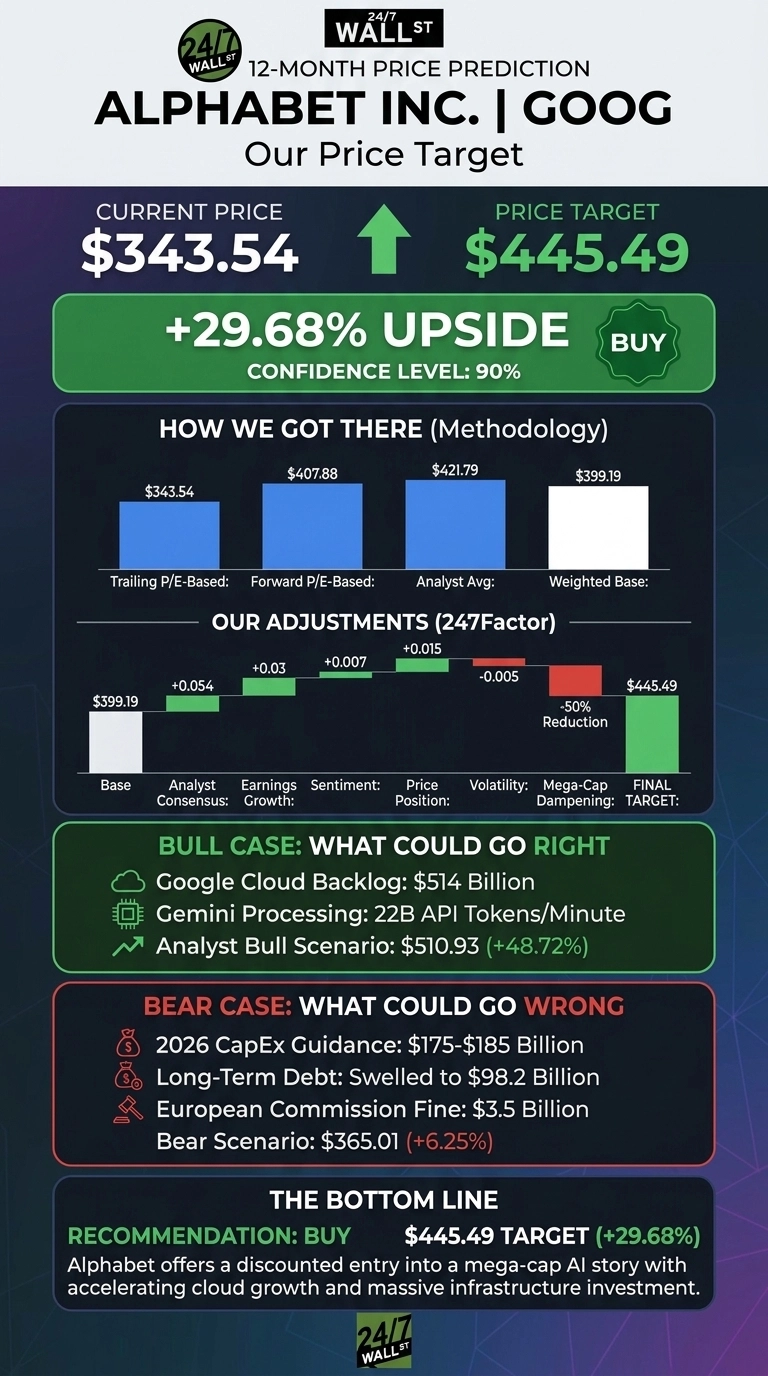
24/7 Wall St. Price Target Summary
| Metric | Value |
|---|---|
| Current Price | $343.54 |
| 24/7 Wall St. Price Target | $445.49 |
| Upside | 29.68% |
| Recommendation | BUY |
| Confidence Level | 90% |
Why Alphabet Cooled Off Ahead of Buffett’s Bet
Alphabet is up 69.03% over the past year and 9.62% year to date, but shares have pulled back 7.2% in the past month, sitting roughly 4% off the 52-week high of $404.23.
The Q2 2026 report on July 22 showed strong results: revenue of $119.80 billion grew 24.2% YoY, EPS of $9.11 beat the $3.04 consensus, and Google Cloud accelerated to 82% growth.
Investors focused instead on capex nearly doubling to $44.92 billion and free cash flow turning negative. Warren Buffett’s Berkshire disclosed a dramatically expanded position shortly after, reframing the pullback as an opportunity.
The Case for $510 and Beyond
Bulls point to Google Cloud’s $514 billion backlog, up more than $50 billion sequentially, with nearly 90% of the Fortune 100 using Gemini Enterprise. Gemini processes 22 billion API tokens per minute, and the Gemini App has 950 million monthly active users.
Cloud operating margin expanded to 35.6% from 20.7%, tripling operating income. Consensus among the 57 buy and strong buy ratings (versus 6 holds and zero sells) sets the average analyst target at $421.79.
Our bull case scenario reaches $510.93, a 48.72% gain, if TPU sales scale into 2027 as management guided.
What Could Go Wrong
The bear case centers on 2026 capex guidance of $175 to $185 billion plus a suspended buyback and long-term debt swelling from $46.5 billion to $98.2 billion, raising ROIC questions. Interest expense rose roughly 5x YoY.
Sundar Pichai acknowledged “coding and agent decoding” as areas Gemini needs to improve, and the European Commission handed down a $3.5 billion fine last quarter.
Bulls argue the capex surge funds a contracted $514 billion backlog, and negative free cash flow reflects growth investment in capacity. Our bear case still lands at $365.01, a 6.25% positive return.
How Alphabet Compares to Microsoft and Meta
Microsoft (NASDAQ:MSFT) is the direct cloud comparison. Azure crossed $100 billion in full-year revenue and grew 43% last quarter, but Microsoft trades at a trailing P/E of 28x versus Alphabet’s 17x. That valuation gap makes our GOOG target look conservative given comparable cloud growth trajectories.
Meta Platforms (NASDAQ:META) is the digital-ad counterpoint. Meta missed Q2 with EPS of $6.18 against a $7.22 consensus and trades at a P/E of 22x. Alphabet’s 11th consecutive EPS beat alongside a lower multiple reinforces that the $445.49 target sits within a fair peer range.
| Company | Trailing P/E | Latest Rev Growth |
|---|---|---|
| Alphabet | 17x | 24.2% |
| Microsoft | 28x | 17.8% |
| Meta | 22x | 28.0% |
The Bottom Line
The 24/7 Wall St. price target of $445.49 with 90% confidence reflects the cheapest mega-cap AI story available. Investors with a 12-month horizon who believe cloud backlog converts to revenue as guided may find current levels attractive, while those who want capex intensity to normalize before free cash flow recovers may prefer to wait. On balance, the setup skews constructive.
| Year | 24/7 Wall St. Price Target |
|---|---|
| 2026 | $445.49 |
| 2027 | $525 |
| 2028 | $595 |
| 2029 | $660 |
| 2030 | $710 |
These projections assume Alphabet executes on its cloud and AI roadmap. Significant upside could come from Waymo commercialization or TPU external sales, while regulatory action remains the largest downside risk.
The post Berkshire Raised Its Alphabet Share Count by 658% in a Single Quarter. Here’s Where The Stock is Headed appeared first on 24/7 Wall St..
]]>Alphabet (NASDAQ:GOOG) shares are making a strong case for why they could be the biggest AI bargain on the market right now, now hovering at around 17.3 times trailing price-to-earnings (P/E). With Google Gemini quietly hitting the 1 billion monthly active users (MAUs) mark, it certainly feels like much of Wall Street is drastically discounting the company’s ability to monetize the technology.
Of course, the company has seen top AI talent depart of late, and it is facing delays with the Gemini 3.5 Pro model, which is nowhere to be seen two months after its expected arrival; questions linger as to whether everything is all right with the company’s AI trajectory.
Despite the delays, the management shuffling over at Google DeepMind, and the untimely key person departures, Google remains an AI force that’s bound to find its way back to the top three. When Gemini’s latest Pro model finally does release, I do think Alphabet shareholders will be able to breathe easy again after a turbulent past couple of months.
It’s more than just smarts; Google Gemini has mindshare, speed, and value down
In my view, Google’s vast distribution moat and huge chunk of mindshare could buy it more than enough time to get the next model out the door, even if it means extending the delay by another several months. At the end of the day, Google is so close to the average user, whether it’s via Google Search (which hasn’t faded at the hands of AI as initially feared) or AI Mode, or a Gemini Plus or Pro subscription bundled with storage or other software.
Combined with its TPU advantage, perhaps Google is the AI innovator that can drive down token costs and chatbot response times far faster than its rivals. Of course, it’s getting tougher to top Anthropic or OpenAI in smarts, but I’d argue that Google really doesn’t have to if it can continue to stay at the top when it comes to value (shooting for the smarts of an American frontier model while aiming for costs similar to that of an open Chinese model?), speed, and, perhaps most importantly, closeness to the user.
The company doesn’t need to force a Gemini button onto a keyboard when most people already have Google Search as the default page that opens when they launch their browser. With Gemini on Android and the AI licensing deal with Apple (NASDAQ:AAPL) factored in, it’s clear that Google is touching mobile AI in some way or another. Whether it’s the latest Gemini on Android or a distilled version from Apple, it’s clear that Google’s distribution moat is incredibly far-reaching.
Could it be that Google Gemini could quickly become the default AI of everyday users?
Who knows. OpenAI might be shedding share, but as the AI wars move to value (smarts per dollar paid per month), I do think that the odds tilt heavily in Google’s favor. At the end of the day, distribution moats and mindshare might matter just as much, if not more so, than having a few extra points for coding and reasoning benchmarks or costing a few cents less per X number of tokens.
Any way you look at it, I view the latest 1 billion MAU milestone as a signal that Google is still very much on the right track with AI. If anything, retaining such an impressive share, even amid a roadbump in its roadmap (model delays and key departures), signals that its moat extends far beyond where the latest Gemini model stands in the large language model (LLM) benchmarks.
Of course, the bigger story, at least for investors, is that Google is pouring an unprecedented sum (as much as $205 billion for this year) into CapEx to advance AI. While ROIs matter, it feels like investors don’t want to wait, as hyperscalers may still be scratching the surface on the AI infrastructure buildout, which feels more energy-constrained than chip-constrained.
The bottom line
As Google Cloud looks to hit an inflection point down the road, while Gemini looks to make up for lost time (Gemini 3.7 Flash has proven incredibly capable as we all await 3.5 Pro) and the firm seeks to win the AI value wars, perhaps Google remains the far better bet than OpenAI or even Anthropic.
The post Gemini Hits 1 Billion Active Users: Why Wall Street Is Mispricing Google’s Consumer AI Dominance appeared first on 24/7 Wall St..
]]>
Earnings season doubles as confession season on Wall Street. Every August, the biggest money managers in the world file their 13Fs with the SEC, and for a few days investors get an unusually clear window into what smart money actually did with its cash last quarter — not what it said on CNBC.
This year’s filings landed with a theme: Alphabet (NASDAQ:GOOG)(NASDAQ:GOOGL). Two of the most closely watched billionaire investors in the country, working independently and managing very different pools of capital, both used the second quarter to build up meaningful stakes in Google’s parent company. One of them is a name every retail investor already knows. The other should be.
Berkshire Just Made Alphabet Its Third-Favorite Stock
Berkshire Hathaway‘s (NYSE:BRK-A)(NYSE:BRK-B) Q2 13F showed the company added roughly 48 million Alphabet shares, an 83% increase that pushed its combined GOOGL/GOOG position to about 106 million shares worth $37.8 billion. That’s now 10.2% of Berkshire’s equity portfolio — enough to make Alphabet the third-largest holding, trailing only Apple (NASDAQ:AAPL) at $70 billion and American Express (NYSE:AXP) at $51.9 billion, and ahead of longtime staple Coca-Cola (NYSE:KO).
Roughly 60% of the added shares came from Berkshire’s $10 billion private placement with Alphabet in June, earmarked to help fund AI infrastructure. The rest — about $7 billion — Berkshire bought on the open market.
Buffett told CNBC in June that Alphabet was his idea, and that Berkshire began building the position back in the third quarter of 2025. He’s since handed day-to-day stock-picking to CEO Greg Abel, but says the two still talk through where capital goes. In short, this wasn’t Abel going rogue — it carries Buffett’s fingerprints, built on the kind of moat Buffett has always paid up for: a search business that still functions as a near-monopoly, a YouTube platform reaching 2.7 billion monthly users, and a cloud unit that’s now the third-largest in the world behind AWS and Azure.
Druckenmiller Was Peering Over Buffett’s Shoulder
Buffett is the investor small investors most often try to shadow, but Druckenmiller is the one other billionaires study. He ran George Soros’s Quantum Fund through the trade that famously broke the Bank of England in 1992, then spent 30 years running his own Duquesne Capital Management without a single losing year before converting it into Duquesne Family Office in 2010 — a private investment vehicle that manages Druckenmiller’s own wealth rather than outside client money, which is why it can move fast and concentrate hard without redemption pressure.
That speed showed up in Duquesne’s Q2 13F. The $5.21 billion portfolio initiated a brand-new Alphabet position, alongside new stakes in Advanced Micro Devices (NASDAQ:AMD) and Fox (NASDAQ:FOX). Druckenmiller also increased his position in Amazon (NASDAQ:AMZN) by more than 1,000%, nearly tripled United Airlines (NASDAQ:UAL) holdings, and fully exited Broadcom (NASDAQ:AVGO), Intel (NASDAQ:INTC), and Micron Technology (NASDAQ:MU).
When Two Legends Read From the Same Playbook
Granted, Druckenmiller is a sector rotator by nature — he’s just as likely to own a Brazil ETF or a biotech name as a mega-cap — and this quarter was no exception. But buried in the reshuffling was a new 603,000-share position in Delta Air Lines (NYSE:DAL) and a $48 million position in D.R. Horton (NYSE:DHI). Berkshire grew its airline position by 44% to 57.3 million shares and also bought a new stake in the homebuilder.
Two investors with almost nothing in common, philosophically, landed on the same two stocks and the same search giant in the same three months. That’s not coincidence — that’s convergence, and convergence is worth noticing.
Key Takeaway
Neither filing is a reason to chase Alphabet blindly — 13Fs are backward-looking, and both funds bought before some of the stock’s recent run. Still, when Berkshire’s 10.2%-of-portfolio conviction bet lines up with a brand-new position from one of the sharpest macro traders alive, that’s two very different playbooks pointing at the same page.
Investors doing their own homework on Alphabet now have good company doing it alongside them.
The post Warren Buffett Wasn’t the Only Billionaire Buying Alphabet Stock in Q2 appeared first on 24/7 Wall St..
]]>
Cash has been the story at Berkshire Hathaway (NYSE:BRK-A)(NYSE:BRK-B) for three years running. Warren Buffett spent that stretch selling more stock than he bought, quarter after quarter, while the company’s cash and Treasury bill pile swelled toward record territory. Investors got used to reading Berkshire’s 13F filings as a lesson in patience rather than a shopping list.
That changed this quarter. New CEO Greg Abel broke a 14-quarter streak of net selling, and the filing he submitted on Friday shows exactly where he’s putting the money instead. The headline name isn’t a surprise industry pick or a value-stock retread — it’s Alphabet (NASDAQ:GOOG)(NASDAQ:GOOGL), and it was bought in a size that’s hard to ignore.
Berkshire Turns Buyer Again
Berkshire added several positions in the second quarter: 17.5 million shares of Delta Air Lines (NYSE:DAL), 4.3 million shares of Macy’s (NYSE:M), 3.1 million shares of homebuilder Lennar (NYSE:LEN), and 553,000 shares of The New York Times (NYSE:NYT). None of those come close to the main event: Abel bought 24.5 million shares of Alphabet’s Class A stock GOOGL and 23.6 million shares of the Class C stock GOOG — 48.1 million shares combined, worth $37.8 billion at quarter-end.
That single purchase vaulted Alphabet into Berkshire’s third-largest holding, at 10.2% of the portfolio, trailing only Apple (NASDAQ:AAPL) ($70 billion, or 19.5% of the total) and American Express (NYSE:AXP) ($51.9 billion, or 14.5%). Add the $10 billion direct investment Berkshire made in June to help fund Alphabet’s AI infrastructure buildout, and the pattern is unmistakable: Alphabet is Berkshire Hathaway’s favorite stock now.
Buffett’s fingerprints are on this one too. He told CNBC in June that buying Alphabet was his idea, as Berkshire started building the stake back in the third quarter of 2025. Buffett has said he still talks with Abel about where to put Berkshire’s money, even in retirement. Abel, for his part, said in February that he now directs 94% of Berkshire’s equity portfolio, with longtime manager Ted Weschler handling the remaining 6%.
Berkshire also sold stock, closing out the Constellation Brands (NYSE:STZ) position it built 18 months ago and picked up a small stake in homebuilder D.R. Horton (NYSE:DHI), a sector Buffett has drifted in and out of before.
What Buffett — or Abel — Sees in Alphabet
Alphabet checks the boxes Buffett has always wanted: a dominant market position and free cash flow that keeps flowing even when the balance sheet gets messy.
- Google still runs a near-monopoly in search.
- YouTube is the leading streaming video platform on Earth, watched by roughly 90% of global internet users and reaching 2.7 billion monthly users.
- Google Cloud is the third-largest cloud computing business, behind only Amazon‘s (NASDAQ:AMZN) AWS and Microsoft‘s (NASDAQ:MSFT) Azure.
Granted, Alphabet reported negative free cash flow last quarter for the first time as a public company — a real number worth watching — but trailing-12-month free cash flow still came in at $53 billion, and net margins, operating margins, return on equity, and return on invested capital all held up.
That’s the case for buying a stock that, on the surface, looks like the kind of high-flying tech name Buffett has spent decades avoiding. In a market plenty of investors already consider stretched, Abel and Buffett aren’t betting on where Alphabet trades next month. They’re betting on what the business is worth over the next decade. As Buffett has put it for 60 years, “price is what you pay, value is what you get.”
Key Takeaway
One quarter doesn’t erase three years of caution, and Berkshire still has $365.5 billion in cash on hand — plenty of room for another Alphabet-sized bet or a cushion if the market stumbles. That said, the signal matters. Abel has now shown he’ll deploy real capital when he sees real value, and Alphabet’s jump to Berkshire’s third-largest holding is the clearest evidence yet.
For shareholders, the takeaway isn’t to chase Alphabet because Berkshire bought it — it’s to notice that the company known for saying no just said yes, in a big way.
The post Alphabet Is Berkshire Hathaway’s New Favorite Stock After Buying 48 Million Shares appeared first on 24/7 Wall St..
]]>Tesla (NASDAQ: TSLA) and Alphabet (NASDAQ: GOOG) both reported Q2 2026 results on July 22, 2026, and the same-day comparison reveals two very different AI stories.
Tesla is spending furiously on Robotaxi, Optimus, and chips while today’s automotive margins buckle. Alphabet is spending even more, yet Google Cloud and Gemini are already turning that capital into recurring revenue at scale.
Both stocks trade near the same price. The businesses behind them look nothing alike.
Margin Pain at Tesla. Margin Expansion at Alphabet.
Tesla delivered $28.24 billion in revenue, up 25.52% year over year, with a record 480,126 vehicle deliveries and 13.5 GWh of energy storage deployed. That is real operational momentum.
But non-GAAP EPS of $0.33 came in missing expectations by 38.51%, and operating margin collapsed to 1.4% as opex jumped 47% on AI infrastructure and CEO award stock-comp. CFO Vaibhav Taneja acknowledged “automotive margins excluding regulatory credits declined sequentially from 19.2% to 16.3%”.
Alphabet posted $119.8 billion in revenue and blew past estimates with EPS of $9.11 versus a $3.0427 estimate. The star of the quarter was Google Cloud at $24.768 billion, up 82%, with a cloud backlog that swelled to $514 billion. Sundar Pichai told investors “nearly 90% of the Fortune 100” now use Gemini Enterprise. Operating margin expanded to 34%.
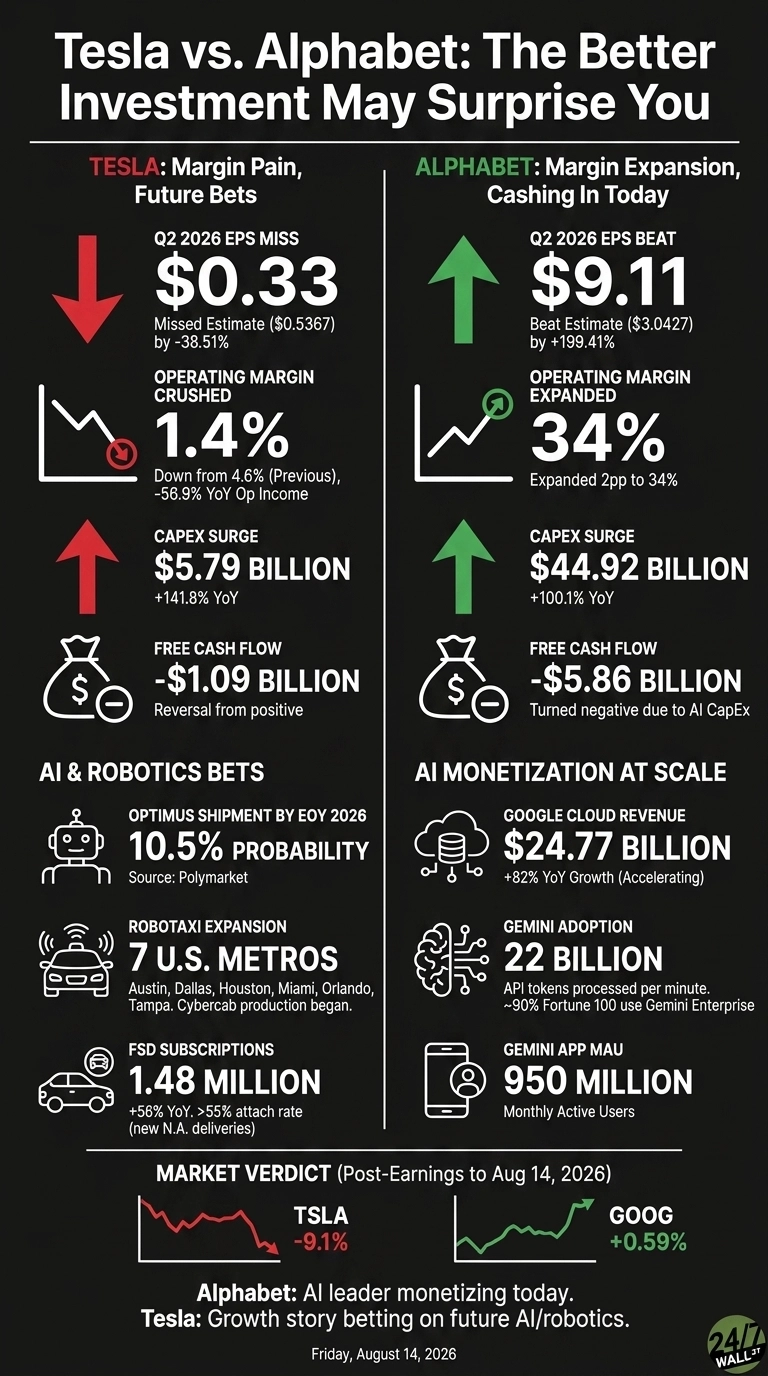
| Business Driver | Tesla | Alphabet |
| Revenue growth | 25.5% | 24.2% |
| Operating margin | 1.4% | 34% |
| Q2 CapEx | $5.79B | $44.92B |
Betting on Future Robots vs. Cashing Checks Today
Tesla’s thesis is entirely forward. Elon Musk framed the spend bluntly: “This is a massive CapEx year, but I’m confident that all the things that we’re investing in will yield incredible returns.”
Robotaxi now runs in seven markets, active FSD subscriptions hit 1.48 million, and Cybercab production has begun. Yet free cash flow flipped to -$1.09 billion, and Polymarket traders assign just a 10.5% probability that Optimus ships commercially by year-end.
Alphabet is monetizing AI while it builds. Gemini processes 22 billion API tokens per minute, the consumer app hit 950 million MAUs, and Search still grew 17% to $63.27 billion. Free cash flow did turn negative at -$5.86 billion, and long-term debt more than doubled to $98.2 billion.
Those are real risks. They just come attached to a business already generating $185.7 billion in trailing operating cash flow.
The Next Test Is Whether Tesla’s Spend Converts
I will be watching whether Tesla’s operating margin can climb back above 5% before capex eases, and whether Robotaxi miles compound at the rate Ashok described: “more than 10% a week”.
For Alphabet, the story is TPU supply. Management said “vast majority of TPU system sales revenue expected in 2027”, meaning today’s backlog becomes tomorrow’s earnings only if capacity keeps pace.
Why I Lean Toward Alphabet on This Earnings Report
Personally, I would rather own Alphabet here. At a P/E near 14 with 34% operating margins, you get an AI leader monetizing today, not a promise.
Tesla at a P/E of 354 requires believing Optimus, Robotaxi, and TerraFab all land on schedule. Tesla stock has fallen 9.1% since earnings while Alphabet is roughly flat at +0.59%, which tells you what the market thinks too.
If you are a turnaround investor who believes AI robotics arrives faster than the crowd expects, Tesla still has asymmetric upside. For everyone else, Alphabet looks like the more compelling AI trade this quarter.
The post Tesla vs. Alphabet: The Better Investment May Surprise You appeared first on 24/7 Wall St..
]]>
Big tech companies don’t just build products — they place bets. Amazon (NASDAQ:AMZN) poured billions into a cloud division that looked like a side project in 2006. Microsoft (NASDAQ:MSFT) wrote a $1 billion check to a scrappy AI lab called OpenAI in 2019. And Alphabet (NASDAQ:GOOG), back in 2015, handed roughly $900 million to a rocket company that most Wall Street analysts treated as a vanity project for Elon Musk.
A decade later, that rocket company is public, and Alphabet’s stake is worth more than the entire market capitalization of Ford (NASDAQ:F), Kraft Heinz (NASDAQ:KHC), and Southwest Airlines (NYSE:LUV) combined. This is what patient capital looks like when it actually works — and it offers shareholders a window into how Alphabet thinks about risk that its search-ad business alone never could.
The Numbers Behind a 100-Bagger
According to Alphabet’s recent Form 13F, the company held 551.2 million shares of SpaceX (NASDAQ:SPCX) valued at approximately $94.2 billion as of June 30 — more than 100 times the roughly invested 10 years ago. That single stake now accounts for 95% of Alphabet’s total investment portfolio.
SpaceX went public on June 12 at $135 a share, and Alphabet’s disclosed position made it the company’s largest institutional shareholder by a wide margin, ahead of four other major holders. Granted, paper gains aren’t cash in the bank. SpaceX shares closed at $141.29 on Wednesday — 4.7% above the IPO price, but 17% below the June 30 mark that Alphabet used to value its stake. That’s a reminder that 13F filings are snapshots, not real-time trackers, and they’re published up to six weeks after quarter-end. In any case, even after the pullback, Alphabet is sitting on a gain few venture investors ever see.
Why This Matters More Than the Headline Number
Alphabet’s core operations are compounding on their own: consolidated revenue rose 24% year-over-year to $119.8 billion in the second quarter, marking its 12th straight quarter of double-digit growth. Google Cloud revenue expanded 82% to $24.8 billion, and YouTube generated $11 billion in ad revenue for the quarter.
That operational strength is why Alphabet trades at a trailing P/E of roughly 17 — a discount to the broader technology sector average that MarketBeat pegs around 75x. Compare that to peers making similar outsized private bets:
| Company | Early Bet | Current Value | Approx. Return |
| Alphabet | $900 million in SpaceX (2015) | $94.2 billion (June 2026) | ~100x |
| Microsoft | $13 billion in OpenAI (first tranche, 2019) | ~$228 billion (based on latest funding round, March 2026) | ~17.6x |
| Nvidia (NASDAQ:NVDA) | $10 billion in Anthropic (first tranche, November 2025) | ~$27.6 billion (based on latest funding round, May 2026) | ~2.7X |
Alphabet also holds a stake in Anthropic, which the company’s Q2 filing said contributed to a $99.0 billion gain on equity securities that boosted net income by $77.1 billion, or $6.26 per diluted share, for the quarter. Strip that out, and Alphabet’s core business still generated an adjusted EPS of $2.85, beating what analysts had expected out of the ad and cloud businesses alone.
Key Takeaway
The SpaceX stake is a bonus, not the investment thesis. Alphabet’s core advertising, cloud, and AI businesses are growing revenue at 24% annually while trading at a below-sector P/E multiple, and the SpaceX position simply proves management is willing to make outsized, long-duration bets that pay off.
That said, investors shouldn’t buy Alphabet stock for the SpaceX exposure alone — it’s an illiquid, largely unmonetizable paper gain until Alphabet actually sells shares, and SpaceX’s own volatility (a 14% pullback from its post-IPO peak) shows these things don’t move in a straight line.
Regardless, for shareholders who already like Alphabet’s search, cloud, and Gemini businesses, the SpaceX windfall is the kind of asymmetric payoff that should make patient investors sleep well at night. A near-25% return on invested capital and a 49% return on equity did the heavy lifting long before SpaceX ever went public.
The post Alphabet Turned $900 Million in SpaceX Into $94 Billion — Here’s the Lesson for Investors appeared first on 24/7 Wall St..
]]>Most mutual funds launched in the 1930s are footnotes in a finance textbook. The Investment Company of America (NASDAQ:AIVSX) is still open, still paying dividends, and still one of the largest actively managed U.S. equity funds on the planet. Its total net assets sat at roughly $165.9 billion as of March 31, 2026, a scale that only decades of compounding and asset-gathering can produce.
The fund, part of the American Funds family run by Capital Group, is a large-cap, value-leaning U.S. stock fund. It has been in continuous operation since the 1930s. Longevity is interesting, but it does not automatically make a fund a good buy today. Here is what AIVSX actually gets you in 2026.
What Ninety Years of Compounding Looks Like
Recent numbers are unambiguous. On an adjusted basis, AIVSX returned 272.94% over the ten years ending August 12, 2026, 97.98% over the trailing five years, and 19.59% over the trailing one year. Year to date through August 12, 2026, the fund was up 13.66%, closing at $70.70. Those are respectable numbers for a diversified large-cap fund, though they trail what a plain S&P 500 index fund delivered over the same decade.
The long arc matters more than any single window. The adjusted close climbed from 7.2467 at year-end 1999 to 70.70 in August 2026, a stretch that includes the dot-com bust, the 2008 financial crisis, and the 2020 pandemic drawdown. The March 2020 adjusted trough of 21.5113 was recovered inside a year. That is what surviving cycles looks like on a chart.
What Is Actually in the Portfolio
AIVSX runs an active portfolio, though its top names will feel familiar. As of March 31, 2026, Amazon was the largest single position at 4.72% of assets, followed by the two Alphabet share classes at a combined 4.63% (GOOGL at 2.49% and GOOG at 2.13%). AbbVie sat at 1.09%, Abbott Laboratories at 0.75%, Alnylam Pharmaceuticals at 0.39%, American Express at 0.33%, Altria at 0.29%, Air Products & Chemicals at 0.16%, and AT&T at 0.09%.
That mix, with mega-cap tech alongside pharma, tobacco, industrial gases, and a telecom, reflects the approach. Capital Group’s multi-manager system splits the portfolio among several investment professionals who each run a sleeve, which is why the fund holds both aggressive growth names and traditional dividend payers side by side. Turnover tends to be modest by active-fund standards, which helps keep taxable capital gains manageable for investors in brokerage accounts.
The Load and Share-Class Reality
AIVSX is the Class A share of the Investment Company of America. Class A shares in the American Funds lineup carry a front-end sales charge and an ongoing 12b-1 fee, meaning a slice of your first dollar goes to distribution before it is ever invested. Cheaper share classes of the same underlying portfolio exist, including F-2, F-3, and R-6 shares, which are typically available inside advisor platforms and workplace retirement plans without the sales load.
If you already own AIVSX inside a 401(k) or through a fee-based advisor, you may not be paying the load. If you are buying it retail at a brokerage, checking whether a load-waived share class is available is the single most impactful thing you can do.
The Income Side
The fund pays quarterly distributions with an outsized year-end payout. The trailing 12-month total was $6.2343 per share, with the June 16, 2026 quarterly distribution at $0.324. The December 2025 year-end distribution alone was $5.6003 per share, reflecting realized capital gains inside the portfolio. That is a feature of an actively managed fund with long-held winners, but it does create a tax event in taxable accounts.
Who Should Look at AIVSX, and Who Should Not
Investors who already hold AIVSX in a retirement plan without paying the load, and who want diversified large-cap exposure with a value tilt, have a defensible core holding. Long-horizon investors who value active manager continuity over rock-bottom fees may find the American Funds system appealing. Investors buying in taxable accounts through a discount broker, or those who are fee-sensitive and comfortable with index investing, generally have cheaper, more tax-efficient ways to own the same names.
Funds Worth Comparing
- Washington Mutual Investors Fund (NASDAQ:AWSHX): the American Funds stablemate with a stricter dividend-payer mandate, useful for investors who want more income orientation.
- Growth Fund of America (NASDAQ:AGTHX): the aggressive-growth sibling in the same fund family, for investors willing to trade dividends for higher tech and growth weights.
- Vanguard 500 Index Fund Admiral Shares (NASDAQ:VFIAX): the low-cost passive alternative that has outpaced most active large-cap funds over the past decade.
- Dodge & Cox Stock Fund (NASDAQ:DODGX): a no-load, value-oriented active peer with a long tenure of its own and no sales charge to navigate.
The post The Investment Company of America, AIVSX, Has Outlasted Nearly Every Fund Launched Beside It appeared first on 24/7 Wall St..
]]>SpaceX (NASDAQ:SPCX) stock is up 5% to $140 midday Wednesday, and Intuitive Machines (NASDAQ:LUNR) shares are up 3% to $17 ahead of tomorrow’s earnings release. Two separate, company-specific catalysts are driving the moves while the rest of the space complex trades quietly.
SPCX stock is rebounding after a 5% drop Tuesday, so today looks more like a snapback than a breakout. LUNR shares extend a run that has carried the stock into a Q2 2026 earnings report scheduled for before market open Thursday.
Both stocks are moving on discrete catalysts, and peers across the space complex are little changed. That divergence is what makes today’s action worth watching for investors already positioned in either name.
SpaceX Rebounds on Starlink Launch and AI Bull Case
SpaceX launched 24 Starlink satellites to low-Earth orbit from Vandenberg Space Force Base on Tuesday night, extending a constellation that ended Q2 2026 with 12 million subscribers. The fresh cadence reinforces the connectivity growth story that underpinned last week’s earnings report, which showed revenue of $7.81 billion and Starlink subscribers doubling year over year (YoY).
The larger driver may be a Morgan Stanley note from analyst Adam Jones carrying a $300 price target. Jones argues investors are underestimating SpaceX’s AI business, including the pending $60 billion acquisition of coding platform Cursor and neocloud data-center leasing deals with Anthropic and Alphabet‘s (NASDAQ:GOOG) Google.
Morgan Stanley sees Cursor’s annual revenue run rate climbing from $4 billion in June toward $33 billion by 2030. That framing recasts SPCX stock from a launch-and-satellite story into an AI infrastructure play, which helps explain the sharp reversal off Tuesday’s weakness.
The Polymarket odds line up with the price action. The August 12 up/down market for SPCX is pricing an 89% probability of a green day, and the $145 target level shows 75.5% conviction in the August 20, 2026 market.
Intuitive Machines Climbs Ahead of Earnings
Intuitive Machines reports its Q2 2026 results before the market opens on Thursday, August 13, with a conference call at 8:30 a.m. ET. The consensus estimate calls for a loss of $0.07 per share on $219 million in revenue. Wall Street holds a Moderate Buy with an average price target of $39.70, though Zacks flags a Rank 3 and an Earnings ESP of -12.9%, suggesting the model is not calling for a beat.
The recent run-up in LUNR shares traces to two catalysts. L3Harris Technologies (NYSE:LHX) selected Intuitive Machines for the Space Development Agency’s AMDT3 mission, disclosed August 4, and the company announced acquisitions of Goonhilly Earth Station and COMSAT on August 3.
Intuitive Machines closed Q1 2026 with a record $1.1 billion backlog, giving investors a visible pipeline heading into tomorrow’s report. Options positioning is skewed constructive, with a full-chain put/call ratio of 0.36 across LUNR contracts.
Space Complex Otherwise Quiet
SpaceX’s peers are little changed today, which reinforces that SPCX and LUNR shares are trading on their own news rather than a sector wave. Virgin Galactic (NYSE:SPCE) stock is down 1% to $3.25, and AST SpaceMobile (NASDAQ:ASTS) shares are up 2% to $72.91.
Rocket Lab (NASDAQ:RKLB) stock is essentially flat despite last week’s Q2 revenue beat and Iridium deal narrative, and Planet Labs (NYSE:PL) shares are up 2% to $24.15. The Procure Space ETF (NASDAQ:UFO) is close to flat, a reminder that this narrow thematic fund carries meaningful sector-concentration risk given its focused holdings roster.
What to Watch
Intuitive Machines reports tomorrow morning. Investors can watch for backlog updates, integration progress on the Lanteris and Goonhilly deals, and any commentary tightening the $900 million to $1 billion full-year revenue guidance. Historically, Intuitive Machines’ earnings days have averaged a +7% day-of move followed by a -7% one-week fade, so sustainability matters more than the initial reaction.
For SpaceX, the near-term test is whether today’s gains hold and whether the Morgan Stanley thesis draws follow-on analyst moves. A moderate position size makes sense in both names given SPCX’s post-IPO volatility and LUNR’s pre-earnings drift risk.
The post SpaceX Rises 5% on Fresh Starlink Launch, Intuitive Machines Gains 3% Ahead of Earnings appeared first on 24/7 Wall St..
]]>Should Norway have a lot of money, as a nation? How and why? The nation has only 5.7 million people. And its GDP is only $500 billion. These are tiny compared to most other nations. However, it has a sovereign wealth fund which is worth $2 trillion. The yield from the money was $184 billion in the first half.
Its wealth fund is worth more than any OPEC nation. It is also larger than China’s.
Norway’s money comes from North Sea oil holdings. These are mostly in the Ekofisk, Statfjord, Troll, and Johan Sverdrup fields. Norway produces two million barrels of oil per day from these fields. And, according to Reuters, it has spread the risk of this capital widely across the world’s public companies. “Investing the Norwegian state’s revenues from oil and gas production, the fund owns on average 1.5% of all listed companies globally, making it the world’s largest single investor,” the news service reports.
Among the sovereign wealth fund’s money are relatively large positions in the world’s megacap tech firms. It holds a 1.28% stake worth $62 billion in Nvidia, (NASDAQ: NVDA), a 1.24% stake worth $52 billion in Apple (NASDAQ: AAPL), a 1.17% stake worth $50 billion in Alphabet (NASDAQ: GOOG), a 1.27% stake worth $35 billion in Microsoft (NASDAQ: MSFT), and a 1.7% stake worth $34 billion in Taiwan Semiconductor Manufacturing
Sovereign wealth funds, in general, hold massive positions in publicly traded companies. Yet, investors rarely, if ever, hear comments or criticisms about these positions. It is not entirely clear why the sovereign money remains passive.
Sovereign wealth fund positions are often larger than those of America’s largest money managers. These include Vanguard, BlackRock, and Fidelity. These institutions are, on occasion, very vocal. However, they represent millions of individual and institutional investors. Sovereign wealth funds only have one–their own governments.
Is $184 billion a good return on $2 trillion? Certainly not on a percentage basis. However, Norway does need outside returns. The dollar sum of the return is too staggering.
The post Norway Made $184 Billion In First Half, With Help From Nvidia And Apple appeared first on 24/7 Wall St..
]]>Nvidia (NASDAQ:NVDA) stock seems to be on its way higher again following news that Elon Musk’s Space Exploration Technologies (NASDAQ:SPCX) will be exclusive to the GPU maker, rather than looking to shop around and mix it up as some other tech firms might be doing with their AI data centers.
Nvidia might have less to worry about with its GPU rivals, but, in my view, that doesn’t mean investors should forget about the rise of hyperscalers’ custom silicon ambitions, especially as more of that towering CapEx goes towards securing the hardware layer. Any way you look at it, tech firms have all the incentives to get into the hardware game as they look to find a way to quit the latest and greatest GPUs from the great Nvidia.
Indeed, the company’s sales growth and high margins are unprecedented for a hardware company. But with great economic profits comes a wave of competition as other firms look to disrupt moats with innovation to get a piece of that glorious generational opportunity to be had in chips.
As an increasing amount of AI compute goes from training to inference, the case for custom silicon will get louder with time. But, at the end of the day, it’s hard to tell which firms will dominate in AI hardware in a decade from now.
Nvidia seems like a great choice as Jensen Huang pivots the firm for the inference inflection point by doubling down on LPUs, CPUs, and other innovations to bolster the software side of its AI moat. At the same time, though, some of the hyperscalers might also be in for a multiple re-rating, especially once they go from using custom hardware to power their own data centers to selling to third parties to put in their own facilities.
Yes, Google TPUs are still worth keeping tabs on
Undoubtedly, Alphabet‘s (NASDAQ:GOOG) Google TPUs have come a long way in recent years, and with the optimization for its own cloud and product suite (Gemini, YouTube, Search and beyond), perhaps TPUs don’t need to be head and shoulders above competing hardware products to gain share in the global AI chip market.
In my view, Google TPUs are set for success, given the cost efficiency focus and the kinds of share gains to be had in a “good enough” kind of environment where affordability matters more than extra capability. As Google eats its own cooking (using TPUs to power next-generation applications), it has every incentive in the world to optimize for lower costs.
And, all the while, other firms are bound to get hungry for a technology that might help make AI inference cheap enough to pave the way for what could be another wave of “tokenmaxxing.” When tokens are so cheap and abundant, maybe it makes more sense for next-generation applications to use first and bring up questions about utility later.
Custom silicon and the age of token abundance?
In my view, Google’s I/O 2026 was rich with AI applications that you could consider to be quite token-expensive, especially compared to a simple Gemini prompt. Whether we’re talking about Genative UX, which generates interfaces on the fly, or kicking off some agents to do tasks in the background, it feels like Google might be nudging the industry into an era where users need not worry about token bills.
Whether it’s Google TPUs or another hyperscaler’s custom silicon (Meta Platforms‘ (NASDAQ:META) MTIA hardware also shows plenty of promise, I do think that an inference explosion stands to benefit the hyperscalers more than the likes of Nvidia, despite its efforts to ready itself for the shift.
Any way you look at it, token-heavy applications are coming and, with them, some much more efficient custom silicon is going to be needed for the vast inference spike. Of course, it’s going to take time for hyperscalers to scale up, especially since we’re in the early days of this buildout. Over time, though, I certainly wouldn’t bet against the custom silicon shift as the hyperscalers look to command a bit more of that AI premium for controlling the AI infrastructure all the way down the stack.
The post Beyond GPUs: As Hyperscalers Flex Their Own Chips, a New Kind of “AI Premium” Is in the Cards. appeared first on 24/7 Wall St..
]]>It’s hard to know what to do with those overheated and increasingly volatile shares of memory chip play Micron (NASDAQ:MU) while the battle between the bulls and the bears becomes that much fiercer. On the one hand, the bulls have a pretty strong case for Micron still being a great value, considering AI-driven demand has been relentless.
Add the 5.6 times trailing price-to-earnings (P/E) multiple and the massive profits produced in this likely early (or maybe not?) structural buildout in AI data centers, and it certainly feels like the latest drop in Micron is more of a screaming buying opportunity than a cyclical peak. At this juncture, it’s hard to find that many sell-side analysts in the bear camp.
Some of the bigger bulls think Micron shares could be headed above $2,000 per share, as firms continue selling while commanding full pricing power. At the same time, Dr. Michael Burry is a notable short who’s targeted the U.S. memory juggernaut that briefly eclipsed a $1 trillion market cap before its recent correction.
It’s getting too hard to tell what’s up next for Micron
While it’s hard to call what the future holds for Micron as CapEx-heavy hyperscalers continue hoarding all the memory chips they can get their hands on, history suggests that the single-digit P/E multiple and unprecedented surge in demand might be illusory as memory looks to reach the latter innings of its cyclical ascent.
Now, it’s hard to tell if the cyclical top is in, but, at the end of the day, it’s harder to make a case that we’re still in the earlier innings, especially as some of the leading AI innovators look to find algorithmic solutions to a hardware bottleneck problem.
Even if the hyperscalers pouring hundreds of billions per year on CapEx are only going to keep raising the bar on their spending, my guess is that these firms — which aren’t just buying up chips but actually working on profoundly innovative solutions to advance AI’s capabilities while driving costs towards the floor — are going to find a way around what seems to be a perpetual memory shortage.
The incentive is there, as too is the willingness to experiment with new ways to run AI in a more memory-efficient manner.
The one thing that should give investors pause
Whether we’re talking about Alphabet‘s (NASDAQ:GOOG) and its TurboQuant breakthrough, which finds a clever way to shrink the VRAM footprint, or Apple‘s (NASDAQ:AAPL) sophisticated on-device techniques to power through its unprecedented DRAM shortage, it’s clear that firms are looking to find a way to make the most of what they have. It’s hard to know what to make of what algorithmic innovations could do to the longer-term demand for memory chips as the memory needs per query look to move lower from here.
In my view, this uncertainty makes a high-stakes name like Micron belong in the “too hard to understand” bucket, especially since there are so many forces at work, including Jevons’ Paradox, which ties higher efficiency to greater usage, which I’m sure the bulls would cite as a defense to the algorithmic breakthroughs firms are making to find their way around memory constraints.
Even if you’re a believer in AI and the great buildout being in its earlier days, the pace of innovation on the software side, I think, is going to be tough to keep up with as well. While I wouldn’t try to bet against the firm, as Burry is doing, I also wouldn’t be inclined to pound the table as hard as many analysts on Wall Street.
There are too many variables right here, even if you think Micron can capture even more share of the memory market from its two massive South Korean rivals at a time when so many firms are starting to really feel memory-starved. In a global market where just about everyone is looking for solutions to a difficult and costly problem that one can’t simply throw money at, I do think that underestimating the downside risks could prove quite costly with the memory plays at these heights.
The post Micron is Gaining Share. These Bulls See More Upside Ahead appeared first on 24/7 Wall St..
]]>Meta (NASDAQ: META) and Alphabet (NASDAQ: GOOG) both delivered Q2 2026 results that reshaped how investors think about big tech’s AI spending race.
Meta beat on revenue but missed EPS by 14.42%, snapping a six-quarter beat streak. Alphabet blew past estimates on both lines, powered by a Google Cloud surge. Both companies are pouring tens of billions into AI, and the market is asking which strategy actually pays.
Ad Engine Roars, Margins Buckle at Meta
Meta’s advertising business is humming. Ad revenue climbed 27% year over year to $59.36 billion, with impressions up 14% and price per ad up 12%. Family DAP reached 3.60 billion, showing engagement across Facebook, Instagram, and WhatsApp remains sticky.
The trouble sits below the top line. Operating margin compressed to 31% from 43% as costs jumped 55% to $42.03 billion. A $2.40 billion legal charge tied to youth litigation and $1.18 billion in severance from an 8,000 headcount reduction did the damage.
Free cash flow collapsed to $784 million, down 91.31%, as CapEx climbed to $30.12 billion. Mark Zuckerberg framed it as necessary pain: “AI is accelerating our core business today, powering our next generation of products, and opening the door to entirely new enterprise opportunities.” Investors need to trust that promise.
Cloud Acceleration Rewrites Alphabet’s Story
Alphabet’s quarter was cleaner. Revenue rose 24.23% to $119.80 billion, with Google Cloud accelerating to 82% growth at $24.77 billion. Search added 17%, YouTube ads 13%, and subscriptions 15%. Operating margin expanded to 34%, opposite to Meta.
Gemini is now a mass product. It processes 22 billion API tokens per minute, the Gemini App reached 950 million monthly active users, and nearly 90% of the Fortune 100 use Gemini Enterprise.
Sundar Pichai called it “an amazing quarter“. The catch: Alphabet spent $44.92 billion on CapEx, ran free cash flow negative at -$5.86 billion, and suspended its buyback. That is substantial trust the market is extending.
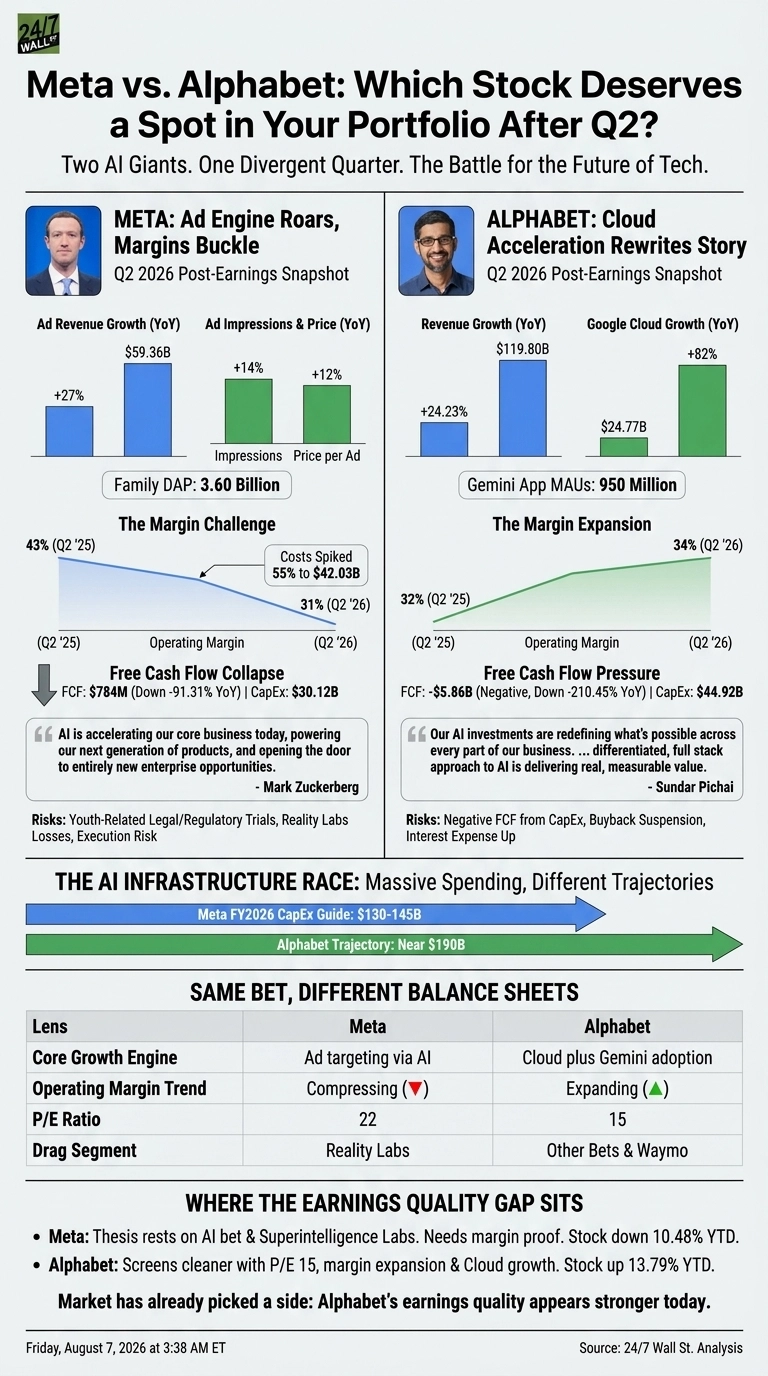
Same Bet, Different Balance Sheets
| Lens | Meta | Alphabet |
| Core Growth Engine | Ad targeting via AI | Cloud plus Gemini adoption |
| 2026 CapEx Guide | $130-145B | Trajectory near $190B |
| Operating Margin Trend | Compressing | Expanding |
| P/E | 22 | 15 |
| Drag Segment | Reality Labs | Other Bets and Waymo |
Meta is betting the ad engine plus Superintelligence Labs will convert massive spend into a new enterprise franchise. Alphabet already has paying cloud customers absorbing its GPUs.
Retail sentiment reflects the gap: Meta’s Reddit chatter recovered to a bullish 78 score by August 7 after cratering to 33 on earnings day, while GOOG’s composite sits at neutral-to-positive.
The Next Test Is CapEx Payback
I will watch whether Meta’s Q3 revenue guide of $61-64 billion holds and whether ad pricing keeps pace with impressions.
For Alphabet, the question is whether Cloud can sustain triple-digit-adjacent growth long enough to justify the buyback pause. Meta shares are down 10.48% year to date; Alphabet is up 13.79%. The market has already picked a side.
Where the Earnings Quality Gap Sits
On the numbers, Alphabet screens more cleanly today. A 15 P/E for a business expanding margins while Cloud grows 82% is a tighter risk profile than Meta’s current setup.
Meta’s thesis rests on Zuckerberg’s AI bet and the option value on Superintelligence Labs, which requires more quarters of margin evidence to validate. If youth litigation charges stabilize and CapEx begins producing measurable ad-yield gains, the picture shifts. For now, Alphabet’s earnings quality is the stronger data point.
The post Meta vs. Alphabet: Which Stock Deserves a Spot in Your Portfolio After Q2? appeared first on 24/7 Wall St..
]]>
The S&P 500 is entering the second half of 2026 with an earnings picture that is difficult to ignore. Companies are not merely clearing analyst estimates; they are clearing them by a record margin.
At the same time, corporate profitability has reached a new high, while spending on artificial intelligence, semiconductors, and data-center infrastructure is translating into faster growth across multiple industries. That matters because stock prices ultimately need earnings to justify them.
The catch is that two companies — Alphabet (NASDAQ:GOOG) and Amazon (NASDAQ:AMZN) — are making the headline numbers look even better than the underlying picture. Strip them out, and the earnings story gets less spectacular but remains remarkably healthy.
The Biggest Earnings Beat On Record
According to FactSet’s Aug. 7 Earnings Insight, S&P 500 companies have reported earnings 29.2% above analysts’ estimates in aggregate — more than four times larger than the 7.0% five-year average.
If 29.2% holds through the end of earnings season, it will be the largest aggregate earnings surprise since FactSet began tracking the measure in 2008, surpassing the previous record of 23.2% set in the second quarter of 2020.
The breadth is notable, too. Eighty-six percent of reporting companies have beaten EPS estimates, versus a five-year average of 78%. Revenue surprises are positive as well, with companies reporting sales 3.2% above expectations.
And profitability is moving in the same direction. The blended S&P 500 net profit margin has reached 16.9%, up from 14.8% last quarter and 12.9% a year ago. FactSet says that would be the highest margin in its data going back to 2009.
Alphabet And Amazon Change The Picture
Here’s where investors need to read past the headline. Alphabet and Amazon produced enormous EPS surprises, partly because of investment revaluations. Alphabet reported $9.11 of Q2 EPS versus a $2.88 consensus estimate, while Amazon reported $5.75 versus $1.82.
Alphabet’s GAAP results included $98 billion of other income, primarily from unrealized gains on equity securities, such as SpaceX (NASDAQ:SPCX) and Anthropic. Amazon included $53.4 billion of other income, primarily related to its Anthropic investment. These aren’t operating profits generated by selling advertising, cloud services, or merchandise. They are accounting gains tied to higher valuations of investments.
FactSet calculates that removing the two companies would reduce the S&P 500’s earnings surprise from 29.2% to 10.9%. That’s not the record-breaking figure — but it is still comfortably above the five-year average.
The same adjustment reduces Q2 year-over-year earnings growth from 50.4% to 32.0%. In other words, the headline number is flattered, but the underlying earnings engine isn’t disappearing.
AI Is Showing Up In Real Earnings
FactSet reports that the Information Technology sector is growing earnings 70.4% year over year, with semiconductors and semiconductor equipment up 135%. Technology hardware, storage, and peripherals are growing 55%. Revenue growth tells a similar story: semiconductor revenue is up 77%, while technology hardware revenue is up 31%.
That’s the investment thesis worth watching. The AI boom is no longer confined to companies selling software models. It is driving demand for chips, servers, networking equipment, data centers, electricity, and cloud capacity. Amazon’s AWS revenue, for example, increased 37% in Q2 to $42.2 billion, while operating income rose 63% to $16.6 billion.
At the same time, FactSet says the S&P 500’s forward P/E is 20.0, above its 10-year average of 19.0. That valuation leaves less room for earnings disappointments.
Key Takeaway
In short, investors shouldn’t dismiss this earnings season because Alphabet and Amazon distorted the headline.
Yes, removing them cuts the S&P 500’s earnings growth rate to 32.0% and its earnings surprise to 10.9%. But those figures remain strong, while margins hit a record 16.9% and semiconductor earnings are growing 135%.
That makes the bigger story clear: AI is producing genuine operating growth across a widening slice of corporate America.
The risk is valuation. With the S&P 500 trading at 20 times forward earnings, investors are already paying for continued execution. Smart investors should focus less on the 50.4% headline growth rate and more on whether the companies underneath it can keep delivering double-digit earnings growth as AI infrastructure spending expands.
The post Even Without Alphabet and Amazon, the S&P 500 Just Posted Its Biggest Earnings Beat Ever appeared first on 24/7 Wall St..
]]>Alphabet (NASDAQ: GOOG) and Meta Platforms (NASDAQ: META) both dropped Q2 2026 results in late July, with sharply diverging results.
Google leaned on Cloud and Gemini adoption to power a clean beat. Meta grew ad revenue at a healthy clip but watched costs blow past guidance, snapping a long earnings streak and rattling investors.
Cloud Carries Google. Costs Bite Meta.
Alphabet posted revenue of $119.8 billion, up 24.23% year over year, with Google Cloud accelerating to $24.77 billion and 82% growth.
Sundar Pichai told investors that “nearly 90% of the Fortune 100” now use Gemini Enterprise, while Gemini models process 22 billion API tokens per minute. Search still did the heavy lifting at $63.27 billion, up 17%, and YouTube pulled in 1.7 billion unique viewers for World Cup content. Operating margin expanded to 34%. Clean.
Meta’s top line looked fine on the surface: revenue of $60.8 billion, up 27.96%, ad revenue of $59.36 billion, and impressions up 14% with pricing up 12%. The problem sat below the fold.
EPS came in at $6.18 versus $7.2173 expected, missing expectations by 14.42% and ending a six-quarter beat streak. Total costs jumped 55%, weighed down by $2.40 billion in legal charges and $1.18 billion in severance tied to an 8,000-employee reduction. Operating margin collapsed from 43% to 31%.
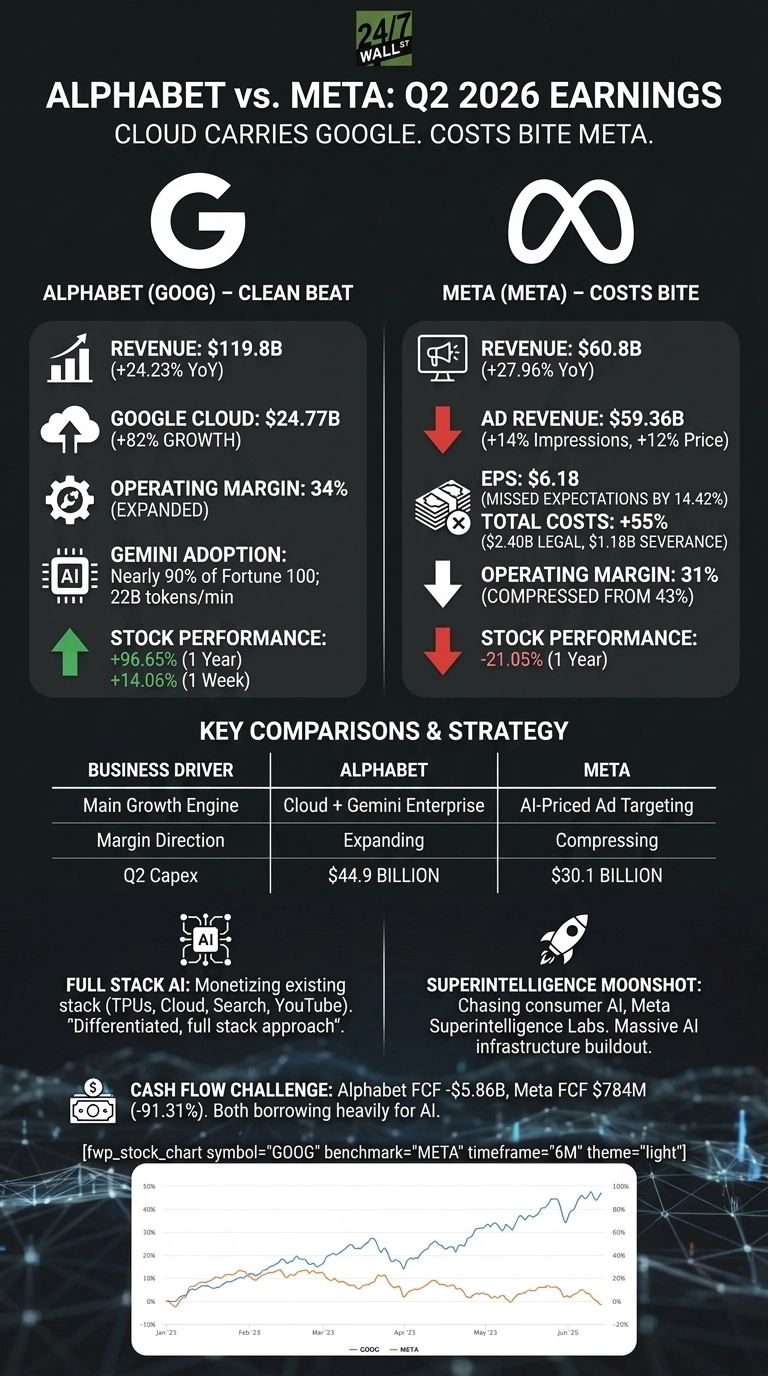
| Business Driver | Alphabet | Meta |
| Main growth engine | Cloud + Gemini Enterprise | AI-priced ad targeting |
| Margin direction | Expanding | Compressing |
| Q2 capex | $44.9 billion | $30.1 billion |
Full Stack vs. Superintelligence Moonshot
Alphabet is monetizing AI across a stack it already owns: TPUs, Gemini models, Cloud, Search, YouTube, Workspace. Pichai framed it as a “differentiated, full stack approach“, and the Cloud number backs him up.
Meta is spending to invent something further out. Zuckerberg’s Meta Superintelligence Labs is chasing consumer AI on top of a family of apps that reaches 3.60 billion daily users. He called AI “accelerating our core business today“, but the P&L is doing the paying.
Both are borrowing heavily. Alphabet raised roughly $70 billion in combined equity and debt and suspended its buyback. Meta guided full-year capex to $130 billion to $145 billion, with expenses raised to $165 billion to $169 billion. Free cash flow tells the story: Alphabet swung to negative $5.86 billion, and Meta’s fell 91.31% to $784 million.
The Next Test Is Whether Capex Pays
I want to see three things. For Google, whether Cloud can hold that 82% pace as capacity floods online, and whether Search query growth truly benefits from AI features rather than getting cannibalized.
For Meta, whether the Q3 revenue guide of $61 billion to $64 billion materializes without another cost surprise. The youth-related U.S. trials scheduled for 2026 are a wildcard I do not think retail has priced in.
Why I Lean Google Right Now
On the fundamentals, Alphabet looks like the cleaner setup. Cloud is compounding, margins are widening, and shares are up 14.06% in the past week and 96.65% over one year.
Meta is a harder call. The ad engine still works, but shares are down 21.05% over the last year, and Polymarket traders assign only a 44% probability that META revisits $640 in August.
If you like turnarounds with defined catalysts, Meta has more upside variance. For investors focused on current fundamentals, Alphabet screens more favorably until Meta demonstrates cost discipline.
The post Alphabet’s Cloud vs Meta’s Superintelligence: Who Wins Q2? appeared first on 24/7 Wall St..
]]>Alphabet’s Class C shares are trading at $356.62 as of August 6, 2026, and our proprietary model sees room for more. Our 24/7 Wall St. price target for Google (NASDAQ: GOOG) is $461.01 over the next 12 months, implying 29.27% upside from here. That is a buy, held at 90% confidence, the highest tier our system assigns.
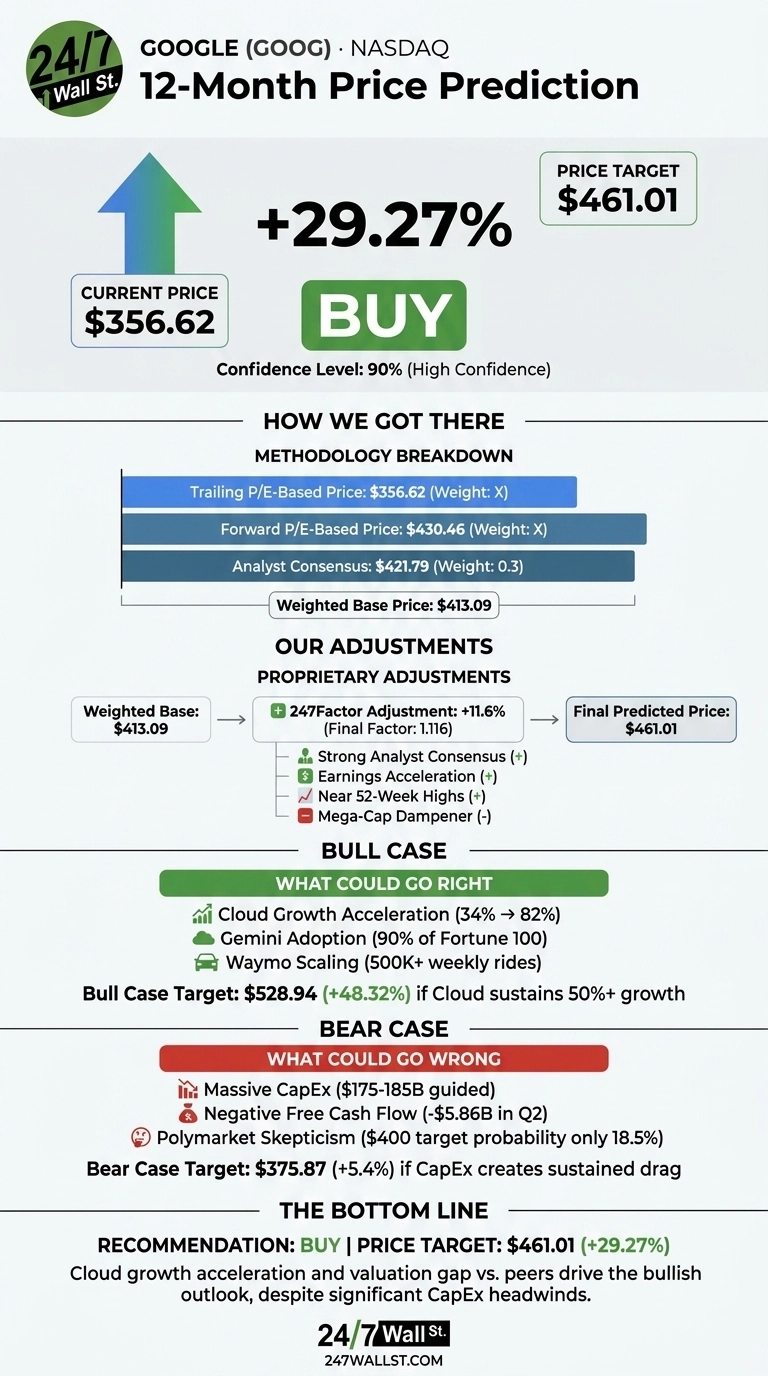
24/7 Wall St. Price Target Summary
| Metric | Value |
|---|---|
| Current Price | $356.62 |
| 24/7 Wall St. Price Target | $461.01 |
| Upside | 29.27% |
| Recommendation | BUY |
| Confidence Level | 90% |
Our base-case path has GOOG crossing $400 between the December 2026 checkpoint of $389.70 and the March 2027 checkpoint of $412.70. Google should reach $400 in early February 2027, roughly a week after the Q4 FY26 earnings release.
A Week of Recovery After a Bruising Earnings Report
GOOG is up 81.62% over the past year and 13.79% year to date, trading about 4% below its 52-week high of $404.23. The last week added 6.87% as buyers stepped back in after the Q2 earnings drawdown.
That Q2 report on July 24, 2026 delivered strong fundamentals: EPS of $9.11 beat a $3.04 estimate, revenue of $119.80B rose 24.2% year over year, and Google Cloud accelerated to 82% growth.
Shares fell 6.89% on the day as investors digested a 100% YoY jump in CapEx to $44.92B and a suspended buyback.
Why Bulls See a Breakout Ahead
The bull case rests on Cloud. Google Cloud’s growth ramped from 34% to 48% to 63% to 82% across the last four quarters, with backlog swelling from $155B to $460B.
Gemini is in use at nearly 90% of the Fortune 100, the Gemini App has 950M monthly active users, and Waymo is scaling to 500,000 weekly rides. If Cloud sustains 50%+ growth into 2027, the bull scenario reaches $528.94, a 48.32% total return.
What Could Go Wrong
The bear case is the CapEx bill. Google guided 2026 CapEx to $175 to $185 billion, long-term debt climbed from $46.5B to $98.2B, buybacks were suspended in Q2, and free cash flow turned negative at negative $5.86B. Polymarket bettors put only 18.5% odds on GOOG hitting $400 by end of August, and 81.5% on $350.
Our bear-case path finishes at $375.87. Bulls counter that negative FCF reflects front-loaded AI infrastructure that will compound cash flows once utilization catches capacity, mirroring the 2016-2018 hyperscaler cycle.
How Google Compares to Microsoft and Meta
Microsoft (NASDAQ: MSFT) is the cleanest comp. Both pour capital into AI cloud infrastructure and court the same enterprise buyers. MSFT trades at a trailing P/E of 28, nearly double GOOG’s 15, despite Azure growing 43% versus Google Cloud’s 82%. That valuation gap is the core of our bull thesis: Google is priced like a mature ad business while executing like a hyperscaler.
Meta Platforms (NASDAQ: META) offers a different angle. The stock trades at a P/E of 22 and missed EPS by 14.42% in Q2 2026 while guiding $130 to $145 billion in 2026 CapEx. Meta shows AI infrastructure spending punishes stocks when growth wobbles, while Google continues to accelerate. The peer set makes our $461.01 target look conservative.
| Company | Trailing P/E | Operating Margin |
|---|---|---|
| Google (GOOG) | 15 | 32% |
| Microsoft (MSFT) | 28 | 47% |
| Meta (META) | 22 | 41% |
Google Price Prediction 2026-2030
Our 24/7 Wall St. price target of $461.01 is a BUY at 90% confidence, and $400 looks like a February 2027 waypoint. Cloud growth paired with a P/E below peers tips the scale.
The bull thesis strengthens if Google Cloud holds 60%+ growth into Q4, while another CapEx guidance hike without a matching backlog uptick would weaken it. On current numbers, the risk-reward profile tilts favorable.
| Year | 24/7 Wall St. Price Target |
|---|---|
| 2026 (year-end) | $389.70 |
| 2027 | $461.01 |
| 2028 | $545 |
| 2029 | $640 |
| 2030 | $747 |
The 2028-2030 figures extrapolate our five-year base case of $747.43 by 2031, a 15.95% annualized return. These projections assume Google executes on Cloud and Gemini. Significant upside or downside could come from antitrust remedies or a step-change in AI monetization.
The post Price Prediction: Google Will Hit $400 on This Date appeared first on 24/7 Wall St..
]]>When the Q1 2026 13F filings were released in mid-May (Q2 filing are released later in August), three names kept surfacing across the sharpest institutional portfolios: Amazon (NASDAQ:AMZN), Alphabet (NASDAQ:GOOGL) and Uber (NYSE:UBER).
Bill Ackman’s Pershing Square disclosed Amazon as roughly 17.4% of the portfolio and Uber at 15.7%. David Tepper’s Appaloosa added to both Amazon (~15.2%) and Uber (~7.7%), while slightly trimming Alphabet to roughly 8%. Li Lu’s Himalaya Capital ran Alphabet at ~44.8% combined between GOOGL and GOOG, and Warren Buffett’s Berkshire Hathaway more than doubled its Alphabet stake to roughly 6% of the portfolio. Berkshire, worth noting, does not own Amazon.
Amazon: The AI Cash Machine Ackman and Tepper Are Backing
Amazon traded around $273.86 on Aug. 6, up nearly 21% year to date and tracking the thesis holding both Ackman and Tepper. Q1 2026 revenue rose 16.6% to $181.52 billion, and EPS of $2.78 beat expectations of $1.65. AWS grew 28%, the fastest in 15 quarters, at a 37.7% operating margin.
Advertising delivered $17.24 billion, up 24%. Andy Jassy’s $200 billion 2026 capex plan is the tell: this is a compounding cash machine being redeployed into AI infrastructure while trading at a forward P/E of 31.
Alphabet: The Value Play Buffett and Li Lu Both See
Alphabet is the clearest consensus name of the three, and the reason is quantitative. Shares are up 14.09% YTD and 83.36% over one year, yet the forward P/E sits at just 26. Q1 2026 EPS of $5.11 beat expectations of $2.53. Google Cloud grew 63% to $20.03 billion, with backlog nearly doubling to over $460 billion.
Waymo is running more than 500,000 fully autonomous rides per week. When Buffett doubles down and Li Lu (his ideological heir) runs a portfolio nearly half-weighted in one name, they see the same thing: a growth business trading like a value stock. (For readers focused on this exact playbook, the 24/7 Wall St. free report 7 Warren Buffett Stocks to Buy Now is worth a look.)
Uber: The Contrarian Compounder

Uber is the outlier. Shares are down 16.68% YTD and 22.62% over the past year, yet Ackman and Tepper both hold it. Why? Q1 2026 gross bookings rose 25% to $53.72 billion, Uber One hit 50 million members driving half of gross bookings, and the company returned $3.01 billion in Q1 buybacks against $2.29 billion of free cash flow.
The forward P/E is 22, ROE is 35.3%, and the Zoox and Waymo partnerships position Uber as the aggregation layer for autonomous vehicles regardless of who wins the tech race.
Should Retail Follow?
The pattern is coherent, not coincidental. All three are platform businesses with high ROE, strong free cash flow, and AI-linked optionality that trades below their growth rate. Alphabet screens as the most defensible entry given the valuation gap. Amazon offers the cleanest AI infrastructure exposure. Uber is the highest-conviction contrarian setup, but requires patience through the AV transition. 13F data is point-in-time as of March 31, 2026, so positions may have shifted. For retirement-focused investors, the takeaway is the shared thesis: quality compounders bought at reasonable multiples still work. Copying the trade is optional. Understanding why four elite managers converged here is not.
The post Why Amazon, Alphabet and Uber Keep Showing Up in the Same Billionaire Portfolios appeared first on 24/7 Wall St..
]]>
The artificial intelligence arms race has entered a new phase. For the past two years, investors focused on which hyperscaler would spend the most on AI infrastructure. Now the more important question is how those investments will be financed.
Capital spending plans from Alphabet (NASDAQ:GOOG), Amazon (NASDAQ:AMZN), Microsoft (NASDAQ:MSFT), Meta Platforms (NASDAQ:META), and Oracle (NASDAQ:ORCL) have climbed towards $1 trillion, stretching even the enormous cash flows these companies generate. Instead of slowing their ambitions, they are increasingly tapping debt markets and equity investors to bridge the gap.
For long-term investors, that’s an important shift because it changes how these companies fund growth without necessarily changing the growth story itself.
Alphabet Is Rewriting the AI Financing Playbook
Alphabet has become the clearest example of this new reality. The company is returning to the bond market for the third time in just nine months, seeking to raise as much as $25 billion through a new debt offering.
That follows:
| Financing Event | Amount Raised |
| November 2025 debt issuance | $25 billion |
| February 2026 debt issuance | $30 billion |
| June 2026 equity financing | Roughly $90 billion |
| August 2026 proposed bond sale | Up to $25 billion |
If the latest bond sale prices in full, Alphabet will have raised roughly $170 billion in fresh capital in less than a year. The timing isn’t surprising. Alphabet recently lifted its 2026 capital expenditure forecast to $195 billion to $205 billion, up from an earlier outlook of $180 billion to $190 billion.
Assuming the company ultimately raises around $80 billion in debt this year, borrowings alone would finance about 40% of its projected capital spending. With four months remaining in the year, another debt offering could push that figure over 50%, although another equity raise remains a possibility.
This isn’t because Alphabet can’t access capital. It’s because AI infrastructure is becoming too expensive to fund entirely from internally generated cash.
Cash Flow Has Become the New Constraint
The biggest surprise from Alphabet’s second-quarter earnings last month wasn’t revenue growth or Google Cloud’s continued momentum. It was cash flow. Alphabet generated $39.1 billion in operating cash flow but spent $44.9 billion on capital expenditures, producing its first-ever quarterly negative free cash flow as a public company.
Normally, investors punish that kind of development, and initially they did. Alphabet shares fell roughly 7% immediately after earnings before reversing course. Within about 10 days, the stock had climbed 17% from those post-earnings lows as investors concluded that the cash burn reflected aggressive investment rather than weakening demand.
Ironically, Wall Street appears more willing to tolerate temporary negative free cash flow than slower AI investment. That’s a remarkable change from just a few years ago, when free cash flow was one of the market’s favorite valuation metrics.
Rising Debt Isn’t the Same Thing as Financial Stress
The obvious concern is leverage. Before the latest proposed bond offering, Alphabet reported more than $98 billion in long-term debt after its earlier financing rounds. Viewed in isolation, that sounds like a dramatic increase, but against Alphabet’s balance sheet, it looks much less concerning.
The company still holds one of the largest cash positions in corporate America, generates well over $100 billion annually in operating cash flow on a trailing basis, and continues to post operating margins that most companies can only dream about.
Granted, higher debt means higher interest expense, and investors should expect financing costs to keep climbing if Alphabet continues borrowing. It also raises the stakes for AI investments to generate attractive returns over time.
But unlike highly leveraged companies borrowing simply to stay afloat, Alphabet is borrowing from a position of financial strength to accelerate infrastructure spending.
Key Takeaway
In short, Alphabet isn’t signaling financial weakness by issuing more debt — it is acknowledging that a $205 billion annual AI investment program has outgrown what even its formidable free cash flow can comfortably support.
For investors, the more important question isn’t whether Alphabet can afford another $25 billion in bonds — the evidence suggests it can — the real question is whether those hundreds of billions of dollars ultimately produce enough AI revenue to justify the spending.
Thus far, the market appears willing to give management the benefit of the doubt. Until that confidence changes, financing AI with more debt may prove to be a feature of Alphabet’s strategy rather than a flaw.
The post Alphabet Is Taking on More Debt to Finance Its AI Spending. Why That’s Not Necessarily Bad News appeared first on 24/7 Wall St..
]]>Shares of Alphabet (NASDAQ:GOOGL) are down 4% to $361 in Wednesday afternoon trading after the company announced a sweeping AI leadership overhaul. GOOGL stock is still up 16% year to date (YTD), and its 52-week high of $408.61 sits within reach of recent levels.
The trigger is based on sentiment rather than Alphabet’s fundamentals. First of all, Demis Hassabis is moving from Google DeepMind CEO to Alphabet chief scientist and chairman.
Moreover, Jeff Dean, the company’s chief scientist and a co-founder of Google Brain, Sanjay Ghemawat, a longtime senior engineer behind much of the infrastructure that still powers Google, Oriol Vinyals, who co-led development of the company’s Gemini AI model, and Quoc Le, a veteran AI researcher whose work helped lay the groundwork for modern large language models are departing to launch a startup called Discovery Loop.
Investors are reading the reshuffle as a brain drain at a delicate moment, with concerns that Google trails OpenAI and Anthropic and that a Gemini 4 upgrade is delayed. The bigger question for traders watching Alphabet stock right now is: What would it actually take for GOOGL to break above $400? The answer looks less dramatic than today’s headlines suggest.
The AI Brain Drain Behind Today’s Drop
Jeff Dean, Google’s chief scientist and a 27-year Alphabet veteran, is one of the most recognizable AI names on the planet. His exit alongside several other senior AI leaders is the kind of story that jolts sentiment even when core financials remain intact. Alphabet will serve as a founding investor and cloud partner for Discovery Loop, which softens the strategic blow.
Retail reaction has been split. r/wallstreetbets registered a bullish sentiment score of 76 for Alphabet on the view that “the train isn’t stopping,” while r/stocks sat at a more neutral 58. The Q2 2026 earnings report itself was strong, so today’s move reflects a confidence shift rather than a cash-flow issue.
The Valuation Case for $400
Alphabet’s real support for a move above $400 comes from valuation. GOOGL stock trades at a trailing P/E ratio of 17.31x, the cheapest of the mega-caps, versus Meta Platforms (NASDAQ:META) at 20.71x, Microsoft (NASDAQ:MSFT) at 27.22x, and the Invesco QQQ Trust (NASDAQ:QQQ) at 31.98x. A modest re-rating toward peers would do most of the work.
Wall Street already prices Alphabet stock north of that level. The analyst consensus GOOGL price target sits at $428.04, backed by 13 strong buy, 45 buy, 6 hold, and 0 sell ratings. The 24/7 model carries a base target of $451.73, with a forward P/E-based fair value of $407.82.
Google CEO Sundar Pichai’s Q2 2026 numbers underpin the case. Alphabet reported revenue of $119.8 billion, up 24.2% year over year (YoY), with Google Cloud revenue accelerating 82% to $24.77 billion. The company’s EPS came in at $9.11 versus a $3.04 consensus, marking 11 straight quarterly beats.
Peers and Sector Context
The peer set frames why Alphabet’s discount stands out. Meta Platforms stock is down 11% YTD after a Q2 EPS miss and elevated capex guidance, Microsoft shares are up 2% for the year, and the QQQ ETF is up 18%.
The prediction markets on Polymarket peg $400 at a 50% probability for August, with $390 at 59.5% for GOOGL stock. Traders see a plausible path, but they aren’t calling it a lock.
It’s worth mentioning that GOOGL shares are Alphabet’s Class A shares while GOOG (NASDAQ:GOOG) is the ticker for Alphabet’s Class C shares. Both types of Alphabet shares are publicly traded.
What Could Push GOOGL Over the Line
The risks deserve fair weight. Alphabet’s capital spending pushed Q2 free cash flow to negative $5.86 billion, long-term debt jumped from $46.5 billion to $98.2 billion, and the buyback program was suspended. The regulatory overhang and AI competition from OpenAI and Anthropic aren’t going anywhere.
The setup for a run at $400 is straightforward. Sentiment needs to stabilize after this leadership reshuffle, Google Cloud growth has to hold, and AI monetization must keep flowing to the top line. Analysts and the 24/7 Wall St. model already assume prices well above that threshold.
Investors can watch for whether GOOGL stock holds above its 50-day moving average near $358.43 and how the markets absorb the next Gemini Pro release, which prediction markets place at a 76% probability by August 31. That release, more than any executive change, could set the tone into September.
The post Alphabet Is Still Up 16% in 2026. What Will It Take to Get GOOGL Stock Above $400? appeared first on 24/7 Wall St..
]]>Someone, please tell me if I’m wrong. SpaceX (NASDAQ: SPCX) said its capital expenditures were $18.4 billion in the quarter that just ended. Almost all of the spending is going toward AI. By the same token, Oracle (NASDAQ: ORCL) says it will spend a ton more. Yahoo reports, “Oracle expects capital expenditures of up to $95 billion in fiscal 2027, though it expects repayments from customers for up to $25 billion of that.” And that number is small by megatech company standards.
Microsoft (NASDAQ: MSFT) says capex in the current fiscal year will be $175 billion. In the current quarter, it will be $50 billion. Amazon (NASDAQ: AMZN) says it will be $220 billion this year, which is a revision upward from the number it gave three months ago. Meta (NASDAQ: META) has put it as high as $145 billion for the year. Total across these large companies, and a few which are slightly smaller, the sum for 2026 is $860 billion, up 80% year over year.
I don’t understand it. The market hammered SpaceX, in part because of the AI spending plan. But they are tiny.
It’s harder to figure out why SpaceX rents out data center capacity. Why doesn’t it use it for its own AI buildout? CNBC reports, “While SpaceX’s own models are seen as behind OpenAI and Anthropic, the company is positioning itself as an alternative cloud player by renting out the computing capacity that it is building with Nvidia chips.” Some of that appears to involve providing service to Google and Anthropic.
Here’s another thing that’s hard to understand. When it comes to enterprise software spending, OpenAI, Anthropic, and to a lesser extent companies like Microsoft and Alphabet (NASDAQ: GOOG) show up. Where is SpaceX?
Jump way across the AI industry to AI assistants? xAI’s Grok lags well behind leaders in Apple’s App Store. Those leaders include Claude, ChatGPT, and Gemini.
Something is missing. If xAI’s capex spending is at the low end among the industry’s leaders, its enterprise adoption is low, and its consumer market share is low, what’s going on?
The post SpaceX Has Already Lost AI Race appeared first on 24/7 Wall St..
]]>Bill Ackman’s Pershing Square Capital Management opened a new Microsoft (NASDAQ:MSFT) position of 5,654,078 shares valued at $2,092,970,053, disclosed in the 13F for the quarter ended March 31, 2026, and filed on May 15, 2026. The stake landed at roughly 15.26% of the disclosed portfolio, an instant top holding.
In the same filing, Pershing Square cut its Alphabet (NASDAQ:GOOG, NASDAQ:GOOGL) exposure to almost nothing, trimming the GOOG share class by 5,852,145 shares, about -94.94%, and reducing the GOOGL class by roughly -95.2%.
A Swap Funded by Alphabet Proceeds
Ackman funded the Microsoft purchase by dumping roughly $1,844,801,000 worth of last cycle’s AI winner, a name that has returned 98.05% over the trailing year. Selling something up nearly 100% to buy something down is the entire trade in one sentence.
Alphabet’s Q2 numbers, reported later on July 22, 2026, were extraordinary. Revenue rose 24% year over year to $119.796 billion, Google Cloud grew 82%, and core operating income climbed 30%. Ackman sold anyway, in Q1, when the market still loved it.
What Microsoft Looked Like When He Was Buying
Microsoft in Q1 was a de-rated stock. It had sold off on its fiscal Q2 report as investors questioned whether Azure’s AI lead was slipping, and forward multiples compressed toward roughly 21x forward earnings, a level Ackman publicly called overblown. By the time the fiscal Q4 report landed on July 30, 2026, the fundamentals had reasserted themselves.
Revenue came in at $90.01 billion with EPS of $4.74, and the stock jumped 8.13% in after-hours trading. Azure crossed a $100 billion annual run rate for the fiscal year, Microsoft 365 Copilot passed 30 million paid seats, and Intelligent Cloud grew 32%. Ackman was buying the operating story the market had temporarily stopped believing.
What Peers Were Doing at the Same Time
Peer positioning went the other way. Reporting on the same Q1 filing cycle indicates Daniel Loeb’s Third Point exited Microsoft, David Tepper’s Appaloosa trimmed the position sharply, Chase Coleman’s Tiger Global reduced its stake meaningfully, and Chris Hohn’s TCI cut hard as well. The directional message is clean. Concentrated managers who had ridden Microsoft for years were rotating out just as Ackman rotated in, and he did it with the proceeds of an Alphabet position most of them were still comfortable holding.
Contrarian moves get remembered when they work, and this one was contrarian on both sides of the trade at once.
What a Retirement Investor Should Take From This
You do not have to copy the trade to learn from it. Microsoft trades at a forward P/E of 24, a trailing 27, a 34% return on equity, and 45.1% operating margins. Alphabet, still statistically cheaper, is the real complication in Ackman’s trade. His bet is that Microsoft’s monetization of enterprise AI, through Azure and Copilot, translates faster into durable earnings than Alphabet’s search-plus-cloud stack, and that the fear which pushed the multiple to 21x was mispriced.
For a retirement-focused investor already holding Microsoft, the takeaway is to hold through the AI-CapEx anxiety cycles rather than trim into them. For anyone considering an entry, Ackman’s price is behind you, but so is the pessimism that let him get in.
Why He Did This
In my opinion, the leading cause was Google losing its edge in AI. Companies like Anthropic, backed by Amazon (NASDAQ:AMZN), and OpenAI, backed by Microsoft, have made massive progress. Anthropic’s Fable 5 and OpenAI’s GPT 5.6 are constantly in the news for hacking into things and their technical prowess. Google seems nowhere close to closing the gap.
Just 6 months ago, it seemed like Google was destined to win the AI race. Now, it seems like a pitched battle between Anthropic, OpenAI, and a handful of Chinese companies.
The post Why Bill Ackman Poured $2 Billion Into a Stock His Peers Were Fleeing appeared first on 24/7 Wall St..
]]>Nvidia (NASDAQ:NVDA) stock might have slowed down in the past year, gaining less than 15% in the timespan, but the business is still moving at a staggering pace as it does its best to meet sky-high AI demand while investing in the bottlenecks in the buildout. Whether it’s the desire to time a peak in hardware (no evidence of that yet), fears over circular financing and its potential to cause a violent unwind of some sort of “AI bubble,” Nvidia stock isn’t going to be right for everyone.
Perhaps the biggest reason to stay sidelined is the slowing upside momentum combined with the bearish bets put on by the great Dr. Michael Burry, who’s best known for betting against the housing market ahead of the 2008 Great Financial Crisis. With Dr. Burry recently adding to his already lofty put position, questions linger as to whether Nvidia stock is peaking out, even as the business itself continues to post spectacular results.
On the flip side, Dan Ives of Yorkville & Ives sees more wins coming for Nvidia, with “12-to-1” demand for its chips, a reality check that might not be baked into this increasingly skeptical market quite yet.
Expectations are high, but Nvidia just keeps sprinting faster
Of course, it’s going to be hard for Jensen Huang and company to keep sprinting at this pace for the long haul. Past blowout quarters have pretty much caused Nvidia’s expectation treadmill to be on max. And while the firm hasn’t broken a sweat just yet, skeptics like Dr. Burry know that staying at such a pace just isn’t sustainable over time. But what if Nvidia really is a seasoned marathon runner that can keep the pace on a maxed-out treadmill for tens of miles more?
While the company itself is going to keep blowing the numbers away, what’s harder to predict, at least in my view, is how investors and the market will react, especially as they grow more exhausted in a market environment that could become a whole lot more volatile as we head into the latter half of the third quarter — a period that tends to see things get just a bit more turbulent.
Like it or not, Nvidia is continuing to be in that “Goldilocks” zone, all while the firm continues operating at the highest level possible. Even if someone like Dr. Burry increases his short exposure by way of bearish put options, I find it hard to bet against a firm that’s seeing real earnings growth, unheard-of gross and operating margins, as well as rising CapEx from hyperscaler customers.
It’s not just that hyperscalers are increasing their spend to advance the AI buildout to make way for the next generation of AI applications, but it’s more players that stand to enter the hyperscaler group.
Think Meta Platforms (NASDAQ:META) and Oracle (NYSE:ORCL), which, like it or not, are in the hyperscaler game now after their respective pivots. Meta decided to go ahead with selling compute via Meta Compute, while Oracle has seemingly prioritized Oracle Cloud Infrastructure (OCI) above all else. Indeed, the latter firm actually sacrificed its credit rating to pull off what could be one of the most aggressive pivots in corporate history.
AI demand might overwhelm supply to a greater extent
Any way you look at it, AI data centers are going up, and they’ll be coming online fast. And, with that, a lot of next-generation Nvidia GPUs are going to keep flying off shelves, with firms at the front of the line deemed the most fortunate to be able to hand over obscene sums of cash for the right to get their hands on the latest and greatest hardware.
With Ives recently highlighting a 12-to-1 demand-to-supply ratio for its chips, I think it’s hard to get behind the bearish narrative right now when the reality points to more of the same, perhaps for far longer than almost anyone except for Ives and the bigger bulls expects.
In any case, Nvidia is back in the $5 trillion market cap club, and with a 22.8 times forward price-to-earnings (P/E) multiple, I’d say it’s hard to bet against the firm, given the current reality of the fundamentals.
The bottom line
What’s most dangerous for the bears, in my view, is what happens when hyperscalers start clocking in those ROIs, as cloud growth keeps moving higher in a way that catches just about everyone off-guard.
When you look at those Amazon (NASDAQ:AMZN), Microsoft (NASDAQ:MSFT), and Alphabet (NASDAQ:GOOG) numbers, maybe higher CapEx will soon be what Wall Street craves rather than rejects. For Nvidia stock to pass Go and collect $20, I think the hyperscalers are going to need to see that growth jolt turn into a free cash flow inflection point.
The post NVIDIA Facing 12-to-1 Demand to Supply for its Chips, Says Expert—and It Might Be Time to Buy appeared first on 24/7 Wall St..
]]>Shares of Meta Platforms (NASDAQ:META) have been clobbered since the firm pulled the curtain on its underwhelming quarterly earnings results. The numbers themselves were okay (28% revenue growth is nothing to sneeze at), but compared to the other hyperscaler firms, the results were actually quite uninspiring, with a lot to be desired. Add heavy spend into the equation, and it’s not a mystery as to why investors rotated out of the name so violently last week.
One bad quarter doesn’t signify that all is lost with Meta, though, especially as the company continues to spend aggressively to catch up in the hyperscaler race while also funneling considerable sums into its superintelligence team, which now actually has something quite impressive to show for its many years of hard work with Muse Spark, a model that might actually convince some users to pay for.
As the company shifts gears a bit from using its own AI compute to selling compute to others via Meta Compute while looking to play in the same arena as Anthropic, OpenAI, and Alphabet’s (NASDAQ:GOOG) Google with its new closed-source large language model Muse Spark, questions linger as to how the company’s AI strategy stands to evolve from here.
Yes, Meta is spending a lot. But it’s probably going to be money well spent
While Meta’s seemingly worrisome spend to fund its AI plans was a primary reason to hit the sell button after the second-quarter reveal, I do think that to sell Meta here is to forego a dirt-cheap stock that’s well on track to win in the AI race as it looks to aggressively move forward in a way that could disrupt its fellow hyperscaler peers.
At the end of the day, Meta might be less far along in its CapEx cycle, but I do think it will make up for this with heavy spending and creative decisions made internally. Whether that’s an AI Zuckerberg or making use of Meta’s trove of internal data, I do think the firm is more than willing to add an exclamation point when it comes to its AI plan.
The major positive for Meta, at least in my opinion, is that Meta is entering the hyperscaler game at the best possible moment. It’s got the AI-native, AI-first mindset before the shovel goes into the ground — an advantage that I think much of Wall Street is heavily discounting, especially following a discouraging quarterly showing.
Without the capital drag of legacy cloud infrastructure and some ridiculously aggressive moves to move at full speed in the AI race, my guess is that it’s just a matter of time before Meta Compute becomes the fastest, shiniest new racecar that’s driving in the AI race.
A powerful frontier AI innovator and new hyperscaler that’s going for a bargain
As Meta looks to take control of the stack with its hardware initiatives while exploring the possibilities within the consumer and business realms with its profoundly powerful and rapidly advancing new model, I certainly wouldn’t want to bet against the firm while it’s down and out, trading for 18.6 times forward price-to-earnings (P/E) — a multiple that I believe vastly underestimates the company’s AI vision as well as the sheer aggression of Mark Zuckerberg.
With a powerful digital ads cash engine behind the firm and the potential for high-margin cloud growth to take things into overdrive, I certainly wouldn’t overlook Meta’s shares, even though there are more exciting things in the hyperscaler world to look to right now. Add the wild card of Muse Spark into the equation and the potential for deeper cuts to Reality Labs, an effort I’m sure Wall Street would applaud, and I see Meta as having very easy levers to pull to get its stock marching higher again.
Dismiss Muse Spark, if you will, but version 1.1 is a pretty big deal. It’s a powerful model with seriously impressive agentic capabilities, with benchmarks that suggest it’s not all too far from the very front of the pack. Meta made a statement with this release, and it’s going to be interesting to see how much better the next iteration will be as Meta’s Superintelligence Labs looks to win at any cost.
The post 28% Revenue Growth Ignored: Why Panic-Selling Meta Stock Over Infrastructure Spend Is a Mistake appeared first on 24/7 Wall St..
]]>One of the things that was not entirely clear when Amazon (NASDAQ: AMZN), Alphabet (NASDAQ: GOOG), and Microsoft (NASDAQ: MSFT) announced their earnings was the extent to which Microsoft leads Alphabet in cloud market share. According to Cloud Zero, Amazon’s AWS has 28% of the market, Microsoft Azure has 21%, and Google Cloud Platform has 14%. Since their cloud businesses are a primary source of AI adoption, the figures are particularly important.
There is a second way to look at which company is likely to have the best cloud future. This is based on cloud revenue growth. In the most recently reported quarter, AWS revenue grew 37%. Microsoft’s growth was 43%, and Alphabet’s was 82%. Even at those growth rates, Alphabet may not catch its rivals soon, if it catches them at all.
Microsoft has a key set of advantages over Google. One is the installed base of Microsoft’s other software products across corporations. A huge number of companies already use Windows Server, Office 365, and Active Directory. Azure integration is likely much easier than Google Cloud integration.
Apparently, the availability of the Microsoft and Google products differs. “Region availability is limited in some geographies,” according to research firm Sotatek.
What is at stake? To a large extent, AI adoption. Cloud services integrate AI features and functions. With hundreds of billions of dollars on the table, this may be the most important single factor.
The post Microsoft Races Ahead Of Google In The Cloud appeared first on 24/7 Wall St..
]]>The mega-cap tech trade got interesting again this summer. Apple (NASDAQ: AAPL) is up 13.84% year to date, Alphabet (NASDAQ: GOOG) has gained 85.46% over the past year, and Amazon (NASDAQ: AMZN) just posted its fastest AWS growth in 18 quarters.
Between AI infrastructure spending, custom silicon, and a Services flywheel that keeps compounding, I think all three can push meaningfully higher into 2027. Here is how Apple gets to $400, Alphabet to $500, and Amazon to $350.
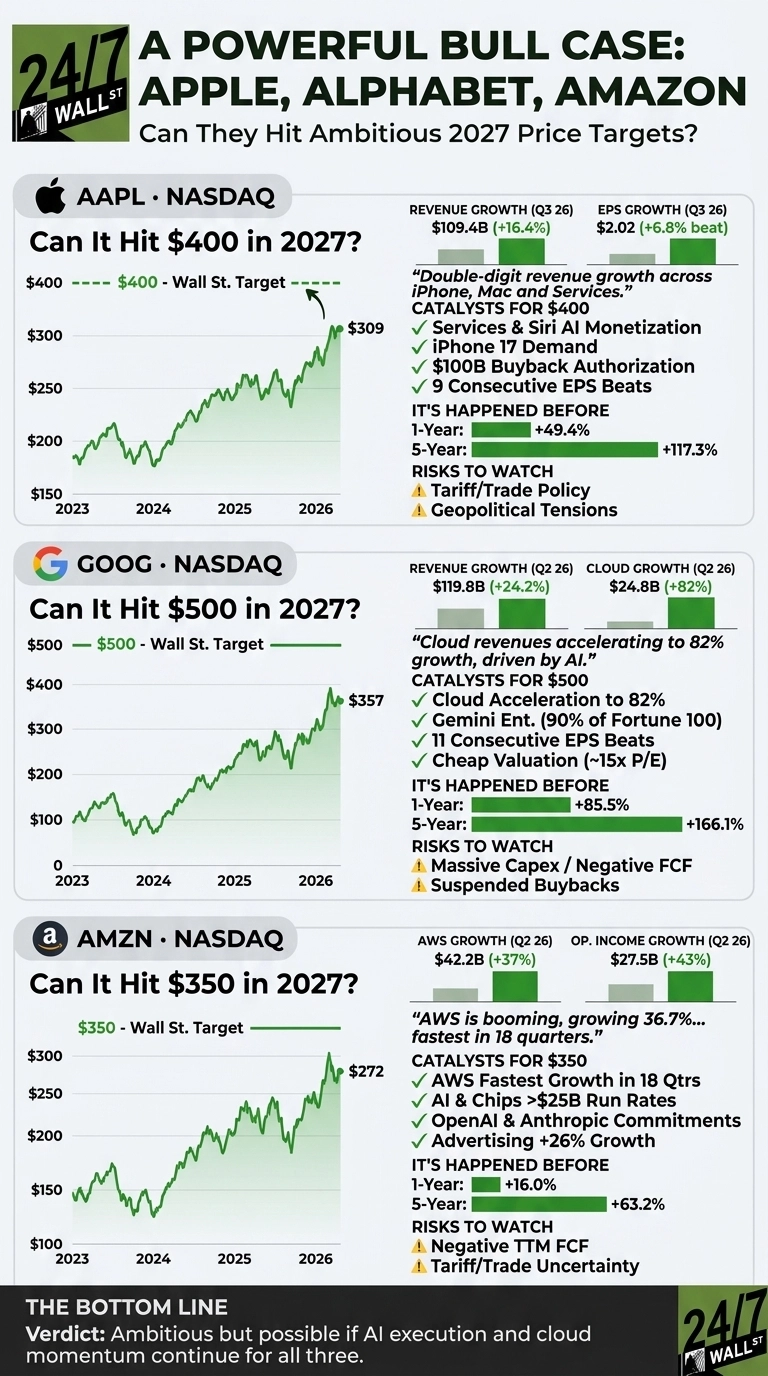
Apple’s Path to $400: Services and Siri AI
Apple trades at $308.91 after a 7.24% pullback last week. The June quarter was the strongest ever, with revenue of $109.42 billion, up 16.4%, and EPS of $2.02 versus $1.89 consensus. That is nine consecutive quarters of beats. iPhone revenue jumped to $54.25 billion on iPhone 17 demand, and Services hit $30.74 billion.
Tim Cook said Apple delivered “double-digit revenue growth across iPhone, Mac and Services, and in every geographic segment.” At $62.09 billion in nine-month buybacks plus a new $100 billion authorization, the float keeps shrinking.
Apple trades at a P/E near 40x. Hitting $400 keeps a similar multiple against fiscal 2027 EPS as WWDC26’s new Siri AI monetization ramps. That is a roughly 29% gain, well within reach given the 49.42% one-year return already on the tape.
Alphabet’s Path to $500: Cloud Acceleration
Alphabet is the cheapest of the three at a 15x P/E, versus the S&P 500 near 22x. Q2 revenue was $119.80 billion, up 24.2%, and Google Cloud accelerated to 82% growth at $24.77 billion. Cloud has now gone from 48% in Q4 2025 to 63% to 82%, and the backlog exited Q1 at $460 billion.
Sundar Pichai noted “nearly 90% of the Fortune 100″ use Gemini Enterprise, with models processing 22 billion API tokens per minute. Alphabet has beaten EPS 11 quarters in a row. A rerating to just 20x on rising 2027 estimates gets the stock to $500, a roughly 40% move from $356.65. Given the 85% one-year rally, another leg is plausible.
Amazon’s Path to $350: AWS and Custom Silicon
Amazon closed at $271.58 after popping 15.32% on earnings day. AWS grew 37% to $42.23 billion at a 39.4% operating margin. Andy Jassy said AI and Chips businesses each cleared $25 billion annualized run rates growing triple digits. Advertising climbed 26% to $19.81 billion, and operating income surged 43%.
OpenAI is committing to 2 GW of Trainium capacity starting 2027, and Anthropic is securing up to 5 GW. With Q3 operating income guided to as much as $26.5 billion, 2027 estimates should keep drifting up. Amazon trades near 38x earnings today. On 2027 operating income leverage, $350 implies a still-reasonable multiple. That is roughly 29% of upside.
The Bottom Line
Bull cases require a lot to go right. Apple needs Siri AI monetization plus continued iPhone strength. Alphabet needs Cloud to stay above 50% growth without capex breaking free cash flow. Amazon needs AWS and custom silicon to deliver on the OpenAI and Anthropic commitments.
None of that is guaranteed. But with three consecutive quarters of accelerating results across the group, the setup for outsized 2027 returns is there. I would not expect gains like these every year, but Apple at $400, Alphabet at $500, and Amazon at $350 is the blueprint if the AI buildout keeps compounding.
The post A Powerful Bull Case Is Emerging for Apple, Alphabet and Amazon appeared first on 24/7 Wall St..
]]>