For most of modern corporate history, employment law risk was managed institutionally — through policies, HR departments and indemnities. That presumption is now outdated.
Today, the fastest-growing exposure and risk runs directly through the chief executive as an individual employee and fiduciary. Boards that still treat controversy as a communications issue are discovering, often too late, that regulators, activists and plaintiffs’ lawyers are weaponizing employment and human-rights frameworks to target leaders personally.
The biggest threat now facing CEOs appears nowhere on balance sheets or risk matrices but on Twitter, in headlines and in activist playbooks designed to break individuals rather than institutions — or, at least, institutions through their CEOs. Boards that fail to adjust to this reality are gambling with their leadership.
Boards are only beginning to understand this shift. Many, indeed most, still treat controversy as a communications problem — something to be managed with statements, apologies or time.
Regulators, activists and plaintiffs’ lawyers understand it differently. They know the most efficient pressure point is no longer the institution but the individual who leads it.
The modern CEO — especially one who is articulate, values-driven and publicly visible — is no longer just an executive. He or she is a governance signal, a reputational proxy and, increasingly, the primary target. The law has not materially changed. The environment has.
In practice, the pattern is familiar to anyone who has lived through a real crisis. A public statement, often careful and well-intentioned, becomes a headline. The headline becomes a campaign. The campaign attracts regulatory attention, investor anxiety, advertiser hesitation or internal unrest. By the time the legal department is fully engaged, what initially looked like reputational noise has hardened into personal exposure for the CEO.
This is not accidental. It is strategic.
Corporations are resilient. Individuals are not. Activists understand this. So do regulators operating under political pressure.
CEOs have reputations, families, immigration considerations, future board prospects and careers that extend well beyond their current role. Apply enough pressure to the individual and the institution almost always moves.
Many boards respond with outdated tools. Tighter message discipline. Faster apologies. More process. That playbook no longer works. The real question is whether the organization understands where the CEO’s personal fault lines now lie — and whether it has prepared for them before pressure arrives.
Three developments explain why this moment feels different.
First, the collapse of the boundary between public speech and corporate responsibility. Officially, the line still exists. In practice, it is porous. Statements are judged less by intent than by reaction. Silence is treated as a position. Clarification is framed as escalation. What matters is not what was said, but how it can be leveraged.
Second, the normalization of lawfare. Complaints do not need to succeed to be effective. They need only impose cost, distraction or reputational uncertainty. Process itself has become punishment. CEOs who assume that being substantively correct will protect them often learn — too late — that exposure is driven by momentum, not merits.
Third, institutional retreat. Universities, regulators and even boards now default to proceduralism under pressure. Support, if it comes at all, is often delayed and private. The question asked behind closed doors is no longer “Is this right?” but “Is this survivable?”
The result is a dangerous asymmetry. CEOs are encouraged to lead, signal values and speak plainly — until that leadership attracts scrutiny. At that point, the same institutions that demanded clarity discover a sudden appetite for neutrality and review.
What works in this environment is neither silence nor reflexive contrition. Silence invites escalation. Performative apologies satisfy no one and signal that pressure works.
The only durable response is preparation.
Boards that are adapting treat CEO visibility as a foreseeable risk category, not an anomaly. They stress-test public positions in advance. They identify lines they are prepared to defend. They resist improvising under fire. And they ensure that when pressure arrives, the CEO has access to independent legal judgment — unfiltered by internal politics or reputational anxiety.
For CEOs, the lesson is equally clear. Visibility remains a source of power. It is also a source of personal risk. That does not require retreat from public life. It requires understanding that every statement exists in an ecosystem designed to exploit ambiguity — and that precision, timing and restraint are now strategic assets.
The companies that navigate this moment successfully are not those that say the least. They are the ones that understand the cost of saying something and have decided in advance which costs they are prepared to bear.
The era in which institutions could reliably absorb the blow is over. The CEO is now part of the product. Leaders and boards who recognize this early retain control. Those who discover it mid-crisis rarely do.
Most failures in this space are not failures of intelligence or intent. They are failures of preparation, resulting in the discovery, under pressure, that no one had mapped the personal exposure until it was already being exploited. The leaders who fare best are those who have had these conversations privately before they are forced to have them publicly.
Howard Levitt is senior partner of Levitt LLP, employment and labour lawyers with offices in Ontario and Alberta, and British Columbia. He practices employment law in eight provinces and is the author of six books, including the Law of Dismissal in Canada.
]]>Sprott Inc. ( TSE:SII ) wholly owned subsidiary Sprott Asset Management USA ‘s CEO Rick Rule comments on the strategy behind First Mining Finance Corp ( CVE:FF ) and Odin Mining and Exploration Ltd. ( CVE:ODN ) project acquisition.
 Listen to the podcast interview with Rick Rue:
James West: Rick, thanks for joining us again today.
Rick Rule: Always a pleasure, thanks for having me on.
James West: Rick, companies like First Mining Finance Corp., who opportunistically capitalized on weak commodity prices to build an inventory or mineral bank of advanced high quality projects, they’re now being rewarded for their foresight. And is that an example of the thesis that you’ve been outlining for us in past interviews, playing out for investors?
Rick Rule: Yes and no. The truth is that what First Mining Finance did was a variant of optionality. They took on projects that had seen very high exploration expenditures, and at least initially, they acquired those projects at a substantial discount to the historic spend.
Optionality, which is the play that I had sort of outlined for you, is very different. In optionality, what you’re doing is, you’re buying a large, established resource that has a lot of in situ upside to the commodity price. What Keith Neumeyer did was very different; he took advantage of the fact that cost of capital decreases with liquidity, and he also bought deposits – well, not deposits; he bought exploration projects that had generated a lot of data as opposed to a lot of resources. It needs to be pointed out, in the two principal practitioners of the exploration optionality thesis or target optionality thesis, that is, Odin Mining and First Mining Finance, that as you say, they’ve both been substantially rewarded.
What they have done differently than the real optionality model is that they’ve bought targets as opposed to deposits. And so people need to understand that this is a strategy that can yield very big rewards with exploration success, but the increase in the price of a commodity that you don’t necessarily have very much of does not always translate into share price gains. It’s a very, very different strategy, and it’s a strategy, by the way, that requires capital expenditure.
The idea with the optionality strategy is that the management team does something that’s very difficult for them, which is nothing. You don’t issue more stock, you don’t dilute; you let the mineral price escalation take care of the value creation. At Odin and First Mining Finance, their model is very different. They propose to beneficiate those exploration projects while the mineral price is still low. What they’re hoping is that the data that was established by somebody who spent $15 million on a project, that they spent $1 million or $2 million acquiring, gives them a leg up on discovery; but they will be spending money while the commodity price is still low. This is a target optionality strategy, not a minerals optionality strategy.
James West: Wow. Okay. So then, where are the opportunities as far as Sprott Global’s position going forward, that investors can still get in front of as of now, that will provide opportunities for the immediate and longer term future?
Rick Rule: I think in the short term, like the third and fourth quarter – don’t do it now – in the third and fourth quarter, there will be tremendous opportunities in junk debt market. I think that there is going to be really substantial credit disruption, particularly in the energy space, and I think enough disruption that the senior secured facilities will be impaired. And if the senior secured facilities are impaired, the publicly trading subordinated facilities will really be impaired.
It’s important to note that there’s about $3.5 trillion worth of energy debt in public companies worldwide, and we think as much of $500 million of this is impaired. Now, what’s important to note here, James, is that the people who bought this stuff four or five years ago were yield-oriented, not credit-oriented. They didn’t take a look at the companies’ underlying ability to pay at various commodity prices, they just looked at the yield. So those people believed that a bad 8.5 per cent yield was better than a good 7 per cent yield. And that same lack of sophistication on the buy side will be evidenced on the sell side. When the disruption hits the energy credit markets, we suspect that the naïve buyers will believe that both oil and gas are four letter words, and they’ll sell with the same lack of discipline that they bought.
So imagine a situation where a piece of publicly traded subordinated debt was issued with a 7.5 per cent yield, and let’s say it has three or four years remaining on it. But the bond goes to 50, meaning that your 7.5 per cent yield becomes a 15 per cent yield, and in the three or four years to maturity, they have to buy you back at 100 for a piece of paper that you bought for 50.
Now if that piece of paper doesn’t pay you off at 100, the shareholders of the underlying security see themselves going to zero. So one of two things happen: you get sort of a 25 per cent annualized rolling yield, or the shareholders go to zero. We seek the ability to pick and choose through the whole range of resource credits, not merely energy credits but also precious metals credits and base metals credits. And the junk bond market will be the best opportunity available to us in resource markets globally.
Other opportunities, of course, will continue to appear, particularly in the smaller, illiquid end of the natural resource markets for people who are willing to do securities analysis. The truth is that in the range above $2 billion or $3 billion in market cap, there’s an awful lot of information and an awful lot of competition, and it’s unlikely that you’ll be able to outperform the markets in the plus-$3 billion range.
For subscribers and viewers who are willing to accept the risk of the volatility, and importantly, willing to do the work, the sub-$200 million market cap space will perform, my suspicion is, probably as well as it did in the last decade. Remember, James, that the TSXV, the natural resource index of the TSXV, while it’s up by 50 or 60 per cent in the last six months, was down nominally 88 per cent. In fact, it fell by half, which it normally does; then it fell by half again, which it seldom does, and then it fell by half a third time. It tells you how far some of the stocks in the sector go.
And I’m sorry for the long-winded answer, but it’s also important that your subscribers, your listeners, understand that most of the upside performance in the sector isn’t delivered by the whole space. It isn’t delivered by 1,200 companies. It’s delivered by 100 or 150 companies. It’s important not to buy the sector, but rather, to do stock selection within the sector.
James West: Rick, as usual, very enlightening. Thank you once again for your time today. We’ll catch up with you again very soon.
Rick Rule: Always a pleasure. Thank you, sir.
James West is an investor and the author of the Midas Letter, an investing research report focused on Canadian markets.The views expressed on this podcast — edited for clarity, brevity and compliance with securities laws — are his own and are presented for general informational purposes only. They should not be construed as advice to invest in any securities mentioned.
James West and/or associated funds do not own shares in any securities mentioned in this article. For the full Midas Letter disclosure policy, click here. Postmedia and Midas Letter have a revenue sharing arrangement.
]]>The C-Suite isn’t what it used to be. Nor is it now what it is destined to be.
New roles are coming to the fore, while traditional roles are undergoing significant changes to meet the shifting demands of technology, workers and society at large.
There are more titles being added to the C-Suite mix, such as chief digital officer, chief data officer, chief innovation officer and chief analytics officer, among others.
With that comes a new chapter for traditional titles as well. The CIO and CFO roles are ideal cases in point. Both are undergoing significant changes in an environment of rapid digital transformation.
There is a well-known joke in technology circles that CIO stands for Career Is Over, says Charlotte Wang, chief technology officer for IBM Technology Services in Toronto. “Information was the currency when the role CIO (chief information officer) was coined in the mid-1980s. Then we saw the advent of chief technology officer and chief innovation officer as business recognized the need for that technology bent in the C-Suite.”
Historically, CIOs were relied upon to have a technology and engineering background. Today, they also need the skills and competencies to communicate with the board in a language they understand, whether it’s profit and loss, customer acquisition strategies or business outcomes, says Chris Bedi, Global CIO at ServiceNow in Santa Clara, Calif., an enterprise cloud company specializing in digital transformation.
“Boardroom conversations are now about how to leverage technology for higher productivity,” he says. “The chief information officer has to be more strategic than ever. Now they also have to be able to drive cultural transformation across the company.”
Another significant change in the CIO role is the need for greater collaboration within the ecosystem, Bedi notes. During a typical workday, “they might be meeting with a chief marketing officer and talking conversion rates and applying machine learning; the next might be with the CFO on how to drive improvement in revenues and GDPR compliance. Yet another conversation might be with sales around creating a greater customer experience, or with the head of talent about improving the employee experience. Today’s CIO has to be adept at pivoting for all those conversations.”
Bob Vokes, managing director, financial services, for Accenture Canada, says the CFO’s role is undergoing an equally significant shift. A recent Accenture report, “ The CFO Reimagined: From Driving Value to Building the Digital Enterprise, ” states that today’s CFOs are moving beyond finance functions and playing a more critical role in driving digital disruption within their organizations.
According to the report, 76 per cent of CFOs recognize that finance skills will continue to move away from core finance to advanced digital, statistics, operational and collaborative skills. In addition, 78 per cent say the change must be rapid and drastic, as traditional finance roles may soon become obsolete.
“A new set of capabilities has to be put in place, such as the curiosity factor around data, quantitative analysis and communications,” Vokes explains. “That shift starts by having an open mind set on how to develop the new financial insight perspective. Then the question is, do they have the right tools, data, people and skills to drive the process?”
Getting CFOs or any other incumbent to a more appropriate level is not something that can be achieved with a snap of the fingers, Vokes says. “It takes time and a combination of events. One is changing internal hiring practices and profiles and looking for up-and-coming people that have a nice blend of quantitative and communicative skills.”
Organizations looking to transition their board need to start with internal talent, Wang agrees. “That’s No. 1. I’m continually amazed how boards or executives dismiss their own employees. They think someone in infrastructure operations doesn’t understand business. But they absolutely do because they keep the lights on, know where the data is, and how the network operates.”
In the new skills economy, hiring from within will enable companies to find people who want to get out of engineering and be innovators, she notes. “We don’t let these people go because we have automated. We harvest them because they know the business.”
The next steps are providing internal support structures to help them expand their capabilities through additional support and training, and applying the technology tools to ensure that they have the right access to the right information.
External hiring processes also need to be revised. As Vokes says, “It’s important to start remixing the DNA of people coming in. When you combine that with internal training and support and tooling capabilities, it will all come together.”
]]>Kahuso founder and CEO Michael Carter tells us how his own experience gave him the idea for Kahuso, which links companies with experienced executives who are available for temporary gigs.
 Listen to the podcast interview with Michael Carter:
Transcript of the Conversation:
James West: Michael, thanks for joining us today.
Michael Carter: Thank you for having me.
James West: Michael, let’s start with an overview: what’s the value proposition and the revenue model of Kahuso Inc.?
 Midas Letter is a monthly journal profiling Canadian emerging companies with best-in-class potential in all sectors. Subscribe today
Michael Carter: So in a nutshell, we’re a disruptive technology company that hopes to revolutionize the executive employment space. So the value proposition, I mean, it’s a dual-ended marketplace. On the executive side, we aspire to create a platform where executives can come and find a plethora of interim, part-time advisory board opportunities, initially targeted at small/midsize companies, because I think that’s where the greatest demand is. But the response to date has been pretty overwhelming from large companies as well. So value prop on the company side is, companies nowadays are rethinking how they both recruit and deploy resources, and even more so, I think, at the executive level, looking for flexibility, control, speed, capacity, etc. And so as they look at moving away from, say, the traditional cradle to grave careers and permanent roles at an executive level, how do they find those executives that are either millennials or accomplished executives that are now looking themselves for more control and flexibility in the marketplace, to fill the gaps?
James West: Okay, so in a nutshell, outsourced executive suite?
Michael Carter: Yeah, that’s a good way to put it. The other one-liner we always use is kind of the the
James West: Okay, that’s a bit scary. All right. So how does this compare with, let’s say, LinkedIn?
Michael Carter: The one-liner LinkedIn to me is, LinkedIn is a social network that’s aspiring to move into the recruiting business. And if you talk to any corporation or executive for that matter that uses LinkedIn, you’ve got to work your butt off to get productive with it. It’s not easy to use; the matching algorithm in my humble opinion is poor at best, and so it takes a lot of time and energy to really capitalize on what LinkedIn has to offer.
We want to be your Jerry Maguire. We want to be your agent and do all that work for you. So you come to our platform, we’re doing a lot of the heavy lifting, or as much as possible, leveraging technology, so when you are looking for an executive or what have you, it’s immediate. It’s something that we can show you what you’re looking for, for the right amount of time, at the right time.
James West: One of the biggest problems I have with LinkedIn, which I used to use religiously, I use it a lot less now, is that they show me people I already know. I don’t want to know people I already know, I want to meet new people for things like guests in podcasts, etc., and subjects for articles. So that’s the biggest criticism I have there.
How does Kahuso actually go about the business of matching my talents as a C-suite executive who wants a part-time gig, wants to help somebody part-time – how do I get into the system, and how do people find me?
Michael Carter: I mentioned e-Harmony at the beginning, we got a chuckle out of it; the reason why I use that analogy is because we take a much more thoughtful approach to building the profile of both executives and companies on the platform. So where traditional platforms like a LinkedIn or other, they really focus on your CV, and people endorsing you for functional skills, we like to think we take it a step further. So as an executive or a company coming onboard, we put you through a wizard that looks at things like cultural fit, that looks at things like professional attributes, what’s your team-building style, what’s your leadership style, what’s your decision-making style. And so we look at a variety and a more robust set of data that kind of gets spit into the machine if you will, and then we’ve taken a unique approach to the matching algorithm, where we’re building a machine learning matching algorithm that adds a lot more rocket science, if you will, behind how do the right executives fit with the right opportunities.
And so we think we have a much better mousetrap in the middle, that delivers that proposition.
James West: I see. So I’ll find an egotistic, narcissistic control freak CEO micro-manager, that should come across in my profile?
Michael Carter: I certainly hope so.
James West: Okay, well that’s interesting. Now tell me about the revenue model: how are you guys going to monetize this environment?
Michael Carter: So we believe we can make money on both sides, and there’s a third angle which I’ll explain. So on the executive side, I think we’re going to have to earn it, obviously, but over time I think executives will pay a subscription fee to be part of this platform based obviously on the richness and the depth of our opportunity portfolio, if you will.
And so we’ll look at more of a subscription model on that side. And on the company side, we’re going to look at two different ways: one is a connection model, so it’d kind of a success-based model, if you will, where we’re not going to charge you a dime until you find executives that you want to connect to. So we’ll only charge you once you have some success. Or we’ll offer the old fashioned model which is hey, if you want it more fixed and predictable, we’ll just charge you a rich posting fee.
So that’s the core monetization model.
The other part, which I didn’t describe, and we’ve had a lot of positive response on, is what I’m calling our ecosystem ply. So I’ll use me as an example, where I, having been in the start-up world and dabbled around for the last couple years, I have a wife and two kids, and I haven’t worked for anybody, so I don’t have benefits, and it’s something that drives my family crazy. So we realized, one of the things that could make agile executives more successful, make it easier for them to kind of transform into this kind of world of employment, and so what are those value-added services that we could offer each of them? A great example was benefits. I know of a lot of executives that are kind of mailing it in, and especially female executives that are mailing it in, because they don’t want to give up the benefits package that they enjoy.
So we’ve cut a deal with a great, innovative company called Benecaid that has offered us an associate plan. So if you’re an executive that comes on to our platform, we can offer you a benefits plan. Granted, you still have to pay for it, but we can get you a much better plan at a much cheaper cost because it’s coming through Kahuso. And how we monetize that is, there are elements of that that we’ll earn a brokerage fee on, if you will.
So you’ll get benefits, you’ll look at invoicing software like FreshBooks we’ve got a deal with, that if you come through Kahuso and you’re new to the agile talent world, one of the first things you’re going to have to do is invoice your clients. Well, we can offer you invoicing software through FreshBooks, and we’ll monetize every one of those partnerships that will drive kind of peripheral revenue beyond our core matching product.
James West: Right. Interesting. So you’re now a private company; what is your plan for capitalizing this? How much capital has gone into it so far, and what’s the exit strategy for your investors?
Michael Carter: So we have, hopefully within the next month we’ll close an angel round that followed a family round from last year, or friends round, rather. So wind the clock ahead three weeks, we’ll have raised about $1.5 million of private equity into the company. The beauty of this model and being very technology-centric, we feel, is it’s quite scalable; it’s not going to need a ton of capital in terms of what our vision is.
That being said, it’s going to be about accelerating our growth path. So we will need capital to move out of the kind of GTA and southern Ontario realm. Starting next year, we’re going to need some aggressive growth capital, and so for lack of a better way to put it, we’re open to all options, and what makes the most sense for our company and where we aspire to go, be it through looking at the VC community or private equity community, or do we look at some of the public options that are available to us.
Exit strategy? I never like to predict what that looks like. Done this a few times where it can go a variety of different ways. So I think obviously one of the likely scenarios that I can see is an acquisition play at some point, so we can liquidate or offer our current investors a liquidity event via an acquisition. But based on our financial forecast, there’s an argument to be had that says that this can generate a ton of cash, and why would we be in a rush to sell it if we can kind of create value through the cash flow?
James West: You bet. All right, Michael, let’s leave it there for now. We’ll come back to you in a couple quarters’ time and see how you’re making out. Thank you so much for your time today.
Michael Carter: Thank you for having me.
James West is an investor and the author of the Midas Letter, an investing research report focused on Canadian markets.The views expressed on this podcast — edited for clarity, brevity and compliance with securities laws — are his own and are presented for general informational purposes only. They should not be construed as advice to invest in any securities mentioned.
James West and/or associated funds do not own shares in any securities mentioned in this article. For the full Midas Letter disclosure policy, click here. Postmedia and Midas Letter have a revenue sharing arrangement.
]]>Carpathian Gold Corp. ( CNSX:CPN ) ( OTCMKTS:CPNFF ) has the largest undeveloped gold deposit in Europe, and with Forbes and Manhattan’s recent takeover of the project, it is now in the hands of experienced mine developers.
Listen to the podcast interview with Scott Moore:
James West: Scott, thanks for joining us today.
Scott Moore: Thanks for having me, James.
James West: Scott, give me an update on what’s happening with Carpathian Gold, and how Forbes & Manhattan came to be involved.
Scott Moore: Yeah, I guess it’s a bit of a lengthy story. We’ve certainly over the past about four years, been looking at the Brazilian asset that was in Carpathian Gold, and certainly had teams down there looking to acquire the asset when it ran into a little bit of I guess operational or build issues. And at the same time always kind of slightly coveted the Carpathian asset in Romania, based on its size, you know, it’s quite a substantial resource; second-largest gold asset in Europe.
James West: What is the resource?
Scott Moore: You’re looking right now at about 7.2 million ounces of gold and about 1.5 billion pounds of copper.
James West: Wow. And what’s the grade?
Scott Moore: You’re looking at a low-grade, bulk tonnage operation, average grade of about 0.8 with about 0.25 or so kicker of copper. And the original feasibility, or at least the preliminary economic assessment, was running at 40,000 tonne a day operation. So there are some high grade operation potential, so that’s one of the things we’ll be looking for as we move into feasibility: opportunity to build a smaller, tighter, starter-type project with a lower CapEx, and then build over time.
James West: So the Brazilian asset was sold out of the company?
Scott Moore: Yeah, so that gave us, I would say that over the last three years we put bids into Macquarie at least three times to purchase Rovina Valley out of Macquarie, and of course Macquarie never actually put Carpathian into any kind of process, and then ran the operation to try to maximize the value of the Brazilian asset, and then on the announcement that Carpathian had divested Brazil to Brio, which is a 100 per cent owned subsidiary of Yamana, left Carpathian with Rovina Valley, not really a management team in place, $1 million in the bank and obviously there was an opportunity to approach the company and make a bid to put money into the company and provide a management team and take them forward.
James West: Okay. So now, where does the Romanian asset sit in terms of – didn’t Barrick make an investment in that at one point?
Scott Moore: Barrick made an investment back, I think, in 2009, when they bought 9 per cent of the company for $20 million. So this was a not-insignificant price to pay, certainly in the heady days of the mining industry back then, $20 million wasn’t big money for a company of Barrick at the time. But you know, the size and scope of the project, at least on the preliminary economic assessment basis, 380,000 ounces of gold equivalent production for 17 years. Long life mine, good exploration potential beyond what’s there now, it’s a discovery made by Samax, which is the Carpathian subsidiary in Romania, and it’s the only deposit in Romania that’s 100 per cent owned by a private company.
So the other companies, like Gabriel, of course, we know about; Eldorado’s Certej project, these were past government owned, state owned agency projects. So it’s 80/20 for both those projects with the government, where this one was a discovery made by Carpathian’s team in Romania, so it’s 100 per cent owned, which is a little bit different. You don’t have that legacy of this was a state-owned asset divested to some private company; this was a discovery made by Carpathian’s own team in Romania.
James West: Yeah. Okay, so are there any political issues that you foresee in Romania along the lines of what Gabriel dealt with?
Scott Moore: I don’t think that along the lines of Gabriel; you know, Gabriel is a very large project. Again, that’s the largest gold mine potentially in Europe, with a lot of archaeological resources, a lot of bulk tonnage cyanidation, heat bleach asset, whereas the project we have in Rovina is much smaller, much tighter. You don’t have the archaeological remains around there, you don’t have a Roman town built on it, you don’t have to move a city. And you can use conventional flotation technology to make an upper gold concentrate and ship it to a number of smelters, but primarily in the pre-feasibility sent to the Freeport smelter in Spain. So not like arsenic the laden smelter that’s got to go to another smelter like Tsumeb. Chelopech sends their con to Tsumeb in Namibia. It’s not like that.
So again, you have a much tighter project. So we don’t feel that we have the political headwinds, as it were, with Gabriel. And in fact, in May of last year, 2015, Rovina and Carpathian was granted a mining license for the project. So that starts the whole permitting process.
Now, that license has to be ratified by a number of departments within Romania, which is an ongoing process, and of course last year there was a change in government in Romania and elections are coming up in November of this year. So our focus will be to understand the issues revolving around getting that license ratified and essentially gazetted in Romania, and we believe that our experience in eastern Europe and Ukraine in particular, and Russia, we certainly have experience in eastern European countries and believe that we can work the right balance to satisfy all the agencies that we’ve done a good job and a proper job to get that license ratified.
And we look at this kind of like the same as, where does Forbes do a good job? Find an asset that has a little bit of hairs on it but with a good resource that would get turned into a real mine. This reminds us of Sullivan; at the time we took over Sullivan, it had a litigation for seven years, it was a mess, you had to get –
James West: Terrorists.
Scott Moore: Terrorists, drunk guys, whatever it was, you had to get through that. We got through that, we did a proper engineering study, proper environmental impact study, got the permits, and ultimately before we were able to build, it was taken over by Rio Alto and then Rio Alto was subsequently taken over by Tahoe Resources. So it fits our model of what we like to see; you know, Avion in Mali was the same thing. You had a mine there from Nevsun, didn’t work. We had to do the technical work to turn it around. So that’s the opportunity we see: we’ve got a big resource, big junky resource, low grade, but again, a big bulk tonnage operation can work there in stages, and if we come into a good bull market, it’s an excellent project.
James West: Right. So the other elephant in the room is the 750 million shares outstanding?
Scott Moore: Well, I think post-closing it’s like 904. That’s a big number, and no, at some point, and of course we’re also listed on the Canadian Securities Exchange which is through the whole Macquarie management of Carpathian, they took it off the main board and dropped it down to the CSE to save costs and fees and such. So we’re looking at opportunities to take us back to the main board and look at what we do, at some point, certainly up to shareholders whether we have a consolidation back to a more manageable Canadian-sized company, not a Aussie company as it were.
James West: Yeah, right!
Scott Moore: At 900 million shares would be great on the ASX, but the TSX is perhaps a little different.
James West: Yeah, okay. So now what’s the timeline that we can expect to see go into the development of this project?
Scott Moore: Certainly we’ll spend, we’ve already started, but in the next three or four months to get that mining license ratified. That’ll be our number one goal, while we put together the technical team, and then move towards a full feasibility study over the next twelve months, taking into consideration some very good work done on the resource and the current preliminary economic assessment.
But once you have that mine license ratified, it starts the whole process for all the permitting for the project, for the construction license, the EIA and everything. So that’ll be part and parcel, in tandem with moving with the feasibility, doing the entire permitting work and all the social work and environmental impact studies that you would need to get that construction license granted concurrently with moving fowards on the feasibility study.
James West: And so now, so Barrick put in $20 million; how much in total has gone into this project before you guys got it?
Scott Moore: I guess, certainly Macquarie had put $250 million in, primarily to Brazil. So I don’t think – I’d have to look at exactly what’s happened on the financials, but there hasn’t been an awful lot of money spent on Romania other than, they did drill 140,000 metres, so there’s been a good, and a good PEA done. So in terms of the engineering work and the resource, and the drilling on that has been quite a bit of money spent on that. I’m sure that’s where the bulk of Barrick’s money was spent, specifically on the Rovina asset. But the bulk of the company, the money has been spent, several hundred million dollars, unfortunately sunk into Brazil.
James West: Right. So now, so there’s nothing in Carpathian in Brazil anymore?
Scott Moore: Yeah. So the transaction closed on April 28, where a Yamana subsidiary named Brio, which we all know, is now holding the bulk of the Brazilian assets, purchased the RDM mine from Macquarie and from Carpathian for $45 million and wrote off the balance of any debt owed to Macquarie, and Brio had to put $1 million USD into Carpathian by way of a private placement.
James West: Okay. I saw that. The private placement was at $0.015.
Scott Moore: Yeah. $0.018, so 70 million shares.
James West: And you guys put money in at…
Scott Moore: $0.07.
James West: Right. Which strikes me as a very non-Forbes & Manhattan kind of transaction. You guys pay the less and the next guy pays more.
Scott Moore: Well, I guess we like good assets, and whether we pay $0.04 or $0.05 or $0.07, this is either going to be worth $5.00 or it’s not. The assets of this quality and this size are extremely hard to come by. When we took over Verena Minerals in Brazil, they had a million ounces and we did a market deal at whatever, $0.25, $0.35 at the time, and then we drilled out 8 million ounces, and Belo Sun is now a $350 million, $400 million market cap company. So in this situation, we don’t have to do that quality of drilling to add those ounces, they’re already there, but the hairs on the project were the permitting, the lack of capital to spend on Romania because they were focused on trying to turn around Brazil.
So it just gave us the perfect storm, and whether we end up paying, pre-money, $10 million more or $15 more, at the end of the day it’s either going to be worth $1 billion company or it’s not. So paying upfront $0.01 or $0.02 is really small potatoes in the scheme of things.
James West: Right. Great. Let’s leave it there for now; we’ll come back in six months and see how you’re making out. Thanks for your time.
Scott Moore: Okay, thanks, James. Appreciate it.
James West is an investor and the author of the Midas Letter, an investing research report focused on Canadian markets.The views expressed on this podcast — edited for clarity, brevity and compliance with securities laws — are his own and are presented for general informational purposes only. They should not be construed as advice to invest in any securities mentioned.
James West and/or associated funds do not own shares in any securities mentioned in this article. For the full Midas Letter disclosure policy, click here. Postmedia and Midas Letter have a revenue sharing arrangement.
]]>In the five months since Chuck Robbins took over as CEO of networking giant Cisco Systems, his mantra has been one word: “Faster.”
“We live in a very real-time world,” he told journalists at the Cisco Global Editors Conference this month. “The pace of change has never been greater.”
And because the world is moving so fast, he’s pushing his executives to accelerate Cisco’s pace as well. If they tell him that a project needs 18 months to complete, he asks for it in nine.
“I don’t even know, it just feels good,” he said. “Let’s just go faster. Maybe it should be 20, but it doesn’t matter; we’ve got to figure out how to go faster. I do think that two of the key things we have to do in order to go faster is we have to simplify things, and we have to be clear.”
Streamlining
The company plans to practice what it preaches, streamlining its internal processes to increase its efficiency. Robbins’ commitment is that Cisco will become the number one example of a digital B2B company to its customers.
Yet the disruption that’s created by technology creates an incremental set of issues for customers, Robbins noted. That creates pressure on the IT organization from the c-suite, who are asking how technology fits within company strategy.
“The good news is, we’ve gotten to the point now where every customer knows that technology enables their strategy,” Robbins said. “There is no debate.”
But only one quarter of those customers actually has a digital strategy. The opportunity for Cisco, he said, is in helping customers take advantage of the digital revolution, where 40 percent of the data will be moving between machines, and industrial systems running proprietary protocols will be converged onto IP networks.
Digital solutions
To that end, Cisco has announced its Digital Solutions for Industries in four areas: Connected Machines for Digital Manufacturing, Smart Connected Pipeline for Digital Oil and Gas, Substation Security for Digital Utilities, and Connected Mass Transit for Digital Transportation.
It also announced enhancements to its IoT System Security portfolio that allow the IoT network to act as a sensor and enforcer to provide security policy enforcement within routers and switches as well as providing solutions for IoT physical security with video surveillance cameras, physical access control, and video surveillance manager with advanced security analytics.
In addition, Cisco announced a partnership with robotics manufacturer FANUC America, connecting over 300,000 robots on the factory floor. The company says that those connections, and the information gleaned from analysing the data from the robots, have already saved FANUC’s customers $38 million by preventing downtime at a cost of $16,000 per minute.
And that’s just one of Cisco’s planned and existing partnerships, Robbins said.
“You’re going to continue to see us drive deep strategic partnerships because we think the market’s moving so fast,” he noted. “And we think that we can drive unique innovation for the customer by bring together our technology and other technologies in a much deeper way.”
But that’s not its only form of industry collaboration; Cisco is also making strategic investments in companies through a $2 billion fund, and is co-developing solutions with its customers. Some of those solutions have then been productized.
“I believe the future will lead to unique partnerships we never dreamed of,” Robbins said.
]]>
To the British Empire, Canada was once the place to go for furs and timber — a vast land an ocean away whose resources would be tapped to make beaver pelt hats for fashion-conscious Londoners and wooden masts for the Royal Navy.
These days, however, Brits are pining after a different type of commodity from their former colony: Canadian corporate talent. And their appetite for it shows no sign of abating. 
Speculation in the U.K. is still simmering that the Bank of England is considering Mark Carney, governor of the Bank of Canada, to succeed its own governor who leaves in June next year. The Financial Times , which first reported the story April 17, noted that although Mr. Carney denied that he had any direct contact with the BOE or its supervisory body, no one has disputed the existence of an approach per se. The idea is now believed to have been presented to Mr. Carney through a third party, the newspaper said.
That Mr. Carney, 47, is unlikely to want the job is beside the point. The fact is that many people believe the British government wants a new face at the bank, one who can shake things up at the institution and reverse its slow-moving culture. For the bank and for other British corporations, that new face is increasingly Canadian.
Mr. Carney is only the most recent example of a British crush on Canucks to fill its leadership ranks. In the past two years alone, Britain named Newfoundland-born Moya Greene to fix its Royal Mail, the first non-Brit to hold the chief executive post. The British Airport Authority tapped Montrealer Normand Boivin to run Heathrow as its chief operating officer. And Canary Wharf Group PLC appointed Canadian-Romanian George Iacobescu as chairman of the London property developer.
“The Brits talk about it all the time — about how well Canadian banks have done and how well Canada has done” managing through the financial crisis and last recession, said Michael Lagopoulos, deputy chairman of RBC Wealth Management and president of the Canada-U.K. Chamber of Commerce. “Whether you’re a regulator, central banker, whatever, in the trade Canadians are thought of as people that know what they’re doing.”
[np-related]
Credit rating agency Moody’s Investors Service this month called Canada’s bank sector the soundest in the world, citing a combination of strong underlying credit fundamentals and a prudent regulatory environment among the factors for the superior standing. Unlike lenders in the United States, Canadian banks suffered no failures during the financial crisis in 2008.
The ability to navigate trouble is what attracted BAA to Mr. Boivin as well.
In the wake of Heathrow’s “big freeze,” a nasty winter storm in December 2010 that grounded flights at the facility for four days and threw the travel plans of thousands of people into chaos, the airport’s management invited the Canadian, then operations director at Aéroports de Montréal, to give the Brits some advice on how to deal with snow and avoid a repeat of the embarrassment. They were so impressed with what they heard that they hired him.
“We aren’t fishing abroad out of desperation because we don’t have talent at home,” said Anthony Cary, former British high commissioner to Canada from 2007 to 2010. “But we’re open to looking for good people wherever they may be found. And more and more, Canada is seen as an important country … which is extremely well run.”
Britain has a remarkable history of searching abroad to try to find the best management that it can get. Some of its biggest companies are run by foreigners.
London Stock Exchange Group PLC, which cancelled its plan to merge with Canada’s TMX Group last summer because it did not have enough shareholder support for the deal, is run by Frenchman Xavier Rolet. U.K. engineering giant Amec PLC is steered by Samir Brikho, a Lebanese-born Swede. Vodafone Group PLC, the world’s biggest wireless operator, is run by Italian Vittorio Colao as chief executive.
“The U.K. looks like a Petri dish for the globalization of corporate leadership,” FT associate editor Andrew Hill wrote this past week in a column that argued that Mr. Carney’s nationality as “a subject of the Queen” matters far less than his adaptability.

According to the latest survey by consultancy Robert Half, the number of non-British chief executives of the 100 biggest U.K.-listed groups has risen to 45 from 41 over the past four years.
The high percentage is partly due to the number of large foreign companies listed in London, Mr. Hill wrote. “But even in Britain, top directors are occasionally recruited on the basis that they will understand the ‘culture’ of the City of London. As Mr. Carney (who studied at Oxford University and later worked for Goldman Sachs in London) is discovering, that can be shorthand for ‘a Brit.’ ”
Canada’s investment in the U.K. is also growing. That naturally translates into more Canadian management in Britain as well, says Ashley Prime, deputy consul general at the British consulate in Toronto.
“This is part of a bigger picture of how Canada is extending itself economically overseas, particularly in the U.K.,” Mr. Prime said in an interview. “It’s great for us. It’s where you put your money.”
Canadian direct investment in the U.K. topped $83-billion in 2011, a 37% increase over 2007. Britain is the second-largest destination for Canadian dollars after the United States.
Canadian pension funds have been among the biggest investors in the U.K. in recent years and Ontario Teachers’ Pension Plan has been particularly active, with more than $3-billion worth of assets in the country including the HS1 high speed rail network and Camelot UK Lotteries. Oil companies have also made significant investments, with Talisman Energy’s capital spending program in the U.K. pegged at $800-million this year alone.
Given the sheer size of Canada’s financial footprint in Britain, it just makes sense that its leadership ranks would also end up there, Mr. Prime said. “The right person for the job is the right person for the job. And it doesn’t matter whether they come from Timbuktu or wherever.”
Thirty years after Canada finally won complete legislative and constitutional freedom from the United Kingdom, it has now won something else from its former colonial master — executive suite envy.
]]>Having a strong brand as a leader within a company, produces significant business benefits. That’s why it’s so important to methodically build and protect your brand as a strong leader . If that brand suffers a setback, your company feels real pain. For example, employees lose confidence in the direction of the company; they spend time looking for other employment opportunities; their desire to innovate decreases; and they cease being strong advocates for your business.
Ultimately, it doesn’t matter whether the damage to your reputation is caused by you or by circumstances beyond your control. The bottom line is that your credibility is on the line and you need to turn perceptions around quickly or your ability to operate as an effective leader will be significantly hampered. If your leader brand is broken, here are three guidelines to repair it:
Assess the damage. When your reputation as a leader takes a hit, it’s equivalent to either a dent in the fender or a complete write-off. Repairing it depends largely on the depth of the damage. Consider the following scenario: your company is undergoing a drastic restructuring. You and your executive team share with your company an evolving vision and possible scenarios. Questions are answered genuinely with compassion and with the information that is available and sharable. You have one-on-one discussions with influencers and people who have been with the company for years to address their concerns. The approach taken is that everyone has contributed to the company’s success and will continue to do so in the short- and long-term. When the reorganization is finally made public, there are some major gaps between what was discussed and the final outcomes. However, the damage to your reputation will be limited because of your pre-planning, managing expectations, active listening and leveraging the executive team. As a result, your reputation is tarnished but not irreparably so.
In contrast, consider the senior executive who publicly announces the launch of a new product and mobilizes considerable company resources to ensure it comes to market with tremendous fanfare. Furthermore, the executive, while hinging future growth on the success of the product, downplays dissenting opinions and neglects internally established processes for mitigating risks. This kind of single-mindedness, even with the best intentions, sets the stage for a complete reputation write-off if the company’s targeted expectations for the product are not achieved.
Choose the right mechanics . Senior executives are committed, action-oriented and energetic professionals who are comfortable with taking ownership. So the idea of refraining from jumping in to repair the damage to their reputation within their own company is a painful proposition. And, in truth, they need to be involved. However, the best strategy is for senior executives to engage their core management team. If the success of social media and social networking has reinforced one message it is this: the credibility of the channel trumps the attractiveness of the message. As a result, use your team as your eyes, your ears and your voice. While they are not charged with making excuses or candy-coating issues, they are responsible for explaining context and providing additional clarification. They should also provide a strong supporting voice that demonstrates that there is unwavering confidence for decisions made and the processes used. Finally, they should reinforce the humanity of the senior executive whose reputation has been damaged.
Drive carefully . Successfully repairing a damaged reputation takes time. And, while it shouldn’t slow down any senior executive’s activities, it will shape which initiatives they should participate in and how these are framed. At the same time, they should look to leverage the credibility that comes from sources external to the company. This includes involving well-respected individuals who have left the company, key industry leaders and the media to portray the senior executive in a more positive light. Finally, senior executives should be seen as taking charge of positive and successful initiatives as well as actively participating in popular company events.
Next month: How to inspire your team during tough economic or organizational times
For more than 15 years, Andrew Brown has helped senior executives develop and implement corporate communications for increasing revenues and enhancing reputations. He has brought to market more than 150 products in a dozen industries and has written more than 300 articles on product innovation, social media, marketing strategies and strategic alliances.
]]>When it comes to the fast-changing world of technology, competition is a very good thing.
It drives product development, spurs continual improvements and drives chief executives to dream big and pursue their next, great tech innovation. But when you’re a fledgling startup with no financial backing and few clients to speak of — basically Filemobile’s situation in 2006 when it launched — duking it out with larger, more established competitors can be a brutal, uphill slog.
Like many other small tech companies, our social media marketing business found a way to compete with rivals in the sector, namely well-established and well-funded competitors such as Pluck and KickApps — both of which have since been acquired.
How we managed this feat is a case study in leveraging past experience and common sense to survive past the crucial two-year startup mark. As mentioned in our last column, we had a pre-existing online fantasy sports business that helped incubate Filemobile and provided a handful of big-name client leads. From that, we leveraged critical lessons to make our new firm a success.
First, like the online fantasy sports business, we chose to operate in a specific market niche. At the time, user-generated content was relatively new and the platforms to capture, moderate and publish it — say, to a major brand or media outlet’s website — were few. KickApps and Pluck were the main players, but both focused on the U.S. market and their platforms were less flexible than Media Factory, which would soon become Filemobile’s main software-as-a-service product suite. We carefully analyzed the features our competitors were offering and tried to serve a niche that they couldn’t. Specifically, we ensured that our platform offered widespread functionality and included application programming interfaces to allow third-party developers to build apps for Media Factory to suit their individual needs. This helped provide a much-needed competitive edge. The move paid off and our early Canadian clients were impressed that a small, local shop — with whom they could have face-to-face contact if necessary — managed to produce a product that could rival those of much larger U.S. firms.
The second lesson was that we didn’t delude ourselves into thinking we could crush those larger competitors. Experience taught us that the odds of a small, unfunded Canadian tech startup challenging U.S.-based behemoths and winning is virtually nil — basically, the same odds of surviving a climb up Mt. Everest in a bathing suit with no ropes. Could you survive and make it to the peak? In theory, yes — in reality, not a chance.
So, we chose to avoid a head-to-head rivalry by initially staying out of their territory altogether and setting up a beach head in Toronto to focus on major GTA-based brands and media companies who might have a need for Media Factory. It was only when we established significant sales in our home market that we began expanding across Canada and the U.S. We also integrated flexible pricing structures into our model, allowing clients to use specific Media Factory modules and scale up as needed. This proved to be another major competitive advantage.
But sometimes competitors aren’t other firms with similar products or services. Sometimes, perception is a tech firm’s greatest rival. We faced two challenges on that front.
First, many firms initially were uncomfortable using a cloud-based service such as Media Factory when operating in the cloud still left managers with more uneasy questions than reassuring answers. Because we were able to land a few key clients through contacts from our pre-existing online fantasy sports platform, we managed to prove to other sales leads that Media Factory was a reliable, stable and secure service. Other tech entrepreneurs be warned: operating in a burgeoning market niche and proving the worth of any new tech product or service takes time and significant effort.
The other major challenge involved saving clients from themselves or their marketing agencies. At that point, many companies were trying to build platforms like Media Factory on their own, or were being sold one-off platforms by large advertising or marketing agencies to use in each of their UGC marketing campaigns — at nearly 10 times the monthly cost of using Media Factory. It took considerable legwork to market the cost-effectiveness, flexibility and utility of leveraging one software-as-a-service platform for multiple projects without the accompanying development costs or headaches. However, with extensive research and countless client presentations, we managed to drive the point home. We even achieved a major competitive coup: after making the case for co-operation, we gradually added several of those agencies as customers and they began deploying Media Factory as their social marketing suite of choice to efficiently build creative solutions for their clients.
Despite the fact that we, like so many other tech startups, faced an uphill competitive climb, we managed to overcome those early challenges and survive. We gradually turned competitive pressures into a motivating tool to drive innovation and keep our competitive fires burning. In hindsight, that relentless and highly daunting competition proved to be one of our greatest assets.
Next time — the fourth installment of our series on how Filemobile survived to the five-year mark: How we served large clients on a skeleton staff.
Steve Hulford, Chief Creative Officer
Ron Watson, Chief Financial Officer
Marc Milgrom, President
Filemobile Inc.
This regular blog aims to provide relevant management insights and highlight industry developments and opportunities, to help technology entrepreneurs start, manage and grow their firms.
]]>As a member of the C-Suite, you gain a tremendous advantage over those competitors who don’t sustain a strong brand within their companies. For example, when your employees believe that you are a powerful leader they are more likely to: feel positive about the direction of the company; feel empowered to innovate; spend less time looking for other employment; enthusiastically recruit other talented professionals; adhere to important policies; and identify opportunities for operational improvement.
To create and sustain a brand as a strong leader within a business, members of the C-suite should follow these three core practices:
Focus your activities . Senior leaders often find themselves drawn into tactical issues. This happens during the planning or implementation of important initiatives such as launching new products, pursuing large prospective clients or wooing high-profile executives. However, focusing too much on tactical issues could hurt a CEO’s reputation. In fact, leaders quickly risk being seen as getting in the way of moving projects forward, slowing down innovation and taking resources away from company-wide priorities. The lesson here: Ask yourself whether a member of your management team is better suited to dealing with the initiative than you are. If not, either secure or train a member of your team so that you, as a member of the C-suite, can keep out of day-to-day issues. You should be focusing your activities on those issues where your attention is needed to ensure the long-term health of your business.
Align your external and internal communications . Ironically, to be seen as a strong leader within a company by its employees, leaders need to devote time building a reputation as a leader outside of the company. To do so effectively means ensuring that those professionals who are responsible for building your public reputation — ghost-writers, speech writers and social media liaisons — work closely with those people who promote your activities within the company. At the same time, leaders need to tap into their executive teams’ credibility. Within your company, your senior colleagues play a tremendous role in reinforcing and amplifying the messages that you, and by extension the company, are an important player in the industry.
Demonstrate your humanity . Corporate leaders have abandoned the notion that in order to be effective they need to be taskmasters who lead by fear and intimidation. Today’s leader has embraced the need to be an effective magnet for talented people, for resources that fund continued growth and for strategic alliances. To successfully attract these elements, leaders must demonstrate their humanity. For example, make sure that you look for opportunities to share stories about your family and out-of-work passions. Also find opportunities to display other positive human attributes such as generosity and compassion. Openly recognizing and rewarding members of your company who embody key corporate values accomplishes this while reinforcing the organizational culture. Getting involved in fundraising activities that you genuinely feel are worthy of your time and support demonstrates to others your commitment to the public good.
Next Month : How senior executives can repair their brand after a difficult organizational change.
For more than 15 years, Andrew Brown has helped senior executives develop and implement corporate communications for increasing revenues and enhancing reputations. He has brought to market more than 150 products in a dozen industries and has written more than 300 articles on product innovation, social media, marketing strategies and strategic alliances.
]]>In my last column I wrote about the importance of not only building and maintaining a strong employer brand — loosely defined as the way your company is perceived by current and prospective employees — but also broadcasting the merits of your workplace culture to the world via social media channels such as Facebook, Twitter, LinkedIn or YouTube.
So, what happens when, thanks to torrid success that’s left your staffers exhausted, delivered new opportunities seemingly by the day and turned hiring into a top priority to keep retention and growth levels high, you advertise a position and manage to attract the A-list talent you need to take your company to the next level?
Consider it mission accomplished on the employer brand promotion front. Now it’s time to extend an offer of employment to the best of those talented job hunters.
Trouble is, small to medium-sized business owners often drop the ball at this stage and lose great new hires to competitors because they’re not fully committed to the process. They fail because, in the course of running a fast-growing company, they neglect to dedicate the time and energy to properly vet those peak performers for cultural fit, woo them by selling the value of the position and the strength of the team they’re about to join, keep them engaged along the way and then seal the deal with a timely, enticing offer.
A couple of common scenarios can emerge: they lose the opportunity to recruit that hot prospect outright, or hire the wrong person and are saddled with a dud employee they need to fire in six months. Either way, it’s a burden on the business, as well as stressful on the entrepreneur as those seemingly endless rounds of interviews continue. This often causes the chief executive to work “in” the business as well as “on” it, putting extra pressure on their already challenged sense of work-life balance.
Bear in mind that recruiting your next star employee doesn’t have to be painful. In fact, hiring, which is best done collaboratively with existing staffers in the interview and final decision-making process, can have strategic benefits. It not only highlights your team’s strengths and weaknesses, but can provide the kind of insight that shapes future growth.
But it takes careful planning and execution to snag highly sought-after prospects. Ask yourself these questions before and during your next round of hiring, then watch that next star performer take your firm to new heights:
Why would anyone want to work for my company, and me, specifically? Be prepared to outline your vision, describe your leadership style in detail, and define your competitive advantage as an employer. This can include providing a comprehensive benefit package, perks such as flex hours and a generous vacation policy, right down to small, but significant, considerations such as consistent feedback, volunteer opportunities and a platform to provide ideas and collaborate.
Have I developed a comprehensive, direct, friendly, realistic and accurate job description? If not, start thinking and prepare a clear outline of the position to build buzz among both active and passive job seekers. And of course, be well-prepared to talk about the role for which the candidate is applying — not to mention their prospective responsibilities and career opportunities — the most exciting aspect of the team they’ll be working with, as well as your short- and long-term vision for the company.
I’ve advertised the job, but have I reached out to my community? The more top talent you can connect with, the greater the number of impressive resumés you’ll receive. Recruitment firms are an obvious option to help with that process, but connected CEOs should engage contacts, which could be everyone from existing employees to suppliers, on relevant social media channels to attract an impressive array of applicants. After all, many of today’s top young workers search for jobs and vet employers on their preferred social media channels first before turning to other platforms.
Have I done my pre-interview homework? Be sure to read each resumé in detail, prepare relevant questions and outline your objectives. Will the interview be a casual meet-and-greet or a formal investigation of the candidate’s abilities? Understanding your objectives will help determine how you prepare.
Am I ready to take the interview seriously? Top candidates are not impressed by unprepared interviewers — and they do pay close attention to details and use them to assess which companies are worthy of their talents. Treat every interview like it’s a business development meeting — be prepared, be on time, work at building rapport and, if you’re interested at the end of it, communicate your thoughts and ask if the candidate is considering any offers or actively interviewing with your competitors.
Am I prepared to fully engage with candidates? If so, follow up as promised, book second interviews quickly and maintain at least one to two email or phone touch points each week, then share more with them at each meeting. That can mean introducing them to your team, providing a tour of the office and even discussing key operational challenges with each round of interviews.
Am I ready to make that offer? Once thorough references are completed, proceed with an offer and come to the table not only with the compensation package you first dangled, but consider offering an extra bump or guaranteed bonus to help seal the deal.
Am I prepared to deliver on all of those promises? Be sure to hold yourself accountable on everything you’ve promised and you’ll have a much greater chance motivating and retaining that game-changing employee.
—Mandy Gilbert is chief executive of Creative Niche (creativeniche.com). She writes a monthly column for the Financial Post.
]]>Today we launch a new monthly series called The CEO Communications Toolkit, designed to address the most important communications issues and skills facing today’s senior executives, including: personal brand maintenance; post-reorganization brand repair; working with communications agencies; effective spokesperson communication; and, using inspiring communication to inspire your team.
One core skill for every business leader is the art of corporate storytelling. As humans, we are drawn to compelling stories, we learn lessons from stories that are told well and actively share them with our colleagues, networks, friends and families. To many business leaders — particularly those for who are more comfortable with numbers and spreadsheets than words sentences and paragraphs — storytelling is seen as ominous. But it doesn’t have to be.
Before you begin, remember that easily understood stories have a greater impact on your target audience, so use a structure and language that everyone can understand. Help your audience link your story to a greater context (e.g. a restructure, a merger, a change in market focus, etc.). Keeping you stories simple increases the likelihood they’ll be retold and shared, which is essential in today’s social-media savvy world.
In addition to clarity, there are a few key principles to keep in mind when developing your story. First, be sure to be clear about the lesson you want to convey and repeat it several times using examples of day-to-day work situations.
Once you’re satisfied with that your story is simple and the lesson is clear, make it a point to practice your presentation to a smaller, low-risk audience before going out to the entire organization. Choose an audience that will give you candid feedback, but also one that includes a representative of the target audience. Watch their faces as you present to them to see if they’re reacting as you would have anticipated and, if not, modify your story accordingly.
In some cases you may need to have more than one version of your story in order to appeal to the interests of different audiences or to conform to certain time limitations. Also, repeat your story at strategic times (a new hire, a new promotion, a restructuring, etc.) so that you create a sense of comfort and familiarity with the story amongst your teams.
Chris Carder, co-founder of ThinData, is an excellent example of someone who successfully used storytelling to grow the company into a successful email and social media agency. To learn more about his story, click here to listen to the podast.
NEXT MONTH: How senior executives can effectively establish and maintain their brand as a strong corporate leader.
For more than 15 years, Andrew Brown has helped senior executives develop and implement corporate communications for increasing revenues and enhancing reputations. He has brought to market more than 150 products in a dozen industries and has written more than 300 articles on product innovation, social media, marketing strategies and strategic alliances.
]]>The departure of Marvin Romanow as president and CEO of Nexen Inc. may have been a complete surprise, but analysts are optimistic that it bodes well for the share price.
The stock rose 9% in early trading Tuesday.
Kevin Reinhart, who most recently served as CFO, was appointed to the role on an interim basis.
[np-related]
“We see this as a drastic step by the board in restoring shareholder confidence in the company, and closing a valuation gap that has been presistent for several years,” said George Toriola, analyst at UBS.
He considers Mr. Reinhart capable, knowledgeable and very genuine, and expects the move will be well received by shareholders as the company searches for a new CEO.
Mr. Toriola also anticipates that investors will refocus on Nexen’s fundamentals, including its significant discount to the sum of its parts, its oil-levered assets, near-term growth and improving performance at Long Lake over the medium to long term.
With the Usan field offshore Nigeria possibly starting up late in the first quarter of 2012 at 36,000 barrels of oil per day, along with an improving performance at the Buzzard field in the North Sea, UBS considers the stock attractively valued.
Mr. Toriola rates Nexen shares a buy with a $28.50 price target.
Greg Pardy, co-head of global energy research at RBC Capital Markets, believes the news could signal a closing of the gap at which Nexen trades relative to its net asset value, which he estimates at $29.54 per share. The analyst has a sector perform rating and $25 price target on the stock.
“Over the past couple of years, we have met regularly with Kevin Reinhart, and look upon him as a competent CFO who tells it like it is,” Mr. Pardy told clients. “Although the Nexen story has been nothing to write home about for some time, the company’s step appears to be its first in the road to recovery.”
While the analyst thinks the appointment of an interim CEO may cause potential buyers to surface, he believes Nexen’s plan is focused on new leadership and a turnaround, “which could take years.”
Mr. Pardy anticipates that Nexen shares will get a lift as the market considers its fate. However, the analyst is making no changes to his outlook on the company until more information on its game plan is available.
]]>It didn’t take long for the country’s news pages and social media circles to be abuzz with predominantly negative reaction to the latest report from socially oriented think tank, the Canadian Centre for Policy Alternatives (CCPA) Tuesday morning. The Ottawa-based organization revealed Canada’s top 100 CEOs had seen a salary spike of 27% in 2011 and now earn 189 times the average wage.
The result, says the report’s author Hugh Mackenzie, is a growing wage gap that, if left unchecked, will inevitably lead to social unrest, rising crime rates, diminished trust and worsening health. While the disparity between the average CEO’s wage and the average middle-class wage is unquestionably startling, it might be worth analyzing in greater depth the validity of the CCPA’s predictions of social unrest and its implication that these executives are unworthy of their wages.
First, let’s acknowledge that there is no great social upheaval taking place in Canada due to the wage gap or any other reason (nor is there one on the horizon). The occupy movement of yesteryear received limited public support and the protesters themselves made it painfully clear that they could not articulate what it was they were protesting let alone suggest a solution for it. Canada’s crime rates have been on a downward spiral during the very same period CEOs’ salaries have been on the rise. In fact, according to Statistics Canada , crime rates are at their lowest since the 1970s. And while people are less trusting of corporations after the 2008 financial market crash, this phenomenon is far from exclusive to Canada .
Furthermore, the roots of the world’s resentment toward corporations lie in the post-recession decimated investment accounts of Baby Boomers and the dismal job prospects of Gen Y rather than the compensation packages of the Canadian C-Suite. Canada has fared better than any other nation in weathering the recession and its citizens enjoy one of the strongest economies among OECD nations, so it’s not particularly effective to argue spikes in CEO salaries are destroying us from within.
Once you set aside the predictions of the CCPA, you’re left with the fundamental question of whether or not corporate leaders are worth their remuneration packages? The answer can be found in the back pages of the report itself. Mr. Mackenzie suggests CEO compensation packages continue to surge because corporation boards continually outbid one another to ensure they can attract the best talent. Therein lies the heart of the matter. CEOs are highly paid because the boards to which they report believe they are talented enough to be worth the investment. In other words, they are being paid their market value. Magna International CEO Frank Stronach topped the list of best-paid CEOs with a package of $61.8 million. To the average middle class worker, that number seems outrageous, but when you consider that Magna generated $24.1 billion in sales in 2010 under Stronach’s leadership, the number suddenly seems much less staggering.
Mr. Mackenzie further asserts that CEOs’ salaries continue to rise because their friends sitting on the corporations’ boards are rubber stamping salary increases regardless of the CEO’s performance. Yet, as the Toronto Star’s Josh Rubin noted, only 18 of the 100 CEOs saw their companies’ share prices fall in 2010. That means 82 of the top 100 CEOs oversaw an improvement in shareholder investment of their companies. Wouldn’t that mean the vast majority of Canada’s best-paid CEOs are performing well and deserve to enjoy the fruits of their labour?
Not so says Mr. Mackenzie quoting business expert Henry Mintzberg, who says share price is not a fair measure of achievement because share price is based strictly on predictions of future performance, not past performance. Really? How often do investors reward corporate leaders who perpetually falsely predict a strong quarter ahead? CEOs, who are commonly paid a bonus through stock options, have a vested interest in seeing their companies’ stock prices rise and therefore perform in a manner that ensures they do. Cashing in on their own rising stock is their reward for solid corporate governance, not a form of “legal corruption” as Mr. Mintzberg alleges.
The CCPA seems to be vilifying our nation’s most successful business leaders with the implication that there is something inherently wrong about the accumulation of wealth for which we all strive. The think tank suggests rewards for business achievement should have artificial limits – such as salary caps via excessive taxation – rather than be set by the free market. That kind of thinking is what one would expect to find among pundits in the now-destitute economies of Greece and Italy, not in an enterprising nation like Canada. Our nation’s economy would be well served by keeping it that way.
]]>Another day, another dollar? For Canada’s top executives, it’s more like another half-day, another $44,366.
That’s how much the average member of the 100 top-paid chief executives of companies listed on the Toronto Stock Exchange’s composite index was projected to earn by noon on Tuesday, the first working day of this year.
That’s according the Canadian Centre for Policy Alternatives, which for the fifth straight year has measured how long it takes for Canada’s richest chief executives to make the average Canadian’s annual pay.
The think-tank based its report on data from 2010. Its previous report, based on numbers from 2009, showed the average CEO among Canada’s top 100 making the average person’s pay by 2:30 p.m. on the year’s first working day.
The latest report showed Canada’s top executives earned, on average, $8.4-million in 2010, including salary, bonuses, stock grants and options. That was up 27% from a year earlier. The average person, on the other hand, is actually earning less than during the 2008-09 recession, if inflation is taken into account, the centre said.
The report says those working minimum wage jobs on a full-time basis made an average of $19,798 in 2010.
Not only is the gap between the county’s elite money earners and regular people big, but it’s getting bigger, the report said.
“The average of Canada’s CEO elite 100 make 189 times more than Canadians earning the average wage,” the report’s author, economist Hugh Mackenzie, said in a statement. “If you think that’s normal, it’s not. In 1998, the highest paid 100 Canadian CEOs earned 105 times more than the average wage, itself likely more than double the figure for a decade earlier.”
The centre said no comparable data is available for the 1980s.
The report says inequality between Canada’s richest and the rest has been growing since the mid-1980s, reversing a trend since the 1930s that saw increasing equality between the rich, middle and poor.
Although not technically a CEO, the top earning executive on the centre’s list was Frank Stronach, chairman of Magna International until May last year. He made $61.8-million in 2010, more than $40-million of that in bonuses, the Centre for Policy Alternatives said.
The next two spots were also taken by Magna officials — CEO Donald Walker was reported as earning $16.7-million, and Siegfried Wolf, a co-CEOuntil November 2010, made $16.5-million.
The lowest-paid executive among the top 100 was Pierre Beaudoin of Bombardier Inc., whose compensation amounted to $3.9-million.
There was only one woman among these executives — Nancy Southern of ATCO Ltd. and Canadian Utilities Ltd. with earnings of $4.8-million, which put her in 85th place in the centre’s rankings.
The total compensation among the top 100 executives in 2010 was $838-million, the centre said. That’s more than the projected deficits this year for several provincial governments, including those for Manitoba, New Brunswick, Nova Scotia and Prince Edward Island.
Postmedia News
]]>TORONTO — Calvin McDonald has a three-year plan to turn around Sears Canada Inc., and even though most agree it will be an uphill battle to fix the struggling department store chain, the 40-year-old former Loblaw Cos. executive and marathon runner does not seem daunted by the prospect.
The new CEO of the retailer has been travelling the country to marshall the will of the company’s workforce of 31,000, listening to employee feedback and delivering a message about having “courage to change.”
Change is a must, given that Sears Canada has been steadily losing ground for years, with revenue, net earnings and same-store sales declining annually since 2006.
Consumer research still shows that Sears Canada is a trusted brand, Mr. McDonald said in an interview Tuesday at Sears Canada‘s head office in Toronto. But given the poor results, it is clear many people have been shopping elsewhere.
“From 2006 to 2010 we have lost about $1-billion [in annual] revenue,” he conceded.
Net earnings per share were down 56% in 2010, and in the most recent third quarter it posted a loss of $46.6-million, down from a profit of $20.8-million a year ago. Same-store sales – a key measure of retail health – fell 7.8%.
Before becoming chief executive six months ago, Mr. McDonald said his perception of Sears was of a retailer “that had lost its way … the stores were cluttered, [and] the things that were great were hard to find.”
Mr. McDonald says the final quarter of 2011 will be focused on what behaviour the retailer needs to change, including improving customer service and accountability, and focusing on products. He has board approval to begin refurbishing stores, and will upgrade four full-line department stores in the first quarter of 2012. Sears will also open four outlets of its Quebec-based appliance chain Corbeil in Ontario.
He did not disclose how much the retailer will spend on its store upgrades or the other turnaround initiatives.
Toronto retailing consultant Wendy Evans said some improvements are already evident, but many improvements could be made.
“The stores are looking so much less cluttered. But they haven’t got the overall assortment right,” Ms. Evans said. “Their fashion brands are less than exciting. The Bay is taking a big chunk out of Sears’ sales because they have the credibility of great brands and the thrill of the chase with some great prices on interesting and fun fashion.”
Sears Canada, which has 196 department stores and 280 hometown dealer stores across Canada, recently cut 70 people from its head office, which employs 2,000. Mr. McDonald has implemented a hiring freeze and did not rule out additional layoffs, saying he will evaluate the business over the next three years.
Mr. McDonald is implementing a five-point growth plan to be customer-driven, focus on internal talent and fix Sears Canada’s pricing strategy. That strategy has convinced too many customers to expect bargains all the time, said Ken Wong, marketing professor at Queen’s University school of Business.
“There are great bargains at Sears,” Mr. Wong said. “There is always stuff on sale and then customers will only buy when things are on sale. Nothing destroys your profitability faster than price cuts.”
Mr. McDonald cited the need to have more every-day value-priced items in the mix rather than a so called high-low pricing format based around driving volume from dramatic markdowns of full-priced items.
Mr. McDonald is even more under the gun to improve the picture at Sears, which is 96%-owned by U.S. retailer Sears Holdings Corp., as the arrival of Target looms in 2013. He said Sears Canada will focus on its traditional strengths such as appliances, where it had a 40% market share 10 years ago.
While it still has highest share in that category, it is “much lower,” he said, adding many categories still enjoy top market share “more by default than design.”
The real question, he says, is “is our market share equal to consumers’ perception of where to go to buy those categories? Where you have a disconnect is where you are vulnerable,” and there is room for improvement, he said.
If his resume after a variety of leadership roles at Loblaw Cos. for the past 18 years wasn’t enough to convince the embattled ranks that a fresh CEO with determination could revive the fortunes of the struggling department store chain, a recent company relay race might have done the trick.
In September Mr. McDonald, a triathlete who runs to and from work four days a week — a distance equivalent to a half-marathon — joined a 140-kilometre company relay. The London, Ont. native did three legs of it in a row, 30 kilometres, and placed second to the relay runners at the end of his trek.
]]>You have to wonder where the oil sands sector might be today if Rick George hadn’t agreed two decades ago to fix what others would have considered a hopeless disaster.
Mr. George joined Suncor Energy Inc. on Jan. 1, 1991, when the oil sands business was an experiment, the company was one of the world’s highest cost producers, its chief executive was dying of cancer, and its plant in Fort McMurray had suffered a devastating fire and a 5 ½ month labour dispute.
Yet under his leadership, Suncor, the first company to invest in the oil sands half a century ago, pushed many of the innovations that made Alberta’s deposits what they are today: the world’s third largest oil resource, a magnet of energy investment, the engine of Canada’s economy. Meanwhile, Suncor’s market value grew to $50-billion, from $1-billion in 2001, as it took bold steps like launching its Millennium expansion when oil prices had sunk below $10 and purchasing Petro-Canada for $19.2-billion in the depth of the 2009 global recession.
While many contributed to the sector’s success, Mr. George’s leadership was so far reaching he is the sector’s father.
Mr. George, 61, announced his retirement Thursday after two decades as president and CEO. With his departure, the industry loses another one of its larger-than-life personalities, like Gwyn Morgan, Jim Buckee, Hal Kvisle, John Lau, J.C. Anderson, Jim Gray.
In a meeting with reporters, he displayed the same optimism in the oil sands’ future that he had in those early days as the industry faces even more challenges related to its impact on the environment.
“It’s been an amazing journey,” he said. “Part of it for us was borne out of necessity. It was pretty obvious in (1991) that we either got the oil sands fixed, or we would not survive. What came out of that was the drive to make the change necessary to make something successful.
“In this industry, we only got a critical mass of companies involved in the last ten years, as in-situ took off, as Shell came in and invested, and now we have all the international players come in, from the Chinese, all the European companies, including Total and Statoil. With that come very large R & D budgets.
“The technology changes that you are going to see in this industry in the next ten years, both in the mining side and in the in-situ side, in the land reclamation side, are going to be off-the-chart good.”
Born in Brush, Col., Mr. George and his family became Canadian citizens in 1996.
He is staying on as CEO until the company’s annual meeting in May. Steve Williams, 55, the company’s chief operating officer, has been promoted to president effective immediately and will succeed Mr. George as CEO.
The transition had been planned for years and the company is in great shape, Mr. George said. With the merger with Petro-Canada in the rear view mirror, debt down to $7-billion from $14-billion, earnings and cash flow at record levels, a ten-year growth strategy well under way, Mr. George said he felt it was time to move on.
Yet Mr. George is leaving at a time Suncor’s stock is depressed and analysts are concerned about its high costs and the reliability of its facilities. Its merger with Petro-Canada brought new assets in the oil sands and the East Coast offshore, but also troubled businesses in Libya and Syria that are have been disrupted by uprisings.
Environmental lobby criticism of the oil sands has never been higher, culminating in U.S. president Barack Obama’s decision last month to delay approval of the Keystone XL oil sands pipeline, while a major campaign against construction of the Northern Gateway pipeline is gaining momentum.
Mr. Willians said he plans to play a big role in pushing Suncor’s environmental agenda, within the company and in the industry, so that there is adoption of leading edge practices. At the same time, the company will be focused on delivering growth.
“Taking it from less than $2 billion to $50 billion has been an incredible achievement,” he said. “My challenge has to be to take it up to $100 billion.”
]]>Russ Girling, CEO of TransCanada, finds himself in the eye of the storm, dealing with regulatory delays to Keystone XL Pipeline and investors who are nervous that its customers might ditch the pipeline in favour of competitors who have less regulatory headaches.
But the chief executive appeared confident that Keystone’s customer base is intact and the project remains in the best interest of the Unites States. He spoke with Yadullah Hussain after an Investor Day roadshow in Toronto.
Q Are you worried that Enbridge’s Wrangler pipeline would take away some of your customers due to the uncertainty surrounding Keystone XL Pipeline.
A Not at this point in time. I don’t think it’s a question of ‘either, or’.
There is growing production in Canada, the Bakken Fields and in the U.S MidWest and producers are going to need multiple options to get the products out. The logical market is the Gulf Coast, which currently refines nearly half a million barrels a day and imports 5.5 million barrels per day – so that’s where all the new production is going to go.
Producers will want to keep all their options open, because they are growing production and they don’t know how difficult it is going to be to access those markets.
So it is not an either or thing. I don’t think our producers are going to jump on to their projects.
Q So your clients haven’t been calling you…
A Our clients are supportive. They know this isn’t about our pipeline, it’s about access to domestic markets with domestic supply.
That’s what debate is about. It’s about fossil fuels in its entirety versus alternative energy. It is not about the siting of a pipeline.
That broader debate around fossil fuels isn’t going to go away. You can see production coming and it will all go different ways, they are going to need access to markets and they are going to look at West Coast and East Coast.
Q Now that you have stuck a deal with Nevraska, are you confident that you have complied with most of the State Department’s requirements?
A I think we just started the process. We have a better arrangement in Nebraska whereby the State Department and the Department of Environmental Quality in Nebraska are going to co-operate. But you are right, it is an important step in that direction but we are just getting started in that process. That leads to a final determination of a national interest review.
We now have a process to re-route out of Sands Hills. It will then be about national interest determination, which is supportive of the project given the U.S.’s energy security jobs, and economic stimulus needs.
Q In hindsight, do you think the company should have shown more flexibility on routing. Your stance previously was rerouting can not be out done, but the State Department Review suddenly resulted in a quick rerouting over the Sands Hill.
A The State Department was very clear that the review was not the result of technical issues, but the public concerns of Nebraskans surrounding Sand Hills.
All the way along we followed the rules of the process as they were laid out for us. We couldn’t have opened up the discussion to all the routes of the pipeline.
Now that the State Department narrowed its focus to Nerbaska Sands Hills, we have addressed it.
]]>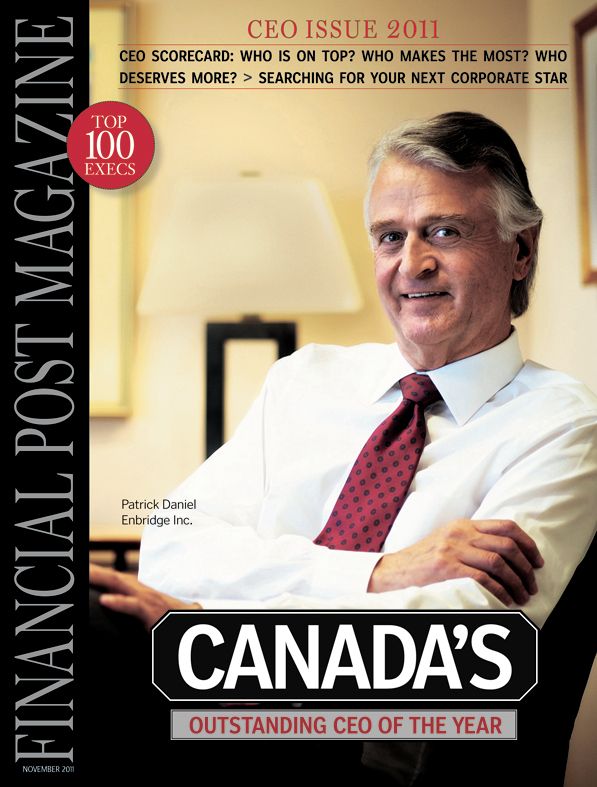
CEO Issue 2011
Outstanding CEO of the Year: The oil patch crusader
Patrick Daniel has successfully navigated Enbridge through a trying year, including criticism of its mega-pipeline project, lower energy prices and an oil spill in Michigan
The 2011 Bossies
The year might be remembered as the start of RIM’s decline, but there were plenty of other unexpected turns — and a few crafty moves as well
Star search
Grooming a potential CEO is tough enough when things are running smoothly, but it’s even harder to find a good one when the chief executive suddenly exits
Change is good
Investors may not like the direction the stock markets are heading, nor company execs, but it should be viewed as an opportunity to look at things in a new, perhaps more profitable, light. Many of the country’s top 100 CEOs are already doing just that
J. Michael Pearson – Valeant Pharmaceuticals International Inc.
“We are always being questioned because we are going against some long-held beliefs”
FIRST BUSINESS
Editor’s Letter: From CEO to CBO
Say-on-pay activism raises an unwelcome spectre: the Chief Bureaucratic Officer
FP Street: Endangered species
The long-tenured chief executive is becoming a rare sight in today’s boardrooms because of tighter corporate-governance rules and a higher degree of impatience
Business Mix: Dram side of the moon
Lunar Rogue’s whisky list is out of this world
FP EXECUTIVE
C-Suite: Cyril Leeder – President, Senators Sports & Entertainment
Now in its 20th season, Ontario’s other NHL team still has to work hard to get noticed, but hosting the 2012 All-Star game should pay off
Style: Winter wonder
A cashmere jacket means you can stay warm and look good in the snow
Books: Mass appeal
Playing to the common denominator may have gone by the wayside
PERSONAL FINANCE
Family Finance: House call
A former doctor has plenty of time for wealth management; perhaps too much time
Boomer vs. Junior: What to do with a bonus or unexpected windfall?
“Employers can annualize taxes payable on the bonus” vs. We live in the present and sometimes you have to treat yourself”
FP ENTREPRENEUR
Profile: Critical mass
Ottawa’s life-sciences cluster provides new vision for eSight
Tax Clinic: A taxing ride
The CRA clarifies its position on the tax treatment of company cars
On the Case: Siding with the enemy
Turning to a competitor for help in times of trouble can solve a problem, but at what cost?
The long-tenured chief executive is becoming a rare sight in today’s boardrooms because of tighter corporate-governance rules and a higher degree of impatience
Leo Apotheker had barely finished redecorating his corner office at Hewlett Packard Co. when he was ejected from the helm of America’s largest technology company after 11 months. Carol Bartz fared marginally better at Yahoo! She was fired via phone after 33 months on the job at the Internet giant. Rapid turnover in the executive suite has been accelerating for most of the past decade and the trend shows no sign of abating. Indeed, CEO churn is on the rise for those who are forced to leave, as well as those who depart voluntarily. The average tenure of outgoing CEOs from companies listed on the S&P/TSX Composite Index in 2004 was 8.5 years, according to data from the Board Shareholder Confidence Index, prepared by the Clarkson Centre for Board Effectiveness.
In 2009, the incumbency rate was 4.8 years.
A study of the world’s largest 2,500 public companies by Booz & Co. this year produced similar results. Overall, outgoing CEOs in 2010 were in their positions for 6.6 years compared to 8.1 years a decade ago. Even those CEOs who decamped voluntarily had shorter terms — seven years in 2010 compared to 10 years in 2001.
Clearly, the days of the imperial CEO are gone. Keeping the top job has become far more precarious. The reason: Chief executives are under more pressure to perform in shorter periods of time because the structures that had accommodated the long-tenured CEO of the past are slipping away. Some of the attrition can be chalked up to job-hopping. Some are hired on an interim basis to accomplish a specific task, such as Frederick “Fritz” Henderson at General Motors Co., who spent eight months after his hiring in 2009 steering the auto giant through bankruptcy. However, the main reasons for the high turnover stem from long-term trends in corporate governance.
For example, publicly traded companies, especially in North America, are increasingly separating the roles of chairman and chief executive. In 2010, 14% of incoming CEOs were assigned the dual roles, compared to 52% in 2001. As a result, CEOs are less likely to dominate the boardroom, set the agenda and control the flow of management information.
Although in theory CEOs have always served at the discretion of the board, that distinction has never been as stark as it is today. The result is a power shift that’s forging a new dynamic and redefining the way directors and CEOs interact in corporations.
A tougher governance environment has also made directors, appointed by shareholders to run companies that act in their best interests, more cognizant of their fiduciary responsibilities and the personal risks associated with failing to carry them out. As directors face greater scrutiny from shareholders and regulators, they’re redirecting some of the pressure downward to senior management. Thus, boards in general are becoming more critical and demanding of CEO performance and less patient about achieving objectives. Where a strategy is not working, boards appear more willing to pull the trigger.
The margin for error and the window for underachievers is narrower than it has ever been. Ask Donald Schroeder, who spent 20 years climbing to the C-suite at Tim Hortons Inc. only to be fired as CEO and president by the board after three years.
The ensuing tumult at the top is a victory for advocates of greater accountability. How CEOs navigate this brave new world will determine whether they can ever get comfortable in the corner office.
]]>Ford Motor Co. of Canada made the announcement Tuesday it would be replacing its chief executive, David Mondragon, three years after he took the helm of the automaker’s Canadian division and guided it to the top sales spot in the country for the first time in more than 50 years.
Mr. Mondragon, who was appointed chief executive of Ford of Canada in August 2008, will assume the new role of general marketing manager for Ford and Lincoln in the U.S., the company said. He will be replaced as president and chief executive of Ford of Canada by Dianne Craig effective Nov. 1, it added.
“Dave’s contributions to Ford of Canada during the last three years have been significant. He led the team through one of the most tumultuous times in the industry and successfully grew the business, bringing new customers to Ford,” said Mark Fields, Ford’s president of the Americas, in a statement. “This positive marketplace momentum will continue to build as Dianne shares her extensive dealer relations skills, sales background and marketing expertise with the Ford of Canada team.”
Ms. Craig was most recently the general manager for the southwest U.S. market, and has held various positions with the company since she joined Ford in 1986.
Mr. Mondragon’s return to the company’s headquarters in Dearborne, Mich., was the second such promotion this year for a top auto executive in Canada. Earlier this year, Chrysler Group LLC announced that in addition to continuing on as chief executive of the Canadian operations, Reid Bigland, a Vancouver native, would be tapped to lead the Dodge brand, and to run all sales strategy, dealer relations and operations, order facilitation, incentives and field operations in both the U.S. and Canada as part of management shake-up.
Carlos Gomes, a senior economist at Scotia Economics who covers the auto industry, said while it’s not typical for Canada executives to see these sort of promotions, it demonstrates that if they prove themselves in the Canadian marketplace, there are bigger things ahead.
During his three years as chief executive, Mr. Mondragon, a California native, managed to help Ford grow its market share from 12.5% in 2008 to nearly 18% year-to-date in 2011.
Along the way, Mr. Gomes said Ford was able to capitalize on the restructuring of GM and Chrysler and grow its sales through the recession in Canada by introducing a series of smaller vehicles that appealed to the market here.
“They took the overall lead in 2010 and are maintaining that lead through this year,” Mr. Gomes said. “It has definitely been an important milestone for them.”
]]>Tim Hortons Inc. has decided that adding beef lasagna casserole to its menu will help fill the gaping hole in its lunch and dinner lineup.
For a company that commands 83% market share of all coffee poured outside of Canadian households, and 70% of the national breakfast pie, maybe a 10-oz. steaming pile of noodles, beef and grated cheddar cheese in a bowl or cardboard cup for $4.49 may not be that much of a risk.
It’s not like the baked goods and coffee giant hasn’t fiddled with its menu before. Over the better part of the past decade, Tim Hortons has been trying to entice folks with chili, soup and sandwiches in an attempt to gain ground from quick-serve restaurant giant McDonald’s.
Still, not all of its culinary tweaks have survived. Remember the slow roast beef sandwich?
No matter, this latest hot-bowl incarnation sounds like it has potential. Presumably, there are synergies in using the same infrastructure to make chili to also bake lasagna.
But ovens and cooking utensils aside, this latest food foray is about Tim Horton’s bigger challenges. Don’t look at the stock price, which is a big hit with retail investors. It punched through the $50 barrier last month, trading at multiples of 22 times earnings.
Even so, analysts say they just don’t see the growth prospects that live up to those earnings multiples.
The fact is, Tim Hortons is a victim of its own success. The chain has saturated the Canadian market and still has plans to add an additional 800 franchises to its existing 3,200. Future growth should come from new products, such as the lasagne, the company hopes will attract more traffic through its doors and drive-thru.
Inevitably, the future of this Canadian corporate icon lies in the United States, which has thus far been a wasteland. Past forays, starting with the merger with Wendy’s in the 90s, haven’t worked.
That is the reason a new CEO is likely to emerge from south of the border.
It may be hard to believe, but the ubiquitous Tims brand is nowhere in the U.S. and lighting up a handful of outlets in Manhattan isn’t exactly playing to its core customer base.
Tim Hortons has been learning the hard way that the quick-serve restaurant business in the U.S. is a ground war.
The winning formula that made Tim Hortons a beloved name in Canada may be useful only in real estate terms in America.
Forget about taking over defunct Dunkin’ Donuts outlets in Manhattan. The meagre success it has seen so far has been achieved through organic growth, as it’s done in other New York-based markets in Syracuse, Rochester and Buffalo. The U.S. is densely dotted with thousands of small cities and towns with populations ten times the size of the ones that made Tim Hortons monolithic in this country.
Dunkin Donuts is the Tim Hortons of the U.S., so the Canadian chain is trying to reinvent itself as a bakery cafe with quality products and daily deals to placate those skeptical Americans.
What’s not known is who is going to lead the charge. Former chief executive Donald Schroeder, 64, was unceremoniously dumped in May in an apparent huff over succession planning. Executive chairman of the board Paul House has been doing double duty as acting CEO since Schroeder’s departure and earning $750,000 not including bonuses and stock options. Still, the 67-year-old, who had already been CEO for two years before Schroeder took over in 2008, is not the messiah to lead Tim Hortons bravely into the U.S.
Over at head office in Oakville, Ont., the folks at Tims aren’t saying much months after promising an external search to name a successor “as soon as practical.” Five months later, a company spokesperson said that “process continues and we have no further updates at this time.”
Most industry observers don’t expect the new CEO to come from inside the company’s ranks but no one will admit to it for fear of an exodus in the senior management pool.
Besides, an internal candidate shouldn’t take that long to identify, even if the Tims board failed to have a succession plan in place three years after hiring Schroeder.
The ideal external candidate would be a Canadian with more than a decade’s worth of experience in the highly competitive U.S. market. Good luck finding that needle in a haystack.
More likely, one of Canada’s most beloved companies will be entrusted to an American who has successfully fought in the U.S. trenches and who can convince the company’s board, employees, customers and shareholders that the winning formula at home won’t be surrendered to pitch a flag south of the border.
]]>In the most recent entry of the LinkedIn Diaries , I identified some practical lessons that you can apply to optimize your success with LinkedIn by focusing on the profiles and practices of ING DIRECT Canada’s President, Peter Aceto and Claymore Investments’ President, Som Seif.
In this entry of the LinkedIn Diaries , I focus on the secrets of LinkedIn super users . These senior executives use LinkedIn more frequently, more consistently and more fluently than the vast majority of users. These super users, who have unearthed or reinforced some of the most critical LinkedIn practices, include the following:
- Phil Soper – CEO, Brookfield Real Estate Services
- Jacoline Loewen – Partner of Loewen & Partners, one of Canada’s premiere private equity firms
- Ayelet Baron – VP, Strategy and Planning of Cisco Systems Canada
Phil Soper . As the President and Chief Executive of Brookfield Real Estate Services and Royal LePage Real Estate Services, Phil Soper inspires a group of over 16,000 real estate professionals throughout Canada. Because many of these real estate agents have enthusiastically embraced social-media tools, Soper needs to serve as an example of best practices. As a result, several of his teams (e.g. Human Resources, Marketing) lead the industry in social media planning and execution. For LinkedIn, Soper’s super user secrets include the following:
- Establish measurable goals. Whether you are focused on reducing the time required to find strong job candidates or increasing social mentions, set a goal that can be tracked. And then, track it.
- Always remain authentic. Because LinkedIn connects people so well, it is essential that the image that you present online truly reflects who you are.
- Share good news. Look for opportunities to profile good people, good news, exciting events and corporate success stories. For example, when a recent Royal LePage Shelter Foundation fundraiser exceeded expectations, Soper and his team enthusiastically shared the news via LinkedIn.
Jacoline Loewen . You wouldn’t necessarily expect that an internationally renowned author would be a LinkedIn super user. But, the fact is, Jacoline Loewen , Partner of Loewen & Partners, and writer of three highly-regarded business books, considers LinkedIn to be an essential tool for her short- and long-term success. For LinkedIn, Loewen’s super user secrets include the following:
- Network Up. If you choose to share your updates with your connections, recognize that they see who you connect with. That means that if you want to be seen as being associated with leaders, only connect to those people who make your network look stronger and more compelling.
- Broadcast your physical location. While any application that broadcasts your physical location needs to be used carefully, Loewen finds that by announcing her travel plans via LinkedIn, she gets invited to local events with business associates, clients and prospects.
- Integrate with your other contact databases. Most busy executives have contacts and related information located in several applications, for example, a CRM application (e.g. Salesforce or ACT!), a database (e.g. Access), a spreadsheet (e.g. Excel) an email program (e.g. Outlook) and other social media tools (e.g. Flickr or Facebook). As a result, keeping tabs on new developments can be cumbersome. Because LinkedIn arguably has the most current updates, use it as your primary source for contact information.
Ayelet Baron . One of the first people to adopt LinkedIn when the application was developed 10 years ago, Ayelet Baron , who is the VP, Strategy and Planning of Cisco Systems Canada refers to LinkedIn several times per day. Her LinkedIn super user lessons include the following:
- Schedule LinkedIn time. Devote time to check in with LinkedIn regularly. One option is to keep a web browser open and logged into LinkedIn so that you can quickly review and asses your connections’ posts and profile updates. Doing so arms you with the ability to re-connect with people, send them useful links and build your own community by making connections within your network. Also, use the News and Signal functions to keep you up-to-date on topics of interest that you and your connections share.
- Monitor competitors. Your competitors are following you, your colleagues and your company. So, use LinkedIn to do the same. Check to see what positions they are hiring for. This could hint at what new products or projects they are planning.
- Leverage networks within your company. Identify a community of social media adopters within in your organization. When you see an article that captures your interest, use LinkedIn to share it with this community — while adding your insights, opinions or questions. Taking this approach typically sparks responses and connections with people in your social community and extends beyond. Also, actively promote and share posts from people within your network.
In the next issue of the LinkedIn Diaries, I will tackle the most common and thorny questions that executives face when optimizing their LinkedIn strategies.
Andrew Brown is president of Write on the Money. He helps senior executives harness the power of digital and traditional business communication tools (such as LinkedIn) and strategies.
]]>The resignation of Steve Jobs as CEO of Apple Inc. prompted selling of shares in the iconic technology company, despite the fact that investors had time to prepare.
The management transition that will see Mr. Jobs move to the chairman role and COO Tim Cook take the reins as CEO should be a smooth one. At the same time, consumers will continue to buy Apple products. However, the intensifying competitive environment might have some investors worrying about “what’s next?”
Much like the departure of Henry Ford and Walt Disney – creative forces whose companies carried on for years – Apple without Mr. Jobs will carry on. However, it’s hard to believe Apple won’t be different, said Mike Abramsky, analyst at RBC Capital Markets.
While he thinks the near-term risks for investors are low, Mr. Job’s resignation as CEO may change Apple over time.
“Steve was involved in every detail of product, marketing, execution, deal-making (carriers, studios, etc.) and had the vision and gravitas to bet on
disruptive innovations,” Mr. Abramsky told clients. “Steve’s departure may precipitate Apple’s evolution from icon-led to team-led, from disruptive innovation to continuous innovation.”
He was also closely linked to the Apple brand and played an important role in recruitment and employee retention. Therefore, any key departures, organizational disruption, strategic missteps, margin pressures or gains by competitors could lead to share volatility, Mr. Abramsky warned.
The news is expected to create an attractive entry point for investors looking to add or build bigger positions in Apple, said Mark Moskowitz, analyst at J.P.Morgan. Yet while the news may weigh on Apple shares in the near term, he thinks the company’s model is “built to last,” sustaining a “digital way of life” that other industry participants have yet to rival.
Apple shares fell roughly 3% in early trading Thursday, after declining about 5% shortly after the news was announced early Wednesday evening.
The key, of course, is whether Mr. Jobs’ impact fades or is lasting. Under Mr. Cook, Apple will likely focus more on operational excellence through growth drivers such as global distribution and channel expansion, but Mr. Jobs’ approach wasn’t about cost cutting or exiting businesses.
“Mr. Jobs’ second term as Apple’s CEO drove a stunning recovery and then rise to dominance by constructing a world of mobile devices and content ubiquity,” Mr. Moskowitz said in a research note. “We think the
impact from Steve Jobs is lasting, cementing Apple’s role in the digital age.”
The day-to-day contributions of Mr. Jobs will surely be missed, but the level of creativity and intelligence among Apple’s management team and its legion of employees can sustain the company’s model and industry leadership, Mr. Moskowitz said. He does not expect too much to change within the organization, and feels the successes of the iPhone, iPad, iPod and MacBook Air reflect the work of many, not one.
Mr. Cook, for example, has been an integral part of Apple’s unprecedented growth in earnings and revenue, as well as in limiting operational disruptions. His knowledge of Apple and its rigid product cycles, supply chain and partners will prove valuable in maintaining the company’s market strategy.
As for the stock, Mr. Moskowitz noted the divergence in Apple’s valuation and consensus estimates in 2011. As both revenue and earnings per share estimates continued to see major gains, valuation multiples compressed. The analyst believe this reflected investors’ preparation for Mr. Jobs’ departure.
“In the near term, we expect the stock to be under pressure but not encounter a downdraft, as a CEO change has been partly discounted,” Mr. Moskowitz said.
REACTION FROM OTHER ANALYSTS
Chris Whitmore, Deutsche Bank
“We expect this news to pressure shares of APPL and we view this depressed multiple likely reflects a lot of this concern.
Looking forward, we believe risk is more likely to be centered around Apple’s 3-5+ year product plans if/when Jobs permanently departs.”
T. Michael Walkley, Canaccord Genuity
“We continue to anticipate strong earnings growth for Apple over the next several years with very strong demand and relatively low global market penetration for iPhone, iPad and Mac products.
Steve Jobs is a Silicon Valley legend… his resignation is not a complete surprise, and we believe Apple has a succession plan in place.”
Keven Dede, Brigantine Advisors
“Continued new product introductions point to the complete breadth of the team across all the company’s product lines.
The team that orchestrates the continued development of products across the company, we believe is undervalued by those deciding to divest under this leadership change announcement.
Given the extent of Jobs’ influence over Apple’s culture for the length of time he has led the company implies that he has imbued a sustainable culture within the organization that we see carrying on beyond his personal leadership. Each division of the company is responsible for bringing new, exciting, user friendly products to market, and we believe that course should continue regardless of Jobs’ presence at Apple. That said, as recent trading has illustrated, our belief is currently not well shared on Wall Street.”
Ben A. Reitzes, Barclays Capital
“While we do not believe that Steve Jobs is replaceable, it is worth noting that Tim Cook is a proven executive who can handle the pressure and knows how to run the inner workings of Apple in Jobs’ shadow. While the stock could see some immediate headline pressure, we expect sentiment to rebound through next year with strong execution and new product cycles.
We believe Tim Cook is a very talented executive that deserves a lot of credit for key Apple attributes that are not thought of as ‘Steve Jobs territory.’ For example, we credit Cook with spear-heading Apple’s successful efforts to streamline its supply chain after the tech bubble.
Tim’s focus on maintaining low inventory has contributed to Apple’s industry-leading cash conversion cycle as well. Tim has also served Apple well in negotiating component prices and build plan arrangements, resulting in industry-leading margins. One can assume that Tim has learned a lot from Jobs over the last 13 years on the innovation front. We believe Cook shares Jobs’ taste for simplicity and style – and will try to maintain the culture Jobs has instilled. Note that Apple also has other very talented executives including Head of Design Jonathan Ives and CFO Peter Oppenheimer.”
]]>For Loblaw Cos. Ltd., losing a senior executive to Sears Canada Inc. is not enough to set off alarm bells in and of itself.
But with chief executive openings at Shoppers Drug Mart and Tim Hortons, Target opening up a massive beachhead in Canada and other major U.S. retailers thinking of doing the same thing, Executive Chairman Galen G. Weston and Loblaw better keep an eye on the exits.
“Given Loblaw’s revenues of over $30-billion, Loblaw executive ranks are an obvious target for companies seeking talent. One departure is manageable, but it will be important for Loblaw to retain its key operational executives over the next two years in a heated market for talent,” Keith Howlett, analyst with Desjardins Securities, said in a note.
The latest defection is Calvin McDonald, who was previously in charge of conventional stores across the country but jumped ship for the chief executive’s corner office at Sears.
Mr. Howlett expects a decision on Mr. McDonald’s replacement to wait until Vicente Trius, Loblaw’s incoming president, arrives from Europe.
]]>A strong loonie is good for Canada because it forces companies to be more productive and it shows what the rest of the world thinks about us, said Rick Waugh, chief executive of the Bank of Nova Scotia.
“A strengthening currency that is fundamentally strong over a reasonable period of time means you’re probably doing things pretty well,” Mr. Waugh told journalists following the bank’s annual meeting in Halifax Tuesday.
While some players such as exporters may find themselves hurt by rising labour costs, an expensive currency is in general a positive thing for a country.
The companies that are not benefiting “just have to do a bit better, which is good because that’s productivity,” he said.
Mr. Waugh said the only real currency related challenge is volatility because companies are constantly playing catch-up.
“When you get volatility and you’re an exporter and you’ve priced your product and then the Canadian dollar works against you, it could take you six months to a year until you get your pricing re-aligned,” he said. “So [it’s] volatility of the exchange rate up or down that I think should be the main concern.”
The loonie has soared in value over the past several years, largely because of Canada’s substantial and mostly western based natural resource industry which has also been one of the main beneficiaries.
By contrast, auto makers and other manufacturers in central Canada have fared less well.
]]>By John Barker
The King’s Speech should be required corporate leadership viewing. In this year’s Academy Award nominated (winning) film, Bertie, (played by Colin Firth), the severely stuttering prince, must rise to his unexpected destiny as a war-time King.
Turning in desperation to the unconventional speech therapist Lionel Logue, (played by Geoffrey Rush), we see behind the crown Bertie’s all too human foibles and paralyzing insecurities.
Parallels to the world of business are clear: when called upon, leaders often struggle to find their own voice. Whether king or queen, executive or manager, anyone who aspires to inspire must face this rite of passage.
Lionel and Bertie, were dealing with much more than a simple stutter – personal empowerment was the core issue. In twenty years of coaching leaders to discover and embrace their authentic voice, I’ve seen many talented women and men achieve personal and professional success while facing down similar emotional and political roadblocks.
Audiences connect with this movie because they relate to the terror of exposure that the microphone represents for Bertie. We all understand the personal courage it takes to respond to the urgent call of the moment, to put aside self-doubt to – “deliver” – all while under the most unforgiving kind of public scrutiny.
Yet we expect the very same extraordinary qualities on a daily basis from the people managing and leading our major enterprises and institutions. It can be an unnerving high-wire act within already high risk jobs.
So what’s the executive summary of The King’s Speech when it comes to finding a “genuine leadership voice”?
Intellectual stutters can be overcome
Decades of “Power Pointless” presentations have reduced many brilliant leaders to insecure, expensive voice over talent. Sloganeering, tech-speak and business bafflegab combine to erode confidence and credibility while undermining any trace of the visionary voice that all stakeholders crave. “Personal Points of View” based on the unique character, vision and sensibility of each individual must replace those conceptually stammering – and all too corporate – “Bullet Points of View”.
Ritualized communication is obsolete
Once upon a time, ‘Kinging’ only required “looking good on a horse!” says Bertie’s father, the old King George, before he dies. Expecting deference and intellectual authority based on your ‘title’ — whether royal, executive or managerial – invites skepticism and scorn. Today’s relentless digital media exposure accentuates this perception dilemma. Our “emperors of business” really do have “no clothes” until they take charge of their communication and define their own unique and sincere style.
Finding ‘authentic voice’ is a personal quest in a public forum
Like any sophisticated personal skill, mastering voice and leadership presence takes time, repetition, humility and mentoring. Lionel Logue’s insistence on a hierarchy-free, private working relationship between two personal and intellectual peers was key to Bertie’s ultimate breakthrough. Business people also need a safe environment to explore their voice, free from the rigid status quo thinking of “Archbishop of Canterbury” traditionalists.
Delivery Tips:
1.Imagine the effect you want to have Bertie had to galvanize a nation for War. You don’t. Start with what you want your audience to feel – then create the authentic and personal message to take them there.
2.Be more than your title Titles are hollow until you fill them. Bertie could finally speak as King after he accepted himself as a real Person. Bring you entire sensibility and your life experience to the communication challenge.
3.Speak as part of a larger conversation: Events loom large only in the presenter’s mind. Think beyond that specific moment on the calendar. Every exchange is part of a larger conversation. Tune into that larger rhythm and keep things in context.
4.Offer insight not just facts: Anyone can do process. Find the story or the personal experience that makes your unique insights on the content come alive. Narrative trumps detail every time.
5. Be benevolent: At the podium a good Queen or King is just and forgiving – towards themselves. Be gentle with yourself and approach the process with humour and grace. Audiences will be kind to you when they see you being kind to yourself.
The King’s Speech succeeds because it recognizes our profound human need to connect — communally. King or commoner, reaching that level of ‘voic’” is rarely easy but the rewards are great. Business leaders who remember the image of Bertie delivering across the microphone to Lionel with growing confidence and conviction will know the simple secret: Speak authentically to one — reach and inspire multitudes!
John Barker has more than 25 years experience developing compelling content and coaching leaders to discover, own and master their authentic, inspirational voice. jbarker@trunote.com
]]>A new survey shows only a minor consumer impact if Apple Inc. CEO Steve Jobs were to leave, suggesting that the company may be bigger than its boss.
The RBC/ChangeWave data indicates that 93% of 3,091 respondents (asked between Jan. 31 and Feb. 9) would likely continue buying Apple products after Mr. Jobs departed.
These results contrast with an identical survey taken in June 2008 ahead of the CEO’s medical leave It showed 18% of respondents less likely to buy products without Mr. Jobs at the helm.
“The survey shows consumers may have a higher comfort (than in the past) about Apple without CEO Jobs,” RBC Capital Markets analyst Mike Abramsky said in a note to clients.
He suggested this may be due to the continuation of Apple’s success and innovation when Mr. Jobs was on leave in 2009. Its share price rose 144%, revenue climbed 20%, it shipping 25 million iPhones and introduced the iPhone 3GS.
Apple’s iPhone, Mac and iPad franchises all have strong momentum and are positioned against large markets, the analyst noted.
Meanwhile, company management and its 47,000 employees have executed well during Mr. Jobs’ past absences, and consumers have had three years to evolve their perception of the Apple brand beyond the buying pull of its iconic CEO, Mr. Abramsky added.
Despite the fact that these factors could help sustain Apple’s momentum for years, longer-term risks related to a possible departure of Mr. Jobs may still emerge. That is because as CEO, he is “widely viewed as Apple’s chief innovator, dealmaker, leader, motivator, and is deeply involved in minute decisions.”
Mr. Abramsky recommends that clients accumulate Apple shares on weakness related to succession uncertainty.
]]>It’s understandable that investors be concerned when a CEO steps down from their position. On Wednesday, two major Canadian companies announced the departure of their head honchos – Shoppers Drug Mart Corp. and Uranium One Inc.
In the case of Shoppers , board of directors chair David Williams replaces Jürgen Schreiber on an interim basis. The board will start a global search for a new CEO, while Mr. Schreiber is pursuing a private equity opportunity outside of North America.
While Mr. Williams has served on the drug store chain’s board since 2003 and was also CFO at Loblaw Cos. between 1992 and 1998, the change could worry some shareholders.
The departure of a CEO during a period of earnings volatility could cause some investors to question Shoppers’ current strategy and outlook, UBS analyst Vishal Shreedhar said in a note to clients.
“Many shareholders invested in Shoppers because of their confidence in Mr. Schreiber’s ability to return the company to consistent growth,” the analyst wrote.
But despite the heightened short-term investor concern, Mr. Shreedhar is confident that Shoppers shares will ultimately be driven by earnings. The company reports first quarter 2011 earnings on February 10 and the analyst thinks it could provide a favourable outlook.
“In our view, Mr. Schreiber was well liked by much of the investment community; however, we felt that his relationship with the company’s largest customer (the province of Ontario) was mishandled during changes to generic drug legislation,” Canaccord Genuity analyst Candice Williams said in a note. “Therefore, the company may have been in need of a new face.
Unfortunately for Shoppers, the timing of the announcement comes as the company is implementing a number of new initiatives, she added. These include a private label generic drug program, a generic drug export program, a financial services initiative, and the continued rollout of the Project Infinity store program.
Ms. Williams said Shoppers faces a number of headwinds related to generic drug legislation across Canada, and therefore advises investors to buy The Jean Coutu Group Inc . for Canadian drug store exposure.
Desjardins Securities analyst Keith Howlett thinks John Lederer, former president of Loblaw and former CEO of Duane Reade Inc. in the United States, may be a leading candidate to become the CEO of Shoppers.
Mr. Lederer also serves on Tim Hortons Inc.’s board of directors. “The timing of Mr. Shreiber’s departure is unfortunate, given that Shoppers is in the midst of adjusting to the recent draconian Ontario generic drug pricing reforms,” Mr. Howlett said in a report.
Phase 1 of these reforms became effective on July 1, 2010, with Phase 2 going into effect on April 1, 2011.
At Uranium One , which is controlled by Russian state-owned group ARMZ, Jean Nortier resigned as CEO and Chris Sattler takes over.
While admitting that optics are frequently dented when a CEO resigns unexpectedly, Raymond James analyst Bart Joworski said he was cautious of this possibility several months ago as Uranium One moved ahead with the ARMZ deal. Nonetheless, he considers Mr. Sattler well suited for the new position and more than capable to lead the company.
The analyst did downgrade his rating on Uranium One to Market Perform from Outperform to reflect recent share price appreciation.
“Mr. Sattler has been a key part of Uranium One’s recent success…” Dundee Securities analyst David Talbot said in a note. “His mining, engineering and investment banking background has certainly helped him identify real targets for acquisitions.
Mr. Sattler, who joined the company in 2006 and has served as vice president of corporate development and investor relations since 2009, gets his new duties on February 1 and will join the board.
Mr. Nortier will remain a member of the board, but returned to South Africa with his family for personal reasons.
]]>In case anybody was wondering, yes indeed, Canada’s chief executives do in fact make more than the rest of us working stiffs.
By a lot.
In 2009, the top 100 chief executives in Canada earned an average of $6.6-million, about 155 times the salary of the average Canadian — a paltry $42,988.
By contrast, in 1998 chief executives only earned 104 times the average Canadian salary, a report from the research institute Canadian Centre for Policy Alternatives said Monday.
“At this rate of reward, this handful of elite CEOs pocket the equivalent of the average Canadian wage by 2:30 p.m. on Jan. 3 — the first working day of the year,” Hugh Mackenzie, the report’s author, said in a release.
The figures also do not account for some $1.3-billion in stock options that were not cashed in by chief executives in 2009, he said. This is unfair to Canadian taxpayers as stock options are taxed at a lower rate, he said.
Mr. Mackenzie figures the options are actually worth about $2 in future income for every $1 they declared in 2009.
Yup, should’ve spent less time at the mall in high school.
]]>Microsoft Corp. is shaking up the leadership atop the company’s Entertainment & Devices division as the world’s largest software company looks to breathe new life into its consumer-facing businesses.
Robbie Bach, president of the company’s E&D division since its creation five years ago, and J Allard, a senior vice president who helped create the original Xbox and the company’s Zune music player, are both leaving the Redmond, Washington-based company, in a move that was first reported by TechFlash .
For Microsoft, the departures of Mr. Bach and Mr. Allard will give chief executive Steve Ballmer more direct control of the company’s consumer-facing products, which count Google Inc., Apple Inc., Sony Corp. and Nintendo Co. Ltd. among their competitors.
“After almost 22 years with the company, Robbie Bach has decided to retire from Microsoft,” Mr. Ballmer said in an internal email sent to Microsoft employees. “I have worked with Robbie during his entire tenure at Microsoft, and count him as both a friend and a great business partner and leader. Robbie has always had great timing, and is going out on a high note — this has been a phenomenal year for E&D overall, and with the coming launches of both Windows Phone 7 and “Project Natal,” the rest of the year looks stupendous as well.”
According to the email, Mr. Bach — who at one time was considered a possible successor to Mr. Ballmer as chief executive — will not be replaced as head of the E&D division.
Instead, Canadian-born Don Mattrick, who currently heads up the company’s interactive entertainment (video games) business and Andy Lees, who leads the company’s mobile communications business (Windows Mobile and other smartphones) will report directly to Mr. Ballmer.
“Don and Andy have built our strong leadership teams and product pipelines, and are well positioned for the years ahead,” Mr. Ballmer said in the email.
Mr. Bach was the face of the company’s Xbox brand and would appear on stage with Mr. Ballmer during the company’s annual keynote address at the Consumer Electronics Show in Las Vegas. FP Tech Desk had a chance to sit down with Mr. Bach earlier this year at CES , where he spoke about Microsoft’s plans to put its software into automobiles and the company’s highly anticipated Project Natal video game technology.
While Mr. Bach helped turn the company’s Xbox division into one of Microsoft’s leading consumer brands, under his leadership, the Windows Mobile division has struggled to keep pace with Research In Motion Ltd.’s BlackBerry devices, Apple Inc.’s iPhone and Google Inc.’s Android software, despite having a head start.
Windows Mobile was the only commercial paltform whose absolute number of shipments declined between 2008 and 2009, said Matt Rosoff, an analyst with the research firm Directions on Microsoft.
“I think they’re on the right track with Windows Phone 7, but the release of Kin was a real puzzle,” Mr. Rosoff said.
“I also think that the decision of Hewlett Packard to buy Palm and use its mobile OS in low-end “slate” tablet PCs, rather than shipping them with Windows 7, was a real setback — HP’s been a longtime very loyal Windows partner, and this is precisely the threat that Microsoft is most worried about in mobile: that devices based on mobile OSs will begin to cut into sales of Windows at the low end.”
In an email delivered to Microsoft employees, Mr. Ballmer said that Mr. Bach played an instrumental part in Microsoft’s history:
“Transitions are always hard. Robbie has been an instrumental part of so many key moments in Microsoft history — from the evolution of Office to the decision to create the first Xbox to pushing the company hard in entertainment overall … J as well has had a great impact in the market and on our culture, providing leadership in design, and in creating a passionate and involved Xbox community, and earlier being at the center of our work seizing the importance of the Web for the company … both have been great team builders with a strong record of attracting, coaching and growing talent. As a result, their teams are primed to continue to step up and deliver great products, great services and great results for the company.”
Mr. Allard, whose departure is reportedly unrelated to Mr. Bach’s retirement, will remain an adviser to the company, reporting directly to Mr. Ballmer.
One of the first Microsoft employees to stress the importance of the Internet back in the early 1990s and a key member of the team that built out the Xbox Live video game network, Mr. Allard’s departure will be a big loss for the company, said Matt Rosoff, an analyst with Directions on Microsoft, a research firm.
“For the last three years or so, however, he’s kept a fairly low profile, working on design, user experience, and future-looking projects,” Mr. Rosoff said.
“I think his presence was probably helpful in attracting creative people to work for Microsoft’s E&D business.”
]]>