Advertise with Googlier.com The Daily Music Break https://dailymusicbreak.com Fri, 09 Jan 2026 15:42:13 +0000 en-US hourly 1 https://dailymusicbreak.com/wp-content/uploads/2025/06/cropped-Group-29-2-32x32.png The Daily Music Break https://dailymusicbreak.com 32 32 https://dailymusicbreak.com/13241-2/ https://dailymusicbreak.com/13241-2/#respond Fri, 09 Jan 2026 15:42:03 +0000 https://dailymusicbreak.com/?p=13241 google-site-verification: googleb29a7f93681242e7.html

]]>
https://dailymusicbreak.com/13241-2/feed/ 0 13241
Happy Thanksgiving from Edward Tarte https://dailymusicbreak.com/happy-thanksgiving-from-edward-tarte/ https://dailymusicbreak.com/happy-thanksgiving-from-edward-tarte/#respond Wed, 26 Nov 2025 21:33:08 +0000 https://dailymusicbreak.com/?p=13212

This is what the site had to say about Mr. Tarte:

Edward Tarte was a man of profound courage and conviction, whose journey from Catholic priesthood to atheism was marked by unwavering honesty and integrity. Born in 1934, he dedicated his early years to the service of others, answering the call to priesthood within the Catholic Church.

Throughout his tenure as a priest, Edward touched the lives of many with his compassion, empathy, and dedication to his faith. However, as he delved deeper into questions of theology and morality, he found himself increasingly at odds with the doctrines and practices of the Church.

In a bold and courageous act, Edward made the difficult decision to leave the priesthood and embrace atheism, a path that was met with both admiration and criticism. Undeterred by the challenges he faced, he continued to pursue truth and enlightenment, sharing his journey with others through his writing, speaking engagements, and online presence.

Edward’s commitment to intellectual honesty and his willingness to question deeply-held beliefs served as an inspiration to countless individuals grappling with their own faith or lack thereof. His eloquence, wit, and wisdom left an indelible mark on all who had the privilege of knowing him or engaging with his work.

As we bid farewell to Edward Tarte, let us remember him not only for his remarkable journey from priest to atheist but also for his enduring legacy of courage, compassion, and unwavering pursuit of truth. May his memory continue to inspire us to live authentically and to seek understanding and empathy in our interactions with others.

Sounds like a good man, in a lot of ways.

]]>
https://dailymusicbreak.com/happy-thanksgiving-from-edward-tarte/feed/ 0 13212
Great Music Scenes from 15 Movies (and a Bonus) https://dailymusicbreak.com/great-movie-music/ https://dailymusicbreak.com/great-movie-music/#respond Sun, 09 Nov 2025 23:00:18 +0000 https://dailymusicbreak.com/?p=13187

There are concert movies, biopics about musicians and documentaries about performers, bands and events. There are also movies in which music is not front and center–but have great music in them. Indeed, there are tons of them. A song can make or break a movie. There are two issues to making it all work: The music itself and effectively integrating it into the film.

Below is our take on 16 great movie musical moments. Please comment on the list and suggest which movies should be added.

“Deliverance”

The scene in which the urbanite (Ronnie Cox) and the kid from the Georgia backwoods (Billy Redden) work through “Dueling Banjos” is iconic. The two characters seem to be creating a shared language. It feels like a scene from a sci-fi film in which extraterrestrials drop by. Director John Boorman may simply be saying that people from the cities and the sticks are from different planets, which certainly is true.

Also note also how long he spent building the drama. My modern sensibilities want it to happen faster. There are all sorts of interesting sidelights to the scene. including a hidden banjo player and a lawsuit. The instrumentalists are Eric Weissberg (banjo) and Steve Mandell (guitar). The movie was released in 1972.


“Anatomy of a Murder”

I’m stretching the definitions here because this really is an entire soundtrack. But this scene — in which Jimmy Stewart sits in with Duke Ellington — is not as iconic as it should be. The roadhouse atmospherics are great.

The movie, which was released in 1959, was directed by Otto Preminger. It is famously forthright and honest in its treatment of sex crimes and in the realism of the trial. I believe it has been used in law schools. The judge is Joseph Welch, who took on Joe McCarthy during a 1954 Congressional hearing on communist influences in the armed services. He basically ended the Wisconsin Democrat’s career with this question: “Have you no sense of decency, sir, at long last?”


“The Life Aquatic with Steve Zissou”

This odd 2004 Bill Murray film features Seu Jorge, a Brazilian singer. He plays a great, simple version of David Bowie’s “Changes” in Portuguese. It’s interesting that upbeat rock songs always sound good when they are slowed down and simplified. Eric Clapton’s acoustic version of “Layla” is another example.


“The Bridge Over the River Kwai”

The 1957 hit features “The Colonel Boogie March.” The backstory is interesting. David Lean is considered one of the great directors in movie history. He directed “Lawrence of Arabia,” “Doctor Zhivago,” “Great Expectations,” “Oliver Twist,” “In Which We Serve” (with Noël Coward) and others. It stands to reason, then, that idea of having the prisoners whistle would be a bit of directorial genius.

Not so. Wikipedia says that the extras playing POWs couldn’t march in time, annoying Lean. A fellow on the project happened to be a great whistler and thought that “The Colonel Boogie March” would help. It did, and Lean got the credit.


“Pulp Fiction”

John Travolta and Uma Thurman dancing to Chuck Berry’s “You Never Can Tell” on an almost certainly intentionally cheesy set and half-baked Marilyn Monroe and Ed Sullivan imitators is one of many surreal and deeply comedic (as opposed to funny) moments in the film, which was released in 1994.


“The Fifth Element”

This is one of the most entertaining films I’ve ever seen, from beginning to end. It’s peak Bruce Willis. He is like James Taylor and Willie Nelson. They make something that is very hard look easy. Other people try to do what they do–and most fail. A note at iMDB says that the extraterrestrial diva in this scene—Diva Plavalauna—sings “Il dolce suono,” which was written by Gaetano Donizetti. It is, according to the note, “an aria from the opera Lucia de Lammermoor. It is one of the most difficult arias because of its length, its soaring arpeggios, and the high F above high C.” That bit of classiness doesn’t stop the beautiful Milla Jovovich from giving The Three Stooges a shout out towards the end of the clip. The trivia notes at iMDB are interesting.


“Pat Garrett and Billy the Kid”

Bob Dylan plays a character named “Alias” in the 1973 film. Acting is not Dylan’s thing, to put it kindly. His real contribution is the epic, dirge-like “Knockin’ on Heaven’s Door.” The scene – in which a dying Slim Pickens looks forlornly and apologetically at his significant other (Katy Jurado) is sad and poignant. It’s a perfect match of music and content. The movie also features James Coburn, which is another thing in its favor. His look of sadness in this scene is brilliant.


“The Blues Brothers”

There are musical geniuses in the movie, including Aretha Franklin, Cab Calloway, “Blue” Lou Marina, Donald “Duck” Dunn, Twiggy, John Lee Hooker and many others. “Shake a Tail Feather” is a happy and fun song.

I cover the cable television industry for trade publications for many years. The annual conventions featured lots of famous people. Actors, directors and others made personal appearances and some of the musicians performed (for a pretty penny, I imagine).

In the mid 1990s I covered the biggest national conference, which in this particular year was in Atlanta. Some network–I forget which–rented out the Hard Rock. The featured performer was Charles. I got there early because I had a dinner I couldn’t miss and hoped to catch a song or two before I had to leave. I walked in and almost immediately, as if by magic, the lights dimmed and out came Ray. He and his handlers walked right passed me.  It was surreal. I was the only one watching Ray Charles play. He opened his set with “Yardbird Suite,” a genius playing music by Charlie Parker, another genius.


“Dog Day Afternoon”

The Daily Music Break has already touched on the opening sequence, a montage in which director Sidney Lumet checks out what else is happening in New York City on August 22, 1972. This is a counterpoint to the claustrophobic action that is about to get underway at the bank in Brooklyn.

Lumet is right up there with Woody Allen and Martin Scorsese as great directors of movies about New York City. I think he understood that New Yorkers love the city and think it sucks for the same reason: A million parallel universes are lumped haphazardly atop each other, and each is blissfully ignorant of the others. The montage is set to Elton John and Bernie Taupin’s great song “Amoreena.”


“Performance”

The song “Memo from Turner” was recorded three times. Two were by the Rolling Stones and one by Traffic’s Steve Winwood and Steve Capaldi. It’s likely the 1970 movie was just as skeevy and grim as the song.


“Shaft!”

This list also wouldn’t be complete without Isaac Hayes’ “Theme from Shaft,” the opening sequence from the 1971 movie starring Richard Roundtree.


“Pee Wee’s Big Adventure”

The virtual end of Paul Reubens’ career due to an arrest at a porno theater in 1991 was a sad thing. Reubens’ Pee Wee Herman man-child character had the rare ability to entertain kids while winking at the grownups and entertaining the grownups while winking at the kids. Herman yelling at a bunch of bikers to shut up because he was trying to make a phone call and dancing on the bar to “Tequila” in the 1985 film isn’t “Citizen Kane.” But it’s entertaining and in its own way a great moment in cinema history.


“Casablanca”

Of course, the 1942 film is famous for Rick and Ilsa and Sam (Humphrey Bogart, Ingrid Bergman and Arthur “Dooley” Wilson) and “As Time Goes By.” But the most stirring moment of the film is the Frenchies singing “La Marseillaise” in a symbolic beat down of the Nazis at Rick’s Place. I suppose the soap opera elements of the movie get a pass since it was released during the war. People needed heroes.


“Reservoir Dogs”

The fact that it’s so difficult to watch Mr. Blonde — Michael Madsen — torture a cop is proof that it’s good filmmaking. One critic wrote that the scene’s tension is due to viewers’ developing identification with Mr. Blonde due to his goofy dancing. Perhaps. Or maybe it’s simply is difficult to watch a bound man being sliced with a knife.

The song is Stealers Wheel’s “Stuck in the Middle with You.” “Breaking Bad” used the same trick of superimposing a light song on a dark scene. In that case, it was Walter White freaking out and getting pepper sprayed and arrested in a scene which began with America’s “A Horse with No Name,” which is the poster child for pleasant and innocuous songs.

This scene is pretty tough stuff, so the video only is available at YouTube itself.


“Midnight Cowboy”

Like “Dog Day Afternoon,” an opening credits masterpiece. “Everybody’s Talkin’ ” was written by Fred Neil and sung by Harry Nilsson, a Beatles favorite. It’s a cliché, but true: It doesn’t get any better than this. The movie was released in 1969 and remains the only X-rated film to win the Best Picture Oscar.


“Bonus: Dr. Strangelove or: How I Learned to Stop Worrying and Love the Bomb”

I was thinking of the bonus movie, “Dr. Strangelove” the other day while watching the very good Netflix film “House Full of Dynamite.” The two, separated by decades and sensibilities, are filmed takes of what a nuclear war would look like. The underrated “Failsafe,” staring Henry Fonda and one of the Darrins from “Bewitched,” also deserves mention.

I aways felt bad about the ending of the movie. As Slim Pickens rides the bomb down to our end, Dame Vera Lynn’s “We’ll Meet Again” plays. It’s too bad that one of the great, great songs about hope and standing up against evil ends up being a punchline. Pickins, the only actor in two movies on this list, dies in both “Pat Garrett and Billy the Kid” and “Dr. Strangelove.” One death is poignant and sad. The other is funny.


]]>
https://dailymusicbreak.com/great-movie-music/feed/ 0 13187
Eight Reasons a Record Player is a Great Gift https://dailymusicbreak.com/eight-reasons-a-record-player-great-gift/ https://dailymusicbreak.com/eight-reasons-a-record-player-great-gift/#respond Mon, 29 Sep 2025 17:36:11 +0000 https://dailymusicbreak.com/eight-reasons-a-record-player-as-a-great-gift-2/
(Image: Anthony Scanlon via Pixabay)

Finding a gift for the person who has everything is a small annoyance. This tip won’t eliminate the problem permanently — there’s always next year — but it likely is appropriate for a good portion of the people to whom you give recurrent gifts.

Buy them a record player.

There are solid reasons for this. Before we go over them, a word on definitions: The terms record players and turntables are used pretty much interchangeably. That’s generally okay, but the reality is that there is a world of difference between the two. A turntable is just that, a platter that holds the tonearm and cartridge and spins the vinyl round and round. It’s helpless on its own. A record player includes a turntable but integrates it with the rest of the package: Preamp, amp, speakers and so forth.

Keep it in mind when shopping. Amazon and even specialty audio sites do a surprisingly poor job of using the correct term. Be sure that you are searching to the correct product category.

Eight Good Reasons to Gift a Record Player

What following are the key reasons that record players are great gift ideas:

Record players help develop a love of music: Little kids love gadgets. Giving a tween or younger child (I’m not sure if this group has a cute name) a record player, with all its buttons and spinning discs, along with a classic album or two is great both as a toy and as an on-ramp to musical literacy and openness.

Bonding: One night a few years ago I heard some music wafting down from one of my teen kid’s bedroom. I walked closer to the stairs and realized it was The Grateful Dead’s “Scarlet Begonias.” I realized that I had done something right. The same kid still is a GD fan — and likes electronica and hip hop. More recently, I’ve heard admiration for Stevie Ray Vaughan, Pink Floyd and an enthusiastic response for Johnny Winter’s “Hustled Down in Texas.”

When I was a kid, the preceding generation’s music was big band jazz. Duke and Dorsey. The music that won the war. I love it now but had no use for it then. Things have changed: Many young people are deeply knowledgeable about the music of the 1960s and 70s. They recognize quality the genius.

Props to them, as they would say. But along with their good taste, a reason this has happened simply is that there no definitive break point between the music of my generation and theirs. Much has been added, but the basic building blocks haven’t changed.

Of course, all that great music can be streamed and listened to on CDs. But listening to it on a record player can be a bonding experience. A gift of a record player and a couple of classic albums – especially if they emotionally resonate with mom and dad – builds a bridge.

The vinyl that is part of the record player experience is fun on multiple levels: CDs and streaming clearly are great music delivery mechanisms. They just as clearly lack romance and character. In the case of streaming, you get the music–and that’s it. CDs come with text that is about as readable as the fine print in an insurance policy.

The physicality of the analog world has three dimensions. We’ve touched on the equipment itself. The other two liner notes and vinyl record cover art.

A good deal of the great music writing during the latter half of the twentieth century was done in liner notes. This is especially true in jazz. Listening to music while reading the back of the album is rewarding. The attraction of cover art is self-explanatory: Think of R. Crumb’s artwork for “Cheap Thrills,” The Carole King photo on “Tapestry,” The Sergeant Pepper cover. The list of iconic covers essentially is endless. Cover art is its own subcategory — and one that expands the experience.

Record players are great for second homes and vacations: Some folks have done quite well and have second homes. Others perhaps haven’t reached that level but have enough to spend a week or two in the mountains or at the beach. A record player is perfect for these folks even if they have expensive audiophile-level component systems at home. The device may not provide the fidelity to which they are accustomed, but it is better than nothing.

More on record players after the political break…


Among the things the Biden administration did during the Covid years was to allow government financing of Wi-Fi for school buses and for Wi-Fi equipment to be loaned by libraries to students and patrons.

This week (late September and early October, 2025, long after the main story was written), the FCC–now headed by Brendan Carr–revoked the authority for such funding. The rationale was that Biden’s FCC exceeded its authority and illegally encroached on Congress’ role in broadening the programs.

You don’t have to be a Constitutional scholar–we’re about as far from that as it’s possible to be–to see that the current administration is very comfortable usurping Congress’ powers when it wants to do so. Hiding behind the Constitution when making a potentially unpopular decision seems weak.

In any case, this seems pretty misplaced.  The FCC has claimed that the kids on the bus are getting free screen time and are playing games, listening to music, etc. on the buses. That seems pretty likely, to an extent. I’m at work and just watched a great video (“Steam Powered Aereoplane by the great John Hartford). However, children–particularly those in rural areas in which the ride to and from school can be very long–almost certainly would use the time to get their work done. Especially those who have jobs awaiting them in the evening.

It’s also ludicrous to make a distinction between campus and off campus. Suppose there is a fight in the bus. Would school authorities not investigate and punish those at fault because the incident occurred in a school bus? If there is an accident, wouldn’t the school’s insurance company be involved, just as it would if the accident happened in a school building?

For some reason, the current administration seems to be going out of its way to make life difficult for folks. The strange part is that in many cases, those folks are from states that voted for President Trump. It’s odd.


Back to record players…

Vintage record players are great for the elderly: There is a cottage industry in retro looking vintage record players. These are not antiques. They are modern record players made to look and operate like the machines of the past. I can think of nothing that would be more welcome – again, perhaps given with a couple of remastered albums – in an assisted living apartment or home of a senior lucky enough to still be on their own.

A record player is a tool in digitization. It’s bit counter-intuitive, but record players can be helpful to a person’s digitization efforts. Digitizing a cut from an album is called a “needle drop” by the cool kids. Of course, the vinyl source must be accessed in order to do this. Some record players make this process easier and more fun.

Record players look great. It’s a bit ironic: This article is about all the great assets of record players. Not among them is the sentence: “Play vinyl on a record player because they make them they produce great sound.” It’s a given that fidelity is not the key. At the same time, however, record player manufacturers have to find a way to sell these devices. They’ve found it: They let the designers go nuts. Even lower priced record players are creatively designed. Those aimed at kids have vibrant colors. The same unit often come in a number of color options.

Record players are reasonably priced: And, finally, there is the wallet issue. A very capable record player can be bought for $100 or less. Units that are good enough for kids are available in the $50 range. That’s not too much to pay for something that can deliver great joy today and start the recipient on the road to continued happiness for years to come.

A quick Web search will provide lots of great possibilities. Remember, you are looking for all-inclusive record players, not turntables. I can’t think of a better gift—especially if you throw in a remastered vinyl record album or two.

Doing so will be such a hit that you’ll be able to get away with a tie or a scented candle next year.

]]>
https://dailymusicbreak.com/eight-reasons-a-record-player-great-gift/feed/ 0 4428
Quick Hits https://dailymusicbreak.com/quick-hits/ https://dailymusicbreak.com/quick-hits/#respond Mon, 22 Sep 2025 19:24:50 +0000 https://dailymusicbreak.com/?p=7891 Two fighters

Week of October 6

The Trump administration uses chaos and news exhaustion as tactics to keep its opponents overwhelmed and off balance.

Perhaps it’s better to pick one issue a week to follow. This week, I am keeping the government shutdown, birthright citizenship, the Argentinian deal, the aftermath of speeches by Donald Trump and Pete Hegseth at the Quantico Marine Corps base and assorted other embarrassments and scandals on the back burner.

The focus for me is the attempts to legitimize the administration to use the National Guard in Chicago and Portland, Oregon. It’s a huge issue for several reasons:

• Using National Guard troops in such a way can be seen as a way to normalize a military presence in advance of the elections next month and the midterms year later.

• The arrogance and lack of respect for the law and judiciary is comically obvious. Judge Karin Immergut initially ruled that the administration couldn’t move troops to Portland. She wrote that the rationales presented to her were “untethered to facts,” according to Politico. That’s judicial-speak for saying that the administration was lying. The punchline is that Hegseth subsequently took steps to send National Guard troops from California and Texas to Portland, Chicago and other states. The ploy–using troops from states not specifically mentioned in the judge’s order–was so egregious that Immergut held a hearing late on a Sunday night to clarify and rectify the situation.

• The context of this is question of how plugged in Trump. The challenges to our system being made by the administration’s action are profound. The people need to know if these moves are being made or molded by Stephen Miller, Russ Vought or anyone else. We deserve to know what the president is being told.

An underlying tension since Trump entered office is whether or not the administration would follow adverse judicial decisions. The odds of this situation providing that answer were high. They rose higher when Chicago and Illinois filed lawsuits against the administration on October 6.

Earlier Quick Hits after the music break…


Little Richard — Richard Wayne Penniman — is one of the pillars of rock and roll.

The Macon, GA native was born in 1932, the third of 12 children. His father was both a bootlegger and a Seventh Day Adventist preacher. The dramatic details of his biography are told in many places, of course, including the The History of Rock, Biography and The Wall Street Journal, which are sources for this post.

Richard’s father kicked him out of the house when he was 13 due to his effeminate manner. Richard spent a few years gaining his footing. He recorded some music and worked at other jobs. (Continue Reading…)


Week of September 22

The general wisdom always has been that Donald Trump’s core of support is solid and unshakeable. That core loves him and will always come out to vote. Beyond this, he needed a respectable but not dominant percentage of more centrist Republicans and rightward leaning Democrats to win elections. The base-first strategy was brilliant and served him well.

Some very big things have changed. The most important is that Trump doesn’t need to win any more elections. He is done electorally. This frees him up to be himself publicly even more than he was before. It also enables him to work full time on opportunities that flow high political office: Making money, gaining retribution and security a pardon for the crimes he knows he committed.

A second and related change is that the makeup of the president’s circle is radically different than during his first term. The first term featured a number of people with gravitas and a grounding in and respect for how our government works. Those folks were not welcome into this administration. The current crew are enablers and sycophants. Their job is to not say no.

The ramifications of these two changes are enormous. And they have been on display during the past week or so. There was the statement and Charlie Kirk’s funeral that he hates his enemies, the Jimmy Kimmel affair, the two-count indictment against James Comey (which legal experts seem to unanimously call an embarrassment), weird accusations of a plot because the escalator and teleprompter system at the U.N.  malfunctioned and other smaller things. Next week, apparently, Fox personality Pete Hegseth will convene an all-hands meeting at the Quantico, VA, Marine base. The goal, apparently, is to instill the warrior instinct on men and women who all have spent decades of their lives protecting us. None of this normal.

The president’s behavior clearly is leading to a slow decline in his approval ratings. It’s hard to validate, but I believe it is tied to a deeper realization among ever-wider swatches of the public of three things: Trump is uninterested in voters’ needs, wholly focused on his own agenda and that he is just not fully there anymore.

The questions going forward:

How unleashed is Trump? Could he surprise as he worries about his legacy?

Will Republicans become more assertive as the president’s approval ratings head towards the 20s?

Will the Democrats get their act together?

Will the power the public demonstrated in the Kimmel affair broaden and embolden the organized resistance?

Will the Supreme Court finally figure out that they are empowering a very dangerous individual and the unitary executive doctrine nonsense?

There are others. The bottom line is that the public must stay engaged and vote.

Earlier Quick Hits after the music break


Posting this to carry on the boxing theme of the headline and the image at the top of this page. LL Cool J’s real name is James Todd Smith. He was raised on Long Island and in Queens, NY.

Smith had a difficult upbringing according to the Wikipedia profile. Despite that, he has had a tremendously successful career. He is among the first big stars of hip-hop. Smith subsequently became an actor and has had his own sit-com, been a cast member of NCIS Los Angeles. His list of acting credits is long and impressive.


Earlier Quick Hits:

September 22

Early Voting has started Virginia’s gubernatorial race. The Democratic candidate, Abigail Spanberger has a 12% lead–52% to 40%–against Republican candidate Winsome Earle-Sears, who is the current attorney general. The poll was conducted by Christoper Newport University.

To the north, Democrat Mikie Sherrill is eight points ahead of Republican Jack Ciattarelli in the latest Quinnipiac University poll of the New Jersey gubernatorial race. Sherrill has 49% and Ciattarelli 41% with the rest back minor candidates or are undecided. In a two-person race, Sherrill has 51% and Ciattarelli’s 42%.

An internal poll found Ciattarelli ahead of Sherrill 46% to 45%. 

The latest Reuters/Ipsos poll has consistently bad news for President Trump. The poll found that 56% of Americans disapprove of his performance versus 43% who approve. The pollster asked respondents of their opinions on six tops–economy, crime, tariffs, immigration and the wars in Ukraine and Gaza–and found that the president is underwater (below 50%) in them all.

Feelings on whether the country is headed in the right or wrong direction is seen as an indicator of the elections that follow. If that holds true, the Republicans are in a tough spot 14 months before the midterms. 

An Associated Press-NORC poll found that 51% of Republicans think the country is headed in the wrong direction. In June, just 29% of Republicans held this view. Overall, 75% of adults in the country think the country is headed in the wrong direction.

A man named Nicholas Wimbish of Milledgeville, GA, was sentenced to serve 20 months in prison and pay a $2,000 fine after pleading guilty to one count of conveying false information and making hoaxes. 

Wimbish was employed as a poll worker at the Jones County Elections Office in Gray, Georgia. On October 16 of last year he and a voter had a “verbal altercation,” according to the Justice Department. Wimbish subsequently sent a letter threatening to bomb the polling place and made it appear that it was written by the man with whom he argued.


]]>
https://dailymusicbreak.com/quick-hits/feed/ 0 7891
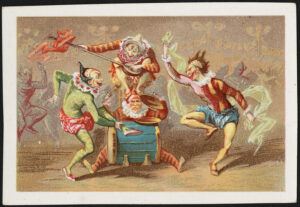
Funny Band Names https://dailymusicbreak.com/funny-band-names/ https://dailymusicbreak.com/funny-band-names/#respond Mon, 22 Sep 2025 14:36:23 +0000 https://dailymusicbreak.com/?p=7882 clowns playing instruments

Boston Public Library via Flickr

Needless to say, we all can use a laugh. There are lots of funny band names. Below is one for each letter (no X) from Digital Dream Door. It’s likely that many are just gags and the bands themselves were nominal. I did see three in the list that became bands of note: Flogging Molly, ? and the Mysterians, They Might be Giants and Kinky Friedman and the Texas Jewboys.

Check out The Marx Brothers and Laurel and Hardy for sheer brilliance, albeit from a very different era.

A sampling of the band names:

The Al Roker Death Cult Wind Ensemble

Beerbellied Scum From Central Bucks County

Cardiac Zach and the Defibulators

The Dancing French Liberals of 1848

Experimental BBQ

The Fred Mertz Experience

Gonnorhea Pizzaria

He’s Dead Jim

If You Don’t Order Food You Have To Leave

Jiggle the Handle

Kathleen Turner Overdrive

Lesbian Dopeheads on Mopeds

Men Among Poodles

Our Manager Told Us That Our Band Name Was Too Long and Difficult to Remember and That We Had to Change it So After a Long Brainstorming Session We Came Up With This One Because All the Other Ones Sucked

Pontius CoPilot

Question Mark & the Mysterians

Rebel Without Applause

Stupid White People

350,000 Crazed and Fully Africanized “Welcome to Disneyworld” Bees

Ultimate Spinach

The Vast Void of Empty Nothingness

Willie Nelson Mandela

The Yams from Outer Space

Zombina & The Skeletones

]]>
https://dailymusicbreak.com/funny-band-names/feed/ 0 7882
The Solution to Our Problem Is Being Implemented https://dailymusicbreak.com/soft-secession-the-answer/ https://dailymusicbreak.com/soft-secession-the-answer/#respond Wed, 17 Sep 2025 05:14:12 +0000 https://dailymusicbreak.com/?p=7847

Three surprises: There is an elegant solution to our problem of governance, it already is being implemented and the Supreme Court decision making it feasible was written by conservative icon Antonin Scalia.

The idea is simple. “Soft secession” is the shift of the emphasis of laws and policies from the federal level, where the most power rests today, to the states. Applying the idea to our current struggles would mean that the blue states would simply take care of their own business alone, in partnership with other blue/purple states or with red states if common ground exists. The states don’t enforce federal laws that they consider flawed.

We become the United States of America and the United States of New America.

It’s not exactly what Abraham Lincoln had in mind, but Thomas Jefferson would have been fine with it.

There is nothing revolutionary in the core idea. Jefferson wanted strong states and a weak central government. We have a mix of state and federal rules and laws today. The only thing that would really change is that the states would assert themselves more strongly and become the senior partner in their interactions with Washington. 

A Substack by Christopher Armitage entitled It’s Time for Americans to Start Talking About “Soft Secession” explains the concept far better than I can do so. He offers examples of where it already is being implemented and lays out some of the early strategic moves by proponents. What’s very clear is that a lot of very smart people have been working on this for months.

More after the music break…


Since this post is about a form of Civil War, I was going to use the beautiful “Ashokan Farewell” as the music break. After all, the song–which was written by Jay Ungar about an area of SUNY New Paltz, my wife’s alma mater– was a sublime choice by Ken Burn for use in the landmark documentary The Civil War. Soft secession, after all, is a subtle form of civil war.

As I was writing, however, it became apparent that Fleetwood Mac’s “Go Your Own Way” was the better choice simply for the title. The song is from the band’s classic Rumors album. I’ve always been intrigued by the almost complete transformation Fleetwood Mac. It was founded as British blues band in 1967 by Peter Green, who brought in Mick Fleetwood and John McVie. Green was a pure blues player. He played with John Mayall’s legendary Bluebreakers, whose alumni also included Eric Clapton and Mick Taylor. Green, who had mental health issues, left the ban. McVie brought in his wife, Christine. The band became far more pop oriented and the rest, as they say, is history.


Back to soft secession…

The only thing that I would add to Armitage’s terrific explainer is that skillful and ambitious politicians – starting with California and Illinois governors Gavin Newsom and J.B. Pritzker – want to be the Democratic nominee for president. Soft secession is a great way to do this. It is easy to understand, dramatic and has the potential to offer a path forward to people in the center and on the left who are aghast at both where this country is headed and at the apparent lack of resistance by the Democrats.

A bit of broader context is that the red and blue states are not on equal footing now. The system under which we live is inherently tilted toward the red states. Indeed, it’s quite possible that these states have pushed things too far and have messed up what seems to be a pretty good deal.

The states send taxes they collect to Washington. They are divided up and used to support Federal programs. In general, red states generate less tax revenue than blue states. However, the funding they receive is not limited by the amount they contribute. In essence the blue states subsidize the red. A post earlier this year at Time.com looked at the math. Jeffrey Sonnenfeld and Stephen Henriques found that the discrepancy is not small:

We have compiled a first-of-its-kind comprehensive five-year assessment of state-by-state inflows and outflows of federal funds and found the balance of contributions and receipts is not even close, red states are still propped up by blue states. After our researchers analyzed federal expenditures, including the Biden era infrastructure initiatives, Medicare/Medicaid, military spending, government contracts, standard grants, etc., against federal revenues across all 50 states, it is clear that blue states are funding red states. 

The blue states have another axe to grind. Red states are overrepresented in the legislative process. All states get two senators. Illinois (population 12.8 million) and Idaho (2 million) each get two. Michigan (10.2 million) and North Dakota (784,000) as well. The list goes on.

This is no accident. The Founding Fathers set it up this way due to the fear that states with urban centers would have dominated barely settled rural states. But, over time, the exact opposite occurred. Rural states turned red. They now rely on this built-in advantage to push through legislation that favors their economies and cultural agendas. The center/left’s long-term frustration at playing second fiddle to a weaker collection of states is likely to make soft session very popular.  

Soft Secession is OK, according to Scalia

The commonsense case for disentanglement is strong from both the current and historical perspectives. The kicker is that this modern iteration of the states’ rights versus federalism kicked off by the Supreme Court decision in a 1997 case (Printz v. The United States). 

The case dealt with enforcement of the Brady Handgun Violence Prevention Act (which commonly is called the Brady Bill). The question the court considered was whether local chief law enforcement officers could be forced to temporarily perform background checks that are part of the law, which is a federal statute.

The five conservative justices at that time–Antonin Scalia (who wrote the majority opinion), William Rehnquist, Sandra Day O’Connor (concurrence), Anthony Kennedy and Clarence Thomas–decided that the state officials could not be forced to participate. This is called the anti-commandeering doctrine. according to a Medium posting by Vickie Helm. I am not a lawyer, but feel that there is some contradiction between that and the Supremacy Clause of the Constitution which that says that federal law prevails when it contradicts state or local law.

Still another factor driving soft secession is that many blue state residents clearly feel the Supreme Court is corrupt. One seat (held by Neil Gorsuch) was thought to be stolen. There are numerous legal and ethical questions surrounding Clarence Thomas. Elected officials from red states are not willing to explore either situation. Legal experts say some decisions favoring Trump rely upon bizarre interpretations – and some (from the “shadow docket”) offer no reasoning at all. 

Whether under such conditions the blue states would abide by a decision demanding that they comply with a decision they feel is deeply wrong is questionable and the product of a jaded court. What also is unclear is what options the administration would have if they did ignore it.

Two philosophies of democratic governance–the anti-commandeering and the unitary executive doctrines–may end up in a winner-take-all battle. The two are diametrically opposite: More power reverts to the states in one and the single chief executive is more or less a king in the other. The lesson may simply be that today hazy mix of three roughly equal branches has grown antiquated.


]]>
https://dailymusicbreak.com/soft-secession-the-answer/feed/ 0 7847
Does Trump 47=King Donald the First? https://dailymusicbreak.com/does-trump-47-king-donald-the-first/ https://dailymusicbreak.com/does-trump-47-king-donald-the-first/#respond Fri, 12 Sep 2025 20:24:50 +0000 https://dailymusicbreak.com/?p=7825

The good news–and there is good news–is that the administration’s poll numbers are down. Several factors are driving the decline: The economy is fading, the president is doing things that are both unpopular and not what he campaigned on and, quite likely, all but his core is getting tired of his shtick.

Also, there is a non-zero chance that he is a pedophile. That never helps a person’s popularity.

This begs a very important questions: Going forward do his job and popularity levels actually matter? Does an individual with immense power and allies in high places need to listen to the people? Will enough of his more tentative allies break away to make a difference?

Like so many things in the Trump era, we just do not know. He has two types of supporters (with, of course, much overlap): People who blindly follow him and people who aren’t fond of him but are getting too much of what they want to withdraw their support.

The cult will remain. Legislators will as well, as long as Trump is perceived to have the power to cost them their jobs with a tweet. Much of the judiciary has done a decent job of pushing back. Unfortunately, the Supreme Court hasn’t.

Not the Kind of Unity We Need

Much of the intellectual right has spent decades pushing something called the unitary executive theory. As the name implies, it vests a tremendous amount of power in the presidency. Clearly, that “creates tension,” as the smart folks say, with the intricate system of checks and balances under which divvy up rights and responsibilities. That’s how we supposedly are governed.

More after the music break…


There are a lot of words that aren’t used any longer. Or still are, but have different connotations. In any case, be ready to be “charmed.” That really the best way of describing Tatiana Eva-Marie and the Avalon Jazz Band’s cover of the classic song “La Mer.” 

The cover of “La Mer” is perfect and a nice antidote to the generally challenging (if not downright depressing) subject matter of this site, especially this week. I know that everyone had different tastes, yada, yada. But it’s more or less impossible not to like this. I love it all, but my favorite is the guitarist with the aqua hair. 

The song has a long history It was written and performed by a French singer by the name of Charles Trenet who seems to be a lot like Maurice Chevalier. I believe the words were changed when it came to the United States. It was a big hit for Bobby Darin, of course.


Back to politics:

The unitary executive is perilously close to being a king. And, guess what: That is exactly how Trump is acting. He and the rest of the right knows that this is the last best chance they get to implement the unitary executive. It also is the last opportunity to roll back the New Deal and the departments and agencies it made possible, another long-time goal of the right.

It doesn’t matter that most people like what these agencies and departments try to do, though they may complain about how they go about doing it. Many conservative academicians and pundits don’t. They feel that the America in which we all grew up is not what the Founding Fathers wanted. I read the Constitution every few years and see no justification for this. 

So we are where we are: A president with sinking approval numbers but without another election to worry about, a conservative intelligentsia getting everything they want or cowed into silence and an electorate beginning to understand that Donald Trump may not be who he said he was.

We are the precipice of great change and great choices. America either will have a king in everything but name or a democracy that has withstood a dire frontal assault. What could be decisive? A bombshell from the Epstein scandal and/or a recession that would push Trump’s approval rating so low that moderate Republicans in the House and Senate would no longer need fear him? A massive number of illnesses and fatalities due to the hollowing out and poorly led Department of Health? More political violence?

Or does none of this matter? The other reality that needs to be faced is that those with the power now have no real intention of giving it up. Donald Trump already quarterbacked one attack on the peaceful transfer of power. There is absolutely no guarantee he won’t do so again. And, if he knows now that he will do that, why should he care about poor polling numbers? 

But keep in mind that there isn’t a world in which public opinion doesn’t matter at all. If there was Stalin would not have needed secret police. There are ways that the public will make its presence felt regardless of whether there is a legitimate vote. And, if the will of a majority of the people is egregiously ignored, they can solve the problem themselves. 

I am not talking about violence along the lines of what we saw earlier this week. The concept of soft secession (which would be a great name for a band) is generating a tremendous amount of interest. It’s simple but a big step: Blue states setting their own standards and entering into agreements with like-minded states to govern independently of Washington. It’s not a pipe dream. It’s happening. 

There clearly is a lot of uncertainty. Nobody has any idea what will happen. It’s impossible to avoid the conclusion that a strong turnout and vote in favor of democracy will set the tone for the fight. We must not allow them to portray us as dispirited, apathetic and weak. More to the point: We must not be dispirited, apathetic and weak.

Please vote in every election.


]]>
https://dailymusicbreak.com/does-trump-47-king-donald-the-first/feed/ 0 7825
The Death of Charlie Kirk https://dailymusicbreak.com/the-death-of-charlie-kirk/ https://dailymusicbreak.com/the-death-of-charlie-kirk/#respond Thu, 11 Sep 2025 12:50:27 +0000 https://dailymusicbreak.com/?p=7804

Charlie Kirk this summer. (Image: Gage Skidmore – https://www.flickr.com/photos/gageskidmore/54670961811/, CC BY-SA 4.0, https://commons.wikimedia.org/w/index.php?curid=172612805)


The moral complexity of what has happened in the past 24 hours is staggering. And that’s okay, if we learn from it.

A highly polarizing figure who has said awful things about people without the ability to answer back was peacefully addressing a crowd in a public forum. A gunman murdered him.

First, it is important to understand what we don’t know, which is just about everything. No suspect has been arrested. We have no idea why he or she murdered Kirk. We also don’t know if we can trust the government to give us accurate information. There already was one unattributed story released pointing to the shooter being transexual. It turned out to be inaccurate and quite possibly an intentional lie.

The moral complexities will change if and when those facts are known. And, if the murderer was from the left, they will become greater and the situation far more dangerous.

All that notwithstanding, the person responsible must be tried and, if convicted, punished according to the applicable laws. That’s unmistakable. Violence is morally, ethically, legally and religiously wrong. It has no place in civil society. Period. Society needs to be strong enough to convince its citizens that hate speech is wrong. Killing the speaker gives him or her a stronger voice, albeit from the grave.

Kirk had done much damage in his life, but his misdeeds were verbal. As far as I know he never physically hurt anyone. He did not deserve to die.

The Hard Part

Now comes the hard part: Kirk had said that deaths by gun violence was “worth it” and would “unfortunately” lead to deaths but was the cost of protecting the Second Amendment. He stated position was that his own killing was a price that had to be paid.

He was wrong. All freedoms enunciated in the Constitution are accompanied by fine print that limits them where it makes sense. The go-to example is that we have First Amendment rights, but we can’t scream “fire” in a crowded theatre. Those on the right battling to ease controls on weapons are wrong. There are ways to follow the Second Amendment and at the same time protect the public. And the amendment itself is vague and confusing.

The right has spent decades denying this simple reality and won’t deal with nuance: Do you arm teachers? What level of investigation must be done for somebody buying a gun? Do you seed gunpowder to it can be traced? Do you put fingerprint security on weapons so only authorized people can use them? What types of weapons are illegal due to their lethality? These are important questions, but they can be worked out if both sides argue in good faith.

And let’s face it: If the Founding Fathers came back to life and call us idiots for not managing these weapons better.

There are dozens of shootings every year. Indeed, a kid at a Denver-area school shot two classmates and killed himself even as the horror in Utah was playing out. If there was moral outrage about that, I missed it.

The difference between Kirk and the most other victims of gun violence is that Kirk put himself in the arena. Perhaps he was brave. Perhaps he was in denial. Perhaps he had a martyr complex. But unlike the kids and staff at countless schools, he knew he was playing with fire, both literally and figuratively.

The biggest take away from the past 24 hours is the selective empathy of the right. They rightfully say that what happened to Kirk was awful. I totally agree. Nobody short of Hitler deserves to end that way. But where their emotions when it happens to a little kid? Somebody quietly doing their nondescript job?

I work a couple of days a week in the public schools in New York City. Yesterday I was helping take care of about a dozen preschoolers. The thought that some idiot could bolt through the door and do terrible things to these kids is terrifying and appalling. It is almost appalling that somebody would say it is the price we have to pay to have a free society. It isn’t.

Please vote so that the next Charlie Kirk lives until 90.


]]>
https://dailymusicbreak.com/the-death-of-charlie-kirk/feed/ 0 7804
For the Next 3 Years Elections are about More than Politics https://dailymusicbreak.com/elections-next-three-years-about-far-more-than-politics/ https://dailymusicbreak.com/elections-next-three-years-about-far-more-than-politics/#respond Tue, 02 Sep 2025 19:17:38 +0000 https://dailymusicbreak.com/?p=6319  

Secret Service

The Secret Service guarding Laura Bush in 2006 (Image: Chuck Patch)

It’s totally understandable that many people find politics distasteful and pay as little attention to it as possible. Indeed, there is a strong case to be made that it’s the “right” response. Politicians are natural born liars, after all. They tell you one thing and do another, often while their hand is in your pocket looking for your wallet.

There is some level of truth to that. Politicians lie. It’s part of the system, a feature not a bug. You cannot be a successful politician without distorting the truth because people are far more likely to vote for people who tell them what they want to hear than the truth. People who enjoy politics see it as a bit of a game. To them, the intrinsic dishonesty of the system is not disqualifying. We’re all grownups, they say, and that’s how the game is played. Grow up.

The goal of the revamped Daily Music Break is to convince folks who are never or rarely vote to get off the sidelines for at least the next three years. There is a special reason to put up with the artful dodges and clever deflections that have annoyed you in the past.

The assumption is that people should vote for one candidate or the other based on policies. It’s a no-brainer, after all. But not now. Donald Trump and the coalition he has built is not primarily about policy. It is about grievance, cruelty, rewriting history and incivility.

Consider this Associated Press item from late last week:

President Donald Trump has revoked former Vice President Kamala Harris’ Secret Service protection that otherwise would have ended next summer, senior Trump administration officials said Friday.

Former vice presidents typically get federal government protection for six months after leaving office, while ex-presidents do so for life. But then-President Joe Biden quietly signed a directive, at Harris’ request, that had extended protection for her beyond the traditional six months, according to another person familiar with the matter. The people insisted on anonymity to discuss a matter not made public.

A one-off against a particularly bitter foe? Perhaps not:

President Donald Trump said Monday he was ending “immediately” the Secret Service protection details assigned to Democrat Joe Biden’s adult children, which the former president had extended to July shortly before leaving office in January.

The Republican president on social media objected to what he said were 18 agents assigned to Hunter Biden’s protective detail while in South Africa this week. He said Ashley Biden has 13 agents assigned to her detail and that she too “will be taken off the list.”

Not to beat a dead horse, but John Bolton also is facing the world alone or with the level of security he can pay for out of his own pocket. And this is a guy who was the victim of an assassination plot:

U.S. Secret Service protection from former Trump national security adviser John Bolton, who became a critic of the president after Bolton’s ouster from the first Trump administration in 2019. Multiple sources told CBS News the decision was made in the past 24 hours.

In case you are wondering, ex-presidents get lifelong protection by law. Otherwise, Bill Clinton, George Bush and Barack Obama also would be on their own.

Continue reading after the music break…

“White House Blues” is a traditional acoustic blues about the assassination of President William McKinley by an anarchist in Buffalo in 1901. The song has been performed by many artists. This masterful and melancholy version is by John Renbourn, a founding member the legendary British folk band Pentangle. It’s on the great solo album “Faro Annie.”

My favorite verses: “The people they came a running round to see what had been done/You have shot the president down with your Iver Johnson gun/Hard times, hard times” and “The train, well the train, running on down the line/blowing at every station, McKinley is a dyin’ / Hard times, hard times.” Check it out. It’s interesting that a Brit would be able to make such a moving version of a song that so deeply American.


We live in a violent country in a very dangerous world. To run for office in such times demands a level of personal bravery and sacrifice that is beyond most of us. The physical risk to candidates is real, though rarely spoken about. The president himself was attacked twice during the campaign. To increase the danger for these folks once they exit public service is a form of intimidation that is unconscionable.

Nonvoters should consider this. When folks on the left decry the administration for doing such things as cutting nutritional support to children (SNAP), funding for disease research or FEMA, it is possible for supporters to say that such moves are necessary to balance the budget. It’s an extraordinarily weak argument, but an argument nonetheless.

However, there is absolutely no rationale or argument on purposely putting people in danger simply because they ran against or disagreed with you. The word “petty” comes up a lot in the coverage of this topic. It indeed may be petty. But it is far more. It is extraordinarily cruel. It also is the action of somebody acting as a crime boss, not a statesman.

Donald Trump will never run for office. That does not make this point moot, however. Most Republican candidates during the next three years will position themselves as Trump acolytes, confidantes and proteges. Whether they share Trump’s cruel streak personally is irrelevant. Republicans supported it for one of three reasons: they lacked guts to object, speaking out would hurt their electoral prospects – or they are cruel themselves. None of the reasons are acceptable. Not speaking out is deeply un-American. It should be enough to bring you off the sidelines to vote.


]]>
https://dailymusicbreak.com/elections-next-three-years-about-far-more-than-politics/feed/ 0 6319