

Creating a Killer Marketing Plan Continue reading The post Seattle Angel Fund Speaker Series first appeared on ChangeMarketer.]]>
I had the pleasure of being a speaker at the third session of the popular Seattle Angel Fund Speaker Series. I want to thank the sponsors Karr Tuttle Campbell, Seattle Angel Fund, and Clark Nuber PS for hosting this event. I also want to share the following insights that they used to frame the discussion.
According to CB insights, the number one reason companies fail is due to no market need, and conversely, according to long-time investor, Bill Gross, the number one reason companies succeed is timing. So it is important for the investor to assess whether a venture has correctly assessed the market and whether it is well positioned to capture that market. In addition, with so many business models, how does one tell which marketing plan is the right one?
I had the opportunity to discuss some marketing strategies and tactics to help companies go from emerging to surging by leveraging the marketplace forces that matter most. To learn more see the following blog posts.
Market Force: “Why Now?”

Market Force: “Practicing Systematic-Marketing?”
My Pick first appeared on ChangeMarketer.]]>

As a marketer, I watch the Super Bowl for the commercials. The game is terrific, but the commercials deliver the same kind of thrill ride to anyone involved with selling a product or service – which is most of us. So what is my pick?
Kia: ‘Hero’s Journey’ with Melissa McCarthy
While the super bowl commercials serve many purposes including brand building, they ultimately need to help generate sales. The Kia “Hero’s Journey” advertisement delivers a solid selling message in a humorous and actionable manner.
If you haven’t seen it, watch it here:
Here are my reasons
- Clear Positioning? They offer “the most fuel efficient crossover”
- Why Me? They connect with the “hero” in each of us
- Why Now? They communicate a sense of urgency
- Why This Product? It’s the positioning: “most” fuel efficient
- Call to Action? “It’s hard to be an ecowarrior, but it is easy to drive like one.”
This simple statement communicates what makes the Niro hybrid crossover vehicle unique. To standout, Kia does this by choosing the “most” positioning direction.
As a positioning and message expert, you can learn more about the “most” positioning direction along with three other powerful positioning directions in this short video clip.
This video was excerpted from a University of Washington CoMotion Presentation.
This ad effectively reaches out to its potential buyers by appealing to the hero in us in a very topical, yet humorous manner. They put connecting with you first, before conveying the sales messages.
You are needed now in order to save the whales, trees and polar ice caps. They use a humorous approach and a celebrity comedian who experiences unexpected consequences in order to successfully break through the business-as-usual barriers.
After a connection and urgency have been established, the product message is conveyed. Also, they show the product — multiple times and well integrated — not just as a parting shot.
Are you ready to go for a test drive? I am. They brought the whole message home by putting you in the driver’s seat.
Congratulations Kia, well done!
Try watching the commercial again
Now that you have the ChangeMarketer perspective on the commercial, I suggest watching it again. It will be a different experience. We do this in a marketing workshop that I conduct on positioning and messaging. It is not only fun, but effective in helping you shape your own communications when you are in a selling situation.
The post Super Bowl 51 Commercials:My Pick first appeared on ChangeMarketer.]]>
Three Milestones Continue reading The post Congratulations 9Mile Labs first appeared on ChangeMarketer.]]>

As a mentor with 9Mile Labs high-tech accelerator, I have the pleasure of working with motivated start-up teams on their positioning and go-to-market strategies, playing a role in keeping the focus on how to secure customer traction. I want to highlight three important 9Mile Labs achievements that support this goal.
1. 9Mile Labs Program Evolution
As described in the following article, 9Mile Labs has been tuning its program to focus on customer revenue metrics as its measure of success.
Accelerator 9Mile Labs Evolves Model for Investing in Startups
2. New Advisory Board for 9Mile Labs
Five tech industry leaders have been named to a new advisory board including:
- Gary Rubens: Angel investor and founder of StartIt Labs
- Robert Kelly: Corporate VP at Microsoft
- Heather Redman: Angel investor and VP at Indix
- Tom Casey: VP of platform and infrastructure at Apptio
- Michael Orbach: Managing director at Cascadia Capital
At the Milestone 9 event last week, customer traction was a discussion topic which was captured in this GeekWire article.
Here’s the ‘Dirty Secret’ About Silicon Valley, and Why Seattle Startups Have an Advantage
3. Cohort V Graduation
Eleven companies have just “graduated” from the program. The growth demonstrated by the individuals in these companies is a pleasure to experience. To all, you have my congratulations.
9Mile Labs Graduates 11 Startups in Cohort 5
What’s Next?
Applications for the next program are open until 4/18/2016. Apply at www.9milelabs.com. Help spread the word.
The post Congratulations 9Mile Labs first appeared on ChangeMarketer.]]>It's a Make-or-Break Proposition Continue reading The post Standout Positioning first appeared on ChangeMarketer.]]>
Event Announcement

When: Wednesday May 13, 2015, from 4:00 to 6:00 pm PDT
Where: University of Washington. CoMotion Incubator. Fluke Hall. Seattle, WA
What: Every entrepreneur knows how difficult it is to concisely communicate the value that a start-up opportunity provides. When the entrepreneur fails to communicate effectively, potential investors and customers find it not only painful, but a show stopper.
Join us in discussing how to:
- Communicate value clearly, concisely and competitively
- Craft a precise message based on standout positioning
- Change your communications style from convincing to compelling
In this session, a number of positioning examples will be shared from successful Seattle-based industry leaders and emerging companies.
The post Standout Positioning first appeared on ChangeMarketer.]]>How To Secure Customer Traction Continue reading The post Early Stage Marketing first appeared on ChangeMarketer.]]>

Communicating value clearly, concisely and competitively is essential for establishing a customer connection. However, securing traction requires more. There are three approaches that startups often overlook.
Driving Business Growth
I had the pleasure of speaking to the companies participating in the 500 Mexico City startup incubator program on the topic of, How to Drive Business Growth with Change Marketing.

In the one-on-one working sessions that followed, securing customer traction was the most discussed challenge. Since my experience with other incubators has been so similar, I want to review three approaches that startups overlook or undervalue.
1. Start by focusing on the optimal target customer
Not all potential customers are equal. Target market definition work needs to get beyond identifying prospects with interest, to those most likely to purchase. Startup resources are scarce and need to be focused or precious time and money are lost. I have developed an approach to defining a target market called PRO.
The Approach
Potential: These are the potential customers that would be interested in your product/service. Census data is often a source for understanding and sizing the market at the interest level. However, this is too general to be of use in establishing your go-to-market strategy.
Reachable: These are the potential customers where active “highways” exist to reach them efficiently. Association membership lists are an example of one possible source for identifying the reachable market. This enables a startup to use a one-to-many communications strategy to save time and money, and is preferable to the typical one-to-one communications that most startups employ.
Optimal: These are potential customers that are most likely to use your product successfully and are exhibiting buying behavior. Topical conference attendance lists is an example of a source for identifying this group. It is here that the startup should focus its customer acquisition strategy and tactics in order to achieve traction.
An Example
A startup was generating interest in its service, but was experiencing very low closure rates, even after investing a tremendous amount of time educating the prospect. Two shifts in perspective are required to alter the outcome.
- Stop Trying to Change Behavior: The effort to change behavior was being underestimated. The traditional way to order this service was via a telephone call. This startup was asking the customer to change their behavior by ordering online—something most were unwilling to do.
- Start Leveraging Existing Behavior: When we discussed the criteria for an optimal customer, we were able to shift the focus to identifying potential customers that were already ordering online, leveraging existing behavior. This lead to a very different group of customers being targeted, which dramatically improved the odds for securing traction.
2. Make customers a peer in your communications
It is important to remember that you are biased in the eyes of the potential customer. They know that you are trying to sell them something. Having existing customers communicate your message is far more credible and impactful. Potential customers have, at the top of their list, determining whether someone like them is already using the product/service and what their experience has been.
The Approach
Think of every secured customer as a communications partner. At the earliest possible moment, have your customers speak, in their own voice, about their experience. Include this on your website, in press releases and in sales collateral. Start with quotes, move on to case studies or testimonials and then joint presentations at relevant industry forums.
An Example
I had a client that thought the best message the company could deliver to its prospects was, “We have no agenda other than enabling yours,” which is an expression of, “we have your best interests at heart.” So we included that thought in the testing along with 11 other messages. It came in dead last—bottom of the heap. It is simply not believable. The prospect knows you are trying to sell them something and will discount these kinds of statements.
One of the startups that I met with last week had an impressive number of customers and told me their stories, only after I asked. They had not yet involved the customers in communicating their message. Many startups want to go deeper and deeper into the company storyline without realizing the seismic shift that can occur by making the customer a true peer in their communication efforts.
3. Understand customer realities before choosing
your go-to-market strategies
Most startups assume that they are operating a standalone business with a standalone product. There are market segments and times in the industry life-cycle where this is possible. However, there are many cases where the optimal target customer will neither accept standalone products nor tolerate the risk that a startup represents. This is particularly true in B2B situations.
The Approach
Understanding the existing market conditions that affect product adoption is essential. In some cases, bringing your product to market as part of a bundled solution with an existing vendor, or through a channel partner, may be the only way to establish traction.
An Example
Two different startups described market conditions where a large company competitor had entered their space before they had gained traction. In both cases, looking at who would make good strategic partners became essential rather than continuing down the go-it-alone path. We looked at companies that were already selling a noncompetitive product to the startup’s optimal target customer. This offered the potential for creating a strategic and economic win/win, as both an incremental revenue opportunity and a path to securing traction.
While, there is more that could be said on this topic, my intent in sharing these approaches and examples is to help startups shift their perspective to actions they can take to secure customer traction and drive their business growth.
The post Early Stage Marketing first appeared on ChangeMarketer.]]>A Marketer's Perspective Continue reading The post Why Startups Fail first appeared on ChangeMarketer.]]>
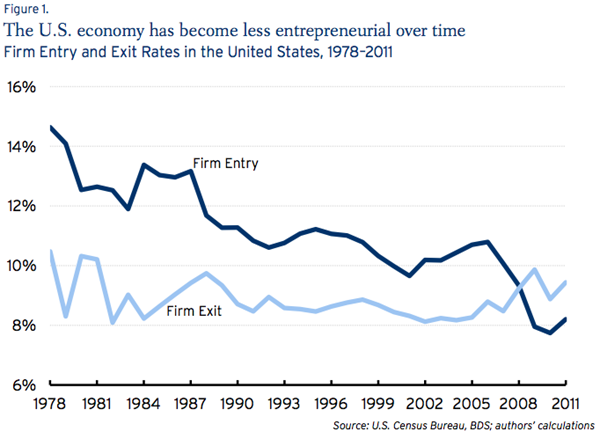
Source: VentureBeat How Startups Are Dying Faster Than They’re Being Created
Lack of Market Visibility Threatens Viability
This headline, “How Startups Are Dying Faster Than They’re Being Created,” as reported in VentureBeat, caught my attention. You can’t help but ask yourself why? While the implications for the economy are obvious and the potential reasons many, I would like to counsel startups to consider how their approach to marketing is tied to their outcome.
In my work with startups I see a number of reoccurring issues that make or break success. I want to touch on three of those now.
- 1. Marketing is different than sales
An all too common startup pattern is to have an idea, build a product, hire sales people, consume available cash, and then lay off sales people. Notice that marketing was missing in this chain of events. It is marketers who understand how to identify the optimal target customer—those most likely to purchase. It is marketers that ensure that a set of steps get built to allow a prospect to buy, cost-effectively.
- 2. Marketing needs to address “fear of the unknown”
Be realistic about how much change your potential customer has to experience in order to benefit from using your new product. For many, change heightens the fear of the unknown, and this can really put the brakes on the selling process. Storytelling and analogies are powerful ways to help change fear of the unknown into known ideas or action, accelerating the buying process.
- 3. Marketing sits between “make” and “make money“
If you want to be able to make money from your efforts, then marketing perspective is crucial in shaping even the earliest product decisions. Otherwise, valuable time and resources can be wasted. I have been able to facilitate the extraordinary change in perspective founders make when the inside “idea” view and the outside “customer” views are merged.
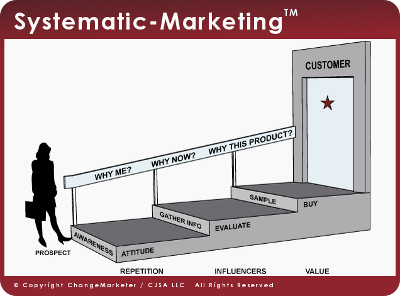
In my own practice I address these issues with an approach that I call Systematic-Marketing; a process which identifies the steps and messages used to convert prospects into buyers, cost-effectively.

Details are available in a previous blog post titled,
“Are you practicing systematic-marketing?“
Change the Odds
Last week, when I was the speaker at the University of Washington – Center for Commercialization (C4C)—Startup Seminar Series, Systematic-Marketing was the topic that generated the most follow-up emails and discussions among the participants. This is not an isolated experience. It arises when mentoring startups, as well as during discussions with investors and with other service providers.
If more startups approached marketing as a systematic set of steps to be built in unison with their product development efforts, it would improve the odds for success. This is one of the ideas driving the proliferation of startup incubators and accelerators. While hard data is still difficult to come by, the entrepreneurs involved will tell you that their participation was a life-changing experience, saving enormous trial-and-error learning in the process.
9Mile Labs Accelerator Event
If you are interested in participating in the startup community, consider attending the 9Mile Labs high-tech B2B accelerator graduation event being held May 16, 2014, at the Four Seasons in Seattle, Washington. Event and registration details can be found at m9.9milelabs.com.
The post Why Startups Fail first appeared on ChangeMarketer.]]>It's Never Too Early To Make It Clear Continue reading The post Driving Business Growth first appeared on ChangeMarketer.]]>

Seeing Ahead
You wouldn’t voluntarily steer a car that had a muddy windshield. Yet many businesses do exactly that when they treat positioning as a “launch” activity. Good positioning is what clears the view so a business is able to drive its growth successfully.
As a Startup: Find the Highway
During the idea phase, the road to the optimal customer is often very muddy. Understanding who will be interested in the new product and why they would be willing to use it is essential for establishing the foundation for traction and growth.
That is why I have developed the “Why Now?” positioning approach. Addressing positioning early is the best way to identify optimal customers. “Launch” is far too late in the business development cycle to produce this fundamental and necessary level of clarity.
When Emerging: Adjust the Ride
As a company grows, changes takes place in the marketplace that amount to fresh mud being thrown onto the once clear windshield. In this case, I use an “Only, Best, First, Most” positioning approach to sharpen differentiation.
Maturing: Handle Changing Requirements
As a company/product matures, the “we’ve-always-done-it-this-way” inertia can take hold. In this situation, I use a competitive landscape driven approach to understand emerging market segments and customers needs, so that we can then re-position effectively.
Interested in Knowing More?
Consider attending the University of Washington – Center for Commercialization (C4C) – Startup Seminar Series, where I will be the featured speaker on May 2, 2014.

This would be an easy way to learn more about my approach to driving business growth. Attendance is free and more details can be found at: http://changemarketer.com/speaking/
I hope to see some of you there.
The post Driving Business Growth first appeared on ChangeMarketer.]]>Your Success Depends On It Continue reading The post Stop: Ask the Customer first appeared on ChangeMarketer.]]>

How many times do ideas get communicated to the marketplace without seriously engaging the potential customer in the process? It is more times than most would care to admit. Recent events reminded me of the immense value provided by stopping long enough to ask the customer.
Start the Dialog
There is clear benefit to taking the initiative and getting the dialog started at the earliest possible moment. I recently received a pivotal insight on a current project, that no one but a customer would have been able to articulate so effectively.
My Three Favorite Questions
In my business I talk with potential and/or actual customers early in the process in order to shape a companies positioning and messaging direction, and then again to gauge their react to the direction chosen, all before going public. I have found the following three questions most effective for “seeing” the company and its value from the customer’s perspective.
- How would you describe [company/product] to someone unfamiliar with the company and its products?
- What three words best describe the [company] “experience”? Which one is the most important and why?
- What should [company] be communicating in order to attract other customers like yourself?
This approach always delivers powerful insights while saving considerable time and money in the process.
Demonstrated At Milestone 9 Demo Day
As a mentor for 9Mile Labs, a B2B high-tech accelerator, I know that the program places a lot of emphasis on having the start-up companies engage in dialogs with potential customers. At the Demo Day event it was a pleasure to see how the man-hours of effort they spent on “asking the customer” resulted in the companies being able to articulate their mission and communicate their value proposition. Congratulations to all nine companies for their determination and growth.
Before a Single Line of Code Written
Driving this all home, was when successful entrepreneur, Sunny Gupta, co-founder, President and CEO of Apptio and keynote speaker at the Milestone 9 Demo Day, said that he engaged in deep dialog with twenty CIOs who were potential customers, before he wrote a single line of code. How often does that happen?
For Your Business
So stop long enough to ask yourself how a customer could be helping you solve the pressing issues you have on your “short-list”. Take the time to pick-up the phone, send an email, meet them for coffee, or design a survey to gather meaningful feedback. Your success depends on it.
P.S.
I was honored to receive an award at the Milestone 9 Demo Day event. Thank you Cohort I companies and thank you 9Mile Labs for all you are doing for the start-up community.

- Consummate Coach Award — Sherril Small
- Entrepreneurial Einstein Award — Rand Fishkin
- Community Champion Award — Skip Walter
- Community Support Award — Seaton Gras or Surf Incubator
“Stop” image courtesy of Stuart Miles/FreeDigitalPhotos.net
The post Stop: Ask the Customer first appeared on ChangeMarketer.]]>It's a Make-or-Break Proposition Continue reading The post Why Positioning is a Specialty first appeared on ChangeMarketer.]]>

The window of opportunity to market a new product is short. It requires all hands on deck to develop standout positioning and communicate it effectively. In this make-or-break situation, it makes sense to involve an experienced positioning professional. Here’s why.
Time is the Enemy
New ideas have a “shelf life” — an increasingly shorter one. If it is a good idea, it will be mimicked. Being forced to deal with look-alike products happens sooner rather than later. The first-mover advantage will be lost to a skilled second-mover if market leadership is not achieved in a timely fashion.
Accelerating the Communications Journey
Many companies take too long to hit their stride in communicating effectively. That is time that can never be recovered. That time is crucial for building effective competitive barriers and to make available cash stretch as far as possible in order to cover ramp-up expenses.
As a make-the-market specialist, positioning is part of every project I undertake and my goal is to break new ground and make the most of that precious time by bringing clarity to communications.
At the moment I am working with nine different start-up companies and their founding teams — each a part of the B2B incubator, 9Mile Labs. As a result of the workshops that I am conducting with each company, I have been reminded of the value clear positioning generates. For example:
- Hit the Bulls Eye: Emerging companies have a lot to say about how they do what they do. However, what a prospect needs to hear first are the Whys. More on how to accomplish this is available at: Why Me? Why Now? Why this Product?
- Standout Fast: In the first few seconds of your interaction with a prospect, they will decide to either go-forward or stop. Use that time wisely by cutting through the clutter and clearly communicate why you are different from all the rest. More on how this is achieved is available at: Positioned Clearly.
- Use an Appropriate Analogy: For one of the 9Mile Labs start-ups, a successful communications concept from the telecommunications industry was applied to a retail situation, generating immediate understanding.
- Speed-Up “Discovery”: The “fit” message can be understood and market tested before you ramp up a sales team. Avoid the pain and expense of the “one-salesperson-to-one-prospect” discovery process that chews up so much time.
- Lower Cost of Sales: When the “fit” message is clear, you can bring qualified buyers to the business through cost-effective marketing tactics, rather than seek prospects through high-cost, personal selling tactics. More on how to do this available at: Practice Systematic Marketing.
Be prepared by asking yourself, “Of all the things my product can do or deliver, when competition copies me, what is the most important thing I will fight for in order to standout?” The answer will take you a long way towards knowing how to position yourself in the present.
It’s a Make-or-Break Situation
Achieving standout positioning and effectively communicating it is challenging work. It is one of the hardest things a marketer has to do. As in any other significant endeavor, frequency and depth of experience matters.
A typical marketer will position or reposition a product only a few times in their career, which reminds me of a conversation that I had with a physician friend. He told me when picking out a surgeon, choose someone that does that same procedure often. That advise makes sense in marketing situations as well, because positioning can make-or-break the success of a company.
That is why positioning is a specialty. A specialist offers the experience built with frequency, provides frameworks that speed the outcome, and provides feedback on what has worked or not worked in other situation. Combined, this means that obstacles are removed, performance is optimized, and precious time is saved.
The post Why Positioning is a Specialty first appeared on ChangeMarketer.]]>