The post New 2027 CPT guidance for unattended sleep testing now available appeared first on American Academy of Sleep Medicine – Association for Sleep Clinicians and Researchers.
]]>The newly released 2027 CPT Professional Edition includes the final code descriptors, definitions, and reporting instructions for the new unattended sleep testing code family that takes effect Jan. 1, 2027.
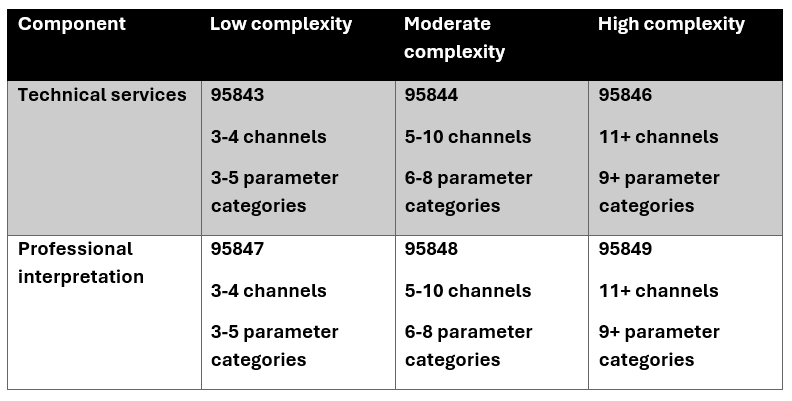
The new framework replaces Current Procedural Terminology (CPT) codes 95800, 95801, and 95806 with six codes that separate the technical portion of unattended sleep testing from the physician or other qualified healthcare professional interpretation and report. Code selection is based on the number of clinically relevant channels recorded and the number of parameter categories generated, with the lower of the two determining the appropriate complexity level.
New unattended sleep testing codes
What's new in the 2027 CPT manual?
In addition to the code descriptors, the updated sleep medicine testing guidelines provide important information to help practices apply the new codes, including:
- New and revised definitions for channels, parameter categories, direct and derived measures of sleep, interpretation, technical analysis, epochs, sleep testing, and other key terms.
- Examples of qualifying channels, such as airflow, oxygen saturation, respiratory effort, position, movement,
- electroencephalography (EEG), electrooculography (EOG), electromyography (EMG), electrocardiography (ECG), photoplethysmography, and peripheral arterial tonometry.
- A new parameter-category framework covering sleep summary, sleep stages, oxygen measures, obstructive sleep apnea (OSA) and non-OSA respiratory indices, cardiac and movement indices, positional measures, and other categories.
- Clarification on counting parameters: Multiple measures within the same category, such as apnea-hypopnea index (AHI), respiratory disturbance index (RDI), and respiratory event index (REI), count as one parameter category, not three.
- Code-selection instructions specifying that the appropriate complexity level is determined by the lower of the channel count or parameter-category count.
- Additional reporting guidance clarifying that code selection is based on clinically relevant information, not simply the number of signals a device can collect or its capabilities.
Members may send questions about CPT guidance on the new codes to coding@aasm.org.
The post New 2027 CPT guidance for unattended sleep testing now available appeared first on American Academy of Sleep Medicine – Association for Sleep Clinicians and Researchers.
]]>The post Talking Sleep | Using Your Voice to Improve Reimbursement appeared first on American Academy of Sleep Medicine – Association for Sleep Clinicians and Researchers.
]]>Season 8 | Episode 20
In this episode of Talking Sleep, host Dr. Seema Khosla welcomes members of the American Academy of Sleep Medicine advocacy team for an inside look at the work being done behind the scenes to support sleep clinicians and advance patient access to care. Joined by Diedra Gray, Tracy Bunge, Eric Albrecht, and Melissa Clark, the conversation explores how physician reimbursement decisions are made and how sleep medicine professionals can help shape the future of the field.
Many sleep clinicians have experienced the frustration of declining reimbursement, changing payment policies, and increasing administrative burdens. While it can feel as though these decisions are beyond the influence of individual physicians, this episode highlights the many ways clinicians can contribute their expertise and advocate for sustainable sleep medicine practice.
The discussion examines the complex process behind physician payment, including the roles of CPT coding, the AMA Relative Value Scale Update Committee (RUC), Medicare payment rules, and private payer policies. Listeners will gain insight into how reimbursement values are determined, how proposed policy changes are evaluated, and why physician participation in surveys and feedback opportunities is essential to the process.
The episode also tackles key issues facing physicians today, including budget neutrality, inflationary pressures on physician practices, and recent reimbursement reductions that affect sleep medicine and other specialties. The guests explain how the AASM works to advocate for fair compensation while ensuring patients continue to have access to high-quality sleep care.
Beyond payment policy, the conversation explores legislative advocacy and the role sleep clinicians can play in shaping public policy. From contacting elected officials and participating in advocacy campaigns to supporting legislation that promotes sleep health, listeners will learn how individual voices can contribute to meaningful change. Topics include physician payment reform, sleep health legislation, delayed school start times, permanent standard time, and other policy initiatives important to the sleep medicine community.
Whether you’re curious about how reimbursement decisions are made, interested in becoming more involved in advocacy efforts, or looking to better understand the forces shaping sleep medicine practice, this episode offers valuable insight into the people and processes working on behalf of sleep clinicians and their patients.
Join us for this informative conversation about reimbursement, advocacy, and how your voice can help shape the future of sleep medicine.
Diedra Gray, Tracy Bunge, Eric Albrecht and Melissa Clark are members of the American Academy of Sleep Medicine (AASM) advocacy team, which works to advance the interests of sleep medicine professionals and improve patient access to high-quality sleep care. Their work includes physician reimbursement and payment policy, legislative advocacy, and public policy initiatives that affect the sleep medicine community. Through collaboration with clinicians, policymakers and other stakeholders, the AASM advocacy team supports efforts to strengthen the practice of sleep medicine and promote policies that prioritize sleep health.
The post Talking Sleep | Using Your Voice to Improve Reimbursement appeared first on American Academy of Sleep Medicine – Association for Sleep Clinicians and Researchers.
]]>The post AASM announces first autoscoring certification awarded to EnsoData appeared first on American Academy of Sleep Medicine – Association for Sleep Clinicians and Researchers.
]]>DARIEN, IL — The American Academy of Sleep Medicine congratulates EnsoData on becoming the first company to achieve Full PSG Certification through the AASM Autoscoring Certification Program, with EnsoSleep Version 8.3 certified across all four scoring domains: sleep staging, arousals, respiratory events and periodic limb movements. The program independently evaluates autoscoring software performance against rigorous AASM standards using a large dataset of real-world polysomnography studies.
Certification was awarded to EnsoSleep Version 8.3, recognizing the software’s demonstrated performance across the complete PSG scoring process and supported home sleep apnea test applications.
“The AASM Autoscoring Certification Program was created to provide an independent, objective assessment of autoscoring software performance and to help sleep centers identify solutions they can trust,” said Steve Van Hout, executive director of the AASM. “We congratulate EnsoData on this important achievement and for becoming the first company to successfully complete certification across all four scoring domains.”
EnsoData previously participated in the AASM Sleep Stage Autoscoring Pilot Program, which helped inform the development of the current certification framework. The certification of EnsoSleep Version 8.3 represents a significant milestone in the evolution of independent performance validation for sleep technology and highlights the growing role of artificial intelligence and automation in sleep medicine.
“As autoscoring technology continues to become integrated into clinical workflows, independent validation is increasingly important,” said Dr. Fariha Abbasi-Feinberg, president of the AASM. “Achievements such as this help advance transparency, innovation and confidence in technologies that support patient care.”
About the AASM Autoscoring Certification Program
The AASM Autoscoring Certification Program provides an independent, objective evaluation of autoscoring software used to analyze PSG records and HSAT results. The program helps sleep centers and clinicians identify software that has demonstrated performance comparable to expert human scorers while promoting innovation, transparency and quality within sleep medicine.
Individual domain autoscoring certification
Under AASM certification standards, individual domain certification enables companies to certify their software in one or more of these domains: sleep stage, arousals, respiratory events and leg movements. This modular approach expands the scope of eligibility beyond PSG-only software to include HSAT solutions.
Full PSG autoscoring certification
Software that successfully meets performance requirements for all four scoring parameters receives Full PSG Certification.
The AASM is currently accepting applications for the Autoscoring Certification Program. To be eligible, autoscoring software must have received 510(k) clearance from the Food and Drug Administration or be in the submission process, and it must be capable of analyzing raw, unscored, full-night polysomnography records. Companies that achieve certification will receive a certificate, be permitted to use the autoscoring certification mark for promotional purposes and have their software recognized on the AASM website.
Learn more about the AASM Autoscoring Certification Program.
For industry applications and inquiries, contact certification@aasm.org.
###
About the American Academy of Sleep Medicine
Established in 1975, the AASM is a medical association that advances sleep care and enhances sleep health to improve lives. The AASM membership includes more than 9,500 physicians, scientists, and other health care professionals who help people who have sleep disorders. The AASM also accredits 2,300 sleep centers that are providing the highest quality of sleep care across the country.
The post AASM announces first autoscoring certification awarded to EnsoData appeared first on American Academy of Sleep Medicine – Association for Sleep Clinicians and Researchers.
]]>The post New guideline provides recommendations on managing shift work disorder appeared first on American Academy of Sleep Medicine – Association for Sleep Clinicians and Researchers.
]]>DARIEN, IL – A new clinical practice guideline from the American Academy of Sleep Medicine establishes evidence-based recommendations for the management of shift work disorder in adults.
The guideline is published in the Journal of Clinical Sleep Medicine and is accompanied by a systematic review and meta-analysis examining behavioral, pharmacologic, and circadian-based interventions for shift work disorder, with outcomes relevant to both patients and clinicians.
Previous AASM practice parameters addressed circadian rhythm sleep-wake disorders broadly and provided recommendations for commonly used interventions. The new guideline builds on this earlier work by applying a systematic, evidence-graded approach to evaluate the benefits and potential harms of treatments specifically for shift work disorder.
“There is no one-size-fits-all solution for shift work disorder,” said lead co-author Kenneth P. Wright, Jr., who has a doctorate in behavioral neuroscience and psychology and is a professor of distinction in integrative physiology and director of the Sleep and Chronobiology Laboratory at the University of Colorado Boulder. “Our recommendations reflect the reality that patients have different schedules, symptoms, and constraints, and clinicians need flexible, evidence-based strategies to help them function safely and sleep effectively.”
Shift work disorder affects approximately 27% of adult shift workers and occurs when required work schedules overlap with an individual’s usual sleep timing for at least three months. The disorder is characterized by excessive sleepiness, sleep disturbance/insomnia, or both, resulting from circadian misalignment and insufficient sleep. Shift work disorder is commonly encountered in both primary care and sleep medicine settings.
The guideline emphasizes individualized treatment based on symptom profile, work schedule, and patient preferences. Key recommendations include:
- For excessive sleepiness: The guideline suggests the use of armodafinil or modafinil for adults with shift work disorder to improve alertness during night shifts, based on moderate-certainty of evidence. It also suggests the consideration of caffeine, bright light plus caffeine, and strategic naps and caffeine, as well as select circadian-based interventions such as scheduled bright light exposure or meal timing, recognizing that the certainty of evidence for these approaches is low, and benefits may vary across individuals.
- For insomnia symptoms: For patients with difficulty initiating or maintaining sleep, the guideline suggests the use of cognitive behavioral therapy for insomnia, melatonin or melatonin receptor agonists, and certain hypnotic agents to support sleep in relation to work schedules. The AASM suggests against the use of some hypnotic agents with unfavorable risk–benefit profiles, including some benzodiazepines.
- For circadian adaptation: To address circadian misalignment, the guideline suggests interventions such as timed bright light exposure, consistent sleep scheduling when feasible, and use of light-filtering strategies during the commute home, with the goal of better aligning the endogenous circadian system with required work hours.
The guideline also highlights the limited quality of evidence for many interventions and underscores the need for shared decision-making and further research.
To develop this guideline, the AASM commissioned a task force of experts in sleep and circadian medicine to systematically review the published literature and develop updated recommendations for the management of shift work disorder, taking into consideration the certainty of evidence, beneficial and harmful effects, patient values and preferences, and resource use. The draft guideline was posted for public comment, and the AASM board of directors approved the final recommendations.
This guideline was endorsed by the Australasian Sleep Association, Society of Behavioral Sleep Medicine, the Nurse Practitioner Association of Canada, Sleep Charity, Project Sleep, and the Sleep Health Foundation.
The co-authors of the guideline are Dr. Sabra M. Abbott; Dr. Liza Ashbrook; Christopher L. Drake, who has a doctorate in clinical psychology; Erin Flynn-Evans, who has a doctorate in health and medical sciences; Sarah Framnes-DeBoer, who has a master’s degree in biological sciences; Uzma Kazmi, who has a master’s degree in public health; Kelly Keeler, who has a master’s degree in biomedical sciences; Dr. Catherine McCall; Rebecca Morgan, who has a doctorate in health research methodology; Taylor Shaffer-Hodgeman, who has a master’s degree in biology; and Dr. Lynn Marie Trotti.
View more AASM clinical practice guidelines and learn more about the guideline development process.
# # #
Wright has served in advisory and consulting roles for multiple industry organizations and has received industry research support. Drake has served on advisory boards, consulted for pharmaceutical companies, participated in industry-sponsored research and clinical trials, and served as a paid speaker for sleep-related therapeutics. Shaffer-Hodgeman is employed by the AASM, and Framnes-DeBoer, Kazmi and Keeler were employed by the AASM at the time of their work on this guideline. Morgan is a paid consultant for the AASM. Trotti serves on the AASM board of directors and the Guideline Advisory Panel. The remaining task force members reported no relevant conflicts of interest.
The guideline was published Oct. 24, 2026, in the Journal of Clinical Sleep Medicine.
About the American Academy of Sleep Medicine
Established in 1975, the AASM is a medical association that advances sleep care and enhances sleep health to improve lives. The AASM membership includes more than 9,500 physicians, scientists, and other health care professionals who help people who have sleep disorders. The AASM also accredits 2,300 sleep centers that are providing the highest quality of sleep care across the country.
The post New guideline provides recommendations on managing shift work disorder appeared first on American Academy of Sleep Medicine – Association for Sleep Clinicians and Researchers.
]]>The post Deadline reminders for the CMS Quality Payment Program appeared first on American Academy of Sleep Medicine – Association for Sleep Clinicians and Researchers.
]]>On Oct. 14, the Centers for Medicare & Medicaid Services shared important reminders about Quality Payment Program (QPP) deadlines, including those for exception applications and Merit-based Incentive Payment System (MIPS) Value Pathways (MVP) registration.
Exception applications
The 2026 QPP exception applications remain available through Dec. 31 at 8 p.m. ET. Exception applications allow users to specify the reason for their inability to report data for one or more MIPS performance categories:
- MIPS Promoting Interoperability Performance Category Hardship Exception Application
- MIPS Extreme and Uncontrollable Circumstances Exception Application
Individual clinicians, groups, and virtual groups (or third-party representatives) who meet the requirements for either exception are encouraged to request reweighing of one or more MIPS performance categories. Additional information and the exception applications can be found here.
MVP registration
The 2026 MVP registration period is open and will remain available through Nov. 30 at 8 p.m. ET. Individuals, groups, subgroups, and Alternative Payment Model (APM) entities planning to report an MVP must register through the QPP website. Clinicians registered for an MVP may still choose to report traditional MIPS, and those who submit both will receive the higher of the two scores. CMS also reminds practices that beginning in 2026, groups reporting an MVP must attest to their specialty composition as part of the registration process.
How to register
- Sign in to QPP.
- Click Register or Edit an MVP registration from the landing page.
- Click your MVP reporting option.
Additional resources
Members may send questions regarding QPP exception applications and/or MVP registration to quality@aasm.org.
The post Deadline reminders for the CMS Quality Payment Program appeared first on American Academy of Sleep Medicine – Association for Sleep Clinicians and Researchers.
]]>The post Case Study of the Month – October 2026 appeared first on American Academy of Sleep Medicine – Association for Sleep Clinicians and Researchers.
]]>Exclusive content for AASM Members only. Get the latest updates, insights, and essential news from the field of sleep medicine, delivered exclusively to AASM members. Stay informed with timely updates on clinical guidelines, advocacy efforts, and professional opportunities. Log in or register to view the full content.
The post Case Study of the Month – October 2026 appeared first on American Academy of Sleep Medicine – Association for Sleep Clinicians and Researchers.
]]>The post Study links restless legs syndrome during pregnancy to higher risk of perinatal depression appeared first on American Academy of Sleep Medicine – Association for Sleep Clinicians and Researchers.
]]>DARIEN, IL — New research found a higher risk of perinatal depression in pregnant women with restless legs syndrome.
Results show that pregnant women with RLS were three times more likely to develop perinatal depression, which involves major depressive episodes during pregnancy or the months after childbirth. They were also two times more likely to develop depressive symptoms. The association was strongest when RLS occurred during the third trimester. The findings remained significant after accounting for factors including age, education, partner status, occupation, number of children, and whether the pregnancy was planned.
“We found that pregnant women with restless legs syndrome had about three times the risk of developing perinatal depression,” said first author Dr. Kazuhide Tezuka, a visiting researcher in the department of mental health at the University of Tokyo Graduate School of Medicine. “This association was seen for restless legs syndrome identified in the third trimester, but not in the second.”
The study was published Aug. 31 in the Journal of Clinical Sleep Medicine, the official publication of the American Academy of Sleep Medicine.
Restless legs syndrome is a sleep-related movement disorder characterized by a strong, nearly irresistible urge to move the legs, often accompanied by other uncomfortable sensations felt in the legs. These symptoms begin or worsen during periods of rest or inactivity, are temporarily or totally relieved by movement, and occur exclusively or predominantly in the evening or at night, making it difficult to fall asleep. A recent AASM survey found that 13% of Americans report having been diagnosed with RLS. Previous research also has shown that people with RLS experience depression and anxiety at four times the rate of the general U.S. population, and that RLS commonly occurs during pregnancy.
The study analyzed data from 2,435 pregnant women in Japan with an average age of 30.5 years. Participants completed screening questionnaires for RLS during the second and third trimesters, revealing that 40 women (1.6%) had RLS during the second trimester, and 60 women (3.5%) had RLS in the third trimester. Researchers also tracked major depressive episodes and symptoms through three months postpartum, during which 69 participants developed perinatal depression.
According to the authors, the findings suggest that screening for RLS during pregnancy, particularly in the third trimester, may help identify women at an elevated risk of perinatal depression and support earlier intervention.
“Because restless legs syndrome often develops later in pregnancy, asking about its symptoms again in the third trimester, not just at early prenatal visits, may help healthcare providers identify women at higher risk of perinatal depression,” said Tezuka.
The researchers noted that the prevalence of RLS was lower than expected, the number of depression cases among participants with RLS was small, that participants were self-selected volunteers, and that all measures were self-reported. They emphasized that further investigation is needed to determine whether treating RLS can reduce the risk of perinatal depression.
# # #
The full title of the study is, “Time-varying restless legs syndrome and risk of incident perinatal depression.” To arrange an interview with Dr. Daisuke Nishi or an AASM spokesperson, please contact the AASM at 630-737-9700 or media@aasm.org.
The study was supported by a grant from the Japan Society for the Promotion of Science. The funder had no role in the study design, data collection, analysis, interpretation, or reporting.
About the American Academy of Sleep Medicine
Established in 1975, the AASM is a medical association that advances sleep care and enhances sleep health to improve lives. The AASM membership includes more than 9,500 physicians, scientists, and other health care professionals who help people who have sleep disorders. The AASM also accredits 2,300 sleep centers that are providing the highest quality of sleep care across the country.
The post Study links restless legs syndrome during pregnancy to higher risk of perinatal depression appeared first on American Academy of Sleep Medicine – Association for Sleep Clinicians and Researchers.
]]>The post AASM launches an updated My Learning experience appeared first on American Academy of Sleep Medicine – Association for Sleep Clinicians and Researchers.
]]>The AASM has launched a new My Learning experience to help you more easily find and manage educational resources. The updated platform continues to provide the evidence-based resources you rely on while offering a more personalized experience.
The new My Learning features easier navigation and places the resources, tools, and information most relevant to you front and center. The streamlined experience makes it easier to navigate My Learning and manage your learning activities in one place.
When you first access the new My Learning, you will be guided through an onboarding process. Completing this optional process allows My Learning to tailor your experience to your needs and interests.
After onboarding, you can explore the updated platform and access the educational content and tools that support your professional development.
Whether you are earning CME credit, completing educational activities, or exploring new resources, the new My Learning experience helps you quickly connect with the content most relevant to your interests and practice. This personalized approach makes it easier to discover learning opportunities that support your ongoing professional development.
Log in to My Learning to complete onboarding and begin exploring the new platform today.
The post AASM launches an updated My Learning experience appeared first on American Academy of Sleep Medicine – Association for Sleep Clinicians and Researchers.
]]>The post Study finds a smartwatch can help screen for obstructive sleep apnea appeared first on American Academy of Sleep Medicine – Association for Sleep Clinicians and Researchers.
]]>DARIEN, IL — New research suggests that a consumer smartwatch can help identify adults with moderate-to-severe obstructive sleep apnea, offering a way to screen for a common sleep disorder that often goes undiagnosed.
Results show that the Samsung Galaxy Watch demonstrated high accuracy for detecting moderate-to-severe obstructive sleep apnea among adults aged 22 and older. It correctly distinguished those with moderate-to-severe sleep apnea 94% of the time, with a 94% sensitivity and 67% specificity at its default setting. The device achieved 100% sensitivity and specificity among high-risk individuals with high hypoxic burden, a physiologic marker of low oxygen saturation in the blood.
“Our findings show that consumer smartwatches can make sleep apnea screening more accessible by identifying people at risk for moderate-to-severe obstructive sleep apnea,” said principal investigator Dr. Robson Capasso, professor of otolaryngology – head and neck surgery – at Stanford University. “These devices are not diagnostic, but by bringing validated screening into something people already wear every night, we may be able to identify risk earlier and shorten the path to evaluation and to low-risk, well-established therapies such as positive airway pressure and weight management.”
According to the American Academy of Sleep Medicine, obstructive sleep apnea is a common and serious sleep disorder in which breathing repeatedly stops or becomes restricted during sleep due to blockage of the upper airway. Untreated sleep apnea is associated with an increased risk of stroke, heart attacks, depression, and motor vehicle accidents.
The study was published Aug. 27 in the Journal of Clinical Sleep Medicine, the official publication of the AASM. It involved 147 adults with an average age of 54 years. Participants had a prior diagnosis of moderate-to-severe sleep apnea or a high pre-test likelihood of having it. They wore a Galaxy Watch 6 for two nights during sleep studies at the Stanford Health Care Sleep Medicine Center and for three nights at home. The Sleep Apnea Feature of the Galaxy Watch was compared with the results of the overnight sleep studies.
“One of the important aspects of this study is that we validated the smartwatch across multiple nights and multiple sleep apnea measures, including apnea-hypopnea index and hypoxic burden,” said lead author Arash Alavi, who has a doctorate in computer science and is director of software engineering at Stanford University’s Deep Data Research Center. “That kind of rigorous validation is important for clinical screening.”
According to the authors, the findings demonstrate that consumer sleep wearables can serve as an effective screening tool to help identify individuals who may benefit from formal diagnostic testing. While wearable technology is not intended to diagnose obstructive sleep apnea, it may help guide individuals toward timely evaluation and treatment.
Anyone who has signs of sleep apnea, such as habitual snoring and gasping or choking during sleep, should talk to a doctor or contact an AASM-accredited sleep center for help.
# # #
The full title of the study is, “Smartwatch-based detection of moderate-to-severe and high-risk obstructive sleep apnea.” To arrange an interview with Dr. Robson Capasso or an AASM spokesperson, please contact the AASM at 630-737-9700 or media@aasm.org.
The authors disclosed that Samsung Electronics Co. Ltd. provided financial support and material for this study, and the Stanford Sleep Center and the Stanford Center for Clinical Research assisted with the trial. The Stanford REDCap and Box platforms were operated by the Stanford Medicine Research IT team. Capasso also serves on the Scientific Advisory Board for Restera Medical.
About the American Academy of Sleep Medicine
Established in 1975, the AASM is a medical association that advances sleep care and enhances sleep health to improve lives. The AASM membership includes more than 9,500 physicians, scientists, and other health care professionals who help people who have sleep disorders. The AASM also accredits 2,300 sleep centers that are providing the highest quality of sleep care across the country.
The post Study finds a smartwatch can help screen for obstructive sleep apnea appeared first on American Academy of Sleep Medicine – Association for Sleep Clinicians and Researchers.
]]>The post Coffee is no cure: Survey data highlight risks of drowsy driving appeared first on American Academy of Sleep Medicine – Association for Sleep Clinicians and Researchers.
]]>For many Americans, driving is an everyday necessity, but getting behind the wheel without enough sleep can have serious consequences. According to survey results from the American Academy of Sleep Medicine, 41% of adults say they have felt so sleepy while driving that it affected their ability to drive safely.
“Drowsy driving puts everyone on the road at risk,” said AASM President Dr. Fariha Abbasi-Feinberg. “It’s important to recognize the warning signs that you are too tired to drive. If you are yawning, drifting into other lanes, or nodding off, it’s time to pull over to get some sleep.”
Many of the adults who admitted to driving while sleepy have tried different strategies to keep themselves awake and alert behind the wheel:
- 65% drink coffee or a caffeinated beverage
- 59% open a window
- 52% turn up the volume on the radio
- 50% pull over to take a break (nap, walk, or go to the bathroom)
- 44% drink water
- 37% eat a snack
- 28% make a phone call
- 23% listen to an audiobook or podcast
“There is no strategy that can substitute for sufficient sleep,” added Abbasi-Feinberg. “A quick fix, like drinking coffee or a caffeinated beverage, may provide a temporary boost in alertness, but it cannot replace the restorative benefits of sleep. If you’re too sleepy, the safest choice is to stay off the road.”
Drowsiness affects drivers in different ways. Some drivers are less alert and reactive, while others have impaired judgement, making more frequent mistakes. Some may even slip into “microsleeps,” brief episodes where awareness drops out, potentially leading to a loss of vehicle control.
Research from the AAA Foundation for Traffic Safety underscores the scope of the problem. Drowsy driving is a factor in more than one in six crashes, which is nearly eight times higher than federal estimates, and contributes to more than 6,000 deaths each year. The danger begins well before a driver falls asleep.
“Drowsy driving isn’t limited to nodding off behind the wheel,” said Jake Nelson, director of Traffic Safety Advocacy and Research at AAA. “Research from the AAA Foundation for Traffic Safety has found that driving after getting only four hours of sleep is associated with a crash risk comparable to driving with a blood alcohol concentration of 0.08. Coffee, fresh air, or a loud radio may make you feel more alert temporarily, but they cannot replace sleep. If you become drowsy on the road, a 20- to 30-minute nap can help restore alertness for up to two hours. Before getting behind the wheel, ask yourself whether you’re truly rested enough to drive safely.”
Tips to prevent drowsy driving
In support of the National Sleep Foundation’s Drowsy Driving Prevention Week® (Nov. 1-7), the AASM recommends the following tips to help keep drivers safe on the road:
- Sleep for seven or more hours before driving. This is how long the AASM recommends adults sleep each night on a regular basis to promote optimal health.
- Avoid driving late at night. Drowsiness is more likely during the late-night and early-morning hours, so avoid driving during these times whenever possible.
- Avoid driving alone. If you must travel when you’re tired, having another person in the car can provide an extra set of eyes to help recognize the signs of drowsiness.
- When taking a long trip, share the driving with another passenger. On long road trips, take turns driving with a well-rested passenger so everyone has an opportunity to rest before getting behind the wheel.
- Pull over at a rest stop and take a nap. If you become drowsy while driving, pull over at a safe location and take a short nap rather than trying to push through the sleepiness.
- Arrange for someone to give you a ride home after working a late shift. If you’re too tired to drive safely after a late shift, arrange for a ride with someone who is well-rested or use another form of transportation.
For more information about sleep health, or to find a local AASM-accredited sleep center, visit sleepeducation.org. View 2025 AASM Sleep Prioritization Survey results in the AASM newsroom.
###
About the Survey
The American Academy of Sleep Medicine commissioned an online survey of 2,007 adults in the U.S. The overall margin of error fell within +/- 2 percentage points with a confidence interval of 95 percent. Fieldwork took place between June 5-13, 2025, by Atomik Research, an independent market research agency.
About the American Academy of Sleep Medicine
Established in 1975, the AASM is a medical association that advances sleep care and enhances sleep health to improve lives. The AASM membership includes more than 9,500 physicians, scientists, and other healthcare professionals who help people who have sleep disorders. The AASM also accredits 2,300 sleep centers that are providing the highest quality of sleep care across the country.
The post Coffee is no cure: Survey data highlight risks of drowsy driving appeared first on American Academy of Sleep Medicine – Association for Sleep Clinicians and Researchers.
]]>