The post Engineered Floor I-Joists and Firefigher Safety: Basic Insights first appeared on Buildingsonfire.com.
]]> The following videos provide some Basic insights on Engineered Floor I-Joists and Firefigher Safety. The first two video reports are a few years old, but provide some good visual and narrative insights into the current building construction trends, operational limitations and fireground tactical safety considerations.
Take the time to review these video clips and gain some new insights or refresh and reinforce your past knowledge of engineered floor systems, assemblies and tactical safety considerations. References and links to mission critical reports, studies and incidents is provided for your to expand your knowledge and skill base; for every rank and level of operations from firefighter, company or command officer.
Some insights on Engineered I-Joist construction and uses from a manufacture’s perspective….
Some insights on a newer type of I-Joist Hanger System interated into an Insulated concrete formwork system (ICF)
Cut-outs in I Joists for HVAC runs
If you’ve been paying attention to the latest news and on the job reports the past two month, you should have noticed there’s been an adverse emerging trend evident in near miss, close-calls resulting in maydays, RIT deployments and self-rescue resulting from floor compromise and floor collapse.
I previously posted some research and links related to the first one or two events on Buildingsonfire on Facebook HERE, It became evident that there was an immediate opportunity to get some learning’s and insights out.
If you have a chance head over to Facebook and link into Buildingsonfire and check out the incident links posted as well as some immediate report links from the December/January time frame
In the meantime here are some links I pulled together that you should take the time to read and share with your companies, personnel and staff…..
Take the time to have a ten minute drill on these events as Operating Expeeince (OE) on floor systems and operational safety with your company, station or department.
Take a look at your current SOP and SOG’s and determine if you have the right “stuff” in place to provide operational guidance and direction based upon your organization’s operational profile and capabilites.
Is your training up to speed on size-up, risk profiling and command and compay level operations for conducting work at buildings and occupancies with actual or suspected engineered floor systems?
Reference Links for Operational Insights and Operating Experience (OE)
- Eleven Minutes to Mayday; What You Need to Know
- Career Engineer Dies and Fire Fighter Injured After Falling Through Floor While Conducting a Primary Search at a Residential Structure Fire – Wisconsin
- Volunteer deputy fire chief dies after falling through floor hole in residential structure during fire attack – Indiana
- A career captain and a part-time fire fighter die in a residential floor collapse – Ohio
- Career fire fighter dies after falling through the floor fighting a structure fire at a local residence – Ohio
- Career lieutenant dies following floor collapse into basement fire and a career fire fighter dies attempting to rescue the career lieutenant – New York
- Floor collapse at commercial structure fire claims the lives of one career lieutenant and one career fire fighter – New York
- First-floor collapse during residential basement fire claims the life of two fire fighters (career and volunteer) and injures a career fire fighter captain – New York
- NIOSH Alert: Preventing Injuries and Deaths of Fire Fighters due to Truss System Failures
- NIOSH Alert: Preventing Injuries and Deaths of Fire Fighters due to Structural Collapse (1999)
- Preventing Deaths and Injuries of Fire Fighters Working Above Fire-Damaged Floors
- CommandSafety.com: Operational Safety at Basement Fires: Close Call
- CommandSafety.com: Buffalo, NY Three Alarm Fire and Double LODD Report
- CommandSafety.com: Remembering Brackenridge 1991 Floor Collapse and LODD
- CommandSafety.com: Engineered Structural Systems- Hazards
Here’s some screen shots from Buildingsonfire on Facebook. Go HERE or follow the link at the left column. Join the growing list of 3500 fans with Buildingsonfire on Facebook and Buildingsonfire.com (fully launching in January, 2011)


UL Testing
UL Fire Academy CBT
- UL Structural Stability of Engineered Lumber in Fire Conditions
- This two-hour presentation summarizes a research study on the hazards posed to firefighters by the use of lightweight construction and engineered lumber in floor and roof designs. This free on-line computer based presentation will allow fire professionals to better interpret fire hazards and assess risk for life safety of building occupants and firefighters.
- This online firefighter training course is the result of a research partnership among UL, the Chicago Fire Department, IAFC, and Michigan State University, funded in part by the U.S. Department of Homeland Security. This self-guided course, which focuses on the structural stability of engineered lumber under fire conditions, is targeted toward the 1.1 million fire service personnel in the United States and Canada. The knowledge developed and shared in this course is critically important to firefighter and civilian safety.
- This two-hour presentation summarizes a research study on the hazards posed to firefighters by the use of lightweight construction and engineered lumber in floor and roof designs. This free on-line computer based presentation will allow fire professionals to better interpret fire hazards and assess risk for life safety of building occupants and firefighters.
- Program Objectives:
- Provide brief history of events leading up to DHS Grant tests
- Identify the fire test hypothesis, parameters, and steps completed in the testing process
- Compare tests results (legacy vs. modern construction)
- Communicate learnings from our partners representing the fire service
- Discuss code recommendations
- UL University on-line Program HERE
Here’s a link to a past informative posting related to engineered systems and their relationship to firefighter safety and operations, HERE. There’s some great contributed information and manufacturer “insights” on the subject engineered wood I-joists and beams and firefighter safety. There are some interesting statistical extrapolations, correlations and conveniences’ that attempt to make the case. But then again, You be the judge. Take at look at the presentation developed by the American Forest and Paper Association, HERE and HERE.
If you haven’t done so yet, don’t forget to check out the free online training program on Structural Stability of Engineered Lumber in Fire Conditions at the UL University developed and provided by Underwriter’s Laboratories (UL), HERE
Here’s an additional series of other important Reference Links that provide some insights on operational safety, incident conditions and factors ;
- NIOSH Publication No. 2009-114: Preventing Deaths and Injuries of Fire Fighters Working Above Fire-Damaged Floors HERE
- NIOSH Publication No. 2005-132: Preventing Injuries and Deaths of Fire Fighters Due to Truss System Failures HERE
- NFPA Report on Light Weight Construction, HERE
- Informative USFA Coffee Break series postings related to Building Types & Fire Resistance: HERE. HERE, HERE, HERE, and HERE
- Remember, Building Knowledge = Firefighter Safety (Bk-F2S)

Buildingsonfire.com and the Command Institute
Coming Spring 2011
We’re finishing up with the content development and working on the supportive case studies and interactive group activities for an exciting new one day seminar program on that will address the leading issues, studies and reports specific to engineered floor and roof systems, incorporating the lastest UL and NIST test data and insights with cutting edge methodolgies and practices for firefighting operations.
- Engineered Structural Systems & Fireground Operations will be available for training bookings commencing in May 2011. Contact us for a new brochure and program details.
In addition, look for a new updated 2011 Training Seminar brochure to download with a series of revised training seminars incorporating the newest operational insights
- Building Construction for the Command & Company Officer
- Building Construction and Tactical Operations
- Tactical Operations and the New Rules of Combat Fire Engagement
- Dynamic Risk Assessment of Occupancies for Operational Safety
- Reading the Building: Predictive Profiling Predictive Occupancy Profiling
The post Engineered Floor I-Joists and Firefigher Safety: Basic Insights first appeared on Buildingsonfire.com.
]]>The post The New Lexicon and Challenges first appeared on Buildingsonfire.com.
]]>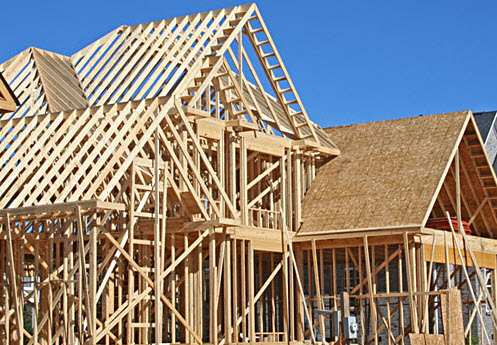 Of the many issues affecting the Fire Service, the prevailing challenge that has a pronounced impact on operational safety is the assimilation of engineered structural systems (ESS) into mainstream building design and construction. The presence of engineered structural systems (ESS) are no longer considered to be an innocuous feature in a given building or occupancy; it is the predominate feature in nearly all current construction, renovation and adaptive reuse or infill applications. It has become far more than just concerning ourselves with the presence of a simple light-weight or “engineered” truss roof system or a wood I-beam floor assembly.
There is a new lexicon of building construction components and systems that must be added to your operational safety vocabulary and incident action plans. There is a new terminology, applications and a knowledge base to learn that will support operational excellence and support the integrity of incident safety performance of companies and personnel. Do you know what they represent and how these components, assemblies and systems may affect or influence an incident?
The fire service continues to apply the term “light weight construction” to a wide variety of building construction and systems. This expression has become a miss-application of both term and the correlation of risk and severity related to operational profiling. In other words, we apply and express the use of “light weight construction” for all types of engineered components, systems, designs and assemblies in nearly all types of building construction and occupancy use. Although the roots of the term can be traced back to the early 1980′s, and its application to the (then) emerging use of trussed roofing systems and the advent of wood I-beam floor supports (sans solid dimensional lumber joists), the use of the terminology in today’s context of risk assessment, strategic and tactical management and deployment models and within the context of incident operational tactics is no longer applicable, valid or suitable. It must be expanded into a more specific and descriptive level of classification and correlation.
For the most part, when discussing buildings and occupancies, aside from classifications related to code type or class as an element of fire resistance; the emphasis has been to differentiate between conventional and engineered construction, and the application of the term “light weight construction”. I continue advocating and promoting through my lectures that it’s much more than this when looking at the spectrum of construction and the structural anatomy of buildings. Current and past generations of buildings, construction and occupancies can be more accurately differentiated and classified within six (6) expanding categories in the following Building Construction Systems;
- Heritage: Pre-1879
- Legacy: 1880-1944
- Conventional: 1945-1964
- Light Weight: 1965-1995
- Engineered: 1996-2009
- Blended Engineered: 2010-
We’ll discuss these six classifications in greater details in future postings here and expand the level of details on the CommandSafety.com and Buildingsonfire.com sites. Our current generation of buildings, construction and occupancies are not as predictable as past “conventional” construction, therefore risk assessment, strategies and tactics must change to address the advancement of new rules of combat structural fire engagement. But if you don’t understand or know what and how those changes in predictability have occurred, you may be operating with a false sense of operational risk and safety margin.
It’s a Lot More than just talking about “Light Weight” Construction….
- From Plywood-CDX….to
- Particle Board- PB…..to;
- Orient Strand Board-OSB
- Structural Composite Lumber- SCL
- Laminate Strand Lumber- LSL
- Laminate Veneer Lumber-LVL
- Structural Insulated Panels-SIP
- Parallel Strand Lumber-PSL
- Machine Stress Rated Lumber- MSR
- Medium Density Fiberboard-MDF and MDL (Lumber)
- Finger Jointed Lumber-FJL
- Adhesives…..
Do some research and check these terms out for starters. We’ll talk more about these components and assemblies in the near future. So get busy on your down time today over the next few days and discover the implications these components may have in your community….
Here’s a link to a past informative posting related to engineered systems and their relationship to firefighter safety and operations, HERE. There’s some great contributed information and manufacturer “insights” on the subject engineered wood I-joists and beams and firefighter safety. There are some interesting statistical extrapolations, correlations and conveniences’ that attempt to make the case. But then again, You be the judge. Take at look at the presentation developed by the American Forest and Paper Association, HERE and HERE.
If you haven’t done so yet, don’t forget to check out the free online training program on Structural Stability of Engineered Lumber in Fire Conditions at the UL University developed and provided by Underwriter’s Laboratories (UL), HERE
Here’s a series of other important Reference Links that provide some insights on operational safety, incident conditions and factors and the lessons-learned from a number of LODD events;
NIOSH Publication No. 2009-114: Preventing Deaths and Injuries of Fire Fighters Working Above Fire-Damaged Floors HERE
NIOSH Publication No. 2005-132: Preventing Injuries and Deaths of Fire Fighters Due to Truss System Failures HERE
Volunteer Deputy Fire Chief Dies after Falling Through Floor Hole in Residential Structure during Fire Attack—Indiana, HERE
First-floor collapse during residential basement fire claims the life of two fire fighters (career and volunteer) and injures a career fire fighter captain – New York, Report HERE
Career Fire Fighter Dies After Falling Through the Floor Fighting a Structure Fire at a Local Residence – Ohio, HERE
Colerain Township, Ohio Double LODD Preliminary Report, HERE
Career engineer dies and fire fighter injured after falling through floor while conducting a primary search at a residential structure fire – Wisconsin, HERE
NFPA Report on Light Weight Construction, HERE
Informative USFA Coffee Break series postings related to Building Types & Fire Resistance: HERE. HERE, HERE, HERE, and HERE
The post The New Lexicon and Challenges first appeared on Buildingsonfire.com.
]]>The post Four Alarm Fire Apartment Complex Under Construction (NJ) first appeared on Buildingsonfire.com.
]]>A massive fire ripped through a condominium complex under construction in Rahway N.J., early Tuesday.
The four-alarm fire started around 1:30 a.m. at the vacant multi-story building along Route 27.
Rahway Fire Chief Bill Young said five area engine companies were called to help combat the surging flames. Given the intensity of the fire, the department let it burn itself out since it’s too dangerous for firefighters to get inside the structure.
Authorities said the blaze was under control by 10:30 a.m. No injuries were reported.
The wind carried smoke to the neighboring towns of Elizabeth and Linden. NBCNewYork crews could smell it when they got off the Turnpike en route to the scene.
Route 27 was closed for hours between Hazelwood and West Grand Avenue, according to the Department of Transportation‘s traffic website.
Firefighters have extinguished a blaze in Rahway that destroyed a soon-to-be-completed apartment complex.
St. Georges Avenue (Route 27) has been reopened to traffic, and ladder trucks have pulled away from the building. Several state and county arson units remained at the scene as of 1:30 p.m., as well as fire dogs.
The fire, which was reported around 1:30 this morning at the unoccupied building on St. Georges Avenue (Route 27), consumed the block-long building, said David Taylor, a battalion chief with the Rahway Fire Department.
Four-alarms were sent out to summon additional help in trying to quell the flames, which punched through the roof of the building and spewed a dark black smoke into the air, Taylor said.
There were reports of worried residents in towns as far away as Elizabeth calling 911 when they smelled the smoke.
But the help of some 100 or more firefighters and the equipment they brought — from 10 departments — was not enough to control the conflagration as the crews chased the flames from one section of the pre-fab building to the next, Taylor said.
At one point this morning, as news helicopters hovered above, commanders ordered the hoses turned off and hoped the remaining fire would start to sputter out. By 9 a.m., the fire had been knocked down, but it’s still expected to take the rest of the day to eliminate hot areas, Taylor said.
There’s no known cause yet. Union County and the state fire officials will be on scene today trying to determine how the fire started and whether it is suspicious.
“The good thing is it was unoccupied,” and no firefighters reported injuries, Taylor said
Firefighters battle an apartment complex fire in Rahway. gallery (5 photos)

The post Four Alarm Fire Apartment Complex Under Construction (NJ) first appeared on Buildingsonfire.com.
]]>The post Near-Misses, Maydays and Floor Collapses first appeared on Buildingsonfire.com.
]]>
- Do you know what’s underneath you as you’re making entry?
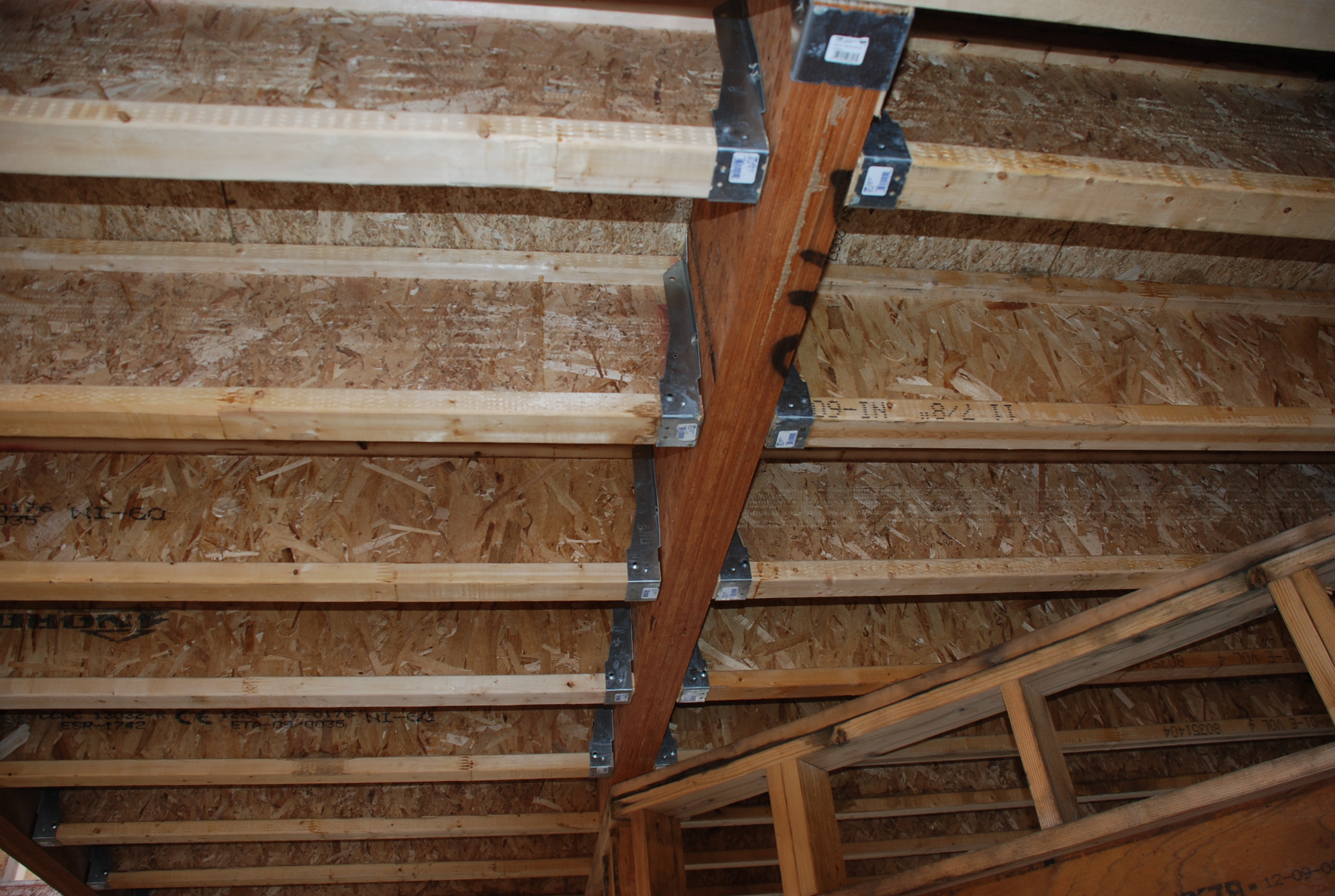
If you’ve been paying attention to the latest news and on the job reports these past few days, you may have noticed there’s been an emerging trend evident in near miss, close-calls resulting in maydays, RIT deployments and self-rescue resulting from floor compromise and floor collapse.
As I was doing some research and posting links related to the first one or two events on Buildingsonfire on Facebook, HERE, it became evident that there was an immediate opportunity to get some learning’s and insights out. If you have a chance head over to Facebook and link into Buildingsonfire and check out the incident links posted as well as some immediate report links.
I’ll plan to develop some operational safety and awareness insights related to building construction, floor systems and operational integrity in the next few days. I’ll get a comprehensive list of events and incident parameters compiled and posted also.
In the meantime here are some links I pulled together that you should take the time to read and share with your companies, personnel and staff…..
This seems like a good time to have a ten minute drill on these events as Operating Expeeince (OE) on floor systems and operational safety.
Reference Links for Operational Insights and Operating Experience (OE)
- Eleven Minutes to Mayday; What You Need to Know
- Career Engineer Dies and Fire Fighter Injured After Falling Through Floor While Conducting a Primary Search at a Residential Structure Fire – Wisconsin
- Volunteer deputy fire chief dies after falling through floor hole in residential structure during fire attack – Indiana
- A career captain and a part-time fire fighter die in a residential floor collapse – Ohio
- Career fire fighter dies after falling through the floor fighting a structure fire at a local residence – Ohio
- Career lieutenant dies following floor collapse into basement fire and a career fire fighter dies attempting to rescue the career lieutenant – New York
- Floor collapse at commercial structure fire claims the lives of one career lieutenant and one career fire fighter – New York
- First-floor collapse during residential basement fire claims the life of two fire fighters (career and volunteer) and injures a career fire fighter captain – New York
- NIOSH Alert: Preventing Injuries and Deaths of Fire Fighters due to Truss System Failures
- NIOSH Alert: Preventing Injuries and Deaths of Fire Fighters due to Structural Collapse (1999)
- Preventing Deaths and Injuries of Fire Fighters Working Above Fire-Damaged Floors
- CommandSafety.com: Operational Safety at Basement Fires: Close Call
- CommandSafety.com: Buffalo, NY Three Alarm Fire and Double LODD Report
- CommandSafety.com: Remembering Brackenridge 1991 Floor Collapse and LODD
- CommandSafety.com: Engineered Structural Systems- Hazards
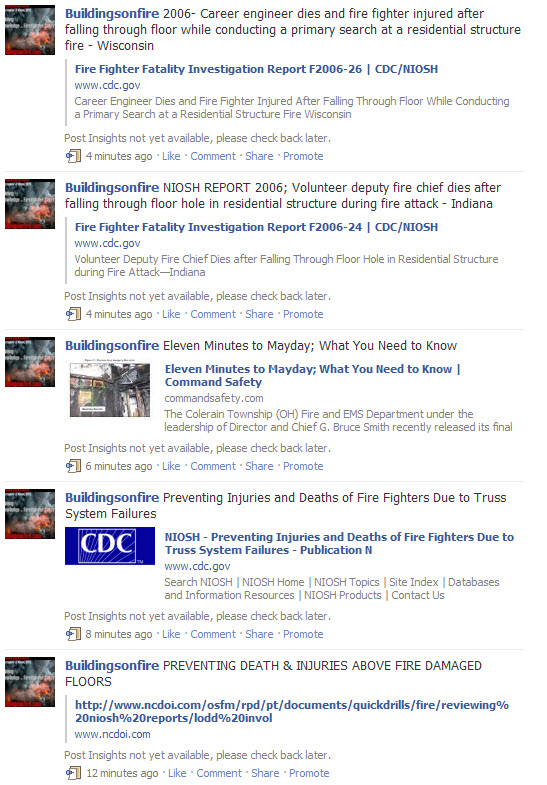
Here’s some screen shots from Buildingsonfire on Facebook. Go HERE or follow the link at the Home Page. Join the growing list of 3500 fans with Buildingsonfire on Facebook and Buildingsonfire.com

The post Near-Misses, Maydays and Floor Collapses first appeared on Buildingsonfire.com.
]]>