Things like classes and assignments and credentials are the least valuable things about higher education. They're all relatively recent inventions and were developed in order to accommodate mass education. Rather than re-litigate that argument, however, I want to focus on what's good about higher education. What's worth preserving that will carry on even in the age of artificial intelligence? Here are a few thoughts.
See also on [Original Location] [This Post]]]>
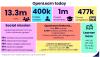
Andy Lane offers his reflections on 20 years of the Open University's OpenLearn project, from its beginnings as a Hewlett-funded initiative influenced by things like Creative Commons and MIT OpenCourseWare through to its current status as a fixture of the university. What stands out to me is how much OpenLearn depended on continued funding and support from the University, and how other initiatives with less consistent and stable support were not able to achieve the same success. That said, what also emerges is the long-term impact sharing learning resources has had on the wider community. I would also like to see him expand on his comment that "the report on OER policies I linked to earlier proposed that the MOOC movement severely hindered the OER movement."
Web: [Direct Link] [This Post]]]>
I was never part of Zine culture, though if I had ever been exposed to them I would no doubt have picked up the trend - after all, in grade school, I did write and print my own local newspaper, 'The Eagle Report', which I tried to sell in local stores (I loved eagles and birds generally; still do). Anyhow, Zines are having a moment - Doug Belshaw sold out his first limited print run, and Creative Commons celebrated its 25th anniversary with a 28 pager. In this post Alan Levine also links to one in the classic style from Becky Chambers along with her 8-page single sheet Zine template (I have no idea where I'd find a printer for paper that size).
Web: [Direct Link] [This Post]]]>
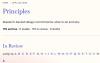
This is "a persistent, LLM-maintained knowledge base for learning design" containing sections (a.k.a. 'knowledge types') on "principles, elements, patterns, designs, products and programmes, strategies, design processes and methods, research methods, theories, learner variables, and empirical claims." It's in a very raw state: "models wrote this wiki, and no person has yet checked any page." Still, in broad strokes, it reflects the state of the literature, and the literature is messy: 170 principles, 1360 theories, 26495 claims. No doubt a first pass could reduce this number somewhat, but it's no wonder there's no real progress in learning time when just about every paper starts anew with a revision of the basics.
Web: [Direct Link] [This Post]]]>

The DS 106 Daily Create has been running non-stop since 2012. The idea is simple: post a creativity prompt once a day and a hashtag people can use to identify their contributions, aggregate them, and enjoy. It started as a Twitter thing but migrated some time ago to the Fediverse. You can follow it here. In this post Alan Levine reintroduces the Daily Create and talks about how he spent 25 minutes over breakfast making Friday's. What I like is that I can picture it as though it were myself - though I don't contribute at all regularly to the Daily Create (it's more like once in a blue moon) I nonetheless identify with the idea of waking up in the morning and spending the day creating. That is what I do, and it is to me a good way to live my life.
Web: [Direct Link] [This Post]]]>

I think of this often in the sense that I wonder whether people around me can know or understand what I'm thinking about. My conclusion is that they most certainly cannot. But if we don't share thoughts with each other how can we even communicate? This is a good discussion, and I align (more or less) with Kit Fine's suggestion that "communication is not really a matter of thought identity, but thought coordination. What matters is not the intrinsic properties of two people's thoughts or the extent to which those are the same. What matters is how those thoughts are related. For instance, treating our thoughts as if they are about the same things often suffices for understanding and joint behaviour."
Web: [Direct Link] [This Post]]]>

I wouldn't say journalism is for everyone - it takes a certain skill to approach a stranger and ask them to give you information, even if you are backed by press credentials. That said, my experience in student journalism meant the world to me and the fact that I have a career at all is a testament to the skills and attitudes it helped me acquire. And that's what's described here: "In our classroom-turned-newsroom, students analyze information, verify facts and consider different viewpoints for every story they publish. They wrestle with ethical dilemmas, use their own judgement and write their own copy. " There's one big difference, though. My journalism experience was voluntary, not part of a course or class, and not something managed by a teacher or professor. We - the students - ran the newspaper ourselves. This included not only writing and reporting, but layout and design, advertising, financial management, even office supplies and printing contracts. It makes a difference.
Web: [Direct Link] [This Post]]]>
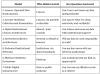
This post introduces us to something called LearnKit. The white paper describes it as follows: "LearnKit is a learner-centered data infrastructure designed to give individuals access to, control over, and the ability to act on their own learning data across K-12, postsecondary education, and the workforce." The work is credited to a Gates Foundation initiative authored by Karen Cator, Valerie Greenhill, and Sharon Leu, but I can't find that anywhere online. The white paper is very high level (by contrast I've spent all days in the weeds looking at digital signing, authentication and decentralized identity protocols, including the W3C's verified credentials data model (hey, we each pick our own interests in our retirement)).
Web: [Direct Link] [This Post]]]>

Michael Geist writes of a federal committee that "considered two potential bans, one on targeted ads for kids and the other on underage access to social media. The committee recommended the ad ban and stopped short of the social media one, but the government reversed the approach, declining the ad ban while legislating the social media ban for under-16s." I would also favour an ad ban, but it's tricky. There isn't really a difference in principle between an ad directed at kids, and the manipulation of an algorithm to direct certain sorts of messages to kids. Advertising doesn't have to be (and often isn't) simply "buy this" or "you need that". A lot of it is aimed at self-image, perceptions, lifestyles and choices. The way an online gambling company, say, might want to normalize betting on sports.
Web: [Direct Link] [This Post]]]>
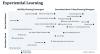
This is just a preview of a concept for an upcoming article, and normally I would just wait for it, but I think this 'experiental learning map' is worth sharing, even though it's still in draft form (illustrated). I probably wouldn't place specific products (especially 'pro editions') intop a map like this. And I think that the range of experiental learning is a lot more broad than the obvious workplace focus informing this current version. The two axes makes some sense - the 'human vs simulation' on the y axis is clear, though the 'training vs growing' needs some sharpening. Terms like 'executive' and 'heroic tribes' don't really belong on axes names. Maybe something like 'predefined vs chaotic' might better reflect the range. Still, I think this is a good time to be thinking about what experiential learning looks like and how we can describe what we're bulding.
Web: [Direct Link] [This Post]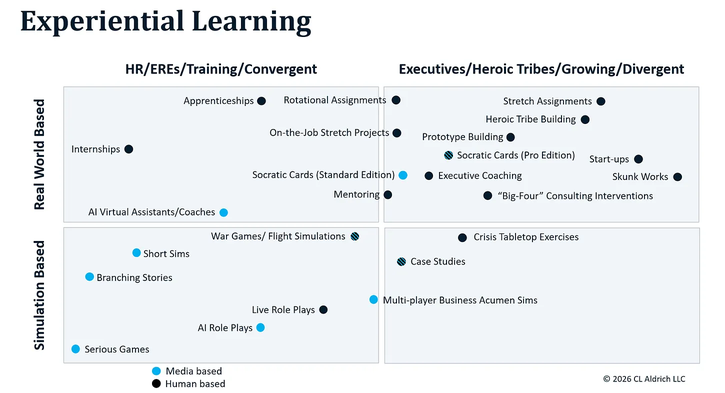
]]>

This article criticizes the depiction of the world in terms of a global North and South as too simplistic. "While it is well documented that European colonialism, Euro-American neo-colonialism and coloniality have created and continue to maintain structural global inequalities and inequities across the globe, the world cannot be seen, at least not anymore, only through the lens of Northern wealth and Southern poverty." The authors don't recommend a specific alternative framing, but they do suggest "two possible gestures" instead: "understanding identities of humans as dynamic and fluid rather than fixed and stagnant aligns with the understanding of the North and South as complex, nuanced and changing categories," and "the 'idea of a global subaltern' that transcends the North–South binary and works towards the creation of a more just world for all."
Web: [Direct Link] [This Post]]]>
This is "a modern fully open-source textbook exploring why and how deep neural networks learn compact and information-dense representations of high-dimensional real-world data." It's a daunting read - and to be honest, I gave the first chapter a careful read but have only skimmed the rest (though it's now on my virtual bookshelf for future reference). I think people who are serious about understanding how we learn and how machines emulate this should at the very least read that first chapter. It contains what is to my understanding an accurate history of artificial intelligence (including the important early work in computation, cybernetics, and information theory). The aim of the book is to give us a framework that explains how neural networks work to generate intelligence. They authors write, "intelligence is not about collecting all informative data in advance and training a model to memorize their (low-dimensional) distribution. Instead, it requires computational mechanisms that can continuously improve current knowledge of the distribution and acquire new information when needed. A fundamental characteristic of any intelligent being or system - whether an animal, a human, a civilization, or the entire scientific community - is the ability to continuously improve or gain new information or knowledge on its own."
Web: [Direct Link] [This Post]]]>
Wendy Palmer comments on Accredible's State of Credentialing report which argues, among other things, that "Credentialing programs have entered an accountability era. As expectations rise, organizations are increasingly expected to demonstrate the impact of their programs - not just issue credentials." She picks up on that point to explore "how we measure the value of digital credentials, and whether the measures we're using really tell us what we need to know about their quality and impact." She asks, "are we conflating the quality of the learning experience with the quality of the credential that represents it?" After all, "they aren't quite the same thing. A course might be exceptionally well designed, delivered and assessed. It might meet every institutional quality standard. Yet the credential issued at the end often simply says that someone successfully completed the course. What does that communicate to an employer." Via Doug Belshaw.
Web: [Direct Link] [This Post]]]>