Advertise with Googlier.com Centre for Study of Society and Secularism https://csss-isla.com csss-isla.com Fri, 11 Sep 2026 09:05:30 +0000 en hourly 1 https://wordpress.org/?v=5.2.18 https://csss-isla.com/wp-content/uploads/2019/06/cropped-logo_icon_retina-32x32.png Centre for Study of Society and Secularism https://csss-isla.com 32 32 The Place of Muslim Women: Faith, Public Participation and the Question of Equality https://csss-isla.com/institute-of-islamic-studies-iis/the-place-of-muslim-women-faith-public-participation-and-the-question-of-equality/ https://csss-isla.com/institute-of-islamic-studies-iis/the-place-of-muslim-women-faith-public-participation-and-the-question-of-equality/#respond Fri, 11 Sep 2026 09:05:29 +0000 https://csss-isla.com/?p=4891 View Post

The post The Place of Muslim Women: Faith, Public Participation and the Question of Equality appeared first on Centre for Study of Society and Secularism.

]]>

Farhat Khan[i]

11/09/2026

The problem of the status of Muslim women in society has again emerged as a topic of discussion after the statement of Kerala’s Sunni cleric Kanthapuram A.P. Aboobacker Musliyar that women should stay at home and not claim public spaces or even participate in public religious events. The statement has been criticised by various political figures and once again brought the question of women’s participation in public spaces into discussion. (Source)

But when we look at the lives of Muslim women themselves, the picture is not so simple. Muslim women have entered public life in many different ways and have occupied spaces that were once considered unimaginable for them. Bangladesh, for example, has had Khaleda Zia and Sheikh Hasina as Prime Ministers.

There are also women like Begum Rokeya Sakhawat Hossain, who came from what was then Bengal and is now Bangladesh. She grew up in a conservative Muslim family where she herself did not receive formal schooling, yet she went on to become a writer, educationist and social reformer. In 1911, she established the Sakhawat Memorial Girls’ School in Calcutta for Muslim girls and spent years working to make education accessible to them. She also organised Muslim women and worked for their education and economic independence.

Another example is Sania Mirza, one of India’s most successful women tennis players. A Muslim woman who entered a sport where women were still fighting for acceptance, she became India’s first woman to win a WTA singles title and later became the first Indian woman to win a Grand Slam title. Her career also brought questions about her clothing, her religion and whether playing tennis was compatible with being a Muslim woman. Yet she continued to play, compete and occupy a space that was very much in the public eye. Her journey is another example of a Muslim woman defining her own place in public life rather than allowing others to define it for her.

These examples matter to me because they show that the question is not simply about whether Muslim women can enter public spaces. Muslim women already have. They have entered politics, education, social reform, sports and public life in different ways and in different periods of history.

I think about this particularly because of my own experience working with Muslim girls at Parcham.

I come from a conservative family myself, so I understand that restrictions on girls do not always come in the form of someone explicitly saying, “You cannot do this.” Sometimes they come through expectations. Through what is considered appropriate. Through what a girl is supposed to wear, where she is supposed to go, how late she can stay outside, what kind of people she can interact with and what kind of life she is expected to have.

At Parcham, I worked with Muslim girls through football. I remember a girl who wore a burkha and played football. She stepped onto the same playground as everyone else and played the game. Slowly, she became comfortable enough to play in shorts and pants as well. To someone looking from outside, it may simply look like a girl playing football. But for her, there was much more happening. She was claiming a space.

She was not being asked to give up being Muslim in order to play football. She was simply discovering that being Muslim did not have to mean that she could not play football.

I saw similar changes in many of the girls I worked with. Girls who were initially hesitant slowly became more confident. They started speaking up, travelling, taking responsibility, playing, leading and making decisions for themselves. And becoming first licensed women football coaches in Mumbra.

This is why the phrase “public space” means something very personal to me. A public space can be a parliament. It can be a classroom. It can be a workplace. It can also simply be a football ground.

And sometimes, for a girl who has grown up being told where she can and cannot go, stepping onto that ground is already a significant act.

This brings me back to what Islam itself says about women and their place in society.

I thought it would be interesting to look at what the Quran itself has to say. Because whenever the question of Muslim women arises, the entire discussion revolves around modesty, hijab and restrictions. But the Quran also speaks of equality, responsibilities and morals, and it talks about both men and women.

The first verse I want to quote is Chapter 49, Verse 13:

“O mankind! We created you from a single pair of a male and a female, and made you into nations and tribes so that you may know one another, not so that you may despise one another. Truly, the most honored of you in the sight of Allah is the one who is the most righteous among you. And Allah has full knowledge and is well aware of all things.”

What I understand from this verse is that Allah has created both men and women, and the difference between them is not presented as a basis for superiority. The Bible describes Eve as being created from Adam’s rib, while the Quran speaks of the creation of a male and a female as a pair. For me, this is significant because it presents men and women as having a shared origin rather than placing one above the other. The verse says that the most honoured in the sight of Allah is the one who is most righteous. It does not say that a man is more honoured than a woman simply because he is a man. If men and women are equal in their worth before Allah, then there is no basis for denying women the same opportunities and access to public spaces as men.

Then there is Chapter 33, Verse 35:

“For Muslim men and women, for believing men and women, for devout men and women, for true men and women, for men and women who are patient and constant, for men and women who humble themselves, for men and women who give in charity, for men and women who fast, for men and women who guard their chastity, and for men and women who engage much in Allah’s praise – Allah has prepared forgiveness and a great reward for them.”

It repeatedly mentions both men and women. The expectations are the same and the reward that Allah promises is the same as well. It is remarkable that the Quran, revealed more than 1,400 years ago, addressed men and women together in this way, recognising their equal responsibilities and rewards. Even today, this remains a powerful message about equality between men and women. If the Quran itself addresses both together, there is no reason to question women’s equal place and participation in society.

Another verse that often comes up when we discuss Muslim women is Chapter 24, Verse 31:

“And say to the believing women that they should lower their gaze and guard their modesty; that they should not display their beauty and ornaments except what (must ordinarily) appear thereof; that they should draw their veils over their bosoms and not display their beauty except to their husbands, their fathers, their husbands’ fathers, their sons, their husbands’ sons, their brothers or their brothers’ sons, or their sisters’ sons, or their women, or the slaves whom their right hands possess, or male servants free of physical needs, or small children who have no sense of the shame of sex; and that they should not strike their feet in order to draw attention to their hidden ornaments. And O ye Believers! turn ye all together towards Allah, that ye may attain Bliss.”

The verse asks believing women to lower their gaze and observe modesty. I mention this because a similar instruction is also given to believing men, asking them to lower their gaze and observe modesty, reflecting the Quran’s emphasis on equality in expectations for both men and women. The verse also mentions the people before whom women are not required to conceal their beauty. This is important because it shows that women would be going beyond these close relationships and interacting with others outside the home. The instruction, therefore, is about how women should conduct themselves in public and around others, not about preventing them from entering public spaces.

 And if we look at Islamic history, women were not absent from public life.

Al-Shifa bint Abdullah is traditionally said to have been given responsibilities by Caliph Umar ibn al-Khattab to oversee the marketplace in Medina. This was a public responsibility and an important one.

Then there is Hazrat Aisha. She was actively involved in the political developments of her time and played a leading role in the Battle of the Camel. A woman being at the centre of such a major political and military event in early Islamic history itself shows that women were not simply expected to remain within the home.

The girls I worked with at Parcham taught me something very simple about this. Freedom does not always look dramatic. Sometimes it looks like a girl entering a football ground for the first time. Sometimes it looks like her deciding what she wants to wear while playing. Sometimes it looks like speaking in front of a group, travelling somewhere on her own, taking responsibility for a team or simply realising that she is capable of doing something she had never imagined herself doing.

For me, that is what claiming public space is really about.

It is not about making Muslim women behave like someone else’s idea of a “modern woman”. It is not about telling them to abandon their faith, their families or their traditions. It is about making sure that faith is not used as a reason to take away their ability to participate, contribute and make choices about their own lives.

Muslim women have been teachers, writers, scholars, political leaders, activists, athletes and community workers. They have been present in public life long before this particular debate began. The question, therefore, is not whether Muslim women belong in public spaces. They already do.

The more important point is that their presence does not make them any less Muslim.

I would like to conclude this article with a beautiful poem by Shehnaaz Shaikh of Awaaz-e-Niswan, titled मैं अच्छी हूँघबराओ नको.” The poem beautifully captures a woman stepping outside her home, taking responsibility for her family and community, and reassuring those at home that they do not need to worry about her.

Source: (Youtube)

मैं अच्छी हूँघबराओ नकोऐसा ख़त में लिखो।
कोणी मेल्याने ने तुझको लिखामैं निकली रोड पर।
अगर तुझको शक है मुझ परनहीं निकलूँगी बाहर।
मैं पानी को जाऊँ के नकोऐसा ख़त में लिखो।
बाबा को आया बुखारखाँसीप्राइवेट में गई उसको लेकर।
सौ रुपये लियेइंजेक्शन दियाअसर नहीं हुआ बच्चे पर।
मैं JJ को जाऊँ के नकोऐसा ख़त में लिखो।

___

Farhat Khan is a programme coordinator at Centre for Study of Society and Secularism[i]

The post The Place of Muslim Women: Faith, Public Participation and the Question of Equality appeared first on Centre for Study of Society and Secularism.

]]>
https://csss-isla.com/institute-of-islamic-studies-iis/the-place-of-muslim-women-faith-public-participation-and-the-question-of-equality/feed/ 0
28th Dr.Asghar Ali Engineer Memorial Lecture https://csss-isla.com/featured/28th-dr-asghar-ali-engineer-memorial-lecture/ https://csss-isla.com/featured/28th-dr-asghar-ali-engineer-memorial-lecture/#respond Thu, 10 Sep 2026 11:06:18 +0000 https://csss-isla.com/?p=4883 View Post

The post 28th Dr.Asghar Ali Engineer Memorial Lecture appeared first on Centre for Study of Society and Secularism.

]]>

Video link


The post 28th Dr.Asghar Ali Engineer Memorial Lecture appeared first on Centre for Study of Society and Secularism.

]]>
https://csss-isla.com/featured/28th-dr-asghar-ali-engineer-memorial-lecture/feed/ 0
Dr. Asghar Ali Engineer Memorial Lecture on”Gandhi’s Faith, and Ours” by Dr. Ramachandra Guha https://csss-isla.com/memorial-lectures/gandhis-faith-and-ours/ https://csss-isla.com/memorial-lectures/gandhis-faith-and-ours/#respond Mon, 24 Aug 2026 09:22:29 +0000 https://csss-isla.com/?p=4868 View Post

The post Dr. Asghar Ali Engineer Memorial Lecture on”Gandhi’s Faith, and Ours” by Dr. Ramachandra Guha appeared first on Centre for Study of Society and Secularism.

]]>

I speak of what faith meant to Gandhi, how he sought to rid his inherited Hinduism of its pervasive hierarchies, how he cultivated a remarkable range of friendships across the boundaries of religion, and finally, of how he worked ceaselessly to build trust between India’s two largest religious communities, Hindus and Muslims”, said Dr. Ramachandra Guha who was delivering the 28th Dr. Asghar Ali Engineer Memorial Lecture titled “Gandhi’s Faith, and Ours”, at the Constitutional Club in Delhi on 22nd August, 2026. Dr. Guha is an eminent historian and author who has contributed seminal work on Gandhi. The Lecture was chaired by Dr. Purushottam Agrawal who is an author of repute and former bureaucrat. The prestigious Dr. Asghar Ali Engineer Memorial Lectures, organized by the Centre for Study of Society and Secularism, take place annually- one in Delhi and another in Mumbai.
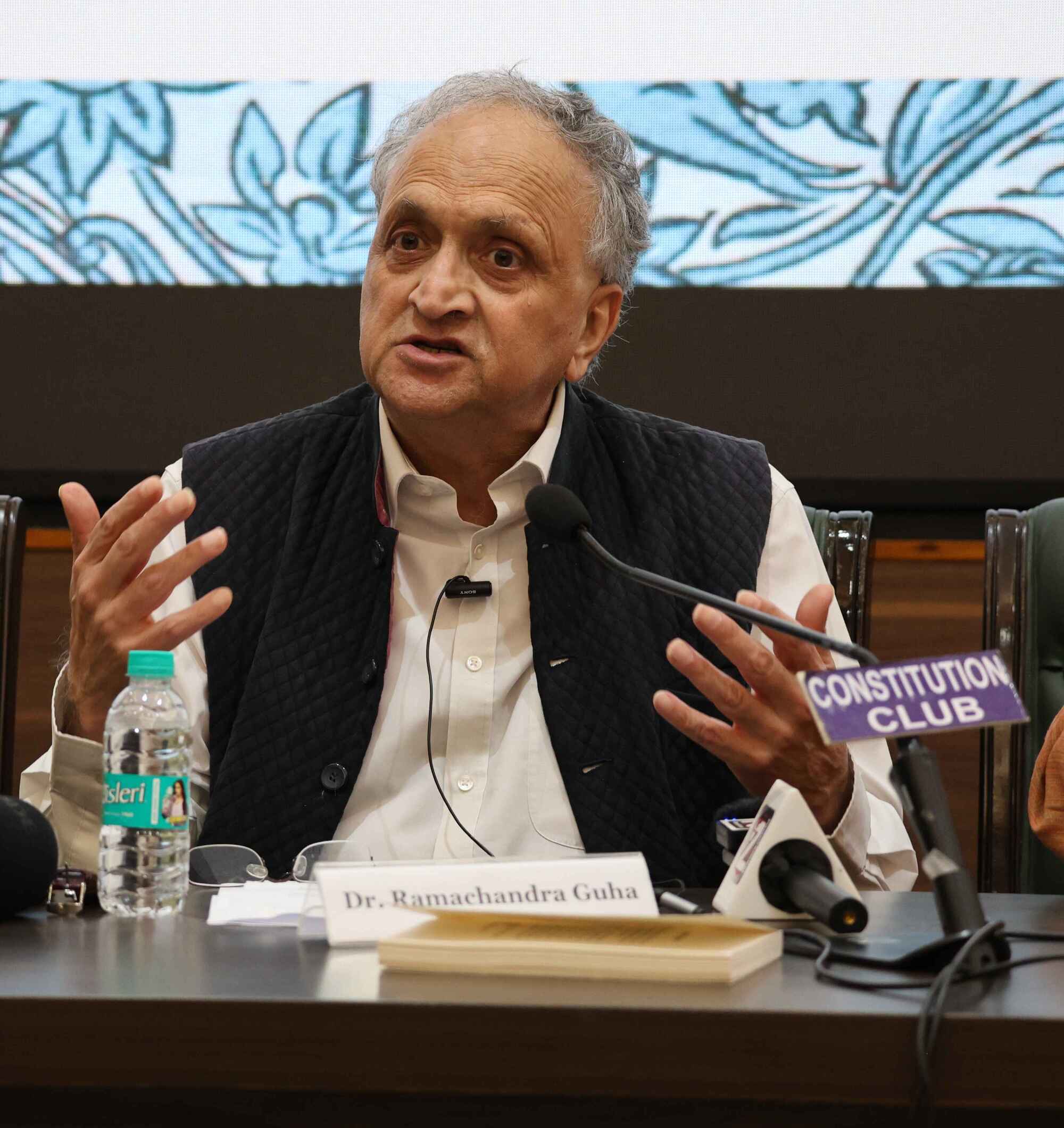
Dr. Guha at the Memorial Lecture also examined the opposition to the ideas of Gandhi by religious fundamentalists on the one side and secular socialists on the other. The Lecture ended by talking of the enduring relevance of Gandhi’s ideas to the world we live in today.
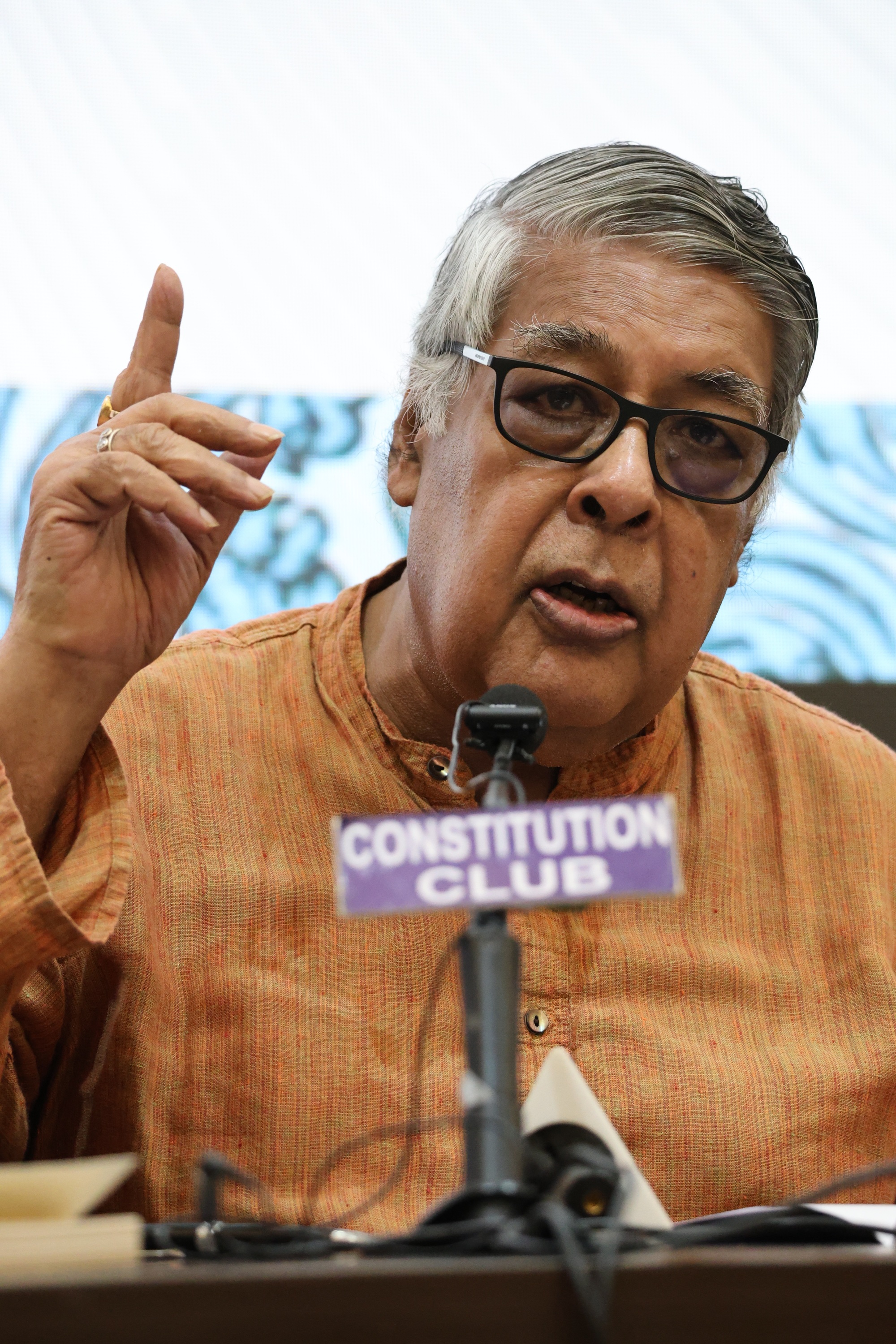
 

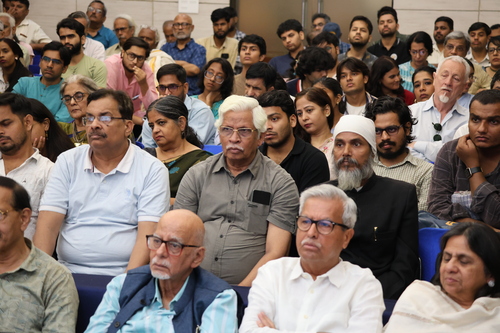
Dr. Purushottam Agrawal also resonated with the need to revisit Gandhi and his ideas in the polarized society we live in today. The Lecture was attended by over 200 participants, prominent intellectuals, historians, journalists, students and had a round of lively questions and answers. A vote of thanks was proposed by Adv. Irfan Engineer, the Director of CSSS.


Video link

The post Dr. Asghar Ali Engineer Memorial Lecture on”Gandhi’s Faith, and Ours” by Dr. Ramachandra Guha appeared first on Centre for Study of Society and Secularism.

]]>
https://csss-isla.com/memorial-lectures/gandhis-faith-and-ours/feed/ 0
Invitation for 28th Dr. Asghar Ali Engineer Memorial Lecture by Dr. Ramachandra Guha https://csss-isla.com/uncategorized/invitation-for-28th-dr-asghar-ali-engineer-memorial-lecture-by-dr-ramachandra-guha/ https://csss-isla.com/uncategorized/invitation-for-28th-dr-asghar-ali-engineer-memorial-lecture-by-dr-ramachandra-guha/#respond Thu, 06 Aug 2026 07:06:24 +0000 https://csss-isla.com/?p=4842 View Post

The post Invitation for 28th Dr. Asghar Ali Engineer Memorial Lecture by Dr. Ramachandra Guha appeared first on Centre for Study of Society and Secularism.

]]>

Dear Sir/Madam,

Greetings from CSSS!

We are pleased to invite you to the 28th Dr. Asghar Ali Engineer Memorial Lecture organized by the Centre for Study of Society and Secularism on 22nd August 2026 at 5:00 PM at Speaker Hall, Constitution Club of India, Vithalbhai Patel House, Rafi Mag, New Delhi – 110001.

Kindly register at the given link before 17th August 2026

https://docs.google.com/forms/d/e/1FAIpQLSf4_8RXzYO8E4oZR2mes8B3-POSQP_uhFVD9lAnpjbirE-9tQ/viewform?usp=publish-editor


Topic of the lecture: “Gandhi’s Faith, and Ours

Speaker:  Dr. Ramachandra Guha, Historian and Author

Chair: Dr. Purushottam Agrawal, Author and Academician

We would be delighted if you could join us for High Tea at 5.00 PM.


Kind regards,

Irfan Engineer,

Director,

Centre for Study of Society and Secularism

E-mail: csss2work@gmail.com, csss.mumbai@gmail.com


The post Invitation for 28th Dr. Asghar Ali Engineer Memorial Lecture by Dr. Ramachandra Guha appeared first on Centre for Study of Society and Secularism.

]]>
https://csss-isla.com/uncategorized/invitation-for-28th-dr-asghar-ali-engineer-memorial-lecture-by-dr-ramachandra-guha/feed/ 0
Fact Finding Report – Communal Tensions Surrounding Bakri Eid at Mira Road, Maharashtra, May 2026 https://csss-isla.com/fact-finding-reports/fact-finding-report-communal-tensions-surrounding-bakri-eid-at-mira-road-maharashtra-may-2026/ https://csss-isla.com/fact-finding-reports/fact-finding-report-communal-tensions-surrounding-bakri-eid-at-mira-road-maharashtra-may-2026/#respond Thu, 06 Aug 2026 05:32:59 +0000 https://csss-isla.com/?p=4849 View Post

The post Fact Finding Report – Communal Tensions Surrounding Bakri Eid at Mira Road, Maharashtra, May 2026 appeared first on Centre for Study of Society and Secularism.

]]>

(Part – I)

Communal Polarisation in Mira Road

Irfan Engineer & Neha Dabhade

06/08/2026

Introduction

The Mira Road/Mira-Bhayander suburb of the Mumbai Metropolitan Region has emerged as communally sensitive area in the recent past. The area was recently in news for the communal tensions that took place on account of Bakri Eid. It has witnessed communal tensions and polarization even before this recent incident. However, in order to understand these tensions in this area, it would be helpful to look at the background and the evolution of this area.

  1. The Demographic Origins of Mira Road and Naya Nagar’s “Ghetto” Designation

Mira road emerged as a locality not very long ago. The rising rates of real estate in Mumbai, the aspirations of the middle-income group, labourers, young couples to own a shelter made Mira Road viable and transformed it into a growing real estate haven. The connectivity with local trains also helped the process along with the keen interest taken by the Builders/ developer lobby in this area which saw lucrative opportunities in burgeoning real estate in this area. One of the aspects of emergence of this area can be attributed also to communal riots in Mumbai. As is the case in other parts of India, after communal riots and subsequent displacement- voluntary or involuntary, the Muslims were pushed into newer localities, leading emergence of “ghettos”. Naya Nagar in Mira Road is one such areas in Mumbai.

According to Census data of 2011, Hinduism is majority religion in Mira and Bhayander city with 68.96 % followers. Islam is second most popular religion in city of Mira and Bhayander with approximately 16.28 % following it. In Mira and Bhayander city, Christianity is followed by 6.01 %, Jainism by 5.67 %, Sikhism by 0.53 % and Buddhism by 1.86 %. Around 0.14 % stated ‘Other Religion’, approximately 0.54 % stated ‘No Particular Religion’.

The characterisation of Naya Nagar as a Muslim enclave is best understood as a consequence of post-riot migration patterns rather than a recent or unilateral phenomenon. Following the 1992–93 Bombay riots, a substantial number of Muslim families from South Central and Central Mumbai relocated to Naya Nagar, a trend reinforced by rising property prices in the city core; concurrently, Hindu residents who secured better economic opportunities elsewhere gradually moved out, consolidating the locality’s present demographic composition, with 2011 Census data indicating that Muslims constituted roughly sixteen per cent of the Mira-Bhayander Municipal Corporation’s population, concentrated predominantly in and around Naya Nagar.

Notably, the area’s founding narrative was explicitly pluralist rather than sectarian. Naya Nagar was established by Syed Nazar Hussain, who in 1979 invited both Shiv Sena founder Bal Thackeray and Indian Union Muslim League leader G.M. Banatwala to jointly inaugurate the colony — a gesture made before the undivided Shiv Sena had formally adopted Hindutva as party ideology in 1985. Long-term residents of both communities have generally described the locality’s social history as one of routine coexistence rather than segregation; one local activist, while acknowledging that post-riot migration made Nayanagar “a larger ghetto,” simultaneously emphasised that Hindus and Muslims coexisted without communal friction for decades, citing a Ganesh temple located near the eventual epicentre of the 2024 violence where both communities have jointly participated in annual festivities for roughly thirty years.

It should be noted, however, that asymmetric residential exclusion does appear to operate in the adjoining, Hindu-majority Shanti Nagar locality, where Muslim residents reportedly encounter difficulty securing rental housing — a pattern of informal segregation that commentators have compared to similar dynamics observed in other Indian metropolitan contexts. Scholarly and journalistic critiques of the “ghetto” framing have argued that this asymmetry is analytically significant: Muslim-majority localities are routinely subject to pejorative labelling and heightened scrutiny, while comparably exclusionary Hindu-majority areas escape similar characterisation. At the more extreme end of public discourse, Hindutva-aligned commentary during the period of unrest advanced considerably more inflammatory and empirically unsubstantiated claims — including assertions that Muslims from Mumbra and other cities had migrated to the area specifically to assert demographic “dominance,” and that the locality had become a centre of religious conversion through coercive means. Such claims should be treated as contested political assertions rather than established fact; their circulation nonetheless illustrates how demographic description was actively instrumentalised in the discourse surrounding the violence.

  1. Political Competition and the Intensification of Hindu Nationalist Rhetoric

The communal polarization in Mira Road intensified due to the competition amongst the political players in the area who resorted to communal and hateful narratives to strengthen their political prospects. For instance, the trajectory of local legislator Geeta Jain illustrates how electoral competition within the Bharatiya Janata Party contributed to escalating communal rhetoric in the area. Jain contested the 2019 Assembly election independently, as a rebel candidate on an explicitly secular platform emphasising development, women’s rights, and employment, having previously attempted, in 2015, to organise an iftaar event using municipal funds. Her subsequent political repositioning was gradual but pronounced: by March 2023 she was flagging off a Hindu Jan Akrosh Morcha organised by Hindutva-affiliated groups, and by January 2024 she was publicly declaring, in the immediate aftermath of the violence, that Hindus required only “five minutes” to demonstrate numerical and physical superiority over Muslim residents — a statement that garnered substantial approval among Hindu nationalist constituencies.

This repositioning cannot be understood in isolation from the intra-party contest for the BJP ticket ahead of the 2024 elections, which involved at least two rival aspirants similarly deploying communal symbolism: Ravi Vyas, the BJP’s district president, who inaugurated a scaled replica of the Ayodhya temple in the constituency, and former legislator Narendra Mehta, who scheduled a competing religious procession along a route substantially overlapping with the 2023 Hindu Akrosh rally (subsequently cancelled following intervention by the Deputy Chief Minister).

The Shiv Sena (Shinde faction) organised a further motorcycle rally invoking Ram Rajya themes. Local political observers characterised this competitive escalation as symptomatic of an absence of substantive development initiatives in the constituency, with communal polarisation serving as an alternative electoral strategy.

This pattern carried subsequent legal consequences. In March 2024, a writ petition was filed before the Bombay High Court seeking action against Jain, fellow BJP legislator Nitesh Rane, and Telangana legislator T. Raja for allegedly delivering speeches inciting the January violence. Local MLAs Geeta Jain and Nitesh Rane reportedly tried to lead a Hindutva rally in the affected areas after the violence took place. They even gave the police an ‘ultimatum’ to let them conduct a rally as well. Rane even tweeted during the tense period, a part of which said “chun chun ke maarenge.”

The High Court directed police in April 2024 to review recordings and transcripts of the relevant speeches, following which criminal cases were registered against Rane and Jain under Sections 153A (promoting communal enmity), 153B, 143, 504, and 506 of the Indian Penal Code, along with provisions of the Maharashtra Police Act. This judicial intervention indicates that the rhetoric in question was subsequently treated by the courts as potentially constituting actionable incitement rather than protected political speech.

An examination of the electoral trajectory of Geeta Jain provides important insights into the intersection of electoral politics, communal polarization, and urban political economy in Mira Bhayandar. Jain was elected as an independent candidate from the Mira Bhayandar Assembly constituency in 2019, defeating the Bharatiya Janata Party (BJP) candidate, Narendra Mehta, by a margin of approximately 15,000 votes. Belonging to one of the prominent real estate developer families in the region, she projected herself as a politically independent and socially inclusive leader. As discussed earlier, her public outreach included organizing Iftaar gatherings for the Muslim community, signalling an attempt to cultivate support across religious groups. Given the demographic composition of the constituency, it is plausible that Muslim voters contributed to her electoral success.

However, her subsequent political positioning, particularly in the aftermath of the communal violence in 2024, reflected a markedly different public stance that was widely perceived as critical of, or antagonistic toward, the Muslim community. This shift may have altered her electoral support base and constituted one of several factors contributing to her defeat in the 2024 Assembly election. She finished a distant third, securing only 23,051 votes, while Narendra Mehta won the seat with 144,376 votes and Muzaffar Hussain received 83,943 votes. Although multiple political and electoral factors likely shaped this outcome, her changing political positioning appears to have diminished the cross-community appeal that had characterized her earlier campaign.

This political repositioning, despite its apparent electoral costs, may also be situated within the broader political economy of urban development in Mira Road. The region’s real estate sector has long been shaped by patterns of residential segregation, with premium housing projects often marketed through narratives that implicitly or explicitly exclude Muslim residents. Such practices have contributed to the spatial concentration of Muslims in localities such as Naya Nagar, while predominantly non-Muslim residential complexes command significantly higher property values. Existing scholarship on urban segregation in India has demonstrated how communal identities are increasingly embedded within housing markets, influencing both residential mobility and property valuation. Within this context, the economic interests of influential real estate actors may intersect with communal politics, creating incentives for the reproduction of segregated urban spaces. While establishing a direct causal relationship between individual political positions and commercial interests requires further empirical investigation, the convergence of political discourse and the economic logic of spatial exclusion offers an important analytical framework for understanding the dynamics of communalized urban development in Mira Road.

  1. The Preceding Pattern of Provocation and Hate Speech

The events of January 2024 were preceded by a documented pattern of escalating communal rhetoric extending back to at least March 2023. At a rally organised by the Sakal Hindu Samaj on 12 March 2023 — attended by Jain and addressed in the presence of senior police officials — social media commentator Kajal Shingala (“Kajal Hindustani”) called for the economic boycott of Muslim residents, employed derogatory communal terminology, and asserted without evidence that Naya Nagar functioned as a narcotics distribution hub, additionally propagating unsubstantiated claims regarding fertility-related harm allegedly caused by Muslim vendors. This speech occurred approximately eleven days before the commencement of Ramzan, a timing residents interpreted as deliberately provocative. The speech subsequently prompted a formal citizen complaint to police, though enforcement action (registration of a case under Sections 153A and 505(2)) did not occur until April 2023, and Shingala’s eventual arrest took place in an unrelated case filed in Gujarat.

Approximately one week later, the constituency hosted a mass congregation addressed by spiritual figure Dhirendra Shastri, who, with Jain positioned beside him, asserted that Maharashtra would be central to the establishment of a “Hindu rashtra.” Through 2023, residents — including students and minors — reported recurring incidents of religiously motivated harassment, including coerced recitation of religious slogans, targeted intimidation in educational settings, and circulation of communal messaging within peer social media groups. Concurrently, local police maintained periodic barricading of sections of Naya Nagar during religiously sensitive periods, a measure residents characterised as protective crowd-control rather than territorial demarcation — a characterisation subsequently contested by BJP legislators, who framed the barricades as illegitimate assertion of exclusive Muslim territorial claims.

  1. Reconstruction of the January 2024 Violence

21 January (Sunday): At approximately 10:30 pm, a procession comprising approximately four cars and ten two-wheelers, carrying Hindu residents displaying saffron flags and equipped with a mounted microphone, traversed Naya Nagar. Police accounts indicate the procession initially passed the Taini Masjid and Mohammed Masjid on Lodha Road, with occupants reportedly shouting religious slogans; the vehicles then entered a dead-end lane containing a further mosque, where local residents, apprehending an attempt to breach the mosque, confronted the procession. A confrontation ensued involving stones and physical altercation; police intervention brought the immediate situation under control, and the Naya Nagar police station registered a case resulting in five arrests. Reported injuries included a facial laceration sustained by trader Vinod Jaiswal. A widely circulated video depicted resident Sunaina Gupta sustaining a head injury during the confrontation; Gupta subsequently stated that her family had resided in the area across generations without prior incident, and that she had not anticipated that religious symbols displayed on a vehicle would provoke confrontation. Residents further indicated that tensions escalated over the following two days partly due to the circulation of videos depicting the retreat of the Hindu procession, which some in the Muslim community shared alongside commentary perceived by Hindu residents as triumphalist.

22 January (Monday): This date coincided with the Ram Lalla consecration ceremony at Ayodhya, a nationally significant occasion that substantially amplified the political salience of the preceding night’s clash. By the morning of 22 January, BJP legislator Nitesh Rane had publicly stated on social media: “Remember what has happened in Mira Road, there will be strong reactions.” Concurrently, a media outlet’s social media account characterised the prior night’s mob action using the term “jihadi,” a post that accumulated in excess of 800,000 views. Violence subsequently diffused beyond the initial site of confrontation to multiple locations:

  • In Shanti Nagar, a predominantly Hindu commercial area containing some Muslim-owned establishments, groups of assailants — reportedly comprising teenagers and young adults — vandalised shops identified by Muslim proprietor names or the absence of saffron symbology, employing stones and, in some instances, physical intrusion into premises. Residents alleged that police present at the scene did not intervene to prevent the attacks, with some characterising police deployment as oriented toward protecting the assailants rather than the targeted establishments.
  • In Bhayander (West), an Ola-affiliated cab driver, Jabir Siraj Ansari, was stopped, forcibly removed from his vehicle following identification of his name, and beaten, sustaining multiple facial fractures.
  • A motorcyclist was identified as Muslim via a religious decal, verbally abused, and coerced under threat of continued violence into reciting a Hindu religious slogan.
  • A commercial tempo owned by a Muslim transporter was stopped by an armed group in Shanti Nagar; both the driver and an accompanying employee sustained injuries, the latter requiring stitches for a head wound. The incident was captured on video with several assailants identifiable.
  • Stone-throwing was reported at a mosque in Bhayander (West).

Security deployment was substantially increased over the course of the day, incorporating Riot Control Police and subsequently State Reserve Police Force and Rapid Action Force contingents. During this period, Jain formally petitioned the police commissioner for removal of protective barricading in Naya Nagar.

23 January (Tuesday): This date encompassed both continued unrest and the initiation of formal state response. Further vandalism of commercial establishments was reported in Kashimira, Naya Nagar, and Navghar, with cumulative arrests across the preceding days reaching nineteen according to police statements. An additional fifteen individuals were detained specifically in connection with the initial 21 January confrontation, charged under Section 307 (attempt to murder); this cohort reportedly included four minors aged sixteen and seventeen.

At approximately 5:00 pm, the Mira Bhayander Municipal Corporation’s anti-encroachment division conducted a demolition operation in Naya Nagar. One affected proprietor, operating an automobile repair establishment for twenty-two years, reported being physically removed from his premises by police immediately prior to its demolition, along with fourteen other structures, sustaining an estimated financial loss of five to six lakh rupees; he stated that documentary evidence of tenancy, including utility records, was disregarded by the authorities conducting the operation. A municipal official confirmed that the targeted structures were Muslim-owned, characterising the action as the initial phase of a continuing enforcement drive against unauthorised construction. Estimates of total structures demolished range from twelve to seventeen across contemporaneous reporting, conducted under substantial police presence.

The temporal proximity of the demolition to preceding political statements attracted particular scrutiny: the operation occurred one day following a public statement by Deputy Chief Minister Devendra Fadnavis demanding the “strictest action against the culprits” of the violence, yet the enforcement action was directed exclusively at structures identified as Muslim-owned rather than at any comparable measure against identified Hindu participants in the violence. Residents questioned the temporal coincidence, given that several of the demolished structures had reportedly existed for over two decades without prior enforcement action.

  1. Asymmetry in State Response

Subsequent independent examination of case documentation revealed a marked disparity in investigative outcomes according to complainant religion. Analysis of eight First Information Reports filed in connection with the violence found that in four cases where the complainant was Muslim, no arrests had been made; further, despite at least twenty-two Muslim-owned commercial establishments having been vandalised during the three-day period, police had not registered a single First Information Report in relation to those incidents at the time of review. This pattern extended to cases involving identifiable video evidence: neither the assault on the Ola driver Ansari nor the attack on the transport vehicle resulted in arrests within the weeks following the incidents, notwithstanding victims’ efforts to assist identification of assailants from circulating footage.

A comparable disparity is evident in the charges applied. Muslim residents implicated in the 21 January confrontation were charged under Section 307 (attempt to murder), carrying a maximum sentence of life imprisonment, on the basis of a First Information Report attributing collective responsibility to a crowd of fifty to sixty persons without individualised allegations. By contrast, Hindu individuals implicated in the assaults on the tempo driver and associated personnel were charged under substantially lesser provisions (Sections 141, 143, 147, 149, 324, 341, and 427), carrying a maximum sentence of three years, notwithstanding video evidence permitting identification of specific assailants.

The demolition operation itself drew formal international criticism. Amnesty International India characterised the action as reflecting a discriminatory de facto policy of using punitive demolition as a response to communal violence, asserting that the operation proceeded without adequate notice or procedural safeguards, and calling instead for prosecution of those responsible for incitement through due legal process.

A partial institutional counterweight subsequently emerged through judicial oversight: the Bombay High Court’s intervention regarding hate speech allegations against Jain and Rane, along with its continuing scrutiny (via writ petition proceedings) of arrest and demolition procedures, indicates that the asymmetry in state response did not proceed entirely without institutional check, though the ultimate disposition of these proceedings remains a matter warranting continued monitoring.

*******


FACT-FINDING REPORT

(Part – II)

Communal Tensions Surrounding Bakri Eid at Poonam Estate Cluster 1, Mira Road, Maharashtra, May 2026

Centre for Study of Society and Secularism (CSSS)
Based on fact-finding undertaken between 30 May and 12 July 2026

1. Background and fact-finding process

In May 2026, communal tensions arose at Poonam Estate Cluster 1, a large residential complex in Mira Road under the jurisdiction of the Mira-Bhayandar Municipal Corporation (MBMC), over the temporary keeping of goats ahead of Bakri Eid.

What began as a dispute concerning a temporary goat enclosure escalated between approximately 22 and 26 May, involving objections from residents, municipal and police intervention, mobilisation of persons from outside the society, violence, involvement of religious and political organisations, and extensive circulation of competing narratives through social and conventional media. The episode significantly damaged relations within a residential community that residents from different faiths had described as historically cosmopolitan.

CSSS began its fact-finding on 30 May. The fact-finding team included Irfan Engineer, Director of CSSS; Sameer Wagle, member of civil society initiative Mumbai for Peace; Rukmini Iyer, peacebuilder; and Sudhakar Suradkar, retired IPS officer. The process included visits to Poonam Cluster; interviews with residents, managing committee representatives, political and community representatives and a person who reported being assaulted; an interview with Nagnath Kamble, associated with the Vishwa Hindu Parishad (VHP) and Bajrang Dal; engagement with senior municipal and police authorities; and observation of police-convened meetings with Muslim residents on 5 July and Hindu residents on 12 July.

CSSS met MBMC Municipal Commissioner Radhabinod A. Sharma, IAS, briefly on 2 July, but did not receive substantive clarification concerning the permissions process or the legal basis for municipal action. Deputy Commissioner of Police Rahul Laxman Chavan, IPS, directed the team to Senior Police Inspector Rajendra Kamble of Kashimira Police Station, who had handled the incident on the ground and subsequently engaged with CSSS.

This report distinguishes corroborated information and official statements from allegations and contested interpretations. Several relevant documents, including FIRs, CCTV footage, some permissions and correspondence, and municipal orders or circulars, were not available to CSSS. Conclusions concerning individual criminal responsibility are therefore outside the scope of this report.

2. The immediate dispute and chronology

Poonam Cluster has a history of collective religious celebrations including Holi, Ganapati, Eid and Muharram. Muslim residents stated that goats had been temporarily kept within the society before Bakri Eid for approximately eight to ten years. They consistently maintained that qurbani, or ritual slaughter, had never taken place within the residential complex and was not intended there in 2026.

There had nevertheless been objections to the goat enclosure for several years. Hemendra Joshi, a Hindu resident who identified himself as a complainant, stated that he had raised objections from 2019 onwards, principally concerning smell and the use of common space. The 2026 conflict therefore involved a longstanding practice that was also subject to longstanding objections.

A police intimation or application was reportedly made around 13-15 May 2026, and Senior PI Kamble subsequently confirmed that police permission had been given on time. Preparation of the temporary enclosure reportedly began around 16 May. The society is also reported to have approached the fire department and MBMC, although the precise documentary trail remains incomplete. Residents stated that an application submitted to MBMC was acknowledged but neither approved nor rejected.

On or around 24 May, MBMC officials removed the asbestos roof of the temporary enclosure, reportedly on fire-safety grounds. The bamboo supports were subsequently removed. The authorities ultimately directed that the goats themselves be removed. Approximately 48 goats were transported on 26 May to a ground near NH School in Naya Nagar, with residents cooperating in their removal.

Senior PI Kamble subsequently stated that many goats lacked medical certificates, ear tags, photographs and other documentation that he said was required, and referred to animal-welfare and transportation requirements. He also maintained that a housing society managing committee could not itself legally authorise the storage of animals.

Residents, however, maintained that they had followed substantially the same practice for years, were willing to comply with applicable rules, and had not been informed of changed or newly enforced requirements despite approaching the authorities. Significantly, Senior PI Kamble stated that after the incident he had recommended that MBMC develop clearer regulations concerning the transportation and management of animals and related arrangements.

3. Escalation and communalisation

The evidence indicates that genuine practical grievances existed concerning smell, hygiene, common space, visitors and society decision-making. These grievances were embedded within a longer deterioration of relations involving disputes over Taraweeh prayers, namaz, loudspeakers, religious lighting and banners, visitors attending religious events, festival committees and the use of common areas.

The conflict changed character when persons and organisations from outside the society became involved. Residents reported the arrival of persons associated with organisations including the VHP and Bajrang Dal. Nagnath Kamble stated that Poonam Cluster residents had approached the VHP for assistance and estimated that the crowd during the disturbances eventually reached 400-500 persons, including organisational members and other citizens.

Physical violence occurred during the disturbances. One person interviewed by CSSS, Rahim, reported being assaulted by a group after stopping near Poonam Cluster to enquire about the gathering. Police personnel reportedly extracted him from the crowd. Other assaults were also alleged. Senior PI Kamble stated that three FIRs had been registered in connection with the episode, while other testimony referred to additional accused persons and incidents. CSSS did not have sufficient documentary evidence to determine individual criminal responsibility.

The appearance of a pig during an already communally charged confrontation became a particularly provocative feature of the episode. Video footage circulated widely. The identity and intention of the person or persons responsible, and the precise circumstances of the incident, could not be conclusively established during the fact-finding.

Political intervention and social media further amplified the controversy. Public narratives increasingly framed the dispute in terms of animal sacrifice within a residential society. This was materially different from the account consistently given to CSSS that goats were being temporarily housed but qurbani was neither practised nor proposed within Poonam Cluster. The conflation of temporary housing, transportation and slaughter contributed to communalising what had initially included practical and regulatory disagreements.

4. Legal and administrative analysis

The legal issues surrounding the incident require several distinct questions to be separated: transportation of goats; temporary keeping of goats; animal welfare; slaughter; municipal regulation; fire and sanitation requirements; and the use of common residential spaces.

The Prevention of Cruelty to Animals Act, 1960[1], particularly Sections 3 and 11, establishes duties concerning animal welfare and prevention of unnecessary suffering. The Transport of Animals Rules, 1978[2], as amended, regulate the transportation of sheep and goats, including veterinary certification, fitness for transport, overcrowding and transport conditions. These provisions are relevant to the transportation and welfare of the animals but do not, by themselves, establish a blanket prohibition on temporarily keeping goats within residential society premises.

The Maharashtra Municipal Corporations Act, 1949[3] gives municipal corporations powers and responsibilities relating to public health, sanitation, markets, slaughterhouses and prevention of cruelty to animals, and enables municipal regulation through statutory powers, bye-laws and administrative measures. CSSS was, however, unable to establish which specific MBMC provision, bye-law or administrative order was relied upon to prohibit or regulate the temporary keeping of goats at Poonam Cluster in May 2026.

The Bombay High Court’s interim order of 6 August 2019 in Jiv Maitri Trust v. Union of India[4] and Others concerned temporary permissions for slaughter during Bakri Eid and restrained permission for slaughter inside individual residential flats. Its subject matter was slaughter, and it does not on its face establish a general prohibition on temporarily keeping goats within residential society premises.

The Maharashtra Animal Preservation Act, 1976[5], as amended, prohibits or regulates the slaughter of specified cattle. Goats are not among the cattle categories whose slaughter is prohibited under the Act, although their slaughter remains subject to other applicable municipal, public-health, animal-welfare and location requirements.

CSSS therefore did not identify a legal provision that, by itself, establishes a blanket prohibition on temporarily keeping goats in every residential society in Maharashtra. This does not establish that the arrangements at Poonam Cluster were lawful: fire safety, sanitation, animal welfare, transportation documentation, municipal rules, cooperative housing requirements and common-space regulations may all apply.

The critical administrative issue is that neither the applicable requirements nor the legal basis for MBMC’s intervention were made sufficiently clear to the affected residents or subsequently to CSSS. If requirements had changed or existing requirements were being enforced differently in 2026, they should have been communicated in advance and applied transparently and consistently.

5. Principal findings

CSSS finds that the immediate controversy concerned the temporary keeping of goats rather than qurbani within Poonam Cluster. Public conflation of these distinct activities contributed to escalation.

The practice of temporarily keeping goats was longstanding, but objections to it also dated back at least to 2019. Genuine practical grievances concerning smell, hygiene, visitors, common space and internal decision-making therefore existed and should not be dismissed as inherently communal.

The regulatory environment was unclear. Different legal questions concerning transportation, animal welfare, temporary housing and slaughter were repeatedly conflated, while MBMC did not provide a clear account of the provisions relied upon in its intervention.

The involvement of outside religious, political and vigilante actors materially transformed an internal residential dispute into a wider communal confrontation. Whatever the merits of residents’ grievances, outside organisations should neither exercise an extra-legal veto over residents’ religious practices nor substitute themselves for lawful authorities and internal dispute-resolution mechanisms.

The incident also exposed a deeper deterioration in trust within Poonam Cluster. Muslim residents subsequently considered suspending public festival celebrations temporarily, while Hindu residents strongly opposed such a measure, particularly in relation to Ganesh Chaturthi. This disagreement could itself become a future flashpoint unless addressed through an inclusive and lawful process.

At the same time, residents from both communities expressed a desire for peaceful coexistence, clearer rules and dialogue. The police-convened engagement following the incident represents a constructive beginning, although dialogue cannot substitute for transparent administration, impartial investigation and consistent enforcement of law.

6. Recommendations

Clear and uniform regulations

MBMC and the police should publish accessible, multilingual guidance well before major festivals, clearly distinguishing requirements relating to transportation and temporary housing of animals, slaughter, sound, common spaces, sanitation, fire safety and crowd management. Rules should not be introduced or newly enforced at the last moment without reasonable notice.

Single-window permissions

MBMC should establish a single-window system or nodal officer coordinating municipal, police, fire, veterinary, transport and other permissions. Comparable administrative facilitation should be available across religious communities.

Impartial enforcement

Authorities should apply laws consistently and proportionately, provide written reasons for approvals and refusals, and avoid selective enforcement. Religious organisers should comply with applicable law in both letter and spirit.

Responsible use of common spaces

Religious activities should take account of sanitation, smell, sound, access, safety, animal welfare and the rights of other residents. Housing societies should establish reasonable arrangements through inclusive processes rather than allowing either longstanding custom or unilateral objections to determine outcomes.

Inclusive internal mechanisms

Poonam Cluster should establish or strengthen a representative festival and welfare mechanism involving different faith communities, owners and tenants, women and senior citizens, with transparent procedures for advance planning and grievance resolution.

Dialogue before escalation

Practical disputes should first be addressed through direct, time-bound local dialogue, supported where appropriate by trained mediators or Mohalla/Shanti Committees. Unresolved legal questions should then be referred promptly to competent authorities.

Prevent external and vigilante interference

Police should act preventively against unauthorised gatherings, intimidation, threats, blockades and attempts by outside groups to impose decisions upon residential communities. Private organisations should not be treated as representatives of entire religious communities.

Address hate speech and misinformation

Sections 196 and 299 of the Bharatiya Nyaya Sanhita, 2023[6] provide relevant offences concerning promoting enmity and deliberate acts intended to outrage religious feelings. The Supreme Court, in Shaheen Abdullah v. Union of India and Others[7], has directed police to take suo motu action where hate speech meeting the legal threshold comes to their notice. Political status or organisational affiliation should not insulate unlawful conduct from scrutiny.

Authorities, political actors, community organisations and the media should also communicate disputes accurately. In the present case, conflating temporary keeping of goats with slaughter significantly distorted public understanding.

Sustained peacebuilding

Mira-Bhayandar requires continuing inter-community engagement through credible Mohalla or Peace Committees, women’s and youth dialogues, joint civic initiatives and rapid-response mechanisms capable of intervening before local disagreements become communal confrontations.

Address municipal infrastructure

MBMC should clarify and fulfil its responsibilities concerning lawful animal markets, slaughterhouse infrastructure, burial grounds and other facilities required by a religiously diverse urban population. Longstanding administrative deficits can create recurring logistical, public-health and communal tensions.

7. Conclusion

The Poonam Cluster incident was neither simply a dispute about goats nor an inexplicable outbreak of communal hostility. It arose through the interaction of longstanding religious practice, genuine local grievances, unclear regulation, weak internal dispute resolution, municipal action, outside mobilisation, political intervention, violence and social-media amplification.

The central lesson extends beyond Bakri Eid. Everyday differences in diverse urban communities will inevitably arise around religious practice, shared space, sound, sanitation and public facilities. When rules are clear, authorities act consistently and communities possess credible mechanisms for dialogue, such differences can remain practical disagreements. When administrative ambiguity, political mobilisation, misinformation and vigilante intervention enter the situation, ordinary disputes can rapidly acquire communal meaning.

Preventing recurrence therefore requires both sound administration and sustained social engagement: transparent and equal application of law, clear permissions, timely grievance resolution, protection from intimidation, responsible political and media conduct, and dialogue that respects religious difference while protecting shared civic space.

Legal and public sources consulted

  1. The Prevention of Cruelty to Animals Act, 1960, especially sections 3 and 11. India Code, Government of India.
  2. The Transport of Animals Rules, 1978, as amended, including provisions governing transport of sheep and goats. Animal Welfare Board of India.
  3. The Maharashtra Municipal Corporations Act, 1949. India Code, Government of India.
  4. Jiv Maitri Trust v. Union of India and Others, Bombay High Court, interim order dated 6 August 2019.
  5. The Maharashtra Animal Preservation Act, 1976, as amended.
  6. The Bharatiya Nyaya Sanhita, 2023, sections 196 and 299. India Code, Government of India.
  7. Shaheen Abdullah v. Union of India and Others, Supreme Court of India, orders directing police authorities to register cases Suo motu where hate speech meeting the legal threshold comes to their notice.

[1] The Prevention of Cruelty to Animals Act, 1960, especially sections 3 and 11. India Code, Government of India.

[2] The Transport of Animals Rules, 1978, as amended, including provisions governing transport of sheep and goats. Animal Welfare Board of India.

[3] The Maharashtra Municipal Corporations Act, 1949. India Code, Government of India.

[4] Jiv Maitri Trust v. Union of India and Others, Bombay High Court, interim order dated 6 August 2019.

[5] The Maharashtra Animal Preservation Act, 1976, as amended.

[6] The Bharatiya Nyaya Sanhita, 2023, sections 196 and 299. India Code, Government of India.

[7] Shaheen Abdullah v. Union of India and Others, Supreme Court of India, orders directing police authorities to register cases suo motu where hate speech meeting the legal threshold comes to their notice.


Bibliography:

Newslaundry. “‘Duty of state to protect all people’: Amnesty India condemns bulldozer action in Mira Road.” January 25, 2024. https://www.newslaundry.com/2024/01/25/amnesty-international-india-condemns-bulldozer-action-maharashtra

Scroll.in. “Punitive demolitions of Muslims’ properties must stop: Amnesty after Mira Road bulldozer action.” January 31, 2024. https://scroll.in/latest/1062683/punitive-demolitions-of-muslims-properties-must-stop-amnesty-after-mira-road-bulldozer-action

Deccan Herald. “Clash between two groups in Mumbai over chanting Lord Ram slogans, 6 detained.” January 22, 2024. https://www.deccanherald.com/india/maharashtra/clash-between-two-groups-in-mumbai-over-chanting-lord-ram-slogans-6-detained-2858748

Deccan Herald. “Ex-BJP MLA to lead peace march in Thane on Jan 26.” January 25, 2024. https://www.deccanherald.com/india/maharashtra/ex-bjp-mla-to-lead-peace-march-in-thane-on-jan-26-2863824

Deccan Herald. “Mira Road clashes: Bulldozer action initiated following violence over Ram Mandir rally in Mumbai.” January 23, 2024. https://www.deccanherald.com/india/maharashtra/mira-road-clashes-bulldozer-action-initiated-following-violence-over-ram-mandir-rally-in-mumbai-2860899

Deccan Herald. “Security beefed up at Mira Road.” January 2024. https://www.deccanherald.com/india/maharashtra/security-beefed-up-at-mira-road-2862897

India TV News. “Mumbai: Tension persists in Mira Road post Ram Temple rally; bulldozers act on illegal constructions.” January 23, 2024. https://www.indiatvnews.com/maharashtra/mumbai-tension-mira-road-post-ram-temple-rally-bulldozers-act-illegal-constructions-maharashtra-naya-nagar-locality-saffron-flags-ayodhya-2024-01-23-913302

Maktoob Media. “After violent Ram temple celebrations, clashes, authorities demolish Muslims’ shops in Mumbai’s Mira Road.” January 23, 2024. https://maktoobmedia.com/india/after-violent-ram-temple-celebrations-clashes-authorities-demolish-muslims-shops-in-mumbais-mira-road/

The Quint. “‘Pulled My Hair, Hurled Abuses at My 12-Yr-Old’: Woman in Viral Mira Road Video.” January 27, 2024. https://www.thequint.com/news/india/mira-road-woman-attacked-hindu-muslim-communal-riots-police-fir-naya-nagar-mumbai-thane-latest-news

The Wire. “‘Police Didn’t Stop the Mob’: Shopkeepers, Injured Recount Hindutva Violence at Mumbai’s Mira Road.” January 24–25, 2024. https://m.thewire.in/article/communalism/police-didnt-stop-the-mob-shopkeepers-injured-recount-hindutva-violence-at-mumbais-mira-road (also archived via Dailyhunt: https://m.dailyhunt.in/news/india/english/the+wire+english-epaper-wireng/police+didnt+stop+the+mob+shopkeepers+injured+recount+hindutva+violence+at+mumbais+mira+road-newsid-n577210038)

ThePrint. “‘Not Hindu-Muslim row’: Mira Road residents say politicians changing nature of ‘peace haven’.” January 2024. https://theprint.in/india/not-hindu-muslim-row-mira-road-residents-say-politicians-changing-nature-of-peace-haven/1940641/

ThePrint. “Ram temple has erased the violence of 1992 from public memory. Mira Road is a reminder.” February 28, 2025. https://theprint.in/opinion/newsmaker-of-the-week/ram-temple-has-erased-the-violence-of-1992-from-public-memory-mira-road-is-a-reminder/1941437/

ThePrint. “‘Why did it take 22 yrs?’ Muslim-majority area questions timing of demolition drive in Mira Road.” February 28, 2025. https://theprint.in/india/why-did-it-take-22-yrs-muslim-majority-area-questions-timing-of-demolition-drive-in-mira-road/1938697/

Scroll.in. “Why the police investigation into Mira Road violence has left Muslims with little hope of justice.” February 13, 2024. https://scroll.in/article/1063469/is-police-investigation-into-mira-road-riots-biased-against-muslims

Scroll.in. “‘They saw a Muslim name and attacked’: How Hindutva mobs ran amok in Mira Road.” January 30, 2024. https://scroll.in/article/1062772/they-saw-a-muslim-name-and-attacked-how-hindutva-mobs-ran-amok-on-mira-road

The Mooknayak (English). “Mira Road Violence Sparks Debate on ‘Muslim Areas’ and Societal Ghettoization.” January 27, 2024. https://en.themooknayak.com/minority-news/mira-road-violence-sparks-debate-on-muslim-areas-and-societal-ghettoization

The Mooknayak (English). “Mumbai: Why Bulldozer Actions Often Come After Violence, Crime if It’s Really Routine Affair, Ask Mira Road Residents.” February 6, 2024. https://en.themooknayak.com/minority-news/mumbai-why-bulldozer-actions-often-come-after-violence-crime-if-its-really-routine-affair-ask-mira-road-residents

Land Conflict Watch. “17 ‘illegal’ shops demolished in Naya Nagar near Mumbai, days after communal clashes in Mira Road.” October 4, 2024. https://www.landconflictwatch.org/conflicts/17-illegal-shops-demolished-in-naya-nagar-near-mumbai-days-after-communal-clashes-in-mira-road

Radiance News / Radiance Weekly. “Unmasking ‘ghettoization’ — on why there are ‘Muslim areas’ in modern India.” January 27, 2024. https://radiancenews.com/unmasking-ghettoization-on-why-there-are-muslim-areas-in-modern-india/ (also: https://radianceweekly.net/unmasking-ghettoization-on-why-there-are-muslim-areas-in-modern-india/)

OpIndia. “INC candidate from Mira Bhayandar, Muzzafar Hussain opposed Yakub Memon’s hanging; is son of founder of Nayanagar, where Hindus are hardly allowed today.” November 9, 2024. https://www.opindia.com/2024/11/meet-muzzafar-hussain-the-congress-candidate-from-mira-bhayandar-who-opposed-yakub-memons-hanging-and-whose-father-founded-nayanagar-where-hindus-are-hardly-allowed-today/


The post Fact Finding Report – Communal Tensions Surrounding Bakri Eid at Mira Road, Maharashtra, May 2026 appeared first on Centre for Study of Society and Secularism.

]]>
https://csss-isla.com/fact-finding-reports/fact-finding-report-communal-tensions-surrounding-bakri-eid-at-mira-road-maharashtra-may-2026/feed/ 0
The Politics of the Kanwar Yatra: State Patronage, Rule of Law, and the Challenge to Indian Secularism https://csss-isla.com/secular-perspective/the-politics-of-the-kanwar-yatra-state-patronage-rule-of-law-and-the-challenge-to-indian-secularism/ https://csss-isla.com/secular-perspective/the-politics-of-the-kanwar-yatra-state-patronage-rule-of-law-and-the-challenge-to-indian-secularism/#respond Thu, 06 Aug 2026 05:26:12 +0000 https://csss-isla.com/?p=4846 View Post

The post The Politics of the Kanwar Yatra: State Patronage, Rule of Law, and the Challenge to Indian Secularism appeared first on Centre for Study of Society and Secularism.

]]>


Neha Dabhade

06/08/2026

The disturbing visuals circulating on national television and social media of participants in Kanwar yatra beating up a helpless man outside of a police vehicle while others are dancing and cheering on has foregrounded the discussion on the state support to Kanwar Yatra and the violence a section of the Yatra is perpetuating year on year. It raises the question on who can occupy public spaces in India which in recent years are intensely contested especially during festivals. The discussion on Kanwar Yatra becomes all the more relevant and timely given that the authorities in districts including Meerut, Ghaziabad, Baghpat, Muzaffarnagar have issued orders for closure of government and private schools, along with nurseries, colleges, universities and technical institutions barring the scheduled exams to continue. This directive comes on the heels of the vandalization of school van in Lucknow when the bus accidently collided with a motorcycle carrying participants of the procession. This comes at a time when education system in India and future of Indian youth has assumed centre stage and there are a series of protests in different parts of India over this issue. In another incident, in Meerut, a video showed a group of processionists assaulting a man after a minor road collision.

During the month of Shravan, millions of devotees undertake the Kanwar Yatra, carrying holy water from the Ganga to offer at Shiva temples. The pilgrimage has deep religious significance and, for generations, was largely a decentralized expression of popular devotion. However, in recent years, the Kanwar Yatra has undergone a remarkable transformation. It has become one of the largest state-managed religious mobilizations in contemporary India, involving extensive deployment of police and paramilitary forces, special infrastructure, traffic management, public expenditure, and direct administrative intervention.

There is nothing inherently unconstitutional about a secular state regulating and ensuring the safe conduct of a religious procession. The Constitution protects the freedom of religion under Articles 25 and 26 of every citizen. However, this freedom of religion is subject to subject to public order, morality and health.  The state is expected to intervene in religious matter where public order, health and morality are threatened. The Kanwar Yatra which is disrupting public order and endangering lives of innocent citizens should be strictly regulated by the state. Constitutional concern and misalignment arise when such the state appears to be giving patronage selectively, when state power becomes intertwined with majoritarian religious symbolism, and when the state’s commitment to neutrality and the rule of law appears compromised. The Kanwar Yatra today raises precisely these concerns.

From Administrative Regulation to Political Patronage

The scale of state involvement in the Kanwar Yatra has expanded dramatically over the past decade. The state of Uttar Pradesh this year like in the previous years, has deployed helicopters to shower flower petals on the procession. The resources for this aerial floral welcome came from state exchequer. Just to understand the scale of the expenditure incurred by the state for the Kanwar Yatra, one of the reports stated that in 2024, the government of UP had made a budgetary allocation for Kanwar Yatra to the tune of Rs 100 crore. This also includes an expenditure of Rs 20 lakh for hiring choppers which shower rose petals over the processionists and to ensure a smooth and safe pilgrimage (Banerjee, 2024).

Certain measures like closure of traffic and deployment of forces may be justified on grounds of public safety. However, some actions of the state coincide with overt political messaging. Ministers publicly participate in welcome ceremonies, governments advertise the arrangements as evidence of their commitment to Hindu religious traditions, and administrative decisions are often presented as demonstrations of cultural nationalism rather than neutral governance.

This transformation reflects a broader political phenomenon in which religious festivals become sites for ideological symbolism. Scholars such as Christophe Jaffrelot have argued that the contemporary politics of Hindu nationalism increasingly relies upon public religious mobilization that blurs the distinction between religion and state. The Kanwar Yatra exemplifies this process by converting a pilgrimage into an event that visibly showcases governmental patronage of a majority religion.

The central concern lies not in the state’s regulation of religious practices, but in the uneven pattern of political patronage, whereby comparable levels of institutional and state support are rarely afforded to religious processions of other communities. Such differential treatment raises important questions regarding the principles of state neutrality and equal citizenship in a secular constitutional democracy. Indian secularism does not require hostility toward religion; rather, it requires principled distance and equal respect for all faiths.

Administrative Neutrality under Strain

The constitutional debate surrounding the Kanwar Yatra became particularly significant in 2024 when authorities in Uttar Pradesh directed eateries and food vendors situated along the pilgrimage route to display the names of owners and employees. Similar directions were issued in Uttarakhand and Madhya Pradesh.

Civil society organizations, academics and political leaders challenged these directions before the Supreme Court, arguing that they effectively enabled religious identification of business owners, particularly Muslims, and could facilitate discrimination against them.

The Supreme Court stayed the implementation of these directives, observing that no individual could be compelled to disclose personal identity in this manner and indicating that the legitimate concern of the administration should be ensuring transparency regarding the food being served rather than identifying the religious identity of proprietors.

The controversy demonstrated how administrative measures ostensibly adopted to maintain public order can produce exclusionary consequences. Even if the stated objective was convenience for pilgrims, the practical effect of requiring disclosure of names along a religious route was to expose businesses to communal scrutiny.

The Constitution guarantees equality before law (Article 14), prohibits discrimination on grounds of religion (Article 15), protects personal liberty (Article 21), and secures freedom of conscience (Article 25). Administrative decisions affecting religious communities must therefore satisfy standards of necessity, proportionality, and equal treatment.

Violence and the Rule of Law

While it is no secret that the Kanwar Yatra enjoys massive state patronage, it wouldn’t be inaccurate to say that the processionists have also enjoyed a degree of impunity granted by the state which emboldens a section of the processionists to indulge in violence.

Over the past few years, numerous documented incidents have involved groups of participants engaging in vandalism, assault, road rage, attacks on police personnel, destruction of vehicles following traffic disputes, and damage to public property point towards this impunity.

2024:

In 2024, a mob of processionists assaulted a Muslim man, Aquib, and vandalized his car in Muzaffarnagar on July 21. Police found the attack was unprovoked; no kawad had actually been damaged. An FIR was filed against seven named processionists for attempt to murder and rioting. In the days that followed, a group of processionists attacked petrol pump in Muzaffarnagar’s Mansoorpur area after a vendor nearby objected to them discarding mango seeds on the premises (India Today, 2024). On the same day, another e-rickshaw driver, Sanjay Kumar in Haridwar was beaten and his vehicle vandalised after an accidental collision. In Haridwar, Kanwariyas assaulted sub-inspector Sudhanshu Kishore and snatched his phone after he tried to stop a DJ system near a toll plaza (Nawaz, 2024)

On 30th July, in Haryana’s Fatehpura, Kanwar processionists pelted stoned a school bus of a Sikh-run academy (Akal Academy) after it allegedly brushed a Kanwar; two Bajrang Dal activists later booked for instigating the mob (Kumar, 2024 ). On the same day, in Ghaziabad, a police vehicle was vandalised and overturned by a mob of processionists who were objecting to a wine shop remaining visible. On 1st August, in Hapur, Kanwar processionists attempted to forcefully enter into a madrasa at Sikandar Gate, alleging someone had spat on them from the roof.

In Muzzafarnagar, on 23rd July, 2024, E-rickshaw driver Mohit (a Dalit) was assaulted by processionists after his vehicle brushed a kanwar; he died 5 days later (July 28) — police attribute death to pre-existing illness. However, Mohit’s family disputed this and claimed his death was a result of injuries to his chest and kidneys (Rashid, 2025).

2025:

A car carrying a Muslim family, driven by one Nazim, in Haridwar on 5th July, 2025, allegedly brushed against the processionists; a mob surrounded the vehicle, dragged out occupants including women and children, and beat the driver while extensively damaging the car. FIR was filed against 8 individuals (Radiance News, 2025).

These incidents have occurred across different states and different years, prompting state governments themselves to impose restrictions on the carrying of tridents, hockey sticks and other objects capable of being used as weapons during the Yatra.

Such incidents raise an uncomfortable question: does the state respond with equal firmness when violence occurs during politically significant religious mobilizations like Kanwar Yatra on the one hand and processions of other religions on the other hand?

The issue is not whether pilgrims should be prosecuted because they are pilgrims. Rather, it is whether criminal law is applied uniformly regardless of religious identity or political context. We have witnessed how the student protestors demanding the resignation of the education minister are being hounded and criminalized by the state. The videos have documented well how unarmed students were beaten up by police and arms wielding men in plain clothes.

The rule of law requires that offences such as assault, rioting, criminal intimidation, and destruction of public property be investigated impartially. Selective enforcement weakens public confidence not only in policing but also in constitutional governance.

Economic Exclusion and Religious Profiling

Another worrying trend has been the effect of administrative measures on Muslim-owned businesses situated along Kanwar routes.

Reports during the 2024 controversy documented concerns that compulsory disclosure of owners’ names would effectively enable customers to identify Muslim-owned establishments and potentially avoid them. Critics argued that such measures legitimized economic exclusion based upon religious identity rather than consumer preference.

A secular state cannot become an instrument through which economy is organized around religious identity. Such administrative directives emboldened the targeting of Muslim shopkeepers by Hindu right wing organizations and vigilante.

Secularism Beyond Symbolism

Indian secularism differs from the strict separation model between state and religion found in some Western states like France. In India, religions have often occupied public spaces and its different manifestations in public are not prohibited. However, the state has no official religion and the state is required to give equal respect and maintain equal distance from all religions. The contemporary governance of the Kanwar Yatra tests these principles.

When governments devote extraordinary administrative energy and patronage to facilitating one religious procession while simultaneously issuing directives that disproportionately affect minority communities, questions inevitably arise regarding constitutional neutrality.

The concern is therefore not the yatra itself. It is whether state institutions remain impartial while facilitating it. Whenever violence associated with any religious procession is tolerated or inadequately addressed because of political or ideological considerations, the immediate consequence is impunity. The long-term consequence is erosion of public faith in equal citizenship.

Reclaiming Constitutional Secularism

The Kanwar Yatra constitutes a significant religious tradition for a section of Indian society and, like all forms of peaceful religious observance, warrants protection and regulation within the framework of the rule of law. The critical issue, however, is not the religious practice itself but the nature and extent of state involvement in it. In a secular constitutional democracy, the state is expected to maintain principled neutrality toward all religions. Where the state chooses to extend support for religious practices, such support must be guided by the principles of equality and non-discrimination rather than selective preference for the symbols, practices, or institutions of any particular faith. The preservation of India’s secular democratic order therefore requires that state patronage, where it exists, remain consistent with the constitutional commitment to religious neutrality and equal treatment of all communities, rather than becoming a substitute for these foundational principles.

The real test of Indian secularism is not whether governments facilitate religious observance. It is whether they do so without compromising equality before law, without encouraging religious profiling, and without relaxing the ordinary application of criminal law when politically influential groups violate it.

The Constitution of India envisions neither a theocratic state nor an anti-religious one. It envisions a republic in which every citizen—pilgrim, shopkeeper, devotee, or dissenter or any other ordinary person—enjoys equal protection of the law. The future of Indian secularism will depend not on how grandly the state facilitates religious processions but on whether it continues to administer the law without fear, favour, or discrimination.


Reference:

Banerjee, B. (2024, July 22). Money Control. Retrieved from Money Control: https://www.moneycontrol.com/news/india/rs-1000-crore-boost-the-economic-impact-of-kanwar-yatra-12774312.html

India Today. (2024, July 25). Retrieved from India Today : https://www.indiatoday.in/india/video/kanwariyas-vandalise-petrol-pump-in-ups-muzaffarnagar-after-dispute-with-staff-2571684-2024-07-25

Kumar, M. (2024 , July 31). Times of India. Retrieved from Times of India: https://timesofindia.indiatimes.com/city/chandigarh/kanwariyas-vandalise-school-bus-fir-against-40/articleshow/112150818.cms

Nawaz, M. (2024, July 27). Times of India. Retrieved from Times of India: https://timesofindia.indiatimes.com/city/dehradun/police-officer-injured-in-attack-by-kanwariyas-in-haridwar/articleshow/112054494.cms

Radiance News. (2025, July 7). Retrieved from Radiance News : https://radiancenews.com/kanwar-yatra-pilgrims-allegedly-assault-muslim-family-vandalise-vehicle/

Rashid, O. (2025, August 1). The Wire. Retrieved from The Wire: https://thewire.in/law/kanwariyas-beat-him-in-such-a-way-that-he-appeared-almost-dead-slain-drivers-family-disputes-police-claim


The post The Politics of the Kanwar Yatra: State Patronage, Rule of Law, and the Challenge to Indian Secularism appeared first on Centre for Study of Society and Secularism.

]]>
https://csss-isla.com/secular-perspective/the-politics-of-the-kanwar-yatra-state-patronage-rule-of-law-and-the-challenge-to-indian-secularism/feed/ 0
Constructing the Riot: State Response, Media Narratives, and Communal Violence in Nagpur, March 2025 https://csss-isla.com/fact-finding-reports/constructing-the-riot-state-response-media-narratives-and-communal-violence-in-nagpur-march-2025/ https://csss-isla.com/fact-finding-reports/constructing-the-riot-state-response-media-narratives-and-communal-violence-in-nagpur-march-2025/#respond Wed, 05 Aug 2026 07:04:22 +0000 https://csss-isla.com/?p=4837 View Post

The post Constructing the Riot: State Response, Media Narratives, and Communal Violence in Nagpur, March 2025 appeared first on Centre for Study of Society and Secularism.

]]>

Fact Finding Report by CSSS

05/08/2026

Introduction:

On 17th March, 2025, communal riot was reported from the Mahal area of Nagpur. The media reports described that right-wing groups, Vishwa Hindu Parishad (VHP) and Bajrang Dal had organized protests near the Shivaji Statue in Mahal area around 11.30am. The protests came in the backdrop of the film ‘Chaava’. The film which claimed to have portrayed the life of the Maratha King – Sambhaji Maharaj, who was the son of Medieval Hindu ruler Chhatrapati Shivaji Maharaj and his successor to the Maratha Empire and the rule of the Mughal Emperor Aurangzeb. Many viewers of the film reacted emotionally to the manner in which Sambhaji Maharaj was purportedly put to death by Aurangzeb. It was reported that the right-wing Hindu nationalists, including the Maharashtra Chief Minister, Devendra Fadnavis, demanded that the tomb of Aurangzeb in Khuldabad near Chhatrapati Sambhaji Nagar, formerly Aurangabad, should be demolished. Reportedly the protest in Nagpur turned violent when some protestors burnt an effigy of the tomb of Aurangzeb wrapped with the traditional cloth offered at Sufi Shrines – Chadar – with Kalma – confession of Islamic faith in Arabic – written on it. This allegedly enraged a section of Muslim onlookers, who objected to setting aflame the Kalma, but not the effigy of Aurangzeb. That the chadar was containing any holy scriptures or writing was denied by the Chief Minister, Devendra Fadnavis.

It was reported in the media that a Muslim mob then subsequently vandalized vehicles and attacked the police personnel through the day of 17th March, 2025. The injured included 33 police personnel, including three deputy commissioners of police (DCP). In response, 123 individuals, including 19 minors, were arrested, and most of them are still being investigated. The Nagpur Municipal Corporation demolished the house of one of the accused, Fahim Khan, which attracted adverse remarks from the judiciary. A house of other co-accused was partially demolished.

The media and the narrative of the state about the reasons and the way the communal riots unfolded in Nagpur painted a stark picture where the blame for these “planned” riots was squarely placed on the Muslims alone. The Chief Minister himself in his statements to the media gave an account of the violence. He said, “We got a trolley of stones, indicating planning, and some specified houses and institutions were targeted.”  Describing what he said was the sequence of events, the Chief Minister said, “Vishwa Hindu Parishad and Bajrang Dal held an agitation to press for removal of Aurangzeb’s grave… they raised slogans like ‘remove Aurangzeb’s grave’ and burnt a symbolic grave with bundles of grass…” The CM denied that the chadar had the holy scripture on it and that it enraged the Muslims. He claimed that the chadar with the holy text as merely a rumour. He said “Later a rumour was spread – that the symbolic grave had religious text on the cloth covering it. After namaz a crowd of 250 people came to the place and started shouting slogans. When people started saying they would set vehicles on fire, police used force. (NDTV, 2025)”

These statements amongst other similar media reports and statements put the onus of the violence in Nagpur on Muslims. The statements depicted a sinister and well-organized communal riot orchestrated by the Muslims and which caused huge damage- including serious injuries to police personnel, vandalizing of vehicles (two wheelers and four wheelers), mobs hurling stones on residents and houses. One report stated that around 40 vehicles and two JCB machines were torched, police vans vandalized and a dozen cops including two IPS officers injured in stone pelting as per the report of Times of India on 18th March, 2025. Ironically, one person who died in this riot was Irfan Ansari, a resident of Garib Nawaz Nagar and a welder by profession who was attacked by a mob near Geetanjali chowk and Hansapuri. The impression given by the media reports of the unilateral aggression of the Muslims led CSSS to undertake a fact-finding mission to Nagpur to study the causes of the communal riots.  CSSS probed into the impact of this communal riot on the social landscape of Nagpur, especially the intercommunity relations between the Hindus and Muslims in Nagpur. The CSSS fact finding team consisted of Irfan Engineer, Director of Centre for Study of Society and Secularism (CSSS) and Neha Dabhade, Executive Director of CSSS. The fact-finding team visited Nagpur from 27th to 30th September, 2025.

Methodology:

The fact-finding team in the course of visit to Nagpur met different stakeholders – the  shopkeepers in Mahal area around the Shivaji statue and eye witnesses of the torching of the effigy and the subsequent communal riots, the accused arrested for the riots, historian- Dr. Mohammad Sharfuddin Sahil, civil society organizations, journalists, retired bureaucrats, members of political parties and advocates who are fighting the cases of some of the accused and finally, the brother of Irfan Ansari who lost his life when a Hindu mob attacked him in the evening of 17th March, while he was walking towards the railway station to catch a train.

The Fact-finding team attempted to meet the Commissioner of Police in Nagpur and waited to meet him at the Commissioner’s office for almost four hours. But the Commissioner was busy with other engagements. The Team also tried to meet Kamal Haryanvi, Bajrang Dal leader. He initially gave an appointment to the team but later cancelled it. Thus, the team could not meet him.

The team also looked at some videos of the burning of the effigy. The team tried to get an overall picture of the society of Nagpur- its political, historical and social landscape and particularly facts about the events that unfolded on 17th March and its impact on society.

Background of Nagpur:

Nagpur is a city known for its diverse culture and peaceful living together of different communities and religions. In fact, its history of peaceful co-existence stretches all the way back to the 18th century under the rule of Raghoji Bhonsle I, a notable king associated with promoting peaceful relations in the region around Nagpur. Though a Maratha ruler known for his military conquests, he maintained generally positive relations and political alliances with different kings and nobility from different religious communities in his kingdom and outside. Under the Bhonsles, Hindu-Muslim coexistence was encouraged, and they extended patronage to Hindu temples, Muslim mosques, and other religious institutions alike. This helped Nagpur remain a culturally diverse and relatively harmonious region during their rule.

According to the 2011 census, about 69% of the people in Nagpur follow Hinduism, 15% follow Buddhism, and nearly 12% are Muslims. Even though some media shows Nagpur as a place of communal violence, especially after the clashes in March 2025, the truth is different.  Nagpur has experienced enduring communal harmony, syncretic traditions and social reforms.

Nagpur’s syncretic culture is evident in its festive traditions. Its Marbat festival is a centuries old tradition where people from different religions come together to burn massive effigies representing evil at Nehru Putla Square. Participants from various religious backgrounds join in shouting “Take away all evil and go, Marbat.” Attar Gali in the city’s Mahal area is named after its traditional perfume shops, most of which are owned by Muslims. Despite this, the lane has been an essential part of the Ganesh Chaturthi festival for decades, as devotees flock every year to buy “attar”, a natural perfume, in preparation for the celebrations. Additionally, the Halba Koshti weaver community in Nagpur, originally tribal migrants, blend tribal, Hindu, and Muslim customs through their weaving craft, language, and cuisine. Their participation in local Muslim festivals like Muharram and their famous handloom sarees symbolize inter-religious harmony.

Nagpur has been the bedrock of the Dalit movement spearheaded by Dr. B. R Ambedkar. Nagpur has witnessed the struggle of the Dalits especially the Mahar community through the different annals of India’s independence movement and Ambedkar’s emphasis on equal treatment of Dalits and greater electoral representation of Dalits through the Poona Pact. The Dalits in Nagpur strove under the leadership of Ambedkar to resist, organize and fight for annihilation of caste and strengthen equality. Nagpur also experienced the historic mass conversion of lakhs of Dalits to Buddhism in Nagpur on October 14, 1956, which is considered a landmark event in Dalit history and the birth of the Neo-Buddhist (Navayana) movement. This conversion was a spiritual and political act to break free from the caste system’s oppression within Hinduism, laying the foundation for a new identity based on Buddhism’s principles of equality and rationality. Ambedkar’s legacy in Nagpur also includes providing a spiritual and political framework for the Dalit movement, strengthening its resolve, and promoting self-respect and liberation. These values of equality and Constitutionalism resonate in the social fabric of Nagpur and has contributed to its collective social consciousness.

Nagpur is also a place of contradictions. On the one hand where Nagpur has been part of progressive movements for equality, on the other hand, it is also home to the Rashtriya Swayamsevak Sangh (RSS), the single largest organization celebrating its 100th anniversary in 2025 which is the fountainhead of the ideology of Hindu supremacy and publicly espousing the cause of Hindu rashtra or Hindu nation. It is believed that Keshav Baliram Hedgewar founded the RSS in 1925 after witnessing the Nagpur riots of 1923. This communal riot in 1923 was triggered when a procession of Hindus insisted on passing in front of a mosque with music. According to a right-wing website, this procession was led by Hindu Mahasabha on the occasion of Lakshmi Puja[1].  Communal tensions continued to rock Nagpur in 1924 and 1925. These tensions reflected brewing communal conflict between Hindus and Muslims in Nagpur, which was one of the factors which deeply influenced Hedgewar to found the RSS with the aim of uniting and organizing Hindus for self-defense and socio-political solidarity. Despite the presence of the RSS, the people of Nagpur have mostly lived together peacefully for many years.

The electoral history of Nagpur points towards a more secular politics where the right wing got a hold only a few years back. The political representation of Nagpur has largely alternated between the Indian National Congress (INC) and Bharatiya Janata Party (BJP) over the decades. The city has been under Congress rule from the early 1950s to the early 1990s with leaders like Anasuyabai Kale and Banwarilal Purohit among others serving as Members of Parliament. However, since the mid-1990s, the Bharatiya Janata Party, which has deep roots in the city through the RSS, gradually gained prominence. In the 2024 Nagpur Assembly Elections, the BJP won 4 out 5 assembly seats in Nagpur North, East, South and South West constituencies, with the INC candidate elected to the North West constituency.

Main Findings of the Fact-Finding Team:

  1. What happened on the morning of 17th March?

From the eye witnesses, Aman Shivankar, owner of a shop at the Shivaji Statue chowk, the fact-finding team gathered how communal tensions unfolded on 17th March, 2025. On the occasion of Shivaji Jayanti, the VHP and the Bajrang Dal, had obtained permission for protests at the Shivaji Statue in Mahal area, demanding the removal of Aurangzeb’s tomb at Khuldabad in Chhatrapati Sambhajinagar. Shivankar narrated that the protestors gathered around the statue at around 11am. There were around 20 to 30 protestors who gathered. According to him, they were shouting anti-Muslim slogans. There were also anti- Aurangzeb slogans raised by the protestors. Shivankar and another Hindu shopkeeper who didn’t want to be named but has a shop at the Chowk, narrated to the fact-finding team that the Muslim onlookers were calm when these slogans were being shouted by the aggressive protestors. Shivankar said that around noon, the protestors started burning an effigy which had a chaddar with Arabic text written on it. The protestors were stamping the effigy with the chaddar, dragging it on the ground, and beating it with sticks. This was verified by the Hindu shopkeepers, eye witnesses, and the videos clips of the incident.

Shivankar emphasized that the disrespect to the chaddar with Kalama written on it upset the Muslim onlookers who then approached the protestors and the police present there to stop disrespect to the chaddar. The police did very little to stop the disrespect to the chaddar. However, the police diffused the situation. The crowd dispersed from Mahal area. According to Manohar Mulay, member of CPI Party, when the Muslim onlookers approached the police who were looking on when the chadar was being stamped by the protestors, the police not only didn’t act or take any serious action but also lathicharged some Muslim youth who demanded action. The police also rounded off some Muslim youth and detained them.

Some Muslims led by Fahim khan approached Ganesh Peth police station that afternoon with the demand to immediately arrest the miscreants who disrespected the chaddar. Khan also demanded that the innocent Muslim youth who were detained should be released. Instead of taking immediate stringent action against the miscreants, the police manhandled and beat some of the young Muslim youth who were protesting the inaction of the police. That angered the Muslims further. Though the police wrote down the FIR, the police didn’t include any stringent appropriate sections nor arrested anyone. The Muslims left the police station.

In the meanwhile, one of the social media influencers, Muqarrib Jafri, made a video on social media stating that the police are not taking any action against the culprits and that the Muslims should assemble at the police station to put pressure on the police to act. His account was suspended and forced to abscond after he was blamed for violence. The police however arrested Hamid Engineer, Chief of the Minorities Democratic Party (MDP) and youtuber Mohammad Shahzad Khan who runs the channel NNTV on youtube for inciting violence through their social media videos. They both were in prison for a month.

The Muslims were assured by the police that action will be taken against the miscreants by the evening. However, by the evening too, no action was taken against the miscreants. At around 6pm, after the Maghrib prayers, the Muslims gathered around the Shivaji statue in Mahal area again. There saw again that the miscreants who were present in the morning involved in disrespecting the chadar were still at large and seen in the evening raising aggressive slogans. There was also a Hindu mob which had gathered in the afternoon near the Shivaji statue. The Muslims demanded again to the police to arrest the culprits. According to an eye witness, in the chowk of the Shivaji statue, three sides were dominated by the Hindu mob. The Muslim mob was one side. Due to lack of punitive action against the miscreants who disrespected the chaddar, the Muslim mob clashed with the Hindu mob and the police. The police personnel sustained injuries as per the police personnel and journalists in the clash. The police dispersed the Muslim mob with force and chased after them.

The Muslim mob then dispersed into different by lanes and alleys. At around 10.30 pm, in Hansapuri lane, the vehicles of Hindu shopkeepers were vandalized. Around 12 to 13 bikes and one car was burnt.  According to the residents of the area and owners of the vehicles, the faces of the people in the mob were covered. Around the same time, a mob attacked Irfan Ansari who was on his way to the railway station to board a train for Itarsi on the evening of 17th March, 2025. The mob severely beat up Irfan Ansari who was a welder. He had severe head injuries. He died in a government hospital after six days.

  1. The extent of “damage” inflicted by “Muslim” mob:

One of the important reasons, CSSS decided to undertake the fact finding into this incident of communal riots was the alleged aggression and violence perpetrated by the Muslims as had appeared into the newspaper reports. The reporting in the newspapers gave a lopsided picture of the communal riot, reporting that there were houses and many vehicles vandalized. From the media reports, the fact-finding team went with the presumption that based on mere rumours of burning or desecration of the holy chadar, a section of the Muslims in Nagpur attacked many police officers, Hindu households and shops, vehicles, and properties. The impression from the media reports hinted at continuous attacks by a section of Muslims for a couple of days. The larger narrative based on such reports depicted the Muslims as the sole aggressors, triggered by religious intolerance.

However, during the visit of the fact-finding team to Nagpur and during the interactions with Hindus and Muslims both, one point that was reiterated by all was that Muslims in Nagpur are very peaceful and the relations between Hindus and Muslims have been marked by non- violence, respect and peace. The Hindu shopkeepers like Shivankar around the Shivaji statue narrated to the fact-finding team that the Muslims who were gathered in the morning around the Shivaji Statue didn’t object to the protests or slogans against Aurangzeb delivered by the VHP and Bajrang Dal. But after the protestors dragged on the ground, kicked and burst effigy covered in the Holy Chadar, the Muslims approached the police present on the spot. The Muslims hadn’t attacked the police or the protestors but demanded that the police take action against the desecration. The Hindu shopkeepers went on to say in the evening too when the Hindu right wing members garlanded the Shivaji statue, the Muslims around the chowk approached the police present there to seek action for the desecration that took place in the morning. When the police still refused to act, the mob became aggressive and attacked the police. However, no shops or homes around were attacked or vandalized.

One salient point to be noted as one eye witness to the violence in the evening, told the fact-finding team that while there was a mob of Muslims on one road converging to the chowk, three roads had a pre-dominantly mobs of Hindu right wing. Thus, there was also mobilization of Hindu right wing. The police used force only against the Muslim mob to disperse them. This mob dispersed into the lanes of Hansapuri. The Hindu shopkeepers, Shrikant Kawale and Lokesh in the Hansapuri told the fact-finding team that a mob entered the lane around 11pm. The people in the mob had covered their faces. They burnt bikes parked in the lane. When asked by the fact-finding team who these miscreants were, the shopkeepers said that they can’t know for certain if they were Muslims because their faces were covered and that the relations between the Hindu and Muslim community have always been positive and peaceful and remains so. If they were Muslims, they were outsiders.

  1. The Role of the State:

The communal riot in Nagpur reflected the political agenda of the ruling dispensation and the police and administration carrying it out with legal instruments. The Muslim community and specific Muslim individuals who demanded accountability were made to take the fall for the communal riots. This communal riot also exposes the impunity granted to the Hindu right wing by the state to blatantly disrespect the sentiments of the Muslims through acts of desecration and provoke them. The role of the police in the communal riots in Nagpur is to be largely blamed. The police not only failed to prevent the communal riots, their action after the riots to bring the perpetrators to justice has been lop-sided, biased and seemingly targeting the Muslim community.

The police were present on the spot of protest on the morning of 17th March, 2025. The police witnessed the abusive slogans raised by the Hindu Right-Wing organizers of the protest. The police witnessed the desecration of the holy chadar in the protest. Despite the demands by the Muslim by lookers to act against those desecrating the holy chadar, the police didn’t act in the morning. It didn’t register a FIR with stringent sections. Even when Fahim Khan approached the police and tried to put pressure, the police reluctantly filed a FIR without any stringent sections. The police in fact manhandle some Muslim youth who had come to the Ganesh Peth police station.

When the Hindu right-wing groups gathered again at 5pm at the Shivaji Statue in the Mahal area, Muslims in the area again approached the police to arrest the miscreants against whom no action was taken. In the evening, according to eye witnesses, there was a Muslim mob but also Hindu mobs as well. But the police acted chased out the mob with Muslims.

Four FIRs were filed in the cases related to the communal riots at the Ganesh Peth Police station against 100 persons against the Muslim protestors. One FIR was filed in Tehsil Police station which covers Mominpura and Hansapuri related to Irfan Ansari’s death. The third FIR was filed in Kotwali police station, and the fourth FIR was filed related to social media posts and videos. Interestingly, in the case of Irfan Ansari’s death, the police have arrested 9 persons – eight amongst them Muslims and one Hindu, Santosh Gaur who is aged and a cancer patient. The question raised by the civil society and the Muslims is that why a Muslim mob will kill a Muslim man? The team were told that Santosh Gaur’s name was added to the FIR for the investigation to appear impartial, implicating even a Hindu for namesake. However, the team was told, the police chose an aged and an ailing Hindu man, who would easily get bail on medical grounds, while the Muslim accused would be denied the same. Indeed, Santosh Gaur got bail. Muslims believe that all those arrested for Irfan Ansari’s murder, including Santosh Gaur, is innocent.

The penal action too unduly targeted the Muslims. The police arrested mostly Muslims. The fact-finding team met some of the arrested. Faizan Shaikh, aged 25, and Adnan Shaikh, 34, are brothers living in Bhadalpura area. Faizan is a student of Bachelors of Commerce and Adnan drives his own car listed with Uber and Ola. His livelihood and sustenance of his family depends on his earnings from driving.

17th March, 2025 marked the 10th day of his father’s death- his father passed away on 8th March, 2025. On 17th March, the family hosted a ceremony for the 10th day ritual, and there were many guests and relatives who were there to offer the family condolences. Around 9.30 pm, the police barged into their house and demanded that the brothers come with them to the police station for their alleged involvement in the riots. The women in the family, Faizan and Adnan’s mother, their sister Bushra Shaikh and Adnan’s wife, begged with the police to leave the brothers alone, explaining that there was a death in the family and the boys were at home for the prayers and with guests and nowhere near the sites of communal riots and certainly didn’t participate in the violence.

However, the police did not pay any heed to their cries. As some a group of people or mob had run into the lane where this family lived, the police targeted the residents living in the houses in this lane and started beating those gathered indiscriminately and dragged Adnan out and arrested him. They vandalized the belongings in the house. They dragged both the brothers from their homes, beating them on the way till the police vehicle stationed in Chitnis Park which is approximately 250 meters. One of the police personnel hit Faizan with a plastic baton on his left eye damaging the nerve of his eye causing loss of vision in that eye. In the police station too, the brothers were severely beaten up. The injuries were so severe on their bodies along with the injuries on the bodies of other accused that the judge in the court where they were produced the next day had to ask the police to take them to the hospital for medical examination and treatment. The injuries were visibly stark.

Faizan complained about the loss of visibility in his eye. While he was admitted in the government hospital, Bushra, his sister said that he was treated like a criminal and not given adequate medical attention. Bushra insisted with the police to let her take Faizan to a private hospital to get the much-needed medical treatment for his eye. Faizan was finally released to avail of treatment and asked to report to the police station regularly. However, Adnan spent 110 days in prison. Adnan not only lost his income for the days he spent in prison, but after getting out of prison, he lost his contracts with Uber and Ola since he has criminal charges against him. This is in accordance with their policy. This has left the family in a severe financial lurch. Faizan, who is partially visually impaired, has bleak career prospects. Adnan is facing financial loss and social stigma after losing his job as a driver with Uber. His earnings have completely stopped while his monthly installments are piling up for purchase of the car. Their big household is currently being supported by Bushra who works as an executive in an MNC. She lamented that her prospects of a good proposal for marriage are greatly diminished by the criminal charges that her brothers face.

18 residents were arrested by the police from Bhadalpura area on the same morning. More than 100 persons were arrested in the FIRs filed by the police. There are numerous stories similar to Faizan’s and Adnan’s.

The two main accused, Kamal Haryanvi and Amol Thackarey, Bajrang Dal leader, including others, were never arrested by the police. They surrendered twelve days after the communal riot at the Kotwali police state. They secured bail in two hours. Amol Thackeray has been an active member of the Bajrang Dal and been enthusiastic in anti- Valentine Day campaigns in the past. In the past, he has advocated marrying off couples who were found together in public spaces on valentine’s day. Touting such actions as a bid to save “Indian culture”, he roamed the streets with mangalsutra and vermilion to forcefully marry couples on Valentines Day (Times of India, 2010).

He was also active in demanding safety of Hindus in Murshidabad and West Bengal after riots took place in Murshidabad in April 2025. He went to an extent of demanding dismissal of the Mamta Banerjee government in West Bengal by the Centre, threatening protests in different parts of India (Arya , 2025).

Kamal Haryanvi is Bajrang Dal leader in Nagpur. He has been in the past booked for hate speeches against Muslim community (The Print, 2014). He has also been a cow vigilante. More recently he demanded the identification of each person who wish to enter garba pandals be checked and verified.

The interaction with Fahim Khan too was very insightful to understand how this conflict was used to target the Muslim community. Fahim Khan, member of Minority Democratic Party, was accused of being the “mastermind” of the communal riots in Nagpur. He has a small shop selling burqas. He is a small-time politician. The police alleged that Khan’s provocative speech directly contributed to the escalation of tensions, triggering clashes between communities in the area. However, the team found that Fahim Khan was made a scapegoat for the violence in Nagpur. He went to the police on 17th March, 2025 to demand accountability but instead of acting on his complaint, he was implicated in the riot.

The Chief Minister, Devendra Fadnavis, after this riot, had already given statements that those responsible for the communal riots would face demolitions as a punishment, keeping in with the trend in Uttar Pradesh, Gujarat, Assam and Madhya Pradesh amongst other places ruled by BJP. The bulldozer action has earned the Chief Ministers in these states accolades from some section of the media. It appears that the same was hoped for in this case by the CM of Maharashtra.

The Chief Minister wanted to be seen taking strict action against this violence, made Fahim Khan out to be the “mastermind” of this communal riot. Fahim Khan’s house was demolished. The demolitions come on the heels of the statement of Maharashtra Chief Minister Devendra Fadnavis. “In Maharashtra, we take action our own way. Where a bulldozer is needed, it will be used. Any wrongdoing will be crushed, and no one will be spared. Whatever damage has happened will be recovered from the rioters. If they do not pay the money, their property will be sold to recover the damages. Wherever required, bulldozers will also be used,” said Fadnavis (Maitra, 2025).

Fahim Khan had given an interview in the media pointing out at the lack of appropriate action by the police after he tried to file a complaint against the miscreants who desecrated the holy chadar. His role was blown out of proportion subsequently and he was made the scapegoat.

His house, owned legally by his mother was demolished by the municipal authorities for his alleged role in the communal riots. Fahim Khan was contacted by some Muslims on the morning of 17th March informing about the desecration of the holy Chadar. He reluctantly went to the protest site at around 2.15 pm after receiving repeated calls with 4 to 5 other party workers. Instead of acting against those who desecrated the holy chadar, the police were lathi charging Muslim school children. He then went to the Ganesh Peth Police Station. His statement was taken after making him wait for a longtime. However, the FIR didn’t state the events the way they unfolded. The police didn’t include any stringent charges against those present in the protest in Mahal area who desecrated the holy chadar.

After filing the complaint, Khan gave an interview to the media blaming the police for inadequate action and left for home at around 4.30pm. He was called again in the night at the Yashodhara nagar police station where he went at 10pm. He was accused there for inciting violence by giving a provocative interview to the media. He was beaten up severely along with others who were arrested.

On Sunday, 23rd March, 2025, his family was served a notice for demolition of their house which the administration claimed was illegally constructed. The Nagpur Municipal Corporation issued a notice to Khan, citing various lapses in the construction of the house and lack of approval for the building plan. However, the house was registered under Khan’s mother’s name. They resided in this house for the past 30 years. His house was demolished on Monday morning, 24th March, 2025 at 9am. The whole house was razed down in a matter of minutes. Fahim Khan approached the judiciary the same morning. The Bombay High Court even issued a stay order on the demolition but this only intensified the demolition drive. The family lost their savings and house in a flash. The HC made adverse remarks on the manner the demolition took place without giving the family an opportunity of hearing. “The action was taken in a high-handed manner, without giving a hearing to the owners of the property, the bench noted,” the bench said (Bose, 2025).

Fahim Khan spent four months in prison. There are six cases in four different police stations slapped against him. He must report to the police 20 days in the month. During festivals, he gets externment (tadipar) notice and must go out of Nagpur. With these conditions he is unable to concentrate on his livelihood and the family has little income. Fahim Khan has a small shop selling burqas. He had taken a loan to stock up his shop and was counting on the month of Ramadan and Eid in March to make profits to sustain his family for the rest of the year. But he spent this time in jail. These hardships have broken the morale of the family. They are currently living in the house of Fahim’s sister.

The house of another accused, Yusuf Sheikh, was partially demolished. The demolitions which drew ire from the judiciary indicates how the state is targeting the Muslims through state structures and mechanisms.

The FIR filed in relation to the communal riots by the police has different facts than those that the fact-finding team came to gather during its trip to Nagpur. The FIR squarely blamed the Muslims and alleged that these riots were pre-planned. However, the team found the allegations exaggerated, unfounded and improbable. The Team found that FIR appeared one-sided without taking into account the provocation of the Hindu right wing organizations or role of the mob that consisted of them. The context and relevant circumstances were missing from the FIR.

CSSS team studied the FIR that is filed at the Ganesh Peth police station by police personnel dated 18th March, 2025. The FIR was written a day later- possibly and it appears to suit the narrative of the police which blamed the Muslims for this communal riot in the FIR. The FIR alleged that this riot was pre-planned by the Muslim community. Ironically the FIR doesn’t mention any happenings of the morning where the police were approached by the Muslims to stop the desecration of the holy chadar.

The FIR begins with the events at 4pm on 17th March and states that the Muslim mob of 500 to 600 gathered near the Shivaji statue and adjoining areas. The FIR states that Muslims had planned the attack on the police and were raising any anti-Hindu slogans which were abusive in nature. The FIR alleges that Muslims were carrying dangerous weapons including axes, sticks and stones.  It also alleged that petrol bomb thrown at police and the mob molested a woman police personnel member. It alleged that Muslims burnt vehicles and houses of people. The team found that no houses were attacked or vandalized or burnt. No surprise that all the accused named in the FIR were Muslims

  1. Polarization in the Society of Nagpur:

Prior to the events of March 17, 2025, the city of Nagpur had not experienced communal violence or inter-religious tensions of significant magnitude. Historically, Nagpur has been characterized by a relatively harmonious coexistence between its Hindu and Muslim communities. While incidents of communal unrest had occasionally occurred in surrounding regions, the social environment within Nagpur itself largely remained peaceful and unaffected.

The fact-finding team observed that, despite the communal disturbances that took place in Nagpur and the subsequent one-sided media portrayal emphasizing alleged aggression by members of the Muslim community, there was no substantial evidence of enduring distrust or animosity between the Hindu and Muslim populations. Hindu residents, including shopkeepers like the Kawales and owners of vehicles that were damaged or destroyed during the riots, expressed no resentment toward their Muslim counterparts. On the contrary, they emphasized the historically cooperative and amicable relations shared by both communities.

Aman Shivankar, shop owner near the Shivaji Statue expressed regret over the events of the morning of March 17, stating that the protestors should not have disrespected the holy chadar and that the police ought to have intervened promptly to prevent actions that could offend the religious sentiments of the Muslim community. The failure at polarization can also be attributed to the perception amongst the Hindu residents in Nagpur who don’t see the Muslims as aggressors but as innocent citizens.

In conclusion, while the communal violence in Nagpur generated a polarized narrative in certain sections of the media, it did not translate into a lasting polarization of society along religious lines. The social cohesion and inter-community trust in Nagpur remained largely intact, indicating a resilience of the city’s pluralistic social fabric.

Conclusions of the Team based on observations:

The communal riot that took place in the Mahal area of Nagpur on 17th March, 2025 was as a result of the impunity granted to the Hindu right wing to disrespect the sentiments of Muslims by desecrating holy symbols. The police which could have prevented this riot by taking timely action against those who desecrated the holy chadar with qur’anic verses on it. Though this was denied by the Chief Minister, the fact-finding team verified this from different eye witnesses and videos of the incident. The police chose to be mere bystanders and allowed the Hindu right wing protestors to continue their disrespect and provocation. It refused to arrest the guilty and registered the FIR only after pressure was mounted on it.

The inaction of the police led to frustration amongst the Muslims and when even on the evening of 17th March, the miscreants who desecrated the chadar were not arrested, a section of the Muslims onlooker at the Shivaji Statue chowk approached the police again to demand arrests. The police used force to disperse only the Muslim mob while not acting against the mob of the Hindu right wing. The ensuing riot saw vandalizing of vehicles, injuries to police personnel and the death of Irfan Ansari. It is to be noted that the loss was much lesser than that reported by the media. The duration of the riot too was only the evening of 17th March as opposed to the impression given in media reports that the riot went on for a few days.

The state action after the riot didn’t seem to ensure justice but to target the Muslim community. The team gathered from their visit that innocent Muslims unconnected to the riot were arrested by the police. They were beaten up causing serious injuries which were also taken note of by the judiciary when the accused were produced in court. Almost all the accused were Muslims, including in the case of the murder of Irfan Ansari where the accused were all Muslims barring Gaur who is a senior citizen and a cancer patient- making him improbable to commit this crime and making it easier for him to get a bail. The ruling dispensation through its narrative and keeping in with its political agenda created a “mastermind” for this riot. Fahim Khan who was termed as a “mastermind” of this riot is a member of the MDP Party holding next to no clout or influence. He has a small business and went to the police station to demand filing of the FIR against those who desecrated the chadar and their arrest. This act of demanding accountability costed him his liberty. His house, legally owned by his mother, was demolished and he is implicated in the labyrinth of legal processes. The Hindu right wing leaders who were accused of desecration were never arrested. They surrendered themselves almost after two weeks of the violence and were granted bail in a matter of a couple of hours.

This communal riot in Nagpur though didn’t cause communal polarization, is nonetheless a blot on the harmonious social fabric of Nagpur which is characterized by composite culture and progressive social reforms. This riot indicates the effect of the macro Hindu ring wing politics which has come to haunt the more peaceful spaces in India through divisive narratives and politics which target vulnerable communities. The media too played a pivotal role in misrepresenting the communal riot and reported it in a lopsided manner which vilified the Muslim community in Nagpur. The media reported the state narrative without verifying it impartially, allowing this communal riot to be shrouded in lies and manipulation.

Demands/ Recommendations of the Fact-Finding team:

  • The death of Irfan Ansari should be investigated impartially and those responsible for his murder should be arrested. Gaur appears to be the scapegoat to balance out the arrests. He was murdered by the mob and the culprits should be named, investigated and brought to justice.
  • Stringent penal action should be taken against those who desecrated the Holy Chadar during the protests on 17th March, 2025.
  • Adequate compensation should be to the families of Fahim Khan and Yusuf Sheikh for demolishing their houses without due procedure.
  • Fair investigation and punitive action against police personnel who couldn’t prevent the communal riots when it was possible.


[1] https://www.opindia.com/2020/08/nagpur-riots-1923-played-in-dr-k-b-hedgewar-life-formation-of-rss/

The post Constructing the Riot: State Response, Media Narratives, and Communal Violence in Nagpur, March 2025 appeared first on Centre for Study of Society and Secularism.

]]>
https://csss-isla.com/fact-finding-reports/constructing-the-riot-state-response-media-narratives-and-communal-violence-in-nagpur-march-2025/feed/ 0
Threats to Justice Gautam Patel’s family purportedly from a “guild of Dawoodi Bohra” https://csss-isla.com/uncategorized/threats-to-justice-gautam-patels-family-purportedly-from-a-guild-of-dawoodi-bohra/ https://csss-isla.com/uncategorized/threats-to-justice-gautam-patels-family-purportedly-from-a-guild-of-dawoodi-bohra/#respond Thu, 18 Jun 2026 07:00:54 +0000 https://csss-isla.com/?p=4804 View Post

The post Threats to Justice Gautam Patel’s family purportedly from a “guild of Dawoodi Bohra” appeared first on Centre for Study of Society and Secularism.

]]>

Irfan Engineer

18/06/2026

At times facts can be stranger than fiction. Fathom the repeated threats issued over last 10 months, purportedly by a guild of Dawoodi Bohra (DB) community, to a retd. Judge of Bombay High Court – Justice Gautam S. Patel and his wife and attack on his daughter residing in the U.K. – for the judgement he delivered on April 23, 2024 deciding the succession battle between two claimants to the post of the 53rd Dai ul-Mutlaq (head priest of the Dawoodi Bohra community) in favour of Syedna Mufaddal Saifuddin. Both the parties to the suit – the plaintiff as well as the defendant – have not only denied their role, but also condemned the threat to the family members and the attack on Justice Patel’s daughter in U.K.. The legal successor of the original plaintiff in the suit of succession – late Syedna Khuzaima Qutbuddin – have filed an appeal against Justice Patel’s judgement before the Division Bench of the Court and the appeal may be taken up for hearing soon. Only a well-armed militant group can threaten the higher judiciary in the hope to get a favourable judicial decision, which is in rarest of rare cases. Legal remedies are available to the party that loses their case.

Being just about a million strong, the DBs are a tiny minority community within the Shia community, which in turn is a small minority within the Muslim minority community. The weight of being a doubled down minority community necessitates them to carry on with their way of life and culture without being too assertive. The Pontiff always expresses support towards the ruling political regimes, including towards the present BJP led regime. The DBs are visible in all political rallies of the Prime Minister. The Pontiffs are known to liberally contribute to the funds of Muslim Personal Law Board and Aligarh Muslim University to be in the good books of the Sunni sect. The Pontiff also contributes significantly to the political fund of the ruling party. They avoid controversies and therefore are perceived to be a peaceful community. The threats purportedly from a guild of DB community and attack on Justice Patel’s family is therefore bizarre. Even otherwise, it is not common for a member of higher judiciary and even his family to be targeted in such a manner for having delivered the judgment. Moreover, once the judgement is delivered, the judge becomes functus officio, and the only remedy is an appeal, or a review when provided by law. The judge has no power to withdraw, recant or nullify the judgement in any way – not even when he is in office, and even less so after his retirement. Justice Patel while speaking to the media said that the threats issued were in different jurisdictions – Mumbai, London and West Hertfordshire in the U.K. where his daughter was attacked and her nose bloodied.

The Peaceful Community

To non-Bohras, the DB community, largely consisting of traders and businesspersons, appear to be peaceful. However, there are many instances where they have been internally violent and highly intolerant. My father, Dr. Asghar Ali Engineer, leader of the reformist section was brutally attacked five times. The reformists accept the Pontiff and his religious leadership, but demand that laws of the land be respected and Bohras should be allowed to enjoy the freedoms and rights granted by the Constitution of India in secular affairs, e.g. in choosing their livelihood, or in exercising their electoral choice. Reformist Bohras oppose coercive collection of religious levies, demand accounts for the funds collected from the community, and demand to stop the practice of social boycott. In all five attempts were made on Engineer’s life. In 1981, a group of fanatic followers of the then Pontiff stabbed Dr. Engineer in Hyderabad. In 1983, fifteen fanatical followers of the Syedna pounded and kicked Dr. Engineer in Cairo, Egypt, until he was unconscious. He would have been killed, but for the arrival of the police. On February 13, 2001, Dr. Engineer was beaten by a fanatic mob at Mumbai Airport and his home and office was attacked and totally destroyed. In February 1981, I was beaten up by a fanatic Bohra mob when I was attending a reformist conference. The Nathwani Commission Report documents numerous such heinous attacks on those who disagreed with the Pontiffs. The call for violence and mobilisation of violent mobs in most cases was given from the mosques.

The root of intolerance and violence lies in the doctrinal faith propounded by the Pontiff. The Pontiff has claimed in the Privy Council in the Chandabai Galla Case that he is God on earth, and accountable to none, except the God above. According to the Ismaili faith (which includes the DBs and the Aga Khan followers also known as Khoja community), the religious leader or the Imam is not only the religious head, he is also the temporal head of the community. Members of the community have to follow all the diktats of the Pontiff, even in what is considered as personal affairs of the individuals. In order to make it possible for the members of the community to follow every diktat, personal charisma of the Pontiff is hyped up through community controlled media in a sustained manner all the time. The Pontiff promises that he will personally ensure that every member of the community will be admitted into heaven.

For the community to believe such hyped-up charisma, the Pontiff claims miraculous powers. On the other hand, the highly organised and efficiently managed religious establishment called kothar, builds grand mosques, and dargahs, where revered saints of the community are buried, in order to mesmerise the community into submission. The religious worship places have five-star facilities for lodging and boarding serving sumptuous meals at a very subsidised rate. They double up as tourist outings as well. All this reduces religion not as a guide for moral and ethical way of life, as it should be, but as an instrument to seek blind following. Every Bohra on attaining age of 12 or thereabouts has to give Mithaq, or an oath of allegiance to the Pontiff, where s/he swears that the Pontiff is the owner of his/her body, mind, soul and all his/her wealth and properties; that s/he will declare war on anyone s/he is commanded to declare war on; that s/he will cut-off all relations with anyone s/he is commanded to. The community celebrates this oath of allegiance, a declaration of slavery. When the faithful followers were commanded to attack Dr. Engineer, they attacked him and his properties, when my grandmother was told to cut-off relations with her son and curse him publicly, she was forced to do so. She cried profusely after that but she needed to socialise with others in the family. No one is supposed to question any orders of the kothar. Religion is what the Pontiff declares to be so, even in most heinous and violent acts. Nobody dares to defy the Pontiff. The reformists faced the worst consequences, a prize they were willing to pay in order to awaken the community to thinking and moral beings with dignity and to understand and follow Islam.

The battle of succession after the death of the 52nd Dai ul-Mutlaq Syedna Mohammed Burhanuddin brought out the lowest point to which a human being could stoop. The plaintiff in the suit filed in the Bombay High Court was not only the brother of the 52nd Dai, he was also second in command, designated as Mazoon. The defendant, son of the deceased 52nd Dai, moved in quickly and succeeded in consolidating his hold over the religious establishment. The community, which revered the plaintiff as Mazoon, was ordered to now curse him by the other claimant to the post of Dai.

It is not my case that either party to the suit is behind the attack and threats to Justice Patel and his family. Such threats and attacks should be strongly condemned and those behind should be brought to justice. The point is that such charisma seeking blind following is bound to instigate followers to resort to violence.

The post Threats to Justice Gautam Patel’s family purportedly from a “guild of Dawoodi Bohra” appeared first on Centre for Study of Society and Secularism.

]]>
https://csss-isla.com/uncategorized/threats-to-justice-gautam-patels-family-purportedly-from-a-guild-of-dawoodi-bohra/feed/ 0
Peace Centre Activities- Bhagalpur- April 2026 to June 2026 https://csss-isla.com/bhagalpur-peace-centre/bhagalpur-peace-centre-activites-april-2026/ https://csss-isla.com/bhagalpur-peace-centre/bhagalpur-peace-centre-activites-april-2026/#respond Thu, 28 May 2026 09:38:01 +0000 https://csss-isla.com/?p=4809 View Post

The post Peace Centre Activities- Bhagalpur- April 2026 to June 2026 appeared first on Centre for Study of Society and Secularism.

]]>


“महात्मा फुले जयंती ” और

सांस्कृतिक कार्यक्रम एवं संवाद

Date: 11 April 2026

पीस सेंटर परिधि द्वारा 11 अप्रैल से 14 अप्रैल तक महात्मा फुले की जयंती से अंबेडकर जयंती तक चार दिवसीय “फुले से अंबेडकर विचार यात्रा” किया गया | इसी समय परिधि सृजन मेला का भी आयोजन कलाकेन्द्र भागलपुर मे हुआ | महात्मा फुले जिन्होंने सदियों से व्याप्त सामाजिक रूढ़ियों को मिटाने और मांजकर सम्यक भारतीय संस्कृति की जोत जलाई, को हार्दिक आभार के साथ याद करते हुए भागलपुर के संस्कृतिकर्मियों ने “परिधि सृजनमेला” का आगाज आज से कलाकेन्द्र, लाजपत पार्क में किया। पूरा परिसर फुले के जन्मोत्सव पर सजा हुआ है, बच्चे युवा महिलाएं महत्मा फुले की तस्वीर पर पुष्पांजलि कर संगीत संध्या में शिरकत की। शास्त्रीय,लोक और सुगम संगीत में एक से एक प्रतिभाएं उल्लासपूर्वक प्रतिस्पर्धा प्रदर्शित की । चित्र,शिल्प,मूर्ति,मंजूषा और मिथिला लोक कला की प्रदर्शनी कला दीर्घा की ओर आगत अतिथियों दर्शकों को लुभाती रही। साहित्य और पुस्तक प्रेमियों के आकर्षण का केंद्र दिनकर पुस्तकालय द्वारा पुस्तक प्रदर्शनी सह बिक्री का स्टाल भी हर वर्ष की भांति मेले में लगी हुई है।साहित्य,समसामयिक राजनीति समाज,दार्शनिक वैचारिक पुस्तकें एक साथ उपलब्ध कराई गई। एक स्वतंत्र गरिमा पूर्ण पंडाल में सांस्कृतिक अविभावक की तरह ज्योतिबा फुले और डॉ अम्बेडकर के भव्य चित्र लगे थे । आगंतुकगण  भावपूर्ण पुष्पांजलि करते रहे। ति. मां.वि.वि.भागलपुर के कुल सचिव डॉ रामाशीष पूर्वे और डीन, छात्र कल्याण डॉ अर्चना कुमारी साह ने सृजनमेला की कला प्रदर्शनी का विधिवत उदघाटन किया। स्वागत करते हुए परिधि के निदेशक उदय ने कहा- फुले अज्ञानता को विषमता की सबसे बड़ी वजह मानते थे।सम्यक रचना ही संस्कृति है । आज प्रकृति की लूट से न केवल पारिस्थितिकी असंतुलन पैदा हुआ है बल्कि विषमता भी बढ़ी है । प्रोफेसर योगेन्द्र ने कहा देश और समाज में बढ़ती चुनौतियों का मुकाबला करने को भावी पीढ़ी सृजन मेला जैसे आयोजनों और प्रक्रिया से ही संभव है। कलाकेन्द्र और परिधि के लगातार प्रयास सराहनीय हैं।

****

Date: 11 to 14th April 2026

Location: कला केंद्र, भागलपुर  

Name of Event/Activity : सृजन मेला

Type of Activity : सांस्कृतिक कार्यक्रम
सृजन मेला मे सुबह 7 से  ही चित्रांकन की प्रतियोगिता में भागलपुर के विभिन्न स्कूलों से बच्चों ने भागीदारी की। बच्चों ने विभिन्न विषयों को चित्रात्मक अभिव्यक्ति दे रहे थे। अंग जनपद की लोक परंपरा मंजूषा चित्रकला में अपना हुनर दिखाने की प्रतियोगिता जूनियर और सीनियर — दो वर्गों में विभक्त थी। लोक कला को पीढ़ी दर पीढ़ी संजोने का यह विशिष्ट प्रयास है।कविता पाठ की प्रतियोगिता में प्रकृति प्रेम और सामाजिक दायित्वों पर आधारित कविताओं का सस्वर पढ़ना था। विकास की आधुनिक परिभाषा में मिट्टी से जुड़ाव लगातार कमती जा रही है । ऐसे में बच्चों युवाओं में मिट्टी गूंथ कर उनसे कलाकृतियां बनाना सृजन का प्रासंगिक आयाम  हो — इस समझ से मिट्टी खिलौना निर्माण की प्रतियोगिता सम्पन्न हुई। शास्त्रीय नृत्य में भरत नाट्यम और कथक नृत्य की प्रतियोगिता आयोजित हुई । उन प्रतिभाओं को मंच देने का काम सृजन मेला बखूबी कर रहा है। प्रतिभागियों से ज्यादा उनके मां पिता अविभावक और प्रशिक्षकों में उत्साह दिख रहा था। कलाकेन्द्र परिसर रंग बिरंगे पोशाक में सजी धजी नृत्यांगनाओं से भर गया था। सृजन मेला के तीसरे दिन नाटक, माइम,समूह गीत,समूह नृत्य की कला प्रतिभाओं को परखने का रहा। निर्णायकगण प्रतिभाओं के परीक्षण में लगे रहे और दर्शकगण उनमें रोचकता, कथ्य की नूतनता और प्रस्तुति के प्रभावों में डूबते उतारते रहे। समूह गीत की प्रतियोगिता में विदेशिया,बिहुला गीत,गोदना गीत,मौसम गीत आदि लोक स्वर ज्यादा मुखर हुआ। समूह नृत्य संवर्ग में एक से एक प्रस्तुतियां हुईं।
मुख्य अतिथि सुन्दरवती महिला कॉलेज की प्राचार्य श्रीमति निशा झा ने कहा कि परिधि और कलाकेन्द्र का यह बहुआयामी आयोजन कला संस्कृति के समागम का नायाब उदाहरण है। क्लाइमेट जस्टिस और सामाजिक समरसता को संवेदित करती प्रस्तुतियां देख कर मैं विभोर हो रही हूँ। इतने बड़े दर्शक समुदाय को हमारे बीच के ही बच्चे सहज ही गम्भीर संदेश देने में सक्षम हुए हैं। मैं बच्चों को विशेष तौर पर बधाई देती हूं। वे निश्चय ही समाज और देश को आगे ले जाएंगे।
 विभिन्न प्रतियोगिताओं में लगभग 700 प्रतिभागियों ने अपनी कला प्रतिभा का प्रदर्शन किया और लगभग 4000 लोगों ने इस मेल में भागीदारी की

***

Date: 14 April 2026

Time : 1-3 pm

Location: कहलगाँव, नवगछिया, कला केंद्र,

Name of Event/Activity : अंबेडकर जयंती

Type of Activity : सांस्कृतिक कार्यक्रम

14 अप्रैल 2026 को परिधि भागलपुर के द्वारा कालीघाट कागज़ी टोला कहलगांव नवगछिया और भागलपुर में डॉक्टर भीमराव अंबेडकर की जयंती, मनाया गया. बैठक में मछुआ, बुद्धिजीवी, सामाजिक कार्यकर्ता, शामिल हुए डॉ भीम राव अम्बेडकर को माल्यार्पण किया गया सभा को संबोधित करते हुए योगेंद्र साहनी ने कहा कि डॉ भीम राव अम्बेडकर ने समाज में फैले ऊंच-नीच, भेदभाव, सामाजिक असमानता, गरीबों का हक, दलितों का अधिकार, दलितों को बोलने का अधिकार आदी की लड़ाई उन्होंने लड़ी।
वहीं दूसरी ओर सृजन मेल के मंच पर समावेशी संस्कृति को अक्षुण्णता प्रदान करने हेतु भारतीय संविधान को स्वरूप देने वाले बाबा साहेब भीमराव अम्बेडकर की जयंती 14 अप्रैल 2026 को भागलपुर के कवियों संस्कृतिकर्मियों और कला प्रतिभाओं, दर्शकों ने अलग अंदाज से मनाया। न कोई राजनीति, न कोई भाषण, न नारेबाजी- सिर्फ काव्यात्मक और कलात्मक उद्गार तथा बाबा साहेब के प्रति स्नेह सम्मान और आभार।

मेले की शुरुआत 11 अप्रैल को महात्मा फुले की जयंती मनाते हुए की गई थी और समापन बाबा साहेब को नमन करते हुए। परिधि सृजन मेला में रूढ़ियों , अंधविश्वास, अपसंस्कृति के खिलाफ अग्रगामी विचारों को स्वर देते संगीत, नृत्य, नाटक, पेंटिंग्स, शिल्प ने भागलपुर की प्रखर रचनात्मकता को एक बार फिर से मजबूत स्थापना दी। मंच पर बाबा साहेब और फुले के आदमकद चित्रों को सजा दिया गया।

चित्र शिल्प और बाल कृतियों, मंजूषा चित्र,फोटोग्राफी प्रदर्शनी में दर्शकों का तांता लगा रहा,मधुर धीमे संगीत लहरियां प्रदर्शनी कलादीर्घा में गूंज रही। उधर रविंद्र रंगमंच भागलपुर के बिहार बंगाली समिति के कलाकारों से आच्छादित है।
उल्लास शांति का विरोधी नहीं, रचनात्मकता टिकाऊ प्रगति का पर्याय है –बिहार बंगाली समिति की प्रस्तुतियों में यही प्रतीत हो रहा था। रवींद्र संगीत की प्रस्तुति ने बंगीय संस्कृति की सुगंध बिखेर दिया। देश भक्ति गीत मुक्तिर मोनदिरे भी प्रस्तुत किया गया। मौके पर भागलपुर के चुनिंदा कवियों ने कविताओं की प्रस्तुति दी। उनके स्वर प्रकृति के प्रति संवेदनशीलता लिए रही। प्राचार्य डॉ दीपो महतो ने अपने उद्बोधन में कहा कि हमारे लोक जीवन की परंपरा लुप्त होती जा रही हैं, आज हम उन्हीं को सांस्कृतिक कलाओं के रूप में संजोने की कोशिश कर रहे हैं।आप बधाई के पात्र हैं । अम्बेडकर साहेब को ऐसे याद करना अद्भुत है।

***

Date : 3-17 May 2026

Time:   2-5 pm

Location:   कलाकेन्द्र, भागलपुर

Name of Event/Activity:  “इंटर्नशिप प्रोग्राम सामाजिक सरोकार हेतु साहित्य-कला-संस्कृति”

Type of Activity : इंटर्नशिप प्रोग्राम
3 मई से 17 मई 2026 को कला केंद्र भागलपुर में एस एम कॉलेज के हिंदी विभाग की छात्राओं का चल रहे इंटर्नशिप प्रोग्राम आयोजित हुआ। एस एम कॉलेज की 104 छात्राओं ने इंटर्नशिप किया। इंटर्नशिप का टॉपिक था “सामाजिक सरोकार हेतु साहित्य–कला–संस्कृति”।   इंटर्नशिप की शुरुआत 3 मई को हुई थी और 17 मई को हुआ । ज्ञात हो नई शिक्षा नीति के तहत अपने विषय से इतर किसी अन्य संस्थान, संस्था या एनजीओ आदि के साथ न्यूनतम साठ ( 60 ) घंटे इंटर्नशिप करना है। समापन समारोह का आयोजन परिधि, कला केंद्र और एस एम कॉलेज की छात्राओं द्वारा संयुक्त रूप से हुआ। कार्यक्रम का संचालन और रिपोर्टिंग अलग अलग छात्राओ ने की। परिधि के निदेशक उदय ने कहा कि शुरू मे तो मुश्किल से लड़कियां सकुचाते हुए तैयार हुई थी, फिर बाद में रिपोर्टर बनने की होड़ लग गई। इसके अतिरिक्त कई गतिविधियों में लड़कियों संयोजन का मौका मिला। रिपोर्टिंग, दिवस नायिका और ग्रुप संयोजन से हमारे अंदर नेतृत्व क्षमता बढ़ी। इंटर्नशिप में दृष्टि और क्षमता विकास दोनों पर ध्यान दिया गया। दृष्टि निर्माण प्रक्रिया के तहत जलवायु परिवर्तन (ग्लोबल वार्मिंग, पारिस्थितिकी असंतुलन,  पर्यावरणीय असंतुलन) जेंडर और सामाजिक सांस्कृतिक सह अस्तित्व पर चर्चा हुई. जबकि क्षमतावर्धन के तहत नाटक और चित्रकला से जुड़े कई अभ्यास कराए गए। मौके पर इंटर्नशीप के इंचार्ज डॉ दीपक कुमार दिनकर ने परिधि और कला केंद्र का आभार जताया और कहा कि आप लोगों ने हमारी छात्राओं को निःशुल्क  इंटर्नशीप कराकर अपनी संस्थाओं के उद्वेश्य और विजन मिशन को साबित किया है। हमने बहुत सोच समझकर हिंदी की छात्राओं के इंटर्नशिप के लिए परिधि और कला केंद्र को चुना था जिसकी अहमियत आप लोगों ने साबित कर दिया। एस एम कॉलेज हिंदी विभाग की विभागाध्यक्ष और इंटर्नशीप की सुपरभाइजर डॉ आशा ओझा ने कहा कि बहुत कम समय में आप प्रशिक्षकों ने हमारी छात्राओं के छुपे हुए गुण को उजागर कर दिया इतने कम समय में सभी लड़कियों द्वारा गीत और नाटक की प्रस्तुति अदभुत था। परिधि के निदेशक उदय ने कहा  कि हमारे लिए यह कार्यक्रम महज सर्टिफिकेट बांटने का कार्यक्रम नहीं बल्कि छात्राओं को ज्ञान के निर्माण के लिए प्रेरित करने और सामाजिक परिवर्तन हेतु एक पीढ़ी तैयार करने का कार्यक्रम था। कला केंद्र के प्राचार्य राजीव राहुल ने कहा जब सीखने वाला ठीक हो तो सिखाने वाले को आनंद आनंद आता है। मौके पर संगीता और सुषमा ने भी प्रशिक्षण के अनुभव रखे . छात्राओं ने संगीता लिखित नारीवादी गीत ” फूल हम हैं हमही कली हैं, घर के बगीचे में ही खिली हैं,, तोड़ो न मोड़ो न नफरत से तोलो न, हर घर की बेटी का मान रखो… ” और ललन उदय लिखित पर्यावरण गीत  “जंगल धरती पानी बचाओ , जंगल धरती पहाड़ बचाओ”, “कितने मंदिर और बनेंगे,कितने मस्जिद और बनेंगे” का समूह गायन किया। लड़कियों ने नाटक एक था राजा एक थी रानी के एक अंश की प्रस्तुति भी की। निशा निश्चल और सृष्टि सुमन ने कार्यक्रम का संयोजन किया। समापन के अवसर पर 100 से अधिक छात्राओं सहित भागलपुर विश्वविद्यालय के पी आर ओ दीपक कुमार दिनकर, हिंदी विभाग की अध्यक्षा आशा ओझा तिवारी, उदय, कला केंद्र के प्राचार्य राजीव कुमार सिंह, संगीता, मृदुला सिंह, जयप्रकाश कुमार, सुषमा कुमारी, अभिजीत कुमार, भरत कुमार आदि मौजूद थे।
***

Date: 7 May 2026

Time : 2-5 pm

Location: कला केंद्र, भागलपुर  

Name of Event/Activity : रवींद्र जयंती

Type of Activity : संवाद, सांस्कृतिक कार्यक्रम
दिनांक 7 मई 2026 को स्थानीय कला केंद्र में रविन्द्र नाथ ठाकुर की 165 वी जयंती पीस सेंटर परिधि द्वारा मनाई गई. कला केंद्र में रविन्द्र नाथ ठाकुर की भव्य मूर्ति बनी हुई है और बगल में ही रविन्द्र मंच भी है. इस अवसर पर मौजूद छात्राओं ने कहा कि रविन्द्र नाथ  ठाकुर एशिया में नोबेल पुरस्कार पाने वाले पहले भारतीय थे. रवि बाबू को उनकी कृति गीतांजलि के लिए नोबेल पुरस्कार मिला था. रविन्द्र नाथ ठाकुर बहुमुखी प्रतिभा के धनी थे,  वरिष्ठ संस्कृति कर्मी उदय ने कहा – रवींद्रनाथ ठाकुर एक साथ कवि, गीतकार, कहानीकार, उपन्यासकार, चित्रकार और नाटककार थे. उन्होंने लगभग ढाई हजार के करीब गीत लिखे तथा उन गीतों की स्वरलिपि तैयार की जो रविन्द्र संगीत के नाम से पूरी दुनियां में प्रसिद्ध है. वे एक आध्यात्मिक और दार्शनिक व्यक्ति थे. रविन्द्र नाथ उच्च कोटि के शिक्षा शास्त्री थे. उनका मानना था कि प्रकृति सबसे बड़ा गुरु है. इसीलिए प्रकृति की गोद में उन्होंने शिक्षा  केंद्र खोला और नाम रखा शांति निकेतन. वे मानवतावादी और प्रकृतिवादी थे. शांति निकेतन उनका ड्रीम प्रोजेक्ट था. छात्रों को तैयार करने में उनकी अहम भूमिका थी. गांधी ने जो उन्हें गुरुदेव कहा, सही मायने में वे इसके हकदार थे. कलाकेंद्र के प्राचार्य राजीव कुमार सिंह उर्फ़ राहुल ने उन्हें श्रद्धांजलि देते कहा कि रविन्द्र नाथ ठाकुर का राष्ट्रवाद बहुभाषा और बहु संस्कृति पर आधारित था. वे विविधता के जबरदस्त पैरोकार थे. उनके लिखे दो गीत जन गण मन और अमार सोनार बांग्ला क्रमशः भारत और बंगला देश का राष्ट्रगान है. रंगकर्मी निरुपम कांति पाल ने कहा कि रविन्द्र नाथ ठाकुर 1912 ईस्वी में भागलपुर आए थे और यहाँ बंगीय साहित्य परिषद की स्थापना की. वे भारत की विविधता का सम्मान करते थे और विभिन्न संस्कृतियों का समन्वय चाहते थे। इसी उद्देश्य से देश भर में घूम घूम कर ऐसे संस्थानों की स्थापना कर रहे थे। अभिजीत शंकर ने उन्हें मानवीय स्वभाव, मूल्य और अंतर मन के बेहतरीन चितेरे के  रूप में याद करते हुए उनके द्वारा रचित कई उपन्यासों का जिक्र किया. जिसमें मानव मानव के बीच के अनकहे व अपरिभाषित संबंधों को बहुत ही मार्मिक ढंग से  चित्रित किया है. इस अवसर पर रीया कुमारी, रूचि कुमारी, निधि कुमारी,गीतांजलि गुंजन,सृष्टि सुमन, अलका कुमारी आदि ने अपने विचार के साथ-साथ गुरुदेव की कविताओं का पाठ किया। मौके पर मूर्तिकार संजीव कुमार शर्मा ने टैगोर की प्रतिमा रंगकर्मी निरुपम कांति पॉल को भेंट की।

***


Date :  4-9 June 2026

Time: 8-12 am

Location:   कलाकेन्द्र, भागलपुर

Name of Event/Activity: “सह रचना शिविर

Type of Activity : समर कैंप

4-9 जून 2026 को कला केंद्र एवं परिधि द्वारा आयोजित सह रचना शिविर का आयोजन हुआ। इस अवसर पर शिविर में तैयार कला सामग्रियों की प्रदर्शनी भी लगायी गयी। 4 जून से 9 जून तक सह रचना शिविर का आयोजन कलाकेंद्र भागलपुर में हुआ । शिविर में 30 बच्चे और 10 माताओं ने हिस्सा लिया। इन 6 दिनों में प्रतिभागियों ने सह अस्तित्व और साझी संस्कृति पर समूह चर्चा की एवं मिट्टी की मूर्ति और क्राफ्ट निर्माण किया। मिट्टी के साथ बच्चों का संबंध टूटता जा रहा है इसलिए मिट्टी के साथ खेलना और मिट्टी को महसूस करना हमारे कार्यशाला का केंद्रीय विषय रहा। मिट्टी, धरती और प्रकृति के साथ सहचर्य के बिना मानव संस्कृति व सभ्यता संभव नहीं. मानवीय मूल्य का विकास तभी होगा जब हम धरती और प्रकृति के साथ जीना सीखेंगे. सह रचना शिविर में प्रतिभागियों ने एक और जहां प्रकृति में रहने वाले कई प्रकार के जीव जंतुओं को मूर्ति कला में ढाला वहीं दूसरी ओर मानव मानव के अंतर संबंधों पर केंद्रित गतिविधियों को भी अपने कला का विषय वस्तु बनाया। आज समापन के अवसर पर सभी प्रतिभागियों को सहभागिता प्रमाण पत्र वितरित करते हुए कला केंद्र के प्राचार्य राजीव कुमार सिँह ने कहा कि हमारा उद्देश्य कि हम एक साथ मिलकर सामूहिक कला अभिव्यक्ति कर सकें. यह सामूहिक निर्माण हमें सामूहिकता का बोध ही नहीं करता बल्कि एक दूसरे के हाव-भाव, गुण -दोष को समझने का मौका भी प्रदान करता है। आज हमारा समाज न्यूक्लियर परिवार की ओर बढ़ रहा है तो इसकी विसंगतियों से भी हमें जूझना पड़ रहा है इसलिए सामूहिक अभिक्रम जरूरी है। हम ऐसे कार्यक्रमों के माध्यम से प्रकृति, मानवता और सामूहिकता एक साथ महसूस करते हैं। शिविर के उत्प्रेरक के तौर पर सौरभ कुमार पासवान, स्वाति चौधरी, अभिजीत कुमार आदि ने महत्वपूर्ण भूमिका निभाई.

***

Date: 20 June 2026

Time : 8-10 am

Location: कासिमपुर, भागलपुर  

Name of Event/Activity : “विविधता हमारी संस्कृति”

Type of Activity : संवाद

पीस सेंटर परिधि द्वारा कासिमपुर, भागलपुर में संवाद : “विविधता हमारी संस्कृति” का आयोजन छात्र-छात्राओं के बीच किया गया. इस मौके पर संयोजक राजीव एवं विनय कुमार भारती ने अपने वक्तव्य में कहा कि हम जिस देश में है वह विविधताओं का देश है. अगर हम गौर करें तो विविधता ही हमारी संस्कृति है। उत्तर से दक्षिण और पूर्व से पश्चिम तक अलग-अलग धर्म और संस्कृतियों का प्रवाह देखने को मिलता है. कोई संस्कृति अचानक शुरू या अचानक खत्म नहीं होती है. एक ही राज्य में अगर हम एक छोर से दूसरी छोर तक चलना शुरू करें तो हमें संस्कृति, खान-पान, बोली भाषा में निरंतर परिवर्तन देखने को मिलेगा। ऐसे परिवर्तन को हम एक संस्कृति में बांधकर नहीं देख सकते. संस्कृति का मतलब ही है आदान-प्रदान से बना बोली व्यवहार. दुर्भाग्य से आज कुछ लोग एकल संस्कृति की बात कर रहे हैं. ऐसे विविधता भरे देश और समाज में एकल संस्कृति का अर्थ होगा किसी एक का वर्चस्व और शेष का उत्पीड़न. विनय कुमार भारती ने कहा कि आज हम यह नहीं बतला सकते कि हमने अपने खान-पान और पहनावे में कौन सी चीज किस से ग्रहण कर ली है। परंतु अब वह हमारे संस्कृति का हिस्सा बन चुका है। जिस प्रकार कुर्ता पायजामा हमारे पहनावे का, बैंगन टमाटर शिमला मिर्च हमारे खानपान का उसी प्रकार दुनिया भर की भाषाओं के शब्द हमारी बोली भाषा का हिस्सा बन चुके हैं। अगर हम इस मर्म को समझ लेते हैं तो भाषा, नस्ल, खान-पान, पहनावा, रीति रिवाज आदि के नाम पर होने वाले विभेद और हिंसा को रोक सकते हैं. शिक्षक बीडी शर्मा ने मकर संक्रांति के अवसर पर पूरे देश के अलग-अलग संस्कृतियों में होने वाले पर्व त्योहार की विस्तृत जानकारी देते हुए इसके भेद और आपसी समन्वय को रखते हुए कहा कि एक ही समय को कैसे अलग-अलग संस्कृति अलग-अलग त्यौहार के रूप में मनाता है यह देखने और समझने लायक है। हम किसी रीति रिवाज,बोलचाल या धर्म संस्कृति के कारण किसी को छोटा या बड़ा नहीं कह सकते। कासिमपुर के सामाजिक कार्यकर्ता रामचरित्र यादव ने संबोधित करते हुए कहा कि भारत की विविधता ही हमारी संस्कृति है। सांस्कृतिक एकता का अर्थ है हम सभी की संस्कृति, रीति-रिवाज और धार्मिक मान्यताओं का सम्मान करें। हमारे देश में मोहर्रम के मौके पर कई स्थानों पर मुसलमान के साथ-साथ हिंदू भी ताजिया और निशान निकालते हैं. धार्मिक रूप से अलग होते हुए भी सांस्कृतिक तौर पर ये इसे अपना समझते हैं। यही समझ हमें एक बनाता है। अगर हम देश को मजबूत और खुशहाल देखना चाहते हैं तो हमें संस्कृति, धर्म, नस्ल,क्षेत्र, भाषा आदि के नाम पर होने वाले भेदभाव को समाप्त करना होगा।

***

Date: 29 June 2026

Time : 3-6 pm

Location: कला केंद्र, भागलपुर  

Name of Event/Activity : “आखर प्रेम का”

Type of Activity : सांस्कृतिक कार्यक्रम

29 जून 2026 को कबीर जयंती के अवसर पर ढाई “आखर प्रेम का” कार्यक्रम कला केंद्र में परिधि के संयुक्त तत्वावधान में आयोजित हुआ। कला केंद्र और पीस सेंटर परिधि के इस कार्यक्रम में कबीर दोहे, कुंडलियां, साखी और निर्गुण गाये तथा अतिथियों ने कबीर की सीख पर मंतव्य रखे. संचालन करते हुए राहुल ने कहा कि कबीर एक साथ कवि, समाज सुधारक, धर्म सुधारक, संत और दार्शनिक थे। साईं इतना दीजिए जामे कुटुम समाय, मैं भी भूखा न रहूं साधु न भूखा जाय इन पंक्तियों में समाजवाद का बीज है। कबीर धर्म के नहीं धार्मिक पाखंड और धार्मिक कर्मकांड के प्रबल विरोधी थे। वे कमियाँ संत थे। काम करते हुए चिंतन मनन करते थे। उनके बारे में कहा जाता है “मसी कागद छुओ नहीं” मतलब वे पढ़े लिखे नहीं थे, आत्मज्ञानी थे। कबीर ने ढोंगी संत महात्माओं के आचरण पर काफी कटाक्ष किया है। उदय ने कहा कि कबीर कहा करते थे कि पढ़ने लिखने से कोई विद्वान नहीं होता है विद्वान वह है जो प्रेम के मर्म को समझता है। प्रेम मनुष्य समाज की अद्भुत निर्मिति है। प्रेम बढ़ता गया, समाज बढ़ता गया यानि हम सभ्य होते गए। वह प्रेम ही है जिसके कारण हमने विवाह की शुरुआत की, परिवार बनाया फिर गांव बसाये और धर्म जैसी संस्था भी बनाई। इसलिए प्रेम धर्म का मूल है और नफरत अधर्म और असभ्यता की निशानी। कबीर निर्गुण ब्रह्म के उपासक थे। निर्गुण मतलब जो नहीं है लेकिन है। कबीर के इष्ट भी राम थे, लेकिन कबीर का राम दशरथ काv कारण है कि वे दोनों धर्मों के अधिसंख्य  लोगों के प्रिय हैं। हिंदू और मुसलमान दोनों का दावा है कि वे हमारे हैं। एक जुलाहा इतना हो सकता है ये बात कुछ लोगों को नागवार गुजरी तो उन्होंने ये भी कह दिया कि कबीर ब्राह्मणी के पुत्र थे। कबीर आज भी गांव गांव में लोकप्रिय हैं क्योंकि उन्होंने कमकर की भाषा में बात की और आसपास के चीजों का उदाहरण दिया।

 कार्यक्रम में कबीर संगीत का आयोजन विनय कुमार भारती के संयोजन में हुआ। नाल पर संगत प्रमोद जी ने एवं गायन स्वर में बिनय कुमर भारती, मन सतसंगी, प्रेरणा स्वरूप, कृतिका मंजरी, रूपम कुमारी, वीणा, दीक्षा, चन्दन, विशाल, सृष्टि, लक्ष्मी आदि ने समा बांधा। डा. मनोज ने प्रेम के ब्यपक रूप की बात की. उन्होंने समस्त जीव जगत, नदी, पहाड़ से प्रेम की बात की। डा नीरज ने कहा कि प्रेम तभी बढेगा ज़ब हम मैं तत्व को ख़त्म करें. धर्म प्रेम तत्व में छिपा है। डॉ योगेंद्र ने धर्म के नाम पर होने वाले पाखंड और लूट पर सवाल खड़ा किया। कबीर ने हिंदू धर्म में व्याप्त वर्ण व्यवस्था और जातिवाद के खिलाफ आवाज लगाई .

Media Coverage
 

The post Peace Centre Activities- Bhagalpur- April 2026 to June 2026 appeared first on Centre for Study of Society and Secularism.

]]>
https://csss-isla.com/bhagalpur-peace-centre/bhagalpur-peace-centre-activites-april-2026/feed/ 0
Mumbai Conclave of Religions Calls for Dialogue, Ethical Responsibility, and Ecological Stewardship in a Time of Crisis https://csss-isla.com/interfaith/mumbai-conclave-of-religions-calls-for-dialogue-ethical-responsibility-and-ecological-stewardship-in-a-time-of-crisis/ https://csss-isla.com/interfaith/mumbai-conclave-of-religions-calls-for-dialogue-ethical-responsibility-and-ecological-stewardship-in-a-time-of-crisis/#respond Sat, 09 May 2026 13:53:34 +0000 https://csss-isla.com/?p=4785 View Post

The post Mumbai Conclave of Religions Calls for Dialogue, Ethical Responsibility, and Ecological Stewardship in a Time of Crisis appeared first on Centre for Study of Society and Secularism.

]]>

Mumbai, May 9, 2026: Religious leaders, scholars, artists, civil society members, and practitioners from diverse traditions gathered at the Conclave of Religions 2026 held in Mumbai on May 9 under the theme “Sacred Earth, Shared Humanity: Rethinking Religious Et hos in an Age of Crisis.” The event was organised by the Inter-Religious Solidarity Council (IRSC), Mumbai, and brought together participants from across faiths to reflect on religious extremism, social fragmentation, and ecological responsibility.
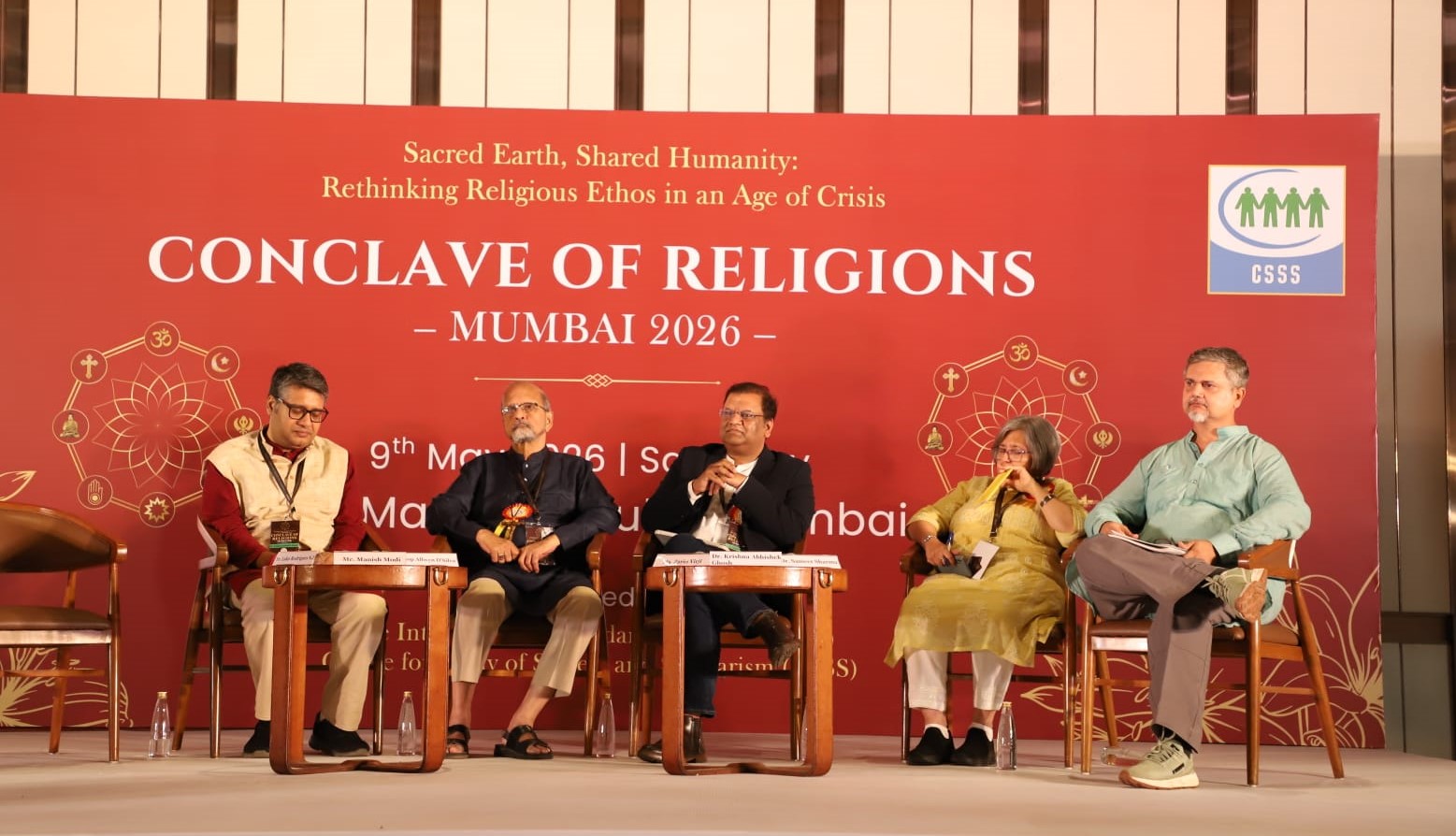
The Conclave opened with an interfaith invocation by Radhika Sood Nayak, who rendered Begumpura by the 15th-century Bhakti saint Ravidas – a poetic vision of a society free from suffering, hierarchy, and fear – setting the tone for the gathering’s emphasis on dignity, coexistence, and justice.
Welcoming participants, IRSC Convenor Keshav Chandra Das reflected on the origins of the Inter-Religious Solidarity Council, established in 2022 to foster interreligious harmony through dialogue, shared celebrations, and collaborative engagement in increasingly polarised times. Referring to the theme of the Conclave, he framed the ethical choices before society today as “division or dialogue, exploitation or stewardship.”
Irfan Engineer, Co-Convenor of IRSC and Director of the Centre for Study of Society and Secularism (CSSS), situated the Conclave within India’s pluralistic traditions. Referring to Swami Vivekananda and Mahatma Gandhi, he emphasised the importance of recognising the dignity and truth present across religions. “India is home to the religion with the smallest number of followers in the world, as it is home to some major religions as well,” he observed.
The keynote address was delivered by noted vocalist and Ramon Magsaysay Award recipient T. M. Krishna, who reflected on religion, identity, nationalism, social justice, and ecological responsibility through history, music, and constitutional thought. Beginning with references to Rabindranath Tagore’s Jana Gana Mana and early debates around the Indian flag and the Constitution, he explored the layered and evolving imagination of India.

Speaking candidly about contemporary anxieties, he remarked, “We have a crisis of fear, a crisis of hate.” Reflecting on symbols and belonging, he observed that colours themselves had become “triggers” in public discourse, while also reminding the audience that “the green denoting Islam was really about environmentalism.”

Krishna also reflected on the ethical dimensions of religion and nonviolence. “Subscribing to ahimsa does not mean we stop being violent,” he said, urging participants to examine violence in everyday relationships and language. Emphasising the inseparability of ecological and social questions, he stated, “You can’t be working for the environment without working for social justice. We are the environment, not separate from it.”

Drawing from Buddhist emperor Ashoka’s reflections on dhamma and invoking Dr B.R. Ambedkar’s use of the term maitri (friendship or compassionate fellowship), Krishna suggested that ethical coexistence required listening across differences. “Every human being has a right to engage in every dialogue,” he noted, adding that “atheism is also a kind of dharma.”
Former Lieutenant Governor of Delhi Najeeb Jung, who chaired the keynote session, spoke about the idea of parasparta – mutuality or interdependence – in relation to constitutional thought and social life. “This Conclave is necessary to bring us back to our earth and to our humanity,” he said. Warning against sectarianism and bigotry, he asked, “Can we refuse to hate in the name of what is sacred? Let our faith be reflected in how we treat each other.”

The first panel, “Bridges of Belief: Healing Divides,” moderated by Fr. Frazer Mascarenhas, brought together representatives from multiple traditions, including Christianity, Hinduism, Islam, Sikhism, Buddhism, and the Warkari tradition.

The speakers repeatedly returned to themes of compassion, transformation, and interconnectedness. Bishop Dominic Savio stated, “The essence of Christianity can be expressed in just one word: love.” Swami Sarvalokananda Maharaj recalled Swami Vivekananda’s call to “accept all religions as true.” Haji Sayed Ambar Chisty observed, “Islam does not teach us to divide; Islam teaches us to connect.”

Tejashree Ingawale reflected on the Warkari practice of greeting others with “Mauli Mauli,” explaining that it emerges from seeing divinity in every human being. Dr Surinder Kaur drew from Guru Nanak’s teachings to affirm the unity of humanity, while Ven. Geshe Tenzin Damchoe emphasised that “our dhamma is transformation of our mind.”
Audience reflections raised questions around coercion, politicisation of religion, and the need to uphold the right of all religions to exist peacefully. Responding from a civil society perspective, actor Joy Sengupta remarked, “Politicians weaponise religious prejudice, not religion per se,” adding that compassion and service cannot themselves be weaponised. Scholar Dr Zarin Shafi observed, “We have to be the bridge. All religions focus on the purpose of humanity.”

The session concluded with Tejashree Ingawale presenting devotional songs from the saint-poet traditions of Maharashtra.

The second half of the Conclave focused on ecological responsibility through the panel “Stewards of the Earth: A Multifaith Call to Eco-Centrism,” followed by a reflective structured dialogue process that invited participants to reflect on actionable commitments emerging from the day’s conversations.

The Conclave concluded with a cultural evening featuring Carnatic music by TM Krishna and accompanying artistes, reaffirming the role of culture and the arts in nurturing dialogue, reflection, and solidarity across communities.
 

Read full report of the conclave>>>

The post Mumbai Conclave of Religions Calls for Dialogue, Ethical Responsibility, and Ecological Stewardship in a Time of Crisis appeared first on Centre for Study of Society and Secularism.

]]>
https://csss-isla.com/interfaith/mumbai-conclave-of-religions-calls-for-dialogue-ethical-responsibility-and-ecological-stewardship-in-a-time-of-crisis/feed/ 0