What happens when procurement decisions are made without visibility, standardized processes, or proper spending controls? The answer is often increased costs, supplier inefficiencies, compliance risks, and budget overruns. In today's competitive business environment, procurement is no longer just a purchasing function—it is a strategic process that directly impacts profitability, operational efficiency, and long-term business growth. Effective procurement control helps organizations manage spending, ensure policy compliance, and maintain strong supplier relationships while optimizing resource utilization.
As businesses grow, procurement activities become increasingly complex. Managing multiple suppliers, tracking purchase requests, monitoring budgets, ensuring timely approvals, and maintaining compliance can be challenging when relying on manual processes or disconnected systems. A lack of real-time visibility into procurement operations can lead to unauthorized spending, duplicate purchases, delayed approvals, and missed opportunities for cost savings. These challenges highlight the need for a more structured and technology-driven approach to procurement control.
This is where Enterprise Resource Planning (ERP) systems play a strategic role. By centralizing procurement data and automating purchasing workflows, ERP systems provide organizations with greater transparency, accountability, and control over procurement activities. From purchase requisitions and supplier management to budget tracking and invoice processing, ERP solutions help streamline the entire procurement lifecycle while ensuring alignment with organizational goals and financial objectives.
Among the leading ERP solutions available today, Deskera ERP offers a comprehensive platform for managing procurement operations efficiently. It enables businesses to automate procurement workflows, track purchasing activities in real time, monitor budgets, manage supplier information, and generate actionable insights through advanced reporting. By integrating procurement with inventory, accounting, and financial management functions, Deskera ERP helps organizations strengthen procurement control, reduce costs, and make more informed purchasing decisions.
In this guide, we will explore the strategic role of ERP systems in procurement control and how they help businesses achieve greater efficiency, compliance, and profitability.
What Is Procurement Control?
Procurement control refers to the policies, procedures, approval processes, and monitoring mechanisms that organizations use to manage and regulate their purchasing activities. Its primary purpose is to ensure that goods and services are acquired in a controlled, cost-effective, and compliant manner while supporting the organization's operational and strategic objectives.
A robust procurement control framework establishes clear guidelines for procurement activities, including vendor selection, purchase approvals, budget management, contract compliance, and spending oversight. By implementing these controls, businesses can ensure that procurement transactions are properly authorized, aligned with company policies, and conducted within approved budgets. This helps prevent unauthorized purchases, reduce procurement-related risks, and maintain financial accountability across the organization.
Procurement control also plays a critical role in improving operational efficiency and supplier management. Through standardized procurement processes, organizations can streamline purchasing workflows, enhance transparency, and maintain consistency in procurement decisions. Effective controls enable businesses to monitor supplier performance, negotiate better contracts, and identify opportunities for cost savings without compromising quality or service levels.
In today's increasingly complex business environment, procurement control has evolved from a purely administrative function into a strategic business practice. By providing visibility into procurement activities and ensuring alignment with organizational goals, procurement control helps companies optimize spending, strengthen compliance, minimize risk, and maximize the value generated from their procurement investments.
Core Components of Procurement Control
Effective procurement control is built on a combination of governance policies, internal controls, and monitoring mechanisms that ensure purchasing activities remain compliant, transparent, and aligned with business objectives. These components work together to minimize risk, prevent fraud, improve accountability, and enhance procurement efficiency.
The following elements form the foundation of a strong procurement control framework.
Segregation of Duties
Segregation of duties involves dividing procurement responsibilities among different individuals or departments to reduce the risk of errors, fraud, and unauthorized transactions.
For example, the employee requesting a purchase should not be the same person approving it or processing payment. This separation creates checks and balances within procurement workflows, improving accountability and strengthening internal controls.
Preventive Controls
Preventive controls are measures designed to stop procurement issues before they occur. These controls may include approval workflows, spending limits, vendor validation procedures, and automated purchase order requirements.
By identifying and addressing potential risks early in the procurement process, preventive controls help organizations reduce errors, avoid policy violations, and maintain financial discipline.
Supplier Data Integrity
Accurate and reliable supplier information is essential for effective procurement control. Supplier data integrity involves maintaining up-to-date vendor records, banking details, contract information, certifications, and performance metrics.
Strong master data governance practices help prevent duplicate vendor entries, payment errors, and compliance issues while ensuring procurement teams can make informed supplier-related decisions.
Compliance Checks
Compliance checks ensure procurement activities adhere to internal policies, contractual obligations, industry regulations, and legal requirements. These reviews help verify that purchasing decisions follow approved procedures and meet applicable standards.
Regular compliance monitoring reduces regulatory risks, supports ethical procurement practices, and helps organizations avoid penalties, disputes, and reputational damage.
Audit Readiness and Risk Assessment
Audit readiness requires organizations to maintain clear documentation and traceable procurement records throughout the purchasing lifecycle. Regular risk assessments and internal reviews help identify control weaknesses, process gaps, and potential compliance concerns before they escalate. A proactive approach to auditing and risk management strengthens procurement governance and supports continuous process improvement.
How Procurement Control Works
Procurement control functions throughout the entire procure-to-pay (P2P) lifecycle, ensuring that every purchasing activity is properly reviewed, authorized, executed, and monitored.
By applying structured controls at each stage, organizations can maintain financial discipline, reduce procurement risks, improve compliance, and ensure that purchasing decisions support business objectives. The process typically involves the following key stages.
Planning and Budgeting
The procurement control process begins with planning and budgeting. Organizations identify purchasing requirements based on operational needs, production schedules, and strategic goals. These requirements are then aligned with approved budgets and financial plans.
Proper planning ensures that procurement activities support business priorities while preventing unnecessary spending and helping maintain effective control over working capital.
Request Validation
Once a procurement need is identified, a purchase request is submitted for review. During the validation stage, procurement teams verify the necessity of the purchase, confirm budget availability, and ensure compliance with company policies.
This step helps eliminate duplicate, unauthorized, or unnecessary requests before they move forward, reducing procurement errors and controlling costs from the outset.
Approval and Authorization
After validation, procurement requests follow predefined approval workflows based on the organization's delegation of authority structure. Depending on the purchase value, category, or department, multiple levels of approval may be required.
Structured authorization processes ensure accountability, prevent unauthorized spending, and maintain compliance with internal procurement policies and financial controls.
Procurement Execution
Once approvals are secured, the procurement team proceeds with supplier selection, purchase order creation, contract execution, and order placement.
Approved purchases are fulfilled by suppliers, goods or services are received and verified, and invoices are processed for payment. Procurement controls during this phase help ensure that transactions are accurate, properly documented, and aligned with agreed terms and conditions.
Monitoring and Continuous Oversight
Procurement control does not end after a purchase is completed. Organizations continuously monitor procurement activities through reporting, audits, compliance reviews, and performance tracking.
Modern systems often leverage real-time dashboards and AI-driven analytics to identify anomalies, monitor spending patterns, and detect potential risks. Continuous oversight helps strengthen governance, improve procurement performance, and support ongoing process optimization.
Common Procurement Control Challenges Businesses Face
Procurement control is essential for managing costs, ensuring compliance, and maintaining operational efficiency. However, many organizations struggle to establish effective controls due to fragmented processes, limited visibility, and increasing procurement complexity.
These challenges can lead to higher costs, operational delays, compliance risks, and reduced supplier performance. Understanding these obstacles is the first step toward building a stronger procurement control framework.
Lack of Visibility into Procurement Activities
Many businesses lack a centralized view of procurement operations, making it difficult to track purchase requests, supplier performance, spending patterns, and order status.
Without real-time visibility, organizations may struggle to identify inefficiencies, monitor budgets, or detect unauthorized purchases. This limited transparency often leads to poor decision-making and reduced control over procurement activities.
Manual and Error-Prone Purchasing Processes
Organizations that rely on spreadsheets, emails, and paper-based approvals often face delays and inaccuracies in procurement operations.
Manual processes increase the likelihood of data entry mistakes, duplicate orders, lost documents, and communication gaps. These inefficiencies not only slow down purchasing activities but also make it harder to maintain consistent procurement controls.
Maverick Spending and Budget Overruns
Maverick spending occurs when employees make purchases outside approved procurement channels or supplier agreements. This lack of control can lead to higher procurement costs, reduced negotiating power, and budget overruns.
Without proper monitoring and approval mechanisms, businesses may find it difficult to enforce spending policies and maintain financial discipline.
Supplier Management Difficulties
Managing multiple suppliers across different categories can be challenging without standardized processes and accurate supplier data.
Businesses may face issues such as inconsistent supplier performance, delayed deliveries, contract non-compliance, and poor communication.
Ineffective supplier management can disrupt operations and limit opportunities for cost savings and strategic sourcing.
Compliance and Approval Workflow Issues
Ensuring compliance with internal policies, contractual obligations, and regulatory requirements can be difficult when approval processes are unclear or inconsistently followed.
Unauthorized purchases, missing approvals, and inadequate documentation can expose organizations to financial, legal, and operational risks. Weak approval controls also make audits more challenging.
Poor Data Accuracy and Reporting
Procurement decisions depend heavily on accurate and timely data. However, businesses often struggle with fragmented information spread across multiple systems or departments.
Inaccurate supplier records, incomplete purchase histories, and inconsistent reporting can hinder decision-making, reduce forecasting accuracy, and make it difficult to evaluate procurement performance effectively.
Fraud and Procurement Risks
Weak procurement controls can create opportunities for fraudulent activities such as unauthorized purchases, duplicate payments, supplier favoritism, or invoice manipulation.
Without proper segregation of duties, audit trails, and monitoring mechanisms, organizations may be unable to detect or prevent procurement-related risks before they impact financial performance.
Difficulty Tracking Procurement Performance
Many organizations lack the tools and processes needed to measure procurement effectiveness. Without clear visibility into key procurement metrics such as purchase cycle times, supplier performance, contract compliance, and cost savings, businesses may struggle to identify improvement opportunities and optimize procurement strategies.
Benefits of Effective Procurement Control
Effective procurement control enables organizations to manage purchasing activities more strategically while maintaining financial discipline and operational efficiency.
By implementing strong procurement controls, businesses can reduce risks, improve visibility, strengthen supplier relationships, and ensure that procurement decisions align with organizational objectives.
The following are some of the key benefits of effective procurement control.
Improved Cost Management
Procurement control helps organizations monitor spending, prevent unauthorized purchases, and ensure that procurement activities remain within approved budgets.
By enforcing purchasing policies and optimizing supplier contracts, businesses can reduce unnecessary expenditures, identify cost-saving opportunities, and achieve better value from their procurement investments.
Greater Financial Visibility
With effective procurement controls in place, organizations gain clear visibility into purchasing activities, spending patterns, and budget utilization.
This transparency enables management to track procurement performance, forecast expenses more accurately, and make informed financial decisions that support business growth and profitability.
Enhanced Compliance and Governance
Procurement control ensures that purchasing activities comply with internal policies, contractual obligations, and regulatory requirements. Structured approval processes, audit trails, and documentation standards help reduce compliance risks, strengthen governance, and improve accountability across the organization.
Reduced Procurement Risks
Strong procurement controls help minimize risks associated with fraud, unauthorized spending, supplier disputes, and operational disruptions.
By implementing approval workflows, segregation of duties, and ongoing monitoring, businesses can identify potential issues early and take corrective action before they impact operations.
Increased Operational Efficiency
Standardized procurement procedures and clearly defined controls streamline purchasing workflows and reduce administrative burdens.
Employees spend less time managing approvals, resolving errors, and handling paperwork, allowing procurement teams to focus on strategic sourcing and supplier relationship management.
Better Supplier Performance and Relationships
Procurement control supports consistent supplier evaluation, contract management, and performance monitoring.
By maintaining clear procurement standards and tracking supplier metrics, organizations can strengthen vendor relationships, improve service quality, negotiate favorable terms, and ensure reliable supply chain performance.
Improved Decision-Making
Access to accurate procurement data and performance insights allows businesses to make more informed decisions.
Procurement control provides visibility into supplier performance, spending trends, purchasing efficiency, and contract compliance, enabling organizations to identify improvement opportunities and optimize procurement strategies.
Stronger Budget Discipline
Effective procurement control helps ensure that purchases are aligned with approved budgets and organizational priorities.
Real-time monitoring and approval mechanisms prevent overspending, improve budget adherence, and support responsible allocation of financial resources across the business.
Enhanced Audit Readiness
Organizations with robust procurement controls maintain comprehensive records of procurement transactions, approvals, contracts, and supplier interactions.
This documentation simplifies audit processes, improves traceability, and demonstrates compliance with internal and external requirements.
Increased Strategic Value of Procurement
When procurement activities are properly controlled and aligned with business objectives, procurement evolves from a transactional function into a strategic contributor.
Effective procurement control helps organizations optimize spending, improve supplier collaboration, support long-term planning, and create sustainable competitive advantages.
The Role of ERP Systems in Procurement Control
As procurement processes become more complex, organizations need greater visibility, consistency, and control over purchasing activities.
Enterprise Resource Planning (ERP) systems play a critical role in strengthening procurement control by centralizing data, automating workflows, enforcing policies, and providing real-time insights.
By integrating procurement with finance, inventory, and supplier management functions, ERP systems help businesses improve efficiency, reduce risks, and make more informed purchasing decisions.
Centralizing Procurement Data and Processes
ERP systems bring all procurement-related information into a single, centralized platform. Purchase requests, supplier records, purchase orders, contracts, invoices, and spending data are stored and managed in one system.
This eliminates data silos, improves information accuracy, and provides stakeholders with a unified view of procurement activities, enabling better coordination and control.
Automating Procurement Workflows
Manual procurement processes often result in delays, errors, and inconsistencies. ERP systems automate key procurement activities such as purchase requisitions, approval routing, purchase order generation, invoice matching, and payment processing.
Automation reduces administrative workloads, accelerates procurement cycles, and ensures that purchasing activities follow standardized procedures.
Enhancing Procurement Visibility and Transparency
One of the most significant advantages of ERP systems is real-time visibility into procurement operations. Procurement teams and management can monitor spending, track purchase orders, review supplier performance, and analyze procurement trends through centralized dashboards and reports. This transparency helps organizations identify inefficiencies, control costs, and make data-driven decisions.
Strengthening Internal Controls and Governance
ERP systems help enforce procurement policies by embedding approval workflows, spending limits, role-based access controls, and audit trails into procurement processes.
Every transaction is documented and traceable, improving accountability and reducing the risk of unauthorized purchases, fraud, or policy violations. Strong governance mechanisms help organizations maintain compliance and financial discipline.
Improving Budget and Spend Control
ERP systems provide real-time access to budget utilization and procurement spending data. Before purchases are approved, the system can verify budget availability and flag potential overspending.
This capability helps organizations prevent budget overruns, control procurement costs, and ensure that purchasing decisions align with financial objectives.
Supporting Supplier Management
Effective supplier management is a key component of procurement control. ERP systems maintain comprehensive supplier profiles, including performance metrics, contract details, pricing agreements, and transaction histories.
Procurement teams can use this information to evaluate supplier performance, strengthen vendor relationships, negotiate better terms, and reduce supply chain risks.
Enhancing Compliance and Risk Management
ERP systems help organizations comply with internal policies, industry standards, and regulatory requirements by enforcing standardized procurement procedures.
Automated approval workflows, contract tracking, audit logs, and compliance monitoring features reduce procurement risks and make it easier to prepare for audits and regulatory reviews.
Enabling Data-Driven Decision-Making
Modern ERP systems provide advanced analytics and reporting capabilities that help organizations evaluate procurement performance and identify opportunities for improvement.
By analyzing procurement KPIs, supplier trends, spending patterns, and cost-saving opportunities, businesses can make strategic decisions that improve procurement efficiency and support long-term growth.
Best Practices for Strengthening Procurement Control
Strengthening procurement control requires more than implementing policies and approval procedures. Organizations must establish a structured framework that promotes transparency, accountability, compliance, and continuous improvement across the procurement lifecycle.
By adopting the following best practices, businesses can maximize the strategic value of procurement control while leveraging ERP systems to enforce and streamline these controls effectively.
Define Clear Procurement Policies and Guidelines
A strong procurement control framework begins with clearly documented policies that outline purchasing procedures, approval requirements, supplier selection criteria, spending limits, and compliance expectations.
Well-defined policies ensure that employees understand their responsibilities and follow consistent procurement practices. ERP systems support this effort by embedding procurement rules directly into workflows, reducing the risk of policy violations.
Standardize Procurement Processes
Standardized procurement processes create consistency across departments and purchasing activities. Establishing uniform procedures for purchase requests, approvals, supplier onboarding, purchase order management, and invoice processing reduces confusion and minimizes operational inefficiencies. ERP systems play a strategic role by automating and enforcing standardized workflows throughout the procurement lifecycle.
Implement Real-Time Monitoring and Visibility
Organizations should continuously monitor procurement activities to identify spending trends, approval bottlenecks, supplier issues, and compliance risks.
Real-time dashboards and reporting tools provide greater visibility into procurement performance and enable faster corrective action when issues arise.
Modern ERP systems enhance procurement control by delivering real-time insights that support proactive decision-making.
Enhance Transparency Across Procurement Operations
Transparency helps build accountability and strengthens governance. Stakeholders should have access to accurate information regarding procurement spending, supplier performance, purchase approvals, and contract compliance.
ERP systems centralize procurement data and provide role-based access to information, ensuring that decision-makers have the visibility needed to manage procurement activities effectively.
Conduct Regular Audits and Compliance Reviews
Periodic audits help organizations evaluate whether procurement controls are functioning as intended. Reviewing procurement records, approval workflows, supplier transactions, and compliance documentation can reveal control gaps and areas for improvement.
ERP systems simplify audit processes by maintaining complete transaction histories, approval logs, and audit trails that support regulatory and internal compliance requirements.
Strengthen Supplier Management Practices
Effective procurement control extends beyond internal processes to include supplier oversight. Organizations should regularly assess supplier performance, monitor contract compliance, and maintain accurate supplier records.
ERP systems provide centralized supplier management capabilities that help procurement teams evaluate vendors, reduce supplier-related risks, and improve sourcing decisions.
Leverage Data and Analytics for Better Decision-Making
Data-driven procurement management enables organizations to identify inefficiencies, control costs, and optimize supplier relationships.
Businesses should regularly analyze procurement KPIs such as procurement cycle time, spend under management, supplier performance, and contract compliance rates.
ERP systems provide advanced analytics that transform procurement data into actionable insights for continuous improvement.
Foster a Culture of Continuous Improvement
Procurement control should evolve alongside changing business requirements, regulatory expectations, and market conditions.
Organizations should regularly review procurement performance, gather stakeholder feedback, and refine procurement controls based on insights gained from audits and analytics.
ERP systems support continuous improvement by providing the visibility and performance data needed to identify opportunities for optimization.
Align Procurement Control with ERP-Driven Strategies
To fully realize the strategic role of ERP systems in procurement control, organizations should integrate procurement processes with finance, inventory, supplier management, and compliance functions.
This integrated approach ensures greater visibility, stronger governance, and more effective decision-making. By combining robust procurement controls with ERP capabilities, businesses can transform procurement from a transactional function into a strategic driver of efficiency, cost savings, and long-term business value.
How Deskera ERP Helps with Procurement Control
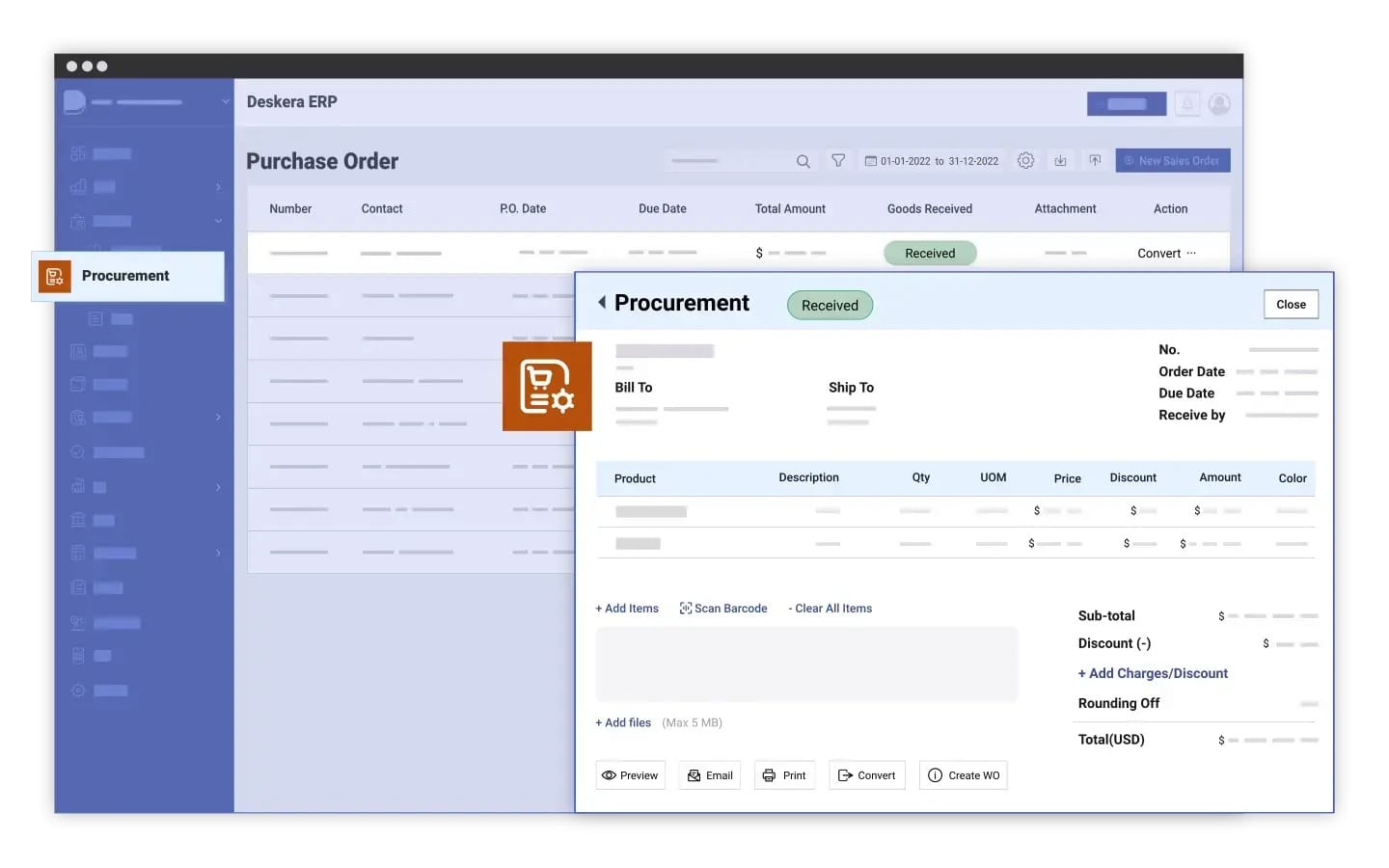
Effective procurement control requires visibility, standardization, automation, and real-time monitoring across the entire purchasing process. Deskera ERP helps businesses strengthen procurement control by centralizing procurement activities, automating workflows, improving spending oversight, and integrating procurement with inventory and financial management. This enables organizations to reduce procurement risks, improve compliance, and make better purchasing decisions.
Centralized Procurement Management
Deskera ERP provides a unified platform for managing procurement activities, including purchase requests, purchase orders, supplier information, goods receipts, and invoices. By consolidating procurement data in a single system, businesses gain better visibility into purchasing operations, eliminate information silos, and improve control over procurement processes.
Automated Purchase Requisitions and Purchase Orders
Manual procurement processes often result in delays and errors. Deskera ERP automates the creation and management of purchase requisitions and purchase orders, helping organizations streamline procurement workflows. Automation ensures consistency, reduces administrative effort, and improves the accuracy of procurement transactions.
Approval Workflow Management
Deskera ERP enables businesses to establish structured approval workflows for procurement requests and purchases. Approval hierarchies can be configured based on spending limits, departments, or organizational roles, ensuring that procurement activities follow company policies and authorization requirements. This helps prevent unauthorized spending and strengthens internal controls.
Real-Time Budget and Spend Tracking
Controlling procurement spending is a critical aspect of procurement control. Deskera ERP provides real-time visibility into purchasing activities and budget utilization, allowing businesses to monitor expenditures as they occur. Procurement teams can identify spending trends, avoid budget overruns, and make informed purchasing decisions based on accurate financial data.
Supplier Management and Performance Monitoring
Deskera ERP maintains centralized supplier records, making it easier to manage vendor information, purchase histories, pricing agreements, and transaction details. Businesses can evaluate supplier performance, monitor delivery reliability, and make more strategic sourcing decisions, helping improve supplier relationships while reducing procurement risks.
Inventory and Procurement Integration
By integrating procurement with inventory management, Deskera ERP helps organizations align purchasing decisions with actual inventory requirements. Procurement teams can track stock levels, monitor material consumption, and generate purchase orders based on inventory needs. This reduces excess inventory, prevents stockouts, and supports more efficient procurement planning.
Enhanced Compliance and Audit Readiness
Deskera ERP creates a complete digital record of procurement activities, including approvals, purchase orders, receipts, invoices, and supplier transactions. These audit trails improve transparency, simplify compliance reporting, and make it easier to prepare for internal and external audits. Organizations can ensure that procurement activities consistently follow established policies and procedures.
Procurement Reporting and Analytics
Deskera ERP offers reporting and analytics capabilities that provide valuable insights into procurement performance. Businesses can monitor key metrics such as procurement cycle times, supplier performance, purchasing costs, and spending patterns. These insights support data-driven decision-making and help organizations continuously improve procurement efficiency and control.
Integrated Financial Management
Since procurement activities directly impact organizational finances, Deskera ERP integrates procurement data with accounting and financial management functions. This integration improves financial visibility, enhances budget control, and ensures that procurement decisions align with broader business objectives. As a result, organizations can maintain stronger financial discipline while optimizing procurement operations.
By combining automation, visibility, supplier management, inventory integration, and financial controls, Deskera ERP helps businesses establish a more structured and effective procurement control framework. This not only improves operational efficiency and compliance but also reinforces the strategic role of ERP systems in procurement control by enabling organizations to manage purchasing activities with greater accuracy, accountability, and confidence.
Key Takeaways
- Procurement control establishes the policies, procedures, and monitoring mechanisms needed to ensure purchasing activities remain compliant, cost-effective, and aligned with organizational goals.
- Effective procurement control relies on key components such as segregation of duties, preventive controls, supplier data integrity, compliance checks, and audit readiness to reduce risk and improve governance.
- Procurement control works throughout the procure-to-pay lifecycle, from planning and budgeting to approval, execution, and continuous monitoring of procurement activities.
- Common procurement control challenges include limited visibility, manual processes, maverick spending, supplier management issues, compliance risks, and poor data accuracy.
- ERP systems play a strategic role in procurement control by centralizing procurement data, automating workflows, enhancing visibility, and strengthening governance across purchasing operations.
- Effective procurement control helps organizations improve cost management, increase financial visibility, strengthen compliance, reduce procurement risks, and enhance operational efficiency.
- Businesses can strengthen procurement control by implementing clear policies, standardizing processes, enabling real-time monitoring, enhancing transparency, conducting audits, and pursuing continuous improvement.
- Deskera ERP supports procurement control through centralized procurement management, automated workflows, approval controls, real-time spend tracking, supplier management, inventory integration, and procurement analytics.
- By combining strong procurement controls with ERP-driven automation and visibility, organizations can transform procurement into a strategic function that drives efficiency, compliance, cost savings, and long-term business value.
Related Articles
 Niti Samani
 Niti Samani
 Niti Samani
 Niti Samani
 Niti Samani
 Niti Samani
Have you ever wondered why two products made from the same materials and labor can still have vastly different production costs? The answer often lies in manufacturing overhead (MOH)—the indirect costs required to keep a manufacturing facility running. While these expenses may not be directly tied to a specific product, they significantly influence production costs, profitability, and overall business performance.
Manufacturing overhead includes a wide range of indirect expenses such as factory rent, utilities, equipment depreciation, maintenance, quality control, and indirect labor. Although these costs are essential for supporting production activities, they can be difficult to track and allocate accurately. Without proper management, overhead expenses can increase operating costs, distort product pricing, and reduce profit margins.
Calculating manufacturing overhead correctly is critical for determining the true cost of production and making informed business decisions. By understanding the different types of overhead costs and using appropriate allocation methods, manufacturers can improve budgeting, optimize resource utilization, and identify opportunities for cost reduction. Effective overhead management also enables businesses to enhance operational efficiency and maintain a competitive edge in increasingly demanding markets.
Modern manufacturing software such as Deskera MRP helps businesses gain better control over manufacturing overhead through real-time cost tracking, production monitoring, inventory management, and detailed reporting. By providing greater visibility into production expenses and resource utilization, Deskera MRP enables manufacturers to identify inefficiencies, reduce unnecessary costs, and make data-driven decisions. In this guide, we will explore manufacturing overhead, its types, calculation methods, and practical strategies to reduce costs and improve profitability.
What Is Manufacturing Overhead (MOH)?
Manufacturing Overhead (MOH) refers to all the indirect costs incurred during the production process that cannot be directly traced to a specific product. These costs are necessary to keep a manufacturing facility operating but are not classified as direct materials or direct labor.
In other words, manufacturing overhead includes the expenses that support production activities behind the scenes. While these costs do not become part of the finished product, they play a crucial role in ensuring that manufacturing operations run efficiently and consistently.
For example, when a company manufactures furniture, the wood used to make a table is a direct material cost, and the wages paid to workers assembling the table are direct labor costs. However, expenses such as factory rent, electricity, equipment depreciation, maintenance, and the salaries of production supervisors are considered manufacturing overhead because they support the production process without being directly attributable to a single product.
Manufacturing overhead is an essential component of total manufacturing costs and must be allocated to products to determine their true production cost. Accurate overhead tracking helps manufacturers set appropriate pricing, improve profitability, create realistic budgets, and identify opportunities to reduce operating expenses.
Some common examples of manufacturing overhead include:
- Factory rent or lease payments
- Utilities such as electricity, water, and gas
- Equipment depreciation
- Machine maintenance and repairs
- Indirect labor (supervisors, quality inspectors, maintenance staff)
- Indirect materials (lubricants, cleaning supplies, safety equipment)
- Factory insurance
- Quality control and inspection costs
- Safety and compliance expenses
By understanding and managing manufacturing overhead effectively, businesses can gain better visibility into production costs, improve cost control, and make more informed operational and financial decisions.
Types of Manufacturing Overhead Costs
Manufacturing overhead costs are generally categorized into three main types: fixed overhead, variable overhead, and semi-variable (mixed) overhead.
Understanding these categories helps manufacturers track expenses more accurately, allocate costs effectively, and identify opportunities for cost optimization.
Fixed Manufacturing Overhead
Fixed manufacturing overhead consists of costs that remain relatively constant regardless of production volume. Whether a factory produces 100 units or 10,000 units, these expenses typically do not change within a specific period.
Examples of fixed manufacturing overhead include:
- Factory rent or lease payments
- Property taxes
- Factory insurance premiums
- Depreciation of manufacturing equipment
- Salaries of production managers and supervisors
Since these costs remain stable, manufacturers must spread them across the units produced to determine the overhead cost per product.
Variable Manufacturing Overhead
Variable manufacturing overhead changes in proportion to production activity. As production increases, these costs tend to rise; when production decreases, they generally decline.
Examples of variable manufacturing overhead include:
- Indirect materials such as lubricants and cleaning supplies
- Utility costs related to machine operation
- Equipment maintenance linked to usage
- Production consumables
- Waste disposal costs associated with manufacturing activities
Managing variable overhead effectively can help manufacturers reduce unnecessary expenses and improve operational efficiency.
Semi-Variable (Mixed) Manufacturing Overhead
Semi-variable overhead contains both fixed and variable components. A portion of the cost remains constant, while the remaining amount fluctuates based on production levels or equipment usage.
Examples of semi-variable manufacturing overhead include:
- Utility bills with a fixed service charge and usage-based fees
- Maintenance contracts with fixed monthly payments plus repair costs
- Equipment servicing expenses
- Telephone and internet services used in production facilities
- Machine lease agreements with usage-based charges
Because mixed costs have both fixed and variable elements, manufacturers often analyze them separately to improve budgeting and forecasting accuracy.
Why Understanding Overhead Types Matters
Classifying manufacturing overhead into fixed, variable, and semi-variable categories helps businesses:
- Improve product costing accuracy
- Create more reliable budgets and forecasts
- Identify cost-saving opportunities
- Optimize resource allocation
- Make informed pricing decisions
- Improve profitability and operational performance
A clear understanding of these overhead categories enables manufacturers to manage production costs more effectively and maintain better control over their overall manufacturing expenses.
How to Calculate Manufacturing Overhead
Calculating manufacturing overhead helps businesses determine the total indirect costs associated with production. Accurate overhead calculations provide a clearer picture of product costs, support pricing decisions, and help identify opportunities to improve profitability.
Step 1: Identify All Indirect Manufacturing Costs
Start by listing all costs that support production but cannot be directly traced to a specific product.
Common manufacturing overhead costs include:
- Factory rent or lease
- Utilities (electricity, water, gas)
- Equipment depreciation
- Factory insurance
- Maintenance and repairs
- Indirect labor (supervisors, maintenance staff, quality inspectors)
- Indirect materials (lubricants, cleaning supplies, safety equipment)
Step 2: Calculate Total Manufacturing Overhead
Add together all indirect manufacturing expenses incurred during a specific period.
Manufacturing Overhead Formula
Manufacturing Overhead = Total Indirect Manufacturing Costs
Or
Manufacturing Overhead = Indirect Labor + Indirect Materials + Other Factory Overhead Costs
Step 3: Select an Allocation Base
Since overhead costs cannot be directly assigned to individual products, manufacturers use an allocation base to distribute these costs across production.
Common Allocation Bases
Direct Labor Hours
- Overhead is allocated based on the number of labor hours used in production.
Direct Labor Cost
- Overhead is allocated according to total direct labor expenses.
Machine Hours
- Overhead is assigned based on machine usage time.
- Common in highly automated manufacturing environments.
Units Produced
- Overhead is distributed equally across all units produced.
Step 4: Calculate the Manufacturing Overhead Rate
The manufacturing overhead rate determines how much overhead should be allocated to production based on the chosen allocation base.
Manufacturing Overhead Rate Formula
Manufacturing Overhead Rate = Total Manufacturing Overhead ÷ Total Allocation Base
Example of Manufacturing Overhead Calculation
Suppose a manufacturer incurs the following monthly overhead expenses:
- Factory rent: $8,000
- Utilities: $3,000
- Equipment depreciation: $4,000
- Indirect labor: $5,000
Total Manufacturing Overhead
Total Manufacturing Overhead = $8,000 + $3,000 + $4,000 + $5,000
Total Manufacturing Overhead = $20,000
Assume the company uses machine hours as its allocation base and records 4,000 machine hours during the month.
Manufacturing Overhead Rate
Manufacturing Overhead Rate = $20,000 ÷ 4,000 Machine Hours
Manufacturing Overhead Rate = $5 per Machine Hour
This means the company allocates $5 of manufacturing overhead for every machine hour used in production. If a product requires 10 machine hours to manufacture, it will be assigned:
Allocated Overhead = 10 × $5
Allocated Overhead = $50
By regularly calculating manufacturing overhead and monitoring overhead rates, manufacturers can improve cost accuracy, optimize resource utilization, and make more informed operational and financial decisions.
Benefits of Effective Manufacturing Overhead Management
Manufacturing overhead can account for a significant portion of total production costs. Effectively managing these indirect expenses helps manufacturers gain greater control over their operations, improve cost accuracy, and enhance profitability.
By monitoring and optimizing overhead costs, businesses can make better decisions, allocate resources more efficiently, and maintain a competitive advantage in the market.
More Accurate Product Costing
Effective manufacturing overhead management ensures that indirect costs are allocated accurately across products. This provides a more realistic view of production costs and prevents underpricing or overpricing.
Accurate product costing helps manufacturers evaluate profitability at the product level, identify high-cost areas, and make informed decisions about pricing, production, and resource allocation.
Improved Profit Margins
Controlling overhead expenses reduces unnecessary spending and lowers overall production costs. When manufacturers identify inefficiencies, eliminate waste, and optimize resource usage, they can improve profit margins without compromising product quality.
Better overhead management also enables businesses to maintain profitability even during periods of rising material, labor, or operational costs.
Better Pricing Decisions
A clear understanding of manufacturing overhead allows businesses to establish pricing strategies based on actual production costs rather than estimates.
Accurate cost data helps ensure that products are priced competitively while maintaining healthy margins. This reduces the risk of selling products below cost and supports long-term financial sustainability.
Enhanced Budgeting and Forecasting
Tracking and analyzing overhead costs provides valuable insights for budgeting and financial planning. Manufacturers can anticipate future expenses more accurately, allocate funds effectively, and prepare for changes in production demand. Improved forecasting helps businesses avoid unexpected cost overruns and supports better strategic decision-making across departments.
Greater Operational Efficiency
Manufacturing overhead management often highlights inefficiencies in production processes, equipment utilization, and resource consumption. By addressing these issues, manufacturers can streamline operations, reduce downtime, and improve workflow performance. Greater operational efficiency leads to faster production cycles, lower costs, and more consistent output quality.
Improved Resource Utilization
Monitoring overhead costs helps manufacturers understand how effectively they are using labor, equipment, facilities, and utilities. This visibility enables better allocation of resources and reduces underutilization or overuse. Improved resource utilization contributes to higher productivity, lower operating costs, and better overall manufacturing performance.
Stronger Competitive Advantage
Manufacturers that effectively manage overhead costs can operate more efficiently and offer products at competitive prices. Lower production costs create opportunities to improve profitability, invest in innovation, and respond more quickly to market changes. As a result, businesses can strengthen their market position and achieve sustainable long-term growth.
Challenges in Managing Manufacturing Overhead
While manufacturing overhead is essential to keeping production operations running smoothly, managing these indirect costs can be challenging. Unlike direct materials and labor, overhead expenses are often difficult to track, allocate, and control.
Without proper oversight, rising overhead costs can reduce profitability, distort product costing, and limit operational efficiency.
Understanding these challenges is the first step toward improving cost management and making more informed business decisions.
Rising Energy and Utility Costs
Energy and utility expenses are a significant component of manufacturing overhead and can fluctuate due to market conditions, seasonal demand, and regulatory changes.
Rising electricity, water, and fuel costs increase production expenses and can negatively impact profit margins. Manufacturers often struggle to predict and manage these costs, especially in energy-intensive production environments.
Inaccurate Cost Allocation Methods
Allocating overhead costs to products can be complex, particularly when multiple products or production lines share the same resources. Using outdated or inappropriate allocation methods may result in inaccurate product costing, leading to poor pricing decisions and distorted profitability analysis. This challenge becomes more pronounced as manufacturing operations grow in complexity.
Lack of Real-Time Cost Visibility
Many manufacturers rely on manual processes or disconnected systems to track overhead expenses. As a result, they may not have real-time visibility into production costs, resource usage, or operational inefficiencies. Delayed access to cost data makes it difficult to identify problems quickly and take corrective action before expenses escalate.
Equipment Downtime and Maintenance Expenses
Unexpected machine breakdowns and unplanned maintenance can significantly increase manufacturing overhead. Downtime not only leads to repair costs but also reduces production capacity and delays order fulfillment. Without a proactive maintenance strategy, manufacturers may experience frequent disruptions that drive up indirect production costs.
Production Inefficiencies and Waste
Inefficient production processes, excessive material waste, rework, and poor workflow management can increase overhead costs over time. These inefficiencies consume additional resources, labor, energy, and machine capacity without generating additional value. Identifying and eliminating operational bottlenecks is often a major challenge for manufacturers seeking to control overhead expenses.
Manual Tracking and Reporting Errors
Many organizations still use spreadsheets and manual record-keeping to monitor overhead costs. These methods are time-consuming and prone to errors, inconsistencies, and data duplication. Inaccurate reporting can lead to poor financial decisions, budgeting issues, and difficulty in identifying the true drivers of manufacturing overhead costs.
Fluctuating Production Volumes
Changes in production demand can make overhead management more difficult. Fixed overhead costs remain relatively constant regardless of output levels, which means lower production volumes can increase the overhead cost per unit. Manufacturers must carefully balance capacity utilization and production planning to minimize the impact of demand fluctuations on overall costs.
Difficulty Measuring Resource Utilization
Tracking how effectively equipment, facilities, utilities, and labor resources are being used can be challenging without proper monitoring systems. Limited visibility into resource utilization often results in underused assets, unnecessary expenses, and missed opportunities for cost optimization. Accurate measurement is essential for improving efficiency and reducing overhead costs.
10 Strategies to Reduce Manufacturing Overhead Costs
Reducing manufacturing overhead costs is essential for improving profitability, maintaining competitive pricing, and enhancing operational efficiency.
While overhead expenses cannot be eliminated entirely, manufacturers can implement targeted strategies to optimize resource utilization, minimize waste, and gain better control over indirect production costs.
The following strategies can help businesses effectively reduce manufacturing overhead while maintaining productivity and product quality.
Improve Production Planning and Scheduling
Effective production planning helps manufacturers optimize resource utilization and minimize idle time. By creating accurate production schedules, businesses can reduce machine downtime, prevent bottlenecks, and ensure labor and equipment are used efficiently. Better scheduling also helps avoid costly production delays and unnecessary overtime expenses.
Reduce Equipment Downtime Through Preventive Maintenance
Unexpected equipment failures often lead to higher repair costs, production interruptions, and increased overhead expenses. Implementing a preventive maintenance program helps identify potential issues before they become major problems. Regular inspections, servicing, and maintenance improve equipment reliability, extend asset lifespan, and reduce costly unplanned downtime.
Automate Manual Processes
Automation can significantly reduce labor-intensive tasks and improve operational efficiency. Automating activities such as inventory tracking, production monitoring, data entry, and reporting minimizes human error and reduces administrative overhead. It also allows employees to focus on higher-value activities that contribute directly to productivity and business growth.
Optimize Energy Consumption
Energy costs are a major component of manufacturing overhead. Manufacturers can lower utility expenses by upgrading to energy-efficient equipment, monitoring energy usage, and implementing conservation initiatives. Simple measures such as optimizing machine operation schedules, reducing idle equipment time, and improving facility lighting can generate substantial cost savings over time.
Improve Inventory Management
Poor inventory management can lead to excess stock, storage costs, obsolescence, and production inefficiencies. Maintaining optimal inventory levels helps reduce carrying costs while ensuring materials are available when needed. Accurate inventory tracking and demand forecasting also minimize waste and improve overall operational efficiency.
Minimize Material Waste and Scrap
Material waste directly increases production costs and contributes to higher overhead expenses. Manufacturers can reduce waste by improving quality control processes, standardizing work procedures, and continuously monitoring production performance. Identifying the root causes of scrap and rework helps lower material consumption and improve resource utilization.
Increase Workforce Productivity
A well-trained and productive workforce can help reduce indirect costs associated with delays, errors, and inefficiencies. Providing employee training, improving communication, and establishing clear performance goals can enhance productivity. Higher workforce efficiency enables manufacturers to achieve greater output without significantly increasing overhead expenses.
Monitor Costs with Real-Time Reporting
Real-time visibility into manufacturing costs enables businesses to identify inefficiencies and address issues before they escalate. Tracking overhead expenses through dashboards and automated reporting systems helps managers make faster, data-driven decisions. Continuous monitoring also supports more accurate budgeting and cost control initiatives.
Standardize Operational Processes
Standardized procedures improve consistency, reduce errors, and streamline production activities. Establishing best practices for manufacturing operations, maintenance, quality control, and inventory management helps eliminate unnecessary variations that contribute to higher overhead costs. Consistent processes also improve productivity and operational performance across the organization.
Leverage ERP and Manufacturing Software
Modern ERP and manufacturing management systems provide greater visibility into production costs, resource utilization, and operational performance. These solutions automate data collection, improve planning accuracy, and support real-time decision-making. By centralizing information and identifying inefficiencies, manufacturers can better control overhead expenses and drive continuous cost improvements.
How Deskera MRP Helps Manufacturers Manage and Reduce Manufacturing Overhead
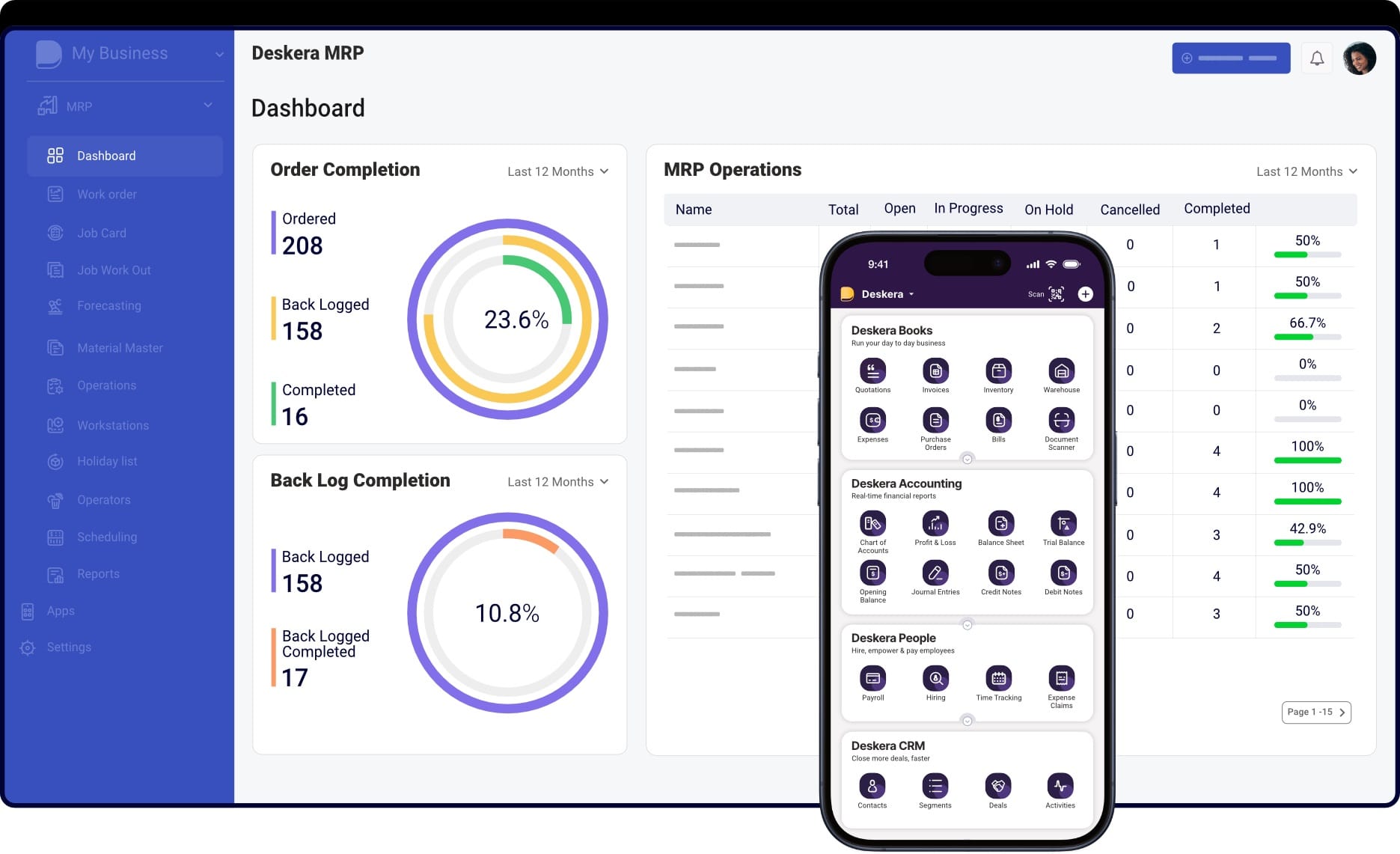
Managing manufacturing overhead requires visibility into production costs, resource utilization, machine performance, inventory levels, and operational efficiency. Deskera MRP helps manufacturers gain greater control over these cost drivers by integrating production planning, inventory management, machine maintenance, costing, and reporting into a single platform. This enables businesses to reduce inefficiencies, optimize resources, and make more informed decisions to improve profitability.
Real-Time Production Cost Tracking
Deskera MRP helps manufacturers track production activities and associated costs in real time. By providing visibility into work orders, production progress, and resource consumption, businesses can identify cost overruns early and take corrective action. This improves cost control and helps ensure manufacturing overhead is allocated more accurately across products.
Production Planning and Scheduling Optimization
Inefficient scheduling often leads to idle labor, machine downtime, and unnecessary overhead expenses. Deskera MRP's production planning and scheduling capabilities help manufacturers allocate resources effectively, balance workloads, and streamline production workflows. Better planning reduces delays, improves capacity utilization, and lowers indirect production costs.
Material Requirement Planning and Inventory Control
Excess inventory, stock shortages, and inefficient material management can significantly increase manufacturing overhead. Deskera MRP helps manufacturers plan material requirements, monitor inventory levels, and align procurement with production demand. This reduces carrying costs, minimizes waste, and ensures materials are available when needed without tying up excess working capital.
Machine Management and Preventive Maintenance
Unexpected equipment breakdowns can increase maintenance costs and production downtime. Deskera MRP includes machine management and maintenance capabilities that help manufacturers monitor machine performance, automate maintenance schedules, and track maintenance activities. This proactive approach improves equipment reliability, reduces downtime, and lowers overhead costs associated with repairs and production interruptions.
WIP Tracking and Bottleneck Identification
Work-in-progress (WIP) tracking provides real-time visibility into production status and resource utilization. Deskera MRP enables manufacturers to monitor production flow, identify bottlenecks, and address inefficiencies before they impact operations. Improved workflow visibility helps reduce delays, improve throughput, and optimize overhead-related expenses.
Yield Calculation and Scrap Management
Material waste and production scrap contribute directly to higher manufacturing overhead. Deskera MRP helps manufacturers track yields, monitor finished goods costs, and manage by-products and scrap. By identifying sources of waste and improving production efficiency, businesses can reduce unnecessary expenses and improve overall profitability.
Advanced Reporting and Cost Analysis
Deskera MRP provides comprehensive production reports and analytics that help manufacturers monitor costs, efficiency, and profitability. Real-time reporting enables managers to evaluate overhead trends, identify cost-saving opportunities, and make data-driven decisions. This level of visibility supports continuous improvement and more effective overhead management.
AI-Powered Insights and Decision-Making
Deskera's AI assistant, David, helps manufacturers access reports, insights, and recommendations more quickly. Combined with real-time operational data, AI-powered insights help managers identify inefficiencies, improve planning accuracy, and optimize resource utilization. This enables faster decision-making and supports ongoing efforts to reduce manufacturing overhead costs.
By combining production planning, inventory management, machine maintenance, costing, reporting, and AI-driven insights in a unified platform, Deskera MRP helps manufacturers improve operational efficiency, reduce indirect production expenses, and maintain better control over manufacturing overhead costs.
Key Takeaways
- Manufacturing overhead (MOH) includes all indirect production costs, such as utilities, factory rent, maintenance, depreciation, and indirect labor, that support manufacturing operations but cannot be directly traced to specific products.
- Manufacturing overhead differs from direct materials and direct labor because it represents the indirect expenses required to keep production facilities running efficiently.
- Manufacturing overhead costs are typically categorized into fixed, variable, and semi-variable overhead, each affecting production costs and budgeting differently.
- Common manufacturing overhead expenses include factory utilities, equipment depreciation, maintenance costs, quality control activities, insurance, and indirect materials and labor.
- Calculating manufacturing overhead involves identifying all indirect production costs, determining total overhead expenses, and allocating them using an appropriate allocation base.
- Manufacturing overhead rates help businesses distribute indirect costs accurately across products using allocation bases such as direct labor hours, labor costs, machine hours, or units produced.
- Manufacturers often face challenges in managing overhead due to rising utility costs, inaccurate cost allocation, equipment downtime, production inefficiencies, and limited visibility into real-time costs.
- Reducing manufacturing overhead requires a combination of strategies, including better production planning, preventive maintenance, automation, energy optimization, inventory control, waste reduction, and process standardization.
- Effective manufacturing overhead management improves product costing accuracy, profit margins, pricing decisions, budgeting, resource utilization, operational efficiency, and long-term competitiveness.
- Monitoring key metrics such as overhead rate, overhead cost per unit, machine utilization, capacity utilization, maintenance costs, energy consumption, scrap rates, and OEE helps manufacturers control overhead expenses more effectively.
- Deskera MRP helps manufacturers reduce manufacturing overhead by providing real-time production visibility, production planning, inventory control, machine maintenance management, cost tracking, advanced reporting, and AI-powered insights for better decision-making.
Related Articles
 Niti Samani
 Niti Samani
 Niti Samani
 Niti Samani
 Niti Samani
 Niti Samani
Managing inventory across multiple warehouses is far more challenging than simply tracking stock in a single location. As businesses expand their operations, they often face inventory discrepancies, delayed stock updates, transfer errors, and inconsistent inventory records across facilities. These issues can lead to stockouts, excess inventory, fulfillment delays, and increased operating costs, making effective stock adjustment management a critical component of successful warehouse operations.
Stock adjustments play a vital role in maintaining inventory accuracy across a distributed warehouse network. Whether adjustments result from damaged goods, cycle count variances, returns, shrinkage, or inter-warehouse transfer discrepancies, businesses must ensure that inventory records accurately reflect physical stock levels at all times. Without a structured approach to managing stock adjustments, even small errors can quickly multiply across multiple locations, disrupting supply chain efficiency and customer satisfaction.
Modern ERP systems have become essential tools for overcoming these challenges. By centralizing inventory data and synchronizing stock information across warehouses, ERP software helps businesses maintain accurate inventory records in real time. Studies show that organizations using integrated ERP-driven inventory management can reduce stockouts by as much as 60% while lowering inventory carrying costs by 10% to 20%. This improved visibility and control not only streamline distribution processes but also enhance working capital performance and overall operational efficiency.
Deskera ERP provides businesses with a comprehensive platform for managing inventory across multiple warehouses from a single system. It offers real-time inventory tracking, automated stock adjustments, warehouse transfer management, barcode-enabled inventory control, and advanced reporting capabilities. With centralized inventory visibility and automation, Deskera ERP helps businesses reduce inventory discrepancies, improve stock accuracy, and optimize warehouse operations at scale.
What Are Stock Adjustments?
Stock adjustments are changes made to recorded inventory quantities to ensure that inventory records accurately reflect the actual stock available in a warehouse or storage location. These adjustments become necessary whenever there is a discrepancy between the physical inventory count and the quantity recorded in the inventory management system. By correcting these differences, businesses can maintain accurate inventory data, support efficient operations, and make informed purchasing and fulfillment decisions.
Stock adjustments can either increase or decrease inventory levels. Positive adjustments occur when additional stock is discovered during inventory counts, while negative adjustments are made when inventory is lost, damaged, stolen, expired, or incorrectly recorded. Common reasons for stock adjustments include cycle count variances, receiving errors, shipping mistakes, customer returns, production issues, and discrepancies during warehouse transfers.
In multi-warehouse operations, stock adjustments are particularly important because inventory is constantly moving between locations. Without timely and accurate adjustments, businesses may experience stockouts in one warehouse while excess inventory remains hidden in another. This lack of visibility can lead to inaccurate forecasting, delayed order fulfillment, higher carrying costs, and reduced customer satisfaction.
Effective stock adjustment management helps businesses maintain inventory accuracy, improve warehouse efficiency, strengthen financial reporting, and support better decision-making. When supported by modern inventory management or ERP systems, stock adjustments can be recorded and tracked in real time, ensuring inventory records remain synchronized across all warehouse locations.
Types of Stock Adjustments
Effective inventory management requires businesses to understand the different types of stock adjustments and inventory adjustments that may be needed to keep inventory records accurate. While some adjustments correct inventory quantities, others update inventory values or inventory status.
Using the correct stock adjustment method is essential because an incorrect adjustment can leave businesses with inaccurate stock levels, distorted inventory valuation, and poor operational decisions.
In multi-warehouse operations, where inventory is constantly moving between locations, understanding these inventory adjustment types becomes even more important.
1. Quantity Increase Adjustment
A quantity increase stock adjustment is used when the physical inventory count is higher than the quantity recorded in the inventory system. This inventory adjustment increases stock levels to reflect the actual inventory available.
Common reasons for a quantity increase inventory adjustment include:
- Unrecorded inventory discovered during physical counts
- Customer returns that are inspected and returned to sellable stock
- Corrections of previous inventory recording errors
- Inventory receipts that were not properly entered into the system
This type of stock adjustment ensures that inventory records accurately reflect available inventory and prevents underreporting of stock levels.
2. Quantity Decrease Adjustment
A quantity decrease inventory adjustment is made when the physical stock count is lower than the quantity shown in inventory records. This stock adjustment reduces recorded inventory levels to match actual stock on hand.
Common causes include:
- Inventory shrinkage and theft
- Damaged, defective, or expired products
- Picking and shipping errors
- Internal consumption of inventory
- Lost or misplaced stock
Regular inventory adjustments of this type help businesses maintain inventory accuracy and identify recurring inventory control issues.
3. Cost Adjustment (Inventory Revaluation)
A cost adjustment is a type of inventory adjustment that changes the financial value of inventory without affecting the physical quantity. Unlike quantity-based stock adjustments, this adjustment focuses solely on inventory valuation.
Businesses typically perform cost adjustments when:
- Supplier costs differ from the original purchase order price
- Inventory values need to be updated due to market changes
- Product costs were entered incorrectly
- Inventory valuation methods require correction
Accurate inventory adjustments for valuation purposes help ensure reliable financial reporting, inventory accounting, and cost-of-goods-sold calculations.
4. Inventory Status Adjustment
An inventory status adjustment changes the classification of inventory without changing the total quantity on hand. This type of stock adjustment is commonly used when products need to be moved between different inventory statuses.
Examples include:
- Moving inventory from sellable stock to damaged stock
- Transferring products to a quarantine area for inspection
- Reclassifying defective items awaiting supplier returns
- Separating expired products from available inventory
These inventory adjustments improve inventory visibility and help ensure that only approved inventory is available for order fulfillment.
5. Warehouse Transfer Adjustment
In multi-warehouse operations, stock adjustments are often required when inventory is transferred between locations. If discrepancies occur during the transfer process, businesses may need to perform inventory adjustments to reconcile stock records across warehouses.
Common scenarios include:
- Quantity mismatches between shipping and receiving warehouses
- Inventory damaged during transit
- Incorrect transfer documentation
- Delayed inventory updates between facilities
Warehouse transfer-related stock adjustments are critical for maintaining accurate inventory balances and ensuring inventory visibility across all locations. Without proper inventory adjustment procedures, businesses risk creating discrepancies that can affect replenishment planning, order fulfillment, and overall warehouse performance.
Importance of Stock Adjustments for Inventory Accuracy
Accurate inventory records are the foundation of effective inventory management, especially in businesses operating multiple warehouses. However, inventory discrepancies can arise due to damaged goods, theft, receiving errors, returns, or stock transfer issues.
Regular stock adjustments and inventory adjustments help reconcile these differences, ensuring that inventory records match actual stock levels. By maintaining inventory accuracy, businesses can improve operational efficiency, reduce costs, and make better supply chain decisions.
Improved Inventory Visibility
Regular stock adjustments ensure that inventory records accurately reflect the quantity of products available across all locations. Accurate inventory visibility helps businesses track stock movements, monitor inventory levels in real time, and prevent discrepancies from accumulating over time. This is particularly important in multi-warehouse operations where inventory is frequently transferred between facilities.
Reduced Stockouts and Overstocking
Accurate inventory adjustments help businesses maintain optimal inventory levels by ensuring replenishment decisions are based on reliable data. When stock records are incorrect, businesses may unknowingly reorder products they already have or fail to replenish items that are running low. Timely stock adjustments reduce the risk of both stockouts and excess inventory, improving inventory control and customer service.
Better Demand Forecasting and Planning
Demand forecasting depends on accurate inventory data. Regular stock adjustments eliminate discrepancies that can distort inventory reports and planning models.
With accurate inventory records, businesses can better predict future demand, optimize purchasing decisions, and allocate inventory more effectively across warehouses, leading to improved operational efficiency and reduced inventory carrying costs.
Enhanced Order Fulfillment Accuracy
Inventory accuracy directly impacts a company's ability to fulfill customer orders correctly and on time. Proper stock adjustments ensure that warehouse teams work with accurate inventory information when picking and shipping products.
This reduces fulfillment errors, prevents canceled orders caused by unavailable stock, and improves customer satisfaction by ensuring reliable product availability.
Stronger Financial Reporting
Inventory is often one of the largest assets on a company's balance sheet. Inventory adjustments help ensure that inventory valuation accurately reflects actual stock levels and costs.
Accurate stock adjustment processes support reliable financial statements, cost-of-goods-sold calculations, profitability analysis, and compliance with accounting and auditing requirements.
Faster Identification of Inventory Issues
Frequent stock adjustments help businesses identify recurring inventory problems such as shrinkage, theft, process inefficiencies, or warehouse handling errors.
By analyzing inventory adjustment trends, managers can uncover root causes of discrepancies and implement corrective measures. This proactive approach strengthens inventory controls and helps improve overall warehouse performance.
Improved Multi-Warehouse Coordination
In multi-warehouse operations, inventory accuracy depends on maintaining synchronized stock records across all locations. Stock adjustments help reconcile transfer discrepancies, receiving errors, and inventory movements between warehouses.
Accurate inventory adjustments improve coordination between facilities, ensuring that inventory decisions are based on consistent and up-to-date information throughout the organization.
Why Stock Adjustments Are Challenging in Multi-Warehouse Operations
Managing stock adjustments becomes significantly more complex when inventory is distributed across multiple warehouses. Unlike single-location operations, businesses must track inventory movements, transfers, receipts, and fulfillment activities across several facilities simultaneously.
As the number of locations increases, so does the likelihood of inventory discrepancies, making accurate inventory adjustments more difficult to manage. Without standardized processes and real-time visibility, even minor errors can create widespread inventory inaccuracies.
Inventory Visibility Issues Across Locations
One of the biggest challenges in multi-warehouse operations is maintaining complete visibility into inventory levels at every location. When inventory data is stored in separate systems or updated manually, stock records can quickly become outdated.
This makes it difficult to perform accurate stock adjustments and inventory adjustments, increasing the risk of inventory discrepancies and poor decision-making.
Inconsistent Inventory Recording Practices
Different warehouses may follow different procedures for receiving, counting, transferring, and adjusting inventory. These inconsistencies can result in variations in how stock adjustments are recorded and managed.
Without standardized inventory adjustment processes, businesses may struggle to maintain accurate inventory records and ensure consistency across all warehouse locations.
Delays in Updating Inventory Data
Inventory information is constantly changing as products are received, transferred, picked, packed, and shipped. When inventory updates are delayed, businesses may perform stock adjustments based on outdated information.
These delays can create discrepancies between physical inventory and system records, making inventory accuracy more difficult to maintain across multiple warehouses.
Errors During Inter-Warehouse Transfers
Inventory transfers between warehouses are a common source of stock adjustment challenges. Products may be damaged, misplaced, delayed, or incorrectly counted during transit.
If transfer records do not match the inventory received at the destination warehouse, businesses must perform inventory adjustments to reconcile the differences and maintain accurate stock balances.
Managing High SKU Volumes Across Multiple Facilities
As businesses grow, they often manage thousands of SKUs across several warehouses. Tracking inventory movements and performing stock adjustments for a large number of products can become increasingly complex.
High SKU volumes increase the likelihood of counting errors, misplaced inventory, and data discrepancies, making inventory adjustments more frequent and time-consuming.
Difficulty Identifying the Root Cause of Discrepancies
When inventory discrepancies occur in a multi-warehouse environment, identifying the source of the problem can be challenging. Errors may originate from receiving, picking, shipping, transfers, returns, or manual data entry.
Without detailed audit trails and inventory tracking, businesses may struggle to determine why stock adjustments are necessary, allowing recurring issues to persist.
Lack of Real-Time Inventory Synchronization
Many businesses still rely on disconnected systems or periodic inventory updates between warehouses. Without real-time synchronization, stock levels may differ across locations, leading to inaccurate inventory records.
This creates additional inventory adjustment requirements and increases the risk of stockouts, overstocking, and fulfillment errors throughout the warehouse network.
Common Causes of Stock Adjustments in Multi-Warehouse Environments
Stock adjustments and inventory adjustments are a normal part of warehouse operations, but frequent discrepancies often indicate underlying inventory management challenges.
In multi-warehouse environments, inventory moves through multiple locations, systems, and processes, creating more opportunities for errors.
Understanding the most common causes of stock adjustments can help businesses identify weaknesses in their operations and implement stronger inventory control measures.
Inventory Count Variances
Physical inventory counts do not always match the quantities recorded in inventory systems. These variances can occur due to counting mistakes, misplaced inventory, scanning errors, or delays in recording inventory transactions.
Regular stock adjustments are often required to reconcile these differences and ensure inventory records accurately reflect actual stock levels across all warehouse locations.
Damaged, Lost, or Stolen Inventory
Products may become damaged during storage, handling, transportation, or warehouse operations. Inventory can also be lost due to misplacement or shrinkage caused by theft.
When these incidents occur, businesses must perform inventory adjustments to remove affected items from available stock and maintain accurate inventory records and valuation.
Receiving and Put-away Errors
Mistakes during receiving and put-away processes are a common reason for stock adjustments. Inventory may be received in incorrect quantities, entered incorrectly into the system, or stored in the wrong warehouse location.
These errors can create discrepancies between physical inventory and system records, requiring inventory adjustments to restore inventory accuracy.
Picking and Shipping Mistakes
Incorrect product picks, shipment errors, and order fulfillment mistakes can all lead to inventory discrepancies. For example, warehouse staff may accidentally pick extra items or ship the wrong products to customers.
When inventory records no longer match actual stock levels, businesses must perform stock adjustments to correct the inventory balance.
Returns Processing Issues
Customer returns often create inventory adjustment challenges, especially when products are inspected, restocked, repaired, or discarded. Delays in processing returns or incorrectly classifying returned inventory can cause inventory records to become inaccurate. Timely stock adjustments help ensure returned products are properly accounted for within the inventory system.
Inter-Warehouse Transfer Discrepancies
Inventory transfers between warehouses can create discrepancies if products are damaged, lost, delayed, or incorrectly counted during transit. Differences between the quantity shipped and the quantity received often require stock adjustments and inventory adjustments to reconcile records across locations and maintain accurate inventory visibility.
Data Entry and System Integration Errors
Manual data entry mistakes and poor system integration can significantly impact inventory accuracy.
Incorrect inventory transactions, duplicate records, delayed updates, or synchronization failures between systems may create discrepancies that require stock adjustments.
Businesses with multiple warehouses are particularly vulnerable to these issues when inventory data is managed across disconnected platforms.
Production and Assembly Variances
For manufacturers, inventory adjustments may be required when actual material consumption differs from planned production quantities. Scrap, waste, rework, and inaccurate bill of materials (BOM) data can all contribute to inventory discrepancies. Performing timely stock adjustments helps ensure raw material and finished goods inventories remain accurate throughout the production process.
How to Manage Stock Adjustments in Multi-Warehouse Operations
Managing stock adjustments across multiple warehouses requires more than simply correcting inventory discrepancies as they occur.
Businesses need standardized processes, real-time inventory visibility, and strong inventory controls to ensure that stock adjustments and inventory adjustments are recorded accurately across all locations.
By implementing the right strategies, organizations can improve inventory accuracy, reduce operational disruptions, and maintain consistent inventory records throughout their warehouse network.
Establish Standardized Stock Adjustment Procedures
Creating consistent procedures for stock adjustments is essential when managing multiple warehouses.
Every location should follow the same guidelines for recording inventory adjustments, investigating discrepancies, and approving inventory changes.
Standardized processes reduce errors, improve accountability, and ensure that inventory records remain consistent regardless of where stock adjustments occur.
Implement Real-Time Inventory Tracking
Real-time inventory tracking allows businesses to monitor inventory movements as they happen across all warehouse locations.
When inventory data is updated instantly, stock adjustments can be made based on accurate information rather than outdated records.
This helps minimize discrepancies, improves inventory visibility, and supports faster resolution of inventory adjustment issues.
Use Barcode and RFID Technology
Barcode scanning and RFID technology significantly improve inventory accuracy by reducing manual data entry and tracking inventory movements automatically.
These technologies help warehouse teams record inventory transactions correctly, identify discrepancies quickly, and perform stock adjustments with greater precision.
As a result, businesses can reduce inventory adjustment errors and improve inventory control.
Conduct Regular Cycle Counts
Regular cycle counting helps businesses identify inventory discrepancies before they become major problems.
Instead of waiting for annual physical inventory counts, warehouses can continuously verify inventory accuracy throughout the year.
Frequent cycle counts support timely stock adjustments, improve inventory records, and reduce the risk of large inventory adjustment corrections later.
Automate Inter-Warehouse Transfer Tracking
Inventory transfers are one of the most common sources of stock adjustment issues in multi-warehouse operations. Automating transfer tracking ensures that inventory movements are recorded accurately from shipment to receipt.
This helps businesses detect transfer discrepancies quickly and perform necessary inventory adjustments before inventory inaccuracies affect fulfillment or replenishment decisions.
Establish Approval Workflows for Inventory Adjustments
Not all stock adjustments should be processed automatically. Implementing approval workflows ensures that significant inventory adjustments are reviewed and authorized before they are finalized.
This additional layer of control helps prevent unauthorized inventory changes, reduces fraud risks, and improves the accuracy of inventory adjustment records.
Maintain Detailed Audit Trails
A comprehensive audit trail allows businesses to track every stock adjustment and inventory adjustment made across warehouses.
Detailed records provide visibility into who made the adjustment, when it occurred, and why it was necessary. Audit trails simplify investigations, improve compliance, and help businesses identify recurring inventory management issues.
Train Warehouse Staff on Inventory Best Practices
Warehouse employees play a critical role in maintaining inventory accuracy. Providing regular training on inventory procedures, stock adjustment processes, barcode usage, and cycle counting techniques helps reduce operational errors.
Well-trained staff are more likely to identify discrepancies early and perform inventory adjustments correctly, leading to more reliable inventory records.
Centralize Inventory Data Across All Warehouses
Managing inventory through a centralized inventory management or ERP system helps ensure that all warehouses operate from the same set of inventory data.
Centralized systems provide real-time visibility into stock levels, inventory movements, and stock adjustments across locations. This eliminates information silos and makes inventory adjustments more accurate and efficient.
Analyze Inventory Adjustment Trends
Businesses should regularly review stock adjustment and inventory adjustment data to identify recurring patterns and root causes. Frequent discrepancies may indicate process weaknesses, training gaps, theft, or system issues.
By analyzing adjustment trends, organizations can take corrective action, improve inventory controls, and reduce the need for future stock adjustments.
Best Practices for Accurate Stock Adjustments Across Multiple Warehouses
Accurate stock adjustments are essential for maintaining inventory accuracy in multi-warehouse operations. While inventory adjustments help correct discrepancies, businesses should also focus on preventing errors before they occur.
By implementing strong inventory controls, standardized procedures, and data-driven management practices, organizations can reduce the frequency of stock adjustments, improve inventory visibility, and ensure consistent inventory records across all warehouse locations.
Centralize Inventory Data in a Single System
Managing inventory through a centralized inventory management or ERP system ensures that all warehouses operate using the same inventory data.
Centralized visibility helps businesses track inventory movements, stock adjustments, and inventory adjustments in real time.
This reduces data silos, minimizes discrepancies between locations, and enables faster, more accurate inventory decision-making.
Define Adjustment Thresholds and Exception Rules
Establishing predefined thresholds for stock adjustments helps businesses identify unusual inventory discrepancies quickly. Exception rules can automatically flag significant inventory adjustments for review and approval.
This approach improves inventory control, prevents unauthorized changes, and ensures that large inventory discrepancies receive appropriate investigation before adjustments are finalized.
Monitor Inventory Movements Continuously
Continuous monitoring of inventory movements helps businesses detect discrepancies before they become larger problems.
Tracking receiving, transfers, picking, shipping, and returns in real time improves inventory visibility and allows warehouse teams to address issues promptly.
Effective monitoring reduces the need for large corrective stock adjustments and improves overall inventory accuracy.
Reconcile Inventory Records Regularly
Frequent reconciliation of inventory records helps ensure that system data matches physical inventory levels. Businesses should perform regular cycle counts and periodic physical inventory audits across all warehouse locations.
These activities help identify discrepancies early, support timely inventory adjustments, and prevent inventory errors from accumulating over time.
Analyze Adjustment Trends to Identify Root Causes
Reviewing stock adjustment and inventory adjustment data can reveal recurring inventory issues that require attention. Patterns in inventory discrepancies may indicate process inefficiencies, training gaps, warehouse handling problems, or theft. By identifying and addressing root causes, businesses can reduce future inventory adjustments and improve long-term inventory accuracy.
Use Role-Based Access Controls for Inventory Changes
Restricting access to inventory adjustment functions helps protect inventory data and prevent unauthorized changes. Role-based permissions ensure that only authorized personnel can approve or execute stock adjustments.
This strengthens accountability, improves auditability, and reduces the risk of inventory discrepancies caused by human error or fraud.
Improve Data Accuracy in Inventory Management Systems
Accurate inventory data is critical for reducing unnecessary stock adjustments. Businesses should ensure that inventory transactions are recorded correctly and updated promptly across all systems.
Integrating barcode scanning, RFID technology, and automated data capture tools can significantly improve inventory accuracy and minimize manual entry errors.
Enhance Warehouse Controls and Security Procedures
Strong warehouse controls help prevent inventory losses caused by theft, damage, or misplacement. Security measures such as restricted access areas, surveillance systems, inventory tracking tools, and standardized handling procedures can reduce inventory shrinkage. Fewer inventory losses mean fewer stock adjustments and more reliable inventory records.
Standardize Inventory Valuation Methods
Using consistent inventory valuation methods across all warehouse locations ensures accurate inventory reporting and financial consistency. Standardized valuation practices simplify inventory adjustments, improve inventory accounting accuracy, and support more reliable financial statements, especially for organizations managing inventory across multiple facilities.
Align Inventory Planning with Demand Forecasting
Accurate demand forecasting helps businesses maintain appropriate inventory levels and reduce inventory-related disruptions. When purchasing, replenishment, and warehouse allocation decisions are aligned with expected demand, businesses can minimize stock imbalances, reduce emergency stock adjustments, and improve inventory utilization across all locations.
Key Metrics to Track for Effective Stock Adjustment Management
Managing stock adjustments effectively requires more than simply correcting inventory discrepancies. Businesses must continuously monitor key performance indicators (KPIs) to evaluate inventory accuracy, identify recurring issues, and improve inventory control processes.
Tracking the right metrics helps organizations reduce unnecessary inventory adjustments, improve warehouse performance, and maintain accurate inventory records across multiple locations.
Inventory Accuracy Rate
Inventory accuracy rate measures how closely recorded inventory matches the actual physical inventory available in warehouses. It is one of the most important indicators of inventory management effectiveness.
A high inventory accuracy rate suggests that stock adjustments and inventory adjustments are being managed properly, while low accuracy may signal process gaps, counting errors, or inventory control issues.
Stock Adjustment Frequency
This metric tracks how often stock adjustments are performed within a specific period.
While occasional inventory adjustments are normal, frequent adjustments may indicate recurring operational problems such as inventory handling errors, poor receiving processes, or inadequate inventory tracking.
Monitoring adjustment frequency helps businesses identify areas where inventory management practices need improvement.
Inventory Shrinkage Rate
Inventory shrinkage rate measures the percentage of inventory lost due to theft, damage, misplacement, administrative errors, or other causes. High shrinkage often leads to increased stock adjustments and inventory adjustments.
Tracking this metric helps businesses evaluate warehouse controls, strengthen security measures, and reduce inventory losses that impact profitability.
Cycle Count Accuracy
Cycle count accuracy compares inventory records with the results of regular cycle counts conducted throughout the warehouse. This metric helps businesses assess the reliability of inventory data and the effectiveness of counting procedures.
Consistently high cycle count accuracy reduces the need for major stock adjustments and supports better inventory planning.
Warehouse Transfer Accuracy
Warehouse transfer accuracy measures how accurately inventory is transferred between locations. It evaluates whether the quantity shipped matches the quantity received without discrepancies.
Poor transfer accuracy often results in additional inventory adjustments and inventory visibility issues. Monitoring this metric helps improve inter-warehouse coordination and inventory control.
Order Fulfillment Accuracy
Order fulfillment accuracy tracks the percentage of customer orders shipped correctly and completely. Inaccurate inventory records can lead to incorrect shipments, stockouts, and fulfillment delays.
By monitoring this metric, businesses can assess how effectively stock adjustments and inventory accuracy support order fulfillment performance and customer satisfaction.
Inventory Adjustment Value
This metric measures the total financial impact of stock adjustments and inventory adjustments over a specific period. Tracking adjustment value helps businesses understand how inventory discrepancies affect inventory valuation, profitability, and financial reporting. Significant adjustment values may indicate underlying operational issues that require corrective action.
Time to Resolve Inventory Discrepancies
Time to resolve inventory discrepancies measures how quickly inventory issues are identified, investigated, and corrected. Faster resolution times help maintain inventory accuracy and prevent discrepancies from affecting warehouse operations, replenishment planning, and customer service. This metric reflects the efficiency of a company's inventory adjustment processes.
Inventory Turnover Ratio
Inventory turnover ratio measures how efficiently inventory is sold and replenished over a given period. While not directly tied to stock adjustments, inaccurate inventory records can negatively impact turnover calculations and replenishment decisions. Monitoring inventory turnover alongside inventory adjustment metrics provides a more complete view of inventory performance.
Percentage of Adjustments by Root Cause
Tracking stock adjustments by root cause helps businesses identify the most common reasons for inventory discrepancies. Categories may include receiving errors, transfer issues, shrinkage, damaged goods, returns, or data entry mistakes. Analyzing these trends allows organizations to address recurring problems proactively and reduce the need for future inventory adjustments.
How Deskera ERP Helps Manage Stock Adjustments Effectively
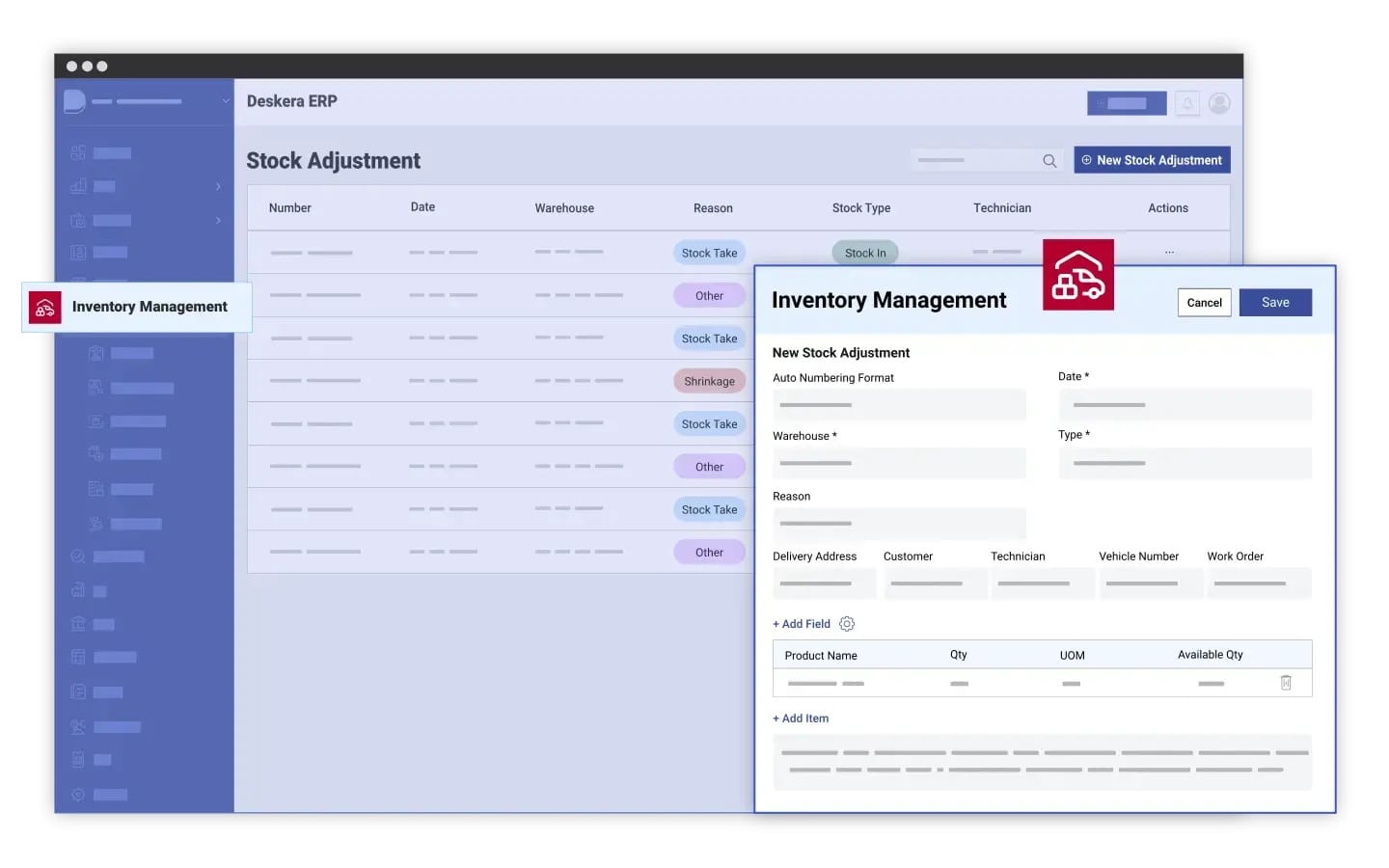
Managing stock adjustments across multiple warehouses can be complex, especially when inventory is constantly moving between locations. Deskera ERP helps businesses simplify inventory adjustment processes by providing real-time inventory visibility, centralized inventory management, and automated inventory controls. By maintaining accurate inventory records and reducing manual intervention, Deskera ERP enables organizations to improve inventory accuracy and minimize costly inventory discrepancies.
Centralized Multi-Warehouse Inventory Management
Deskera ERP allows businesses to manage inventory across multiple warehouses from a single platform. All inventory movements, stock adjustments, and inventory adjustments are recorded within a centralized system, ensuring consistent inventory data across locations. This unified view helps businesses quickly identify discrepancies and maintain accurate inventory records throughout the warehouse network.
Real-Time Inventory Tracking
With real-time inventory tracking, Deskera ERP provides up-to-date visibility into inventory levels, stock transfers, receipts, and shipments. Inventory data is automatically updated as transactions occur, allowing businesses to perform stock adjustments based on accurate information. Real-time visibility reduces inventory discrepancies and helps prevent stockouts, overstocking, and fulfillment errors.
Simplified Stock Adjustment and Inventory Correction Processes
Deskera ERP makes it easier to record and manage stock adjustments whenever inventory discrepancies occur. Businesses can quickly update inventory quantities, document adjustment reasons, and maintain accurate inventory records. This streamlined inventory adjustment process helps warehouse teams resolve discrepancies efficiently while ensuring complete traceability of inventory changes.
Automated Inventory Transfers Between Warehouses
Inter-warehouse transfers are a common source of inventory discrepancies. Deskera ERP helps businesses track inventory transfers from dispatch to receipt, ensuring accurate inventory movement records across locations. Automated transfer tracking reduces manual errors, improves warehouse coordination, and minimizes the need for corrective stock adjustments caused by transfer discrepancies.
Barcode-Enabled Inventory Control
Deskera ERP supports barcode-based inventory management, enabling warehouse teams to scan and track inventory throughout receiving, storage, picking, and shipping processes. Barcode automation reduces manual data entry errors and improves inventory accuracy, resulting in fewer inventory adjustments and more reliable stock records.
Comprehensive Audit Trails and Inventory Tracking
Every stock adjustment and inventory adjustment recorded in Deskera ERP is tracked through detailed audit logs. Businesses can monitor who made an adjustment, when it occurred, and why it was necessary. These audit trails improve accountability, simplify inventory investigations, and support compliance with internal controls and auditing requirements.
Advanced Reporting and Inventory Analytics
Deskera ERP provides inventory reports and analytics that help businesses monitor stock adjustment trends, inventory accuracy, warehouse performance, and inventory movement patterns. By analyzing adjustment data, organizations can identify recurring issues, address root causes of discrepancies, and continuously improve inventory management processes.
Mobile Accessibility for Warehouse Operations
Deskera ERP's mobile capabilities allow warehouse personnel to access inventory information, record inventory transactions, and manage stock adjustments from anywhere within the facility. Mobile access improves operational efficiency, enables faster inventory updates, and helps ensure inventory records remain accurate in real time.
Better Inventory Planning and Replenishment
Accurate inventory records are critical for effective replenishment planning and demand forecasting. By reducing inventory discrepancies through timely stock adjustments and automated inventory management, Deskera ERP helps businesses maintain optimal inventory levels, improve purchasing decisions, and allocate inventory efficiently across multiple warehouse locations.
Key Takeaways
- Stock adjustments and inventory adjustments help reconcile differences between recorded inventory and actual stock levels, ensuring accurate inventory records and operational efficiency.
- Types of Stock Adjustments: Understanding the different types of stock adjustments—quantity increases, quantity decreases, cost adjustments, status adjustments, and transfer adjustments—helps businesses apply the correct inventory correction method.
- Importance of Stock Adjustments for Inventory Accuracy: Regular stock adjustments improve inventory accuracy, support better planning, reduce stockouts, and strengthen financial reporting.
- Why Stock Adjustments Are Challenging in Multi-Warehouse Operations: Managing inventory adjustments across multiple warehouses is complex due to visibility gaps, transfer discrepancies, inconsistent processes, and delayed inventory updates.
- Common Causes of Stock Adjustments in Multi-Warehouse Environments: Inventory count variances, damaged goods, receiving errors, transfer issues, returns, and data inaccuracies are among the most common reasons businesses perform stock adjustments.
- How to Manage Stock Adjustments in Multi-Warehouse Operations: Standardized procedures, real-time inventory tracking, cycle counting, automated transfer management, and centralized inventory systems are essential for effective stock adjustment management.
- Best Practices for Accurate Stock Adjustments Across Multiple Warehouses: Centralized inventory data, continuous monitoring, regular reconciliations, role-based controls, and root-cause analysis help minimize inventory discrepancies and improve inventory accuracy.
- Key Metrics to Track for Effective Stock Adjustment Management: Monitoring metrics such as inventory accuracy rate, stock adjustment frequency, shrinkage rate, cycle count accuracy, and transfer accuracy helps businesses improve inventory control and operational performance.
- Benefits of Effective Stock Adjustment Management: Well-managed stock adjustments reduce inventory losses, improve warehouse coordination, enhance customer satisfaction, and support better financial and operational outcomes.
- How ERP Software Improves Stock Adjustment Management: ERP systems streamline inventory adjustments through real-time visibility, automation, centralized data management, audit trails, and advanced inventory analytics.
- How Deskera ERP Helps Manage Stock Adjustments Effectively: Deskera ERP simplifies stock adjustment processes with multi-warehouse inventory management, real-time tracking, barcode-enabled controls, automated transfers, audit logs, and powerful inventory reporting capabilities.
Related Articles
 Niti Samani
 Niti Samani
 Niti Samani
 Niti Samani
 Niti Samani
 Niti Samani
Have you ever wondered how manufacturers produce aircraft components, medical implants, or electronic parts with microscopic accuracy and virtually no room for error? The answer lies in precision manufacturing—a highly specialized approach that focuses on producing parts and products with extremely tight tolerances, exceptional consistency, and superior quality. As industries continue to demand higher performance, reliability, and customization, precision manufacturing has become a cornerstone of modern production.
The importance of precision manufacturing is growing rapidly across industries such as aerospace, automotive, medical devices, electronics, and industrial equipment. Even the smallest deviation in dimensions can lead to product failures, safety risks, regulatory issues, and increased costs. By combining advanced machinery, automation, data-driven processes, and rigorous quality control, manufacturers can achieve the accuracy needed to meet increasingly complex product requirements while maintaining efficiency and profitability.
This growing demand is reflected in market trends. The global precision manufacturing and machining market is currently valued at approximately $134 billion and is projected to exceed $224 billion by 2034. The expansion is being driven by technological advancements, increasing adoption of automation, rising quality standards, and the need for highly precise components in next-generation products. As a result, businesses are investing heavily in modern manufacturing technologies to remain competitive in a rapidly evolving marketplace.
To fully realize the benefits of precision manufacturing, companies also need strong production planning and operational control. Deskera MRP helps manufacturers streamline production scheduling, manage inventory levels, monitor shop floor activities, and optimize resource utilization from a single platform. With real-time visibility into manufacturing operations, automated workflows, and data-driven insights, Deskera MRP enables businesses to maintain high levels of accuracy, improve efficiency, and support continuous improvement initiatives essential for precision manufacturing success.
What Is Precision Manufacturing?
Precision manufacturing is the process of producing parts and components with extremely tight tolerances, high dimensional accuracy, and consistent quality. It involves transforming digital designs into physical products using advanced technologies such as Computer Numerical Control (CNC) machines, Computer-Aided Design (CAD), Computer-Aided Manufacturing (CAM), automation systems, and precision inspection equipment. The goal is to create components that meet exact specifications with minimal variation, often within microns or fractions of a millimeter.
Unlike traditional manufacturing methods that may allow greater dimensional variation and rely heavily on manual adjustments, precision manufacturing uses computer-controlled processes to minimize human error and ensure repeatability. CNC machines, for example, can precisely remove material from metal, plastic, or composite workpieces to create complex shapes and intricate features while maintaining exceptionally tight tolerances. This level of control enables manufacturers to produce identical parts consistently, even across large production runs.
Precision manufacturing focuses on three core principles: accuracy, repeatability, and process control. Accuracy ensures that every component matches the intended design specifications, while repeatability guarantees consistent results from one production cycle to the next. Advanced monitoring systems, automated inspection tools, and digital workflows help manufacturers maintain strict quality standards throughout the production process.
Today, precision manufacturing plays a critical role in industries such as aerospace, automotive, medical devices, electronics, and industrial equipment manufacturing. In these sectors, even the smallest deviation can affect product performance, safety, or reliability. By combining advanced machinery, sophisticated software, and rigorous quality control practices, precision manufacturing enables businesses to produce high-performance components that meet demanding industry requirements while improving efficiency and reducing waste.
Core Principles of Precision Manufacturing
Precision manufacturing is built on a set of fundamental principles that ensure products are produced accurately, consistently, and efficiently. These principles guide every stage of the manufacturing process, from design and production to inspection and quality assurance. By adhering to these core concepts, manufacturers can meet strict specifications, minimize defects, and deliver high-performance components for demanding industries.
Accuracy
Accuracy refers to the ability to manufacture parts that precisely match the intended design specifications. In precision manufacturing, even minor deviations can impact product performance, functionality, or safety. Advanced technologies such as CNC machining, CAD/CAM systems, and automated measurement tools help ensure components are produced within extremely tight tolerances.
Repeatability
Repeatability is the ability to consistently produce identical parts across multiple production runs. Whether manufacturing a dozen components or thousands, each part must meet the same quality and dimensional standards. Automated production processes and standardized workflows help eliminate variations and ensure consistent results.
Tight Tolerance Control
Tolerance control involves maintaining allowable dimensional variations within predefined limits. Precision manufacturing often requires tolerances measured in microns or fractions of a millimeter. Effective tolerance management ensures that components fit together correctly, perform reliably, and meet industry requirements.
Process Control
Process control focuses on monitoring and managing manufacturing operations to maintain product quality and operational stability. Manufacturers use sensors, real-time data collection, automation systems, and performance monitoring tools to identify issues early and prevent defects before they occur.
Quality Assurance and Inspection
Quality assurance ensures that products meet specified standards throughout the manufacturing process. Precision manufacturers use inspection techniques such as coordinate measuring machines (CMMs), laser scanning, and automated testing systems to verify dimensions, surface finishes, and product integrity before delivery.
Continuous Improvement
Continuous improvement involves regularly analyzing production performance and identifying opportunities to enhance efficiency, quality, and accuracy. By leveraging production data, advanced analytics, and employee feedback, manufacturers can reduce waste, optimize processes, and maintain a competitive advantage in increasingly demanding markets.
How Precision Manufacturing Works
Precision manufacturing follows a structured process designed to transform detailed engineering designs into highly accurate, high-quality components.
Every stage is carefully controlled to ensure products meet exact specifications, maintain tight tolerances, and deliver consistent performance.
Advanced technologies, automated equipment, and rigorous quality checks work together throughout the production cycle to achieve the required level of precision.
Product Design and Engineering
The process begins with product design and engineering, where manufacturers create detailed digital models and technical drawings using CAD software.
Engineers define dimensions, tolerances, material requirements, and performance specifications to ensure the final product meets functional and quality standards.
This stage lays the foundation for accurate production and helps identify potential manufacturing challenges before production begins.
Material Selection
Choosing the right material is critical to achieving the desired strength, durability, and performance of the final component. Manufacturers evaluate factors such as mechanical properties, thermal resistance, corrosion resistance, and machinability when selecting metals, plastics, composites, or other materials. Proper material selection helps ensure product reliability and manufacturing efficiency.
Precision Machining and Fabrication
Once the design and materials are finalized, production begins using advanced manufacturing technologies such as CNC milling, CNC turning, grinding, laser cutting, or electrical discharge machining (EDM).
These computer-controlled systems remove or shape material with exceptional accuracy, producing components that meet strict dimensional requirements while minimizing human error.
Inspection and Quality Control
Throughout the manufacturing process, components undergo continuous inspection and quality verification. Precision measurement tools, coordinate measuring machines (CMMs), laser scanners, and automated inspection systems are used to check dimensions, surface finishes, and tolerances. Early detection of deviations helps prevent defects and ensures compliance with quality standards.
Final Assembly and Testing
For products consisting of multiple components, the manufactured parts are assembled and tested to verify proper fit, functionality, and performance.
Manufacturers may conduct mechanical, electrical, environmental, or stress tests depending on the application. Once the product passes all quality and performance checks, it is prepared for delivery to the customer.
Key Technologies Used in Precision Manufacturing
Precision manufacturing relies on a combination of advanced technologies that enable manufacturers to produce highly accurate, consistent, and complex components. These technologies help minimize human error, improve repeatability, maintain tight tolerances, and optimize production efficiency.
As manufacturing requirements become more demanding, the integration of digital tools, automation, and intelligent systems has become essential for achieving precision at scale.
Computer Numerical Control (CNC) Machining
CNC machining is one of the most important technologies in precision manufacturing. It uses computer-controlled machines to remove material from a workpiece through processes such as milling, turning, drilling, boring, and grinding.
CNC machines follow programmed instructions generated from CAD/CAM software, allowing them to produce highly accurate components with exceptional consistency.
Modern multi-axis CNC machines can manufacture complex geometries in a single setup while maintaining extremely tight tolerances, making them ideal for aerospace, automotive, medical, and electronics applications.
Computer-Aided Design (CAD) and Computer-Aided Manufacturing (CAM)
CAD and CAM software form the digital foundation of precision manufacturing. CAD software allows engineers to create detailed 2D and 3D models of components, while CAM software converts these designs into machine-readable instructions.
Together, these technologies streamline product development, improve design accuracy, reduce production errors, and ensure seamless communication between design and manufacturing teams.
Automation and Robotics
Automation and robotics help manufacturers improve consistency, productivity, and operational efficiency. Robotic systems can perform repetitive tasks such as material handling, assembly, welding, packaging, and machine loading with high precision.
By reducing manual intervention, automation minimizes errors, increases throughput, and enables manufacturers to maintain consistent quality across large production volumes.
Additive Manufacturing (3D Printing)
Additive manufacturing, commonly known as 3D printing, creates components by building material layer by layer based on digital designs.
Unlike traditional subtractive methods, this technology adds material only where needed, reducing waste and enabling the production of highly complex geometries.
Precision manufacturers often use 3D printing for rapid prototyping, customized parts, lightweight structures, and low-volume production runs.
Artificial Intelligence and Machine Learning
Artificial intelligence (AI) and machine learning are transforming precision manufacturing by enabling smarter decision-making and predictive capabilities.
These technologies can analyze large volumes of production data to identify patterns, optimize machining parameters, predict equipment failures, improve quality control, and support continuous process improvement.
AI-powered systems help manufacturers increase efficiency while reducing downtime and defects.
Industrial Internet of Things (IIoT)
The Industrial Internet of Things connects machines, sensors, and production equipment to collect and exchange real-time data.
IIoT technology provides manufacturers with greater visibility into machine performance, production status, energy consumption, and product quality.
Real-time monitoring allows faster problem detection, better process control, and more informed decision-making throughout the manufacturing operation.
Coordinate Measuring Machines (CMMs)
Coordinate Measuring Machines (CMMs) are advanced inspection systems used to verify the dimensional accuracy of manufactured components.
These machines measure physical features with exceptional precision and compare them against design specifications.
CMMs play a critical role in quality assurance by identifying deviations, validating tolerances, and ensuring that finished products meet strict industry standards before they reach customers.
Precision Manufacturing Industries and Applications
Precision manufacturing plays a vital role in industries where accuracy, reliability, and consistency are critical.
Its ability to produce components with tight tolerances and repeatable quality makes it essential for applications ranging from aerospace systems and medical devices to consumer electronics and industrial automation.
As products become increasingly complex and performance expectations continue to rise, precision manufacturing remains a key enabler of innovation and operational excellence across multiple sectors.
Aerospace Industry
The aerospace industry relies heavily on precision manufacturing to produce components that must withstand extreme temperatures, pressures, and operating conditions.
Parts such as turbine blades, engine components, actuator housings, landing gear systems, and structural assemblies require exceptional dimensional accuracy and reliability.
Precision manufacturing ensures these components meet strict safety, performance, and regulatory requirements while maintaining lightweight designs and fuel efficiency.
Automotive Industry
Precision manufacturing supports both automotive prototyping and large-scale production.
Critical components such as engine parts, transmission systems, fuel injection assemblies, braking systems, and gear mechanisms require tight tolerances to ensure optimal performance and durability.
By enabling consistent part production, precision manufacturing helps improve vehicle reliability, fuel efficiency, and overall manufacturing quality.
Medical Devices and Healthcare
Medical device manufacturing demands some of the highest levels of precision and quality control.
Surgical instruments, orthopedic implants, dental devices, diagnostic equipment, and medical housings must meet stringent regulatory standards and exact dimensional specifications.
Precision manufacturing enables the production of complex, highly reliable components that contribute to patient safety and treatment effectiveness.
Electronics and Semiconductor Industry
As electronic devices become smaller and more sophisticated, precision manufacturing has become essential for producing miniature components and assemblies.
Applications include smartphone housings, semiconductor equipment, sensor casings, connectors, optical components, and circuit board parts. Tight tolerances and precise alignment are critical to ensuring product performance, functionality, and reliability.
Defense and Military Applications
Defense systems operate in demanding environments where reliability is non-negotiable.
Precision manufacturing is used to produce components for weapon systems, surveillance equipment, communication devices, targeting systems, military vehicles, and aerospace defense applications.
The ability to achieve consistent quality and maintain strict compliance standards makes precision manufacturing indispensable in this sector.
Robotics and Industrial Automation
Robotics and automation systems depend on highly accurate components to achieve smooth movement, precise positioning, and long-term operational reliability.
Precision manufacturing is used to produce gears, actuators, robotic joints, housings, control systems, and motion components that require exact dimensions and minimal variation. These capabilities help improve the performance and lifespan of automated systems.
Consumer Electronics and Consumer Goods
Precision manufacturing enables the production of high-quality consumer products with consistent fit, finish, and functionality.
Applications include smartphones, wearable devices, laptops, smart home products, appliances, and personal care products.
Manufacturers rely on precision processes to create intricate designs, maintain product quality, and support large-scale production requirements.
Industrial Equipment Manufacturing
Industrial machinery and equipment often require highly durable and precisely engineered components to operate efficiently.
Precision manufacturing is used to produce bearings, valves, pumps, machine tools, hydraulic systems, and custom industrial parts.
Accurate manufacturing helps reduce equipment failures, improve performance, and extend operational lifespan.
Prototyping and Research & Development
Precision manufacturing is widely used in product development and research activities.
Engineers can create functional prototypes that closely replicate final production parts, allowing them to test designs, evaluate performance, and identify improvements before full-scale manufacturing begins.
Rapid prototyping capabilities help accelerate innovation while reducing development risks and costs.
Benefits of Precision Manufacturing
Precision manufacturing provides manufacturers with the ability to produce highly accurate, reliable, and consistent components while improving efficiency and reducing costs.
By combining advanced machinery, automation, digital design tools, and rigorous quality control, businesses can achieve superior production outcomes that would be difficult to replicate using conventional manufacturing methods.
These advantages make precision manufacturing essential for industries that demand exceptional quality and performance.
Higher Product Accuracy and Tighter Tolerances
One of the most significant benefits of precision manufacturing is its ability to produce components with extremely tight tolerances and minimal dimensional variation.
Advanced CNC machines, automated controls, and digital design systems ensure that every part closely matches the intended specifications.
This level of accuracy is critical in industries such as aerospace, medical devices, and electronics, where even minor deviations can affect product performance and safety.
Faster Production Cycles
Precision manufacturing accelerates production by integrating CAD/CAM software, automation, and computer-controlled machinery.
Once a design is finalized, manufacturing instructions can be generated quickly and executed with minimal manual intervention.
This streamlined workflow reduces lead times, enables faster prototyping, and helps businesses bring products to market more efficiently.
Reduced Material Waste and Rework
High levels of accuracy and repeatability significantly reduce the number of defective parts produced during manufacturing. Optimized machining paths, automated processes, and precise material usage help minimize scrap and rework, resulting in lower material consumption and reduced production costs. This also supports sustainability initiatives by reducing waste generation.
Greater Consistency and Repeatability
Precision manufacturing ensures that identical parts can be produced repeatedly with the same quality and dimensional accuracy. Automated systems and standardized production processes eliminate much of the variability associated with manual manufacturing methods. This consistency is especially important for large-scale production where uniformity directly impacts product reliability and customer satisfaction.
Lower Long-Term Manufacturing Costs
Although precision manufacturing technologies may require a higher initial investment, they often deliver substantial long-term cost savings.
Reduced waste, fewer defects, lower labor requirements, shorter production cycles, and improved operational efficiency help lower the total cost of manufacturing over time while improving profitability.
Easier Prototyping and Product Development
Modern precision manufacturing technologies support rapid prototyping, allowing manufacturers to quickly transform digital designs into functional prototypes.
Engineers can test, evaluate, and refine designs faster, reducing development time and identifying potential issues before full-scale production begins. This accelerates innovation and improves product quality.
Compatibility with a Wide Range of Materials
Precision manufacturing processes can work with a broad range of materials, including aluminum, titanium, stainless steel, copper alloys, plastics, composites, and specialty materials.
This flexibility allows manufacturers to select materials based on performance, durability, weight, and cost requirements without compromising accuracy or quality.
Enhanced Product Quality and Reliability
By maintaining strict process control and rigorous quality standards, precision manufacturing consistently produces components that perform as intended.
Improved dimensional accuracy, superior surface finishes, and tighter tolerances contribute to higher product reliability, fewer failures, and longer service life for finished products.
Improved Scalability
Precision manufacturing can efficiently support both low-volume production and high-volume manufacturing. Once a process is programmed and validated, manufacturers can scale production while maintaining the same level of accuracy and quality. This makes it easier to respond to changing market demand without sacrificing consistency.
Improved Safety and Reduced Human Error
Automation, robotics, and computer-controlled equipment reduce the need for manual intervention in many manufacturing operations. This minimizes the risk of human error, improves workplace safety, and ensures more consistent production outcomes. Real-time monitoring systems can also detect deviations early, helping prevent defects and equipment-related issues before they impact production.
Challenges and Risks of Precision Manufacturing
While precision manufacturing offers exceptional accuracy, consistency, and efficiency, it also presents several technical, operational, and financial challenges.
Producing components with extremely tight tolerances requires advanced equipment, skilled personnel, rigorous quality control, and continuous process optimization.
Understanding these challenges can help manufacturers develop effective strategies to minimize risks and maximize the return on their investments.
High Initial Investment
One of the biggest barriers to adopting precision manufacturing is the substantial upfront cost. Advanced CNC machines, automation systems, inspection equipment, CAD/CAM software, and quality control technologies require significant capital investment.
In addition to purchasing equipment, manufacturers must also account for installation, training, integration, and ongoing software upgrades. For small and mid-sized businesses, these costs can make implementation challenging without careful financial planning.
Skilled Labor Shortages
Despite increasing automation, precision manufacturing still depends heavily on skilled engineers, programmers, machinists, and quality control specialists.
Operating advanced machinery, creating optimized CAD/CAM programs, interpreting production data, and troubleshooting technical issues require specialized expertise.
As the manufacturing industry faces a growing shortage of skilled workers, many companies struggle to recruit and retain talent capable of supporting precision operations.
Machine Downtime and Maintenance Requirements
Precision manufacturing equipment must operate within extremely tight performance parameters to maintain accuracy. Regular wear and tear, tool degradation, spindle misalignment, and thermal fluctuations can affect machine performance over time.
Unplanned downtime not only disrupts production schedules but can also lead to quality issues and missed delivery deadlines. As a result, manufacturers must invest in preventive and predictive maintenance programs to ensure equipment reliability.
Maintaining Tight Tolerances
Achieving and maintaining tight tolerances remains one of the most demanding aspects of precision manufacturing.
Even minor factors such as tool wear, machine vibration, material inconsistencies, temperature changes, or fixture misalignment can affect dimensional accuracy.
Manufacturers must continuously monitor production processes, calibrate equipment, and conduct inspections to ensure products remain within specified tolerance limits.
Quality Defects and Process Variability
Because precision manufacturing operates with very small margins for error, even slight process variations can lead to defects.
Common issues include dimensional inaccuracies, surface finish imperfections, burr formation, thermal distortion, and material deformation.
Detecting and correcting these problems often requires advanced inspection systems, real-time monitoring, and robust quality management procedures.
Regulatory Compliance and Documentation Requirements
Many industries that rely on precision manufacturing—including aerospace, medical devices, automotive, and defense—have strict regulatory and quality standards.
Manufacturers must comply with industry certifications, maintain detailed production records, ensure traceability, and undergo regular audits.
Managing these compliance requirements can increase administrative workloads and require significant investments in documentation and quality assurance systems.
Supply Chain Disruptions
Precision manufacturing often depends on specialized materials, tooling, and components sourced from multiple suppliers.
Disruptions caused by supplier delays, raw material shortages, transportation issues, or geopolitical factors can impact production schedules and increase costs.
Maintaining a resilient supply chain and strong supplier relationships is essential for minimizing these risks.
Cybersecurity and Data Protection Risks
As precision manufacturing becomes increasingly connected through automation, IIoT devices, cloud platforms, and digital production systems, cybersecurity has become a growing concern.
Unauthorized access, data breaches, ransomware attacks, or system failures can disrupt operations and compromise sensitive manufacturing information.
Manufacturers must implement strong cybersecurity measures to protect production systems and intellectual property.
Balancing Cost, Speed, and Quality
Manufacturers often face pressure to reduce costs and shorten lead times while maintaining high precision and product quality. Balancing these competing priorities can be challenging, particularly in highly competitive industries.
Companies must carefully optimize processes, resource allocation, and production planning to meet customer expectations without compromising accuracy or profitability.
How to Ensure Precision in Manufacturing Processes
Achieving precision in manufacturing requires more than advanced machinery. It demands a systematic approach that combines technology, process control, skilled personnel, and continuous monitoring.
Manufacturers must focus on every stage of production—from design and material selection to machining, inspection, and maintenance—to consistently meet tight tolerances and quality requirements.
By implementing the right strategies, businesses can improve accuracy, reduce defects, and maintain reliable production performance.
Regularly Calibrate and Maintain Equipment
Precision manufacturing starts with well-maintained equipment. Over time, machine wear, thermal expansion, vibration, and alignment issues can affect dimensional accuracy.
Regular calibration ensures CNC machines, inspection systems, and production equipment continue to operate within specified tolerances. Preventive maintenance schedules and routine performance checks help minimize deviations and reduce the risk of costly downtime.
Leverage Advanced CAD/CAM Software
Computer-Aided Design (CAD) and Computer-Aided Manufacturing (CAM) software play a critical role in ensuring manufacturing accuracy.
CAD systems create precise digital models, while CAM software generates optimized machining instructions for production equipment.
Advanced software tools can simulate machining operations, identify potential issues before production begins, and reduce the likelihood of programming errors that affect part quality.
Implement Robust Quality Control Processes
Quality control should be integrated throughout the entire manufacturing process rather than performed only at the final inspection stage.
In-process inspections, automated measurement systems, statistical process control (SPC), and coordinate measuring machines (CMMs) help detect deviations early.
Continuous quality monitoring allows manufacturers to make corrections quickly and prevent defects from affecting larger production batches.
Invest in Employee Training and Skill Development
Even highly automated manufacturing environments rely on skilled operators, programmers, engineers, and quality specialists.
Ongoing training ensures employees remain proficient in operating advanced equipment, interpreting production data, and applying best practices.
A knowledgeable workforce can identify issues faster, optimize processes, and contribute to maintaining consistent manufacturing precision.
Select and Handle Materials Carefully
Material properties significantly influence manufacturing accuracy and product performance. Factors such as hardness, thermal expansion, machinability, and dimensional stability must be considered during material selection.
Proper storage, handling, and preparation of raw materials help prevent contamination, deformation, and other issues that could impact final product quality.
Adopt Advanced Manufacturing Technologies
Modern manufacturing technologies such as multi-axis CNC machines, robotics, automation systems, additive manufacturing, and digital twins provide greater control over production processes.
These technologies improve repeatability, reduce human error, and enable manufacturers to achieve tighter tolerances while increasing productivity and operational efficiency.
Utilize Real-Time Monitoring and Data Analytics
Real-time monitoring systems provide continuous visibility into machine performance, production conditions, and process variables.
Sensors, Industrial Internet of Things (IIoT) devices, and data analytics platforms help identify abnormalities before they affect product quality.
Access to accurate production data allows manufacturers to make proactive adjustments and maintain process stability.
Implement Predictive Maintenance Programs
Predictive maintenance uses machine data, sensors, and analytics to identify potential equipment issues before failures occur.
Monitoring factors such as vibration, temperature, tool wear, and machine load helps manufacturers schedule maintenance activities at the right time.
This approach reduces unexpected downtime, protects equipment accuracy, and extends machine lifespan.
Standardize Manufacturing Processes
Standardized operating procedures help ensure consistency across production runs and reduce process variability.
Clearly documented workflows, machine settings, inspection methods, and quality standards enable manufacturers to replicate successful processes and maintain repeatable results regardless of production volume or personnel changes.
Foster a Culture of Continuous Improvement
Precision manufacturing requires ongoing refinement and optimization. Manufacturers should regularly analyze production data, evaluate quality performance, identify process bottlenecks, and implement corrective actions.
Continuous improvement initiatives help enhance accuracy, reduce waste, improve efficiency, and ensure long-term competitiveness in an increasingly demanding manufacturing environment.
Best Practices for Successful Precision Manufacturing
Success in precision manufacturing depends on more than advanced equipment and technology.
Manufacturers must establish disciplined processes, maintain strict quality standards, and continuously optimize operations to achieve consistent accuracy and efficiency.
By following proven best practices, businesses can improve product quality, reduce operational risks, and maximize the value of their precision manufacturing investments.
Invest in Advanced Manufacturing Technologies
Modern technologies such as multi-axis CNC machines, automation systems, robotics, additive manufacturing, and digital twins enable greater accuracy, repeatability, and process control.
Investing in the right technology helps manufacturers meet tighter tolerances, produce complex components more efficiently, and remain competitive in rapidly evolving markets.
Prioritize Quality at Every Stage
Quality should be integrated into every phase of the manufacturing process rather than treated as a final inspection activity. Implementing in-process inspections, statistical process control (SPC), automated measurement systems, and rigorous testing procedures helps identify issues early and prevents defects from reaching customers.
Maintain Regular Equipment Calibration and Maintenance
Even minor machine deviations can affect product accuracy and consistency. Establishing preventive and predictive maintenance programs helps keep equipment operating at peak performance.
Regular calibration, alignment checks, and condition monitoring reduce the risk of machine-related errors, downtime, and quality problems.
Leverage CAD/CAM and Digital Manufacturing Tools
Advanced CAD/CAM software improves design accuracy and streamlines the transition from engineering to production.
Digital manufacturing tools enable process simulation, toolpath optimization, and virtual testing, helping manufacturers identify potential issues before production begins and reducing costly errors.
Focus on Workforce Development
Skilled employees remain essential to precision manufacturing success. Providing ongoing training in machining techniques, automation systems, quality control methods, and emerging technologies helps employees maintain high performance levels. A knowledgeable workforce is better equipped to solve problems, improve processes, and adapt to changing production requirements.
Standardize Processes and Workflows
Documented procedures and standardized operating practices help reduce variability across production runs. Consistent machine settings, inspection methods, setup procedures, and quality standards ensure repeatable results and make it easier to maintain product quality regardless of production volume.
Use Real-Time Monitoring and Data Analytics
Real-time production monitoring provides immediate visibility into machine performance, production progress, and quality metrics. By analyzing operational data, manufacturers can detect anomalies, address bottlenecks, optimize machine utilization, and make informed decisions that improve overall efficiency and precision.
Strengthen Supplier and Material Management
Precision manufacturing depends on high-quality raw materials and reliable suppliers. Establishing strong supplier relationships, conducting material inspections, and maintaining strict procurement standards help ensure material consistency and reduce the risk of quality issues that can affect finished products.
Implement Robust Traceability Systems
Maintaining complete traceability throughout the production process helps manufacturers monitor product quality, support regulatory compliance, and quickly identify the root causes of defects.
Digital tracking systems provide visibility into materials, production activities, inspections, and finished goods, improving accountability and operational control.
Embrace Continuous Improvement
Manufacturers should regularly review performance metrics, quality data, and production processes to identify opportunities for improvement.
Continuous improvement initiatives help reduce waste, increase efficiency, enhance product quality, and ensure long-term success in a competitive manufacturing environment.
Key Metrics to Track in Precision Manufacturing
Measuring performance is essential for maintaining the accuracy, efficiency, and consistency required in precision manufacturing.
By tracking the right metrics, manufacturers can identify process inefficiencies, monitor product quality, reduce waste, and ensure that production operations consistently meet tight tolerance requirements.
These key performance indicators (KPIs) provide valuable insights that support continuous improvement and better decision-making.
First Pass Yield (FPY)
First Pass Yield measures the percentage of products that meet quality specifications without requiring rework or repairs. A high FPY indicates that manufacturing processes are operating effectively and producing accurate parts on the first attempt. Monitoring this metric helps identify quality issues early and reduce production costs associated with rework and scrap.
Overall Equipment Effectiveness (OEE)
OEE evaluates how efficiently manufacturing equipment is being utilized by measuring availability, performance, and quality. This metric provides a comprehensive view of machine productivity and helps manufacturers identify downtime, speed losses, and quality-related inefficiencies that may affect production accuracy and output.
Defect Rate
The defect rate tracks the percentage of manufactured components that fail to meet specified quality standards. Monitoring defect rates helps manufacturers identify recurring quality issues, improve process control, and reduce the risk of customer complaints, product recalls, or regulatory non-compliance.
Machine Utilization Rate
Machine utilization measures how effectively production equipment is being used during available operating time. Low utilization rates may indicate scheduling inefficiencies, excessive downtime, or capacity planning issues. Improving machine utilization helps maximize production output while maintaining precision and quality standards.
Production Cycle Time
Production cycle time measures the total time required to manufacture a product from start to finish. Tracking cycle times helps manufacturers identify bottlenecks, optimize workflows, and improve production efficiency without compromising product accuracy or quality.
Scrap and Rework Rate
This metric measures the amount of material wasted through defective products, production errors, or rework activities. High scrap and rework rates often indicate issues with process control, machine performance, operator training, or material quality. Reducing these rates lowers costs and improves operational efficiency.
On-Time Delivery Rate
On-time delivery rate tracks the percentage of customer orders delivered according to the agreed schedule. In precision manufacturing, meeting delivery commitments is just as important as maintaining product quality. This metric helps evaluate production planning effectiveness and overall supply chain performance.
Process Capability (Cp and Cpk)
Process capability metrics measure how consistently a manufacturing process operates within specified tolerance limits. Cp evaluates the potential capability of a process, while Cpk measures actual process performance considering process variation and centering. These metrics are particularly important in precision manufacturing, where maintaining tight tolerances is critical.
Customer Return Rate
Customer return rate indicates the percentage of products returned due to defects, performance issues, or quality concerns. Tracking this metric helps manufacturers assess product reliability, identify quality gaps, and improve customer satisfaction through better production and inspection processes.
Mean Time Between Failures (MTBF)
MTBF measures the average operating time between equipment failures. A higher MTBF indicates greater equipment reliability and stability. Monitoring this metric supports preventive maintenance planning, reduces unexpected downtime, and helps maintain consistent production accuracy.
How Deskera MRP Helps Precision Manufacturers
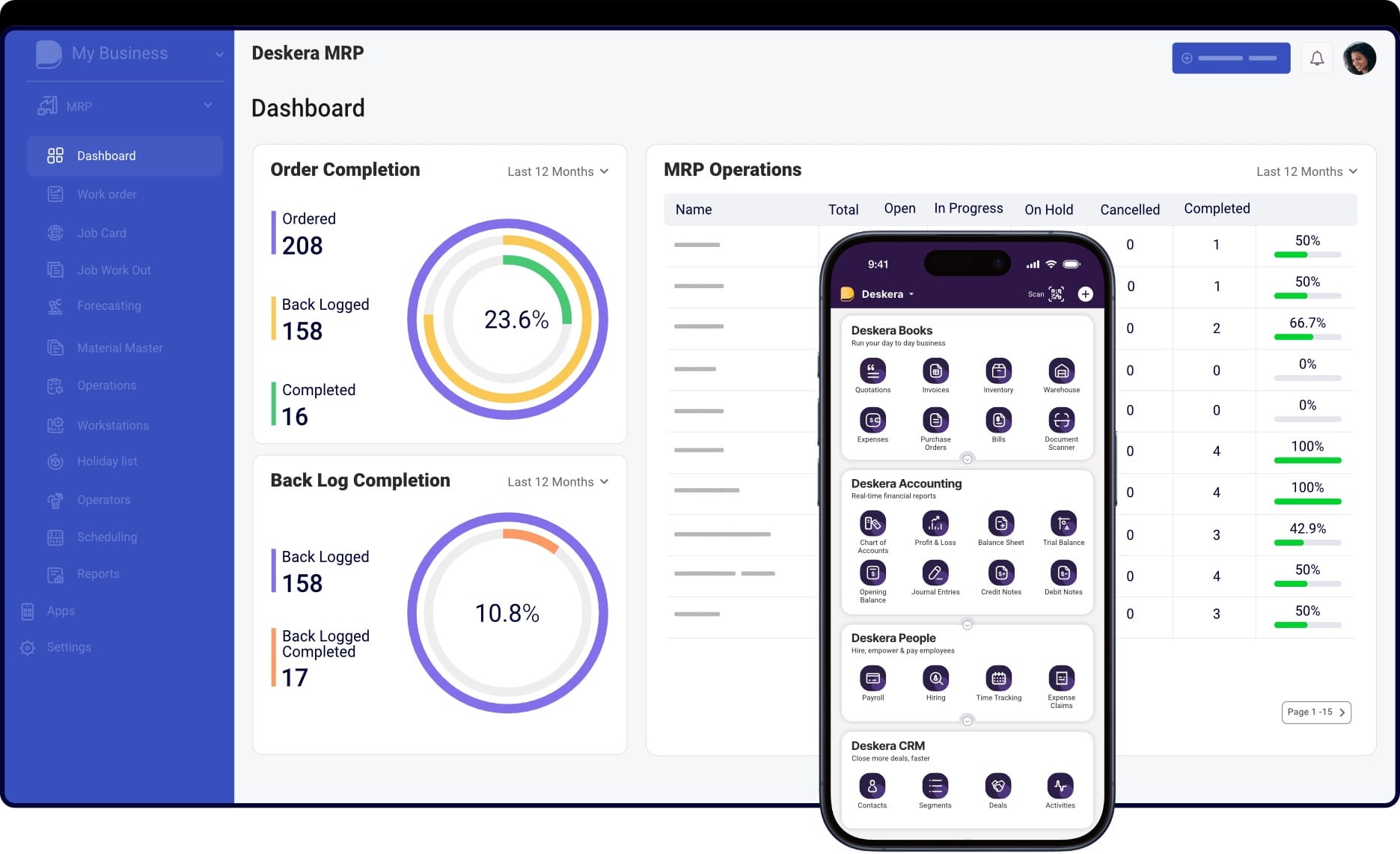
Precision manufacturers operate in an environment where accuracy, traceability, machine reliability, and production efficiency are critical. Deskera MRP provides an integrated platform that helps manufacturers manage materials, production schedules, machine performance, work orders, and quality-related processes from a single system. This enables greater control over manufacturing operations while supporting consistent product quality and on-time delivery.
Streamlines Production Planning and Scheduling
Precision manufacturing often involves complex workflows, tight deadlines, and strict production requirements. Deskera MRP helps manufacturers create detailed production plans, allocate resources, set schedules, and track production activities in real time. Better planning reduces bottlenecks, improves resource utilization, and ensures production runs stay on schedule.
Improves Material Availability and Inventory Control
Material shortages can disrupt precision manufacturing operations and delay customer deliveries. Deskera's Material Requirements Planning (MRP) capabilities help manufacturers manage inventory levels, track material availability, plan procurement activities, and ensure the right materials are available when needed. This reduces stockouts while avoiding excess inventory costs.
Supports Complex Product Structures with Multi-Level BOMs
Precision-manufactured products often contain multiple assemblies and subassemblies. Deskera MRP's Multi-Level Bill of Materials (BOM) functionality allows manufacturers to manage complex product structures, track component usage, and maintain visibility into material costs throughout the production process.
Enhances Work Order Management
Accurate execution is essential in precision manufacturing. Deskera automates work order creation, assignment, tracking, and completion monitoring. Manufacturers can track labor, machine utilization, production progress, and associated costs, helping ensure every production order is completed according to specifications.
Improves Machine Performance and Maintenance Management
Machine accuracy directly affects product quality in precision manufacturing. Deskera's Machine Management and Machine Maintenance capabilities help manufacturers monitor machine performance, automate maintenance scheduling, track equipment health, and reduce unexpected downtime. This helps maintain production accuracy while extending equipment lifespan.
Provides Real-Time Visibility into Work-in-Progress (WIP)
Precision manufacturers need visibility into production status at every stage. Deskera MRP offers WIP tracking capabilities that allow manufacturers to monitor production progress, identify bottlenecks, track material consumption, and make informed decisions before delays impact delivery schedules.
Reduces Waste Through Yield and Scrap Tracking
Material waste and production defects can significantly increase costs in precision manufacturing. Deskera helps manufacturers track by-products, scrap, production yields, and finished goods costs. These insights enable continuous process improvement and help identify opportunities to reduce waste and improve profitability.
Improves Demand Forecasting and Resource Planning
Demand fluctuations can make production planning challenging. Deskera MRP provides demand forecasting capabilities that help manufacturers anticipate customer requirements, optimize inventory levels, and align production capacity with expected demand. This improves responsiveness while reducing planning errors.
Delivers Actionable Production Insights
Deskera's production reporting tools provide visibility into manufacturing costs, productivity, efficiency, and profitability. Precision manufacturers can use these insights to monitor key performance indicators, identify process inefficiencies, and make data-driven decisions that support continuous improvement initiatives.
Supports Consistent Quality and Operational Control
By integrating production planning, inventory management, machine monitoring, work orders, and reporting into a single platform, Deskera MRP helps manufacturers establish greater process consistency and operational control. This is particularly valuable for precision manufacturers that must maintain tight tolerances, minimize variability, and consistently meet customer quality expectations.
Key Takeaways
- Precision manufacturing produces highly accurate components with tight tolerances, ensuring consistent quality, reliability, and performance across demanding applications.
- The core principles of precision manufacturing—accuracy, repeatability, process control, quality assurance, and automation—form the foundation of successful production operations.
- Precision manufacturing works through a structured process that combines digital design, advanced machining, inspection, and quality control to transform designs into highly accurate parts.
- Technologies such as CNC machining, CAD/CAM software, automation, robotics, additive manufacturing, AI, IIoT, and CMMs enable manufacturers to achieve exceptional precision and efficiency.
- Precision manufacturing improves product accuracy, reduces waste, accelerates production, supports complex designs, and delivers long-term operational cost savings.
- Despite its advantages, precision manufacturing presents challenges such as high capital investment, skilled labor shortages, equipment maintenance requirements, and strict compliance demands.
- Maintaining precision requires regular equipment calibration, advanced software utilization, robust quality control, workforce training, and continuous process monitoring.
- Successful precision manufacturing depends on adopting best practices such as standardizing workflows, investing in modern technology, prioritizing quality, and fostering continuous improvement.
- Tracking key metrics such as First Pass Yield (FPY), OEE, defect rates, process capability, cycle time, and machine utilization helps manufacturers optimize performance and maintain accuracy.
- Precision manufacturing supports critical industries including aerospace, automotive, medical devices, electronics, defense, robotics, industrial equipment, and product development.
- Deskera MRP helps precision manufacturers improve production planning, inventory management, machine maintenance, work order tracking, demand forecasting, and operational visibility to support consistent quality and efficiency.
Related Articles
 Niti Samani
 Niti Samani
 Niti Samani
 Niti Samani
 Niti Samani
 Niti Samani
What if your equipment could tell you exactly when it needs maintenance instead of relying on fixed schedules or waiting for a breakdown to occur? The answer lies in condition-based maintenance (CBM), a proactive maintenance strategy that monitors the actual condition of equipment and triggers maintenance activities only when signs of deterioration or performance issues are detected. By using real-time data, businesses can address potential problems before they lead to costly failures and operational disruptions.
Traditional maintenance approaches often fall into two categories: reactive maintenance, where repairs are made after equipment fails, and preventive maintenance, where servicing is performed at predetermined intervals regardless of asset condition. While both methods have their place, they can result in unnecessary maintenance costs, unexpected downtime, or inefficient use of resources. Condition-based maintenance offers a more data-driven alternative by ensuring that maintenance is performed only when it is genuinely needed.
Advancements in sensors, Industrial Internet of Things (IIoT) technologies, and data analytics have made condition-based maintenance more accessible and effective than ever before. By continuously monitoring parameters such as vibration, temperature, pressure, and lubrication quality, organizations can gain deeper insights into equipment health, improve reliability, extend asset lifespan, and optimize maintenance spending. As industries increasingly focus on operational efficiency and asset performance, CBM has become a critical component of modern maintenance strategies.
Implementing condition-based maintenance becomes even more effective when supported by an integrated manufacturing and maintenance management system. Deskera MRP helps manufacturers streamline maintenance planning by providing real-time visibility into production operations, inventory levels, and equipment-related activities. With features such as work order management, inventory tracking, automated workflows, and centralized operational data, Deskera MRP enables businesses to coordinate maintenance activities efficiently while minimizing disruptions to production. By combining maintenance insights with broader manufacturing processes, organizations can improve equipment reliability, reduce downtime, and enhance overall operational performance.
What Is Condition-Based Maintenance (CBM)?
Condition-based maintenance (CBM) is a maintenance strategy that uses the actual condition of equipment or assets to determine when maintenance should be performed. Instead of relying on fixed maintenance schedules or waiting for equipment to fail, CBM continuously or periodically monitors asset health and triggers maintenance activities only when specific indicators suggest declining performance or a potential failure. This approach helps organizations perform maintenance at the right time, reducing unnecessary servicing while minimizing the risk of unexpected breakdowns.
At the core of condition-based maintenance is the collection and analysis of real-time operational data. Organizations use sensors, monitoring devices, inspections, and performance measurements to track key equipment parameters such as vibration, temperature, pressure, lubrication quality, energy consumption, and noise levels. When these indicators deviate from established performance thresholds, maintenance teams are alerted to investigate and address the issue before it escalates into a major failure.
Unlike traditional maintenance methods, CBM enables a more proactive and data-driven approach to asset management. Reactive maintenance often results in costly downtime and emergency repairs, while preventive maintenance may lead to unnecessary maintenance activities on equipment that is still functioning properly. Condition-based maintenance bridges this gap by ensuring that maintenance resources are used only when needed, improving equipment reliability, reducing maintenance costs, and maximizing asset availability.
Modern condition-based maintenance programs often leverage advanced technologies such as Industrial Internet of Things (IIoT) sensors, artificial intelligence (AI), machine learning, and predictive analytics. These technologies help organizations identify patterns, detect anomalies, and gain deeper insights into equipment performance. As a result, maintenance teams can make more informed decisions and schedule maintenance interventions before equipment performance falls below acceptable levels.
For condition-based maintenance to be effective, organizations must have the ability to monitor equipment conditions, detect changes in performance early enough to take corrective action, and establish efficient processes for responding to maintenance alerts. It is also important to prioritize critical assets where equipment failure could significantly impact production, safety, or operational costs. By focusing monitoring efforts on high-value assets, businesses can achieve a stronger return on investment from their CBM initiatives.
Overall, condition-based maintenance represents a significant advancement in maintenance management. By combining real-time monitoring, data analysis, and proactive decision-making, CBM helps organizations reduce downtime, extend asset lifespan, improve operational efficiency, and create a more reliable and cost-effective maintenance program.
Condition-Based Maintenance vs Predictive Maintenance vs Preventive Maintenance
Organizations use different maintenance strategies to improve equipment reliability, reduce downtime, and control maintenance costs. While condition-based maintenance (CBM), predictive maintenance (PdM), and preventive maintenance (PM) all aim to prevent equipment failures, they differ significantly in how maintenance activities are triggered, the technologies they use, and the level of data analysis involved.
Preventive maintenance follows a predefined schedule, condition-based maintenance relies on real-time equipment condition data, and predictive maintenance uses advanced analytics to forecast future failures before they occur.
Understanding the differences between these approaches can help businesses choose the most suitable maintenance strategy based on their operational requirements, asset criticality, and available resources.
Which Maintenance Strategy Is Best?
There is no single maintenance strategy that works for every organization. Preventive maintenance is simple and cost-effective for less critical equipment, condition-based maintenance provides greater efficiency by responding to actual asset conditions, and predictive maintenance offers the highest level of optimization by forecasting failures before they occur.
Many modern organizations use a combination of all three approaches, applying each strategy based on asset criticality, operational risk, and available maintenance resources.
Types of Condition Monitoring Techniques
Condition-based maintenance relies on various monitoring techniques to assess equipment health and identify potential issues before they result in failure.
These techniques collect real-time or periodic data from assets while they are operating, allowing maintenance teams to detect abnormalities without disrupting production.
The choice of monitoring method depends on the type of equipment, operating conditions, and the failure modes being monitored.
1. Vibration Monitoring
Vibration monitoring, also known as vibration analysis, is one of the most widely used condition monitoring techniques, particularly for rotating equipment such as motors, pumps, fans, compressors, and turbines.
The technique measures vibration frequencies and amplitudes to identify abnormal patterns that may indicate mechanical problems.
Changes in vibration levels can reveal issues such as:
- Bearing wear or failure
- Shaft misalignment
- Mechanical looseness
- Rotor imbalance
- Bent shafts
- Resonance problems
Because vibration abnormalities often appear long before equipment failure occurs, vibration monitoring enables maintenance teams to detect and resolve issues early, reducing the likelihood of unexpected breakdowns.
2. Infrared Thermography
Infrared thermography uses thermal imaging technology to monitor equipment temperatures and detect overheating or abnormal heat patterns.
Thermal cameras capture infrared radiation emitted by an asset and convert it into a visual image called a thermogram, which helps maintenance teams compare current operating temperatures against normal baseline conditions.
Infrared thermography is commonly used for:
- Electric motors and control panels
- Bearings and rotating equipment
- Switchgear and transformers
- Insulation inspections
- Fluid, gas, and sludge level monitoring
Since temperature increases often indicate friction, electrical resistance, or component degradation, thermography provides an effective non-contact method for identifying developing problems before they become critical.
3. Oil Analysis
Oil analysis evaluates the condition of lubricants used in machinery to determine both equipment health and lubricant effectiveness.
Samples are collected from equipment and analyzed for changes in physical and chemical properties, contamination levels, and wear particles.
Oil analysis helps maintenance teams monitor:
- Lubricant viscosity
- Acidity and oxidation levels
- Water contamination
- Dirt and foreign particles
- Metal wear debris
- Additive depletion
This technique is especially valuable for engines, gearboxes, hydraulic systems, compressors, and other heavily lubricated equipment.
By identifying contamination and component wear early, organizations can prevent costly equipment damage and optimize lubrication practices.
4. Ultrasonic Analysis
Ultrasonic analysis uses high-frequency sound waves that are beyond the range of human hearing to detect mechanical and electrical faults.
Specialized ultrasonic sensors convert these sounds into measurable data that maintenance teams can analyze for signs of equipment deterioration.
Ultrasonic monitoring can identify:
- Bearing defects
- Lubrication problems
- Gear wear
- Pump cavitation
- Steam trap failures
- Compressed air leaks
- Vacuum leaks
- Electrical arcing and corona discharge
Both contact-based and airborne ultrasonic testing methods are used, making this technique highly versatile across a wide range of industrial applications.
5. Pressure Analysis
Pressure analysis monitors pressure levels within systems that transport or contain fluids, gases, or air. Maintaining proper pressure is essential for ensuring equipment performance, process efficiency, and operational safety.
Pressure monitoring is commonly used for:
- Pipelines and valves
- Hydraulic systems
- Air compressors
- Storage tanks
- Gas distribution systems
- Process manufacturing equipment
Continuous pressure monitoring can quickly identify abnormal pressure fluctuations, leaks, blockages, or equipment malfunctions, allowing maintenance teams to take corrective action before system performance is affected.
6. Electrical Analysis
Electrical analysis evaluates the performance and condition of electrical systems and motor-driven equipment. By measuring parameters such as voltage, current, resistance, capacitance, inductance, and power quality, maintenance teams can identify electrical abnormalities that may indicate developing faults.
Electrical analysis helps detect:
- Voltage imbalances
- Power quality issues
- Circuit faults
- Motor winding problems
- Electrical overloads
- Power factor deficiencies
- Loose electrical connections
This monitoring technique is particularly important for manufacturing facilities that rely heavily on motors, drives, transformers, and other critical electrical assets.
Choosing the Right Monitoring Technique
No single condition monitoring technique can detect every type of equipment failure. Many organizations combine multiple monitoring methods to create a comprehensive condition-based maintenance program.
For example, a manufacturer may use vibration monitoring for rotating equipment, infrared thermography for electrical systems, and oil analysis for lubricated machinery.
By integrating multiple monitoring technologies, businesses gain a more complete view of asset health and can make more accurate maintenance decisions.
Ultimately, selecting the right condition monitoring techniques depends on asset criticality, operating conditions, potential failure modes, and the value that proactive maintenance can deliver to the organization.
How Condition-Based Maintenance Works
Condition-based maintenance follows a structured process that uses real-time asset data to determine when maintenance should be performed.
Instead of relying on fixed maintenance schedules, CBM continuously evaluates equipment health and triggers maintenance activities only when performance indicators suggest a developing issue.
This allows organizations to detect potential failures early, reduce unplanned downtime, and optimize maintenance resources.
1. Define Performance Baselines and Objectives
The first step in a condition-based maintenance program is establishing performance baselines for critical assets. A baseline represents the normal operating condition of a machine and serves as a reference point for future comparisons.
Organizations typically define:
- Normal temperature ranges
- Acceptable vibration levels
- Standard pressure readings
- Energy consumption benchmarks
- Lubrication performance parameters
At this stage, maintenance teams also identify critical assets and establish clear objectives for the CBM program, such as reducing downtime, improving equipment reliability, or lowering maintenance costs.
2. Install Monitoring Equipment and Sensors
Once performance standards are established, organizations deploy monitoring technologies to collect equipment data. The type of monitoring equipment depends on the asset being monitored and the failure modes being assessed.
Common monitoring devices include:
- Vibration sensors
- Temperature sensors
- Pressure gauges
- Thermal imaging cameras
- Ultrasonic detectors
- Oil analysis equipment
- Electrical monitoring devices
These sensors continuously or periodically monitor equipment conditions without interrupting normal operations.
3. Collect and Monitor Equipment Data
After the monitoring system is in place, sensors begin collecting operational data from equipment. This data provides real-time visibility into asset performance and helps maintenance teams understand how equipment behaves under different operating conditions.
Organizations may collect data on:
- Temperature fluctuations
- Vibration patterns
- Pressure changes
- Lubrication quality
- Electrical performance
- Acoustic signals
Data can be gathered continuously through connected sensors or at scheduled intervals through inspections and testing procedures.
4. Analyze Data and Identify Anomalies
The collected data is then analyzed to detect deviations from established performance baselines. Maintenance teams use software platforms, analytics tools, and increasingly, artificial intelligence and machine learning technologies to identify patterns, trends, and abnormalities.
Examples of detectable anomalies include:
- Increasing vibration levels in rotating equipment
- Abnormal temperature spikes
- Sudden pressure drops
- Excessive lubricant contamination
- Electrical current irregularities
These warning signs often indicate developing equipment problems that require attention before failure occurs.
5. Generate Maintenance Alerts and Work Orders
When monitoring systems detect conditions that exceed predefined thresholds, maintenance alerts are automatically generated. These alerts notify maintenance personnel that corrective action may be required.
Many organizations integrate CBM systems with computerized maintenance management systems (CMMS) or ERP software to automatically:
- Create work orders
- Assign maintenance tasks
- Prioritize repairs
- Schedule maintenance activities
- Track maintenance progress
This automation helps ensure that maintenance actions are initiated quickly and efficiently.
6. Perform Corrective Maintenance
Once a maintenance task is triggered, technicians inspect the equipment and carry out the required repairs, adjustments, replacements, or servicing activities.
Because the issue is identified before a complete breakdown occurs, maintenance teams can address the problem under planned conditions rather than during an emergency.
Examples of corrective actions include:
- Replacing worn bearings
- Realigning shafts
- Repairing leaks
- Adjusting operating parameters
- Replenishing or replacing lubricants
- Fixing electrical faults
Planned corrective maintenance minimizes operational disruptions and reduces repair costs.
7. Review Results and Continuously Improve
Condition-based maintenance is not a one-time activity but an ongoing cycle of monitoring, analysis, and improvement.
After maintenance is completed, organizations review performance data to evaluate the effectiveness of the corrective actions and refine monitoring strategies.
Continuous improvement activities may include:
- Updating performance thresholds
- Improving sensor placement
- Enhancing data analysis methods
- Expanding monitoring coverage to additional assets
- Optimizing maintenance workflows
Over time, these improvements increase the accuracy and effectiveness of the CBM program, helping organizations achieve greater equipment reliability and operational efficiency.
The Condition-Based Maintenance Cycle
In summary, condition-based maintenance operates through a continuous cycle:
Establish Baselines → Install Sensors → Collect Data → Analyze Conditions → Generate Work Orders → Perform Maintenance → Improve Monitoring Strategies
By continuously monitoring equipment health and acting only when necessary, condition-based maintenance enables organizations to prevent failures, reduce unnecessary maintenance activities, and maximize asset performance throughout the equipment lifecycle.
Benefits of Condition-Based Maintenance
Condition-based maintenance offers a smarter and more efficient approach to asset management by using real-time equipment data to determine when maintenance is actually required.
Rather than relying on fixed maintenance schedules or reacting to unexpected failures, organizations can make informed maintenance decisions based on the actual health of their assets.
This proactive strategy improves equipment performance, reduces operational risks, and helps businesses maximize the return on their maintenance investments.
1. Reduces Unplanned Downtime
One of the most significant benefits of condition-based maintenance is its ability to minimize unexpected equipment failures. By continuously monitoring asset conditions and identifying early warning signs of deterioration, maintenance teams can address issues before they lead to breakdowns.
This enables organizations to:
- Schedule maintenance activities in advance
- Avoid costly production interruptions
- Reduce emergency repairs
- Improve overall equipment availability
As a result, businesses experience fewer disruptions and more predictable operations.
2. Lowers Maintenance Costs
Traditional preventive maintenance can often result in unnecessary servicing of equipment that is still functioning properly. Condition-based maintenance eliminates this inefficiency by ensuring maintenance is performed only when asset conditions indicate a genuine need.
This helps organizations:
- Reduce unnecessary maintenance activities
- Lower labor and service costs
- Minimize spare parts consumption
- Avoid costly catastrophic failures
By targeting maintenance efforts where they are needed most, businesses can significantly improve maintenance cost efficiency.
3. Extends Asset Lifespan
Equipment that is regularly monitored and maintained according to its actual condition tends to operate more efficiently and experience less wear and tear over time. Early detection of developing issues prevents minor problems from escalating into major failures that can permanently damage equipment.
Benefits include:
- Improved equipment health
- Reduced component deterioration
- Longer service life for critical assets
- Greater return on capital investments
Extending asset lifespan also reduces the frequency of expensive equipment replacements.
4. Improves Equipment Reliability
Reliable equipment is essential for maintaining consistent production and operational performance. Condition-based maintenance helps ensure assets continue operating at optimal levels by detecting abnormalities before they impact performance.
This results in:
- Fewer unexpected failures
- More stable production processes
- Improved asset performance
- Increased operational confidence
Higher reliability enables organizations to meet production targets more consistently and efficiently.
5. Enhances Workplace Safety
Equipment failures can create significant safety risks for employees, particularly in industries that operate heavy machinery, high-pressure systems, or electrical equipment. Continuous condition monitoring allows maintenance teams to identify safety-related issues before they become hazardous.
Condition-based maintenance contributes to:
- Reduced risk of equipment-related accidents
- Early detection of dangerous operating conditions
- Improved compliance with safety regulations
- Safer working environments for employees
Proactively addressing equipment issues helps protect both personnel and operational assets.
6. Improves Maintenance Efficiency
Condition-based maintenance helps maintenance teams focus their efforts on assets that genuinely require attention. Instead of spending time on routine inspections or unnecessary maintenance tasks, technicians can prioritize work based on actual equipment conditions.
This improves:
- Resource utilization
- Technician productivity
- Maintenance planning accuracy
- Work order prioritization
As a result, maintenance departments can accomplish more with the same resources.
7. Optimizes Maintenance Scheduling
Because CBM provides early warning of potential failures, maintenance activities can be planned at the most convenient and cost-effective times. Organizations gain greater control over maintenance schedules instead of being forced to react to unexpected breakdowns.
Benefits include:
- Better workforce scheduling
- Reduced overtime expenses
- Improved production planning
- More effective shutdown management
Planned maintenance interventions are typically less disruptive and more economical than emergency repairs.
8. Supports Better Budgeting and Cost Control
Unexpected equipment failures often lead to unplanned expenses, emergency parts procurement, and costly downtime. Condition-based maintenance helps organizations predict maintenance needs more accurately and avoid surprise expenditures.
This enables:
- More accurate maintenance budgeting
- Better forecasting of maintenance expenses
- Improved financial planning
- Greater control over operating costs
By reducing uncertainty, organizations can allocate maintenance budgets more effectively.
9. Improves Operational Efficiency
Condition-based maintenance allows equipment to operate continuously while monitoring systems collect performance data in real time.
Since monitoring activities are generally non-invasive, organizations can gain valuable insights into asset health without interrupting production.
This leads to:
- Increased productivity
- Improved asset utilization
- Reduced operational disruptions
- More efficient manufacturing and maintenance processes
The combination of reliable equipment and optimized maintenance contributes directly to overall operational excellence.
10. Enables Data-Driven Decision Making
Modern condition-based maintenance systems generate large volumes of valuable operational data. This information provides deeper visibility into asset performance, failure trends, and maintenance effectiveness.
Organizations can use these insights to:
- Improve maintenance strategies
- Optimize equipment performance
- Identify recurring issues
- Make more informed investment decisions
Data-driven maintenance decisions ultimately help businesses improve reliability, efficiency, and long-term asset management outcomes.
Condition-based maintenance delivers substantial benefits by aligning maintenance activities with the actual condition of equipment.
By reducing downtime, lowering costs, extending asset lifespan, improving safety, and enhancing operational efficiency, CBM helps organizations maximize asset performance while creating a more proactive and cost-effective maintenance environment.
Challenges of Condition-Based Maintenance
While condition-based maintenance offers significant advantages in terms of equipment reliability, cost savings, and operational efficiency, implementing and managing a successful CBM program is not without challenges.
Organizations must invest in technology, develop new processes, and build the expertise required to effectively collect and interpret equipment data.
Understanding these challenges can help businesses plan more effectively and maximize the return on their condition-based maintenance initiatives.
1. High Initial Implementation Costs
One of the biggest barriers to adopting condition-based maintenance is the upfront investment required. Implementing a CBM program often involves purchasing sensors, monitoring devices, data acquisition systems, software platforms, and communication infrastructure.
Additional costs may include:
- Sensor installation and calibration
- Equipment retrofitting
- Maintenance software deployment
- Network and connectivity upgrades
- Consulting and implementation services
Although CBM can generate substantial long-term savings, the initial investment can be significant, particularly for small and medium-sized businesses.
2. Complex Data Collection and Analysis
Condition-based maintenance relies heavily on accurate and continuous data collection. Modern monitoring systems generate large volumes of information from multiple assets, creating challenges related to data storage, processing, and interpretation.
Organizations must manage:
- Real-time equipment data streams
- Historical performance records
- Sensor-generated alerts
- Equipment health trends
- Maintenance history information
Without effective data management systems and analytical tools, valuable insights can be overlooked, reducing the effectiveness of the CBM program.
3. Need for Specialized Skills and Expertise
Collecting equipment data is only part of the process. Maintenance teams must also understand how to interpret the data and translate findings into actionable maintenance decisions.
Organizations may require expertise in:
- Condition monitoring techniques
- Vibration analysis
- Thermography
- Oil analysis
- Data analytics
- Reliability engineering
Training employees or hiring specialized personnel can increase implementation costs and extend the time required to achieve full program effectiveness.
4. Integration with Existing Systems
Integrating condition monitoring technologies with existing maintenance and operational systems can be challenging, especially in facilities that rely on older equipment or legacy software platforms.
Common integration challenges include:
- Incompatible equipment interfaces
- Legacy machinery lacking sensor connectivity
- Data synchronization issues
- Limited system interoperability
- Complex software integration requirements
In some cases, organizations may need to retrofit equipment or upgrade systems to support real-time monitoring capabilities.
5. Sensor Reliability and Environmental Limitations
The success of a condition-based maintenance program depends on the accuracy and reliability of its monitoring devices. However, sensors often operate in demanding industrial environments where factors such as extreme temperatures, moisture, vibration, dust, and chemical exposure can affect their performance.
Potential issues include:
- Sensor degradation over time
- Calibration inaccuracies
- Communication failures
- False alarms
- Data loss or corruption
Regular maintenance and validation of monitoring equipment are necessary to ensure reliable data collection.
6. Maintenance Scheduling Uncertainty
Unlike preventive maintenance, which follows predictable schedules, condition-based maintenance generates maintenance activities based on actual equipment conditions. While this improves maintenance efficiency, it can also create planning challenges.
Organizations may experience:
- Variable maintenance workloads
- Difficulty forecasting labor requirements
- Uncertain spare parts demand
- Challenges in workforce scheduling
Maintenance managers must develop flexible resource planning strategies to accommodate condition-triggered maintenance activities.
7. Limited Detection of Certain Failure Modes
Condition-based maintenance is highly effective at identifying failures that produce measurable changes in equipment performance. However, not all failure modes generate detectable warning signs.
Examples include:
- Sudden component failures
- Material fatigue failures
- Manufacturing defects
- Certain electronic failures
- Rapid catastrophic breakdowns
As a result, CBM is often most effective when combined with preventive or predictive maintenance strategies for comprehensive asset protection.
8. Cybersecurity and Data Security Risks
Modern condition-based maintenance systems frequently rely on connected sensors, Industrial Internet of Things (IIoT) devices, cloud platforms, and networked monitoring systems. While these technologies improve visibility and automation, they also introduce cybersecurity risks.
Organizations must address:
- Unauthorized system access
- Data breaches
- Network vulnerabilities
- Device security threats
- Data integrity concerns
Strong cybersecurity policies and secure system architectures are essential to protect maintenance and operational data.
9. Difficulty Justifying ROI in the Early Stages
Although CBM can deliver significant long-term benefits, organizations may struggle to demonstrate immediate financial returns after implementation. Benefits such as reduced downtime, improved reliability, and extended asset life often accumulate gradually over time.
This can create challenges when:
- Securing management approval
- Justifying technology investments
- Measuring early program success
- Allocating ongoing funding
Establishing clear performance metrics and tracking results from the outset can help organizations demonstrate the value of their CBM initiatives.
10. Change Management and Organizational Adoption
Successfully implementing condition-based maintenance often requires a shift in maintenance culture. Employees who are accustomed to reactive or schedule-based maintenance practices may initially resist new technologies and data-driven decision-making processes.
Organizations may face challenges such as:
- Resistance to change
- Lack of employee engagement
- Training requirements
- Process redesign needs
- Adoption delays
Strong leadership support, employee training, and clear communication are critical for ensuring successful adoption of condition-based maintenance practices.
Despite these challenges, the long-term benefits of condition-based maintenance often outweigh the implementation difficulties. Organizations that invest in the right technology, develop skilled maintenance teams, establish strong data management practices, and integrate CBM with their broader maintenance strategy can significantly improve equipment reliability, reduce operational costs, and enhance overall business performance.
Best Practices for Implementing Condition-Based Maintenance
Implementing condition-based maintenance successfully requires more than simply installing sensors and collecting equipment data. Organizations must establish clear objectives, prioritize the right assets, develop effective monitoring strategies, and create processes that transform data into actionable maintenance decisions.
By following proven best practices, businesses can maximize the benefits of condition-based maintenance while minimizing implementation challenges.
1. Start with Critical Assets
Not every asset requires condition-based monitoring. The most effective approach is to begin with equipment whose failure would have the greatest impact on production, safety, quality, or operational costs.
When selecting assets, consider:
- Production-critical equipment
- High-value assets
- Equipment with frequent failure histories
- Assets with high repair or replacement costs
- Equipment that presents safety risks when it fails
Focusing on critical assets first allows organizations to achieve faster returns on investment and demonstrate the value of CBM before expanding the program.
2. Establish Clear Performance Baselines
Condition-based maintenance relies on identifying deviations from normal operating conditions. Therefore, organizations should establish baseline performance metrics for each monitored asset before launching a CBM program.
Common baseline measurements include:
- Temperature ranges
- Vibration levels
- Pressure readings
- Power consumption
- Lubrication characteristics
- Production performance indicators
Accurate baselines provide a reliable benchmark for detecting abnormal equipment behavior and triggering maintenance actions.
3. Select the Right Monitoring Technologies
Different assets require different monitoring techniques. Choosing the most appropriate condition-monitoring technology ensures accurate data collection and improves fault detection capabilities.
Examples include:
- Vibration analysis for rotating machinery
- Infrared thermography for electrical equipment
- Oil analysis for lubricated systems
- Ultrasonic testing for leak detection
- Pressure monitoring for hydraulic and pneumatic systems
- Electrical analysis for motors and power systems
Organizations should align monitoring technologies with asset types and likely failure modes.
4. Implement Reliable Data Collection Processes
The effectiveness of condition-based maintenance depends on the quality and consistency of collected data. Inaccurate or incomplete information can lead to missed warning signs or unnecessary maintenance activities.
Best practices include:
- Regular sensor calibration
- Standardized data collection procedures
- Continuous monitoring where appropriate
- Validation of sensor accuracy
- Consistent inspection schedules
Reliable data forms the foundation of informed maintenance decision-making.
5. Define Alert Thresholds and Maintenance Triggers
Monitoring data only becomes valuable when organizations establish clear criteria for identifying abnormal conditions. Maintenance teams should define acceptable operating limits and determine when maintenance intervention is required.
This includes setting:
- Warning thresholds
- Critical alarm levels
- Escalation procedures
- Response timelines
- Maintenance priorities
Clearly defined triggers help eliminate guesswork and ensure timely action when equipment performance begins to deteriorate.
6. Integrate CBM with Maintenance Management Systems
Condition-based maintenance delivers the greatest value when integrated with maintenance management platforms such as CMMS and ERP systems. Integration enables organizations to automate maintenance workflows and improve operational visibility.
Benefits of integration include:
- Automatic work order generation
- Maintenance scheduling
- Asset history tracking
- Spare parts management
- Maintenance reporting and analytics
A connected system ensures that monitoring insights translate into efficient maintenance execution.
7. Train Maintenance Teams and Operators
Technology alone cannot guarantee a successful CBM program. Employees must understand how to interpret condition-monitoring data, respond to alerts, and execute maintenance activities effectively.
Training should cover:
- Condition monitoring techniques
- Sensor technologies
- Data interpretation
- Root cause analysis
- Maintenance procedures
- Equipment reliability principles
Well-trained personnel can identify issues faster and make more informed maintenance decisions.
8. Maintain Accurate Asset and Maintenance Records
Historical asset data provides valuable insights into equipment performance, recurring failures, and maintenance effectiveness. Maintaining comprehensive records helps organizations refine monitoring strategies and improve decision-making over time.
Important records include:
- Asset specifications
- Maintenance history
- Failure reports
- Sensor readings
- Inspection results
- Repair documentation
Accurate records support continuous improvement and long-term reliability planning.
9. Continuously Analyze and Improve the Program
Condition-based maintenance should be viewed as an ongoing process rather than a one-time implementation. Organizations should regularly review performance data and evaluate the effectiveness of their monitoring strategies.
Continuous improvement efforts may include:
- Adjusting alert thresholds
- Expanding monitoring coverage
- Updating monitoring technologies
- Improving maintenance workflows
- Identifying new failure patterns
Regular program reviews help ensure that the CBM strategy remains aligned with operational goals.
10. Combine CBM with Other Maintenance Strategies
While condition-based maintenance is highly effective, it may not be suitable for every asset or failure mode. Many organizations achieve the best results by combining CBM with preventive and predictive maintenance approaches.
A balanced maintenance strategy can:
- Address sudden failure risks
- Improve asset coverage
- Optimize maintenance resources
- Increase overall equipment reliability
- Reduce maintenance costs
Using multiple maintenance strategies allows organizations to create a more comprehensive and resilient asset management program.
Focus on Measurable Performance Outcomes
To evaluate the success of a condition-based maintenance program, organizations should regularly track key performance indicators (KPIs) such as equipment availability, mean time between failures (MTBF), mean time to repair (MTTR), maintenance costs, and unplanned downtime. Monitoring these metrics helps quantify the impact of CBM and identifies opportunities for further optimization.
By following these best practices, organizations can build a successful condition-based maintenance program that improves asset reliability, reduces downtime, optimizes maintenance spending, and supports long-term operational excellence.
Essential KPIs for Measuring Condition-Based Maintenance Success
Implementing a condition-based maintenance (CBM) program is only the first step toward improving asset reliability and maintenance efficiency.
To determine whether the program is delivering the expected results, organizations need to track key performance indicators (KPIs) that measure equipment performance, maintenance effectiveness, downtime reduction, and cost savings.
These metrics provide valuable insights into the health of assets and help maintenance teams continuously optimize their CBM strategies.
1. Mean Time Between Failures (MTBF)
Mean Time Between Failures measures the average amount of operating time between equipment failures. A higher MTBF indicates that assets are operating reliably and that the condition-based maintenance program is successfully preventing unexpected breakdowns.
Formula:
MTBF = Total Operating Time ÷ Number of Failures
Why it matters:
- Measures equipment reliability
- Tracks improvements in asset performance
- Evaluates the effectiveness of maintenance activities
2. Mean Time to Repair (MTTR)
Mean Time to Repair measures the average time required to diagnose, repair, and restore equipment after a failure occurs. A lower MTTR indicates that maintenance teams can respond quickly and efficiently to equipment issues.
Formula:
MTTR = Total Repair Time ÷ Number of Repairs
Why it matters:
- Measures maintenance responsiveness
- Helps minimize production disruptions
- Improves equipment availability
3. Equipment Availability
Equipment availability measures the percentage of time an asset is operational and available for production. Since condition-based maintenance aims to reduce unexpected downtime, increased availability is a strong indicator of program success.
Formula:
Availability (%) = (Operating Time ÷ Planned Production Time) × 100
Why it matters:
- Evaluates overall asset performance
- Measures uptime improvements
- Identifies reliability issues
4. Unplanned Downtime Percentage
This KPI tracks the proportion of total available operating time lost due to unexpected equipment failures and breakdowns. A successful CBM program should steadily reduce unplanned downtime.
Formula:
Unplanned Downtime (%) = (Unplanned Downtime ÷ Total Available Time) × 100
Why it matters:
- Measures the effectiveness of failure prevention
- Identifies recurring equipment problems
- Supports production continuity
5. Maintenance Cost per Asset
Maintenance Cost per Asset measures the average maintenance expenditure for each monitored asset. It helps organizations determine whether CBM is reducing maintenance expenses and improving cost efficiency.
Formula:
Maintenance Cost per Asset = Total Maintenance Costs ÷ Number of Assets
Why it matters:
- Evaluates maintenance cost control
- Supports budgeting decisions
- Measures return on maintenance investments
6. Planned Maintenance Percentage (PMP)
Planned Maintenance Percentage measures the proportion of maintenance work that is planned rather than reactive. As condition-based maintenance matures, organizations should see a higher percentage of planned maintenance activities.
Formula:
Planned Maintenance Percentage (%) = (Planned Maintenance Hours ÷ Total Maintenance Hours) × 100
Why it matters:
- Indicates maintenance maturity
- Reduces emergency repairs
- Improves resource utilization
7. Maintenance Schedule Compliance
This KPI measures how consistently maintenance tasks are completed according to the planned schedule. High compliance rates indicate effective maintenance planning and execution.
Formula:
Schedule Compliance (%) = (Completed Scheduled Maintenance Tasks ÷ Total Scheduled Maintenance Tasks) × 100
Why it matters:
- Ensures maintenance activities are completed on time
- Improves equipment reliability
- Supports preventive and condition-based maintenance objectives
8. Asset Utilization Rate
Asset utilization measures how effectively equipment is being used compared to its available operating capacity. Improved asset reliability through CBM often leads to higher utilization rates.
Formula:
Asset Utilization (%) = (Actual Operating Time ÷ Available Operating Time) × 100
Why it matters:
- Measures operational efficiency
- Tracks productivity improvements
- Identifies underutilized assets
9. Work Order Completion Rate
Work Order Completion Rate measures the percentage of maintenance work orders completed within a specific period. This KPI helps evaluate maintenance team productivity and workflow efficiency.
Formula:
Work Order Completion Rate (%) = (Completed Work Orders ÷ Total Work Orders) × 100
Why it matters:
- Measures maintenance execution effectiveness
- Identifies workflow bottlenecks
- Improves maintenance planning
10. Failure Detection Accuracy
Failure Detection Accuracy evaluates how effectively condition-monitoring systems identify genuine equipment issues before failures occur. It measures the reliability of monitoring technologies and maintenance decision-making.
Formula:
Failure Detection Accuracy (%) = (Correctly Identified Potential Failures ÷ Total Maintenance Alerts) × 100
Why it matters:
- Assesses monitoring system effectiveness
- Reduces false alarms
- Improves maintenance decision quality
11. Spare Parts Inventory Turnover
Condition-based maintenance often improves spare parts planning by providing earlier visibility into maintenance needs. Inventory turnover measures how efficiently spare parts inventory is utilized.
Formula:
Inventory Turnover = Annual Spare Parts Usage Value ÷ Average Spare Parts Inventory Value
Why it matters:
- Optimizes inventory management
- Reduces excess stock
- Improves spare parts availability
12. Return on Maintenance Investment (ROMI)
Return on Maintenance Investment measures the financial benefits generated from maintenance activities relative to maintenance spending. It helps justify investments in CBM technologies and monitoring systems.
Formula:
ROMI (%) = [(Maintenance Savings − Maintenance Costs) ÷ Maintenance Costs] × 100
Why it matters:
- Quantifies maintenance value
- Supports investment decisions
- Measures overall program profitability
Measuring Long-Term CBM Success
No single KPI can fully evaluate the effectiveness of a condition-based maintenance program. Organizations should track a combination of reliability, maintenance, operational, and financial metrics to gain a complete view of performance.
By regularly monitoring KPIs such as MTBF, MTTR, equipment availability, maintenance costs, and unplanned downtime, businesses can continuously refine their condition-based maintenance strategy and maximize asset reliability, operational efficiency, and return on investment.
How Deskera MRP Helps Manage Condition-Based Maintenance
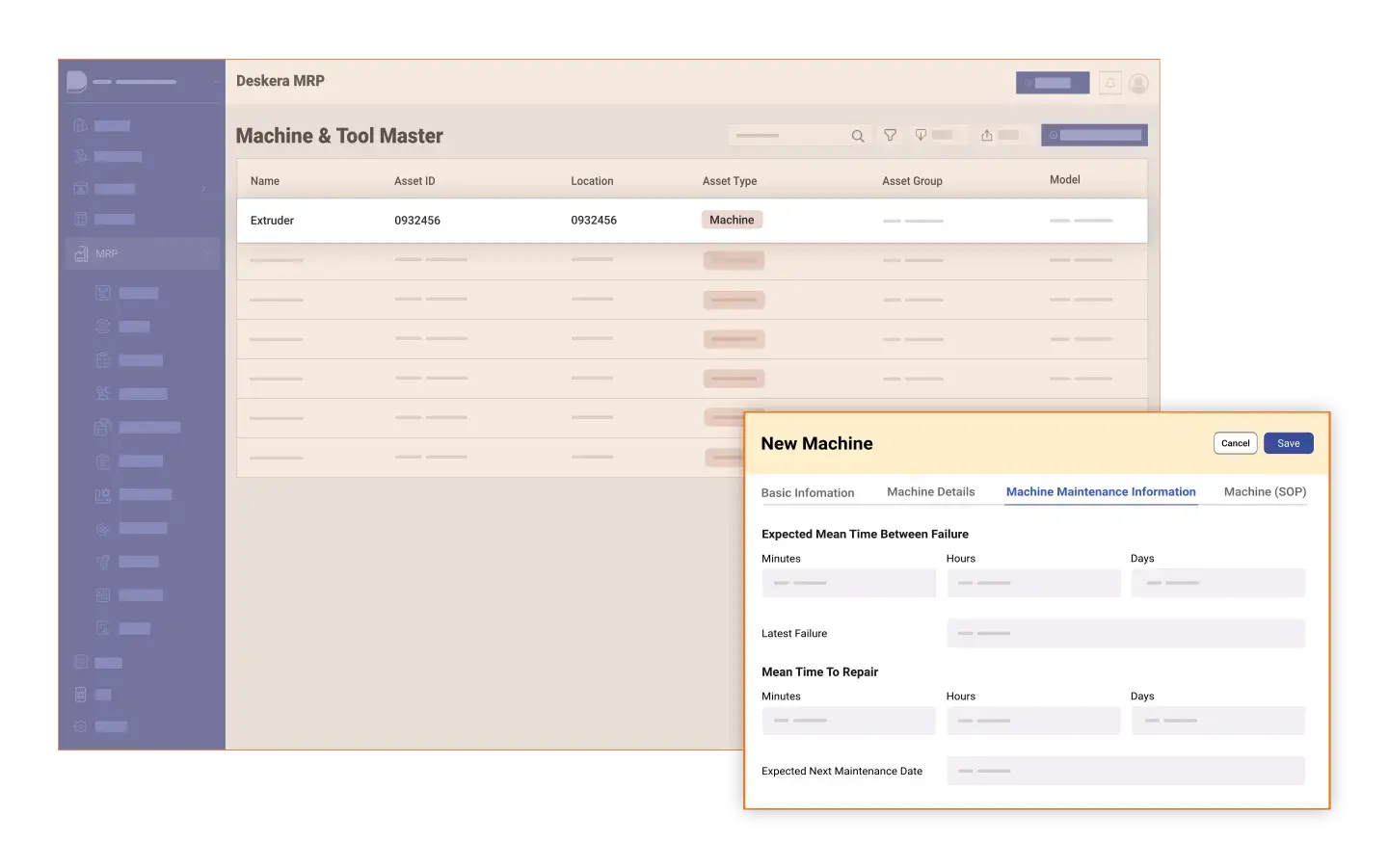
Condition-based maintenance requires real-time visibility into equipment performance, efficient maintenance planning, and seamless coordination between maintenance and production teams.
Deskera MRP helps manufacturers manage maintenance activities more effectively by providing centralized machine management, maintenance scheduling, work order tracking, inventory control, and performance reporting. This enables businesses to reduce downtime, improve equipment reliability, and make more informed maintenance decisions.
Real-Time Machine Monitoring
Deskera MRP provides a centralized view of machine performance, utilization, and maintenance status. By tracking machine operations and performance trends, maintenance teams can identify potential issues early and take corrective action before they impact production. This visibility supports a more proactive approach to equipment maintenance.
Automated Maintenance Scheduling
Deskera MRP simplifies maintenance planning by automating maintenance schedules based on predefined criteria. This helps ensure maintenance tasks are completed on time, reduces manual tracking, and minimizes the risk of missed maintenance activities that could lead to equipment failures.
Work Order Management
The platform allows businesses to create, assign, and track maintenance work orders from a single system. Maintenance teams can monitor task progress, document repairs, and maintain detailed service records, improving maintenance execution and accountability across the organization.
Maintenance History Tracking
Deskera MRP maintains comprehensive maintenance records for every machine, including inspections, repairs, and service activities. Access to historical maintenance data helps businesses identify recurring issues, evaluate equipment performance, and make more informed maintenance decisions.
Spare Parts and Inventory Control
Effective condition-based maintenance depends on having the right spare parts available when needed. Deskera MRP integrates maintenance operations with inventory management, enabling businesses to track spare parts availability, monitor stock levels, and reduce delays caused by material shortages.
Machine Health Monitoring
Deskera MRP helps organizations monitor machine health and equipment performance through centralized machine management capabilities. By tracking asset conditions and operational data, maintenance teams can identify performance issues early and improve equipment reliability.
Reporting and Performance Analytics
The system provides maintenance and machine performance reports that help businesses monitor downtime, maintenance costs, asset utilization, and maintenance effectiveness. These insights support data-driven decision-making and continuous improvement initiatives.
Integration with Production Planning
Deskera MRP connects maintenance activities with production schedules, allowing businesses to coordinate maintenance work with manufacturing operations. This helps minimize production disruptions while ensuring equipment receives timely maintenance.
Centralized Asset Management
Deskera MRP stores machine specifications, maintenance schedules, service records, and operational information in a centralized platform. This improves asset visibility, simplifies maintenance planning, and enables better control over equipment management processes.
Key Takeaways
- Condition-based maintenance (CBM) uses real-time equipment condition data to determine when maintenance should be performed, helping organizations move beyond fixed maintenance schedules.
- A successful CBM program works through a continuous cycle of monitoring asset conditions, analyzing performance data, identifying anomalies, and performing maintenance only when necessary.
- Common condition monitoring techniques such as vibration analysis, infrared thermography, oil analysis, ultrasonic testing, pressure monitoring, and electrical analysis help detect early signs of equipment deterioration.
- Unlike preventive maintenance and predictive maintenance, CBM triggers maintenance based on actual equipment conditions, striking a balance between scheduled maintenance and advanced failure prediction.
- The primary benefits of condition-based maintenance include reduced unplanned downtime, lower maintenance costs, improved equipment reliability, enhanced safety, and longer asset lifespans.
- Despite its advantages, CBM implementation can present challenges such as high initial investment costs, data management complexity, integration difficulties, and the need for specialized expertise.
- Organizations can improve CBM success by prioritizing critical assets, establishing performance baselines, selecting appropriate monitoring technologies, and continuously refining maintenance processes.
- Tracking KPIs such as MTBF, MTTR, equipment availability, unplanned downtime, maintenance costs, and work order completion rates helps measure the effectiveness of a condition-based maintenance strategy.
- Deskera MRP supports condition-based maintenance by providing machine monitoring, maintenance scheduling, work order management, inventory control, maintenance history tracking, and performance reporting within a centralized platform.
- By combining condition monitoring technologies with an integrated maintenance management system, businesses can improve asset performance, optimize maintenance resources, and achieve greater operational efficiency.
Related Articles
 Niti Samani
 Niti Samani
 Niti Samani
 Niti Samani
 Niti Samani
 Niti Samani
Have you ever wondered why some businesses consistently stay within budget while others struggle with unexpected expenses and cost overruns? The answer often lies in how effectively they plan, monitor, and control their operational budgets. Operational budget planning is not just about estimating expenses—it involves continuously tracking costs, allocating resources efficiently, and making informed financial decisions that support business goals. Without proper budget control, organizations can face cash flow issues, reduced profitability, and limited growth opportunities.
However, traditional budgeting methods often rely on spreadsheets, disconnected systems, and manual processes that make it difficult to maintain accuracy and visibility. As businesses grow, managing budgets across multiple departments, locations, and operational functions becomes increasingly complex. Delayed reporting, inaccurate forecasts, and limited collaboration can prevent decision-makers from identifying financial risks and responding to changing business conditions in time.
ERP (Enterprise Resource Planning) software addresses these challenges by integrating financial, operational, procurement, inventory, and business data into a centralized platform. With real-time visibility into expenses, automated workflows, advanced forecasting capabilities, and comprehensive reporting tools, ERP systems enable organizations to create more accurate budgets, monitor spending continuously, and maintain stronger financial control. By providing a single source of truth, ERP software helps businesses improve decision-making while reducing inefficiencies and unnecessary costs.
Deskera ERP is a comprehensive cloud-based business management solution designed to help organizations streamline financial planning and operational control. It integrates accounting, procurement, inventory management, sales, and business operations into a unified platform, providing real-time visibility into financial performance. With automated workflows, customizable dashboards, advanced reporting, and AI-powered insights through David AI, Deskera ERP enables businesses to improve budgeting accuracy, optimize resource allocation, and maintain better control over operational spending. As a result, organizations can make data-driven decisions, enhance profitability, and support sustainable business growth.
What Is an Operational Budget?
An operational budget is a detailed financial plan that outlines the expected revenue and expenses associated with a company's day-to-day business activities over a specific period, typically a month, quarter, or year. It serves as a roadmap for managing routine operations, helping businesses allocate resources efficiently, control costs, and ensure that operational goals align with overall business objectives. By establishing spending limits and financial targets, an operational budget enables organizations to maintain financial discipline while supporting productivity and growth.
An operational budget typically includes projected sales revenue, direct costs such as raw materials and labor, and indirect operating expenses such as rent, utilities, marketing, administrative costs, and maintenance. These estimates are based on historical performance, market trends, production plans, and business forecasts. By comparing actual results against budgeted figures, businesses can identify variances, evaluate performance, and take corrective actions when necessary.
Unlike a capital budget, which focuses on long-term investments such as equipment purchases, facility expansions, or technology upgrades, an operational budget concentrates on the recurring expenses required to run daily business operations. It helps management monitor financial performance, manage cash flow, and ensure that resources are being used effectively across departments.
A well-planned operational budget provides greater visibility into business finances, improves decision-making, and supports strategic planning. When combined with ERP software, organizations can automate budget creation, track expenses in real time, and gain deeper insights into operational performance, making budget management more accurate and efficient.
Importance of Operational Budget Planning and Control
Operational budget planning and control play a vital role in maintaining an organization's financial stability and operational efficiency.
By establishing clear spending guidelines and continuously monitoring financial performance, businesses can allocate resources effectively, minimize unnecessary expenses, and ensure that operational activities align with strategic objectives.
Effective budget management also helps organizations respond proactively to market changes, maintain profitability, and support long-term growth.
Improves Financial Visibility and Decision-Making
Operational budgets provide a clear view of expected revenues, expenses, and resource requirements across the organization. This visibility enables managers to make informed decisions based on accurate financial data rather than assumptions.
By tracking actual spending against planned budgets, businesses can quickly identify trends, address financial issues, and make adjustments that support better operational and financial outcomes.
Enhances Cost Control
A well-defined operational budget helps businesses establish spending limits and monitor expenses throughout the budgeting period. This structured approach makes it easier to identify unnecessary costs, prevent overspending, and ensure that resources are used efficiently.
Effective budget control supports profitability by helping organizations maintain financial discipline while continuing to meet operational goals and customer demands.
Supports Better Resource Allocation
Budget planning enables organizations to allocate financial, human, and operational resources according to business priorities. By forecasting future requirements and anticipated expenses, companies can ensure that departments receive the resources they need without exceeding available funds. This improves productivity, reduces resource shortages, and helps businesses achieve their objectives more efficiently.
Improves Forecasting Accuracy
Operational budget planning encourages businesses to analyze historical performance, market conditions, and future business requirements when estimating revenues and expenses.
This process improves forecasting accuracy and helps organizations prepare for potential challenges and opportunities. More reliable forecasts support better strategic planning and reduce the risk of financial surprises that can disrupt operations.
Strengthens Cash Flow Management
Effective budget planning and control help businesses anticipate cash inflows and outflows, ensuring that sufficient funds are available to support daily operations.
By monitoring spending and aligning expenses with expected revenue, organizations can avoid cash shortages, manage working capital more effectively, and maintain financial stability even during periods of uncertainty.
Increases Accountability Across Departments
Operational budgets establish clear financial targets and spending responsibilities for different departments and teams. This accountability encourages managers to monitor expenses closely and make cost-conscious decisions.
Regular budget reviews also promote transparency and collaboration, ensuring that all departments contribute to the organization's financial and operational goals.
Supports Long-Term Business Growth
Organizations that consistently plan and control their operational budgets are better positioned to invest in growth opportunities while maintaining financial stability.
Effective budgeting helps businesses optimize costs, improve profitability, and allocate resources toward strategic initiatives. This creates a strong financial foundation that supports expansion, innovation, and long-term competitive success.
Common Challenges in Traditional Operational Budget Management
Many organizations still rely on spreadsheets, disconnected software systems, and manual processes to manage operational budgets. While these methods may work for smaller operations, they often become inefficient as businesses grow and financial data becomes more complex.
Traditional budget management approaches can lead to delays, inaccuracies, and limited visibility, making it difficult for organizations to maintain control over spending and make informed financial decisions.
Limited Visibility into Financial Data
Traditional budgeting systems often store financial information across multiple spreadsheets, departments, or standalone applications. This fragmented approach makes it difficult to obtain a complete and accurate view of organizational spending.
As a result, decision-makers may lack timely insights into budget performance, leading to delayed responses to financial issues and missed opportunities for cost optimization.
Inaccurate Forecasting and Budget Estimates
Many traditional budgeting processes rely heavily on historical data and manual assumptions. Without access to real-time business information and advanced forecasting tools, organizations may struggle to accurately predict future expenses, revenue, and resource requirements.
Inaccurate forecasts can result in unrealistic budgets, inefficient resource allocation, and financial shortfalls that negatively impact business performance.
Time-Consuming Manual Processes
Budget preparation, consolidation, and reporting often require significant manual effort when using traditional methods. Finance teams must collect data from multiple sources, verify information, and update spreadsheets regularly.
These repetitive tasks consume valuable time, increase administrative workload, and reduce the organization's ability to focus on strategic financial planning and analysis.
Increased Risk of Human Errors
Manual data entry and spreadsheet-based budgeting increase the likelihood of calculation mistakes, duplicate entries, and inaccurate reporting. Even small errors can lead to incorrect budget forecasts and poor financial decisions.
As the volume of financial data grows, maintaining accuracy becomes increasingly challenging, creating additional risks for the organization.
Poor Expense Tracking and Monitoring
Traditional budget management systems often lack real-time monitoring capabilities, making it difficult to track actual spending against planned budgets.
Financial reports may only be available weekly or monthly, limiting the organization's ability to detect budget overruns quickly. This delayed visibility can result in uncontrolled spending and reduced financial accountability.
Lack of Collaboration Across Departments
Operational budgeting requires input from multiple departments, including finance, procurement, operations, and human resources. Traditional budgeting methods often create information silos where departments work independently using separate spreadsheets and reports.
This lack of collaboration can lead to inconsistent assumptions, duplicated efforts, and budgets that do not accurately reflect organizational priorities.
Difficulty Managing Budget Changes
Business conditions can change rapidly due to market fluctuations, supply chain disruptions, or shifting customer demand. Traditional budgeting systems often lack the flexibility needed to update budgets efficiently when circumstances change. Revising forecasts, reallocating resources, and communicating budget adjustments can become slow and complicated, reducing organizational agility.
Limited Reporting and Analytical Capabilities
Traditional budgeting tools generally provide basic reporting functions with limited analytical depth. Generating detailed financial insights often requires additional manual calculations and data manipulation.
Without advanced reporting and analytics, organizations may struggle to identify spending patterns, evaluate performance trends, and uncover opportunities to improve financial efficiency.
How ERP Software Improves Operational Budget Planning and Control
ERP software transforms operational budget management by integrating financial and operational data into a single platform.
Instead of relying on disconnected spreadsheets and manual processes, businesses can use ERP systems to automate budgeting activities, gain real-time visibility into spending, and make more informed financial decisions.
This enables organizations to improve budget accuracy, strengthen cost control, and maintain better oversight of financial performance across all departments.
Centralizes Financial and Operational Data
ERP software consolidates data from accounting, procurement, inventory, sales, production, and other business functions into a unified system. This centralized approach eliminates data silos and provides a single source of truth for budget planning.
With access to accurate and consistent information, businesses can create more reliable budgets and make better financial decisions based on real-time operational data.
Enables Real-Time Budget Tracking
One of the biggest advantages of ERP software is its ability to monitor expenses and budget performance in real time. Managers can instantly compare actual spending against budgeted amounts, identify variances, and take corrective action before minor issues become major financial problems. This continuous visibility helps organizations maintain tighter control over operational costs.
Improves Budget Forecasting Accuracy
ERP systems leverage historical financial data, operational trends, and current business information to support more accurate forecasting. By analyzing patterns in sales, procurement, inventory usage, and operating expenses, organizations can develop realistic budget projections. Improved forecasting reduces uncertainty and helps businesses prepare more effectively for future financial requirements.
Automates Budget Creation and Approval Workflows
ERP software streamlines budgeting by automating data collection, budget preparation, and approval processes.
Instead of manually consolidating information from multiple departments, organizations can generate budgets using real-time data already stored within the ERP system.
Automated approval workflows also accelerate budget reviews while ensuring compliance with internal financial policies.
Enhances Cost Control and Expense Management
ERP systems provide detailed visibility into spending across departments, projects, and business units. Organizations can monitor expenses closely, identify areas of overspending, and implement cost-saving measures more effectively.
By tracking expenditures against predefined budgets, businesses can improve financial discipline and prevent unnecessary operational costs.
Supports Department-Level Budgeting and Accountability
ERP software allows organizations to create and manage budgets at the department, project, product line, or location level. Department managers gain greater ownership of their financial performance and can track spending against allocated budgets in real time. This increased accountability promotes responsible resource utilization and better alignment with organizational goals.
Improves Procurement and Inventory Cost Management
Procurement and inventory expenses often represent a significant portion of operational costs. ERP software integrates budgeting with purchasing and inventory management processes, providing better visibility into supplier spending, stock levels, and purchasing trends. This integration helps organizations optimize inventory, reduce waste, and control procurement costs more effectively.
Provides Advanced Reporting and Financial Analytics
ERP systems offer customizable dashboards, automated reports, and financial analytics that provide deeper insights into budget performance. Businesses can analyze budget variances, monitor key financial metrics, and identify trends that impact profitability. These insights support faster, data-driven decision-making and help management improve overall financial performance.
Strengthens Compliance and Financial Governance
ERP software maintains detailed audit trails, standardized financial processes, and controlled approval workflows that improve financial transparency. Organizations can ensure that spending aligns with approved budgets while meeting internal governance requirements and regulatory obligations. Stronger financial controls reduce risk and improve confidence in budget-related decisions.
Facilitates Scenario Planning and Strategic Decision-Making
Modern ERP systems enable organizations to model different financial scenarios and evaluate the impact of potential business decisions before implementation. Businesses can assess how changes in demand, costs, or resource allocation may affect operational budgets. This capability helps management make proactive decisions and develop more resilient financial strategies.
Key Metrics Businesses Should Track for Operational Budget Control
Tracking the right budget control metrics helps organizations evaluate financial performance, identify inefficiencies, and ensure spending remains aligned with business objectives.
These key performance indicators (KPIs) provide valuable insights into budget utilization, cost management, forecasting accuracy, and overall operational efficiency.
By monitoring these metrics regularly, businesses can make proactive decisions that strengthen financial control and improve profitability.
Budget Variance
Budget variance measures the difference between actual spending and the amount originally budgeted. It helps businesses identify whether departments or projects are operating within planned financial limits.
Regularly monitoring budget variance enables organizations to detect overspending or underspending early and take corrective actions to maintain financial stability.
Formula:
Budget Variance = Actual Spending − Budgeted Spending
Budget Utilization Rate
The budget utilization rate indicates how much of the allocated budget has been used during a specific period. This metric helps managers monitor spending patterns and assess whether resources are being utilized as planned.
A utilization rate that is too high or too low may signal the need for budget adjustments or resource reallocation.
Formula:
Budget Utilization Rate (%) = (Actual Spending ÷ Budgeted Spending) × 100
Operating Expense Ratio
The operating expense ratio measures operating expenses as a percentage of revenue. It helps businesses evaluate cost efficiency and determine how much revenue is being consumed by daily operations. A lower ratio generally indicates better operational efficiency and stronger profitability.
Formula:
Operating Expense Ratio (%) = (Operating Expenses ÷ Revenue) × 100
Cost Savings Achieved
This metric measures the amount of money saved compared to the original budget or projected costs. Tracking cost savings helps organizations evaluate the effectiveness of cost-control initiatives, procurement strategies, and operational improvements while identifying opportunities for further optimization.
Formula:
Cost Savings = Budgeted Cost − Actual Cost
Forecast Accuracy
Forecast accuracy measures how closely budget forecasts align with actual financial results. Accurate forecasting supports better planning, resource allocation, and decision-making. Organizations that consistently monitor this metric can refine forecasting models and improve future budget reliability.
Formula:
Forecast Accuracy (%) = [1 − (|Actual Value − Forecast Value| ÷ Actual Value)] × 100
Procurement Cost Variance
Procurement cost variance evaluates the difference between actual purchasing costs and budgeted procurement expenses. This metric helps businesses assess supplier performance, monitor purchasing efficiency, and identify unexpected cost increases that may impact operational budgets.
Formula:
Procurement Cost Variance = Actual Procurement Cost − Budgeted Procurement Cost
Departmental Budget Adherence
Departmental budget adherence measures how effectively individual departments stay within their allocated budgets. Monitoring this KPI improves accountability, highlights areas of overspending, and ensures that financial resources are being managed responsibly across the organization.
Formula:
Departmental Budget Adherence (%) = (Budgeted Department Expenses ÷ Actual Department Expenses) × 100
Cash Flow Variance
Cash flow variance compares projected cash flow with actual cash flow over a specific period. This metric helps businesses identify discrepancies between expected and actual cash movement, allowing them to manage liquidity more effectively and avoid potential cash shortages.
Formula:
Cash Flow Variance = Actual Cash Flow − Forecasted Cash Flow
Best Practices for Improving Operational Budget Planning and Control with ERP
Implementing ERP software can significantly enhance budget planning and control, but organizations achieve the greatest benefits when they follow proven budgeting and financial management practices.
By combining ERP capabilities with structured processes, businesses can improve budget accuracy, strengthen cost control, and make more informed financial decisions.
The following best practices can help organizations maximize the value of their ERP investment.
Establish Clear Budget Objectives
Successful budget planning begins with clearly defined financial and operational goals. Organizations should align budget objectives with broader business strategies, growth targets, and performance expectations.
ERP software helps track progress against these objectives by providing real-time visibility into spending, revenue, and operational performance, ensuring budgets remain aligned with organizational priorities.
Centralize Financial and Operational Data
Accurate budgeting depends on having reliable and consistent data. Businesses should use their ERP system to consolidate financial, procurement, inventory, sales, and operational information into a single platform.
A centralized data environment eliminates duplicate records, improves data accuracy, and provides a comprehensive view of organizational performance for better budget planning.
Use Historical Data to Improve Forecasting
ERP systems store valuable historical business data that can be used to create more realistic budget forecasts. Organizations should analyze past spending patterns, revenue trends, seasonal fluctuations, and operational performance when developing budgets. Leveraging historical insights helps reduce forecasting errors and supports more accurate financial planning.
Monitor Budget Performance Continuously
Budget management should be an ongoing process rather than a periodic activity. Businesses should use ERP dashboards and reporting tools to track actual spending against budgeted amounts in real time.
Continuous monitoring allows managers to identify variances quickly, investigate the causes, and take corrective actions before financial issues escalate.
Automate Budgeting and Approval Workflows
Manual budgeting processes often create delays and increase the risk of errors. Organizations should take advantage of ERP automation capabilities to streamline budget creation, approvals, revisions, and reporting.
Automated workflows improve efficiency, reduce administrative workload, and ensure that budget-related decisions follow established financial controls and approval hierarchies.
Improve Departmental Collaboration
Operational budgets involve multiple departments, each with unique financial requirements and responsibilities. ERP software enables cross-functional collaboration by providing shared access to budgeting information and performance data.
Encouraging department participation during the budgeting process helps create more accurate budgets and improves accountability across the organization.
Track Key Budget Control Metrics
Businesses should establish and regularly monitor KPIs such as budget variance, budget utilization rate, operating expense ratio, forecast accuracy, and procurement cost variance.
ERP systems provide automated reporting and analytics that make it easier to track these metrics, evaluate performance, and identify opportunities for cost optimization and efficiency improvements.
Conduct Regular Budget Reviews and Adjustments
Business conditions can change due to market shifts, supply chain disruptions, or changing customer demand. Organizations should schedule regular budget reviews using ERP-generated reports and insights.
Reviewing budget performance periodically enables businesses to update forecasts, reallocate resources, and adjust financial plans to reflect current operational realities.
Strengthen Cost Control Measures
ERP software provides detailed visibility into expenses across departments, projects, and locations. Organizations should use this visibility to identify unnecessary spending, monitor procurement activities, and enforce spending policies. Strong cost-control practices help maximize profitability while ensuring resources are allocated effectively.
Leverage ERP Analytics for Strategic Decision-Making
Modern ERP systems offer advanced reporting, dashboards, and analytical tools that support data-driven decision-making. Businesses should use these capabilities to analyze financial trends, evaluate budget performance, assess operational efficiency, and identify areas for improvement. Data-backed insights enable more effective budget planning and help organizations achieve long-term financial objectives.
How Deskera ERP Helps with Operational Budget Planning and Control
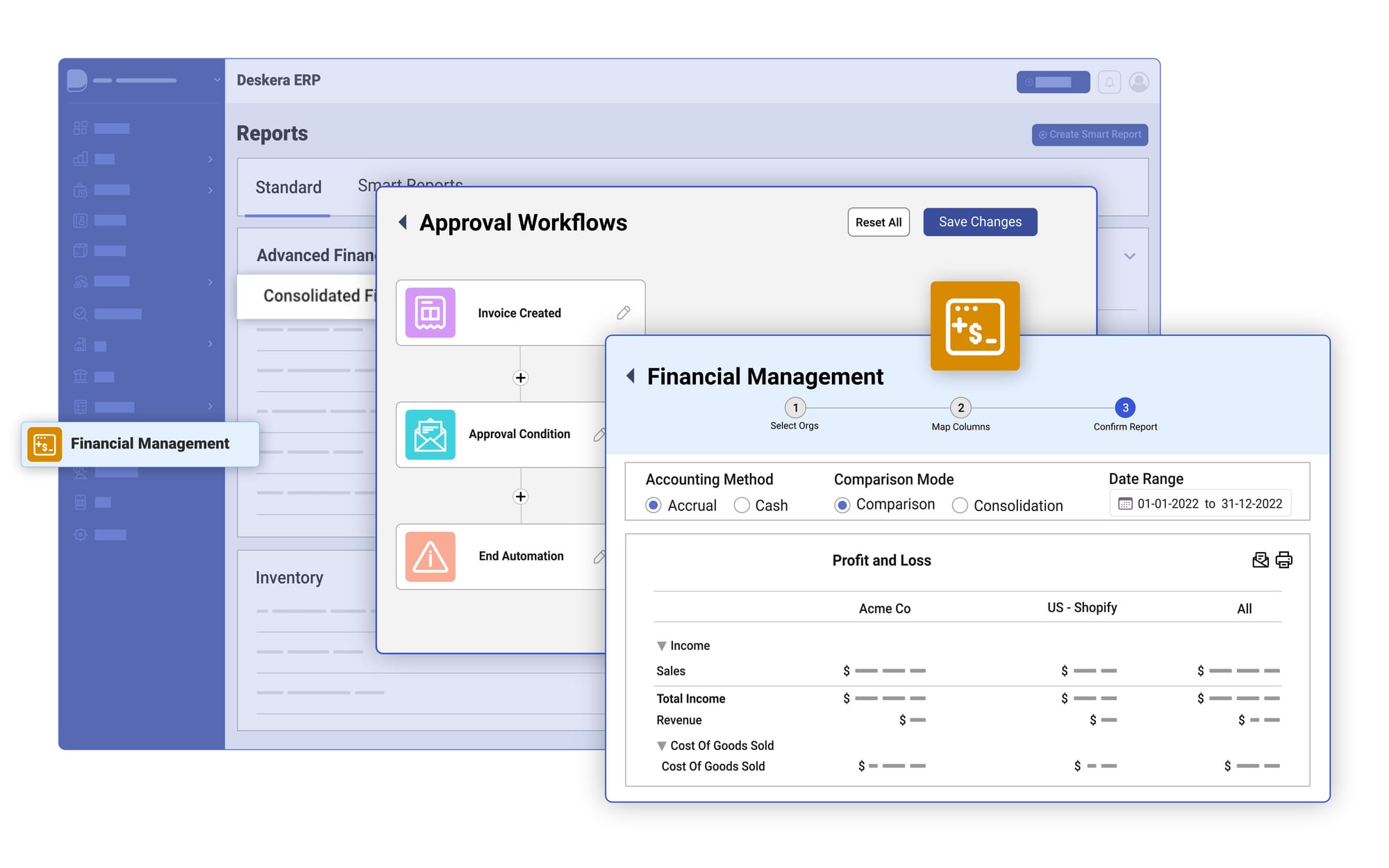
Effective operational budget planning requires accurate financial data, real-time visibility into business performance, and strong cost-control mechanisms. Deskera ERP provides an integrated platform that connects finance, procurement, inventory, sales, and operational processes, enabling businesses to plan budgets more accurately, monitor spending continuously, and maintain greater financial control. By automating key financial workflows and providing actionable insights, Deskera ERP helps organizations improve budgeting efficiency and make better financial decisions.
Centralizes Financial and Operational Data
Deskera ERP brings together data from accounting, inventory, procurement, sales, and business operations into a single platform. This centralized approach eliminates data silos and provides a unified view of financial performance, making it easier to create accurate budgets and track operational expenses across the organization.
Provides Real-Time Financial Visibility
With customizable dashboards and real-time reporting, Deskera ERP enables businesses to monitor revenue, expenses, cash flow, and budget performance as they occur. Decision-makers can quickly identify budget variances, track spending trends, and respond proactively to financial issues before they affect profitability.
Improves Budget Forecasting Accuracy
Deskera ERP helps organizations use historical financial data, sales trends, purchasing patterns, and operational insights to create more reliable budget forecasts. Better forecasting allows businesses to anticipate future costs, allocate resources effectively, and reduce the risk of budget overruns.
Automates Financial Processes and Approvals
Manual budgeting and approval processes can be time-consuming and prone to errors. Deskera ERP automates key financial workflows, including expense tracking, purchase approvals, invoicing, and financial reporting. This improves efficiency, reduces administrative workload, and ensures greater consistency in budget-related processes.
Enhances Expense and Cost Control
Deskera ERP provides detailed visibility into operational spending across departments, projects, and locations. Businesses can monitor expenses in real time, identify areas of overspending, and implement corrective actions quickly. This level of control helps organizations optimize costs and improve overall financial performance.
Integrates Procurement and Inventory Management
Procurement and inventory costs often represent a significant portion of operational expenses. Deskera ERP integrates purchasing and inventory management with financial processes, enabling businesses to track supplier spending, optimize inventory levels, prevent excess stock, and reduce unnecessary procurement costs.
Delivers Comprehensive Reporting and Analytics
Deskera ERP offers advanced reporting tools and customizable dashboards that provide insights into budget utilization, cost trends, financial performance, and operational efficiency. These analytics help management evaluate budget effectiveness, identify improvement opportunities, and make data-driven decisions.
Supports Multi-Department and Multi-Location Budget Management
For growing businesses, managing budgets across multiple departments or locations can be challenging. Deskera ERP enables organizations to track financial performance across different business units while maintaining centralized control. This improves accountability, resource allocation, and budget governance throughout the organization.
Provides AI-Powered Insights with David AI
Deskera’s AI Assistant, David AI, helps businesses analyze financial data, uncover spending patterns, and generate actionable insights. By identifying trends and highlighting potential risks, David AI supports more informed budgeting decisions and helps organizations improve financial planning and operational efficiency.
Strengthens Financial Governance and Compliance
Deskera ERP maintains accurate records, audit trails, and standardized financial processes that improve transparency and accountability. Built-in controls help ensure that spending aligns with approved budgets and organizational policies, reducing financial risks while supporting compliance requirements.
Key Takeaways
- An operational budget serves as a financial roadmap that helps businesses plan, allocate, and manage resources required for daily operations.
- Effective operational budget planning and control improve financial visibility, cost management, resource allocation, and long-term business performance.
- Traditional budget management methods often create challenges such as limited visibility, inaccurate forecasting, manual errors, poor expense tracking, and inefficient collaboration.
- ERP software improves operational budget planning and control by centralizing data, automating processes, and providing real-time financial insights.
- Key ERP capabilities such as budgeting tools, financial dashboards, workflow automation, analytics, and integrated business management support stronger budget governance.
- Tracking metrics such as budget variance, budget utilization rate, operating expense ratio, forecast accuracy, and cash flow variance helps organizations maintain financial control and improve decision-making.
- Industries including manufacturing, retail, distribution, healthcare, professional services, and construction can significantly benefit from ERP-driven budget management.
- Following best practices such as continuous budget monitoring, data centralization, workflow automation, KPI tracking, and regular budget reviews helps maximize the value of ERP-based budgeting.
- Emerging trends such as AI-powered forecasting, predictive analytics, cloud ERP platforms, and real-time financial monitoring are transforming operational budget management.
- Deskera ERP helps businesses improve operational budget planning and control through integrated financial management, real-time visibility, automated workflows, advanced reporting, procurement oversight, and AI-powered insights.
Related Articles
 Niti Samani
 Niti Samani
 Niti Samani
 Niti Samani
 Niti Samani
 Niti Samani
What happens when manufacturers fail to predict lead times accurately? The result is often production delays, inventory shortages, missed delivery deadlines, rising operational costs, and dissatisfied customers. In today’s highly competitive manufacturing environment, even small forecasting errors can disrupt the entire supply chain. This is why lead time forecasting has become a critical part of modern manufacturing operations.
Lead time forecasting refers to the process of estimating the time required to procure raw materials, manufacture products, and deliver finished goods to customers. Accurate forecasting enables manufacturers to plan production schedules more effectively, optimize inventory levels, improve supplier coordination, and respond quickly to changing customer demand. However, relying on spreadsheets and disconnected systems often leads to inaccurate forecasts and limited visibility across operations.
This is where Enterprise Resource Planning (ERP) systems play a transformative role. Modern ERP solutions centralize business data from procurement, inventory, production, warehouse management, and supply chain operations into a single platform. By providing real-time insights, automation, and predictive analytics, ERP systems help manufacturers improve lead time forecasting accuracy and make faster, data-driven decisions. As supply chains become more complex, ERP-driven forecasting is increasingly essential for maintaining operational efficiency and customer satisfaction.
Deskera ERP helps manufacturers streamline lead time forecasting through integrated inventory management, production planning, procurement automation, and real-time reporting tools. Its AI-powered capabilities enable businesses to analyze historical trends, monitor supplier performance, and optimize production schedules with greater accuracy. With mobile accessibility, cloud-based infrastructure, and advanced analytics, Deskera ERP empowers manufacturers to reduce delays, improve supply chain visibility, and enhance overall operational agility.
What Is Lead Time Forecasting?
Lead time forecasting is the process of estimating the amount of time required to complete a business or manufacturing process from start to finish. In manufacturing, it typically involves predicting how long it will take to procure raw materials, produce goods, and deliver finished products to customers. Accurate lead time forecasting helps businesses plan operations more efficiently, reduce delays, and improve overall supply chain performance.
Manufacturers use lead time forecasting to better align production schedules with customer demand and inventory availability. By analyzing historical data, supplier performance, production capacity, market trends, and demand fluctuations, businesses can make more informed decisions about procurement, inventory replenishment, and production planning. This helps minimize disruptions and ensures smoother operational workflows.
Lead time forecasting is especially important in industries where supply chain complexity, fluctuating demand, and tight delivery schedules directly impact profitability and customer satisfaction. Without accurate forecasting, manufacturers may face stock shortages, production bottlenecks, excess inventory, missed deadlines, and higher operational costs. Effective forecasting enables companies to proactively address risks before they affect business operations.
Modern ERP systems have significantly improved the accuracy and efficiency of lead time forecasting. ERP software integrates data from inventory, procurement, warehouse management, production planning, and supply chain operations into a centralized platform. This provides real-time visibility and predictive insights that help manufacturers forecast lead times more accurately and respond quickly to changing business conditions.
Types of Lead Time in Manufacturing
In manufacturing, lead time is not limited to a single process. It consists of multiple stages across procurement, sourcing, production, inventory handling, and product delivery.
Understanding the different types of lead time helps manufacturers identify operational bottlenecks, improve forecasting accuracy, and optimize supply chain efficiency. Each type plays a critical role in ensuring smooth production workflows, timely deliveries, and improved customer satisfaction.
Customer Lead Time
Customer lead time refers to the total time a customer experiences from placing an order until receiving the finished product. It includes order processing, procurement, production, packaging, shipping, and final delivery.
This metric directly impacts customer satisfaction and brand reputation. Manufacturers that reduce customer lead time can improve service quality, respond faster to market demand, and gain a stronger competitive advantage in their industry.
Material Lead Time
Material lead time is the time required to procure and receive raw materials or components from suppliers. It begins when a purchase order is placed and ends when the materials are delivered and ready for production use.
Delays in material lead time can disrupt manufacturing schedules and create inventory shortages. Accurate forecasting helps businesses maintain sufficient stock levels while avoiding excessive inventory carrying costs.
Procurement Lead Time
Procurement lead time refers to the complete duration involved in sourcing and purchasing materials or services needed for manufacturing operations. It includes supplier selection, purchase approvals, order processing, transportation, and receiving activities.
Longer procurement lead times can slow down production and increase operational inefficiencies. ERP systems help manufacturers automate procurement workflows, track supplier performance, and improve procurement planning for faster material availability.
Production Lead Time
Production lead time is the actual time required to manufacture or assemble a product once all materials, labor, and machinery are available on the factory floor. It includes machine setup, assembly, processing, inspection, and packaging activities.
Long production lead times reduce operational flexibility and delay customer deliveries. Manufacturers use ERP-driven production planning and scheduling tools to optimize workflows and minimize production bottlenecks.
Supplier Lead Time
Supplier lead time measures how long suppliers take to process and deliver materials after receiving a purchase order. This duration may vary due to supplier capacity constraints, transportation delays, market demand fluctuations, or geopolitical disruptions.
Monitoring supplier lead time helps manufacturers evaluate supplier reliability and improve sourcing strategies. ERP systems provide real-time supplier performance data to support better forecasting and supplier relationship management.
Delivery Lead Time
Delivery lead time refers to the time required to transport finished goods from the manufacturing facility to the customer’s location. It includes packaging, warehousing, shipping, and final-mile delivery processes.
Inefficient logistics operations or transportation delays can negatively affect customer satisfaction and profitability. Accurate delivery forecasting enables manufacturers to optimize logistics planning, improve on-time delivery performance, and provide realistic delivery schedules to customers.
Order Lead Time
Order lead time encompasses all internal activities involved in processing a customer order, including order receipt, production scheduling, manufacturing, packaging, and shipping. It reflects the total time required to complete the order fulfillment process within the organization.
Reducing order lead time improves responsiveness and operational efficiency. ERP systems help streamline order processing workflows by integrating inventory, production, procurement, and logistics operations.
Cumulative Lead Time
Cumulative lead time represents the maximum possible time needed to fulfill a customer order when no inventory is available in stock. It combines all procurement, material sourcing, and production lead times into a single metric.
Manufacturers use cumulative lead time for strategic planning, demand forecasting, and capacity management. Understanding this metric helps businesses evaluate production flexibility and prepare for long-term supply chain requirements.
Key Attributes of Lead Time Forecasting
Effective lead time forecasting goes beyond simply estimating delivery or production timelines. It involves analyzing multiple variables that influence supply chain reliability, inventory planning, procurement decisions, and production efficiency.
Understanding the key attributes of lead time forecasting helps manufacturers improve operational accuracy, reduce risks, and make better data-driven decisions across the supply chain.
Lead Time Forecast Value
The lead time forecast value represents the estimated duration required to complete a procurement, production, or delivery process. This forecast is typically generated using historical data, supplier performance, demand patterns, and operational trends.
Accurate forecast values help manufacturers determine when to order materials, schedule production, and plan deliveries. Modern ERP systems provide intelligent forecasting capabilities that continuously update lead time estimates using real-time operational data.
Lead Time Deviation
Lead time deviation measures the variability or inconsistency in supplier or production lead times. A high deviation indicates unpredictable delivery or manufacturing performance, which increases operational risk and requires additional safety stock.
Even a short lead time can create inventory challenges if it fluctuates significantly. Monitoring lead time deviation helps manufacturers assess supplier reliability, improve planning accuracy, and reduce unnecessary inventory carrying costs caused by uncertainty.
Lead Time Reliability
Lead time reliability refers to the consistency with which suppliers, production teams, or logistics providers meet expected timelines. Reliable lead times improve production scheduling, inventory optimization, and customer satisfaction.
Poor reliability often results in delays, stock shortages, and operational disruptions. Manufacturers use ERP systems and supplier performance analytics to monitor reliability trends and identify areas that require process improvements or stronger supplier collaboration.
Lead Time Seasonality
Lead time seasonality refers to recurring fluctuations in lead times caused by seasonal trends or external conditions. Factors such as weather disruptions, supplier shutdowns, holiday demand spikes, employee vacations, and transportation congestion can all affect lead time performance.
Recognizing seasonal patterns enables manufacturers to adjust procurement schedules, increase safety stock when necessary, and avoid unexpected supply chain disruptions during peak or slow periods.
Historical Lead Time Analysis
Historical lead time analysis involves reviewing past lead time data to identify trends, recurring delays, and operational inefficiencies. Analyzing historical performance helps businesses improve forecasting accuracy and make more informed procurement and production decisions.
ERP systems centralize historical operational data, enabling manufacturers to compare supplier performance, evaluate production timelines, and continuously refine forecasting models based on actual business outcomes.
Safety Stock Impact
Lead time forecasting directly affects safety stock requirements. When lead times are uncertain or highly variable, businesses often maintain additional inventory to prevent stockouts and production interruptions.
However, excess safety stock increases storage and carrying costs. Accurate lead time forecasting helps manufacturers balance inventory levels more effectively by minimizing uncertainty and reducing the need for excessive buffer inventory.
Real-Time Data Visibility
Real-time visibility is a critical attribute of modern lead time forecasting. Manufacturers need access to up-to-date information from suppliers, inventory systems, production operations, and logistics networks to make accurate forecasts.
ERP systems provide centralized, real-time dashboards that help businesses monitor operational performance, identify delays quickly, and respond proactively to changing supply chain conditions.
Predictive and Data-Driven Insights
Modern lead time forecasting increasingly relies on predictive analytics, artificial intelligence, and machine learning technologies. These tools analyze large volumes of operational and market data to identify patterns, forecast risks, and improve decision-making accuracy.
Predictive insights help manufacturers anticipate disruptions, optimize procurement timing, and improve production planning before problems impact business operations.
Benefits of Effective Lead Time Forecasting
Effective lead time forecasting helps manufacturers improve operational efficiency, reduce supply chain disruptions, and make more informed business decisions.
By accurately estimating procurement, production, and delivery timelines, businesses can optimize inventory levels, improve customer satisfaction, and strengthen overall supply chain performance.
In today’s competitive manufacturing environment, accurate forecasting has become essential for maintaining profitability and operational agility.
Improved Production Planning
Accurate lead time forecasting enables manufacturers to create more efficient production schedules based on material availability, workforce capacity, and customer demand. Better planning reduces production bottlenecks, machine downtime, and workflow disruptions.
Manufacturers can allocate resources more effectively and ensure smoother production operations while minimizing delays that negatively impact delivery commitments and operational efficiency.
Reduced Inventory Costs
Lead time forecasting helps businesses maintain optimal inventory levels by improving procurement timing and reducing uncertainty. Manufacturers can avoid overstocking excess materials while minimizing the risk of stock shortages that interrupt production.
Lower inventory carrying costs, reduced warehousing expenses, and improved inventory turnover contribute to better cash flow management and higher overall profitability.
Better Supplier Management
Accurate forecasting allows manufacturers to evaluate supplier reliability and plan procurement activities more strategically. Businesses can identify suppliers with inconsistent delivery performance and take corrective actions before disruptions occur.
Improved supplier coordination strengthens supply chain relationships, enhances procurement efficiency, and reduces delays caused by poor supplier performance or inaccurate purchasing decisions.
Faster Order Fulfillment
Effective lead time forecasting improves order processing and delivery performance by aligning production schedules with customer demand. Manufacturers can provide more accurate delivery timelines and reduce delays in order fulfillment.
Faster and more reliable deliveries improve customer satisfaction, increase repeat business opportunities, and strengthen brand reputation in competitive manufacturing markets.
Enhanced Customer Satisfaction
Customers expect accurate delivery commitments and timely order fulfillment. Effective lead time forecasting helps businesses meet customer expectations consistently by reducing unexpected delays and improving communication.
When manufacturers can reliably deliver products on time, they build stronger customer trust, improve retention rates, and enhance overall customer experience.
Improved Supply Chain Visibility
Lead time forecasting provides better visibility into procurement, production, inventory, and logistics operations. Manufacturers can monitor operational performance more effectively and identify potential disruptions before they impact business activities.
Enhanced visibility enables faster decision-making, better coordination between departments, and improved responsiveness to changing market conditions or supply chain challenges.
Reduced Operational Risks
Forecasting helps manufacturers identify potential supply chain risks such as supplier delays, transportation disruptions, material shortages, or demand fluctuations.
Early risk identification allows businesses to implement contingency plans, adjust inventory levels, or source alternative suppliers proactively. This reduces the likelihood of costly production interruptions and improves overall operational resilience.
Increased Operational Efficiency
Accurate lead time forecasting minimizes inefficiencies caused by poor scheduling, inventory imbalances, and reactive decision-making. Manufacturers can streamline workflows, reduce idle production time, and improve resource utilization across departments. Better coordination between procurement, production, and logistics teams leads to smoother operations and higher overall productivity.
Better Financial Planning
Lead time forecasting supports more accurate budgeting and financial planning by improving inventory control and procurement management. Businesses can reduce unnecessary inventory investments, avoid emergency purchasing costs, and optimize working capital usage. Predictable operations also help manufacturers forecast revenue, expenses, and production costs more accurately for long-term business planning.
Stronger Competitive Advantage
Manufacturers with accurate lead time forecasting capabilities can respond more quickly to customer demand, market changes, and supply chain disruptions. Faster decision-making, improved operational agility, and reliable delivery performance provide a significant competitive advantage. Businesses that consistently meet customer expectations are better positioned to grow market share and strengthen long-term profitability.
Challenges of Traditional Lead Time Models
Traditional lead time forecasting models were designed for relatively stable supply chain environments where market conditions, supplier performance, and customer demand remained predictable over long periods.
However, today’s manufacturing landscape is far more dynamic and complex. Rapid market shifts, global disruptions, and changing customer expectations have exposed several limitations in conventional lead time forecasting approaches, making them less effective for modern manufacturing operations.
Overreliance on Historical Data
Traditional lead time models heavily depend on historical averages to estimate future lead times. While past data remains valuable, relying solely on historical trends assumes that business conditions will remain stable over time.
This approach often ignores sudden disruptions such as geopolitical conflicts, tariffs, natural disasters, labor shortages, supplier shutdowns, and rapid demand fluctuations. As a result, manufacturers may generate inaccurate forecasts that fail to reflect current operational realities.
Lack of Real-Time Visibility
One of the biggest limitations of traditional lead time forecasting models is the absence of real-time operational visibility. Conventional systems cannot continuously monitor supplier activity, inventory movement, transportation delays, or production bottlenecks as they occur.
Without access to live data, businesses struggle to identify risks early and respond proactively. This delayed visibility often leads to production disruptions, missed deadlines, and poor customer service performance.
Reactive Rather Than Predictive Approach
Traditional forecasting models typically respond to disruptions only after they have already affected operations. Since these systems lack predictive analytics and automated alerts, manufacturers often operate in a reactive mode, constantly addressing issues after delays occur.
This firefighting approach increases operational inefficiencies, slows decision-making, and creates unnecessary pressure on procurement, production, and logistics teams trying to recover from unexpected disruptions.
Inability to Handle Supply Chain Volatility
Modern supply chains operate in a highly volatile and uncertain environment influenced by global economic shifts, changing regulations, transportation disruptions, and evolving consumer behavior.
Traditional lead time models struggle to adapt to this VUCA (Volatile, Uncertain, Complex, and Ambiguous) environment because they treat lead times as relatively fixed values. This lack of flexibility reduces forecasting accuracy and limits the organization’s ability to respond quickly to changing conditions.
Dependence on Legacy ERP Systems
Many traditional lead time forecasting processes rely on outdated ERP systems that were originally designed for monthly or quarterly planning cycles.
These legacy systems often lack advanced analytics, automation, AI capabilities, and real-time integration features required for modern forecasting.
As a result, businesses experience disconnects between strategic planning and day-to-day operational decisions, limiting their ability to react quickly to market changes and supply chain disruptions.
Limited Supplier Performance Analysis
Traditional forecasting models often fail to analyze supplier reliability and lead time variability in sufficient detail.
They may use standard lead times without accounting for fluctuations in supplier performance, transportation issues, or recurring delivery delays.
This limited visibility makes it difficult for manufacturers to evaluate supplier risks accurately and optimize procurement planning based on actual supplier behavior.
Manual Processes and Human Errors
Many conventional lead time forecasting methods still rely on spreadsheets, manual data entry, and disconnected systems.
These manual processes are time-consuming and highly prone to human error, leading to inaccurate forecasts and inconsistent planning decisions.
Errors in calculations, outdated data, or poor communication between departments can significantly impact production schedules, inventory management, and customer deliveries.
Poor Integration Across Business Functions
Traditional lead time models often operate in isolated systems that lack integration between procurement, inventory management, production planning, warehouse operations, and logistics.
This fragmented approach creates data silos that prevent teams from accessing accurate, organization-wide information. Without integrated data visibility, manufacturers struggle to coordinate operations effectively and make informed forecasting decisions across the supply chain.
How ERP Improves Lead Time Forecasting
Modern ERP systems play a critical role in improving lead time forecasting by providing real-time visibility, centralized data management, automation, and advanced analytics.
Unlike traditional forecasting methods that rely on disconnected systems and historical averages, ERP software integrates procurement, inventory, production, warehouse, and supply chain data into a single platform.
This enables manufacturers to forecast lead times more accurately, respond quickly to disruptions, and optimize overall operational efficiency.
Real-Time Inventory Visibility
ERP systems provide real-time visibility into inventory levels across warehouses, production facilities, and supply chain networks. Manufacturers can monitor stock availability, raw material consumption, reorder points, and inventory movement instantly.
This visibility helps businesses avoid stock shortages and production delays while improving procurement planning. Accurate inventory data also enhances lead time forecasting by ensuring production schedules are aligned with actual material availability.
Centralized Data Management
One of the biggest advantages of ERP systems is their ability to centralize business data from multiple departments into a unified platform. Procurement, production, finance, warehouse management, logistics, and sales teams can access the same real-time information.
This eliminates data silos and improves coordination across operations. Centralized data enables more accurate lead time calculations by providing a complete view of the manufacturing and supply chain process.
AI-Powered Demand Forecasting
Modern ERP solutions use artificial intelligence and machine learning to analyze historical sales trends, customer demand patterns, seasonal fluctuations, and market conditions.
These predictive capabilities help manufacturers forecast future demand more accurately and adjust procurement and production schedules accordingly. AI-driven forecasting reduces uncertainty, improves planning precision, and minimizes delays caused by sudden demand changes or inaccurate inventory assumptions.
Automated Procurement Planning
ERP systems automate procurement workflows by generating purchase orders, tracking supplier deliveries, and monitoring material availability in real time. Automation reduces manual errors and ensures materials are ordered at the right time based on production requirements and forecasted demand.
By improving procurement efficiency and supplier coordination, ERP software helps reduce procurement lead times and prevents delays caused by late or inaccurate purchasing decisions.
Production Scheduling Optimization
ERP systems improve lead time forecasting by optimizing production planning and scheduling processes. Manufacturers can allocate labor, machinery, and materials more efficiently while identifying potential bottlenecks before they disrupt operations.
Real-time production monitoring helps businesses adjust schedules quickly in response to delays or changing priorities. This improves production efficiency and ensures customer orders are completed within expected timelines.
Supplier Performance Monitoring
ERP software enables manufacturers to track supplier performance metrics such as delivery consistency, lead time deviation, order accuracy, and reliability.
Businesses can identify high-risk suppliers, evaluate sourcing performance, and make better procurement decisions based on actual supplier data.
Improved supplier visibility helps manufacturers reduce uncertainty in lead time forecasting and build more resilient supply chain operations.
Predictive Analytics for Risk Management
Advanced ERP systems use predictive analytics to identify potential supply chain risks before they impact operations. These systems analyze trends, disruptions, transportation delays, supplier issues, and market conditions to forecast potential lead time problems.
Early risk identification allows manufacturers to take proactive measures such as adjusting inventory levels, sourcing alternative suppliers, or rescheduling production activities to minimize operational disruptions.
Improved Supply Chain Collaboration
ERP platforms improve communication and collaboration between suppliers, procurement teams, warehouse managers, production planners, and logistics providers.
Shared access to real-time operational data helps all stakeholders coordinate more effectively and respond quickly to changing business conditions. Better collaboration reduces miscommunication, minimizes delays, and enhances overall lead time forecasting accuracy across the supply chain.
Real-Time Reporting and Analytics
ERP systems provide customizable dashboards and real-time analytics that help manufacturers monitor operational performance continuously. Businesses can track KPIs such as supplier lead times, inventory turnover, order fulfillment rates, and production cycle times.
These insights support faster decision-making and help organizations refine forecasting strategies based on actual operational performance and changing market conditions.
Enhanced Operational Agility
By combining automation, predictive analytics, and real-time visibility, ERP systems help manufacturers become more agile and responsive.
Businesses can quickly adapt to supply chain disruptions, demand fluctuations, and production challenges without significantly affecting delivery timelines.
This flexibility improves forecasting accuracy and helps manufacturers maintain consistent operations in increasingly volatile and competitive markets.
How Deskera ERP Helps Manufacturers Improve Lead Time Forecasting
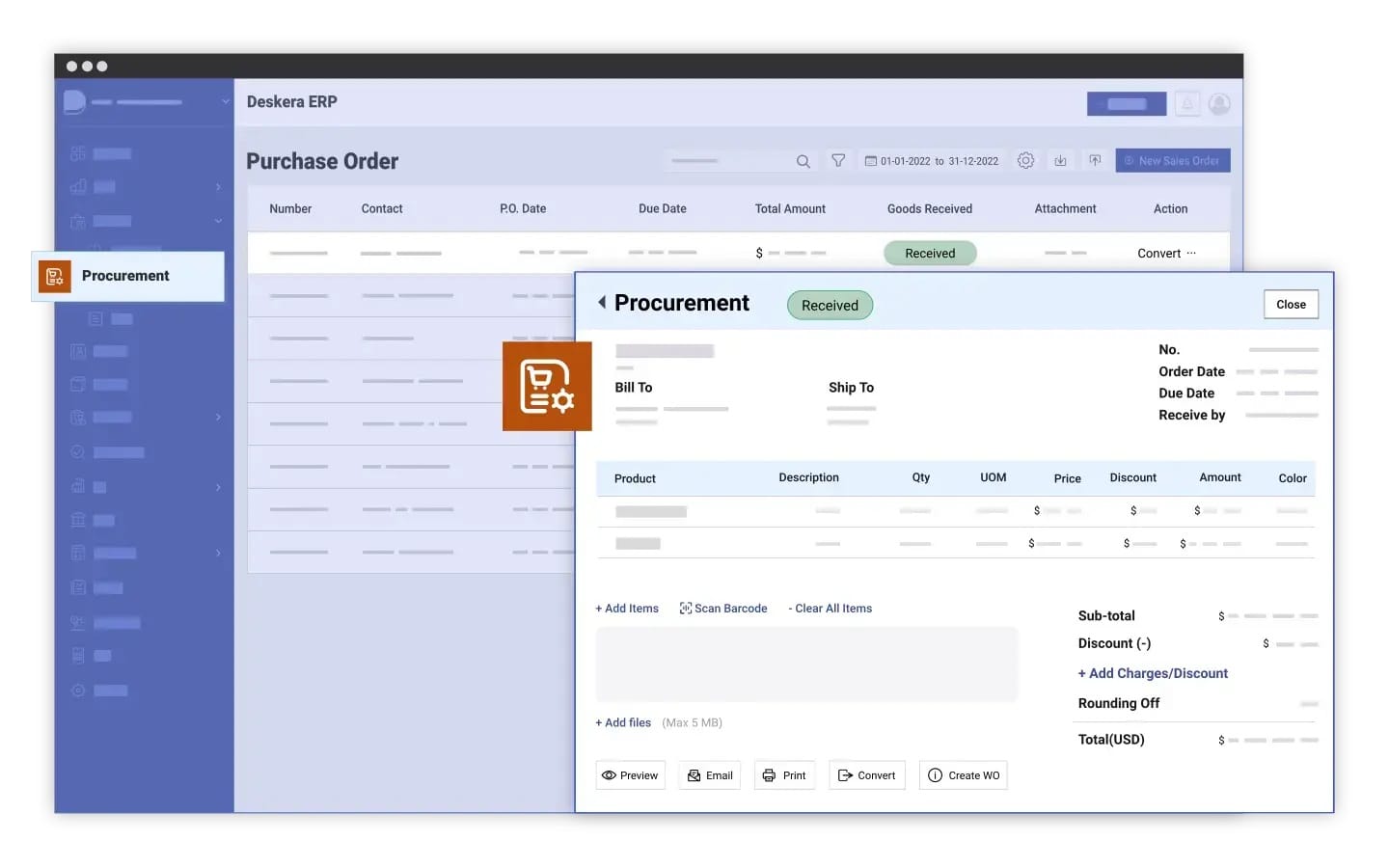
Accurate lead time forecasting requires real-time visibility, efficient planning, and coordinated supply chain operations. Deskera ERP helps manufacturers improve forecasting accuracy by integrating inventory management, procurement, production planning, and reporting into a centralized cloud-based platform. With automation and real-time data access, businesses can reduce delays, improve planning efficiency, and make faster operational decisions.
Real-Time Inventory Visibility
Deskera ERP provides real-time visibility into inventory levels, stock movement, and material availability. Manufacturers can monitor raw materials, work-in-progress inventory, and finished goods across locations, helping them avoid stock shortages and production delays. Better inventory visibility improves procurement planning and supports more accurate lead time forecasting.
Automated Procurement Management
Deskera ERP streamlines procurement workflows by automating purchase orders, supplier management, and inventory replenishment processes. Automated procurement reduces manual errors, improves material availability, and helps manufacturers order supplies based on production requirements and forecasted demand.
Production Planning and Scheduling
Deskera ERP helps manufacturers optimize production schedules by improving resource allocation and workflow planning. Businesses can track production activities in real time, identify bottlenecks, and reduce downtime. Efficient scheduling improves production efficiency and shortens manufacturing lead times.
Supplier Performance Tracking
Deskera ERP enables businesses to monitor supplier performance, including delivery timelines and order consistency. This helps manufacturers identify supplier-related risks, improve sourcing decisions, and reduce procurement delays that can impact overall lead time forecasting accuracy.
Real-Time Reporting and Analytics
Deskera ERP offers real-time dashboards and reporting tools that provide insights into inventory, procurement, production, and order fulfillment performance. These analytics help businesses identify operational inefficiencies quickly and make data-driven forecasting and planning decisions.
Cloud and Mobile Accessibility
As a cloud-based ERP solution, Deskera ERP allows manufacturers to access operational data from anywhere using mobile devices or desktops. Real-time access to production schedules, inventory updates, and procurement information improves responsiveness and supports faster decision-making across the supply chain.
Improved Operational Efficiency
By integrating core manufacturing and supply chain processes into one platform, Deskera ERP improves coordination between departments and reduces workflow inefficiencies. This helps manufacturers respond more effectively to demand fluctuations, minimize delays, and improve overall lead time forecasting accuracy.
Key Takeaways
- Lead time forecasting helps manufacturers estimate procurement, production, and delivery timelines more accurately to improve operational efficiency and customer satisfaction.
- Understanding different types of lead time, such as customer, material, procurement, production, supplier, delivery, order, and cumulative lead time, helps businesses identify operational bottlenecks and improve planning accuracy.
- Key attributes like lead time deviation, reliability, seasonality, historical analysis, and predictive insights play a major role in improving forecasting precision and inventory optimization.
- Traditional lead time forecasting models often struggle due to overreliance on historical data, lack of real-time visibility, reactive planning approaches, and outdated ERP systems.
- ERP systems improve lead time forecasting by centralizing data, automating workflows, providing real-time visibility, and enabling predictive analytics across supply chain operations.
- Real-time inventory visibility through ERP systems helps manufacturers avoid stock shortages, improve procurement timing, and maintain smoother production schedules.
- Automated procurement management reduces manual errors, improves supplier coordination, and ensures timely material availability for uninterrupted manufacturing operations.
- Advanced production planning and scheduling capabilities help manufacturers optimize resource allocation, reduce bottlenecks, and shorten production lead times.
- Supplier performance monitoring enables businesses to track delivery consistency and improve sourcing decisions to reduce procurement-related delays.
- Effective lead time forecasting improves production planning, inventory management, order fulfillment speed, operational efficiency, and overall supply chain agility.
- Accurate forecasting also helps manufacturers reduce operational risks, lower inventory carrying costs, and improve customer satisfaction through reliable delivery performance.
- Real-time reporting and analytics provide manufacturers with actionable insights that support faster, data-driven forecasting and operational decisions.
- Cloud-based ERP systems improve accessibility and responsiveness by enabling businesses to monitor operations and manage supply chain activities from anywhere.
- AI-powered forecasting and predictive analytics help manufacturers anticipate disruptions, respond to demand fluctuations, and improve long-term planning accuracy.
- Deskera ERP helps manufacturers improve lead time forecasting through integrated inventory management, procurement automation, production planning, supplier tracking, and real-time operational analytics.
Related Articles
 Niti Samani
 Niti Samani
 Niti Samani
 Niti Samani
 Niti Samani
 Niti Samani
What causes production delays, missed delivery deadlines, and inefficient shop floor operations in manufacturing? In many cases, the answer lies in poor manufacturing scheduling. Without a well-structured scheduling system, manufacturers often struggle with machine downtime, material shortages, labor inefficiencies, and production bottlenecks that disrupt the entire workflow. Effective manufacturing scheduling helps businesses allocate resources efficiently, streamline production processes, and ensure timely order fulfillment.
Manufacturing scheduling plays a critical role in maintaining operational efficiency and meeting customer expectations. It determines when production activities should occur, which resources should be used, and how workflows should be prioritized to maximize productivity. A well-optimized schedule reduces idle time, improves machine utilization, minimizes waste, and enables manufacturers to respond quickly to changing market demands. As production environments become more complex, businesses need smarter scheduling strategies to remain competitive.
Modern manufacturers are increasingly adopting digital tools and automation technologies to improve scheduling accuracy and flexibility. Real-time production monitoring, predictive analytics, AI-driven forecasting, and ERP-integrated scheduling systems allow businesses to make faster and more informed decisions. These technologies help manufacturers identify bottlenecks early, balance production capacity, and quickly adjust schedules during disruptions or sudden demand changes.
One of the solutions helping manufacturers improve scheduling efficiency is Deskera MRP. Deskera MRP enables businesses to streamline production planning, manage inventory levels, track material availability, and optimize resource allocation from a centralized platform. With real-time visibility into manufacturing operations, automated workflows, and integrated production scheduling capabilities, Deskera MRP helps manufacturers reduce delays, improve coordination across departments, and enhance overall operational efficiency. Its cloud-based accessibility and advanced reporting features also support faster decision-making and continuous production improvement.
What Is Manufacturing Scheduling?
Manufacturing scheduling is the process of organizing, planning, and managing production activities to ensure manufacturing operations run efficiently and products are completed on time. It involves assigning resources such as machines, labor, materials, and production lines to specific tasks within a defined timeframe. The primary goal of manufacturing scheduling is to optimize production flow, reduce downtime, improve resource utilization, and meet customer delivery deadlines.
A manufacturing schedule outlines when each production task should start and finish, which machines or workstations will be used, and how production orders will move through the manufacturing process. Effective scheduling helps manufacturers balance production capacity with customer demand while minimizing delays, bottlenecks, and unnecessary costs. It also improves coordination between departments such as procurement, inventory, production, and logistics.
Manufacturing scheduling differs from production planning, although the two are closely connected. Production planning focuses on determining what products need to be produced, in what quantities, and within what timeframe. Manufacturing scheduling, on the other hand, focuses on the execution of those plans by deciding the sequence of operations, resource allocation, and timing of production activities.
Modern manufacturing scheduling often relies on ERP and MRP systems to improve accuracy and efficiency. Advanced scheduling tools provide real-time visibility into machine availability, inventory levels, workforce capacity, and production progress. This allows manufacturers to quickly adjust schedules in response to disruptions such as equipment failures, material shortages, or sudden changes in customer demand, ensuring smoother and more agile manufacturing operations.
Key Objectives of Manufacturing Scheduling
Manufacturing scheduling is designed to ensure that production processes operate smoothly, efficiently, and within planned timelines. It helps manufacturers coordinate resources, reduce operational disruptions, and improve overall productivity. By creating structured production schedules, businesses can optimize workflows, minimize waste, and consistently meet customer expectations while maintaining cost efficiency and operational flexibility.
Optimizing Resource Allocation
One of the primary objectives of manufacturing scheduling is to ensure the efficient use of available resources, including machines, labor, materials, and production lines. Proper scheduling prevents resource conflicts, reduces idle time, and balances workloads across operations. This allows manufacturers to maximize production capacity, improve productivity, and avoid unnecessary delays caused by poor coordination or underutilized resources.
Reducing Production Downtime
Manufacturing scheduling helps minimize downtime by ensuring that production activities are properly sequenced and resources are available when needed. Scheduled maintenance, material availability checks, and efficient workflow planning reduce the chances of unexpected disruptions. Lower downtime improves machine utilization, maintains consistent production flow, and helps manufacturers avoid costly interruptions that impact output and delivery timelines.
Meeting Delivery Deadlines
Timely order fulfillment is a critical goal of manufacturing scheduling. By organizing production activities efficiently, manufacturers can ensure products are completed and delivered according to customer expectations. Effective scheduling helps prioritize urgent orders, manage lead times, and prevent production bottlenecks that may cause delays. Consistently meeting delivery deadlines strengthens customer satisfaction, improves reliability, and supports long-term business growth.
Improving Production Flow
Manufacturing scheduling aims to create a smooth and continuous production process by coordinating tasks in the most efficient sequence. Well-structured schedules reduce bottlenecks, minimize waiting times between operations, and improve communication across departments. A streamlined production flow helps manufacturers maintain operational consistency, increase throughput, and respond more effectively to changes in demand or production requirements.
Types of Manufacturing Scheduling
Manufacturing scheduling methods vary based on production goals, operational complexity, and resource availability. Different scheduling approaches help manufacturers manage workflows, optimize capacity, and meet delivery deadlines more effectively. Choosing the right type of manufacturing scheduling allows businesses to improve production efficiency, reduce delays, and maintain better control over manufacturing operations.
Forward Scheduling
Forward scheduling starts production tasks as soon as resources such as machines, labor, and materials become available. This method focuses on completing production orders at the earliest possible time. It is commonly used in make-to-stock manufacturing environments where businesses aim to maximize production output and maintain inventory levels. However, forward scheduling may sometimes lead to higher inventory holding costs if production exceeds immediate demand.
Backward Scheduling
Backward scheduling begins with the final delivery date and works backward to determine when each production activity should start. This approach helps manufacturers meet customer deadlines while minimizing excess inventory and storage costs. Backward scheduling is especially useful in make-to-order manufacturing, where production is closely aligned with customer demand and delivery commitments.
Finite Capacity Scheduling
Finite capacity scheduling considers the actual availability and limitations of production resources before assigning tasks. It ensures that machines, labor, and workstations are not overloaded beyond their capacity. This method creates more realistic production schedules, reduces bottlenecks, and improves operational efficiency. Finite scheduling is particularly beneficial for manufacturers dealing with limited resources or complex production processes.
Infinite Capacity Scheduling
Infinite capacity scheduling assumes that production resources are always available without limitations. It focuses on completing tasks based on production demand without considering real-world constraints such as machine availability or labor capacity. While this method simplifies planning and allows faster schedule creation, it may lead to unrealistic production expectations and resource conflicts if not adjusted properly.
Why Effective Manufacturing Scheduling Matters
Effective manufacturing scheduling is essential for maintaining smooth production operations and achieving business goals. It helps manufacturers coordinate resources, manage workflows efficiently, and ensure products are completed on time.
Without proper scheduling, businesses may experience production delays, increased operational costs, inefficient resource utilization, and reduced customer satisfaction.
A well-structured scheduling system improves operational visibility, supports better decision-making, and enables manufacturers to adapt quickly to changing production demands.
Improves Production Efficiency
Effective scheduling ensures that production activities are organized in the most efficient sequence, reducing unnecessary delays and interruptions. It helps manufacturers optimize machine usage, labor allocation, and workflow coordination to maximize output.
By minimizing idle time and improving task synchronization, businesses can achieve higher productivity levels and maintain smoother manufacturing operations.
Reduces Production Delays and Bottlenecks
Manufacturing scheduling helps identify and eliminate bottlenecks that can slow down production processes.
Proper scheduling ensures that materials, labor, and machines are available when needed, reducing disruptions and workflow congestion.
This enables manufacturers to maintain consistent production flow, avoid missed deadlines, and respond more effectively to unexpected operational challenges.
Enhances Machine and Labor Utilization
Efficient scheduling improves the use of manufacturing resources by balancing workloads across machines and employees. It prevents overloading some resources while others remain underutilized.
Better resource allocation increases productivity, reduces operational inefficiencies, and helps manufacturers achieve higher returns from their equipment and workforce investments.
Supports On-Time Delivery
Meeting customer delivery deadlines is a major priority for manufacturers, and effective scheduling plays a critical role in achieving it.
Structured production schedules ensure that orders are completed within planned timelines and production tasks are prioritized appropriately.
On-time delivery improves customer satisfaction, strengthens business relationships, and enhances the company’s reputation for reliability.
Minimizes Inventory Carrying Costs
Proper manufacturing scheduling helps align production activities with actual demand, reducing excess inventory and unnecessary storage costs.
Manufacturers can better manage raw materials, work-in-progress inventory, and finished goods levels through accurate scheduling.
Lower inventory carrying costs improve cash flow and reduce the financial burden associated with overproduction and excess stock.
Improves Customer Satisfaction and Profitability
Efficient scheduling contributes directly to better customer experiences by ensuring consistent product quality and timely deliveries. Satisfied customers are more likely to place repeat orders and maintain long-term business relationships.
At the same time, improved operational efficiency, lower production costs, and reduced waste help manufacturers increase profitability and maintain a competitive advantage in the market.
Common Challenges in Manufacturing Scheduling
Manufacturing scheduling can become highly complex due to changing customer demands, resource limitations, production disruptions, and supply chain uncertainties. Even well-planned schedules may face unexpected challenges that affect production timelines and operational efficiency.
Understanding these common scheduling challenges helps manufacturers identify improvement opportunities and implement strategies that support smoother and more reliable production operations.
Unplanned Machine Downtime
Unexpected equipment failures and machine breakdowns can severely disrupt production schedules. Downtime delays manufacturing activities, creates bottlenecks, and affects order completion timelines.
Without proper maintenance planning and real-time monitoring, manufacturers may struggle to adjust schedules quickly, leading to reduced productivity, increased operational costs, and missed delivery commitments.
Material Shortages and Delayed Procurement
Manufacturing schedules heavily depend on the timely availability of raw materials and components. Delays in procurement, supplier issues, or inaccurate inventory tracking can interrupt production workflows and force rescheduling of operations.
Material shortages often lead to idle machines, labor inefficiencies, and production delays that negatively impact customer satisfaction and operational performance.
Inaccurate Demand Forecasting
Poor demand forecasting makes it difficult for manufacturers to create accurate production schedules. Overestimating demand may result in excess inventory and wasted resources, while underestimating demand can cause stockouts and delayed deliveries.
Fluctuating market conditions and changing customer preferences further increase scheduling complexity and make production planning less predictable.
Poor Communication Between Departments
Inefficient communication between production, procurement, inventory, sales, and logistics teams can create scheduling conflicts and operational delays.
Without proper coordination, departments may work with outdated or incomplete information, leading to material shortages, inaccurate production priorities, and workflow disruptions.
Strong cross-functional communication is essential for maintaining accurate and flexible manufacturing schedules.
Manual Scheduling Errors
Many manufacturers still rely on spreadsheets and manual scheduling processes, which increase the risk of human errors and inaccurate planning.
Manual scheduling can be time-consuming, difficult to update, and less effective in handling complex production environments.
Errors in resource allocation, production sequencing, or timeline estimation can significantly affect operational efficiency and delivery performance.
Frequent Production Changes and Rush Orders
Unexpected customer requests, urgent orders, or last-minute production changes can disrupt existing schedules and create operational instability.
Manufacturers often struggle to balance regular production activities with changing priorities while maintaining efficiency and delivery timelines.
Frequent schedule adjustments may also increase setup times, labor stress, and production costs.
Lack of Real-Time Production Visibility
Without real-time visibility into production operations, manufacturers may find it difficult to monitor progress, identify bottlenecks, and respond quickly to disruptions.
Delayed or inaccurate production data limits decision-making capabilities and affects schedule accuracy. Real-time monitoring tools and ERP systems help manufacturers gain better control over scheduling and operational performance.
Capacity Constraints
Limited machine availability, workforce shortages, and production space restrictions can make scheduling more difficult.
Capacity constraints may prevent manufacturers from meeting customer demand within planned timelines, especially during peak production periods.
Proper capacity planning and resource optimization are essential to maintaining realistic schedules and avoiding operational overload.
Key Metrics Used in Manufacturing Scheduling
Manufacturers rely on scheduling metrics to evaluate production efficiency, monitor operational performance, and identify areas for improvement. These metrics provide valuable insights into how effectively resources, machines, labor, and production timelines are being managed.
Tracking key scheduling KPIs helps businesses reduce delays, improve workflow coordination, optimize resource utilization, and maintain consistent production performance.
Production Cycle Time
Production cycle time measures the total time required to complete the manufacturing process for a product, from the beginning of production to final completion.
Monitoring cycle time helps manufacturers identify inefficiencies, reduce delays, and improve overall production speed. Lower cycle times often indicate smoother workflows and higher operational efficiency.
Formula:
Production Cycle Time = Total Production Time / Number of Units Produced
Schedule Adherence
Schedule adherence measures how closely actual production activities follow the planned manufacturing schedule. High schedule adherence indicates efficient production coordination and better operational control.
Monitoring this metric helps manufacturers identify delays, disruptions, and scheduling inconsistencies that may impact delivery timelines and customer satisfaction.
Formula:
Schedule Adherence (%) = (Completed Scheduled Jobs / Total Scheduled Jobs) × 100
Machine Utilization Rate
Machine utilization rate measures how effectively manufacturing equipment is being used during available production time. This metric helps manufacturers identify underutilized machines, excessive downtime, and production bottlenecks.
Improving machine utilization supports higher productivity, better capacity management, and improved return on equipment investments.
Formula:
Machine Utilization (%) = (Actual Machine Operating Time / Available Machine Time) × 100
On-Time Delivery Rate
On-time delivery rate measures the percentage of customer orders delivered within the promised timeframe. This KPI reflects the effectiveness of manufacturing scheduling, production coordination, and supply chain management.
High on-time delivery rates improve customer satisfaction, strengthen business relationships, and enhance the company’s market reputation.
Formula:
On-Time Delivery (%) = (Orders Delivered On Time / Total Orders) × 100
Overall Equipment Effectiveness (OEE)
Overall Equipment Effectiveness (OEE) measures manufacturing productivity by evaluating equipment availability, performance efficiency, and product quality.
OEE helps manufacturers identify production losses caused by downtime, slow performance, or quality issues. A higher OEE score indicates better operational efficiency and more effective use of manufacturing resources.
Formula:
OEE = Availability × Performance × Quality
Benefits of Improving Manufacturing Scheduling
Improving manufacturing scheduling helps businesses streamline production operations, optimize resource utilization, and maintain better control over manufacturing processes.
A well-structured scheduling system reduces operational inefficiencies, minimizes disruptions, and improves coordination across departments.
As manufacturers face increasing pressure to meet customer expectations and manage complex production environments, effective scheduling becomes essential for maintaining productivity, profitability, and long-term competitiveness.
Faster Production Cycles
Efficient manufacturing scheduling reduces unnecessary delays, bottlenecks, and idle time throughout the production process. By organizing workflows and sequencing tasks effectively, manufacturers can complete production activities faster and improve throughput. Shorter production cycles enable businesses to fulfill customer orders more quickly and respond faster to changing market demands.
Better Resource Utilization
Improved scheduling ensures that machines, labor, materials, and production lines are used more efficiently. Proper resource allocation prevents overloading some resources while others remain underutilized. Better utilization increases operational productivity, reduces waste, and helps manufacturers maximize returns on equipment and workforce investments.
Reduced Production Downtime
Effective scheduling minimizes unexpected disruptions by ensuring that materials, machines, and labor are available when needed. Preventive maintenance planning and real-time monitoring also help reduce equipment failures and idle production time. Lower downtime improves operational continuity and supports more stable manufacturing workflows.
Improved On-Time Delivery Performance
Accurate production schedules help manufacturers complete orders within planned timelines and meet customer delivery expectations consistently. Better scheduling coordination reduces production delays and enables faster response to urgent orders or unexpected disruptions. Improved on-time delivery strengthens customer trust, enhances business reputation, and supports long-term customer retention.
Lower Operational Costs
Manufacturing scheduling improvements help reduce operational expenses by minimizing waste, downtime, overtime labor, and inefficient resource usage. Optimized workflows also lower inventory carrying costs and reduce unnecessary production activities. These cost savings improve overall profitability and help manufacturers maintain stronger financial performance.
Increased Production Flexibility
Flexible scheduling systems allow manufacturers to adapt more easily to changing customer demands, rush orders, and supply chain disruptions. Agile production schedules improve operational responsiveness and reduce the impact of unexpected production changes. Increased flexibility also helps businesses manage market fluctuations more effectively while maintaining production stability.
Better Inventory Management
Efficient scheduling aligns production activities with material availability and customer demand, helping manufacturers maintain optimal inventory levels. This reduces excess stock, prevents material shortages, and improves procurement coordination. Better inventory management supports smoother production operations and improves cash flow by reducing unnecessary inventory holding costs.
Enhanced Decision-Making
Modern scheduling systems provide real-time production visibility and performance insights that support faster and more informed decision-making. Manufacturers can monitor machine utilization, production progress, and workflow bottlenecks more effectively. Access to accurate operational data allows managers to make proactive scheduling adjustments and improve overall production efficiency.
Higher Customer Satisfaction
Consistent product quality, reliable delivery timelines, and faster response to customer needs contribute directly to improved customer satisfaction. Effective scheduling helps manufacturers maintain dependable production performance and meet customer expectations more consistently. Satisfied customers are more likely to place repeat orders and build long-term business relationships.
Increased Profitability and Competitive Advantage
Improved manufacturing scheduling enhances overall operational efficiency, reduces costs, and increases production output, all of which contribute to higher profitability. Manufacturers that maintain efficient scheduling processes can respond faster to market demands, deliver products more reliably, and operate more competitively in fast-changing industries.
20 Strategies for Improving Manufacturing Scheduling
Improving manufacturing scheduling requires a combination of technology, process optimization, workforce coordination, and data-driven decision-making.
Modern manufacturers operate in highly dynamic environments where production delays, machine downtime, fluctuating demand, and supply chain disruptions can quickly impact operational efficiency.
By implementing effective scheduling strategies, businesses can improve production flow, maximize resource utilization, reduce bottlenecks, and maintain consistent on-time delivery performance.
1. Understand and Map Current Production Workflows
Before improving scheduling processes, manufacturers must clearly understand how their current production workflows operate.
Mapping the production flow helps identify task sequences, material movement, machine interactions, and operational inefficiencies that may disrupt scheduling.
Techniques such as value stream mapping (VSM) allow manufacturers to detect bottlenecks, excessive waiting times, duplicated activities, and unnecessary movement within production operations.
2. Implement Real-Time Production Monitoring
Real-time production monitoring provides instant visibility into machine performance, job progress, and production status across the shop floor. Manufacturers can quickly detect bottlenecks, downtime events, and workflow disruptions before they escalate into larger operational issues.
Real-time monitoring also improves decision-making by enabling production teams to adjust schedules dynamically based on actual production conditions and resource availability.
3. Use ERP Software for Centralized Scheduling
ERP systems centralize production scheduling by integrating data from inventory, procurement, production, sales, and logistics departments into a single platform. This eliminates data silos and improves schedule accuracy using real-time operational insights.
Centralized scheduling enables manufacturers to coordinate resources more effectively, respond faster to production changes, and maintain better visibility into overall manufacturing performance.
4. Adopt Advanced Production Scheduling (APS) Tools
Advanced Production Scheduling (APS) software improves scheduling accuracy by considering constraints such as machine capacity, labor availability, material availability, routing rules, and job priorities.
APS systems automatically generate optimized production schedules and simulate different production scenarios. These tools help manufacturers improve throughput, reduce bottlenecks, and respond more efficiently to disruptions in production workflows.
5. Improve Demand Forecasting Accuracy
Accurate demand forecasting allows manufacturers to align production schedules with actual customer demand and market trends.
By analyzing historical sales data, seasonal demand patterns, and purchasing behavior, manufacturers can reduce forecasting errors and improve production planning accuracy.
Better forecasting minimizes overproduction, prevents stock shortages, and supports more stable and efficient manufacturing schedules.
6. Prioritize Preventive Maintenance
Preventive maintenance helps reduce unexpected machine breakdowns that can disrupt production schedules and create operational delays. Scheduling regular equipment inspections, servicing, and maintenance activities improves machine reliability and availability.
By minimizing downtime risks, manufacturers can maintain uninterrupted production flow, improve schedule stability, and reduce costly emergency repairs and production interruptions.
7. Optimize Workforce Scheduling
Efficient workforce scheduling ensures that labor availability aligns with production requirements and machine capacity. Manufacturers can improve productivity by assigning operators based on skills, certifications, and experience levels.
Proper workforce scheduling also reduces idle labor time, prevents workforce overload, and improves coordination across production shifts, resulting in smoother manufacturing operations.
8. Cross-Train Employees for Operational Flexibility
Cross-training employees enables manufacturers to quickly reassign workers to different tasks or machines during labor shortages, absenteeism, or demand spikes.
A flexible workforce improves operational resilience and reduces scheduling disruptions caused by skill gaps. Cross-trained employees also support faster problem-solving and improve the organization’s ability to maintain production continuity during unexpected changes.
9. Apply Finite Capacity Scheduling
Finite capacity scheduling creates realistic production schedules by considering actual resource limitations such as machine availability, labor capacity, and production space constraints.
This approach prevents resource overloading and helps manufacturers avoid unrealistic production timelines. Finite scheduling improves workflow stability, reduces bottlenecks, and enables better coordination between production operations and available resources.
10. Reduce Changeover and Setup Times
Long setup and changeover times reduce production efficiency and disrupt scheduling accuracy.
Manufacturers can minimize these delays by standardizing setup procedures, grouping similar production jobs, and applying SMED (Single-Minute Exchange of Dies) techniques.
Faster changeovers improve production flexibility, increase throughput, and allow manufacturers to respond more efficiently to changing customer demands.
11. Improve Inventory and Material Management
Production schedules depend heavily on the timely availability of raw materials and components. Effective inventory management ensures that materials are available when needed without creating excessive inventory costs.
Synchronizing procurement activities with production schedules helps manufacturers avoid material shortages, reduce production stoppages, and maintain consistent manufacturing workflows.
12. Automate Scheduling Processes
Automating scheduling processes reduces reliance on spreadsheets and manual planning methods that are prone to errors and delays.
Automated scheduling systems improve planning speed, accuracy, and responsiveness by dynamically adjusting production schedules based on real-time operational changes.
Automation also reduces administrative workload and enables manufacturers to manage complex production environments more effectively.
13. Enhance Cross-Department Communication
Strong communication between production, procurement, inventory, maintenance, logistics, and sales teams is essential for maintaining accurate production schedules.
Improved coordination helps manufacturers reduce scheduling conflicts, resolve operational issues faster, and align production activities with business priorities. Daily production reviews and centralized communication platforms support better collaboration and decision-making.
14. Use Real-Time IoT and Machine Data
IoT-enabled machines and connected production systems provide real-time operational data that improves scheduling visibility and accuracy.
Manufacturers can monitor machine status, downtime events, cycle times, and job completion progress instantly.
This live data helps schedulers make faster adjustments, improve capacity planning, and create production schedules that reflect actual shop-floor conditions.
15. Leverage AI and Predictive Analytics
AI and predictive analytics help manufacturers anticipate disruptions before they occur by analyzing historical and real-time production data.
Predictive models can identify machine failure risks, potential bottlenecks, labor shortages, and demand fluctuations.
AI-driven scheduling systems also optimize job sequencing and production timelines, helping manufacturers improve efficiency and reduce operational uncertainty.
16. Build Flexible and Agile Production Schedules
Rigid production schedules often fail when unexpected disruptions occur. Flexible scheduling strategies allow manufacturers to adapt quickly to changing customer demands, urgent orders, machine breakdowns, and supply chain issues.
Including contingency plans and schedule buffers improves operational agility and helps manufacturers maintain stable production even during unpredictable conditions.
17. Use Lean Manufacturing Principles
Lean manufacturing principles such as Just-in-Time (JIT) production, load leveling (Heijunka), and continuous flow improve scheduling efficiency by reducing waste and stabilizing production workflows.
Lean scheduling minimizes excess inventory, improves workflow consistency, and supports faster response to production changes. These practices also help manufacturers create more predictable and efficient production schedules.
18. Track Scheduling KPIs Continuously
Monitoring key scheduling metrics such as schedule adherence, machine utilization, OEE, cycle time, and on-time delivery helps manufacturers evaluate scheduling performance and identify inefficiencies.
Continuous KPI tracking provides actionable insights that support process improvements, better resource allocation, and more accurate production planning over time.
19. Perform Root-Cause Analysis on Scheduling Issues
When production schedules fail or delays occur, manufacturers should investigate the root causes behind the disruption. Common causes may include inaccurate cycle time estimates, material shortages, machine downtime, or labor constraints.
Root-cause analysis helps businesses identify recurring operational problems and implement corrective actions that improve future scheduling reliability.
20. Encourage Continuous Improvement and Feedback
Manufacturing scheduling should evolve continuously based on operational feedback and performance analysis. Operators, supervisors, and production planners often identify inefficiencies that may not appear in production reports alone.
Encouraging employee feedback and implementing continuous improvement initiatives helps manufacturers refine scheduling processes, improve workflow stability, and enhance long-term operational performance.
How Deskera MRP Helps Improve Manufacturing Scheduling
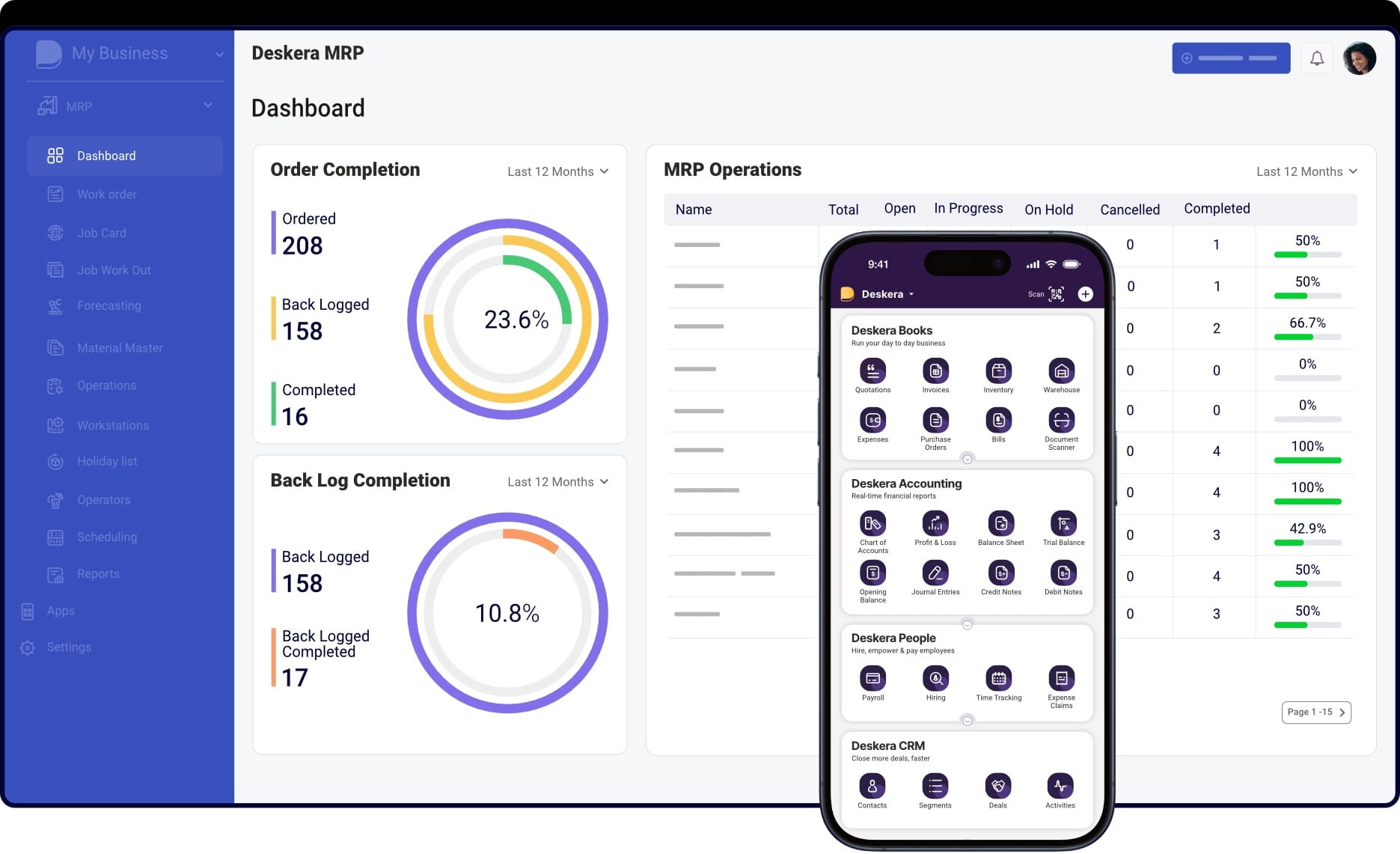
Efficient manufacturing scheduling requires real-time visibility, accurate production planning, seamless coordination across departments, and the ability to respond quickly to operational changes. Manual scheduling methods and disconnected systems often create delays, resource conflicts, and production inefficiencies.
Deskera MRP helps manufacturers streamline scheduling processes by integrating production planning, inventory management, procurement, and shop floor operations into a centralized platform that improves visibility, coordination, and decision-making.
Real-Time Production Visibility
Deskera MRP provides manufacturers with real-time visibility into production activities, machine utilization, inventory availability, and work order progress. Production managers can monitor shop floor operations instantly and identify bottlenecks or delays before they disrupt schedules. Access to real-time operational data enables faster decision-making and helps maintain more accurate and responsive production schedules.
Centralized Production Planning and Scheduling
Deskera MRP centralizes production scheduling by connecting manufacturing, inventory, procurement, and sales processes within a single system. This eliminates information silos and improves coordination between departments. Manufacturers can create more accurate schedules, allocate resources efficiently, and adjust production plans quickly based on changes in demand, material availability, or production capacity.
Integrated Inventory and Material Management
Manufacturing schedules depend heavily on the timely availability of raw materials and components. Deskera MRP helps businesses maintain optimal inventory levels through real-time inventory tracking, automated stock updates, and procurement coordination. This reduces material shortages, prevents production interruptions, and ensures that production schedules remain aligned with material availability.
Automated Workflows and Reduced Manual Errors
Deskera MRP automates several production and scheduling processes that are traditionally managed manually through spreadsheets or disconnected systems. Automated workflows reduce scheduling errors, improve planning speed, and simplify production coordination. Manufacturers can also reduce administrative workload while improving overall scheduling accuracy and operational efficiency.
Better Resource and Capacity Management
Deskera MRP helps manufacturers manage machine capacity, labor allocation, and production resources more effectively. Production planners can monitor resource availability, avoid capacity overload, and create realistic production schedules based on actual operational constraints. Improved capacity planning helps reduce bottlenecks and supports smoother production flow across manufacturing operations.
Improved Demand Forecasting and Production Planning
Deskera MRP uses historical sales data, inventory trends, and operational insights to support more accurate demand forecasting and production planning. Better forecasting helps manufacturers align production schedules with actual customer demand, reducing overproduction, excess inventory, and stock shortages. This improves scheduling stability and overall manufacturing efficiency.
Enhanced Cross-Department Collaboration
Effective manufacturing scheduling requires close coordination between production, procurement, inventory, logistics, and sales teams. Deskera MRP improves communication and collaboration by providing all departments with access to shared real-time data and centralized workflows. Better coordination reduces scheduling conflicts, improves operational alignment, and enables faster responses to production changes.
Advanced Reporting and Performance Tracking
Deskera MRP offers reporting and analytics tools that help manufacturers monitor scheduling performance, production efficiency, machine utilization, and operational KPIs. Managers can identify recurring bottlenecks, analyze workflow inefficiencies, and make data-driven improvements to production schedules. Continuous performance monitoring supports long-term operational optimization and better decision-making.
Cloud-Based Accessibility and Mobility
As a cloud-based platform, Deskera MRP allows manufacturers to access production schedules, operational data, and reports from anywhere using desktop or mobile devices. This flexibility improves responsiveness, supports remote decision-making, and enables managers to stay connected with production operations even outside the factory floor.
Key Takeaways
- Manufacturing scheduling helps manufacturers organize production activities efficiently to improve workflow coordination, resource utilization, and on-time delivery performance.
- The main objectives of manufacturing scheduling include optimizing resource allocation, reducing downtime, improving production flow, and ensuring timely order fulfillment.
- Different scheduling methods such as forward scheduling, backward scheduling, finite scheduling, and infinite scheduling help manufacturers manage production based on operational requirements and capacity constraints.
- Effective manufacturing scheduling improves production efficiency, minimizes bottlenecks, enhances machine and labor utilization, and supports better customer satisfaction.
- Common scheduling challenges include machine downtime, material shortages, inaccurate forecasting, poor communication, manual errors, and capacity limitations that disrupt production flow.
- Key manufacturing scheduling metrics such as cycle time, schedule adherence, machine utilization, on-time delivery, and OEE help businesses measure scheduling performance and identify operational inefficiencies.
- Mapping existing workflows and identifying bottlenecks provide a strong foundation for improving manufacturing scheduling processes.
- Real-time production monitoring enables manufacturers to detect disruptions quickly, improve visibility, and make faster scheduling adjustments.
- ERP systems improve manufacturing scheduling by centralizing production, inventory, procurement, and sales data into a single platform for better coordination.
- Advanced Production Scheduling (APS) tools help manufacturers create optimized schedules by considering machine capacity, labor availability, and production constraints.
- Accurate demand forecasting helps manufacturers align production schedules with customer demand while reducing overproduction and stock shortages.
- Preventive maintenance improves machine reliability and reduces unexpected downtime that can disrupt production schedules.
- Workforce scheduling and skill-based labor allocation improve productivity, reduce idle time, and support smoother production operations.
- Cross-training employees increases workforce flexibility and helps manufacturers adapt quickly to labor shortages or sudden production changes.
- Finite capacity scheduling creates realistic production timelines by considering actual resource availability and operational limitations.
- Reducing setup and changeover times improves production flexibility, increases throughput, and enhances schedule stability.
- Strong inventory and material management ensures raw materials are available when needed, reducing production interruptions caused by shortages.
- Automating scheduling processes improves planning speed, reduces manual errors, and enables dynamic schedule adjustments during disruptions.
- Effective communication between departments improves production coordination, reduces scheduling conflicts, and supports faster operational decisions.
- IoT-enabled machines and real-time data improve scheduling accuracy by providing live visibility into machine performance and production progress.
- AI and predictive analytics help manufacturers anticipate bottlenecks, optimize job sequencing, and improve scheduling decisions proactively.
- Flexible and agile scheduling strategies help manufacturers respond more effectively to demand fluctuations, urgent orders, and operational disruptions.
- Lean manufacturing principles such as JIT production and continuous improvement support more stable, efficient, and waste-free production scheduling.
- Continuous KPI tracking and root-cause analysis help manufacturers identify scheduling inefficiencies and improve long-term operational performance.
- Encouraging employee feedback and continuous improvement initiatives helps manufacturers refine scheduling processes and strengthen production efficiency over time.
- Improving manufacturing scheduling leads to faster production cycles, lower operational costs, better inventory management, higher customer satisfaction, and increased profitability.
- Deskera ERP helps manufacturers improve scheduling through real-time production visibility, centralized planning, automated workflows, inventory management, and advanced reporting capabilities.
Related Articles
 Niti Samani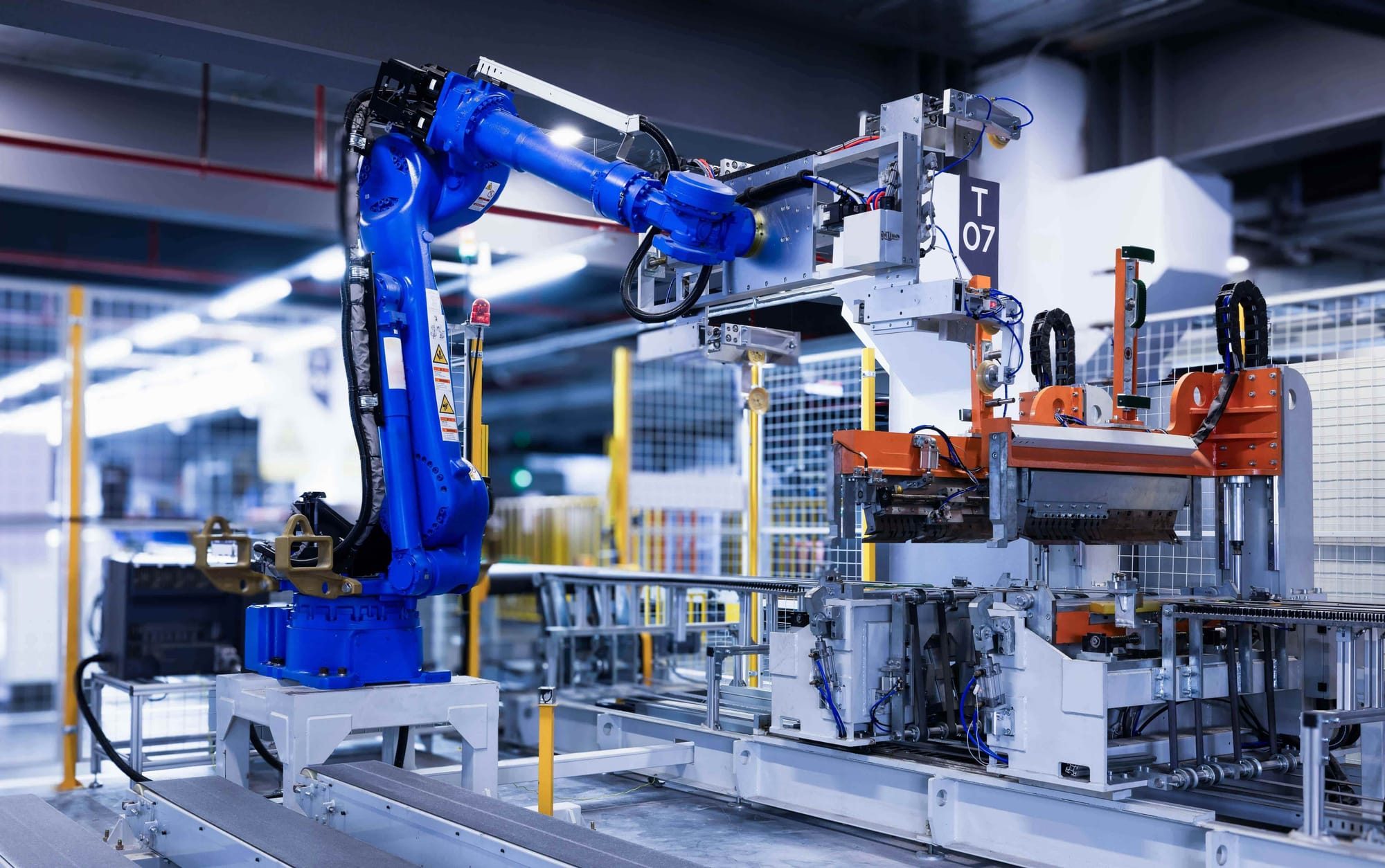
 Niti Samani
 Niti Samani
 Niti Samani
 Niti Samani
 Niti Samani
Inventory shortages can quietly drain a business’s revenue, disrupt operations, and damage customer trust. Whether it is a manufacturer running out of raw materials or a retailer facing empty shelves during peak demand, stockouts create costly setbacks that are difficult to recover from. In today’s fast-moving and highly competitive market, businesses can no longer rely on manual inventory tracking methods or disconnected systems to maintain optimal stock levels.
The financial impact of inventory shortages is staggering. Studies show that stockouts contribute to nearly $71.4 billion in lost retail sales every year, while around 40% of customers switch to competitors when their preferred products are unavailable. On a global scale, inventory distortion—which includes shortages, overstocks, and inaccurate inventory records—costs businesses an estimated $1.6 trillion annually. These numbers highlight how critical effective inventory management has become for maintaining profitability, customer loyalty, and operational continuity.
This is where Enterprise Resource Planning (ERP) systems play a transformative role. Modern ERP solutions provide real-time visibility into inventory levels, automate replenishment processes, improve demand forecasting accuracy, and streamline supply chain coordination. By integrating inventory, procurement, warehouse management, sales, and production into a centralized platform, ERP systems help businesses proactively identify inventory risks before they turn into costly shortages.
Deskera ERP is one such solution that helps businesses gain complete control over inventory operations through automation and intelligent insights. It offers features such as real-time inventory tracking, demand forecasting, multi-warehouse management, barcode scanning, automated purchase management, and advanced reporting dashboards. With its cloud-based accessibility and integrated business management capabilities, Deskera ERP enables organizations to reduce stockouts, improve inventory accuracy, and maintain smooth business operations.
What Is Inventory Shortage?
An inventory shortage occurs when a business does not have enough stock available to meet customer demand or production requirements. It happens when the quantity of products, raw materials, or supplies on hand falls below the required level, leading to stockouts, delayed orders, or interrupted operations. Inventory shortages can affect retailers, manufacturers, wholesalers, and eCommerce businesses alike, often resulting in lost sales and dissatisfied customers.
Inventory shortages may occur due to several reasons, including inaccurate demand forecasting, supplier delays, poor inventory tracking, sudden spikes in customer demand, inefficient warehouse management, or manual inventory errors. For manufacturers, shortages of raw materials can halt production lines, while retailers may struggle to fulfill customer orders on time when finished goods are unavailable.
For example, if a retail store experiences unexpectedly high demand for a product during a festive season but fails to replenish stock in time, customers may find the shelves empty. Similarly, a manufacturing company that runs out of critical components may face production downtime and delayed deliveries. In both cases, the business suffers operational disruptions and potential revenue loss.
Preventing inventory shortages requires businesses to maintain accurate inventory visibility, optimize stock levels, monitor supplier performance, and forecast demand effectively. Modern ERP systems help address these challenges by providing real-time inventory tracking, automated stock replenishment, demand forecasting, and centralized inventory management across multiple locations.
Common Signs of Inventory Shortage
Inventory shortages rarely happen overnight. In most cases, businesses experience several warning signs before stock levels become critically low. Identifying these signs early can help companies take corrective action before shortages disrupt operations, delay deliveries, or impact customer satisfaction. Monitoring inventory performance regularly allows businesses to respond proactively and maintain stable supply chain operations.
Frequent Stockouts
One of the most obvious signs of an inventory shortage is recurring stockouts. Products frequently becoming unavailable indicates that inventory replenishment processes are not keeping pace with customer demand. This issue can lead to missed sales opportunities, reduced customer trust, and increased pressure on procurement teams. Frequent stockouts often result from poor demand forecasting, delayed supplier deliveries, or inaccurate inventory records.
Delayed Customer Orders
When businesses struggle to fulfill customer orders on time, it often signals insufficient inventory availability. Delayed shipments and longer delivery timelines can negatively impact customer satisfaction and damage brand reputation. Customers today expect fast and reliable fulfillment, especially in competitive industries like retail and eCommerce. Repeated order delays may indicate poor inventory planning, inefficient warehouse coordination, or lack of real-time inventory visibility.
Increased Backorders
A growing number of backorders is another strong indication of inventory shortages. Backorders occur when customers place orders for products that are temporarily unavailable. While businesses may eventually fulfill these orders, excessive backorders create operational bottlenecks and frustrate customers. Persistent backorders usually point to inaccurate demand forecasting, weak supplier coordination, or delays in replenishment cycles.
Production Interruptions
In manufacturing environments, inventory shortages often lead to production downtime. A lack of raw materials, spare parts, or components can halt production schedules and reduce operational efficiency. These interruptions increase labor costs, delay product deliveries, and impact overall productivity. Frequent production stoppages typically suggest inadequate inventory monitoring, poor procurement planning, or unreliable supplier performance.
Emergency Purchasing and Expedited Shipping
Businesses experiencing inventory shortages often resort to emergency purchasing or expedited shipping to replenish stock quickly. While this may solve immediate shortages, it significantly increases procurement and logistics costs. Rush orders and urgent supplier requests are clear signs that inventory planning processes are reactive rather than proactive. Over time, relying on emergency purchases can reduce profitability and strain supplier relationships.
Declining Customer Satisfaction
Customer complaints about unavailable products, delayed deliveries, or canceled orders often indicate inventory shortages. When customers consistently fail to receive products on time, they may switch to competitors offering better product availability. Declining customer satisfaction can directly impact repeat business and long-term brand loyalty. Businesses that regularly monitor customer feedback can often identify inventory issues before they escalate further.
Inaccurate Inventory Records
Frequent mismatches between physical stock and recorded inventory levels are a common warning sign of inventory shortages. Inaccurate inventory data can cause businesses to believe products are available when they are actually out of stock. This problem is often caused by manual data entry errors, poor warehouse tracking processes, or lack of inventory synchronization across locations. Accurate inventory visibility is essential for preventing unexpected shortages.
High Supplier Dependency Risks
Businesses heavily dependent on a limited number of suppliers may experience inventory shortages more frequently. Supplier delays, transportation disruptions, or production issues can quickly affect stock availability. If a company regularly faces delays due to vendor-related problems, it may indicate the need for better supplier diversification and stronger procurement planning. Monitoring supplier performance is critical for maintaining consistent inventory levels.
Major Causes of Inventory Shortage
Inventory shortages can occur for many reasons, ranging from poor planning and inaccurate data to supplier disruptions and sudden market changes. When businesses fail to maintain proper inventory control, even small inefficiencies can quickly lead to stockouts, delayed deliveries, and operational disruptions. Understanding the root causes of inventory shortages is essential for improving inventory management and maintaining consistent product availability.
Inaccurate Demand Forecasting
Poor demand forecasting is one of the leading causes of inventory shortages. When businesses fail to accurately predict customer demand, they may order insufficient stock to meet future sales requirements. Seasonal demand fluctuations, changing market trends, and unexpected buying patterns can make forecasting challenging. Without reliable forecasting tools and historical sales analysis, businesses often struggle to maintain optimal inventory levels.
Lack of Real-Time Inventory Visibility
Businesses that rely on outdated or disconnected inventory systems often lack real-time visibility into stock levels. This makes it difficult to track inventory movements accurately across warehouses, retail stores, or production facilities. As a result, companies may unknowingly run out of stock before replenishment orders are placed. Limited inventory visibility also increases the risk of data inconsistencies and delayed decision-making.
Manual Inventory Management Processes
Manual inventory tracking methods, such as spreadsheets or paper-based records, are highly prone to human error. Incorrect data entry, missed stock updates, and delayed reporting can create inaccurate inventory records that lead to shortages. Manual processes also make it difficult for businesses to monitor inventory in real time or respond quickly to sudden demand changes. As operations grow, these inefficiencies become even more difficult to manage.
Supplier Delays and Disruptions
Inventory shortages often occur when suppliers fail to deliver products or raw materials on time. Transportation issues, production delays, labor shortages, geopolitical disruptions, and natural disasters can all affect supplier reliability. Businesses that depend heavily on a small number of suppliers are particularly vulnerable to supply chain disruptions. Delayed supplier deliveries can quickly interrupt inventory replenishment cycles and create stock availability issues.
Inefficient Reorder Management
Poor reorder planning can result in businesses replenishing inventory too late or ordering incorrect quantities. If reorder points and safety stock levels are not properly defined, inventory may fall below critical levels before new stock arrives. Inefficient reorder management is especially problematic in businesses with fluctuating demand patterns or long supplier lead times. Automated reorder systems help reduce this risk significantly.
Poor Warehouse Management
Disorganized warehouse operations can contribute to inventory shortages by causing misplaced, damaged, or untracked stock. Inefficient storage layouts, inaccurate picking processes, and lack of barcode or RFID tracking can reduce inventory accuracy. In some cases, products may physically exist in the warehouse but remain unavailable due to poor stock visibility or operational inefficiencies. Effective warehouse management is critical for maintaining accurate inventory control.
Sudden Demand Spikes
Unexpected increases in customer demand can quickly deplete inventory levels if businesses are unprepared. Promotional campaigns, seasonal sales, market trends, or viral product popularity can lead to rapid stock consumption. Without flexible inventory planning and responsive supply chain coordination, businesses may struggle to replenish products fast enough to meet demand. Sudden demand spikes are particularly challenging for businesses with long procurement lead times.
Inadequate Safety Stock Levels
Safety stock acts as a buffer against unexpected demand fluctuations or supplier delays. Businesses that maintain insufficient safety stock are more likely to experience inventory shortages during disruptions. On the other hand, calculating appropriate safety stock levels requires balancing storage costs with inventory risk. Companies that underestimate required safety stock often face stockouts during periods of uncertainty or demand variability.
Poor Communication Across Departments
Inventory shortages can also result from poor coordination between sales, procurement, warehouse, and production teams. For example, if sales teams launch promotions without informing procurement departments, inventory may run out faster than expected. Lack of communication leads to disconnected planning, inaccurate purchasing decisions, and delayed replenishment activities. Integrated ERP systems help improve collaboration and ensure all departments work with the same inventory data.
Ineffective Inventory Audits
Businesses that fail to conduct regular inventory audits may overlook discrepancies between actual and recorded stock levels. Inventory shrinkage caused by theft, damage, spoilage, or administrative errors can gradually reduce available inventory without being detected. Over time, these inaccuracies lead to unexpected shortages and operational disruptions. Routine inventory audits help businesses maintain accurate stock records and identify inventory issues early.
Why Preventing Inventory Shortages is Critical
Preventing inventory shortages is essential for maintaining smooth business operations, meeting customer expectations, and protecting profitability. Even a temporary stockout can create a chain reaction of operational delays, lost sales, and damaged customer relationships.
In highly competitive markets, businesses that fail to maintain consistent inventory availability risk losing both revenue and long-term customer loyalty. By proactively preventing shortages, companies can improve operational efficiency, strengthen supply chain performance, and ensure business continuity.
Financial Impact of Inventory Shortages
Inventory shortages can significantly reduce a company’s revenue and profitability. When products are unavailable, businesses lose immediate sales opportunities and may also incur additional costs through emergency procurement, expedited shipping, or production delays.
Repeated stockouts can also increase operational expenses and reduce overall profit margins. Over time, inventory shortages create financial instability by disrupting cash flow and limiting business growth opportunities.
Operational Disruptions and Downtime
Shortages often interrupt daily business operations, particularly in manufacturing and distribution environments. A lack of raw materials or finished goods can halt production schedules, delay shipments, and reduce workforce productivity.
These disruptions affect operational efficiency and create bottlenecks across the supply chain. Preventing inventory shortages helps businesses maintain consistent workflows, reduce downtime, and improve overall operational performance.
Declining Customer Satisfaction
Customers expect products to be available when they need them. When businesses fail to fulfill orders due to stock shortages, customers often become frustrated and may choose competitors instead.
Delayed deliveries, canceled orders, and poor product availability can negatively impact the overall customer experience. Maintaining adequate inventory levels helps businesses deliver reliable service, improve customer satisfaction, and build stronger customer relationships.
Loss of Customer Loyalty and Brand Reputation
Frequent inventory shortages can damage a company’s reputation and reduce customer trust. Customers who repeatedly experience stockouts may perceive the business as unreliable or poorly managed.
Negative reviews, complaints, and reduced repeat purchases can affect long-term brand value. In competitive industries, businesses that consistently maintain product availability are more likely to retain loyal customers and strengthen their market position.
Reduced Supply Chain Efficiency
Inventory shortages often create inefficiencies throughout the supply chain. Procurement teams may need to place urgent orders, suppliers may face increased pressure, and warehouse operations can become disorganized.
These reactive processes increase costs and reduce overall supply chain stability. Preventing shortages through better inventory planning and forecasting allows businesses to maintain smoother and more efficient supply chain operations.
Impact on Production Continuity
For manufacturers, inventory shortages can directly affect production continuity. Missing raw materials or components may force production lines to stop temporarily, leading to delayed manufacturing schedules and missed delivery deadlines.
These interruptions reduce productivity and increase operational costs. Maintaining adequate inventory levels ensures uninterrupted production and supports consistent manufacturing output.
Increased Risk of Competitive Loss
In today’s fast-paced market, customers can quickly switch to alternative brands if products are unavailable. Competitors with better inventory availability often gain market share when businesses experience frequent stockouts.
Preventing inventory shortages helps businesses remain competitive by ensuring customers can consistently access products without delays or disruptions.
Better Business Planning and Decision-Making
Businesses that actively prevent inventory shortages benefit from more accurate planning and informed decision-making. Reliable inventory availability allows companies to forecast sales, manage procurement, optimize warehouse operations, and improve customer service more effectively. Strong inventory control also provides greater flexibility to respond to changing market conditions and future business growth.
How ERP Systems Help Prevent Inventory Shortages
ERP systems play a critical role in helping businesses maintain optimal inventory levels and avoid costly stock shortages.
By integrating inventory management, procurement, sales, warehouse operations, and supply chain processes into a centralized platform, ERP systems provide real-time visibility and automation across the entire inventory lifecycle.
This enables businesses to forecast demand accurately, streamline replenishment processes, and respond quickly to inventory-related issues before they disrupt operations.
Real-Time Inventory Visibility
ERP systems provide businesses with real-time visibility into inventory levels across warehouses, retail locations, and distribution centers. Every inventory movement, including purchases, sales, transfers, and returns, is updated instantly within the system.
This centralized visibility helps businesses track stock availability accurately and avoid situations where products run out unexpectedly. Real-time monitoring also improves decision-making by giving teams access to accurate and up-to-date inventory data.
Automated Reorder Point Management
Modern ERP systems allow businesses to automate reorder point management based on predefined stock thresholds and demand patterns. When inventory levels fall below minimum stock requirements, the system automatically generates purchase requisitions or reorder alerts.
This reduces the risk of delayed replenishment and helps maintain consistent inventory availability. Automated reorder management also minimizes manual intervention and improves procurement efficiency.
Accurate Demand Forecasting
ERP systems use historical sales data, market trends, and customer demand patterns to improve forecasting accuracy. Advanced ERP solutions may also incorporate AI-driven analytics to predict future inventory requirements more effectively.
Accurate demand forecasting helps businesses maintain appropriate stock levels, reduce unexpected shortages, and prepare for seasonal demand fluctuations. Better forecasting also supports smarter purchasing and production planning decisions.
Improved Procurement and Supplier Management
ERP systems streamline procurement processes by improving coordination between purchasing teams and suppliers. Businesses can track supplier performance, monitor lead times, and manage purchase orders more efficiently through a centralized platform.
Better supplier visibility helps reduce delays in inventory replenishment and ensures timely delivery of products or raw materials. ERP systems also support stronger supplier relationships through improved communication and planning.
Multi-Warehouse Inventory Management
Businesses operating across multiple warehouses or locations often struggle with inventory imbalances. ERP systems help manage inventory distribution efficiently by providing centralized control over stock movement across all locations.
Companies can transfer inventory between warehouses, identify excess stock, and prevent shortages in high-demand locations. This improves inventory utilization and reduces the risk of localized stockouts.
Automated Purchase Order Generation
ERP systems can automatically generate purchase orders based on inventory levels, sales trends, and production requirements. This automation ensures that replenishment activities occur on time without relying heavily on manual monitoring.
Automated purchase order management reduces administrative workload, minimizes ordering errors, and shortens procurement cycles. Faster replenishment processes help businesses maintain stable inventory levels and prevent shortages.
Inventory Alerts and Notifications
ERP systems provide automated alerts and notifications for low stock levels, delayed shipments, slow-moving inventory, and other inventory-related issues.
These real-time notifications allow businesses to take immediate corrective action before shortages affect operations or customers. Alerts help inventory managers stay proactive rather than reactive, improving overall inventory control and operational responsiveness.
Better Production Planning
For manufacturers, ERP systems improve production planning by aligning inventory availability with production schedules. The system ensures that required raw materials and components are available before manufacturing begins, reducing the risk of production delays caused by shortages. Integrated production and inventory planning also improve resource allocation, scheduling accuracy, and manufacturing efficiency.
Enhanced Warehouse Management
ERP systems improve warehouse operations through features such as barcode scanning, batch tracking, serial number tracking, and automated stock updates.
These capabilities reduce inventory inaccuracies caused by manual processes and improve overall warehouse efficiency. Better warehouse management ensures products are stored, tracked, and retrieved accurately, minimizing the chances of misplaced or unavailable inventory.
Real-Time Reporting and Analytics
ERP systems provide detailed inventory reports and analytics that help businesses identify inventory trends, monitor stock performance, and detect potential shortage risks early.
Managers can analyze stock movement, turnover rates, supplier performance, and demand fluctuations through customizable dashboards and reports. Data-driven insights enable businesses to make faster and more informed inventory management decisions.
Improved Coordination Across Departments
ERP systems integrate multiple business functions into a unified platform, improving communication between sales, procurement, warehouse, finance, and production teams.
All departments work with the same real-time inventory data, reducing miscommunication and disconnected planning.
Better collaboration helps businesses respond quickly to demand changes, manage replenishment more effectively, and maintain consistent inventory availability.
Support for Scalable Inventory Management
As businesses grow, managing inventory manually becomes increasingly difficult. ERP systems provide scalable inventory management capabilities that support expanding product lines, warehouses, suppliers, and customer demand.
The system adapts to growing operational complexity while maintaining inventory accuracy and efficiency. This scalability helps businesses prevent inventory shortages even as operations become larger and more dynamic.
ERP Inventory Shortage Prevention Workflow
ERP systems follow a structured and automated workflow to help businesses monitor inventory levels, predict demand, manage replenishment, and prevent stock shortages before they occur.
By integrating inventory management with procurement, sales, warehouse operations, and production planning, ERP systems create a continuous flow of accurate data across the organization.
This workflow enables businesses to maintain optimal inventory availability while reducing manual errors and operational delays.
Step 1: Real-Time Inventory Monitoring
The inventory shortage prevention process begins with continuous real-time inventory monitoring. ERP systems track every inventory movement, including sales, purchases, returns, transfers, and production usage, as they happen.
This provides businesses with accurate visibility into current stock levels across all warehouses and locations. Real-time monitoring helps identify low-stock situations early and prevents unexpected stockouts caused by outdated or inaccurate inventory data.
Step 2: Demand Forecasting and Inventory Planning
ERP systems analyze historical sales data, customer demand trends, seasonal patterns, and market behavior to forecast future inventory requirements. These forecasting capabilities help businesses estimate how much inventory will be needed over specific periods.
Accurate demand planning allows companies to maintain balanced inventory levels, avoid understocking, and prepare for fluctuations in customer demand without overinvesting in excess inventory.
Step 3: Setting Reorder Points and Safety Stock Levels
Once inventory forecasts are generated, ERP systems help businesses establish reorder points and safety stock thresholds for each product. Reorder points define the minimum inventory level at which replenishment should begin, while safety stock acts as a buffer against unexpected demand spikes or supplier delays. Automated threshold management ensures inventory replenishment starts before stock levels become critically low.
Step 4: Automated Replenishment and Purchase Order Generation
When inventory levels fall below predefined reorder points, the ERP system automatically triggers replenishment workflows. The system may generate purchase requisitions, create purchase orders, or notify procurement teams to initiate restocking activities.
Automation reduces dependency on manual inventory checks and minimizes delays in ordering inventory. Faster replenishment cycles help businesses maintain uninterrupted stock availability.
Step 5: Supplier Coordination and Procurement Management
ERP systems streamline communication and coordination with suppliers throughout the procurement process. Businesses can track supplier lead times, order statuses, delivery schedules, and vendor performance through centralized dashboards.
Improved supplier management helps reduce procurement delays and ensures inventory arrives on time. ERP systems also allow businesses to compare supplier performance and make more informed sourcing decisions.
Step 6: Warehouse Receiving and Inventory Updates
Once inventory arrives, ERP systems update stock levels automatically during the receiving process. Barcode scanning, RFID tracking, and warehouse management tools help ensure accurate stock recording and product tracking.
Automated inventory updates reduce human errors and provide instant visibility into newly available stock. Efficient receiving workflows also improve warehouse productivity and inventory accuracy.
Step 7: Inventory Allocation and Distribution
ERP systems help businesses allocate inventory efficiently across warehouses, retail locations, production units, or customer orders. The system identifies where stock is needed most and supports inventory transfers between locations when necessary.
Proper inventory allocation reduces localized shortages and improves overall inventory utilization. Businesses can fulfill customer demand more effectively while maintaining balanced stock levels across operations.
Step 8: Continuous Inventory Analysis and Reporting
ERP systems continuously monitor inventory performance using real-time analytics and reporting tools. Managers can track key inventory metrics such as stockout rates, inventory turnover, lead times, and order fulfillment performance.
These insights help businesses identify inventory risks, improve forecasting accuracy, and optimize replenishment strategies over time. Continuous analysis supports proactive inventory management and long-term operational improvement.
Step 9: Cross-Department Collaboration and Decision-Making
ERP systems improve collaboration between procurement, warehouse, sales, finance, and production teams by centralizing inventory information. All departments have access to the same real-time data, which improves planning accuracy and reduces communication gaps.
Better coordination allows businesses to respond faster to demand changes, supplier issues, or operational disruptions, helping prevent inventory shortages across the organization.
Step 10: Ongoing Optimization and Scalability
As business operations grow, ERP systems help organizations scale inventory management processes efficiently. Businesses can continuously optimize inventory policies, forecasting models, supplier relationships, and warehouse operations using ERP-driven insights.
This ongoing optimization improves inventory control, reduces shortages, and supports sustainable business growth even in complex and rapidly changing markets.
Key Metrics Businesses Should Track to Prevent Inventory Shortages
Tracking the right inventory metrics helps businesses identify potential shortage risks before they disrupt operations. These metrics provide insights into stock movement, demand patterns, supplier performance, and inventory efficiency.
By monitoring inventory KPIs consistently, businesses can improve forecasting accuracy, optimize replenishment strategies, and maintain stable inventory availability.
Stockout Rate
Stockout rate measures how often products become unavailable when customers place orders. A high stockout rate indicates poor inventory planning, inaccurate forecasting, or delayed replenishment processes. Monitoring this metric helps businesses identify products that frequently run out of stock and take corrective action to improve inventory availability.
Formula:
Stockout Rate (%) = (Number of Stockouts / Total Customer Orders) × 100
Inventory Turnover Ratio
Inventory turnover ratio measures how efficiently inventory is sold and replaced over a specific period. A low turnover ratio may indicate slow-moving inventory, while an extremely high ratio can suggest insufficient stock levels that increase shortage risks. This metric helps businesses maintain the right balance between inventory availability and carrying costs.
Formula:
Inventory Turnover Ratio = Cost of Goods Sold (COGS) / Average Inventory
Order Fulfillment Rate
Order fulfillment rate measures the percentage of customer orders fulfilled successfully without delays or stock issues. A low fulfillment rate often signals inventory shortages or warehouse inefficiencies. Businesses use this metric to evaluate how effectively inventory supports customer demand and delivery performance.
Formula:
Order Fulfillment Rate (%) = (Orders Fulfilled Successfully / Total Orders) × 100
Lead Time
Lead time measures the total time required to replenish inventory after placing an order with a supplier. Longer or inconsistent lead times increase the risk of inventory shortages, especially during periods of high demand. Tracking lead time helps businesses improve procurement planning and maintain sufficient safety stock levels.
Formula:
Lead Time = Order Delivery Date - Order Placement Date
Safety Stock Level
Safety stock represents the extra inventory maintained to protect against unexpected demand spikes or supplier delays. Businesses that maintain insufficient safety stock are more likely to experience stockouts during disruptions. Monitoring safety stock levels helps companies ensure inventory stability without overstocking products.
Formula:
Safety Stock = (Maximum Daily Usage × Maximum Lead Time) - (Average Daily Usage × Average Lead Time)
Reorder Point
Reorder point identifies the inventory level at which businesses should begin replenishment to avoid stock shortages. Setting accurate reorder points ensures that new inventory arrives before existing stock is depleted. This metric is critical for maintaining uninterrupted inventory availability.
Formula:
Reorder Point = (Average Daily Usage × Lead Time) + Safety Stock
Inventory Accuracy Rate
Inventory accuracy rate measures how closely recorded inventory matches actual physical stock levels. Poor inventory accuracy can lead to unexpected shortages because businesses may believe products are available when they are not. Regularly monitoring this metric improves inventory visibility and operational reliability.
Formula:
Inventory Accuracy Rate (%) = (Accurate Inventory Records / Total Inventory Records) × 100
Backorder Rate
Backorder rate measures the percentage of customer orders delayed because products are unavailable at the time of purchase. A high backorder rate often indicates recurring inventory shortages or supply chain inefficiencies. Tracking this KPI helps businesses improve replenishment planning and customer satisfaction.
Formula:
Backorder Rate (%) = (Backordered Items / Total Ordered Items) × 100
Days Inventory Outstanding (DIO)
Days Inventory Outstanding measures the average number of days inventory remains in storage before being sold or used. Monitoring this metric helps businesses optimize inventory levels and avoid both excess inventory and stock shortages. An unusually low DIO may indicate insufficient inventory coverage.
Formula:
Days Inventory Outstanding (DIO) = (Average Inventory / Cost of Goods Sold) × Number of Days
Supplier On-Time Delivery Rate
Supplier on-time delivery rate measures how consistently suppliers deliver inventory within agreed timelines. Delayed supplier deliveries are a major cause of inventory shortages. Tracking supplier performance helps businesses identify unreliable vendors and improve procurement planning.
Formula:
Supplier On-Time Delivery Rate (%) = (On-Time Deliveries / Total Deliveries) × 100
Common Challenges in Preventing Inventory Shortages
Preventing inventory shortages is not always straightforward, especially in today’s fast-changing business environment. Companies often face multiple operational, technological, and supply chain-related challenges that make maintaining optimal inventory levels difficult.
Without effective inventory management strategies and integrated systems, even minor disruptions can quickly lead to stockouts, delayed deliveries, and customer dissatisfaction.
Understanding these challenges helps businesses develop more proactive and resilient inventory management practices.
Inaccurate Demand Forecasting
One of the biggest challenges businesses face is accurately predicting customer demand. Market trends, seasonal fluctuations, changing consumer preferences, and unexpected demand spikes can make forecasting difficult.
When demand estimates are inaccurate, businesses may either understock products or overcompensate with excess inventory. Poor forecasting directly increases the risk of inventory shortages and operational disruptions.
Lack of Real-Time Inventory Visibility
Many businesses still operate with disconnected systems or outdated inventory tracking methods that do not provide real-time stock visibility.
Without accurate and up-to-date inventory data, businesses may struggle to monitor stock levels across warehouses, retail stores, or production facilities.
This lack of visibility can result in delayed replenishment decisions and unexpected stock shortages.
Supplier Delays and Supply Chain Disruptions
Supplier-related issues are a major challenge in preventing inventory shortages. Delayed shipments, transportation bottlenecks, raw material shortages, labor issues, and geopolitical disruptions can all affect inventory availability.
Businesses that depend heavily on a small number of suppliers are particularly vulnerable to supply chain interruptions. Even well-planned inventory strategies can fail if suppliers cannot deliver inventory on time.
Manual Inventory Management Processes
Manual inventory tracking methods often create inefficiencies and increase the likelihood of human error. Spreadsheet-based systems and paper records can lead to inaccurate stock counts, delayed updates, and duplicate data entries.
As businesses grow, manual inventory processes become increasingly difficult to manage, making it harder to maintain inventory accuracy and prevent shortages.
Poor Inventory Data Accuracy
Inventory management decisions are only as effective as the data supporting them. Inaccurate inventory records caused by theft, damaged goods, data entry errors, or unrecorded stock movements can create major inventory visibility problems.
Businesses may assume products are available when actual stock levels are much lower, leading to unexpected stockouts and fulfillment delays.
Inefficient Reorder Planning
Many businesses struggle with determining the correct reorder points and safety stock levels for their inventory.
Reordering inventory too late increases the risk of shortages, while ordering too early can lead to excess inventory and higher storage costs.
Inefficient reorder planning becomes even more challenging when demand patterns fluctuate frequently or supplier lead times are inconsistent.
Multi-Warehouse Inventory Complexity
Managing inventory across multiple warehouses or locations adds another layer of complexity. Businesses may experience inventory imbalances where one location faces shortages while another holds excess stock.
Without centralized inventory management and coordinated stock transfers, maintaining consistent inventory availability across locations becomes difficult.
Lack of Cross-Department Coordination
Inventory management often involves multiple departments, including procurement, warehouse operations, sales, finance, and production planning.
Poor communication between these teams can lead to inaccurate purchasing decisions, delayed replenishment, or inventory mismatches.
For example, sales promotions may increase demand unexpectedly if procurement teams are not informed in advance.
Sudden Market and Demand Changes
Rapid market shifts, economic uncertainty, and changing consumer behavior can disrupt inventory planning efforts.
Unexpected events such as viral product trends, seasonal surges, or industry disruptions may cause inventory demand to rise suddenly.
Businesses without flexible inventory management systems may struggle to respond quickly enough to avoid shortages.
Limited Technology Adoption
Some businesses continue to rely on outdated systems that lack automation, analytics, and integration capabilities.
Without modern ERP or inventory management solutions, companies may struggle to monitor inventory performance, forecast demand accurately, or automate replenishment processes.
Limited technology adoption reduces operational efficiency and increases the risk of inventory shortages.
Balancing Inventory Costs and Availability
Maintaining enough inventory to prevent shortages while avoiding excessive carrying costs is a constant challenge for businesses.
Holding too much inventory ties up capital and increases storage expenses, while maintaining too little inventory increases stockout risks.
Achieving the right balance requires accurate forecasting, efficient procurement, and continuous inventory optimization.
Resistance to Process Changes
Implementing improved inventory management practices or ERP systems may face resistance from employees accustomed to traditional processes.
Lack of training, fear of technology adoption, or organizational resistance can slow down inventory management improvements.
Without proper change management and employee support, businesses may struggle to fully optimize their inventory control processes.
Best Practices for Using ERP to Prevent Inventory Shortages
Implementing an ERP system alone is not enough to eliminate inventory shortages. Businesses must also follow the right operational practices to fully utilize the system’s capabilities and maintain consistent inventory availability.
Effective ERP usage involves continuous monitoring, process optimization, accurate data management, and strategic planning.
By following proven best practices, businesses can strengthen inventory control, improve supply chain responsiveness, and reduce the likelihood of costly stock disruptions.
Standardize Inventory Data Across the Organization
One of the most effective ways to improve inventory management is by maintaining standardized and consistent inventory data within the ERP system.
Product names, SKUs, units of measurement, supplier details, and warehouse records should follow uniform formats across all departments and locations.
Standardized data reduces duplicate records, improves reporting accuracy, and ensures inventory transactions are processed consistently throughout the organization.
Classify Inventory Based on Business Priority
Not all inventory items require the same level of monitoring or replenishment urgency. Businesses should use ERP systems to categorize inventory based on factors such as demand frequency, revenue contribution, or operational importance.
High-priority products and critical raw materials should receive closer monitoring and faster replenishment cycles. Inventory classification helps businesses allocate resources more effectively and reduce the risk of shortages for essential items.
Continuously Review and Adjust Reorder Parameters
Market conditions, supplier performance, and customer demand patterns constantly change over time. Businesses should regularly review reorder points, safety stock levels, and lead time assumptions within the ERP system to ensure they remain accurate.
Static inventory settings may become ineffective if demand increases suddenly or suppliers experience delays. Continuous optimization helps maintain appropriate stock levels under changing business conditions.
Integrate Sales Forecasting with Inventory Planning
ERP systems become far more effective when sales forecasting and inventory planning work together.
Businesses should align inventory decisions with upcoming promotions, seasonal campaigns, product launches, and sales projections.
Coordinating sales and inventory planning helps prevent unexpected demand surges from creating stock shortages. This approach also improves purchasing accuracy and warehouse preparedness.
Use Automated Exception Reporting
Instead of relying solely on routine inventory reports, businesses should configure ERP systems to generate automated exception reports for unusual inventory activity.
These reports can highlight sudden drops in stock levels, abnormal sales spikes, delayed supplier deliveries, or products nearing stockout conditions.
Exception-based monitoring allows managers to focus on critical inventory risks before they escalate into larger operational problems.
Diversify Supplier Networks
ERP systems can help businesses manage multiple suppliers more effectively, but organizations should also strategically diversify their supplier base.
Relying too heavily on a single supplier increases vulnerability to delays and disruptions.
Maintaining backup suppliers for critical inventory items improves supply chain resilience and reduces the chances of shortages during unexpected events.
Improve Inventory Cycle Counting Practices
Rather than conducting infrequent full inventory audits, businesses should use ERP systems to support regular cycle counting processes.
Cycle counting involves checking smaller sections of inventory on a rotating schedule to identify discrepancies early.
Frequent inventory verification improves stock accuracy, reduces operational disruptions, and helps businesses detect inventory issues before they impact customer orders or production schedules.
Enable Mobile Inventory Access
Providing warehouse teams and inventory managers with mobile ERP access improves inventory responsiveness and operational efficiency.
Mobile inventory tools allow employees to update stock records, confirm inventory movements, and access real-time inventory data directly from warehouse floors or remote locations.
Faster data updates reduce delays and improve inventory accuracy across operations.
Monitor Slow-Moving and Obsolete Inventory
Excess slow-moving inventory can tie up storage space and working capital that could otherwise support critical stock replenishment. Businesses should use ERP analytics to identify obsolete or underperforming inventory items regularly.
Optimizing inventory mix and removing unnecessary stock helps free resources for high-demand products that are more likely to experience shortages.
Establish Inventory Escalation Procedures
Businesses should create clear escalation workflows within the ERP system for handling potential inventory shortages. For example, low-stock alerts for critical items can automatically notify procurement managers, warehouse supervisors, or production planners. Defined escalation procedures ensure faster decision-making and improve the organization’s ability to respond proactively to inventory risks.
Conduct Regular ERP Performance Reviews
ERP systems should be continuously evaluated to ensure inventory management processes remain efficient and aligned with business goals. Businesses should review inventory KPIs, forecasting accuracy, replenishment performance, and warehouse efficiency on a regular basis. Ongoing ERP performance reviews help identify process gaps, improve system usage, and support continuous inventory optimization.
Train Employees on ERP Inventory Workflows
Even advanced ERP systems can produce poor results if employees are not properly trained. Businesses should provide regular training on inventory workflows, data entry standards, warehouse procedures, and reporting tools. Well-trained employees are more likely to follow standardized processes, reduce inventory errors, and use ERP features effectively to prevent shortages.
How Deskera ERP Helps Prevent Inventory Shortages
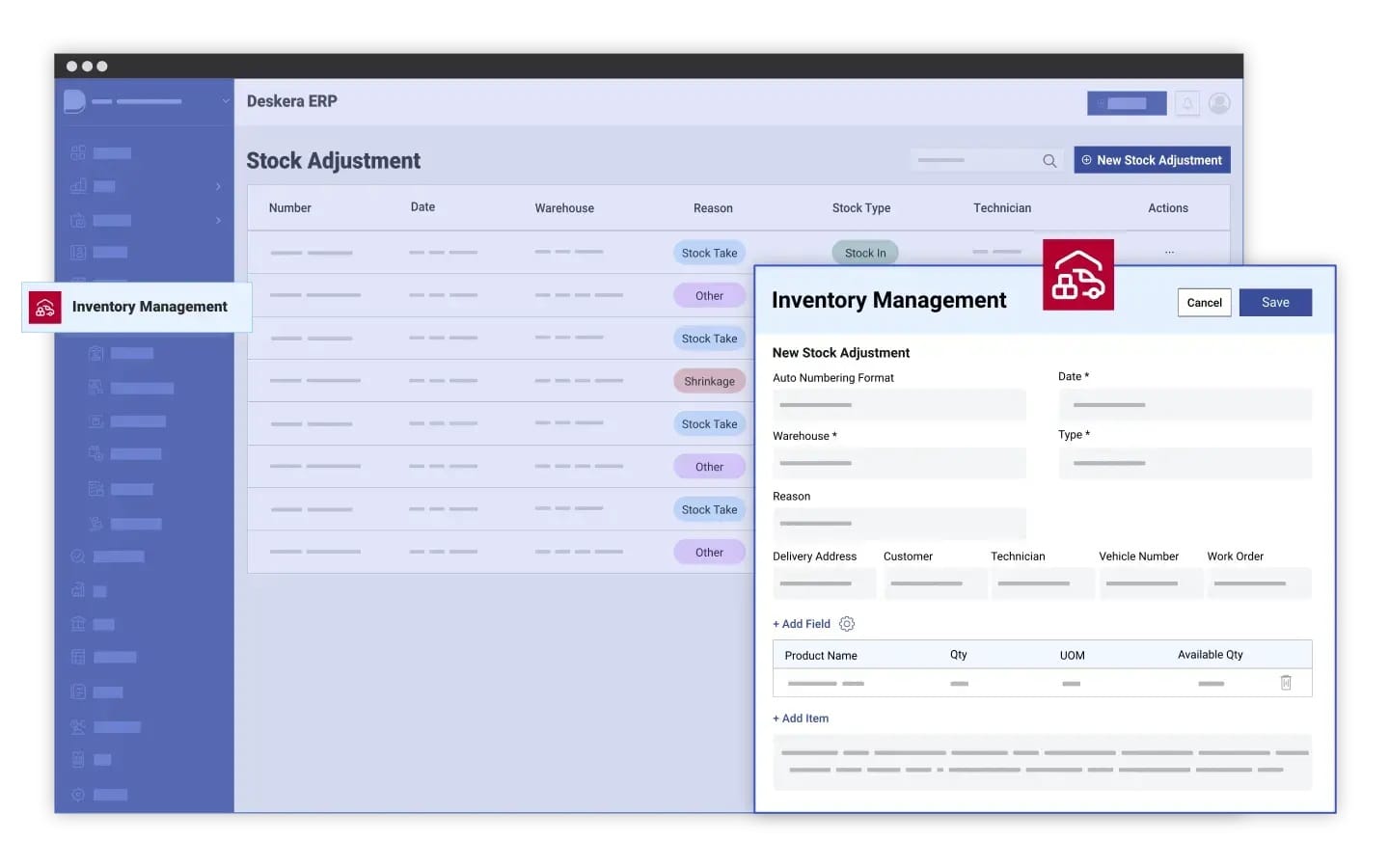
Deskera ERP helps businesses reduce inventory shortages by providing centralized inventory control, real-time visibility, and intelligent automation across procurement, warehouse, sales, and production processes. By integrating multiple business functions into a single platform, Deskera ERP enables organizations to monitor inventory accurately, improve forecasting, streamline replenishment, and respond quickly to changing demand conditions. These capabilities help businesses maintain consistent stock availability while improving operational efficiency.
Real-Time Inventory Tracking
Deskera ERP provides real-time visibility into inventory levels across warehouses, retail locations, and distribution centers. Businesses can monitor stock movement instantly as products are purchased, sold, transferred, or returned. This live inventory tracking reduces the chances of stock discrepancies and helps businesses identify low-stock situations before they result in shortages. Real-time updates also improve inventory accuracy and support faster decision-making.
Automated Inventory Replenishment
Deskera ERP helps automate replenishment workflows by allowing businesses to define reorder points, minimum stock levels, and safety stock thresholds. When inventory levels fall below predefined limits, the system automatically triggers replenishment alerts or purchase requests. Automated replenishment reduces delays caused by manual inventory monitoring and ensures critical products are reordered on time to avoid stockouts.
Demand Forecasting and Inventory Planning
Deskera ERP supports smarter inventory planning by analyzing historical sales data and inventory trends. Businesses can use these insights to forecast future demand more accurately and prepare for seasonal fluctuations or changing market conditions. Improved forecasting helps organizations maintain balanced inventory levels, reduce understocking risks, and improve purchasing decisions.
Centralized Procurement Management
Deskera ERP streamlines procurement operations by centralizing supplier management, purchase orders, approvals, and inventory purchasing activities. Businesses can track supplier lead times, manage vendor performance, and monitor procurement status from a unified dashboard. Better procurement visibility helps reduce supplier delays and ensures inventory replenishment processes remain efficient and timely.
Multi-Warehouse Inventory Management
For businesses operating across multiple locations, Deskera ERP provides centralized control over inventory stored in different warehouses. The system helps businesses track stock availability across locations, transfer inventory between warehouses, and optimize inventory distribution. This reduces the likelihood of localized shortages and improves overall inventory utilization throughout the supply chain.
Barcode and Batch Tracking
Deskera ERP supports barcode-based inventory management and batch tracking to improve inventory accuracy and traceability. Barcode scanning helps warehouse teams process inventory faster while reducing manual data entry errors. Batch tracking allows businesses to monitor inventory movement more precisely, making it easier to identify stock issues, manage expiry-sensitive products, and maintain accurate stock records.
Real-Time Alerts and Notifications
Deskera ERP provides automated alerts and notifications for low stock levels, delayed purchase orders, pending deliveries, and other inventory-related events. These real-time notifications help inventory managers take immediate corrective action before inventory shortages affect operations or customer orders. Proactive alerts improve responsiveness and strengthen inventory control processes.
Integrated Sales and Inventory Coordination
Deskera ERP integrates inventory management with sales operations, allowing businesses to align inventory planning with customer demand more effectively. Sales orders automatically update inventory records, helping teams monitor stock consumption in real time. This integration reduces communication gaps between departments and improves inventory planning accuracy during high-demand periods.
Inventory Reporting and Analytics
Deskera ERP offers detailed inventory reports and analytics that help businesses monitor inventory performance and identify shortage risks early. Businesses can analyze inventory turnover, stock movement, order fulfillment rates, and supplier performance through customizable dashboards. These insights support data-driven decision-making and help businesses optimize inventory management strategies continuously.
Mobile Accessibility and Cloud-Based Management
As a cloud-based ERP platform, Deskera ERP allows businesses to access inventory data securely from anywhere using desktop or mobile devices. Managers can review inventory reports, approve purchase orders, and monitor stock levels remotely in real time. Mobile accessibility improves operational agility and ensures businesses can respond quickly to inventory-related issues regardless of location.
Improved Operational Efficiency
By automating inventory workflows and integrating multiple business processes, Deskera ERP reduces manual workload, improves inventory accuracy, and minimizes operational delays. Businesses can manage procurement, warehouse operations, inventory planning, and order fulfillment more efficiently within a single system. This operational efficiency plays a critical role in preventing inventory shortages and maintaining consistent customer service levels.
Key Takeaways
- Inventory shortages can lead to lost sales, operational disruptions, and reduced customer satisfaction, making proactive inventory management essential for businesses.
- An inventory shortage occurs when businesses lack sufficient stock to meet customer demand or production requirements, resulting in stockouts and fulfillment delays.
- Common warning signs of inventory shortages include frequent stockouts, delayed customer orders, rising backorders, production interruptions, and emergency purchasing.
- Inaccurate demand forecasting, supplier delays, manual inventory tracking, poor warehouse management, and lack of real-time visibility are major causes of inventory shortages.
- Preventing inventory shortages is critical for maintaining profitability, improving operational efficiency, protecting brand reputation, and ensuring customer loyalty.
- ERP systems centralize inventory, procurement, warehouse, sales, and production processes, helping businesses improve inventory visibility and operational coordination.
- ERP systems help prevent inventory shortages through real-time inventory tracking, automated replenishment, accurate demand forecasting, and streamlined supplier management.
- Key ERP features such as barcode scanning, inventory dashboards, AI forecasting, warehouse management, and procurement automation improve stock accuracy and inventory availability.
- ERP inventory shortage prevention workflows involve continuous inventory monitoring, forecasting, automated reordering, supplier coordination, warehouse tracking, and ongoing optimization.
- Industries including manufacturing, retail, healthcare, automotive, wholesale, and food processing benefit significantly from ERP-driven inventory management systems.
- Tracking metrics such as stockout rate, reorder point, inventory turnover, safety stock, fulfillment rate, and supplier delivery performance helps businesses identify inventory risks early.
- Businesses commonly face challenges such as supply chain disruptions, inaccurate inventory records, demand fluctuations, poor cross-department communication, and outdated systems when preventing shortages.
- Best practices for using ERP to prevent shortages include maintaining standardized inventory data, optimizing reorder parameters, diversifying suppliers, using automated reporting, and conducting regular cycle counts.
- Emerging trends such as AI-powered forecasting, IoT inventory tracking, cloud ERP systems, predictive analytics, and smart warehouse automation are transforming inventory management practices.
- Deskera ERP helps businesses prevent inventory shortages through real-time inventory monitoring, automated replenishment, centralized procurement, inventory analytics, and multi-warehouse management.
- ERP systems play a vital role in helping businesses maintain optimal stock levels, reduce stockouts, improve customer satisfaction, and support long-term business growth.
Related Articles
 Niti Samani
 Niti Samani
 Niti Samani
 Deskera Content Team
 Niti Samani
 Niti Samani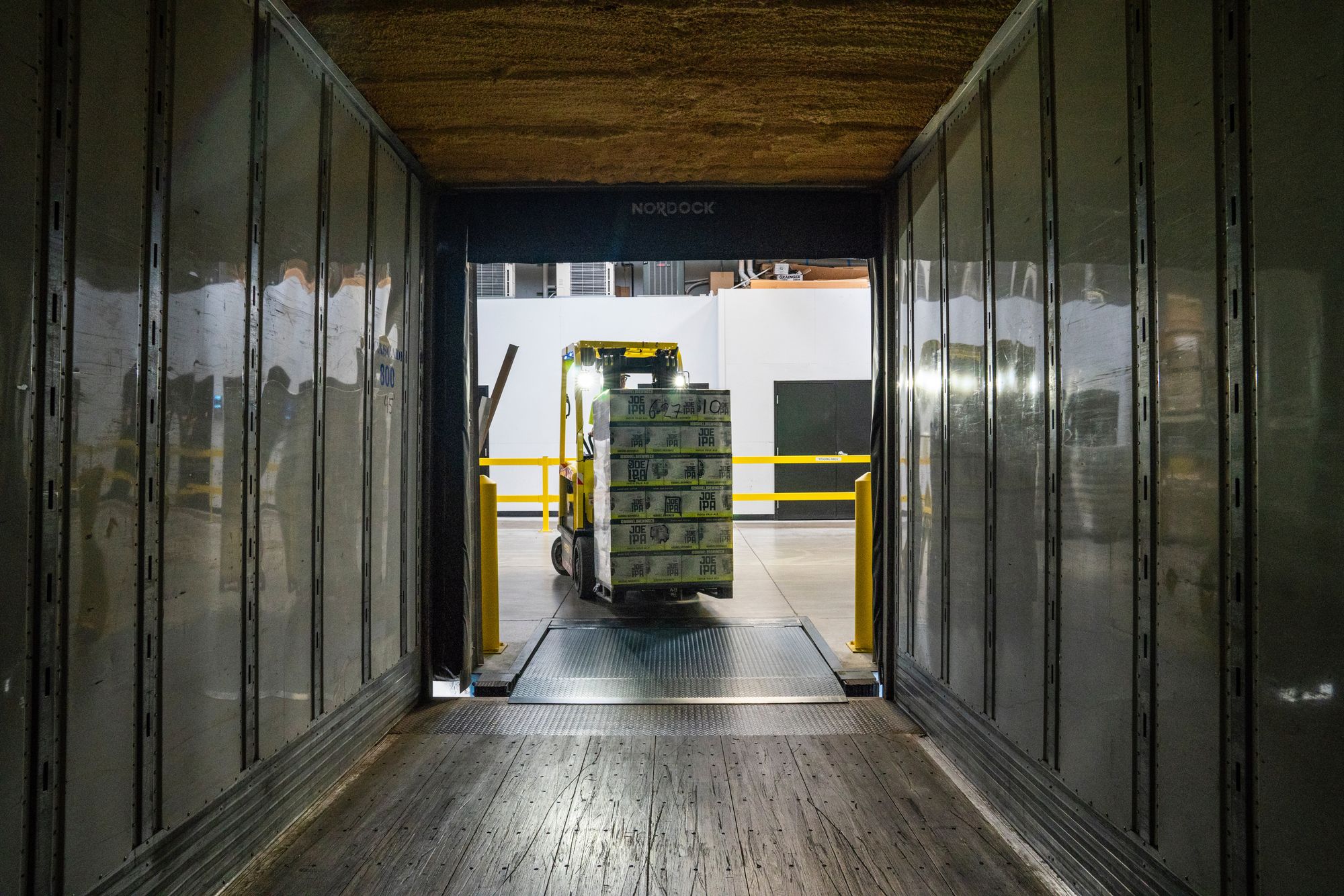
“Why do some businesses convert leads faster while others struggle to get responses from prospects?” The answer often lies in how quickly and efficiently they engage with potential customers. In today’s competitive market, lead response time has become a critical factor influencing conversion rates, customer satisfaction, and overall sales performance. A delayed response can cause businesses to lose valuable opportunities, while companies that respond quickly are more likely to build trust and move prospects through the sales funnel successfully.
Managing lead response efficiently can be challenging when businesses rely on disconnected systems, manual processes, and scattered customer data. Sales teams often waste valuable time switching between spreadsheets, emails, CRM tools, and communication platforms just to gather customer information or assign leads. These inefficiencies slow down follow-ups, create communication gaps, and reduce the chances of converting high-potential leads into customers.
This is where ERP systems help businesses streamline and accelerate lead management processes. An ERP system integrates sales, CRM, customer support, finance, inventory, and communication tools into one centralized platform, enabling teams to access real-time customer information and automate workflows. Features such as automated lead assignment, instant notifications, workflow automation, centralized customer records, and real-time analytics help businesses reduce delays and improve responsiveness across every stage of the sales cycle.
Among the leading solutions available today, Deskera ERP offers a comprehensive platform designed to improve lead response time and sales efficiency. Its integrated CRM, workflow automation, AI-powered insights, real-time dashboards, and mobile accessibility help businesses manage customer interactions more effectively. By combining sales, customer support, inventory, accounting, and business intelligence into a single system, Deskera enables organizations to respond to leads faster, improve collaboration between teams, and deliver a better customer experience.
What Is Lead Response Time?
Lead response time refers to the amount of time it takes for a sales or marketing team to respond to a potential customer after they express interest in a business. This interest can come in many forms, such as filling out a contact form, requesting a demo, downloading an eBook, signing up for a newsletter, sending an inquiry, or booking a consultation. The timer starts the moment the lead reaches out and ends when a representative from the business makes the first response.
It is one of the most important sales performance metrics because it directly affects customer engagement and conversion opportunities. A fast response signals professionalism, attentiveness, and a willingness to help, while a delayed response can cause prospects to lose interest or turn to competitors. In highly competitive industries, even a few minutes can make a major difference in whether a lead converts into a customer.
For example, if a prospect submits a demo request at 10:00 AM and receives a reply from a sales representative at 10:20 AM, the lead response time is 20 minutes. Businesses often measure this metric across different lead sources because response urgency may vary depending on lead intent. A prospect requesting pricing information or a product demo is generally considered a warmer lead and requires a faster follow-up compared to someone downloading an informational resource.
Ultimately, the goal of lead response management is not just to respond quickly, but to respond first with accurate and personalized communication. Reducing lead response time helps businesses improve customer experience, increase conversion rates, strengthen trust, and create a more efficient sales process.
How to Calculate Lead Response Time
Lead response time measures the average amount of time it takes for a sales or support team to respond to incoming leads after they express interest in a business. Calculating this metric helps organizations evaluate sales efficiency, identify delays in communication, and improve customer engagement processes.
The calculation starts by measuring the time difference between when a lead is generated and when the first response is sent. Businesses then add the total response times for all leads and divide the result by the total number of leads handled during a specific period.
Lead Response Time Formula
Lead Response Time = Total Time Taken to Respond to Leads / Total Number of Leads
Example Calculation
Suppose a company received 5 leads in one day, and the response times were:
- Lead 1: 10 minutes
- Lead 2: 20 minutes
- Lead 3: 15 minutes
- Lead 4: 25 minutes
- Lead 5: 30 minutes
Total Response Time = 10 + 20 + 15 + 25 + 30 = 100 minutes
Lead Response Time = 100 / 5
Lead Response Time = 20 minutes
This means the company takes an average of 20 minutes to respond to new leads.
Businesses can further improve accuracy by tracking lead response time by source, campaign, department, or sales representative.
For example, leads requesting demos or pricing information may require much faster follow-ups than informational inquiries.
Monitoring this KPI regularly helps businesses identify bottlenecks, improve responsiveness, and increase lead conversion opportunities.
Why Lead Response Time is Critical for Business Success
Lead response time plays a major role in determining how effectively a business converts prospects into customers. In today’s fast-moving digital environment, customers expect quick communication and immediate assistance when they show interest in a product or service.
A delayed response can reduce engagement, weaken trust, and increase the likelihood of losing leads to competitors. Faster response times help businesses improve sales performance, customer relationships, and operational efficiency.
Higher Lead Conversion Rates
Responding to leads quickly significantly increases the chances of converting prospects into paying customers.
When businesses engage with leads while their interest is still high, they can answer questions, address concerns, and guide prospects through the sales process more effectively.
Slow responses often result in lost opportunities because potential customers may move on to competitors who respond faster and provide immediate support.
Improved Customer Experience
Fast lead response times create a positive first impression and demonstrate that a business values its customers. Quick communication helps prospects feel acknowledged and supported, which improves customer satisfaction and trust.
On the other hand, delayed responses can frustrate potential buyers and negatively impact brand perception. Providing timely assistance strengthens customer relationships and encourages long-term engagement with the business.
Stronger Competitive Advantage
In competitive markets, speed can become a major differentiator. Businesses that respond to inquiries faster than competitors are more likely to capture customer attention and secure sales opportunities.
Prospects often contact multiple companies before making a decision, and the first business to respond professionally and accurately usually gains an advantage. Faster response times help companies stand out and improve their market positioning.
Increased Sales Team Productivity
Efficient lead response processes help sales teams manage inquiries more effectively and reduce time spent on manual follow-ups.
Automated workflows, centralized customer information, and real-time notifications enable representatives to prioritize leads and respond quickly.
This improves productivity, reduces missed opportunities, and allows teams to focus more on nurturing high-value prospects and closing deals.
Better Lead Qualification and Prioritization
Quick responses allow businesses to identify high-intent leads earlier in the sales cycle. Sales teams can assess customer requirements, buying readiness, and potential value more efficiently when communication happens promptly.
Faster lead qualification helps businesses prioritize promising opportunities, allocate resources effectively, and improve overall sales pipeline management while reducing delays in decision-making.
Faster Sales Cycles and Revenue Growth
Reducing lead response time accelerates the entire sales process by keeping prospects engaged and moving them through the pipeline more efficiently.
Faster interactions reduce waiting periods, improve communication flow, and shorten the time required to close deals.
As businesses convert leads more quickly and consistently, they can increase sales revenue, improve forecasting accuracy, and support long-term business growth.
Common Challenges That Slow Down Lead Response Time
Many businesses struggle to respond to leads quickly due to operational inefficiencies, disconnected systems, and manual sales processes. These challenges create delays in communication, reduce sales productivity, and increase the risk of losing potential customers to competitors.
Identifying and addressing these obstacles is essential for improving responsiveness, streamlining lead management, and creating a more efficient customer engagement process.
Disconnected Systems and Data Silos
Businesses often use separate tools for CRM, email communication, marketing automation, customer support, and sales tracking.
When customer information is scattered across multiple platforms, sales teams spend extra time searching for data instead of responding to leads.
This lack of centralized information slows communication, creates inconsistencies, and reduces the efficiency of lead management processes.
Manual Lead Assignment Processes
Many organizations still rely on manual methods to assign leads to sales representatives. This can create delays, confusion, and uneven lead distribution among team members.
Without automated routing systems, leads may remain unattended for extended periods, reducing engagement opportunities. Manual assignment also increases the risk of human error, duplicate follow-ups, and missed sales opportunities.
Poor Communication Between Teams
Ineffective collaboration between sales, marketing, and customer support teams can significantly slow lead response time.
When departments operate independently without sharing real-time information, important customer details may be delayed or overlooked.
Poor communication creates inconsistencies in follow-ups, weakens customer experiences, and prevents teams from responding quickly and accurately to inquiries.
Limited Visibility Into Lead Status
Without real-time tracking and reporting systems, businesses often struggle to monitor lead progress throughout the sales pipeline. Sales managers may not know which leads have been contacted, followed up on, or neglected.
Limited visibility can result in delayed responses, duplicate outreach efforts, and missed follow-ups, making it difficult to maintain an organized and efficient sales process.
High Volume of Incoming Leads
As businesses grow, managing a large number of incoming leads across websites, social media, emails, and other channels becomes increasingly challenging.
Sales teams may find it difficult to prioritize urgent inquiries or identify high-value prospects quickly. Without automation and proper lead management systems, high lead volumes can overwhelm teams and increase response delays.
Lack of Workflow Automation
Manual processes for follow-ups, reminders, approvals, and communication tasks consume valuable time and reduce operational efficiency.
Sales representatives may forget to follow up with prospects or delay responses due to repetitive administrative work.
Without workflow automation, businesses struggle to maintain consistent communication, leading to slower response times and lower lead conversion rates.
Inadequate Lead Prioritization
Not all leads have the same level of interest or urgency, but many businesses lack effective lead scoring and prioritization systems.
As a result, sales teams may spend too much time on low-priority prospects while high-intent leads wait for responses.
Poor prioritization reduces sales efficiency and increases the risk of losing qualified leads to competitors who respond faster.
Limited Mobile Accessibility
Sales teams often work remotely, travel frequently, or manage customer interactions outside traditional office environments. Without mobile access to customer data, CRM tools, and communication systems, representatives may face delays in responding to inquiries.
Limited accessibility reduces flexibility, slows decision-making, and affects the overall speed and quality of customer engagement.
How ERP Systems Help Improve Lead Response Time
ERP systems help businesses improve lead response time by centralizing customer information, automating sales workflows, and enabling faster communication across departments.
Instead of relying on disconnected tools and manual processes, businesses can use ERP software to manage leads, customer interactions, follow-ups, and sales activities from a single platform.
This improves operational efficiency, reduces delays, and helps sales teams respond to potential customers more quickly and effectively.
Centralized Customer and Lead Information
ERP systems store customer data, lead history, communication records, and sales activities in one centralized database.
This allows sales representatives to access complete customer information instantly without switching between multiple systems.
Faster access to accurate data helps teams respond to inquiries quickly, personalize communication, and reduce delays caused by scattered or incomplete information.
Automated Lead Capture and Assignment
Modern ERP systems automatically capture leads from websites, emails, social media, forms, and other communication channels.
Once captured, leads can be assigned automatically to the appropriate sales representatives based on predefined rules such as location, product category, or lead source.
Automation reduces manual effort, eliminates assignment delays, and ensures leads receive immediate attention.
Real-Time Notifications and Alerts
ERP software provides real-time notifications whenever a new lead enters the system or when follow-up actions are required. Sales teams receive instant alerts for inquiries, pending responses, scheduled meetings, and customer activities.
These notifications help representatives respond faster, avoid missed opportunities, and maintain consistent communication throughout the sales process.
Workflow Automation
ERP systems automate repetitive sales and communication tasks such as sending emails, scheduling follow-ups, updating lead statuses, and creating reminders.
By reducing manual administrative work, sales teams can focus more on engaging with prospects and closing deals. Workflow automation also ensures that leads move through the sales pipeline without unnecessary delays or interruptions.
Improved Collaboration Across Departments
Lead management often involves multiple departments, including sales, marketing, customer service, and finance. ERP systems create a unified platform where teams can share real-time information and collaborate more efficiently.
Better coordination between departments improves communication, reduces response gaps, and enables faster resolution of customer inquiries and sales opportunities.
AI-Powered Lead Prioritization
Many modern ERP solutions use artificial intelligence and analytics to score and prioritize leads based on customer behavior, engagement, purchase intent, and historical data.
AI-driven prioritization helps sales teams focus on high-value or high-intent leads first, improving response efficiency and increasing the likelihood of conversions.
Mobile Accessibility for Sales Teams
Cloud-based ERP systems provide mobile access to customer information, lead data, and communication tools.
Sales representatives can respond to inquiries, update lead statuses, and manage follow-ups from any location using smartphones or tablets.
Mobile accessibility improves responsiveness, especially for remote teams or field sales representatives who need instant access to information.
Integration With Communication Channels
ERP systems integrate with emails, chat platforms, websites, social media channels, and customer support systems to centralize all communication activities.
This integration enables businesses to manage leads from multiple channels within a single interface. Unified communication improves visibility, reduces delays, and ensures faster responses to customer inquiries across platforms.
Real-Time Analytics and Performance Monitoring
ERP software provides dashboards and analytics tools that track lead response times, sales activities, conversion rates, and team performance in real time.
Businesses can identify bottlenecks, monitor service levels, and optimize lead management processes more effectively. Real-time visibility helps organizations continuously improve responsiveness and sales efficiency.
Better Lead Tracking and Follow-Up Management
ERP systems help businesses track every stage of the lead lifecycle, from initial inquiry to final conversion. Automated follow-up reminders, task management tools, and activity tracking ensure that no lead is forgotten or neglected.
This improves accountability, strengthens customer engagement, and increases the chances of converting leads into long-term customers.
Benefits of Improving Lead Response Time With ERP
Improving lead response time with ERP systems offers advantages that go beyond faster communication and higher conversions.
ERP software helps businesses build more organized, scalable, and data-driven sales operations by automating workflows, improving visibility, and centralizing customer management.
These operational and strategic benefits help organizations improve efficiency, reduce resource wastage, and create a more consistent sales process across departments.
Better Workflow Standardization
ERP systems help businesses create standardized lead management workflows across teams and departments. Automated processes ensure that every lead follows the same structured journey, from capture and assignment to follow-up and conversion.
Standardization reduces inconsistencies, improves process reliability, and helps businesses maintain uniform customer engagement practices regardless of team size or location.
Reduced Administrative Burden
Manual tasks such as updating spreadsheets, assigning leads, scheduling reminders, and tracking follow-ups consume significant time and resources.
ERP automation reduces repetitive administrative work by streamlining these processes within a centralized platform.
This allows sales teams to focus more on customer engagement, relationship building, and strategic sales activities instead of operational tasks.
Improved Data Accuracy and Consistency
ERP systems centralize lead and customer information in one database, reducing the risk of duplicate records, outdated information, and manual entry errors.
Accurate and consistent data helps sales teams communicate more effectively, track customer interactions properly, and make informed decisions.
Better data quality also improves reporting accuracy and supports more reliable sales forecasting.
Enhanced Sales Pipeline Visibility
ERP software provides real-time visibility into lead movement, sales activities, pending follow-ups, and conversion stages. Managers can monitor pipeline performance, identify bottlenecks, and track team responsiveness more efficiently.
Greater visibility helps businesses optimize lead handling processes, improve accountability, and ensure that no opportunities are lost due to poor tracking or communication gaps.
Stronger Cross-Department Coordination
Lead management often requires coordination between sales, marketing, finance, inventory, and customer support teams. ERP systems integrate these functions into a single platform, enabling departments to share information seamlessly.
Improved coordination reduces delays caused by miscommunication and ensures that customer inquiries, quotations, approvals, and support requests are handled more efficiently.
Scalability for Growing Businesses
As businesses expand, managing increasing lead volumes manually becomes difficult and inefficient.
ERP systems provide scalable infrastructure that can handle larger customer databases, multiple sales channels, and growing operational complexity.
Automated lead management processes allow businesses to maintain fast response times and operational efficiency even as sales activities increase.
Better Compliance and Activity Tracking
ERP systems maintain detailed records of customer interactions, follow-ups, communication history, and sales activities.
This improves transparency and makes it easier for businesses to monitor employee performance, maintain process compliance, and audit customer communication when needed.
Activity tracking also helps businesses identify inefficiencies and continuously improve sales operations.
Improved Decision-Making With Real-Time Insights
ERP platforms provide real-time analytics, dashboards, and reporting tools that help businesses monitor lead response performance and sales efficiency.
Managers can analyze response trends, identify delays, evaluate team productivity, and make faster operational decisions.
Access to real-time business intelligence helps organizations optimize lead management strategies and improve overall sales effectiveness.
Best Practices for Using ERP to Improve Lead Response Time
Implementing an ERP system alone is not enough to achieve faster lead response times. Businesses must also adopt the right strategies, workflows, and operational practices to maximize the effectiveness of their ERP platform.
By combining automation, real-time visibility, standardized processes, and team collaboration, organizations can significantly improve responsiveness, streamline lead management, and create a more efficient customer engagement process.
Automate Lead Capture and Assignment
Businesses should configure their ERP system to automatically capture leads from websites, emails, social media platforms, and contact forms.
Automated lead assignment rules based on territory, product type, lead source, or sales representative availability help eliminate manual delays.
This ensures that leads are routed to the right team members instantly, improving response speed and reducing the risk of missed opportunities.
Set Clear Lead Response Time Goals
Establishing measurable response time targets helps sales teams prioritize speed and accountability. Businesses should define service-level expectations for responding to different types of leads, such as demo requests, support inquiries, or pricing questions. ERP dashboards and analytics tools can then be used to monitor response performance and identify areas requiring improvement.
Centralize Customer and Communication Data
Maintaining all customer interactions, communication history, and lead details within the ERP system improves accessibility and consistency.
Sales representatives should be able to access emails, call records, notes, and previous interactions from a single platform. Centralized information reduces time spent searching for data and enables faster, more personalized customer responses.
Use Workflow Automation for Follow-Ups
ERP workflow automation should be used to schedule reminders, create follow-up tasks, send automated emails, and update lead statuses. Automated workflows help ensure that no lead is overlooked or forgotten during the sales cycle.
Reducing manual administrative work also allows sales teams to focus more on engaging with prospects and building customer relationships.
Integrate All Customer Communication Channels
Businesses should integrate email platforms, websites, live chat systems, social media channels, customer support tools, and CRM functions into the ERP system.
Omnichannel integration provides a unified view of customer interactions and allows teams to manage inquiries from multiple sources in one place. This improves visibility, coordination, and response efficiency across communication channels.
Prioritize High-Intent Leads With AI and Analytics
Many ERP systems provide AI-powered lead scoring and analytics capabilities that help businesses identify high-priority prospects.
Sales teams should use predictive insights to focus on leads with stronger buying intent or higher conversion potential. Prioritizing urgent or valuable inquiries helps improve sales efficiency and increases the chances of successful conversions.
Enable Mobile Access for Sales Teams
Providing mobile access to ERP systems allows sales representatives to respond to leads and update customer information from any location.
Mobile accessibility is especially important for remote teams and field sales representatives who need real-time access to lead data and communication tools. Faster access to information improves responsiveness and enhances customer engagement.
Train Employees on ERP Usage and Workflows
Even advanced ERP systems cannot deliver optimal results without proper employee training. Businesses should ensure that sales, marketing, and customer support teams understand how to use ERP features effectively, including lead tracking, automation tools, dashboards, and reporting systems. Well-trained employees can respond more efficiently, reduce errors, and improve overall lead management performance.
Monitor KPIs and Continuously Optimize Processes
Businesses should regularly track key metrics such as lead response time, follow-up rates, conversion rates, and sales cycle length using ERP analytics tools.
Monitoring performance helps identify bottlenecks, inefficiencies, and communication gaps within the sales process.
Continuous optimization ensures that lead management strategies remain effective as customer expectations and business operations evolve.
Maintain Clean and Accurate Lead Data
Outdated, incomplete, or duplicate customer information can slow response times and reduce communication accuracy. Businesses should regularly update and clean lead databases within the ERP system to maintain reliable customer records.
Accurate data improves workflow efficiency, enhances reporting quality, and helps sales teams engage with prospects more effectively.
Important KPIs to Track Lead Response Performance
Tracking the right key performance indicators (KPIs) helps businesses measure the effectiveness of their lead management process and identify areas for improvement.
These metrics provide valuable insights into response efficiency, sales productivity, customer engagement, and conversion performance.
By monitoring lead response KPIs regularly through ERP systems, businesses can optimize workflows, reduce delays, and improve overall sales outcomes.
Average Lead Response Time
Average lead response time measures how long it takes sales teams to respond to incoming leads. It is one of the most important indicators of sales responsiveness and operational efficiency. A lower response time generally improves customer engagement and conversion opportunities.
Formula:
Average Lead Response Time = Total Time Taken to Respond to Leads / Total Number of Leads
Lead Conversion Rate
Lead conversion rate measures the percentage of leads that successfully convert into customers. This KPI helps businesses evaluate the effectiveness of their lead response process, sales communication, and follow-up strategies.
Formula:
Lead Conversion Rate (%) = (Converted Leads / Total Leads) × 100
First Response Time
First response time tracks the amount of time taken to send the initial response after a lead inquiry is received. This metric specifically focuses on the speed of the first customer interaction, which often plays a major role in shaping customer perception and engagement.
Formula:
First Response Time = Total Time Taken for Initial Responses / Total Number of Leads
Lead Follow-Up Rate
Lead follow-up rate measures how consistently sales teams engage with incoming leads after the first interaction. This KPI helps businesses monitor whether leads are being properly nurtured throughout the sales cycle.
Formula:
Lead Follow-Up Rate (%) = (Leads Followed Up With / Total Leads Received) × 100
Sales Cycle Length
Sales cycle length measures the average time required to convert a lead into a paying customer. Shorter sales cycles often indicate efficient lead management, faster decision-making, and effective communication processes.
Formula:
Sales Cycle Length = Total Number of Days to Close Deals / Total Deals Closed
Lead Qualification Rate
Lead qualification rate measures the percentage of incoming leads that meet predefined qualification criteria. This KPI helps businesses assess lead quality and the effectiveness of lead scoring and prioritization processes.
Formula:
Lead Qualification Rate (%) = (Qualified Leads / Total Leads) × 100
Customer Response Satisfaction Score
This KPI measures how satisfied leads or customers are with the speed and quality of responses they receive. Businesses often collect this data through feedback surveys, ratings, or customer experience forms.
Formula:
Customer Response Satisfaction Score (%) = (Total Positive Response Ratings / Total Responses Collected) × 100
Lead Abandonment Rate
Lead abandonment rate measures the percentage of leads that stop engaging with the business due to delayed responses, poor follow-ups, or ineffective communication. Monitoring this KPI helps businesses identify weaknesses in their lead management process.
Formula:
Lead Abandonment Rate (%) = (Lost or Unresponsive Leads / Total Leads) × 100
Revenue Per Lead
Revenue per lead measures the average revenue generated from each lead acquired. This KPI helps businesses evaluate the financial effectiveness of their lead response and conversion strategies.
Formula:
Revenue Per Lead = Total Revenue Generated From Leads / Total Number of Leads
How Deskera ERP Helps Improve Lead Response Time
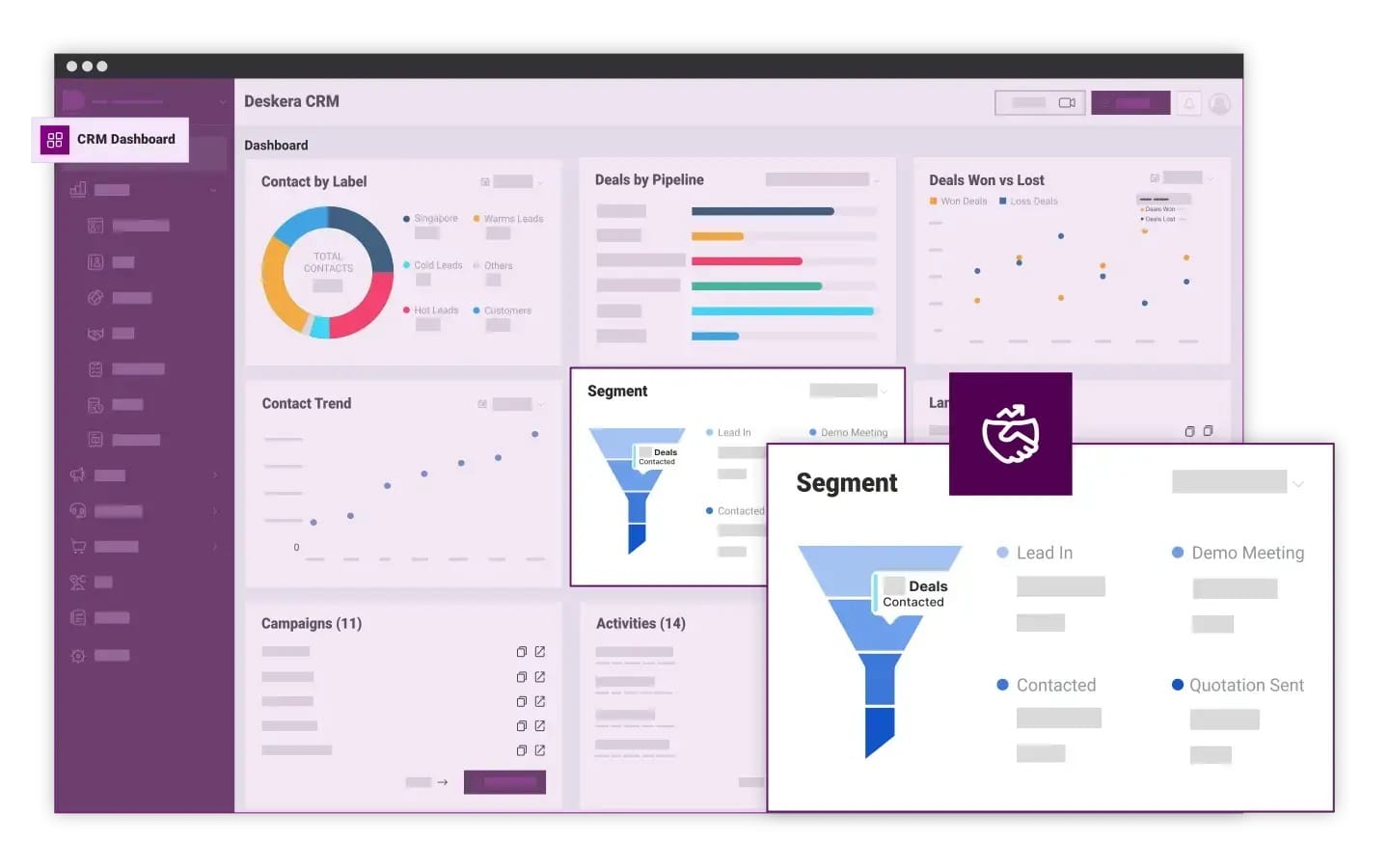
Deskera ERP helps businesses improve lead response time by centralizing customer interactions, automating workflows, and streamlining communication across departments. Its integrated ERP and CRM capabilities enable sales teams to manage leads, customer data, communication history, and sales activities from one unified platform, helping businesses respond to inquiries faster and more efficiently.
Centralized Customer Relationship Management
Deskera ERP includes integrated CRM features that allow businesses to segment customers, create deal pipelines, track customer histories and interactions, and manage opportunities within a centralized system. By giving sales teams quick access to customer information and communication records, Deskera reduces delays caused by disconnected systems and improves response efficiency.
Automated Sales and Workflow Processes
Deskera ERP helps automate sales and marketing tasks through workflow automation and rule-based processes. Businesses can automate repetitive activities such as follow-up reminders, lead management tasks, approval workflows, and customer communication processes. Automation reduces manual effort, speeds up lead handling, and helps teams respond to inquiries more consistently.
Real-Time Dashboards and Business Intelligence
The platform provides dashboards, smart reports, forecasts, and business intelligence tools that help businesses monitor sales activities and track key performance metrics in real time. These insights help managers identify bottlenecks, monitor response performance, and make faster operational decisions to improve lead management efficiency.
Mobile Accessibility and Cloud ERP Capabilities
Deskera ERP offers cloud-based accessibility and mobile application support, allowing sales teams to access customer information, manage leads, and respond to inquiries from anywhere. Mobile accessibility improves flexibility for remote and field sales teams, enabling faster customer engagement and reducing response delays.
Integrated Business Modules for Faster Coordination
Deskera ERP integrates accounting, finance, inventory, procurement, warehouse management, CRM, and customer service into one platform. This centralized business environment improves coordination between departments and reduces communication gaps that can slow lead handling processes. Sales teams can access relevant business information quickly, improving responsiveness and operational efficiency.
Key Takeaways
- Lead response time measures how quickly a business responds after a prospect expresses interest, making it a critical sales performance metric.
- Faster lead response times improve customer engagement, strengthen trust, and increase the likelihood of converting prospects into customers.
- Common challenges such as disconnected systems, manual workflows, poor communication, and limited visibility can significantly delay lead responses.
- Calculating lead response time helps businesses monitor sales efficiency and identify bottlenecks in customer communication processes.
- ERP systems improve lead response time by centralizing customer data, automating workflows, and streamlining communication across departments.
- Features such as automated lead assignment, workflow automation, real-time notifications, and integrated communication tools help businesses respond to leads more efficiently.
- Businesses should look for ERP features such as CRM integration, automation capabilities, analytics dashboards, mobile accessibility, and omnichannel communication support to improve lead management.
- Using ERP systems for lead response management helps businesses standardize workflows, reduce administrative work, improve data accuracy, and strengthen operational visibility.
- Industries such as manufacturing, retail, healthcare, SaaS, professional services, and real estate can benefit significantly from ERP-driven lead management processes.
- Best practices such as automating lead routing, centralizing customer information, integrating communication channels, and monitoring KPIs help maximize ERP effectiveness.
- Tracking KPIs like average lead response time, lead conversion rate, follow-up rate, sales cycle length, and lead qualification rate helps businesses continuously optimize sales performance.
- Emerging trends such as AI-powered analytics, predictive lead scoring, cloud ERP systems, and workflow automation are shaping the future of lead response management.
- Deskera ERP helps businesses improve lead response time through integrated CRM, workflow automation, real-time dashboards, centralized customer management, and connected business operations.
Related Articles
 Niti Samani
 Niti Samani
 Niti Samani
 Niti Samani
 Niti Samani
 Niti Samani
Have you ever wondered how companies like Toyota, Dell, and Amazon manage to reduce excess inventory while still meeting customer demand on time? The answer lies in an efficient operational model known as the Just in Time (JIT) supply chain strategy. This approach focuses on receiving raw materials, components, and inventory only when they are needed in the production or sales process, helping businesses minimize waste, lower storage costs, and improve overall efficiency.
In today’s highly competitive and rapidly changing business environment, organizations are under constant pressure to optimize inventory levels, improve cash flow, and build more agile supply chains. Traditional inventory systems that rely on maintaining large stock levels often result in higher carrying costs, overstocking, and operational inefficiencies. In contrast, JIT supply chain management enables businesses to streamline procurement, production, and inventory management processes while responding more effectively to customer demand and market fluctuations.
However, implementing a Just in Time supply chain strategy is not without challenges. While the model offers significant benefits such as reduced inventory costs, improved operational efficiency, and faster production cycles, it also increases dependence on accurate demand forecasting, reliable suppliers, and efficient logistics networks. Even minor disruptions in transportation, supplier delays, or sudden shifts in customer demand can impact business continuity. This makes strategic planning, supply chain visibility, and real-time data management critical for successful JIT implementation.
This is where modern ERP solutions like Deskera ERP play a vital role. Deskera ERP helps businesses streamline procurement, inventory management, warehouse operations, and production planning through a centralized platform. With features such as real-time inventory tracking, automated procurement workflows, demand forecasting, analytics, and supply chain visibility, businesses can efficiently support JIT operations while reducing operational risks. By integrating key supply chain functions into a single system, Deskera ERP enables organizations to build smarter, leaner, and more resilient supply chains.
What Is Just in Time (JIT) Supply Chain Strategy?
Just in Time (JIT) supply chain strategy is an inventory and production management approach in which materials, components, and products are ordered, produced, or delivered only when they are needed in the production or sales process. The primary goal of JIT is to minimize excess inventory, reduce storage costs, eliminate waste, and improve operational efficiency across the supply chain.
Unlike traditional supply chain models that maintain large amounts of inventory as a buffer against uncertainty, JIT focuses on maintaining lean inventory levels. Businesses using JIT rely heavily on accurate demand forecasting, efficient supplier coordination, real-time inventory visibility, and streamlined logistics to ensure that products and raw materials arrive exactly at the right time and in the required quantity.
The concept of JIT became widely popular through the Japanese manufacturing industry, particularly through Toyota and its Toyota Production System (TPS). Toyota developed the JIT methodology to improve manufacturing efficiency, reduce production waste, and enhance product quality. Since then, the strategy has been adopted across various industries, including manufacturing, retail, automotive, electronics, healthcare, and e-commerce.
In a JIT supply chain system, businesses continuously monitor customer demand, production schedules, and inventory levels to avoid overstocking and understocking. Raw materials are procured only when production requires them, and finished goods are produced based on actual market demand rather than forecasts alone. This demand-driven approach helps organizations optimize working capital, improve cash flow, and respond more quickly to market changes.
The success of a Just in Time supply chain strategy depends on several critical factors, including strong supplier relationships, reliable transportation networks, efficient warehouse operations, and advanced technology systems. Modern ERP and supply chain management software play a crucial role in supporting JIT operations by providing real-time data, inventory tracking, procurement automation, and demand forecasting capabilities.
Today, JIT supply chain strategy is considered one of the most effective approaches for businesses seeking lean operations, cost optimization, and greater supply chain agility. However, because it relies on minimal inventory buffers, companies must carefully manage risks such as supplier delays, transportation disruptions, and sudden fluctuations in demand.
JIT Supply Chain Strategy vs Traditional Supply Chain Model
Businesses use different supply chain strategies depending on their operational goals, industry requirements, customer demand patterns, and inventory management approach. The Just in Time (JIT) supply chain strategy focuses on maintaining minimal inventory and producing goods based on real-time demand, while traditional supply chain models typically rely on larger inventory reserves to prevent stock shortages and handle demand fluctuations.
Both approaches have their own advantages and limitations. JIT systems prioritize efficiency, cost reduction, and lean operations, whereas traditional supply chain models emphasize stability, inventory availability, and risk reduction through buffer stock. Understanding the differences between these two strategies helps businesses choose the most suitable supply chain model for their operational needs.
How Just in Time (JIT) Supply Chain Strategy Works
A Just in Time (JIT) supply chain strategy works by aligning procurement, production, inventory management, and delivery processes with real-time customer demand. Instead of maintaining large amounts of inventory, businesses receive materials and produce goods only when they are needed.
This approach helps reduce waste, lower carrying costs, and improve operational efficiency. Successful JIT implementation depends on accurate demand forecasting, reliable supplier coordination, real-time inventory visibility, and efficient logistics management.
Demand-Driven Inventory Management
JIT supply chain strategy operates on a demand-driven model where inventory levels are based on actual customer orders and market demand rather than long-term stockpiling. Businesses continuously monitor sales trends, customer behavior, and production requirements to maintain optimal inventory levels.
This minimizes excess inventory, reduces storage costs, and lowers the risk of obsolete stock. Demand-driven inventory management also helps organizations improve cash flow by reducing unnecessary capital tied up in inventory.
Real-Time Procurement and Replenishment
In a JIT system, raw materials and components are ordered only when production requires them. Procurement teams coordinate closely with suppliers to ensure timely delivery of goods in the exact quantity needed.
This real-time replenishment process helps businesses avoid overordering and excessive warehouse storage. Automated procurement systems and ERP software further improve efficiency by tracking inventory levels, generating purchase orders, and reducing manual procurement delays.
Supplier Coordination and Communication
Strong supplier relationships are essential for the success of a JIT supply chain strategy. Businesses must maintain clear communication and collaboration with suppliers to ensure materials arrive on time and meet quality standards.
Suppliers often share production schedules, inventory data, and delivery timelines with manufacturers to support seamless operations. Reliable supplier coordination helps minimize production interruptions, reduce lead times, and improve supply chain responsiveness.
Production Scheduling and Workflow Optimization
JIT supply chains rely heavily on efficient production scheduling to ensure that manufacturing processes align with customer demand and inventory availability. Production activities are carefully planned to avoid delays, bottlenecks, and excess work-in-progress inventory.
Businesses optimize workflows by streamlining operations, reducing setup times, and improving resource allocation. This helps manufacturers increase productivity, shorten production cycles, and maintain lean manufacturing operations.
Continuous Inventory Monitoring
Continuous inventory monitoring is a critical component of JIT supply chain management. Businesses use inventory tracking systems, barcode scanners, RFID technology, and ERP software to gain real-time visibility into stock levels and material movement.
Monitoring inventory in real time helps organizations quickly identify shortages, prevent stockouts, and maintain accurate inventory records. Improved inventory visibility also enables faster decision-making and enhances overall supply chain efficiency.
Efficient Transportation and Logistics Management
Transportation and logistics play a vital role in ensuring the success of a JIT strategy. Since businesses maintain minimal inventory buffers, materials and finished products must be delivered quickly and reliably.
Companies optimize transportation routes, delivery schedules, and distribution processes to avoid delays and disruptions. Efficient logistics management helps maintain smooth production operations, improve order fulfillment rates, and reduce unnecessary transportation costs.
Use of ERP and Supply Chain Technology
Modern JIT supply chains rely on ERP and supply chain management software to coordinate inventory, procurement, production, and logistics activities.
ERP systems provide centralized access to real-time data, helping businesses improve forecasting accuracy, automate workflows, and enhance operational visibility.
Technologies such as AI, predictive analytics, IoT devices, and cloud-based supply chain platforms further strengthen JIT operations by enabling faster and more data-driven decision-making.
Major Benefits of Just in Time (JIT) Supply Chain Strategy
The Just in Time (JIT) supply chain strategy offers several operational and financial advantages for businesses seeking leaner and more efficient supply chain management.
By reducing unnecessary inventory and aligning production closely with customer demand, JIT helps organizations improve productivity, lower costs, and optimize resource utilization.
Businesses across manufacturing, retail, automotive, and e-commerce industries use JIT systems to enhance agility, improve inventory control, and strengthen overall supply chain performance.
Reduced Inventory Holding Costs
One of the biggest advantages of a JIT supply chain strategy is the significant reduction in inventory holding costs. Since businesses maintain lower inventory levels, they spend less on warehousing, storage, insurance, and inventory maintenance.
Reduced carrying costs help organizations free up working capital that can be invested in other business operations such as expansion, technology upgrades, or product development. Lower inventory levels also minimize the financial risks associated with unsold or obsolete stock.
Improved Cash Flow Management
JIT supply chain management improves cash flow by reducing the amount of money tied up in inventory. Businesses purchase raw materials and products only when needed, allowing them to allocate capital more efficiently.
Improved cash flow provides greater financial flexibility and helps organizations manage operational expenses more effectively.
Companies with strong cash flow can also respond faster to market opportunities and changing customer demands without maintaining excessive inventory reserves.
Lower Warehouse Space Requirements
Because JIT systems operate with minimal inventory levels, businesses require less warehouse and storage space. This helps reduce facility-related costs such as rent, utilities, equipment maintenance, and labor expenses.
Smaller warehouse requirements also improve operational efficiency by simplifying inventory handling and reducing clutter within storage facilities.
Businesses can utilize the available space more strategically for faster order processing and improved workflow management.
Reduced Waste and Overstocking
JIT supply chain strategy helps businesses minimize waste caused by overproduction, excess inventory, and unsold products. By producing goods based on actual customer demand, organizations can avoid overstocking and reduce the likelihood of obsolete inventory.
This is especially important in industries with rapidly changing consumer preferences or products with limited shelf life. Reduced waste also supports lean manufacturing principles and helps businesses improve sustainability initiatives.
Faster Production Cycles
JIT systems streamline production processes by ensuring that materials and components arrive exactly when needed. This reduces delays caused by inventory shortages or inefficient workflows and enables faster production cycles.
Businesses can manufacture and deliver products more quickly, improving responsiveness to customer demand. Faster production turnaround times also help organizations remain competitive in industries where speed and operational efficiency are critical success factors.
Better Product Quality Control
Since JIT focuses on smaller and more frequent production runs, businesses can identify and resolve quality issues more quickly. Problems in raw materials, manufacturing processes, or finished goods are detected earlier before they affect large batches of products.
Improved quality control helps reduce defects, rework, and product recalls while enhancing customer satisfaction. Consistent product quality also strengthens brand reputation and customer loyalty.
Improved Operational Efficiency
JIT supply chain strategy improves overall operational efficiency by streamlining procurement, production, inventory management, and logistics activities. Businesses eliminate unnecessary processes, reduce idle inventory, and optimize resource utilization across the supply chain.
Enhanced operational efficiency leads to lower operational costs, improved productivity, and better coordination between departments. Companies can also make faster and more accurate business decisions using real-time supply chain data.
Enhanced Customer Satisfaction
By improving production efficiency and inventory availability, JIT systems help businesses fulfill customer orders more accurately and on time. Faster response times and efficient order processing contribute to higher customer satisfaction levels.
Businesses can also adapt more quickly to changes in customer preferences and market demand. Reliable delivery schedules and consistent product availability help strengthen customer relationships and improve long-term customer retention.
Increased Supply Chain Flexibility
JIT supply chain management enables businesses to become more agile and responsive to market changes. Since companies operate with lean inventory levels, they can adjust production schedules and procurement plans more easily based on real-time demand fluctuations.
Increased flexibility helps businesses respond quickly to seasonal demand changes, new market trends, and unexpected disruptions. This adaptability is particularly valuable in highly competitive and rapidly evolving industries.
Risks and Challenges of JIT Supply Chain Strategy
While the Just in Time (JIT) supply chain strategy offers significant cost and efficiency benefits, it also comes with several risks and operational challenges. Since JIT systems rely on minimal inventory levels, businesses have very little margin for error when disruptions occur.
Delays in procurement, transportation issues, inaccurate demand forecasting, or supplier failures can quickly impact production schedules and customer deliveries. To successfully implement JIT, organizations must carefully manage supply chain risks, strengthen supplier relationships, and maintain real-time operational visibility.
Supply Chain Disruptions
JIT supply chain systems are highly vulnerable to supply chain disruptions because businesses maintain very low inventory buffers. Events such as natural disasters, geopolitical conflicts, labor strikes, or pandemics can interrupt the flow of raw materials and finished goods.
Even short-term disruptions can delay production and impact customer deliveries. Companies using JIT must develop contingency plans and build resilient supply chain networks to minimize the impact of unexpected disruptions.
Dependence on Suppliers
A successful JIT strategy depends heavily on reliable suppliers that can consistently deliver materials on time and meet quality standards.
If suppliers fail to fulfill orders due to operational issues, financial instability, or capacity limitations, production activities may come to a halt.
Businesses must maintain strong communication and long-term partnerships with suppliers to reduce supply-related risks. Supplier diversification can also help minimize overdependence on a single vendor.
Transportation Delays
Efficient transportation and logistics are critical in JIT supply chain management because materials are delivered exactly when needed for production or sales.
Transportation delays caused by traffic congestion, fuel shortages, weather conditions, or shipping bottlenecks can disrupt inventory replenishment schedules.
Since JIT systems operate with minimal safety stock, even small delays can create production stoppages and missed delivery deadlines. Businesses must optimize logistics planning and monitor transportation performance closely.
Demand Forecasting Errors
JIT supply chains rely on accurate demand forecasting to ensure the right quantity of products and materials is available at the right time. Inaccurate forecasts can result in inventory shortages or production inefficiencies.
If customer demand increases unexpectedly, businesses may struggle to replenish inventory quickly enough to meet market needs. On the other hand, inaccurate overestimation of demand can lead to unnecessary procurement and operational inefficiencies.
Stockout Risks
One of the biggest challenges of JIT inventory management is the increased risk of stockouts. Because businesses maintain limited inventory levels, sudden spikes in customer demand or delays in replenishment can lead to inventory shortages.
Stockouts can negatively impact customer satisfaction, disrupt production schedules, and result in lost sales opportunities. Maintaining strategic safety stock for critical materials can help businesses reduce stockout risks without compromising JIT efficiency.
Limited Buffer Inventory
Traditional inventory systems often maintain extra stock as a safeguard against uncertainty, but JIT systems intentionally minimize buffer inventory to reduce costs. While this improves efficiency, it also leaves businesses with limited flexibility during emergencies or unexpected disruptions.
Without backup inventory, companies may struggle to continue operations during supplier delays or transportation interruptions. Businesses implementing JIT must carefully balance lean inventory management with operational risk management.
Rising Freight and Logistics Costs
JIT supply chains typically involve smaller and more frequent shipments instead of large bulk orders. While this reduces storage requirements, it can increase transportation and freight costs over time. Frequent deliveries may also place additional pressure on logistics providers and distribution networks. Businesses must optimize delivery routes, negotiate supplier agreements, and use technology-driven logistics planning to control transportation expenses effectively.
Difficulty Managing Seasonal Demand
Industries with highly seasonal or unpredictable demand patterns may face challenges implementing JIT supply chain strategies.
Sudden increases in demand during peak seasons can strain supplier capacity and transportation networks, making it difficult to replenish inventory quickly.
Businesses may also face difficulties forecasting customer demand accurately during seasonal fluctuations. Combining JIT with demand forecasting tools and strategic inventory planning can help address these challenges.
Vulnerability During Global Crises
Global events such as pandemics, economic recessions, trade restrictions, or geopolitical conflicts can severely impact JIT supply chain operations.
The COVID-19 pandemic highlighted how fragile lean supply chains can become when international transportation, manufacturing, and supplier networks are disrupted.
Businesses with highly optimized JIT systems often struggle during prolonged global crises because they lack sufficient inventory reserves. Building supply chain resilience and diversification has become increasingly important for modern JIT strategies.
Best Practices for Implementing Successful JIT Supply Chain Strategy
Implementing a successful Just in Time (JIT) supply chain strategy requires careful planning, strong supplier coordination, accurate forecasting, and real-time operational visibility.
Since JIT systems operate with minimal inventory buffers, businesses must ensure that procurement, production, logistics, and inventory management processes function efficiently without delays or disruptions.
Organizations that follow best practices can maximize the benefits of JIT while minimizing operational risks and improving overall supply chain performance.
Build Strong Supplier Partnerships
Reliable suppliers are the foundation of an effective JIT supply chain strategy. Businesses should develop long-term relationships with suppliers that can consistently deliver high-quality materials on time and in the required quantities.
Clear communication, shared production schedules, and collaborative planning help improve coordination between suppliers and manufacturers. Companies should also regularly evaluate supplier performance based on delivery accuracy, quality standards, and responsiveness to ensure supply chain reliability.
Improve Demand Forecasting Accuracy
Accurate demand forecasting is essential for maintaining optimal inventory levels in a JIT system. Businesses should use historical sales data, customer purchasing trends, seasonal demand patterns, and market analysis to predict future demand more effectively.
Advanced forecasting tools powered by AI and predictive analytics can further improve accuracy and reduce the risk of stockouts or overproduction. Better forecasting helps organizations align procurement and production activities with real-time customer demand.
Use ERP and Inventory Management Systems
Modern ERP and inventory management systems play a critical role in supporting JIT supply chain operations. ERP software provides real-time visibility into inventory levels, procurement activities, production schedules, and supplier performance.
Automated workflows help businesses streamline purchasing, reduce manual errors, and improve operational efficiency. Centralized data access also enables faster decision-making and helps organizations respond quickly to supply chain disruptions or demand fluctuations.
Strengthen Supply Chain Visibility
Real-time supply chain visibility allows businesses to monitor inventory movement, supplier deliveries, transportation status, and production activities continuously.
Technologies such as IoT sensors, RFID tracking, cloud-based platforms, and barcode systems help improve transparency across the supply chain.
Enhanced visibility enables businesses to identify potential delays or shortages early and take corrective action before operations are affected. This improves responsiveness and minimizes operational risks.
Diversify Supplier Networks
Relying too heavily on a single supplier increases the risk of supply chain disruptions in a JIT system. Businesses should diversify their supplier network by working with multiple vendors across different locations whenever possible.
Supplier diversification helps reduce dependency risks and improves supply continuity during emergencies, transportation issues, or geopolitical disruptions. Maintaining backup suppliers also provides greater flexibility when demand changes unexpectedly.
Optimize Transportation and Logistics Planning
Efficient transportation and logistics management are critical because JIT systems require timely and frequent deliveries. Businesses should optimize delivery routes, transportation schedules, and warehouse operations to minimize delays and reduce shipping costs.
Working with reliable logistics providers and using real-time shipment tracking systems can improve delivery accuracy and operational efficiency. Faster and more predictable transportation helps maintain smooth production and inventory replenishment processes.
Maintain Strategic Safety Stock
Although JIT focuses on lean inventory management, maintaining a small amount of strategic safety stock for critical materials can help reduce operational risks. Safety stock acts as a buffer against supplier delays, transportation disruptions, or sudden demand spikes.
Businesses should carefully determine the appropriate level of backup inventory based on supplier reliability, lead times, and demand variability. This balanced approach improves resilience without significantly increasing inventory costs.
Monitor Supply Chain KPIs Regularly
Tracking key performance indicators (KPIs) helps businesses evaluate the effectiveness of their JIT supply chain strategy. Important metrics include inventory turnover ratio, supplier on-time delivery rate, stockout frequency, lead times, order fulfillment rates, and carrying costs.
Regular KPI monitoring helps organizations identify inefficiencies, improve forecasting accuracy, and optimize supply chain performance. Data-driven insights also support continuous improvement initiatives and better operational planning.
Invest in Automation and Real-Time Data
Automation technologies significantly improve the efficiency and reliability of JIT supply chain operations. Businesses should invest in automated procurement systems, warehouse automation, AI-driven forecasting tools, and real-time analytics platforms to reduce manual processes and improve operational accuracy.
Real-time data access helps businesses respond faster to disruptions, improve coordination across departments, and make more informed decisions. Automation also supports scalability as business operations grow.
Develop Risk Management and Contingency Plans
Because JIT systems operate with minimal inventory buffers, businesses must proactively prepare for potential disruptions. Organizations should create contingency plans for supplier failures, transportation delays, demand fluctuations, and global supply chain disruptions.
Risk management strategies may include alternative sourcing options, emergency logistics arrangements, and crisis response procedures. A strong risk management framework helps businesses maintain operational continuity even during unexpected events.
Important KPIs to Measure JIT Supply Chain Performance
Measuring the performance of a Just in Time (JIT) supply chain strategy is essential for maintaining operational efficiency, reducing inventory costs, and ensuring smooth production processes.
Since JIT systems rely on minimal inventory levels and real-time replenishment, businesses must closely monitor key performance indicators (KPIs) to identify inefficiencies, improve forecasting accuracy, and reduce operational risks.
Tracking the right KPIs helps organizations make data-driven decisions, strengthen supplier coordination, and continuously optimize supply chain performance.
Inventory Turnover Ratio
The inventory turnover ratio measures how efficiently a business sells and replaces inventory over a specific period. A higher inventory turnover ratio indicates that products are moving quickly through the supply chain, which aligns well with JIT principles. Monitoring this KPI helps businesses reduce excess inventory, improve cash flow, and optimize stock management. Low turnover rates may indicate overstocking, weak demand, or inefficient inventory planning.
Formula: Inventory Turnover Ratio = Cost of Goods Sold / Average Inventory
Order Fulfillment Rate
Order fulfillment rate measures the percentage of customer orders delivered accurately and on time. In a JIT environment, maintaining a high fulfillment rate is critical because businesses operate with limited inventory buffers. A strong fulfillment rate reflects efficient inventory management, accurate demand forecasting, and effective logistics coordination. Poor fulfillment performance may result in delayed deliveries, lost sales, and reduced customer satisfaction.
Formula: Order Fulfillment Rate = (Orders Fulfilled Successfully / Total Customer Orders) × 100
Stockout Frequency
Stockout frequency measures how often inventory shortages occur within a specific timeframe. Since JIT systems maintain minimal inventory levels, tracking stockouts is essential to identify supply chain vulnerabilities and forecasting inaccuracies. Frequent stockouts can disrupt production schedules, delay customer deliveries, and negatively impact revenue. Businesses use this KPI to improve inventory planning, supplier reliability, and replenishment strategies.
Formula: Stockout Frequency = (Number of Stockout Events / Total Inventory Items) × 100
Lead Time Reduction
Lead time measures the amount of time required to move materials or products through the supply chain, from procurement to delivery. JIT supply chain strategies aim to minimize lead times to improve responsiveness and operational efficiency.
Monitoring lead time reduction helps businesses identify bottlenecks in procurement, production, and logistics processes. Shorter lead times enable faster inventory replenishment and better customer service.
Formula: Lead Time Reduction = ((Previous Lead Time - Current Lead Time) / Previous Lead Time) × 100
Carrying Cost of Inventory
Carrying cost of inventory measures the total cost of storing and maintaining inventory over a period of time. This includes warehousing, insurance, depreciation, labor, and storage expenses.
One of the main objectives of JIT is to reduce carrying costs by minimizing excess inventory. Tracking this KPI helps businesses evaluate the financial efficiency of their inventory management strategy.
Formula: Carrying Cost of Inventory = (Total Inventory Holding Costs / Average Inventory Value) × 100
Supplier On-Time Delivery Rate
Supplier on-time delivery rate measures how consistently suppliers deliver materials according to agreed schedules. Reliable supplier performance is critical for JIT operations because delayed deliveries can immediately disrupt production.
Monitoring this KPI helps businesses assess supplier reliability and improve procurement planning. High on-time delivery rates contribute to smoother inventory replenishment and stronger supply chain stability.
Formula: Supplier On-Time Delivery Rate = (On-Time Deliveries / Total Deliveries) × 100
Production Downtime Percentage
Production downtime measures the amount of time manufacturing operations are interrupted due to inventory shortages, equipment failures, or supply chain disruptions.
In a JIT environment, even minor delays can significantly affect production schedules. Tracking downtime helps businesses identify operational inefficiencies, improve preventive maintenance practices, and strengthen supply chain coordination.
Formula: Production Downtime Percentage = (Downtime Hours / Total Production Hours) × 100
Perfect Order Rate
Perfect order rate measures the percentage of customer orders delivered without errors, delays, damages, or missing items. This KPI reflects the overall effectiveness of procurement, inventory management, production, and logistics operations within a JIT supply chain. A high perfect order rate indicates strong operational coordination and efficient order fulfillment processes.
Formula: Perfect Order Rate = (Perfect Orders / Total Orders) × 100
Demand Forecast Accuracy
Demand forecast accuracy measures how closely predicted demand matches actual customer demand. Accurate forecasting is critical in JIT systems because inventory levels are tightly aligned with expected sales and production requirements.
Poor forecasting accuracy can lead to stockouts, overproduction, or inefficient procurement decisions. Businesses use this KPI to improve forecasting models and optimize inventory planning.
Formula: Demand Forecast Accuracy = (1 - (|Actual Demand - Forecasted Demand| / Actual Demand)) × 100
How Deskera ERP Helps Optimize JIT Supply Chain Strategy
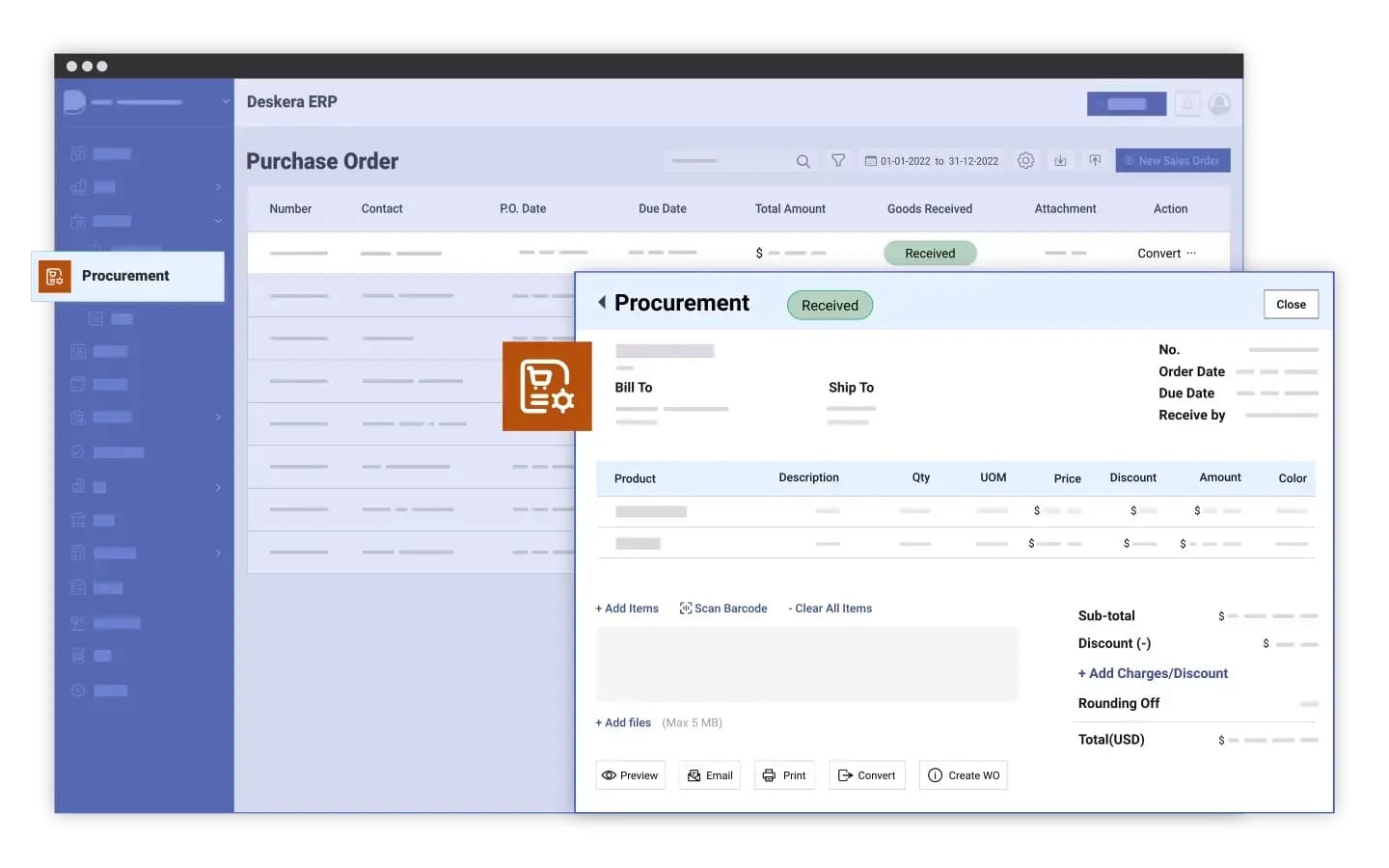
Implementing a successful Just in Time (JIT) supply chain strategy requires real-time visibility, accurate demand forecasting, efficient procurement processes, and seamless coordination across the entire supply chain. Managing these activities manually can lead to delays, inventory inaccuracies, and operational inefficiencies that directly impact JIT performance. This is where Deskera ERP helps businesses streamline operations and build a more agile, efficient, and data-driven supply chain ecosystem.
Real-Time Inventory Tracking
Deskera ERP provides real-time inventory visibility across warehouses, production facilities, and distribution centers. Businesses can monitor stock levels, inventory movement, and material availability instantly, helping prevent overstocking and stock shortages. Real-time tracking enables organizations to maintain lean inventory levels while ensuring materials are available exactly when needed for production or customer orders, which is essential for successful JIT operations.
Automated Procurement Management
JIT supply chains depend heavily on timely procurement and supplier coordination. Deskera ERP automates procurement workflows by generating purchase orders, tracking supplier deliveries, and monitoring replenishment requirements automatically. This reduces manual procurement delays and improves purchasing accuracy. Automated procurement processes also help businesses maintain optimal inventory levels and ensure that materials arrive according to production schedules.
Accurate Demand Forecasting and Planning
Demand forecasting is one of the most critical elements of JIT supply chain management. Deskera ERP helps businesses analyze historical sales data, inventory trends, seasonal demand patterns, and purchasing behavior to improve forecasting accuracy. Better forecasting allows organizations to align procurement and production activities with actual customer demand, reducing the risks of overproduction, stockouts, and unnecessary inventory carrying costs.
Production Planning and Scheduling
Deskera ERP supports efficient production planning by helping businesses schedule manufacturing activities based on material availability, customer demand, and production capacity. Production teams can optimize workflows, allocate resources effectively, and reduce manufacturing delays. Improved scheduling ensures smoother production cycles and minimizes downtime caused by inventory shortages or supply chain disruptions.
Supplier and Vendor Management
Strong supplier relationships are essential for maintaining uninterrupted JIT operations. Deskera ERP centralizes supplier and vendor information, making it easier to monitor supplier performance, delivery timelines, procurement history, and pricing details. Businesses can evaluate supplier reliability, improve communication, and strengthen vendor collaboration to ensure materials are delivered on time and according to quality standards.
Warehouse and Inventory Optimization
Efficient warehouse management is critical in JIT environments where inventory turnover is high and storage space is minimized. Deskera ERP helps businesses optimize warehouse operations through inventory categorization, stock movement tracking, barcode integration, and automated inventory updates. Improved warehouse visibility reduces handling inefficiencies, enhances inventory accuracy, and supports faster order fulfillment processes.
Real-Time Analytics and Reporting
Deskera ERP provides advanced analytics and customizable reporting tools that help businesses monitor supply chain performance and identify operational bottlenecks. Organizations can track important JIT KPIs such as inventory turnover ratio, lead times, order fulfillment rates, stockout frequency, and supplier delivery performance. Access to real-time insights enables faster decision-making and supports continuous supply chain improvement initiatives.
Improved Supply Chain Visibility
JIT supply chain strategies require complete visibility across procurement, production, inventory, and logistics operations. Deskera ERP integrates multiple business functions into a centralized platform, allowing businesses to access accurate real-time data from a single dashboard. Enhanced visibility improves coordination between departments, helps detect supply chain disruptions early, and enables faster responses to operational challenges.
Mobile Accessibility and Workflow Automation
Deskera ERP offers cloud-based accessibility and mobile capabilities that allow teams to manage supply chain operations remotely and in real time. Managers can monitor inventory levels, approve purchase orders, track deliveries, and review operational reports from any location. Workflow automation further reduces manual tasks, improves process consistency, and enhances operational efficiency across the supply chain.
Supports Scalable and Agile Supply Chain Operations
As businesses grow, managing complex supply chain activities becomes more challenging. Deskera ERP helps organizations scale their JIT operations efficiently by automating processes, improving coordination, and centralizing supply chain data. The platform supports agile business operations by enabling faster adaptation to changing customer demand, market trends, and supply chain disruptions while maintaining lean inventory practices.
Key Takeaways
- Just in Time (JIT) supply chain strategy helps businesses reduce inventory waste, lower storage costs, and improve operational efficiency by aligning inventory and production with real-time demand.
- JIT supply chain systems work through demand-driven inventory management, real-time procurement, supplier coordination, efficient production scheduling, and continuous inventory monitoring.
- Successful JIT implementation depends on key components such as accurate demand forecasting, reliable suppliers, efficient logistics, inventory visibility, ERP systems, and automation technologies.
- One of the biggest benefits of JIT supply chain strategy is reduced inventory holding costs, which helps businesses optimize working capital and improve cash flow management.
- JIT systems improve operational efficiency by streamlining procurement, production, warehouse management, and logistics processes while minimizing unnecessary inventory.
- Businesses implementing JIT can improve customer satisfaction through faster order fulfillment, better product availability, and quicker response to market demand changes.
- Despite its advantages, JIT supply chain strategy also carries risks such as supplier dependency, transportation delays, stockouts, and vulnerability to global supply chain disruptions.
- Industries such as manufacturing, automotive, electronics, retail, healthcare, and e-commerce benefit significantly from JIT due to their need for lean operations and efficient inventory management.
- Compared to traditional supply chain models, JIT focuses on lean inventory, lower costs, and operational agility, while traditional models prioritize inventory buffers and supply stability.
- Businesses can successfully implement JIT strategies by building strong supplier partnerships, improving demand forecasting, strengthening supply chain visibility, and optimizing transportation planning.
- Maintaining strategic safety stock and developing contingency plans can help businesses reduce operational risks associated with JIT inventory systems.
- Tracking KPIs such as inventory turnover ratio, stockout frequency, lead times, order fulfillment rates, and demand forecast accuracy is essential for measuring JIT supply chain performance.
- Modern technologies such as ERP software, AI-driven forecasting, IoT tracking, warehouse automation, and cloud-based supply chain platforms play a critical role in supporting efficient JIT operations.
- Future trends in JIT supply chain strategy include AI-powered demand forecasting, smart warehousing, hyperautomation, digital supply chain ecosystems, and real-time operational visibility.
- Deskera ERP helps optimize JIT supply chain strategy by providing real-time inventory tracking, automated procurement, demand forecasting, production planning, supplier management, and advanced analytics capabilities.
Related Articles
 Niti Samani
 Niti Samani
 Nalini
 Damini
 Niti Samani
 Niti Samani
What causes businesses to miss delivery deadlines, struggle with production delays, and lose customer trust? In many cases, the answer lies in poor lead time management. When companies lack visibility into procurement, inventory, production, and order fulfillment processes, even small disruptions can create major operational bottlenecks. Effective lead time management has become essential for businesses looking to improve efficiency, reduce costs, and meet growing customer expectations.
Lead time management refers to the process of monitoring and reducing the time required to complete business operations such as sourcing raw materials, manufacturing products, and delivering orders to customers. Shorter and more predictable lead times help businesses maintain optimal inventory levels, improve production planning, minimize delays, and increase customer satisfaction. However, managing lead times manually becomes increasingly difficult as supply chains grow more complex and business operations expand across multiple departments and locations.
This is where ERP systems play a critical role. Enterprise Resource Planning (ERP) systems integrate core business functions such as inventory management, procurement, production planning, warehouse operations, sales, and finance into a single centralized platform. By providing real-time visibility, automation, and data-driven insights, ERP systems help businesses identify bottlenecks, streamline workflows, improve forecasting accuracy, and optimize supply chain coordination. As a result, organizations can significantly reduce operational delays and improve overall business agility.
Deskera ERP is a comprehensive business management solution designed to help companies improve operational efficiency and lead time management. It offers features such as real-time inventory tracking, automated procurement workflows, production planning, demand forecasting, warehouse management, and advanced analytics. With its AI-powered insights, mobile accessibility, and integrated business modules, Deskera ERP enables businesses to streamline end-to-end operations, improve supply chain visibility, and accelerate order fulfillment processes.
What Is Lead Time Management?
Lead time management is the process of planning, monitoring, and optimizing the time it takes to complete a business operation from start to finish. In supply chain and manufacturing environments, lead time refers to the total time required to procure raw materials, manufacture products, process orders, and deliver finished goods to customers. Effective lead time management helps businesses reduce delays, improve operational efficiency, maintain optimal inventory levels, and ensure timely deliveries.
Businesses across industries rely on efficient lead time management to maintain smooth workflows and meet customer expectations. When lead times are too long or unpredictable, companies may experience production bottlenecks, inventory shortages, delayed shipments, increased operational costs, and dissatisfied customers. On the other hand, shorter and more accurate lead times improve productivity, strengthen supply chain performance, and enhance overall business profitability.
Lead time management involves analyzing every stage of the operational process to identify inefficiencies and reduce unnecessary delays. This includes supplier coordination, procurement planning, inventory management, production scheduling, warehouse operations, transportation, and order fulfillment. By continuously monitoring these activities, businesses can improve resource utilization, streamline workflows, and respond more effectively to market demand fluctuations.
Modern businesses increasingly use ERP systems and supply chain technologies to improve lead time management. These systems provide real-time visibility into inventory, procurement, production, and logistics operations, enabling organizations to make faster and more informed decisions. With automation, analytics, and predictive forecasting capabilities, ERP solutions help businesses minimize disruptions, optimize supply chain coordination, and achieve faster order fulfillment cycles.
Common Challenges in Lead Time Management
Managing lead times effectively is a major challenge for businesses operating in fast-moving and highly competitive markets. Supply chain disruptions, inaccurate forecasting, poor coordination between departments, and inefficient operational processes can all increase lead times and reduce business efficiency.
Without proper visibility and planning, organizations may struggle to fulfill orders on time, maintain optimal inventory levels, and meet customer expectations. Understanding these challenges is the first step toward improving operational performance and building a more responsive supply chain.
Lack of Real-Time Visibility
One of the biggest challenges in lead time management is the lack of real-time visibility across business operations.
Many companies still rely on disconnected systems, spreadsheets, or manual reporting methods that make it difficult to track inventory levels, supplier deliveries, production progress, and order status accurately.
Without centralized and up-to-date information, businesses often face delays in identifying bottlenecks, responding to disruptions, and making informed operational decisions, resulting in longer and less predictable lead times.
Inaccurate Demand Forecasting
Poor demand forecasting can significantly affect lead time management by creating imbalances in inventory and production planning.
When businesses fail to predict customer demand accurately, they may either overstock inventory or experience stock shortages that disrupt production schedules and order fulfillment.
Inaccurate forecasts also make it difficult to allocate resources efficiently, coordinate procurement activities, and maintain smooth supply chain operations, ultimately increasing operational delays and costs.
Poor Supplier Coordination
Supplier-related issues are another common factor contributing to long lead times. Inefficient communication with suppliers, delayed raw material deliveries, inconsistent supplier performance, and limited visibility into vendor operations can create major procurement bottlenecks.
Businesses that lack strong supplier coordination often struggle to maintain production schedules and fulfill customer orders on time. Managing multiple suppliers across different regions further increases complexity and makes lead time optimization more challenging.
Manual Processes and Human Errors
Many organizations still use manual processes for inventory tracking, procurement management, production scheduling, and order processing. These manual workflows increase the likelihood of data entry errors, duplicated information, approval delays, and communication gaps between departments.
Human errors in forecasting, inventory updates, or order management can disrupt operational workflows and create unnecessary delays throughout the supply chain. As businesses grow, manual systems become increasingly inefficient and difficult to manage effectively.
Inefficient Inventory Management
Poor inventory management practices can directly impact lead times and overall supply chain efficiency. Excess inventory ties up working capital and increases storage costs, while insufficient inventory can lead to stockouts and production interruptions.
Businesses that lack accurate inventory visibility may struggle to maintain the right balance between supply and demand. Slow-moving inventory, inaccurate stock records, and delayed replenishment processes further contribute to operational inefficiencies and longer fulfillment cycles.
Production and Scheduling Delays
Production bottlenecks and inefficient scheduling are major obstacles to effective lead time management, especially in manufacturing industries. Machine downtime, labor shortages, poor production planning, and inefficient workflow coordination can delay manufacturing activities and disrupt delivery timelines.
In many cases, businesses struggle to allocate resources effectively or respond quickly to changing demand conditions. These production inefficiencies not only increase lead times but also reduce overall operational productivity and customer satisfaction.
The Role of ERP Systems in Effective Lead Time Management
ERP systems play a critical role in helping businesses manage and reduce lead times by integrating core business operations into a centralized platform.
From procurement and inventory management to production planning and order fulfillment, ERP software provides real-time visibility, automation, and data-driven insights that improve operational efficiency across the entire supply chain.
By streamlining workflows and improving coordination between departments, ERP systems enable businesses to respond faster to changing market demands and minimize operational delays.
Centralized Data and Real-Time Visibility
ERP systems eliminate data silos by consolidating information from multiple departments into a single platform. This centralized visibility allows businesses to track inventory levels, supplier deliveries, production progress, and customer orders in real time.
With instant access to accurate operational data, managers can quickly identify bottlenecks, respond to disruptions, and make informed decisions that improve workflow efficiency and reduce lead times across procurement, manufacturing, and distribution processes.
Improved Demand Forecasting and Planning
Accurate demand forecasting is essential for reducing lead times and maintaining smooth business operations. ERP systems use historical sales data, market trends, and inventory information to help businesses forecast demand more accurately.
Advanced ERP solutions also incorporate AI-driven analytics and predictive planning tools that improve inventory replenishment and production scheduling. Better forecasting reduces the risk of stockouts, overproduction, and last-minute procurement delays, enabling businesses to maintain consistent operational flow.
Streamlined Procurement Processes
ERP systems simplify and automate procurement activities, helping businesses reduce delays in sourcing raw materials and supplies. Automated purchase order generation, supplier management tools, and real-time procurement tracking improve communication between businesses and vendors.
ERP software also helps organizations monitor supplier performance, track delivery schedules, and maintain accurate procurement records. These capabilities reduce procurement cycle times, improve supplier coordination, and ensure timely availability of materials for production operations.
Enhanced Inventory Management
Effective inventory management is one of the most important factors in lead time reduction, and ERP systems provide businesses with complete visibility into inventory operations.
Real-time stock tracking, automated reorder points, barcode integration, and warehouse management capabilities help businesses maintain optimal inventory levels.
ERP systems minimize stock shortages, prevent overstocking, and improve inventory accuracy, allowing organizations to fulfill orders faster and avoid production interruptions caused by material shortages.
Better Production Scheduling
ERP systems improve production efficiency by helping businesses optimize production schedules, resource allocation, and manufacturing workflows. With access to real-time production data, manufacturers can monitor machine utilization, track work orders, and identify production bottlenecks before they escalate into delays. ERP software also supports capacity planning and labor scheduling, ensuring that resources are used efficiently and production timelines are maintained, ultimately reducing manufacturing lead times.
Faster Order Processing and Fulfillment
ERP systems accelerate order processing by automating sales order management, invoicing, inventory allocation, and shipping workflows. When customer orders are integrated directly with inventory and warehouse systems, businesses can process and fulfill orders more quickly and accurately.
Real-time coordination between departments helps reduce delays caused by manual approvals, incorrect inventory information, or communication gaps, improving order fulfillment speed and enhancing customer satisfaction.
Improved Supply Chain Coordination
Managing complex supply chains requires seamless coordination between suppliers, manufacturers, warehouses, distributors, and logistics providers. ERP systems improve collaboration by providing a unified platform where all stakeholders can access relevant operational information.
Businesses can track shipments, monitor supplier activities, manage warehouse operations, and respond to supply chain disruptions more effectively. Improved coordination reduces delays, enhances operational agility, and supports faster end-to-end supply chain performance.
Automation of Manual Processes
Manual business processes often create inefficiencies, delays, and human errors that increase lead times. ERP systems automate repetitive tasks such as inventory updates, purchase order approvals, production scheduling, invoice processing, and reporting.
Automation reduces paperwork, speeds up workflows, and improves data accuracy across business operations. By minimizing manual intervention, ERP systems help organizations improve operational consistency and reduce delays caused by administrative inefficiencies.
Real-Time Analytics and Performance Monitoring
ERP systems provide advanced reporting and analytics tools that help businesses monitor lead time performance continuously. Real-time dashboards and KPI tracking allow managers to analyze supplier lead times, production cycle times, order fulfillment rates, and inventory turnover.
These insights help businesses identify inefficiencies, predict potential disruptions, and implement proactive improvements. Data-driven decision-making enables organizations to optimize operations continuously and maintain faster, more reliable lead time performance.
Benefits of Using ERP Systems for Lead Time Management
ERP systems provide businesses with the tools and visibility needed to optimize lead time management across procurement, production, inventory, and order fulfillment operations.
By integrating business functions into a centralized platform, ERP software helps organizations improve coordination, automate workflows, reduce delays, and make faster data-driven decisions.
Effective ERP implementation not only shortens lead times but also improves operational efficiency, customer satisfaction, and overall business performance.
Reduced Operational Delays
ERP systems help businesses identify and eliminate bottlenecks that slow down operational processes. With real-time visibility into procurement, inventory, production, and logistics activities, organizations can quickly detect disruptions and take corrective action before delays escalate.
Automated workflows and streamlined communication between departments further reduce waiting times and manual dependencies, enabling businesses to maintain smoother operations and achieve faster order fulfillment cycles.
Lower Inventory Carrying Costs
Effective lead time management supported by ERP systems helps businesses maintain optimal inventory levels and reduce unnecessary inventory holding costs.
Real-time inventory tracking and demand forecasting capabilities minimize the risk of overstocking or stock shortages.
Businesses can automate replenishment processes and improve stock accuracy, ensuring that inventory is available when needed without tying up excessive working capital in surplus inventory storage.
Improved Customer Satisfaction
Faster and more reliable lead times directly improve customer satisfaction by ensuring timely deliveries and accurate order fulfillment. ERP systems provide businesses with better visibility into order status, inventory availability, and shipping schedules, allowing them to communicate more effectively with customers. By reducing delays and improving service reliability, businesses can strengthen customer trust, increase retention rates, and build long-term customer relationships.
Better Supplier Relationships
ERP systems improve supplier management by enabling businesses to track supplier performance, monitor delivery timelines, and maintain accurate procurement records.
Real-time communication and automated procurement workflows help businesses collaborate more efficiently with vendors and reduce delays caused by manual coordination.
Stronger supplier relationships lead to improved reliability, faster material availability, and more stable supply chain operations, all of which contribute to shorter lead times.
Increased Productivity and Efficiency
By automating repetitive tasks and integrating business operations, ERP systems significantly improve workforce productivity and operational efficiency.
Employees spend less time on manual data entry, paperwork, and repetitive administrative processes, allowing them to focus on higher-value activities.
Streamlined workflows, centralized data access, and automated approvals help businesses complete operational tasks more quickly and accurately, reducing lead times across multiple business functions.
Faster Decision-Making
ERP systems provide real-time data and advanced analytics that support faster and more informed decision-making.
Managers can access live dashboards, performance reports, and operational insights related to inventory, production, procurement, and order fulfillment.
This visibility allows businesses to respond quickly to disruptions, adjust production schedules, optimize resource allocation, and make proactive decisions that improve lead time performance and operational agility.
Higher On-Time Delivery Rates
Maintaining high on-time delivery performance is critical for customer satisfaction and business competitiveness. ERP systems improve order accuracy, production planning, and logistics coordination, helping businesses meet delivery commitments consistently.
Automated order processing and real-time shipment tracking reduce the risk of missed deadlines and shipping errors. As a result, businesses can improve delivery reliability and strengthen their reputation for operational excellence.
Greater Supply Chain Agility
Modern supply chains face constant disruptions caused by changing customer demands, supplier delays, market fluctuations, and global uncertainties.
ERP systems improve supply chain agility by providing end-to-end visibility and enabling businesses to respond quickly to unexpected changes.
Real-time insights, predictive analytics, and automated workflows allow organizations to adapt operations efficiently, minimize disruptions, and maintain consistent lead time performance even in dynamic business environments.
Improved Business Scalability
As businesses grow, managing operations manually becomes increasingly complex and inefficient. ERP systems provide scalable infrastructure that supports business expansion without significantly increasing operational complexity.
Integrated workflows, centralized data management, and automation capabilities allow businesses to handle larger transaction volumes, additional suppliers, expanding inventories, and growing customer demands more efficiently.
This scalability ensures that businesses can continue optimizing lead times while supporting long-term growth objectives.
Industries That Benefit Most from ERP-Based Lead Time Management
Lead time management is critical for industries that depend on efficient supply chains, accurate inventory control, timely production schedules, and fast order fulfillment. ERP systems help organizations across various sectors improve operational visibility, automate workflows, and reduce delays throughout their business processes.
Industries with complex procurement, manufacturing, warehousing, and distribution operations benefit significantly from ERP-driven lead time optimization, enabling them to improve efficiency, reduce costs, and enhance customer satisfaction.
Manufacturing
Manufacturing companies rely heavily on efficient lead time management to maintain smooth production operations and meet customer delivery expectations. ERP systems help manufacturers optimize production scheduling, manage raw material procurement, monitor machine utilization, and track work orders in real time.
By improving coordination between inventory, procurement, and production departments, ERP software reduces production delays, minimizes downtime, and ensures faster completion of manufacturing cycles.
Retail and E-commerce
Retail and e-commerce businesses operate in highly competitive markets where customers expect fast and accurate deliveries. ERP systems help these businesses manage inventory levels, forecast customer demand, automate order processing, and streamline warehouse operations.
Real-time inventory visibility and automated replenishment processes reduce stockouts and fulfillment delays, allowing retailers to improve delivery speed, maintain product availability, and enhance the overall customer shopping experience.
Distribution and Logistics
Distribution and logistics companies handle large volumes of inventory movement, transportation coordination, and order fulfillment activities, making lead time management essential for operational success. ERP systems improve shipment tracking, warehouse management, route planning, and supplier coordination.
With real-time visibility into supply chain operations, logistics providers can reduce transportation delays, optimize delivery schedules, improve inventory flow, and ensure timely product distribution across multiple locations.
Food and Beverage
The food and beverage industry requires strict control over inventory freshness, production timelines, and supply chain efficiency. Delays in procurement, manufacturing, or delivery can lead to product spoilage, compliance risks, and revenue losses.
ERP systems help businesses manage inventory expiration dates, production schedules, procurement workflows, and demand forecasting. Improved operational coordination enables food and beverage companies to reduce waste, maintain product quality, and ensure timely product delivery.
Automotive
Automotive companies manage highly complex supply chains involving thousands of components, suppliers, and production processes. Any delay in material availability or production scheduling can disrupt manufacturing operations and increase costs significantly.
ERP systems help automotive manufacturers improve supplier coordination, monitor inventory availability, optimize production planning, and manage just-in-time manufacturing processes. These capabilities reduce production bottlenecks and improve overall supply chain efficiency.
Pharmaceuticals
Pharmaceutical companies must manage strict regulatory requirements, sensitive inventory, and precise production schedules while ensuring timely product availability.
ERP systems help pharmaceutical businesses maintain accurate inventory records, monitor batch tracking, automate procurement processes, and improve production planning.
Real-time visibility into supply chain operations helps reduce delays, improve compliance management, and ensure efficient distribution of critical healthcare products and medications.
Electronics and High-Tech Manufacturing
Electronics and high-tech manufacturers often face challenges related to rapid product changes, fluctuating customer demand, and complex global supply chains. ERP systems help these businesses manage component procurement, production workflows, inventory planning, and supplier relationships more effectively.
Improved forecasting accuracy, automated inventory management, and real-time operational insights enable electronics manufacturers to reduce lead times, respond quickly to market changes, and maintain competitive advantage.
Best Practices for Improving Lead Time Management with ERP
Implementing an ERP system alone is not enough to optimize lead time management effectively. Businesses must also follow structured operational strategies and best practices to maximize the benefits of ERP-driven automation, visibility, and analytics.
By combining standardized workflows, accurate data management, supplier collaboration, and continuous performance monitoring, organizations can significantly reduce delays, improve supply chain efficiency, and maintain consistent operational performance.
Standardize Business Processes
Standardized workflows help businesses reduce inconsistencies and improve operational efficiency across departments. ERP systems work most effectively when procurement, inventory management, production planning, and order fulfillment processes follow clearly defined procedures.
Standardization minimizes communication gaps, reduces process variations, and ensures that operational activities are completed more efficiently. Consistent workflows also make it easier for businesses to identify bottlenecks and implement process improvements that support faster lead times.
Maintain Accurate Inventory Data
Accurate inventory data is essential for effective lead time management and smooth supply chain operations. Businesses should regularly update inventory records, monitor stock movements, and eliminate discrepancies between physical inventory and system data.
ERP systems provide real-time inventory visibility, but maintaining data accuracy requires disciplined inventory practices such as cycle counting, barcode scanning, and automated stock tracking. Accurate inventory information helps businesses avoid stock shortages, overstocking, and procurement delays.
Monitor Supplier Performance Regularly
Supplier performance directly affects procurement lead times and overall supply chain reliability. Businesses should use ERP systems to track supplier delivery timelines, order accuracy, product quality, and responsiveness consistently.
Monitoring supplier performance helps organizations identify unreliable vendors, improve supplier communication, and build stronger procurement relationships.
Businesses can also use supplier performance insights to negotiate better contracts, reduce material delays, and maintain uninterrupted production schedules.
Use Predictive Analytics for Demand Planning
Predictive analytics helps businesses forecast customer demand more accurately and improve operational planning.
ERP systems equipped with analytics and AI capabilities can analyze historical sales patterns, seasonal trends, and market fluctuations to generate more reliable demand forecasts.
Accurate forecasting enables businesses to optimize inventory levels, schedule production efficiently, and reduce the risk of stockouts or excess inventory. Better demand planning ultimately supports shorter and more predictable lead times.
Automate Routine Workflows
Manual processes often slow down operations and increase the likelihood of errors that disrupt lead time performance. Businesses should use ERP systems to automate repetitive workflows such as purchase order creation, inventory replenishment, production scheduling, invoice approvals, and reporting.
Automation improves operational speed, reduces paperwork, and minimizes administrative bottlenecks. By reducing manual intervention, businesses can improve process consistency and accelerate overall supply chain operations.
Continuously Track KPIs and Bottlenecks
Continuous monitoring of operational performance is critical for improving lead time management over time.
Businesses should use ERP dashboards and reporting tools to track key performance indicators such as order lead time, supplier lead time, inventory turnover, production cycle time, and on-time delivery rates.
Regular performance analysis helps organizations identify operational inefficiencies, detect emerging bottlenecks, and make proactive adjustments that improve supply chain efficiency and lead time reliability.
Train Employees on ERP Usage
Even the most advanced ERP system cannot deliver maximum value without proper user adoption and training. Businesses should ensure that employees understand how to use ERP tools effectively for inventory management, procurement, production planning, and reporting activities.
Proper training improves data accuracy, reduces operational errors, and ensures consistent use of ERP functionalities across departments. Well-trained employees can also identify process improvement opportunities that contribute to faster and more efficient operations.
Integrate ERP with Supply Chain Operations
ERP systems deliver greater value when fully integrated with broader supply chain operations, including suppliers, warehouses, logistics providers, and distribution channels. Integration improves data sharing, enhances communication, and provides end-to-end visibility across the supply chain.
Businesses can monitor shipments, track inventory movements, coordinate procurement activities, and respond to disruptions more effectively. Strong supply chain integration supports faster decision-making, minimizes delays, and improves overall lead time management performance.
Key Metrics to Track for Lead Time Management
Tracking the right performance metrics is essential for improving lead time management and maintaining efficient business operations.
Key performance indicators (KPIs) help businesses measure operational efficiency, identify bottlenecks, monitor supplier and production performance, and make data-driven decisions.
ERP systems simplify KPI tracking by providing real-time dashboards, automated reporting, and centralized operational visibility. By continuously monitoring these metrics, businesses can reduce delays, improve supply chain coordination, and enhance overall operational performance.
Order Lead Time
Order lead time measures the total time taken from receiving a customer order to delivering the finished product to the customer. This metric helps businesses evaluate the efficiency of their order processing, production, inventory management, and shipping operations.
A shorter order lead time indicates streamlined workflows and better operational coordination, while longer lead times may signal bottlenecks in procurement, production scheduling, or logistics processes.
Formula: Order Lead Time = Order Delivery Date − Order Placement Date
Supplier Lead Time
Supplier lead time measures the amount of time suppliers take to deliver raw materials or products after a purchase order is placed. This metric is critical for procurement planning and inventory management because supplier delays can disrupt production schedules and order fulfillment timelines.
Monitoring supplier lead time helps businesses identify reliable vendors, improve supplier coordination, and reduce procurement-related operational disruptions.
Formula: Supplier Lead Time = Delivery Date − Purchase Order Date
Production Cycle Time
Production cycle time measures the total time required to manufacture a product from the beginning of production to completion. This metric helps businesses evaluate manufacturing efficiency, machine utilization, workflow coordination, and labor productivity.
Longer production cycle times often indicate production bottlenecks, inefficient scheduling, or equipment downtime. Reducing production cycle time helps businesses improve output capacity and accelerate order fulfillment.
Formula: Production Cycle Time = Production Completion Time − Production Start Time
Inventory Turnover Ratio
Inventory turnover ratio measures how efficiently a business sells and replenishes inventory over a specific period. A higher inventory turnover ratio indicates efficient inventory management and faster inventory movement, while a lower ratio may suggest excess inventory or weak demand forecasting. This metric helps businesses optimize stock levels, reduce carrying costs, and improve supply chain responsiveness.
Formula: Inventory Turnover Ratio = Cost of Goods Sold ÷ Average Inventory
On-Time Delivery Rate
On-time delivery rate measures the percentage of customer orders delivered within the promised timeframe. This KPI is essential for evaluating logistics efficiency, production reliability, and customer service performance.
A high on-time delivery rate reflects strong operational coordination and effective lead time management, while lower rates may indicate supply chain inefficiencies or fulfillment delays.
Formula: On-Time Delivery Rate = (Orders Delivered On Time ÷ Total Orders Delivered) × 100
Perfect Order Rate
Perfect order rate measures the percentage of orders completed without errors, delays, damages, or missing items. This metric evaluates the overall efficiency and accuracy of order fulfillment processes.
A higher perfect order rate indicates strong coordination between inventory management, warehouse operations, shipping, and customer service functions. Improving this metric helps businesses enhance customer satisfaction and reduce costly operational errors.
Formula: Perfect Order Rate = (Perfect Orders ÷ Total Orders) × 100
Stockout Frequency
Stockout frequency measures how often a business runs out of inventory for specific products during a given period. Frequent stockouts can disrupt production schedules, delay customer orders, and reduce customer satisfaction.
Tracking stockout frequency helps businesses improve inventory planning, optimize replenishment strategies, and maintain consistent product availability.
Formula: Stockout Frequency = (Number of Stockouts ÷ Total Inventory Items) × 100
Forecast Accuracy
Forecast accuracy measures how closely actual demand matches forecasted demand over a specific period. Accurate forecasting is essential for inventory optimization, procurement planning, and production scheduling.
Poor forecast accuracy often leads to overstocking, stock shortages, and operational inefficiencies. ERP systems with predictive analytics capabilities help businesses improve forecast reliability and reduce lead time variability.
Formula: Forecast Accuracy = [1 − (|Actual Demand − Forecasted Demand| ÷ Actual Demand)] × 100
Order Fulfillment Cycle Time
Order fulfillment cycle time measures the total time required to process, pick, pack, ship, and deliver a customer order. This metric helps businesses evaluate the efficiency of warehouse operations, inventory availability, and shipping coordination.
Reducing order fulfillment cycle time improves delivery speed, enhances customer satisfaction, and strengthens overall supply chain performance.
Formula: Order Fulfillment Cycle Time = Order Delivery Date − Order Receipt Date
Future Trends in ERP and Lead Time Management
As supply chains become more complex and customer expectations continue to rise, businesses are increasingly adopting advanced ERP technologies to improve lead time management and operational agility.
Modern ERP systems are evolving beyond traditional process automation by incorporating artificial intelligence, predictive analytics, IoT connectivity, and cloud-based capabilities.
These innovations are helping businesses gain deeper operational visibility, improve forecasting accuracy, and respond faster to disruptions across the supply chain.
AI-Powered Predictive Planning
Artificial intelligence is transforming ERP systems by enabling predictive planning and smarter decision-making.
AI-powered ERP platforms can analyze large volumes of historical and real-time data to forecast demand fluctuations, identify potential supply chain disruptions, and optimize production schedules automatically.
Predictive analytics helps businesses reduce uncertainties, improve inventory planning, and minimize operational delays. As AI technology advances, ERP systems will become even more proactive in preventing bottlenecks and improving lead time accuracy.
IoT-Enabled Supply Chain Visibility
The integration of Internet of Things (IoT) technology with ERP systems is improving real-time visibility across supply chain operations. IoT-enabled sensors and connected devices allow businesses to track inventory movements, monitor machine performance, and oversee transportation conditions in real time.
This continuous flow of operational data helps organizations detect disruptions early, reduce equipment downtime, and improve shipment tracking accuracy. Enhanced visibility enables businesses to respond quickly to delays and maintain smoother supply chain operations.
Cloud ERP Adoption
Cloud-based ERP systems are becoming increasingly popular due to their scalability, flexibility, and accessibility. Unlike traditional on-premise solutions, cloud ERP platforms allow businesses to access operational data from anywhere and support real-time collaboration across multiple locations.
Cloud ERP systems also simplify software updates, reduce infrastructure costs, and improve data security. As businesses continue adopting remote and distributed operational models, cloud ERP solutions will play a larger role in improving lead time management and supply chain coordination.
Real-Time Data Analytics
Real-time analytics is becoming a critical capability for businesses seeking faster and more informed operational decisions.
Modern ERP systems provide live dashboards, automated reporting, and advanced analytics tools that allow organizations to monitor inventory levels, supplier performance, production schedules, and order fulfillment activities continuously.
Real-time insights help businesses identify inefficiencies immediately, respond proactively to disruptions, and optimize workflows dynamically to reduce lead times and improve operational performance.
Digital Twins in Manufacturing
Digital twin technology is emerging as a powerful innovation in manufacturing and supply chain management. A digital twin is a virtual replica of a physical production environment, machine, or supply chain process that allows businesses to simulate operations and analyze performance in real time.
ERP systems integrated with digital twins can help organizations predict equipment failures, optimize production workflows, and evaluate operational changes before implementation. This technology improves planning accuracy and helps reduce production-related delays.
Automation and Smart Warehousing
Automation technologies are reshaping warehouse operations and significantly improving lead time efficiency. ERP systems increasingly integrate with robotics, automated storage systems, barcode scanners, and AI-driven warehouse management tools to streamline inventory handling and order fulfillment processes.
Smart warehousing solutions improve picking accuracy, reduce manual labor requirements, accelerate shipment processing, and minimize fulfillment errors. As automation adoption grows, businesses will achieve faster and more efficient warehouse operations with shorter fulfillment cycles.
Blockchain for Supply Chain Transparency
Blockchain technology is gaining attention for its ability to improve transparency and traceability within supply chains. When integrated with ERP systems, blockchain can create secure and tamper-proof transaction records for procurement, inventory movements, and supplier activities.
This enhanced transparency helps businesses improve supplier trust, reduce fraud risks, and monitor supply chain operations more accurately. Improved traceability also enables faster issue resolution and supports more reliable lead time management.
Mobile ERP and Remote Accessibility
Mobile ERP capabilities are becoming increasingly important as businesses seek faster decision-making and greater operational flexibility. Mobile-enabled ERP systems allow managers, warehouse teams, procurement staff, and field employees to access real-time operational data from smartphones and tablets.
Remote accessibility improves communication, accelerates approvals, and enables businesses to respond quickly to operational issues regardless of location. This mobility helps organizations maintain operational continuity and reduce delays across distributed supply chain networks.
How Deskera ERP Helps Improve Lead Time Management
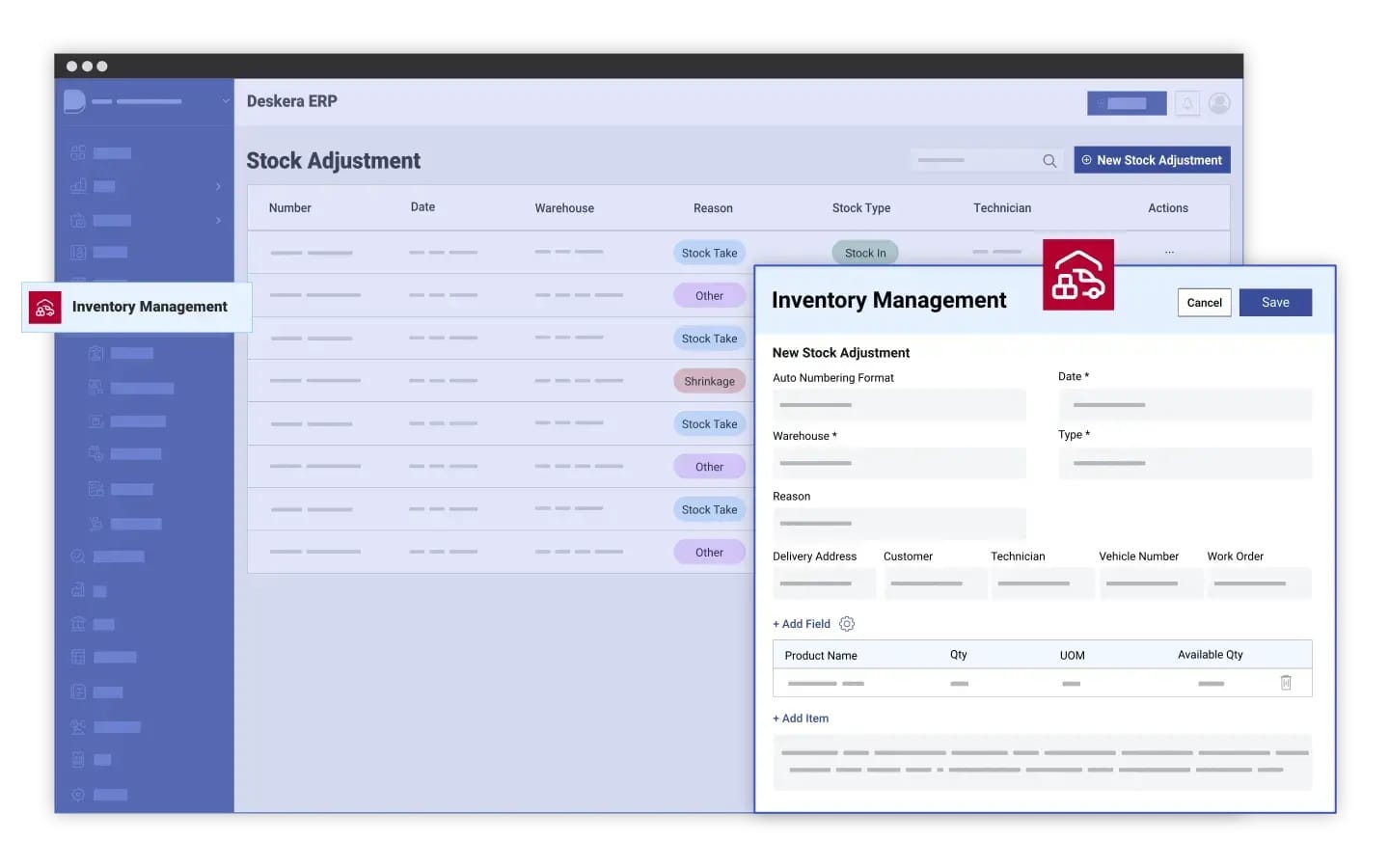
Deskera ERP helps businesses optimize lead time management by integrating procurement, inventory, production, warehouse operations, sales, and supply chain processes into a single centralized platform. With real-time visibility, automation, AI-powered insights, and advanced planning capabilities, businesses can identify operational bottlenecks, reduce delays, and improve overall supply chain efficiency. By streamlining end-to-end business operations, Deskera ERP enables organizations to maintain faster, more predictable, and more efficient lead times.
Real-Time Inventory Tracking
Deskera ERP provides businesses with real-time visibility into inventory levels, stock movements, warehouse operations, and material availability. Accurate inventory tracking helps organizations maintain optimal stock levels, prevent stock shortages, and avoid excess inventory carrying costs. With instant access to inventory data, businesses can make faster replenishment decisions, improve order fulfillment efficiency, and reduce operational delays caused by inventory inaccuracies.
Automated Procurement and Reordering
Deskera ERP simplifies procurement management by automating purchase order creation, supplier coordination, and inventory replenishment processes. Businesses can set automated reorder points to ensure that raw materials and products are replenished before stock levels become critically low. Automated procurement workflows reduce manual intervention, improve supplier communication, and minimize delays associated with procurement approvals and material sourcing activities.
Advanced Production Planning
Efficient production scheduling is essential for reducing manufacturing lead times, and Deskera ERP helps businesses optimize production operations through advanced planning and scheduling tools. The platform enables manufacturers to allocate resources effectively, monitor work orders, track machine utilization, and identify production bottlenecks in real time. Improved production visibility helps businesses maintain smooth workflows, reduce downtime, and accelerate manufacturing cycles.
Demand Forecasting and Analytics
Deskera ERP uses data-driven analytics and forecasting capabilities to help businesses predict customer demand more accurately. By analyzing historical sales data, inventory trends, and operational patterns, businesses can improve procurement planning, optimize production schedules, and maintain better inventory control. Accurate forecasting reduces the risk of stockouts, overproduction, and last-minute operational disruptions that often increase lead times.
Warehouse and Supply Chain Visibility
Deskera ERP improves warehouse efficiency and supply chain coordination by providing centralized visibility into inventory movement, order processing, supplier activities, and shipment tracking. Businesses can monitor supply chain operations in real time and respond quickly to disruptions or delays. Improved visibility across procurement, warehousing, and logistics functions enables organizations to streamline operations and improve end-to-end lead time performance.
Workflow Automation and Process Efficiency
Manual processes often slow down operations and create communication gaps between departments. Deskera ERP automates repetitive tasks such as inventory updates, invoice processing, procurement approvals, production scheduling, and reporting. Workflow automation improves operational speed, reduces administrative burdens, minimizes human errors, and ensures that critical business activities are completed more efficiently and consistently.
AI-Powered Insights and Reporting
Deskera ERP provides advanced reporting tools and AI-powered operational insights that help businesses monitor key lead time management metrics continuously. Real-time dashboards allow managers to track inventory turnover, supplier performance, order fulfillment rates, and production cycle times. These insights help businesses identify inefficiencies, predict operational disruptions, and make proactive decisions that improve supply chain performance and reduce delays.
Mobile Accessibility for Faster Decision-Making
With mobile accessibility features, Deskera ERP allows managers and operational teams to access real-time business information from anywhere. Employees can monitor inventory levels, approve purchase orders, review production updates, and track shipments directly from mobile devices. Faster access to operational data improves communication, accelerates decision-making, and helps businesses respond quickly to unexpected supply chain disruptions or operational issues.
End-to-End Business Process Integration
One of the biggest advantages of Deskera ERP is its ability to integrate multiple business functions into a unified system. Procurement, inventory management, finance, sales, production, and warehouse operations work together seamlessly within a centralized platform. This integration eliminates data silos, improves departmental coordination, enhances operational visibility, and enables businesses to optimize workflows across the entire supply chain, resulting in faster and more reliable lead time management.
Key Takeaways
- Lead time management helps businesses reduce delays, improve operational efficiency, optimize inventory levels, and enhance customer satisfaction across supply chain operations.
- Poor visibility, inaccurate forecasting, supplier coordination issues, manual workflows, inefficient inventory management, and production bottlenecks are some of the biggest challenges affecting lead time performance.
- ERP systems improve lead time management by centralizing business operations, providing real-time visibility, automating workflows, and improving coordination across procurement, production, inventory, and logistics functions.
- Features such as real-time reporting, inventory tracking, demand forecasting, production planning, workflow automation, and AI-driven analytics make ERP systems highly effective for lead time optimization.
- Businesses using ERP systems benefit from reduced operational delays, lower inventory carrying costs, improved customer satisfaction, stronger supplier relationships, and faster decision-making.
- Industries such as manufacturing, retail, logistics, food and beverage, automotive, pharmaceuticals, and electronics gain significant advantages from ERP-based lead time management solutions.
- Best practices such as standardizing workflows, maintaining accurate inventory data, automating routine processes, monitoring KPIs, and integrating ERP with supply chain operations help businesses maximize lead time efficiency.
- Tracking key metrics like order lead time, supplier lead time, inventory turnover ratio, production cycle time, on-time delivery rate, and forecast accuracy helps businesses identify inefficiencies and improve operational performance.
- Emerging technologies such as AI-powered forecasting, IoT-enabled visibility, cloud ERP, digital twins, smart warehousing, blockchain, and mobile ERP are shaping the future of lead time management.
- Deskera ERP helps businesses improve lead time management through real-time inventory tracking, automated procurement, advanced production planning, workflow automation, AI-powered analytics, and end-to-end operational visibility.
Related Articles
 Niti Samani
 Niti Samani
 Niti Samani
 Niti Samani
 Niti Samani
 Niti Samani
What separates highly efficient manufacturers from those constantly battling delays, downtime, and rising operational costs? The answer often lies in one critical metric: machine utilization. In today’s competitive manufacturing landscape, simply owning advanced machinery is not enough. Businesses must ensure that every machine operates at its maximum productive potential with minimal idle time, breakdowns, and inefficiencies. High machine utilization directly impacts production output, operational efficiency, profitability, and customer satisfaction, making it a cornerstone of modern manufacturing success.
Machine utilization refers to how effectively manufacturing equipment is being used compared to its total available production time. When machines sit idle due to maintenance issues, poor scheduling, material shortages, or operational bottlenecks, manufacturers lose valuable production capacity and revenue opportunities. On the other hand, optimized machine utilization helps businesses reduce downtime, improve throughput, lower manufacturing costs, and extend equipment lifespan. As manufacturers continue adopting automation and smart factory technologies, machine utilization has become more data-driven and measurable than ever before.
Modern manufacturers are increasingly leveraging digital tools, IoT sensors, predictive maintenance systems, artificial intelligence, and real-time analytics to monitor machine performance and identify inefficiencies before they escalate into costly disruptions. From reducing setup times to improving production scheduling and maintenance planning, businesses are focusing on maximizing the productivity of every asset across the shop floor. In industries where margins are tight and customer expectations are constantly rising, improving machine utilization can create a significant competitive advantage.
Deskera MRP helps manufacturers streamline production planning, inventory control, maintenance scheduling, and shop floor operations from a centralized platform. With real-time production visibility, automated workflows, demand forecasting, and smart resource allocation, Deskera MRP enables businesses to minimize machine downtime and improve equipment utilization. Its advanced analytics and reporting capabilities allow manufacturers to monitor machine performance, optimize production schedules, and make data-driven operational decisions that improve efficiency and profitability across manufacturing operations.
What Is Machine Utilization?
Machine utilization is a key performance metric that measures how effectively a machine or piece of equipment is being used during its available operating time. In simple terms, it shows the percentage of time a machine is actively running and producing output compared to the total time it is available for production. Manufacturers use machine utilization to evaluate equipment productivity, identify inefficiencies, and improve operational performance across the shop floor.
Machine utilization is commonly used alongside manufacturing KPIs such as Overall Equipment Effectiveness (OEE), production efficiency, and capacity utilization. A higher machine utilization rate indicates that equipment is being used efficiently with minimal idle time, while a lower utilization rate suggests downtime, underuse, maintenance issues, or production bottlenecks. Monitoring utilization helps businesses reduce operational losses, optimize resource allocation, and maximize return on equipment investments.
For example, consider a CNC machining center in an automotive parts manufacturing facility that is scheduled to operate for 16 hours per day. Due to maintenance activities, material shortages, and changeover delays, the machine only runs productively for 12 hours. This indicates that a portion of the machine’s available time was lost to operational inefficiencies, reducing its overall utilization and affecting production output.
Another example can be seen in a packaging facility where a carton sealing machine is available for an entire production shift but remains idle for several hours because of conveyor jams, operator breaks, and delayed material supply. Even though the equipment is technically available, interruptions and downtime prevent it from operating at full capacity. By monitoring machine utilization, manufacturers can identify these inefficiencies, reduce idle time, improve scheduling, and maximize the productivity of their equipment and production lines.
Machine utilization is especially important in modern manufacturing environments where equipment investments are expensive and production schedules are tightly linked to customer demand. By continuously monitoring machine performance, businesses can improve throughput, reduce downtime, optimize maintenance schedules, and ensure that production assets are operating as efficiently as possible.
Key Components of Machine Utilization
Machine utilization is influenced by several operational factors that determine how effectively production equipment performs during available working hours. Understanding these key components helps manufacturers identify inefficiencies, minimize downtime, and improve overall equipment productivity. By monitoring these elements closely, businesses can optimize machine performance, improve production output, and maximize return on equipment investments.
Machine Availability
Machine availability refers to the amount of time equipment is ready and available for production compared to the total scheduled operating time. Unplanned breakdowns, maintenance activities, setup delays, and material shortages can reduce machine availability and negatively impact utilization rates. Maintaining high equipment availability is essential for ensuring uninterrupted production and maximizing operational efficiency across manufacturing processes.
Machine Performance
Machine performance measures how efficiently equipment operates while running. Even when machines are available and operational, factors such as reduced operating speeds, minor stoppages, inefficient workflows, or improper machine settings can lower productivity. Monitoring machine performance helps manufacturers identify speed losses and operational inefficiencies that prevent equipment from operating at optimal production capacity.
Quality Output
Quality output evaluates the percentage of defect-free products produced during machine operation. High levels of scrap, rework, or defective products reduce effective machine utilization because production time and resources are wasted on unusable output. Improving quality control processes, operator training, and machine calibration helps manufacturers maximize productive output and maintain consistent manufacturing standards.
Downtime Management
Downtime management focuses on minimizing production interruptions caused by machine failures, maintenance activities, changeovers, or operational bottlenecks. Both planned and unplanned downtime directly affect machine utilization by reducing the amount of productive operating time available. Effective downtime tracking and analysis help manufacturers identify recurring issues and implement corrective actions to improve equipment reliability.
Maintenance Efficiency
Maintenance efficiency measures how effectively preventive, predictive, and corrective maintenance activities support equipment reliability and operational continuity. Poor maintenance practices can lead to frequent breakdowns, extended repair times, and reduced machine productivity. Implementing proactive maintenance strategies helps manufacturers improve machine health, reduce downtime, and extend equipment lifespan while supporting higher utilization rates.
Production Scheduling
Production scheduling plays a critical role in ensuring machines are utilized efficiently throughout manufacturing operations. Poor scheduling can create idle time, production bottlenecks, and uneven workload distribution across equipment. Effective production planning helps manufacturers align machine availability with production demand, optimize resource allocation, and maintain smooth operational workflows across the shop floor.
Factors Affecting Machine Utilization
Machine utilization is influenced by several operational, technical, and organizational factors that determine how efficiently production equipment performs during available operating hours. Even advanced machinery can experience low utilization if production workflows, maintenance processes, or resource planning are not properly managed. Understanding these factors helps manufacturers identify inefficiencies, reduce downtime, and maximize equipment productivity across manufacturing operations.
Unplanned Downtime
Unexpected machine breakdowns, equipment failures, and emergency maintenance activities are among the biggest factors affecting machine utilization. Unplanned downtime interrupts production schedules, reduces operating hours, and increases manufacturing delays. Frequent breakdowns can also lead to higher repair costs and lower production efficiency. Implementing preventive and predictive maintenance strategies helps manufacturers minimize unexpected interruptions and improve equipment reliability.
Excessive Changeover Times
Long setup and changeover times reduce the amount of time machines spend actively producing goods. In manufacturing environments with frequent product variations, equipment may remain idle during tool replacements, recalibration, cleaning, or configuration adjustments. Techniques such as Single-Minute Exchange of Die (SMED), standardized setup procedures, and operator training help manufacturers reduce transition times and improve machine utilization.
Poor Production Planning
Inefficient production planning can result in machine idle time, uneven workload distribution, and production bottlenecks. When schedules are not properly aligned with production demand, machines may remain inactive while waiting for materials, labor, or production instructions. Effective production scheduling and capacity planning help manufacturers optimize machine usage, improve workflow efficiency, and maintain continuous production operations.
Underutilization of Equipment
Machines may sometimes operate below their full production capacity even when they are actively running. Factors such as inefficient cycle times, low production speeds, improper machine settings, or suboptimal workflows can reduce equipment productivity. Monitoring machine performance and optimizing operational processes help manufacturers maximize output and improve overall equipment effectiveness.
Lack of Preventive Maintenance
Poor maintenance practices can lead to increased equipment wear, frequent breakdowns, and reduced operational efficiency. Without regular inspections and preventive maintenance, machines are more likely to experience unexpected failures that disrupt production. Establishing proactive maintenance schedules helps improve machine reliability, extend equipment lifespan, and maintain consistent utilization levels.
Material Shortages and Supply Chain Delays
Machine utilization can decline when raw materials, components, or production supplies are not available on time. Supply chain disruptions and inventory shortages force machines to remain idle until materials arrive, causing production delays and lost output. Efficient inventory management and supply chain coordination help manufacturers maintain uninterrupted production workflows.
Operator Skill and Workforce Efficiency
Machine performance is heavily influenced by the skills and efficiency of machine operators and production staff. Inadequate training, operational errors, and inefficient workflows can reduce production speed and increase downtime. Investing in workforce training and standardized operating procedures helps improve machine handling, reduce errors, and enhance overall equipment productivity.
Inefficient Workflow and Production Bottlenecks
Poorly designed workflows and bottlenecks in production lines can prevent machines from operating continuously. Delays in upstream or downstream processes may force equipment to stop or wait unnecessarily during production cycles. Streamlining workflows and improving process coordination help manufacturers maintain smoother operations and better machine utilization.
Lack of Real-Time Monitoring
Without real-time visibility into machine performance, manufacturers may struggle to identify operational inefficiencies, downtime causes, and underutilized equipment. Manual tracking methods often delay problem detection and corrective actions. Using machine monitoring software, IoT sensors, and ERP systems enables businesses to track utilization data in real time and improve operational decision-making.
Energy and Environmental Conditions
Power fluctuations, unstable operating environments, excessive heat, humidity, or poor ventilation can negatively affect machine performance and reliability. Environmental factors may lead to equipment slowdowns, increased maintenance requirements, or unexpected failures. Maintaining proper operating conditions helps ensure stable machine performance and supports higher utilization rates.
Types of Machine Utilization
Machine utilization can be measured in different ways depending on the manufacturing environment, production objectives, and operational processes involved.
Understanding the various types of machine utilization helps manufacturers identify inefficiencies, optimize production capacity, and improve equipment performance across different stages of operations.
Each type focuses on a specific aspect of how machinery, resources, and production systems are being used within a facility.
Production Machine Utilization
Production machine utilization measures how effectively equipment is used during active manufacturing operations. It focuses on the amount of time machines spend producing goods compared to their available production time.
Manufacturers use this type of utilization to monitor shop floor productivity, identify idle equipment, reduce operational delays, and ensure machines are consistently contributing to production targets and output goals.
Capacity Utilization
Capacity utilization evaluates how much of a machine’s maximum production capability is being used under actual operating conditions. It helps manufacturers understand whether production resources are underutilized, fully optimized, or overloaded. Monitoring capacity utilization supports better production planning, resource allocation, and demand forecasting while helping businesses maintain operational efficiency and avoid production bottlenecks during peak manufacturing periods.
Labor-Assisted Machine Utilization
Labor-assisted machine utilization focuses on machines that rely partly on human operators for setup, operation, monitoring, or material handling. In these environments, equipment productivity is closely connected to workforce efficiency and operator skills.
Delays caused by manual interventions, training gaps, or inefficient workflows can reduce utilization rates, making workforce coordination and operational standardization critical for maintaining consistent machine performance.
Automated Machine Utilization
Automated machine utilization measures the performance of machines operating with minimal human intervention using robotics, automation systems, IoT devices, and smart manufacturing technologies.
This type of utilization is common in Industry 4.0 environments where real-time monitoring and predictive analytics improve equipment efficiency.
Automated utilization tracking helps manufacturers reduce downtime, increase production speed, and maintain consistent operational performance across highly automated facilities.
Machine Utilization Formula and Calculations
Machine utilization calculations help manufacturers measure how efficiently production equipment is being used during available operating hours. By tracking utilization rates, businesses can identify downtime, improve production planning, reduce operational inefficiencies, and maximize equipment productivity.
Basic Machine Utilization Formula
Machine Utilization (%) = (Actual Machine Running Time / Available Production Time) × 100
Where:
- Actual Machine Running Time = Total time the machine is actively producing
- Available Production Time = Total scheduled production time excluding planned shutdowns
Example Calculation
Suppose a laser cutting machine is scheduled to operate for 20 hours in a day. However, due to maintenance delays and material shortages, the machine only runs productively for 15 hours.
Machine Utilization (%) = (15 / 20) × 100
Machine Utilization (%) = 75%
This means the machine was actively utilized for 75% of its available production time.
Capacity Utilization Formula
Capacity utilization measures how much of a machine’s maximum production capacity is actually being used.
Capacity Utilization (%) = (Actual Production Output / Maximum Possible Output) × 100
Where:
- Actual Production Output = Units actually produced
- Maximum Possible Output = Maximum output achievable under ideal conditions
Example Calculation
A plastic molding machine can ideally produce 12,000 components per day. However, due to operational interruptions, it produces only 9,000 components.
Capacity Utilization (%) = (9,000 / 12,000) × 100
Capacity Utilization (%) = 75%
This indicates the machine is operating at 75% of its maximum production capacity.
Downtime Percentage Formula
Downtime percentage measures the amount of production time lost because of breakdowns, maintenance, setup delays, or other interruptions.
Downtime Percentage (%) = (Downtime Hours / Total Available Hours) × 100
Example Calculation
If a packaging machine is available for 18 hours but experiences 3 hours of downtime:
Downtime Percentage (%) = (3 / 18) × 100
Downtime Percentage (%) = 16.7%
This means 16.7% of the machine’s available production time was lost to downtime.
Machine Idle Time Formula
Idle time measures the amount of time equipment remains operationally available but is not actively producing.
Machine Idle Time (%) = (Idle Time / Available Production Time) × 100
Example Calculation
A conveyor system is available for 14 hours but remains idle for 2 hours due to workflow bottlenecks.
Machine Idle Time (%) = (2 / 14) × 100
Machine Idle Time (%) = 14.3%
Throughput Rate Formula
Throughput rate measures the number of units a machine produces within a specific period.
Throughput Rate = Total Units Produced / Total Production Time
Example Calculation
A filling machine produces 24,000 bottles in 8 hours.
Throughput Rate = 24,000 / 8
Throughput Rate = 3,000 bottles per hour
Overall Equipment Effectiveness (OEE) Formula
OEE is a comprehensive manufacturing metric used to evaluate machine productivity based on availability, performance, and quality.
OEE (%) = Availability × Performance × Quality
Where:
- Availability = Actual Operating Time / Planned Production Time
- Performance = Actual Output / Expected Output
- Quality = Good Units Produced / Total Units Produced
Example Calculation
Suppose:
- Availability = 90%
- Performance = 85%
- Quality = 95%
OEE (%) = 0.90 × 0.85 × 0.95
OEE (%) = 72.7%
This means the machine’s overall productive efficiency is 72.7%.
By consistently tracking these metrics, manufacturers can improve shop floor visibility, maximize equipment productivity, and build more efficient production operations.
Relationship Between Machine Utilization and OEE
Machine utilization and Overall Equipment Effectiveness (OEE) are closely connected manufacturing metrics used to evaluate equipment productivity and operational performance.
While machine utilization measures how much time a machine is actively operating compared to its available production time, OEE provides a broader analysis of how effectively the equipment performs during operation.
Together, these metrics help manufacturers gain deeper insights into machine efficiency, production losses, and operational improvement opportunities.
Machine Utilization Focuses on Equipment Usage
Machine utilization primarily measures whether production equipment is being actively used during scheduled operating hours. It helps manufacturers identify idle time, downtime, scheduling inefficiencies, and underutilized machinery.
A higher utilization rate usually indicates that equipment is operating for a larger portion of available production time, helping improve asset productivity and production output.
OEE Measures Overall Equipment Effectiveness
OEE is a more comprehensive manufacturing metric that evaluates equipment performance based on three critical factors: availability, performance, and quality.
Availability measures machine uptime, performance evaluates operating speed against ideal capacity, and quality measures the percentage of defect-free products produced. OEE helps manufacturers understand the true effectiveness of their equipment beyond simple operating time measurements.
High Machine Utilization Does Not Always Mean High OEE
A machine may operate for long hours and show high utilization rates while still delivering poor overall efficiency. Frequent slowdowns, excessive scrap production, quality defects, or minor stoppages can reduce OEE even when utilization remains high. This is why manufacturers cannot rely solely on machine utilization when evaluating production performance and operational effectiveness.
OEE Provides Deeper Operational Insights
While machine utilization highlights how frequently equipment is being used, OEE helps identify hidden production losses affecting manufacturing performance. It enables manufacturers to detect inefficiencies related to speed losses, quality issues, and unplanned downtime. Combining machine utilization with OEE analysis gives businesses a more accurate understanding of machine productivity and operational efficiency.
Both Metrics Are Essential for Manufacturing Optimization
Manufacturers use both machine utilization and OEE together to improve production planning, reduce downtime, optimize maintenance activities, and increase equipment reliability.
Monitoring these metrics helps businesses maximize machine productivity, improve product quality, and achieve lean manufacturing objectives while supporting long-term operational profitability and continuous improvement initiatives.
Key Metrics Related to Machine Utilization
Manufacturers rely on several performance metrics alongside machine utilization to evaluate equipment efficiency, production effectiveness, and operational reliability.
These metrics provide deeper insights into machine performance, downtime causes, production quality, and maintenance effectiveness.
Tracking these indicators helps businesses identify inefficiencies, improve productivity, and optimize manufacturing operations for better overall performance.
Downtime Rate
Downtime rate measures the amount of production time lost because of machine breakdowns, maintenance activities, setup delays, or operational interruptions. High downtime rates directly reduce machine utilization and negatively impact production output.
Monitoring downtime helps manufacturers identify recurring equipment issues, improve maintenance planning, and reduce unexpected production disruptions across manufacturing operations.
Machine Idle Time
Machine idle time refers to periods when equipment is available for production but remains inactive due to workflow bottlenecks, labor shortages, material delays, or scheduling inefficiencies. Excessive idle time indicates underutilized equipment and lost production opportunities.
Tracking idle time helps manufacturers improve resource allocation, streamline workflows, and ensure machines operate more consistently throughout production cycles.
Throughput Rate
Throughput rate measures the quantity of products or units a machine produces within a specific period. It helps manufacturers evaluate production capacity, operational speed, and overall equipment productivity.
Higher throughput rates generally indicate efficient machine performance, while lower throughput may signal production bottlenecks, equipment inefficiencies, or process disruptions that require operational improvements.
Overall Equipment Effectiveness (OEE)
Overall Equipment Effectiveness (OEE) is a comprehensive manufacturing metric that evaluates machine productivity based on availability, performance, and quality.
OEE helps manufacturers identify hidden production losses caused by downtime, reduced operating speeds, and defective output. Monitoring OEE alongside machine utilization provides a more complete understanding of equipment efficiency and operational effectiveness.
Mean Time Between Failures (MTBF)
Mean Time Between Failures (MTBF) measures the average amount of operating time between equipment breakdowns or failures. A higher MTBF indicates greater machine reliability and improved operational stability.
Manufacturers use this metric to assess equipment health, evaluate maintenance effectiveness, and reduce unexpected downtime that negatively affects machine utilization and production continuity.
Mean Time to Repair (MTTR)
Mean Time to Repair (MTTR) measures the average time required to repair equipment and restore it to operational condition after a failure occurs. Lower MTTR values indicate faster maintenance response and improved equipment recovery processes.
Reducing repair time helps manufacturers minimize production disruptions and maintain higher machine utilization levels across manufacturing operations.
Production Efficiency
Production efficiency measures how effectively machines convert inputs such as labor, materials, and energy into finished products.
It helps manufacturers evaluate whether equipment is operating at optimal performance levels while minimizing waste and production losses.
High production efficiency supports improved machine utilization, reduced operational costs, and better manufacturing profitability.
Capacity Utilization
Capacity utilization measures how much of a machine’s maximum production capability is being used under actual operating conditions. It helps businesses determine whether equipment is underutilized, fully optimized, or overloaded.
Monitoring capacity utilization supports better production planning, resource management, and demand forecasting while improving operational efficiency and manufacturing flexibility.
Benefits of Improving Machine Utilization
Improving machine utilization helps manufacturers maximize the productivity of their equipment while reducing operational inefficiencies and production losses.
When machines operate more consistently and efficiently, businesses can increase output, lower manufacturing costs, and improve overall operational performance.
Higher machine utilization also enables manufacturers to make better use of existing resources without immediately investing in additional equipment or production capacity.
Increased Production Output
Higher machine utilization allows manufacturers to produce more goods within the same operating timeframe. By reducing idle time, downtime, and operational interruptions, businesses can improve throughput and meet production targets more consistently. Increased output also helps manufacturers respond more effectively to growing customer demand and changing market conditions.
Reduced Operational Costs
Efficient machine utilization helps lower production costs by maximizing the use of existing equipment and minimizing waste caused by downtime or inefficiencies.
Better utilization reduces the need for unnecessary overtime, emergency repairs, and additional machinery investments. This leads to improved cost efficiency and stronger profit margins across manufacturing operations.
Improved Equipment Return on Investment
Manufacturing equipment often represents a major capital investment for businesses. Improving machine utilization ensures that equipment is being used more effectively, helping manufacturers generate greater value from their machinery investments. Higher productivity and operational efficiency improve overall return on investment while reducing the financial impact of underutilized assets.
Reduced Downtime and Production Delays
Optimizing machine utilization helps manufacturers identify and eliminate factors causing production interruptions and operational delays.
Improved maintenance practices, better scheduling, and real-time monitoring reduce unplanned downtime and ensure smoother production workflows. This leads to more reliable operations and improved production continuity.
Better Production Planning and Scheduling
When machine utilization data is accurately monitored, manufacturers can create more effective production schedules and allocate resources more efficiently.
Better planning reduces bottlenecks, prevents equipment overload, and improves coordination between production processes. This helps maintain balanced workflows and supports more predictable manufacturing operations.
Improved Product Quality
Consistent machine performance contributes to more stable production conditions and fewer manufacturing defects. Machines operating efficiently are less likely to experience process variations, calibration issues, or production inconsistencies that affect product quality. Higher utilization combined with effective maintenance supports better quality control and reduces scrap and rework costs.
Enhanced Equipment Lifespan
Properly managed machine utilization helps prevent excessive wear caused by inefficient operations, poor maintenance, or repeated breakdowns.
Monitoring machine performance and scheduling preventive maintenance improve equipment reliability and extend machinery lifespan. This reduces long-term replacement costs and improves operational sustainability.
Increased Workforce Productivity
Efficient machine utilization also improves labor productivity by reducing delays, idle time, and workflow disruptions on the shop floor.
Employees can work more effectively when machines operate reliably and production processes run smoothly. Improved coordination between workers and equipment enhances overall manufacturing efficiency and operational performance.
Better Decision-Making Through Data Insights
Tracking machine utilization provides manufacturers with valuable operational data that supports better decision-making.
Real-time insights into machine performance, downtime trends, and production efficiency help businesses identify improvement opportunities and optimize manufacturing processes.
Data-driven decisions enable manufacturers to improve productivity, reduce inefficiencies, and strengthen overall competitiveness.
Improved Customer Satisfaction
Higher machine utilization supports faster production cycles, consistent product quality, and on-time deliveries. Reliable manufacturing operations help businesses meet customer expectations more effectively and reduce delays caused by equipment issues or production bottlenecks. Improved operational efficiency ultimately strengthens customer satisfaction and long-term business relationships.
Common Challenges in Improving Machine Utilization
Although improving machine utilization can significantly enhance manufacturing efficiency and profitability, many businesses face operational, technical, and organizational challenges that limit equipment productivity.
Identifying these obstacles is essential for developing effective strategies that reduce downtime, optimize production workflows, and maximize equipment performance across manufacturing operations.
Unplanned Equipment Downtime
Unexpected machine breakdowns and emergency maintenance activities remain one of the biggest challenges affecting machine utilization. Frequent equipment failures interrupt production schedules, reduce operating time, and increase repair costs.
Without effective preventive maintenance programs and real-time monitoring systems, manufacturers may struggle to minimize downtime and maintain consistent production efficiency.
Inefficient Production Planning
Poor production scheduling and ineffective resource allocation can create machine idle time, workflow bottlenecks, and uneven equipment workloads. Machines may remain inactive while waiting for materials, labor, or production instructions, reducing overall utilization.
Manufacturers often face difficulties balancing production demand with equipment availability, especially in complex or high-volume manufacturing environments.
Excessive Setup and Changeover Times
Long setup and product changeover processes reduce the amount of time machines spend actively producing goods. Frequent production changes, manual configurations, and inefficient setup procedures can significantly impact utilization rates.
Manufacturers operating in industries with high product variation often struggle to minimize transition times while maintaining production flexibility and quality standards.
Lack of Real-Time Machine Visibility
Many manufacturers still rely on manual data collection and paper-based tracking methods that provide limited visibility into machine performance.
Without real-time monitoring, it becomes difficult to identify downtime causes, detect operational inefficiencies, or respond quickly to production disruptions.
Limited visibility delays decision-making and reduces the ability to optimize machine performance effectively.
Aging or Legacy Equipment
Older machinery often experiences more frequent breakdowns, lower operating speeds, and limited automation capabilities compared to modern manufacturing equipment.
Legacy systems may also lack compatibility with advanced monitoring software and smart manufacturing technologies. Maintaining aging equipment while trying to improve utilization can become costly and operationally challenging for manufacturers.
Inadequate Preventive Maintenance
Reactive maintenance approaches often lead to increased equipment failures and unplanned downtime. Without structured preventive or predictive maintenance programs, manufacturers may struggle to identify early signs of machine wear or performance degradation. Poor maintenance practices reduce equipment reliability and make it difficult to maintain stable machine utilization levels.
Workforce Skill Gaps
Machine utilization is heavily influenced by the skills and efficiency of machine operators, technicians, and production teams. Inadequate training, operator errors, and inconsistent workflows can reduce production speed and increase downtime.
Many manufacturers face challenges in developing skilled workforces capable of operating advanced machinery and adapting to evolving manufacturing technologies.
Material Shortages and Supply Chain Disruptions
Production delays caused by raw material shortages, inventory issues, or supply chain disruptions can force machines to remain idle for extended periods.
Even highly efficient equipment cannot maintain strong utilization rates if production materials are unavailable when needed. Managing inventory levels and supplier coordination remains a major challenge for many manufacturers.
Difficulty Balancing Utilization and Equipment Health
While maximizing machine utilization is important, excessive equipment usage without proper maintenance can increase wear and tear, shorten machinery lifespan, and raise repair costs.
Manufacturers often face the challenge of balancing high production demands with equipment reliability and long-term operational sustainability.
Resistance to Technology Adoption
Some organizations face challenges implementing modern technologies such as machine monitoring software, IoT systems, automation platforms, and predictive analytics tools.
Resistance to operational changes, budget limitations, and integration difficulties can slow digital transformation efforts and limit opportunities to improve machine utilization through advanced manufacturing technologies.
Data Integration and System Compatibility Issues
Manufacturers often use multiple disconnected systems for production management, maintenance tracking, inventory control, and machine monitoring.
Integrating data across these systems can be difficult, especially when older equipment lacks digital connectivity. Poor system integration limits operational visibility and makes it harder to analyze machine utilization data effectively.
Managing Production Variability
Fluctuating customer demand, seasonal production requirements, and changing manufacturing priorities can make it difficult to maintain consistent machine utilization levels.
Sudden production increases may overload equipment, while lower demand periods can lead to underutilized machinery. Manufacturers must continuously adjust production schedules and resource allocation to maintain operational efficiency.
Strategies to Improve Machine Utilization
Improving machine utilization requires a combination of efficient production planning, proactive maintenance, real-time monitoring, workforce optimization, and technology adoption.
Manufacturers that continuously monitor machine performance and eliminate operational inefficiencies can maximize equipment productivity, reduce downtime, and improve overall manufacturing efficiency.
The following strategies help businesses optimize machine utilization and achieve better production outcomes.
Implement Machine Monitoring Software
Machine monitoring software provides real-time visibility into equipment performance, operating hours, downtime, cycle times, and production efficiency.
These systems help manufacturers identify operational bottlenecks, recurring machine issues, and underutilized equipment quickly.
Real-time monitoring also supports faster decision-making, improved production control, and more accurate performance analysis across manufacturing operations.
Establish a Machine Utilization Baseline
Before improving machine utilization, manufacturers must first understand current equipment performance levels.
Establishing a utilization baseline helps businesses compare productive machine hours against scheduled operating hours and identify areas requiring improvement.
Accurate baseline data provides a foundation for setting performance targets, tracking progress, and making informed operational decisions.
Automate Production Planning and Scheduling
Production planning software helps manufacturers optimize machine schedules, allocate resources efficiently, and minimize equipment idle time.
Automated scheduling systems can quickly adapt to production disruptions, material shortages, or changing customer demands.
Better production planning improves workflow coordination, balances machine workloads, and ensures equipment operates more consistently throughout production cycles.
Improve Preventive and Predictive Maintenance
Preventive and predictive maintenance strategies help reduce unexpected equipment failures and improve machine reliability.
Scheduled inspections, condition monitoring, and predictive analytics allow manufacturers to identify maintenance issues before they cause major breakdowns.
Effective maintenance management minimizes unplanned downtime, extends equipment lifespan, and supports higher machine utilization rates.
Reduce Changeover and Setup Times
Long setup and changeover periods reduce productive machine operating time and lower overall utilization.
Manufacturers can improve efficiency by using techniques such as Single-Minute Exchange of Die (SMED), standardized setup procedures, and automation-assisted configurations.
Faster changeovers allow machines to resume production more quickly and reduce operational losses during product transitions.
Optimize Machine Cycle Times
Machine cycle optimization focuses on reducing the time required for equipment to complete a production process. Faster and more efficient cycle times improve production throughput and reduce idle periods between operations.
Manufacturers can optimize cycle performance through automation, workflow improvements, better scheduling, and machine parameter adjustments that enhance operational speed and consistency.
Optimize CNC Program Performance
For CNC-based manufacturing operations, optimizing machine programming can significantly improve utilization and production efficiency.
Fine-tuning CNC parameters, reducing unnecessary machine movements, and improving cutting paths help increase production speed while reducing material waste.
Better program optimization also improves machine accuracy and supports higher overall equipment effectiveness.
Minimize Unscheduled Maintenance
Unexpected maintenance activities disrupt production schedules and reduce machine availability. Relying solely on manual tracking methods often makes it difficult to detect early signs of machine failure.
Automated maintenance tracking systems and real-time machine monitoring help manufacturers identify issues proactively, reducing breakdown frequency and minimizing operational interruptions.
Invest in Modern and Smart Equipment
Modern manufacturing equipment typically offers better reliability, automation capabilities, and integrated monitoring systems compared to outdated machinery.
Smart machines equipped with IoT sensors and advanced diagnostics can automatically track downtime causes, performance data, and maintenance needs.
Upgrading aging equipment helps improve productivity, reduce operational disruptions, and increase overall machine utilization.
Improve Operator Training and Workforce Efficiency
Well-trained machine operators are more likely to run equipment efficiently, identify operational issues quickly, and follow standardized procedures correctly.
Workforce training helps reduce setup errors, improve machine handling, and minimize production delays. Skilled operators also contribute to better cycle efficiency and smoother production workflows across manufacturing operations.
Leverage Real-Time Data Analytics
Data analytics tools help manufacturers analyze machine performance trends, downtime causes, production speed, and utilization patterns more effectively.
Real-time insights allow businesses to make faster operational adjustments and identify hidden inefficiencies that affect machine productivity.
Data-driven manufacturing decisions support continuous improvement and long-term operational optimization.
Standardize Production Processes
Standardized workflows and operating procedures help reduce inconsistencies that negatively affect machine performance and utilization.
Clearly defined production processes improve coordination between machines, operators, and production teams while minimizing delays and operational errors.
Standardization also supports more predictable production outcomes and improved manufacturing efficiency.
Improve Material and Inventory Management
Machine utilization can decline when equipment remains idle because of delayed raw materials or inventory shortages.
Efficient inventory control and supply chain coordination help ensure materials are available when needed, preventing unnecessary production interruptions.
Synchronizing inventory management with production planning supports continuous machine operation and smoother manufacturing workflows.
Use OEE Tracking for Continuous Improvement
Tracking Overall Equipment Effectiveness (OEE) helps manufacturers identify production losses related to availability, performance, and quality. OEE analysis provides deeper insights into machine productivity and highlights areas requiring operational improvements.
Combining OEE tracking with machine utilization monitoring helps businesses improve equipment efficiency and maximize manufacturing performance over time.
How Deskera MRP Helps Optimize Machine Utilization
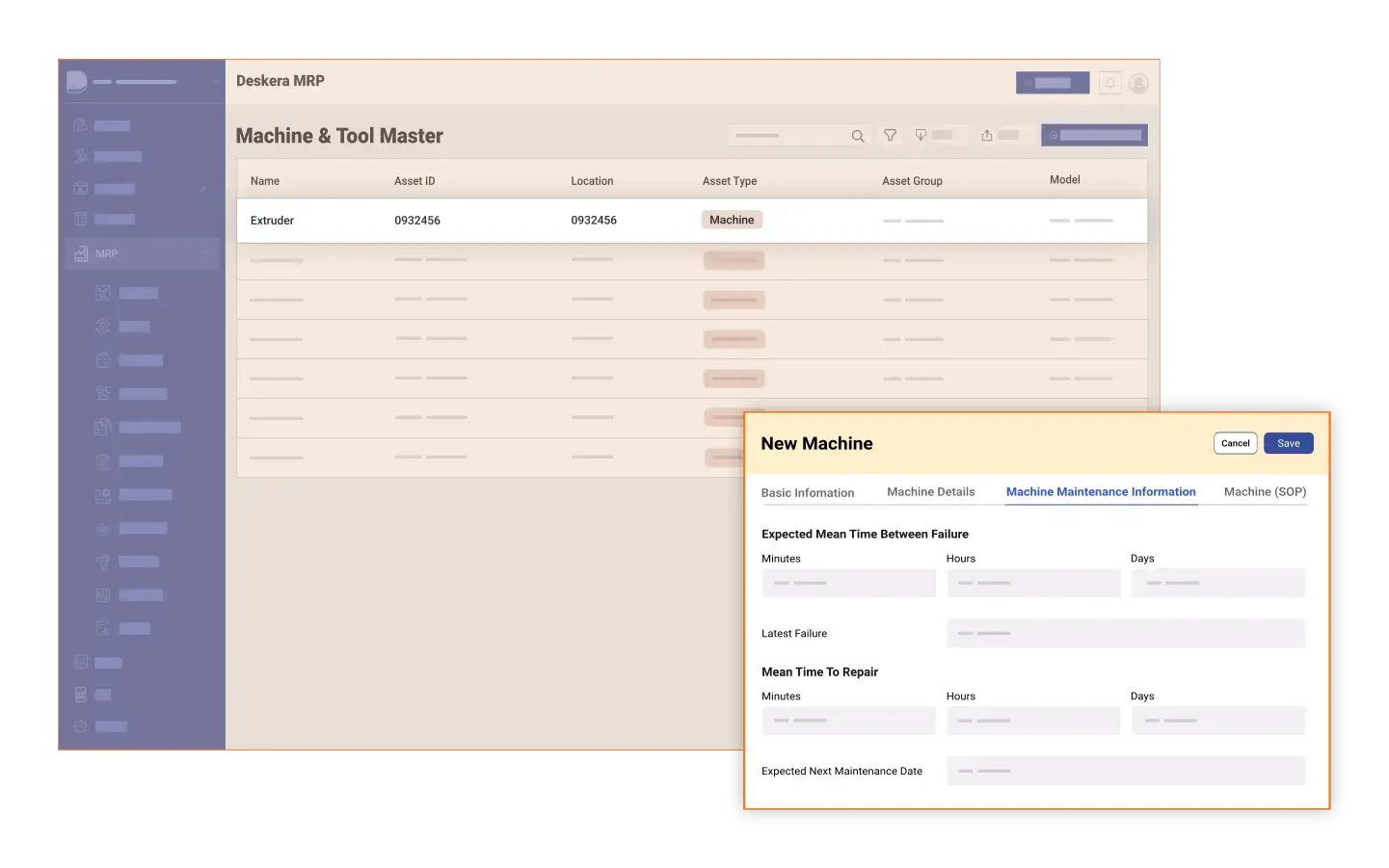
Efficient machine utilization requires real-time production visibility, accurate planning, proactive maintenance, and seamless coordination between manufacturing processes. Deskera MRP helps manufacturers improve equipment productivity by integrating production planning, inventory management, maintenance tracking, and operational analytics into a centralized platform. With better visibility into machine performance and production workflows, businesses can reduce downtime, optimize scheduling, and maximize manufacturing efficiency.
Real-Time Production Monitoring
Deskera MRP provides real-time visibility into shop floor operations, allowing manufacturers to monitor machine activity, production status, downtime, and operational performance from a centralized dashboard. Real-time insights help production managers quickly identify inefficiencies, respond to disruptions, and improve machine productivity across manufacturing processes.
Automated Production Planning and Scheduling
Efficient scheduling is critical for maximizing machine utilization. Deskera MRP helps businesses automate production planning by aligning machine availability, workforce allocation, inventory levels, and production demand. Automated scheduling reduces idle time, minimizes production bottlenecks, and ensures better utilization of manufacturing resources.
Preventive Maintenance Management
Unexpected equipment failures can significantly reduce machine utilization and disrupt production workflows. Deskera MRP supports preventive maintenance scheduling, helping manufacturers perform timely inspections, servicing, and repairs before major breakdowns occur. Proactive maintenance management improves equipment reliability, reduces unplanned downtime, and extends machinery lifespan.
Downtime Tracking and Analysis
Tracking downtime is essential for identifying operational inefficiencies and recurring machine issues. Deskera MRP helps manufacturers record and analyze downtime events, maintenance history, and production interruptions. Detailed reporting enables businesses to identify root causes of downtime and implement corrective actions that improve machine performance.
Inventory and Material Synchronization
Machine idle time often occurs because of delayed raw materials or inventory shortages. Deskera MRP integrates inventory management with production operations, ensuring materials are available when needed for manufacturing processes. Better inventory synchronization helps maintain uninterrupted production workflows and supports higher equipment utilization.
Advanced Analytics and Performance Reporting
Deskera MRP provides advanced reporting and analytics tools that help manufacturers monitor key production metrics such as machine utilization, downtime trends, throughput, and operational efficiency. Data-driven insights support continuous improvement initiatives and help businesses make informed decisions to optimize manufacturing performance.
Improved Resource Allocation
Efficient machine utilization depends on proper coordination between equipment, labor, and production schedules. Deskera MRP helps manufacturers allocate resources more effectively by providing centralized visibility into production capacity, workforce requirements, and operational workloads. Better resource planning improves workflow efficiency and reduces equipment idle time.
Support for Smart Manufacturing and Automation
Modern manufacturing environments increasingly rely on automation, IoT devices, and real-time data collection to improve operational efficiency. Deskera MRP supports digital manufacturing initiatives by integrating production data, operational monitoring, and automated workflows into a unified system. This enables manufacturers to improve machine visibility, optimize production cycles, and enhance overall equipment effectiveness.
Better Decision-Making Through Centralized Data
Manufacturers often struggle with disconnected systems and fragmented operational data. Deskera MRP centralizes production, inventory, maintenance, and operational information into a single platform, enabling faster and more accurate decision-making. Centralized visibility helps businesses identify utilization gaps, improve operational planning, and maximize manufacturing productivity.
Key Takeaways
- Machine utilization measures how effectively manufacturing equipment is used during available production time and plays a critical role in improving operational efficiency.
- High machine utilization helps manufacturers increase production output, reduce downtime, lower operational costs, and maximize equipment productivity.
- Machine utilization works by comparing actual machine running time with scheduled production time to identify inefficiencies and productivity losses.
- Different types of machine utilization, including production, capacity, labor-assisted, and automated utilization, help manufacturers evaluate equipment performance across various operational environments.
- Key components such as machine availability, performance, quality output, maintenance efficiency, and production scheduling directly influence machine utilization levels.
- Machine utilization formulas and calculations help businesses measure equipment performance, track downtime, evaluate production capacity, and improve operational decision-making.
- Machine utilization and Overall Equipment Effectiveness (OEE) are closely related metrics that together provide deeper insights into equipment productivity and manufacturing efficiency.
- Important metrics such as downtime rate, idle time, throughput, MTBF, MTTR, production efficiency, and capacity utilization help manufacturers monitor machine performance more effectively.
- Factors such as unplanned downtime, excessive changeover times, poor production planning, equipment underutilization, and material shortages can significantly reduce machine utilization.
- Improving machine utilization delivers benefits such as increased throughput, reduced production costs, better product quality, enhanced equipment lifespan, and improved customer satisfaction.
- Strategies like real-time machine monitoring, preventive maintenance, automated production planning, cycle optimization, operator training, and OEE tracking help maximize equipment utilization.
- Manufacturers often face challenges such as aging equipment, lack of real-time visibility, workforce skill gaps, supply chain disruptions, and system integration issues when improving machine utilization.
- Modern technologies including IoT, automation, predictive maintenance, and data analytics play a major role in optimizing machine utilization in smart manufacturing environments.
- Continuous monitoring and analysis of machine utilization data help manufacturers identify inefficiencies, optimize workflows, and support long-term operational improvement initiatives.
- Deskera ERP helps manufacturers optimize machine utilization through real-time production monitoring, automated scheduling, preventive maintenance management, inventory synchronization, and advanced operational analytics.
Related Articles
 Niti Samani
 Niti Samani
 Niti Samani
 Niti Samani
 Niti Samani
 Niti Samani
Have you ever wondered how companies manage customer support, payroll, IT services, and other critical operations without expanding massive in-house teams? The answer often lies in Business Process Outsourcing (BPO). By outsourcing specific business functions to specialized third-party providers, companies can reduce operational costs, improve efficiency, access expert talent, and focus more on their core business goals.
Business Process Outsourcing (BPO) has become a strategic growth driver for organizations of all sizes. From handling customer service and accounting to managing HR and technical support, BPO allows businesses to streamline operations while maintaining high service quality. As digital transformation accelerates across industries, outsourcing is no longer just a cost-saving tactic—it has evolved into a powerful strategy for scalability, innovation, and global competitiveness.
However, managing outsourced operations effectively requires strong coordination, visibility, and real-time data access. Businesses must ensure smooth communication between internal teams and external service providers while maintaining control over workflows, compliance, and performance metrics. This is where integrated business management systems play a critical role in improving outsourcing efficiency and operational transparency.
Deskera ERP helps businesses manage outsourced operations through centralized workflow automation, real-time reporting, integrated accounting, inventory tracking, and cloud-based collaboration tools. With features like AI-powered insights, automated approvals, and end-to-end business visibility, Deskera enables companies to streamline vendor coordination, improve productivity, and make smarter operational decisions. In this guide, we will explore what BPO is, its types, benefits, challenges, industry applications, and how businesses can successfully implement outsourcing strategies for long-term growth.
What Is Business Process Outsourcing (BPO)?
Business Process Outsourcing (BPO) is the practice of hiring third-party service providers to handle specific business functions or operational processes on behalf of a company. These outsourced functions are usually non-core activities—tasks that are necessary for business operations but are not directly tied to the company’s primary products or services. BPO enables businesses to improve operational efficiency, reduce costs, access specialized expertise, and focus more on strategic growth initiatives.
Originally, BPO was primarily used in the manufacturing sector to streamline supply chain operations and improve production efficiency. Over time, however, outsourcing expanded far beyond manufacturing and is now widely adopted across industries such as healthcare, banking, eCommerce, telecommunications, pharmaceuticals, logistics, energy, and information technology. Today, businesses outsource a wide range of processes including customer support, payroll processing, accounting, data entry, procurement, IT services, digital marketing, and human resource management.
BPO services are generally divided into two major categories: back-office outsourcing and front-office outsourcing. Back-office BPO includes internal operational functions such as finance and accounting, procurement, inventory management, IT support, and HR administration. Front-office BPO focuses on customer-facing activities like technical support, sales, telemarketing, and customer service. Many modern BPO providers combine both front-office and back-office services to create a more integrated and efficient operational structure for businesses.
The growth of the BPO industry has been fueled by globalization, digital transformation, and advancements in technologies such as cloud computing, artificial intelligence (AI), automation, analytics, and chatbots. Businesses are no longer outsourcing solely to reduce labor costs; they are also seeking access to advanced technologies, skilled professionals, operational flexibility, and faster scalability. As competition continues to intensify across industries, BPO has become a strategic business solution that helps organizations improve customer experience, enhance productivity, and gain a competitive advantage in the global market.
BPO vs Outsourcing vs Managed Services
Although Business Process Outsourcing (BPO), outsourcing, and managed services are often used interchangeably, they are not the same. All three involve delegating certain business activities to external providers, but they differ in scope, responsibility, level of strategic involvement, and service delivery models.
Understanding these differences helps businesses choose the right operational strategy based on their goals, budget, and long-term requirements.
Types of Business Process Outsourcing (BPO)
Business Process Outsourcing (BPO) can be categorized based on the location of the outsourcing provider and the type of services being outsourced. Different types of BPO help businesses improve operational efficiency, reduce costs, access specialized expertise, and enhance customer service.
Understanding these categories enables organizations to choose the most suitable outsourcing strategy according to their operational goals and business requirements.
Onshore BPO (Domestic Outsourcing)
Onshore BPO refers to outsourcing business functions to a service provider located within the same country. This model helps businesses maintain better communication, cultural alignment, and regulatory compliance.
Companies often choose onshore outsourcing for customer service, accounting, and administrative functions where local language proficiency and market understanding are important. It also allows easier collaboration and faster issue resolution compared to overseas outsourcing models.
Nearshore BPO
Nearshore BPO involves outsourcing business operations to service providers located in neighboring or nearby countries. This outsourcing model offers businesses the advantage of lower operational costs while maintaining similar time zones, languages, and cultural compatibility.
Nearshore outsourcing improves communication efficiency and simplifies collaboration between teams. Companies commonly use nearshore BPO for IT support, software development, customer service, and technical assistance.
Offshore BPO
Offshore BPO occurs when a company outsources its business processes to a provider located in a distant foreign country. Businesses often use offshore outsourcing to reduce labor costs, access global talent, and achieve round-the-clock operations.
Common offshore BPO services include customer support, payroll processing, IT services, and data management. This model is widely adopted by organizations looking to improve scalability and operational flexibility.
Back-Office BPO
Back-office BPO focuses on outsourcing internal business functions that do not directly involve customer interactions. These tasks are essential for smooth business operations but are usually administrative in nature.
Common back-office services include accounting, payroll, human resources, procurement, inventory management, and data entry. Outsourcing these functions helps companies reduce administrative workloads, improve efficiency, and allow internal teams to focus on strategic business activities.
Front-Office BPO
Front-office BPO involves outsourcing customer-facing services to third-party providers. These functions directly impact customer experience and brand reputation.
Common front-office outsourcing services include customer support, technical assistance, telemarketing, sales support, and help desk operations.
Many businesses partner with specialized call centers and support agencies to improve service quality, provide 24/7 assistance, and manage customer interactions more effectively.
Knowledge Process Outsourcing (KPO)
Knowledge Process Outsourcing (KPO) refers to outsourcing specialized and knowledge-intensive tasks that require advanced expertise and analytical skills.
Unlike traditional BPO, KPO focuses on high-value activities such as market research, financial analysis, legal research, content development, and business consulting.
Companies use KPO services to gain access to industry experts, improve decision-making, and enhance innovation without expanding their internal workforce.
Legal Process Outsourcing (LPO)
Legal Process Outsourcing (LPO) is a specialized branch of KPO that involves outsourcing legal services to external professionals or firms.
Businesses and law firms use LPO providers for tasks such as contract drafting, legal documentation, compliance management, litigation support, and intellectual property research.
LPO helps organizations reduce legal operational costs while improving efficiency and access to experienced legal professionals.
Research Process Outsourcing (RPO)
Research Process Outsourcing (RPO) involves outsourcing research and analytical activities to specialized service providers. Businesses use RPO services for market research, investment analysis, product development research, and data analytics.
Industries such as healthcare, pharmaceuticals, finance, and technology frequently rely on RPO providers to support innovation, strategic planning, and informed business decision-making while reducing internal research costs.
IT-Enabled Services (ITES)
IT-Enabled Services (ITES) refer to outsourcing services delivered through internet-based systems and information technology infrastructure. These services include technical support, remote infrastructure management, cloud services, telecommunications support, and web-based customer assistance.
ITES enables businesses to improve operational efficiency, enhance digital capabilities, and access advanced technological expertise without investing heavily in internal IT infrastructure.
How Does Business Process Outsourcing (BPO) Work?
Business Process Outsourcing (BPO) works by transferring specific business functions or operational processes from an organization to an external service provider.
Companies outsource tasks that are essential but not part of their core business activities, allowing internal teams to focus on strategic growth and innovation.
The BPO process involves careful planning, vendor selection, workflow transition, and continuous performance monitoring to ensure efficiency and service quality.
Deciding to Adopt BPO
The first step in the BPO process is determining whether outsourcing is the right strategy for the business. Companies evaluate factors such as operational costs, resource availability, scalability needs, and business objectives before making this decision.
Small businesses may outsource due to limited expertise or staffing, while larger organizations often adopt BPO to improve efficiency, reduce overhead costs, and gain access to specialized skills and technologies.
Identifying Business Functions to Outsource
After deciding to implement BPO, businesses identify which functions are best suited for outsourcing. These are usually non-core processes such as customer support, payroll, accounting, IT services, procurement, or data management.
Organizations analyze how outsourcing these activities will affect workflows, technology infrastructure, compliance requirements, employee responsibilities, and overall business operations before moving forward with the outsourcing strategy.
Choosing the Right BPO Service Provider
Selecting the right outsourcing partner is one of the most critical stages in the BPO process. Businesses compare vendors based on expertise, industry experience, pricing, service quality, technology capabilities, and turnaround time.
Some companies outsource an entire department to a single vendor, while others divide tasks among multiple providers. The goal is to find a reliable partner that aligns with the organization’s operational requirements and long-term business goals.
Defining Contracts and Service-Level Agreements (SLAs)
Once a provider is selected, the company establishes a formal outsourcing agreement. The contract outlines the scope of work, pricing structure, timelines, responsibilities, confidentiality terms, and expected performance standards.
Businesses may choose fixed-price contracts, time-and-materials contracts, or performance-based agreements. Service-Level Agreements (SLAs) are also created to define measurable performance indicators such as response time, accuracy, service quality, and customer satisfaction.
Transferring Business Operations to the Vendor
After finalizing the contract, the organization begins transferring workflows and responsibilities to the BPO provider. This stage includes knowledge sharing, employee training, process documentation, technology integration, and communication planning.
A structured transition process is essential to minimize disruptions and ensure operational continuity. Effective collaboration between the company and the outsourcing provider helps create a smoother and more efficient implementation.
Managing Communication and Collaboration
Successful BPO operations depend heavily on consistent communication and collaboration between the company and the service provider. Businesses often use cloud-based platforms, project management tools, ERP systems, and real-time reporting software to monitor outsourced operations.
Regular meetings, performance reviews, and transparent communication help resolve issues quickly, improve coordination, and ensure that both parties remain aligned with business objectives.
Monitoring Vendor Performance
Once outsourcing operations are fully implemented, businesses continuously monitor vendor performance to ensure service quality and operational efficiency.
Organizations track key performance indicators (KPIs) such as turnaround time, cost savings, customer satisfaction, productivity, and error rates.
Regular evaluations help businesses determine whether the outsourcing arrangement is meeting expectations and whether adjustments, renewals, or contract modifications are required.
Improving and Scaling BPO Operations
As business needs evolve, companies may expand or optimize their outsourcing strategies. Businesses often scale outsourced operations to support growth, enter new markets, improve customer service, or adopt advanced technologies such as automation and artificial intelligence.
Continuous improvement and performance analysis help organizations maximize the long-term value of BPO while maintaining flexibility and operational efficiency.
Benefits of Business Process Outsourcing (BPO)
Business Process Outsourcing (BPO) offers organizations a strategic way to improve operational efficiency, reduce costs, and gain access to specialized expertise without expanding internal resources.
By outsourcing non-core business functions to experienced service providers, companies can focus more on innovation, customer experience, and long-term growth.
As digital transformation continues to reshape industries, BPO has become an important business strategy for organizations seeking flexibility, scalability, and competitive advantage.
Reduced Operational Costs
One of the biggest advantages of BPO is cost reduction. Outsourcing helps businesses lower expenses related to hiring, training, salaries, infrastructure, and employee benefits.
Companies can also reduce operational overhead by using fee-based service models instead of maintaining full-time in-house teams. Offshore outsourcing further helps businesses access lower labor costs while maintaining service quality and operational efficiency.
Greater Focus on Core Business Functions
BPO allows organizations to focus their time, resources, and attention on core business activities that directly contribute to growth and profitability.
Instead of spending valuable resources managing administrative or repetitive tasks, businesses can prioritize innovation, product development, customer engagement, and strategic planning.
This improved focus helps companies strengthen their competitive advantage and enhance overall business performance.
Improved Efficiency and Productivity
BPO providers specialize in specific business functions and often use advanced technologies, standardized workflows, and industry best practices to deliver services more efficiently.
Their expertise enables faster task completion, improved accuracy, and higher productivity levels. By outsourcing routine operations to experienced professionals, companies can streamline processes and improve overall operational performance without increasing internal workloads.
Access to Specialized Expertise
Outsourcing partners typically employ skilled professionals with expertise in areas such as accounting, customer support, IT services, HR management, and analytics.
Businesses gain access to specialized knowledge and industry experience without investing heavily in recruitment or training. This allows organizations to improve service quality and leverage professional capabilities that may not be available internally.
Access to Advanced Technologies
Many BPO providers invest in modern technologies such as artificial intelligence (AI), automation, cloud computing, analytics, and customer relationship management (CRM) systems.
By outsourcing business functions, companies can access these advanced tools and technologies without making large infrastructure investments. This helps businesses improve efficiency, automate workflows, and remain competitive in rapidly evolving markets.
Increased Business Flexibility and Scalability
BPO provides businesses with the flexibility to scale operations up or down based on changing market demands and business requirements.
Companies can quickly adapt to seasonal fluctuations, expansion plans, or unexpected increases in workload without hiring additional staff or investing in new infrastructure.
This flexibility enables organizations to respond faster to market opportunities and operational challenges.
Faster Global Expansion
BPO providers often operate across multiple countries and regions, making it easier for businesses to expand into international markets.
Outsourcing partners can provide multilingual customer support, local market expertise, and region-specific operational knowledge.
This helps companies establish a global presence more efficiently while reducing the complexity and cost associated with international expansion.
Better Customer Service and 24/7 Support
Many outsourcing providers offer round-the-clock customer support services across multiple channels and languages.
This improves customer satisfaction by ensuring faster response times, continuous support availability, and consistent service quality.
Businesses can deliver better customer experiences without building large in-house support teams, especially when serving customers across different time zones.
Reduced Compliance and Operational Risks
BPO providers are often experienced in industry regulations, compliance requirements, and risk management practices.
Outsourcing functions such as payroll, HR, finance, and legal processes helps businesses reduce the risk of compliance errors, penalties, and operational disruptions.
Companies also benefit from expert guidance and updated regulatory knowledge provided by outsourcing specialists.
More Time for Strategic Decision-Making
By outsourcing repetitive and time-consuming operational tasks, businesses can free up management teams to focus on long-term planning and strategic initiatives.
Instead of handling routine administrative work, leadership teams can concentrate on innovation, market expansion, customer relationships, and business development.
This strategic focus supports sustainable growth and stronger organizational performance.
Drawbacks of Business Process Outsourcing (BPO)
While Business Process Outsourcing (BPO) offers significant benefits such as cost savings, scalability, and operational efficiency, it also comes with certain challenges and risks. Businesses that outsource critical operations may face issues related to communication, security, vendor dependency, and service quality.
Understanding these drawbacks helps organizations develop better outsourcing strategies, minimize risks, and maintain stronger control over outsourced business processes.
Data Security and Privacy Risks
One of the biggest concerns associated with BPO is the risk of data breaches and privacy issues. Outsourcing often requires companies to share sensitive customer, financial, or operational information with third-party providers.
When data is transferred across networks or international borders, the chances of cyberattacks, hacking attempts, and unauthorized access can increase. Different countries may also have varying data protection laws and security standards.
Communication and Language Barriers
Communication challenges are common in outsourcing arrangements, especially in offshore BPO models. Differences in language, accents, business practices, and cultural expectations can create misunderstandings and delays.
Poor communication may affect service quality, project timelines, customer support interactions, and collaboration between internal teams and external vendors. These issues can become more significant when multiple departments and stakeholders are involved.
Hidden and Unforeseen Costs
Although outsourcing is primarily adopted to reduce operational costs, businesses sometimes underestimate the actual expenses involved.
Hidden costs may arise from vendor selection, contract renegotiations, technology upgrades, employee transition processes, legal disputes, training requirements, or delayed project delivery.
Currency fluctuations and additional service charges can also increase overall outsourcing expenses beyond the original budget expectations.
Overdependence on External Vendors
Long-term outsourcing relationships can create excessive dependence on third-party providers. When a vendor becomes deeply integrated into business operations, replacing them or bringing processes back in-house can become difficult and expensive.
Businesses may also face operational disruptions if the outsourcing provider experiences staffing shortages, financial issues, poor performance, or service interruptions.
Quality Control Challenges
Maintaining consistent service quality can sometimes be difficult in BPO arrangements. Some outsourcing providers may prioritize cost reduction over service excellence by replacing experienced staff with less skilled employees or handling large workloads with limited resources.
This can negatively affect productivity, customer satisfaction, accuracy, and operational performance if businesses do not regularly monitor vendor performance and establish clear quality standards.
Regulatory and Compliance Issues
Organizations remain responsible for meeting industry regulations and compliance requirements even when operations are outsourced.
Different countries may follow different labor laws, tax regulations, data privacy standards, and compliance practices.
Failure by a BPO provider to meet these requirements can expose businesses to legal penalties, financial losses, and reputational damage.
Increased Risk of Business Disruptions
Outsourcing operations to external vendors can increase vulnerability to disruptions caused by political instability, economic uncertainty, natural disasters, cybersecurity incidents, or infrastructure failures in the provider’s location.
If the outsourcing partner experiences operational problems, the client company’s business activities may also be interrupted. This makes risk management and business continuity planning essential in BPO relationships.
Reduced Direct Control Over Operations
When companies outsource business functions, they lose a certain level of direct control over processes, employees, and service delivery.
Businesses may find it harder to enforce internal standards, monitor day-to-day activities, or quickly implement operational changes.
Limited visibility into outsourced operations can sometimes create delays in decision-making and issue resolution.
Potential Impact on Brand Reputation
Poor service quality, security incidents, or customer dissatisfaction caused by outsourcing providers can negatively affect a company’s reputation.
In customer-facing functions such as technical support or customer service, the outsourcing partner directly represents the brand.
Any negative customer experiences or operational failures can reduce customer trust and harm the company’s public image.
Employee Morale and Public Backlash
Outsourcing certain business functions may create concerns among internal employees regarding job security and organizational stability.
In some cases, businesses may also face criticism from customers or the public if outsourcing is perceived as replacing local jobs to reduce costs.
These concerns can impact employee morale, workplace culture, and brand perception if not managed carefully.
Best Practices for Successful BPO Implementation
Implementing Business Process Outsourcing (BPO) successfully requires more than simply transferring tasks to an external provider.
Businesses must carefully plan their outsourcing strategy, select the right vendor, establish clear expectations, and continuously monitor performance to maximize value.
A well-managed BPO implementation helps organizations improve efficiency, reduce operational risks, enhance service quality, and achieve long-term business goals.
Clearly Define Business Objectives
Before outsourcing any business process, organizations should clearly identify their goals and expectations.
Businesses need to determine whether they are outsourcing to reduce costs, improve efficiency, access specialized expertise, enhance customer service, or support expansion.
Defining measurable objectives helps companies choose the right outsourcing strategy and evaluate the success of the BPO partnership more effectively.
Choose the Right BPO Service Provider
Selecting the right outsourcing partner is one of the most important factors in successful BPO implementation.
Businesses should evaluate vendors based on industry expertise, service quality, technology capabilities, scalability, pricing structure, security standards, and client reviews.
A reliable provider should understand the company’s business requirements and demonstrate the ability to deliver consistent and high-quality services.
Start With Non-Core Business Functions
Organizations should initially outsource non-core activities that do not directly affect their primary value proposition. Functions such as payroll processing, data entry, accounting, customer support, and IT help desk services are commonly outsourced first.
Starting with less critical operations allows businesses to evaluate vendor performance, improve workflows, and reduce implementation risks before expanding outsourcing efforts.
Establish Clear Service-Level Agreements (SLAs)
Service-Level Agreements (SLAs) are essential for setting clear expectations between the company and the outsourcing provider.
SLAs should define performance metrics, response times, quality standards, reporting requirements, confidentiality terms, and escalation procedures.
Well-structured SLAs help ensure accountability, simplify performance evaluation, and reduce misunderstandings throughout the outsourcing relationship.
Prioritize Data Security and Compliance
Since outsourcing often involves sharing sensitive business and customer information, companies must implement strong data security and compliance measures.
Businesses should verify that BPO providers follow industry regulations, cybersecurity standards, and data privacy laws.
Regular audits, secure communication systems, access controls, and confidentiality agreements help minimize security risks and protect critical business information.
Maintain Strong Communication and Collaboration
Effective communication is critical for successful BPO operations. Businesses should establish regular communication channels, reporting schedules, and feedback mechanisms with outsourcing providers.
Frequent meetings, real-time collaboration tools, and transparent discussions help improve coordination, resolve issues quickly, and maintain alignment between both parties. Strong communication also reduces misunderstandings caused by cultural or language differences.
Develop a Structured Transition Plan
A smooth transition process is essential when transferring business operations to a BPO provider.
Companies should create a detailed implementation plan that includes workflow documentation, employee training, technology integration, knowledge transfer, and timeline management.
A phased transition approach helps reduce disruptions, maintain service continuity, and improve operational stability during the outsourcing process.
Continuously Monitor Vendor Performance
Businesses should regularly evaluate the performance of outsourcing providers using key performance indicators (KPIs) and service benchmarks.
Metrics such as turnaround time, customer satisfaction, error rates, cost savings, and productivity levels help organizations measure outsourcing effectiveness.
Ongoing monitoring enables companies to identify performance gaps, optimize workflows, and ensure service quality standards are consistently maintained.
Use Technology for Better Visibility and Automation
Integrating technologies such as ERP systems, cloud platforms, automation tools, and analytics software improves visibility and control over outsourced operations.
Real-time dashboards, workflow tracking, and automated reporting help businesses monitor vendor activities, improve collaboration, and make data-driven decisions.
Technology integration also enhances operational efficiency and simplifies communication between internal teams and outsourcing providers.
Build Long-Term Strategic Partnerships
Successful BPO relationships are built on trust, transparency, and long-term collaboration rather than short-term cost savings alone.
Businesses should work closely with outsourcing providers to improve processes, share feedback, and align operational goals.
Developing a strategic partnership encourages innovation, improves service quality, and creates greater long-term value for both organizations.
Important KPIs to Measure BPO Performance
Measuring Business Process Outsourcing (BPO) performance is essential for ensuring that outsourcing operations align with business objectives and deliver the expected results.
Key Performance Indicators (KPIs) help organizations evaluate service quality, operational efficiency, cost savings, customer satisfaction, and vendor performance.
Tracking the right KPIs enables businesses to identify improvement areas, optimize outsourcing strategies, and maintain accountability across outsourced operations.
Cost Savings Percentage
Cost savings percentage measures how much money a business saves through outsourcing compared to managing the same operations in-house. This KPI helps organizations evaluate the financial effectiveness of their BPO strategy.
Businesses typically compare operational costs before and after outsourcing to determine whether the outsourcing partnership is delivering the expected return on investment and long-term cost efficiency.
Service-Level Agreement (SLA) Compliance
SLA compliance measures how effectively the BPO provider meets the agreed service standards outlined in the contract. This KPI tracks metrics such as response times, resolution times, service availability, and task completion rates.
High SLA compliance indicates reliable vendor performance, while repeated SLA failures may signal operational inefficiencies, communication issues, or the need for contract adjustments.
Customer Satisfaction Score (CSAT)
Customer Satisfaction Score (CSAT) evaluates how satisfied customers are with the services delivered by outsourced teams. Businesses often collect customer feedback through surveys, ratings, or post-service evaluations.
This KPI is especially important for customer-facing BPO functions such as technical support, call centers, and help desk services, where service quality directly impacts customer experience and brand reputation.
First Response Time (FRT)
First Response Time measures how quickly outsourced teams respond to customer inquiries, service requests, or support tickets. Faster response times improve customer satisfaction and operational efficiency.
This KPI is commonly used in customer support and IT service outsourcing to evaluate how effectively the BPO provider handles incoming requests and maintains service responsiveness.
Average Resolution Time
Average Resolution Time tracks the amount of time required to fully resolve customer issues or complete specific tasks. A lower resolution time generally indicates better process efficiency and stronger vendor performance.
Monitoring this KPI helps businesses assess how effectively outsourced teams manage workloads, handle customer concerns, and deliver timely solutions.
Productivity and Efficiency Metrics
Productivity KPIs measure the output generated by outsourced teams within a specific time frame.
These metrics may include tasks completed per employee, number of support tickets handled, transaction processing speed, or operational throughput.
Tracking productivity helps businesses determine whether outsourcing providers are operating efficiently and meeting expected performance targets.
Error Rate and Accuracy Levels
Error rate measures the frequency of mistakes, inaccuracies, or quality issues in outsourced operations. This KPI is particularly important in finance, payroll, data entry, accounting, and compliance-related functions where accuracy is critical.
Lower error rates indicate better process control, stronger quality assurance practices, and higher operational reliability.
Customer Retention Rate
Customer retention rate measures how effectively a business retains customers after outsourcing customer-facing services. Strong retention rates often indicate positive customer experiences and consistent service quality provided by the BPO partner.
Declining retention rates may suggest service issues, communication problems, or customer dissatisfaction that require immediate attention.
Employee Turnover Rate
Employee turnover rate within the BPO provider’s workforce can significantly impact service consistency and operational stability. High turnover rates may lead to lower productivity, reduced service quality, and increased training costs.
Monitoring this KPI helps businesses assess workforce stability and the provider’s ability to maintain experienced and skilled personnel.
Compliance and Security Metrics
Compliance-related KPIs measure how effectively the BPO provider follows regulatory requirements, security standards, and data protection policies.
Metrics may include audit success rates, security incident frequency, policy violations, and regulatory compliance scores.
These KPIs are critical for businesses outsourcing sensitive functions such as finance, healthcare, legal services, and customer data management.
Turnaround Time (TAT)
Turnaround Time measures the total time taken to complete a task, process, or customer request from start to finish. Faster turnaround times improve operational efficiency and customer experience.
This KPI is widely used in outsourced services such as claims processing, payroll management, technical support, and order fulfillment operations.
Return on Investment (ROI)
Return on Investment (ROI) measures the overall value generated from outsourcing compared to the total cost of the BPO engagement.
This KPI considers factors such as cost savings, productivity improvements, service quality, operational efficiency, and business growth.
A positive ROI indicates that the outsourcing strategy is delivering measurable business benefits and supporting long-term organizational goals.
How Deskera ERP Helps You Manage Business Process Outsourcing (BPO)
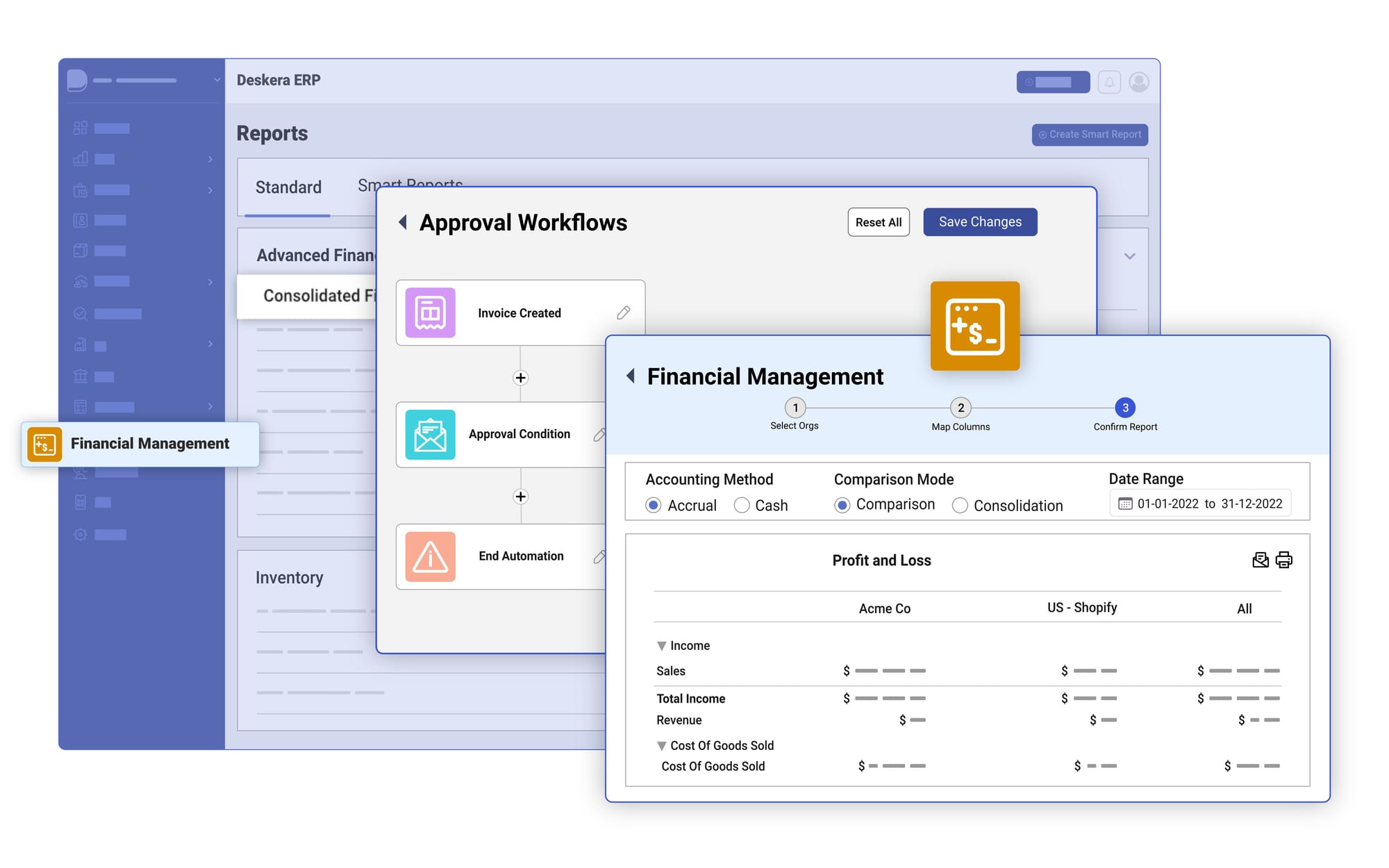
Managing outsourced business operations requires strong coordination, process visibility, real-time communication, and centralized data management. Businesses working with BPO providers must ensure that outsourced teams remain aligned with operational goals, compliance requirements, and performance expectations. Deskera ERP helps businesses streamline outsourced operations through integrated workflows, automation, cloud-based collaboration, and real-time business intelligence.
Centralized Management of Business Operations
Deskera ERP centralizes core business functions such as accounting, procurement, inventory management, payroll, CRM, customer service, and HR operations into a single platform. This unified system helps businesses maintain better control and visibility over outsourced processes while reducing operational silos and communication gaps between internal teams and BPO providers.
Automated Workflow and Process Management
Deskera ERP provides workflow automation features that help businesses standardize outsourced operations and reduce manual intervention. Companies can automate approvals, purchase orders, invoicing, inventory updates, payroll processing, and financial reporting. Automated workflows improve operational consistency, reduce errors, and ensure outsourced tasks are completed more efficiently and accurately.
Real-Time Reporting and Performance Monitoring
Businesses outsourcing critical functions need continuous visibility into vendor performance and operational efficiency. Deskera ERP offers real-time dashboards, smart reports, analytics, and business intelligence tools that help organizations monitor KPIs, track productivity, evaluate SLA compliance, and identify operational bottlenecks. This enables businesses to make faster, data-driven decisions regarding outsourced operations.
Improved Collaboration With BPO Providers
Since BPO operations often involve multiple teams working across locations, communication and collaboration are essential. Deskera ERP’s cloud-based platform enables secure access to shared data, workflows, customer information, procurement records, and operational updates. This improves coordination between businesses and outsourcing providers while ensuring smoother communication and faster issue resolution.
Better Financial and Accounting Control
Deskera ERP simplifies outsourced finance and accounting operations by automating accounts receivable, accounts payable, bank reconciliation, invoicing, budgeting, forecasting, and financial reporting. Businesses can maintain accurate financial records, improve cash flow visibility, and strengthen financial controls while working with outsourced accounting or payroll service providers.
Streamlined Procurement and Supply Chain Operations
For businesses outsourcing procurement, logistics, or supply chain functions, Deskera ERP helps optimize purchasing workflows, vendor management, inventory tracking, and warehouse operations. Features such as automated purchase requisitions, approval workflows, stock monitoring, and order fulfillment improve operational efficiency and reduce delays in outsourced supply chain processes.
Enhanced Inventory and Warehouse Visibility
Deskera ERP offers real-time inventory tracking, warehouse management, barcode scanning, stock alerts, and fulfillment tracking features that improve visibility across outsourced inventory and logistics operations. Businesses can monitor inventory movement, maintain accurate stock levels, and coordinate better with third-party logistics or warehouse providers.
Scalability for Growing Business Operations
As businesses expand, outsourcing requirements often increase as well. Deskera ERP’s cloud-based infrastructure allows companies to scale operations efficiently without major infrastructure investments. Businesses can easily add users, integrate additional modules, and support growing outsourced workflows while maintaining operational visibility and process control.
Improved Operational Efficiency Through Automation
Deskera ERP integrates automation, reporting, CRM, inventory, accounting, and customer service capabilities into a single ecosystem. This reduces process duplication, minimizes manual work, improves turnaround times, and increases operational efficiency across outsourced functions. Businesses can streamline BPO operations while improving productivity and customer satisfaction.
Key Takeaways
- Business Process Outsourcing (BPO) involves hiring third-party providers to manage non-core business functions, helping companies improve efficiency and focus on strategic growth.
- BPO services are broadly categorized into front-office and back-office functions, covering areas such as customer support, accounting, HR, payroll, IT services, and procurement.
- Businesses can choose between onshore, nearshore, and offshore BPO models depending on their operational goals, budget, communication requirements, and geographic preferences.
- Specialized outsourcing models such as KPO, LPO, RPO, and ITES help organizations access advanced expertise, research capabilities, legal support, and technology-driven services.
- BPO works through a structured process that includes identifying outsourcing needs, selecting vendors, establishing SLAs, transferring operations, and continuously monitoring performance.
- Unlike general outsourcing or managed services, BPO focuses on end-to-end business process management and operational efficiency improvement.
- One of the biggest benefits of BPO is cost reduction through lower labor expenses, reduced infrastructure investment, and flexible service-based pricing models.
- Outsourcing non-core operations enables businesses to focus more on innovation, customer experience, business expansion, and other core competencies.
- BPO providers improve efficiency and productivity by using specialized expertise, advanced technologies, standardized workflows, and automation tools.
- Outsourcing gives businesses access to technologies such as AI, cloud computing, analytics, automation, and CRM systems without requiring large internal investments.
- BPO also supports scalability and global expansion by providing multilingual support, operational flexibility, and 24/7 service capabilities.
- Despite its benefits, BPO comes with risks such as data security concerns, communication barriers, vendor dependency, hidden costs, and reduced operational control.
- Businesses must carefully manage compliance, cybersecurity, and vendor relationships to reduce outsourcing risks and maintain service quality.
- Successful BPO implementation requires clear business objectives, strong SLAs, effective communication, secure data management, and continuous performance monitoring.
- Tracking KPIs such as cost savings, SLA compliance, customer satisfaction, turnaround time, productivity, and ROI helps businesses evaluate outsourcing effectiveness.
- ERP systems play a crucial role in managing outsourced operations by improving visibility, workflow automation, collaboration, and real-time performance tracking.
- Deskera ERP helps businesses streamline BPO operations through integrated accounting, inventory management, workflow automation, reporting, HR management, and cloud-based collaboration tools.
Related Articles
 Niti Samani
 Niti Samani
 Niti Samani
 Niti Samani
 Niti Samani
 Niti Samani
Have you ever wondered why some business investments generate massive profits while others lead to unexpected losses? The answer often lies in one critical process: cost-benefit analysis (CBA). Before launching a new project, purchasing equipment, implementing software, or expanding operations, successful businesses carefully compare expected costs with potential benefits. This structured approach helps organizations make informed decisions that maximize profitability while minimizing financial risks.
Cost-benefit analysis is a powerful decision-making technique that evaluates whether the benefits of a business action outweigh its associated costs. It enables companies to identify profitable opportunities, allocate resources effectively, and avoid unnecessary expenditures. From manufacturing and supply chain management to technology adoption and workforce planning, businesses across industries rely on CBA to support smarter and more strategic decisions.
In today’s highly competitive market, making decisions based on assumptions alone can be costly. Businesses need accurate data, real-time insights, and financial visibility to assess investments with confidence. A well-executed cost-benefit analysis not only improves operational efficiency and financial planning but also helps organizations measure long-term value, evaluate risks, and prioritize initiatives that drive sustainable growth.
This is where Deskera ERP can make a significant difference. Deskera ERP helps businesses streamline financial management, track operational costs, monitor inventory, and generate real-time reports from a centralized platform. With advanced analytics, automation features, and forecasting capabilities, businesses can perform more accurate cost-benefit analyses and make faster, data-driven decisions. By improving visibility across departments, Deskera ERP empowers organizations to optimize investments, reduce inefficiencies, and improve overall profitability.
What Is Cost-Benefit Analysis?
Cost-benefit analysis (CBA) is a systematic and data-driven process used to evaluate whether a business decision, project, or investment is financially worthwhile. It involves comparing the total expected costs of a project with its anticipated benefits to determine if the potential returns justify the investment. By assigning monetary values to both costs and benefits, businesses can make more informed and objective decisions rather than relying on assumptions or intuition.
In simple terms, cost-benefit analysis helps organizations answer a critical question: Do the benefits outweigh the costs? If the projected benefits are greater than the associated costs, the project is generally considered viable and worth pursuing. However, if the costs exceed the expected benefits, businesses may choose to modify the plan, explore alternatives, or avoid the investment altogether.
A cost-benefit analysis typically considers both tangible and intangible factors. Tangible costs may include equipment purchases, labor expenses, software investments, operational costs, and maintenance fees. Tangible benefits often include increased revenue, reduced operational expenses, higher productivity, or improved efficiency. At the same time, businesses also evaluate intangible elements such as customer satisfaction, employee morale, brand reputation, and long-term strategic value.
Another important component of CBA is opportunity cost, which refers to the potential benefits a business may lose when choosing one option over another. By analyzing opportunity costs alongside direct expenses and expected returns, organizations gain a more comprehensive understanding of the trade-offs involved in decision-making.
The process of conducting a cost-benefit analysis generally involves defining the project scope, identifying all relevant costs and benefits, assigning monetary values, calculating metrics such as net present value (NPV) or benefit-cost ratio, analyzing risks, and comparing the final outcomes. This structured approach allows businesses to forecast profitability, minimize financial risks, and allocate resources more effectively.
Today, cost-benefit analysis is widely used across industries for project planning, budgeting, technology investments, supply chain improvements, process optimization, and strategic decision-making. Whether a company is considering implementing new ERP software, expanding production capacity, launching a new product, or automating operations, CBA provides a reliable framework for evaluating feasibility and maximizing business value.
Key Components of Cost-Benefit Analysis
A successful cost-benefit analysis (CBA) depends on evaluating several critical components that help businesses accurately compare the total costs and expected benefits of a project or decision. These components provide a structured framework for assessing financial feasibility, profitability, and long-term business value.
Costs
Costs represent all the expenses and negative impacts associated with a project, investment, or business decision. Identifying every potential cost is essential for conducting an accurate analysis.
Direct Costs
Direct costs are expenses directly tied to the production of a product, service, or project. These may include labor, raw materials, equipment, manufacturing expenses, and operational costs that can be clearly traced to the initiative.
Indirect Costs
Indirect costs are expenses that support the project but are not directly linked to production activities. Examples include office rent, utilities, administrative salaries, maintenance expenses, and other overhead costs that contribute to overall business operations.
Intangible Costs
Intangible costs are difficult to measure financially but can still significantly impact the business. These may include reduced employee productivity, customer dissatisfaction, reputational damage, workflow disruptions, or decreased employee morale during project implementation.
Opportunity Costs
Opportunity costs refer to the potential benefits a business sacrifices when choosing one option over another. For example, investing resources in one project may prevent the company from pursuing another potentially profitable opportunity.
7 Steps for Conducting a Cost-Benefit Analysis
Conducting a cost-benefit analysis (CBA) helps businesses evaluate whether a project, investment, or strategic decision is financially worthwhile. By systematically comparing expected costs with anticipated benefits, organizations can reduce risks, improve resource allocation, and make data-driven decisions.
Below are the key steps involved in performing an effective cost-benefit analysis.
Step 1: Define the Project Scope and Objectives
The first step in a cost-benefit analysis is clearly defining the purpose, scope, and goals of the project or decision. Businesses should identify what they want to achieve, establish timelines, determine required resources, and understand project constraints. Involving key stakeholders at this stage ensures the analysis aligns with operational, financial, and strategic objectives.
Step 2: Identify All Project Costs
Once the project scope is established, businesses must identify all potential costs associated with the initiative. This includes direct costs such as labor, equipment, and materials, as well as indirect costs like utilities, rent, and administrative expenses. Organizations should also consider intangible costs, opportunity costs, recurring expenses, and potential financial or operational risks.
Step 3: Identify Expected Benefits
The next step is to determine the potential benefits the project may generate. Benefits can include increased revenue, cost savings, improved productivity, higher customer satisfaction, enhanced employee morale, or stronger market positioning. Both tangible and intangible benefits should be considered to ensure the analysis captures the project’s overall business value and long-term impact.
Step 4: Assign Monetary Values to Costs and Benefits
After identifying costs and benefits, businesses must assign financial values to each factor to make comparisons easier. Direct financial impacts are usually straightforward to calculate, while intangible factors may require estimates or forecasting models. Using a common monetary unit allows organizations to objectively measure profitability, expected returns, and overall financial feasibility.
Step 5: Perform Cost-Benefit Calculations
At this stage, businesses calculate and compare the total projected costs and benefits of the project. This may involve determining net profit, benefit-cost ratio, return on investment (ROI), payback period, or net present value (NPV). These calculations help decision-makers understand whether the expected benefits outweigh the costs and if the investment is financially viable.
Step 6: Analyze Risks and Alternative Scenarios
A thorough cost-benefit analysis should also account for uncertainty and potential risks. Businesses often perform sensitivity analysis, scenario planning, or risk assessments to evaluate how changing assumptions may impact outcomes. Considering best-case, worst-case, and realistic scenarios helps organizations make more informed decisions and prepare for possible operational or financial challenges.
Step 7: Make Recommendations and Implement Decisions
The final step is interpreting the analysis results and deciding whether to proceed with the project. If the projected benefits exceed the costs and align with business goals, the project may move forward. However, organizations should also consider factors such as available capital, strategic priorities, resource limitations, and long-term sustainability before implementation.
Cost-Benefit Analysis Formula
Cost-benefit analysis uses financial formulas to determine whether a project, investment, or business decision is worth pursuing. These formulas help organizations compare projected costs with expected returns, measure profitability, and evaluate financial feasibility.
The most commonly used cost-benefit analysis formulas are Benefit-Cost Ratio (BCR), Net Present Value (NPV), Return on Investment (ROI), and Net Benefit.
Benefit-Cost Ratio (BCR)
The Benefit-Cost Ratio compares the total expected benefits of a project with its total projected costs. It helps businesses determine whether the financial returns justify the investment.
Formula: BCR = Present Value of Benefits ÷ Present Value of Costs
Interpretation:
- BCR greater than 1 = Benefits outweigh costs
- BCR equal to 1 = Break-even point
- BCR less than 1 = Costs outweigh benefits
For example, a BCR of 1.8 means the business is expected to generate ₹1.80 in benefits for every ₹1 invested.
Net Present Value (NPV)
Net Present Value measures the difference between the present value of expected benefits and the present value of project costs. It considers the time value of money, making it highly useful for long-term investment decisions.
Formula: NPV = Present Value of Benefits − Present Value of Costs
Interpretation:
- Positive NPV = Project is financially viable
- Negative NPV = Project may not be profitable
- Higher NPV = Greater expected profitability
Businesses commonly use NPV to evaluate capital investments, expansion projects, equipment purchases, and technology implementations.
Return on Investment (ROI)
Return on Investment calculates the profitability of an investment as a percentage. It helps businesses measure how efficiently their investment generates returns.
Formula: ROI = (Net Benefits ÷ Total Costs) × 100
Interpretation:
- Higher ROI indicates better investment performance
- Positive ROI shows profitable returns
- Negative ROI suggests financial loss
ROI is widely used to compare multiple projects and identify investments with the highest potential returns.
Net Benefit Formula
The Net Benefit formula provides a simple way to calculate the overall financial gain or loss from a project by subtracting total costs from total benefits.
Formula: Net Benefit = Total Benefits − Total Costs
Interpretation:
- Positive result = Profitable project
- Negative result = Financial loss
- Zero result = Break-even outcome
This formula offers a quick overview of whether a project delivers overall value to the business.
Why These Formulas Matter
Together, these formulas provide businesses with a comprehensive framework for evaluating investment opportunities and strategic decisions. While BCR measures the balance between costs and benefits, NPV evaluates long-term financial value, ROI measures profitability efficiency, and Net Benefit highlights the project’s overall financial outcome. Using these formulas helps organizations make more accurate, data-driven, and financially sound decisions.
Benefits of Cost-Benefit Analysis
Cost-benefit analysis (CBA) provides businesses with a structured and data-driven framework for evaluating decisions, investments, and projects. By comparing projected costs with expected benefits, organizations can improve decision-making, reduce risks, and maximize profitability.
Below are some of the key benefits of conducting a cost-benefit analysis.
Supports Data-Driven Decision-Making
Cost-benefit analysis helps businesses make decisions based on measurable data rather than assumptions or intuition. By evaluating financial and operational impacts objectively, organizations can choose strategies that deliver the highest value. This evidence-based approach reduces bias and improves the overall quality of business decisions.
Simplifies Complex Business Decisions
Business decisions often involve multiple variables, risks, and uncertainties. Cost-benefit analysis simplifies this complexity by converting costs and benefits into quantifiable terms. This allows decision-makers to compare different options more clearly and identify the most financially viable and strategically beneficial solution.
Identifies Hidden Costs and Benefits
One major advantage of CBA is that it encourages businesses to evaluate all direct, indirect, tangible, and intangible factors associated with a project. This process often reveals hidden expenses, overlooked risks, or additional benefits that may not be immediately obvious during initial planning.
Improves Resource Allocation
Cost-benefit analysis helps organizations allocate resources more effectively by identifying projects and investments with the highest potential returns. Businesses can prioritize initiatives that maximize profitability while minimizing waste, unnecessary spending, and operational inefficiencies.
Helps Measure Financial and Non-Financial Outcomes
CBA evaluates not only financial gains but also non-financial factors such as customer satisfaction, employee morale, operational efficiency, and brand reputation. Quantifying these intangible benefits provides businesses with a more comprehensive understanding of a project’s long-term value and overall impact.
Supports Risk Identification and Mitigation
By analyzing different scenarios and forecasting future outcomes, cost-benefit analysis helps businesses identify potential risks before implementation. Organizations can evaluate factors such as budget overruns, market changes, regulatory issues, or operational disruptions and develop strategies to minimize these risks.
Enhances Strategic Planning
Cost-benefit analysis provides valuable insights that support long-term strategic planning and business growth. It helps organizations assess whether projects align with company goals, financial capabilities, and market opportunities, leading to better investment decisions and sustainable growth strategies.
Increases Stakeholder Confidence
A well-structured cost-benefit analysis demonstrates that decisions are backed by research, financial analysis, and measurable data. This transparency improves confidence among investors, stakeholders, management teams, and employees by showing that projects have been carefully evaluated before implementation.
Helps Prioritize Business Projects
Businesses often have limited budgets and resources, making it difficult to pursue every opportunity. CBA provides a clear framework for comparing projects based on expected returns, risks, and strategic value. This enables organizations to prioritize the initiatives that offer the greatest overall benefit.
Improves Profitability and Operational Efficiency
Ultimately, the primary goal of cost-benefit analysis is to improve profitability and business performance. By selecting projects with the highest net benefits and avoiding financially unviable decisions, businesses can optimize operations, reduce unnecessary costs, and improve long-term financial outcomes.
Challenges and Limitations of Cost-Benefit Analysis
Although cost-benefit analysis (CBA) is a valuable tool for evaluating business decisions, it is not without limitations. The accuracy and effectiveness of a CBA depend heavily on data quality, forecasting accuracy, and the ability to measure both financial and non-financial factors.
Understanding these challenges helps businesses apply cost-benefit analysis more realistically and effectively.
Difficulty in Predicting Future Variables
One of the biggest challenges of cost-benefit analysis is accurately predicting future conditions and outcomes. Market demand, economic conditions, inflation, competition, supply chain disruptions, and customer preferences can change unexpectedly over time. These uncertainties can significantly impact projected costs and benefits, especially in long-term projects.
Inaccurate or Incomplete Data Can Affect Results
The effectiveness of a cost-benefit analysis depends on the quality of the data used. If businesses rely on outdated, incomplete, or inaccurate information, the final analysis may produce misleading conclusions. Incorrect data can lead to poor investment decisions, underestimated costs, or overly optimistic benefit projections.
Difficulty in Measuring Intangible Factors
Not all costs and benefits can be easily quantified in monetary terms. Factors such as employee morale, customer satisfaction, environmental impact, brand reputation, and organizational culture are difficult to measure accurately. Assigning financial values to these intangible elements often involves assumptions that may reduce the precision of the analysis.
Potential for Bias in Estimations
Cost-benefit analysis can sometimes be influenced by subjective assumptions or personal biases. Decision-makers may unintentionally overestimate benefits, underestimate costs, or focus only on favorable outcomes to justify a project. This can lead to unrealistic forecasts and inaccurate decision-making if the analysis is not conducted objectively.
Time-Consuming and Resource-Intensive Process
Conducting a comprehensive cost-benefit analysis requires extensive research, data collection, forecasting, and financial evaluation. For large or complex projects, the process can become time-consuming and resource-intensive. Smaller businesses may also face challenges due to limited access to accurate data or analytical expertise.
Less Effective for Long-Term Projects
Cost-benefit analysis is generally more reliable for short- and medium-term decisions than for long-term projects. Forecasting costs, revenues, and market conditions far into the future becomes increasingly difficult, which may reduce the accuracy of long-term financial projections and investment evaluations.
Challenges in Evaluating Non-Financial Decisions
Some business decisions involve ethical, social, environmental, or human considerations that cannot be fully evaluated using financial metrics alone.
For example, healthcare, sustainability, employee well-being, or social responsibility initiatives may provide significant long-term value even if immediate financial benefits are difficult to quantify through traditional CBA methods.
Risk of Overlooking External Factors
A cost-benefit analysis may fail to fully account for external influences such as government regulations, political instability, technological changes, or unexpected economic shifts. These external variables can significantly affect project outcomes and reduce the reliability of the analysis if they are not properly considered.
Complexity in Comparing Multiple Alternatives
When businesses evaluate several competing projects or strategies simultaneously, the analysis can become more complex. Different projects may involve varying risks, timelines, and intangible benefits, making direct comparisons difficult. This complexity can sometimes limit the effectiveness of cost-benefit analysis as a standalone decision-making tool.
Best Practices for Effective Cost-Benefit Analysis
Conducting an effective cost-benefit analysis (CBA) requires more than simply comparing costs and benefits. Businesses must use accurate data, realistic assumptions, and a structured evaluation process to ensure reliable results.
Following best practices helps organizations improve decision-making, reduce financial risks, and maximize the value of their investments.
Clearly Define Objectives and Scope
Before starting a cost-benefit analysis, businesses should clearly define the project’s purpose, goals, and expected outcomes. Establishing a well-defined scope helps identify relevant costs, benefits, timelines, and performance metrics. A clear framework also prevents confusion and ensures the analysis remains focused on business priorities.
Identify All Relevant Costs and Benefits
A comprehensive CBA should include all direct, indirect, tangible, and intangible factors associated with the project. Businesses should avoid focusing only on obvious financial costs while overlooking hidden expenses, opportunity costs, or non-financial benefits such as customer satisfaction and employee morale.
Use Accurate and Reliable Data
The quality of a cost-benefit analysis depends heavily on the accuracy of the data used. Businesses should rely on updated financial records, market research, operational reports, and realistic forecasts when estimating costs and benefits. Using incomplete or outdated information can lead to inaccurate conclusions and poor decision-making.
Assign Realistic Monetary Values
When assigning financial values to costs and benefits, organizations should use realistic assumptions and conservative estimates. Overestimating benefits or underestimating costs can distort the analysis and create unrealistic expectations. Businesses should also use consistent valuation methods throughout the evaluation process.
Consider Both Short-Term and Long-Term Impacts
An effective cost-benefit analysis evaluates both immediate and future impacts of a decision. While some projects may involve high upfront costs, they could deliver substantial long-term savings or strategic advantages. Considering long-term operational, financial, and competitive benefits provides a more balanced assessment.
Account for Risks and Uncertainty
Businesses should include risk assessments and scenario analysis as part of the CBA process. Evaluating best-case, worst-case, and realistic scenarios helps organizations understand how changing market conditions, inflation, supply chain disruptions, or operational challenges could impact project outcomes.
Use Financial Metrics for Better Evaluation
Applying financial metrics such as Benefit-Cost Ratio (BCR), Net Present Value (NPV), Return on Investment (ROI), and payback period improves the accuracy of the analysis. These metrics provide measurable insights into profitability, investment efficiency, and long-term financial feasibility.
Involve Key Stakeholders
Including stakeholders from finance, operations, IT, procurement, and management teams improves the quality of the analysis. Different departments can provide valuable insights into project costs, operational impacts, implementation challenges, and expected business benefits, leading to more informed decisions.
Regularly Review and Update the Analysis
Business conditions, costs, and market trends can change over time. Organizations should regularly review and update their cost-benefit analyses to reflect new information, revised forecasts, or changing priorities. Continuous evaluation helps businesses remain agile and make better long-term decisions.
Use ERP and Analytics Tools
Modern ERP systems and analytics platforms can significantly improve the accuracy and efficiency of cost-benefit analysis. These tools provide real-time financial data, operational insights, forecasting capabilities, and automated reporting, enabling businesses to make faster, data-driven decisions with greater confidence.
Key Metrics Businesses Should Track in Cost-Benefit Analysis
While cost-benefit analysis formulas help determine the financial feasibility of a project, businesses also need to track operational and performance metrics after implementation to measure actual outcomes.
These metrics help organizations evaluate whether a project delivers the expected value, improves efficiency, and supports long-term business goals.
Revenue Growth
Revenue growth measures whether the project contributes to increased sales or business income over time. Businesses track this metric to determine if investments such as product launches, expansion strategies, or marketing campaigns are generating measurable financial returns.
Cost Savings
Cost savings help businesses assess how effectively a project reduces operational expenses. Companies often track reductions in labor costs, production expenses, inventory carrying costs, energy consumption, or administrative overhead after implementing new systems or process improvements.
Productivity Improvement
Productivity metrics measure how efficiently employees, equipment, or operational processes perform after project implementation. Increased productivity may include faster production cycles, reduced downtime, improved workflow efficiency, or higher employee output across departments.
Operational Efficiency
Operational efficiency metrics evaluate how well a project improves business processes and resource utilization. Businesses may track order fulfillment speed, production accuracy, equipment utilization, or process automation improvements to measure efficiency gains.
Customer Satisfaction and Retention
Customer-related metrics help businesses understand whether a project positively impacts customer experience and loyalty. Improved service quality, faster delivery times, better product availability, and enhanced support often contribute to higher customer satisfaction and retention rates.
Employee Performance and Engagement
Businesses also track employee-related metrics to evaluate workplace improvements resulting from new technologies, automation, or operational changes. Higher employee engagement, lower turnover rates, improved collaboration, and increased job satisfaction often indicate successful project implementation.
Project Completion Time
Monitoring project timelines helps businesses assess whether initiatives are completed within expected schedules. Delays in implementation can increase costs, disrupt operations, and reduce the overall effectiveness of the investment.
Budget Variance
Budget variance measures the difference between estimated project costs and actual expenses incurred during implementation. Tracking this metric helps businesses identify cost overruns, improve financial planning, and maintain better budget control in future projects.
Risk Reduction
Organizations often track risk-related metrics to evaluate whether a project successfully minimizes operational, financial, compliance, or supply chain risks. Reduced disruptions, fewer compliance issues, and improved operational stability indicate effective risk management.
Long-Term Business Impact
Businesses should also evaluate the long-term strategic impact of a project beyond immediate financial returns. Metrics such as market share growth, scalability, competitive advantage, innovation capability, and business sustainability help organizations assess overall long-term value.
How Deskera ERP Helps With Cost-Benefit Analysis
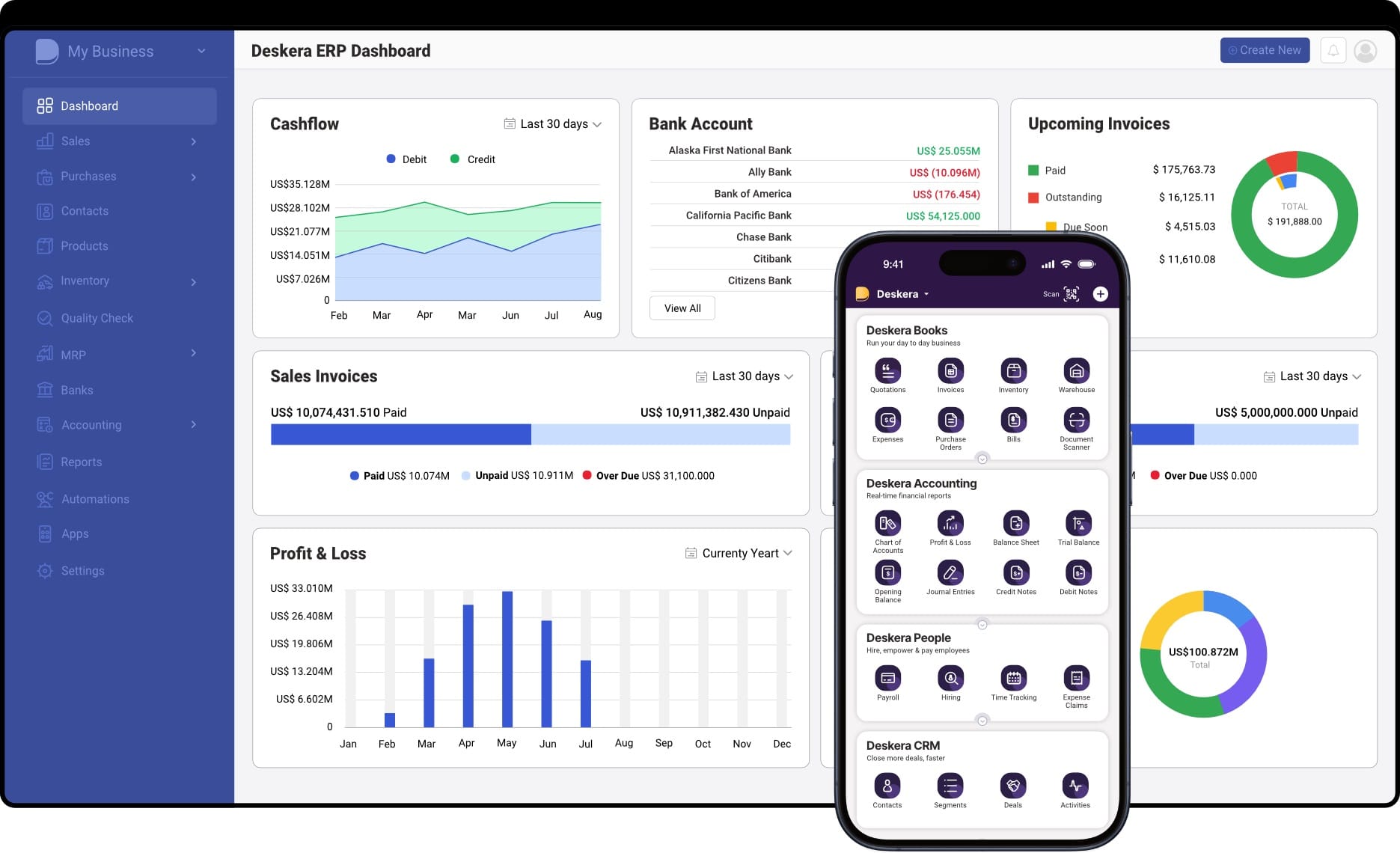
Conducting an accurate cost-benefit analysis requires businesses to collect reliable data, track operational costs, measure performance, and forecast future outcomes. Deskera ERP helps organizations streamline this process by centralizing financial, operational, inventory, procurement, and reporting data into a single integrated platform. This enables businesses to make faster, data-driven, and financially informed decisions.
Centralizes Financial and Operational Data
Deskera ERP integrates accounting, inventory, procurement, warehouse management, CRM, and financial management into one system. Businesses can access real-time operational and financial data from a centralized dashboard, making it easier to gather accurate information for cost-benefit analysis.
Improves Cost Tracking and Visibility
Accurate cost tracking is essential for evaluating project feasibility. Deskera ERP helps businesses monitor direct costs, indirect expenses, inventory carrying costs, procurement spending, labor expenses, and operational overhead in real time. This improved visibility reduces the risk of overlooking hidden costs during analysis.
Enhances Forecasting and Budget Planning
Deskera ERP includes budgeting, forecasting, and financial planning tools that help organizations estimate future costs, revenue growth, and cash flow more accurately. These forecasting capabilities support more reliable cost-benefit analysis by helping businesses evaluate both short-term and long-term financial outcomes.
Provides Real-Time Reporting and Analytics
Real-time dashboards, smart reports, and business intelligence features allow businesses to monitor key financial and operational metrics continuously. Companies can analyze profitability, operational efficiency, production costs, inventory performance, and project expenses more effectively when conducting cost-benefit evaluations.
Supports Inventory and Supply Chain Optimization
Inventory and procurement costs often play a major role in business decision-making. Deskera ERP helps businesses optimize inventory levels, automate replenishment, monitor warehouse performance, and manage procurement processes efficiently. This enables organizations to identify cost-saving opportunities and improve supply chain profitability.
Helps Evaluate Manufacturing Profitability
For manufacturing businesses, Deskera ERP and MRP provide features such as production planning, demand forecasting, yield calculations, finished goods costing, and manufacturing analytics. These capabilities help businesses accurately calculate production costs, analyze profitability, and evaluate operational investments more effectively.
Automates Business Processes
Manual data collection and spreadsheet-based analysis can increase errors and slow decision-making. Deskera ERP automates workflows related to accounting, procurement, inventory management, approvals, reporting, and order processing. Automation improves data accuracy and allows businesses to perform cost-benefit analysis more efficiently.
Improves Decision-Making With Real-Time Insights
Because Deskera ERP provides real-time visibility into business operations, organizations can quickly compare projected costs, expected benefits, and operational performance before making strategic decisions. This helps businesses reduce financial risks, allocate resources more effectively, and prioritize high-value projects.
Supports Scalability and Long-Term Growth
As businesses grow, cost structures and operational complexity also increase. Deskera ERP helps organizations scale efficiently by improving operational control, increasing production efficiency, and reducing costs through integrated business management tools. This makes long-term cost-benefit analysis more accurate and actionable.
Key Takeaways
- Cost-benefit analysis (CBA) helps businesses evaluate whether the expected benefits of a project or investment outweigh its associated costs.
- Understanding cost-benefit analysis is essential for making data-driven, financially informed, and strategic business decisions.
- Key components of CBA include direct costs, indirect costs, intangible costs, opportunity costs, tangible benefits, and long-term value assessment.
- Conducting a cost-benefit analysis involves defining objectives, identifying costs and benefits, assigning monetary values, evaluating risks, and comparing outcomes.
- Financial formulas such as Benefit-Cost Ratio (BCR), Net Present Value (NPV), ROI, and Net Benefit help businesses measure project feasibility and profitability.
- Cost-benefit analysis is widely used in project management, manufacturing, supply chain optimization, technology investments, HR planning, and business expansion decisions.
- The main benefits of cost-benefit analysis include improved decision-making, better resource allocation, risk reduction, operational efficiency, and increased profitability.
- Despite its advantages, CBA has limitations such as forecasting uncertainty, difficulty measuring intangible factors, data dependency, and potential estimation bias.
- Following best practices such as using accurate data, considering long-term impacts, involving stakeholders, and evaluating risks improves the reliability of cost-benefit analysis.
- Businesses should track operational and performance metrics such as revenue growth, cost savings, productivity, efficiency, customer satisfaction, and risk reduction after project implementation.
- Deskera ERP helps businesses perform more accurate cost-benefit analyses through real-time reporting, cost tracking, forecasting, automation, and centralized operational visibility.
Related Articles
 Niti Samani
 Niti Samani
 Niti Samani
 Niti Samani
 Niti Samani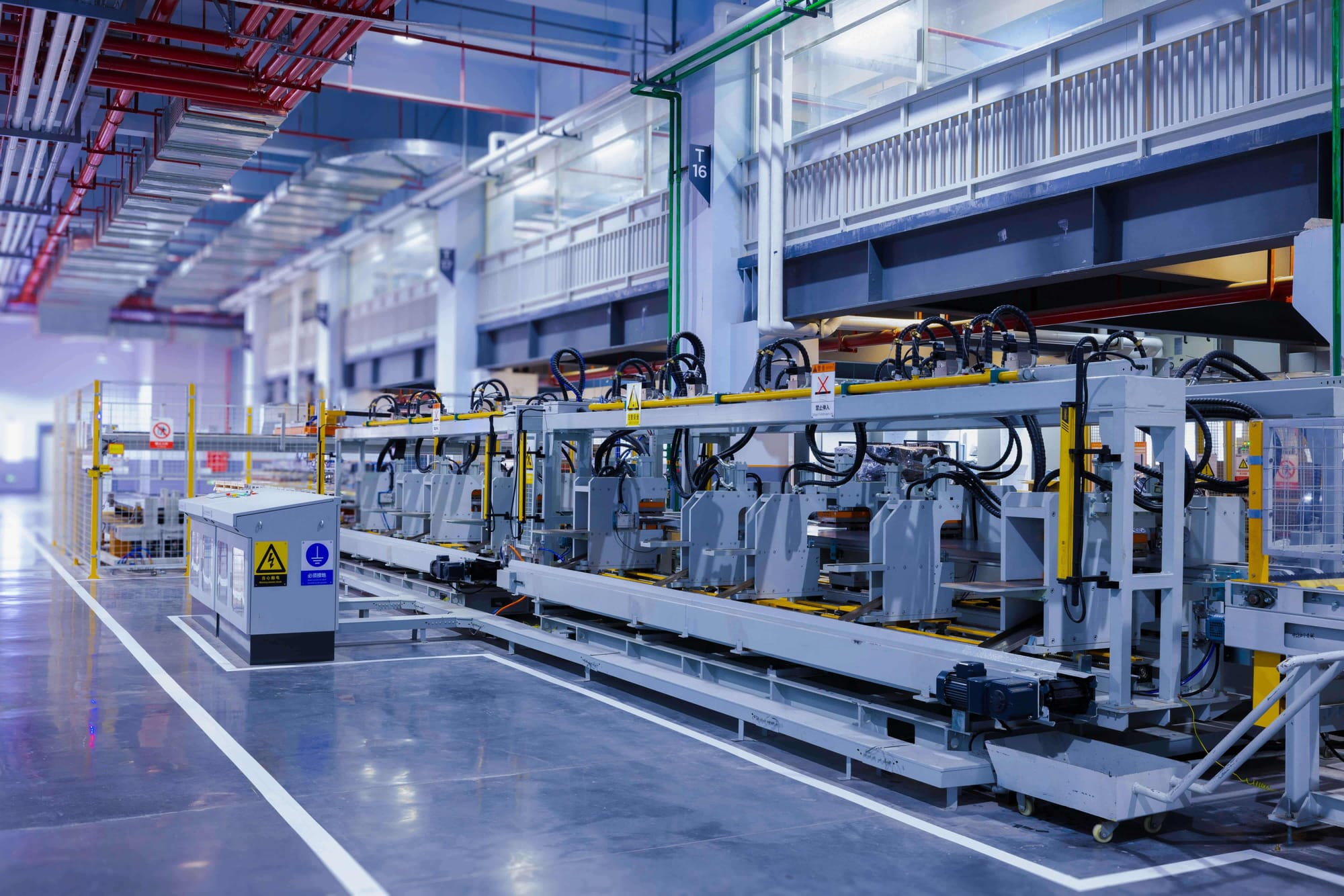
 Niti Samani