The post Clean Air needs Systemic Capacity, not just Resources appeared first on BigWire.
]]>This shift has undoubtedly spurred action and created momentum, but as with all programmes, it has also revealed where the next set of challenges lie. The capacity gap in cities. With increase in funding toward air quality management, so did the monitoring infrastructure and the reporting apparatus. But the city governments lacked institutional capacity to turn all of this into sustained
outcomes, more so given that air quality has not been their traditional domain.
The question, therefore, is no longer only about what is being done, but whether the ULGs are equipped to do it. In most ULGs, air quality is managed as an additional charge and is assigned
to an engineer or staff member already carrying other responsibilities. There are no dedicated teams, no defined mandates, no clear authority to hold other departments accountable (especially when action is required outside of the city governments) or influence how and where money gets spent.
To address this gap, the Central Pollution Control Board (CPCB) appointed 74 consultants on contract across ULGs and State Pollution Control Boards (SPCB) in 2024 to support air quality management. The appointment ensured that all million-plus cities under the 15th FC million-plus challenge grant were covered, either through a consultant posted directly at the ULGs
or through placement at the SPCB in that city. Of the 74, around 28 were appointed in other NCAP non-attainment cities, with placements split between ULGs and SPCBs.
They were appointed with domain expertise to strengthen city-level planning, coordination, and implementation. We examine why this effort could not add up to bring the change it promised.
Providing resources is not building institutional capacity These consultants were initially placed on one-year contracts, that got extended for another year, and when that lapsed last month (March 2026), they got a fresh six-month extension. The first extension itself was delayed and many consultants worked for months without salary disbursement, and such incremental extensions do not inspire stability.
Consultant positions being advisory, lacked decision-making authority, so despite expertise they were often limited to functions such as air quality data management and reporting. In several cities, they were made to support solid waste management and other routine ULGs tasks. In one city, the consultant assigned to the city was required to split their time weekly between the ULGs and the SPCB in another city, to fill the vacant position at SPCB.
While these consultants were located in the ULGs, they were not integrated into municipal structures or accountability frameworks. As a result, there was limited ownership at the city government level over how this capacity was utilised. Without clearly defined roles or institutional anchoring, their work was often shaped by immediate administrative needs; with limited influence on long-term air quality objectives.
Providing skilled individuals is not the same as building institutional capacity. Institutional capacity is reflected not just in the presence of expertise, but in the ability of systems to use it to inform decisions and sustain implementation. This gap has shaped how cities have hitherto responded to available funding.
Funding has enabled cities to undertake a range of interventions. The process also stipulated due steps like source apportionment studies and clean air action plans. However, the choice of final actions by cities has often leaned towards those that are administratively feasible and within direct municipal control, such as road and pavement work, mechanised sweeping, dust suppression, and machine procurement, and chosen basis existing priorities and ease.
Improvements in air quality therefore has been uneven across cities, and higher levels of fund utilisation have not consistently translated into better outcomes. This is not a reflection of effort, but of the conditions under which cities are operating. When institutional capacity is limited, cities tend to prioritise actions that can be delivered within existing systems.
More complex interventions, requiring inter-departmental coordination, technical planning, and sustained engagement, remain harder to design and implement. Efforts without strengthening institutional capacity can’t be sustained. They fade away. Funding can support actions, but outcomes sustain only when systems are in place.
Recommendations
Moving forward, strengthening institutional capacity must become central to how cities approach air quality management. This requires building systems that can sustain actions over time. We suggest a three-pronged strategy:
Cities need dedicated Clean Air Cells to serve as the institutional backbone for proactive air quality governance within ULGs. For this, there should be recruitment of full-time technical experts, including environmental engineers, data managers, and urban planners, dedicated exclusively to air quality management. These roles should not be treated as additional responsibilities, but as core functions within the ULGs.
The Cell should also comprise representatives from key line departments and independent experts, and should have its own mandate, its own budget, and the authority to coordinate
between line departments and shape how resources are allocated.
Urban Air Quality should have ULGs at the centre, where the elected government and officials are able to coordinate necessary actions from all other departments concerned for concerted actions as per plans.
Performance indicators need to evolve to reflect how cities are building and using institutional capacity, not just outcomes and fund utilisation. This includes indicators such as whether trained staff are being retained, whether emission inventories are informing action plans and whether coordination mechanisms across departments are functional.
India has already taken important steps in recognising urban air pollution as a systemic challenge and aligning resources towards it. The next step is to ensure that cities are not only funded to act but are also institutionally empowered.
The post Clean Air needs Systemic Capacity, not just Resources appeared first on BigWire.
]]>The post The Himalaya Is Sending Us a Warning We Cannot Afford to Ignore appeared first on BigWire.
]]>The scale of the tragedy is difficult to comprehend. More than 1,300 people had been confirmed dead by mid-September, with more than 5,000 still missing, according to the WWA assessment. The collapse of a huge rock wall and overlying glacier generated an avalanche that transformed into a debris flood and then a devastating flash flood. The resulting flow travelled at an average speed of about 188 km per hour, reaching settlements and infrastructure downstream with extraordinary speed.
What makes this particularly disturbing is not simply the magnitude of the event, but what happened before it.
The Himalayan region has been warming rapidly. WWA estimates that annual warming around the site is about 2°C attributable to human-caused climate change, while July-August temperatures have increased by about 1.5°C. The freezing threshold has also been moving upwards by roughly 100 metres per decade in recent decades during the monsoon and post-monsoon seasons. These changes matter enormously in a landscape where ice and permafrost act as part of the mountain’s structural system.
The Langtang Lirung glacier has also been thinning and retreating for decades. WWA notes that glacier thinning and retreat can reduce buttressing and alter stresses within adjacent rock walls. Permafrost degradation can weaken ice-filled fractures, while meltwater can increase pressure within those fractures. Add the legacy of the 2015 earthquake, changing precipitation from snow to rain and unusually warm conditions, and the result is not one isolated climate hazard but a compound geohazard cascade.
This is where the Nepal disaster offers a lesson far beyond Nepal.
We have become accustomed to preparing for hazards that announce themselves: cyclones have tracks, heatwaves can be forecast, heavy rainfall can trigger warnings. But a mountain slope weakened over decades by warming, permafrost thaw, glacier retreat and changing water dynamics does not necessarily provide such a clear warning.
The signals, however, are measurable. The challenge is whether we are monitoring them systematically enough.
High Himalayan regions need sustained observation of glaciers, permafrost, unstable slopes and glacial lakes, combining satellite observation with ground-based monitoring. Risk maps need to be continuously updated. Data must reach disaster-management agencies and communities downstream. And because rivers, hazards and mountain systems do not respect political boundaries, transboundary sharing of data and warnings must become standard practice.
The World Meteorological Organization says it’s Global Cryosphere Watch already provides an institutional framework for strengthening coordinated observations of glaciers, snow, ice and permafrost through in-situ, airborne and space-based systems. The WMO has also been working towards standardised permafrost measurements – precisely the kind of long-term observation needed to understand a rapidly changing cryosphere.
But monitoring alone will not be enough. The WWA assessment makes an uncomfortable point: the August disaster was beyond the predictive and design limits of existing risk-reduction measures. In high mountain valleys, where habitable land is limited and communities and economic activities are concentrated along rivers, completely eliminating exposure may be socially and economically impossible.
This is where the language of loss and damage becomes important.
Nepal has already approached the UN Loss and Damage Fund following the disaster, seeking international support. The UN has described the catastrophe as a stark illustration of the losses and damages increasingly faced by climate-vulnerable countries. Nepal has reportedly sought an initial $20 million from the Fund for the Rasuwa disaster.
Attribution science therefore matters not only to scientists. It matters to communities seeking accountability, to governments planning adaptation, and to countries seeking international support for losses they had little role in creating. The Himalaya is not merely a spectacular landscape or a distant source of rivers. It is a living, changing system on which millions of people across South Asia depend.
The Langtang Lirung disaster should therefore not be remembered only as another tragic flood or landslide. It should become a turning point in how we understand mountain risk.
We cannot prevent every mountain from collapsing. But we can monitor the mountains, understand the warning signals, prepare the valleys and invest in the people who live below them. And where adaptation reaches its limits, the world must be prepared to respond with climate justice – not merely sympathy.
The post The Himalaya Is Sending Us a Warning We Cannot Afford to Ignore appeared first on BigWire.
]]>The post If Krishna is God, Is Yamuna Not Godly? This Janmashtami, Stop Worshipping the Child and Poisoning His Cradle appeared first on BigWire.
]]>We will bathe him in milk, honey and Yamuna water brought in a can from a tanker because no one would dare dip that idol in the actual Yamuna at ITO.
That is our hypocrisy in one image. We celebrate the river’s God and abandon the God’s river.
Krishna was born on Yamuna’s bank. He grew up drinking her water, swimming in her pools, defeating Kaliya to make her safe again for his people and his cows.
Today, if that same child were to swim in Delhi’s Yamuna, he would need a hazmat suit. Let’s be honest about what we have done to Krishna’s Yamuna.
A living river needs oxygen above 5 mg/l. It needs Biological Oxygen Demand – the load of organic filth it must digest – below 3 mg/l. It needs fecal coliform – our shit – below 500 MPN/100ml, max 2,500.
Here is Delhi’s Yamuna:
In January this year, she recorded her most polluted January in five years. At its worst, BOD touched 70 mg/l and fecal coliform hit 8,400,000 MPN/100ml.
Dissolved oxygen, for years, has been consistently zero, indicating the river is virtually dead as it exits the city.
It is not getting better. Last December, DPCC samples showed BOD levels at 25 mg/l at ITO Bridge, 24 mg/l at ISBT Bridge and 17 mg/l at Okhla Barrage, far exceeding the safe limit of 3 mg/l.
Fecal coliform was 92,000 MPN at ISBT Bridge, 54,000 MPN at Nizamuddin Bridge against the desirable limit of 500.
A Parliamentary panel this March said what priests won’t: the Yamuna’s capacity to sustain life in the Delhi stretch is almost non-existent, with 23 out of 33 sites failing primary standards.
We did this. The National Green Tribunal keeps saying it: untreated sewage from the drains between Wazirabad and Asgarpur is the killer.
We have built sewage treatment plants on paper and let Najafgarh, Shahdara and Maharani Bagh drains pour poison in practice. We fine a polluter a few thousand rupees and look away.
But we have also done something worse to her catchment. We cut the forests that held her monsoon.
We mined her floodplain, dammed her sisters upstream without pause, and concretized her banks.
In a climate crisis where we keep breaking emissions records, a river without a floodplain cannot cool a city, cannot recharge groundwater, cannot survive a heatwave.
When flows drop and heat rises, that same sewage becomes more concentrated, more toxic, frothier. The gharial, the migratory birds, the farmer in the Braj – all pay the price of our heat.
Which is why the question you ask on Janmashtami is the only honest one: If Krishna is God, is his river not Godly?
The world has begun to answer yes – not as poetry, but as law.
In 2017, New Zealand made the Whanganui River the first river in the world to be a legal person – an ancestor, indivisible from mountain to sea. In 2021, Canada followed.
The Innu First Nation and the regional municipality declared the Magpie River / Mutuhekau Shipu a legal person.
Now the river has nine rights, among them the right to flow, maintain biodiversity, be free from pollution, and to sue.
Colombia’s Atrato and Amazon, Ecuador’s constitutional Rights of Nature, Spain’s Mar Menor – this is now a global, Indigenous-led jurisprudence.
The logic is brutal and simple: If a corporation can be a legal person to protect its profits, why can’t a river be a legal person to protect our future?
India almost led this.
On March 20, 2017, the Uttarakhand High Court did something radical and beautiful.
It declared that “The Ganga and Yamuna, all their tributaries, streams… are declared as juristic/legal persons /living entities having the status of a legal person with all corresponding rights, duties and liabilities of a living person”.
It said this was needed to protect the faith of society. Unfortunately, this lasted just 109 days.
On July 7, 2017, the Supreme Court stayed that order, ruling that India’s sacred Ganges and Yamuna rivers cannot be considered “living entities” and that rivers do not have the same rights as humans.
The government had argued: if Yamuna is a person, who will be sued when she floods?
So Yamuna went back to being a thing. A drain. A 40-km stretch that gives us 76% of the river’s pollution load but which we still treat as free real estate for our waste.
The stay was legally prudent. Morally, it was a surrender.
This Janmashtami, let’s not do another symbolic aarti on a dead riverbank. Let’s demand a real vow.
One: Make pollution data a matter of public faith. Live, location-wise BOD and fecal coliform display at every ghat, not just DPCC PDFs months later.
Two: Restore the catchment, not just the idol. A Janmashtami fund for native forests on Yamuna’s floodplain from Palla to Okhla and for catchment forests in Yamunotri.
A living floodplain is climate resilience. Concrete is not.
Three: Reopen the rights debate.
We need a River Rights Act that gives Yamuna two legal guardians – one state, one community – with power to sue polluters on behalf of the river, as New Zealand does.
Not to make the river liable for floods, but to make us liable for killing her.
Krishna didn’t fight Kaliya to punish the river. He fought Kaliya to free it. On his birthday, the least we can do is stop being Kaliya.
The post If Krishna is God, Is Yamuna Not Godly? This Janmashtami, Stop Worshipping the Child and Poisoning His Cradle appeared first on BigWire.
]]>The post Meaningful inclusion of women in the workforce is Impossible Without Inclusive Mobility appeared first on BigWire.
]]>This is not just an isolated personal anecdote. This and the experiences of many other women is symptomatic of a systemic failure in the design, implementation, and governance of urban mobility, a failure that actively constrains women’s workforce participation in India’s cities.
According to the Periodic Labour Force Survey (PLFS) 2023–24, only 28% of urban women aged 15 years and above participate in the labour force, compared to 75.6% of urban men, highlighting the stark gender gap in employment. This is a gap that ultimately shapes and limits women’s economic potential.
While research and policy discussions on women’s lower workforce participation have often focused on the disproportionate burden of caregiving responsibilities and household work on women, relatively lower levels of education, and social barriers, mobility remains a critical but largely overlooked impediment.
Yet the ability to travel safely, comfortably, and reliably is often the difference between accessing a job and staying out of the labour force or settling for a non-optimal job. Cities must therefore move towards far more gender-intentional standards in the design, planning, and implementation of urban mobility systems.
This must reflect in the Urban and Regional Development Plans Formulation and Implementation (URDPFI) guidelines that are an integral part of all states’ town and country planning acts, and thus the master planning process, and also in individual project tenders for mobility infrastructure such as roads, bus stops, and metro stations.
Barriers to female workforce participation
Existing labour surveys and studies have long pointed to reasons for low female workforce participation, highlighting in particular, the influence of social and caregiving norms.
For instance, the Female Labour Utilisation (FLU) in India report (April 2023) documents multiple barriers rooted in social expectations, while the PLFS 2021–22 shows that many women remain outside paid work due to education (33.6%) and childcare or homemaking responsibilities (44.5%).
Yet, taken together, these explanations reveal only part of the picture. Unfortunately, neither the PLFS nor the FLU report explicitly captures mobility-related barriers—such as concerns about commute safety, transport availability, distance to workplaces, or inadequate urban infrastructure—as reasons for women’s non-participation in paid work.
Women’s participation in the economy is shaped not only by social norms, but also by the everyday design of our cities; an influence that remains largely invisible in employment debates.
However, where mobility is considered as a factor in women’s work force participation, it is often reduced to safety. For example, in India Today Insight Survey (2025) finds that 57% of women report safety challenges during their commute. Additinally an Uber–Oxford Economics study (2023), based on survey findings, suggests that improving access to safe and reliable transport could raise women’s workforce participation in India by 4–6.9%.
India has also launched multiple initiatives to improve women’s safety in public spaces, particularly through Safe City projects and Nirbhaya Fund supported interventions focused on surveillance, policing, and emergency response systems. While these efforts are important, their prominence also reveals a limitation: women’s mobility continues to be understood through a safety-first-and often safety-only-framework.
While safety from violence and harassment is non-negotiable, this framing is too narrow. It reduces a complex access issue to a single dimension of crime prevention. A broader view of mobility is needed—one that includes reliability, affordability, time poverty, and last-mile connectivity.
Mobility beyond only safety
Recent research by the Jana Urban Space Foundation (JUSP) titled the ‘Gender-Intentional Infrastructure study’, moves firmly beyond only the safety lens to examine mobility in women’s workforce participation as a full journey, from leaving home to reaching work and returning.
Drawing on detailed journey mapping across multiple stages of travel, the study highlights how factors such as accessible public toilets, seating, clear wayfinding, reliable public transport, last-mile connectivity, trip-chaining and the quality of walking infrastructure shape women’s employment decisions.
It shows how everyday mobility conditions become concrete deal-breakers; reversing a decision which would otherwise be to choose to work or work where they would like to. While 42 out of 64 unemployed women identified safety as a key reason for not working. ,nearly 70% of unemployed women also cited lack of transport access as a main reason for not working,.
This compared to just three citing domestic responsibilities. Safety emerges as an issue embedded in the everyday design and maintenance of urban mobility systems, most pronounced in specific contexts, particularly during last-mile travel, at poorly lit stops, and along fragmented walking routes.
Furthermore, basic amenities can play a large role in where to work. As one respondent mentioned that, “There is no toilet on the way. If the journey is long, it becomes very difficult. Because of this, I avoid work that is far, even if the salary is better.” The graphic below highlights the absolute mobility non-negotiables for women’s workforce participation, as well as the ‘good to haves’ in the form of ‘enablers’.
Deal-Breakers and Enablers: What Women Need to Work.

From artificial shackles to liberating infrastructure
Often for a woman who overcame social hurdles to work, at least in mindset and approach, the poor city mobility infrastructure itself becomes a second, artificial shackle. Inadequate infrastructure forces a constant calculus of risk: Which routes? Which hours? Which jobs? This constant evaluation restricts her work choices even after the decision to work has been made.
Breaking free from these constraints that impede meaningful inclusion of women in the workforce requires shifting from safety as a protective measure to mobility infrastructure as a source of freedom. When mobility in cities is designed holistically around women’s everyday needs as outlined in the deal-breakers and good to haves in the box above, women no longer need to second-guess whether to work or not, which job opportunities to choose, limit themselves to nearby work, or factor fear into employment decisions. The question then moves from whether women can work to whether cities are enabling women to access the full range of opportunities available to them, on equal terms with men.
Translating this vision into practice demands moving from gender-blind planning to gender-intentional design standards for mobility. As the Gender-Intentional Infrastructure study highlights, key national and sub national planning frameworks including the widely used Indian Road Congress (IRC) guidelines do not explicitly account for the everyday infrastructure conditions—like continuous footpaths, lighting calibrated for safety, or accessible features in public transport—that determine whether women can practically commute to work. Mobility must be designed as a system—spanning safety, accessibility, reliability, comfort, and last-mile connectivity—with these treated as non-negotiable, not optional add-ons
This shift must be backed by accountable governance, with local bodies mandated to maintain infrastructure and coordinate across transport authorities, traffic police and urban planning agencies. Equally important is building institutional capacity by including more women planners, designers, and decision-makers who understand how design choices on mobility systems shape freedom in womens workforce participation choices. Finally, funding for gender-inclusive mobility must move from pilot projects to core urban budgets, ensuring that amended guidelines translate into real change on the ground, not just well-intentioned policy on paper.
Source and Reference:
- Gender-Intentional Infrastructurereport published by JUSP and Janaagraha
- Female Labour Utilisation in India report, report published by Ministry of Labour and Employment Directorate General of Employment Govt of India.
- Periodic Labour Force Survey (PLFS)report published by Ministry of Labour & Employment Govt of India
- India Today Insight survey (2025)article published by India today
- The MobiliserHer study (2022-2025)report published by MobiliseHER organization
- Uber-Oxford Economics study (2023)article published by India news.
- Nirbhaya Fund, ‘Safe City Projects’report published by Ministry of home affairs Govt of India.
- Bengaluru’s Safe City Projectcorporate project/report by Honeywell Automation India Limited
Name:
Mohammad Mansoor A
Associate Manager
Field Engagement & Data
Janaagraha Centre for CItizenship and Democracy.
The post Meaningful inclusion of women in the workforce is Impossible Without Inclusive Mobility appeared first on BigWire.
]]>The post Can 500 Meters Change a City? Odisha Water Man Ranjan Panda Explains appeared first on BigWire.
]]> Mr. Ranjan Panda, an internationally reputed water and climate expert, founded and mentors the Youth4Water campaign. Since March 2019, the campaign has connected young people to nature through unique initiatives driving grassroots climate action.
Now, Mr. Panda has conceptualized a fresh campaign focusing exclusively on urban sustainability. The Big Wire caught up with “Odisha’s Water Man” to discuss the upcoming launch of the “My 500-Meter City” initiative.
BigWire: To start, could you tell us about the “My 500-Meter City” initiative and what inspired this campaign?
Ranjan Panda: Absolutely. The “My 500-Meter City” initiative is a brand-new, purely voluntary movement launched by the Youth4Water-India campaign. It officially kicks off on June 5th to mark World Environment Day.
The core inspiration is the power of individual commitment. We are asking young people and citizens across the country to designate a 500-meter radius in their city—their “Circle”—and take leadership in making that specific area sustainable.
It’s about realizing that macro-level climate resilience starts with micro-level, localized actions right outside our front doors.
 We have been mulling over this campaign idea for about two years because cities have emerged as major climate polluters, even as their own climate vulnerabilities increase manifold.
However, when the global fuel crisis hit home, urging citizens to adopt austerity measures, we knew this was the perfect time to launch.
We are fighting both the oil and climate crises together, and we must step up our response through locally led initiatives.
The theme of World Environment Day this time is “Inspired by Nature. For Climate. For Our Future.” We thought this is the best day to launch, as the core idea is to connect people to nature in a very tangible way.
If you explore your city on foot or by bicycle, you get to know its landscape much better. You don’t just understand it; you work to protect it.
BigWire: What exactly does participation look like on a day-to-day basis for someone who joins this movement?
Ranjan Panda: The daily commitments are simple, healthy, and highly impactful. Once you designate your 500-meter Circle, we encourage you to walk or cycle for your daily errands within that area instead of using a vehicle.
If you are stepping out to buy groceries, fruits, or fish, you make it a habit to carry a cloth bag. That is just the beginning.
You can start by designating a circle right around your own home to build these daily habits. Later, we strongly encourage volunteers to form local teams.
This allows you to go beyond personal lifestyle choices and become true guardians of local ecosystems. Teams can count trees and open spaces within their 500-meter radius, tracking their health and usage.
It’s about taking active ownership of your surroundings and helping neighbors understand the importance of biodiversity.
Eventually, these local efforts can be integrated into city-wide Heat Action Plans—addressing a massive problem that almost all our cities are currently facing.
The post Can 500 Meters Change a City? Odisha Water Man Ranjan Panda Explains appeared first on BigWire.
]]>The post Is America Replacing Banks with Stablecoins? appeared first on BigWire.
]]>Every payment, settlement, and liquidity transaction ultimately flowed through commercial banking institutions acting as intermediaries between the public and the central bank.
The Federal Reserve’s master account system formed the foundation of this privilege, creating a formidable moat around traditional banking.That moat is under stiffchallenge now to give way.
President Donald Trump’s recent Executive Order “EXECUTIVE ORDER 14405——INTEGRATING FINANCIAL TECHNOLOGY INNOVATION INTO REGULATORY FRAMEWORKS” directing regulators to review Federal Reserve payment access for fintech firms, digital asset institutions, and uninsured depository entities has ignited a debate that extends far beyond cryptocurrency.
At stake is not merely the future of crypto finance but the future structure of money itself.The significance of the order lies in its instruction to evaluate whether non-bank financial institutions should gain direct access to Federal Reserve payment rails and settlement services.
If implemented broadly, institutions dealing in stablecoins and tokenized assets could settle transactions directly with the Federal Reserve without routing funds through commercial banks.
Historically, banks earned their dominanceby controllingaccess to settlement infrastructure. Every payment required a banking intermediary. Every deposit created leverage for lending.
Every transfer generated fees and strengthened the banking franchise.Digital asset institutions challenge this model.A regulated stablecoin issuer, once connected directly to Federal Reserve infrastructure, could perform many functions traditionally associated with banks without carrying the same branch network, staffing structure, or legacy operational costs.
Stablecoins such as USDC, RLUSD, and similar instruments would effectively become programmable digital dollars capable of moving across borders twenty-four hours a day, seven days a week.
The consequence is not necessarily the elimination of banks but their gradual downgrading from gatekeepers to service providers.Commercial banks may increasingly find themselves competing against digital-native financial institutions that can settle directly with the central bank.
The competitive advantage shifts from physical infrastructure and deposit gathering to technology, user experience, tokenization capabilities, and network effects.
This transformation creates an inevitable tension between traditional finance and digital finance.Banking associations argue that access to Federal Reserve accounts should remain limited to institutions operating under the most stringent banking regulations.
Their concern is understandable. Direct access grants legitimacy, operational efficiency, and competitive parity with some of theworld’s largest financial institutions.Crypto firms, meanwhile, argue that financial innovation should not be blocked by historical monopolies. They contend that regulated digital asset institutions can provide faster, cheaper, and more transparent financial services while expanding access to global markets.What emerges is not merely a regulatory disagreement but a struggle between two financial philosophies.The first philosophy views banks as essential custodians of monetary stability.
The second viewstechnology platforms as the future operating system of money.Interestingly, this development does not necessarily weaken the U.S. dollar. In fact, it may strengthen it.Many observers have interpreted the rise of stablecoins as a challenge to sovereign currencies.
However, the opposite may occur. Dollar-backed stablecoins remain fundamentally dependent upon dollar reserves and U.S. Treasury securities.
Every successful stablecoin expands the dollar’s global reach into regions where traditional banking infrastructure is inefficient or inaccessible.In this sense, stablecoins may become the next-generation distribution mechanism for American monetary influence.Instead of exporting physical dollars through correspondent banking networks, the United States could export digital dollars through blockchain networks. The dollar would no longer travel solely through banks; it would travel through wallets, smart contracts, decentralized applications, and tokenized financial ecosystems.For countries seeking alternatives to dollar dominance, this presents a new challenge.Many nations have pursued de-dollarization strategies through local currency settlements, central bank digital currencies (CBDCs), and regional payment systems. Yet if stablecoins become globally accepted settlement instruments backed by U.S. financial infrastructure, the result may be a form of “Digital Dollarization.”A merchant in Africa, a farmer in Latin America, or a freelancer in Southeast Asia could hold and
transact in tokenized dollars without ever opening a U.S. bank account.
This expands American monetary reach far beyond traditional banking channels.At the same time, foreign central banks may perceive such developments as a threat to monetary sovereignty. Governments could accelerate their own CBDC programs or impose restrictions on foreign stablecoins to preserve control over domestic monetary systems.The geopolitical implications are profound.A future competition may emerge between:• Bank-issued money versus stablecoin-issued money• Central Bank Digital Currencies versus private stablecoins• National payment systems versus global blockchain networks• Financial sovereignty versus financial interoperabilityFor the United States economy, the benefits could be substantial. Greater efficiency in payments, increased demand for Treasury securities backing stablecoins, lower transaction costs, and stronger global demand for dollar-denominated assets could reinforce America’s financial leadership.However, risks remain.If a significant share of deposits migrates from banks into stablecoin ecosystems, commercial banks could experience funding pressures. Traditional lending models might weaken. Regulators would need to rethink deposit insurance, liquidity management, systemic risk, and financial supervision.Questions of governance also arise.Critics point to the growing involvement of political figures and their families in digital asset ventures. The leader’sfamily’s participation in crypto-related businesses has drawn scrutiny overpotential conflicts of interest. Even if policies are adopted for broader economic reasons, perceptions of preferential treatment can affect public trust.This makes transparency essential.The challenge for policymakers is to ensure that regulatory reform benefits innovation and competition rather than specific market participants.Ultimately, the executive order may be remembered as more than a crypto policy initiative. It may mark the beginning of a structural transition from an economy organized around banking institutions to one increasingly organized around digital financial networks.The Federal Reserve’s payment rails have long been the exclusive domain of banks. If digital asset institutions gain meaningful access, the world may witness the emergence of a new financial order in which money moves not only through banks but through programmable, tokenized, and globally interoperable networks.The question is no longer whether digital finance will coexist with traditional banking.The question is whethertraditional banking can adapt quickly enough to remain central in a world where the Federal Reserve is opening its doors to an entirely new class of financial institutions.
The post Is America Replacing Banks with Stablecoins? appeared first on BigWire.
]]>The post Raise Your Voice: Care for Your Planet appeared first on BigWire.
]]>On that morning, as I started walking from my home, two individuals just crossed me and started walking in front of me in my morning walk route.
Out of these two individuals, the smaller one was a girl child, must be in her early elementary school years, and the other seemed to be her father, in his mid-thirties!
The hand-holding gesture of these two forerunners was clearly visible that one is a caregiver, and the other one, an explorer of life.
Within ten strides, I neared them, and was about to cross over the father-daughter duo, I overheard something, that slowed my stride, stimulating my curiosity to listen more, and pushed me to remain behind them.
“Tell me na Papa! Why are you keeping silent? Answer me, na, Papa. Papa please!” In a demanding voice, after saying those things, the girl decisively shook her father’s hand.
Responding to the involuntary shuddering movement of his hand, the father instantaneously reacted in a harsh voice, but immediately realized his mistake and readjusted his tone.
Father’s first reaction had already hit the bull’s eye, making the baby girl disengage her hand from her father’s hold.
After a couple of seconds of her father’s remorseful persuasion and pleading, the baby girl emotionally returned to her natural self and tried to narrate the story before asking her father the real question that was in her mind.
“Papa! You know, those big trees that my friend ‘Niti’ had in her front yard are no more! All are gone now. In fact, the entire row of all those big trees, staying on both sides of the lane, near my friend’s house, that were there till day before yesterday, are now absent!”
“Okay, so what do you want me to answer? Where it all vanished to or whether you should replant some other trees or not, what is your question?”
I could feel the sarcasm hidden in the father’s question that the baby girl could hardly articulate.
“Noooo… Paapaa!, Absolutely; not at all these questions.”
The elongated response of the daughter in a grumbling voice, along with the disapproving facial expression, communicated that she took pity on her father’s dumbness.
“Papa! How come you are so slow and simple? No, I can’t ask those child-like silly questions, Papa! I am a big girl now, and I can understand many more things.”
After delivering a self-glory precursory note, she added,
“My question is, many of those big trees were sweet fruit-bearing trees that ripen during the summer, like Jamun, Sapota, Mango, and Bael, and so on, and how could anybody cut all these trees, especially when they are loaded with the tender fruits, Papa? How can any person be so cruel as to do such harm to the trees, as to completely cut those voiceless from their trunks, giving no scope for them to heal themselves, eliminating the chances of regeneration?”
Father was having difficulty giving a sincere, direct answer to his child’s logical query. So, he coughed momentarily, breathed in some air, and prepared himself to answer.
“Look, dear, what you are saying is right, but sometimes we are bound to do certain things, even though our ethics do not give us permission to do so. Probably, there is a sanction for road expansion, and the workers are bound to cut the vegetation to widen the road, so the situation sometimes compels us to do certain actions against our will.”
In an annoying and irritating voice, she said,
“Papa! You are only justifying all those cruelties with your answers. Big trees are not only a compendium of leaves and branches, but are more than that. Have you ever seen how many squirrels, birds, and other smaller animals were taking shelter in those tree houses? How were those trees’ shade regulating the summer temperature in the vicinity, providing relief to the commuters and stray animals? Do you have any idea? You are only justifying the need for road expansion, but what about the global warming and climate change context, Papa? By cutting down those big trees, you elders are only justifying your action in the present; but what about our future?
From excitement, her tone slowly turned into slumber disappointment
“Our teacher was saying in a class that climate change is accumulating with every passing year, Papa. We need to take proactive steps to arrest the warming process by caring and conserving more vegetation, or else how could we live in this world, with all the lost greenery, and harsher climatic conditions, Papa?”
It was a mind-numbing question coming from an elementary school student. I could make out, from behind, father’s struggle to find an appropriate answer that would satisfy his baby girl while making her aware of the ground reality of the need for economic development. However, I couldn’t listen any further to their conversation, as I had reached the road divergent point where I had to take another route, leaving the duo with all their question-answer moments. But the girl’s simple question lingered, tingling within me the search for the right answer.
“If in the name of economic development, you elders will cut down the trees and ultimately aggravate the global warming condition, then how could we live in a harsher world? Your forefathers gave you all a soothing, comfortable environment to live happily. What will we do in the future with all the ecosystem services gone, with the trees being cut, that you all are doing carelessly, even without thinking about us?”
On the forthcoming Earth Day, which we celebrate on 22nd April every year since 1970, we need to reflect more critically about the health of our mother earth and need to take note that, “we have not inherited this earth from our forefathers but borrowed it from our children.”
The post Raise Your Voice: Care for Your Planet appeared first on BigWire.
]]>The post RSS Centenary Year: Hosabale Calls for Social Unity and Civic Responsibility in Shillong appeared first on BigWire.
]]>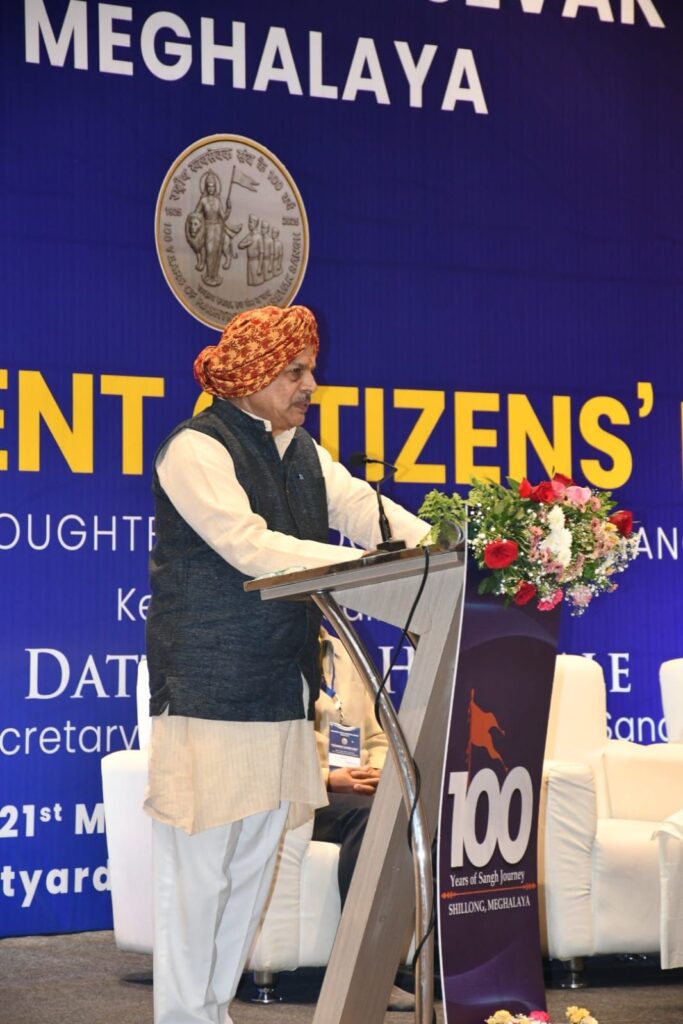
The event, organised by RSS Meghalaya, was held at Courtyard by Marriott Shillong and brought together distinguished members of society for dialogue and exchange of ideas.
In his keynote address, Hosabale recalled Shillong’s association with national icons like Swami Vivekananda, Rabindranath Tagore and Subhas Chandra Bose. He traced the RSS journey since its founding in 1925 by Keshav Baliram Hedgewar in Nagpur, noting its expansion to nearly 85,000 daily shakhas nationwide.
Hosabale said Hedgewar founded the organisation to address social fragmentation that enabled foreign domination, stressing that the RSS seeks to organise society rather than function as just another institution. Highlighting India’s civilisational ethos, he said diversity in language and culture strengthens national unity, which must be sustained through continuous social work and character building.
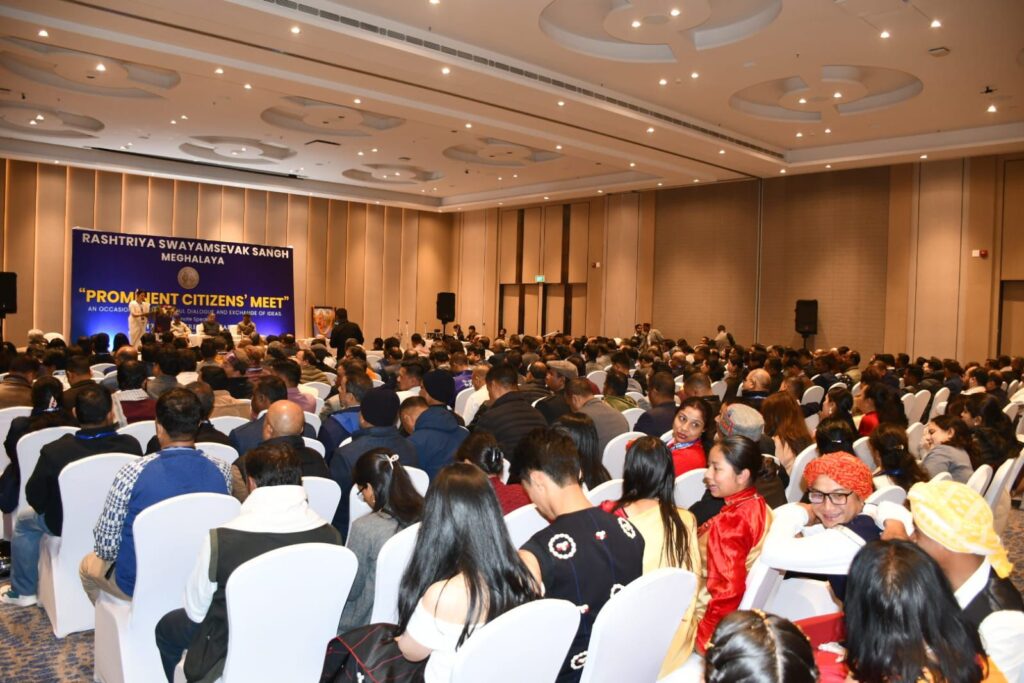
He underscored that transformation begins with individuals, families and ethical conduct guided by dharma as moral responsibility. Addressing misconceptions, he said the centenary year aims to expand societal engagement with the RSS message of collective contribution.
Hosabale outlined “Panch Parivartan,” focusing on social harmony beyond caste divisions, swadeshi consciousness, family values, environmental responsibility and civic duties. During an interactive session, he raised concerns over drug abuse, calling it both a social and security challenge, and stressed the need for strong families and vigilance.
On women’s empowerment, he highlighted the importance of eliminating harmful customs while recognising traditional leadership roles. He also reiterated that the RSS does not support religious discrimination and respects constitutional freedoms.
He concluded by urging citizens to engage directly with the organisation to better understand its work and vision.
The post RSS Centenary Year: Hosabale Calls for Social Unity and Civic Responsibility in Shillong appeared first on BigWire.
]]>The post GLOBAL ORDER OF FORCE appeared first on BigWire.
]]>What once passed for global governance now resembles a hollow echo, institutions watching as power asserts itself without consultation, without consensus, without consequence.
Consider the pattern. Actions unfold first; explanations follow later, if at all. A head of state is seized under the justification of narcotics and geopolitical proximity.
Strategic bombings are executed on the suspicion of alignment or influence. Nations are coerced into silence, their sovereignty softened by pressure rather than persuasion. What emerges is not diplomacy but choreography, in which power scripts the outcome before dialogue ever begins.
And yet, every act invites a response. Not directly, but diffusely. One country becomes the theatre; another becomes the message.
Iran’s retaliation does not confine itself to a singular adversary; it radiates across a region, touching Saudi Arabia, the UAE, Oman, Kuwait, Bahrain, Iraq, and Qatar. Conflict is no longer bilateral; it is systemic. Each strike is a signal, each response a ripple, widening the arc of instability.

A new grammar of deterrence is forming, which is less about defense and more about proximity. Pakistan, invoking nuclear capability, does not address distant adversaries but threatens its immediate neighbor.
India becomes the rhetorical target, not because of direct conflict, but because geography allows it. This is ‘counterbalancing’ by intimidation,where nuclear language is no longer a last resort, but a first instrument of leverage.
What does it mean when such statements emerge not from fringe actors but from seasoned diplomats? It suggests that the logic of extremity has seeped into the strategic mainstream. Threat becomes policy. Ideology becomes doctrine. The line between defense and coercion dissolves.
Parallel to this militarized rhetoric runs another, quieter contest—the clash of currencies, of economic architectures.
The petro-dollar, long dominant, now meets the petro-yuan in contested terrains: Venezuela, Iran, and parts of Latin America. Oil is no longer merely a commodity; it is a currency anchor, a geopolitical lever. Control over energy flows increasingly defines influence over financial systems.

And beneath these layers lies a more tangible pursuit: resources. From the Gulf of Mexico to contested mineral agreements in Eastern Europe, from strategic canals to Arctic ambitions, the map of the world is being redrawn not by treaties, but by transactions of control.
Critical minerals, oil reserves, and trade routes each become a node in a larger network of dominance.
Military presence follows economic interest. Bases dot landscapes not as symbols of alliance, but as instruments of assurance, assurance that access, once gained, will not be easily relinquished. Even abandoned grounds are reconsidered, reclaimed, and repurposed. Geography itself becomes fluid, shaped by strategic necessity rather than sovereign permanence.
Narratives are constructed to justify these movements. Nuclear threats are invoked, even as facilities face repeated bombardment. Security is cited, even as entire regions are destabilized. Counter-terrorism becomes a rationale broad enough to encompass the displacement, destruction, and reconfiguration of societies. Gaza stands as a stark illustration, where security concerns intersect with territorial ambition, and humanitarian cost becomes collateral damage.
In this environment, ideology and pragmatism intertwine uneasily. Religious extremism, national pride, and geopolitical calculation form a volatile mix. When one state frames another as a perpetual adversary, when hostility becomes institutional rather than episodic, the possibility of de-escalation narrows. The threat is no longer situational; it is structural.

Amid this turbulence, there are divergent approaches. Some nations adopt vocal postures, projecting strength through rhetoric. Others choose calibrated silence, engaging across regions, balancing relationships without spectacle. India, notably, has leaned toward the latter—cultivating ties across competing blocs, navigating complexity with measured restraint. It is a strategy that does not dominate headlines but accrues influence.
Yet even this balance exists within a broader shift toward personality-driven politics. Leadership is increasingly personalized, and policy is intertwined with identity. National interest is framed not just as a collective good, but as an individual mandate. The rise of assertive, inward-looking doctrines reflects a world where cooperation yields to competition, and negotiation to assertion.
This is not unique to one country. It is a global drift—toward jingoism, toward the celebration of military capability as proof of legitimacy. But such a trajectory carries consequences. Economies strain under the weight of conflict. Supply chains fracture. Environmental damage accumulates, often irreversibly. The cost is not borne solely by combatants, but by citizens far removed from decision-making rooms.
What, then, remains of order? If power alone dictates terms, if dialogue follows destruction rather than preventing it, can the concept of a rules-based system endure? Or are we witnessing its gradual erosion, replaced by a hierarchy where strength supersedes structure?
The deeper question is not about any single conflict, but about the pattern they collectively reveal. A world where ego amplifies action, where resources justify intervention, where threats normalize coercion—this is a world inching toward fragmentation.
And in that fragmentation lies a paradox. The more power concentrates, the less stable the system becomes. Each assertion invites counter-assertion. Each dominance breeds resistance. The cycle sustains itself, feeding on fear, ambition, and the absence of restraint.
Humanity, meanwhile, becomes both participant and victim. Cities are reduced, environments degraded, futures deferred. The calculus of power rarely accounts for these costs, yet they accumulate, shaping a reality that no strategy fully controls.
Perhaps the most pressing question is also the simplest: who speaks for restraint? If no institution commands it, if no collective enforces it, does responsibility revert to individual nationsor even to individual leaders?
In a world defined by force, the choice to pause becomes the rarest form of strength. Whether that choice will emerge, or whether momentum will carry us further into disorder, remains uncertain. But the trajectory, as it stands, demands scrutiny, not just of actions, but of the assumptions that justify them.
The post GLOBAL ORDER OF FORCE appeared first on BigWire.
]]>“Granny! Granny! Do you know, even the rivers too have a gender category?”, in a shrieking, screaming voice, I uttered those words in a squeaky way, as I entered our apartment from the school, holding the bag at my back.
The post Rivers and Gender Identity appeared first on BigWire.
]]>“Granny! Granny! Do you know, even the rivers too have a gender category?”, in a shrieking, screaming voice, I uttered those words in a squeaky way, as I entered our apartment from the school, holding the bag at my back.
At that point in time, Granny was busy with her balcony-bound gardening task.
Responding to my statement, without raising her eyes, she nodded with a mm-hmm sound.
It created a repulsive effect in me. “How can anyone not feel excited to explore new things?Probably she had nodded casually, without listening to me,” was the background thought, creating an urge to make her properly listen to my newly explored Sanskrit grammatical facts about rivers.
I neared her, still having school bags on my back. Shoved her, holding her arms, actuating her to look at me and listen to my new insights.
“Hey! You are still in your uniforms! Go and change first, then we will discover together what you have learned today in your school.”
“Noooo…, Grannyyy…!”, in a grumbling voice, while oozing out my lips forward with those elongated words to express my unhappiness about the proposed delay in the conversation, I shared my desire to talk about it right now.
“Okay! After that, you will go straight to your room and change your clothes, right?”
“Mother promise!”, a spontaneous reaction to ensure fulfilment of her commandments from my side after the condition was laid down by her.
She just abandoned the thing that she was doing, looked straight into my eyes, a motivational gesture from her side to speak my mind.
With a sparkle in my eyes, I shared,
“You know, Granny! In our language class today, the teacher said that in classical Indian languages, like Sanskrit, rivers too have gender! Most of the rivers, like the Ganga, Yamuna, Mahanadi, etc., are female, while the Brahmaputra, Budha Balang, etc.,are male rivers! Can you believe this! How can a river have a gender? It is an inanimate entity, right, Granny?”
She took a pause, reshaped her thoughts, rearrangedwords, and prepared herself to present the age-old wisdom of Indian philosophy to a kid in his own language!
“Yes, honey! What you are trying to say is true, but that varies from context to context. In modern languages like English, rivers belong to abiotic elements and are considered inanimate objects.
But in classical Indian languages, rivers are full of life, as they hold within themselves varieties of species like fish, mammals, reptiles, and invertebrates, and their water, an instrument of sustenance of life on earth. These nurturing abilities of the rivers made the ancient sages and scholars ascribe these rivers’unique names and genders.”
“Yeah, understood!It is true that rivers provide a lifeline on the earth, so they deserve our respect, and naming the rivers also seems okay, but not attributing gender identity, right?”
Granny with a thinker look, and scholarly tonality said, “You know, dear, in ancient Indian philosophy, each object has a life, an identity, and a name.
Any narration of the particular object used to get personified to communicate to the listeners about the attributes of that being. In this manner, the scholars observed the pattern of flow of the rivers, the turns and twists these rivers take during the overflowing monsoon, the kind of energy unfolded in the region during the spate, the behaviour of the river near its mouth, etc., were a few parameters used by them to decide the gender of the river. If the river’s flow is smooth over its course and expanded over a large network near its mouth, then it receives a female attribute. On the other hand, if the river is violent, troublesome, unpredictable, and associated with a destructive force, then it picks up a male gender.”
“So, you say, male rivers are more energetic, active, and spirited, like we boys behave during our playtime?”
With an affectionate, fond smile, she reached out to my chin and said, “Partially, you are right, but the female rivers equally possess that vital energy and their expanses are larger, nurturing wider areas, providing water to an extensive network of channels, near the river mouth, benefitting a large number of people.”
“Like our girls in our school, these female rivers have a vast network of friends with whom they share their waters, but the male rivers, like us boys, have fewer friends that last forever, is it okay!”
With a gentle and caring smile, she nodded. The immediate query was, “Do you know any male river names?”
“Yes, there are many male rivers in India, like the Brahmaputra, Son River, Damodar River, Ajay River, Lohit River, Budha Balang River, and Sindhu River of undivided India, now belonging to Pakistan, are treated as male rivers, because of their ferocity, valour, and grandeur.”
The answer from Granny provided another clue for the next question, which she could infer from my facial gesture.
“Now, no more conversation! You go inside, change your clothes, and freshen up first; then I will tell you many legends about rivers. You see, one interesting story I know is about the cancelled marriage between two rivers, and they have been separated for the rest of their lives. Do you want to listen to those stories? Clean up yourself first!”
The rivers, despite their gender attributes, foster, nourish, and endorse civilisations, a feminine tendency in itself. And the soul of these rivers lies in the hills and mountains covered with dense vegetation.
At this juncture, as climate change is accelerating, we need to act now to protect these rivers and their souls. Otherwise, in future, the children would not have the privilege of debating the “gender identity” of a particular river, but would only be debating whether it an active river or dead river.
The post Rivers and Gender Identity appeared first on BigWire.
]]>