After all, I am Filipino. It is in my nature to crave something maasim, to have a taste for something sour. I know, the Filipino word asim doesn’t translate well. Most people associate sourness with something spoiled, like sour milk, or something unripe, like a sour fruit picked too early, unready and unwanted. But for Filipinos, sourness is desired. It is celebrated. It is everywhere. Pork cooked in vinegar. Chicken simmered in tamarind. Fish soured in guava. In a sawsawan or a salad matched with something salty and fried.
I lifted the lid and instantly the smell of vinegar filled the kitchen. The heat and the acid had transformed the bright green sitaw, cut like matchsticks, into something darker. Green like olives. With a spoon I had a taste. The beans were tender but still crisp. Its sweetness blending beautifully with the vinegar and fish sauce. It was exactly what I wanted. The asim that I had craved.
Adobong Sitaw Recipe
1 bunch sitaw (Chinese long beans or yard long beans), about 3/4 pound
1 tablespoon vegetable oil
4 cloves garlic, peeled and crushed
1/4 cup vinegar
3 tablespoons fish sauce
Snip off the ends of the long beans and cut them into the length of matchsticks. This is easiest to do with a pair of kitchen shears.
Heat the oil in a kawali or pan over medium heat. Add the garlic and fry until almost brown. Add the long beans and stir fry until it starts to blister, about a few minutes. Add the vinegar and fish sauce then cover with a lid. Turn the heat down to low and cook until tender and the color has turned dark green. Serve immediately.

It could be worse, I consoled myself. I’ve been on traffic jams that took me well over an hour to get home when the freeways freeze into a standstill. Interstate 880 is notorious for such standstills on rush hours. I will never understand why there’s always some sort of incident on the freeway everyday. Maybe a truck breaks down. Maybe a collision. Maybe an accident. And these incidents happen like they’re destined to happen on the rush hour when everyone tries to get home, when everyone decides to slow down and rubberneck like it’s their business to investigate. Can’t we just all proceed carefully and move on with our lives?
When I lived back home, traffic was hopelessly worse. I traveled half the distance, between Quezon City, where I lived with my mom and dad, and Makati, where I worked, but miserably spent over an hour on EDSA that seemed to be permanently choked on traffic. I left at dawn everyday to avoid the morning mess then sat out the afternoon rush as late as I could to come home late at night, relieved that the bout with traffic for the day was over, only to be anxious about facing it once again the morning after.
I turned on NPR on the radio. Sometimes I listen to the news to while away the time. Sometimes I listen to an audiobook. Once a week I phone my mom for a chat. “Are you driving home?” She would always ask. “Yes, I’m on my way.” I would say then complain about the ridiculousness of sitting on traffic.
I felt the beginnings of a headache. It could be because I was hungry. After all, it had been a long day. Or it could be those damn Republicans on the news! And so I quickly turned the radio off then remembered I had Skyflakes. The red, white, and blue wrapper crackled as I clumsily tore it open. These crackers have been a dependable companion on my commutes, tiding me over until I get home. Skyflakes and I go way back, as far back as those days driving along EDSA. I tore of a piece and savored every crunchy bite. I dialed my mom and waited for her to pick up. I was going to be stuck in traffic for a while, I thought. I might as well enjoy it.

Skyflakes Brickle
Recipe adapted from The New York Times, makes two pounds
7 packages skyflakes, three crackers in each package
1 cup brown sugar
1/2 pound salted butter, two sticks
1 teaspoon vanilla
3 cups semisweet chocolate chips, one bag
Brickle is a confection made of saltine crackers, like Skyflakes, covered with a butter, sugar, vanilla and melted chocolate. Some people call it crack, rightly so because this sweet and salty snack is seriously addicting. You can run with this recipe and add toppings like toasted nuts and dried fruits.
Preheat oven to 350 degrees F. Line a sheet pan with heavy-duty aluminum foil. Arrange crackers side by side in a single layer on the foil. In a small saucepan, melt sugar and butter, stirring constantly until they bubble, about a few minutes. Remove from heat and quickly stir in vanilla. Pour over the crackers and spread to cover them evenly with a spatula.
Bake immediately until butter bubbles, about 7 minutes. Remove the pan from the oven and sprinkle the chocolate chips evenly over the crackers. Return to the top rack of the oven and bake until chocolate chips are melted, about a few minutes. Spread melted chocolate evenly over the crackers with a spatula.
Let it cool for 30 minutes then refrigerate for a few hours until set or overnight. Once set, peel off the foil and break the brickle into pieces. Keep refrigerated.

The pint of honey was a generous gift from our neighbors, Bob and Diane. They are an older, retired couple who have lived in the neighborhood for years. I met them when they stopped by one afternoon while I was pulling weeds out of our flower beds. “Your chickens are lovely,” Diane said. “We enjoy watching them.” I thanked them while I beamed like a proud father. Another neighbor, Paul, whose mother lives across the street from us takes his nieces and nephews to our kitchen garden every now and then to see the chickens. His eight year old nephew, whose name escapes me (I know, I am getting old) gets a kick out of picking eggs from the laying boxes.
“We love what you did to the front yard with those vegetable beds,” she said. Compliments like these make the backbreaking work of gardening worthwhile. Dennis and I have been slowly transforming our lawn into a kitchen garden where we can grow vegetables and flowers. We’ve also planted fruit trees: peaches, an apricot, apples, a pear, and plums.
“When the hens start laying again we’ll stop by with a dozen,” I offered Bob and Diane.
“We’ll trade you honey from our hives,” Diane said.
My ears perked up. Dennis and I went to a beekeeping class a couple of years ago but decided to put off keeping bees until we have more free time. I was thrilled to know that there are other like-minded people in the neighborhood.
“We should start a neighborhood CSA,” I said. Pasture raised eggs and Oakland honey. You cannot get more local than that.

Honey Walnut Bread
Recipe adapted from The Joy of Cooking, makes one loaf
2-1/2 cups all purpose flour
2 teaspoons baking powder
1/2 teaspoon baking soda
1 teaspoon salt
1 egg
1 cup milk
2 tablespoons butter, melted
3/4 cup honey
1 cup chopped walnuts
Grease a 9 x 5-inch loaf pan. Preheat oven to 350 degrees F.
Whisk flour, baking powder, baking soda, salt in a bowl until combined. In a separate bowl, beat egg, milk, butter, and honey until combined. Beat the liquid ingredients into the dry ones until just combined. Fold in walnuts. Pour batter into greased pan and bake until a toothpick inserted in the center comes out clean, about 50 minutes to an hour. Let it cool in the pan for ten minutes then unmold and let it cool completely.

I planted my left arm onto the ground to support my back while I knelt on both knees. I leaned forward. I could feel the dampness of the morning on my knees. The plants had already flowered and the leaves had turned yellow and brown. A few months ago I watched Dennis mound dirt around the young, green plants and now they looked spent. A sign they were ready for the harvest.
I brushed off the foot-tall mound of dirt and started digging for treasure. Gathering potatoes is like digging for buried treasure, for buried gold — for buried Yukon Gold. I used a trowel and my hands to dig through the soil, sorting carefully to avoid bruising the potatoes.
One by one they appeared. Some were bigger than my fist, bigger than my cheeks. Some were as small as marbles. Some were easy to find. Some were buried deep in the ground. Every time I spotted a golden potato I gasped with excitement. I could toss them in olive oil, salt, and black pepper, and roast them until beautifully browned. Crisp in the outside, creamy in the inside. I could peel them, slice them thinly, and fry them for bistek. I could peel them, cube them, and add them in a stew with tomatoes for menudo or afritada. I could peel them, boil them, and mash them with milk and butter. I could even take it a step further and lay the mashed potatoes over a casserole of lamb for shepherd’s pie.
Before long, the bins started to fill up. Never mind the dirt stains on my jeans where I knelt. Never mind the dirt stuck to my fingernails. I didn’t care for these because I had a treasure trove of golden potatoes.

Lamb Shepherd’s Pie Recipe
Recipe adapted from Jamie Oliver, makes eight servings
2 pounds ground lamb
2 tablespoons flour
salt and freshly ground black pepper
2 tablespoons olive oil
1 small onion, roughly chopped
2 sticks celery, trimmed and roughly chopped
2 cloves garlic, crushed
1 medium carrot, peeled and roughly chopped
4 strips bacon, roughly chopped
3 short stalks fresh rosemary, leaves separated
1 14 ounce can diced tomatoes
2 pounds Yukon Gold potatoes, peeled
1 cup milk
2 tablespoons butter
Preheat oven to 375 degrees F.
Combine ground lamb and flour in a bowl. Season with salt and black pepper and toss until well combined.
Heat oil in a Dutch oven or a large pan over medium high heat. Saute garlic, onion, and celery until fragrant and softened. Add ground lamb and fry until browned. Add carrot, a large pinch of rosemary leaves and tomatoes. If pan is not ovenproof, transfer to an ovenproof dish. Cover and bake in the oven until lamb is cooked, about an hour.
Meanwhile, boil potatoes in salted water until cooked through. Drain well. In a bowl, add milk to potatoes and mash well until smooth.
Melt butter in a pan. When it starts to bubble, add rosemary and fry until crisp. Add butter and rosemary to mashed potatoes and season with salt and black pepper.
Take the lamb out of the oven. Skim fat and discard. Adjust salt and black pepper. Spoon mashed potatoes over lamb. Turn up the temperature in the oven to 400 degrees F and bake until bubbling and brown on top, about 20 minutes.

With a quick thump on the counter, I cracked the eggs open, one at a time, then dropped them into a bowl. The brown eggs with yolks as bright as marigolds were gifts from Rose, our four-year-old Buff Orpington. She, the Delaware, and the pair of Australorps have started laying eggs again after their yearly winter hiatus. Hens rest during the winter months when the days are shorter and colder. Laying eggs is no piece of cake, you know. Hens need enough daylight to lay eggs and when it gets colder they adapt and use their resources toward keeping themselves warm rather than producing eggs. The first three years of a hen’s life are the prime laying years. Rose, who is on her fourth, is thankfully doing well.
Finding the first egg in the straw-covered laying box after it has been empty for months is like spotting the first daffodil in the flower bed or the first shoot on the fig tree. It’s like waking up in the early morning and discovering that the mockingbird has returned with his mellifluous serenades. It’s like noticing that the sun sets a little later each day. Winter is finally over. The time has come for spring, for tag-sibol [tag-see-bol]. In Filipino sibol means to shoot, to grow. Tag-sibol is Filipino for spring.


A pinch of salt and a pinch of just ground black pepper later, I beat the eggs briskly with a fork. Its tines clanged against the bottom of the bowl, breaking the silence of the room. As soon as the onions began to brown I poured the eggs over them. My mom made eggs with onions when I was little. I remember obsessively picking the onions out and just eating the scrambled eggs with rice. My mom ended up eating more onions than eggs. Back then, I was too young to appreciate the sweetness of stir fried onions.
With a silicon spatula I stirred the eggs and onions in the skillet. I scraped along the edge of the pan then stirred toward the center, repeating the movements slowly. When the eggs were just beginning to set I lifted the pan away from the flame then continued to stir until the eggs were set but still moist, the way I like scrambled eggs.
The sun was finally out after raining for days but a thick mist still lingered outside. From where I stood next to the kitchen window I could see Rose sashaying in the garden. The Delaware and the Australorps with their strikingly red combs were busy digging dirt under the fig tree. I could tell I wasn’t the only one happy that spring’s finally back.


I don’t know if I have told you about Liz. There are six of us siblings. I am the youngest and the unico hijo. Liz is the second oldest. My sister is like a mother to me. I came out to her before I came out to anyone in my family. She showed me compassion like a mother would. Going to college wouldn’t have been possible if it weren’t for her. She helped pay for me to go to school, from tuition and books to stipends every month. She helped our parents and our family in so many ways. Her generosity was boundless. Her kindness cannot be measured. Sadly, we have lost her. She passed away this past December, a few weeks before Christmas.
“Liz is gone,” my youngest sister delivered the sad news. Dennis and I were just returning from a trip to Vienna. I had known she was rushed to the hospital a couple of days before. I would later know that it started with a headache, which turned into heavy bleeding in her brain. My heart sank when I read the message. I was just in Vienna with my husband to celebrate our wedding and, now, happiness turned into grief in an instant.
I spent the next four days with my family, with my mother who never thought she would lose a child in her lifetime. We remembered Liz through stories and old photographs, finding comfort in each other’s company, finding comfort in food. Liz was fifty five — oh, what a short life! Her sudden passing was terribly unexpected and it has left all of us brokenhearted.

Chicken Sopas, makes four to six servings
1 tablespoon olive oil
1 small onion, thinly sliced
1 stalk celery, thinly sliced
1/2 pound boneless, skinless chicken breast, sliced into strips
1 small carrot, cut into small cubes
4 cups chicken broth, preferably homemade
1 cup elbow macaroni
1/2 cup milk or cream
salt and freshly ground black pepper to taste
On the last day of the wake, my family wore something yellow — Liz’s favorite color. My Auntie Ludy, who stepped in for my mother as the cook during the wake, made a pot of chicken sopas. I spoke about my sister in between tears and spoke about how she will be missed. The following day we buried her with a sendoff of yellow balloons. It was a sad day.
Heat oil in a pot over medium high heat. Saute onions and celery until fragrant and softened, about 5 minutes. Add chicken and brown on all sides. Add carrots and chicken broth. Bring to a boil then simmer over low heat until chicken is cooked. Add elbow macaroni and simmer until cooked but still firm. Stir in milk. Ads salt and freshly ground black pepper to taste. Serve hot.

This photograph was taken when I visited home in 2010, the last time I saw Liz. My mom, Liz, her husband, and I watched the sun set together in Manila Bay that day, then went for chicken barbecue for dinner. Just like the way we used to.
]]>My eyes begin to well up with tears. The images of fathers and mothers with their sons and daughters, dressed up in their Sunday best with hands full of suitcases, remind me of the day I arrived in California nearly sixteen years ago. Los Angeles International Airport was my Ellis Island. Dressed in a white short sleeve button-down shirt, dark blue jeans, and brown loafers, I flew in from Manila on a one-way ticket. I had a Philippine passport stamped with an F-1 student visa, two heavy suitcases, twenty crisp one hundred dollar bills, and a Filipino dream.
I was twenty four when I left home. I was young. I was green but had a good head on my shoulders. I had a good job in a good company. I had a lot going for me but despite of it all I felt deeply unhappy. It wasn’t about wanting more or needing more. My family wasn’t poor but we weren’t rich either. We had enough to live a comfortable life. I wasn’t out to my family and to my friends and I knew this burden was the reason for the hollowness I was feeling. I knew that if I stayed I would never be free to be who I am, that I would never be completely happy.
The opportunity to leave and start over elsewhere came as an opportunity to attend graduate school in California. Through a remarkable twist of fate, I met the chair of the Petroleum Engineering Department in Stanford University. We met at a function at work. He was visiting the Philippines to teach a class and to scout for students for their masters program. He invited me to apply and I did. I thought I had nothing to lose. I had all the qualifications and attending school, if I get admitted, would be no cost to my family. A little over a year after we met, I was on a plane bound for California with a fellowship grant to study in one of the world’s best universities.
“Be careful,” my mother told me as we said our goodbyes. I remember the tearful sendoff at the airport very well. My mother and my sisters wept while my father remained quiet. “You’re on your own now.” she said. “Take care of yourself.”
It was true. I had never been on my own and I soon realized as I settled in that I was not prepared for it. The first few months were one of the most difficult times of my life. Homesickness often snowballed into self-doubt. I often questioned myself if I had made the right decision, if the burden of starting over was all worth it. I flew back home less than three months after I left to celebrate Christmas with my family. It was one of the happiest if not the happiest Christmas I spent with my family. When I returned for winter quarter, I promised my family and myself that I would stay strong. School kept me busy. I started to make friends. I bought a cheap, old, second-hand Mazda 626, which I drove around California. I lost weight and got back in shape. I learned how to cook.
By the time I graduated, the price of petroleum was cheap and the petroleum jobs were disappointingly scarce. I was banking on a job in California but the only jobs I could find were in Texas and Louisiana. There was also the job I left behind back home, which was still waiting for me. But I had already fallen in love with California and I wanted to stay. My best option to stay legally and hopefully permanently was to go back to graduate school for another advanced degree. I was fortunate to receive a fellowship grant to attend the University of California in Santa Barbara. I switched fields of research and studied semiconductors. I weathered another four years in school, which earned me a doctoral degree and a work permit. I waited three years to get my green card and five more years after that to be eligible to apply for my American citizenship.
Surely, I had been lucky. But as I look back, I think I was more patient than lucky. I was more determined than lucky. I worked hard while waiting patiently for everything to fall into place. It took sixteen years. Kung may tiyaga, may nilaga, Filipinos say. Patience comes with reward. I learned about the value of patience early on. My mother taught me my first lesson in the kitchen when I was little.
“Be careful,” my mother said.
“I will stay still,” I promised her as I hopped on the chair she anchored to the floor in front of the stove. I would promise her practically anything for the chance to follow her around in the kitchen. I peered inside the pot of pig’s trotters and the steam from the madly boiling water made my eyes squint. She calmed the flame to let the stock simmer quietly.
With her siyanse, the large metal spoon she uses to stir fry vegetables for guisado, my mother skimmed off the fat from the pot of trotters. I watched her as she deftly wielded the siyanse, running it along the edges of the pot, picking up the foam and pieces of fat but leaving off the stock. She ladled the foam and fat in a shallow bowl next to the stove, which she later tossed in the sink. She dipped the siyanse in the stock then swirled it around to let more foam bubble up to the top. She handed me the siyanse and told me to give it a try. Nervously and clumsily, I slopped stock into the shallow bowl. “Skim just the fat,” she said while she wiped off the spill with a rag. I dipped the siyanse the same way she did, swirled it around, and tried it again.
Then she placed the lid back on the pot. “Is it done?” I asked.
“Not yet,” she said. “Now, we have to wait.”
“But for how long?” I asked again.
“Be patient,” she said. “Nilaga takes time to cook.”
A lot has happened in sixteen years since I came to California. I came out to my mother and my sisters. I met my husband. I started writing a blog. I became Filipino-American. Patience indeed comes with reward. My mother was right. Nilaga indeed takes time to cook.

Pork Ribs Nilaga Recipe, makes six to eight servings
1 rack baby back pork ribs, about 2-1/2 pounds, cut into one or two-rib serving pieces
1 small onion, peeled and quartered
1 large carrot, peeled, cut into 1-inch pieces
4 bay leaves
1/2 teaspoon whole black peppercorns
4 teaspoons salt, more to taste
2 medium potatoes, peeled, and quartered
1/2 head small cabbage, cut into strips
fish sauce and calamansi limes
Laga [lah-gâ] means to boil in Filipino. Nilaga [nee-lah-gâ] means boiled. Nilaga is a soup of boiled meat with vegetables. It can be nilagang baka [bah-kah] — beef like shank, or nilagang baboy [bah-boy] — pork like ribs and trotters.
Place pork ribs, onions, carrots, bay leaves, peppercorns, and salt in a stock pot. Add water just enough to cover the ribs, about 8 cups. Bring to a rolling boil over high heat and skim off foam and fat with a spoon. Reduce heat to low and let ribs simmer until fork tender and the meat pulls away from the bone, about 2 hours. Skim off as much fat as you want.
Transfer ribs to a bowl. Strain the stock through a fine mesh strainer. Toss onions, carrots, and other solids. Place strained stock and ribs back to the pot. Add more salt to taste. Add potatoes. Bring to a boil then simmer over low heat until potatoes are cooked, about twenty minutes. Add cabbage just before serving. Cook cabbage for a few minutes then serve with sawsawan of fish sauce and calamansi.
]]>The smell of the garden after rain is delightful. It had not rained for far too long and I had almost forgotten how much I enjoy the smell of freshness after rain. I buttoned the fleece I wore over the shirt I wore to bed then crossed my arms across my chest to keep me warm. The air was crisp and clean. Rain revives and restores. It cleanses. I love how rain brings out the fragrance of the garden, how rain transforms something that is tired and parched into one that is green and alive.
I picked up the trowel from the garden table next to the pile of rusty metal stakes. With a steady grip on its handle I dug deep into our bed of carrots. Their green tops have started to grow back after the hens got their fill of them. Our hens leave nothing in the garden untouched and unappreciated. I loosened the dirt and pulled out a bright orange root. I brushed off the damp dirt, pulled out another one, and headed back to the kitchen.
Like a switch I just turned on, it started to rain as soon as I stepped inside. It didn’t stay for long but long enough for me to enjoy the sound of rain pattering on the roof. I peeled the carrots I just harvested and cut them into wedges. My mise en place for dinner was complete. Soon after the kitchen was filled with the fragrance of garlic and onions browning and the hiss of chicken searing. Soon after the kitchen was filled with the aroma of pie crust and chicken pastel.
Chicken Pastel Recipe, makes six servings
For the crust
1-1/4 cups all-purpose flour
1/2 teaspoon salt
6 tablespoons chilled lard or vegetable shortening
2 tablespoons cold unsalted butter
3 tablespoons ice water
For the filling
2 tablespoons olive oil
2 cloves garlic, crushed
1 small onion, thinly sliced
1 pound boneless and skinless chicken thighs, about six thighs, cut into bite-size pieces
2 potatoes, cubed
2 carrots, cubed
1 8-ounce can tomato sauce
2 tablespoons fish sauce
1 small red bell pepper pepper, cut into strips
1/2 cup heavy cream
salt and black pepper to taste
Sift flour and salt together. Mix the chilled shortening and butter.
Cut the shortening into the flour with a pastry cutter or fork or work it in lightly with the tips of your fingers until it has the consistency of cornmeal. Work it in lightly and do not overwork the dough because it will become dense and greasy.
Sprinkle the dough with ice water. Blend the water gently into the dough until it just holds together. If necessary add another teaspoon to a tablespoon of ice water enough to hold the ingredients together.
Shape the dough into a disk, wrap in plastic wrap, and refrigerate until ready to use. If the dough has been chilled longer than 30 minutes, let it stand until it feels firm yet pliable, like modeling clay, when pressed. If it is too cold, the dough will crack around the edges when rolled.
Heat oil in a pot over medium high heat. Saute garlic and onions until fragrant and softened, about 5 minutes. Add chicken and brown on all sides. Add potatoes, carrots, tomato sauce, and fish sauce. Cover and let chicken simmer over low heat until chicken, potatoes, and carrots are cooked through, about 30 minutes. Add red bell pepper and stir in heavy cream. Add salt and black pepper to taste.
Preheat oven to 350 degrees F.
Ladle chicken and vegetables into a 9-inch pie dish or divide into smaller ovenproof bowls. Roll out the dough into a 10-inch circle and carefully place it on top of the chicken and vegetables. Crimp the edges of the dough onto the edges of the pie dish. If baking in smaller bowls, divide the dough equally into the number of bowls before rolling it out. Place pie dish or bowls on a sheet pan and place inside the oven. Bake until top is brown, about 45 to 50 minutes.


My family’s not affluent but while growing up my mother always made sure there was food on our table even for merienda. Whenever everyone was home either in the weekends or for celebrations, we all gathered around the table and sat together for merienda.
Merienda is a light meal taken in the middle of the morning and in the afternoon. It can be as simple as a kakanin like biko cut in squares or suman wrapped in banana leaves, or pan de sal, just baked or just toasted, split in the middle and filled with something sweet or savory, often accompanied with coffee. It can be heartier like a bowl of chicken mami with steamed pork siopao as round as my cheeks when I was little or dinuguan paired with puto picked up that morning from the market.
For me, merienda is as important as the other meals of the day. A quick siesta followed by merienda never fails to provide that much needed dose of inspiration in the middle of an otherwise uninspiring day. It can be a lifesaver. It is a welcome break. Alas tres, or three in the afternoon, everyday meant only one thing: it was time for merienda. The meal is a testament to the Filipinos’ love for food and for company at any time of the day.

Puto Recipe, makes 12 cakes, four servings
1 cup rice flour
1 tablespoon baking powder
1/2 cup sugar
1 cup water
Puto [poo-toh] and dinuguan [dee-noo-goo-ahn] seem like an odd pair. They are good by themselves — puto with grated coconut and dinuguan with steamed rice — but they are even better together. The sweet rice cakes complement the sour pork blood stew delightfully. The combination is classic Filipino merienda.
Puto is steamed rice cake. There are as many variations to puto as there are islands in the Philippines. One of the more popular kind is putong puti made from galapong, or rice flour. Its name comes from its pristine color — puti, or white. Traditionally, bigas, or uncooked rice, is soaked in water then ground fine in a gilingan, or grinder, into galapong. The rice batter made of ground rice and water is steamed in molds to make muffin-like rice cakes. This simple recipe conveniently uses readily available rice flour.
Whisk rice flour, baking powder, and sugar together in a bowl. Add water and mix until well combined. Pour mixture into 3-inch ramekins or muffin pans until about two thirds full. Place ramekins or muffin pans in a steamer over medium to high heat. Make sure the water is boiling rapidly. Steam until cakes are firm and cooked, about 15 minutes. Take the cakes out of the steamer and let them cool on the kitchen counter until they can be handled. Run a knife around the edges and use the knife to lift the cake out of the ramekin. They are best the day they are made but can be stored in the fridge in an airtight container and reheated in a steamer or microwave oven.
In place of ramekins, you can use brioche molds or small prep bowls or dipping dishes used for sawsawan.
Use plain rice flour and not glutinous or sweet rice flour. You’ll end up making kutsinta if you use glutinous or sweet rice flour.

More Merienda Recipes

Dugo [doo-goh] is Filipino for blood. Dinuguan [dee-noo-goo-ahn] is blood stew. Meat and innards are simmered in vinegar and fresh blood. Yes, you heard right, fresh blood. Filipinos are incredibly frugal and resourceful. While making ends meet, my people leave no food to waste and use every part of a bird or a pig even its own blood.

Mami [mah-mee] is a dish of noodles, chicken, pork or beef, and broth. The origins of the Filipino noodle soup can be traced back to the pioneering Chinese peddlers and restaurateurs who immigrated to the Philippines. Mami is eaten any time of the day, typically paired with steamed pork buns — siopao — or steamed pork dumplings — siomai.

I can still taste the rice noodles and the coconut crumbs on the soft, round rice cakes. They were makunat [mah-koo-nat], the way I like them, the reason I fancy them. I don’t think there’s a word elsewhere that comes close to describing the cake’s one of a kind texture. Chewy comes to mind but it isn’t quite the same.
]]>There’s the agave that needs repotted. The salvias that need pruned, the onion and garlic that need planted. There’s the stack of books collecting dust on the nightstand that need read. There are the recipes pinned and forgotten that need tried. There are trails that need walked, miles that need run. And there are siestas, of course, that need taken.
The list is long but in due time all will be completed. But what’s the rush, right? It’s the weekend after all.

Piaya Recipe
Recipe adapted from Feast Magazine, makes six flatbreads
1 cup all purpose flour, more for dusting work surface
1/2 teaspoon salt
3 tablespoons butter, cold and cubed
5 tablespoons ice water
1/4 cup muscovado sugar
2 tablespoons sesame seeds
Piaya or piyaya [pee-yah-yah] are Visayan unleavened flatbreads filled with muscovado sugar — unrefined cane sugar. The flatbread is popular in Bacolod, in Negros, where most of the sugar in the Philippines comes from. The dough is made simply with flour and water. Piaya is filled with muscovado sugar like a dumpling then rolled into a flatbread and toasted until brown.
Whisk flour and salt together in a bowl. Cut butter into the flour with a fork, a pastry blender, or your fingertips until mixture forms coarse crumbs. Sprinkle the with ice water then blend the water gently until the dough just holds together. If necessary add another teaspoon to a tablespoon of ice water enough to hold the ingredients together. Turn out onto a clean work surface dusted with flour and knead until smooth.
Pat dough into a disk and divide into six pieces. Flatten each piece with your fingers then place a teaspoon and a half of muscovado sugar in the center. Fold over edges to cover like a dumpling then roll into a ball in your hand to seal. Pinch edges together to seal. On a clean work surface dusted with flour, roll into flat circle three to four inches wide using a rolling pin. Sprinkle sesame seeds on both sides.
Heat a pan over medium to high heat. Cook flatbreads in batches until brown, about 3 to 4 minutes each side.
Piaya is perfect with a cup of coffee for a light breakfast or for merienda after a satisfying siesta.

I was worried I would start to cry before I could start to speak like what happened the day before during the run through. I took a deep breath and fixed my eyes on the handsome man standing in front of me.
Perhaps I had a miserable youth
But somewhere in my wicked, miserable past
There must have been a moment of truth
Whether or not you should
So somewhere in my youth or childhood
I must have done something good” — Richard Rodgers and Oscar Hammerstein
My voice cracked. And yes, I channeled my inner Julie Andrews.
My eyes remained fixed on him.
I have and do look forward to every day together. There will be good days and bad days but one thing I know is that I love you more than anything in this world and hope and vow to spend the rest of my days with you.

We met somewhere in the middle. I tiptoed and he leaned forward, toward me. I wrapped my hands around his head, behind his ears. He wrapped his around my back, above my waist. Then we kissed.
What followed was a tight, long embrace, a loud applause, and Elton John on strings. What followed were plenty more embraces from family and friends who travelled near and far to see us wed.
What followed was a feast. Lechon, a whole pig spit roasted with lemongrass and garlic. Paella with shrimp, squid, scallops, mussels, and clams. Paella with chanterelles, artichokes, and shelling beans. Cake and pie. Marble cake with buttercream frosting. Pumpkin caramel pie and apple pie. Wine flowed while old stories were retold and new ones were discovered.
It was one of the happiest, if not the happiest, day of my life. It was like the time we stood on a beach in South Lake Tahoe on the weekend we became domestic partners, the time when we watched the sunset and dreamed of the possibilities in store. It was like the time when Dennis presented my mother a Swarovski snowflake crystal as a memento of her first visit to California, the time when I knew I would spend the rest of my life with this kind and caring man.
That the twisting kaleidoscope moves us all in turn
There’s a rhyme and reason to the wild outdoors
When the heart of this star-crossed voyager beats in time with yours”— Elton John and Tim Rice
“I love your blog,” Maria wrote. “It’s homey, practical, intelligent and still very Filipino. It’s writing like this that can take Filipino cuisine into the mainstream, which sadly it isn’t yet in Australia.”
Those are big shoes to fill, I thought. She apologized for sounding too patronizing, which, of course, I didn’t mind. Hers is the kind of letter I am always thrilled to receive. I always get so excited to hear from people who get it, who get what the blog is about.
She told me she made taisan from the blog and thanked me for the recipe. “I hope you keep going,” she wrote and I started to tear up like I always do.
It’s been quiet around here, I know. But I’m still here! After five years, my humble Filipino food blog is still here! Yes, my blog turned five in July and there wasn’t any fanfare. Oh, how I wish there were more hours in the day to cook and write. I miss waking up at five in the morning before I head out to work to sit at my desk and write. I miss reading your comments and your emails telling me about how a recipe or a story has struck a chord with you. But I must say I have been enjoying the time away from cooking and writing. I have been spending quite a lot of time outside in our garden with Dennis. I find it so relaxing to be out in the sun, to watch something grow, to weed, to water.
And for those who just started following the blog — I am getting married in September! Yes, after almost eight years of living together, Dennis and I are finally getting married. At long last. And so planning the wedding and getting our house and our garden ready for the big day have consumed most of our free time.
But I’m still here! The blog is still here. And, hopefully, when the dust settles I can keep going like I promised Maria. Until then, I am hoping all is well with you.
]]>The ice cream shop, which sat on a sprawling, green lawn next door to a concrete building that housed the plant where the ice cream was made, was where my family went to celebrate milestones. It was where we went for birthdays and graduations, where we went when my dad got a raise, when my sister got her first car — a pale yellow, second hand, four-door Toyota Starlet. We packed ourselves like sardines in the tiny sedan and drove to the ice cream shop to celebrate. Our family wasn’t well-off and so the trips to Magnolia Ice Cream House were far and few between, which made every visit and every sundae fondly memorable.
I remember stepping inside the air conditioned parlor and freezing because it was too cold. It was an excuse to wear my knitted cardigan, which I rarely wore. The shop was always bustling. The waiters wore starched blue and white shirts and dished out scoops right and left behind a long, marbled counter with stools that spun freely. I remember poring over the menu of sundaes and parfaits, wishing I had the appetite to try them all. I was always riddled with indecision but always chose Ernie and Bert, the ice cream shop’s homage to my favorite Sesame Street duo. I grew up glued to that popular American television show and didn’t miss a single show. Ernie and Bert was a sundae made of two big scoops of ice cream — one vanilla and the other chocolate, as far as I can remember — decked out with maraschino cherries and marshmallows that made to look like their eyes and their noses. The scoops were drizzled with chocolate sauce and topped with upside down cake cones that looked like festive birthday hats.
But Magnolia ice cream, be it a simple scoop or a towering parfait, was not complete without flaky barquillos. Barquillos [bahr-kil-yos] are thin, crisp wafer rolls made from flour, milk and sugar, similar to the Spanish pastry with the same name. Barquillos is made in a barquillera, a hot iron press similar to a waffle maker without the characteristic waffle patterns. The thin batter is poured onto the barquillera, pressed and baked like a very thin pancake then, while still hot, quickly rolled using a metal implement into a thin, crisp roll. At times, the hollow rolls are filled with the same crumbly mixture of toasted flour, powdered milk, sugar, and melted butter used in making polvoron. Iloilo in the Visayas is particularly known for its barquillos.
When I was little, I made believe the wafer rolls were miniature telescopes and also cigars. I held a roll in between my index and middle fingers and pretended to smoke it the same way my dad smoked. After a puff I would take a bite and let it crumble into flakes and melt in my mouth. The thin rolls are so fragile. I like to break them gingerly with my hand and sprinkle the flakes all over my ice cream, adding to it a crisp texture. To me, barquillos and sorbetes are inseparable. The pair reminds me of that old ice cream shop and that time when happiness was all about life’s simple pleasures.

Always be careful, my mom reminded me every morning before I headed out to school, which was barely a mile, a quick ten-minute jeepney ride from home. I could practically walk to school but if I did I would be sweating like a pig in the heat of the sun by the time I get to class. My mom gave me exact change for the fare and taught me how to hail jeepneys with a wave of a hand and how to tap the roof with my knuckles to let the driver know I had reached my destination.
The jeepney ride home was always the highlight of my day. I relished the time I spent by myself doing things on my own. I looked forward to sitting in front next to the driver where I could watch the road ahead unfold and admire the over the top ornaments on the hood. When I had extra change I looked forward to a small paper bag of pritong mani peddled on the streets next to the jeepney stop. Mani is peanuts, pritong mani is peanuts with their skins on fried in oil with garlic and salt. Happiness was — and still is — pulling out a plump clove of fried garlic from a greasy bag of pritong mani.
The scent of garlic evokes fond recollections of those days. I love the smell of crushed cloves in my almires (mortar and pestle) and do not mind how the smell lingers on my fingers. I remember folk stories when I was little about witches and spirits and how the smell of crushed garlic can drive them away. A crucifix and a smear of crushed garlic, they say, are all it takes to ward wickedness off. But to me the scent of garlic is far from repugnant. The scent fondly reminds me of home.
The smell of freshly crushed garlic means pork or chicken is soaking in vinegar for adobo. It means butterflied milkfish is curing for daing na bangus. Waking up in the morning to the smell and sound of garlic hissing in hot oil means breakfast with sinangag, or dayold leftover rice fried with garlic and salt. A plate of sinangag with fried eggs and fried fish or fried pork like tocino or longganisa — made with even more garlic — is one of life’s simple pleasures. The same is true with a bowl of arroz caldo garnished with a flurry of golden fried garlic. The chicken and rice porridge served with slices of hard boiled eggs, a squeeze of calamansi juice, and, of course, a sprinkle of fried garlic is my kind of Filipino comfort food.
The first thing I learned to cook after I moved from Manila to California was my mom’s pork adobo. She taught me to use pork shoulder and pork belly and to make the marinade with vinegar, crushed garlic, whole black peppercorns, bay leaves, and salt. Then I learned the rudiments of making gisado. To gisa — from the Spanish guisar — means to sauté. Gisado means sautéed, like a vegetable gisado with repolyo (cabbage), sitaw (yard long beans), or whatever vegetable is in season, and pancit gisado with noodles. She taught me how to render fat from small cuts of pork in a hot kawali (deep frying pan) and how to sauté with garlic, followed by onions, and followed at times by tomatoes. She taught me how to sauté the crushed garlic until the garlic begins to brown and its fragrance fills the kitchen. The making of a delicious home cooked meal in my book always commences with this fragrance. It always begins with the scent of garlic.

Green Bean Gisado Recipe
tablespoon pork lard
cloves garlic, crushed
cloves shallots, sliced thinly
green beans, washed and ends clipped
salt and freshly ground black pepper to taste
Heat lard in a pan over medium to high heat. Add garlic and stir fry until almost brown. Add shallots and stir fry until soft and fragrant. Add green beans and stir fry until blistered and tender but not limp. Season with salt and freshly ground black pepper.


The scent of calamansi wafted across the room. Its sweet scent swelled from the paring knife I used to slice them, from the tines of the fork I used to strain their little seeds.
It was maddeningly hot outside and my mind was fixed on one thing. The scent and taste of my beloved limes are tied to memories of summers back home. Relief always came in a cold glass of calamansi juice. Sweetened with sugar and chilled with ice, it gives guaranteed relief from the heat and from the waves of nostalgia, too.

Skillet Calamansi Bars
Recipe Adapted from Ina Garten’s Lemon Bar Recipe
For the crust
1/4 pound unsalted butter, at room temperature
1/4 cup sugar
1 cup flour
pinch of kosher salt
For the filling
3 large eggs at room temperature
1-1/2 cups granulated sugar
1/2 cup freshly squeezed calamansi juice
1/2 cup flour
powdered sugar for dusting
Preheat the oven to 350 degrees F.
Cream butter and sugar until light. Add flour, salt, and butter. Mix until just combined. Place the dough in a 9-inch skillet or round baking pan. Press the dough into the skillet, building up a 1/2-inch edge on all sides. Chill.
Bake the crust for 15 to 20 minutes, until very lightly browned. Let cool on a wire rack. Leave the oven on.
Whisk together the eggs, sugar, calamansi juice, and flour. Pour over the crust and bake for 30 to 35 minutes, until the filling is set. Let cool to room temperature. Dust with powdered sugar.
Get your calamansi fix with these citrus bars a la Ina Garten. Calamansi custard on top of buttery shortbread crust. You can double the recipe then use a 9 by 13 by 2-inch baking sheet instead of a skillet.


More Calamansi Recipes

I savored the spoonful. The tang. The sweetness. These beguiling, little limes never fail to refresh. Calamansi has this remarkable effect on me. When I was little, my mom used to fix me a glass of freshly squeezed juice every morning. She sweetened it with sugar and chilled it with ice cubes that clinked every time she stirred the juice with a spoon.

With one snip a pair of plump pods fell into my bowl. They were as round and as long as my ring finger. Skins were spotless. Unblemished. The sugar snap peas that we planted from seeds in February had grown heftily into a bush in the garden. It was heavy with fruit, standing just over two feet tall with a little help from a pair of stakes that we crisscrossed and tied together loosely.
 Calamansi Blueberry Cornmeal Pancakes
In 2006, I ran my very first marathon. Twenty six miles in four hours and thirty seven minutes. It was in San Francisco, up and down its daunting hills, across its picturesque landscape. It was a feat so unthinkable for someone like me who was so unathletic. It took a lot of courage and a lot of hard work.
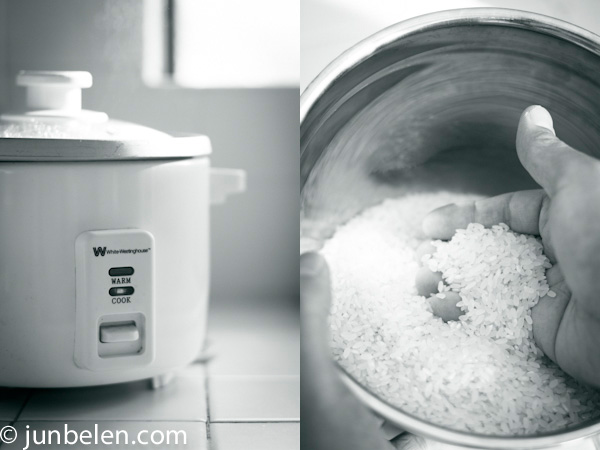
]]>I’ve owned two rice cookers in my adult life. My first was a welcome gift I received when I moved to California, a hand-me-down from one of the older graduate students in the university. It was sadly short-lived; it lasted only a few months before it stopped working. My second still sits on my kitchen counter now. It’s a four-cup rice cooker I bought at an Asian discount store. It has a glass lid with a small opening where the steam billows out and a single switch on its face that toggles between cooking and keeping cooked rice warm. My trusted rice cooker still works after all these years, dependably delivering comfort food to my table.
Back home, cooking rice isn’t as simple as a flip of a switch. Back home, cooking rice is a ritual. It begins with choosing and buying rice at the market — a full sack in times of plenty and a humble kilo when times are tough. My mom prefers Sinandomeng and the more fragrant but more expensive Dinorado. Sinandomeng swells up substantially when cooked and the cooked grains are tender. Cooked Dinorado is firmer than Sinandomeng but my mom likes how the Dinorado grains smell like bagong ani, or fresh harvest.
Bigas, or uncooked rice, can come with husks and dirt leftover after threshing palay, or unhusked rice just harvested from the palayan, or the rice fields. The husks and dirt are picked tediously by hand before bigas is measured, washed, and cooked. I have memories of sitting on our kitchen steps when I was little, with my mom sitting next to me holding a metal bowl of bigas. I remember watching her with curious fascination while she deftly tosses the grains upward with a brisk shake of the bowl, then gracefully combs through them with her fingers.
My mom measures rice using an empty tin milk can. A can filled to the brim with grains is isang gatang, or one measure, which is roughly equivalent to one cup. She pours the grains into a heavy metal pot and washes them thoroughly with running water. She washes the grains three times, tossing the water after each wash down the sink or reserving the starchy hugas bigas, or rice wash water, later for use in poaching whole fish for pesa or sinigang. After the grains are washed, she fills the pot with water and then dips her hand in the pot, fingers first and fingers straightened. She uses the folds of her middle finger as her guide to make sure she adds ample water. Too little leaves the grains parched. Too much makes the rice malata, or too mushy like the consistency of arroz caldo.
At times, my mom adds a knot of pandan to give kanin, or cooked rice, a subtle, sweet fragrance. She ties the long, narrow, blade-like leaves into a simple knot and buries a knot or two underneath the bed of rice. The scent of pandan in a pot of cooked rice is one of my earliest and fondest recollections of food as a child. Pandan is the fragrance of a home-cooked meal, the fragrance of home.
As soon as the water in the pot begins to boil, my mom calms the flame and lets the rice simmer slowly until the rice is inin, or fully cooked. If the flame is too strong, a scorched crust forms at the bottom of the pot called tutong, or burnt rice. A liberal douse of sarsa, or sauce, from a braise like caldereta or mechado fixes the flaw. For some, tutong is not even a flaw but the sought-after part of the entire meal.
Rice leftover from a meal is saved as lamig, or cold rice, stowed in the refrigerator or on the kitchen counter until it is consumed cold or fried with salt and garlic for breakfast the following morning. Sinangag, or fried rice, with fried eggs and fried fish or fried pork is Filipino breakfast bliss.
This is how my mom cooks rice, how she taught me to cook rice. The Filipino staple is ever present on our hapag kainan, on our table, in every meal. She often tells stories about the most trying of times when I was little, when rice was all my family had to eat, when cooked rice doused with water and salt was all my family had to make it through another meal. Doreen Fernandez writes that rice is the Filipinos’ deepest comfort food. Indeed, rice satisfies. Rice feeds the Filipino soul.
Three hundred posts. My winning essay about the Filipino staple is my 300th post. When I started writing my blog nearly five years ago me winning a Doreen Gamboa Fernandez Food Writing Award one day did not cross my mind. My blog lasting this long did not either. I have to admit juggling my blog with the demands of work and life has become more and more difficult through the years. A lot has changed after three hundred posts but there are things that remain the same, things that remind me why I blog — the memories of food and of home and the happiness these memories bring.
]]>