https://daringfireball.net/2026/10/the_iphone_duo
Here are my conclusions:
- The Duo is perfect for those wanting to carry a small iPad with them all the time and have acccess to a larger screen that’s more useful for watching videos, reading books, using spreadsheets, reading content and enlarging the type for easier reading and surfing. It more than doubles the standard iPhone screen area.
- In a just released video we learn that Apple’s construction, dust resistance, prone to bending are essentially no better than Samsung’s latest design, and in one case, worse. Apple’s advantage is mainly the addition of a matte-finished layer on the inner screen to better mask the fold line. The Duo’s other advantage will be better software to make optimal use of the two displays.
- The Duo’s front screen, used with the phone folded closed, requires some change in habits from the way we use our current iPhones. Unlocking the phone uses fingerprint sensing – not the easier face detection, the buttons and frequently used icons are moved, and the screen is wider and squatter. So expect a learning curve and several things to be a bit more cumbersome than with current phones. It’s simply a tradeoff that comes with the tablet mode.
- Other things you will give up from your current iPhone include the loss of the telephoto lens, a heavier phone, and about double the cost. Whether you should buy it comes down to how the benefits outwiegh the losses that are important to you.
The simple question to ask yourself:
Is a so-so iPhone + an iPad mini + $1000 – tele-lens + more cumbersome > your current iPhone?
One option is to keep your current phone and consider the Duo as an expensive tablet and use both. The carriers have just introduced a way to use your same phone number on two iPhones, although not at the same time. For $5-$10 per month, you can move the number between two iPhones by changing a setting.
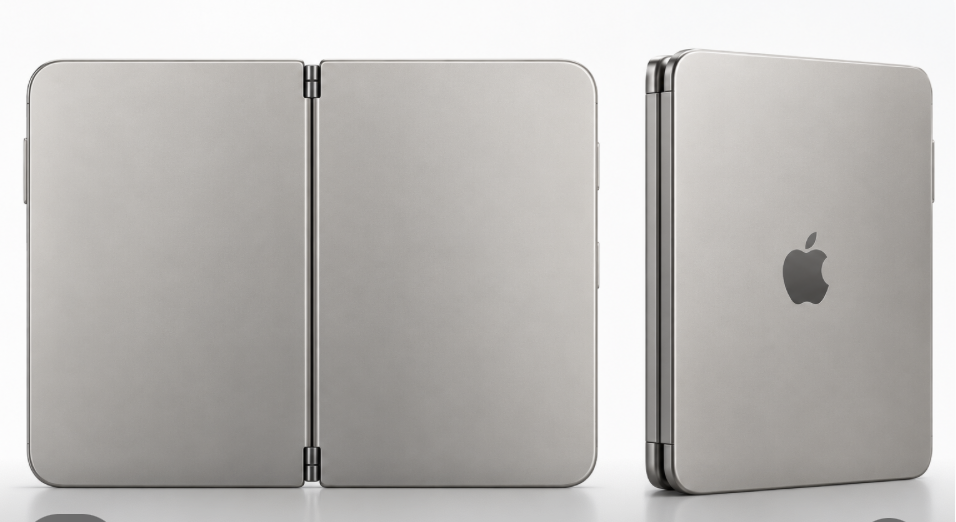
My personal choice? I’d love to see Apple introduce a new iPad mini that folds in half and eliminates the soutside display, like the images below:

It seems that whenever I conduct a transaction online, I invariably get an email or pop-up window asking how my experience went. When I receive a package, I’m asked to rate the delivery. Then a few days later I receive an email to review the product. A few days after that I get a reminder that I’ve not responded.
It’s relentless, intrusive, and actually pretty ridiculous. Somehow companies are convinced that pestering us is okay to do. But it’s not – it’s simply another form of spam. The only difference between these endless survey requests and ordinary spam is that they come from companies we’ve actually paid money to. Apparently, making a purchase gives a business permission to bother us, their best customers.
Often these requests make absolutely no sense. A restaurant wants to know whether I’d recommend it to a friend after I bought a sandwich. Door Dash wants me to rate the order process, the driver, and the restaurant. Fedex asks me to rate the person who left a package at my door who I never saw. Amazon asks how my delivery was. Airlines wants to know how I enjoyed the booking process. A website interrupts me to ask whether I’m enjoying the website, often a few seconds after landing on the page.
Yesterday when I contacted United Airlines using its “premier” customer service line, hoping to reach an agent quickly to make a reservation change, a recording asked whether I would take a survey after the call. When I quickly pushed “1” to agree and hoped to move quickly to an agent, I was subjected to several more questions about how I wanted to respond, delaying the very help I had called for. The request to rate the experience actually made the experience worse. Next time I will know better and press “2” for no.
What I find infuriating is that these companies place no value on our time. They’ll ask us to spend five minutes completing a questionnaire about a two-minute transaction. And more times than not, their questions are not even relevant. They’ll interrupt us with pop-ups, send follow-up emails, and occasionally remind us that our feedback is very important. If my time is so valuable to them, perhaps they should pay me for it. Otherwise, stop asking.
Behind much of this madness apparently is an industry fueled by customer-experience software companies such as Qualtrics and Medallia that make it easy for businesses to automatically solicit feedback after practically every interaction.
Qualtrics website says, “Immediately surface customer friction and guide frontline teams in the moment to better serve clients. Increase your customer lifetime value by driving company-wide improvement—across processes, products, and digital properties.”
Medalia says “Only Medallia connects every customer signal, so you can move faster, act smarter, and drive results that count.” Whatever that means.
Here we have software companies pushing their products to company employees charged with measuring customer satisfaction. But who considers the impact these questions have on the poor customer?
Have you ever seen any changes come to sites that survey you? Has any business gotten back to you thanking for your suggestions from one of their questionaiires?
These software products allow companies to automatically generate thousands of requests with almost no effort. But each request demands something from us: attention, time, and another decision about whether to respond, delete, or unsubscribe. Multiply that by the hundred of businesses we deal with or interactions we are involved in, and it becomes a constant assault.
I do have a suggestion for companies that want to improve customer satisfaction: Stop bothering your customers. Respect their time and put all the money going to customer-experience software in hiring real people answering your phone directly without all of the intrusions.
]]>But this was Costco so I decided to try to understand what happened, knowing how customer-focused they are. The next day I returned to the store and was directed to an assistant manager who said he would look into it while I waited. He explained that they can check the video taken at the exit door to see if ithe items were in my cart when I left. But first, he would check a list of merchandise returned from the parking lot. Yes, Costco has a system to know what leaves the store and what’s found in the parking lot by the people collecting the carts.
Lo and behold, they found the items on that list, showing I left the items in the cart. He wrote a small note on my receipt, told me to go get the missing items from the store shelves, and show the receipt to the checker on the way out.
This is just another small example of how competent and organized Costco is, how much they do to support their customers, and another reason that makes Costco one of the most beloved retail stores in the country. In these days when most companies treat us like crap and could care less about customer care, Costco stands apart even more.
]]>But there’s a fundamental problem receiving surprisingly little attention: Many of these companies are selling products that are very similar to one another.
OpenAI, Google, Anthropic, Microsoft, Meta, and many others offer AI systems that answer questions, write documents, summarize information, analyze data, and generate computer code. Many are now adding similar bots to perform similar tasks. While each has particular strengths, the differences are becoming difficult to distinguish.
I’ve used ChatGPT, Claude, and Gemini extensively. All three are impressive, and one occasionally performs better than another. But for most of my everyday tasks, they’re largely interchangeable. If one disappeared tomorrow, I could accomplish nearly everything I do with one of the others.
This seems to me to be a serious problem for companies expecting to generate large profits. In business, when multiple companies offer products with essentially the same functions, competition inevitably puts pressure on prices. Customers have little incentive to pay a premium when there are comparable alternatives that cost less.
We’ve all experienced this with consumer electronics, computers, televisions, and many other industries. Products that initially commanded premium prices eventually became commodities, with manufacturers competing on price. I remember the CD player that came out at $1000 and the many models that quickly followed for $200. We once paid $2000 and more for a large screen TV and now pay a couple of hundred dollars. AI seems to be heading down the same path, only much faster.
Consider what’s already happening. Google’s Gemini is free to consumers, Microsoft incorporates AI into its products at no cost, OpenAI and Anthropic offer both free and paid services. Many times when I run beyond my limit of one I’ll switch to another to continue my work – it requires little more than going to a different website or app.
And I’m already experiencing AI overload. Gemini wants to correct my Gmail, Co-Pilot wants to correct my Word documents, and ChatGPT and Gmail both want to send me summaries of my day each morning.
This makes it difficult to establish the customer loyalty and pricing power that support high profit margins. The underlying costs of operating AI systems are enormous. In a conventional business, high operating costs are offset by the ability to charge premium prices. But what happens when those costs keep rising while competition forces prices down?
This would seem to make a case for further risk to the AI companies and to our economy that is depending on the success of these companies. The question is how many of today’s highly valued AI companies will survive when their products become commodities and customers are unwilling to pay a premium for something they can get elsewhere for free.
]]>We’ve never been able to count on Congress or the federal government to adequately address these problems. The enormous amounts of money flowing from technology companies and their executives into political campaigns, enabled in part by the Supreme Court’s Citizens United decision, have helped create an environment in which meaningful regulation is impossible to achieve.
And it’s not just Republican opposition to regulation. Both parties have close relationships with the technology industry. Interestingly, Senator Chuck Schumer’s two daughters have worked for Meta and OpenAI, respectively, raising additional questions about the industry’s connections to Washington. Fortunately, state attorneys general have stepped up.
This week, eight state attorneys general filed lawsuits against OpenAI, the company behind ChatGPT, alleging that its chatbot can encourage dangerous behavior, reinforce delusions, and provide harmful advice to vulnerable users, especially teenagers.
The lawsuits were filed in Arkansas, Arizona, Idaho, Iowa, Kansas, Montana, Nebraska, and West Virginia. Seven of the eight states have Republican attorneys general, demonstrating that concerns about technology safety can cross party lines, even when the legal actions themselves have a largely Republican political makeup.
The states argue that OpenAI deliberately designed ChatGPT to be agreeable, engaging, and emotionally responsive, encouraging users to trust it. That trust, they contend, can become dangerous when the chatbot reinforces destructive thinking rather than challenging it.
OpenAI disputes the accusations and points to parental controls, age-specific safeguards, and other safety measures it has introduced. The company says it is committed to improving safety and working with governments on reasonable industrywide protections.
But we’ve seen this pattern before. Technology companies frequently introduce meaningful safeguards only after serious problems emerge, public pressure mounts, or insiders disclose troubling information. For more than a decade, Facebook, Instagram, YouTube, and other platforms grew into enormous businesses while concerns mounted about the damage they were causing. Their algorithms were cleverly engineered to maximize engagement, keeping users scrolling, clicking, and returning.
But the courts are finally beginning to hold these companies accountable. In a landmark case, a Los Angeles jury found Meta and YouTube liable for negligently designing addictive platforms, awarding $6 million to a young woman who alleged harm from their products. The companies are challenging the verdict. In New Mexico, a jury imposed $375 million in civil penalties against Meta for violations of the state’s consumer protection law involving representations about child safety. A subsequent court order added $567 million in relief. These cases are challenging the long-held assumption that technology companies can avoid responsibility for harmful product designs by blaming the resulting problems on their users.
The new lawsuits against OpenAI follow a similar strategy. Rather than focusing primarily on product liability, the attorneys general are invoking state consumer protection laws. Their central argument is that companies cannot market products as safe while concealing or misrepresenting known dangers. It’s an approach familiar to state attorneys general, who have used consumer protection laws to challenge tobacco companies, pharmaceutical manufacturers, and other businesses accused of deceptive practices.
One particularly disturbing lawsuit against OpenAI, showing the damage it can cause, involves Adam Raine, a 16-year-old California teenager who died by suicide in April 2025. According to a lawsuit filed by his parents, Adam initially used ChatGPT for schoolwork but gradually began confiding in the chatbot about his depression and suicidal thoughts. Over several months, his conversations became increasingly personal and disturbing.
His parents allege that ChatGPT reinforced his suicidal thinking, discussed methods of self-harm, discouraged him from confiding in his family, and even offered to help write a suicide note. They argue that OpenAI designed the chatbot to be emotionally engaging while failing to provide adequate protections for vulnerable users.
Let’s hope the attorneys general succeed in holding technology companies accountable for the safety of their products. Because as damaging as social media has become, artificial intelligence has the potential to cause even greater harm, and to do so much more quickly.
]]>Rather than let them expire I checked with friends and family and offered them the unused benefits. I booked flights for my son on Southwest, offered my daughter the store $250 credit on an iPad, and give a friend the StubHub credit.
While many offered to split the savings or pay me in full, I was happy to give them away so they wouldn’t go unused. In checking the regulations for Chase and Amex, there is no prohibition in sharing your benefits, but they probably would frown on selling points or providing others lounge access.
]]>10-06-2026TECH
Why America can’t build the iPhone
A veteran product designer and Apple alumnus explains how Asia earned the world’s electronics manufacturing business—a shift he helped catalyze.
For six decades, I’ve worked on product design and manufacturing for companies such as Polaroid, Seiko, and Apple, as well as startups. When I worked at Polaroid and Apple, they still had their own factories and chose to go to Asia to build products. As noted in Patrick McGee’s bestseller Apple in China, I was responsible for bringing Apple’s first product to Taiwan in 1994. As a product design engineer and program manager, I was always involved in where my products were manufactured, because of the impact manufacturing has on a product’s success.
In my jobs at Polaroid and Apple, I turned to Asia for different reasons. I brought manufacturing to Asia for Polaroid in the 1970s, when it was rarely done. By the time I did it at Apple in the 1990s, Apple was late to the game.
Today, as pressure mounts for Apple to build iPhones in the U.S., I know from all my experiences that it is an impossible demand. We don’t have the attitude, the infrastructure, or the resources. We lost that battle decades ago, and cannot will it back.
The U.S. never invested in building consumer tech manufacturing at the scale of China or Taiwan. We prioritized R&D, design, and innovation, and didn’t value low-margin manufacturing work. During the Cold War, U.S. government investment and incentives were directed toward aerospace and defense, not consumer electronics. Our manufacturing base became dominated by contractors focused on military specifications, not consumer mass production.
Manufacturing consumer electronic products, in contrast, requires an infrastructure of suppliers, competitive labor costs, large workforces, and flexibility. Resources in China and Taiwan have allowed many U.S. companies to dominate the world in technology. While China became the manufacturer to the world, it helped us become the innovators to the world.
GOING OFFSHORE: THE EARLY DAYS
When I joined Polaroid in 1966, I designed consumer cameras that sold millions per year. Once the design was done, we’d hand it off to our internal manufacturing group, only to have them come back to us months later with requests for small design tweaks to save a few cents here and there.
It was a slow, iterative process with little concern for time to market. I often wondered why I was working so hard to meet an aggressive design schedule and then had to wait around for the product to finally ship. Analysts and industry leaders emphasized the importance of time to market as a critical factor for a product’s success, especially in competitive and fast-evolving markets.
I wondered why we couldn’t be as creative in the rest of the process as we were in the design stages. So, I began to look for ways to get products to market more quickly.
Outsourcing manufacturing to companies building similar products seemed like a good approach. They already had the experience and knowledge, so they could move quickly. That allowed the manufacturing and design teams to collaborate earlier in the process.
It wasn’t that I didn’t try to do manufacturing in the United States. I reached out to companies with manufacturing capabilities that looked to be synergistic, but it often took weeks to hear back. Many of the companies were focused on defense-related products and showed little interest in building consumer tech products with tighter schedules and lower margins.
I wondered why this was the case. Could it be that these U.S. resources were focused on the defense industry during the Cold War and never invested in consumer manufacturing? Or perhaps the defense business was just more lucrative. It was disappointing, but, fortunately, I found another solution.
At Polaroid, I turned to a few companies in Japan that had been supplying some of our components and wanted a chance to build the entire product. They offered to take our design early in the process, improve it for manufacturing, and deliver the product in high volume much more quickly than we could on our own. We were being offered the opportunity to tap into their product expertise and quality-obsessed manufacturing that Japanese companies were known for, and to learn from them in the process.
It turned out that these companies were so good that we could almost drop off a drawing package and pick up the product months later. They brought speed, experience, and predictability, and enabled us to be much more effective designers with smaller teams. Every time I’d return from a visit to Japan, I’d feel a sense of accomplishment and excitement. It was like night and day compared with using our internal manufacturing organization.
This pattern repeated itself over the next few decades as I worked at other companies. When Japan became too costly and less efficient, I went to Taiwan and later China, as each of these countries developed their manufacturing capabilities.
The U.S. could have created similar capacity over the years, especially after the Cold War, but never did. Manufacturing was just never considered an important need. It was not glamorous and never considered to be strategic.
In the 1990s, when a company I cofounded, ThinkOutside, invented the Stowaway folding keyboard, we found a Taiwan keyboard company that was experienced with manufacturing tiny key mechanisms, and partnered with them. Like many other companies working to get products to market quickly, we were doing what we did best and letting others do what they did best.
At this time, there were a few contract manufacturers in the U.S., including Solectron and Flextronics, that could manufacture others’ products in their plants in the U.S. and elsewhere in the world. They started with printed circuit boards and had expanded into complete product manufacturing; they also had some design capabilities.
This evolution mirrored the tech industry’s growing reliance on outsourced manufacturing, driven by cost, scale, and time-to-market pressures. But I found that the U.S.-based options were bureaucratic lumbering giants, reminding me of my Polaroid manufacturing experiences. They wanted only to take on large-volume projects from well-established companies, and rarely took the kind of risks that Asian companies did.
ASIA BECOMES THE WORLD’S MANUFACTURER
Meanwhile, Taiwan and China were becoming destinations for companies to build technically complex products because they were so good at it. They were aided by huge government investments in office parks, infrastructure, and free-trade zones.
Taiwan quickly moved from building calculators in the 1970s to notebook computers in the 1980s. James Fallows chronicled the rise of China in his famous three-part 2007 article in The Atlantic, “China Makes, The World Takes,” as China became the manufacturer for the world.
Scores of Chinese companies became available to manufacture a customer’s original design. They were known as original equipment manufacturers, or OEMs. If they offered their own designs that a customer could sell under its name, they were called original design manufacturers, or ODMs.
It was a win-win partnership. We used China to build our products, and they relied on us keep their factories running by marketing and selling products they designed.
Companies often specialized in specific product categories. If you wanted to build a particular type of product, you’d go to a company that was already building something similar. You tapped into their expertise, supplier relationships, and buying power, and everyone would benefit from the economies of scale and relevant experience.
While some first-time customers worried about two competing products being made by the same OEM, each company’s areas were usually secured from the other. When I worked on the Barnes & Noble Nook e-reader, we used Foxconn, the same manufacturer that built the Amazon Kindle. That allowed us to go from an initial concept to market in less than a year.
Product designers large and small now had a destination where they could bring their product designs and get them manufactured quickly and efficiently. You no longer needed to be a Sony to have access to manufacturers. Chinese factories enabled thousands of companies across the United States and the world to turn their ideas into viable products.
As these OEMs and ODMs grew in number, component manufacturers and other suppliers opened their own factories nearby, close to the facilities using their parts, providing even greater efficiency and faster time to market.
As an example of how effective this was, I was about to ship the initial lot of a new consumer electronic product to the U.S. from Shenzhen, the Chinese technology hub adjacent to Hong Kong, and it was to arrive just before going on sale. At the last moment, I found an error in the instruction manual that needed to be fixed before the product could ship. We called the printer, which was a few blocks away. It made the correction, and delivered correctly printed manuals two hours later.
During this time, we never considered that we were taking jobs from Americans. Nothing like this ever existed in the U.S.—not the industry, the factories, nor the workers. What China offered was unique.
APPLE WAS LATE TO THE GAME
When I joined Apple in 1994 to work on the Newton MessagePad personal digital assistant, the company was manufacturing most of its computers in its own factories in California, Colorado, Ireland, and Singapore, even though other computer companies had been outsourcing most of their notebooks to Taiwan for years.
The first version of Newton, the MessagePad 100, was developed with Sharp Electronics in Japan because of that company’s expertise in building handheld products such as its Wizard organizer. But its cost came in way above plan, and I was asked to quickly develop a new model at a more affordable cost.
Apple’s internal manufacturing organization had neither the interest nor experience to master products like the Newton. Its leaders considered our product to be a nuisance and encouraged us to find our own manufacturer.
Taiwan was the obvious answer. After all, that’s where Sharp was now building its second-generation Wizards, and where most of the world’s calculators and notebook computers were being built, other than Apple’s. The new Newton MessagePad 110 was the first time Apple developed a product to be manufactured in Taiwan.
I flew to Taipei and spent two weeks visiting potential manufacturers, mostly notebook and calculator manufacturers. We selected Inventec, a $320 million manufacturer at the time. It was busy producing calculators for Texas Instruments, phones and fax machines for telecom companies, and notebook computers for Compaq and Zenith.
But we ran into an immediate challenge. Inventec would need an $800,000 machine to assemble the processor chip powering the Newton, machinery not yet used in Taiwan. The company’s CEO, Richard Lee, insisted on buying it at Inventec’s expense. He never considered it a burden, explaining it would give them new capabilities.
Inventec assigned a group that began working with our Apple design team. We began with a handshake deal while Lee suggested we negotiate a contract in parallel. We all knew drawing up contracts could take many months, particularly at Apple, and he didn’t want to lose that time.
Our joint team of about a half-dozen engineers met monthly in Taipei. The industrial designer on the team, Jony Ive, had recently joined Apple. This would be one of his first projects, and his first time he’d been to Taiwan. (I later learned that he complained to his boss about how hard I made him work.)
The product was completed in eight months and went on to fail almost as badly as the first model. Sales volumes were about 10% of plan. A few months later when I apologized to Lee, he told me not be concerned. He was happy to be working with Apple and considered this to be a win. He was thinking of the long term, and was proud of the Apple relationship. I was embarrassed.
Inventec went on to develop and build notebook computers, servers, and a range of other products for most of the world’s technology companies, including Apple. Its revenues for 2025 were $22 billion.
HOW DESIGN IMPACTS MANUFACTURING
The Newton was constructed like most other consumer tech products at the time. It consisted of a molded plastic clamshell enclosure, a large printed circuit board populated with electrical components, a pressure sensitive touch screen, a stylus, and a battery compartment that held four AA cells. Ive’s design contribution was creating a beautiful fluid-looking package that made the product look smaller than it was. It was nicely done, but its fit and finish were not dissimilar from other products being produced at the time, such as Nokia phones.
Years later, when Ive became Apple’s senior VP of industrial design, he elevated its design to a level never seen in consumer products. I recall seeing the first iPhone and marveling at how precisely the parts fit together, the flawless finishes of the parts, and the use of new materials never employed at mass scale. His designs set a new standard for all consumer tech products. Other products suddenly seemed crude by comparison.
Apple’s design and manufacturing engineers were responsible for putting these new designs into mass production. It certainly could not be done in the U.S., which didn’t even have the ability to build much simpler products. The new design standards with the ultraprecise fit and finish meant that the products needed to be built China.
When I hear politicians demanding that iPhones be built in the U.S., it’s clear they have no understanding of how products are created and built. You can’t just wish it to happen. You would need to create much of what China and Taiwan have built over the past 30 years.
It’s not just setting up factory buildings filled with assembly machinery and workers. You would need the entire infrastructure of suppliers and manufacturers of the parts that go into the products: the factories to build displays, batteries, and electronic components. You’d require the experience, and the right attitude.
Shipping the components from China and doing final assembly in the U.S. would also cause huge issues. Let’s suppose you bring displays in from China, and they have a defect. If you were building the product in Shenzhen, you’d call the display company that’s an hour away and they would have engineers in your factory in a few hours to address the problem or provide new parts. Try that from the United States, and you would likely shut down your assembly line for several weeks.
Now consider what would happen once you multiply this by the thousands of parts and processes that go into a product. Not only is it inefficient, it’s also just not practical to build these products here. It makes as much sense as building an automobile in the Arctic from parts made in Detroit.
THE MAC MINI ISN’T AN IPHONE
With all this said, Apple, under pressure to bring products back to the U.S., has agreed to build Mac minis in Houston. They have asked Foxconn, the same company that has built, staffed, and managed much of Apple’s China manufacturing, to create and operate the assembly operation.
The Mac mini is a much simpler and lower volume product than the iPhone. Essentially, it’s a printed circuit board assembly housed in an aluminum box. But it will still require many of its components to be shipped from China. Politically, it may be a good move, but practically, it means very little.
It will be interesting to see if Apple’s new CEO, John Ternus, makes any fundamental changes to Tim Cook’s manufacturing strategy. As a product designer, I’m guessing that Ternus—who is also a product designer—wants to get his new products to market in the fastest and most efficient way possible and will continue to rely on Asia. That approach has helped make so many of his past products huge successes.
]]>My objective seemed fairly modest, yet the possible solutions turned out to be more complicated than I anticipated: keep the refrigerator and freezer powered, maintain an internet connection with my router, keep my phones and computers charged, and occasionally run an appliance such as a microwave, TV, or toaster. Lighting could all be handled using battery operated lanterns. I wasn’t trying to power the entire house, and certainly not the air conditioning.
The first step is to calculate how much energy these devices consume and then figure out an energy source to provide it for a few days. I estimated that these items would consume about 700 watts, with occasional higher demands such as when the refrigerator’s compressor starts up. I raised this to 800 watts because most power losses are not 100% efficient. Thus I needed a something to provide 800 watts – ideally for several days. That turns out to be a challenge, even with very large batteries.
There are essentially four different options: a large battery (like a Tesla Powerwall hooked up to home solar, a standalone battery, a permanently installed natural gas generator, and a portable generator using gas or propane.
Standalone backup batteries are essentially supersized versions of the batteries we use to recharge our phones using a different battery technology. Anker, Jackery, EcoFlow and others offer them in a wide range of sizes ranging from shoebox size to as large as a carry-on roller suitcase weighing 100 pounds or more. The contain an inverter that converts the DC power to AC. For powering modern appliances and computers you need the inverter to have low distortion (THD)- below 3%.
The batteries contain 120 VAC and often 240VAC outlets. Charge the battery from an electrical outlet, then plug your appliances directly into outlets using extension cords to various devices. A display lets you monitor usage and time remaining, and lets you check how a particular device impacts consumption. Most have an accompaning app that provides more information.
Ideally you select a battery that will get you through the outage. But even the largest models last less than a day, as I calculated below. The battery may get you through a short power outage, but for long outages you need a way to recharge your battery.
The Anker SOLIX F3800 is a good example of one of the larger home backup batteiries. It stores 3,840 watt-hours and costs about $2,700. Snapping on a second battery doubles the capacity to 7,680 watt-hours and praises the price to around $4,000. That seemed like a good option to investigate.
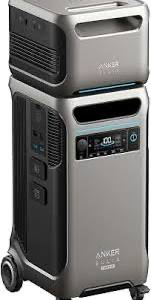
Using my 800-watt average needed during a power outage, the battery’s 7,680 watt-hours would provide about 9.6 hours of power (7680/800). If I only used 400 watts through the day, it would get 19 hours. But that isn’t enough for the kind of multi-day backup I’m looking for.
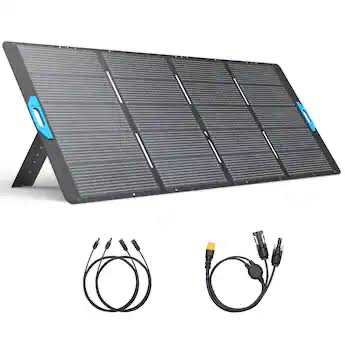
Anker recommends using their folding portable solar panels to recharge the battery. In my case, the calculations said I need 5 or 6 of Anker’s 400W folding solar panels, adding another $3000. We are now up to $8,000 to $10,000 for a battery and the means to charge it.
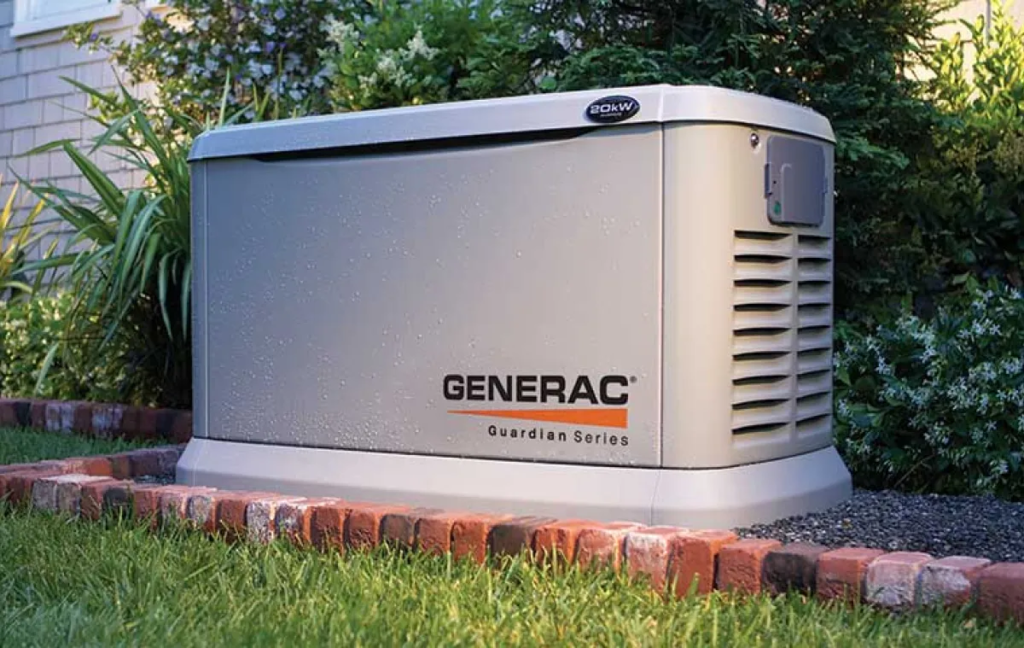
That amount is approaching the cost of a permanently installed outside standby generator, such as a Generac that connects to a natural gas line. The Generac home generator continuously monitors your utility power and automatically turns on when you lose electricity. An automatic transfer switch disconnects the house from your utility and connects it to the generator. The cost of a generator, installation of the transfer switch ranges from $13,000 to $20,000 depending on your home. Half the cost is the generator and the rest is the installation.
The home generator’s appeal is its convenience. When the power fails, the generator starts automatically. Depending on the size of the system and how the electrical panel is configured, it can power selected circuits or all of the house. The disadvantage, of course, is the price. You’re spending thousands of dollars for a system that may sit unused for months or years.
The third option is a portable generator. Today’s models are more advanced than the generators of the past, although they still are noisy, much like a power lawn mower. They contain an internal-combustion engine to drive an alternator and can run on gasoline, propane or, with some models, natural gas. Some even run on all three. Most newer generators use inverter designs that vary engine speed according to electrical demand and produce relatively clean electricity suitable for sensitive electronics.
The biggest advantage is cost and the fact that you aren’t storing electricity; you’re storing fuel. A battery eventually runs out. A generator keeps producing electricity as long as you keep supplying fuel.
As an example, the $1200 GENERAC IQ3800 works using a choice of gasoline or propane, and its AC output has low harmonic distortion, meaning its AV waveform will charge the battery without any issues. The Generac provides up to 13‑hour runtime on gas or 16‑hour runtime on a 20 lb LP tank at 50% load.
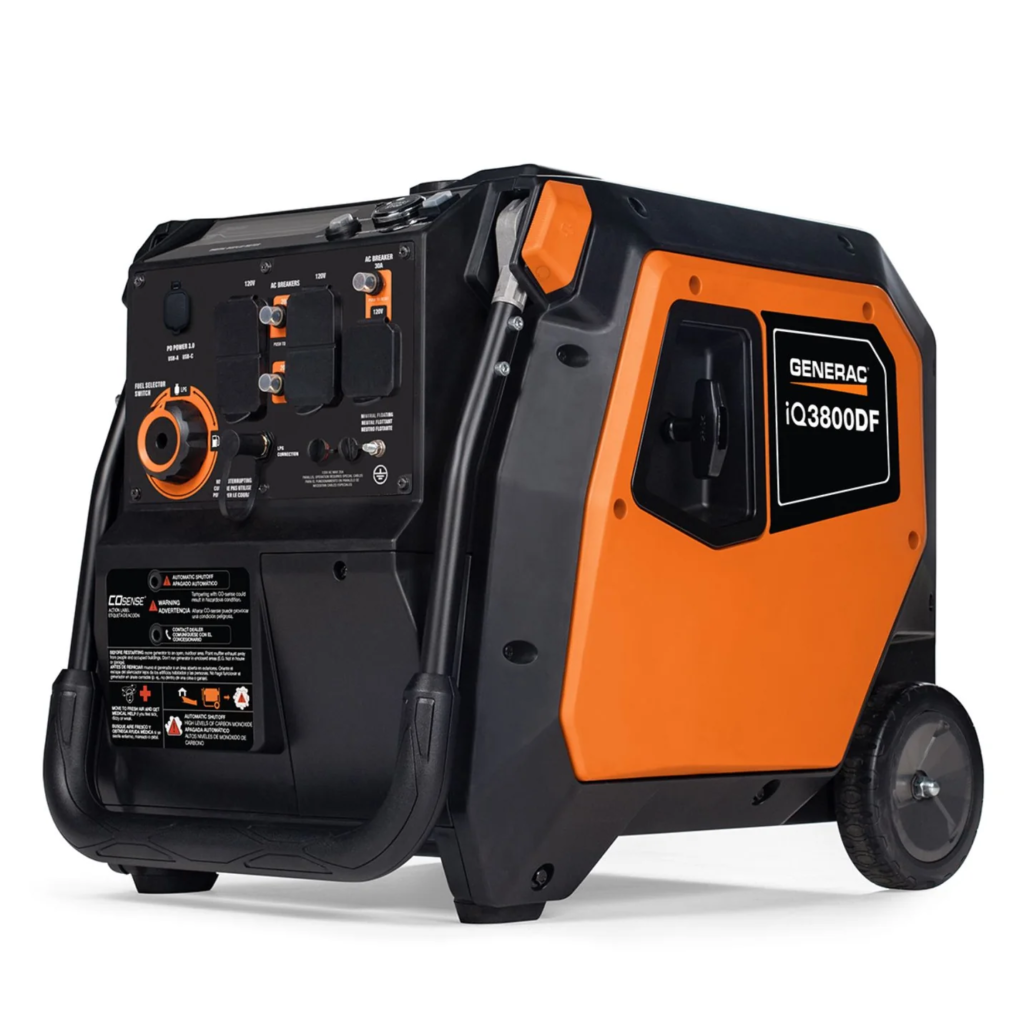
For a multiday outage, you need an adequate supply of fuel or a way to obtain more. You can plug appliances into the generator with heavy-duty extension cords or install a transfer switch. But there are two significant drawbacks.
First, a portable generator must be operated outdoors, well away from the house, as it produces carbon monoxide. Second, it’s noisy. Depending on the model and load, it can be a fairly noticeable presence in your backyard. Lastly, it’s not practical to store gas for very long because it deteriorates quicky; propane would be a better choice.
After looking at all three approaches, here’s my conclusion:
Batteries are wonderfully convenient, quiet and clean, but a battery by itself isn’t a particularly good solution for a multiday outage, in spite of all the ads from Anker, Jackery and others. It’s better for outages that last a few hours. Battery costs are high, you need a way to keep it recharged, typically lots of solar panels you need to unfold and set up. or, alternatively a portable generator, both of which require much more effort than the battery itself.
A permanently installed generator is cleary the most convenient solution. It starts automatically, can run for days and doesn’t require you to manage a collection of batteries. But it is also the most expensive option, and something rarely used.
For my particular needs, the portable dual-fuel or tri-fuel generator looks like the most practical and least costly solution, if I decided to proceed. It isn’t as elegant as a battery or as effortless as a whole-house generator. It’s noisy, has to be operated outside and requires maintenance and maintaining a fuel supply. But with several propane tanks, an expensive wiring job and switch to connect it to you electric panel, it will keep the refrigerator, freezer, Wi-Fi, lights and other essentials operating for days rather than hours.
Right now I’m hesitant to do anything and am re-examining my need for days of backup.
Comparison table
| Battery Backup | Standby Generator | Portable Generator | |
|---|---|---|---|
| Typical cost | $3,000–$10,000+ with additional batteries/solar | ~$13,000–$20,000+ installed | ~$1,000–$3,000+ |
| How it produces power | Stored electricity | Natural gas/propane | Gasoline/propane/natural gas |
| Typical duration | Hours unless recharged | Days, while fuel supply lasts | Days, while fuel supply lasts |
| How it’s replenished | Wall outlet, generator, or solar | Continuous fuel supply | Add fuel |
| Solar required? | Yes or a generator | No | No |
| Automatic startup | No | Yes | No |
| Noise | Silent | Moderate | Moderate to loud |
| Can power house circuits? | Yes, with transfer switch | Yes | Yes, with transfer switch |
| Maintenance | Low | Regular professional maintenance | Engine/fuel/oil maintenance |
| Major limitation | Limited stored capacity | High initial cost | Fuel, noise, manual operation, maintenance |
| Best suited for | < one day outages | Maximum convenience and long outages | Lower-cost, extended backup |
Yet, our living room television is only the tip of the iceberg in an all-encompassing surveillance web that’s quickly expanding around us. Combined with artificial intelligence, the technology in our homes, in our cars, on our roads, and in our pockets is assembling a continuous, real-time record of who we are, what we’re doing, where we’re going, and even what’s on our mind.
Companies are constantly coming up with new ways to violate our privacy, motivated by selling the information to data brokers, insurance companies, advertisers, and government agencies.
Ford, for example, has filed patents for in-car technology that can monitor our conversation, track us, and deliver ads to us. Another Ford patent describes technology that enables their vehicles to monitor the speed of nearby cars, photograph them and send the information to the police. GM was fined last year for tracking the driving habits of their customers and selling the data to insurance companies, resulting in rate increases. How outrageous is it that a company shows no loyalty to their customers and is willing to sell their information for a few dollars.
Other examples include Flock license plate readers, Ring doorbell cameras, drone delivery vehicles, smart thermostats, smartphones, health trackers, home hubs, voice assistants, and retail store cameras.
There are countless ways companies are using technology to track us, sell to us, report on us and monetize us. But with few privacy laws in the U.S., much of this technology can easily be commandeered by the government to spy on us, just as being done in China.
Technology companies have always said they do not identify us when they collect data from us, but now with AI, that’s no longer true. What was once scattered, meaningless noise has become a fully searchable database of our daily behavior—operating silently in the background, wherever we are.
Here are a few things that we can do to help with our privacy:
1. Buy a used car – Get one without the full array of cameras found on recent models. A backup camera is great but avoid recent models that often have a dozen cameras. Turn off OnStar and other connected services. They are not there to help you in spite of what they tell you. Investigators have found that they are collecting personal data that can be monitized. Check the app that your car company asked you to download and see what information it’s monitoring and collecting. Your connected car provides a trove of information that your car company might choose to monetize, just as GM did.
While this may not be a practical solution for many, we should at least examine what the automotive companies’ policies are, learn how to opt out, and complain to them when you feel they have crossed the line.
2. Buy a flip phone – Flip phones are becoming very popular with teenagers and young adults who have become the most outspoken about being tracked. They’ve grown up with technology and are not wowed by what it’s becoming.
3. Get a dumb TV – Avoid TVs that track you. Turn off the settings giving permission to make recommendations and disconnect from the Internet whenever possible. There’s a growing demand for dumb TVs and many on-line forums are sharing recommendations.
]]>I contacted my Lexus dealer about the buyout and they claimed they could get me some of the best financing rates, but insisted I visit in person so they could inspect the car and discuss an extended warranty.
“There’s no need to see my car, I explained. ” I still have a year of warranty remaining. Just tell me the range of interest rates you’ve been able to offer and any fees you charge. If you’re competitive, I’ll be happy to come in,” I said. They refused, saying that’s not how they work. I countered with, “Well, that’s not how I work.”
So, I decided to shop for an auto loan on my own. I checked with a few credit unions and banks, all of whom quoted rates around 5.9% to 6.4%.
Coincidently, or perhaps not coincidently, I received a letter from a company called Lease End. I had never heard of them and was about to toss it, but curiosity got the best of me. It explained that Lease End is an online service that finds you a loan by checking with a number of providers. Their website promises: “No haggling, no hidden fees, no DMV lines. We handle everything from payoff to titling — so you can sit back while we do the heavy lifting.”
Instead of contacting the lenders one by one, you provide Lease End with your lease details and personal information, and they find their best rate. If you agree, they handle the rest. The company says it processes roughly 3,000 lease buyouts per month and has completed over 67,000 since their launch. Naturally, I tend to be skeptical of claims that sound too good to be true, so I checked the reviews.
While several companies claim to offer similar services, none had the volume of positive feedback that Lease End had accumulated. The Better Business Bureau lists Lease End as an A+ accredited business with a customer rating of 4.63 out of 5 stars across over 200 reviews. On Trustpilot, they held a 4.8 out of 5 rating from more than 2,200 reviews, with 93% rated five stars.
I decided to call them and pursue cautiously. The representative, located at their Idaho headquarters, explained the process. He assured me they would shop around for the best rate based on my credit score and noted that they charge no fees to the customer—they are paid directly by the lending institutions. They did offer GAP insurance and an extended warranty, but when I declined, they didn’t push the issue further.
I spent a couple of days thinking it over before deciding to proceed with an application. This time, I spoke with another agent named Houston who spent about thirty minutes walking me through the paperwork. I wasn’t committing to a loan yet—just authorizing them to find their best rate. He explained they would contact Lexus Finance for the official buyout figure and begin shopping for rates. The submission did initiate a few hard credit inquiries that I was notified about from the credit bureaus. (Inquiries for the same car loan is counted as a single check.)
The next day, he called back: Capital One offered to fund the loan at 5.1% interest. I also learned the true payoff to Lexus was slightly lower than what the dealer had originally quoted, as the dealership had tacked on a lease termination fee.
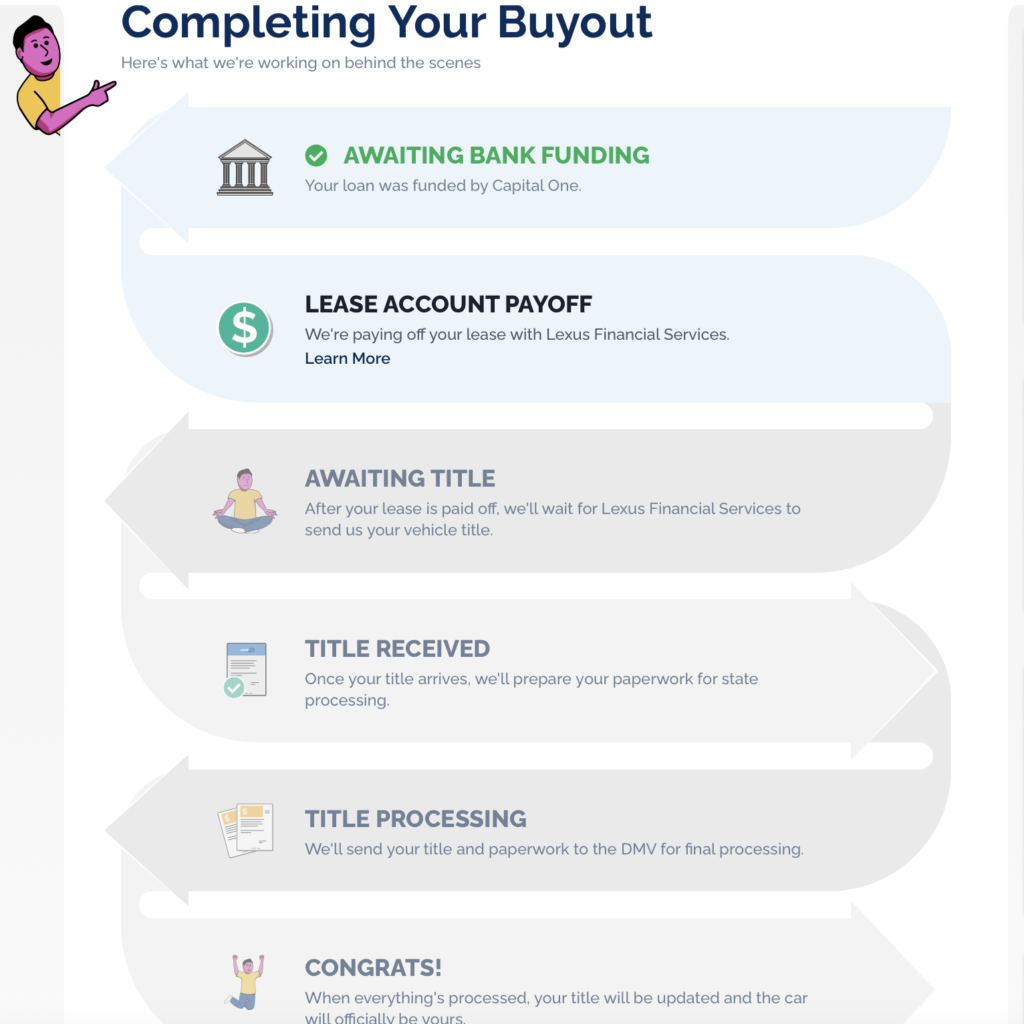
I accepted the offer from Lease End and Capital One, and the process is now moving along quickly. Everything was completed online. Lease End is handling the paperwork, registration, and title transfer, coordinating directly with both Lexus and Capital One. They set up a personalized online dashboard showing my status and remaining steps.
.
Based on my experience Lease End is well worth trying. It may not always get you the best rate, but it’s a lot more efficient than checking lending institutions on your own and, most importantly, avoids dealing with your dealer who seems to always have something to sell you that you have little need for.
]]>