The post The End appeared first on Bleeding Heart Libertarians.
]]>The vagueness of the guiding idea was in some ways intended, and in other ways not. Part of the explanation is that we launched the blog as a way of working out the details of an idea that we were all interested in and attracted to, but hadn’t entirely figured out yet. But a big part of what the vagueness did was allow philosophers– and, later, a number of colleagues from other disciplines– with some pretty radically different normative, empirical, and methodological commitments to rally together under a common banner. Thus, we had people like me, a pluralist classical liberal who supports a basic income guarantee, and people like Roderick Long, an Aristotelean left-wing anarchist who favors “markets, not capitalism.” And everything in between.
Reconciling free markets and social justice seemed like an especially worthwhile project to undertake in 2011. Academic political philosophy was largely dominated by followers of John Rawls, for whom a commitment to social justice (of a particular sort) was paramount. And libertarianism remained a fringe and unfamiliar view within the academy – for most academic philosophers, it was a view that was born and died in 1974 with the publication of Robert Nozick’s Anarchy, State, and Utopia. But a critical mass of scholars were working out new ways of thinking about libertarian ideas; and many of us who were excited by the work of scholars like David Schmidtz, Gerald Gaus, and John Tomasi thought that there was a different style of libertarian thought beginning to crystallize. And we didn’t only want to publicize that; we wanted to encourage it, to help build and develop the research program associated with it.
Moreover, if we sought to open mainstream Rawlsian political philosophy and theory to the influence of market-friendly classical liberalism, we also wanted to wanted to steer classical liberal scholarship toward taking egalitarian liberal ideas much more seriously than it often had.
In a more minor way, there was a political background, too. The Cold War “fusionism” of conservative and libertarian politics was put under considerable strain during the George W. Bush administration; the 2008 presidential candidacy of Ron Paul had reenergized a strain of libertarian politics that rejected neoconservatism but embraced a kind of nationalist, anti-immigrant paleoconservatism instead. Libertarians who didn’t feel comfortable entangled with either neoconservatives or paleoconservatives, those who took the “liberalism” in “classical liberalism” seriously, hadn’t quite found a public voice— Brink Lindsey’s 2006 New Republic article calling for a new “liberaltarianism” hadn’t found much uptake. That seemed to leave a gap to be filled.
Things have changed quite a bit in the last nine years, both in the realm of academic philosophy and that of real-world politics. Rawlsianism and its particular interpretation of social justice have receded in prominence. The variety of libertarian and classical liberal views within the academy has become better known, even by those who reject those views. And that variety is now a more firmly established fact among libertarian scholars and students themselves
I like to think that this blog, or at least the people who write for it, have played some role in at least the second of those two developments. We set out with the aim of articulating a new and distinct vision of libertarianism. And – while there are certainly a great number of important details of that vision that have yet to be worked out – I think we have succeeded. The project of establishing the intellectual space for bleeding-heart libertarian ideas has also more or less succeeded, giving way to the various different intellectual projects people are going to pursue in that space.
In other words, we’ve said what we needed to say.
For that reason, it’s time to bring Bleeding Heart Libertarians to a close. We’ll be keeping the archives open. But we won’t be posting anything new. At least not here. All of us are still actively writing, and many of us are writing on themes that are very much relevant to the Bleeding Heart Libertarian project. But we’ve said what we wanted to say here, and we think it’s best to put a period at the end of that sentence rather than an ellipsis.
We want to thank all of you who’ve followed this blog over the years, who’ve listened to our musings and sometimes gently, sometimes not-so-gently, chided us to do better. We’re grateful to those who have let us know what this blog has meant to them, if simply in giving them a label with which to understand their own beliefs. And we hope that those of you who have been inspired by the ideas on this blog will pick them up and run with them. The blog is finished. But the vision is not.
You can follow Matt Zwolinski on Facebook, Twitter and on SSRN.
You can follow Jacob Levy on Twitter, at the Niskanen Center, and at his personal blog.
You can follow Steve Horwitz on Facebook, here and here.
You can follow Kevin Vallier on Facebook, Twitter, and his personal blog.
You can follow Andrew Cohen on Facebook and Twitter.
You can follow Sarah Skwire on Facebook, Econlog, and Adam Smith Works.
You can follow Roderick Long on Facebook, his blog, and the Center for a Stateless Society.
The post The End appeared first on Bleeding Heart Libertarians.
]]>The post Anti-Competition as the Incel Mentality appeared first on Bleeding Heart Libertarians.
]]>Incel: “Stacy choose Chad over me. I have the right to retaliate by killing Stacy and/or Chad.”
Michael Fett, a guy on Facebook, justifying Guitar Center being looted: “Guitar Center put Mom and Pop guitar stores out of business. They deserve to be destroyed.”
To be precise, though, Guitar Center didn’t put them out of business. We did by choosing to buy from GC rather than the mom and pop stores. GC didn’t show up and burn their stores. It offered a lower price, more convenience, bigger selection, and in some cases better quality. Consumers chose to buy from GC.
Now, perhaps GC engaged in some hidden rent seeking which screwed over those stores. If it did, fine, that changes things. But that is not what this guy is arguing, nor is what most people argue when they say stuff like this. Instead, they think stores “steal” business from each other. But they don’t, anymore than Chad steals sex from the intel virgin.
The post Anti-Competition as the Incel Mentality appeared first on Bleeding Heart Libertarians.
]]>The post The AAAS Agrees with Magness and Me appeared first on Bleeding Heart Libertarians.
]]>https://www.amacad.org/sites/default/files/media/document/2020-05/hds3_the_state_of_the_humanities_in_colleges_and_universities.pdf?fbclid=IwAR0lCu4KOkSq62KnkXdaOOaQtMBkxJN6affH61kgOctQZks7GsEJqzulHow
It concurs with what Phil and I say in Cracks and our other published work:
1. Adjuncts are not replacing full-time faculty.
2. Full-time humanities employment is in fact growing rather than shrinking.
3. Most humanities faculty are still tenure-track.
Inside Higher Ed published a piece summarizing this, but the author immediately discounted the stuff on adjuncts because, well, it doesn’t fit the approved narrative. They asked, why is there such a gap between perception and reality when it comes to adjunctification? Here’s a partial answer: Because IHE and the Chronicle keep claiming that adjuncts are replacing full-timers and refuse to fact-check these (easily falsifiable) claims.
By the way, while you might think this is irrelevant to this blog, it’s not. Universities are the gatekeepers to the middle and upper-middle classes. They reinforce and sustain class structure in the US, Canada, and elsewhere. How they spend their money, and how those costs are passed onto students and others, are major social justice issues.
The post The AAAS Agrees with Magness and Me appeared first on Bleeding Heart Libertarians.
]]>The post An Excerpt from *When All Else Fails* appeared first on Bleeding Heart Libertarians.
]]>Over the past eight chapters, we’ve examined a wide range of arguments which attempted to show that government agents enjoy special immunity against civilians. Other arguments tried to show that some government agents at least enjoy special immunity against other government agents or would-be government agents. The arguments all failed. Until we get a successful argument to the contrary, we should conclude government wrongdoers are morally on par with civilian wrongdoers.
Many of us have seen videos showing the police choke Eric Garner to death.[i] Half of us have seen “Bou Bou’s” wrangled face after police threw a flash grenade in the sleeping toddlers’ crib.[ii] The Washington Post now runs a column dedicated to documenting and explaining police abuse.[iii] One of the most popular genres on YouTube are videos of police violence and of citizens refusing to comply with police requests. This is a topic of major current interest. And the problem isn’t going away.
Violence is an awful tool. It’s not exactly a last resort, but it’s rarely a first resort. I have not argued for anarchism, for violent revolution, or even for peaceful revolution. I have not defended a theory of social change or articulated a platform for revising unjust laws or removing systematic patterns of oppression. These are difficult problems, and it’s not clear social scientists have made much progress on identifying what works and what does not. My goal here has been quite limited: I have merely argued you may defend yourself and others from particular acts of government injustice the same way that you may defend yourself and others from particular acts of civilian injustice.
Government agents have a job to do. In their first instance, their job is to project our rights and implement justice, not to trample our rights and thwart justice. When government agents choose to do the latter, they exceed any putative authority they might have. When government becomes the enemy, we may protect ourselves. Our rights do not disappear because senators voted to ignore them or because a cop is having a bad day.
Some government agents sometimes take on dangerous jobs for our benefit. Cops assume a great deal of risk, though not as much risk as lumberjacks, farmers, fishers, roofers, truck drivers, or construction laborers.[iv] Congresspeople, generals, and presidents take on tremendous, stressful jobs with great responsibility.
But, at the same time, we each possess an inviolability, founded on justice, which forbids anyone from violating our rights. Government agents take on risk, but they also take on greater than normal moral responsibility to protect rather than violate our rights. How dare government agents do any less? And if they do dare to violate our rights, then they, not we the innocent, should suffer the consequences.
[i] https://www.youtube.com/watch?v=JpGxagKOkv8
[ii] http://abcnews.go.com/US/family-toddler-injured-swat-grenade-faces-1m-medical/story?id=27671521
[iii] https://www.washingtonpost.com/policeshootings/?utm_term=.78d2a12022ba
[iv] http://www.huffingtonpost.com/blake-fleetwood/how-dangerous-is-police-w_b_6373798.html
The post An Excerpt from *When All Else Fails* appeared first on Bleeding Heart Libertarians.
]]>The post Is It Time for Private Punishment? appeared first on Bleeding Heart Libertarians.
]]>I largely stay silent on the issue of whether citizens may privately punish state officials and officers.
However, let’s take a quick stab at this issue. In Injustice for All (one of those books about intersectionality, Jacob Levy?), Surprenant and I talk at great length about the hidden financial and other incentive structures which explain why the US criminal justice system is so unusually dysfunctional, abusive, harsh, and violent. Without here getting into the details, one of the findings is that police are rarely punished for excessive violence, including outright brutality, rape, and the like. Prosecutors and politicians are loath to cross them, and juries are loath to vote them guilty, even in cases worse than Floyd’s.
One of the major arguments for public punishment goes as follows:
The argument against vigilantism is familiar. John Locke argues each of us has the right to punish rights-violators in the state of nature. However, he claims, we are biased judges, too lenient on ourselves and too harsh on those who harm us. Private punishment thus creates various “inconveniences”, and our disagreements over private punishment could lead to conflict. Locke argues we should resolve this problem by instituting (as best we can) an impartial, public system of justice, which will correct those inconveniences and overcome our biases. Once that system is established, we should defer to it. We alienate our private right to punish.
FWIW, David Estlund uses a more detailed version of this argument in his own Democratic Reason. This isn’t simply some old thing Locke said that no one believes anymore. Instead, it’s probably the most widespread view among the population at large and still somewhat popular among philosophers, though no theory of punishment wins majority assent in philosophy.
This argument assumes, though, that the state is actually trying to punish people and doing so in a competent and reasonable way? What if–as with the case of the police–the state has largely declared and demonstrated that it won’t punish them, except under unusual circumstances? Many states have upheld doctrines of “qualified immunity” in which police officers are not held legally or civilly liable for their actions. Localities usually decline to punish excessive police brutality. Torts usually get thrown out. When officers are punished–say by losing their jobs (hardly a fitting punishment for murdering a civilian or blowing up a baby’s face)–police union usually succeed in getting them re-instated with back pay. Cops with a long history of racism and violence often just get moved elsewhere, much as the Catholic Church loved to shuffle around its child molesters.
In effect, the state has said, “We aren’t going to punish cops 99% of the time.” If not, then at the very least, this particular argument against private punishment fails. There may be others that succeed. But if this is your main reason to avoid private punishment, here it does not apply.
The post Is It Time for Private Punishment? appeared first on Bleeding Heart Libertarians.
]]>The post The Two Big News Cases and Philosophy appeared first on Bleeding Heart Libertarians.
]]>This is precisely the kind of case When All Else Fails is about. Every “hypothetical” example in the book is in fact a real case, but we had to say “based on” real cases for legal reasons.
It would obviously be imprudent to attack the cops in this case, as they will likely shoot back and murder you. But would it be immoral–or instead justified–to do so? If you could have shot one from a window and escaped, would it be justified? (I argue yes.) Would it even be obligatory?
Luckily, the police interviewed them and didn’t hurt anybody (as far as I’ve read). But in a nearby possible world, they show up and hurt or even kill the victim, Christian Cooper.
Most people would judge her much more harshly had that happened. She is lucky she isn’t responsible for Cooper’s death. You can use it in your moral luck class.
The post The Two Big News Cases and Philosophy appeared first on Bleeding Heart Libertarians.
]]>The post How Government Leaders Violated Their Epistemic Duties During the SARS-CoV-2 Crisis appeared first on Bleeding Heart Libertarians.
]]>Abstract: In spring 2020, in response to the COVID-19 crisis, world leaders imposed severe restrictions on citizens’ civil, political, and economic liberties. These restrictions went beyond less controversial and less demanding social distancing measures seen in past epidemics. Many states and countries imposed universal lockdowns. In this paper, we argue that these restrictions have not been accompanied by the epistemic practices morally required for their adoption or continuation. While in theory, lockdowns can be justified, governments did not meet and have not yet met their justificatory burdens.
Read it on SSRN here: https://papers.ssrn.com/sol3/papers.cfm?abstract_id=3605981&fbclid=IwAR1aCHoijFmqqZF3xToR_tIIMHAWr6byKag9eHmHGI5uH5Slfg18tDJ0DGI
(The SSRN link is going in and out for some reason. Sorry about that. I think it’s an issue on their end.)
There are a couple small issues with the current version that will get cleaned up before it goes into print. E.g., we say “would overwhelm” at one point when we should say “would just barely overwhelm” to be charitable.
Here’s a longer summary from inside the piece:
Appealing to ideas and principles shared within democratic or liberal traditions, we will show why governments have failed to meet the justificatory burdens required to legitimate the COVID-19 lockdowns. First, we will argue that the quality of the data and models used by officials was poor. We will argue that work on the philosophy of science and the reliability of experts gives us further reason to be cautious in deferring to such models. Second, we will argue (though this is far more obvious) that the decisions were extremely high stakes, imposing significant harms and costs upon people everywhere, especially those in extreme poverty. Together, this provides strong evidence that governments violated the Competence Principle and have failed to meet their justificatory burdens. We will not try to draw a precise line at which government’s would meet their epistemic obligations to justify the lockdowns. Any precise line would be controversial. Instead, we will argue the information, models, etc., that governments used were sufficiently poor that they fall below any plausible line we might draw.
One might object to this entire line of argument by saying that while imprisoning a defendant is “high stakes”, so is letting him go. In the same way, lockdowns are high stakes—involving mass suppression of freedom of movement and association, serious psychological trauma, and severe economic loss—but refusing to impose lockdowns is also high stakes—as it could lead to serious death. First, as we have emphasized, we do not argue for the analog of “letting the suspect go.” We argue for no general form of remedy to the situation of states failing to meet their epistemic duties when they deprive their citizens of rights. Second, even though it is true that there is a parity of risks, it also misses the point. If one simply rejects the ideals of constitutional democracy or simply rejects liberalism, then the question of whether to impose lockdowns or not becomes a utilitarian issue. At the time lockdowns were imposed, the quality of information in support of any choice was quite poor (as we will explain below), and so from utilitarian standpoint, it is just as difficult to justify staying open as it is to justify closing things down. But our point here is that constitutional democrats and liberals do not take all options to start on equal footing. They regard freedom as the default from which departures must be justified; the greater the imposition, the stronger the justification needed. While not all readers are liberals or constitutional democrats, these are nevertheless the dominant paradigms in political philosophy and actual political practice in the West.
Comments closed, not because I don’t want feedback, but because I don’t have the ability to moderate comments anymore and I need to prevent an internet stalker from writing violent threats here.
The post How Government Leaders Violated Their Epistemic Duties During the SARS-CoV-2 Crisis appeared first on Bleeding Heart Libertarians.
]]>The post What Is Public Choice? appeared first on Bleeding Heart Libertarians.
]]>Why is public choice specifically unhelpful here? Rather than starting from the many definitions of public choice offered by its enemies, I’ll begin with the definition provided by one of its major proponents. As described by the late Charles Rowley, longtime editor of the journal Public Choice, the public choice approach is a ““program of scientific endeavor that exposed government failure coupled to a programme of moral philosophy that supported constitutional reform designed to limit government.” In other words, it is not a neutral research program, but one that has a clear political philosophy and set of aims. Bluntly put, it starts from governments bad, markets good, and further assumes that the intersection between governments and markets (where private interests are able to “capture” government) is very bad indeed.
Forget about public choice for a second. Suppose you wanted to know what a research program or subfield of econ is generally about. Here are two methods you might use to figure it out:
1. Examine the extant research in that subfield to see what it is characteristic of it.
2. Quote one particular prominent dude’s definition and characterization, and take it as canonical, even if other, equally or more prominent people in that subfield offer completely different definitions and characterizations.
Obvious 1 > 2. On its face, 2 is just dumb. (If you want to go with definitions offered by prominent dudes, you’d want to at least look at lots of definitions, rather than simply pick one.) But 2 is ideologically convenient for Farrell, while 1 is not, so that’s what he goes with.
If you actually read public choice theory, you see that it’s just the tools of economics applied to collective decision-making and to the traditional areas associated with political science. That’s what it actually is. As proof, I submit all issues of Public Choice ever published. QED.
Sure, public choice theorists are often interested in government failure in much the same way Henry is interested in market failure, but a large part of that was because of straight up silliness in econ textbooks around the time public choice got started. In the middle of the twentieth century, it was common to first identify a market failure, then note an ideally competent and properly motivated government could fix it, and then argue that as such actual governments should be empowered to fix the actual failures. Public choice theorists pointed out this argument–which pervaded econ textbooks at the time and which still is common among the cartoonish ideologues at Crooked Timber–is incomplete, because we still have to ask whether real-life governments will do a good job fixing the problem.
I expect this kind of ideologically-motivated pseudo-exegesis from Corey Robin, but I thought at least Farrell was better than that. Guess not.
The post What Is Public Choice? appeared first on Bleeding Heart Libertarians.
]]>The post Likeville Podcast about the Quarantine appeared first on Bleeding Heart Libertarians.
]]>The post Likeville Podcast about the Quarantine appeared first on Bleeding Heart Libertarians.
]]>The post How Did the Great Recession Affect Academic Employment? appeared first on Bleeding Heart Libertarians.
]]>
During the Great Recession, the total number of people working as assistant professors kept increasing. There wasn’t a dip until a few years after.
This is surprising, because for those of us who lived through and went on the market during that time, the conventional wisdom was that all the job disappeared. But they didn’t.
Note that if you graph the charts for full-time associate and full professors, you get basically the same shape. So, contrary to what you might have heard back in 2008, it wasn’t as if the reason there were no jobs was that the old full-timers refused to retire and thus held onto jobs that could have gone to junior people. Instead, all ranks gradually increased.
Relatedly, here’s the number of full-time faculty in English charted against the number of degrees in English. Note that this chart includes all full-time English faculty, including instructors, lecturers, and other non-tenure-track but full-time academics.
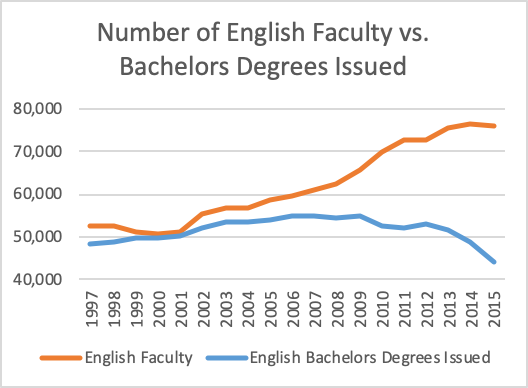
(Occupational Employment Survey, Bureau of Labor Statistics, 2015; Digest of Education Statistics, Section 325)
Once you look at IPEDS and other data, you realize how dangerous it is to rely on proxies like the number of jobs listed in the MLA, or the number of horror stories published at the Chronicle. This things are misleading. People are getting jobs, and supposedly embattled English has seen explosive growth in its employment despite demand for the English degrees dropping off a cliff.
COVID-19 is different, though. While education is a countercyclical product, enrollments are likely to drop. Many students refuse to settle for online education, which provides an inferior experience. There are few randomized control trials of online education, but the few there are suggest students indeed learn less, not that higher education is about learning anyway. Second, even though students are generally a very low risk group for COVID-19 (which we now know is significantly less dangerous than most of you thought back in March, when you were writing bizarre defenses on Facebook of improper research methods), many of their parents might keep them home. Fewer students means less money in the short term means budget crises means hiring freezes and cuts. (Don’t worry. The senior assistant vice dean of administrative administration won’t lose her job, but may have to take a pay cut.) It will be interesting to see what IPEDS and BLS end up showing us about academic employment during this time.
The post How Did the Great Recession Affect Academic Employment? appeared first on Bleeding Heart Libertarians.
]]>